June 2024: Paper 3

100 marks · 10 question parts · Paper, mark scheme and report on Pearson's site

Question by question

QTopicMarksAOType
1(a) Price, income and cross elasticities of demand 5AO1=2,AO2=2,AO3=1Short answer
1(b) Market failure and externalities 8AO1=2,AO2=2,AO3=2,AO4=2Extended response
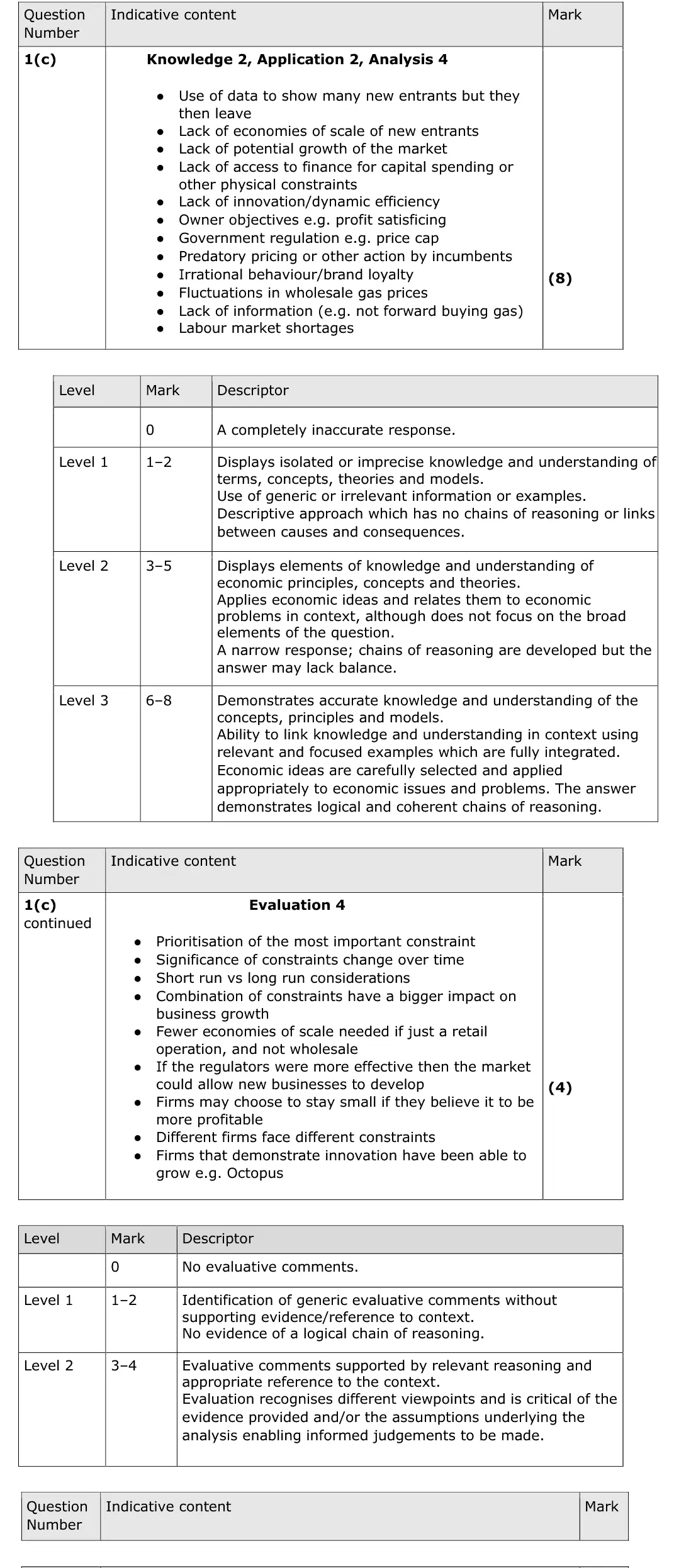
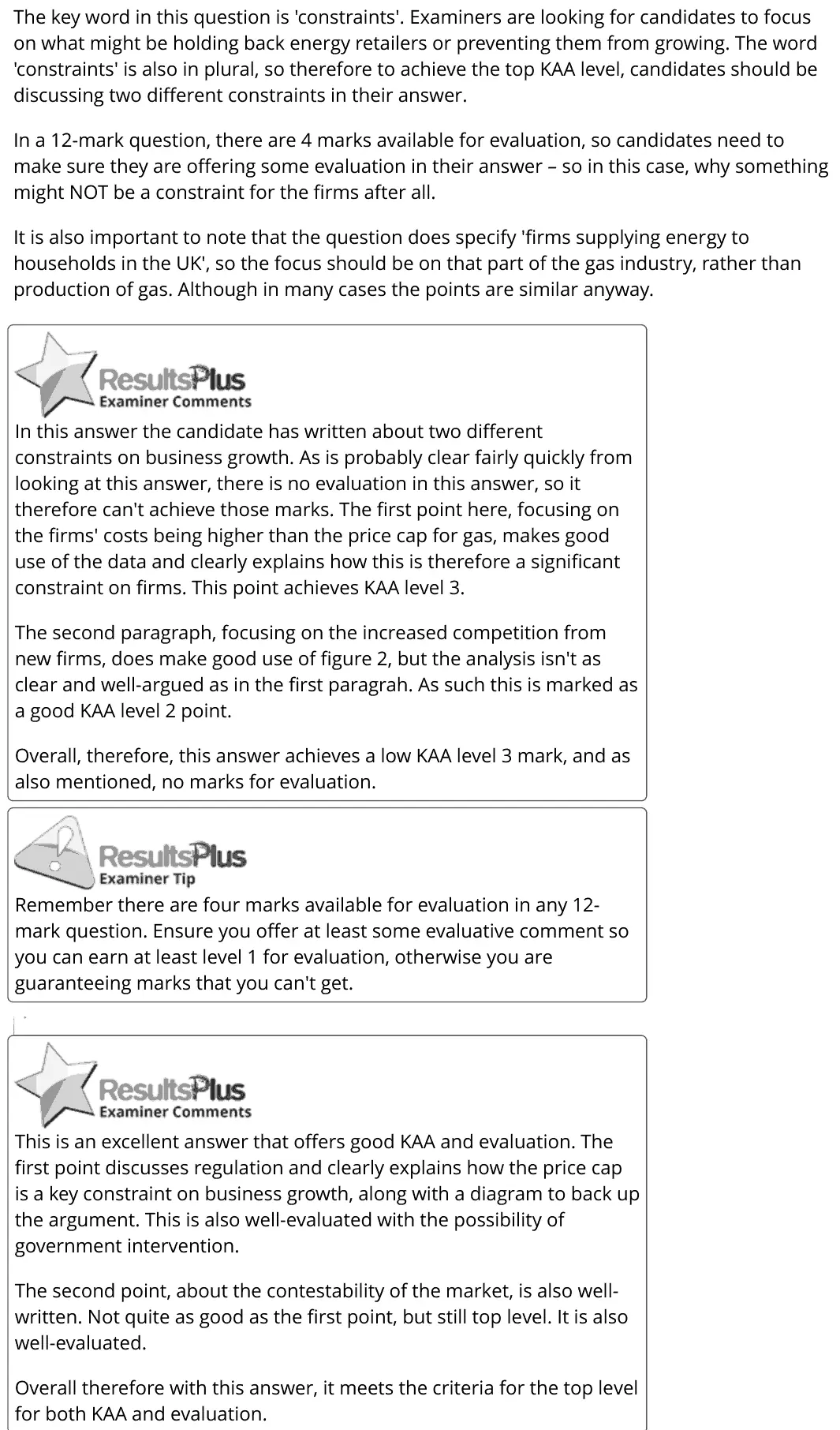
1(c) Business growth and business objectives 12AO1=2,AO2=2,AO3=4,AO4=4Extended response
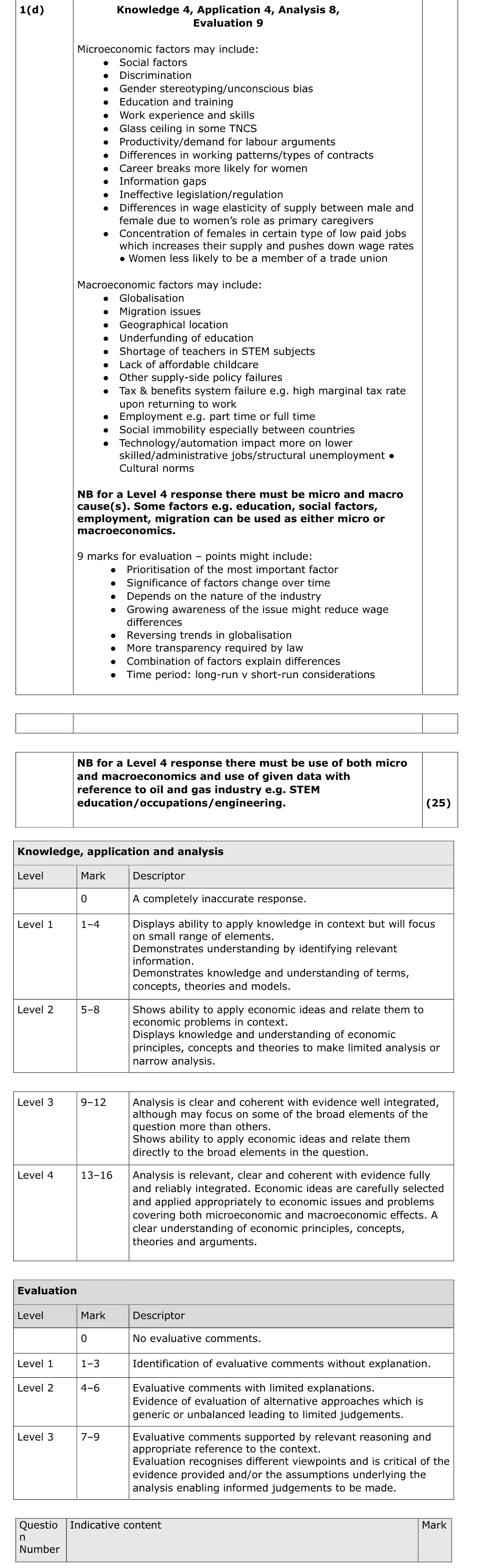
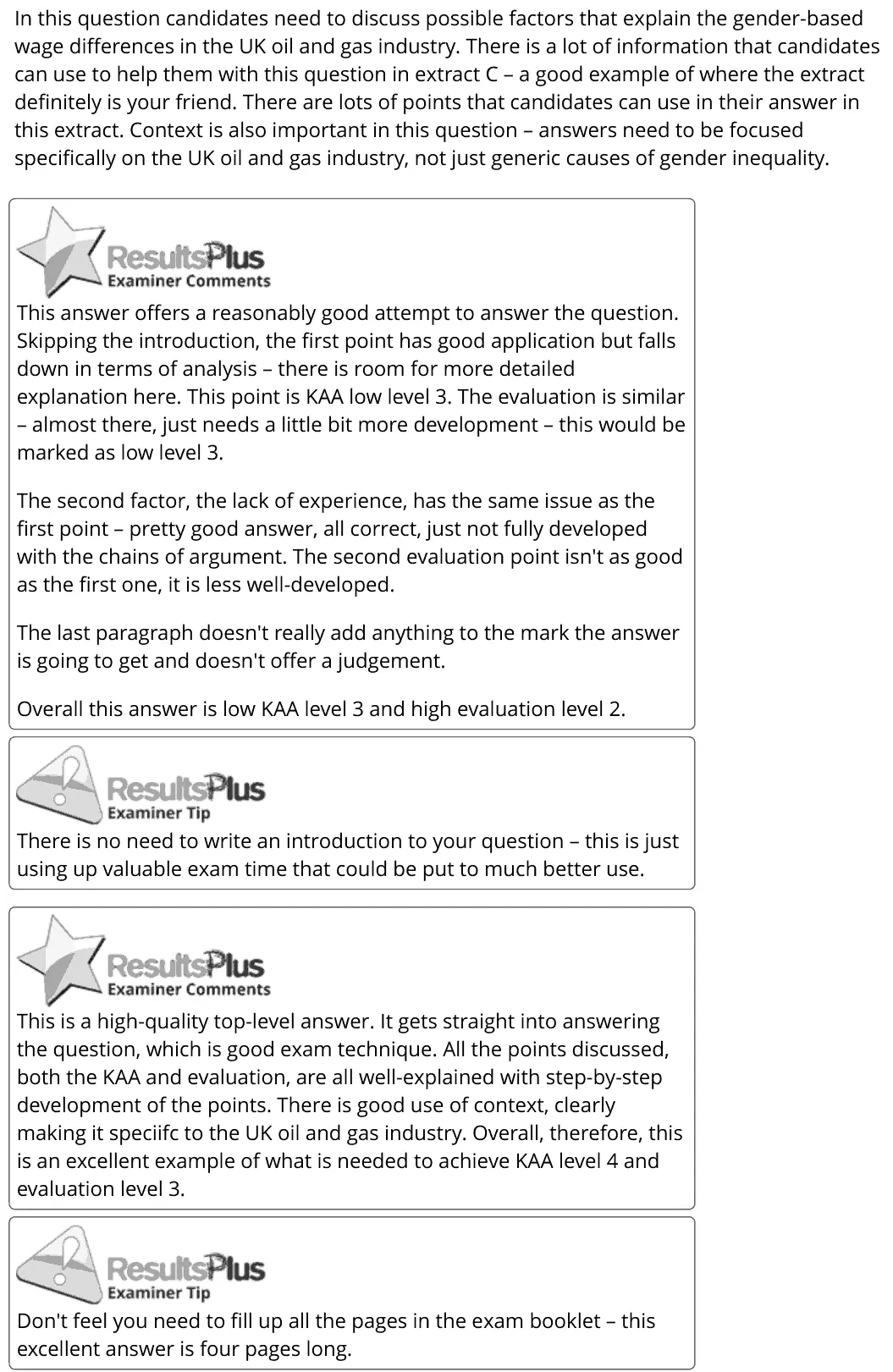
1(d) The labour market, Poverty and inequality 25AO1=4,AO2=4,AO3=8,AO4=9Essay
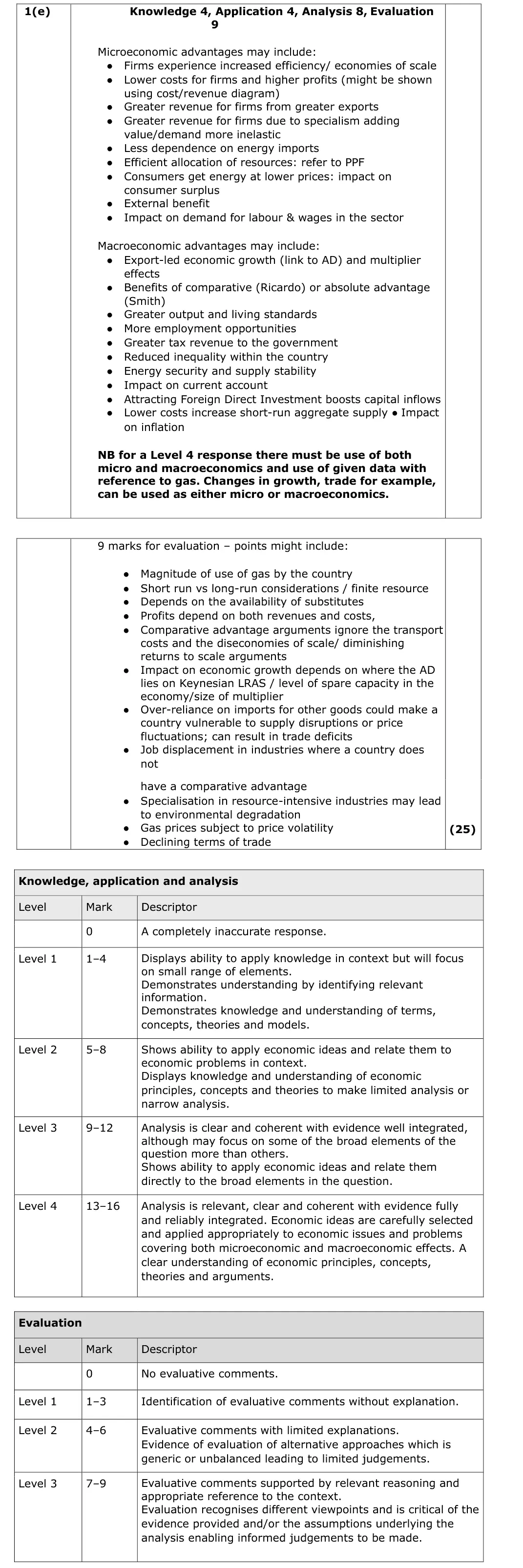
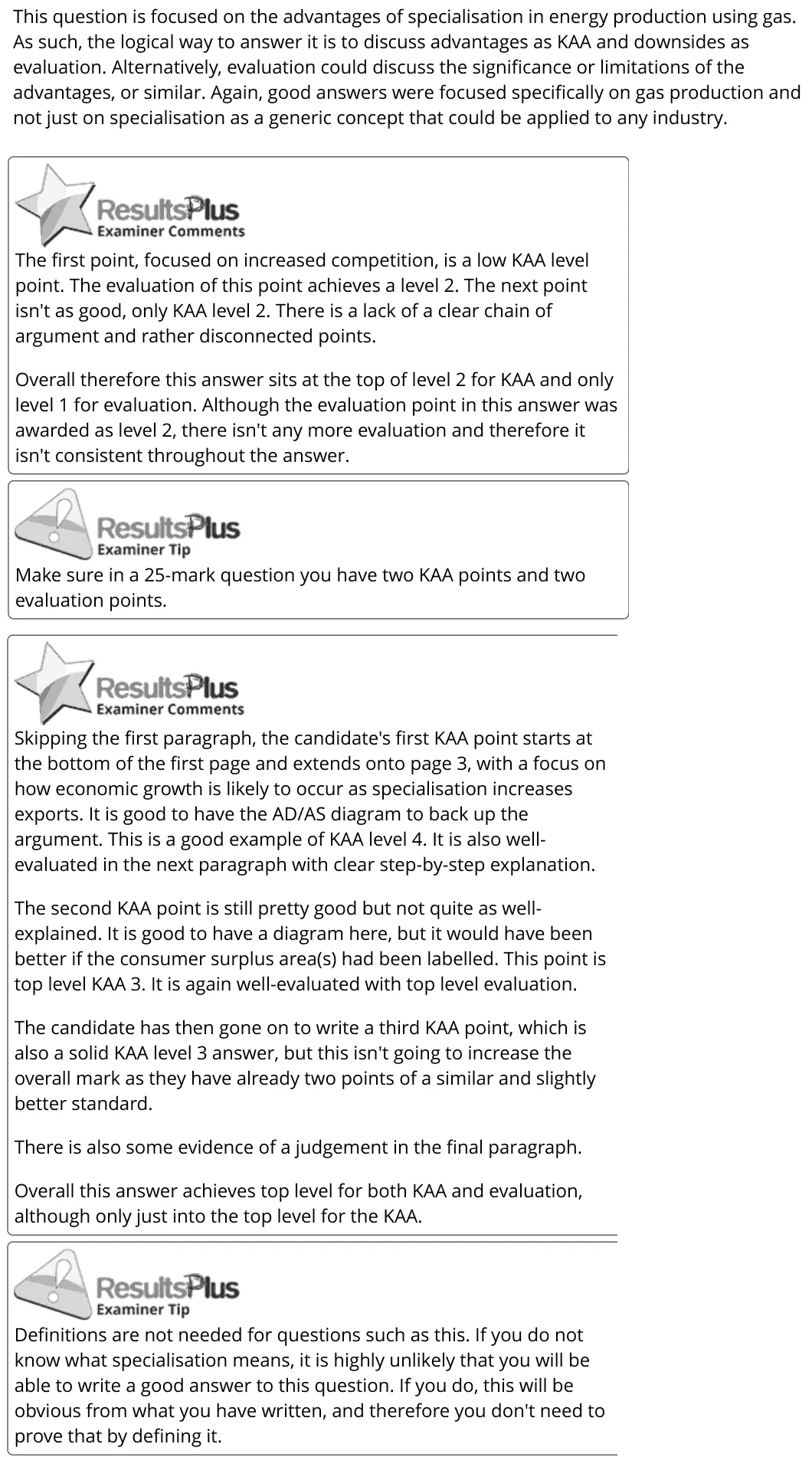
1(e) Specialisation and the division of labour, Globalisation, specialisation and trade 25AO1=4,AO2=4,AO3=8,AO4=9Essay
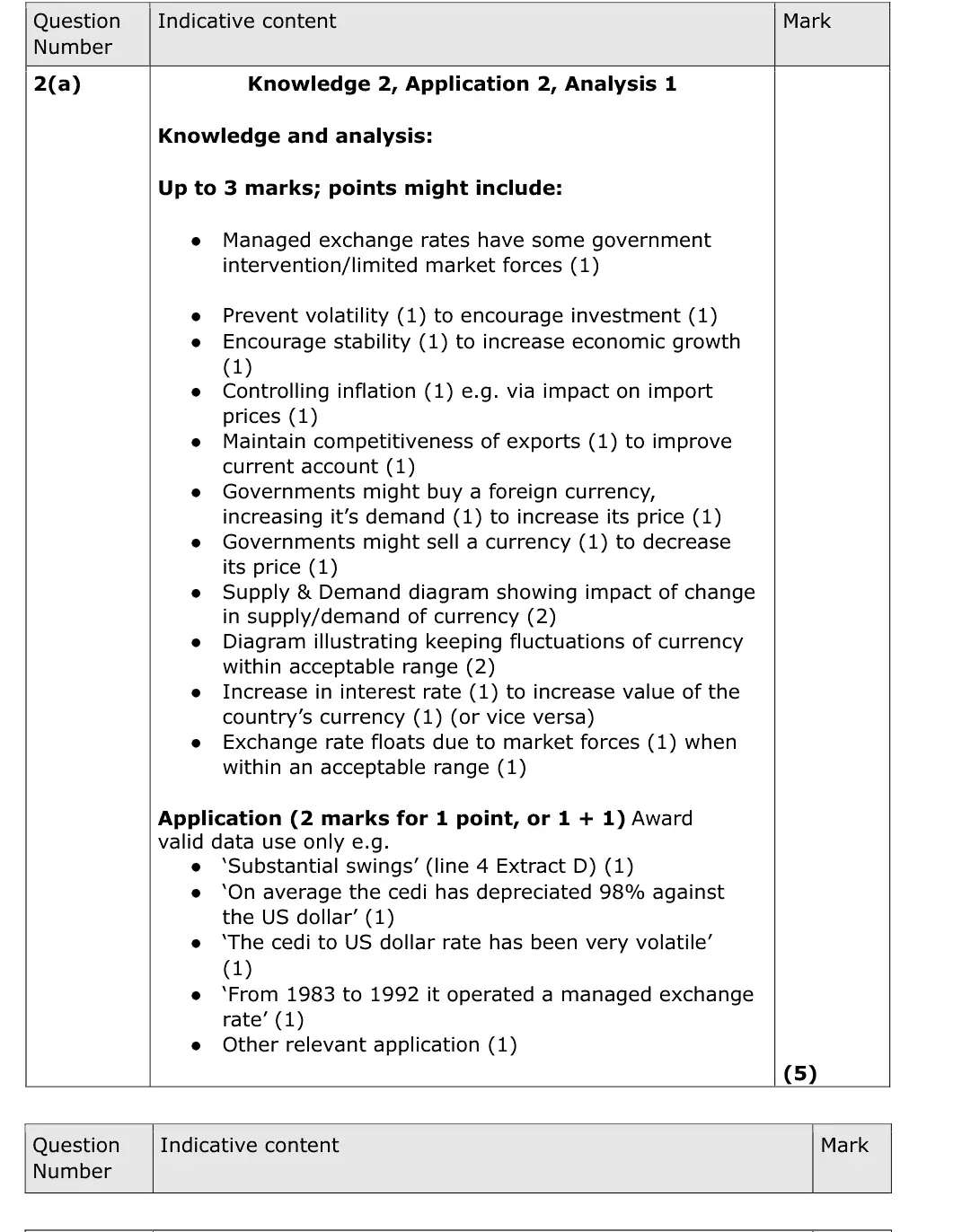
2(a) Exchange rates 5AO1=2,AO2=2,AO3=1Short answer
2(b) Emerging and developing economies 8AO1=2,AO2=2,AO3=2,AO4=2Extended response
2(c) Aggregate demand, The circular flow, national income and the multiplier 12AO1=2,AO2=2,AO3=4,AO4=4Extended response
2(d) Revenues, costs and profits, Demand-side policies: fiscal and monetary policy 25AO1=4,AO2=4,AO3=8,AO4=9Essay
2(e) Trading blocs, the WTO and protectionism, Revenues, costs and profits 25AO1=4,AO2=4,AO3=8,AO4=9Essay

The questions

1(a)1(b)1(c)1(d)1(e)2(a)2(b)2(c)2(d)2(e)
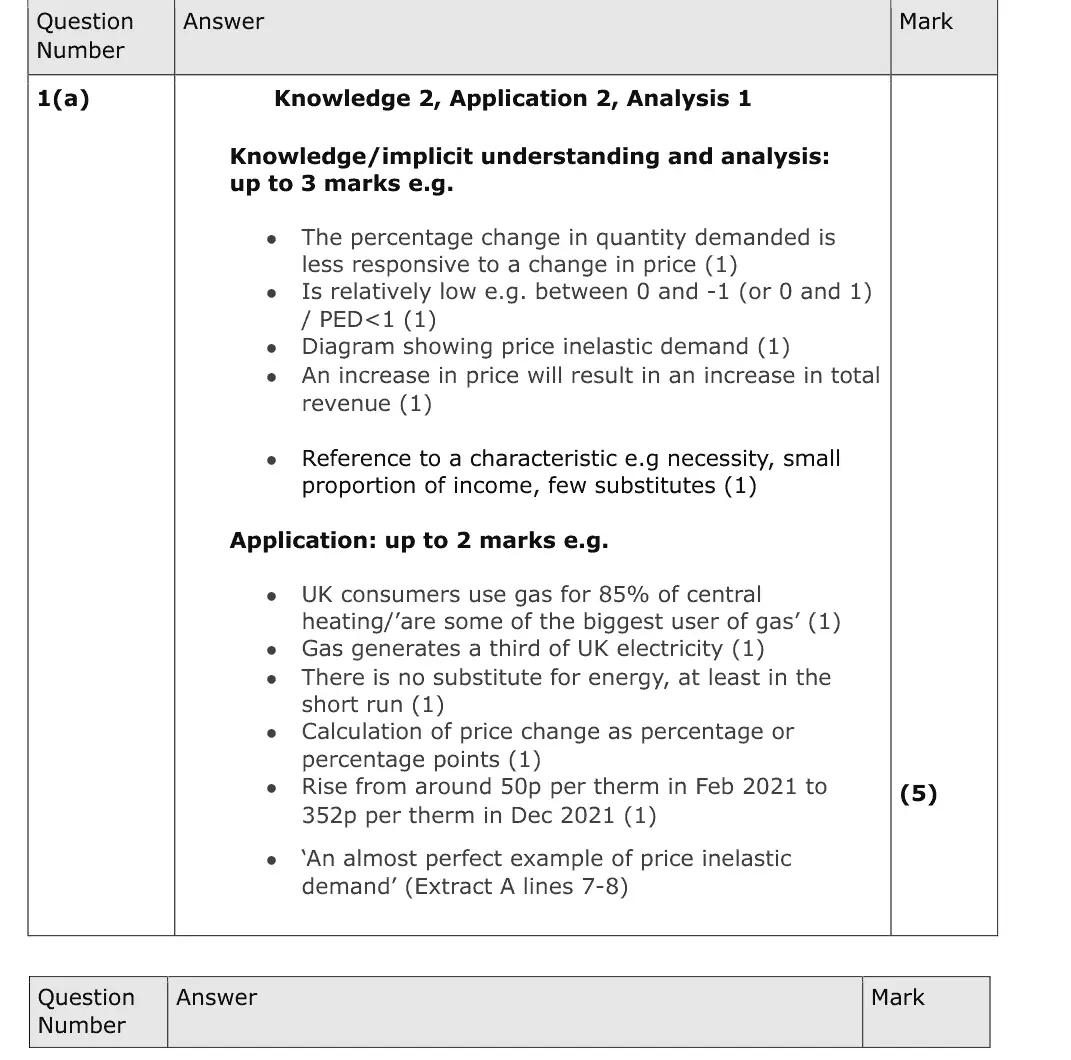
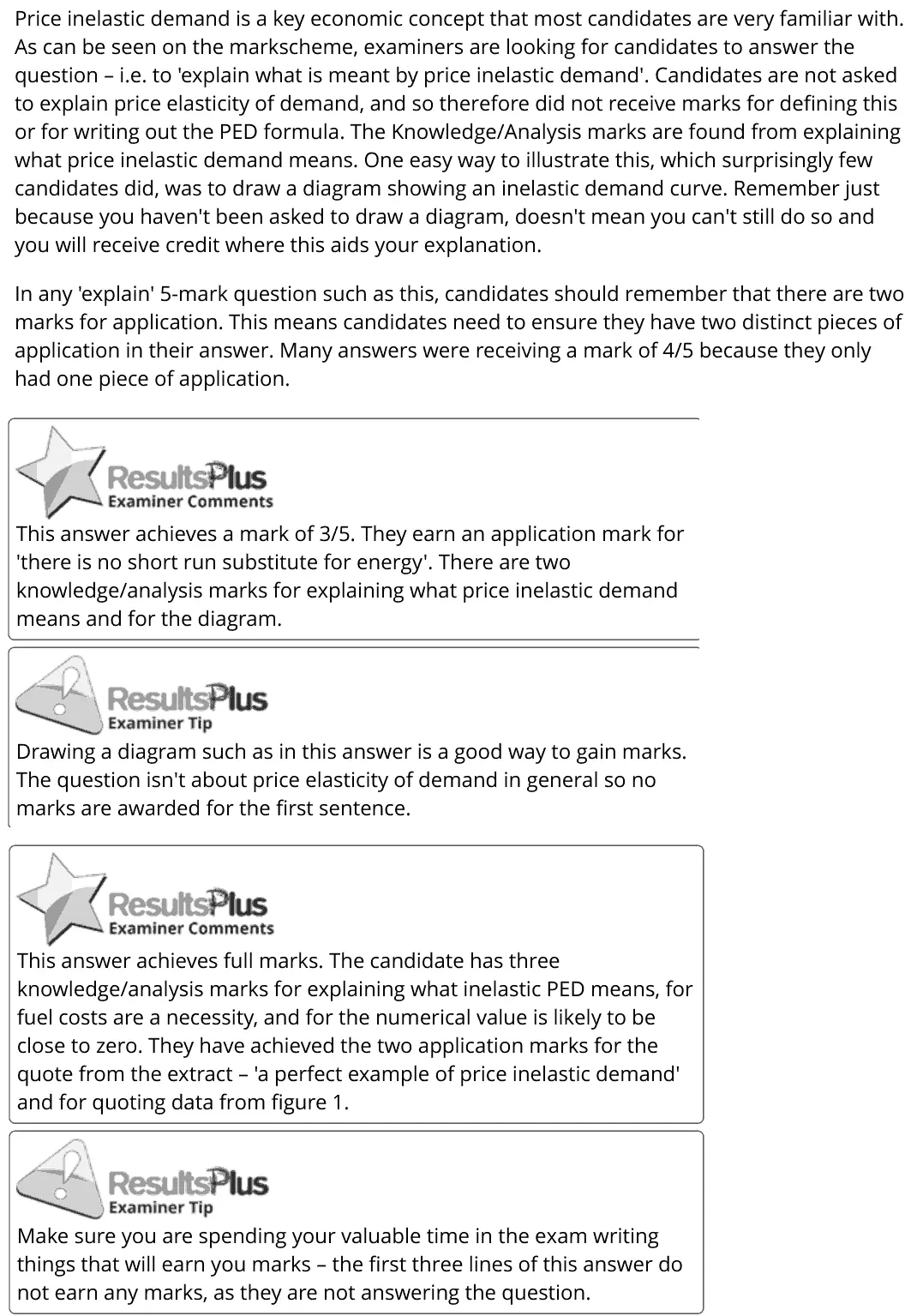
June 2024 · Paper 3 · Q1(a) 5 marks AO1=2, AO2=2, AO3=1 Short answer price elasticity of demand
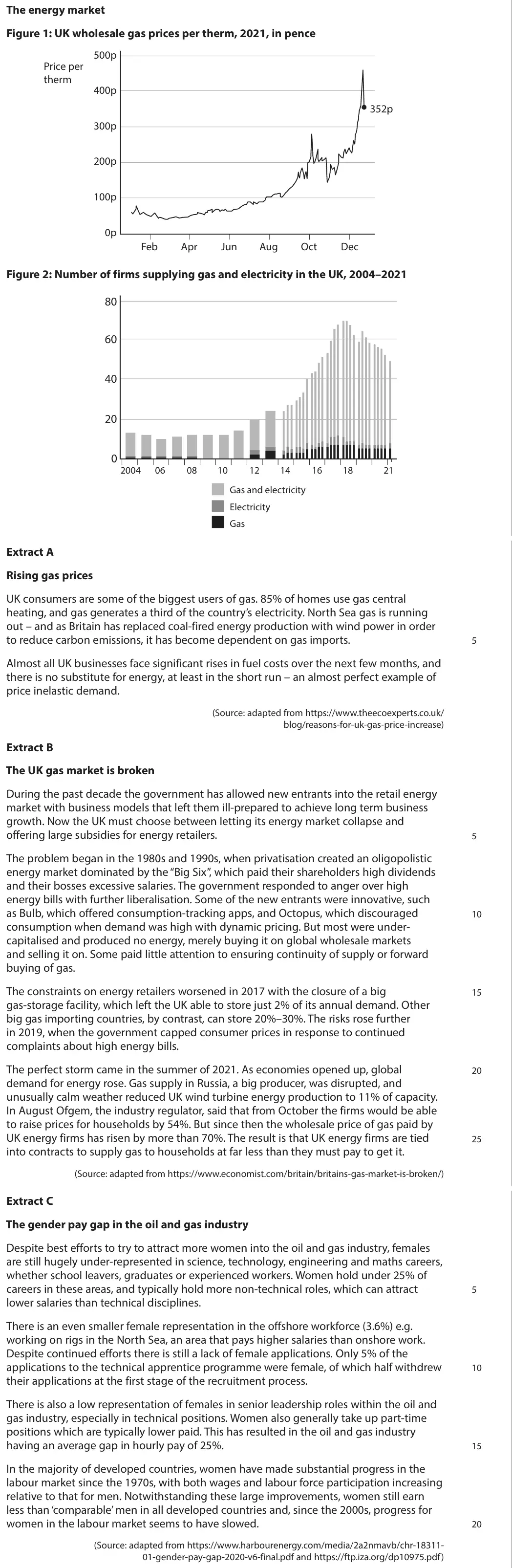
Data and extracts for question 1The energy market Figure 1: UK wholesale gas prices per therm, 2021, in pence 500p Price per therm 400p 352p 300p 200p 100p 0p Feb Apr Jun Aug Oct Dec Figure 2: Number of firms supplying gas and electricity in the UK, 2004–2021 80 60 40 20 0 2004 06 08 10 12 14 16 18 21 Gas and electricity Electricity Gas Extract A Rising gas prices UK consumers are some of the biggest users of gas. 85% of homes use gas central heating, and gas generates a third of the country’s electricity. North Sea gas is running out – and as Britain has replaced coal-fired energy production with wind power in order to reduce carbon emissions, it has become dependent on gas imports. 5 Almost all UK businesses face significant rises in fuel costs over the next few months, and there is no substitute for energy, at least in the short run – an almost perfect example of price inelastic demand. (Source: adapted from https://www.theecoexperts.co.uk/ blog/reasons-for-uk-gas-price-increase) Extract B The UK gas market is broken During the past decade the government has allowed new entrants into the retail energy market with business models that left them ill-prepared to achieve long term business growth. Now the UK must choose between letting its energy market collapse and offering large subsidies for energy retailers. 5 The problem began in the 1980s and 1990s, when privatisation created an oligopolistic energy market dominated by the “Big Six”, which paid their shareholders high dividends and their bosses excessive salaries. The government responded to anger over high energy bills with further liberalisation. Some of the new entrants were innovative, such as Bulb, which offered consumption-tracking apps, and Octopus, which discouraged 10 consumption when demand was high with dynamic pricing. But most were under- capitalised and produced no energy, merely buying it on global wholesale markets and selling it on. Some paid little attention to ensuring continuity of supply or forward buying of gas. The constraints on energy retailers worsened in 2017 with the closure of a big 15 gas-storage facility, which left the UK able to store just 2% of its annual demand. Other big gas importing countries, by contrast, can store 20%–30%. The risks rose further in 2019, when the government capped consumer prices in response to continued complaints about high energy bills. The perfect storm came in the summer of 2021. As economies opened up, global 20 demand for energy rose. Gas supply in Russia, a big producer, was disrupted, and unusually calm weather reduced UK wind turbine energy production to 11% of capacity. In August Ofgem, the industry regulator, said that from October the firms would be able to raise prices for households by 54%. But since then the wholesale price of gas paid by UK energy firms has risen by more than 70%. The result is that UK energy firms are tied 25 into contracts to supply gas to households at far less than they must pay to get it. (Source: adapted from https://www.economist.com/britain/britains-gas-market-is-broken/) Extract C The gender pay gap in the oil and gas industry Despite best efforts to try to attract more women into the oil and gas industry, females are still hugely under-represented in science, technology, engineering and maths careers, whether school leavers, graduates or experienced workers. Women hold under 25% of careers in these areas, and typically hold more non-technical roles, which can attract 5 lower salaries than technical disciplines. There is an even smaller female representation in the offshore workforce (3.6%) e.g. working on rigs in the North Sea, an area that pays higher salaries than onshore work. Despite continued efforts there is still a lack of female applications. Only 5% of the applications to the technical apprentice programme were female, of which half withdrew 10 their applications at the first stage of the recruitment process. There is also a low representation of females in senior leadership roles within the oil and gas industry, especially in technical positions. Women also generally take up part-time positions which are typically lower paid. This has resulted in the oil and gas industry having an average gap in hourly pay of 25%. 15 In the majority of developed countries, women have made substantial progress in the labour market since the 1970s, with both wages and labour force participation increasing relative to that for men. Notwithstanding these large improvements, women still earn less than ‘comparable’ men in all developed countries and, since the 2000s, progress for women in the labour market seems to have slowed. 20 (Source: adapted from https://www.harbourenergy.com/media/2a2nmavb/chr-18311- 01-gender-pay-gap-2020-v6-final.pdf and https://ftp.iza.org/dp10975.pdf)
(a) With reference to Figure 1 and Extract A, explain what is meant by ‘price inelastic demand’ (line 8). (5)
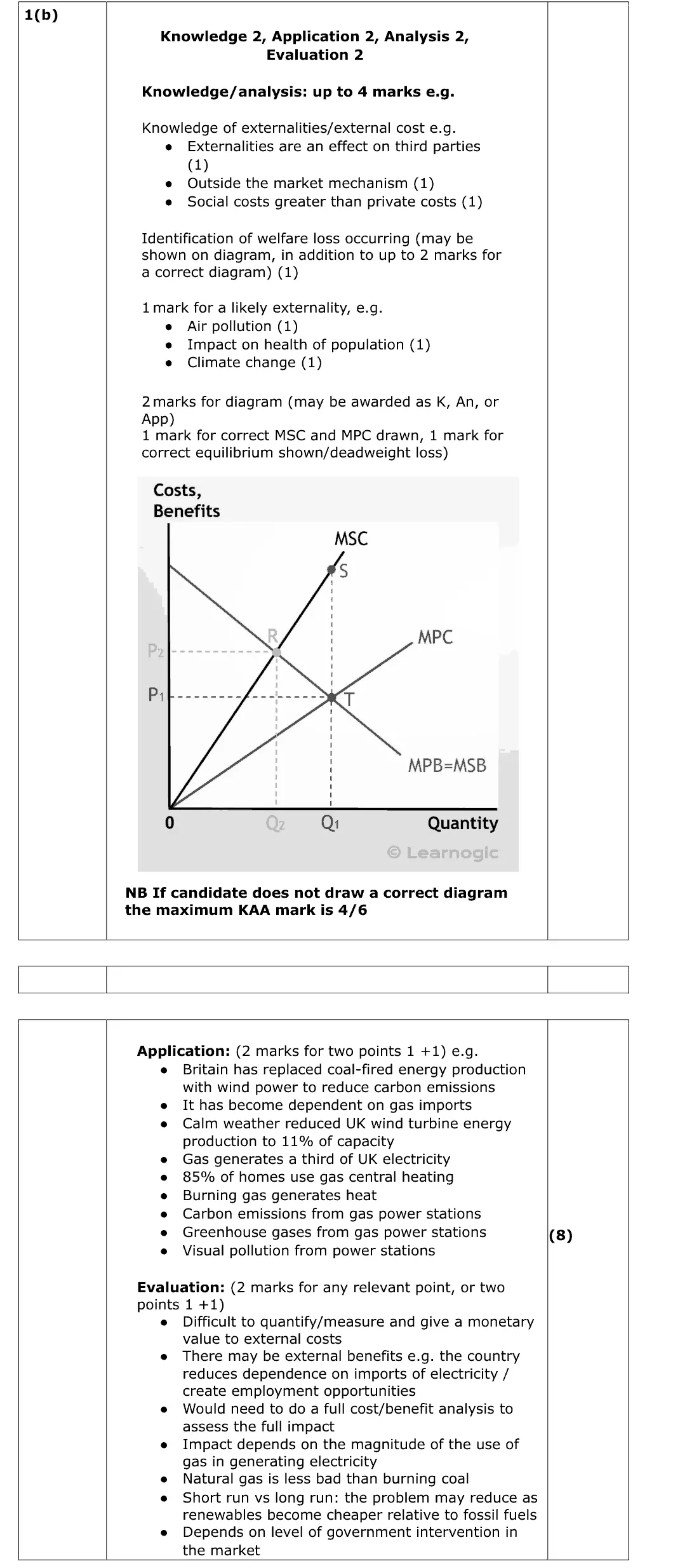
June 2024 · Paper 3 · Q1(b) 8 marks AO1=2, AO2=2, AO3=2, AO4=2 8-mark response externalities
Data and extracts for question 1The energy market Figure 1: UK wholesale gas prices per therm, 2021, in pence 500p Price per therm 400p 352p 300p 200p 100p 0p Feb Apr Jun Aug Oct Dec Figure 2: Number of firms supplying gas and electricity in the UK, 2004–2021 80 60 40 20 0 2004 06 08 10 12 14 16 18 21 Gas and electricity Electricity Gas Extract A Rising gas prices UK consumers are some of the biggest users of gas. 85% of homes use gas central heating, and gas generates a third of the country’s electricity. North Sea gas is running out – and as Britain has replaced coal-fired energy production with wind power in order to reduce carbon emissions, it has become dependent on gas imports. 5 Almost all UK businesses face significant rises in fuel costs over the next few months, and there is no substitute for energy, at least in the short run – an almost perfect example of price inelastic demand. (Source: adapted from https://www.theecoexperts.co.uk/ blog/reasons-for-uk-gas-price-increase) Extract B The UK gas market is broken During the past decade the government has allowed new entrants into the retail energy market with business models that left them ill-prepared to achieve long term business growth. Now the UK must choose between letting its energy market collapse and offering large subsidies for energy retailers. 5 The problem began in the 1980s and 1990s, when privatisation created an oligopolistic energy market dominated by the “Big Six”, which paid their shareholders high dividends and their bosses excessive salaries. The government responded to anger over high energy bills with further liberalisation. Some of the new entrants were innovative, such as Bulb, which offered consumption-tracking apps, and Octopus, which discouraged 10 consumption when demand was high with dynamic pricing. But most were under- capitalised and produced no energy, merely buying it on global wholesale markets and selling it on. Some paid little attention to ensuring continuity of supply or forward buying of gas. The constraints on energy retailers worsened in 2017 with the closure of a big 15 gas-storage facility, which left the UK able to store just 2% of its annual demand. Other big gas importing countries, by contrast, can store 20%–30%. The risks rose further in 2019, when the government capped consumer prices in response to continued complaints about high energy bills. The perfect storm came in the summer of 2021. As economies opened up, global 20 demand for energy rose. Gas supply in Russia, a big producer, was disrupted, and unusually calm weather reduced UK wind turbine energy production to 11% of capacity. In August Ofgem, the industry regulator, said that from October the firms would be able to raise prices for households by 54%. But since then the wholesale price of gas paid by UK energy firms has risen by more than 70%. The result is that UK energy firms are tied 25 into contracts to supply gas to households at far less than they must pay to get it. (Source: adapted from https://www.economist.com/britain/britains-gas-market-is-broken/) Extract C The gender pay gap in the oil and gas industry Despite best efforts to try to attract more women into the oil and gas industry, females are still hugely under-represented in science, technology, engineering and maths careers, whether school leavers, graduates or experienced workers. Women hold under 25% of careers in these areas, and typically hold more non-technical roles, which can attract 5 lower salaries than technical disciplines. There is an even smaller female representation in the offshore workforce (3.6%) e.g. working on rigs in the North Sea, an area that pays higher salaries than onshore work. Despite continued efforts there is still a lack of female applications. Only 5% of the applications to the technical apprentice programme were female, of which half withdrew 10 their applications at the first stage of the recruitment process. There is also a low representation of females in senior leadership roles within the oil and gas industry, especially in technical positions. Women also generally take up part-time positions which are typically lower paid. This has resulted in the oil and gas industry having an average gap in hourly pay of 25%. 15 In the majority of developed countries, women have made substantial progress in the labour market since the 1970s, with both wages and labour force participation increasing relative to that for men. Notwithstanding these large improvements, women still earn less than ‘comparable’ men in all developed countries and, since the 2000s, progress for women in the labour market seems to have slowed. 20 (Source: adapted from https://www.harbourenergy.com/media/2a2nmavb/chr-18311- 01-gender-pay-gap-2020-v6-final.pdf and https://ftp.iza.org/dp10975.pdf)
(b) Examine one likely externality that arises when a producer generates electricity by burning gas. Use a diagram to show the external costs of production. (8)
June 2024 · Paper 3 · Q1(c) 12 marks AO1=2, AO2=2, AO3=4, AO4=4 12-mark response business growth and objectives
Data and extracts for question 1The energy market Figure 1: UK wholesale gas prices per therm, 2021, in pence 500p Price per therm 400p 352p 300p 200p 100p 0p Feb Apr Jun Aug Oct Dec Figure 2: Number of firms supplying gas and electricity in the UK, 2004–2021 80 60 40 20 0 2004 06 08 10 12 14 16 18 21 Gas and electricity Electricity Gas Extract A Rising gas prices UK consumers are some of the biggest users of gas. 85% of homes use gas central heating, and gas generates a third of the country’s electricity. North Sea gas is running out – and as Britain has replaced coal-fired energy production with wind power in order to reduce carbon emissions, it has become dependent on gas imports. 5 Almost all UK businesses face significant rises in fuel costs over the next few months, and there is no substitute for energy, at least in the short run – an almost perfect example of price inelastic demand. (Source: adapted from https://www.theecoexperts.co.uk/ blog/reasons-for-uk-gas-price-increase) Extract B The UK gas market is broken During the past decade the government has allowed new entrants into the retail energy market with business models that left them ill-prepared to achieve long term business growth. Now the UK must choose between letting its energy market collapse and offering large subsidies for energy retailers. 5 The problem began in the 1980s and 1990s, when privatisation created an oligopolistic energy market dominated by the “Big Six”, which paid their shareholders high dividends and their bosses excessive salaries. The government responded to anger over high energy bills with further liberalisation. Some of the new entrants were innovative, such as Bulb, which offered consumption-tracking apps, and Octopus, which discouraged 10 consumption when demand was high with dynamic pricing. But most were under- capitalised and produced no energy, merely buying it on global wholesale markets and selling it on. Some paid little attention to ensuring continuity of supply or forward buying of gas. The constraints on energy retailers worsened in 2017 with the closure of a big 15 gas-storage facility, which left the UK able to store just 2% of its annual demand. Other big gas importing countries, by contrast, can store 20%–30%. The risks rose further in 2019, when the government capped consumer prices in response to continued complaints about high energy bills. The perfect storm came in the summer of 2021. As economies opened up, global 20 demand for energy rose. Gas supply in Russia, a big producer, was disrupted, and unusually calm weather reduced UK wind turbine energy production to 11% of capacity. In August Ofgem, the industry regulator, said that from October the firms would be able to raise prices for households by 54%. But since then the wholesale price of gas paid by UK energy firms has risen by more than 70%. The result is that UK energy firms are tied 25 into contracts to supply gas to households at far less than they must pay to get it. (Source: adapted from https://www.economist.com/britain/britains-gas-market-is-broken/) Extract C The gender pay gap in the oil and gas industry Despite best efforts to try to attract more women into the oil and gas industry, females are still hugely under-represented in science, technology, engineering and maths careers, whether school leavers, graduates or experienced workers. Women hold under 25% of careers in these areas, and typically hold more non-technical roles, which can attract 5 lower salaries than technical disciplines. There is an even smaller female representation in the offshore workforce (3.6%) e.g. working on rigs in the North Sea, an area that pays higher salaries than onshore work. Despite continued efforts there is still a lack of female applications. Only 5% of the applications to the technical apprentice programme were female, of which half withdrew 10 their applications at the first stage of the recruitment process. There is also a low representation of females in senior leadership roles within the oil and gas industry, especially in technical positions. Women also generally take up part-time positions which are typically lower paid. This has resulted in the oil and gas industry having an average gap in hourly pay of 25%. 15 In the majority of developed countries, women have made substantial progress in the labour market since the 1970s, with both wages and labour force participation increasing relative to that for men. Notwithstanding these large improvements, women still earn less than ‘comparable’ men in all developed countries and, since the 2000s, progress for women in the labour market seems to have slowed. 20 (Source: adapted from https://www.harbourenergy.com/media/2a2nmavb/chr-18311- 01-gender-pay-gap-2020-v6-final.pdf and https://ftp.iza.org/dp10975.pdf)
(c) With reference to Figure 2 and Extract B, discuss the possible constraints on business growth for firms supplying energy to households in the UK. (12)
June 2024 · Paper 3 · Q1(d) 25 marks AO1=4, AO2=4, AO3=8, AO4=9 25-mark essay Either/or labour marketpoverty and inequality
Data and extracts for question 1The energy market Figure 1: UK wholesale gas prices per therm, 2021, in pence 500p Price per therm 400p 352p 300p 200p 100p 0p Feb Apr Jun Aug Oct Dec Figure 2: Number of firms supplying gas and electricity in the UK, 2004–2021 80 60 40 20 0 2004 06 08 10 12 14 16 18 21 Gas and electricity Electricity Gas Extract A Rising gas prices UK consumers are some of the biggest users of gas. 85% of homes use gas central heating, and gas generates a third of the country’s electricity. North Sea gas is running out – and as Britain has replaced coal-fired energy production with wind power in order to reduce carbon emissions, it has become dependent on gas imports. 5 Almost all UK businesses face significant rises in fuel costs over the next few months, and there is no substitute for energy, at least in the short run – an almost perfect example of price inelastic demand. (Source: adapted from https://www.theecoexperts.co.uk/ blog/reasons-for-uk-gas-price-increase) Extract B The UK gas market is broken During the past decade the government has allowed new entrants into the retail energy market with business models that left them ill-prepared to achieve long term business growth. Now the UK must choose between letting its energy market collapse and offering large subsidies for energy retailers. 5 The problem began in the 1980s and 1990s, when privatisation created an oligopolistic energy market dominated by the “Big Six”, which paid their shareholders high dividends and their bosses excessive salaries. The government responded to anger over high energy bills with further liberalisation. Some of the new entrants were innovative, such as Bulb, which offered consumption-tracking apps, and Octopus, which discouraged 10 consumption when demand was high with dynamic pricing. But most were under- capitalised and produced no energy, merely buying it on global wholesale markets and selling it on. Some paid little attention to ensuring continuity of supply or forward buying of gas. The constraints on energy retailers worsened in 2017 with the closure of a big 15 gas-storage facility, which left the UK able to store just 2% of its annual demand. Other big gas importing countries, by contrast, can store 20%–30%. The risks rose further in 2019, when the government capped consumer prices in response to continued complaints about high energy bills. The perfect storm came in the summer of 2021. As economies opened up, global 20 demand for energy rose. Gas supply in Russia, a big producer, was disrupted, and unusually calm weather reduced UK wind turbine energy production to 11% of capacity. In August Ofgem, the industry regulator, said that from October the firms would be able to raise prices for households by 54%. But since then the wholesale price of gas paid by UK energy firms has risen by more than 70%. The result is that UK energy firms are tied 25 into contracts to supply gas to households at far less than they must pay to get it. (Source: adapted from https://www.economist.com/britain/britains-gas-market-is-broken/) Extract C The gender pay gap in the oil and gas industry Despite best efforts to try to attract more women into the oil and gas industry, females are still hugely under-represented in science, technology, engineering and maths careers, whether school leavers, graduates or experienced workers. Women hold under 25% of careers in these areas, and typically hold more non-technical roles, which can attract 5 lower salaries than technical disciplines. There is an even smaller female representation in the offshore workforce (3.6%) e.g. working on rigs in the North Sea, an area that pays higher salaries than onshore work. Despite continued efforts there is still a lack of female applications. Only 5% of the applications to the technical apprentice programme were female, of which half withdrew 10 their applications at the first stage of the recruitment process. There is also a low representation of females in senior leadership roles within the oil and gas industry, especially in technical positions. Women also generally take up part-time positions which are typically lower paid. This has resulted in the oil and gas industry having an average gap in hourly pay of 25%. 15 In the majority of developed countries, women have made substantial progress in the labour market since the 1970s, with both wages and labour force participation increasing relative to that for men. Notwithstanding these large improvements, women still earn less than ‘comparable’ men in all developed countries and, since the 2000s, progress for women in the labour market seems to have slowed. 20 (Source: adapted from https://www.harbourenergy.com/media/2a2nmavb/chr-18311- 01-gender-pay-gap-2020-v6-final.pdf and https://ftp.iza.org/dp10975.pdf)
(d) Evaluate the microeconomic and macroeconomic factors that explain gender-based wage differences in the UK oil and gas industry. (25)
June 2024 · Paper 3 · Q1(e) 25 marks AO1=4, AO2=4, AO3=8, AO4=9 25-mark essay Either/or specialisation and division of labourglobalisation and trade
Data and extracts for question 1The energy market Figure 1: UK wholesale gas prices per therm, 2021, in pence 500p Price per therm 400p 352p 300p 200p 100p 0p Feb Apr Jun Aug Oct Dec Figure 2: Number of firms supplying gas and electricity in the UK, 2004–2021 80 60 40 20 0 2004 06 08 10 12 14 16 18 21 Gas and electricity Electricity Gas Extract A Rising gas prices UK consumers are some of the biggest users of gas. 85% of homes use gas central heating, and gas generates a third of the country’s electricity. North Sea gas is running out – and as Britain has replaced coal-fired energy production with wind power in order to reduce carbon emissions, it has become dependent on gas imports. 5 Almost all UK businesses face significant rises in fuel costs over the next few months, and there is no substitute for energy, at least in the short run – an almost perfect example of price inelastic demand. (Source: adapted from https://www.theecoexperts.co.uk/ blog/reasons-for-uk-gas-price-increase) Extract B The UK gas market is broken During the past decade the government has allowed new entrants into the retail energy market with business models that left them ill-prepared to achieve long term business growth. Now the UK must choose between letting its energy market collapse and offering large subsidies for energy retailers. 5 The problem began in the 1980s and 1990s, when privatisation created an oligopolistic energy market dominated by the “Big Six”, which paid their shareholders high dividends and their bosses excessive salaries. The government responded to anger over high energy bills with further liberalisation. Some of the new entrants were innovative, such as Bulb, which offered consumption-tracking apps, and Octopus, which discouraged 10 consumption when demand was high with dynamic pricing. But most were under- capitalised and produced no energy, merely buying it on global wholesale markets and selling it on. Some paid little attention to ensuring continuity of supply or forward buying of gas. The constraints on energy retailers worsened in 2017 with the closure of a big 15 gas-storage facility, which left the UK able to store just 2% of its annual demand. Other big gas importing countries, by contrast, can store 20%–30%. The risks rose further in 2019, when the government capped consumer prices in response to continued complaints about high energy bills. The perfect storm came in the summer of 2021. As economies opened up, global 20 demand for energy rose. Gas supply in Russia, a big producer, was disrupted, and unusually calm weather reduced UK wind turbine energy production to 11% of capacity. In August Ofgem, the industry regulator, said that from October the firms would be able to raise prices for households by 54%. But since then the wholesale price of gas paid by UK energy firms has risen by more than 70%. The result is that UK energy firms are tied 25 into contracts to supply gas to households at far less than they must pay to get it. (Source: adapted from https://www.economist.com/britain/britains-gas-market-is-broken/) Extract C The gender pay gap in the oil and gas industry Despite best efforts to try to attract more women into the oil and gas industry, females are still hugely under-represented in science, technology, engineering and maths careers, whether school leavers, graduates or experienced workers. Women hold under 25% of careers in these areas, and typically hold more non-technical roles, which can attract 5 lower salaries than technical disciplines. There is an even smaller female representation in the offshore workforce (3.6%) e.g. working on rigs in the North Sea, an area that pays higher salaries than onshore work. Despite continued efforts there is still a lack of female applications. Only 5% of the applications to the technical apprentice programme were female, of which half withdrew 10 their applications at the first stage of the recruitment process. There is also a low representation of females in senior leadership roles within the oil and gas industry, especially in technical positions. Women also generally take up part-time positions which are typically lower paid. This has resulted in the oil and gas industry having an average gap in hourly pay of 25%. 15 In the majority of developed countries, women have made substantial progress in the labour market since the 1970s, with both wages and labour force participation increasing relative to that for men. Notwithstanding these large improvements, women still earn less than ‘comparable’ men in all developed countries and, since the 2000s, progress for women in the labour market seems to have slowed. 20 (Source: adapted from https://www.harbourenergy.com/media/2a2nmavb/chr-18311- 01-gender-pay-gap-2020-v6-final.pdf and https://ftp.iza.org/dp10975.pdf)
(e) Evaluate the microeconomic and macroeconomic advantages for a country specialising in energy production using gas. (25)
June 2024 · Paper 3 · Q2(a) 5 marks AO1=2, AO2=2, AO3=1 Short answer exchange rates
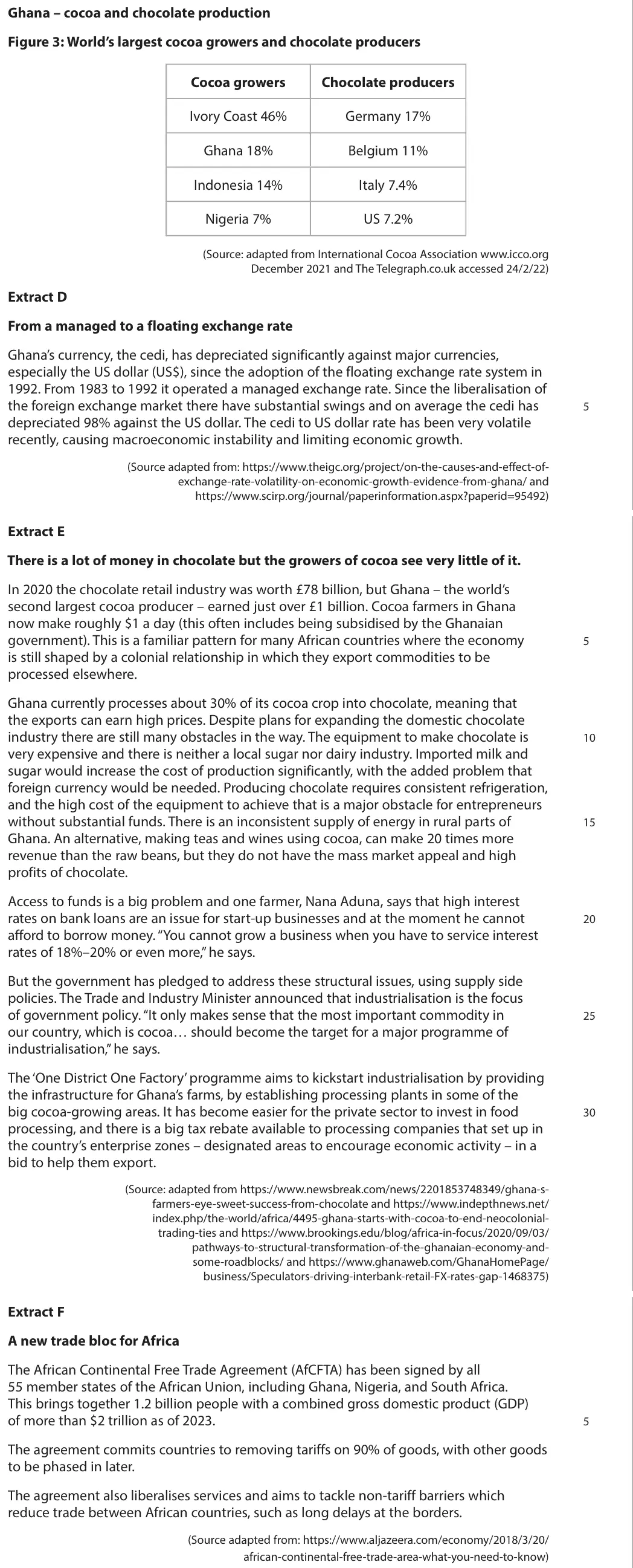
Data and extracts for question 2Ghana – cocoa and chocolate production Figure 3: World’s largest cocoa growers and chocolate producers Cocoa growers Chocolate producers Ivory Coast 46% Germany 17% Ghana 18% Belgium 11% Indonesia 14% Italy 7.4% Nigeria 7% US 7.2% (Source: adapted from International Cocoa Association www.icco.org December 2021 and The Telegraph.co.uk accessed 24/2/22) Extract D From a managed to a floating exchange rate Ghana’s currency, the cedi, has depreciated significantly against major currencies, especially the US dollar (US$), since the adoption of the floating exchange rate system in 1992. From 1983 to 1992 it operated a managed exchange rate. Since the liberalisation of the foreign exchange market there have substantial swings and on average the cedi has 5 depreciated 98% against the US dollar. The cedi to US dollar rate has been very volatile recently, causing macroeconomic instability and limiting economic growth. (Source adapted from: https://www.theigc.org/project/on-the-causes-and-effect-of- exchange-rate-volatility-on-economic-growth-evidence-from-ghana/ and https://www.scirp.org/journal/paperinformation.aspx?paperid=95492) Extract E There is a lot of money in chocolate but the growers of cocoa see very little of it. In 2020 the chocolate retail industry was worth £78 billion, but Ghana – the world’s second largest cocoa producer – earned just over £1 billion. Cocoa farmers in Ghana now make roughly $1 a day (this often includes being subsidised by the Ghanaian government). This is a familiar pattern for many African countries where the economy 5 is still shaped by a colonial relationship in which they export commodities to be processed elsewhere. Ghana currently processes about 30% of its cocoa crop into chocolate, meaning that the exports can earn high prices. Despite plans for expanding the domestic chocolate industry there are still many obstacles in the way. The equipment to make chocolate is 10 very expensive and there is neither a local sugar nor dairy industry. Imported milk and sugar would increase the cost of production significantly, with the added problem that foreign currency would be needed. Producing chocolate requires consistent refrigeration, and the high cost of the equipment to achieve that is a major obstacle for entrepreneurs without substantial funds. There is an inconsistent supply of energy in rural parts of 15 Ghana. An alternative, making teas and wines using cocoa, can make 20 times more revenue than the raw beans, but they do not have the mass market appeal and high profits of chocolate. Access to funds is a big problem and one farmer, Nana Aduna, says that high interest rates on bank loans are an issue for start-up businesses and at the moment he cannot 20 afford to borrow money. “You cannot grow a business when you have to service interest rates of 18%–20% or even more,” he says. But the government has pledged to address these structural issues, using supply side policies. The Trade and Industry Minister announced that industrialisation is the focus of government policy. “It only makes sense that the most important commodity in 25 our country, which is cocoa… should become the target for a major programme of industrialisation,” he says. The ‘One District One Factory’ programme aims to kickstart industrialisation by providing the infrastructure for Ghana’s farms, by establishing processing plants in some of the big cocoa-growing areas. It has become easier for the private sector to invest in food 30 processing, and there is a big tax rebate available to processing companies that set up in the country’s enterprise zones – designated areas to encourage economic activity – in a bid to help them export. (Source: adapted from https://www.newsbreak.com/news/2201853748349/ghana-s- farmers-eye-sweet-success-from-chocolate and https://www.indepthnews.net/ index.php/the-world/africa/4495-ghana-starts-with-cocoa-to-end-neocolonial- trading-ties and https://www.brookings.edu/blog/africa-in-focus/2020/09/03/ pathways-to-structural-transformation-of-the-ghanaian-economy-and- some-roadblocks/ and https://www.ghanaweb.com/GhanaHomePage/ business/Speculators-driving-interbank-retail-FX-rates-gap-1468375) Extract F A new trade bloc for Africa The African Continental Free Trade Agreement (AfCFTA) has been signed by all 55 member states of the African Union, including Ghana, Nigeria, and South Africa. This brings together 1.2 billion people with a combined gross domestic product (GDP) of more than $2 trillion as of 2023. 5 The agreement commits countries to removing tariffs on 90% of goods, with other goods to be phased in later. The agreement also liberalises services and aims to tackle non-tariff barriers which reduce trade between African countries, such as long delays at the borders. (Source adapted from: https://www.aljazeera.com/economy/2018/3/20/ african-continental-free-trade-area-what-you-need-to-know)
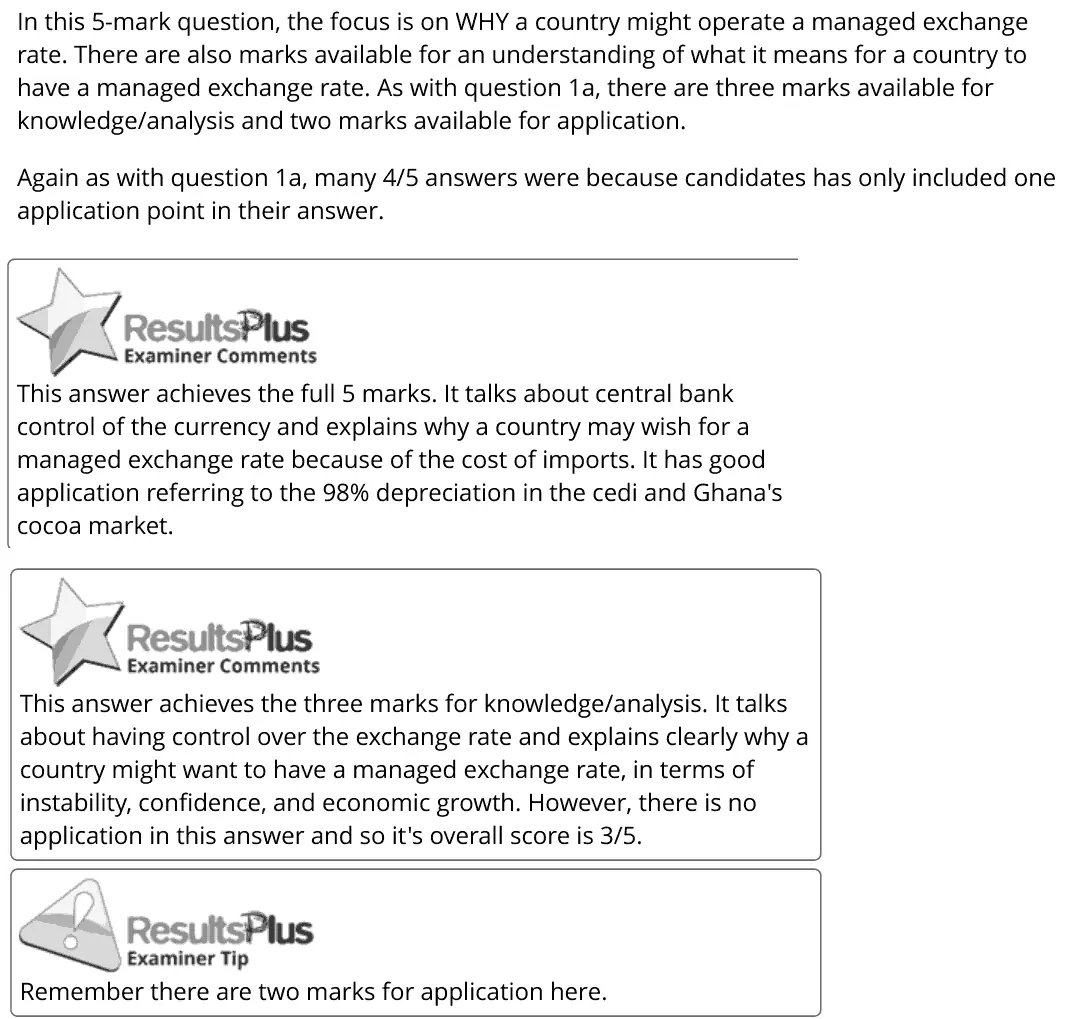
(a) Explain one reason why a country might operate a managed exchange rate. Refer to Extract D in your answer. (5)
June 2024 · Paper 3 · Q2(b) 8 marks AO1=2, AO2=2, AO3=2, AO4=2 8-mark response emerging and developing economies
Data and extracts for question 2Ghana – cocoa and chocolate production Figure 3: World’s largest cocoa growers and chocolate producers Cocoa growers Chocolate producers Ivory Coast 46% Germany 17% Ghana 18% Belgium 11% Indonesia 14% Italy 7.4% Nigeria 7% US 7.2% (Source: adapted from International Cocoa Association www.icco.org December 2021 and The Telegraph.co.uk accessed 24/2/22) Extract D From a managed to a floating exchange rate Ghana’s currency, the cedi, has depreciated significantly against major currencies, especially the US dollar (US$), since the adoption of the floating exchange rate system in 1992. From 1983 to 1992 it operated a managed exchange rate. Since the liberalisation of the foreign exchange market there have substantial swings and on average the cedi has 5 depreciated 98% against the US dollar. The cedi to US dollar rate has been very volatile recently, causing macroeconomic instability and limiting economic growth. (Source adapted from: https://www.theigc.org/project/on-the-causes-and-effect-of- exchange-rate-volatility-on-economic-growth-evidence-from-ghana/ and https://www.scirp.org/journal/paperinformation.aspx?paperid=95492) Extract E There is a lot of money in chocolate but the growers of cocoa see very little of it. In 2020 the chocolate retail industry was worth £78 billion, but Ghana – the world’s second largest cocoa producer – earned just over £1 billion. Cocoa farmers in Ghana now make roughly $1 a day (this often includes being subsidised by the Ghanaian government). This is a familiar pattern for many African countries where the economy 5 is still shaped by a colonial relationship in which they export commodities to be processed elsewhere. Ghana currently processes about 30% of its cocoa crop into chocolate, meaning that the exports can earn high prices. Despite plans for expanding the domestic chocolate industry there are still many obstacles in the way. The equipment to make chocolate is 10 very expensive and there is neither a local sugar nor dairy industry. Imported milk and sugar would increase the cost of production significantly, with the added problem that foreign currency would be needed. Producing chocolate requires consistent refrigeration, and the high cost of the equipment to achieve that is a major obstacle for entrepreneurs without substantial funds. There is an inconsistent supply of energy in rural parts of 15 Ghana. An alternative, making teas and wines using cocoa, can make 20 times more revenue than the raw beans, but they do not have the mass market appeal and high profits of chocolate. Access to funds is a big problem and one farmer, Nana Aduna, says that high interest rates on bank loans are an issue for start-up businesses and at the moment he cannot 20 afford to borrow money. “You cannot grow a business when you have to service interest rates of 18%–20% or even more,” he says. But the government has pledged to address these structural issues, using supply side policies. The Trade and Industry Minister announced that industrialisation is the focus of government policy. “It only makes sense that the most important commodity in 25 our country, which is cocoa… should become the target for a major programme of industrialisation,” he says. The ‘One District One Factory’ programme aims to kickstart industrialisation by providing the infrastructure for Ghana’s farms, by establishing processing plants in some of the big cocoa-growing areas. It has become easier for the private sector to invest in food 30 processing, and there is a big tax rebate available to processing companies that set up in the country’s enterprise zones – designated areas to encourage economic activity – in a bid to help them export. (Source: adapted from https://www.newsbreak.com/news/2201853748349/ghana-s- farmers-eye-sweet-success-from-chocolate and https://www.indepthnews.net/ index.php/the-world/africa/4495-ghana-starts-with-cocoa-to-end-neocolonial- trading-ties and https://www.brookings.edu/blog/africa-in-focus/2020/09/03/ pathways-to-structural-transformation-of-the-ghanaian-economy-and- some-roadblocks/ and https://www.ghanaweb.com/GhanaHomePage/ business/Speculators-driving-interbank-retail-FX-rates-gap-1468375) Extract F A new trade bloc for Africa The African Continental Free Trade Agreement (AfCFTA) has been signed by all 55 member states of the African Union, including Ghana, Nigeria, and South Africa. This brings together 1.2 billion people with a combined gross domestic product (GDP) of more than $2 trillion as of 2023. 5 The agreement commits countries to removing tariffs on 90% of goods, with other goods to be phased in later. The agreement also liberalises services and aims to tackle non-tariff barriers which reduce trade between African countries, such as long delays at the borders. (Source adapted from: https://www.aljazeera.com/economy/2018/3/20/ african-continental-free-trade-area-what-you-need-to-know)
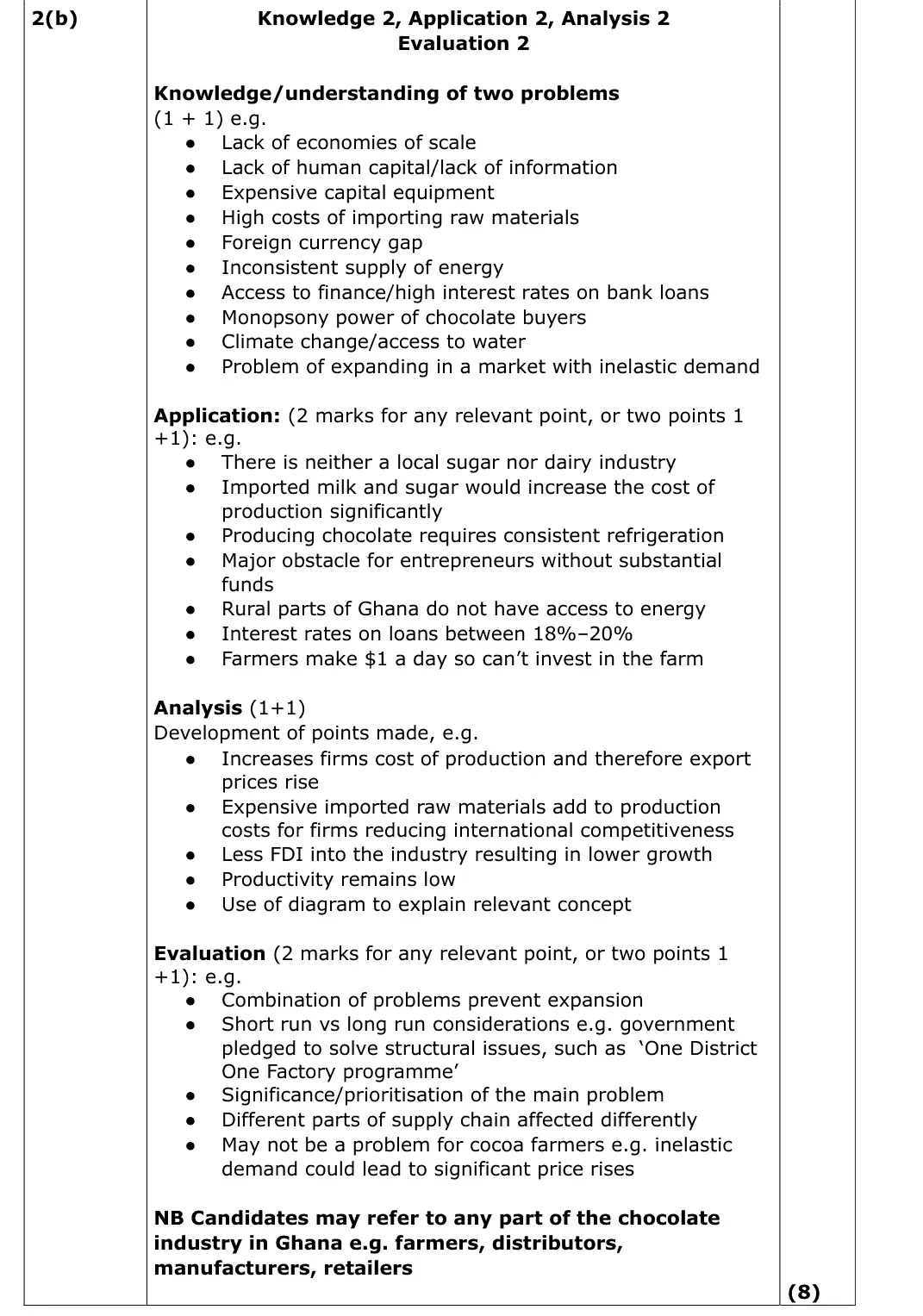
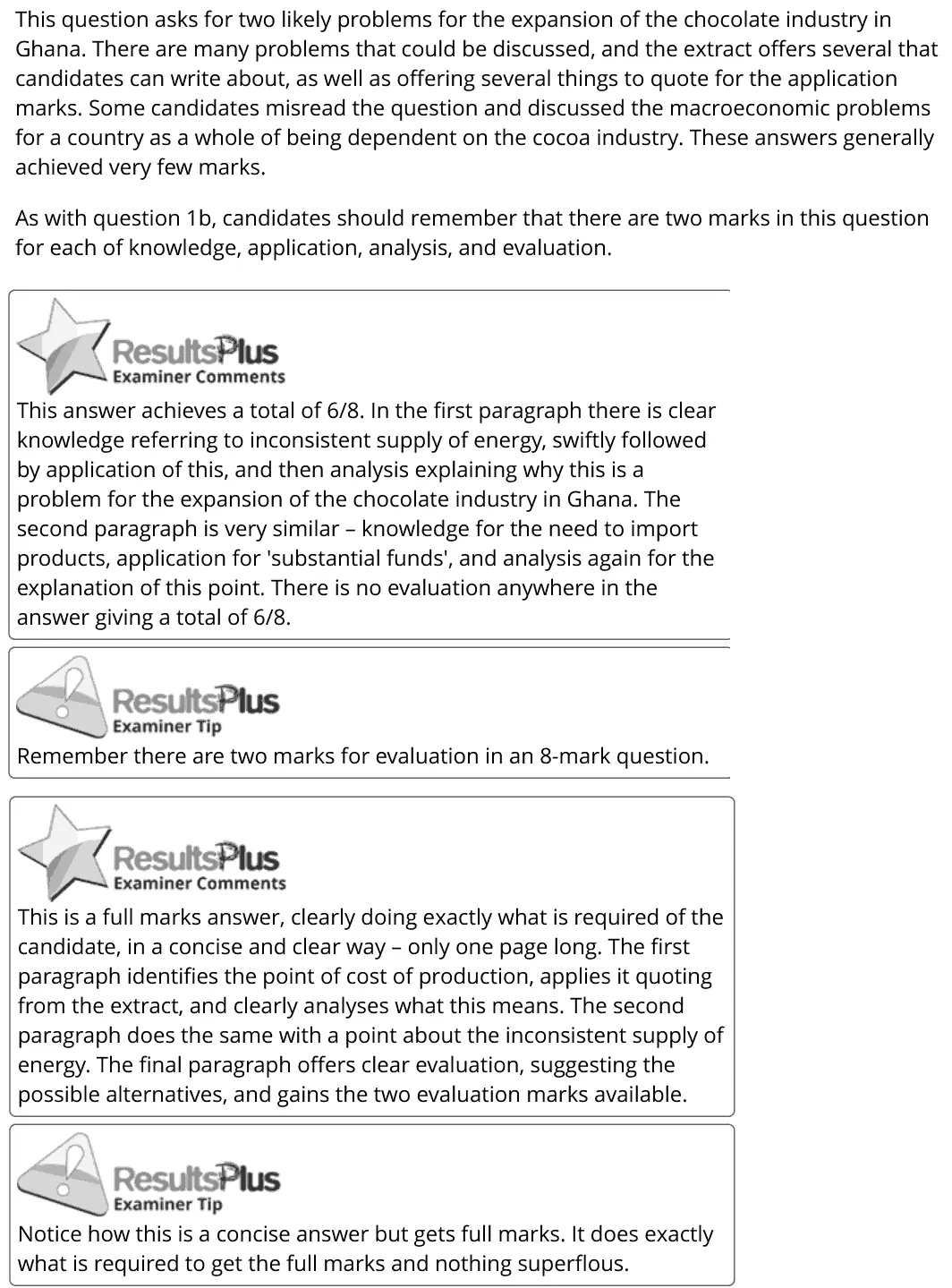
(b) With reference to the second paragraph of Extract E, examine two likely problems for the expansion of the chocolate industry in Ghana. (8)
June 2024 · Paper 3 · Q2(c) 12 marks AO1=2, AO2=2, AO3=4, AO4=4 12-mark response aggregate demandnational income and the multiplier
Data and extracts for question 2Ghana – cocoa and chocolate production Figure 3: World’s largest cocoa growers and chocolate producers Cocoa growers Chocolate producers Ivory Coast 46% Germany 17% Ghana 18% Belgium 11% Indonesia 14% Italy 7.4% Nigeria 7% US 7.2% (Source: adapted from International Cocoa Association www.icco.org December 2021 and The Telegraph.co.uk accessed 24/2/22) Extract D From a managed to a floating exchange rate Ghana’s currency, the cedi, has depreciated significantly against major currencies, especially the US dollar (US$), since the adoption of the floating exchange rate system in 1992. From 1983 to 1992 it operated a managed exchange rate. Since the liberalisation of the foreign exchange market there have substantial swings and on average the cedi has 5 depreciated 98% against the US dollar. The cedi to US dollar rate has been very volatile recently, causing macroeconomic instability and limiting economic growth. (Source adapted from: https://www.theigc.org/project/on-the-causes-and-effect-of- exchange-rate-volatility-on-economic-growth-evidence-from-ghana/ and https://www.scirp.org/journal/paperinformation.aspx?paperid=95492) Extract E There is a lot of money in chocolate but the growers of cocoa see very little of it. In 2020 the chocolate retail industry was worth £78 billion, but Ghana – the world’s second largest cocoa producer – earned just over £1 billion. Cocoa farmers in Ghana now make roughly $1 a day (this often includes being subsidised by the Ghanaian government). This is a familiar pattern for many African countries where the economy 5 is still shaped by a colonial relationship in which they export commodities to be processed elsewhere. Ghana currently processes about 30% of its cocoa crop into chocolate, meaning that the exports can earn high prices. Despite plans for expanding the domestic chocolate industry there are still many obstacles in the way. The equipment to make chocolate is 10 very expensive and there is neither a local sugar nor dairy industry. Imported milk and sugar would increase the cost of production significantly, with the added problem that foreign currency would be needed. Producing chocolate requires consistent refrigeration, and the high cost of the equipment to achieve that is a major obstacle for entrepreneurs without substantial funds. There is an inconsistent supply of energy in rural parts of 15 Ghana. An alternative, making teas and wines using cocoa, can make 20 times more revenue than the raw beans, but they do not have the mass market appeal and high profits of chocolate. Access to funds is a big problem and one farmer, Nana Aduna, says that high interest rates on bank loans are an issue for start-up businesses and at the moment he cannot 20 afford to borrow money. “You cannot grow a business when you have to service interest rates of 18%–20% or even more,” he says. But the government has pledged to address these structural issues, using supply side policies. The Trade and Industry Minister announced that industrialisation is the focus of government policy. “It only makes sense that the most important commodity in 25 our country, which is cocoa… should become the target for a major programme of industrialisation,” he says. The ‘One District One Factory’ programme aims to kickstart industrialisation by providing the infrastructure for Ghana’s farms, by establishing processing plants in some of the big cocoa-growing areas. It has become easier for the private sector to invest in food 30 processing, and there is a big tax rebate available to processing companies that set up in the country’s enterprise zones – designated areas to encourage economic activity – in a bid to help them export. (Source: adapted from https://www.newsbreak.com/news/2201853748349/ghana-s- farmers-eye-sweet-success-from-chocolate and https://www.indepthnews.net/ index.php/the-world/africa/4495-ghana-starts-with-cocoa-to-end-neocolonial- trading-ties and https://www.brookings.edu/blog/africa-in-focus/2020/09/03/ pathways-to-structural-transformation-of-the-ghanaian-economy-and- some-roadblocks/ and https://www.ghanaweb.com/GhanaHomePage/ business/Speculators-driving-interbank-retail-FX-rates-gap-1468375) Extract F A new trade bloc for Africa The African Continental Free Trade Agreement (AfCFTA) has been signed by all 55 member states of the African Union, including Ghana, Nigeria, and South Africa. This brings together 1.2 billion people with a combined gross domestic product (GDP) of more than $2 trillion as of 2023. 5 The agreement commits countries to removing tariffs on 90% of goods, with other goods to be phased in later. The agreement also liberalises services and aims to tackle non-tariff barriers which reduce trade between African countries, such as long delays at the borders. (Source adapted from: https://www.aljazeera.com/economy/2018/3/20/ african-continental-free-trade-area-what-you-need-to-know)
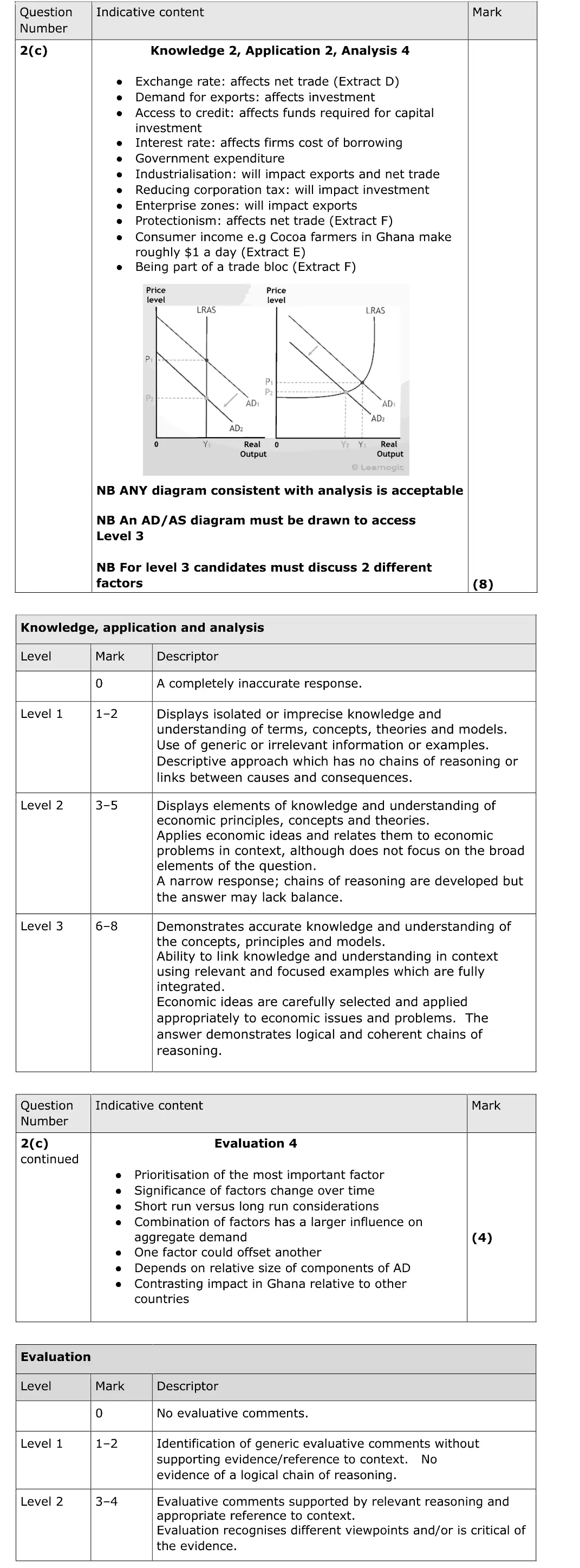
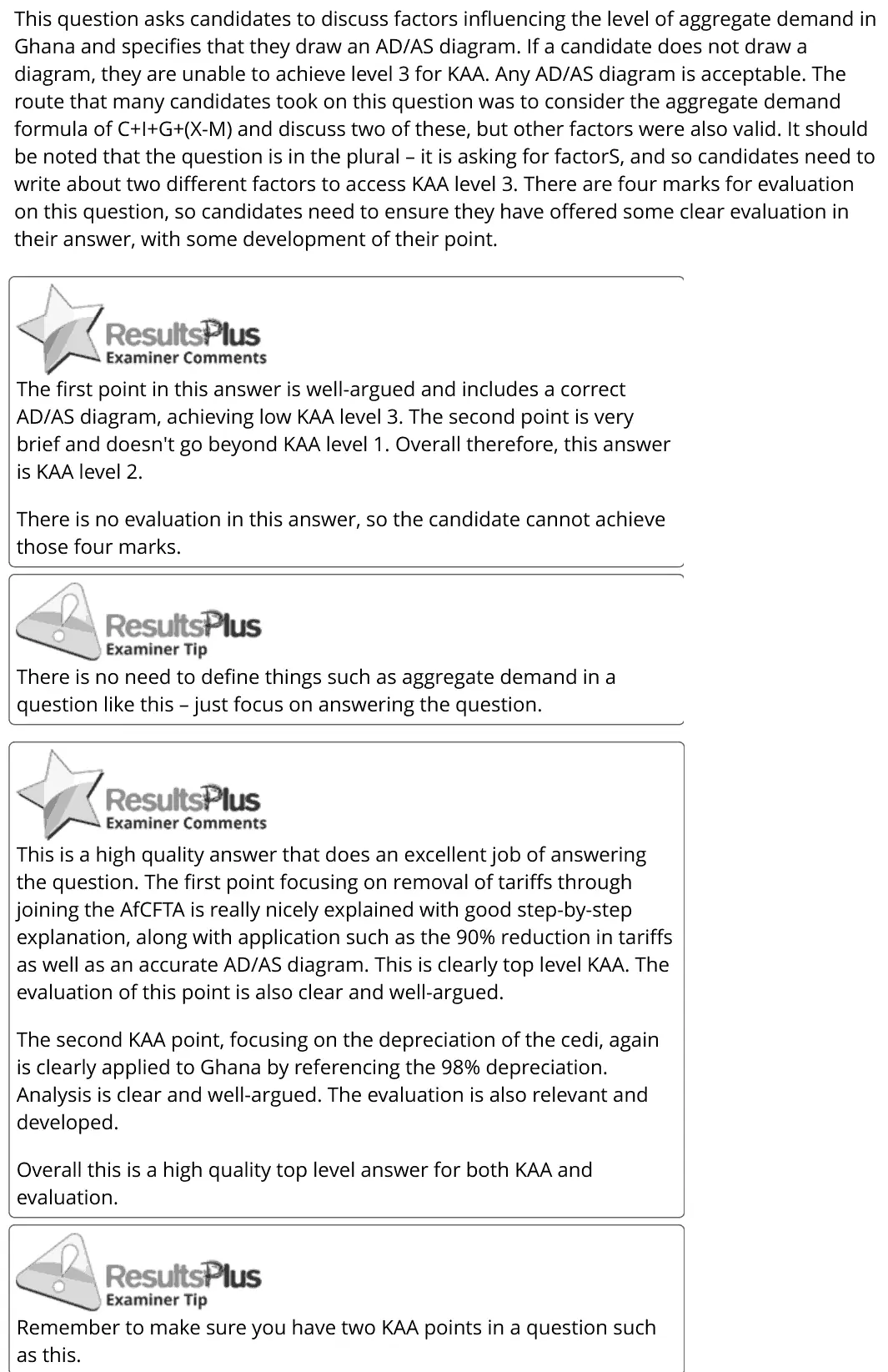
(c) Discuss factors influencing the level of aggregate demand in Ghana. Use an aggregate demand and aggregate supply diagram in your answer. (12)
June 2024 · Paper 3 · Q2(d) 25 marks AO1=4, AO2=4, AO3=8, AO4=9 25-mark essay Either/or revenues costs and profitsfiscal and monetary policy
Data and extracts for question 2Ghana – cocoa and chocolate production Figure 3: World’s largest cocoa growers and chocolate producers Cocoa growers Chocolate producers Ivory Coast 46% Germany 17% Ghana 18% Belgium 11% Indonesia 14% Italy 7.4% Nigeria 7% US 7.2% (Source: adapted from International Cocoa Association www.icco.org December 2021 and The Telegraph.co.uk accessed 24/2/22) Extract D From a managed to a floating exchange rate Ghana’s currency, the cedi, has depreciated significantly against major currencies, especially the US dollar (US$), since the adoption of the floating exchange rate system in 1992. From 1983 to 1992 it operated a managed exchange rate. Since the liberalisation of the foreign exchange market there have substantial swings and on average the cedi has 5 depreciated 98% against the US dollar. The cedi to US dollar rate has been very volatile recently, causing macroeconomic instability and limiting economic growth. (Source adapted from: https://www.theigc.org/project/on-the-causes-and-effect-of- exchange-rate-volatility-on-economic-growth-evidence-from-ghana/ and https://www.scirp.org/journal/paperinformation.aspx?paperid=95492) Extract E There is a lot of money in chocolate but the growers of cocoa see very little of it. In 2020 the chocolate retail industry was worth £78 billion, but Ghana – the world’s second largest cocoa producer – earned just over £1 billion. Cocoa farmers in Ghana now make roughly $1 a day (this often includes being subsidised by the Ghanaian government). This is a familiar pattern for many African countries where the economy 5 is still shaped by a colonial relationship in which they export commodities to be processed elsewhere. Ghana currently processes about 30% of its cocoa crop into chocolate, meaning that the exports can earn high prices. Despite plans for expanding the domestic chocolate industry there are still many obstacles in the way. The equipment to make chocolate is 10 very expensive and there is neither a local sugar nor dairy industry. Imported milk and sugar would increase the cost of production significantly, with the added problem that foreign currency would be needed. Producing chocolate requires consistent refrigeration, and the high cost of the equipment to achieve that is a major obstacle for entrepreneurs without substantial funds. There is an inconsistent supply of energy in rural parts of 15 Ghana. An alternative, making teas and wines using cocoa, can make 20 times more revenue than the raw beans, but they do not have the mass market appeal and high profits of chocolate. Access to funds is a big problem and one farmer, Nana Aduna, says that high interest rates on bank loans are an issue for start-up businesses and at the moment he cannot 20 afford to borrow money. “You cannot grow a business when you have to service interest rates of 18%–20% or even more,” he says. But the government has pledged to address these structural issues, using supply side policies. The Trade and Industry Minister announced that industrialisation is the focus of government policy. “It only makes sense that the most important commodity in 25 our country, which is cocoa… should become the target for a major programme of industrialisation,” he says. The ‘One District One Factory’ programme aims to kickstart industrialisation by providing the infrastructure for Ghana’s farms, by establishing processing plants in some of the big cocoa-growing areas. It has become easier for the private sector to invest in food 30 processing, and there is a big tax rebate available to processing companies that set up in the country’s enterprise zones – designated areas to encourage economic activity – in a bid to help them export. (Source: adapted from https://www.newsbreak.com/news/2201853748349/ghana-s- farmers-eye-sweet-success-from-chocolate and https://www.indepthnews.net/ index.php/the-world/africa/4495-ghana-starts-with-cocoa-to-end-neocolonial- trading-ties and https://www.brookings.edu/blog/africa-in-focus/2020/09/03/ pathways-to-structural-transformation-of-the-ghanaian-economy-and- some-roadblocks/ and https://www.ghanaweb.com/GhanaHomePage/ business/Speculators-driving-interbank-retail-FX-rates-gap-1468375) Extract F A new trade bloc for Africa The African Continental Free Trade Agreement (AfCFTA) has been signed by all 55 member states of the African Union, including Ghana, Nigeria, and South Africa. This brings together 1.2 billion people with a combined gross domestic product (GDP) of more than $2 trillion as of 2023. 5 The agreement commits countries to removing tariffs on 90% of goods, with other goods to be phased in later. The agreement also liberalises services and aims to tackle non-tariff barriers which reduce trade between African countries, such as long delays at the borders. (Source adapted from: https://www.aljazeera.com/economy/2018/3/20/ african-continental-free-trade-area-what-you-need-to-know)
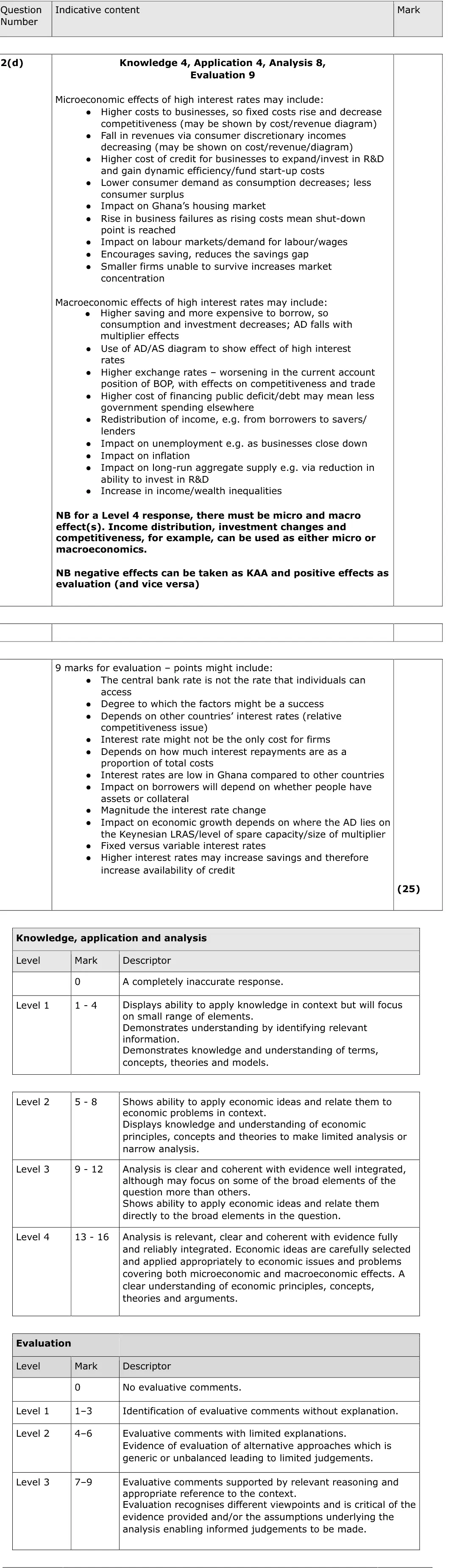
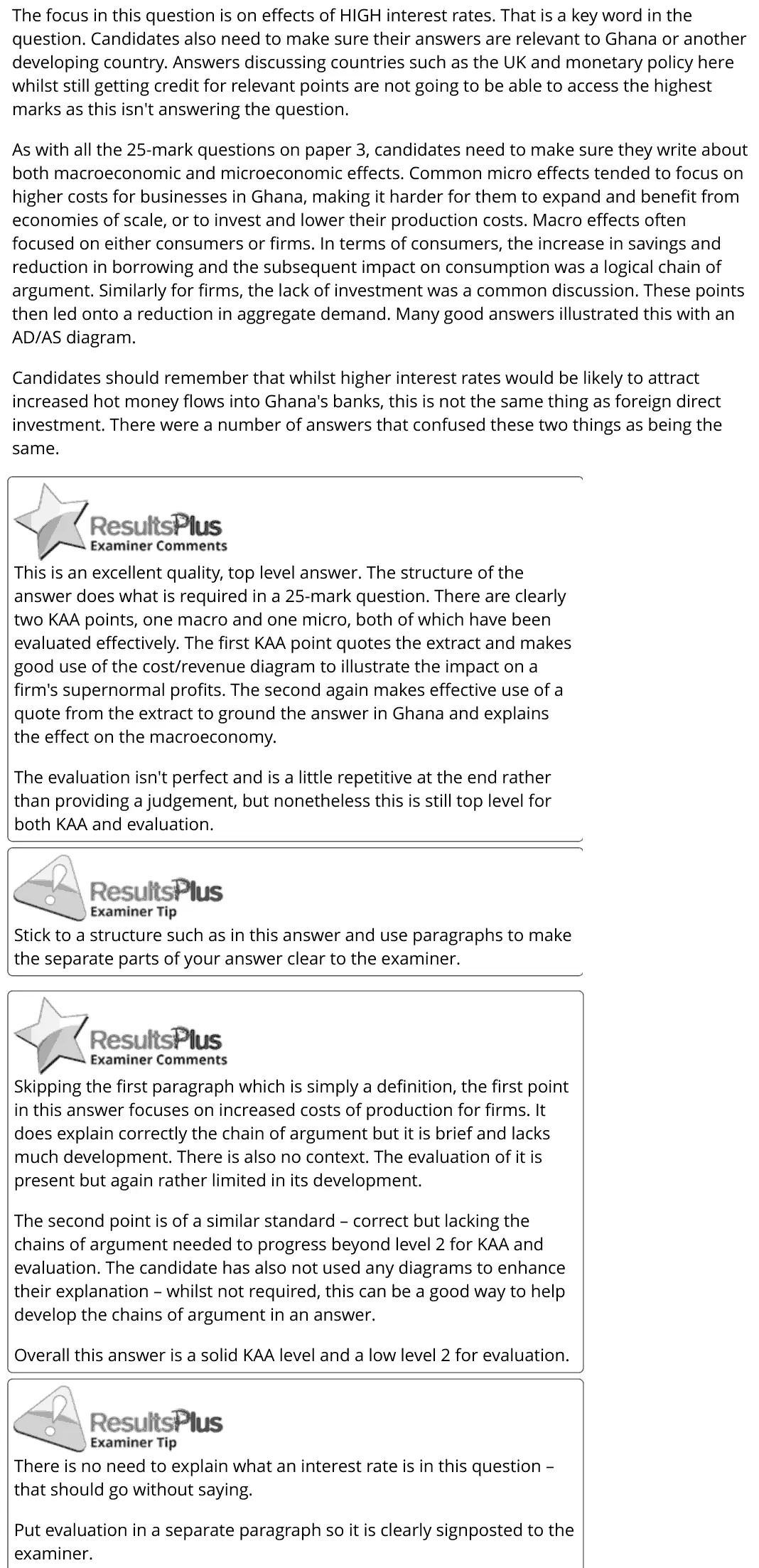
(d) Evaluate the microeconomic and macroeconomic effects of high interest rates in Ghana, or another developing country of your choice. (25)
June 2024 · Paper 3 · Q2(e) 25 marks AO1=4, AO2=4, AO3=8, AO4=9 25-mark essay Either/or trading blocs and protectionismrevenues costs and profits
Data and extracts for question 2Ghana – cocoa and chocolate production Figure 3: World’s largest cocoa growers and chocolate producers Cocoa growers Chocolate producers Ivory Coast 46% Germany 17% Ghana 18% Belgium 11% Indonesia 14% Italy 7.4% Nigeria 7% US 7.2% (Source: adapted from International Cocoa Association www.icco.org December 2021 and The Telegraph.co.uk accessed 24/2/22) Extract D From a managed to a floating exchange rate Ghana’s currency, the cedi, has depreciated significantly against major currencies, especially the US dollar (US$), since the adoption of the floating exchange rate system in 1992. From 1983 to 1992 it operated a managed exchange rate. Since the liberalisation of the foreign exchange market there have substantial swings and on average the cedi has 5 depreciated 98% against the US dollar. The cedi to US dollar rate has been very volatile recently, causing macroeconomic instability and limiting economic growth. (Source adapted from: https://www.theigc.org/project/on-the-causes-and-effect-of- exchange-rate-volatility-on-economic-growth-evidence-from-ghana/ and https://www.scirp.org/journal/paperinformation.aspx?paperid=95492) Extract E There is a lot of money in chocolate but the growers of cocoa see very little of it. In 2020 the chocolate retail industry was worth £78 billion, but Ghana – the world’s second largest cocoa producer – earned just over £1 billion. Cocoa farmers in Ghana now make roughly $1 a day (this often includes being subsidised by the Ghanaian government). This is a familiar pattern for many African countries where the economy 5 is still shaped by a colonial relationship in which they export commodities to be processed elsewhere. Ghana currently processes about 30% of its cocoa crop into chocolate, meaning that the exports can earn high prices. Despite plans for expanding the domestic chocolate industry there are still many obstacles in the way. The equipment to make chocolate is 10 very expensive and there is neither a local sugar nor dairy industry. Imported milk and sugar would increase the cost of production significantly, with the added problem that foreign currency would be needed. Producing chocolate requires consistent refrigeration, and the high cost of the equipment to achieve that is a major obstacle for entrepreneurs without substantial funds. There is an inconsistent supply of energy in rural parts of 15 Ghana. An alternative, making teas and wines using cocoa, can make 20 times more revenue than the raw beans, but they do not have the mass market appeal and high profits of chocolate. Access to funds is a big problem and one farmer, Nana Aduna, says that high interest rates on bank loans are an issue for start-up businesses and at the moment he cannot 20 afford to borrow money. “You cannot grow a business when you have to service interest rates of 18%–20% or even more,” he says. But the government has pledged to address these structural issues, using supply side policies. The Trade and Industry Minister announced that industrialisation is the focus of government policy. “It only makes sense that the most important commodity in 25 our country, which is cocoa… should become the target for a major programme of industrialisation,” he says. The ‘One District One Factory’ programme aims to kickstart industrialisation by providing the infrastructure for Ghana’s farms, by establishing processing plants in some of the big cocoa-growing areas. It has become easier for the private sector to invest in food 30 processing, and there is a big tax rebate available to processing companies that set up in the country’s enterprise zones – designated areas to encourage economic activity – in a bid to help them export. (Source: adapted from https://www.newsbreak.com/news/2201853748349/ghana-s- farmers-eye-sweet-success-from-chocolate and https://www.indepthnews.net/ index.php/the-world/africa/4495-ghana-starts-with-cocoa-to-end-neocolonial- trading-ties and https://www.brookings.edu/blog/africa-in-focus/2020/09/03/ pathways-to-structural-transformation-of-the-ghanaian-economy-and- some-roadblocks/ and https://www.ghanaweb.com/GhanaHomePage/ business/Speculators-driving-interbank-retail-FX-rates-gap-1468375) Extract F A new trade bloc for Africa The African Continental Free Trade Agreement (AfCFTA) has been signed by all 55 member states of the African Union, including Ghana, Nigeria, and South Africa. This brings together 1.2 billion people with a combined gross domestic product (GDP) of more than $2 trillion as of 2023. 5 The agreement commits countries to removing tariffs on 90% of goods, with other goods to be phased in later. The agreement also liberalises services and aims to tackle non-tariff barriers which reduce trade between African countries, such as long delays at the borders. (Source adapted from: https://www.aljazeera.com/economy/2018/3/20/ african-continental-free-trade-area-what-you-need-to-know)
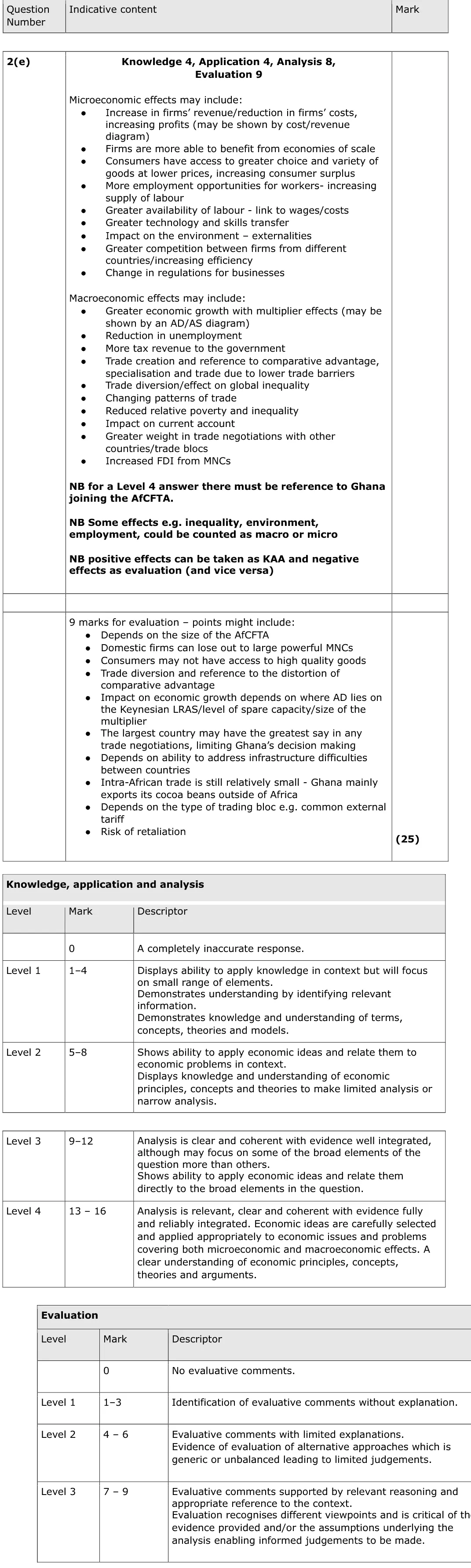
(e) Evaluate the microeconomic and macroeconomic effects of Ghana joining the African Continental Free Trade Agreement (Extract F). (25)

Work with an Edexcel economics tutor

Want a paper marked and gone through with you? Message us.

Prefer email? Send an enquiry

If you are under 18, please include a parent's contact details. Enquiries go to enquiries@economicsaleveltutor.com and are deleted once handled. All tutoring is online.