Notes and key-term cards for this topic are being written by our tutors. The past-paper questions below are ready now.
Specification statements
3.1.1Sizes and types of firms: a) Reasons why some firms tend to remain small and why others grow b) Significance of the divorce of ownership from control: the principal-agent problem c) Distinction between public and private sector organisations d) Distinction between profit and not-for-profit organisations
3.1.2Business growth: a) How businesses grow: • organic growth • forward and backward vertical integration • horizontal integration • conglomerate integration b) Advantages and disadvantages of: • organic growth • vertical integration • horizontal integration • conglomerate integration c) Constraints on business growth: • size of the market • access to finance • owner objectives • regulation
3.1.3Demergers: a) Reasons for demergers b) Impact of demergers on businesses, workers and consumers
3.2.1Business objectives: a) Different business objectives and reasons for them: • profit maximisation • revenue maximisation • sales maximisation • satisficing b) Diagrams and formulae to illustrate the different business objectives: • profit maximisation • revenue maximisation • sales maximisation
‘Revenue maximisation is a more realistic business objective than profit maximisation for many businesses.’ To what extent do you agree with this statement? Refer to an industry of your choice in your answer.
Tap a question to zoom it. The data and extracts fold out above each question; the mark scheme and examiner's comment open underneath.
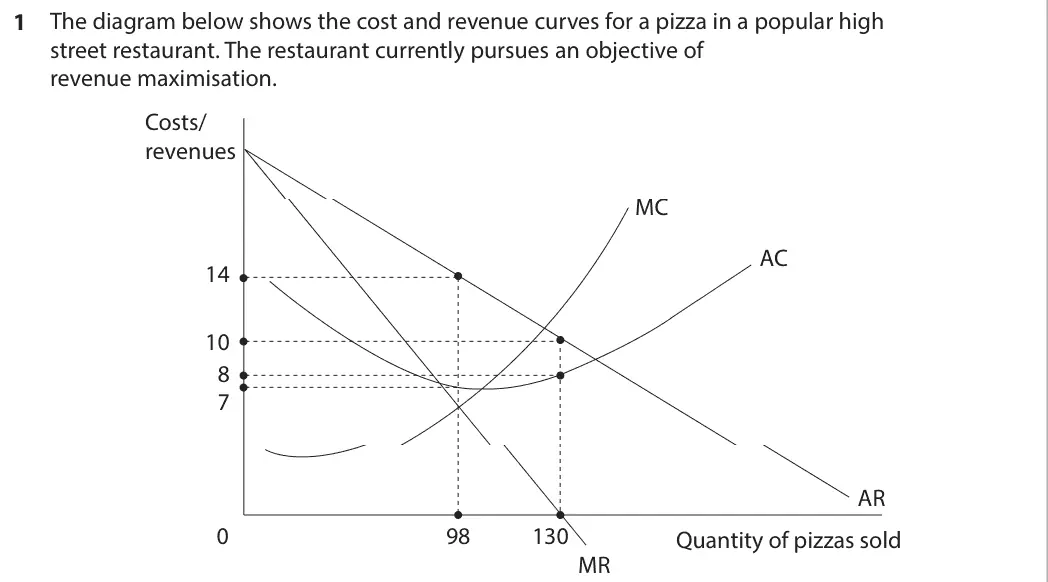
June 2025 · Paper 1 · Q1(a)4 marksAO1=2, AO2=2Calculation
Data and extracts for question 1
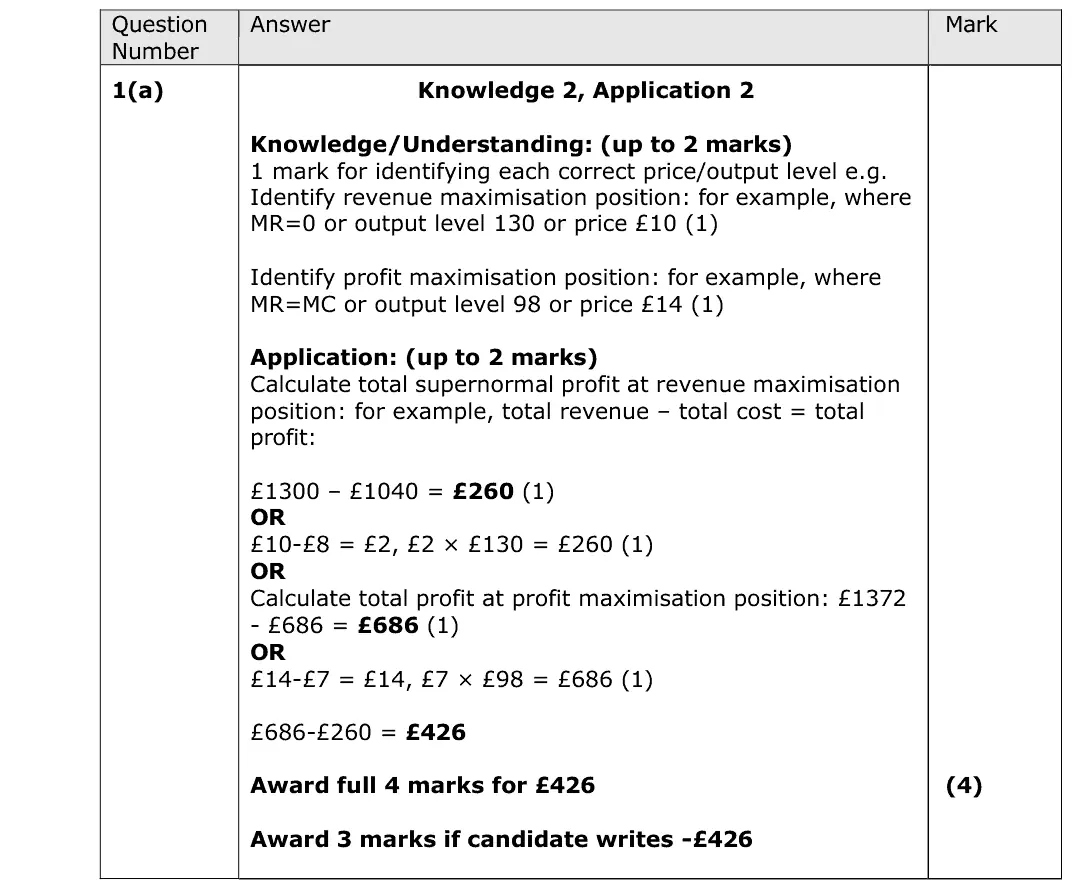
Mark scheme
Examiner's comment
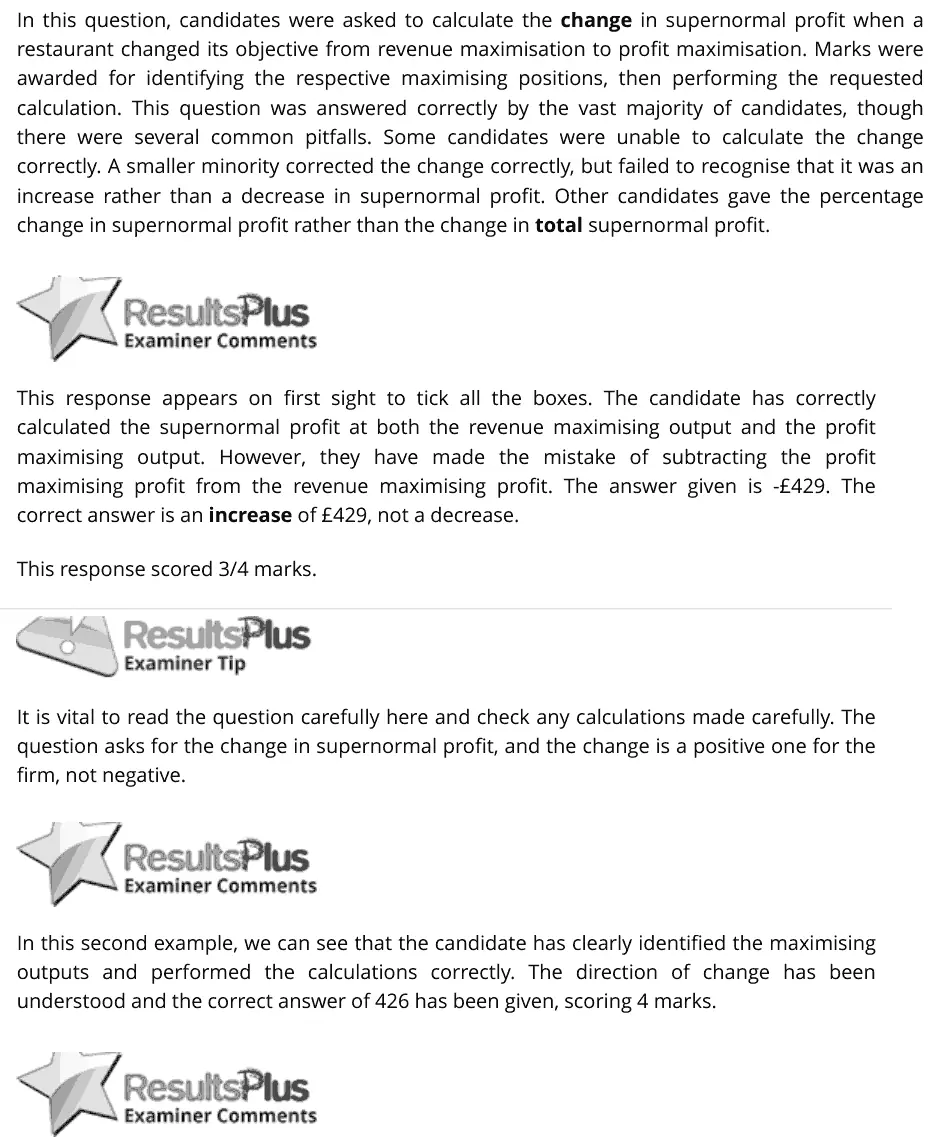
In this question, candidates were asked to calculate the change in supernormal profit when a restaurant changed its objective from revenue maximisation to profit maximisation. Marks were awarded for identifying the respective maximising positions, then performing the requested calculation. This question was answered correctly by the vast majority of candidates, though there were several common pitfalls. Some candidates were unable to calculate the change correctly. A smaller minority corrected the change correctly, but failed to recognise that it was an increase rather than a decrease in supernormal profit. Other candidates gave the percentage change in supernormal profit rather than the change in total supernormal profit. This response appears on first sight to tick all the boxes. The candidate has correctly calculated the supernormal profit at both the revenue maximising output and the profit maximising output. However, they have made the mistake of subtracting the profit maximising profit from the revenue maximising profit. The answer given is -£429. The correct answer is an increase of £429, not a decrease. This response scored 3/4 marks. It is vital to read the question carefully here and check any calculations made carefully. The question asks for the change in supernormal profit, and the change is a positive one for the firm, not negative. In this second example, we can see that the candidate has clearly identified the maximising outputs and performed the calculations correctly. The direction of change has been understood and the correct answer of 426 has been given, scoring 4 marks.
Notes from the mark scheme and report
revenue maximisation where MR = 0: (£10 - £8) x 130 = £260
profit maximisation where MC = MR: (£14 - £7) x 98 = £686
change = +£426 (an increase)
-£426 scores 3
common errors: subtracting the wrong way round, giving a percentage change
Quantitative skills: QS 4 (construct and interpret a range of standard graphical forms); QS 6 (calculate cost, revenue and profit (marginal, average, totals))
June 2025 · Paper 1 · Q6(e)15 marksAO1=3, AO2=3, AO3=3, AO4=615-mark response
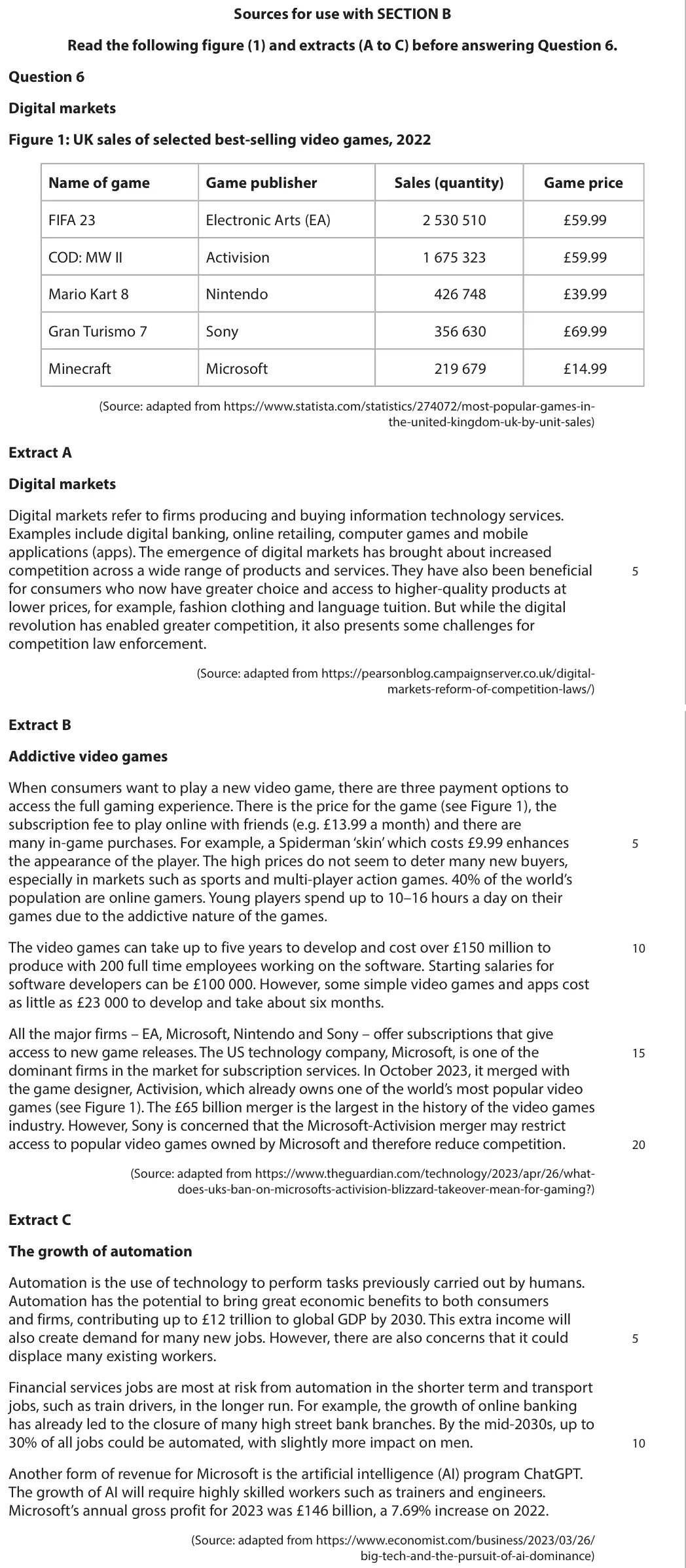
Data and extracts for question 6
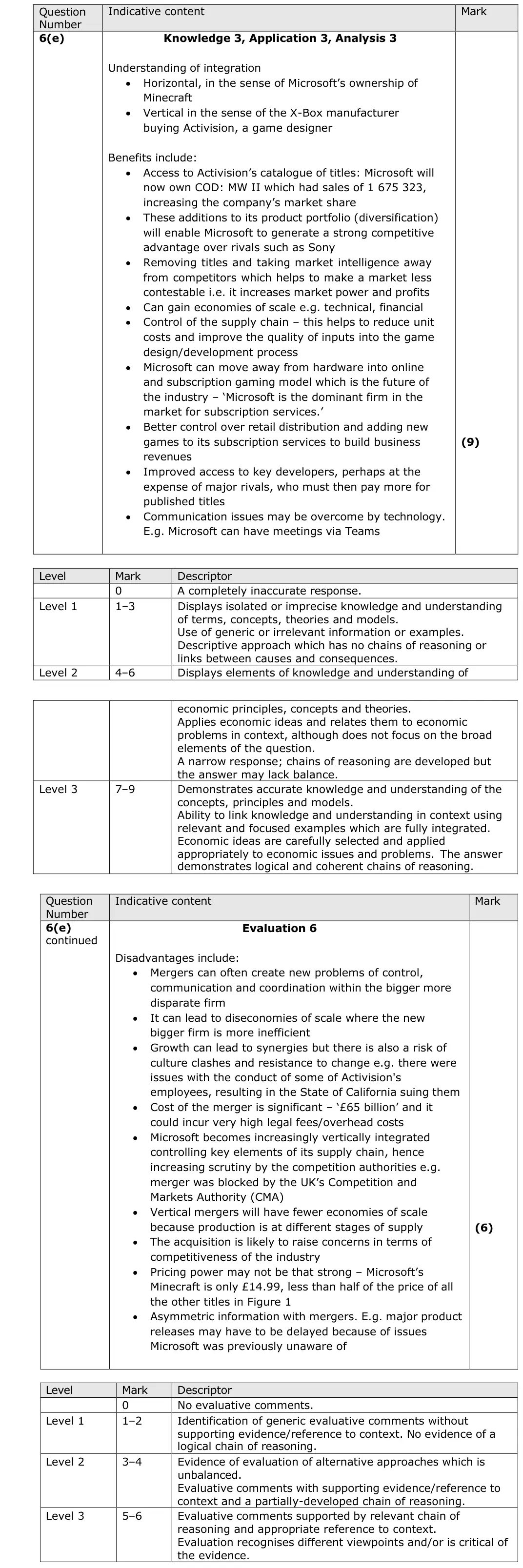
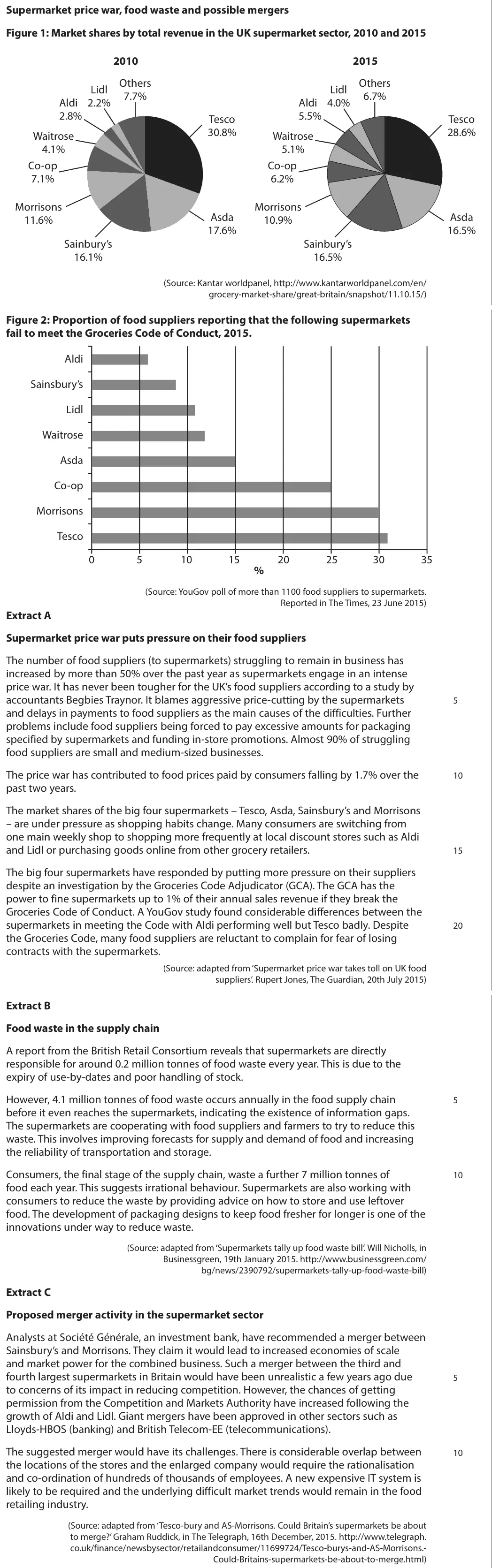
Mark scheme, including the levels grid and indicative content
Examiner's comment
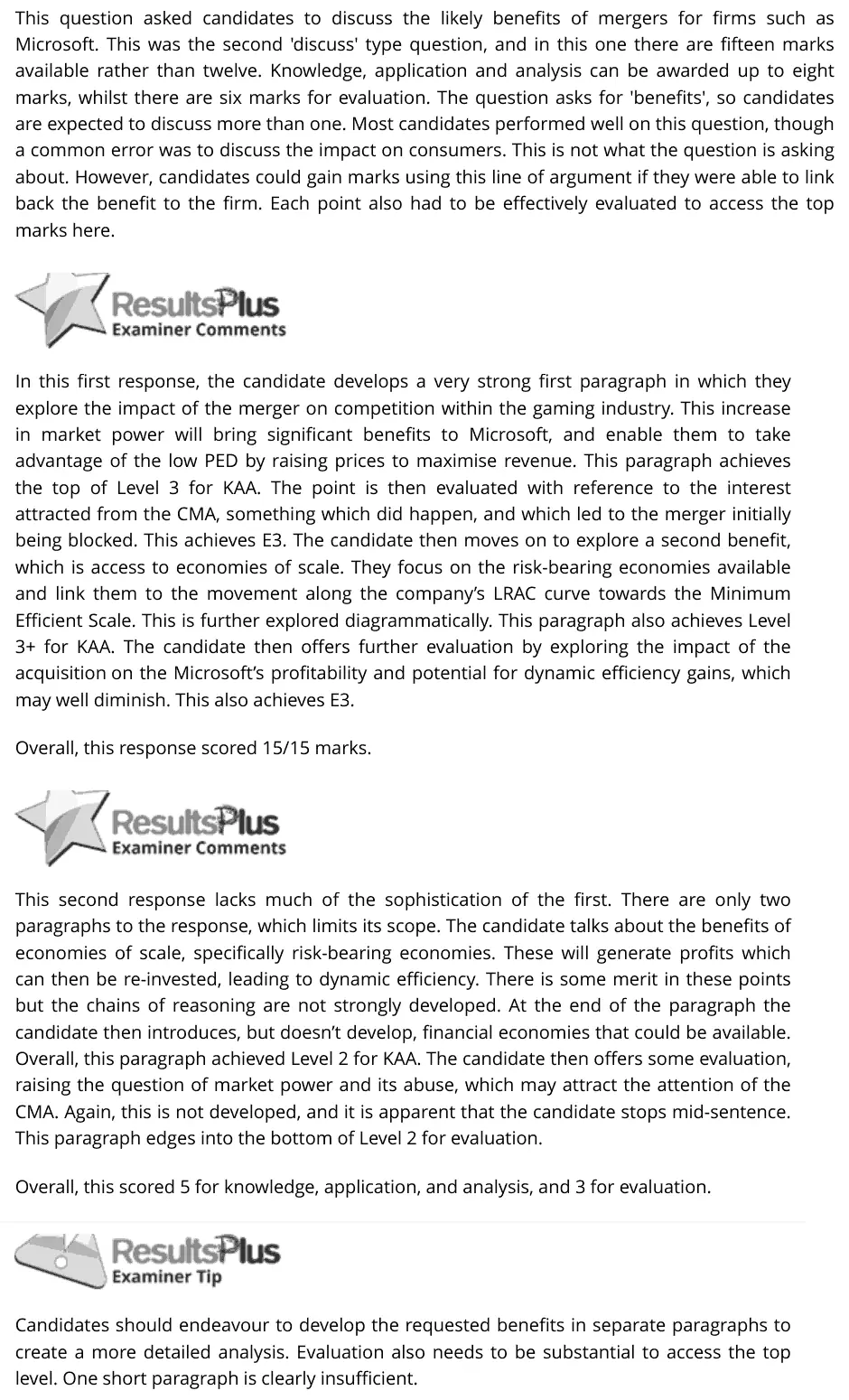
This question asked candidates to discuss the likely benefits of mergers for firms such as Microsoft. This was the second 'discuss' type question, and in this one there are fifteen marks available rather than twelve. Knowledge, application and analysis can be awarded up to eight marks, whilst there are six marks for evaluation. The question asks for 'benefits', so candidates are expected to discuss more than one. Most candidates performed well on this question, though a common error was to discuss the impact on consumers. This is not what the question is asking about. However, candidates could gain marks using this line of argument if they were able to link back the benefit to the firm. Each point also had to be effectively evaluated to access the top marks here. In this first response, the candidate develops a very strong first paragraph in which they explore the impact of the merger on competition within the gaming industry. This increase in market power will bring significant benefits to Microsoft, and enable them to take advantage of the low PED by raising prices to maximise revenue. This paragraph achieves the top of Level 3 for KAA. The point is then evaluated with reference to the interest attracted from the CMA, something which did happen, and which led to the merger initially being blocked. This achieves E3. The candidate then moves on to explore a second benefit, which is access to economies of scale. They focus on the risk-bearing economies available and link them to the movement along the company’s LRAC curve towards the Minimum Efficient Scale. This is further explored diagrammatically. This paragraph also achieves Level 3+ for KAA. The candidate then offers further evaluation by exploring the impact of the acquisition on the Microsoft’s profitability and potential for dynamic efficiency gains, which may well diminish. This also achieves E3. Overall, this response scored 15/15 marks. This second response lacks much of the sophistication of the first. There are only two paragraphs to the response, which limits its scope. The candidate talks about the benefits of economies of scale, specifically risk-bearing economies. These will generate profits which can then be re-invested, leading to dynamic efficiency. There is some merit in these points but the chains of reasoning are not strongly developed. At the end of the paragraph the candidate then introduces, but doesn’t develop, financial economies that could be available. Overall, this paragraph achieved Level 2 for KAA. The candidate then offers some evaluation, raising the question of market power and its abuse, which may attract the attention of the CMA. Again, this is not developed, and it is apparent that the candidate stops mid-sentence. This paragraph edges into the bottom of Level 2 for evaluation. Overall, this scored 5 for knowledge, application, and analysis, and 3 for evaluation. Candidates should endeavour to develop the requested benefits in separate paragraphs to create a more detailed analysis. Evaluation also needs to be substantial to access the top level. One short paragraph is clearly insufficient.
Notes from the mark scheme and report
benefits to the firm (market share, Activision's titles, economies of scale, control of supply chain, subscription model), not to consumers unless linked back
horizontal and vertical integration
evaluate each benefit e.g. CMA scrutiny, diseconomies of scale
June 2024 · Paper 1 · Q3(a)4 marksAO1=2, AO2=2Diagram
Data and extracts for question 3
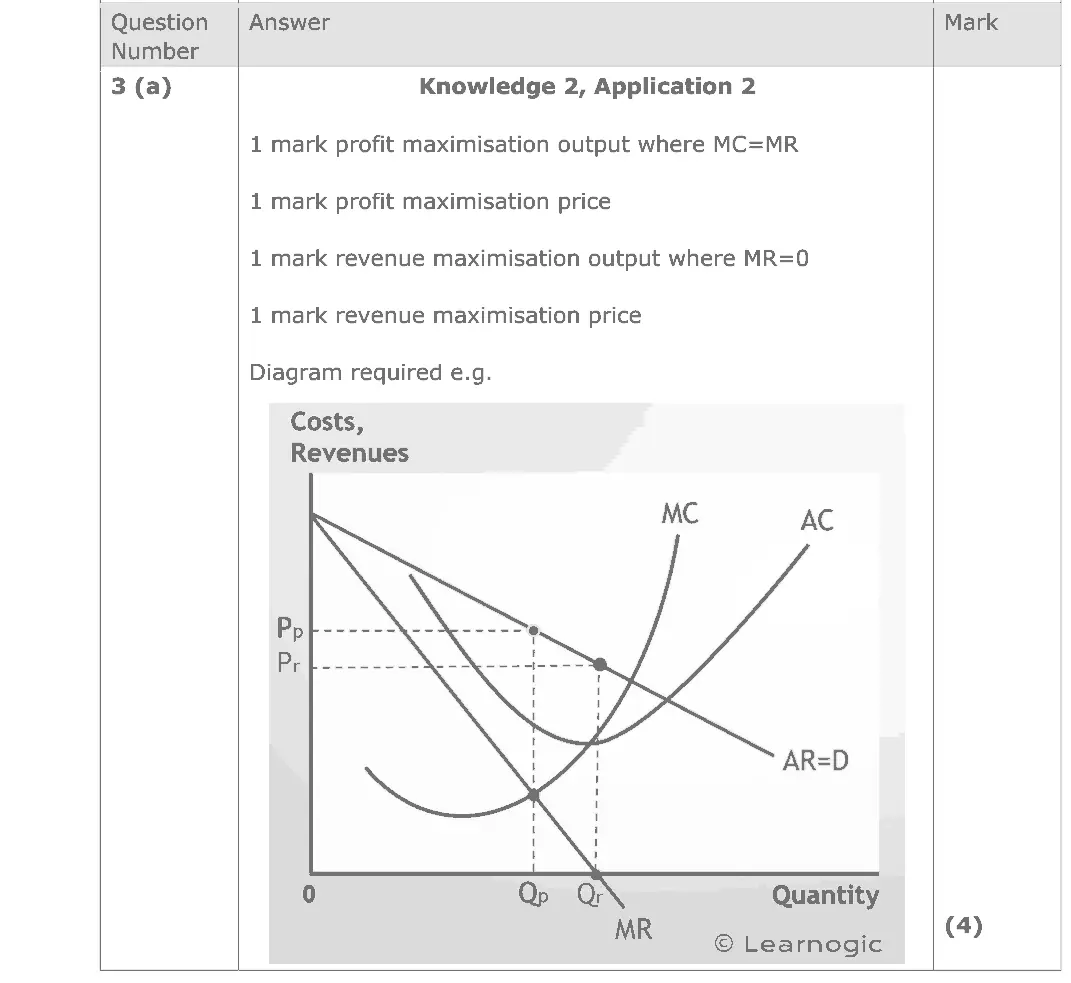
Mark scheme
Examiner's comment
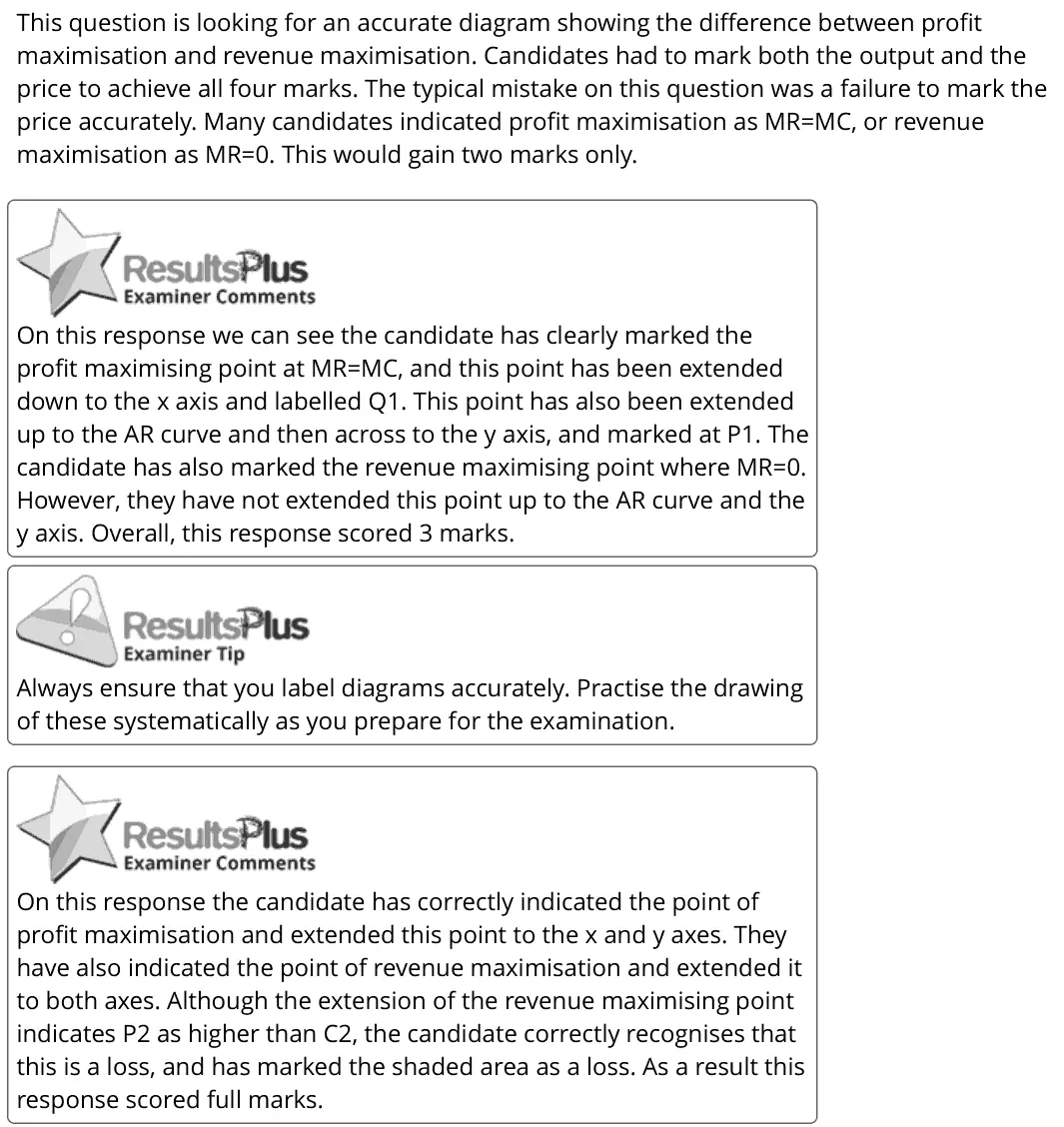
This question is looking for an accurate diagram showing the difference between profit maximisation and revenue maximisation. Candidates had to mark both the output and the price to achieve all four marks. The typical mistake on this question was a failure to mark the price accurately. Many candidates indicated profit maximisation as MR=MC, or revenue maximisation as MR=0. This would gain two marks only. On this response we can see the candidate has clearly marked the profit maximising point at MR=MC, and this point has been extended down to the x axis and labelled Q1. This point has also been extended up to the AR curve and then across to the y axis, and marked at P1. The candidate has also marked the revenue maximising point where MR=0. However, they have not extended this point up to the AR curve and the y axis. Overall, this response scored 3 marks. Always ensure that you label diagrams accurately. Practise the drawing of these systematically as you prepare for the examination. On this response the candidate has correctly indicated the point of profit maximisation and extended this point to the x and y axes. They have also indicated the point of revenue maximisation and extended it to both axes. Although the extension of the revenue maximising point indicates P2 as higher than C2, the candidate correctly recognises that this is a loss, and has marked the shaded area as a loss. As a result this response scored full marks.
Notes from the mark scheme and report
mark price AND output for both objectives: profit max where MC = MR, revenue max where MR = 0
showing only MC = MR and MR = 0 scores 2 of 4
Quantitative skills: QS 4 (construct and interpret a range of standard graphical forms)
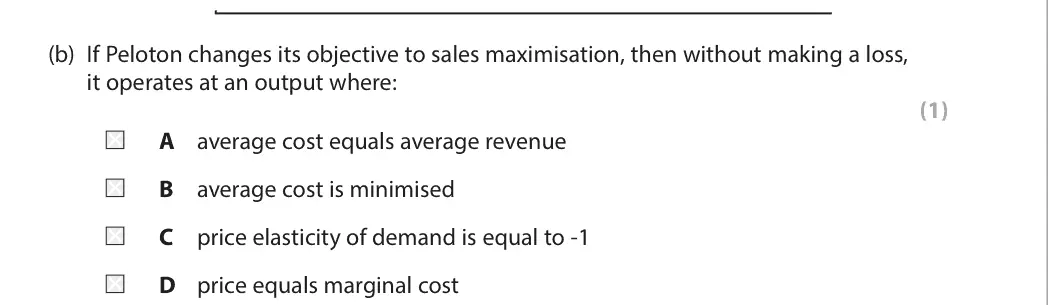
June 2024 · Paper 1 · Q3(b)1 markMultiple choice
Data and extracts for question 3
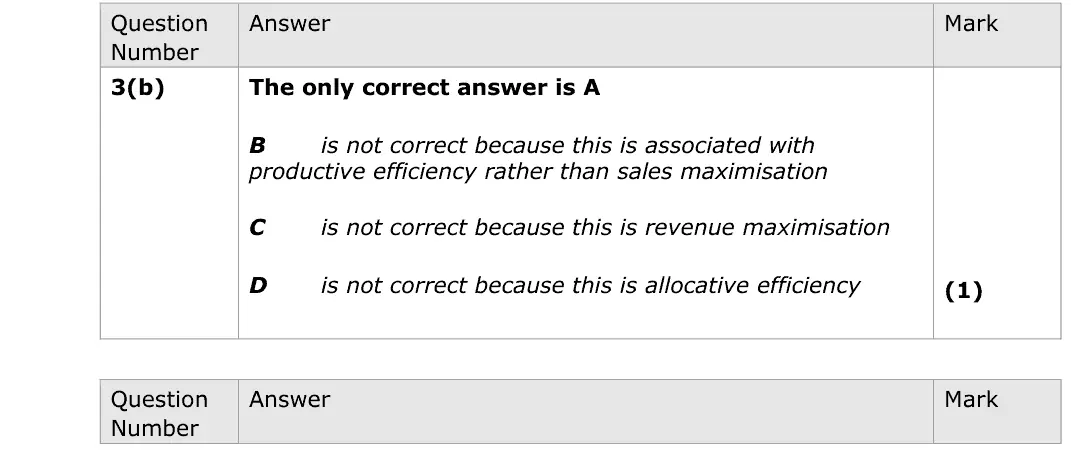
Answer
A
Mark scheme
Notes from the mark scheme and report
sales maximisation without a loss is where AC = AR (A)
B is productive efficiency, C revenue maximisation (PED = -1), D allocative efficiency
June 2024 · Paper 3 · Q1(c)12 marksAO1=2, AO2=2, AO3=4, AO4=412-mark response
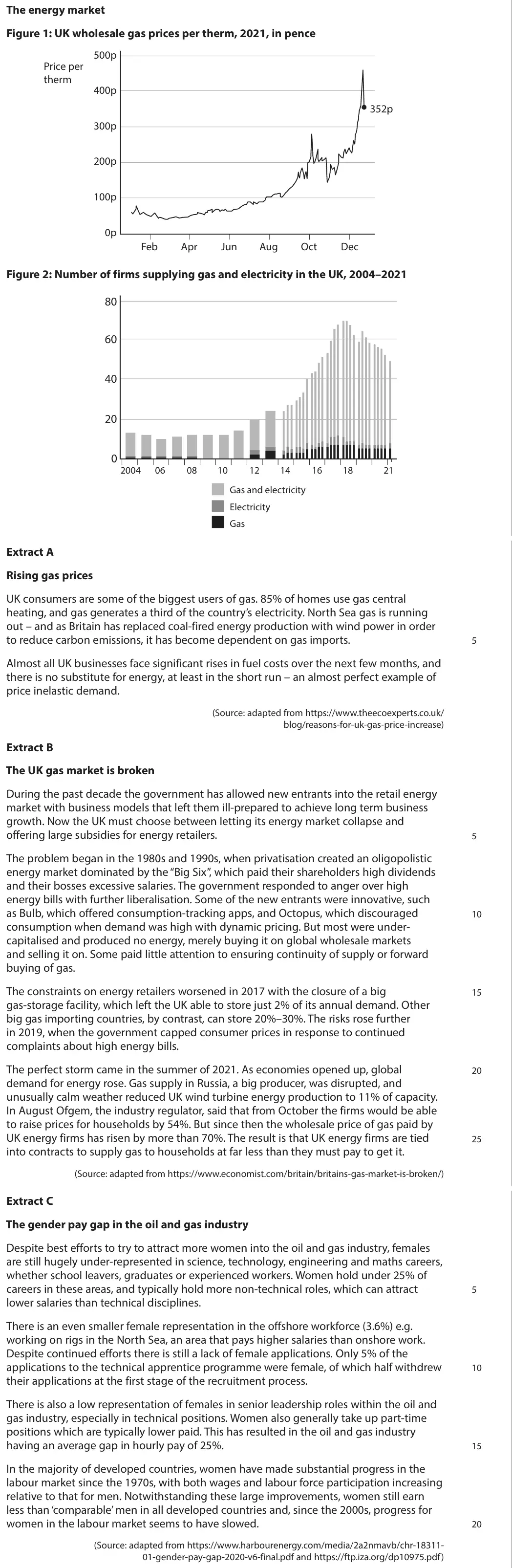
Data and extracts for question 1
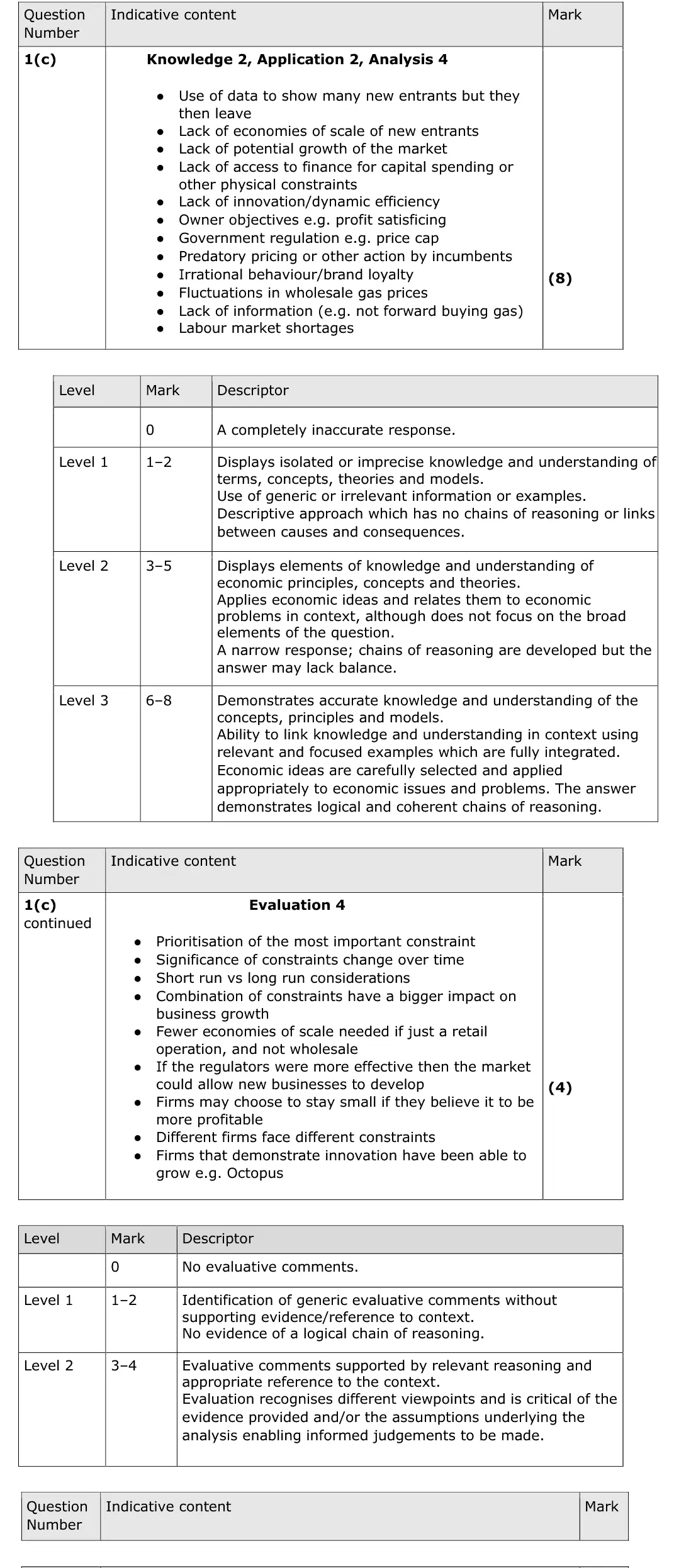
Mark scheme, including the levels grid and indicative content
Examiner's comment
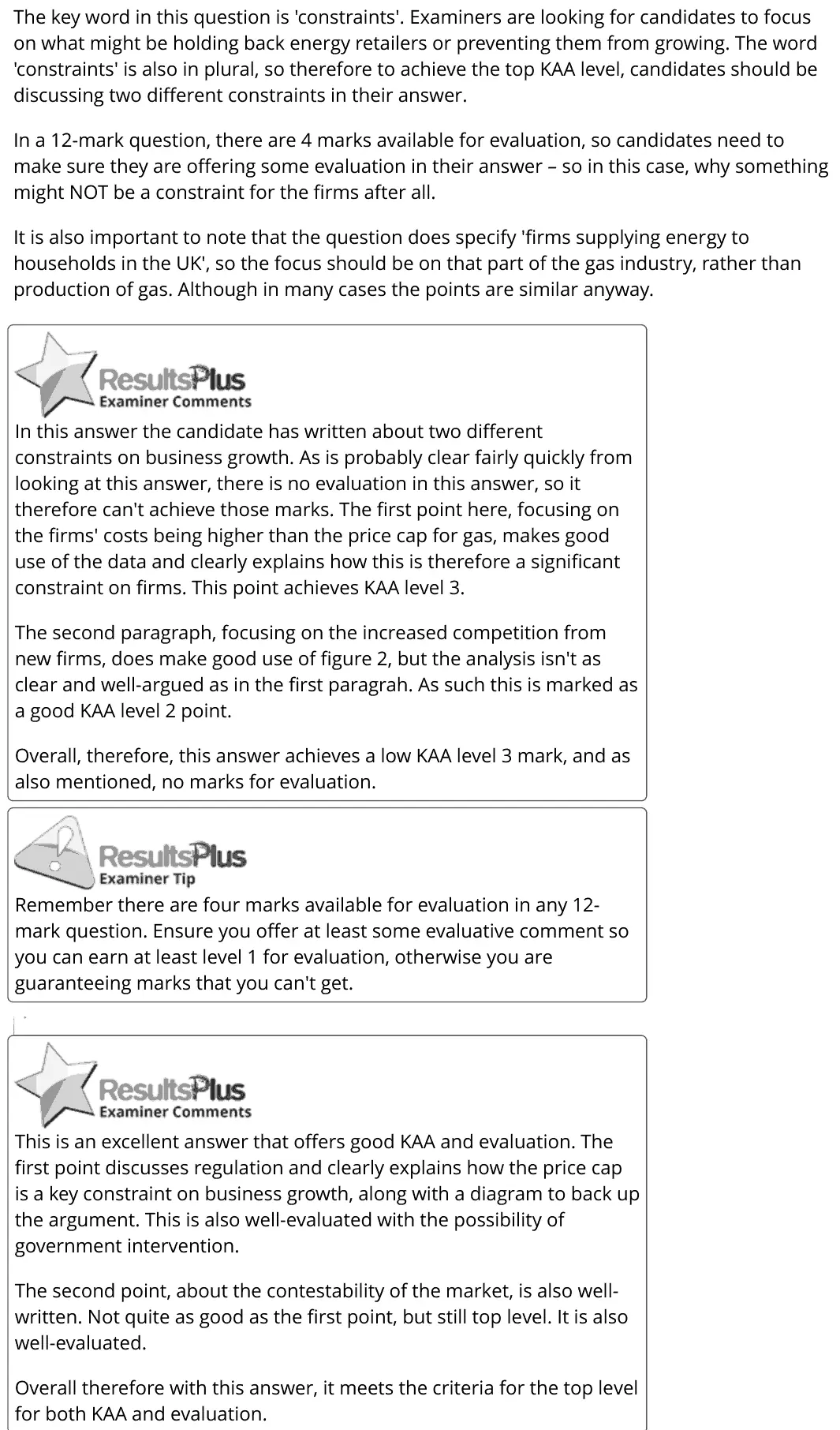
The key word in this question is 'constraints'. Examiners are looking for candidates to focus on what might be holding back energy retailers or preventing them from growing. The word ‘constraints’ is also in plural, so therefore to achieve the top KAA level, candidates should be discussing two different constraints in their answer. In a 12-mark question, there are 4 marks available for evaluation, so candidates need to make sure they are offering some evaluation in their answer - so in this case, why something might NOT be a constraint for the firms after all. It is also important to note that the question does specify ‘firms supplying energy to households in the UK’, so the focus should be on that part of the gas industry, rather than production of gas. Although in many cases the points are similar anyway. <p BesultsPtus In this answer the candidate has written about two different constraints on business growth. As is probably clear fairly quickly from looking at this answer, there is no evaluation in this answer, so it therefore can't achieve those marks. The first point here, focusing on the firms' costs being higher than the price cap for gas, makes good use of the data and clearly explains how this is therefore a significant constraint on firms. This point achieves KAA level 3. The second paragraph, focusing on the increased competition from new firms, does make good use of figure 2, but the analysis isn't as clear and well-argued as in the first paragrah. As such this is marked as a good KAA level 2 point. Overall, therefore, this answer achieves a low KAA level 3 mark, and as also mentioned, no marks for evaluation. Gm | Examiner Tip Remember there are four marks available for evaluation in any 12- mark question. Ensure you offer at least some evaluative comment so you can earn at least level 1 for evaluation, otherwise you are guaranteeing marks that you can't get. | <6ResultsPlus This is an excellent answer that offers good KAA and evaluation. The first point discusses regulation and clearly explains how the price cap is a key constraint on business growth, along with a diagram to back up the argument. This is also well-evaluated with the possibility of government intervention. The second point, about the contestability of the market, is also well- written. Not quite as good as the first point, but still top level. It is also well-evaluated. Overall therefore with this answer, it meets the criteria for the top level for both KAA and evaluation.
Notes from the mark scheme and report
top KAA needs two constraints (price cap below wholesale cost, under-capitalised new entrants, lack of economies of scale, access to finance, regulation, Big Six incumbents) using Figure 2 and Extract B
focus on retailers supplying households, not gas production
evaluate why something might not be a constraint
Quantitative skills: QS 9 (interpret, apply and analyse information in written, graphical tabular and numerical forms)
June 2023 · Paper 3 · Q2(b)8 marksAO1=2, AO2=2, AO3=2, AO4=28-mark response
Data and extracts for question 2
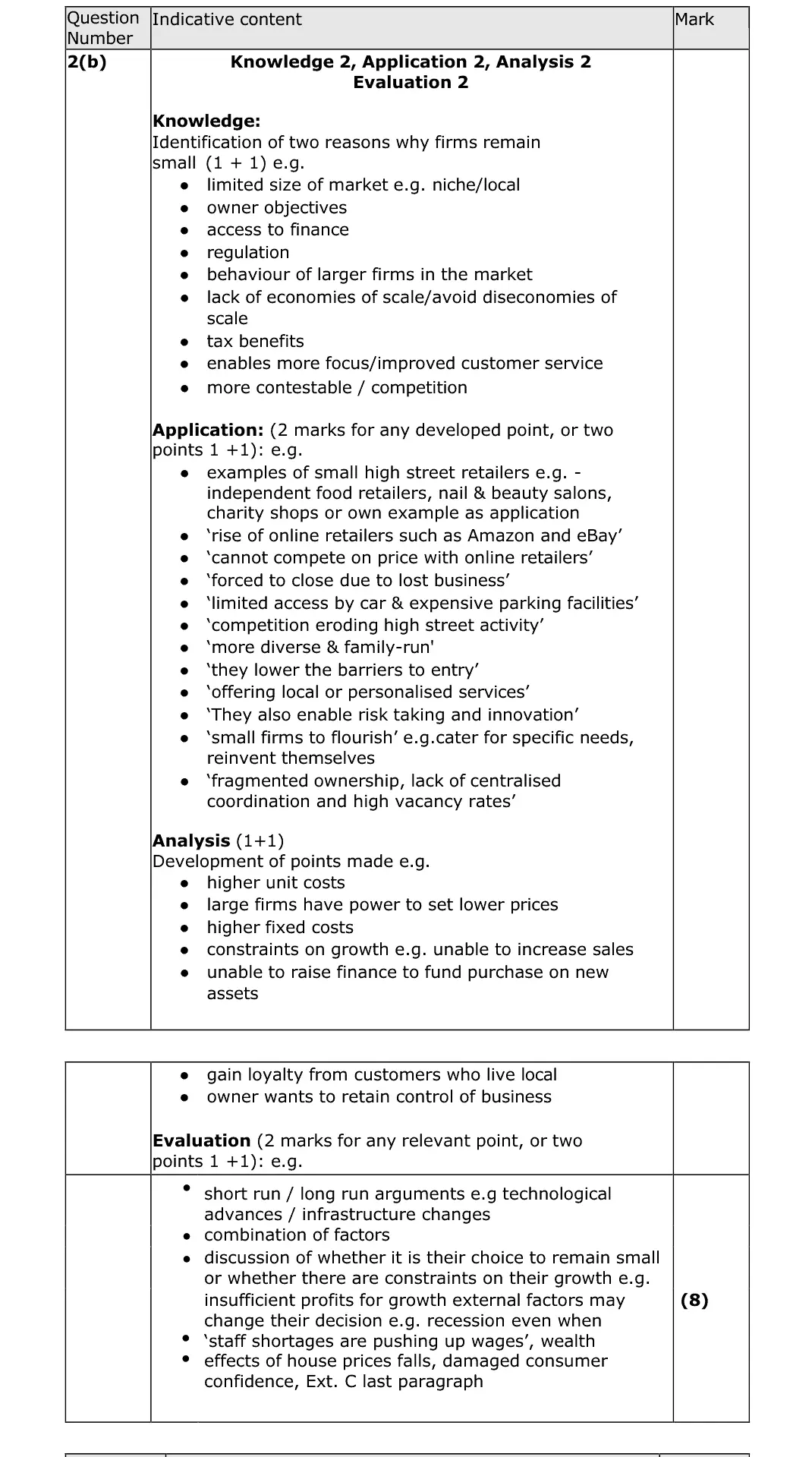
Mark scheme, including the levels grid and indicative content
Examiner's comment
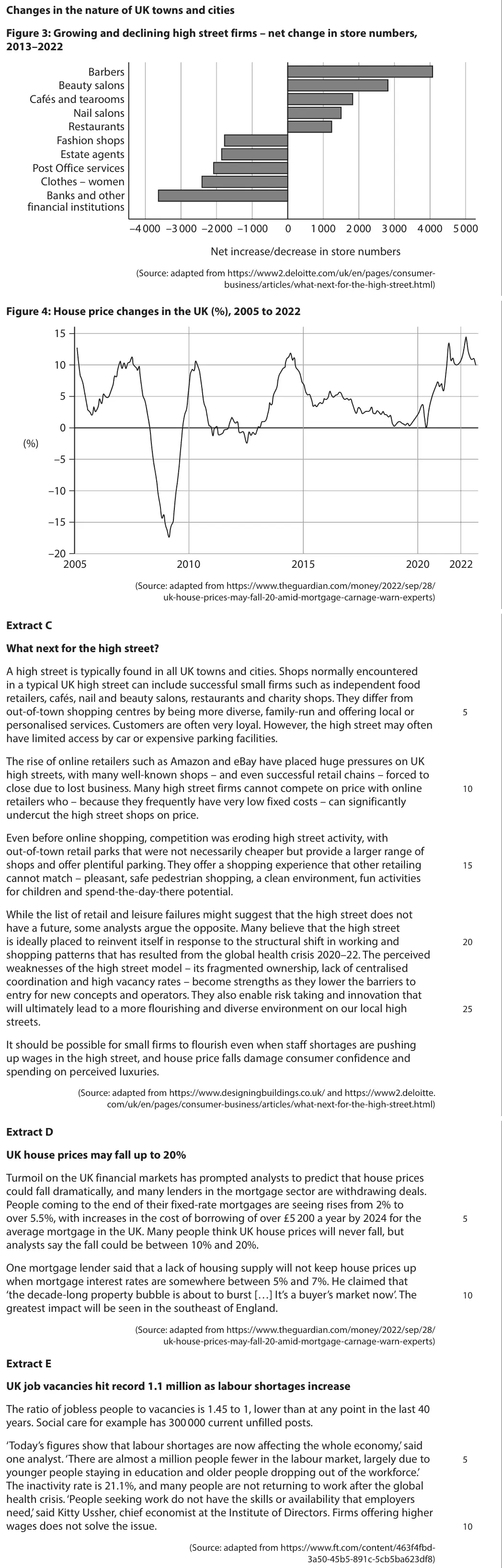
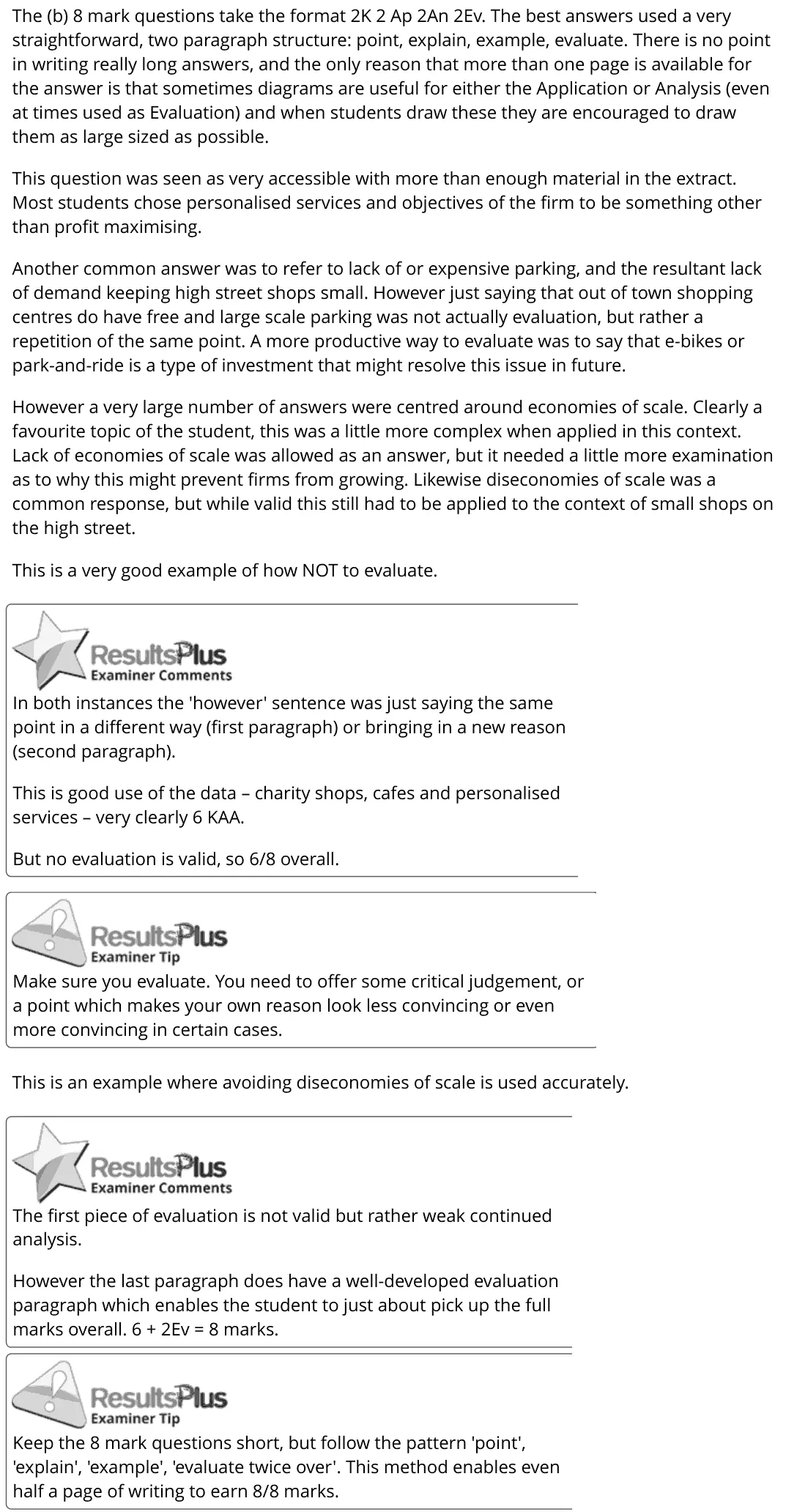
The (b) 8 mark questions take the format 2K 2 Ap 2An 2Ev. The best answers used a very straightforward, two paragraph structure: point, explain, example, evaluate. There is no point in writing really long answers, and the only reason that more than one page is available for the answer is that sometimes diagrams are useful for either the Application or Analysis (even at times used as Evaluation) and when students draw these they are encouraged to draw them as large sized as possible. This question was seen as very accessible with more than enough material in the extract. Most students chose personalised services and objectives of the firm to be something other than profit maximising. Another common answer was to refer to lack of or expensive parking, and the resultant lack of demand keeping high street shops small. However just saying that out of town shopping centres do have free and large scale parking was not actually evaluation, but rather a repetition of the same point. A more productive way to evaluate was to say that e-bikes or park-and-ride is a type of investment that might resolve this issue in future. However a very large number of answers were centred around economies of scale. Clearly a favourite topic of the student, this was a little more complex when applied in this context. Lack of economies of scale was allowed as an answer, but it needed a little more examination as to why this might prevent firms from growing. Likewise diseconomies of scale was a common response, but while valid this still had to be applied to the context of small shops on the high street. This is a very good example of how NOT to evaluate. In both instances the 'however' sentence was just saying the same point in a different way (first paragraph) or bringing in a new reason (second paragraph). This is good use of the data – charity shops, cafes and personalised services – very clearly 6 KAA. But no evaluation is valid, so 6/8 overall. Make sure you evaluate. You need to offer some critical judgement, or a point which makes your own reason look less convincing or even more convincing in certain cases. This is an example where avoiding diseconomies of scale is used accurately. The first piece of evaluation is not valid but rather weak continued analysis. However the last paragraph does have a well-developed evaluation paragraph which enables the student to just about pick up the full marks overall. 6 + 2Ev = 8 marks. Keep the 8 mark questions short, but follow the pattern 'point', 'explain', 'example', 'evaluate twice over'. This method enables even half a page of writing to earn 8/8 marks.
Notes from the mark scheme and report
e.g. niche or local market, owner objectives, personalised service, lack of parking
lack of economies of scale needs explaining in context
evaluation must not just restate the point (e.g. free parking out of town), consider choice v constraint
Quantitative skills: QS 9 (interpret, apply and analyse information in written, graphical tabular and numerical forms)
June 2022 · Paper 1 · Q5(a)1 markAO1=1Multiple choice
Data and extracts for question 5
Answer
C
Mark scheme
Notes from the mark scheme and report
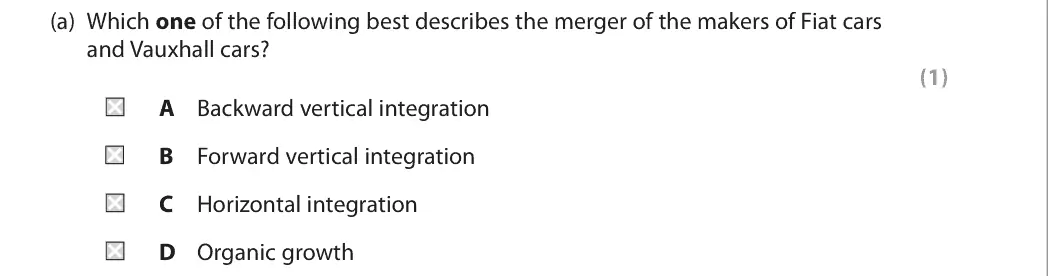
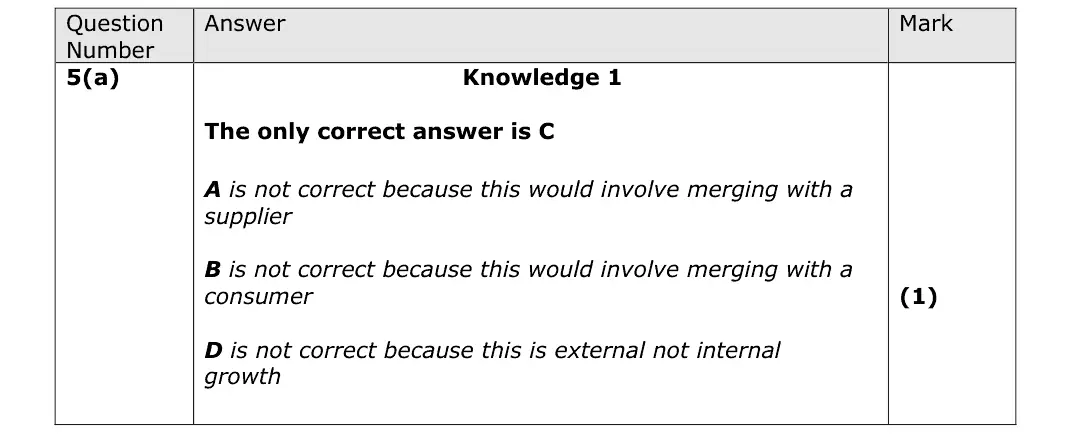
two car makers at the same stage of production is horizontal integration (C)
A backward vertical (supplier)
B forward vertical (customer)
D organic growth is internal, not a merger
June 2022 · Paper 1 · Q6(c)10 marksAO1=2, AO2=2, AO3=2, AO4=410-mark response
Data and extracts for question 6
Mark scheme, including the levels grid and indicative content
Examiner's comment
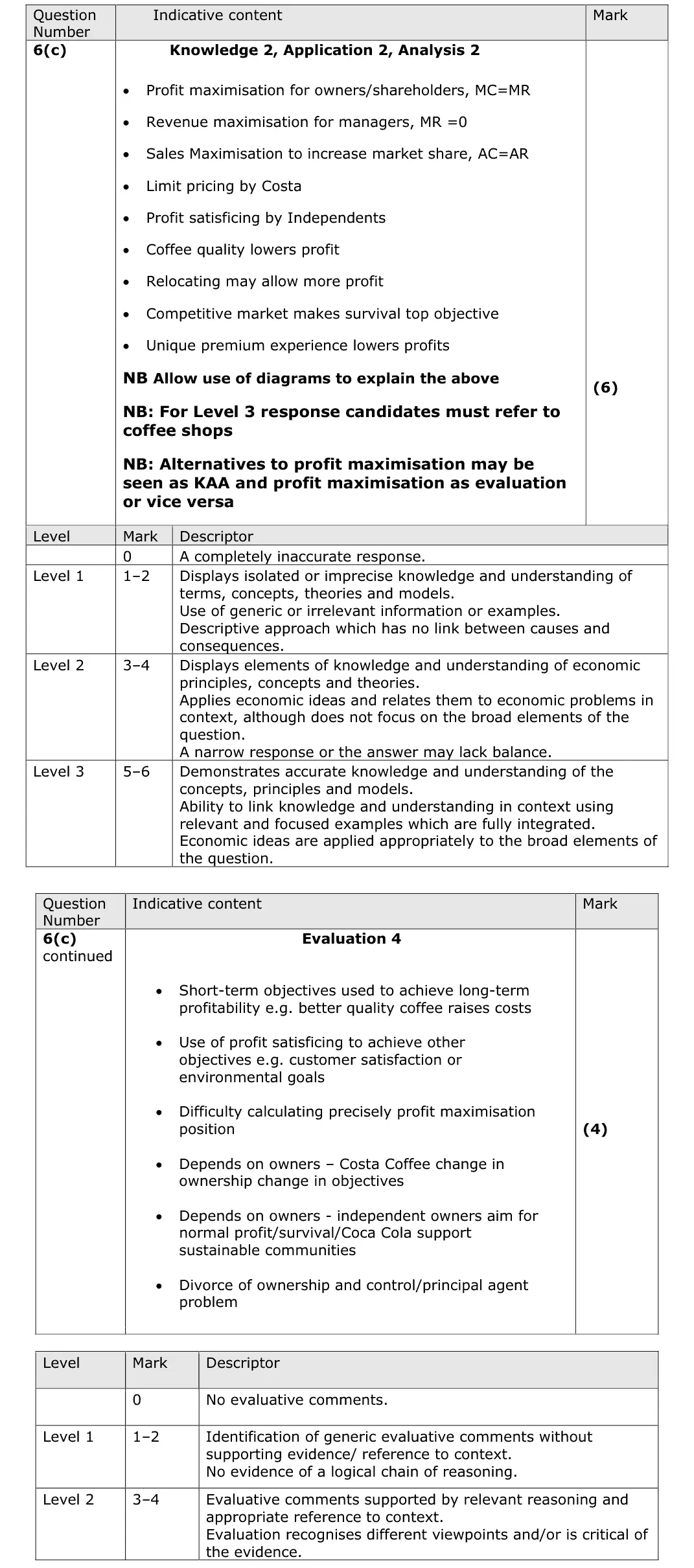
The expectation of this question is that candidates would start with an evaluation of the profit maximisation position. However, a vice-versa approach was also valid, especially since some candidates argued that profit maximisation would be the long-term objective. To access Level 3, candidates were required to apply this position to the coffee shop owners. Therefore, some very thorough purely theoretical answers were not awarded marks in the top Level. This response starts with a clear definition and uses a diagram in context to argue why branded stores like Costa will want to profit maximise for their owners (L3+). The following evaluation regarding the use of sales maximisation pricing to deal with hit-and-run competition is also well applied (L2e). The candidate provided another reason, that of niche independent stores relying on consumer loyalty but being subject to low profit, as drawn from the data (L3 & L2e). Overall, this response achieved L3 (6KAA) and L2e (4ev) and was awarded the full 10 marks. Try to evaluate in context. This response is awarded a low Level 3 for Knowledge, Application and Analysis (KAA) as it is a very narrow response. No marks were awarded for evaluation (3/10 marks). There is a lack of precision in this response in identifying the alternative objective to profit maximisation. As a result, the candidate displays elements of knowledge and understanding of the concept and there is some understanding in context, but it has not been explained clearly in the response. By not considering profit maximisation, the candidate has not focussed on the broad elements of the question. Ensure you have mastered key knowledge of economic terms and concepts to avoid generic responses.
Notes from the mark scheme and report
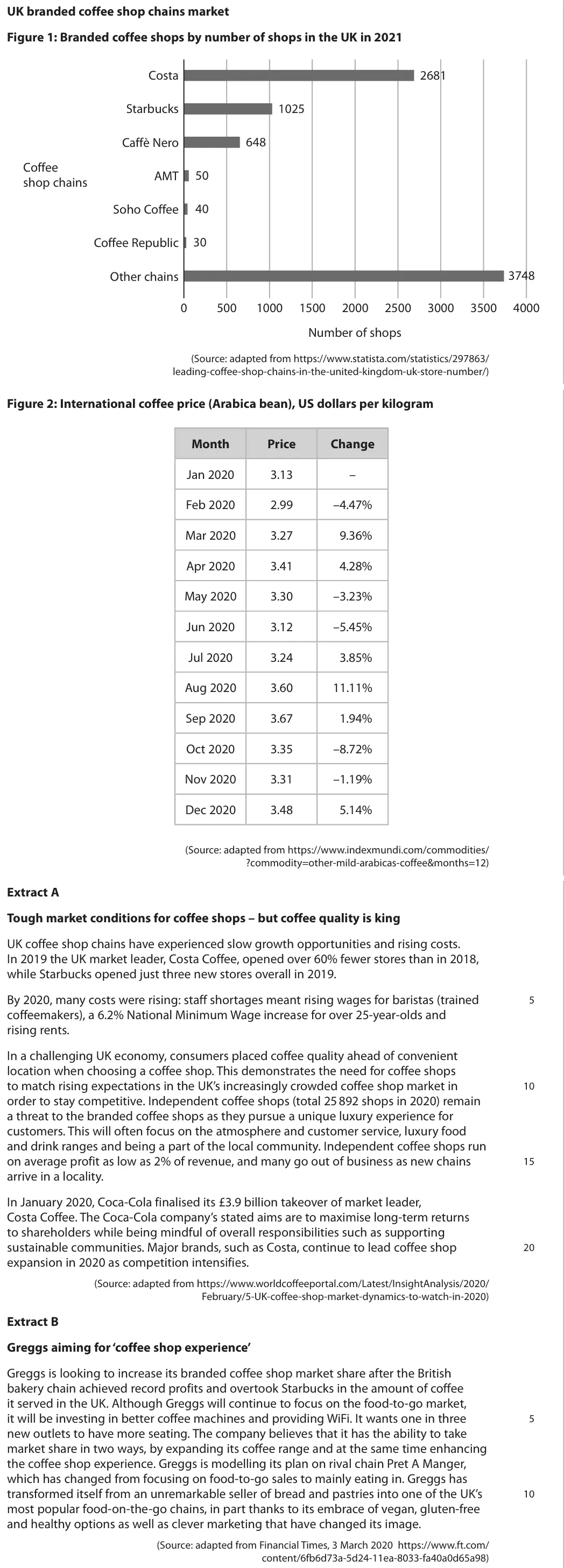
profit maximisation (MC = MR) for Costa's shareholders against sales or revenue maximisation, limit pricing and satisficing by independents on 2% margins
Level 3 needs application to coffee shops
theoretical answers stayed below Level 3
June 2022 · Paper 3 · Q1(c)12 marksAO1=2, AO2=2, AO3=4, AO4=412-mark response
Data and extracts for question 1
Mark scheme, including the levels grid and indicative content
Examiner's comment
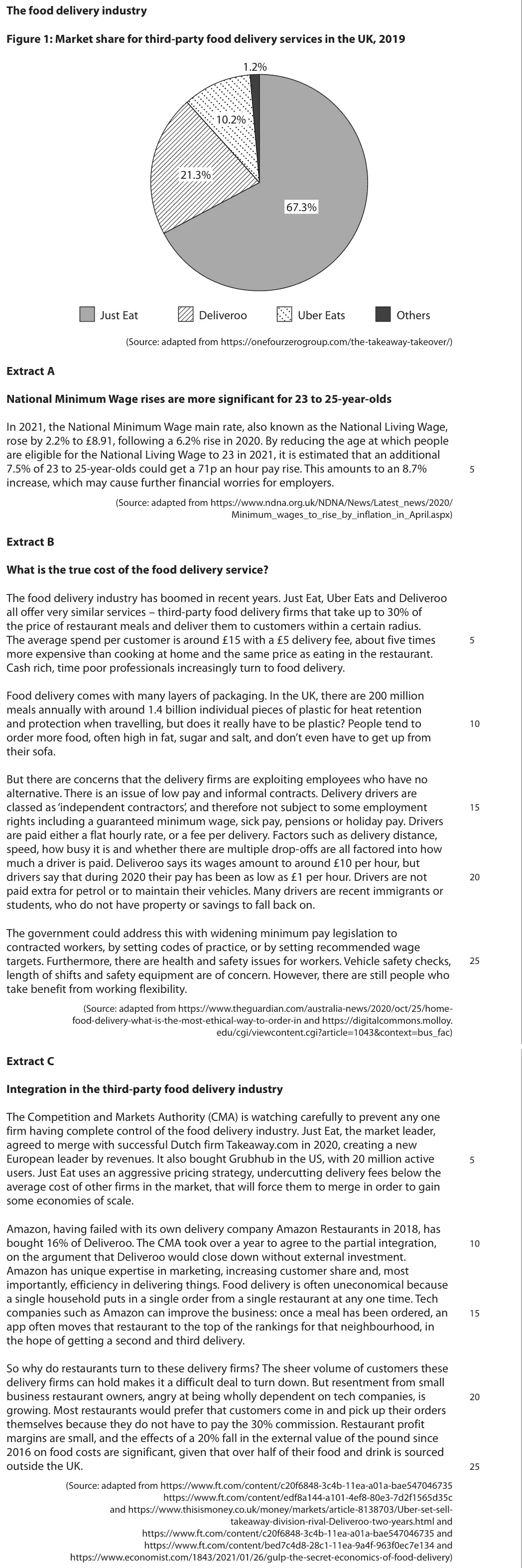
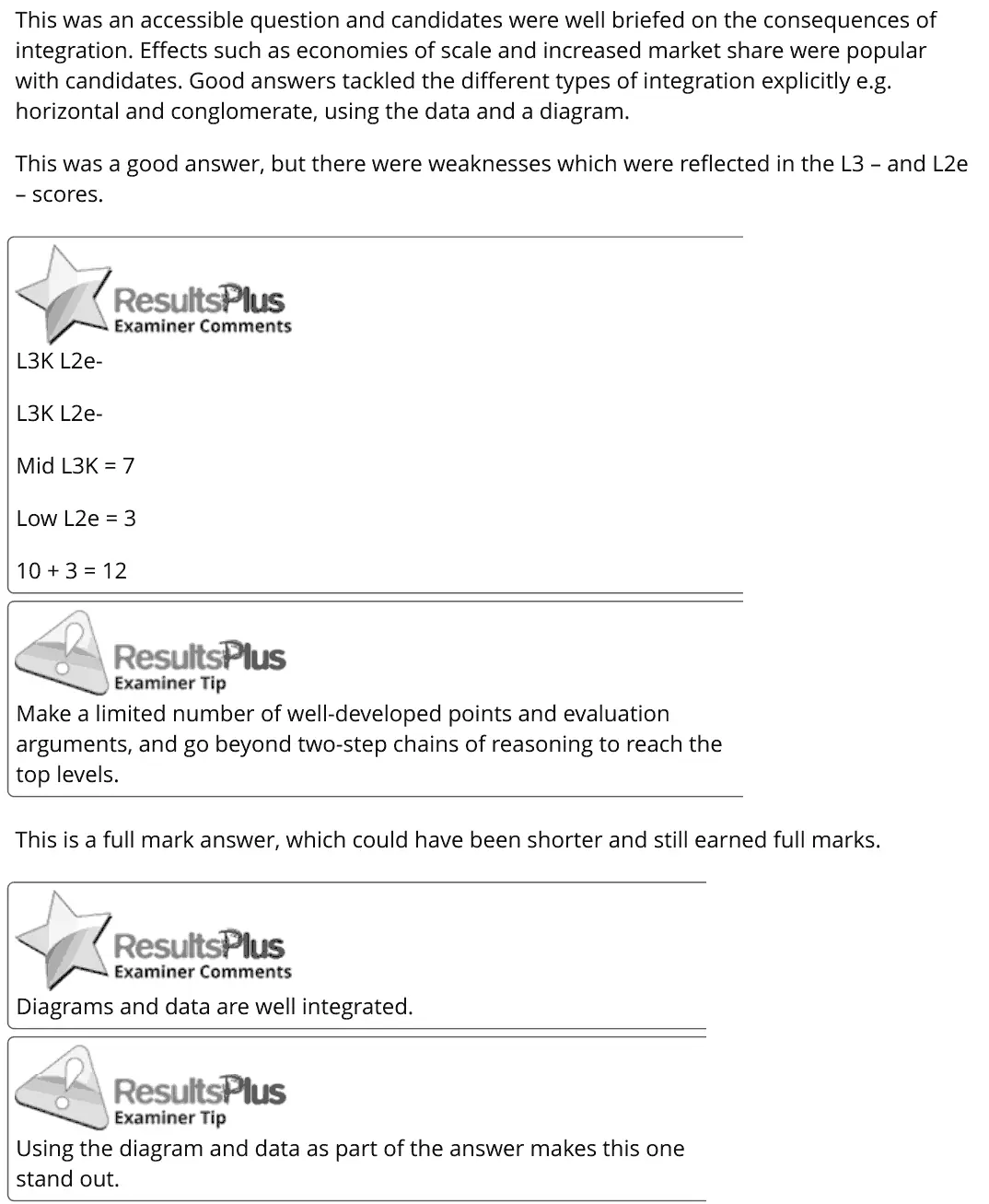
This was an accessible question and candidates were well briefed on the consequences of integration. Effects such as economies of scale and increased market share were popular with candidates. Good answers tackled the different types of integration explicitly e.g. horizontal and conglomerate, using the data and a diagram. This was a good answer, but there were weaknesses which were reflected in the L3 – and L2e – scores. L3K L2e- L3K L2e- Mid L3K = 7 Low L2e = 3 10 + 3 = 12 Make a limited number of well-developed points and evaluation arguments, and go beyond two-step chains of reasoning to reach the top levels. This is a full mark answer, which could have been shorter and still earned full marks. Diagrams and data are well integrated. Using the diagram and data as part of the answer makes this one stand out.
Notes from the mark scheme and report
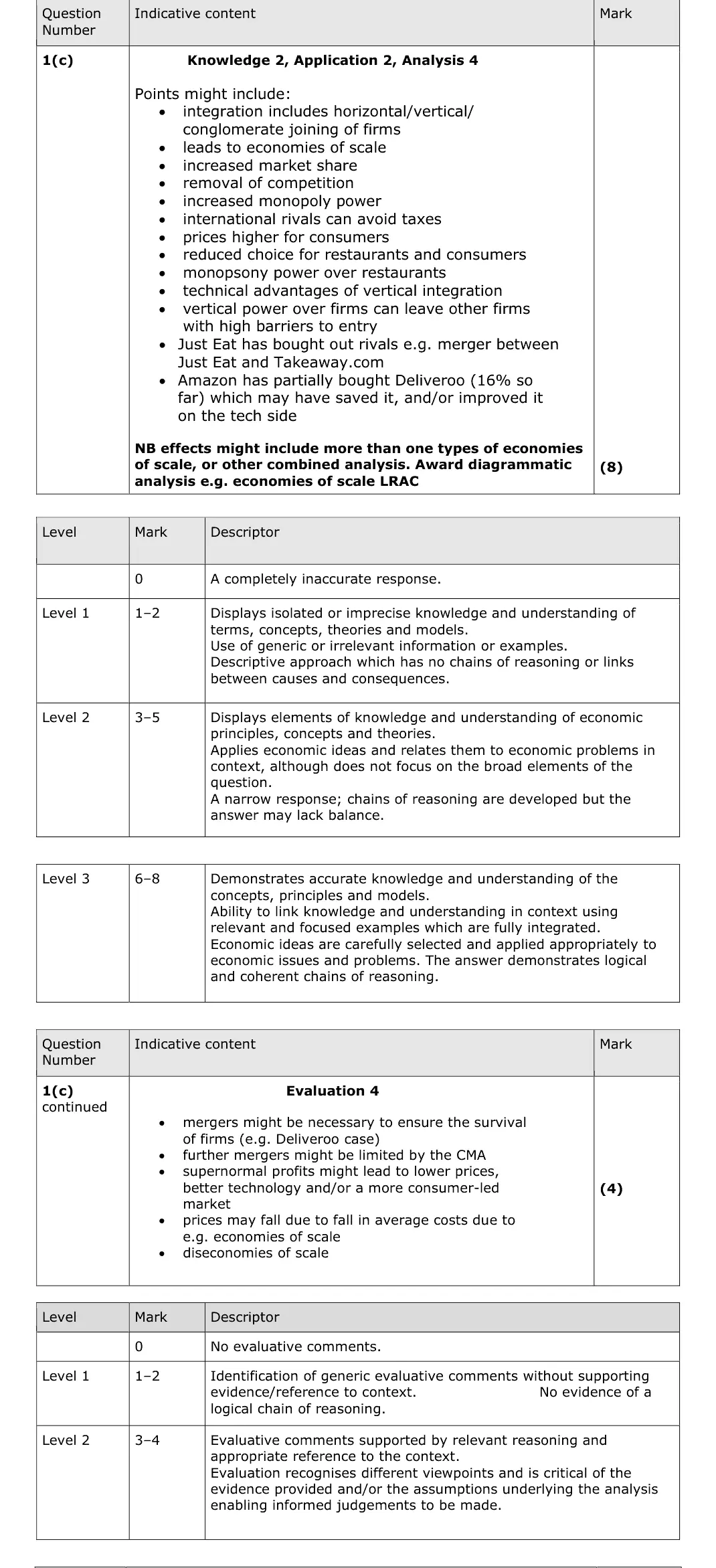
name the type of integration (Just Eat and Takeaway.com horizontal, Amazon's 16% of Deliveroo)
economies of scale (LRAC diagram), market power, higher prices and less choice, monopsony power over restaurants
evaluate e.g. CMA oversight, efficiency gains
few well-developed points beat a list
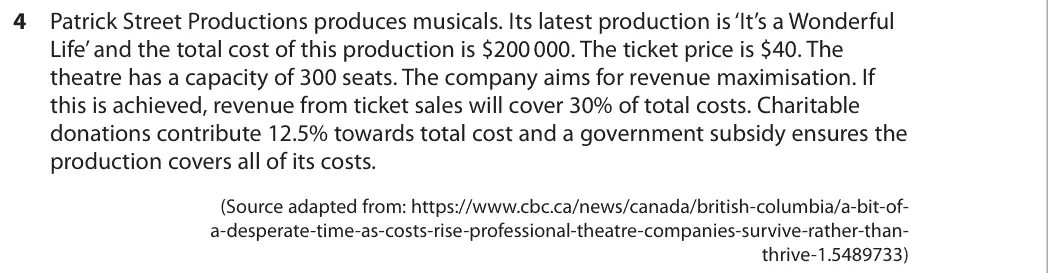
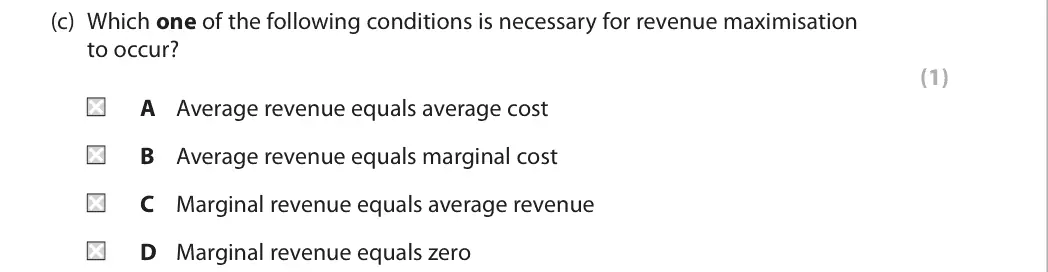
November 2021 · Paper 1 · Q4(c)1 markAO3=1Multiple choice
Data and extracts for question 4
Answer
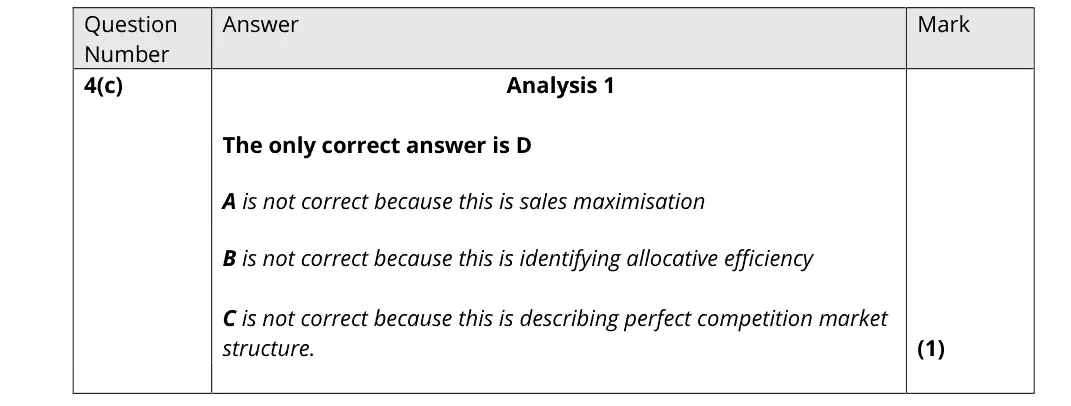
D
Mark scheme
Notes from the mark scheme and report
revenue maximisation where MR = 0 (D)
AR = AC is sales maximisation, AR = MC is allocative efficiency, MR = AR is the perfectly competitive firm
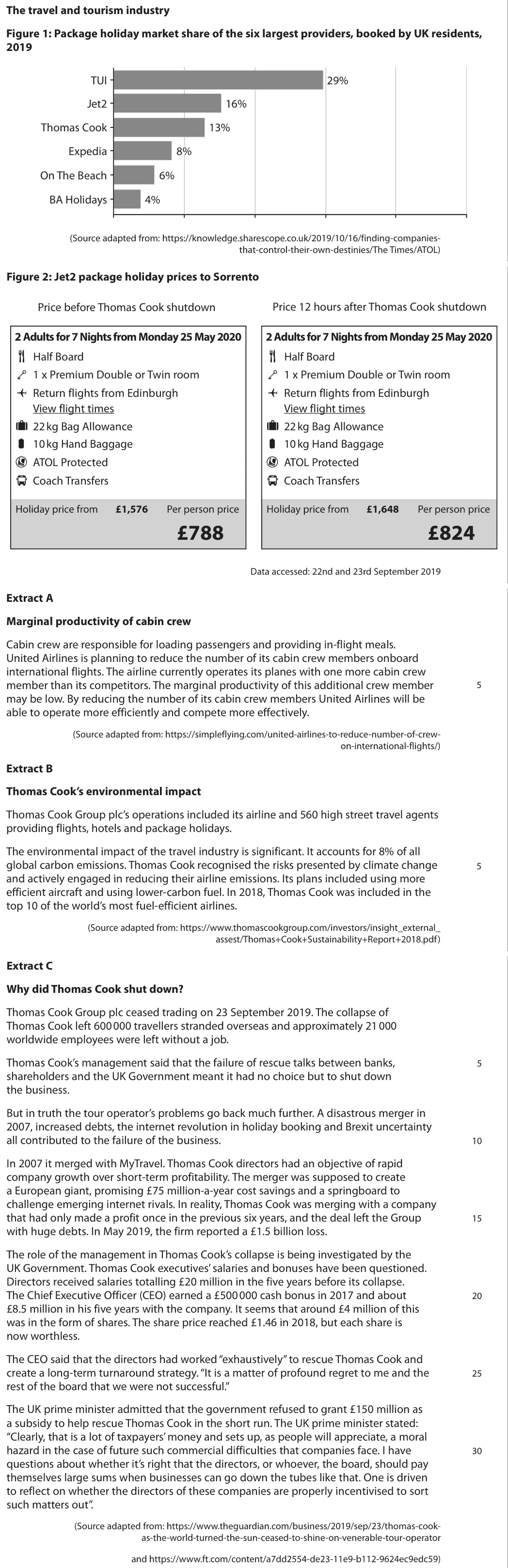
November 2021 · Paper 1 · Q6(c)10 marksAO1=2, AO2=2, AO3=2, AO4=410-mark response
Data and extracts for question 6
Mark scheme, including the levels grid and indicative content
Examiner's comment
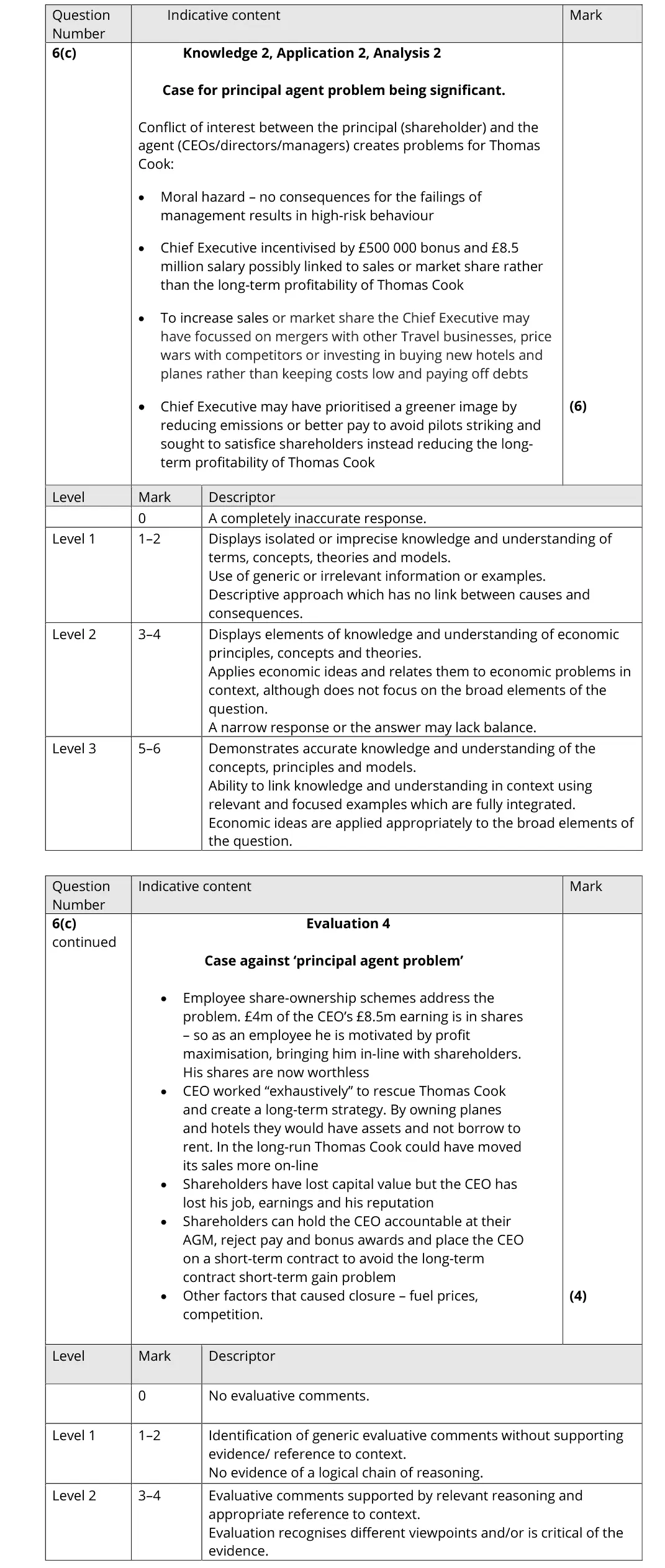
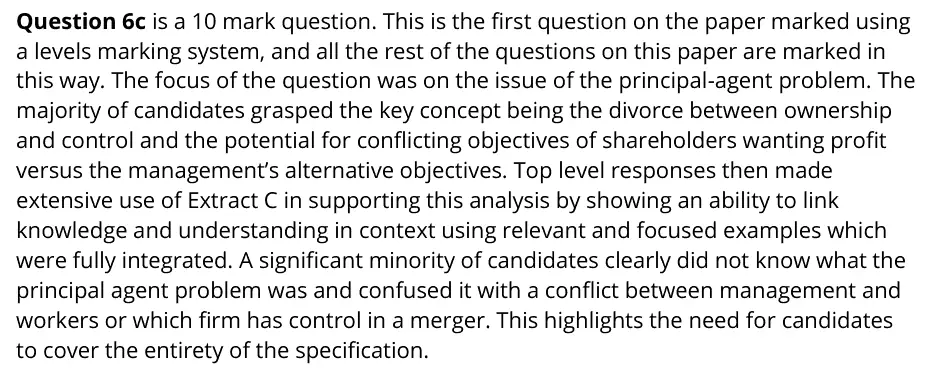
Question 6c is a 10 mark question. This is the first question on the paper marked using a levels marking system, and all the rest of the questions on this paper are marked in this way. The focus of the question was on the issue of the principal-agent problem. The majority of candidates grasped the key concept being the divorce between ownership and control and the potential for conflicting objectives of shareholders wanting profit versus the management’s alternative objectives. Top level responses then made extensive use of Extract C in supporting this analysis by showing an ability to link knowledge and understanding in context using relevant and focused examples which were fully integrated. A significant minority of candidates clearly did not know what the principal agent problem was and confused it with a conflict between management and workers or which firm has control in a merger. This highlights the need for candidates to cover the entirety of the specification.
Notes from the mark scheme and report
divorce of ownership from control: directors pursued growth via the MyTravel merger and kept bonuses (CEO £500 000 bonus) while shareholders lost
evaluate other causes (debt, internet booking, Brexit)
report: a significant minority did not know the principal-agent problem, confusing it with managers versus workers
October 2020 · Paper 1 · Q5(a)2 marksAO1=1, AO3=1Short answer
Data and extracts for question 5
Mark scheme
Examiner's comment
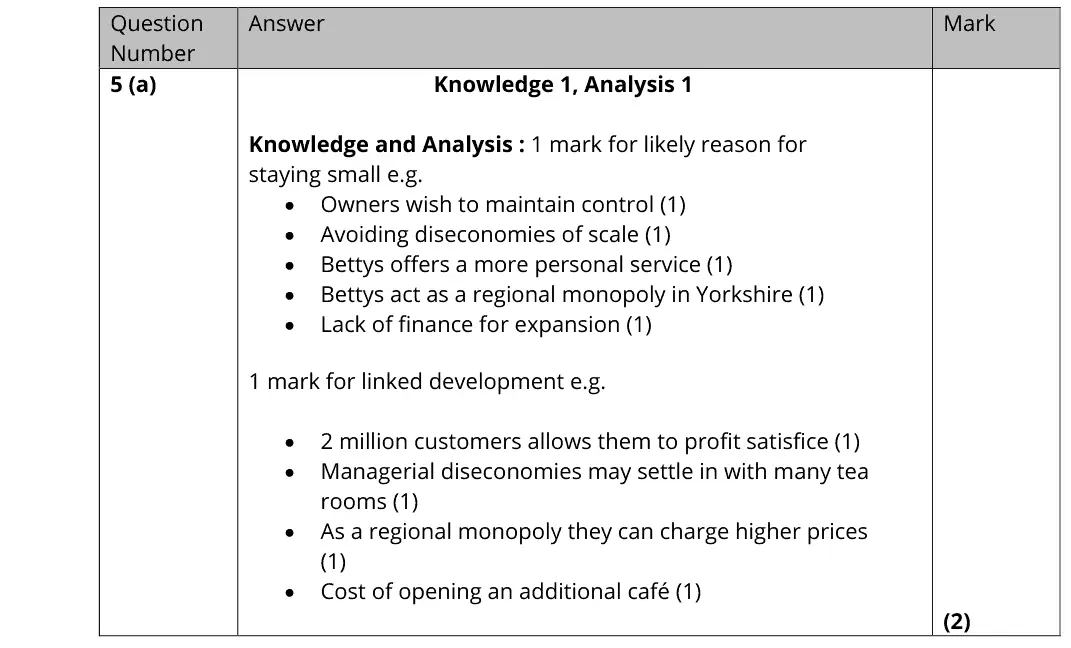
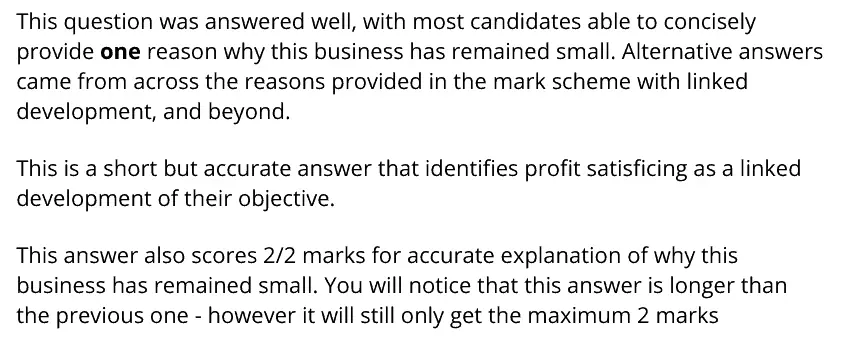
This question was answered well, with most candidates able to concisely provide one reason why this business has remained small. Alternative answers came from across the reasons provided in the mark scheme with linked development, and beyond. This is a short but accurate answer that identifies profit satisficing as a linked development of their objective. This answer also scores 2/2 marks for accurate explanation of why this business has remained small. You will notice that this answer is longer than the previous one - however it will still only get the maximum 2 marks
Notes from the mark scheme and report
one reason (owners keep control, avoid diseconomies of scale, personal service, regional niche, lack of finance) with linked development in context, e.g. 2 million customers already gives satisficing profit
October 2020 · Paper 1 · Q5(b)2 marksAO1=2Short answer
Data and extracts for question 5
Mark scheme
Examiner's comment
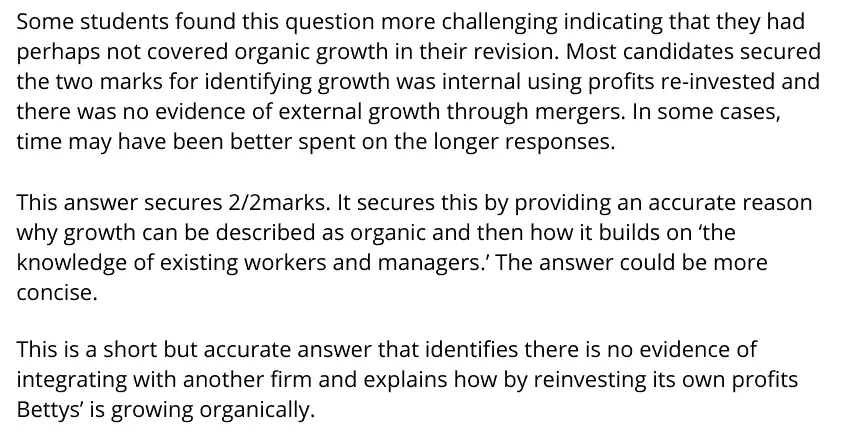
Some students found this question more challenging indicating that they had perhaps not covered organic growth in their revision. Most candidates secured the two marks for identifying growth was internal using profits re-invested and there was no evidence of external growth through mergers. In some cases, time may have been better spent on the longer responses. This answer secures 2/2marks. It secures this by providing an accurate reason why growth can be described as organic and then how it builds on ‘the knowledge of existing workers and managers.’ The answer could be more concise. This is a short but accurate answer that identifies there is no evidence of integrating with another firm and explains how by reinvesting its own profits Bettys’ is growing organically.
Notes from the mark scheme and report
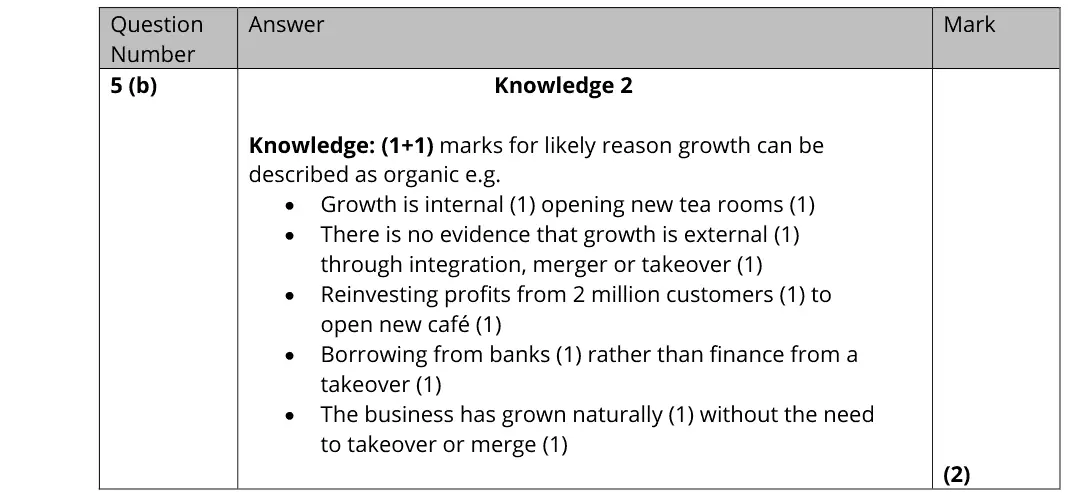
organic growth is internal: opening new branches funded by reinvested profit
no evidence of merger or takeover
report: some had not revised organic growth
October 2020 · Paper 1 · Q5(c)1 markAO2=1Multiple choice
Data and extracts for question 5
Answer
B
Mark scheme
Notes from the mark scheme and report
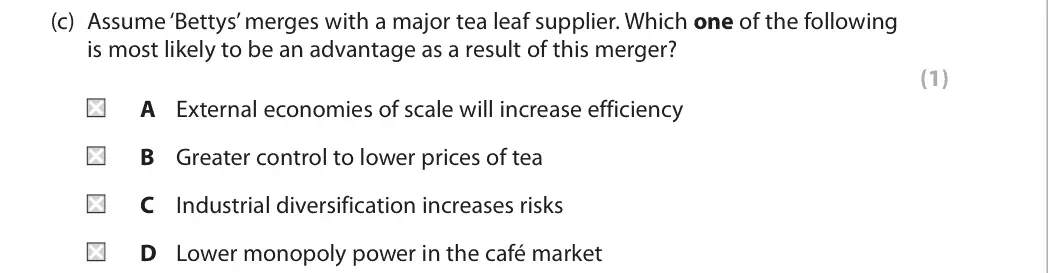
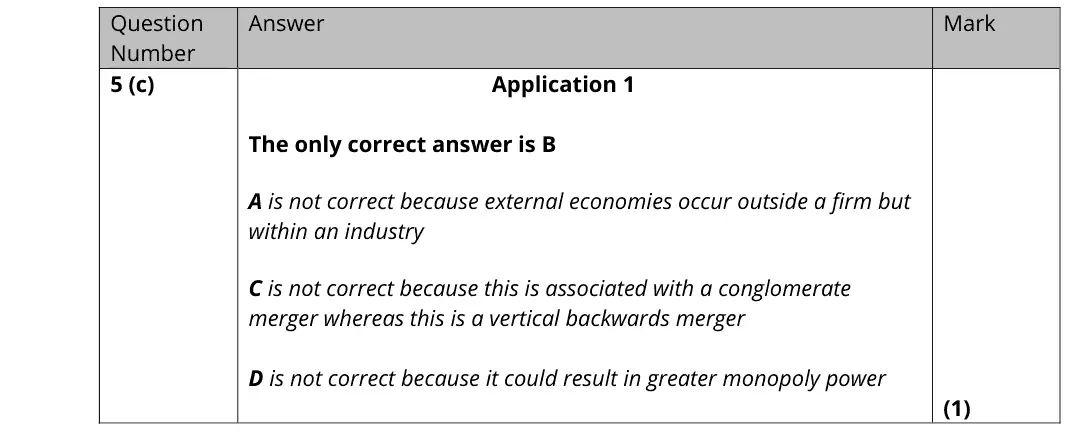
merging with a tea supplier is backward vertical integration giving control over input prices (B)
A external economies arise outside the firm
C diversification describes a conglomerate merger
D monopoly power would rise
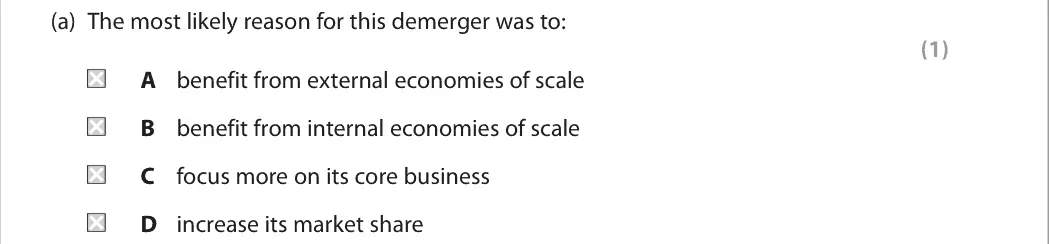
June 2019 · Paper 1 · Q4(a)1 markAO3=1Multiple choice
Data and extracts for question 4
Answer
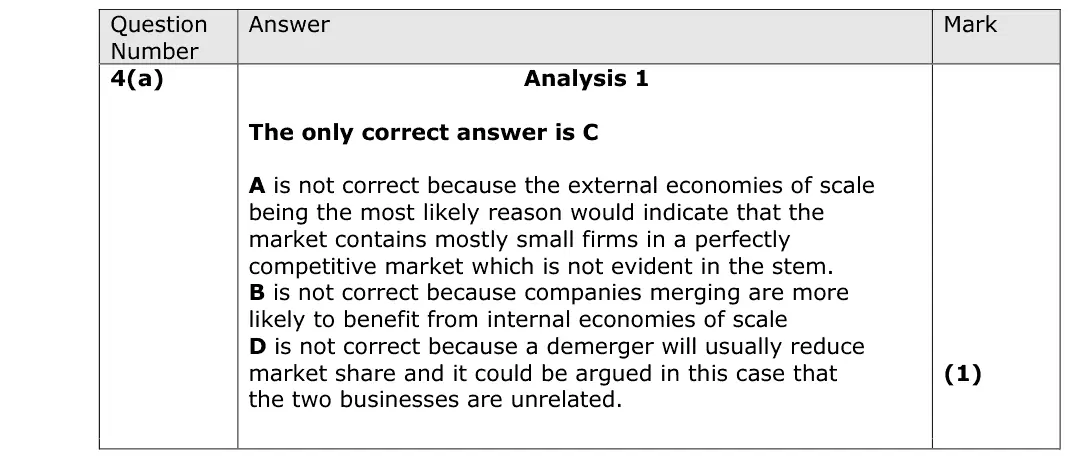
C
Mark scheme
Notes from the mark scheme and report
the demerged firm can focus on its core business (C)
external economies of scale are irrelevant, internal economies come from growing not demerging, a demerger usually reduces market share
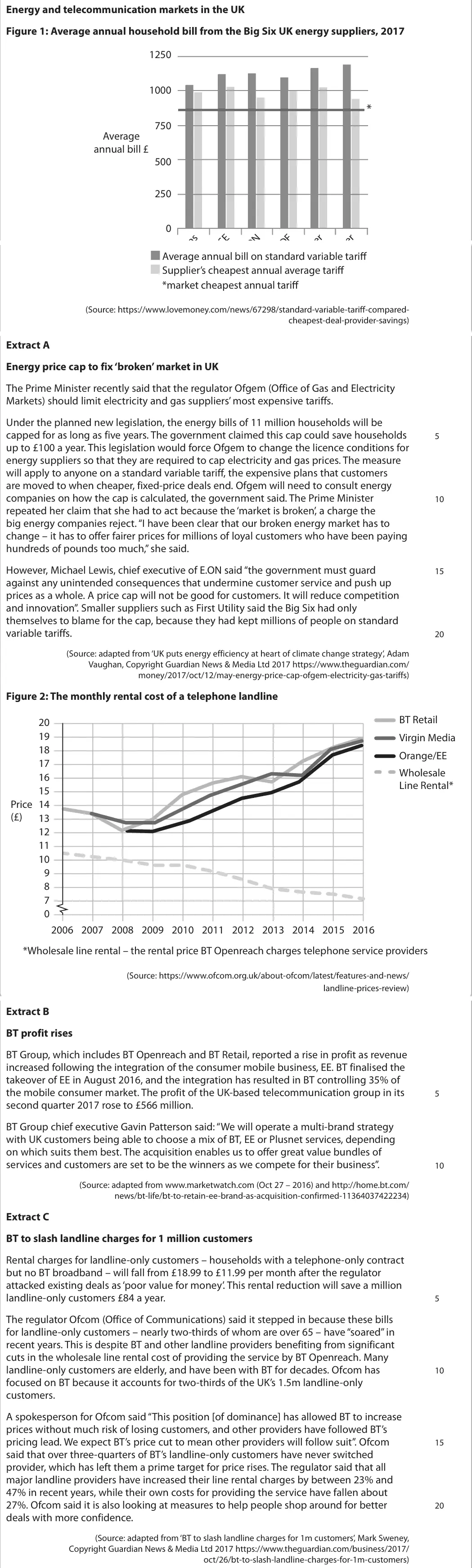
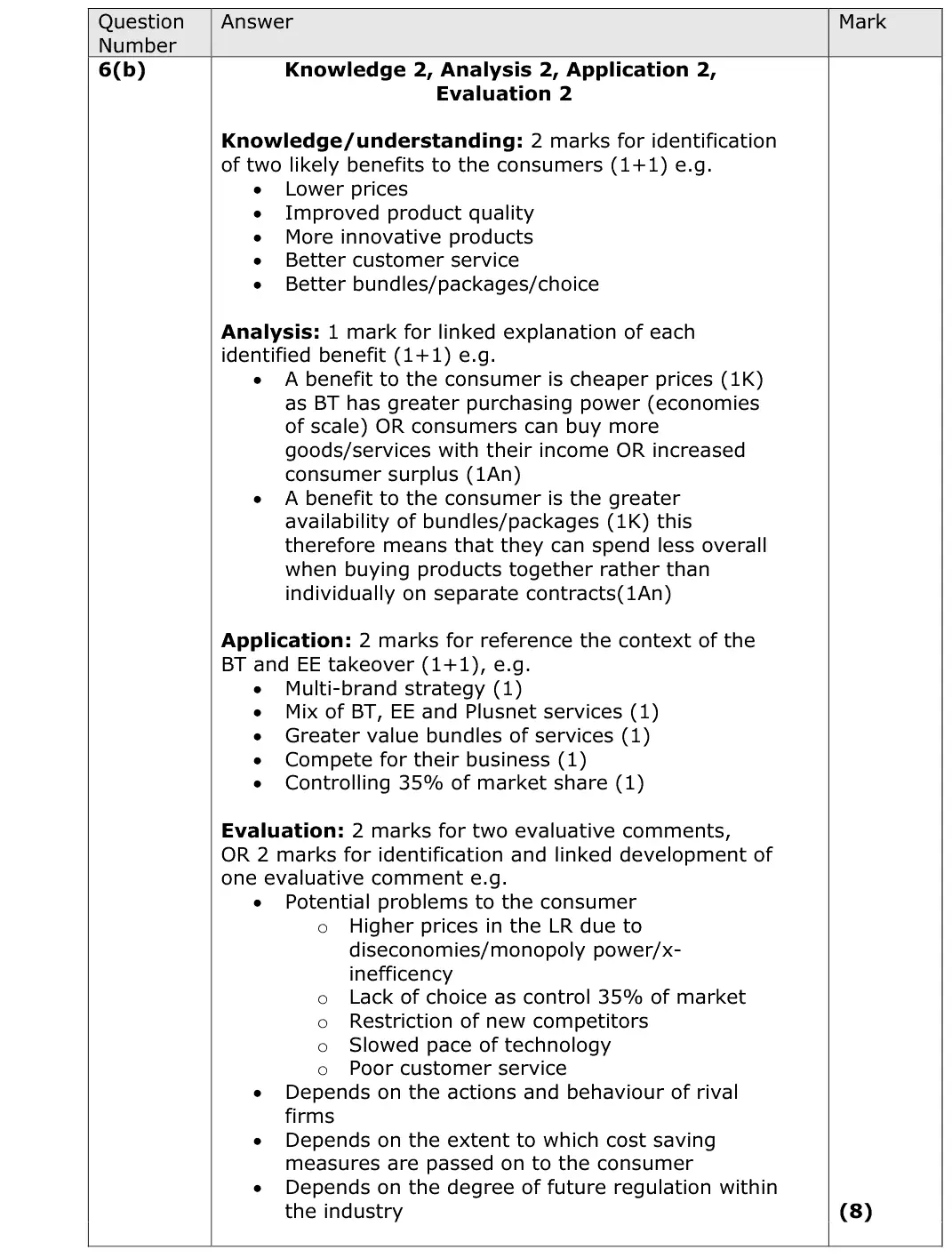
June 2019 · Paper 1 · Q6(b)8 marksAO1=2, AO2=2, AO3=2, AO4=28-mark response
Data and extracts for question 6
Mark scheme, including the levels grid and indicative content
Examiner's comment
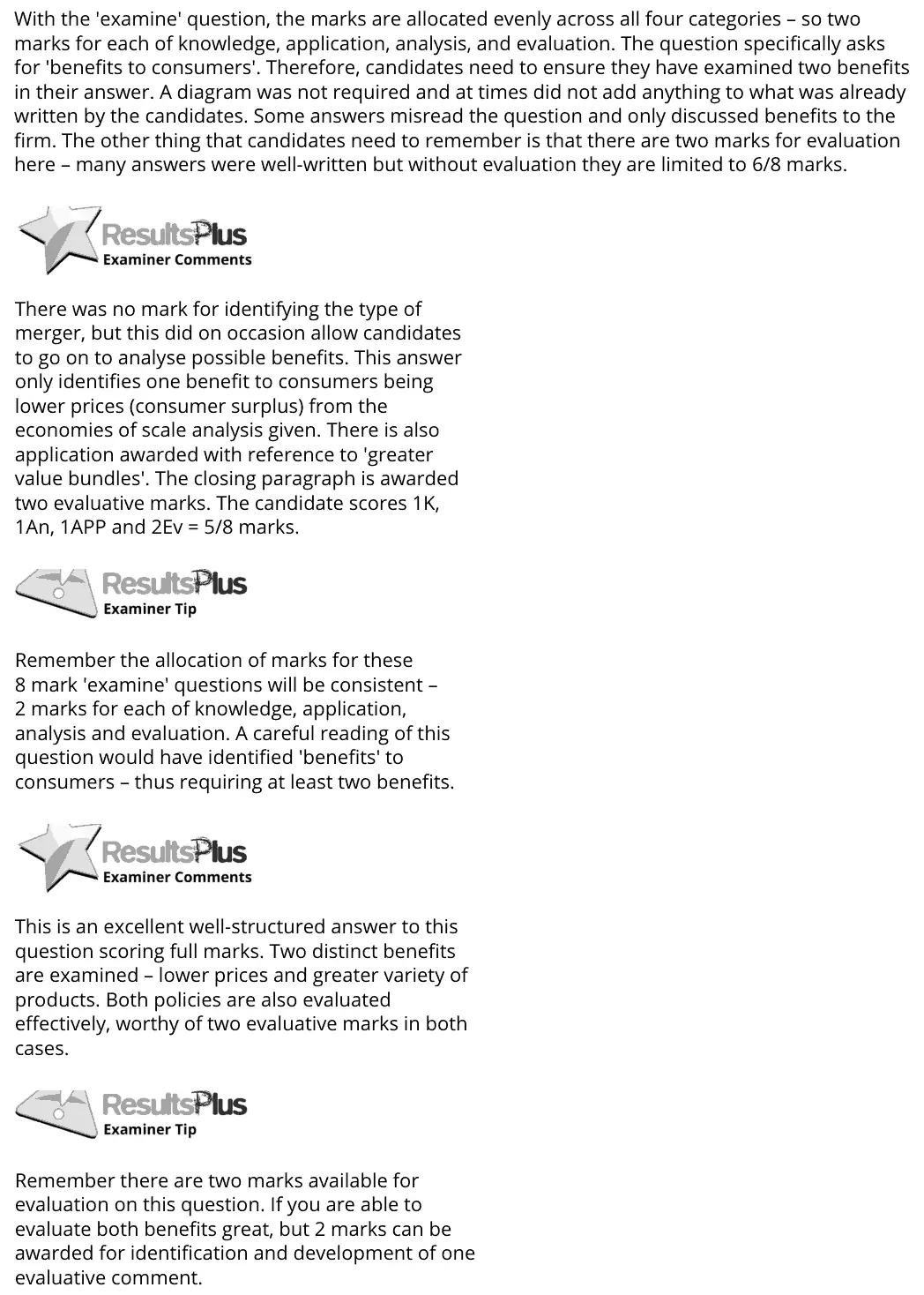
With the 'examine' question, the marks are allocated evenly across all four categories – so two marks for each of knowledge, application, analysis, and evaluation. The question specifically asks for 'benefits to consumers'. Therefore, candidates need to ensure they have examined two benefits in their answer. A diagram was not required and at times did not add anything to what was already written by the candidates. Some answers misread the question and only discussed benefits to the firm. The other thing that candidates need to remember is that there are two marks for evaluation here – many answers were well-written but without evaluation they are limited to 6/8 marks. There was no mark for identifying the type of merger, but this did on occasion allow candidates to go on to analyse possible benefits. This answer only identifies one benefit to consumers being lower prices (consumer surplus) from the economies of scale analysis given. There is also application awarded with reference to 'greater value bundles'. The closing paragraph is awarded two evaluative marks. The candidate scores 1K, 1An, 1APP and 2Ev = 5/8 marks. Remember the allocation of marks for these 8 mark 'examine' questions will be consistent – 2 marks for each of knowledge, application, analysis and evaluation. A careful reading of this question would have identified 'benefits' to consumers – thus requiring at least two benefits. This is an excellent well-structured answer to this question scoring full marks. Two distinct benefits are examined – lower prices and greater variety of products. Both policies are also evaluated effectively, worthy of two evaluative marks in both cases. Remember there are two marks available for evaluation on this question. If you are able to evaluate both benefits great, but 2 marks can be awarded for identification and development of one evaluative comment.
Notes from the mark scheme and report
two benefits to consumers (lower prices from economies of scale, better-value bundles, quality, innovation) applied to BT/EE
report: some discussed benefits to the firm, and no evaluation caps the mark at 6/8
June 2019 · Paper 3 · Q2(b)8 marksAO1=2, AO2=2, AO3=2, AO4=28-mark response
Data and extracts for question 2
Mark scheme, including the levels grid and indicative content
Examiner's comment
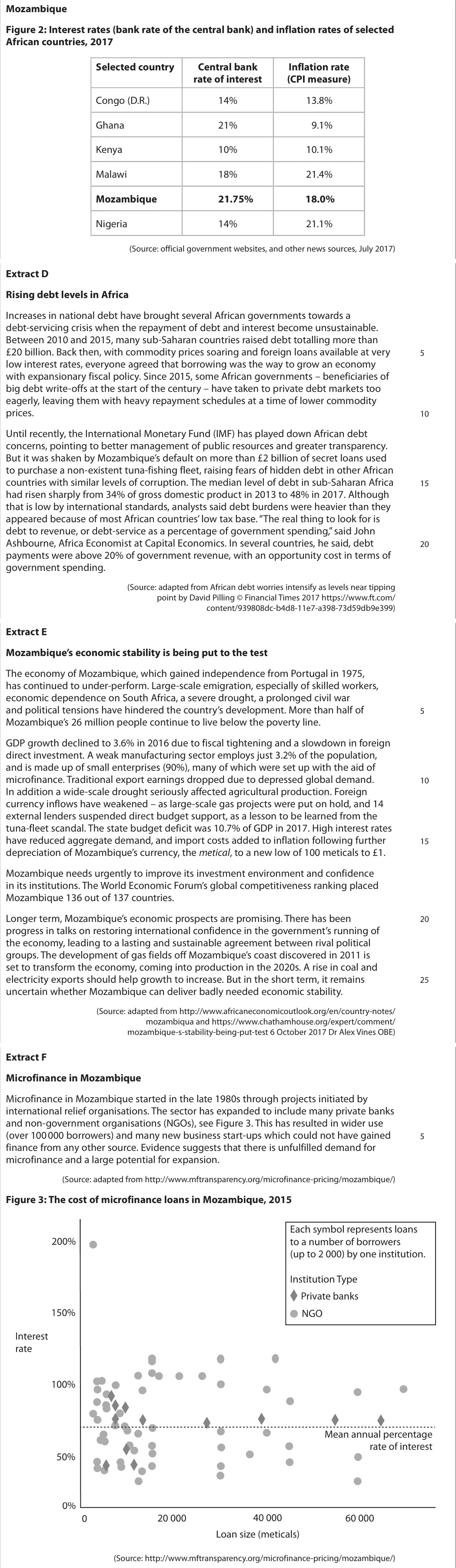
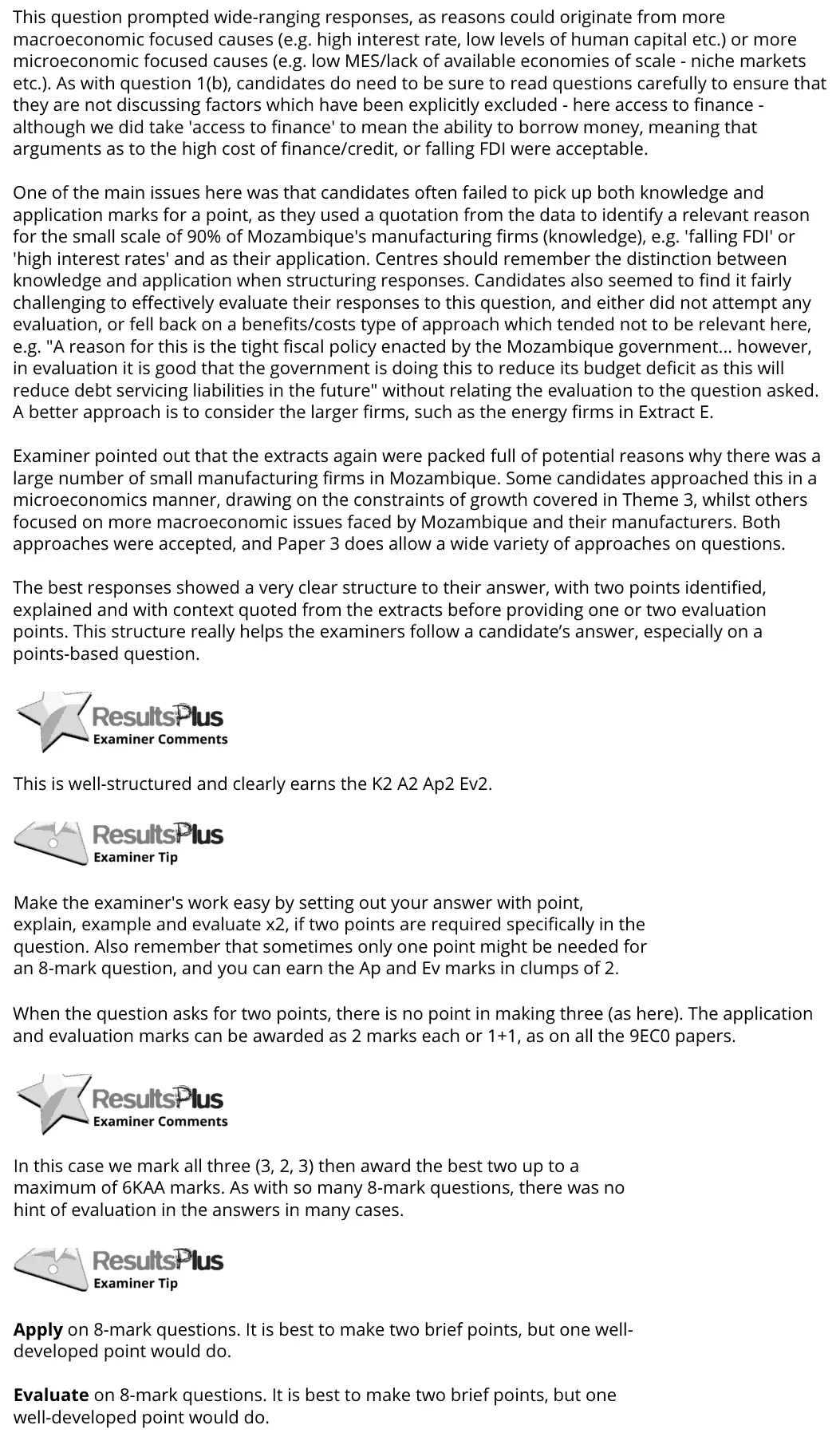
This question prompted wide-ranging responses, as reasons could originate from more macroeconomic focused causes (e.g. high interest rate, low levels of human capital etc.) or more microeconomic focused causes (e.g. low MES/lack of available economies of scale - niche markets etc.). As with question 1(b), candidates do need to be sure to read questions carefully to ensure that they are not discussing factors which have been explicitly excluded - here access to finance - although we did take 'access to finance' to mean the ability to borrow money, meaning that arguments as to the high cost of finance/credit, or falling FDI were acceptable. One of the main issues here was that candidates often failed to pick up both knowledge and application marks for a point, as they used a quotation from the data to identify a relevant reason for the small scale of 90% of Mozambique's manufacturing firms (knowledge), e.g. 'falling FDI' or 'high interest rates' and as their application. Centres should remember the distinction between knowledge and application when structuring responses. Candidates also seemed to find it fairly challenging to effectively evaluate their responses to this question, and either did not attempt any evaluation, or fell back on a benefits/costs type of approach which tended not to be relevant here, e.g. "A reason for this is the tight fiscal policy enacted by the Mozambique government... however, in evaluation it is good that the government is doing this to reduce its budget deficit as this will reduce debt servicing liabilities in the future" without relating the evaluation to the question asked. A better approach is to consider the larger firms, such as the energy firms in Extract E. Examiner pointed out that the extracts again were packed full of potential reasons why there was a large number of small manufacturing firms in Mozambique. Some candidates approached this in a microeconomics manner, drawing on the constraints of growth covered in Theme 3, whilst others focused on more macroeconomic issues faced by Mozambique and their manufacturers. Both approaches were accepted, and Paper 3 does allow a wide variety of approaches on questions. The best responses showed a very clear structure to their answer, with two points identified, explained and with context quoted from the extracts before providing one or two evaluation points. This structure really helps the examiners follow a candidate’s answer, especially on a points-based question. This is well-structured and clearly earns the K2 A2 Ap2 Ev2. Make the examiner's work easy by setting out your answer with point, explain, example and evaluate x2, if two points are required specifically in the question. Also remember that sometimes only one point might be needed for an 8-mark question, and you can earn the Ap and Ev marks in clumps of 2. When the question asks for two points, there is no point in making three (as here). The application and evaluation marks can be awarded as 2 marks each or 1+1, as on all the 9EC0 papers. In this case we mark all three (3, 2, 3) then award the best two up to a maximum of 6KAA marks. As with so many 8-mark questions, there was no hint of evaluation in the answers in many cases. Apply on 8-mark questions. It is best to make two brief points, but one well- developed point would do. Evaluate on 8-mark questions. It is best to make two brief points, but one well-developed point would do.
Notes from the mark scheme and report
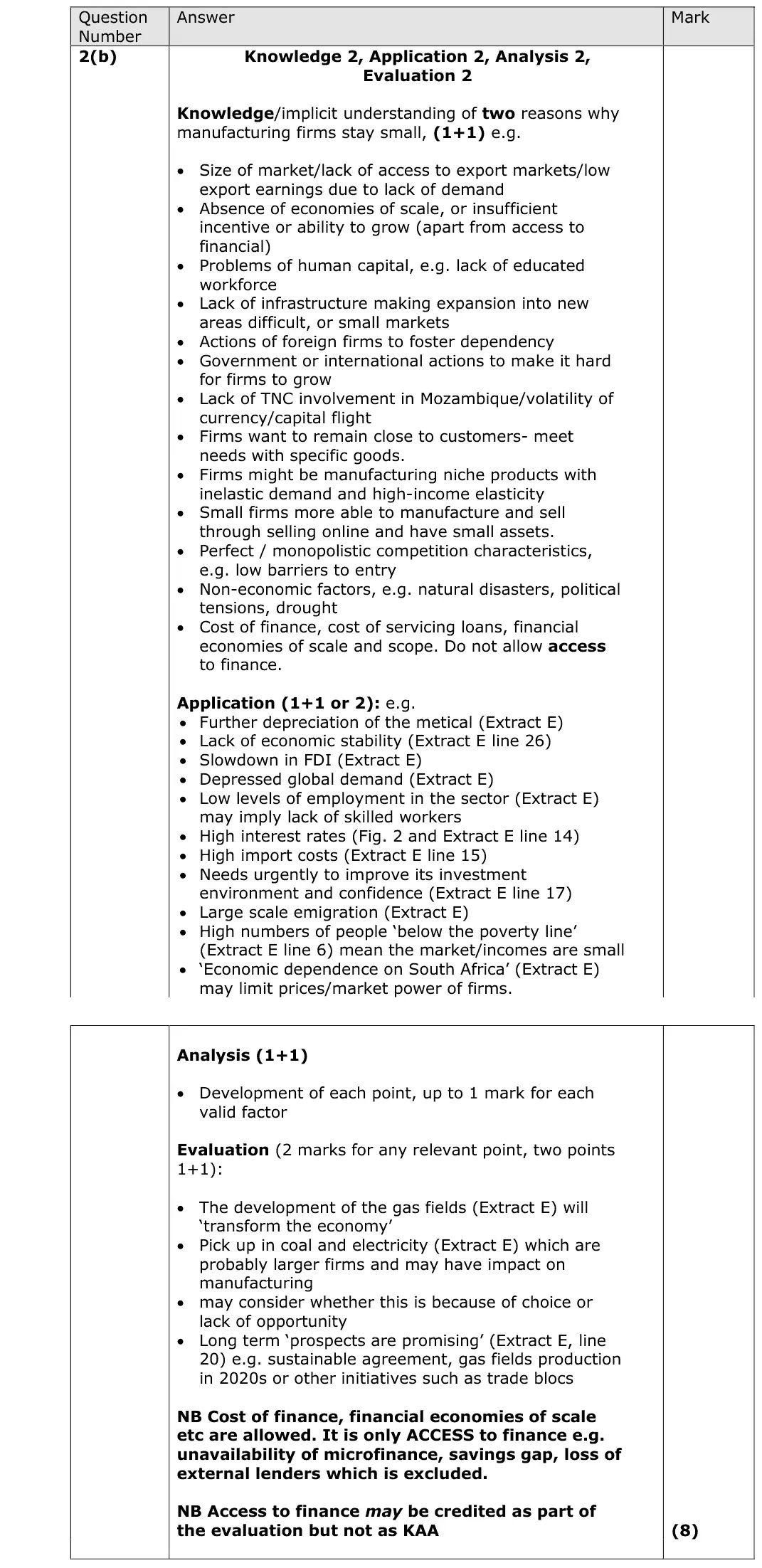
access to finance is excluded (cost of finance allowed)
small market, poverty, lack of economies of scale, low human capital, weak infrastructure
separate the reason (knowledge) from the data quote (application)
evaluate e.g. gas fields will transform the economy
Quantitative skills: QS 9 (interpret, apply and analyse information in written, graphical tabular and numerical forms)
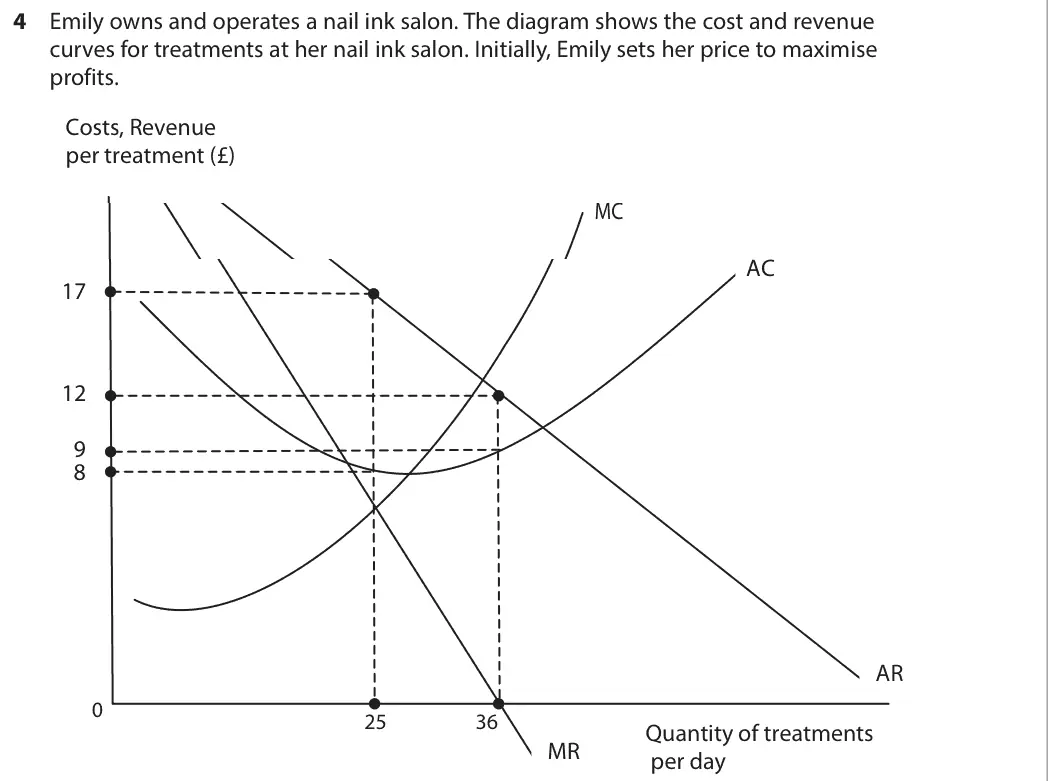
June 2018 · Paper 1 · Q4(a)4 marksAO1=2, AO2=2Calculation
Data and extracts for question 4
Mark scheme
Examiner's comment
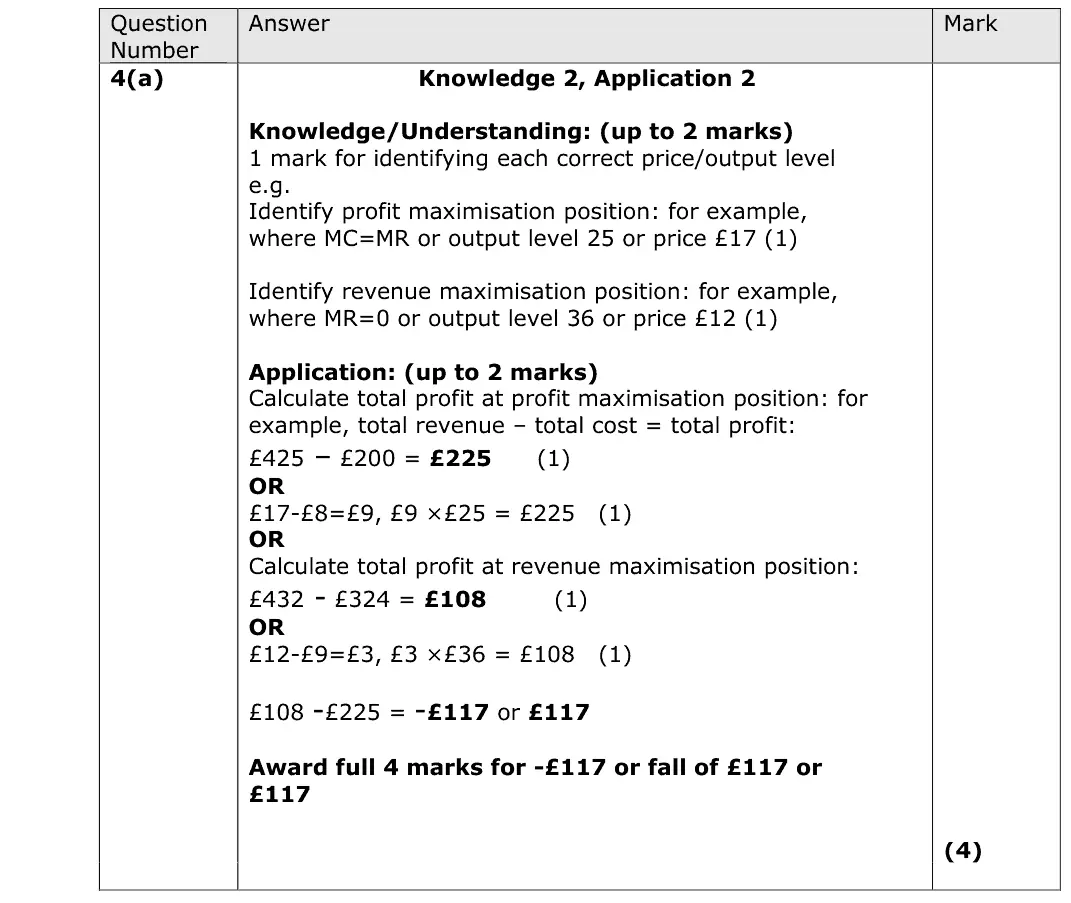
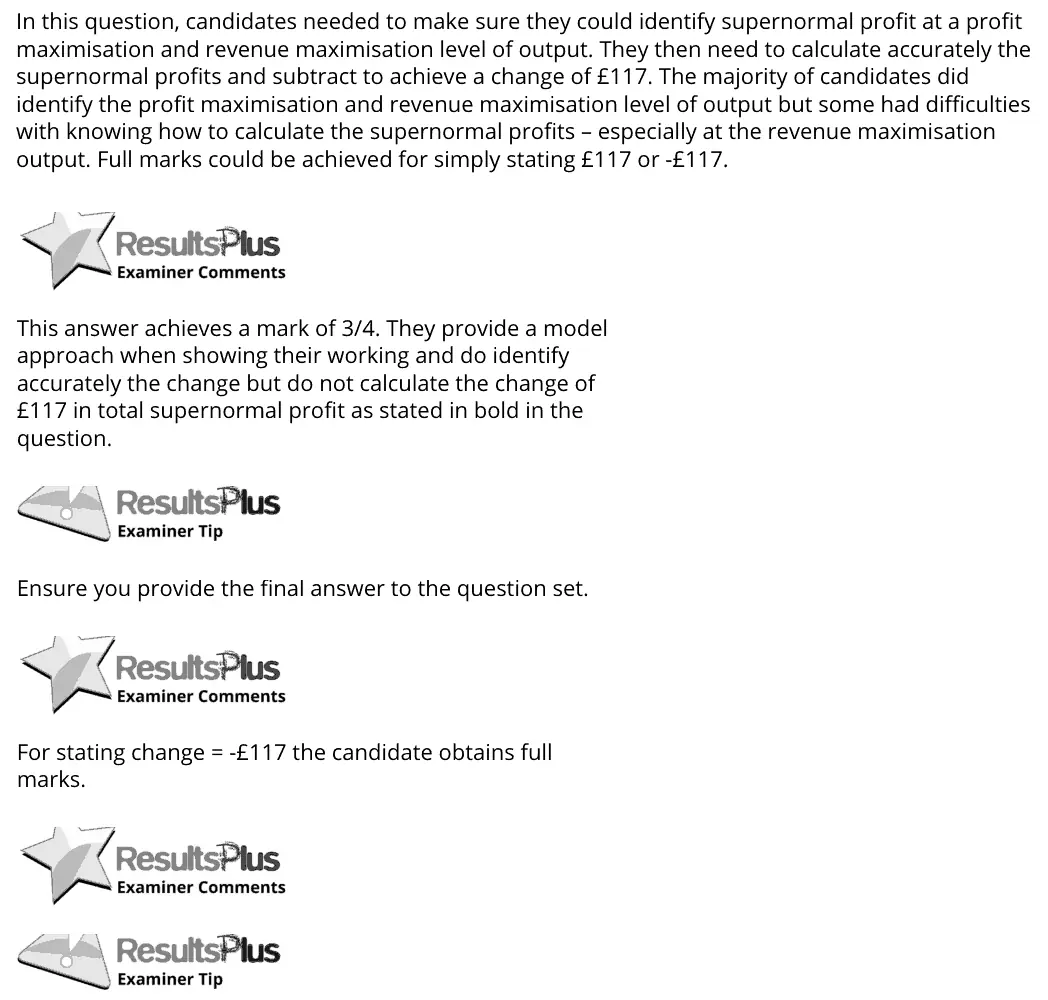
In this question, candidates needed to make sure they could identify supernormal profit at a profit maximisation and revenue maximisation level of output. They then need to calculate accurately the supernormal profits and subtract to achieve a change of £117. The majority of candidates did identify the profit maximisation and revenue maximisation level of output but some had difficulties with knowing how to calculate the supernormal profits – especially at the revenue maximisation output. Full marks could be achieved for simply stating £117 or -£117. This answer achieves a mark of 3/4. They provide a model approach when showing their working and do identify accurately the change but do not calculate the change of £117 in total supernormal profit as stated in bold in the question. Ensure you provide the final answer to the question set. For stating change = -£117 the candidate obtains full marks.
Notes from the mark scheme and report
profit max MC = MR at 25 treatments: (£17 - £8) x 25 = £225
revenue max MR = 0 at 36: (£12 - £9) x 36 = £108
change = -£117
report: some could not calculate supernormal profit at the revenue-maximising output, or did not state the final change
Quantitative skills: QS 4 (construct and interpret a range of standard graphical forms); QS 6 (calculate cost, revenue and profit (marginal, average, totals))
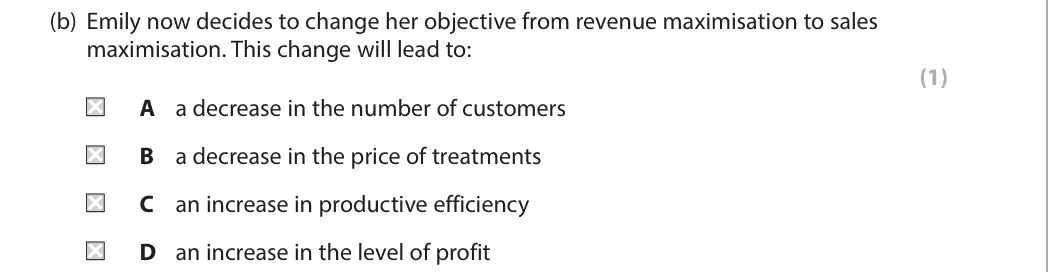
June 2018 · Paper 1 · Q4(b)1 markMultiple choice
Data and extracts for question 4
Answer
B
Mark scheme
Notes from the mark scheme and report
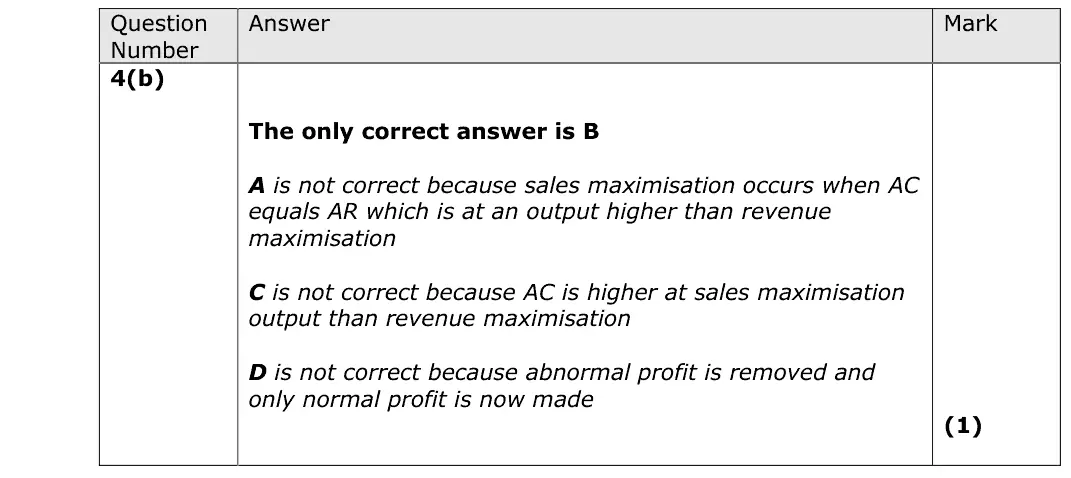
sales maximisation (AC = AR) is at a higher output than revenue maximisation, so price falls (B)
A wrong as output rises
C AC is higher there
D only normal profit is made
June 2018 · Paper 3 · Q1(d)25 marksAO1=4, AO2=4, AO3=8, AO4=925-mark essayEither/or
Data and extracts for question 1
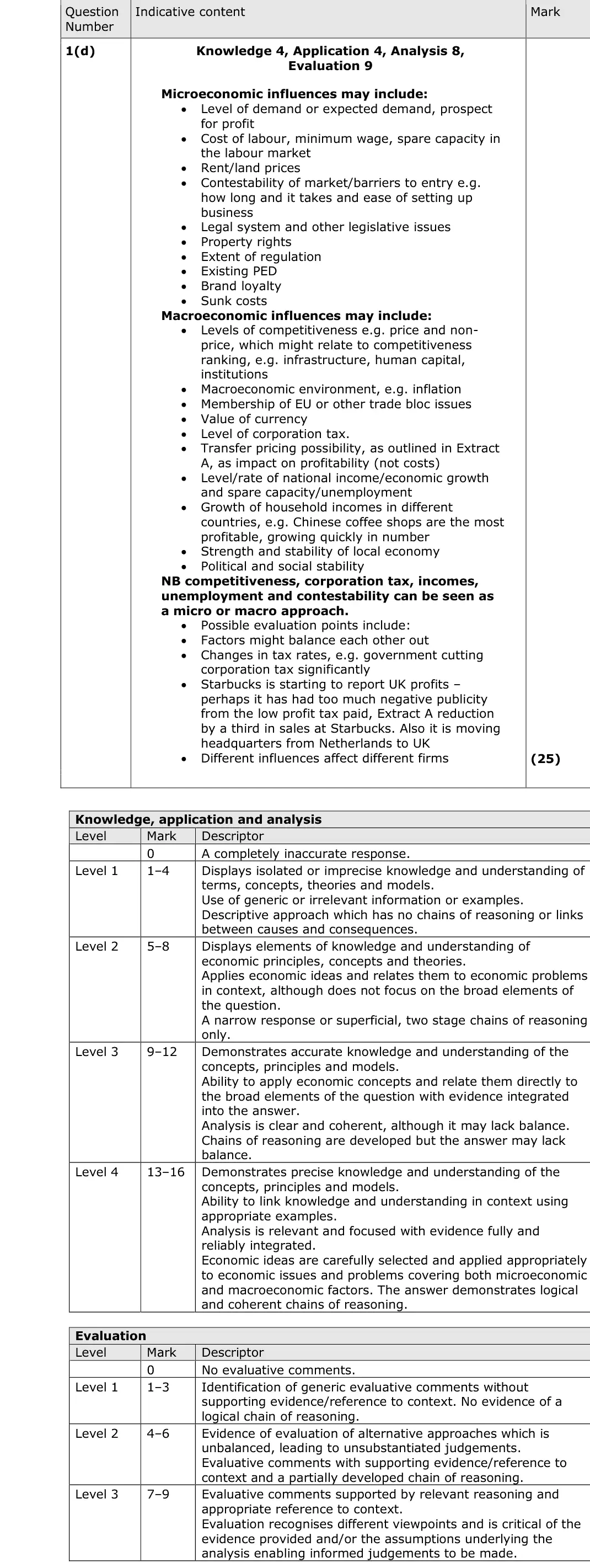
Mark scheme, including the levels grid and indicative content
Examiner's comment
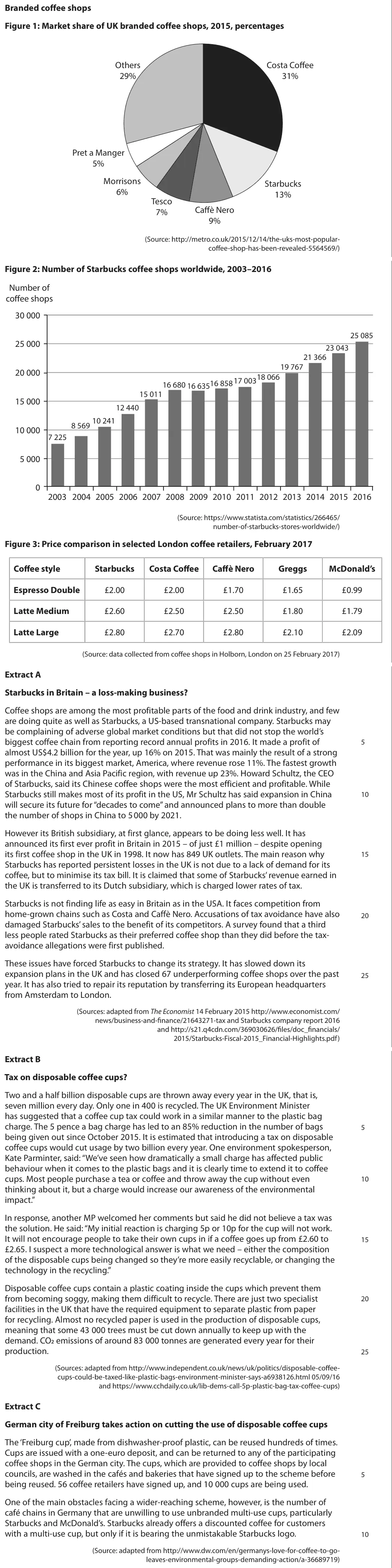
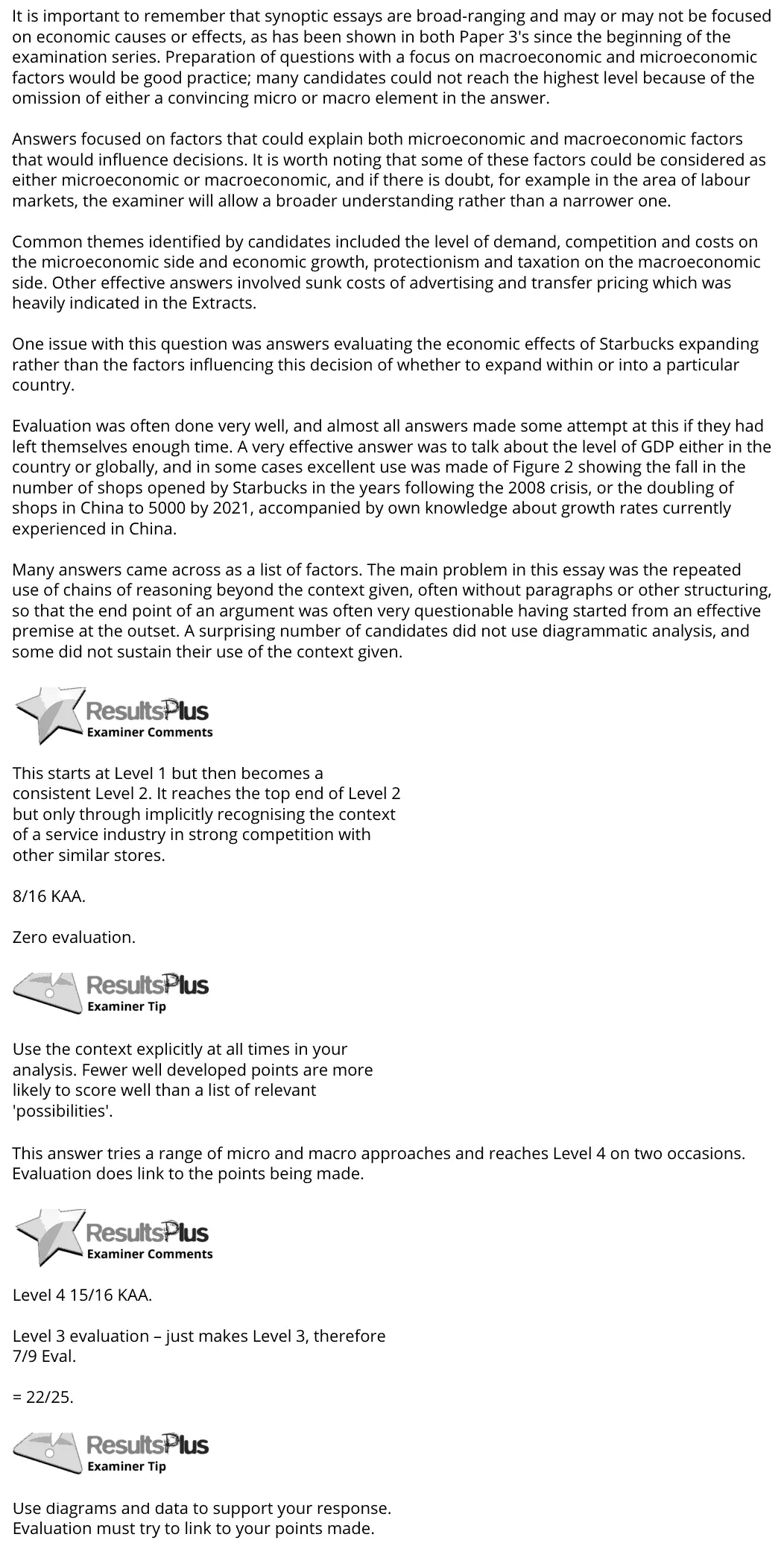
It is important to remember that synoptic essays are broad-ranging and may or may not be focused on economic causes or effects, as has been shown in both Paper 3's since the beginning of the examination series. Preparation of questions with a focus on macroeconomic and microeconomic factors would be good practice; many candidates could not reach the highest level because of the omission of either a convincing micro or macro element in the answer. Answers focused on factors that could explain both microeconomic and macroeconomic factors that would influence decisions. It is worth noting that some of these factors could be considered as either microeconomic or macroeconomic, and if there is doubt, for example in the area of labour markets, the examiner will allow a broader understanding rather than a narrower one. Common themes identified by candidates included the level of demand, competition and costs on the microeconomic side and economic growth, protectionism and taxation on the macroeconomic side. Other effective answers involved sunk costs of advertising and transfer pricing which was heavily indicated in the Extracts. One issue with this question was answers evaluating the economic effects of Starbucks expanding rather than the factors influencing this decision of whether to expand within or into a particular country. Evaluation was often done very well, and almost all answers made some attempt at this if they had left themselves enough time. A very effective answer was to talk about the level of GDP either in the country or globally, and in some cases excellent use was made of Figure 2 showing the fall in the number of shops opened by Starbucks in the years following the 2008 crisis, or the doubling of shops in China to 5000 by 2021, accompanied by own knowledge about growth rates currently experienced in China. Many answers came across as a list of factors. The main problem in this essay was the repeated use of chains of reasoning beyond the context given, often without paragraphs or other structuring, so that the end point of an argument was often very questionable having started from an effective premise at the outset. A surprising number of candidates did not use diagrammatic analysis, and some did not sustain their use of the context given. This starts at Level 1 but then becomes a consistent Level 2. It reaches the top end of Level 2 but only through implicitly recognising the context of a service industry in strong competition with other similar stores. 8/16 KAA. Zero evaluation. Use the context explicitly at all times in your analysis. Fewer well developed points are more likely to score well than a list of relevant 'possibilities'. This answer tries a range of micro and macro approaches and reaches Level 4 on two occasions. Evaluation does link to the points being made. Level 4 15/16 KAA. Level 3 evaluation – just makes Level 3, therefore 7/9 Eval. = 22/25. Use diagrams and data to support your response. Evaluation must try to link to your points made.
Notes from the mark scheme and report
factors influencing the decision to expand (demand, costs, barriers to entry, corporation tax and transfer pricing, growth and incomes), not the effects of Starbucks expanding
both micro and macro factors needed for the top level
use Figure 2 (fewer openings after 2008, China expansion)
Quantitative skills: QS 9 (interpret, apply and analyse information in written, graphical tabular and numerical forms)
June 2017 · Paper 1 · Q6(e)15 marksAO1=3, AO2=3, AO3=3, AO4=615-mark response
Data and extracts for question 6
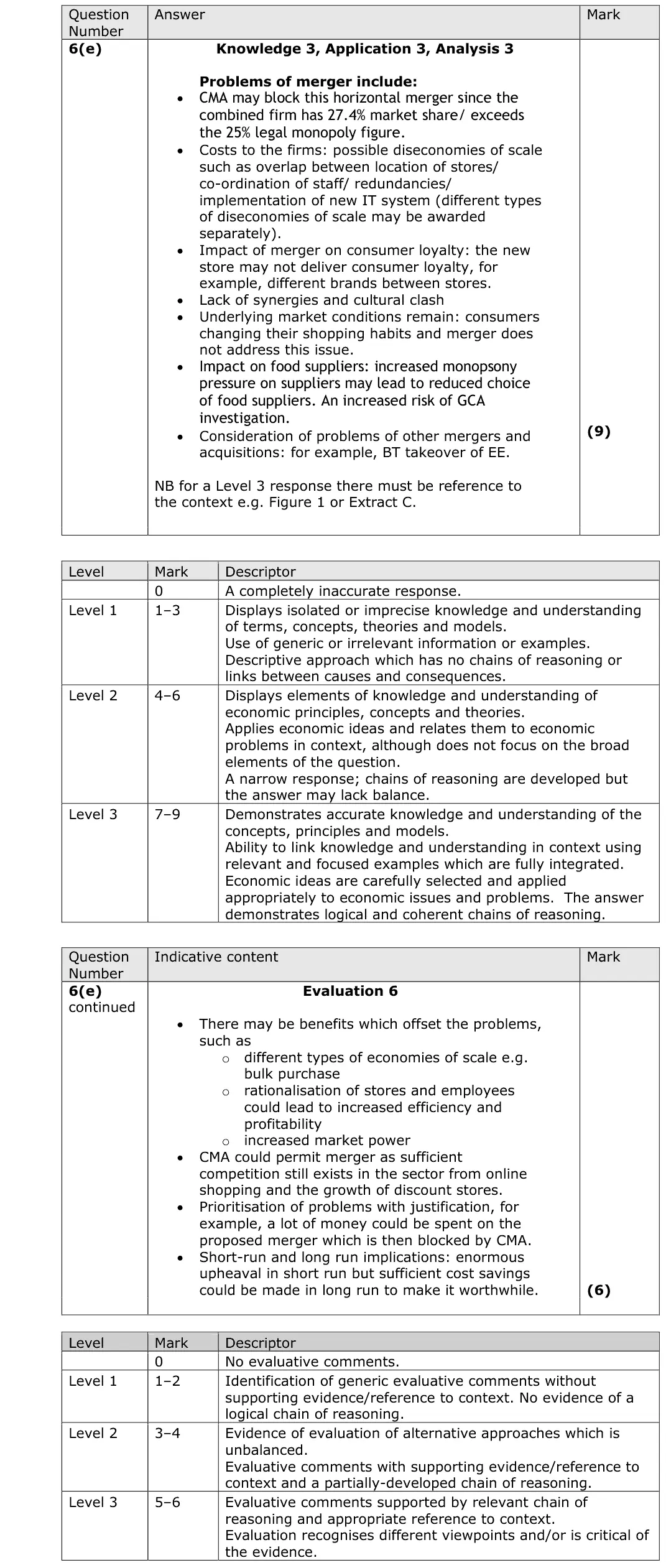
Mark scheme, including the levels grid and indicative content
Examiner's comment
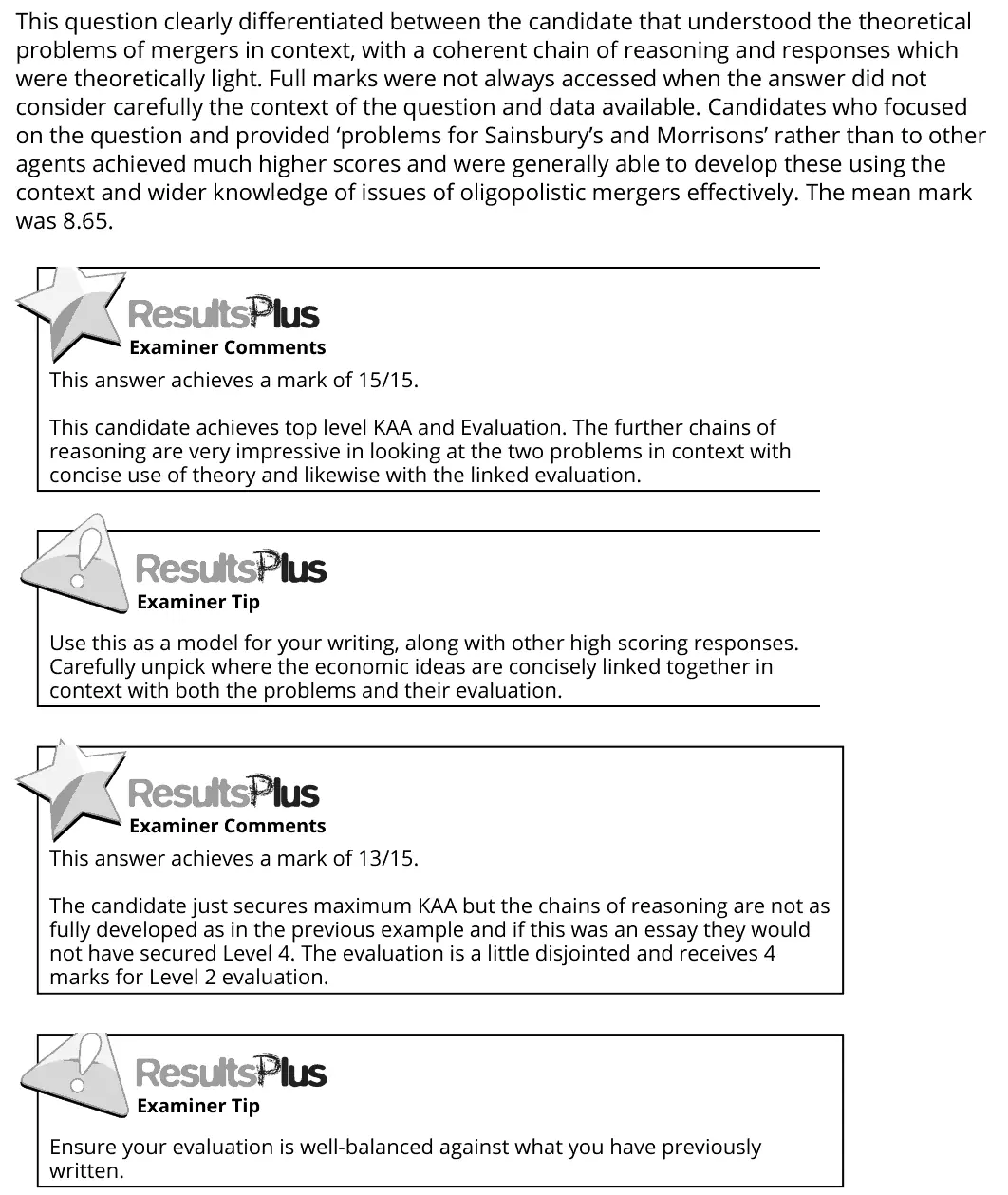
This question clearly differentiated between the candidate that understood the theoretical problems of mergers in context, with a coherent chain of reasoning and responses which were theoretically light. Full marks were not always accessed when the answer did not consider carefully the context of the question and data available. Candidates who focused on the question and provided ‘problems for Sainsbury’s and Morrisons’ rather than to other agents achieved much higher scores and were generally able to develop these using the context and wider knowledge of issues of oligopolistic mergers effectively. The mean mark was 8.65. Use this as a model for your writing, along with other high scoring responses. Carefully unpick where the economic ideas are concisely linked together in context with both the problems and their evaluation. This answer achieves a mark of 15/15. This candidate achieves top level KAA and Evaluation. The further chains of reasoning are very impressive in looking at the two problems in context with concise use of theory and likewise with the linked evaluation. Ensure your evaluation is well-balanced against what you have previously written. This answer achieves a mark of 13/15. The candidate just secures maximum KAA but the chains of reasoning are not as fully developed as in the previous example and if this was an essay they would not have secured Level 4. The evaluation is a little disjointed and receives 4 marks for Level 2 evaluation.
Notes from the mark scheme and report
problems for the two firms: CMA may block a horizontal merger (combined share 27.4% exceeds 25%), diseconomies of scale from overlapping stores, co-ordinating staff and a new IT system
report: answers focused on problems for other agents scored lower
evaluate with economies of scale and growth of Aldi and Lidl
Quantitative skills: QS 2 (calculate, use and understand percentages, percentage changes and percentage point changes); QS 9 (interpret, apply and analyse information in written, graphical tabular and numerical forms)
June 2017 · Paper 1 · Q825 marksAO1=4, AO2=4, AO3=8, AO4=925-mark essayEither/or
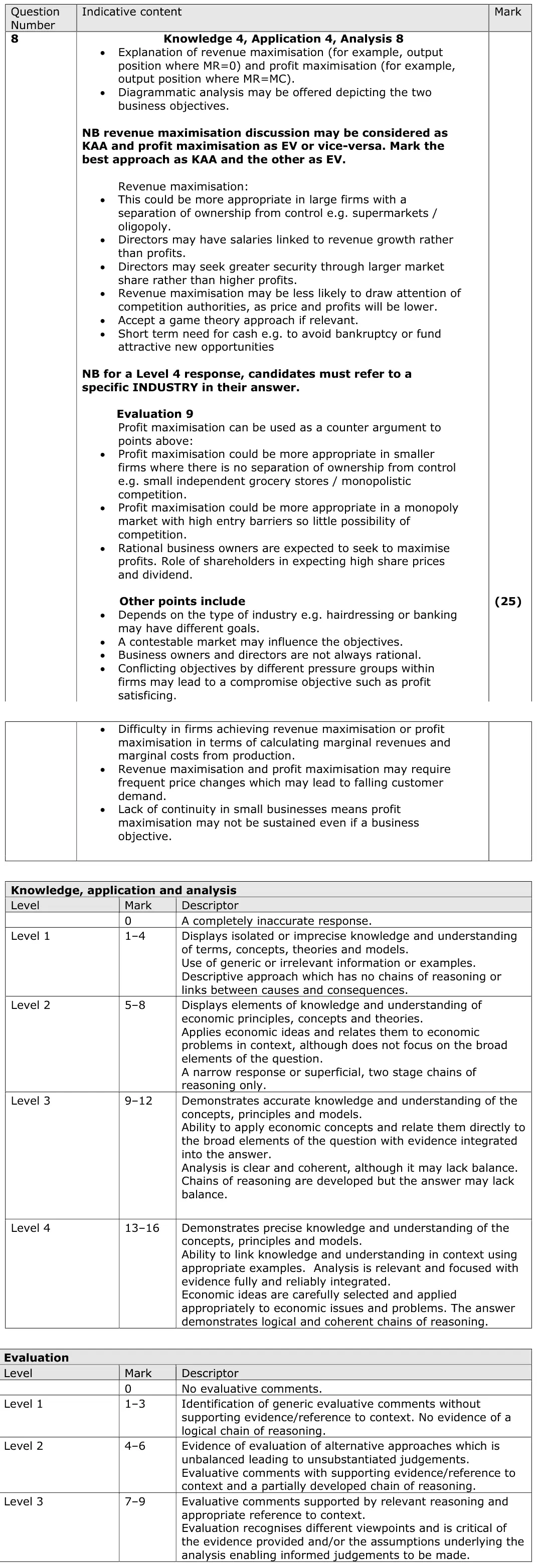
Mark scheme, including the levels grid and indicative content
Examiner's comment
Diagrams for this were clear as was the concept but beyond the argument that shareholders expect MC=MR because they want dividends and managers want MR=0 because performance bonuses are often linked to turnover, the candidates struggled to think of reasons. Stronger candidates examined the idea that MR=MC was quite hard to calculate and the shareholders wouldn’t really have a clue given their proximity to the daily operation and inside workings of a business. Effective evaluation often went on to be critical of revenue maximisation along the lines indicated in the mark scheme as well as the principal-agent problem. There was clear differentiation in approach from confused diagrams to fully labelled and annotated diagrams. Candidates struggled to develop chains of reasoning which explained why one objective might be more suitable for firms in a specific industry. The lack of effective application to an industry led to a number of responses failing to develop arguments and to build on a technical understanding of the conditions for the two different objectives. This answer achieves a mark of 20/25. This answer focuses primarily on the theoretical arguments to an advanced level. However there needs to be a consistent focus on an industry of choice and this answer was too focussed on ‘Walmart’ in early parts and then later on it focuses on ‘supermarkets’ but not consistently; hence top level 3 KAA (12) plus L3e (8e). An industry focus is key to answering this question. Remember to ensure you answer the question in context i.e. an industry of your choice. This answer achieves a mark of 4/25. The candidate correctly alters the chosen question number. The crossed out work clearly took up some time and the candidate would have been in a better position if they had planned out possible answers and came to a decision before they started their write up. For some candidates it might be effective to briefly look at the essay options at the start of the exam and to consider possible planned approaches before making your decision.
Notes from the mark scheme and report
revenue max where MR = 0, profit max where MC = MR (diagram may be used)
principal-agent problem: managers' bonuses linked to sales revenue
MC and MR hard to know in practice
report: candidates struggled to give reasons and to apply consistently to one industry of choice
Work with an Edexcel economics tutor
Essays stuck in Level 2, or losing the easy marks in Section A? Book a trial session with Lianne, a former Edexcel examiner.