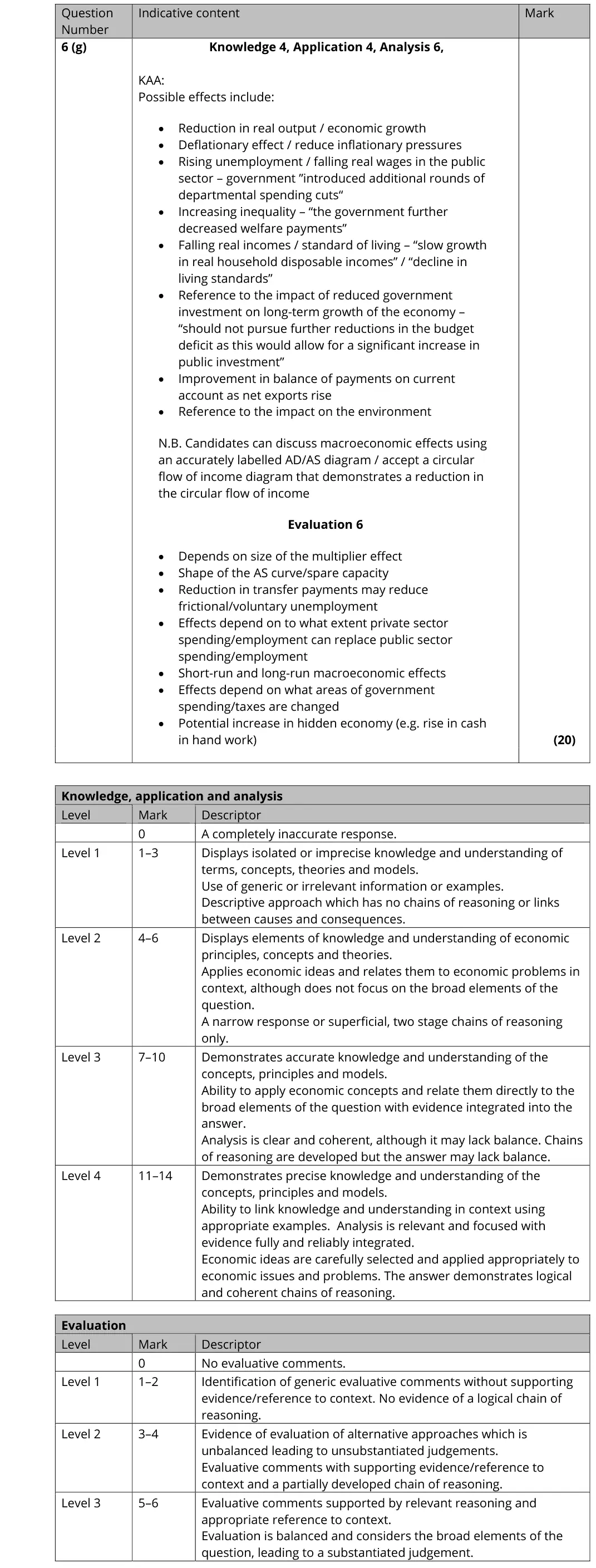
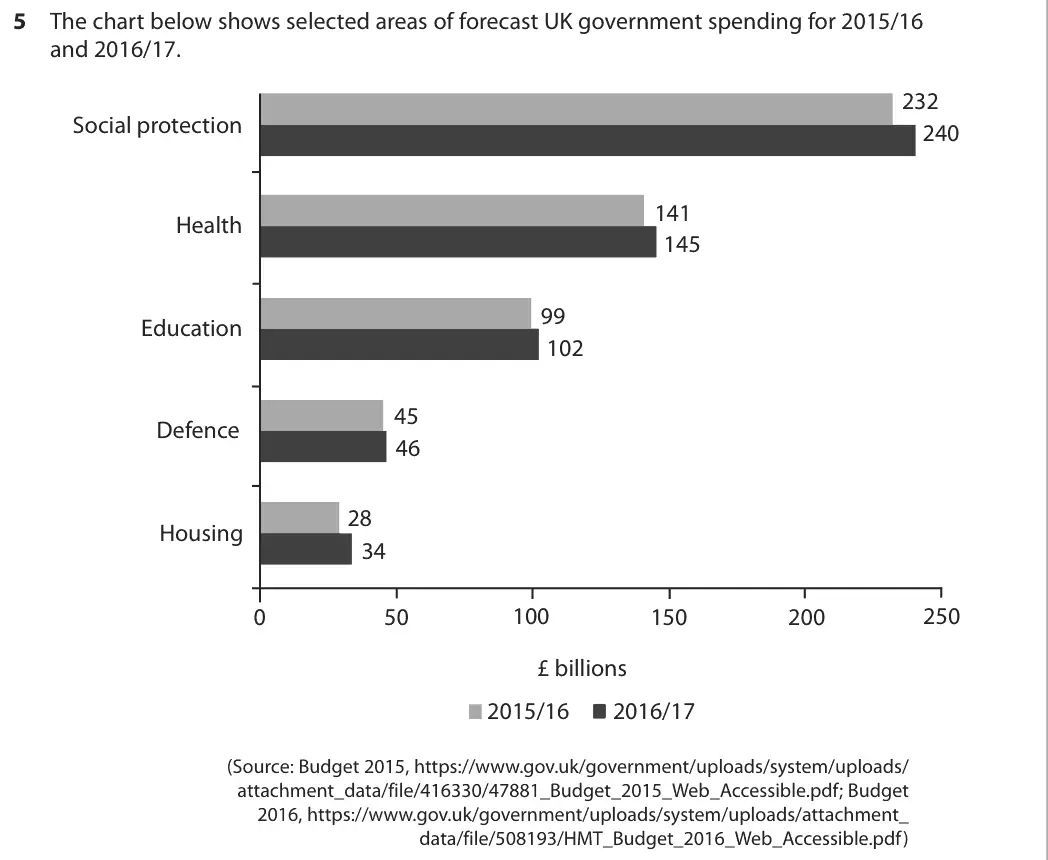
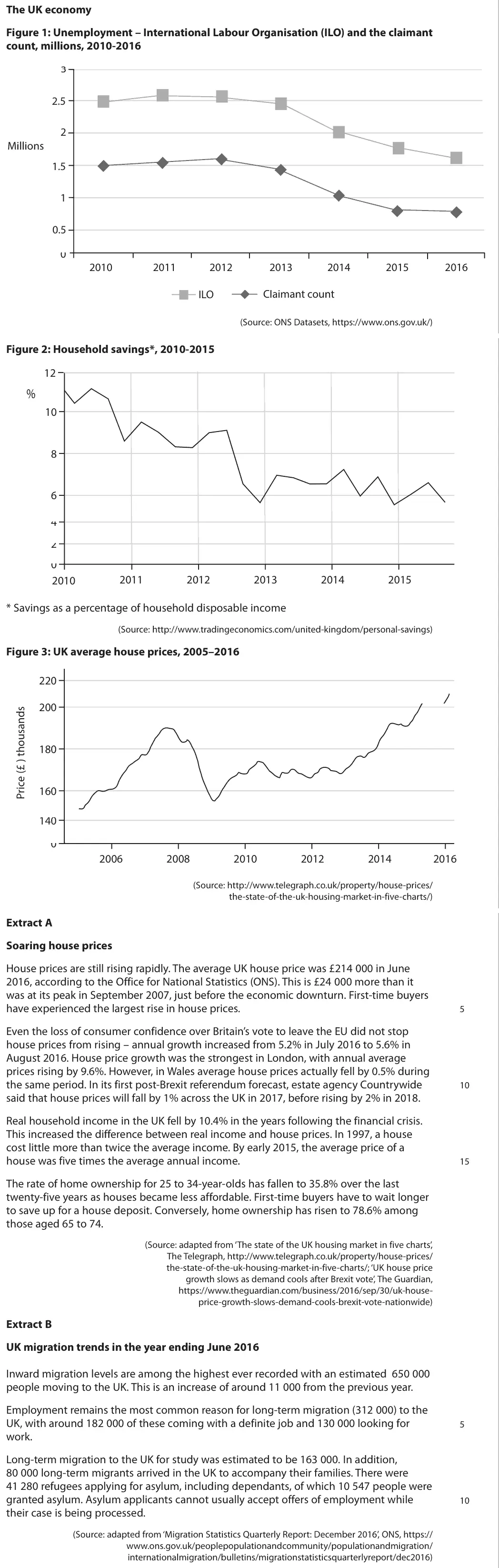
2.6.2Demand-side policies: a) Distinction between monetary and fiscal policy b) Monetary policy instruments: • interest rates • asset purchases to increase the money supply (quantitative easing) c) Fiscal policy instruments: • government spending and taxation d) Distinction between government budget (fiscal) deficit and surplus e) Distinction between, and examples of, direct and indirect taxation f) Use of AD/AS diagrams to illustrate demand-side policies g) The role of the Bank of England: • the role and operation of the Bank of England's Monetary Policy Committee h) Awareness of demand-side policies in the Great Depression and the Global Financial Crisis of 2008 • different interpretations • policy responses in the US and UK i) Strengths and weaknesses of demand-side policiesAS
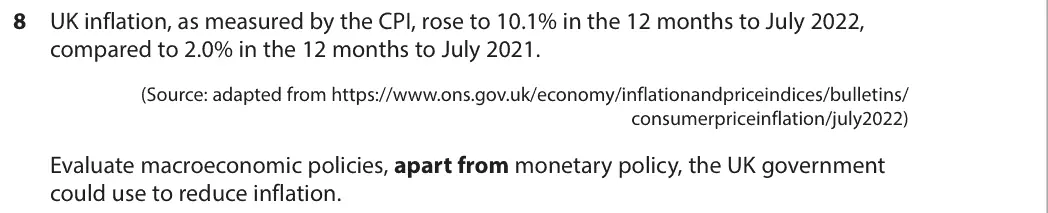
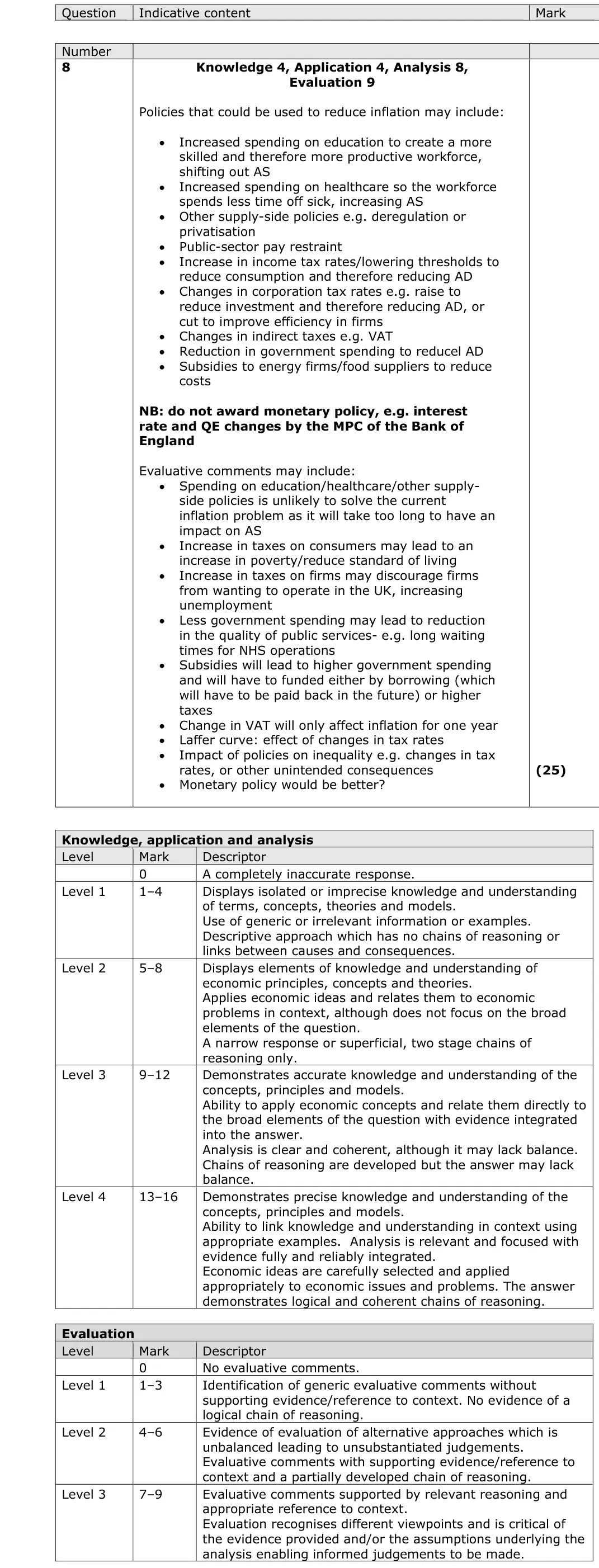
UK inflation, as measured by the CPI, rose to 10.1% in the 12 months to July 2022, compared to 2.0% in the 12 months to July 2021. (Source: adapted from https://www.ons.gov.uk/economy/inflationandpriceindices/bulletins/ consumerpriceinflation/july2022) Evaluate macroeconomic policies, apart from monetary policy, the UK government could use to reduce inflation.
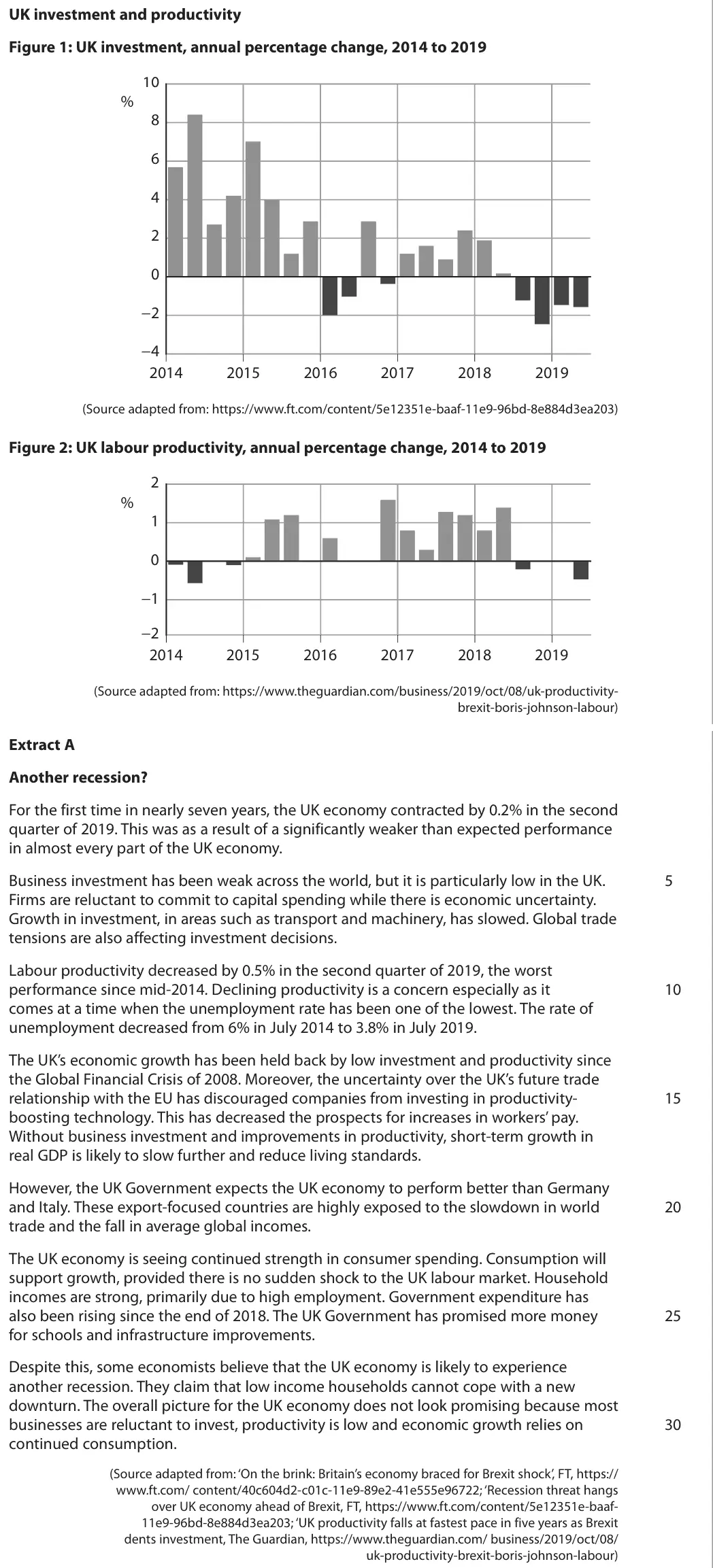
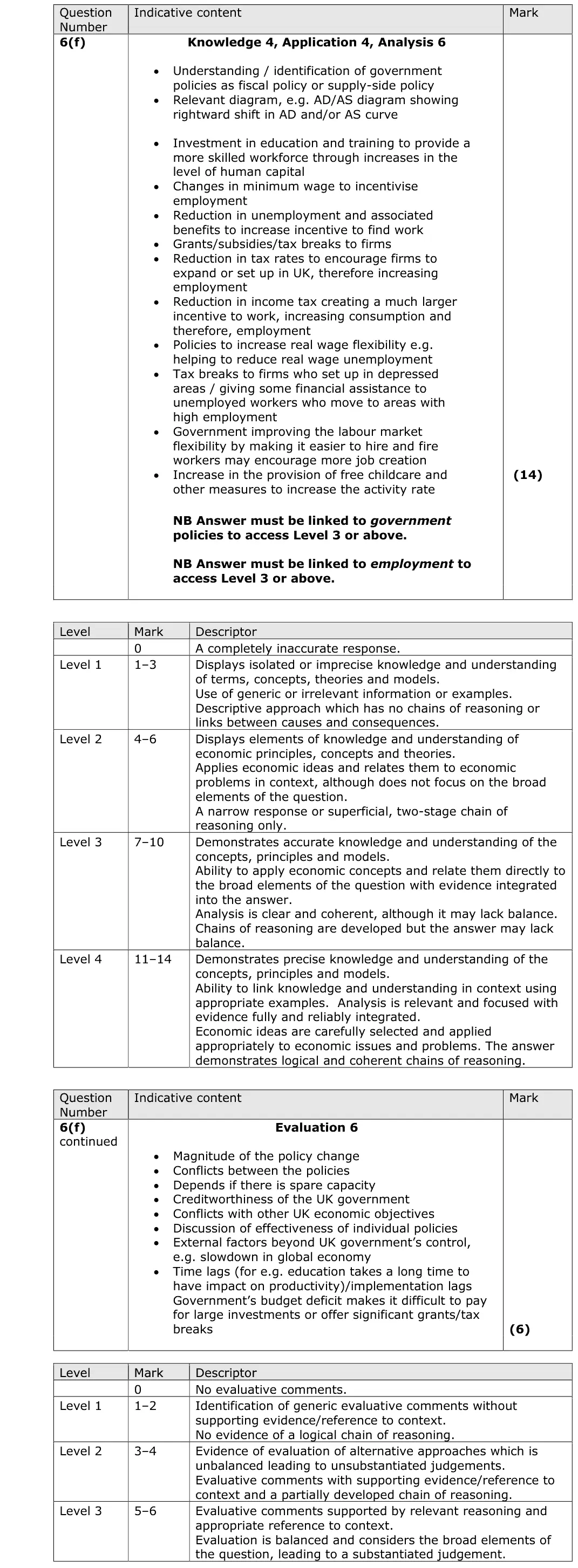
Evaluate the fiscal policies the UK Government could use if it believes that ‘the UK economy is likely to experience another recession’ (Extract A, lines 27–28).
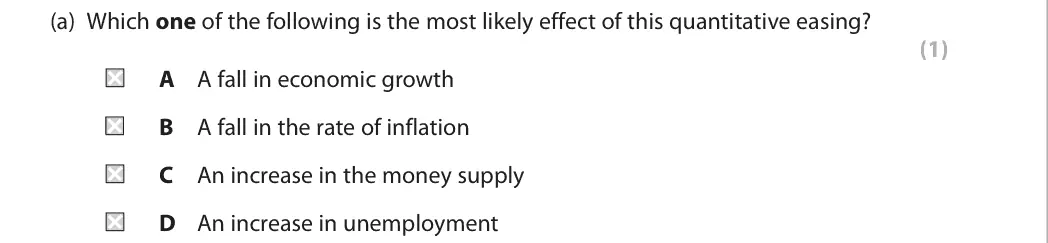
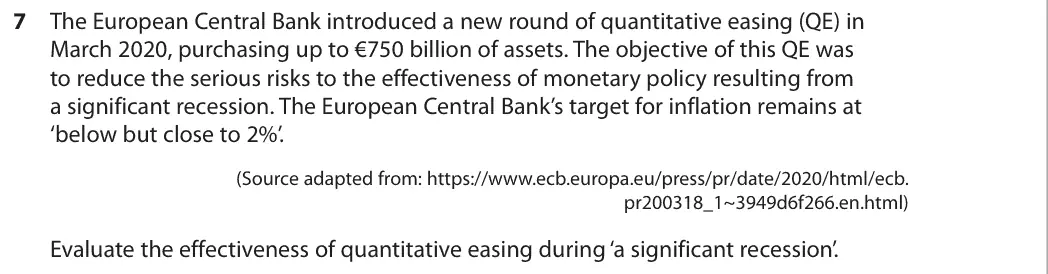
The European Central Bank introduced a new round of quantitative easing (QE) in March 2020, purchasing up to €750 billion of assets. The objective of this QE was to reduce the serious risks to the effectiveness of monetary policy resulting from a significant recession. The European Central Bank’s target for inflation remains at ‘below but close to 2%’. (Source adapted from: https://www.ecb.europa.eu/press/pr/date/2020/html/ecb. pr200318_1~3949d6f266.en.html) Evaluate the effectiveness of quantitative easing during ‘a significant recession’.
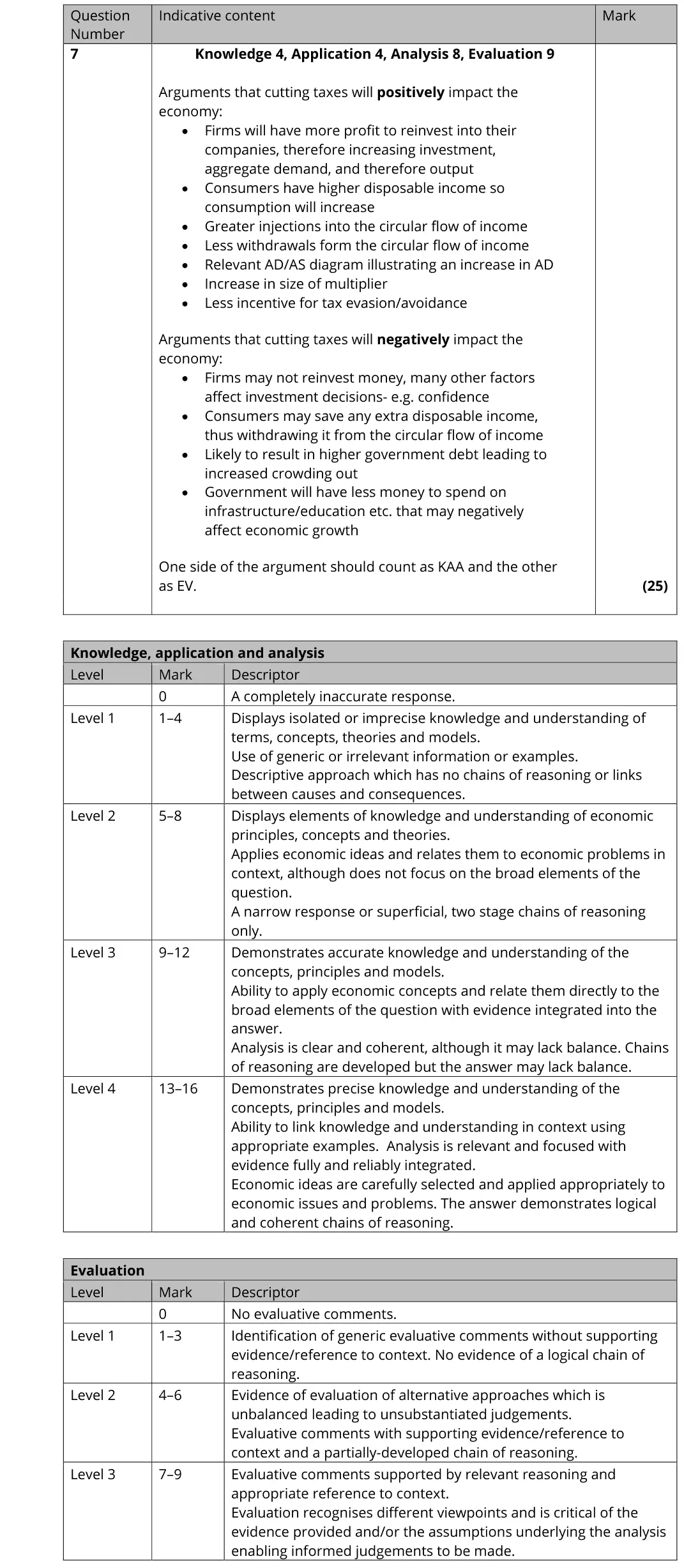
In 2018, the United States Government cut the corporation tax rate (tax on company profits) from 35% to 21%. Income tax rates for US citizens were also reduced: for example, the top rate of income tax was cut from 39.6% to 37%. (Source adapted from: https://www.nytimes.com/) Evaluate the likely impact of cutting tax rates as a policy to increase economic growth.
Tap a question to zoom it. The data and extracts fold out above each question; the mark scheme and examiner's comment open underneath.
June 2025 · AS Paper 2 · Q1(b)3 marksAO1=1, AO2=1, AO3=1Short answer
Data and extracts for question 1
Mark scheme
Examiner's comment
In this question the marks are split as 1 for knowledge, 1 for application, and 1 for analysis. The knowledge comes from identifying one effect, the application for explaining the data, and analysis for development building on the knowledge. Most candidates were able to access knowledge and application marks but were unable to develop the point identified.
Notes from the mark scheme and report
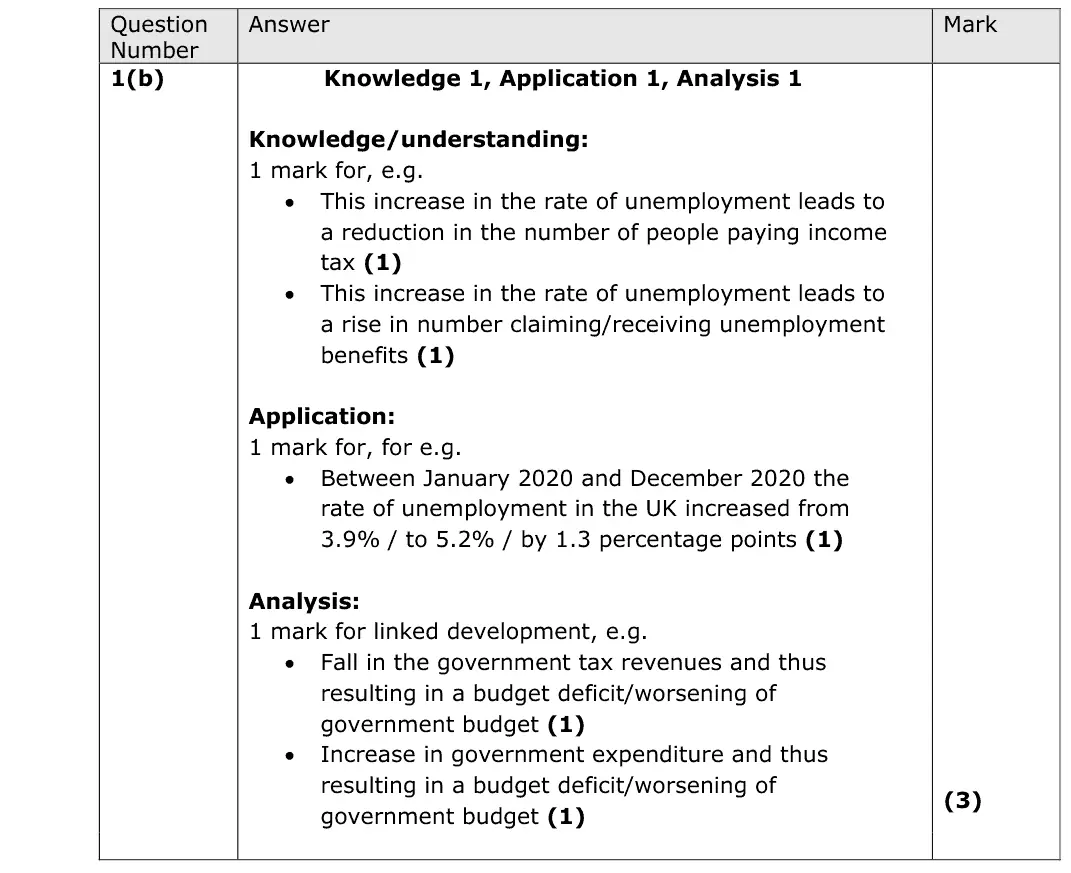
fewer income tax payers and more benefit claimants, so the budget deficit worsens
quote the rise from 3.9% to 5.2% (1.3 percentage points)
most could not develop the point
June 2025 · AS Paper 2 · Q4(a)1 markAO1=1Definition
Data and extracts for question 4
Mark scheme
Examiner's comment
This question required a clear definition of the term indirect tax. Many candidates provided accurate definitions and hence attained the one mark available for this question.
Notes from the mark scheme and report
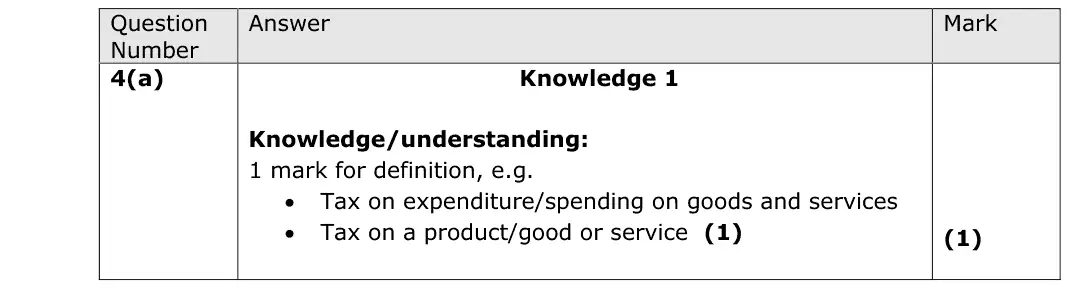
a tax on spending on goods and services
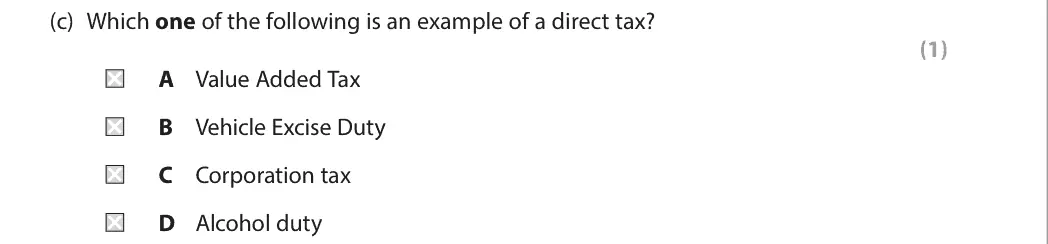
June 2025 · AS Paper 2 · Q4(c)1 markMultiple choice
Data and extracts for question 4
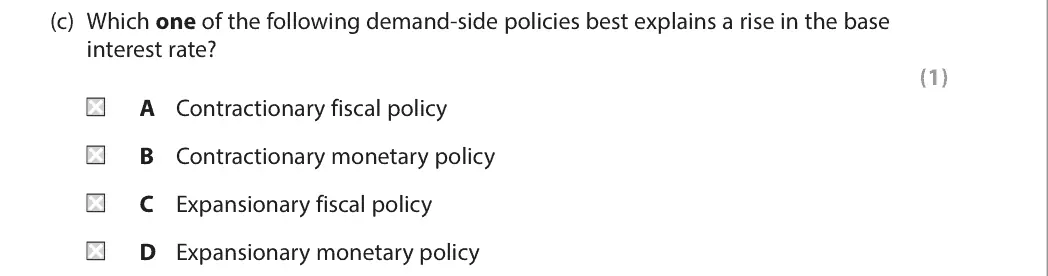
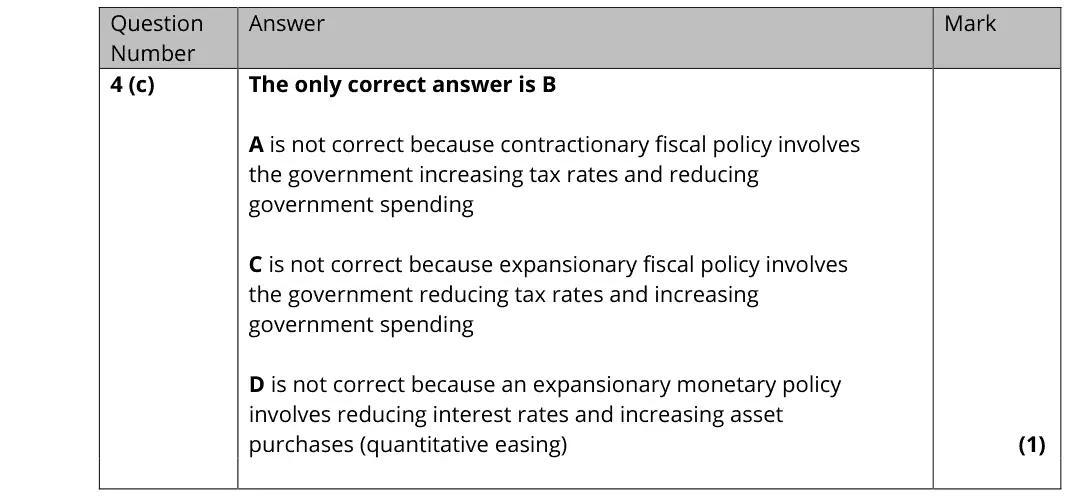
Answer
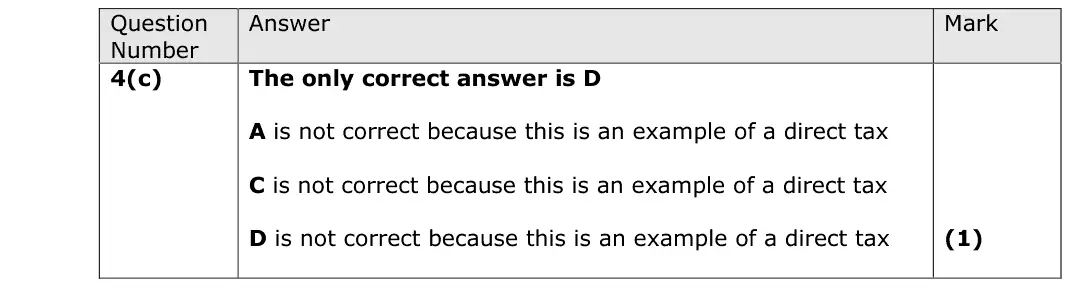
D
Mark scheme
Notes from the mark scheme and report
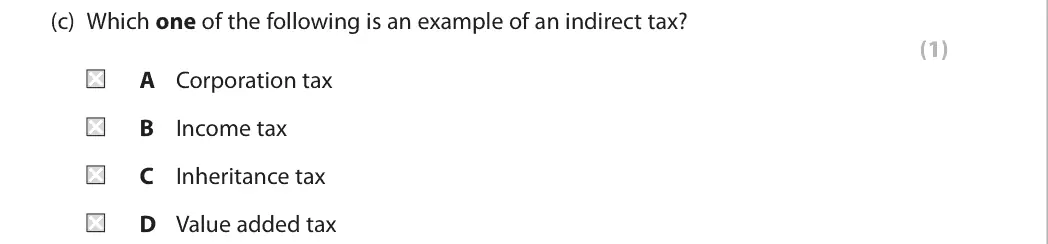
VAT is a tax on spending, i.e. indirect (D)
corporation, income and inheritance taxes are direct
June 2025 · Paper 2 · Q6(a)5 marksAO1=2, AO2=2, AO3=1Short answer
Data and extracts for question 6
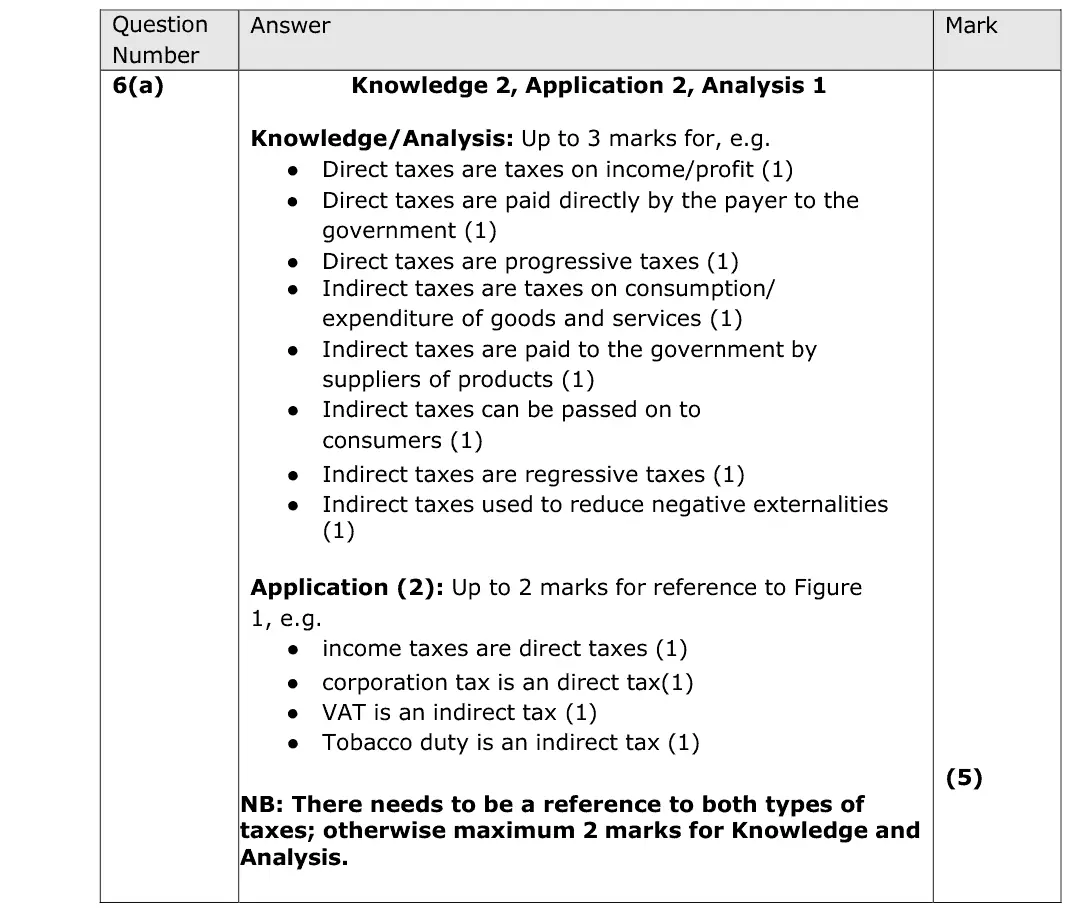
Mark scheme
Examiner's comment
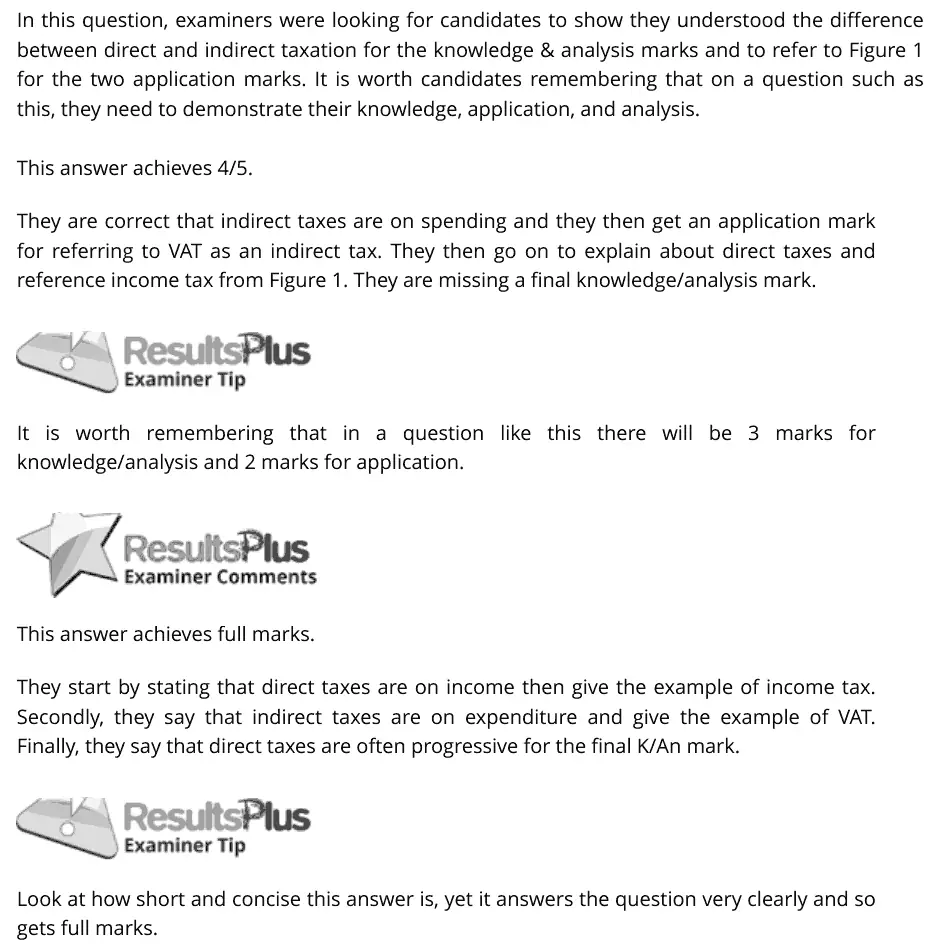
In this question, examiners were looking for candidates to show they understood the difference between direct and indirect taxation for the knowledge & analysis marks and to refer to Figure 1 for the two application marks. It is worth candidates remembering that on a question such as this, they need to demonstrate their knowledge, application, and analysis. This answer achieves 4/5. They are correct that indirect taxes are on spending and they then get an application mark for referring to VAT as an indirect tax. They then go on to explain about direct taxes and reference income tax from Figure 1. They are missing a final knowledge/analysis mark. It is worth remembering that in a question like this there will be 3 marks for knowledge/analysis and 2 marks for application. This answer achieves full marks. They start by stating that direct taxes are on income then give the example of income tax. Secondly, they say that indirect taxes are on expenditure and give the example of VAT. Finally, they say that direct taxes are often progressive for the final K/An mark. Look at how short and concise this answer is, yet it answers the question very clearly and so gets full marks.
Notes from the mark scheme and report
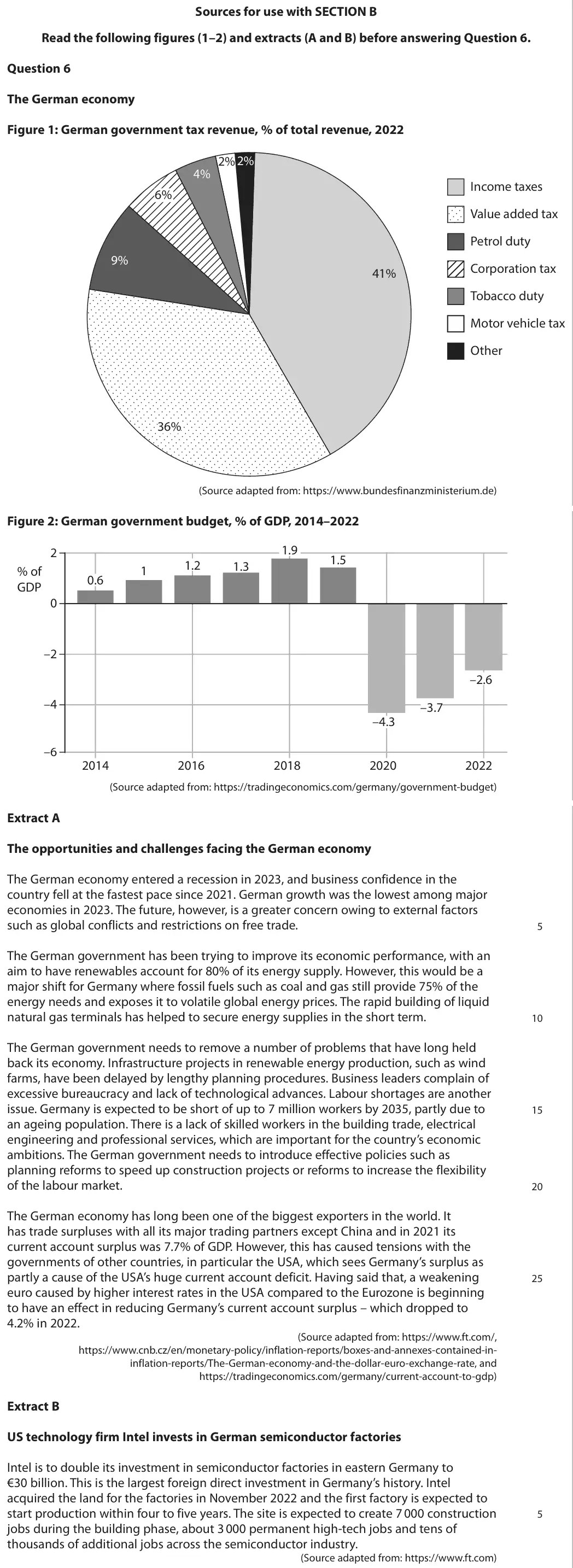
direct taxes on income and profit paid straight to government (income tax 41%, corporation tax 6%), indirect taxes on spending passed on via sellers (VAT 36%, petrol and tobacco duty)
must cover both types
3 marks K/An and 2 application
Quantitative skills: QS 9 (interpret, apply and analyse information in written, graphical tabular and numerical forms)
June 2025 · Paper 2 · Q6(c)10 marksAO1=2, AO2=2, AO3=2, AO4=410-mark response
Data and extracts for question 6
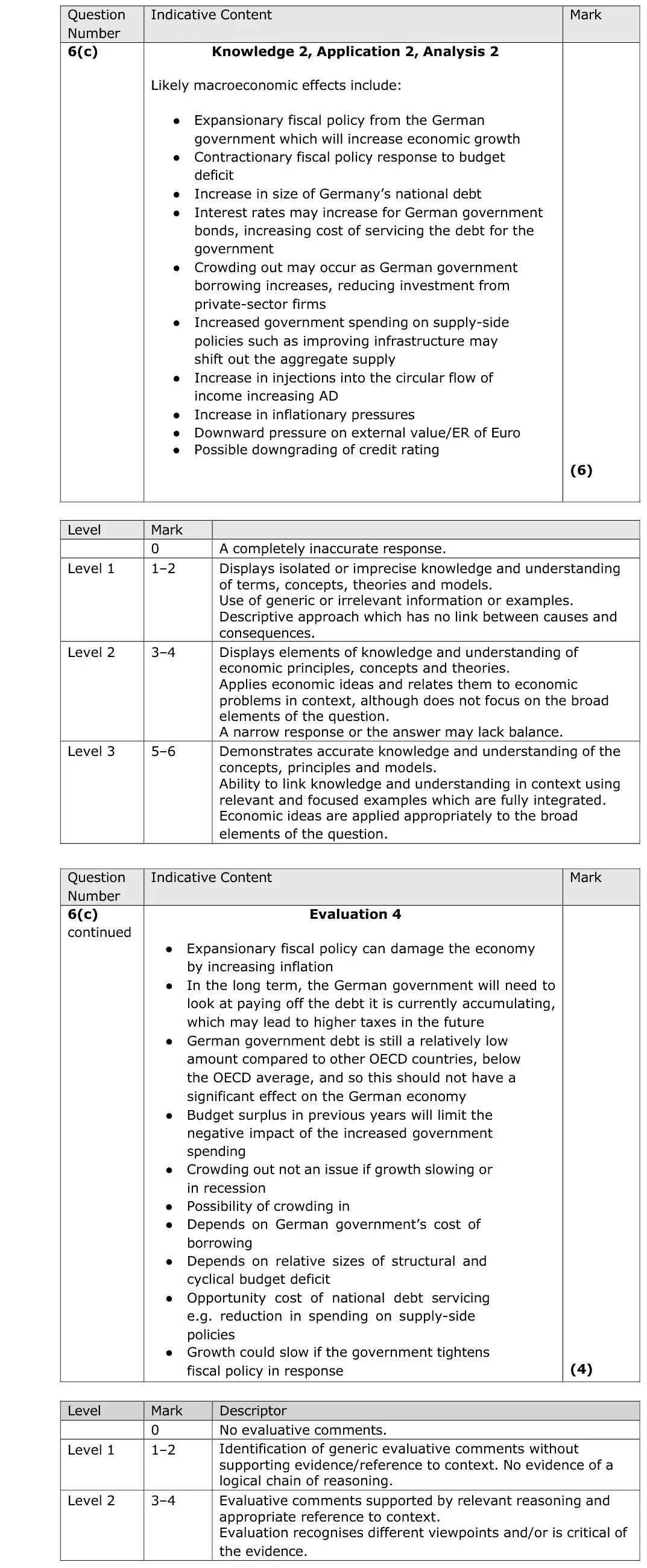
Mark scheme, including the levels grid and indicative content
Examiner's comment
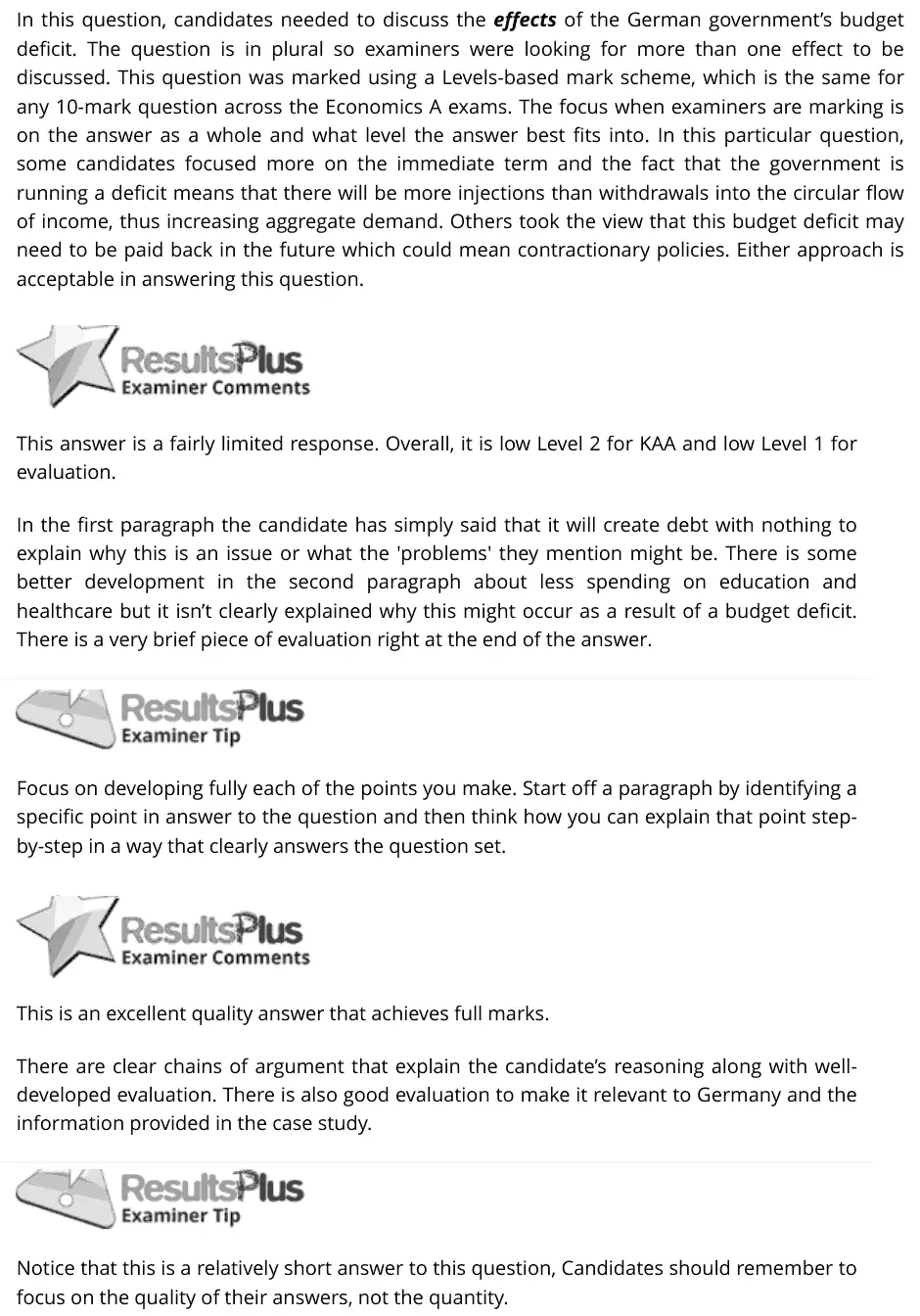
In this question, candidates needed to discuss the effects of the German government’s budget deficit. The question is in plural so examiners were looking for more than one effect to be discussed. This question was marked using a Levels-based mark scheme, which is the same for any 10-mark question across the Economics A exams. The focus when examiners are marking is on the answer as a whole and what level the answer best fits into. In this particular question, some candidates focused more on the immediate term and the fact that the government is running a deficit means that there will be more injections than withdrawals into the circular flow of income, thus increasing aggregate demand. Others took the view that this budget deficit may need to be paid back in the future which could mean contractionary policies. Either approach is acceptable in answering this question. This answer is a fairly limited response. Overall, it is low Level 2 for KAA and low Level 1 for evaluation. In the first paragraph the candidate has simply said that it will create debt with nothing to explain why this is an issue or what the 'problems' they mention might be. There is some better development in the second paragraph about less spending on education and healthcare but it isn’t clearly explained why this might occur as a result of a budget deficit. There is a very brief piece of evaluation right at the end of the answer. Focus on developing fully each of the points you make. Start off a paragraph by identifying a specific point in answer to the question and then think how you can explain that point step- by-step in a way that clearly answers the question set. This is an excellent quality answer that achieves full marks. There are clear chains of argument that explain the candidate’s reasoning along with well- developed evaluation. There is also good evaluation to make it relevant to Germany and the information provided in the case study. Notice that this is a relatively short answer to this question, Candidates should remember to focus on the quality of their answers, not the quantity.
Notes from the mark scheme and report
deficit of 4.3% (2020) to 2.6% (2022): injection raises AD, growth and employment via the multiplier
rising national debt, higher bond yields and debt interest, crowding out, future austerity
evaluate with size of deficit, recession in 2023, Germany's earlier surpluses
more than one effect needed
Quantitative skills: QS 9 (interpret, apply and analyse information in written, graphical tabular and numerical forms)
June 2025 · AS Paper 2 · Q6(d)6 marksAO1=2, AO2=2, AO3=2Short answer
Data and extracts for question 6
Mark scheme
Examiner's comment
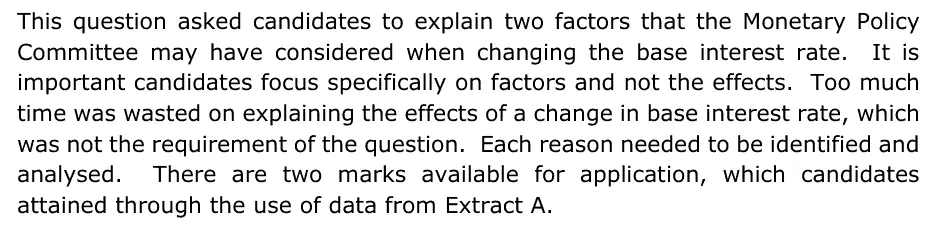
This question asked candidates to explain two factors that the Monetary Policy Committee may have considered when changing the base interest rate. It is important candidates focus specifically on factors and not the effects. Too much time was wasted on explaining the effects of a change in base interest rate, which was not the requirement of the question. Each reason needed to be identified and analysed. There are two marks available for application, which candidates attained through the use of data from Extract A.
Notes from the mark scheme and report
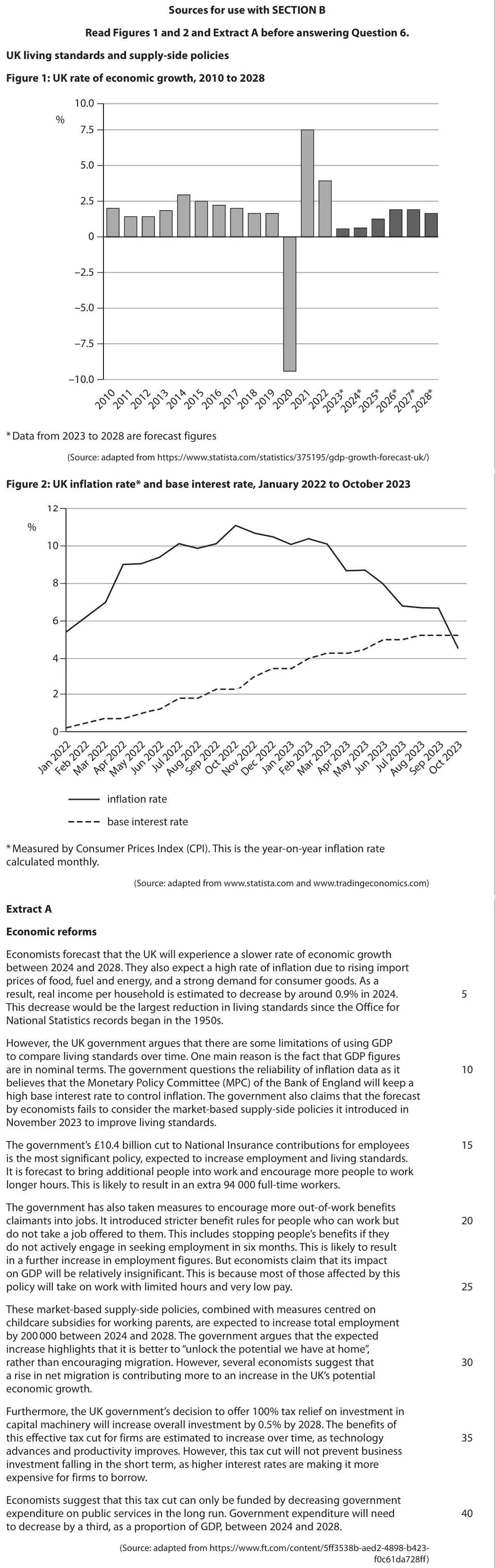
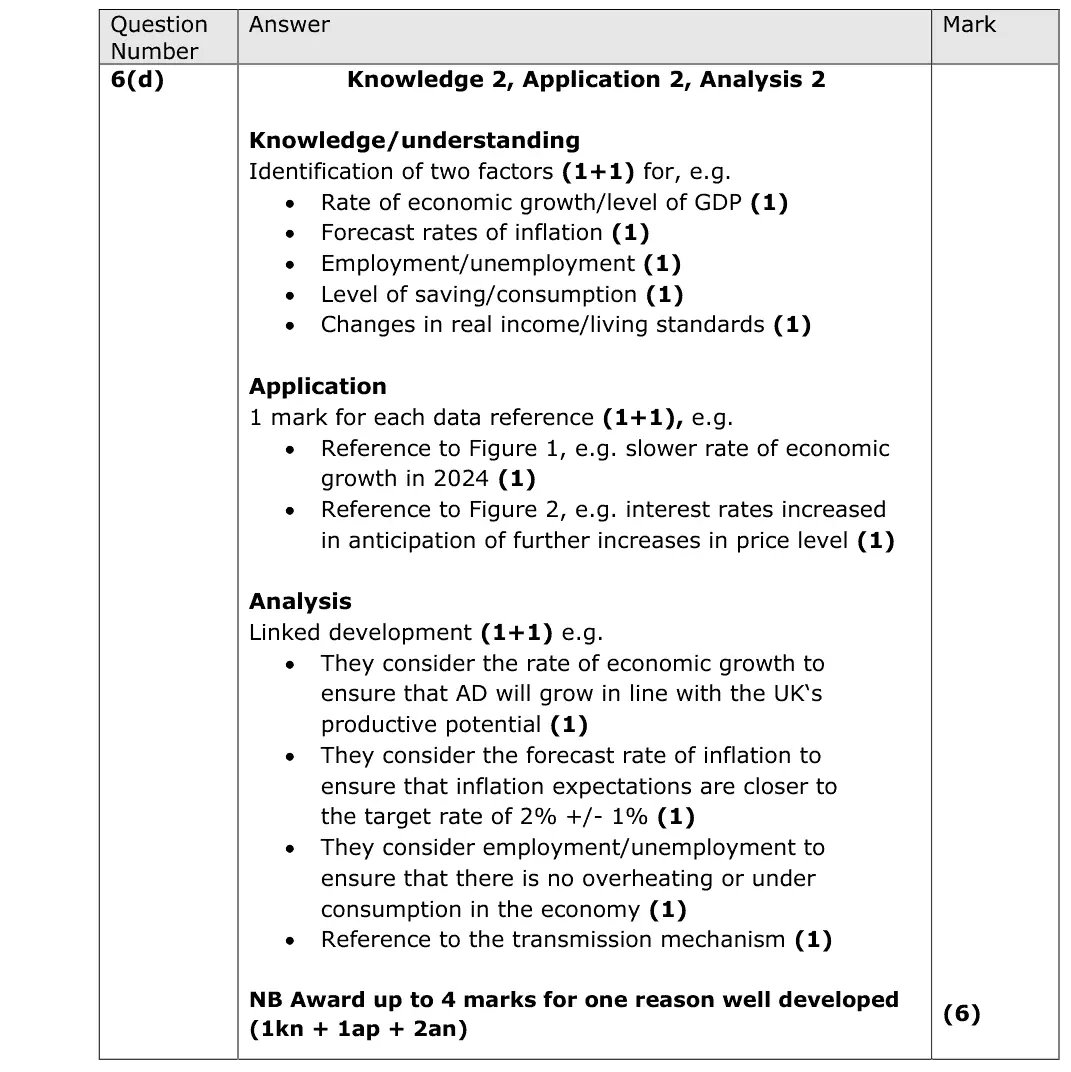
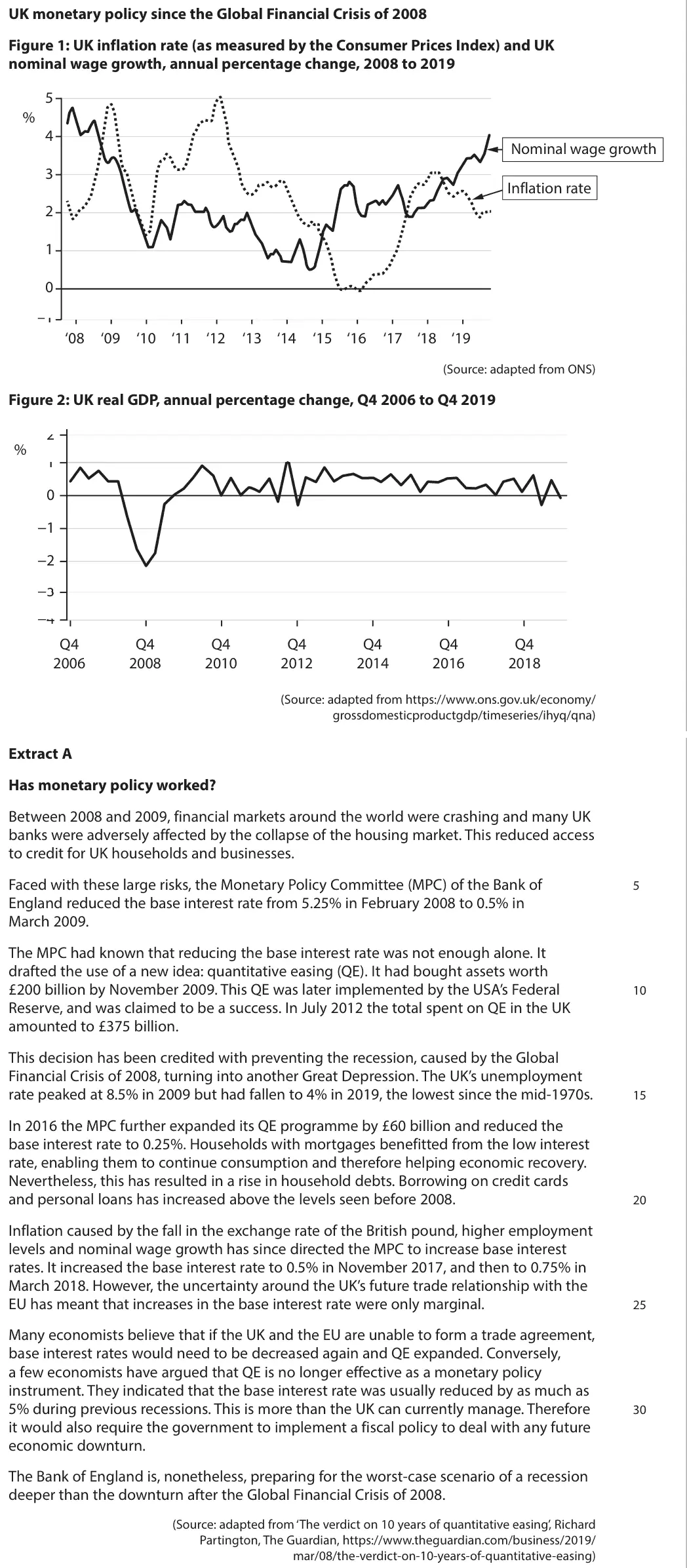
two factors (forecast inflation, growth, unemployment, real incomes) with Figure 1/Figure 2 data (inflation over 10% in late 2022, base rate raised to about 5.25%)
explain factors, not the effects of the rate change
Quantitative skills: QS 9 (interpret, apply and analyse information in written, graphical tabular and numerical forms)
June 2024 · AS Paper 2 · Q5(a)1 markAO1=1Definition
Data and extracts for question 5
Mark scheme
Examiner's comment
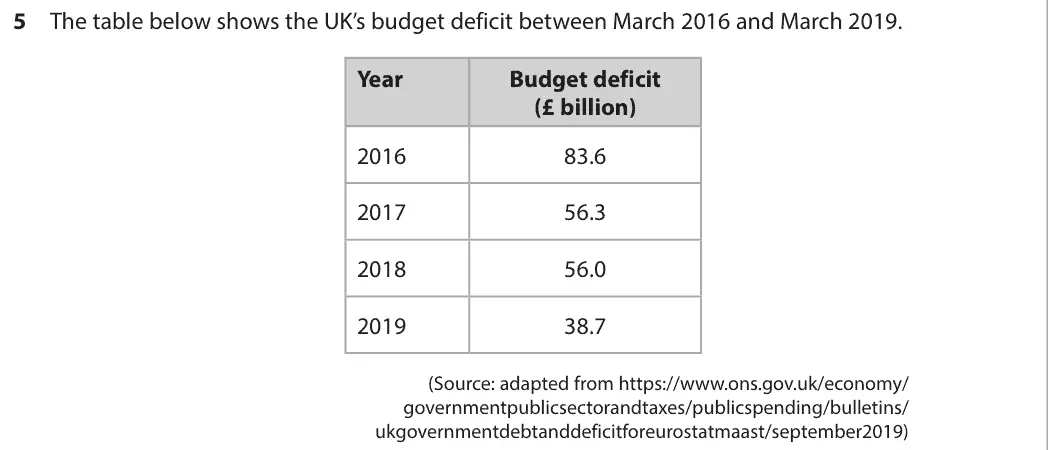
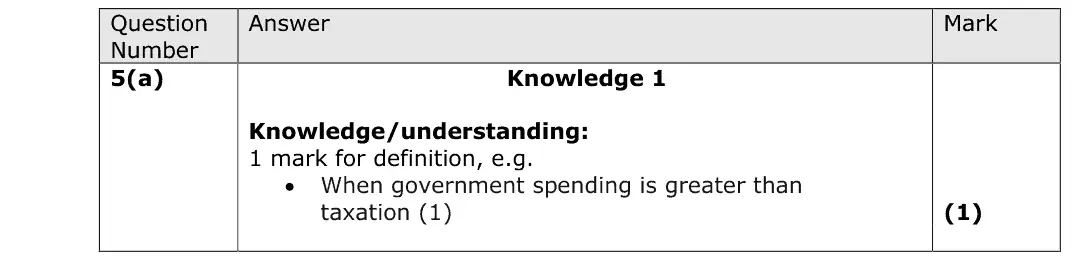
This question requires a clear definition of the term budget deficit. Many provided an accurate definition and hence attained the one mark available for this question.
Notes from the mark scheme and report
government spending greater than tax revenue in a year
not the national debt
June 2024 · AS Paper 2 · Q5(b)2 marksAO2=2Calculation
Data and extracts for question 5
Mark scheme
Examiner's comment
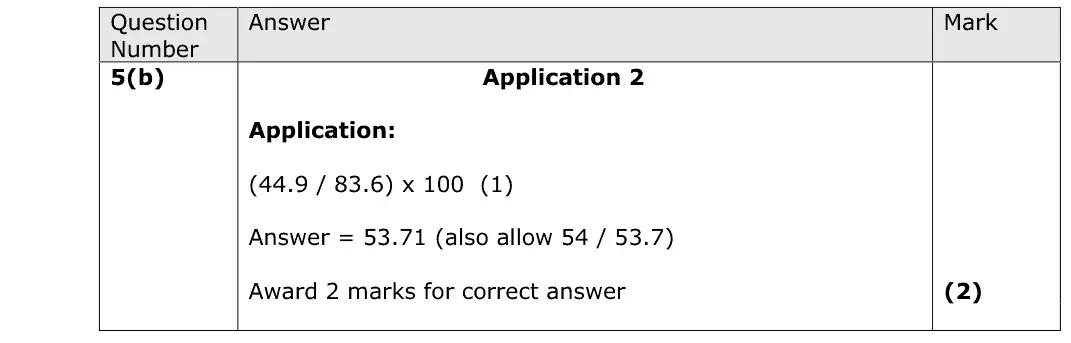
This question asked candidates to calculate percentage decrease in budget deficit. Many candidates found this question a little challenging to answer. These candidates lost marks because they did not use the correct formula.
many used the wrong formula, e.g. dividing by the 2019 figure
Quantitative skills: QS 2 (calculate, use and understand percentages, percentage changes and percentage point changes)
June 2024 · AS Paper 2 · Q5(c)1 markMultiple choice
Data and extracts for question 5
Answer
B
Mark scheme
Notes from the mark scheme and report
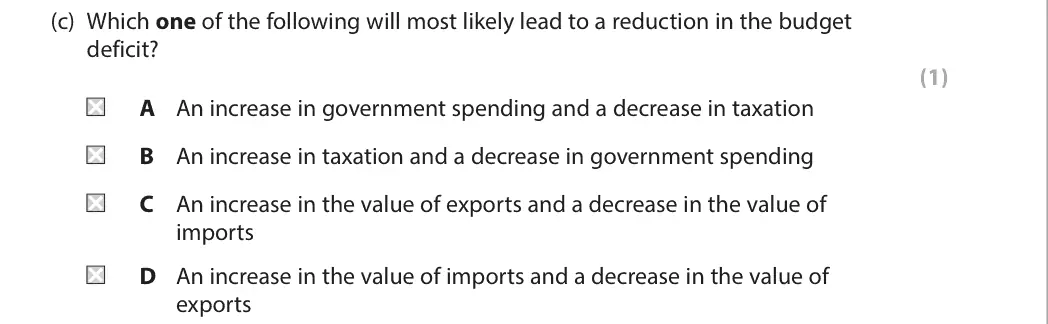
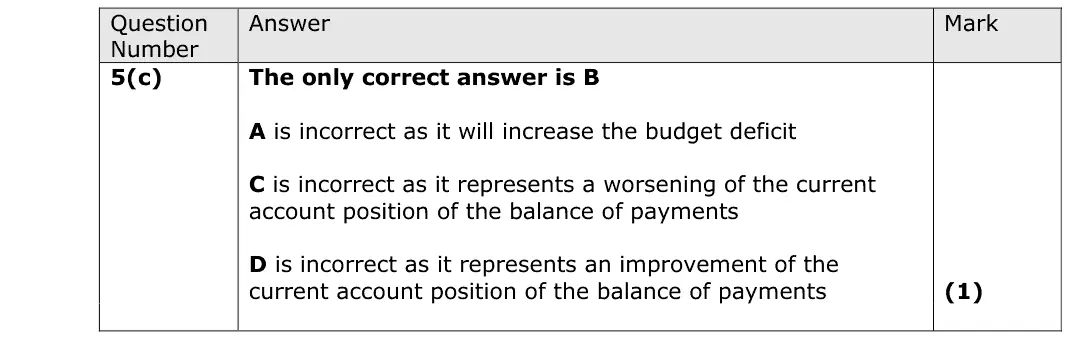
higher taxes and lower spending narrow the budget deficit (B)
A widens it
C and D are about the current account, not the budget
June 2024 · Paper 2 · Q6(d)12 marksAO1=2, AO2=2, AO3=4, AO4=412-mark response
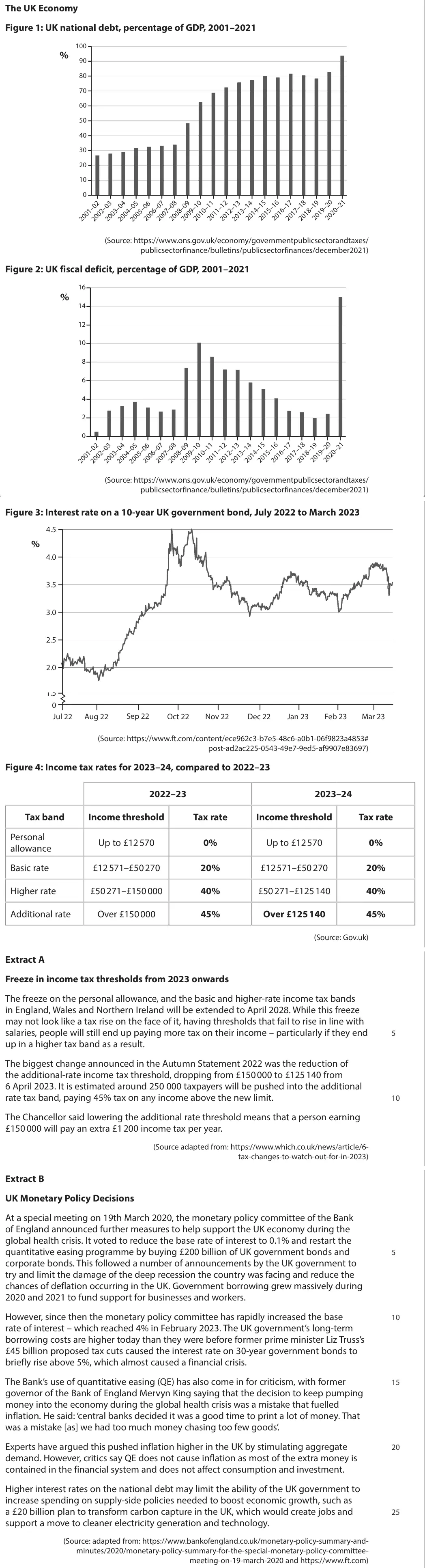
Data and extracts for question 6
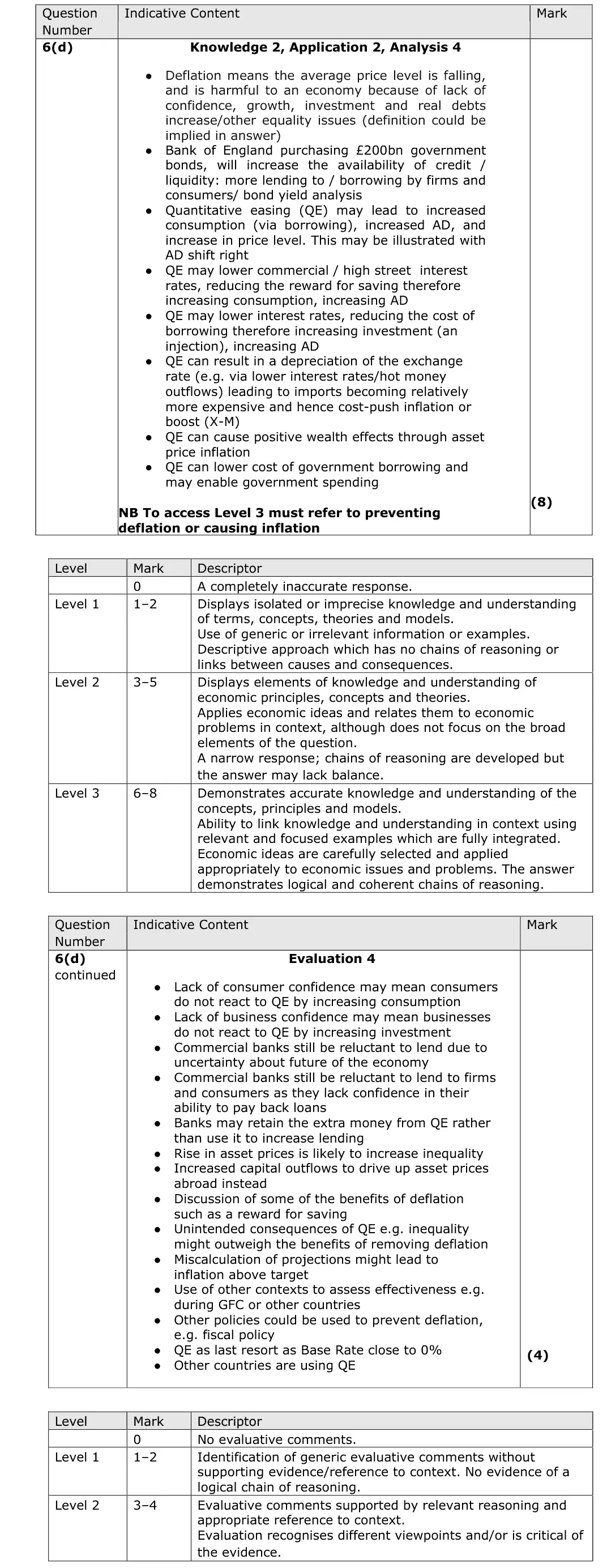
Mark scheme, including the levels grid and indicative content
Examiner's comment
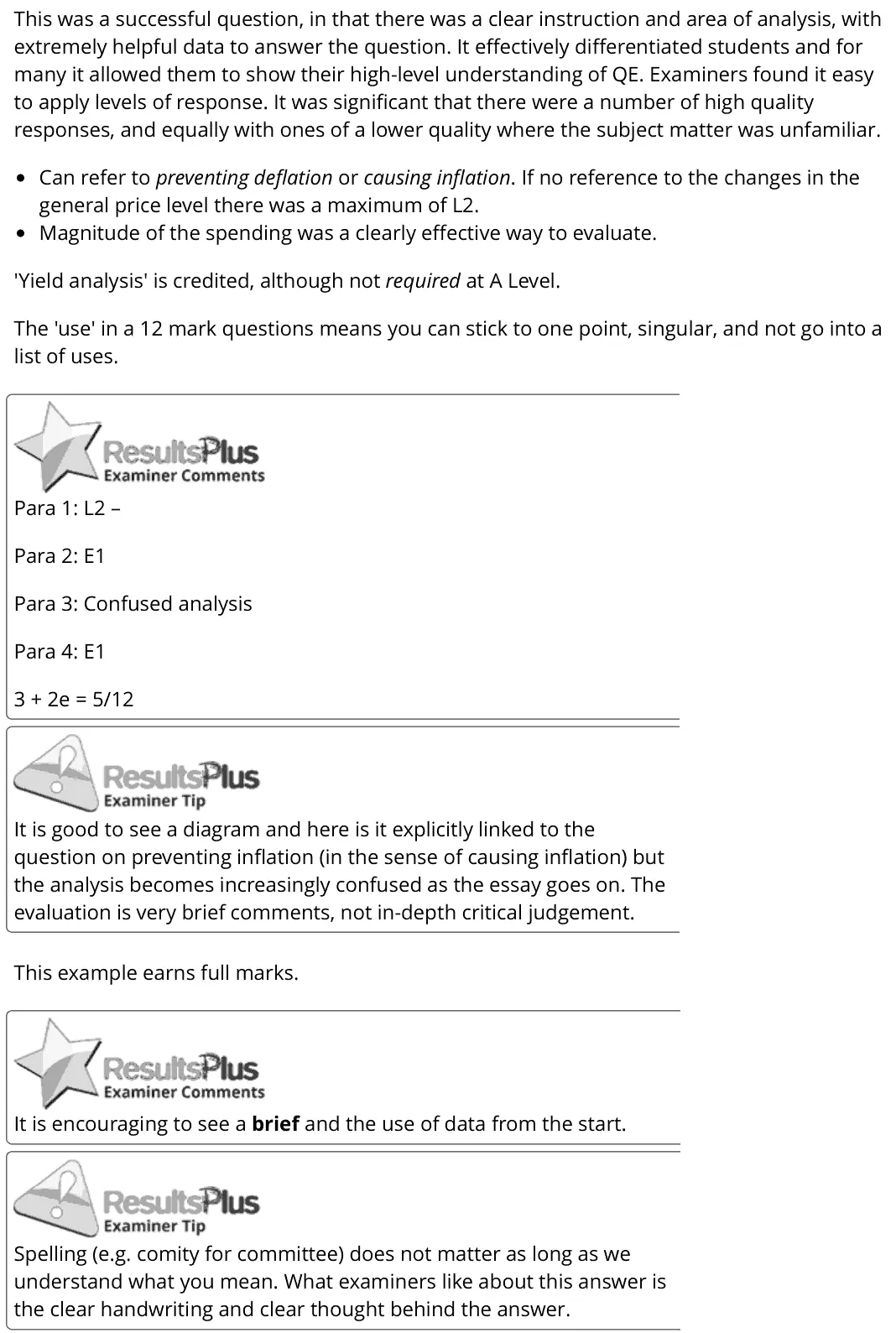
This was a successful question, in that there was a clear instruction and area of analysis, with extremely helpful data to answer the question. It effectively differentiated students and for many it allowed them to show their high-level understanding of QE. Examiners found it easy to apply levels of response. It was significant that there were a number of high quality responses, and equally with ones of a lower quality where the subject matter was unfamiliar. Can refer to preventing deflation or causing inflation. If no reference to the changes in the general price level there was a maximum of L2. Magnitude of the spending was a clearly effective way to evaluate. 'Yield analysis' is credited, although not required at A Level. The 'use' in a 12 mark questions means you can stick to one point, singular, and not go into a list of uses. Para 1: L2 – Para 2: E1 Para 3: Confused analysis Para 4: E1 3 + 2e = 5/12 It is good to see a diagram and here is it explicitly linked to the question on preventing inflation (in the sense of causing inflation) but the analysis becomes increasingly confused as the essay goes on. The evaluation is very brief comments, not in-depth critical judgement. This example earns full marks. It is encouraging to see a brief and the use of data from the start. Spelling (e.g. comity for committee) does not matter as long as we understand what you mean. What examiners like about this answer is the clear handwriting and clear thought behind the answer.
Notes from the mark scheme and report
QE (£200bn bond purchases) raises liquidity and lowers interest rates, boosting C, I and AD and the price level
must refer to the general price level (deflation or inflation) to pass Level 2
evaluate with liquidity trap, money staying in the financial system, magnitude
one use developed is enough
June 2024 · AS Paper 2 · Q6(e)15 marksAO1=3, AO2=3, AO3=3, AO4=615-mark responseHard
Data and extracts for question 6
Mark scheme, including the levels grid and indicative content
Examiner's comment
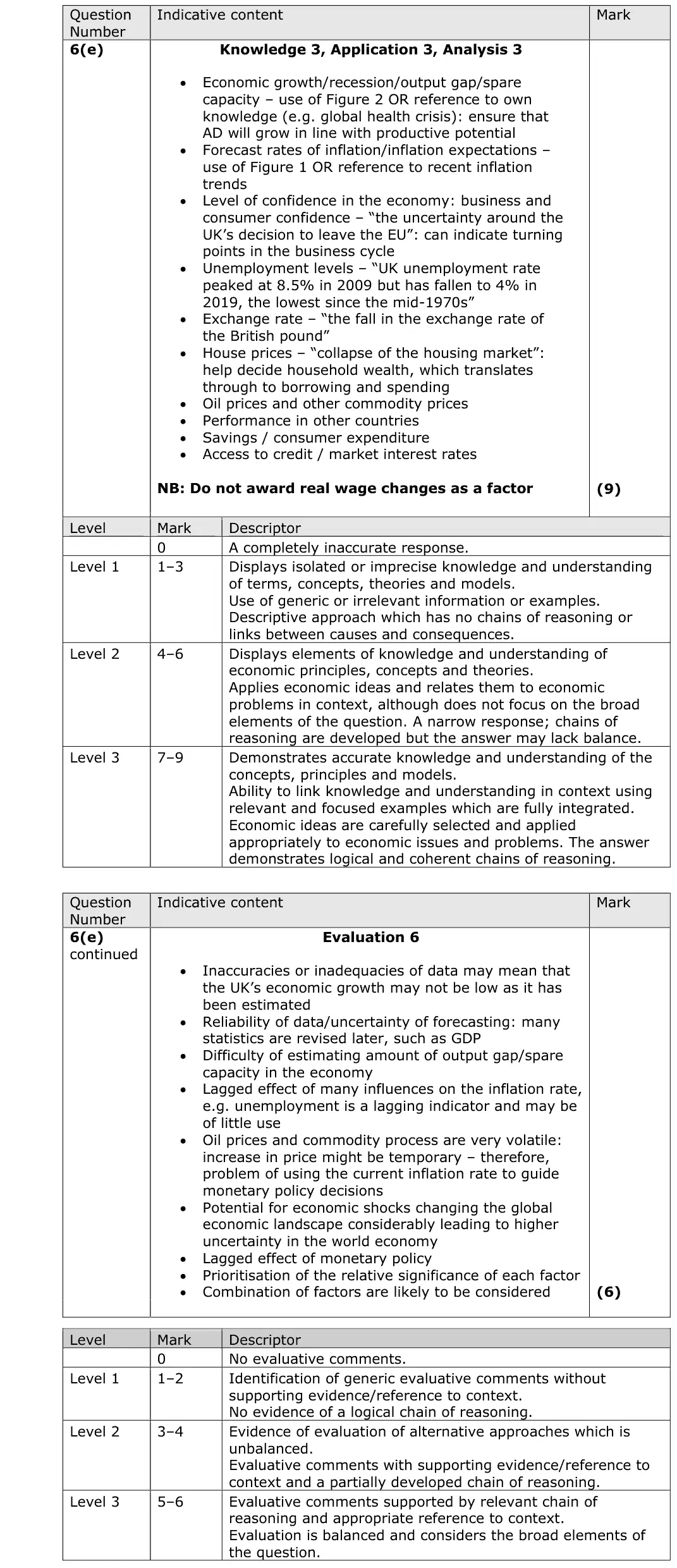
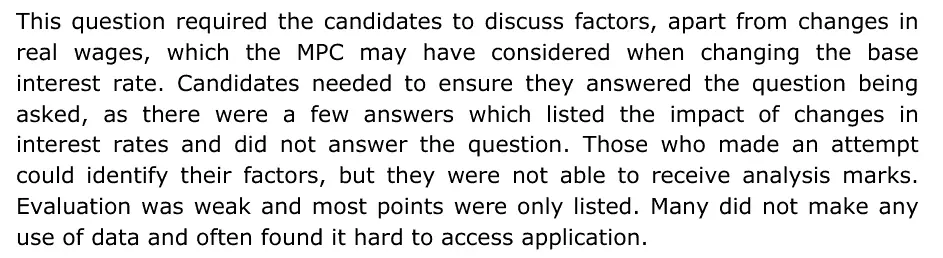
This question required the candidates to discuss factors, apart from changes in real wages, which the MPC may have considered when changing the base interest rate. Candidates needed to ensure they answered the question being asked, as there were a few answers which listed the impact of changes in interest rates and did not answer the question. Those who made an attempt could identify their factors, but they were not able to receive analysis marks. Evaluation was weak and most points were only listed. Many did not make any use of data and often found it hard to access application.
Notes from the mark scheme and report
factors other than real wages: output gap and growth (Figure 2), inflation forecasts (Figure 1), confidence and Brexit uncertainty, unemployment at 4%, exchange rate, house prices
answer about why rates change, not the effects of changing them
report: evaluation was weak and most points only listed, with little data use
June 2024 · AS Paper 2 · Q6(f)20 marksAO1=4, AO2=4, AO3=6, AO4=620-mark essayEither/or
Data and extracts for question 6
Mark scheme, including the levels grid and indicative content
Examiner's comment
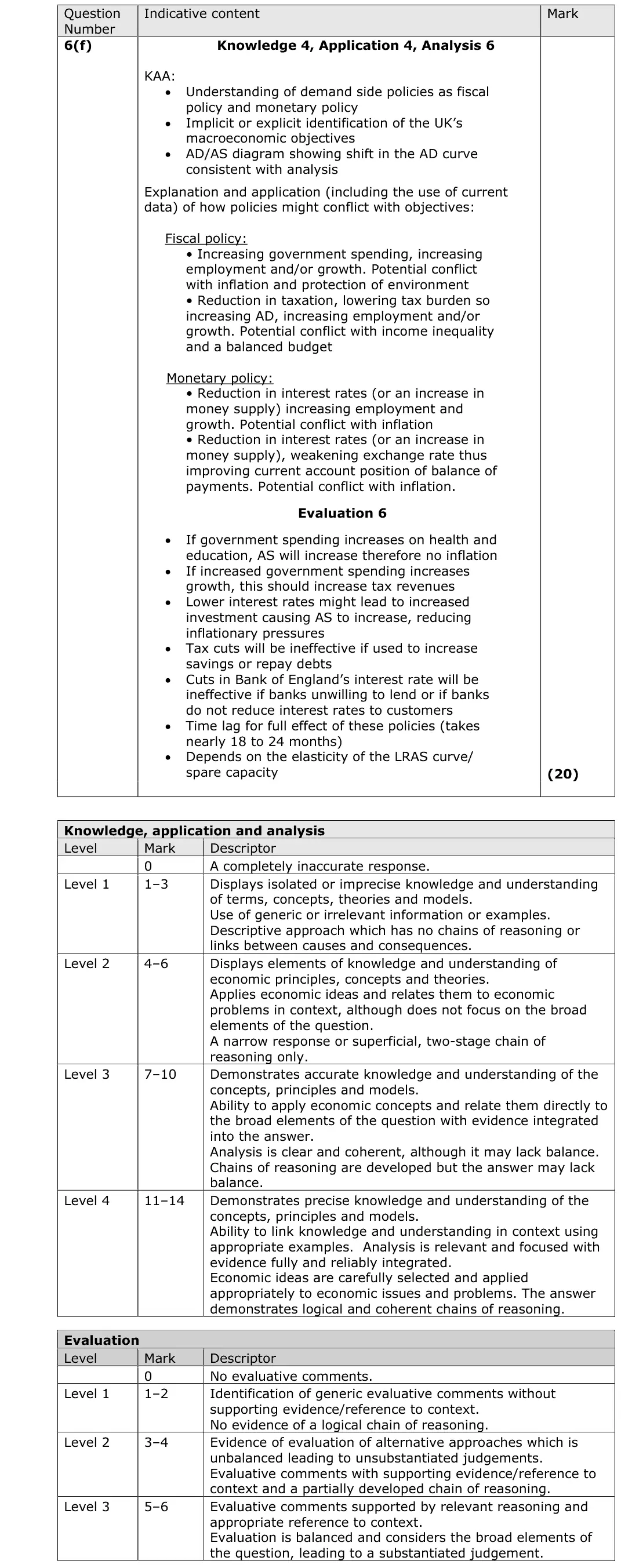
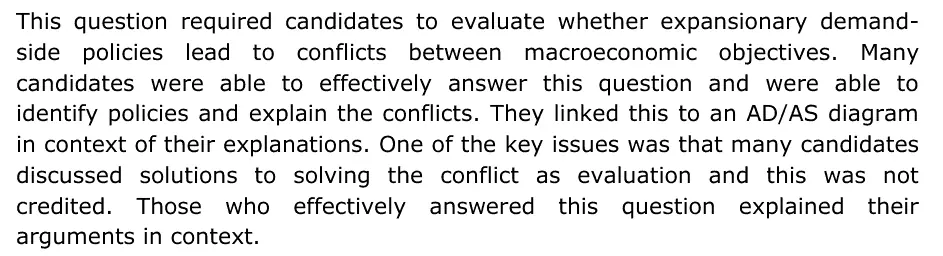
This question required candidates to evaluate whether expansionary demand- side policies lead to conflicts between macroeconomic objectives. Many candidates were able to effectively answer this question and were able to identify policies and explain the conflicts. They linked this to an AD/AS diagram in context of their explanations. One of the key issues was that many candidates discussed solutions to solving the conflict as evaluation and this was not credited. Those who effectively answered this question explained their arguments in context.
Notes from the mark scheme and report
expansionary fiscal and monetary policy raise growth and employment but may conflict with inflation, the current account, a balanced budget and the environment (AD/AS diagram)
evaluate with spare capacity and short-run Phillips curve, not solutions to the conflicts
June 2024 · AS Paper 2 · Q6(g)20 marksAO1=4, AO2=4, AO3=6, AO4=620-mark essayEither/or
Data and extracts for question 6
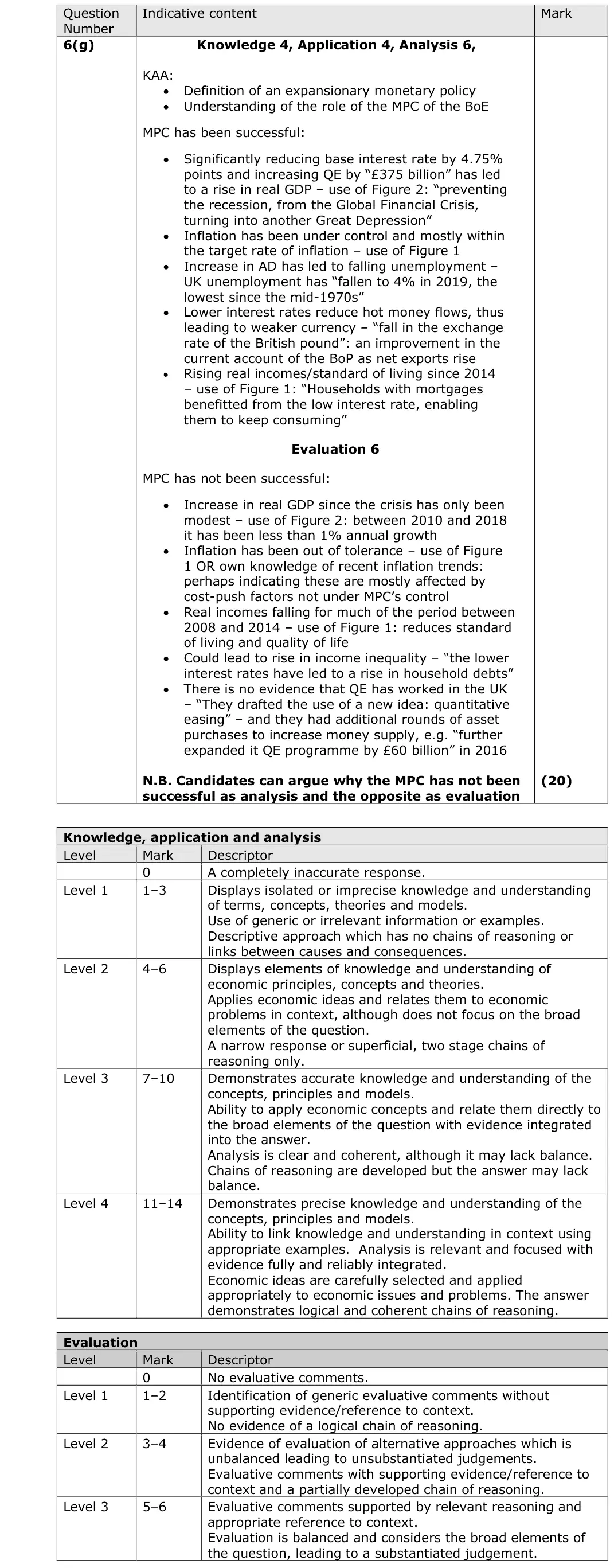
Mark scheme, including the levels grid and indicative content
Examiner's comment
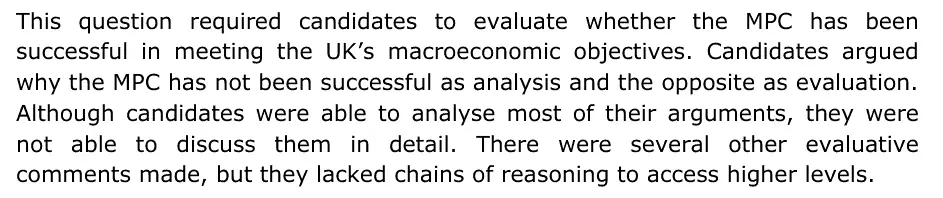
This question required candidates to evaluate whether the MPC has been successful in meeting the UK’s macroeconomic objectives. Candidates argued why the MPC has not been successful as analysis and the opposite as evaluation. Although candidates were able to analyse most of their arguments, they were not able to discuss them in detail. There were several other evaluative comments made, but they lacked chains of reasoning to access higher levels.
Notes from the mark scheme and report
success: rate cut of 4.75 points and £375 billion QE averted depression, unemployment fell to 4%, inflation mostly near target
failure: inflation above target at times, rising household debt, weak growth and real wages
develop each argument
June 2024 · Paper 3 · Q2(d)25 marksAO1=4, AO2=4, AO3=8, AO4=925-mark essayEither/or
Data and extracts for question 2
Mark scheme, including the levels grid and indicative content
Examiner's comment
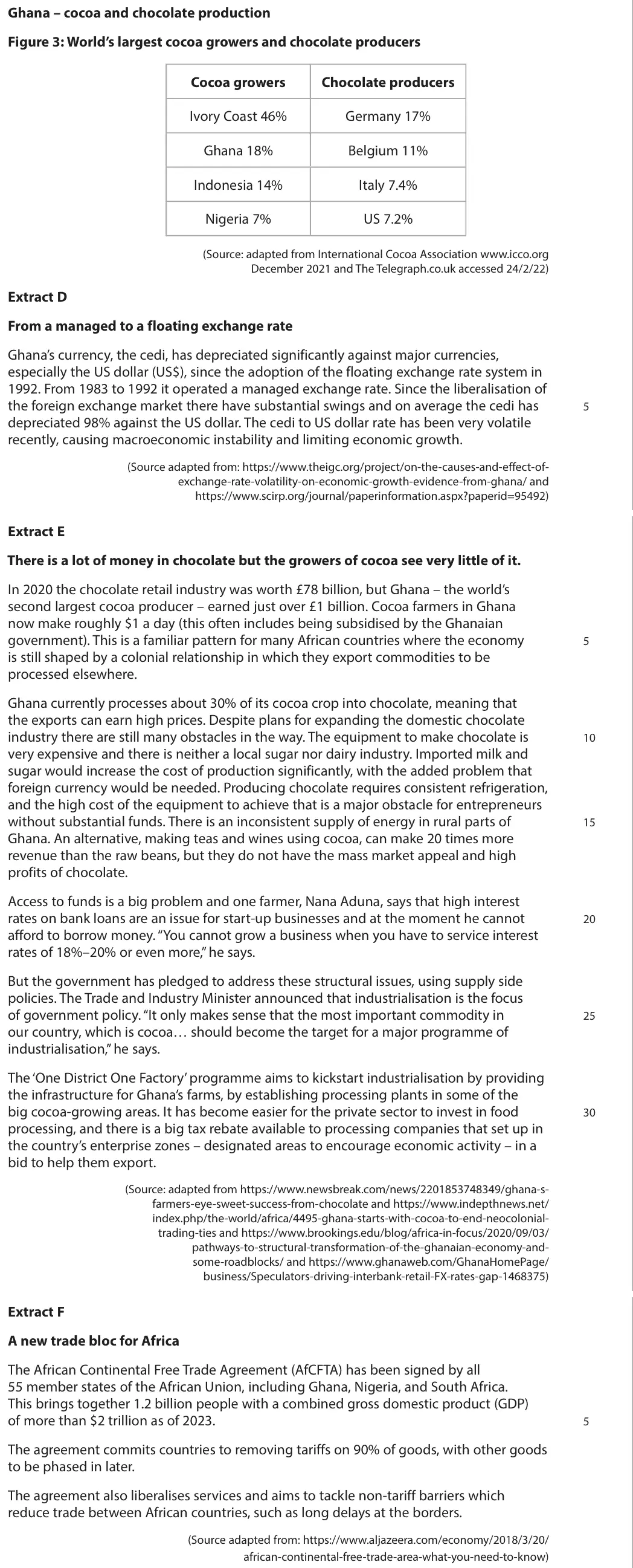
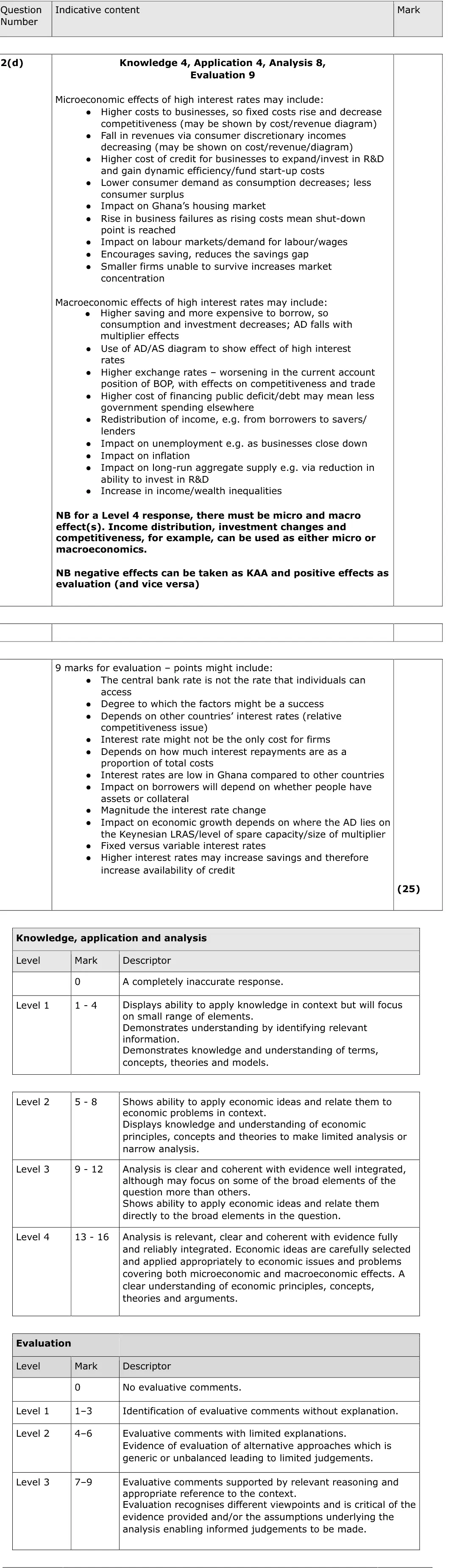
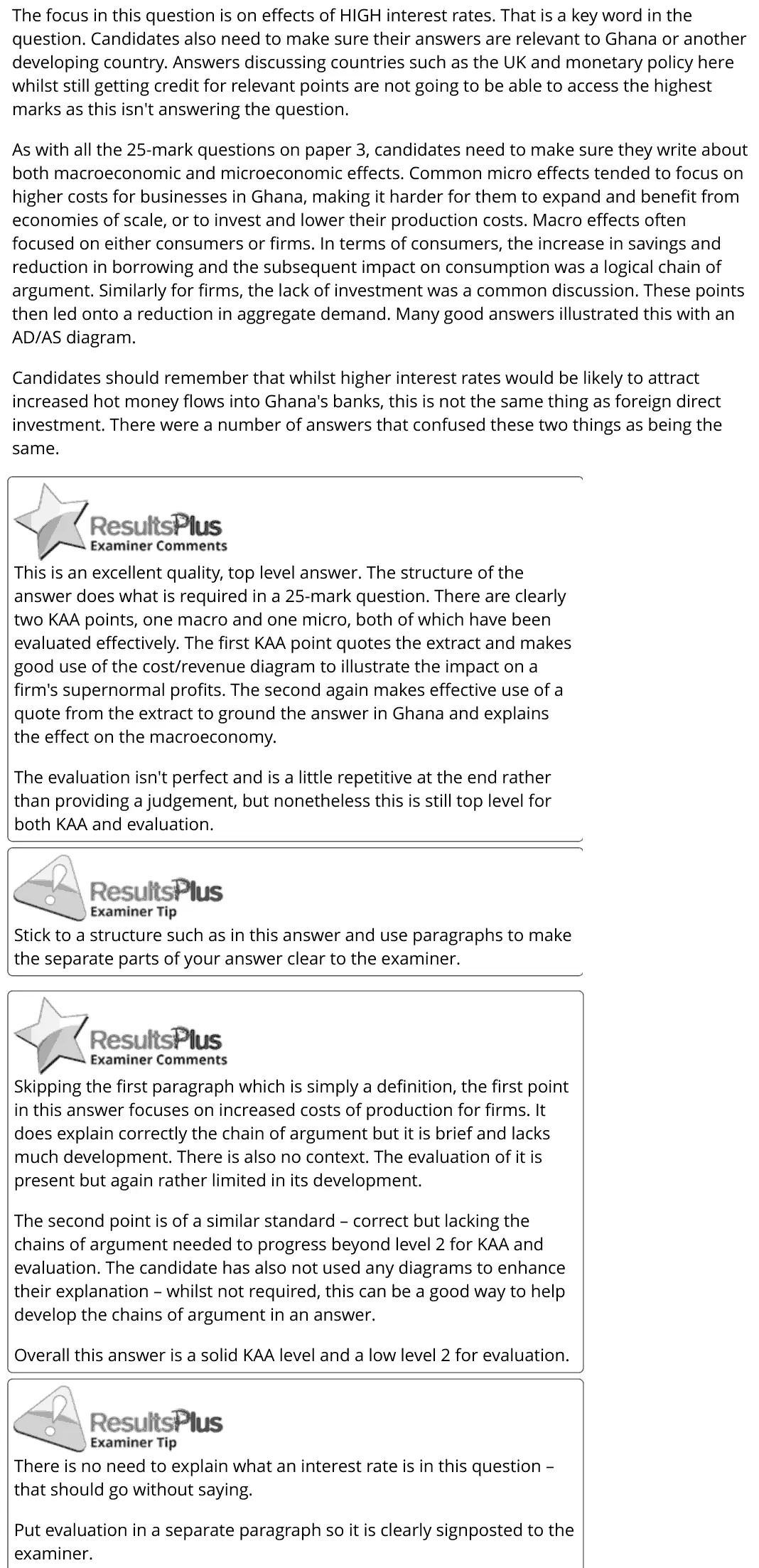
The focus in this question is on effects of HIGH interest rates. That is a key word in the question. Candidates also need to make sure their answers are relevant to Ghana or another developing country. Answers discussing countries such as the UK and monetary policy here whilst still getting credit for relevant points are not going to be able to access the highest marks as this isn't answering the question. As with all the 25-mark questions on paper 3, candidates need to make sure they write about both macroeconomic and microeconomic effects. Common micro effects tended to focus on higher costs for businesses in Ghana, making it harder for them to expand and benefit from economies of scale, or to invest and lower their production costs. Macro effects often focused on either consumers or firms. In terms of consumers, the increase in savings and reduction in borrowing and the subsequent impact on consumption wasa logical chain of argument. Similarly for firms, the lack of investment was a common discussion. These points then led onto a reduction in aggregate demand. Many good answers illustrated this with an AD/AS diagram. Candidates should remember that whilst higher interest rates would be likely to attract increased hot money flows into Ghana's banks, this is not the same thing as foreign direct investment. There were a number of answers that confused these two things as being the same. 4ResultsPlus This is an excellent quality, top level answer. The structure of the answer does what is required in a 25-mark question. There are clearly two KAA points, one macro and one micro, both of which have been evaluated effectively. The first KAA point quotes the extract and makes good use of the cost/revenue diagram to illustrate the impact ona firm's supernormal profits. The second again makes effective use ofa quote from the extract to ground the answer in Ghana and explains the effect on the macroeconomy. The evaluation isn't perfect and is a little repetitive at the end rather than providing a judgement, but nonetheless this is still top level for both KAA and evaluation. GF) ResultsPlus ~~) Examiner Tip Stick to a structure such as in this answer and use paragraphs to make the separate parts of your answer clear to the examiner. Skipping the first paragraph which is simply a definition, the first point in this answer focuses on increased costs of production for firms. It does explain correctly the chain of argument but it is brief and lacks much development. There is also no context. The evaluation of it is present but again rather limited in its development. The second point is of a similar standard - correct but lacking the chains of argument needed to progress beyond level 2 for KAA and evaluation. The candidate has also not used any diagrams to enhance their explanation - whilst not required, this can be a good way to help develop the chains of argument in an answer. Overall this answer is a solid KAA level and a low level 2 for evaluation. GM ResultsPius —~_) Examiner Tip There is no need to explain what an interest rate is in this question - that should go without saying. Put evaluation in a separate paragraph so it is clearly signposted to the examiner.
Notes from the mark scheme and report
micro: higher costs for firms (cost/revenue diagram), less investment, smaller firms close
macro: less consumption and investment, AD falls, exchange rate appreciates, inflation falls
Level 4 needs micro and macro for Ghana or a developing country, not the UK
hot money inflows are not FDI
June 2023 · Paper 2 · Q1(a)4 marksAO1=2, AO2=2Diagram
Data and extracts for question 1
Mark scheme
Examiner's comment
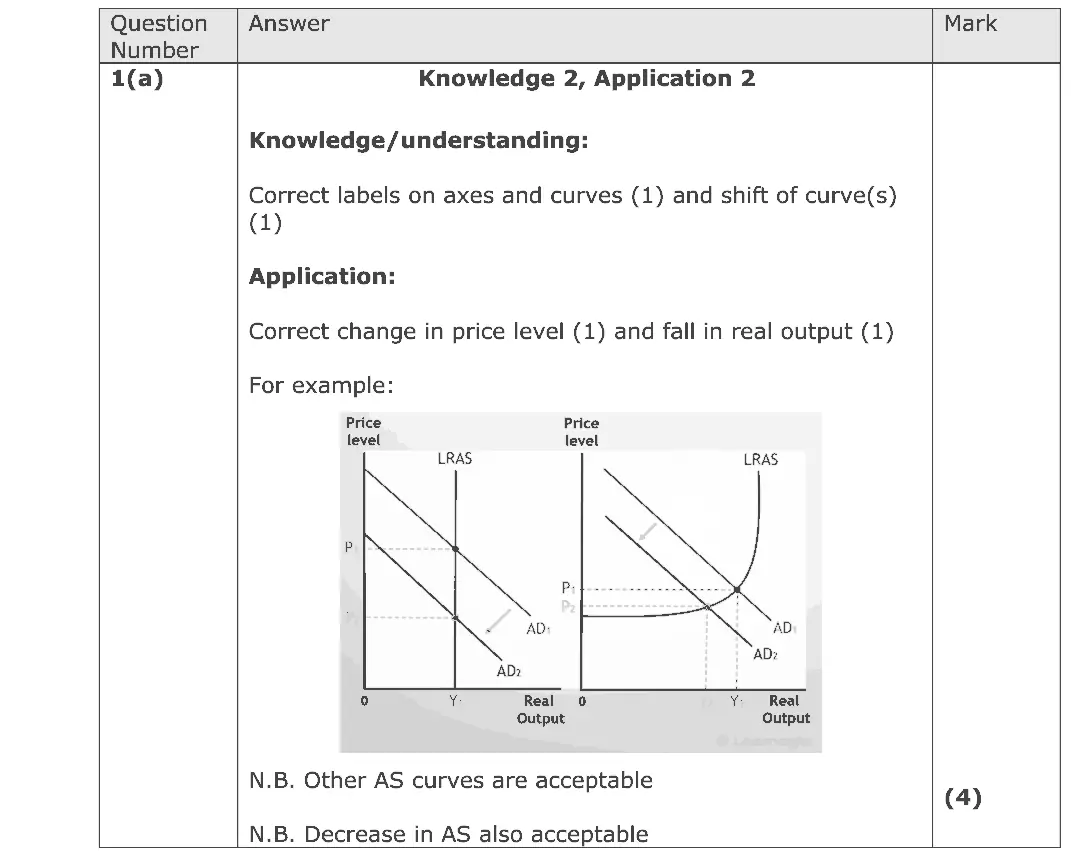
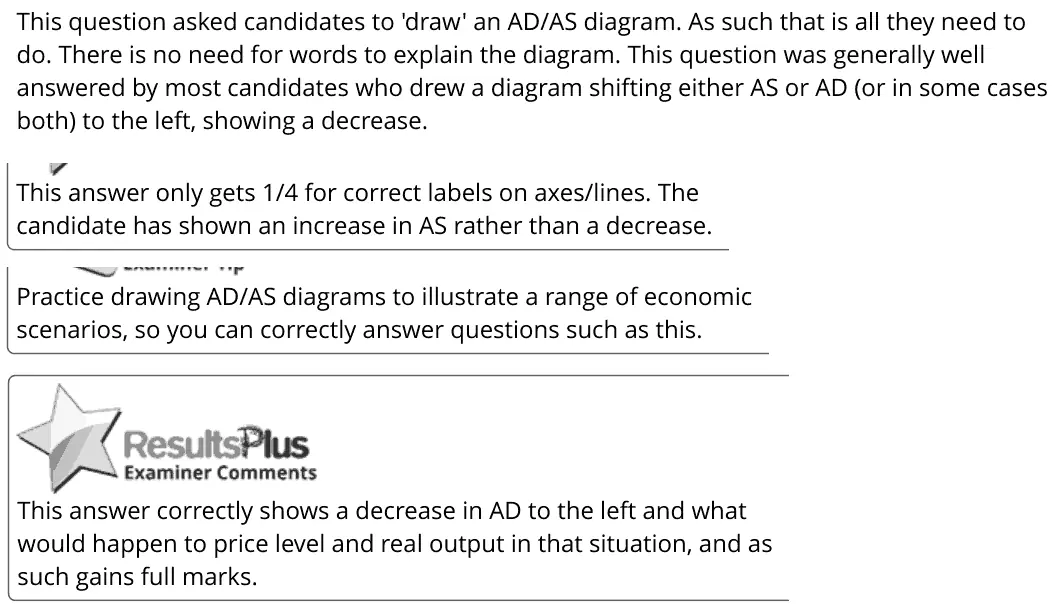
This question asked candidates to 'draw' an AD/AS diagram. As such that is all they need to do. There is no need for words to explain the diagram. This question was generally well answered by most candidates who drew a diagram shifting either AS or AD (or in some cases both) to the left, showing a decrease. This answer only gets 1/4 for correct labels on axes/lines. The candidate has shown an increase in AS rather than a decrease. Practice drawing AD/AS diagrams to illustrate a range of economic scenarios, so you can correctly answer questions such as this. This answer correctly shows a decrease in AD to the left and what would happen to price level and real output in that situation, and as such gains full marks.
Notes from the mark scheme and report
higher interest rate shifts AD left: lower price level and real output (a fall in AS also accepted)
shifting AS right scores only the label mark
no written explanation needed
Quantitative skills: QS 4 (construct and interpret a range of standard graphical forms)
June 2023 · Paper 2 · Q1(b)1 markMultiple choice
Data and extracts for question 1
Answer
A
Mark scheme
Notes from the mark scheme and report
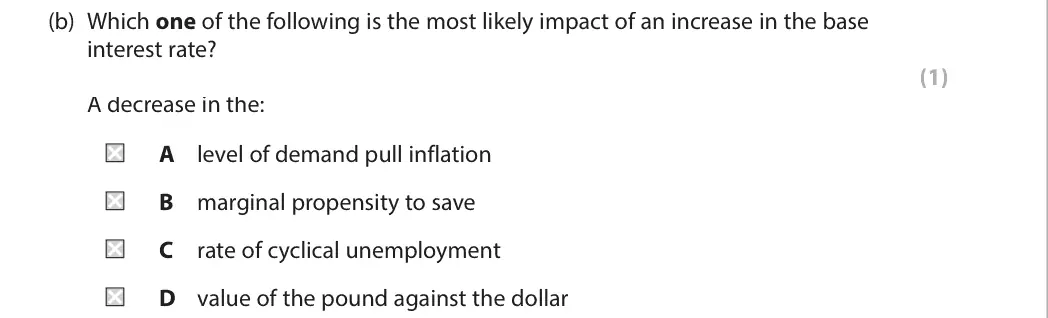
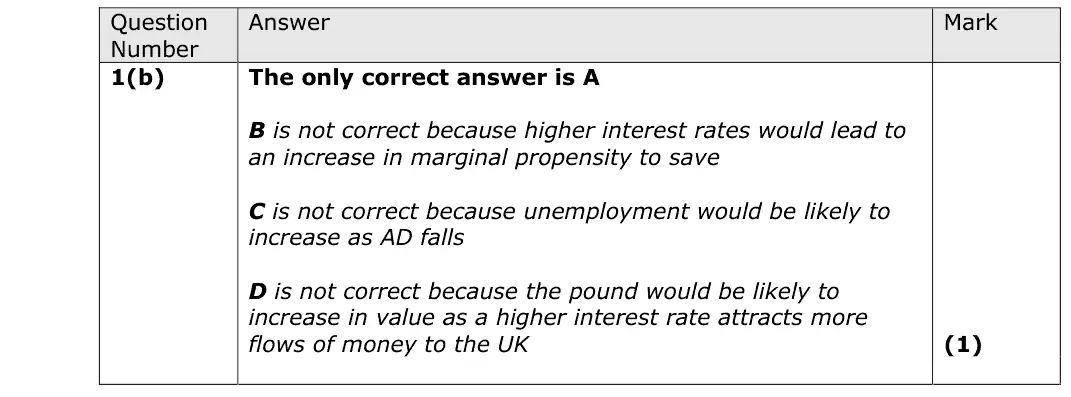
higher rates reduce AD so demand-pull inflation falls (A)
mps would rise, cyclical unemployment would rise, the pound would appreciate on hot money inflows
June 2023 · AS Paper 2 · Q3(a)1 markMultiple choice
Data and extracts for question 3
Answer
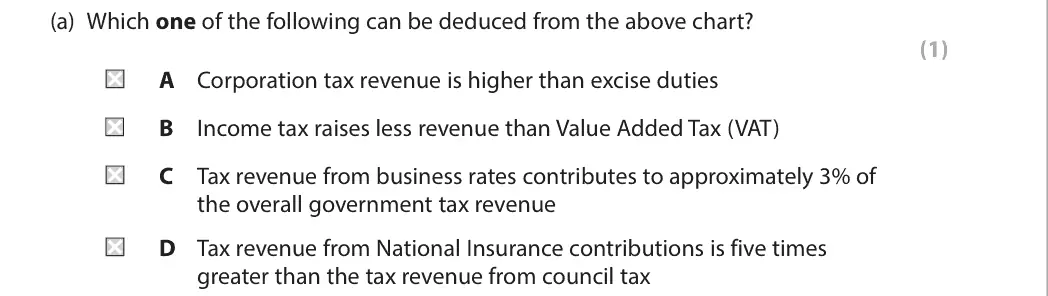
C
Mark scheme
Notes from the mark scheme and report
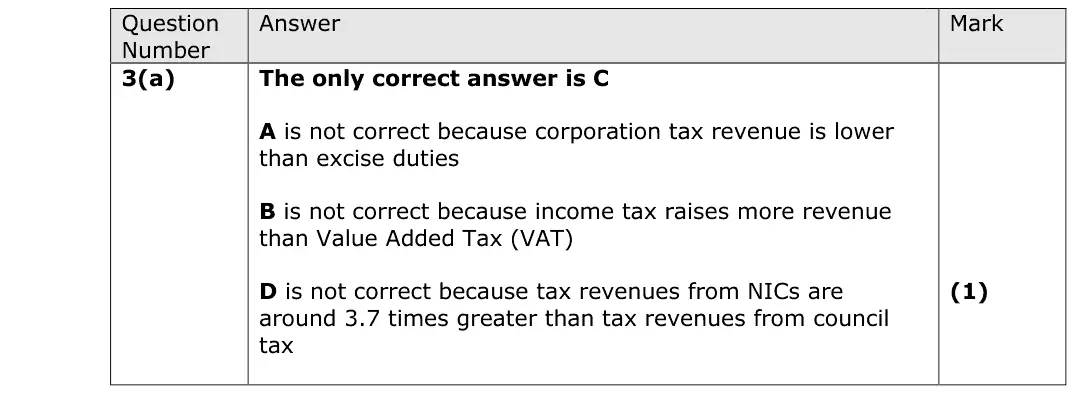
answer C (options not in the crop)
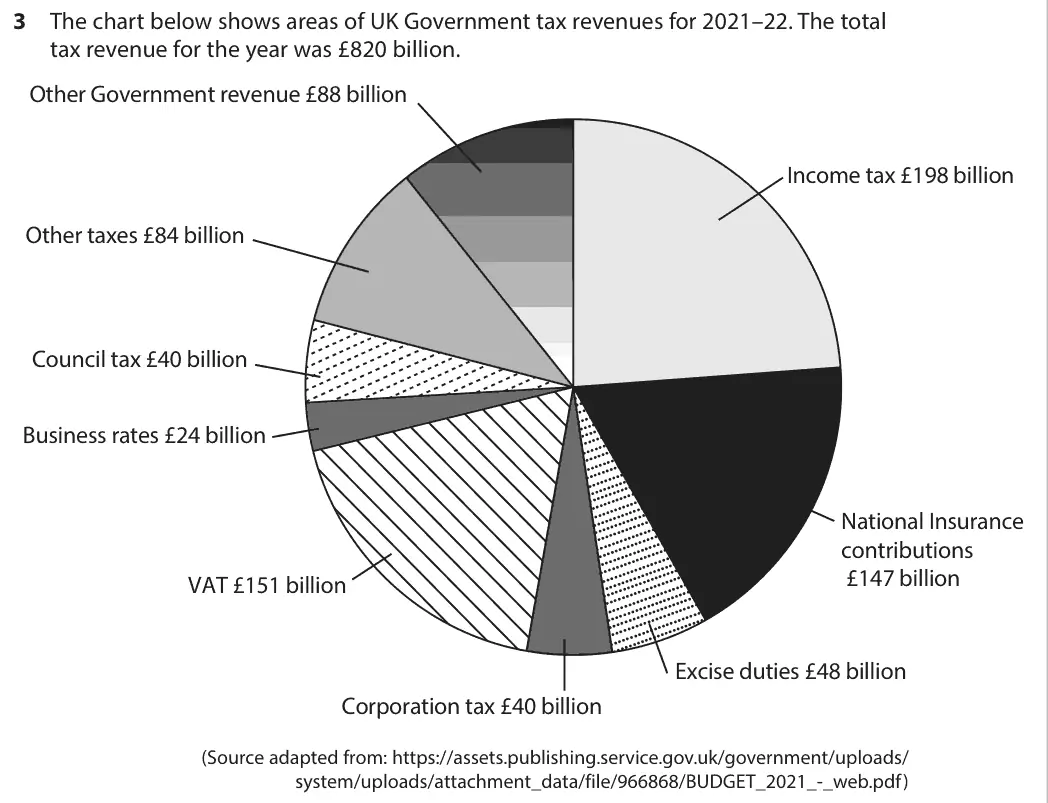
A wrong as corporation tax (£40bn) is below excise duties (£48bn)
B wrong as income tax raises more than VAT
D wrong as NICs are about 3.7 times council tax
Quantitative skills: QS 1 (calculate, use and understand ratios and fractions); QS 9 (interpret, apply and analyse information in written, graphical tabular and numerical forms)
June 2023 · AS Paper 2 · Q3(b)3 marksAO1=1, AO2=1, AO3=1Calculation
Data and extracts for question 3
Mark scheme
Examiner's comment
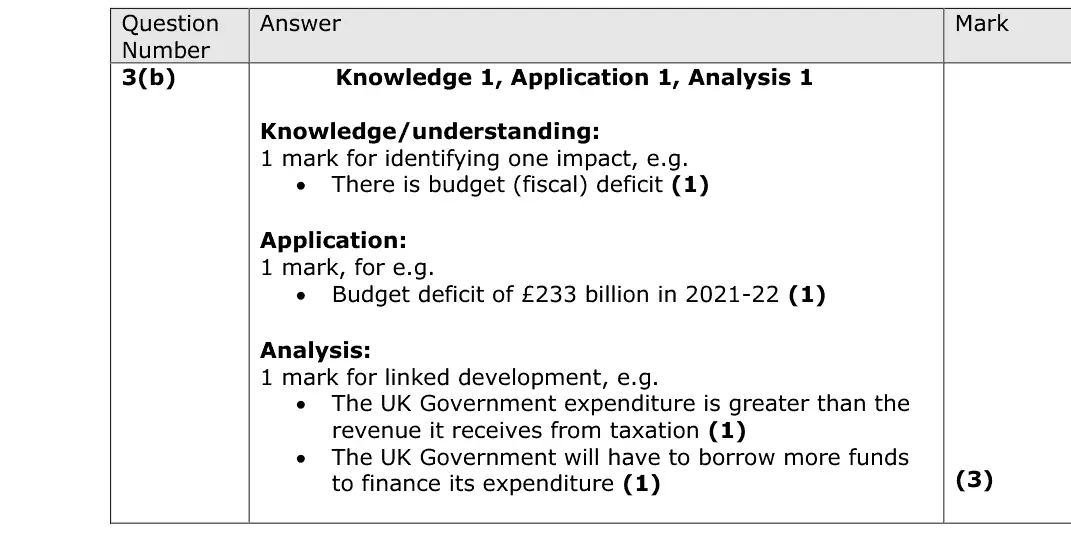
In this question the marks are split as 1 for knowledge, 1 for application, and 1 for analysis. This is a budget balance question that candidates were able to answer relatively easily and the majority were able to do this. Candidates also need to be careful to read the question and the data carefully, as some candidates lost marks because they did not understand the requirements of the question.
Notes from the mark scheme and report
spending £1 053bn exceeds tax £820bn: a budget (fiscal) deficit of £233bn
develop with extra borrowing adding to the national debt
Quantitative skills: QS 9 (interpret, apply and analyse information in written, graphical tabular and numerical forms)
June 2023 · AS Paper 2 · Q6(g)20 marksAO1=4, AO2=4, AO3=6, AO4=620-mark essayEither/or
Data and extracts for question 6
Mark scheme, including the levels grid and indicative content
Examiner's comment
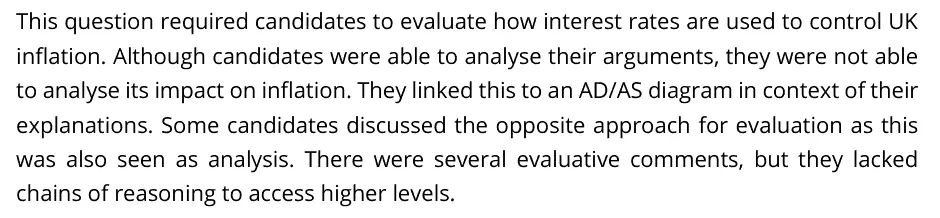
This question required candidates to evaluate how interest rates are used to control UK inflation. Although candidates were able to analyse their arguments, they were not able to analyse its impact on inflation. They linked this to an AD/AS diagram in context of their explanations. Some candidates discussed the opposite approach for evaluation as this was also seen as analysis. There were several evaluative comments, but they lacked chains of reasoning to access higher levels.
Notes from the mark scheme and report
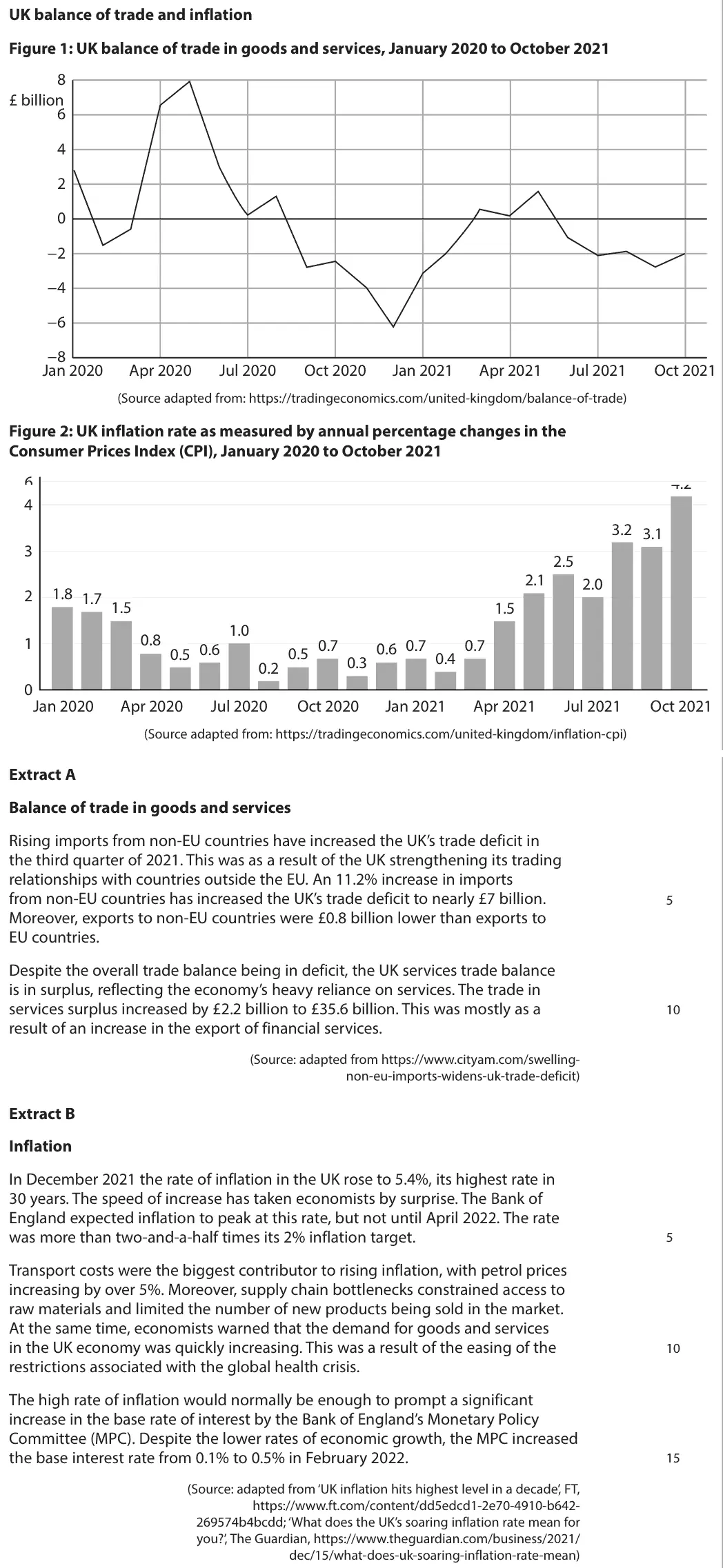
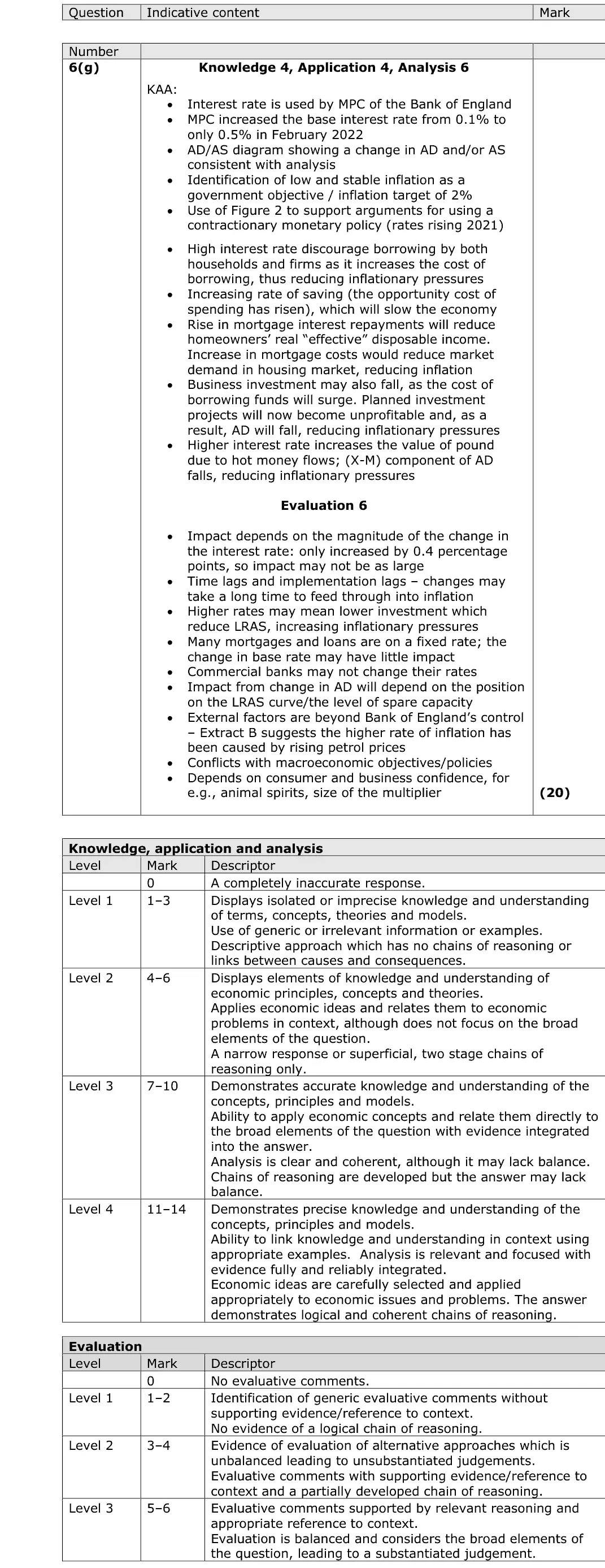
Bank Rate rise (0.1% to 0.5% in Feb 2022) raises borrowing costs, saving and mortgage payments, cuts C and I and AD, and may raise the pound
evaluate cost-push causes, time lags, small rises
report: impact on inflation itself was not analysed and evaluation lacked chains of reasoning
Quantitative skills: QS 9 (interpret, apply and analyse information in written, graphical tabular and numerical forms)
June 2023 · Paper 2 · Q825 marksAO1=4, AO2=4, AO3=8, AO4=925-mark essayEither/or
Mark scheme, including the levels grid and indicative content
evaluate with cost-push causes, time lags, effects on growth and unemployment
June 2022 · AS Paper 2 · Q1(a)1 markMultiple choice
Data and extracts for question 1
Answer
C
Mark scheme
Notes from the mark scheme and report
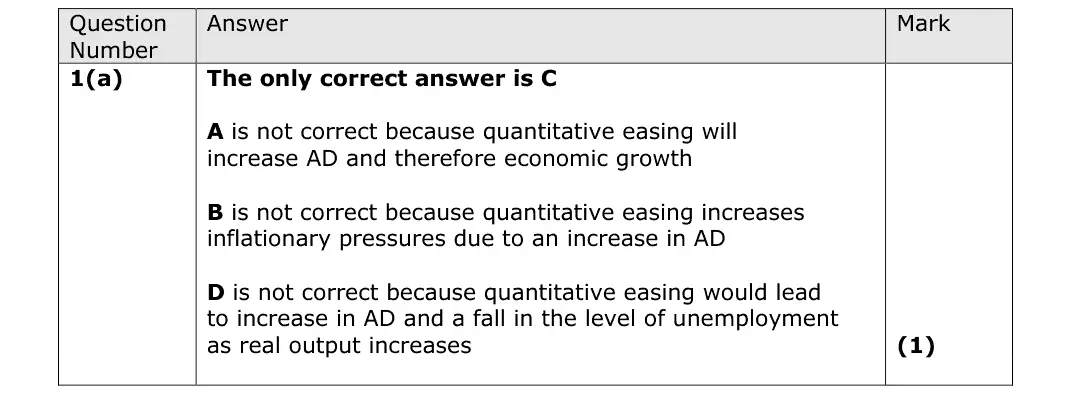
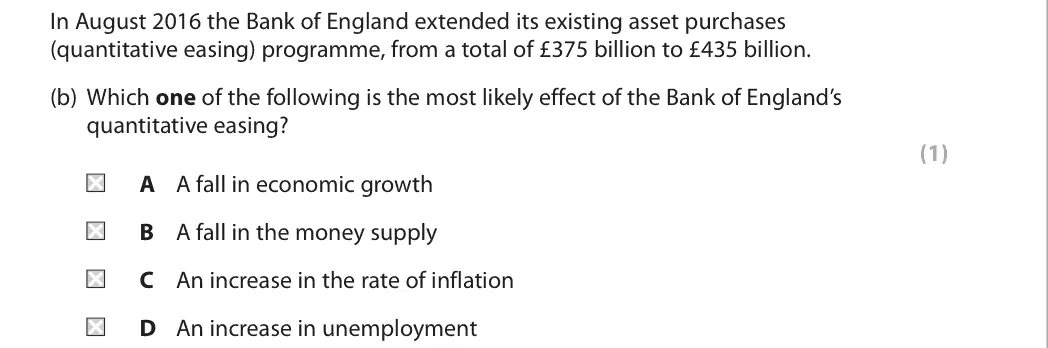
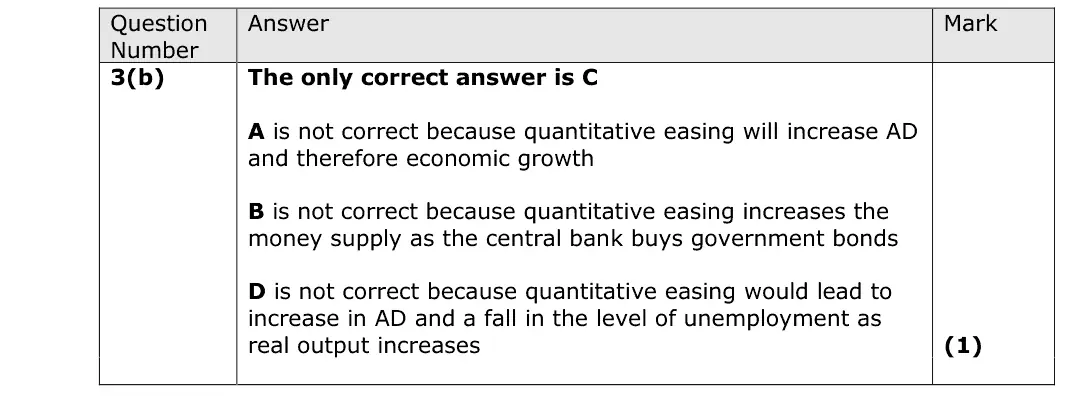
QE (asset purchases) increases the money supply (C)
it raises AD so growth and inflation rise and unemployment falls
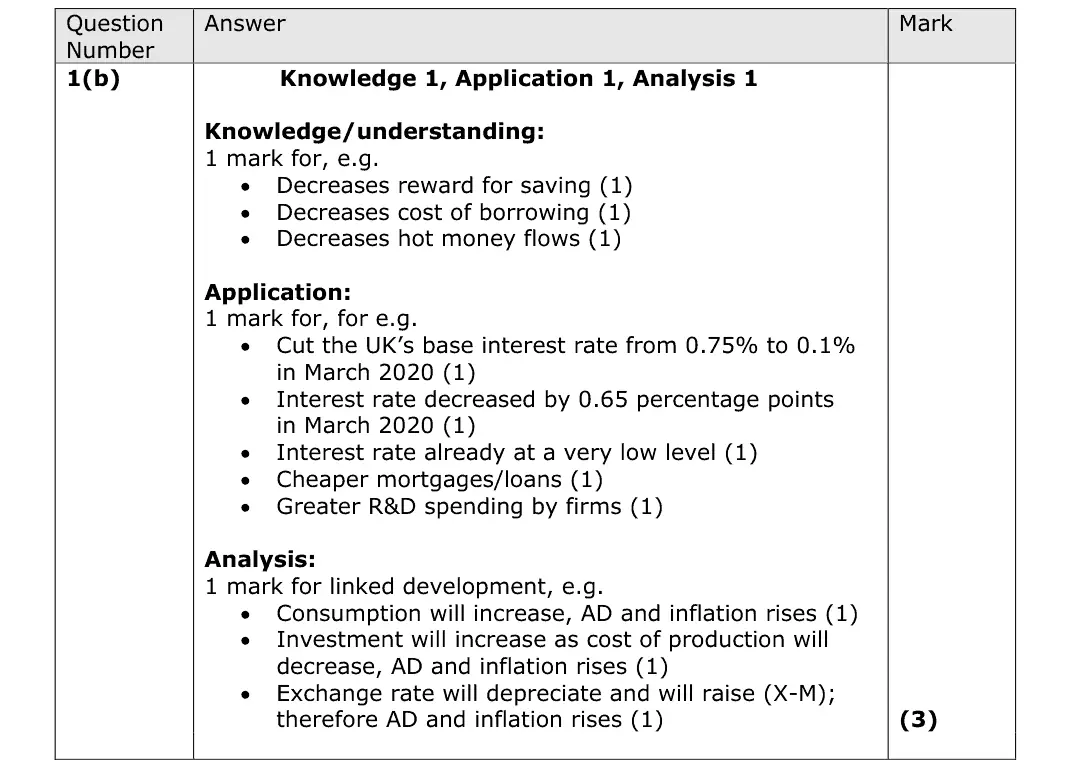
June 2022 · AS Paper 2 · Q1(b)3 marksAO1=1, AO2=1, AO3=1Short answer
Data and extracts for question 1
Mark scheme
Examiner's comment
In this question the marks are split as 1 for knowledge, 1 for application, and 1 for analysis. The knowledge comes from identifying one effect, the application for explaining the data, and analysis for development building on the knowledge. Most candidates were able to access application marks.
Notes from the mark scheme and report
lower rate cuts the cost of borrowing and reward for saving, so C, I and AD rise and inflation rises (or the pound depreciates, raising X - M)
use the 0.75% to 0.1% cut for application
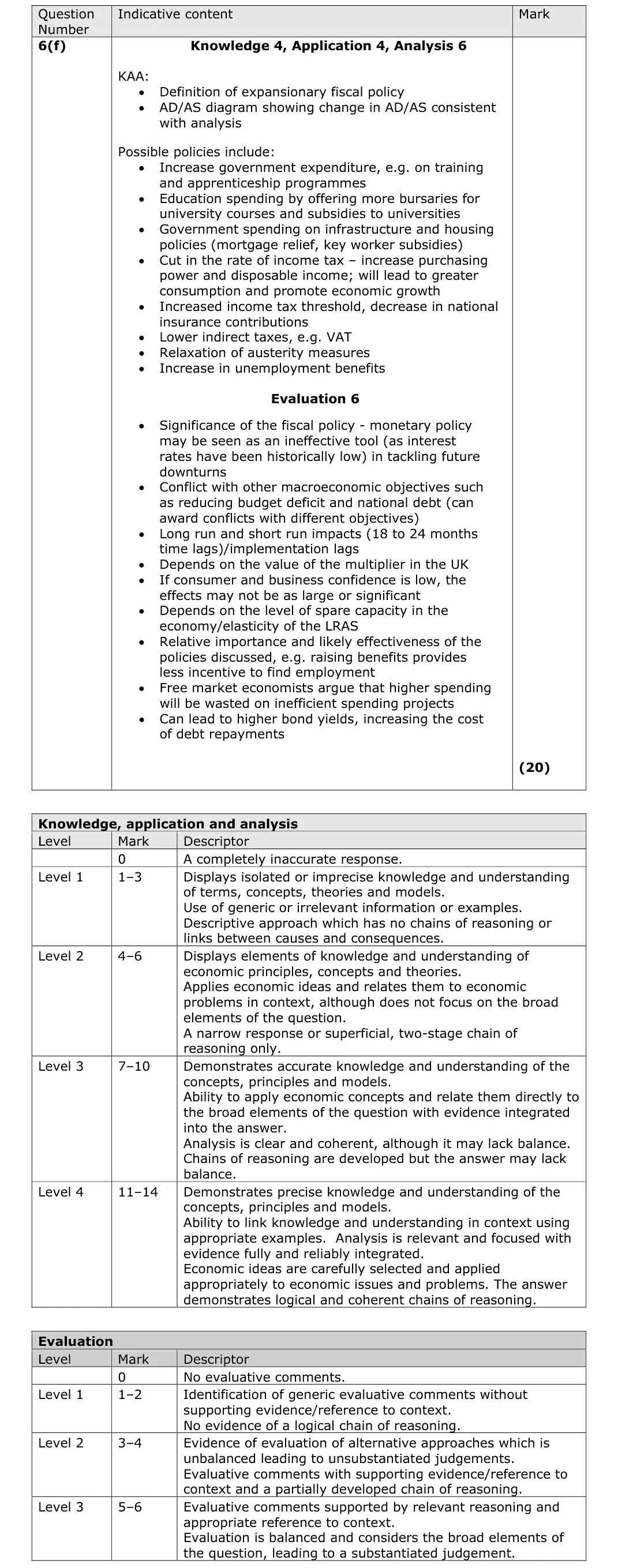
June 2022 · AS Paper 2 · Q6(f)20 marksAO1=4, AO2=4, AO3=6, AO4=620-mark essayEither/or
Data and extracts for question 6
Mark scheme, including the levels grid and indicative content
Examiner's comment
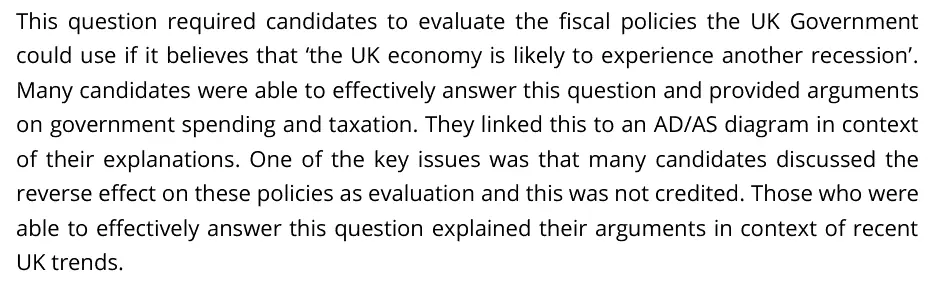
This question required candidates to evaluate the fiscal policies the UK Government could use if it believes that ‘the UK economy is likely to experience another recession’. Many candidates were able to effectively answer this question and provided arguments on government spending and taxation. They linked this to an AD/AS diagram in context of their explanations. One of the key issues was that many candidates discussed the reverse effect on these policies as evaluation and this was not credited. Those who were able to effectively answer this question explained their arguments in context of recent UK trends.
Notes from the mark scheme and report
expansionary fiscal policy (spending on schools/infrastructure, tax cuts) with an AD/AS diagram and multiplier
reversing the policy is not evaluation
evaluate with time lags, debt, crowding out, size of the multiplier, confidence
June 2022 · Paper 3 · Q2(d)25 marksAO1=4, AO2=4, AO3=8, AO4=925-mark essayEither/or
Data and extracts for question 2
Mark scheme, including the levels grid and indicative content
Examiner's comment
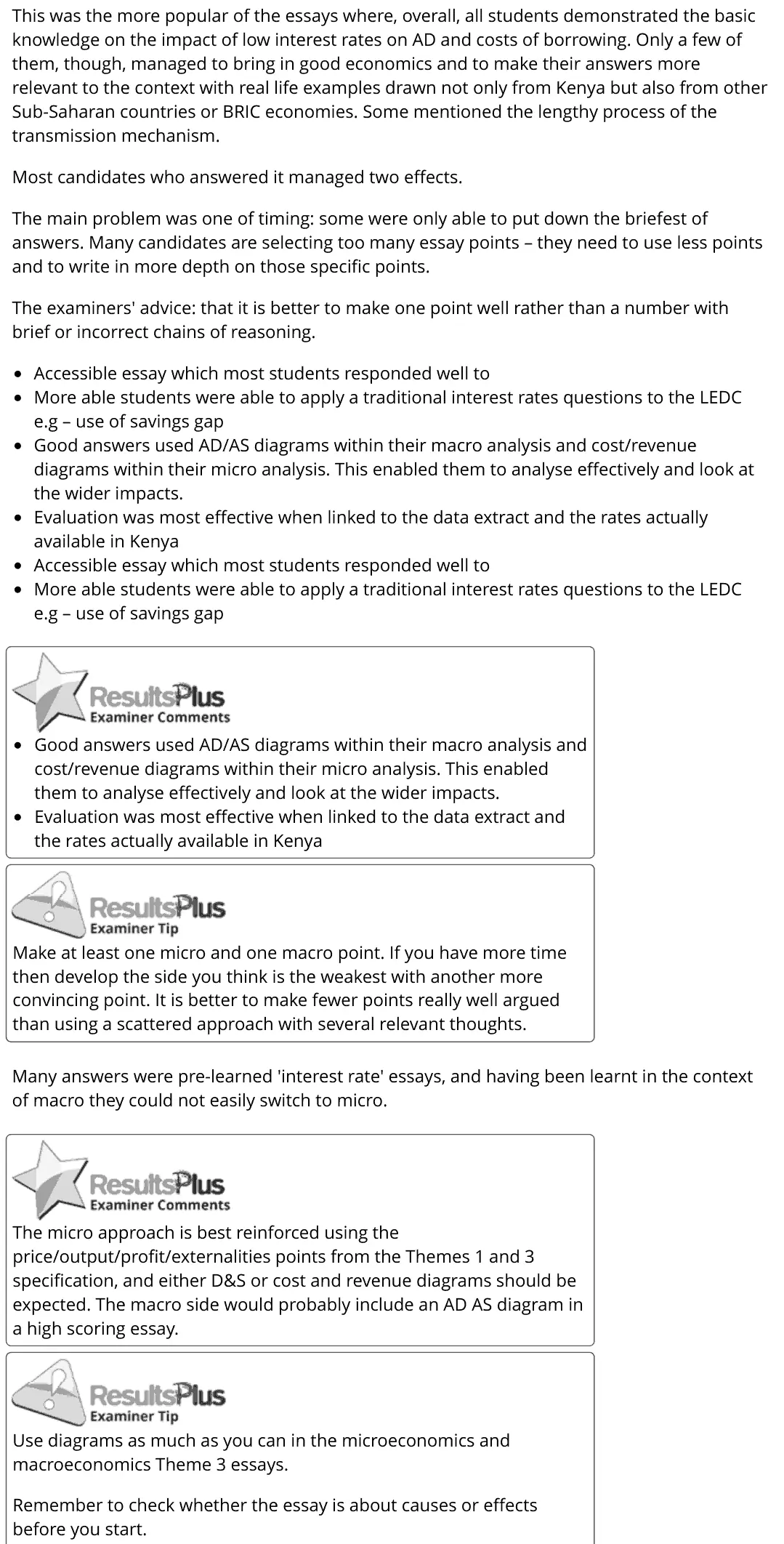
This was the more popular of the essays where, overall, all students demonstrated the basic knowledge on the impact of low interest rates on AD and costs of borrowing. Only a few of them, though, managed to bring in good economics and to make their answers more relevant to the context with real life examples drawn not only from Kenya but also from other Sub-Saharan countries or BRIC economies. Some mentioned the lengthy process of the transmission mechanism. Most candidates who answered it managed two effects. The main problem was one of timing: some were only able to put down the briefest of answers. Many candidates are selecting too many essay points – they need to use less points and to write in more depth on those specific points. The examiners' advice: that it is better to make one point well rather than a number with brief or incorrect chains of reasoning. Accessible essay which most students responded well to More able students were able to apply a traditional interest rates questions to the LEDC e.g – use of savings gap Good answers used AD/AS diagrams within their macro analysis and cost/revenue diagrams within their micro analysis. This enabled them to analyse effectively and look at the wider impacts. Evaluation was most effective when linked to the data extract and the rates actually available in Kenya Accessible essay which most students responded well to More able students were able to apply a traditional interest rates questions to the LEDC e.g – use of savings gap Good answers used AD/AS diagrams within their macro analysis and cost/revenue diagrams within their micro analysis. This enabled them to analyse effectively and look at the wider impacts. Evaluation was most effective when linked to the data extract and the rates actually available in Kenya Make at least one micro and one macro point. If you have more time then develop the side you think is the weakest with another more convincing point. It is better to make fewer points really well argued than using a scattered approach with several relevant thoughts. Many answers were pre-learned 'interest rate' essays, and having been learnt in the context of macro they could not easily switch to micro. The micro approach is best reinforced using the price/output/profit/externalities points from the Themes 1 and 3 specification, and either D&S or cost and revenue diagrams should be expected. The macro side would probably include an AD AS diagram in a high scoring essay. Use diagrams as much as you can in the microeconomics and macroeconomics Theme 3 essays. Remember to check whether the essay is about causes or effects before you start.
Notes from the mark scheme and report
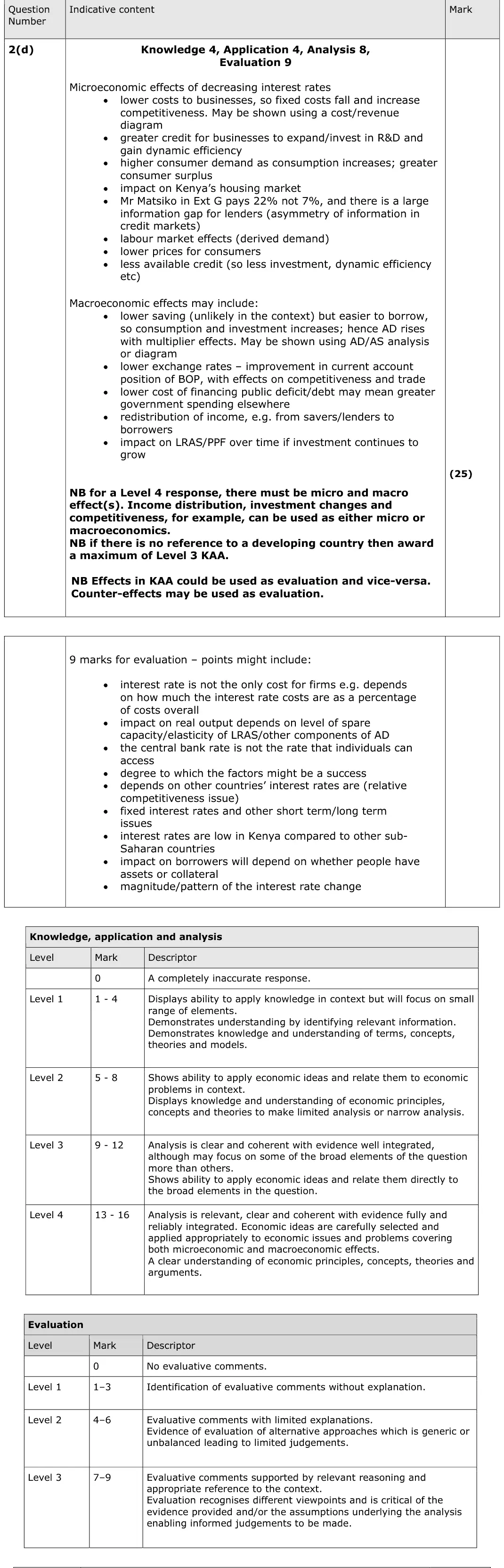
micro: lower borrowing costs for firms, more investment and R&D, consumer demand
macro: C and I raise AD with the multiplier, depreciation, cheaper debt servicing
without a developing country KAA is capped at Level 3
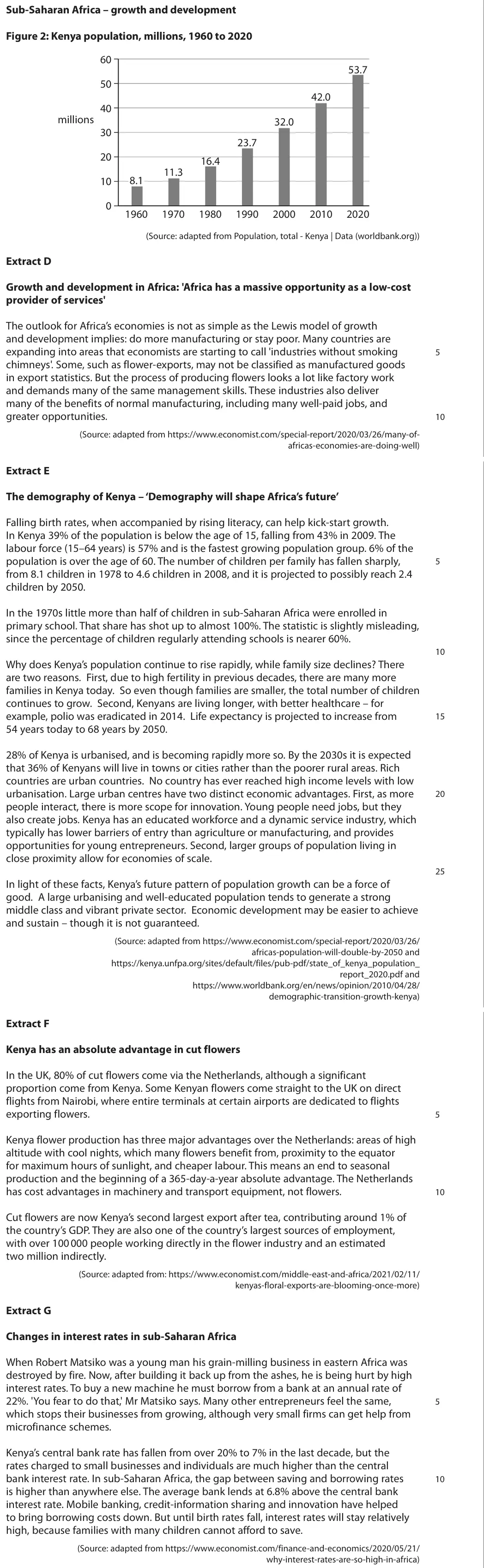
evaluate with the gap between the 7% central bank rate and 22% paid by small firms (Extract G), savings gap
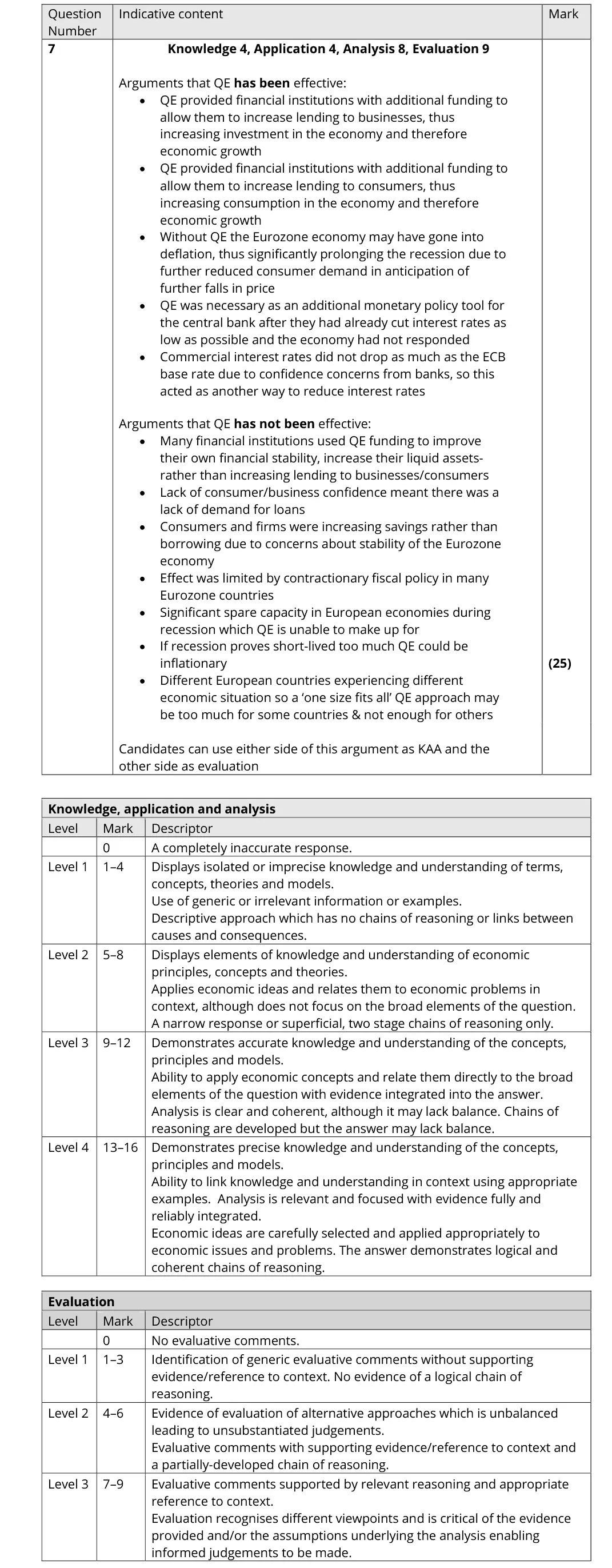
November 2021 · Paper 2 · Q725 marksAO1=4, AO2=4, AO3=8, AO4=925-mark essayEither/or
Mark scheme, including the levels grid and indicative content
Notes from the mark scheme and report
explain how QE works (asset purchases, liquidity, lower yields, lending, AD)
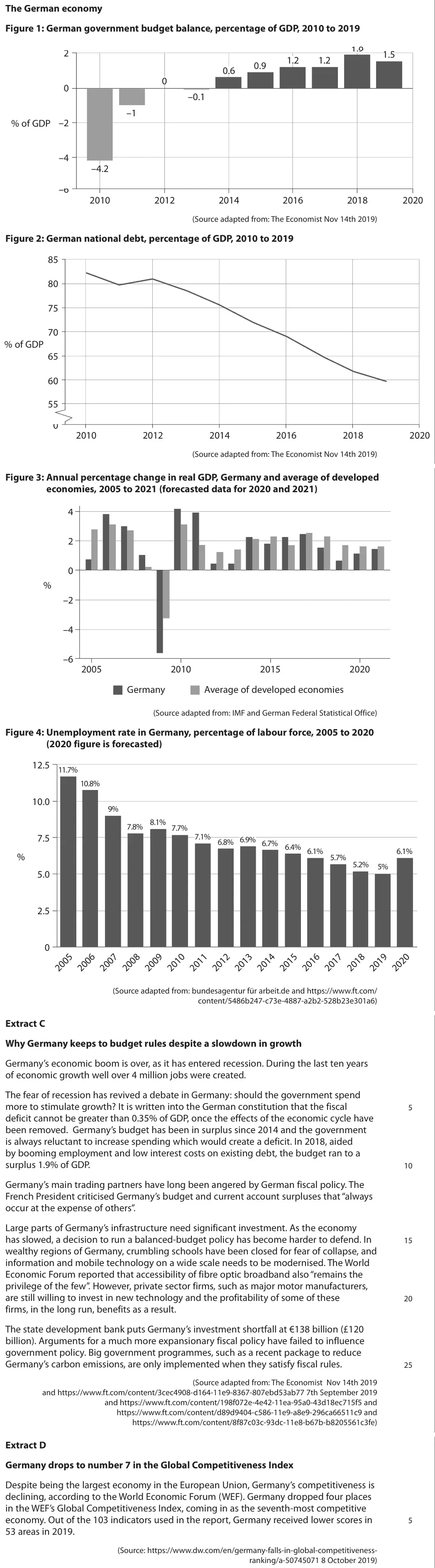
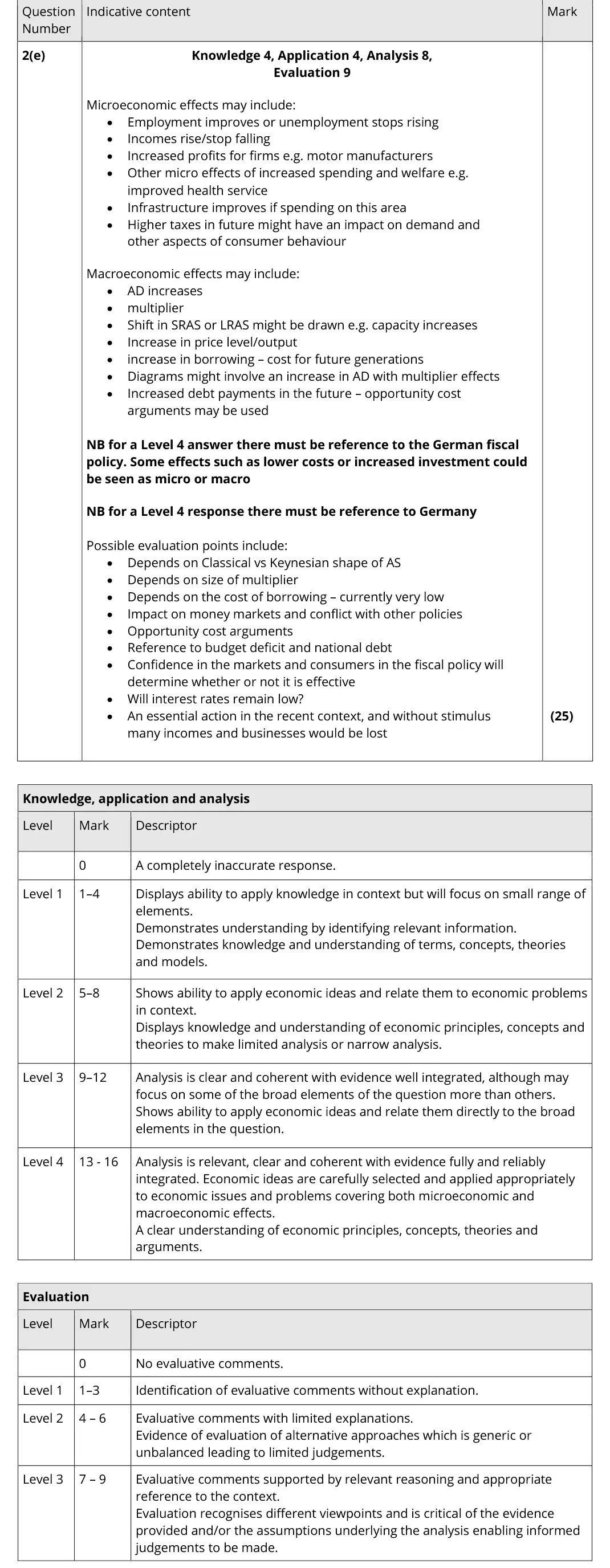
November 2021 · Paper 3 · Q2(e)25 marksAO1=4, AO2=4, AO3=8, AO4=925-mark essayEither/or
Data and extracts for question 2
Mark scheme, including the levels grid and indicative content
Examiner's comment
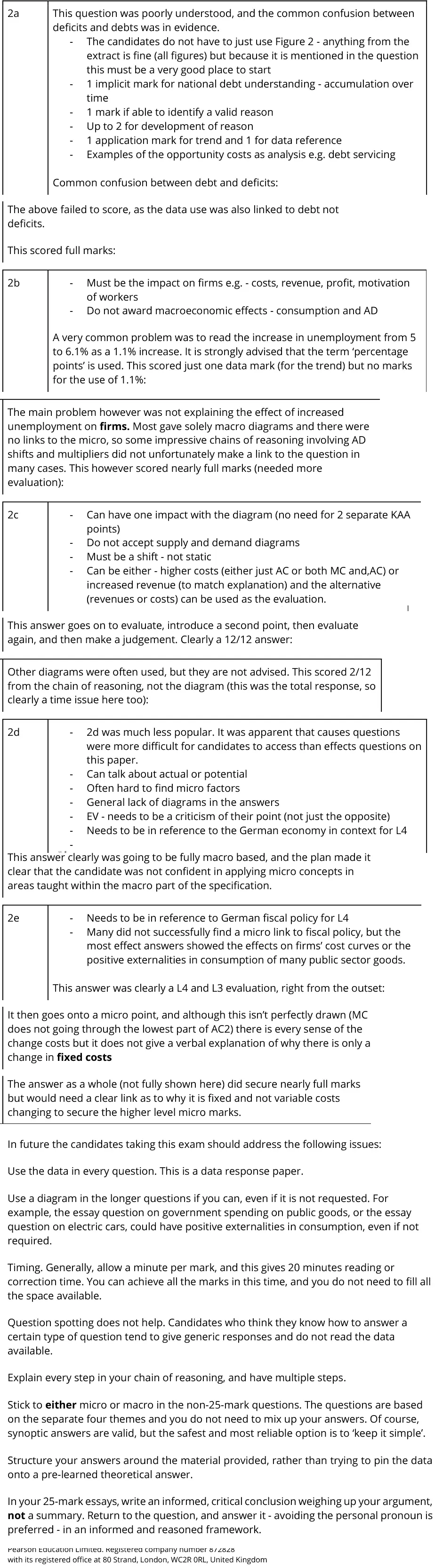
2a This question was poorly understood, and the common confusion between deficits and debts was in evidence. - The candidates do not have to just use Figure 2 - anything from the extract is fine (all figures) but because it is mentioned in the question this must be a very good place to start - 1 implicit mark for national debt understanding - accumulation over time - 1 mark if able to identify a valid reason - Up to 2 for development of reason - 1 application mark for trend and 1 for data reference - Examples of the opportunity costs as analysis e.g. debt servicing Common confusion between debt and deficits: The above failed to score, as the data use was also linked to debt not deficits. This scored full marks: 2b - Must be the impact on firms e.g. - costs, revenue, profit, motivation of workers - Do not award macroeconomic effects - consumption and AD A very common problem was to read the increase in unemployment from 5 to 6.1% as a 1.1% increase. It is strongly advised that the term ‘percentage points’ is used. This scored just one data mark (for the trend) but no marks for the use of 1.1%: The main problem however was not explaining the effect of increased unemployment on firms. Most gave solely macro diagrams and there were no links to the micro, so some impressive chains of reasoning involving AD shifts and multipliers did not unfortunately make a link to the question in many cases. This however scored nearly full marks (needed more evaluation): 2c - Can have one impact with the diagram (no need for 2 separate KAA points) - Do not accept supply and demand diagrams - Must be a shift - not static - Can be either - higher costs (either just AC or both MC and,AC) or increased revenue (to match explanation) and the alternative (revenues or costs) can be used as the evaluation. This answer goes on to evaluate, introduce a second point, then evaluate again, and then make a judgement. Clearly a 12/12 answer: Other diagrams were often used, but they are not advised. This scored 2/12 from the chain of reasoning, not the diagram (this was the total response, so clearly a time issue here too): 2d - 2d was much less popular. It was apparent that causes questions were more difficult for candidates to access than effects questions on this paper. - Can talk about actual or potential - Often hard to find micro factors - General lack of diagrams in the answers - EV - needs to be a criticism of their point (not just the opposite) - Needs to be in reference to the German economy in context for L4 - This answer clearly was going to be fully macro based, and the plan made it clear that the candidate was not confident in applying micro concepts in areas taught within the macro part of the specification. 2e - Needs to be in reference to German fiscal policy for L4 - Many did not successfully find a micro link to fiscal policy, but the most effect answers showed the effects on firms’ cost curves or the positive externalities in consumption of many public sector goods. This answer was clearly a L4 and L3 evaluation, right from the outset: It then goes onto a micro point, and although this isn’t perfectly drawn (MC does not going through the lowest part of AC2) there is every sense of the change costs but it does not give a verbal explanation of why there is only a change in fixed costs The answer as a whole (not fully shown here) did secure nearly full marks but would need a clear link as to why it is fixed and not variable costs changing to secure the higher level micro marks. In future the candidates taking this exam should address the following issues: Use the data in every question. This is a data response paper. Use a diagram in the longer questions if you can, even if it is not requested. For example, the essay question on government spending on public goods, or the essay question on electric cars, could have positive externalities in consumption, even if not required. Timing. Generally, allow a minute per mark, and this gives 20 minutes reading or correction time. You can achieve all the marks in this time, and you do not need to fill all the space available. Question spotting does not help. Candidates who think they know how to answer a certain type of question tend to give generic responses and do not read the data available. Explain every step in your chain of reasoning, and have multiple steps. Stick to either micro or macro in the non-25-mark questions. The questions are based on the separate four themes and you do not need to mix up your answers. Of course, synoptic answers are valid, but the safest and most reliable option is to ‘keep it simple’. Structure your answers around the material provided, rather than trying to pin the data onto a pre-learned theoretical answer. In your 25-mark essays, write an informed, critical conclusion weighing up your argument, not a summary. Return to the question, and answer it - avoiding the personal pronoun is preferred - in an informed and reasoned framework. with its registered office at 80 Strand, London, WC2R 0RL, United Kingdom
Notes from the mark scheme and report
AD shift with multiplier, LRAS shift from infrastructure investment
micro links: firms' cost curves, positive consumption externalities of public goods
Level 4 needs German fiscal policy in context
evaluate with size of multiplier, low borrowing costs, debt brake rules
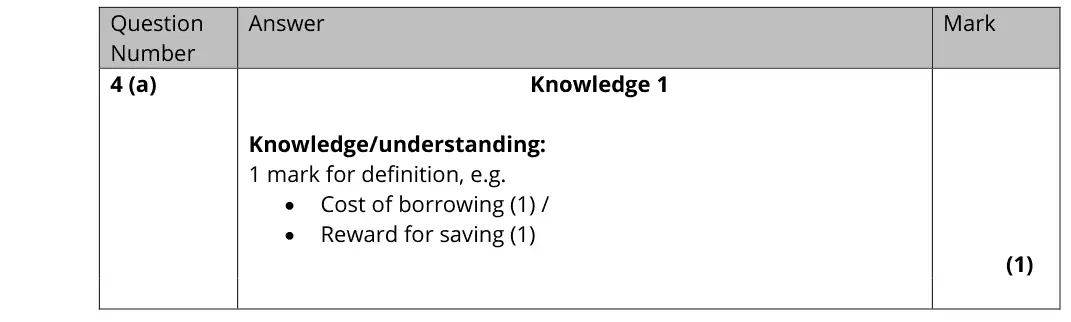
October 2020 · AS Paper 2 · Q4(a)1 markAO1=1Definition
Data and extracts for question 4
Mark scheme
Examiner's comment
This question requires a clear definition of interest rate. Many were not able to provide an accurate definition and hence did not get the mark for this question.
Notes from the mark scheme and report
the cost of borrowing or the reward for saving
many could not give an accurate definition
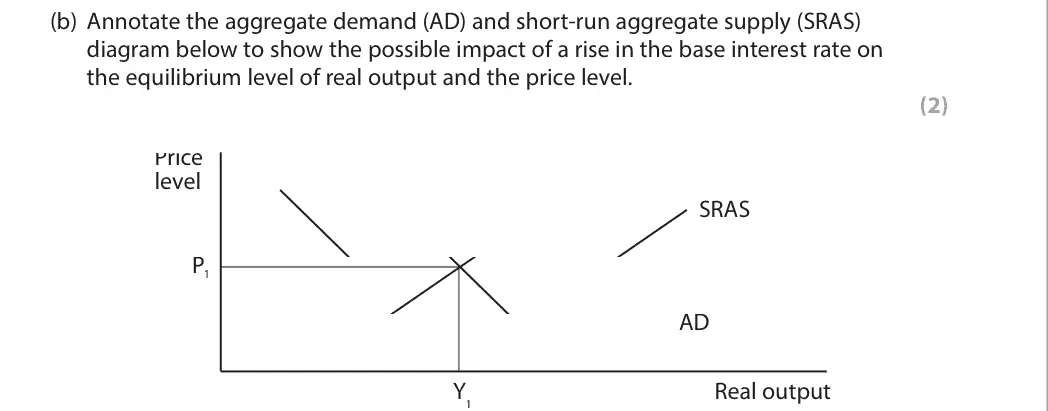
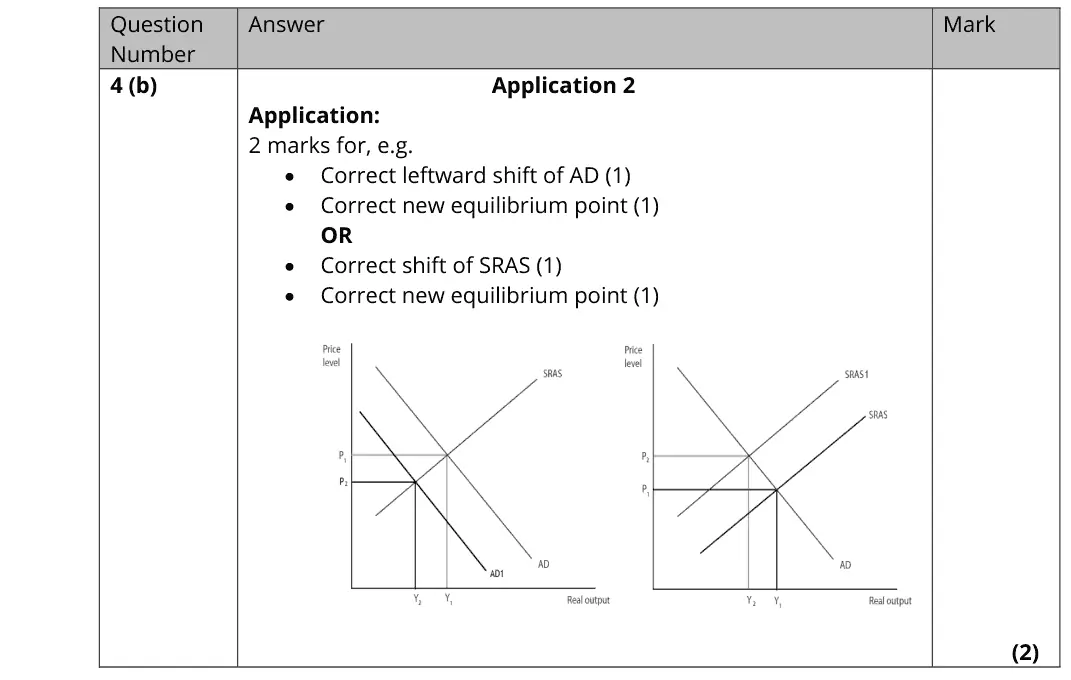
October 2020 · AS Paper 2 · Q4(b)2 marksAO2=2Diagram
Data and extracts for question 4
Mark scheme
Examiner's comment
This question requires candidates to draw the likely impact of a rise in the base interest rate in context of an AD/AS diagram. Marks were awarded as 1 mark for the leftward shift in AD/SRAS and 1 mark for a new equilibrium. Most candidates achieved the 2 marks on this question.
Notes from the mark scheme and report
shift AD left (a SRAS shift is also accepted) and mark the new equilibrium with lower real output and price level
Quantitative skills: QS 4 (construct and interpret a range of standard graphical forms)
October 2020 · AS Paper 2 · Q4(c)1 markMultiple choice
Data and extracts for question 4
Answer
B
Mark scheme
Notes from the mark scheme and report
raising Bank Rate is contractionary monetary policy (B)
fiscal policy uses tax and spending
expansionary monetary policy cuts rates or uses QE
October 2020 · AS Paper 2 · Q6(a)4 marksAO1=2, AO2=2Short answer
Data and extracts for question 6
Mark scheme
Examiner's comment
The marks for this question are split in half between knowledge and application. Candidates were able to accurate define the term ‘balanced government budget’ and get the two knowledge marks. They were also able to identify the years where this was the case and referred to the corresponding data from Figure 1.
Notes from the mark scheme and report
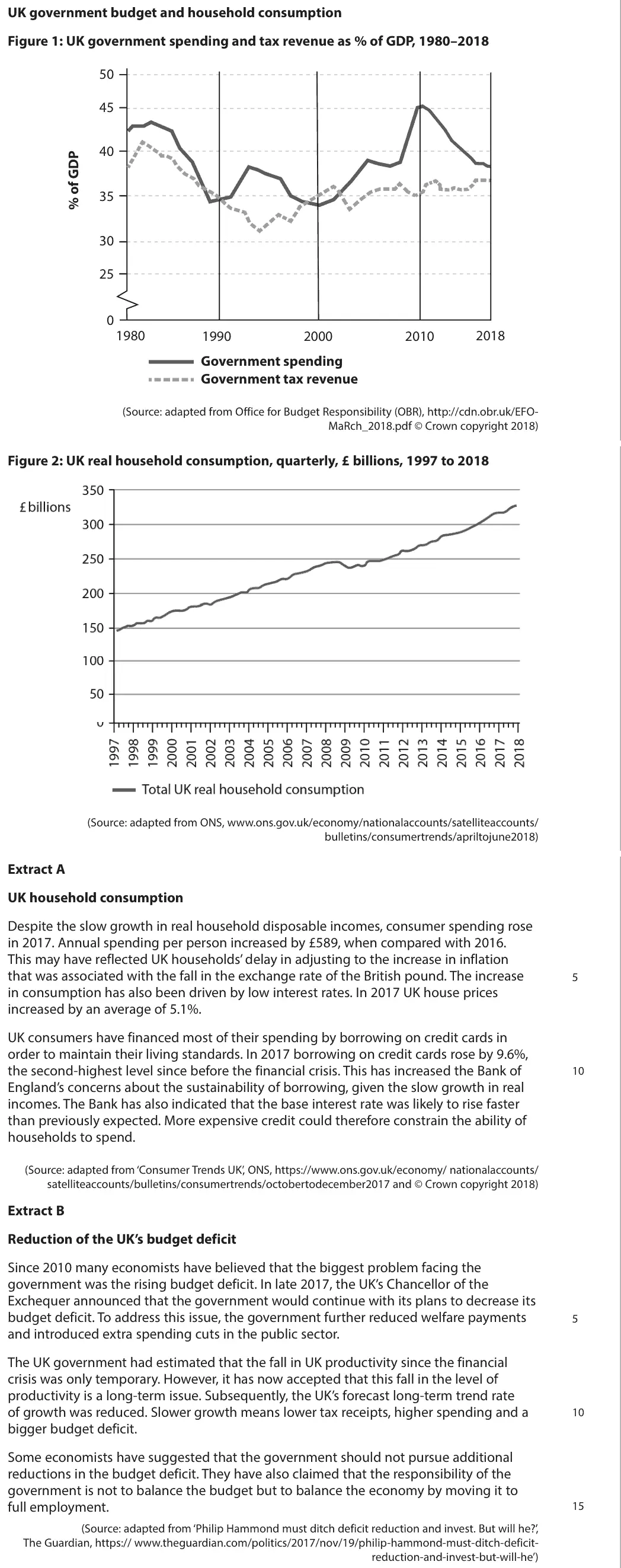
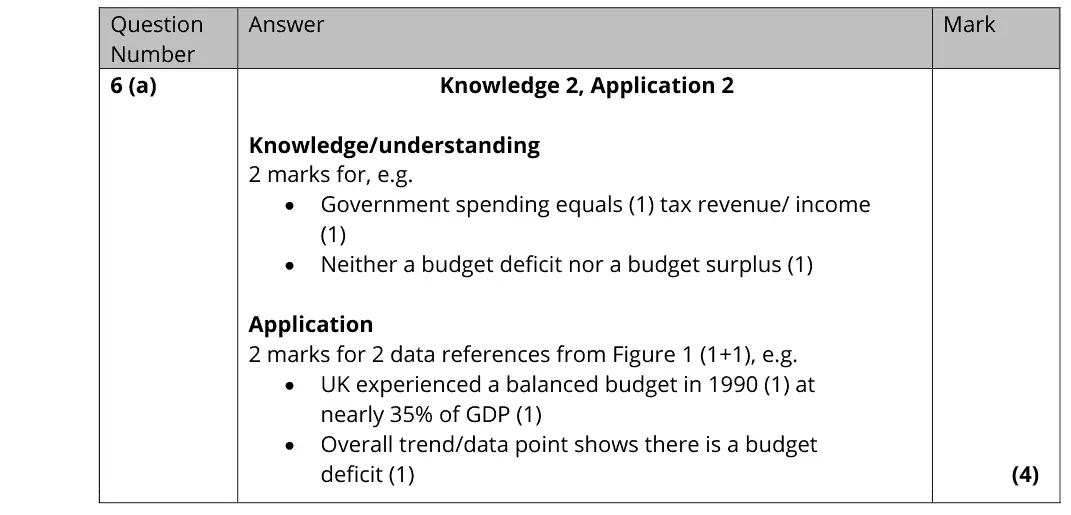
government spending equals tax revenue (neither deficit nor surplus)
two Figure 1 references e.g. balanced around 1990 at about 35% of GDP, deficit since 2002
Quantitative skills: QS 9 (interpret, apply and analyse information in written, graphical tabular and numerical forms)
October 2020 · AS Paper 2 · Q6(g)20 marksAO1=4, AO2=4, AO3=6, AO4=620-mark essayEither/or
Data and extracts for question 6
Mark scheme, including the levels grid and indicative content
Examiner's comment
This question required candidates to evaluate the macroeconomic effects of the UK government pursuing a policy of reducing its budget deficit. Although candidates were able to identify effects, they were not able to develop their points further in depth. The most common theme was the impact on economic growth and unemployment supported by an AD/AS diagram. There were some evaluative comments but they lacked chains of reasoning to access higher levels.
Notes from the mark scheme and report
cutting the deficit reduces AD (lower growth, higher unemployment, less inflation) with multiplier effects, may widen inequality (welfare cuts) and hit public investment
evaluate e.g. lower debt interest, confidence, crowding in
develop chains of reasoning
October 2020 · Paper 2 · Q725 marksAO1=4, AO2=4, AO3=8, AO4=925-mark essayEither/or
Mark scheme, including the levels grid and indicative content
Examiner's comment
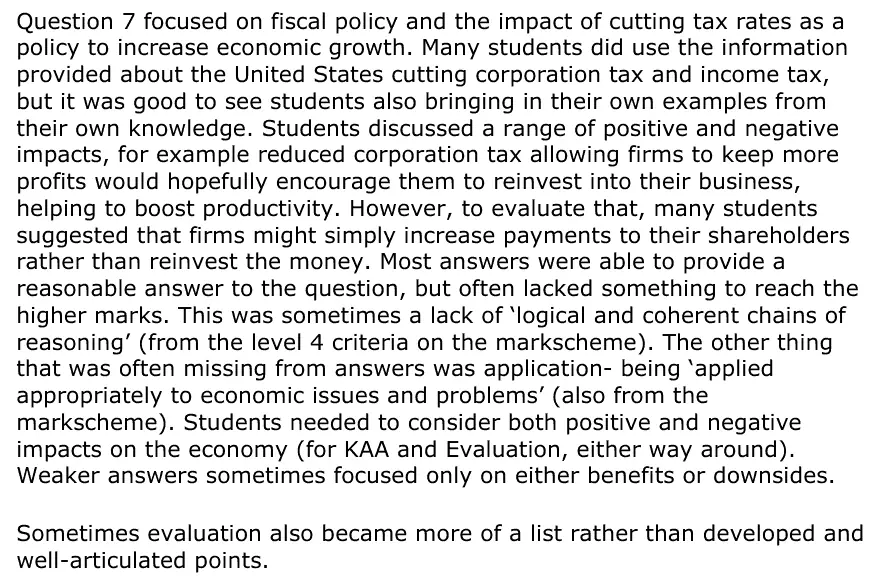
Question 7 focused on fiscal policy and the impact of cutting tax rates as a policy to increase economic growth. Many students did use the information provided about the United States cutting corporation tax and income tax, but it was good to see students also bringing in their own examples from their own knowledge. Students discussed a range of positive and negative impacts, for example reduced corporation tax allowing firms to keep more profits would hopefully encourage them to reinvest into their business, helping to boost productivity. However, to evaluate that, many students suggested that firms might simply increase payments to their shareholders rather than reinvest the money. Most answers were able to provide a reasonable answer to the question, but often lacked something to reach the higher marks. This was sometimes a lack of ‘logical and coherent chains of reasoning’ (from the level 4 criteria on the markscheme). The other thing that was often missing from answers was application- being ‘applied appropriately to economic issues and problems’ (also from the markscheme). Students needed to consider both positive and negative impacts on the economy (for KAA and Evaluation, either way around). Weaker answers sometimes focused only on either benefits or downsides. Sometimes evaluation also became more of a list rather than developed and well-articulated points.
Notes from the mark scheme and report
lower corporation tax raises retained profit for investment, lower income tax raises disposable income and incentives
evaluate with saving, payouts to shareholders instead of investment, higher government debt and crowding out, less spending on infrastructure and education
one side KAA and the other evaluation
answers often lacked application and developed chains
October 2020 · Paper 3 · Q1(d)25 marksAO1=4, AO2=4, AO3=8, AO4=925-mark essayEither/or
Data and extracts for question 1
Mark scheme, including the levels grid and indicative content
Examiner's comment
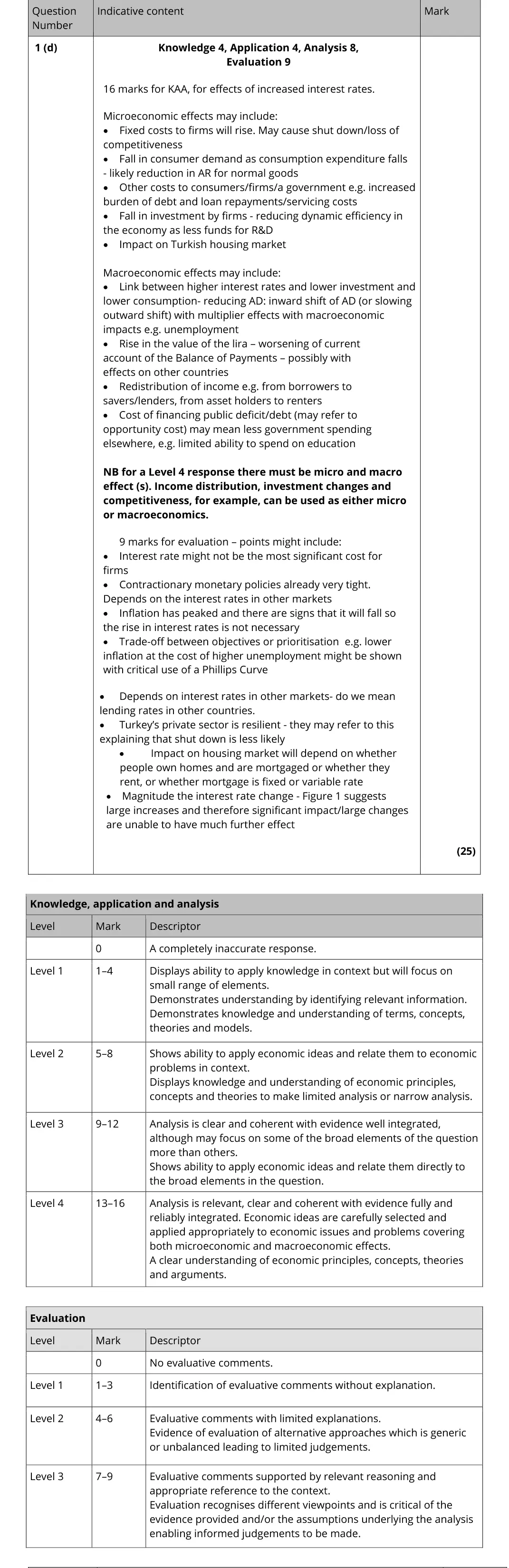
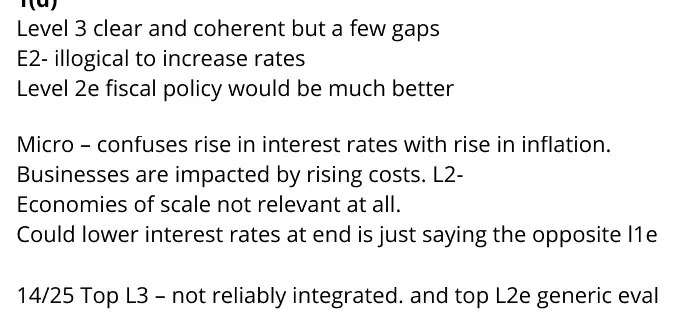
Level 3 clear and coherent but a few gaps E2- illogical to increase rates Level 2e fiscal policy would be much better Micro – confuses rise in interest rates with rise in inflation. Businesses are impacted by rising costs. L2- Economies of scale not relevant at all. Could lower interest rates at end is just saying the opposite l1e 14/25 Top L3 – not reliably integrated. and top L2e generic eval
Notes from the mark scheme and report
micro: higher borrowing and fixed costs for firms, lower consumer demand, less investment and R&D
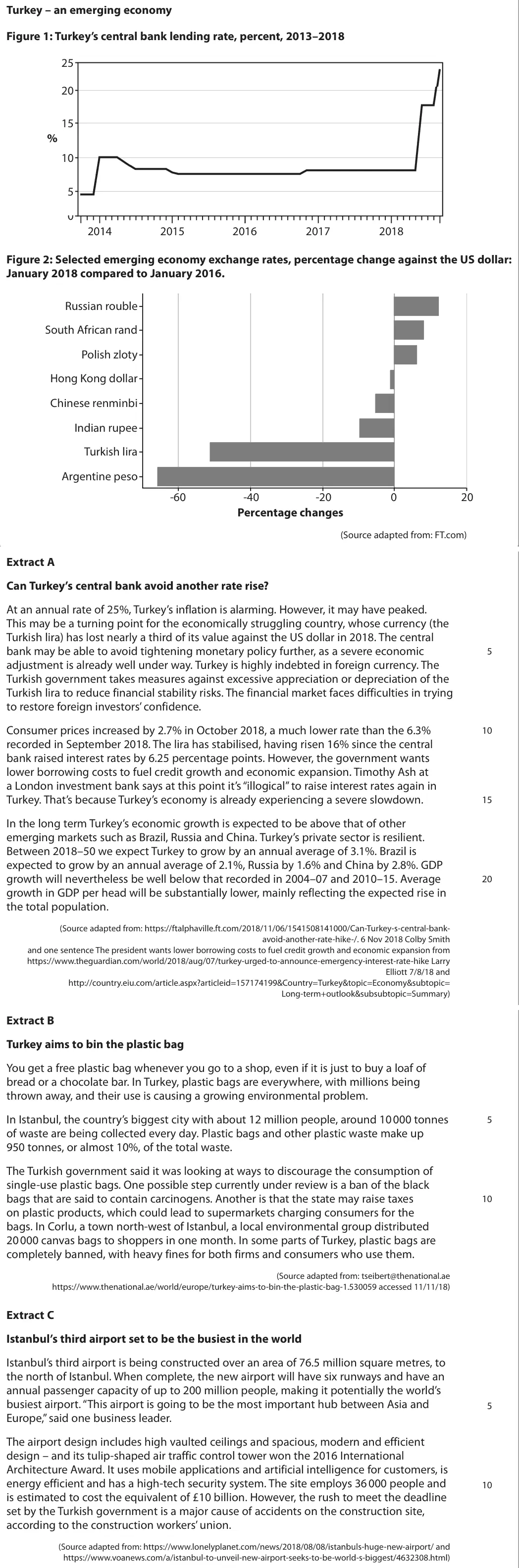
macro: AD falls with multiplier effects, lira appreciates, debt servicing costs
Level 4 needs both micro and macro
do not confuse a rise in interest rates with a rise in inflation
evaluate e.g. inflation already peaking
June 2019 · Paper 2 · Q6(d)12 marksAO1=4, AO2=2, AO3=2, AO4=412-mark response
Data and extracts for question 6
Mark scheme, including the levels grid and indicative content
Examiner's comment
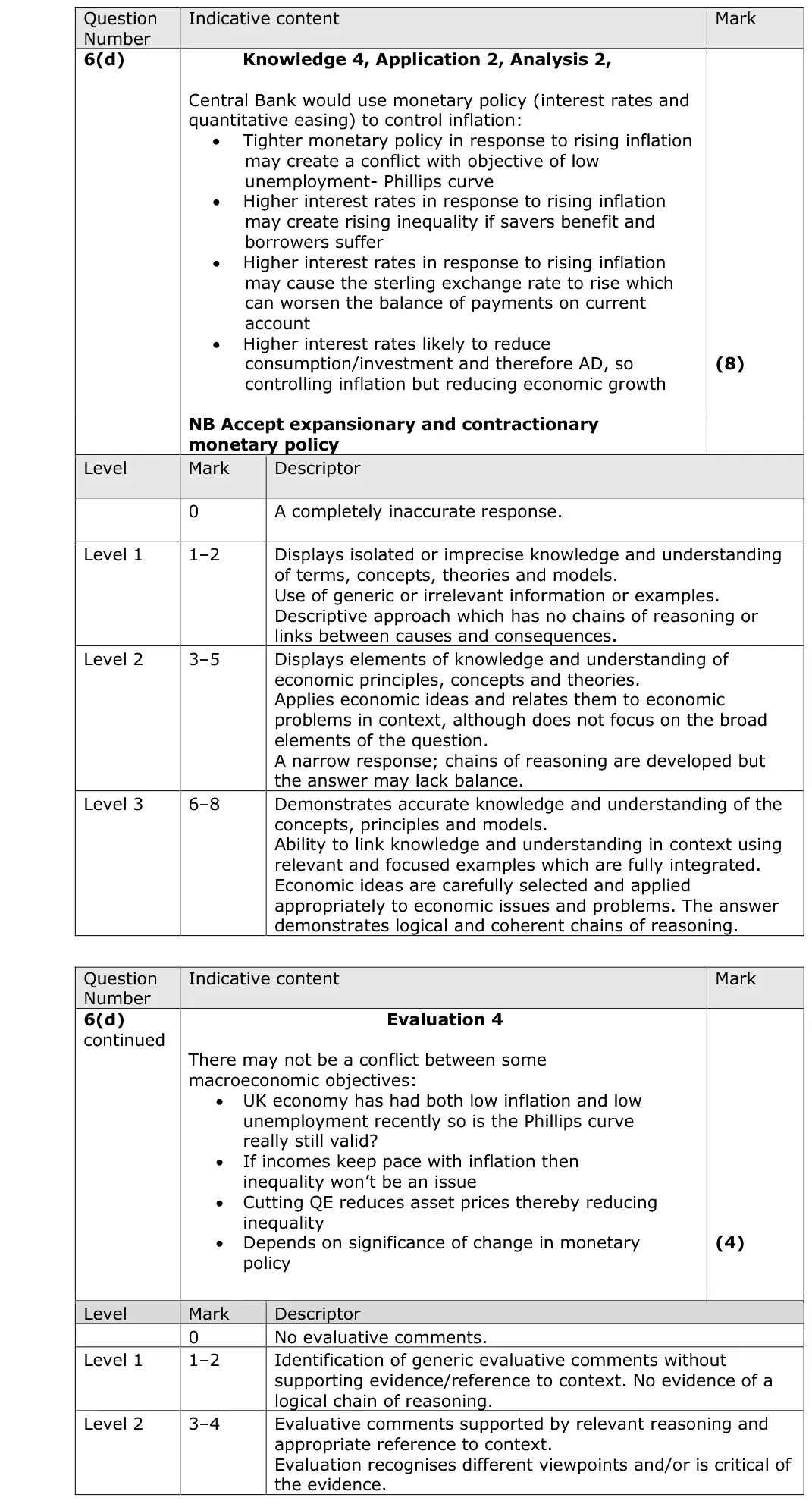
In this question the key to success was in ensuring you fully grasped both aspects of the question. Good answers began from a starting point of the central bank attempting to control inflation and then went on to explain the conflicts that can occur as the central bank attempts to keep inflation on target. For example the Bank of England's 2% target. Answers that just discussed conflicts between macroeconomic objectives without making that link to controlling inflation still received credit but they obviously haven't fully addressed what the question has asked of them. This answer scores 6/12 marks. It just achieves Level 3 for KAA but unfortunately there is no evaluation so they have immediately missed out on those 4 marks. The candidate has answered the question and discussed different conflicts between the macroeconomic objectives, but to reach a higher mark they have to explain in a little more depth and to offer some context to evidence the points being made. Don't forget to relate your answer to the real world - either making use of the information provided in the figures and extracts or your own knowledge. This is a high quality answer with top levels for both KAA and evaluation. The answer starts off straight away with good application to the context and then goes on to explain how this creates a conflict, with an AD/AS diagram to illustrate the point clearly. On the second page the conflict between inflation is explained clearly and has a Phillips curve to illustrate the point. This answer is also evaluated well, looking at the current situation in the UK economy.
Notes from the mark scheme and report
start from the central bank tightening policy to control inflation, then conflicts with unemployment (Phillips curve), growth, the current account (stronger pound) and inequality
many gave no evaluation
June 2019 · AS Paper 2 · Q6(f)20 marksAO1=4, AO2=4, AO3=6, AO4=620-mark essayEither/or
Data and extracts for question 6
Mark scheme, including the levels grid and indicative content
Examiner's comment
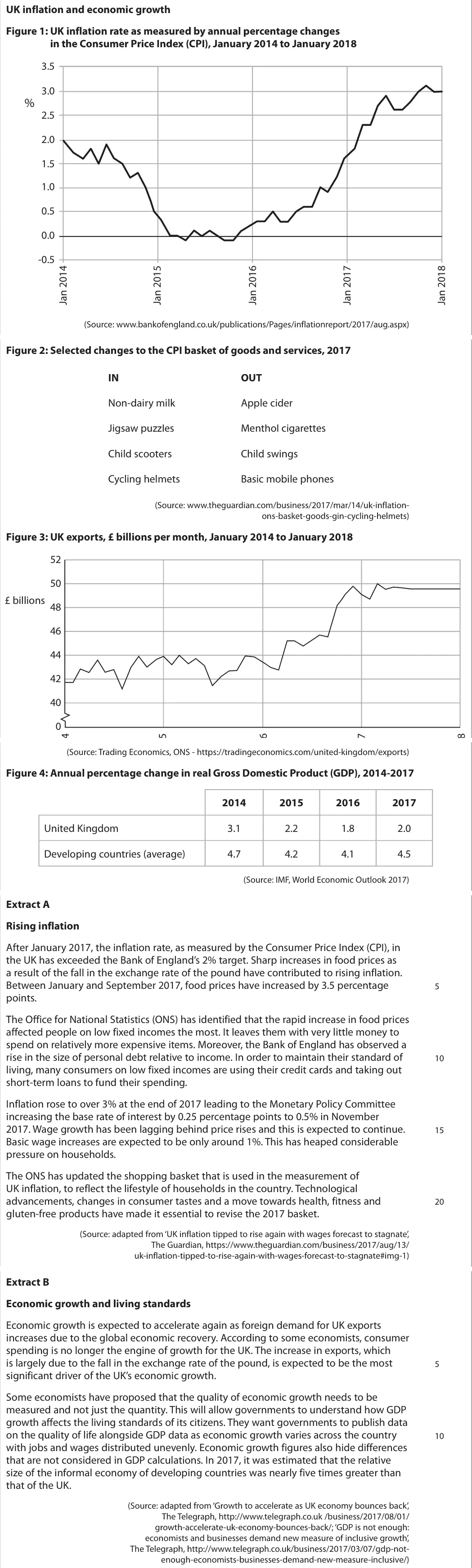
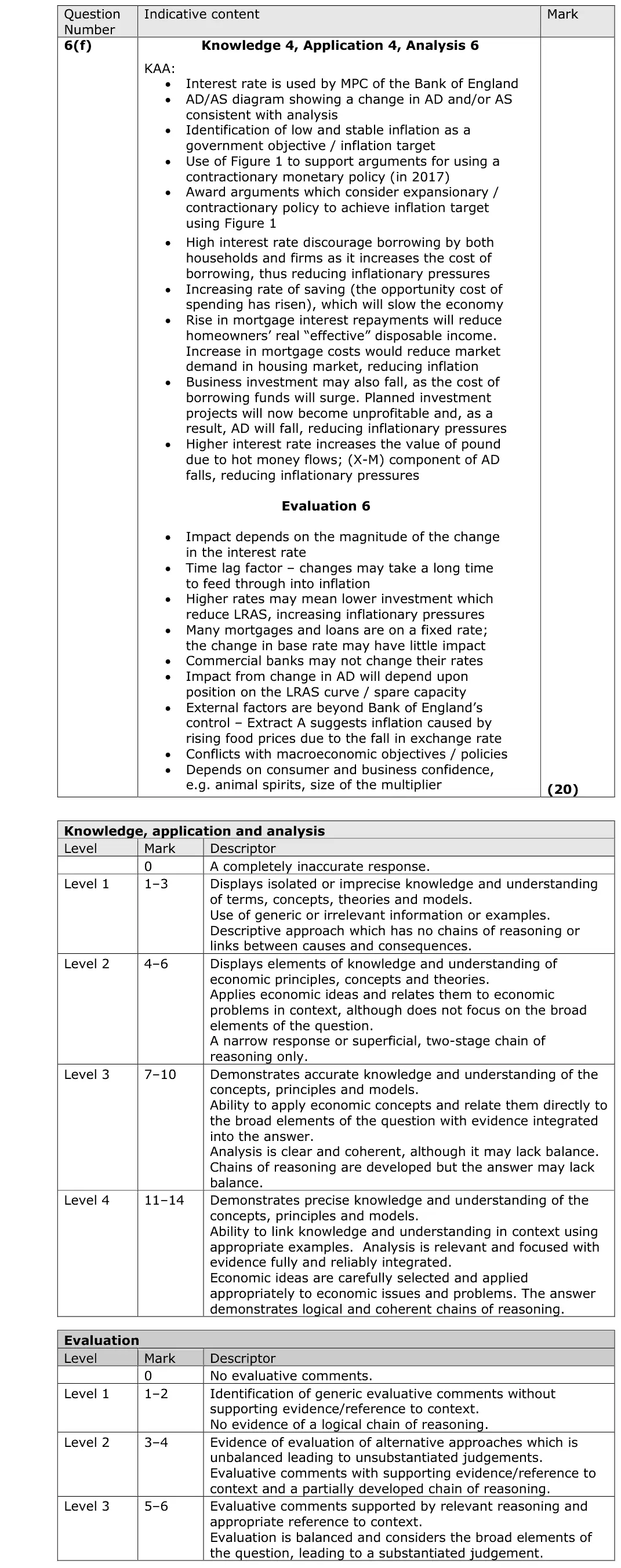
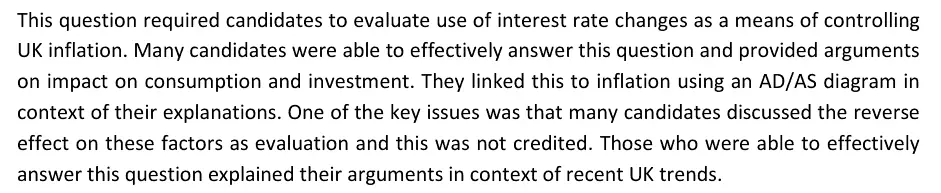
This question required candidates to evaluate use of interest rate changes as a means of controlling UK inflation. Many candidates were able to effectively answer this question and provided arguments on impact on consumption and investment. They linked this to inflation using an AD/AS diagram in context of their explanations. One of the key issues was that many candidates discussed the reverse effect on these factors as evaluation and this was not credited. Those who were able to effectively answer this question explained their arguments in context of recent UK trends.
Notes from the mark scheme and report
Bank Rate changes work through borrowing, saving, mortgages, investment and the exchange rate to shift AD
use Figure 1 (CPI above 3%, Bank Rate raised to 0.5%)
evaluate time lags, cost-push imported inflation, low rates already, confidence
report: the reverse effect was not credited as evaluation
Quantitative skills: QS 9 (interpret, apply and analyse information in written, graphical tabular and numerical forms)
June 2019 · Paper 3 · Q1(d)25 marksAO1=4, AO2=4, AO3=8, AO4=925-mark essayEither/or
Data and extracts for question 1
Mark scheme, including the levels grid and indicative content
Examiner's comment
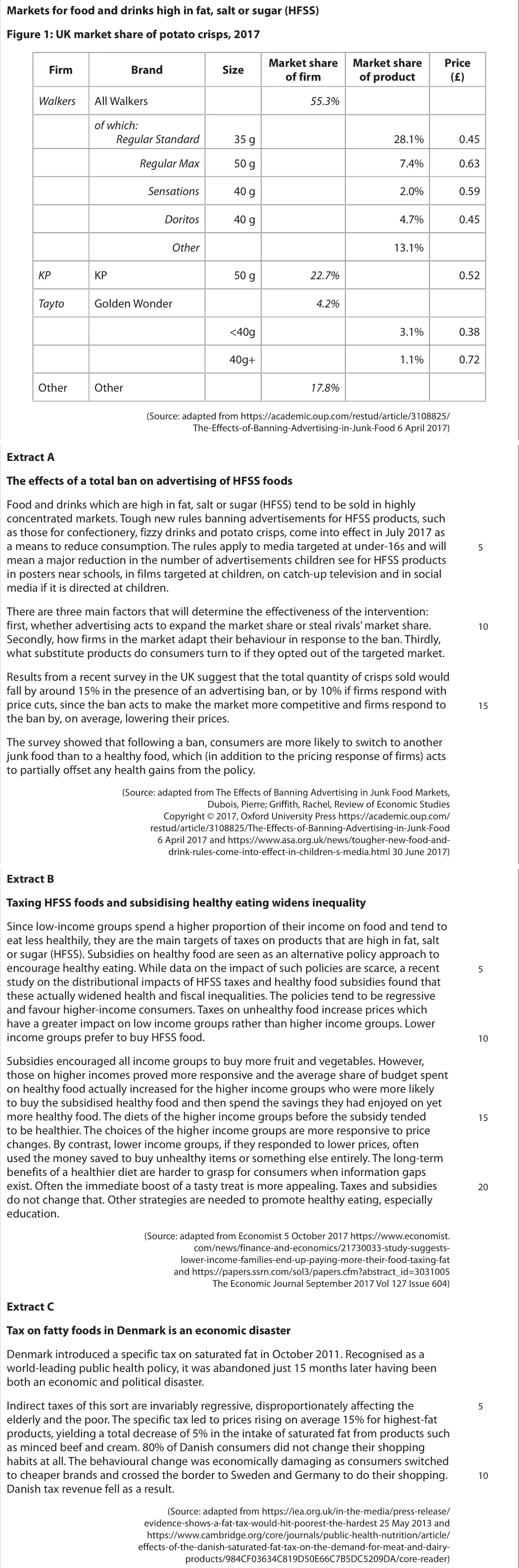
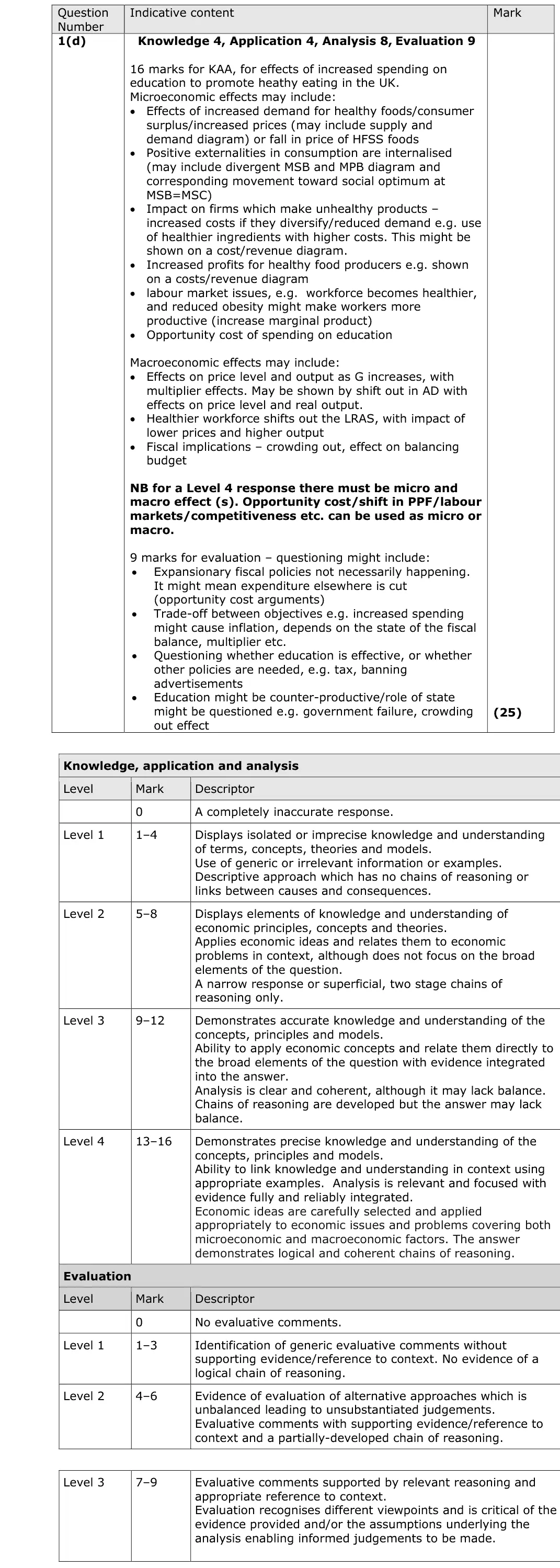
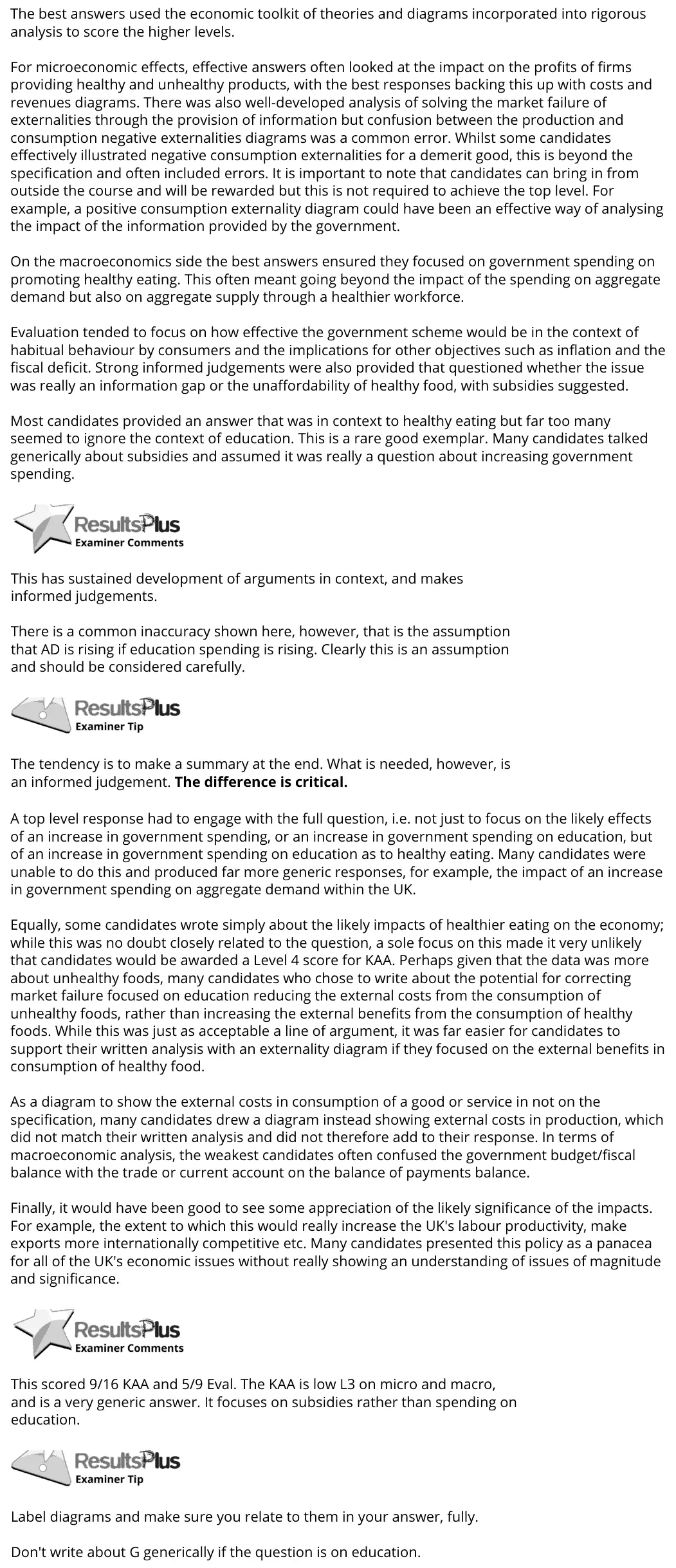
The best answers used the economic toolkit of theories and diagrams incorporated into rigorous analysis to score the higher levels. For microeconomic effects, effective answers often looked at the impact on the profits of firms providing healthy and unhealthy products, with the best responses backing this up with costs and revenues diagrams. There was also well-developed analysis of solving the market failure of externalities through the provision of information but confusion between the production and consumption negative externalities diagrams was a common error. Whilst some candidates effectively illustrated negative consumption externalities for a demerit good, this is beyond the specification and often included errors. It is important to note that candidates can bring in from outside the course and will be rewarded but this is not required to achieve the top level. For example, a positive consumption externality diagram could have been an effective way of analysing the impact of the information provided by the government. On the macroeconomics side the best answers ensured they focused on government spending on promoting healthy eating. This often meant going beyond the impact of the spending on aggregate demand but also on aggregate supply through a healthier workforce. Evaluation tended to focus on how effective the government scheme would be in the context of habitual behaviour by consumers and the implications for other objectives such as inflation and the fiscal deficit. Strong informed judgements were also provided that questioned whether the issue was really an information gap or the unaffordability of healthy food, with subsidies suggested. Most candidates provided an answer that was in context to healthy eating but far too many seemed to ignore the context of education. This is a rare good exemplar. Many candidates talked generically about subsidies and assumed it was really a question about increasing government spending. This has sustained development of arguments in context, and makes informed judgements. There is a common inaccuracy shown here, however, that is the assumption that AD is rising if education spending is rising. Clearly this is an assumption and should be considered carefully. The tendency is to make a summary at the end. What is needed, however, is an informed judgement. The difference is critical. A top level response had to engage with the full question, i.e. not just to focus on the likely effects of an increase in government spending, or an increase in government spending on education, but of an increase in government spending on education as to healthy eating. Many candidates were unable to do this and produced far more generic responses, for example, the impact of an increase in government spending on aggregate demand within the UK. Equally, some candidates wrote simply about the likely impacts of healthier eating on the economy; while this was no doubt closely related to the question, a sole focus on this made it very unlikely that candidates would be awarded a Level 4 score for KAA. Perhaps given that the data was more about unhealthy foods, many candidates who chose to write about the potential for correcting market failure focused on education reducing the external costs from the consumption of unhealthy foods, rather than increasing the external benefits from the consumption of healthy foods. While this was just as acceptable a line of argument, it was far easier for candidates to support their written analysis with an externality diagram if they focused on the external benefits in consumption of healthy food. As a diagram to show the external costs in consumption of a good or service in not on the specification, many candidates drew a diagram instead showing external costs in production, which did not match their written analysis and did not therefore add to their response. In terms of macroeconomic analysis, the weakest candidates often confused the government budget/fiscal balance with the trade or current account on the balance of payments balance. Finally, it would have been good to see some appreciation of the likely significance of the impacts. For example, the extent to which this would really increase the UK's labour productivity, make exports more internationally competitive etc. Many candidates presented this policy as a panacea for all of the UK's economic issues without really showing an understanding of issues of magnitude and significance. This scored 9/16 KAA and 5/9 Eval. The KAA is low L3 on micro and macro, and is a very generic answer. It focuses on subsidies rather than spending on education. Label diagrams and make sure you relate to them in your answer, fully. Don't write about G generically if the question is on education.
Notes from the mark scheme and report
provision of information as intervention: positive consumption externality diagram (MSB above MPB), effects on healthy and HFSS food firms
macro: G with multiplier shifts AD, healthier workforce shifts LRAS
Level 4 needs micro and macro
do not confuse the fiscal balance with the current account
production externality diagrams were a common error
June 2018 · Paper 2 · Q2(b)4 marksAO1=2, AO2=2Diagram
Mark scheme
Examiner's comment
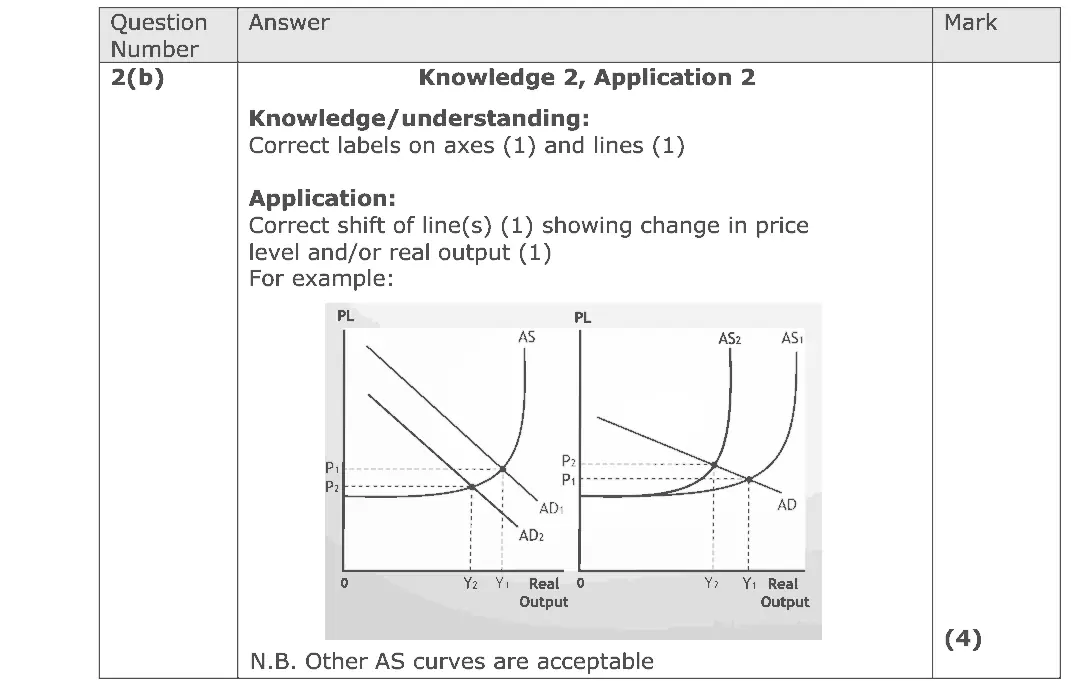
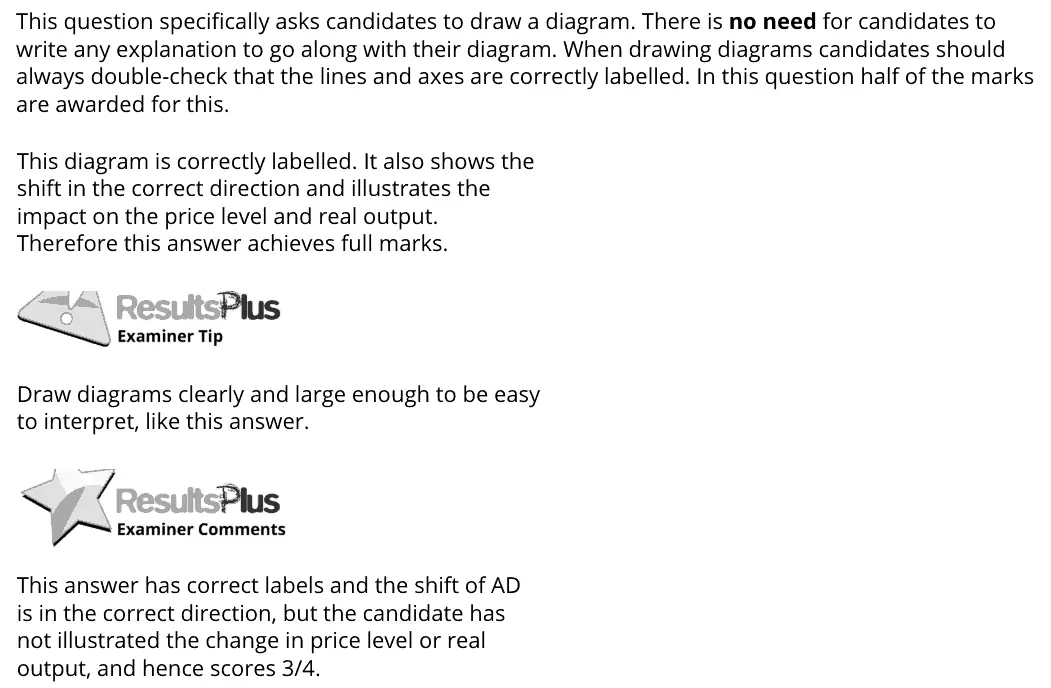
This question specifically asks candidates to draw a diagram. There is no need for candidates to write any explanation to go along with their diagram. When drawing diagrams candidates should always double-check that the lines and axes are correctly labelled. In this question half of the marks are awarded for this. This diagram is correctly labelled. It also shows the shift in the correct direction and illustrates the impact on the price level and real output. Therefore this answer achieves full marks. Draw diagrams clearly and large enough to be easy to interpret, like this answer. This answer has correct labels and the shift of AD is in the correct direction, but the candidate has not illustrated the change in price level or real output, and hence scores 3/4.
Notes from the mark scheme and report
half the marks are for labels on axes (PL, real output) and curves
shift AD left and show the fall in price level and/or real output
showing the shift without marking the new PL or Y scored 3 of 4
no written explanation needed
Quantitative skills: QS 4 (construct and interpret a range of standard graphical forms)
June 2018 · AS Paper 2 · Q3(a)3 marksAO1=1, AO2=1, AO3=1Short answer
Data and extracts for question 3
Mark scheme
Examiner's comment
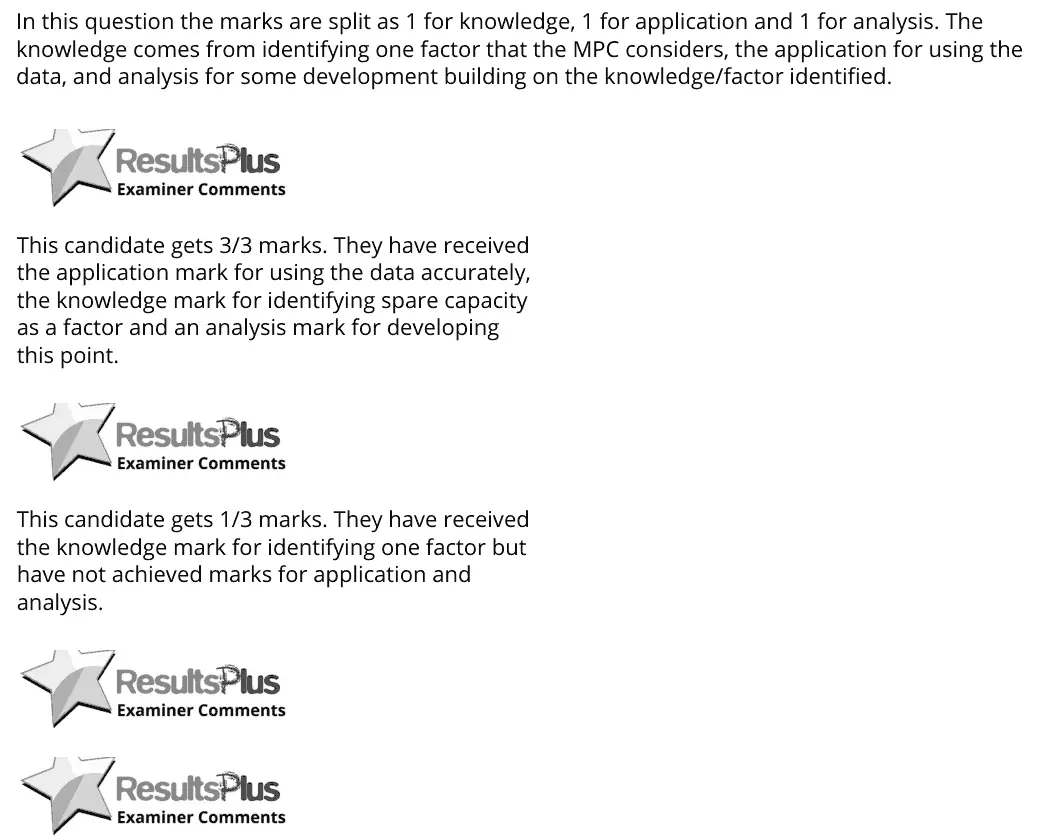
In this question the marks are split as 1 for knowledge, 1 for application and 1 for analysis. The knowledge comes from identifying one factor that the MPC considers, the application for using the data, and analysis for some development building on the knowledge/factor identified. This candidate gets 3/3 marks. They have received the application mark for using the data accurately, the knowledge mark for identifying spare capacity as a factor and an analysis mark for developing this point. This candidate gets 1/3 marks. They have received the knowledge mark for identifying one factor but have not achieved marks for application and analysis.
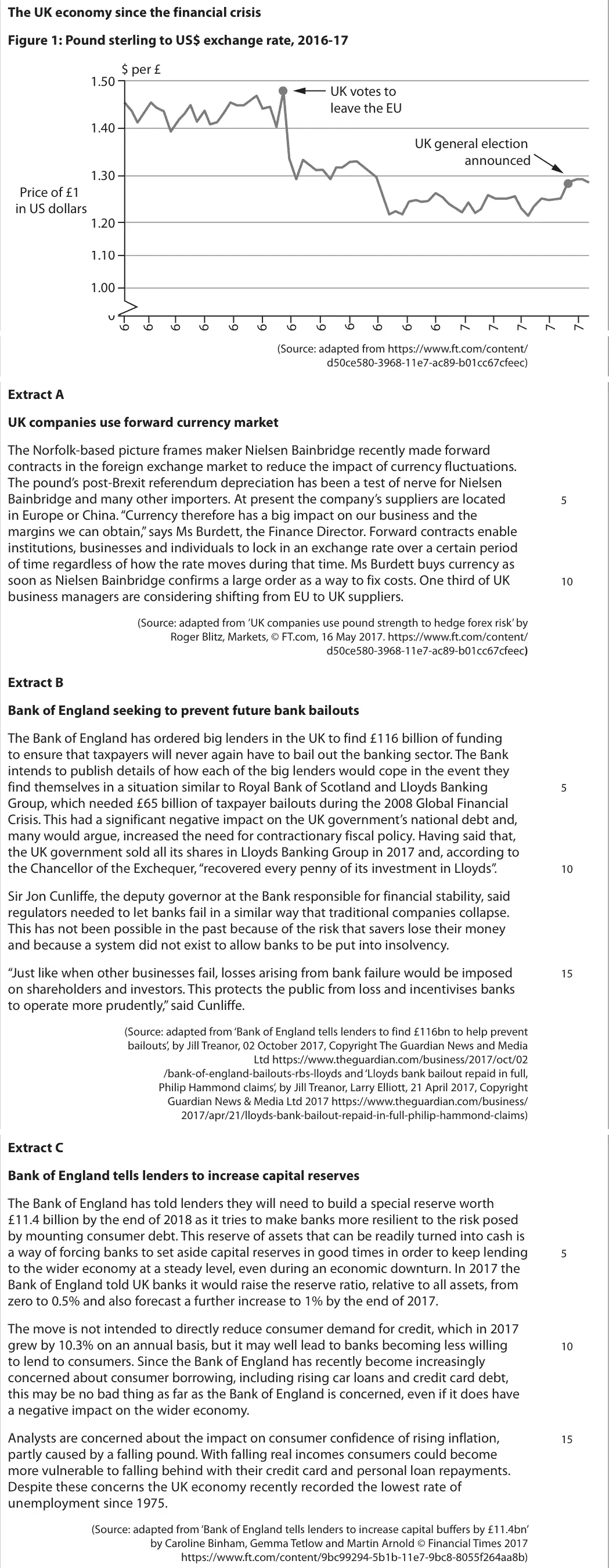
Notes from the mark scheme and report
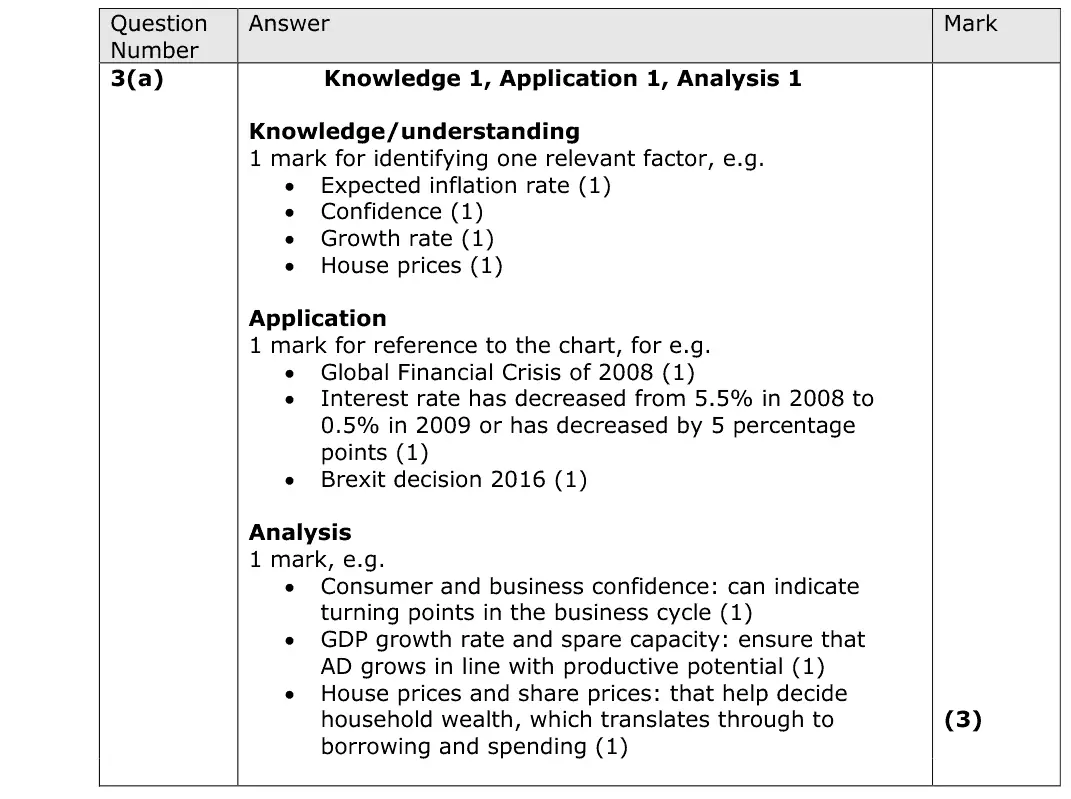
one MPC factor (expected inflation, growth/spare capacity, confidence, house prices) developed
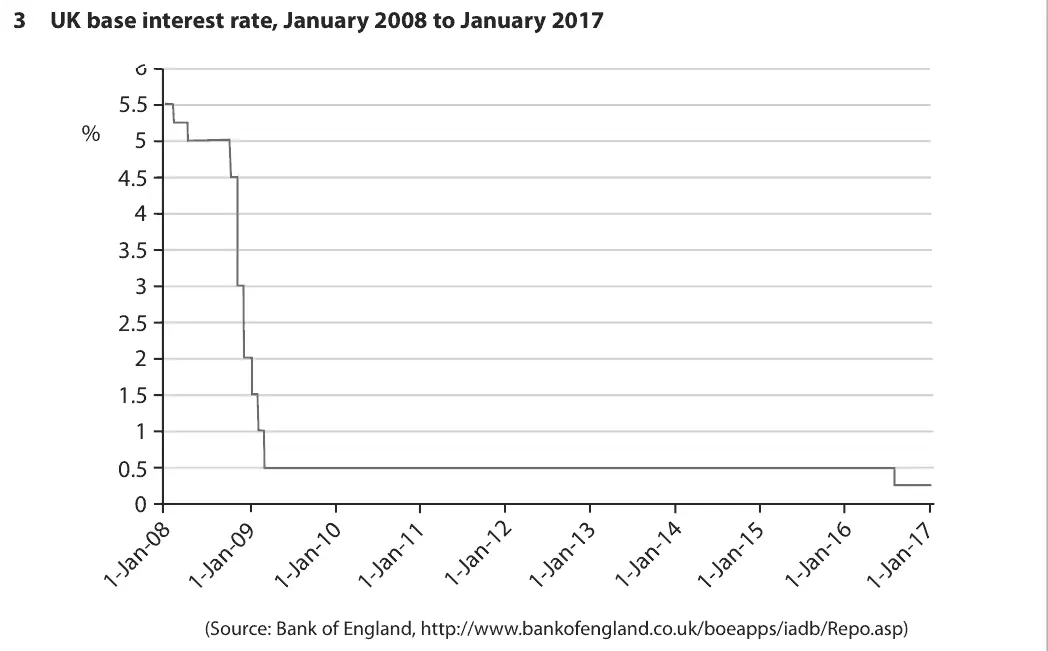
data reference e.g. base rate cut from 5.5% in 2008 to 0.5% in 2009 during the financial crisis
Quantitative skills: QS 9 (interpret, apply and analyse information in written, graphical tabular and numerical forms)
June 2018 · AS Paper 2 · Q3(b)1 markMultiple choice
Data and extracts for question 3
Answer
C
Mark scheme
Notes from the mark scheme and report
QE increases the money supply and AD so inflation is likely to rise (C)
it raises growth and lowers unemployment, and does not reduce the money supply
June 2018 · Paper 2 · Q4(c)1 markMultiple choice
Data and extracts for question 4
Answer
B
Mark scheme
Notes from the mark scheme and report
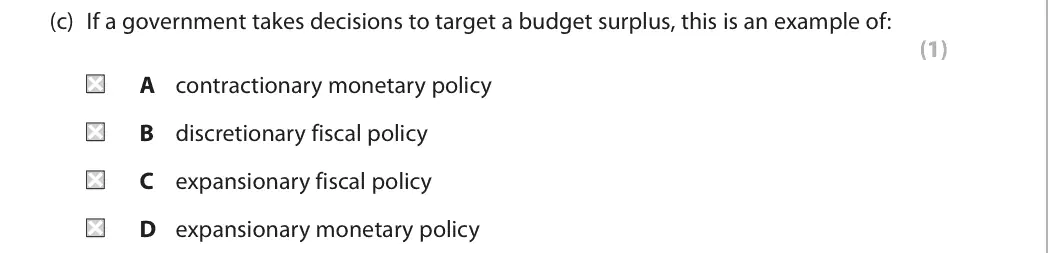
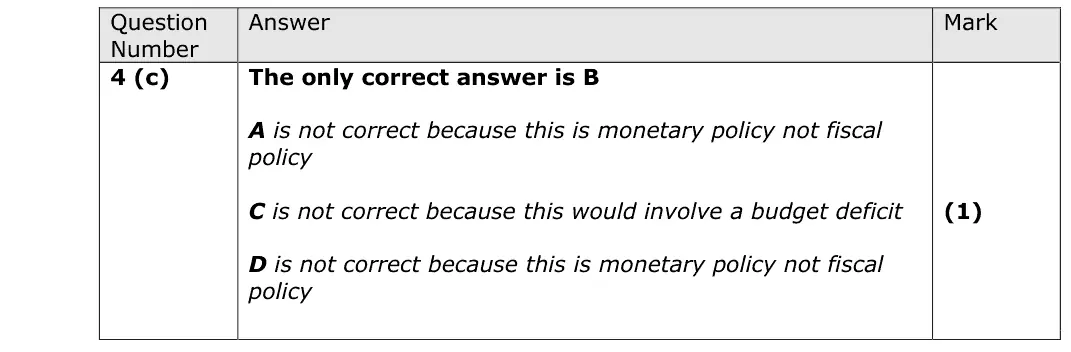
choosing to target a surplus is a deliberate decision on spending and taxes, so discretionary fiscal policy (B)
A and D are monetary policy
C would mean a deficit
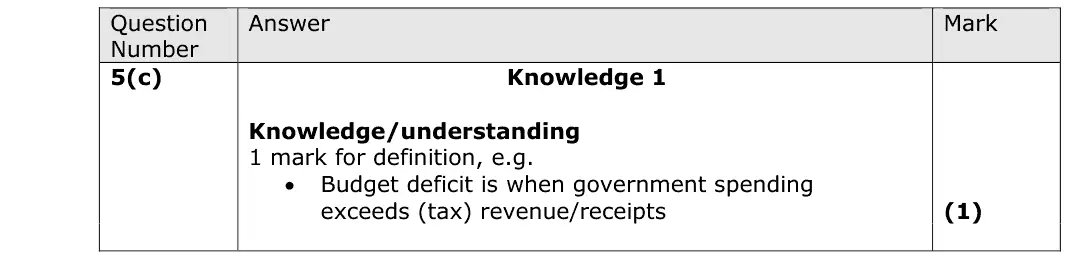
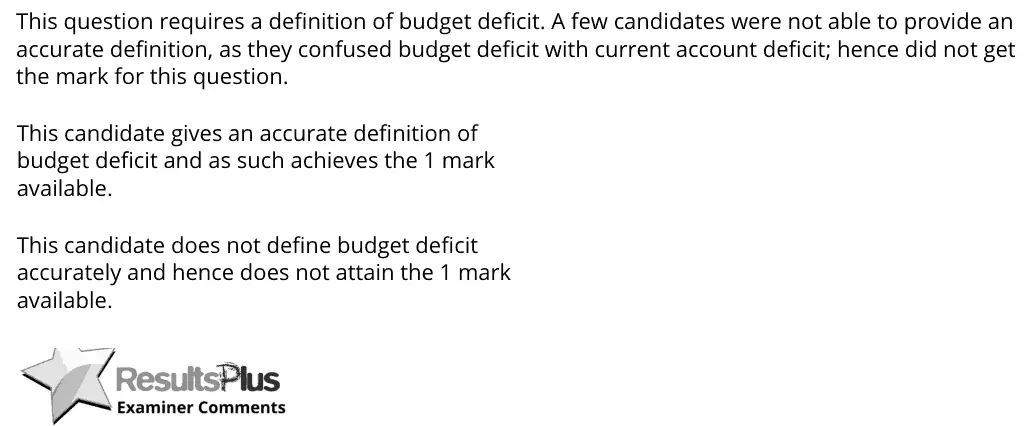
June 2018 · AS Paper 2 · Q5(c)1 markAO1=1Definition
Data and extracts for question 5
Mark scheme
Examiner's comment
This question requires a definition of budget deficit. A few candidates were not able to provide an accurate definition, as they confused budget deficit with current account deficit; hence did not get the mark for this question. This candidate gives an accurate definition of budget deficit and as such achieves the 1 mark available. This candidate does not define budget deficit accurately and hence does not attain the 1 mark available.
Notes from the mark scheme and report
government spending exceeds tax revenue in a year
some confused it with a current account deficit
June 2018 · AS Paper 2 · Q6(f)20 marksAO1=4, AO2=4, AO3=6, AO4=620-mark essayEither/or
Data and extracts for question 6
Mark scheme, including the levels grid and indicative content
Examiner's comment
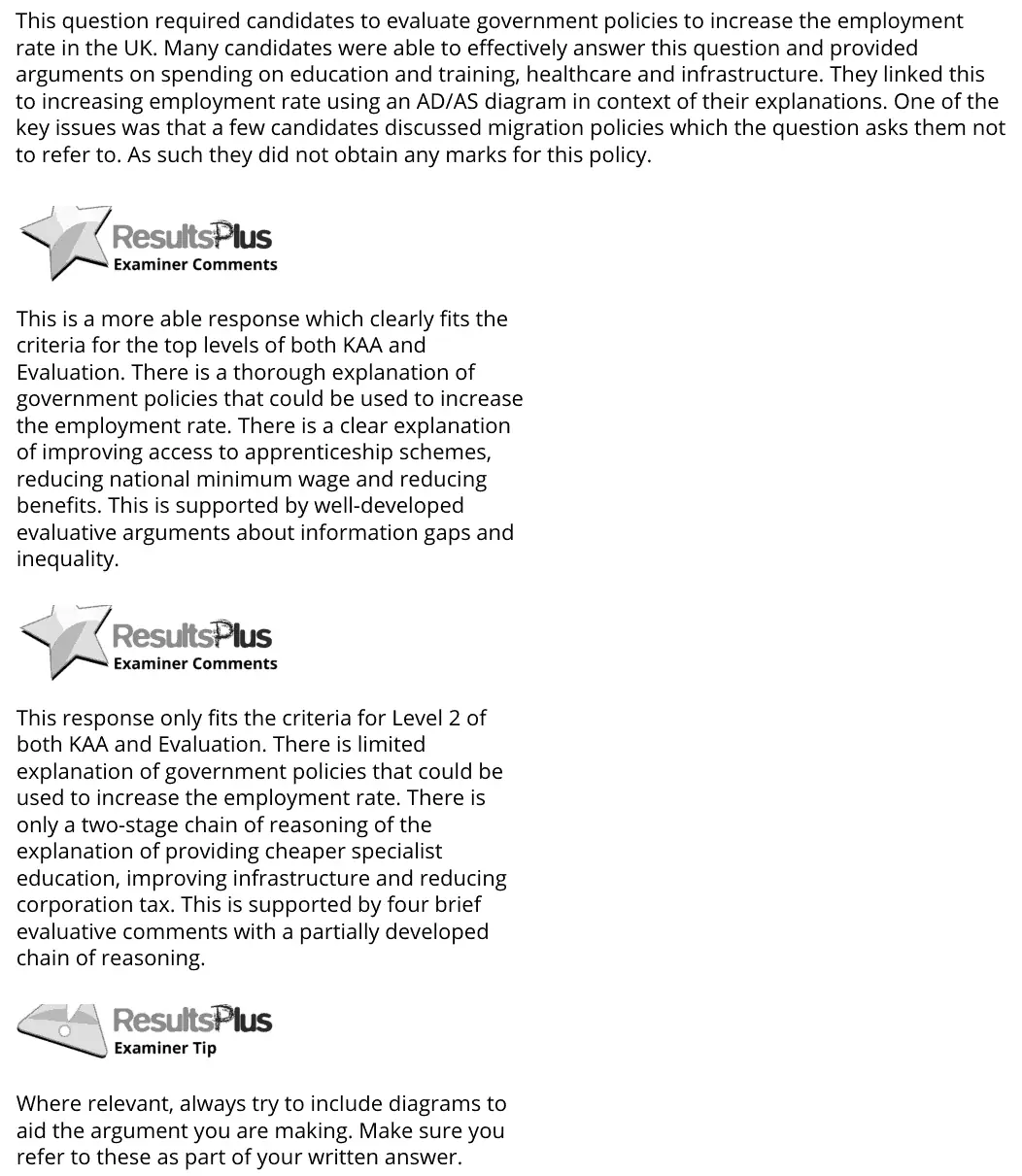
This question required candidates to evaluate government policies to increase the employment rate in the UK. Many candidates were able to effectively answer this question and provided arguments on spending on education and training, healthcare and infrastructure. They linked this to increasing employment rate using an AD/AS diagram in context of their explanations. One of the key issues was that a few candidates discussed migration policies which the question asks them not to refer to. As such they did not obtain any marks for this policy. This is a more able response which clearly fits the criteria for the top levels of both KAA and Evaluation. There is a thorough explanation of government policies that could be used to increase the employment rate. There is a clear explanation of improving access to apprenticeship schemes, reducing national minimum wage and reducing benefits. This is supported by well-developed evaluative arguments about information gaps and inequality. This response only fits the criteria for Level 2 of both KAA and Evaluation. There is limited explanation of government policies that could be used to increase the employment rate. There is only a two-stage chain of reasoning of the explanation of providing cheaper specialist education, improving infrastructure and reducing corporation tax. This is supported by four brief evaluative comments with a partially developed chain of reasoning. Where relevant, always try to include diagrams to aid the argument you are making. Make sure you refer to these as part of your written answer.
Notes from the mark scheme and report
migration policies earn nothing
education and training, apprenticeships, benefit reforms, infrastructure, fiscal stimulus with AD/AS diagrams
evaluate with cost, time lags, information gaps, inequality
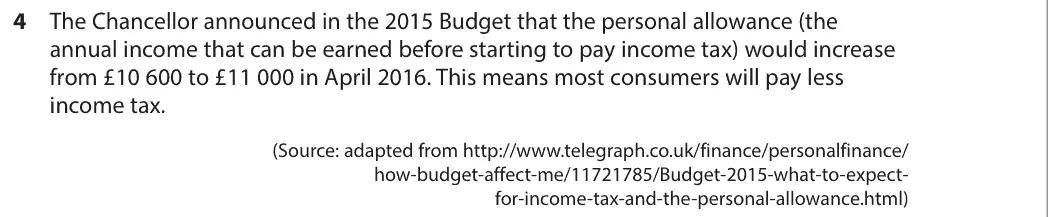
June 2017 · AS Paper 2 · Q4(a)2 marksAO2=2Diagram
Data and extracts for question 4
Mark scheme
Examiner's comment
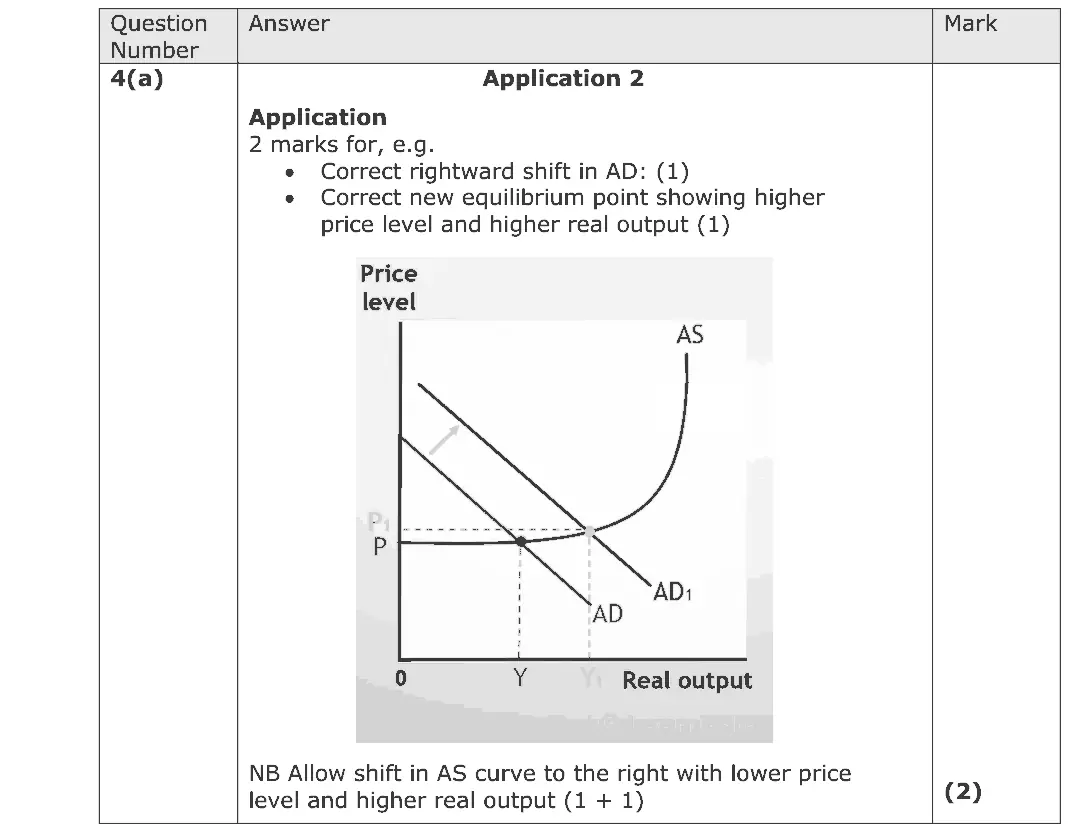
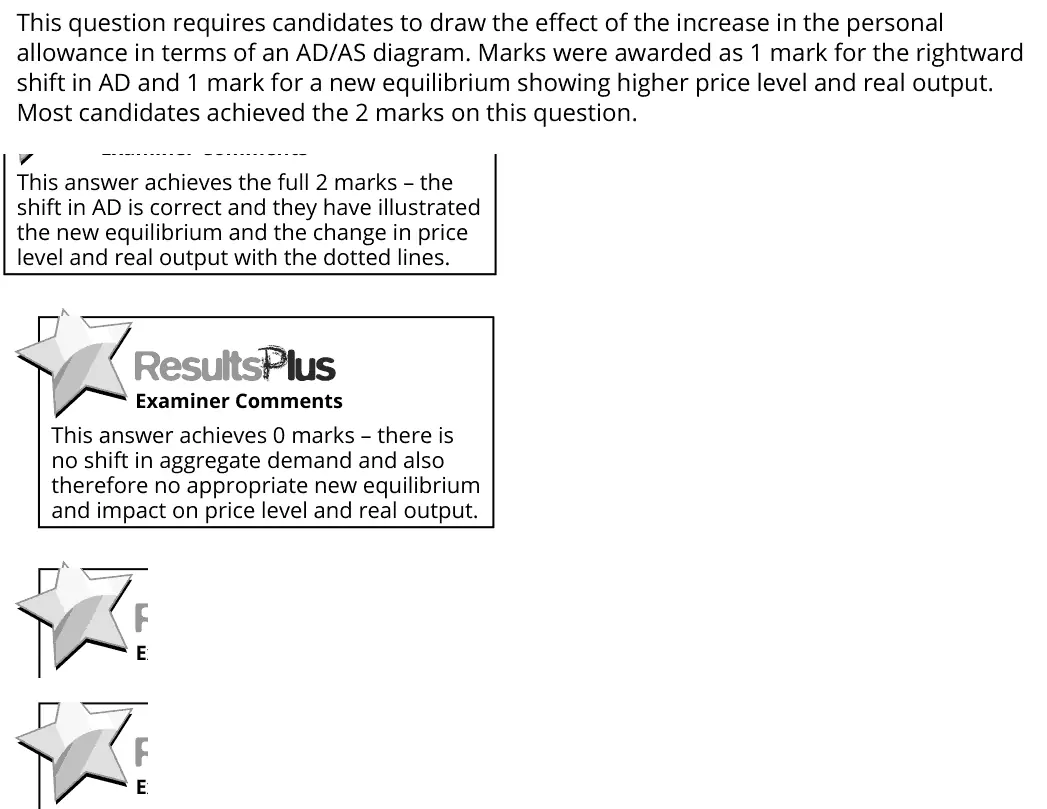
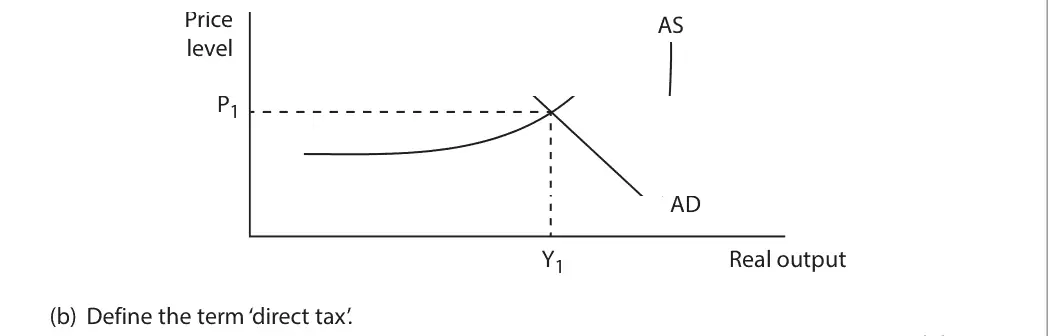
This question requires candidates to draw the effect of the increase in the personal allowance in terms of an AD/AS diagram. Marks were awarded as 1 mark for the rightward shift in AD and 1 mark for a new equilibrium showing higher price level and real output. Most candidates achieved the 2 marks on this question. This answer achieves the full 2 marks – the shift in AD is correct and they have illustrated the new equilibrium and the change in price level and real output with the dotted lines. This answer achieves 0 marks – there is no shift in aggregate demand and also therefore no appropriate new equilibrium and impact on price level and real output.
Notes from the mark scheme and report
a higher personal allowance raises disposable income and consumption so AD shifts right
show the new equilibrium with higher price level and real output (an AS shift right is also allowed)
Quantitative skills: QS 4 (construct and interpret a range of standard graphical forms)
June 2017 · AS Paper 2 · Q4(b)1 markAO1=1Definition
Data and extracts for question 4
Mark scheme
Examiner's comment
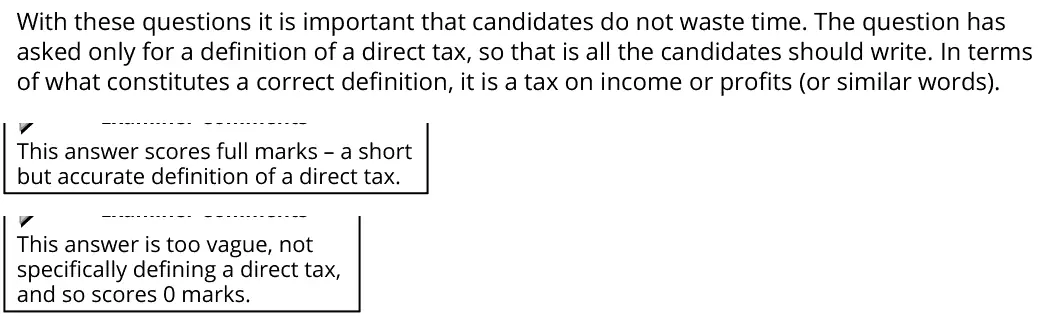
With these questions it is important that candidates do not waste time. The question has asked only for a definition of a direct tax, so that is all the candidates should write. In terms of what constitutes a correct definition, it is a tax on income or profits (or similar words). This answer scores full marks – a short but accurate definition of a direct tax. This answer is too vague, not specifically defining a direct tax, and so scores 0 marks.
Notes from the mark scheme and report
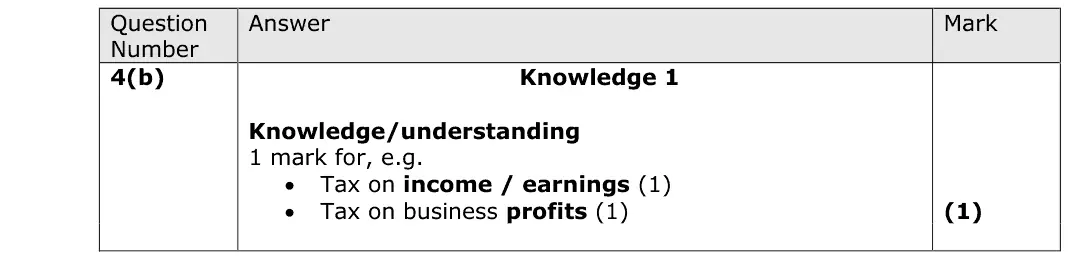
a tax on income or profits (paid directly to the government by the person earning it)
vague answers score 0
June 2017 · AS Paper 2 · Q4(c)1 markMultiple choice
Data and extracts for question 4
Answer
C
Mark scheme
Notes from the mark scheme and report
corporation tax is a tax on profits (C)
VAT, vehicle excise duty and alcohol duty are indirect taxes on spending
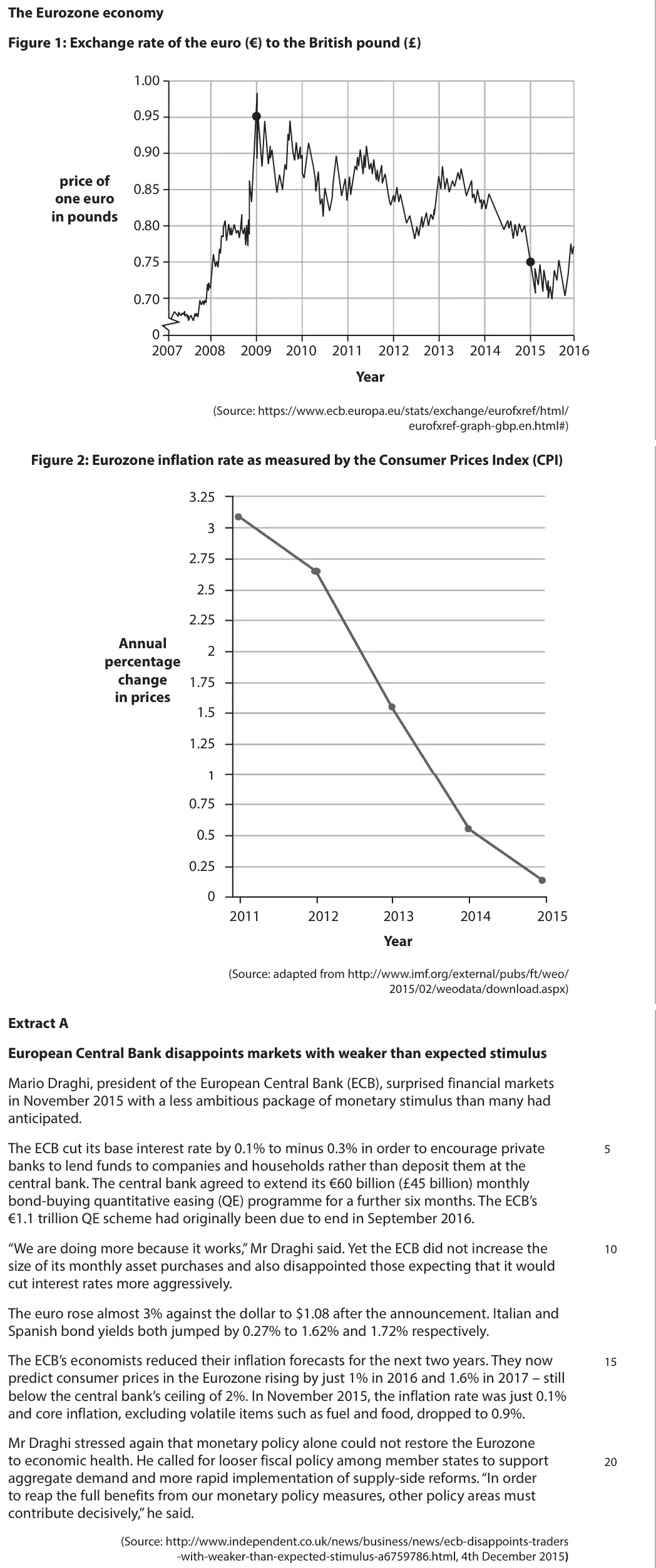
June 2017 · Paper 2 · Q6(d)12 marksAO1=2, AO2=2, AO3=4, AO4=412-mark response
Data and extracts for question 6
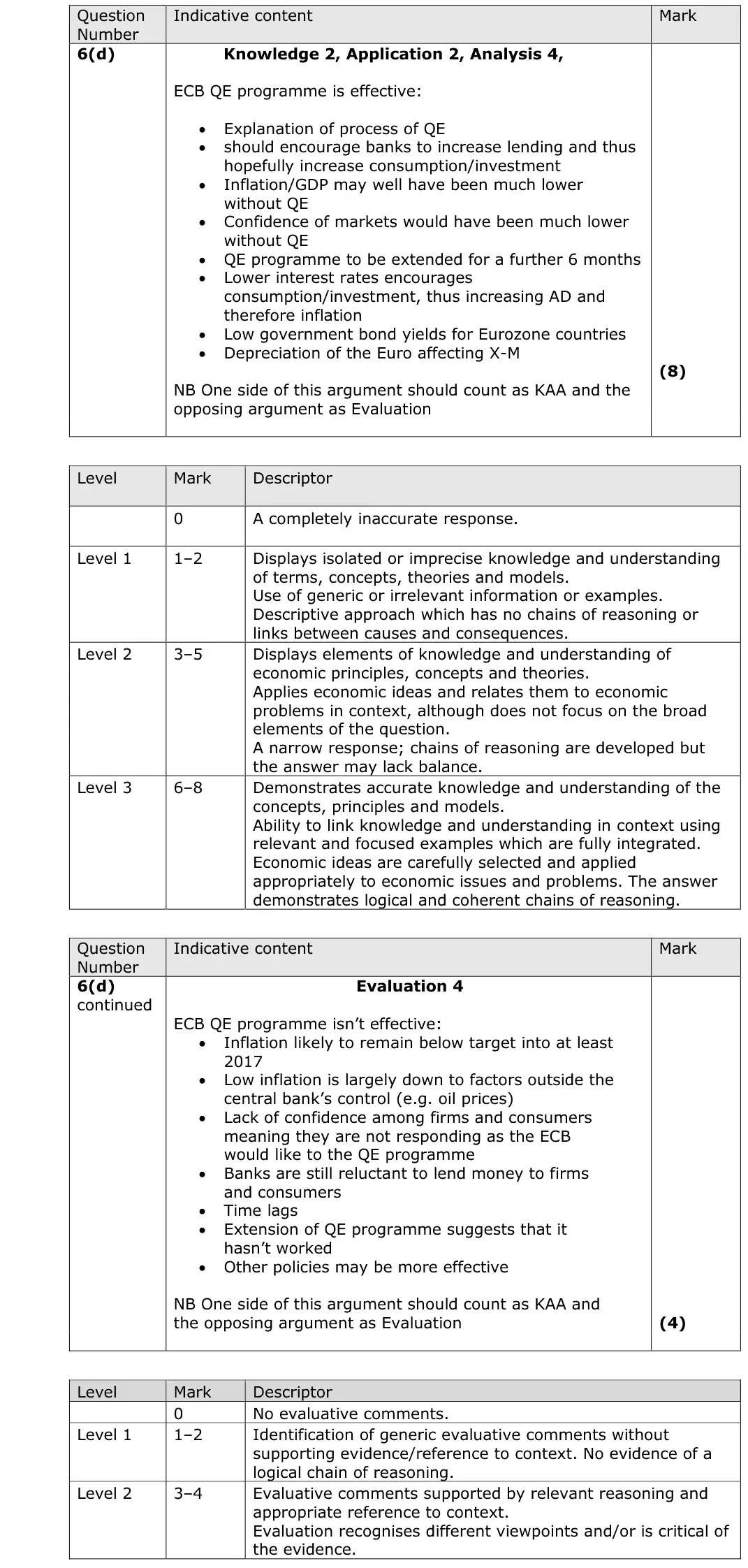
Mark scheme, including the levels grid and indicative content
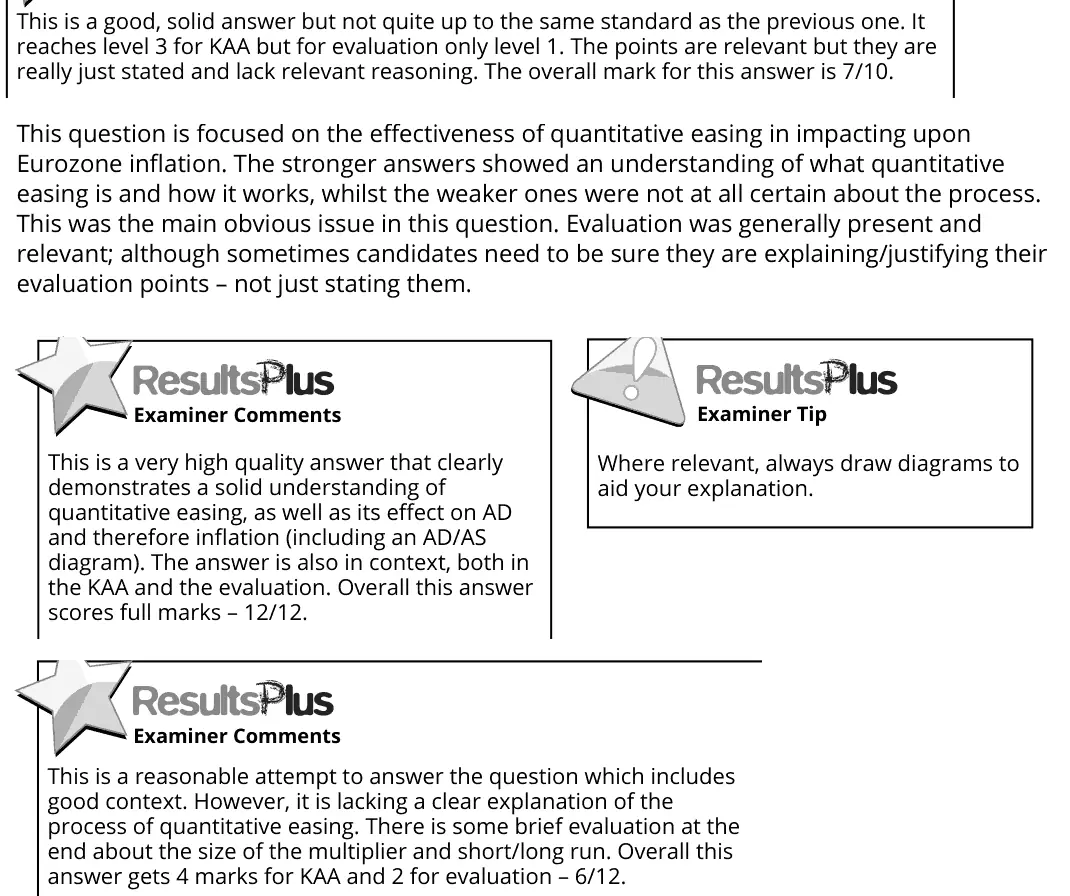
Examiner's comment
This question is focused on the effectiveness of quantitative easing in impacting upon Eurozone inflation. The stronger answers showed an understanding of what quantitative easing is and how it works, whilst the weaker ones were not at all certain about the process. This was the main obvious issue in this question. Evaluation was generally present and relevant; although sometimes candidates need to be sure they are explaining/justifying their evaluation points – not just stating them. This is a good, solid answer but not quite up to the same standard as the previous one. It reaches level 3 for KAA but for evaluation only level 1. The points are relevant but they are really just stated and lack relevant reasoning. The overall mark for this answer is 7/10. Where relevant, always draw diagrams to aid your explanation. This is a very high quality answer that clearly demonstrates a solid understanding of quantitative easing, as well as its effect on AD and therefore inflation (including an AD/AS diagram). The answer is also in context, both in the KAA and the evaluation. Overall this answer scores full marks – 12/12. This is a reasonable attempt to answer the question which includes good context. However, it is lacking a clear explanation of the process of quantitative easing. There is some brief evaluation at the end about the size of the multiplier and short/long run. Overall this answer gets 4 marks for KAA and 2 for evaluation – 6/12.
Notes from the mark scheme and report
explain the QE process (asset purchases, more bank lending, lower yields, higher AD)
weaker answers were unsure how QE works
evaluate with banks reluctant to lend, low confidence, time lags, external causes of low inflation such as oil prices
justify evaluation, do not just state it
June 2017 · Paper 2 · Q6(e)15 marksAO1=3, AO2=3, AO3=3, AO4=615-mark response
Data and extracts for question 6
Mark scheme, including the levels grid and indicative content
Examiner's comment
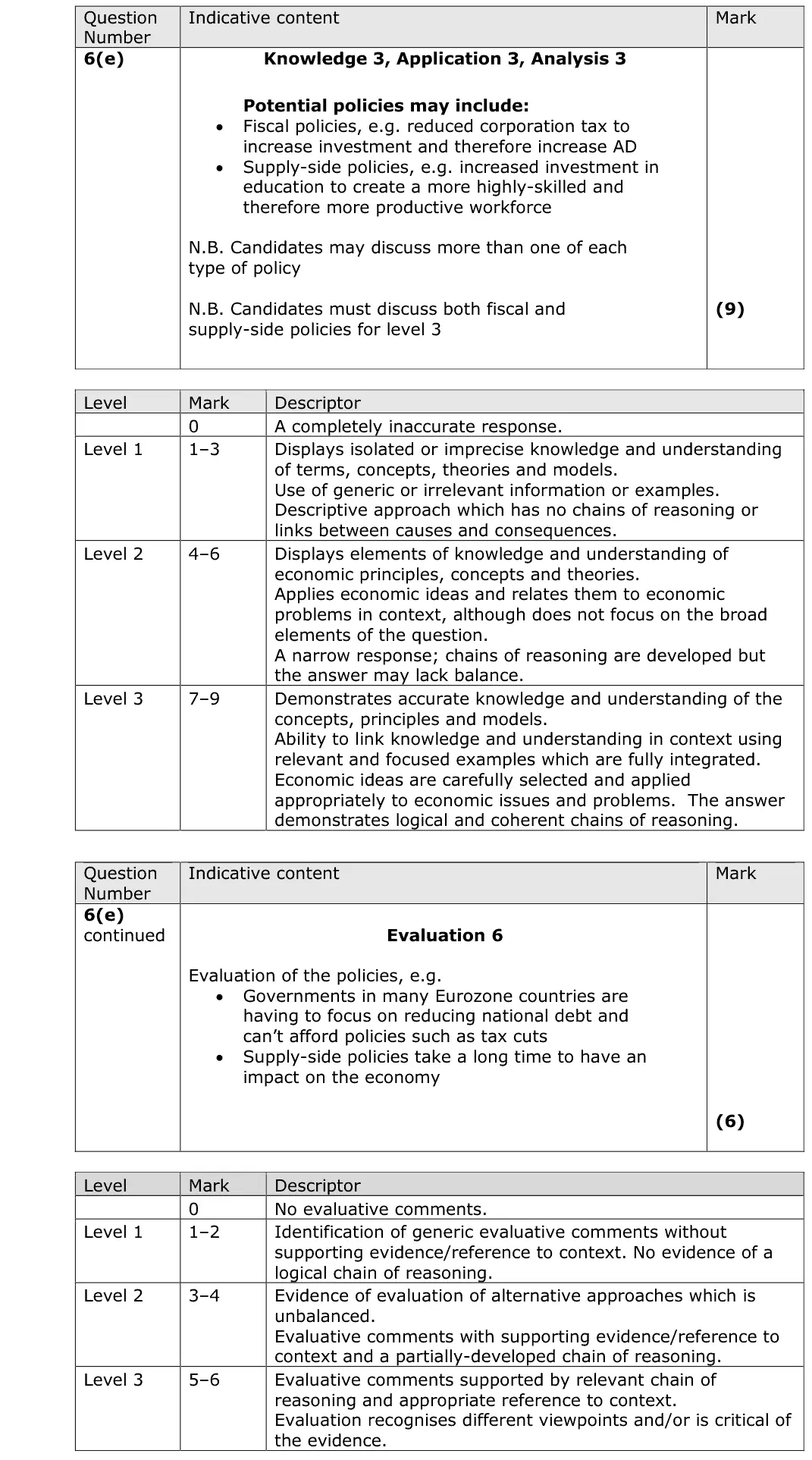
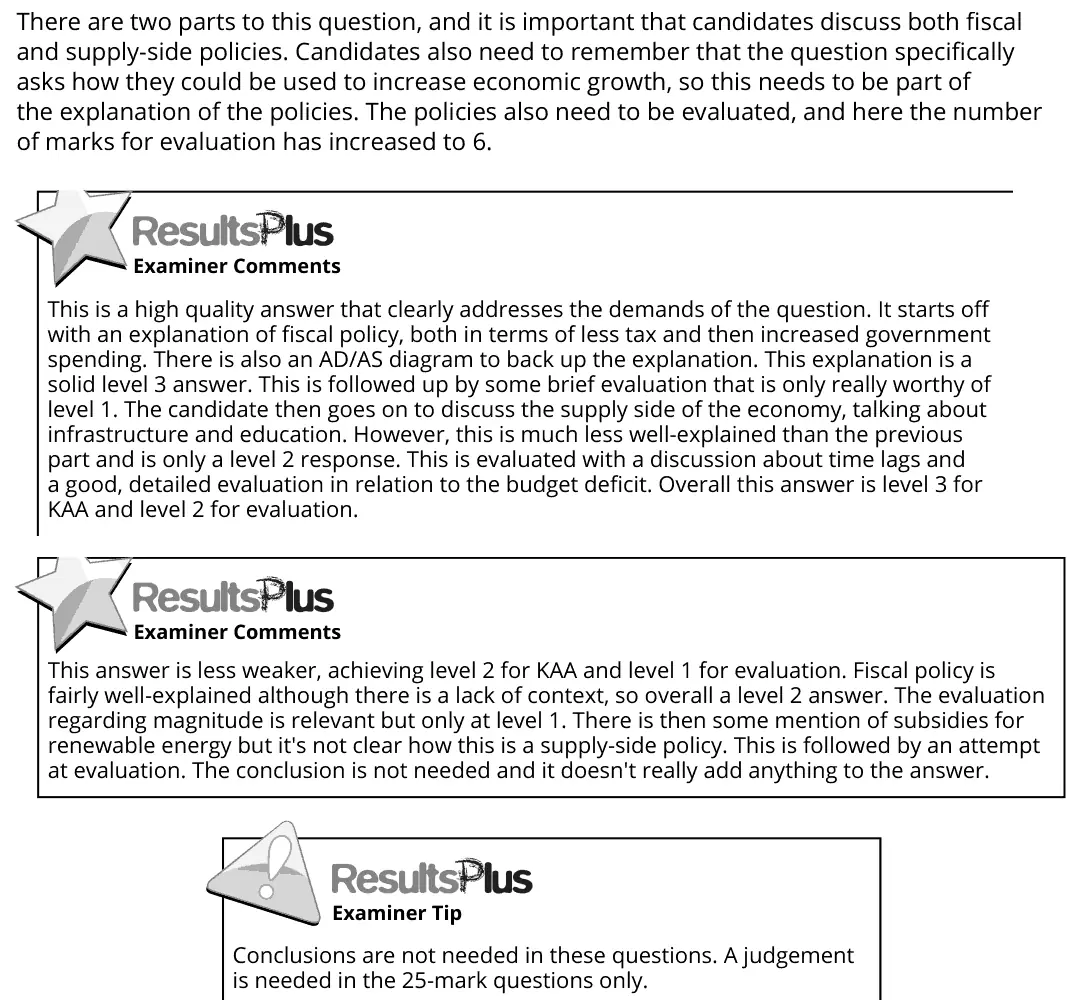
There are two parts to this question, and it is important that candidates discuss both fiscal and supply-side policies. Candidates also need to remember that the question specifically asks how they could be used to increase economic growth, so this needs to be part of the explanation of the policies. The policies also need to be evaluated, and here the number of marks for evaluation has increased to 6. This is a high quality answer that clearly addresses the demands of the question. It starts off with an explanation of fiscal policy, both in terms of less tax and then increased government spending. There is also an AD/AS diagram to back up the explanation. This explanation is a solid level 3 answer. This is followed up by some brief evaluation that is only really worthy of level 1. The candidate then goes on to discuss the supply side of the economy, talking about infrastructure and education. However, this is much less well-explained than the previous part and is only a level 2 response. This is evaluated with a discussion about time lags and a good, detailed evaluation in relation to the budget deficit. Overall this answer is level 3 for KAA and level 2 for evaluation. This answer is less weaker, achieving level 2 for KAA and level 1 for evaluation. Fiscal policy is fairly well-explained although there is a lack of context, so overall a level 2 answer. The evaluation regarding magnitude is relevant but only at level 1. There is then some mention of subsidies for renewable energy but it's not clear how this is a supply-side policy. This is followed by an attempt at evaluation. The conclusion is not needed and it doesn't really add anything to the answer. Conclusions are not needed in these questions. A judgement is needed in the 25-mark questions only.
Notes from the mark scheme and report
Level 3 KAA needs both fiscal and supply-side policies, linked to economic growth
AD/AS diagrams
evaluate with debt constraints on Eurozone governments and time lags of supply-side policies
June 2016 · AS Paper 2 · Q6(e)15 marksAO1=3, AO2=3, AO3=3, AO4=615-mark response
Data and extracts for question 6
Mark scheme, including the levels grid and indicative content
Examiner's comment
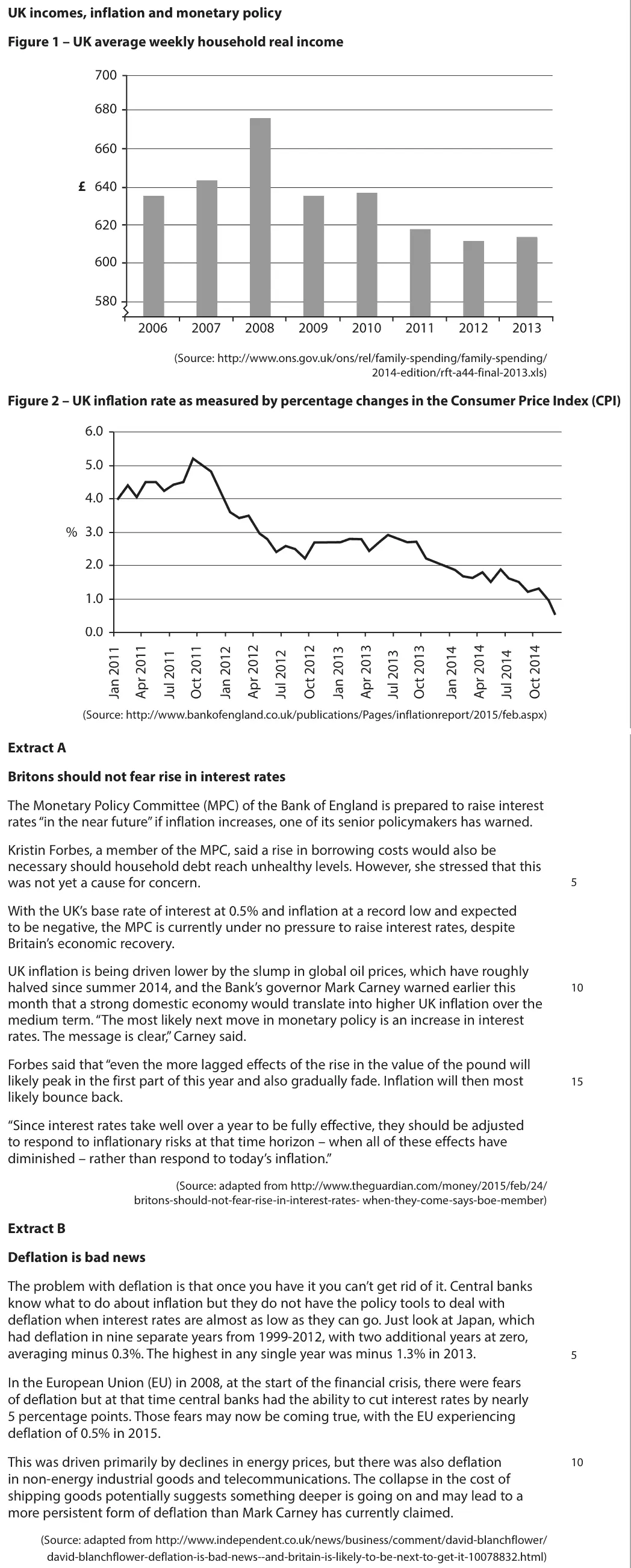
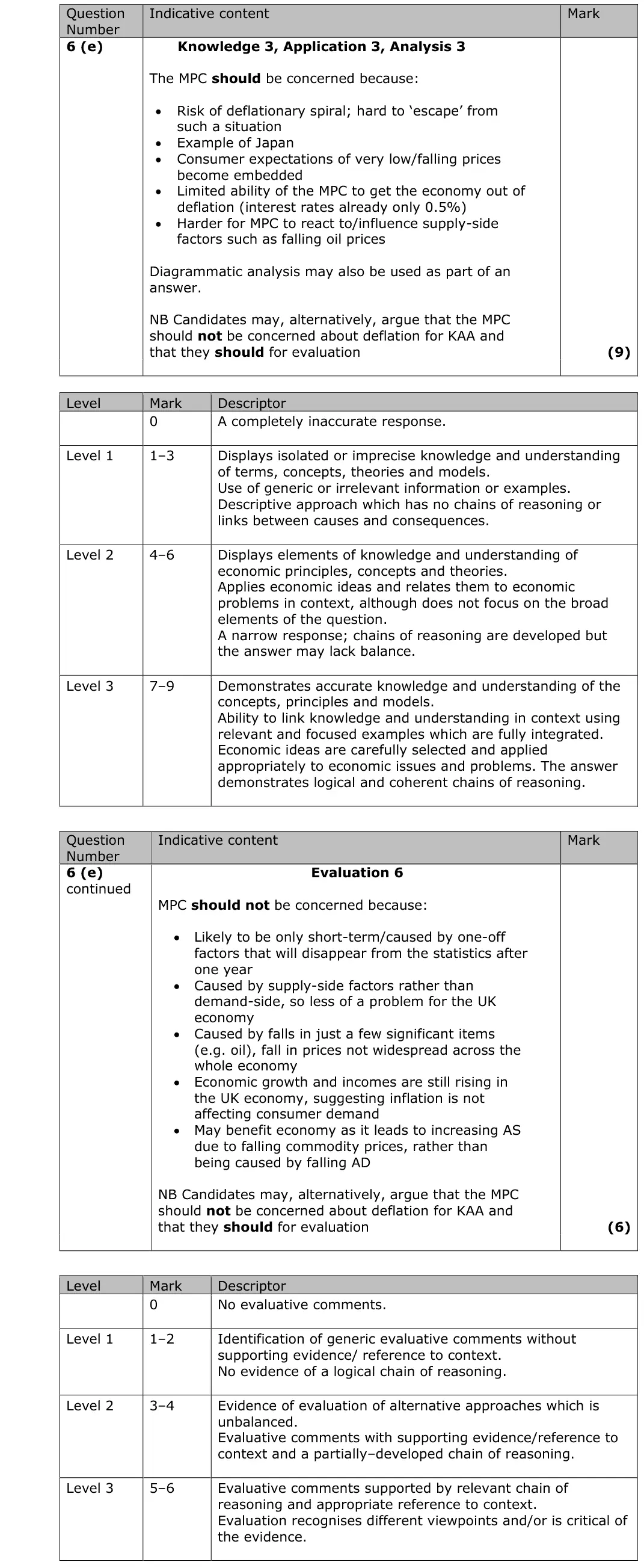
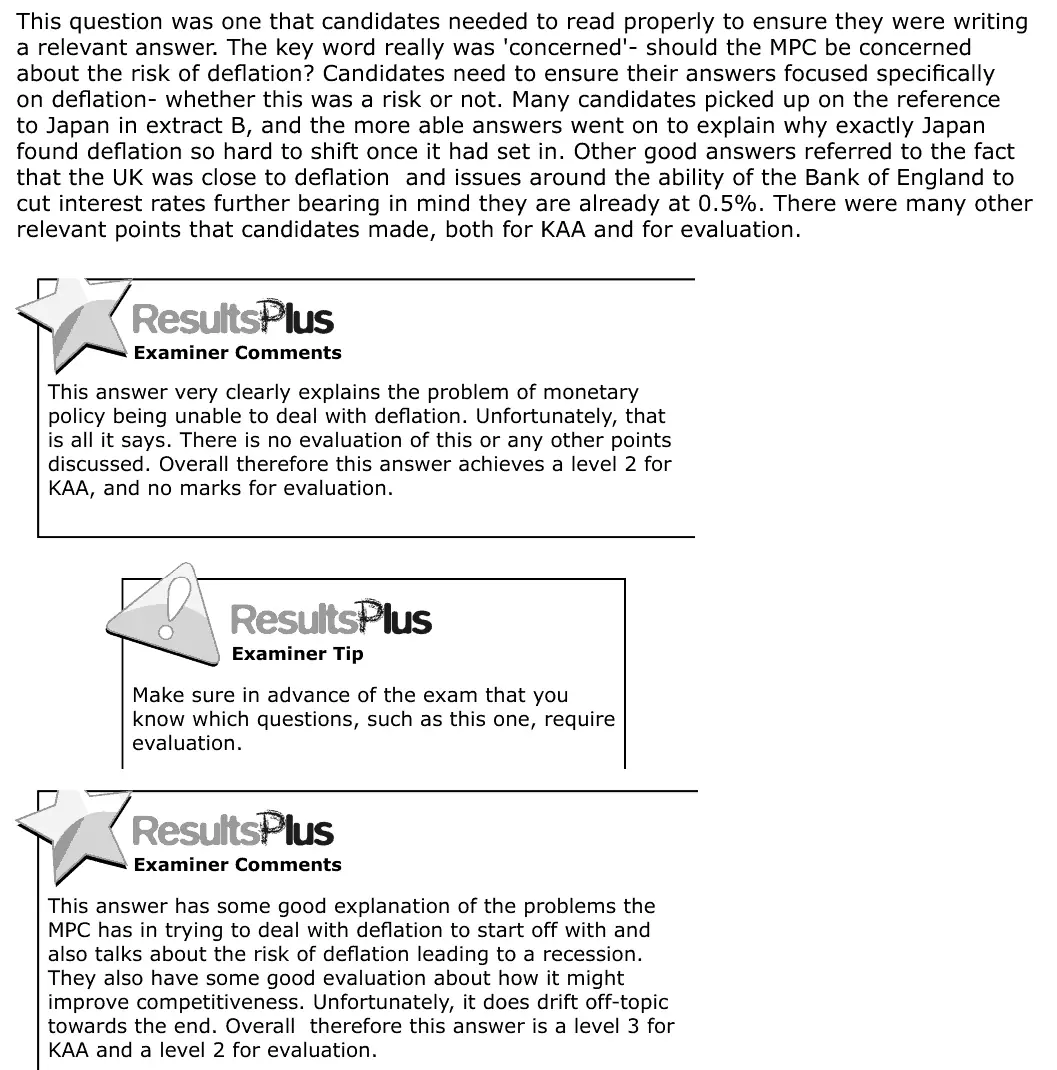
This question was one that candidates needed to read properly to ensure they were writing a relevant answer. The key word really was 'concerned'- should the MPC be concerned about the risk of deflation? Candidates need to ensure their answers focused specifically on deflation- whether this was a risk or not. Many candidates picked up on the reference to Japan in extract B, and the more able answers went on to explain why exactly Japan found deflation so hard to shift once it had set in. Other good answers referred to the fact that the UK was close to deflation and issues around the ability of the Bank of England to cut interest rates further bearing in mind they are already at 0.5%. There were many other relevant points that candidates made, both for KAA and for evaluation. This answer very clearly explains the problem of monetary policy being unable to deal with deflation. Unfortunately, that is all it says. There is no evaluation of this or any other points discussed. Overall therefore this answer achieves a level 2 for KAA, and no marks for evaluation. Make sure in advance of the exam that you know which questions, such as this one, require evaluation. This answer has some good explanation of the problems the MPC has in trying to deal with deflation to start off with and also talks about the risk of deflation leading to a recession. They also have some good evaluation about how it might improve competitiveness. Unfortunately, it does drift off-topic towards the end. Overall therefore this answer is a level 3 for KAA and a level 2 for evaluation.
Notes from the mark scheme and report
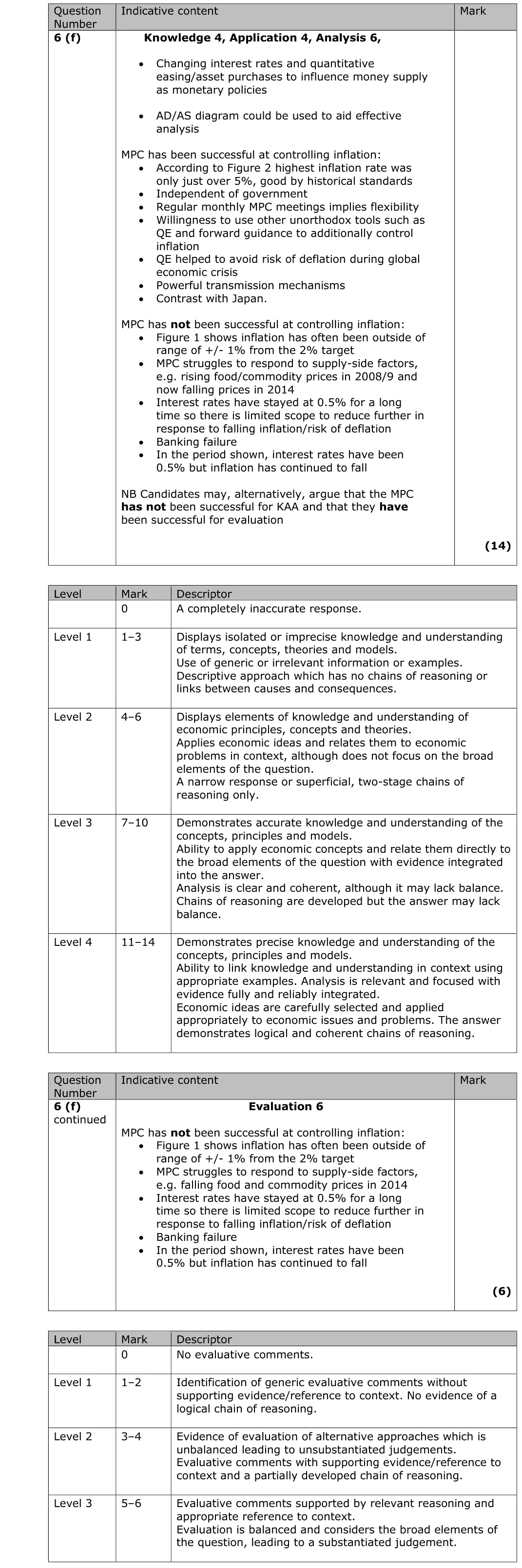
deflation risk: delayed spending, deflationary spiral, rising real debt, Japan, little room to cut Bank Rate below 0.5%
evaluate with "good" deflation from falling oil prices, a temporary dip and a strong domestic economy
stay focused on whether the MPC should be concerned
June 2016 · AS Paper 2 · Q6(f)20 marksAO1=4, AO2=4, AO3=6, AO4=620-mark essayEither/or
Data and extracts for question 6
Mark scheme, including the levels grid and indicative content
Examiner's comment
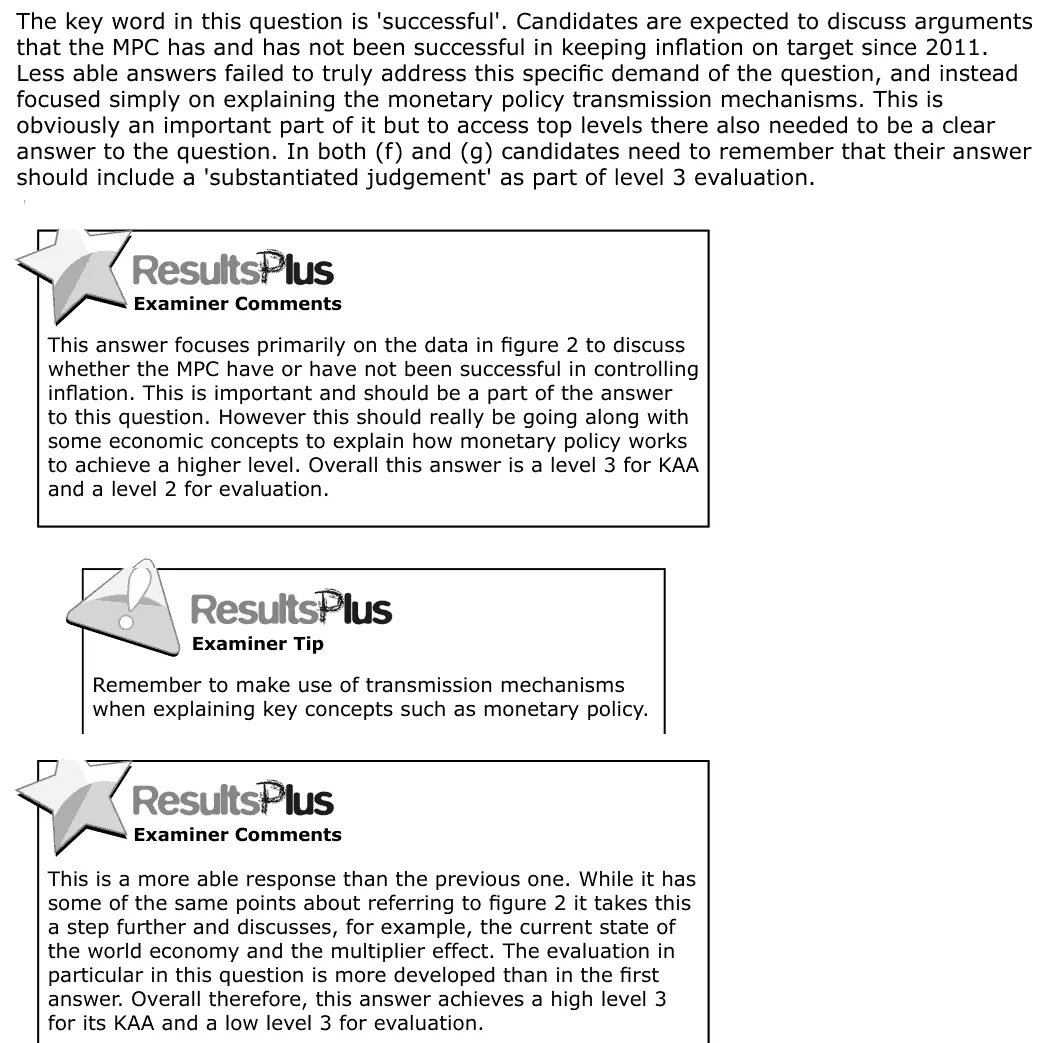
The key word in this question is 'successful'. Candidates are expected to discuss arguments that the MPC has and has not been successful in keeping inflation on target since 2011. Less able answers failed to truly address this specific demand of the question, and instead focused simply on explaining the monetary policy transmission mechanisms. This is obviously an important part of it but to access top levels there also needed to be a clear answer to the question. In both (f) and (g) candidates need to remember that their answer should include a 'substantiated judgement' as part of level 3 evaluation. This answer focuses primarily on the data in figure 2 to discuss whether the MPC have or have not been successful in controlling inflation. This is important and should be a part of the answer to this question. However this should really be going along with some economic concepts to explain how monetary policy works to achieve a higher level. Overall this answer is a level 3 for KAA and a level 2 for evaluation. Remember to make use of transmission mechanisms when explaining key concepts such as monetary policy. This is a more able response than the previous one. While it has some of the same points about referring to figure 2 it takes this a step further and discusses, for example, the current state of the world economy and the multiplier effect. The evaluation in particular in this question is more developed than in the first answer. Overall therefore, this answer achieves a high level 3 for its KAA and a low level 3 for evaluation.
Notes from the mark scheme and report
judge success against the 2% CPI target (plus or minus 1%) using Figure 2: above 5% in 2011, under 1% by late 2014
Bank Rate, QE and forward guidance
supply-side shocks the MPC cannot control
report: weaker answers only described the transmission mechanism
a substantiated judgement is needed for Level 3 evaluation
Quantitative skills: QS 9 (interpret, apply and analyse information in written, graphical tabular and numerical forms)
June 2016 · AS Paper 2 · Q6(g)20 marksAO1=4, AO2=4, AO3=6, AO4=620-mark essayEither/or
Data and extracts for question 6
Mark scheme, including the levels grid and indicative content
Examiner's comment
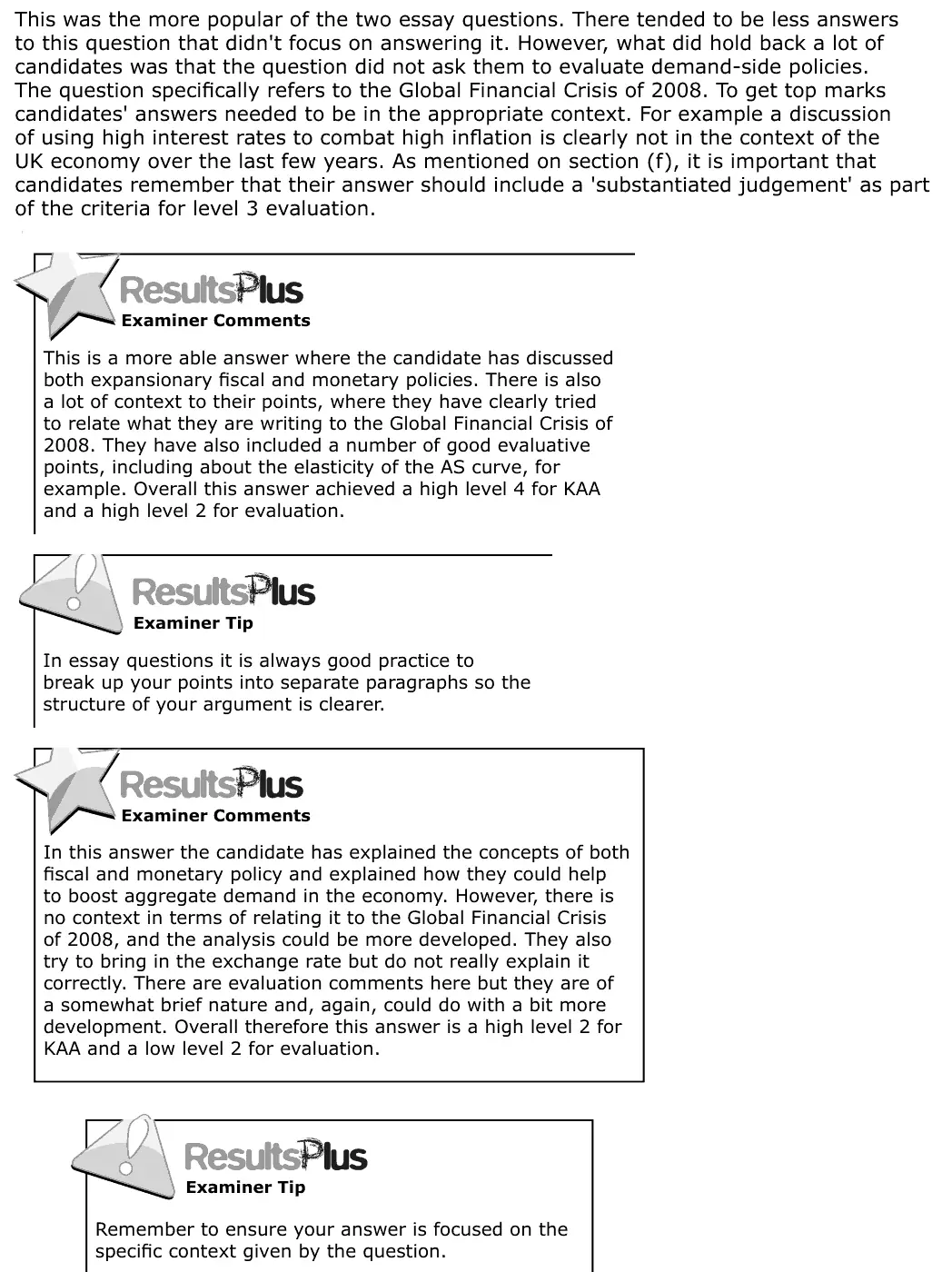
This was the more popular of the two essay questions. There tended to be less answers to this question that didn't focus on answering it. However, what did hold back a lot of candidates was that the question did not ask them to evaluate demand-side policies. The question specifically refers to the Global Financial Crisis of 2008. To get top marks candidates' answers needed to be in the appropriate context. For example a discussion of using high interest rates to combat high inflation is clearly not in the context of the UK economy over the last few years. As mentioned on section (f), it is important that candidates remember that their answer should include a 'substantiated judgement' as part of the criteria for level 3 evaluation. This is a more able answer where the candidate has discussed both expansionary fiscal and monetary policies. There is also a lot of context to their points, where they have clearly tried to relate what they are writing to the Global Financial Crisis of 2008. They have also included a number of good evaluative points, including about the elasticity of the AS curve, for example. Overall this answer achieved a high level 4 for KAA and a high level 2 for evaluation. In essay questions it is always good practice to break up your points into separate paragraphs so the structure of your argument is clearer. In this answer the candidate has explained the concepts of both fiscal and monetary policy and explained how they could help to boost aggregate demand in the economy. However, there is no context in terms of relating it to the Global Financial Crisis of 2008, and the analysis could be more developed. They also try to bring in the exchange rate but do not really explain it correctly. There are evaluation comments here but they are of a somewhat brief nature and, again, could do with a bit more development. Overall therefore this answer is a high level 2 for KAA and a low level 2 for evaluation. Remember to ensure your answer is focused on the specific context given by the question.
Notes from the mark scheme and report
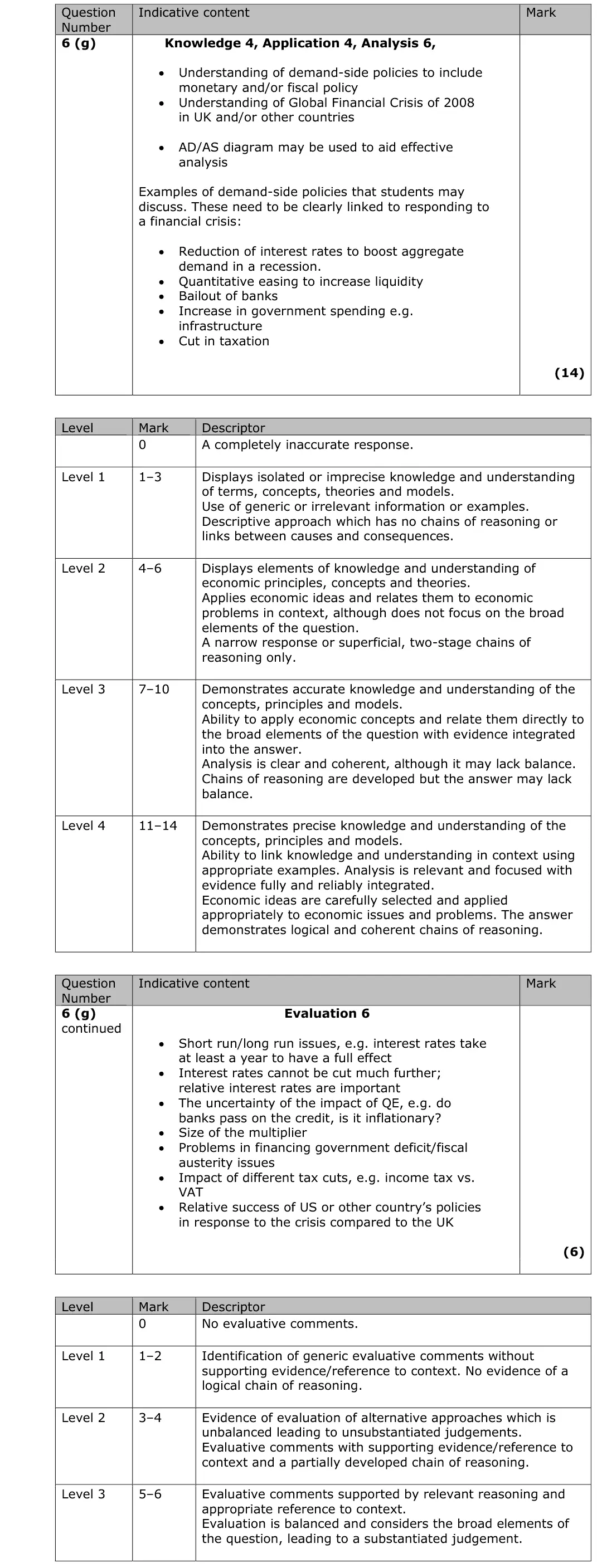
policies must be linked to the 2008 crisis: cuts in Bank Rate to 0.5%, QE, bank bailouts, fiscal stimulus and tax cuts, in the UK and/or US
evaluate liquidity trap, debt and deficits, time lags
report: answers about high rates to fight inflation are out of context
substantiated judgement needed
Work with an Edexcel economics tutor
Essays stuck in Level 2, or losing the easy marks in Section A? Book a trial session with Lianne, a former Edexcel examiner.