Notes and key-term cards for this topic are being written by our tutors. The past-paper questions below are ready now.
Specification statements
3.5.1Demand for labour: a) Factors that influence the demand for labour b) Demand for labour as a derived demand
3.5.2Supply of labour: a) Factors that influence the supply of labour to a particular occupation b) Market failure in labour markets: the geographical and occupational mobility and immobility of labour
3.5.3Wage determination in competitive and non-competitive markets: a) Diagrammatic analysis of labour market equilibrium b) Understanding of current labour market issues c) Government intervention in the labour market: • maximum and minimum wages • public sector wage setting • policies to tackle labour market immobility d) The significance of the elasticity of demand for labour and the elasticity of supply of labour
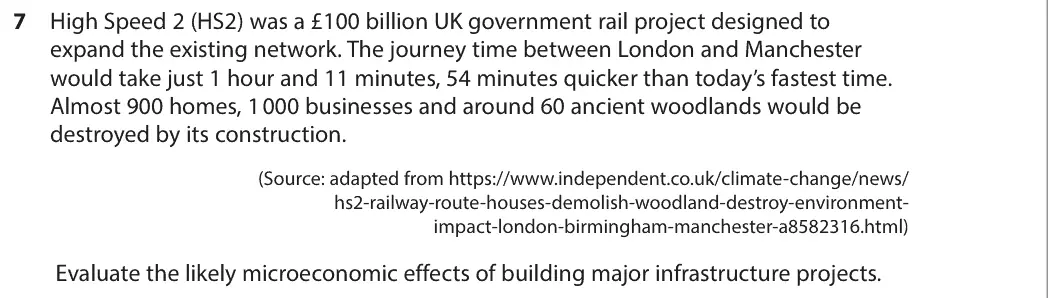
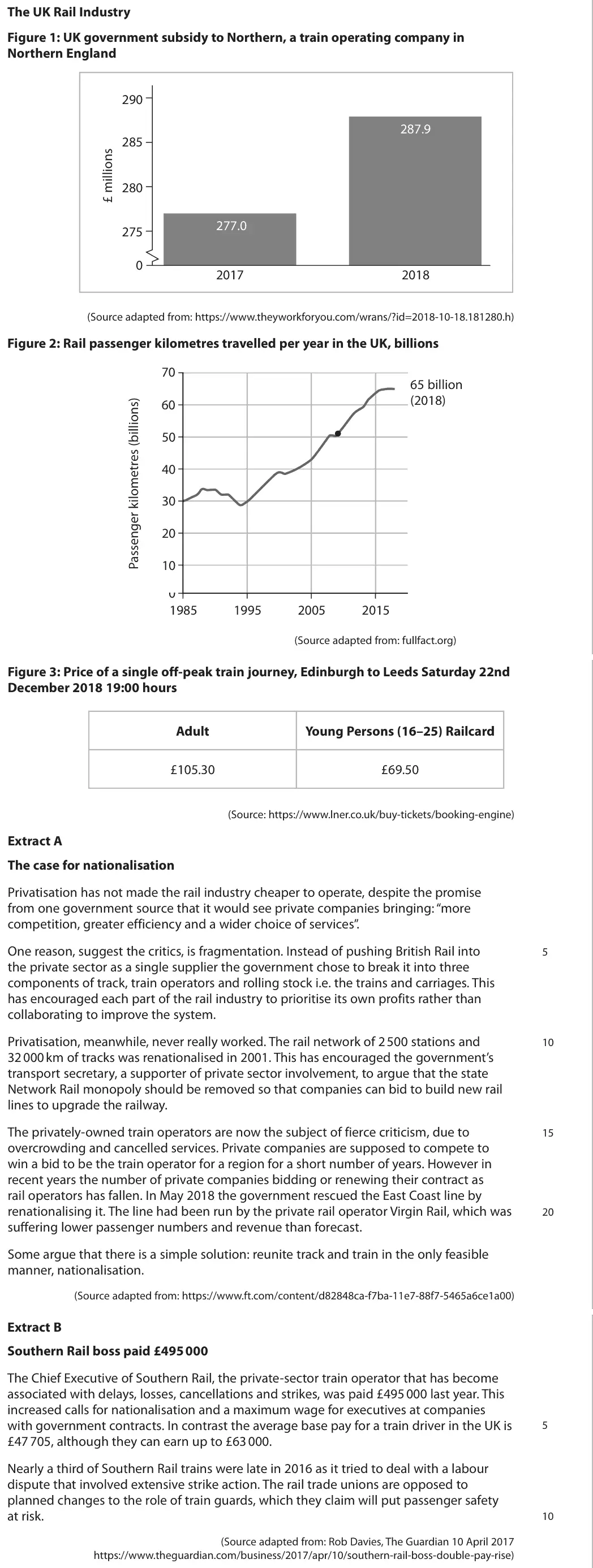
High Speed 2 (HS2) was a £100 billion UK government rail project designed to expand the existing network. The journey time between London and Manchester would take just 1 hour and 11 minutes, 54 minutes quicker than today’s fastest time. Almost 900 homes, 1 000 businesses and around 60 ancient woodlands would be destroyed by its construction. (Source: adapted from https://www.independent.co.uk/climate-change/news/ hs2-railway-route-houses-demolish-woodland-destroy-environment- impact-london-birmingham-manchester-a8582316.html) Evaluate the likely microeconomic effects of building major infrastructure projects.
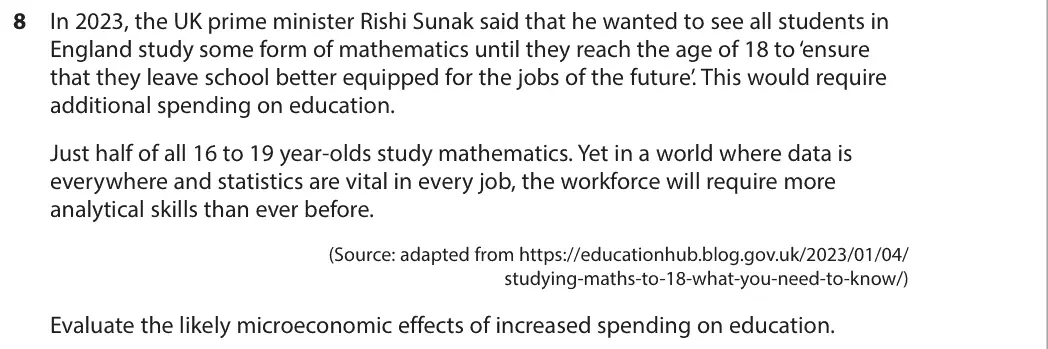
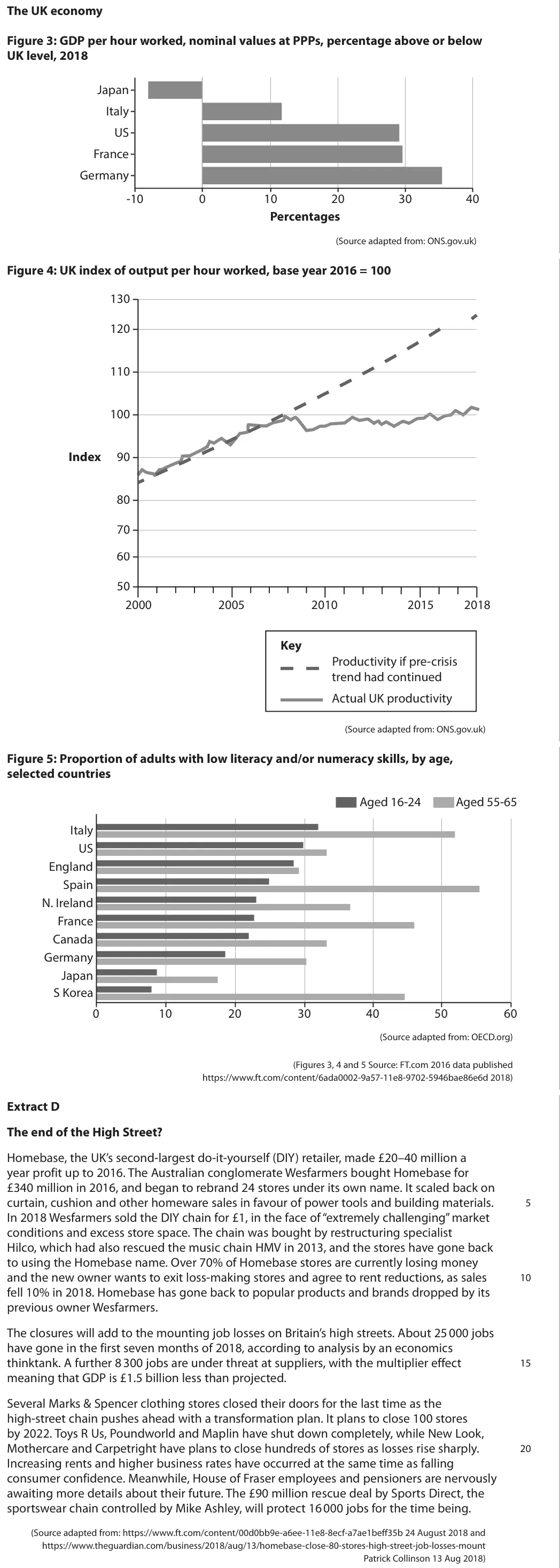
In 2023, the UK prime minister Rishi Sunak said that he wanted to see all students in England study some form of mathematics until they reach the age of 18 to ‘ensure that they leave school better equipped for the jobs of the future’. This would require additional spending on education. Just half of all 16 to 19 year-olds study mathematics. Yet in a world where data is everywhere and statistics are vital in every job, the workforce will require more analytical skills than ever before. (Source: adapted from https://educationhub.blog.gov.uk/2023/01/04/ studying-maths-to-18-what-you-need-to-know/) Evaluate the likely microeconomic effects of increased spending on education.
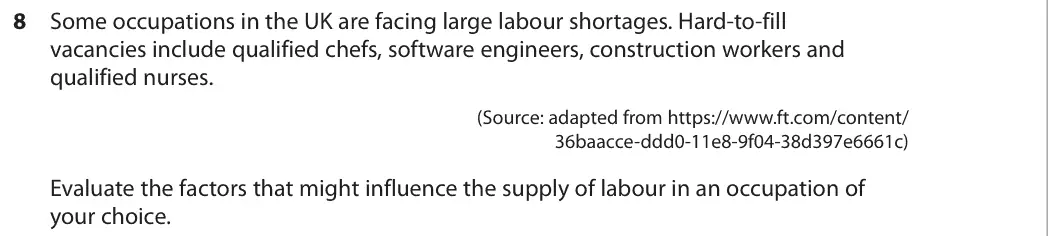
Some occupations in the UK are facing large labour shortages. Hard-to-fill vacancies include qualified chefs, software engineers, construction workers and qualified nurses. (Source: adapted from https://www.ft.com/content/ 36baacce-ddd0-11e8-9f04-38d397e6661c) Evaluate the factors that might influence the supply of labour in an occupation of your choice.
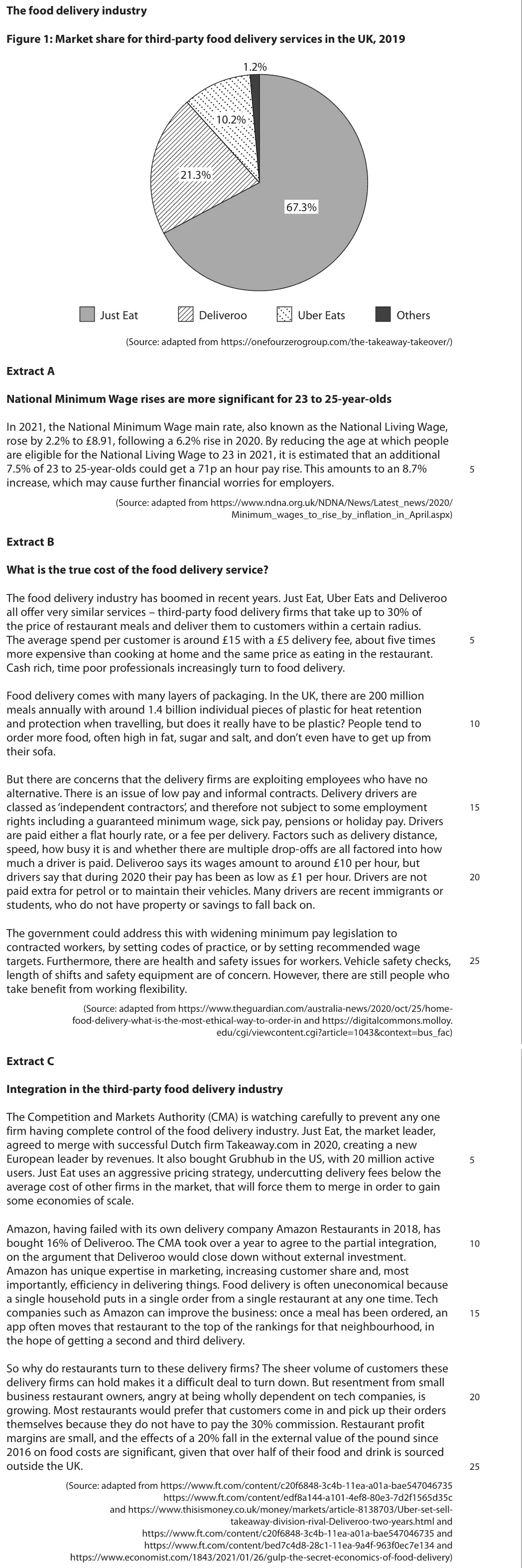
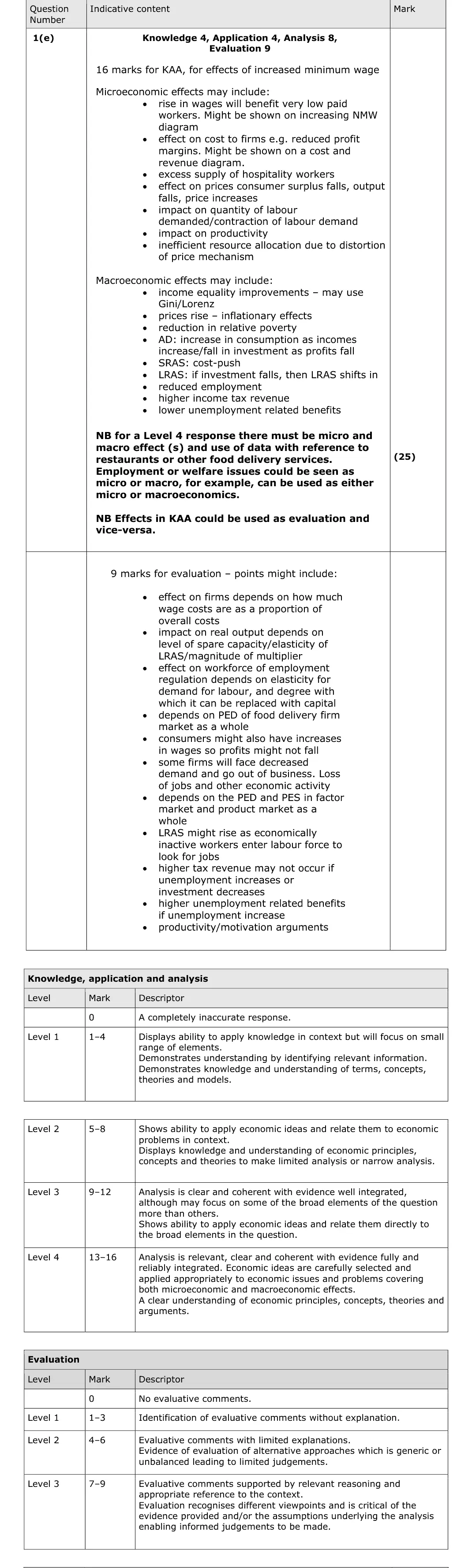
Evaluate the microeconomic and macroeconomic effects of significant increases in the minimum wage. Refer to restaurants or other food delivery services in your answer.
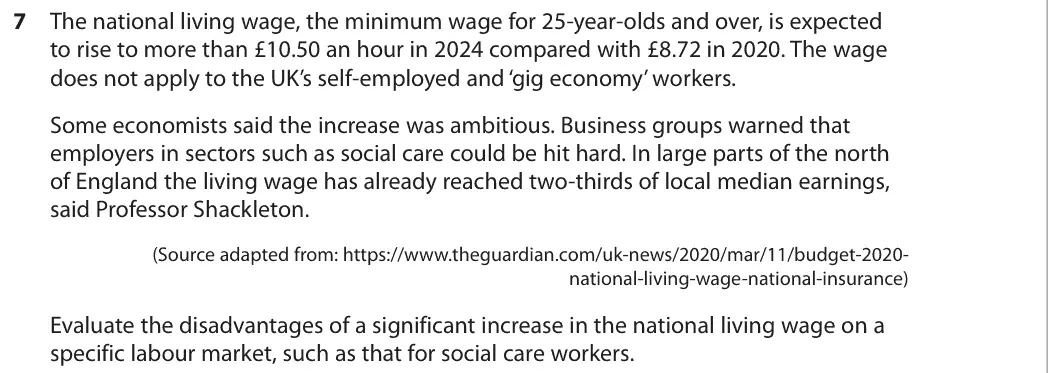
The national living wage, the minimum wage for 25-year-olds and over, is expected to rise to more than £10.50 an hour in 2024 compared with £8.72 in 2020. The wage does not apply to the UK’s self-employed and ‘gig economy’ workers. Some economists said the increase was ambitious. Business groups warned that employers in sectors such as social care could be hit hard. In large parts of the north of England the living wage has already reached two-thirds of local median earnings, said Professor Shackleton. (Source adapted from: https://www.theguardian.com/uk-news/2020/mar/11/budget-2020- national-living-wage-national-insurance) Evaluate the disadvantages of a significant increase in the national living wage on a specific labour market, such as that for social care workers.
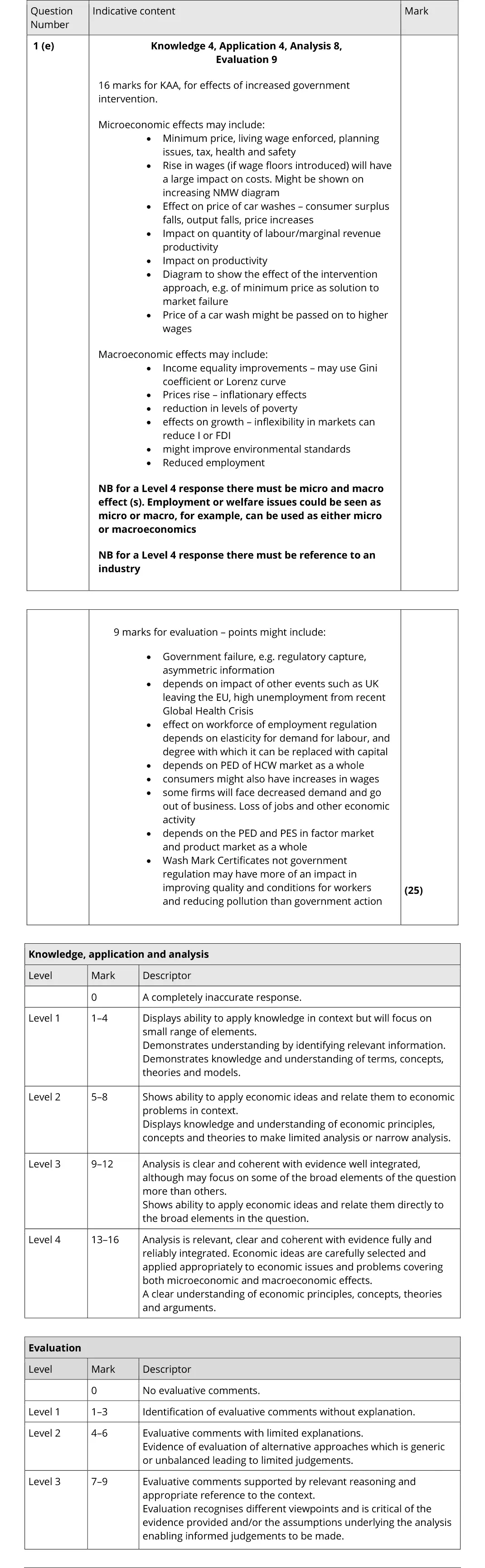
Evaluate the microeconomic and macroeconomic effects of increased government intervention in an industry. Refer to HCWs or another industry of your choice.
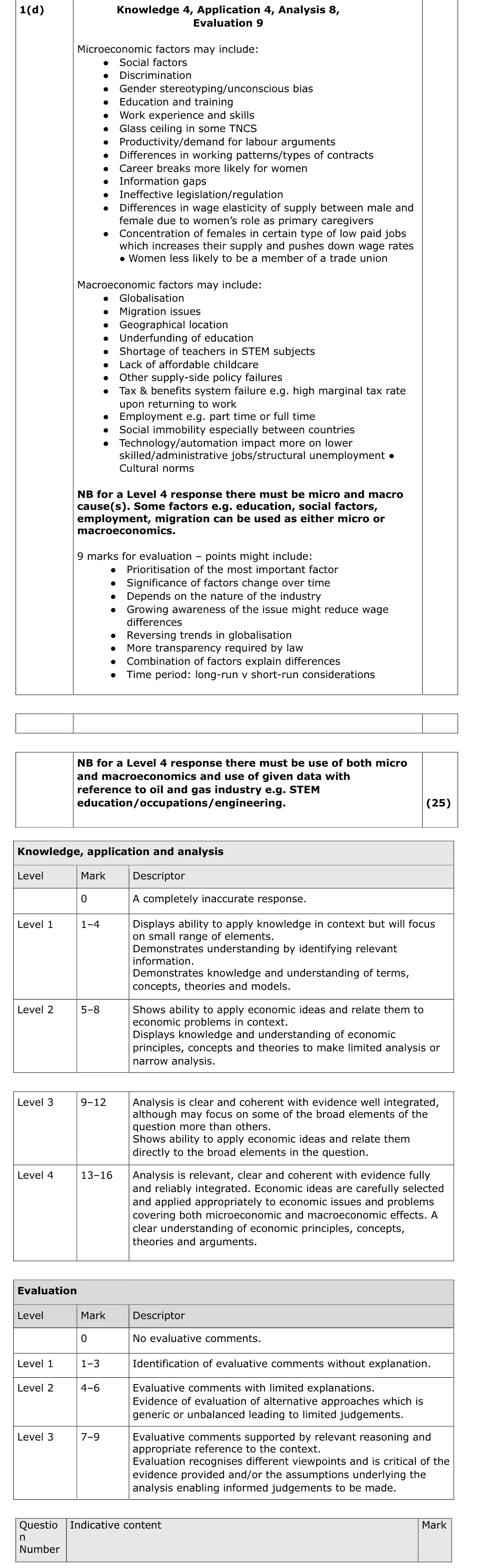
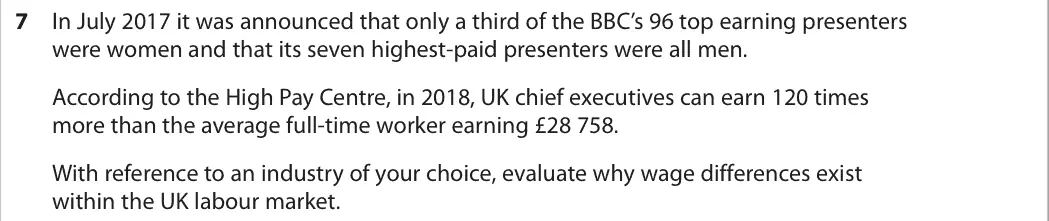
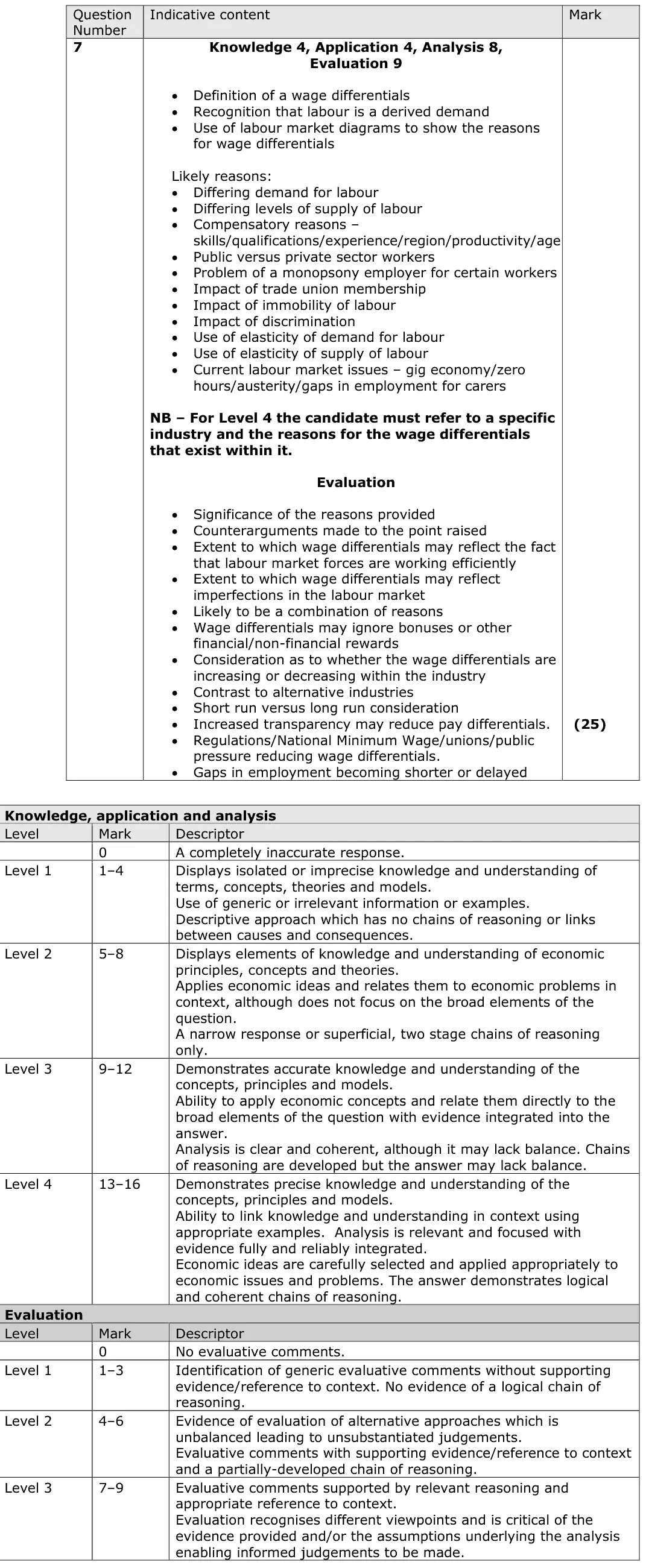
In July 2017 it was announced that only a third of the BBC’s 96 top earning presenters were women and that its seven highest-paid presenters were all men. According to the High Pay Centre, in 2018, UK chief executives can earn 120 times more than the average full-time worker earning £28 758. With reference to an industry of your choice, evaluate why wage differences exist within the UK labour market.
Tap a question to zoom it. The data and extracts fold out above each question; the mark scheme and examiner's comment open underneath.
June 2025 · Paper 1 · Q5(a)4 marksAO1=2, AO2=1, AO3=1Diagram
Data and extracts for question 5
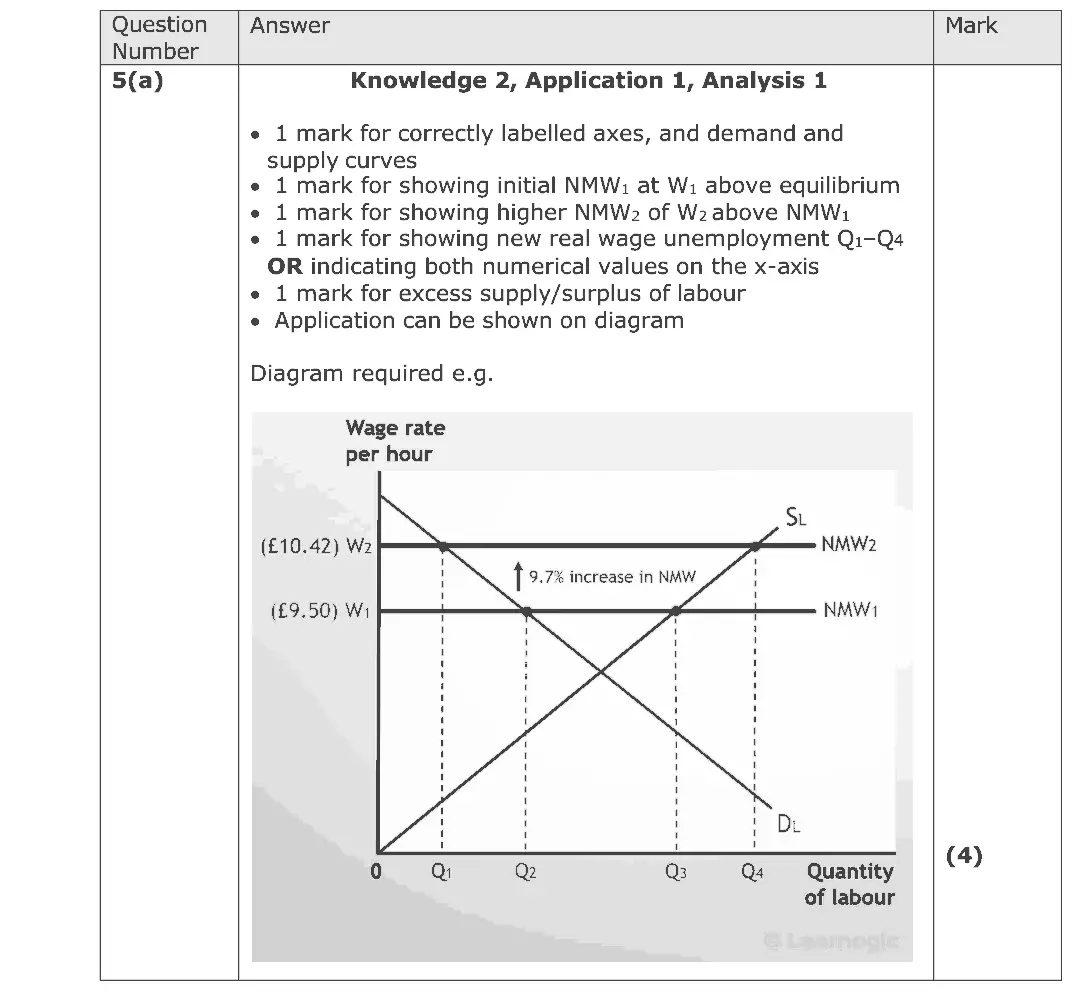
Mark scheme
Examiner's comment
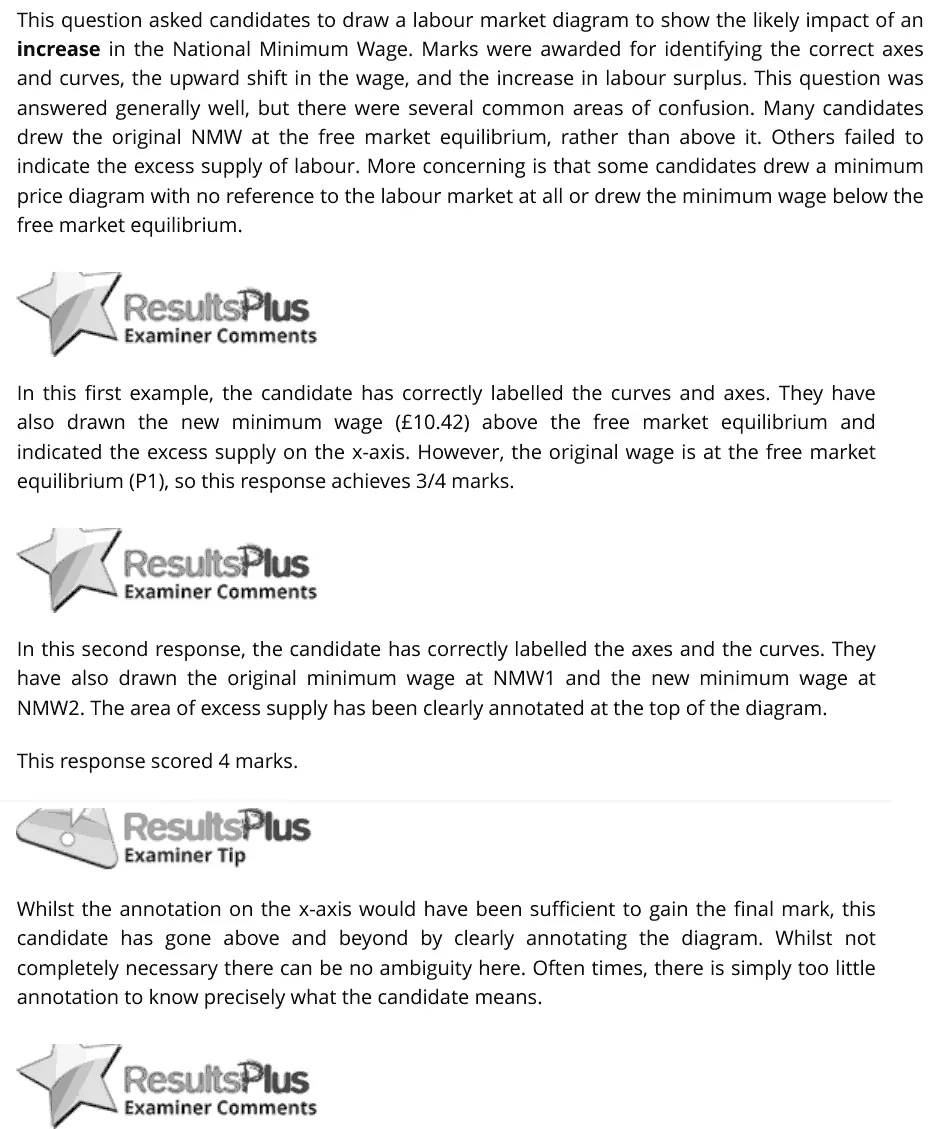
This question asked candidates to draw a labour market diagram to show the likely impact of an increase in the National Minimum Wage. Marks were awarded for identifying the correct axes and curves, the upward shift in the wage, and the increase in labour surplus. This question was answered generally well, but there were several common areas of confusion. Many candidates drew the original NMW at the free market equilibrium, rather than above it. Others failed to indicate the excess supply of labour. More concerning is that some candidates drew a minimum price diagram with no reference to the labour market at all or drew the minimum wage below the free market equilibrium. In this first example, the candidate has correctly labelled the curves and axes. They have also drawn the new minimum wage (£10.42) above the free market equilibrium and indicated the excess supply on the x-axis. However, the original wage is at the free market equilibrium (P1), so this response achieves 3/4 marks. In this second response, the candidate has correctly labelled the axes and the curves. They have also drawn the original minimum wage at NMW1 and the new minimum wage at NMW2. The area of excess supply has been clearly annotated at the top of the diagram. This response scored 4 marks. Whilst the annotation on the x-axis would have been sufficient to gain the final mark, this candidate has gone above and beyond by clearly annotating the diagram. Whilst not completely necessary there can be no ambiguity here. Often times, there is simply too little annotation to know precisely what the candidate means.
Notes from the mark scheme and report
label wage and quantity of labour axes with D and S of labour
original NMW must already be above equilibrium and the new NMW higher
show the wider excess supply of labour
drawing the first NMW at equilibrium or below it loses marks
Quantitative skills: QS 4 (construct and interpret a range of standard graphical forms)
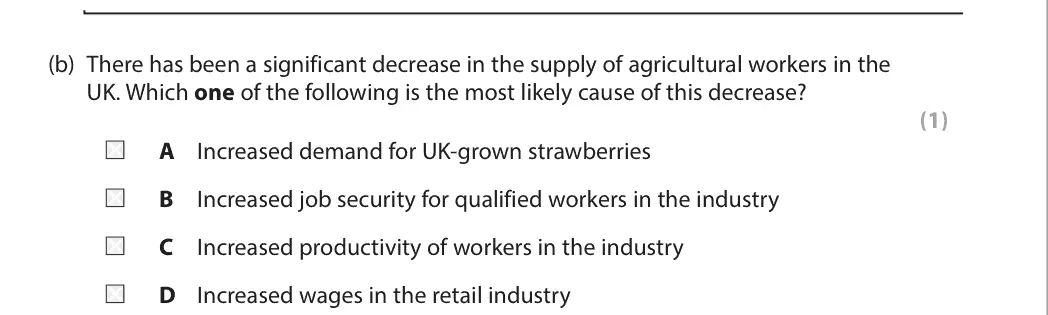
June 2025 · Paper 1 · Q5(b)1 markMultiple choice
Data and extracts for question 5
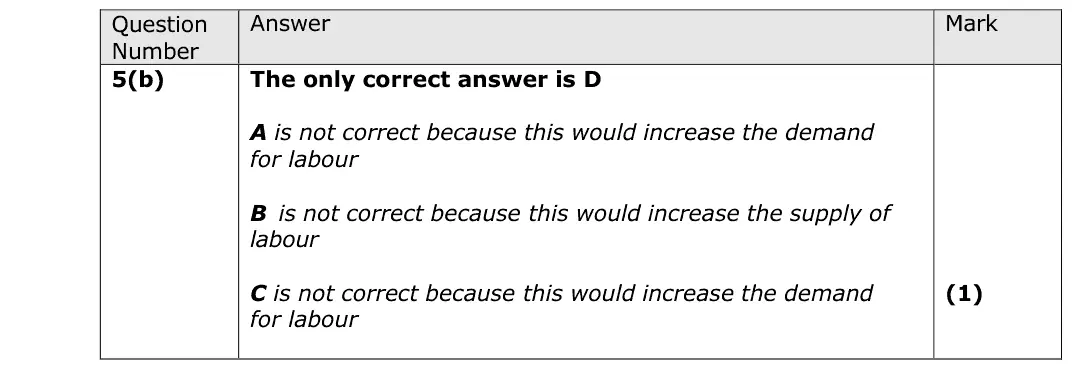
Answer
D
Mark scheme
Notes from the mark scheme and report
higher wages in retail raise the opportunity cost of farm work so supply of agricultural workers falls (D)
A and C raise demand for labour, B raises supply
June 2025 · Paper 1 · Q6(b)8 marksAO1=2, AO2=2, AO3=2, AO4=28-mark response
Data and extracts for question 6
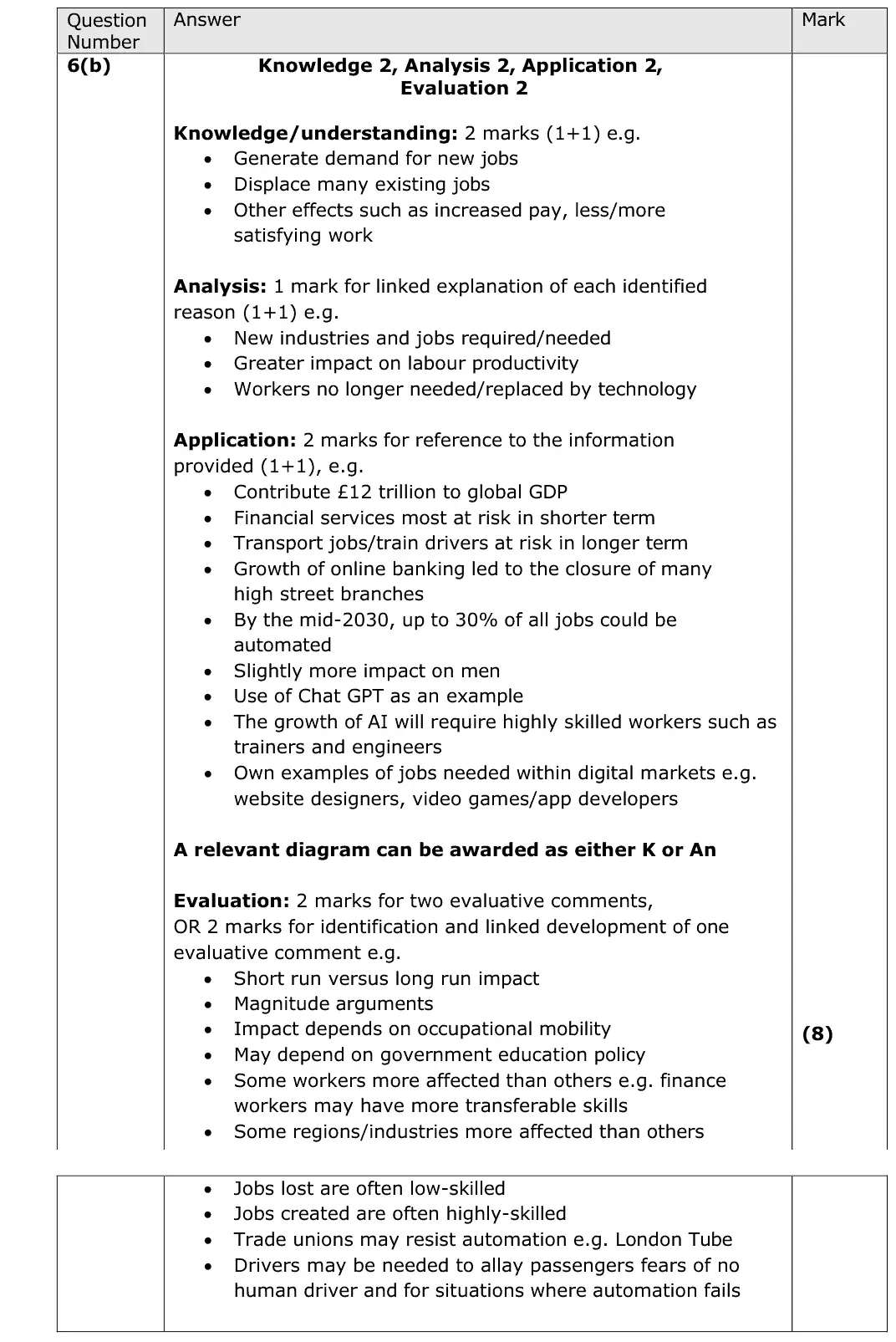
Mark scheme, including the levels grid and indicative content
Examiner's comment
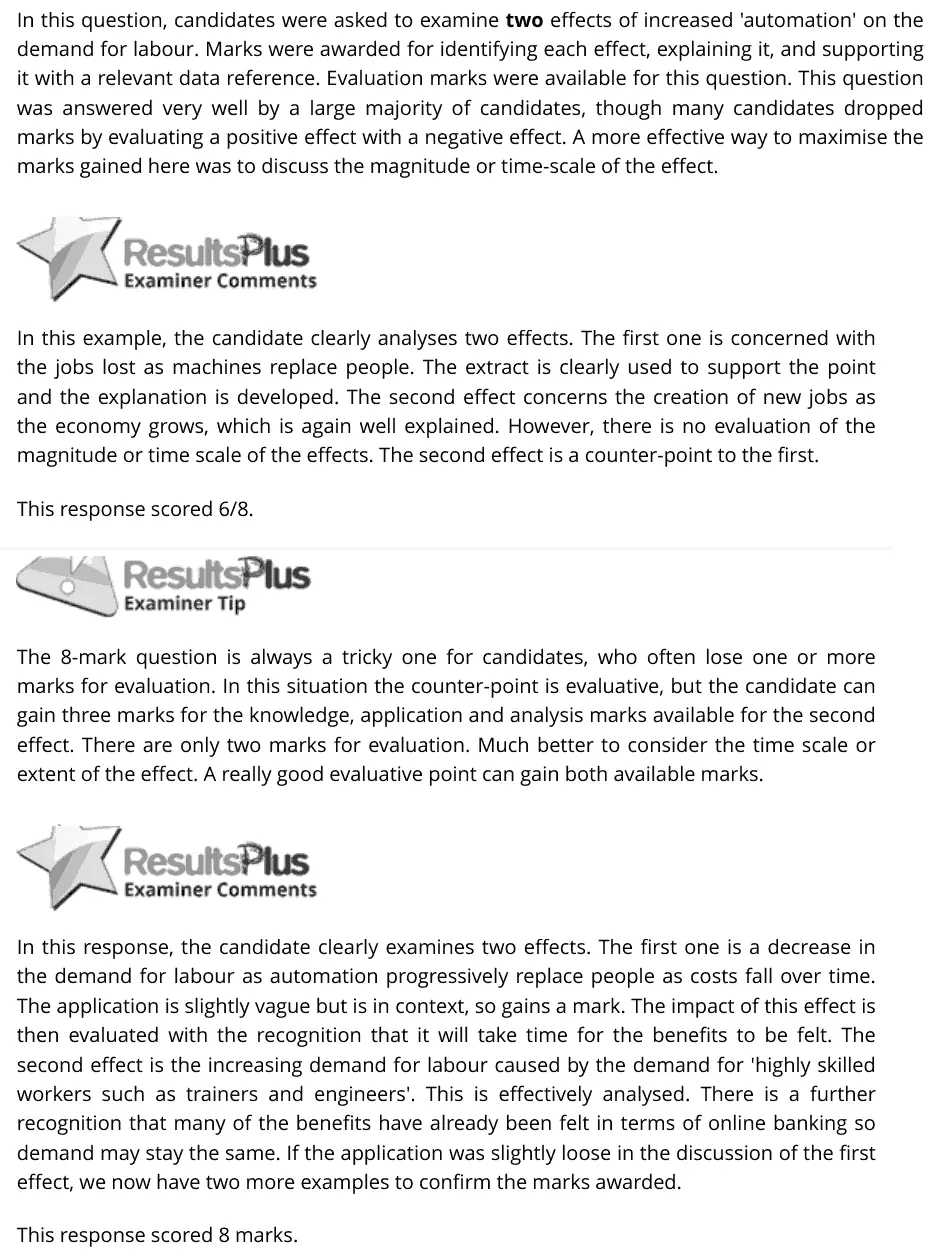
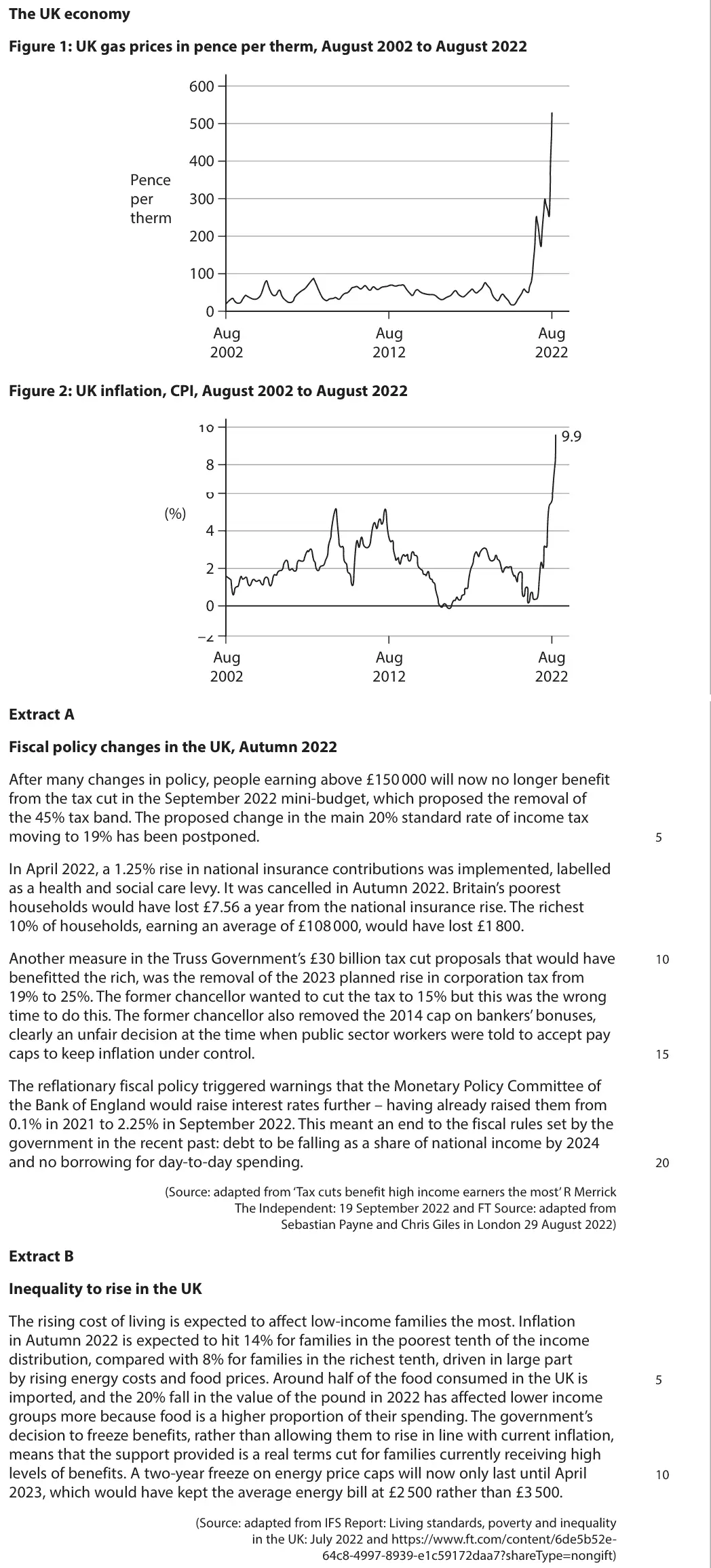
In this question, candidates were asked to examine two effects of increased 'automation' on the demand for labour. Marks were awarded for identifying each effect, explaining it, and supporting it with a relevant data reference. Evaluation marks were available for this question. This question was answered very well by a large majority of candidates, though many candidates dropped marks by evaluating a positive effect with a negative effect. A more effective way to maximise the marks gained here was to discuss the magnitude or time-scale of the effect. In this example, the candidate clearly analyses two effects. The first one is concerned with the jobs lost as machines replace people. The extract is clearly used to support the point and the explanation is developed. The second effect concerns the creation of new jobs as the economy grows, which is again well explained. However, there is no evaluation of the magnitude or time scale of the effects. The second effect is a counter-point to the first. This response scored 6/8. The 8-mark question is always a tricky one for candidates, who often lose one or more marks for evaluation. In this situation the counter-point is evaluative, but the candidate can gain three marks for the knowledge, application and analysis marks available for the second effect. There are only two marks for evaluation. Much better to consider the time scale or extent of the effect. A really good evaluative point can gain both available marks. In this response, the candidate clearly examines two effects. The first one is a decrease in the demand for labour as automation progressively replace people as costs fall over time. The application is slightly vague but is in context, so gains a mark. The impact of this effect is then evaluated with the recognition that it will take time for the benefits to be felt. The second effect is the increasing demand for labour caused by the demand for 'highly skilled workers such as trainers and engineers'. This is effectively analysed. There is a further recognition that many of the benefits have already been felt in terms of online banking so demand may stay the same. If the application was slightly loose in the discussion of the first effect, we now have two more examples to confirm the marks awarded. This response scored 8 marks.
Notes from the mark scheme and report
two effects: displacement of existing jobs (financial services, train drivers) and new demand for skilled workers (AI trainers, engineers)
evaluate with time scale or magnitude, not by setting one effect against the other
Quantitative skills: QS 9 (interpret, apply and analyse information in written, graphical tabular and numerical forms)
June 2025 · Paper 1 · Q725 marksAO1=4, AO2=4, AO3=8, AO4=925-mark essayEither/or
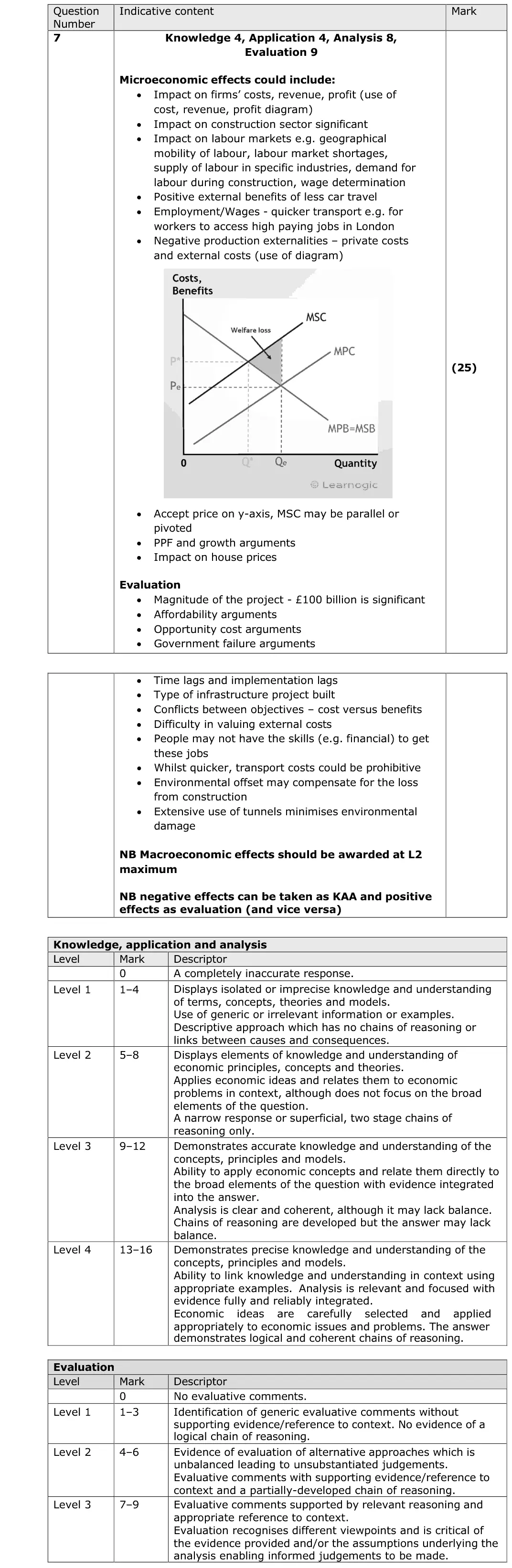
Mark scheme, including the levels grid and indicative content
Examiner's comment
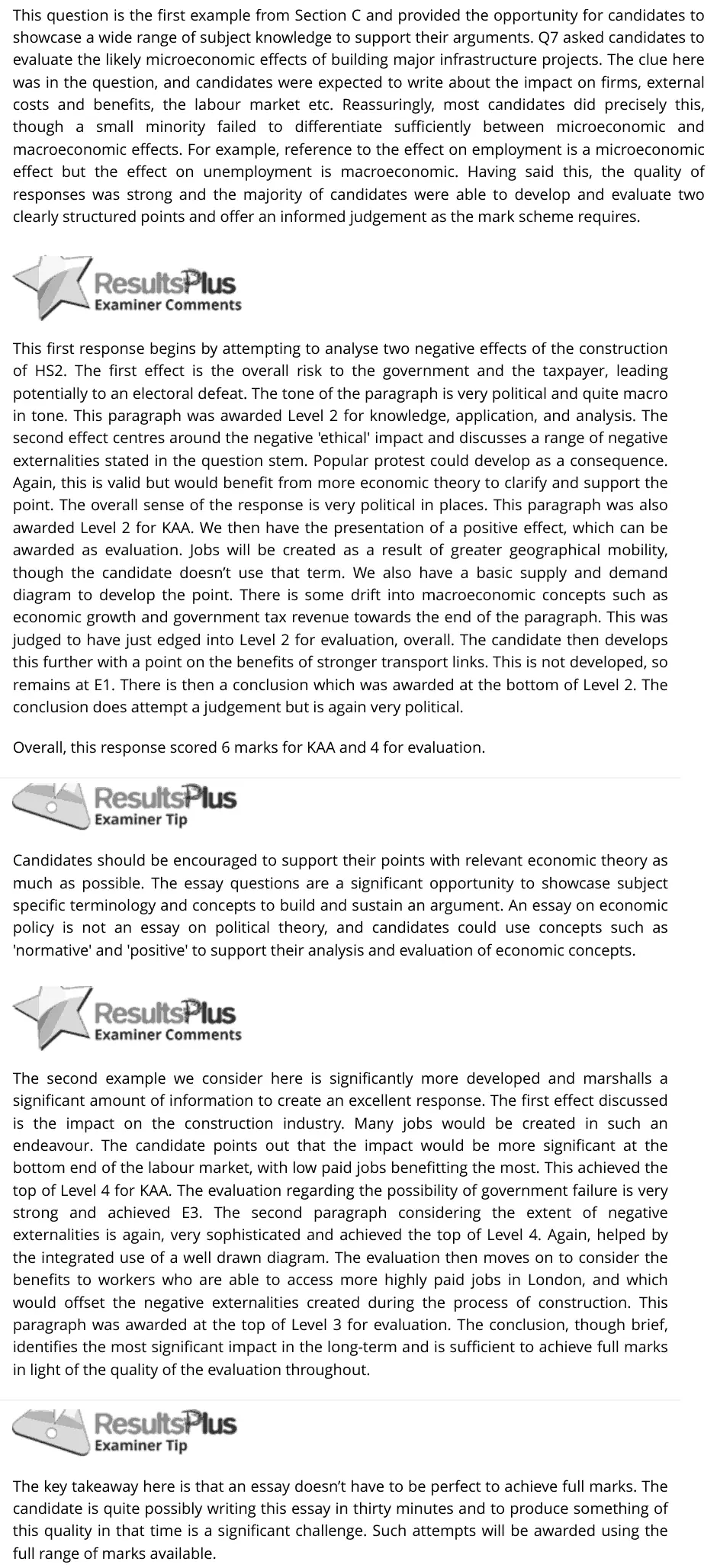
This question is the first example from Section C and provided the opportunity for candidates to showcase a wide range of subject knowledge to support their arguments. Q7 asked candidates to evaluate the likely microeconomic effects of building major infrastructure projects. The clue here was in the question, and candidates were expected to write about the impact on firms, external costs and benefits, the labour market etc. Reassuringly, most candidates did precisely this, though a small minority failed to differentiate sufficiently between microeconomic and macroeconomic effects. For example, reference to the effect on employment is a microeconomic effect but the effect on unemployment is macroeconomic. Having said this, the quality of responses was strong and the majority of candidates were able to develop and evaluate two clearly structured points and offer an informed judgement as the mark scheme requires. This first response begins by attempting to analyse two negative effects of the construction of HS2. The first effect is the overall risk to the government and the taxpayer, leading potentially to an electoral defeat. The tone of the paragraph is very political and quite macro in tone. This paragraph was awarded Level 2 for knowledge, application, and analysis. The second effect centres around the negative 'ethical' impact and discusses a range of negative externalities stated in the question stem. Popular protest could develop as a consequence. Again, this is valid but would benefit from more economic theory to clarify and support the point. The overall sense of the response is very political in places. This paragraph was also awarded Level 2 for KAA. We then have the presentation of a positive effect, which can be awarded as evaluation. Jobs will be created as a result of greater geographical mobility, though the candidate doesn’t use that term. We also have a basic supply and demand diagram to develop the point. There is some drift into macroeconomic concepts such as economic growth and government tax revenue towards the end of the paragraph. This was judged to have just edged into Level 2 for evaluation, overall. The candidate then develops this further with a point on the benefits of stronger transport links. This is not developed, so remains at E1. There is then a conclusion which was awarded at the bottom of Level 2. The conclusion does attempt a judgement but is again very political. Overall, this response scored 6 marks for KAA and 4 for evaluation. Candidates should be encouraged to support their points with relevant economic theory as much as possible. The essay questions are a significant opportunity to showcase subject specific terminology and concepts to build and sustain an argument. An essay on economic policy is not an essay on political theory, and candidates could use concepts such as 'normative' and 'positive' to support their analysis and evaluation of economic concepts. The second example we consider here is significantly more developed and marshalls a significant amount of information to create an excellent response. The first effect discussed is the impact on the construction industry. Many jobs would be created in such an endeavour. The candidate points out that the impact would be more significant at the bottom end of the labour market, with low paid jobs benefitting the most. This achieved the top of Level 4 for KAA. The evaluation regarding the possibility of government failure is very strong and achieved E3. The second paragraph considering the extent of negative externalities is again, very sophisticated and achieved the top of Level 4. Again, helped by the integrated use of a well drawn diagram. The evaluation then moves on to consider the benefits to workers who are able to access more highly paid jobs in London, and which would offset the negative externalities created during the process of construction. This paragraph was awarded at the top of Level 3 for evaluation. The conclusion, though brief, identifies the most significant impact in the long-term and is sufficient to achieve full marks in light of the quality of the evaluation throughout. The key takeaway here is that an essay doesn’t have to be perfect to achieve full marks. The candidate is quite possibly writing this essay in thirty minutes and to produce something of this quality in that time is a significant challenge. Such attempts will be awarded using the full range of marks available.
Notes from the mark scheme and report
microeconomic effects only (macro points max Level 2): costs and profits of firms, labour mobility and construction jobs, external costs (woodland, homes) and benefits (less car travel) with diagrams
employment is micro, unemployment macro
evaluate with £100 billion opportunity cost and valuing externalities
June 2025 · Paper 1 · Q825 marksAO1=4, AO2=4, AO3=8, AO4=925-mark essayEither/or
Mark scheme, including the levels grid and indicative content
Examiner's comment
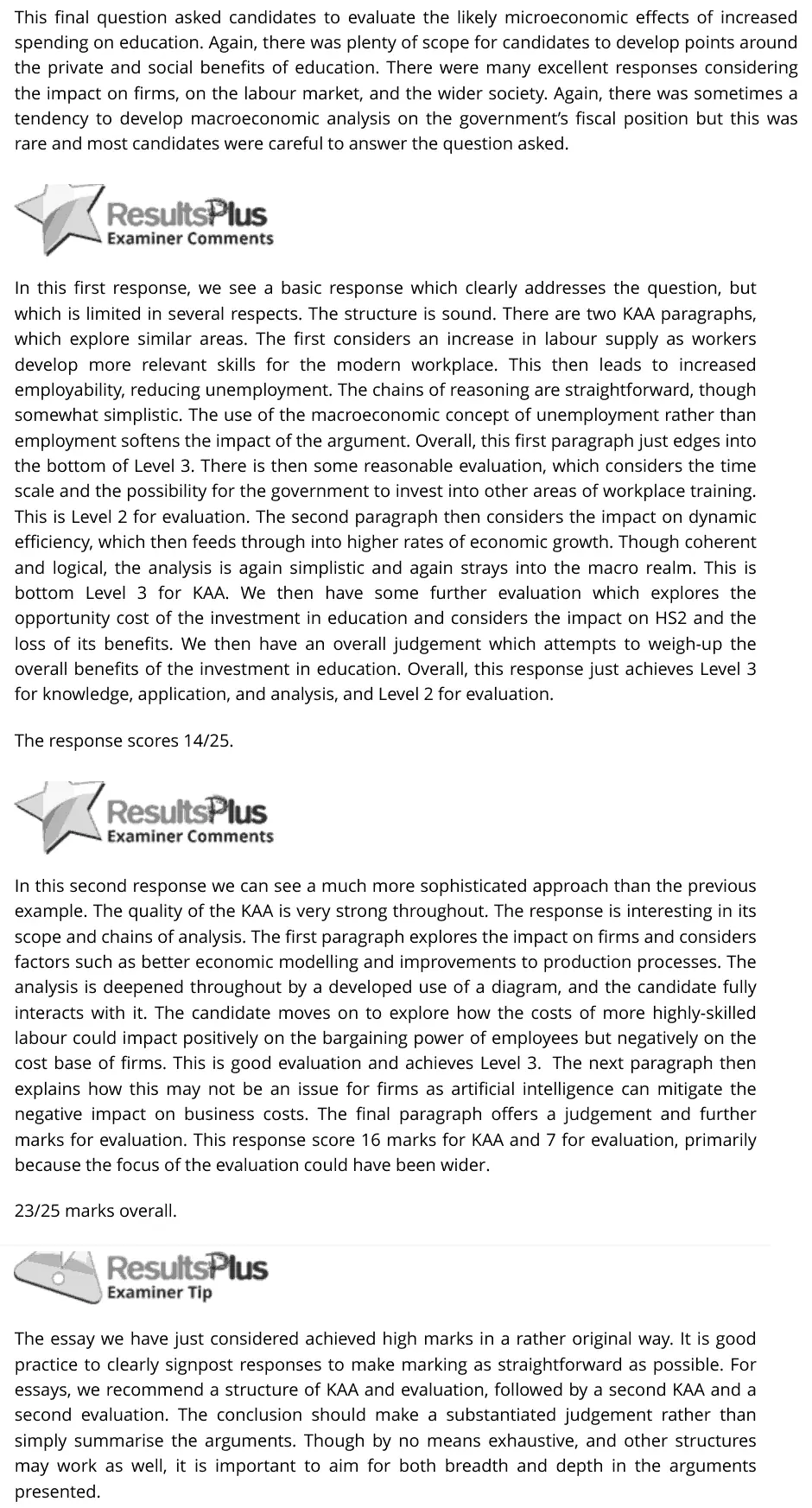
This final question asked candidates to evaluate the likely microeconomic effects of increased spending on education. Again, there was plenty of scope for candidates to develop points around the private and social benefits of education. There were many excellent responses considering the impact on firms, on the labour market, and the wider society. Again, there was sometimes a tendency to develop macroeconomic analysis on the government’s fiscal position but this was rare and most candidates were careful to answer the question asked. In this first response, we see a basic response which clearly addresses the question, but which is limited in several respects. The structure is sound. There are two KAA paragraphs, which explore similar areas. The first considers an increase in labour supply as workers develop more relevant skills for the modern workplace. This then leads to increased employability, reducing unemployment. The chains of reasoning are straightforward, though somewhat simplistic. The use of the macroeconomic concept of unemployment rather than employment softens the impact of the argument. Overall, this first paragraph just edges into the bottom of Level 3. There is then some reasonable evaluation, which considers the time scale and the possibility for the government to invest into other areas of workplace training. This is Level 2 for evaluation. The second paragraph then considers the impact on dynamic efficiency, which then feeds through into higher rates of economic growth. Though coherent and logical, the analysis is again simplistic and again strays into the macro realm. This is bottom Level 3 for KAA. We then have some further evaluation which explores the opportunity cost of the investment in education and considers the impact on HS2 and the loss of its benefits. We then have an overall judgement which attempts to weigh-up the overall benefits of the investment in education. Overall, this response just achieves Level 3 for knowledge, application, and analysis, and Level 2 for evaluation. The response scores 14/25. In this second response we can see a much more sophisticated approach than the previous example. The quality of the KAA is very strong throughout. The response is interesting in its scope and chains of analysis. The first paragraph explores the impact on firms and considers factors such as better economic modelling and improvements to production processes. The analysis is deepened throughout by a developed use of a diagram, and the candidate fully interacts with it. The candidate moves on to explore how the costs of more highly-skilled labour could impact positively on the bargaining power of employees but negatively on the cost base of firms. This is good evaluation and achieves Level 3. The next paragraph then explains how this may not be an issue for firms as artificial intelligence can mitigate the negative impact on business costs. The final paragraph offers a judgement and further marks for evaluation. This response score 16 marks for KAA and 7 for evaluation, primarily because the focus of the evaluation could have been wider. 23/25 marks overall. The essay we have just considered achieved high marks in a rather original way. It is good practice to clearly signpost responses to make marking as straightforward as possible. For essays, we recommend a structure of KAA and evaluation, followed by a second KAA and a second evaluation. The conclusion should make a substantiated judgement rather than simply summarise the arguments. Though by no means exhaustive, and other structures may work as well, it is important to aim for both breadth and depth in the arguments presented.
Notes from the mark scheme and report
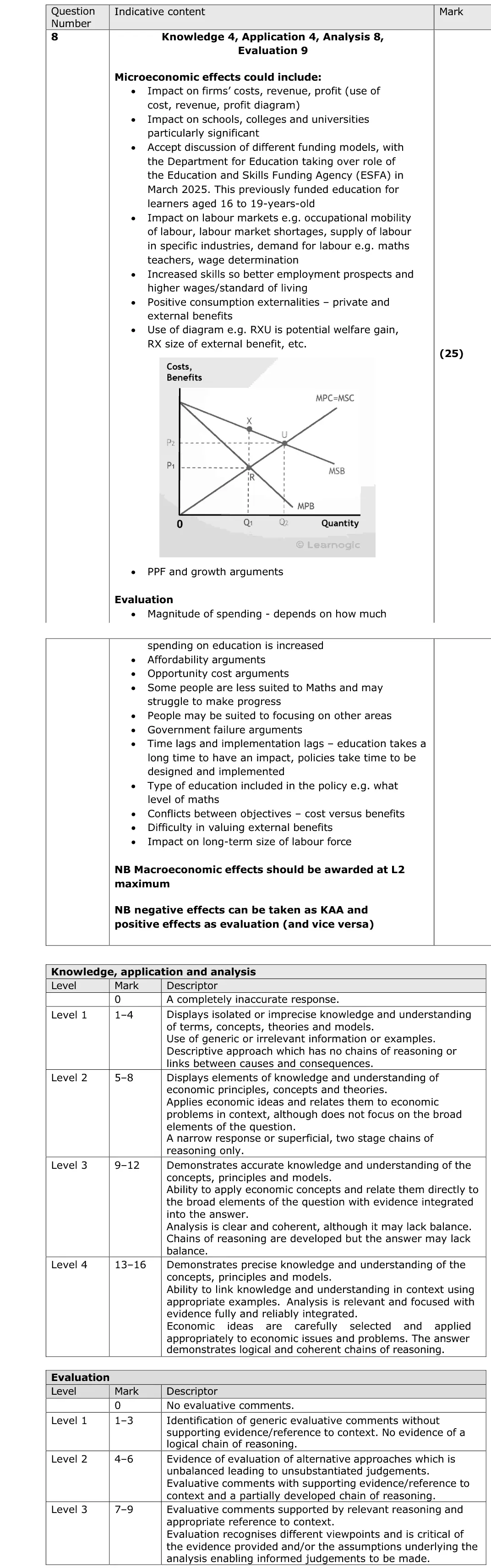
microeconomic effects only: education has external benefits in consumption (welfare gain diagram), raises occupational mobility, labour supply and wages, demand for maths teachers
avoid macro analysis of the fiscal position
evaluate with time lags, opportunity cost, suitability of maths for all
June 2025 · Paper 3 · Q1(b)8 marksAO1=2, AO2=2, AO3=2, AO4=28-mark response
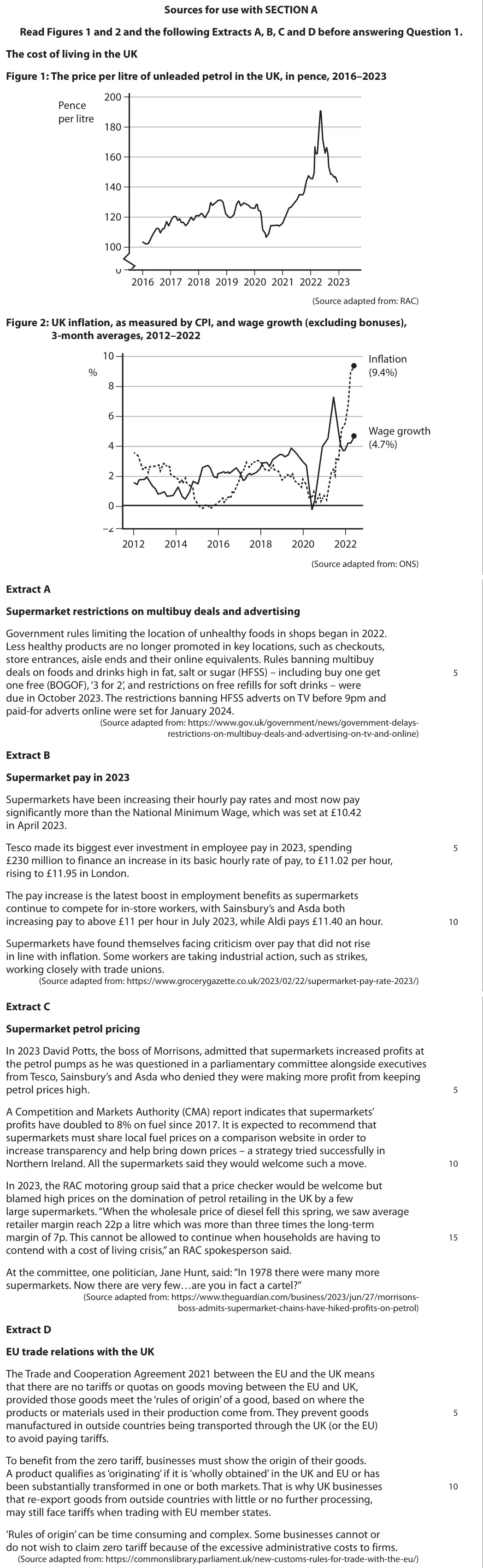
Data and extracts for question 1
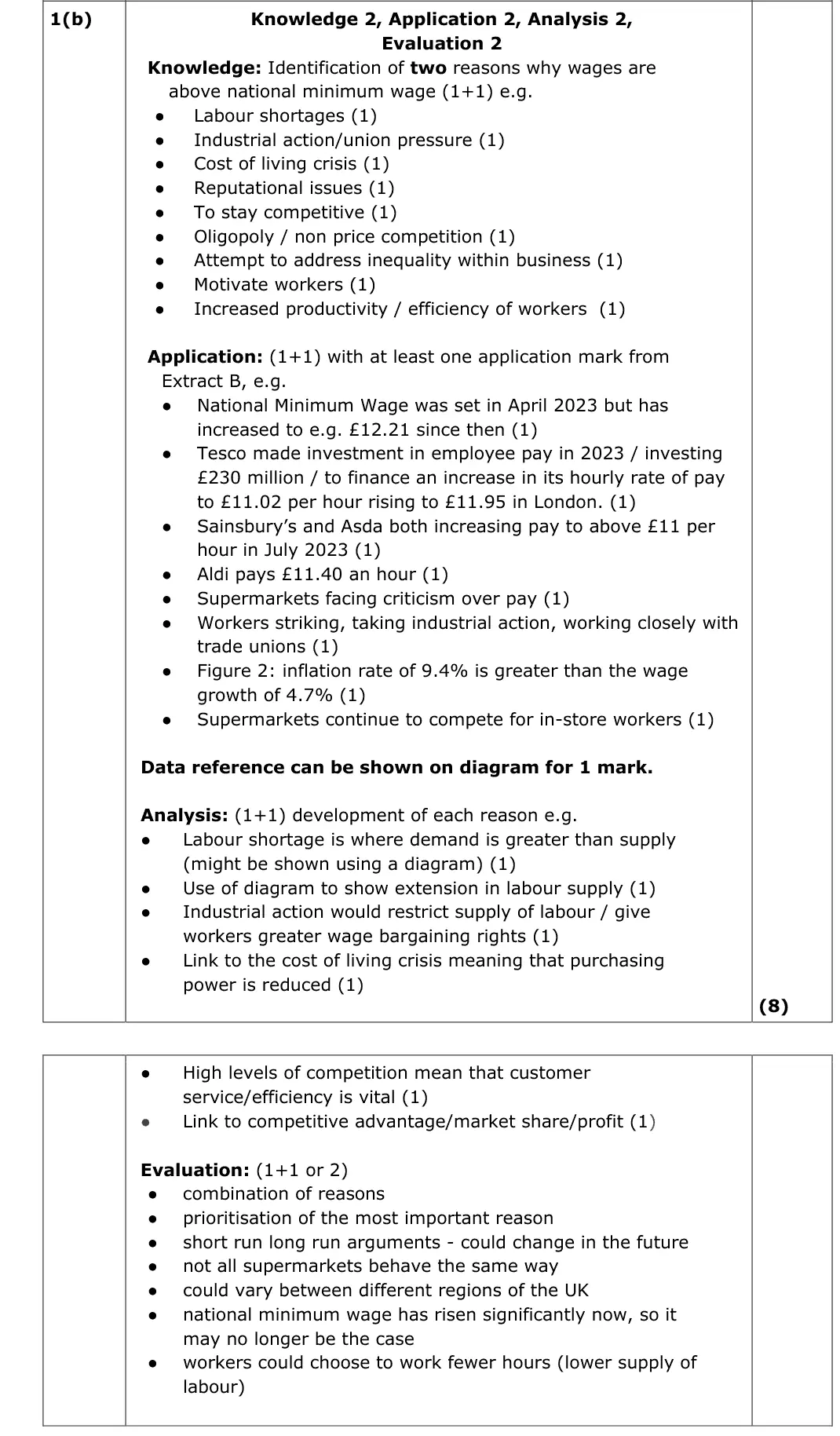
Mark scheme, including the levels grid and indicative content
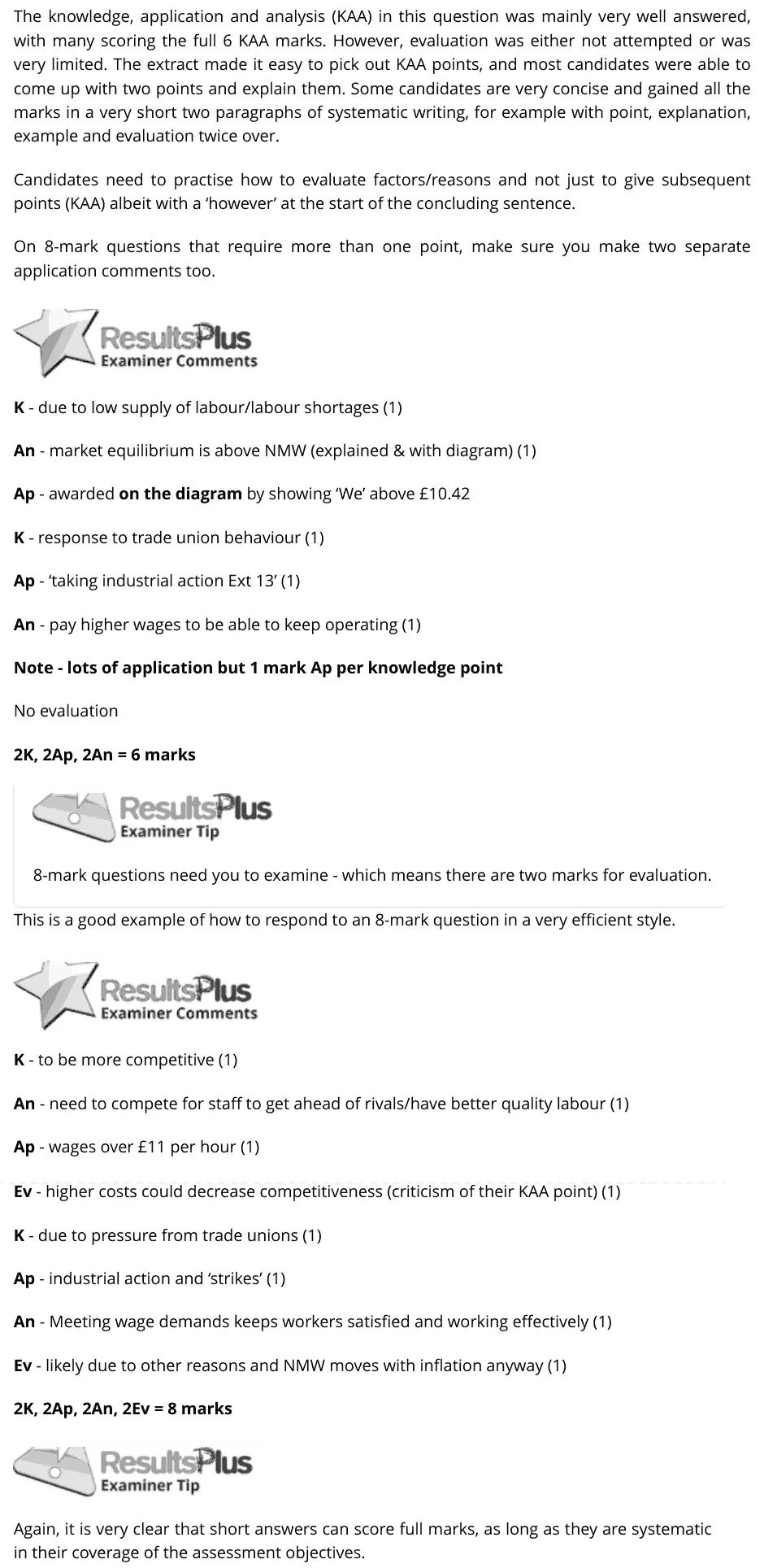
Examiner's comment
The knowledge, application and analysis (KAA) in this question was mainly very well answered, with many scoring the full 6 KAA marks. However, evaluation was either not attempted or was very limited. The extract made it easy to pick out KAA points, and most candidates were able to come up with two points and explain them. Some candidates are very concise and gained all the marks in a very short two paragraphs of systematic writing, for example with point, explanation, example and evaluation twice over. Candidates need to practise how to evaluate factors/reasons and not just to give subsequent points (KAA) albeit with a ‘however’ at the start of the concluding sentence. On 8-mark questions that require more than one point, make sure you make two separate application comments too. K - due to low supply of labour/labour shortages (1) An - market equilibrium is above NMW (explained & with diagram) (1) Ap - awarded on the diagram by showing ‘We’ above £10.42 K - response to trade union behaviour (1) Ap - ‘taking industrial action Ext 13’ (1) An - pay higher wages to be able to keep operating (1) Note - lots of application but 1 mark Ap per knowledge point No evaluation 2K, 2Ap, 2An = 6 marks 8-mark questions need you to examine - which means there are two marks for evaluation. This is a good example of how to respond to an 8-mark question in a very efficient style. K - to be more competitive (1) An - need to compete for staff to get ahead of rivals/have better quality labour (1) Ap - wages over £11 per hour (1) Ev - higher costs could decrease competitiveness (criticism of their KAA point) (1) K - due to pressure from trade unions (1) Ap - industrial action and ‘strikes’ (1) An - Meeting wage demands keeps workers satisfied and working effectively (1) Ev - likely due to other reasons and NMW moves with inflation anyway (1) 2K, 2Ap, 2An, 2Ev = 8 marks Again, it is very clear that short answers can score full marks, as long as they are systematic in their coverage of the assessment objectives.
Notes from the mark scheme and report
two reasons (labour shortages, union pressure/industrial action, cost of living crisis, competition for workers in an oligopoly) each with its own Extract B application (Tesco £11.02, Aldi £11.40)
labour market diagram can show W above £10.42
evaluation often missing
Quantitative skills: QS 9 (interpret, apply and analyse information in written, graphical tabular and numerical forms)
June 2025 · Paper 3 · Q2(d)25 marksAO1=4, AO2=4, AO3=8, AO4=925-mark essayEither/or
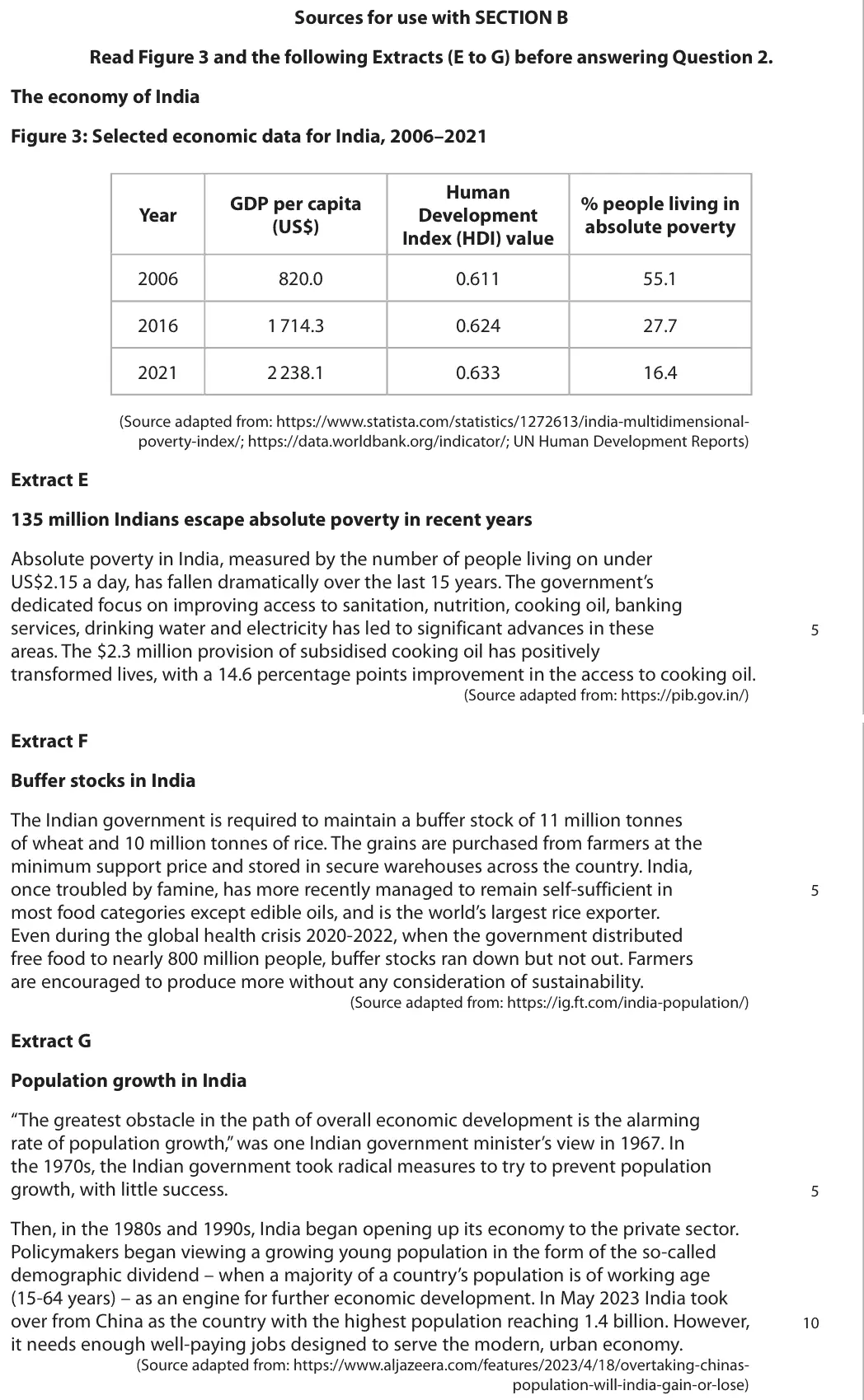
Data and extracts for question 2
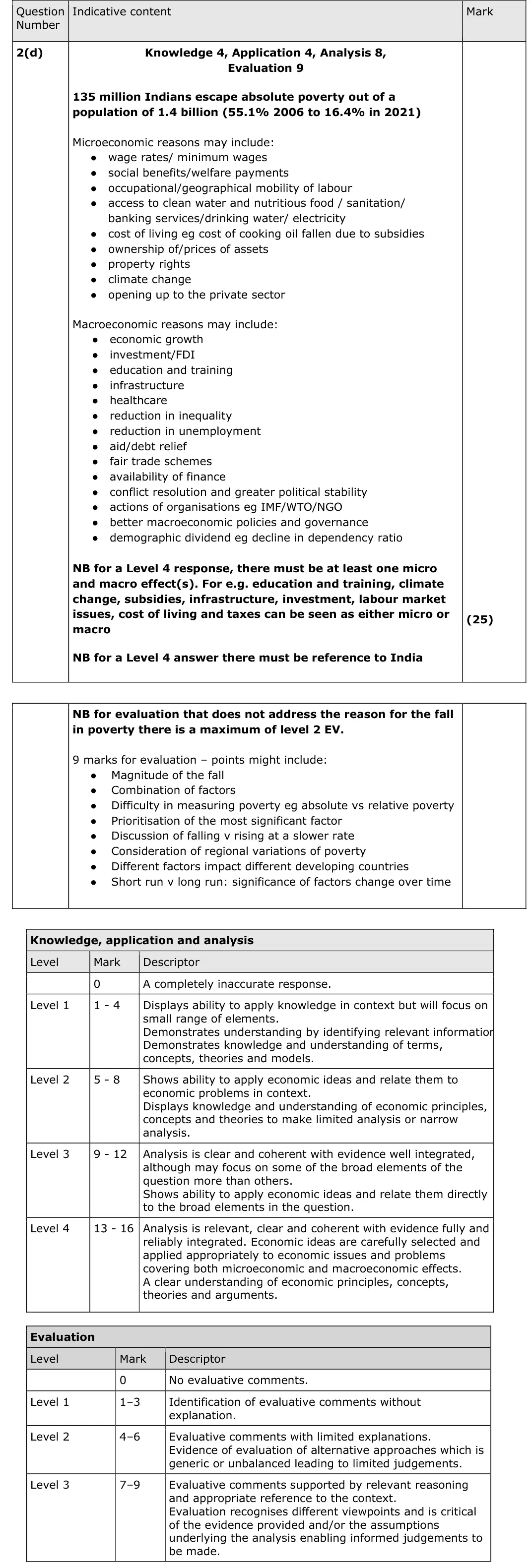
Mark scheme, including the levels grid and indicative content
Examiner's comment
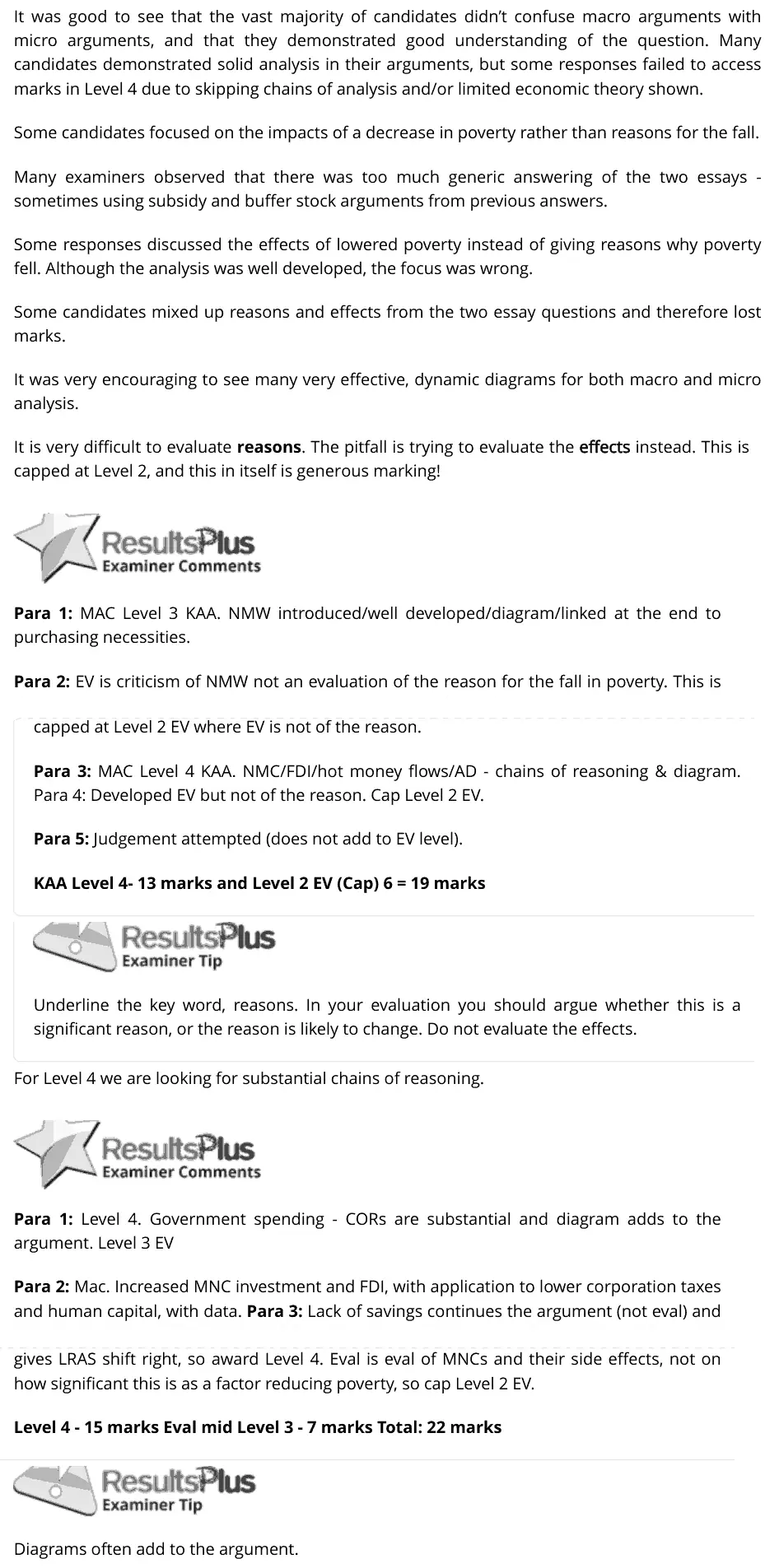
It was good to see that the vast majority of candidates didn’t confuse macro arguments with micro arguments, and that they demonstrated good understanding of the question. Many candidates demonstrated solid analysis in their arguments, but some responses failed to access marks in Level 4 due to skipping chains of analysis and/or limited economic theory shown. Some candidates focused on the impacts of a decrease in poverty rather than reasons for the fall. Many examiners observed that there was too much generic answering of the two essays - sometimes using subsidy and buffer stock arguments from previous answers. Some responses discussed the effects of lowered poverty instead of giving reasons why poverty fell. Although the analysis was well developed, the focus was wrong. Some candidates mixed up reasons and effects from the two essay questions and therefore lost marks. It was very encouraging to see many very effective, dynamic diagrams for both macro and micro analysis. It is very difficult to evaluate reasons. The pitfall is trying to evaluate the effects instead. This is capped at Level 2, and this in itself is generous marking! Para 1: MAC Level 3 KAA. NMW introduced/well developed/diagram/linked at the end to purchasing necessities. Para 2: EV is criticism of NMW not an evaluation of the reason for the fall in poverty. This is capped at Level 2 EV where EV is not of the reason. Para 3: MAC Level 4 KAA. NMC/FDI/hot money flows/AD - chains of reasoning & diagram. Para 4: Developed EV but not of the reason. Cap Level 2 EV. Para 5: Judgement attempted (does not add to EV level). KAA Level 4- 13 marks and Level 2 EV (Cap) 6 = 19 marks Underline the key word, reasons. In your evaluation you should argue whether this is a significant reason, or the reason is likely to change. Do not evaluate the effects. For Level 4 we are looking for substantial chains of reasoning. Para 1: Level 4. Government spending - CORs are substantial and diagram adds to the argument. Level 3 EV Para 2: Mac. Increased MNC investment and FDI, with application to lower corporation taxes and human capital, with data. Para 3: Lack of savings continues the argument (not eval) and gives LRAS shift right, so award Level 4. Eval is eval of MNCs and their side effects, not on how significant this is as a factor reducing poverty, so cap Level 2 EV. Level 4 - 15 marks Eval mid Level 3 - 7 marks Total: 22 marks Diagrams often add to the argument.
Notes from the mark scheme and report
reasons for the fall in poverty (55.1% to 16.4%), not its effects
micro: wages/minimum wage, mobility, access to water, food and banking
macro: growth, FDI, education, infrastructure
Level 4 needs a micro and a macro reason and reference to India
Quantitative skills: QS 9 (interpret, apply and analyse information in written, graphical tabular and numerical forms)
June 2025 · Paper 3 · Q2(e)25 marksAO1=4, AO2=4, AO3=8, AO4=925-mark essayEither/or
Data and extracts for question 2
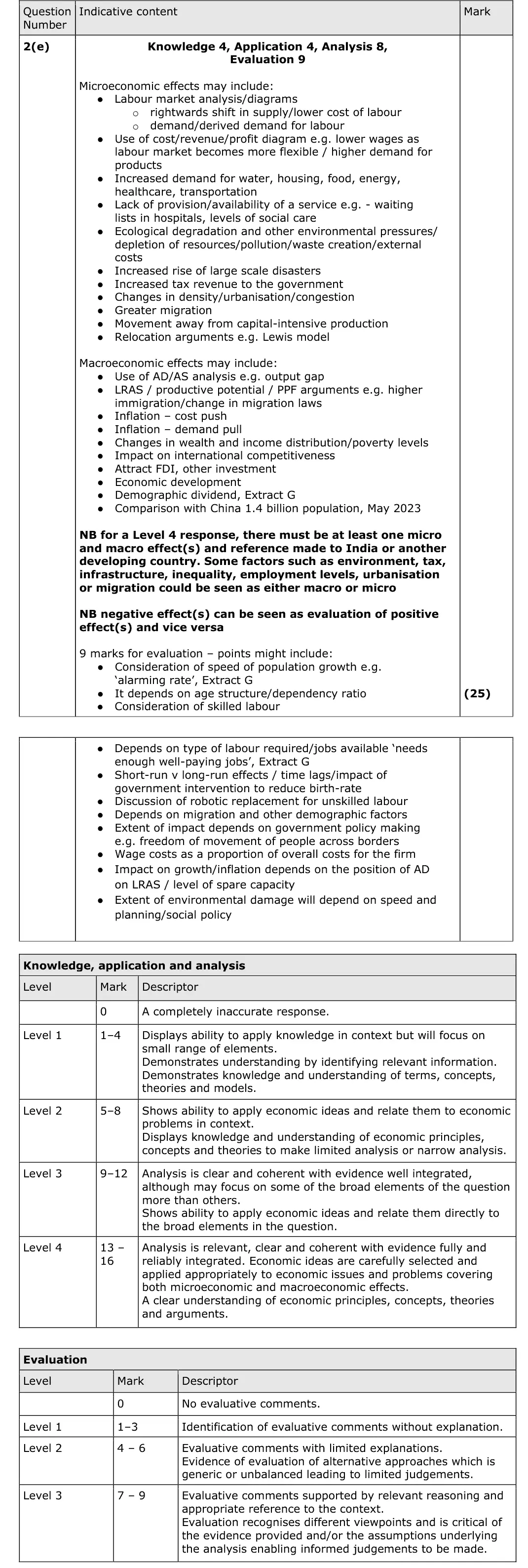
Mark scheme, including the levels grid and indicative content
Examiner's comment
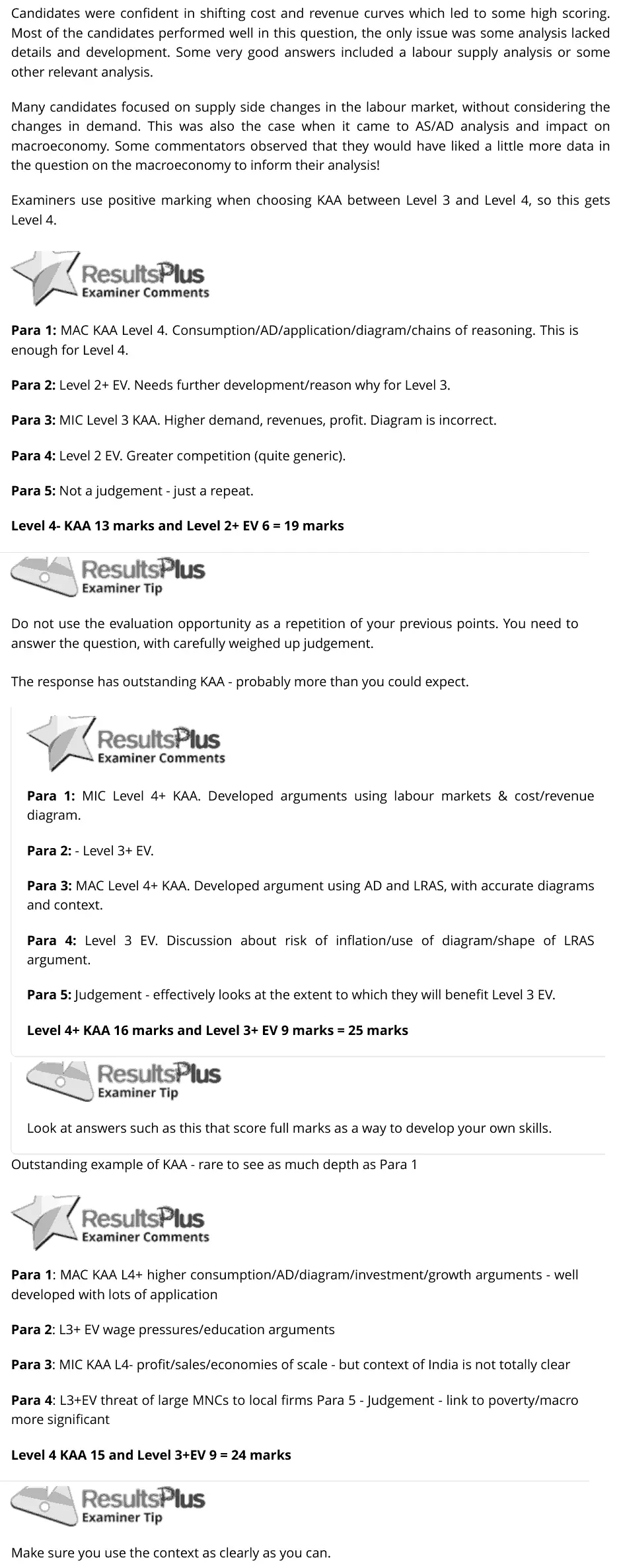
Candidates were confident in shifting cost and revenue curves which led to some high scoring. Most of the candidates performed well in this question, the only issue was some analysis lacked details and development. Some very good answers included a labour supply analysis or some other relevant analysis. Many candidates focused on supply side changes in the labour market, without considering the changes in demand. This was also the case when it came to AS/AD analysis and impact on macroeconomy. Some commentators observed that they would have liked a little more data in the question on the macroeconomy to inform their analysis! Examiners use positive marking when choosing KAA between Level 3 and Level 4, so this gets Level 4. Para 1: MAC KAA Level 4. Consumption/AD/application/diagram/chains of reasoning. This is enough for Level 4. Para 2: Level 2+ EV. Needs further development/reason why for Level 3. Para 3: MIC Level 3 KAA. Higher demand, revenues, profit. Diagram is incorrect. Para 4: Level 2 EV. Greater competition (quite generic). Para 5: Not a judgement - just a repeat. Level 4- KAA 13 marks and Level 2+ EV 6 = 19 marks Do not use the evaluation opportunity as a repetition of your previous points. You need to answer the question, with carefully weighed up judgement. The response has outstanding KAA - probably more than you could expect. Para 1: MIC Level 4+ KAA. Developed arguments using labour markets & cost/revenue diagram. Para 2: - Level 3+ EV. Para 3: MAC Level 4+ KAA. Developed argument using AD and LRAS, with accurate diagrams and context. Para 4: Level 3 EV. Discussion about risk of inflation/use of diagram/shape of LRAS argument. Para 5: Judgement - effectively looks at the extent to which they will benefit Level 3 EV. Level 4+ KAA 16 marks and Level 3+ EV 9 marks = 25 marks Look at answers such as this that score full marks as a way to develop your own skills. Outstanding example of KAA - rare to see as much depth as Para 1 Para 1: MAC KAA L4+ higher consumption/AD/diagram/investment/growth arguments - well developed with lots of application Para 2: L3+ EV wage pressures/education arguments Para 3: MIC KAA L4- profit/sales/economies of scale - but context of India is not totally clear Para 4: L3+EV threat of large MNCs to local firms Para 5 - Judgement - link to poverty/macro more significant Level 4 KAA 15 and Level 3+EV 9 = 24 marks Make sure you use the context as clearly as you can.
Notes from the mark scheme and report
micro: labour supply shifts right, lower wages, higher product demand and revenues
macro: demographic dividend, AD and LRAS, unemployment, pressure on public services
consider demand as well as supply
Level 4 needs a micro and a macro effect for India
June 2024 · Paper 1 · Q6(b)8 marksAO1=2, AO2=2, AO3=2, AO4=28-mark response
Data and extracts for question 6
Mark scheme, including the levels grid and indicative content
Examiner's comment
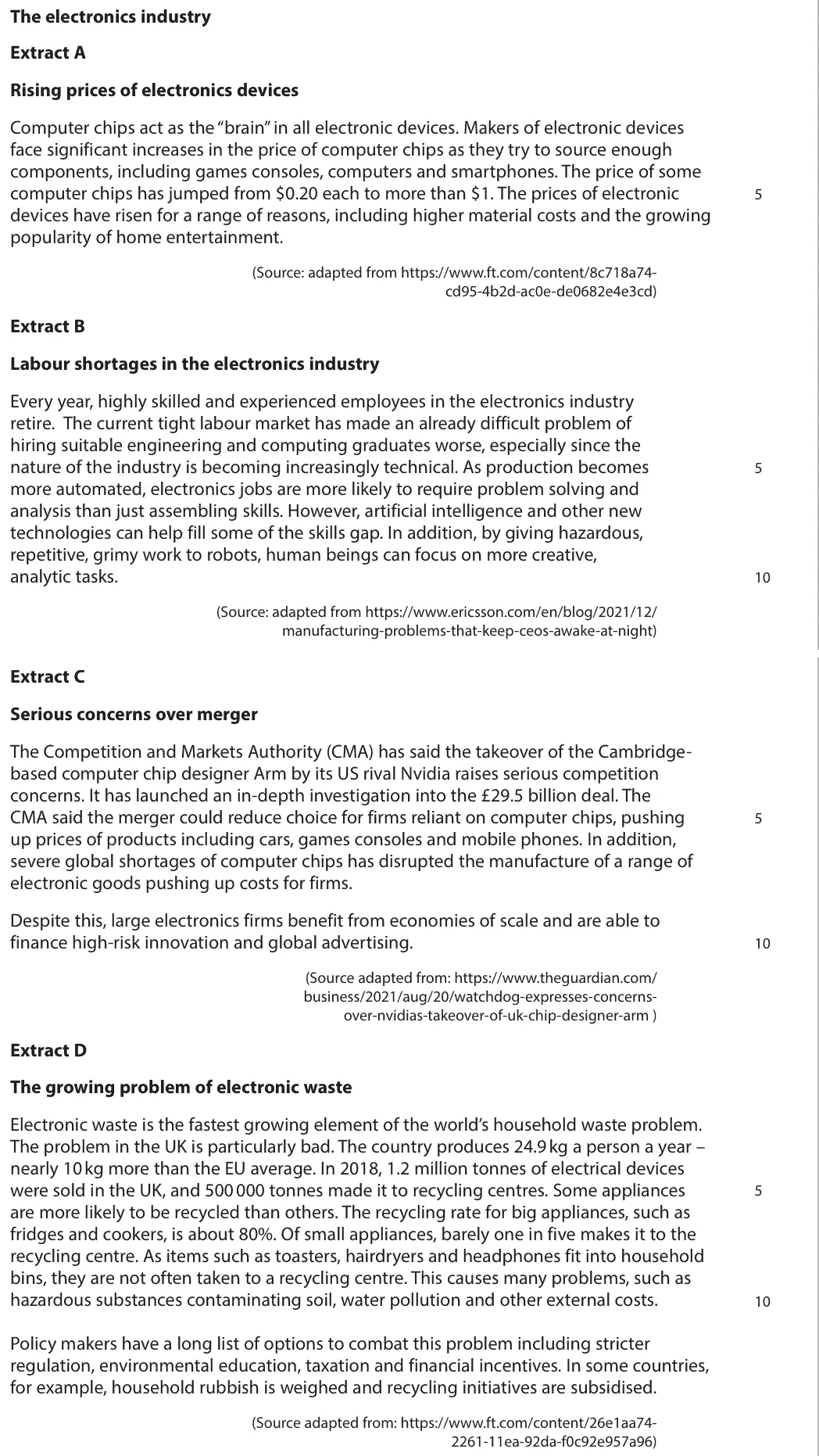
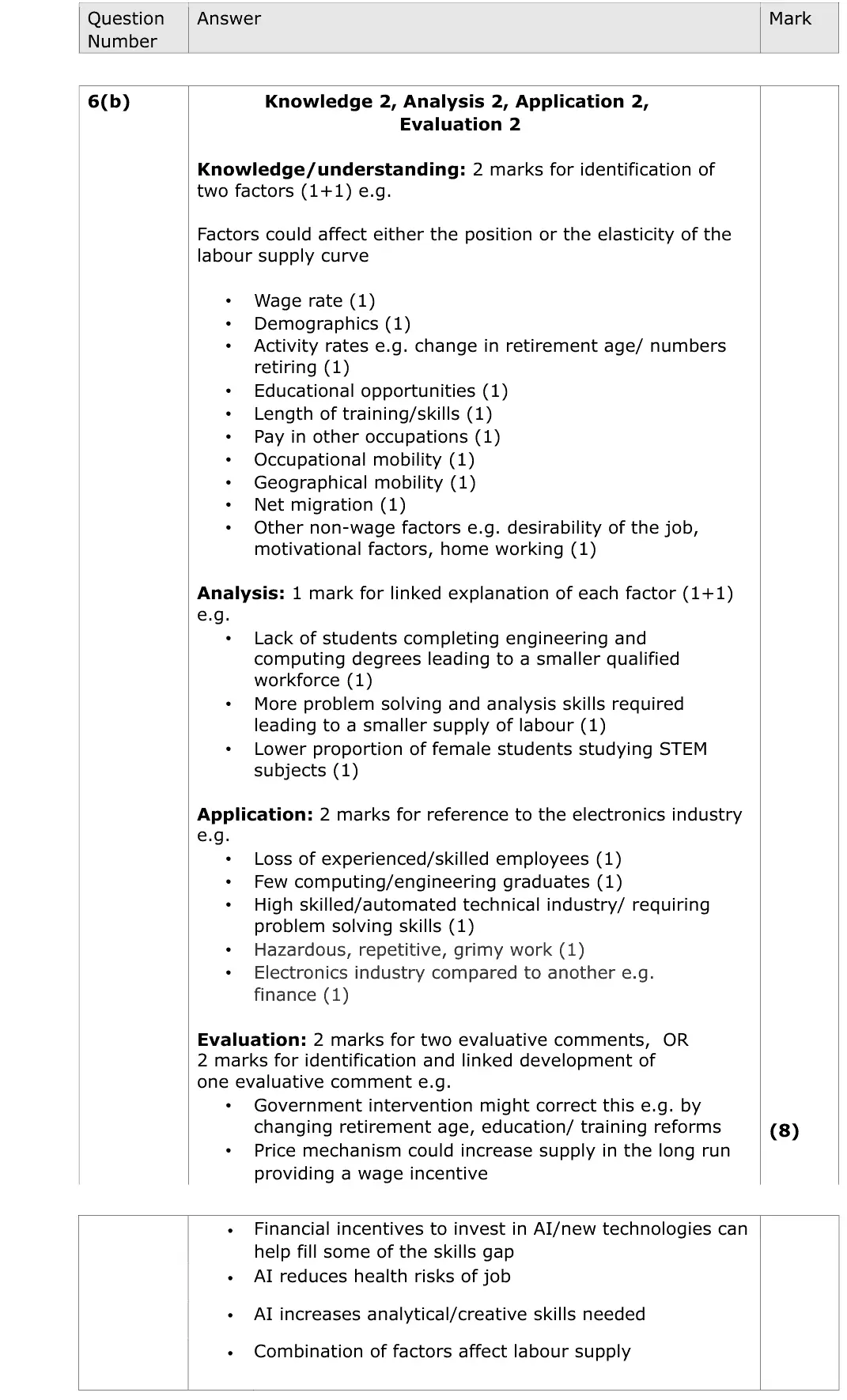
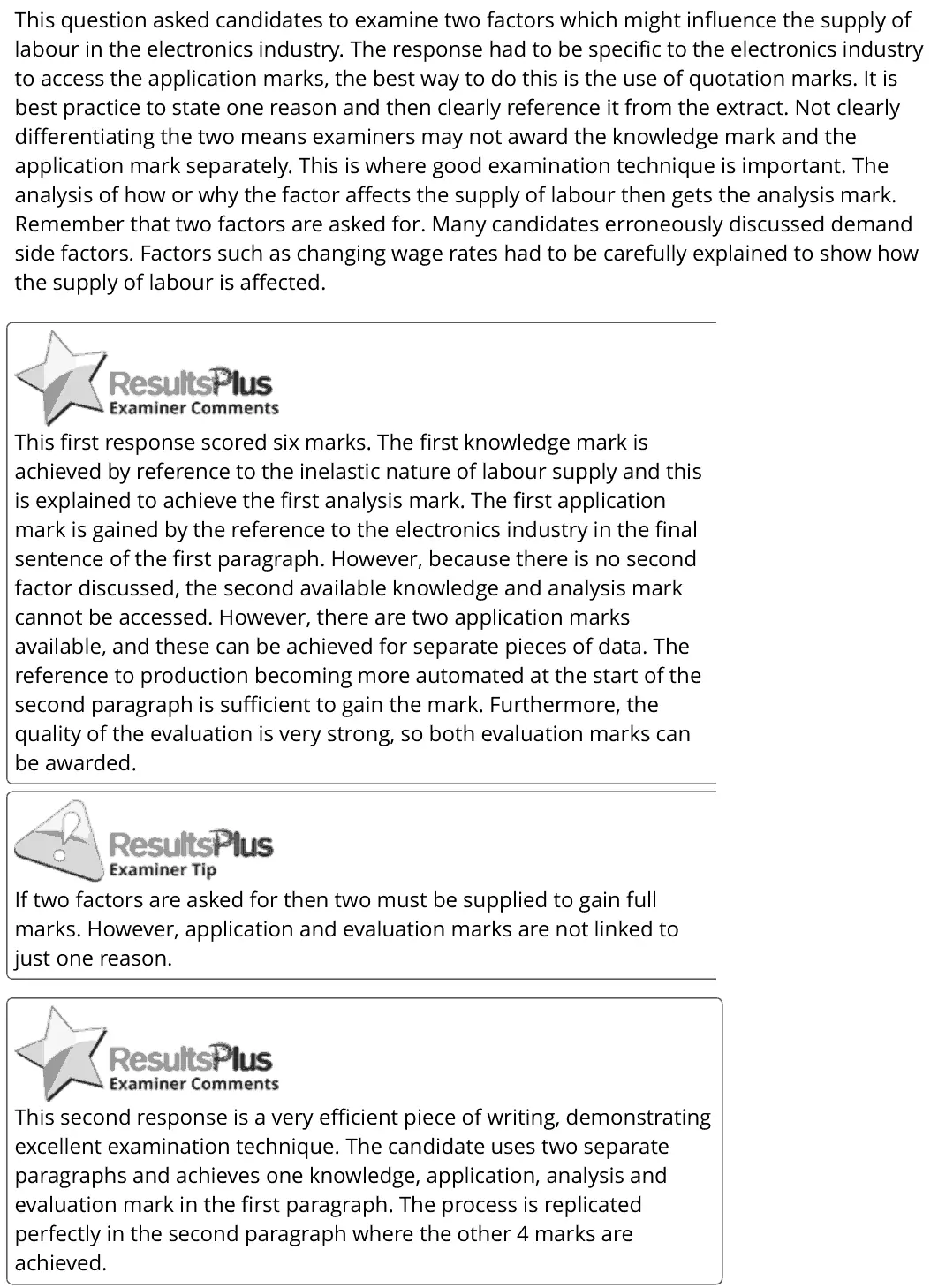
This question asked candidates to examine two factors which might influence the supply of labour in the electronics industry. The response had to be specific to the electronics industry to access the application marks, the best way to do this is the use of quotation marks. It is best practice to state one reason and then clearly reference it from the extract. Not clearly differentiating the two means examiners may not award the knowledge mark and the application mark separately. This is where good examination technique is important. The analysis of how or why the factor affects the supply of labour then gets the analysis mark. Remember that two factors are asked for. Many candidates erroneously discussed demand side factors. Factors such as changing wage rates had to be carefully explained to show how the supply of labour is affected. This first response scored six marks. The first knowledge mark is achieved by reference to the inelastic nature of labour supply and this is explained to achieve the first analysis mark. The first application mark is gained by the reference to the electronics industry in the final sentence of the first paragraph. However, because there is no second factor discussed, the second available knowledge and analysis mark cannot be accessed. However, there are two application marks available, and these can be achieved for separate pieces of data. The reference to production becoming more automated at the start of the second paragraph is sufficient to gain the mark. Furthermore, the quality of the evaluation is very strong, so both evaluation marks can be awarded. If two factors are asked for then two must be supplied to gain full marks. However, application and evaluation marks are not linked to just one reason. This second response is a very efficient piece of writing, demonstrating excellent examination technique. The candidate uses two separate paragraphs and achieves one knowledge, application, analysis and evaluation mark in the first paragraph. The process is replicated perfectly in the second paragraph where the other 4 marks are achieved.
Notes from the mark scheme and report
two factors, clearly separated, each linked to the electronics industry (quote Extract B) and evaluated
demand-side factors do not answer the question
Quantitative skills: QS 9 (interpret, apply and analyse information in written, graphical tabular and numerical forms)
June 2024 · Paper 3 · Q1(d)25 marksAO1=4, AO2=4, AO3=8, AO4=925-mark essayEither/or
Data and extracts for question 1
Mark scheme, including the levels grid and indicative content
Examiner's comment
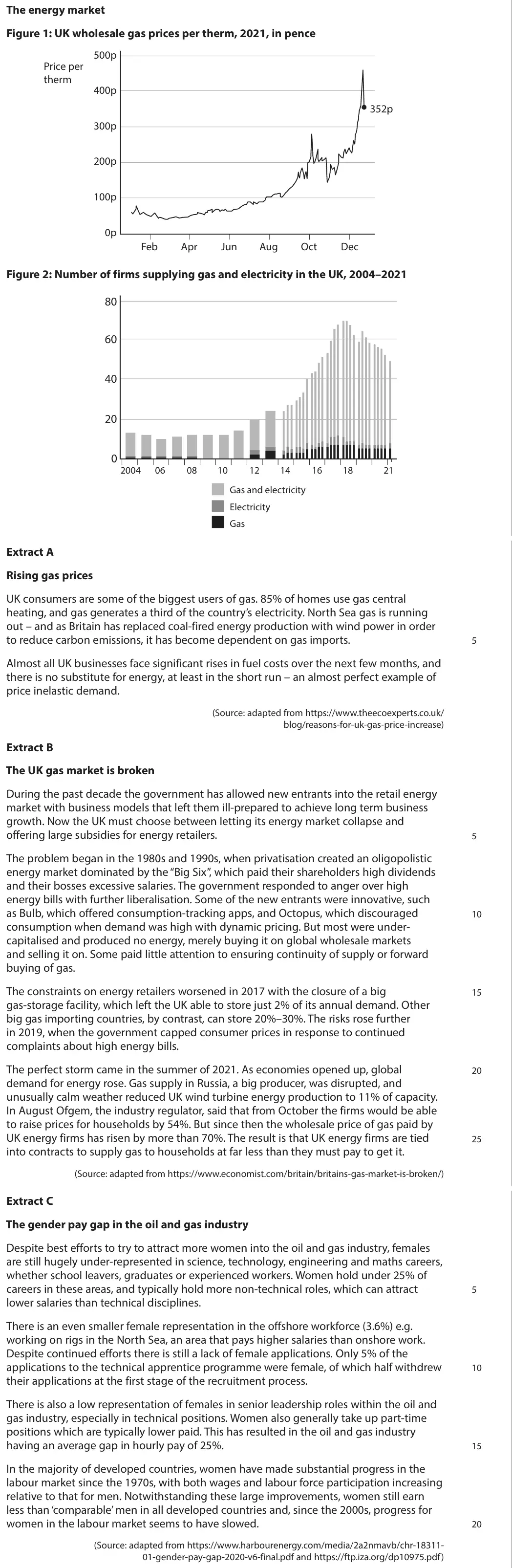
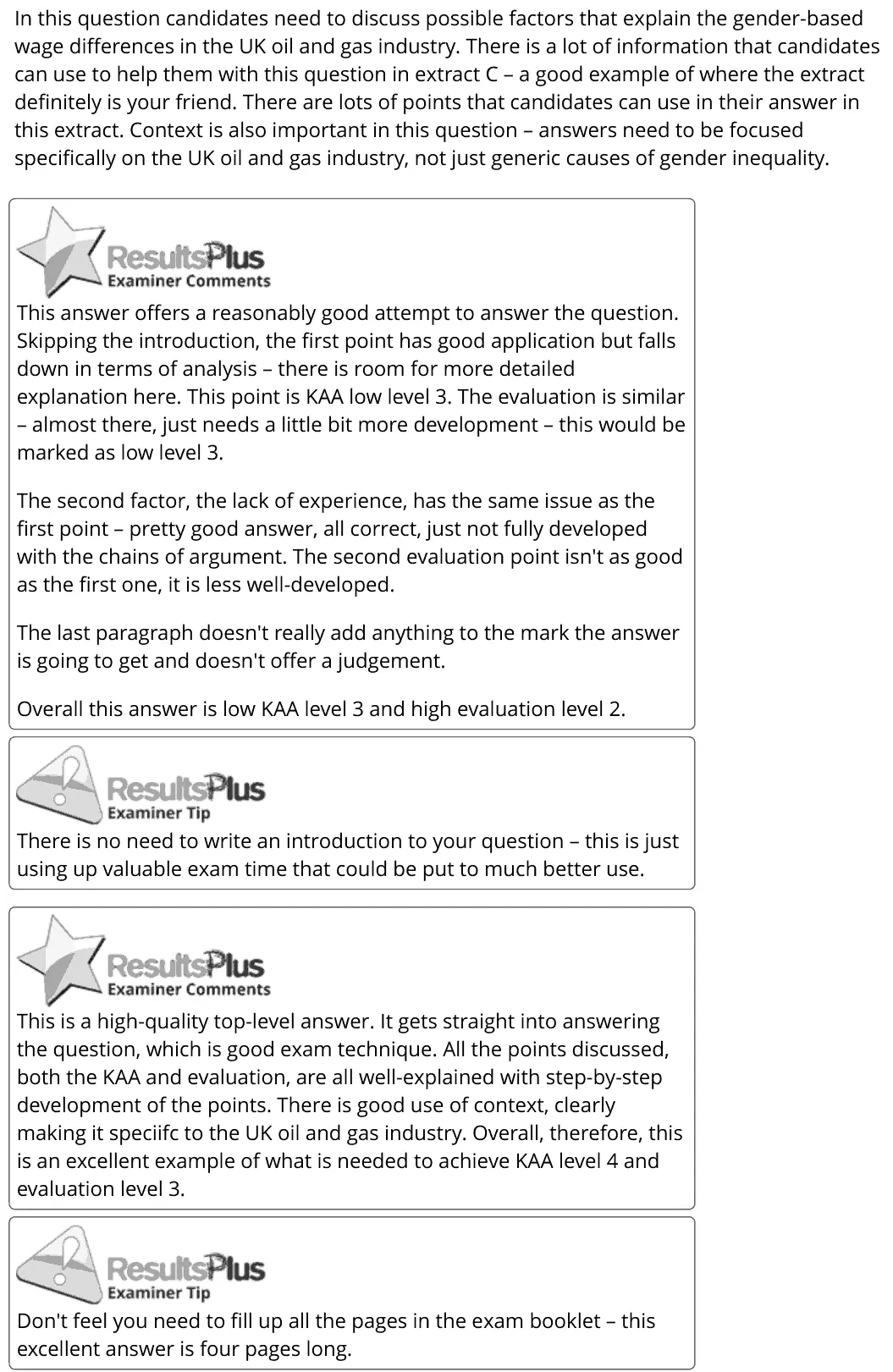
In this question candidates need to discuss possible factors that explain the gender-based wage differences in the UK oil and gas industry. There is a lot of information that candidates can use to help them with this question in extract C - a good example of where the extract definitely is your friend. There are lots of points that candidates can use in their answer in this extract. Context is also important in this question - answers need to be focused specifically on the UK oil and gas industry, not just generic causes of gender inequality. This answer offers a reasonably good attempt to answer the question. Skipping the introduction, the first point has good application but falls down in terms of analysis - there is room for more detailed explanation here. This point is KAA low level 3. The evaluation is similar - almost there, just needsa little bit more development - this would be marked as low level 3. The second factor, the lack of experience, has the same issue as the first point - pretty good answer, all correct, just not fully developed with the chains of argument. The second evaluation point isn't as good as the first one, it is less well-developed. The last paragraph doesn't really add anything to the mark the answer is going to get and doesn't offer a judgement. Overall this answer is low KAA level 3 and high evaluation level 2. GM ResultsPius —~_) Examiner Tip There is no need to write an introduction to your question - this is just using up valuable exam time that could be put to much better use. <p BesultsPtus This is a high-quality top-level answer. It gets straight into answering the question, which is good exam technique. All the points discussed, both the KAA and evaluation, are all well-explained with step-by-step development ofthe points. There is good use of context, clearly making it speciifc to the UK oil and gas industry. Overall, therefore, this is an excellent example of what is needed to achieve KAA level 4 and evaluation level 3. GF ResultsPlus ~~) Examiner Tip Don't feel you need to fill up all the pages in the exam booklet - this excellent answer is four pages long.
Notes from the mark scheme and report
micro: discrimination, stereotyping, skills and STEM training, part-time work, career breaks, elasticity of labour supply
macro: underfunded education, childcare, tax and benefit system, technology
Level 4 needs both micro and macro and use of Extract C data on oil and gas
generic gender pay gap answers stay low
no introduction needed
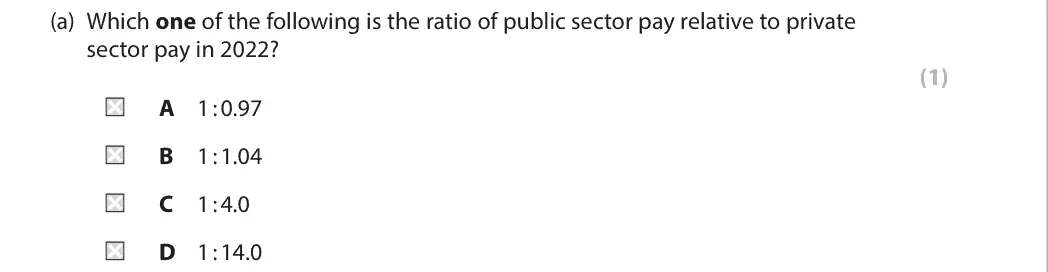
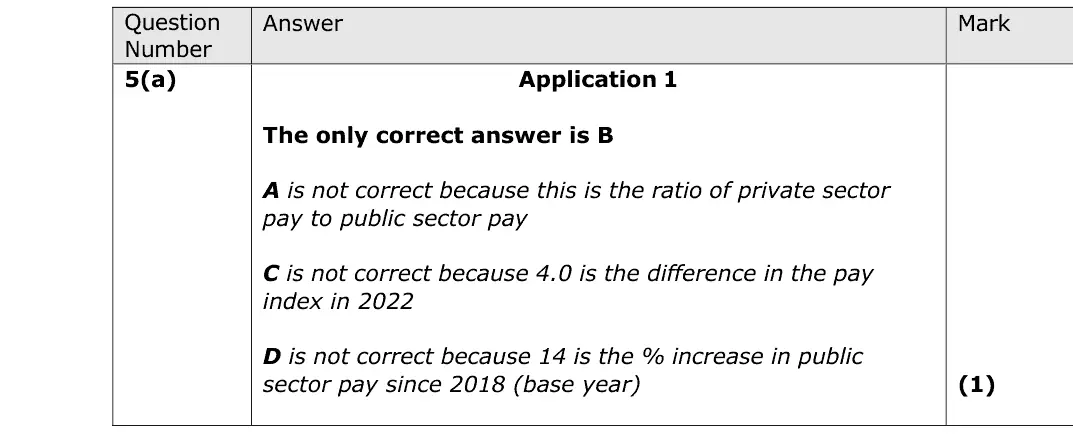
June 2023 · Paper 1 · Q5(a)1 markAO2=1Multiple choice
Data and extracts for question 5
Answer
B
Mark scheme
Notes from the mark scheme and report
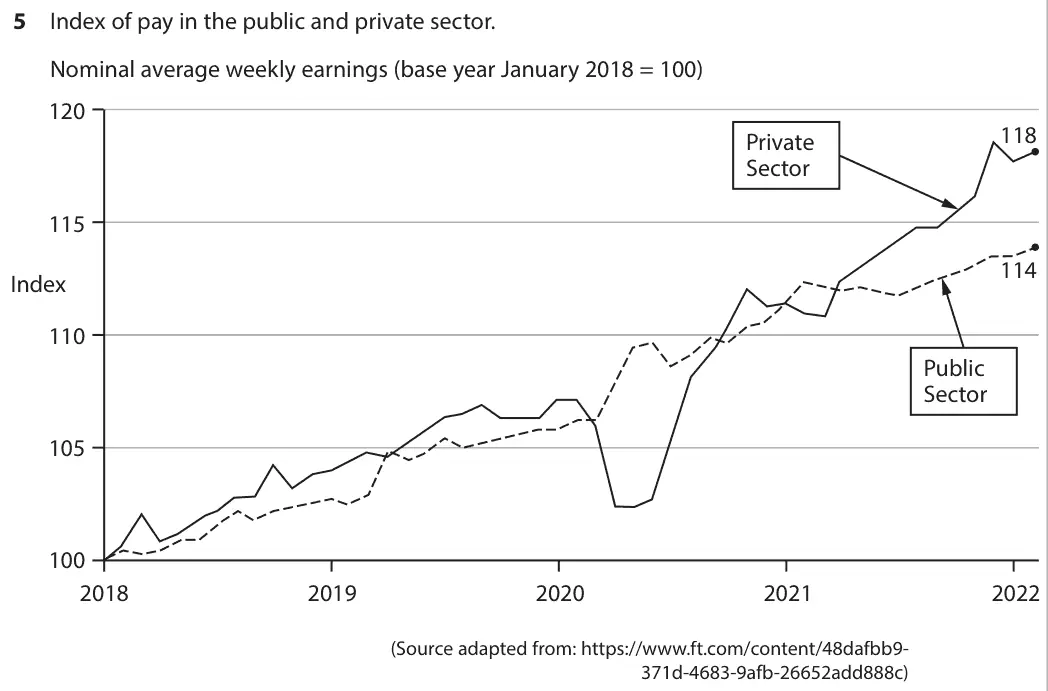
public 114 : private 118 = 1 : 1.04 (B)
A is private relative to public
C is the 4-point gap in the index
D is the 14% rise in public pay since 2018
Quantitative skills: QS 1 (calculate, use and understand ratios and fractions); QS 5 (calculate and interpret index numbers); QS 9 (interpret, apply and analyse information in written, graphical tabular and numerical forms)
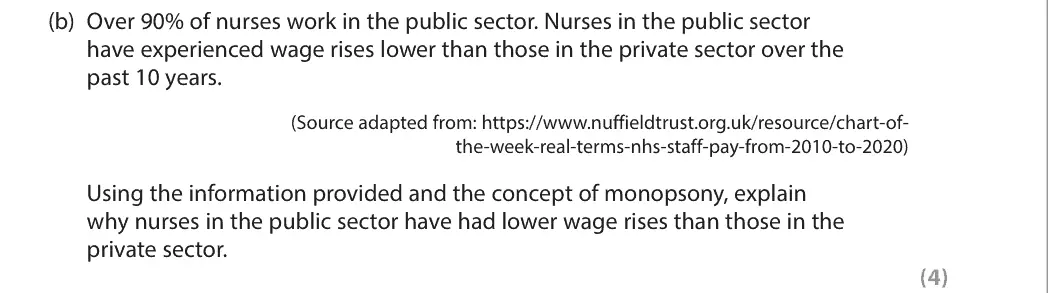
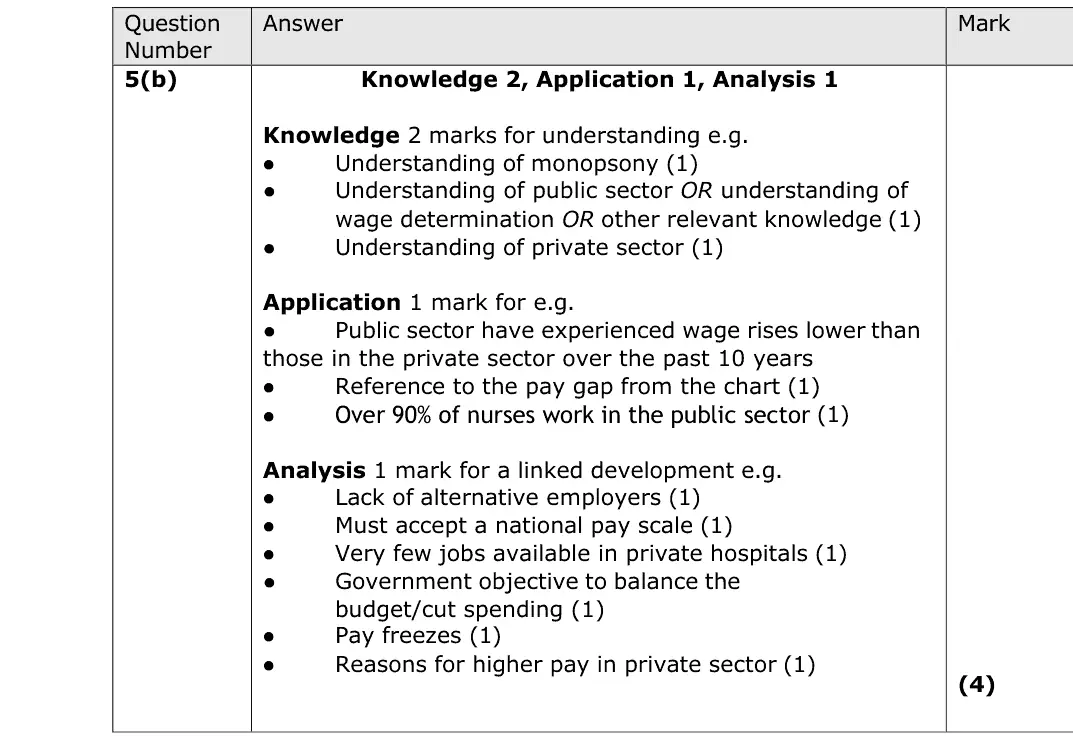
June 2023 · Paper 1 · Q5(b)4 marksAO1=2, AO2=1, AO3=1Short answer
Data and extracts for question 5
Mark scheme
Examiner's comment
This question on monopsony turned out to be very topical, with the whole issue of public sector wage setting headlining in the news during the spring and summer of 2023. Many candidates did well on this question, though a minority scored full marks. To score the knowledge marks candidates had to have a sense of the public or private sectors of the economy. Another knowledge mark could be achieved by recognising the process of wage determination or an understanding of monopsony. The analysis mark required an explanation of why public sector pay lagged behind that of the private sector. Finally, the application mark was achieved by either using the stem or the chart above 5(a). This response achieved full marks for the understanding of monopsony and of the private sector, then the application mark for 90% of nurses working in the NHS. The analysis mark was awarded for the explanation of 'nowhere else to work'. Again, candidates are strongly encouraged to use the stem or other supporting material to gain any available application marks. In this example there was just the one mark for application. This example shows no application of the data. The candidate scores the knowledge marks for the understanding of monopsony and a second knowledge mark for the understanding of the private sector health care. The analysis mark is achieved through the explanation of very few alternative employers.
Notes from the mark scheme and report
the state is a near-monopsony employer of nurses (over 90% in the public sector) with few alternative employers, so it can hold down pay (national pay scales, pay freezes, budget constraints)
use the stem or the pay index for application
Quantitative skills: QS 9 (interpret, apply and analyse information in written, graphical tabular and numerical forms)
June 2023 · Paper 3 · Q1(d)25 marksAO1=4, AO2=4, AO3=8, AO4=925-mark essayEither/or
Data and extracts for question 1
Mark scheme, including the levels grid and indicative content
Examiner's comment
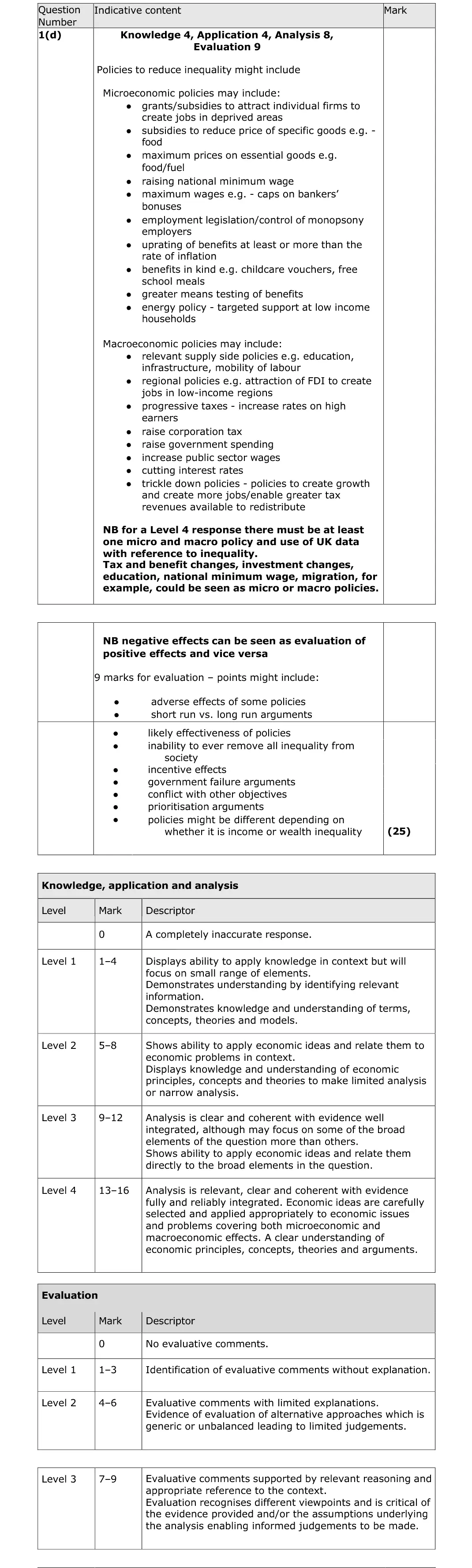
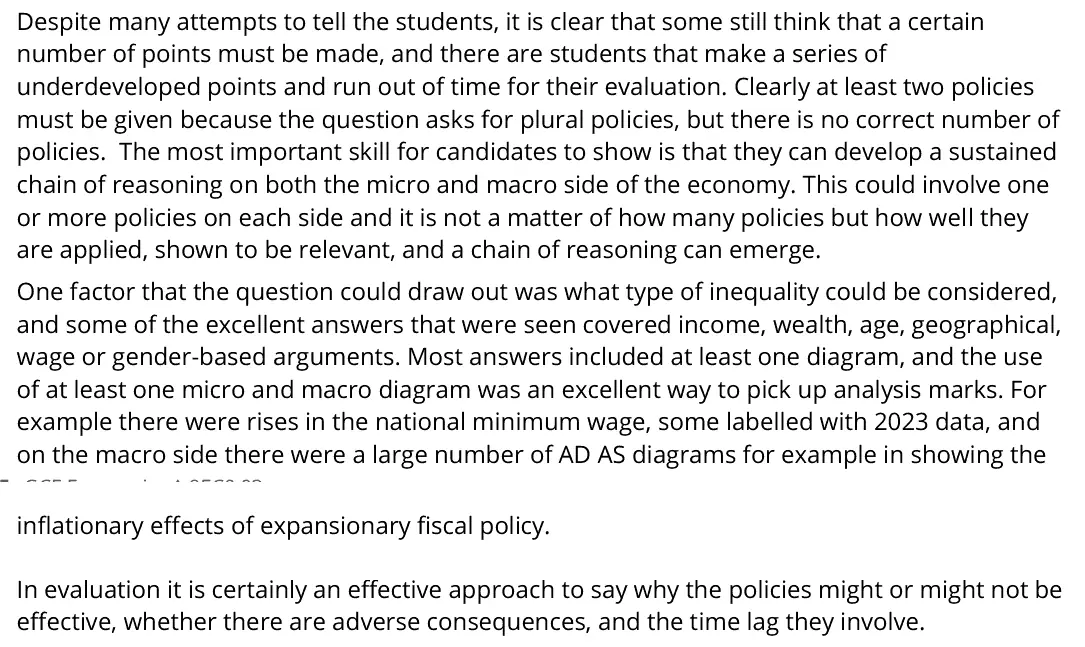
Despite many attempts to tell the students, it is clear that some still think that a certain number of points must be made, and there are students that make a series of underdeveloped points and run out of time for their evaluation. Clearly at least two policies must be given because the question asks for plural policies, but there is no correct number of policies. The most important skill for candidates to show is that they can develop a sustained chain of reasoning on both the micro and macro side of the economy. This could involve one or more policies on each side and it is not a matter of how many policies but how well they are applied, shown to be relevant, and a chain of reasoning can emerge. One factor that the question could draw out was what type of inequality could be considered, and some of the excellent answers that were seen covered income, wealth, age, geographical, wage or gender-based arguments. Most answers included at least one diagram, and the use of at least one micro and macro diagram was an excellent way to pick up analysis marks. For example there were rises in the national minimum wage, some labelled with 2023 data, and on the macro side there were a large number of AD AS diagrams for example in showing the inflationary effects of expansionary fiscal policy. In evaluation it is certainly an effective approach to say why the policies might or might not be effective, whether there are adverse consequences, and the time lag they involve.
Notes from the mark scheme and report
Level 4 needs at least one micro and one macro policy and UK data on inequality
e.g. minimum wage, benefits uprated with inflation, progressive taxes, education
develop a few policies in depth rather than listing many
evaluate with incentive effects, time lags, income v wealth inequality
June 2023 · Paper 3 · Q2(d)25 marksAO1=4, AO2=4, AO3=8, AO4=925-mark essayEither/orHard
Data and extracts for question 2
Mark scheme, including the levels grid and indicative content
Examiner's comment
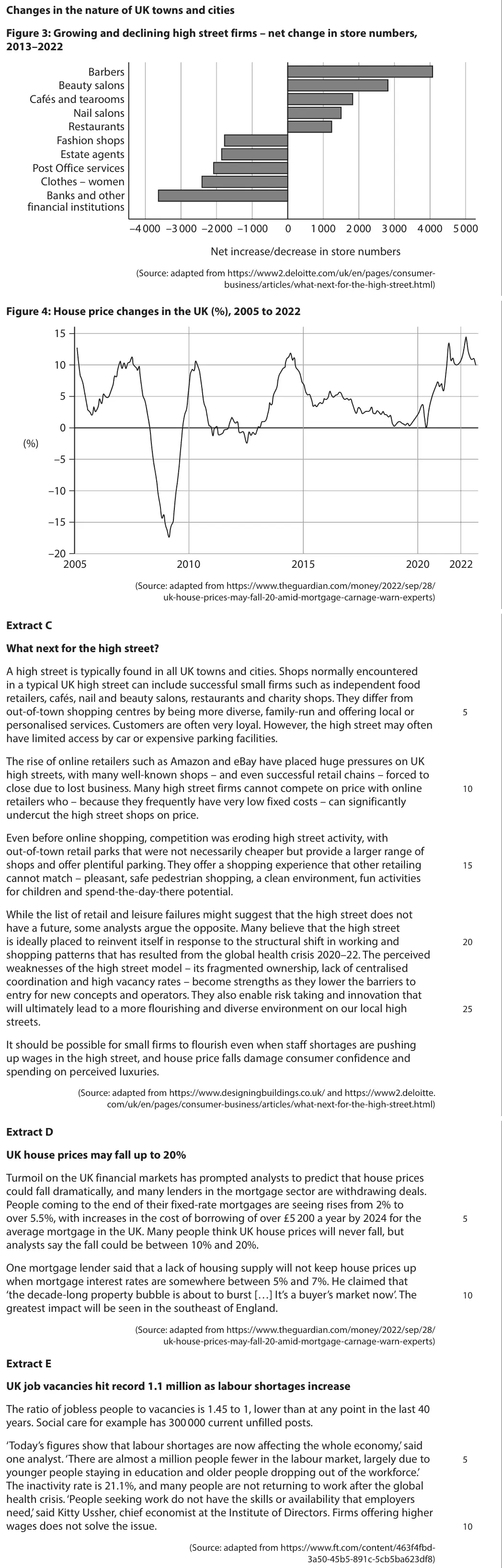
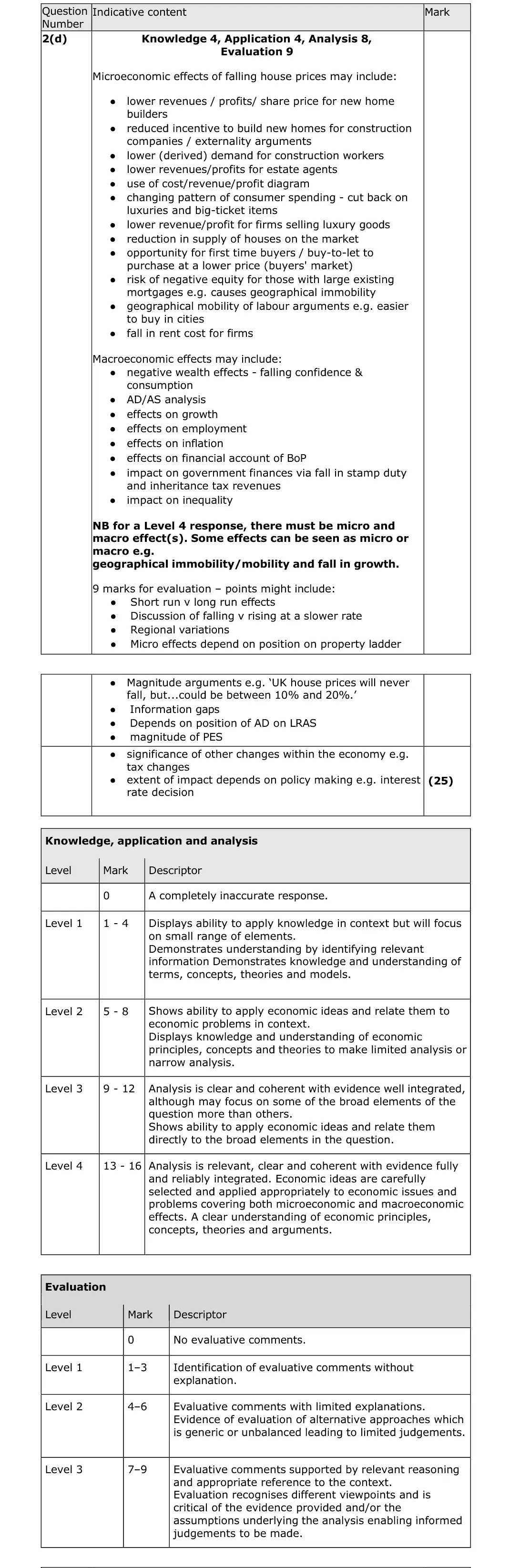
This question on house prices falling caused some significant problems. Mean at 14.1 is the lowest any essay has had in the whole specification series. The average mean is 16 to 17. When house prices are learned about, the wealth effect is the most important factor to put in your notes. Of course the effect on confidence and on first time buyers is important. What does NOT happen is that suddenly people buy a lot more houses in general. This scores 23/25. The diagrams are clear, and the answers are in context. What it really needs is a Judgement not a Conclusion. Do not reproduce pre-learned essays, but it is good to have in mind a micro and a macro diagram that you could use in any essay, as here. Make sure the answer is fully embedded in the context. Then evaluate both the micro and macro side – at least one good argument on each side. This answer does not initially look excellent although eventually it achieves a reasonable score of 18/25. Throughout the answer does not get above L3 KAA and it is clear that the chains of reasoning are short. There is some use of data and there are links made to the diagrams, although at times – for example on page 4 – the links are tenuous and the steps in the chains of reasoning are not convincing. The points are negative wealth effects and geographical mobility, both of which work well. It does not reach Level 4 though, as the chains of reasoning have gaps or are too short to be convincing. Therefore the maximum KAA score of 12/16 is given. Throughout the evaluation is L2+Ev which means it cannot earn more than 6/9 for evaluation. Quality in your answer always surpasses quantity. Write a few points really well, and extend the chains of reasoning to make points that you could read in a quality news report. Read the BBC or similar journalism on house prices to see the most common kinds of arguments, and use some diagrams you know from your course.
Notes from the mark scheme and report
negative wealth effect on consumption and confidence is the key macro link
micro: builders, estate agents, negative equity and geographical immobility
people do not suddenly buy many more houses
evaluate with size of fall (10% to 20%), regional variation
report: "caused some significant problems. Mean at 14.1 is the lowest any essay has had in the whole specification series"
Quantitative skills: QS 9 (interpret, apply and analyse information in written, graphical tabular and numerical forms)
June 2023 · Paper 3 · Q2(e)25 marksAO1=4, AO2=4, AO3=8, AO4=925-mark essayEither/orHard
Data and extracts for question 2
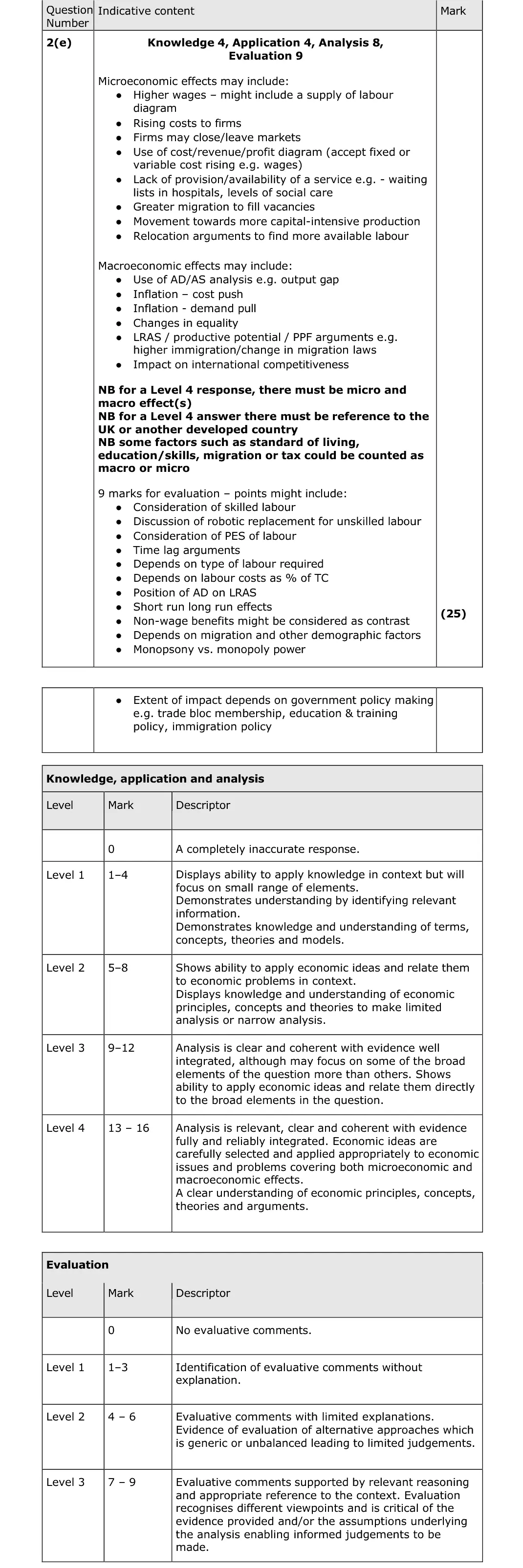
Mark scheme, including the levels grid and indicative content
Examiner's comment
A significant number misunderstood labour shortages as meaning unemployment. In this context it was rare for the answers to access many marks. Hence the standard deviation reached a high of 6.79 which is far higher than ever seen on a 25 mark question in this series. The mean was also significantly low at 14.98. Many answers began with data use, which is very effective. The use of labour market diagrams was also very common, but few (this is an exception) used the leftward shift to explain why wage rates would rise, which was a good approach. Many instead digressed and talked about why there was a shortage of labour, and a huge number wanted to talk about Brexit. Another excellent approach was to move from rising wage costs to an increase in costs, shown on a cost and revenue diagram. This could be either a fixed cost or a variable cost change, as is always the case with labour as a cost, but it must be very carefully explained in the candidate's answer about why the labour is fixed or variable. This answer does it as a fixed cost but it is not really clear why it is fixed apart from 'if firms have to pay employees a higher wage' which does imply a fixed cost by linking it to high street shops and social care. There is really only a hint of evaluation in the answer but it eventually reaches Level 2 evaluation on the fourth page, when discussing what the government might do about the problem. This does reach Level 4 of both micro and macro, and the senior examiners gave this 16/16 for KAA. There is a Judgement (J) but the overall score for evaluation is mid L2 Ev. The final mark is 16+5e = 21. Do not keep repeating diagrams and analysis. Instead devote 9/25 (or 36% of your time) to evaluation. Make an overall judgement – this can be at the start, middle or end of your essay but more often than not it is seen at the end in excellent answers. This answer includes good data, diagrams and development. There is evaluation throughout. It is clearly a top answer 23/25 but it misses out some steps on the macro side – the conclusion at the top of page 4 is reached too quickly, and its corresponding evaluation is generic. You can make just one micro and one macro point and get the top level (L4) as here. A less risky approach might be to add another point if you are at all unsure about your reasoning. Cost and revenue diagrams are a very useful way to show the effects of cost rises. However you must make the link to MC and AC if there is a change in variable costs. Section 1 A reminder to centres that it does not benefit candidates to have stock essay answers as they miss the higher marks by not using the context to guide their analysis and evaluation. It is helpful if the candidate marks the box for the essay chosen (1d or 1e) but if they do not (around 10%) then they are marked in a pool where the examiner has to decide which question has been attempted. The answer usually becomes clear very quickly when candidates put signals in their work and make it clear from the outset that they understand the question. Section 2 The majority of candidates ran short of time on the essay and the advice to candidates is to reserve 30 minutes for the final essay, and to use at least one micro and one macro point, diagrams where possible and all the data that links to the points made. Evaluation is key and we need to see developed and applied chains of reasoning within the evaluation.
Notes from the mark scheme and report
labour shortages are not unemployment
supply of labour shifts left so wages rise, then costs rise on a cost and revenue diagram (explain fixed or variable)
macro: cost-push inflation, LRAS, competitiveness
focus on effects, not causes such as Brexit
report: "A significant number misunderstood labour shortages as meaning unemployment" and "the mean was also significantly low at 14.98"
Quantitative skills: QS 9 (interpret, apply and analyse information in written, graphical tabular and numerical forms)
June 2022 · Paper 1 · Q825 marksAO1=4, AO2=4, AO3=8, AO4=925-mark essayEither/or
Mark scheme, including the levels grid and indicative content
Examiner's comment
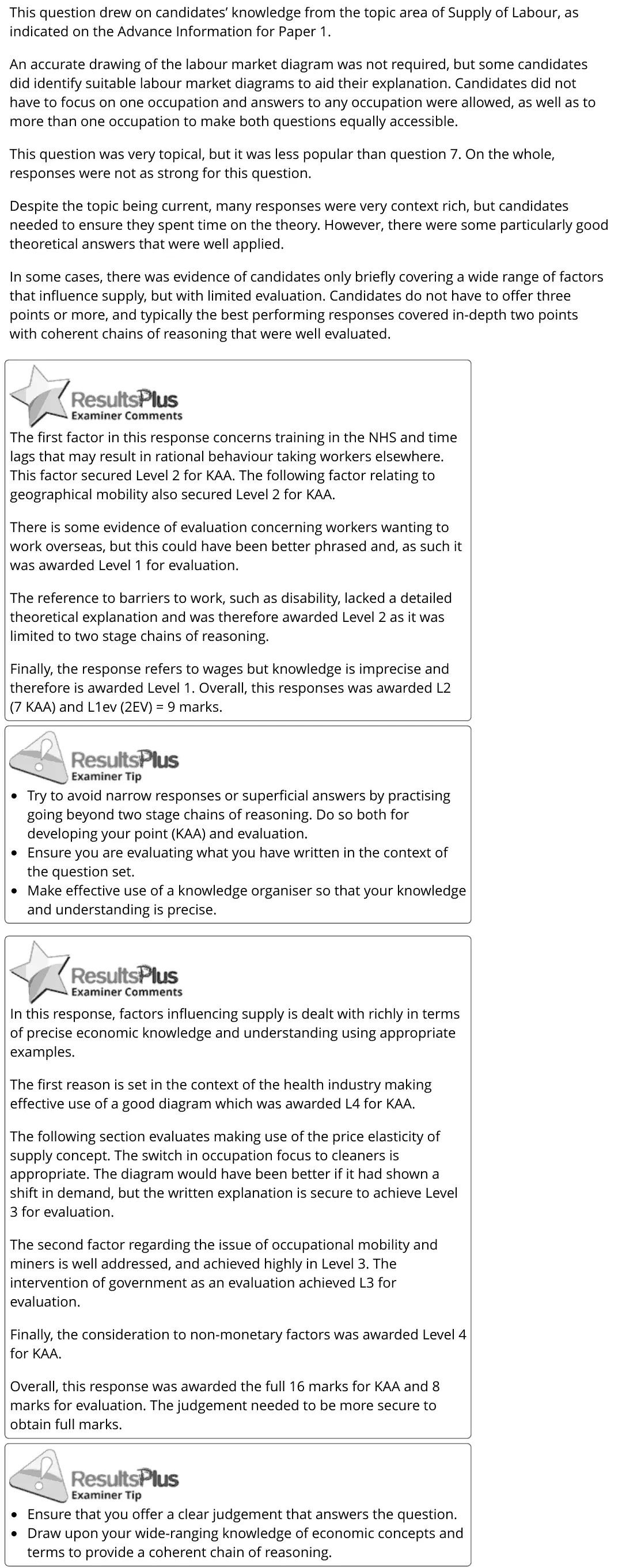
This question drew on candidates’ knowledge from the topic area of Supply of Labour, as indicated on the Advance Information for Paper 1. An accurate drawing of the labour market diagram was not required, but some candidates did identify suitable labour market diagrams to aid their explanation. Candidates did not have to focus on one occupation and answers to any occupation were allowed, as well as to more than one occupation to make both questions equally accessible. This question was very topical, but it was less popular than question 7. On the whole, responses were not as strong for this question. Despite the topic being current, many responses were very context rich, but candidates needed to ensure they spent time on the theory. However, there were some particularly good theoretical answers that were well applied. In some cases, there was evidence of candidates only briefly covering a wide range of factors that influence supply, but with limited evaluation. Candidates do not have to offer three points or more, and typically the best performing responses covered in-depth two points with coherent chains of reasoning that were well evaluated. The first factor in this response concerns training in the NHS and time lags that may result in rational behaviour taking workers elsewhere. This factor secured Level 2 for KAA. The following factor relating to geographical mobility also secured Level 2 for KAA. There is some evidence of evaluation concerning workers wanting to work overseas, but this could have been better phrased and, as such it was awarded Level 1 for evaluation. The reference to barriers to work, such as disability, lacked a detailed theoretical explanation and was therefore awarded Level 2 as it was limited to two stage chains of reasoning. Finally, the response refers to wages but knowledge is imprecise and therefore is awarded Level 1. Overall, this responses was awarded L2 (7 KAA) and L1ev (2EV) = 9 marks. Try to avoid narrow responses or superficial answers by practising going beyond two stage chains of reasoning. Do so both for developing your point (KAA) and evaluation. Ensure you are evaluating what you have written in the context of the question set. Make effective use of a knowledge organiser so that your knowledge and understanding is precise. In this response, factors influencing supply is dealt with richly in terms of precise economic knowledge and understanding using appropriate examples. The first reason is set in the context of the health industry making effective use of a good diagram which was awarded L4 for KAA. The following section evaluates making use of the price elasticity of supply concept. The switch in occupation focus to cleaners is appropriate. The diagram would have been better if it had shown a shift in demand, but the written explanation is secure to achieve Level 3 for evaluation. The second factor regarding the issue of occupational mobility and miners is well addressed, and achieved highly in Level 3. The intervention of government as an evaluation achieved L3 for evaluation. Finally, the consideration to non-monetary factors was awarded Level 4 for KAA. Overall, this response was awarded the full 16 marks for KAA and 8 marks for evaluation. The judgement needed to be more secure to obtain full marks. Ensure that you offer a clear judgement that answers the question. Draw upon your wide-ranging knowledge of economic concepts and terms to provide a coherent chain of reasoning.
report: Q8 responses "not as strong", context-rich but light on theory, or a list of factors with little evaluation
June 2022 · Paper 3 · Q1(e)25 marksAO1=4, AO2=4, AO3=8, AO4=925-mark essayEither/or
Data and extracts for question 1
Mark scheme, including the levels grid and indicative content
Notes from the mark scheme and report
micro: minimum wage above equilibrium (a line below equilibrium has no effect) causes excess supply of labour, higher costs and lower profit margins for restaurants
macro: consumption and AD, cost-push inflation, less inequality and poverty
evaluate with elasticity of demand for labour and wage share of costs
avoid pre-learned essays
November 2021 · Paper 1 · Q1(b)4 marksAO1=2, AO2=1, AO3=1Short answer
Data and extracts for question 1
Mark scheme
Examiner's comment
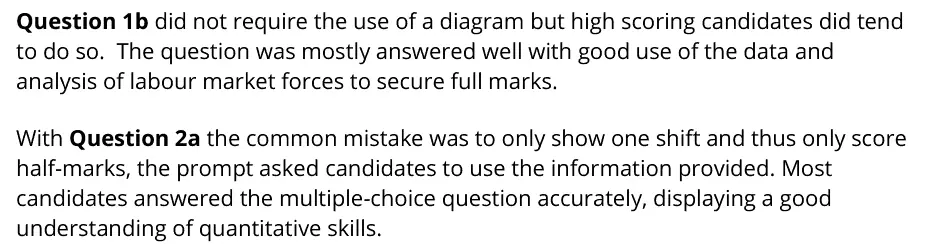
Question 1b did not require the use of a diagram but high scoring candidates did tend to do so. The question was mostly answered well with good use of the data and analysis of labour market forces to secure full marks. With Question 2a the common mistake was to only show one shift and thus only score half-marks, the prompt asked candidates to use the information provided. Most candidates answered the multiple-choice question accurately, displaying a good understanding of quantitative skills.
Notes from the mark scheme and report
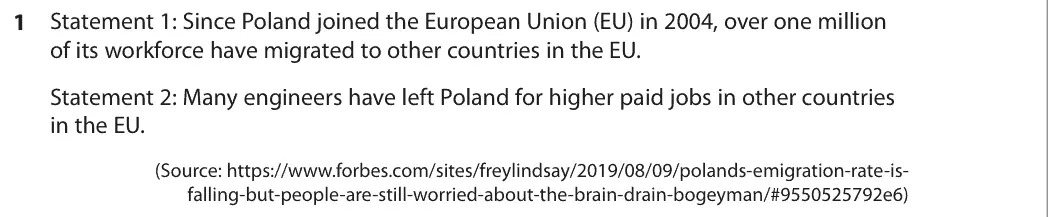
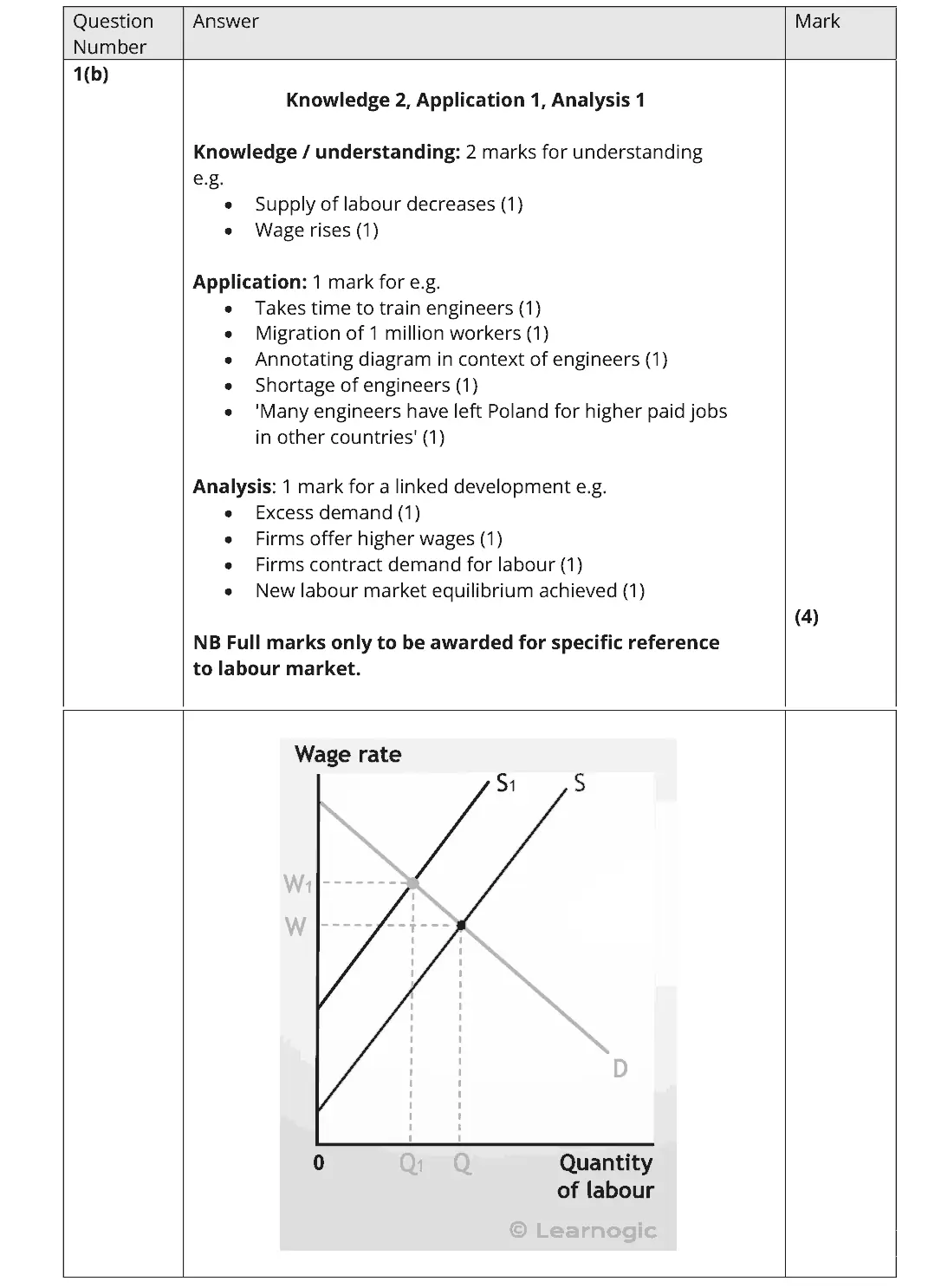
supply of engineers falls (shifts left), excess demand, firms raise wages to a new equilibrium
apply e.g. engineers take time to train, over one million migrated
full marks only with reference to the labour market
a diagram is optional
November 2021 · Paper 1 · Q725 marksAO1=4, AO2=4, AO3=8, AO4=925-mark essayEither/or
Mark scheme, including the levels grid and indicative content
Examiner's comment
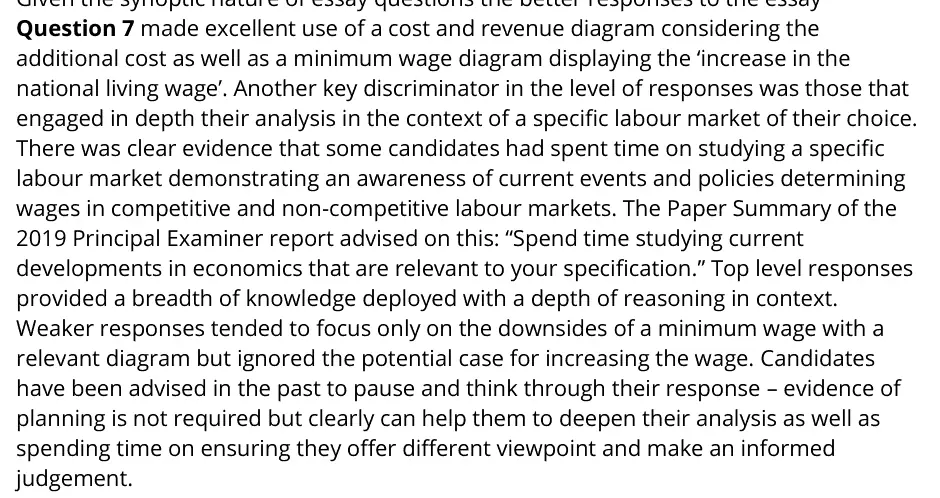
Question 7 made excellent use of a cost and revenue diagram considering the additional cost as well as a minimum wage diagram displaying the ‘increase in the national living wage’. Another key discriminator in the level of responses was those that engaged in depth their analysis in the context of a specific labour market of their choice. There was clear evidence that some candidates had spent time on studying a specific labour market demonstrating an awareness of current events and policies determining wages in competitive and non-competitive labour markets. The Paper Summary of the 2019 Principal Examiner report advised on this: “Spend time studying current developments in economics that are relevant to your specification.” Top level responses provided a breadth of knowledge deployed with a depth of reasoning in context. Weaker responses tended to focus only on the downsides of a minimum wage with a relevant diagram but ignored the potential case for increasing the wage. Candidates have been advised in the past to pause and think through their response – evidence of planning is not required but clearly can help them to deepen their analysis as well as spending time on ensuring they offer different viewpoint and make an informed judgement.
Notes from the mark scheme and report
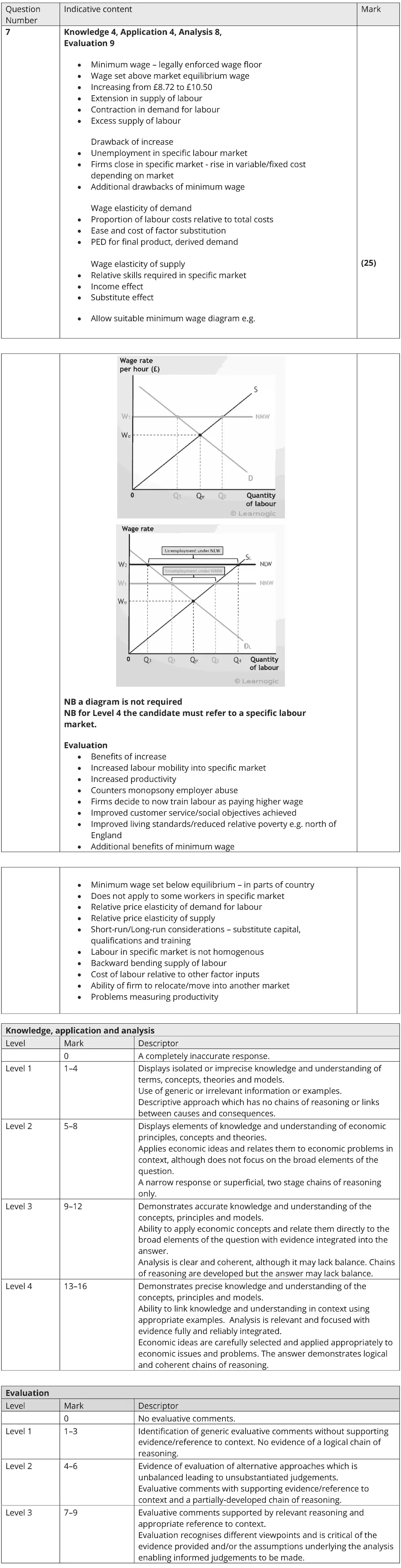
minimum wage above equilibrium causes excess supply of labour (unemployment) in a specific market such as social care
higher costs shift AC and MC up
evaluate with elasticity of labour demand, monopsony employers, productivity and incentive gains
report: weaker answers gave only disadvantages without a counter case and lacked a specific labour market
November 2021 · Paper 3 · Q1(c)12 marksAO1=2, AO2=2, AO3=4, AO4=412-mark response
Data and extracts for question 1
Mark scheme, including the levels grid and indicative content
Examiner's comment
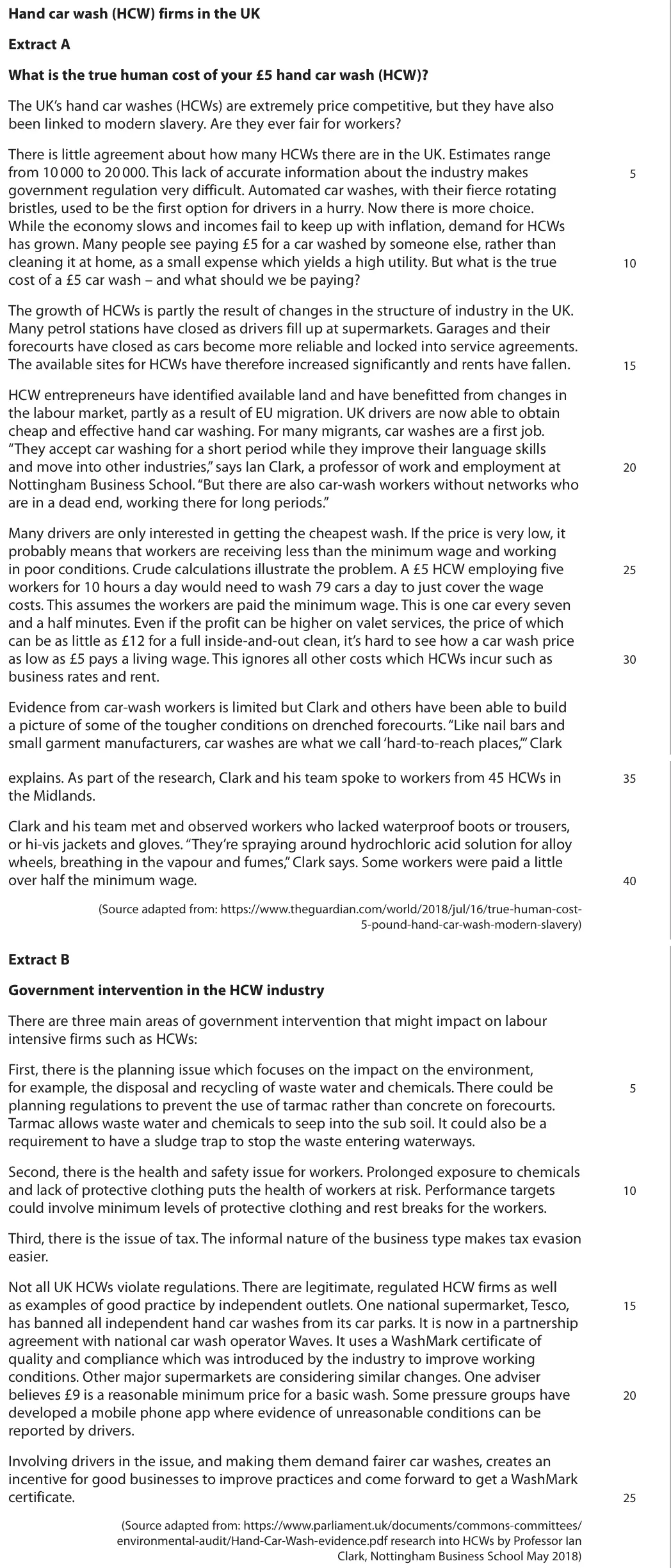
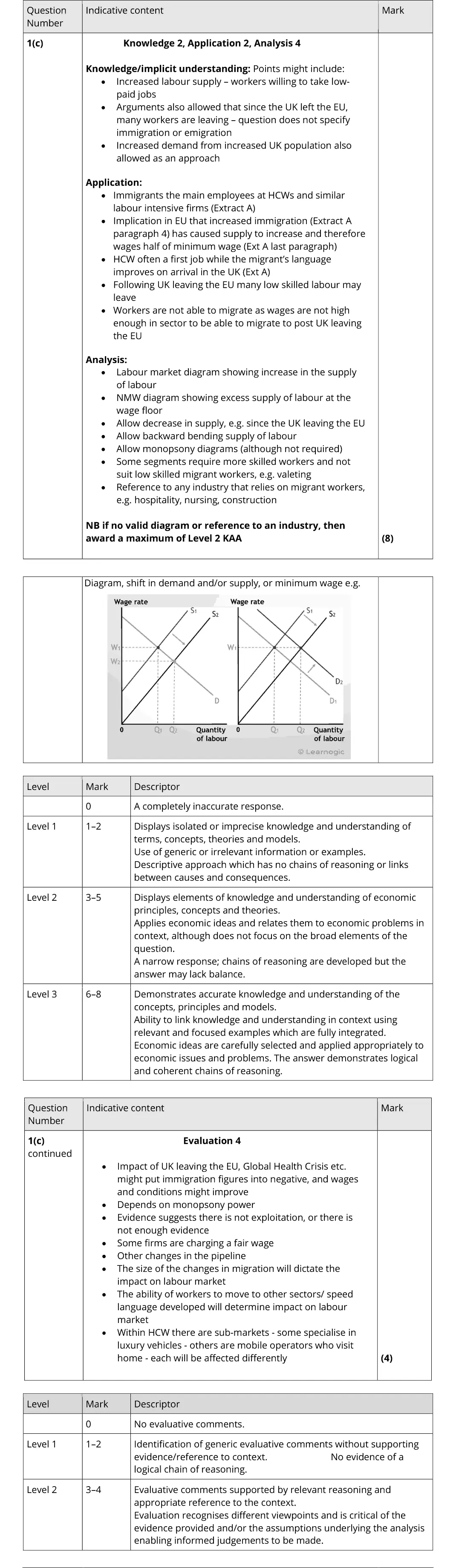
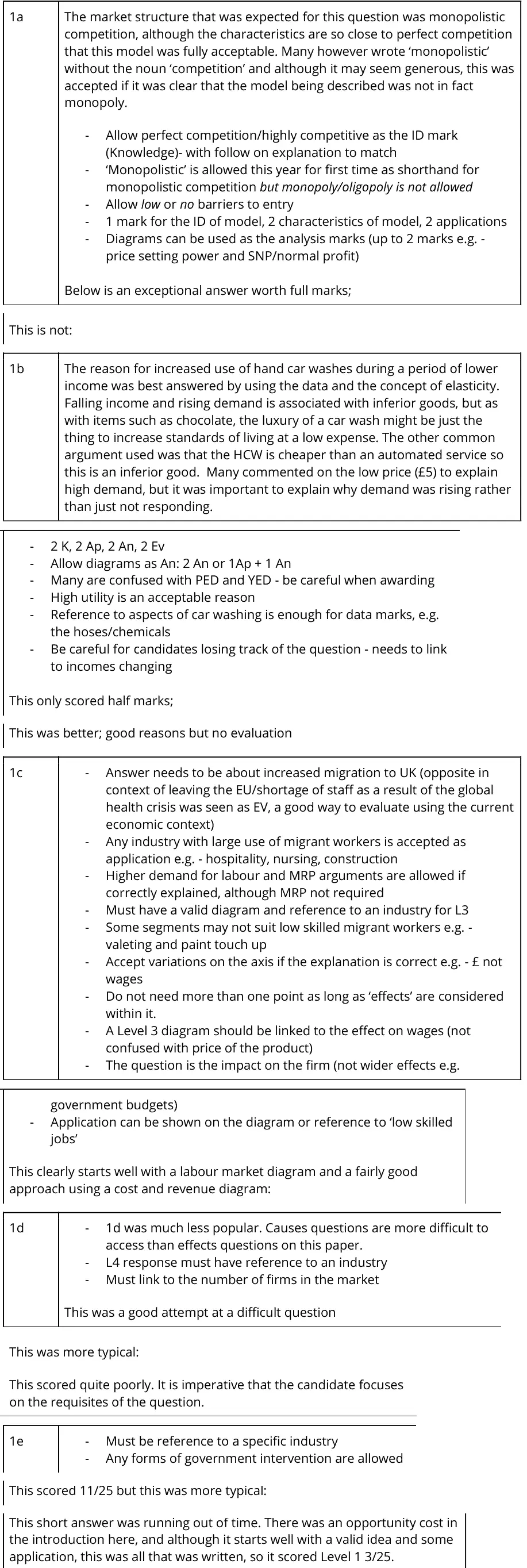
1a The market structure that was expected for this question was monopolistic competition, although the characteristics are so close to perfect competition that this model was fully acceptable. Many however wrote ‘monopolistic’ without the noun ‘competition’ and although it may seem generous, this was accepted if it was clear that the model being described was not in fact monopoly. - Allow perfect competition/highly competitive as the ID mark (Knowledge)- with follow on explanation to match - ‘Monopolistic’ is allowed this year for first time as shorthand for monopolistic competition but monopoly/oligopoly is not allowed - Allow low or no barriers to entry - 1 mark for the ID of model, 2 characteristics of model, 2 applications - Diagrams can be used as the analysis marks (up to 2 marks e.g. - price setting power and SNP/normal profit) Below is an exceptional answer worth full marks; This is not: 1b The reason for increased use of hand car washes during a period of lower income was best answered by using the data and the concept of elasticity. Falling income and rising demand is associated with inferior goods, but as with items such as chocolate, the luxury of a car wash might be just the thing to increase standards of living at a low expense. The other common argument used was that the HCW is cheaper than an automated service so this is an inferior good. Many commented on the low price (£5) to explain high demand, but it was important to explain why demand was rising rather than just not responding. - 2 K, 2 Ap, 2 An, 2 Ev - Allow diagrams as An: 2 An or 1Ap + 1 An - Many are confused with PED and YED - be careful when awarding - High utility is an acceptable reason - Reference to aspects of car washing is enough for data marks, e.g. the hoses/chemicals - Be careful for candidates losing track of the question - needs to link to incomes changing This only scored half marks; This was better; good reasons but no evaluation 1c - Answer needs to be about increased migration to UK (opposite in context of leaving the EU/shortage of staff as a result of the global health crisis was seen as EV, a good way to evaluate using the current economic context) - Any industry with large use of migrant workers is accepted as application e.g. - hospitality, nursing, construction - Higher demand for labour and MRP arguments are allowed if correctly explained, although MRP not required - Must have a valid diagram and reference to an industry for L3 - Some segments may not suit low skilled migrant workers e.g. - valeting and paint touch up - Accept variations on the axis if the explanation is correct e.g. - £ not wages - Do not need more than one point as long as ‘effects’ are considered within it. - A Level 3 diagram should be linked to the effect on wages (not confused with price of the product) - The question is the impact on the firm (not wider effects e.g. government budgets) - Application can be shown on the diagram or reference to ‘low skilled jobs’ This clearly starts well with a labour market diagram and a fairly good approach using a cost and revenue diagram: 1d - 1d was much less popular. Causes questions are more difficult to access than effects questions on this paper. - L4 response must have reference to an industry - Must link to the number of firms in the market This was a good attempt at a difficult question This was more typical: This scored quite poorly. It is imperative that the candidate focuses on the requisites of the question. 1e - Must be reference to a specific industry - Any forms of government intervention are allowed This scored 11/25 but this was more typical: This short answer was running out of time. There was an opportunity cost in the introduction here, and although it starts well with a valid idea and some application, this was all that was written, so it scored Level 1 3/25.
Notes from the mark scheme and report
Level 3 needs a valid labour market diagram (supply of labour shifts right, lower wage) and an industry reference
the diagram must show wages, not the product price
effects on the firm, not the government budget
falling migration after leaving the EU can be the evaluation
Quantitative skills: QS 4 (construct and interpret a range of standard graphical forms); QS 9 (interpret, apply and analyse information in written, graphical tabular and numerical forms)
November 2021 · Paper 3 · Q1(e)25 marksAO1=4, AO2=4, AO3=8, AO4=925-mark essayEither/or
Data and extracts for question 1
Mark scheme, including the levels grid and indicative content
Examiner's comment
1a The market structure that was expected for this question was monopolistic competition, although the characteristics are so close to perfect competition that this model was fully acceptable. Many however wrote ‘monopolistic’ without the noun ‘competition’ and although it may seem generous, this was accepted if it was clear that the model being described was not in fact monopoly. - Allow perfect competition/highly competitive as the ID mark (Knowledge)- with follow on explanation to match - ‘Monopolistic’ is allowed this year for first time as shorthand for monopolistic competition but monopoly/oligopoly is not allowed - Allow low or no barriers to entry - 1 mark for the ID of model, 2 characteristics of model, 2 applications - Diagrams can be used as the analysis marks (up to 2 marks e.g. - price setting power and SNP/normal profit) Below is an exceptional answer worth full marks; This is not: 1b The reason for increased use of hand car washes during a period of lower income was best answered by using the data and the concept of elasticity. Falling income and rising demand is associated with inferior goods, but as with items such as chocolate, the luxury of a car wash might be just the thing to increase standards of living at a low expense. The other common argument used was that the HCW is cheaper than an automated service so this is an inferior good. Many commented on the low price (£5) to explain high demand, but it was important to explain why demand was rising rather than just not responding. - 2 K, 2 Ap, 2 An, 2 Ev - Allow diagrams as An: 2 An or 1Ap + 1 An - Many are confused with PED and YED - be careful when awarding - High utility is an acceptable reason - Reference to aspects of car washing is enough for data marks, e.g. the hoses/chemicals - Be careful for candidates losing track of the question - needs to link to incomes changing This only scored half marks; This was better; good reasons but no evaluation 1c - Answer needs to be about increased migration to UK (opposite in context of leaving the EU/shortage of staff as a result of the global health crisis was seen as EV, a good way to evaluate using the current economic context) - Any industry with large use of migrant workers is accepted as application e.g. - hospitality, nursing, construction - Higher demand for labour and MRP arguments are allowed if correctly explained, although MRP not required - Must have a valid diagram and reference to an industry for L3 - Some segments may not suit low skilled migrant workers e.g. - valeting and paint touch up - Accept variations on the axis if the explanation is correct e.g. - £ not wages - Do not need more than one point as long as ‘effects’ are considered within it. - A Level 3 diagram should be linked to the effect on wages (not confused with price of the product) - The question is the impact on the firm (not wider effects e.g. government budgets) - Application can be shown on the diagram or reference to ‘low skilled jobs’ This clearly starts well with a labour market diagram and a fairly good approach using a cost and revenue diagram: 1d - 1d was much less popular. Causes questions are more difficult to access than effects questions on this paper. - L4 response must have reference to an industry - Must link to the number of firms in the market This was a good attempt at a difficult question This was more typical: This scored quite poorly. It is imperative that the candidate focuses on the requisites of the question. 1e - Must be reference to a specific industry - Any forms of government intervention are allowed This scored 11/25 but this was more typical: This short answer was running out of time. There was an opportunity cost in the introduction here, and although it starts well with a valid idea and some application, this was all that was written, so it scored Level 1 3/25.
Notes from the mark scheme and report
micro: wage floors raise costs, higher car wash prices, minimum price, health and safety
macro: equality, inflation, employment
Level 4 needs micro and macro and a specific industry
evaluate with government failure (regulatory capture, asymmetric information), PED, WashMark self-regulation
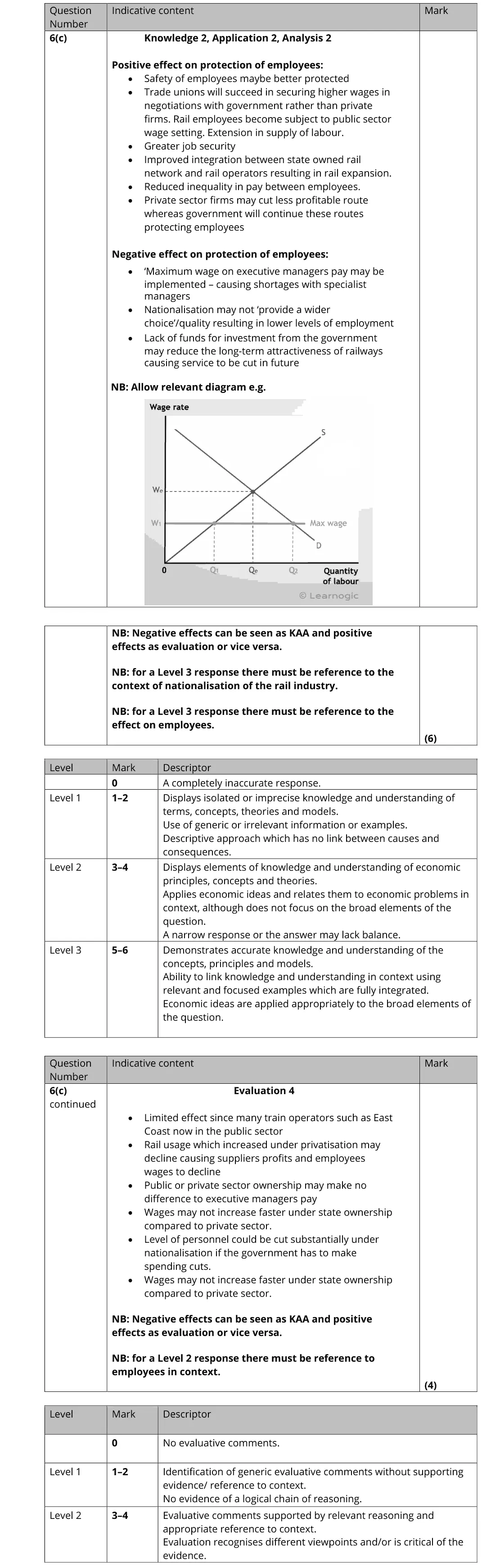
October 2020 · Paper 1 · Q6(c)10 marksAO1=2, AO2=2, AO3=2, AO4=410-mark response
Data and extracts for question 6
Mark scheme, including the levels grid and indicative content
Examiner's comment
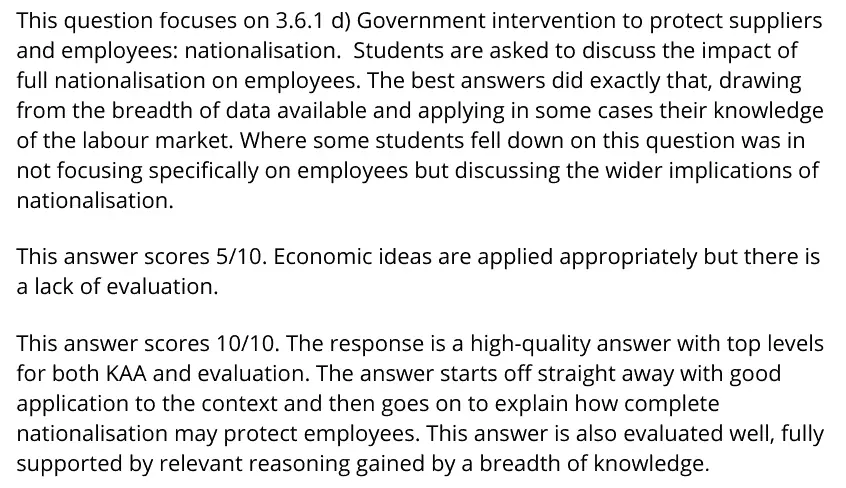
This question focuses on 3.6.1 d) Government intervention to protect suppliers and employees: nationalisation. Students are asked to discuss the impact of full nationalisation on employees. The best answers did exactly that, drawing from the breadth of data available and applying in some cases their knowledge of the labour market. Where some students fell down on this question was in not focusing specifically on employees but discussing the wider implications of nationalisation. This answer scores 5/10. Economic ideas are applied appropriately but there is a lack of evaluation. This answer scores 10/10. The response is a high-quality answer with top levels for both KAA and evaluation. The answer starts off straight away with good application to the context and then goes on to explain how complete nationalisation may protect employees. This answer is also evaluated well, fully supported by relevant reasoning gained by a breadth of knowledge.
Notes from the mark scheme and report
nationalisation to protect employees: public sector wage setting, job security, safety, unprofitable routes kept
evaluate with maximum wages, lack of investment funds and lower quality
report: weaker answers discussed nationalisation generally rather than employees
October 2020 · Paper 3 · Q2(e)25 marksAO1=4, AO2=4, AO3=8, AO4=925-mark essayEither/or
Data and extracts for question 2
Mark scheme, including the levels grid and indicative content
Examiner's comment
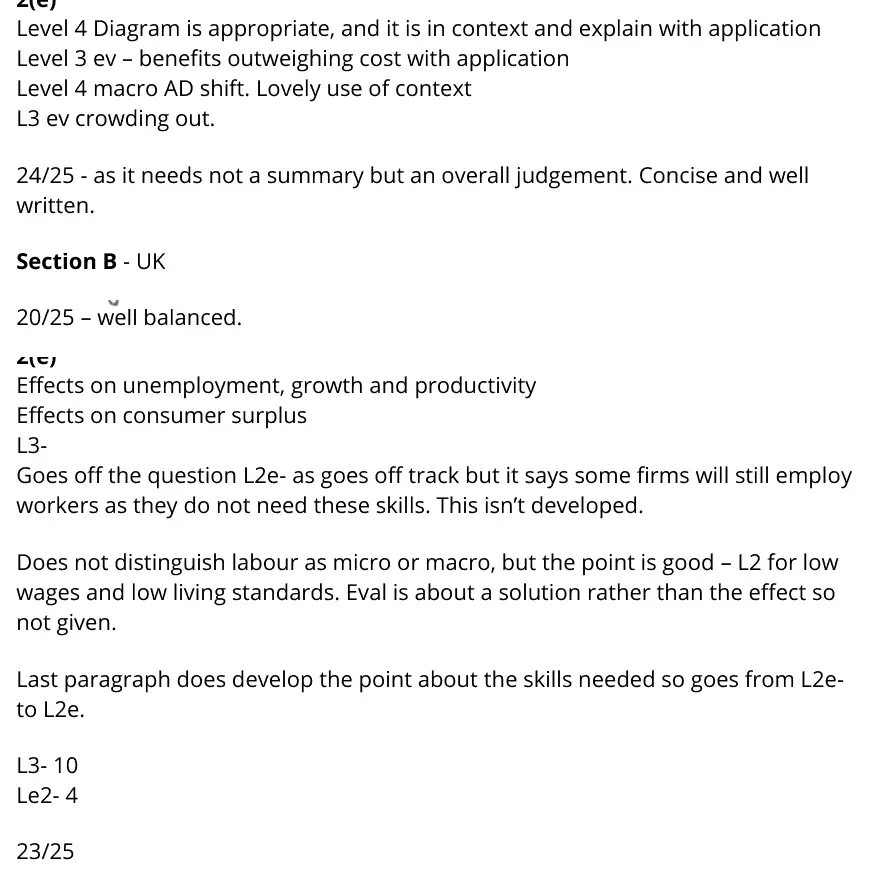
Level 4 Diagram is appropriate, and it is in context and explain with application Level 3 ev – benefits outweighing cost with application Level 4 macro AD shift. Lovely use of context L3 ev crowding out. 24/25 - as it needs not a summary but an overall judgement. Concise and well written. Section B - UK 20/25 – well balanced. Effects on unemployment, growth and productivity Effects on consumer surplus L3- Goes off the question L2e- as goes off track but it says some firms will still employ workers as they do not need these skills. This isn’t developed. Does not distinguish labour as micro or macro, but the point is good – L2 for low wages and low living standards. Eval is about a solution rather than the effect so not given. Last paragraph does develop the point about the skills needed so goes from L2e- to L2e. L3- 10 Le2- 4 23/25
Notes from the mark scheme and report
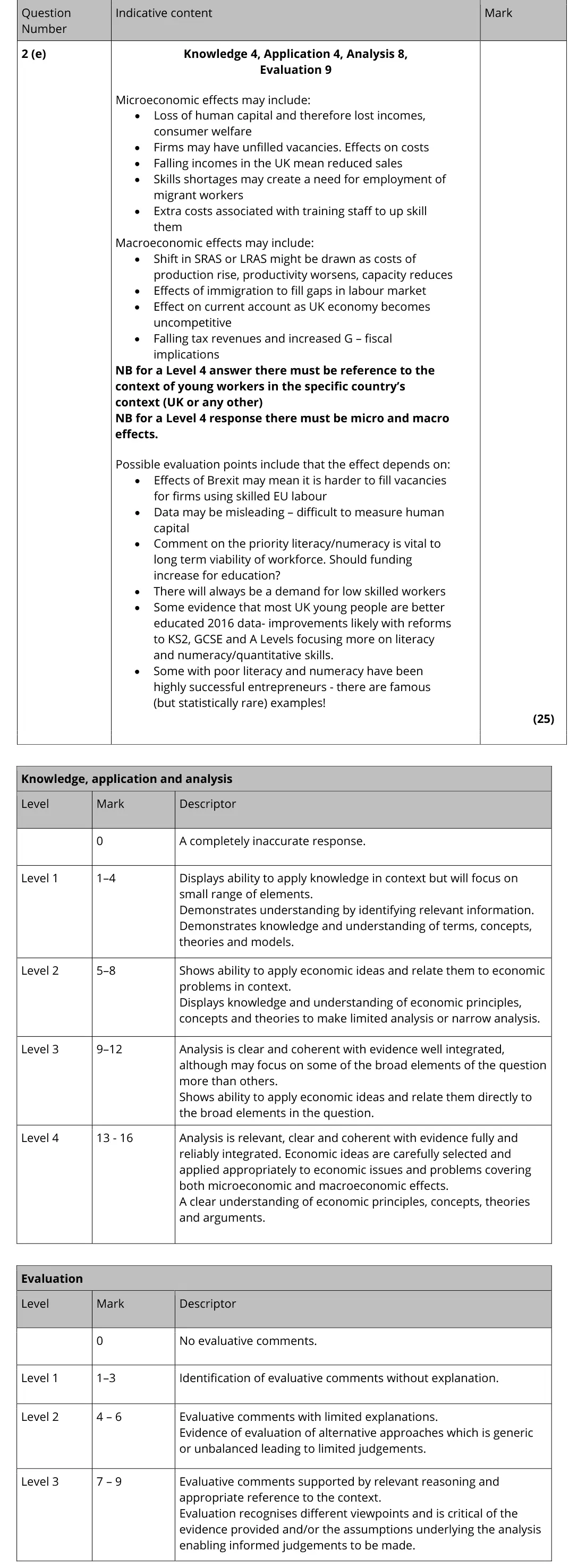
micro: lost human capital, unfilled vacancies, training costs, migrant labour
macro: SRAS/LRAS shift left, weaker current account, fiscal costs
Level 4 needs both micro and macro and the context of young workers
evaluation must be about the effect, not a solution
June 2019 · Paper 1 · Q725 marksAO1=4, AO2=4, AO3=8, AO4=925-mark essayEither/or
Mark scheme, including the levels grid and indicative content
Examiner's comment
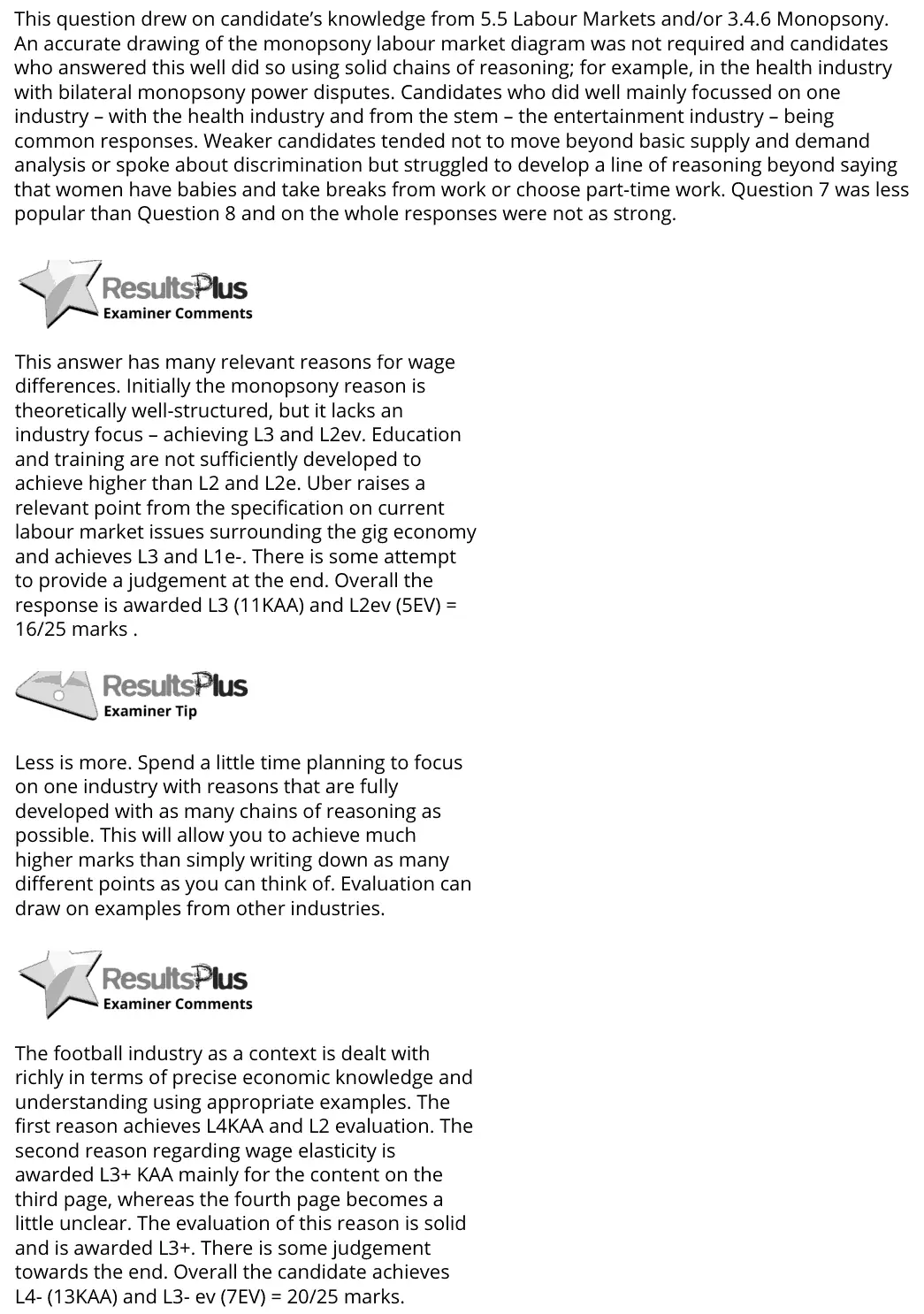
This question drew on candidate’s knowledge from 5.5 Labour Markets and/or 3.4.6 Monopsony. An accurate drawing of the monopsony labour market diagram was not required and candidates who answered this well did so using solid chains of reasoning; for example, in the health industry with bilateral monopsony power disputes. Candidates who did well mainly focussed on one industry – with the health industry and from the stem – the entertainment industry – being common responses. Weaker candidates tended not to move beyond basic supply and demand analysis or spoke about discrimination but struggled to develop a line of reasoning beyond saying that women have babies and take breaks from work or choose part-time work. Question 7 was less popular than Question 8 and on the whole responses were not as strong. This answer has many relevant reasons for wage differences. Initially the monopsony reason is theoretically well-structured, but it lacks an industry focus – achieving L3 and L2ev. Education and training are not sufficiently developed to achieve higher than L2 and L2e. Uber raises a relevant point from the specification on current labour market issues surrounding the gig economy and achieves L3 and L1e-. There is some attempt to provide a judgement at the end. Overall the response is awarded L3 (11KAA) and L2ev (5EV) = 16/25 marks . Less is more. Spend a little time planning to focus on one industry with reasons that are fully developed with as many chains of reasoning as possible. This will allow you to achieve much higher marks than simply writing down as many different points as you can think of. Evaluation can draw on examples from other industries. The football industry as a context is dealt with richly in terms of precise economic knowledge and understanding using appropriate examples. The first reason achieves L4KAA and L2 evaluation. The second reason regarding wage elasticity is awarded L3+ KAA mainly for the content on the third page, whereas the fourth page becomes a little unclear. The evaluation of this reason is solid and is awarded L3+. There is some judgement towards the end. Overall the candidate achieves L4- (13KAA) and L3- ev (7EV) = 20/25 marks.
Notes from the mark scheme and report
wage differences from different demand (derived demand, productivity) and supply (skills, mobility) of labour, monopsony, trade unions, discrimination
Level 4 needs a specific industry
report: weaker answers stayed with basic supply and demand and responses were weaker than Question 8
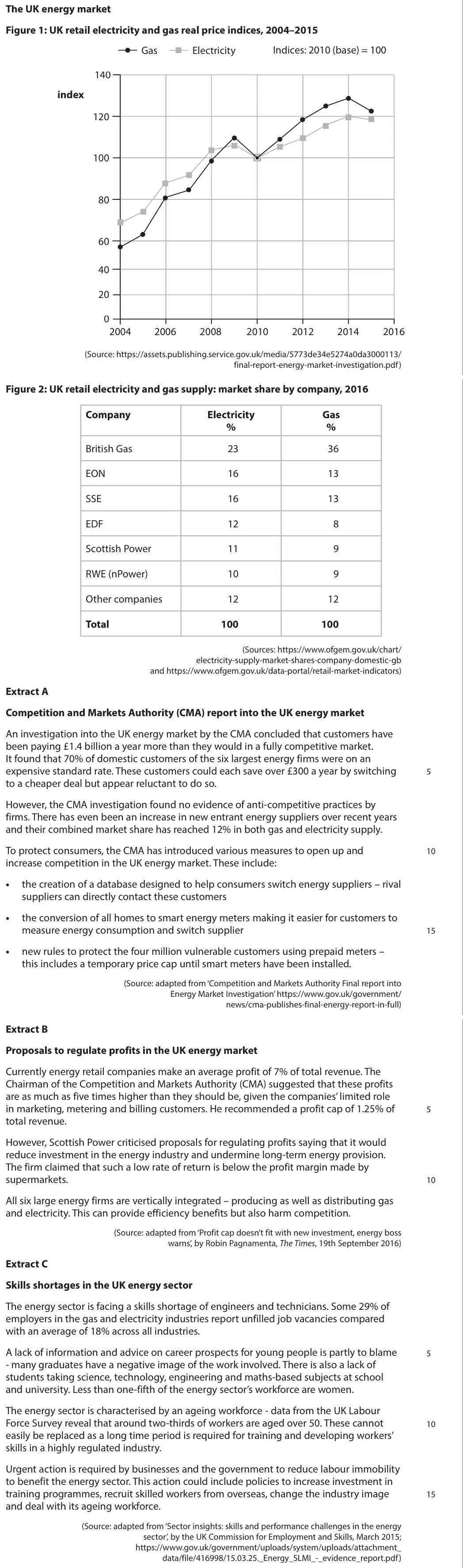
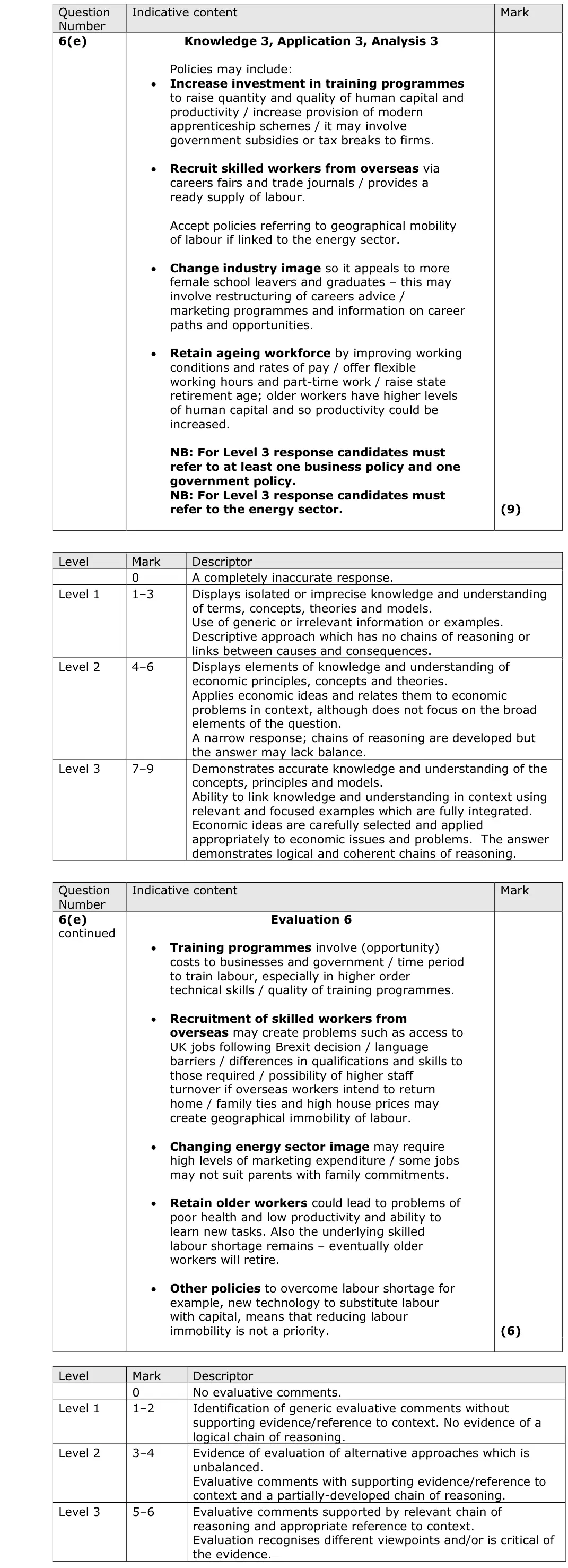
June 2018 · Paper 1 · Q6(e)15 marksAO1=3, AO2=3, AO3=3, AO4=615-mark response
Data and extracts for question 6
Mark scheme, including the levels grid and indicative content
Examiner's comment
This question clearly differentiated candidates between those explaining and evaluating business and government policies to improve mobility in the energy sector and those providing more generic policies that were often one-sided in looking at government policies alone. Most candidates got some balance to their KAA, with education/training the top choice, and recruiting overseas workers or improving the image of the industry being widely used. Many candidates scored Level 2 or Level 3 if they developed these ideas. The evaluation was generally weak as, although solid points were raised (time, opportunity cost etc.), there was often not enough development to warrant a L2e, let alone L3e. This answer achieves a mark of 12/15. This candidate achieves Level 3 +L2e for the government subsidising training in the energy sector – they would have obtained L3e with perhaps a little more development in context, for example energy sector jobs being highly skilled. The next two paragraphs also cover government policies to a Level 3+2e standard but at this point the answer remains unbalanced and not able to access a Level 3 response. Thankfully they then move on to looking at business measures of improving image to a Level 3+L2e standard. Overall the candidate achieves 8+4e. As in 6(c) a large number of candidates follow a structure where they make a KAA point in a paragraph, develop it and then finish the paragraph with a sentence beginning “However,…” where they make an evaluative point. This single sentence rarely scores more than L1e and candidates should be encouraged to develop their evaluative points in a separate paragraph. Centres are encouraged to carefully look at the Level 3 Evaluation descriptor. This answer achieves a mark of 14/15. Use this as a model for your writing, along with other high scoring responses. The evaluation is better balanced here although it was felt that the first evaluative paragraph was worthy of two separate L2e rather than one L3e. The second evaluative paragraph was awarded L3e. Ensure your evaluation is well-balanced against what you have previously written.
Notes from the mark scheme and report
Level 3 needs at least one business AND one government policy applied to the energy sector: training and apprenticeships, overseas recruitment, improving the industry image for women, retaining older workers
report: evaluation (time lags, opportunity cost) was generally weak and underdeveloped
Work with an Edexcel economics tutor
Essays stuck in Level 2, or losing the easy marks in Section A? Book a trial session with Lianne, a former Edexcel examiner.