1.3.1Types of market failure: a) Understanding of market failure b) Types of market failure • externalities • under-provision of public goods • information gapsAS
1.3.2Externalities: a) Distinction between private costs, external costs and social costs b) Distinction between private benefits, external benefits and social benefits c) Use of a diagram to illustrate: • the external costs of production using marginal analysis • the distinction between market equilibrium and social optimum position • identification of welfare loss area d) Use of a diagram to illustrate: • the external benefits of consumption using marginal analysis • the distinction between market equilibrium and social optimum position • identification of welfare gain area e) The impact on economic agents of externalities and government intervention in various marketsAS
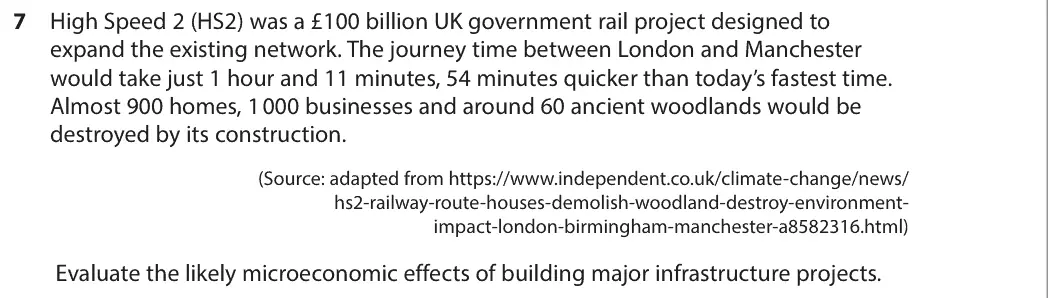
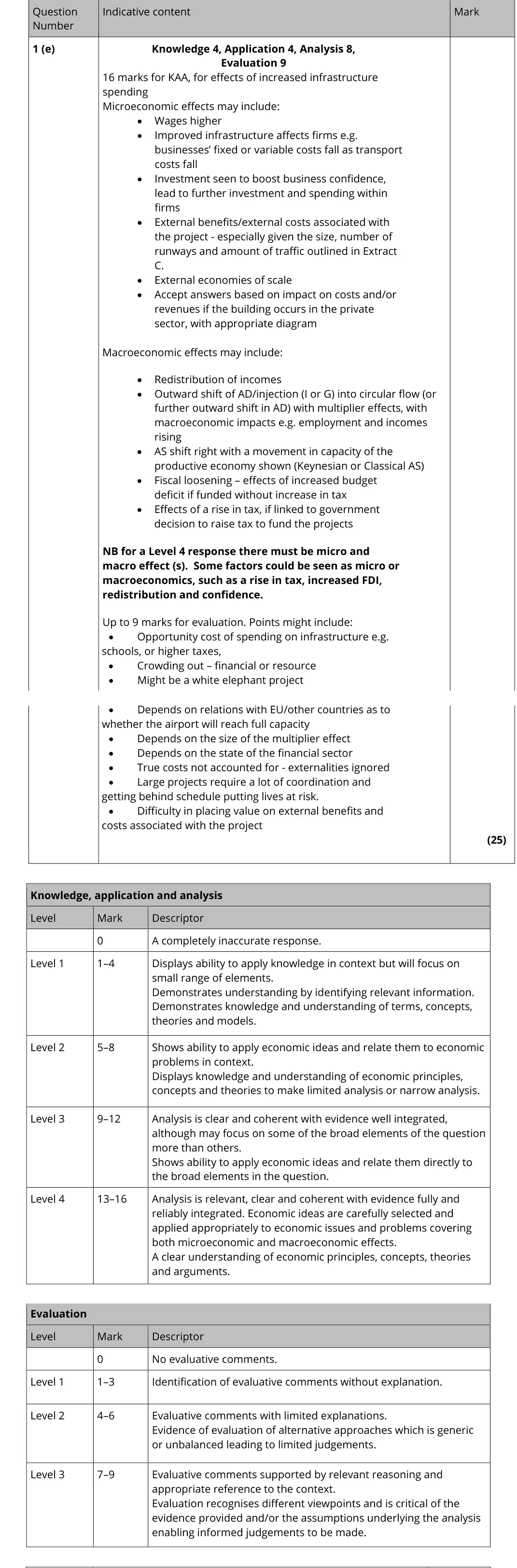
High Speed 2 (HS2) was a £100 billion UK government rail project designed to expand the existing network. The journey time between London and Manchester would take just 1 hour and 11 minutes, 54 minutes quicker than today’s fastest time. Almost 900 homes, 1 000 businesses and around 60 ancient woodlands would be destroyed by its construction. (Source: adapted from https://www.independent.co.uk/climate-change/news/ hs2-railway-route-houses-demolish-woodland-destroy-environment- impact-london-birmingham-manchester-a8582316.html) Evaluate the likely microeconomic effects of building major infrastructure projects.
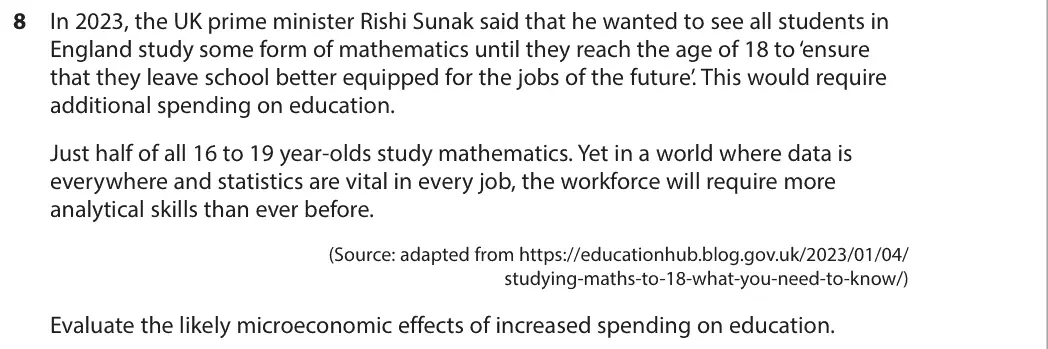
In 2023, the UK prime minister Rishi Sunak said that he wanted to see all students in England study some form of mathematics until they reach the age of 18 to ‘ensure that they leave school better equipped for the jobs of the future’. This would require additional spending on education. Just half of all 16 to 19 year-olds study mathematics. Yet in a world where data is everywhere and statistics are vital in every job, the workforce will require more analytical skills than ever before. (Source: adapted from https://educationhub.blog.gov.uk/2023/01/04/ studying-maths-to-18-what-you-need-to-know/) Evaluate the likely microeconomic effects of increased spending on education.
Using 2021 estimates of carbon emissions, it is estimated that a petrol car journey from London to Glasgow emits approximately 3.3 times more carbon dioxide per passenger than the equivalent journey by train. (Source adapted from: https://www.gov.uk/government/statistics/transport-and- environment-statistics-autumn-2021/transport-and-environment-statistics-autumn-2021) Evaluate possible methods of government intervention to reduce carbon emissions caused by road transport in the UK.
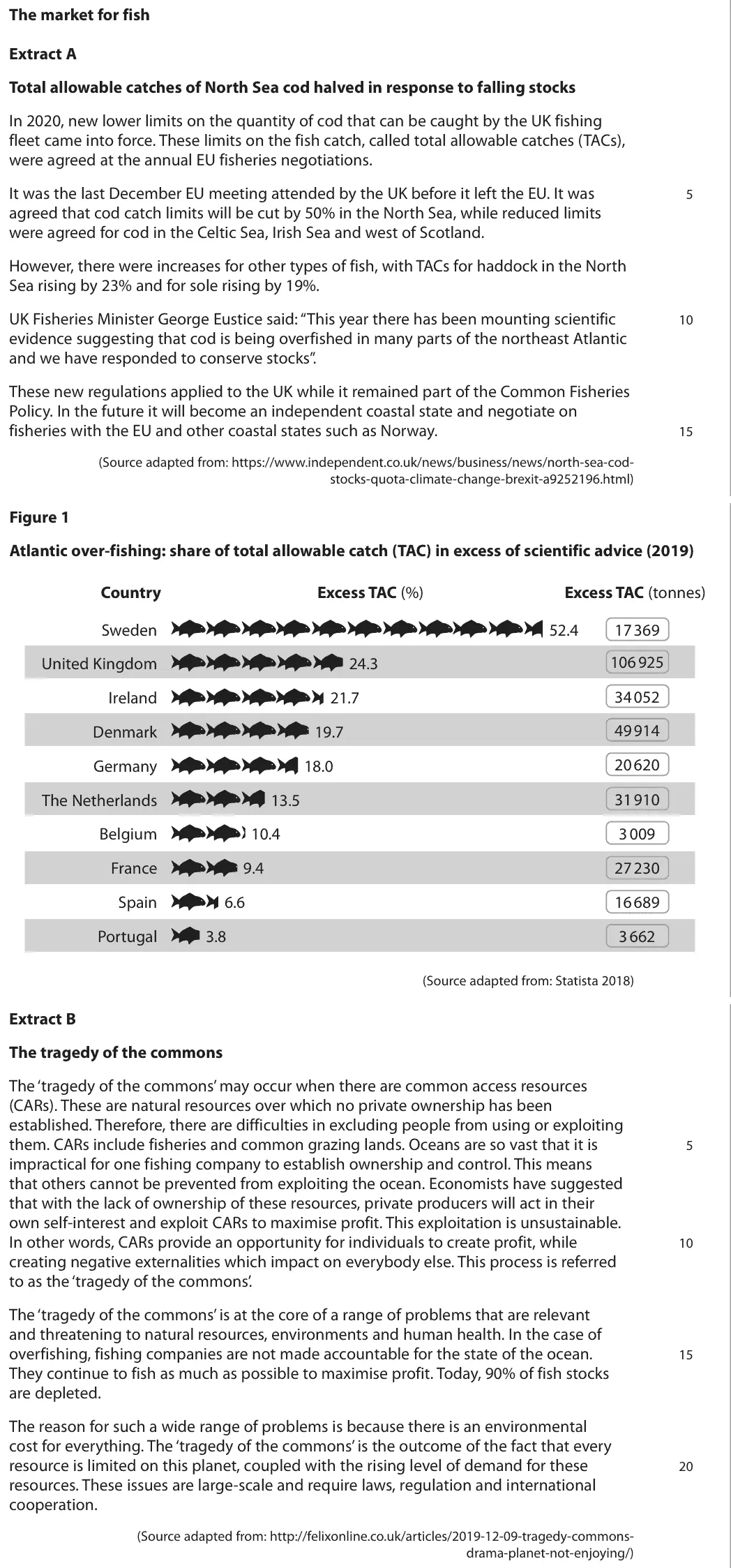
Some economists suggest that the market price of cod does not result in the socially optimum level of output. Evaluate the likely external costs from the over-fishing of cod. Use an appropriate diagram in your answer.
The International Energy Agency has predicted that oil use by cars will peak in 2025 because of the increasing number of drivers switching to electric vehicles. (Source adapted from: https://www.thetimes.co.uk) Evaluate the likely microeconomic consequences of consumers shifting from vehicles powered by fuel obtained from oil to electric‑powered vehicles.
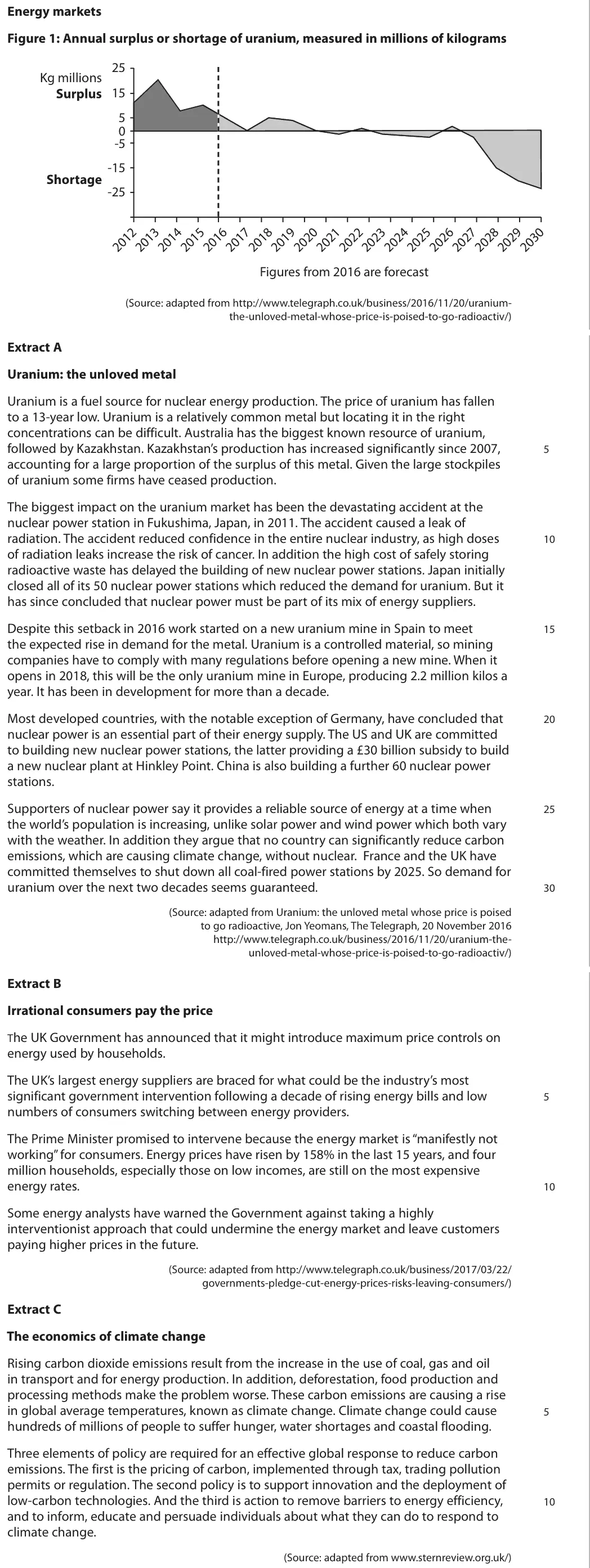
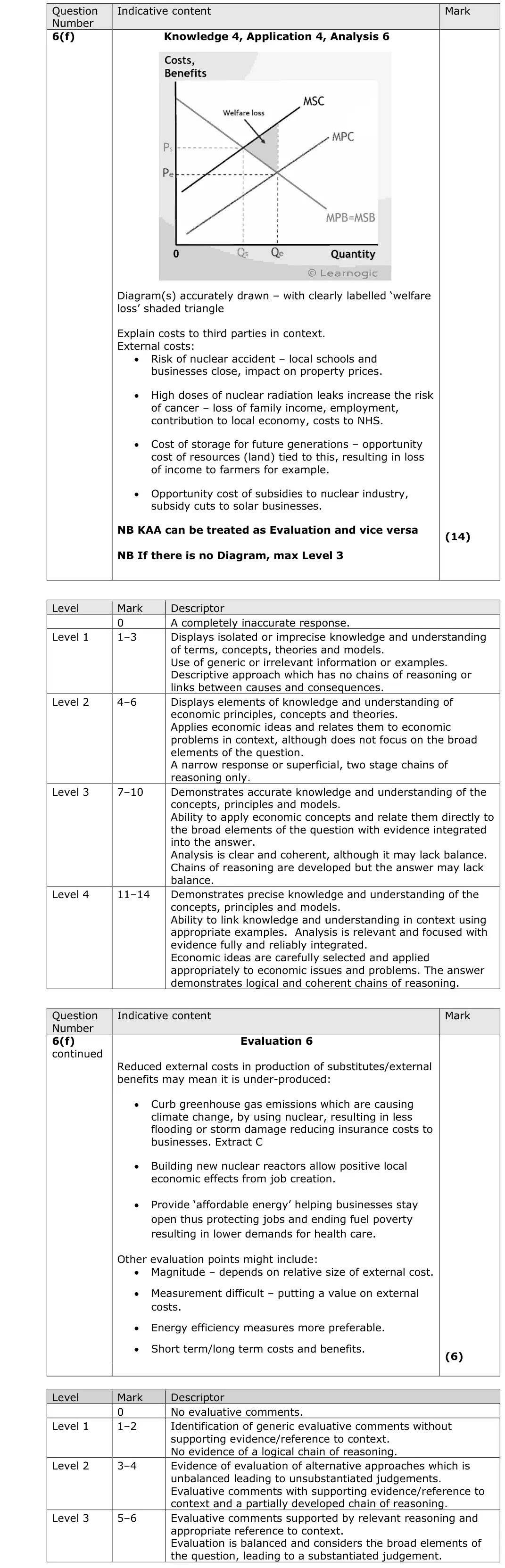
Using the concept of external costs, evaluate whether nuclear power is under-provided or over-provided in the energy market. Use an appropriate diagram in your answer.
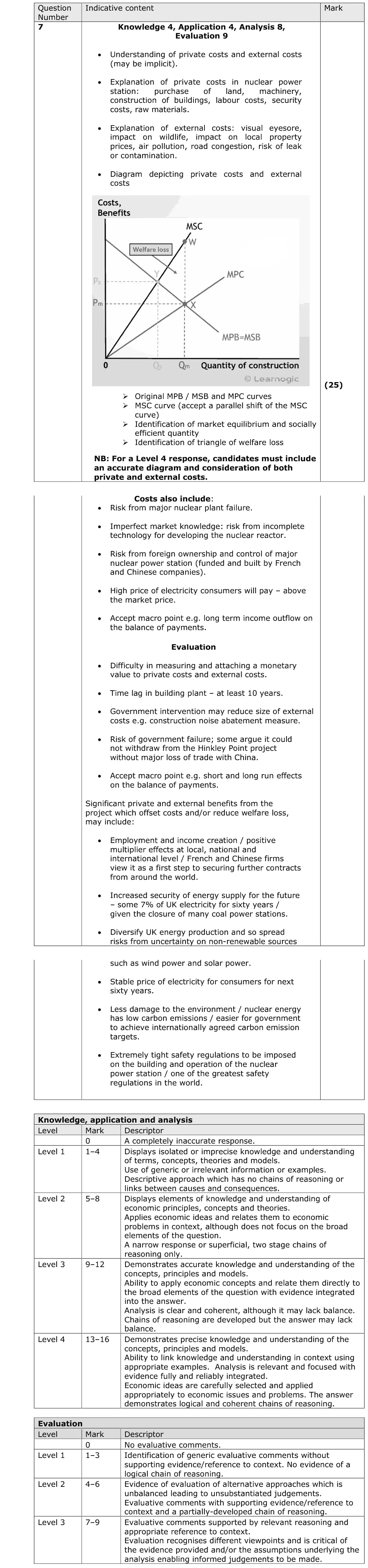
In September 2016 the government approved the building of an £18 billion nuclear power station, Hinkley Point C, which will supply 7% of UK electricity for up to 60 years. The power station is funded by Chinese and French investment. Evaluate the likely private costs and external costs involved in such major power station construction projects. Use an appropriate externalities diagram in your answer.
Tap a question to zoom it. The data and extracts fold out above each question; the mark scheme and examiner's comment open underneath.
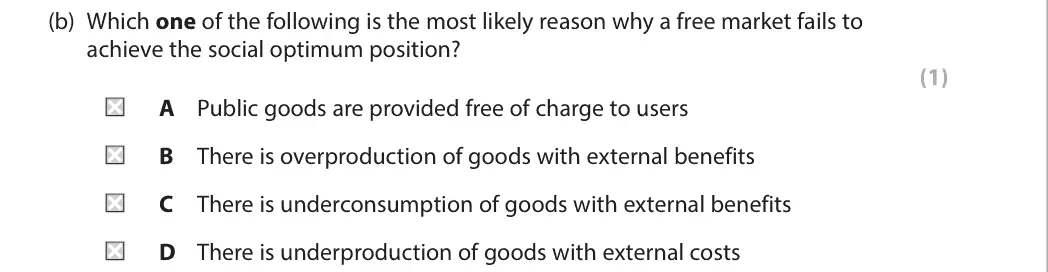
June 2025 · AS Paper 1 · Q3(b)1 markMultiple choice
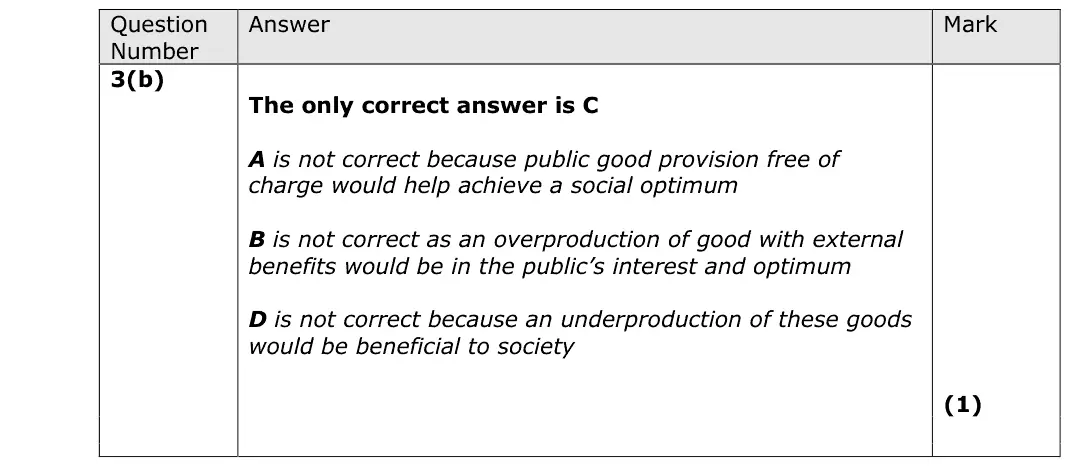
Answer
C
Mark scheme
Notes from the mark scheme and report
underconsumption of goods with external benefits means output is below the social optimum (C)
free provision of public goods helps achieve the optimum
overproduction of external-benefit goods and underproduction of external-cost goods would move towards it
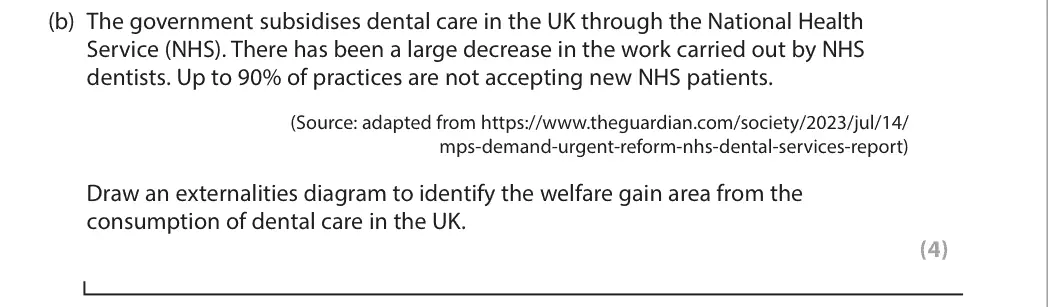
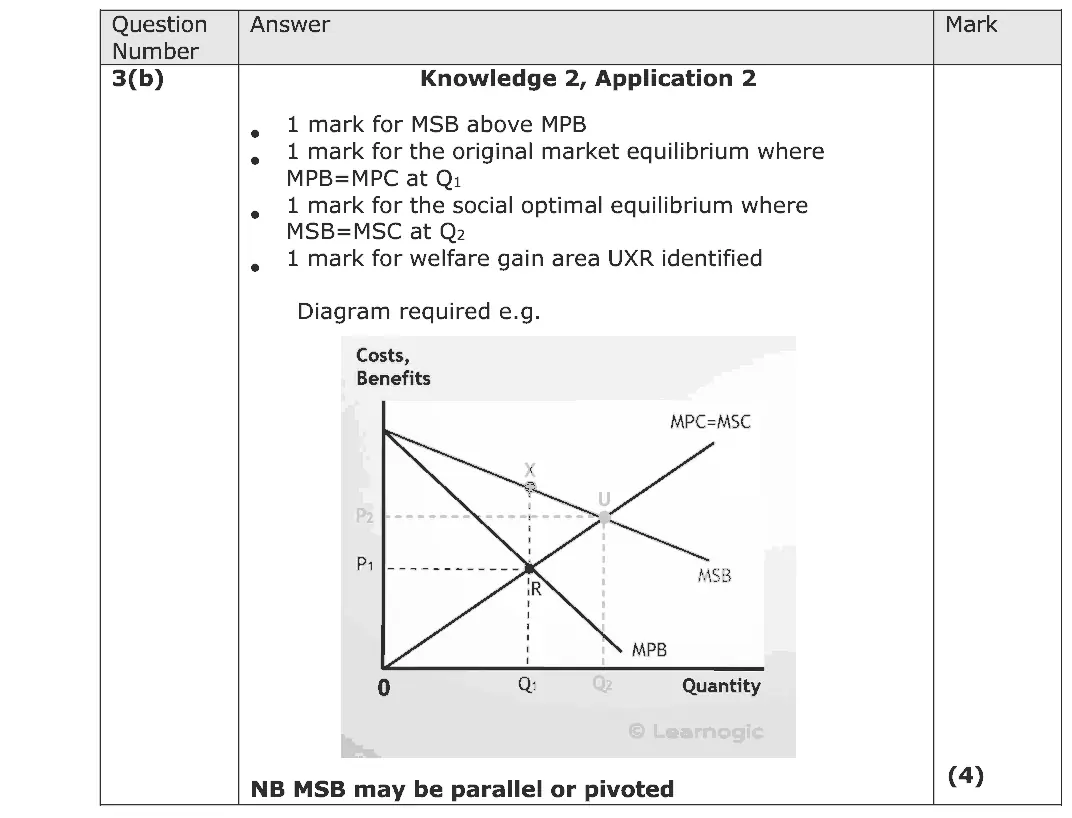
June 2025 · Paper 1 · Q3(b)4 marksAO1=2, AO2=2Diagram
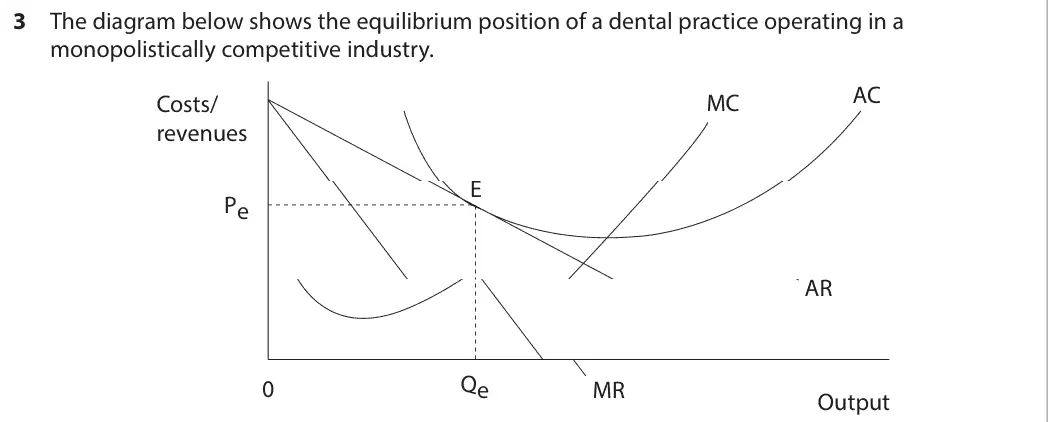
Data and extracts for question 3
Mark scheme
Examiner's comment
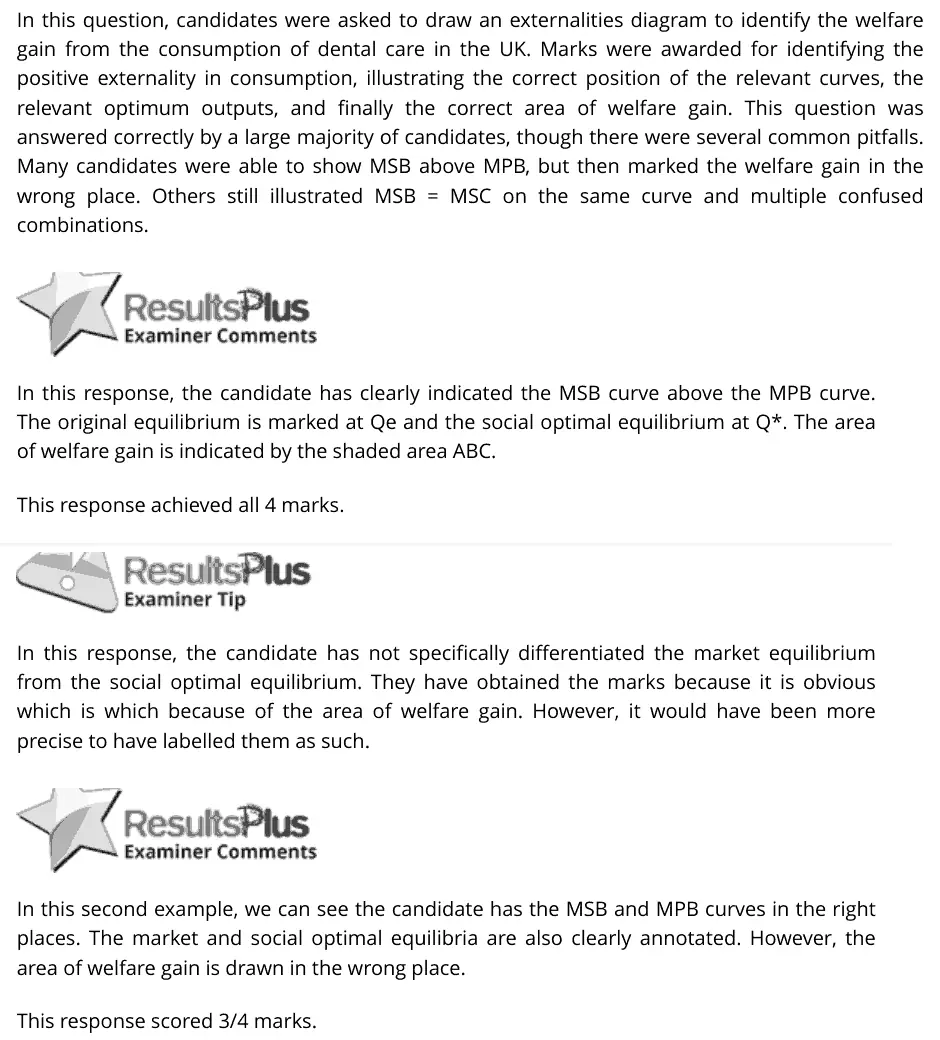
In this question, candidates were asked to draw an externalities diagram to identify the welfare gain from the consumption of dental care in the UK. Marks were awarded for identifying the positive externality in consumption, illustrating the correct position of the relevant curves, the relevant optimum outputs, and finally the correct area of welfare gain. This question was answered correctly by a large majority of candidates, though there were several common pitfalls. Many candidates were able to show MSB above MPB, but then marked the welfare gain in the wrong place. Others still illustrated MSB = MSC on the same curve and multiple confused combinations. In this response, the candidate has clearly indicated the MSB curve above the MPB curve. The original equilibrium is marked at Qe and the social optimal equilibrium at Q*. The area of welfare gain is indicated by the shaded area ABC. This response achieved all 4 marks. In this response, the candidate has not specifically differentiated the market equilibrium from the social optimal equilibrium. They have obtained the marks because it is obvious which is which because of the area of welfare gain. However, it would have been more precise to have labelled them as such. In this second example, we can see the candidate has the MSB and MPB curves in the right places. The market and social optimal equilibria are also clearly annotated. However, the area of welfare gain is drawn in the wrong place. This response scored 3/4 marks.
Notes from the mark scheme and report
MSB above MPB
market equilibrium where MPB = MPC, social optimum where MSB = MSC
shade the welfare gain triangle between the two quantities
common errors: welfare gain in the wrong place, MSB = MSC on the same curve
Quantitative skills: QS 4 (construct and interpret a range of standard graphical forms)
June 2025 · AS Paper 1 · Q6(e)15 marksAO1=3, AO2=3, AO3=3, AO4=615-mark response
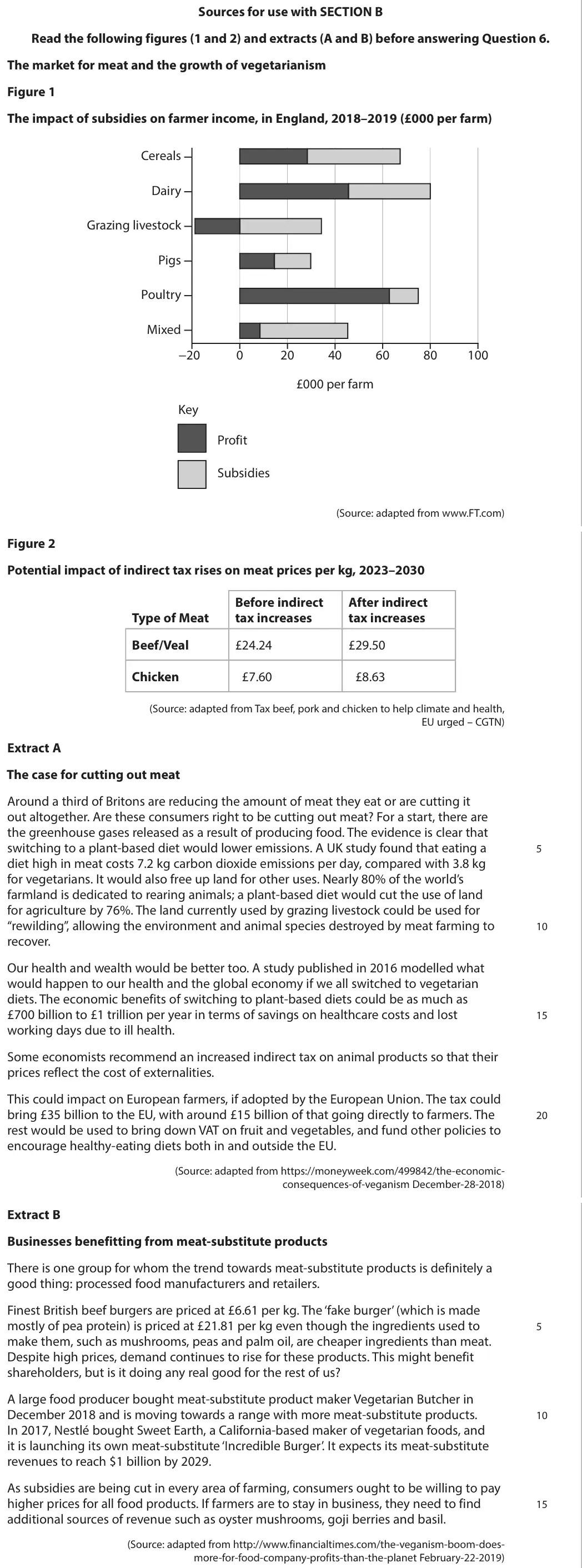
Data and extracts for question 6
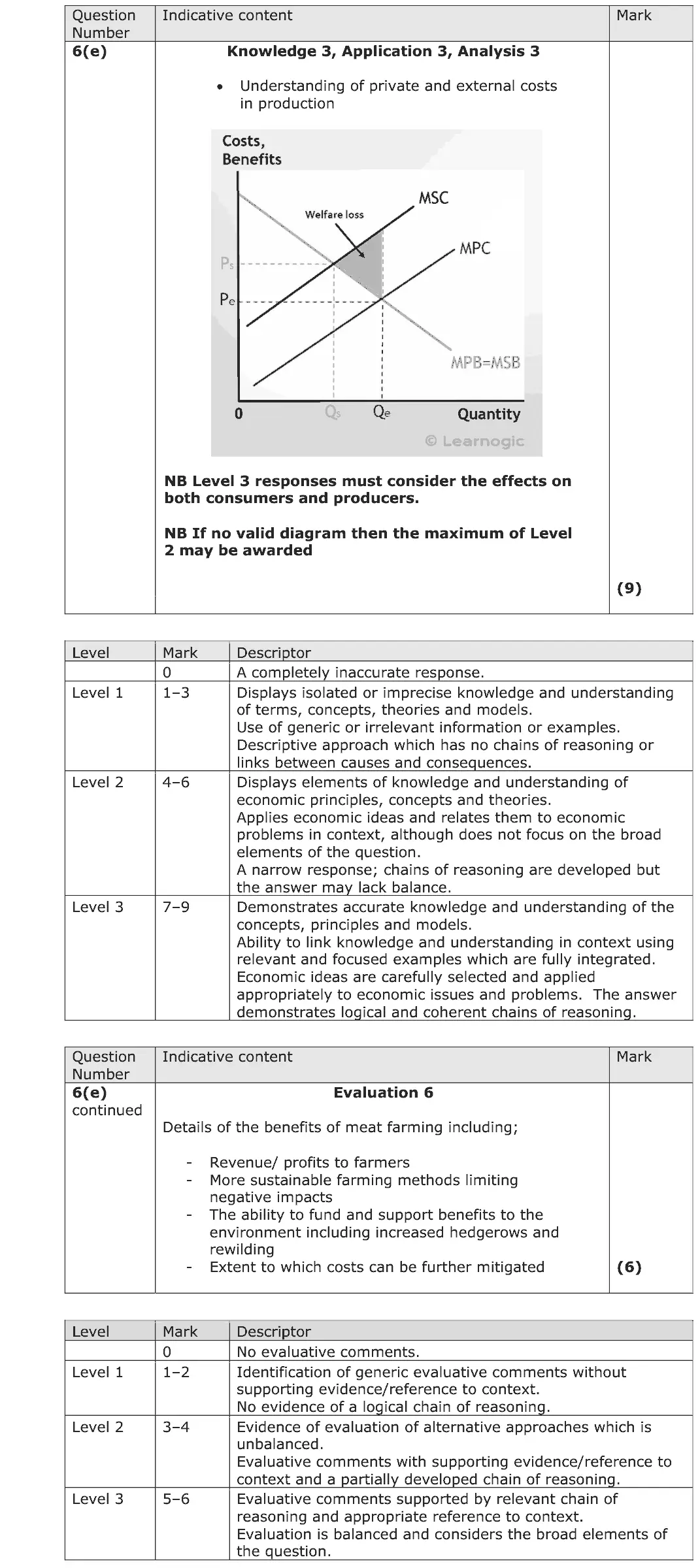
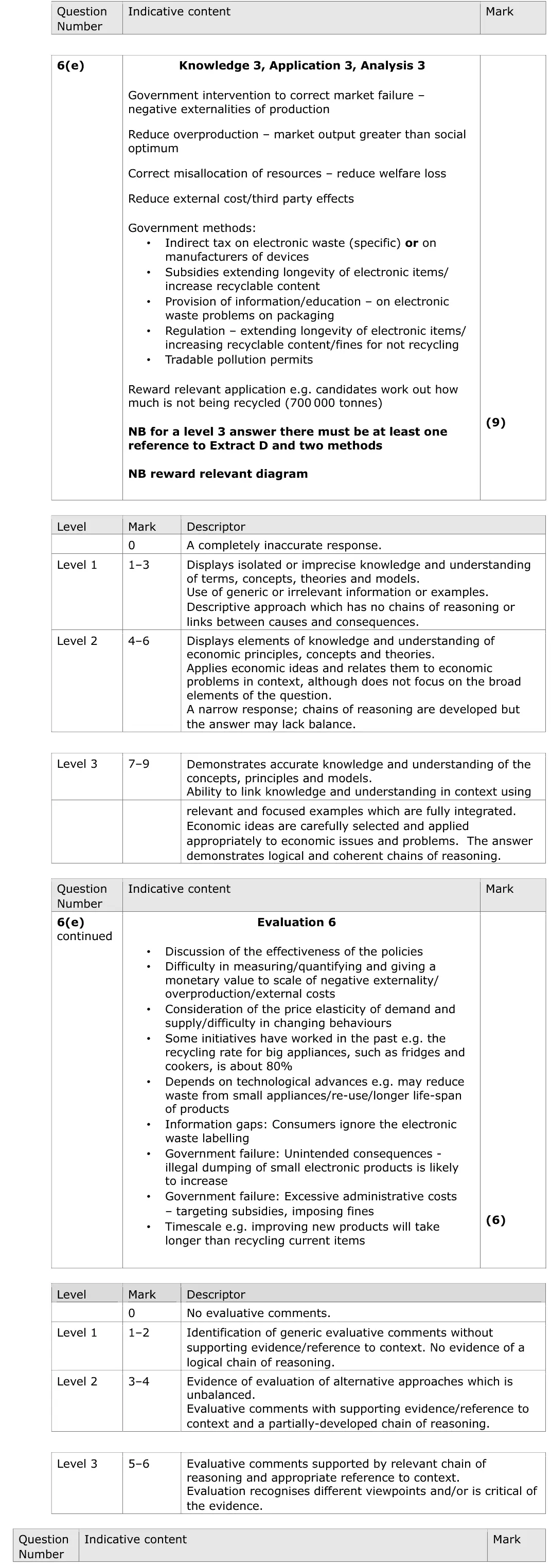
Mark scheme, including the levels grid and indicative content
Examiner's comment
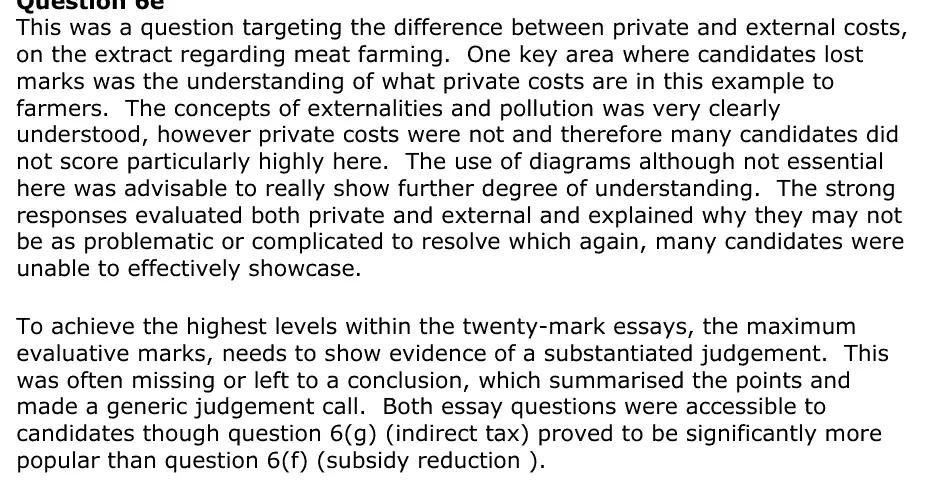
This was a question targeting the difference between private and external costs, on the extract regarding meat farming. One key area where candidates lost marks was the understanding of what private costs are in this example to farmers. The concepts of externalities and pollution was very clearly understood, however private costs were not and therefore many candidates did not score particularly highly here. The use of diagrams although not essential here was advisable to really show further degree of understanding. The strong responses evaluated both private and external and explained why they may not be as problematic or complicated to resolve which again, many candidates were unable to effectively showcase. To achieve the highest levels within the twenty-mark essays, the maximum evaluative marks, needs to show evidence of a substantiated judgement. This was often missing or left to a conclusion, which summarised the points and made a generic judgement call. Both essay questions were accessible to candidates though question 6(g) (indirect tax) proved to be significantly more popular than question 6(f) (subsidy reduction ).
Notes from the mark scheme and report
private costs to farmers (feed, land, labour) vs external costs (greenhouse gases, land use, loss of habitat, health)
negative production externality diagram, no valid diagram caps at Level 2
Level 3 must consider both consumers and producers
report: many did not understand private costs so did not score highly
Quantitative skills: QS 4 (construct and interpret a range of standard graphical forms)
June 2025 · Paper 1 · Q725 marksAO1=4, AO2=4, AO3=8, AO4=925-mark essayEither/or
Mark scheme, including the levels grid and indicative content
Examiner's comment
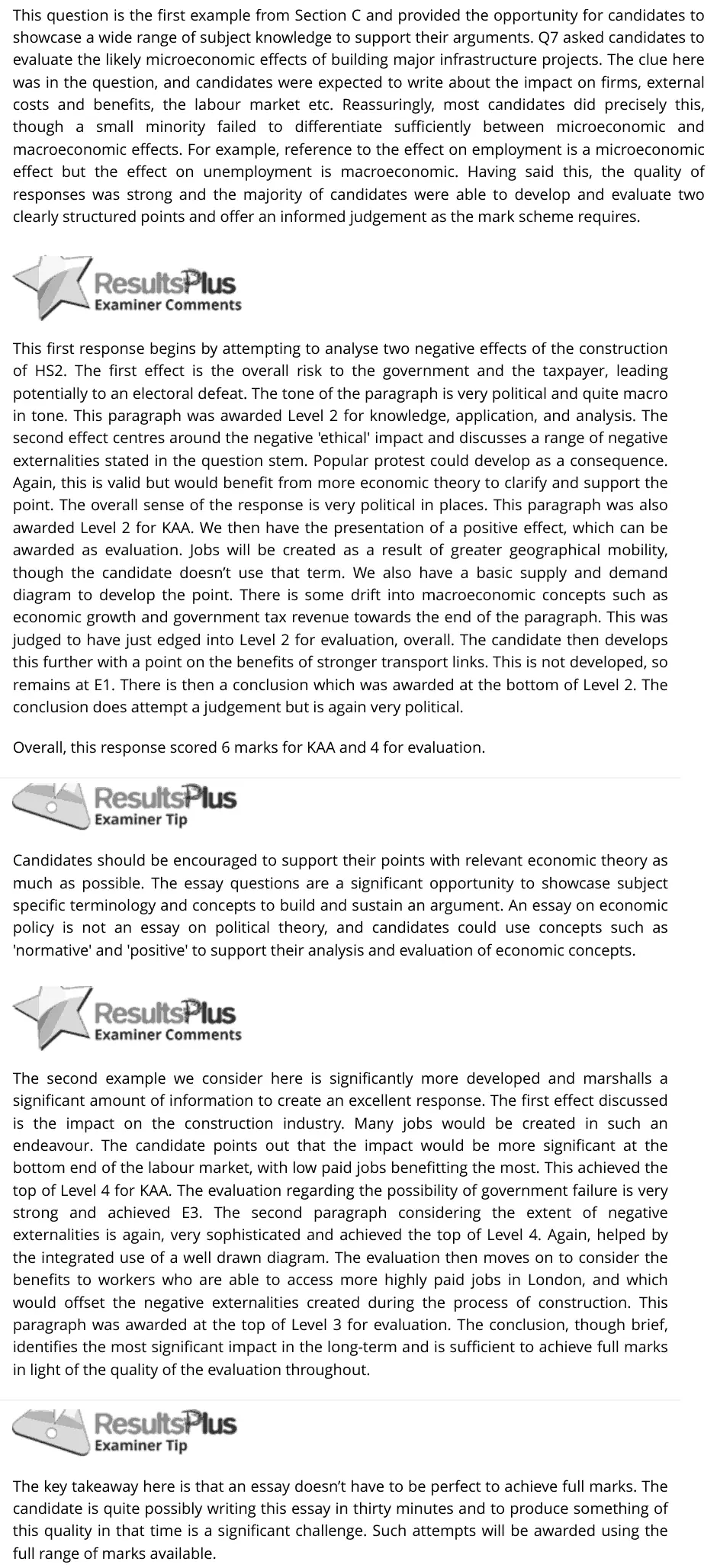
This question is the first example from Section C and provided the opportunity for candidates to showcase a wide range of subject knowledge to support their arguments. Q7 asked candidates to evaluate the likely microeconomic effects of building major infrastructure projects. The clue here was in the question, and candidates were expected to write about the impact on firms, external costs and benefits, the labour market etc. Reassuringly, most candidates did precisely this, though a small minority failed to differentiate sufficiently between microeconomic and macroeconomic effects. For example, reference to the effect on employment is a microeconomic effect but the effect on unemployment is macroeconomic. Having said this, the quality of responses was strong and the majority of candidates were able to develop and evaluate two clearly structured points and offer an informed judgement as the mark scheme requires. This first response begins by attempting to analyse two negative effects of the construction of HS2. The first effect is the overall risk to the government and the taxpayer, leading potentially to an electoral defeat. The tone of the paragraph is very political and quite macro in tone. This paragraph was awarded Level 2 for knowledge, application, and analysis. The second effect centres around the negative 'ethical' impact and discusses a range of negative externalities stated in the question stem. Popular protest could develop as a consequence. Again, this is valid but would benefit from more economic theory to clarify and support the point. The overall sense of the response is very political in places. This paragraph was also awarded Level 2 for KAA. We then have the presentation of a positive effect, which can be awarded as evaluation. Jobs will be created as a result of greater geographical mobility, though the candidate doesn’t use that term. We also have a basic supply and demand diagram to develop the point. There is some drift into macroeconomic concepts such as economic growth and government tax revenue towards the end of the paragraph. This was judged to have just edged into Level 2 for evaluation, overall. The candidate then develops this further with a point on the benefits of stronger transport links. This is not developed, so remains at E1. There is then a conclusion which was awarded at the bottom of Level 2. The conclusion does attempt a judgement but is again very political. Overall, this response scored 6 marks for KAA and 4 for evaluation. Candidates should be encouraged to support their points with relevant economic theory as much as possible. The essay questions are a significant opportunity to showcase subject specific terminology and concepts to build and sustain an argument. An essay on economic policy is not an essay on political theory, and candidates could use concepts such as 'normative' and 'positive' to support their analysis and evaluation of economic concepts. The second example we consider here is significantly more developed and marshalls a significant amount of information to create an excellent response. The first effect discussed is the impact on the construction industry. Many jobs would be created in such an endeavour. The candidate points out that the impact would be more significant at the bottom end of the labour market, with low paid jobs benefitting the most. This achieved the top of Level 4 for KAA. The evaluation regarding the possibility of government failure is very strong and achieved E3. The second paragraph considering the extent of negative externalities is again, very sophisticated and achieved the top of Level 4. Again, helped by the integrated use of a well drawn diagram. The evaluation then moves on to consider the benefits to workers who are able to access more highly paid jobs in London, and which would offset the negative externalities created during the process of construction. This paragraph was awarded at the top of Level 3 for evaluation. The conclusion, though brief, identifies the most significant impact in the long-term and is sufficient to achieve full marks in light of the quality of the evaluation throughout. The key takeaway here is that an essay doesn’t have to be perfect to achieve full marks. The candidate is quite possibly writing this essay in thirty minutes and to produce something of this quality in that time is a significant challenge. Such attempts will be awarded using the full range of marks available.
Notes from the mark scheme and report
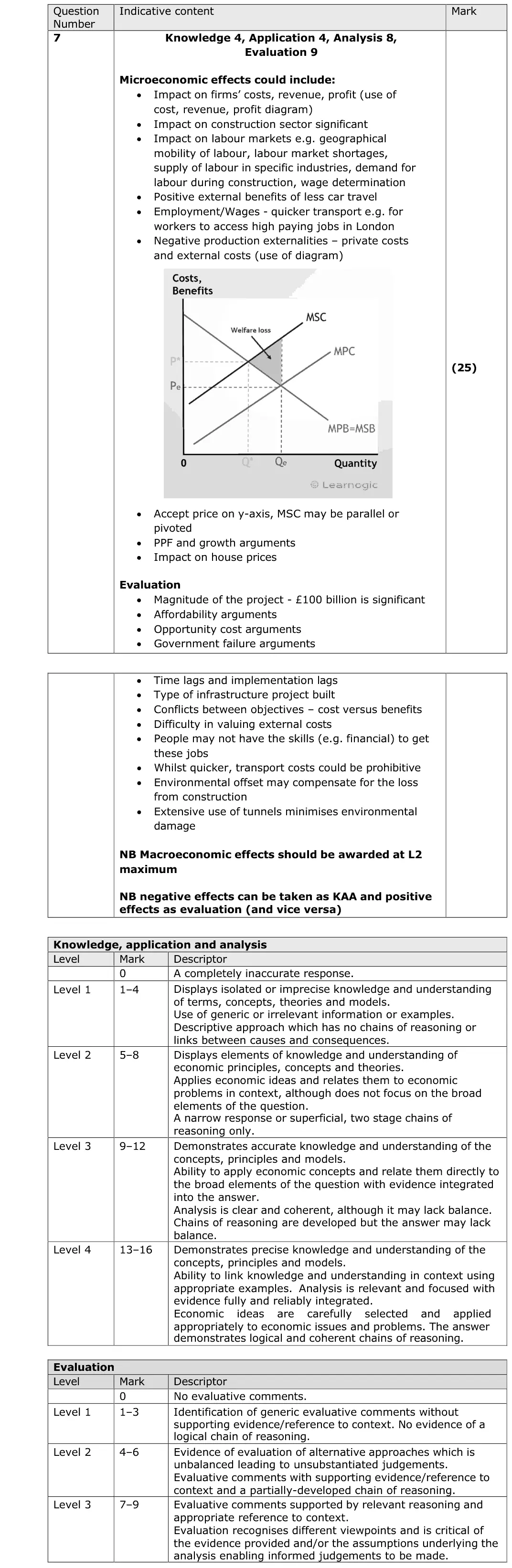
microeconomic effects only (macro points max Level 2): costs and profits of firms, labour mobility and construction jobs, external costs (woodland, homes) and benefits (less car travel) with diagrams
employment is micro, unemployment macro
evaluate with £100 billion opportunity cost and valuing externalities
June 2025 · Paper 1 · Q825 marksAO1=4, AO2=4, AO3=8, AO4=925-mark essayEither/or
Mark scheme, including the levels grid and indicative content
Examiner's comment
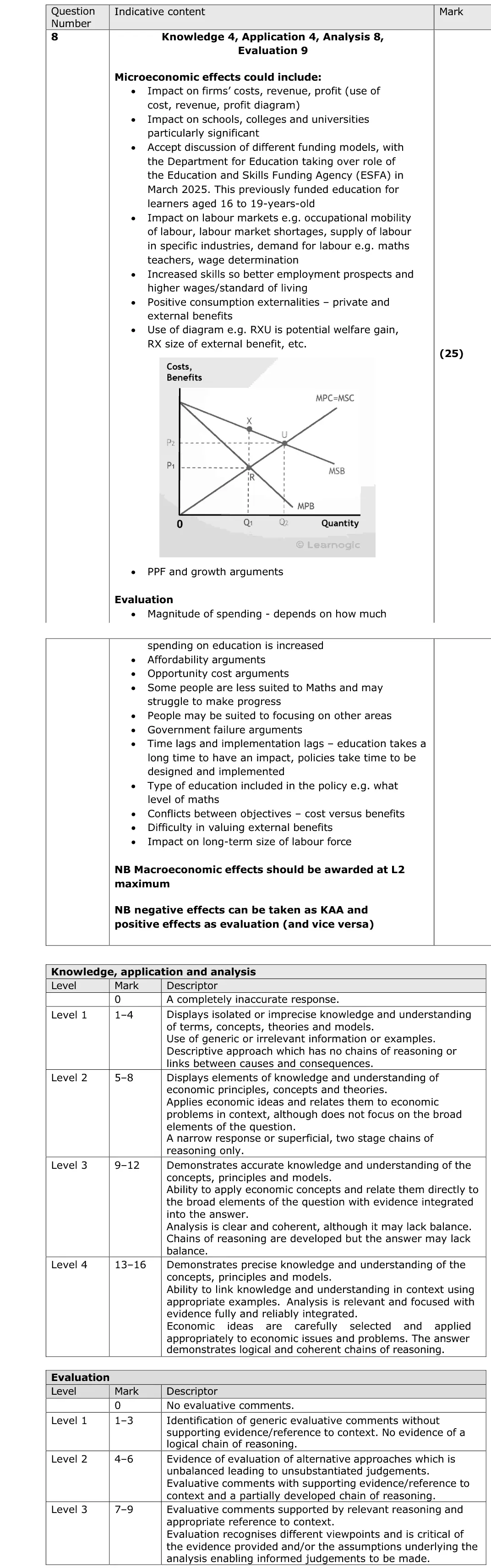
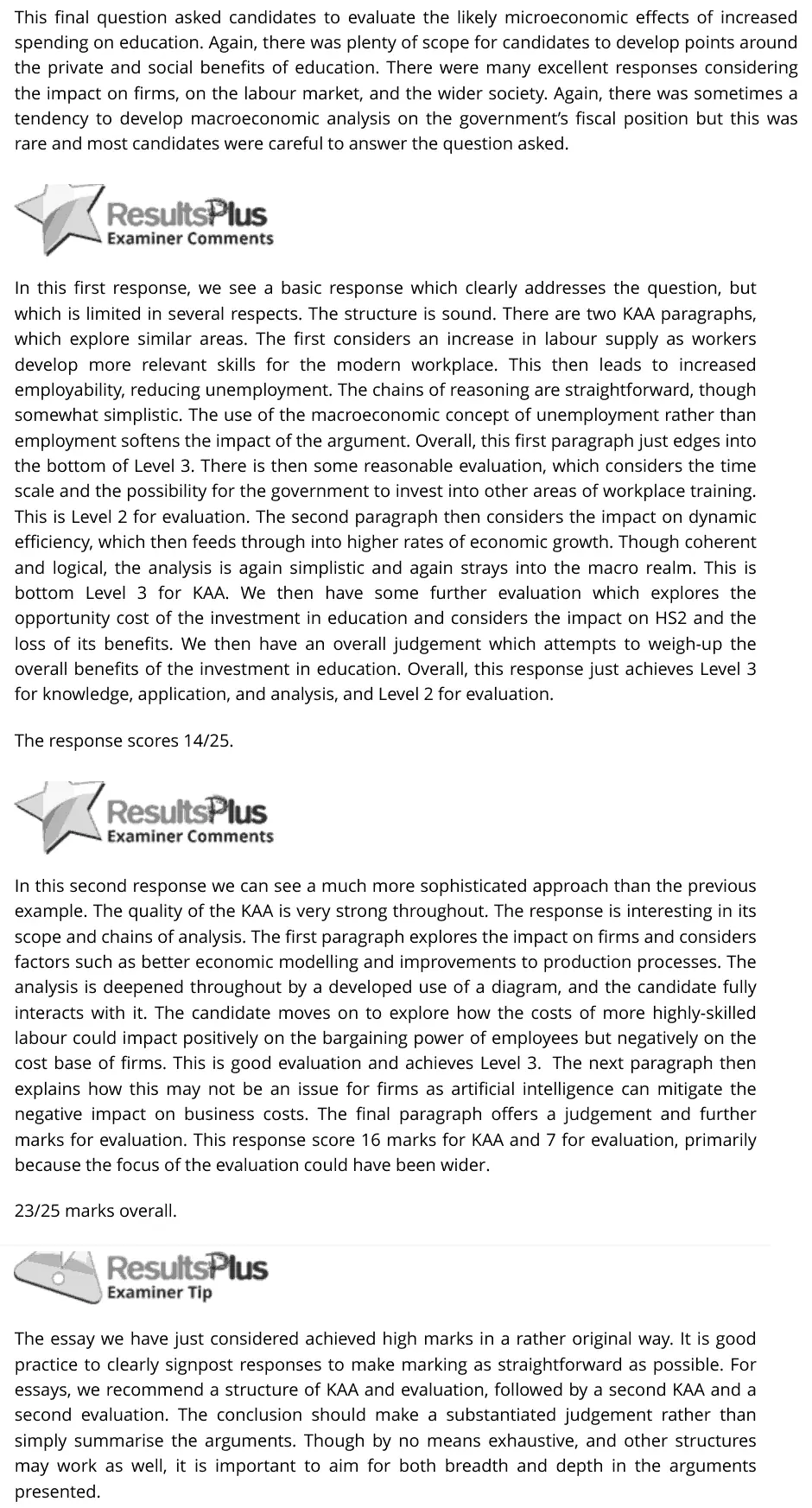
This final question asked candidates to evaluate the likely microeconomic effects of increased spending on education. Again, there was plenty of scope for candidates to develop points around the private and social benefits of education. There were many excellent responses considering the impact on firms, on the labour market, and the wider society. Again, there was sometimes a tendency to develop macroeconomic analysis on the government’s fiscal position but this was rare and most candidates were careful to answer the question asked. In this first response, we see a basic response which clearly addresses the question, but which is limited in several respects. The structure is sound. There are two KAA paragraphs, which explore similar areas. The first considers an increase in labour supply as workers develop more relevant skills for the modern workplace. This then leads to increased employability, reducing unemployment. The chains of reasoning are straightforward, though somewhat simplistic. The use of the macroeconomic concept of unemployment rather than employment softens the impact of the argument. Overall, this first paragraph just edges into the bottom of Level 3. There is then some reasonable evaluation, which considers the time scale and the possibility for the government to invest into other areas of workplace training. This is Level 2 for evaluation. The second paragraph then considers the impact on dynamic efficiency, which then feeds through into higher rates of economic growth. Though coherent and logical, the analysis is again simplistic and again strays into the macro realm. This is bottom Level 3 for KAA. We then have some further evaluation which explores the opportunity cost of the investment in education and considers the impact on HS2 and the loss of its benefits. We then have an overall judgement which attempts to weigh-up the overall benefits of the investment in education. Overall, this response just achieves Level 3 for knowledge, application, and analysis, and Level 2 for evaluation. The response scores 14/25. In this second response we can see a much more sophisticated approach than the previous example. The quality of the KAA is very strong throughout. The response is interesting in its scope and chains of analysis. The first paragraph explores the impact on firms and considers factors such as better economic modelling and improvements to production processes. The analysis is deepened throughout by a developed use of a diagram, and the candidate fully interacts with it. The candidate moves on to explore how the costs of more highly-skilled labour could impact positively on the bargaining power of employees but negatively on the cost base of firms. This is good evaluation and achieves Level 3. The next paragraph then explains how this may not be an issue for firms as artificial intelligence can mitigate the negative impact on business costs. The final paragraph offers a judgement and further marks for evaluation. This response score 16 marks for KAA and 7 for evaluation, primarily because the focus of the evaluation could have been wider. 23/25 marks overall. The essay we have just considered achieved high marks in a rather original way. It is good practice to clearly signpost responses to make marking as straightforward as possible. For essays, we recommend a structure of KAA and evaluation, followed by a second KAA and a second evaluation. The conclusion should make a substantiated judgement rather than simply summarise the arguments. Though by no means exhaustive, and other structures may work as well, it is important to aim for both breadth and depth in the arguments presented.
Notes from the mark scheme and report
microeconomic effects only: education has external benefits in consumption (welfare gain diagram), raises occupational mobility, labour supply and wages, demand for maths teachers
avoid macro analysis of the fiscal position
evaluate with time lags, opportunity cost, suitability of maths for all
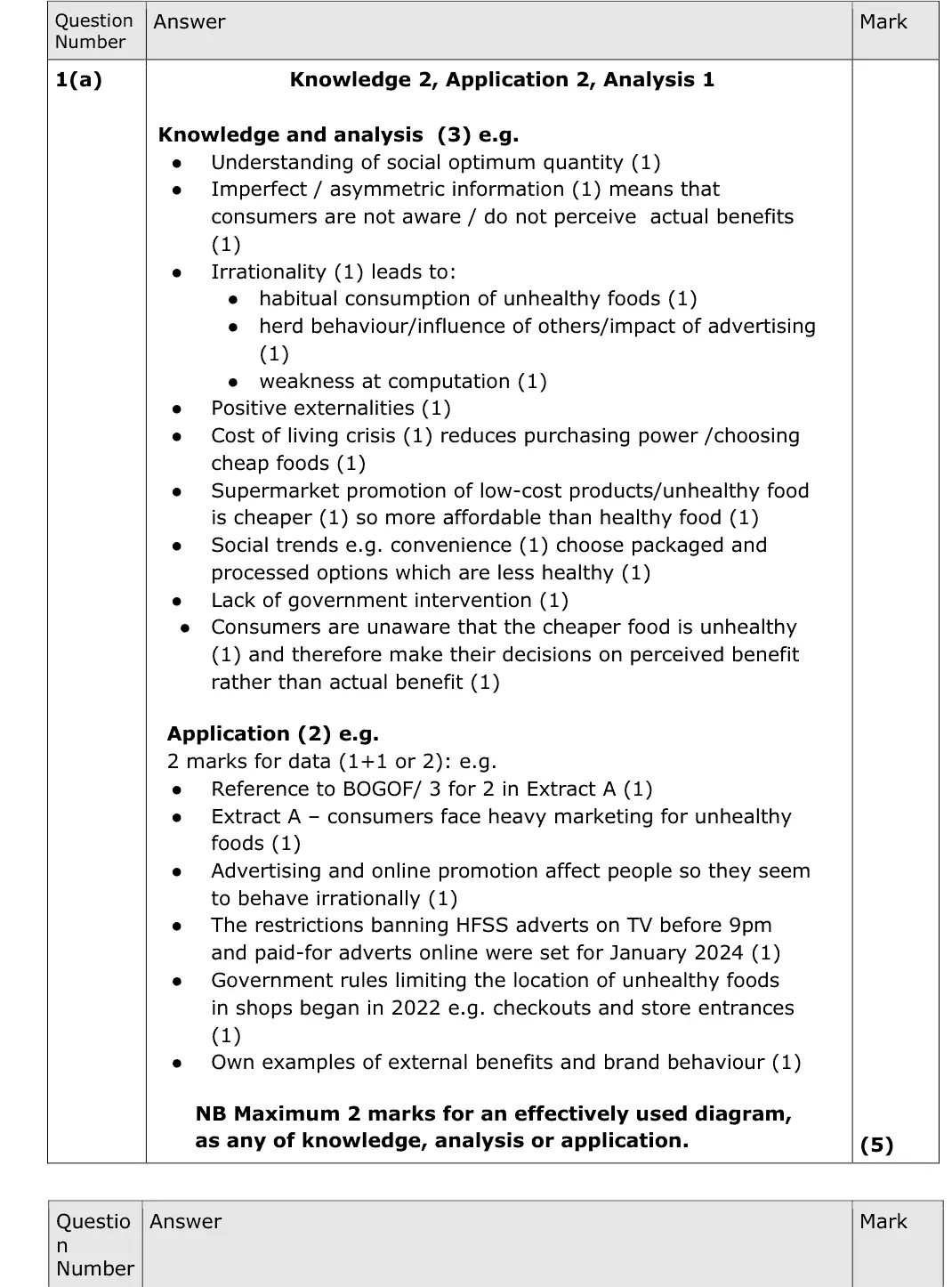
June 2025 · Paper 3 · Q1(a)5 marksAO1=2, AO2=2, AO3=1Short answer
Data and extracts for question 1
Mark scheme
Examiner's comment
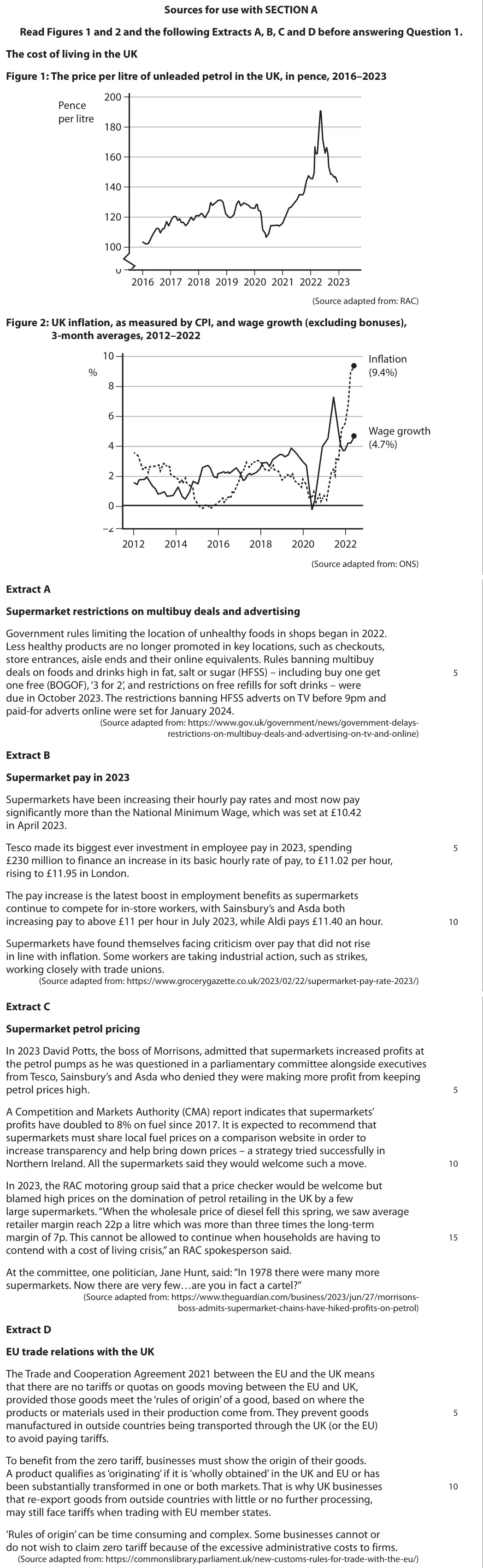
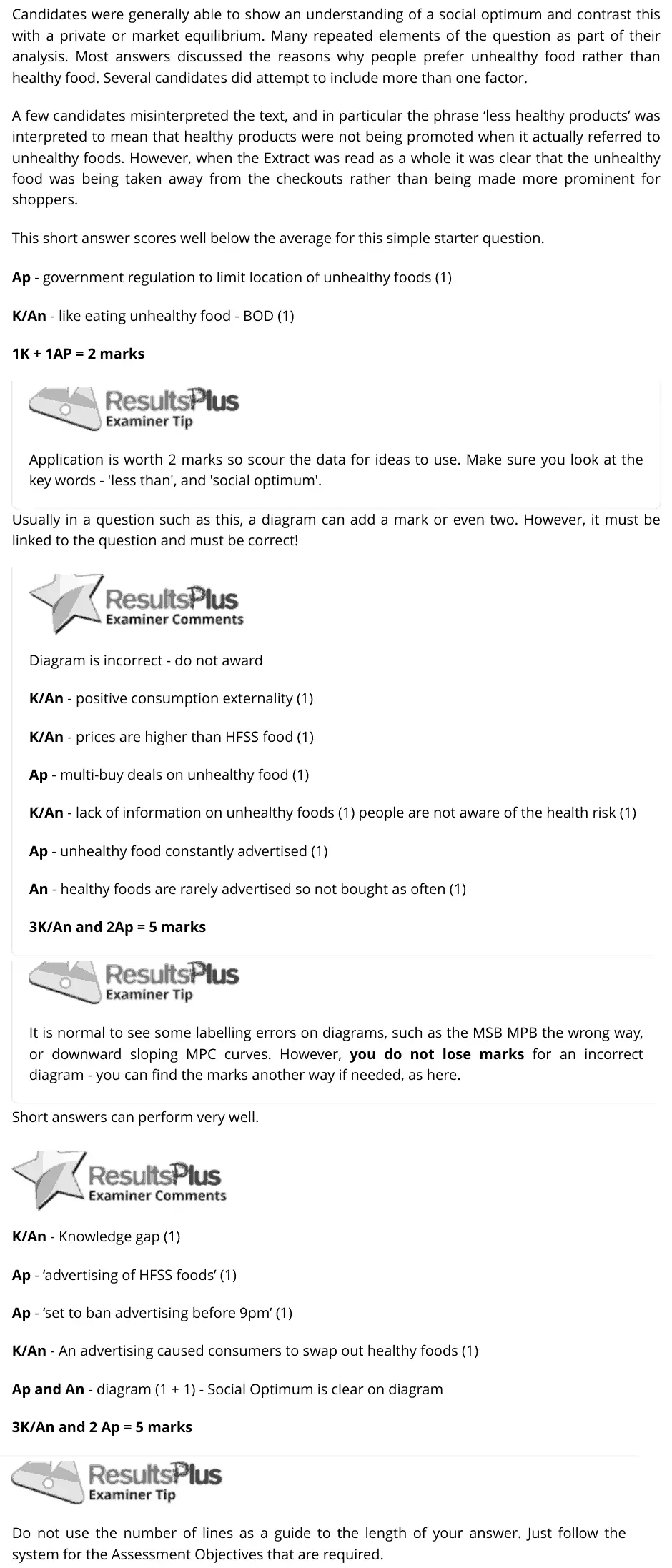
Candidates were generally able to show an understanding of a social optimum and contrast this with a private or market equilibrium. Many repeated elements of the question as part of their analysis. Most answers discussed the reasons why people prefer unhealthy food rather than healthy food. Several candidates did attempt to include more than one factor. A few candidates misinterpreted the text, and in particular the phrase ‘less healthy products’ was interpreted to mean that healthy products were not being promoted when it actually referred to unhealthy foods. However, when the Extract was read as a whole it was clear that the unhealthy food was being taken away from the checkouts rather than being made more prominent for shoppers. This short answer scores well below the average for this simple starter question. Ap - government regulation to limit location of unhealthy foods (1) K/An - like eating unhealthy food - BOD (1) 1K + 1AP = 2 marks Application is worth 2 marks so scour the data for ideas to use. Make sure you look at the key words - 'less than', and 'social optimum'. Usually in a question such as this, a diagram can add a mark or even two. However, it must be linked to the question and must be correct! Diagram is incorrect - do not award K/An - positive consumption externality (1) K/An - prices are higher than HFSS food (1) Ap - multi-buy deals on unhealthy food (1) K/An - lack of information on unhealthy foods (1) people are not aware of the health risk (1) Ap - unhealthy food constantly advertised (1) An - healthy foods are rarely advertised so not bought as often (1) 3K/An and 2Ap = 5 marks It is normal to see some labelling errors on diagrams, such as the MSB MPB the wrong way, or downward sloping MPC curves. However, you do not lose marks for an incorrect diagram - you can find the marks another way if needed, as here. Short answers can perform very well. K/An - Knowledge gap (1) Ap - ‘advertising of HFSS foods’ (1) Ap - ‘set to ban advertising before 9pm’ (1) K/An - An advertising caused consumers to swap out healthy foods (1) Ap and An - diagram (1 + 1) - Social Optimum is clear on diagram 3K/An and 2 Ap = 5 marks Do not use the number of lines as a guide to the length of your answer. Just follow the system for the Assessment Objectives that are required.
Notes from the mark scheme and report
define the social optimum vs market equilibrium
reasons: information gaps (benefits not perceived), positive consumption externalities, irrational habitual/herd behaviour, cheap unhealthy food
use Extract A (BOGOF, HFSS rules) for application
'less healthy products' refers to unhealthy food
max 2 for a diagram, which must be correct
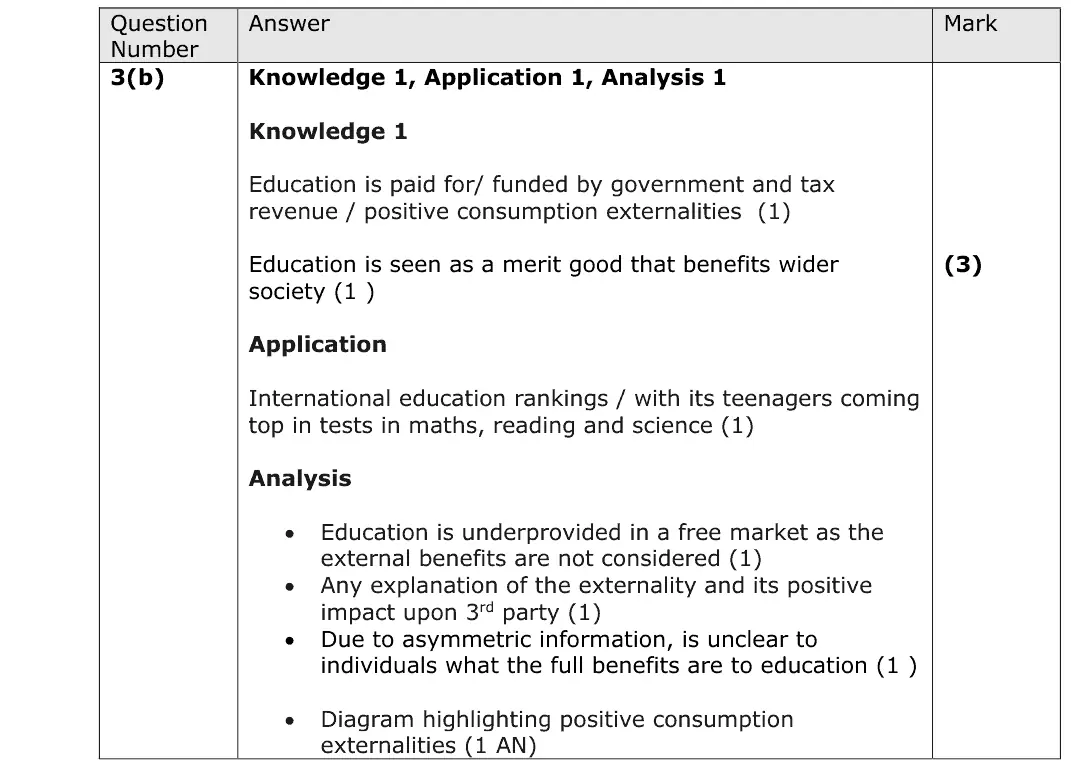
June 2024 · AS Paper 1 · Q3(b)3 marksAO1=1, AO2=1, AO3=1Short answer
Data and extracts for question 3
Mark scheme
Examiner's comment
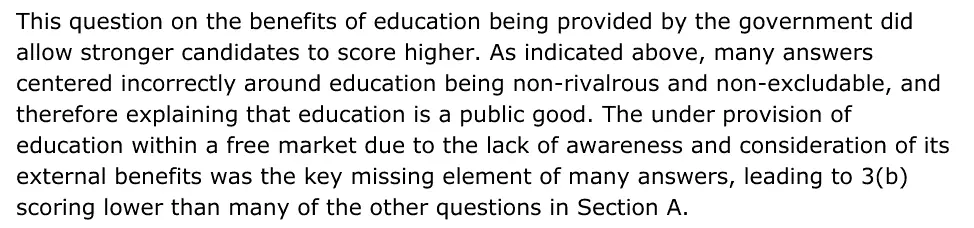
This question on the benefits of education being provided by the government did allow stronger candidates to score higher. As indicated above, many answers centered incorrectly around education being non-rivalrous and non-excludable, and therefore explaining that education is a public good. The under provision of education within a free market due to the lack of awareness and consideration of its external benefits was the key missing element of many answers, leading to 3(b) scoring lower than many of the other questions in Section A.
Notes from the mark scheme and report
education has positive consumption externalities (and information gaps), so it is under-provided in a free market and funded by taxation
apply e.g. Singapore teenagers top international tests
many wrongly called education a public good (non-rival, non-excludable)
report: scored lower than many other Section A questions
June 2024 · AS Paper 1 · Q6(e)15 marksAO1=3, AO2=3, AO3=3, AO4=615-mark response
Data and extracts for question 6
Mark scheme, including the levels grid and indicative content
Examiner's comment
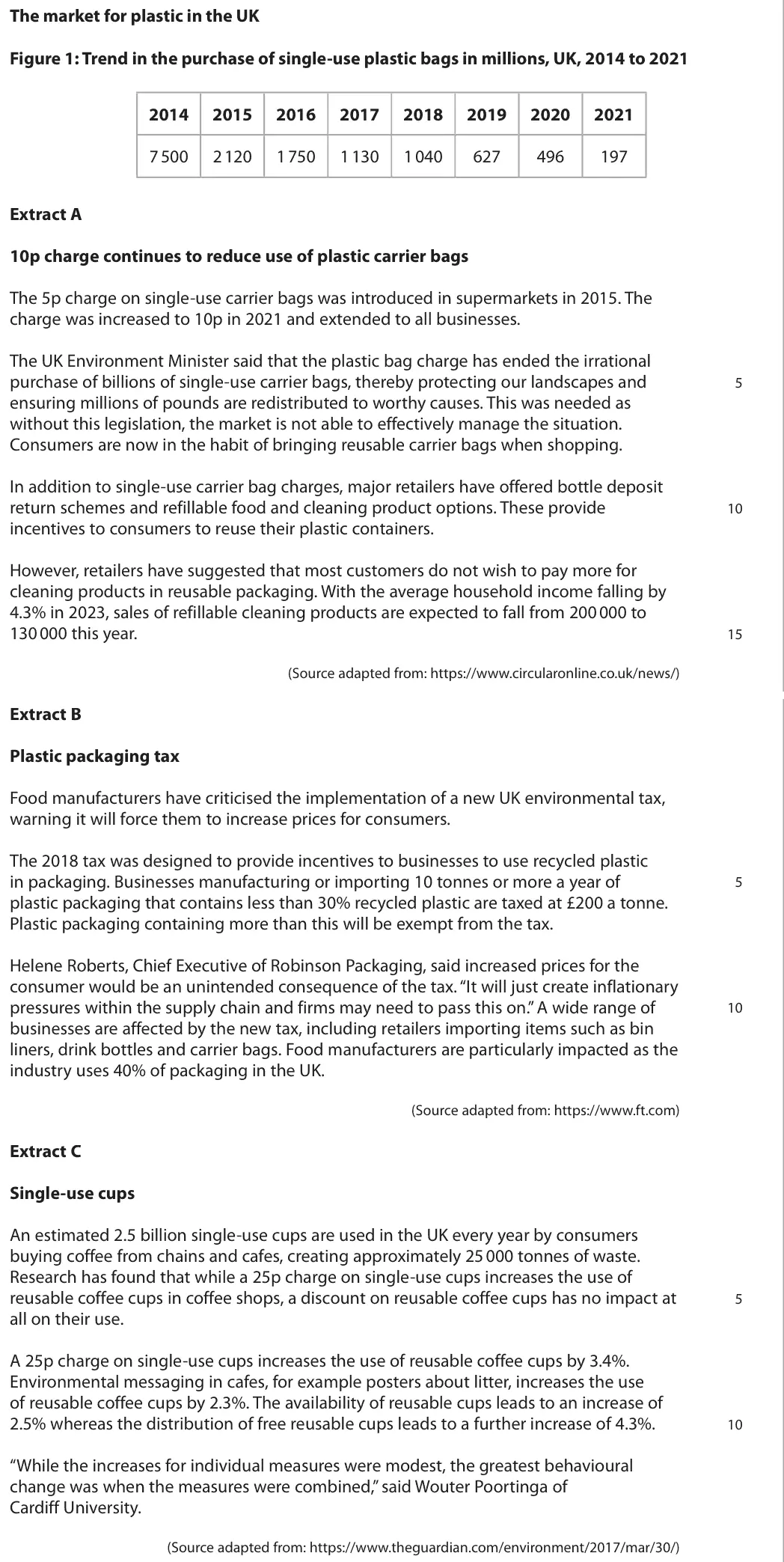
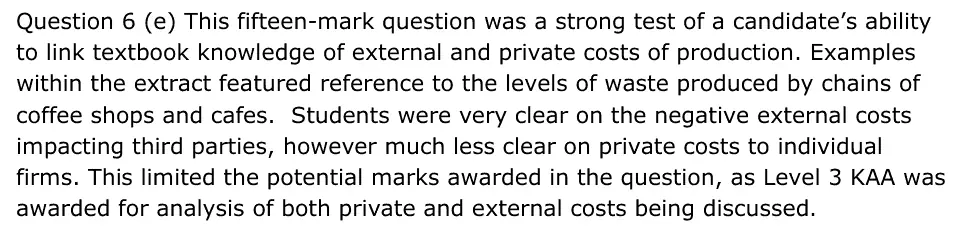
Question 6 (e) This fifteen-mark question was a strong test of a candidate’s ability to link textbook knowledge of external and private costs of production. Examples within the extract featured reference to the levels of waste produced by chains of coffee shops and cafes. Students were very clear on the negative external costs impacting third parties, however much less clear on private costs to individual firms. This limited the potential marks awarded in the question, as Level 3 KAA was awarded for analysis of both private and external costs being discussed.
Notes from the mark scheme and report
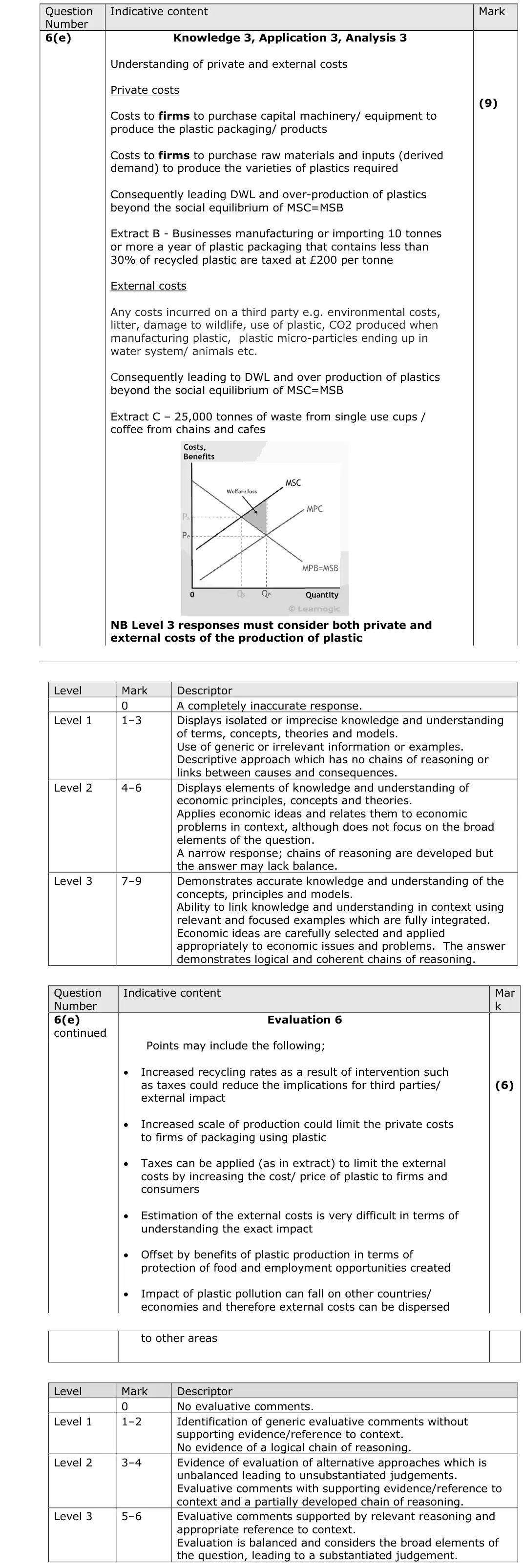
Level 3 needs both private costs (machinery, raw materials, the plastic tax at £200 a tonne) and external costs (litter, wildlife, CO2, microplastics, 25 000 tonnes of cup waste)
report: many were much less clear on private costs
evaluate with difficulty of valuing external costs, recycling, benefits of plastic
June 2024 · Paper 1 · Q6(e)15 marksAO1=3, AO2=3, AO3=3, AO4=615-mark response
Data and extracts for question 6
Mark scheme, including the levels grid and indicative content
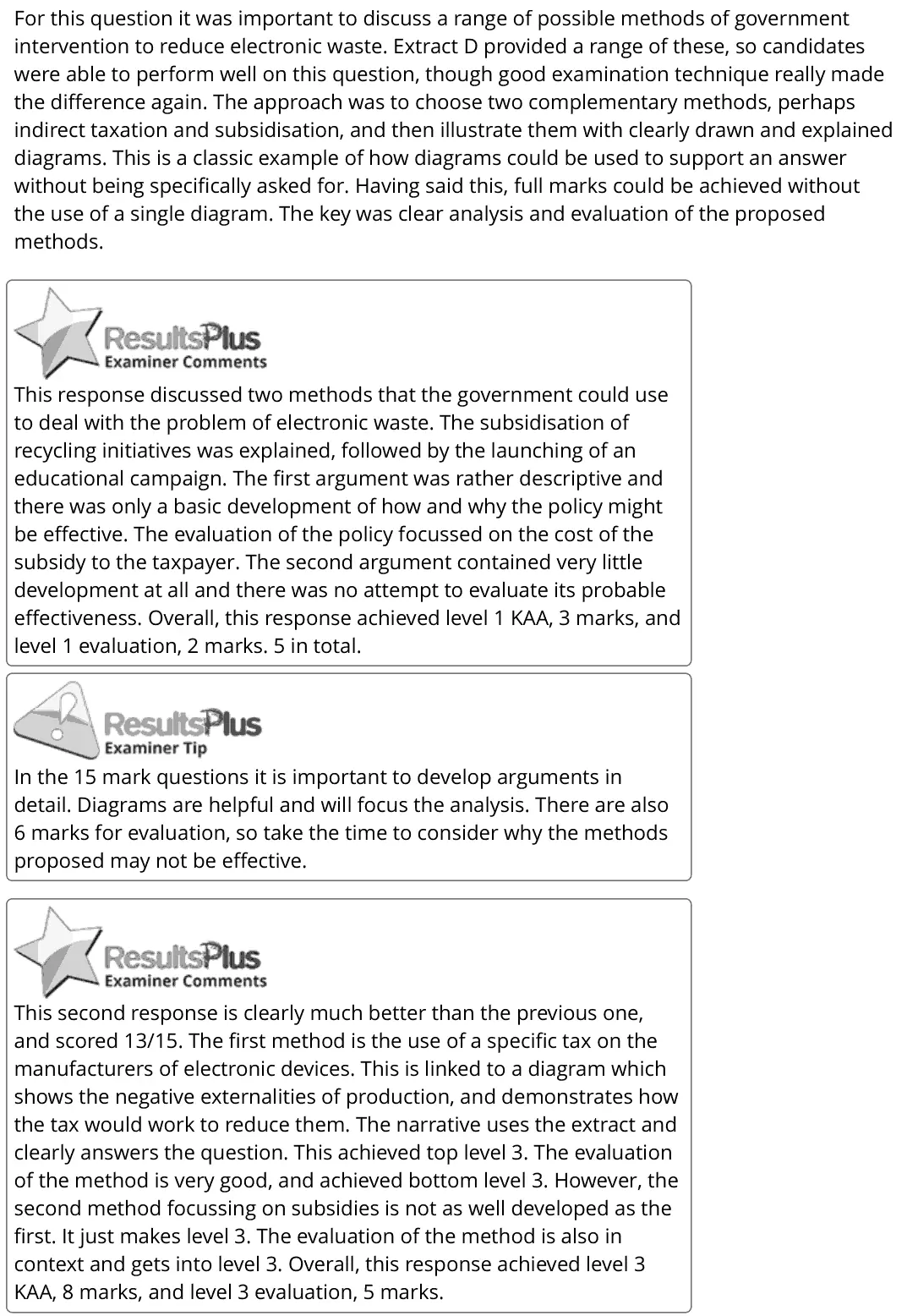
Examiner's comment
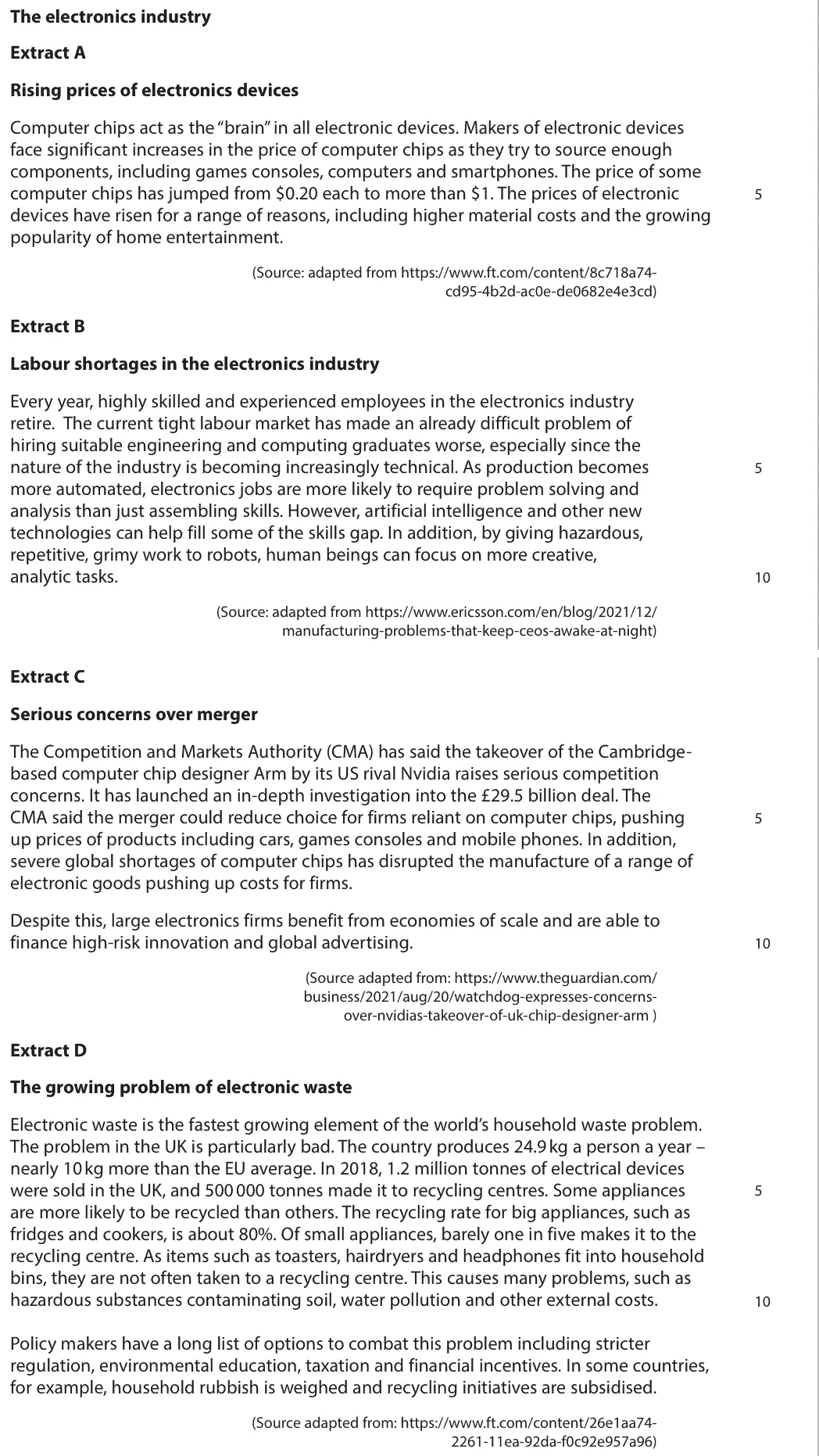
For this question it was important to discuss a range of possible methods of government intervention to reduce electronic waste. Extract D provided a range of these, so candidates were able to perform well on this question, though good examination technique really made the difference again. The approach was to choose two complementary methods, perhaps indirect taxation and subsidisation, and then illustrate them with clearly drawn and explained diagrams. This is a classic example of how diagrams could be used to support an answer without being specifically asked for. Having said this, full marks could be achieved without the use of a single diagram. The key was clear analysis and evaluation of the proposed methods. This response discussed two methods that the government could use to deal with the problem of electronic waste. The subsidisation of recycling initiatives was explained, followed by the launching of an educational campaign. The first argument was rather descriptive and there was only a basic development of how and why the policy might be effective. The evaluation of the policy focussed on the cost of the subsidy to the taxpayer. The second argument contained very little development at all and there was no attempt to evaluate its probable effectiveness. Overall, this response achieved level 1 KAA, 3 marks, and level 1 evaluation, 2 marks. 5 in total. In the 15 mark questions it is important to develop arguments in detail. Diagrams are helpful and will focus the analysis. There are also 6 marks for evaluation, so take the time to consider why the methods proposed may not be effective. This second response is clearly much better than the previous one, and scored 13/15. The first method is the use of a specific tax on the manufacturers of electronic devices. This is linked to a diagram which shows the negative externalities of production, and demonstrates how the tax would work to reduce them. The narrative uses the extract and clearly answers the question. This achieved top level 3. The evaluation of the method is very good, and achieved bottom level 3. However, the second method focussing on subsidies is not as well developed as the first. It just makes level 3. The evaluation of the method is also in context and gets into level 3. Overall, this response achieved level 3 KAA, 8 marks, and level 3 evaluation, 5 marks.
Notes from the mark scheme and report
Level 3 needs two methods and at least one reference to Extract D
indirect tax / subsidy with negative-externality diagrams
evaluate effectiveness, e.g. valuing the external cost
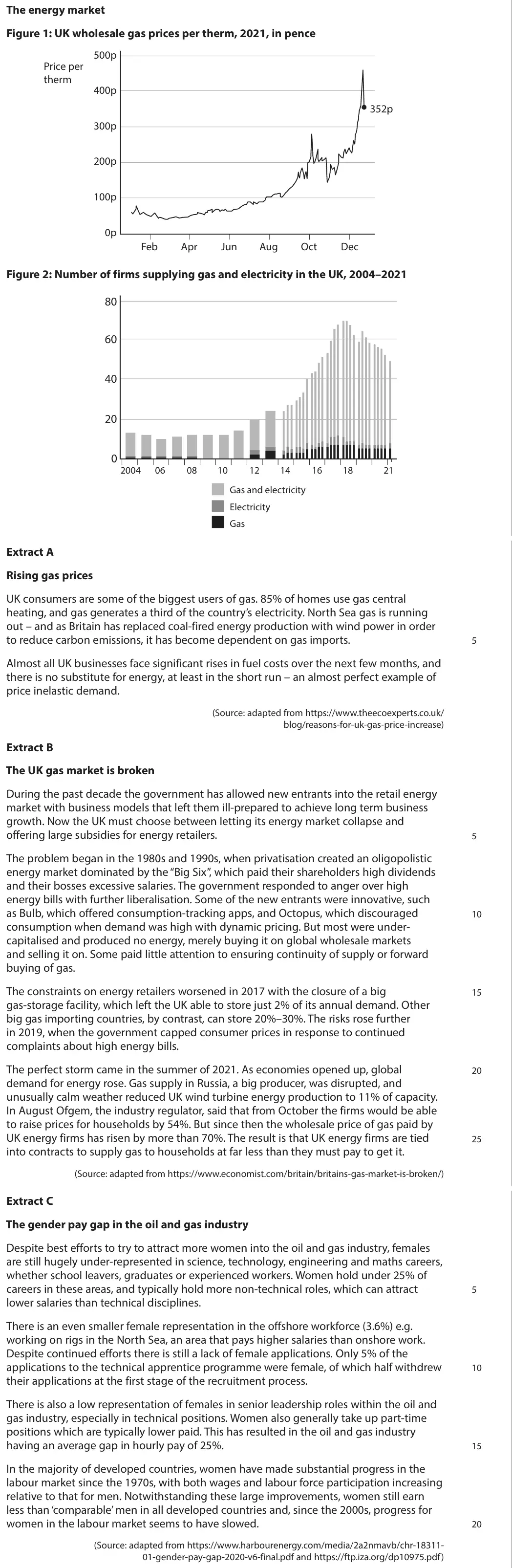
June 2024 · Paper 3 · Q1(b)8 marksAO1=2, AO2=2, AO3=2, AO4=28-mark response
Data and extracts for question 1
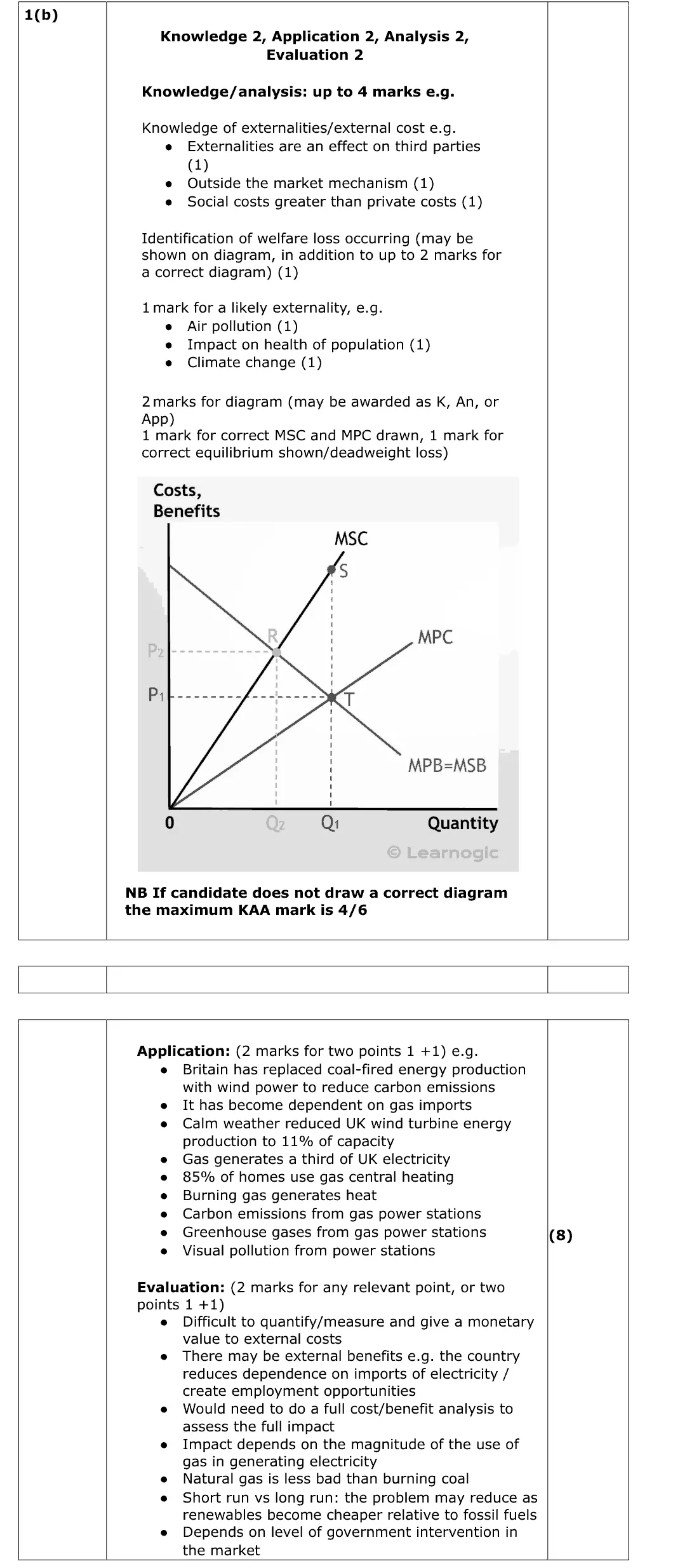
Mark scheme, including the levels grid and indicative content
Examiner's comment
Probably the first thing that candidates should have noticed with this question is the word ‘one’ in bold. The question only asks for ONE likely externality, so candidates who write about two different externalities are wasting valuable time. The question specifically asks for a diagram, and as such answers that do not have a correct diagram showing the external costs of production can achieve a maximum mark overall of 6/8. Fortunately this wasn't an issue for the majority of students, but again it does illustrate the importance of ensuring that you can draw all the key diagrams across the specification. Many well-written answers gained the knowledge/analysis marks relatively quickly. Some struggled to receive the second application mark - remember in any 8-mark question, there will ALWAYS be 2 marks for application. Whilst the number seems to be falling, as hopefully the structure of an 8-mark question is well-understood by now, there are still a signiifant number of candidates who simply aren't evaluating in this question. Remember this automatically means there are two marks you won't be able to earn. <i sesuitsPs This answer achieves full marks. First of all, they have a correct diagram. The first paragraph, above the diagram, clearly identifies the negative externality and references ‘third parties’. In terms of application, this can be found both in the first and second paragraphs. There are two marks for evaluation on the second pageofthe answer. Clearly a well-written answer that does exactly what is required to answer the question and achieves full marks. <6ResultsPlus This answer achieves 6/8. There is a correct diagram along with deadweight loss labelled. This therefore means that 3 marks have been achieved so far. The rest of the answer easily achieves the final k mark and the two application marks - there is plenty of discussion about the negative externality from burning gas and explanation of the diagram. There is really more written here than is needed - the candidate could have stopped writing a lot earlier. Unfortunately, there is no evaluation in this answer and so therefore it can't achieve more than 6/8. “aN mae}ResultsPlus Remember there are ALWAYS 2 marks for evaluation in every 8-mark question.
Notes from the mark scheme and report
ONE externality only (air pollution, carbon emissions, health of third parties)
MSC above MPC diagram with welfare loss
maximum 6 of 8 without a correct diagram
second application mark often missed
evaluate e.g. hard to value external costs, gas cleaner than coal
Quantitative skills: QS 4 (construct and interpret a range of standard graphical forms)
June 2023 · AS Paper 1 · Q6(b)6 marksAO1=2, AO2=2, AO3=2Short answer
Data and extracts for question 6
Mark scheme
Examiner's comment
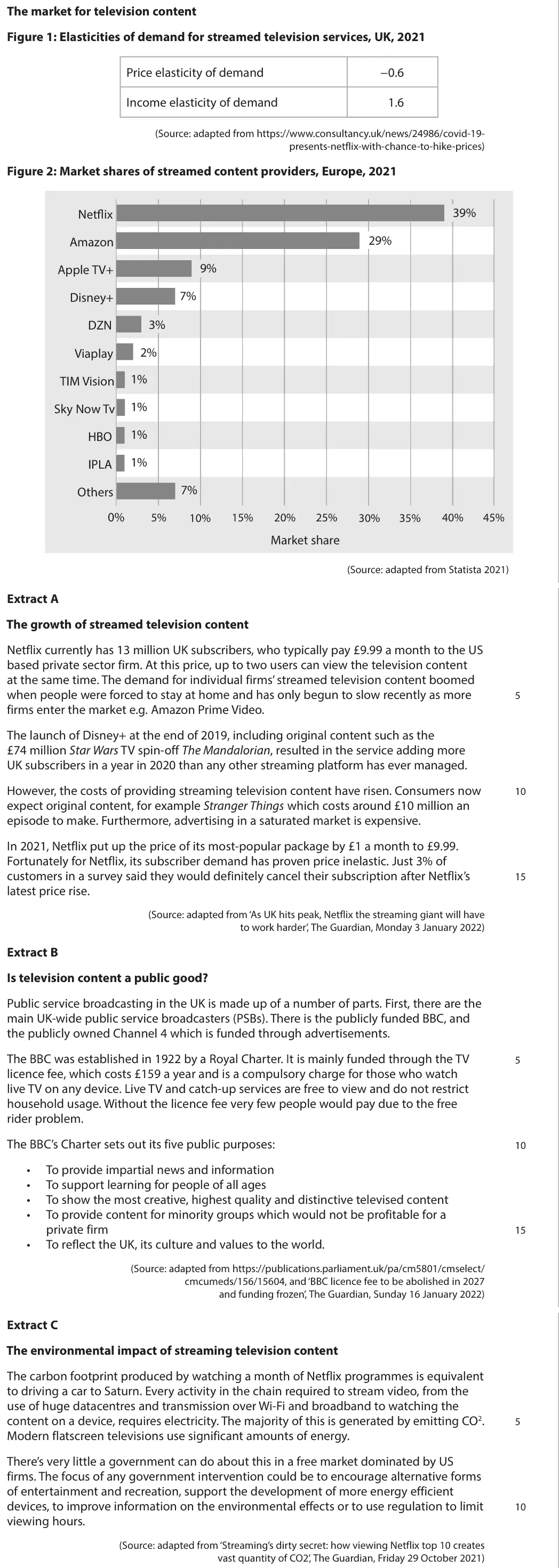
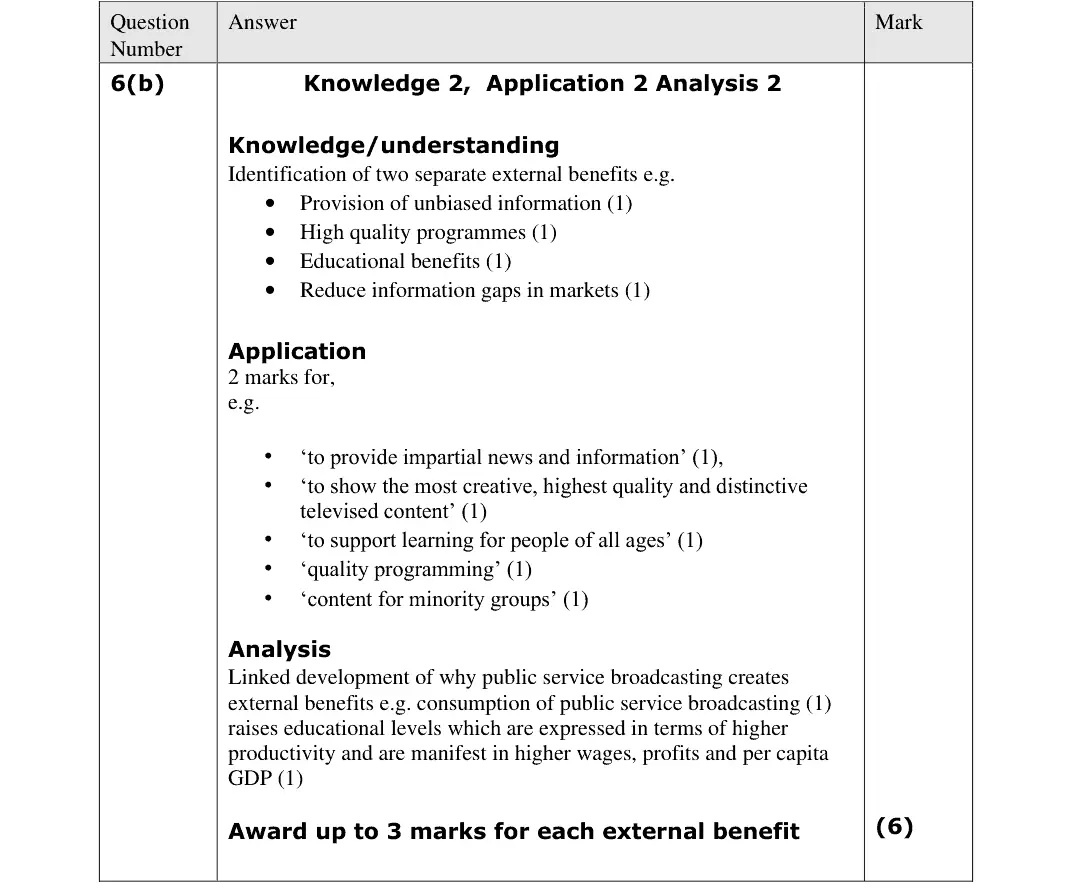
This question was a six-mark question based on external benefits concerned with public service broadcasting consumption. The use of the case study/ extracts was was excellent in this answer, and those candidates who did this well explained and developed their points well ensuring the highest level awards
Notes from the mark scheme and report
two separate external benefits of consumption from Extract B: impartial news, learning for all ages, minority content, culture
analyse the benefit to third parties or society beyond the viewer
June 2023 · Paper 1 · Q6(d)12 marksAO1=2, AO2=2, AO3=4, AO4=412-mark response
Data and extracts for question 6
Mark scheme, including the levels grid and indicative content
Examiner's comment
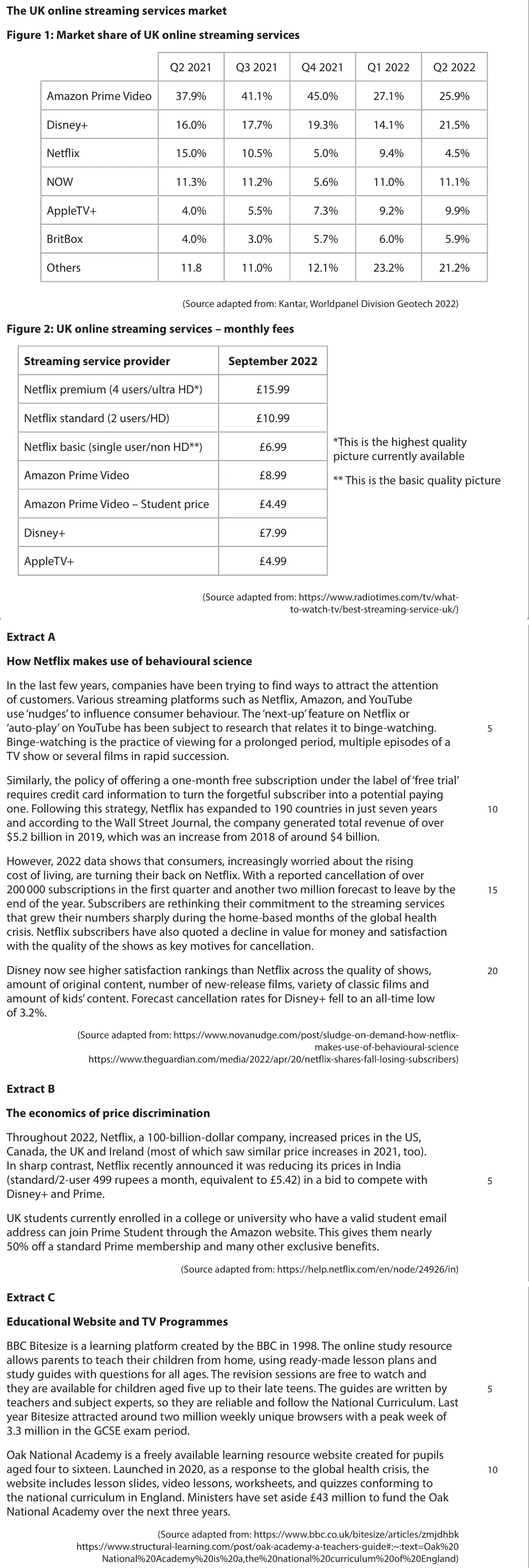
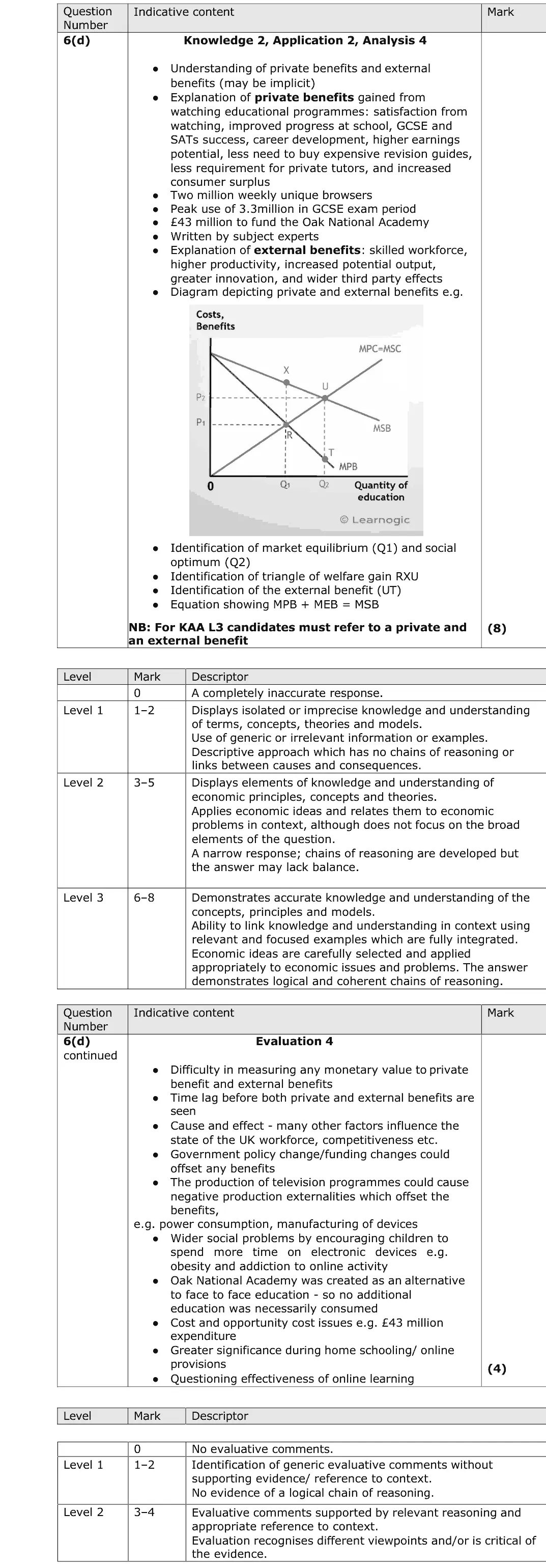
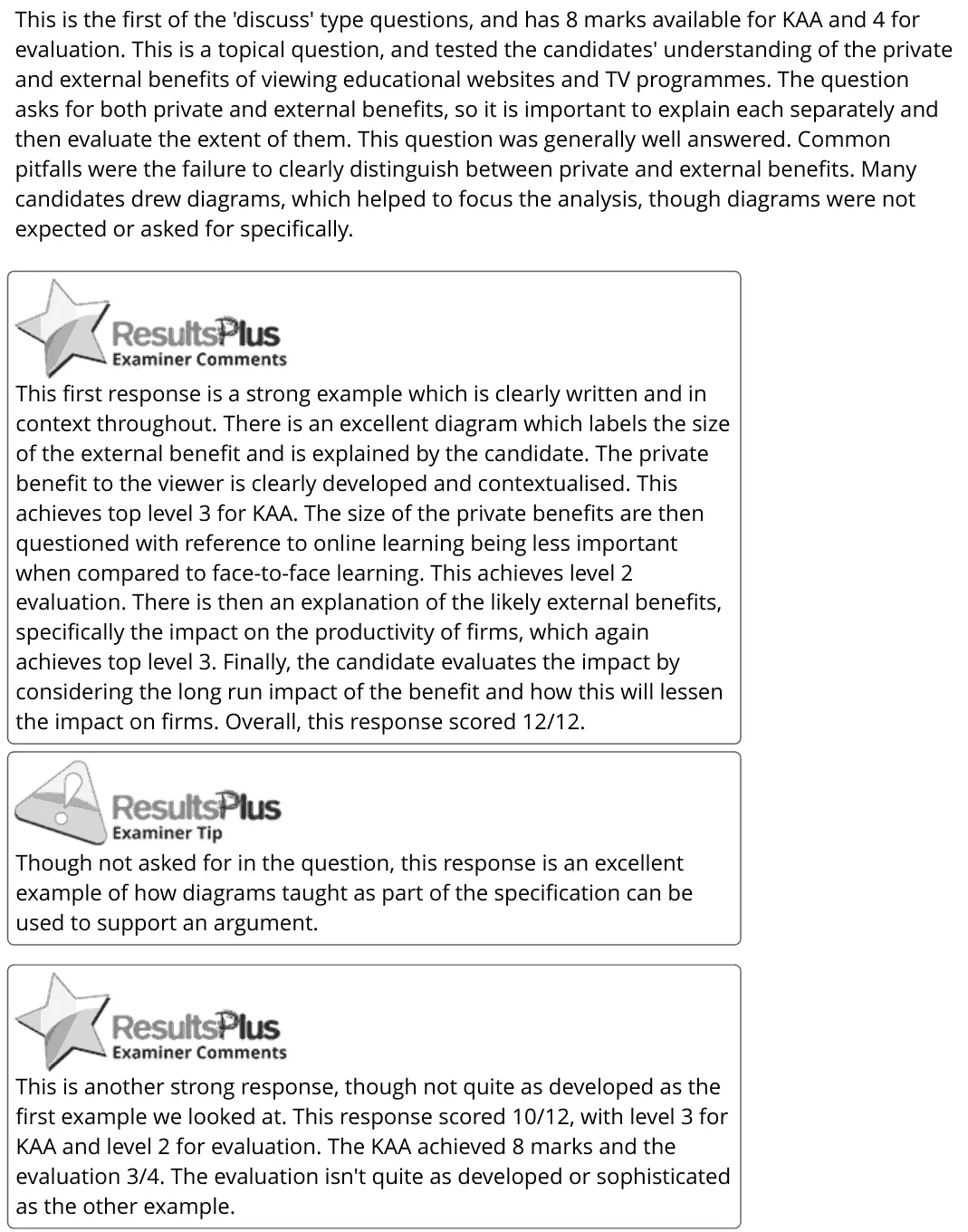
This is the first of the 'discuss' type questions, and has 8 marks available for KAA and 4 for evaluation. This is a topical question, and tested the candidates' understanding of the private and external benefits of viewing educational websites and TV programmes. The question asks for both private and external benefits, so it is important to explain each separately and then evaluate the extent of them. This question was generally well answered. Common pitfalls were the failure to clearly distinguish between private and external benefits. Many candidates drew diagrams, which helped to focus the analysis, though diagrams were not expected or asked for specifically. This first response is a strong example which is clearly written and in context throughout. There is an excellent diagram which labels the size of the external benefit and is explained by the candidate. The private benefit to the viewer is clearly developed and contextualised. This achieves top level 3 for KAA. The size of the private benefits are then questioned with reference to online learning being less important when compared to face-to-face learning. This achieves level 2 evaluation. There is then an explanation of the likely external benefits, specifically the impact on the productivity of firms, which again achieves top level 3. Finally, the candidate evaluates the impact by considering the long run impact of the benefit and how this will lessen the impact on firms. Overall, this response scored 12/12. Though not asked for in the question, this response is an excellent example of how diagrams taught as part of the specification can be used to support an argument. This is another strong response, though not quite as developed as the first example we looked at. This response scored 10/12, with level 3 for KAA and level 2 for evaluation. The KAA achieved 8 marks and the evaluation 3/4. The evaluation isn't quite as developed or sophisticated as the other example.
Notes from the mark scheme and report
separate private benefits (exam success, earnings) from external benefits (more productive workforce, less pressure on schools) of BBC Bitesize and Oak Academy
positive consumption externality diagram optional
report: common pitfall was not distinguishing private from external benefits
June 2023 · AS Paper 1 · Q6(f)20 marksAO1=4, AO2=4, AO3=6, AO4=620-mark essayEither/or
Data and extracts for question 6
Mark scheme, including the levels grid and indicative content
Examiner's comment
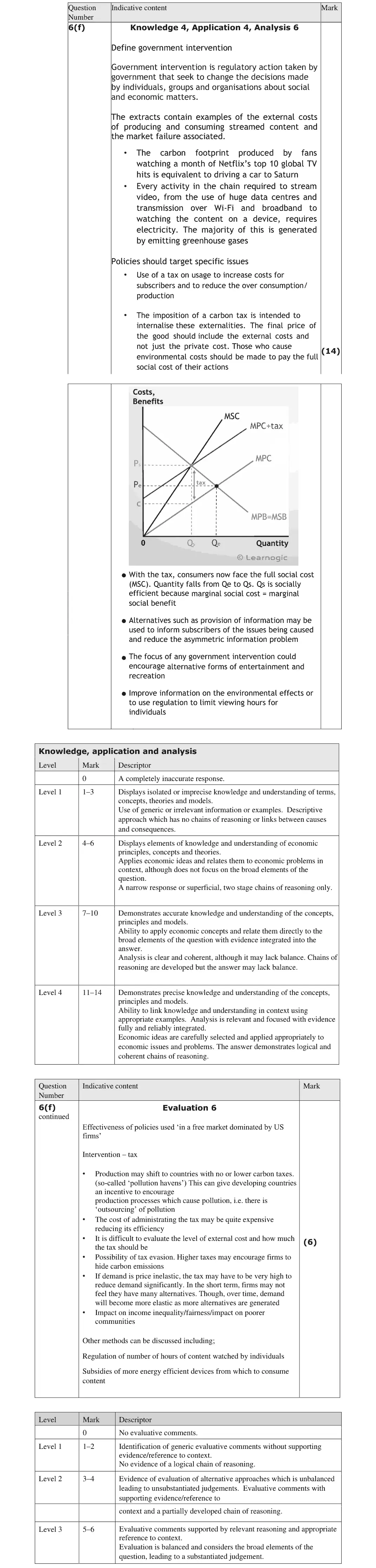
This was a highly accessible question considering the methods that could be used to reduce the environmental damage associated with the consumption of television content. There are numerous possibilities that candidates could explore, and the vast majority talked about taxes,, regulation or provision of information. This essay requires a clear exercise of critical analysis and good candidates would be expected to have a developed a clear appreciation of the method of government intervention to correct the market failure. Sophisticated responses recognised that some forms of government intervention would be more effective than others. Good use of diagrams was showcased throughout the candidates’ responses, usually an indirect tax diagram. To access evaluation marks candidates could explore the various strengths and weaknesses of each method proposed and use the prompts in the extracts to consider how effective the policy might be. Another line of development considered how some combination of policies might be necessary to effectively tackle the problem of environmental damageThe best responses would work by proposing realistic solutions to the problem of excess demand and then evaluating the most effective in the context of the real- world situation.
Notes from the mark scheme and report
negative consumption externality from electricity use and CO2 (Extract C)
tax to internalise the external cost (MSC), information provision, regulation of viewing hours, subsidies for efficient devices
evaluate effectiveness, valuing the externality, US firms beyond UK reach
Quantitative skills: QS 4 (construct and interpret a range of standard graphical forms)
June 2023 · AS Paper 1 · Q6(g)20 marksAO1=4, AO2=4, AO3=6, AO4=620-mark essayEither/or
Data and extracts for question 6
Mark scheme, including the levels grid and indicative content
Examiner's comment
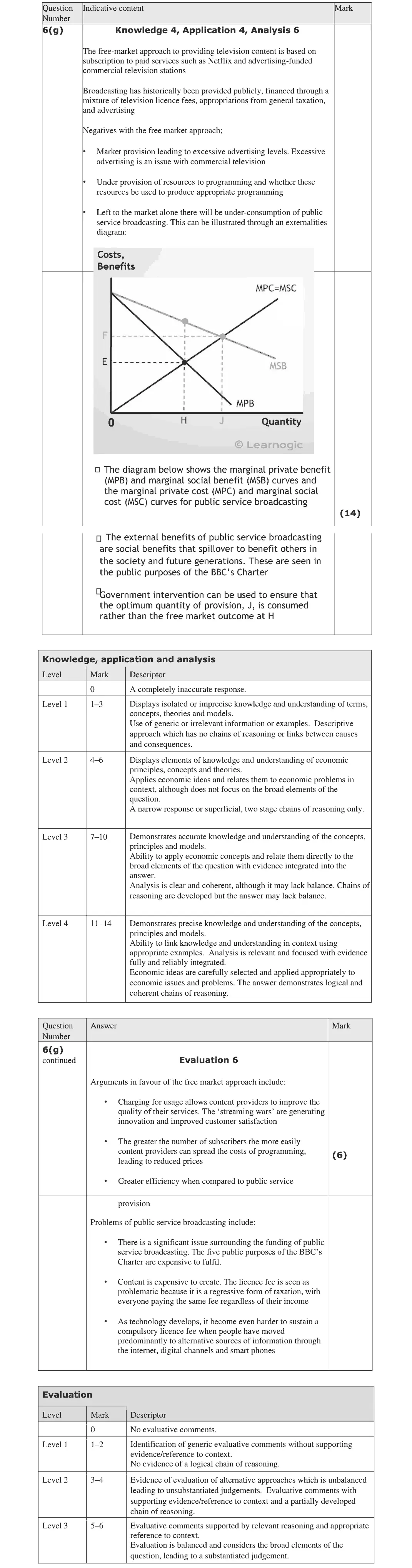
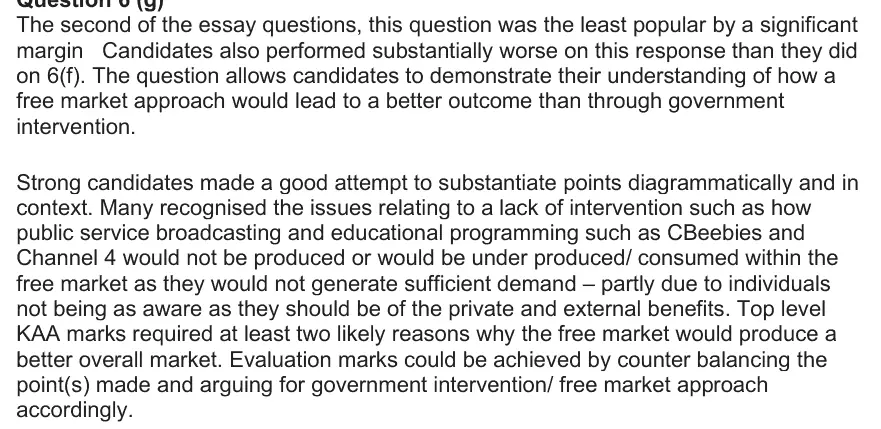
The second of the essay questions, this question was the least popular by a significant margin Candidates also performed substantially worse on this response than they did on 6(f). The question allows candidates to demonstrate their understanding of how a free market approach would lead to a better outcome than through government intervention. Strong candidates made a good attempt to substantiate points diagrammatically and in context. Many recognised the issues relating to a lack of intervention such as how public service broadcasting and educational programming such as CBeebies and Channel 4 would not be produced or would be under produced/ consumed within the free market as they would not generate sufficient demand – partly due to individuals not being as aware as they should be of the private and external benefits. Top level KAA marks required at least two likely reasons why the free market would produce a better overall market. Evaluation marks could be achieved by counter balancing the point(s) made and arguing for government intervention/ free market approach accordingly.
Notes from the mark scheme and report
free market under-provides public service broadcasting with external benefits (MSB above MPB diagram), excess advertising, no content for minority groups
evaluate with choice and competition from Netflix and Disney+, government failure
candidates did substantially worse than on 6(f)
June 2023 · Paper 1 · Q825 marksAO1=4, AO2=4, AO3=8, AO4=925-mark essayEither/or
Mark scheme, including the levels grid and indicative content
Examiner's comment
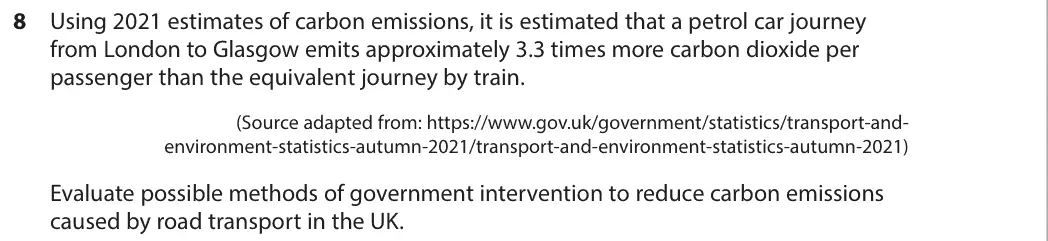
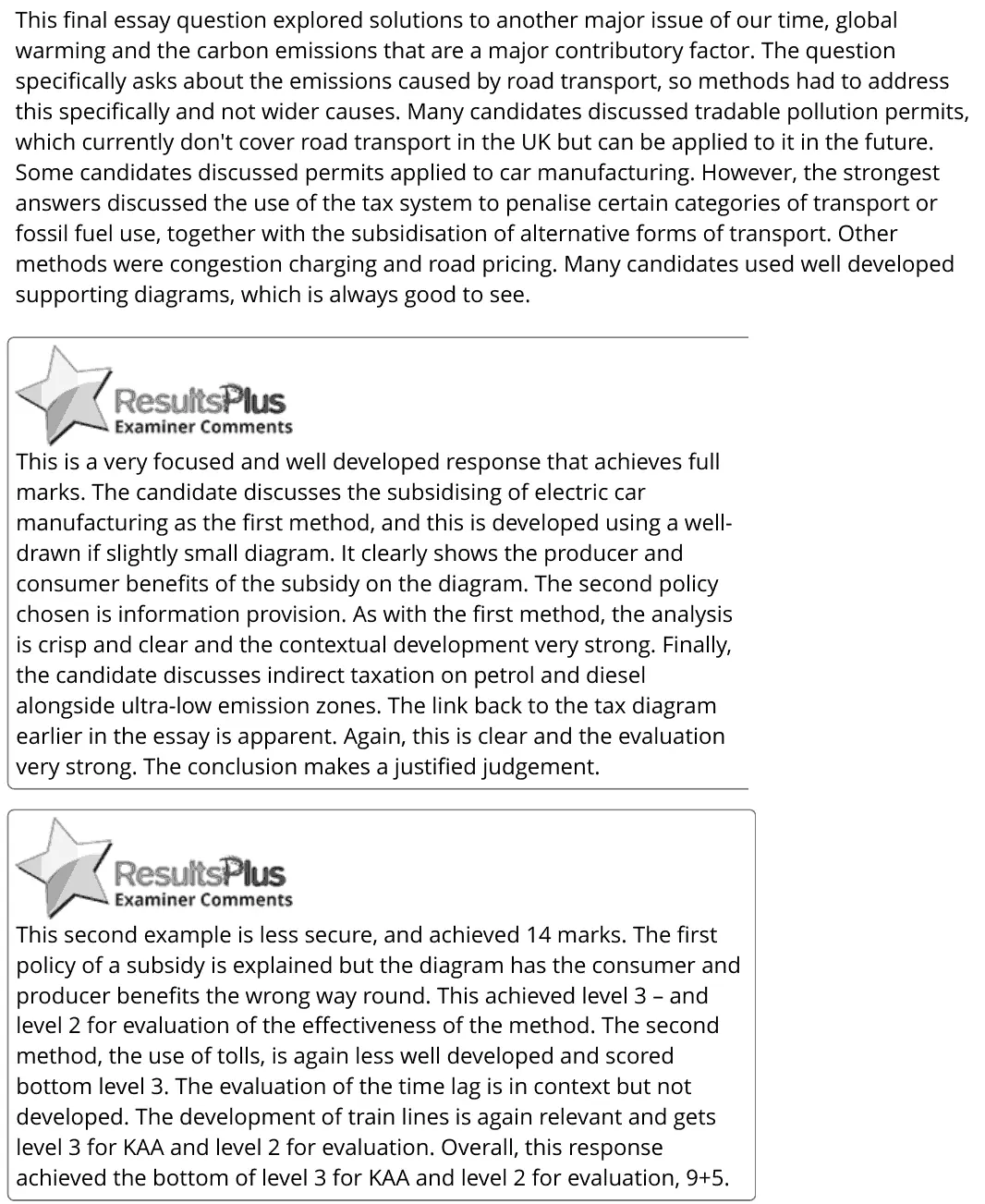
This final essay question explored solutions to another major issue of our time, global warming and the carbon emissions that are a major contributory factor. The question specifically asks about the emissions caused by road transport, so methods had to address this specifically and not wider causes. Many candidates discussed tradable pollution permits, which currently don't cover road transport in the UK but can be applied to it in the future. Some candidates discussed permits applied to car manufacturing. However, the strongest answers discussed the use of the tax system to penalise certain categories of transport or fossil fuel use, together with the subsidisation of alternative forms of transport. Other methods were congestion charging and road pricing. Many candidates used well developed supporting diagrams, which is always good to see. This is a very focused and well developed response that achieves full marks. The candidate discusses the subsidising of electric car manufacturing as the first method, and this is developed using a well- drawn if slightly small diagram. It clearly shows the producer and consumer benefits of the subsidy on the diagram. The second policy chosen is information provision. As with the first method, the analysis is crisp and clear and the contextual development very strong. Finally, the candidate discusses indirect taxation on petrol and diesel alongside ultra-low emission zones. The link back to the tax diagram earlier in the essay is apparent. Again, this is clear and the evaluation very strong. The conclusion makes a justified judgement. This second example is less secure, and achieved 14 marks. The first policy of a subsidy is explained but the diagram has the consumer and producer benefits the wrong way round. This achieved level 3 – and level 2 for evaluation of the effectiveness of the method. The second method, the use of tolls, is again less well developed and scored bottom level 3. The evaluation of the time lag is in context but not developed. The development of train lines is again relevant and gets level 3 for KAA and level 2 for evaluation. Overall, this response achieved the bottom of level 3 for KAA and level 2 for evaluation, 9+5.
Notes from the mark scheme and report
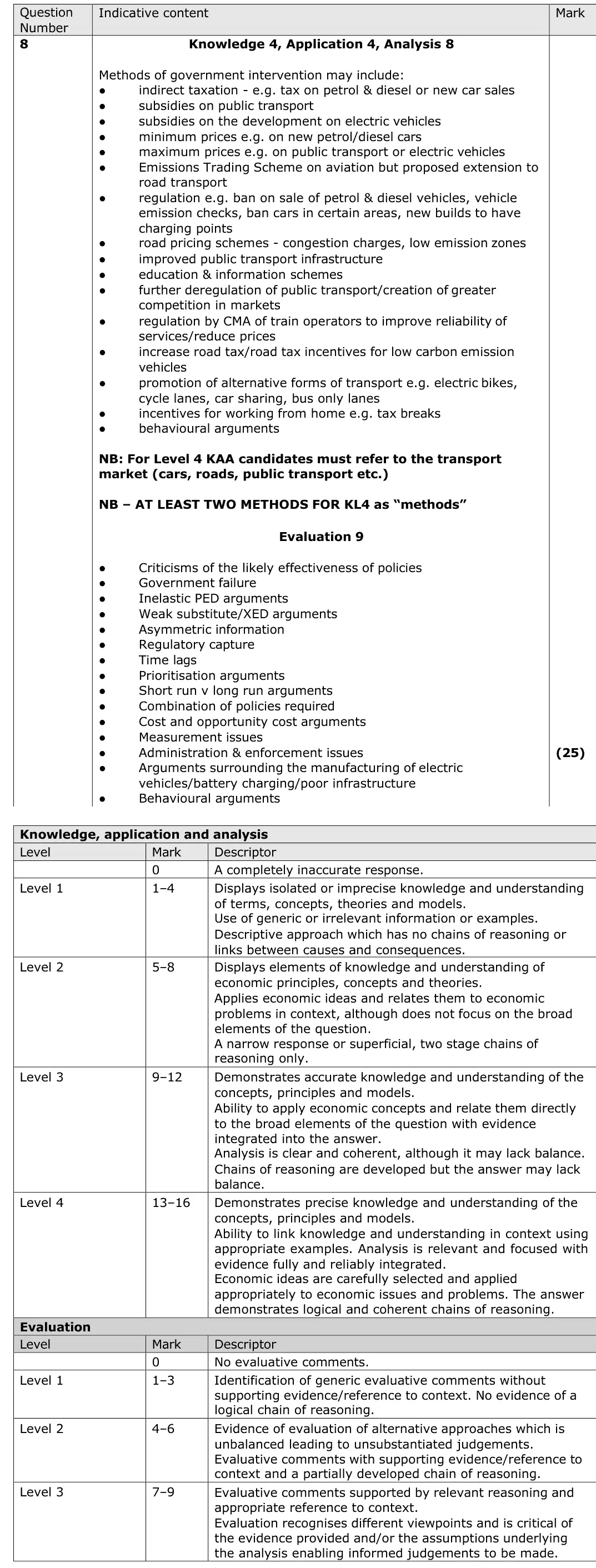
methods must target road transport: fuel or vehicle taxes, subsidies for public transport and electric vehicles, congestion charging, regulation, tradable permits (not yet covered for road transport)
negative externality diagrams
evaluate with PED, valuing the external cost and government failure
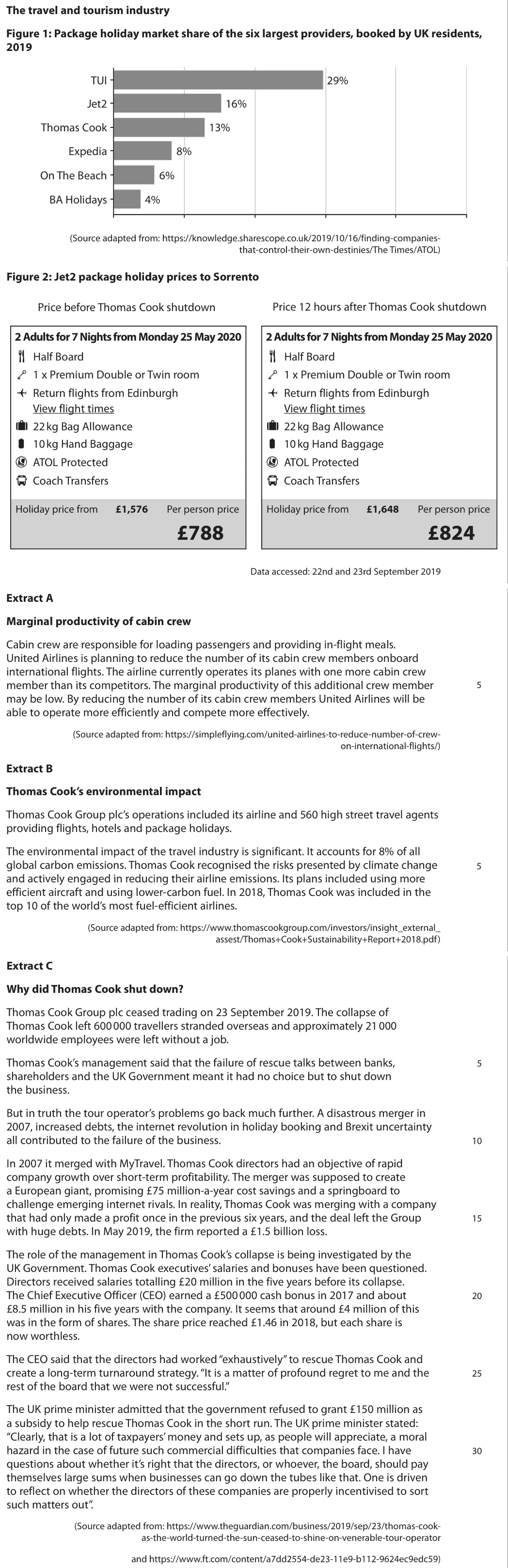
June 2022 · Paper 1 · Q3(a)4 marksAO1=2, AO2=2Diagram
Data and extracts for question 3
Mark scheme
Examiner's comment
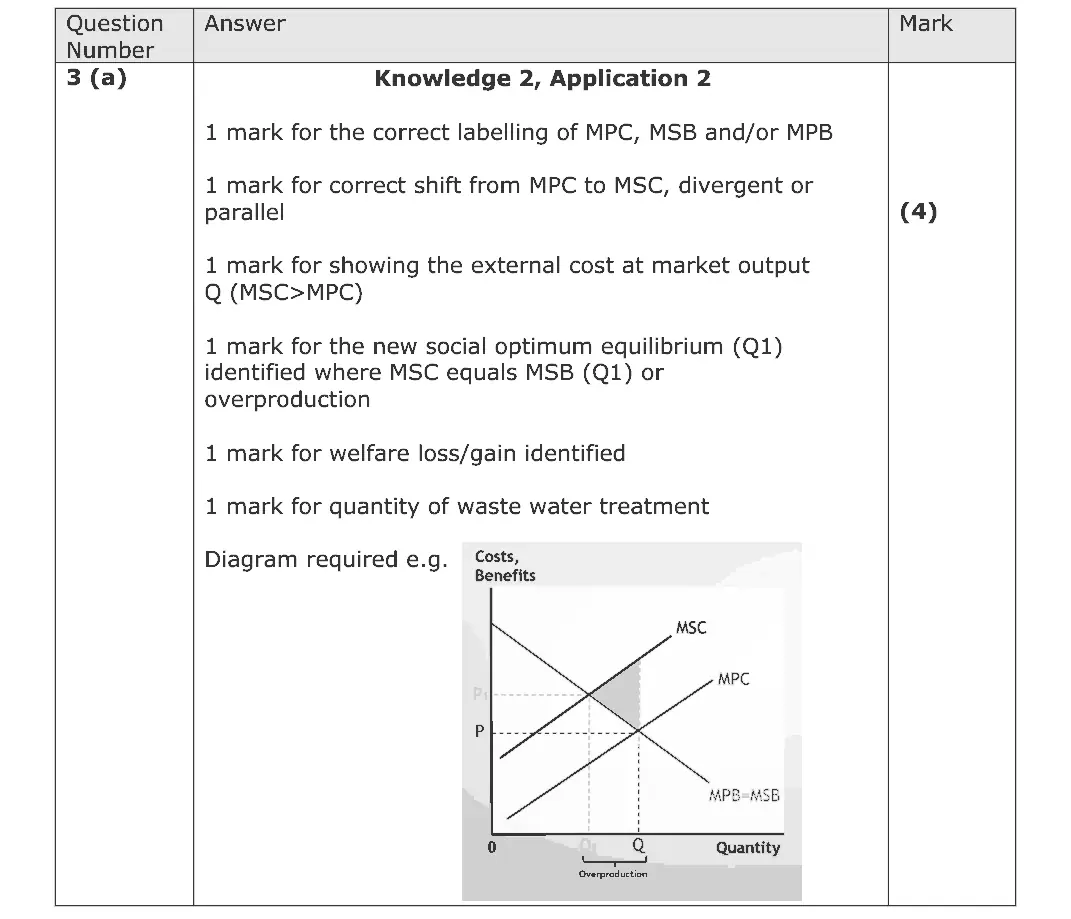
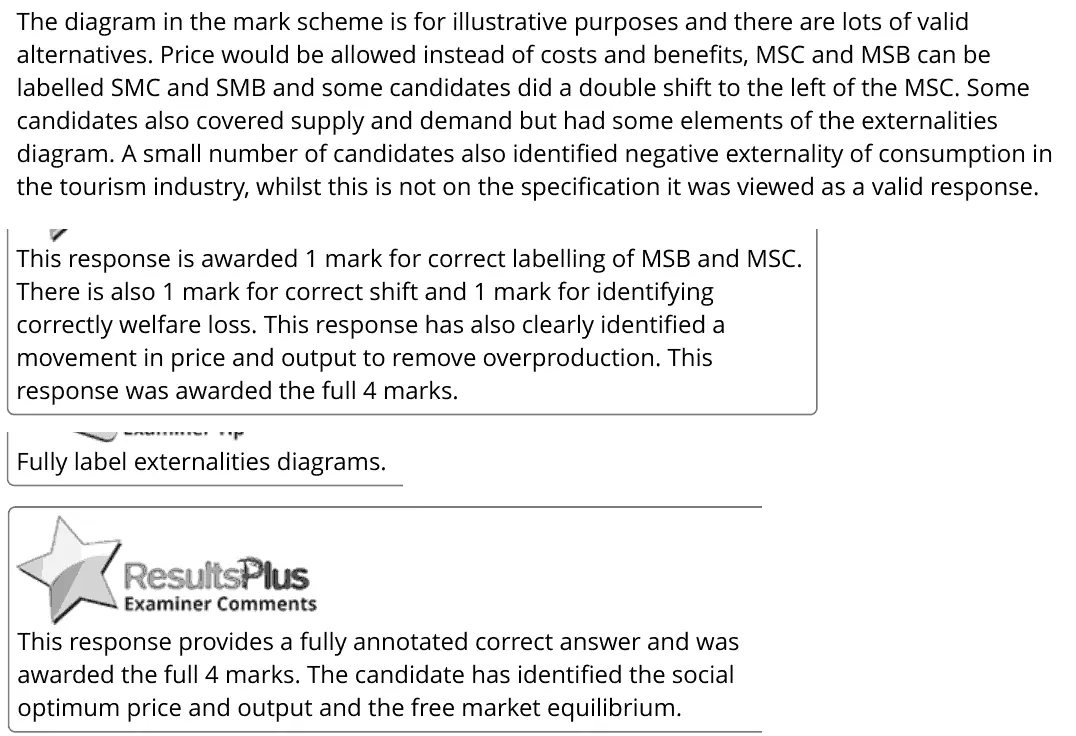
The diagram in the mark scheme is for illustrative purposes and there are lots of valid alternatives. Price would be allowed instead of costs and benefits, MSC and MSB can be labelled SMC and SMB and some candidates did a double shift to the left of the MSC. Some candidates also covered supply and demand but had some elements of the externalities diagram. A small number of candidates also identified negative externality of consumption in the tourism industry, whilst this is not on the specification it was viewed as a valid response. This response is awarded 1 mark for correct labelling of MSB and MSC. There is also 1 mark for correct shift and 1 mark for identifying correctly welfare loss. This response has also clearly identified a movement in price and output to remove overproduction. This response was awarded the full 4 marks. Fully label externalities diagrams. This response provides a fully annotated correct answer and was awarded the full 4 marks. The candidate has identified the social optimum price and output and the free market equilibrium.
Notes from the mark scheme and report
negative production externality: MSC above MPC, market output above the social optimum where MSC = MSB, external cost and welfare loss area shown
MSC and MSB may be labelled SMC and SMB
Quantitative skills: QS 4 (construct and interpret a range of standard graphical forms)
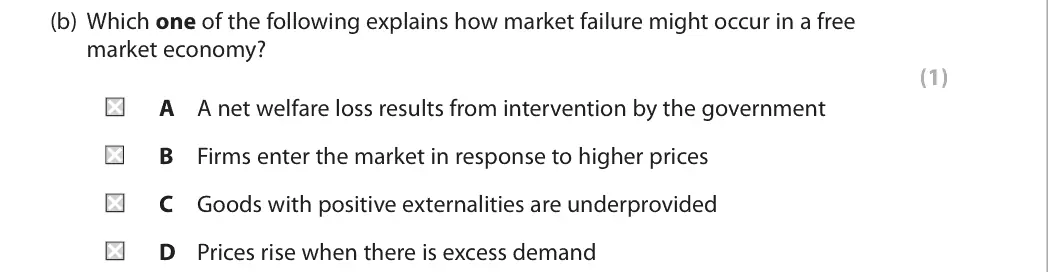
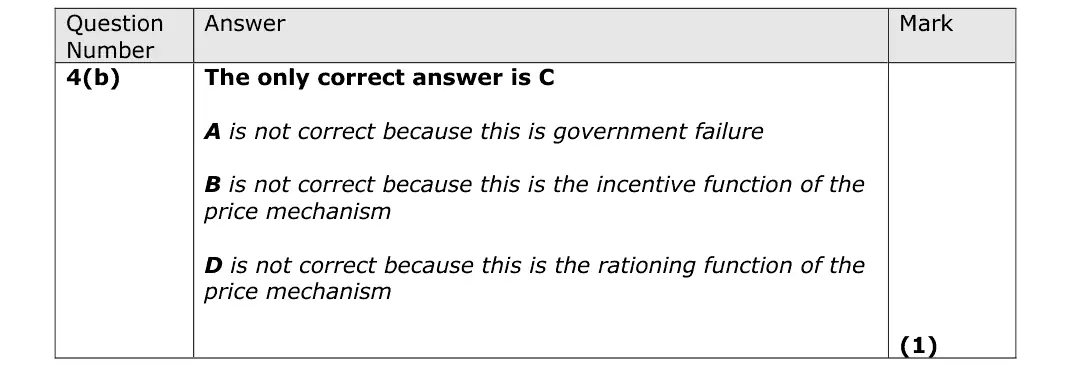
June 2022 · AS Paper 1 · Q4(b)1 markMultiple choice
Data and extracts for question 4
Answer
C
Mark scheme
Notes from the mark scheme and report
underprovision of goods with positive externalities is market failure (C)
A is government failure, B the incentive function, D the rationing function of the price mechanism
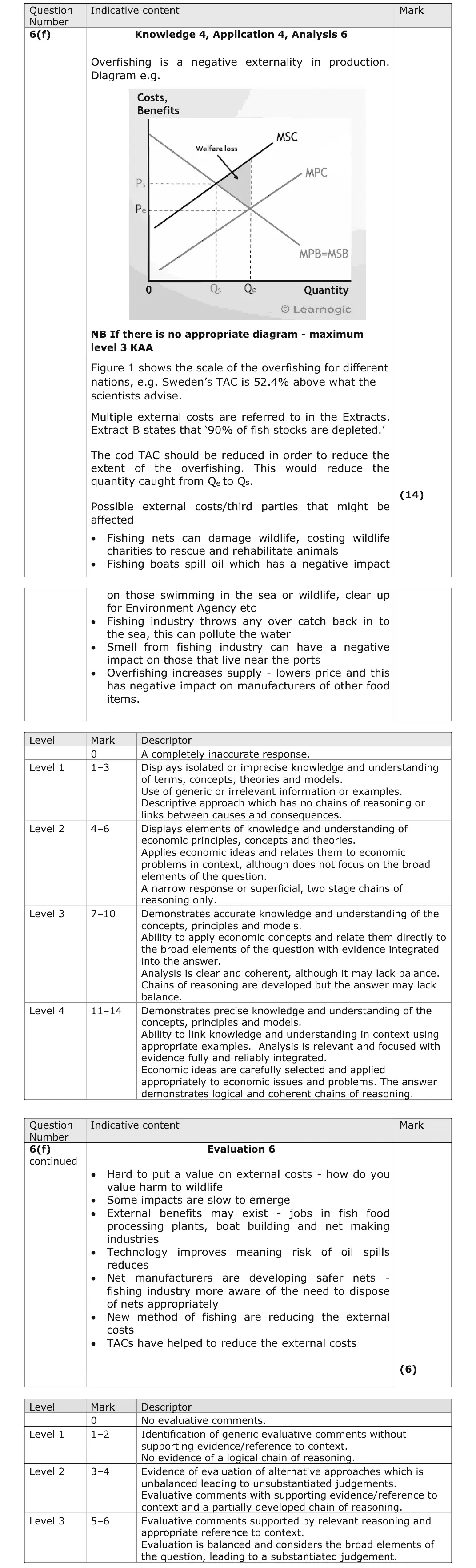
June 2022 · AS Paper 1 · Q6(f)20 marksAO1=4, AO2=4, AO3=6, AO4=620-mark essayEither/orHard
Data and extracts for question 6
Mark scheme, including the levels grid and indicative content
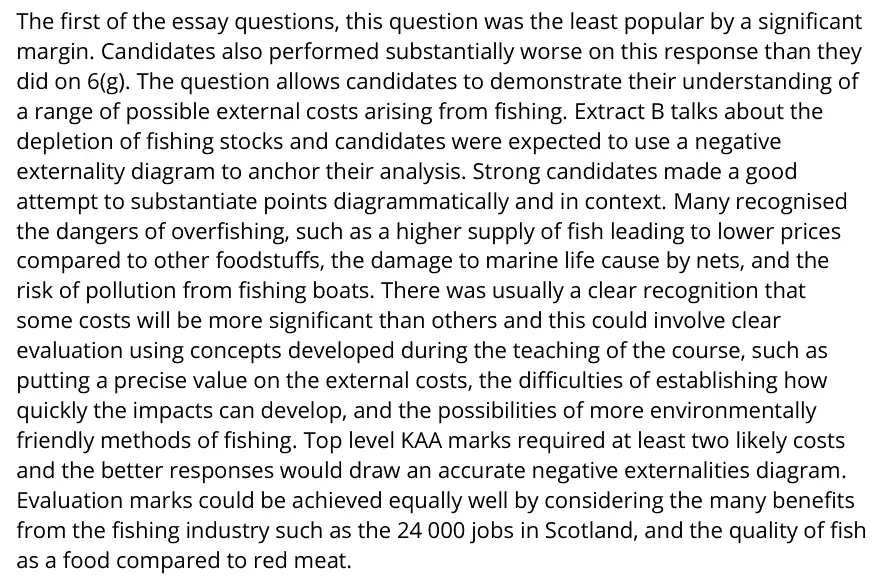
Examiner's comment
The first of the essay questions, this question was the least popular by a significant margin. Candidates also performed substantially worse on this response than they did on 6(g). The question allows candidates to demonstrate their understanding of a range of possible external costs arising from fishing. Extract B talks about the depletion of fishing stocks and candidates were expected to use a negative externality diagram to anchor their analysis. Strong candidates made a good attempt to substantiate points diagrammatically and in context. Many recognised the dangers of overfishing, such as a higher supply of fish leading to lower prices compared to other foodstuffs, the damage to marine life cause by nets, and the risk of pollution from fishing boats. There was usually a clear recognition that some costs will be more significant than others and this could involve clear evaluation using concepts developed during the teaching of the course, such as putting a precise value on the external costs, the difficulties of establishing how quickly the impacts can develop, and the possibilities of more environmentally friendly methods of fishing. Top level KAA marks required at least two likely costs and the better responses would draw an accurate negative externalities diagram. Evaluation marks could be achieved equally well by considering the many benefits from the fishing industry such as the 24 000 jobs in Scotland, and the quality of fish as a food compared to red meat.
Notes from the mark scheme and report
negative production externality diagram (MSC above MPC, welfare loss) is required, otherwise maximum Level 3 KAA
external costs: depleted stocks, damage to marine life, pollution, lost future livelihoods
Figure 1 overfishing (Sweden 52.4%)
evaluate valuing the costs
report: candidates "performed substantially worse on this response than they did on 6(g)"
Quantitative skills: QS 4 (construct and interpret a range of standard graphical forms)
June 2022 · Paper 3 · Q1(a)5 marksAO1=2, AO2=2, AO3=1Short answer
Data and extracts for question 1
Mark scheme
Examiner's comment
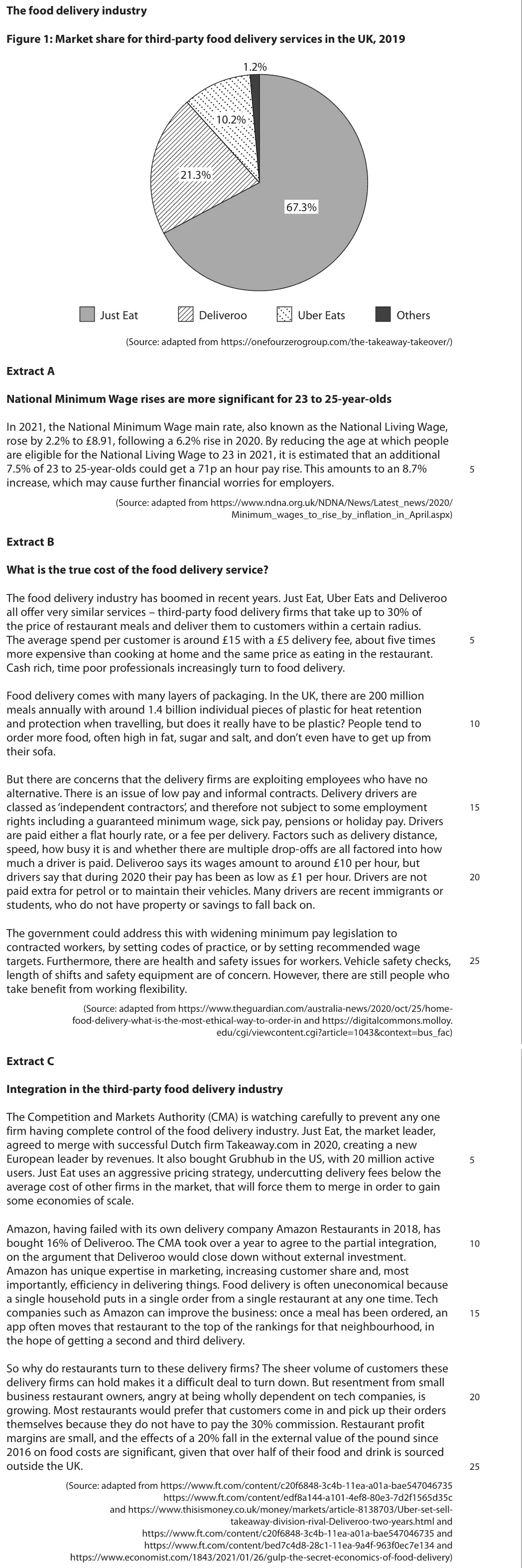
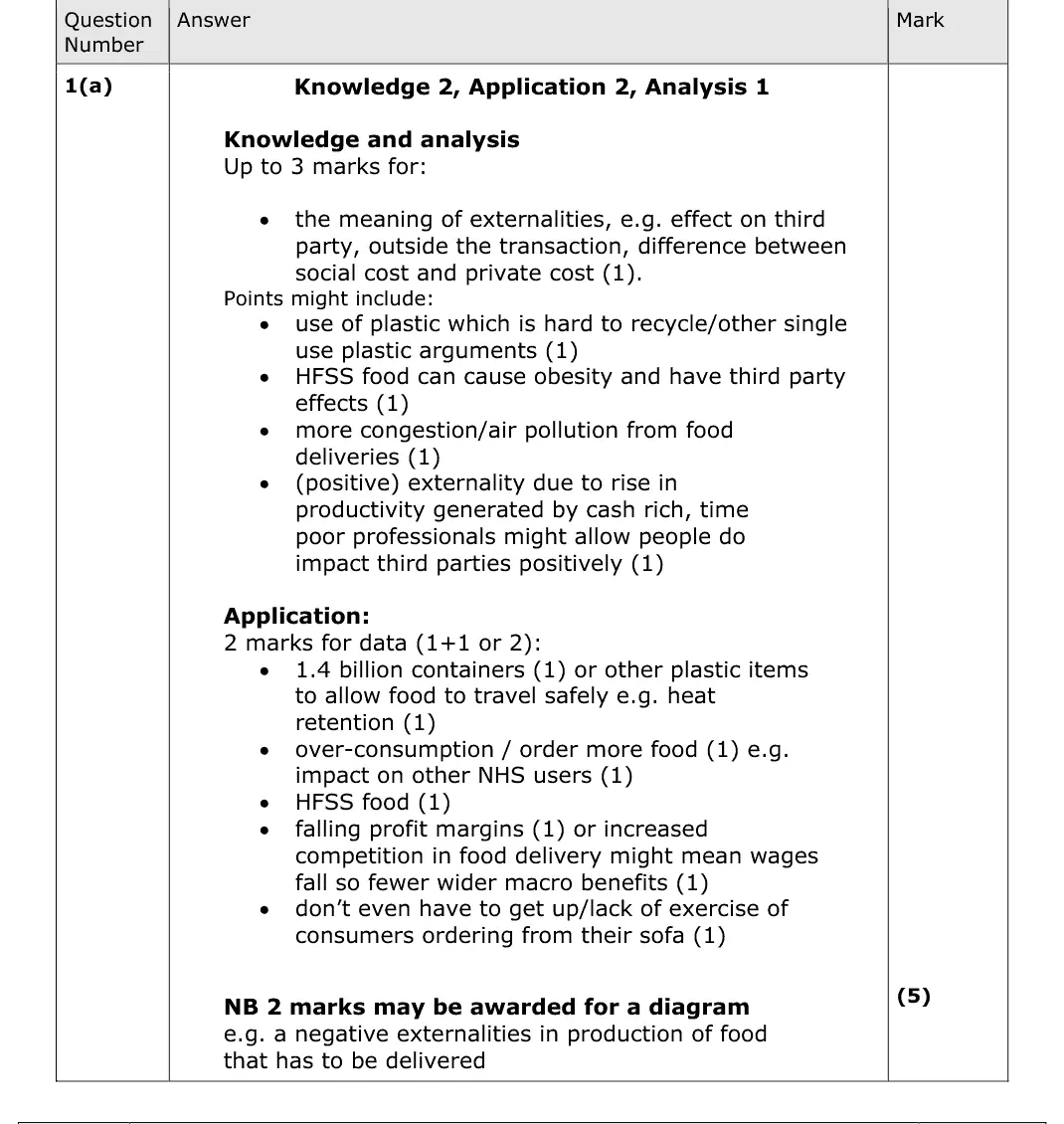
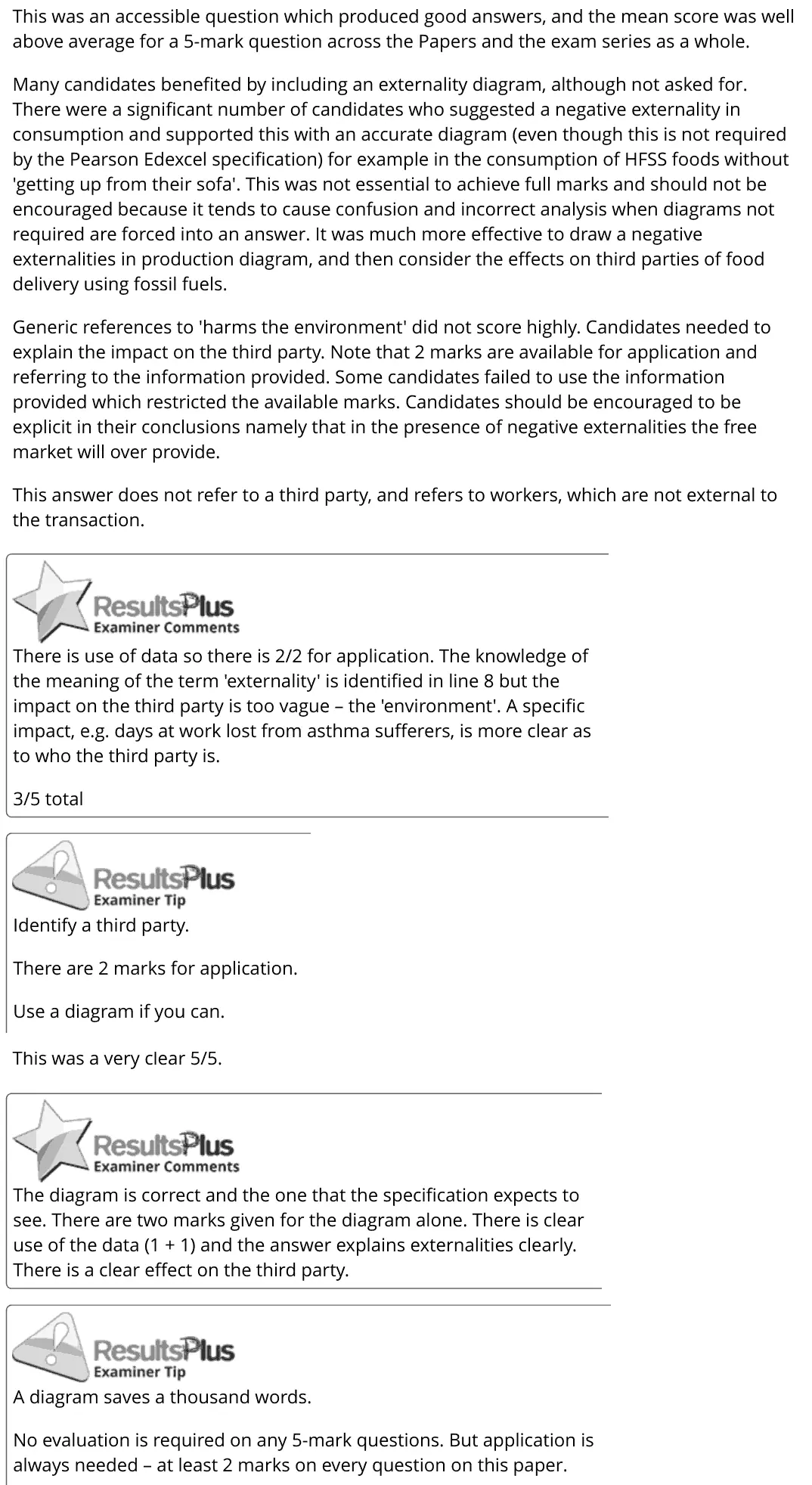
This was an accessible question which produced good answers, and the mean score was well above average for a 5-mark question across the Papers and the exam series as a whole. Many candidates benefited by including an externality diagram, although not asked for. There were a significant number of candidates who suggested a negative externality in consumption and supported this with an accurate diagram (even though this is not required by the Pearson Edexcel specification) for example in the consumption of HFSS foods without 'getting up from their sofa'. This was not essential to achieve full marks and should not be encouraged because it tends to cause confusion and incorrect analysis when diagrams not required are forced into an answer. It was much more effective to draw a negative externalities in production diagram, and then consider the effects on third parties of food delivery using fossil fuels. Generic references to 'harms the environment' did not score highly. Candidates needed to explain the impact on the third party. Note that 2 marks are available for application and referring to the information provided. Some candidates failed to use the information provided which restricted the available marks. Candidates should be encouraged to be explicit in their conclusions namely that in the presence of negative externalities the free market will over provide. This answer does not refer to a third party, and refers to workers, which are not external to the transaction. There is use of data so there is 2/2 for application. The knowledge of the meaning of the term 'externality' is identified in line 8 but the impact on the third party is too vague – the 'environment'. A specific impact, e.g. days at work lost from asthma sufferers, is more clear as to who the third party is. 3/5 total Identify a third party. There are 2 marks for application. Use a diagram if you can. This was a very clear 5/5. The diagram is correct and the one that the specification expects to see. There are two marks given for the diagram alone. There is clear use of the data (1 + 1) and the answer explains externalities clearly. There is a clear effect on the third party. A diagram saves a thousand words. No evaluation is required on any 5-mark questions. But application is always needed – at least 2 marks on every question on this paper.
Notes from the mark scheme and report
explain the effect on a third party (plastic packaging, congestion and pollution from deliveries, obesity from HFSS food) and that the free market over-provides
workers are not third parties
generic 'harms the environment' scores little
2 application marks for Extract B data e.g. 1.4 billion plastic items
Quantitative skills: QS 9 (interpret, apply and analyse information in written, graphical tabular and numerical forms)
November 2021 · Paper 1 · Q6(b)8 marksAO1=2, AO2=2, AO3=2, AO4=28-mark response
Data and extracts for question 6
Mark scheme, including the levels grid and indicative content
Examiner's comment
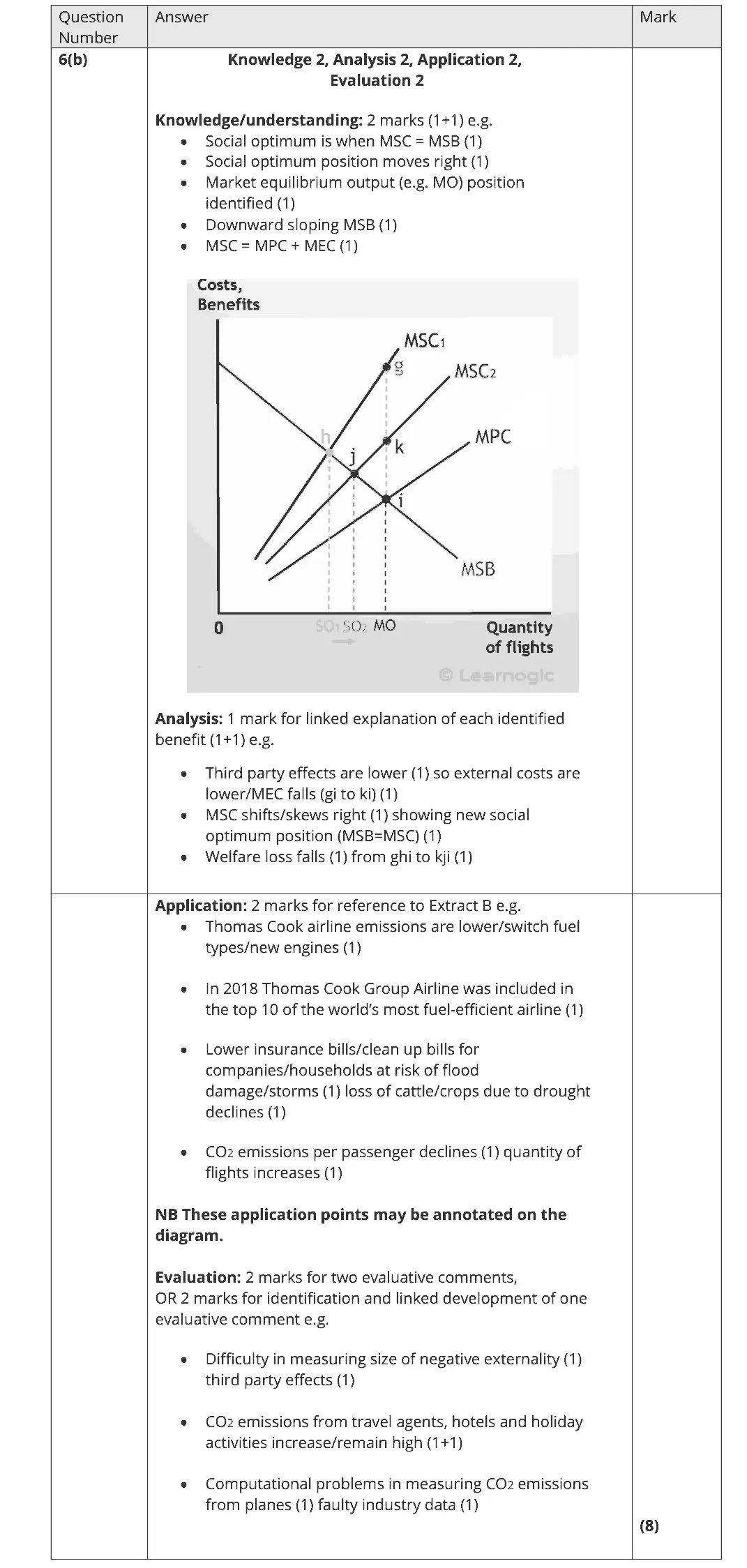
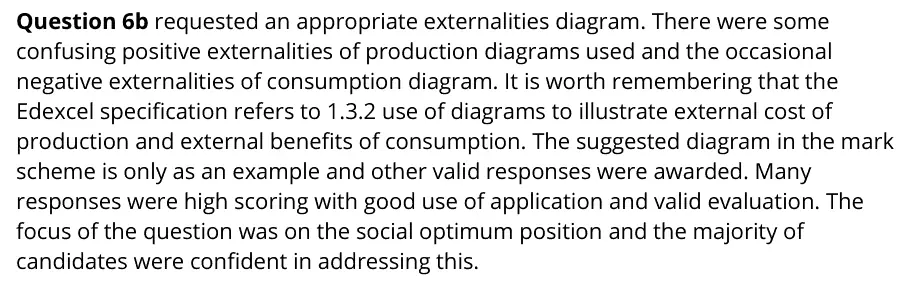
Question 6b requested an appropriate externalities diagram. There were some confusing positive externalities of production diagrams used and the occasional negative externalities of consumption diagram. It is worth remembering that the Edexcel specification refers to 1.3.2 use of diagrams to illustrate external cost of production and external benefits of consumption. The suggested diagram in the mark scheme is only as an example and other valid responses were awarded. Many responses were high scoring with good use of application and valid evaluation. The focus of the question was on the social optimum position and the majority of candidates were confident in addressing this.
Notes from the mark scheme and report
negative production externality diagram: lower emissions reduce MEC so MSC moves towards MPC, the social optimum output moves right and the welfare loss area shrinks
apply fuel-efficient aircraft (Extract B)
evaluate: hard to measure emissions
report: some drew positive production or negative consumption externality diagrams
Quantitative skills: QS 4 (construct and interpret a range of standard graphical forms)
October 2020 · Paper 1 · Q2(a)4 marksAO1=2, AO2=2Diagram
Data and extracts for question 2
Mark scheme
Examiner's comment
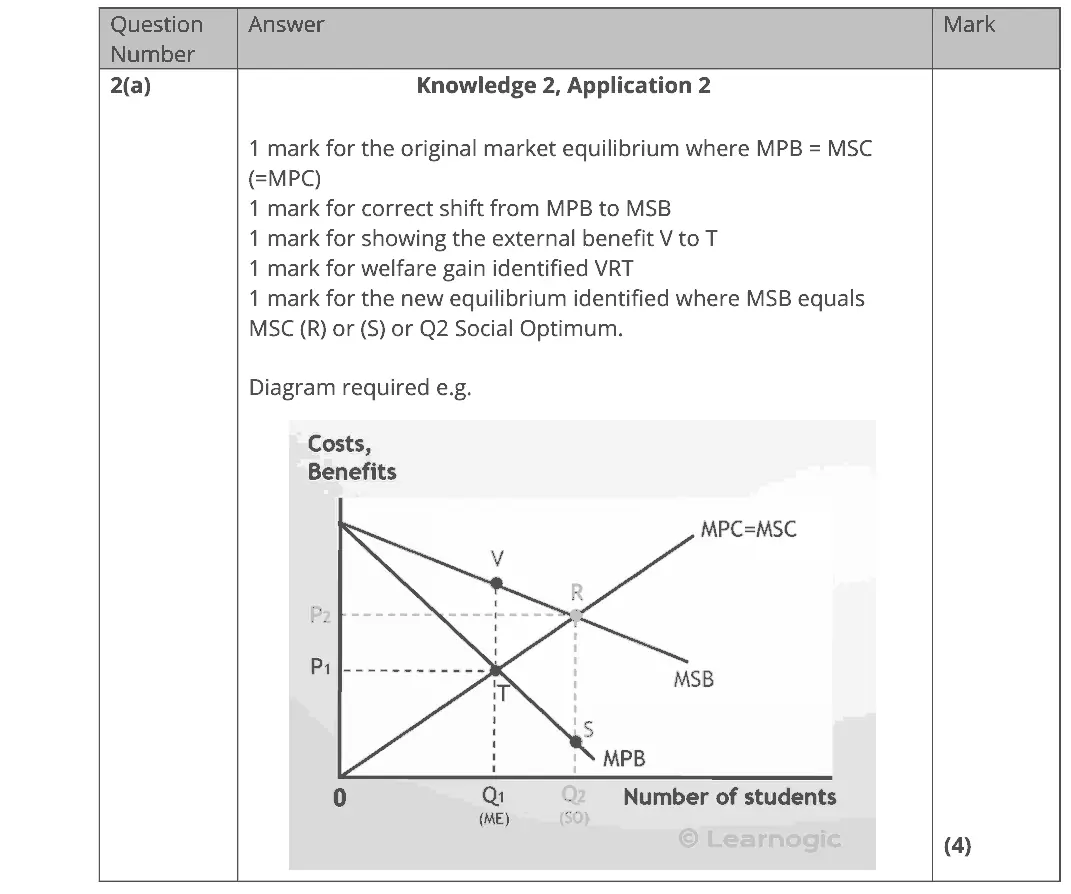
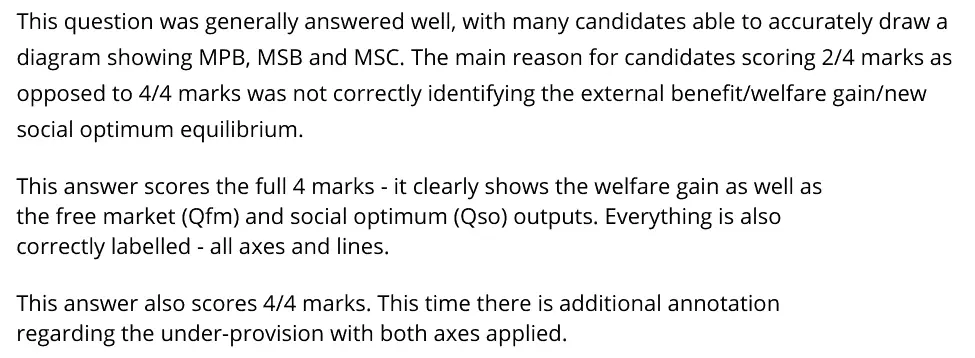
This question was generally answered well, with many candidates able to accurately draw a diagram showing MPB, MSB and MSC. The main reason for candidates scoring 2/4 marks as opposed to 4/4 marks was not correctly identifying the external benefit/welfare gain/new social optimum equilibrium. This answer scores the full 4 marks - it clearly shows the welfare gain as well as the free market (Qfm) and social optimum (Qso) outputs. Everything is also correctly labelled - all axes and lines. This answer also scores 4/4 marks. This time there is additional annotation regarding the under-provision with both axes applied.
Notes from the mark scheme and report
MSB above MPB with MPC = MSC
market equilibrium at MPB = MPC, social optimum at MSB = MSC
mark the external benefit and the welfare gain area
report: the usual loss of 2 marks was not identifying the welfare gain or social optimum
Quantitative skills: QS 4 (construct and interpret a range of standard graphical forms)
October 2020 · Paper 1 · Q2(b)1 markAO3=1Multiple choice
Data and extracts for question 2
Answer
C
Mark scheme
Notes from the mark scheme and report
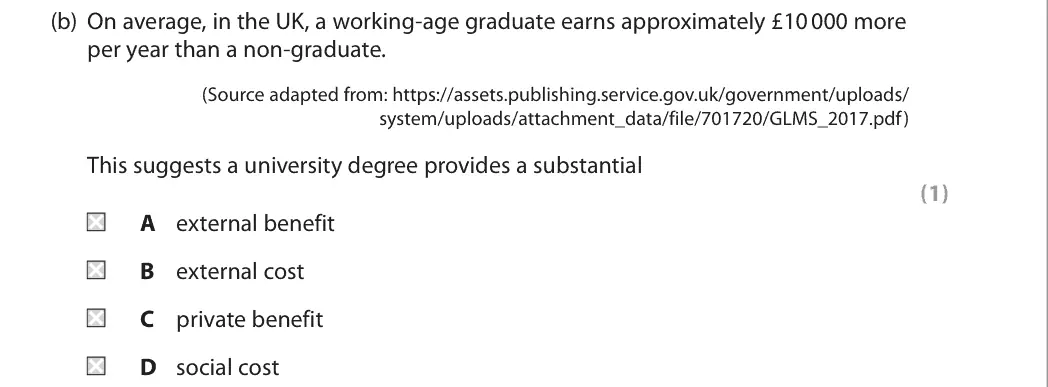
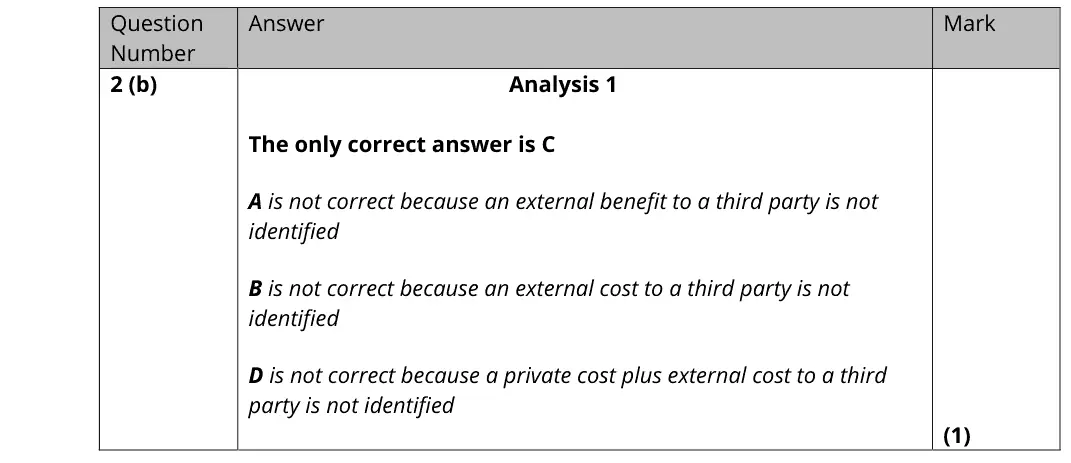
the £10 000 higher earnings go to the graduate, a private benefit (C)
A external benefit needs a third party
B and D are costs
October 2020 · AS Paper 1 · Q5(b)2 marksAO1=2Short answer
Data and extracts for question 5
Mark scheme
Examiner's comment
Candidates were able to recognise the fact that government support is necessary because of the scale of the project. However, it is crucial to recognise that public transport infrastructure is not a public good per se. Rather, such infrastructure has large positive externalities in consumption, whilst being excludable and rival.
Notes from the mark scheme and report
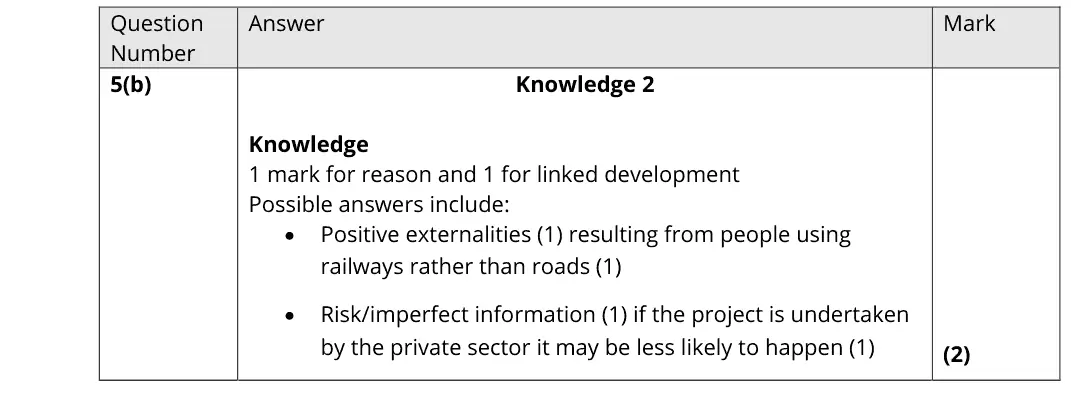
positive externalities from people using rail instead of roads, or risk deterring private finance, then develop
rail infrastructure is not a public good (it is excludable and rival)
October 2020 · AS Paper 1 · Q6(c)6 marksAO1=2, AO2=2, AO3=2Short answer
Data and extracts for question 6
Mark scheme
Examiner's comment
As been discussed earlier, many candidates could explain the private benefit by using the salaries shown in Figure 1, whilst being able to illustrate the third party effect of probable higher tax revenues accruing to graduates as being a benefit to society as a whole.
Notes from the mark scheme and report
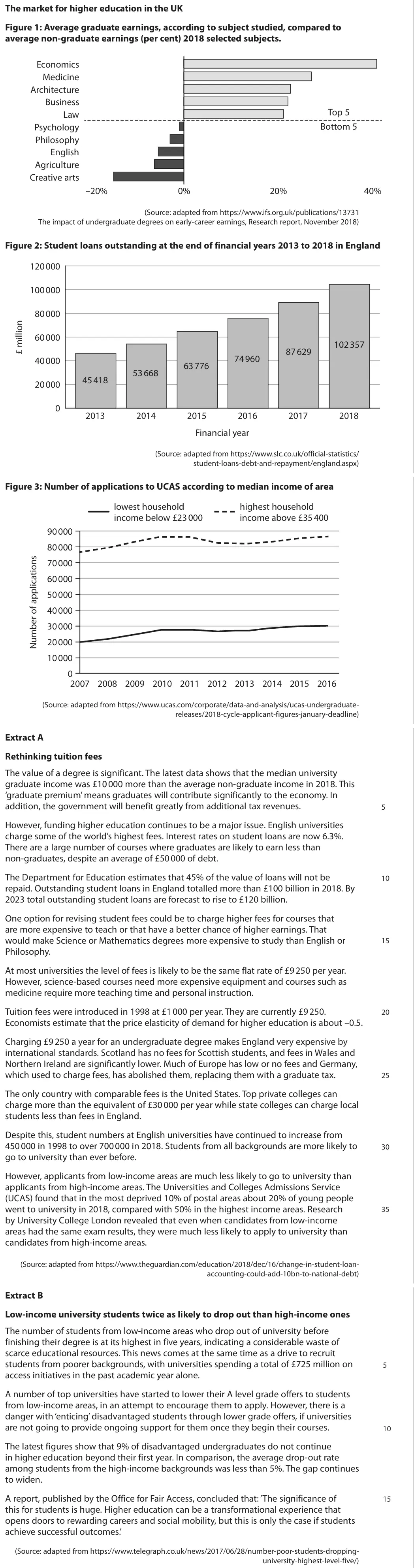
one private benefit (higher earnings, graduate premium £10 000, Figure 1) and one external benefit (extra tax revenue, higher productivity) each quoted from Extract A and developed
up to 3 marks for each benefit
Quantitative skills: QS 9 (interpret, apply and analyse information in written, graphical tabular and numerical forms)
October 2020 · AS Paper 1 · Q6(g)20 marksAO1=4, AO2=4, AO3=6, AO4=620-mark essayEither/or
Data and extracts for question 6
Mark scheme, including the levels grid and indicative content
Examiner's comment
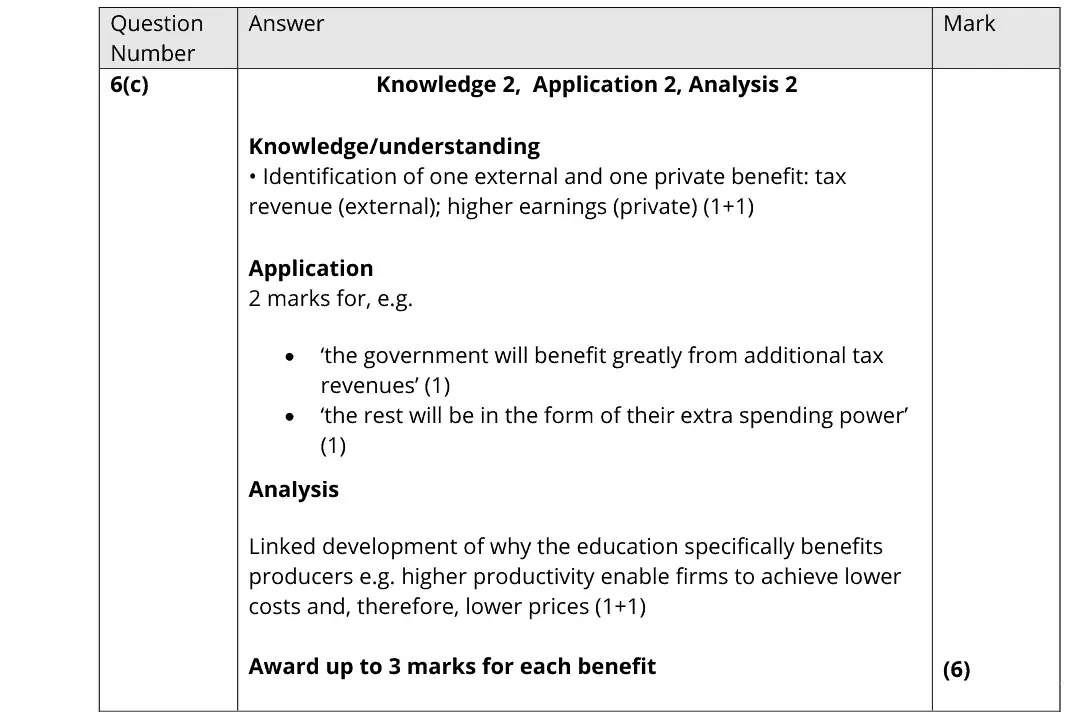
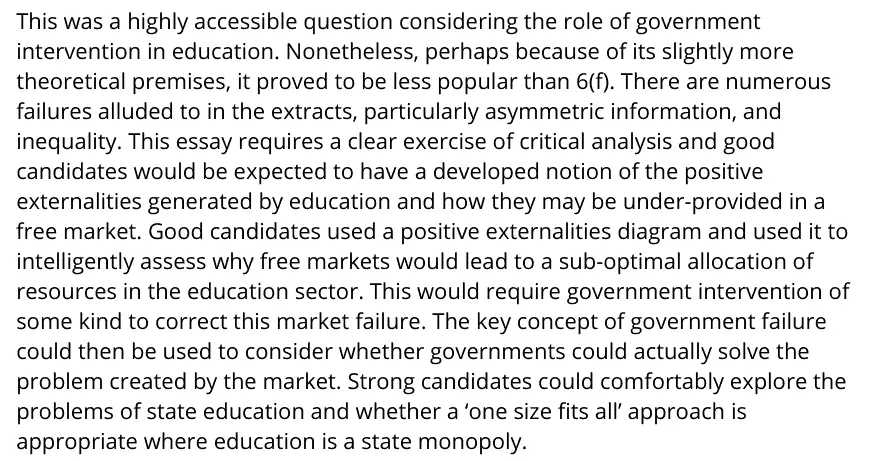
This was a highly accessible question considering the role of government intervention in education. Nonetheless, perhaps because of its slightly more theoretical premises, it proved to be less popular than 6(f). There are numerous failures alluded to in the extracts, particularly asymmetric information, and inequality. This essay requires a clear exercise of critical analysis and good candidates would be expected to have a developed notion of the positive externalities generated by education and how they may be under-provided in a free market. Good candidates used a positive externalities diagram and used it to intelligently assess why free markets would lead to a sub-optimal allocation of resources in the education sector. This would require government intervention of some kind to correct this market failure. The key concept of government failure could then be used to consider whether governments could actually solve the problem created by the market. Strong candidates could comfortably explore the problems of state education and whether a ‘one size fits all’ approach is appropriate where education is a state monopoly.
Notes from the mark scheme and report
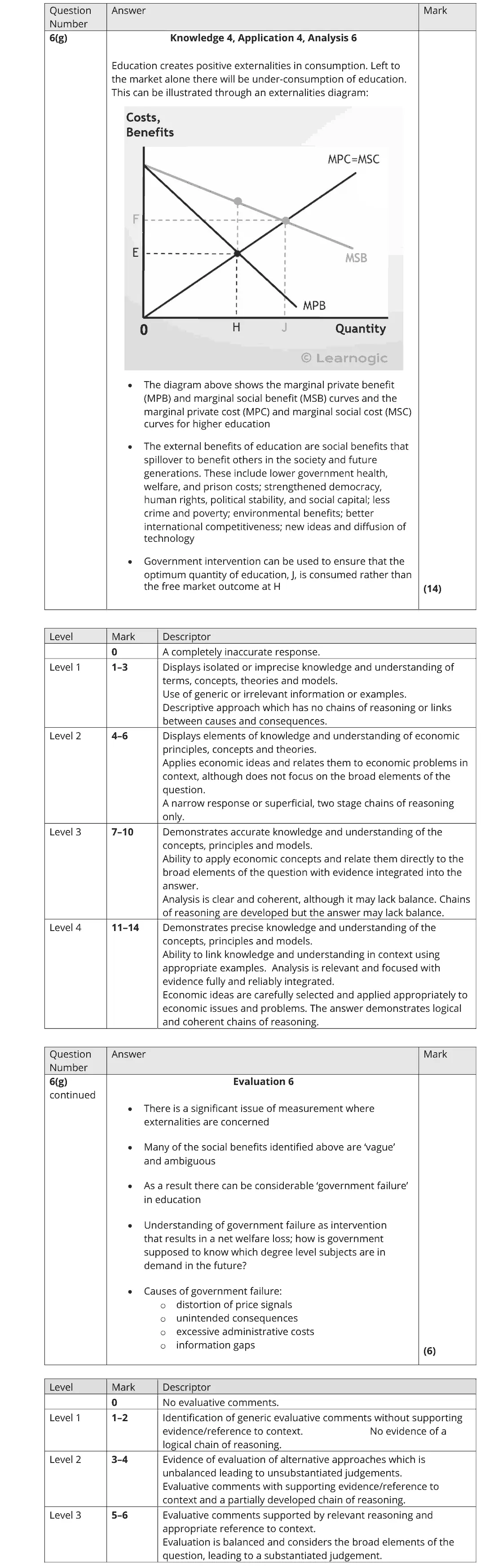
positive externalities diagram (MSB above MPB, under-consumption at H rather than optimum J)
state provision, subsidies, information
evaluate with difficulty of valuing external benefits and government failure (information gaps, unintended consequences, one size fits all)
October 2020 · Paper 1 · Q725 marksAO1=4, AO2=4, AO3=8, AO4=925-mark essayEither/or
Mark scheme, including the levels grid and indicative content
Examiner's comment
This question was more popular than question 8 with better responses overall. Given the synoptic nature of essay questions the better responses made excellent use of Theme 1 and Theme 3 making use of externalities diagrams as well as theory of the firm diagrams. Whilst diagrams were not required better responses over made use of them thus illustrating higher order thinking. The context has had substantial media coverage and stronger candidates were able to provide rich responses in context. The Paper Summary of the 2019 Principal Examiner report advised on this: “Spend time studying current developments in economics that are relevant to your specification. This not only enriches your understanding of key concepts but will enable you to refer to an industry or a firm of your choice if asked in an essay.” In this case following current developments as covered by broadsheet newspapers may have aided responses. This answer scores 12/25. The response secures the top of Level 2 KAA and there are a couple of cases of Level 2 Evaluation. There is a lack of clarity with the diagrams. This answer scores Level 4 KAA and Level 3 Evaluation = 15KAA + 7Ev = 22/25. This is a high-quality answer that fulfils the requirements of the criteria for KAA Level 4 and evaluation Level 3. A breadth of knowledge is deployed and there is a depth of reasoning with a rich use of context. The only downside is that the conclusion is weak.
Notes from the mark scheme and report
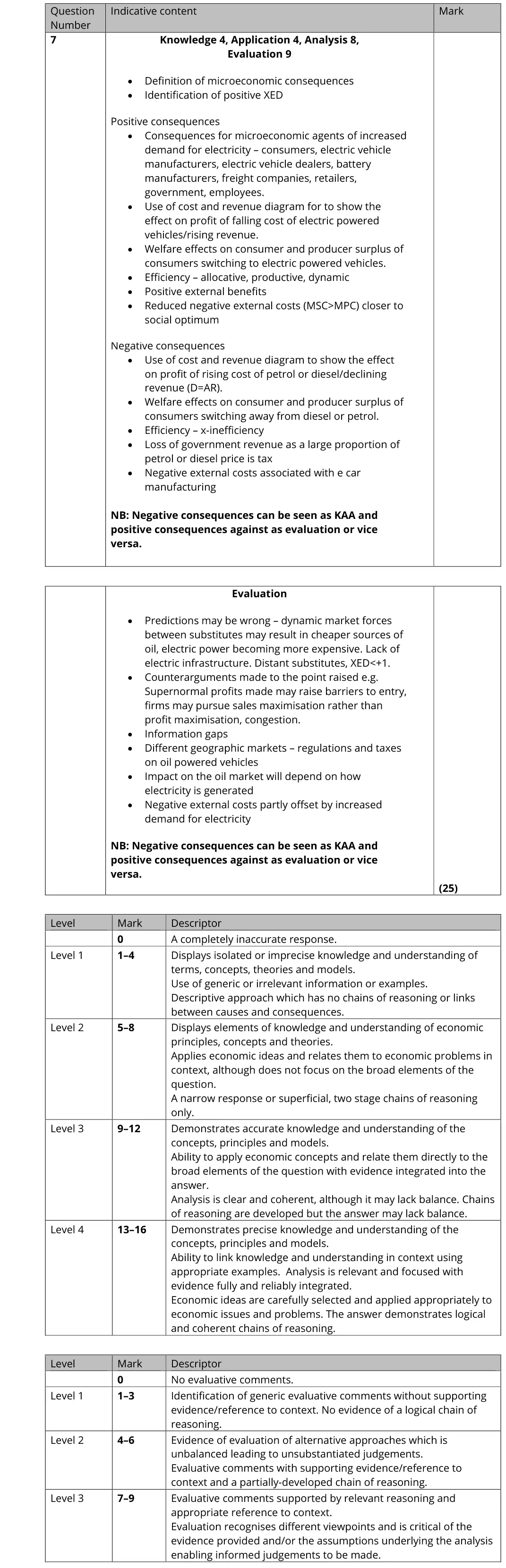
microeconomic effects of switching: positive XED with electricity, demand shifts in car and fuel markets, profits of EV and oil firms, consumer and producer surplus, reduced negative externalities, lost fuel duty
better answers used externality and theory of the firm diagrams (not required)
evaluate with uncertain forecasts, charging infrastructure, external costs of battery production
October 2020 · Paper 3 · Q1(c)12 marksAO1=2, AO2=2, AO3=4, AO4=412-mark response
Data and extracts for question 1
Mark scheme, including the levels grid and indicative content
Examiner's comment
Level 3 diagram – although it does not show social optimum it is implicit Correct use of externalities description Application to the UK is strong L2e cannot pass on the tax Ban – well applied, unintended consequences – well applied but not as good as point 1 and only Level 2 on black bags – good point but needed some development, Level 3 Level 1 – just identifies increases tax. Very odd diagram. 1 + 1e for sense that it perverse effects of increasing output.
Notes from the mark scheme and report
compare policies in Extract B: tax/charge (specific tax diagram), ban on black bags, fines, free canvas bags (20 000 in Corlu)
explain the process that cuts bag use
evaluate with inelastic demand, retailers not passing on the charge, unintended consequences of bans
October 2020 · Paper 3 · Q1(e)25 marksAO1=4, AO2=4, AO3=8, AO4=925-mark essayEither/or
Data and extracts for question 1
Mark scheme, including the levels grid and indicative content
Notes from the mark scheme and report
micro: lower transport costs for firms, external costs and benefits of the airport, external economies of scale
macro: AD up via I or G with the multiplier and LRAS shifting right
Level 4 needs both micro and macro
evaluate with opportunity cost, crowding out, white elephant risk, valuing externalities
Quantitative skills: QS 4 (construct and interpret a range of standard graphical forms)
June 2019 · AS Paper 1 · Q6(g)20 marksAO1=4, AO2=4, AO3=6, AO4=620-mark essayEither/or
Data and extracts for question 6
Mark scheme, including the levels grid and indicative content
Examiner's comment
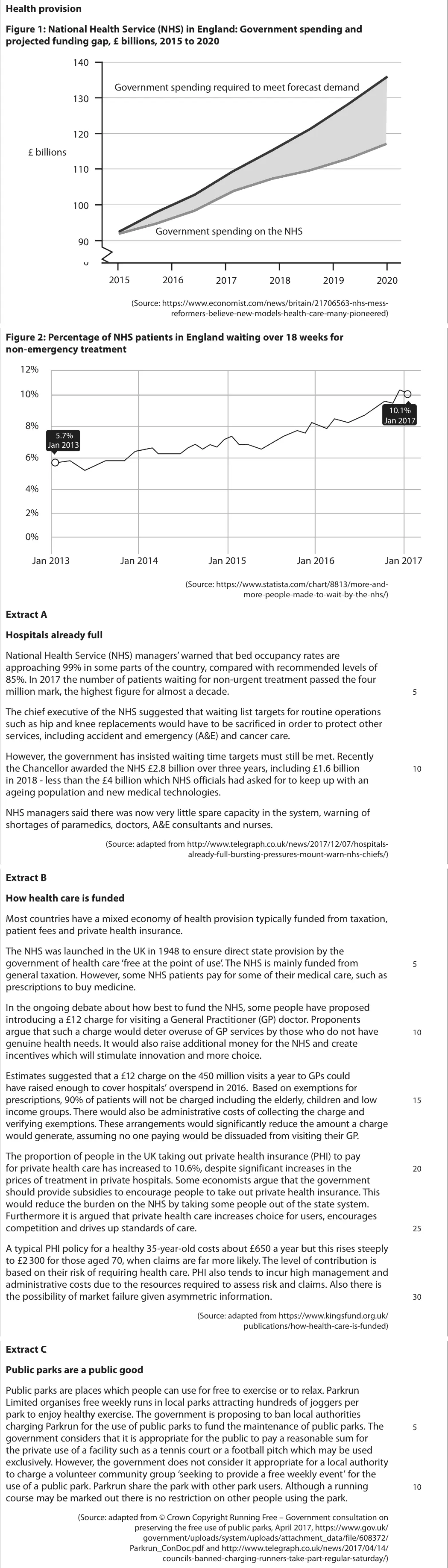
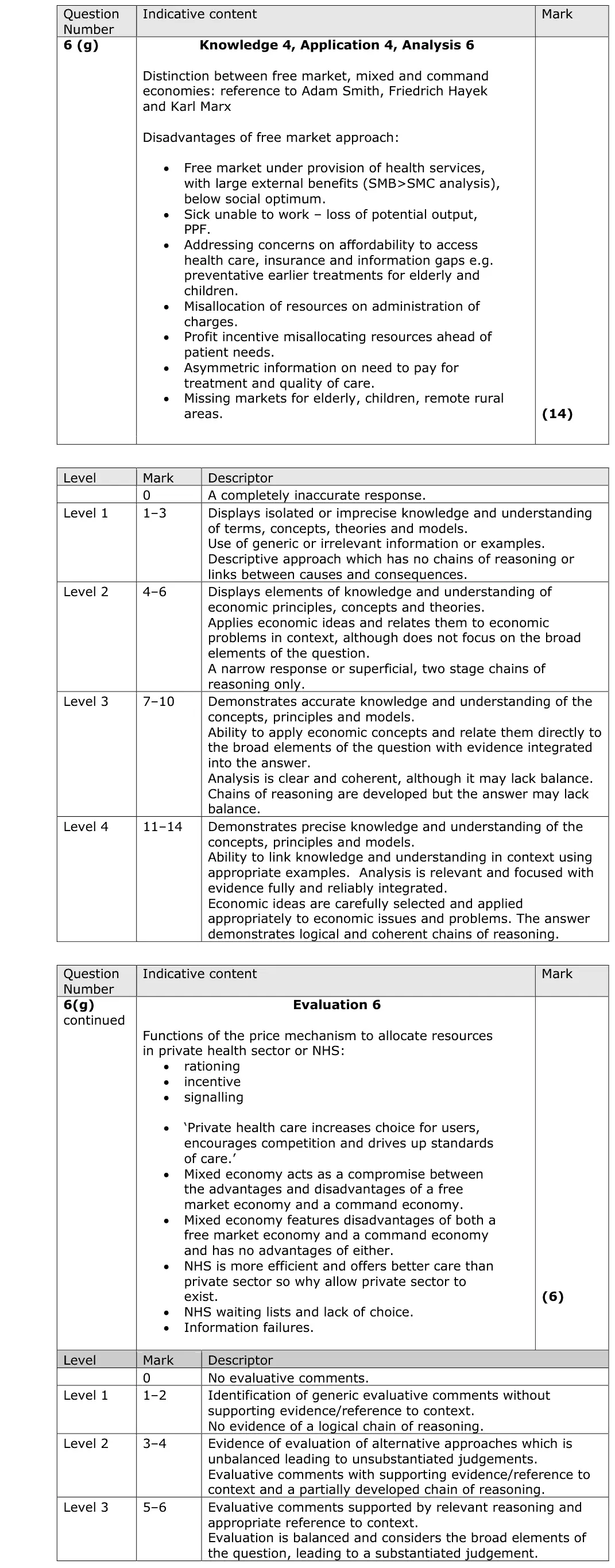
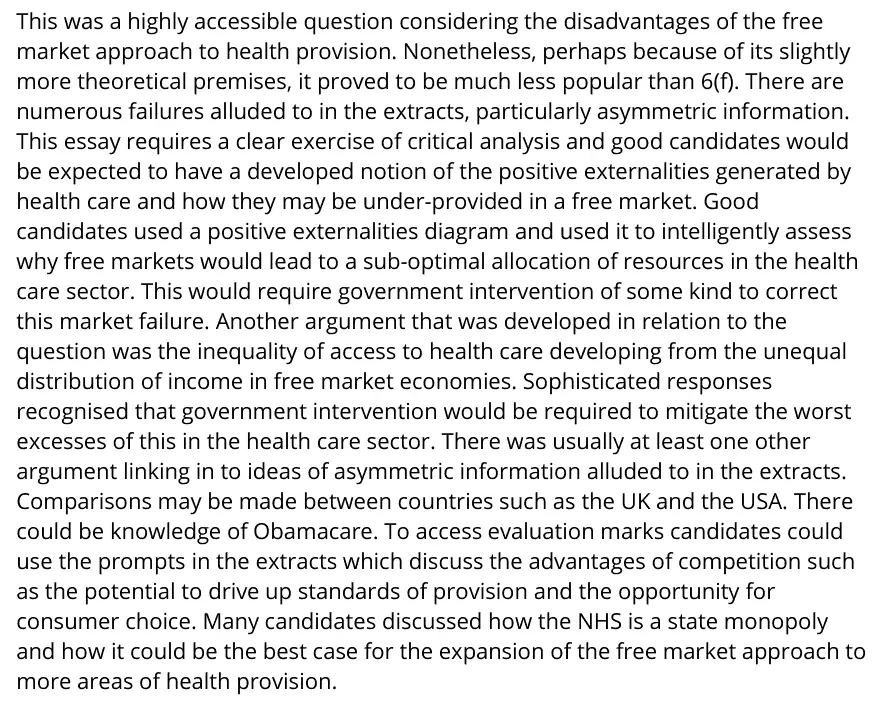
This was a highly accessible question considering the disadvantages of the free market approach to health provision. Nonetheless, perhaps because of its slightly more theoretical premises, it proved to be much less popular than 6(f). There are numerous failures alluded to in the extracts, particularly asymmetric information. This essay requires a clear exercise of critical analysis and good candidates would be expected to have a developed notion of the positive externalities generated by health care and how they may be under-provided in a free market. Good candidates used a positive externalities diagram and used it to intelligently assess why free markets would lead to a sub-optimal allocation of resources in the health care sector. This would require government intervention of some kind to correct this market failure. Another argument that was developed in relation to the question was the inequality of access to health care developing from the unequal distribution of income in free market economies. Sophisticated responses recognised that government intervention would be required to mitigate the worst excesses of this in the health care sector. There was usually at least one other argument linking in to ideas of asymmetric information alluded to in the extracts. Comparisons may be made between countries such as the UK and the USA. There could be knowledge of Obamacare. To access evaluation marks candidates could use the prompts in the extracts which discuss the advantages of competition such as the potential to drive up standards of provision and the opportunity for consumer choice. Many candidates discussed how the NHS is a state monopoly and how it could be the best case for the expansion of the free market approach to more areas of health provision.
Notes from the mark scheme and report
free market under-provides health care with external benefits (positive externality diagram), unequal access by income, asymmetric information, missing markets
evaluate with price signals, choice and competition (Extract B), NHS waiting lists, mixed economy
June 2018 · AS Paper 1 · Q6(f)20 marksAO1=4, AO2=4, AO3=6, AO4=620-mark essayEither/orHard
Data and extracts for question 6
Mark scheme, including the levels grid and indicative content
Examiner's comment
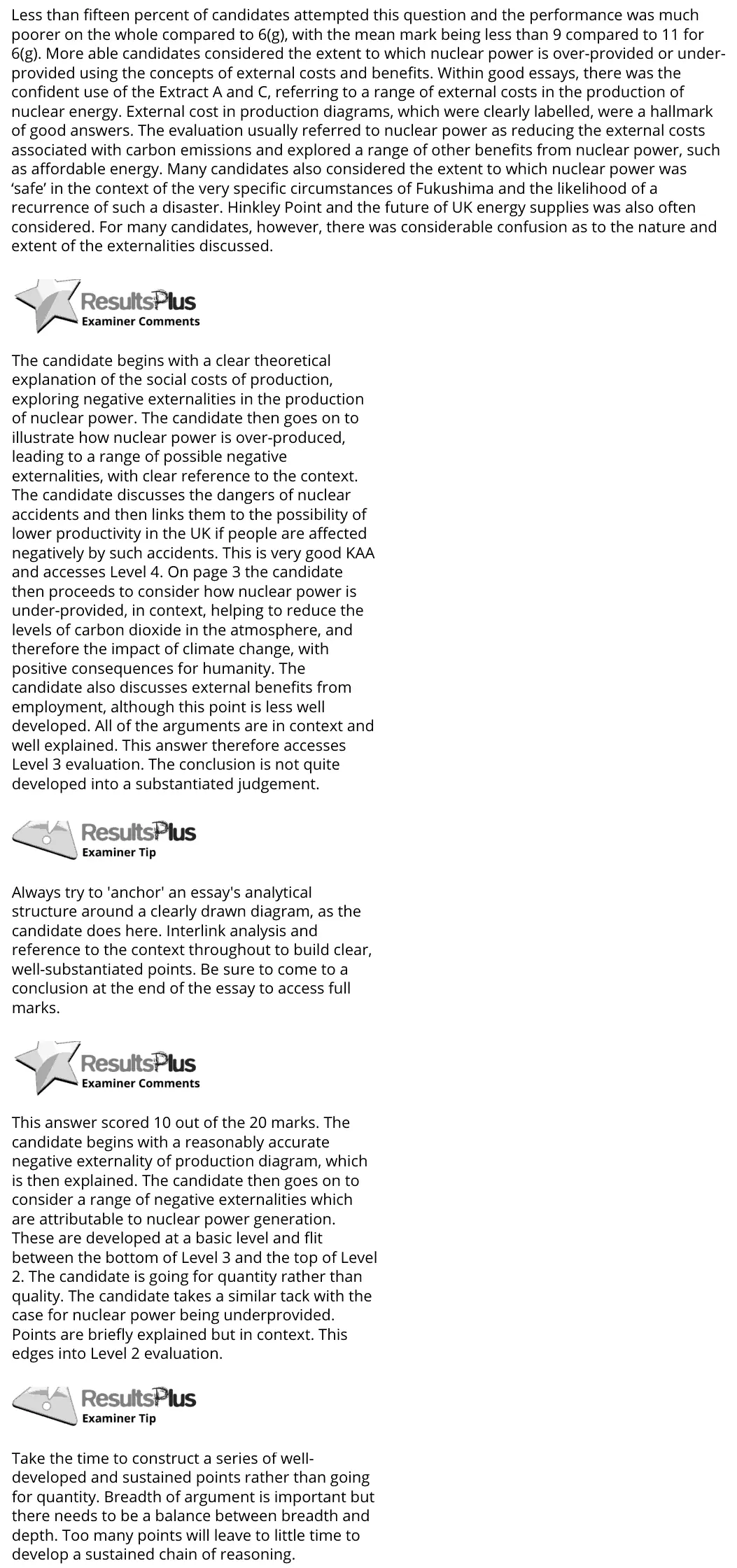
Less than fifteen percent of candidates attempted this question and the performance was much poorer on the whole compared to 6(g), with the mean mark being less than 9 compared to 11 for 6(g). More able candidates considered the extent to which nuclear power is over-provided or under- provided using the concepts of external costs and benefits. Within good essays, there was the confident use of the Extract A and C, referring to a range of external costs in the production of nuclear energy. External cost in production diagrams, which were clearly labelled, were a hallmark of good answers. The evaluation usually referred to nuclear power as reducing the external costs associated with carbon emissions and explored a range of other benefits from nuclear power, such as affordable energy. Many candidates also considered the extent to which nuclear power was ‘safe’ in the context of the very specific circumstances of Fukushima and the likelihood of a recurrence of such a disaster. Hinkley Point and the future of UK energy supplies was also often considered. For many candidates, however, there was considerable confusion as to the nature and extent of the externalities discussed. The candidate begins with a clear theoretical explanation of the social costs of production, exploring negative externalities in the production of nuclear power. The candidate then goes on to illustrate how nuclear power is over-produced, leading to a range of possible negative externalities, with clear reference to the context. The candidate discusses the dangers of nuclear accidents and then links them to the possibility of lower productivity in the UK if people are affected negatively by such accidents. This is very good KAA and accesses Level 4. On page 3 the candidate then proceeds to consider how nuclear power is under-provided, in context, helping to reduce the levels of carbon dioxide in the atmosphere, and therefore the impact of climate change, with positive consequences for humanity. The candidate also discusses external benefits from employment, although this point is less well developed. All of the arguments are in context and well explained. This answer therefore accesses Level 3 evaluation. The conclusion is not quite developed into a substantiated judgement. Always try to 'anchor' an essay's analytical structure around a clearly drawn diagram, as the candidate does here. Interlink analysis and reference to the context throughout to build clear, well-substantiated points. Be sure to come to a conclusion at the end of the essay to access full marks. This answer scored 10 out of the 20 marks. The candidate begins with a reasonably accurate negative externality of production diagram, which is then explained. The candidate then goes on to consider a range of negative externalities which are attributable to nuclear power generation. These are developed at a basic level and flit between the bottom of Level 3 and the top of Level 2. The candidate is going for quantity rather than quality. The candidate takes a similar tack with the case for nuclear power being underprovided. Points are briefly explained but in context. This edges into Level 2 evaluation. Take the time to construct a series of well- developed and sustained points rather than going for quantity. Breadth of argument is important but there needs to be a balance between breadth and depth. Too many points will leave to little time to develop a sustained chain of reasoning.
Notes from the mark scheme and report
negative production externality diagram with welfare loss triangle: radiation risk and waste storage suggest over-provision
evaluate: nuclear reduces carbon external costs of coal and gas, so may be under-provided
report: "performance was much poorer on the whole compared to 6(g)" (mean below 9/20)
Quantitative skills: QS 4 (construct and interpret a range of standard graphical forms)
June 2018 · Paper 1 · Q725 marksAO1=4, AO2=4, AO3=8, AO4=925-mark essayEither/or
Mark scheme, including the levels grid and indicative content
Examiner's comment
This was the less popular of the two essay questions, although it was still completed by several thousand candidates. Diagrammatic analysis was required and when done well was accurate, well labelled and well explained with a solid chain of reasoning to access a Level 4 response. Poor diagrammatic analysis was evident with some careless labelling errors, most often mixing MSC and MPC. High scoring responses were well-structured and at times provided clear evidence of planning. Weaker responses ignored private costs entirely or seemed confused as to exactly what they were. In addition, candidates did not always move on to the third party effects associated with the external cost. As with 6(c) and 6(e), evaluative comments were often tagged on to the end of a paragraph. Top level evaluation often referred to difficulties in measuring the monetary value to private costs and external costs as well as linked evaluation of external benefits offsetting the external costs. Effective sustained judgement balanced the size of the external costs against the private costs and whether these could be offset by benefits to make a judgement call. 18 out of 25 marks awarded. The candidate started by unpacking the demands of the question and then provided an accurate diagram to a Level 3+ standard, as it was accurately labelled and included the social optimum and welfare loss diagram, which was then integrated into their written explanation. This was a valid approach laying the foundations for what could have been a well-structured response. The likely external cost was awarded Level 3+ but would have achieved Level 4 if the candidate had developed further by looking at specific third party effect(s). The paragraph on private costs was well-structured, demonstrating a logical and coherent chain of reasoning in context to a Level 4 standard. Evaluation was focussed on long run external costs in comparison to coal, which was awarded L2e. Likewise the external benefits as evaluation was awarded L2e+ however, whilst being substantial it needed to be linked more tightly to the question in offsetting the external costs or reducing the welfare loss to be awarded L3e. The final bit of evaluation attempted to address private costs but lacked clarity thus achieving L1e. Overall the response lacked judgement and was awarded Level 3+ (12) + L2e+ (6e). Plan to evaluate as you work through your response to better ensure relevant reasoning in context. Higher awarded responses tended to offer a paragraph evaluating private costs having just covered private costs, then likewise for external costs. This was then followed by a substantial conclusion offering judgement or informed judgements were made explicitly throughout. This answer achieves a mark of 19/25. A clear explanation is offered followed by an accurate diagram which is well explained. External costs gets to the third party effect (Level 4)+ but the private costs analysis is thin (Level 2) achieving overall Level 3+ KAA (12). The evaluation is concise but sophisticated in both context and theory as well as offering an attempt at judgement in the conclusion to achieve L3e- (7e). Explaining private costs was a weak spot for many candidates. Try to ensure you can demonstrate precise knowledge and understanding of all the concepts, principles and models.
Notes from the mark scheme and report
Level 4 needs an accurate MPC/MSC diagram with market and social optimum and welfare loss, and both private AND external costs
report: MSC and MPC labels mixed up, private costs ignored or misunderstood, third-party effects not developed
evaluate by measuring costs and offsetting external benefits
Quantitative skills: QS 4 (construct and interpret a range of standard graphical forms)
June 2018 · Paper 3 · Q1(c)8 marksAO1=2, AO2=2, AO3=2, AO4=28-mark response
Data and extracts for question 1
Mark scheme, including the levels grid and indicative content
Examiner's comment
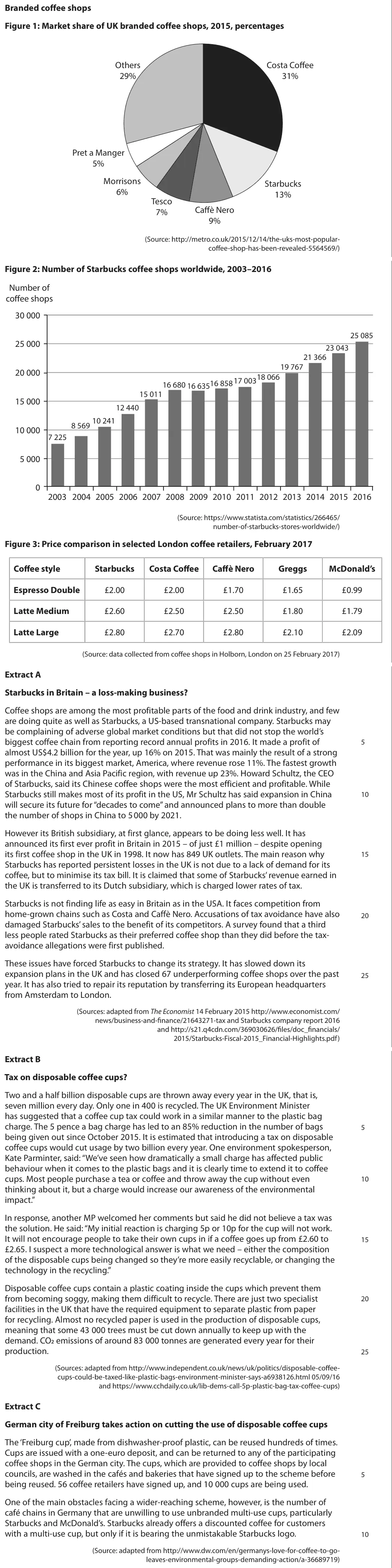
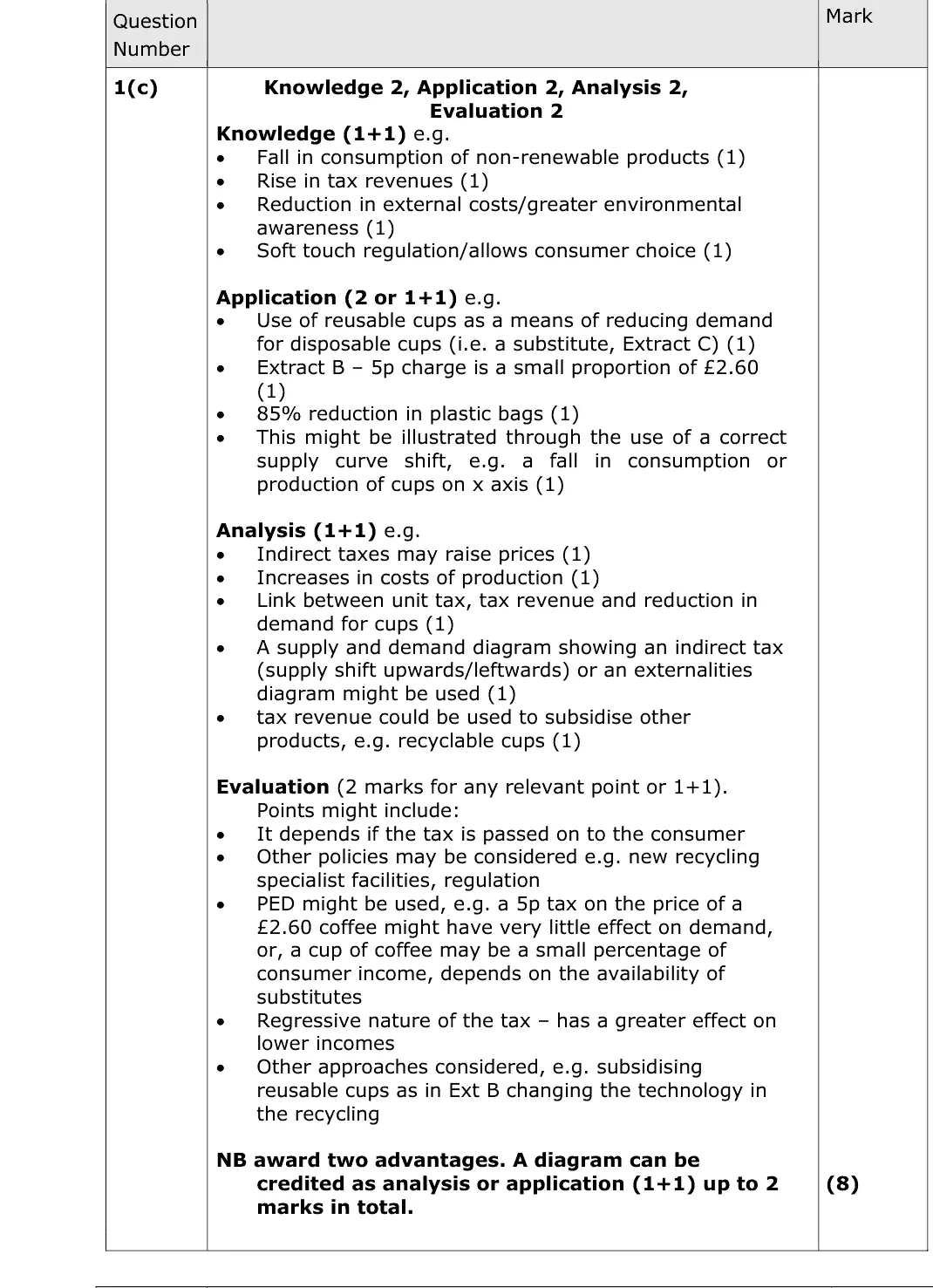
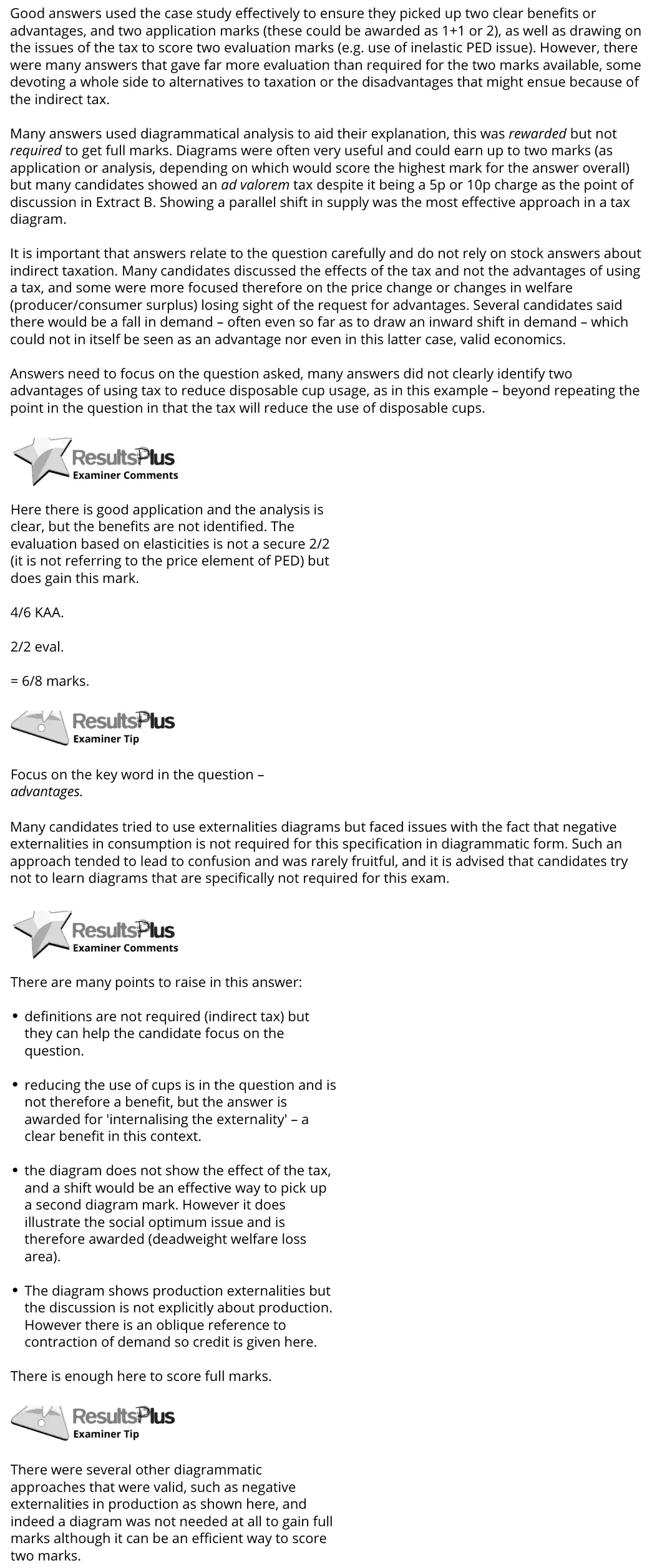
Good answers used the case study effectively to ensure they picked up two clear benefits or advantages, and two application marks (these could be awarded as 1+1 or 2), as well as drawing on the issues of the tax to score two evaluation marks (e.g. use of inelastic PED issue). However, there were many answers that gave far more evaluation than required for the two marks available, some devoting a whole side to alternatives to taxation or the disadvantages that might ensue because of the indirect tax. Many answers used diagrammatical analysis to aid their explanation, this was rewarded but not required to get full marks. Diagrams were often very useful and could earn up to two marks (as application or analysis, depending on which would score the highest mark for the answer overall) but many candidates showed an ad valorem tax despite it being a 5p or 10p charge as the point of discussion in Extract B. Showing a parallel shift in supply was the most effective approach in a tax diagram. It is important that answers relate to the question carefully and do not rely on stock answers about indirect taxation. Many candidates discussed the effects of the tax and not the advantages of using a tax, and some were more focused therefore on the price change or changes in welfare (producer/consumer surplus) losing sight of the request for advantages. Several candidates said there would be a fall in demand – often even so far as to draw an inward shift in demand – which could not in itself be seen as an advantage nor even in this latter case, valid economics. Answers need to focus on the question asked, many answers did not clearly identify two advantages of using tax to reduce disposable cup usage, as in this example – beyond repeating the point in the question in that the tax will reduce the use of disposable cups. Here there is good application and the analysis is clear, but the benefits are not identified. The evaluation based on elasticities is not a secure 2/2 (it is not referring to the price element of PED) but does gain this mark. 4/6 KAA. 2/2 eval. = 6/8 marks. Focus on the key word in the question – advantages. Many candidates tried to use externalities diagrams but faced issues with the fact that negative externalities in consumption is not required for this specification in diagrammatic form. Such an approach tended to lead to confusion and was rarely fruitful, and it is advised that candidates try not to learn diagrams that are specifically not required for this exam. There are many points to raise in this answer: definitions are not required (indirect tax) but they can help the candidate focus on the question. reducing the use of cups is in the question and is not therefore a benefit, but the answer is awarded for 'internalising the externality' – a clear benefit in this context. the diagram does not show the effect of the tax, and a shift would be an effective way to pick up a second diagram mark. However it does illustrate the social optimum issue and is therefore awarded (deadweight welfare loss area). The diagram shows production externalities but the discussion is not explicitly about production. However there is an oblique reference to contraction of demand so credit is given here. There is enough here to score full marks. There were several other diagrammatic approaches that were valid, such as negative externalities in production as shown here, and indeed a diagram was not needed at all to gain full marks although it can be an efficient way to score two marks.
Notes from the mark scheme and report
give two advantages of the tax (internalising the externality, tax revenue, consumer choice), not its effects or 'it reduces cup use' (in the question)
a 5p charge is a specific tax so shift supply parallel, not ad valorem
evaluate with inelastic PED (5p on a £2.60 coffee)
June 2017 · AS Paper 1 · Q5(b)1 markMultiple choice
Data and extracts for question 5
Answer
A
Mark scheme
Notes from the mark scheme and report
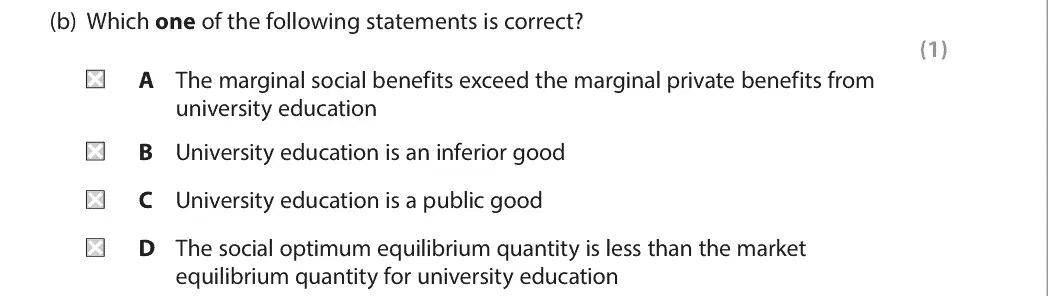
university education has external benefits, so MSB exceeds MPB (A)
it is a normal good, not a public good, and the social optimum quantity is greater than the market quantity (not D)
June 2017 · Paper 3 · Q1(b)8 marksAO1=2, AO2=2, AO3=2, AO4=28-mark response
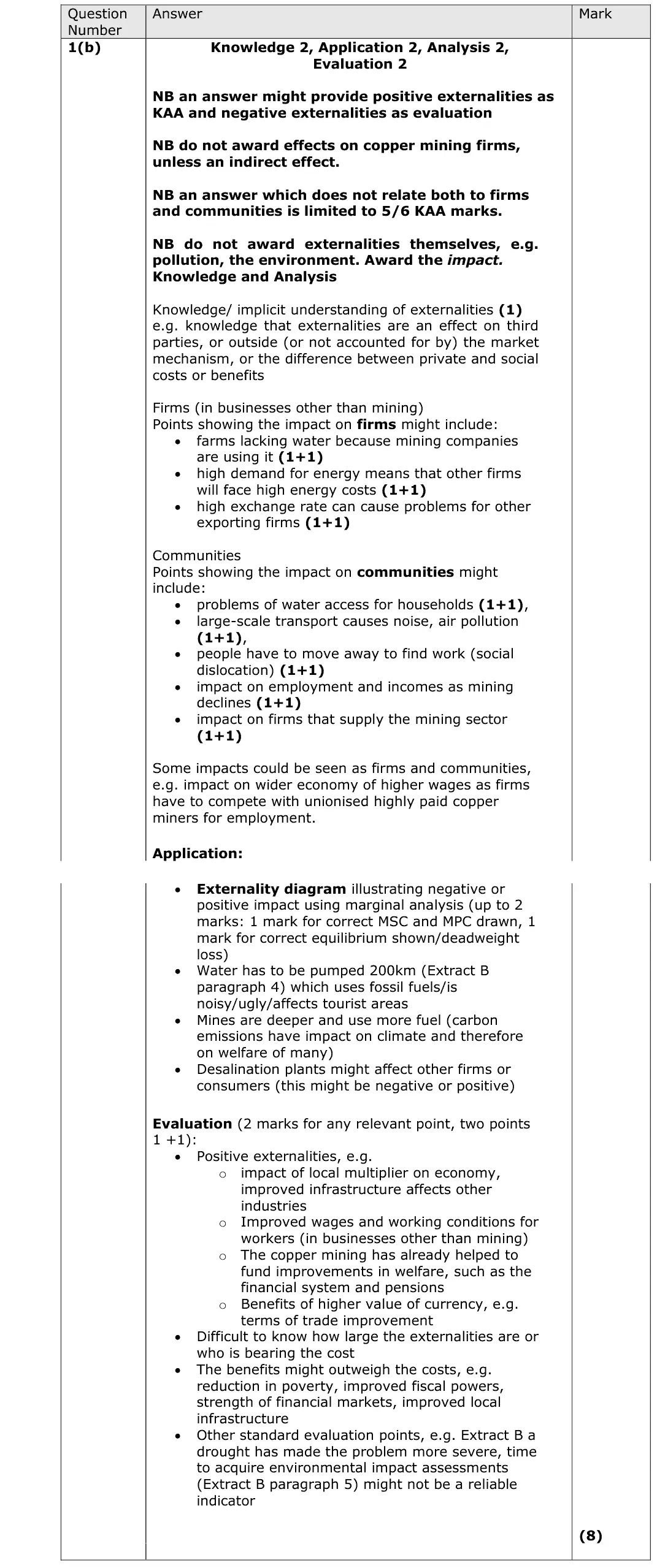
Data and extracts for question 1
Mark scheme, including the levels grid and indicative content
Examiner's comment
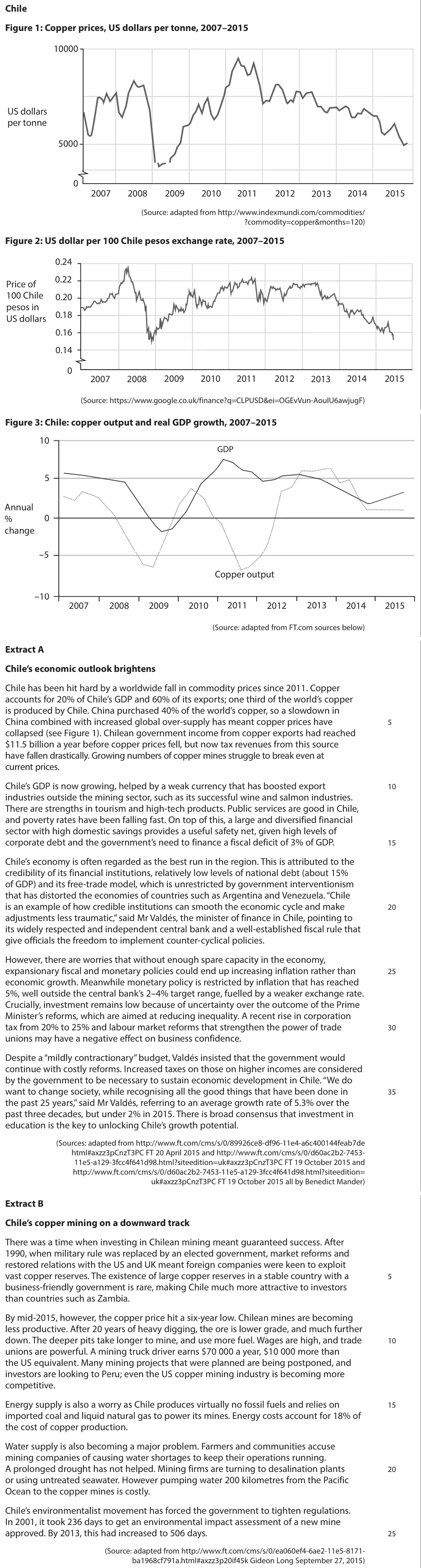
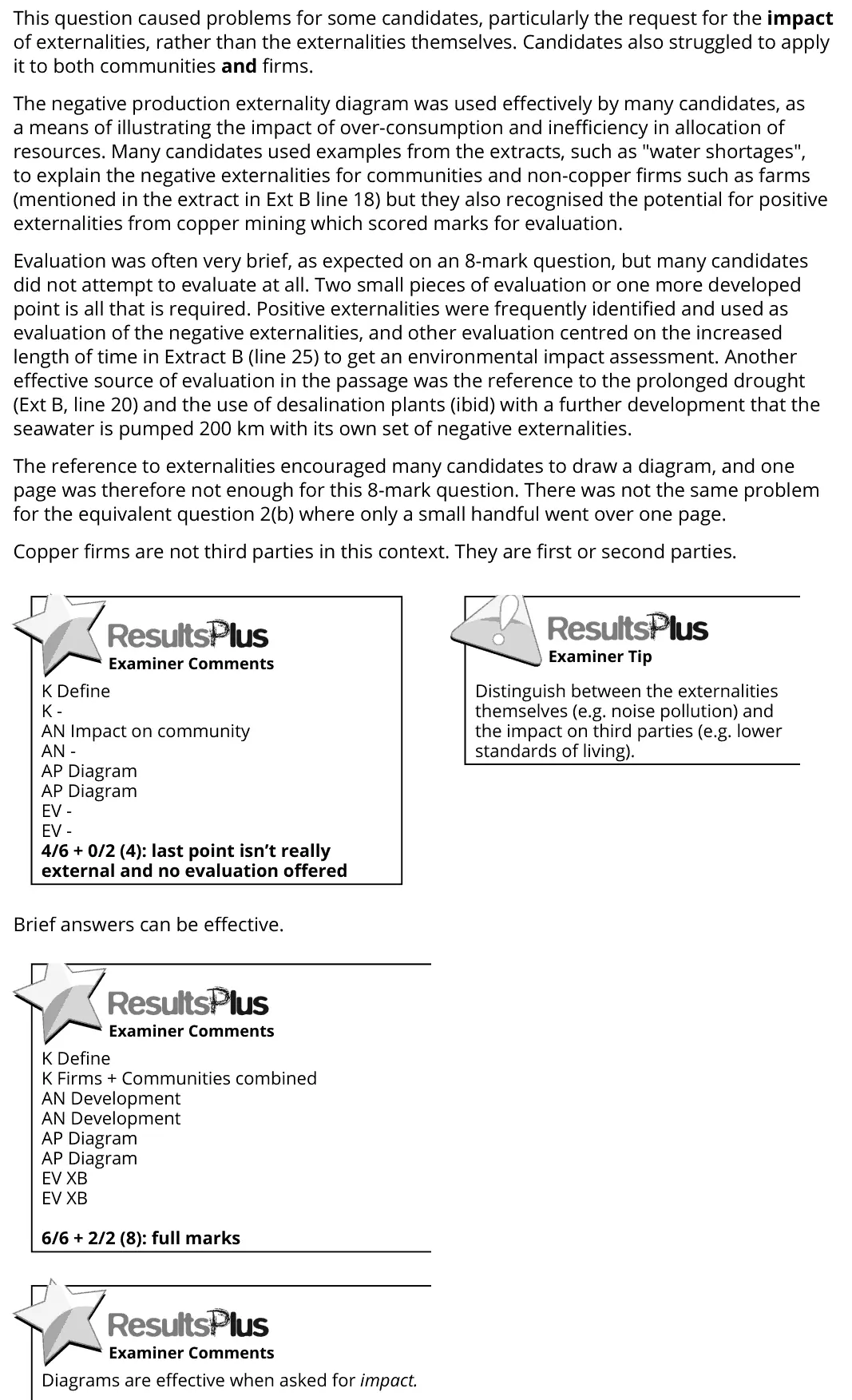
This question caused problems for some candidates, particularly the request for the impact of externalities, rather than the externalities themselves. Candidates also struggled to apply it to both communities and firms. The negative production externality diagram was used effectively by many candidates, as a means of illustrating the impact of over-consumption and inefficiency in allocation of resources. Many candidates used examples from the extracts, such as "water shortages", to explain the negative externalities for communities and non-copper firms such as farms (mentioned in the extract in Ext B line 18) but they also recognised the potential for positive externalities from copper mining which scored marks for evaluation. Evaluation was often very brief, as expected on an 8-mark question, but many candidates did not attempt to evaluate at all. Two small pieces of evaluation or one more developed point is all that is required. Positive externalities were frequently identified and used as evaluation of the negative externalities, and other evaluation centred on the increased length of time in Extract B (line 25) to get an environmental impact assessment. Another effective source of evaluation in the passage was the reference to the prolonged drought (Ext B, line 20) and the use of desalination plants (ibid) with a further development that the seawater is pumped 200 km with its own set of negative externalities. The reference to externalities encouraged many candidates to draw a diagram, and one page was therefore not enough for this 8-mark question. There was not the same problem for the equivalent question 2(b) where only a small handful went over one page. Copper firms are not third parties in this context. They are first or second parties. Distinguish between the externalities themselves (e.g. noise pollution) and the impact on third parties (e.g. lower standards of living). K Define K - AN Impact on community AN - AP Diagram AP Diagram EV - EV - 4/6 + 0/2 (4): last point isn’t really external and no evaluation offered Brief answers can be effective. K Define K Firms + Communities combined AN Development AN Development AP Diagram AP Diagram EV XB EV XB 6/6 + 2/2 (8): full marks Diagrams are effective when asked for impact.
Notes from the mark scheme and report
award the impact of externalities, not the externalities themselves
must cover both non-mining firms (e.g. farms short of water) and communities or KAA is capped
effects on copper mining firms not credited
evaluate with positive externalities or size of the external cost
Quantitative skills: QS 9 (interpret, apply and analyse information in written, graphical tabular and numerical forms)
June 2016 · AS Paper 1 · Q2(a)1 markAO1=1Definition
Mark scheme
Examiner's comment
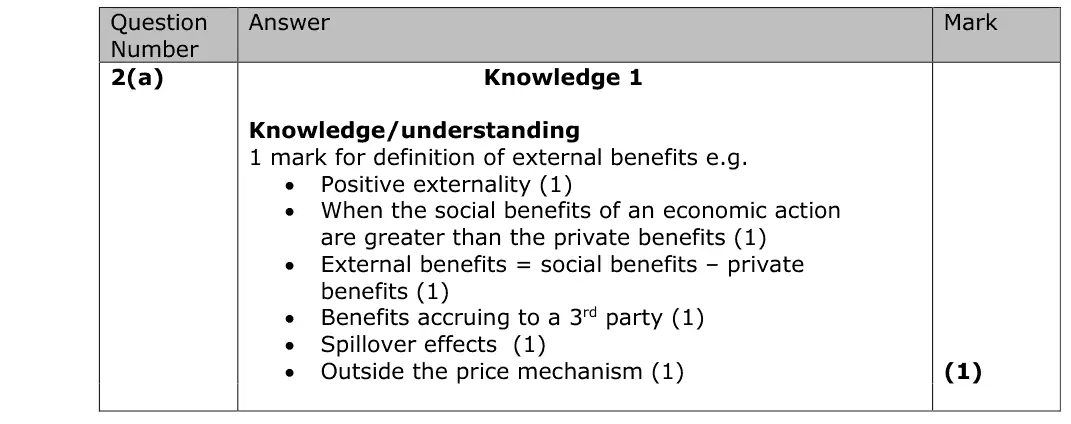
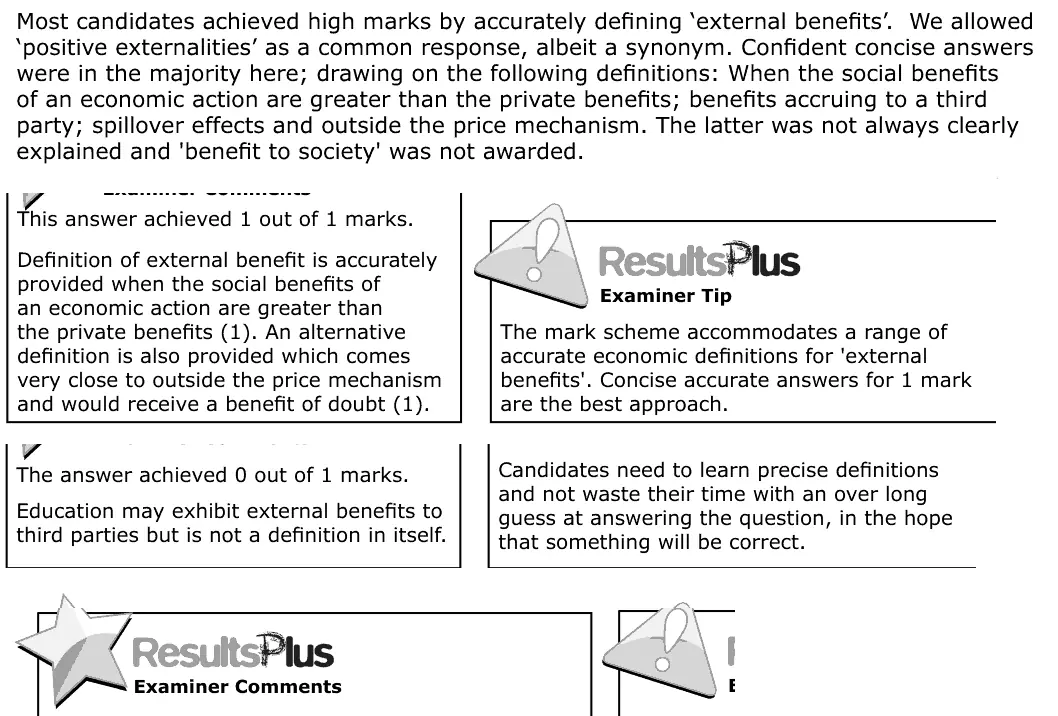
Most candidates achieved high marks by accurately defining ‘external benefits’. We allowed ‘positive externalities’ as a common response, albeit a synonym. Confident concise answers were in the majority here; drawing on the following definitions: When the social benefits of an economic action are greater than the private benefits; benefits accruing to a third party; spillover effects and outside the price mechanism. The latter was not always clearly explained and 'benefit to society' was not awarded. This answer achieved 1 out of 1 marks. Definition of external benefit is accurately provided when the social benefits of an economic action are greater than the private benefits (1). An alternative definition is also provided which comes very close to outside the price mechanism and would receive a benefit of doubt (1). The mark scheme accommodates a range of accurate economic definitions for 'external benefits'. Concise accurate answers for 1 mark are the best approach. The answer achieved 0 out of 1 marks. Education may exhibit external benefits to third parties but is not a definition in itself. Candidates need to learn precise definitions and not waste their time with an over long guess at answering the question, in the hope that something will be correct.
Notes from the mark scheme and report
social benefit minus private benefit, benefits to a third party, spillover effects
'positive externality' accepted
'benefit to society' not awarded
examples are not a definition
June 2016 · AS Paper 1 · Q2(b)1 markMultiple choice
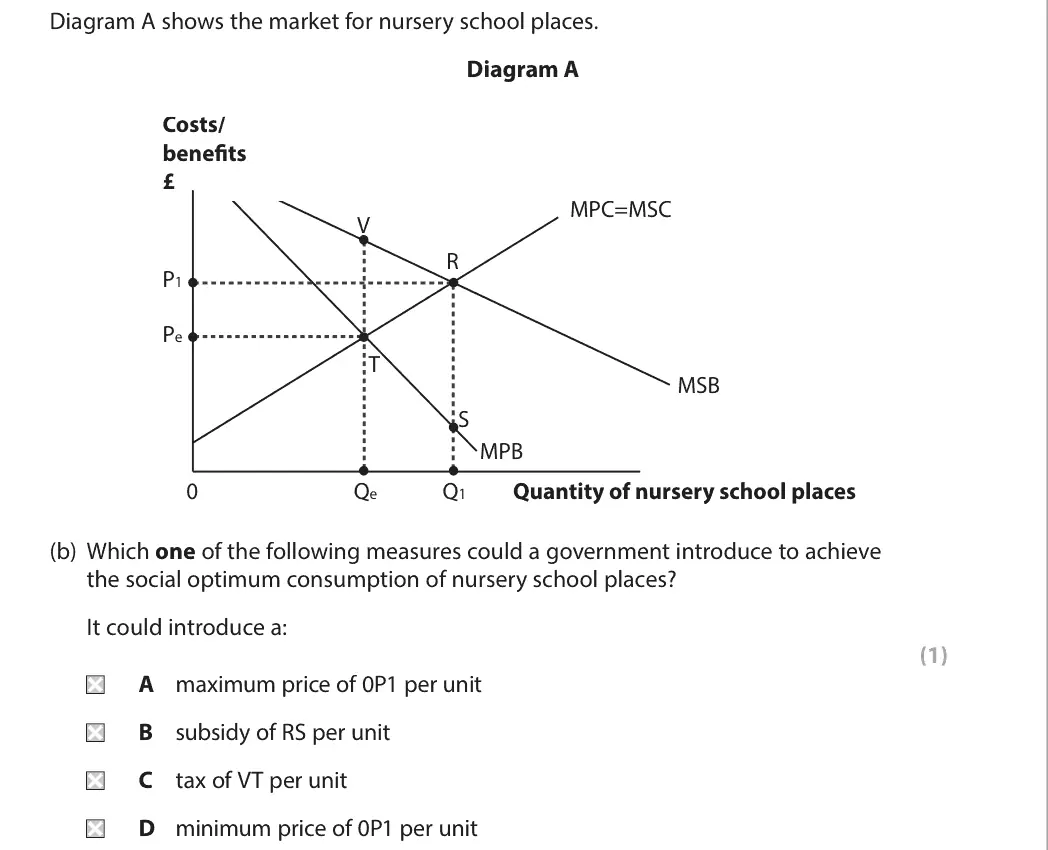
Answer
B
Mark scheme
Notes from the mark scheme and report
a subsidy of RS per unit (the vertical gap between MSB and MPB at the optimum) shifts MPC down to reach Q1 (B)
a tax of VT would reduce consumption
maximum and minimum prices at 0P1 do not reach the optimum
Quantitative skills: QS 4 (construct and interpret a range of standard graphical forms)
June 2016 · AS Paper 1 · Q2(c)2 marksAO2=2Short answer
Mark scheme
Examiner's comment
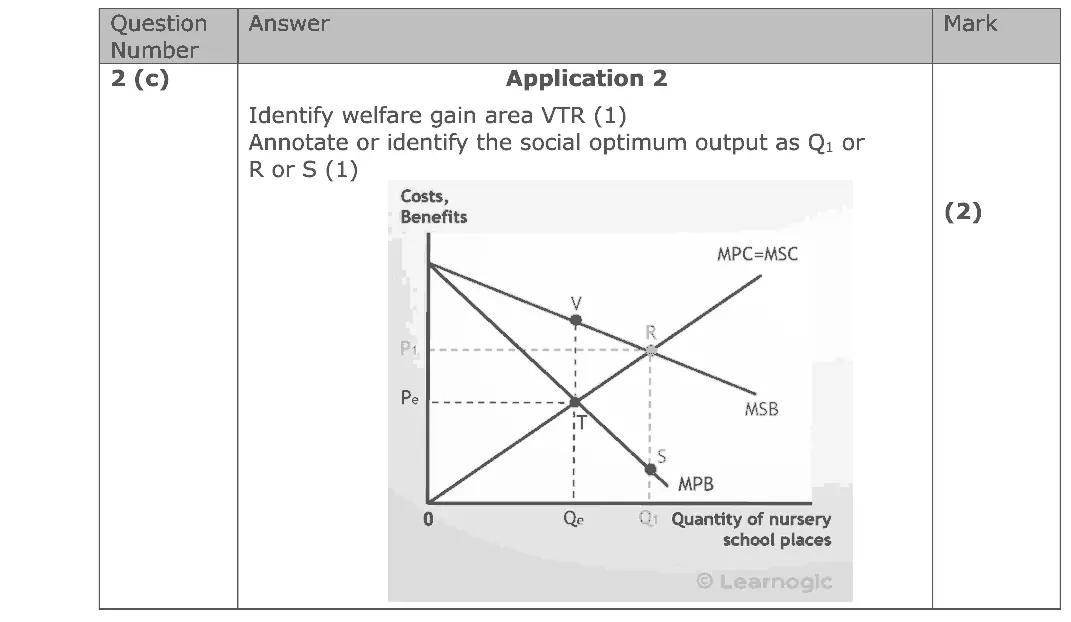
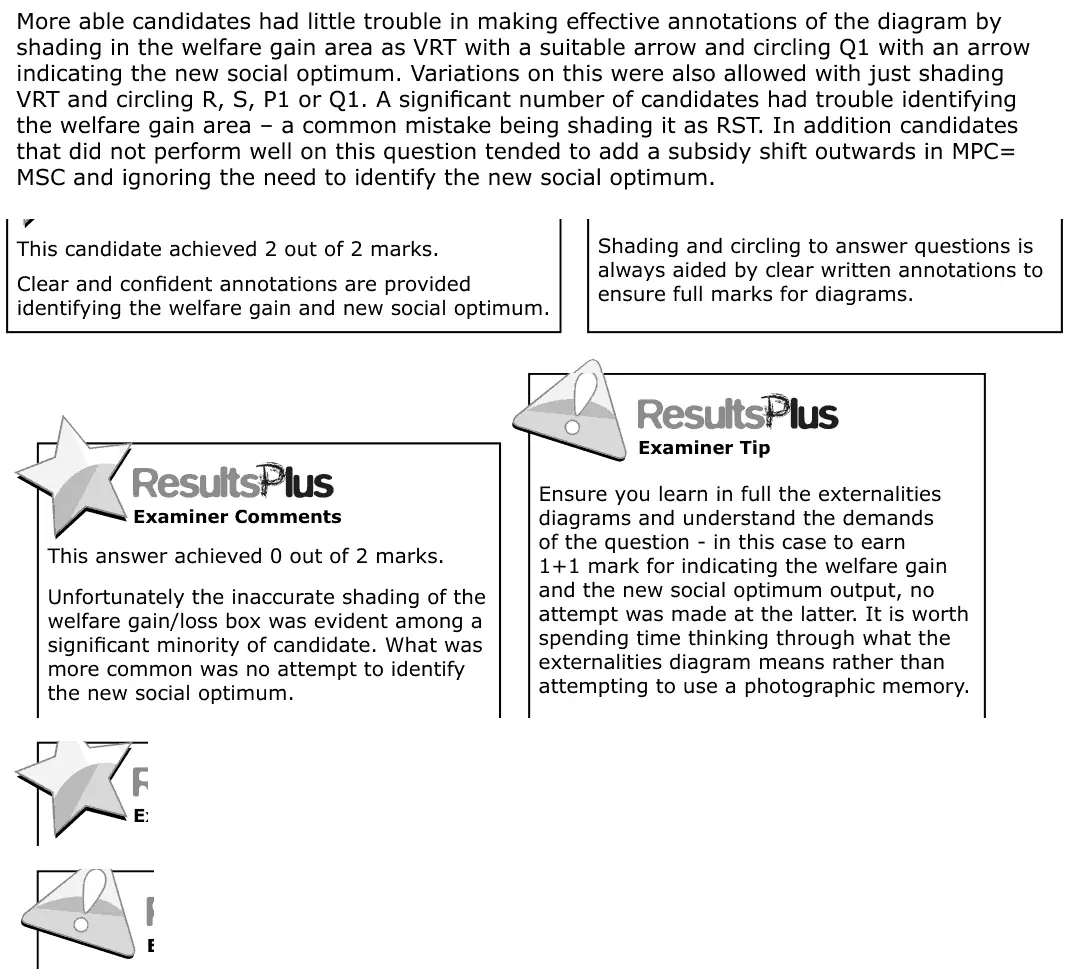
More able candidates had little trouble in making effective annotations of the diagram by shading in the welfare gain area as VRT with a suitable arrow and circling Q1 with an arrow indicating the new social optimum. Variations on this were also allowed with just shading VRT and circling R, S, P1 or Q1. A significant number of candidates had trouble identifying the welfare gain area – a common mistake being shading it as RST. In addition candidates that did not perform well on this question tended to add a subsidy shift outwards in MPC= MSC and ignoring the need to identify the new social optimum. This candidate achieved 2 out of 2 marks. Clear and confident annotations are provided identifying the welfare gain and new social optimum. Shading and circling to answer questions is always aided by clear written annotations to ensure full marks for diagrams. This answer achieved 0 out of 2 marks. Unfortunately the inaccurate shading of the welfare gain/loss box was evident among a significant minority of candidate. What was more common was no attempt to identify the new social optimum. Ensure you learn in full the externalities diagrams and understand the demands of the question - in this case to earn 1+1 mark for indicating the welfare gain and the new social optimum output, no attempt was made at the latter. It is worth spending time thinking through what the externalities diagram means rather than attempting to use a photographic memory.
Notes from the mark scheme and report
shade the welfare gain triangle VTR (not RST) and mark the social optimum output Q1 (or R or S)
many shaded the wrong area or forgot the new optimum
Quantitative skills: QS 4 (construct and interpret a range of standard graphical forms)
June 2016 · AS Paper 1 · Q3(a)1 markMultiple choice
Data and extracts for question 3
Answer
C
Mark scheme
Notes from the mark scheme and report
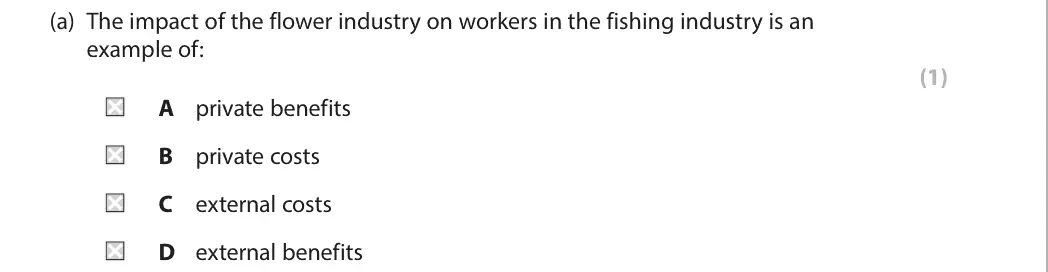
damage to fish stocks is a cost to third parties (fishing workers) so it is an external cost (C)
not a private cost of the flower farms
Work with an Edexcel economics tutor
Essays stuck in Level 2, or losing the easy marks in Section A? Book a trial session with Lianne, a former Edexcel examiner.