Notes and key-term cards for this topic are being written by our tutors. The past-paper questions below are ready now.
Specification statements
3.3.1Revenue: a) Formulae to calculate and understand the relationship between: • total revenue • average revenue • marginal revenue b) Price elasticity of demand and its relationship to revenue concepts (calculation required)
3.3.2Costs: a) Formulae to calculate and understand the relationship between: • total cost • total fixed cost • total variable cost • average (total) cost • average fixed cost • average variable cost • marginal cost b) Derivation of short-run cost curves from the assumption of diminishing marginal productivity c) Relationship between short-run and long-run average cost curves
3.3.3Economies and diseconomies of scale: a) Types of economies and diseconomies of scale b) Minimum efficient scale c) Distinction between internal and external economies of scale
3.3.4Normal profits, supernormal profits and losses: a) Condition for profit maximisation b) Normal profit, supernormal profit and losses c) Short-run and long-run shut-down points: diagrammatic analysis
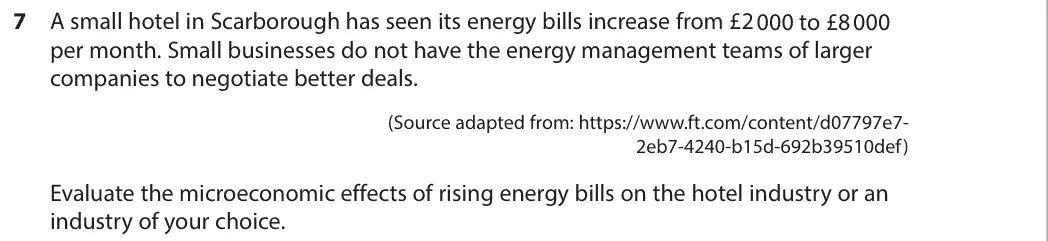
A small hotel in Scarborough has seen its energy bills increase from £2 000 to £8 000 per month. Small businesses do not have the energy management teams of larger companies to negotiate better deals. (Source adapted from: https://www.ft.com/content/d07797e7- 2eb7-4240-b15d-692b39510def) Evaluate the microeconomic effects of rising energy bills on the hotel industry or an industry of your choice.
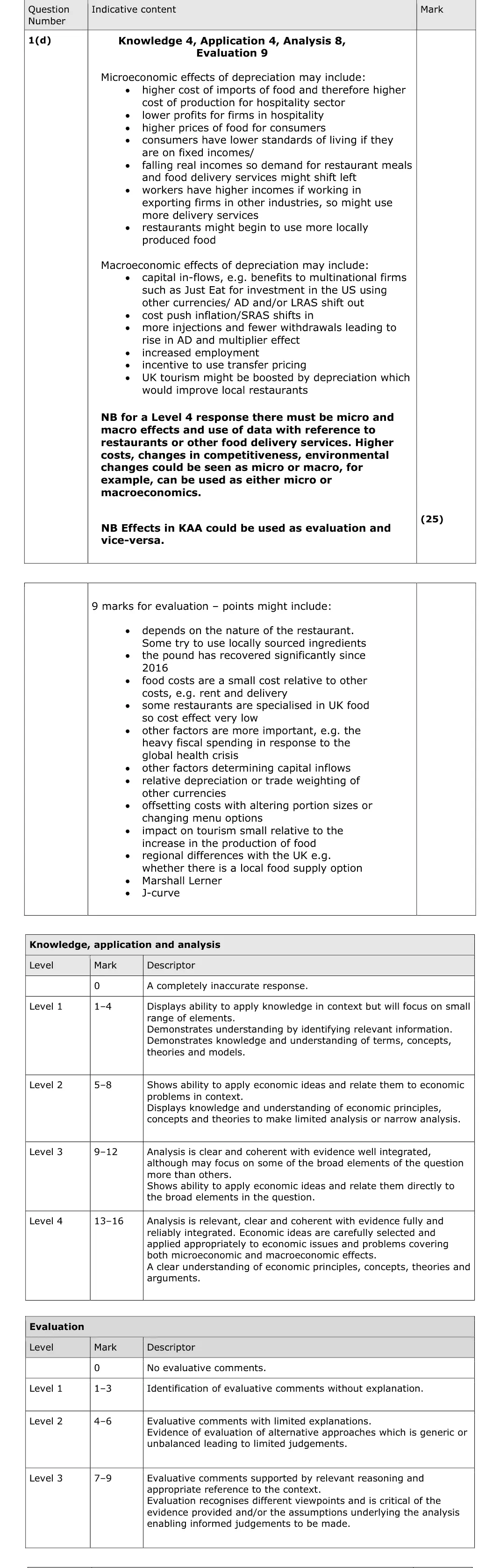
Evaluate the microeconomic and macroeconomic effects of a depreciation of the pound. Refer to restaurants or other food delivery services in your answer.
Tap a question to zoom it. The data and extracts fold out above each question; the mark scheme and examiner's comment open underneath.
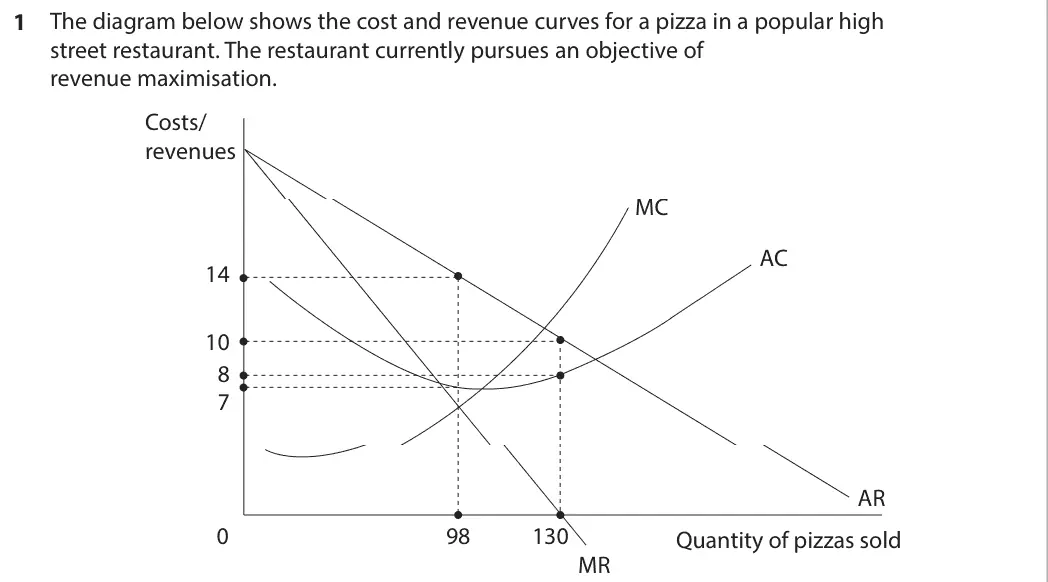
June 2025 · Paper 1 · Q1(a)4 marksAO1=2, AO2=2Calculation
Data and extracts for question 1
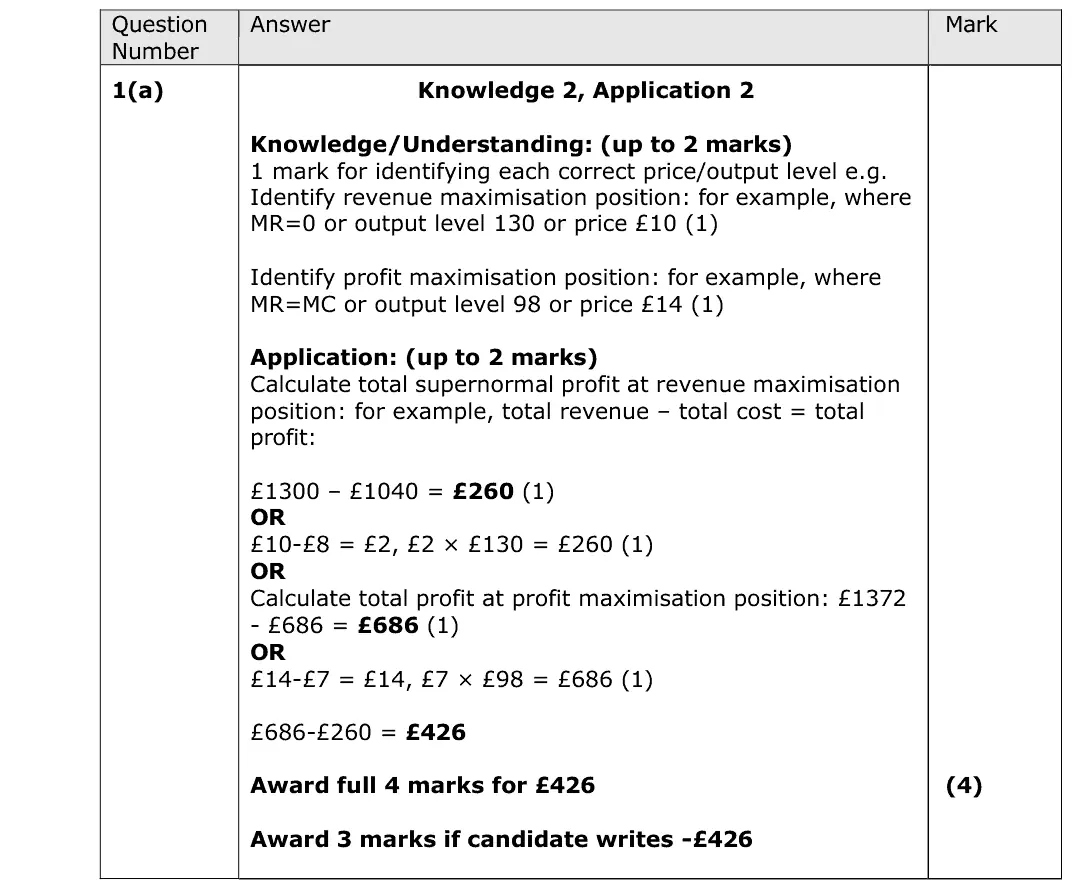
Mark scheme
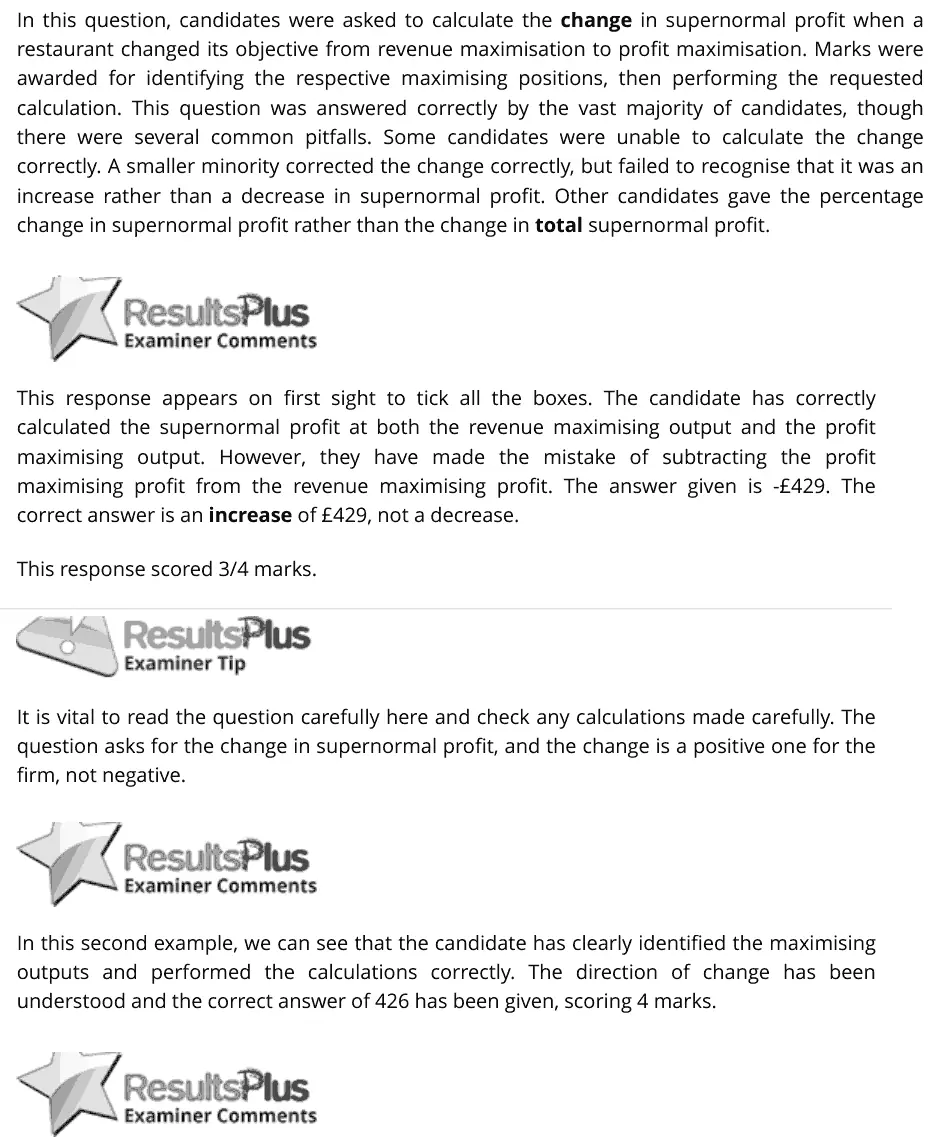
Examiner's comment
In this question, candidates were asked to calculate the change in supernormal profit when a restaurant changed its objective from revenue maximisation to profit maximisation. Marks were awarded for identifying the respective maximising positions, then performing the requested calculation. This question was answered correctly by the vast majority of candidates, though there were several common pitfalls. Some candidates were unable to calculate the change correctly. A smaller minority corrected the change correctly, but failed to recognise that it was an increase rather than a decrease in supernormal profit. Other candidates gave the percentage change in supernormal profit rather than the change in total supernormal profit. This response appears on first sight to tick all the boxes. The candidate has correctly calculated the supernormal profit at both the revenue maximising output and the profit maximising output. However, they have made the mistake of subtracting the profit maximising profit from the revenue maximising profit. The answer given is -£429. The correct answer is an increase of £429, not a decrease. This response scored 3/4 marks. It is vital to read the question carefully here and check any calculations made carefully. The question asks for the change in supernormal profit, and the change is a positive one for the firm, not negative. In this second example, we can see that the candidate has clearly identified the maximising outputs and performed the calculations correctly. The direction of change has been understood and the correct answer of 426 has been given, scoring 4 marks.
Notes from the mark scheme and report
revenue maximisation where MR = 0: (£10 - £8) x 130 = £260
profit maximisation where MC = MR: (£14 - £7) x 98 = £686
change = +£426 (an increase)
-£426 scores 3
common errors: subtracting the wrong way round, giving a percentage change
Quantitative skills: QS 4 (construct and interpret a range of standard graphical forms); QS 6 (calculate cost, revenue and profit (marginal, average, totals))
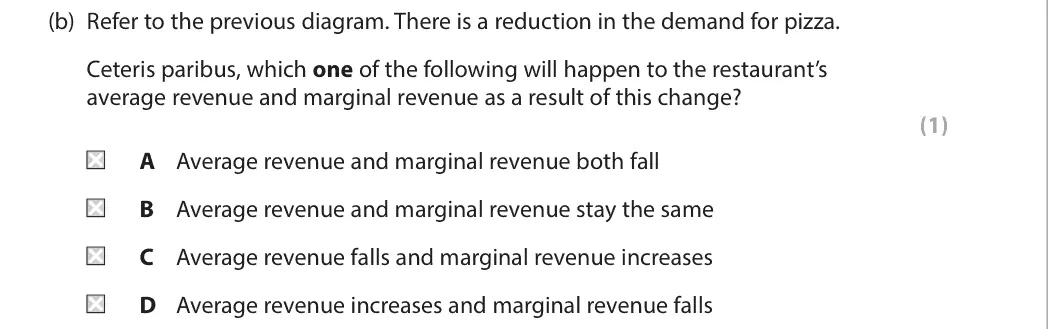
June 2025 · Paper 1 · Q1(b)1 markMultiple choice
Data and extracts for question 1
Answer
A
Mark scheme
Notes from the mark scheme and report
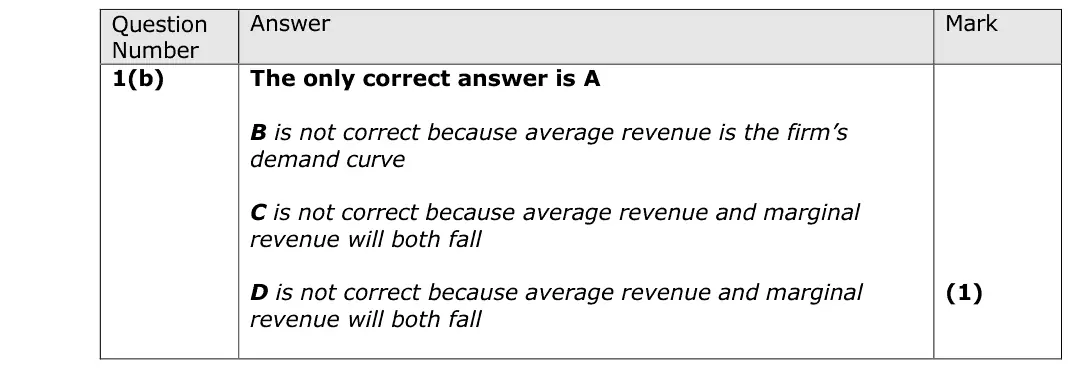
a fall in demand shifts the firm's AR (its demand curve) left, so MR falls too (A)
B ignores that AR is the demand curve
C and D have AR and MR moving in opposite directions
June 2025 · Paper 3 · Q1(d)25 marksAO1=4, AO2=4, AO3=8, AO4=925-mark essayEither/or
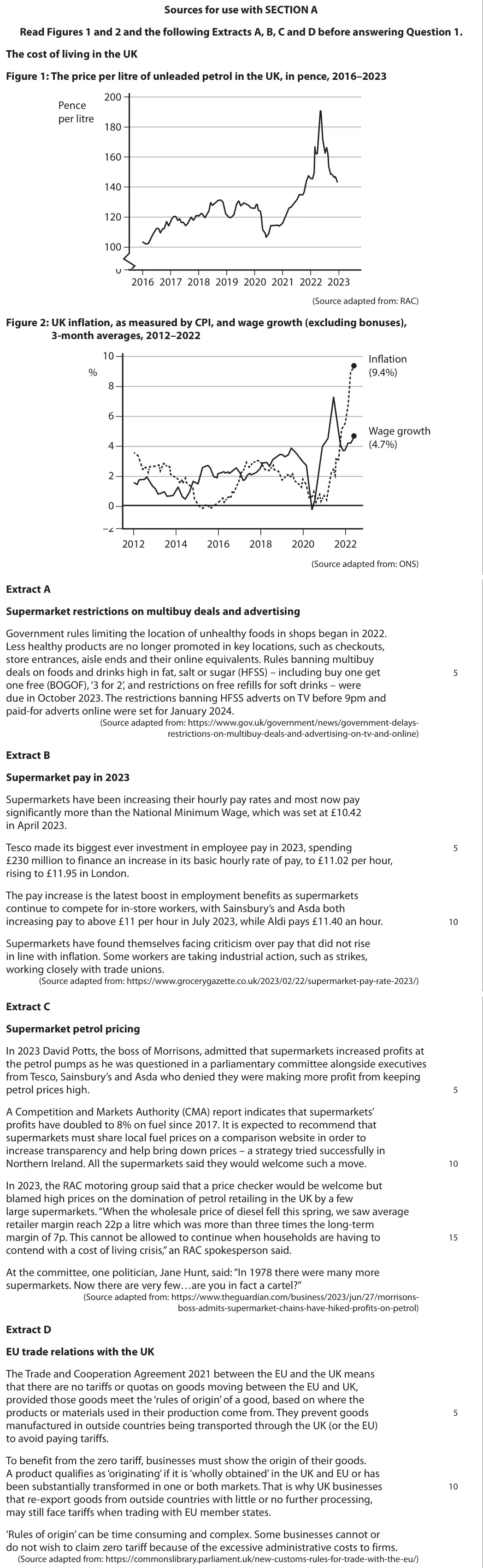
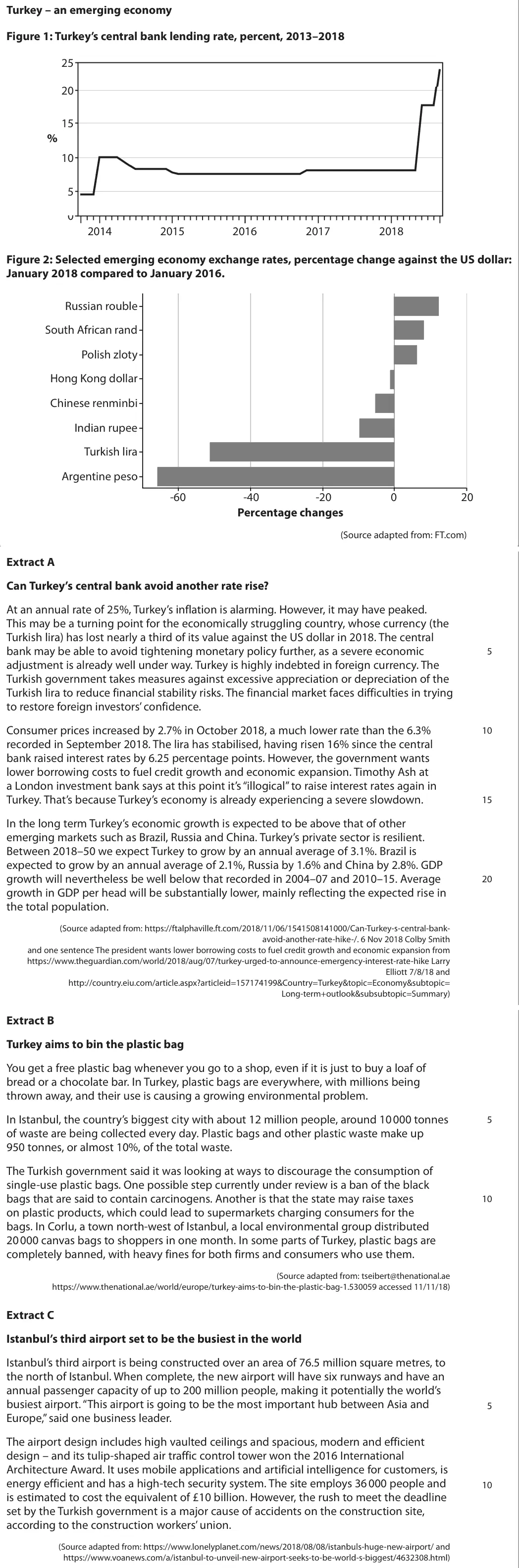
Data and extracts for question 1
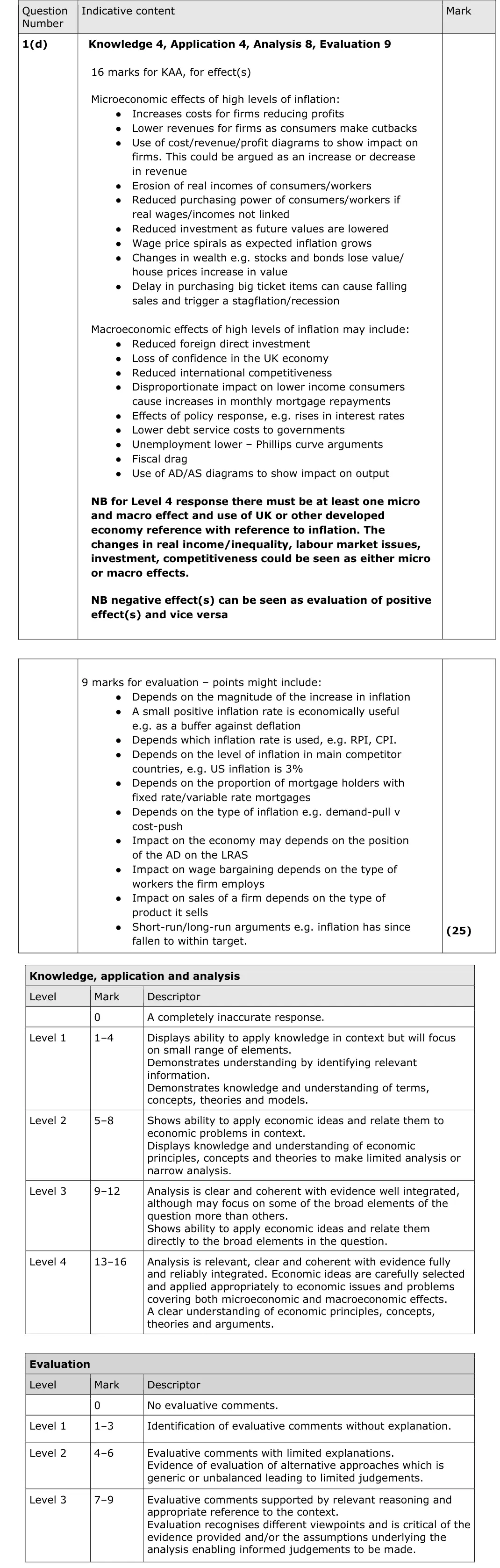
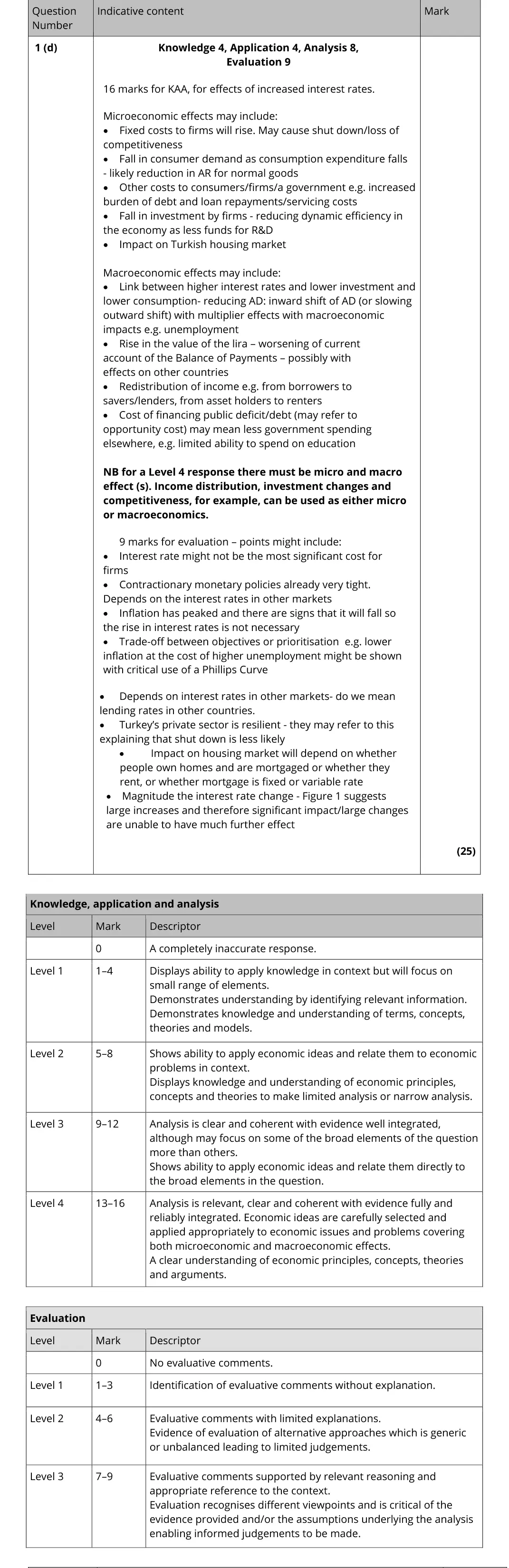
Mark scheme, including the levels grid and indicative content
Examiner's comment
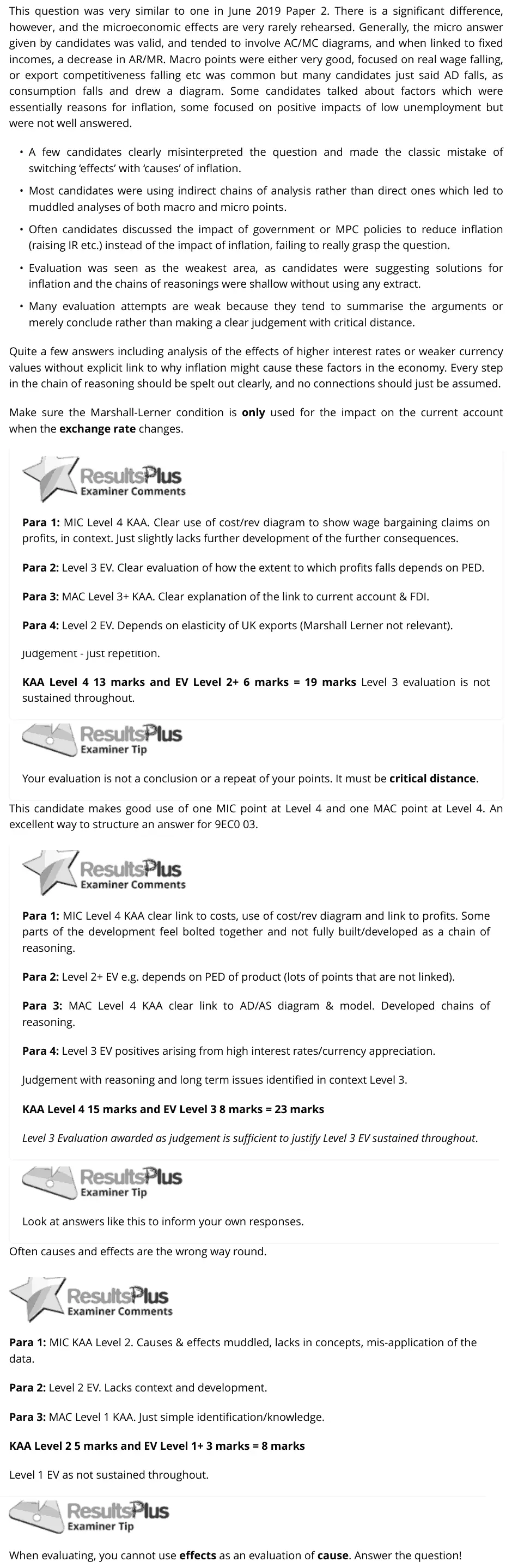
This question was very similar to one in June 2019 Paper 2. There is a significant difference, however, and the microeconomic effects are very rarely rehearsed. Generally, the micro answer given by candidates was valid, and tended to involve AC/MC diagrams, and when linked to fixed incomes, a decrease in AR/MR. Macro points were either very good, focused on real wage falling, or export competitiveness falling etc was common but many candidates just said AD falls, as consumption falls and drew a diagram. Some candidates talked about factors which were essentially reasons for inflation, some focused on positive impacts of low unemployment but were not well answered. • A few candidates clearly misinterpreted the question and made the classic mistake of switching ‘effects’ with ‘causes’ of inflation. • Most candidates were using indirect chains of analysis rather than direct ones which led to muddled analyses of both macro and micro points. • Often candidates discussed the impact of government or MPC policies to reduce inflation (raising IR etc.) instead of the impact of inflation, failing to really grasp the question. • Evaluation was seen as the weakest area, as candidates were suggesting solutions for inflation and the chains of reasonings were shallow without using any extract. • Many evaluation attempts are weak because they tend to summarise the arguments or merely conclude rather than making a clear judgement with critical distance. Quite a few answers including analysis of the effects of higher interest rates or weaker currency values without explicit link to why inflation might cause these factors in the economy. Every step in the chain of reasoning should be spelt out clearly, and no connections should just be assumed. Make sure the Marshall-Lerner condition is only used for the impact on the current account when the exchange rate changes. Para 1: MIC Level 4 KAA. Clear use of cost/rev diagram to show wage bargaining claims on profits, in context. Just slightly lacks further development of the further consequences. Para 2: Level 3 EV. Clear evaluation of how the extent to which profits falls depends on PED. Para 3: MAC Level 3+ KAA. Clear explanation of the link to current account & FDI. Para 4: Level 2 EV. Depends on elasticity of UK exports (Marshall Lerner not relevant). Judgement - just repetition. KAA Level 4 13 marks and EV Level 2+ 6 marks = 19 marks Level 3 evaluation is not sustained throughout. Your evaluation is not a conclusion or a repeat of your points. It must be critical distance. This candidate makes good use of one MIC point at Level 4 and one MAC point at Level 4. An excellent way to structure an answer for 9EC0 03. Para 1: MIC Level 4 KAA clear link to costs, use of cost/rev diagram and link to profits. Some parts of the development feel bolted together and not fully built/developed as a chain of reasoning. Para 2: Level 2+ EV e.g. depends on PED of product (lots of points that are not linked). Para 3: MAC Level 4 KAA clear link to AD/AS diagram & model. Developed chains of reasoning. Para 4: Level 3 EV positives arising from high interest rates/currency appreciation. Judgement with reasoning and long term issues identified in context Level 3. KAA Level 4 15 marks and EV Level 3 8 marks = 23 marks Level 3 Evaluation awarded as judgement is sufficient to justify Level 3 EV sustained throughout. Look at answers like this to inform your own responses. Often causes and effects are the wrong way round. Para 1: MIC KAA Level 2. Causes & effects muddled, lacks in concepts, mis-application of the data. Para 2: Level 2 EV. Lacks context and development. Para 3: MAC Level 1 KAA. Just simple identification/knowledge. KAA Level 2 5 marks and EV Level 1+ 3 marks = 8 marks Level 1 EV as not sustained throughout. When evaluating, you cannot use effects as an evaluation of cause. Answer the question!
Notes from the mark scheme and report
Level 4 needs at least one micro and one macro effect with reference to the UK or another developed economy
micro: costs, revenues and profits of firms
macro: real wages, competitiveness, uncertainty, investment
do not discuss causes of inflation or policies to reduce it
June 2025 · Paper 3 · Q1(e)25 marksAO1=4, AO2=4, AO3=8, AO4=925-mark essayEither/or
Data and extracts for question 1
Mark scheme, including the levels grid and indicative content
Examiner's comment
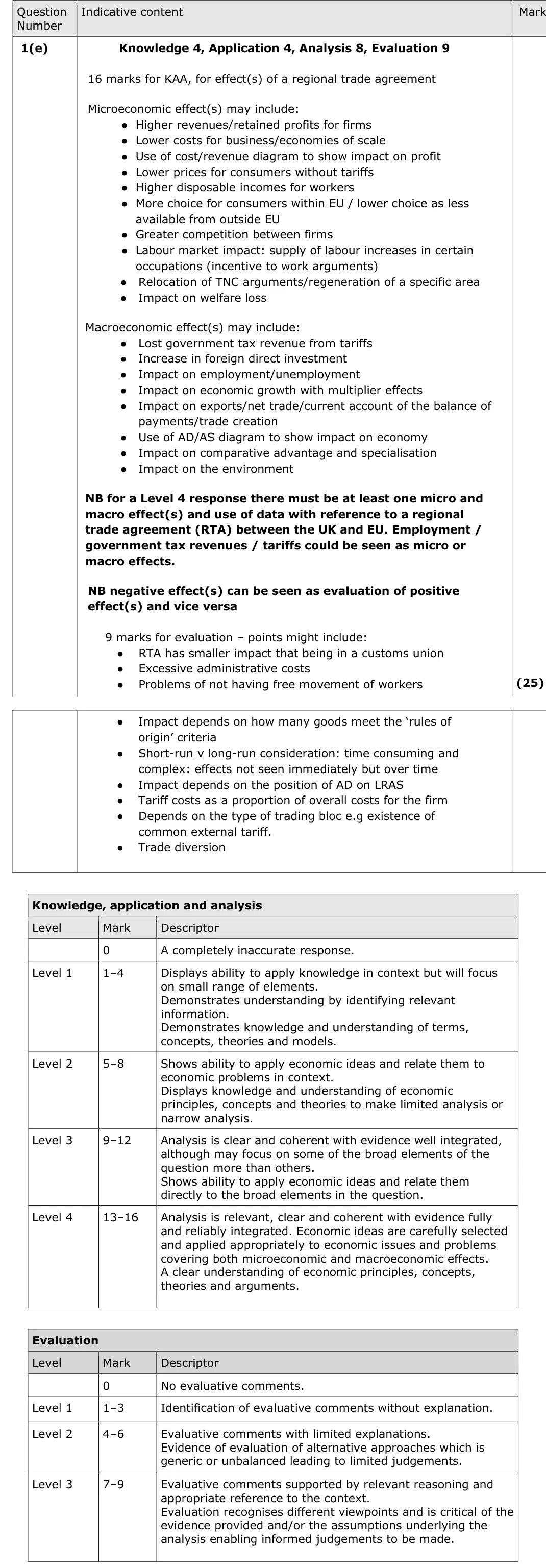
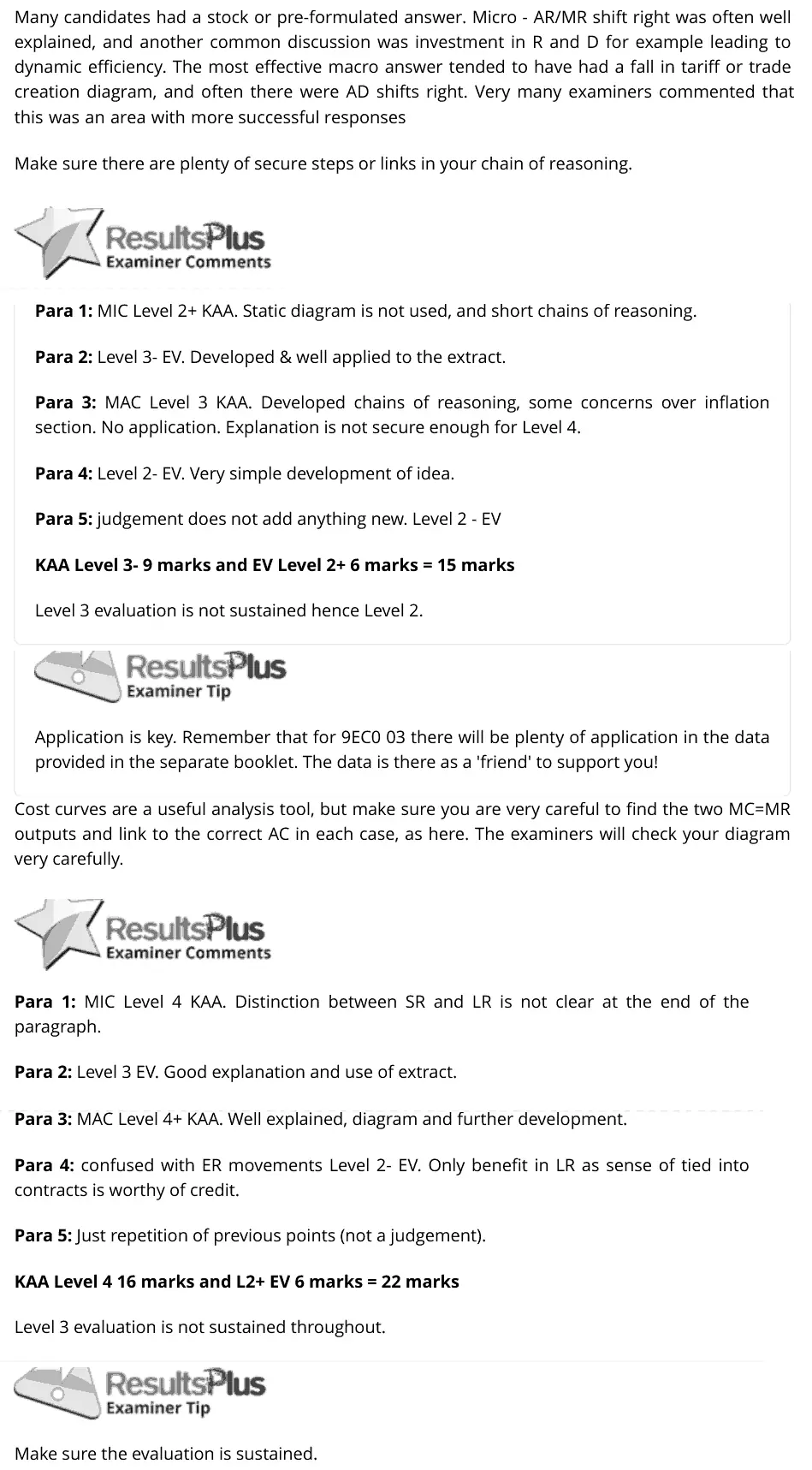
Many candidates had a stock or pre-formulated answer. Micro - AR/MR shift right was often well explained, and another common discussion was investment in R and D for example leading to dynamic efficiency. The most effective macro answer tended to have had a fall in tariff or trade creation diagram, and often there were AD shifts right. Very many examiners commented that this was an area with more successful responses Make sure there are plenty of secure steps or links in your chain of reasoning. Para 1: MIC Level 2+ KAA. Static diagram is not used, and short chains of reasoning. Para 2: Level 3- EV. Developed & well applied to the extract. Para 3: MAC Level 3 KAA. Developed chains of reasoning, some concerns over inflation section. No application. Explanation is not secure enough for Level 4. Para 4: Level 2- EV. Very simple development of idea. Para 5: judgement does not add anything new. Level 2 - EV KAA Level 3- 9 marks and EV Level 2+ 6 marks = 15 marks Level 3 evaluation is not sustained hence Level 2. Application is key. Remember that for 9EC0 03 there will be plenty of application in the data provided in the separate booklet. The data is there as a 'friend' to support you! Cost curves are a useful analysis tool, but make sure you are very careful to find the two MC=MR outputs and link to the correct AC in each case, as here. The examiners will check your diagram very carefully. Para 1: MIC Level 4 KAA. Distinction between SR and LR is not clear at the end of the paragraph. Para 2: Level 3 EV. Good explanation and use of extract. Para 3: MAC Level 4+ KAA. Well explained, diagram and further development. Para 4: confused with ER movements Level 2- EV. Only benefit in LR as sense of tied into contracts is worthy of credit. Para 5: Just repetition of previous points (not a judgement). KAA Level 4 16 marks and L2+ EV 6 marks = 22 marks Level 3 evaluation is not sustained throughout. Make sure the evaluation is sustained.
Notes from the mark scheme and report
Level 4 needs a micro and a macro effect and use of Extract D (rules of origin, administrative costs)
micro: lower costs, higher revenues and profits, more choice
evaluate with rules of origin and the position of the UK outside a customs union
June 2024 · Paper 1 · Q6(c)10 marksAO1=2, AO2=2, AO3=2, AO4=410-mark response
Data and extracts for question 6
Mark scheme, including the levels grid and indicative content
Examiner's comment
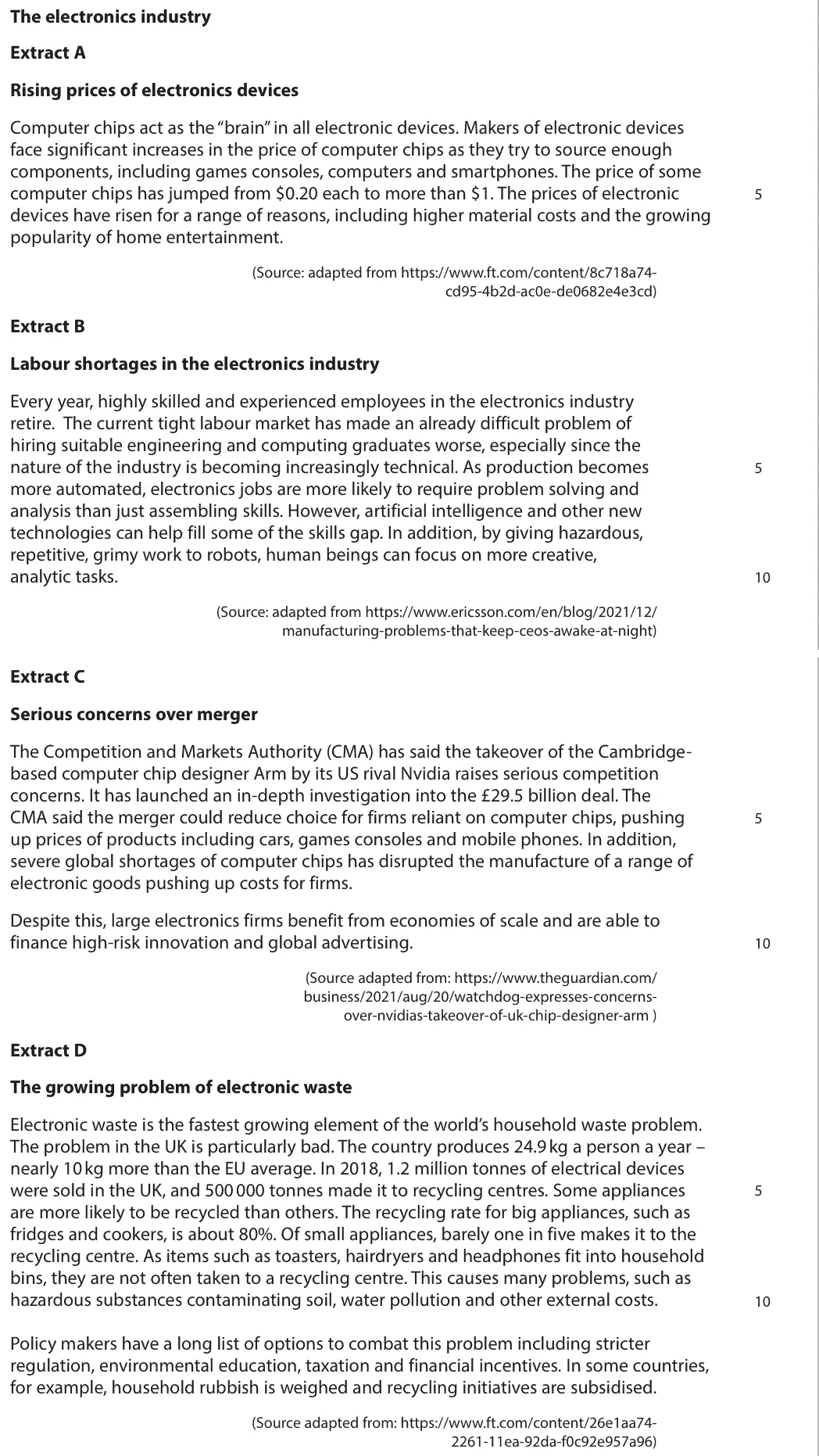
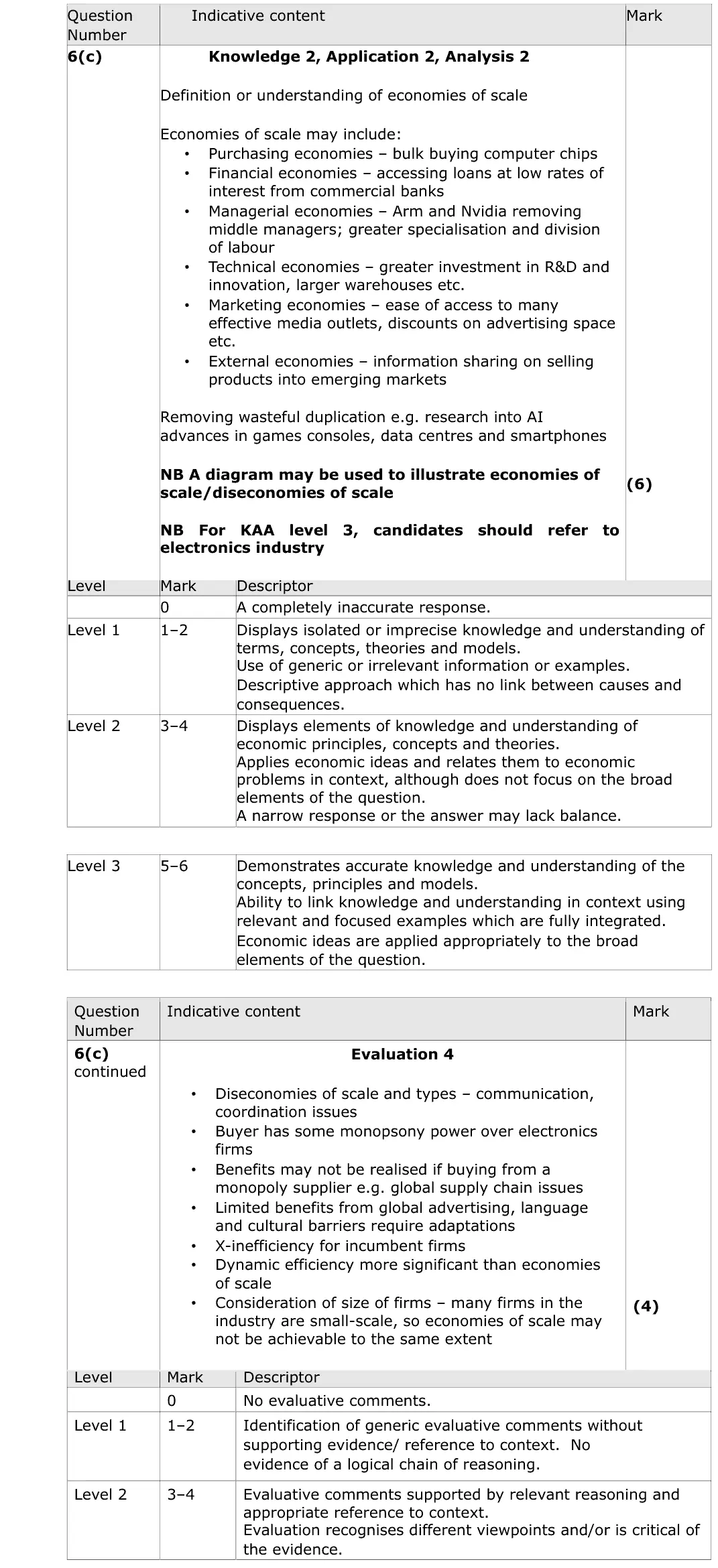
This question is the first of the levels-based responses, and was looking for an assessment of whether firms in the electronics industry benefit from economies of scale. The approach here was to write one paragraph on why the firms benefit and another on why they didn't. Whilst many candidates considered several factors it was possible to obtain full marks by discussing one factor on either side, in depth. Many candidates confused economies of scale with dynamic efficiency, which is about the change in productive efficiency over time. This would cause the long run average cost curve to move downwards. Economies of scale happen when the firm moves further along the original long run average cost curve, towards the minimum efficient scale. Overall, most candidates could discuss the different types of scale economies, such as financial or managerial, and then evaluate by discussing likely diseconomies of scale or whether dynamic efficiency was more significant than economies of scale, given the nature of the industry. The key point here was to assess the extent of these economies in the electronics industry. This first response is a weak response that gained only three of the marks available. The candidate only tells us that firms in the electronics industry benefit from economies of scale. The point about bulk buying discounts accessing lower costs is valid, but the candidate then goes on to discuss gains in dynamic efficiency achieved through new product development. There is no evaluation of the points made. This response achieved bottom level 3, for 3 marks. This a 10 mark question, with 6 marks available for knowledge, application and analysis, and 4 marks for evaluation. To access the marks you should aim to spend roughly 6 minutes developing the KAA and 4 for the evaluation. To access full marks you just need to develop one argument on either side. Efficient use of time is important! It is clear from this second response that the candidate has achieved considerably more in the time available. The candidate talks about the economies of scale potentially achievable through the proposed merger of Nvidia and ARM. There are two well developed points, the first concerning the financial economies of scale from being bigger, which can then be invested into the firms becoming more productively efficient. This point is then well evaluated. The candidate then discusses marketing economies of scale, again in the context of the merger, and evaluates by discussing potential diseconomies of scale. This response achieved full marks.
Notes from the mark scheme and report
do not confuse economies of scale with dynamic efficiency (shift of LRAC down)
one well-developed point each way is enough
evaluate with diseconomies of scale
June 2024 · Paper 1 · Q725 marksAO1=4, AO2=4, AO3=8, AO4=925-mark essayEither/or
Mark scheme, including the levels grid and indicative content
Examiner's comment
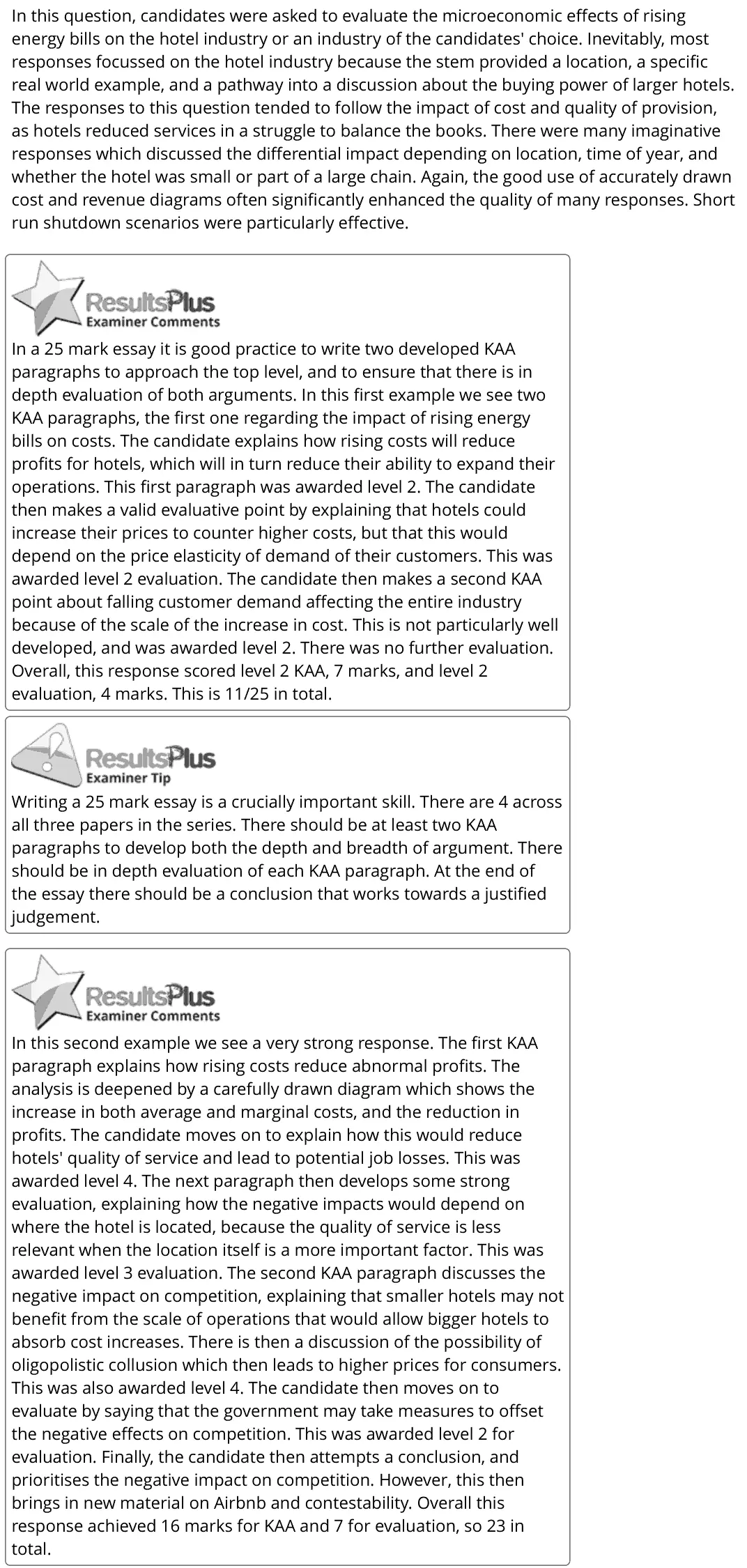
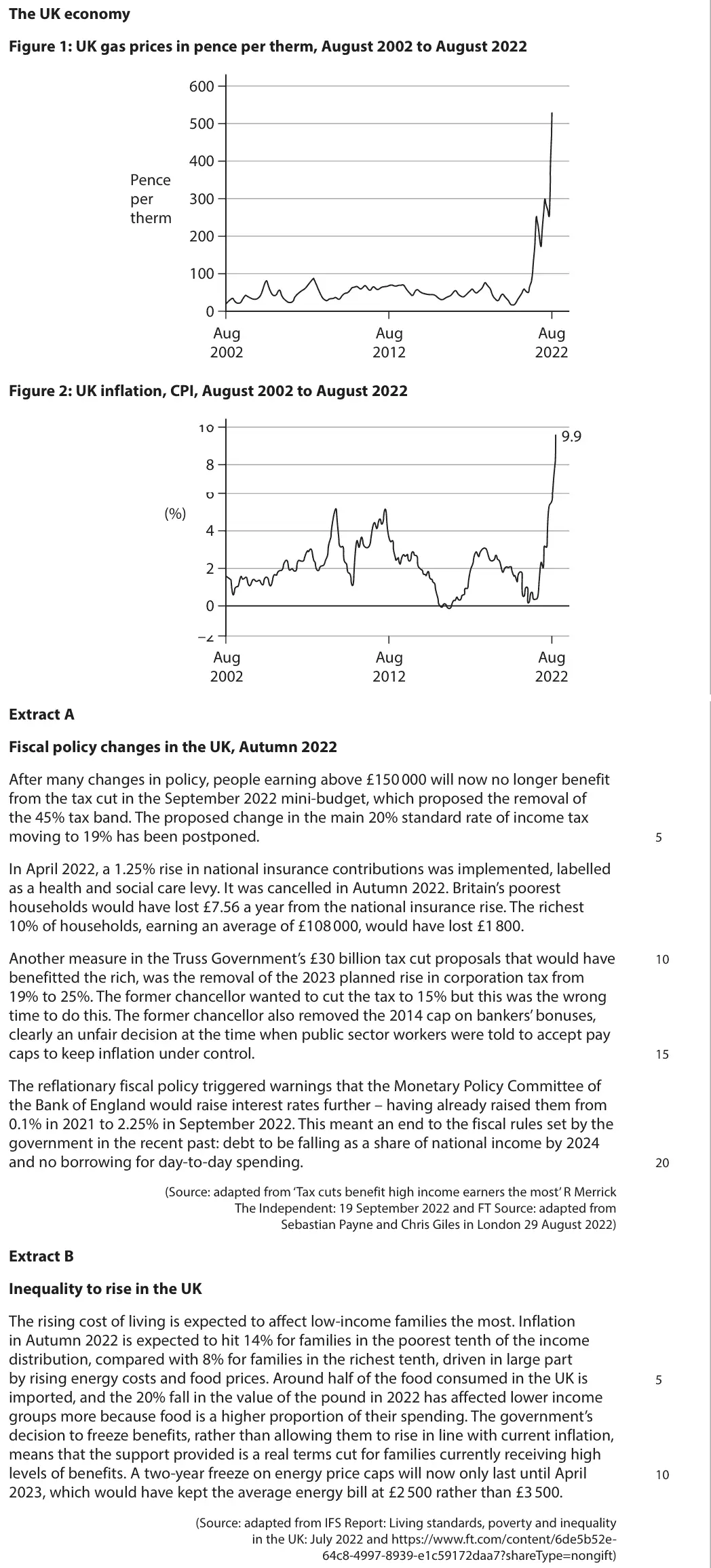
In this question, candidates were asked to evaluate the microeconomic effects of rising energy bills on the hotel industry or an industry of the candidates' choice. Inevitably, most responses focussed on the hotel industry because the stem provided a location, a specific real world example, and a pathway into a discussion about the buying power of larger hotels. The responses to this question tended to follow the impact of cost and quality of provision, as hotels reduced services in a struggle to balance the books. There were many imaginative responses which discussed the differential impact depending on location, time of year, and whether the hotel was small or part of a large chain. Again, the good use of accurately drawn cost and revenue diagrams often significantly enhanced the quality of many responses. Short run shutdown scenarios were particularly effective. In a 25 mark essay it is good practice to write two developed KAA paragraphs to approach the top level, and to ensure that there is in depth evaluation of both arguments. In this first example we see two KAA paragraphs, the first one regarding the impact of rising energy bills on costs. The candidate explains how rising costs will reduce profits for hotels, which will in turn reduce their ability to expand their operations. This first paragraph was awarded level 2. The candidate then makes a valid evaluative point by explaining that hotels could increase their prices to counter higher costs, but that this would depend on the price elasticity of demand of their customers. This was awarded level 2 evaluation. The candidate then makes a second KAA point about falling customer demand affecting the entire industry because of the scale of the increase in cost. This is not particularly well developed, and was awarded level 2. There was no further evaluation. Overall, this response scored level 2 KAA, 7 marks, and level 2 evaluation, 4 marks. This is 11/25 in total. Writing a 25 mark essay is a crucially important skill. There are 4 across all three papers in the series. There should be at least two KAA paragraphs to develop both the depth and breadth of argument. There should be in depth evaluation of each KAA paragraph. At the end of the essay there should be a conclusion that works towards a justified judgement. In this second example we see a very strong response. The first KAA paragraph explains how rising costs reduce abnormal profits. The analysis is deepened by a carefully drawn diagram which shows the increase in both average and marginal costs, and the reduction in profits. The candidate moves on to explain how this would reduce hotels' quality of service and lead to potential job losses. This was awarded level 4. The next paragraph then develops some strong evaluation, explaining how the negative impacts would depend on where the hotel is located, because the quality of service is less relevant when the location itself is a more important factor. This was awarded level 3 evaluation. The second KAA paragraph discusses the negative impact on competition, explaining that smaller hotels may not benefit from the scale of operations that would allow bigger hotels to absorb cost increases. There is then a discussion of the possibility of oligopolistic collusion which then leads to higher prices for consumers. This was also awarded level 4. The candidate then moves on to evaluate by saying that the government may take measures to offset the negative effects on competition. This was awarded level 2 for evaluation. Finally, the candidate then attempts a conclusion, and prioritises the negative impact on competition. However, this then brings in new material on Airbnb and contestability. Overall this response achieved 16 marks for KAA and 7 for evaluation, so 23 in total.
Notes from the mark scheme and report
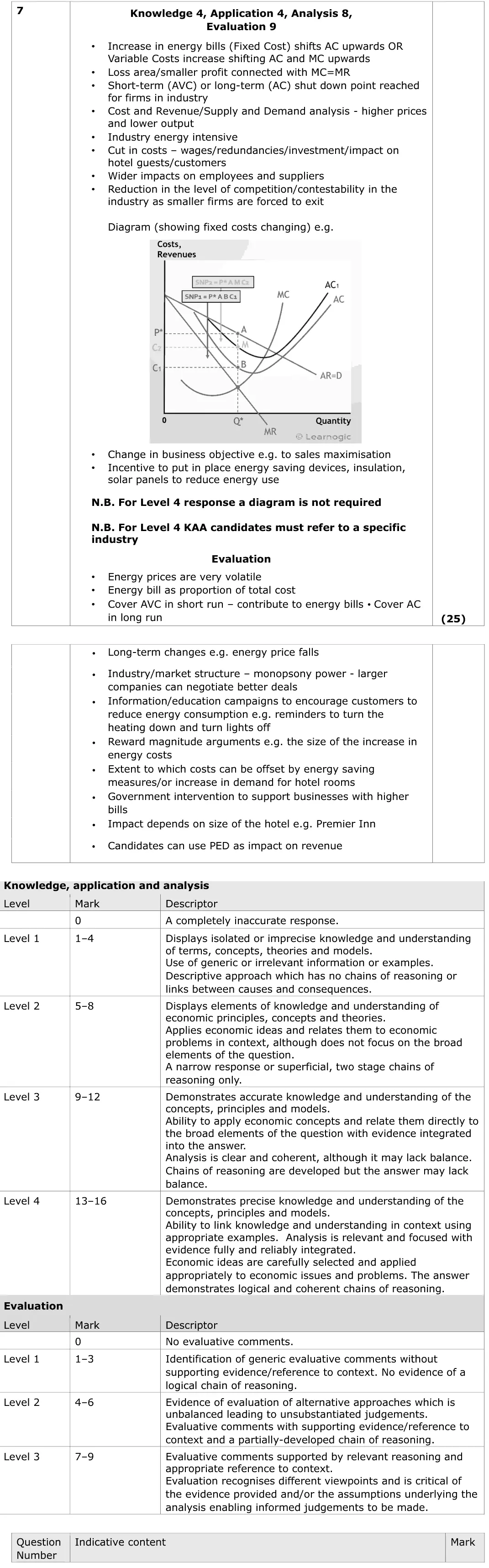
fixed-cost rise shifts AC (variable-cost rise shifts AC and MC)
losses and shut-down points
two developed KAA paragraphs each evaluated
a diagram is not required for Level 4
June 2024 · Paper 3 · Q2(d)25 marksAO1=4, AO2=4, AO3=8, AO4=925-mark essayEither/or
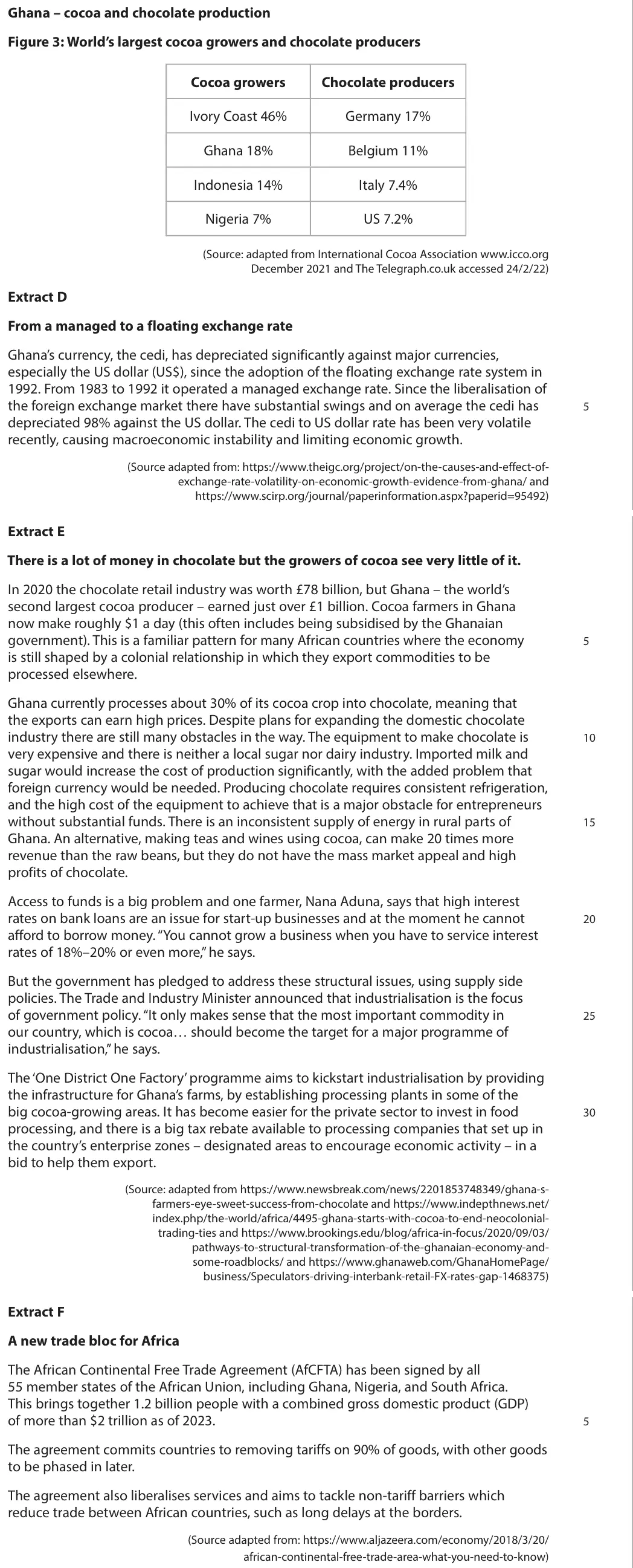
Data and extracts for question 2
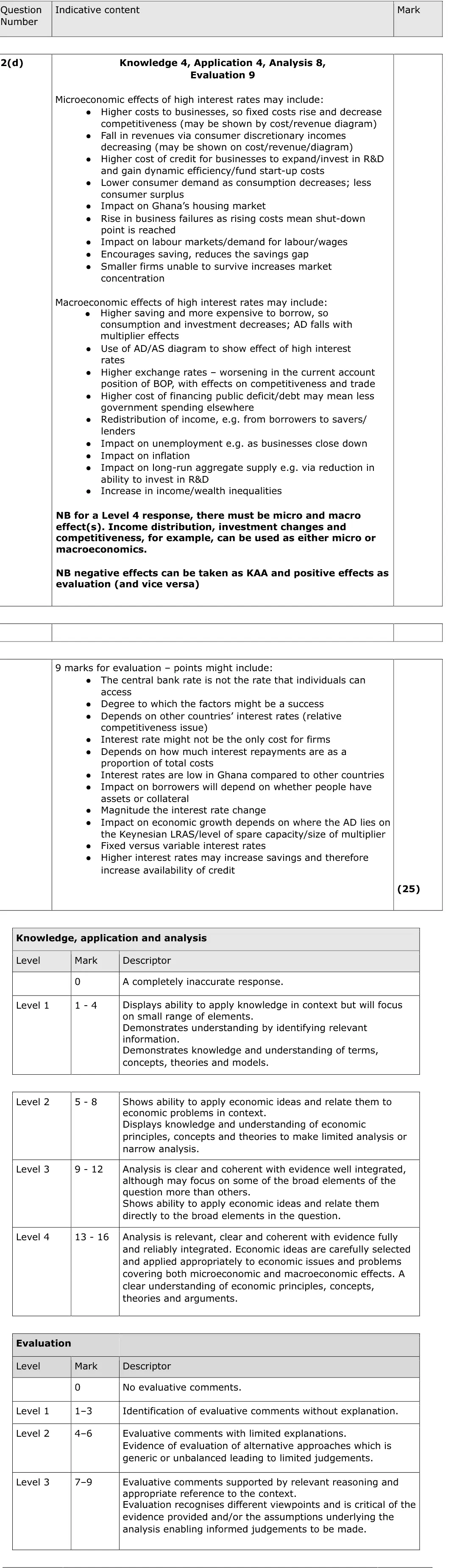
Mark scheme, including the levels grid and indicative content
Examiner's comment
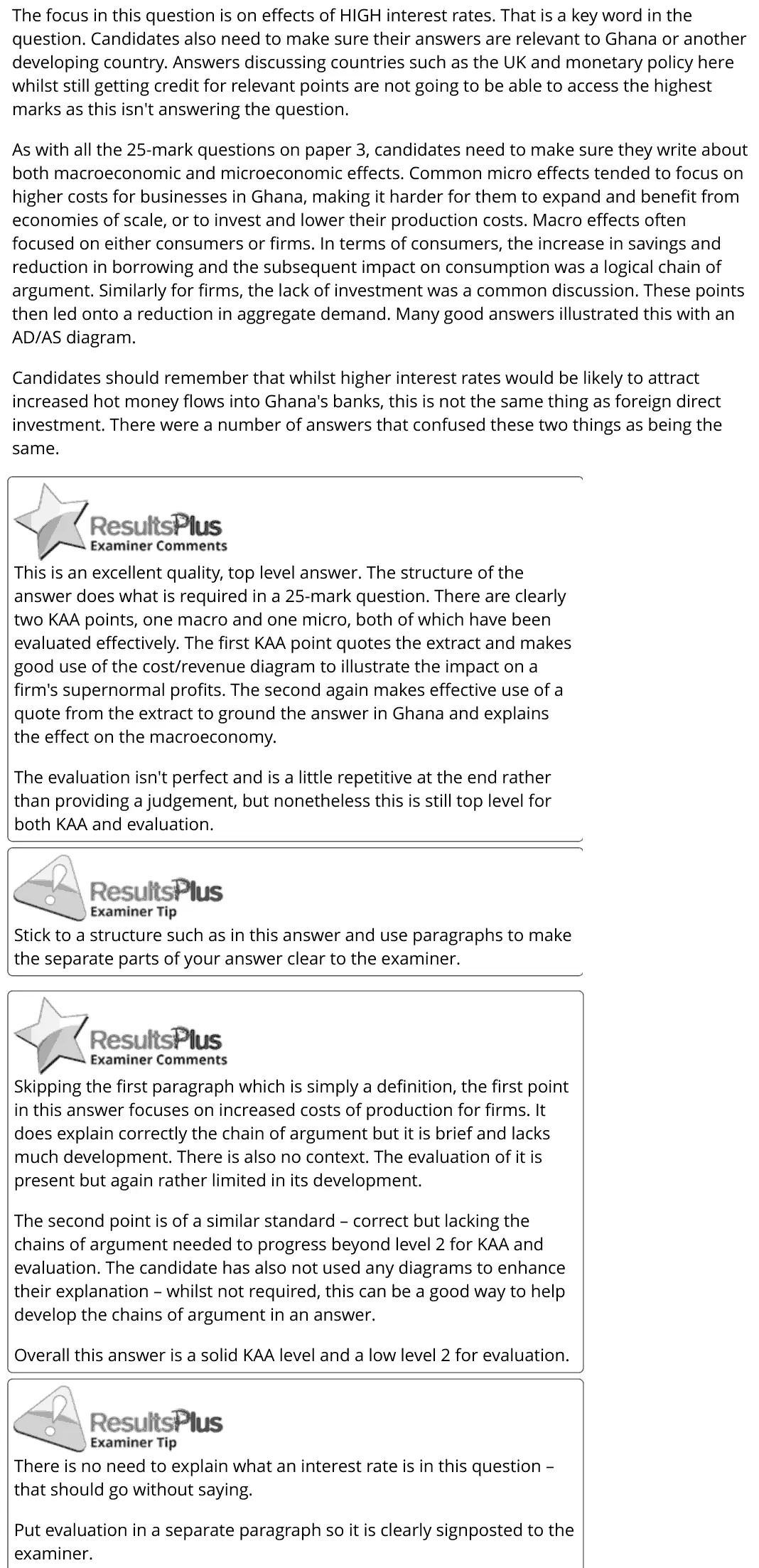
The focus in this question is on effects of HIGH interest rates. That is a key word in the question. Candidates also need to make sure their answers are relevant to Ghana or another developing country. Answers discussing countries such as the UK and monetary policy here whilst still getting credit for relevant points are not going to be able to access the highest marks as this isn't answering the question. As with all the 25-mark questions on paper 3, candidates need to make sure they write about both macroeconomic and microeconomic effects. Common micro effects tended to focus on higher costs for businesses in Ghana, making it harder for them to expand and benefit from economies of scale, or to invest and lower their production costs. Macro effects often focused on either consumers or firms. In terms of consumers, the increase in savings and reduction in borrowing and the subsequent impact on consumption wasa logical chain of argument. Similarly for firms, the lack of investment was a common discussion. These points then led onto a reduction in aggregate demand. Many good answers illustrated this with an AD/AS diagram. Candidates should remember that whilst higher interest rates would be likely to attract increased hot money flows into Ghana's banks, this is not the same thing as foreign direct investment. There were a number of answers that confused these two things as being the same. 4ResultsPlus This is an excellent quality, top level answer. The structure of the answer does what is required in a 25-mark question. There are clearly two KAA points, one macro and one micro, both of which have been evaluated effectively. The first KAA point quotes the extract and makes good use of the cost/revenue diagram to illustrate the impact ona firm's supernormal profits. The second again makes effective use ofa quote from the extract to ground the answer in Ghana and explains the effect on the macroeconomy. The evaluation isn't perfect and is a little repetitive at the end rather than providing a judgement, but nonetheless this is still top level for both KAA and evaluation. GF) ResultsPlus ~~) Examiner Tip Stick to a structure such as in this answer and use paragraphs to make the separate parts of your answer clear to the examiner. Skipping the first paragraph which is simply a definition, the first point in this answer focuses on increased costs of production for firms. It does explain correctly the chain of argument but it is brief and lacks much development. There is also no context. The evaluation of it is present but again rather limited in its development. The second point is of a similar standard - correct but lacking the chains of argument needed to progress beyond level 2 for KAA and evaluation. The candidate has also not used any diagrams to enhance their explanation - whilst not required, this can be a good way to help develop the chains of argument in an answer. Overall this answer is a solid KAA level and a low level 2 for evaluation. GM ResultsPius —~_) Examiner Tip There is no need to explain what an interest rate is in this question - that should go without saying. Put evaluation in a separate paragraph so it is clearly signposted to the examiner.
Notes from the mark scheme and report
micro: higher costs for firms (cost/revenue diagram), less investment, smaller firms close
macro: less consumption and investment, AD falls, exchange rate appreciates, inflation falls
Level 4 needs micro and macro for Ghana or a developing country, not the UK
hot money inflows are not FDI
June 2024 · Paper 3 · Q2(e)25 marksAO1=4, AO2=4, AO3=8, AO4=925-mark essayEither/or
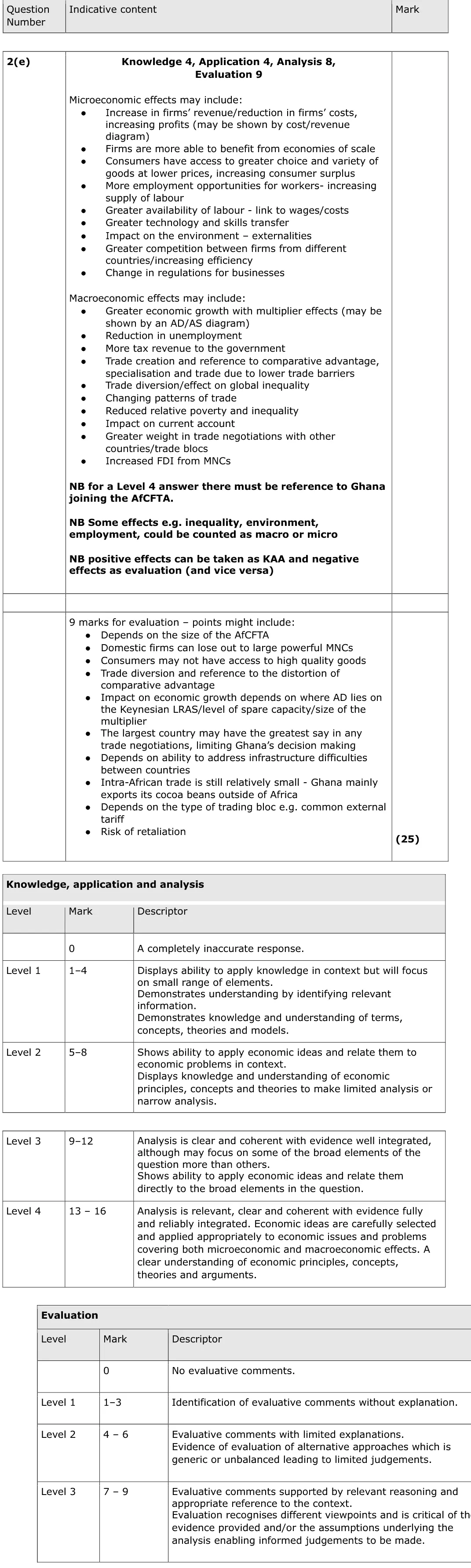
Data and extracts for question 2
Mark scheme, including the levels grid and indicative content
Examiner's comment
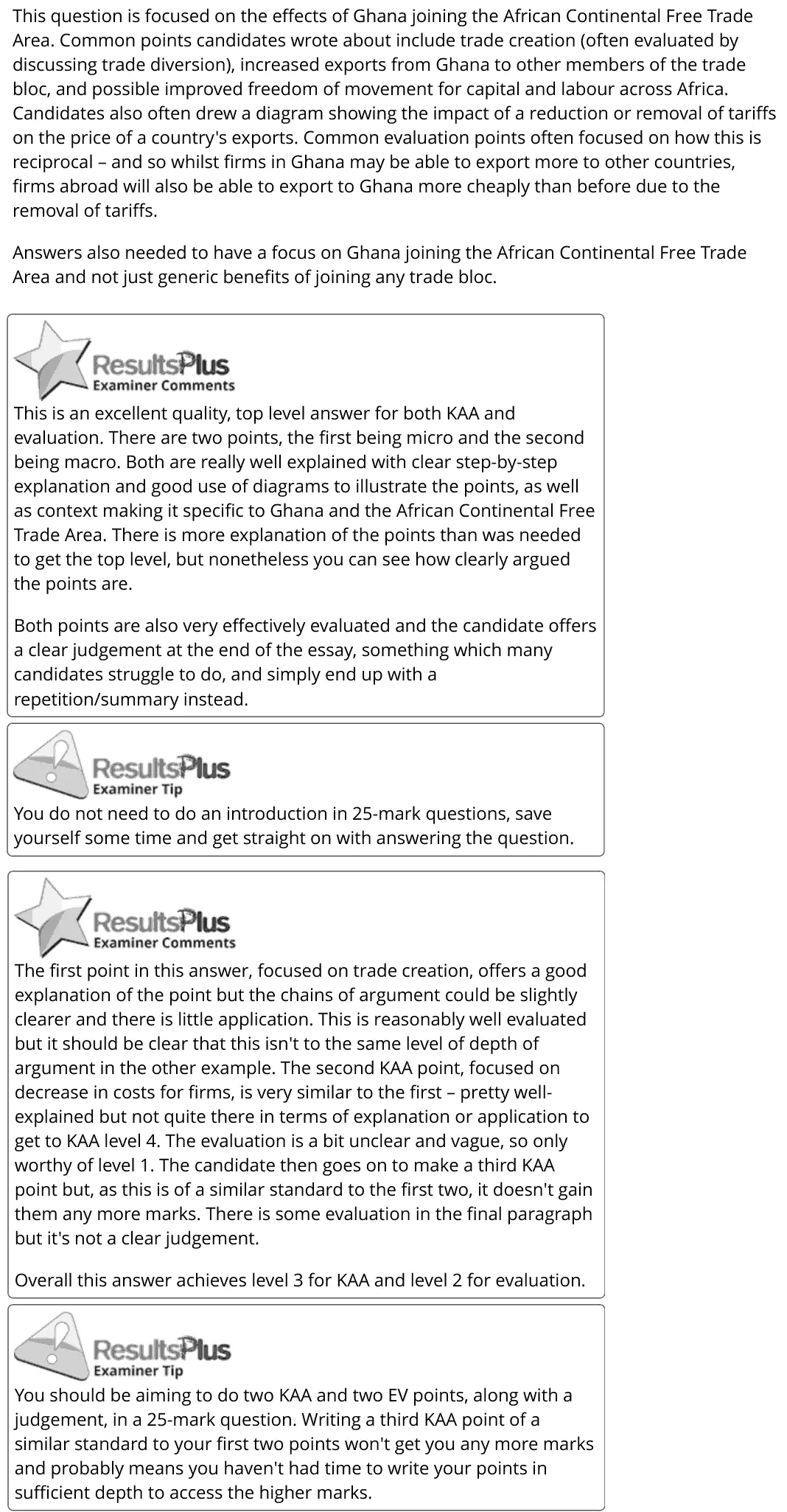
This question is focused on the effects of Ghana joining the African Continental Free Trade Area. Common points candidates wrote about include trade creation (often evaluated by discussing trade diversion), increased exports from Ghana to other members of the trade bloc, and possible improved freedom of movement for capital and labour across Africa. Candidates also often drew a diagram showing the impact ofa reduction or removal of tariffs on the price of a country's exports. Common evaluation points often focused on how this is reciprocal - and so whilst firms in Ghana may be able to export more to other countries, firms abroad will also be able to export to Ghana more cheaply than before due to the removal of tariffs. Answers also needed to have a focus on Ghana joining the African Continental Free Trade Area and not just generic benefits of joining any trade bloc. <6ResultsPlus This is an excellent quality, top level answer for both KAA and evaluation. There are two points, the first being micro and the second being macro. Both are really well explained with clear step-by-step explanation and good use of diagrams to illustrate the points, as well as context making it specific to Ghana and the African Continental Free Trade Area. There is more explanation of the points than was needed to get the top level, but nonetheless you can see how clearly argued the points are. Both points are also very effectively evaluated and the candidate offers a clear judgement at the end of the essay, something which many candidates struggle to do, and simply end up with a repetition/summary instead. A\ cms}ResultsPlus You do not need to do an introduction in 25-mark questions, save yourself some time and get straight on with answering the question. <p BesultsPtus The first point in this answer, focused on trade creation, offers a good explanation of the point but the chains of argument could be slightly clearer and there is little application. This is reasonably well evaluated but it should be clear that this isn't to the same level of depth of argument in the other example. The second KAA point, focused on decrease in costs for firms, is very similar to the first - pretty well- explained but not quite there in terms of explanation or application to get to KAA level 4. The evaluation is a bit unclear and vague, so only worthy of level 1. The candidate then goes on to make a third KAA point but, as this is ofa similar standard to the first two, it doesn't gain them any more marks. There is some evaluation in the final paragraph but it's not a clear judgement. Overall this answer achieves level 3 for KAA and level 2 for evaluation. GP ResultsPius —~_) Examiner Tip You should be aiming to do two KAA and two EV points, along with a judgement, in a 25-mark question. Writing a third KAA point of a similar standard to your first two points won't get you any more marks and probably means you haven't had time to write your points in sufficient depth to access the higher marks.
Notes from the mark scheme and report
micro: lower costs and higher revenue, economies of scale, more choice and consumer surplus
macro: trade creation, export-led growth, FDI
Level 4 must refer to Ghana joining the AfCFTA, not trading blocs in general
evaluate with trade diversion, reciprocal competition from imports, Ghana exporting cocoa outside Africa
June 2023 · Paper 3 · Q1(c)12 marksAO1=2, AO2=2, AO3=4, AO4=412-mark response
Data and extracts for question 1
Mark scheme, including the levels grid and indicative content
Examiner's comment
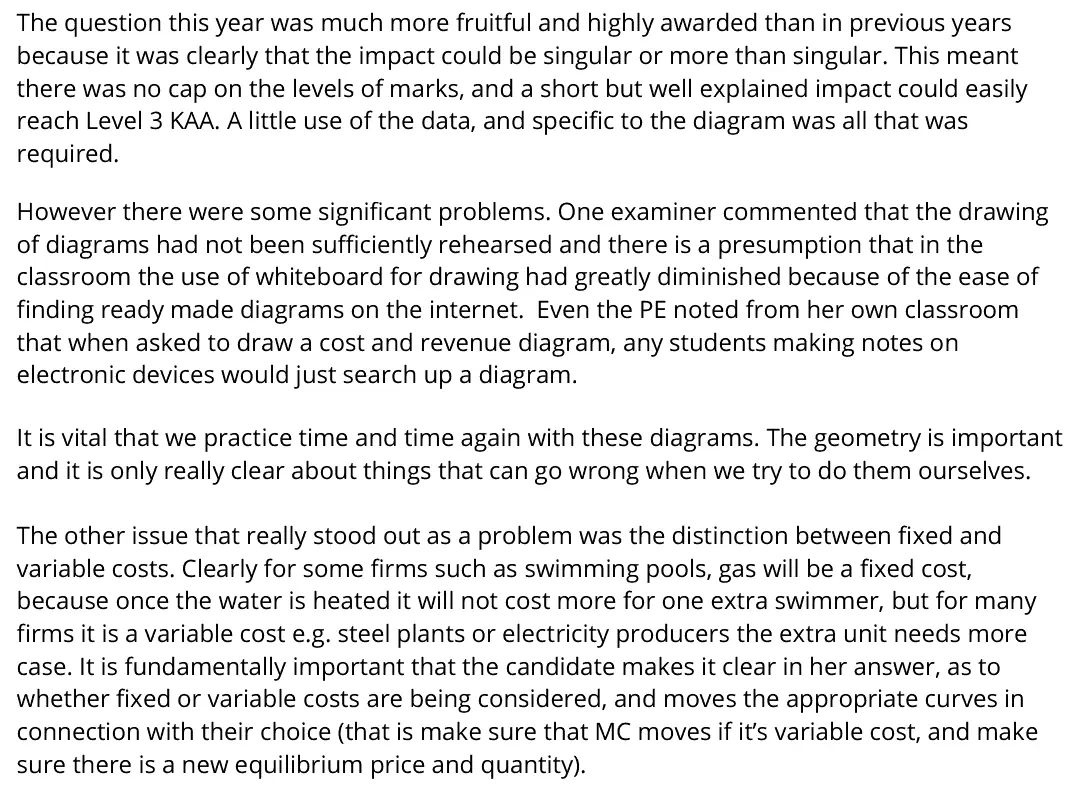
The question this year was much more fruitful and highly awarded than in previous years because it was clearly that the impact could be singular or more than singular. This meant there was no cap on the levels of marks, and a short but well explained impact could easily reach Level 3 KAA. A little use of the data, and specific to the diagram was all that was required. However there were some significant problems. One examiner commented that the drawing of diagrams had not been sufficiently rehearsed and there is a presumption that in the classroom the use of whiteboard for drawing had greatly diminished because of the ease of finding ready made diagrams on the internet. Even the PE noted from her own classroom that when asked to draw a cost and revenue diagram, any students making notes on electronic devices would just search up a diagram. It is vital that we practice time and time again with these diagrams. The geometry is important and it is only really clear about things that can go wrong when we try to do them ourselves. The other issue that really stood out as a problem was the distinction between fixed and variable costs. Clearly for some firms such as swimming pools, gas will be a fixed cost, because once the water is heated it will not cost more for one extra swimmer, but for many firms it is a variable cost e.g. steel plants or electricity producers the extra unit needs more case. It is fundamentally important that the candidate makes it clear in her answer, as to whether fixed or variable costs are being considered, and moves the appropriate curves in connection with their choice (that is make sure that MC moves if it’s variable cost, and make sure there is a new equilibrium price and quantity).
Notes from the mark scheme and report
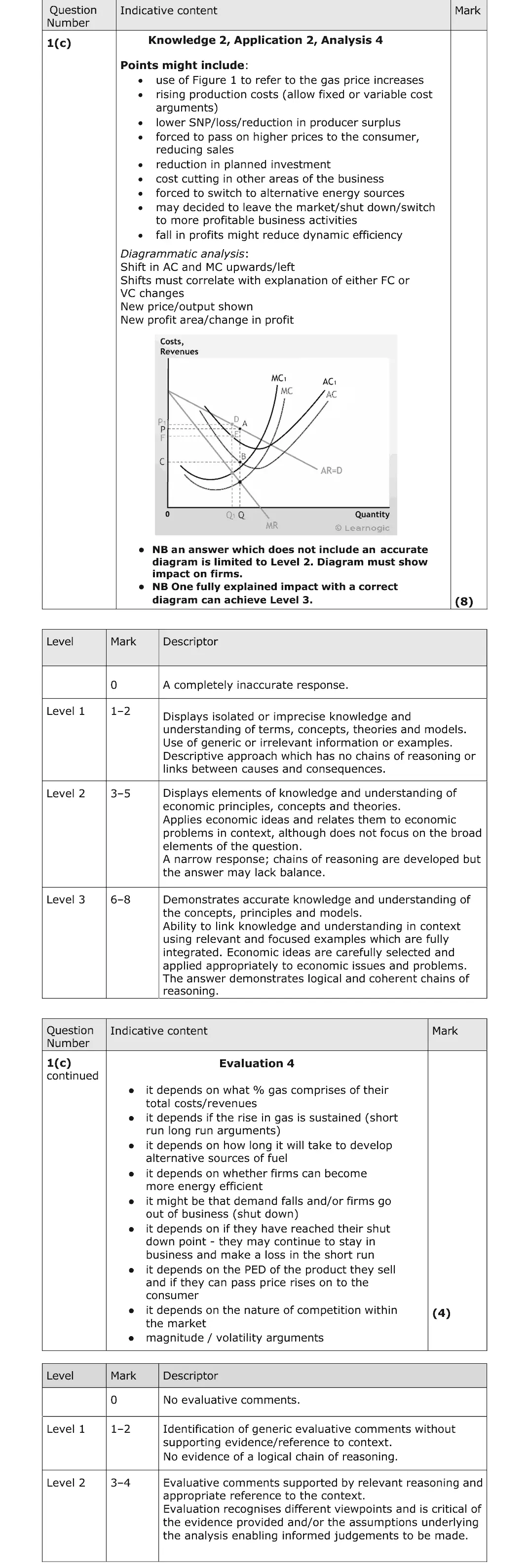
Level 3 needs an accurate cost and revenue diagram: AC and MC shift up for a variable cost (AC only for a fixed cost) and the new profit area at MC = MR
make clear whether gas is a fixed or variable cost
use Figure 1
evaluate with share of gas in costs, PED, shut-down point
Quantitative skills: QS 4 (construct and interpret a range of standard graphical forms); QS 9 (interpret, apply and analyse information in written, graphical tabular and numerical forms)
June 2023 · Paper 3 · Q2(c)12 marksAO1=2, AO2=2, AO3=4, AO4=412-mark response
Data and extracts for question 2
Mark scheme, including the levels grid and indicative content
Examiner's comment
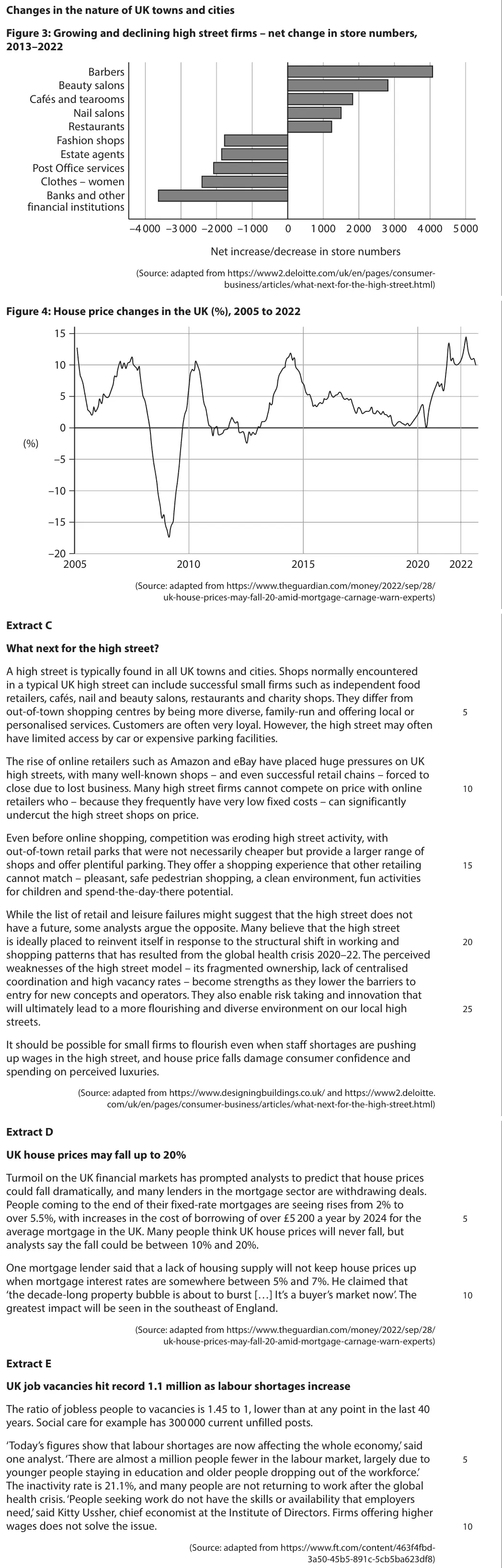
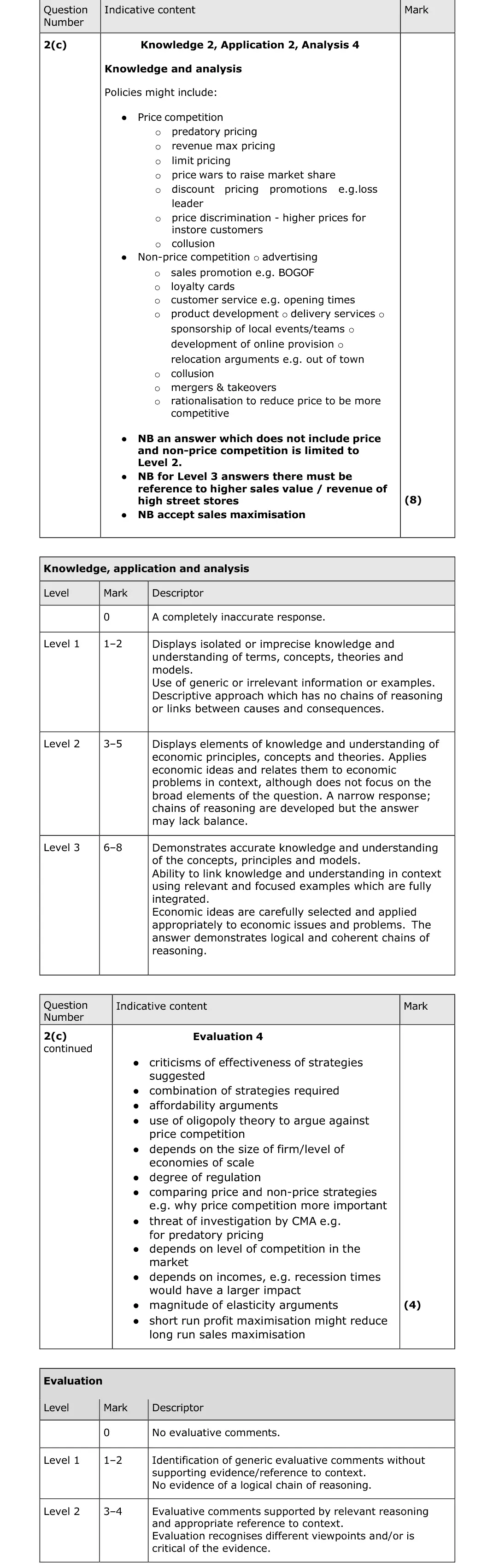
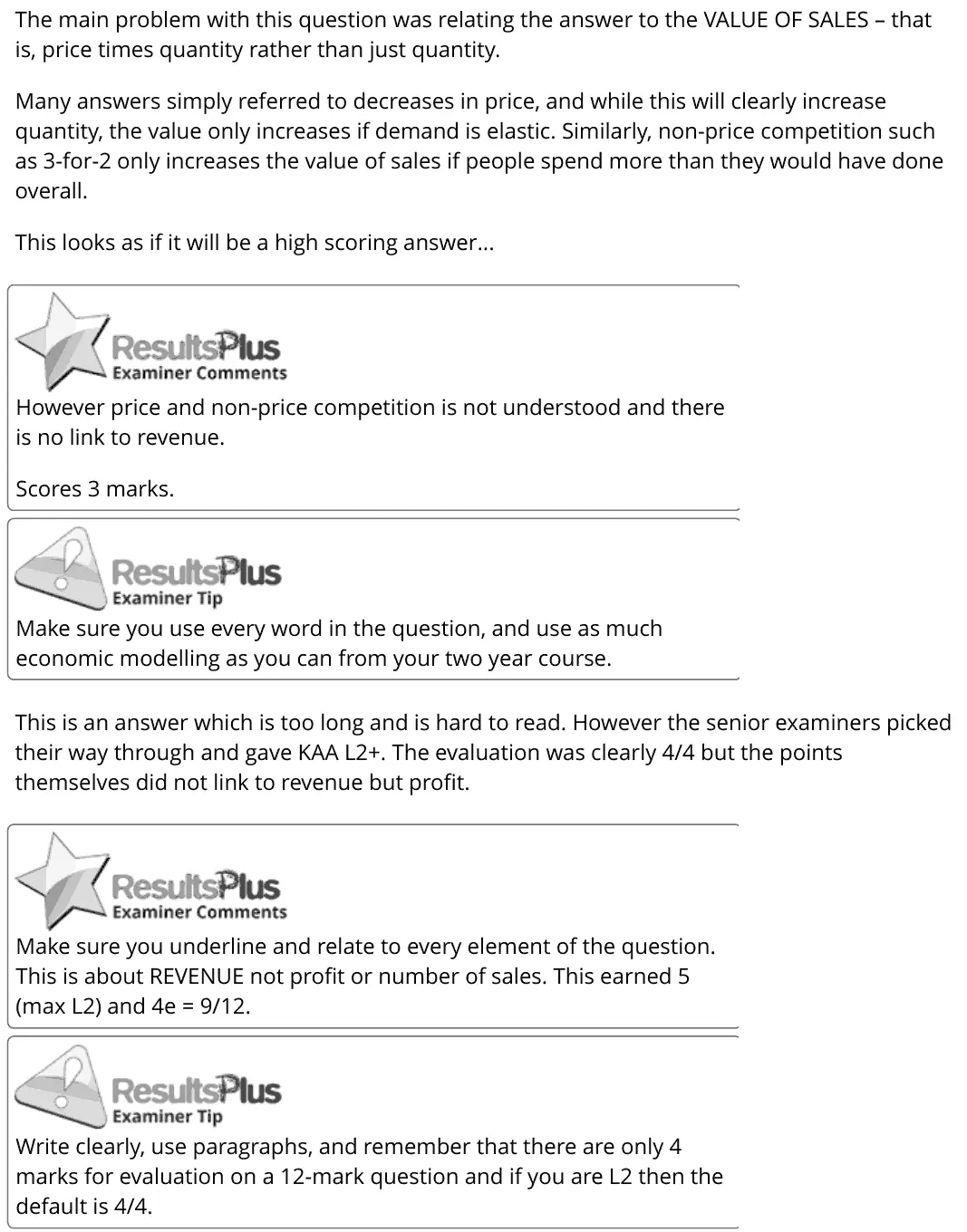
The main problem with this question was relating the answer to the VALUE OF SALES – that is, price times quantity rather than just quantity. Many answers simply referred to decreases in price, and while this will clearly increase quantity, the value only increases if demand is elastic. Similarly, non-price competition such as 3-for-2 only increases the value of sales if people spend more than they would have done overall. This looks as if it will be a high scoring answer... However price and non-price competition is not understood and there is no link to revenue. Scores 3 marks. Make sure you use every word in the question, and use as much economic modelling as you can from your two year course. This is an answer which is too long and is hard to read. However the senior examiners picked their way through and gave KAA L2+. The evaluation was clearly 4/4 but the points themselves did not link to revenue but profit. Make sure you underline and relate to every element of the question. This is about REVENUE not profit or number of sales. This earned 5 (max L2) and 4e = 9/12. Write clearly, use paragraphs, and remember that there are only 4 marks for evaluation on a 12-mark question and if you are L2 then the default is 4/4.
Notes from the mark scheme and report
Level 2 cap unless both price and non-price competition
Level 3 needs a link to the value of sales (price x quantity): a price cut raises revenue only if demand is price elastic
answers about profit or number of sales missed the question
June 2022 · Paper 1 · Q5(b)2 marksAO1=1, AO3=1Short answer
Data and extracts for question 5
Mark scheme
Examiner's comment
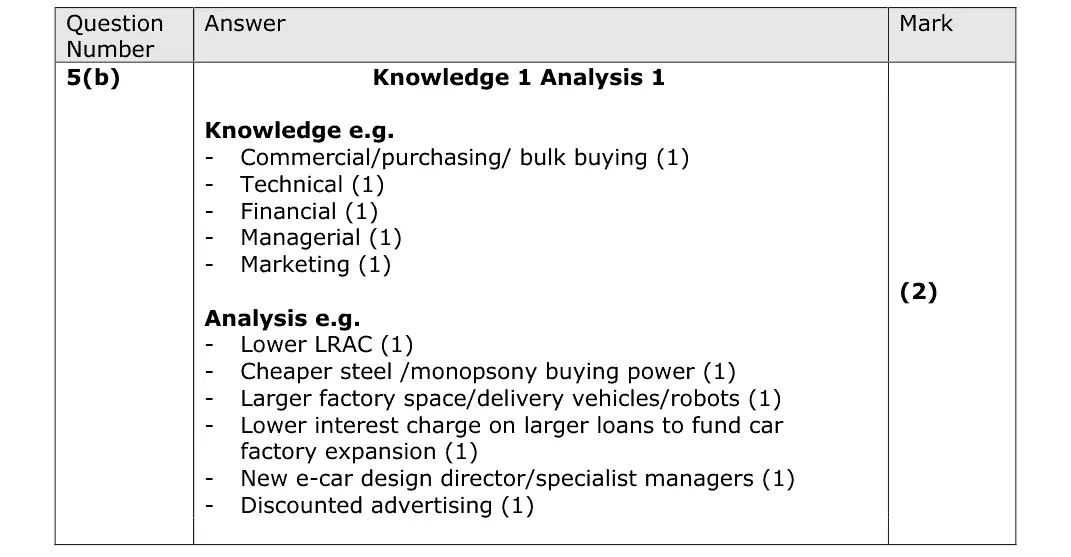
This question was mostly well answered with common responses being purchasing economies of scale lowering average costs or unit costs. Where it was not well answered was when candidates were not clear in understanding technical economies of scale, often referring to them as technological economies or buying new technology or patents. Another area of weakness was candidates talking about the merger resulting in the removal of workers. This is rationalisation and not concerned with economies of scale. This is an example of a correct response and it was awarded the full 2 marks. By providing the example, this response is awarded the full 2 marks. An example will often help in securing a second mark.
Notes from the mark scheme and report
name one internal economy (purchasing, technical, financial, managerial, marketing) and link it to lower LRAC, e.g. cheaper steel bought in bulk
report: technical economies confused with buying new technology, and cutting workers is rationalisation not economies of scale
June 2022 · Paper 1 · Q6(d)12 marksAO1=2, AO2=2, AO3=4, AO4=412-mark response
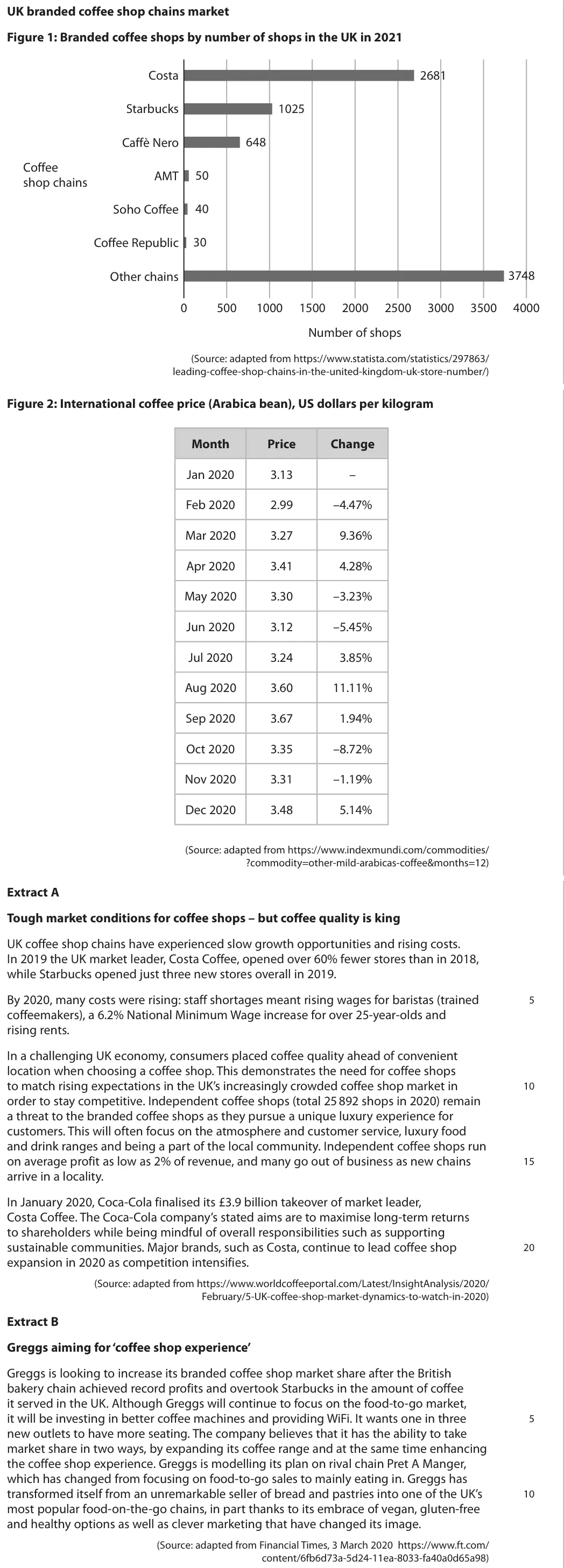
Data and extracts for question 6
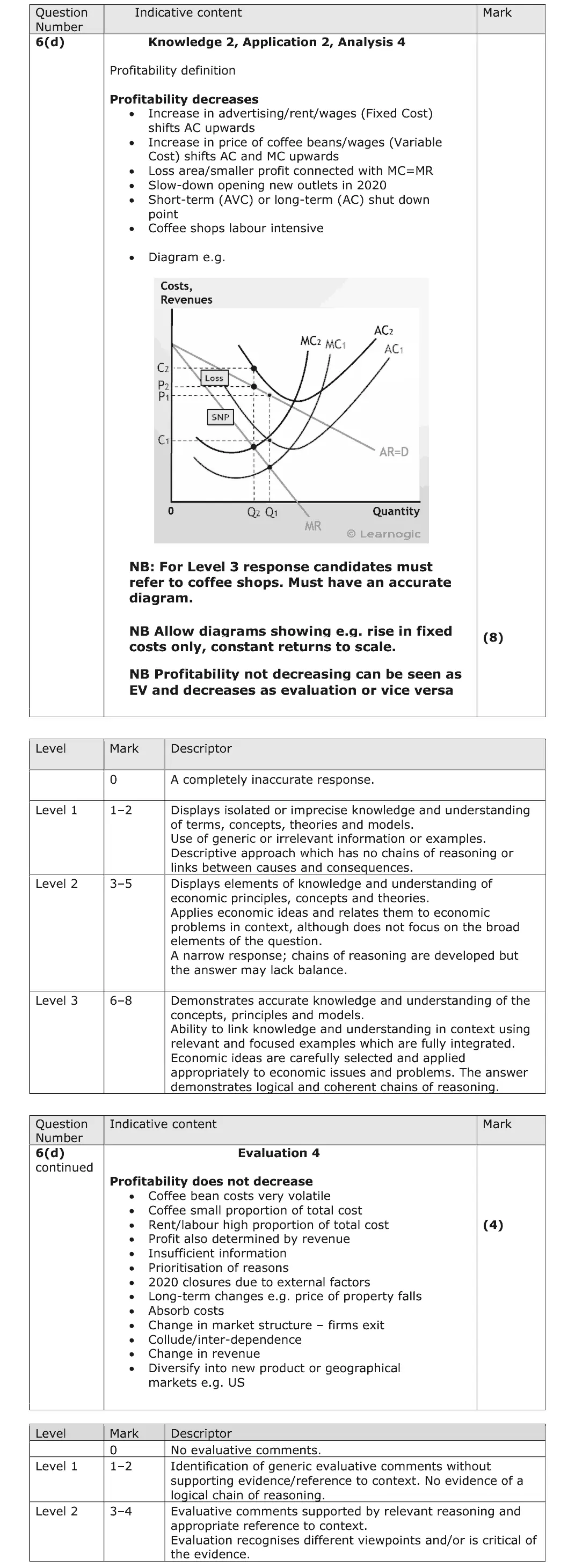
Mark scheme, including the levels grid and indicative content
Examiner's comment
This question required candidates to use a cost and revenue diagram in order to achieve Level 3. The diagram in the mark scheme is only for illustrative purposes and alternative correct diagrams were also allowed. To secure top marks, diagrams needed to match against written explanations. For example, a rise in fixed costs would shift AC and not MC and a rise in variable costs would shift both AC and MC upwards. Candidates were required to accurately identify the change in fixed costs or variable cost in the context of the data. The diagram in this response shows a rise in AC and MC and lower profitability box and achieves Level 3 for KAA for the diagram. However, the response does not identify why costs and variable costs increased in this case. The response provides some explanation of the diagram and a sophisticated sense of using the data to say why quantity is limited, but the lack of reason for the increase in costs places it borderline Level 2 and Level 3. The evaluation linking higher wages to productivity is done well and secures Level 2ev. Overall, this response achieves L3-(6) and L2e-(3ev) and is awarded 9 marks of the 12 marks available. Ensure that you have a precise understanding of why costs curves shift. Further development of evaluation is welcome but it is best to try to make two evaluative points. Evaluating the diagram would have made sense here. Perhaps the firm does not pursue profit maximisation. This is an example of a well developed responses which is awarded the full 12 marks. Ensure that in planning your response you place more thinking time into the marks for Knowledge, Application and Analysis (KAA) rather than Evaluation.
Notes from the mark scheme and report
Level 3 needs an accurate cost and revenue diagram: a fixed cost rise (rent) shifts AC only, a variable cost rise (wages, beans) shifts AC and MC
profit at MC = MR shrinks or becomes a loss
report: diagrams must match the explanation and identify which costs rose
Quantitative skills: QS 4 (construct and interpret a range of standard graphical forms); QS 6 (calculate cost, revenue and profit (marginal, average, totals))
June 2022 · Paper 3 · Q1(c)12 marksAO1=2, AO2=2, AO3=4, AO4=412-mark response
Data and extracts for question 1
Mark scheme, including the levels grid and indicative content
Examiner's comment
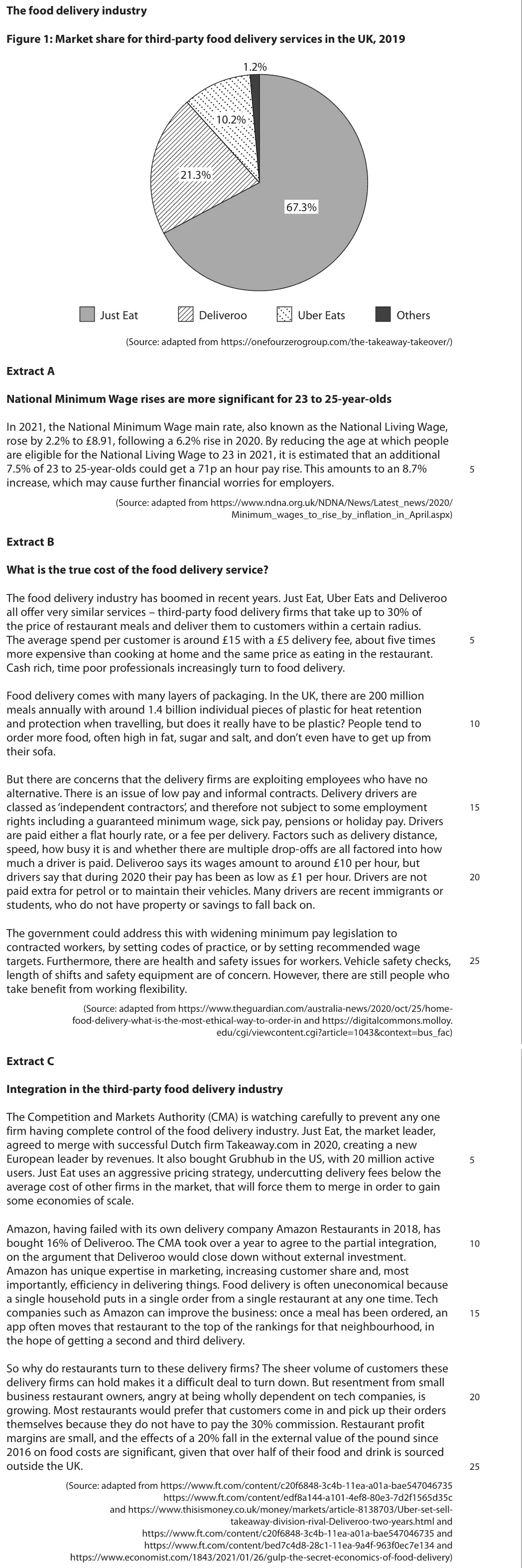
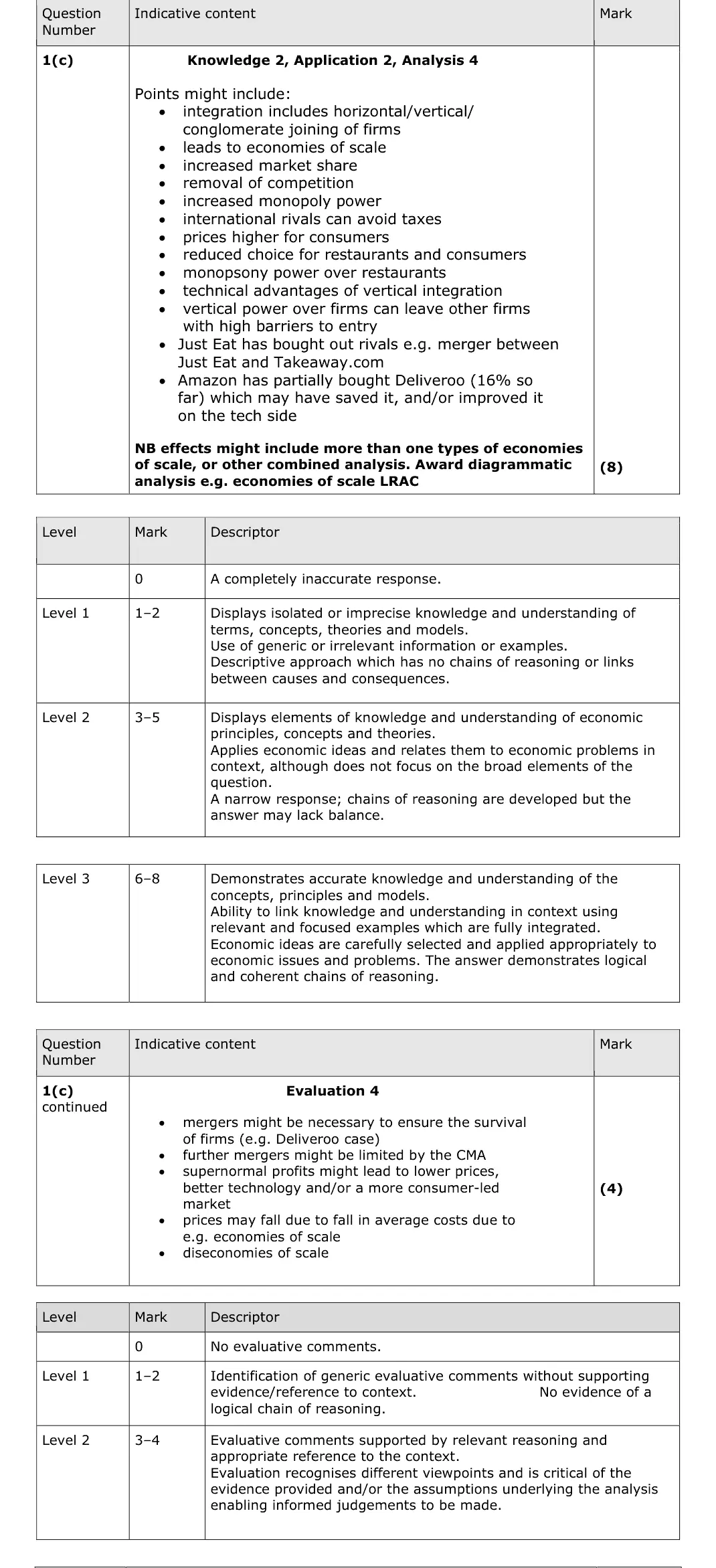
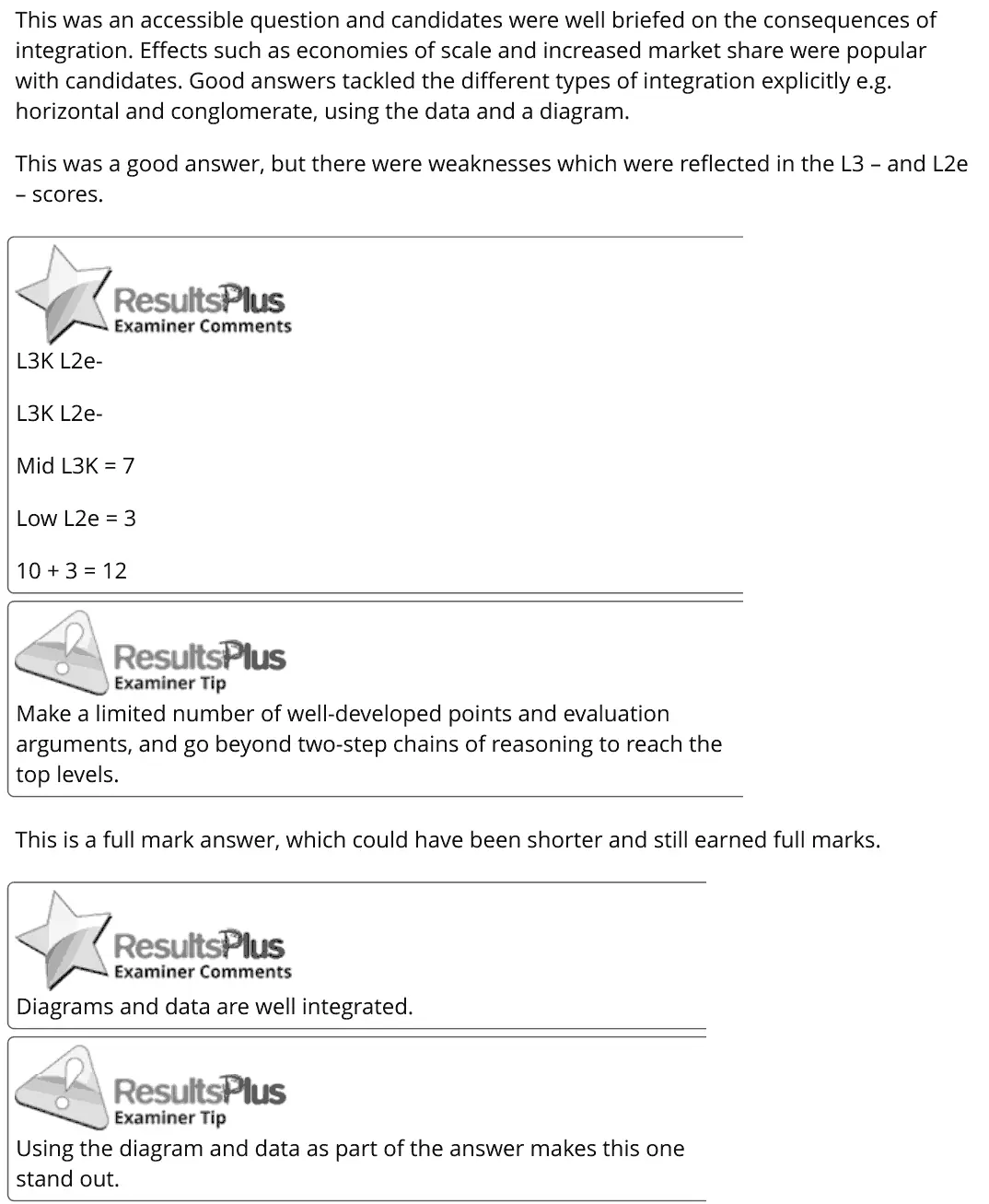
This was an accessible question and candidates were well briefed on the consequences of integration. Effects such as economies of scale and increased market share were popular with candidates. Good answers tackled the different types of integration explicitly e.g. horizontal and conglomerate, using the data and a diagram. This was a good answer, but there were weaknesses which were reflected in the L3 – and L2e – scores. L3K L2e- L3K L2e- Mid L3K = 7 Low L2e = 3 10 + 3 = 12 Make a limited number of well-developed points and evaluation arguments, and go beyond two-step chains of reasoning to reach the top levels. This is a full mark answer, which could have been shorter and still earned full marks. Diagrams and data are well integrated. Using the diagram and data as part of the answer makes this one stand out.
Notes from the mark scheme and report
name the type of integration (Just Eat and Takeaway.com horizontal, Amazon's 16% of Deliveroo)
economies of scale (LRAC diagram), market power, higher prices and less choice, monopsony power over restaurants
evaluate e.g. CMA oversight, efficiency gains
few well-developed points beat a list
June 2022 · Paper 3 · Q1(d)25 marksAO1=4, AO2=4, AO3=8, AO4=925-mark essayEither/or
Data and extracts for question 1
Mark scheme, including the levels grid and indicative content
Examiner's comment
There were some very good essays which showed good understanding of the microeconomics of an exchange rate depreciation on the price of imported ingredients, with many showing a shift in MC as well as AC and a new profit area highlighted. In the macro context some argued effectively that when there is a depreciation, it is likely that the SRAS curve will shift left to reflect the rising cost of imported inputs. A few candidates made explicit links along the lines that a depreciation might increase the popularity of the UK as a tourist destination and so the demand for restaurant meals might increase. Restaurant meals are not typically internationally traded and so it was surprising to see the number of candidates who argued that UK restaurants will sell more meals abroad following a depreciation, or other reasons for a rise in AD. Nevertheless there were some very well informed candidates who showed excellent knowledge of recent developments in the UK economy with regard to the difficulty of attracting staff to this sector. Micro effects of exchange rate depreciation on the food delivery and/or restaurant sector were well explained and were often supported by an accurately drawn cost and revenue diagram showing a rise in AC and MC. The stronger candidates used type of restaurant to really develop their answers where ingredients would need to be sourced from abroad e.g. Japanese and Asian restaurants. Macro effects were more challenging in terms of application to food delivery and/or restaurant sector. Quite a few candidates wrote about how exchange rate depreciation could lead to food delivery companies increasing their export which was unconvincing. Candidates who developed the macroeconomics effects using the AD/AS model, typically with a well explained diagram, were able to offer more developed responses, which scored higher marks. A reminder to centres that at least one good detailed application to the context provided (i.e. the restaurant or food delivery services) was required to score highly. Generic response to the effects of depreciation, tended to score Level 3 KAA. There was good understanding shown of the Marshall-Lerner condition and J Curve in many responses. The micro side of depreciation was best linked to costs, as here. The candidate then links the costs of food in restaurants to the diagram by making it clear that variable costs shift, and therefore both MC and AC shift. This is a good answer but the candidate keeps crossing out work, which is a problem because of opportunity cost. In this case the chains of reasoning are not extended fully so this does not reach the very top of the top levels for KAA and Eval. But at 22/25 there are lessons to be learned from using the right vocabulary and tools of analysis. The economics student should not aim for perfection either in terms of wording or presentation, but instead purity of logic and strength in the links of the analysis and evaluation. This is similarly a good answer in terms of logic and the link to costs is again strong. But the noticeable difference is in terms of the chains of reasoning which stay in Level 3 KAA and Level 2 Eval. So for example the costs are not linked to the variable costs of food imports for restaurants, and that is merely assumed. 12 KAA marks and 6 Eval. This was the modal score for this question. Do not force the examiner to do the work for you. If your costs shift, say whether they are fixed or variable then link your application to the diagram that you draw.
Notes from the mark scheme and report
micro: dearer imported ingredients raise variable costs so MC and AC shift up and profit falls
macro: SRAS shifts left (cost-push inflation), AD effects via net trade and tourism
restaurant meals are not exported, so do not argue they sell more abroad
Level 4 needs micro, macro and the restaurant context
June 2022 · Paper 3 · Q2(d)25 marksAO1=4, AO2=4, AO3=8, AO4=925-mark essayEither/or
Data and extracts for question 2
Mark scheme, including the levels grid and indicative content
Examiner's comment
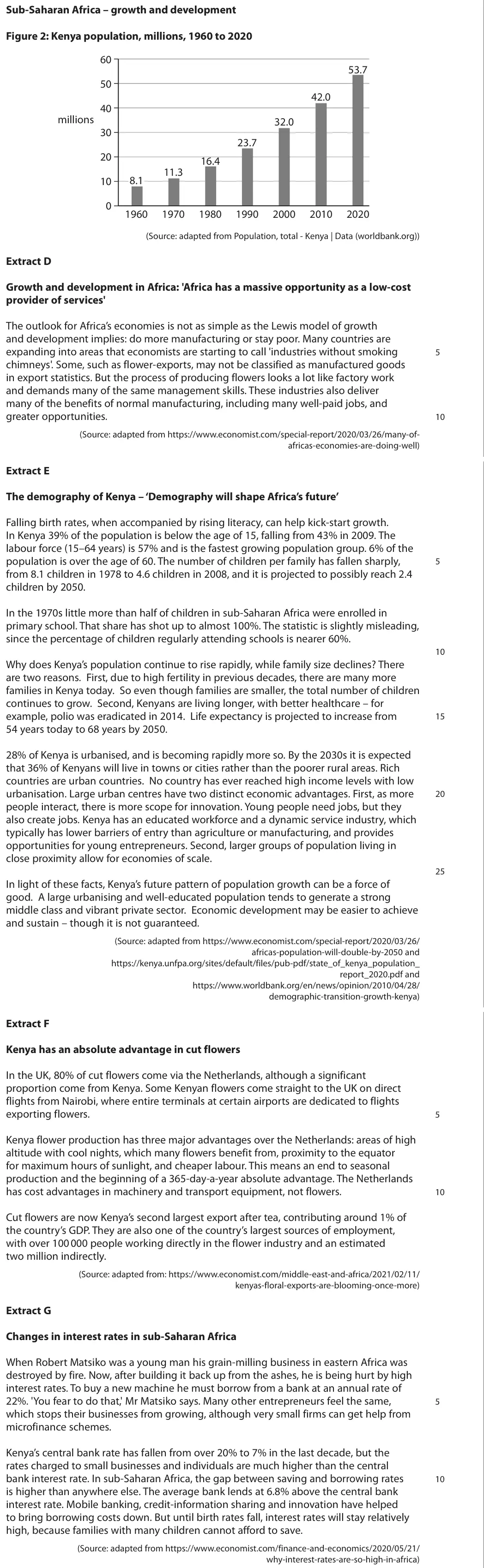
This was the more popular of the essays where, overall, all students demonstrated the basic knowledge on the impact of low interest rates on AD and costs of borrowing. Only a few of them, though, managed to bring in good economics and to make their answers more relevant to the context with real life examples drawn not only from Kenya but also from other Sub-Saharan countries or BRIC economies. Some mentioned the lengthy process of the transmission mechanism. Most candidates who answered it managed two effects. The main problem was one of timing: some were only able to put down the briefest of answers. Many candidates are selecting too many essay points – they need to use less points and to write in more depth on those specific points. The examiners' advice: that it is better to make one point well rather than a number with brief or incorrect chains of reasoning. Accessible essay which most students responded well to More able students were able to apply a traditional interest rates questions to the LEDC e.g – use of savings gap Good answers used AD/AS diagrams within their macro analysis and cost/revenue diagrams within their micro analysis. This enabled them to analyse effectively and look at the wider impacts. Evaluation was most effective when linked to the data extract and the rates actually available in Kenya Accessible essay which most students responded well to More able students were able to apply a traditional interest rates questions to the LEDC e.g – use of savings gap Good answers used AD/AS diagrams within their macro analysis and cost/revenue diagrams within their micro analysis. This enabled them to analyse effectively and look at the wider impacts. Evaluation was most effective when linked to the data extract and the rates actually available in Kenya Make at least one micro and one macro point. If you have more time then develop the side you think is the weakest with another more convincing point. It is better to make fewer points really well argued than using a scattered approach with several relevant thoughts. Many answers were pre-learned 'interest rate' essays, and having been learnt in the context of macro they could not easily switch to micro. The micro approach is best reinforced using the price/output/profit/externalities points from the Themes 1 and 3 specification, and either D&S or cost and revenue diagrams should be expected. The macro side would probably include an AD AS diagram in a high scoring essay. Use diagrams as much as you can in the microeconomics and macroeconomics Theme 3 essays. Remember to check whether the essay is about causes or effects before you start.
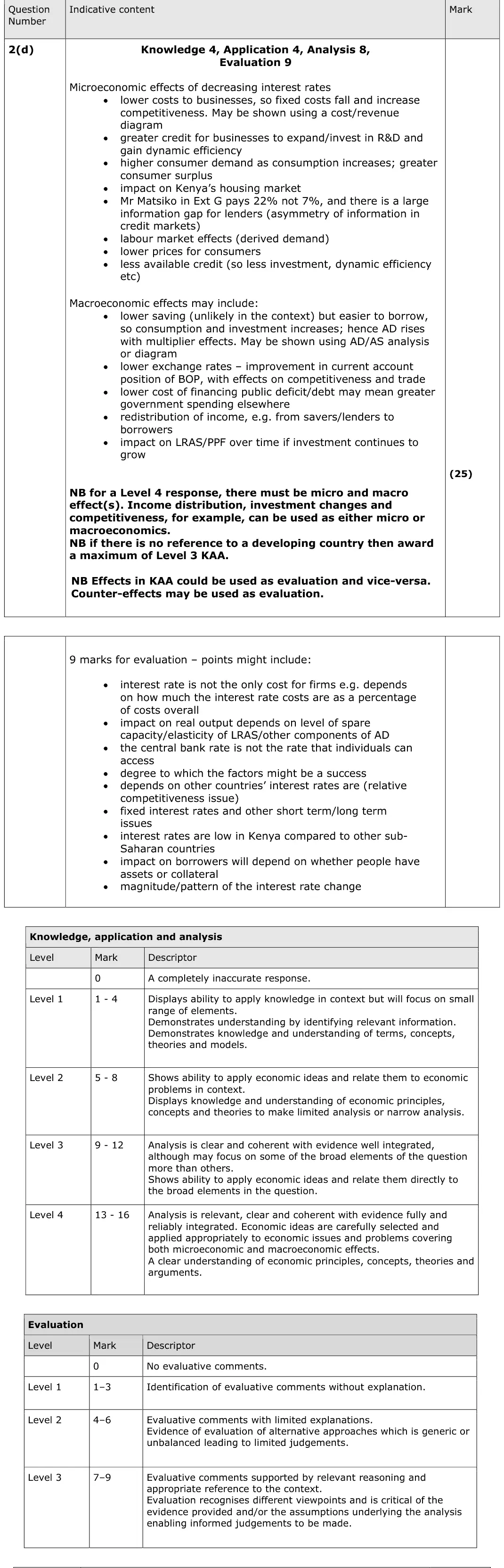
Notes from the mark scheme and report
micro: lower borrowing costs for firms, more investment and R&D, consumer demand
macro: C and I raise AD with the multiplier, depreciation, cheaper debt servicing
without a developing country KAA is capped at Level 3
evaluate with the gap between the 7% central bank rate and 22% paid by small firms (Extract G), savings gap
November 2021 · Paper 1 · Q4(a)2 marksAO2=2Calculation
Data and extracts for question 4
Mark scheme
Notes from the mark scheme and report
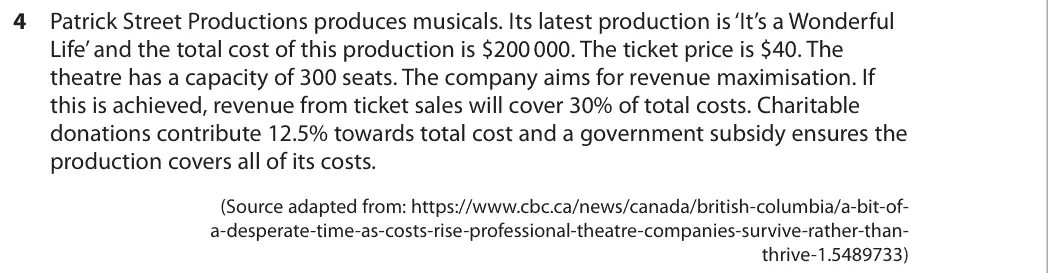
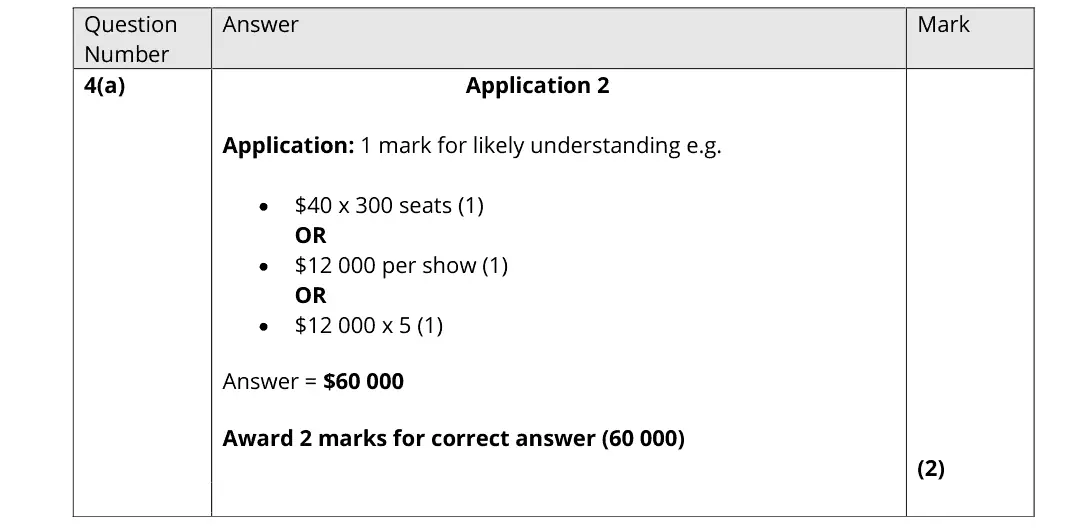
TR = $40 x 300 seats x 5 shows = $60 000
show working ($12 000 per show) for a mark if the final answer is wrong
November 2021 · Paper 1 · Q6(a)5 marksAO1=1, AO2=2, AO3=2Short answer
Data and extracts for question 6
Mark scheme
Examiner's comment
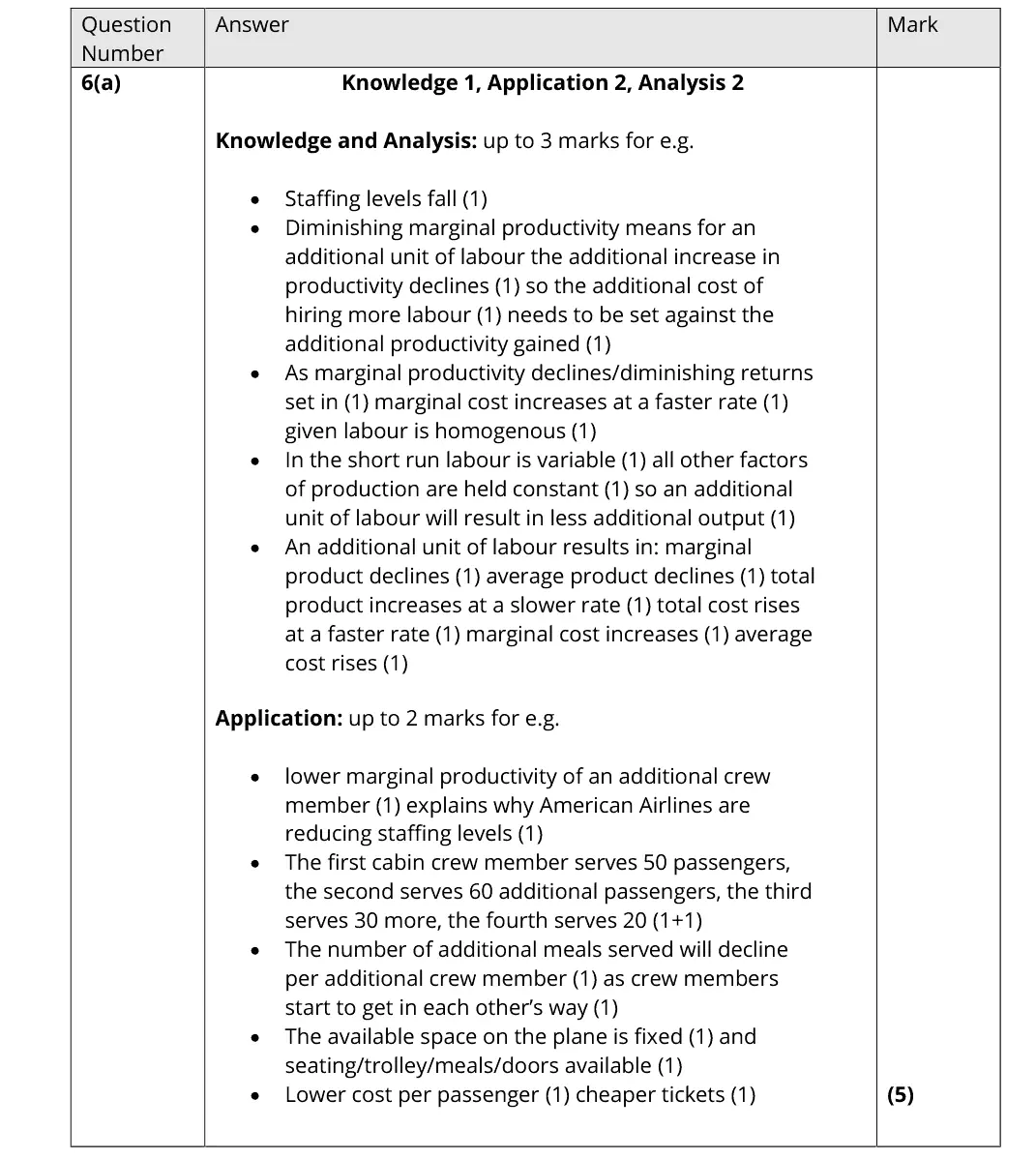
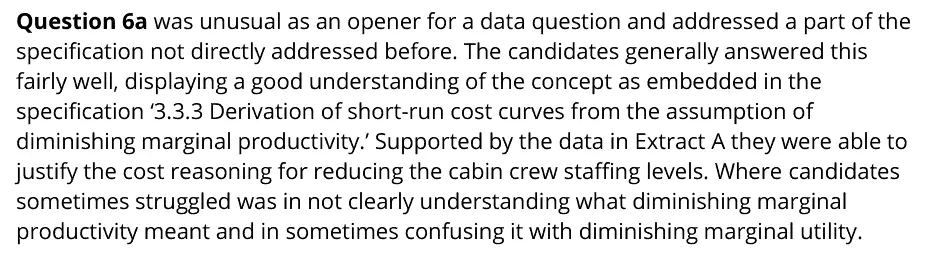
Question 6a was unusual as an opener for a data question and addressed a part of the specification not directly addressed before. The candidates generally answered this fairly well, displaying a good understanding of the concept as embedded in the specification ‘3.3.3 Derivation of short-run cost curves from the assumption of diminishing marginal productivity.’ Supported by the data in Extract A they were able to justify the cost reasoning for reducing the cabin crew staffing levels. Where candidates sometimes struggled was in not clearly understanding what diminishing marginal productivity meant and in sometimes confusing it with diminishing marginal utility.
Notes from the mark scheme and report
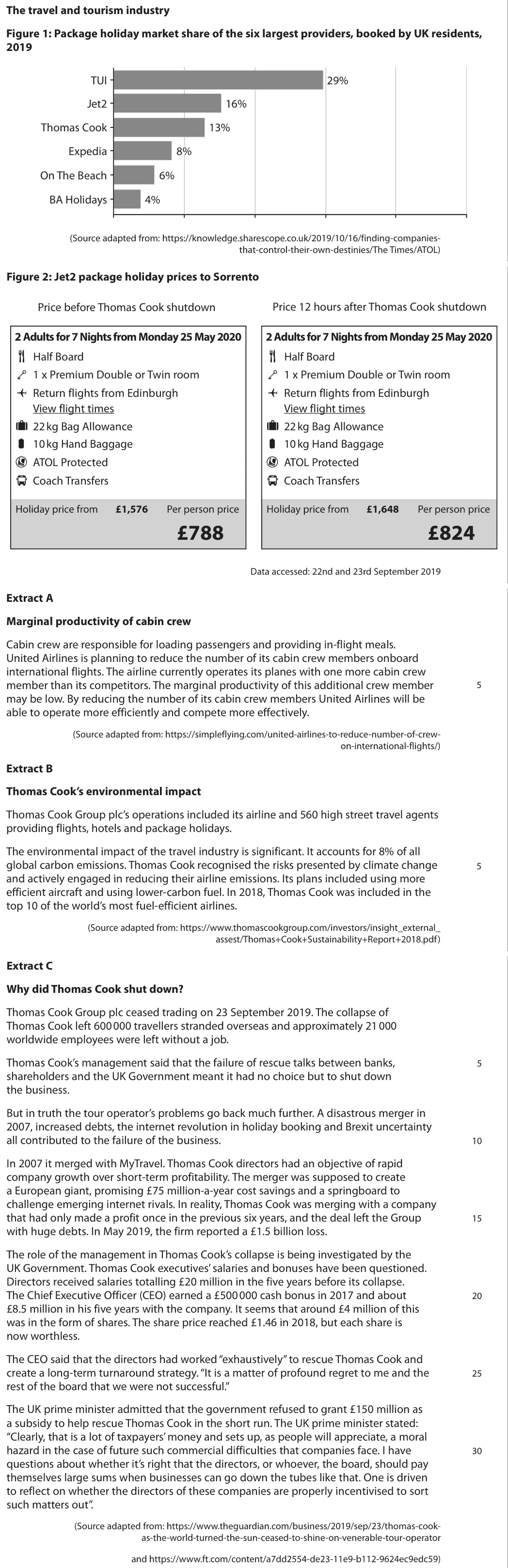
as more crew are added the extra output (meals served, passengers loaded) of each falls, so marginal cost per crew member rises and staffing levels fall (United Airlines, Extract A)
report: some confused diminishing marginal productivity with diminishing marginal utility
November 2021 · Paper 1 · Q6(d)12 marksAO1=2, AO2=2, AO3=4, AO4=412-mark response
Data and extracts for question 6
Mark scheme, including the levels grid and indicative content
Examiner's comment
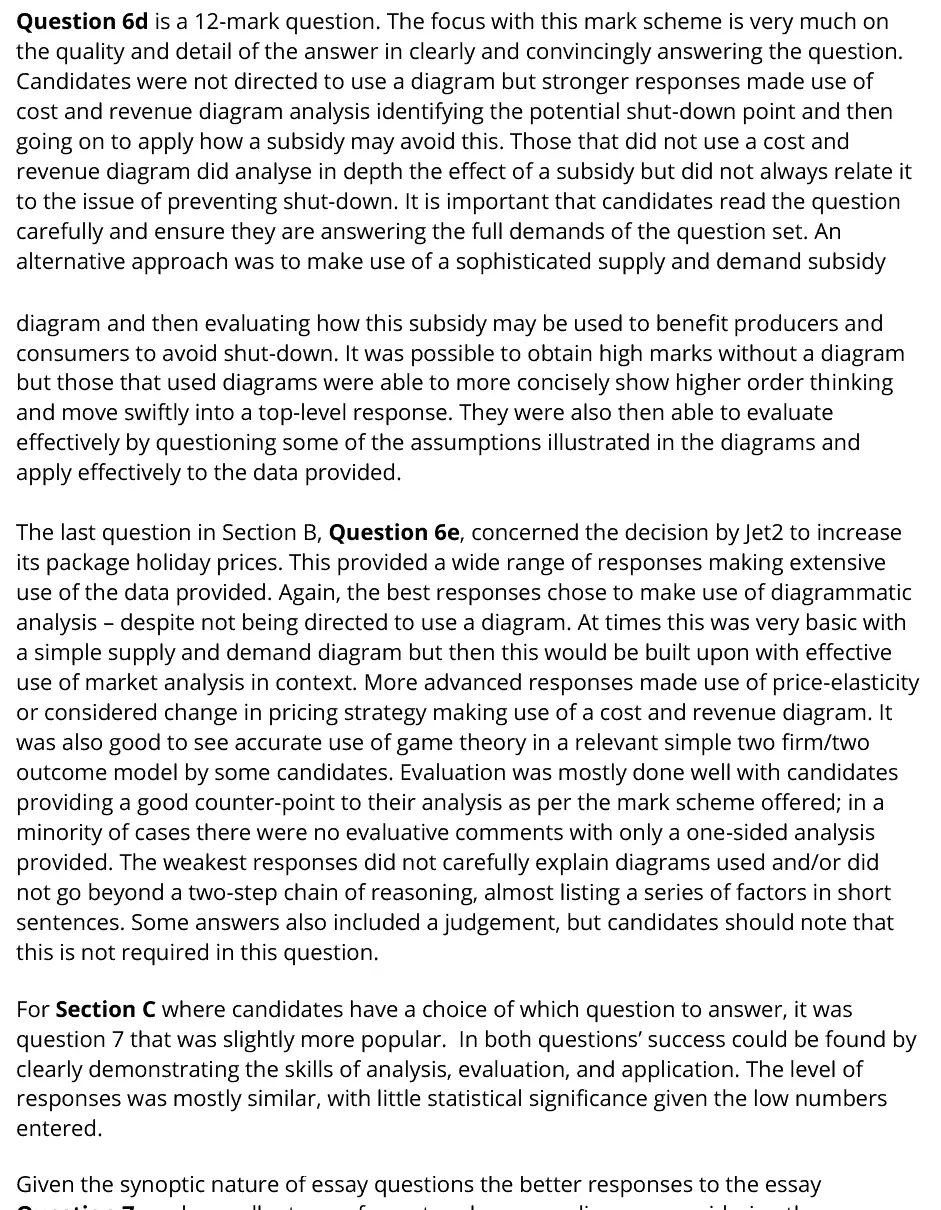
Question 6d is a 12-mark question. The focus with this mark scheme is very much on the quality and detail of the answer in clearly and convincingly answering the question. Candidates were not directed to use a diagram but stronger responses made use of cost and revenue diagram analysis identifying the potential shut-down point and then going on to apply how a subsidy may avoid this. Those that did not use a cost and revenue diagram did analyse in depth the effect of a subsidy but did not always relate it to the issue of preventing shut-down. It is important that candidates read the question carefully and ensure they are answering the full demands of the question set. An alternative approach was to make use of a sophisticated supply and demand subsidy diagram and then evaluating how this subsidy may be used to benefit producers and consumers to avoid shut-down. It was possible to obtain high marks without a diagram but those that used diagrams were able to more concisely show higher order thinking and move swiftly into a top-level response. They were also then able to evaluate effectively by questioning some of the assumptions illustrated in the diagrams and apply effectively to the data provided. The last question in Section B, Question 6e, concerned the decision by Jet2 to increase its package holiday prices. This provided a wide range of responses making extensive use of the data provided. Again, the best responses chose to make use of diagrammatic analysis – despite not being directed to use a diagram. At times this was very basic with a simple supply and demand diagram but then this would be built upon with effective use of market analysis in context. More advanced responses made use of price-elasticity or considered change in pricing strategy making use of a cost and revenue diagram. It was also good to see accurate use of game theory in a relevant simple two firm/two outcome model by some candidates. Evaluation was mostly done well with candidates providing a good counter-point to their analysis as per the mark scheme offered; in a minority of cases there were no evaluative comments with only a one-sided analysis provided. The weakest responses did not carefully explain diagrams used and/or did not go beyond a two-step chain of reasoning, almost listing a series of factors in short sentences. Some answers also included a judgement, but candidates should note that this is not required in this question. For Section C where candidates have a choice of which question to answer, it was question 7 that was slightly more popular. In both questions’ success could be found by clearly demonstrating the skills of analysis, evaluation, and application. The level of responses was mostly similar, with little statistical significance given the low numbers entered. Given the synoptic nature of essay questions the better responses to the essay
Notes from the mark scheme and report
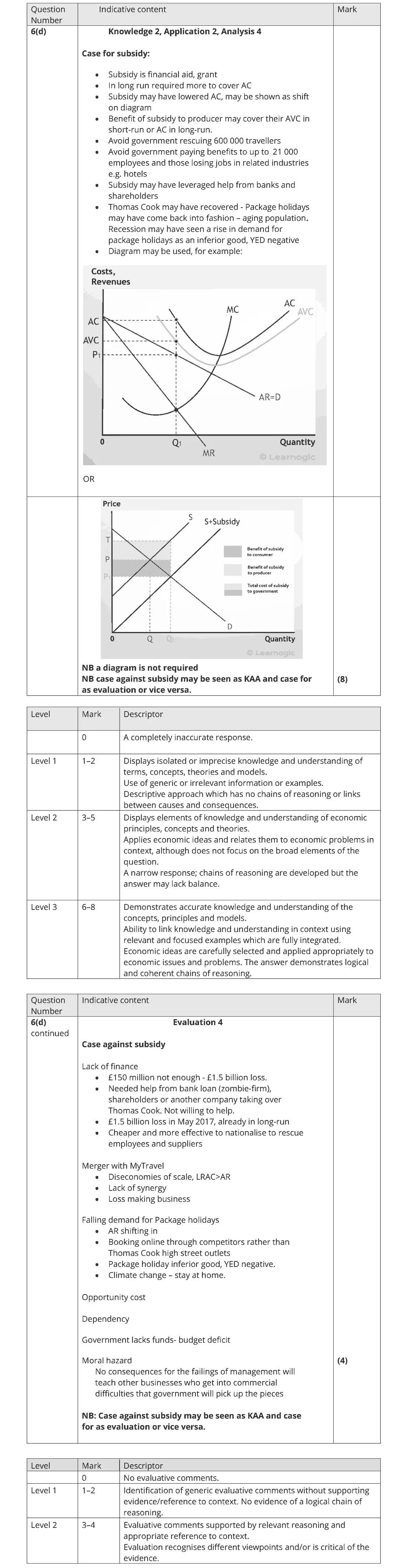
link the subsidy to the shut-down point: short run the firm must cover AVC, long run AC
£150m could save jobs and 600 000 stranded travellers
evaluate moral hazard (prime minister's quote), opportunity cost and government failure
report: answers that ignored shut-down did not answer the question
November 2021 · Paper 3 · Q2(c)12 marksAO1=2, AO2=2, AO3=4, AO4=412-mark response
Data and extracts for question 2
Mark scheme, including the levels grid and indicative content
Examiner's comment
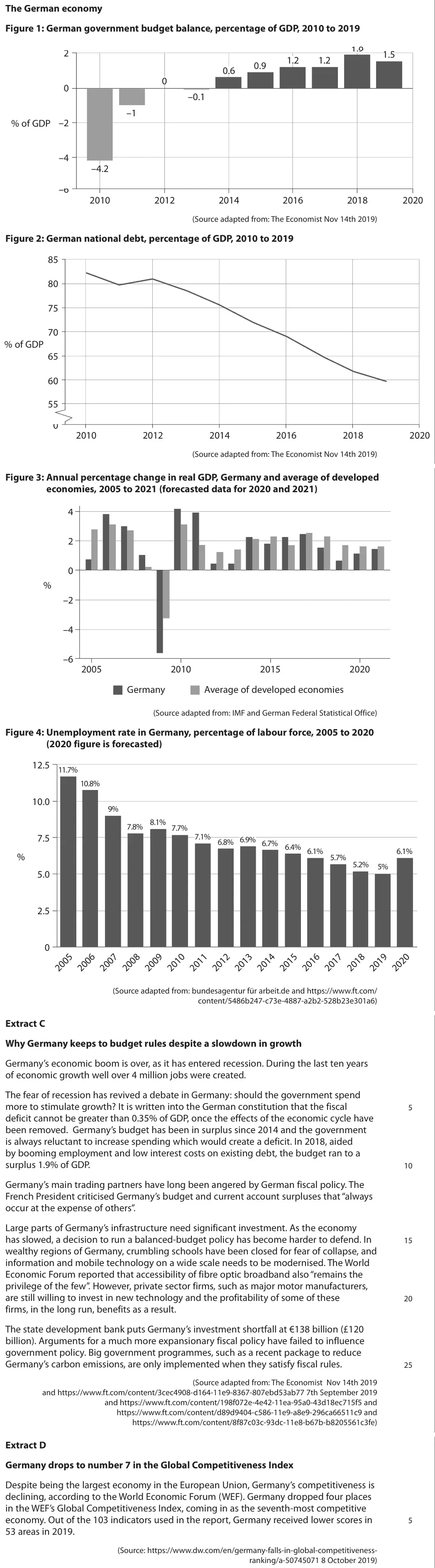
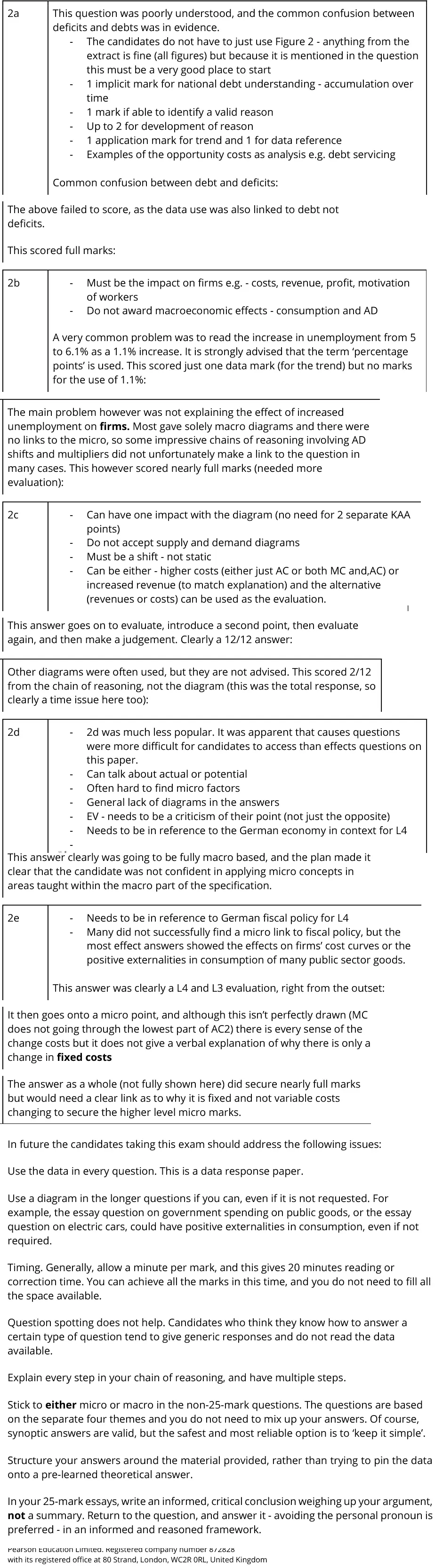
2a This question was poorly understood, and the common confusion between deficits and debts was in evidence. - The candidates do not have to just use Figure 2 - anything from the extract is fine (all figures) but because it is mentioned in the question this must be a very good place to start - 1 implicit mark for national debt understanding - accumulation over time - 1 mark if able to identify a valid reason - Up to 2 for development of reason - 1 application mark for trend and 1 for data reference - Examples of the opportunity costs as analysis e.g. debt servicing Common confusion between debt and deficits: The above failed to score, as the data use was also linked to debt not deficits. This scored full marks: 2b - Must be the impact on firms e.g. - costs, revenue, profit, motivation of workers - Do not award macroeconomic effects - consumption and AD A very common problem was to read the increase in unemployment from 5 to 6.1% as a 1.1% increase. It is strongly advised that the term ‘percentage points’ is used. This scored just one data mark (for the trend) but no marks for the use of 1.1%: The main problem however was not explaining the effect of increased unemployment on firms. Most gave solely macro diagrams and there were no links to the micro, so some impressive chains of reasoning involving AD shifts and multipliers did not unfortunately make a link to the question in many cases. This however scored nearly full marks (needed more evaluation): 2c - Can have one impact with the diagram (no need for 2 separate KAA points) - Do not accept supply and demand diagrams - Must be a shift - not static - Can be either - higher costs (either just AC or both MC and,AC) or increased revenue (to match explanation) and the alternative (revenues or costs) can be used as the evaluation. This answer goes on to evaluate, introduce a second point, then evaluate again, and then make a judgement. Clearly a 12/12 answer: Other diagrams were often used, but they are not advised. This scored 2/12 from the chain of reasoning, not the diagram (this was the total response, so clearly a time issue here too): 2d - 2d was much less popular. It was apparent that causes questions were more difficult for candidates to access than effects questions on this paper. - Can talk about actual or potential - Often hard to find micro factors - General lack of diagrams in the answers - EV - needs to be a criticism of their point (not just the opposite) - Needs to be in reference to the German economy in context for L4 - This answer clearly was going to be fully macro based, and the plan made it clear that the candidate was not confident in applying micro concepts in areas taught within the macro part of the specification. 2e - Needs to be in reference to German fiscal policy for L4 - Many did not successfully find a micro link to fiscal policy, but the most effect answers showed the effects on firms’ cost curves or the positive externalities in consumption of many public sector goods. This answer was clearly a L4 and L3 evaluation, right from the outset: It then goes onto a micro point, and although this isn’t perfectly drawn (MC does not going through the lowest part of AC2) there is every sense of the change costs but it does not give a verbal explanation of why there is only a change in fixed costs The answer as a whole (not fully shown here) did secure nearly full marks but would need a clear link as to why it is fixed and not variable costs changing to secure the higher level micro marks. In future the candidates taking this exam should address the following issues: Use the data in every question. This is a data response paper. Use a diagram in the longer questions if you can, even if it is not requested. For example, the essay question on government spending on public goods, or the essay question on electric cars, could have positive externalities in consumption, even if not required. Timing. Generally, allow a minute per mark, and this gives 20 minutes reading or correction time. You can achieve all the marks in this time, and you do not need to fill all the space available. Question spotting does not help. Candidates who think they know how to answer a certain type of question tend to give generic responses and do not read the data available. Explain every step in your chain of reasoning, and have multiple steps. Stick to either micro or macro in the non-25-mark questions. The questions are based on the separate four themes and you do not need to mix up your answers. Of course, synoptic answers are valid, but the safest and most reliable option is to ‘keep it simple’. Structure your answers around the material provided, rather than trying to pin the data onto a pre-learned theoretical answer. In your 25-mark essays, write an informed, critical conclusion weighing up your argument, not a summary. Return to the question, and answer it - avoiding the personal pronoun is preferred - in an informed and reasoned framework. with its registered office at 80 Strand, London, WC2R 0RL, United Kingdom
Notes from the mark scheme and report
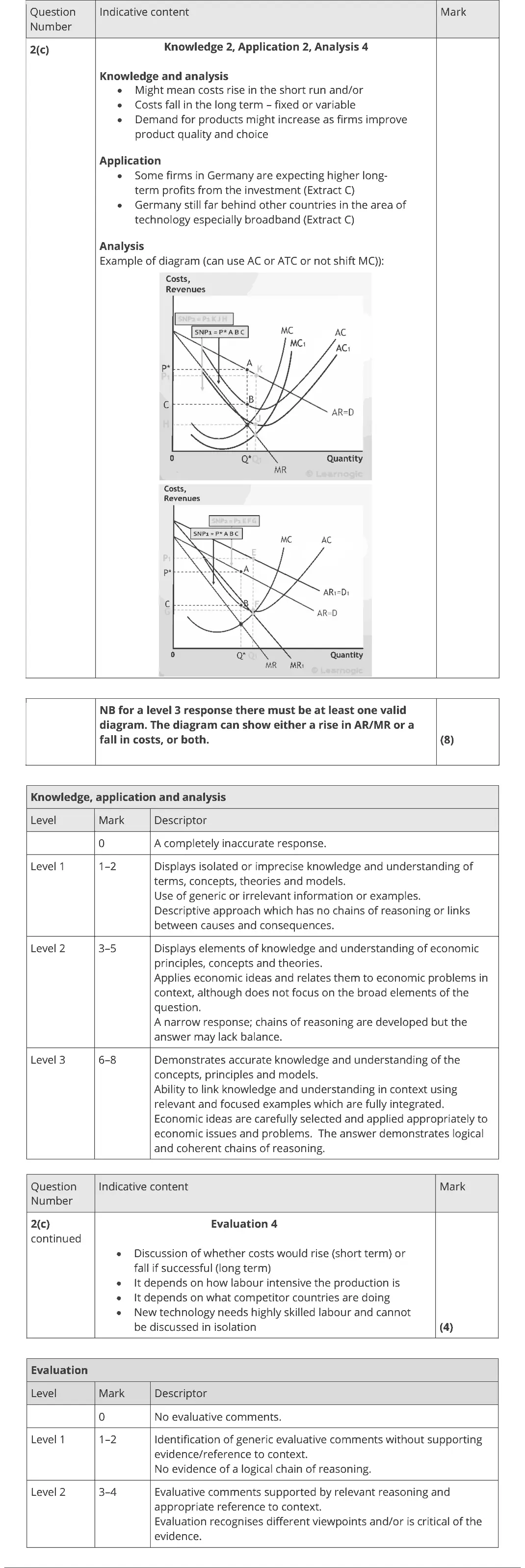
Level 3 needs a valid cost and revenue diagram showing a shift (lower AC/MC or higher AR/MR) and the change in supernormal profit, not supply and demand
costs may rise in the short run and fall in the long run
Extract C: firms expect higher long-term profits
Quantitative skills: QS 4 (construct and interpret a range of standard graphical forms)
October 2020 · Paper 1 · Q4(a)2 marksAO1=1, AO3=1Short answerHard
Data and extracts for question 4
Mark scheme
Examiner's comment
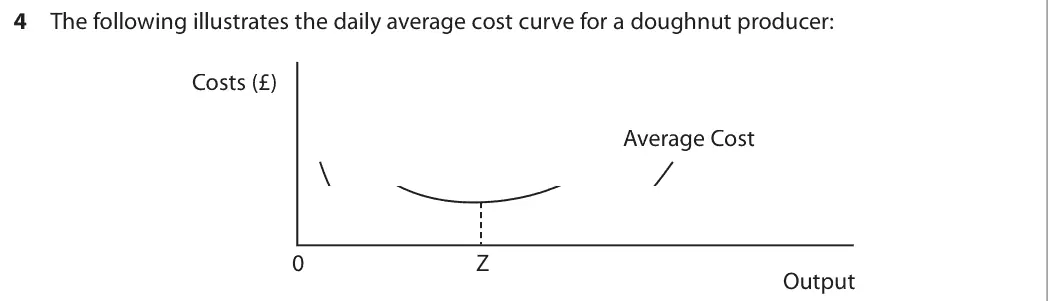
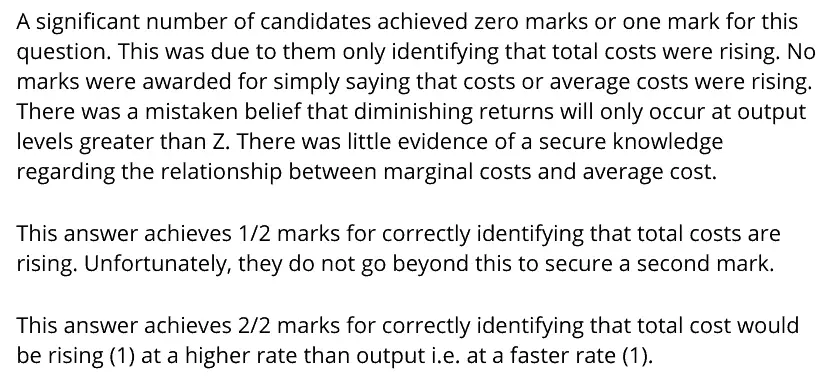
A significant number of candidates achieved zero marks or one mark for this question. This was due to them only identifying that total costs were rising. No marks were awarded for simply saying that costs or average costs were rising. There was a mistaken belief that diminishing returns will only occur at output levels greater than Z. There was little evidence of a secure knowledge regarding the relationship between marginal costs and average cost. This answer achieves 1/2 marks for correctly identifying that total costs are rising. Unfortunately, they do not go beyond this to secure a second mark. This answer achieves 2/2 marks for correctly identifying that total cost would be rising (1) at a higher rate than output i.e. at a faster rate (1).
Notes from the mark scheme and report
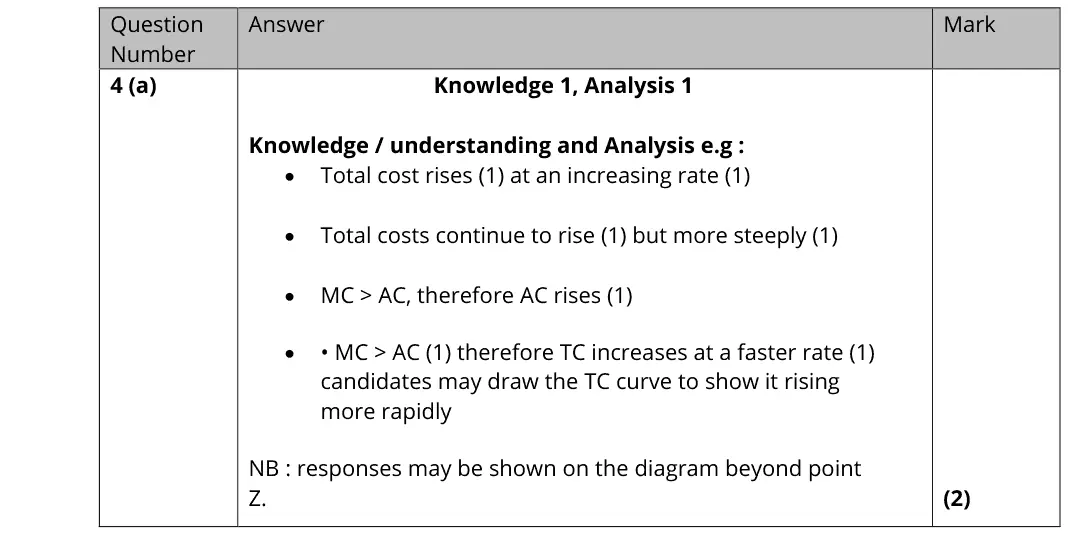
beyond Z MC > AC so total cost rises at an increasing rate
just "costs" or "average costs rise" earns nothing
report: "a significant number of candidates achieved zero marks or one mark", only saying total cost rises, with little secure knowledge of the MC and AC relationship
Quantitative skills: QS 4 (construct and interpret a range of standard graphical forms); QS 6 (calculate cost, revenue and profit (marginal, average, totals))
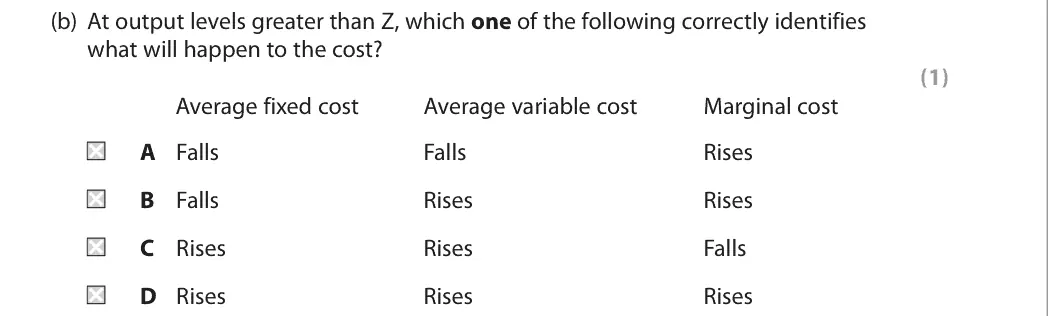
October 2020 · Paper 1 · Q4(b)1 markAO2=1Multiple choice
Data and extracts for question 4
Answer
B
Mark scheme
Notes from the mark scheme and report
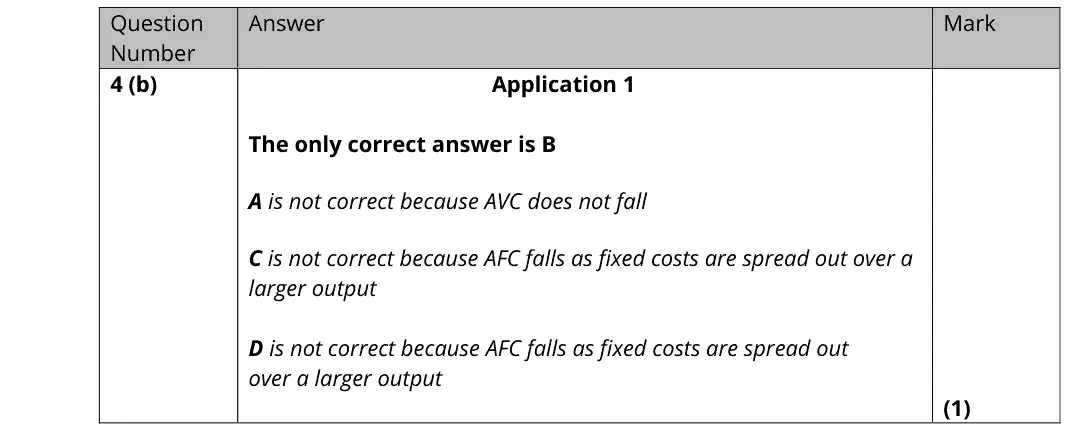
beyond Z average variable cost rises (B)
AFC keeps falling as fixed costs are spread, so the AFC distractors (C, D) are wrong
A wrong as AVC does not fall
Quantitative skills: QS 4 (construct and interpret a range of standard graphical forms)
October 2020 · Paper 1 · Q4(c)2 marksAO2=2Calculation
Data and extracts for question 4
Mark scheme
Examiner's comment
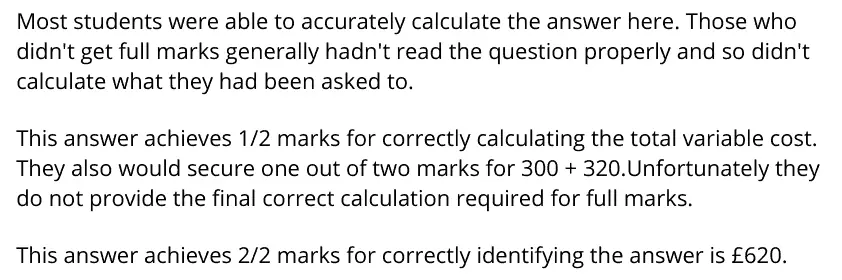
Most students were able to accurately calculate the answer here. Those who didn't get full marks generally hadn't read the question properly and so didn't calculate what they had been asked to. This answer achieves 1/2 marks for correctly calculating the total variable cost. They also would secure one out of two marks for 300 + 320.Unfortunately they do not provide the final correct calculation required for full marks. This answer achieves 2/2 marks for correctly identifying the answer is £620.
Notes from the mark scheme and report
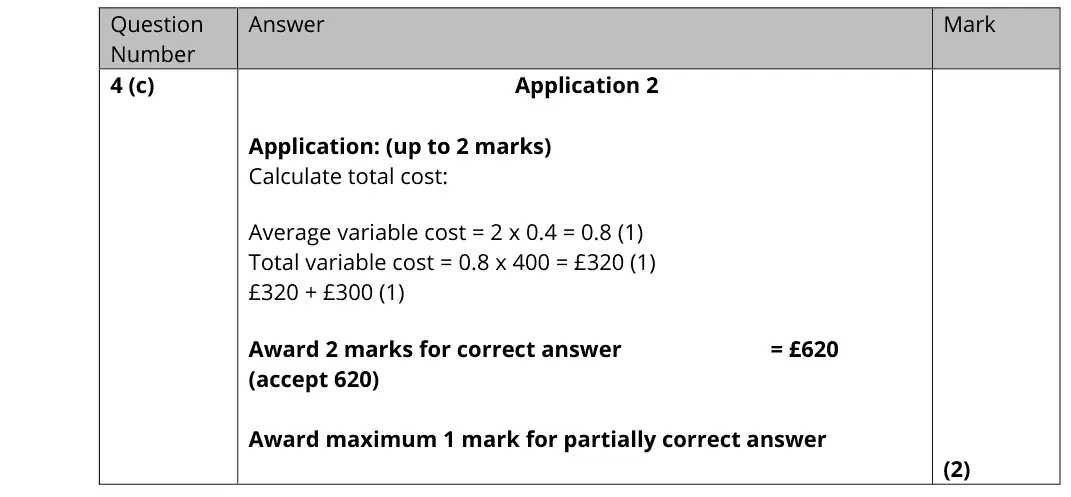
AVC = 40% x £2 = £0.80
TVC = 0.80 x 400 = £320
TC = £320 + £300 = £620
report: errors came from misreading what was asked
Quantitative skills: QS 2 (calculate, use and understand percentages, percentage changes and percentage point changes); QS 6 (calculate cost, revenue and profit (marginal, average, totals))
October 2020 · Paper 3 · Q1(d)25 marksAO1=4, AO2=4, AO3=8, AO4=925-mark essayEither/or
Data and extracts for question 1
Mark scheme, including the levels grid and indicative content
Examiner's comment
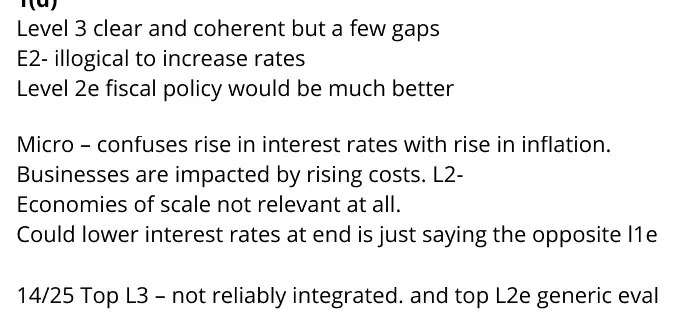
Level 3 clear and coherent but a few gaps E2- illogical to increase rates Level 2e fiscal policy would be much better Micro – confuses rise in interest rates with rise in inflation. Businesses are impacted by rising costs. L2- Economies of scale not relevant at all. Could lower interest rates at end is just saying the opposite l1e 14/25 Top L3 – not reliably integrated. and top L2e generic eval
Notes from the mark scheme and report
micro: higher borrowing and fixed costs for firms, lower consumer demand, less investment and R&D
macro: AD falls with multiplier effects, lira appreciates, debt servicing costs
Level 4 needs both micro and macro
do not confuse a rise in interest rates with a rise in inflation
evaluate e.g. inflation already peaking
October 2020 · Paper 3 · Q2(c)12 marksAO1=2, AO2=2, AO3=4, AO4=412-mark response
Data and extracts for question 2
Mark scheme, including the levels grid and indicative content
Examiner's comment
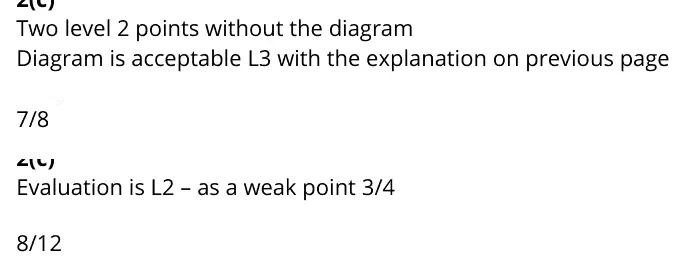
Two level 2 points without the diagram Diagram is acceptable L3 with the explanation on previous page 7/8 Evaluation is L2 – as a weak point 3/4 8/12
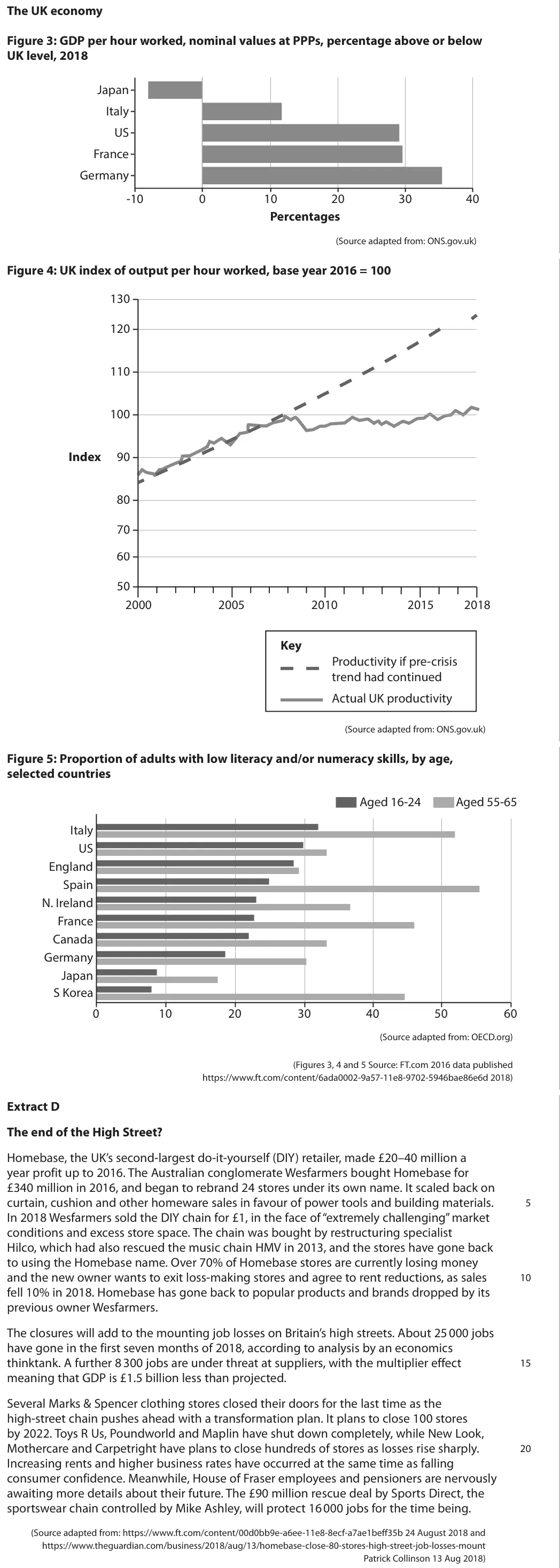
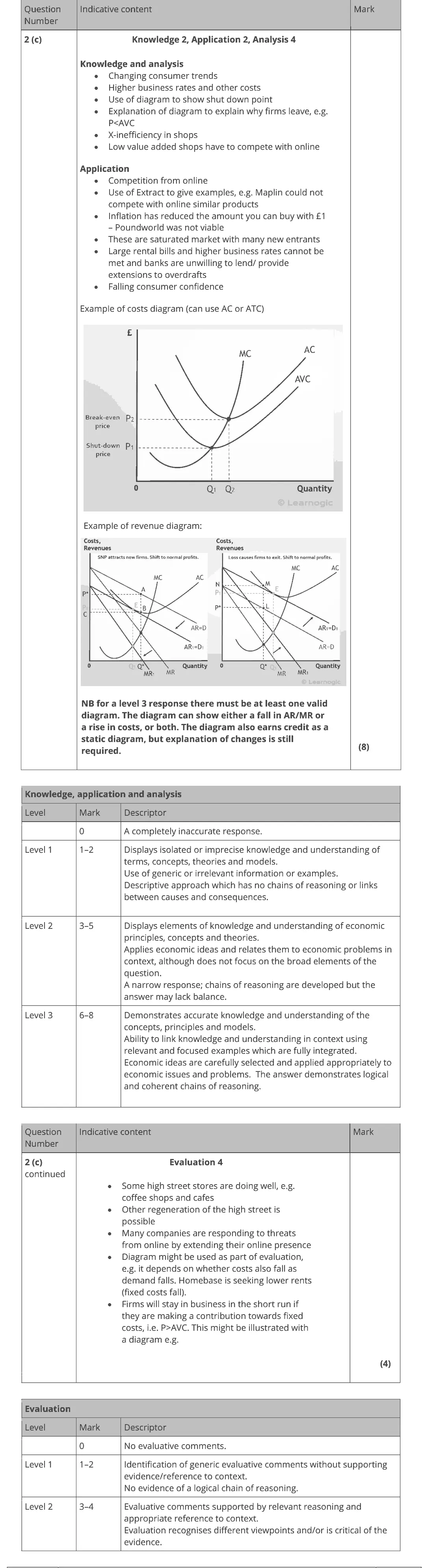
Notes from the mark scheme and report
Level 3 needs at least one valid cost and revenue diagram showing a fall in AR/MR or a rise in costs and the shut-down point (P < AVC)
online competition, business rates and rents, falling confidence from Extract D
evaluate e.g. firms stay open in the short run while covering AVC
Quantitative skills: QS 4 (construct and interpret a range of standard graphical forms)
June 2019 · Paper 1 · Q4(b)4 marksAO1=2, AO2=2Calculation
Data and extracts for question 4
Mark scheme
Examiner's comment
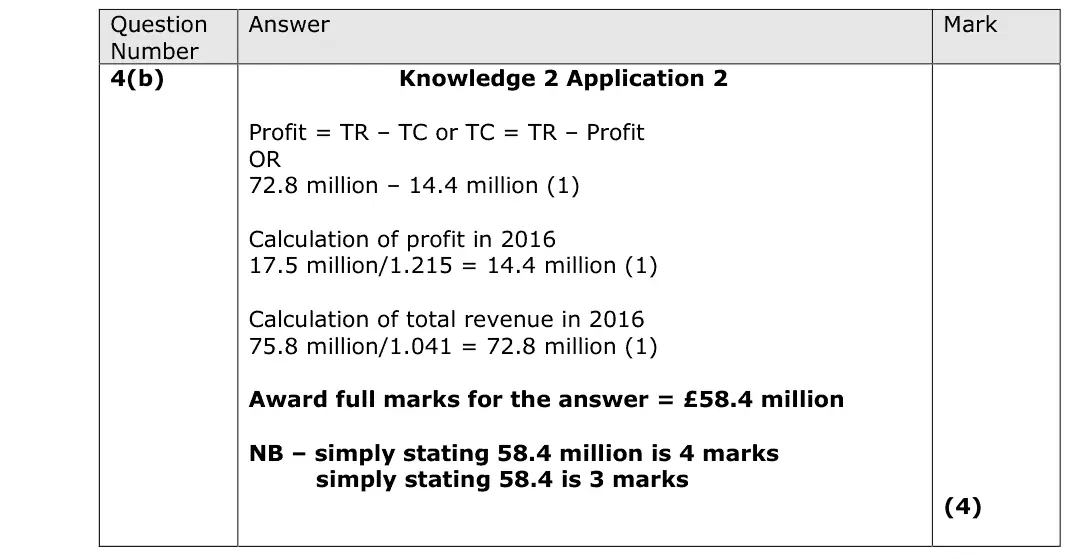
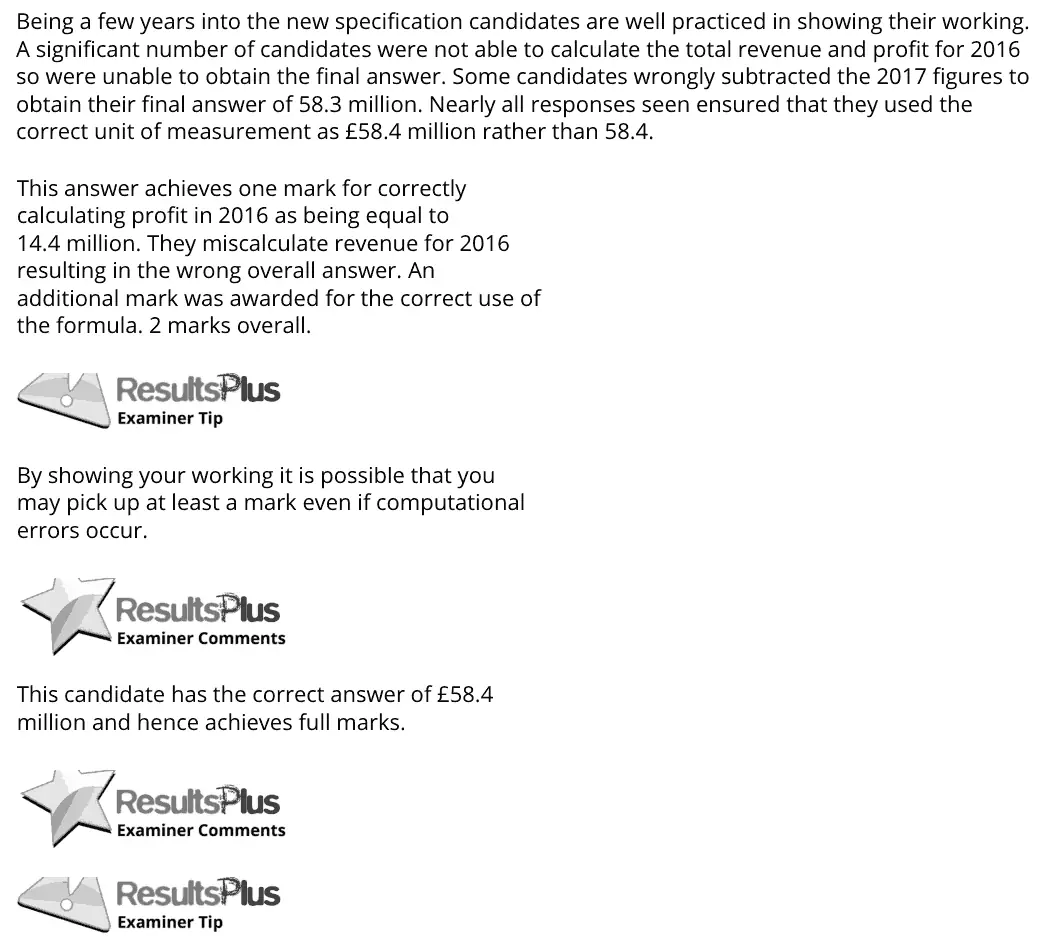
Being a few years into the new specification candidates are well practiced in showing their working. A significant number of candidates were not able to calculate the total revenue and profit for 2016 so were unable to obtain the final answer. Some candidates wrongly subtracted the 2017 figures to obtain their final answer of 58.3 million. Nearly all responses seen ensured that they used the correct unit of measurement as £58.4 million rather than 58.4. This answer achieves one mark for correctly calculating profit in 2016 as being equal to 14.4 million. They miscalculate revenue for 2016 resulting in the wrong overall answer. An additional mark was awarded for the correct use of the formula. 2 marks overall. By showing your working it is possible that you may pick up at least a mark even if computational errors occur. This candidate has the correct answer of £58.4 million and hence achieves full marks.
Notes from the mark scheme and report
2016 profit = 17.5 / 1.215 = £14.4m
2016 revenue = 75.8 / 1.041 = £72.8m
TC = TR - profit = £58.4 million
report: some subtracted the 2017 figures instead of working back to 2016
Quantitative skills: QS 2 (calculate, use and understand percentages, percentage changes and percentage point changes); QS 6 (calculate cost, revenue and profit (marginal, average, totals))
June 2019 · Paper 1 · Q6(d)12 marksAO1=2, AO2=2, AO3=4, AO4=412-mark response
Data and extracts for question 6
Mark scheme, including the levels grid and indicative content
Examiner's comment
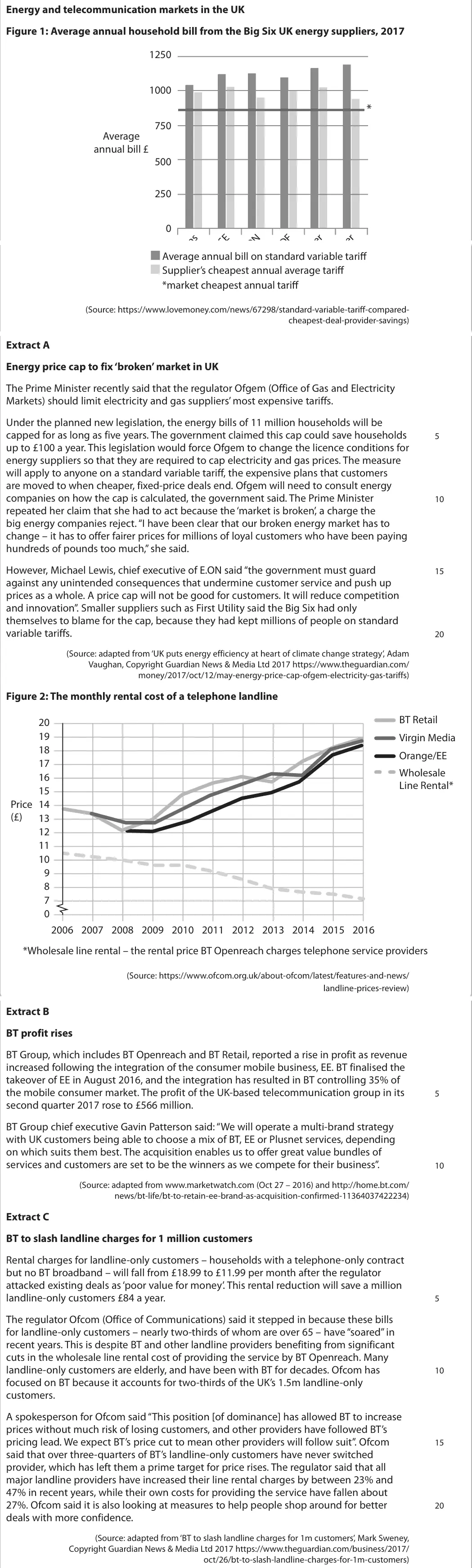
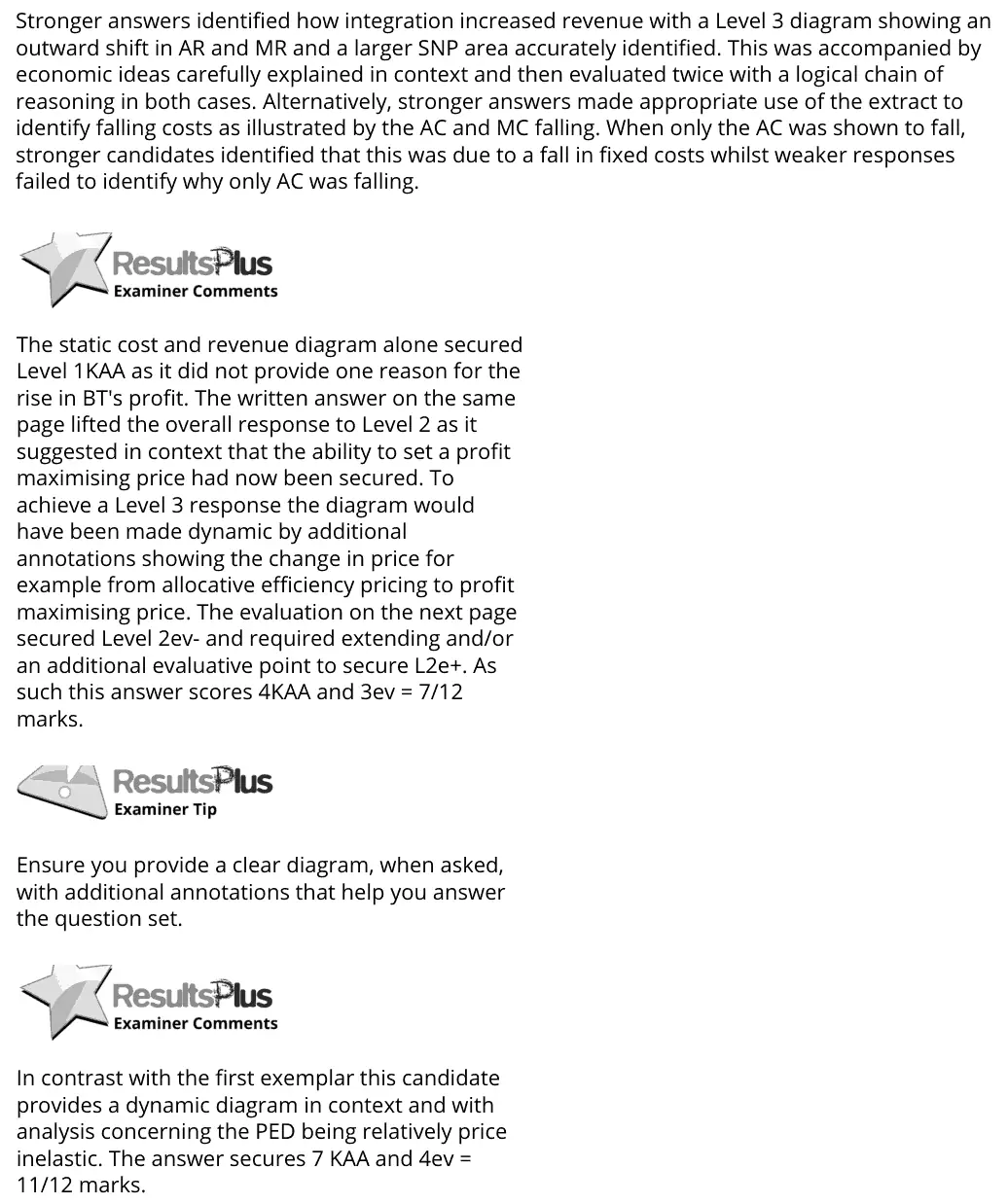
Stronger answers identified how integration increased revenue with a Level 3 diagram showing an outward shift in AR and MR and a larger SNP area accurately identified. This was accompanied by economic ideas carefully explained in context and then evaluated twice with a logical chain of reasoning in both cases. Alternatively, stronger answers made appropriate use of the extract to identify falling costs as illustrated by the AC and MC falling. When only the AC was shown to fall, stronger candidates identified that this was due to a fall in fixed costs whilst weaker responses failed to identify why only AC was falling. The static cost and revenue diagram alone secured Level 1KAA as it did not provide one reason for the rise in BT's profit. The written answer on the same page lifted the overall response to Level 2 as it suggested in context that the ability to set a profit maximising price had now been secured. To achieve a Level 3 response the diagram would have been made dynamic by additional annotations showing the change in price for example from allocative efficiency pricing to profit maximising price. The evaluation on the next page secured Level 2ev- and required extending and/or an additional evaluative point to secure L2e+. As such this answer scores 4KAA and 3ev = 7/12 marks. Ensure you provide a clear diagram, when asked, with additional annotations that help you answer the question set. In contrast with the first exemplar this candidate provides a dynamic diagram in context and with analysis concerning the PED being relatively price inelastic. The answer secures 7 KAA and 4ev = 11/12 marks.
Notes from the mark scheme and report
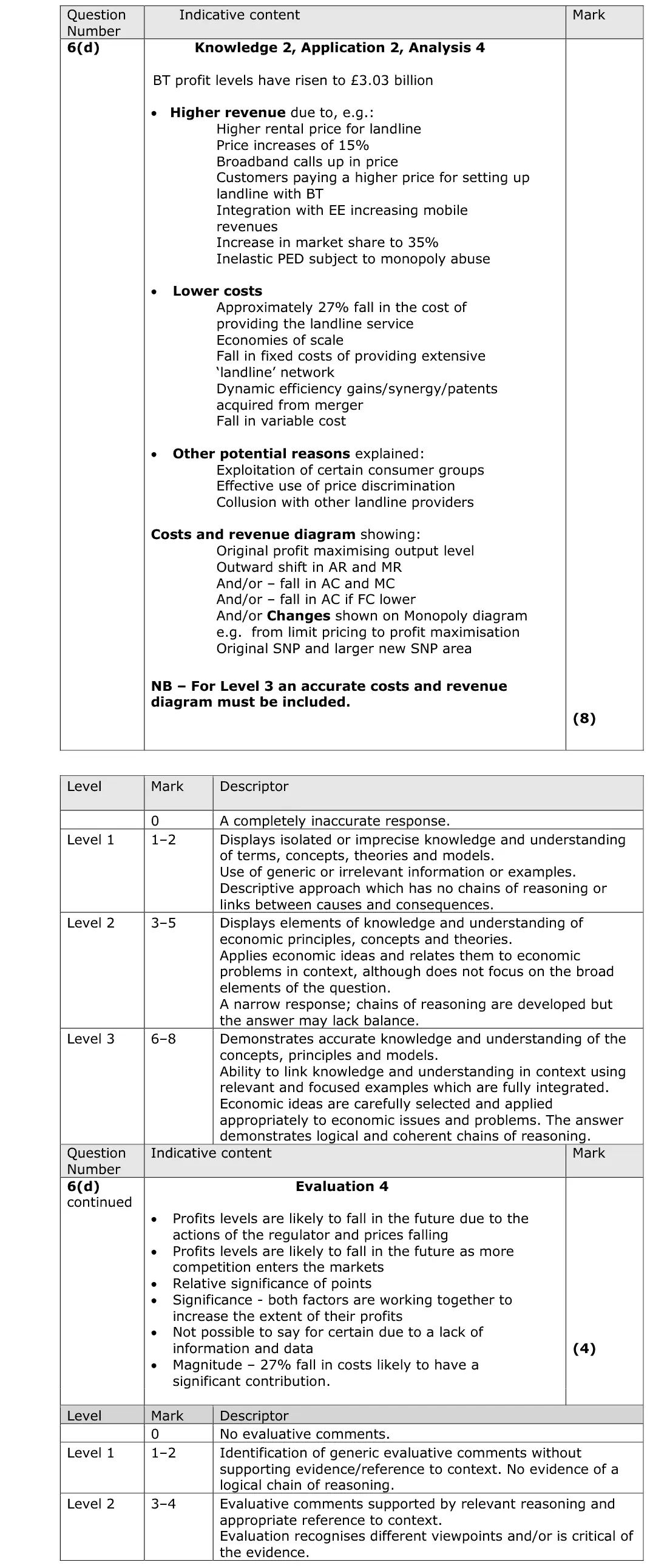
Level 3 needs an accurate cost and revenue diagram: AR and MR shift right (EE integration, 35% share, higher line rental) or AC and MC fall (wholesale cost down)
a static diagram with no reason for the change only reaches Level 1
Quantitative skills: QS 4 (construct and interpret a range of standard graphical forms)
June 2018 · Paper 1 · Q3(a)2 marksAO2=2Calculation
Data and extracts for question 3
Mark scheme
Examiner's comment
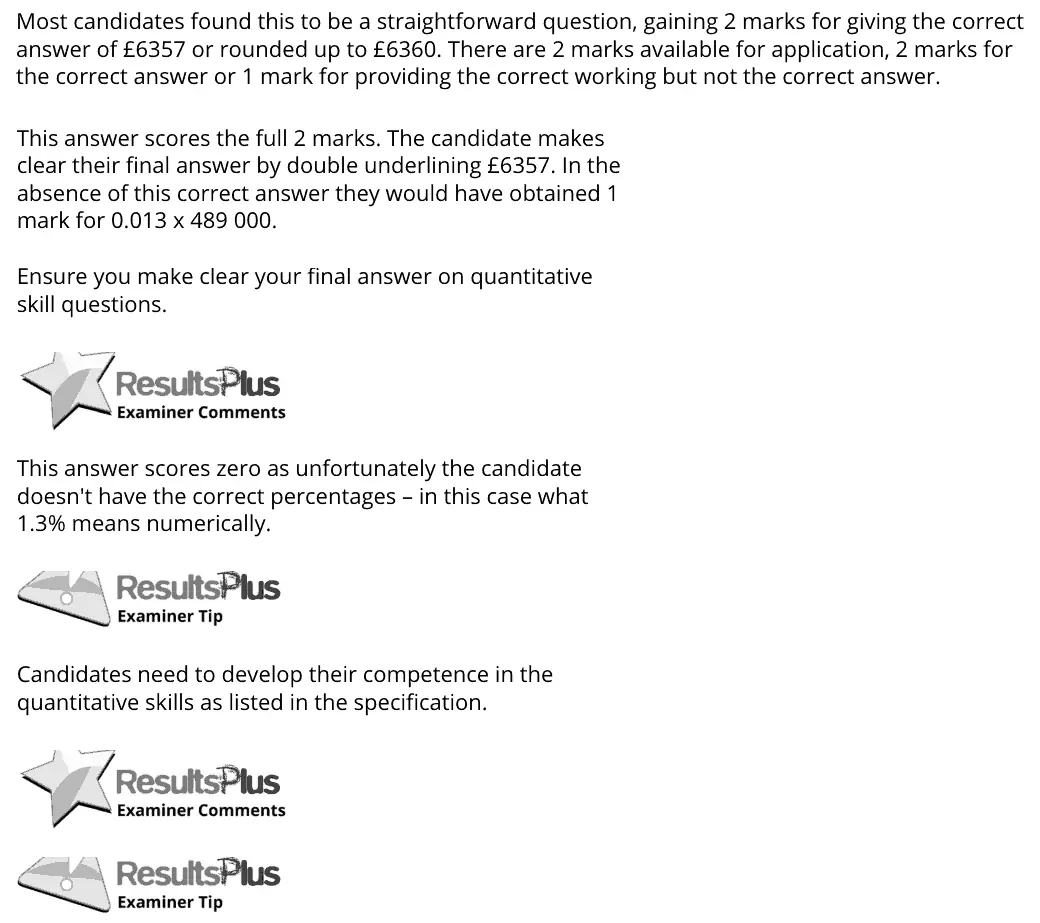
Most candidates found this to be a straightforward question, gaining 2 marks for giving the correct answer of £6357 or rounded up to £6360. There are 2 marks available for application, 2 marks for the correct answer or 1 mark for providing the correct working but not the correct answer. This answer scores the full 2 marks. The candidate makes clear their final answer by double underlining £6357. In the absence of this correct answer they would have obtained 1 mark for 0.013 x 489 000. Ensure you make clear your final answer on quantitative skill questions. This answer scores zero as unfortunately the candidate doesn't have the correct percentages – in this case what 1.3% means numerically. Candidates need to develop their competence in the quantitative skills as listed in the specification.
Notes from the mark scheme and report
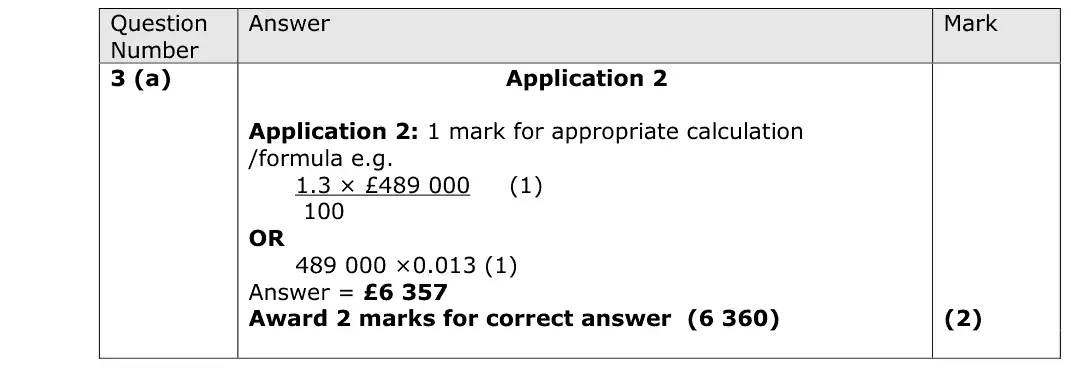
1.3% x £489 000 = 0.013 x 489 000 = £6 357
report: some could not convert 1.3% into a decimal
Quantitative skills: QS 2 (calculate, use and understand percentages, percentage changes and percentage point changes)
June 2018 · Paper 1 · Q4(a)4 marksAO1=2, AO2=2Calculation
Data and extracts for question 4
Mark scheme
Examiner's comment
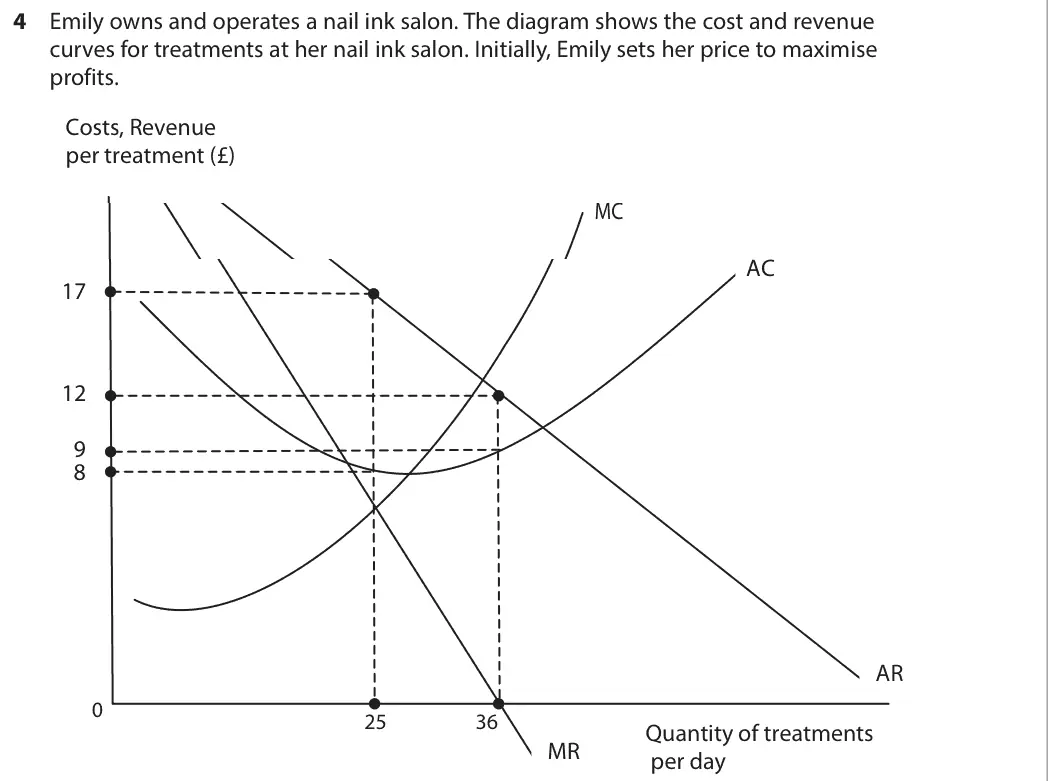
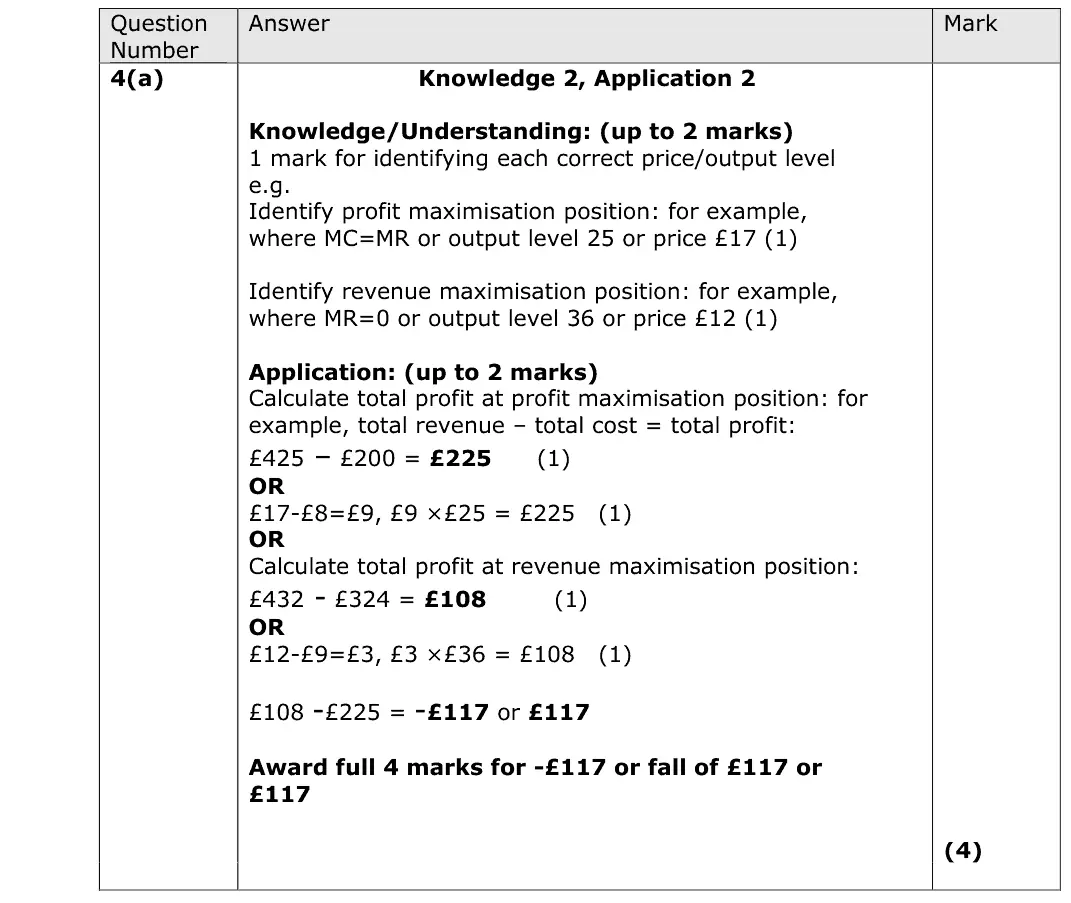
In this question, candidates needed to make sure they could identify supernormal profit at a profit maximisation and revenue maximisation level of output. They then need to calculate accurately the supernormal profits and subtract to achieve a change of £117. The majority of candidates did identify the profit maximisation and revenue maximisation level of output but some had difficulties with knowing how to calculate the supernormal profits – especially at the revenue maximisation output. Full marks could be achieved for simply stating £117 or -£117. This answer achieves a mark of 3/4. They provide a model approach when showing their working and do identify accurately the change but do not calculate the change of £117 in total supernormal profit as stated in bold in the question. Ensure you provide the final answer to the question set. For stating change = -£117 the candidate obtains full marks.
Notes from the mark scheme and report
profit max MC = MR at 25 treatments: (£17 - £8) x 25 = £225
revenue max MR = 0 at 36: (£12 - £9) x 36 = £108
change = -£117
report: some could not calculate supernormal profit at the revenue-maximising output, or did not state the final change
Quantitative skills: QS 4 (construct and interpret a range of standard graphical forms); QS 6 (calculate cost, revenue and profit (marginal, average, totals))
June 2018 · Paper 3 · Q2(b)8 marksAO1=2, AO2=2, AO3=2, AO4=28-mark responseHard
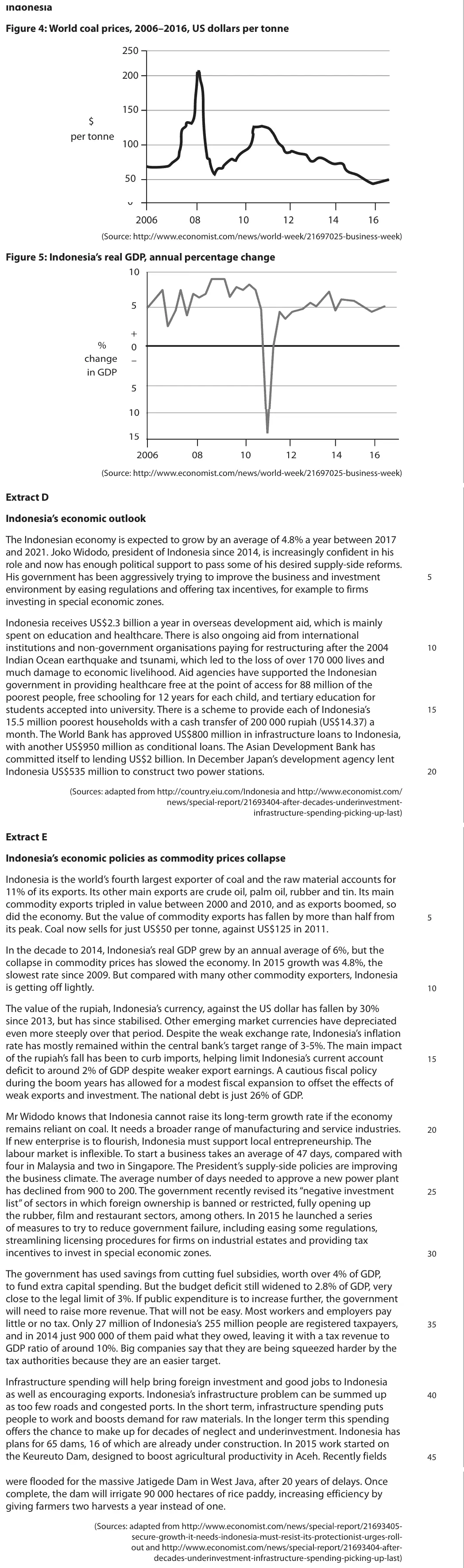
Data and extracts for question 2
Mark scheme, including the levels grid and indicative content
Examiner's comment
With a mean of 5.1/8, this was one of the most challenging questions on the paper. Many candidates in fact left it blank or crossed out large parts of their answer having realised there were inconsistencies. Many candidates did not draw a cost and revenue diagram at all. The best answers could effectively use diagrammatical analysis in this question and it is a key requirement of the Theme 3 course. A variety of approaches were acceptable, with more answers explaining the impact of efficiency on MC and AC, with very few answers explaining the link to MR and AR due to more harvests to sell in the sense that the demand faced by the individual firm was greater — clearly there is a mistake in the answer that simply shows an increase in supply leads to an increase in AR/MR. This fundamental misunderstanding meant that many answers contained an error that made the diagram and its description invalid; indeed some candidates went so far as to suggest there would be an increase in supply, a fall in price and therefore a rise in demand. Although the mark scheme made it possible to discuss the fact that individual competitive firms could face increased revenue, this was not owing to a shift in demand but a movement along a demand curve. Monopoly diagrams were accepted but to show a change in demand in this context, a more sophisticated approach was needed to show increased revenue for individual firms, and a rightwards/downwards movement of MC and AC along a price taking AR was certainly very effective. A surprisingly large number of answers showed a shift in marginal but not average costs (which could not be credited) or static diagrams. Answers which shifted FC or VC were equally acceptable, although it is important that the explanation does not contradict the diagram, for example by discussing a fall in the overheads for the farmers but showing a shift in MC and AC. It was important to show the shift correctly and the new area of profit. This question caused quite a bit of confusion with many crossed out diagrams and more answers without any diagrams at all than might have been expected when the diagram was specifically requested. There was also a surprising large number of supply and demand diagrams, which cannot on their own be credited as cost and revenue diagrams – although as part of a wider perfect competition analysis or as part of evaluation they were credited if valid. Evaluation marks were scored consistently well on this question, with many answers offering one relevant point with explanation to gain both marks. One effective argument was to suggest that Indonesian rice farmers are likely to operate in a highly competitive or contestable market, and therefore any supernormal profits would be eroded in the long run. This answer was fairly representative in that the diagram was static. The economies of scale diagram is partially valid as there is a cost curve, but again it was not used effectively nor was it related to the context so it did not attract marks. There were two marks available for the diagram, either as 2 application or 1 An and 1 Ap. This gets a mark for saying that the profit increases from the investment (1), that costs fall (1) and the application to 90 000 hectares of rice paddy (1). Make sure that the diagram shows a SHIFT and a NEW PROFIT AREA. If you are going to argue that the quantity demanded increases (shift along) then do not show a shift in demand. It is clearly a shift in supply as productivity and efficiency increase. This is a short, clear and effective answer. The diagram is clearly labelled. The text describes the diagram. There is a clear paragraph set apart for evaluation. This is a joy for an examiner to read. Note that you can also score all the marks using a shift in just the FC or AC, although you must be careful not to describe a change in VC and draw just a change in fixed costs, and vice versa.
Notes from the mark scheme and report
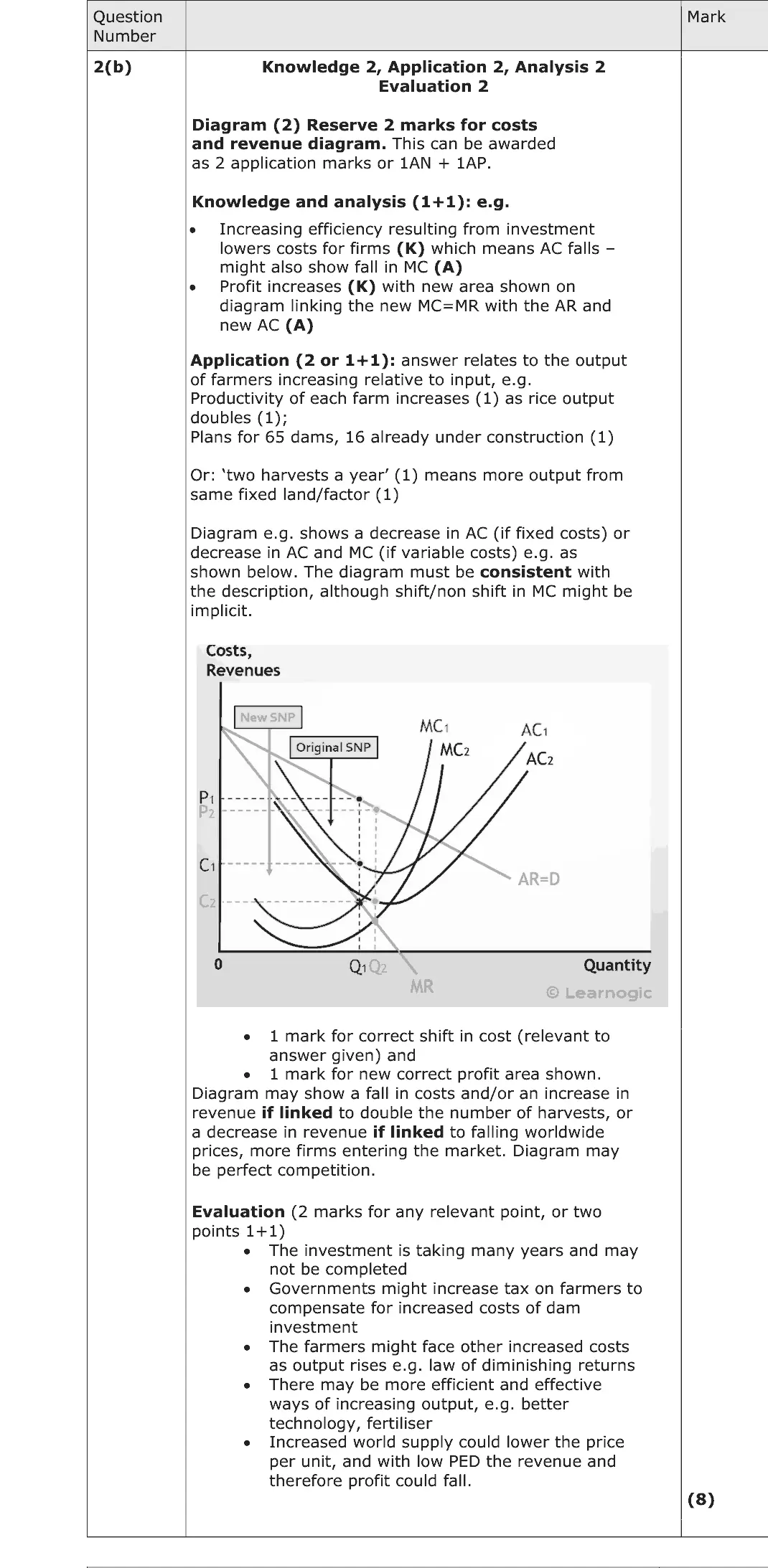
2 marks reserved for a cost and revenue diagram showing a shift down in AC (and MC if variable costs) and the new profit area
a shift in MC only, a static diagram or a supply and demand diagram earns nothing
do not shift AR/MR because supply rises
report: "this was one of the most challenging questions on the paper" (mean 5.1/8), many did not draw the diagram
Quantitative skills: QS 4 (construct and interpret a range of standard graphical forms)
June 2017 · Paper 1 · Q4(a)4 marksAO1=2, AO2=2Diagram
Data and extracts for question 4
Mark scheme
Examiner's comment
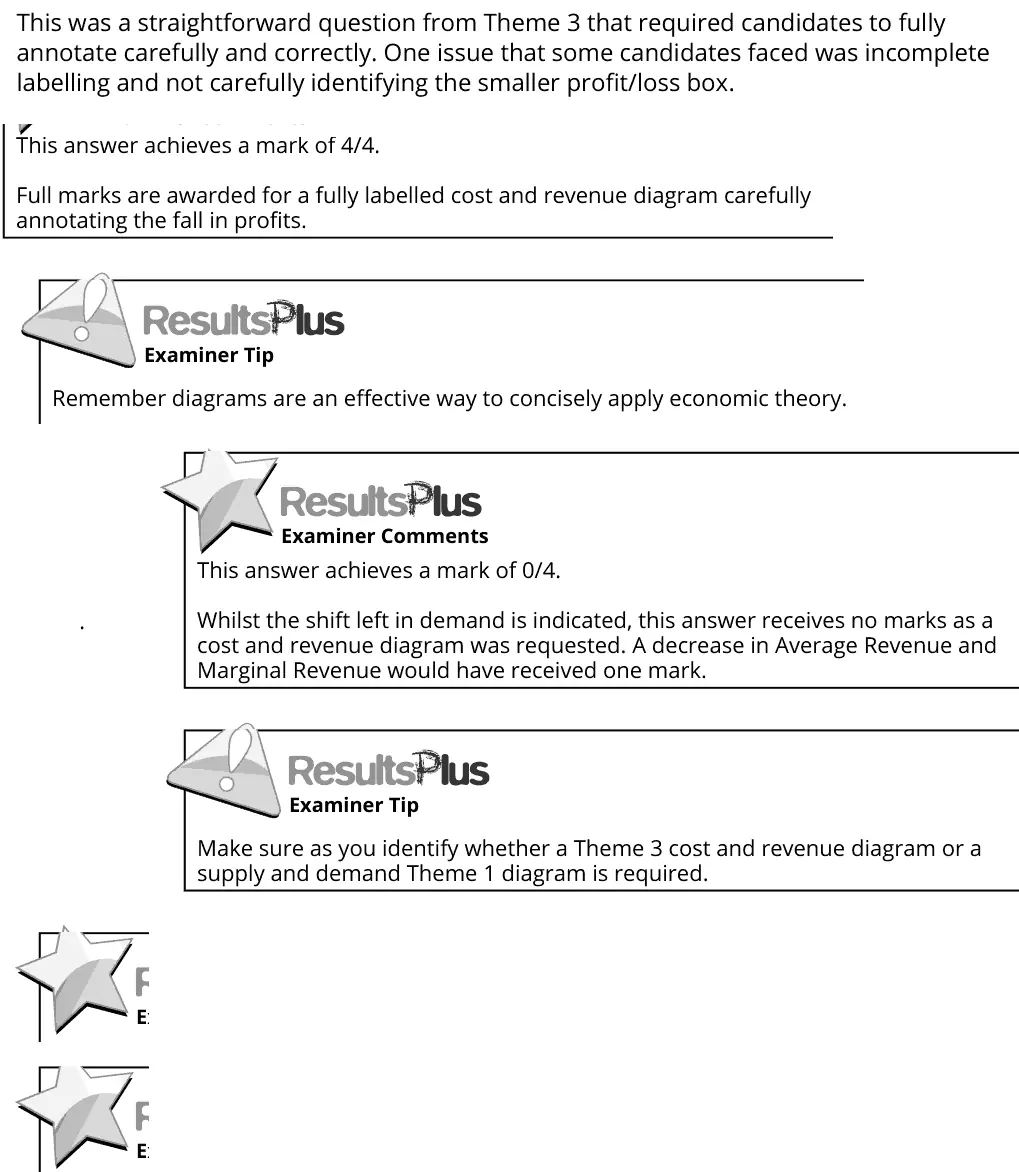
This was a straightforward question from Theme 3 that required candidates to fully annotate carefully and correctly. One issue that some candidates faced was incomplete labelling and not carefully identifying the smaller profit/loss box. This answer achieves a mark of 4/4. Full marks are awarded for a fully labelled cost and revenue diagram carefully annotating the fall in profits. . This answer achieves a mark of 0/4. Whilst the shift left in demand is indicated, this answer receives no marks as a cost and revenue diagram was requested. A decrease in Average Revenue and Marginal Revenue would have received one mark. Make sure as you identify whether a Theme 3 cost and revenue diagram or a supply and demand Theme 1 diagram is required. Remember diagrams are an effective way to concisely apply economic theory.
Notes from the mark scheme and report
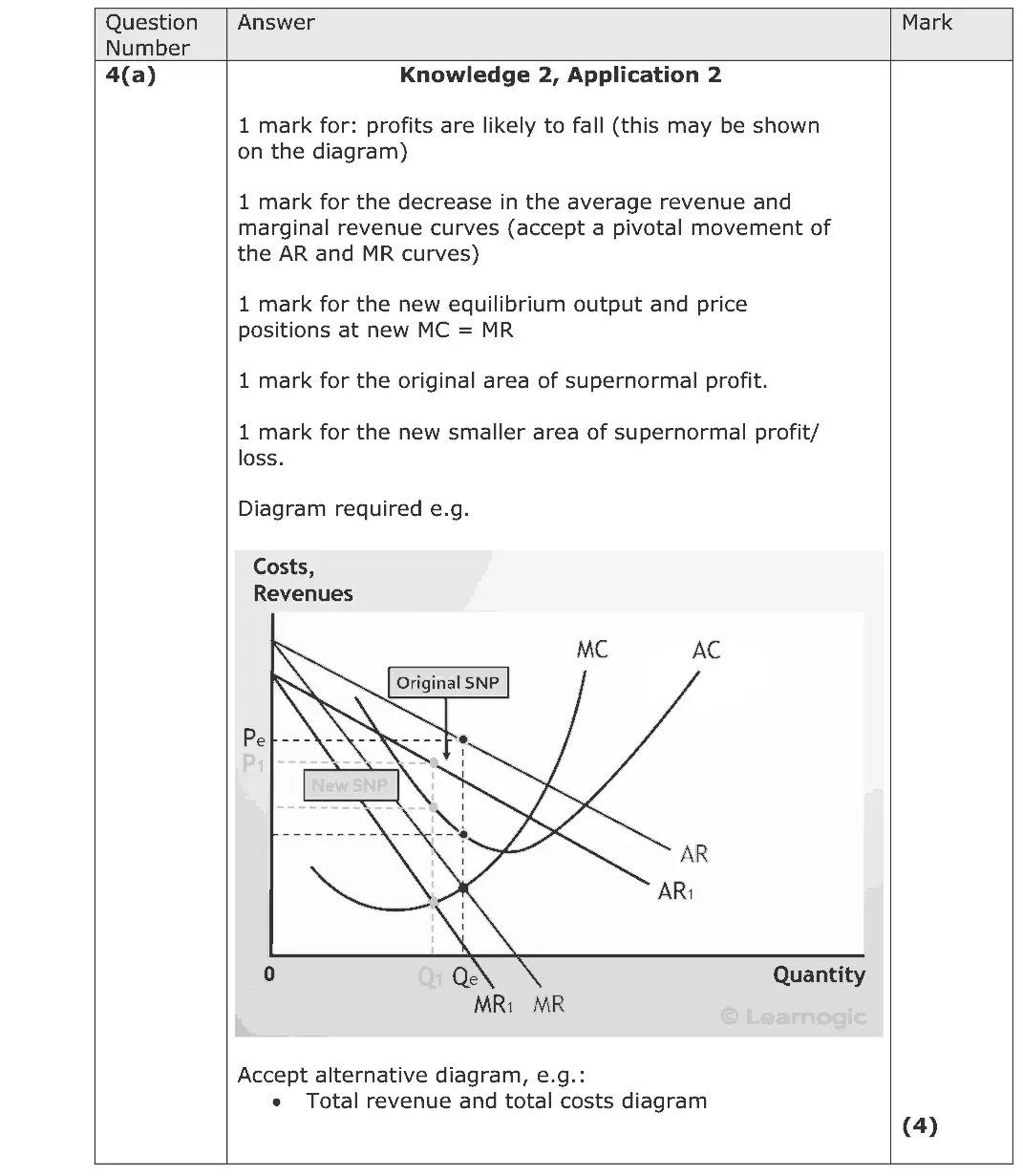
cost and revenue diagram: AR and MR shift (or pivot) left, new MC = MR output and price, original and smaller supernormal profit (or loss) areas
report: a supply and demand diagram scored 0
label the smaller profit box carefully
Quantitative skills: QS 4 (construct and interpret a range of standard graphical forms)
June 2017 · Paper 1 · Q5(a)1 markMultiple choice
Data and extracts for question 5
Answer
D
Mark scheme
Notes from the mark scheme and report
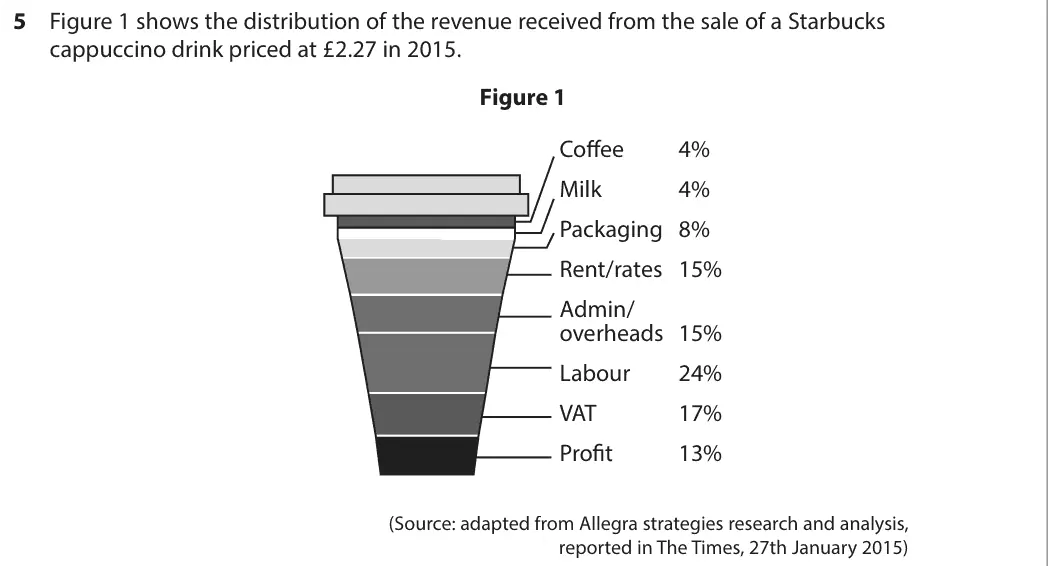
rent does not vary with output, so it is a fixed cost (D)
coffee, milk and packaging rise with each cup sold so are variable costs
June 2017 · Paper 1 · Q5(b)2 marksAO1=1, AO3=1Short answer
Data and extracts for question 5
Mark scheme
Examiner's comment
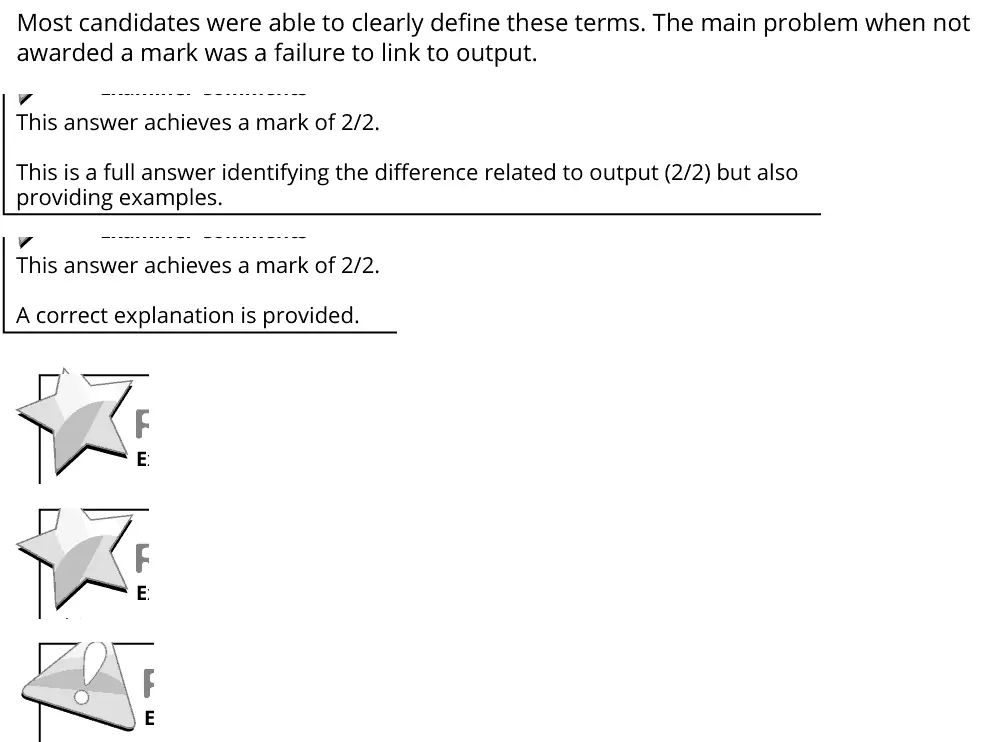
Most candidates were able to clearly define these terms. The main problem when not awarded a mark was a failure to link to output. This answer achieves a mark of 2/2. This is a full answer identifying the difference related to output (2/2) but also providing examples. This answer achieves a mark of 2/2. A correct explanation is provided.
Notes from the mark scheme and report
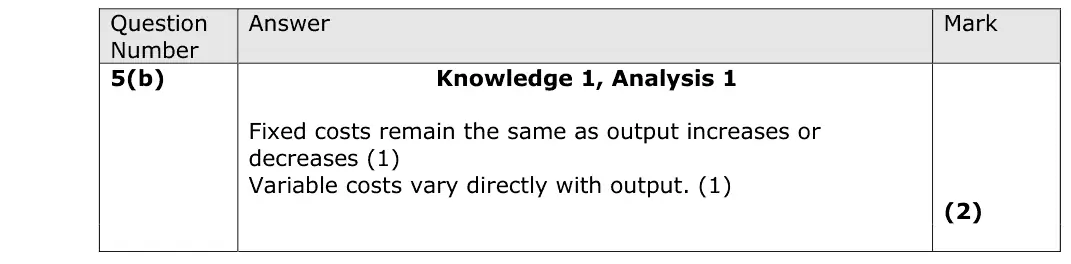
fixed costs do not change as output changes, variable costs vary directly with output
report: answers lost the mark by not linking the definitions to output
June 2017 · Paper 1 · Q5(c)2 marksAO2=2Calculation
Data and extracts for question 5
Mark scheme
Examiner's comment
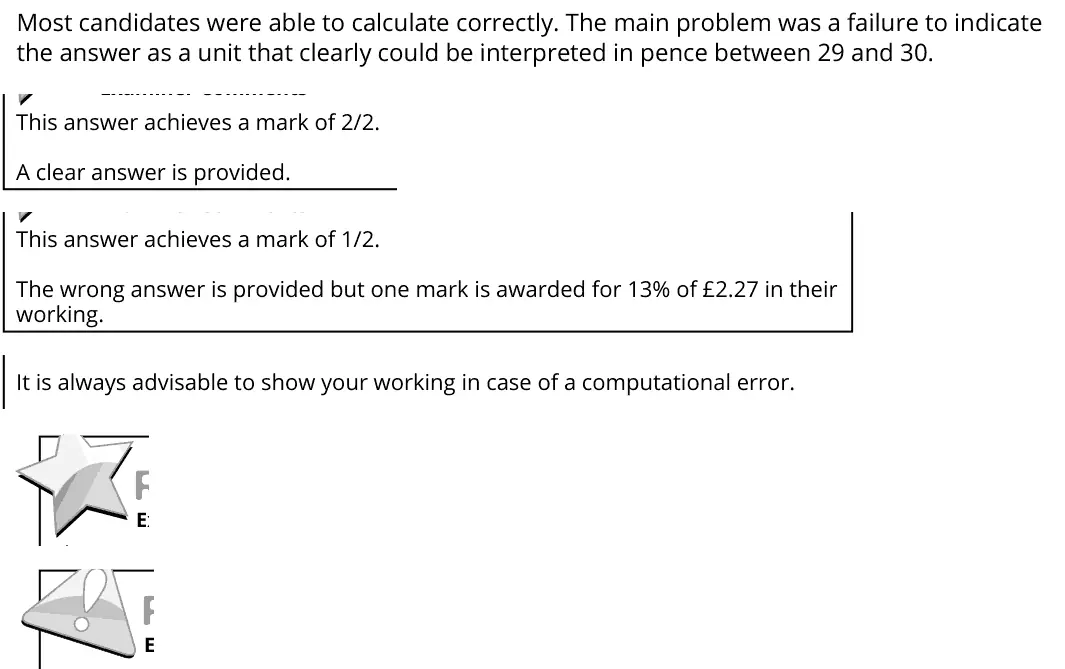
Most candidates were able to calculate correctly. The main problem was a failure to indicate the answer as a unit that clearly could be interpreted in pence between 29 and 30. This answer achieves a mark of 2/2. A clear answer is provided. This answer achieves a mark of 1/2. The wrong answer is provided but one mark is awarded for 13% of £2.27 in their working. It is always advisable to show your working in case of a computational error.
Notes from the mark scheme and report
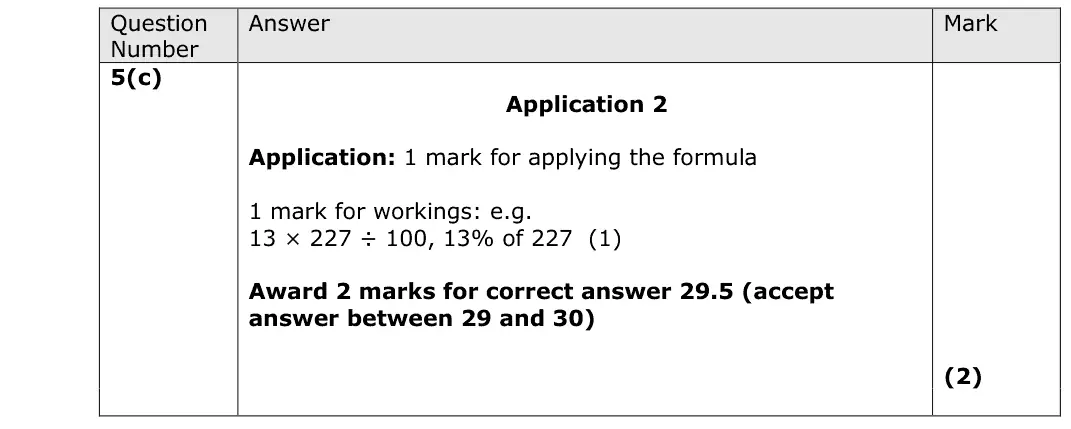
profit = 13% of 227p = 29.5p (accept 29 to 30)
answer must be clearly in pence (report)
show working to earn a mark for 13% x 227
Quantitative skills: QS 2 (calculate, use and understand percentages, percentage changes and percentage point changes); QS 6 (calculate cost, revenue and profit (marginal, average, totals))
June 2017 · Paper 3 · Q2(c)12 marksAO1=2, AO2=2, AO3=4, AO4=412-mark response
Data and extracts for question 2
Mark scheme, including the levels grid and indicative content
Examiner's comment
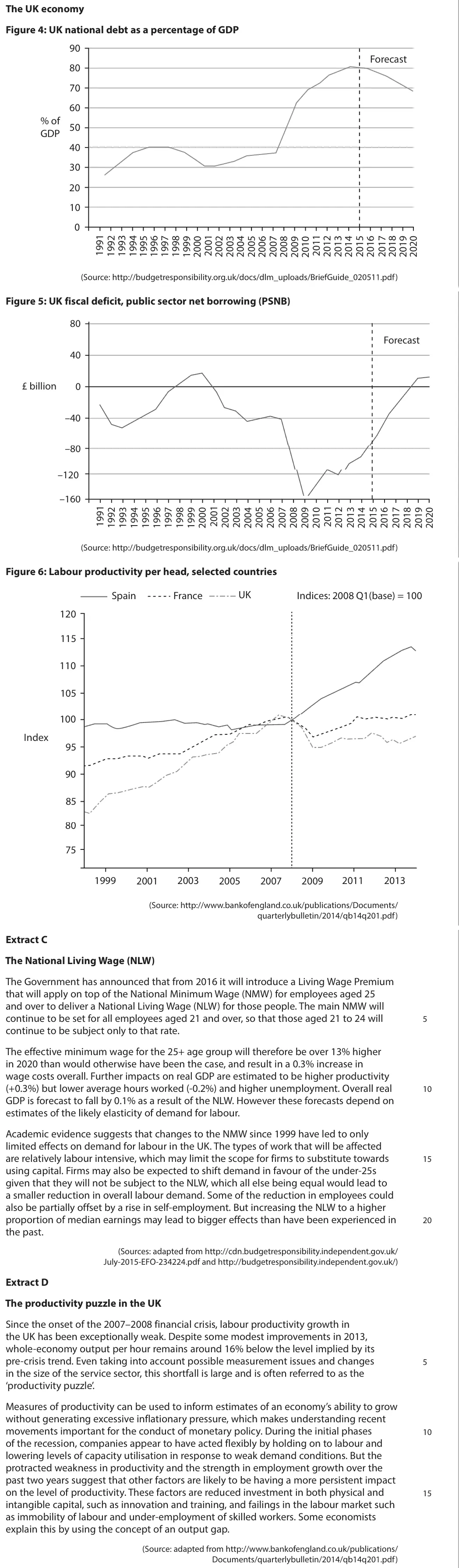
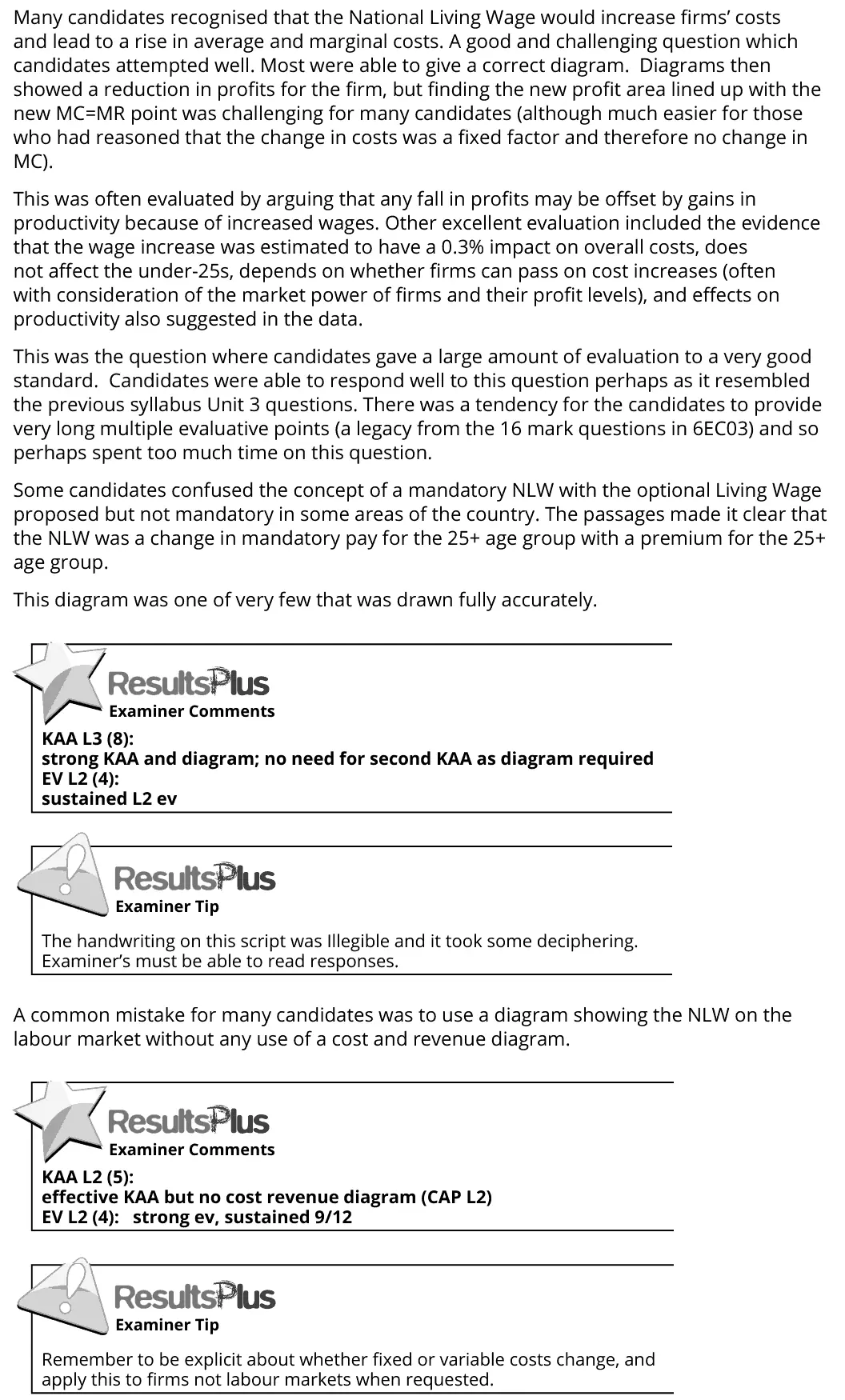
Many candidates recognised that the National Living Wage would increase firms’ costs and lead to a rise in average and marginal costs. A good and challenging question which candidates attempted well. Most were able to give a correct diagram. Diagrams then showed a reduction in profits for the firm, but finding the new profit area lined up with the new MC=MR point was challenging for many candidates (although much easier for those who had reasoned that the change in costs was a fixed factor and therefore no change in MC). This was often evaluated by arguing that any fall in profits may be offset by gains in productivity because of increased wages. Other excellent evaluation included the evidence that the wage increase was estimated to have a 0.3% impact on overall costs, does not affect the under-25s, depends on whether firms can pass on cost increases (often with consideration of the market power of firms and their profit levels), and effects on productivity also suggested in the data. This was the question where candidates gave a large amount of evaluation to a very good standard. Candidates were able to respond well to this question perhaps as it resembled the previous syllabus Unit 3 questions. There was a tendency for the candidates to provide very long multiple evaluative points (a legacy from the 16 mark questions in 6EC03) and so perhaps spent too much time on this question. Some candidates confused the concept of a mandatory NLW with the optional Living Wage proposed but not mandatory in some areas of the country. The passages made it clear that the NLW was a change in mandatory pay for the 25+ age group with a premium for the 25+ age group. This diagram was one of very few that was drawn fully accurately. KAA L3 (8): strong KAA and diagram; no need for second KAA as diagram required EV L2 (4): sustained L2 ev The handwriting on this script was Illegible and it took some deciphering. Examiner’s must be able to read responses. A common mistake for many candidates was to use a diagram showing the NLW on the labour market without any use of a cost and revenue diagram. KAA L2 (5): effective KAA but no cost revenue diagram (CAP L2) EV L2 (4): strong ev, sustained 9/12 Remember to be explicit about whether fixed or variable costs change, and apply this to firms not labour markets when requested.
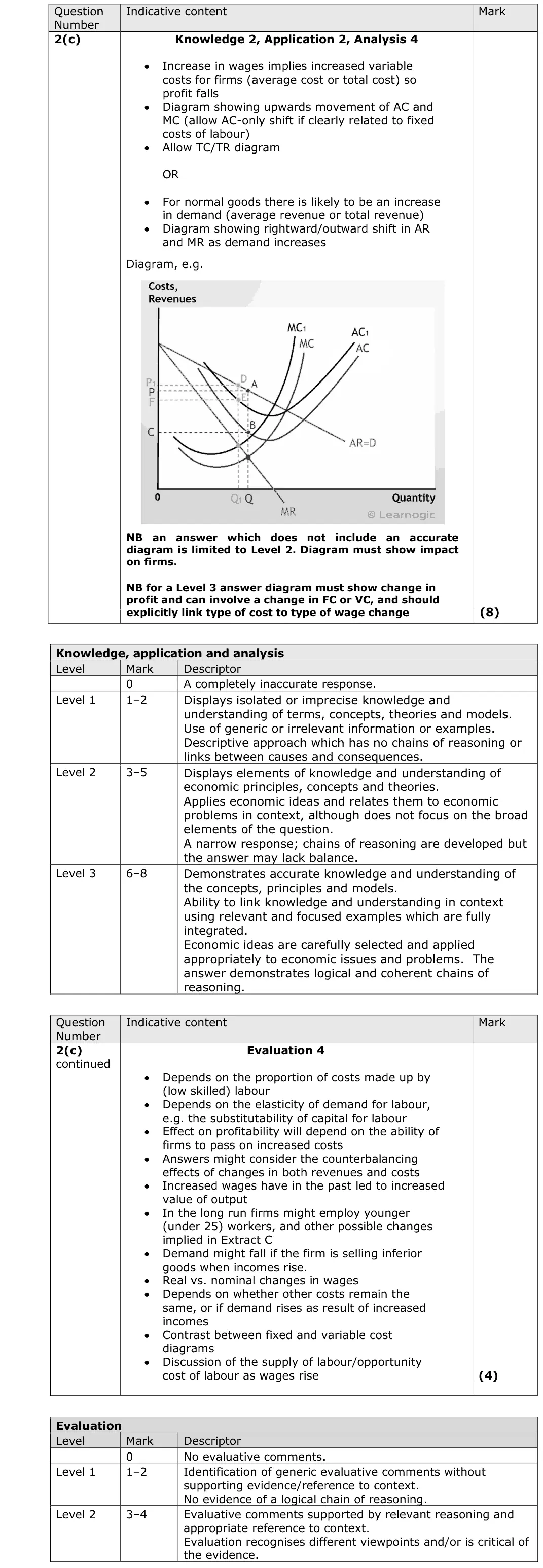
Notes from the mark scheme and report
a higher wage raises variable costs so AC and MC shift up (AC only if treated as a fixed cost)
Level 3 diagram must show the change in profit at the new MC = MR output
evaluate: only 0.3% rise in wage costs, under-25s exempt, ability to pass on costs, productivity gains
Quantitative skills: QS 4 (construct and interpret a range of standard graphical forms)
Work with an Edexcel economics tutor
Essays stuck in Level 2, or losing the easy marks in Section A? Book a trial session with Lianne, a former Edexcel examiner.