Notes and key-term cards for this topic are being written by our tutors. The past-paper questions below are ready now.
Specification statements
1.1.5Specialisation and the division of labour: a) Specialisation and the division of labour: reference to Adam Smith b) The advantages and disadvantages of specialisation and the division of labour in organising production c) The advantages and disadvantages of specialising in the production of goods and services to trade d) The functions of money (as a medium of exchange, a measure of value, a store of value, a method of deferred payment)AS
Tap a question to zoom it. The data and extracts fold out above each question; the mark scheme and examiner's comment open underneath.
June 2024 · Paper 3 · Q1(e)25 marksAO1=4, AO2=4, AO3=8, AO4=925-mark essayEither/or
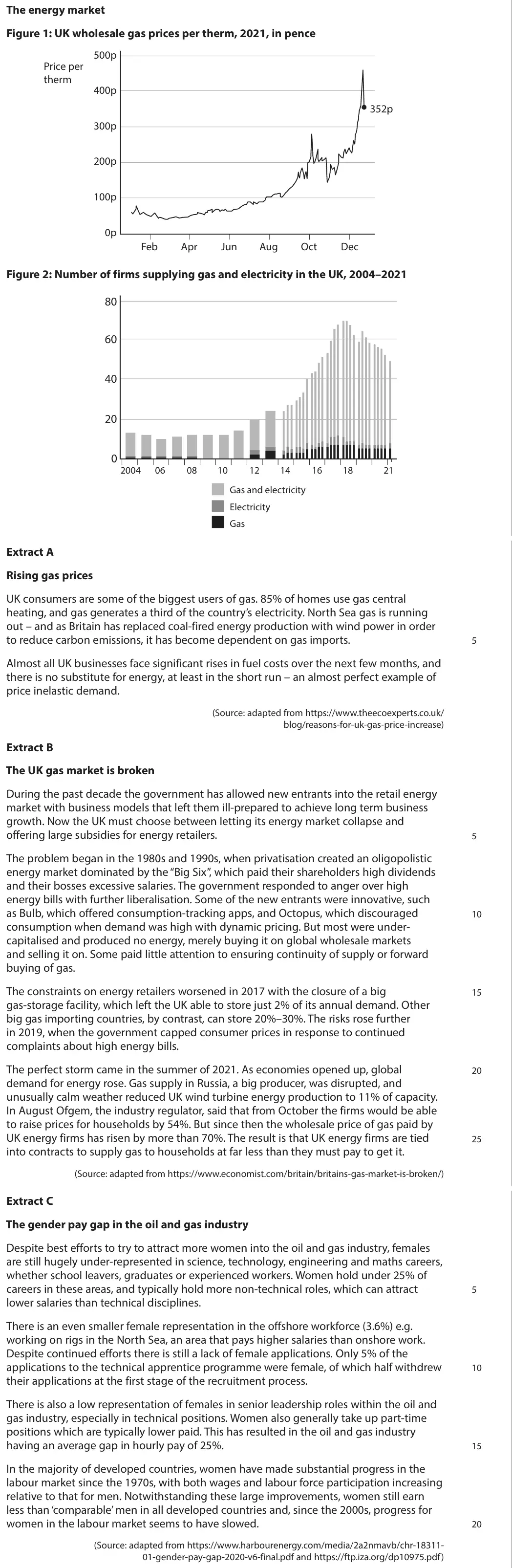
Data and extracts for question 1
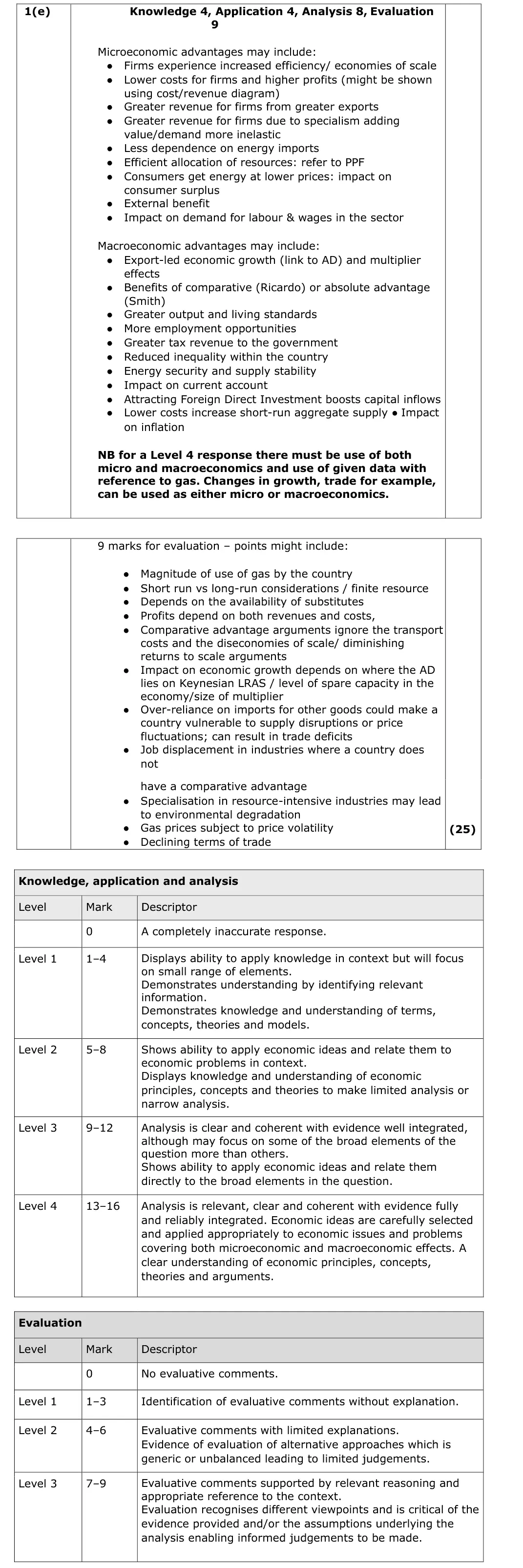
Mark scheme, including the levels grid and indicative content
Examiner's comment
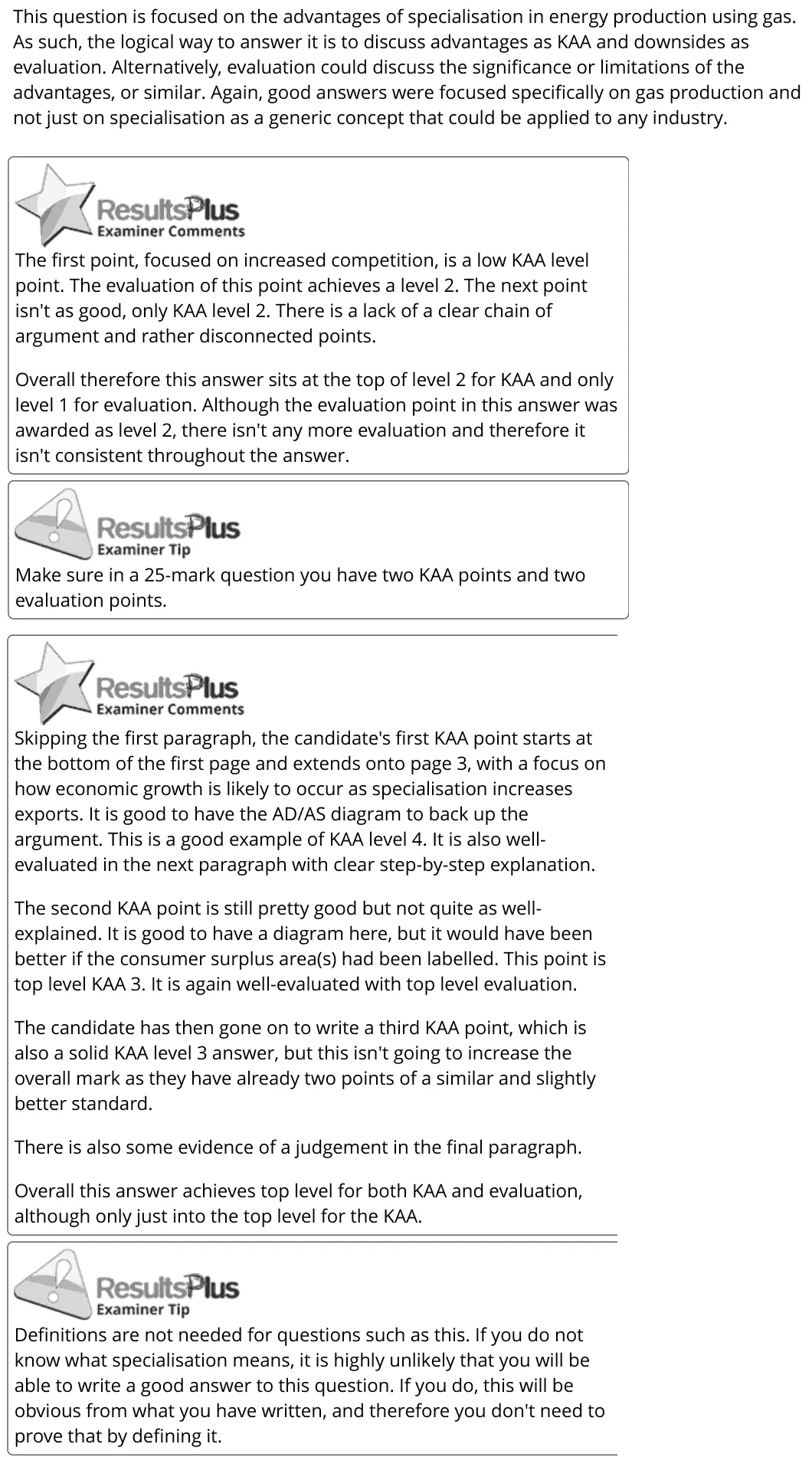
This question is focused on the advantages of specialisation in energy production using gas. As such, the logical way to answer it is to discuss advantages as KAA and downsides as evaluation. Alternatively, evaluation could discuss the significance or limitations of the advantages, or similar. Again, good answers were focused specifically on gas production and not just on specialisation as a generic concept that could be applied to any industry. <6ResultsPlus The first point, focused on increased competition, is a low KAA level point. The evaluation of this point achieves a level 2. The next point isn't as good, only KAA level 2. There is a lack of a clear chain of argument and rather disconnected points. Overall therefore this answer sits at the top of level 2 for KAA and only level 1 for evaluation. Although the evaluation point in this answer was awarded as level 2, there isn't any more evaluation and therefore it isn't consistent throughout the answer. GEG ResultsPlus Make sure in a 25-mark question you have two KAA points and two evaluation points. <p BesultsPtus Skipping the first paragraph, the candidate's first KAA point starts at the bottom of the first page and extends onto page 3, with a focus on how economic growth is likely to occur as specialisation increases exports. It is good to have the AD/AS diagram to back up the argument. This is a good example of KAA level 4. It is also well- evaluated in the next paragraph with clear step-by-step explanation. The second KAA point is still pretty good but not quite as well- explained. It is good to have a diagram here, but it would have been better if the consumer surplus area(s) had been labelled. This point is top level KAA 3. It is again well-evaluated with top level evaluation. The candidate has then gone on to write a third KAA point, which is also a solid KAA level 3 answer, but this isn't going to increase the overall mark as they have already two points of a similar and slightly better standard. There is also some evidence of a judgement in the final paragraph. Overall this answer achieves top level for both KAA and evaluation, although only just into the top level for the KAA. GM) | Examiner Tip Definitions are not needed for questions such as this. If you do not know what specialisation means, it is highly unlikely that you will be able to write a good answer to this question. If you do, this will be obvious from what you have written, and therefore you don't need to prove that by defining it.
Notes from the mark scheme and report
micro: economies of scale, lower costs and higher profits, exports
macro: export-led growth and multiplier, comparative advantage, jobs, tax revenue, energy security
Level 4 needs both micro and macro applied to gas
evaluate with finite resource, price volatility, over-dependence, environmental damage
June 2023 · AS Paper 1 · Q3(a)1 markAO1=1Definition
Data and extracts for question 3
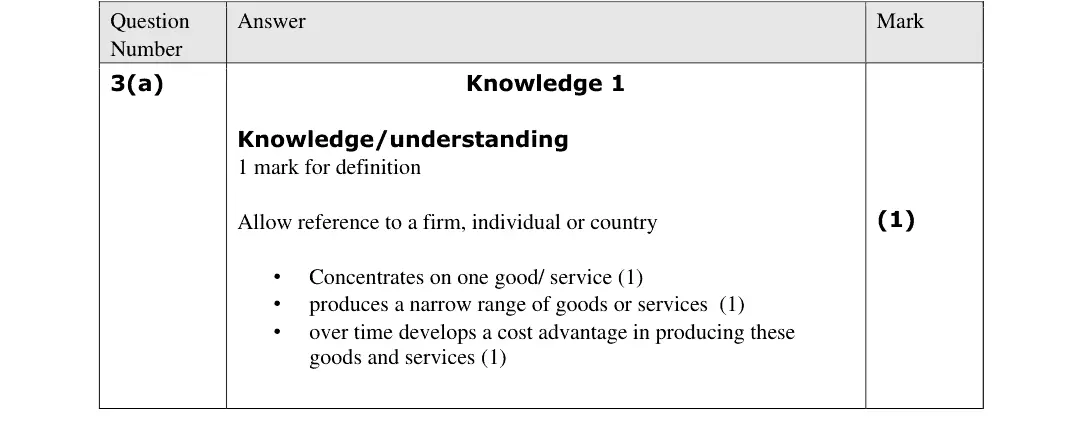
Mark scheme
Examiner's comment
Specialisation and the ‘focus’ upon a particular task was clearly well understood by the majority of candidates A more complicated question in terms of advantages to trade of specialisation was answered less well, with many students not fully targeting their answer to trade and limiting the mark award.
Notes from the mark scheme and report
a firm, individual or country concentrating on producing one or a narrow range of goods or services
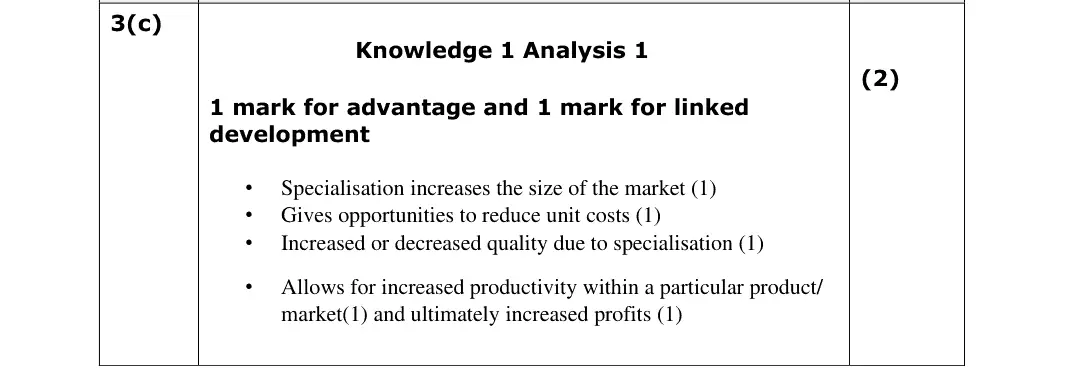
June 2023 · AS Paper 1 · Q3(c)2 marksAO1=1, AO3=1Short answer
Data and extracts for question 3
Mark scheme
Notes from the mark scheme and report
one advantage of specialising to trade (larger market, lower unit costs, higher productivity) plus a linked development
many did not target the answer to trade
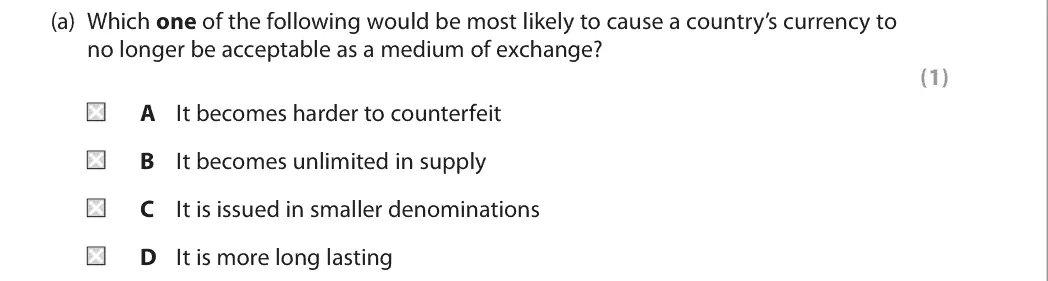
June 2022 · AS Paper 1 · Q3(a)1 markMultiple choice
Data and extracts for question 3
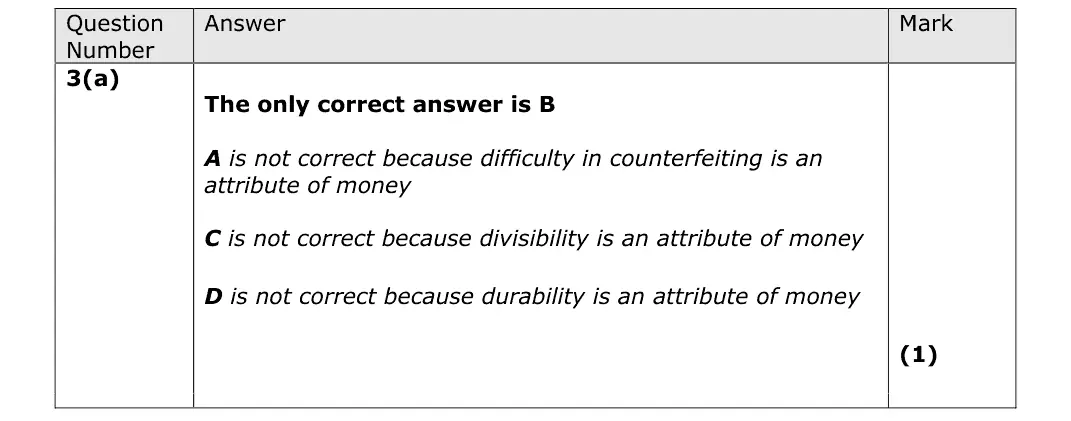
Answer
B
Mark scheme
Notes from the mark scheme and report
money unlimited in supply loses its value and acceptability (B)
being hard to counterfeit, divisible and durable are desirable attributes of money
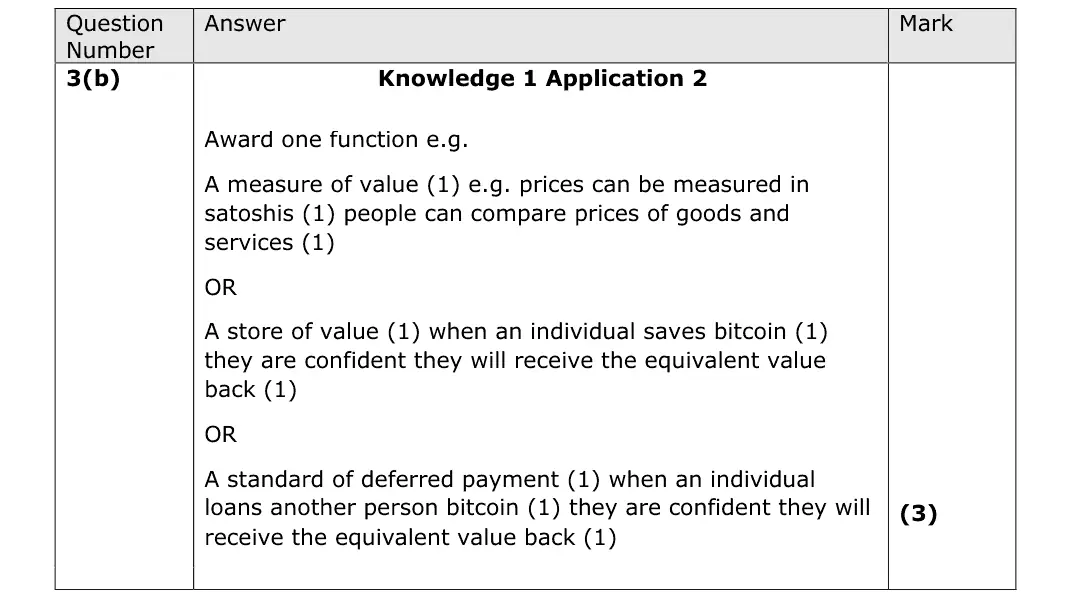
June 2022 · AS Paper 1 · Q3(b)3 marksAO1=1, AO2=2Short answer
Data and extracts for question 3
Mark scheme
Examiner's comment
This question was a challenge for some. Many candidates were able to explain a function of money in relation to Bitcoin, but a minority were able to score full marks. Candidates typically confused the different functions of money.
Notes from the mark scheme and report
one other function (measure of value, store of value, standard of deferred payment) applied to Bitcoin, e.g. prices measured in satoshis
report: a challenge, only a minority scored full marks, functions were confused
June 2022 · AS Paper 1 · Q6(e)15 marksAO1=3, AO2=3, AO3=3, AO4=615-mark response
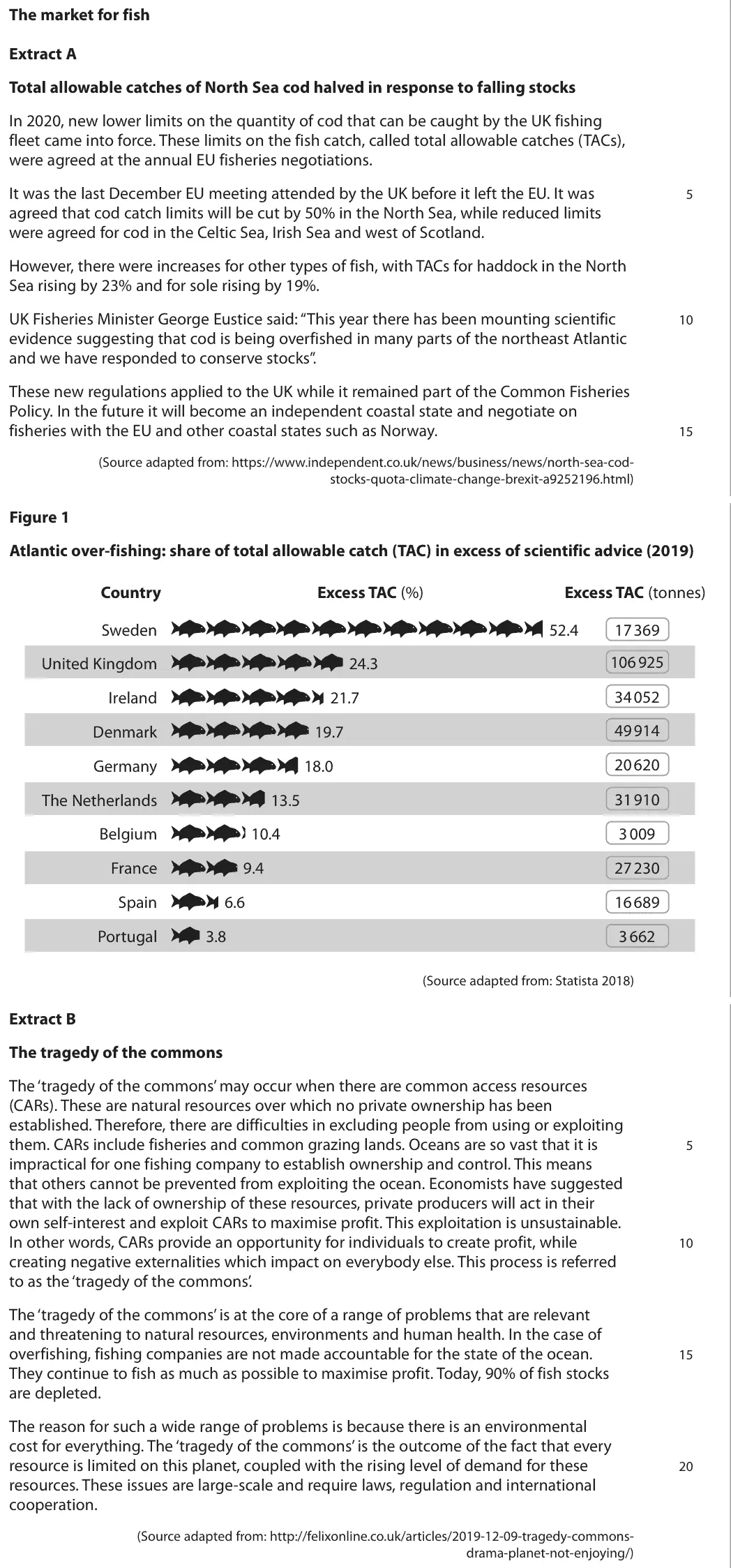
Data and extracts for question 6
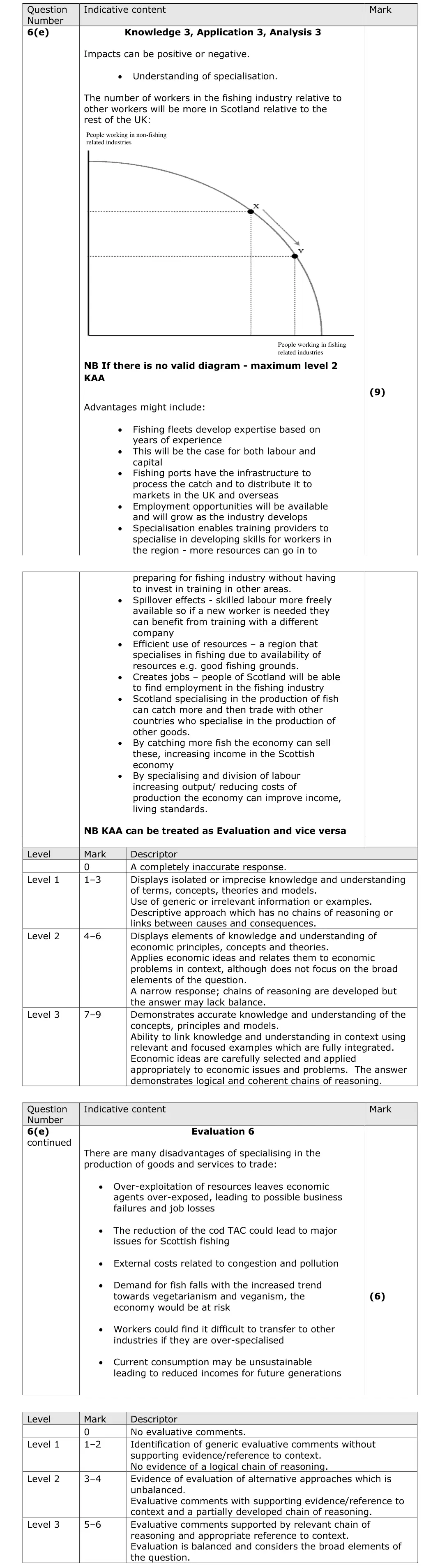
Mark scheme, including the levels grid and indicative content
Examiner's comment
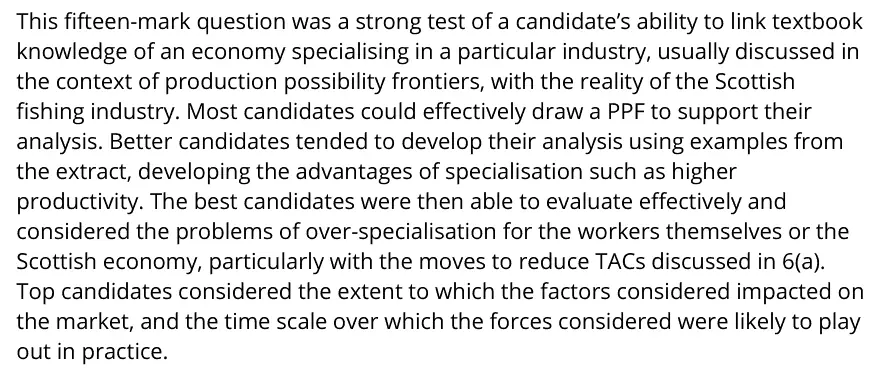
This fifteen-mark question was a strong test of a candidate’s ability to link textbook knowledge of an economy specialising in a particular industry, usually discussed in the context of production possibility frontiers, with the reality of the Scottish fishing industry. Most candidates could effectively draw a PPF to support their analysis. Better candidates tended to develop their analysis using examples from the extract, developing the advantages of specialisation such as higher productivity. The best candidates were then able to evaluate effectively and considered the problems of over-specialisation for the workers themselves or the Scottish economy, particularly with the moves to reduce TACs discussed in 6(a). Top candidates considered the extent to which the factors considered impacted on the market, and the time scale over which the forces considered were likely to play out in practice.
Notes from the mark scheme and report
PPF diagram required: specialising in fishing raises productivity and output (Scotland, 24 000 workers) and allows trade
evaluate over-specialisation, falling TACs, structural unemployment and occupational immobility
Quantitative skills: QS 4 (construct and interpret a range of standard graphical forms)
June 2019 · AS Paper 1 · Q1(a)1 markAO1=1Multiple choice
Data and extracts for question 1
Answer
A
Mark scheme
Notes from the mark scheme and report
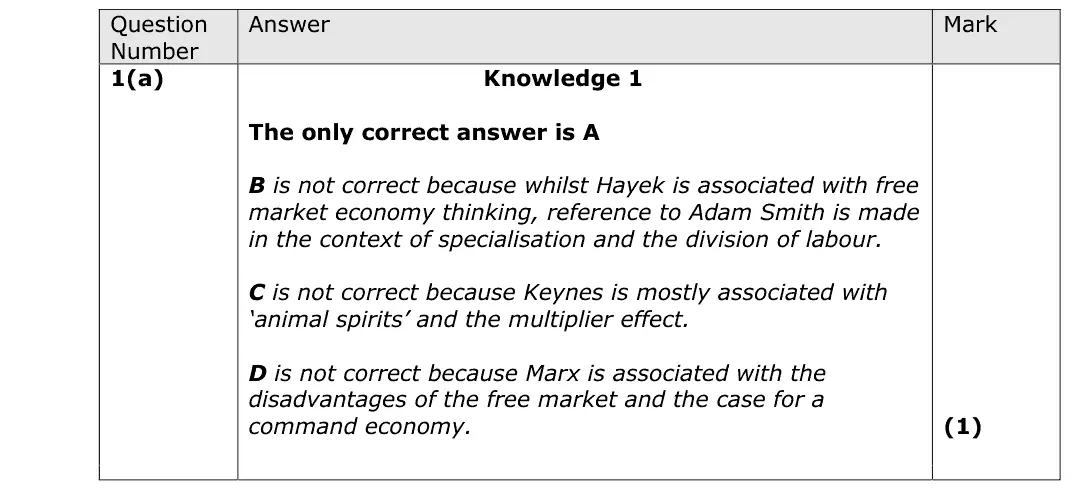
Adam Smith (A) is linked to specialisation and the division of labour (the pin factory)
Hayek is free-market thinking, Keynes animal spirits and the multiplier, Marx the case for a command economy
June 2019 · AS Paper 1 · Q1(b)3 marksAO1=1, AO2=1, AO3=1Short answer
Data and extracts for question 1
Mark scheme
Examiner's comment
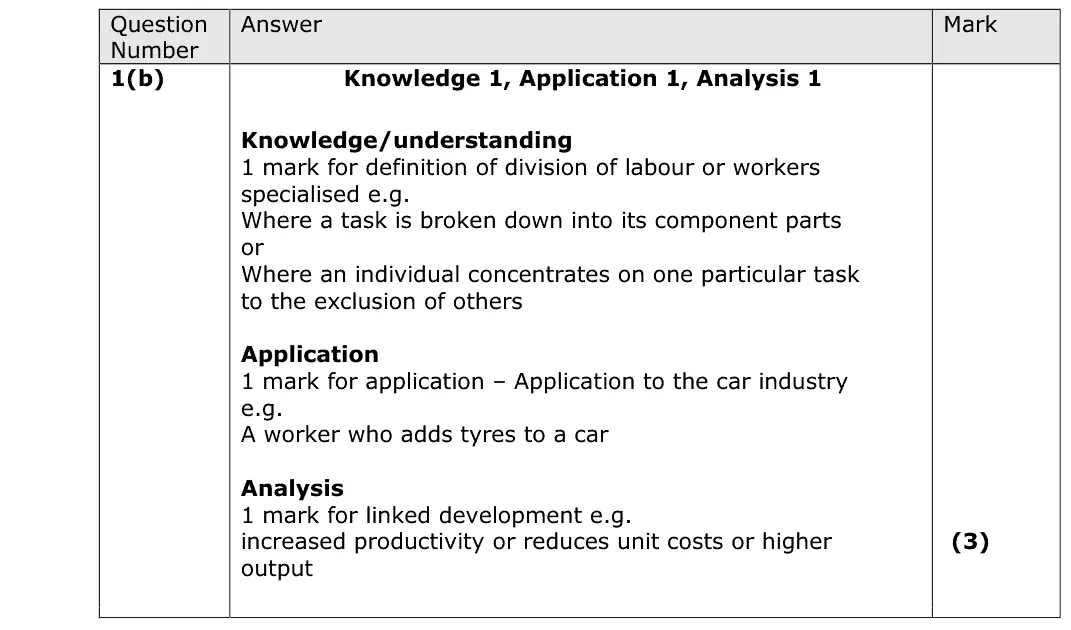
Candidates typically performed well on this question, with most able to identify what the division of labour is and go on to analyse the benefits of it for car manufacturers. Only a minority of candidates were able to give specific examples from the car industry which were necessary to gain the application mark.
Notes from the mark scheme and report
define division of labour (task broken into parts)
apply to cars, e.g. a worker who only fits tyres on the assembly line
develop to higher productivity or lower unit costs
only a minority gave a specific car-industry example for the application mark
June 2019 · Paper 1 · Q5(c)2 marksAO1=1, AO3=1Short answer
Data and extracts for question 5
Mark scheme
Examiner's comment
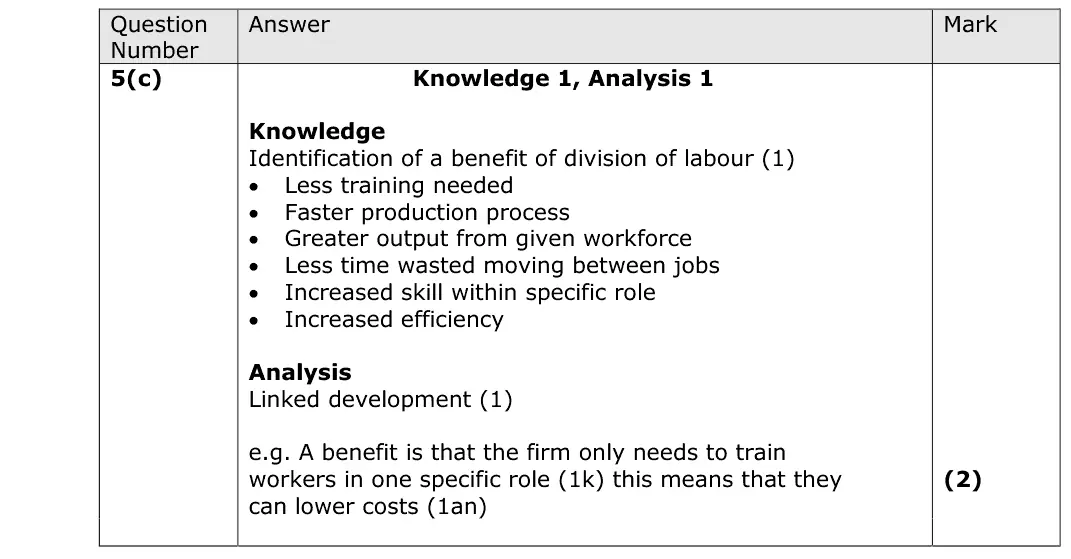
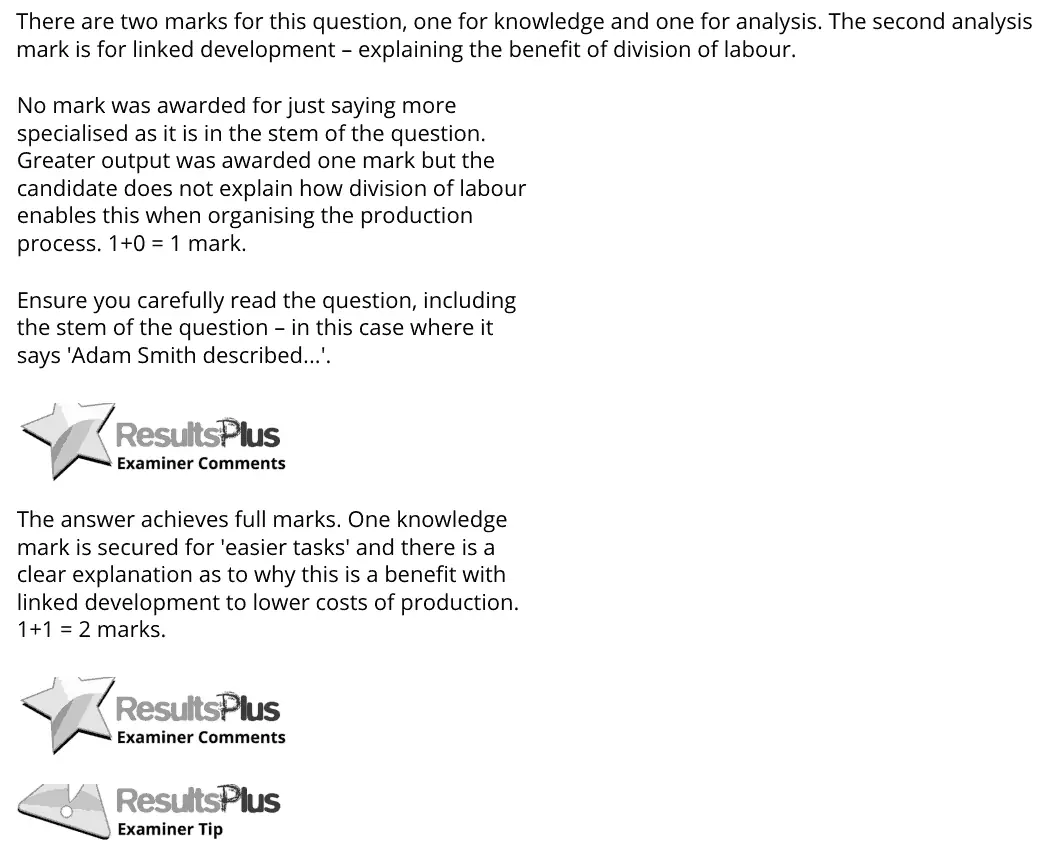
There are two marks for this question, one for knowledge and one for analysis. The second analysis mark is for linked development – explaining the benefit of division of labour. No mark was awarded for just saying more specialised as it is in the stem of the question. Greater output was awarded one mark but the candidate does not explain how division of labour enables this when organising the production process. 1+0 = 1 mark. Ensure you carefully read the question, including the stem of the question – in this case where it says 'Adam Smith described...'. The answer achieves full marks. One knowledge mark is secured for 'easier tasks' and there is a clear explanation as to why this is a benefit with linked development to lower costs of production. 1+1 = 2 marks.
Notes from the mark scheme and report
one advantage (less training, faster production, more output, higher efficiency) with a linked development such as lower costs
"more specialised" alone earns nothing as it is in the stem
June 2016 · AS Paper 1 · Q1(a)1 markMultiple choice
Answer
C
Mark scheme
Notes from the mark scheme and report
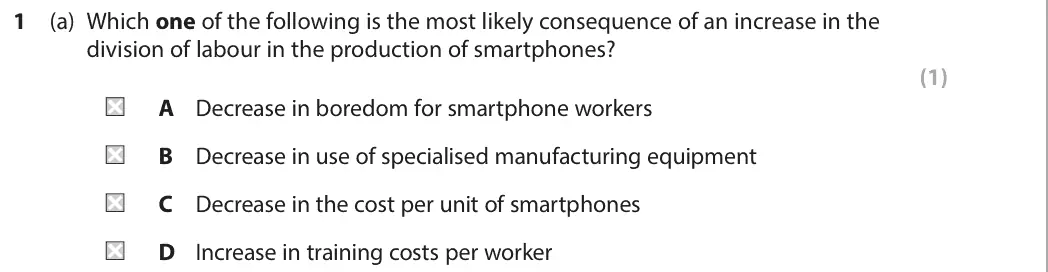
division of labour raises productivity so cost per unit falls (C)
it tends to increase boredom, increase use of specialised equipment and reduce training cost per worker
June 2016 · AS Paper 1 · Q1(b)3 marksAO1=1, AO2=1, AO3=1Short answer
Mark scheme
Examiner's comment
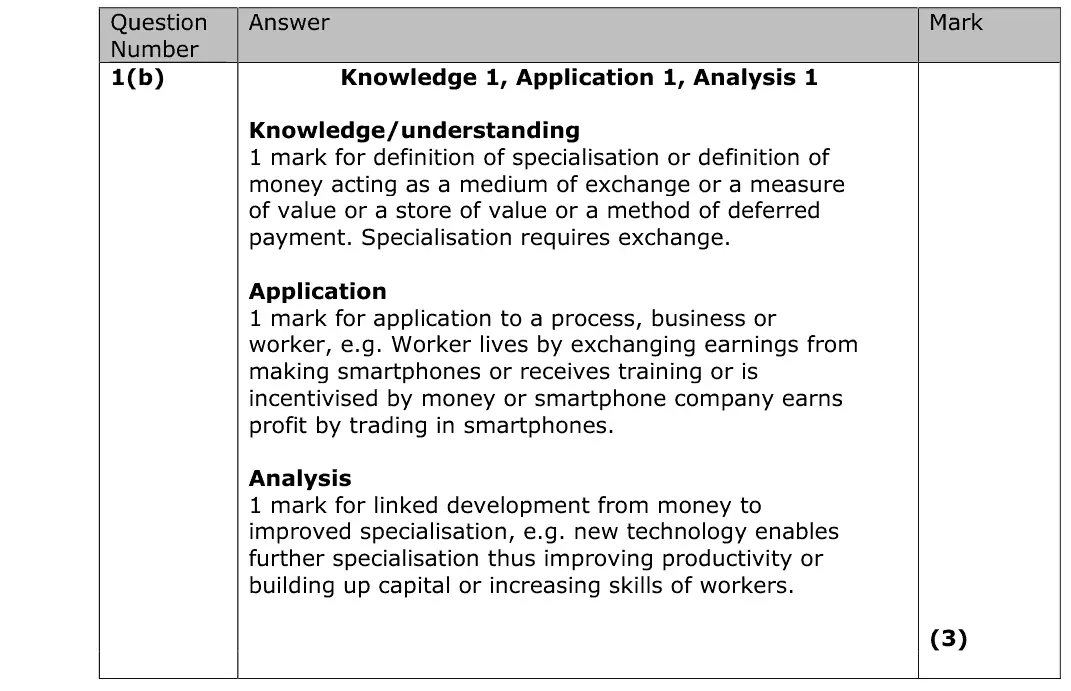
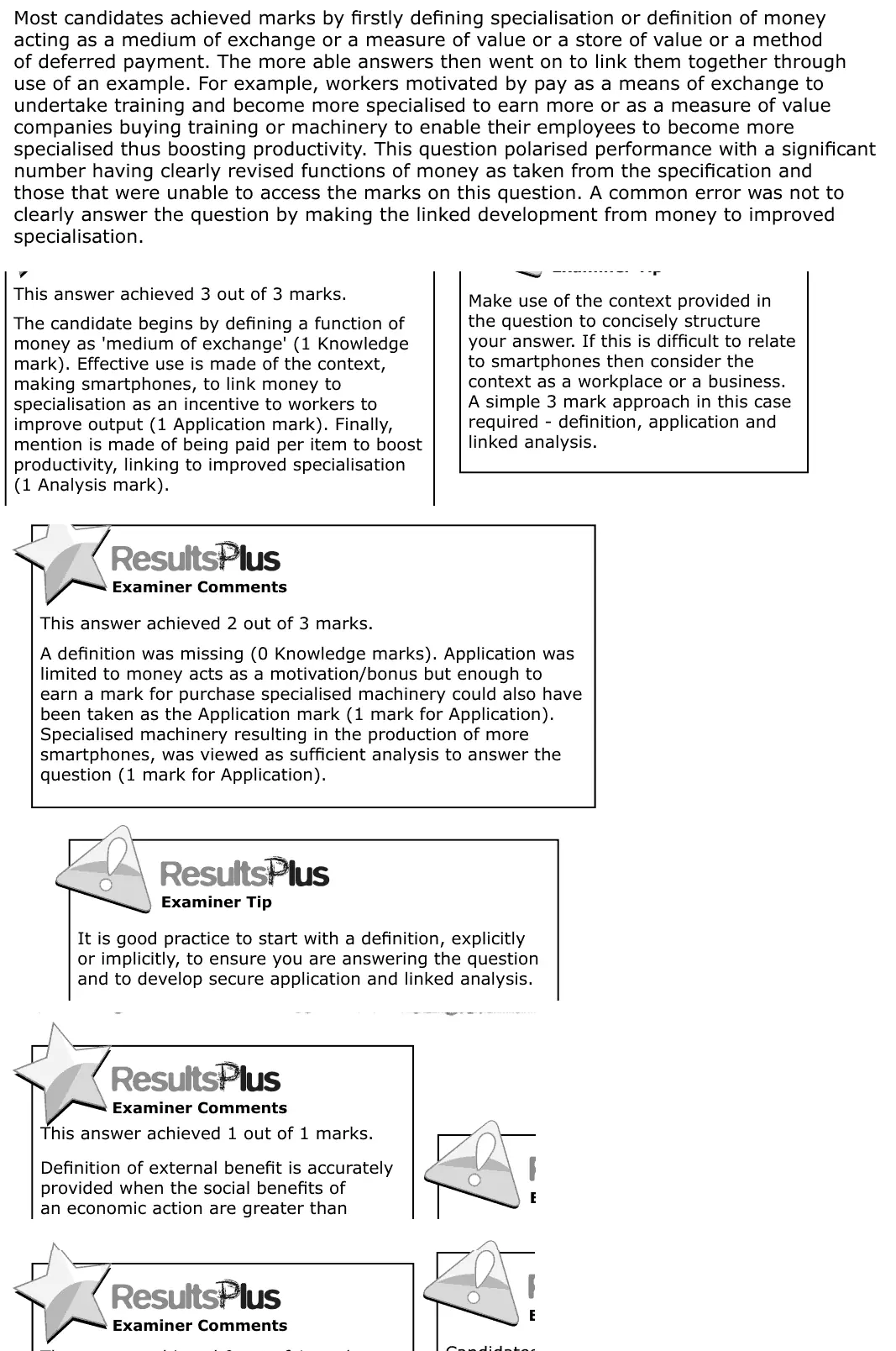
Most candidates achieved marks by firstly defining specialisation or definition of money acting as a medium of exchange or a measure of value or a store of value or a method of deferred payment. The more able answers then went on to link them together through use of an example. For example, workers motivated by pay as a means of exchange to undertake training and become more specialised to earn more or as a measure of value companies buying training or machinery to enable their employees to become more specialised thus boosting productivity. This question polarised performance with a significant number having clearly revised functions of money as taken from the specification and those that were unable to access the marks on this question. A common error was not to clearly answer the question by making the linked development from money to improved specialisation. This answer achieved 3 out of 3 marks. The candidate begins by defining a function of money as 'medium of exchange' (1 Knowledge mark). Effective use is made of the context, making smartphones, to link money to specialisation as an incentive to workers to improve output (1 Application mark). Finally, mention is made of being paid per item to boost productivity, linking to improved specialisation (1 Analysis mark). Make use of the context provided in the question to concisely structure your answer. If this is difficult to relate to smartphones then consider the context as a workplace or a business. A simple 3 mark approach in this case required - definition, application and linked analysis. This answer achieved 2 out of 3 marks. A definition was missing (0 Knowledge marks). Application was limited to money acts as a motivation/bonus but enough to earn a mark for purchase specialised machinery could also have been taken as the Application mark (1 mark for Application). Specialised machinery resulting in the production of more smartphones, was viewed as sufficient analysis to answer the question (1 mark for Application). It is good practice to start with a definition, explicitly or implicitly, to ensure you are answering the question and to develop secure application and linked analysis.
Notes from the mark scheme and report
define specialisation or a function of money (e.g. medium of exchange), then link money to specialisation in smartphone production, e.g. workers paid in money can specialise and buy what they need
common error: no linked development from money to specialisation
Work with an Edexcel economics tutor
Essays stuck in Level 2, or losing the easy marks in Section A? Book a trial session with Lianne, a former Edexcel examiner.