June 2019: Paper 2

100 marks · 21 question parts · Paper, mark scheme and report on Pearson's site

Question by question

QTopicMarksAOType
1(a) Aggregate demand 1Multiple choice
1(b) Inflation 2AO2=2Calculation
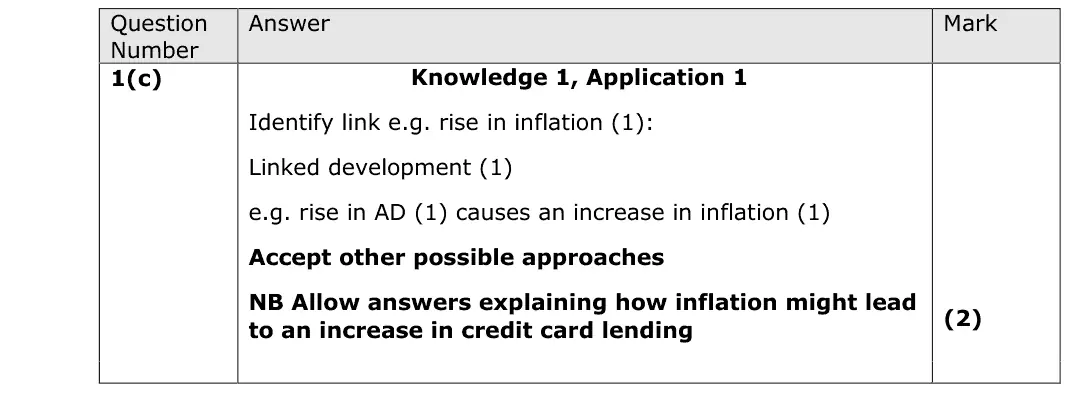
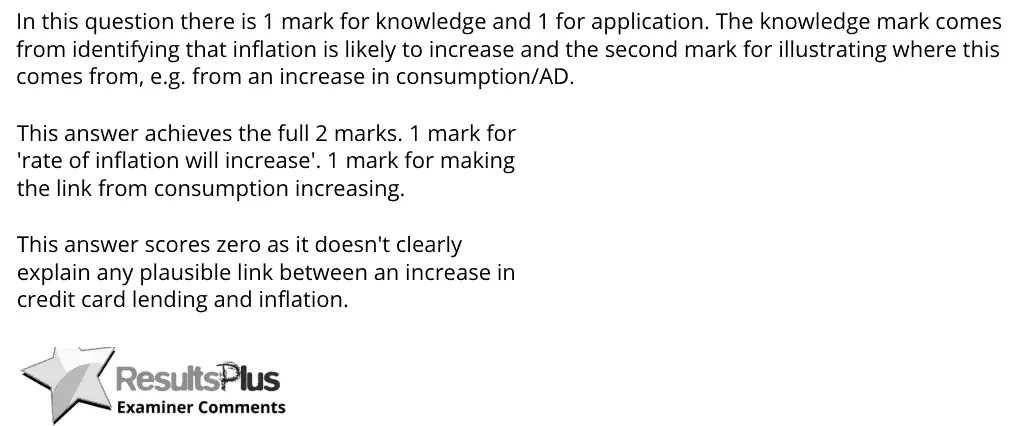
1(c) Inflation 2AO1=1,AO2=1Short answer
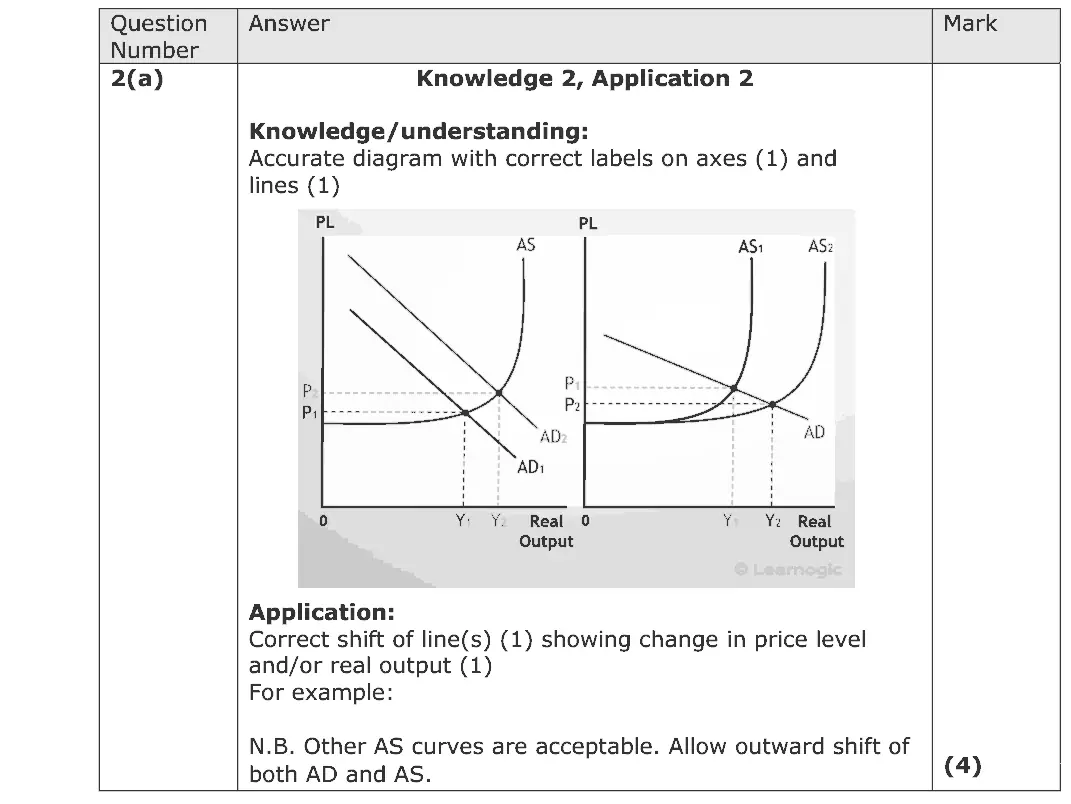
2(a) The circular flow, national income and the multiplier 4AO1=2,AO2=2Diagram
2(b) Aggregate demand 1Multiple choice
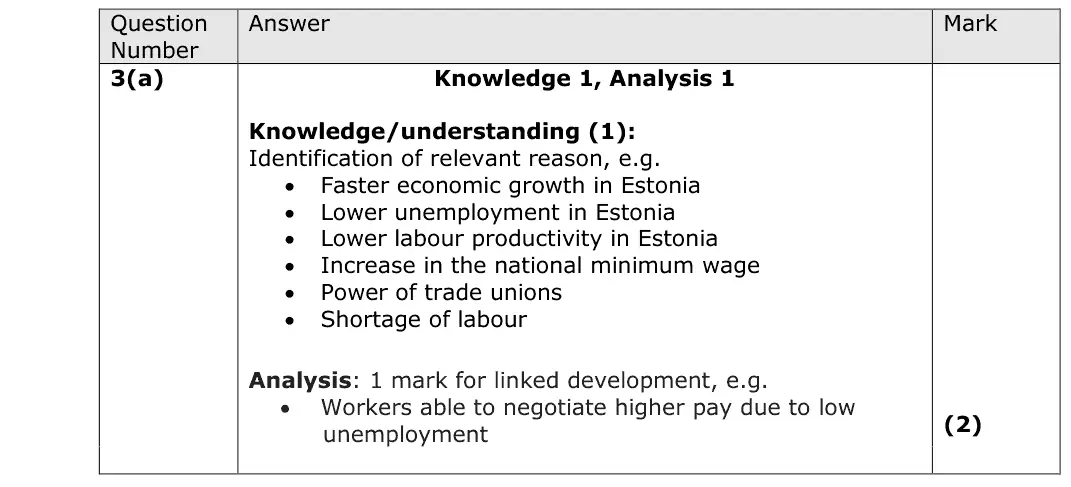
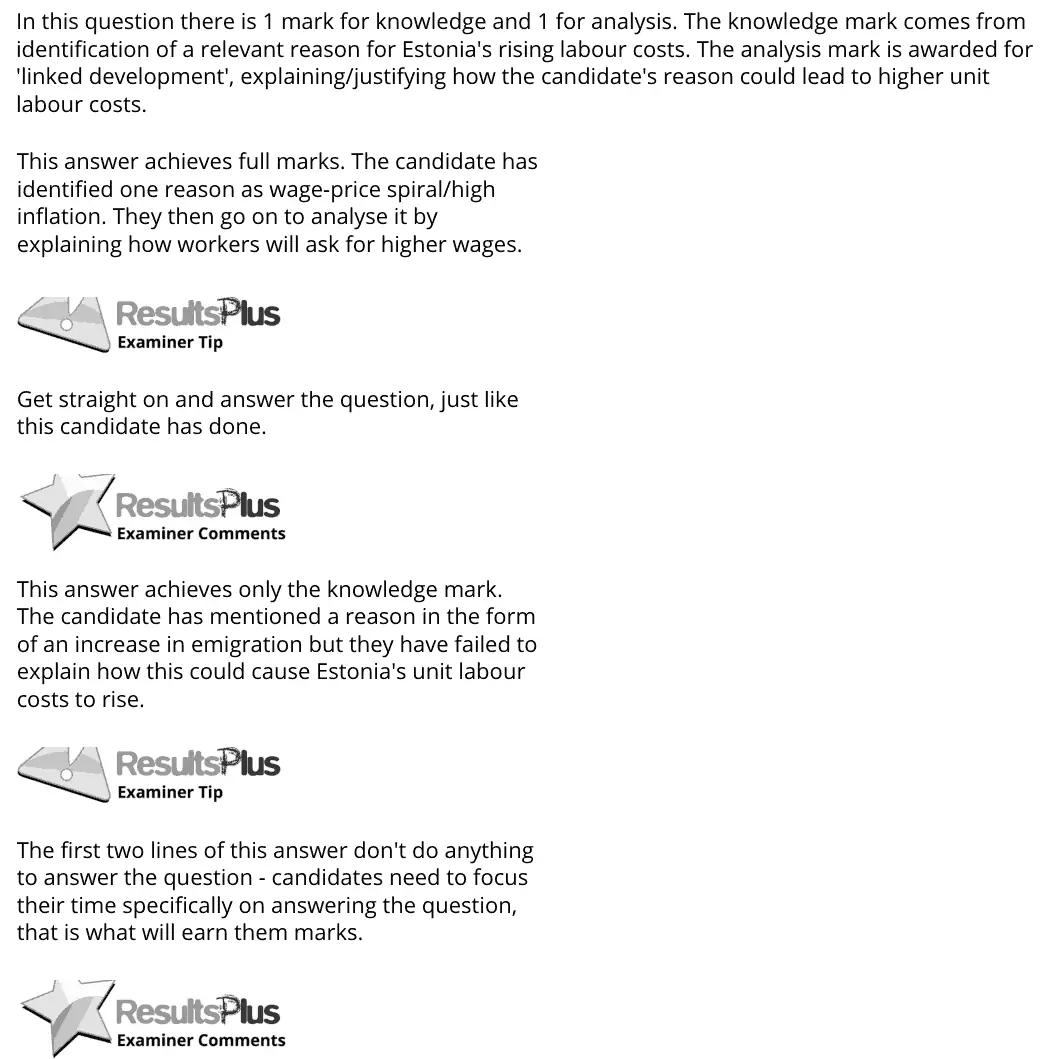
3(a) International competitiveness 2AO1=1,AO3=1Short answer
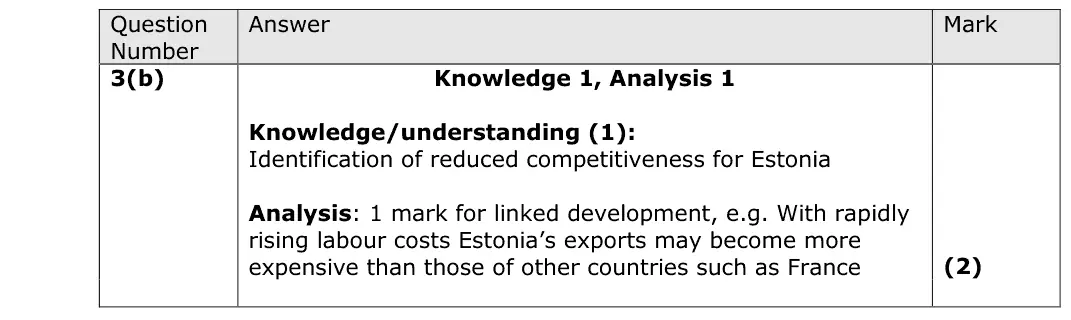
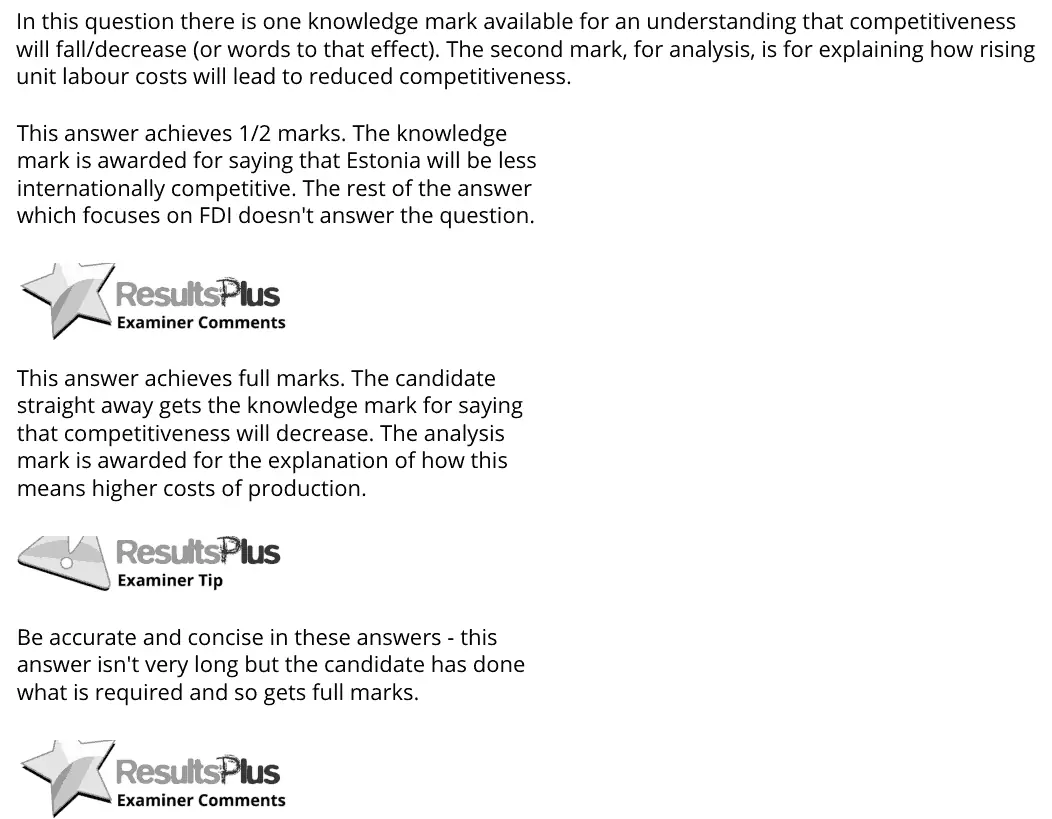
3(b) International competitiveness 2AO1=1,AO3=1Short answer
3(c) International competitiveness 1Multiple choice
4(a) Supply-side policies 1Multiple choice
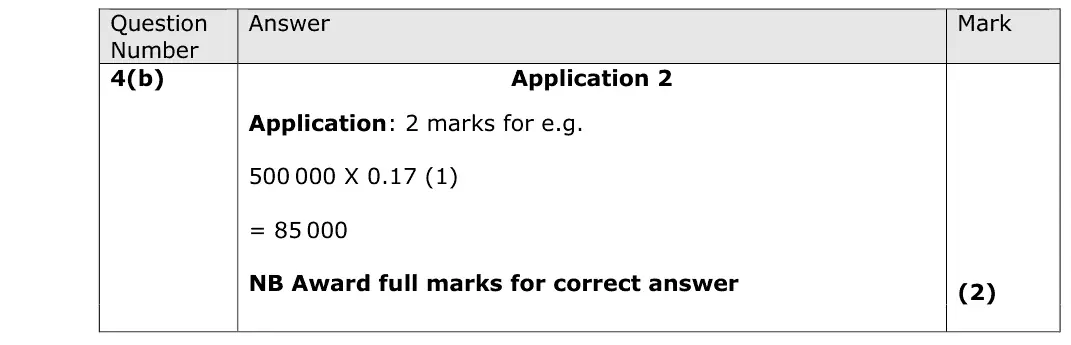
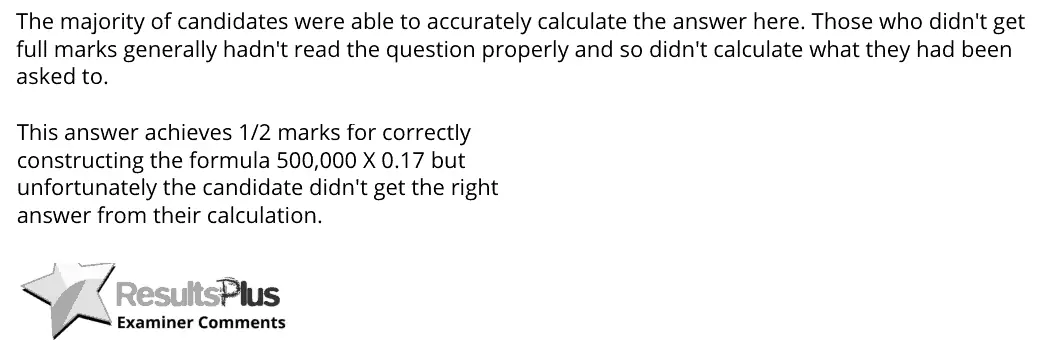
4(b) Public expenditure, taxation and public sector finances 2AO2=2Calculation
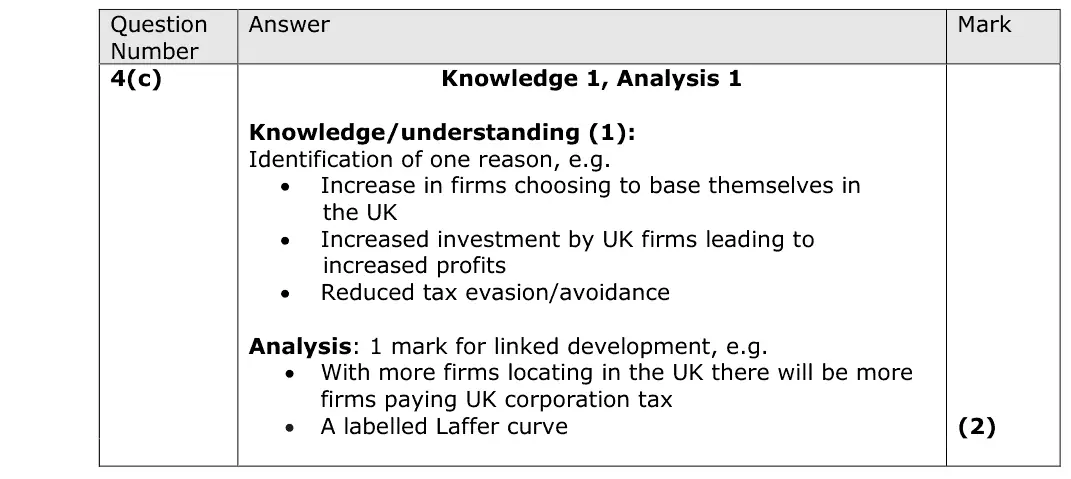
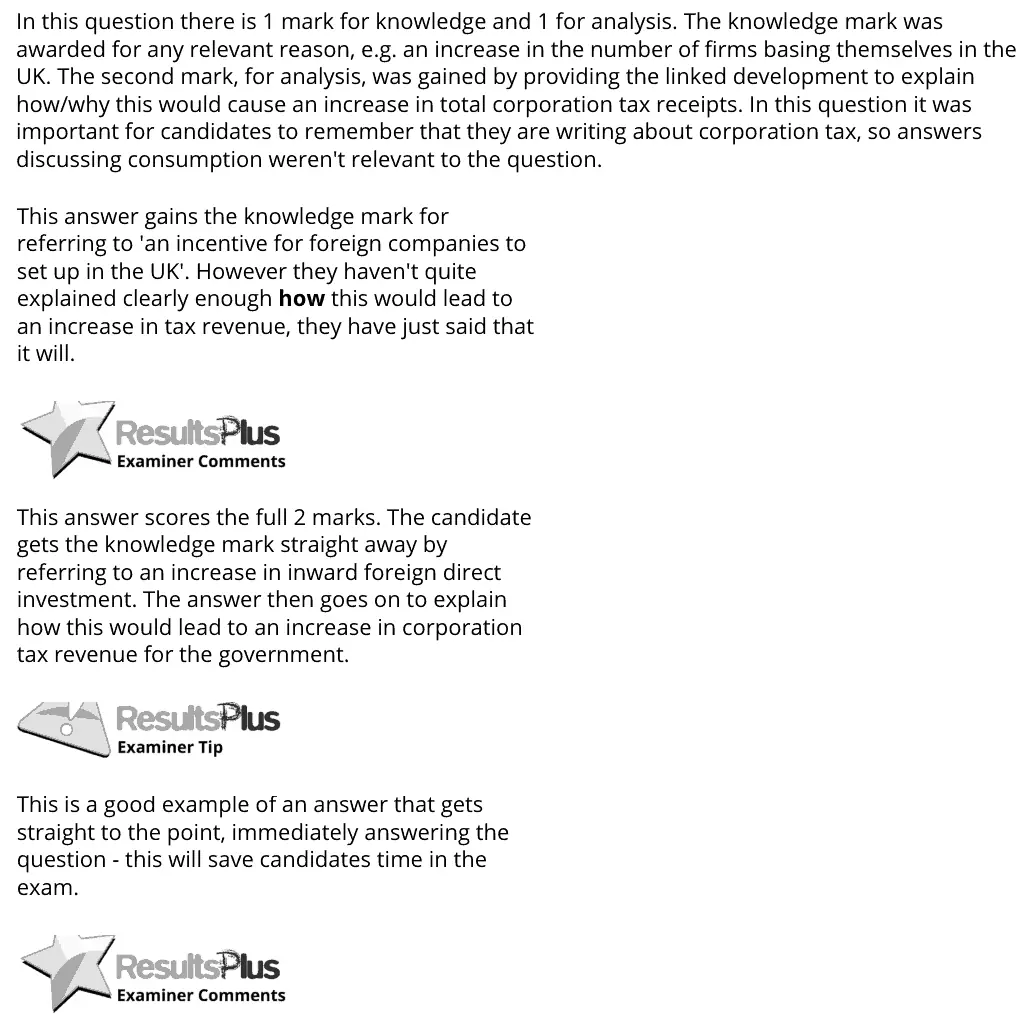
4(c) Public expenditure, taxation and public sector finances 2AO1=1,AO3=1Short answer
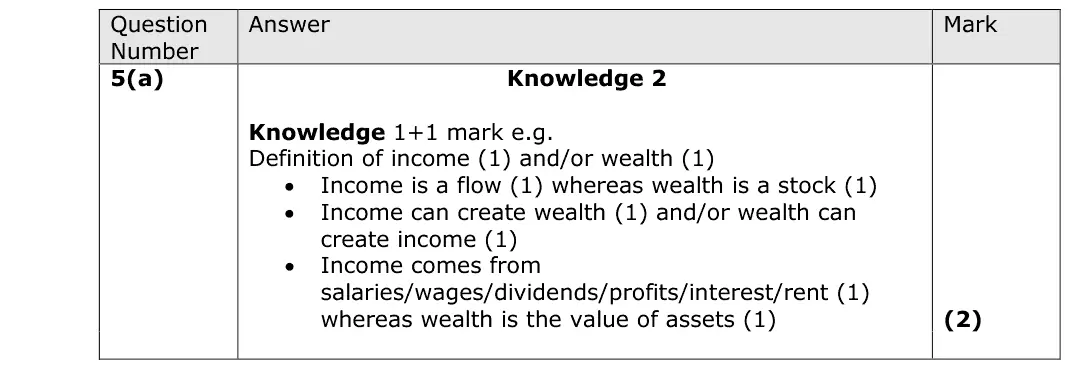
5(a) The circular flow, national income and the multiplier 2AO1=2Short answer
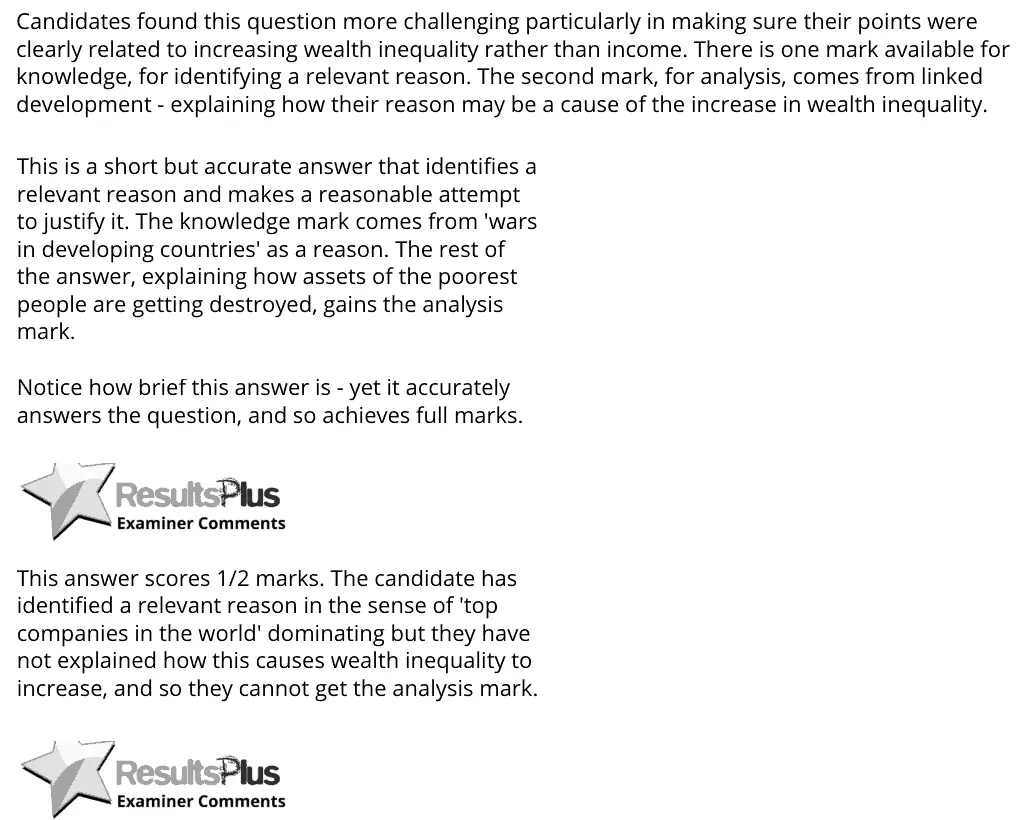
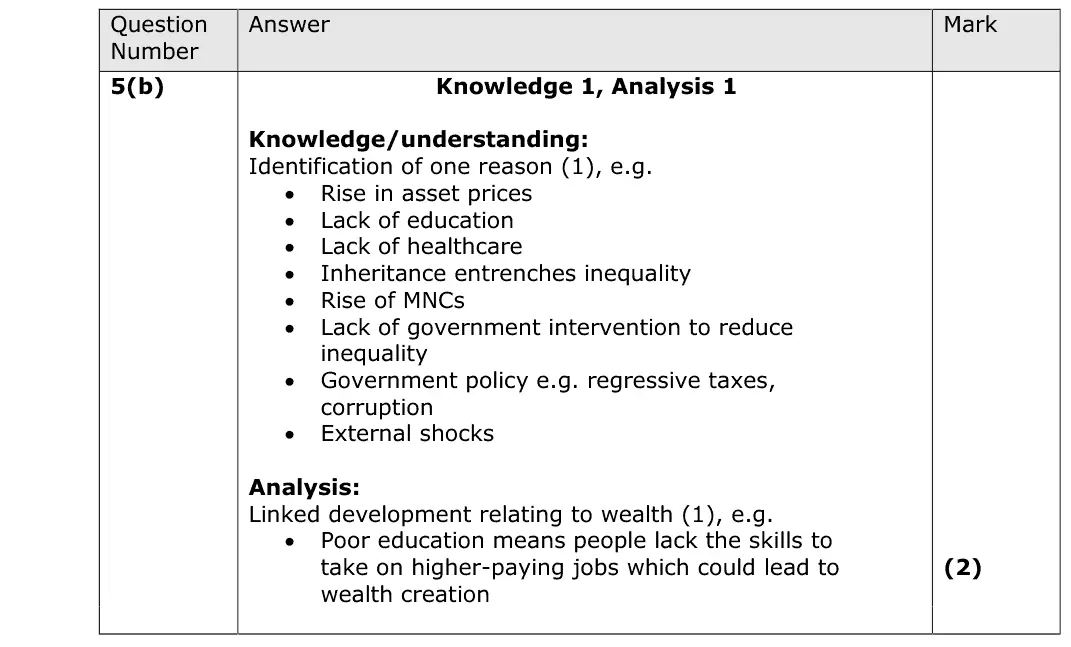
5(b) Poverty and inequality 2AO1=1,AO3=1Short answer
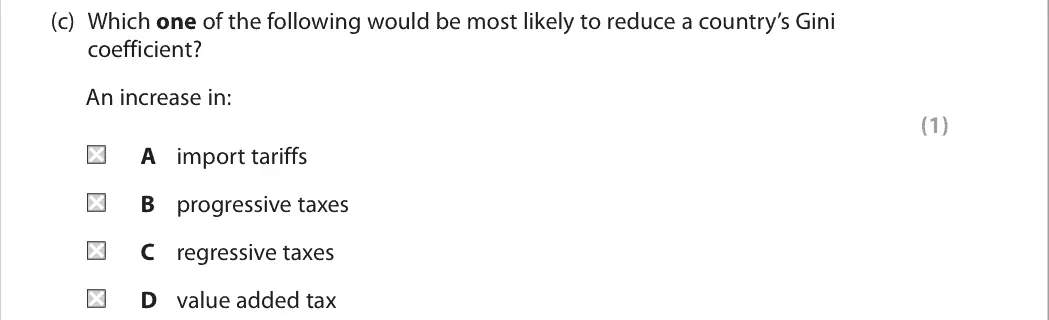
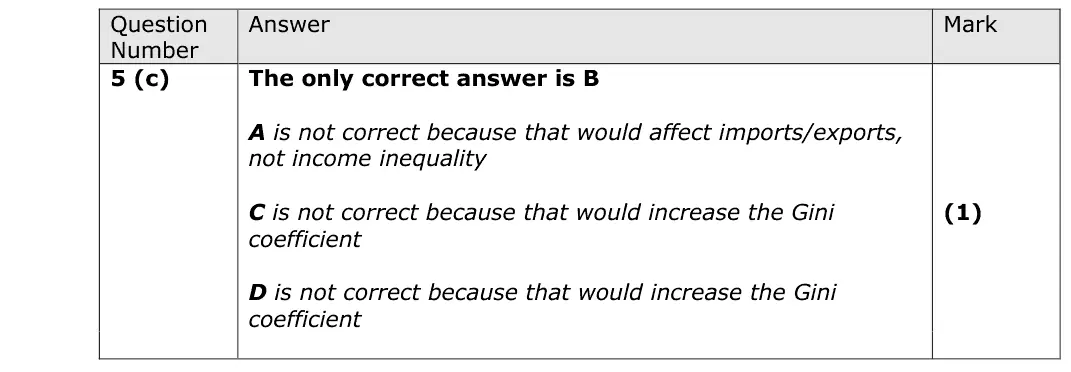
5(c) Public expenditure, taxation and public sector finances 1Multiple choice
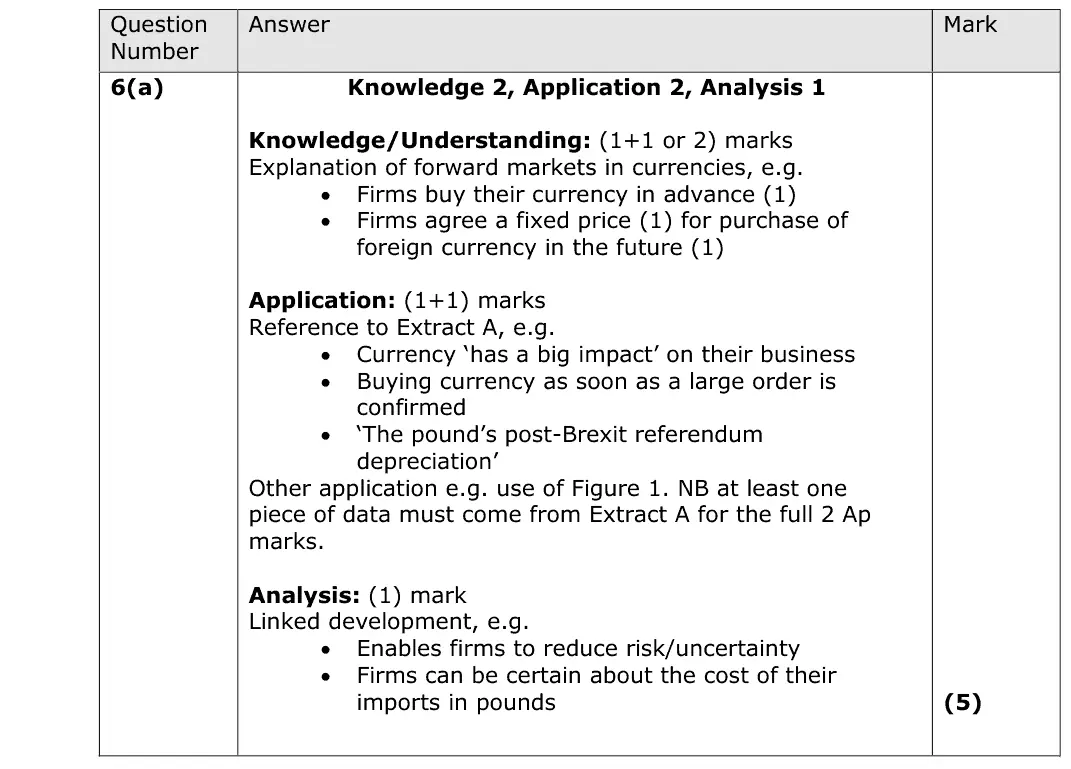
6(a) The financial sector and central banks 5AO1=2,AO2=2,AO3=1Short answer
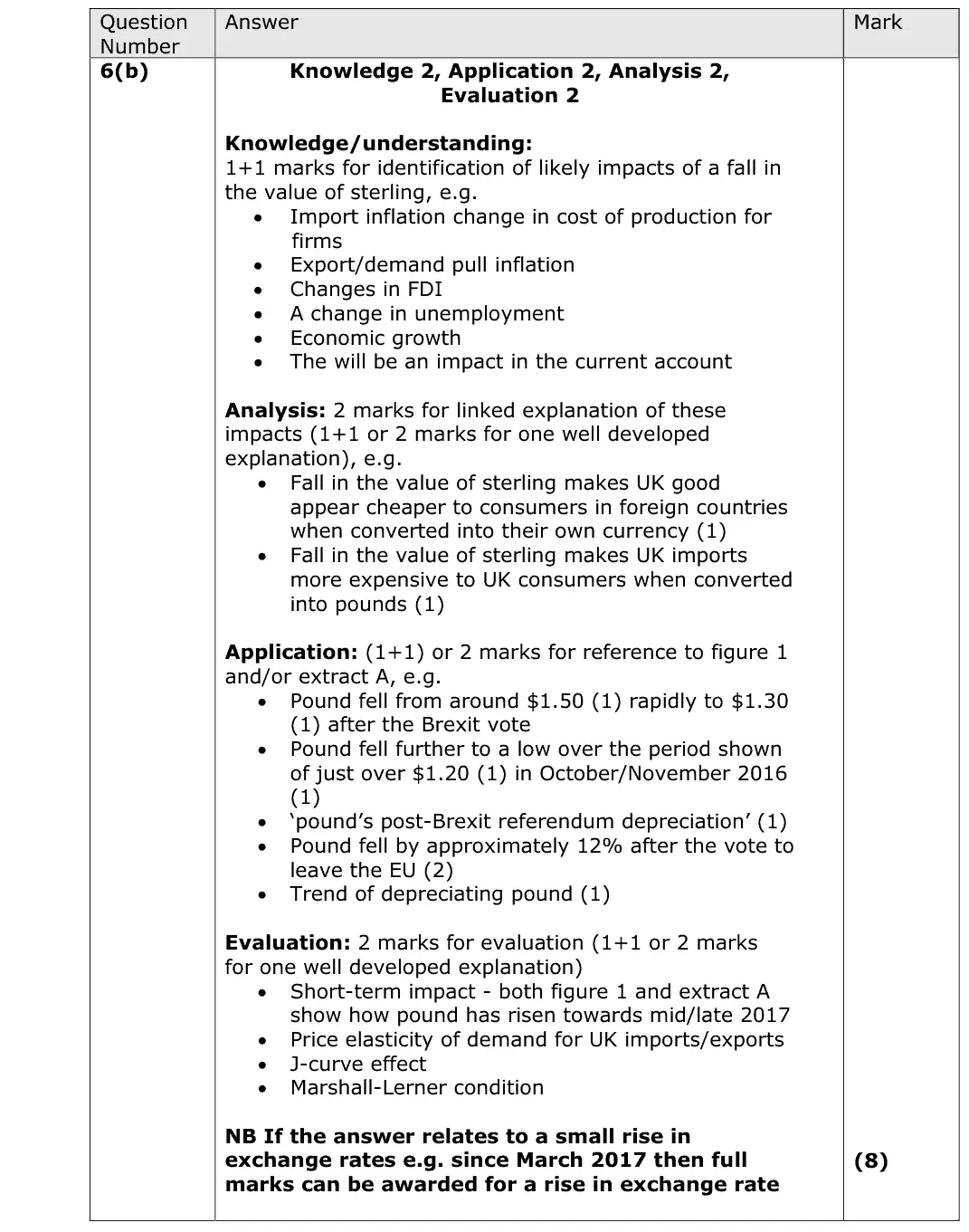
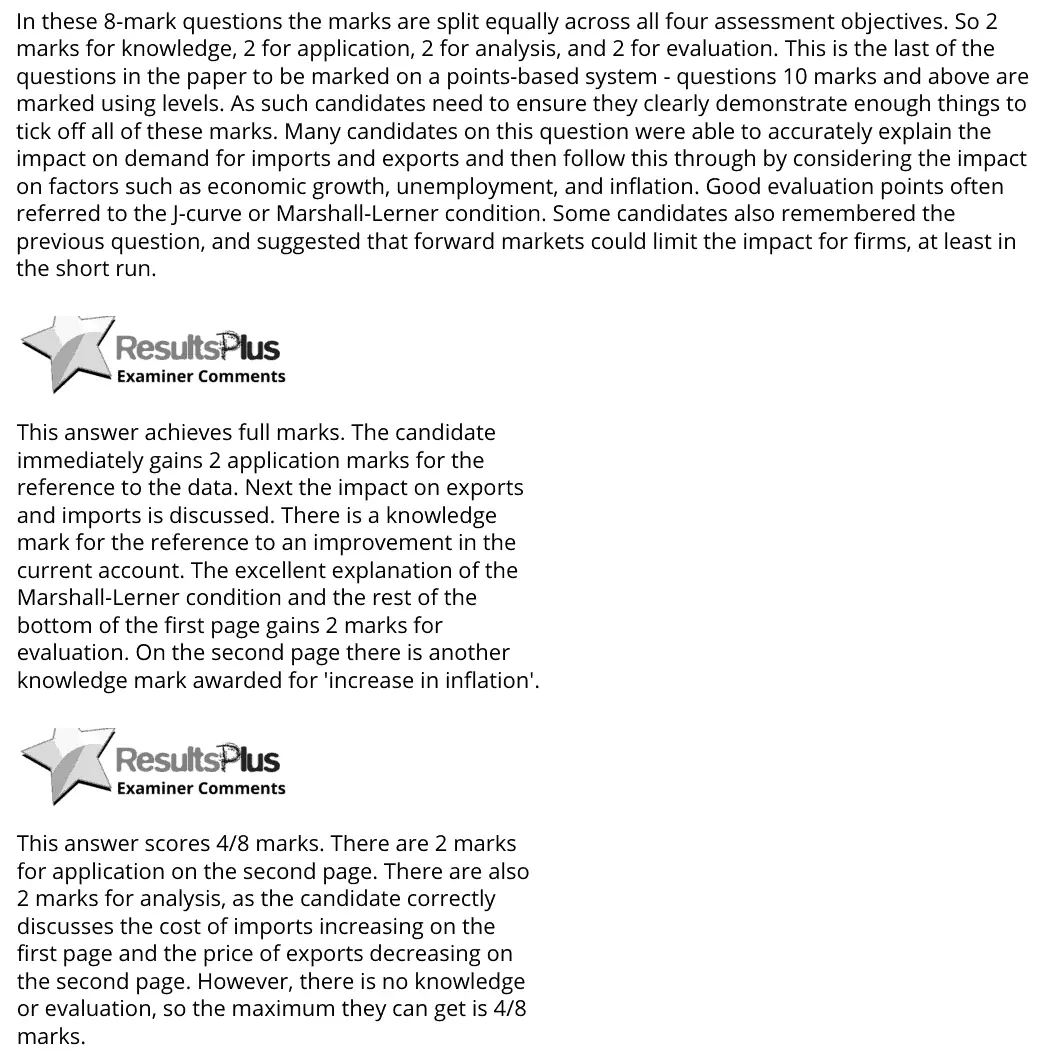
6(b) Exchange rates 8AO1=2,AO2=2,AO3=2,AO4=2Extended response
6(c) Measuring economic growth: GDP, GNI and living standards 10AO1=2,AO2=2,AO3=2,AO4=4Extended response
6(d) Macroeconomic objectives, conflicts and trade-offs, Demand-side policies: fiscal and monetary policy 12AO1=4,AO2=2,AO3=2,AO4=4Extended response
6(e) The financial sector and central banks 15AO1=3,AO2=3,AO3=3,AO4=6Extended response
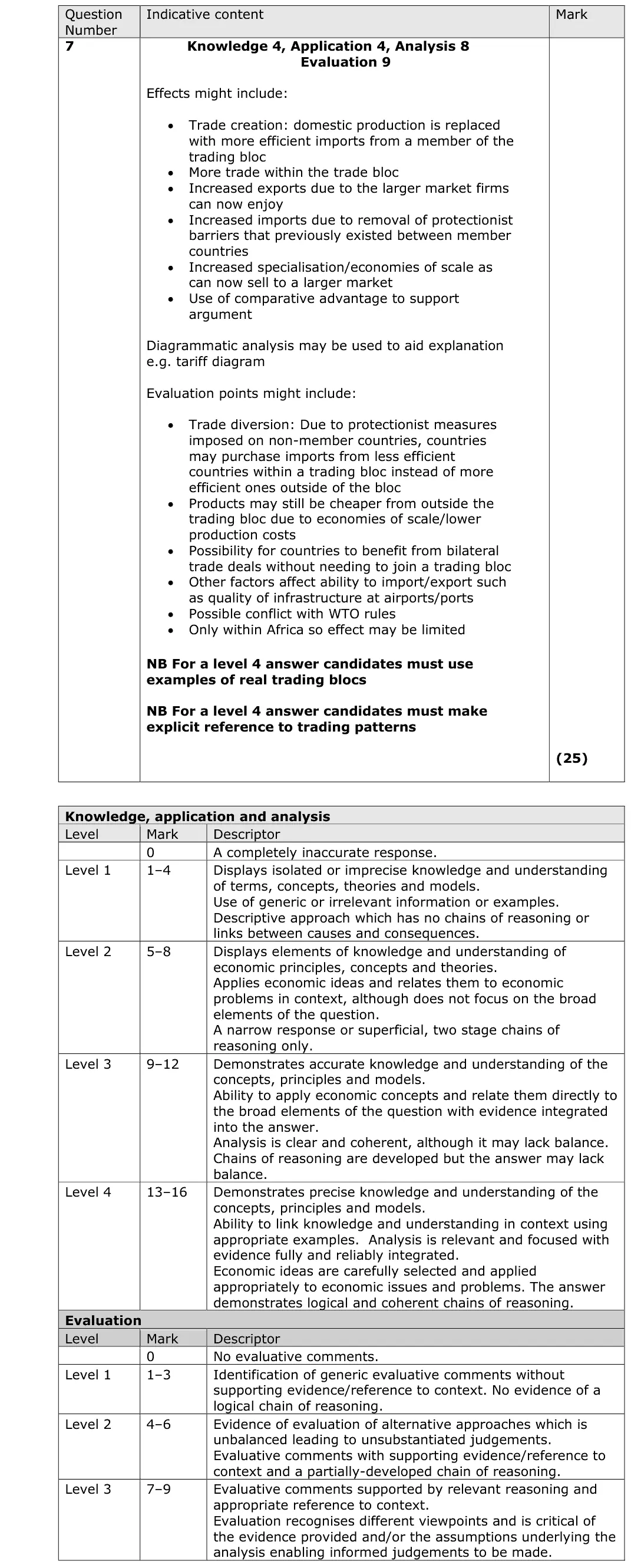
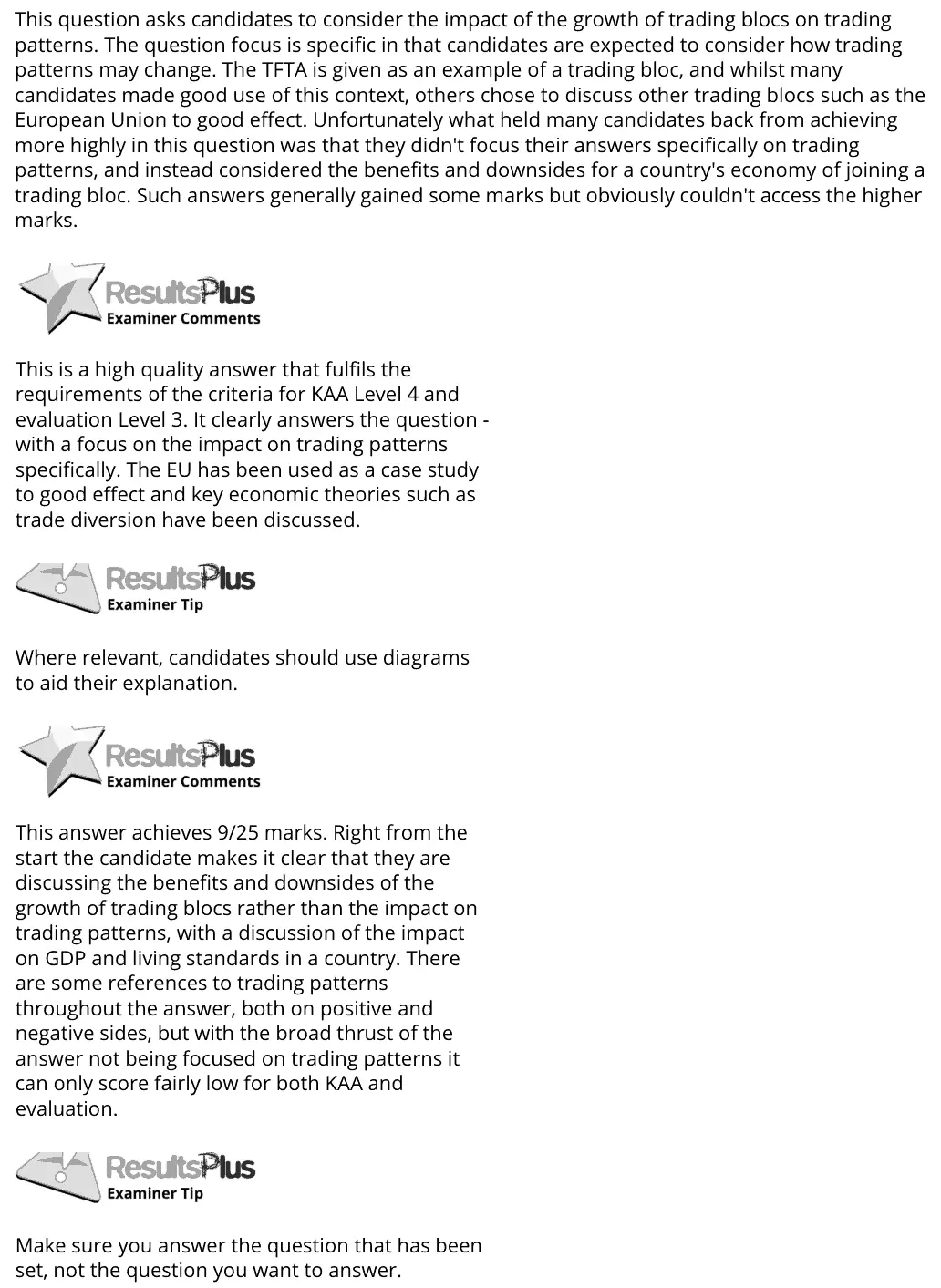
7 Trading blocs, the WTO and protectionism, Globalisation, specialisation and trade 25AO1=4,AO2=4,AO3=8,AO4=9Essay
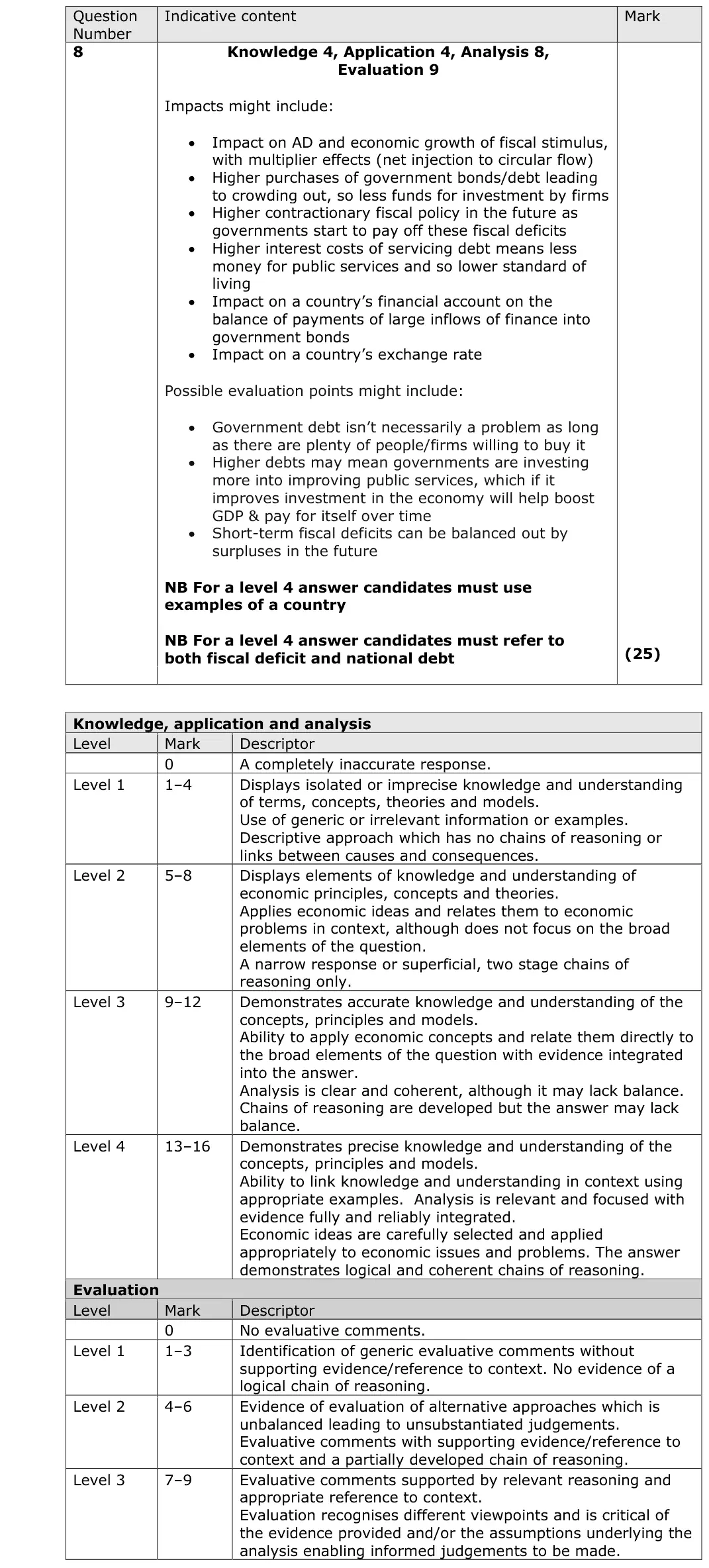
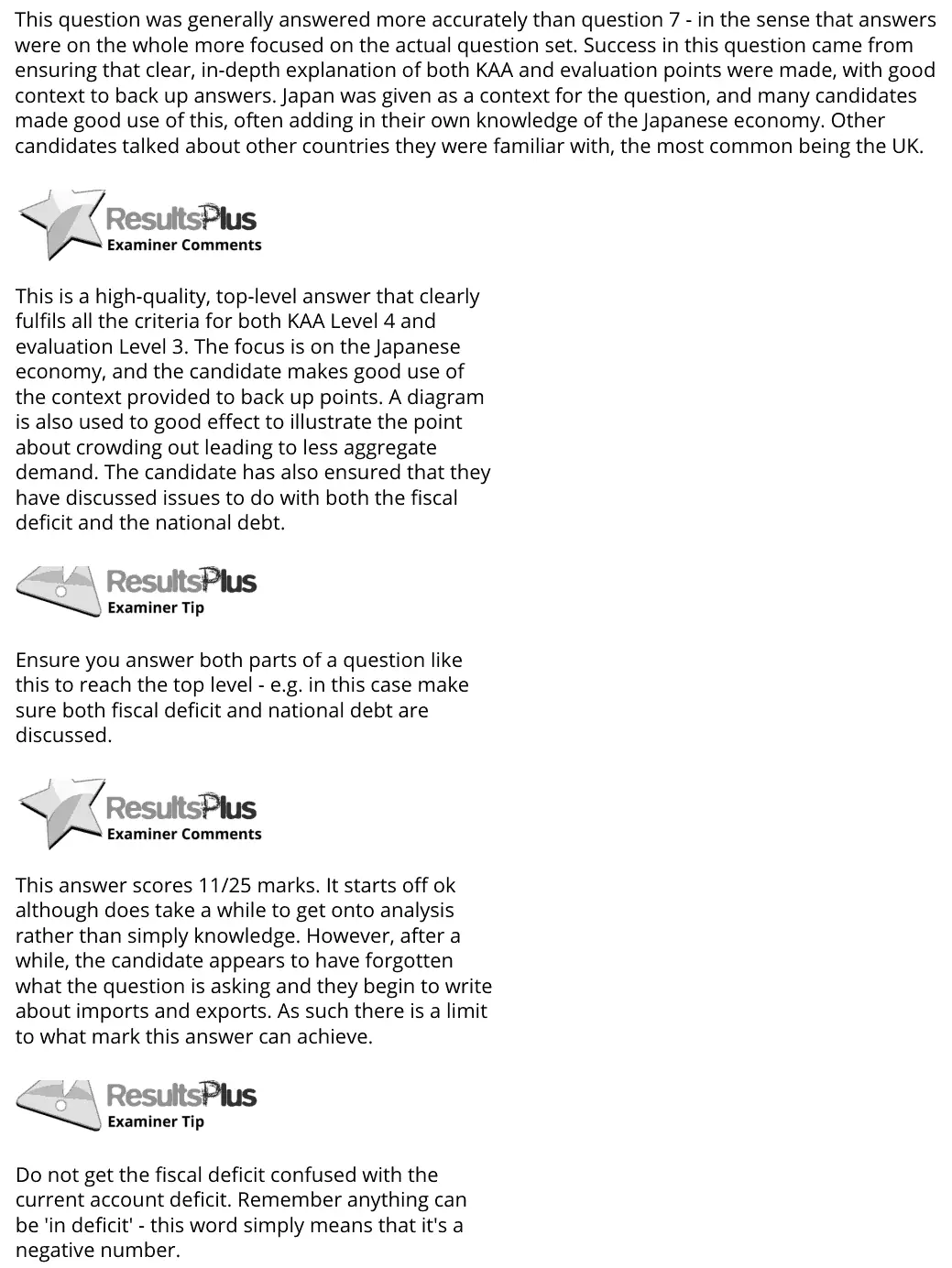
8 Public expenditure, taxation and public sector finances 25AO1=4,AO2=4,AO3=8,AO4=9Essay

The questions

1(a)1(b)1(c)2(a)2(b)3(a)3(b)3(c)4(a)4(b)4(c)5(a)5(b)5(c)6(a)6(b)6(c)6(d)6(e)78
June 2019 · Paper 2 · Q1(a) 1 mark Multiple choice aggregate demand
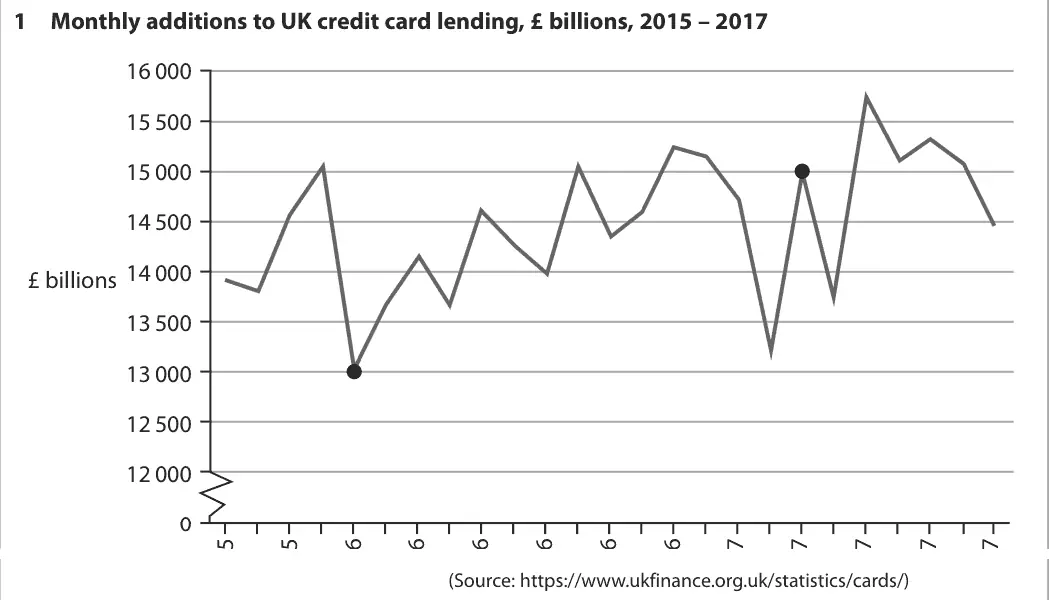
Data and extracts for question 11 Monthly additions to UK credit card lending, £ billions, 2015 – 2017 16 000 15 500 15 000 14 500 14 000 £ billions 13 500 13 000 12 500 12 000 0 (Source: https://www.ukfinance.org.uk/statistics/cards/)
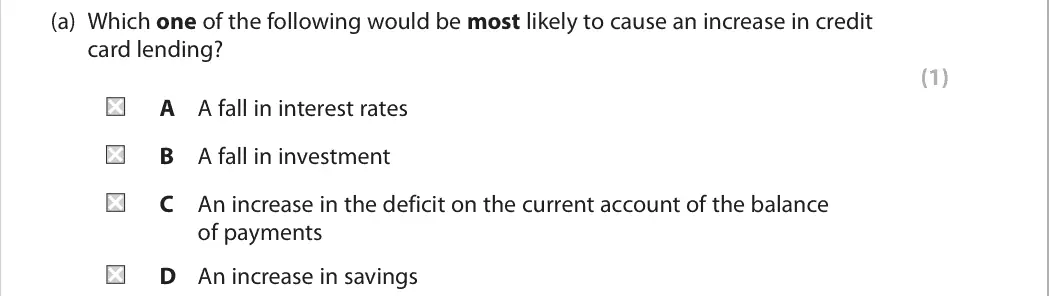
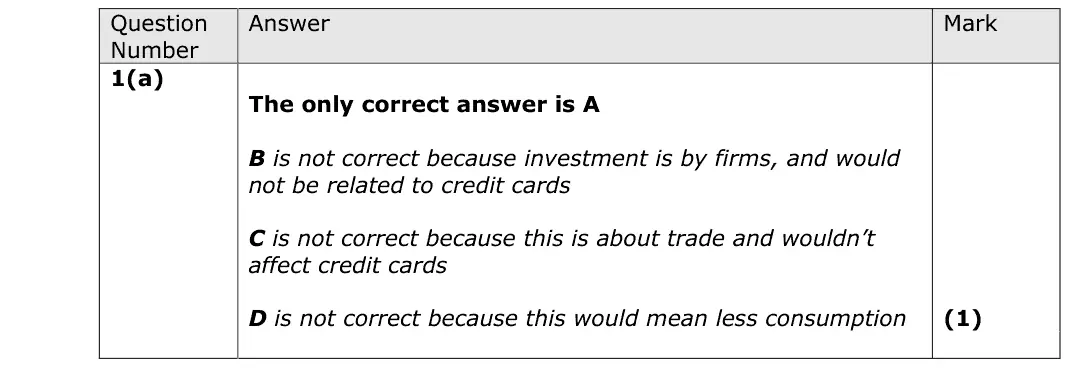
(a) Which one of the following would be most likely to cause an increase in credit card lending? (1) A A fall in interest rates B A fall in investment C An increase in the deficit on the current account of the balance of payments D An increase in savings
June 2019 · Paper 2 · Q1(b) 2 marks AO2=2 Calculation inflation
Data and extracts for question 11 Monthly additions to UK credit card lending, £ billions, 2015 – 2017 16 000 15 500 15 000 14 500 14 000 £ billions 13 500 13 000 12 500 12 000 0 (Source: https://www.ukfinance.org.uk/statistics/cards/)
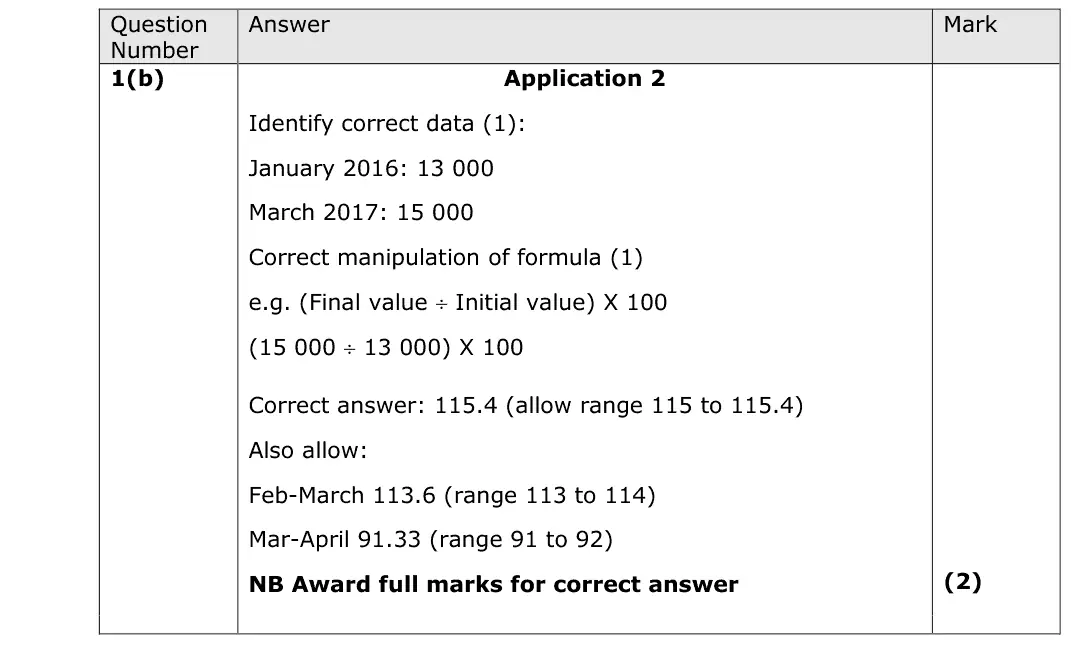
(b) Using the chart, calculate an index number for additions to credit card lending in March 2017, using January 2016 as the base. You are advised to show your working. (2)
June 2019 · Paper 2 · Q1(c) 2 marks AO1=1, AO2=1 Short answer inflation
Data and extracts for question 11 Monthly additions to UK credit card lending, £ billions, 2015 – 2017 16 000 15 500 15 000 14 500 14 000 £ billions 13 500 13 000 12 500 12 000 0 (Source: https://www.ukfinance.org.uk/statistics/cards/)
(c) Explain one possible link between an increase in credit card lending and the rate of inflation. (2)
June 2019 · Paper 2 · Q2(a) 4 marks AO1=2, AO2=2 Diagram national income and the multiplier
Data and extracts for question 22 The International Monetary Fund has called on the G20 group of large industrialised countries to boost government spending on infrastructure. (Source: https://www.theguardian.com/business/2016/jul/23/ imf-calls-for-more-government-spending-as-rate-cuts-lose-their-impact)
(a) Draw an aggregate demand and aggregate supply diagram to show the likely impact of an increase in government spending on infrastructure on a country’s price level and real output. (4)
June 2019 · Paper 2 · Q2(b) 1 mark Multiple choice aggregate demand
Data and extracts for question 22 The International Monetary Fund has called on the G20 group of large industrialised countries to boost government spending on infrastructure. (Source: https://www.theguardian.com/business/2016/jul/23/ imf-calls-for-more-government-spending-as-rate-cuts-lose-their-impact)
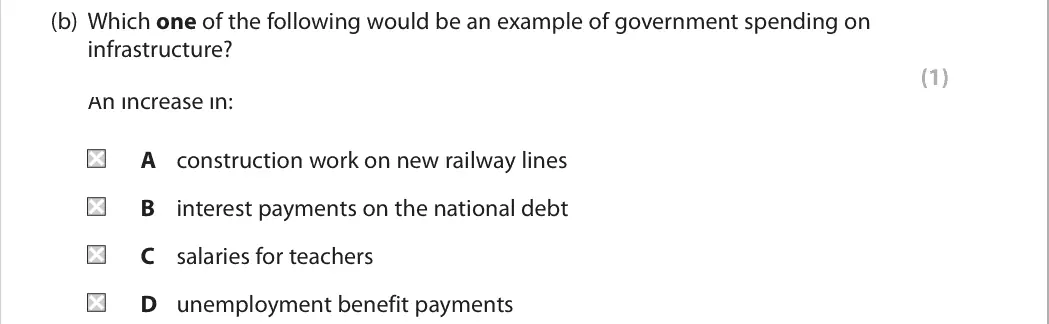
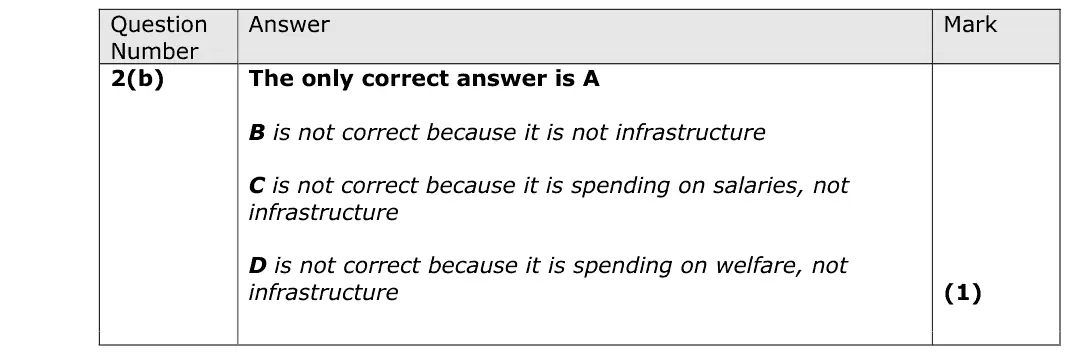
(b) Which one of the following would be an example of government spending on infrastructure? (1) An increase in: A construction work on new railway lines B interest payments on the national debt C salaries for teachers D unemployment benefit payments
June 2019 · Paper 2 · Q3(a) 2 marks AO1=1, AO3=1 Short answer international competitiveness
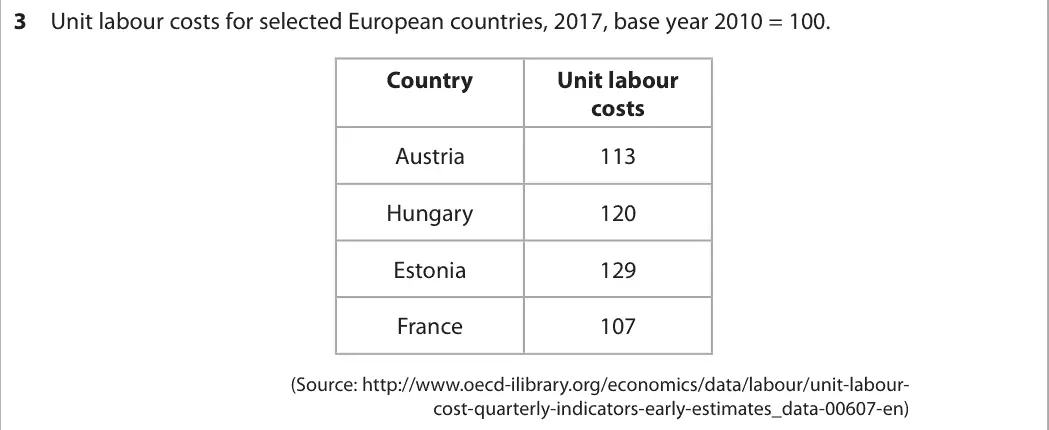
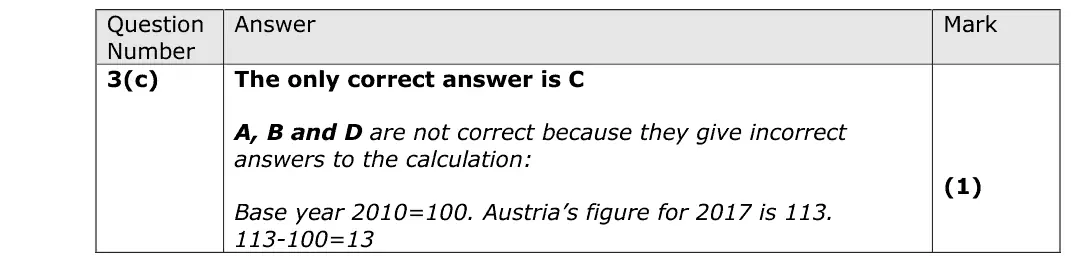
Data and extracts for question 33 Unit labour costs for selected European countries, 2017, base year 2010 = 100. Country Unit labour costs Austria 113 Hungary 120 Estonia 129 France 107 (Source: http://www.oecd-ilibrary.org/economics/data/labour/unit-labour- cost-quarterly-indicators-early-estimates_data-00607-en)
(a) Explain one likely reason for Estonia’s unit labour costs rising faster than in other European countries. (2)
June 2019 · Paper 2 · Q3(b) 2 marks AO1=1, AO3=1 Short answer international competitiveness
Data and extracts for question 33 Unit labour costs for selected European countries, 2017, base year 2010 = 100. Country Unit labour costs Austria 113 Hungary 120 Estonia 129 France 107 (Source: http://www.oecd-ilibrary.org/economics/data/labour/unit-labour- cost-quarterly-indicators-early-estimates_data-00607-en)
(b) Explain how Estonia’s competitiveness could be affected by rising unit labour costs. (2)
June 2019 · Paper 2 · Q3(c) 1 mark Multiple choice international competitiveness
Data and extracts for question 33 Unit labour costs for selected European countries, 2017, base year 2010 = 100. Country Unit labour costs Austria 113 Hungary 120 Estonia 129 France 107 (Source: http://www.oecd-ilibrary.org/economics/data/labour/unit-labour- cost-quarterly-indicators-early-estimates_data-00607-en)
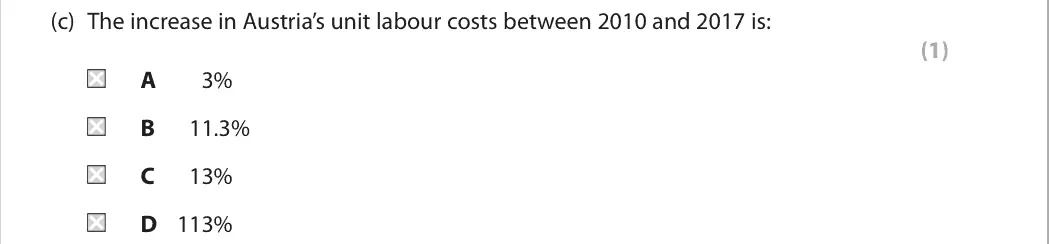
(c) The increase in Austria’s unit labour costs between 2010 and 2017 is: (1) A 3% B 11.3% C 13% D 113%
June 2019 · Paper 2 · Q4(a) 1 mark Multiple choice supply side policies
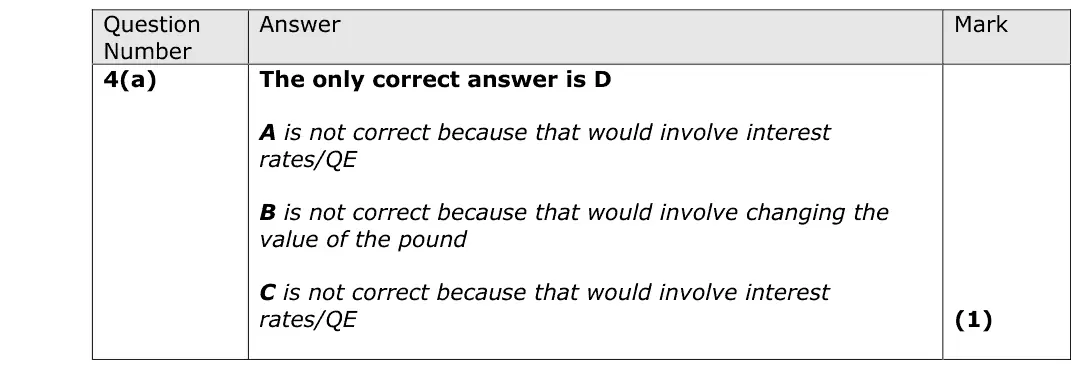
Data and extracts for question 44 The UK Government is planning to cut the rate of corporation tax on all pre-tax profits of companies to 17% by 2020. (Source: adapted from https://www.ft.com/content/ 7579f124-5742-11e7-9fed-c19e2700005f)
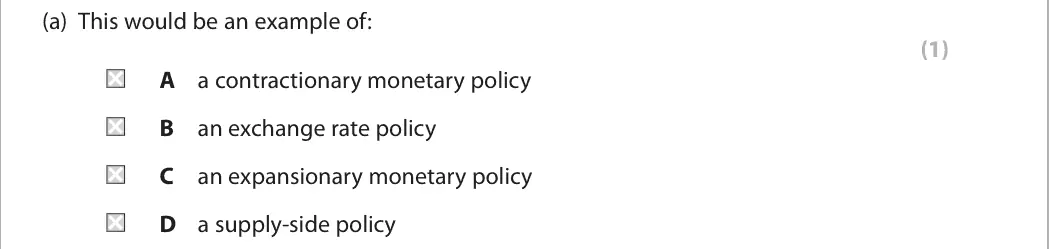
(a) This would be an example of: (1) A a contractionary monetary policy B an exchange rate policy C an expansionary monetary policy D a supply-side policy
June 2019 · Paper 2 · Q4(b) 2 marks AO2=2 Calculation public finances and taxation
Data and extracts for question 44 The UK Government is planning to cut the rate of corporation tax on all pre-tax profits of companies to 17% by 2020. (Source: adapted from https://www.ft.com/content/ 7579f124-5742-11e7-9fed-c19e2700005f)
(b) If a company makes £500 000 pre-tax profit in 2020, calculate how much corporation tax it will pay. Assume that the government cuts the rate of corporation tax as planned. (2)
June 2019 · Paper 2 · Q4(c) 2 marks AO1=1, AO3=1 Short answer public finances and taxation
Data and extracts for question 44 The UK Government is planning to cut the rate of corporation tax on all pre-tax profits of companies to 17% by 2020. (Source: adapted from https://www.ft.com/content/ 7579f124-5742-11e7-9fed-c19e2700005f)
(c) Explain one possible reason why the revenue from corporation tax could increase if the government cuts the rate of tax. (2)
June 2019 · Paper 2 · Q5(a) 2 marks AO1=2 Short answer national income and the multiplier
Data and extracts for question 55 According to the charity Oxfam, the combined wealth of the 62 richest people in the world is the same as the wealth of the poorest half of the world’s population. The value of the combined wealth of the poorest half of the world’s population has fallen by 38% between 2010 and 2016. (Source: adapted from https://www.oxfam.org/en/pressroom/pressreleases /2016-01-18/62-people-own-same-half-world-reveals-oxfam-davos-report)
(a) Explain the distinction between income and wealth. (2)
June 2019 · Paper 2 · Q5(b) 2 marks AO1=1, AO3=1 Short answer poverty and inequality
Data and extracts for question 55 According to the charity Oxfam, the combined wealth of the 62 richest people in the world is the same as the wealth of the poorest half of the world’s population. The value of the combined wealth of the poorest half of the world’s population has fallen by 38% between 2010 and 2016. (Source: adapted from https://www.oxfam.org/en/pressroom/pressreleases /2016-01-18/62-people-own-same-half-world-reveals-oxfam-davos-report)
(b) Explain one likely reason why global wealth inequality has increased. (2)
June 2019 · Paper 2 · Q5(c) 1 mark Multiple choice public finances and taxation
Data and extracts for question 55 According to the charity Oxfam, the combined wealth of the 62 richest people in the world is the same as the wealth of the poorest half of the world’s population. The value of the combined wealth of the poorest half of the world’s population has fallen by 38% between 2010 and 2016. (Source: adapted from https://www.oxfam.org/en/pressroom/pressreleases /2016-01-18/62-people-own-same-half-world-reveals-oxfam-davos-report)
(c) Which one of the following would be most likely to reduce a country’s Gini coefficient? An increase in: (1) A import tariffs B progressive taxes C regressive taxes D value added tax
June 2019 · Paper 2 · Q6(a) 5 marks AO1=2, AO2=2, AO3=1 Short answer financial sector
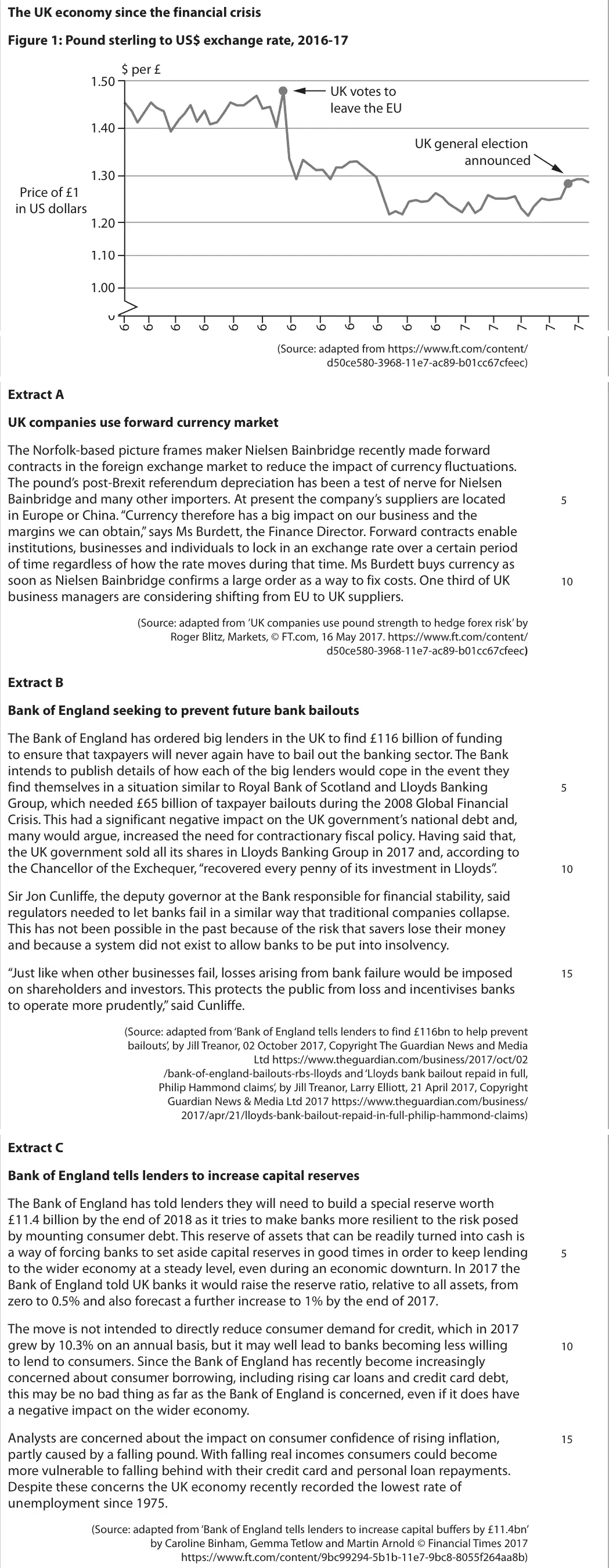
Data and extracts for question 6The UK economy since the financial crisis Figure 1: Pound sterling to US$ exchange rate, 2016-17 $ per £ 1.50 UK votes to leave the EU 1.40 UK general election announced 1.30 Price of £1 in US dollars 1.20 1.10 1.00 0 (Source: adapted from https://www.ft.com/content/ d50ce580-3968-11e7-ac89-b01cc67cfeec) Extract A UK companies use forward currency market The Norfolk-based picture frames maker Nielsen Bainbridge recently made forward contracts in the foreign exchange market to reduce the impact of currency fluctuations. The pound’s post-Brexit referendum depreciation has been a test of nerve for Nielsen Bainbridge and many other importers. At present the company’s suppliers are located 5 in Europe or China. “Currency therefore has a big impact on our business and the margins we can obtain,” says Ms Burdett, the Finance Director. Forward contracts enable institutions, businesses and individuals to lock in an exchange rate over a certain period of time regardless of how the rate moves during that time. Ms Burdett buys currency as soon as Nielsen Bainbridge confirms a large order as a way to fix costs. One third of UK 10 business managers are considering shifting from EU to UK suppliers. (Source: adapted from ’UK companies use pound strength to hedge forex risk’ by Roger Blitz, Markets, © FT.com, 16 May 2017. https://www.ft.com/content/ d50ce580-3968-11e7-ac89-b01cc67cfeec) Extract B Bank of England seeking to prevent future bank bailouts The Bank of England has ordered big lenders in the UK to find £116 billion of funding to ensure that taxpayers will never again have to bail out the banking sector. The Bank intends to publish details of how each of the big lenders would cope in the event they find themselves in a situation similar to Royal Bank of Scotland and Lloyds Banking 5 Group, which needed £65 billion of taxpayer bailouts during the 2008 Global Financial Crisis. This had a significant negative impact on the UK government’s national debt and, many would argue, increased the need for contractionary fiscal policy. Having said that, the UK government sold all its shares in Lloyds Banking Group in 2017 and, according to the Chancellor of the Exchequer, “recovered every penny of its investment in Lloyds”. 10 Sir Jon Cunliffe, the deputy governor at the Bank responsible for financial stability, said regulators needed to let banks fail in a similar way that traditional companies collapse. This has not been possible in the past because of the risk that savers lose their money and because a system did not exist to allow banks to be put into insolvency. “Just like when other businesses fail, losses arising from bank failure would be imposed 15 on shareholders and investors. This protects the public from loss and incentivises banks to operate more prudently,” said Cunliffe. (Source: adapted from ‘Bank of England tells lenders to find £116bn to help prevent bailouts’, by Jill Treanor, 02 October 2017, Copyright The Guardian News and Media Ltd https://www.theguardian.com/business/2017/oct/02 /bank-of-england-bailouts-rbs-lloyds and ‘Lloyds bank bailout repaid in full, Philip Hammond claims’, by Jill Treanor, Larry Elliott, 21 April 2017, Copyright Guardian News & Media Ltd 2017 https://www.theguardian.com/business/ 2017/apr/21/lloyds-bank-bailout-repaid-in-full-philip-hammond-claims) Extract C Bank of England tells lenders to increase capital reserves The Bank of England has told lenders they will need to build a special reserve worth £11.4 billion by the end of 2018 as it tries to make banks more resilient to the risk posed by mounting consumer debt. This reserve of assets that can be readily turned into cash is a way of forcing banks to set aside capital reserves in good times in order to keep lending 5 to the wider economy at a steady level, even during an economic downturn. In 2017 the Bank of England told UK banks it would raise the reserve ratio, relative to all assets, from zero to 0.5% and also forecast a further increase to 1% by the end of 2017. The move is not intended to directly reduce consumer demand for credit, which in 2017 grew by 10.3% on an annual basis, but it may well lead to banks becoming less willing 10 to lend to consumers. Since the Bank of England has recently become increasingly concerned about consumer borrowing, including rising car loans and credit card debt, this may be no bad thing as far as the Bank of England is concerned, even if it does have a negative impact on the wider economy. Analysts are concerned about the impact on consumer confidence of rising inflation, 15 partly caused by a falling pound. With falling real incomes consumers could become more vulnerable to falling behind with their credit card and personal loan repayments. Despite these concerns the UK economy recently recorded the lowest rate of unemployment since 1975. (Source: adapted from ‘Bank of England tells lenders to increase capital buffers by £11.4bn’ by Caroline Binham, Gemma Tetlow and Martin Arnold © Financial Times 2017 https://www.ft.com/content/9bc99294-5b1b-11e7-9bc8-8055f264aa8b)
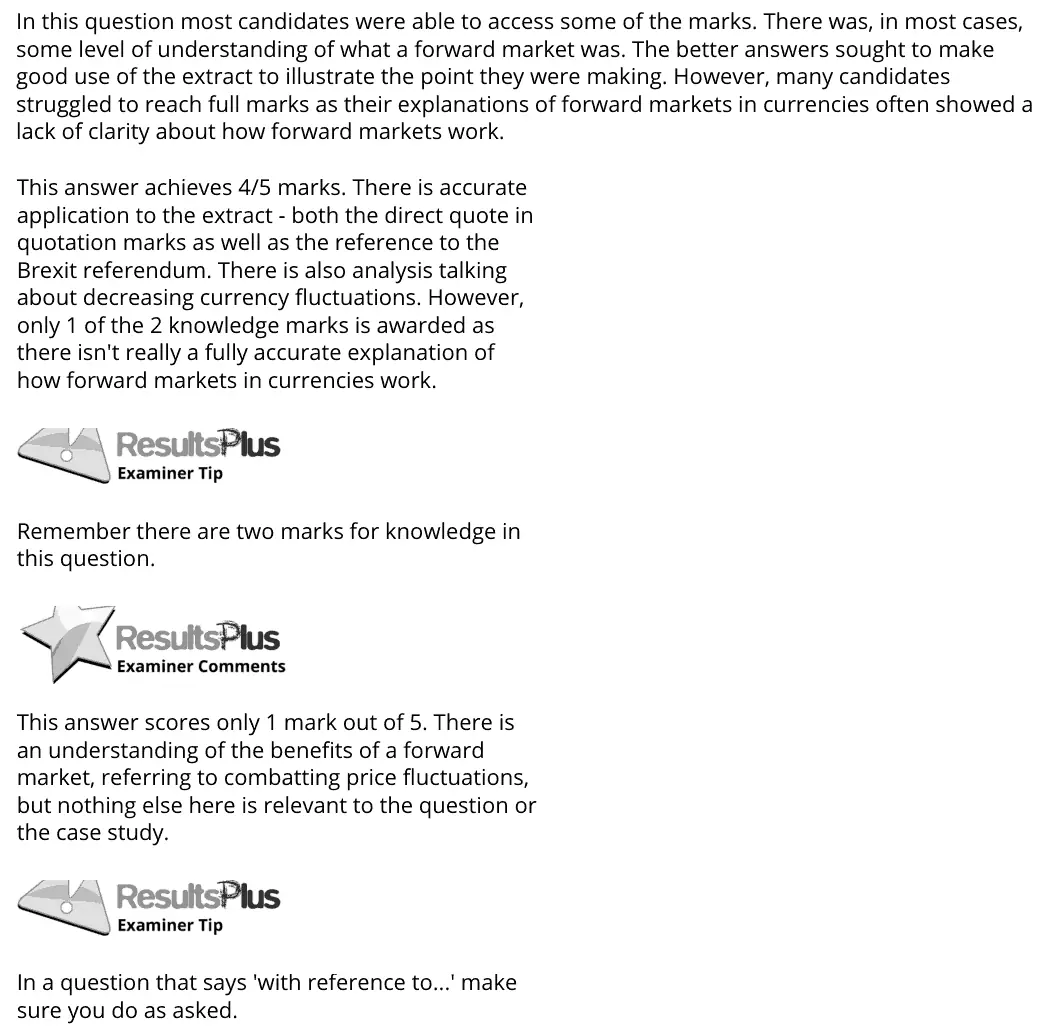
(a) With reference to Extract A, explain the role of forward markets in currencies. (5)
June 2019 · Paper 2 · Q6(b) 8 marks AO1=2, AO2=2, AO3=2, AO4=2 8-mark response exchange rates
Data and extracts for question 6The UK economy since the financial crisis Figure 1: Pound sterling to US$ exchange rate, 2016-17 $ per £ 1.50 UK votes to leave the EU 1.40 UK general election announced 1.30 Price of £1 in US dollars 1.20 1.10 1.00 0 (Source: adapted from https://www.ft.com/content/ d50ce580-3968-11e7-ac89-b01cc67cfeec) Extract A UK companies use forward currency market The Norfolk-based picture frames maker Nielsen Bainbridge recently made forward contracts in the foreign exchange market to reduce the impact of currency fluctuations. The pound’s post-Brexit referendum depreciation has been a test of nerve for Nielsen Bainbridge and many other importers. At present the company’s suppliers are located 5 in Europe or China. “Currency therefore has a big impact on our business and the margins we can obtain,” says Ms Burdett, the Finance Director. Forward contracts enable institutions, businesses and individuals to lock in an exchange rate over a certain period of time regardless of how the rate moves during that time. Ms Burdett buys currency as soon as Nielsen Bainbridge confirms a large order as a way to fix costs. One third of UK 10 business managers are considering shifting from EU to UK suppliers. (Source: adapted from ’UK companies use pound strength to hedge forex risk’ by Roger Blitz, Markets, © FT.com, 16 May 2017. https://www.ft.com/content/ d50ce580-3968-11e7-ac89-b01cc67cfeec) Extract B Bank of England seeking to prevent future bank bailouts The Bank of England has ordered big lenders in the UK to find £116 billion of funding to ensure that taxpayers will never again have to bail out the banking sector. The Bank intends to publish details of how each of the big lenders would cope in the event they find themselves in a situation similar to Royal Bank of Scotland and Lloyds Banking 5 Group, which needed £65 billion of taxpayer bailouts during the 2008 Global Financial Crisis. This had a significant negative impact on the UK government’s national debt and, many would argue, increased the need for contractionary fiscal policy. Having said that, the UK government sold all its shares in Lloyds Banking Group in 2017 and, according to the Chancellor of the Exchequer, “recovered every penny of its investment in Lloyds”. 10 Sir Jon Cunliffe, the deputy governor at the Bank responsible for financial stability, said regulators needed to let banks fail in a similar way that traditional companies collapse. This has not been possible in the past because of the risk that savers lose their money and because a system did not exist to allow banks to be put into insolvency. “Just like when other businesses fail, losses arising from bank failure would be imposed 15 on shareholders and investors. This protects the public from loss and incentivises banks to operate more prudently,” said Cunliffe. (Source: adapted from ‘Bank of England tells lenders to find £116bn to help prevent bailouts’, by Jill Treanor, 02 October 2017, Copyright The Guardian News and Media Ltd https://www.theguardian.com/business/2017/oct/02 /bank-of-england-bailouts-rbs-lloyds and ‘Lloyds bank bailout repaid in full, Philip Hammond claims’, by Jill Treanor, Larry Elliott, 21 April 2017, Copyright Guardian News & Media Ltd 2017 https://www.theguardian.com/business/ 2017/apr/21/lloyds-bank-bailout-repaid-in-full-philip-hammond-claims) Extract C Bank of England tells lenders to increase capital reserves The Bank of England has told lenders they will need to build a special reserve worth £11.4 billion by the end of 2018 as it tries to make banks more resilient to the risk posed by mounting consumer debt. This reserve of assets that can be readily turned into cash is a way of forcing banks to set aside capital reserves in good times in order to keep lending 5 to the wider economy at a steady level, even during an economic downturn. In 2017 the Bank of England told UK banks it would raise the reserve ratio, relative to all assets, from zero to 0.5% and also forecast a further increase to 1% by the end of 2017. The move is not intended to directly reduce consumer demand for credit, which in 2017 grew by 10.3% on an annual basis, but it may well lead to banks becoming less willing 10 to lend to consumers. Since the Bank of England has recently become increasingly concerned about consumer borrowing, including rising car loans and credit card debt, this may be no bad thing as far as the Bank of England is concerned, even if it does have a negative impact on the wider economy. Analysts are concerned about the impact on consumer confidence of rising inflation, 15 partly caused by a falling pound. With falling real incomes consumers could become more vulnerable to falling behind with their credit card and personal loan repayments. Despite these concerns the UK economy recently recorded the lowest rate of unemployment since 1975. (Source: adapted from ‘Bank of England tells lenders to increase capital buffers by £11.4bn’ by Caroline Binham, Gemma Tetlow and Martin Arnold © Financial Times 2017 https://www.ft.com/content/9bc99294-5b1b-11e7-9bc8-8055f264aa8b)

(b) With reference to Extract A and Figure 1, examine the likely impact of the change in the sterling exchange rate on the UK economy. (8)
June 2019 · Paper 2 · Q6(c) 10 marks AO1=2, AO2=2, AO3=2, AO4=4 10-mark response measuring economic growth
Data and extracts for question 6The UK economy since the financial crisis Figure 1: Pound sterling to US$ exchange rate, 2016-17 $ per £ 1.50 UK votes to leave the EU 1.40 UK general election announced 1.30 Price of £1 in US dollars 1.20 1.10 1.00 0 (Source: adapted from https://www.ft.com/content/ d50ce580-3968-11e7-ac89-b01cc67cfeec) Extract A UK companies use forward currency market The Norfolk-based picture frames maker Nielsen Bainbridge recently made forward contracts in the foreign exchange market to reduce the impact of currency fluctuations. The pound’s post-Brexit referendum depreciation has been a test of nerve for Nielsen Bainbridge and many other importers. At present the company’s suppliers are located 5 in Europe or China. “Currency therefore has a big impact on our business and the margins we can obtain,” says Ms Burdett, the Finance Director. Forward contracts enable institutions, businesses and individuals to lock in an exchange rate over a certain period of time regardless of how the rate moves during that time. Ms Burdett buys currency as soon as Nielsen Bainbridge confirms a large order as a way to fix costs. One third of UK 10 business managers are considering shifting from EU to UK suppliers. (Source: adapted from ’UK companies use pound strength to hedge forex risk’ by Roger Blitz, Markets, © FT.com, 16 May 2017. https://www.ft.com/content/ d50ce580-3968-11e7-ac89-b01cc67cfeec) Extract B Bank of England seeking to prevent future bank bailouts The Bank of England has ordered big lenders in the UK to find £116 billion of funding to ensure that taxpayers will never again have to bail out the banking sector. The Bank intends to publish details of how each of the big lenders would cope in the event they find themselves in a situation similar to Royal Bank of Scotland and Lloyds Banking 5 Group, which needed £65 billion of taxpayer bailouts during the 2008 Global Financial Crisis. This had a significant negative impact on the UK government’s national debt and, many would argue, increased the need for contractionary fiscal policy. Having said that, the UK government sold all its shares in Lloyds Banking Group in 2017 and, according to the Chancellor of the Exchequer, “recovered every penny of its investment in Lloyds”. 10 Sir Jon Cunliffe, the deputy governor at the Bank responsible for financial stability, said regulators needed to let banks fail in a similar way that traditional companies collapse. This has not been possible in the past because of the risk that savers lose their money and because a system did not exist to allow banks to be put into insolvency. “Just like when other businesses fail, losses arising from bank failure would be imposed 15 on shareholders and investors. This protects the public from loss and incentivises banks to operate more prudently,” said Cunliffe. (Source: adapted from ‘Bank of England tells lenders to find £116bn to help prevent bailouts’, by Jill Treanor, 02 October 2017, Copyright The Guardian News and Media Ltd https://www.theguardian.com/business/2017/oct/02 /bank-of-england-bailouts-rbs-lloyds and ‘Lloyds bank bailout repaid in full, Philip Hammond claims’, by Jill Treanor, Larry Elliott, 21 April 2017, Copyright Guardian News & Media Ltd 2017 https://www.theguardian.com/business/ 2017/apr/21/lloyds-bank-bailout-repaid-in-full-philip-hammond-claims) Extract C Bank of England tells lenders to increase capital reserves The Bank of England has told lenders they will need to build a special reserve worth £11.4 billion by the end of 2018 as it tries to make banks more resilient to the risk posed by mounting consumer debt. This reserve of assets that can be readily turned into cash is a way of forcing banks to set aside capital reserves in good times in order to keep lending 5 to the wider economy at a steady level, even during an economic downturn. In 2017 the Bank of England told UK banks it would raise the reserve ratio, relative to all assets, from zero to 0.5% and also forecast a further increase to 1% by the end of 2017. The move is not intended to directly reduce consumer demand for credit, which in 2017 grew by 10.3% on an annual basis, but it may well lead to banks becoming less willing 10 to lend to consumers. Since the Bank of England has recently become increasingly concerned about consumer borrowing, including rising car loans and credit card debt, this may be no bad thing as far as the Bank of England is concerned, even if it does have a negative impact on the wider economy. Analysts are concerned about the impact on consumer confidence of rising inflation, 15 partly caused by a falling pound. With falling real incomes consumers could become more vulnerable to falling behind with their credit card and personal loan repayments. Despite these concerns the UK economy recently recorded the lowest rate of unemployment since 1975. (Source: adapted from ‘Bank of England tells lenders to increase capital buffers by £11.4bn’ by Caroline Binham, Gemma Tetlow and Martin Arnold © Financial Times 2017 https://www.ft.com/content/9bc99294-5b1b-11e7-9bc8-8055f264aa8b)
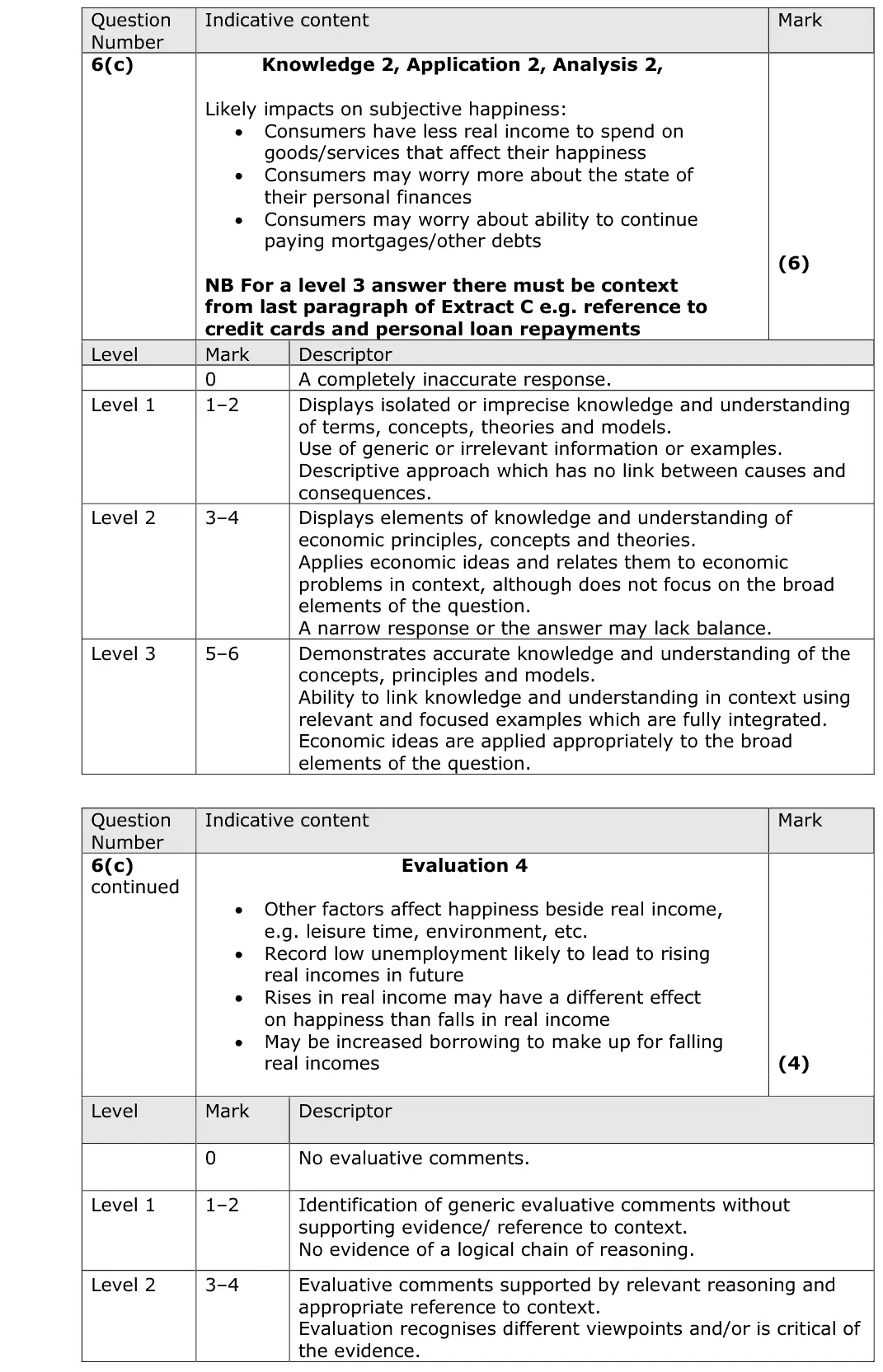
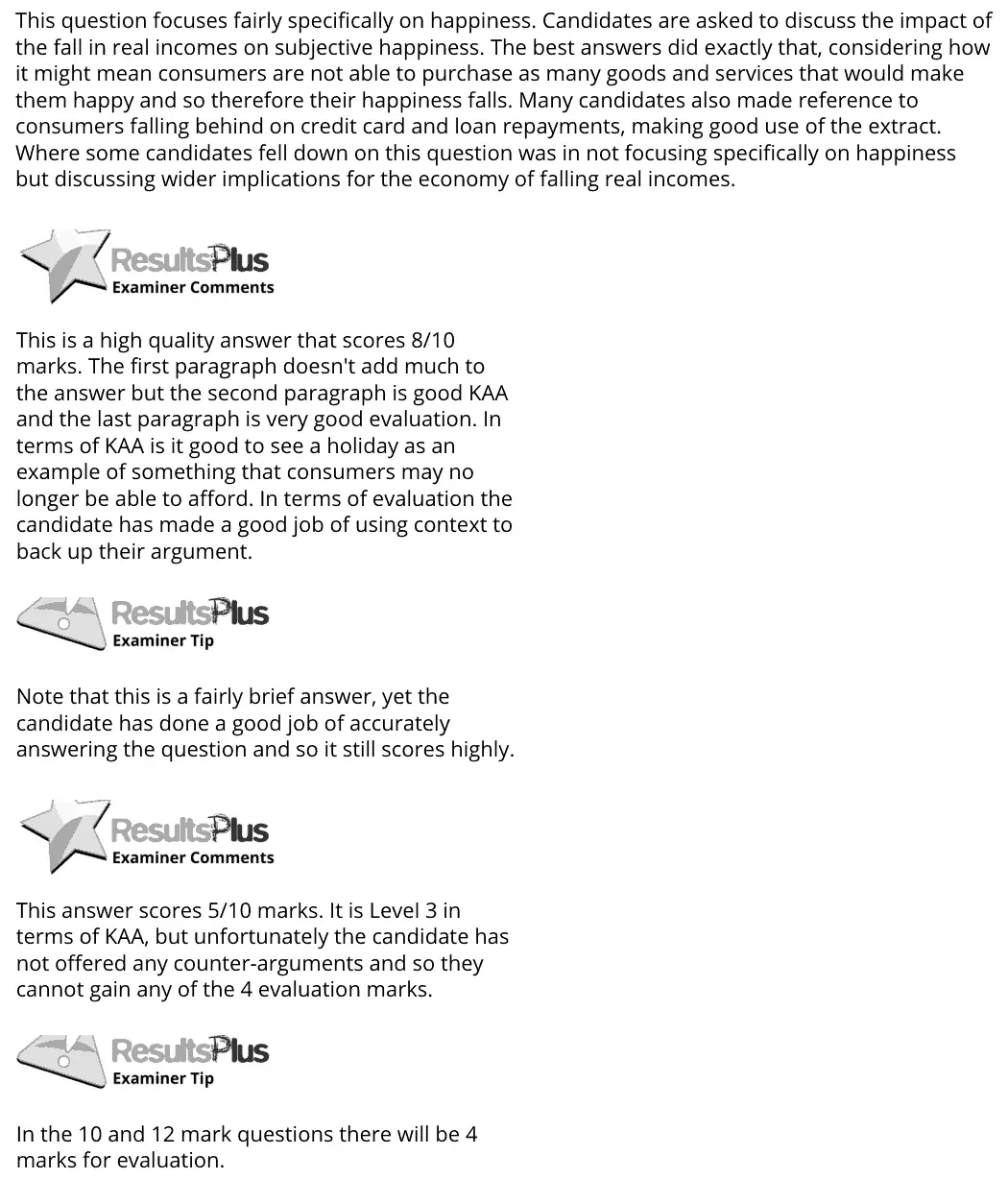
(c) With reference to the last paragraph in Extract C, assess the impact of a fall in real incomes on subjective happiness. (10)
June 2019 · Paper 2 · Q6(d) 12 marks AO1=4, AO2=2, AO3=2, AO4=4 12-mark response macroeconomic objectivesfiscal and monetary policy
Data and extracts for question 6The UK economy since the financial crisis Figure 1: Pound sterling to US$ exchange rate, 2016-17 $ per £ 1.50 UK votes to leave the EU 1.40 UK general election announced 1.30 Price of £1 in US dollars 1.20 1.10 1.00 0 (Source: adapted from https://www.ft.com/content/ d50ce580-3968-11e7-ac89-b01cc67cfeec) Extract A UK companies use forward currency market The Norfolk-based picture frames maker Nielsen Bainbridge recently made forward contracts in the foreign exchange market to reduce the impact of currency fluctuations. The pound’s post-Brexit referendum depreciation has been a test of nerve for Nielsen Bainbridge and many other importers. At present the company’s suppliers are located 5 in Europe or China. “Currency therefore has a big impact on our business and the margins we can obtain,” says Ms Burdett, the Finance Director. Forward contracts enable institutions, businesses and individuals to lock in an exchange rate over a certain period of time regardless of how the rate moves during that time. Ms Burdett buys currency as soon as Nielsen Bainbridge confirms a large order as a way to fix costs. One third of UK 10 business managers are considering shifting from EU to UK suppliers. (Source: adapted from ’UK companies use pound strength to hedge forex risk’ by Roger Blitz, Markets, © FT.com, 16 May 2017. https://www.ft.com/content/ d50ce580-3968-11e7-ac89-b01cc67cfeec) Extract B Bank of England seeking to prevent future bank bailouts The Bank of England has ordered big lenders in the UK to find £116 billion of funding to ensure that taxpayers will never again have to bail out the banking sector. The Bank intends to publish details of how each of the big lenders would cope in the event they find themselves in a situation similar to Royal Bank of Scotland and Lloyds Banking 5 Group, which needed £65 billion of taxpayer bailouts during the 2008 Global Financial Crisis. This had a significant negative impact on the UK government’s national debt and, many would argue, increased the need for contractionary fiscal policy. Having said that, the UK government sold all its shares in Lloyds Banking Group in 2017 and, according to the Chancellor of the Exchequer, “recovered every penny of its investment in Lloyds”. 10 Sir Jon Cunliffe, the deputy governor at the Bank responsible for financial stability, said regulators needed to let banks fail in a similar way that traditional companies collapse. This has not been possible in the past because of the risk that savers lose their money and because a system did not exist to allow banks to be put into insolvency. “Just like when other businesses fail, losses arising from bank failure would be imposed 15 on shareholders and investors. This protects the public from loss and incentivises banks to operate more prudently,” said Cunliffe. (Source: adapted from ‘Bank of England tells lenders to find £116bn to help prevent bailouts’, by Jill Treanor, 02 October 2017, Copyright The Guardian News and Media Ltd https://www.theguardian.com/business/2017/oct/02 /bank-of-england-bailouts-rbs-lloyds and ‘Lloyds bank bailout repaid in full, Philip Hammond claims’, by Jill Treanor, Larry Elliott, 21 April 2017, Copyright Guardian News & Media Ltd 2017 https://www.theguardian.com/business/ 2017/apr/21/lloyds-bank-bailout-repaid-in-full-philip-hammond-claims) Extract C Bank of England tells lenders to increase capital reserves The Bank of England has told lenders they will need to build a special reserve worth £11.4 billion by the end of 2018 as it tries to make banks more resilient to the risk posed by mounting consumer debt. This reserve of assets that can be readily turned into cash is a way of forcing banks to set aside capital reserves in good times in order to keep lending 5 to the wider economy at a steady level, even during an economic downturn. In 2017 the Bank of England told UK banks it would raise the reserve ratio, relative to all assets, from zero to 0.5% and also forecast a further increase to 1% by the end of 2017. The move is not intended to directly reduce consumer demand for credit, which in 2017 grew by 10.3% on an annual basis, but it may well lead to banks becoming less willing 10 to lend to consumers. Since the Bank of England has recently become increasingly concerned about consumer borrowing, including rising car loans and credit card debt, this may be no bad thing as far as the Bank of England is concerned, even if it does have a negative impact on the wider economy. Analysts are concerned about the impact on consumer confidence of rising inflation, 15 partly caused by a falling pound. With falling real incomes consumers could become more vulnerable to falling behind with their credit card and personal loan repayments. Despite these concerns the UK economy recently recorded the lowest rate of unemployment since 1975. (Source: adapted from ‘Bank of England tells lenders to increase capital buffers by £11.4bn’ by Caroline Binham, Gemma Tetlow and Martin Arnold © Financial Times 2017 https://www.ft.com/content/9bc99294-5b1b-11e7-9bc8-8055f264aa8b)
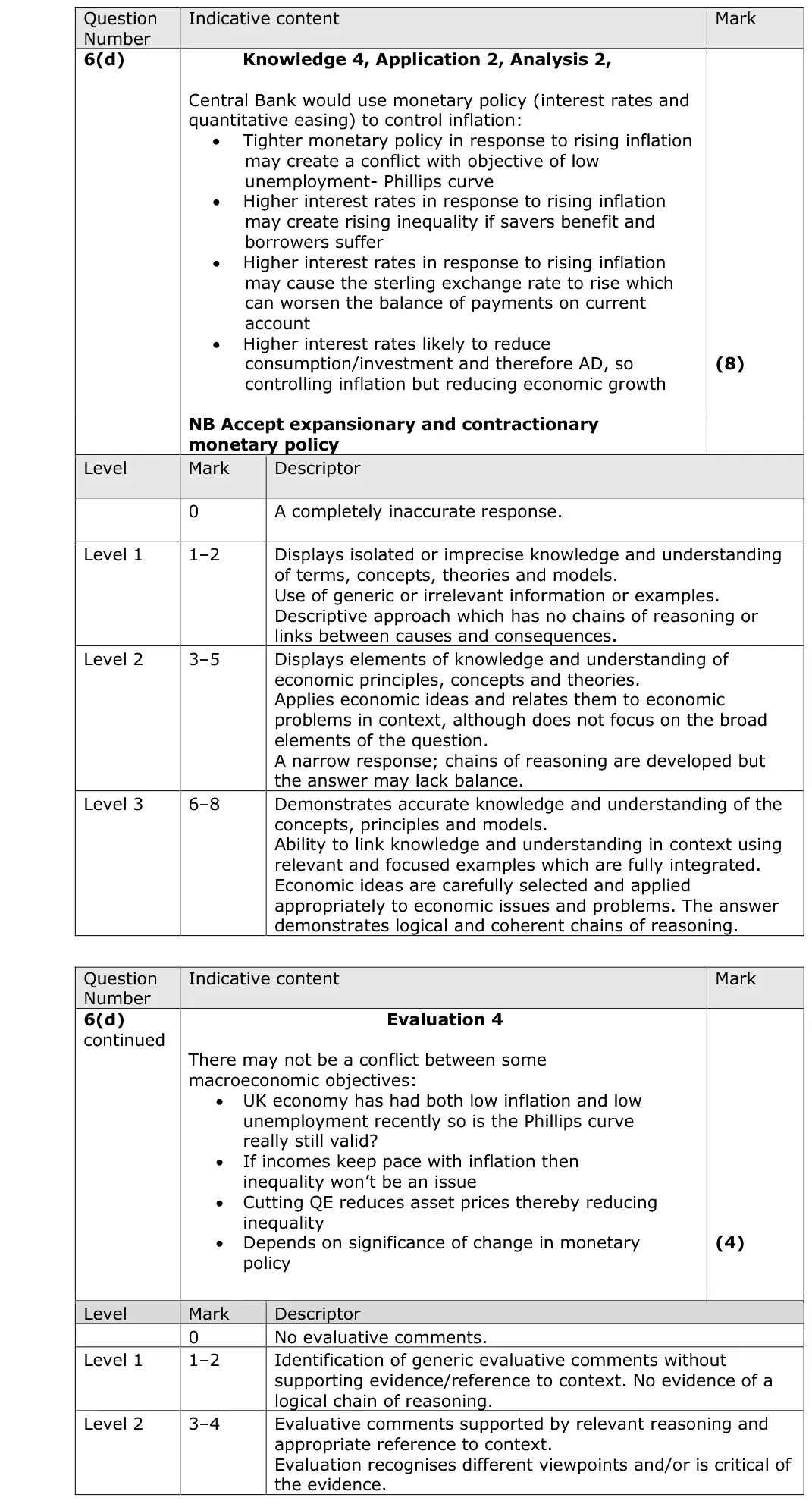
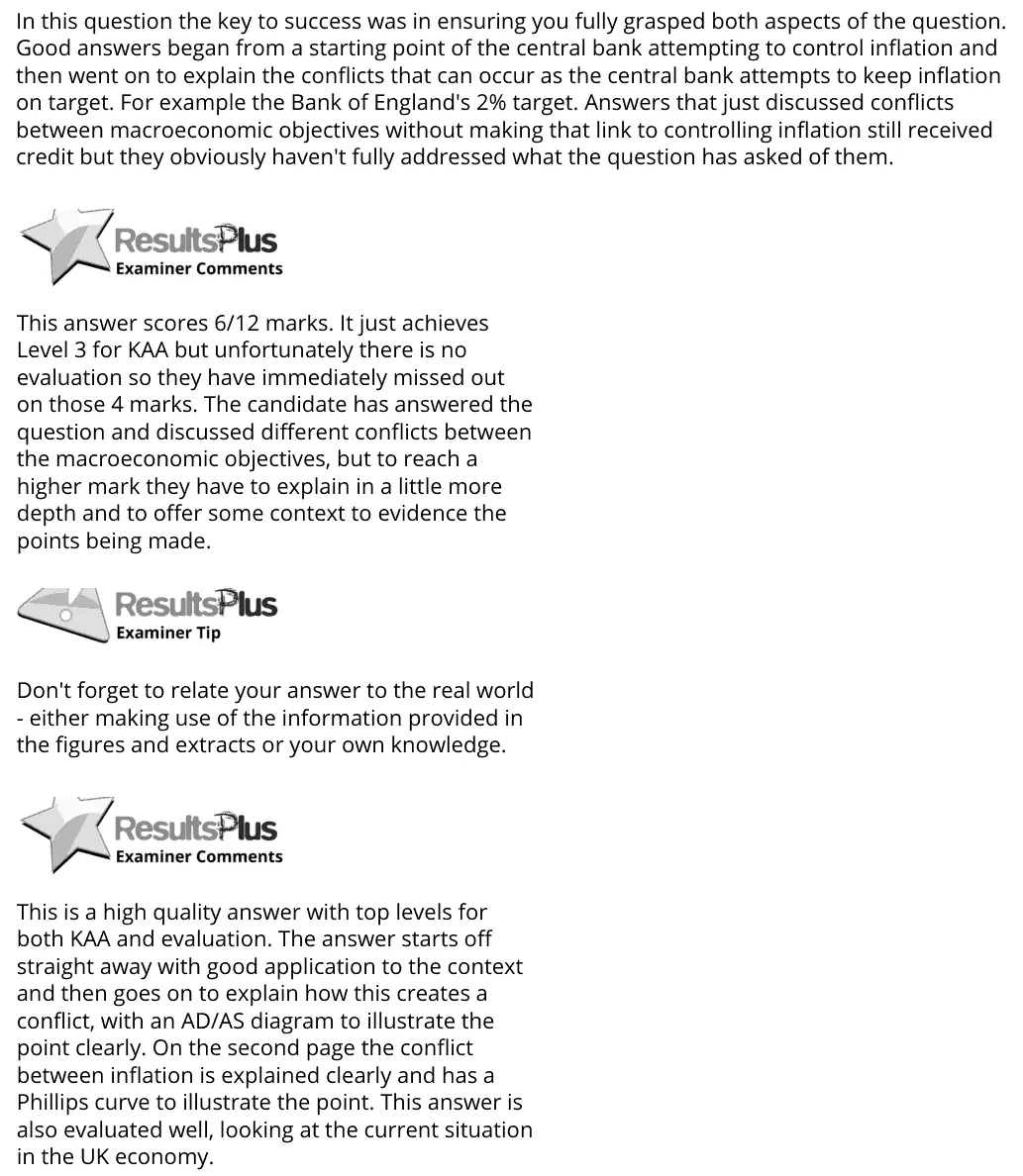
(d) With reference to Extract C, discuss the potential conflicts between macroeconomic objectives when the central bank attempts to control inflation. (12)
June 2019 · Paper 2 · Q6(e) 15 marks AO1=3, AO2=3, AO3=3, AO4=6 15-mark response financial sector
Data and extracts for question 6The UK economy since the financial crisis Figure 1: Pound sterling to US$ exchange rate, 2016-17 $ per £ 1.50 UK votes to leave the EU 1.40 UK general election announced 1.30 Price of £1 in US dollars 1.20 1.10 1.00 0 (Source: adapted from https://www.ft.com/content/ d50ce580-3968-11e7-ac89-b01cc67cfeec) Extract A UK companies use forward currency market The Norfolk-based picture frames maker Nielsen Bainbridge recently made forward contracts in the foreign exchange market to reduce the impact of currency fluctuations. The pound’s post-Brexit referendum depreciation has been a test of nerve for Nielsen Bainbridge and many other importers. At present the company’s suppliers are located 5 in Europe or China. “Currency therefore has a big impact on our business and the margins we can obtain,” says Ms Burdett, the Finance Director. Forward contracts enable institutions, businesses and individuals to lock in an exchange rate over a certain period of time regardless of how the rate moves during that time. Ms Burdett buys currency as soon as Nielsen Bainbridge confirms a large order as a way to fix costs. One third of UK 10 business managers are considering shifting from EU to UK suppliers. (Source: adapted from ’UK companies use pound strength to hedge forex risk’ by Roger Blitz, Markets, © FT.com, 16 May 2017. https://www.ft.com/content/ d50ce580-3968-11e7-ac89-b01cc67cfeec) Extract B Bank of England seeking to prevent future bank bailouts The Bank of England has ordered big lenders in the UK to find £116 billion of funding to ensure that taxpayers will never again have to bail out the banking sector. The Bank intends to publish details of how each of the big lenders would cope in the event they find themselves in a situation similar to Royal Bank of Scotland and Lloyds Banking 5 Group, which needed £65 billion of taxpayer bailouts during the 2008 Global Financial Crisis. This had a significant negative impact on the UK government’s national debt and, many would argue, increased the need for contractionary fiscal policy. Having said that, the UK government sold all its shares in Lloyds Banking Group in 2017 and, according to the Chancellor of the Exchequer, “recovered every penny of its investment in Lloyds”. 10 Sir Jon Cunliffe, the deputy governor at the Bank responsible for financial stability, said regulators needed to let banks fail in a similar way that traditional companies collapse. This has not been possible in the past because of the risk that savers lose their money and because a system did not exist to allow banks to be put into insolvency. “Just like when other businesses fail, losses arising from bank failure would be imposed 15 on shareholders and investors. This protects the public from loss and incentivises banks to operate more prudently,” said Cunliffe. (Source: adapted from ‘Bank of England tells lenders to find £116bn to help prevent bailouts’, by Jill Treanor, 02 October 2017, Copyright The Guardian News and Media Ltd https://www.theguardian.com/business/2017/oct/02 /bank-of-england-bailouts-rbs-lloyds and ‘Lloyds bank bailout repaid in full, Philip Hammond claims’, by Jill Treanor, Larry Elliott, 21 April 2017, Copyright Guardian News & Media Ltd 2017 https://www.theguardian.com/business/ 2017/apr/21/lloyds-bank-bailout-repaid-in-full-philip-hammond-claims) Extract C Bank of England tells lenders to increase capital reserves The Bank of England has told lenders they will need to build a special reserve worth £11.4 billion by the end of 2018 as it tries to make banks more resilient to the risk posed by mounting consumer debt. This reserve of assets that can be readily turned into cash is a way of forcing banks to set aside capital reserves in good times in order to keep lending 5 to the wider economy at a steady level, even during an economic downturn. In 2017 the Bank of England told UK banks it would raise the reserve ratio, relative to all assets, from zero to 0.5% and also forecast a further increase to 1% by the end of 2017. The move is not intended to directly reduce consumer demand for credit, which in 2017 grew by 10.3% on an annual basis, but it may well lead to banks becoming less willing 10 to lend to consumers. Since the Bank of England has recently become increasingly concerned about consumer borrowing, including rising car loans and credit card debt, this may be no bad thing as far as the Bank of England is concerned, even if it does have a negative impact on the wider economy. Analysts are concerned about the impact on consumer confidence of rising inflation, 15 partly caused by a falling pound. With falling real incomes consumers could become more vulnerable to falling behind with their credit card and personal loan repayments. Despite these concerns the UK economy recently recorded the lowest rate of unemployment since 1975. (Source: adapted from ‘Bank of England tells lenders to increase capital buffers by £11.4bn’ by Caroline Binham, Gemma Tetlow and Martin Arnold © Financial Times 2017 https://www.ft.com/content/9bc99294-5b1b-11e7-9bc8-8055f264aa8b)
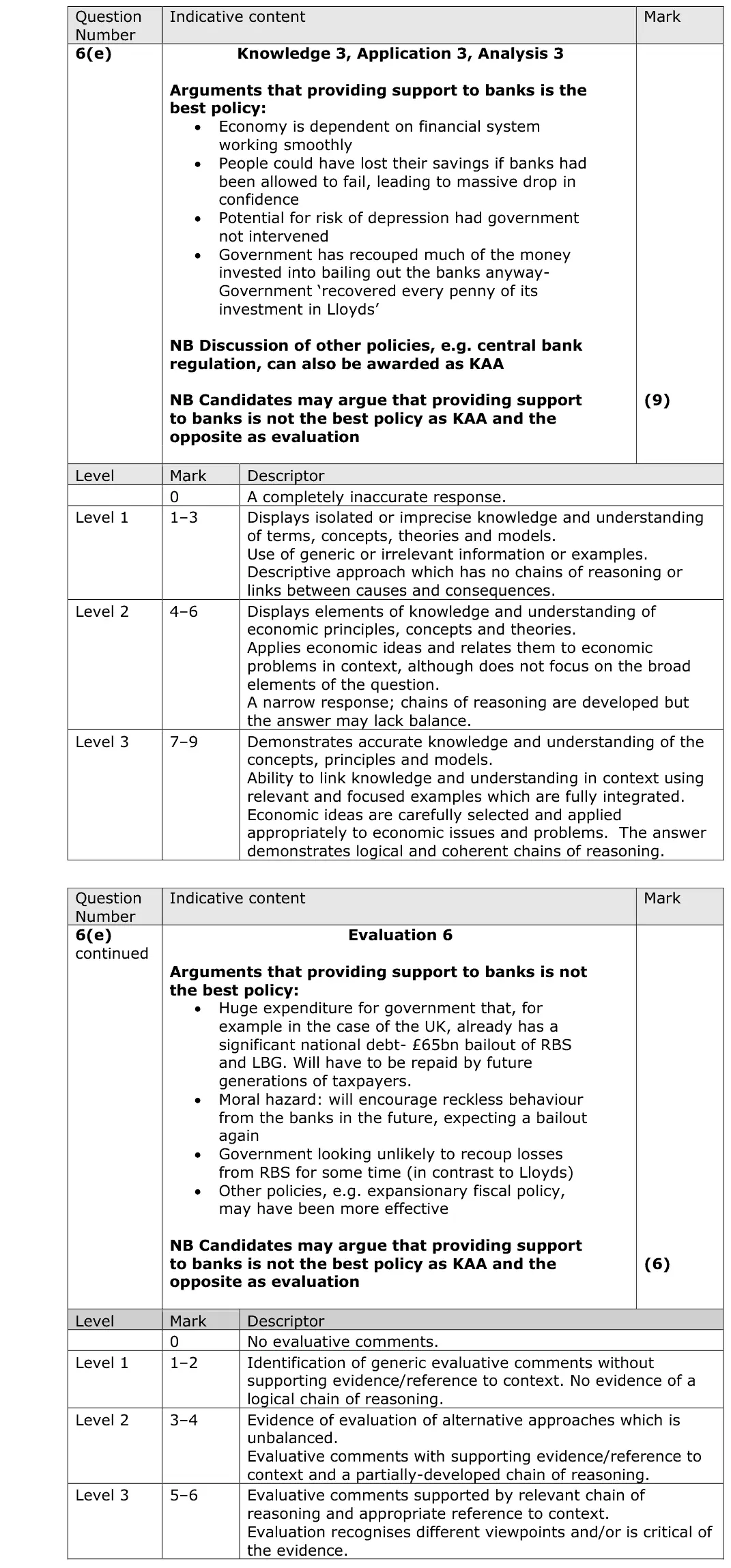
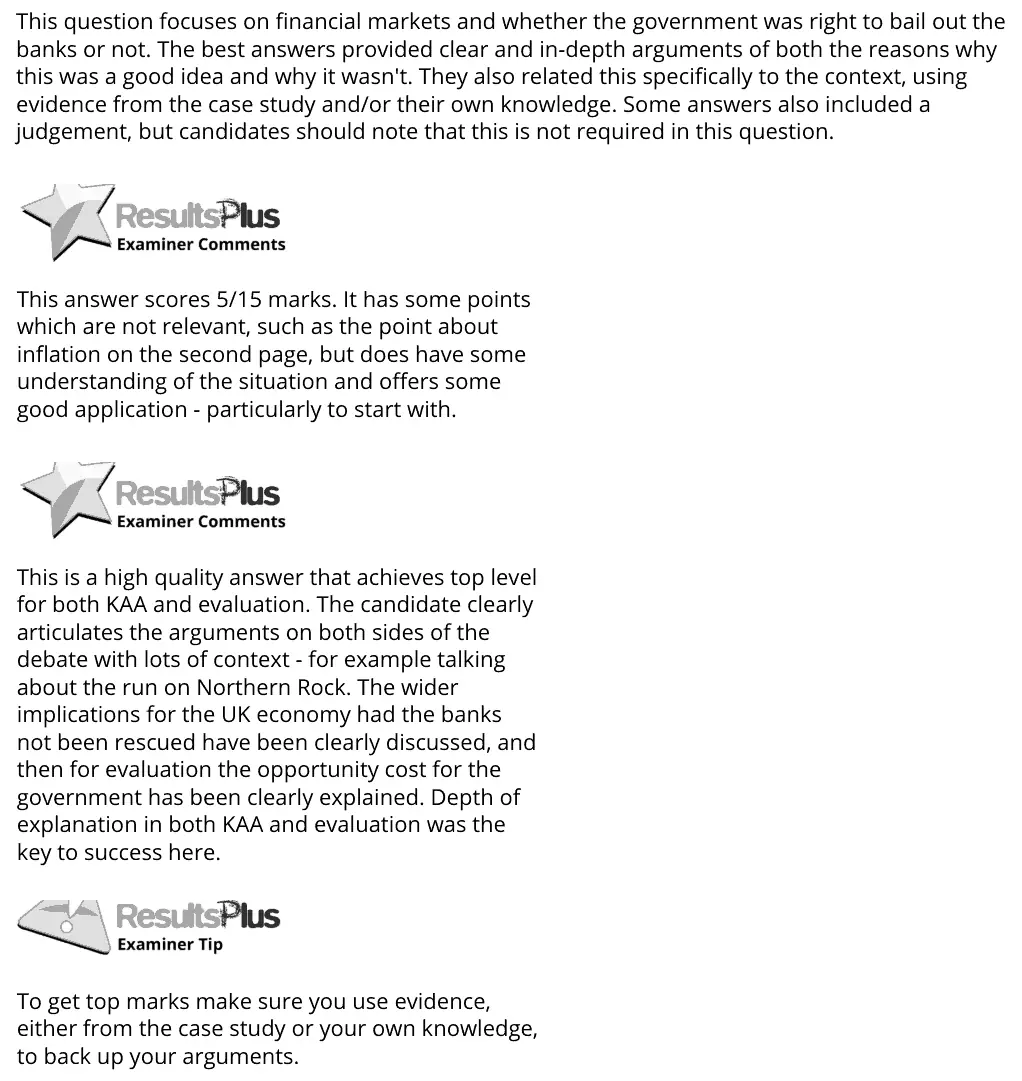
(e) Discuss whether providing substantial government financial support to banks is the best policy response during a financial crisis. (15)
June 2019 · Paper 2 · Q7 25 marks AO1=4, AO2=4, AO3=8, AO4=9 25-mark essay Either/or trading blocs and protectionismglobalisation and trade
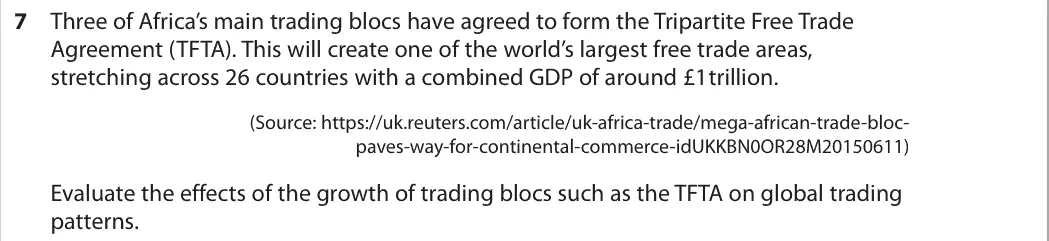
7 Three of Africa’s main trading blocs have agreed to form the Tripartite Free Trade Agreement (TFTA). This will create one of the world’s largest free trade areas, stretching across 26 countries with a combined GDP of around £1 trillion. (Source: https://uk.reuters.com/article/uk-africa-trade/mega-african-trade-bloc- paves-way-for-continental-commerce-idUKKBN0OR28M20150611) Evaluate the effects of the growth of trading blocs such as the TFTA on global trading patterns.
June 2019 · Paper 2 · Q8 25 marks AO1=4, AO2=4, AO3=8, AO4=9 25-mark essay Either/or public finances and taxation
8 Japan’s budget deficit for 2017/18 is expected to be 4.6% of GDP. Its national debt is forecast to increase to above 250% of GDP by 2019. Evaluate the impact of a large fiscal deficit and national debt on a country’s economy.

Work with an Edexcel economics tutor

Want a paper marked and gone through with you? Message us.

Prefer email? Send an enquiry

If you are under 18, please include a parent's contact details. Enquiries go to enquiries@economicsaleveltutor.com and are deleted once handled. All tutoring is online.