Macroeconomic objectives, conflicts and trade-offs Theme 2

Where it is examined
A-level Paper 2 (and Paper 3); AS Paper 2
Level
AS and A level
Specification
Section 2.6, 2 statements
Since 2016
8 question parts: 7 essays, 1 levels-marked responses, 0 multiple-choice items

Notes and key-term cards for this topic are being written by our tutors. The past-paper questions below are ready now.

Specification statements

Every essay set on this topic

SeriesPaperQMarksTitle
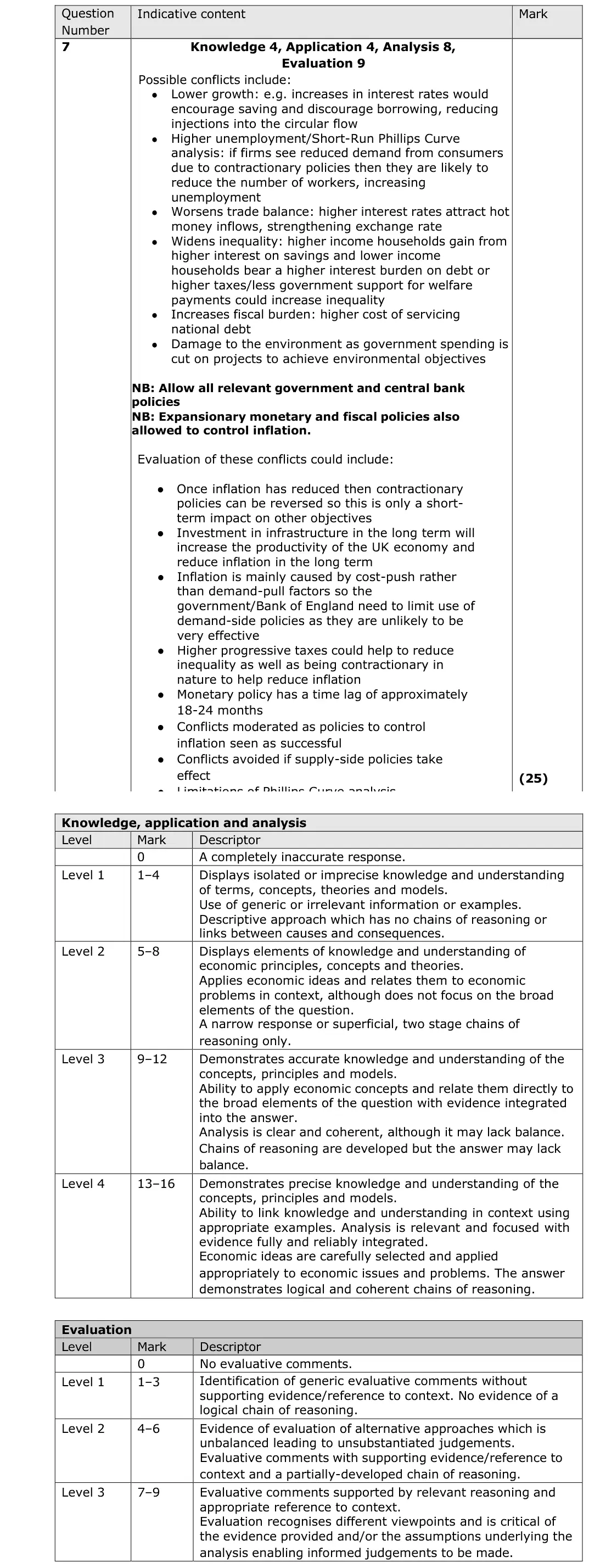
June 2025Paper 2725In January 2023 the UK prime minister, Rishi Sunak, promised to halve inflation by the end of the year. In July 2023 the Bank of England governor, Andrew Bailey, said: “It is crucial that we… return inflation to its 2% target and provide the environment of price stability in which the UK economy can thrive. This is the best contribution monetary policy can make to the prosperity of the United Kingdom.” (Source adapted from: https://www.theguardian.com/politics/2023/jan/04/ sunak‑vows‑to‑be‑steady‑hand‑on‑tiller‑but‑are‑his‑pledges‑all‑sleight‑of‑hand and https://www.theguardian.com/business/2023/jul/10/ inflation‑bank‑of‑england‑boss‑andrew‑bailey‑speech) Evaluate the possible conflicts between macroeconomic objectives when seeking to control inflation.
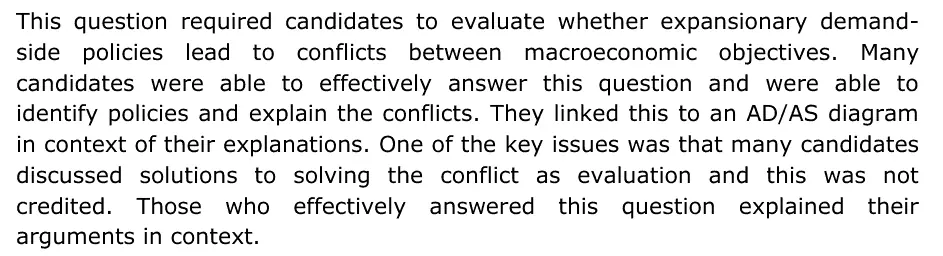
June 2024AS Paper 26(f)20Evaluate whether expansionary demand-side policies lead to conflicts between macroeconomic objectives.
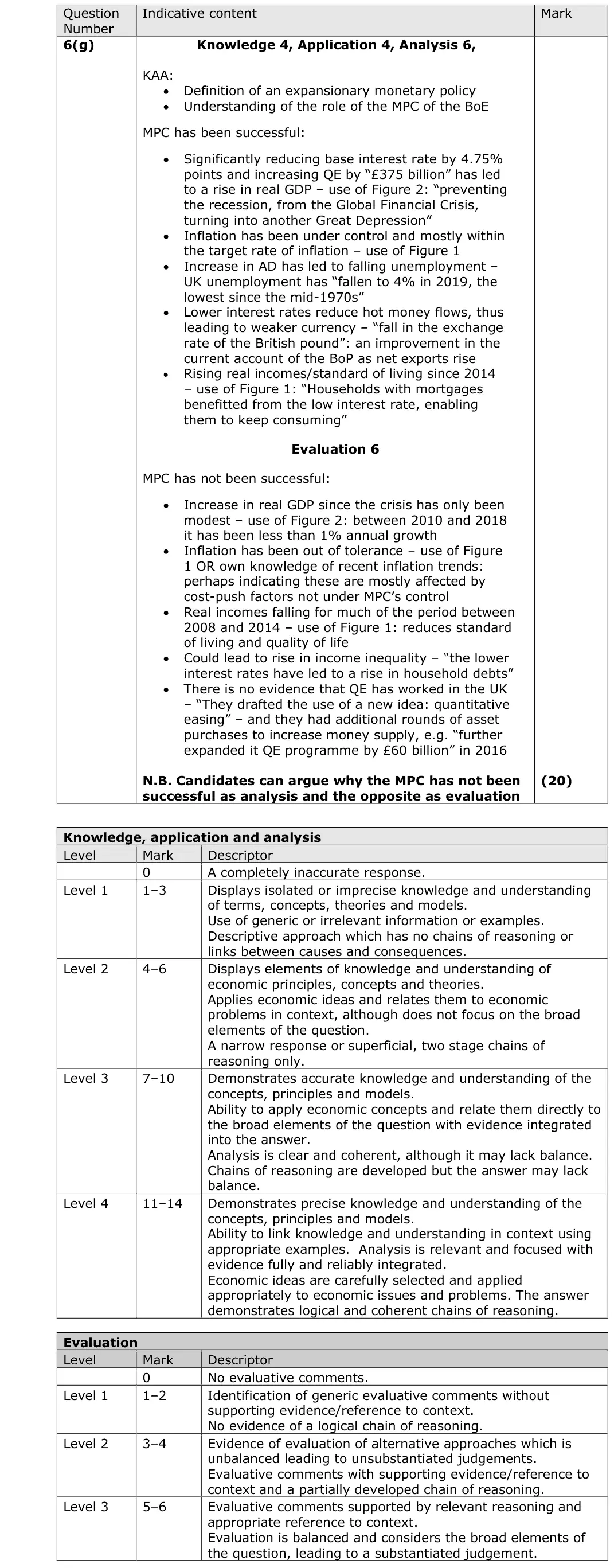
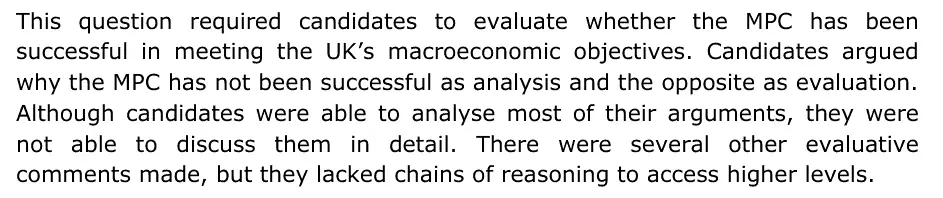
June 2024AS Paper 26(g)20Evaluate whether the MPC has been successful in meeting the UK’s macroeconomic objectives between 2008 and 2019.
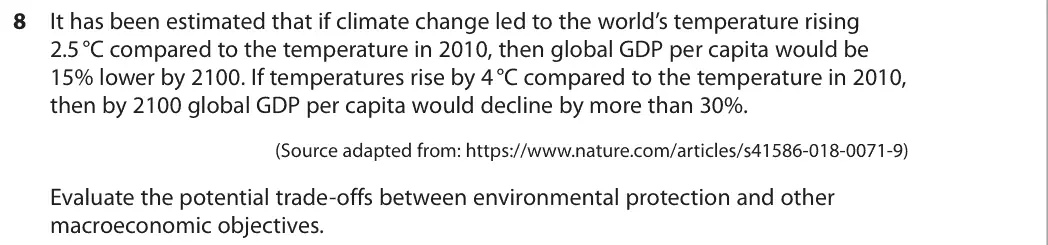
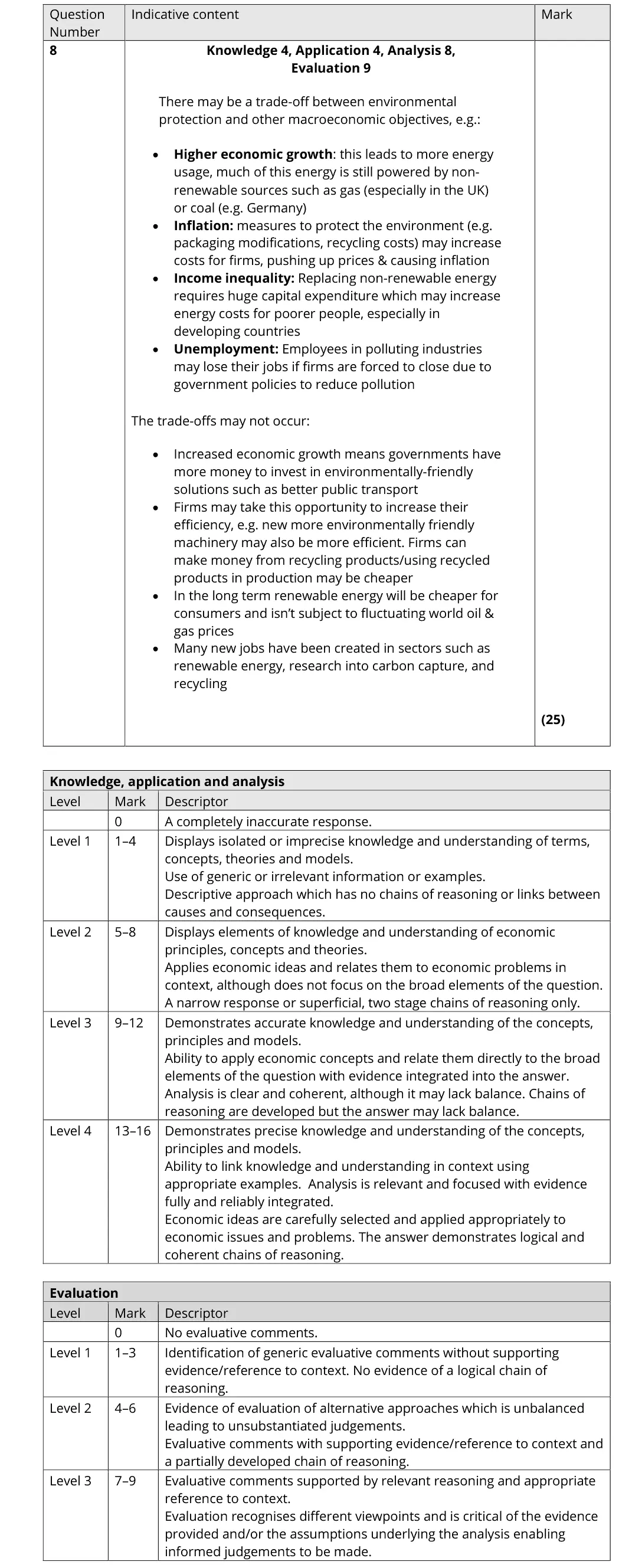
November 2021Paper 2825It has been estimated that if climate change led to the world’s temperature rising 2.5 °C compared to the temperature in 2010, then global GDP per capita would be 15% lower by 2100. If temperatures rise by 4 °C compared to the temperature in 2010, then by 2100 global GDP per capita would decline by more than 30%. (Source adapted from: https://www.nature.com/articles/s41586-018-0071-9) Evaluate the potential trade-offs between environmental protection and other macroeconomic objectives.
October 2020AS Paper 26(g)20Evaluate the likely macroeconomic effects of the UK government pursuing a policy of reducing its budget deficit.
June 2019AS Paper 26(g)20Evaluate the potential conflicts between the objective of economic growth and two other UK macroeconomic objectives.
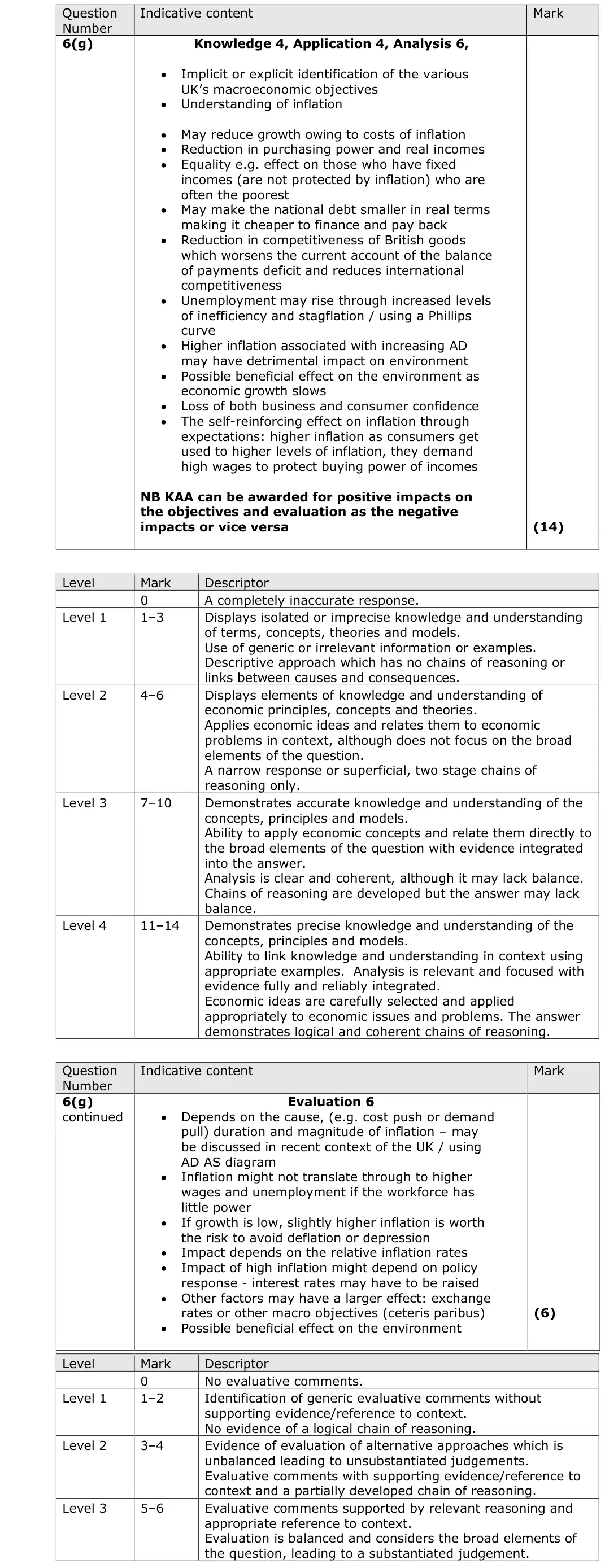
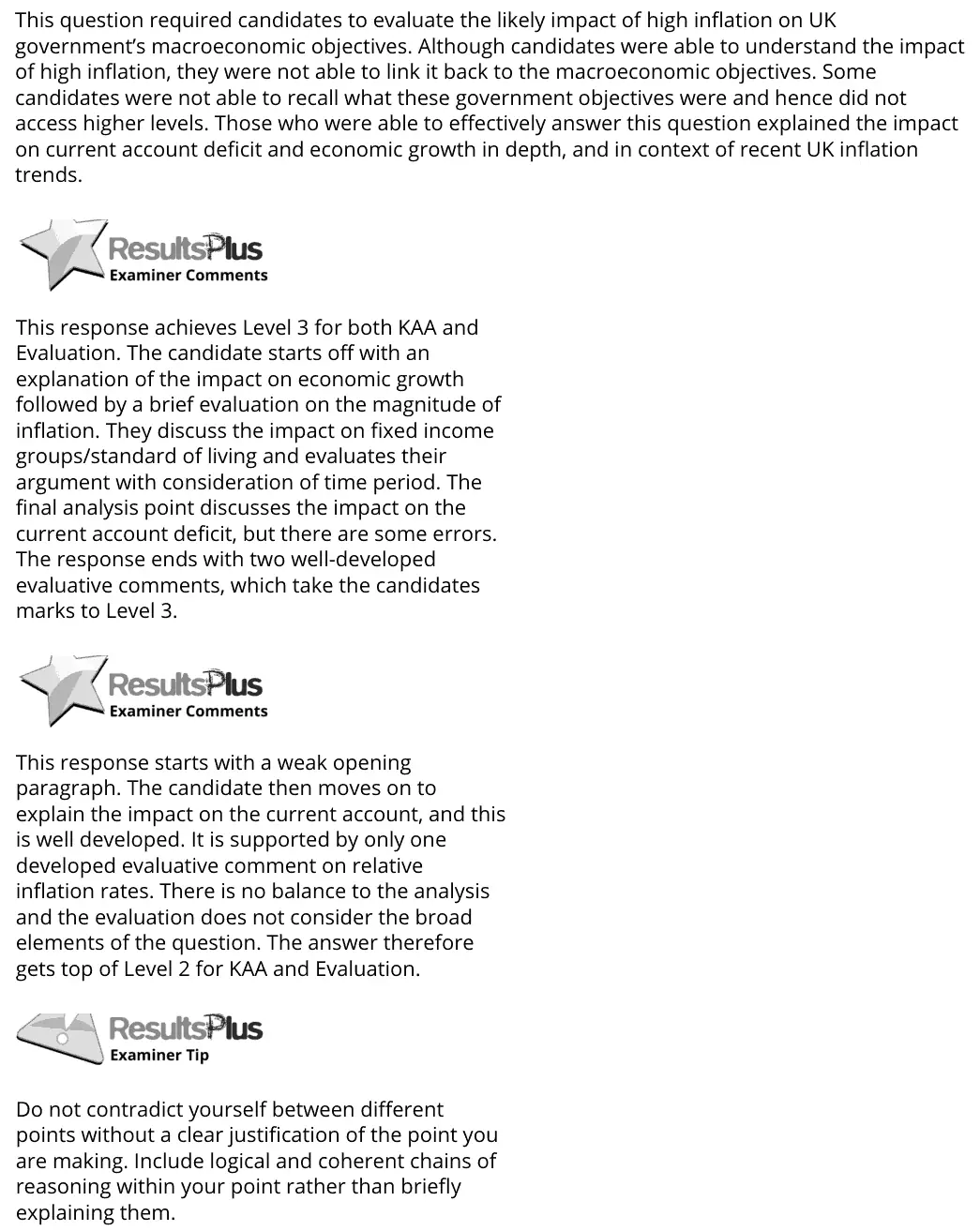
June 2018AS Paper 26(g)20Evaluate the likely impact of high inflation on the UK government’s macroeconomic objectives.

Past-paper questions

Print this topic as a pack

Tap a question to zoom it. The data and extracts fold out above each question; the mark scheme and examiner's comment open underneath.
June 2025 · Paper 2 · Q7 25 marks AO1=4, AO2=4, AO3=8, AO4=9 25-mark essay Either/or
7 In January 2023 the UK prime minister, Rishi Sunak, promised to halve inflation by the end of the year. In July 2023 the Bank of England governor, Andrew Bailey, said: “It is crucial that we… return inflation to its 2% target and provide the environment of price stability in which the UK economy can thrive. This is the best contribution monetary policy can make to the prosperity of the United Kingdom.” (Source adapted from: https://www.theguardian.com/politics/2023/jan/04/ sunak‑vows‑to‑be‑steady‑hand‑on‑tiller‑but‑are‑his‑pledges‑all‑sleight‑of‑hand and https://www.theguardian.com/business/2023/jul/10/ inflation‑bank‑of‑england‑boss‑andrew‑bailey‑speech) Evaluate the possible conflicts between macroeconomic objectives when seeking to control inflation.
June 2024 · AS Paper 2 · Q6(f) 20 marks AO1=4, AO2=4, AO3=6, AO4=6 20-mark essay Either/or
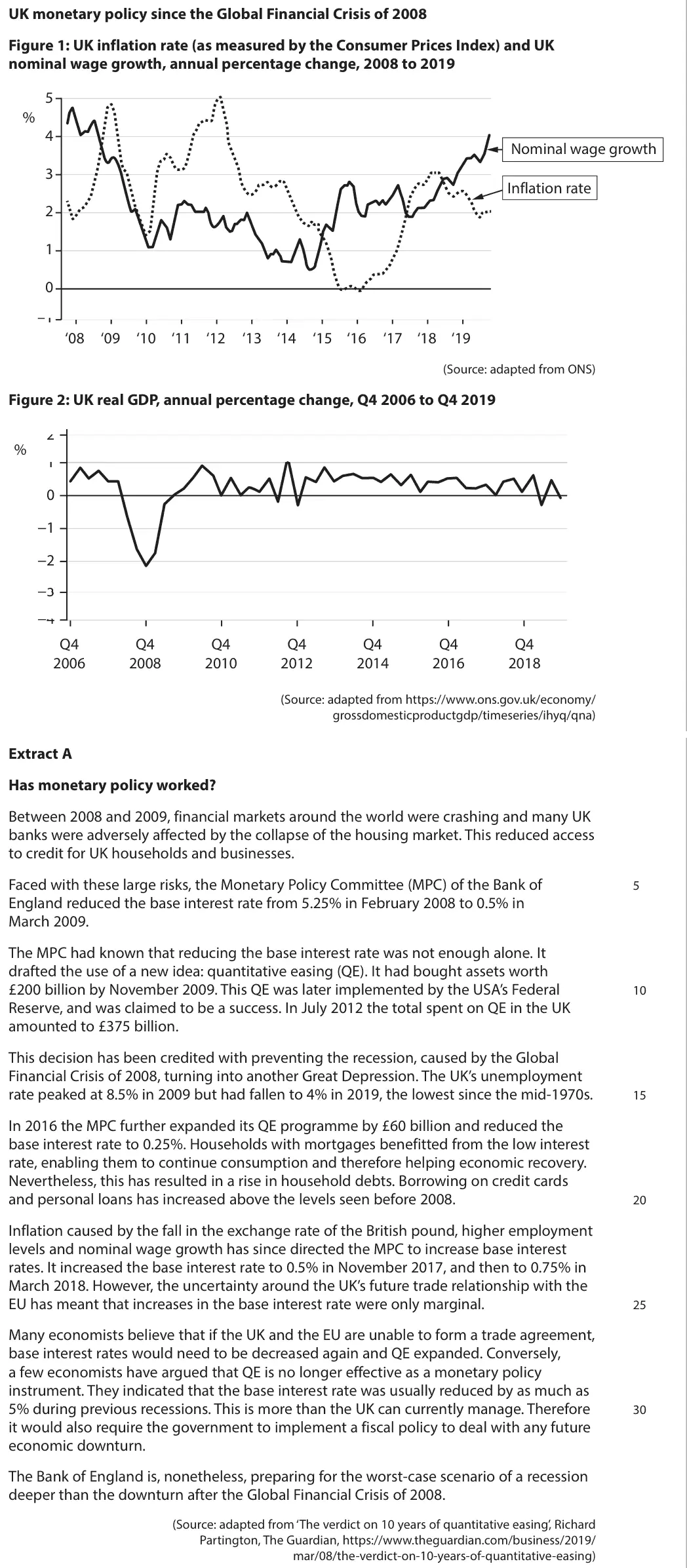
Data and extracts for question 6UK monetary policy since the Global Financial Crisis of 2008 Figure 1: UK inflation rate (as measured by the Consumer Prices Index) and UK nominal wage growth, annual percentage change, 2008 to 2019 5 % 4 Nominal wage growth 3 Inflation rate 2 1 0 –1 ‘08 ‘09 ‘10 ‘11 ‘12 ‘13 ‘14 ‘15 ‘16 ‘17 ‘18 ‘19 (Source: adapted from ONS) Figure 2: UK real GDP, annual percentage change, Q4 2006 to Q4 2019 2 % 1 0 -1 -2 -3 -4 Q4 Q4 Q4 Q4 Q4 Q4 Q4 2006 2008 2010 2012 2014 2016 2018 (Source: adapted from https://www.ons.gov.uk/economy/ grossdomesticproductgdp/timeseries/ihyq/qna) Extract A Has monetary policy worked? Between 2008 and 2009, financial markets around the world were crashing and many UK banks were adversely affected by the collapse of the housing market. This reduced access to credit for UK households and businesses. Faced with these large risks, the Monetary Policy Committee (MPC) of the Bank of 5 England reduced the base interest rate from 5.25% in February 2008 to 0.5% in March 2009. The MPC had known that reducing the base interest rate was not enough alone. It drafted the use of a new idea: quantitative easing (QE). It had bought assets worth £200 billion by November 2009. This QE was later implemented by the USA’s Federal 10 Reserve, and was claimed to be a success. In July 2012 the total spent on QE in the UK amounted to £375 billion. This decision has been credited with preventing the recession, caused by the Global Financial Crisis of 2008, turning into another Great Depression. The UK’s unemployment rate peaked at 8.5% in 2009 but had fallen to 4% in 2019, the lowest since the mid-1970s. 15 In 2016 the MPC further expanded its QE programme by £60 billion and reduced the base interest rate to 0.25%. Households with mortgages benefitted from the low interest rate, enabling them to continue consumption and therefore helping economic recovery. Nevertheless, this has resulted in a rise in household debts. Borrowing on credit cards and personal loans has increased above the levels seen before 2008. 20 Inflation caused by the fall in the exchange rate of the British pound, higher employment levels and nominal wage growth has since directed the MPC to increase base interest rates. It increased the base interest rate to 0.5% in November 2017, and then to 0.75% in March 2018. However, the uncertainty around the UK’s future trade relationship with the EU has meant that increases in the base interest rate were only marginal. 25 Many economists believe that if the UK and the EU are unable to form a trade agreement, base interest rates would need to be decreased again and QE expanded. Conversely, a few economists have argued that QE is no longer effective as a monetary policy instrument. They indicated that the base interest rate was usually reduced by as much as 5% during previous recessions. This is more than the UK can currently manage. Therefore 30 it would also require the government to implement a fiscal policy to deal with any future economic downturn. The Bank of England is, nonetheless, preparing for the worst-case scenario of a recession deeper than the downturn after the Global Financial Crisis of 2008. (Source: adapted from ‘The verdict on 10 years of quantitative easing’, Richard Partington, The Guardian, https://www.theguardian.com/business/2019/ mar/08/the-verdict-on-10-years-of-quantitative-easing)
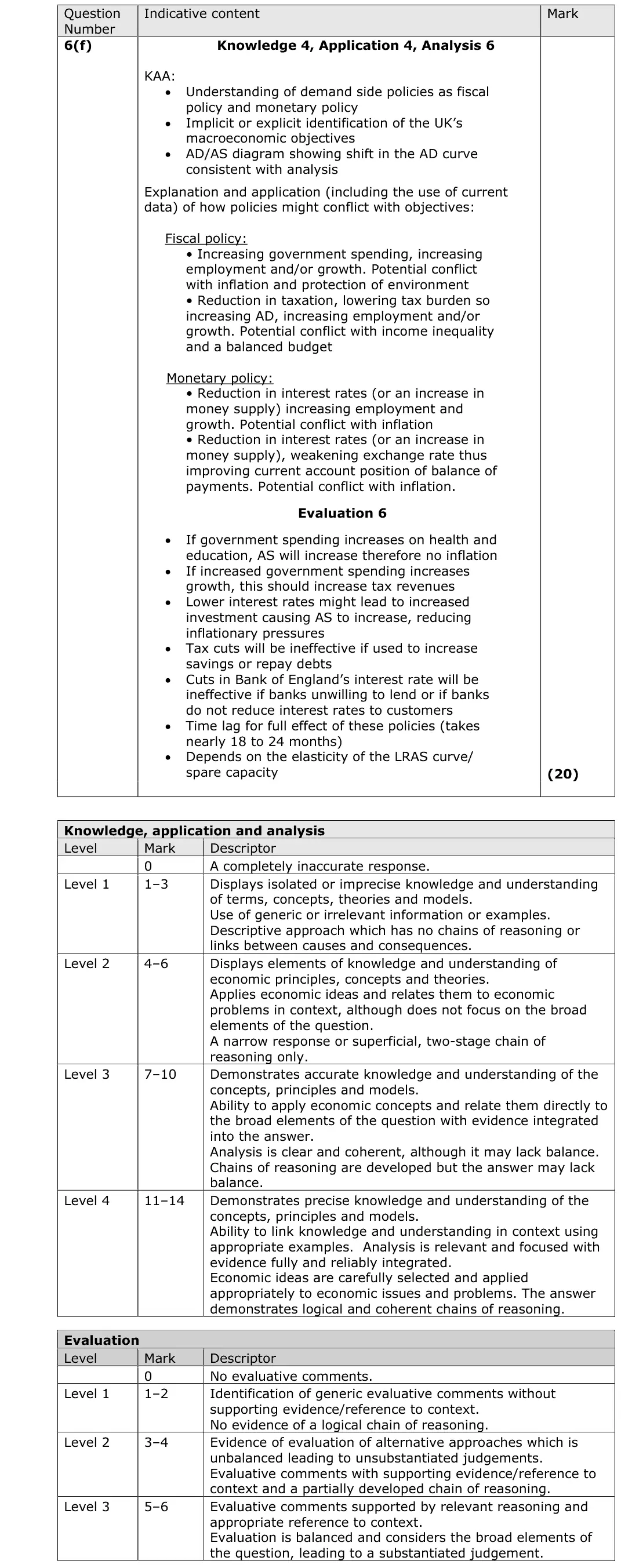
(f) Evaluate whether expansionary demand-side policies lead to conflicts between macroeconomic objectives. (20)
June 2024 · AS Paper 2 · Q6(g) 20 marks AO1=4, AO2=4, AO3=6, AO4=6 20-mark essay Either/or
Data and extracts for question 6UK monetary policy since the Global Financial Crisis of 2008 Figure 1: UK inflation rate (as measured by the Consumer Prices Index) and UK nominal wage growth, annual percentage change, 2008 to 2019 5 % 4 Nominal wage growth 3 Inflation rate 2 1 0 –1 ‘08 ‘09 ‘10 ‘11 ‘12 ‘13 ‘14 ‘15 ‘16 ‘17 ‘18 ‘19 (Source: adapted from ONS) Figure 2: UK real GDP, annual percentage change, Q4 2006 to Q4 2019 2 % 1 0 -1 -2 -3 -4 Q4 Q4 Q4 Q4 Q4 Q4 Q4 2006 2008 2010 2012 2014 2016 2018 (Source: adapted from https://www.ons.gov.uk/economy/ grossdomesticproductgdp/timeseries/ihyq/qna) Extract A Has monetary policy worked? Between 2008 and 2009, financial markets around the world were crashing and many UK banks were adversely affected by the collapse of the housing market. This reduced access to credit for UK households and businesses. Faced with these large risks, the Monetary Policy Committee (MPC) of the Bank of 5 England reduced the base interest rate from 5.25% in February 2008 to 0.5% in March 2009. The MPC had known that reducing the base interest rate was not enough alone. It drafted the use of a new idea: quantitative easing (QE). It had bought assets worth £200 billion by November 2009. This QE was later implemented by the USA’s Federal 10 Reserve, and was claimed to be a success. In July 2012 the total spent on QE in the UK amounted to £375 billion. This decision has been credited with preventing the recession, caused by the Global Financial Crisis of 2008, turning into another Great Depression. The UK’s unemployment rate peaked at 8.5% in 2009 but had fallen to 4% in 2019, the lowest since the mid-1970s. 15 In 2016 the MPC further expanded its QE programme by £60 billion and reduced the base interest rate to 0.25%. Households with mortgages benefitted from the low interest rate, enabling them to continue consumption and therefore helping economic recovery. Nevertheless, this has resulted in a rise in household debts. Borrowing on credit cards and personal loans has increased above the levels seen before 2008. 20 Inflation caused by the fall in the exchange rate of the British pound, higher employment levels and nominal wage growth has since directed the MPC to increase base interest rates. It increased the base interest rate to 0.5% in November 2017, and then to 0.75% in March 2018. However, the uncertainty around the UK’s future trade relationship with the EU has meant that increases in the base interest rate were only marginal. 25 Many economists believe that if the UK and the EU are unable to form a trade agreement, base interest rates would need to be decreased again and QE expanded. Conversely, a few economists have argued that QE is no longer effective as a monetary policy instrument. They indicated that the base interest rate was usually reduced by as much as 5% during previous recessions. This is more than the UK can currently manage. Therefore 30 it would also require the government to implement a fiscal policy to deal with any future economic downturn. The Bank of England is, nonetheless, preparing for the worst-case scenario of a recession deeper than the downturn after the Global Financial Crisis of 2008. (Source: adapted from ‘The verdict on 10 years of quantitative easing’, Richard Partington, The Guardian, https://www.theguardian.com/business/2019/ mar/08/the-verdict-on-10-years-of-quantitative-easing)
(g) Evaluate whether the MPC has been successful in meeting the UK’s macroeconomic objectives between 2008 and 2019. (20)
November 2021 · Paper 2 · Q8 25 marks AO1=4, AO2=4, AO3=8, AO4=9 25-mark essay Either/or
8 It has been estimated that if climate change led to the world’s temperature rising 2.5 °C compared to the temperature in 2010, then global GDP per capita would be 15% lower by 2100. If temperatures rise by 4 °C compared to the temperature in 2010, then by 2100 global GDP per capita would decline by more than 30%. (Source adapted from: https://www.nature.com/articles/s41586-018-0071-9) Evaluate the potential trade-offs between environmental protection and other macroeconomic objectives.
October 2020 · AS Paper 2 · Q6(g) 20 marks AO1=4, AO2=4, AO3=6, AO4=6 20-mark essay Either/or
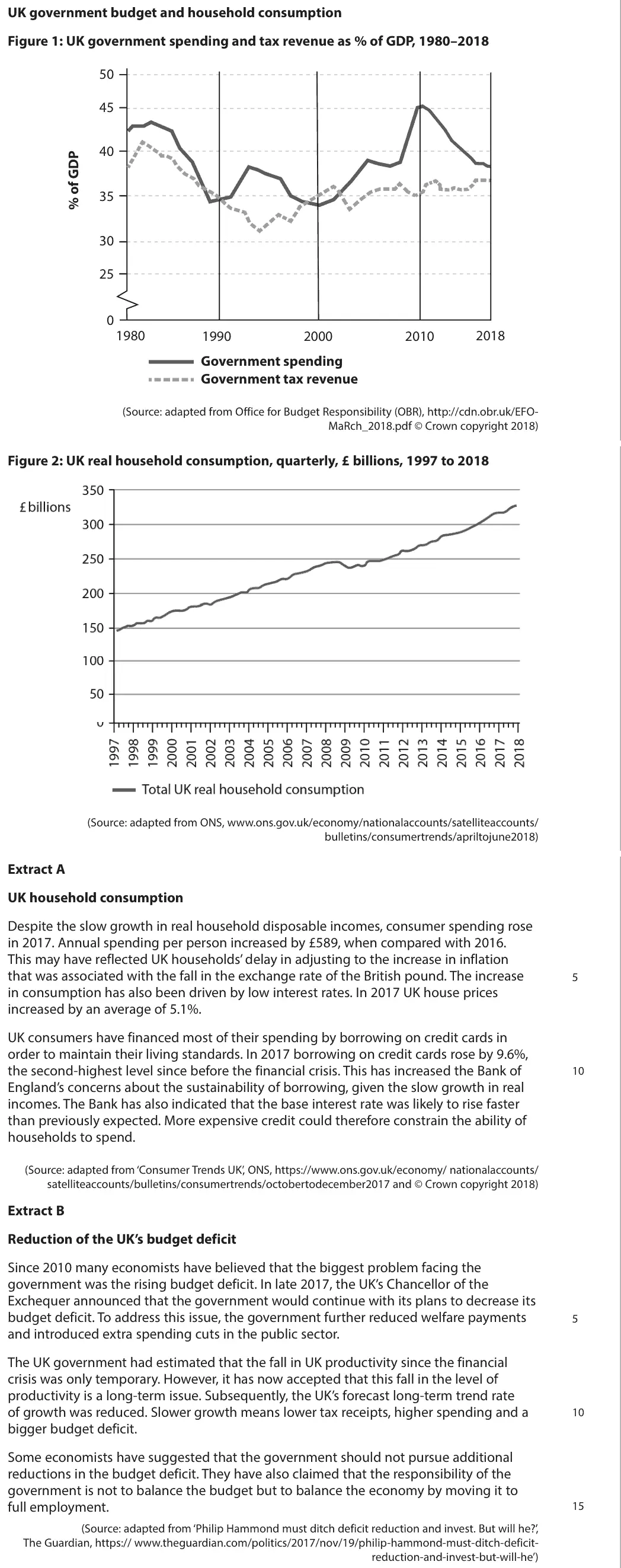
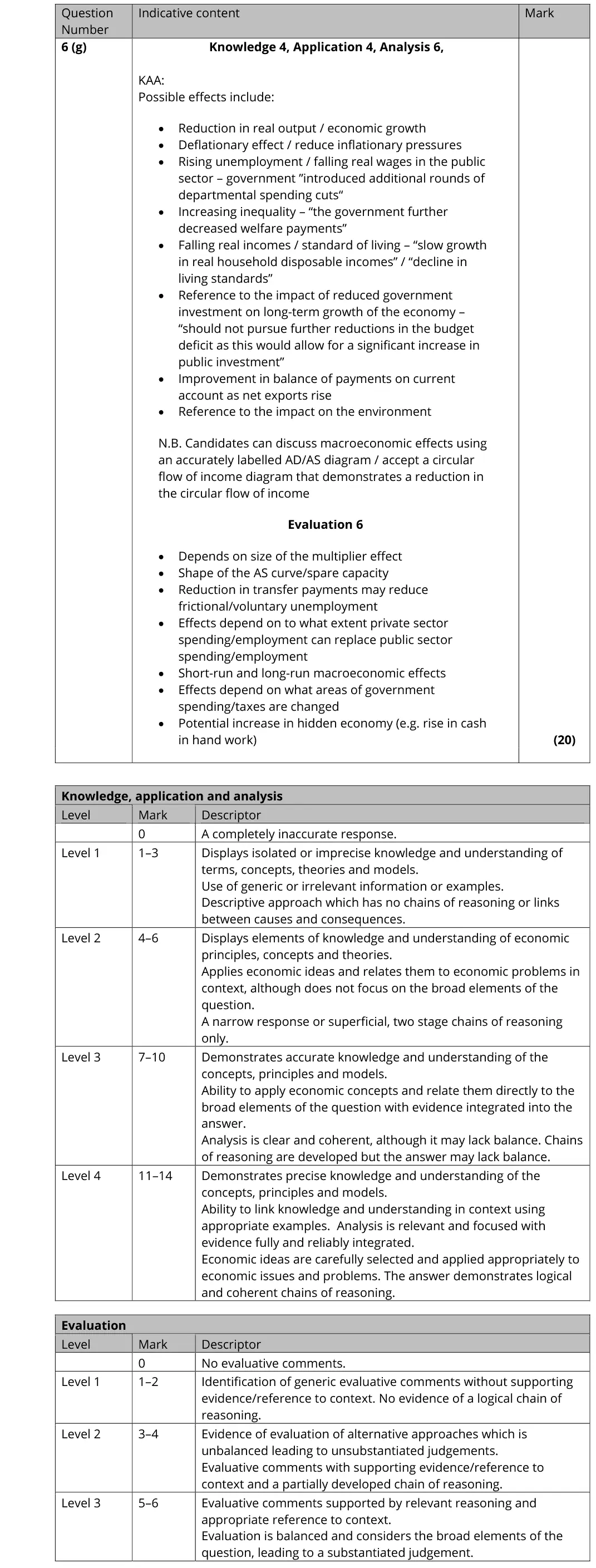
Data and extracts for question 6UK government budget and household consumption Figure 1: UK government spending and tax revenue as % of GDP, 1980–2018 50 45 40 35 30 25 0 1980 2018 1990 2000 2010 Government spending Government tax revenue (Source: adapted from Office for Budget Responsibility (OBR), http://cdn.obr.uk/EFO- MaRch_2018.pdf © Crown copyright 2018) Figure 2: UK real household consumption, quarterly, £ billions, 1997 to 2018 (Source: adapted from ONS, www.ons.gov.uk/economy/nationalaccounts/satelliteaccounts/ bulletins/consumertrends/apriltojune2018) Extract A UK household consumption Despite the slow growth in real household disposable incomes, consumer spending rose in 2017. Annual spending per person increased by £589, when compared with 2016. This may have reflected UK households’ delay in adjusting to the increase in inflation that was associated with the fall in the exchange rate of the British pound. The increase 5 in consumption has also been driven by low interest rates. In 2017 UK house prices increased by an average of 5.1%. UK consumers have financed most of their spending by borrowing on credit cards in order to maintain their living standards. In 2017 borrowing on credit cards rose by 9.6%, the second-highest level since before the financial crisis. This has increased the Bank of 10 England’s concerns about the sustainability of borrowing, given the slow growth in real incomes. The Bank has also indicated that the base interest rate was likely to rise faster than previously expected. More expensive credit could therefore constrain the ability of households to spend. (Source: adapted from ‘Consumer Trends UK’, ONS, https://www.ons.gov.uk/economy/ nationalaccounts/ satelliteaccounts/bulletins/consumertrends/octobertodecember2017 and © Crown copyright 2018) Extract B Reduction of the UK’s budget deficit Since 2010 many economists have believed that the biggest problem facing the government was the rising budget deficit. In late 2017, the UK’s Chancellor of the Exchequer announced that the government would continue with its plans to decrease its budget deficit. To address this issue, the government further reduced welfare payments 5 and introduced extra spending cuts in the public sector. The UK government had estimated that the fall in UK productivity since the financial crisis was only temporary. However, it has now accepted that this fall in the level of productivity is a long-term issue. Subsequently, the UK’s forecast long-term trend rate of growth was reduced. Slower growth means lower tax receipts, higher spending and a 10 bigger budget deficit. Some economists have suggested that the government should not pursue additional reductions in the budget deficit. They have also claimed that the responsibility of the government is not to balance the budget but to balance the economy by moving it to full employment. 15 (Source: adapted from ‘Philip Hammond must ditch deficit reduction and invest. But will he?’, The Guardian, https:// www.theguardian.com/politics/2017/nov/19/philip-hammond-must-ditch-deficit- reduction-and-invest-but-will-he’)
(g) Evaluate the likely macroeconomic effects of the UK government pursuing a policy of reducing its budget deficit. (20)
June 2019 · Paper 2 · Q6(d) 12 marks AO1=4, AO2=2, AO3=2, AO4=4 12-mark response
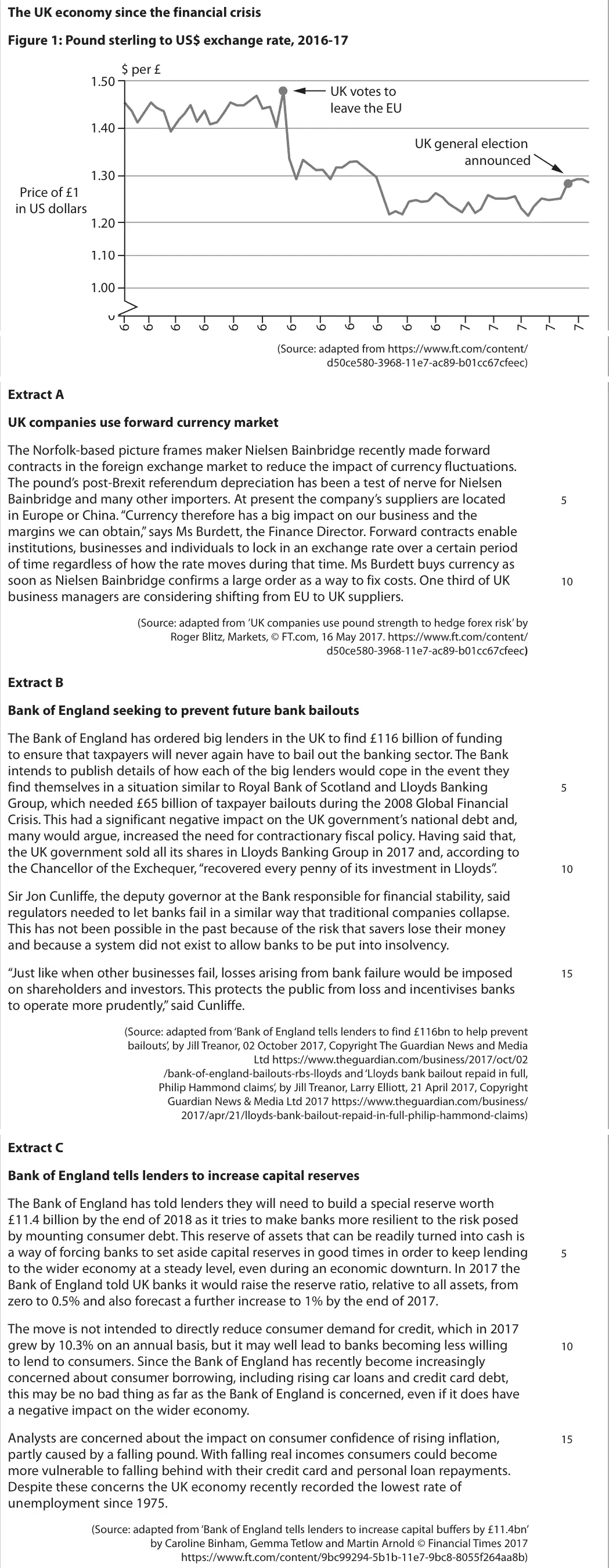
Data and extracts for question 6The UK economy since the financial crisis Figure 1: Pound sterling to US$ exchange rate, 2016-17 $ per £ 1.50 UK votes to leave the EU 1.40 UK general election announced 1.30 Price of £1 in US dollars 1.20 1.10 1.00 0 (Source: adapted from https://www.ft.com/content/ d50ce580-3968-11e7-ac89-b01cc67cfeec) Extract A UK companies use forward currency market The Norfolk-based picture frames maker Nielsen Bainbridge recently made forward contracts in the foreign exchange market to reduce the impact of currency fluctuations. The pound’s post-Brexit referendum depreciation has been a test of nerve for Nielsen Bainbridge and many other importers. At present the company’s suppliers are located 5 in Europe or China. “Currency therefore has a big impact on our business and the margins we can obtain,” says Ms Burdett, the Finance Director. Forward contracts enable institutions, businesses and individuals to lock in an exchange rate over a certain period of time regardless of how the rate moves during that time. Ms Burdett buys currency as soon as Nielsen Bainbridge confirms a large order as a way to fix costs. One third of UK 10 business managers are considering shifting from EU to UK suppliers. (Source: adapted from ’UK companies use pound strength to hedge forex risk’ by Roger Blitz, Markets, © FT.com, 16 May 2017. https://www.ft.com/content/ d50ce580-3968-11e7-ac89-b01cc67cfeec) Extract B Bank of England seeking to prevent future bank bailouts The Bank of England has ordered big lenders in the UK to find £116 billion of funding to ensure that taxpayers will never again have to bail out the banking sector. The Bank intends to publish details of how each of the big lenders would cope in the event they find themselves in a situation similar to Royal Bank of Scotland and Lloyds Banking 5 Group, which needed £65 billion of taxpayer bailouts during the 2008 Global Financial Crisis. This had a significant negative impact on the UK government’s national debt and, many would argue, increased the need for contractionary fiscal policy. Having said that, the UK government sold all its shares in Lloyds Banking Group in 2017 and, according to the Chancellor of the Exchequer, “recovered every penny of its investment in Lloyds”. 10 Sir Jon Cunliffe, the deputy governor at the Bank responsible for financial stability, said regulators needed to let banks fail in a similar way that traditional companies collapse. This has not been possible in the past because of the risk that savers lose their money and because a system did not exist to allow banks to be put into insolvency. “Just like when other businesses fail, losses arising from bank failure would be imposed 15 on shareholders and investors. This protects the public from loss and incentivises banks to operate more prudently,” said Cunliffe. (Source: adapted from ‘Bank of England tells lenders to find £116bn to help prevent bailouts’, by Jill Treanor, 02 October 2017, Copyright The Guardian News and Media Ltd https://www.theguardian.com/business/2017/oct/02 /bank-of-england-bailouts-rbs-lloyds and ‘Lloyds bank bailout repaid in full, Philip Hammond claims’, by Jill Treanor, Larry Elliott, 21 April 2017, Copyright Guardian News & Media Ltd 2017 https://www.theguardian.com/business/ 2017/apr/21/lloyds-bank-bailout-repaid-in-full-philip-hammond-claims) Extract C Bank of England tells lenders to increase capital reserves The Bank of England has told lenders they will need to build a special reserve worth £11.4 billion by the end of 2018 as it tries to make banks more resilient to the risk posed by mounting consumer debt. This reserve of assets that can be readily turned into cash is a way of forcing banks to set aside capital reserves in good times in order to keep lending 5 to the wider economy at a steady level, even during an economic downturn. In 2017 the Bank of England told UK banks it would raise the reserve ratio, relative to all assets, from zero to 0.5% and also forecast a further increase to 1% by the end of 2017. The move is not intended to directly reduce consumer demand for credit, which in 2017 grew by 10.3% on an annual basis, but it may well lead to banks becoming less willing 10 to lend to consumers. Since the Bank of England has recently become increasingly concerned about consumer borrowing, including rising car loans and credit card debt, this may be no bad thing as far as the Bank of England is concerned, even if it does have a negative impact on the wider economy. Analysts are concerned about the impact on consumer confidence of rising inflation, 15 partly caused by a falling pound. With falling real incomes consumers could become more vulnerable to falling behind with their credit card and personal loan repayments. Despite these concerns the UK economy recently recorded the lowest rate of unemployment since 1975. (Source: adapted from ‘Bank of England tells lenders to increase capital buffers by £11.4bn’ by Caroline Binham, Gemma Tetlow and Martin Arnold © Financial Times 2017 https://www.ft.com/content/9bc99294-5b1b-11e7-9bc8-8055f264aa8b)
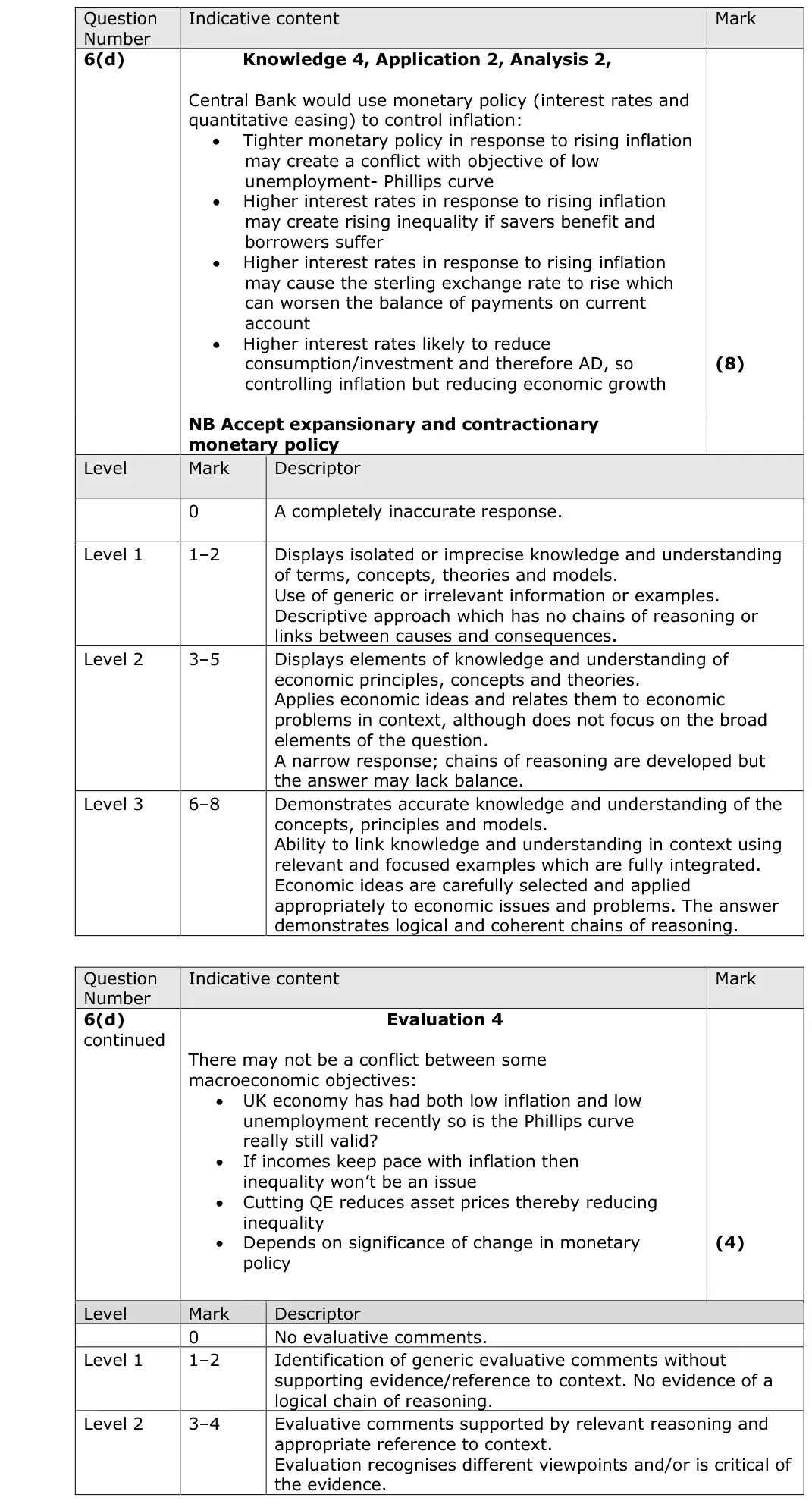
(d) With reference to Extract C, discuss the potential conflicts between macroeconomic objectives when the central bank attempts to control inflation. (12)
June 2019 · AS Paper 2 · Q6(g) 20 marks AO1=4, AO2=4, AO3=6, AO4=6 20-mark essay Either/or Hard
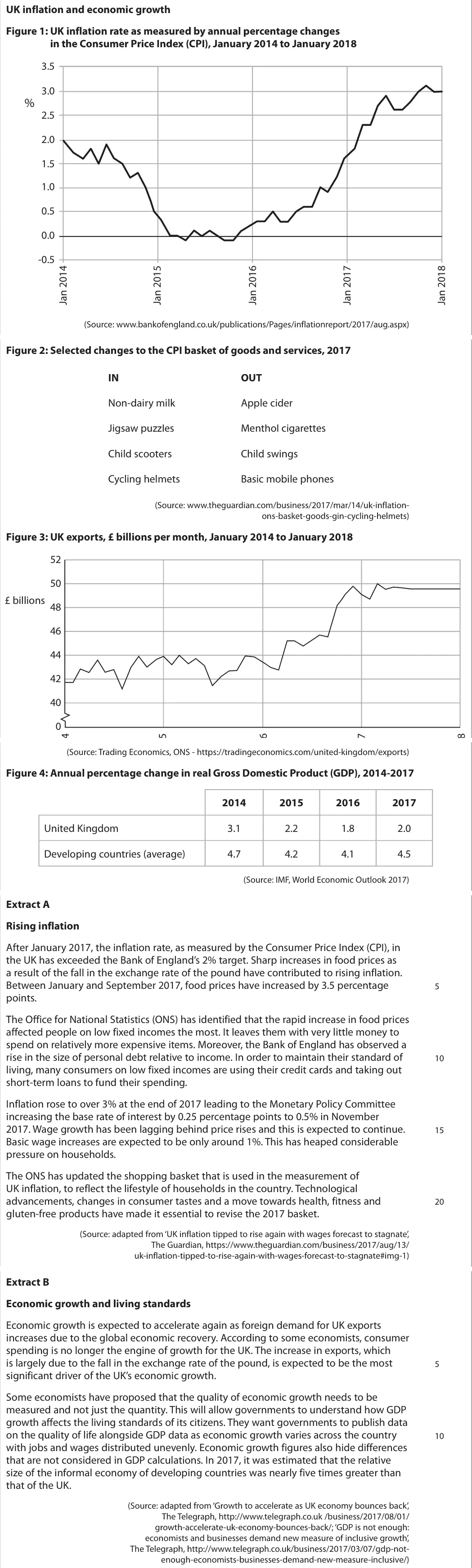
Data and extracts for question 6UK inflation and economic growth Figure 1: UK inflation rate as measured by annual percentage changes in the Consumer Price Index (CPI), January 2014 to January 2018 3.5 3.0 % 2.5 2.0 1.5 1.0 0.5 0.0 -0.5 (Source: www.bankofengland.co.uk/publications/Pages/inflationreport/2017/aug.aspx) Figure 2: Selected changes to the CPI basket of goods and services, 2017 IN OUT Non-dairy milk Apple cider Jigsaw puzzles Menthol cigarettes Child scooters Child swings Cycling helmets Basic mobile phones (Source: www.theguardian.com/business/2017/mar/14/uk-inflation- ons-basket-goods-gin-cycling-helmets) Figure 3: UK exports, £ billions per month, January 2014 to January 2018 52 50 £ billions 48 46 44 42 40 0 (Source: Trading Economics, ONS - https://tradingeconomics.com/united-kingdom/exports) Figure 4: Annual percentage change in real Gross Domestic Product (GDP), 2014-2017 2014 2015 2016 2017 United Kingdom 3.1 2.2 1.8 2.0 Developing countries (average) 4.7 4.2 4.1 4.5 (Source: IMF, World Economic Outlook 2017) Extract A Rising inflation After January 2017, the inflation rate, as measured by the Consumer Price Index (CPI), in the UK has exceeded the Bank of England’s 2% target. Sharp increases in food prices as a result of the fall in the exchange rate of the pound have contributed to rising inflation. Between January and September 2017, food prices have increased by 3.5 percentage 5 points. The Office for National Statistics (ONS) has identified that the rapid increase in food prices affected people on low fixed incomes the most. It leaves them with very little money to spend on relatively more expensive items. Moreover, the Bank of England has observed a rise in the size of personal debt relative to income. In order to maintain their standard of 10 living, many consumers on low fixed incomes are using their credit cards and taking out short-term loans to fund their spending. Inflation rose to over 3% at the end of 2017 leading to the Monetary Policy Committee increasing the base rate of interest by 0.25 percentage points to 0.5% in November 2017. Wage growth has been lagging behind price rises and this is expected to continue. 15 Basic wage increases are expected to be only around 1%. This has heaped considerable pressure on households. The ONS has updated the shopping basket that is used in the measurement of UK inflation, to reflect the lifestyle of households in the country. Technological advancements, changes in consumer tastes and a move towards health, fitness and 20 gluten-free products have made it essential to revise the 2017 basket. (Source: adapted from ‘UK inflation tipped to rise again with wages forecast to stagnate’, The Guardian, https://www.theguardian.com/business/2017/aug/13/ uk-inflation-tipped-to-rise-again-with-wages-forecast-to-stagnate#img-1) Extract B Economic growth and living standards Economic growth is expected to accelerate again as foreign demand for UK exports increases due to the global economic recovery. According to some economists, consumer spending is no longer the engine of growth for the UK. The increase in exports, which is largely due to the fall in the exchange rate of the pound, is expected to be the most 5 significant driver of the UK’s economic growth. Some economists have proposed that the quality of economic growth needs to be measured and not just the quantity. This will allow governments to understand how GDP growth affects the living standards of its citizens. They want governments to publish data on the quality of life alongside GDP data as economic growth varies across the country 10 with jobs and wages distributed unevenly. Economic growth figures also hide differences that are not considered in GDP calculations. In 2017, it was estimated that the relative size of the informal economy of developing countries was nearly five times greater than that of the UK. (Source: adapted from ‘Growth to accelerate as UK economy bounces back’, The Telegraph, http://www.telegraph.co.uk /business/2017/08/01/ growth-accelerate-uk-economy-bounces-back/; ‘GDP is not enough: economists and businesses demand new measure of inclusive growth’, The Telegraph, http://www.telegraph.co.uk/business/2017/03/07/gdp-not- enough-economists-businesses-demand-new-measure-inclusive/)
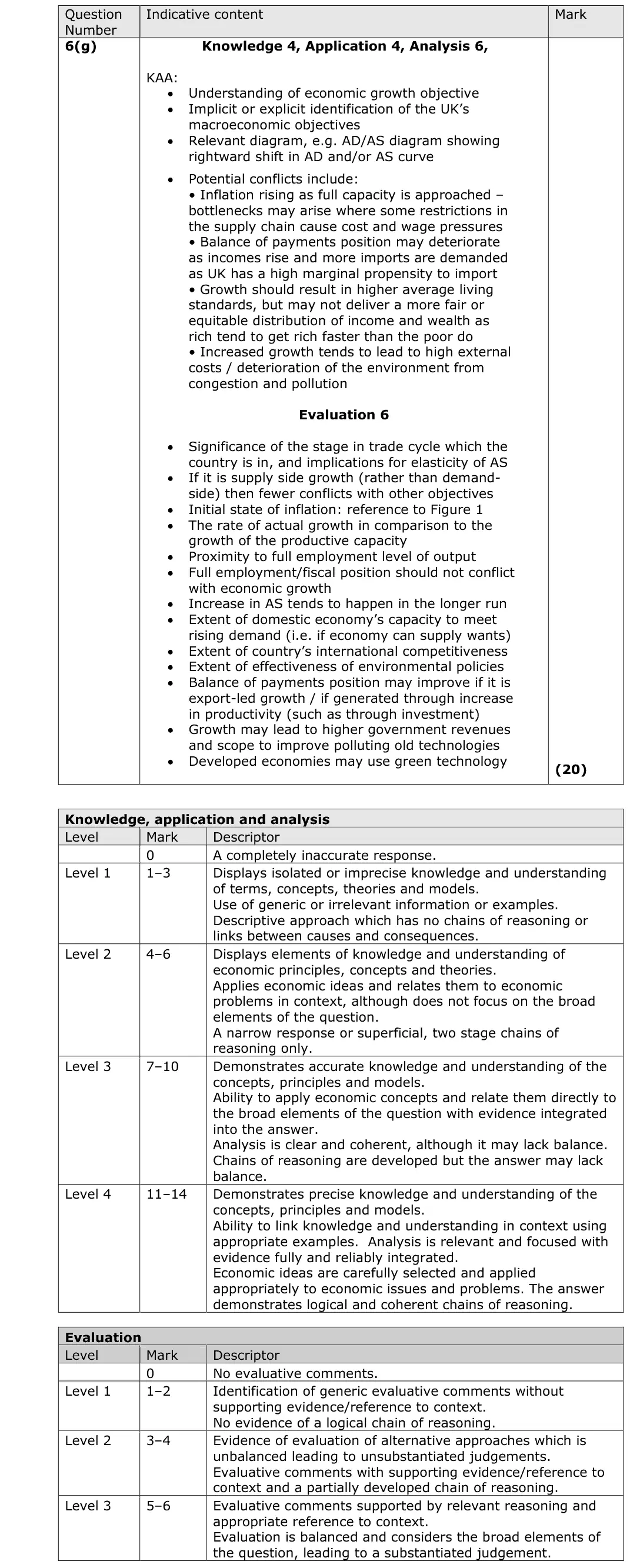
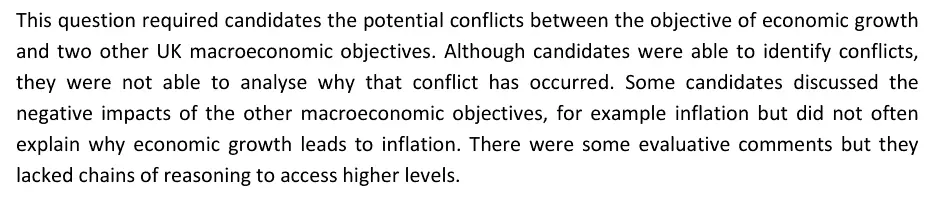
(g) Evaluate the potential conflicts between the objective of economic growth and two other UK macroeconomic objectives. (20)
June 2018 · AS Paper 2 · Q6(g) 20 marks AO1=4, AO2=4, AO3=6, AO4=6 20-mark essay Either/or Hard
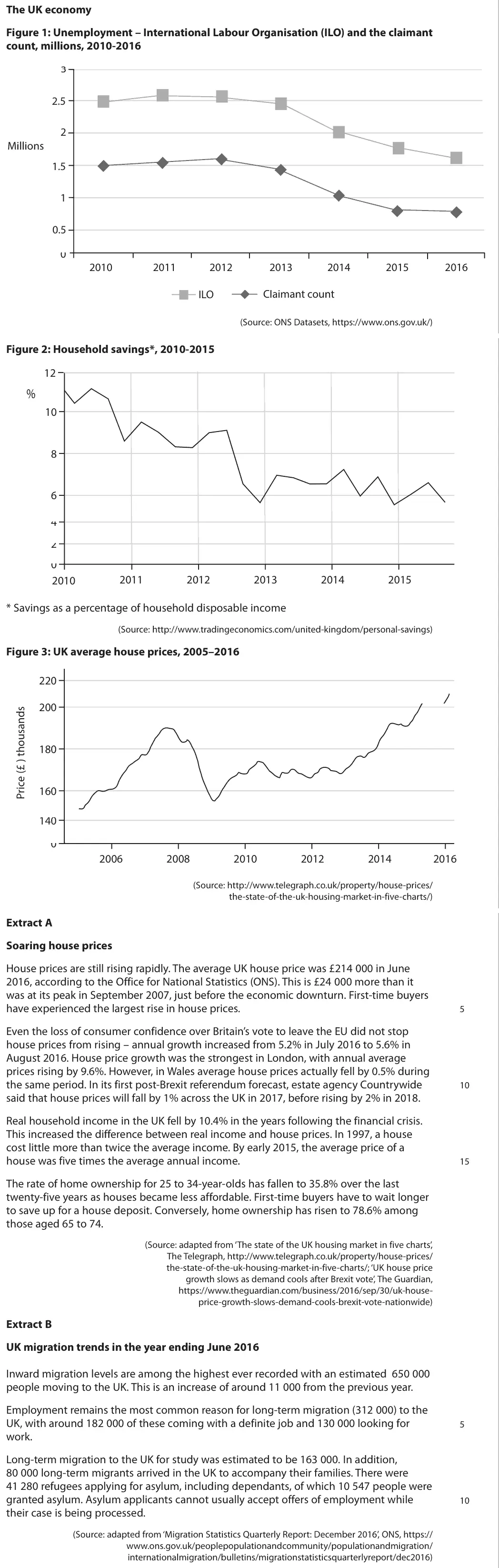
Data and extracts for question 6The UK economy Figure 1: Unemployment – International Labour Organisation (ILO) and the claimant count, millions, 2010-2016 3 2.5 2 Millions 1.5 1 0.5 0 2010 2011 2012 2013 2014 2015 2016 ILO Claimant count (Source: ONS Datasets, https://www.ons.gov.uk/) Figure 2: Household savings*, 2010-2015 12 % 10 8 6 4 2 0 2011 2012 2013 2014 2015 2010 * Savings as a percentage of household disposable income (Source: http://www.tradingeconomics.com/united-kingdom/personal-savings) Figure 3: UK average house prices, 2005–2016 220 200 180 160 140 0 2006 2008 2010 2012 2014 2016 (Source: http://www.telegraph.co.uk/property/house-prices/ the-state-of-the-uk-housing-market-in-five-charts/) Extract A Soaring house prices House prices are still rising rapidly. The average UK house price was £214 000 in June 2016, according to the Office for National Statistics (ONS). This is £24 000 more than it was at its peak in September 2007, just before the economic downturn. First-time buyers have experienced the largest rise in house prices. 5 Even the loss of consumer confidence over Britain’s vote to leave the EU did not stop house prices from rising – annual growth increased from 5.2% in July 2016 to 5.6% in August 2016. House price growth was the strongest in London, with annual average prices rising by 9.6%. However, in Wales average house prices actually fell by 0.5% during the same period. In its first post-Brexit referendum forecast, estate agency Countrywide 10 said that house prices will fall by 1% across the UK in 2017, before rising by 2% in 2018. Real household income in the UK fell by 10.4% in the years following the financial crisis. This increased the difference between real income and house prices. In 1997, a house cost little more than twice the average income. By early 2015, the average price of a house was five times the average annual income. 15 The rate of home ownership for 25 to 34-year-olds has fallen to 35.8% over the last twenty-five years as houses became less affordable. First-time buyers have to wait longer to save up for a house deposit. Conversely, home ownership has risen to 78.6% among those aged 65 to 74. (Source: adapted from ‘The state of the UK housing market in five charts’, The Telegraph, http://www.telegraph.co.uk/property/house-prices/ the-state-of-the-uk-housing-market-in-five-charts/; ‘UK house price growth slows as demand cools after Brexit vote’, The Guardian, https://www.theguardian.com/business/2016/sep/30/uk-house- price-growth-slows-demand-cools-brexit-vote-nationwide) Extract B UK migration trends in the year ending June 2016 Inward migration levels are among the highest ever recorded with an estimated 650 000 people moving to the UK. This is an increase of around 11 000 from the previous year. Employment remains the most common reason for long-term migration (312 000) to the UK, with around 182 000 of these coming with a definite job and 130 000 looking for 5 work. Long-term migration to the UK for study was estimated to be 163 000. In addition, 80 000 long-term migrants arrived in the UK to accompany their families. There were 41 280 refugees applying for asylum, including dependants, of which 10 547 people were granted asylum. Asylum applicants cannot usually accept offers of employment while 10 their case is being processed. (Source: adapted from ‘Migration Statistics Quarterly Report: December 2016’, ONS, https:// www.ons.gov.uk/peoplepopulationandcommunity/populationandmigration/ internationalmigration/bulletins/migrationstatisticsquarterlyreport/dec2016)
(g) Evaluate the likely impact of high inflation on the UK government’s macroeconomic objectives. (20)

Work with an Edexcel economics tutor

Essays stuck in Level 2, or losing the easy marks in Section A? Book a trial session with Lianne, a former Edexcel examiner.
Prefer email? Send an enquiry

If you are under 18, please include a parent's contact details. Enquiries go to enquiries@economicsaleveltutor.com and are deleted once handled. All tutoring is online.