Notes and key-term cards for this topic are being written by our tutors. The past-paper questions below are ready now.
Specification statements
4.4.1Role of financial markets: a) To facilitate saving b) To lend to businesses and individuals c) To facilitate the exchange of goods and services d) To provide forward markets in currencies and commodities e) To provide a market for equities
4.4.2Market failure in the financial sector: a) Consideration of: • asymmetric information • externalities • moral hazard • speculation and market bubbles • market rigging
4.4.3Role of central banks: a) Key functions of central banks: • implementation of monetary policy • banker to the government • banker to the banks – lender of last resort • role in regulation of the banking industry
Tap a question to zoom it. The data and extracts fold out above each question; the mark scheme and examiner's comment open underneath.
June 2024 · Paper 2 · Q3(a)4 marksAO1=2, AO2=1, AO3=1Short answer
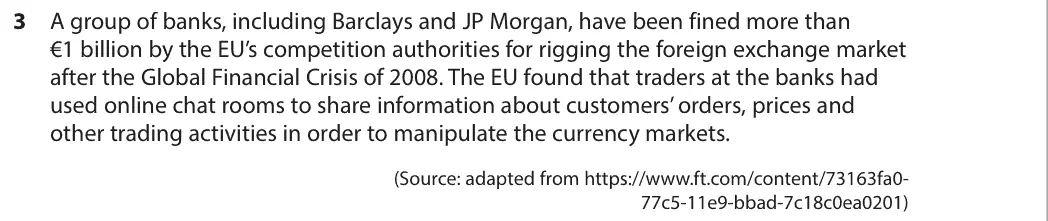
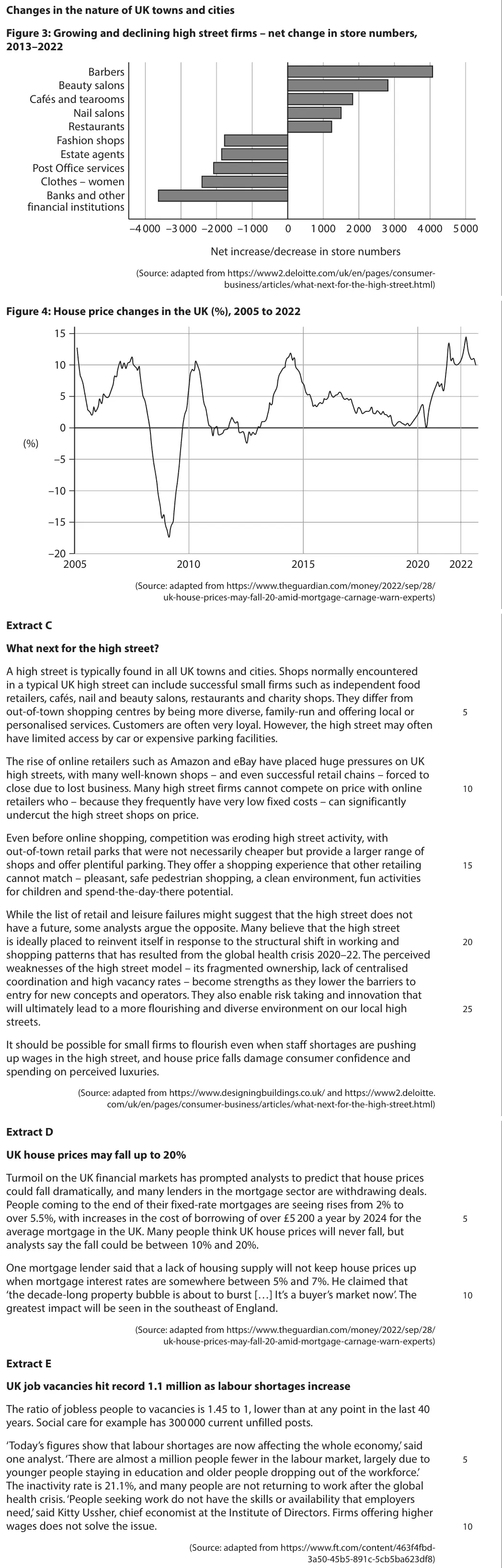
Data and extracts for question 3
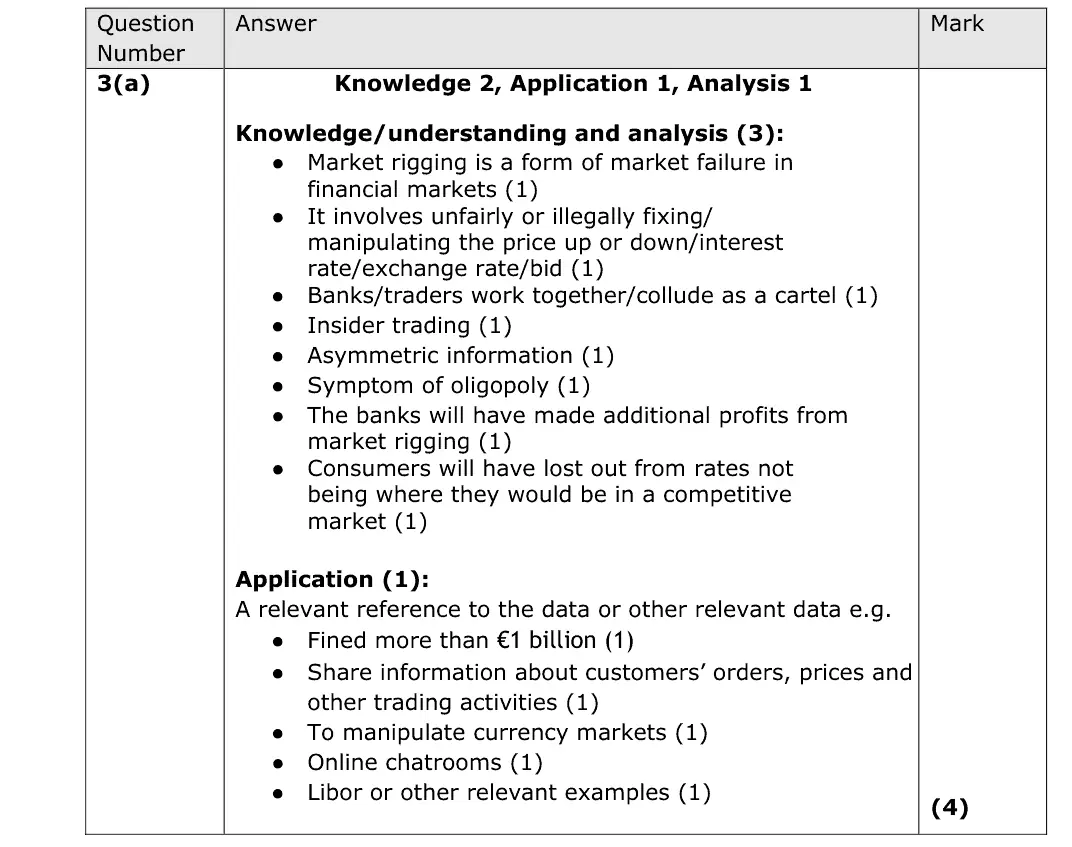
Mark scheme
Examiner's comment
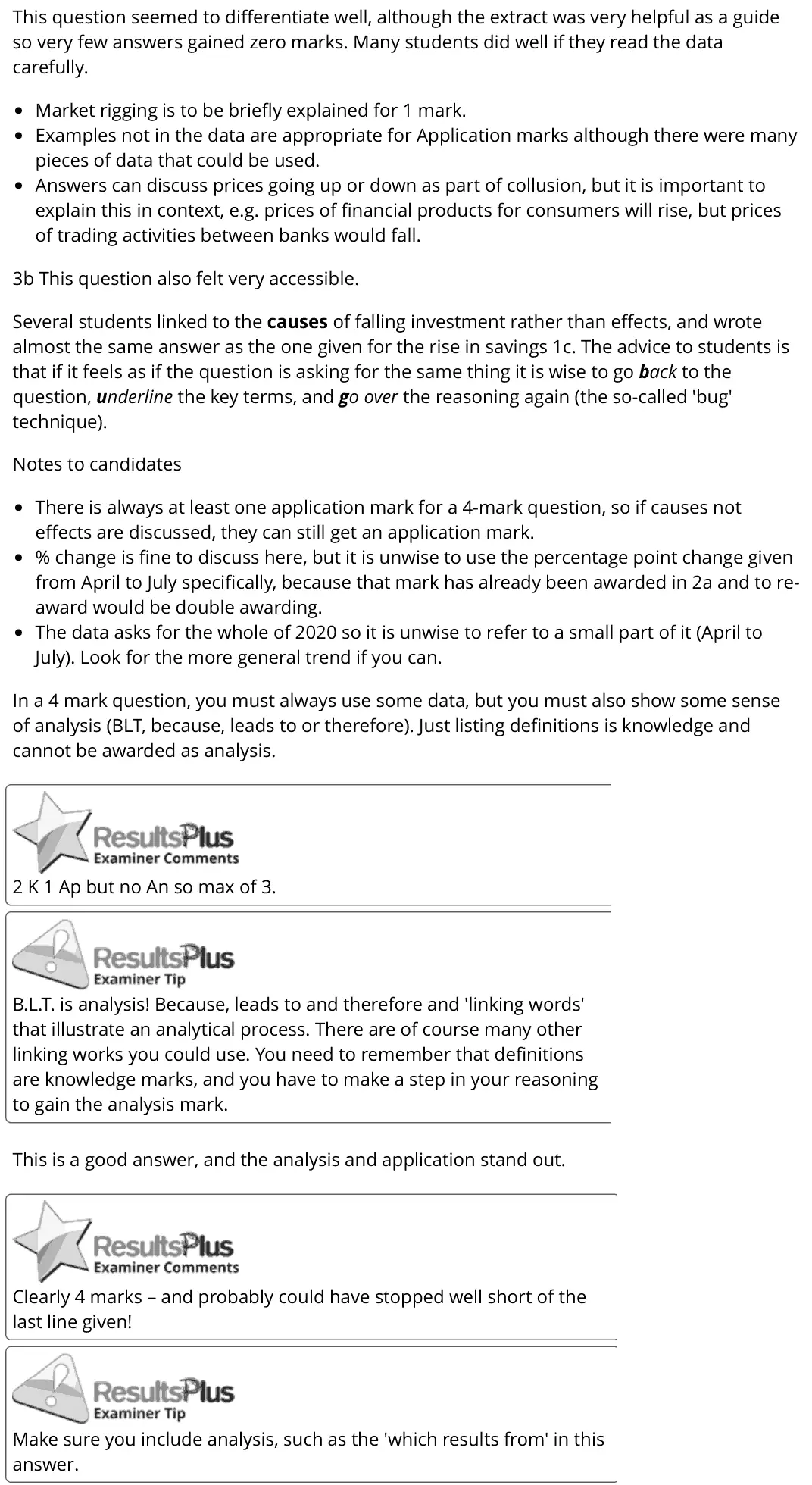
This question seemed to differentiate well, although the extract was very helpful as a guide so very few answers gained zero marks. Many students did well if they read the data carefully. Market rigging is to be briefly explained for 1 mark. Examples not in the data are appropriate for Application marks although there were many pieces of data that could be used. Answers can discuss prices going up or down as part of collusion, but it is important to explain this in context, e.g. prices of financial products for consumers will rise, but prices of trading activities between banks would fall. 3b This question also felt very accessible. Several students linked to the causes of falling investment rather than effects, and wrote almost the same answer as the one given for the rise in savings 1c. The advice to students is that if it feels as if the question is asking for the same thing it is wise to go back to the question, underline the key terms, and go over the reasoning again (the so-called 'bug' technique). Notes to candidates There is always at least one application mark for a 4-mark question, so if causes not effects are discussed, they can still get an application mark. % change is fine to discuss here, but it is unwise to use the percentage point change given from April to July specifically, because that mark has already been awarded in 2a and to re- award would be double awarding. The data asks for the whole of 2020 so it is unwise to refer to a small part of it (April to July). Look for the more general trend if you can. In a 4 mark question, you must always use some data, but you must also show some sense of analysis (BLT, because, leads to or therefore). Just listing definitions is knowledge and cannot be awarded as analysis. 2 K 1 Ap but no An so max of 3. B.L.T. is analysis! Because, leads to and therefore and 'linking words' that illustrate an analytical process. There are of course many other linking works you could use. You need to remember that definitions are knowledge marks, and you have to make a step in your reasoning to gain the analysis mark. This is a good answer, and the analysis and application stand out. Clearly 4 marks – and probably could have stopped well short of the last line given! Make sure you include analysis, such as the 'which results from' in this answer.
Notes from the mark scheme and report
market rigging is illegal manipulation of prices or rates by colluding traders (a financial market failure)
apply the chat rooms, shared customer orders or the €1 billion fine
analysis of who gains and loses is needed for the 4th mark
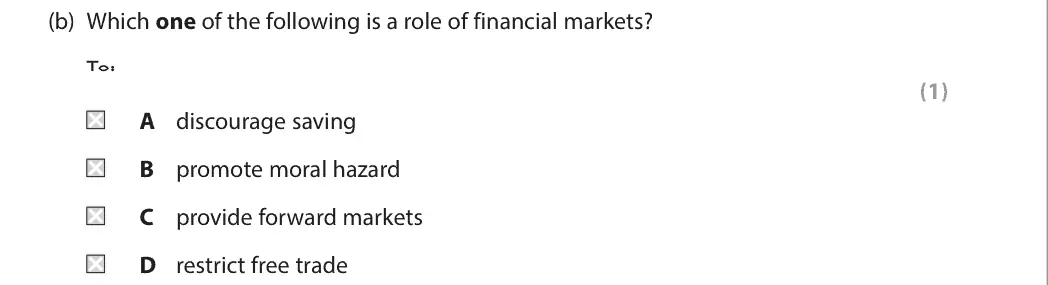
June 2024 · Paper 2 · Q3(b)1 markMultiple choice
Data and extracts for question 3
Answer
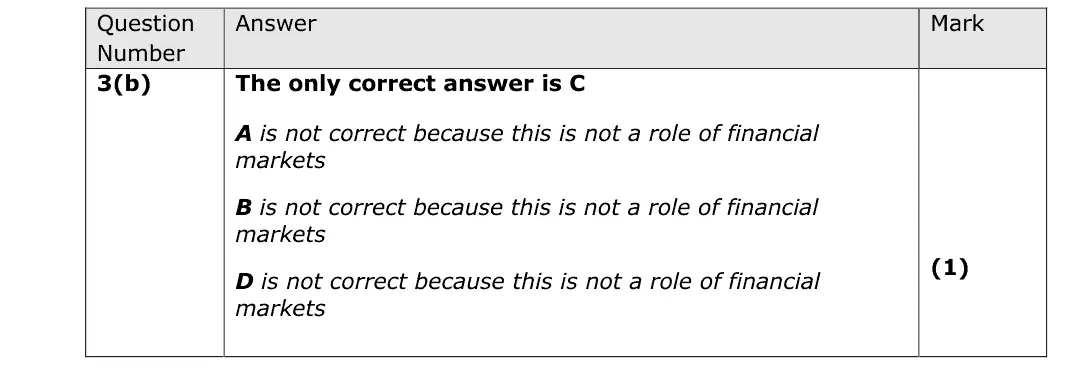
C
Mark scheme
Notes from the mark scheme and report
financial markets provide forward markets in currencies and commodities (C)
A, B and D are not roles
report: the negative words "discourage" and "restrict" caused processing errors
June 2024 · Paper 2 · Q6(d)12 marksAO1=2, AO2=2, AO3=4, AO4=412-mark response
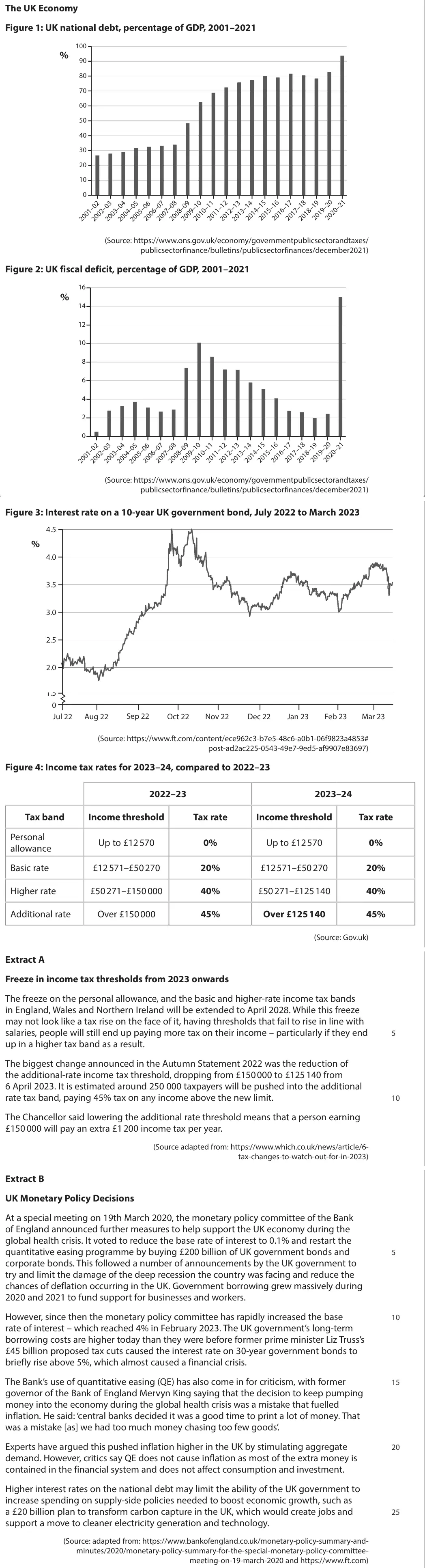
Data and extracts for question 6
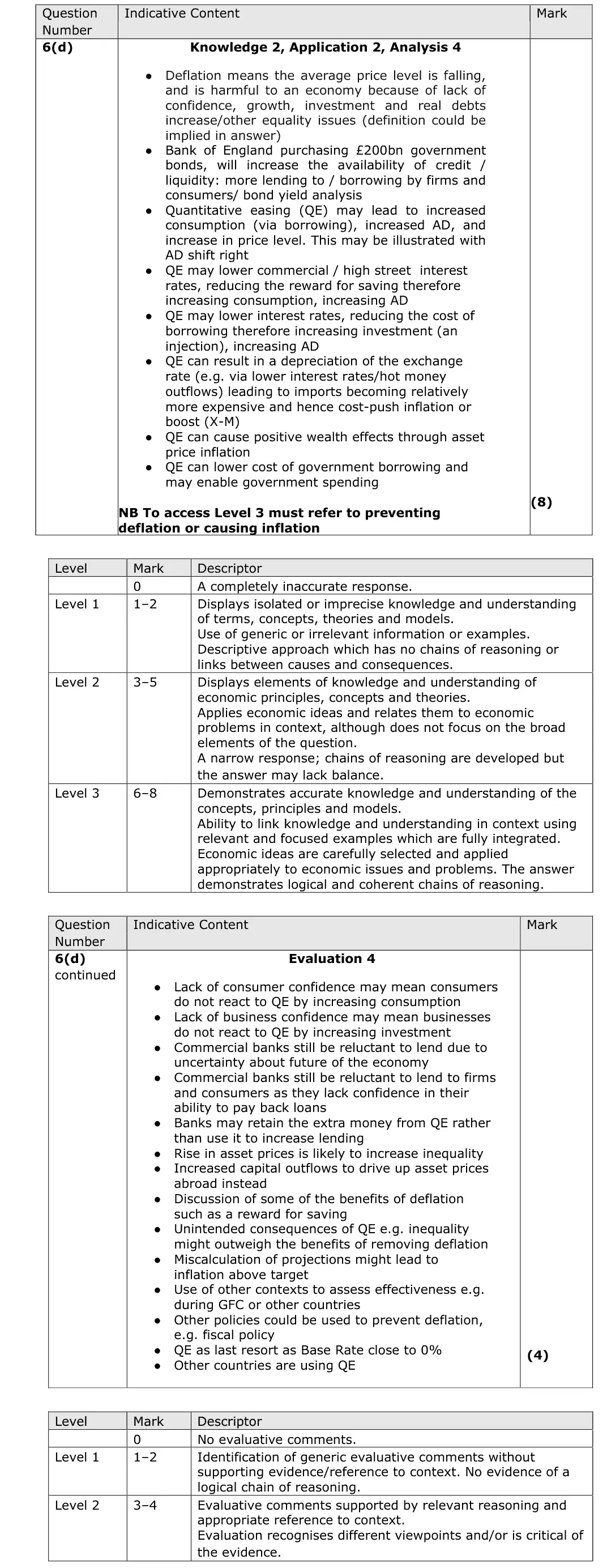
Mark scheme, including the levels grid and indicative content
Examiner's comment
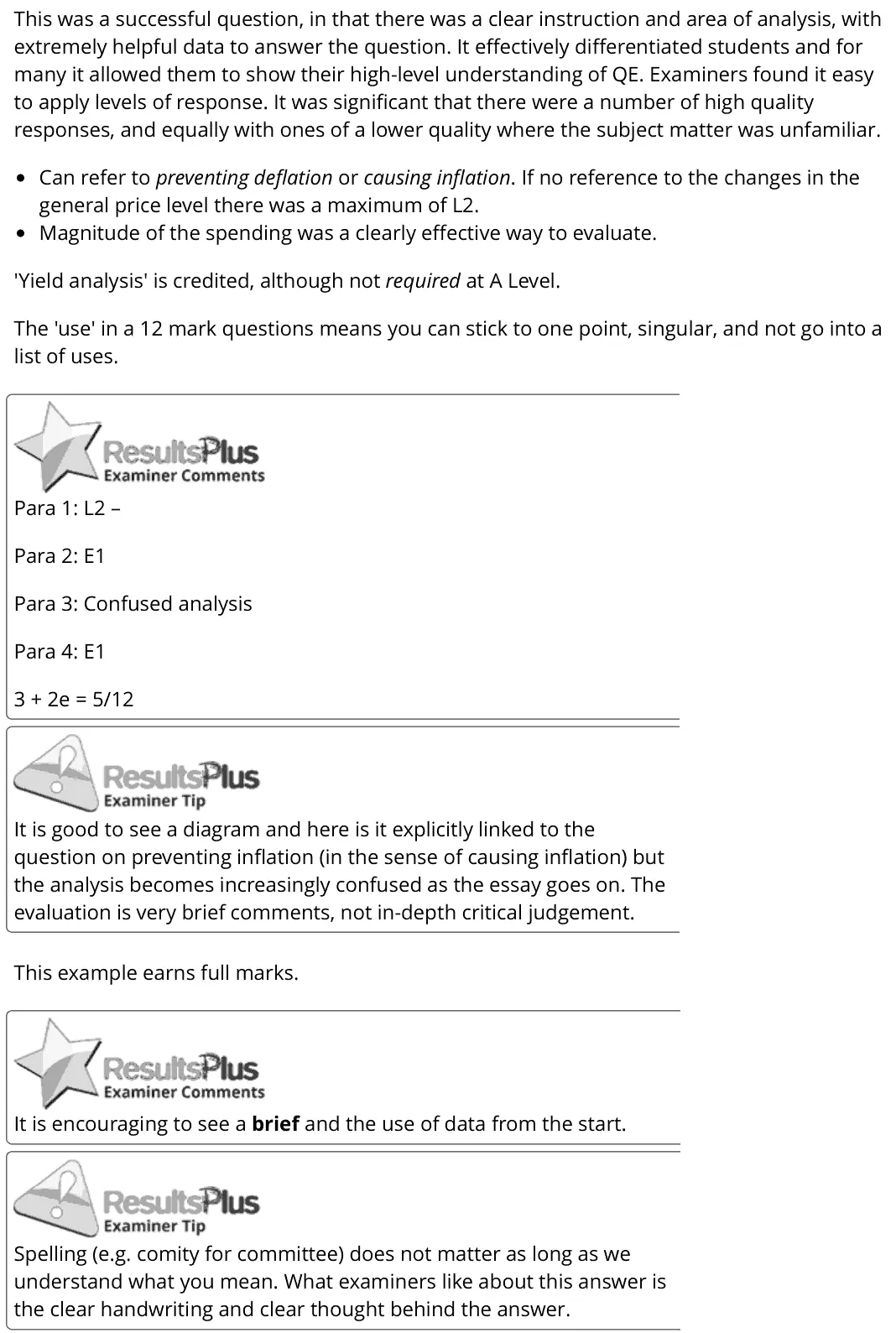
This was a successful question, in that there was a clear instruction and area of analysis, with extremely helpful data to answer the question. It effectively differentiated students and for many it allowed them to show their high-level understanding of QE. Examiners found it easy to apply levels of response. It was significant that there were a number of high quality responses, and equally with ones of a lower quality where the subject matter was unfamiliar. Can refer to preventing deflation or causing inflation. If no reference to the changes in the general price level there was a maximum of L2. Magnitude of the spending was a clearly effective way to evaluate. 'Yield analysis' is credited, although not required at A Level. The 'use' in a 12 mark questions means you can stick to one point, singular, and not go into a list of uses. Para 1: L2 – Para 2: E1 Para 3: Confused analysis Para 4: E1 3 + 2e = 5/12 It is good to see a diagram and here is it explicitly linked to the question on preventing inflation (in the sense of causing inflation) but the analysis becomes increasingly confused as the essay goes on. The evaluation is very brief comments, not in-depth critical judgement. This example earns full marks. It is encouraging to see a brief and the use of data from the start. Spelling (e.g. comity for committee) does not matter as long as we understand what you mean. What examiners like about this answer is the clear handwriting and clear thought behind the answer.
Notes from the mark scheme and report
QE (£200bn bond purchases) raises liquidity and lowers interest rates, boosting C, I and AD and the price level
must refer to the general price level (deflation or inflation) to pass Level 2
evaluate with liquidity trap, money staying in the financial system, magnitude
one use developed is enough
June 2023 · Paper 3 · Q2(a)5 marksAO1=2, AO2=2, AO3=1Short answer
Data and extracts for question 2
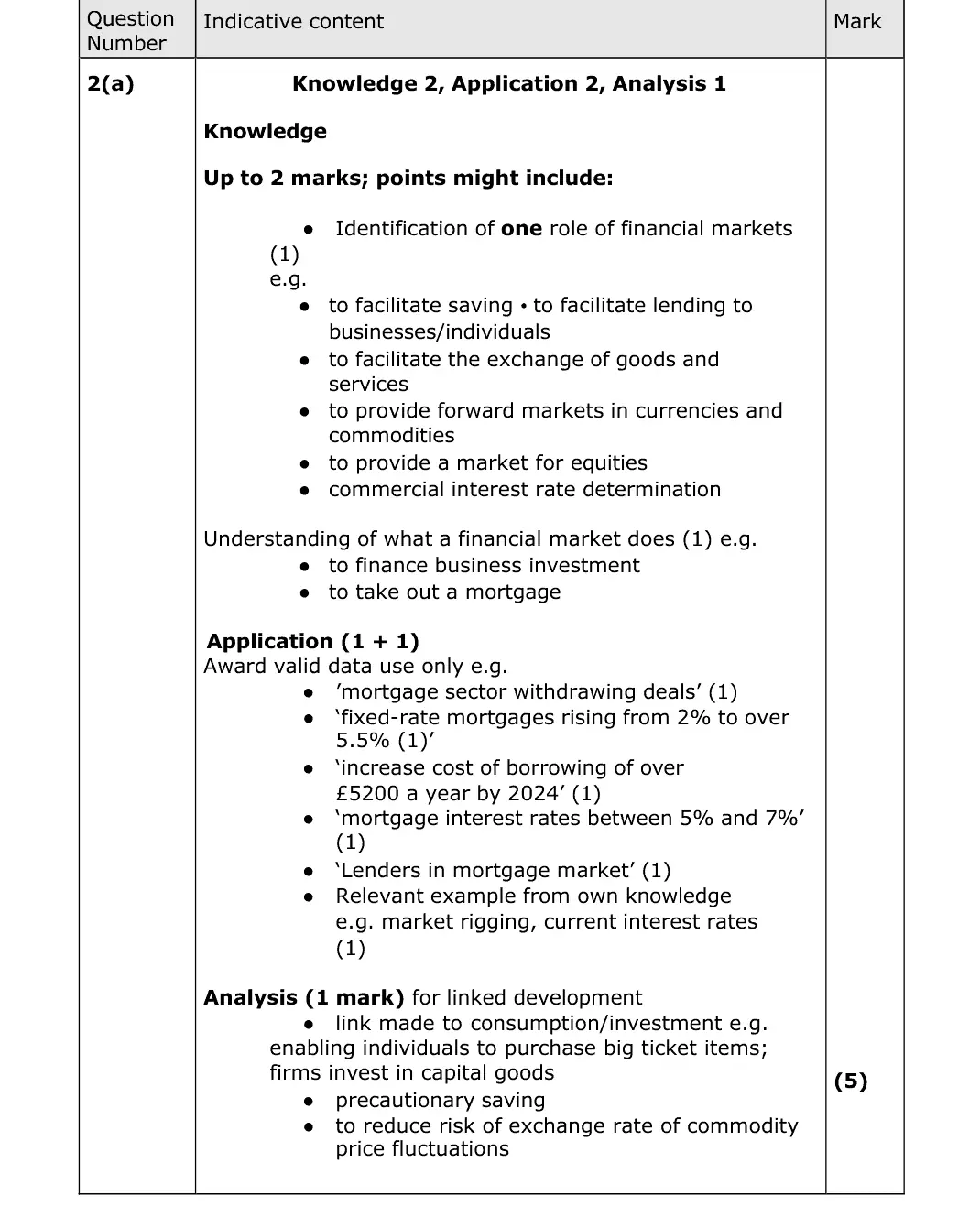
Mark scheme
Examiner's comment
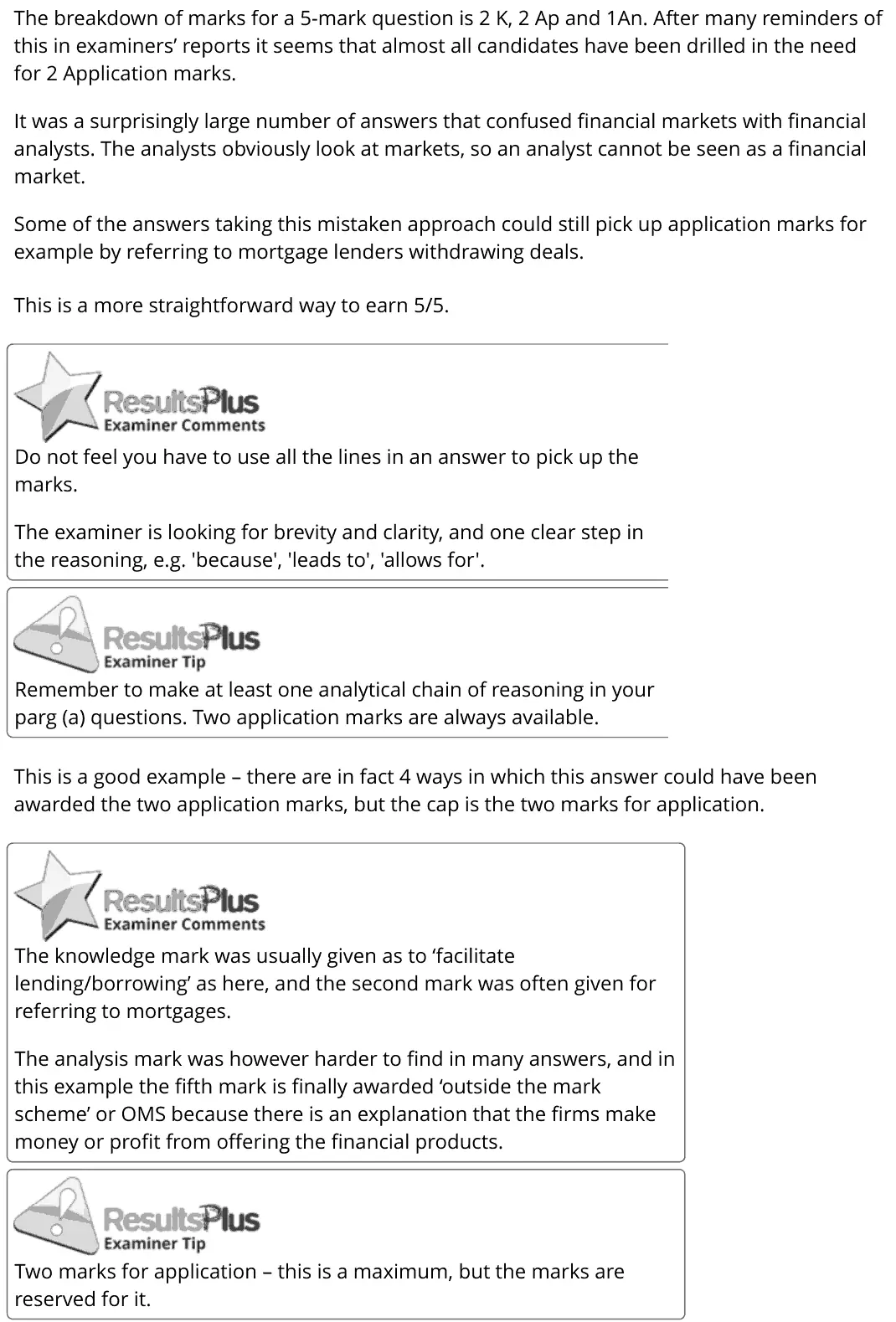
The breakdown of marks for a 5-mark question is 2 K, 2 Ap and 1An. After many reminders of this in examiners’ reports it seems that almost all candidates have been drilled in the need for 2 Application marks. It was a surprisingly large number of answers that confused financial markets with financial analysts. The analysts obviously look at markets, so an analyst cannot be seen as a financial market. Some of the answers taking this mistaken approach could still pick up application marks for example by referring to mortgage lenders withdrawing deals. This is a more straightforward way to earn 5/5. Do not feel you have to use all the lines in an answer to pick up the marks. The examiner is looking for brevity and clarity, and one clear step in the reasoning, e.g. 'because', 'leads to', 'allows for'. Remember to make at least one analytical chain of reasoning in your parg (a) questions. Two application marks are always available. This is a good example – there are in fact 4 ways in which this answer could have been awarded the two application marks, but the cap is the two marks for application. The knowledge mark was usually given as to ‘facilitate lending/borrowing’ as here, and the second mark was often given for referring to mortgages. The analysis mark was however harder to find in many answers, and in this example the fifth mark is finally awarded ‘outside the mark scheme’ or OMS because there is an explanation that the firms make money or profit from offering the financial products. Two marks for application – this is a maximum, but the marks are reserved for it.
Notes from the mark scheme and report
name one role (e.g. lending to individuals through mortgages) and develop it, e.g. allows purchase of big-ticket items
financial markets are not financial analysts
use Extract D, e.g. fixed-rate mortgages rising from 2% to over 5.5%
Quantitative skills: QS 9 (interpret, apply and analyse information in written, graphical tabular and numerical forms)
June 2022 · Paper 2 · Q5(a)4 marksAO1=2, AO2=1, AO3=1Short answer
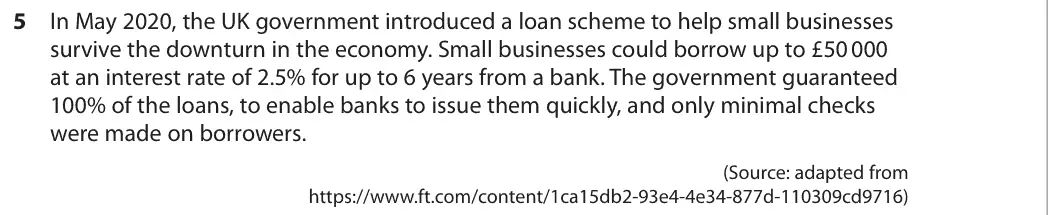
Data and extracts for question 5
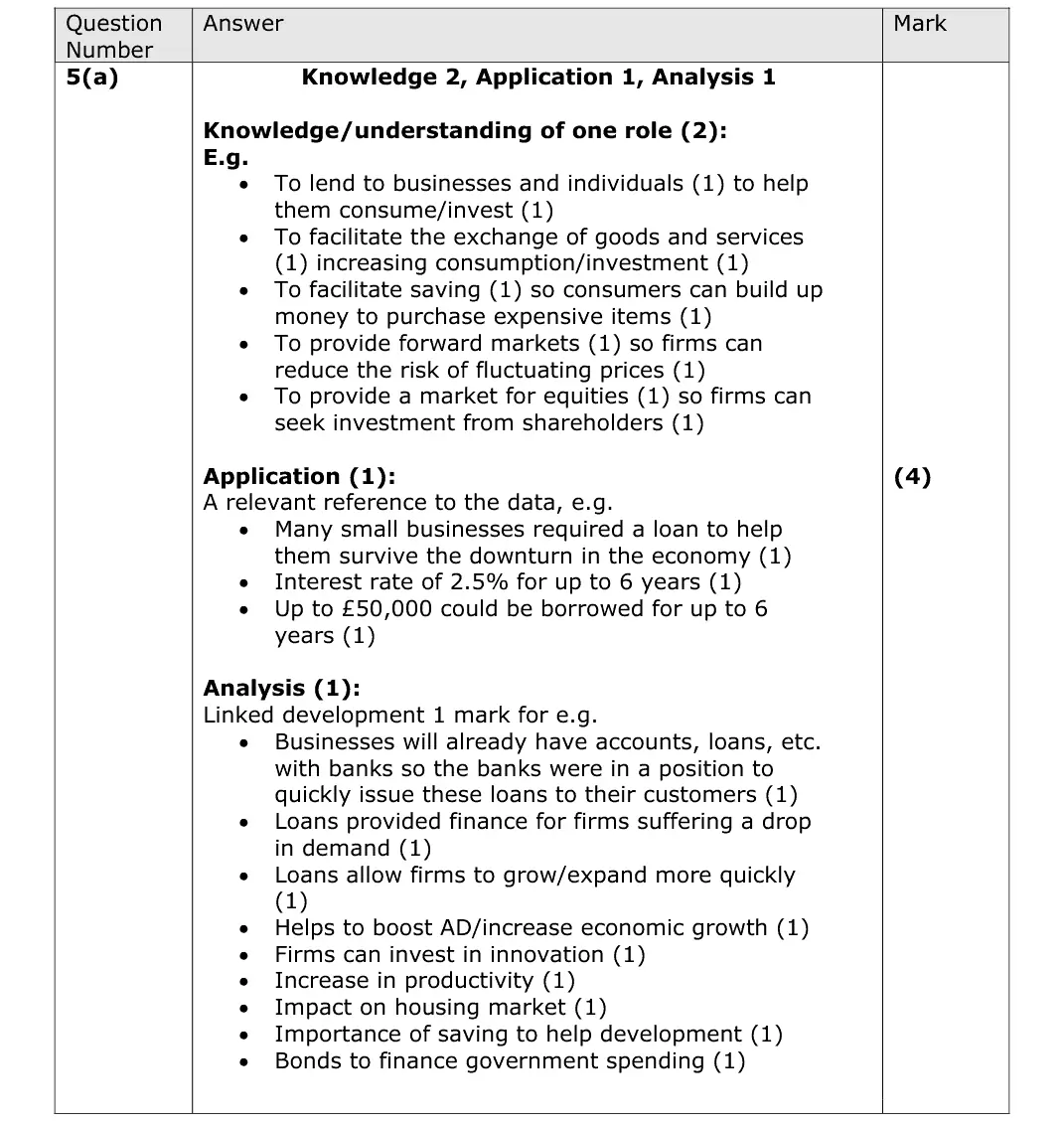
Mark scheme
Examiner's comment
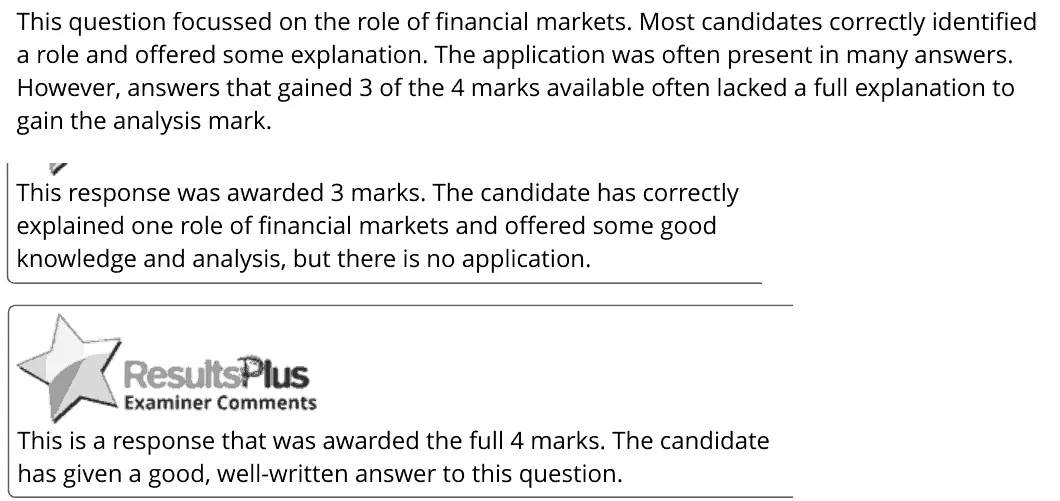
This question focussed on the role of financial markets. Most candidates correctly identified a role and offered some explanation. The application was often present in many answers. However, answers that gained 3 of the 4 marks available often lacked a full explanation to gain the analysis mark. This response was awarded 3 marks. The candidate has correctly explained one role of financial markets and offered some good knowledge and analysis, but there is no application. This is a response that was awarded the full 4 marks. The candidate has given a good, well-written answer to this question.
Notes from the mark scheme and report
one role (lending to businesses, facilitating saving or exchange, forward markets, equities) explained
apply with £50 000 loans at 2.5% for up to 6 years
3-mark answers lacked the developed analysis
June 2022 · Paper 2 · Q5(b)1 markMultiple choice
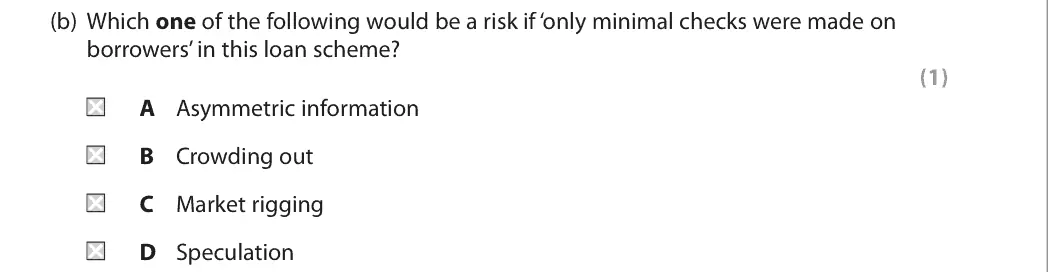
Data and extracts for question 5
Answer
A
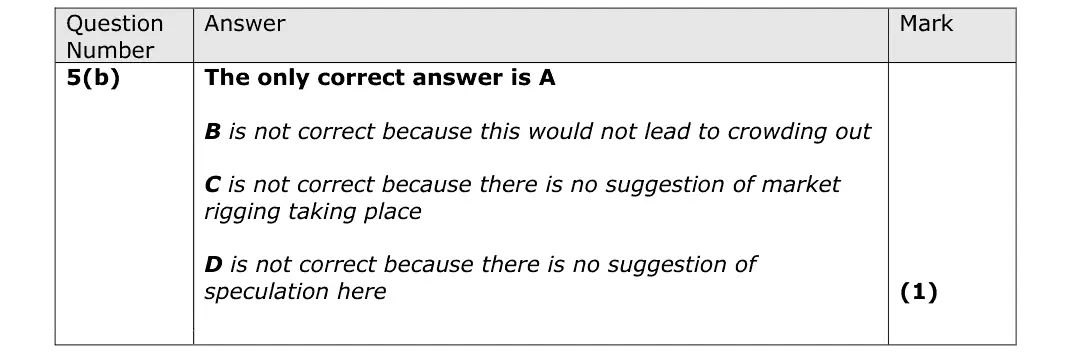
Mark scheme
Notes from the mark scheme and report
minimal checks mean lenders know less than borrowers about the risk of default, so asymmetric information (A)
no crowding out, market rigging or speculation is suggested
June 2019 · Paper 2 · Q6(a)5 marksAO1=2, AO2=2, AO3=1Short answer
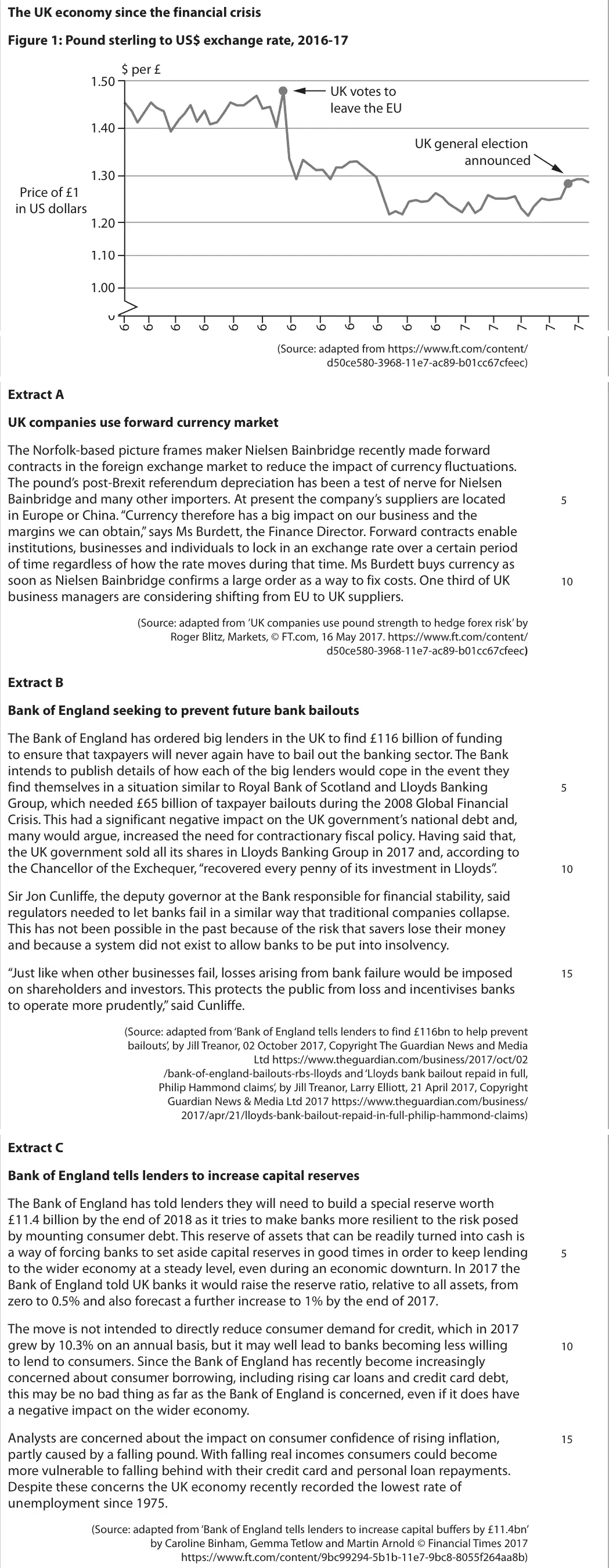
Data and extracts for question 6
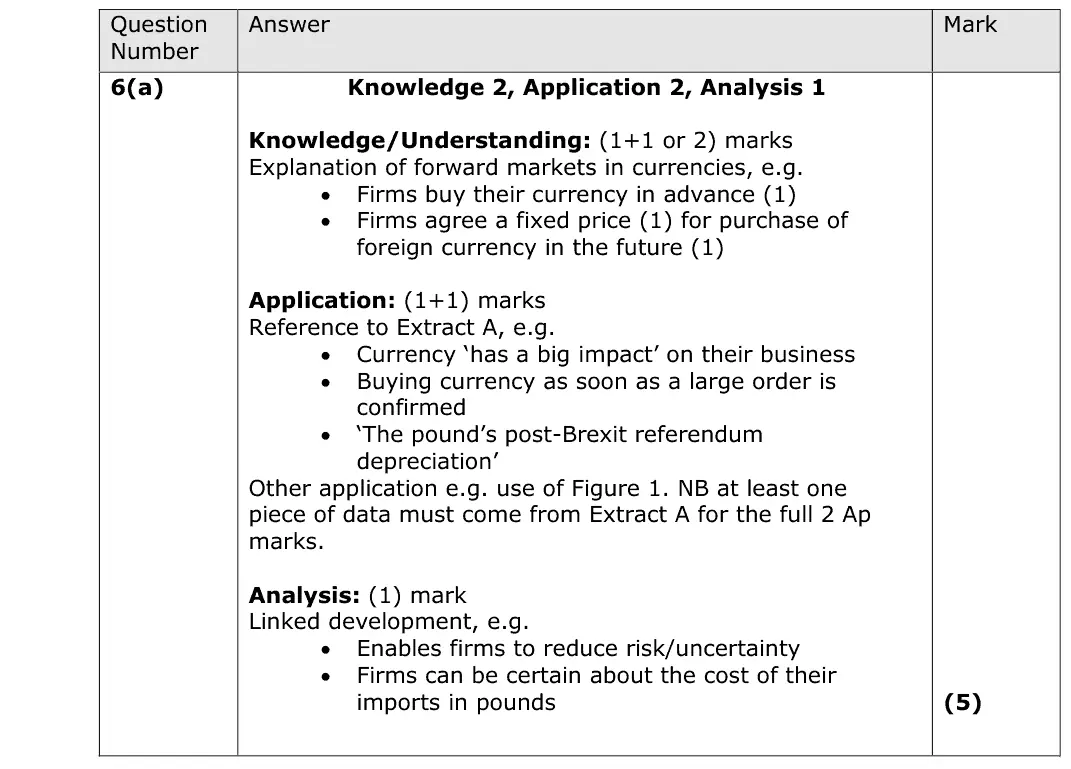
Mark scheme
Examiner's comment
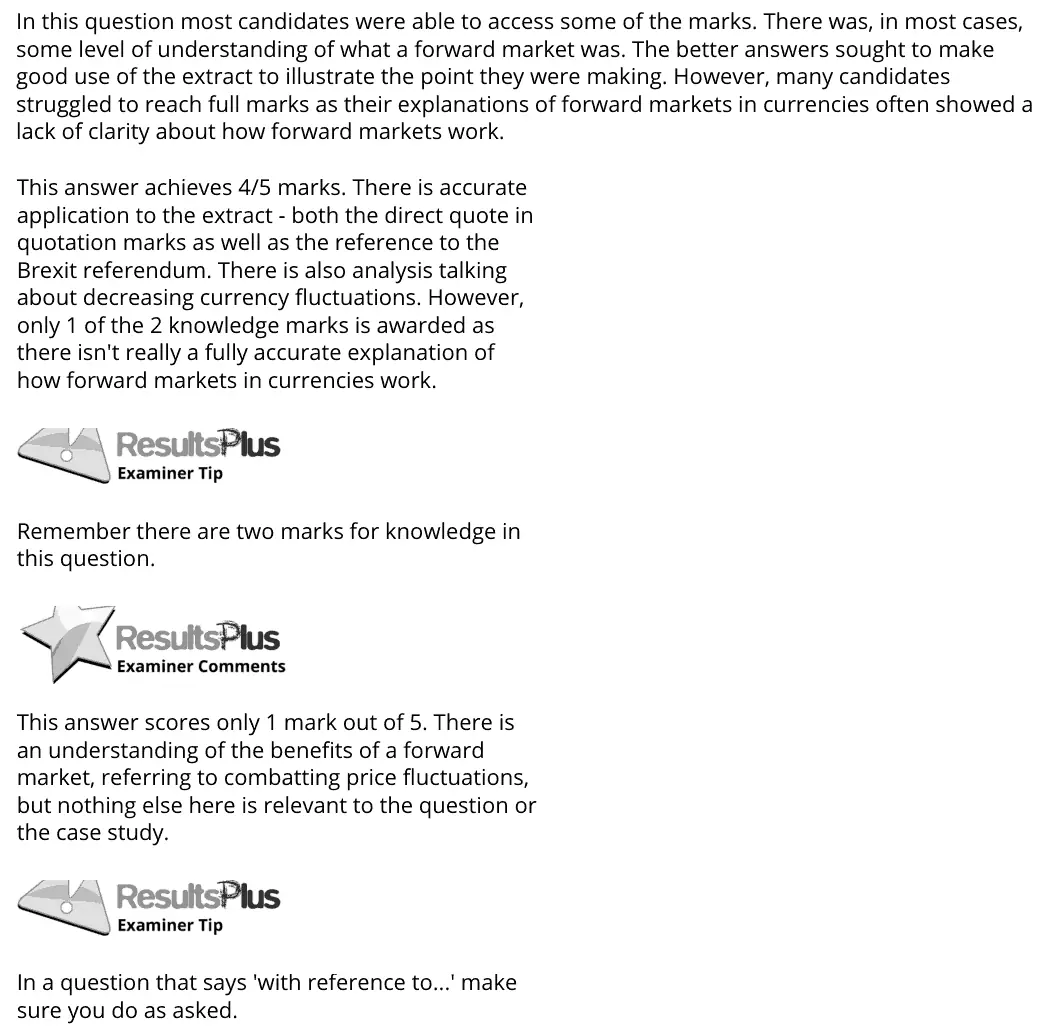
In this question most candidates were able to access some of the marks. There was, in most cases, some level of understanding of what a forward market was. The better answers sought to make good use of the extract to illustrate the point they were making. However, many candidates struggled to reach full marks as their explanations of forward markets in currencies often showed a lack of clarity about how forward markets work. This answer achieves 4/5 marks. There is accurate application to the extract - both the direct quote in quotation marks as well as the reference to the Brexit referendum. There is also analysis talking about decreasing currency fluctuations. However, only 1 of the 2 knowledge marks is awarded as there isn't really a fully accurate explanation of how forward markets in currencies work. Remember there are two marks for knowledge in this question. This answer scores only 1 mark out of 5. There is an understanding of the benefits of a forward market, referring to combatting price fluctuations, but nothing else here is relevant to the question or the case study. In a question that says 'with reference to...' make sure you do as asked.
Notes from the mark scheme and report
firms agree now a fixed exchange rate for buying currency in the future, reducing exchange-rate risk
at least one piece of data from Extract A needed for both application marks
many were unclear how forward markets work
June 2019 · Paper 2 · Q6(e)15 marksAO1=3, AO2=3, AO3=3, AO4=615-mark response
Data and extracts for question 6
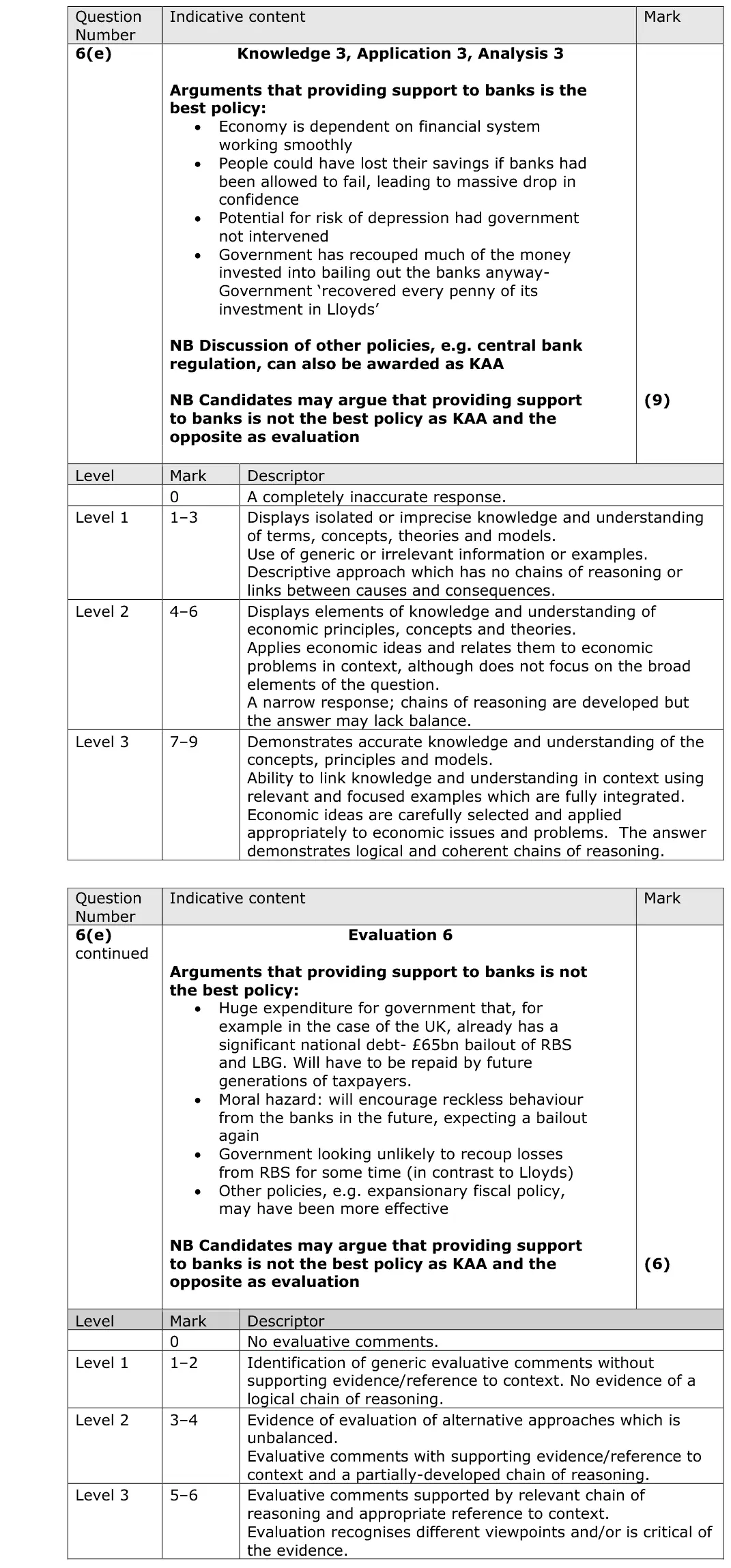
Mark scheme, including the levels grid and indicative content
Examiner's comment
This question focuses on financial markets and whether the government was right to bail out the banks or not. The best answers provided clear and in-depth arguments of both the reasons why this was a good idea and why it wasn't. They also related this specifically to the context, using evidence from the case study and/or their own knowledge. Some answers also included a judgement, but candidates should note that this is not required in this question. This answer scores 5/15 marks. It has some points which are not relevant, such as the point about inflation on the second page, but does have some understanding of the situation and offers some good application - particularly to start with. This is a high quality answer that achieves top level for both KAA and evaluation. The candidate clearly articulates the arguments on both sides of the debate with lots of context - for example talking about the run on Northern Rock. The wider implications for the UK economy had the banks not been rescued have been clearly discussed, and then for evaluation the opportunity cost for the government has been clearly explained. Depth of explanation in both KAA and evaluation was the key to success here. To get top marks make sure you use evidence, either from the case study or your own knowledge, to back up your arguments.
Notes from the mark scheme and report
for: banks are central to the economy, savers' deposits and confidence, money recouped from Lloyds (Extract B)
against: cost to the national debt, moral hazard, other policies
a judgement is not required
June 2018 · Paper 2 · Q5(c)2 marksAO2=2Calculation
Data and extracts for question 5
Mark scheme
Examiner's comment
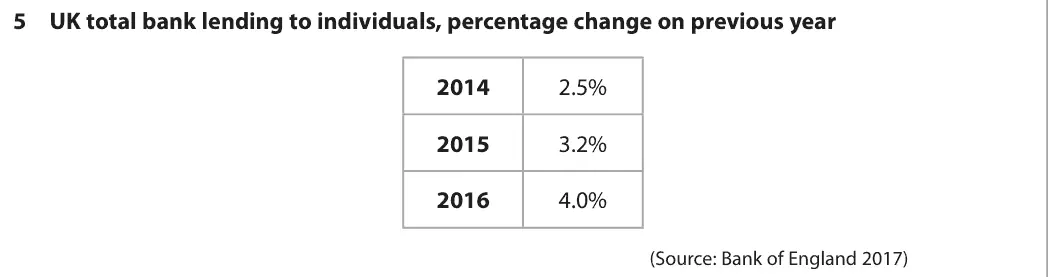
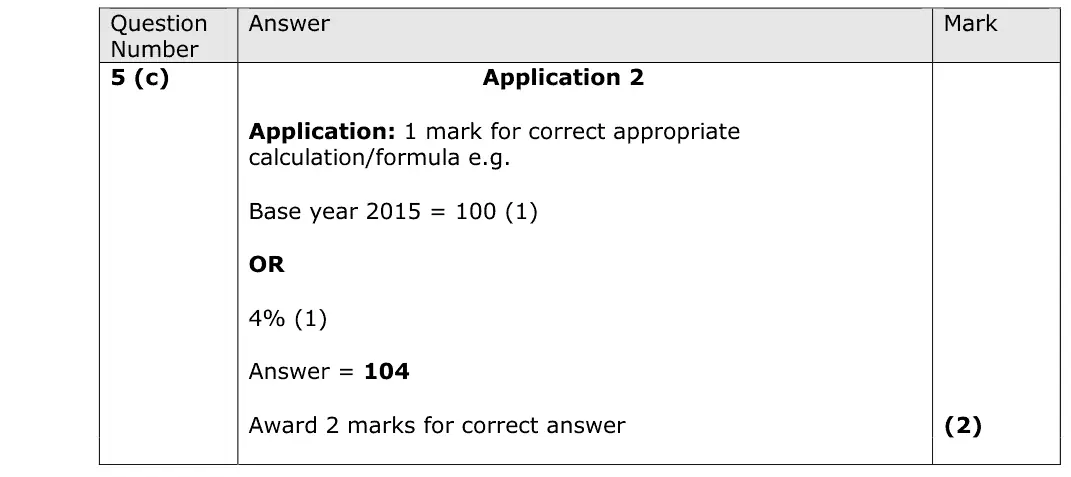
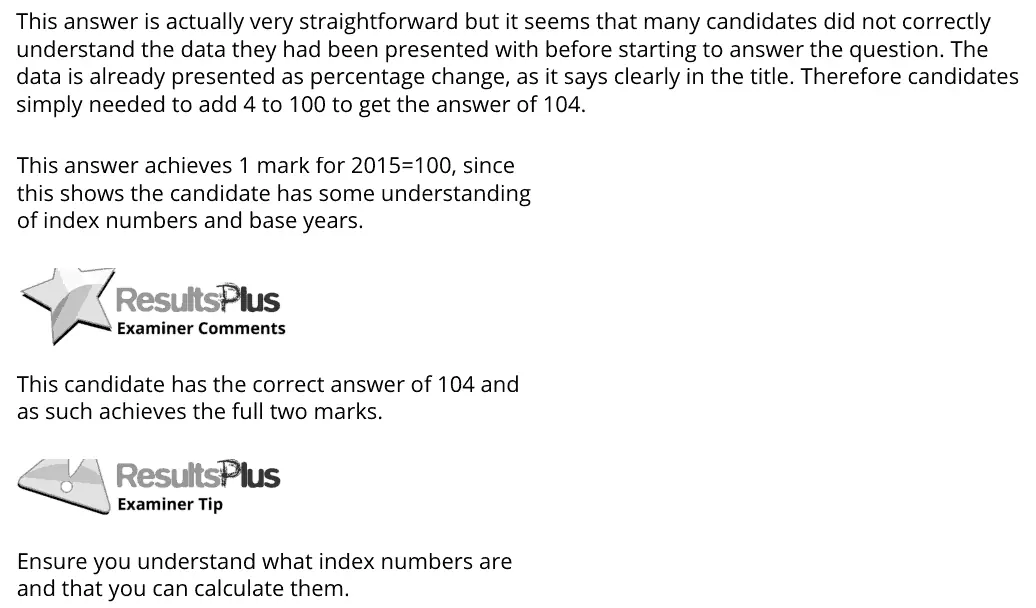
This answer is actually very straightforward but it seems that many candidates did not correctly understand the data they had been presented with before starting to answer the question. The data is already presented as percentage change, as it says clearly in the title. Therefore candidates simply needed to add 4 to 100 to get the answer of 104. This answer achieves 1 mark for 2015=100, since this shows the candidate has some understanding of index numbers and base years. This candidate has the correct answer of 104 and as such achieves the full two marks. Ensure you understand what index numbers are and that you can calculate them.
Notes from the mark scheme and report
the data are already percentage changes: 2015 = 100, plus 4% gives 104
2015 = 100 alone earns 1 mark
report: many candidates did not understand the data were presented as percentage changes
Quantitative skills: QS 2 (calculate, use and understand percentages, percentage changes and percentage point changes); QS 5 (calculate and interpret index numbers); QS 9 (interpret, apply and analyse information in written, graphical tabular and numerical forms)
June 2018 · Paper 2 · Q6(e)15 marksAO1=3, AO2=3, AO3=3, AO4=615-mark response
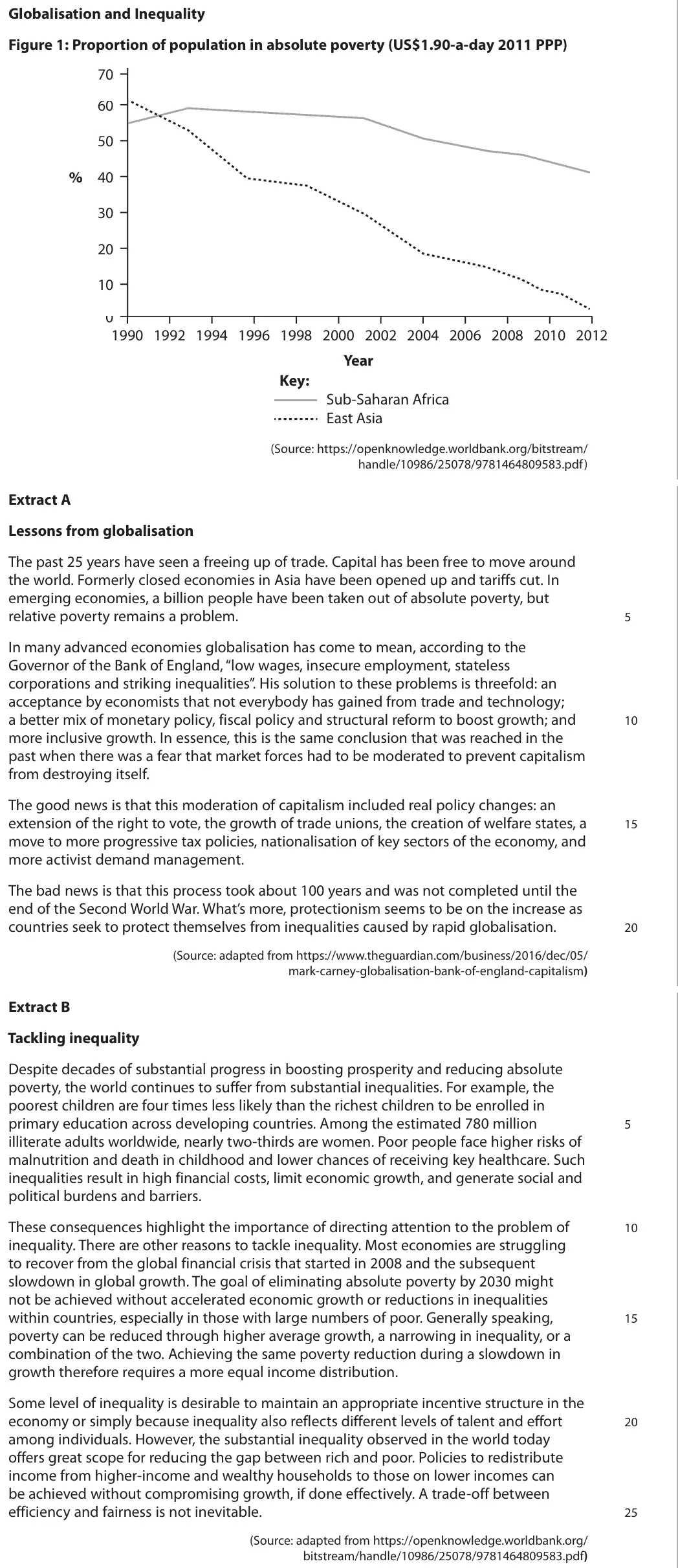
Data and extracts for question 6
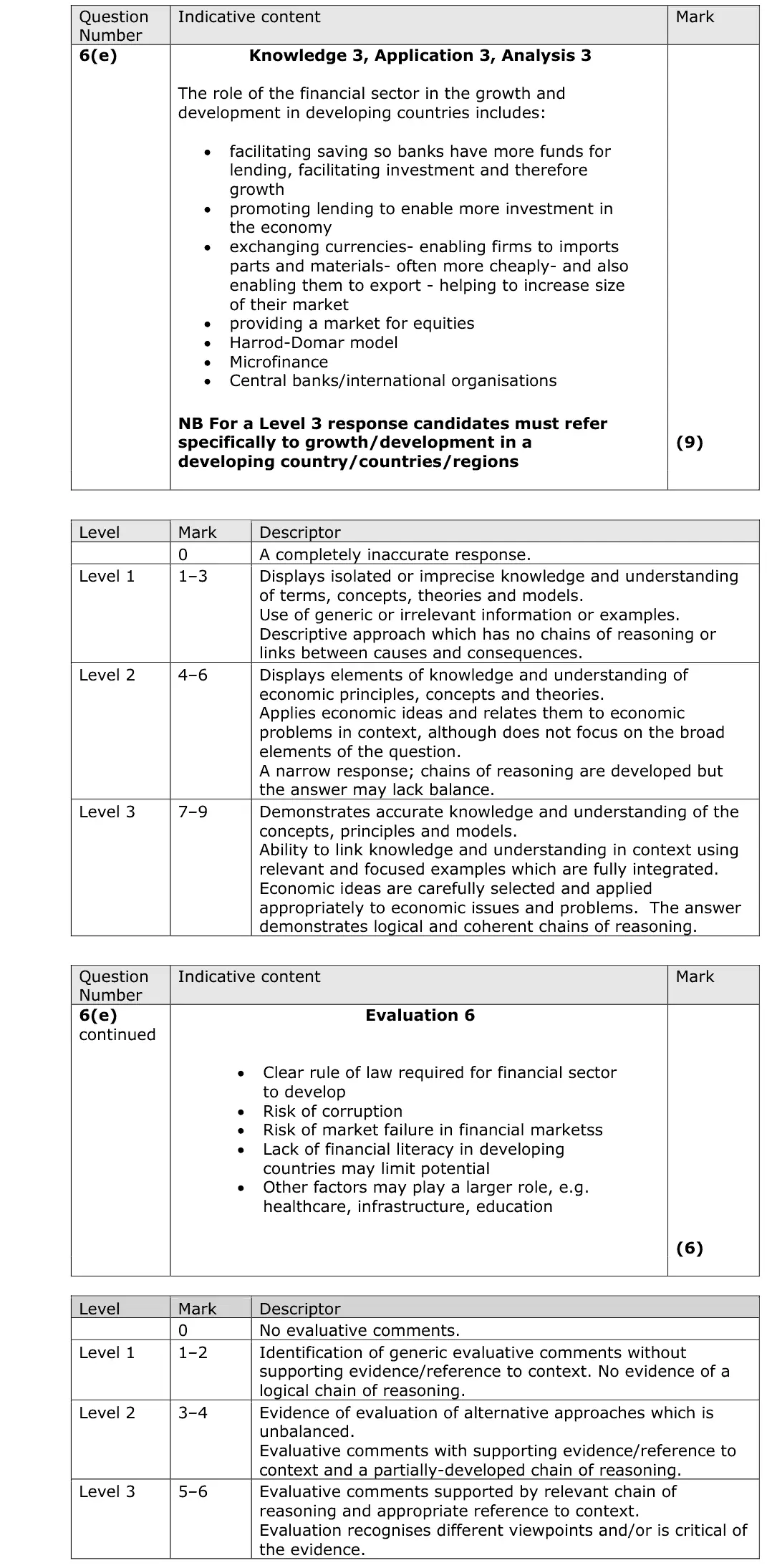
Mark scheme, including the levels grid and indicative content
Examiner's comment
This was a nice open question which allowed candidates to bring in a wide range of issues or institutions when discussing the role of the financial markets. Many candidates discussed the 'traditional' role of banks in terms of savings and loans, with better candidates relating this to the Harrod-Domar model. Microfinance was also discussed by many candidates including the role of central banks in using monetary policy as well as international institutions such as the IMF. The main thing that held some candidates back was that they forgot this question was asking specifically about financial markets and started to answer just in terms of general development issues such as primary product dependency. This is a well-written answer to this question, particularly in terms of the KAA where there are two good points. The first one focuses on the role of banks in terms of savings and investment and the second on foreign exchange. These are also evaluated, although this isn't quite as good as the KAA points. Therefore, overall this answer achieves Level 3 KAA and Level 2 evaluation. Focus on quality rather than quantity. This answer is less than two pages in total yet still achieves very highly. This answer discusses the HIPC initiative and microfinance, although it does not explain them as well as the previous answer. The answer explains what microfinance schemes are but doesn't really explain how they are related to growth and development. It also discusses aid, although this is not relevant to the question. Overall this answer achieves Level 2 for KAA and Level 1 for evaluation.
Notes from the mark scheme and report
saving and lending for investment (Harrod-Domar), foreign exchange, equity markets, microfinance
Level 3 needs reference to specific developing countries or regions
some drifted into general development issues such as primary product dependency
evaluate with corruption, rule of law, financial literacy, market failure
Work with an Edexcel economics tutor
Essays stuck in Level 2, or losing the easy marks in Section A? Book a trial session with Lianne, a former Edexcel examiner.