October 2020: Paper 1

100 marks · 19 question parts · Paper, mark scheme and report on Pearson's site · The October 2020 papers are the papers printed for the cancelled summer 2020 exams

Question by question

QTopicMarksAOType
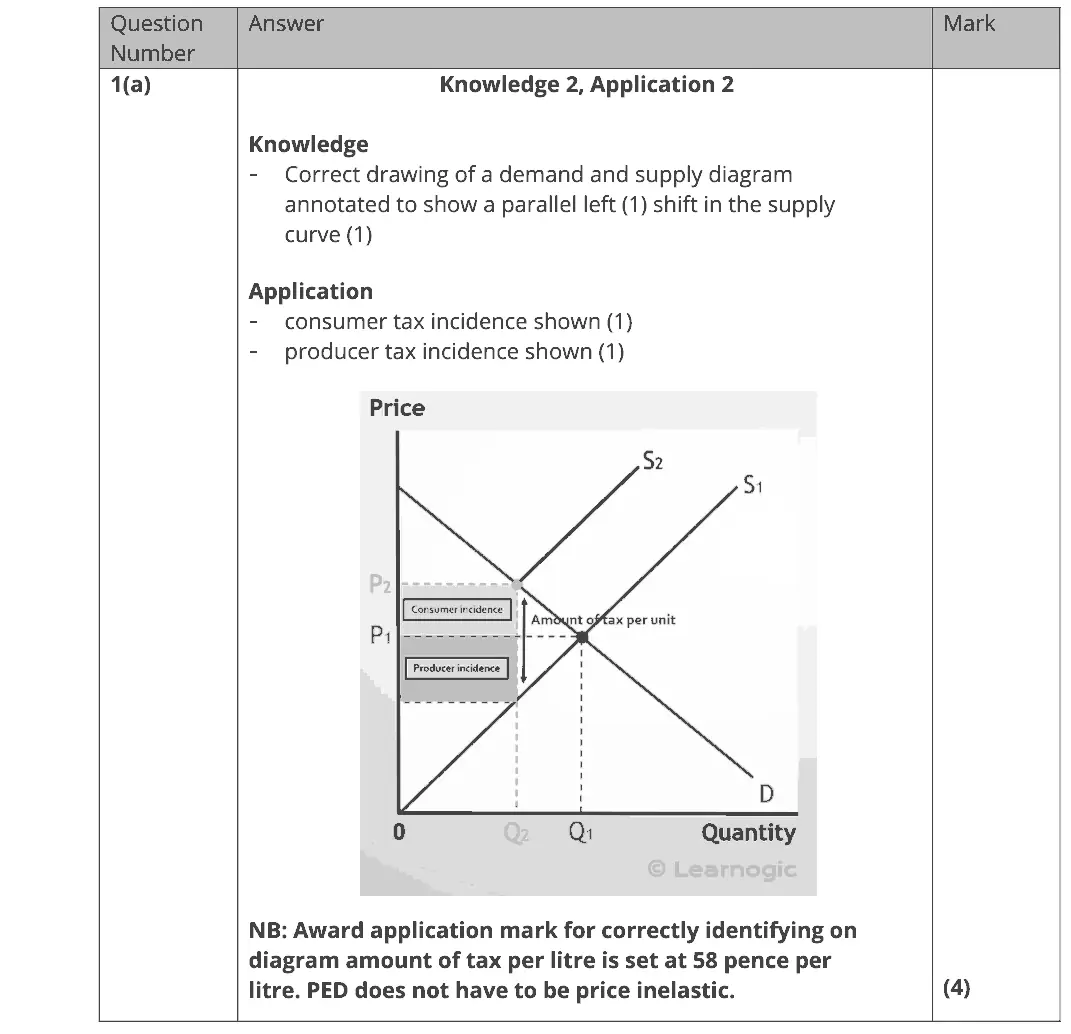
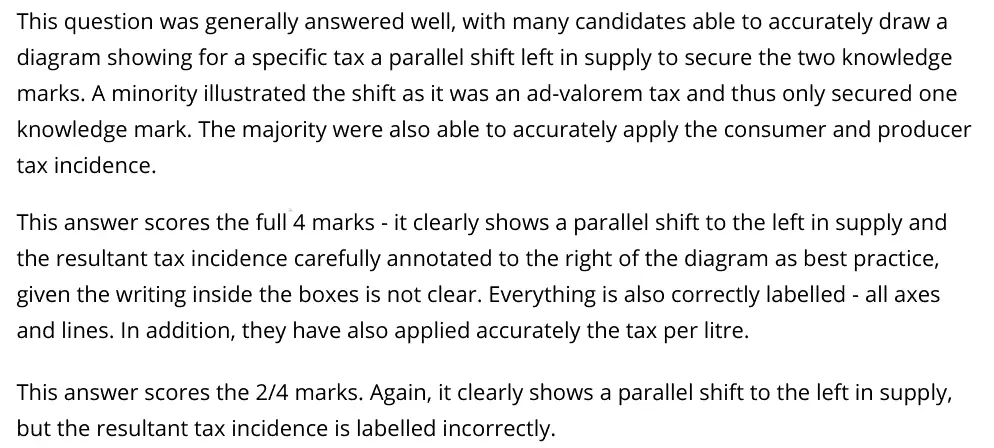
1(a) Indirect taxes and subsidies 4AO1=2,AO2=2Diagram
1(b) The price mechanism, consumer and producer surplus, Indirect taxes and subsidies 1AO3=1Multiple choice
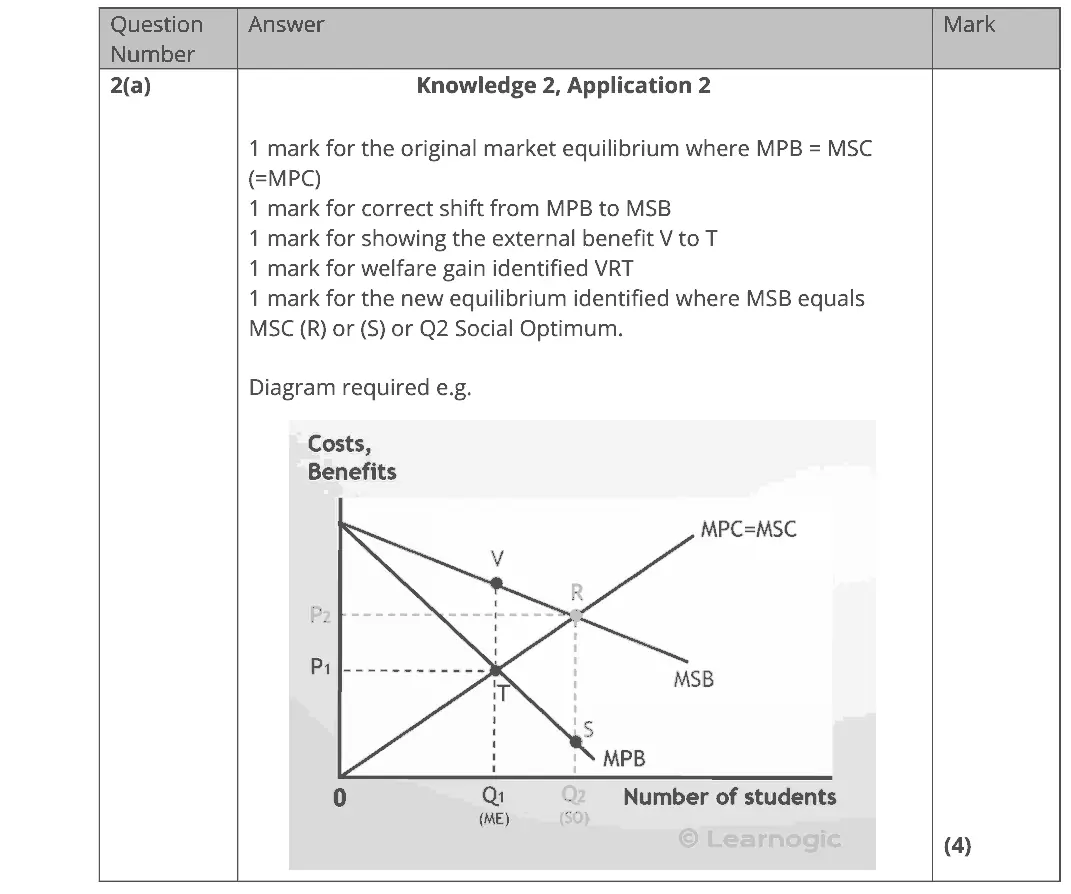
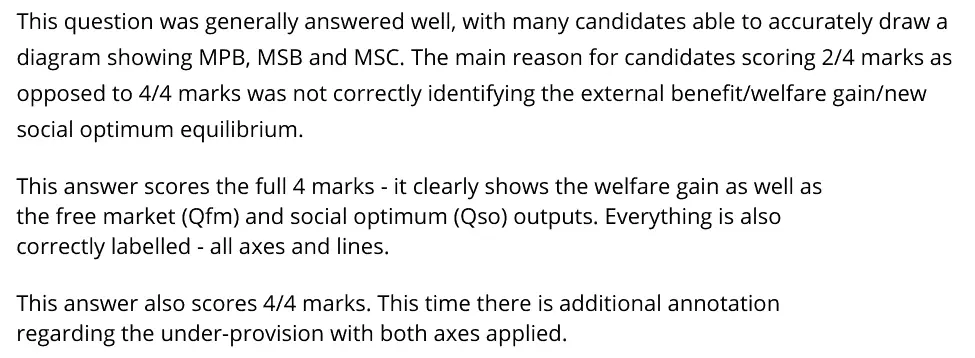
2(a) Market failure and externalities 4AO1=2,AO2=2Diagram
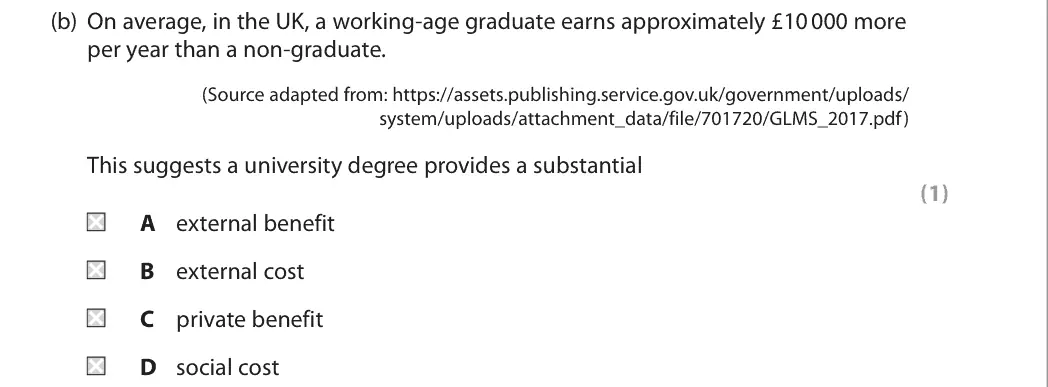
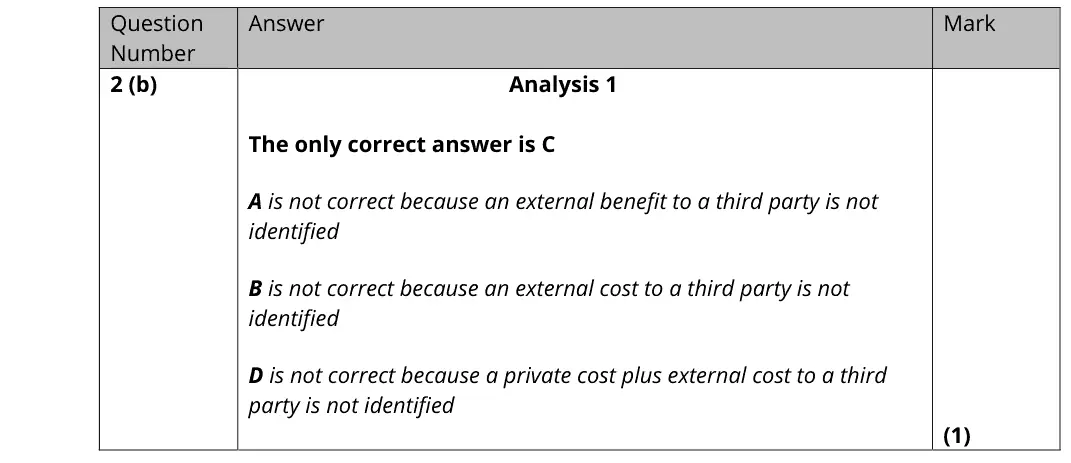
2(b) Market failure and externalities 1AO3=1Multiple choice
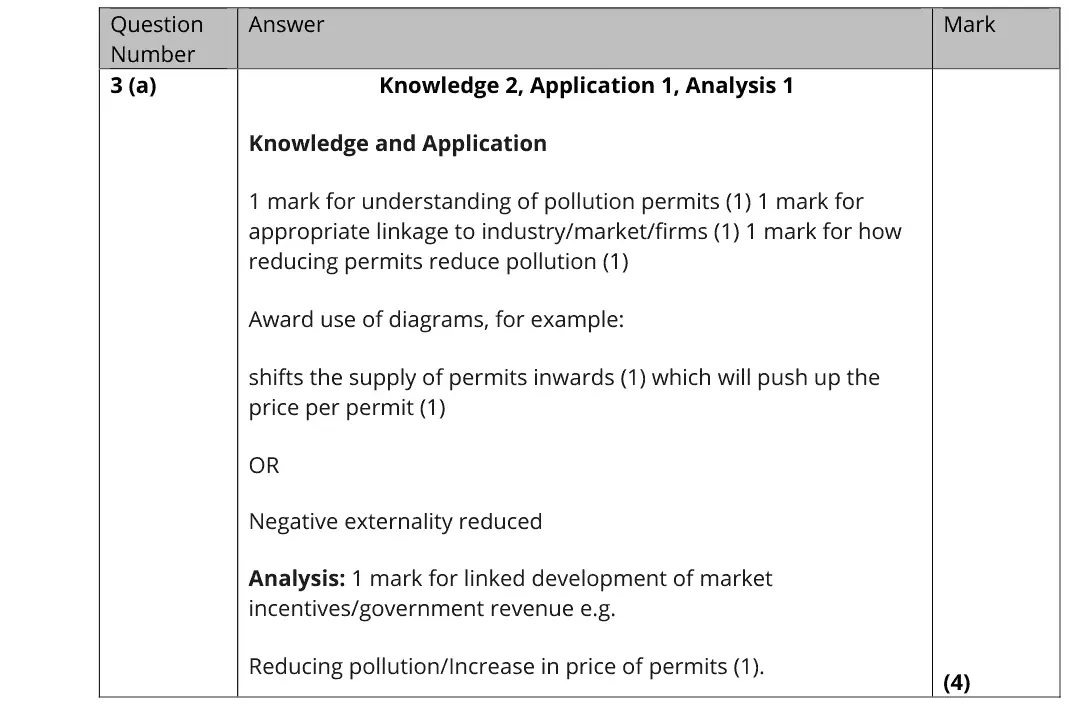
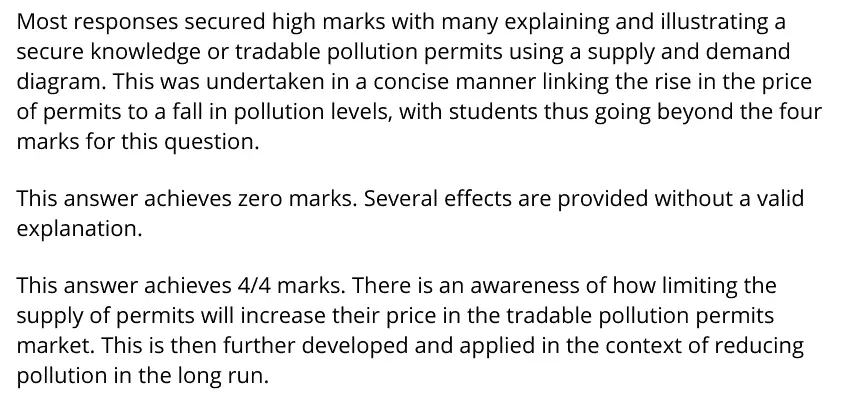
3(a) Government intervention in markets 4AO1=2,AO2=1,AO3=1Short answer
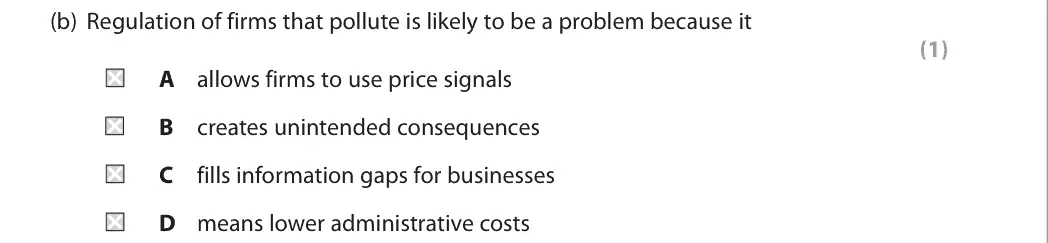
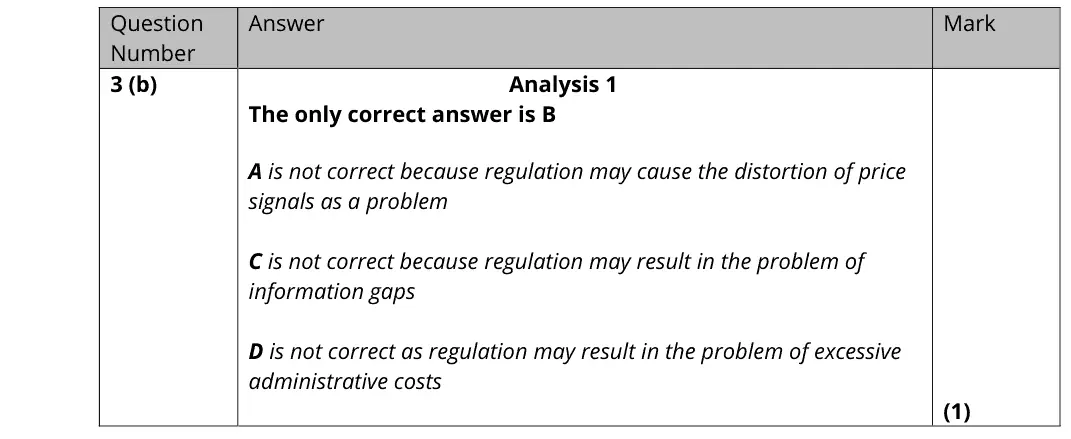
3(b) Government failure 1AO3=1Multiple choice
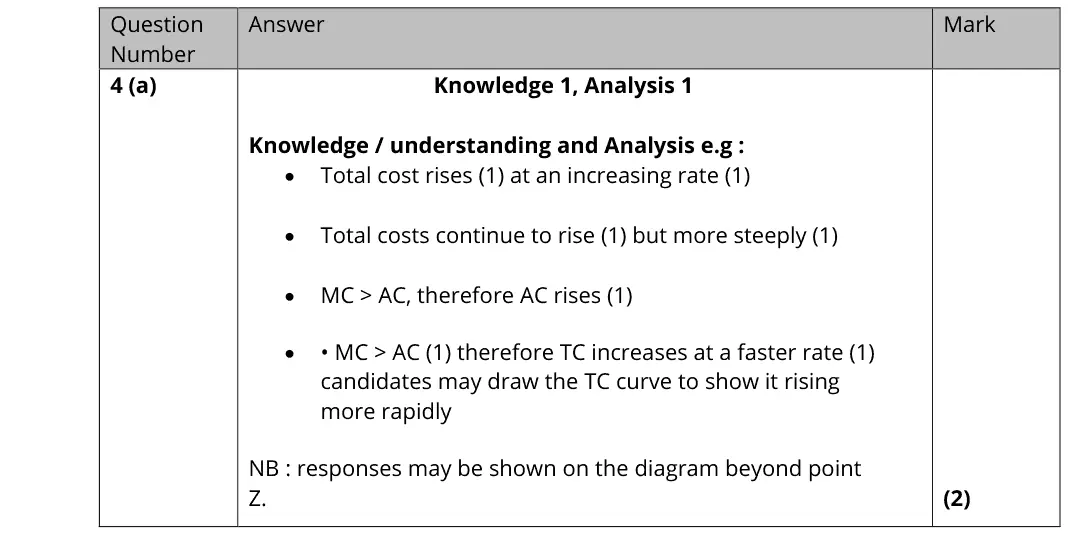
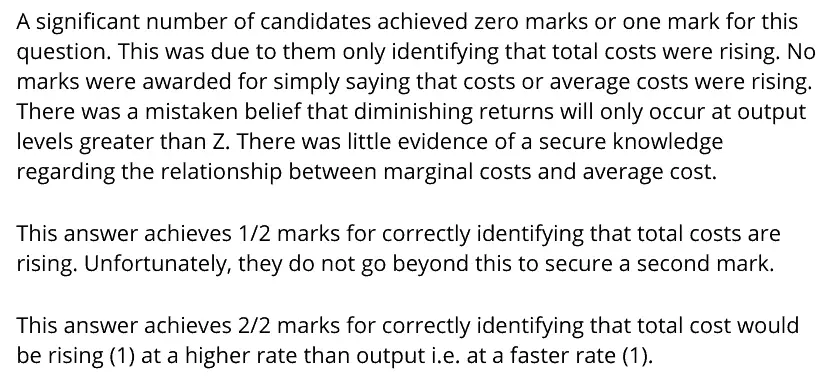
4(a) Revenues, costs and profits 2AO1=1,AO3=1Short answer
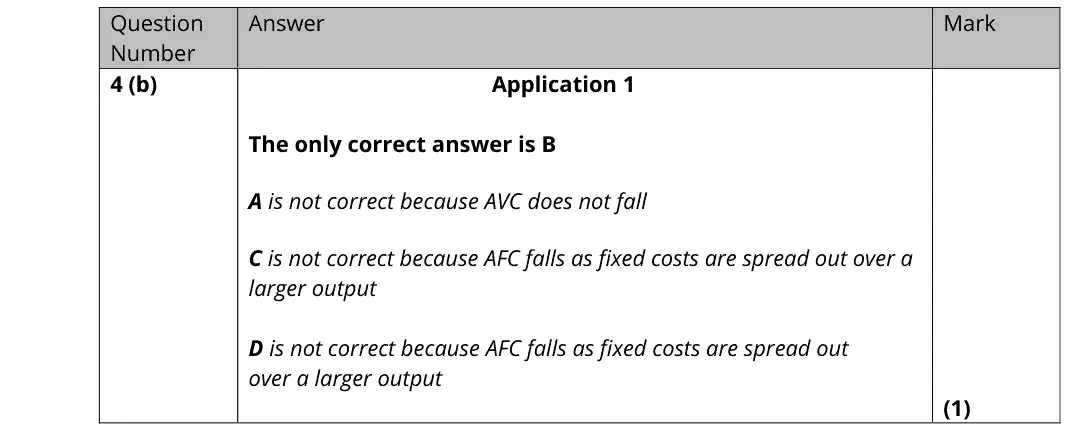
4(b) Revenues, costs and profits 1AO2=1Multiple choice
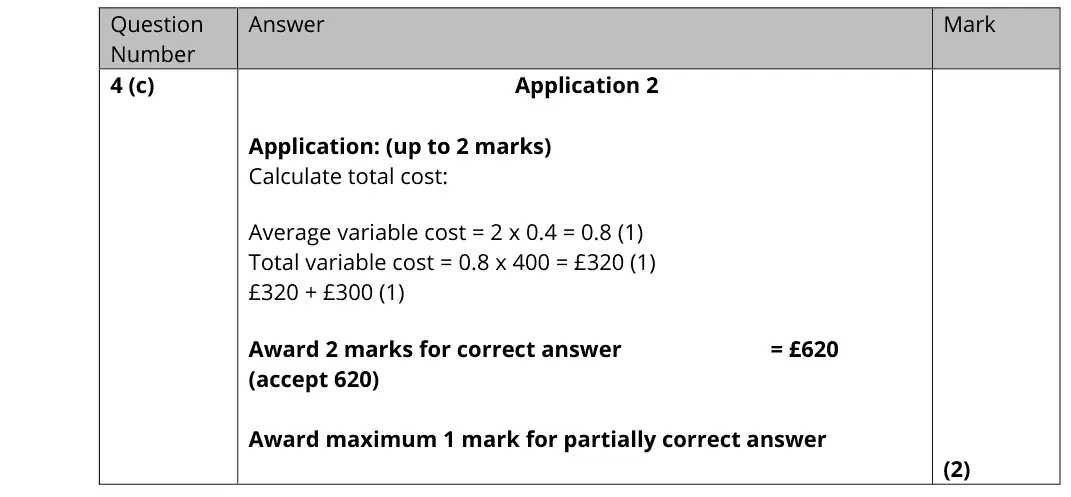
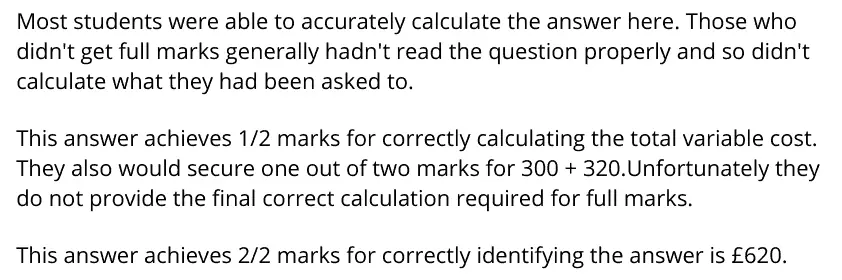
4(c) Revenues, costs and profits 2AO2=2Calculation
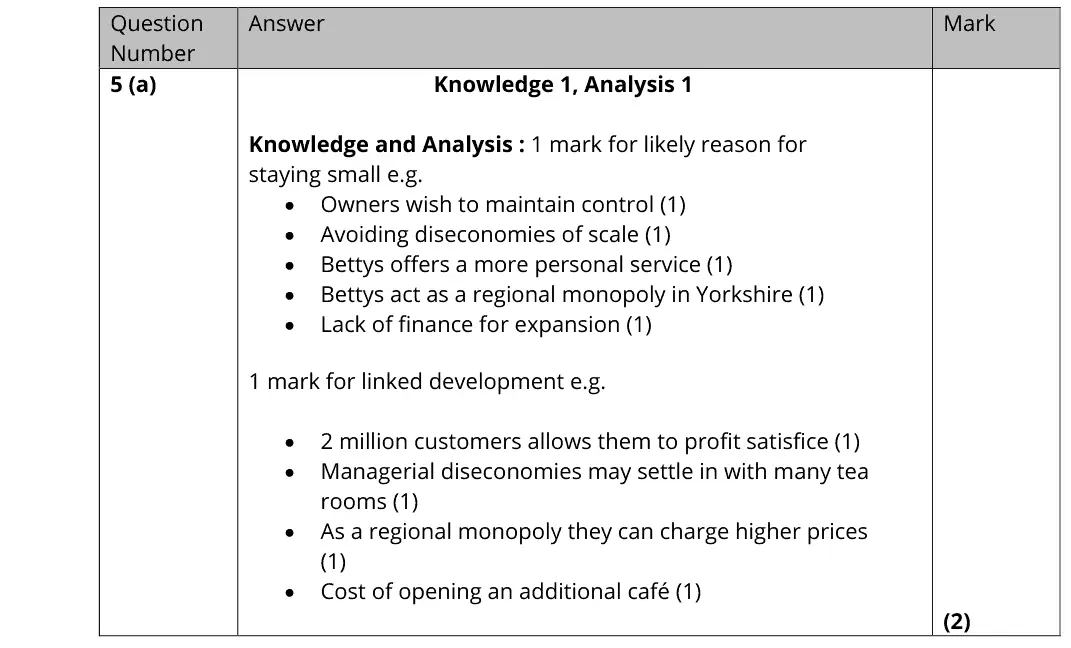
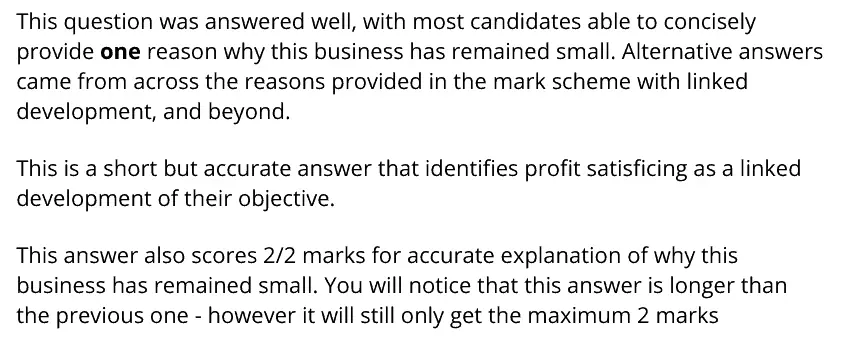
5(a) Business growth and business objectives 2AO1=1,AO3=1Short answer
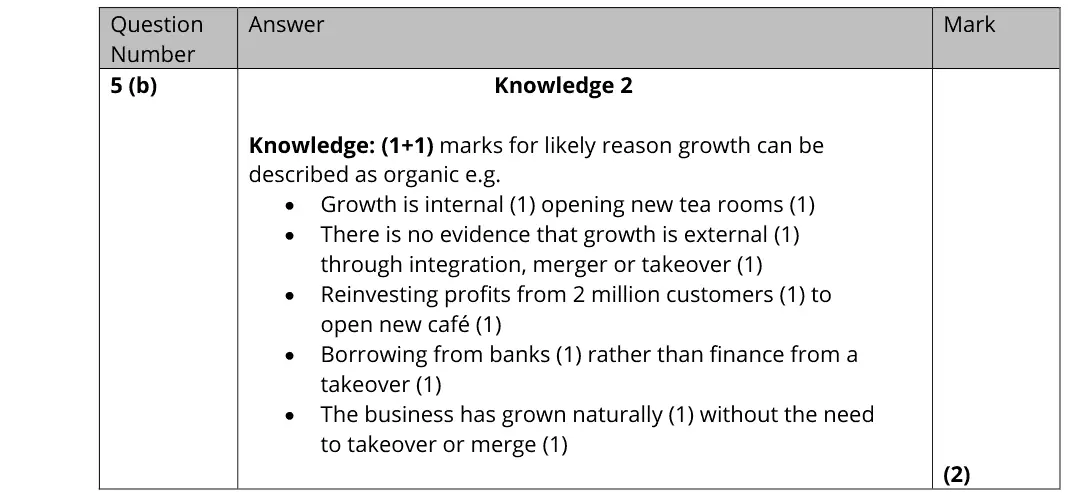
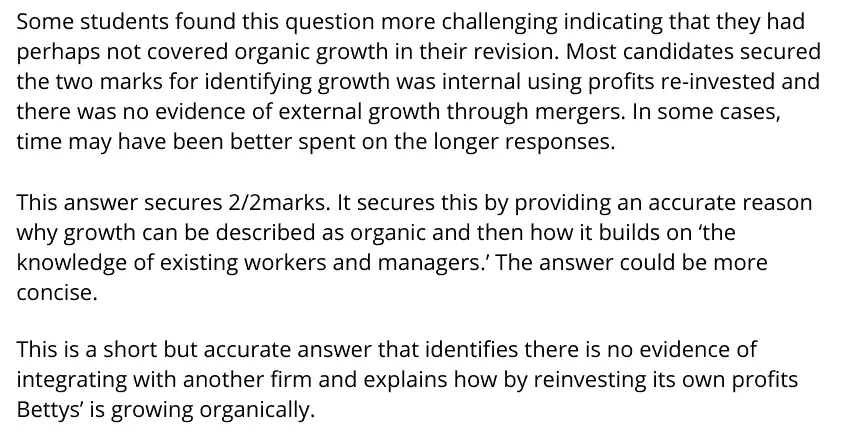
5(b) Business growth and business objectives 2AO1=2Short answer
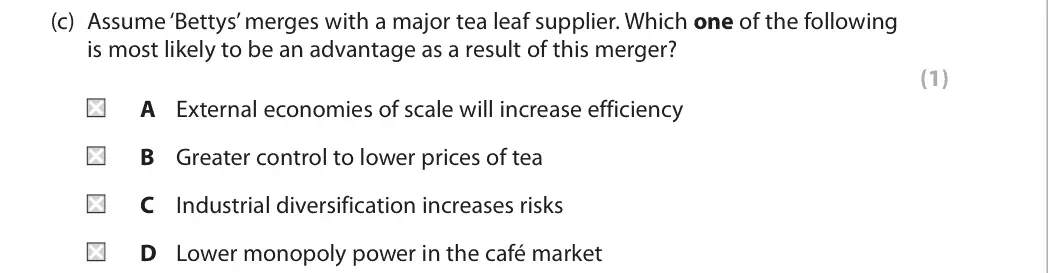
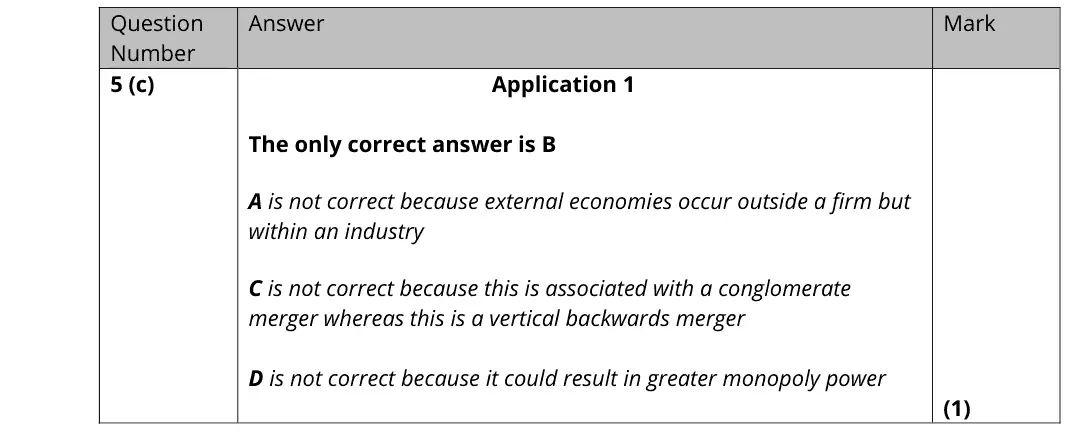
5(c) Business growth and business objectives 1AO2=1Multiple choice
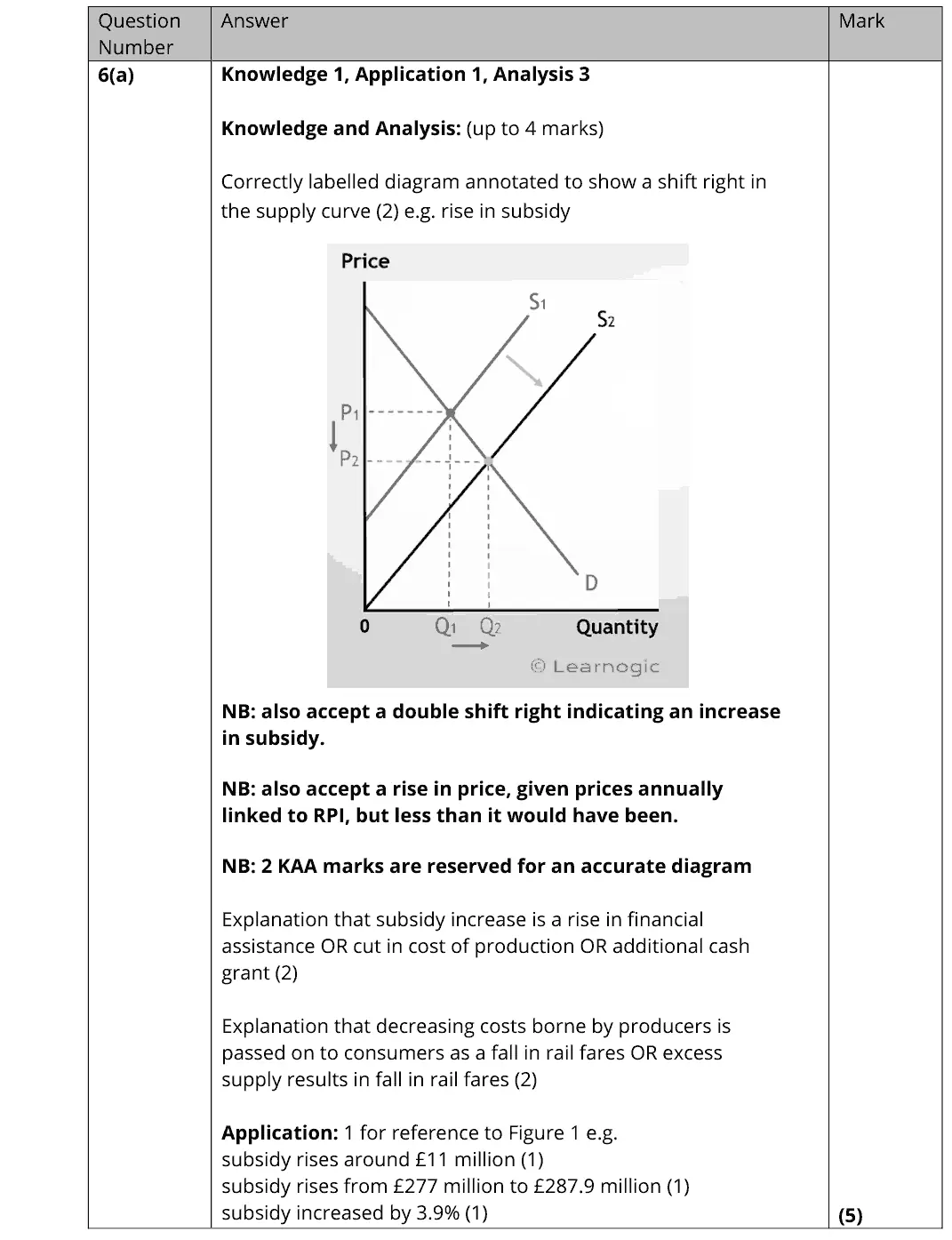
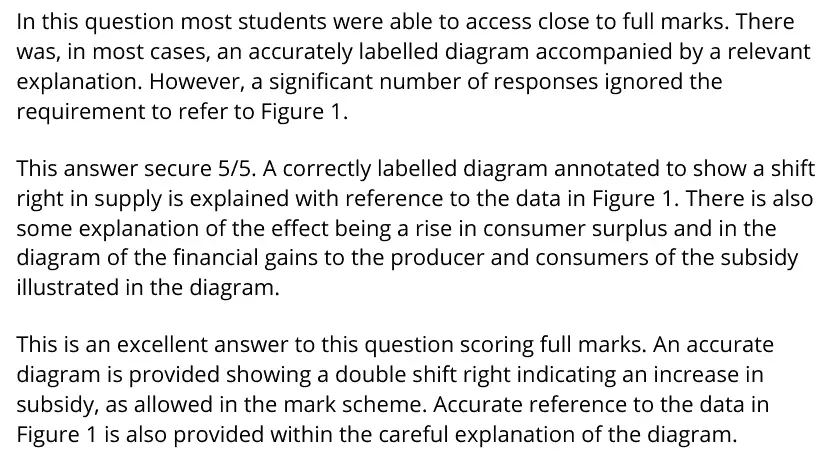
6(a) Indirect taxes and subsidies, Supply, demand and price determination 5AO1=1,AO2=1,AO3=3Diagram
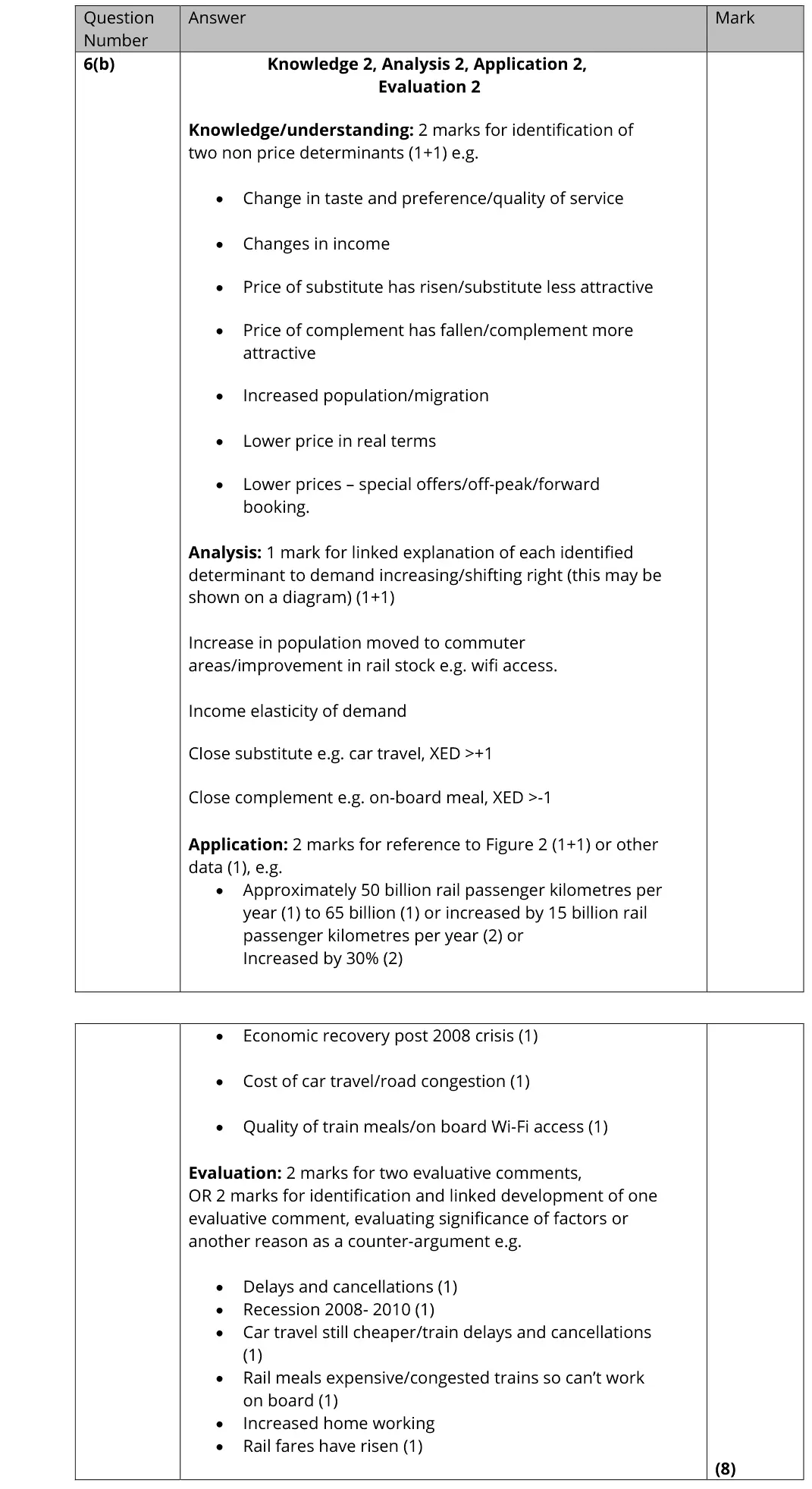
6(b) Supply, demand and price determination 8AO1=2,AO2=2,AO3=2,AO4=2Extended response
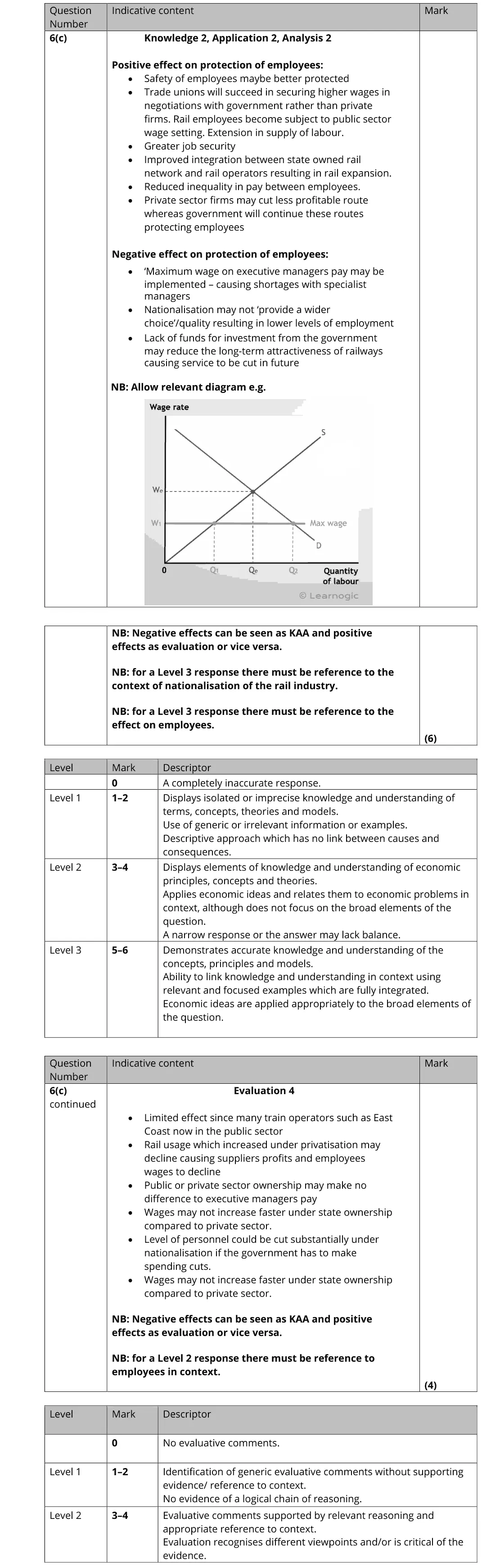
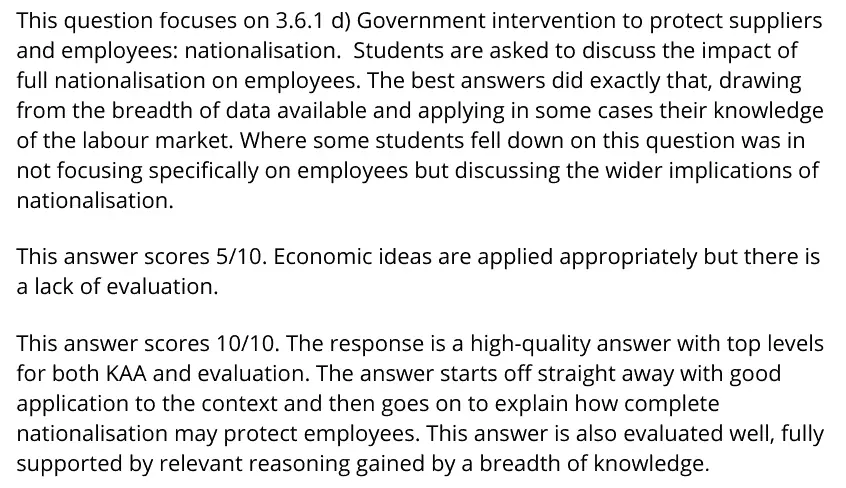
6(c) Government intervention: competition policy and regulation, The labour market 10AO1=2,AO2=2,AO3=2,AO4=4Extended response
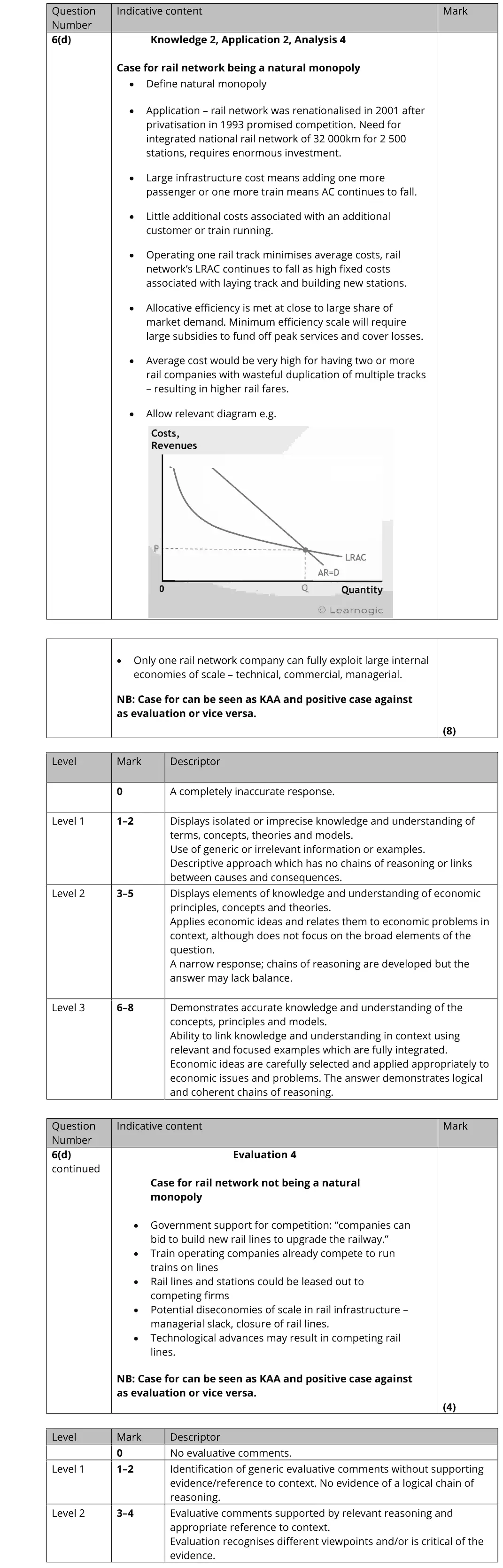
6(d) Monopoly 12AO1=2,AO2=2,AO3=4,AO4=4Extended response
6(e) Monopoly 15AO1=3,AO2=3,AO3=3,AO4=6Extended response
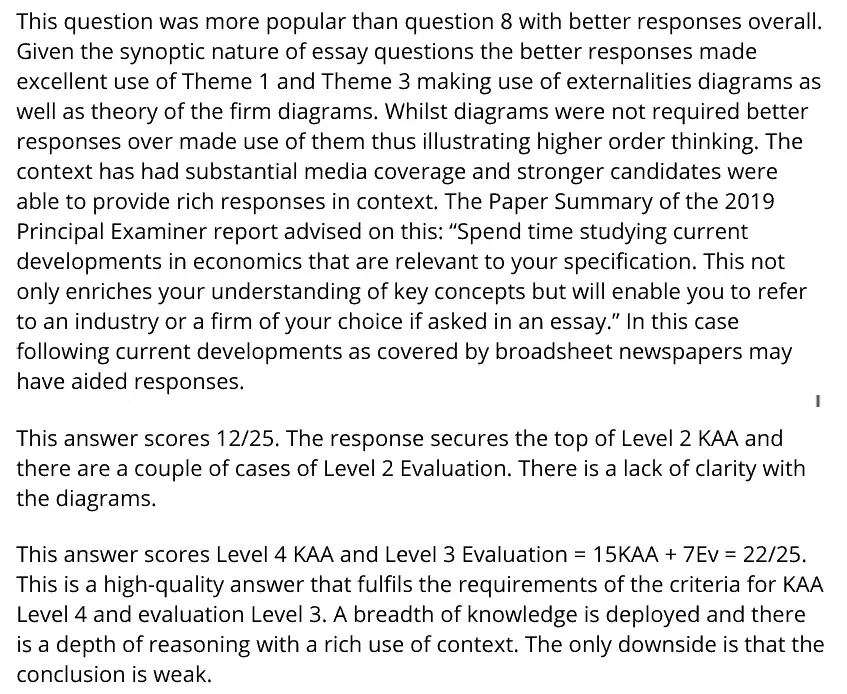
7 Price, income and cross elasticities of demand, Market failure and externalities 25AO1=4,AO2=4,AO3=8,AO4=9Essay
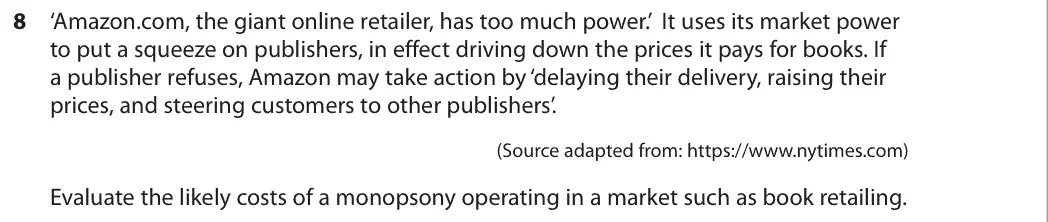
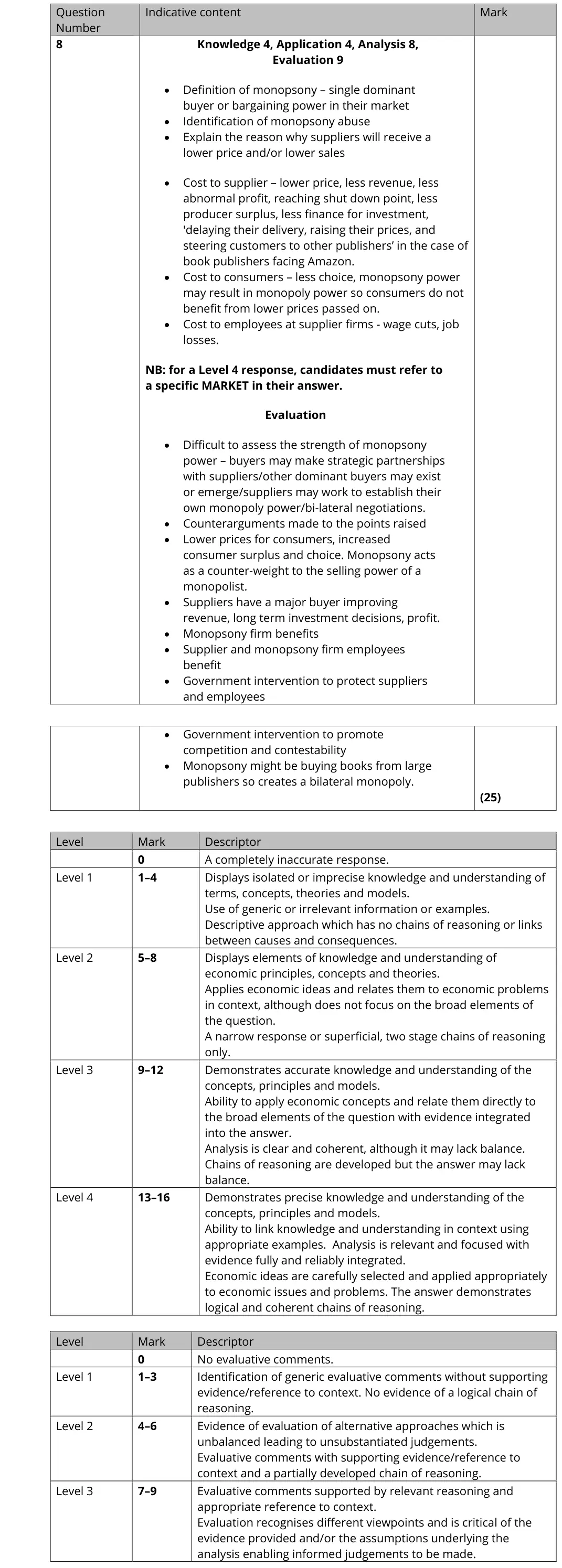
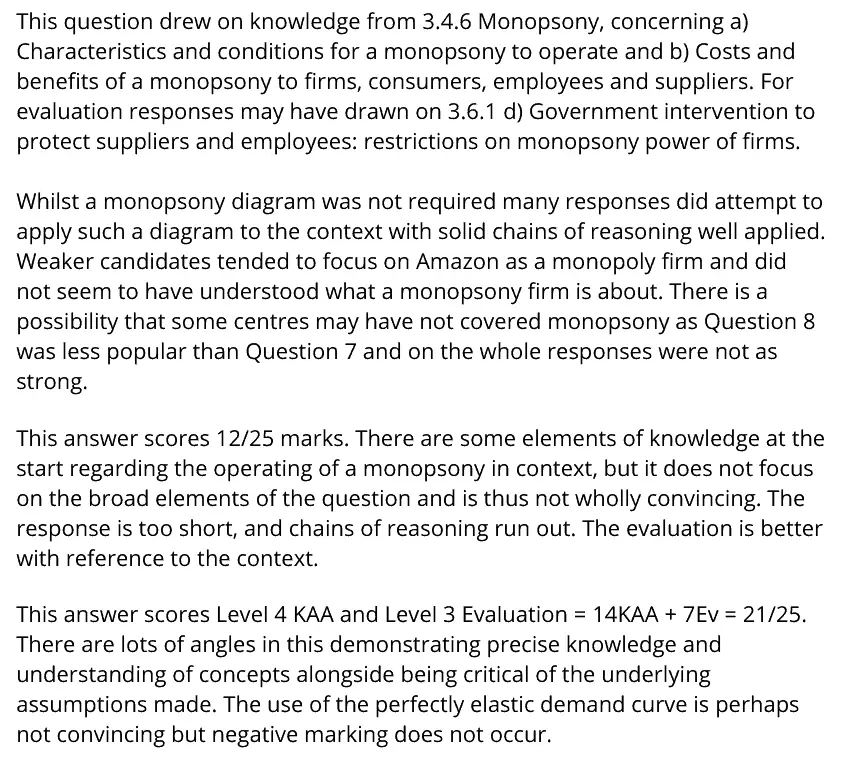
8 Monopsony and contestable markets 25AO1=4,AO2=4,AO3=8,AO4=9Essay

The questions

1(a)1(b)2(a)2(b)3(a)3(b)4(a)4(b)4(c)5(a)5(b)5(c)6(a)6(b)6(c)6(d)6(e)78
October 2020 · Paper 1 · Q1(a) 4 marks AO1=2, AO2=2 Diagram indirect taxes and subsidies
Data and extracts for question 11 Fuel duty is an excise tax imposed on the sale of petrol, included in the price paid by consumers, set at 58 pence per litre. (Source: https://www.gov.uk/tax-on-shopping/fuel-duty)
(a) Draw a supply and demand diagram to show the incidence of a specific petrol tax on consumers and producers. (4)
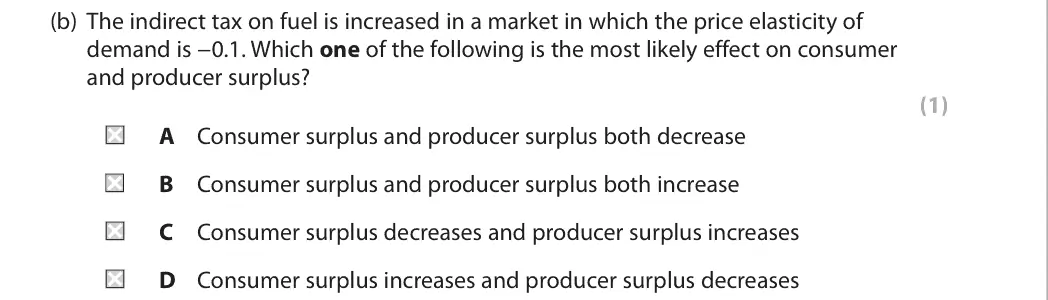
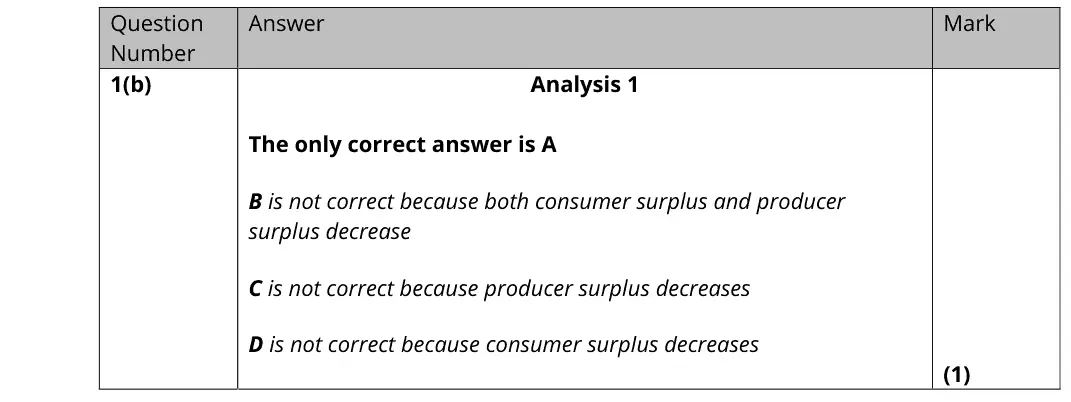
October 2020 · Paper 1 · Q1(b) 1 mark AO3=1 Multiple choice price mechanism and surplusindirect taxes and subsidies
Data and extracts for question 11 Fuel duty is an excise tax imposed on the sale of petrol, included in the price paid by consumers, set at 58 pence per litre. (Source: https://www.gov.uk/tax-on-shopping/fuel-duty)
(b) The indirect tax on fuel is increased in a market in which the price elasticity of demand is -0.1. Which one of the following is the most likely effect on consumer and producer surplus? (1) A Consumer surplus and producer surplus both decrease B Consumer surplus and producer surplus both increase C Consumer surplus decreases and producer surplus increases D Consumer surplus increases and producer surplus decreases
October 2020 · Paper 1 · Q2(a) 4 marks AO1=2, AO2=2 Diagram externalities
Data and extracts for question 22 The external benefits of higher education include increased tax revenue, faster economic growth, greater innovation and labour market flexibility. (Source adapted from: https://www.timeshighereducation.com/news/higher-education-its- good-for-you-and-society/2008681.article#survey-answer)
(a) Draw an externalities diagram to show the likely impact of the consumption of higher education. (4)
October 2020 · Paper 1 · Q2(b) 1 mark AO3=1 Multiple choice externalities
Data and extracts for question 22 The external benefits of higher education include increased tax revenue, faster economic growth, greater innovation and labour market flexibility. (Source adapted from: https://www.timeshighereducation.com/news/higher-education-its- good-for-you-and-society/2008681.article#survey-answer)
(b) On average, in the UK, a working-age graduate earns approximately £10 000 more per year than a non-graduate. (Source adapted from: https://assets.publishing.service.gov.uk/government/uploads/ system/uploads/attachment_data/file/701720/GLMS_2017.pdf) This suggests a university degree provides a substantial (1) A external benefit B external cost C private benefit D social cost
October 2020 · Paper 1 · Q3(a) 4 marks AO1=2, AO2=1, AO3=1 Short answer government intervention in markets
Data and extracts for question 33 The EU tradable pollution permits scheme is expected to become more effective by 2020, due to recent reductions in the number of tradable pollution permits. (Source adapted from: https://ec.europa.eu/clima/policies/ets_en)
(a) Explain one likely effect of reducing the number of tradable pollution permits. (4)
October 2020 · Paper 1 · Q3(b) 1 mark AO3=1 Multiple choice government failure
Data and extracts for question 33 The EU tradable pollution permits scheme is expected to become more effective by 2020, due to recent reductions in the number of tradable pollution permits. (Source adapted from: https://ec.europa.eu/clima/policies/ets_en)
(b) Regulation of firms that pollute is likely to be a problem because it (1) A allows firms to use price signals B creates unintended consequences C fills information gaps for businesses D means lower administrative costs
October 2020 · Paper 1 · Q4(a) 2 marks AO1=1, AO3=1 Short answer Hard revenues costs and profits
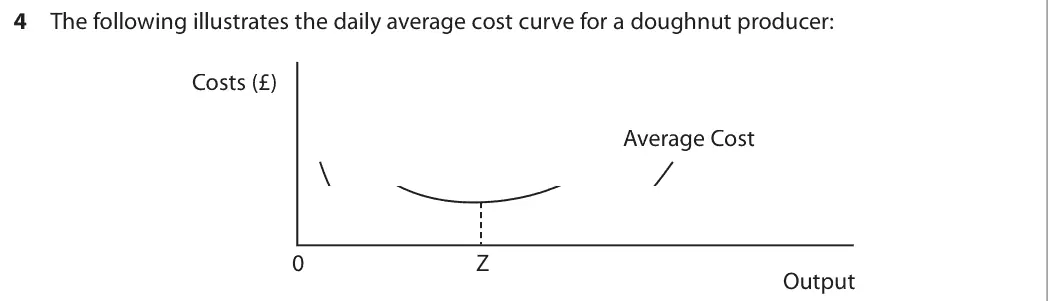
Data and extracts for question 44 The following illustrates the daily average cost curve for a doughnut producer: Costs (£) Average Cost 0 Z Output
(a) Explain what happens to total cost at output levels greater than Z. (2)
October 2020 · Paper 1 · Q4(b) 1 mark AO2=1 Multiple choice revenues costs and profits
Data and extracts for question 44 The following illustrates the daily average cost curve for a doughnut producer: Costs (£) Average Cost 0 Z Output
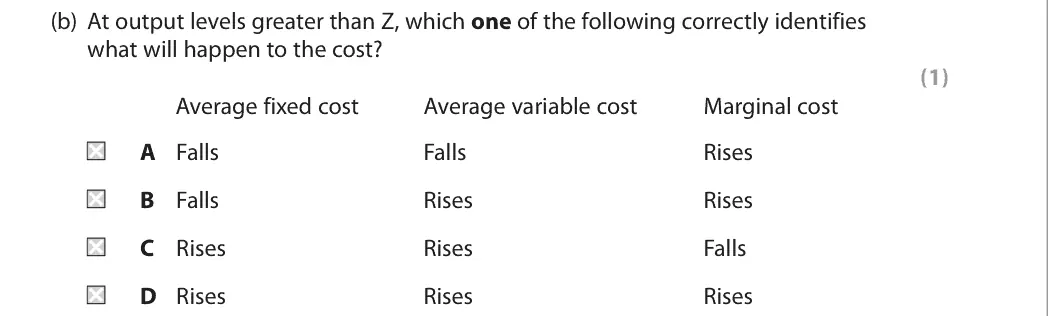
(b) At output levels greater than Z, which one of the following correctly identifies what will happen to the cost? (1) Average fixed cost Average variable cost Marginal cost A Falls Falls Rises B Falls Rises Rises C Rises Rises Falls D Rises Rises Rises
October 2020 · Paper 1 · Q4(c) 2 marks AO2=2 Calculation revenues costs and profits
Data and extracts for question 44 The following illustrates the daily average cost curve for a doughnut producer: Costs (£) Average Cost 0 Z Output
(c) For a luxury doughnut producer the average selling price is £2. The average variable cost is 40% of the selling price and its fixed cost per day is £300. Calculate total costs per day assuming it produces 400 doughnuts per day. (2)
October 2020 · Paper 1 · Q5(a) 2 marks AO1=1, AO3=1 Short answer business growth and objectives
Data and extracts for question 55 ‘Bettys’ is a luxury café, first opened in Harrogate in 1919 specialising in afternoon tea service. Since then it has opened a further five branches in Yorkshire. It has no plans to increase the number of cafés. The six branches have 2 million customers a year. (Source adapted from: https://www.forbes.com/sites/sarahturner/2018/03/22/the-famed-yorkshire-cafe- that-blends-nostalgia-with-profits-and-conservation/#7eb50cec7a4e)
(a) Explain one likely reason why this business has remained small. (2)
October 2020 · Paper 1 · Q5(b) 2 marks AO1=2 Short answer business growth and objectives
Data and extracts for question 55 ‘Bettys’ is a luxury café, first opened in Harrogate in 1919 specialising in afternoon tea service. Since then it has opened a further five branches in Yorkshire. It has no plans to increase the number of cafés. The six branches have 2 million customers a year. (Source adapted from: https://www.forbes.com/sites/sarahturner/2018/03/22/the-famed-yorkshire-cafe- that-blends-nostalgia-with-profits-and-conservation/#7eb50cec7a4e)
(b) Explain why the previous expansion of this business could be described as ‘organic growth’. (2)
October 2020 · Paper 1 · Q5(c) 1 mark AO2=1 Multiple choice business growth and objectives
Data and extracts for question 55 ‘Bettys’ is a luxury café, first opened in Harrogate in 1919 specialising in afternoon tea service. Since then it has opened a further five branches in Yorkshire. It has no plans to increase the number of cafés. The six branches have 2 million customers a year. (Source adapted from: https://www.forbes.com/sites/sarahturner/2018/03/22/the-famed-yorkshire-cafe- that-blends-nostalgia-with-profits-and-conservation/#7eb50cec7a4e)
(c) Assume ‘Bettys’ merges with a major tea leaf supplier. Which one of the following is most likely to be an advantage as a result of this merger? (1) A External economies of scale will increase efficiency B Greater control to lower prices of tea C Industrial diversification increases risks D Lower monopoly power in the café market
October 2020 · Paper 1 · Q6(a) 5 marks AO1=1, AO2=1, AO3=3 Diagram indirect taxes and subsidiessupply and demand
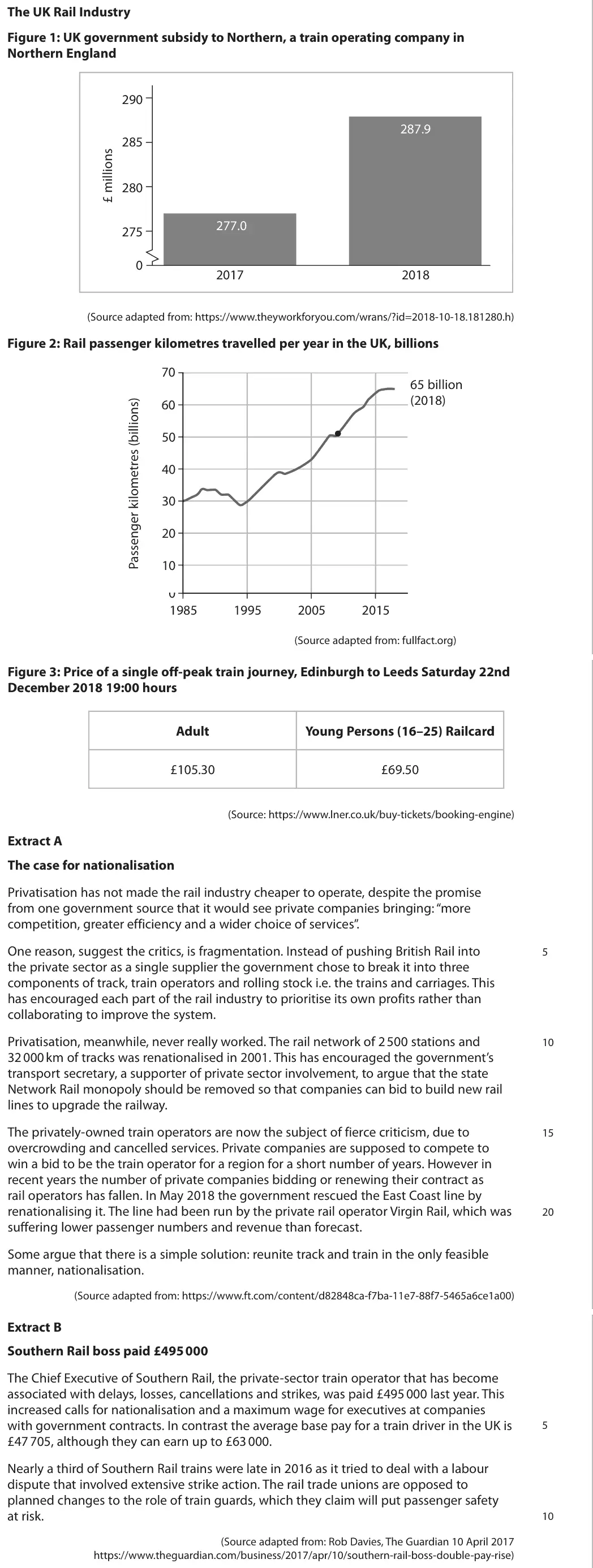
Data and extracts for question 6The UK Rail Industry Figure 1: UK government subsidy to Northern, a train operating company in Northern England 290 287.9 285 280 277.0 275 0 2017 2018 (Source adapted from: https://www.theyworkforyou.com/wrans/?id=2018-10-18.181280.h) Figure 2: Rail passenger kilometres travelled per year in the UK, billions 70 65 billion (2018) 60 50 40 30 20 10 0 1985 1995 2005 2015 (Source adapted from: fullfact.org) Figure 3: Price of a single off-peak train journey, Edinburgh to Leeds Saturday 22nd December 2018 19:00 hours Adult Young Persons (16–25) Railcard £105.30 £69.50 (Source: https://www.lner.co.uk/buy-tickets/booking-engine) Extract A The case for nationalisation Privatisation has not made the rail industry cheaper to operate, despite the promise from one government source that it would see private companies bringing: “more competition, greater efficiency and a wider choice of services”. One reason, suggest the critics, is fragmentation. Instead of pushing British Rail into 5 the private sector as a single supplier the government chose to break it into three components of track, train operators and rolling stock i.e. the trains and carriages. This has encouraged each part of the rail industry to prioritise its own profits rather than collaborating to improve the system. Privatisation, meanwhile, never really worked. The rail network of 2 500 stations and 10 32 000 km of tracks was renationalised in 2001. This has encouraged the government’s transport secretary, a supporter of private sector involvement, to argue that the state Network Rail monopoly should be removed so that companies can bid to build new rail lines to upgrade the railway. The privately-owned train operators are now the subject of fierce criticism, due to 15 overcrowding and cancelled services. Private companies are supposed to compete to win a bid to be the train operator for a region for a short number of years. However in recent years the number of private companies bidding or renewing their contract as rail operators has fallen. In May 2018 the government rescued the East Coast line by renationalising it. The line had been run by the private rail operator Virgin Rail, which was 20 suffering lower passenger numbers and revenue than forecast. Some argue that there is a simple solution: reunite track and train in the only feasible manner, nationalisation. (Source adapted from: https://www.ft.com/content/d82848ca-f7ba-11e7-88f7-5465a6ce1a00) Extract B Southern Rail boss paid £495 000 The Chief Executive of Southern Rail, the private-sector train operator that has become associated with delays, losses, cancellations and strikes, was paid £495 000 last year. This increased calls for nationalisation and a maximum wage for executives at companies with government contracts. In contrast the average base pay for a train driver in the UK is 5 £47 705, although they can earn up to £63 000. Nearly a third of Southern Rail trains were late in 2016 as it tried to deal with a labour dispute that involved extensive strike action. The rail trade unions are opposed to planned changes to the role of train guards, which they claim will put passenger safety at risk. 10 (Source adapted from: Rob Davies, The Guardian 10 April 2017 https://www.theguardian.com/business/2017/apr/10/southern-rail-boss-double-pay-rise)
(a) Refer to Figure 1. Explain the likely effect of the change in subsidy levels between 2017 and 2018 on rail fares. Include a supply and demand diagram in your answer. (5)
October 2020 · Paper 1 · Q6(b) 8 marks AO1=2, AO2=2, AO3=2, AO4=2 8-mark response supply and demand
Data and extracts for question 6The UK Rail Industry Figure 1: UK government subsidy to Northern, a train operating company in Northern England 290 287.9 285 280 277.0 275 0 2017 2018 (Source adapted from: https://www.theyworkforyou.com/wrans/?id=2018-10-18.181280.h) Figure 2: Rail passenger kilometres travelled per year in the UK, billions 70 65 billion (2018) 60 50 40 30 20 10 0 1985 1995 2005 2015 (Source adapted from: fullfact.org) Figure 3: Price of a single off-peak train journey, Edinburgh to Leeds Saturday 22nd December 2018 19:00 hours Adult Young Persons (16–25) Railcard £105.30 £69.50 (Source: https://www.lner.co.uk/buy-tickets/booking-engine) Extract A The case for nationalisation Privatisation has not made the rail industry cheaper to operate, despite the promise from one government source that it would see private companies bringing: “more competition, greater efficiency and a wider choice of services”. One reason, suggest the critics, is fragmentation. Instead of pushing British Rail into 5 the private sector as a single supplier the government chose to break it into three components of track, train operators and rolling stock i.e. the trains and carriages. This has encouraged each part of the rail industry to prioritise its own profits rather than collaborating to improve the system. Privatisation, meanwhile, never really worked. The rail network of 2 500 stations and 10 32 000 km of tracks was renationalised in 2001. This has encouraged the government’s transport secretary, a supporter of private sector involvement, to argue that the state Network Rail monopoly should be removed so that companies can bid to build new rail lines to upgrade the railway. The privately-owned train operators are now the subject of fierce criticism, due to 15 overcrowding and cancelled services. Private companies are supposed to compete to win a bid to be the train operator for a region for a short number of years. However in recent years the number of private companies bidding or renewing their contract as rail operators has fallen. In May 2018 the government rescued the East Coast line by renationalising it. The line had been run by the private rail operator Virgin Rail, which was 20 suffering lower passenger numbers and revenue than forecast. Some argue that there is a simple solution: reunite track and train in the only feasible manner, nationalisation. (Source adapted from: https://www.ft.com/content/d82848ca-f7ba-11e7-88f7-5465a6ce1a00) Extract B Southern Rail boss paid £495 000 The Chief Executive of Southern Rail, the private-sector train operator that has become associated with delays, losses, cancellations and strikes, was paid £495 000 last year. This increased calls for nationalisation and a maximum wage for executives at companies with government contracts. In contrast the average base pay for a train driver in the UK is 5 £47 705, although they can earn up to £63 000. Nearly a third of Southern Rail trains were late in 2016 as it tried to deal with a labour dispute that involved extensive strike action. The rail trade unions are opposed to planned changes to the role of train guards, which they claim will put passenger safety at risk. 10 (Source adapted from: Rob Davies, The Guardian 10 April 2017 https://www.theguardian.com/business/2017/apr/10/southern-rail-boss-double-pay-rise)
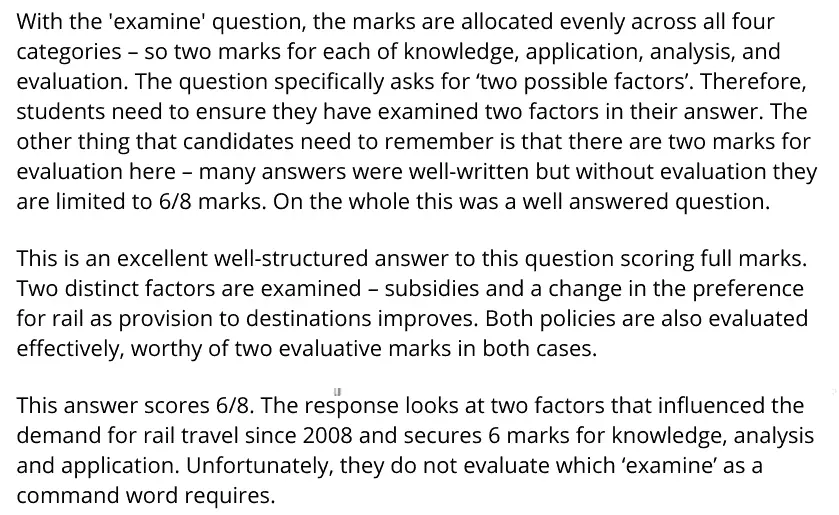
(b) With reference to Figure 2, examine two possible factors which may have influenced demand for rail travel since 2008. (8)
October 2020 · Paper 1 · Q6(c) 10 marks AO1=2, AO2=2, AO3=2, AO4=4 10-mark response competition policy and regulationlabour market
Data and extracts for question 6The UK Rail Industry Figure 1: UK government subsidy to Northern, a train operating company in Northern England 290 287.9 285 280 277.0 275 0 2017 2018 (Source adapted from: https://www.theyworkforyou.com/wrans/?id=2018-10-18.181280.h) Figure 2: Rail passenger kilometres travelled per year in the UK, billions 70 65 billion (2018) 60 50 40 30 20 10 0 1985 1995 2005 2015 (Source adapted from: fullfact.org) Figure 3: Price of a single off-peak train journey, Edinburgh to Leeds Saturday 22nd December 2018 19:00 hours Adult Young Persons (16–25) Railcard £105.30 £69.50 (Source: https://www.lner.co.uk/buy-tickets/booking-engine) Extract A The case for nationalisation Privatisation has not made the rail industry cheaper to operate, despite the promise from one government source that it would see private companies bringing: “more competition, greater efficiency and a wider choice of services”. One reason, suggest the critics, is fragmentation. Instead of pushing British Rail into 5 the private sector as a single supplier the government chose to break it into three components of track, train operators and rolling stock i.e. the trains and carriages. This has encouraged each part of the rail industry to prioritise its own profits rather than collaborating to improve the system. Privatisation, meanwhile, never really worked. The rail network of 2 500 stations and 10 32 000 km of tracks was renationalised in 2001. This has encouraged the government’s transport secretary, a supporter of private sector involvement, to argue that the state Network Rail monopoly should be removed so that companies can bid to build new rail lines to upgrade the railway. The privately-owned train operators are now the subject of fierce criticism, due to 15 overcrowding and cancelled services. Private companies are supposed to compete to win a bid to be the train operator for a region for a short number of years. However in recent years the number of private companies bidding or renewing their contract as rail operators has fallen. In May 2018 the government rescued the East Coast line by renationalising it. The line had been run by the private rail operator Virgin Rail, which was 20 suffering lower passenger numbers and revenue than forecast. Some argue that there is a simple solution: reunite track and train in the only feasible manner, nationalisation. (Source adapted from: https://www.ft.com/content/d82848ca-f7ba-11e7-88f7-5465a6ce1a00) Extract B Southern Rail boss paid £495 000 The Chief Executive of Southern Rail, the private-sector train operator that has become associated with delays, losses, cancellations and strikes, was paid £495 000 last year. This increased calls for nationalisation and a maximum wage for executives at companies with government contracts. In contrast the average base pay for a train driver in the UK is 5 £47 705, although they can earn up to £63 000. Nearly a third of Southern Rail trains were late in 2016 as it tried to deal with a labour dispute that involved extensive strike action. The rail trade unions are opposed to planned changes to the role of train guards, which they claim will put passenger safety at risk. 10 (Source adapted from: Rob Davies, The Guardian 10 April 2017 https://www.theguardian.com/business/2017/apr/10/southern-rail-boss-double-pay-rise)
(c) Assess whether complete nationalisation of the rail industry might protect employees. (10)
October 2020 · Paper 1 · Q6(d) 12 marks AO1=2, AO2=2, AO3=4, AO4=4 12-mark response monopoly
Data and extracts for question 6The UK Rail Industry Figure 1: UK government subsidy to Northern, a train operating company in Northern England 290 287.9 285 280 277.0 275 0 2017 2018 (Source adapted from: https://www.theyworkforyou.com/wrans/?id=2018-10-18.181280.h) Figure 2: Rail passenger kilometres travelled per year in the UK, billions 70 65 billion (2018) 60 50 40 30 20 10 0 1985 1995 2005 2015 (Source adapted from: fullfact.org) Figure 3: Price of a single off-peak train journey, Edinburgh to Leeds Saturday 22nd December 2018 19:00 hours Adult Young Persons (16–25) Railcard £105.30 £69.50 (Source: https://www.lner.co.uk/buy-tickets/booking-engine) Extract A The case for nationalisation Privatisation has not made the rail industry cheaper to operate, despite the promise from one government source that it would see private companies bringing: “more competition, greater efficiency and a wider choice of services”. One reason, suggest the critics, is fragmentation. Instead of pushing British Rail into 5 the private sector as a single supplier the government chose to break it into three components of track, train operators and rolling stock i.e. the trains and carriages. This has encouraged each part of the rail industry to prioritise its own profits rather than collaborating to improve the system. Privatisation, meanwhile, never really worked. The rail network of 2 500 stations and 10 32 000 km of tracks was renationalised in 2001. This has encouraged the government’s transport secretary, a supporter of private sector involvement, to argue that the state Network Rail monopoly should be removed so that companies can bid to build new rail lines to upgrade the railway. The privately-owned train operators are now the subject of fierce criticism, due to 15 overcrowding and cancelled services. Private companies are supposed to compete to win a bid to be the train operator for a region for a short number of years. However in recent years the number of private companies bidding or renewing their contract as rail operators has fallen. In May 2018 the government rescued the East Coast line by renationalising it. The line had been run by the private rail operator Virgin Rail, which was 20 suffering lower passenger numbers and revenue than forecast. Some argue that there is a simple solution: reunite track and train in the only feasible manner, nationalisation. (Source adapted from: https://www.ft.com/content/d82848ca-f7ba-11e7-88f7-5465a6ce1a00) Extract B Southern Rail boss paid £495 000 The Chief Executive of Southern Rail, the private-sector train operator that has become associated with delays, losses, cancellations and strikes, was paid £495 000 last year. This increased calls for nationalisation and a maximum wage for executives at companies with government contracts. In contrast the average base pay for a train driver in the UK is 5 £47 705, although they can earn up to £63 000. Nearly a third of Southern Rail trains were late in 2016 as it tried to deal with a labour dispute that involved extensive strike action. The rail trade unions are opposed to planned changes to the role of train guards, which they claim will put passenger safety at risk. 10 (Source adapted from: Rob Davies, The Guardian 10 April 2017 https://www.theguardian.com/business/2017/apr/10/southern-rail-boss-double-pay-rise)
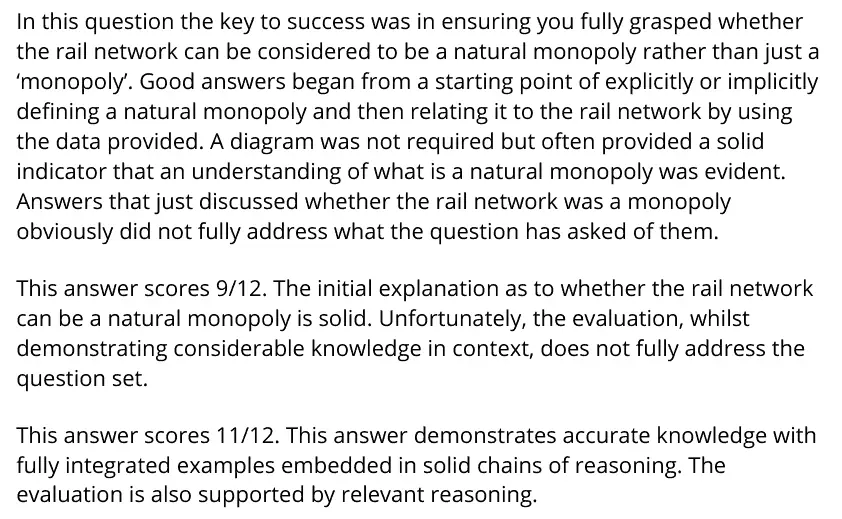
(d) With reference to Extract A, paragraph 3, discuss whether the rail network can be considered to be a natural monopoly. (12)
October 2020 · Paper 1 · Q6(e) 15 marks AO1=3, AO2=3, AO3=3, AO4=6 15-mark response monopoly
Data and extracts for question 6The UK Rail Industry Figure 1: UK government subsidy to Northern, a train operating company in Northern England 290 287.9 285 280 277.0 275 0 2017 2018 (Source adapted from: https://www.theyworkforyou.com/wrans/?id=2018-10-18.181280.h) Figure 2: Rail passenger kilometres travelled per year in the UK, billions 70 65 billion (2018) 60 50 40 30 20 10 0 1985 1995 2005 2015 (Source adapted from: fullfact.org) Figure 3: Price of a single off-peak train journey, Edinburgh to Leeds Saturday 22nd December 2018 19:00 hours Adult Young Persons (16–25) Railcard £105.30 £69.50 (Source: https://www.lner.co.uk/buy-tickets/booking-engine) Extract A The case for nationalisation Privatisation has not made the rail industry cheaper to operate, despite the promise from one government source that it would see private companies bringing: “more competition, greater efficiency and a wider choice of services”. One reason, suggest the critics, is fragmentation. Instead of pushing British Rail into 5 the private sector as a single supplier the government chose to break it into three components of track, train operators and rolling stock i.e. the trains and carriages. This has encouraged each part of the rail industry to prioritise its own profits rather than collaborating to improve the system. Privatisation, meanwhile, never really worked. The rail network of 2 500 stations and 10 32 000 km of tracks was renationalised in 2001. This has encouraged the government’s transport secretary, a supporter of private sector involvement, to argue that the state Network Rail monopoly should be removed so that companies can bid to build new rail lines to upgrade the railway. The privately-owned train operators are now the subject of fierce criticism, due to 15 overcrowding and cancelled services. Private companies are supposed to compete to win a bid to be the train operator for a region for a short number of years. However in recent years the number of private companies bidding or renewing their contract as rail operators has fallen. In May 2018 the government rescued the East Coast line by renationalising it. The line had been run by the private rail operator Virgin Rail, which was 20 suffering lower passenger numbers and revenue than forecast. Some argue that there is a simple solution: reunite track and train in the only feasible manner, nationalisation. (Source adapted from: https://www.ft.com/content/d82848ca-f7ba-11e7-88f7-5465a6ce1a00) Extract B Southern Rail boss paid £495 000 The Chief Executive of Southern Rail, the private-sector train operator that has become associated with delays, losses, cancellations and strikes, was paid £495 000 last year. This increased calls for nationalisation and a maximum wage for executives at companies with government contracts. In contrast the average base pay for a train driver in the UK is 5 £47 705, although they can earn up to £63 000. Nearly a third of Southern Rail trains were late in 2016 as it tried to deal with a labour dispute that involved extensive strike action. The rail trade unions are opposed to planned changes to the role of train guards, which they claim will put passenger safety at risk. 10 (Source adapted from: Rob Davies, The Guardian 10 April 2017 https://www.theguardian.com/business/2017/apr/10/southern-rail-boss-double-pay-rise)
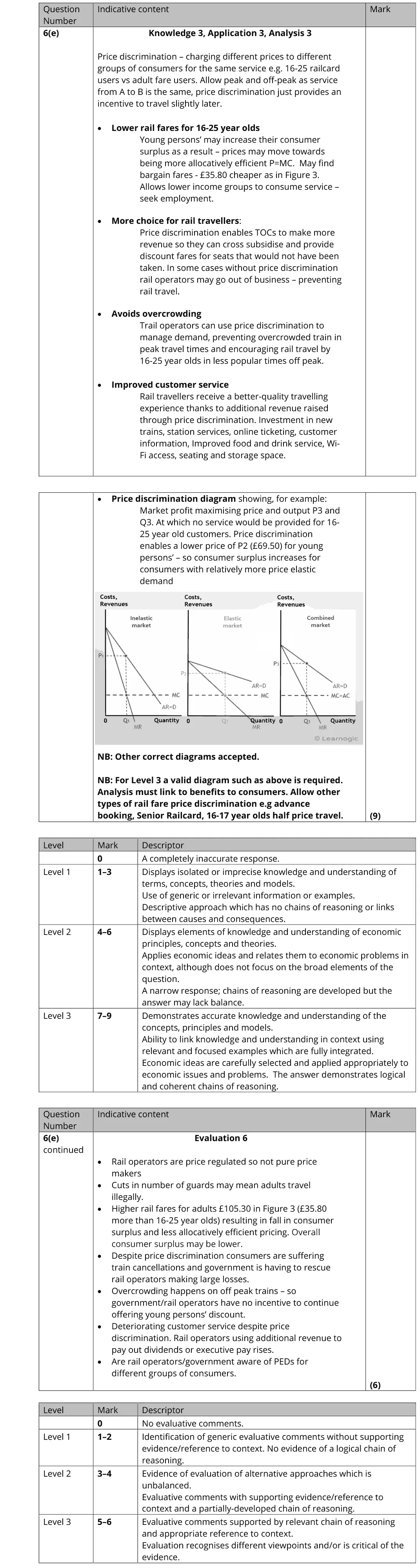
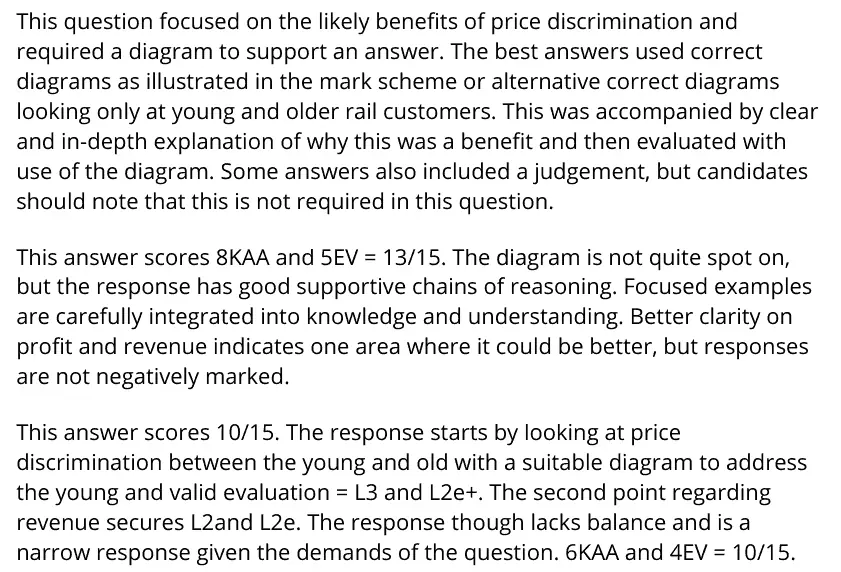
(e) Discuss the likely benefits of price discrimination to rail passengers. Use a diagram to support your answer. (15)
October 2020 · Paper 1 · Q7 25 marks AO1=4, AO2=4, AO3=8, AO4=9 25-mark essay Either/or price elasticity of demandexternalities
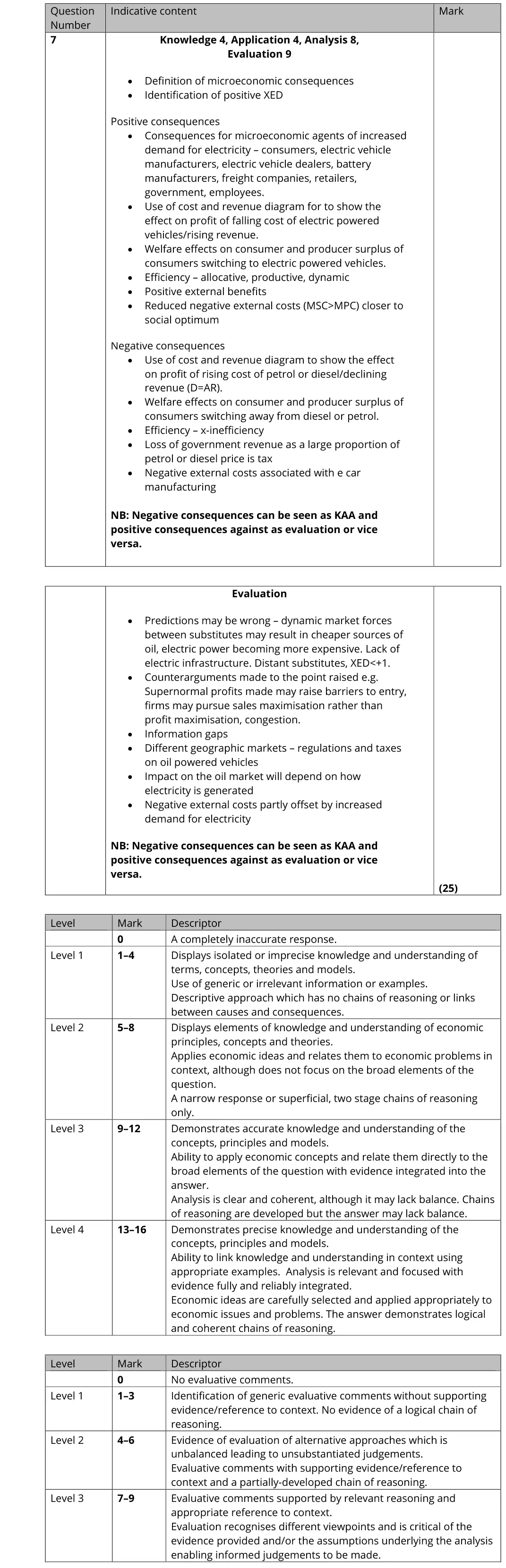
7 The International Energy Agency has predicted that oil use by cars will peak in 2025 because of the increasing number of drivers switching to electric vehicles. (Source adapted from: https://www.thetimes.co.uk) Evaluate the likely microeconomic consequences of consumers shifting from vehicles powered by fuel obtained from oil to electric‑powered vehicles.
October 2020 · Paper 1 · Q8 25 marks AO1=4, AO2=4, AO3=8, AO4=9 25-mark essay Either/or monopsony and contestability
8 ‘Amazon.com, the giant online retailer, has too much power.’ It uses its market power to put a squeeze on publishers, in effect driving down the prices it pays for books. If a publisher refuses, Amazon may take action by ‘delaying their delivery, raising their prices, and steering customers to other publishers’. (Source adapted from: https://www.nytimes.com) Evaluate the likely costs of a monopsony operating in a market such as book retailing.

Work with an Edexcel economics tutor

Want a paper marked and gone through with you? Message us.

Prefer email? Send an enquiry

If you are under 18, please include a parent's contact details. Enquiries go to enquiries@economicsaleveltutor.com and are deleted once handled. All tutoring is online.