Notes and key-term cards for this topic are being written by our tutors. The past-paper questions below are ready now.
Specification statements
1.2.7Price mechanism: a) Functions of the price mechanism to allocate resources: • rationing • incentive • signalling b) The price mechanism in the context of different types of markets, including local, national and global marketsAS
1.2.8Consumer and producer surplus: a) The distinction between consumer and producer surplus b) The use of supply and demand diagrams to illustrate consumer and producer surplus c) How changes in supply and demand might affect consumer and producer surplusAS
Tap a question to zoom it. The data and extracts fold out above each question; the mark scheme and examiner's comment open underneath.
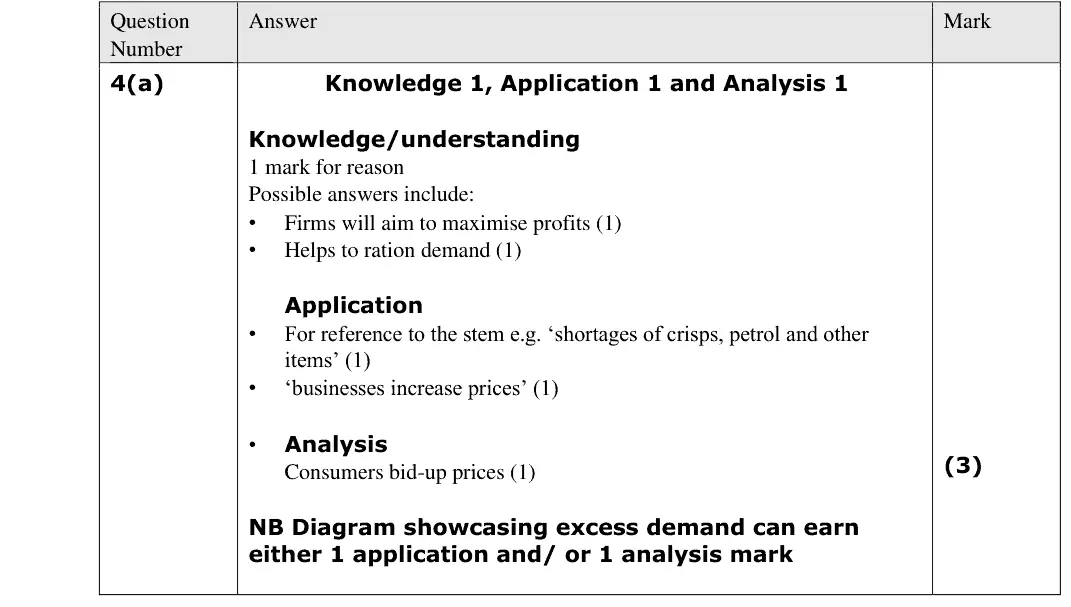
June 2023 · AS Paper 1 · Q4(a)3 marksAO1=1, AO2=1, AO3=1Short answer
Data and extracts for question 4
Mark scheme
Examiner's comment
A high number of students did manage to focus upon how firms are profit maximising and therefore it would be rational for them to increase prices at a time of excess demand. Many candidates however did misinterpret the question and focus upon the price mechanism and its features which was not a suitable and awardable response.
Notes from the mark scheme and report
firms aim to maximise profit, so with excess demand (shortages of crisps and petrol) they can raise price
price rises also ration demand
answers that only described the price mechanism were not credited
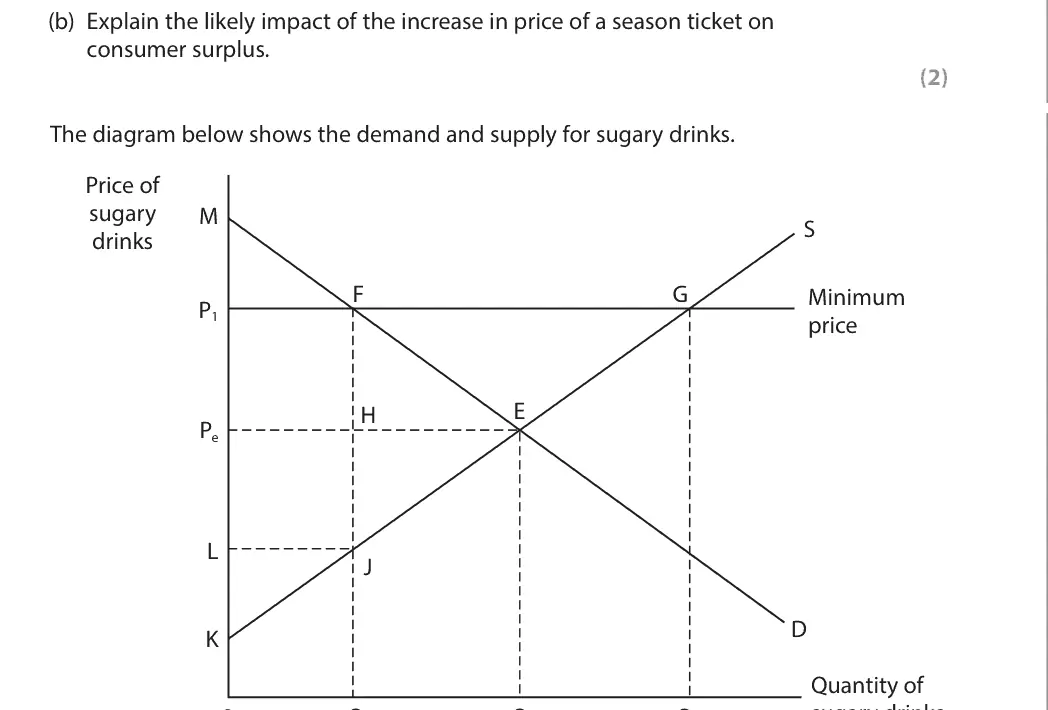
June 2023 · Paper 1 · Q4(b)2 marksAO1=1, AO3=1Short answer
Data and extracts for question 4
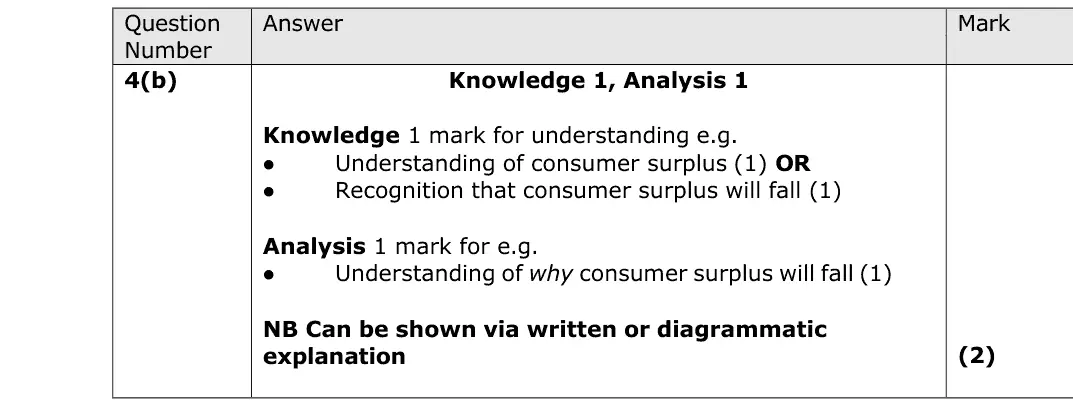
Mark scheme
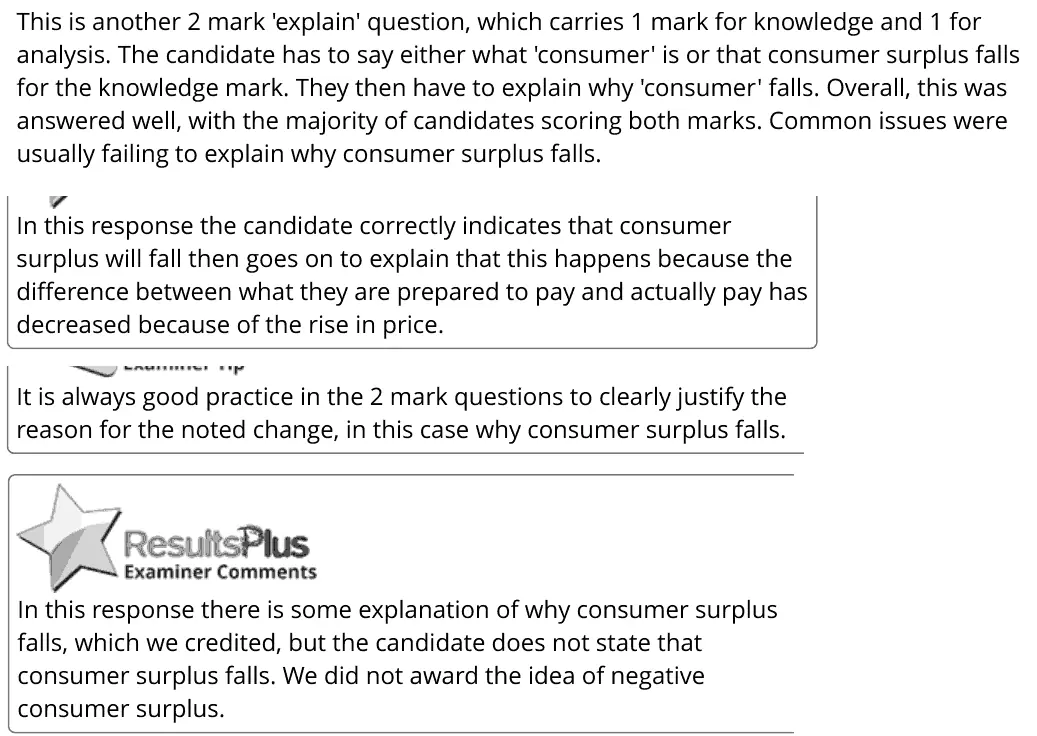
Examiner's comment
This is another 2 mark 'explain' question, which carries 1 mark for knowledge and 1 for analysis. The candidate has to say either what 'consumer' is or that consumer surplus falls for the knowledge mark. They then have to explain why 'consumer' falls. Overall, this was answered well, with the majority of candidates scoring both marks. Common issues were usually failing to explain why consumer surplus falls. In this response the candidate correctly indicates that consumer surplus will fall then goes on to explain that this happens because the difference between what they are prepared to pay and actually pay has decreased because of the rise in price. It is always good practice in the 2 mark questions to clearly justify the reason for the noted change, in this case why consumer surplus falls. In this response there is some explanation of why consumer surplus falls, which we credited, but the candidate does not state that consumer surplus falls. We did not award the idea of negative consumer surplus.
Notes from the mark scheme and report
consumer surplus falls because the gap between what commuters are willing to pay and the price paid narrows (and fewer tickets bought)
report: common issue was not explaining why it falls
June 2023 · Paper 1 · Q4(c)1 markAO2=1Multiple choice
Data and extracts for question 4
Answer
C
Mark scheme
Notes from the mark scheme and report
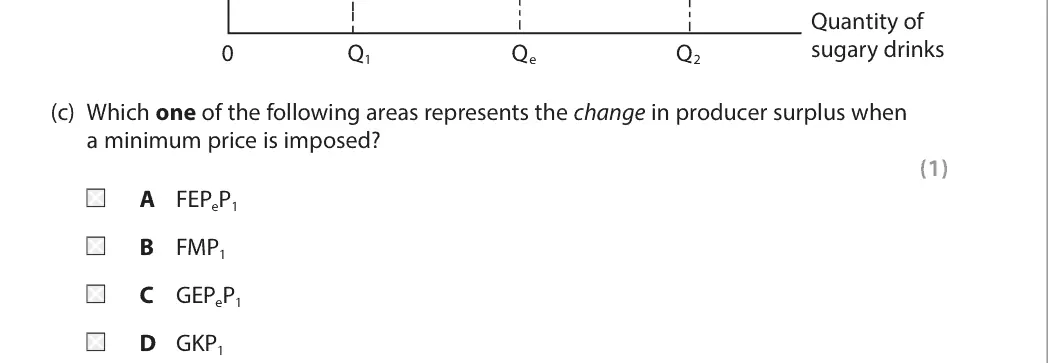
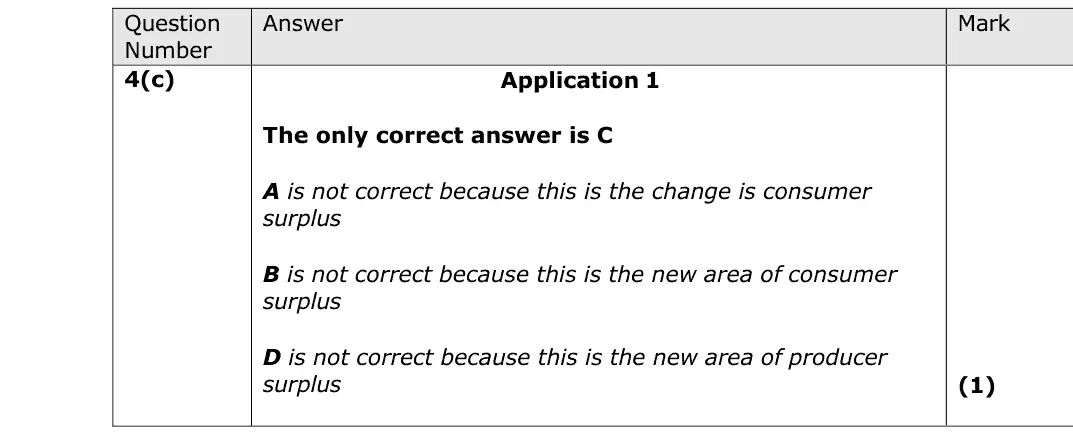
read the change in producer surplus off the minimum-price diagram: GEPeP1 (C)
A is the change in consumer surplus, B the new consumer surplus, D the new producer surplus
Quantitative skills: QS 4 (construct and interpret a range of standard graphical forms)
October 2020 · AS Paper 1 · Q1(b)1 markMultiple choice
Answer
D
Mark scheme
Notes from the mark scheme and report
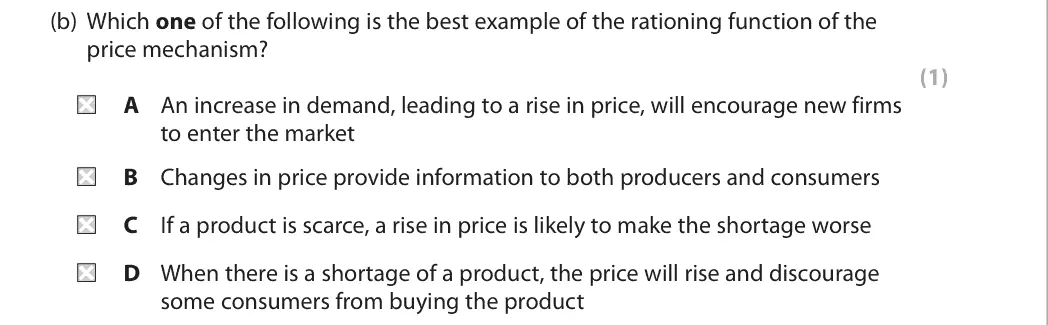
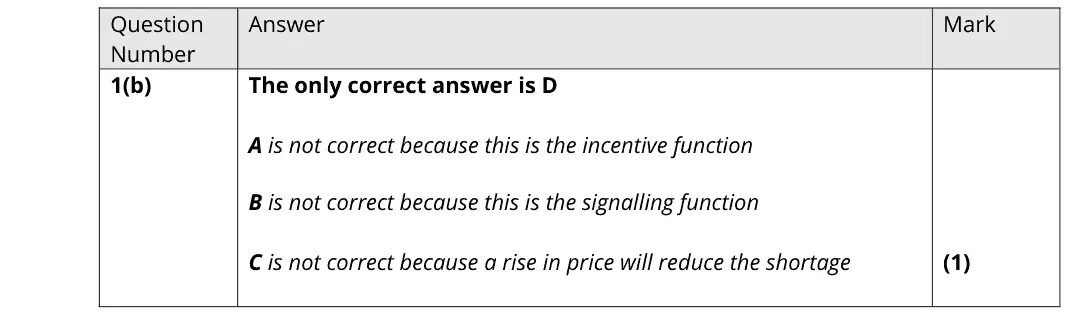
rationing: when there is a shortage the price rises and discourages some consumers from buying (D)
A is the incentive function, B the signalling function
C is wrong because a rise in price reduces the shortage
October 2020 · Paper 1 · Q1(b)1 markAO3=1Multiple choice
Data and extracts for question 1
Answer
A
Mark scheme
Notes from the mark scheme and report
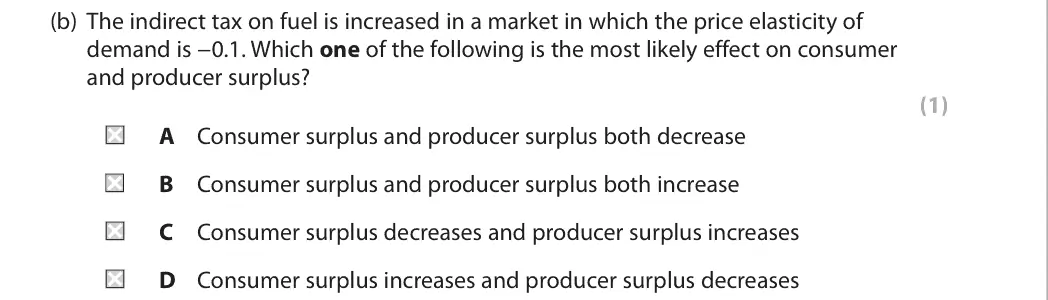
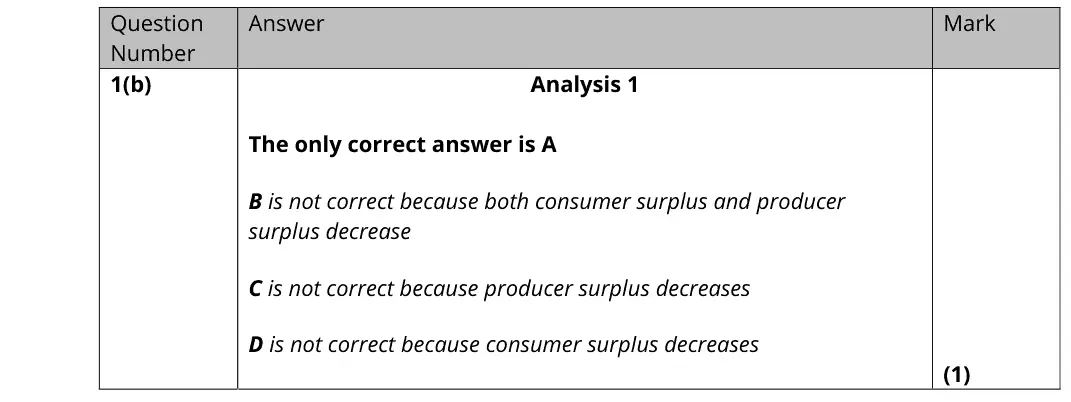
a higher indirect tax raises price and cuts quantity so both consumer and producer surplus fall (A), whatever the PED of -0.1
B, C and D each have one surplus rising
October 2020 · AS Paper 1 · Q6(e)15 marksAO1=3, AO2=3, AO3=3, AO4=615-mark response
Data and extracts for question 6
Mark scheme, including the levels grid and indicative content
Examiner's comment
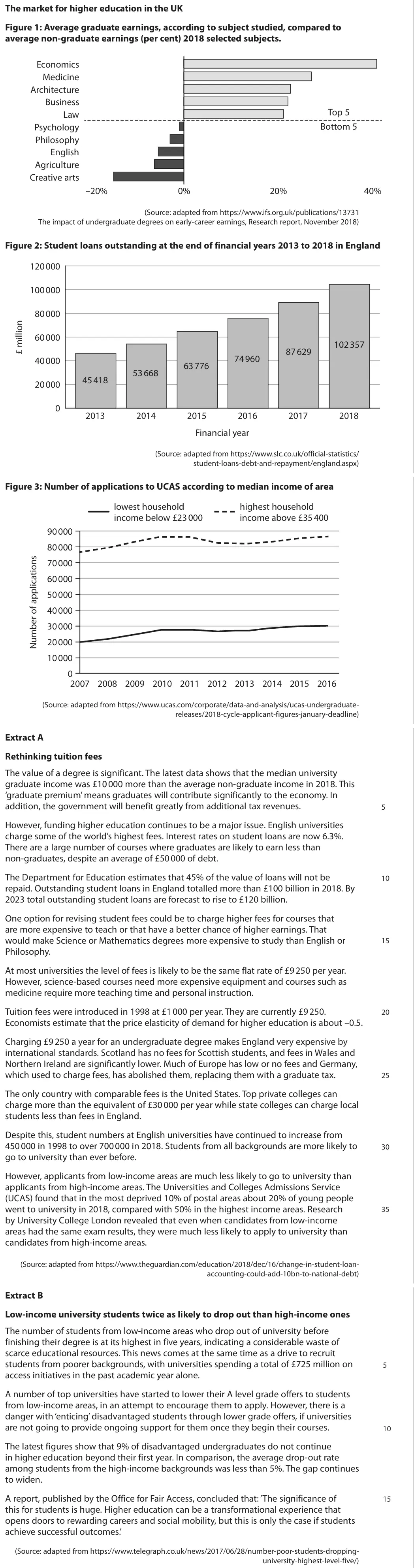
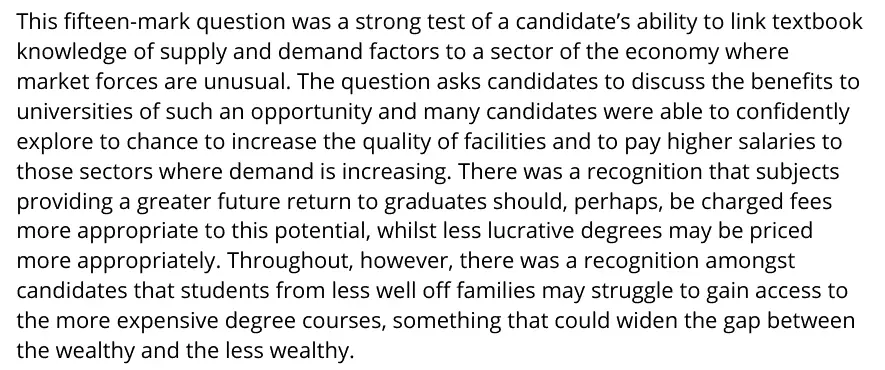
This fifteen-mark question was a strong test of a candidate’s ability to link textbook knowledge of supply and demand factors to a sector of the economy where market forces are unusual. The question asks candidates to discuss the benefits to universities of such an opportunity and many candidates were able to confidently explore to chance to increase the quality of facilities and to pay higher salaries to those sectors where demand is increasing. There was a recognition that subjects providing a greater future return to graduates should, perhaps, be charged fees more appropriate to this potential, whilst less lucrative degrees may be priced more appropriately. Throughout, however, there was a recognition amongst candidates that students from less well off families may struggle to gain access to the more expensive degree courses, something that could widen the gap between the wealthy and the less wealthy.
Notes from the mark scheme and report
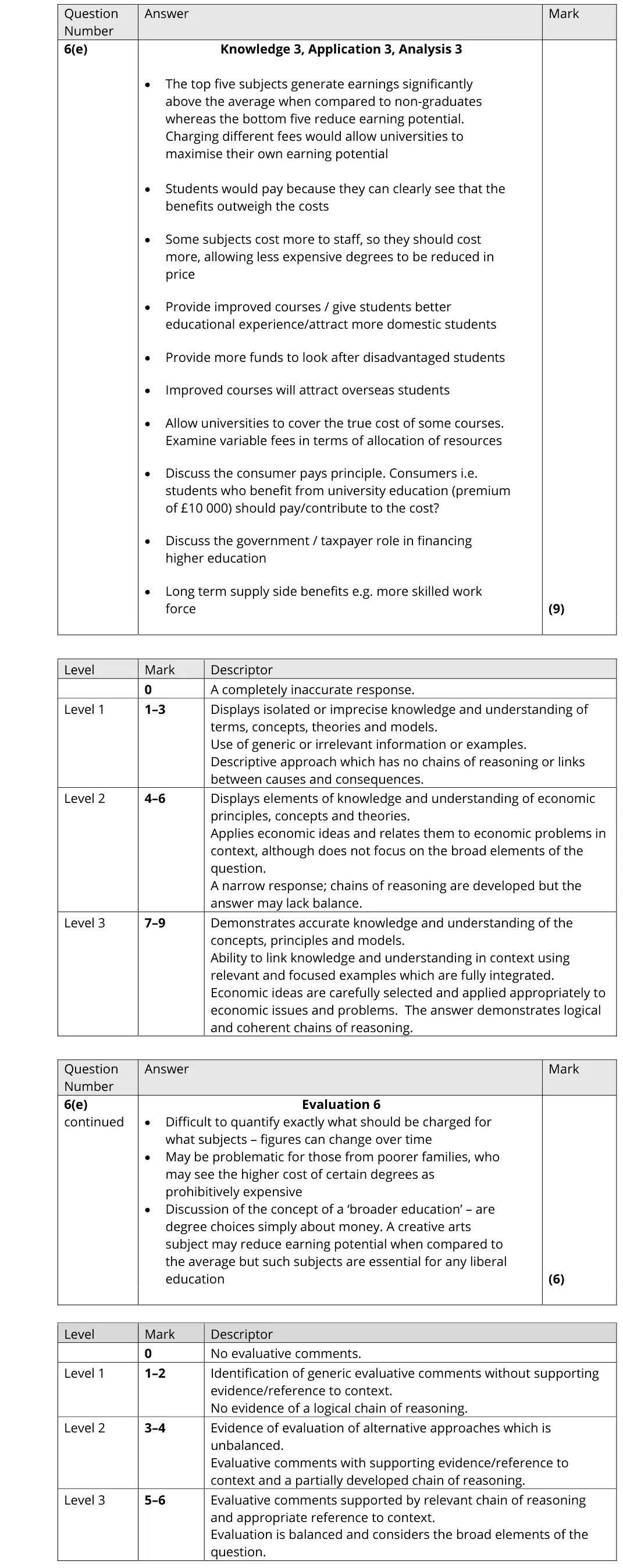
fees reflecting costs and graduate returns (top five subjects earn well above non-graduates) give price signals and allocate resources, fund better courses and staff
evaluate with access for poorer students, wider inequality, value of creative arts degrees beyond money
Quantitative skills: QS 9 (interpret, apply and analyse information in written, graphical tabular and numerical forms)
October 2020 · AS Paper 1 · Q6(f)20 marksAO1=4, AO2=4, AO3=6, AO4=620-mark essayEither/or
Data and extracts for question 6
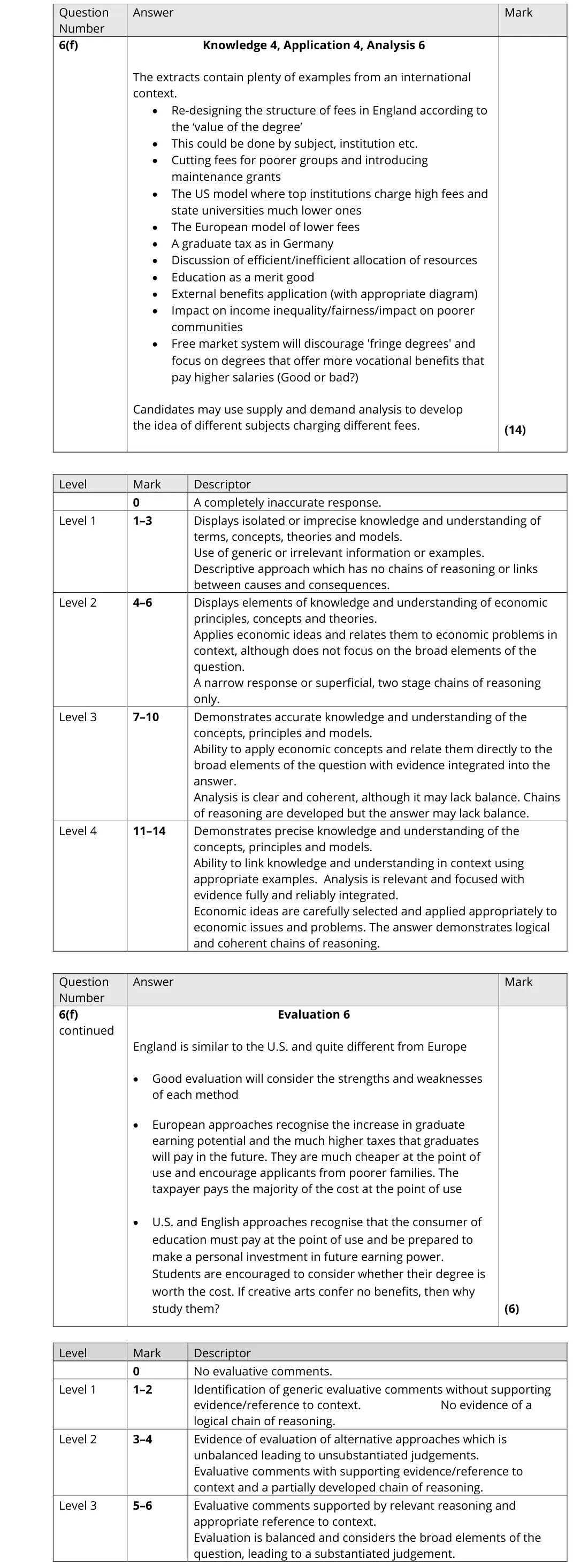
Mark scheme, including the levels grid and indicative content
Examiner's comment
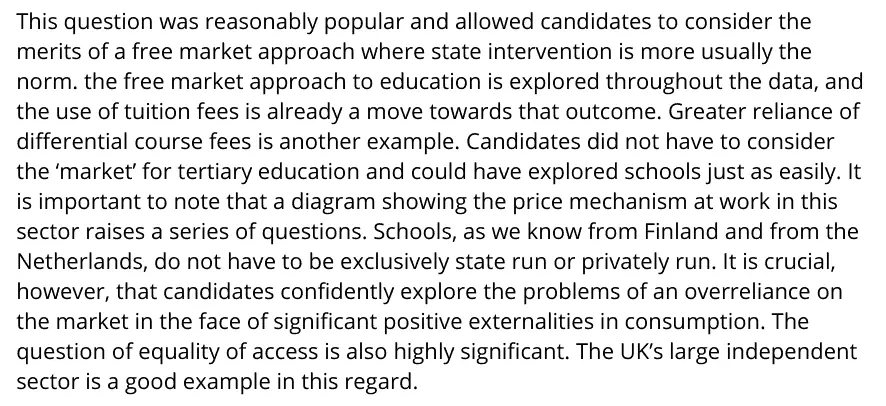
This question was reasonably popular and allowed candidates to consider the merits of a free market approach where state intervention is more usually the norm. the free market approach to education is explored throughout the data, and the use of tuition fees is already a move towards that outcome. Greater reliance of differential course fees is another example. Candidates did not have to consider the ‘market’ for tertiary education and could have explored schools just as easily. It is important to note that a diagram showing the price mechanism at work in this sector raises a series of questions. Schools, as we know from Finland and from the Netherlands, do not have to be exclusively state run or privately run. It is crucial, however, that candidates confidently explore the problems of an overreliance on the market in the face of significant positive externalities in consumption. The question of equality of access is also highly significant. The UK’s large independent sector is a good example in this regard.
Notes from the mark scheme and report
price mechanism, choice, efficiency and fees by value of degree, US model
can discuss schools as well as universities
evaluate with positive externalities in consumption, under-consumption, unequal access and the European low-fee model
June 2019 · AS Paper 1 · Q2(a)2 marksAO2=2Short answer
Data and extracts for question 2
Mark scheme
Examiner's comment
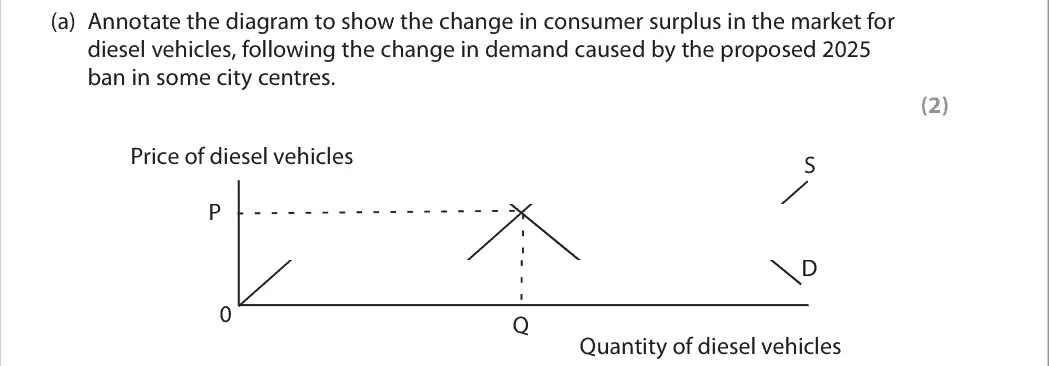
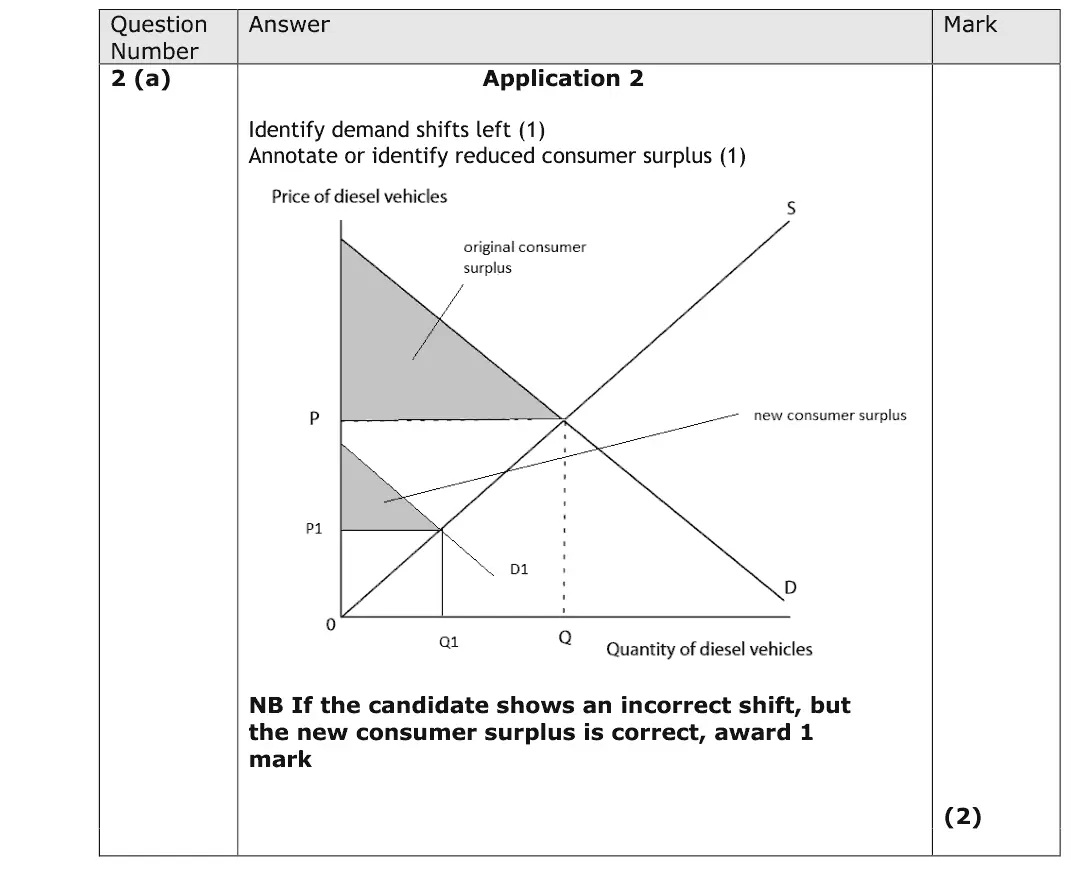
The majority of candidates were able to recognise that the demand curve shifted to the left but were less secure in their ability to show a change in consumer surplus. Typical mistakes were to indicate either a left shift in supply, suggesting a contraction in demand, and to confuse consumer and producer surplus.
Notes from the mark scheme and report
demand shifts left (the ban reduces demand), and consumer surplus shrinks to the smaller triangle under the new demand curve above the new price
common errors: shifting supply or confusing consumer with producer surplus
1 mark if the shift is wrong but the new surplus is correct
Quantitative skills: QS 4 (construct and interpret a range of standard graphical forms)
June 2019 · Paper 1 · Q5(a)2 marksAO1=1, AO3=1Short answer
Data and extracts for question 5
Mark scheme
Examiner's comment
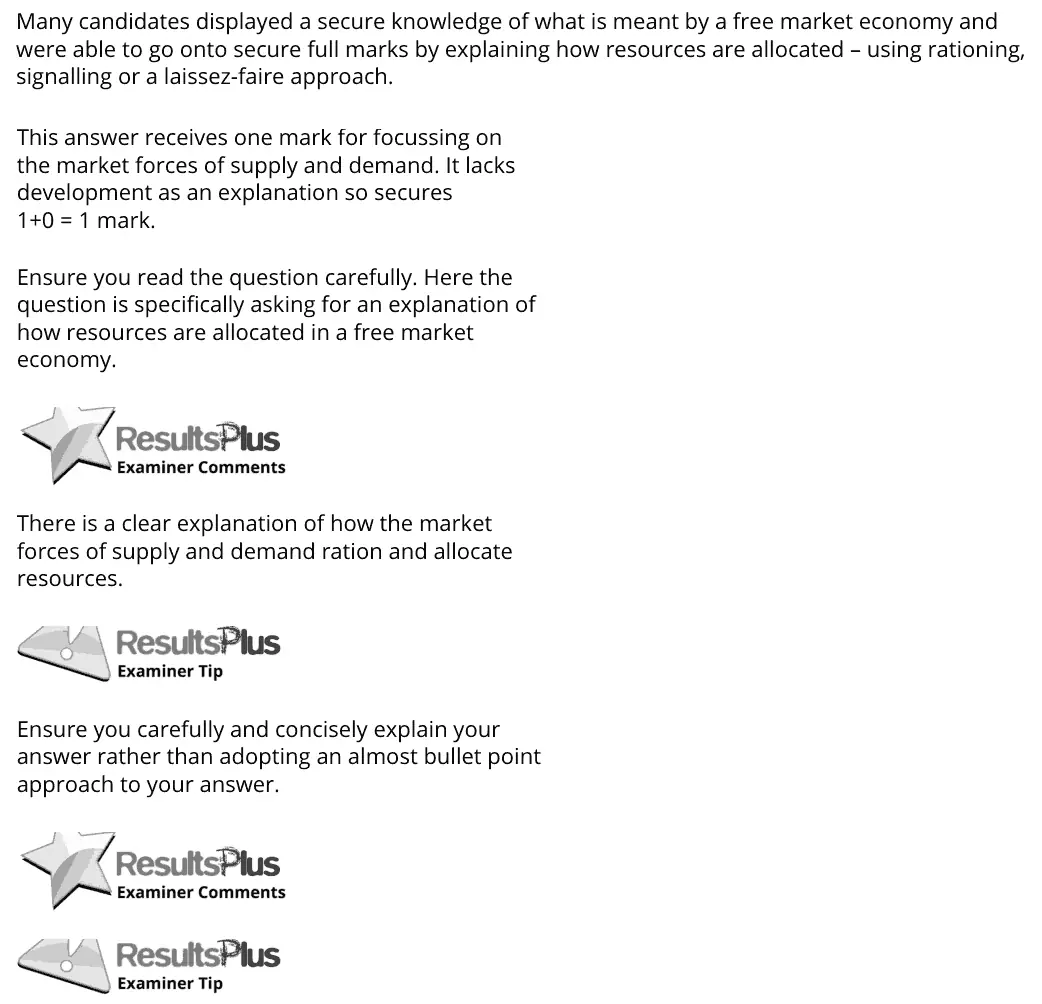
Many candidates displayed a secure knowledge of what is meant by a free market economy and were able to go onto secure full marks by explaining how resources are allocated – using rationing, signalling or a laissez-faire approach. This answer receives one mark for focussing on the market forces of supply and demand. It lacks development as an explanation so secures 1+0 = 1 mark. Ensure you read the question carefully. Here the question is specifically asking for an explanation of how resources are allocated in a free market economy. There is a clear explanation of how the market forces of supply and demand ration and allocate resources. Ensure you carefully and concisely explain your answer rather than adopting an almost bullet point approach to your answer.
Notes from the mark scheme and report
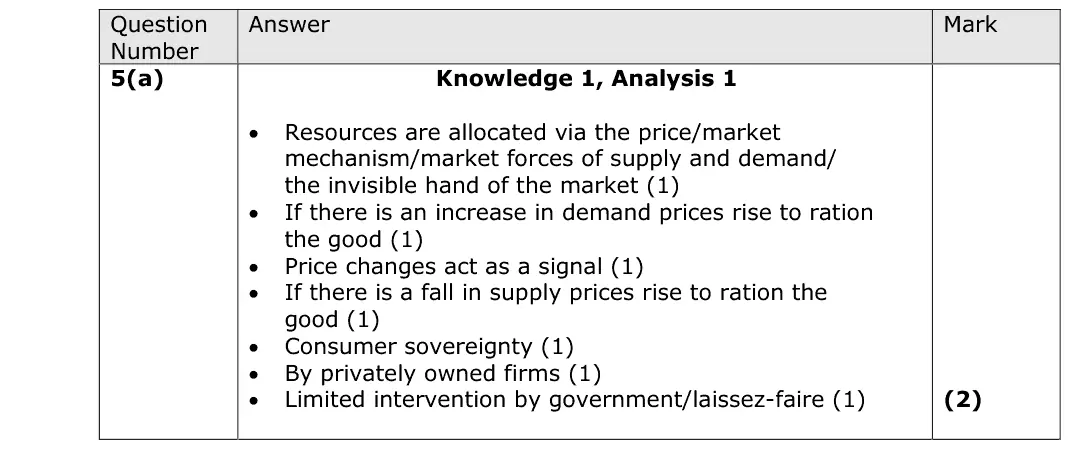
via the price mechanism (market forces, invisible hand): prices ration, signal and give incentives
private ownership and little government intervention
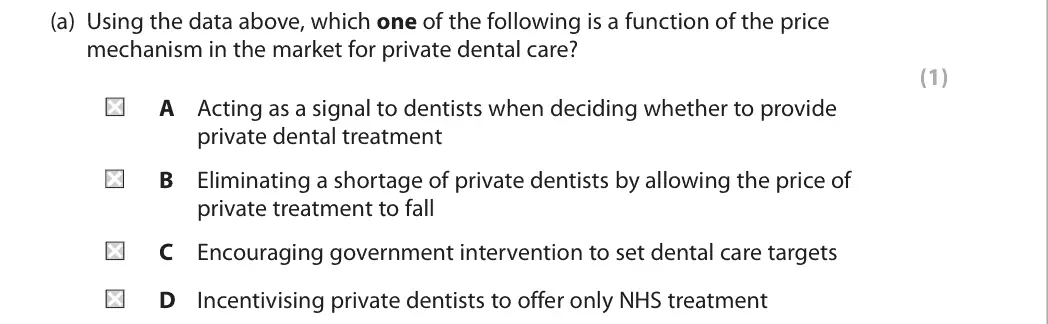
June 2018 · AS Paper 1 · Q3(a)1 markMultiple choice
Data and extracts for question 3
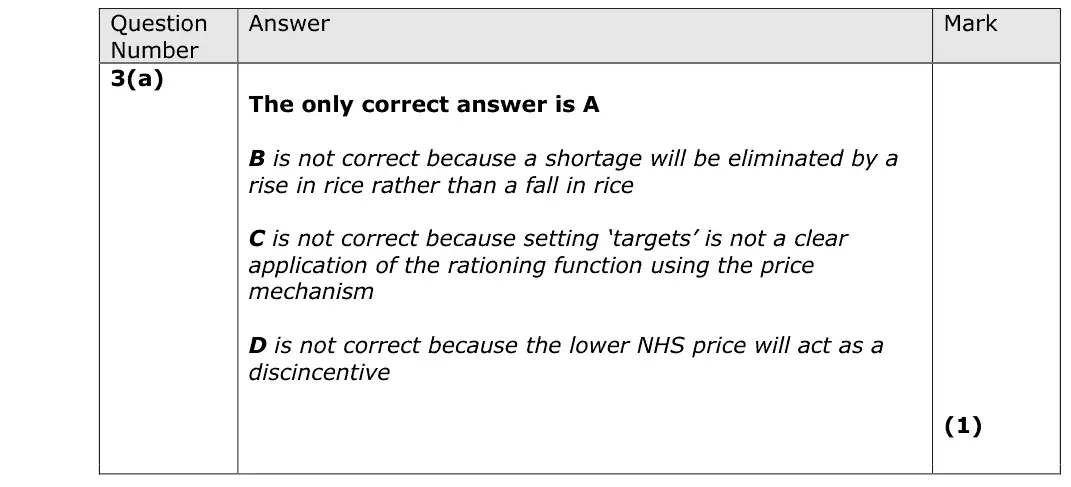
Answer
A
Mark scheme
Notes from the mark scheme and report
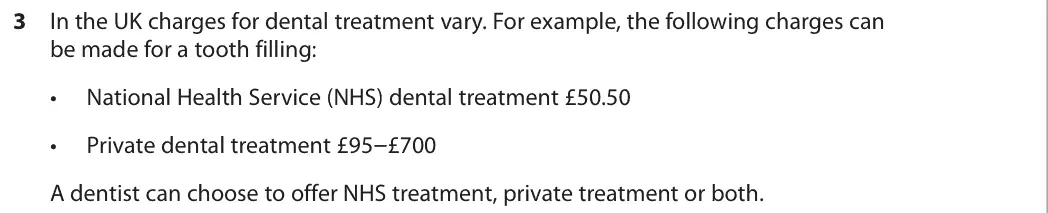
the high private price (£95 to £700) signals to dentists to provide private treatment (A)
a shortage is removed by a price rise not a fall
government targets are not the price mechanism
a lower NHS price would be a disincentive
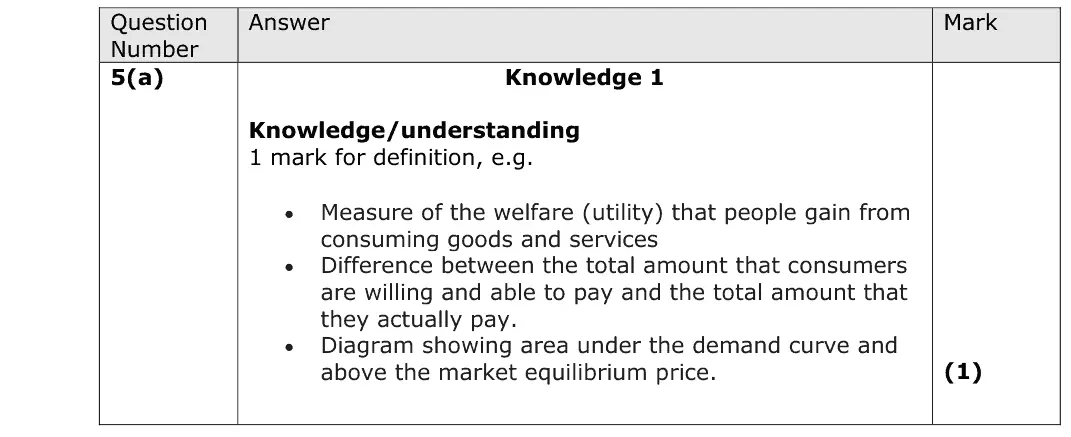
June 2018 · AS Paper 1 · Q5(a)1 markAO1=1Definition
Data and extracts for question 5
Mark scheme
Examiner's comment
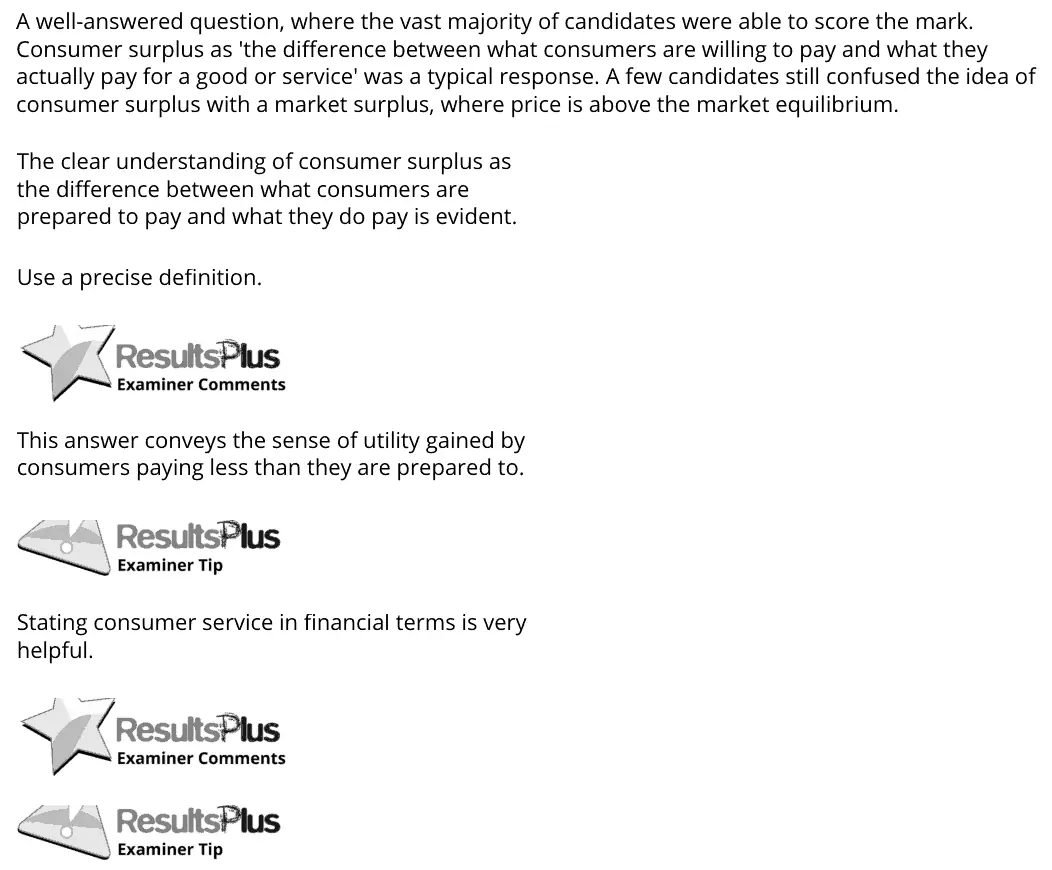
A well-answered question, where the vast majority of candidates were able to score the mark. Consumer surplus as 'the difference between what consumers are willing to pay and what they actually pay for a good or service' was a typical response. A few candidates still confused the idea of consumer surplus with a market surplus, where price is above the market equilibrium. The clear understanding of consumer surplus as the difference between what consumers are prepared to pay and what they do pay is evident. Use a precise definition. This answer conveys the sense of utility gained by consumers paying less than they are prepared to. Stating consumer service in financial terms is very helpful.
Notes from the mark scheme and report
the difference between what consumers are willing to pay and what they actually pay
report: a few confused it with a market surplus (excess supply)
June 2017 · AS Paper 1 · Q3(b)1 markAO1=1Multiple choice
Data and extracts for question 3
Answer
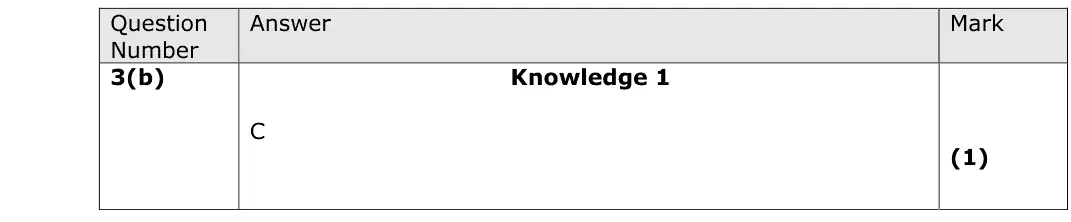
C
Mark scheme
Notes from the mark scheme and report
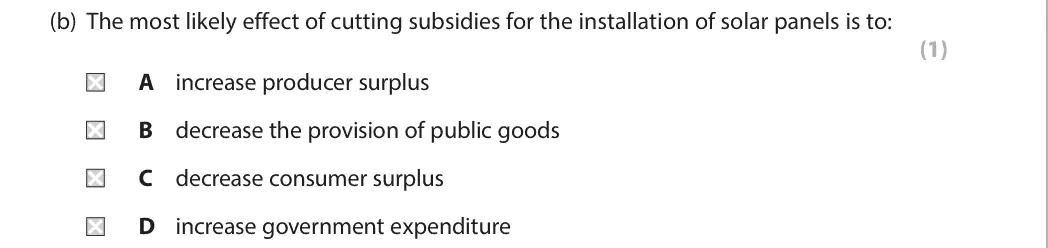
removing the subsidy shifts supply left, raising price and cutting quantity, so consumer surplus falls (C)
producer surplus falls and government spending falls
solar panels are not a public good
June 2017 · Paper 1 · Q3(c)1 markMultiple choice
Data and extracts for question 3
Answer
A
Mark scheme
Notes from the mark scheme and report
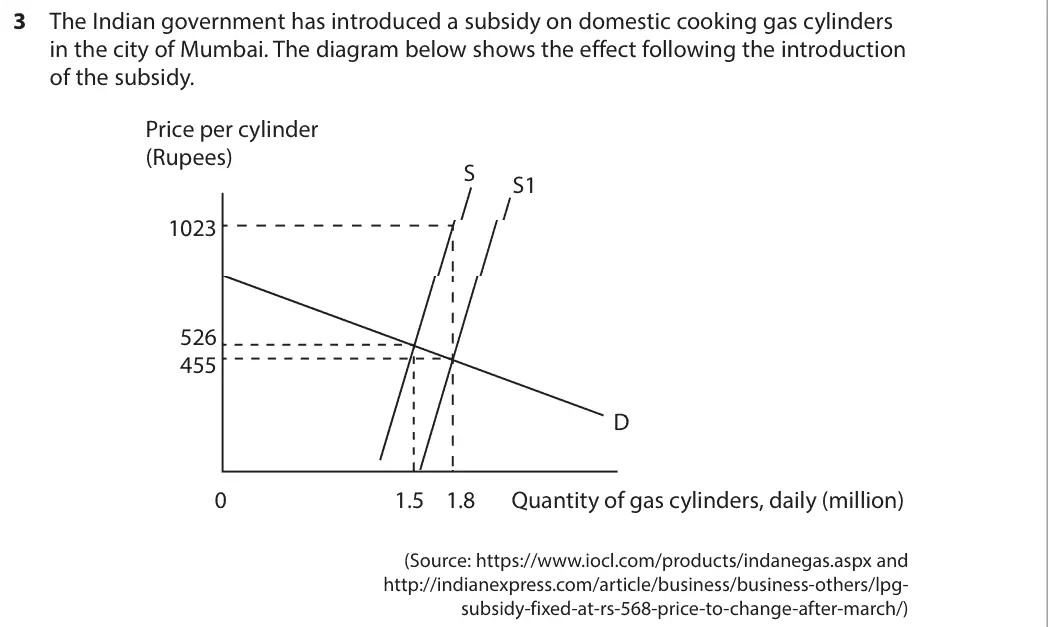
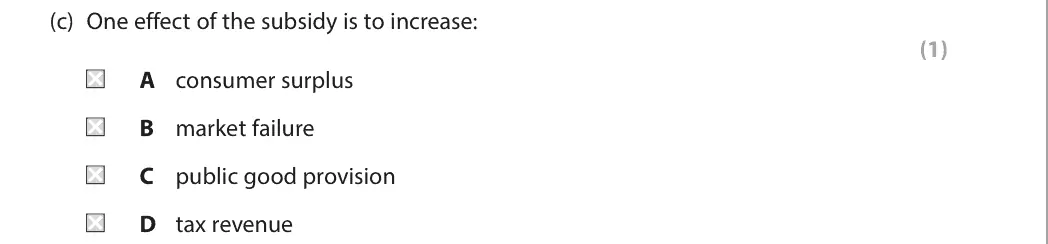
a subsidy lowers the price and raises the quantity, so consumer surplus increases (A)
the subsidy costs the government rather than raising tax revenue
cooking gas is a private good, not a public good
June 2017 · AS Paper 1 · Q4(a)3 marksAO1=1, AO2=1, AO3=1Short answer
Data and extracts for question 4
Mark scheme
Examiner's comment
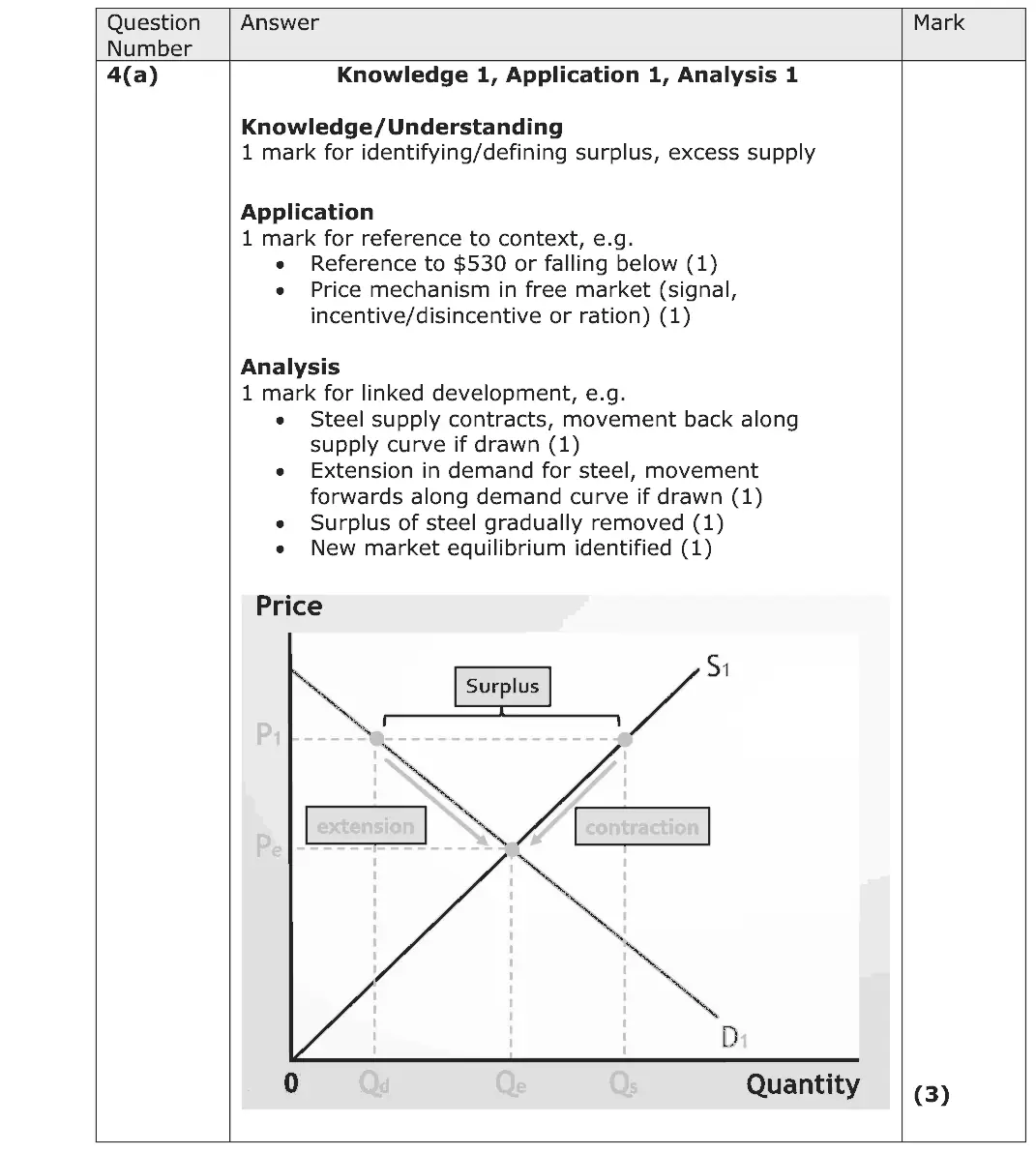
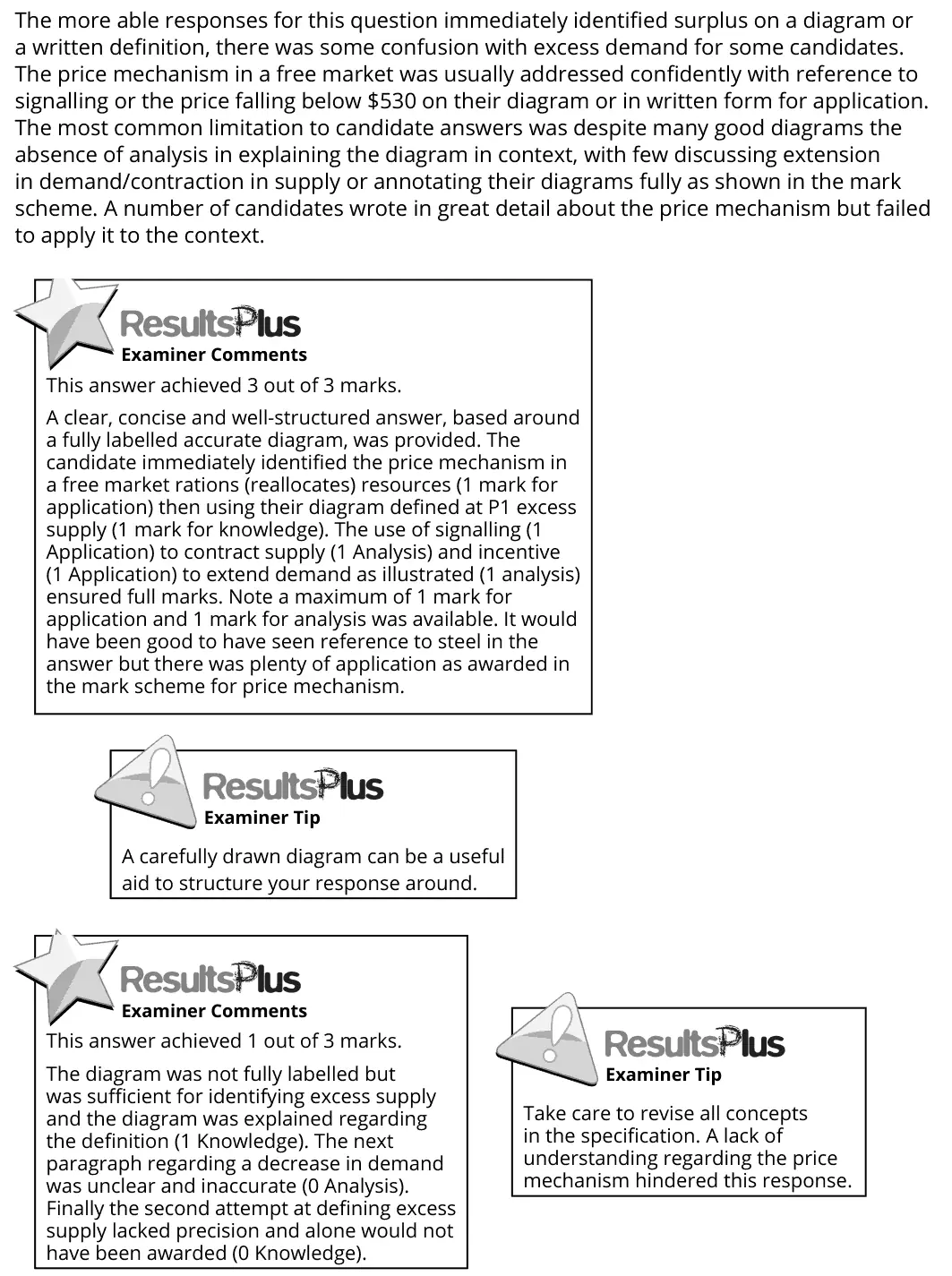
The more able responses for this question immediately identified surplus on a diagram or a written definition, there was some confusion with excess demand for some candidates. The price mechanism in a free market was usually addressed confidently with reference to signalling or the price falling below $530 on their diagram or in written form for application. The most common limitation to candidate answers was despite many good diagrams the absence of analysis in explaining the diagram in context, with few discussing extension in demand/contraction in supply or annotating their diagrams fully as shown in the mark scheme. A number of candidates wrote in great detail about the price mechanism but failed to apply it to the context. This answer achieved 3 out of 3 marks. A clear, concise and well-structured answer, based around a fully labelled accurate diagram, was provided. The candidate immediately identified the price mechanism in a free market rations (reallocates) resources (1 mark for application) then using their diagram defined at P1 excess supply (1 mark for knowledge). The use of signalling (1 Application) to contract supply (1 Analysis) and incentive (1 Application) to extend demand as illustrated (1 analysis) ensured full marks. Note a maximum of 1 mark for application and 1 mark for analysis was available. It would have been good to have seen reference to steel in the answer but there was plenty of application as awarded in the mark scheme for price mechanism. A carefully drawn diagram can be a useful aid to structure your response around. This answer achieved 1 out of 3 marks. The diagram was not fully labelled but was sufficient for identifying excess supply and the diagram was explained regarding the definition (1 Knowledge). The next paragraph regarding a decrease in demand was unclear and inaccurate (0 Analysis). Finally the second attempt at defining excess supply lacked precision and alone would not have been awarded (0 Knowledge). Take care to revise all concepts in the specification. A lack of understanding regarding the price mechanism hindered this response.
Notes from the mark scheme and report
define excess supply or surplus
price falls (below $530) as a signal and incentive, supply contracts and demand extends to a new equilibrium
many good diagrams lacked the analysis and context
some confused it with excess demand
June 2017 · AS Paper 1 · Q6(f)20 marksAO1=4, AO2=4, AO3=6, AO4=620-mark essayEither/or
Data and extracts for question 6
Mark scheme, including the levels grid and indicative content
Examiner's comment
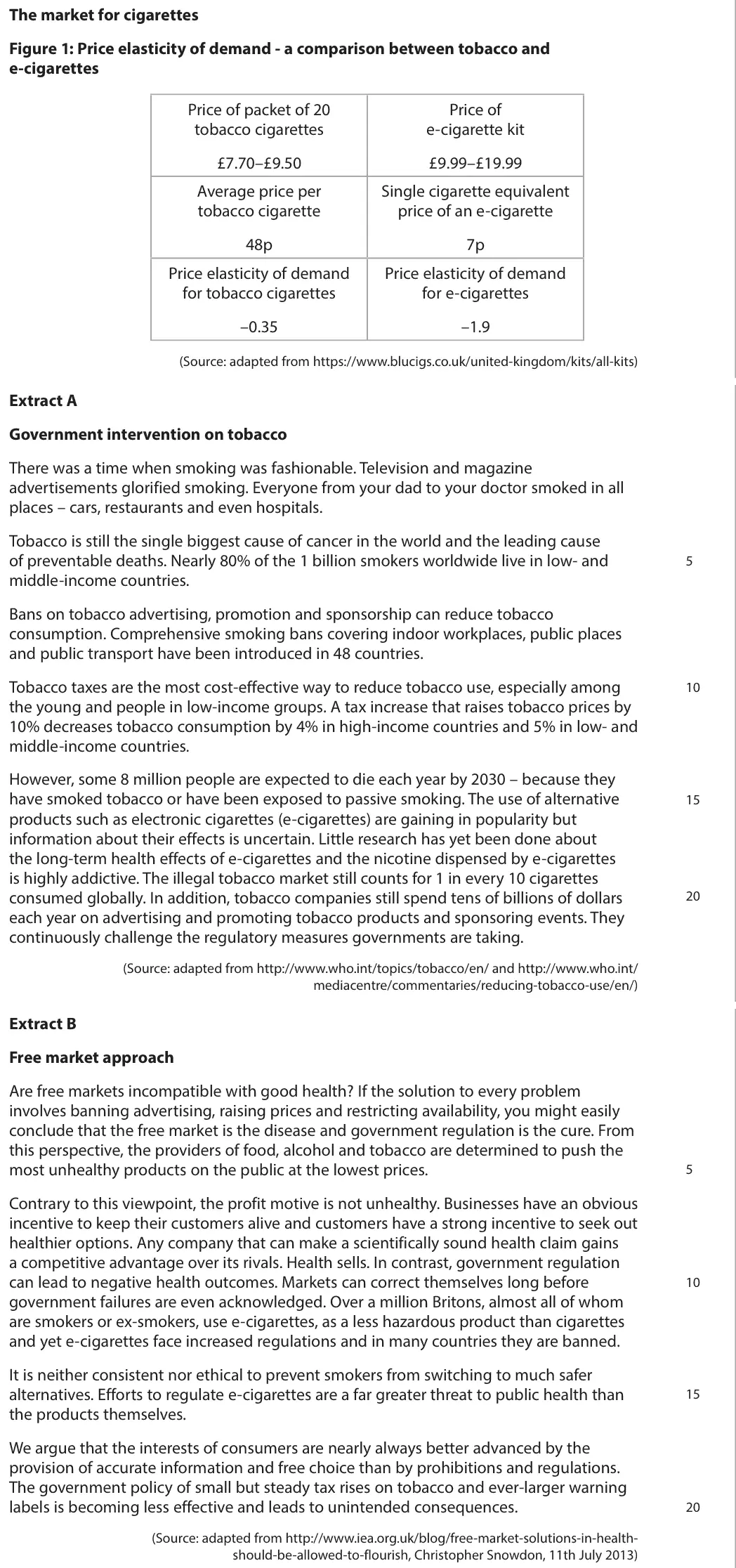
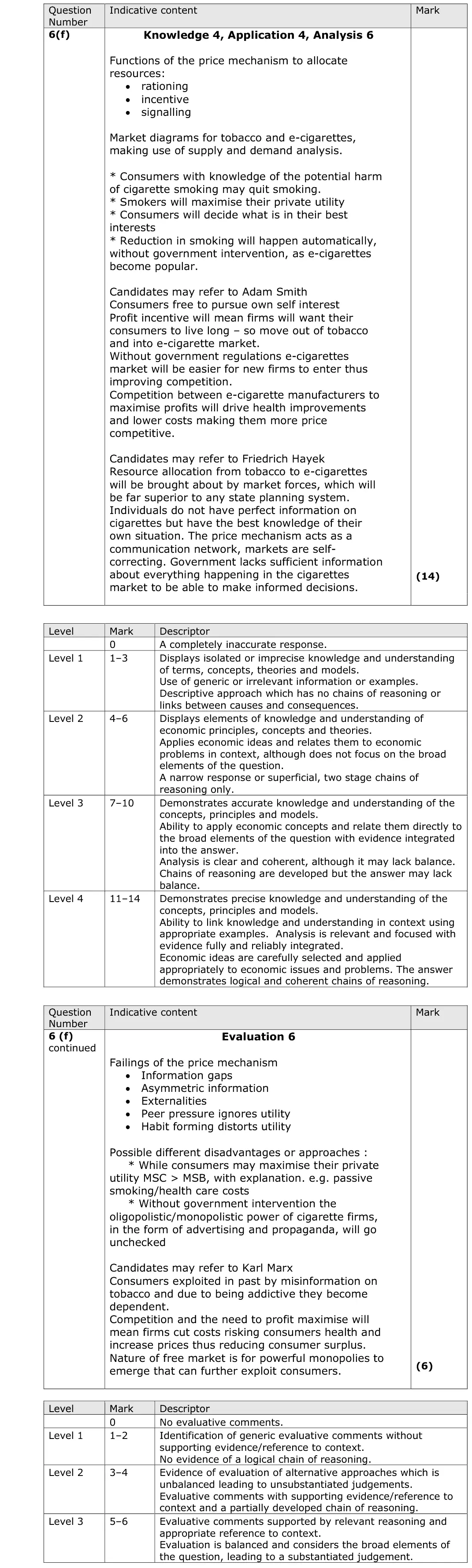
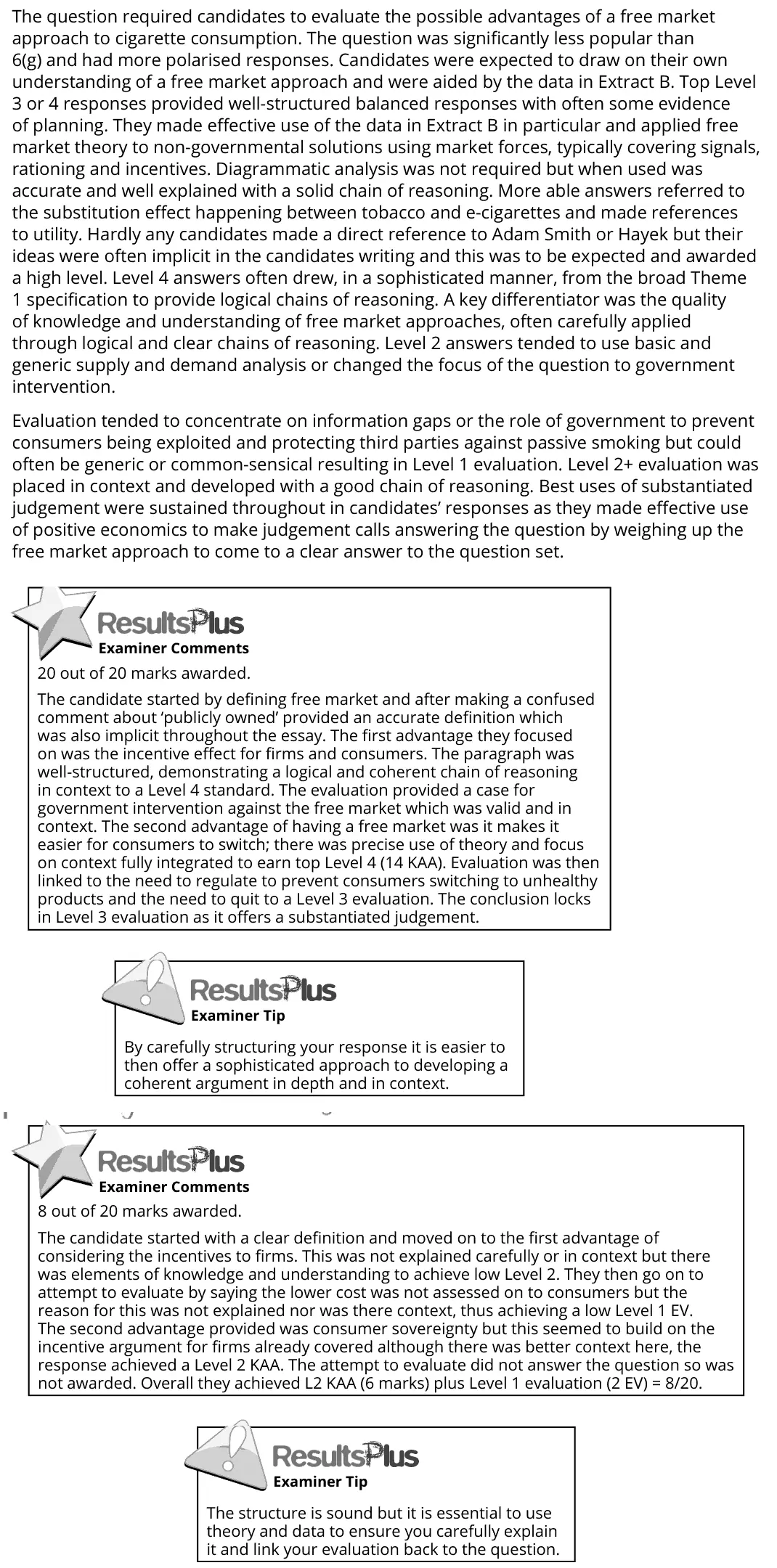
The question required candidates to evaluate the possible advantages of a free market approach to cigarette consumption. The question was significantly less popular than 6(g) and had more polarised responses. Candidates were expected to draw on their own understanding of a free market approach and were aided by the data in Extract B. Top Level 3 or 4 responses provided well-structured balanced responses with often some evidence of planning. They made effective use of the data in Extract B in particular and applied free market theory to non-governmental solutions using market forces, typically covering signals, rationing and incentives. Diagrammatic analysis was not required but when used was accurate and well explained with a solid chain of reasoning. More able answers referred to the substitution effect happening between tobacco and e-cigarettes and made references to utility. Hardly any candidates made a direct reference to Adam Smith or Hayek but their ideas were often implicit in the candidates writing and this was to be expected and awarded a high level. Level 4 answers often drew, in a sophisticated manner, from the broad Theme 1 specification to provide logical chains of reasoning. A key differentiator was the quality of knowledge and understanding of free market approaches, often carefully applied through logical and clear chains of reasoning. Level 2 answers tended to use basic and generic supply and demand analysis or changed the focus of the question to government intervention. Evaluation tended to concentrate on information gaps or the role of government to prevent consumers being exploited and protecting third parties against passive smoking but could often be generic or common-sensical resulting in Level 1 evaluation. Level 2+ evaluation was placed in context and developed with a good chain of reasoning. Best uses of substantiated judgement were sustained throughout in candidates’ responses as they made effective use of positive economics to make judgement calls answering the question by weighing up the free market approach to come to a clear answer to the question set. 20 out of 20 marks awarded. The candidate started by defining free market and after making a confused comment about ‘publicly owned’ provided an accurate definition which was also implicit throughout the essay. The first advantage they focused on was the incentive effect for firms and consumers. The paragraph was well-structured, demonstrating a logical and coherent chain of reasoning in context to a Level 4 standard. The evaluation provided a case for government intervention against the free market which was valid and in context. The second advantage of having a free market was it makes it easier for consumers to switch; there was precise use of theory and focus on context fully integrated to earn top Level 4 (14 KAA). Evaluation was then linked to the need to regulate to prevent consumers switching to unhealthy products and the need to quit to a Level 3 evaluation. The conclusion locks in Level 3 evaluation as it offers a substantiated judgement. By carefully structuring your response it is easier to then offer a sophisticated approach to developing a coherent argument in depth and in context. 8 out of 20 marks awarded. The candidate started with a clear definition and moved on to the first advantage of considering the incentives to firms. This was not explained carefully or in context but there was elements of knowledge and understanding to achieve low Level 2. They then go on to attempt to evaluate by saying the lower cost was not assessed on to consumers but the reason for this was not explained nor was there context, thus achieving a low Level 1 EV. The second advantage provided was consumer sovereignty but this seemed to build on the incentive argument for firms already covered although there was better context here, the response achieved a Level 2 KAA. The attempt to evaluate did not answer the question so was not awarded. Overall they achieved L2 KAA (6 marks) plus Level 1 evaluation (2 EV) = 8/20. The structure is sound but it is essential to use theory and data to ensure you carefully explain it and link your evaluation back to the question.
Notes from the mark scheme and report
price mechanism (signalling, rationing, incentive), consumer sovereignty and utility, profit motive and competition from e-cigarettes (Extract B), Smith and Hayek
evaluate with information gaps, externalities, addiction, market power
far less popular than 6(g) with polarised answers
June 2016 · AS Paper 1 · Q6(c)6 marksAO1=2, AO2=2, AO3=2Diagram
Data and extracts for question 6
Mark scheme
Examiner's comment
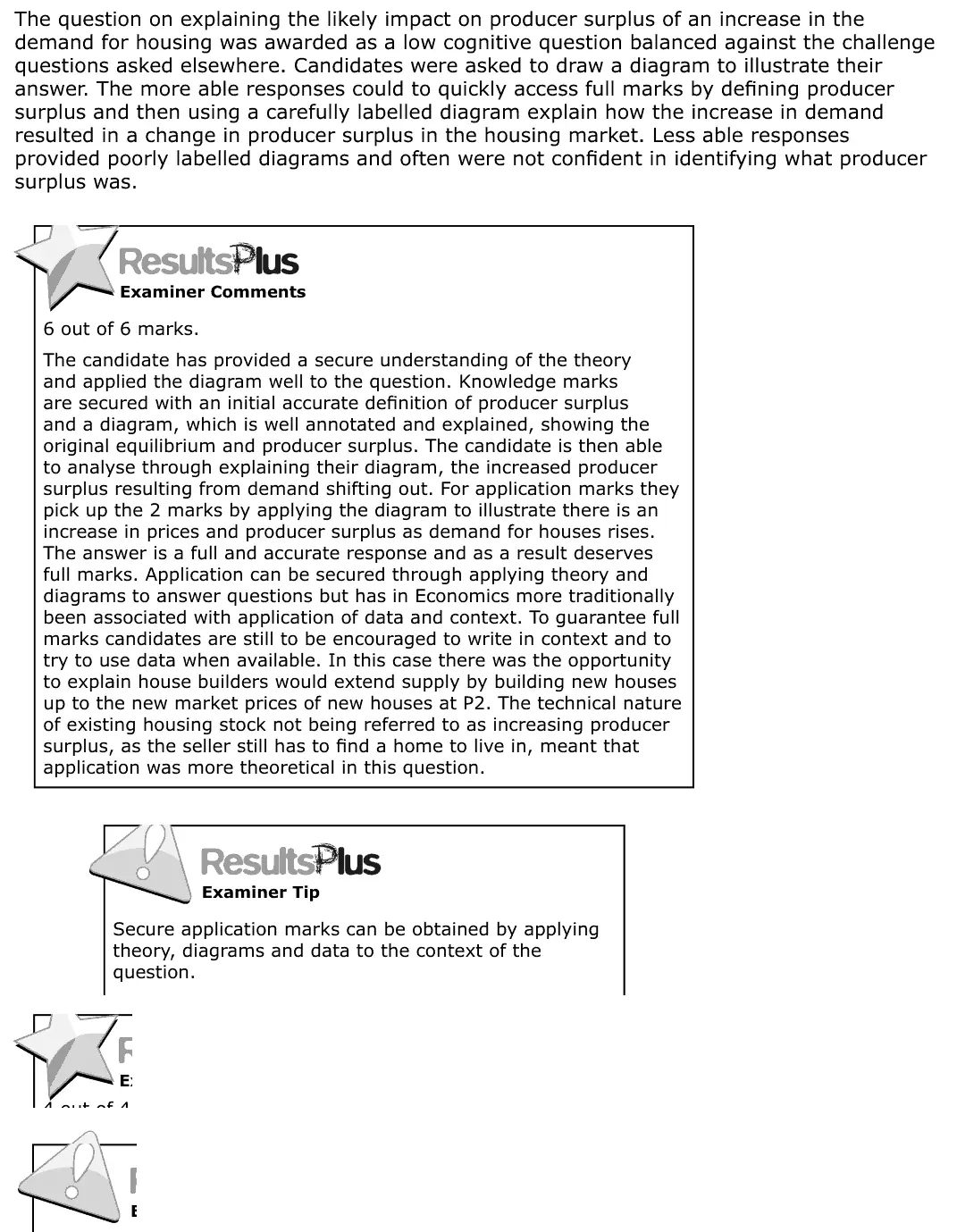
The question on explaining the likely impact on producer surplus of an increase in the demand for housing was awarded as a low cognitive question balanced against the challenge questions asked elsewhere. Candidates were asked to draw a diagram to illustrate their answer. The more able responses could to quickly access full marks by defining producer surplus and then using a carefully labelled diagram explain how the increase in demand resulted in a change in producer surplus in the housing market. Less able responses provided poorly labelled diagrams and often were not confident in identifying what producer surplus was. 6 out of 6 marks. The candidate has provided a secure understanding of the theory and applied the diagram well to the question. Knowledge marks are secured with an initial accurate definition of producer surplus and a diagram, which is well annotated and explained, showing the original equilibrium and producer surplus. The candidate is then able to analyse through explaining their diagram, the increased producer surplus resulting from demand shifting out. For application marks they pick up the 2 marks by applying the diagram to illustrate there is an increase in prices and producer surplus as demand for houses rises. The answer is a full and accurate response and as a result deserves full marks. Application can be secured through applying theory and diagrams to answer questions but has in Economics more traditionally been associated with application of data and context. To guarantee full marks candidates are still to be encouraged to write in context and to try to use data when available. In this case there was the opportunity to explain house builders would extend supply by building new houses up to the new market prices of new houses at P2. The technical nature of existing housing stock not being referred to as increasing producer surplus, as the seller still has to find a home to live in, meant that application was more theoretical in this question. Secure application marks can be obtained by applying theory, diagrams and data to the context of the question.
Notes from the mark scheme and report
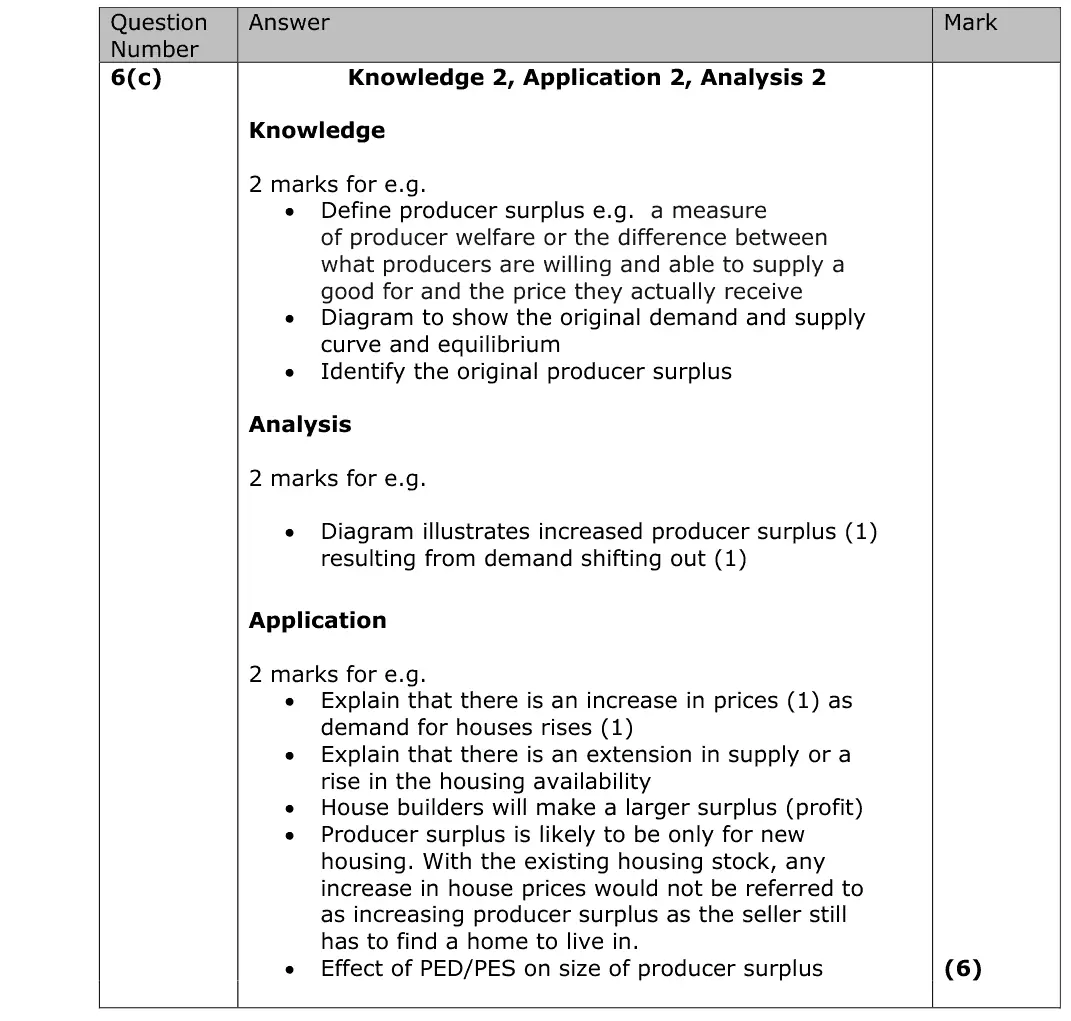
define producer surplus
diagram with demand shifting right, higher price and quantity, larger area above supply and below price
it applies to new housing (builders), not existing owners who must buy again
Quantitative skills: QS 4 (construct and interpret a range of standard graphical forms)
June 2016 · AS Paper 1 · Q6(e)15 marksAO1=3, AO2=3, AO3=3, AO4=615-mark response
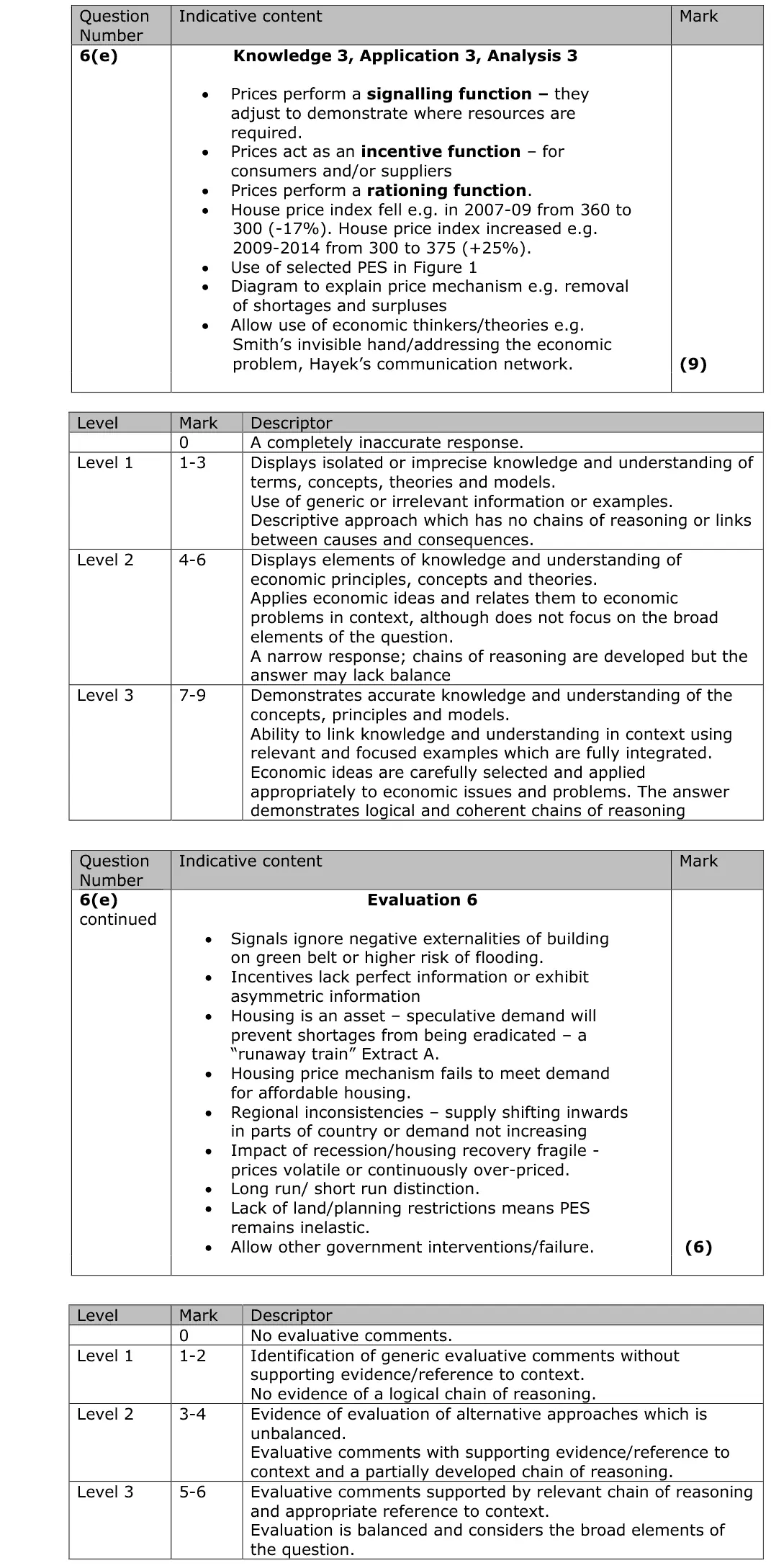
Data and extracts for question 6
Mark scheme, including the levels grid and indicative content
Examiner's comment
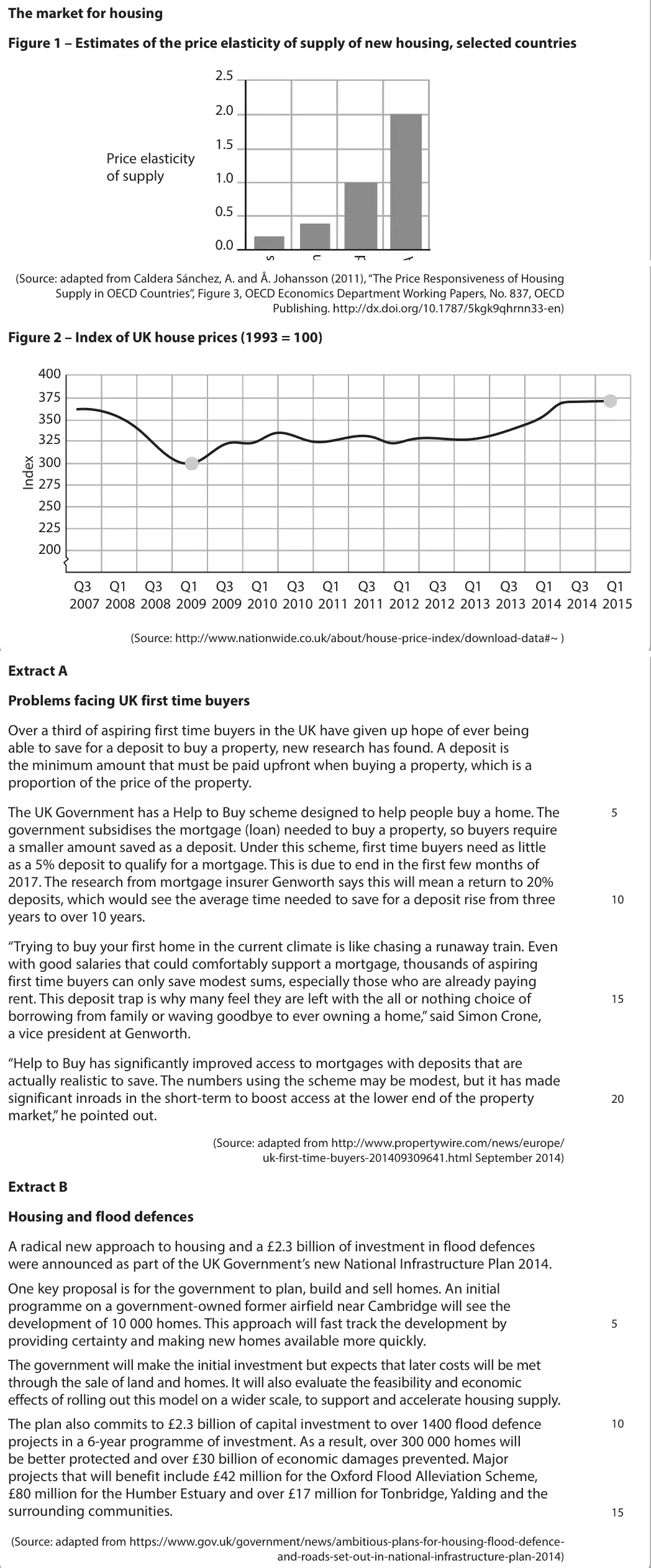
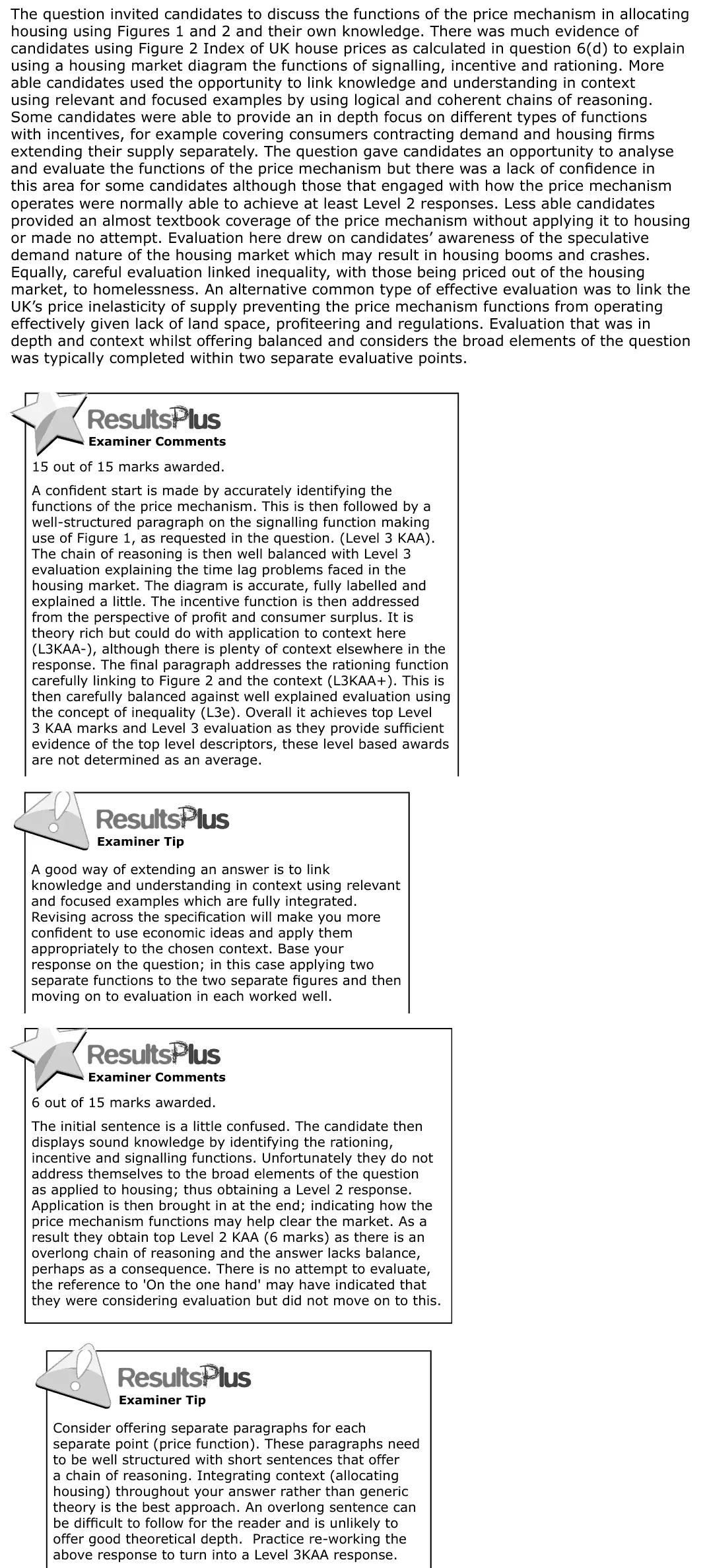
The question invited candidates to discuss the functions of the price mechanism in allocating housing using Figures 1 and 2 and their own knowledge. There was much evidence of candidates using Figure 2 Index of UK house prices as calculated in question 6(d) to explain using a housing market diagram the functions of signalling, incentive and rationing. More able candidates used the opportunity to link knowledge and understanding in context using relevant and focused examples by using logical and coherent chains of reasoning. Some candidates were able to provide an in depth focus on different types of functions with incentives, for example covering consumers contracting demand and housing firms extending their supply separately. The question gave candidates an opportunity to analyse and evaluate the functions of the price mechanism but there was a lack of confidence in this area for some candidates although those that engaged with how the price mechanism operates were normally able to achieve at least Level 2 responses. Less able candidates provided an almost textbook coverage of the price mechanism without applying it to housing or made no attempt. Evaluation here drew on candidates’ awareness of the speculative demand nature of the housing market which may result in housing booms and crashes. Equally, careful evaluation linked inequality, with those being priced out of the housing market, to homelessness. An alternative common type of effective evaluation was to link the UK’s price inelasticity of supply preventing the price mechanism functions from operating effectively given lack of land space, profiteering and regulations. Evaluation that was in depth and context whilst offering balanced and considers the broad elements of the question was typically completed within two separate evaluative points. 15 out of 15 marks awarded. A confident start is made by accurately identifying the functions of the price mechanism. This is then followed by a well-structured paragraph on the signalling function making use of Figure 1, as requested in the question. (Level 3 KAA). The chain of reasoning is then well balanced with Level 3 evaluation explaining the time lag problems faced in the housing market. The diagram is accurate, fully labelled and explained a little. The incentive function is then addressed from the perspective of profit and consumer surplus. It is theory rich but could do with application to context here (L3KAA-), although there is plenty of context elsewhere in the response. The final paragraph addresses the rationing function carefully linking to Figure 2 and the context (L3KAA+). This is then carefully balanced against well explained evaluation using the concept of inequality (L3e). Overall it achieves top Level 3 KAA marks and Level 3 evaluation as they provide sufficient evidence of the top level descriptors, these level based awards are not determined as an average. A good way of extending an answer is to link knowledge and understanding in context using relevant and focused examples which are fully integrated. Revising across the specification will make you more confident to use economic ideas and apply them appropriately to the chosen context. Base your response on the question; in this case applying two separate functions to the two separate figures and then moving on to evaluation in each worked well. 6 out of 15 marks awarded. The initial sentence is a little confused. The candidate then displays sound knowledge by identifying the rationing, incentive and signalling functions. Unfortunately they do not address themselves to the broad elements of the question as applied to housing; thus obtaining a Level 2 response. Application is then brought in at the end; indicating how the price mechanism functions may help clear the market. As a result they obtain top Level 2 KAA (6 marks) as there is an overlong chain of reasoning and the answer lacks balance, perhaps as a consequence. There is no attempt to evaluate, the reference to 'On the one hand' may have indicated that they were considering evaluation but did not move on to this. Consider offering separate paragraphs for each separate point (price function). These paragraphs need to be well structured with short sentences that offer a chain of reasoning. Integrating context (allocating housing) throughout your answer rather than generic theory is the best approach. An overlong sentence can be difficult to follow for the reader and is unlikely to offer good theoretical depth. Practice re-working the above response to turn into a Level 3KAA response.
Notes from the mark scheme and report
signalling, incentive and rationing functions applied to housing with Figure 2 price changes and Figure 1 PES
textbook coverage without the housing context stays at Level 2
evaluate: inelastic supply and planning limits, speculation, affordability, externalities
Quantitative skills: QS 9 (interpret, apply and analyse information in written, graphical tabular and numerical forms)
Work with an Edexcel economics tutor
Essays stuck in Level 2, or losing the easy marks in Section A? Book a trial session with Lianne, a former Edexcel examiner.