Notes and key-term cards for this topic are being written by our tutors. The past-paper questions below are ready now.
Specification statements
3.4.5Monopoly: a) Characteristics of monopoly b) Profit maximising equilibrium c) Diagrammatic analysis d) Third degree price discrimination: • necessary conditions • diagrammatic analysis • costs and benefits to consumers and producers e) Costs and benefits of monopoly to firms, consumers, employees and suppliers f) Natural monopoly
Tesla held an 82% market share of the electric vehicle market in the United States during the first half of 2020. (Source: adapted from https://electrek.co/2020/08/21/ tesla-holds-us-ev-market-losing-federal-tax-credit/) Evaluate whether a monopoly is likely to operate efficiently. Refer to at least one monopoly of your choice.
In many industries, such as banking, health insurance, internet search engines, pharmaceuticals, social media and telecommunications, there have been increases in market concentration. Evaluate the possible consequences for business decision making of increased market concentration. Refer to industries of your choice in your answer.
In July 2016 Apple’s share of the UK market for smartphones was 38%. Evaluate whether such a high market share for one company is in the consumer interest. Use appropriate diagrammatic analysis in your answer.
Tap a question to zoom it. The data and extracts fold out above each question; the mark scheme and examiner's comment open underneath.
June 2024 · Paper 1 · Q6(d)12 marksAO1=2, AO2=2, AO3=4, AO4=412-mark response
Data and extracts for question 6
Mark scheme, including the levels grid and indicative content
Examiner's comment
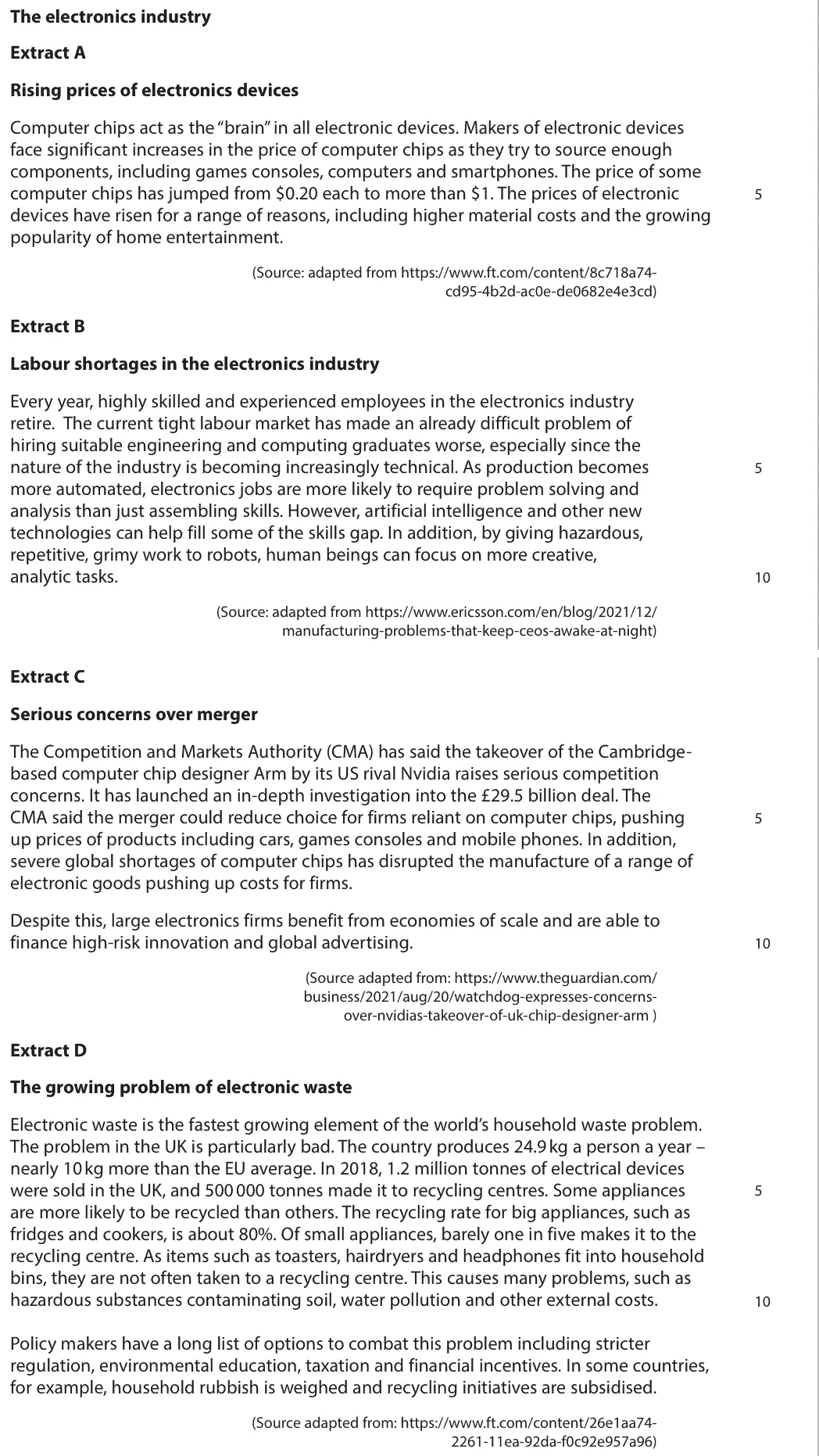
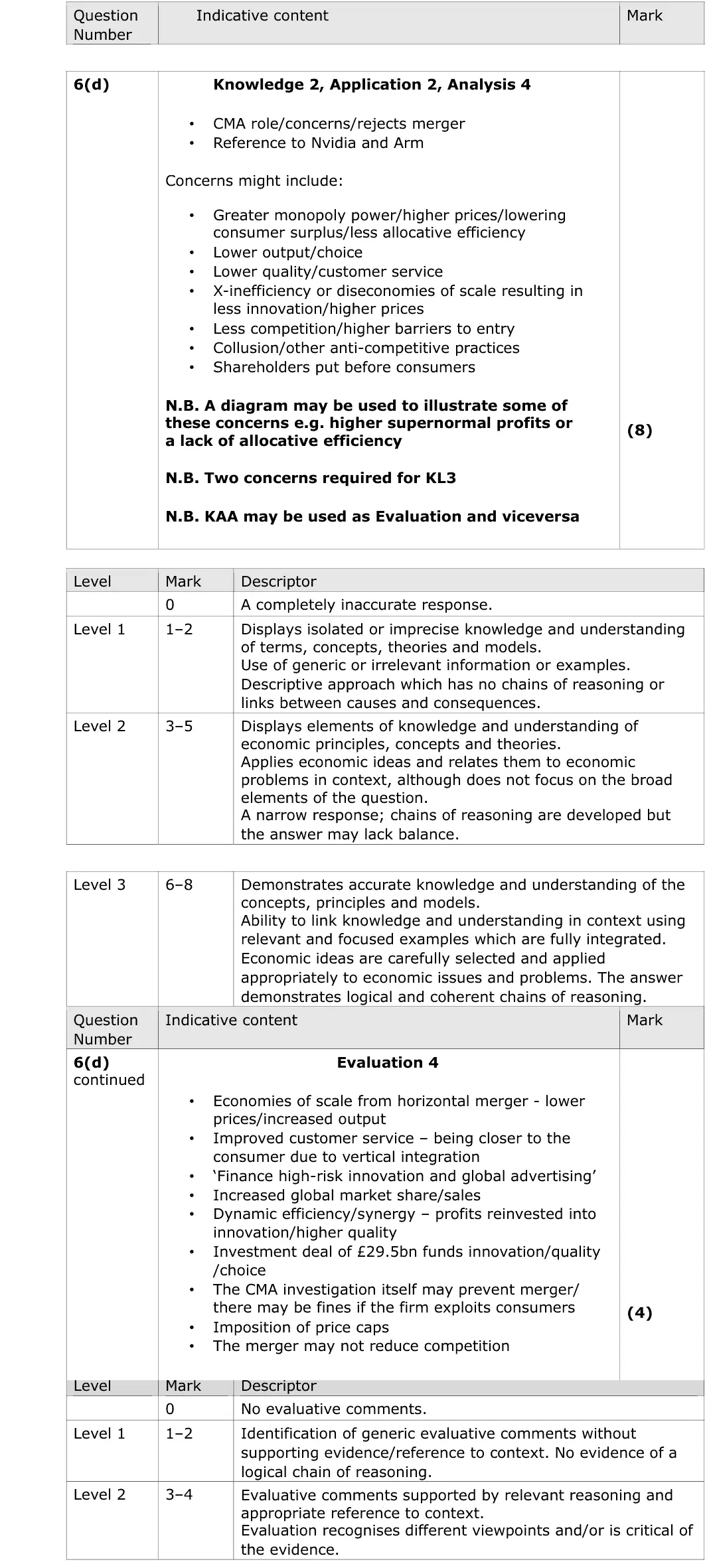
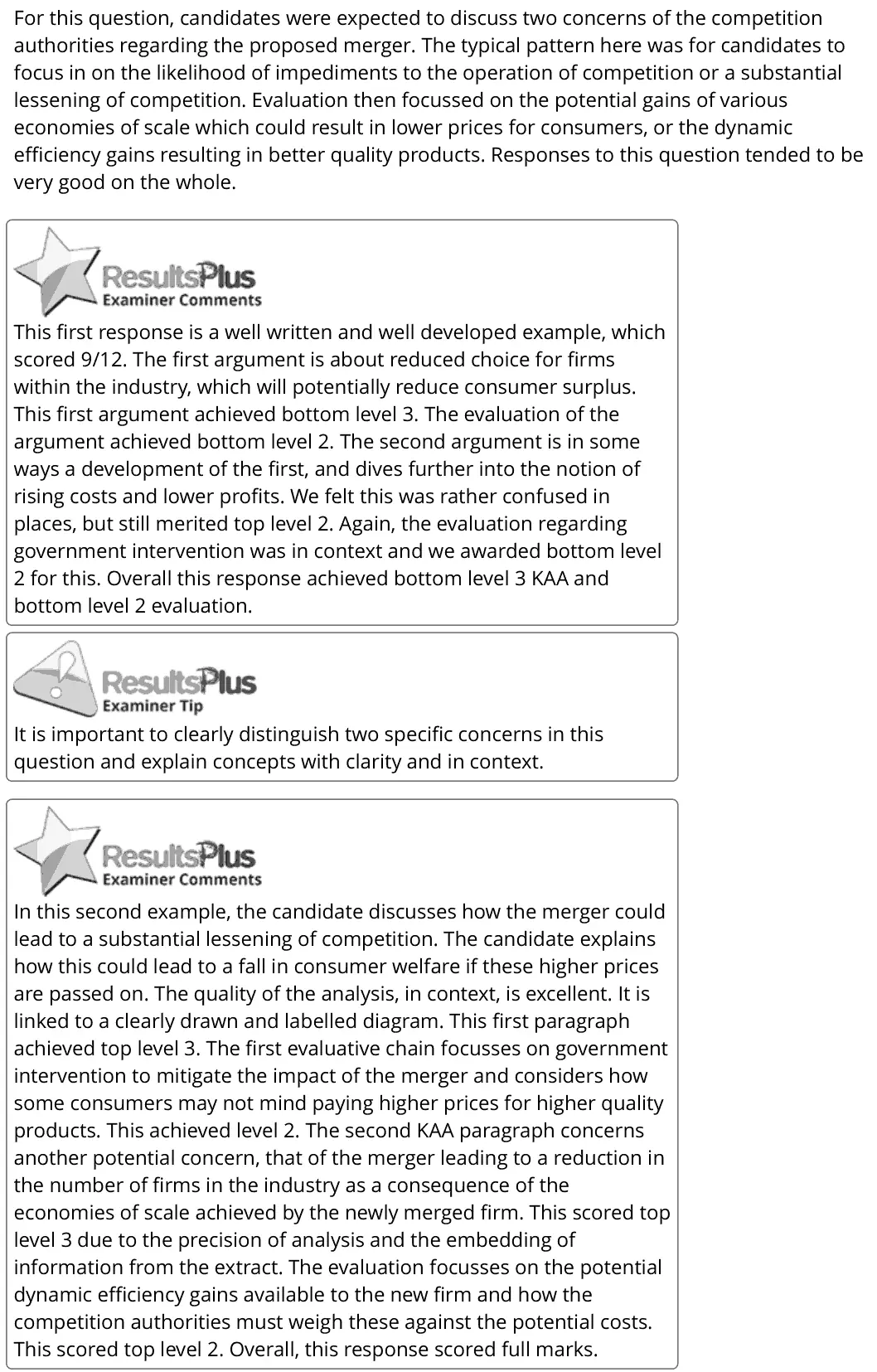
For this question, candidates were expected to discuss two concerns of the competition authorities regarding the proposed merger. The typical pattern here was for candidates to focus in on the likelihood of impediments to the operation of competition or a substantial lessening of competition. Evaluation then focussed on the potential gains of various economies of scale which could result in lower prices for consumers, or the dynamic efficiency gains resulting in better quality products. Responses to this question tended to be very good on the whole. This first response is a well written and well developed example, which scored 9/12. The first argument is about reduced choice for firms within the industry, which will potentially reduce consumer surplus. This first argument achieved bottom level 3. The evaluation of the argument achieved bottom level 2. The second argument is in some ways a development of the first, and dives further into the notion of rising costs and lower profits. We felt this was rather confused in places, but still merited top level 2. Again, the evaluation regarding government intervention was in context and we awarded bottom level 2 for this. Overall this response achieved bottom level 3 KAA and bottom level 2 evaluation. It is important to clearly distinguish two specific concerns in this question and explain concepts with clarity and in context. In this second example, the candidate discusses how the merger could lead to a substantial lessening of competition. The candidate explains how this could lead to a fall in consumer welfare if these higher prices are passed on. The quality of the analysis, in context, is excellent. It is linked to a clearly drawn and labelled diagram. This first paragraph achieved top level 3. The first evaluative chain focusses on government intervention to mitigate the impact of the merger and considers how some consumers may not mind paying higher prices for higher quality products. This achieved level 2. The second KAA paragraph concerns another potential concern, that of the merger leading to a reduction in the number of firms in the industry as a consequence of the economies of scale achieved by the newly merged firm. This scored top level 3 due to the precision of analysis and the embedding of information from the extract. The evaluation focusses on the potential dynamic efficiency gains available to the new firm and how the competition authorities must weigh these against the potential costs. This scored top level 2. Overall, this response scored full marks.
Notes from the mark scheme and report
two concerns needed for KAA Level 3 (substantial lessening of competition, higher prices, less choice, less innovation)
evaluate with economies of scale and dynamic efficiency gains
June 2023 · Paper 1 · Q6(e)15 marksAO1=3, AO2=3, AO3=3, AO4=615-mark response
Data and extracts for question 6
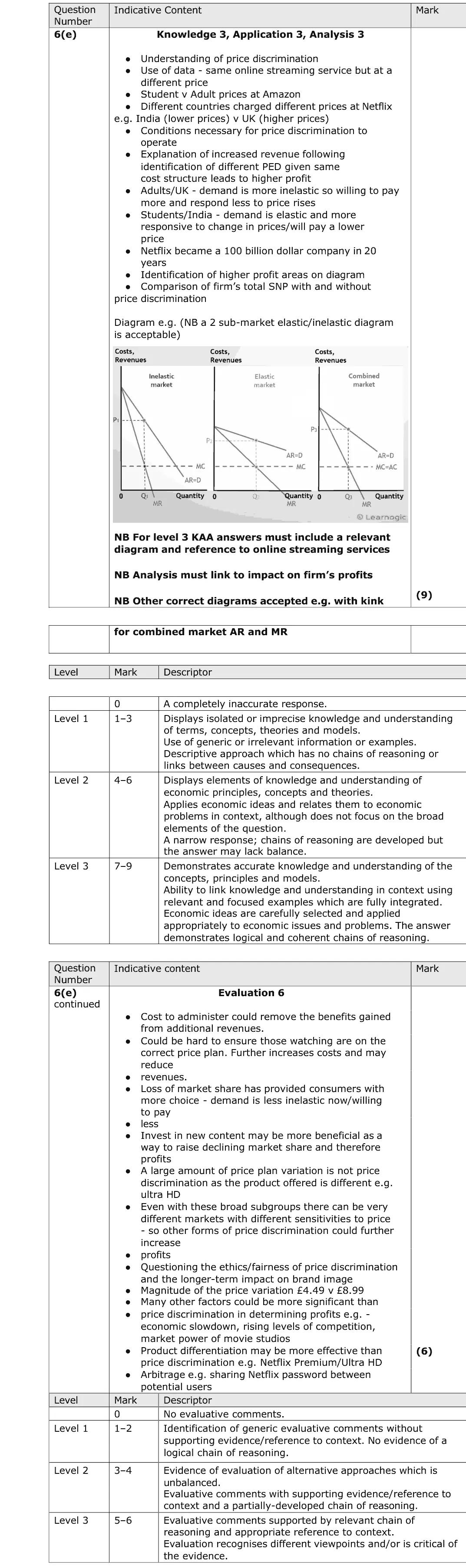
Mark scheme, including the levels grid and indicative content
Examiner's comment
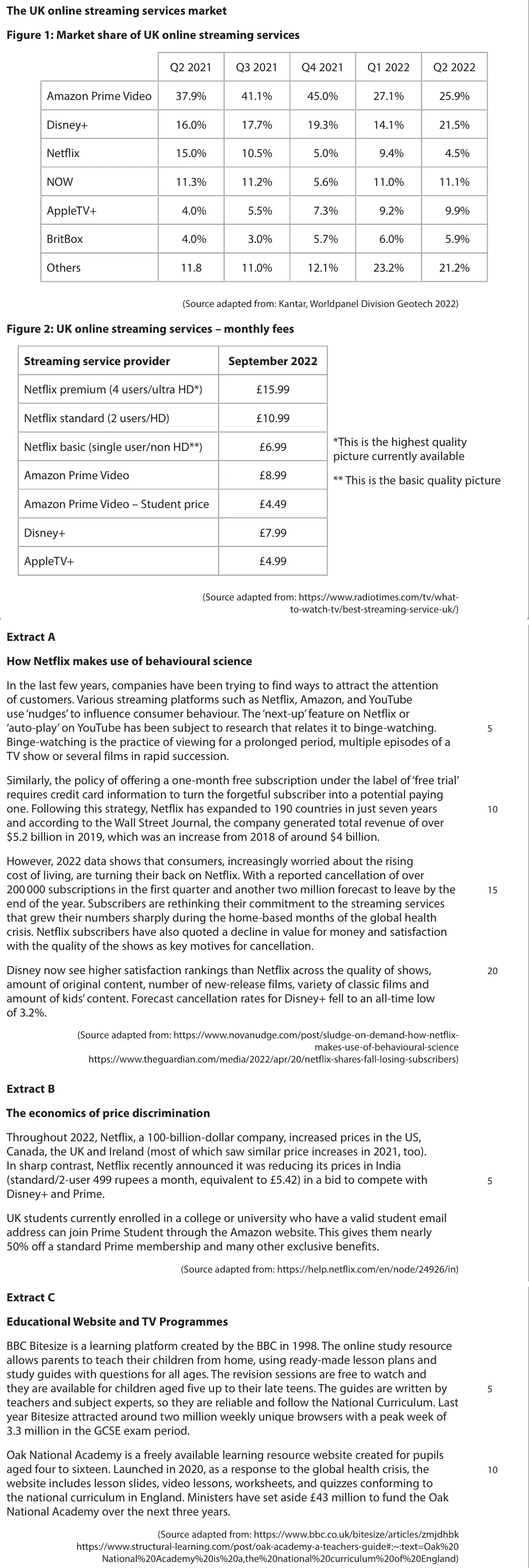
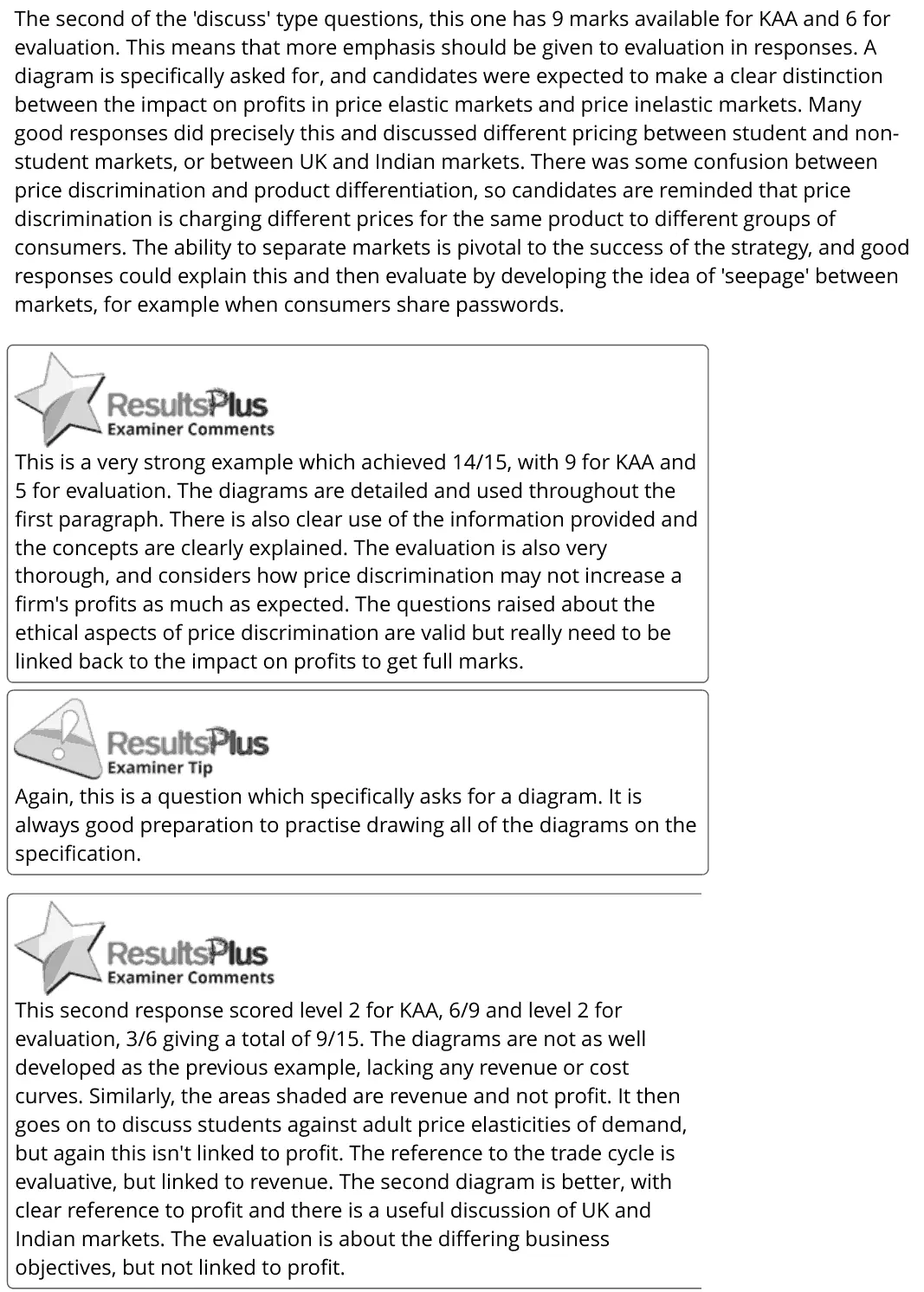
The second of the 'discuss' type questions, this one has 9 marks available for KAA and 6 for evaluation. This means that more emphasis should be given to evaluation in responses. A diagram is specifically asked for, and candidates were expected to make a clear distinction between the impact on profits in price elastic markets and price inelastic markets. Many good responses did precisely this and discussed different pricing between student and non- student markets, or between UK and Indian markets. There was some confusion between price discrimination and product differentiation, so candidates are reminded that price discrimination is charging different prices for the same product to different groups of consumers. The ability to separate markets is pivotal to the success of the strategy, and good responses could explain this and then evaluate by developing the idea of 'seepage' between markets, for example when consumers share passwords. This is a very strong example which achieved 14/15, with 9 for KAA and 5 for evaluation. The diagrams are detailed and used throughout the first paragraph. There is also clear use of the information provided and the concepts are clearly explained. The evaluation is also very thorough, and considers how price discrimination may not increase a firm's profits as much as expected. The questions raised about the ethical aspects of price discrimination are valid but really need to be linked back to the impact on profits to get full marks. Again, this is a question which specifically asks for a diagram. It is always good preparation to practise drawing all of the diagrams on the specification. This second response scored level 2 for KAA, 6/9 and level 2 for evaluation, 3/6 giving a total of 9/15. The diagrams are not as well developed as the previous example, lacking any revenue or cost curves. Similarly, the areas shaded are revenue and not profit. It then goes on to discuss students against adult price elasticities of demand, but again this isn't linked to profit. The reference to the trade cycle is evaluative, but linked to revenue. The second diagram is better, with clear reference to profit and there is a useful discussion of UK and Indian markets. The evaluation is about the differing business objectives, but not linked to profit.
Notes from the mark scheme and report
third-degree price discrimination diagram: higher price in the inelastic sub-market (UK adults), lower in the elastic one (students, India) so profit rises
conditions: market power, separable markets
evaluate seepage (password sharing) and costs of separation
report: some confused price discrimination with product differentiation
Quantitative skills: QS 4 (construct and interpret a range of standard graphical forms)
June 2022 · Paper 1 · Q725 marksAO1=4, AO2=4, AO3=8, AO4=925-mark essayEither/or
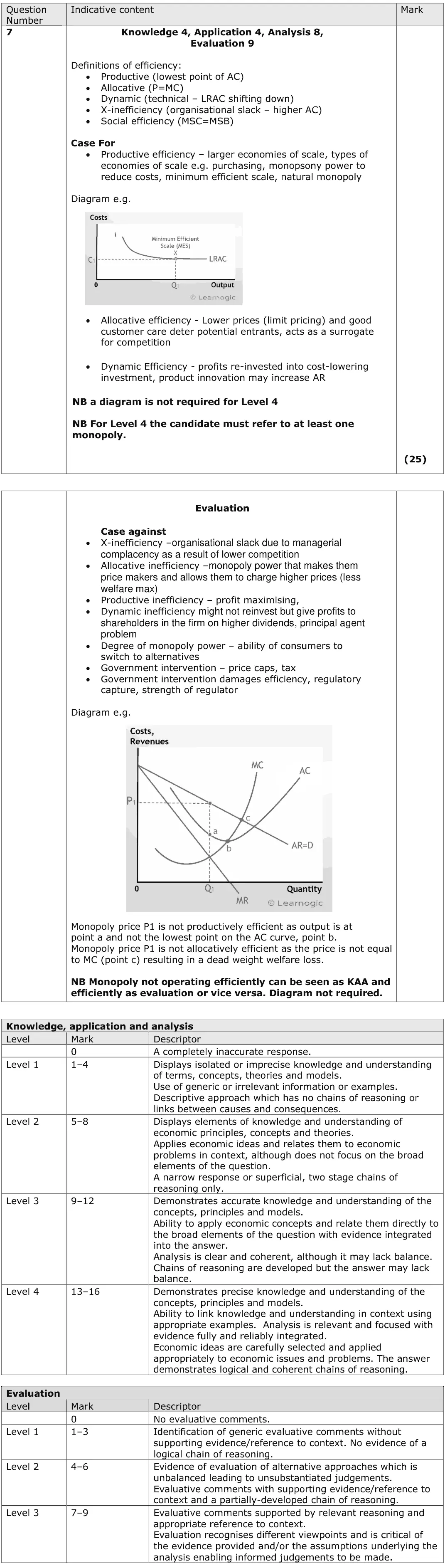
Mark scheme, including the levels grid and indicative content
Examiner's comment
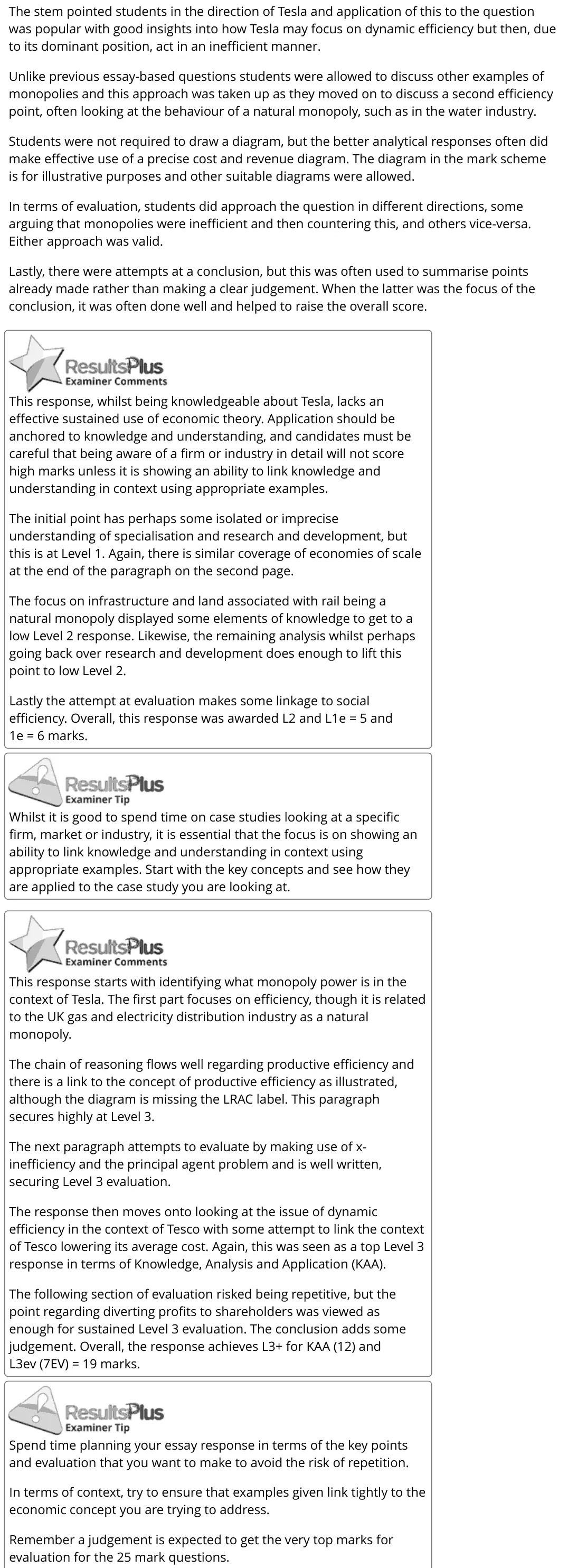
The stem pointed students in the direction of Tesla and application of this to the question was popular with good insights into how Tesla may focus on dynamic efficiency but then, due to its dominant position, act in an inefficient manner. Unlike previous essay-based questions students were allowed to discuss other examples of monopolies and this approach was taken up as they moved on to discuss a second efficiency point, often looking at the behaviour of a natural monopoly, such as in the water industry. Students were not required to draw a diagram, but the better analytical responses often did make effective use of a precise cost and revenue diagram. The diagram in the mark scheme is for illustrative purposes and other suitable diagrams were allowed. In terms of evaluation, students did approach the question in different directions, some arguing that monopolies were inefficient and then countering this, and others vice-versa. Either approach was valid. Lastly, there were attempts at a conclusion, but this was often used to summarise points already made rather than making a clear judgement. When the latter was the focus of the conclusion, it was often done well and helped to raise the overall score. This response, whilst being knowledgeable about Tesla, lacks an effective sustained use of economic theory. Application should be anchored to knowledge and understanding, and candidates must be careful that being aware of a firm or industry in detail will not score high marks unless it is showing an ability to link knowledge and understanding in context using appropriate examples. The initial point has perhaps some isolated or imprecise understanding of specialisation and research and development, but this is at Level 1. Again, there is similar coverage of economies of scale at the end of the paragraph on the second page. The focus on infrastructure and land associated with rail being a natural monopoly displayed some elements of knowledge to get to a low Level 2 response. Likewise, the remaining analysis whilst perhaps going back over research and development does enough to lift this point to low Level 2. Lastly the attempt at evaluation makes some linkage to social efficiency. Overall, this response was awarded L2 and L1e = 5 and 1e = 6 marks. Whilst it is good to spend time on case studies looking at a specific firm, market or industry, it is essential that the focus is on showing an ability to link knowledge and understanding in context using appropriate examples. Start with the key concepts and see how they are applied to the case study you are looking at. This response starts with identifying what monopoly power is in the context of Tesla. The first part focuses on efficiency, though it is related to the UK gas and electricity distribution industry as a natural monopoly. The chain of reasoning flows well regarding productive efficiency and there is a link to the concept of productive efficiency as illustrated, although the diagram is missing the LRAC label. This paragraph secures highly at Level 3. The next paragraph attempts to evaluate by making use of x- inefficiency and the principal agent problem and is well written, securing Level 3 evaluation. The response then moves onto looking at the issue of dynamic efficiency in the context of Tesco with some attempt to link the context of Tesco lowering its average cost. Again, this was seen as a top Level 3 response in terms of Knowledge, Analysis and Application (KAA). The following section of evaluation risked being repetitive, but the point regarding diverting profits to shareholders was viewed as enough for sustained Level 3 evaluation. The conclusion adds some judgement. Overall, the response achieves L3+ for KAA (12) and L3ev (7EV) = 19 marks. Spend time planning your essay response in terms of the key points and evaluation that you want to make to avoid the risk of repetition. In terms of context, try to ensure that examples given link tightly to the economic concept you are trying to address. Remember a judgement is expected to get the very top marks for evaluation for the 25 mark questions.
Notes from the mark scheme and report
define productive, allocative, dynamic and x-efficiency
economies of scale and reinvested profit against P > MC, x-inefficiency and complacency
Level 4 must refer to at least one monopoly (e.g. Tesla, a water company)
a diagram is not required
conclusions often just summarised
November 2021 · Paper 1 · Q3(a)4 marksAO1=2, AO2=2Diagram
Data and extracts for question 3
Mark scheme
Examiner's comment
Question 3a consists mainly of a price-discrimination draw question. The vast majority of candidates demonstrated a very good understanding, but a significant number of candidates were not able to complete this successfully perhaps indicating gaps in their knowledge. Most candidates answered the multiple-choice question accurately. In Question 4 there was a lot of accurate answers to the quantitative-skill based 2-mark questions. Most candidates showed their working, allowing them to pick up at least one mark if they had made a computational error. The overwhelming majority of candidates then went on to correctly answer the revenue maximisation multiple choice question. The first part of Question 5 asked candidates to identify using the data that this was a long run perfect competition scenario. Most candidates had some understanding of the perfect competition model but some struggled to fully complete the diagram accurately in order to achieve full marks. A common error was not identifying the profit maximization output level. Having said that, there were some confident answers that did this with comparative ease. Whilst the majority of candidates did correctly answer the multiple-choice question there was a significant number of random wrong answers. It is possible that less time had been spent on perfect competition than in previous years. Section B, the data response section, was based on data from the travel and tourism industry. This included two figures and three extracts, which high-scoring candidates drew on extensively.
Notes from the mark scheme and report
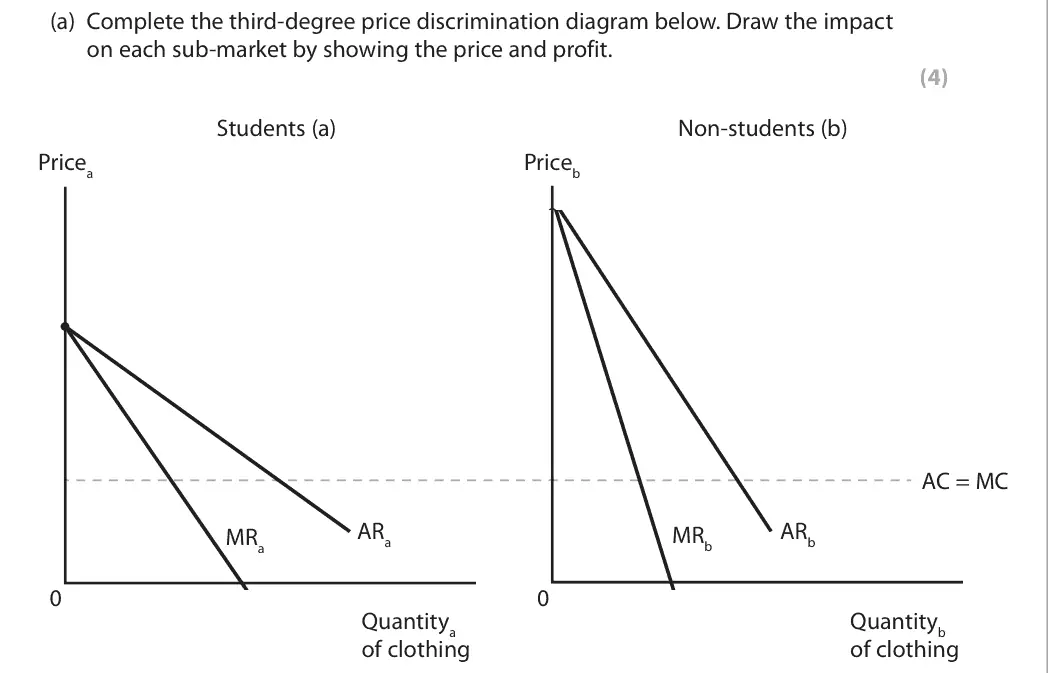
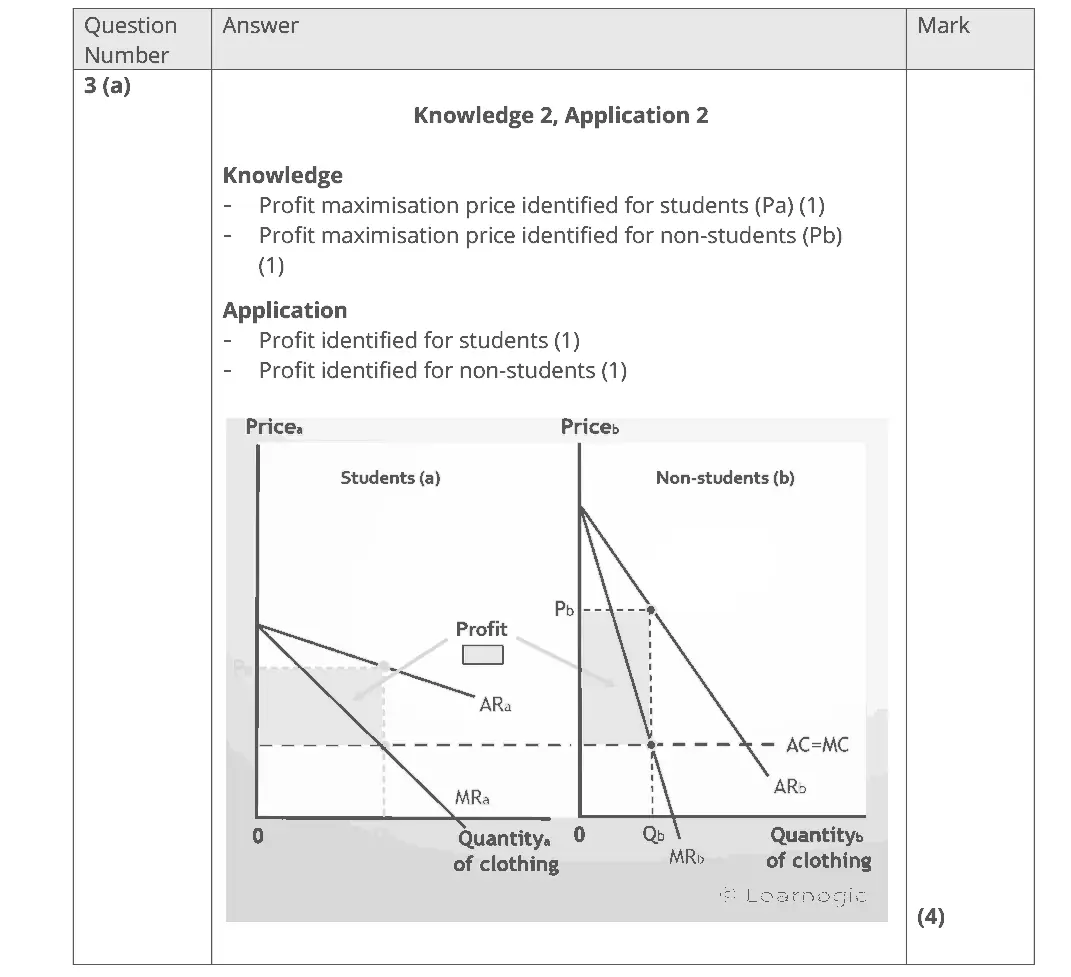
third-degree price discrimination with constant AC = MC: MR = MC in each sub-market, lower price Pa for students (more elastic) and higher Pb for non-students, profit area in each
report: a significant number could not complete it
Quantitative skills: QS 4 (construct and interpret a range of standard graphical forms)
November 2021 · Paper 1 · Q3(b)1 markAO3=1Multiple choice
Data and extracts for question 3
Answer
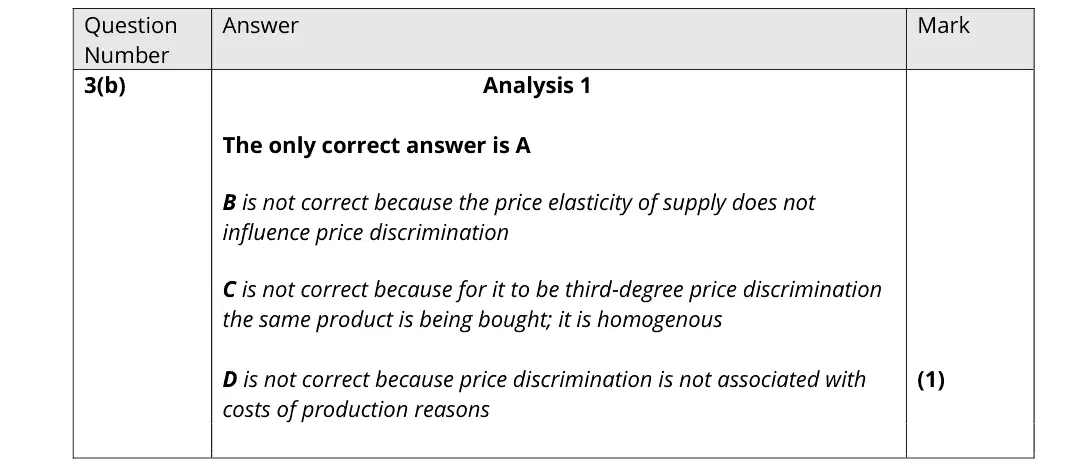
A
Mark scheme
Notes from the mark scheme and report
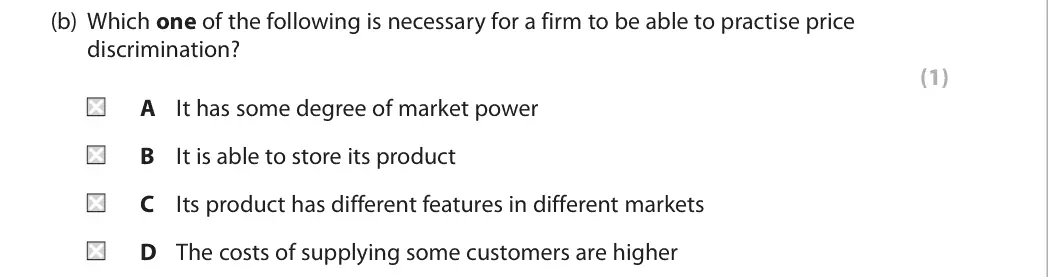
the firm needs some market power (price-maker) to price discriminate (A)
storage is irrelevant
third-degree discrimination sells the same product
price differences are not due to cost differences
November 2021 · Paper 1 · Q6(e)15 marksAO1=3, AO2=3, AO3=3, AO4=615-mark response
Data and extracts for question 6
Mark scheme, including the levels grid and indicative content
Notes from the mark scheme and report
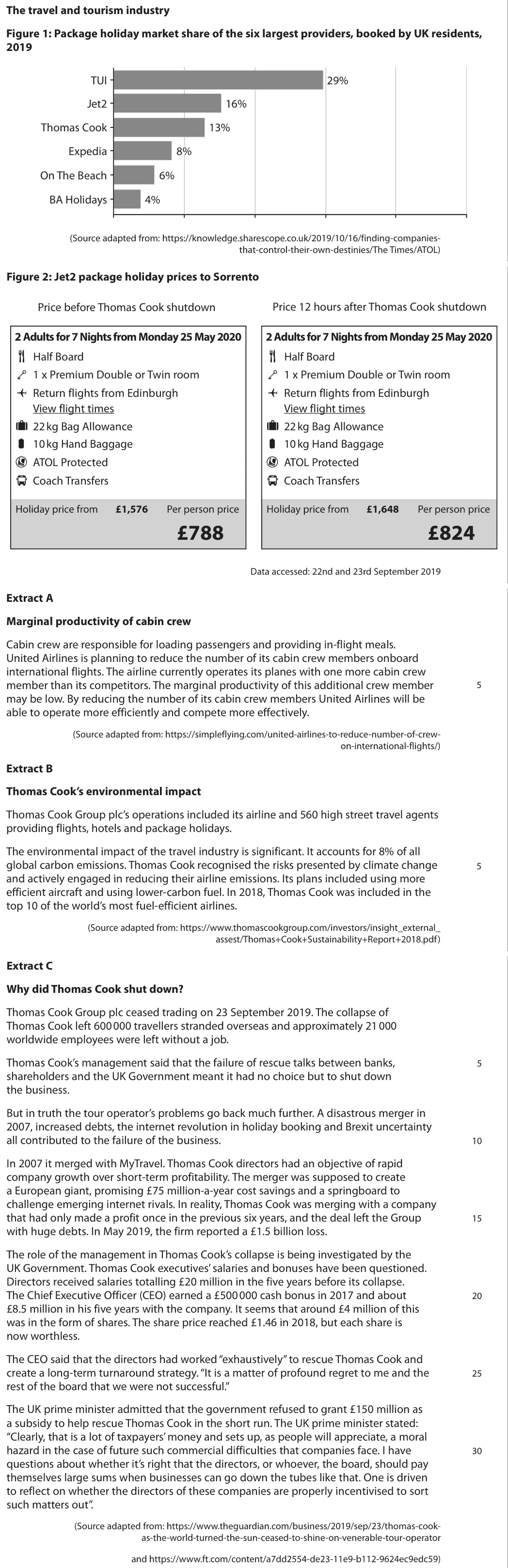
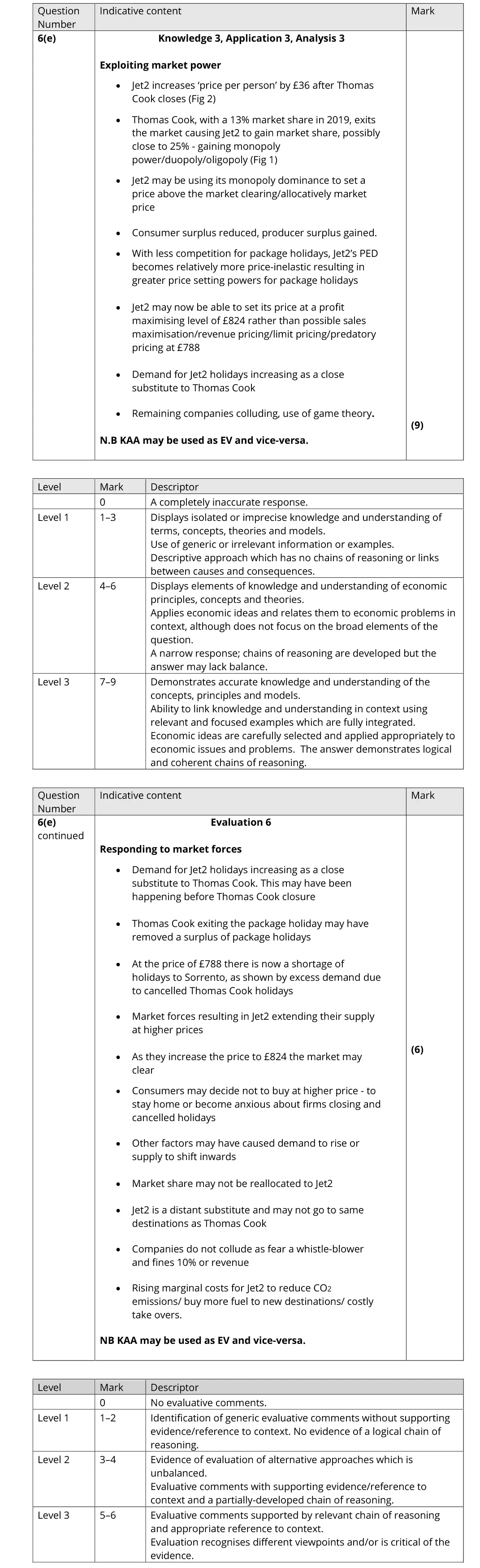
Thomas Cook's exit (13% share, Figure 1) gives Jet2 more market power and less elastic demand, so it raises price from £788 to £824 per person (Figure 2)
move to profit maximising pricing, consumer surplus falls
evaluate with the remaining competition (TUI 29%), contestability and CMA regulation
a final judgement is not required
Quantitative skills: QS 9 (interpret, apply and analyse information in written, graphical tabular and numerical forms)
November 2021 · Paper 1 · Q825 marksAO1=4, AO2=4, AO3=8, AO4=925-mark essayEither/or
Mark scheme, including the levels grid and indicative content
Examiner's comment
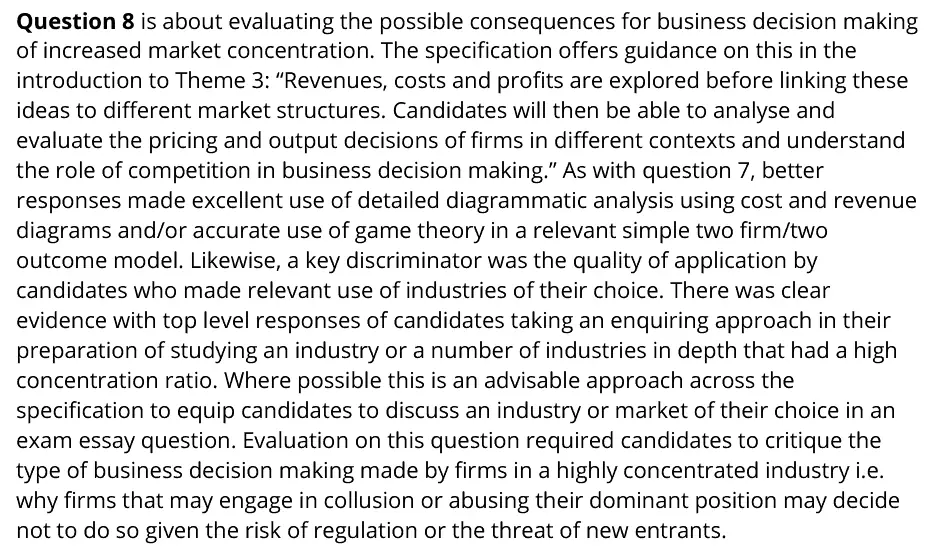
Question 8 is about evaluating the possible consequences for business decision making of increased market concentration. The specification offers guidance on this in the introduction to Theme 3: “Revenues, costs and profits are explored before linking these ideas to different market structures. Candidates will then be able to analyse and evaluate the pricing and output decisions of firms in different contexts and understand the role of competition in business decision making.” As with question 7, better responses made excellent use of detailed diagrammatic analysis using cost and revenue diagrams and/or accurate use of game theory in a relevant simple two firm/two outcome model. Likewise, a key discriminator was the quality of application by candidates who made relevant use of industries of their choice. There was clear evidence with top level responses of candidates taking an enquiring approach in their preparation of studying an industry or a number of industries in depth that had a high concentration ratio. Where possible this is an advisable approach across the specification to equip candidates to discuss an industry or market of their choice in an exam essay question. Evaluation on this question required candidates to critique the type of business decision making made by firms in a highly concentrated industry i.e. why firms that may engage in collusion or abusing their dominant position may decide not to do so given the risk of regulation or the threat of new entrants.
Notes from the mark scheme and report
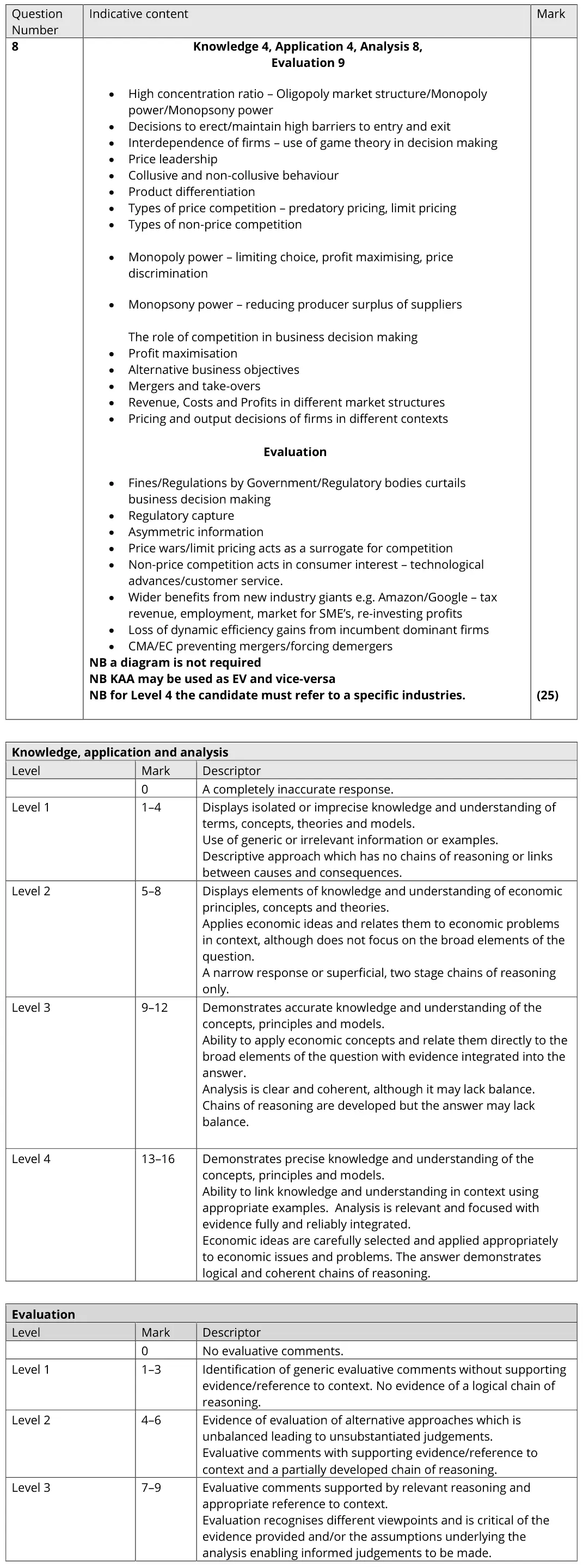
higher concentration means interdependence: game theory, collusion or price leadership, non-price competition, barriers to entry, monopoly pricing
evaluate with risk of regulation, new entrants and contestability
better answers used cost and revenue diagrams and a two firm/two outcome model applied to named industries
October 2020 · Paper 1 · Q6(d)12 marksAO1=2, AO2=2, AO3=4, AO4=412-mark response
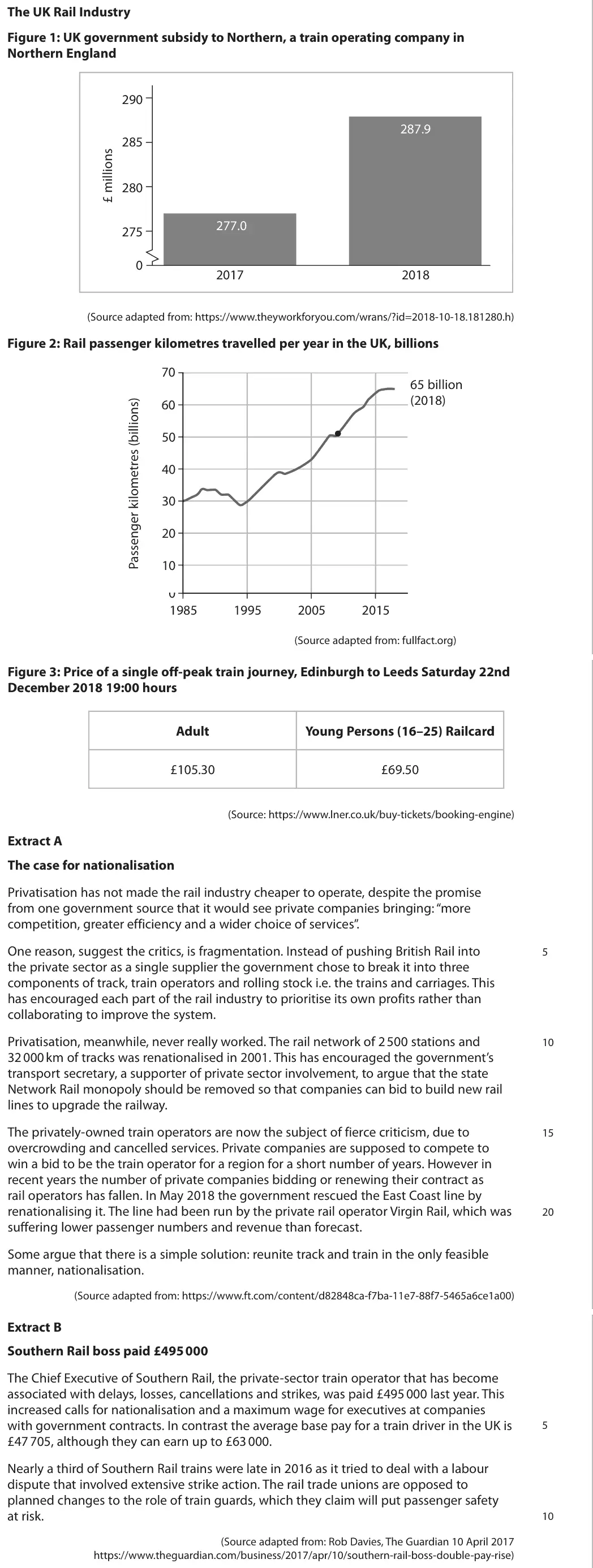
Data and extracts for question 6
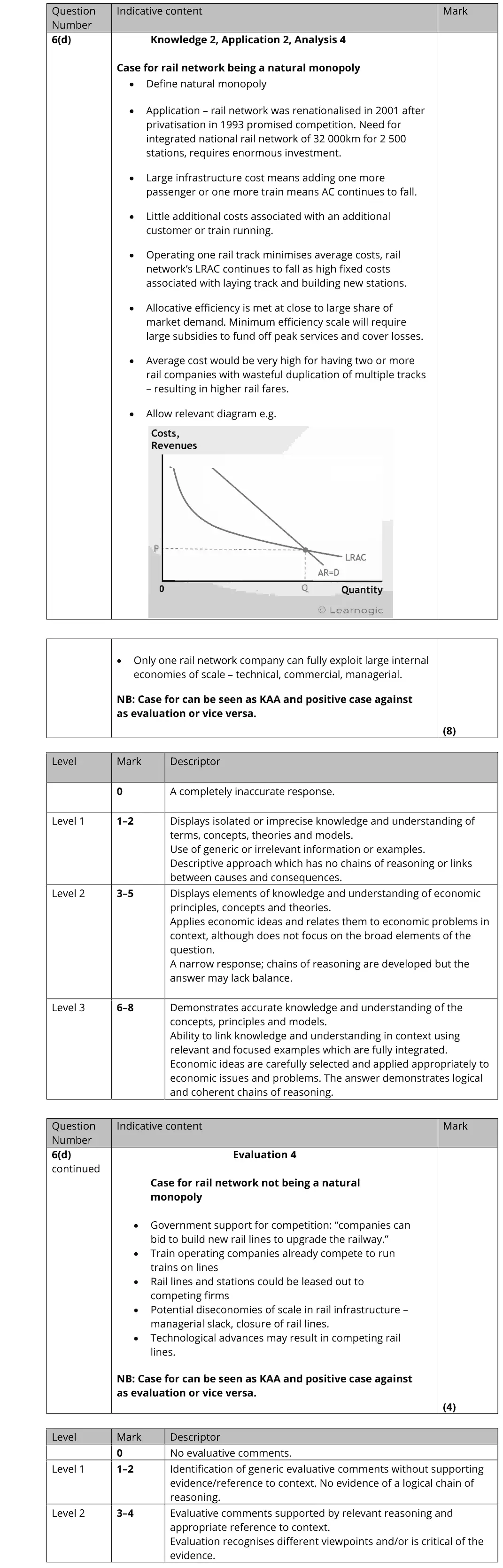
Mark scheme, including the levels grid and indicative content
Examiner's comment
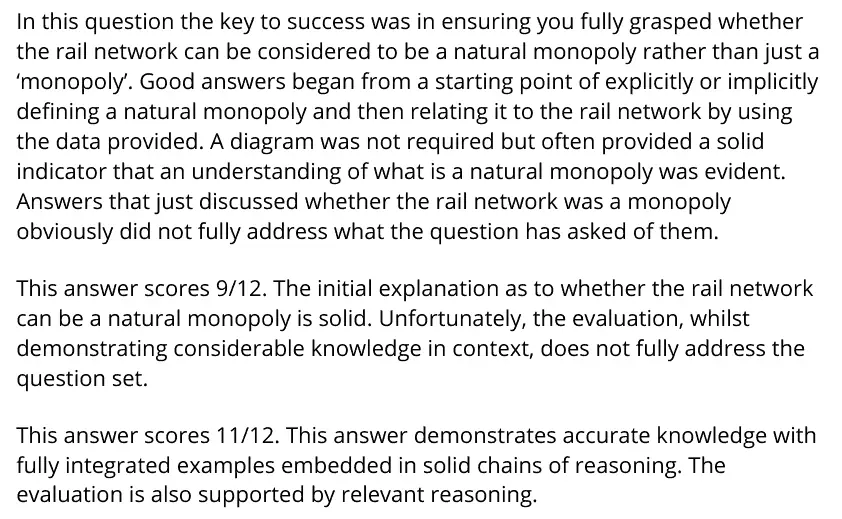
In this question the key to success was in ensuring you fully grasped whether the rail network can be considered to be a natural monopoly rather than just a ‘monopoly’. Good answers began from a starting point of explicitly or implicitly defining a natural monopoly and then relating it to the rail network by using the data provided. A diagram was not required but often provided a solid indicator that an understanding of what is a natural monopoly was evident. Answers that just discussed whether the rail network was a monopoly obviously did not fully address what the question has asked of them. This answer scores 9/12. The initial explanation as to whether the rail network can be a natural monopoly is solid. Unfortunately, the evaluation, whilst demonstrating considerable knowledge in context, does not fully address the question set. This answer scores 11/12. This answer demonstrates accurate knowledge with fully integrated examples embedded in solid chains of reasoning. The evaluation is also supported by relevant reasoning.
Notes from the mark scheme and report
define natural monopoly (high fixed infrastructure costs, falling LRAC over the market, one firm cheapest)
apply 32 000 km of track and 2 500 stations
report: answers discussing only "monopoly" did not address the question
a diagram was not required
October 2020 · Paper 1 · Q6(e)15 marksAO1=3, AO2=3, AO3=3, AO4=615-mark response
Data and extracts for question 6
Mark scheme, including the levels grid and indicative content
Examiner's comment
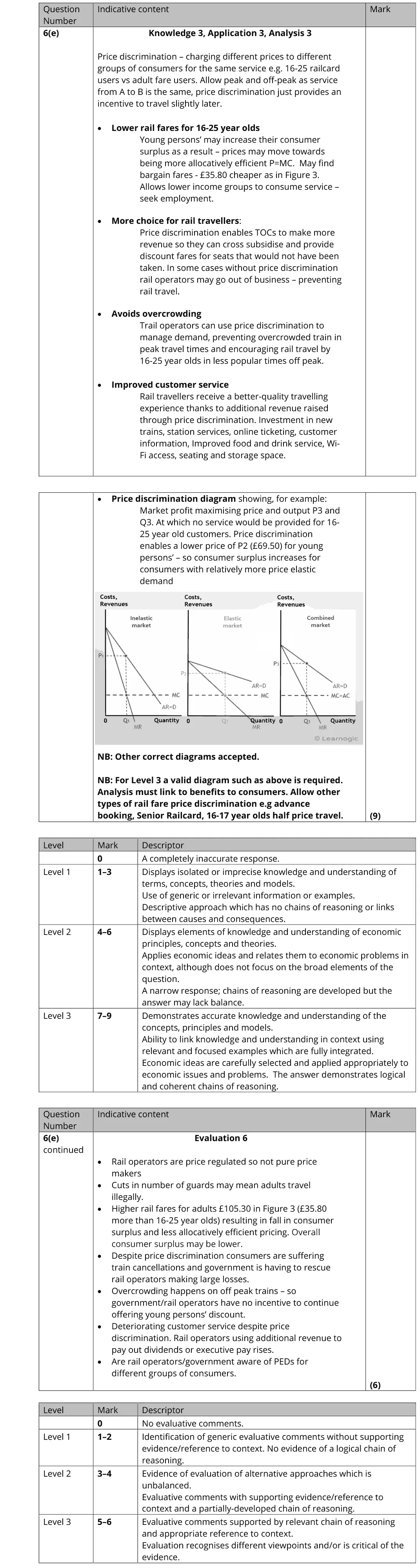
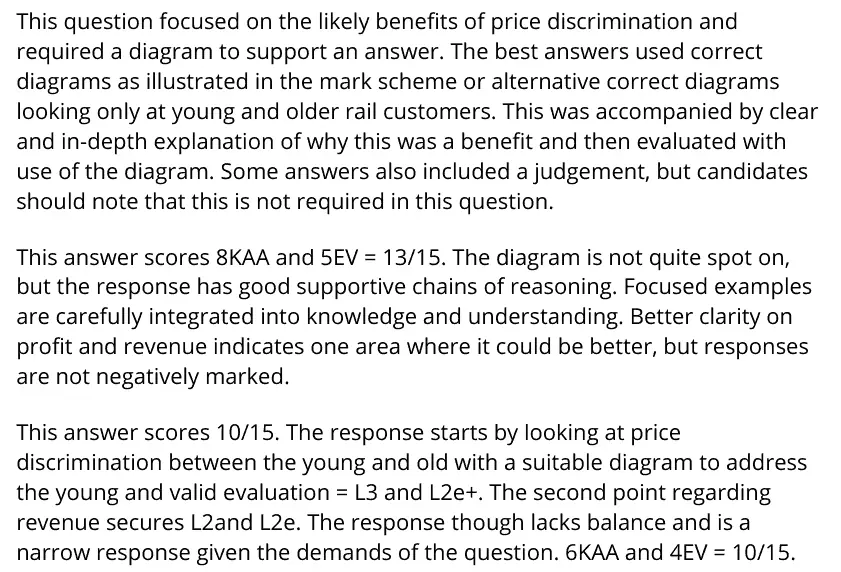
This question focused on the likely benefits of price discrimination and required a diagram to support an answer. The best answers used correct diagrams as illustrated in the mark scheme or alternative correct diagrams looking only at young and older rail customers. This was accompanied by clear and in-depth explanation of why this was a benefit and then evaluated with use of the diagram. Some answers also included a judgement, but candidates should note that this is not required in this question. This answer scores 8KAA and 5EV = 13/15. The diagram is not quite spot on, but the response has good supportive chains of reasoning. Focused examples are carefully integrated into knowledge and understanding. Better clarity on profit and revenue indicates one area where it could be better, but responses are not negatively marked. This answer scores 10/15. The response starts by looking at price discrimination between the young and old with a suitable diagram to address the young and valid evaluation = L3 and L2e+. The second point regarding revenue secures L2and L2e. The response though lacks balance and is a narrow response given the demands of the question. 6KAA and 4EV = 10/15.
Notes from the mark scheme and report
third degree price discrimination diagram (separate markets, different PEDs) required
benefits: cheaper young person fares (£69.50 v £105.30), cross subsidy keeps services running, spreading peak demand, revenue for investment
evaluate with adults paying more and loss of consumer surplus
Quantitative skills: QS 4 (construct and interpret a range of standard graphical forms)
June 2018 · Paper 1 · Q825 marksAO1=4, AO2=4, AO3=8, AO4=925-mark essayEither/or
Mark scheme, including the levels grid and indicative content
Examiner's comment
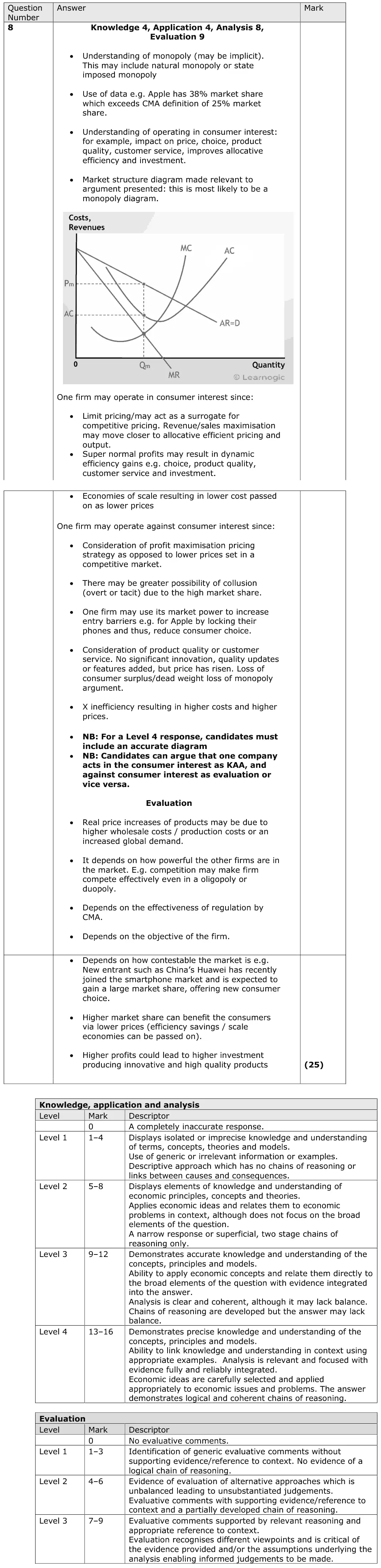
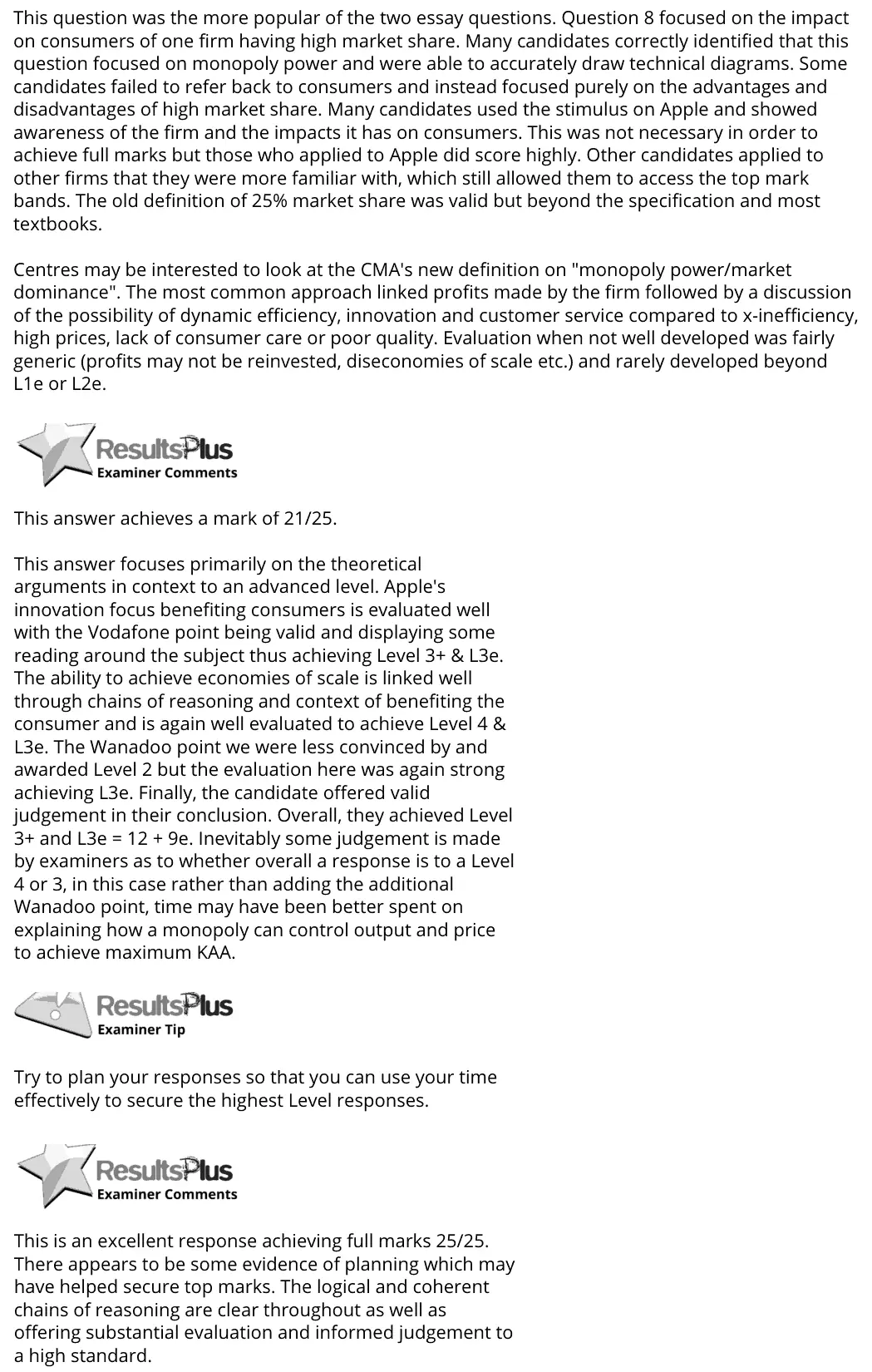
This question was the more popular of the two essay questions. Question 8 focused on the impact on consumers of one firm having high market share. Many candidates correctly identified that this question focused on monopoly power and were able to accurately draw technical diagrams. Some candidates failed to refer back to consumers and instead focused purely on the advantages and disadvantages of high market share. Many candidates used the stimulus on Apple and showed awareness of the firm and the impacts it has on consumers. This was not necessary in order to achieve full marks but those who applied to Apple did score highly. Other candidates applied to other firms that they were more familiar with, which still allowed them to access the top mark bands. The old definition of 25% market share was valid but beyond the specification and most textbooks. Centres may be interested to look at the CMA's new definition on "monopoly power/market dominance". The most common approach linked profits made by the firm followed by a discussion of the possibility of dynamic efficiency, innovation and customer service compared to x-inefficiency, high prices, lack of consumer care or poor quality. Evaluation when not well developed was fairly generic (profits may not be reinvested, diseconomies of scale etc.) and rarely developed beyond L1e or L2e. This answer achieves a mark of 21/25. This answer focuses primarily on the theoretical arguments in context to an advanced level. Apple's innovation focus benefiting consumers is evaluated well with the Vodafone point being valid and displaying some reading around the subject thus achieving Level 3+ & L3e. The ability to achieve economies of scale is linked well through chains of reasoning and context of benefiting the consumer and is again well evaluated to achieve Level 4 & L3e. The Wanadoo point we were less convinced by and awarded Level 2 but the evaluation here was again strong achieving L3e. Finally, the candidate offered valid judgement in their conclusion. Overall, they achieved Level 3+ and L3e = 12 + 9e. Inevitably some judgement is made by examiners as to whether overall a response is to a Level 4 or 3, in this case rather than adding the additional Wanadoo point, time may have been better spent on explaining how a monopoly can control output and price to achieve maximum KAA. Try to plan your responses so that you can use your time effectively to secure the highest Level responses. This is an excellent response achieving full marks 25/25. There appears to be some evidence of planning which may have helped secure top marks. The logical and coherent chains of reasoning are clear throughout as well as offering substantial evaluation and informed judgement to a high standard.
Notes from the mark scheme and report
Level 4 needs an accurate (monopoly) diagram
link every point back to consumers (price, choice, quality, consumer surplus)
dynamic efficiency and economies of scale against higher prices, x-inefficiency and deadweight loss
evaluate with contestability, rivals and CMA regulation
report: evaluation rarely beyond L1e or L2e
Quantitative skills: QS 4 (construct and interpret a range of standard graphical forms)
Work with an Edexcel economics tutor
Essays stuck in Level 2, or losing the easy marks in Section A? Book a trial session with Lianne, a former Edexcel examiner.