Monopsony and contestable markets Theme 3

Where it is examined
A-level Paper 1 (and Paper 3)
Level
A level only
Specification
Section 3.4, 2 statements
Since 2016
8 question parts: 3 essays, 3 levels-marked responses, 1 multiple-choice items

Notes and key-term cards for this topic are being written by our tutors. The past-paper questions below are ready now.

Specification statements

Every essay set on this topic

SeriesPaperQMarksTitle
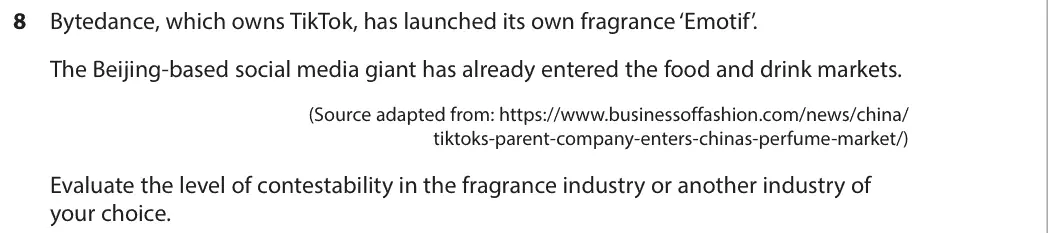
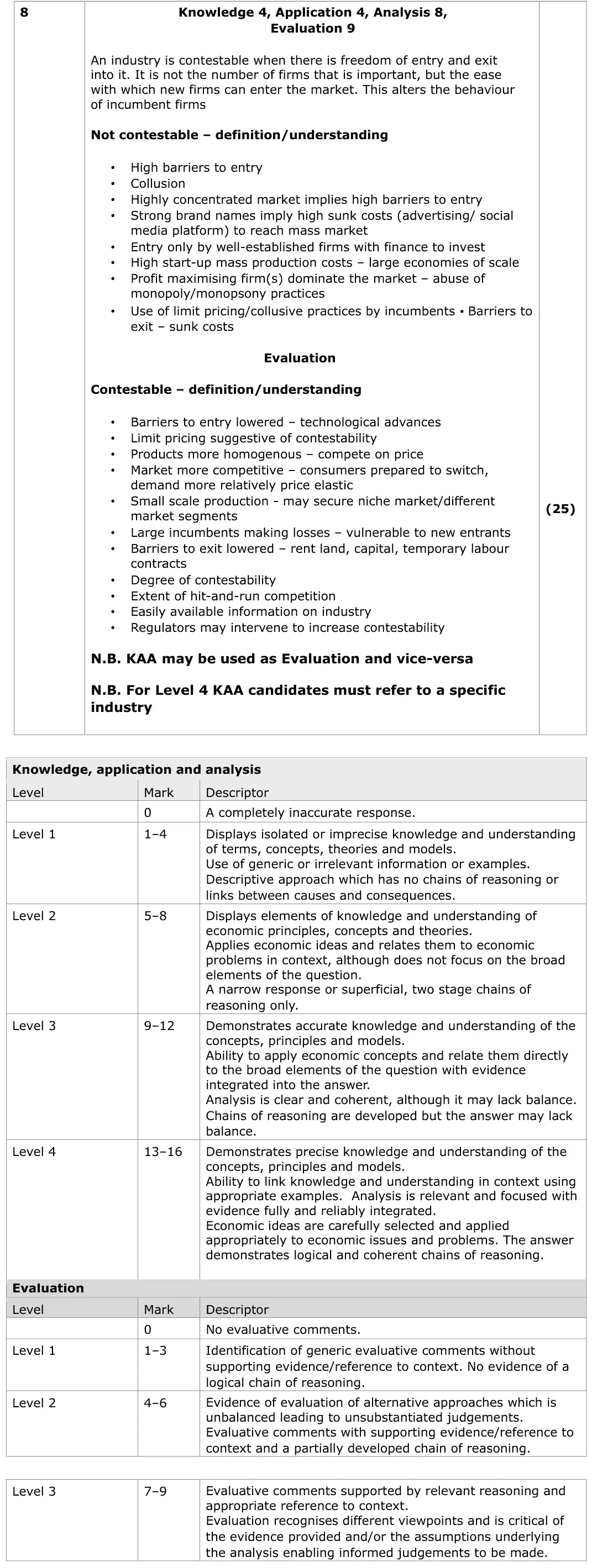
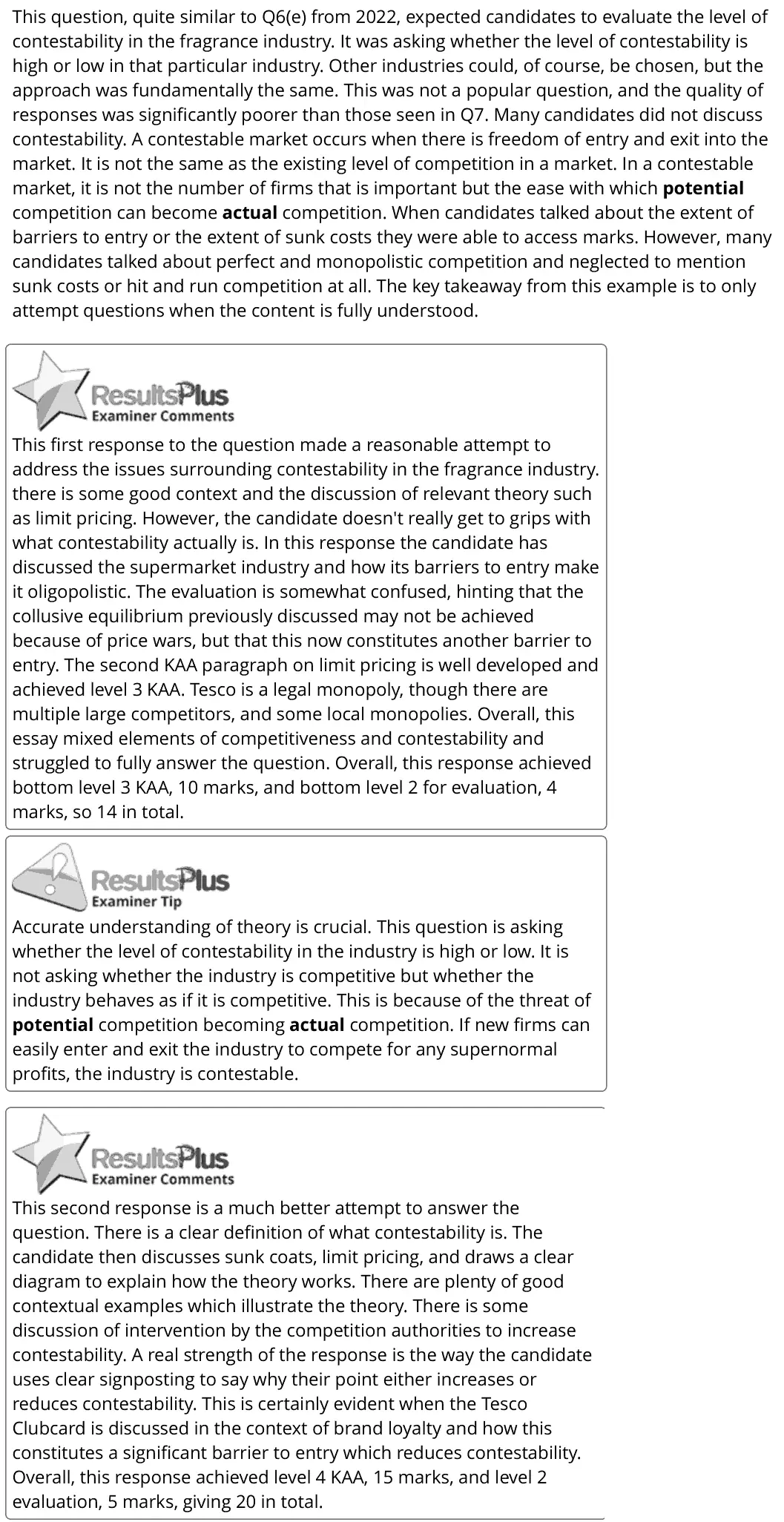
June 2024Paper 1825Bytedance, which owns TikTok, has launched its own fragrance ‘Emotif’. The Beijing-based social media giant has already entered the food and drink markets. (Source adapted from: https://www.businessoffashion.com/news/china/ tiktoks-parent-company-enters-chinas-perfume-market/) Evaluate the level of contestability in the fragrance industry or another industry of your choice.
November 2021Paper 31(d)25Evaluate the microeconomic and macroeconomic factors which determine the number of firms in an industry. Refer to HCWs or another industry of your choice.
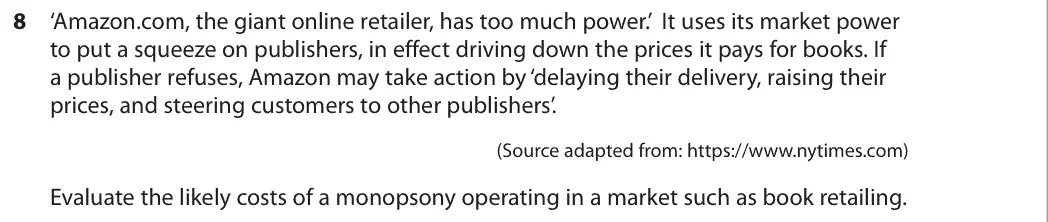
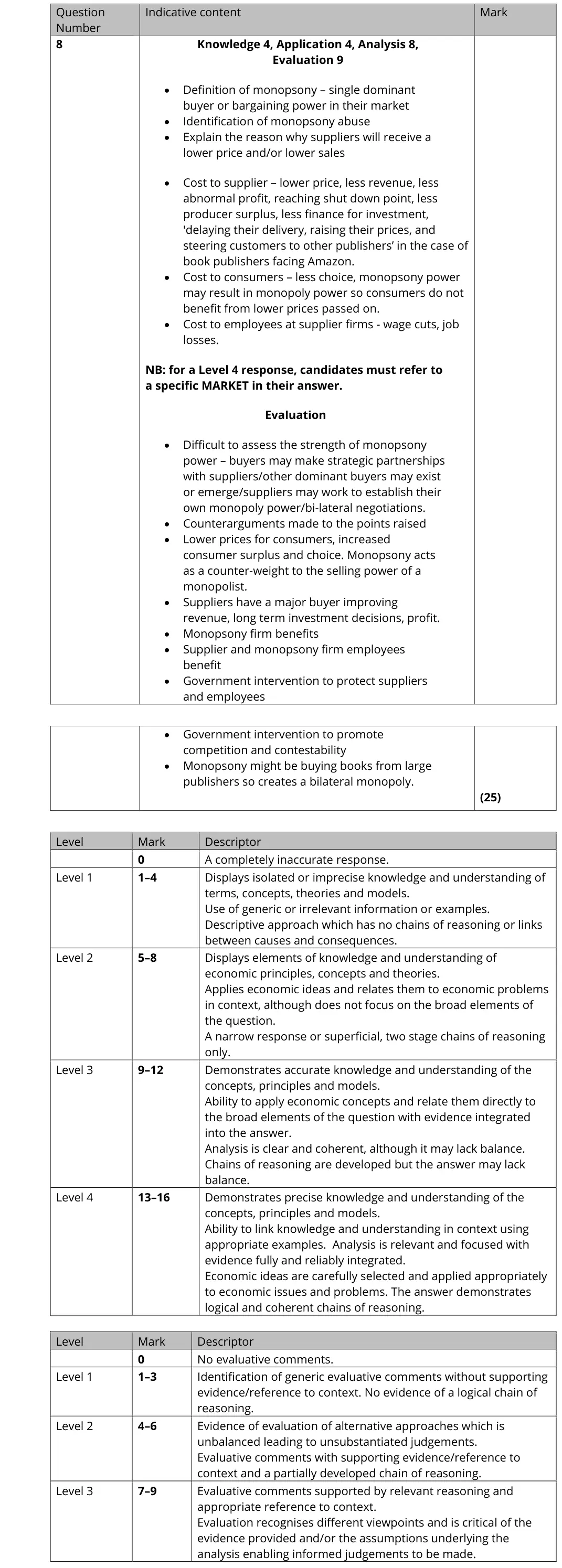
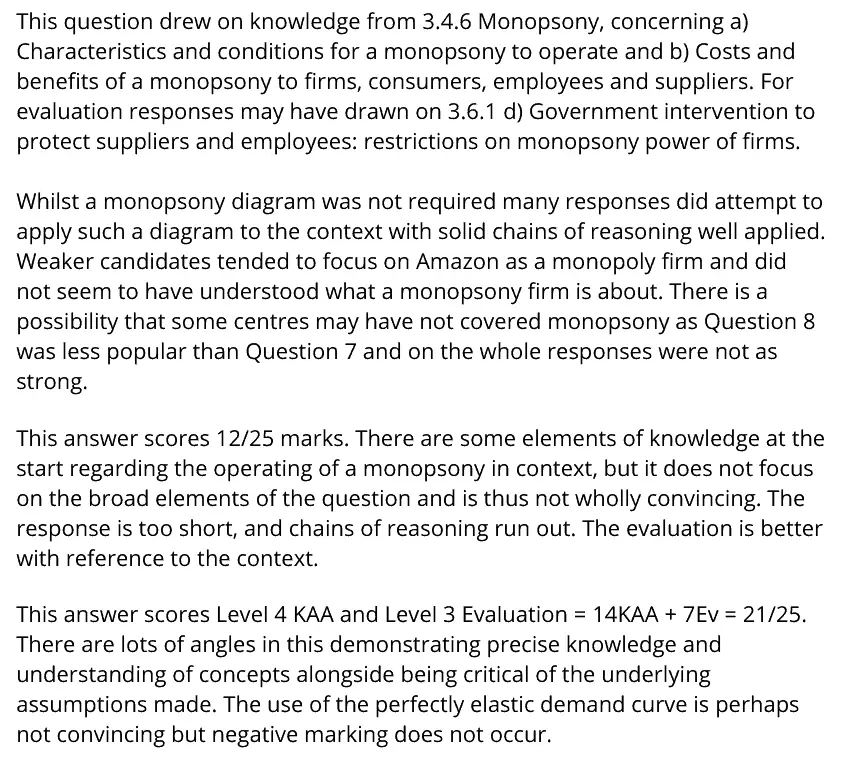
October 2020Paper 1825‘Amazon.com, the giant online retailer, has too much power.’ It uses its market power to put a squeeze on publishers, in effect driving down the prices it pays for books. If a publisher refuses, Amazon may take action by ‘delaying their delivery, raising their prices, and steering customers to other publishers’. (Source adapted from: https://www.nytimes.com) Evaluate the likely costs of a monopsony operating in a market such as book retailing.

Past-paper questions

Print this topic as a pack

Tap a question to zoom it. The data and extracts fold out above each question; the mark scheme and examiner's comment open underneath.
June 2025 · Paper 1 · Q6(d) 10 marks AO1=2, AO2=2, AO3=2, AO4=4 10-mark response
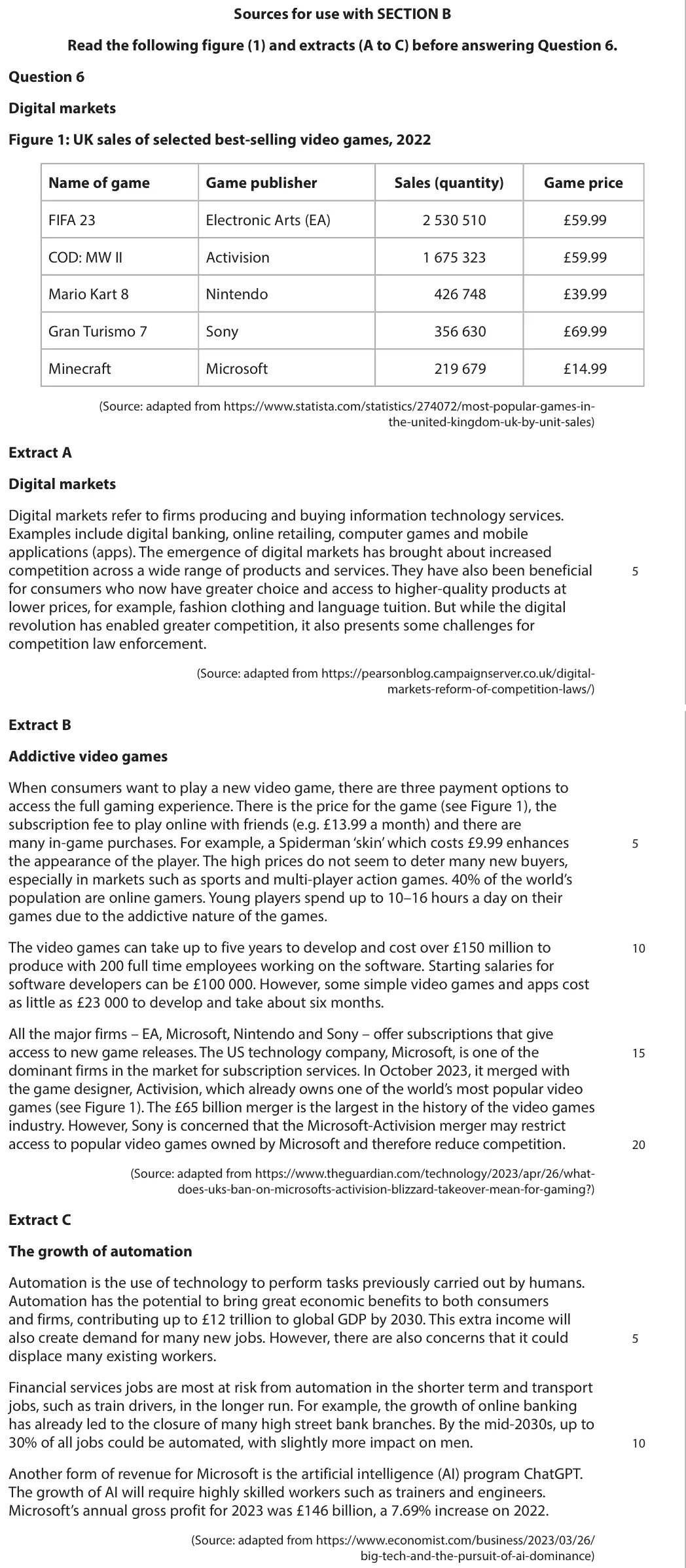
Data and extracts for question 6Sources for use with SECTION B Read the following figure (1) and extracts (A to C) before answering Question 6. Question 6 Digital markets Figure 1: UK sales of selected best-selling video games, 2022 Name of game Game publisher Sales (quantity) Game price FIFA 23 Electronic Arts (EA) 2 530 510 £59.99 COD: MW II Activision 1 675 323 £59.99 Mario Kart 8 Nintendo 426 748 £39.99 Gran Turismo 7 Sony 356 630 £69.99 Minecraft Microsoft 219 679 £14.99 (Source: adapted from https://www.statista.com/statistics/274072/most-popular-games-in- the-united-kingdom-uk-by-unit-sales) Extract A Digital markets Digital markets refer to firms producing and buying information technology services. Examples include digital banking, online retailing, computer games and mobile applications (apps). The emergence of digital markets has brought about increased competition across a wide range of products and services. They have also been beneficial 5 for consumers who now have greater choice and access to higher-quality products at lower prices, for example, fashion clothing and language tuition. But while the digital revolution has enabled greater competition, it also presents some challenges for competition law enforcement. (Source: adapted from https://pearsonblog.campaignserver.co.uk/digital- markets-reform-of-competition-laws/) Extract B Addictive video games When consumers want to play a new video game, there are three payment options to access the full gaming experience. There is the price for the game (see Figure 1), the subscription fee to play online with friends (e.g. £13.99 a month) and there are many in-game purchases. For example, a Spiderman ‘skin’ which costs £9.99 enhances 5 the appearance of the player. The high prices do not seem to deter many new buyers, especially in markets such as sports and multi-player action games. 40% of the world’s population are online gamers. Young players spend up to 10–16 hours a day on their games due to the addictive nature of the games. The video games can take up to five years to develop and cost over £150 million to 10 produce with 200 full time employees working on the software. Starting salaries for software developers can be £100 000. However, some simple video games and apps cost as little as £23 000 to develop and take about six months. All the major firms – EA, Microsoft, Nintendo and Sony – offer subscriptions that give access to new game releases. The US technology company, Microsoft, is one of the 15 dominant firms in the market for subscription services. In October 2023, it merged with the game designer, Activision, which already owns one of the world’s most popular video games (see Figure 1). The £65 billion merger is the largest in the history of the video games industry. However, Sony is concerned that the Microsoft-Activision merger may restrict access to popular video games owned by Microsoft and therefore reduce competition. 20 (Source: adapted from https://www.theguardian.com/technology/2023/apr/26/what- does-uks-ban-on-microsofts-activision-blizzard-takeover-mean-for-gaming?) Extract C The growth of automation Automation is the use of technology to perform tasks previously carried out by humans. Automation has the potential to bring great economic benefits to both consumers and firms, contributing up to £12 trillion to global GDP by 2030. This extra income will also create demand for many new jobs. However, there are also concerns that it could 5 displace many existing workers. Financial services jobs are most at risk from automation in the shorter term and transport jobs, such as train drivers, in the longer run. For example, the growth of online banking has already led to the closure of many high street bank branches. By the mid-2030s, up to 30% of all jobs could be automated, with slightly more impact on men. 10 Another form of revenue for Microsoft is the artificial intelligence (AI) program ChatGPT. The growth of AI will require highly skilled workers such as trainers and engineers. Microsoft’s annual gross profit for 2023 was £146 billion, a 7.69% increase on 2022. (Source: adapted from https://www.economist.com/business/2023/03/26/ big-tech-and-the-pursuit-of-ai-dominance)

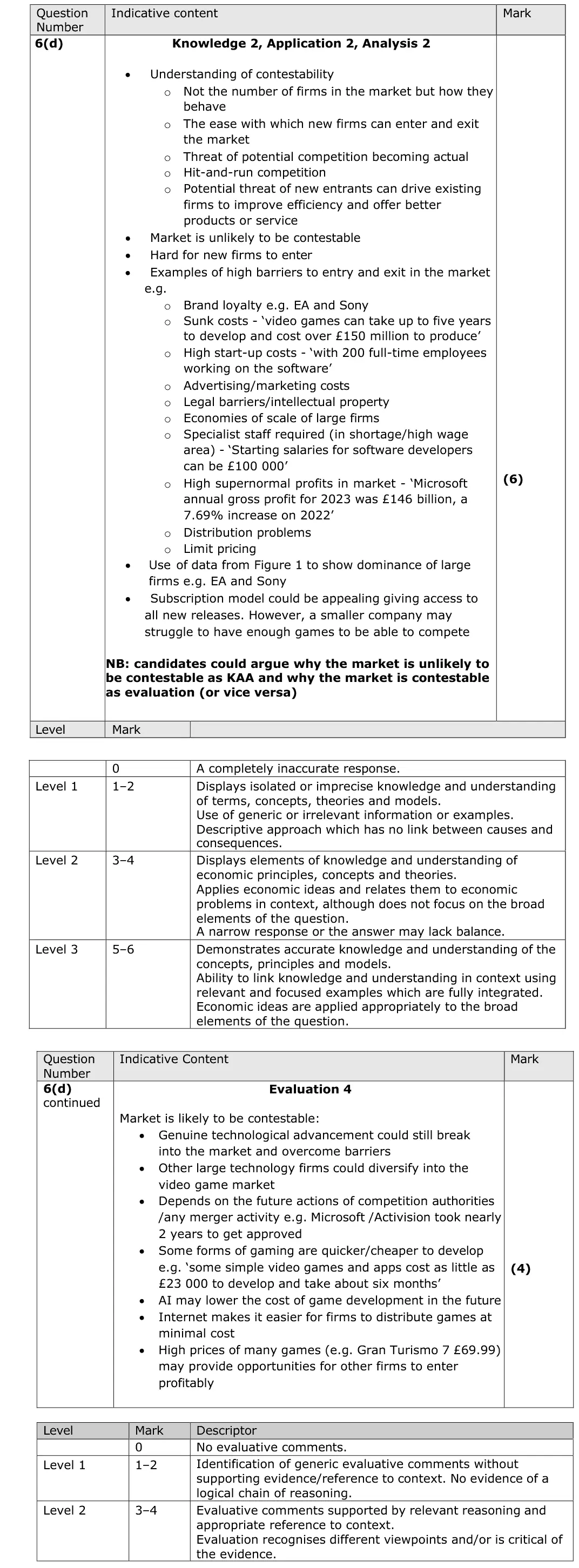
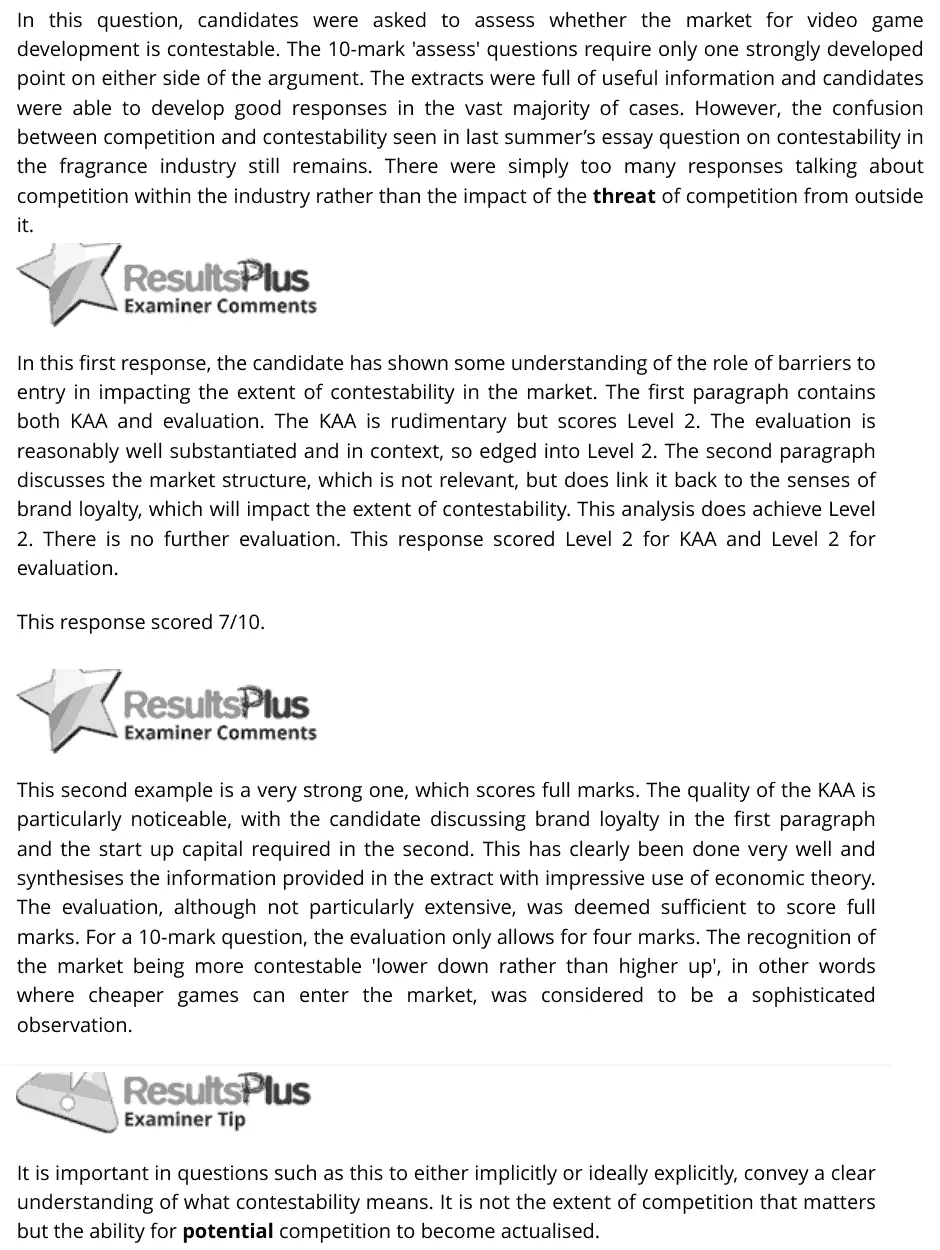
(d) With reference to the information provided, assess whether the market for video game development is contestable. (10)
June 2024 · Paper 1 · Q8 25 marks AO1=4, AO2=4, AO3=8, AO4=9 25-mark essay Either/or Hard
8 Bytedance, which owns TikTok, has launched its own fragrance ‘Emotif’. The Beijing-based social media giant has already entered the food and drink markets. (Source adapted from: https://www.businessoffashion.com/news/china/ tiktoks-parent-company-enters-chinas-perfume-market/) Evaluate the level of contestability in the fragrance industry or another industry of your choice.
June 2023 · Paper 1 · Q5(b) 4 marks AO1=2, AO2=1, AO3=1 Short answer
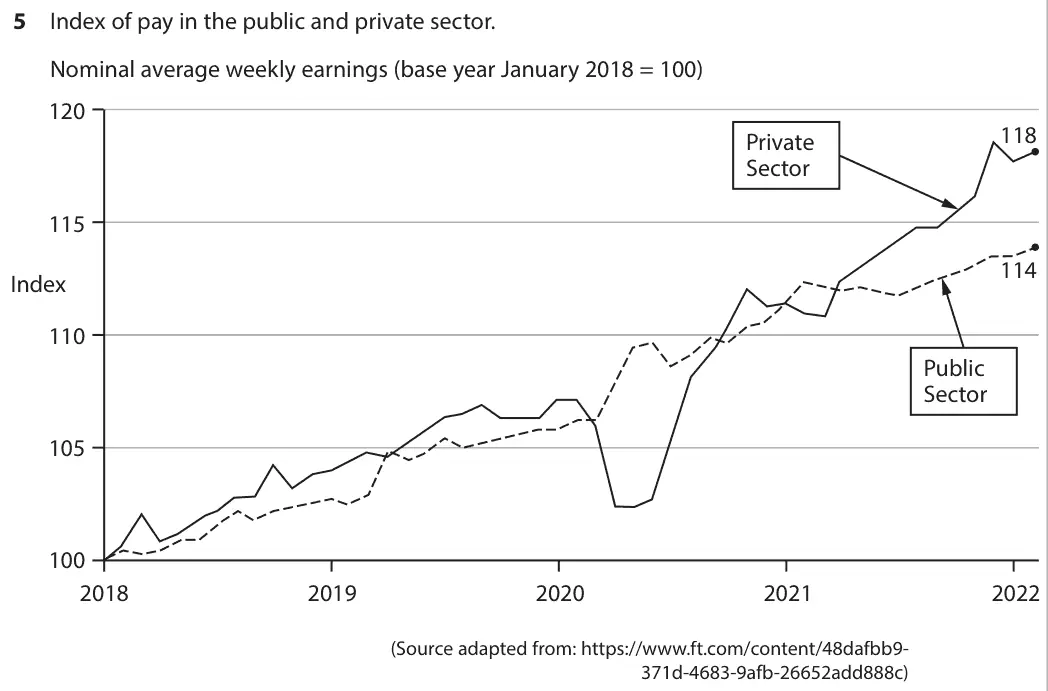
Data and extracts for question 55 Index of pay in the public and private sector. Nominal average weekly earnings (base year January 2018 = 100) 120 118 Private Sector 115 114 Index 110 Public Sector 105 100 2018 2019 2020 2021 2022 (Source adapted from: https://www.ft.com/content/48dafbb9- 371d-4683-9afb-26652add888c)
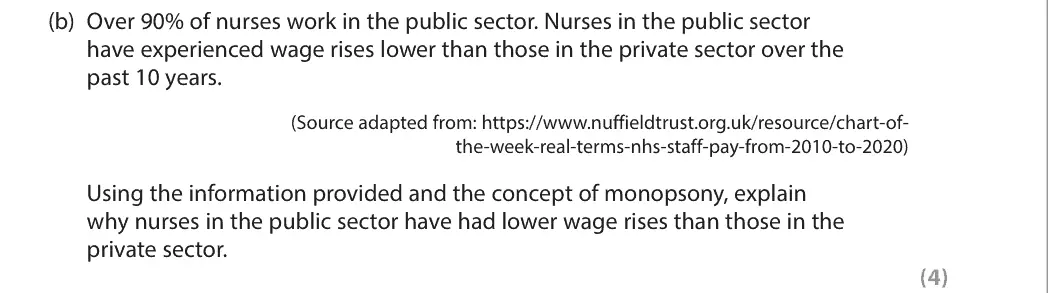
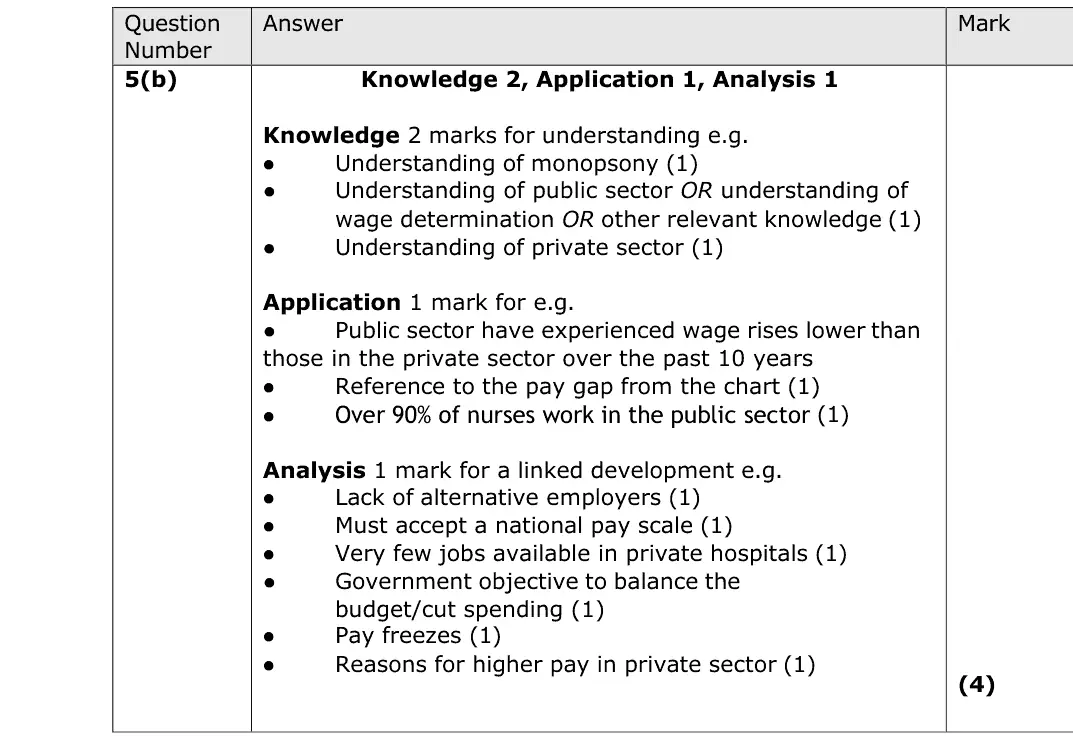
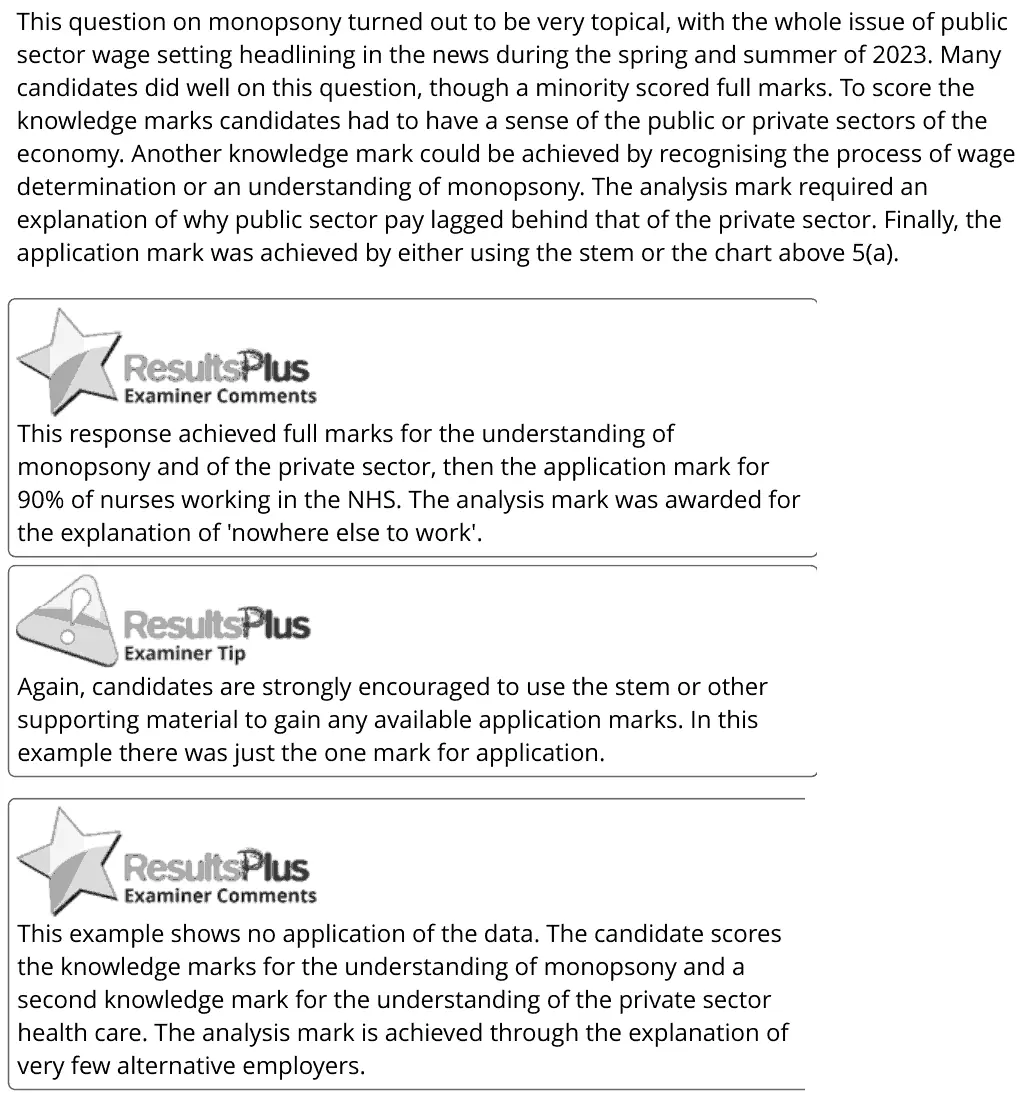
(b) Over 90% of nurses work in the public sector. Nurses in the public sector have experienced wage rises lower than those in the private sector over the past 10 years. (Source adapted from: https://www.nuffieldtrust.org.uk/resource/chart-of- the-week-real-terms-nhs-staff-pay-from-2010-to-2020) Using the information provided and the concept of monopsony, explain why nurses in the public sector have had lower wage rises than those in the private sector. (4)
June 2022 · Paper 1 · Q6(e) 15 marks AO1=3, AO2=3, AO3=3, AO4=6 15-mark response
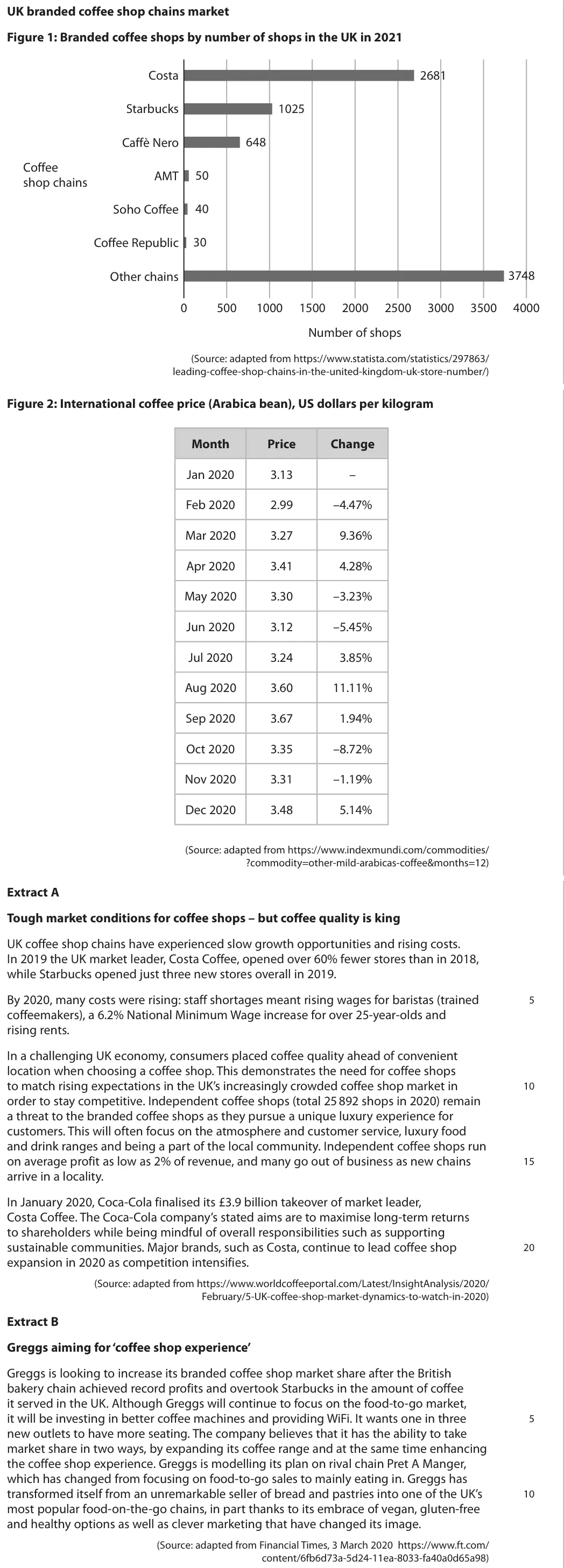
Data and extracts for question 6UK branded coffee shop chains market Figure 1: Branded coffee shops by number of shops in the UK in 2021 Costa 2681 Starbucks 1025 Caffè Nero 648 Coffee 50 AMT shop chains 40 Soho Coffee 30 Coffee Republic 3748 Other chains 0 500 1000 1500 2000 2500 3000 3500 4000 Number of shops (Source: adapted from https://www.statista.com/statistics/297863/ leading-coffee-shop-chains-in-the-united-kingdom-uk-store-number/) Figure 2: International coffee price (Arabica bean), US dollars per kilogram Month Price Change Jan 2020 3.13 – Feb 2020 2.99 –4.47% Mar 2020 3.27 9.36% Apr 2020 3.41 4.28% May 2020 3.30 –3.23% Jun 2020 3.12 –5.45% Jul 2020 3.24 3.85% Aug 2020 3.60 11.11% Sep 2020 3.67 1.94% Oct 2020 3.35 –8.72% Nov 2020 3.31 –1.19% Dec 2020 3.48 5.14% (Source: adapted from https://www.indexmundi.com/commodities/ ?commodity=other-mild-arabicas-coffee&months=12) Extract A Tough market conditions for coffee shops – but coffee quality is king UK coffee shop chains have experienced slow growth opportunities and rising costs. In 2019 the UK market leader, Costa Coffee, opened over 60% fewer stores than in 2018, while Starbucks opened just three new stores overall in 2019. By 2020, many costs were rising: staff shortages meant rising wages for baristas (trained 5 coffeemakers), a 6.2% National Minimum Wage increase for over 25-year-olds and rising rents. In a challenging UK economy, consumers placed coffee quality ahead of convenient location when choosing a coffee shop. This demonstrates the need for coffee shops to match rising expectations in the UK’s increasingly crowded coffee shop market in 10 order to stay competitive. Independent coffee shops (total 25 892 shops in 2020) remain a threat to the branded coffee shops as they pursue a unique luxury experience for customers. This will often focus on the atmosphere and customer service, luxury food and drink ranges and being a part of the local community. Independent coffee shops run on average profit as low as 2% of revenue, and many go out of business as new chains 15 arrive in a locality. In January 2020, Coca-Cola finalised its £3.9 billion takeover of market leader, Costa Coffee. The Coca-Cola company’s stated aims are to maximise long-term returns to shareholders while being mindful of overall responsibilities such as supporting sustainable communities. Major brands, such as Costa, continue to lead coffee shop 20 expansion in 2020 as competition intensifies. (Source: adapted from https://www.worldcoffeeportal.com/Latest/InsightAnalysis/2020/ February/5-UK-coffee-shop-market-dynamics-to-watch-in-2020) Extract B Greggs aiming for ‘coffee shop experience’ Greggs is looking to increase its branded coffee shop market share after the British bakery chain achieved record profits and overtook Starbucks in the amount of coffee it served in the UK. Although Greggs will continue to focus on the food-to-go market, it will be investing in better coffee machines and providing WiFi. It wants one in three 5 new outlets to have more seating. The company believes that it has the ability to take market share in two ways, by expanding its coffee range and at the same time enhancing the coffee shop experience. Greggs is modelling its plan on rival chain Pret A Manger, which has changed from focusing on food-to-go sales to mainly eating in. Greggs has transformed itself from an unremarkable seller of bread and pastries into one of the UK’s 10 most popular food-on-the-go chains, in part thanks to its embrace of vegan, gluten-free and healthy options as well as clever marketing that have changed its image. (Source: adapted from Financial Times, 3 March 2020 https://www.ft.com/ content/6fb6d73a-5d24-11ea-8033-fa40a0d65a98)
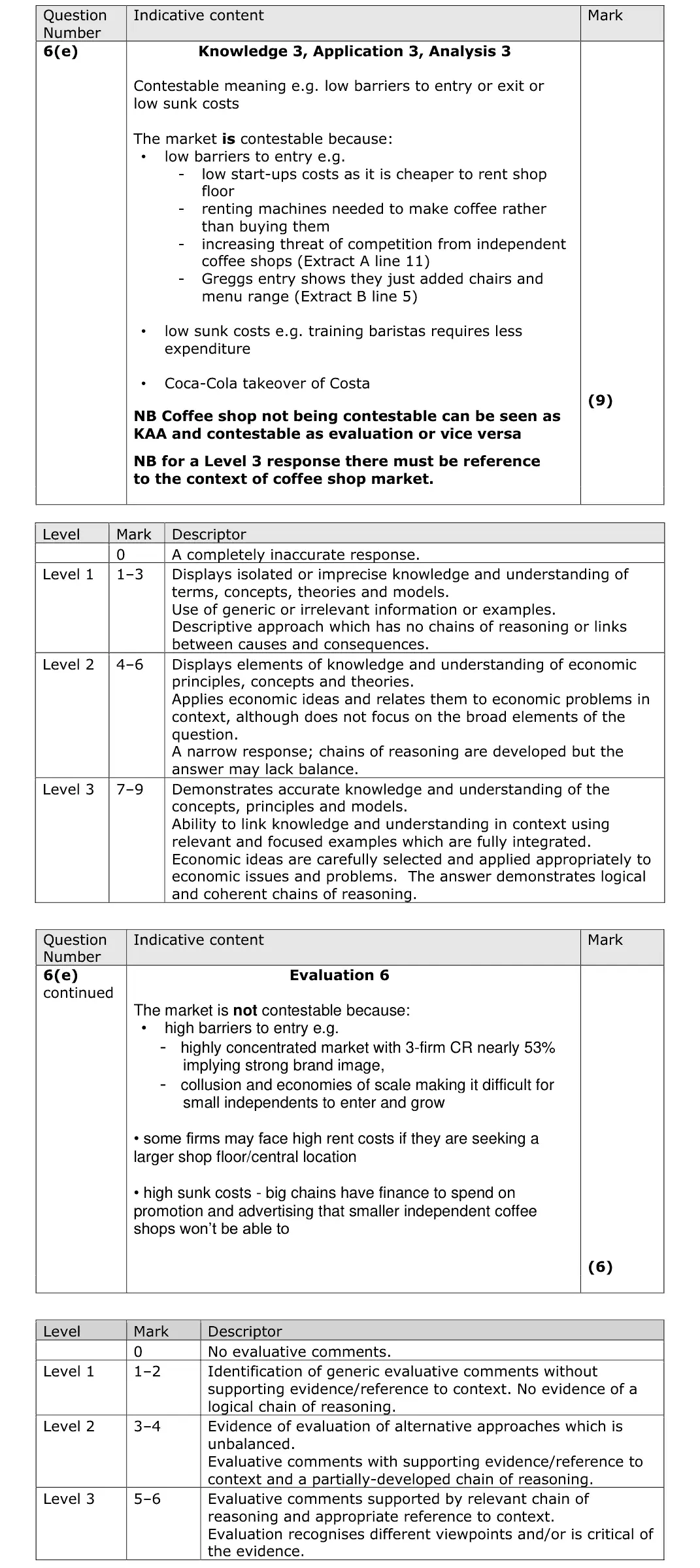
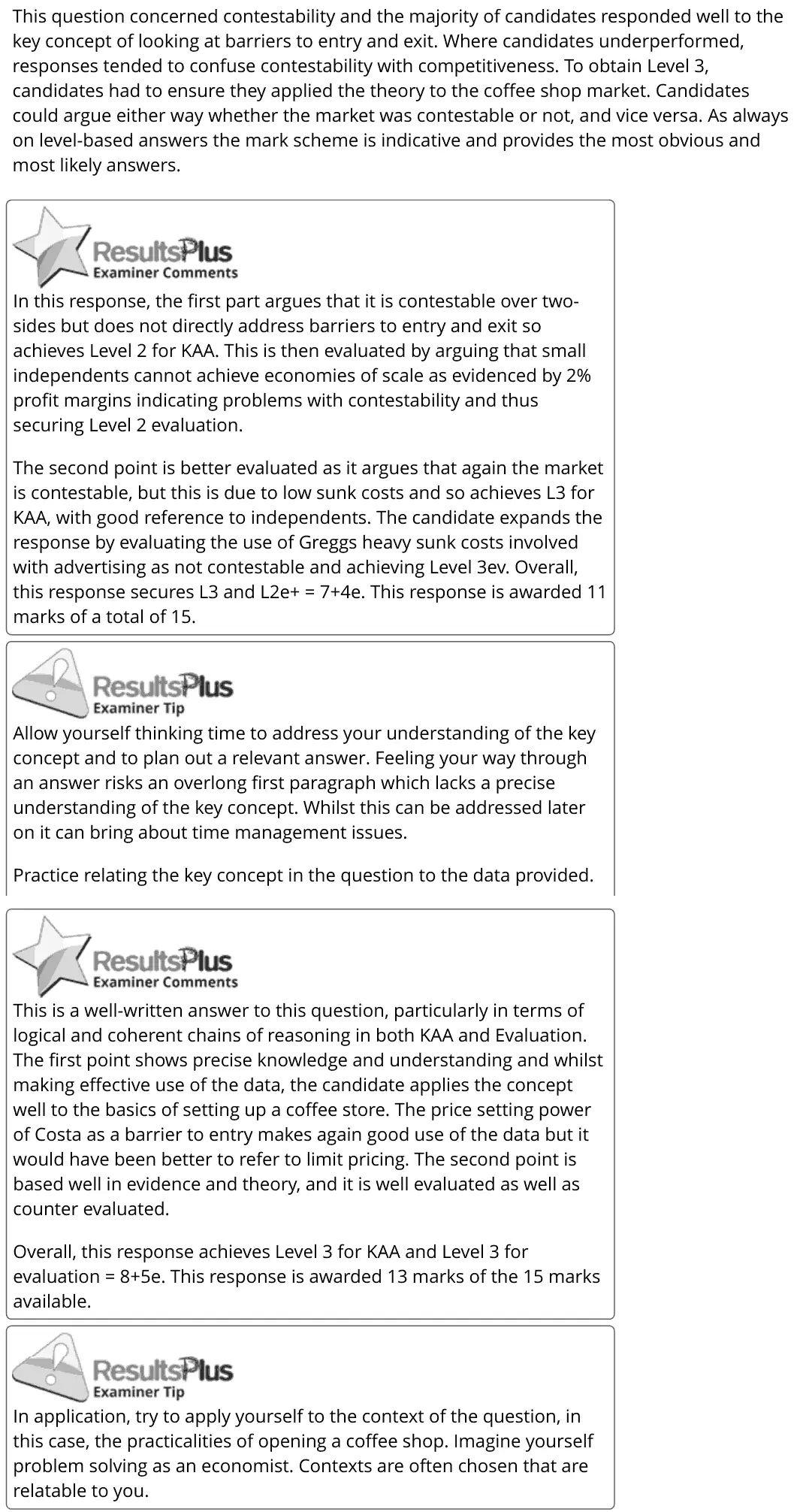
(e) With reference to the information provided, discuss whether the coffee shop market is contestable. (15)
November 2021 · Paper 3 · Q1(d) 25 marks AO1=4, AO2=4, AO3=8, AO4=9 25-mark essay Either/or
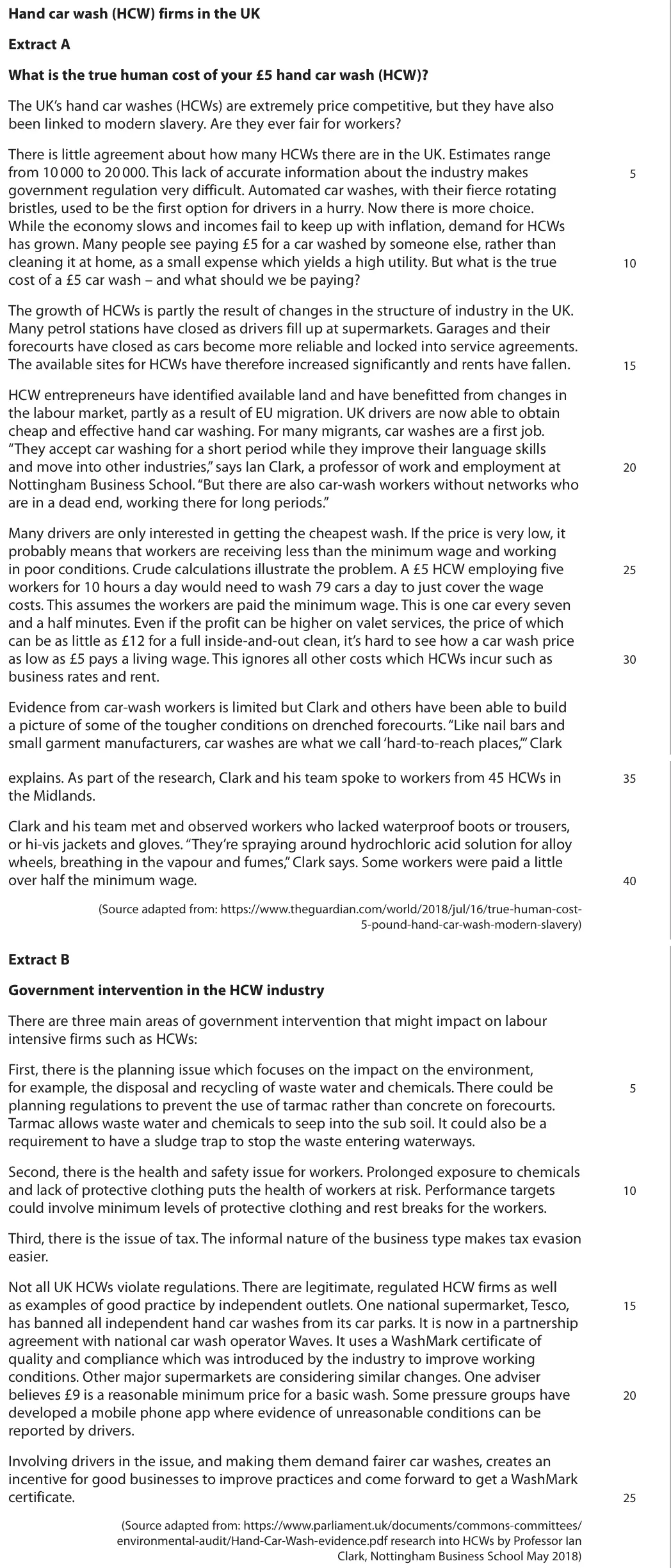
Data and extracts for question 1Hand car wash (HCW) firms in the UK Extract A What is the true human cost of your £5 hand car wash (HCW)? The UK’s hand car washes (HCWs) are extremely price competitive, but they have also been linked to modern slavery. Are they ever fair for workers? There is little agreement about how many HCWs there are in the UK. Estimates range from 10 000 to 20 000. This lack of accurate information about the industry makes 5 government regulation very difficult. Automated car washes, with their fierce rotating bristles, used to be the first option for drivers in a hurry. Now there is more choice. While the economy slows and incomes fail to keep up with inflation, demand for HCWs has grown. Many people see paying £5 for a car washed by someone else, rather than cleaning it at home, as a small expense which yields a high utility. But what is the true 10 cost of a £5 car wash – and what should we be paying? The growth of HCWs is partly the result of changes in the structure of industry in the UK. Many petrol stations have closed as drivers fill up at supermarkets. Garages and their forecourts have closed as cars become more reliable and locked into service agreements. The available sites for HCWs have therefore increased significantly and rents have fallen. 15 HCW entrepreneurs have identified available land and have benefitted from changes in the labour market, partly as a result of EU migration. UK drivers are now able to obtain cheap and effective hand car washing. For many migrants, car washes are a first job. “They accept car washing for a short period while they improve their language skills and move into other industries,” says Ian Clark, a professor of work and employment at 20 Nottingham Business School. “But there are also car-wash workers without networks who are in a dead end, working there for long periods.” Many drivers are only interested in getting the cheapest wash. If the price is very low, it probably means that workers are receiving less than the minimum wage and working in poor conditions. Crude calculations illustrate the problem. A £5 HCW employing five 25 workers for 10 hours a day would need to wash 79 cars a day to just cover the wage costs. This assumes the workers are paid the minimum wage. This is one car every seven and a half minutes. Even if the profit can be higher on valet services, the price of which can be as little as £12 for a full inside-and-out clean, it’s hard to see how a car wash price as low as £5 pays a living wage. This ignores all other costs which HCWs incur such as 30 business rates and rent. Evidence from car-wash workers is limited but Clark and others have been able to build a picture of some of the tougher conditions on drenched forecourts. “Like nail bars and small garment manufacturers, car washes are what we call ‘hard-to-reach places,’” Clark explains. As part of the research, Clark and his team spoke to workers from 45 HCWs in 35 the Midlands. Clark and his team met and observed workers who lacked waterproof boots or trousers, or hi-vis jackets and gloves. “They’re spraying around hydrochloric acid solution for alloy wheels, breathing in the vapour and fumes,” Clark says. Some workers were paid a little over half the minimum wage. 40 (Source adapted from: https://www.theguardian.com/world/2018/jul/16/true-human-cost- 5-pound-hand-car-wash-modern-slavery) Extract B Government intervention in the HCW industry There are three main areas of government intervention that might impact on labour intensive firms such as HCWs: First, there is the planning issue which focuses on the impact on the environment, for example, the disposal and recycling of waste water and chemicals. There could be 5 planning regulations to prevent the use of tarmac rather than concrete on forecourts. Tarmac allows waste water and chemicals to seep into the sub soil. It could also be a requirement to have a sludge trap to stop the waste entering waterways. Second, there is the health and safety issue for workers. Prolonged exposure to chemicals and lack of protective clothing puts the health of workers at risk. Performance targets 10 could involve minimum levels of protective clothing and rest breaks for the workers. Third, there is the issue of tax. The informal nature of the business type makes tax evasion easier. Not all UK HCWs violate regulations. There are legitimate, regulated HCW firms as well as examples of good practice by independent outlets. One national supermarket, Tesco, 15 has banned all independent hand car washes from its car parks. It is now in a partnership agreement with national car wash operator Waves. It uses a WashMark certificate of quality and compliance which was introduced by the industry to improve working conditions. Other major supermarkets are considering similar changes. One adviser believes £9 is a reasonable minimum price for a basic wash. Some pressure groups have 20 developed a mobile phone app where evidence of unreasonable conditions can be reported by drivers. Involving drivers in the issue, and making them demand fairer car washes, creates an incentive for good businesses to improve practices and come forward to get a WashMark certificate. 25 (Source adapted from: https://www.parliament.uk/documents/commons-committees/ environmental-audit/Hand-Car-Wash-evidence.pdf research into HCWs by Professor Ian Clark, Nottingham Business School May 2018)
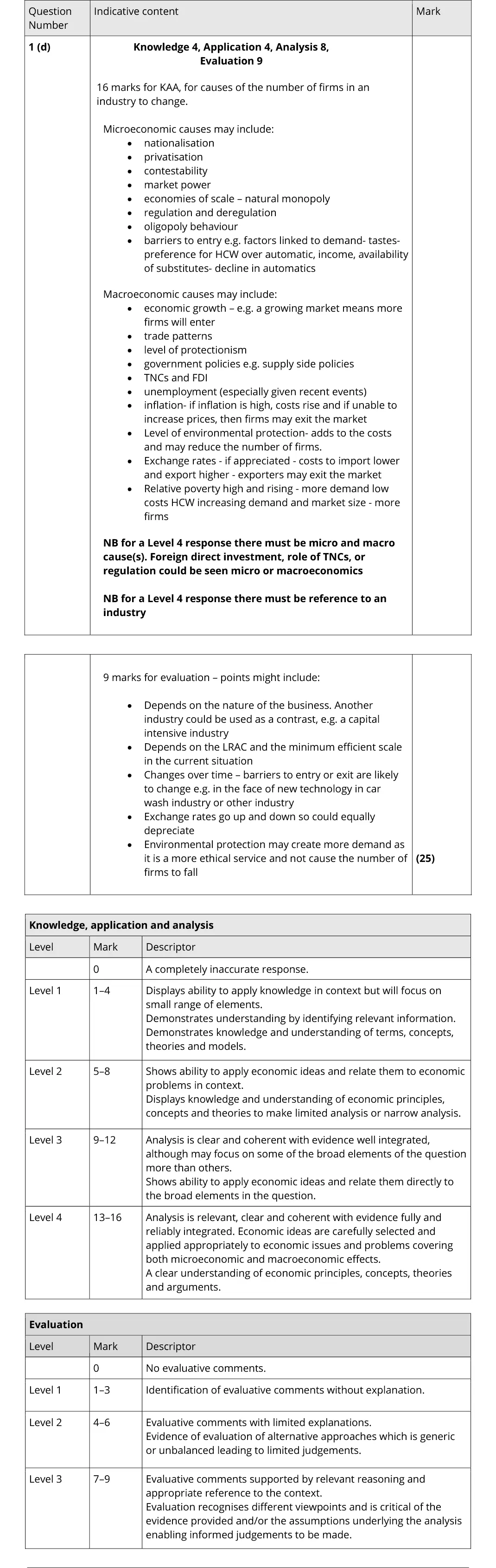
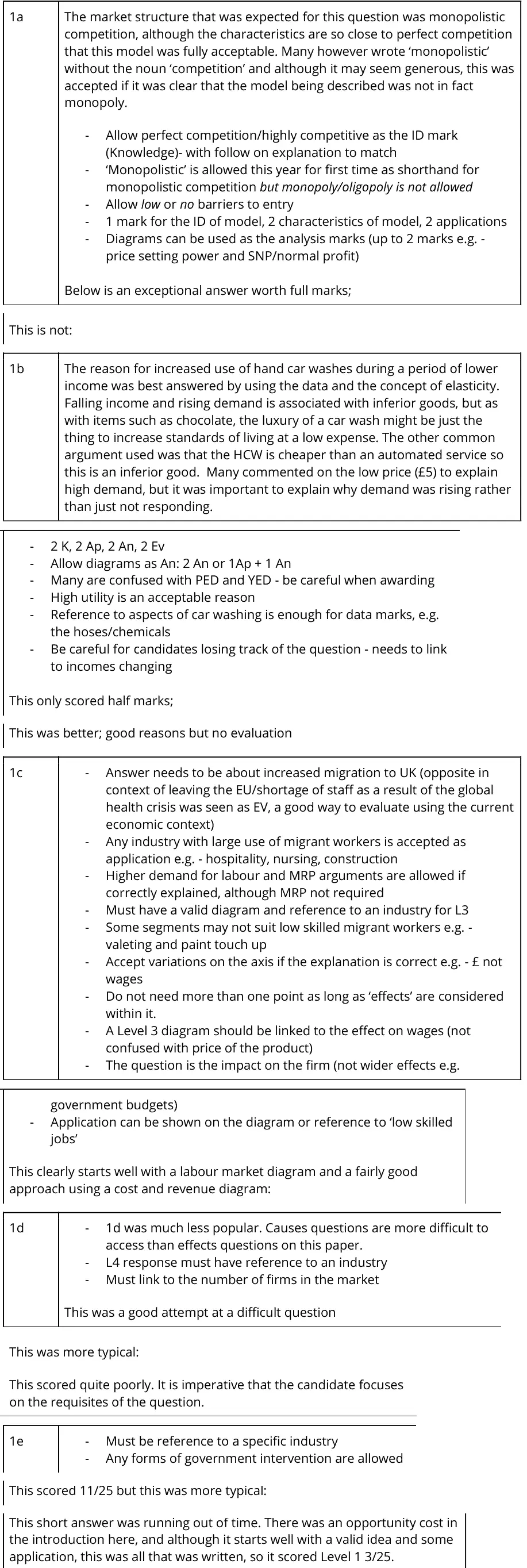
(d) Evaluate the microeconomic and macroeconomic factors which determine the number of firms in an industry. Refer to HCWs or another industry of your choice. (25)
October 2020 · Paper 1 · Q8 25 marks AO1=4, AO2=4, AO3=8, AO4=9 25-mark essay Either/or
8 ‘Amazon.com, the giant online retailer, has too much power.’ It uses its market power to put a squeeze on publishers, in effect driving down the prices it pays for books. If a publisher refuses, Amazon may take action by ‘delaying their delivery, raising their prices, and steering customers to other publishers’. (Source adapted from: https://www.nytimes.com) Evaluate the likely costs of a monopsony operating in a market such as book retailing.
June 2017 · Paper 1 · Q4(b) 1 mark Multiple choice
Data and extracts for question 44 In 2015 JCB, the construction equipment manufacturer, experienced a 6% fall in revenue. This resulted from a reduction in sales of construction equipment to emerging markets.
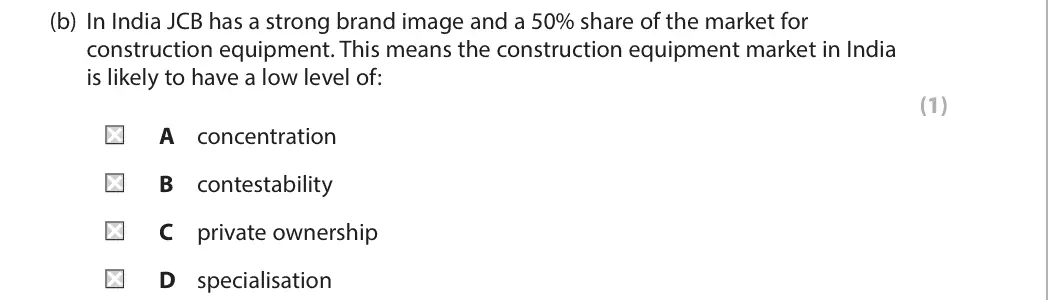
(b) In India JCB has a strong brand image and a 50% share of the market for construction equipment. This means the construction equipment market in India is likely to have a low level of: (1) A concentration B contestability C private ownership D specialisation
June 2017 · Paper 1 · Q6(b) 12 marks AO1=2, AO2=2, AO3=4, AO4=4 12-mark response
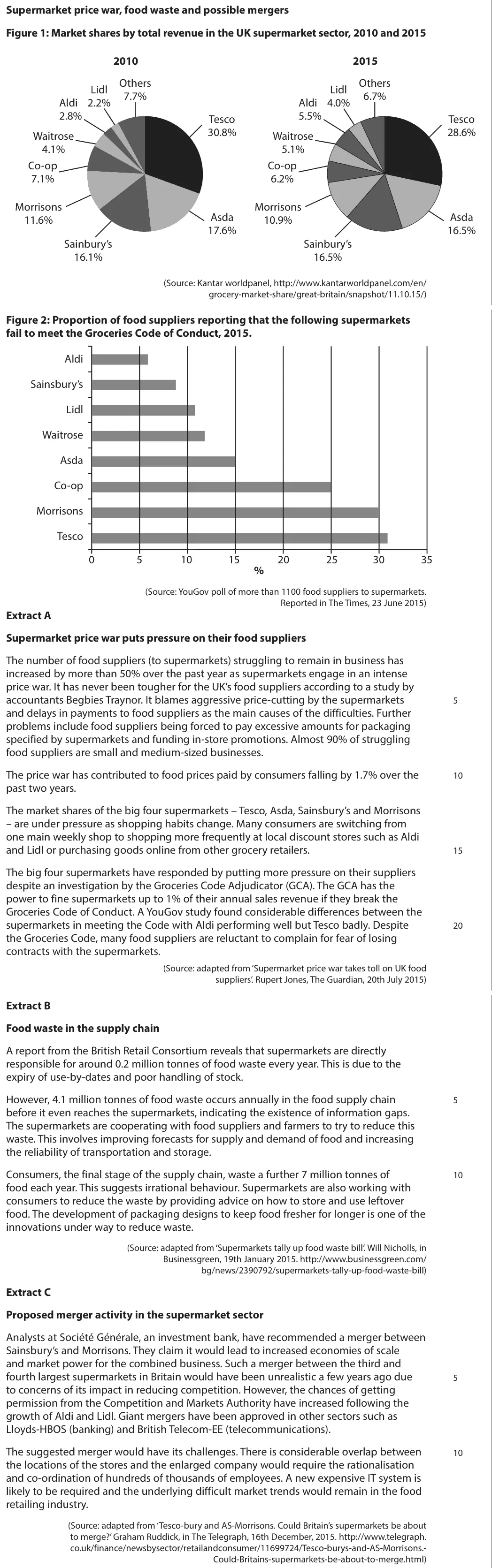
Data and extracts for question 6Supermarket price war, food waste and possible mergers Figure 1: Market shares by total revenue in the UK supermarket sector, 2010 and 2015 2010 2015 Others Others Lidl Lidl 7.7% 6.7% Aldi 2.2% Aldi 4.0% 2.8% 5.5% Tesco Tesco 30.8% 28.6% Waitrose Waitrose 4.1% 5.1% Co-op Co-op 7.1% 6.2% Morrisons Morrisons Asda Asda 11.6% 10.9% 17.6% 16.5% Sainbury’s Sainbury’s 16.1% 16.5% (Source: Kantar worldpanel, http://www.kantarworldpanel.com/en/ grocery-market-share/great-britain/snapshot/11.10.15/) Figure 2: Proportion of food suppliers reporting that the following supermarkets fail to meet the Groceries Code of Conduct, 2015. Aldi Sainsbury’s Lidl Waitrose Asda Co-op Morrisons Tesco 0 5 10 15 20 25 30 35 % (Source: YouGov poll of more than 1100 food suppliers to supermarkets. Reported in The Times, 23 June 2015) Extract A Supermarket price war puts pressure on their food suppliers The number of food suppliers (to supermarkets) struggling to remain in business has increased by more than 50% over the past year as supermarkets engage in an intense price war. It has never been tougher for the UK’s food suppliers according to a study by accountants Begbies Traynor. It blames aggressive price-cutting by the supermarkets 5 and delays in payments to food suppliers as the main causes of the difficulties. Further problems include food suppliers being forced to pay excessive amounts for packaging specified by supermarkets and funding in-store promotions. Almost 90% of struggling food suppliers are small and medium-sized businesses. The price war has contributed to food prices paid by consumers falling by 1.7% over the 10 past two years. The market shares of the big four supermarkets – Tesco, Asda, Sainsbury’s and Morrisons – are under pressure as shopping habits change. Many consumers are switching from one main weekly shop to shopping more frequently at local discount stores such as Aldi and Lidl or purchasing goods online from other grocery retailers. 15 The big four supermarkets have responded by putting more pressure on their suppliers despite an investigation by the Groceries Code Adjudicator (GCA). The GCA has the power to fine supermarkets up to 1% of their annual sales revenue if they break the Groceries Code of Conduct. A YouGov study found considerable differences between the supermarkets in meeting the Code with Aldi performing well but Tesco badly. Despite 20 the Groceries Code, many food suppliers are reluctant to complain for fear of losing contracts with the supermarkets. (Source: adapted from ‘Supermarket price war takes toll on UK food suppliers’. Rupert Jones, The Guardian, 20th July 2015) Extract B Food waste in the supply chain A report from the British Retail Consortium reveals that supermarkets are directly responsible for around 0.2 million tonnes of food waste every year. This is due to the expiry of use-by-dates and poor handling of stock. However, 4.1 million tonnes of food waste occurs annually in the food supply chain 5 before it even reaches the supermarkets, indicating the existence of information gaps. The supermarkets are cooperating with food suppliers and farmers to try to reduce this waste. This involves improving forecasts for supply and demand of food and increasing the reliability of transportation and storage. Consumers, the final stage of the supply chain, waste a further 7 million tonnes of 10 food each year. This suggests irrational behaviour. Supermarkets are also working with consumers to reduce the waste by providing advice on how to store and use leftover food. The development of packaging designs to keep food fresher for longer is one of the innovations under way to reduce waste. (Source: adapted from ‘Supermarkets tally up food waste bill’. Will Nicholls, in Businessgreen, 19th January 2015. http://www.businessgreen.com/ bg/news/2390792/supermarkets-tally-up-food-waste-bill) Extract C Proposed merger activity in the supermarket sector Analysts at Société Générale, an investment bank, have recommended a merger between Sainsbury’s and Morrisons. They claim it would lead to increased economies of scale and market power for the combined business. Such a merger between the third and fourth largest supermarkets in Britain would have been unrealistic a few years ago due 5 to concerns of its impact in reducing competition. However, the chances of getting permission from the Competition and Markets Authority have increased following the growth of Aldi and Lidl. Giant mergers have been approved in other sectors such as Lloyds-HBOS (banking) and British Telecom-EE (telecommunications). The suggested merger would have its challenges. There is considerable overlap between 10 the locations of the stores and the enlarged company would require the rationalisation and co-ordination of hundreds of thousands of employees. A new expensive IT system is likely to be required and the underlying difficult market trends would remain in the food retailing industry. (Source: adapted from ‘Tesco-bury and AS-Morrisons. Could Britain’s supermarkets be about to merge?’ Graham Ruddick, in The Telegraph, 16th December, 2015. http://www.telegraph. co.uk/finance/newsbysector/retailandconsumer/11699724/Tesco-burys-and-AS-Morrisons.- Could-Britains-supermarkets-be-about-to-merge.html)
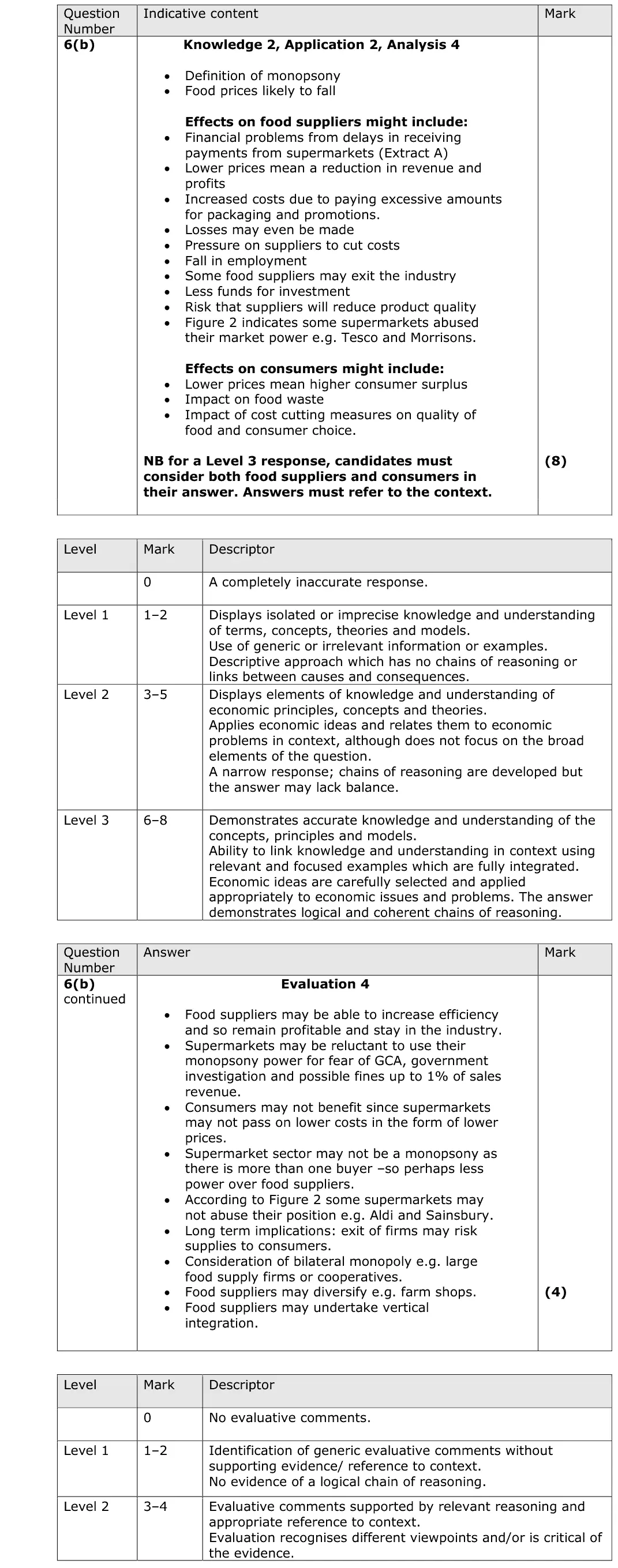
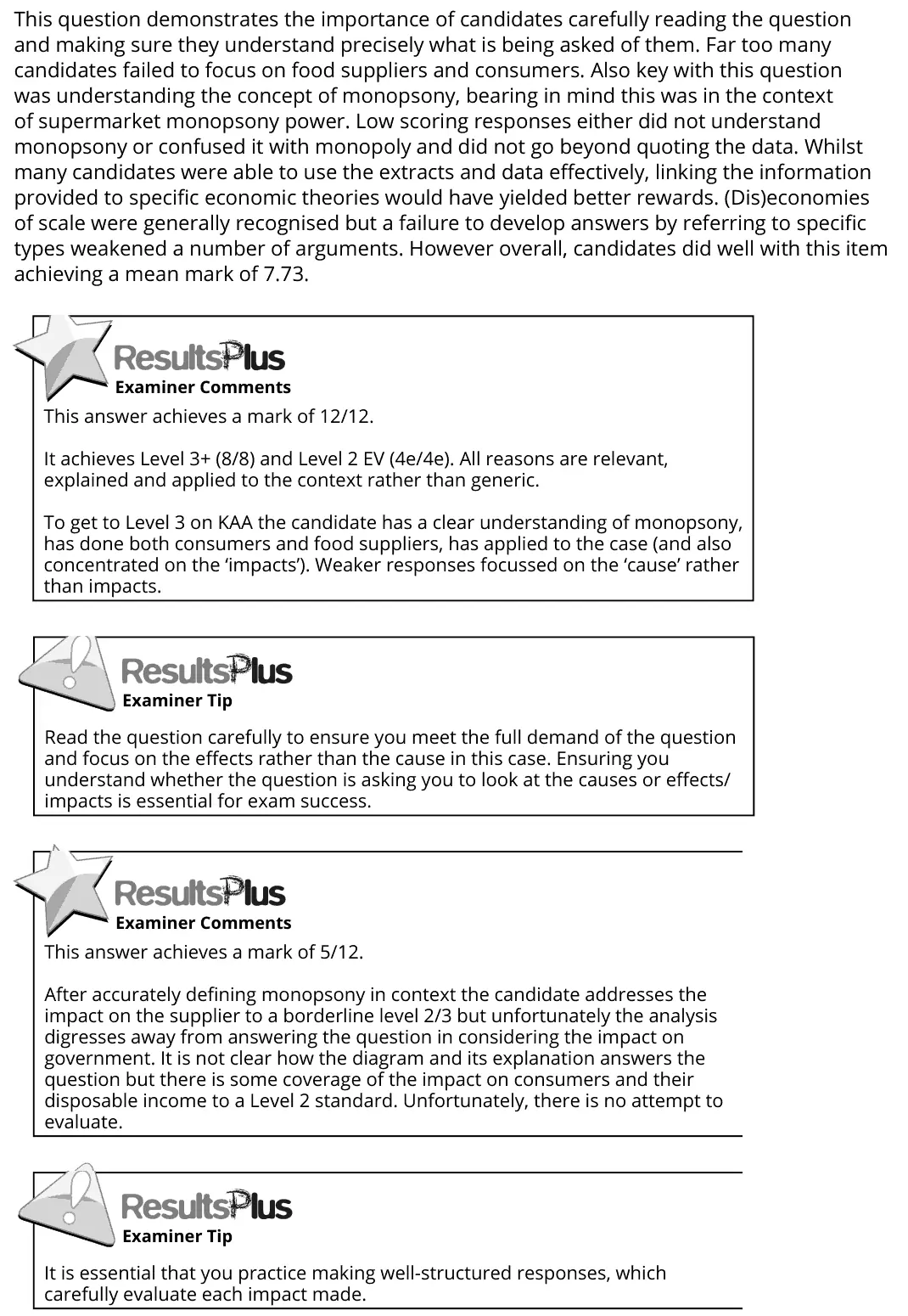
(b) With reference to Figure 2 and Extract A, discuss the possible impact of supermarket monopsony power on both food suppliers and consumers. (12)

Work with an Edexcel economics tutor

Essays stuck in Level 2, or losing the easy marks in Section A? Book a trial session with Lianne, a former Edexcel examiner.

Prefer email? Send an enquiry

If you are under 18, please include a parent's contact details. Enquiries go to enquiries@economicsaleveltutor.com and are deleted once handled. All tutoring is online.