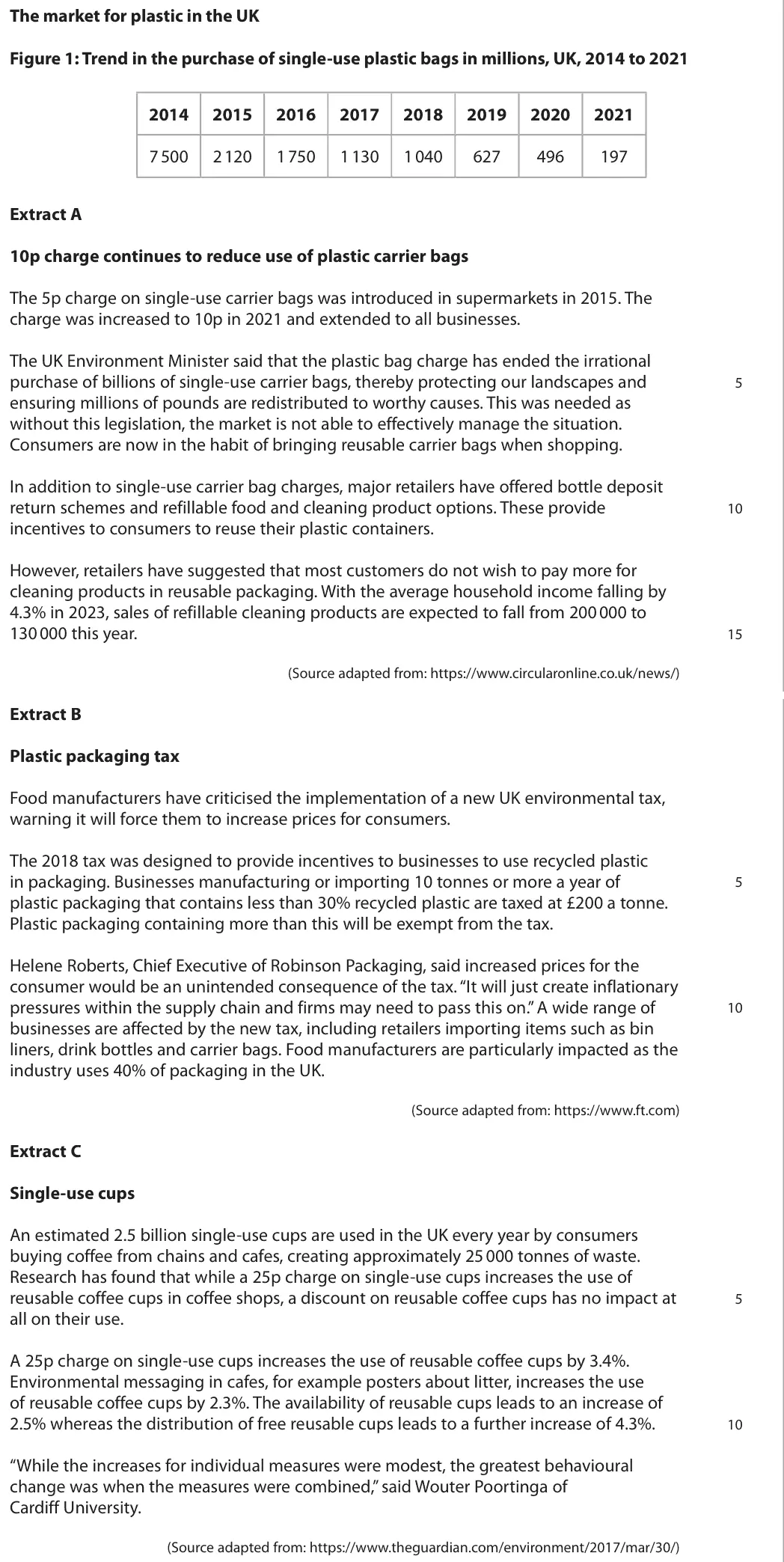
Data and extracts for question 4

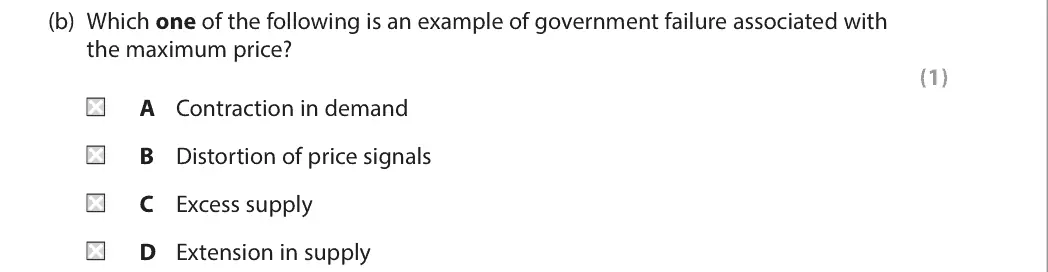
Answer
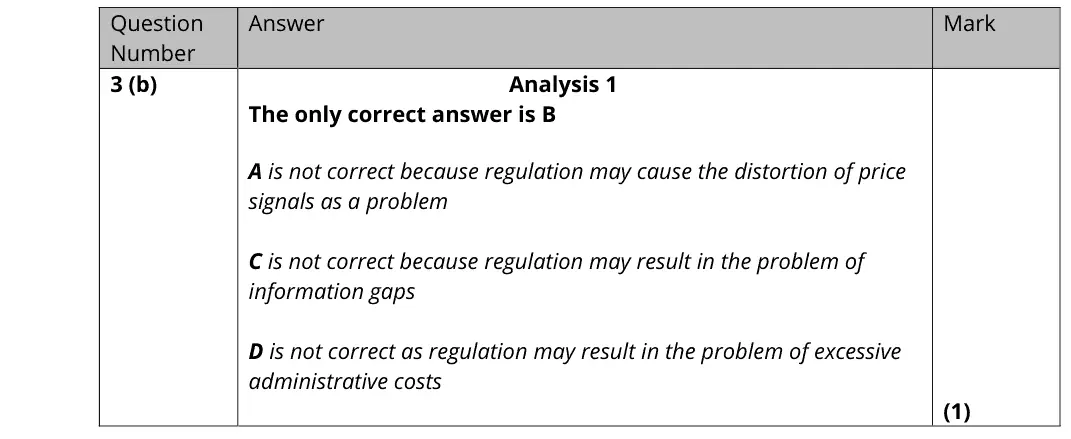
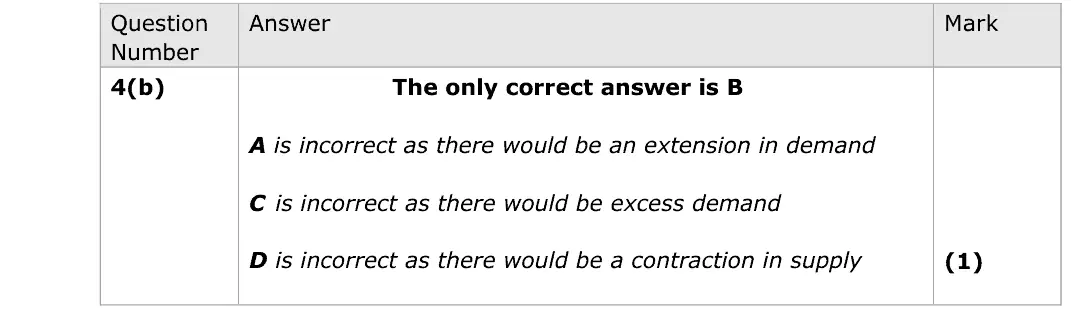
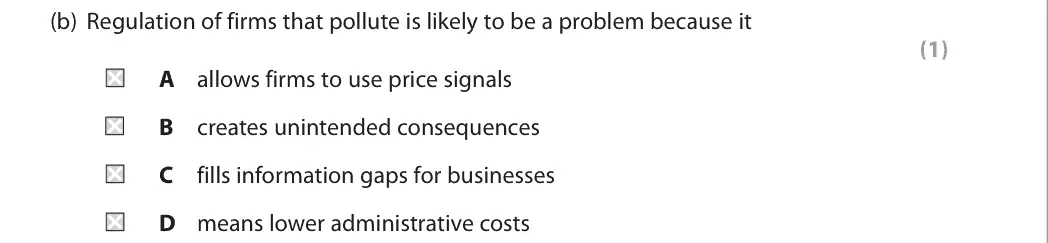
B
Mark scheme
Notes from the mark scheme and report
- distortion of price signals (B) is a cause of government failure
- a maximum price gives excess demand, not excess supply
Notes and key-term cards for this topic are being written by our tutors. The past-paper questions below are ready now.
| Series | Paper | Q | Marks | Title |
|---|---|---|---|---|
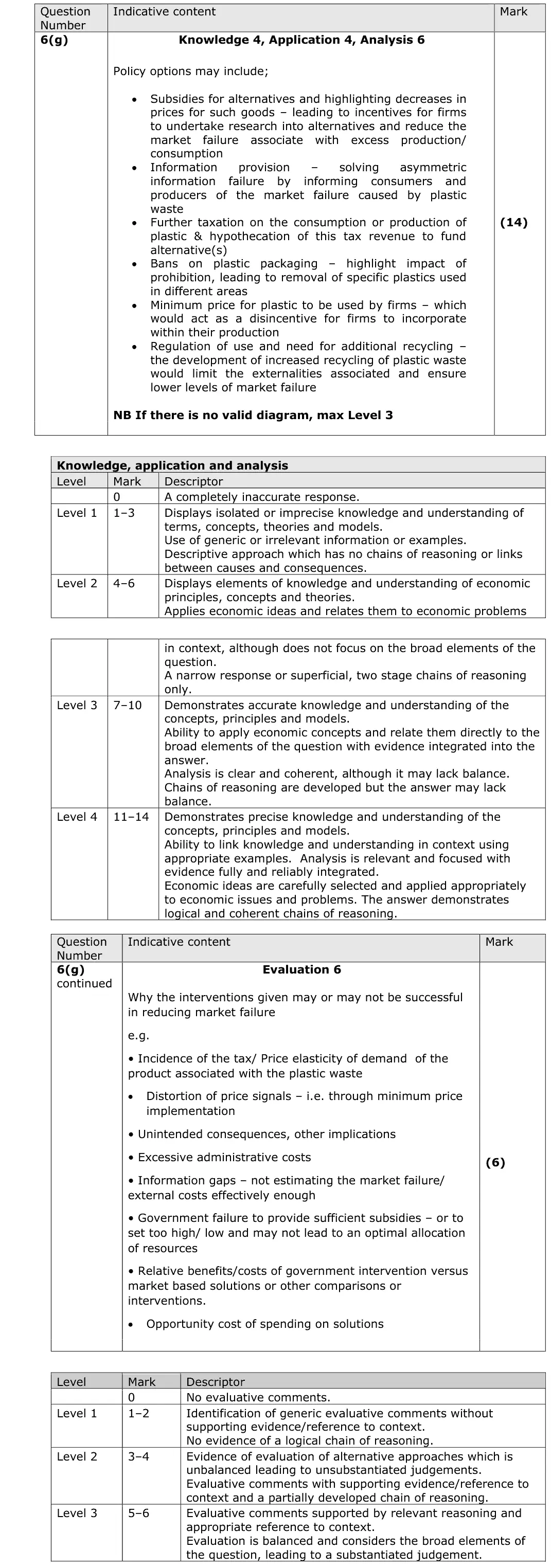
| June 2024 | AS Paper 1 | 6(g) | 20 | Evaluate methods of government intervention which could be used to reduce the market failure associated with plastic waste. Use a diagram to support your answer. |
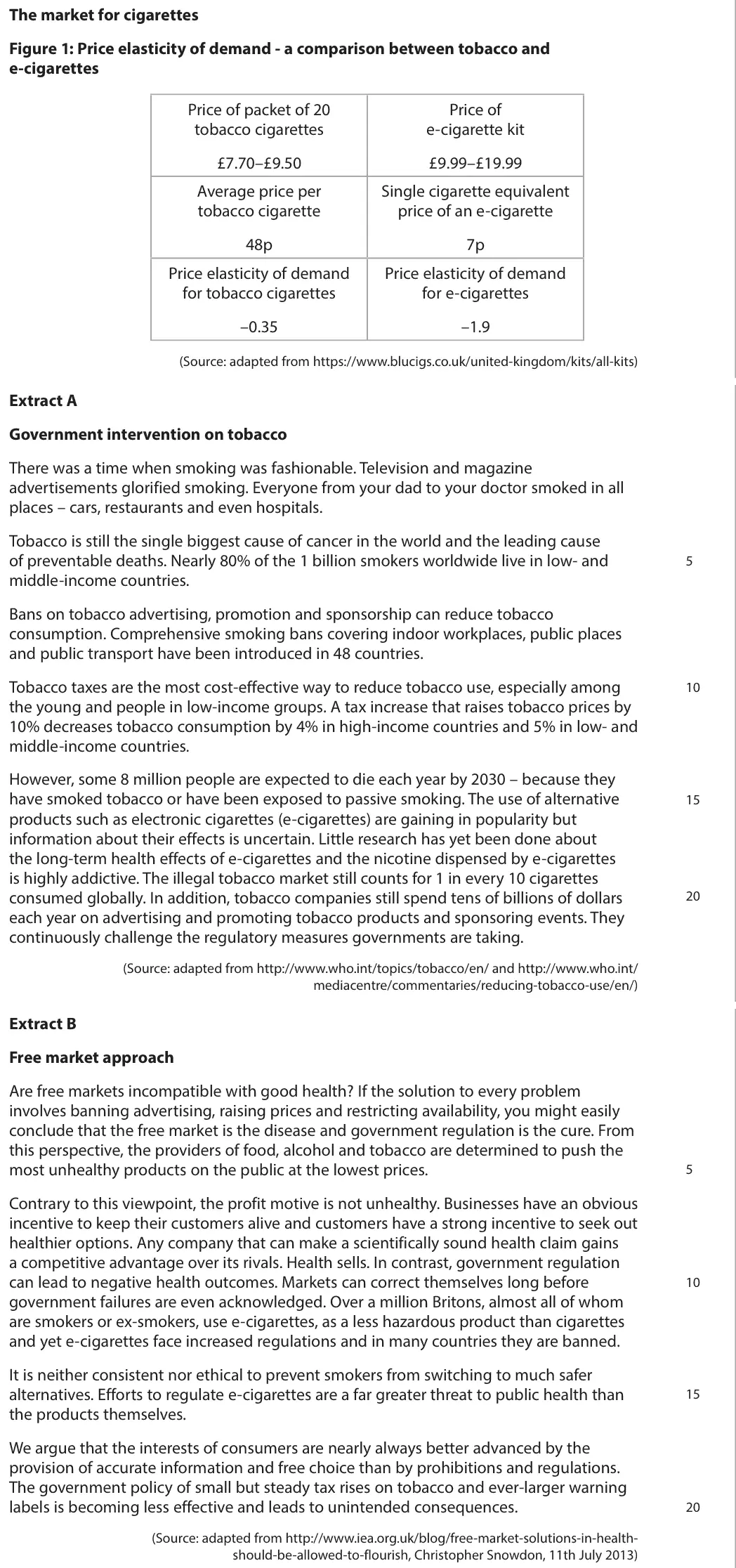
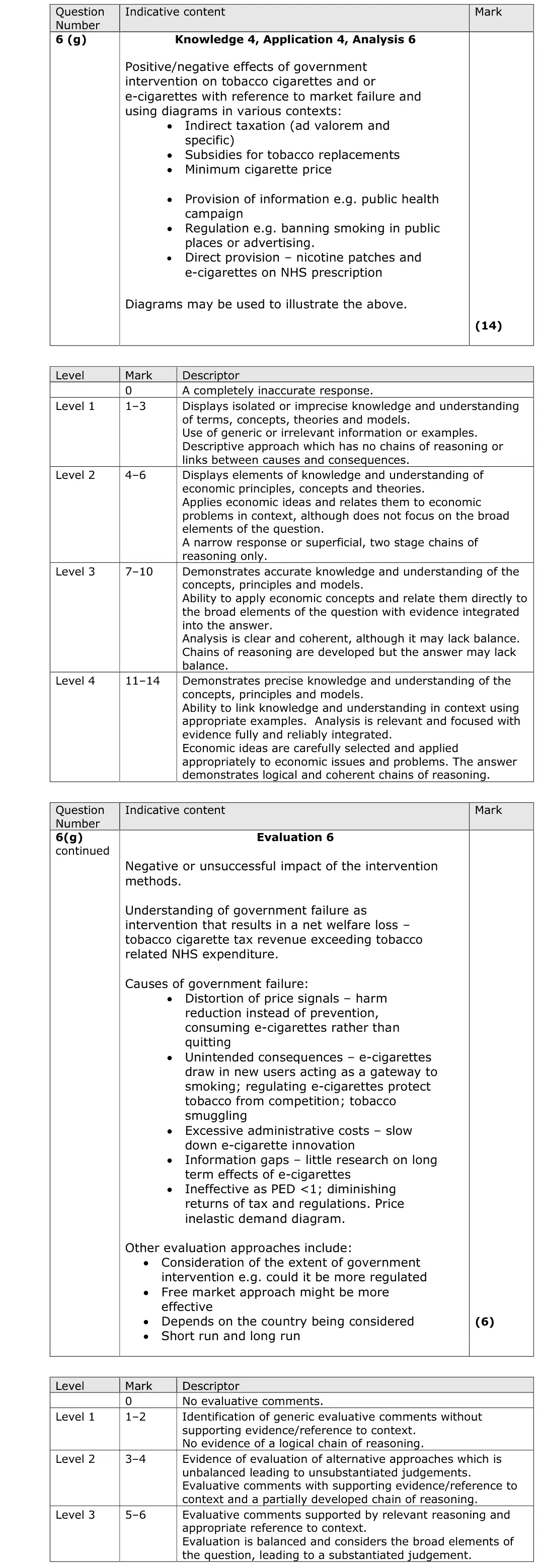
| June 2017 | AS Paper 1 | 6(g) | 20 | Evaluate the impact of government intervention in the cigarette market. |
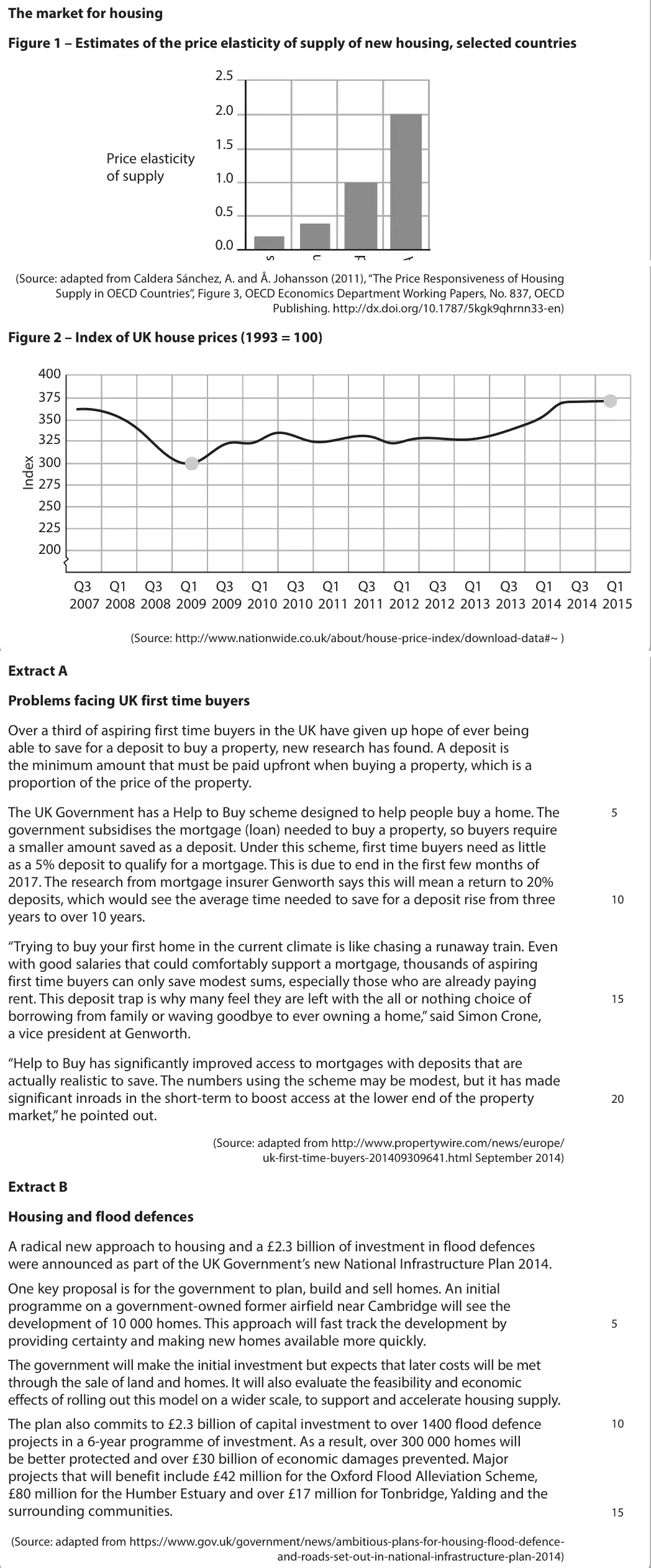
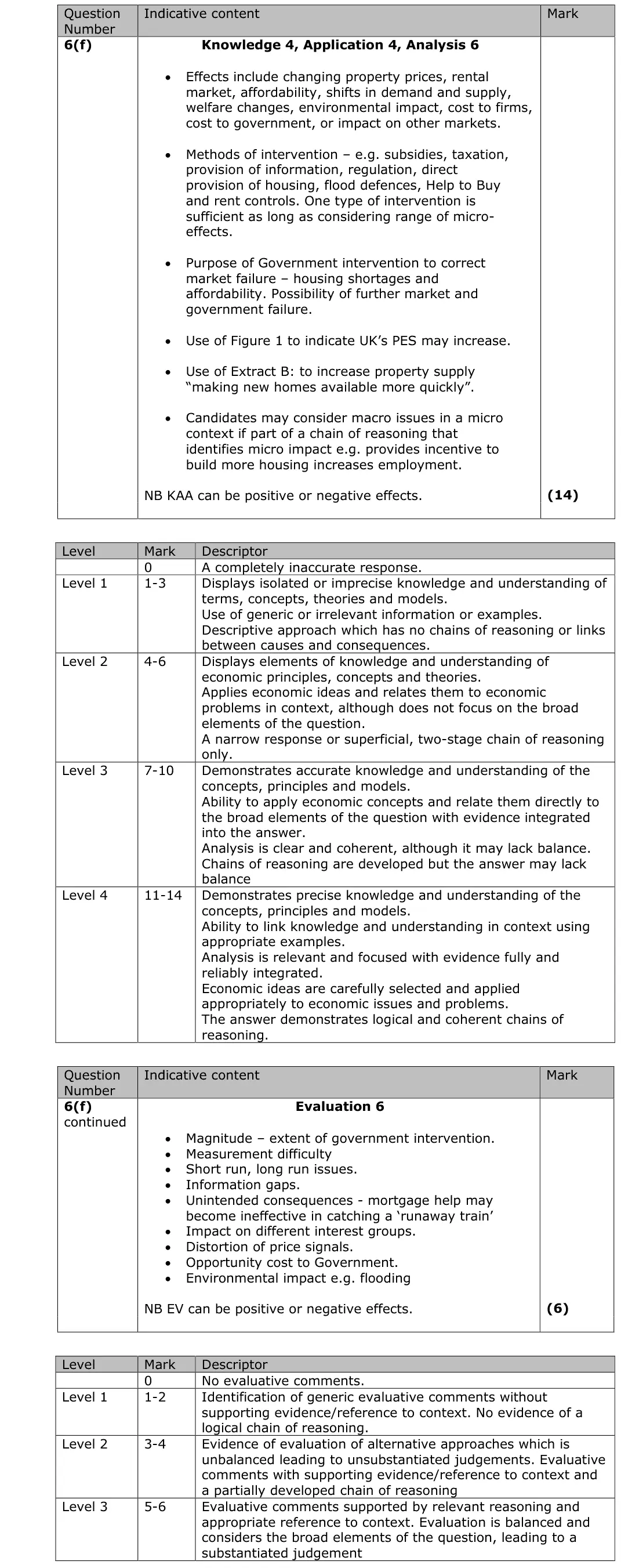
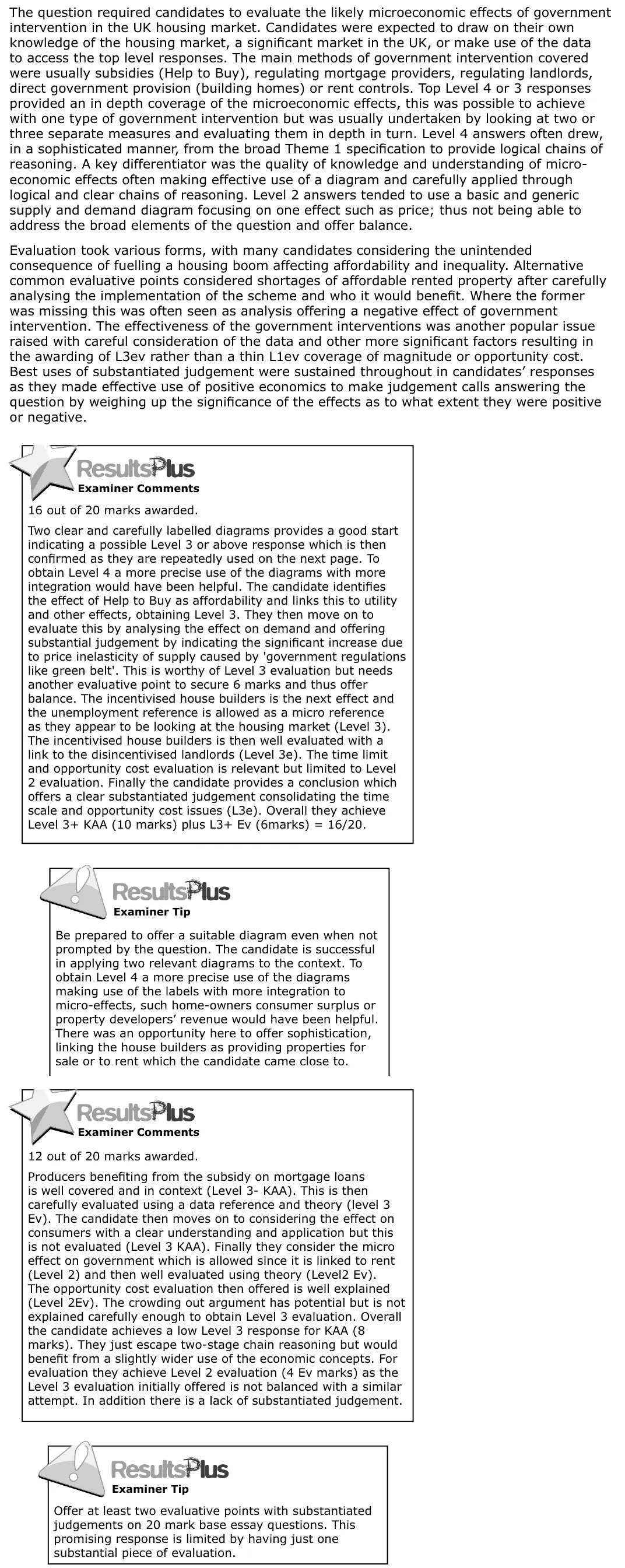
| June 2016 | AS Paper 1 | 6(f) | 20 | Evaluate the likely microeconomic effects of government intervention in the UK housing market. |
B

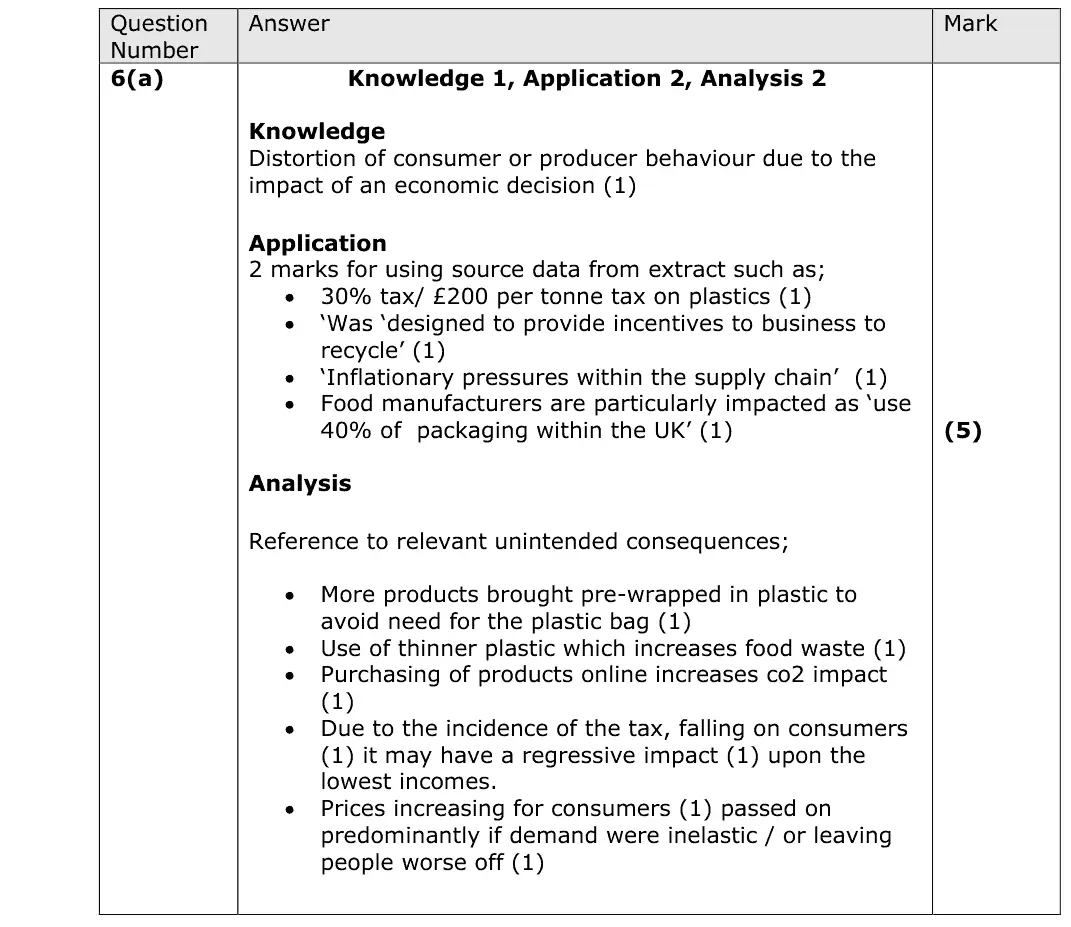
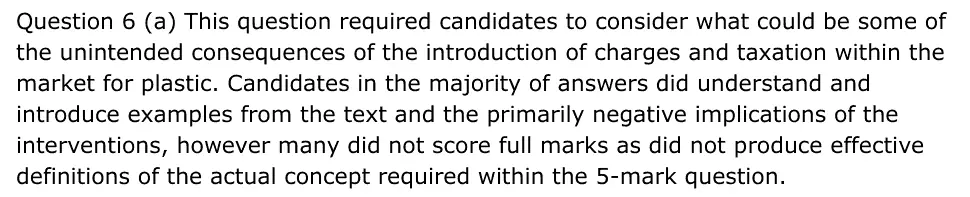
Question 6 (a) This question required candidates to consider what could be some of the unintended consequences of the introduction of charges and taxation within the market for plastic. Candidates in the majority of answers did understand and introduce examples from the text and the primarily negative implications of the interventions, however many did not score full marks as did not produce effective definitions of the actual concept required within the 5-mark question.

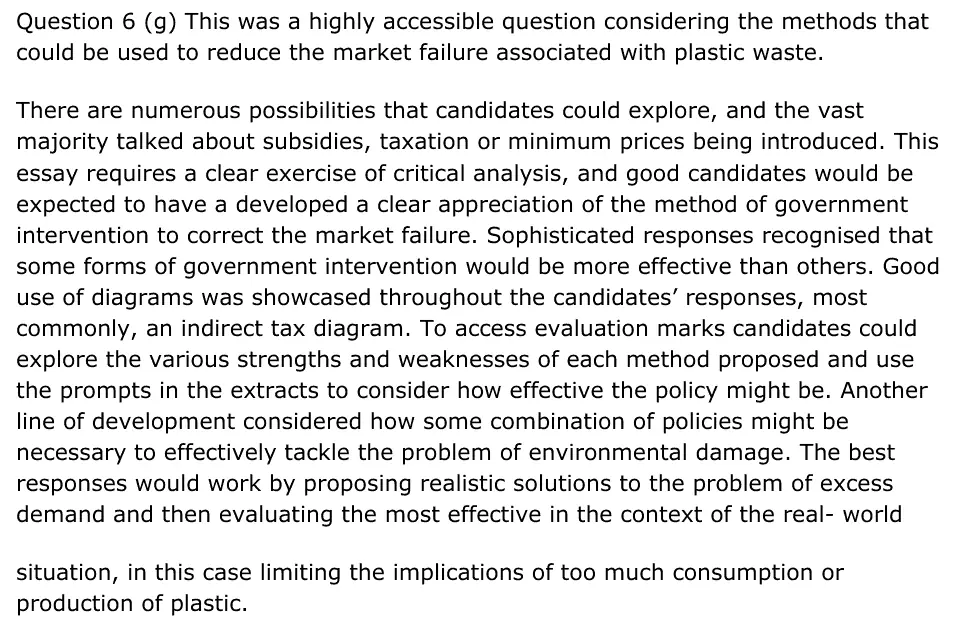
Question 6 (g) This was a highly accessible question considering the methods that could be used to reduce the market failure associated with plastic waste. There are numerous possibilities that candidates could explore, and the vast majority talked about subsidies, taxation or minimum prices being introduced. This essay requires a clear exercise of critical analysis, and good candidates would be expected to have a developed a clear appreciation of the method of government intervention to correct the market failure. Sophisticated responses recognised that some forms of government intervention would be more effective than others. Good use of diagrams was showcased throughout the candidates’ responses, most commonly, an indirect tax diagram. To access evaluation marks candidates could explore the various strengths and weaknesses of each method proposed and use the prompts in the extracts to consider how effective the policy might be. Another line of development considered how some combination of policies might be necessary to effectively tackle the problem of environmental damage. The best responses would work by proposing realistic solutions to the problem of excess demand and then evaluating the most effective in the context of the real- world situation, in this case limiting the implications of too much consumption or production of plastic.
Quantitative skills: QS 4 (construct and interpret a range of standard graphical forms)

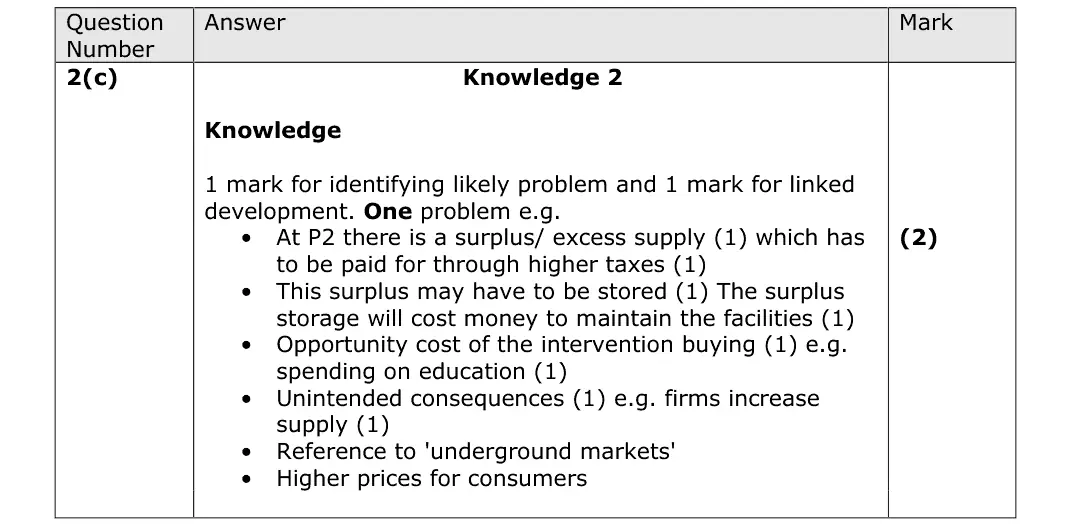
Though many candidates were able to achieve both marks available here, lack of development was an obvious issue for many. Typically, we were looking for some notion of excess supply and the resulting storage costs for the EU.
B

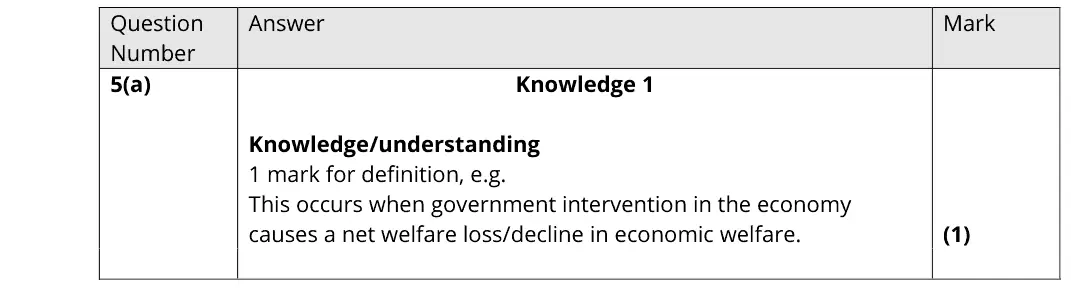
Strong candidates were able to express clearly what government failure is, in terms of a net welfare loss caused by the said intervention. It is important not to confuse this with a market failure.

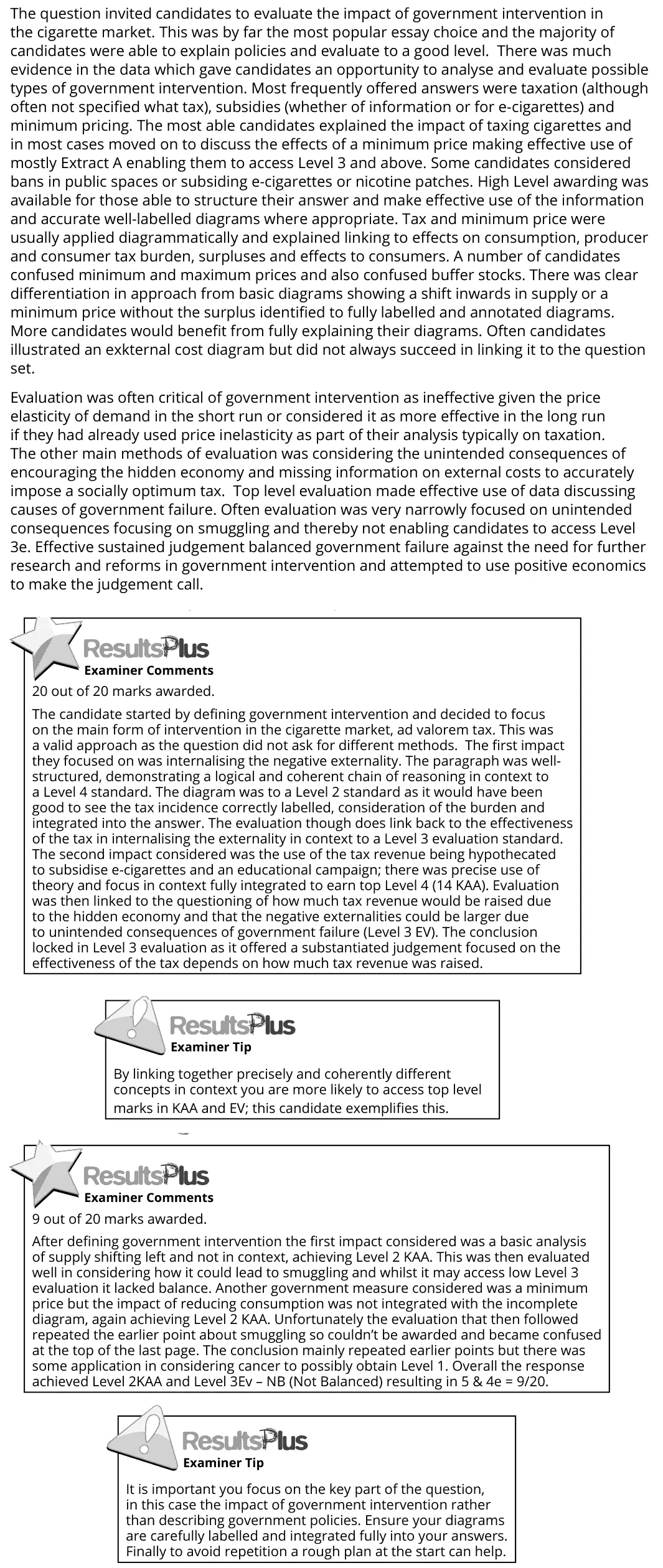
The question invited candidates to evaluate the impact of government intervention in the cigarette market. This was by far the most popular essay choice and the majority of candidates were able to explain policies and evaluate to a good level. There was much evidence in the data which gave candidates an opportunity to analyse and evaluate possible types of government intervention. Most frequently offered answers were taxation (although often not specified what tax), subsidies (whether of information or for e-cigarettes) and minimum pricing. The most able candidates explained the impact of taxing cigarettes and in most cases moved on to discuss the effects of a minimum price making effective use of mostly Extract A enabling them to access Level 3 and above. Some candidates considered bans in public spaces or subsiding e-cigarettes or nicotine patches. High Level awarding was available for those able to structure their answer and make effective use of the information and accurate well-labelled diagrams where appropriate. Tax and minimum price were usually applied diagrammatically and explained linking to effects on consumption, producer and consumer tax burden, surpluses and effects to consumers. A number of candidates confused minimum and maximum prices and also confused buffer stocks. There was clear differentiation in approach from basic diagrams showing a shift inwards in supply or a minimum price without the surplus identified to fully labelled and annotated diagrams. More candidates would benefit from fully explaining their diagrams. Often candidates illustrated an exkternal cost diagram but did not always succeed in linking it to the question set. Evaluation was often critical of government intervention as ineffective given the price elasticity of demand in the short run or considered it as more effective in the long run if they had already used price inelasticity as part of their analysis typically on taxation. The other main methods of evaluation was considering the unintended consequences of encouraging the hidden economy and missing information on external costs to accurately impose a socially optimum tax. Top level evaluation made effective use of data discussing causes of government failure. Often evaluation was very narrowly focused on unintended consequences focusing on smuggling and thereby not enabling candidates to access Level 3e. Effective sustained judgement balanced government failure against the need for further research and reforms in government intervention and attempted to use positive economics to make the judgement call. 20 out of 20 marks awarded. The candidate started by defining government intervention and decided to focus on the main form of intervention in the cigarette market, ad valorem tax. This was a valid approach as the question did not ask for different methods. The first impact they focused on was internalising the negative externality. The paragraph was well- structured, demonstrating a logical and coherent chain of reasoning in context to a Level 4 standard. The diagram was to a Level 2 standard as it would have been good to see the tax incidence correctly labelled, consideration of the burden and integrated into the answer. The evaluation though does link back to the effectiveness of the tax in internalising the externality in context to a Level 3 evaluation standard. The second impact considered was the use of the tax revenue being hypothecated to subsidise e-cigarettes and an educational campaign; there was precise use of theory and focus in context fully integrated to earn top Level 4 (14 KAA). Evaluation was then linked to the questioning of how much tax revenue would be raised due to the hidden economy and that the negative externalities could be larger due to unintended consequences of government failure (Level 3 EV). The conclusion locked in Level 3 evaluation as it offered a substantiated judgement focused on the effectiveness of the tax depends on how much tax revenue was raised. By linking together precisely and coherently different concepts in context you are more likely to access top level marks in KAA and EV; this candidate exemplifies this. 9 out of 20 marks awarded. After defining government intervention the first impact considered was a basic analysis of supply shifting left and not in context, achieving Level 2 KAA. This was then evaluated well in considering how it could lead to smuggling and whilst it may access low Level 3 evaluation it lacked balance. Another government measure considered was a minimum price but the impact of reducing consumption was not integrated with the incomplete diagram, again achieving Level 2 KAA. Unfortunately the evaluation that then followed repeated the earlier point about smuggling so couldn’t be awarded and became confused at the top of the last page. The conclusion mainly repeated earlier points but there was some application in considering cancer to possibly obtain Level 1. Overall the response achieved Level 2KAA and Level 3Ev – NB (Not Balanced) resulting in 5 & 4e = 9/20. It is important you focus on the key part of the question, in this case the impact of government intervention rather than describing government policies. Ensure your diagrams are carefully labelled and integrated fully into your answers. Finally to avoid repetition a rough plan at the start can help.

The question required candidates to evaluate the likely microeconomic effects of government intervention in the UK housing market. Candidates were expected to draw on their own knowledge of the housing market, a significant market in the UK, or make use of the data to access the top level responses. The main methods of government intervention covered were usually subsidies (Help to Buy), regulating mortgage providers, regulating landlords, direct government provision (building homes) or rent controls. Top Level 4 or 3 responses provided an in depth coverage of the microeconomic effects, this was possible to achieve with one type of government intervention but was usually undertaken by looking at two or three separate measures and evaluating them in depth in turn. Level 4 answers often drew, in a sophisticated manner, from the broad Theme 1 specification to provide logical chains of reasoning. A key differentiator was the quality of knowledge and understanding of micro- economic effects often making effective use of a diagram and carefully applied through logical and clear chains of reasoning. Level 2 answers tended to use a basic and generic supply and demand diagram focusing on one effect such as price; thus not being able to address the broad elements of the question and offer balance. Evaluation took various forms, with many candidates considering the unintended consequence of fuelling a housing boom affecting affordability and inequality. Alternative common evaluative points considered shortages of affordable rented property after carefully analysing the implementation of the scheme and who it would benefit. Where the former was missing this was often seen as analysis offering a negative effect of government intervention. The effectiveness of the government interventions was another popular issue raised with careful consideration of the data and other more significant factors resulting in the awarding of L3ev rather than a thin L1ev coverage of magnitude or opportunity cost. Best uses of substantiated judgement were sustained throughout in candidates’ responses as they made effective use of positive economics to make judgement calls answering the question by weighing up the significance of the effects as to what extent they were positive or negative. 16 out of 20 marks awarded. Two clear and carefully labelled diagrams provides a good start indicating a possible Level 3 or above response which is then confirmed as they are repeatedly used on the next page. To obtain Level 4 a more precise use of the diagrams with more integration would have been helpful. The candidate identifies the effect of Help to Buy as affordability and links this to utility and other effects, obtaining Level 3. They then move on to evaluate this by analysing the effect on demand and offering substantial judgement by indicating the significant increase due to price inelasticity of supply caused by 'government regulations like green belt'. This is worthy of Level 3 evaluation but needs another evaluative point to secure 6 marks and thus offer balance. The incentivised house builders is the next effect and the unemployment reference is allowed as a micro reference as they appear to be looking at the housing market (Level 3). The incentivised house builders is then well evaluated with a link to the disincentivised landlords (Level 3e). The time limit and opportunity cost evaluation is relevant but limited to Level 2 evaluation. Finally the candidate provides a conclusion which offers a clear substantiated judgement consolidating the time scale and opportunity cost issues (L3e). Overall they achieve Level 3+ KAA (10 marks) plus L3+ Ev (6marks) = 16/20. Be prepared to offer a suitable diagram even when not prompted by the question. The candidate is successful in applying two relevant diagrams to the context. To obtain Level 4 a more precise use of the diagrams making use of the labels with more integration to micro-effects, such home-owners consumer surplus or property developers’ revenue would have been helpful. There was an opportunity here to offer sophistication, linking the house builders as providing properties for sale or to rent which the candidate came close to. 12 out of 20 marks awarded. Producers benefiting from the subsidy on mortgage loans is well covered and in context (Level 3- KAA). This is then carefully evaluated using a data reference and theory (level 3 Ev). The candidate then moves on to considering the effect on consumers with a clear understanding and application but this is not evaluated (Level 3 KAA). Finally they consider the micro effect on government which is allowed since it is linked to rent (Level 2) and then well evaluated using theory (Level2 Ev). The opportunity cost evaluation then offered is well explained (Level 2Ev). The crowding out argument has potential but is not explained carefully enough to obtain Level 3 evaluation. Overall the candidate achieves a low Level 3 response for KAA (8 marks). They just escape two-stage chain reasoning but would benefit from a slightly wider use of the economic concepts. For evaluation they achieve Level 2 evaluation (4 Ev marks) as the Level 3 evaluation initially offered is not balanced with a similar attempt. In addition there is a lack of substantiated judgement. Offer at least two evaluative points with substantiated judgements on 20 mark base essay questions. This promising response is limited by having just one substantial piece of evaluation.
Essays stuck in Level 2, or losing the easy marks in Section A? Book a trial session with Lianne, a former Edexcel examiner.