Notes and key-term cards for this topic are being written by our tutors. The past-paper questions below are ready now.
Specification statements
3.6.1Government intervention: a) Government intervention to control mergers b) Government intervention to control monopolies: • price regulation • profit regulation • quality standards • performance targets c) Government intervention to promote competition and contestability: • enhancing competition between firms through promotion of small business • deregulation • competitive tendering for government contracts • privatisation d) Government intervention to protect suppliers and employees: • restrictions on monopsony power of firms • nationalisation
3.6.2The impact of government intervention: a) The impact of government intervention on: • prices • profit • efficiency • quality • choice b) Limits to government intervention: • regulatory capture • asymmetric information
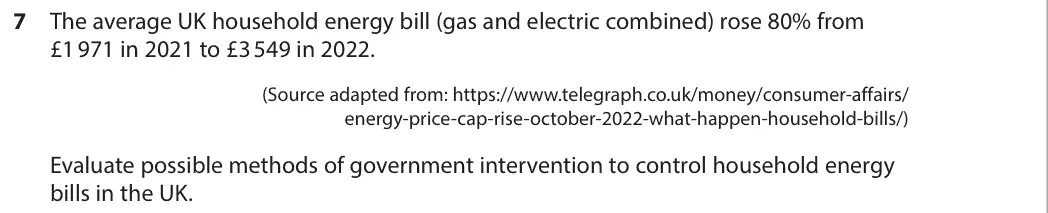
The average UK household energy bill (gas and electric combined) rose 80% from £1 971 in 2021 to £3 549 in 2022. (Source adapted from: https://www.telegraph.co.uk/money/consumer-affairs/ energy-price-cap-rise-october-2022-what-happen-household-bills/) Evaluate possible methods of government intervention to control household energy bills in the UK.
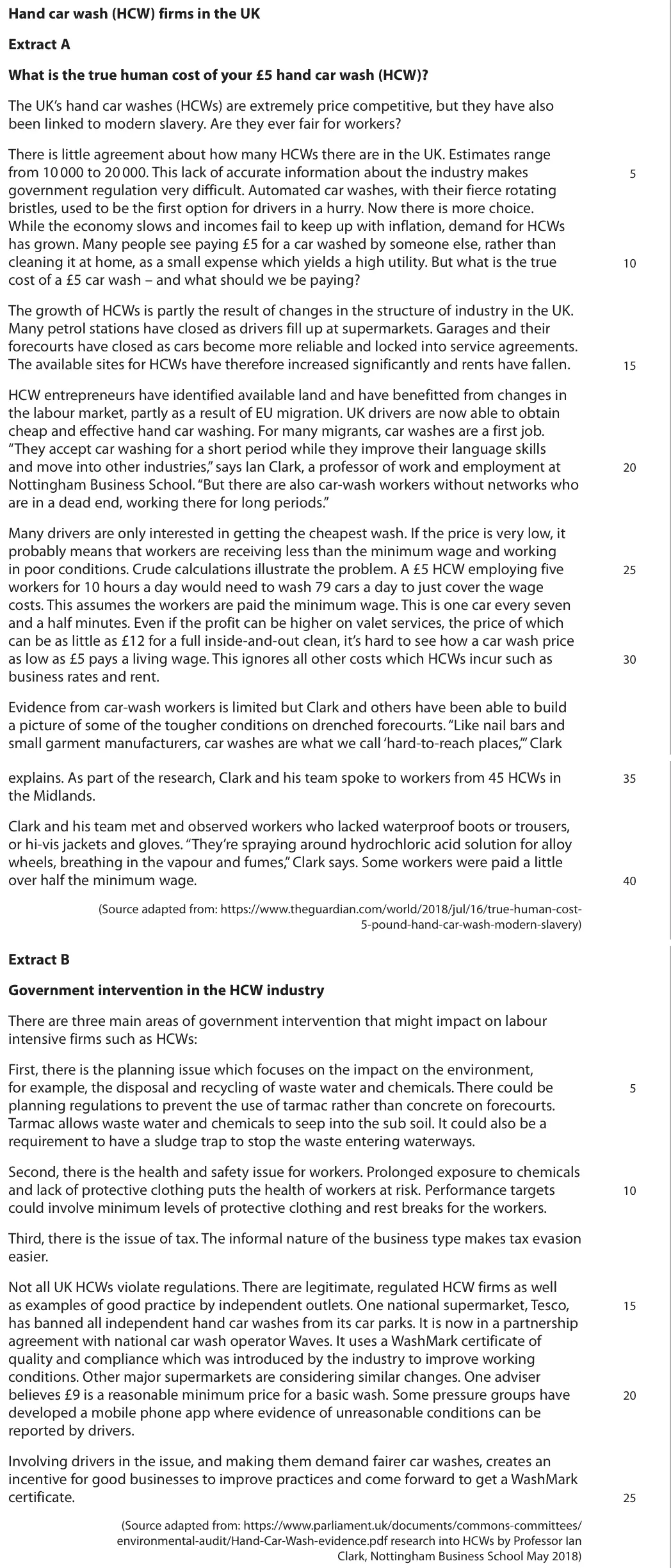
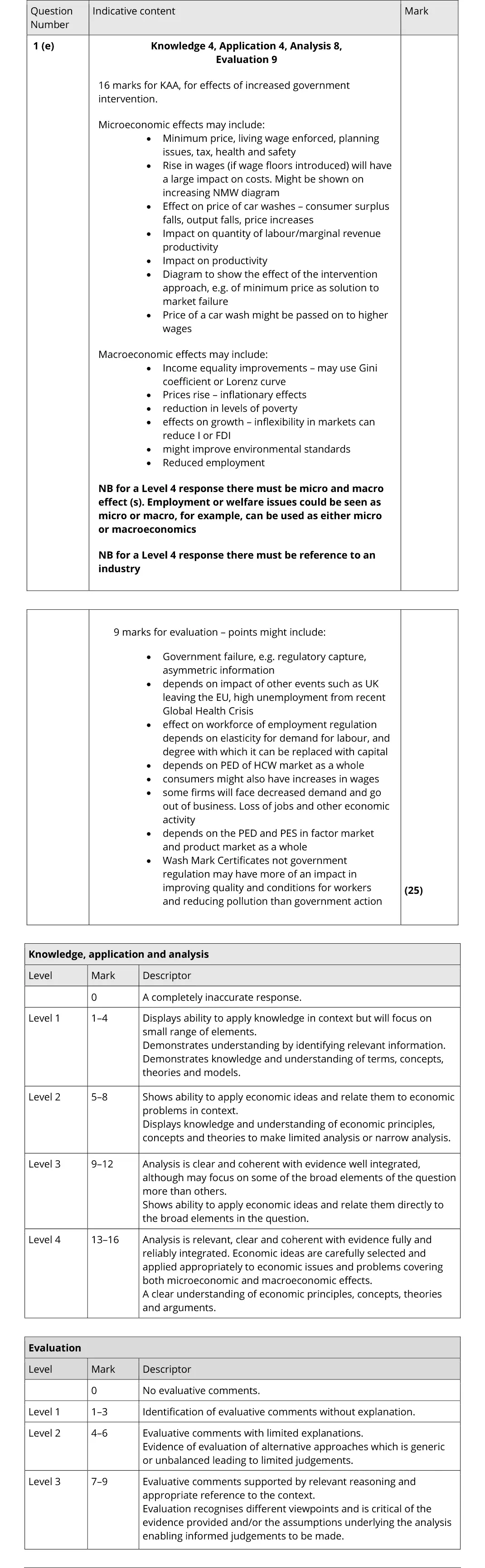
Evaluate the microeconomic and macroeconomic effects of increased government intervention in an industry. Refer to HCWs or another industry of your choice.
Tap a question to zoom it. The data and extracts fold out above each question; the mark scheme and examiner's comment open underneath.
June 2024 · Paper 1 · Q6(d)12 marksAO1=2, AO2=2, AO3=4, AO4=412-mark response
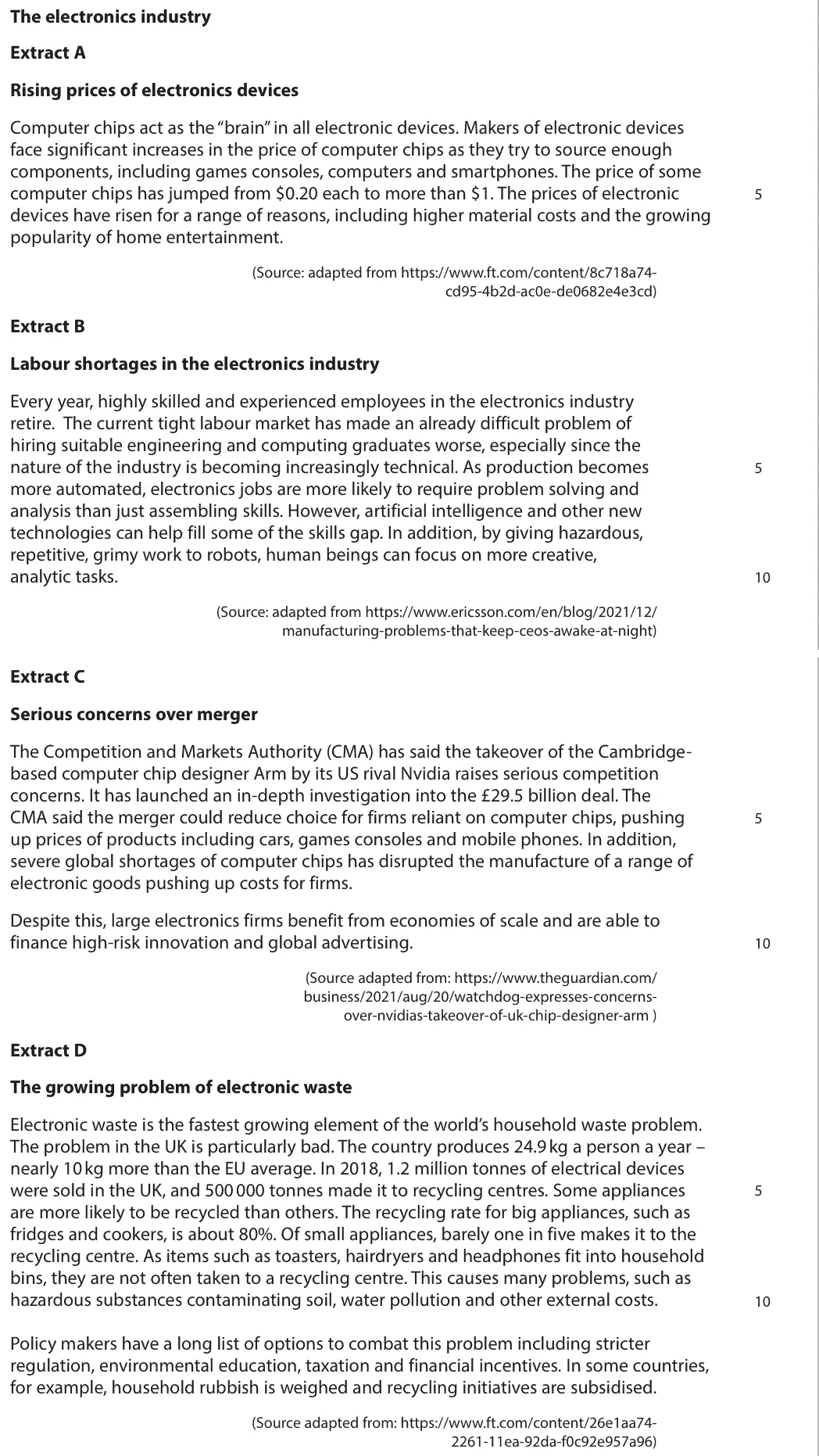
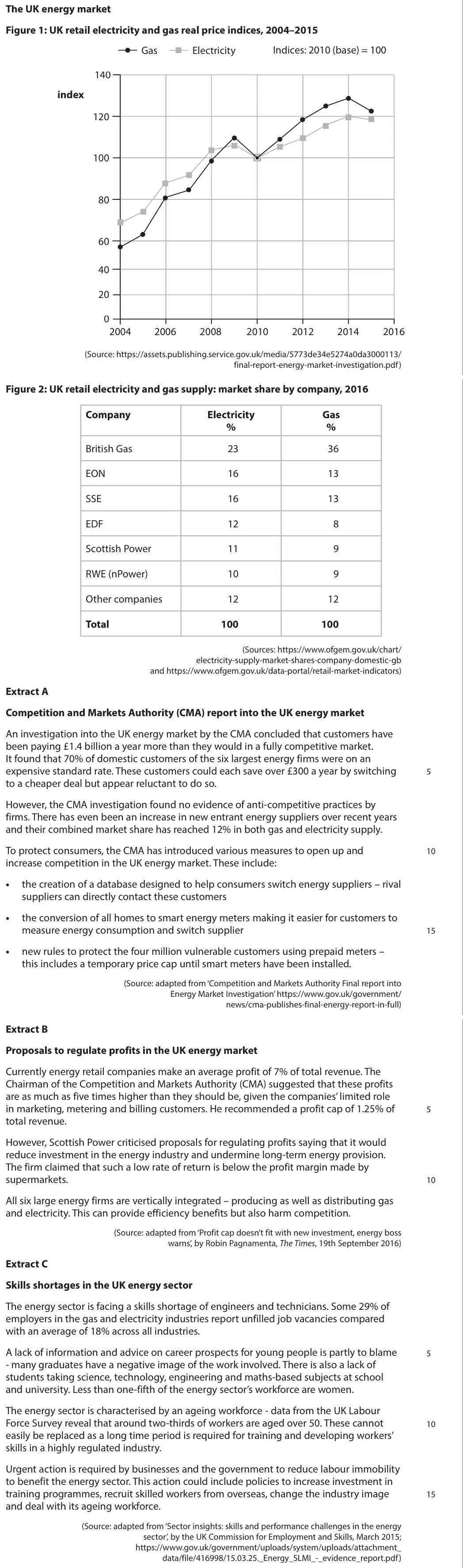
Data and extracts for question 6
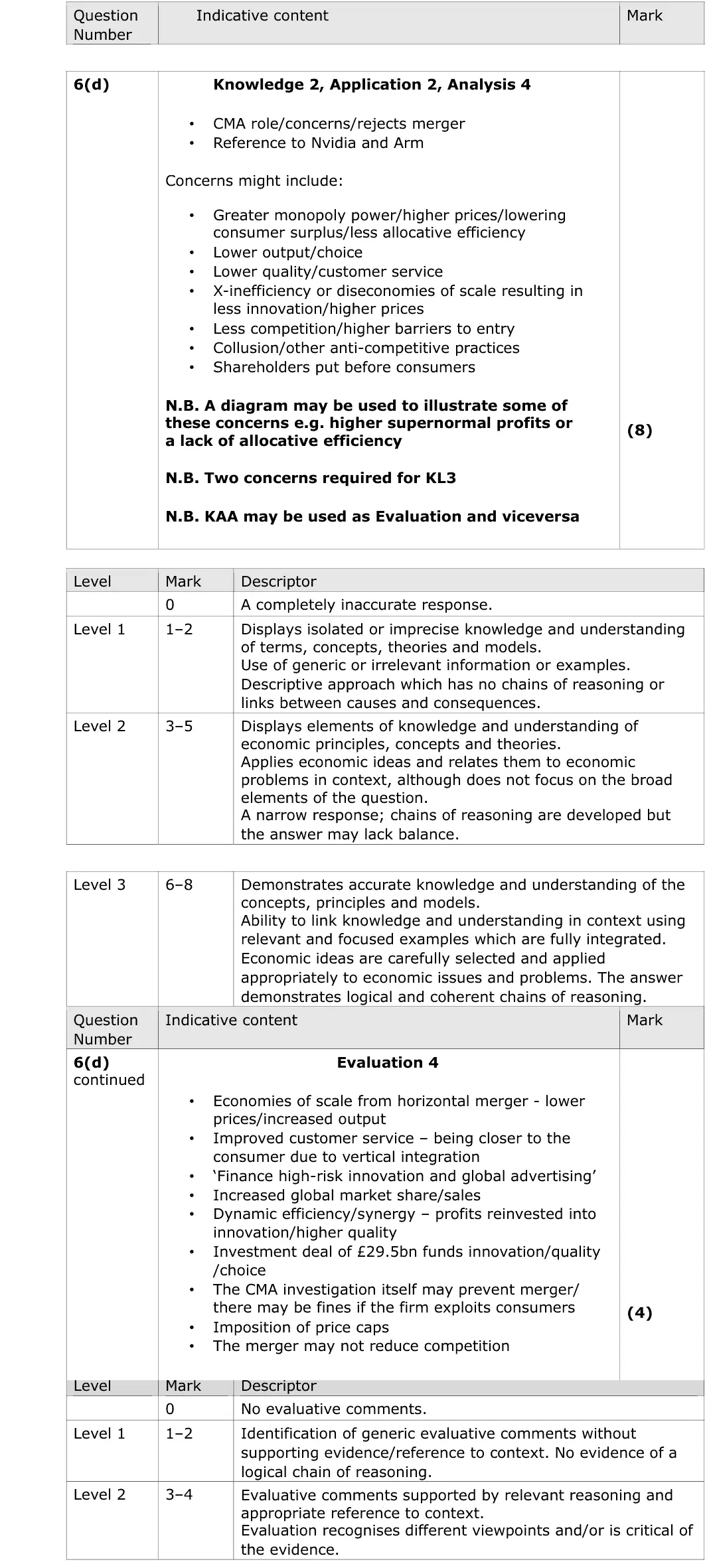
Mark scheme, including the levels grid and indicative content
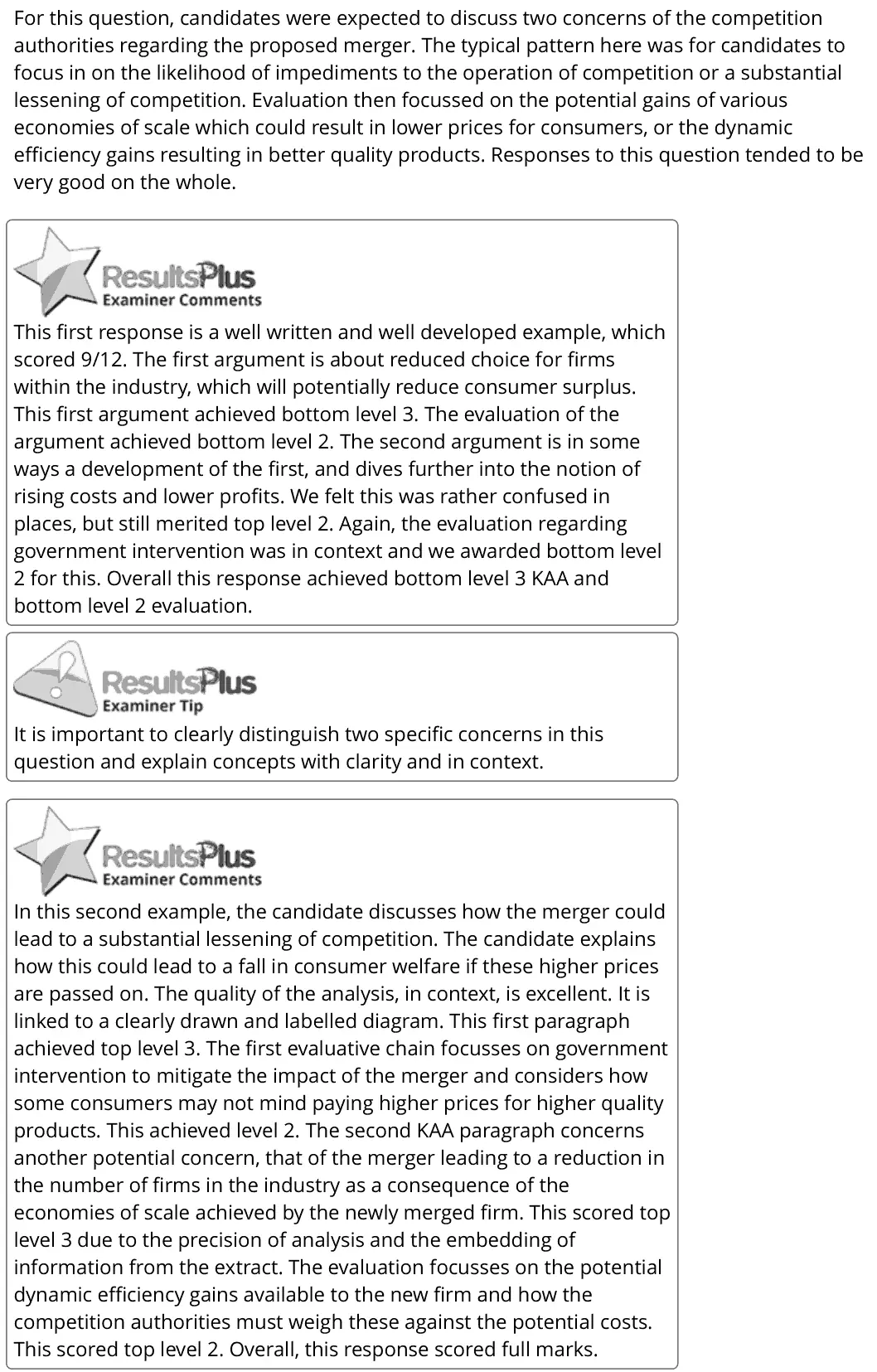
Examiner's comment
For this question, candidates were expected to discuss two concerns of the competition authorities regarding the proposed merger. The typical pattern here was for candidates to focus in on the likelihood of impediments to the operation of competition or a substantial lessening of competition. Evaluation then focussed on the potential gains of various economies of scale which could result in lower prices for consumers, or the dynamic efficiency gains resulting in better quality products. Responses to this question tended to be very good on the whole. This first response is a well written and well developed example, which scored 9/12. The first argument is about reduced choice for firms within the industry, which will potentially reduce consumer surplus. This first argument achieved bottom level 3. The evaluation of the argument achieved bottom level 2. The second argument is in some ways a development of the first, and dives further into the notion of rising costs and lower profits. We felt this was rather confused in places, but still merited top level 2. Again, the evaluation regarding government intervention was in context and we awarded bottom level 2 for this. Overall this response achieved bottom level 3 KAA and bottom level 2 evaluation. It is important to clearly distinguish two specific concerns in this question and explain concepts with clarity and in context. In this second example, the candidate discusses how the merger could lead to a substantial lessening of competition. The candidate explains how this could lead to a fall in consumer welfare if these higher prices are passed on. The quality of the analysis, in context, is excellent. It is linked to a clearly drawn and labelled diagram. This first paragraph achieved top level 3. The first evaluative chain focusses on government intervention to mitigate the impact of the merger and considers how some consumers may not mind paying higher prices for higher quality products. This achieved level 2. The second KAA paragraph concerns another potential concern, that of the merger leading to a reduction in the number of firms in the industry as a consequence of the economies of scale achieved by the newly merged firm. This scored top level 3 due to the precision of analysis and the embedding of information from the extract. The evaluation focusses on the potential dynamic efficiency gains available to the new firm and how the competition authorities must weigh these against the potential costs. This scored top level 2. Overall, this response scored full marks.
Notes from the mark scheme and report
two concerns needed for KAA Level 3 (substantial lessening of competition, higher prices, less choice, less innovation)
evaluate with economies of scale and dynamic efficiency gains
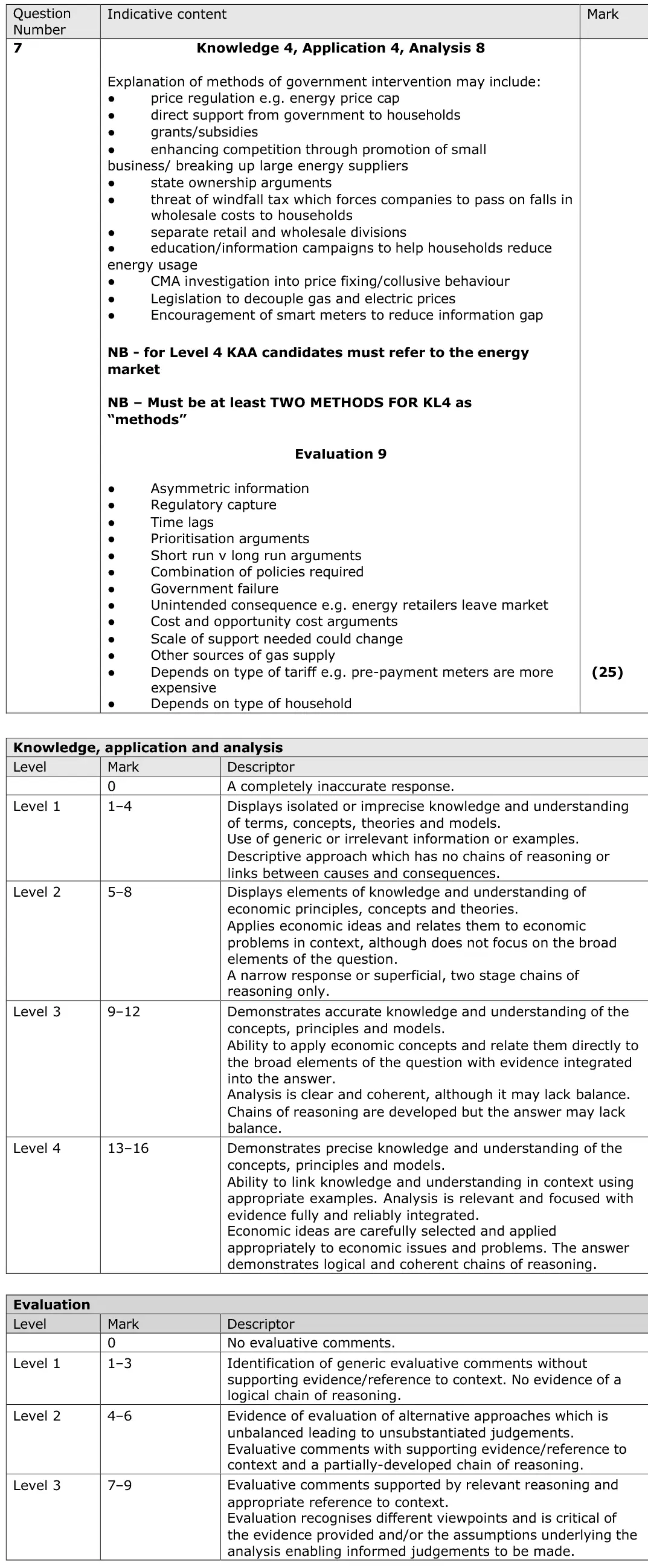
June 2023 · Paper 1 · Q725 marksAO1=4, AO2=4, AO3=8, AO4=925-mark essayEither/or
Mark scheme, including the levels grid and indicative content
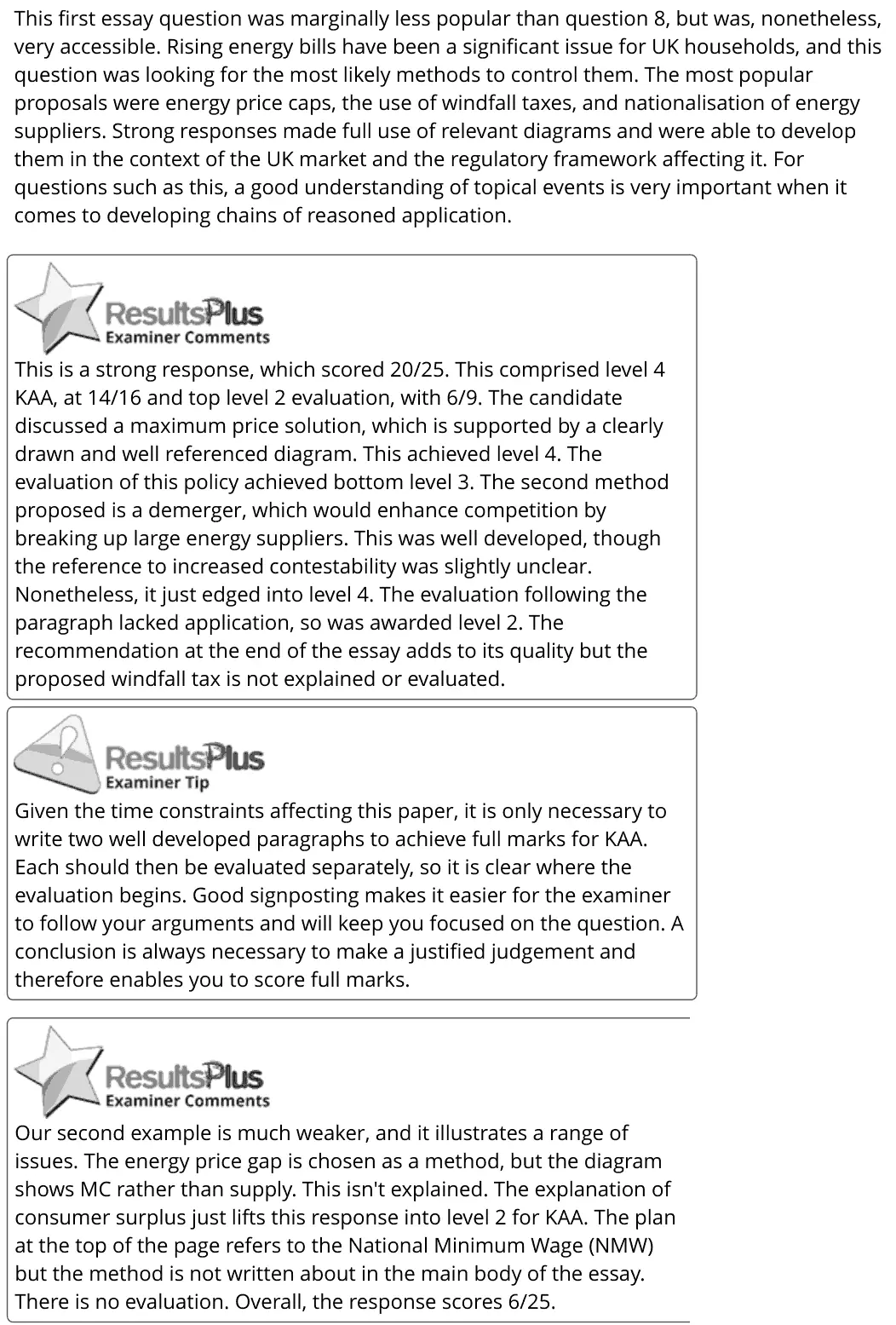
Examiner's comment
This first essay question was marginally less popular than question 8, but was, nonetheless, very accessible. Rising energy bills have been a significant issue for UK households, and this question was looking for the most likely methods to control them. The most popular proposals were energy price caps, the use of windfall taxes, and nationalisation of energy suppliers. Strong responses made full use of relevant diagrams and were able to develop them in the context of the UK market and the regulatory framework affecting it. For questions such as this, a good understanding of topical events is very important when it comes to developing chains of reasoned application. This is a strong response, which scored 20/25. This comprised level 4 KAA, at 14/16 and top level 2 evaluation, with 6/9. The candidate discussed a maximum price solution, which is supported by a clearly drawn and well referenced diagram. This achieved level 4. The evaluation of this policy achieved bottom level 3. The second method proposed is a demerger, which would enhance competition by breaking up large energy suppliers. This was well developed, though the reference to increased contestability was slightly unclear. Nonetheless, it just edged into level 4. The evaluation following the paragraph lacked application, so was awarded level 2. The recommendation at the end of the essay adds to its quality but the proposed windfall tax is not explained or evaluated. Given the time constraints affecting this paper, it is only necessary to write two well developed paragraphs to achieve full marks for KAA. Each should then be evaluated separately, so it is clear where the evaluation begins. Good signposting makes it easier for the examiner to follow your arguments and will keep you focused on the question. A conclusion is always necessary to make a justified judgement and therefore enables you to score full marks. Our second example is much weaker, and it illustrates a range of issues. The energy price gap is chosen as a method, but the diagram shows MC rather than supply. This isn't explained. The explanation of consumer surplus just lifts this response into level 2 for KAA. The plan at the top of the page refers to the National Minimum Wage (NMW) but the method is not written about in the main body of the essay. There is no evaluation. Overall, the response scores 6/25.
Notes from the mark scheme and report
energy price cap (maximum price) with diagram, windfall tax, subsidies or direct support to households, nationalisation, promoting competition
evaluate with shortages, firms exiting, cost to government and government failure
topical knowledge helps application
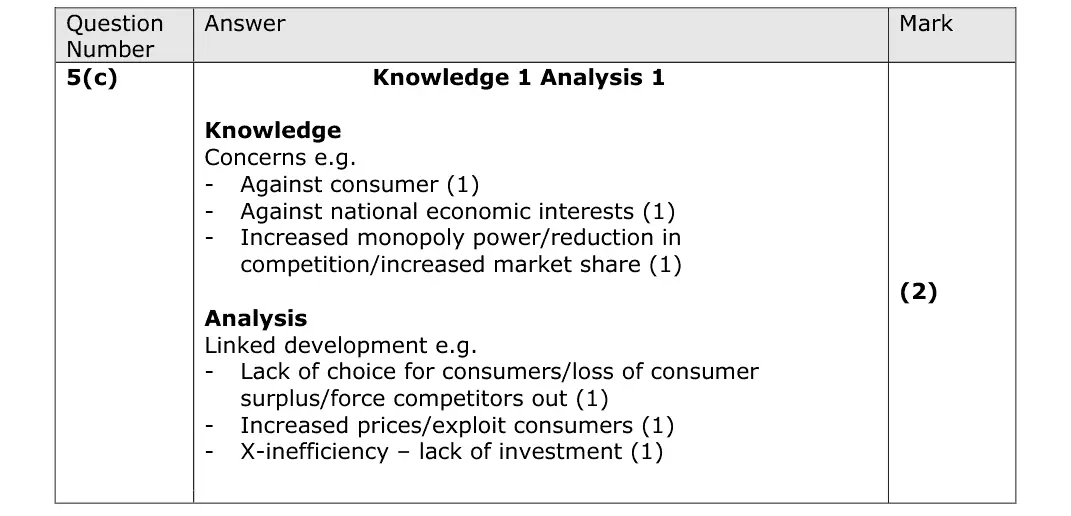
June 2022 · Paper 1 · Q5(c)2 marksAO1=1, AO3=1Short answer
Data and extracts for question 5
Mark scheme
Examiner's comment
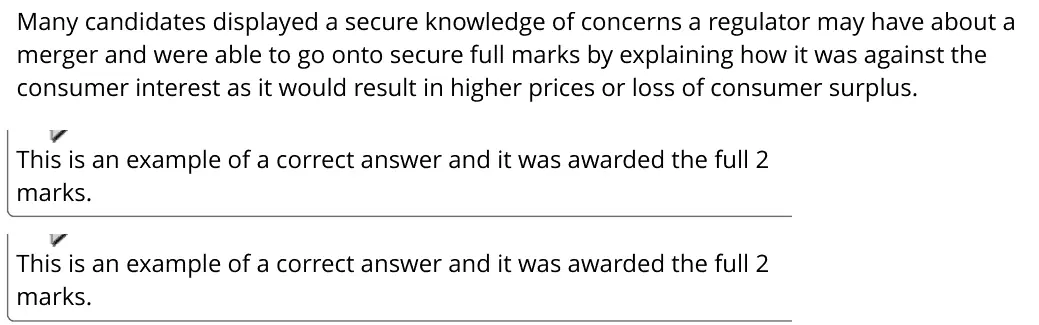
Many candidates displayed a secure knowledge of concerns a regulator may have about a merger and were able to go onto secure full marks by explaining how it was against the consumer interest as it would result in higher prices or loss of consumer surplus. This is an example of a correct answer and it was awarded the full 2 marks. This is an example of a correct answer and it was awarded the full 2 marks.
Notes from the mark scheme and report
concern: reduced competition or higher market share, developed as higher prices, less choice or lost consumer surplus
November 2021 · Paper 3 · Q1(e)25 marksAO1=4, AO2=4, AO3=8, AO4=925-mark essayEither/or
Data and extracts for question 1
Mark scheme, including the levels grid and indicative content
Examiner's comment
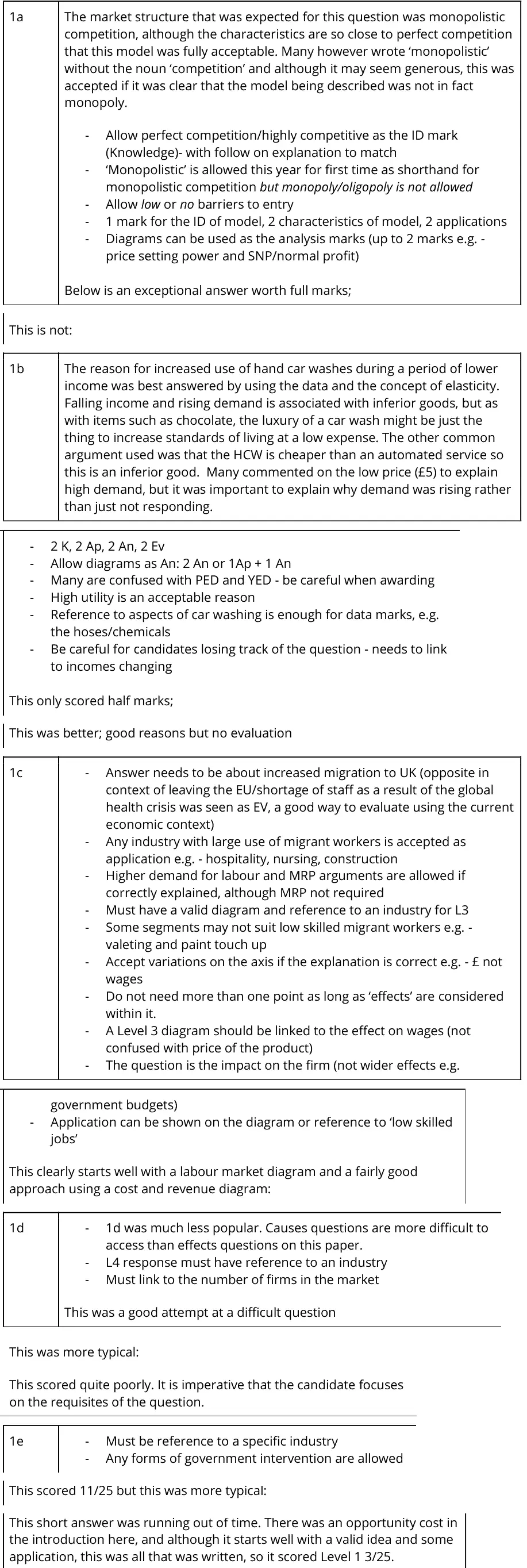
1a The market structure that was expected for this question was monopolistic competition, although the characteristics are so close to perfect competition that this model was fully acceptable. Many however wrote ‘monopolistic’ without the noun ‘competition’ and although it may seem generous, this was accepted if it was clear that the model being described was not in fact monopoly. - Allow perfect competition/highly competitive as the ID mark (Knowledge)- with follow on explanation to match - ‘Monopolistic’ is allowed this year for first time as shorthand for monopolistic competition but monopoly/oligopoly is not allowed - Allow low or no barriers to entry - 1 mark for the ID of model, 2 characteristics of model, 2 applications - Diagrams can be used as the analysis marks (up to 2 marks e.g. - price setting power and SNP/normal profit) Below is an exceptional answer worth full marks; This is not: 1b The reason for increased use of hand car washes during a period of lower income was best answered by using the data and the concept of elasticity. Falling income and rising demand is associated with inferior goods, but as with items such as chocolate, the luxury of a car wash might be just the thing to increase standards of living at a low expense. The other common argument used was that the HCW is cheaper than an automated service so this is an inferior good. Many commented on the low price (£5) to explain high demand, but it was important to explain why demand was rising rather than just not responding. - 2 K, 2 Ap, 2 An, 2 Ev - Allow diagrams as An: 2 An or 1Ap + 1 An - Many are confused with PED and YED - be careful when awarding - High utility is an acceptable reason - Reference to aspects of car washing is enough for data marks, e.g. the hoses/chemicals - Be careful for candidates losing track of the question - needs to link to incomes changing This only scored half marks; This was better; good reasons but no evaluation 1c - Answer needs to be about increased migration to UK (opposite in context of leaving the EU/shortage of staff as a result of the global health crisis was seen as EV, a good way to evaluate using the current economic context) - Any industry with large use of migrant workers is accepted as application e.g. - hospitality, nursing, construction - Higher demand for labour and MRP arguments are allowed if correctly explained, although MRP not required - Must have a valid diagram and reference to an industry for L3 - Some segments may not suit low skilled migrant workers e.g. - valeting and paint touch up - Accept variations on the axis if the explanation is correct e.g. - £ not wages - Do not need more than one point as long as ‘effects’ are considered within it. - A Level 3 diagram should be linked to the effect on wages (not confused with price of the product) - The question is the impact on the firm (not wider effects e.g. government budgets) - Application can be shown on the diagram or reference to ‘low skilled jobs’ This clearly starts well with a labour market diagram and a fairly good approach using a cost and revenue diagram: 1d - 1d was much less popular. Causes questions are more difficult to access than effects questions on this paper. - L4 response must have reference to an industry - Must link to the number of firms in the market This was a good attempt at a difficult question This was more typical: This scored quite poorly. It is imperative that the candidate focuses on the requisites of the question. 1e - Must be reference to a specific industry - Any forms of government intervention are allowed This scored 11/25 but this was more typical: This short answer was running out of time. There was an opportunity cost in the introduction here, and although it starts well with a valid idea and some application, this was all that was written, so it scored Level 1 3/25.
Notes from the mark scheme and report
micro: wage floors raise costs, higher car wash prices, minimum price, health and safety
macro: equality, inflation, employment
Level 4 needs micro and macro and a specific industry
evaluate with government failure (regulatory capture, asymmetric information), PED, WashMark self-regulation
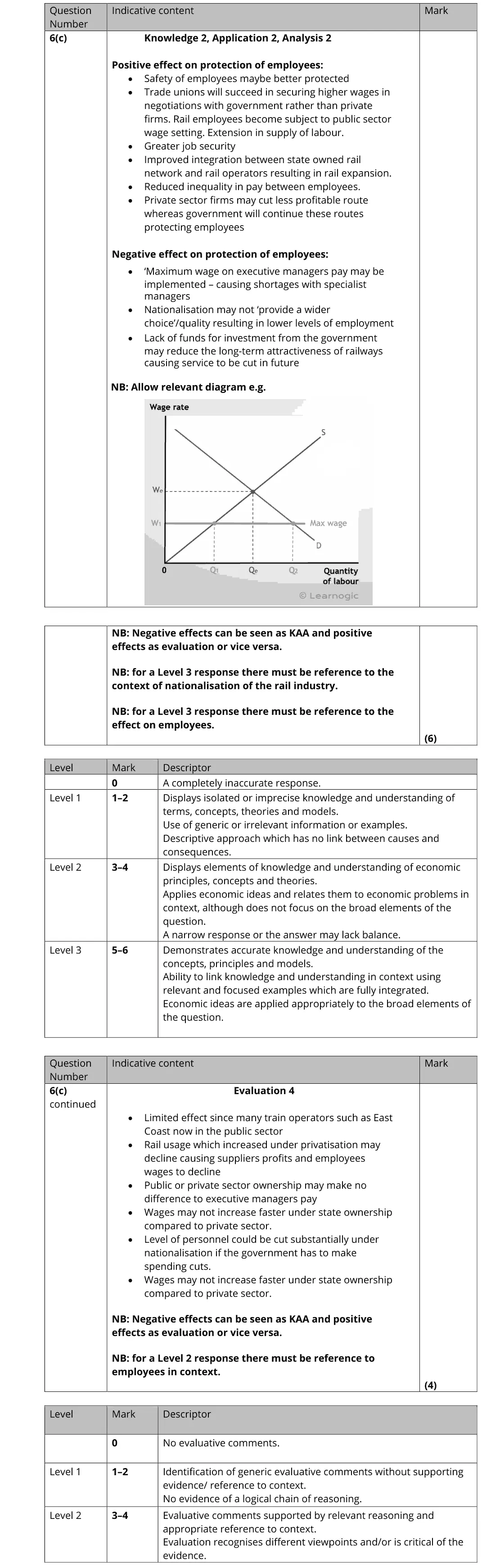
October 2020 · Paper 1 · Q6(c)10 marksAO1=2, AO2=2, AO3=2, AO4=410-mark response
Data and extracts for question 6
Mark scheme, including the levels grid and indicative content
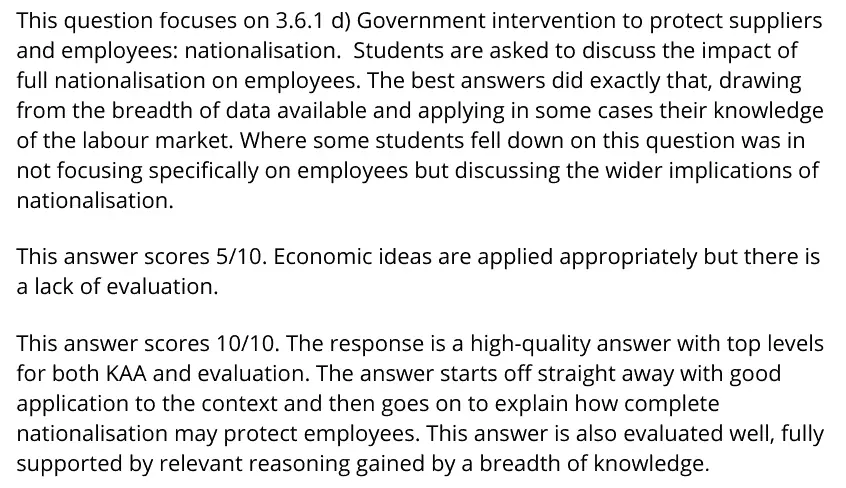
Examiner's comment
This question focuses on 3.6.1 d) Government intervention to protect suppliers and employees: nationalisation. Students are asked to discuss the impact of full nationalisation on employees. The best answers did exactly that, drawing from the breadth of data available and applying in some cases their knowledge of the labour market. Where some students fell down on this question was in not focusing specifically on employees but discussing the wider implications of nationalisation. This answer scores 5/10. Economic ideas are applied appropriately but there is a lack of evaluation. This answer scores 10/10. The response is a high-quality answer with top levels for both KAA and evaluation. The answer starts off straight away with good application to the context and then goes on to explain how complete nationalisation may protect employees. This answer is also evaluated well, fully supported by relevant reasoning gained by a breadth of knowledge.
Notes from the mark scheme and report
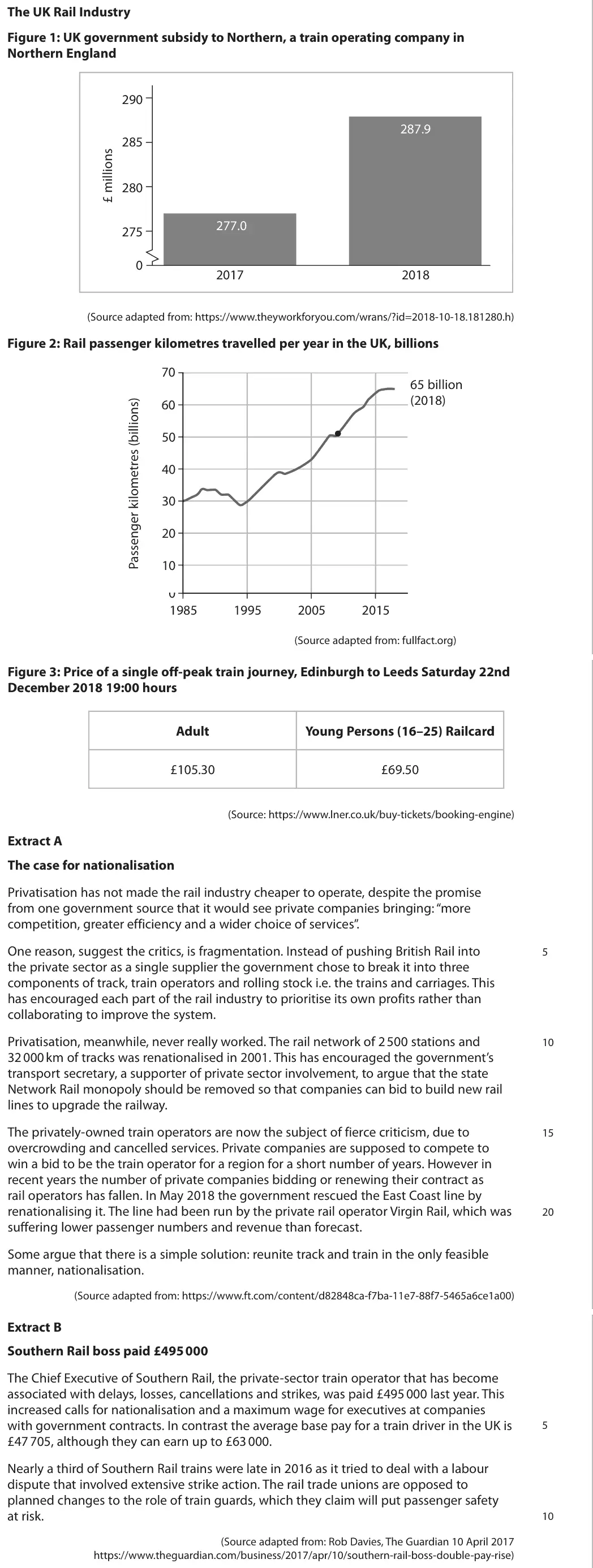
nationalisation to protect employees: public sector wage setting, job security, safety, unprofitable routes kept
evaluate with maximum wages, lack of investment funds and lower quality
report: weaker answers discussed nationalisation generally rather than employees
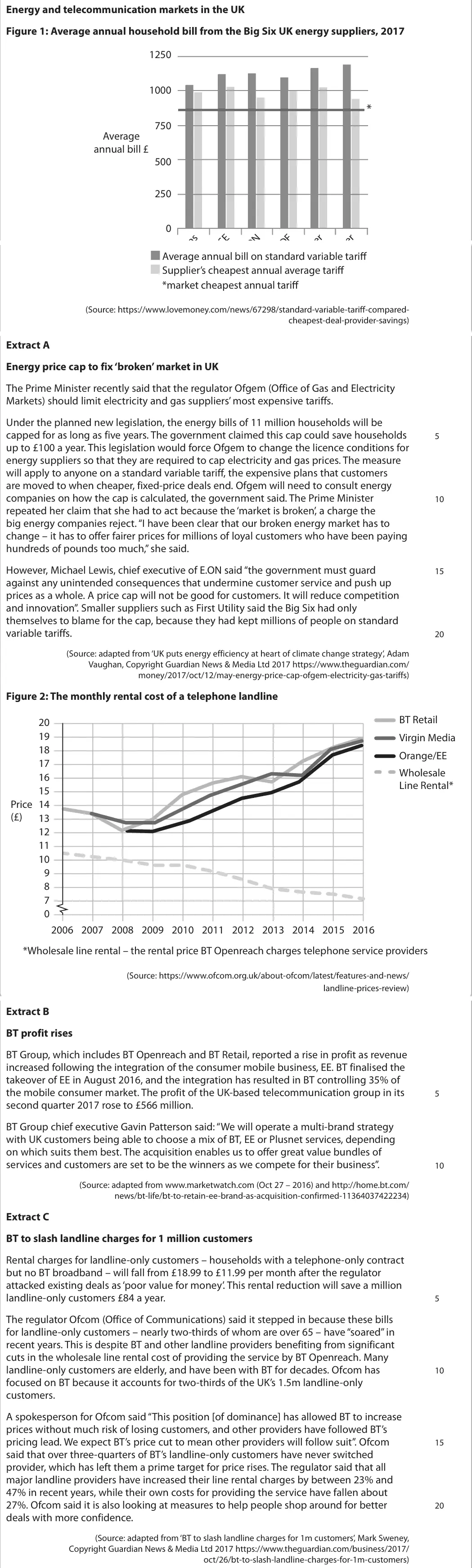
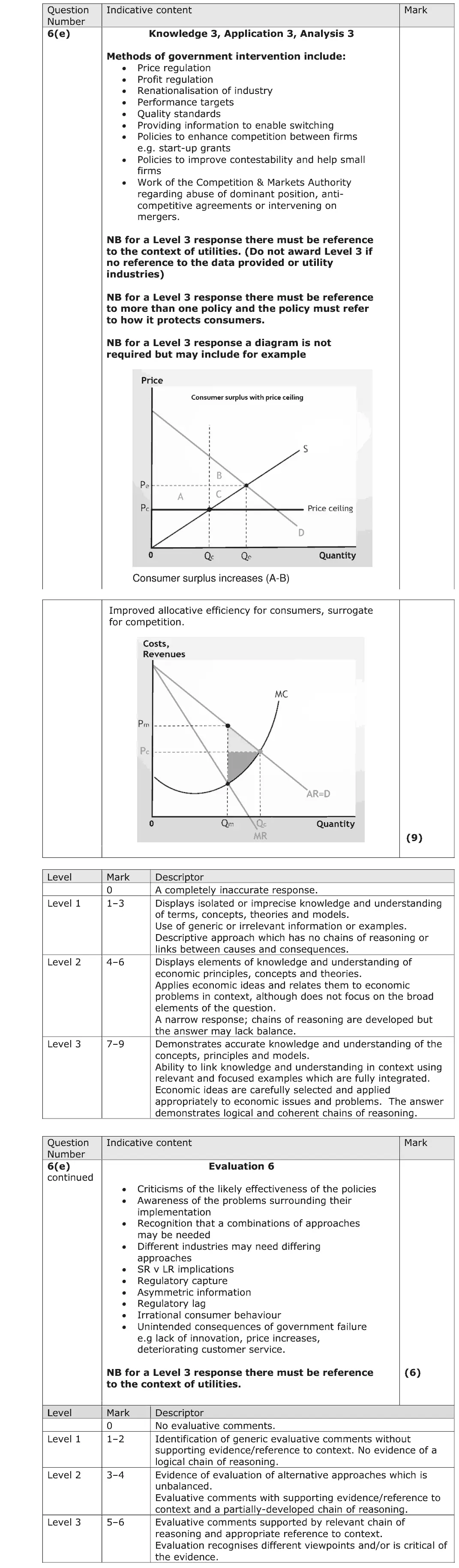
June 2019 · Paper 1 · Q6(e)15 marksAO1=3, AO2=3, AO3=3, AO4=615-mark response
Data and extracts for question 6
Mark scheme, including the levels grid and indicative content
Examiner's comment
Price caps was by far the most common method used and most candidates provided a correct supply and demand diagram, with a few attempting to illustrate the change in consumer surplus and many evaluating well. Around a third of the candidates discussed price caps using a cost and revenue diagram, with many in this case identifying consumer surplus gain. Many candidates also had the price cap intersecting the allocative efficiency point, which set up the opportunity for some excellent evaluation. Candidates who were able to bring in a wider range of economic issues were therefore able to access the higher-level marks. Additional popular methods included providing information, profit regulation and nationalisation. This answer discusses briefly the introduction of a price cap achieving Level 2-. The evaluation is very thin, L1ev-. Another method implied is nationalisation but there is a lack of application. The evaluation this time achieves L2e-. Overall the response achieves Level 2- (4 KAA) and L2Ev- (3EV) = 7/15 marks. Try to ensure your chains of reasoning are developed with application and economic ideas, diagrams can help with this even when not requested. This is a well-written answer to this question, particularly in terms of logical and coherent chains of reasoning in both KAA and Evaluation. The first one focuses on information campaigns (L3+) and the second on a maximum price (L3). Maximum prices could have been developed a little further – for example identifying in the diagram the gain in consumer surplus. Therefore, overall this answer achieves Level 3 KAA and Level 3+ evaluation = 8 and 6ev = 14/15 marks. Focus on quality rather than quantity. This answer is two pages in total yet still achieves very highly. Avoid a scattergun approach of discussing many methods.
Notes from the mark scheme and report
Level 3 needs more than one method, each explained as protecting consumers, in the utilities context
price caps, profit regulation, information to aid switching, nationalisation
evaluate with regulatory capture and asymmetric information
June 2018 · Paper 1 · Q6(b)12 marksAO1=2, AO2=2, AO3=4, AO4=412-mark response
Data and extracts for question 6
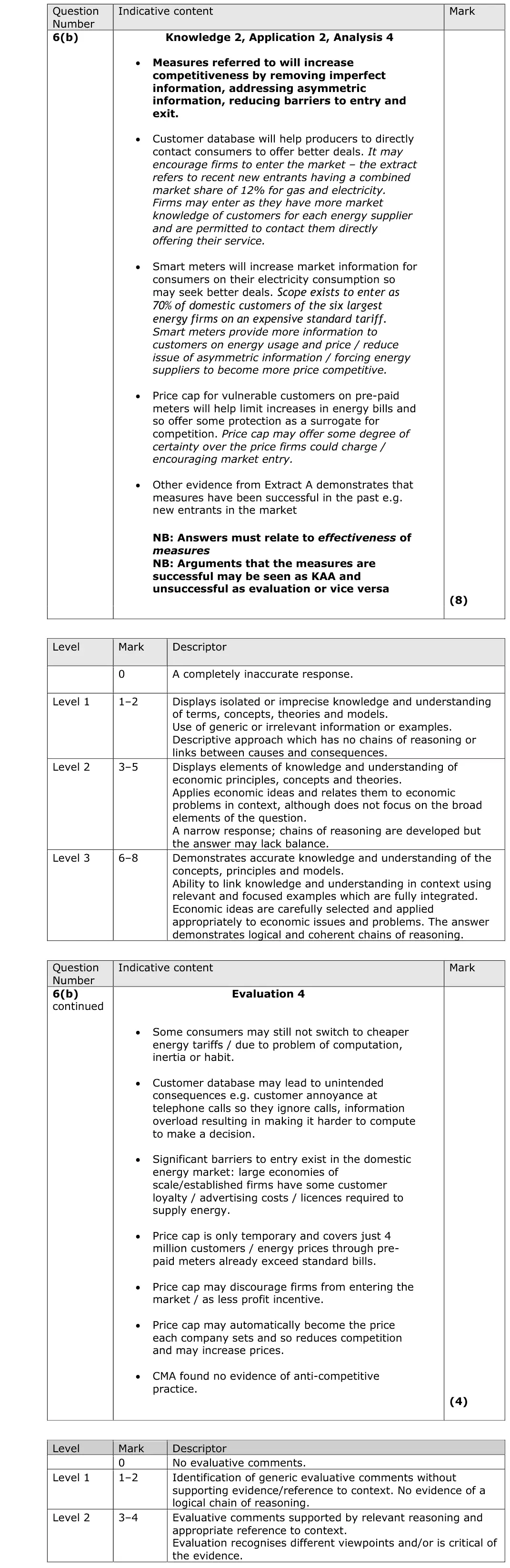
Mark scheme, including the levels grid and indicative content
Examiner's comment
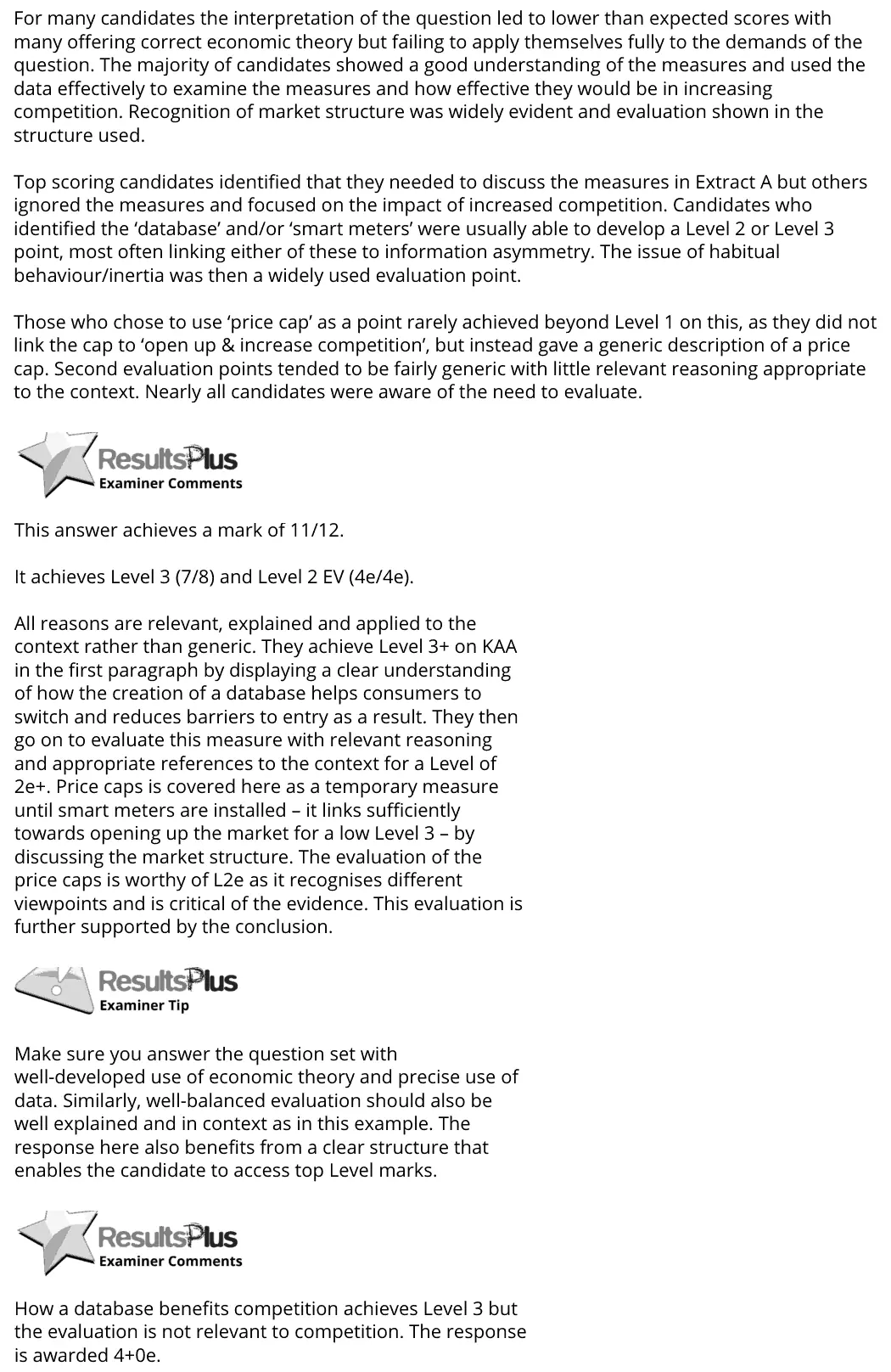
For many candidates the interpretation of the question led to lower than expected scores with many offering correct economic theory but failing to apply themselves fully to the demands of the question. The majority of candidates showed a good understanding of the measures and used the data effectively to examine the measures and how effective they would be in increasing competition. Recognition of market structure was widely evident and evaluation shown in the structure used. Top scoring candidates identified that they needed to discuss the measures in Extract A but others ignored the measures and focused on the impact of increased competition. Candidates who identified the ‘database’ and/or ‘smart meters’ were usually able to develop a Level 2 or Level 3 point, most often linking either of these to information asymmetry. The issue of habitual behaviour/inertia was then a widely used evaluation point. Those who chose to use ‘price cap’ as a point rarely achieved beyond Level 1 on this, as they did not link the cap to ‘open up & increase competition’, but instead gave a generic description of a price cap. Second evaluation points tended to be fairly generic with little relevant reasoning appropriate to the context. Nearly all candidates were aware of the need to evaluate. This answer achieves a mark of 11/12. It achieves Level 3 (7/8) and Level 2 EV (4e/4e). All reasons are relevant, explained and applied to the context rather than generic. They achieve Level 3+ on KAA in the first paragraph by displaying a clear understanding of how the creation of a database helps consumers to switch and reduces barriers to entry as a result. They then go on to evaluate this measure with relevant reasoning and appropriate references to the context for a Level of 2e+. Price caps is covered here as a temporary measure until smart meters are installed – it links sufficiently towards opening up the market for a low Level 3 – by discussing the market structure. The evaluation of the price caps is worthy of L2e as it recognises different viewpoints and is critical of the evidence. This evaluation is further supported by the conclusion. Make sure you answer the question set with well-developed use of economic theory and precise use of data. Similarly, well-balanced evaluation should also be well explained and in context as in this example. The response here also benefits from a clear structure that enables the candidate to access top Level marks. How a database benefits competition achieves Level 3 but the evaluation is not relevant to competition. The response is awarded 4+0e.
Notes from the mark scheme and report
discuss the Extract A measures (switching database, smart meters, price cap) not just the effects of more competition
link to asymmetric information and barriers to entry (new entrants 12% share)
price cap rarely beyond Level 1 unless linked to competition
evaluate with habitual behaviour and inertia
June 2018 · Paper 1 · Q6(c)10 marksAO1=2, AO2=2, AO3=2, AO4=410-mark response
Data and extracts for question 6
Mark scheme, including the levels grid and indicative content
Examiner's comment
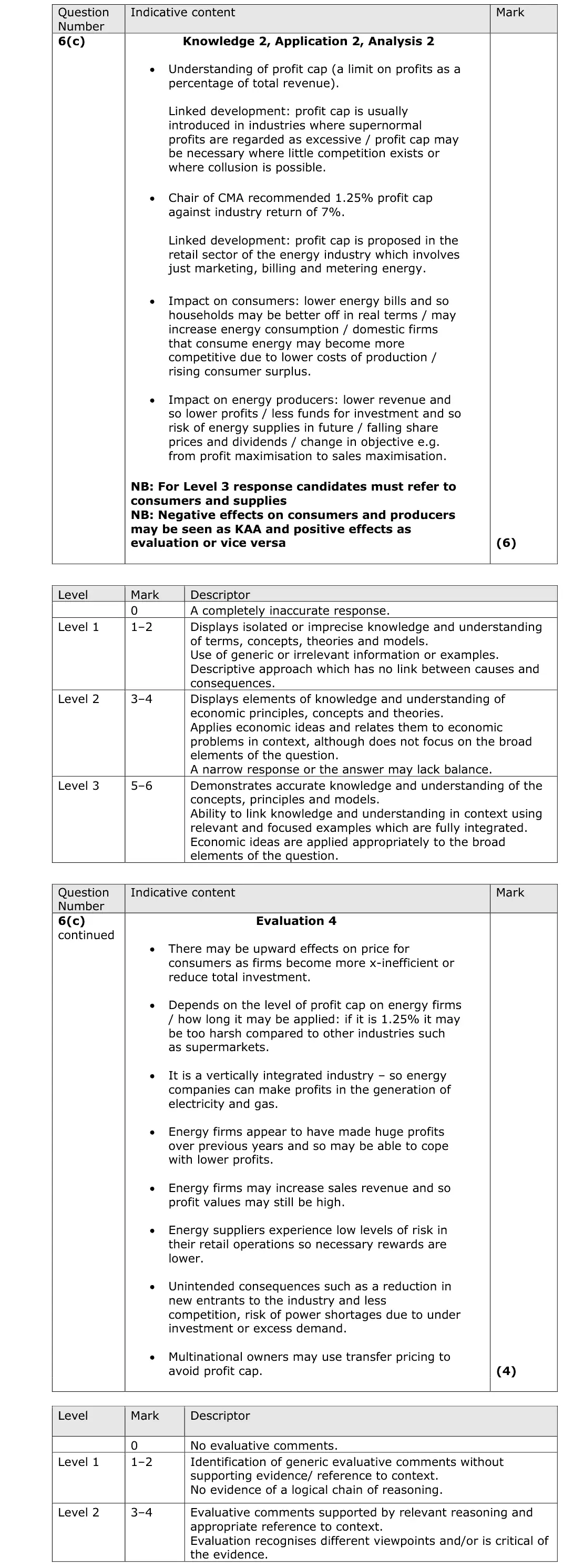
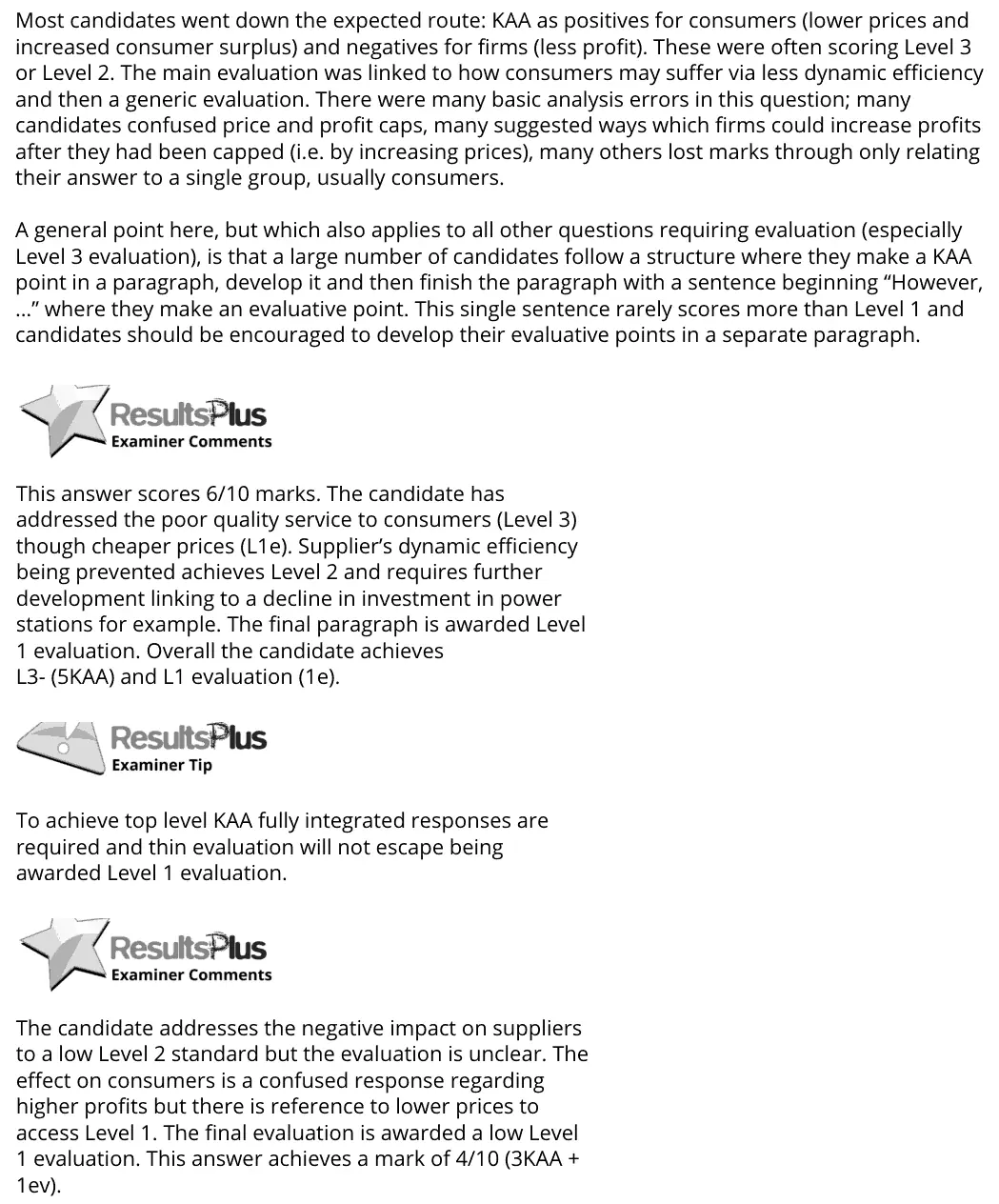
Most candidates went down the expected route: KAA as positives for consumers (lower prices and increased consumer surplus) and negatives for firms (less profit). These were often scoring Level 3 or Level 2. The main evaluation was linked to how consumers may suffer via less dynamic efficiency and then a generic evaluation. There were many basic analysis errors in this question; many candidates confused price and profit caps, many suggested ways which firms could increase profits after they had been capped (i.e. by increasing prices), many others lost marks through only relating their answer to a single group, usually consumers. A general point here, but which also applies to all other questions requiring evaluation (especially Level 3 evaluation), is that a large number of candidates follow a structure where they make a KAA point in a paragraph, develop it and then finish the paragraph with a sentence beginning “However, …” where they make an evaluative point. This single sentence rarely scores more than Level 1 and candidates should be encouraged to develop their evaluative points in a separate paragraph. This answer scores 6/10 marks. The candidate has addressed the poor quality service to consumers (Level 3) though cheaper prices (L1e). Supplier’s dynamic efficiency being prevented achieves Level 2 and requires further development linking to a decline in investment in power stations for example. The final paragraph is awarded Level 1 evaluation. Overall the candidate achieves L3- (5KAA) and L1 evaluation (1e). To achieve top level KAA fully integrated responses are required and thin evaluation will not escape being awarded Level 1 evaluation. The candidate addresses the negative impact on suppliers to a low Level 2 standard but the evaluation is unclear. The effect on consumers is a confused response regarding higher profits but there is reference to lower prices to access Level 1. The final evaluation is awarded a low Level 1 evaluation. This answer achieves a mark of 4/10 (3KAA + 1ev).
Notes from the mark scheme and report
profit cap of 1.25% of revenue against current 7%
Level 3 must cover consumers AND suppliers
report: many confused price and profit caps or said firms would raise prices after the cap
evaluate with lower investment and dynamic efficiency
a one-sentence "However" scores only L1e
June 2018 · Paper 3 · Q2(e)25 marksAO1=4, AO2=4, AO3=8, AO4=925-mark essayEither/or
Data and extracts for question 2
Mark scheme, including the levels grid and indicative content
Examiner's comment
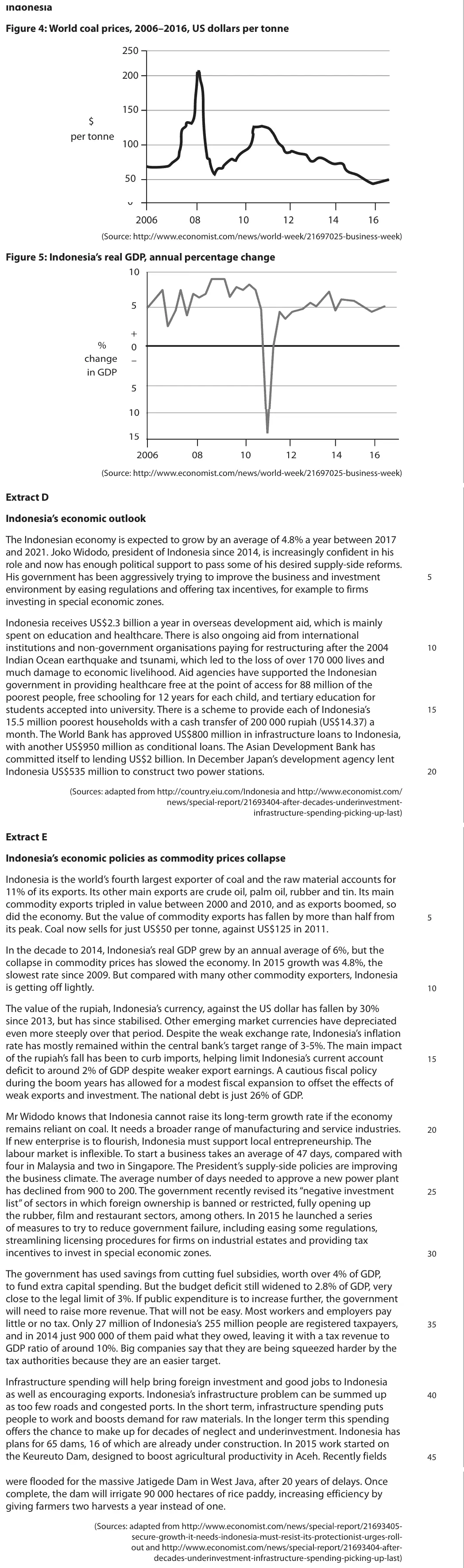
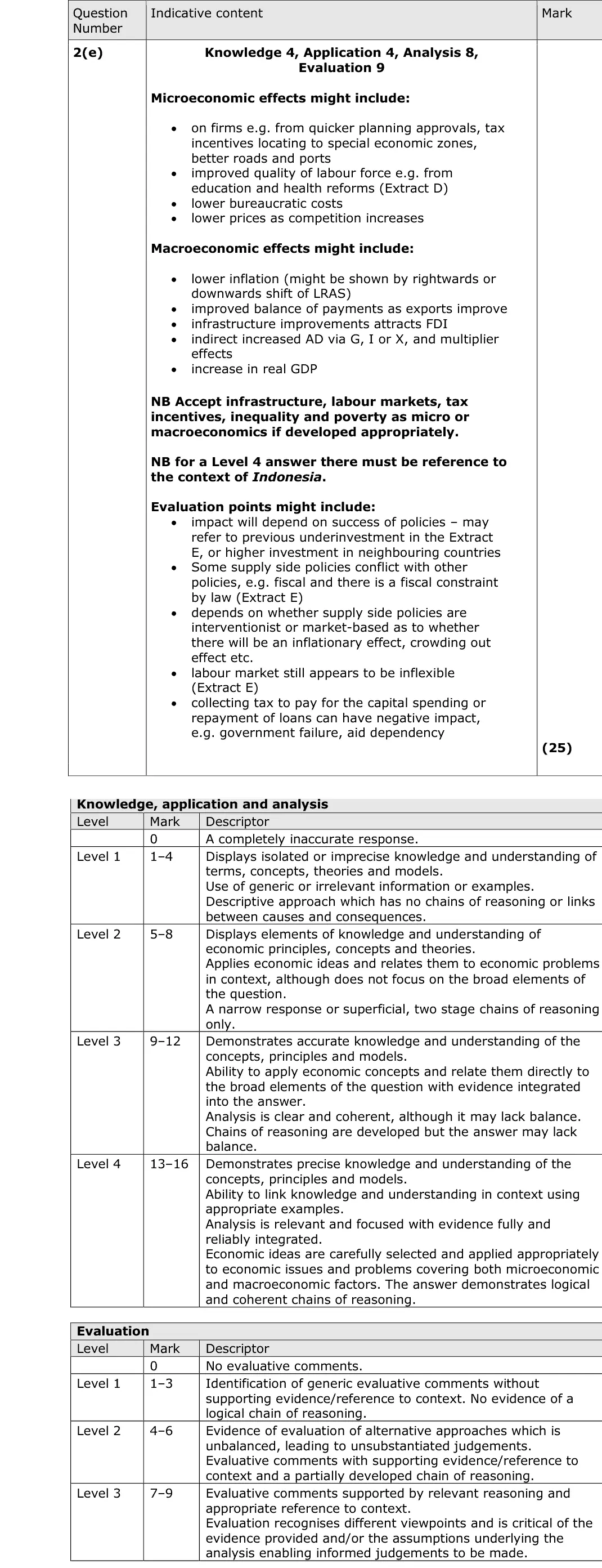
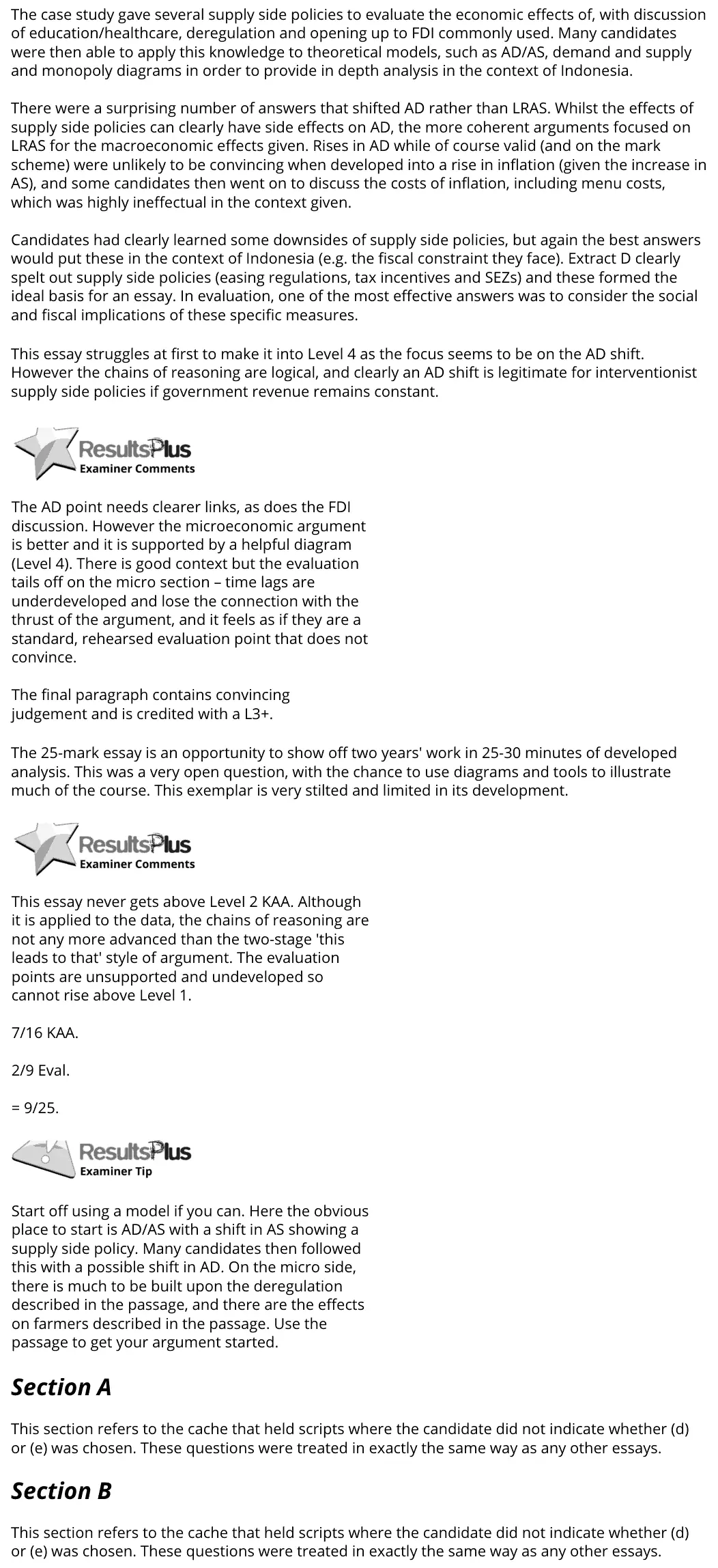
The case study gave several supply side policies to evaluate the economic effects of, with discussion of education/healthcare, deregulation and opening up to FDI commonly used. Many candidates were then able to apply this knowledge to theoretical models, such as AD/AS, demand and supply and monopoly diagrams in order to provide in depth analysis in the context of Indonesia. There were a surprising number of answers that shifted AD rather than LRAS. Whilst the effects of supply side policies can clearly have side effects on AD, the more coherent arguments focused on LRAS for the macroeconomic effects given. Rises in AD while of course valid (and on the mark scheme) were unlikely to be convincing when developed into a rise in inflation (given the increase in AS), and some candidates then went on to discuss the costs of inflation, including menu costs, which was highly ineffectual in the context given. Candidates had clearly learned some downsides of supply side policies, but again the best answers would put these in the context of Indonesia (e.g. the fiscal constraint they face). Extract D clearly spelt out supply side policies (easing regulations, tax incentives and SEZs) and these formed the ideal basis for an essay. In evaluation, one of the most effective answers was to consider the social and fiscal implications of these specific measures. This essay struggles at first to make it into Level 4 as the focus seems to be on the AD shift. However the chains of reasoning are logical, and clearly an AD shift is legitimate for interventionist supply side policies if government revenue remains constant. The AD point needs clearer links, as does the FDI discussion. However the microeconomic argument is better and it is supported by a helpful diagram (Level 4). There is good context but the evaluation tails off on the micro section – time lags are underdeveloped and lose the connection with the thrust of the argument, and it feels as if they are a standard, rehearsed evaluation point that does not convince. The final paragraph contains convincing judgement and is credited with a L3+. The 25-mark essay is an opportunity to show off two years' work in 25-30 minutes of developed analysis. This was a very open question, with the chance to use diagrams and tools to illustrate much of the course. This exemplar is very stilted and limited in its development. This essay never gets above Level 2 KAA. Although it is applied to the data, the chains of reasoning are not any more advanced than the two-stage 'this leads to that' style of argument. The evaluation points are unsupported and undeveloped so cannot rise above Level 1. 7/16 KAA. 2/9 Eval. = 9/25. Start off using a model if you can. Here the obvious place to start is AD/AS with a shift in AS showing a supply side policy. Many candidates then followed this with a possible shift in AD. On the micro side, there is much to be built upon the deregulation described in the passage, and there are the effects on farmers described in the passage. Use the passage to get your argument started. Section A This section refers to the cache that held scripts where the candidate did not indicate whether (d) or (e) was chosen. These questions were treated in exactly the same way as any other essays. Section B This section refers to the cache that held scripts where the candidate did not indicate whether (d) or (e) was chosen. These questions were treated in exactly the same way as any other essays.
Notes from the mark scheme and report
shift LRAS for the macro effects, not just AD (then arguing demand-pull inflation is weak)
micro effects of deregulation, tax incentives and special economic zones on firms' costs and competition
evaluate in Indonesia's context, e.g. the 3% fiscal deficit limit and inflexible labour market
June 2017 · Paper 1 · Q6(c)8 marksAO1=2, AO2=2, AO3=2, AO4=28-mark response
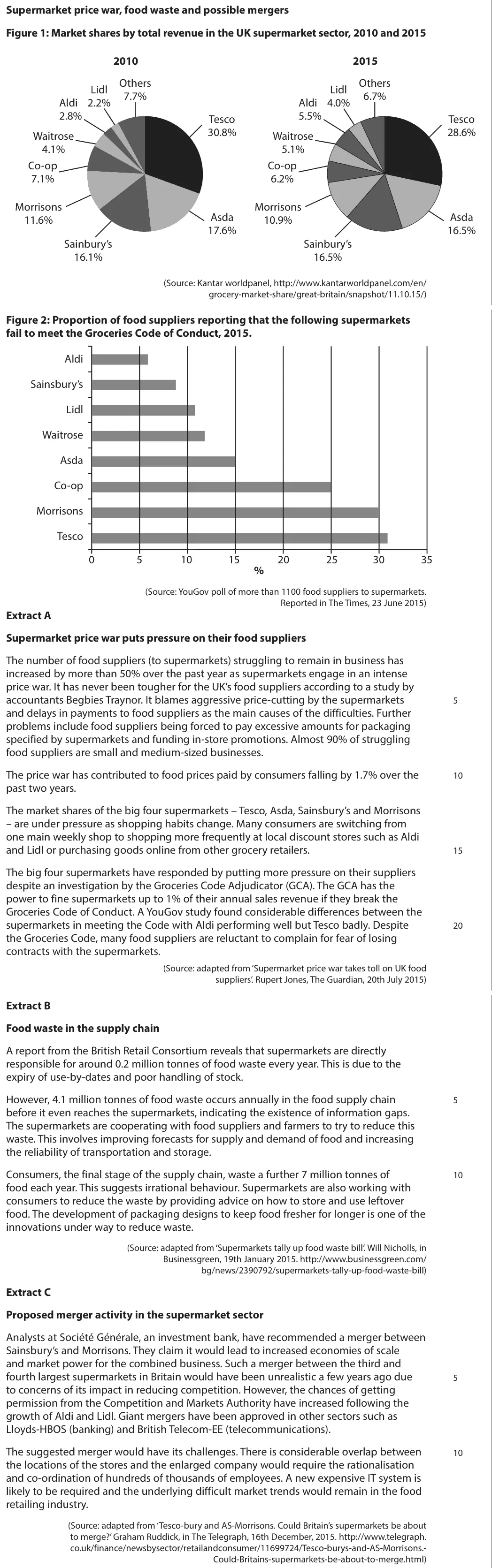
Data and extracts for question 6
Mark scheme, including the levels grid and indicative content
Examiner's comment
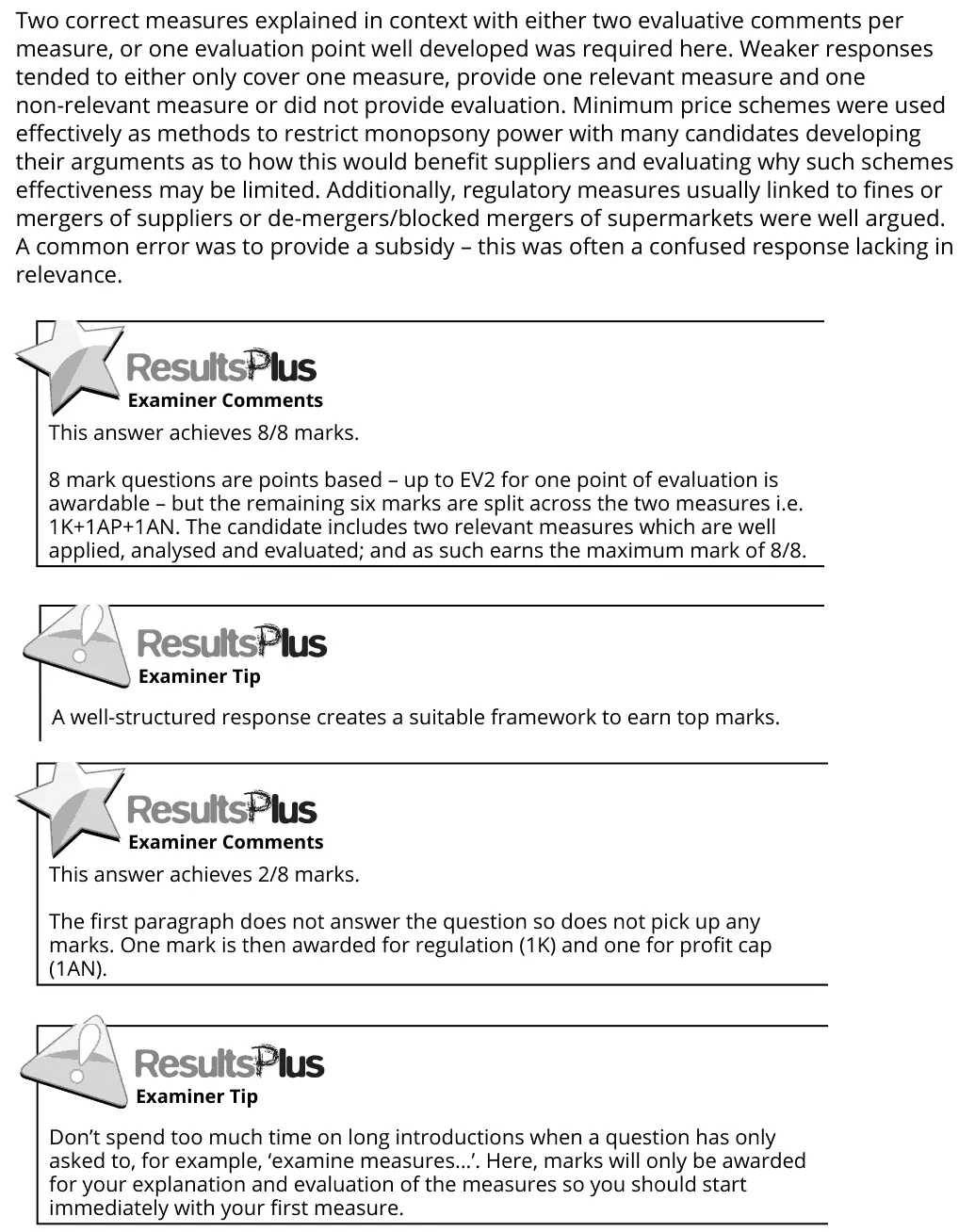
Two correct measures explained in context with either two evaluative comments per measure, or one evaluation point well developed was required here. Weaker responses tended to either only cover one measure, provide one relevant measure and one non-relevant measure or did not provide evaluation. Minimum price schemes were used effectively as methods to restrict monopsony power with many candidates developing their arguments as to how this would benefit suppliers and evaluating why such schemes effectiveness may be limited. Additionally, regulatory measures usually linked to fines or mergers of suppliers or de-mergers/blocked mergers of supermarkets were well argued. A common error was to provide a subsidy – this was often a confused response lacking in relevance. This answer achieves 8/8 marks. 8 mark questions are points based – up to EV2 for one point of evaluation is awardable – but the remaining six marks are split across the two measures i.e. 1K+1AP+1AN. The candidate includes two relevant measures which are well applied, analysed and evaluated; and as such earns the maximum mark of 8/8. A well-structured response creates a suitable framework to earn top marks. Don’t spend too much time on long introductions when a question has only asked to, for example, ‘examine measures...’. Here, marks will only be awarded for your explanation and evaluation of the measures so you should start immediately with your first measure. This answer achieves 2/8 marks. The first paragraph does not answer the question so does not pick up any marks. One mark is then awarded for regulation (1K) and one for profit cap (1AN).
Notes from the mark scheme and report
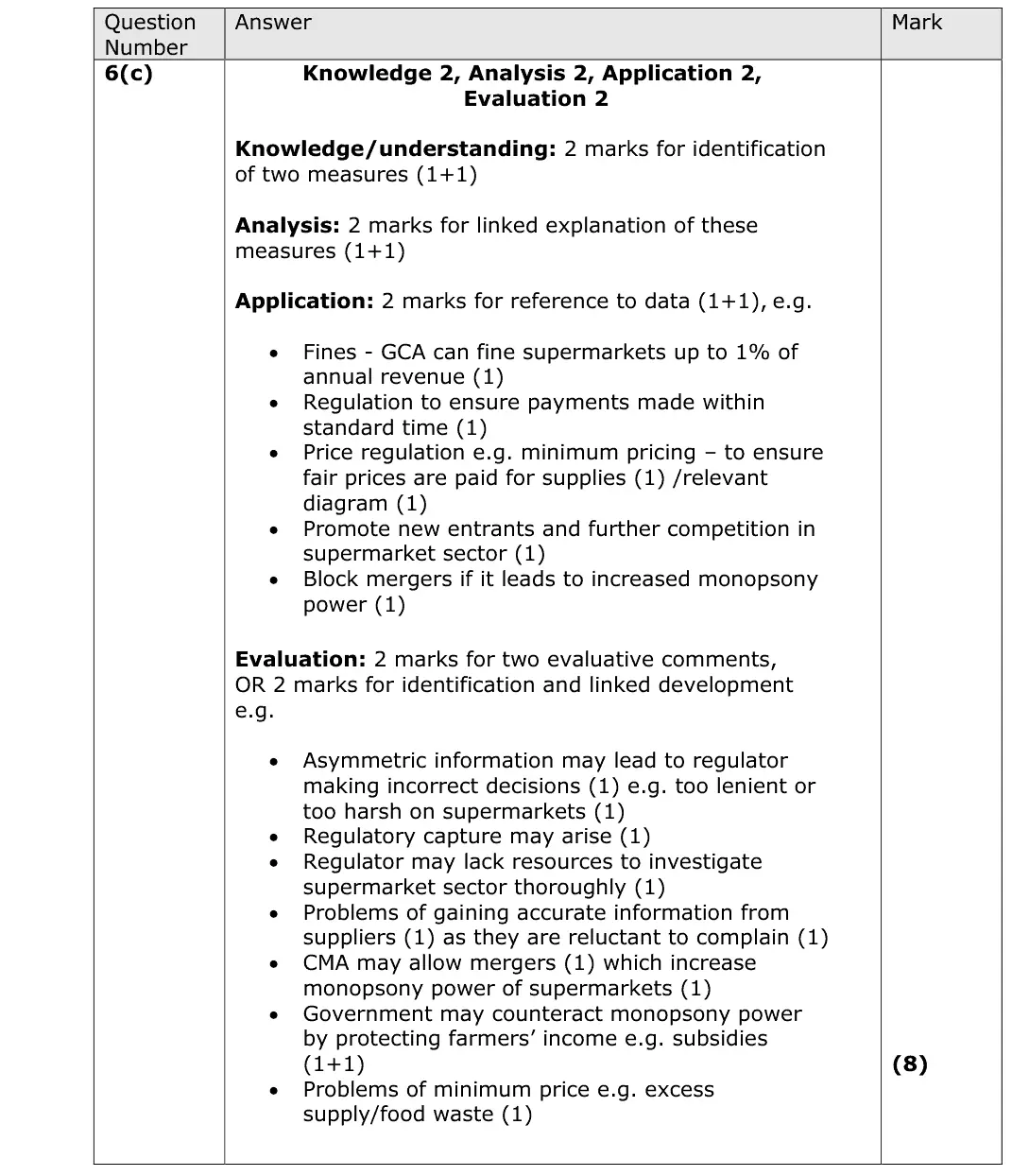
two measures each identified, explained and applied (e.g. GCA fines up to 1% of revenue, regulating payment times, blocking supermarket mergers, minimum prices for suppliers) plus evaluation
report: a subsidy was a common confused answer
do not waste time on long introductions
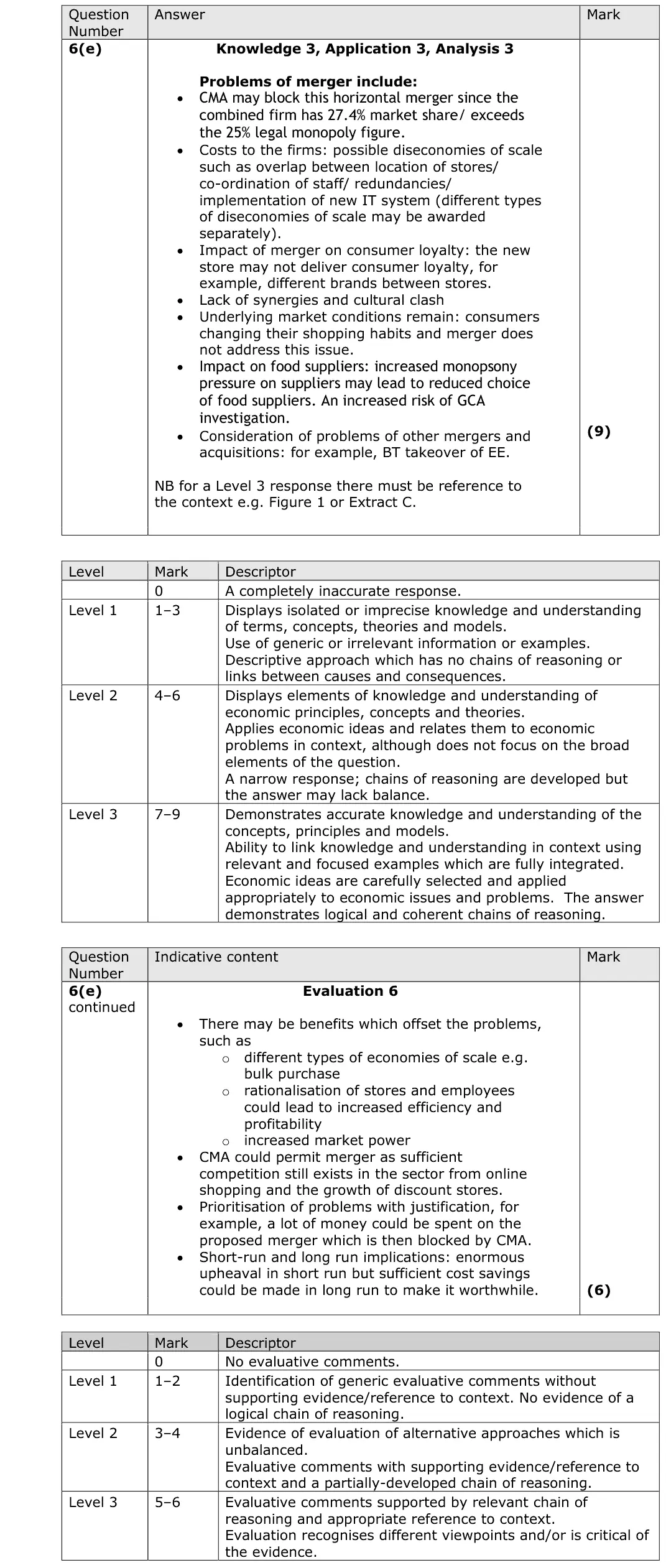
June 2017 · Paper 1 · Q6(e)15 marksAO1=3, AO2=3, AO3=3, AO4=615-mark response
Data and extracts for question 6
Mark scheme, including the levels grid and indicative content
Examiner's comment
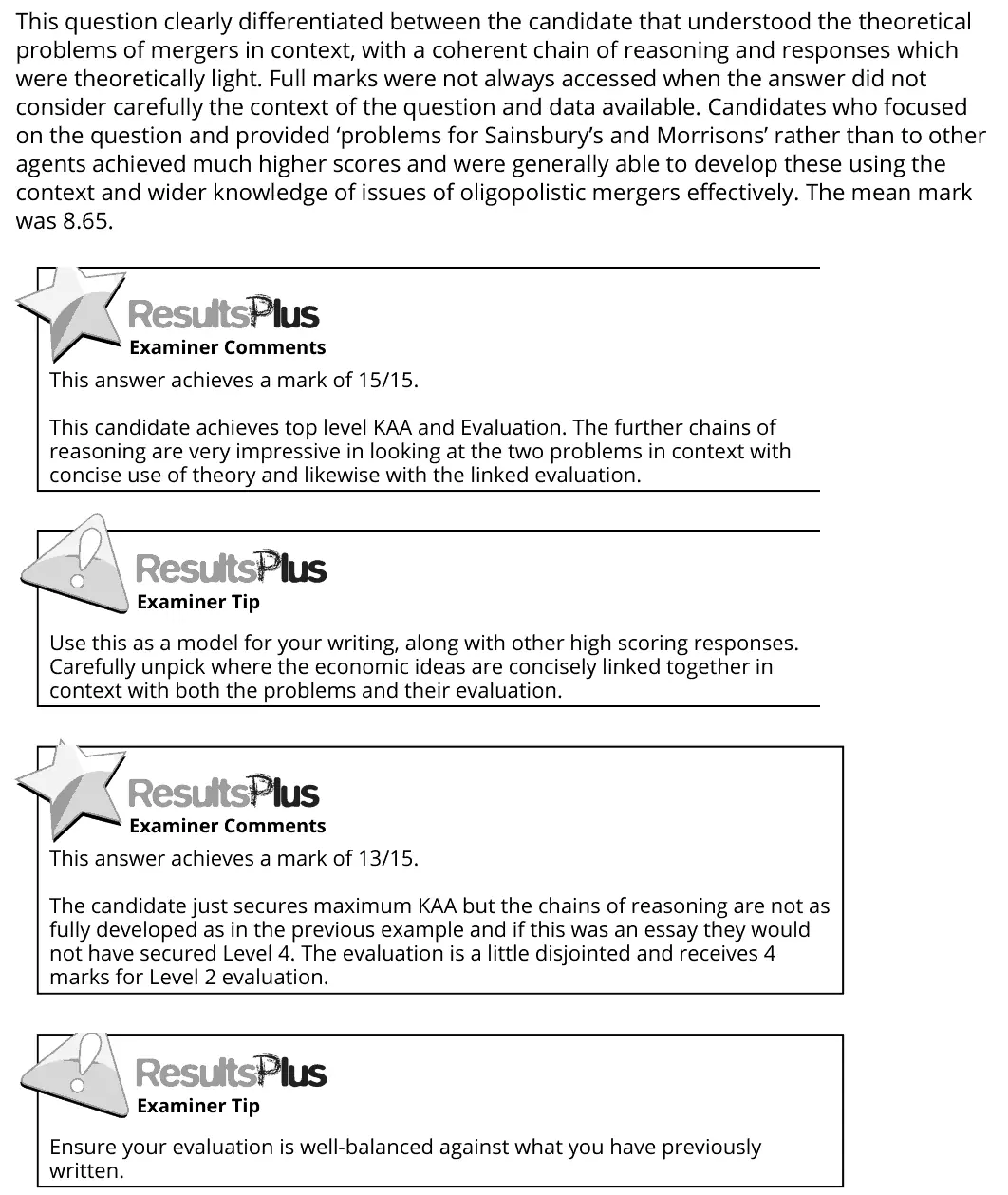
This question clearly differentiated between the candidate that understood the theoretical problems of mergers in context, with a coherent chain of reasoning and responses which were theoretically light. Full marks were not always accessed when the answer did not consider carefully the context of the question and data available. Candidates who focused on the question and provided ‘problems for Sainsbury’s and Morrisons’ rather than to other agents achieved much higher scores and were generally able to develop these using the context and wider knowledge of issues of oligopolistic mergers effectively. The mean mark was 8.65. Use this as a model for your writing, along with other high scoring responses. Carefully unpick where the economic ideas are concisely linked together in context with both the problems and their evaluation. This answer achieves a mark of 15/15. This candidate achieves top level KAA and Evaluation. The further chains of reasoning are very impressive in looking at the two problems in context with concise use of theory and likewise with the linked evaluation. Ensure your evaluation is well-balanced against what you have previously written. This answer achieves a mark of 13/15. The candidate just secures maximum KAA but the chains of reasoning are not as fully developed as in the previous example and if this was an essay they would not have secured Level 4. The evaluation is a little disjointed and receives 4 marks for Level 2 evaluation.
Notes from the mark scheme and report
problems for the two firms: CMA may block a horizontal merger (combined share 27.4% exceeds 25%), diseconomies of scale from overlapping stores, co-ordinating staff and a new IT system
report: answers focused on problems for other agents scored lower
evaluate with economies of scale and growth of Aldi and Lidl
Quantitative skills: QS 2 (calculate, use and understand percentages, percentage changes and percentage point changes); QS 9 (interpret, apply and analyse information in written, graphical tabular and numerical forms)
Work with an Edexcel economics tutor
Essays stuck in Level 2, or losing the easy marks in Section A? Book a trial session with Lianne, a former Edexcel examiner.