June 2024: Paper 1

100 marks · 17 question parts · Paper, mark scheme and report on Pearson's site

Question by question

QTopicMarksAOType
1(a) Price, income and cross elasticities of demand 4AO1=2,AO2=1,AO3=1Short answer
1(b) Price, income and cross elasticities of demand 1Multiple choice
2(a) Price elasticity of supply 4AO1=2,AO2=1,AO3=1Short answer
2(b) Price elasticity of supply 1Multiple choice
3(a) Business growth and business objectives 4AO1=2,AO2=2Diagram
3(b) Business growth and business objectives 1Multiple choice
4(a) Government intervention in markets 4AO1=2,AO2=1,AO3=1Short answer
4(b) Government failure 1Multiple choice
5(a) Oligopoly 4AO1=2,AO2=1,AO3=1Calculation
5(b) Oligopoly 1Multiple choice
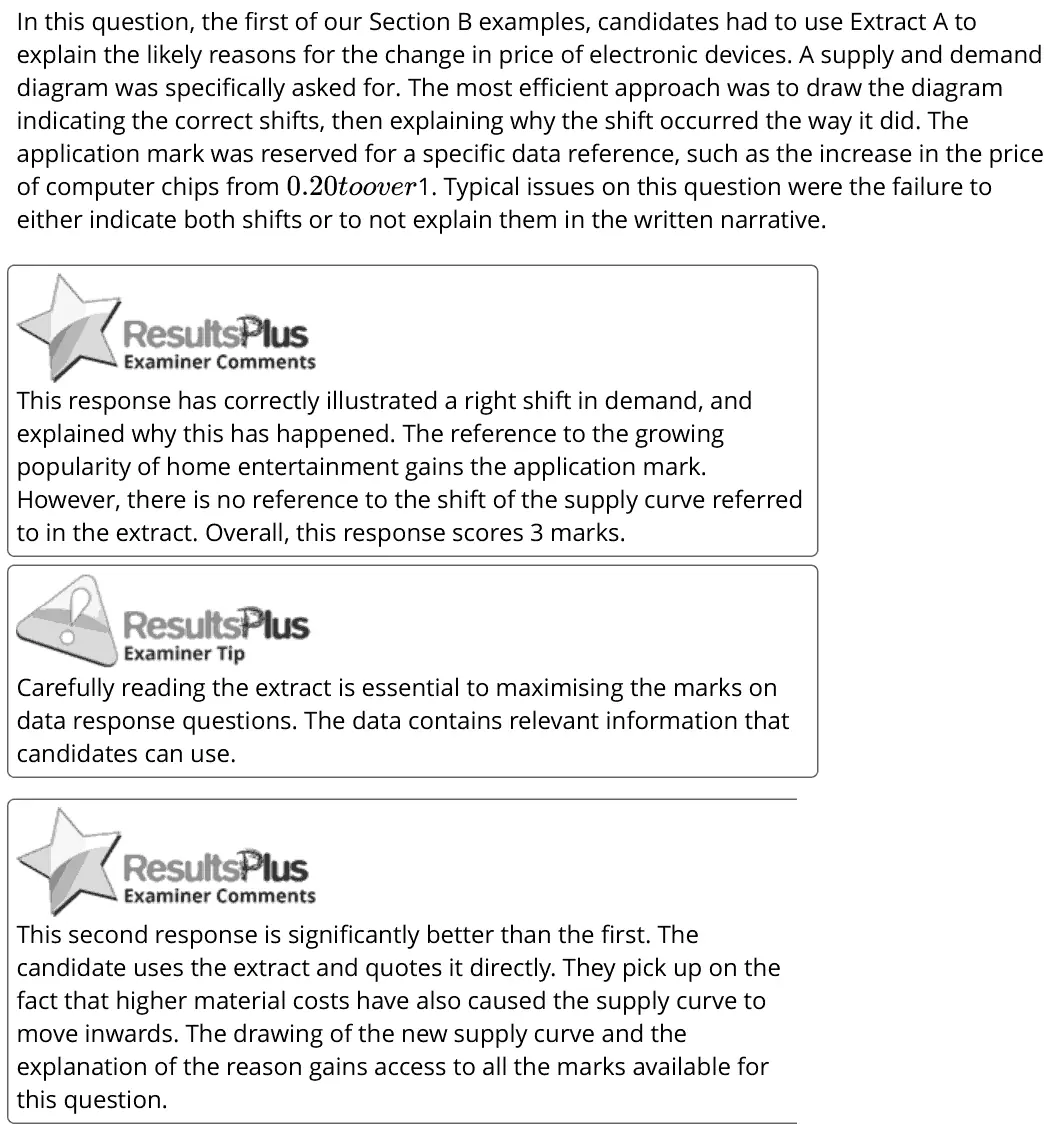
6(a) Supply, demand and price determination 5AO1=1,AO2=1,AO3=3Diagram
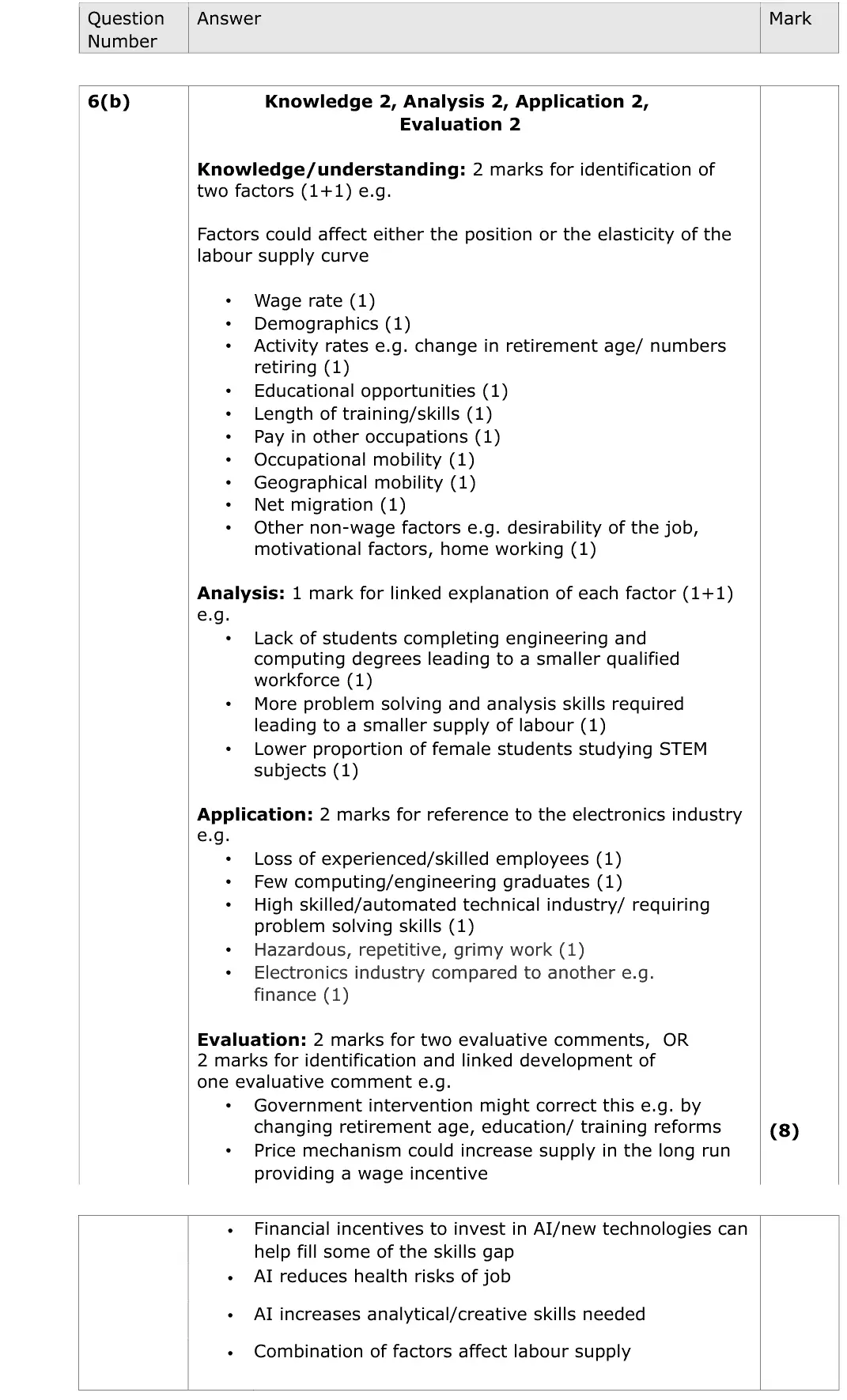
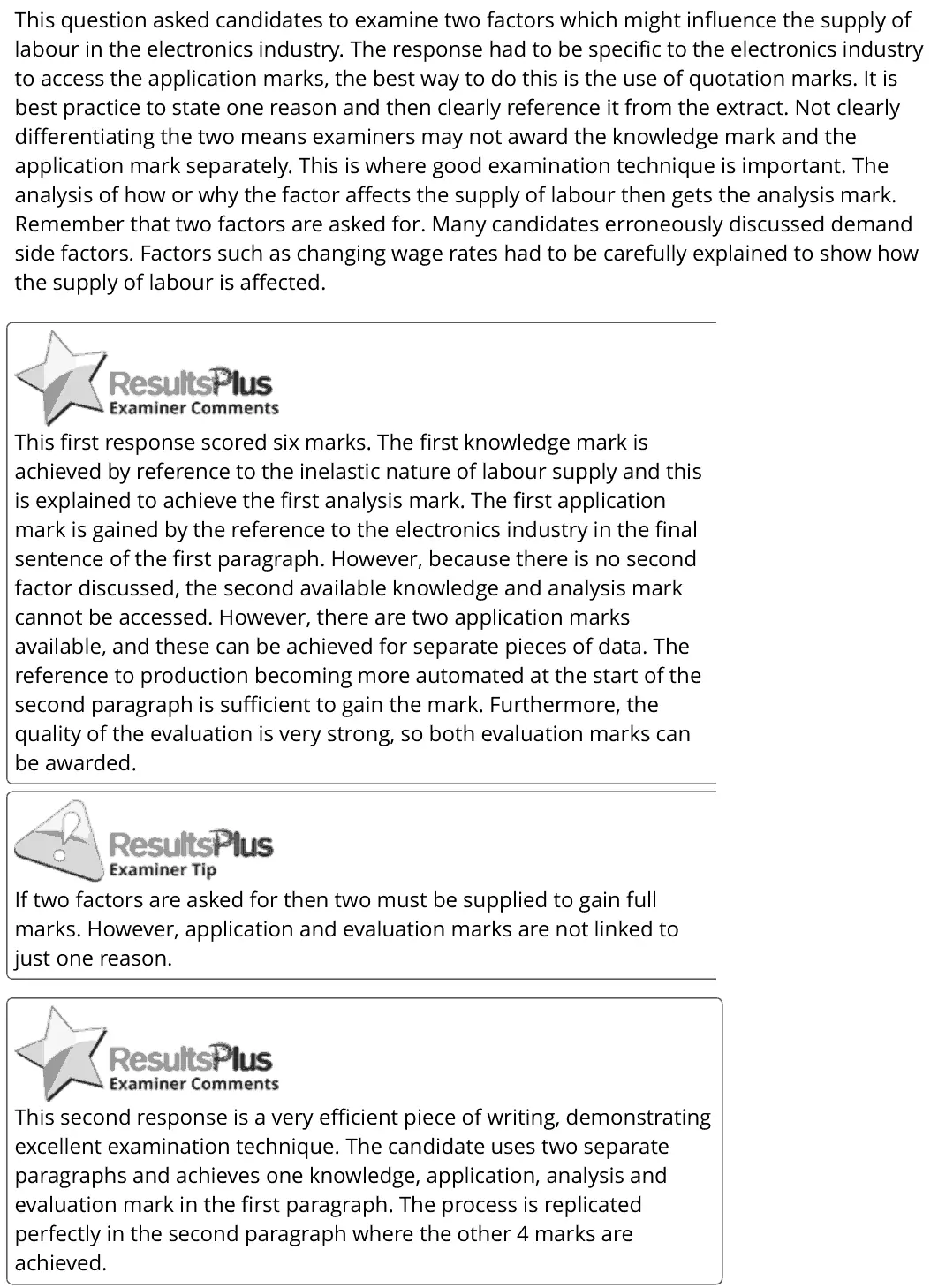
6(b) The labour market 8AO1=2,AO2=2,AO3=2,AO4=2Extended response
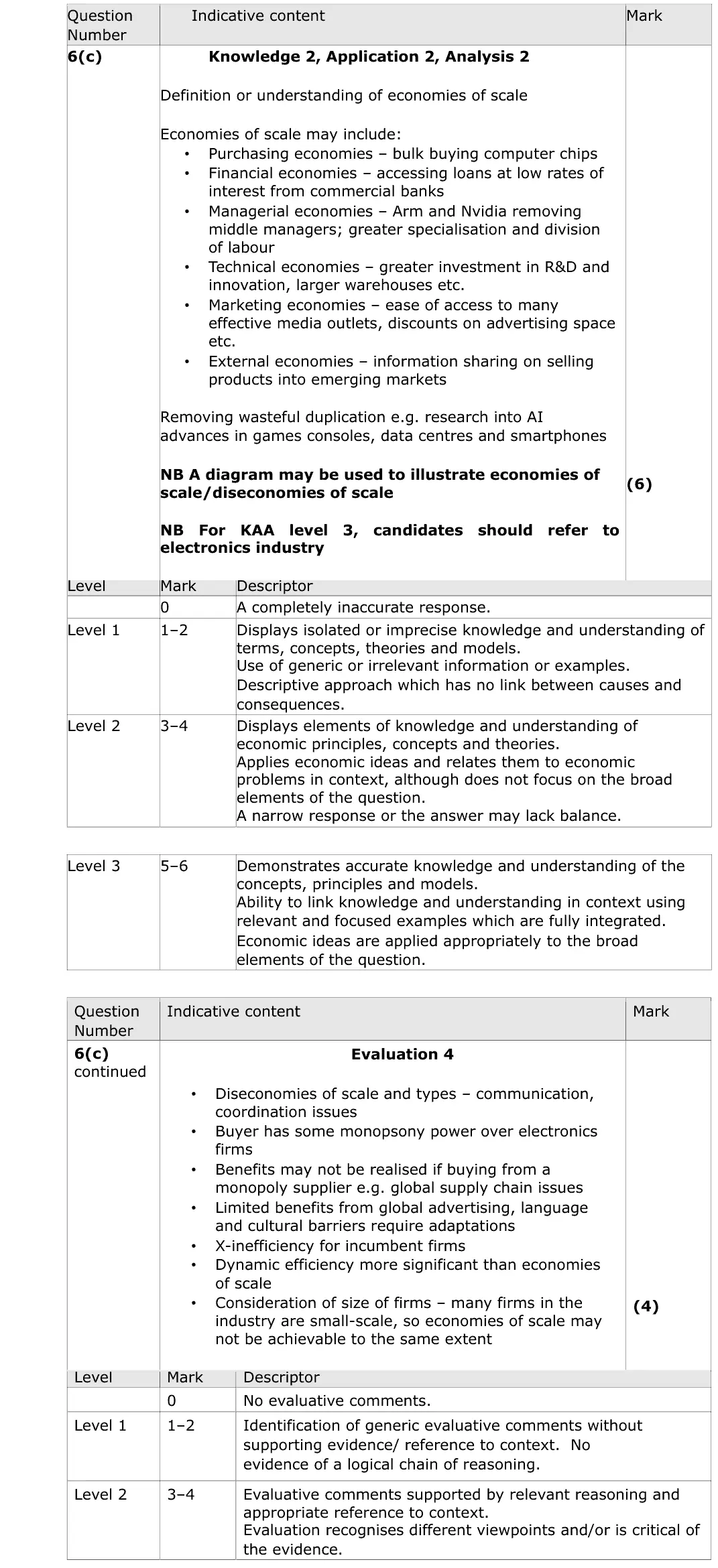
6(c) Revenues, costs and profits 10AO1=2,AO2=2,AO3=2,AO4=4Extended response
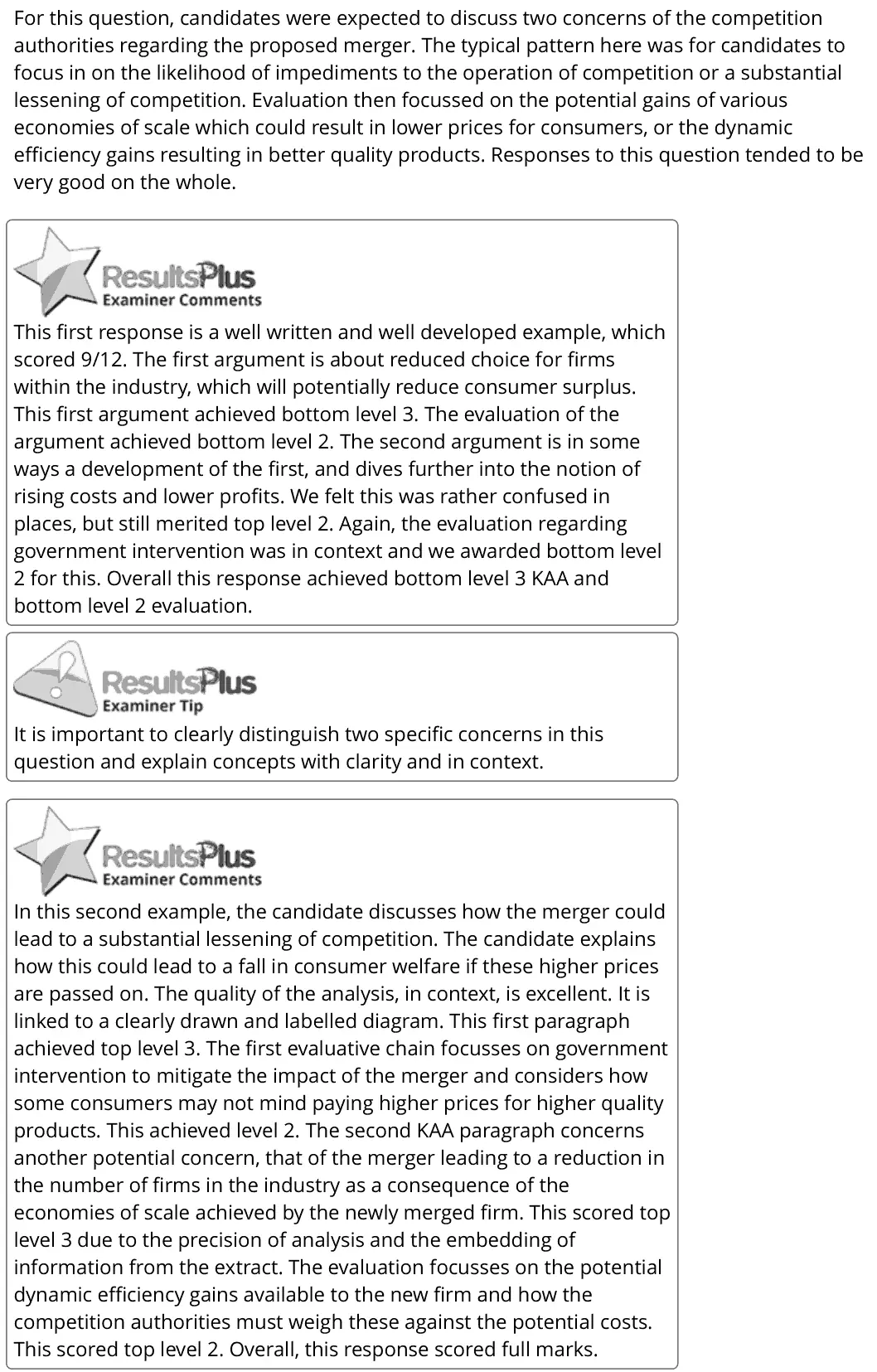
6(d) Government intervention: competition policy and regulation, Monopoly 12AO1=2,AO2=2,AO3=4,AO4=4Extended response
6(e) Government intervention in markets, Market failure and externalities 15AO1=3,AO2=3,AO3=3,AO4=6Extended response
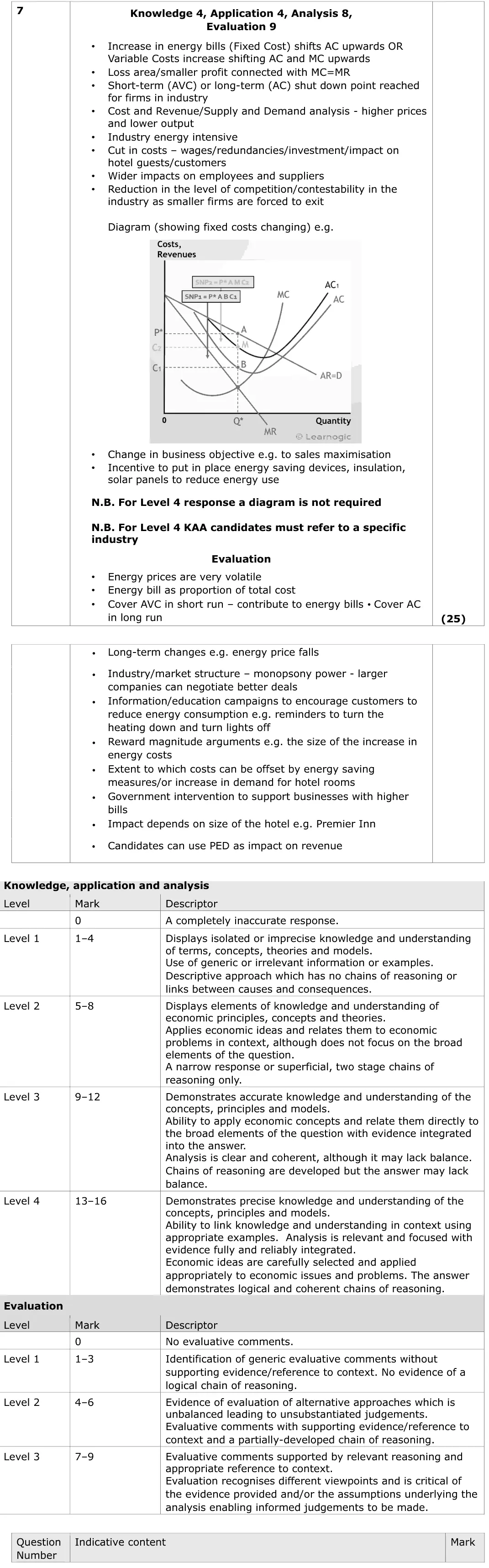
7 Revenues, costs and profits 25AO1=4,AO2=4,AO3=8,AO4=9Essay
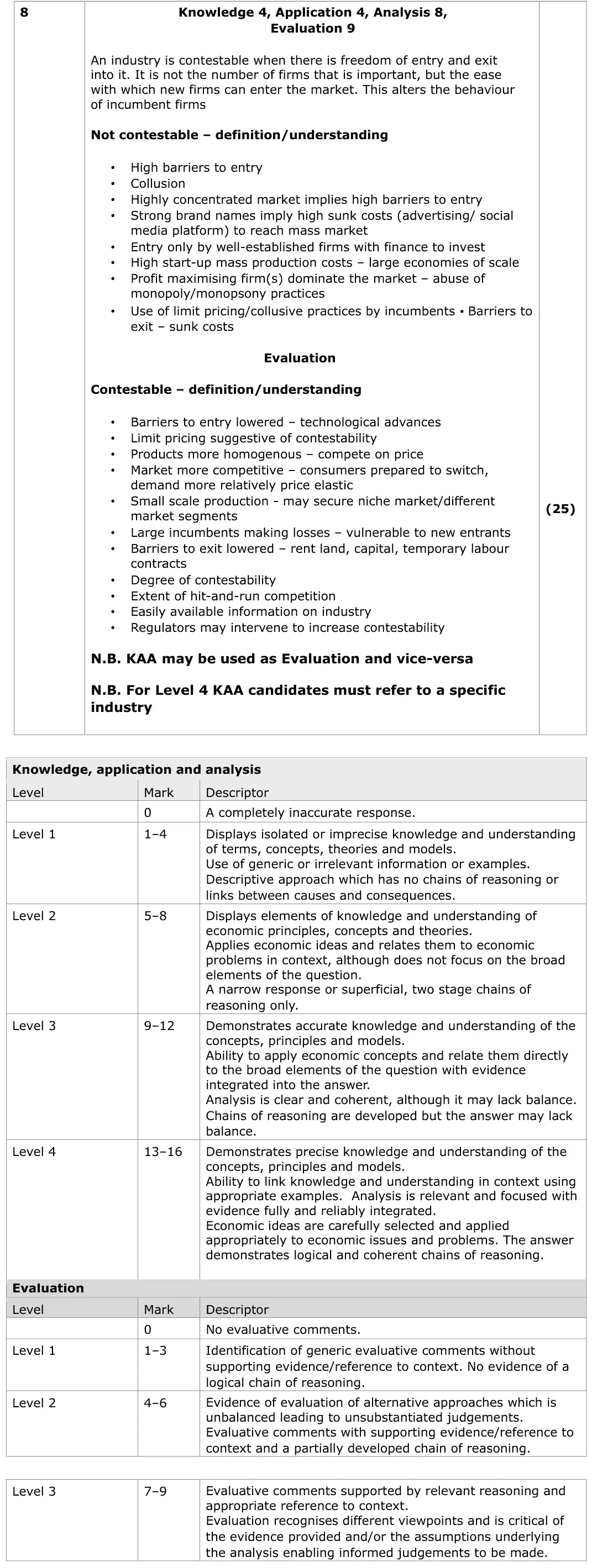
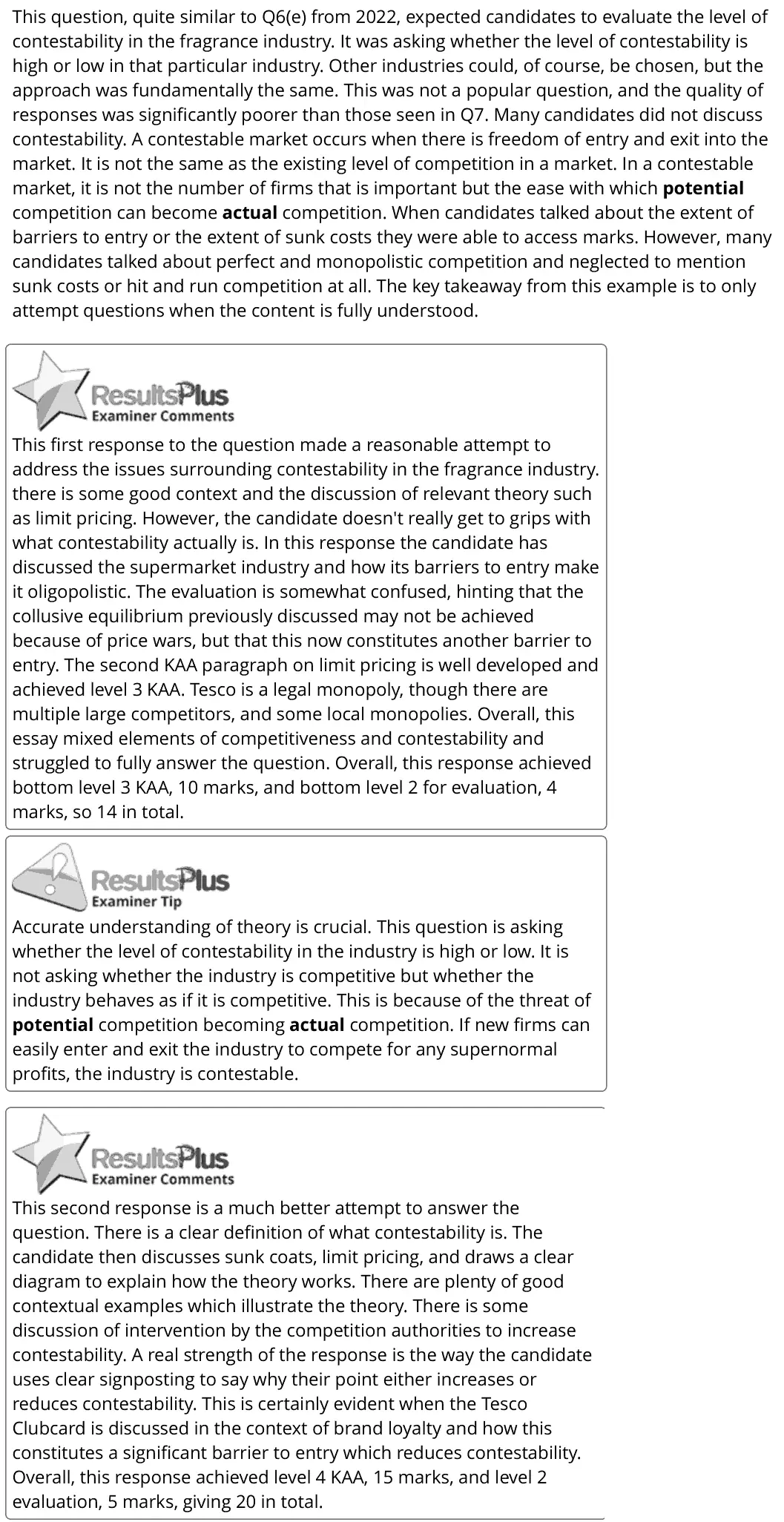
8 Monopsony and contestable markets 25AO1=4,AO2=4,AO3=8,AO4=9Essay

The questions

1(a)1(b)2(a)2(b)3(a)3(b)4(a)4(b)5(a)5(b)6(a)6(b)6(c)6(d)6(e)78
June 2024 · Paper 1 · Q1(a) 4 marks AO1=2, AO2=1, AO3=1 Short answer price elasticity of demand
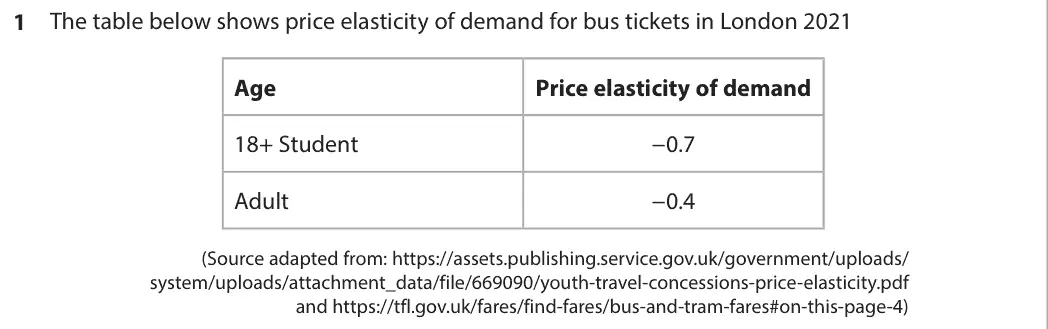
Data and extracts for question 11 The table below shows price elasticity of demand for bus tickets in London 2021 Age Price elasticity of demand 18+ Student -0.7 Adult -0.4 (Source adapted from: https://assets.publishing.service.gov.uk/government/uploads/ system/uploads/attachment_data/file/669090/youth-travel-concessions-price-elasticity.pdf and https://tfl.gov.uk/fares/find-fares/bus-and-tram-fares#on-this-page-4)
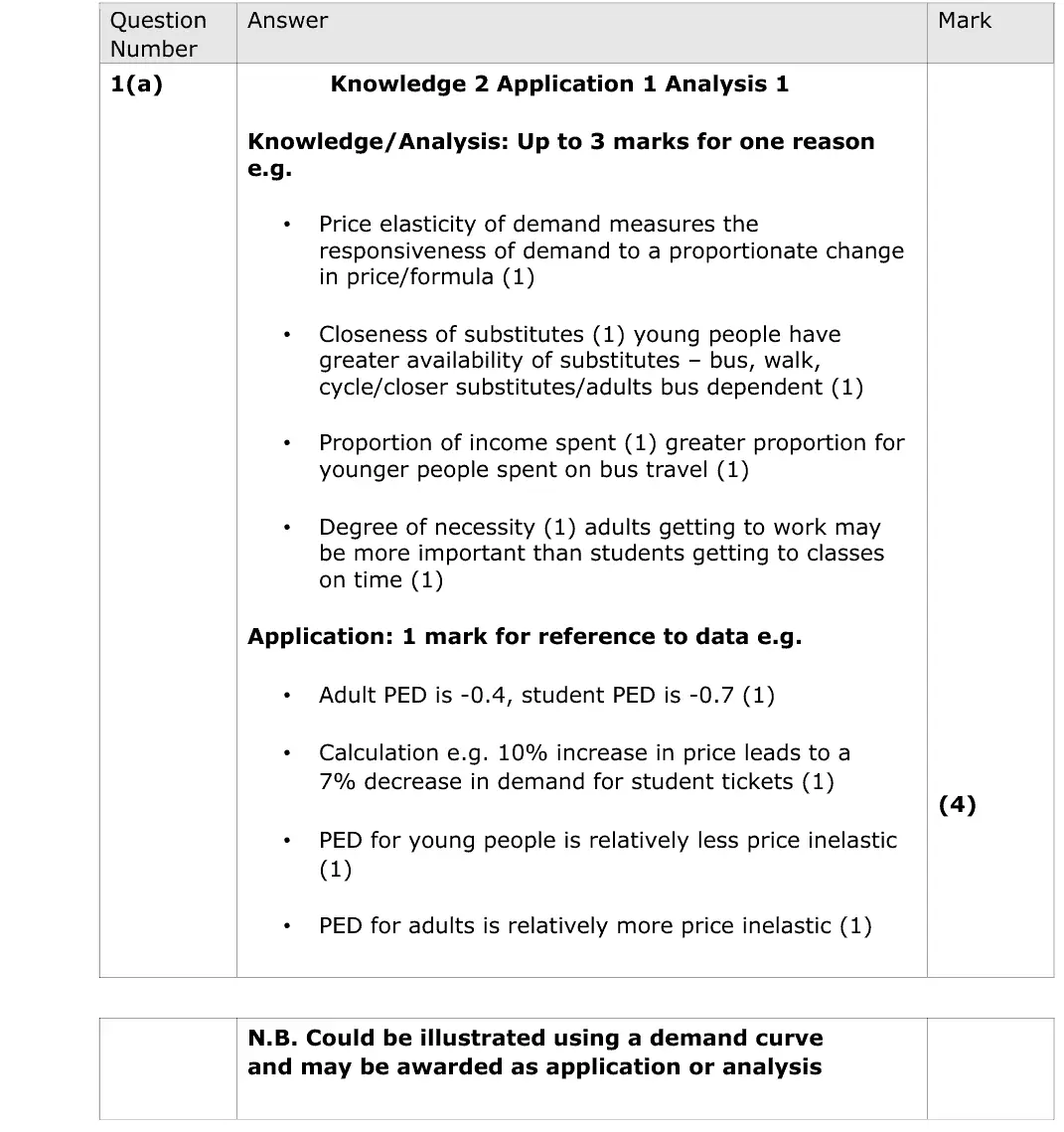
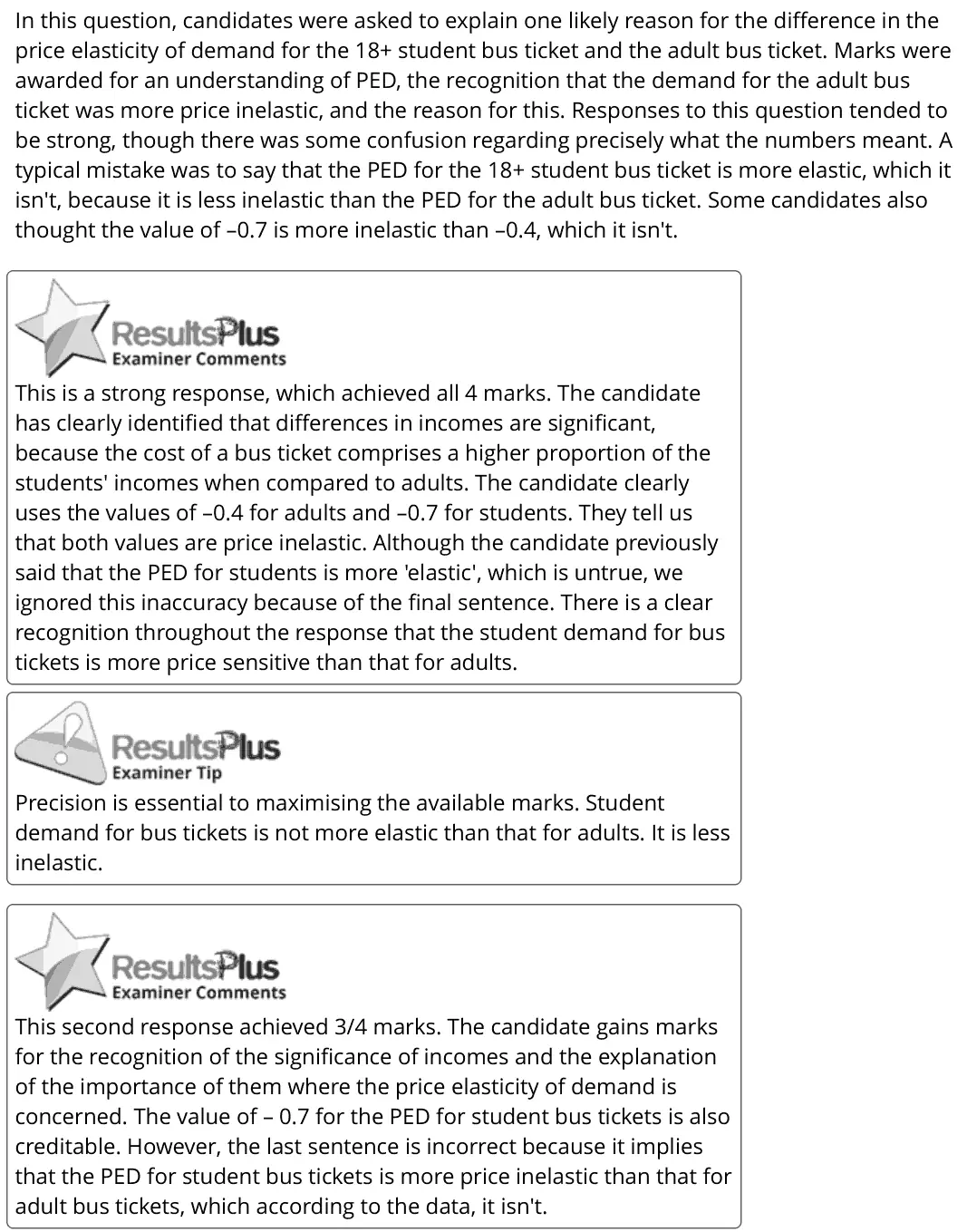
(a) Explain one likely reason for the difference in the price elasticity of demand for the 18+ student bus ticket and the adult bus ticket. (4)
June 2024 · Paper 1 · Q1(b) 1 mark Multiple choice price elasticity of demand
Data and extracts for question 11 The table below shows price elasticity of demand for bus tickets in London 2021 Age Price elasticity of demand 18+ Student -0.7 Adult -0.4 (Source adapted from: https://assets.publishing.service.gov.uk/government/uploads/ system/uploads/attachment_data/file/669090/youth-travel-concessions-price-elasticity.pdf and https://tfl.gov.uk/fares/find-fares/bus-and-tram-fares#on-this-page-4)
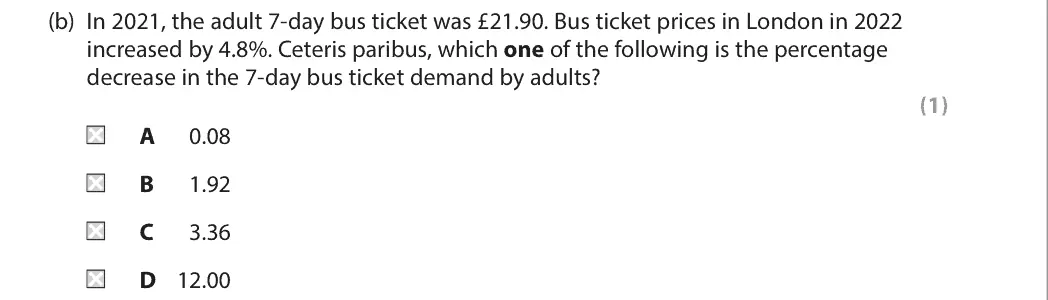
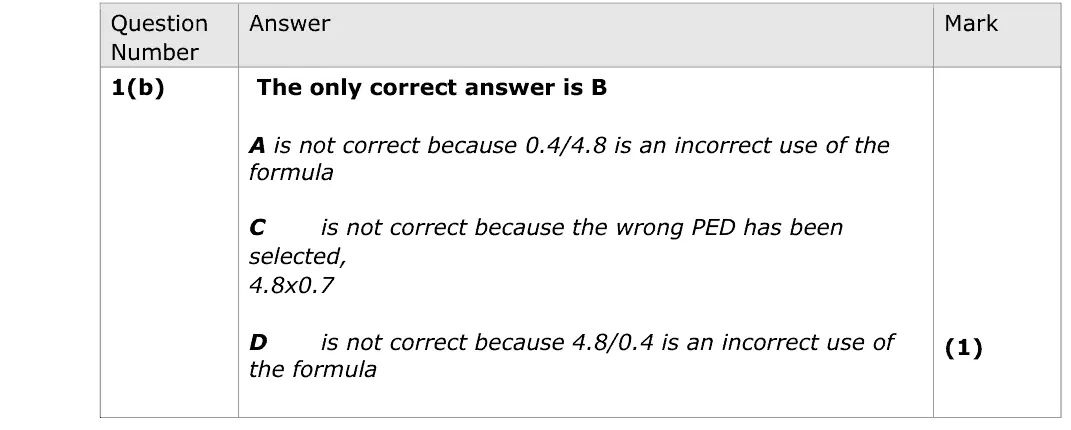
(b) In 2021, the adult 7-day bus ticket was £21.90. Bus ticket prices in London in 2022 increased by 4.8%. Ceteris paribus, which one of the following is the percentage decrease in the 7-day bus ticket demand by adults? (1) A 0.08 B 1.92 C 3.36 D 12.00
June 2024 · Paper 1 · Q2(a) 4 marks AO1=2, AO2=1, AO3=1 Short answer elasticity of supply
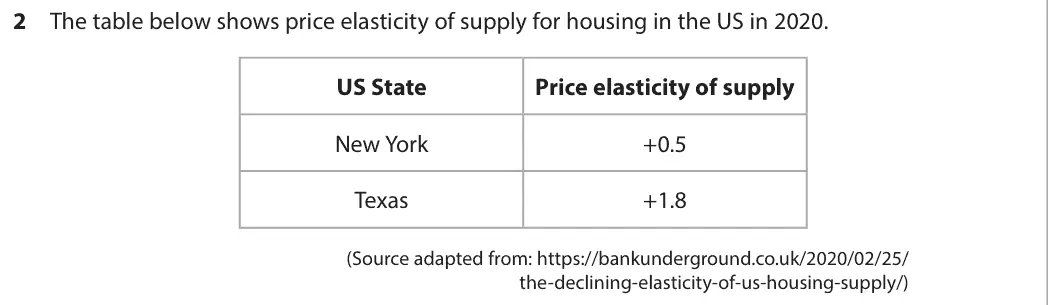
Data and extracts for question 22 The table below shows price elasticity of supply for housing in the US in 2020. US State Price elasticity of supply New York +0.5 Texas +1.8 (Source adapted from: https://bankunderground.co.uk/2020/02/25/ the-declining-elasticity-of-us-housing-supply/)
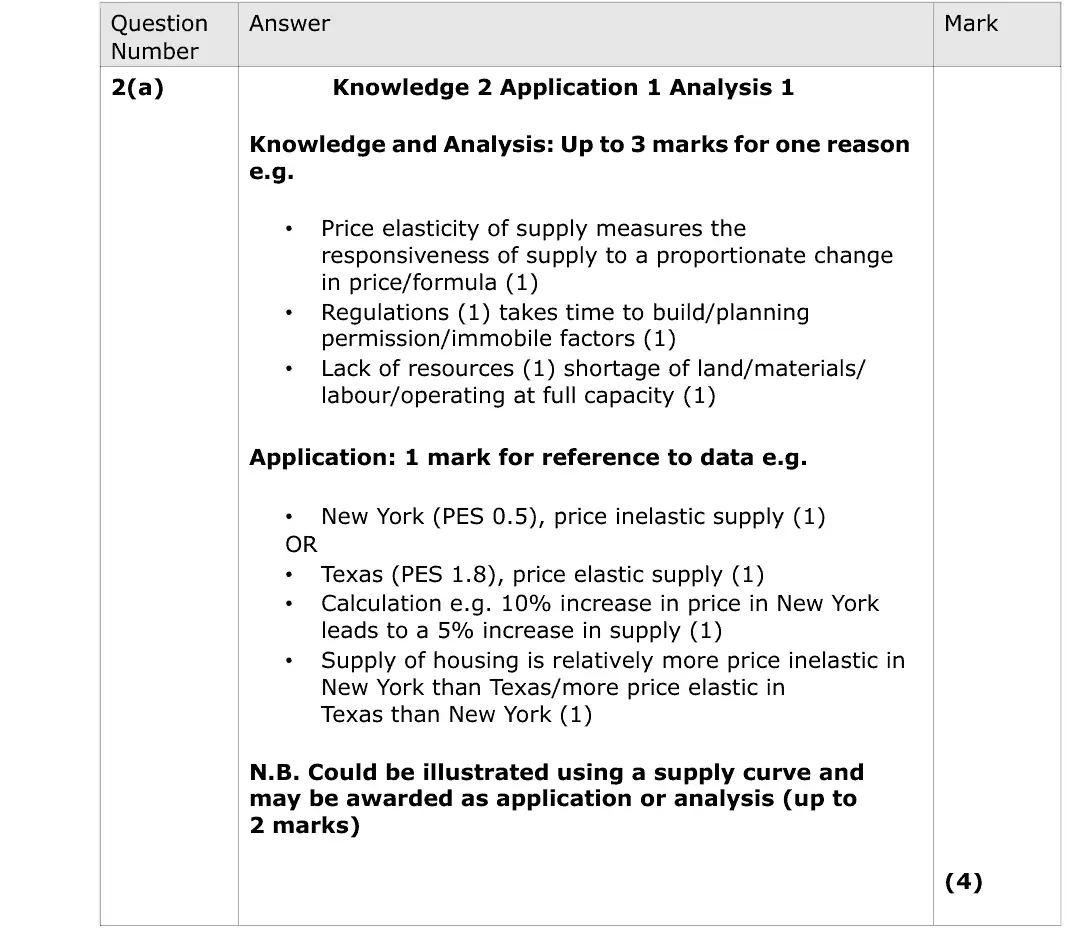
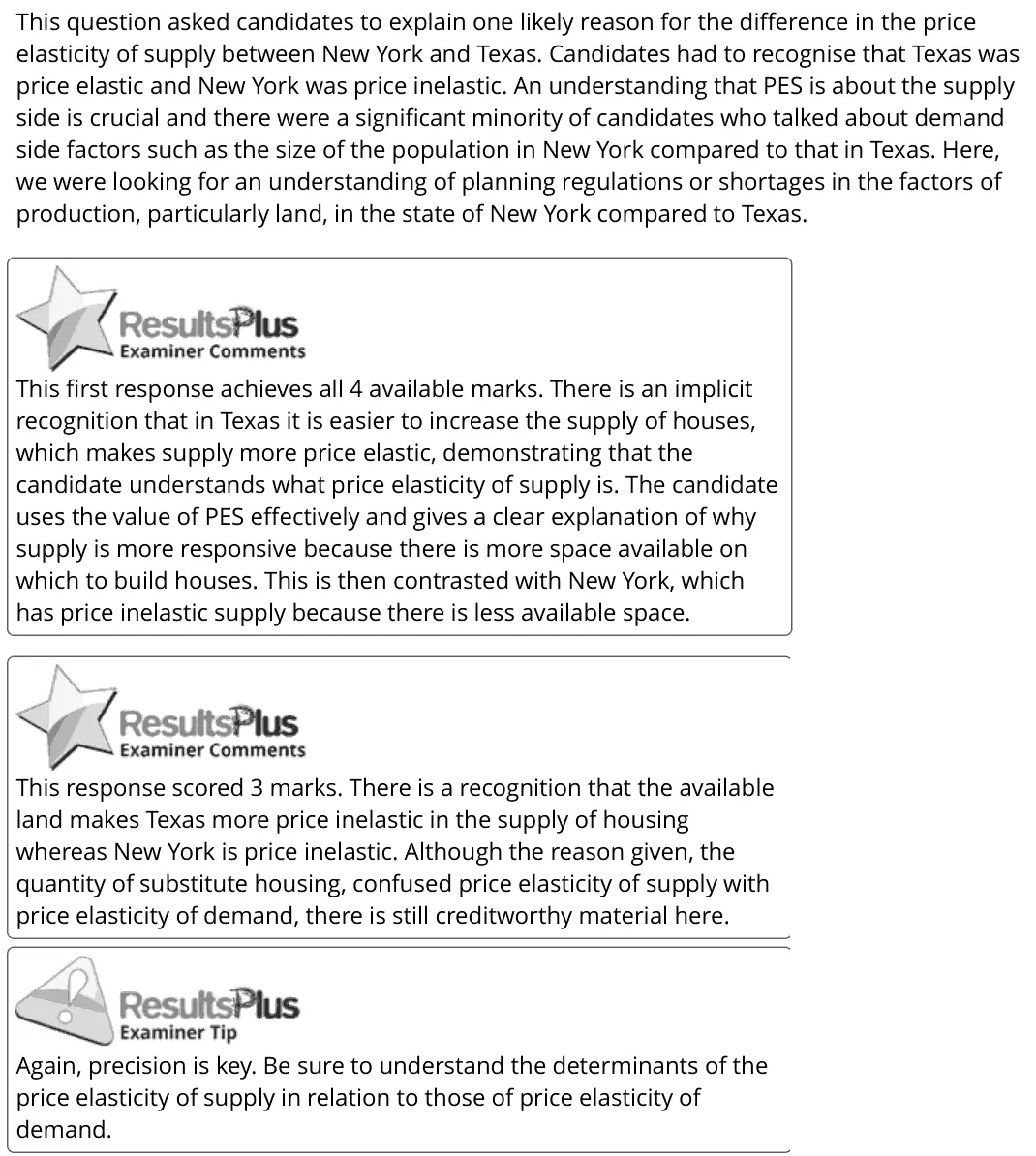
(a) With reference to the data above, explain one likely reason for the difference in the price elasticity of supply. (4)
June 2024 · Paper 1 · Q2(b) 1 mark Multiple choice elasticity of supply
Data and extracts for question 22 The table below shows price elasticity of supply for housing in the US in 2020. US State Price elasticity of supply New York +0.5 Texas +1.8 (Source adapted from: https://bankunderground.co.uk/2020/02/25/ the-declining-elasticity-of-us-housing-supply/)
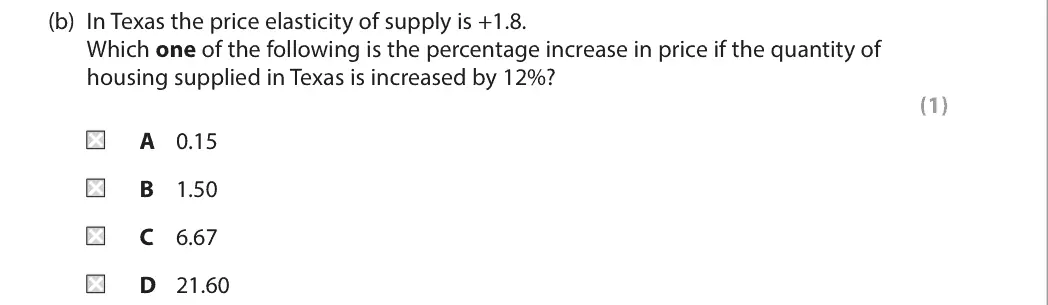
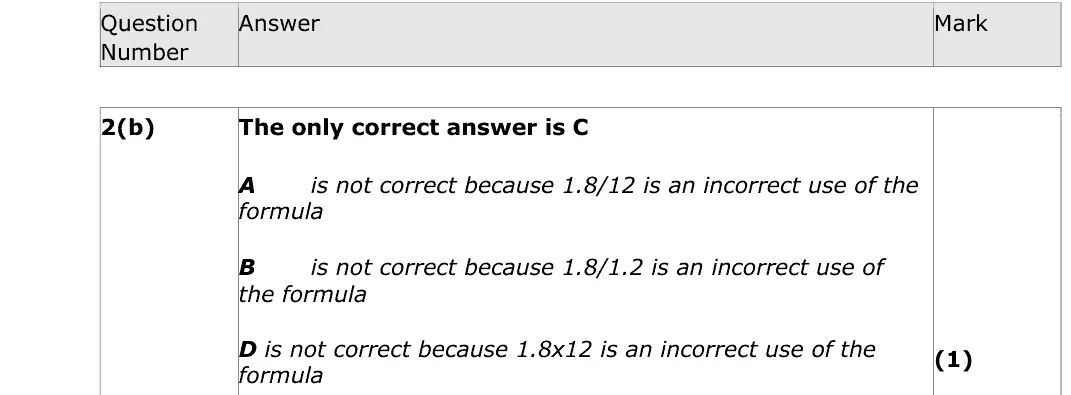
(b) In Texas the price elasticity of supply is +1.8. Which one of the following is the percentage increase in price if the quantity of housing supplied in Texas is increased by 12%? (1) A 0.15 B 1.50 C 6.67 D 21.60
June 2024 · Paper 1 · Q3(a) 4 marks AO1=2, AO2=2 Diagram business growth and objectives
Data and extracts for question 33 Peloton is a firm which makes exercise bikes. Peloton’s objective is to prioritise selling fitness services rather than to achieve short-term profit maximisation. (Source adapted from: https://www.forbes.com/sites/shelleykohan/2022/01/26/ peloton-prioritizes-access-and-acquisition-over-profits/?sh=13d8ee474f40 )
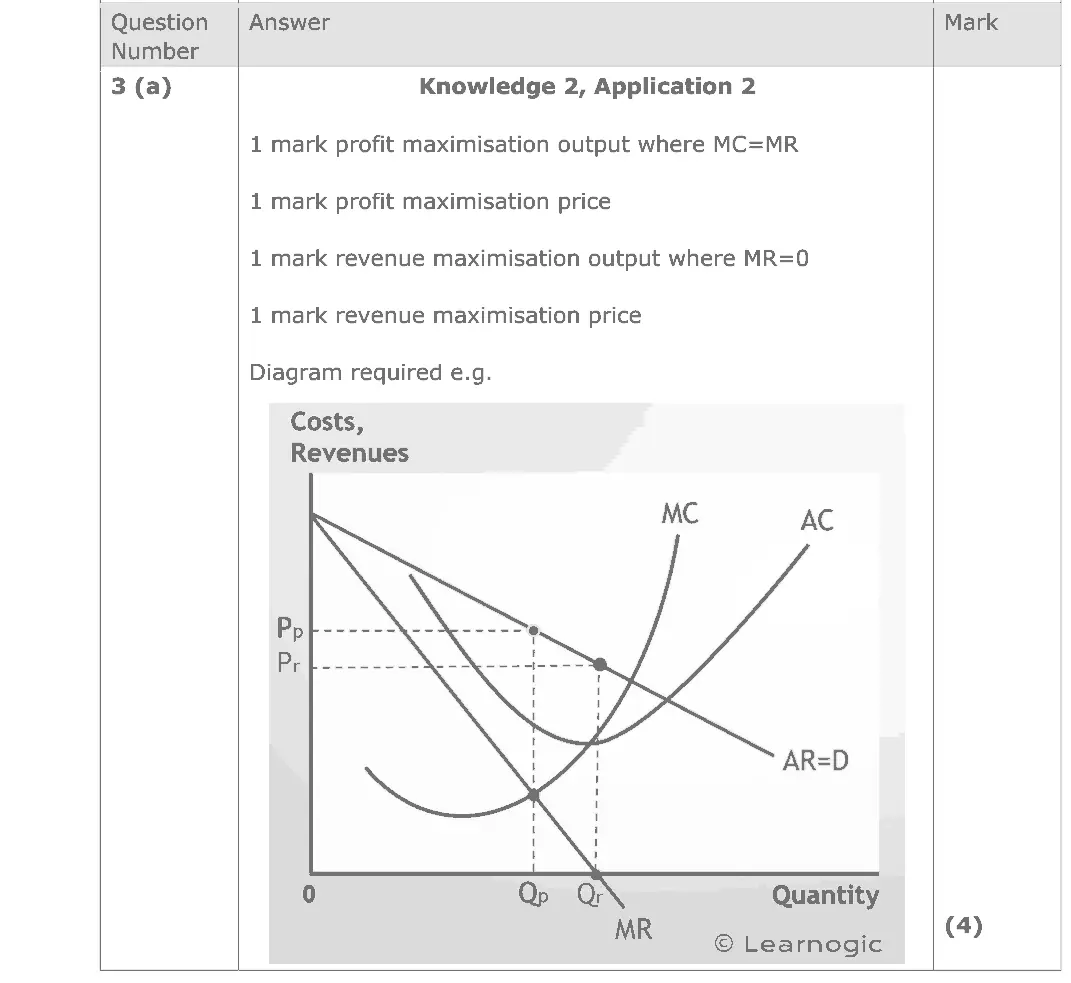
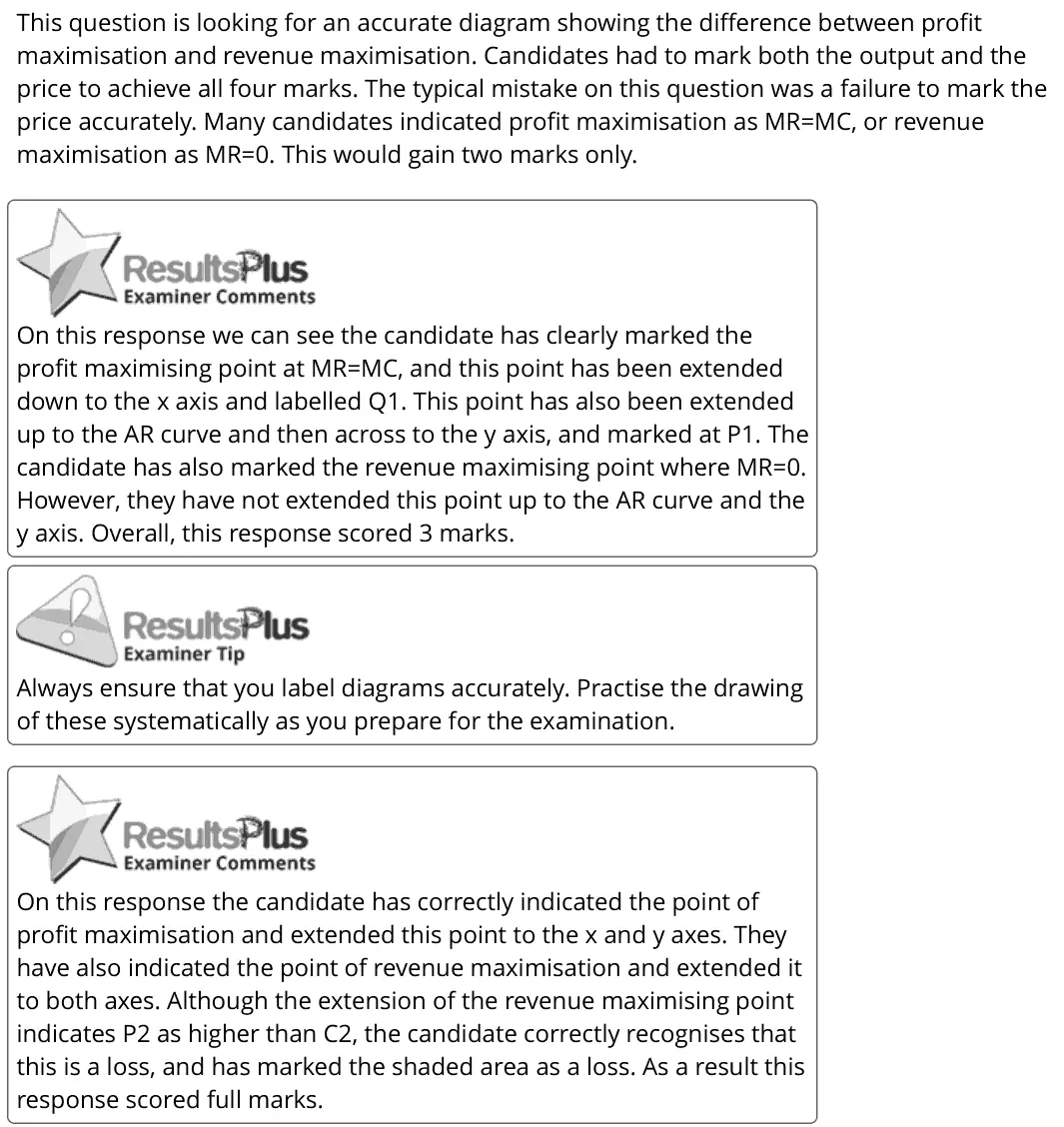
(a) Draw a cost and revenue diagram to illustrate the different business objectives: profit maximisation and revenue maximisation. (4)
June 2024 · Paper 1 · Q3(b) 1 mark Multiple choice business growth and objectives
Data and extracts for question 33 Peloton is a firm which makes exercise bikes. Peloton’s objective is to prioritise selling fitness services rather than to achieve short-term profit maximisation. (Source adapted from: https://www.forbes.com/sites/shelleykohan/2022/01/26/ peloton-prioritizes-access-and-acquisition-over-profits/?sh=13d8ee474f40 )
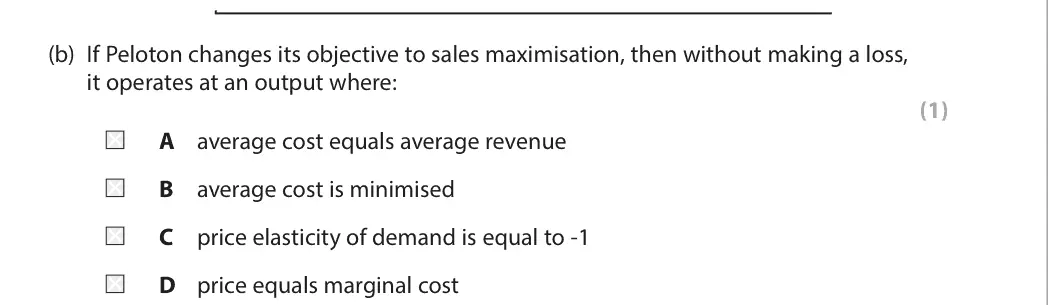
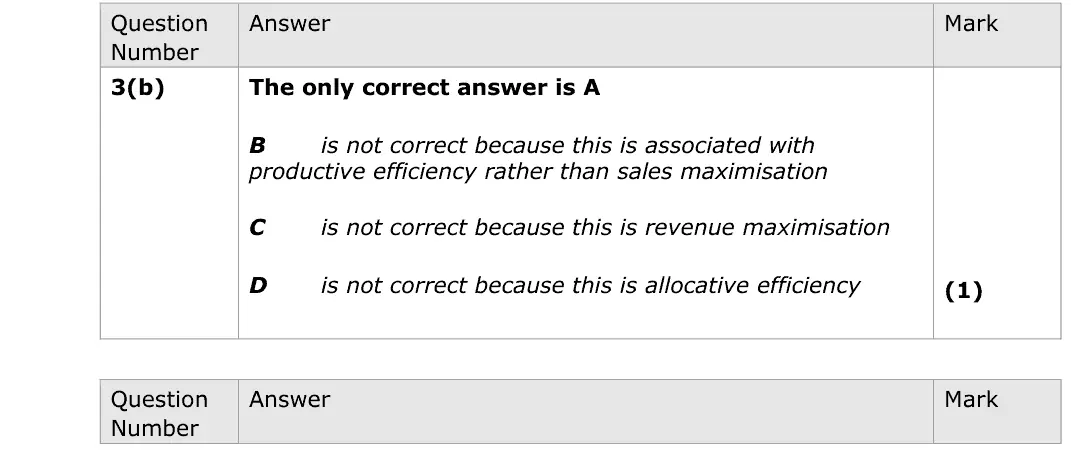
(b) If Peloton changes its objective to sales maximisation, then without making a loss, it operates at an output where: (1) A average cost equals average revenue B average cost is minimised C price elasticity of demand is equal to -1 D price equals marginal cost
June 2024 · Paper 1 · Q4(a) 4 marks AO1=2, AO2=1, AO3=1 Short answer government intervention in markets
Data and extracts for question 44 In 2022 the government announced that the maximum undergraduate tuition fee for universities in England will remain at £9 250 per year for the next two years. (Source adapted from: https://questions-statements.parliament.uk/ written-statements/detail/2021-10-21/HCWS339)
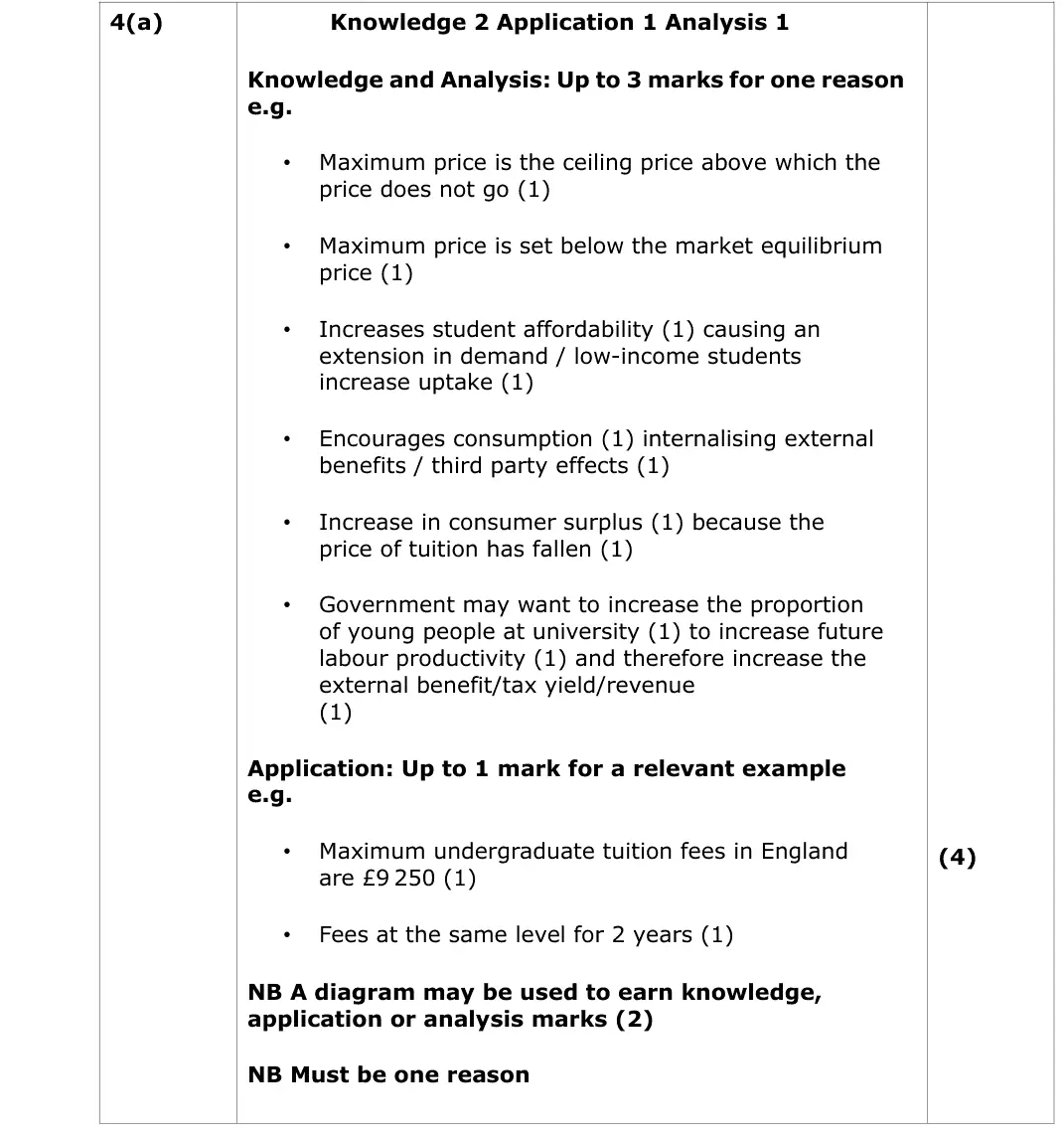
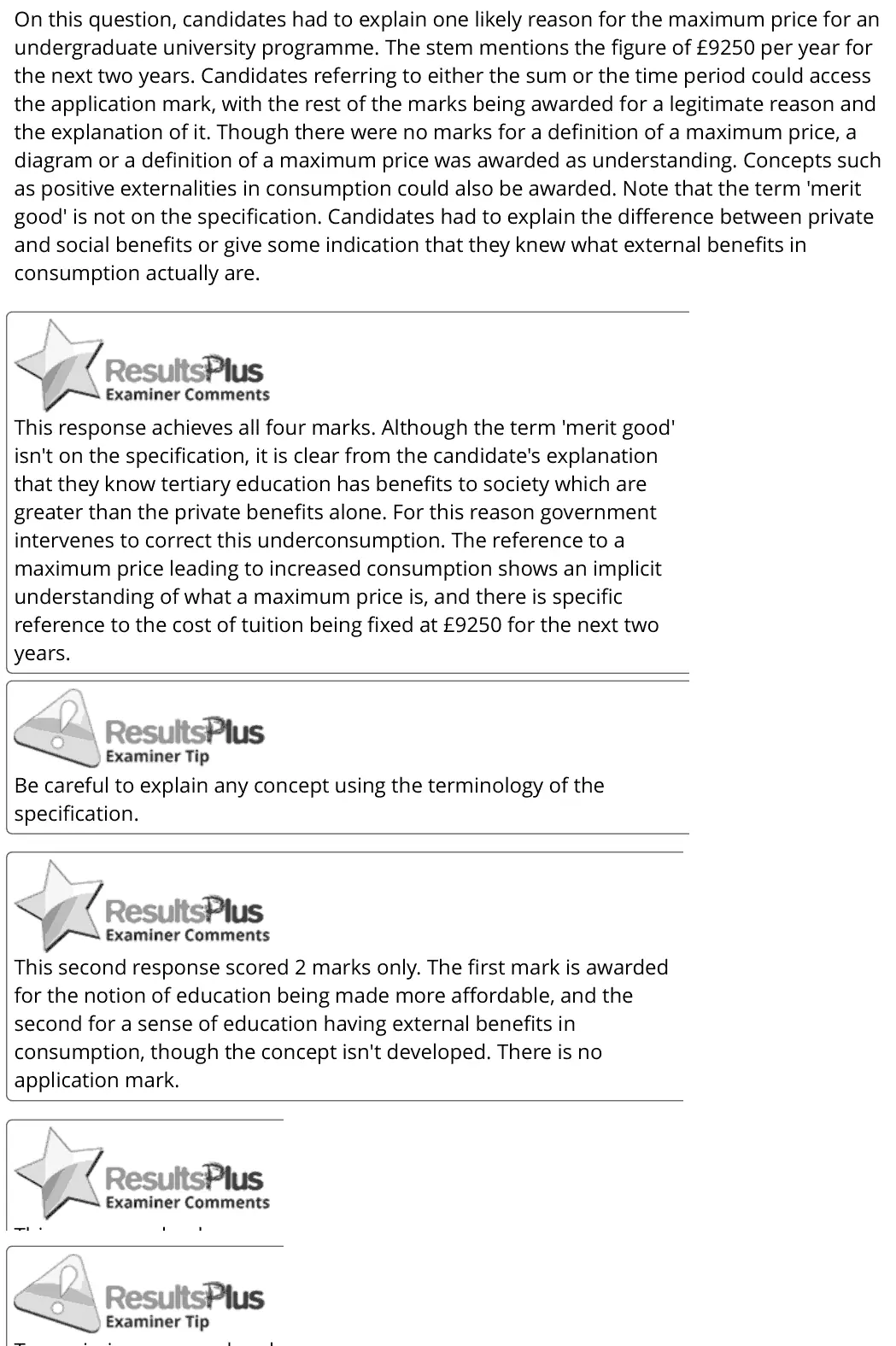
(a) Explain one likely reason for the maximum price for an undergraduate university programme. (4)
June 2024 · Paper 1 · Q4(b) 1 mark Multiple choice government failure
Data and extracts for question 44 In 2022 the government announced that the maximum undergraduate tuition fee for universities in England will remain at £9 250 per year for the next two years. (Source adapted from: https://questions-statements.parliament.uk/ written-statements/detail/2021-10-21/HCWS339)
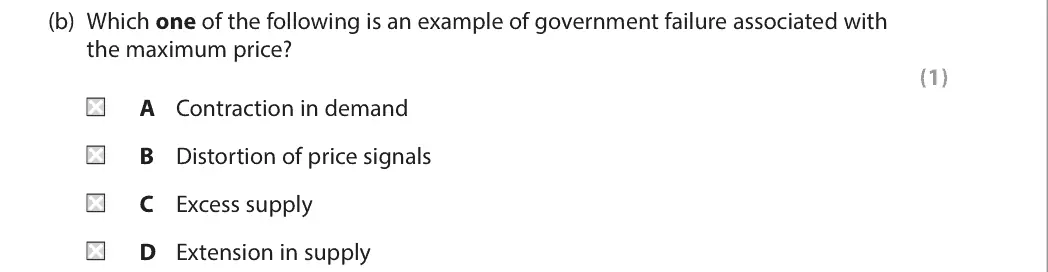
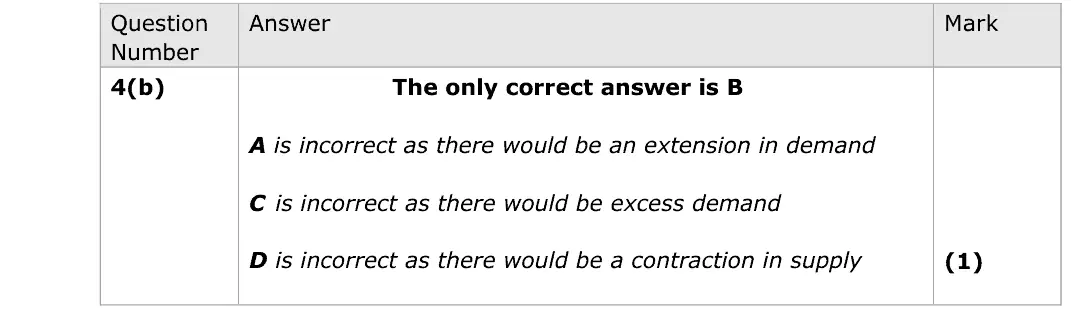
(b) Which one of the following is an example of government failure associated with the maximum price? (1) A Contraction in demand B Distortion of price signals C Excess supply D Extension in supply
June 2024 · Paper 1 · Q5(a) 4 marks AO1=2, AO2=1, AO3=1 Calculation oligopoly
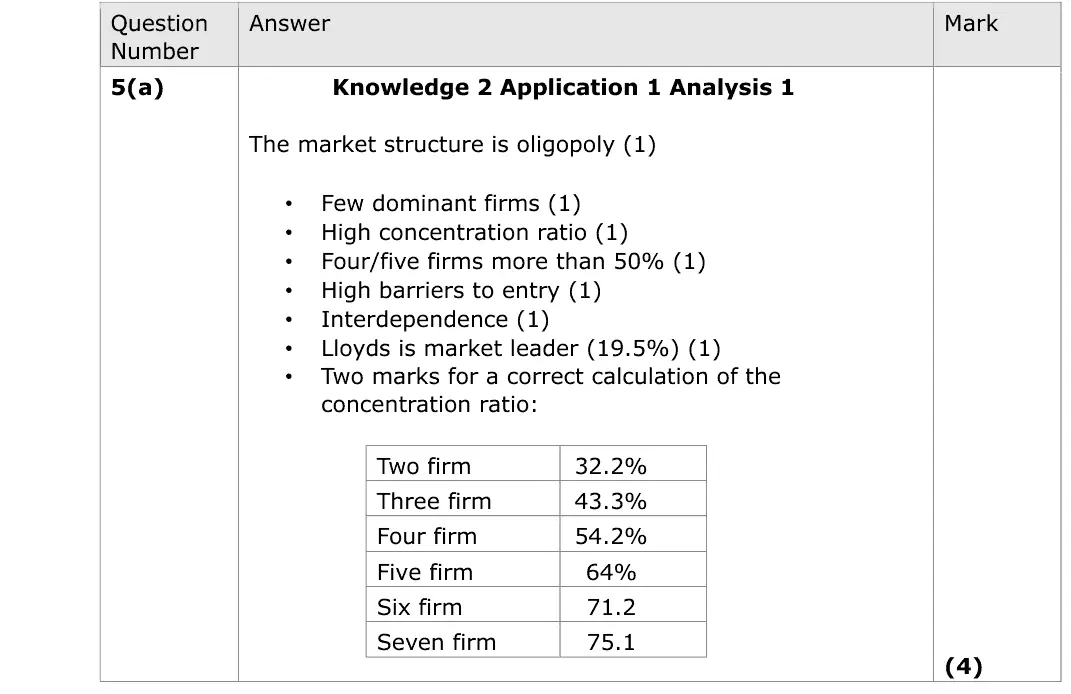
Data and extracts for question 55 The graph below shows the largest mortgage lenders in the United Kingdom (UK) in 2020, by market share. 24.9% 25 % 19.5% 20 15 12.7% 11.1% 10.9% 9.8% 10 7.2% 5 3.9% 0 (Source adapted from: https://www.statista.com/statistics/727348/ uk-banks-gross-lending-market-share/)
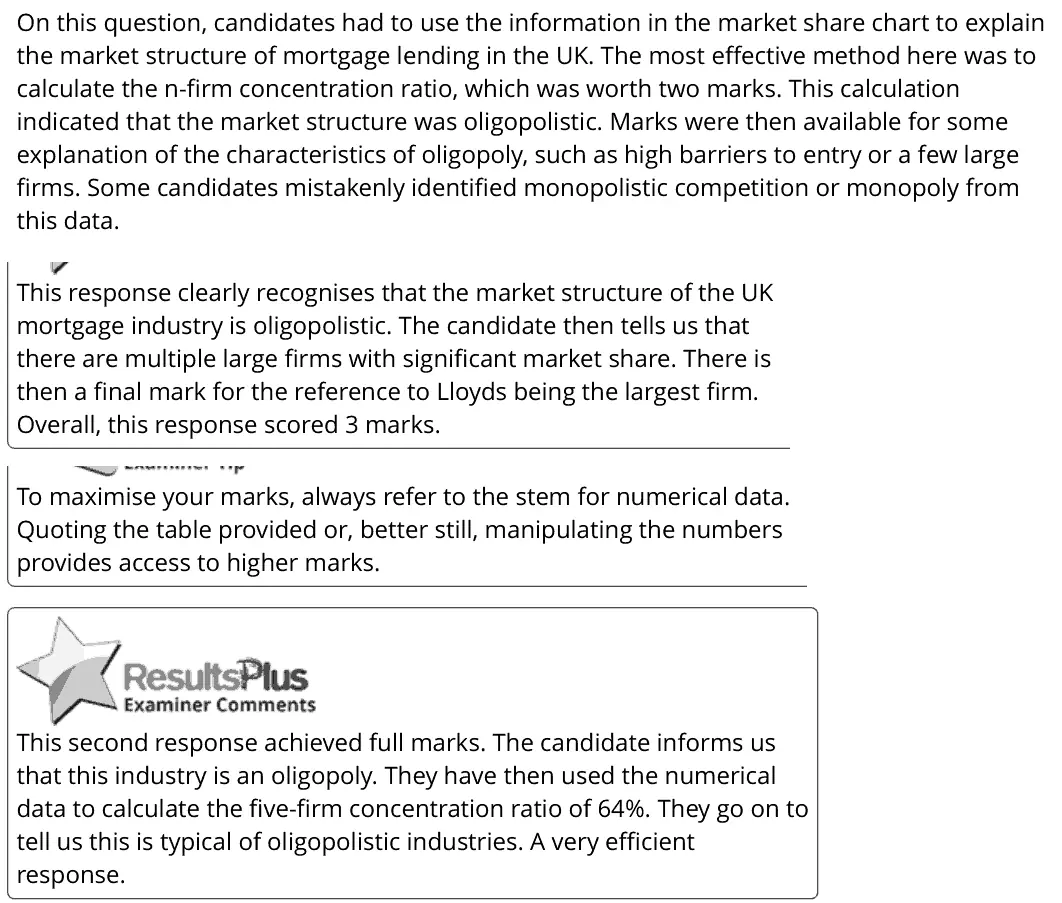
(a) With reference to the information on the preceding page, explain the market structure of mortgage lending in the UK. (4)
June 2024 · Paper 1 · Q5(b) 1 mark Multiple choice oligopoly
Data and extracts for question 55 The graph below shows the largest mortgage lenders in the United Kingdom (UK) in 2020, by market share. 24.9% 25 % 19.5% 20 15 12.7% 11.1% 10.9% 9.8% 10 7.2% 5 3.9% 0 (Source adapted from: https://www.statista.com/statistics/727348/ uk-banks-gross-lending-market-share/)
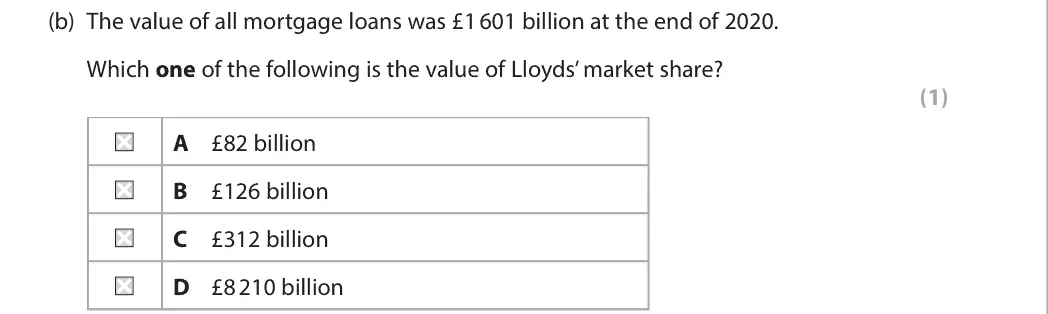
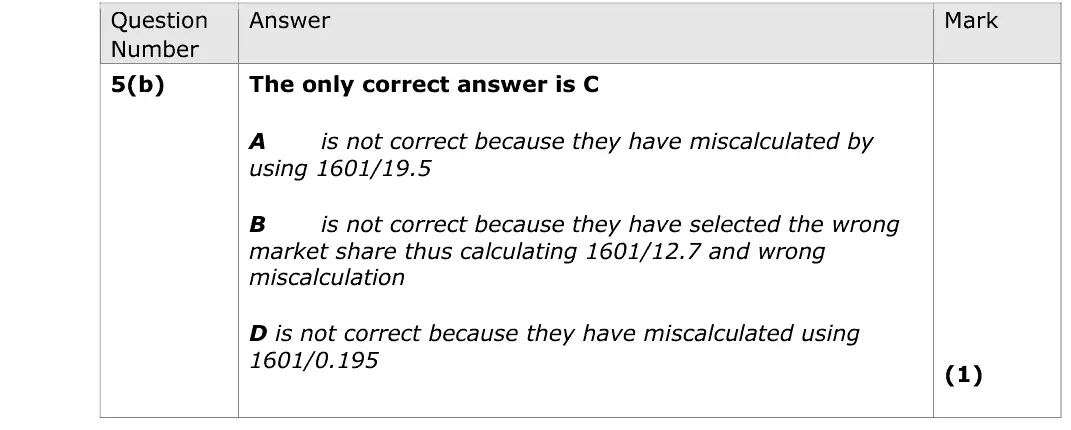
(b) The value of all mortgage loans was £1 601 billion at the end of 2020. Which one of the following is the value of Lloyds’ market share? (1) A £82 billion B £126 billion C £312 billion D £8 210 billion
June 2024 · Paper 1 · Q6(a) 5 marks AO1=1, AO2=1, AO3=3 Diagram supply and demand
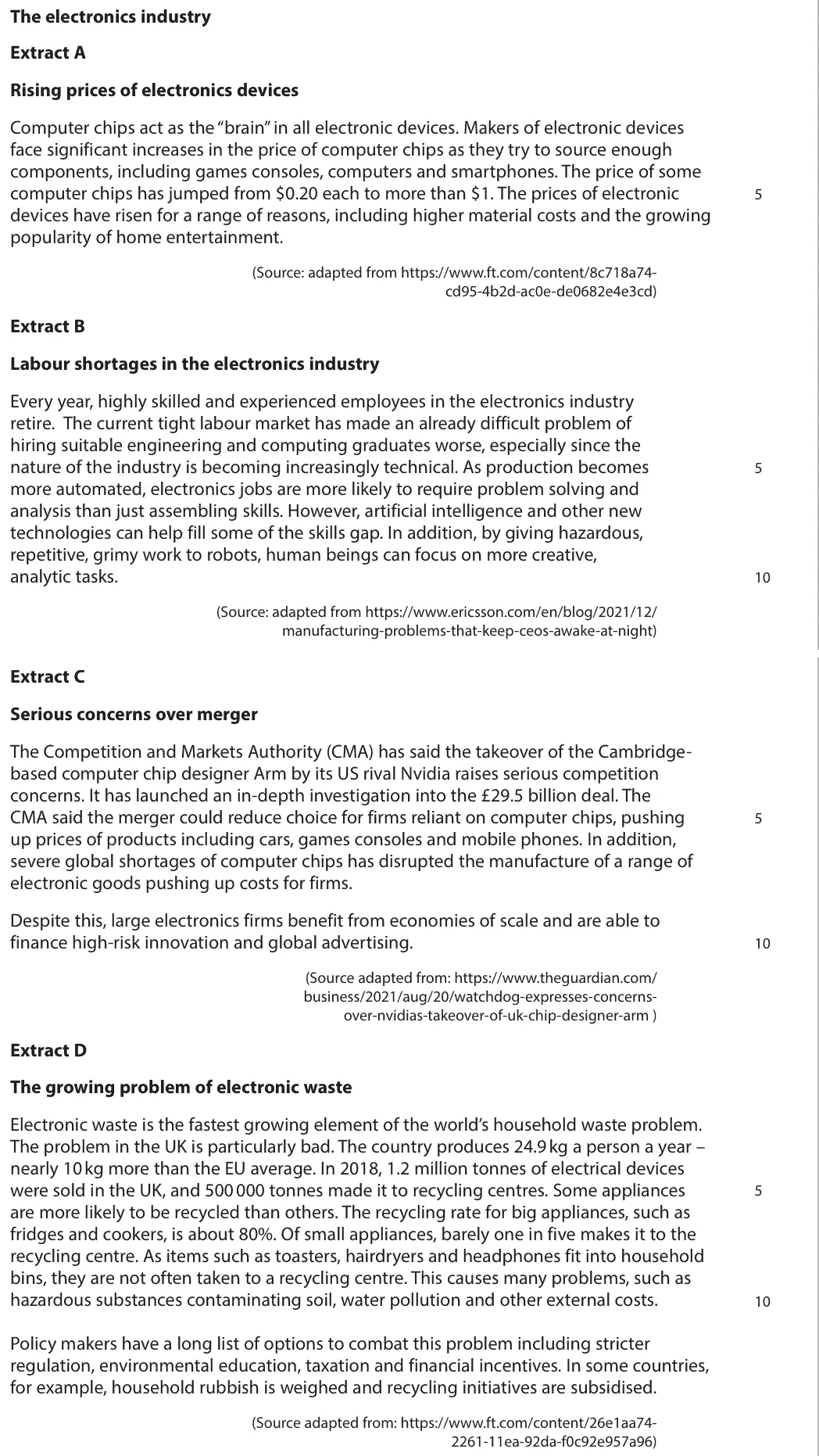
Data and extracts for question 6The electronics industry Extract A Rising prices of electronics devices Computer chips act as the “brain” in all electronic devices. Makers of electronic devices face significant increases in the price of computer chips as they try to source enough components, including games consoles, computers and smartphones. The price of some computer chips has jumped from $0.20 each to more than $1. The prices of electronic 5 devices have risen for a range of reasons, including higher material costs and the growing popularity of home entertainment. (Source: adapted from https://www.ft.com/content/8c718a74- cd95-4b2d-ac0e-de0682e4e3cd) Extract B Labour shortages in the electronics industry Every year, highly skilled and experienced employees in the electronics industry retire. The current tight labour market has made an already difficult problem of hiring suitable engineering and computing graduates worse, especially since the nature of the industry is becoming increasingly technical. As production becomes 5 more automated, electronics jobs are more likely to require problem solving and analysis than just assembling skills. However, artificial intelligence and other new technologies can help fill some of the skills gap. In addition, by giving hazardous, repetitive, grimy work to robots, human beings can focus on more creative, analytic tasks. 10 (Source: adapted from https://www.ericsson.com/en/blog/2021/12/ manufacturing-problems-that-keep-ceos-awake-at-night) Extract C Serious concerns over merger The Competition and Markets Authority (CMA) has said the takeover of the Cambridge- based computer chip designer Arm by its US rival Nvidia raises serious competition concerns. It has launched an in-depth investigation into the £29.5 billion deal. The CMA said the merger could reduce choice for firms reliant on computer chips, pushing 5 up prices of products including cars, games consoles and mobile phones. In addition, severe global shortages of computer chips has disrupted the manufacture of a range of electronic goods pushing up costs for firms. Despite this, large electronics firms benefit from economies of scale and are able to finance high-risk innovation and global advertising. 10 (Source adapted from: https://www.theguardian.com/ business/2021/aug/20/watchdog-expresses-concerns- over-nvidias-takeover-of-uk-chip-designer-arm ) Extract D The growing problem of electronic waste Electronic waste is the fastest growing element of the world’s household waste problem. The problem in the UK is particularly bad. The country produces 24.9 kg a person a year – nearly 10 kg more than the EU average. In 2018, 1.2 million tonnes of electrical devices were sold in the UK, and 500 000 tonnes made it to recycling centres. Some appliances 5 are more likely to be recycled than others. The recycling rate for big appliances, such as fridges and cookers, is about 80%. Of small appliances, barely one in five makes it to the recycling centre. As items such as toasters, hairdryers and headphones fit into household bins, they are not often taken to a recycling centre. This causes many problems, such as hazardous substances contaminating soil, water pollution and other external costs. 10 Policy makers have a long list of options to combat this problem including stricter regulation, environmental education, taxation and financial incentives. In some countries, for example, household rubbish is weighed and recycling initiatives are subsidised. (Source adapted from: https://www.ft.com/content/26e1aa74- 2261-11ea-92da-f0c92e957a96)
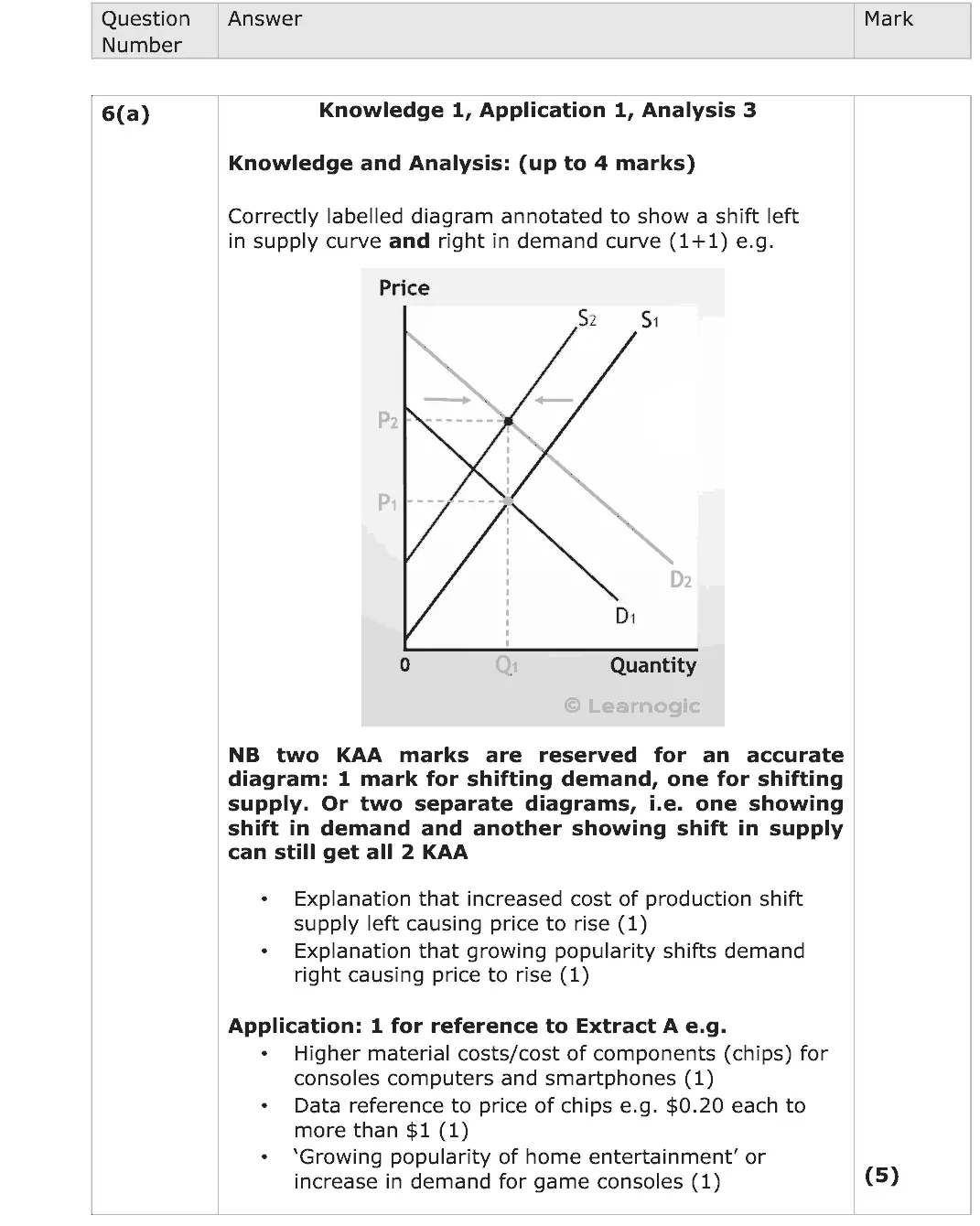
(a) With reference to Extract A, explain the likely reasons for the change in price of electronic devices. Include a supply and demand diagram in your answer. (5)
June 2024 · Paper 1 · Q6(b) 8 marks AO1=2, AO2=2, AO3=2, AO4=2 8-mark response labour market
Data and extracts for question 6The electronics industry Extract A Rising prices of electronics devices Computer chips act as the “brain” in all electronic devices. Makers of electronic devices face significant increases in the price of computer chips as they try to source enough components, including games consoles, computers and smartphones. The price of some computer chips has jumped from $0.20 each to more than $1. The prices of electronic 5 devices have risen for a range of reasons, including higher material costs and the growing popularity of home entertainment. (Source: adapted from https://www.ft.com/content/8c718a74- cd95-4b2d-ac0e-de0682e4e3cd) Extract B Labour shortages in the electronics industry Every year, highly skilled and experienced employees in the electronics industry retire. The current tight labour market has made an already difficult problem of hiring suitable engineering and computing graduates worse, especially since the nature of the industry is becoming increasingly technical. As production becomes 5 more automated, electronics jobs are more likely to require problem solving and analysis than just assembling skills. However, artificial intelligence and other new technologies can help fill some of the skills gap. In addition, by giving hazardous, repetitive, grimy work to robots, human beings can focus on more creative, analytic tasks. 10 (Source: adapted from https://www.ericsson.com/en/blog/2021/12/ manufacturing-problems-that-keep-ceos-awake-at-night) Extract C Serious concerns over merger The Competition and Markets Authority (CMA) has said the takeover of the Cambridge- based computer chip designer Arm by its US rival Nvidia raises serious competition concerns. It has launched an in-depth investigation into the £29.5 billion deal. The CMA said the merger could reduce choice for firms reliant on computer chips, pushing 5 up prices of products including cars, games consoles and mobile phones. In addition, severe global shortages of computer chips has disrupted the manufacture of a range of electronic goods pushing up costs for firms. Despite this, large electronics firms benefit from economies of scale and are able to finance high-risk innovation and global advertising. 10 (Source adapted from: https://www.theguardian.com/ business/2021/aug/20/watchdog-expresses-concerns- over-nvidias-takeover-of-uk-chip-designer-arm ) Extract D The growing problem of electronic waste Electronic waste is the fastest growing element of the world’s household waste problem. The problem in the UK is particularly bad. The country produces 24.9 kg a person a year – nearly 10 kg more than the EU average. In 2018, 1.2 million tonnes of electrical devices were sold in the UK, and 500 000 tonnes made it to recycling centres. Some appliances 5 are more likely to be recycled than others. The recycling rate for big appliances, such as fridges and cookers, is about 80%. Of small appliances, barely one in five makes it to the recycling centre. As items such as toasters, hairdryers and headphones fit into household bins, they are not often taken to a recycling centre. This causes many problems, such as hazardous substances contaminating soil, water pollution and other external costs. 10 Policy makers have a long list of options to combat this problem including stricter regulation, environmental education, taxation and financial incentives. In some countries, for example, household rubbish is weighed and recycling initiatives are subsidised. (Source adapted from: https://www.ft.com/content/26e1aa74- 2261-11ea-92da-f0c92e957a96)
(b) Examine two factors which might influence the supply of labour in the electronics industry. (8)
June 2024 · Paper 1 · Q6(c) 10 marks AO1=2, AO2=2, AO3=2, AO4=4 10-mark response revenues costs and profits
Data and extracts for question 6The electronics industry Extract A Rising prices of electronics devices Computer chips act as the “brain” in all electronic devices. Makers of electronic devices face significant increases in the price of computer chips as they try to source enough components, including games consoles, computers and smartphones. The price of some computer chips has jumped from $0.20 each to more than $1. The prices of electronic 5 devices have risen for a range of reasons, including higher material costs and the growing popularity of home entertainment. (Source: adapted from https://www.ft.com/content/8c718a74- cd95-4b2d-ac0e-de0682e4e3cd) Extract B Labour shortages in the electronics industry Every year, highly skilled and experienced employees in the electronics industry retire. The current tight labour market has made an already difficult problem of hiring suitable engineering and computing graduates worse, especially since the nature of the industry is becoming increasingly technical. As production becomes 5 more automated, electronics jobs are more likely to require problem solving and analysis than just assembling skills. However, artificial intelligence and other new technologies can help fill some of the skills gap. In addition, by giving hazardous, repetitive, grimy work to robots, human beings can focus on more creative, analytic tasks. 10 (Source: adapted from https://www.ericsson.com/en/blog/2021/12/ manufacturing-problems-that-keep-ceos-awake-at-night) Extract C Serious concerns over merger The Competition and Markets Authority (CMA) has said the takeover of the Cambridge- based computer chip designer Arm by its US rival Nvidia raises serious competition concerns. It has launched an in-depth investigation into the £29.5 billion deal. The CMA said the merger could reduce choice for firms reliant on computer chips, pushing 5 up prices of products including cars, games consoles and mobile phones. In addition, severe global shortages of computer chips has disrupted the manufacture of a range of electronic goods pushing up costs for firms. Despite this, large electronics firms benefit from economies of scale and are able to finance high-risk innovation and global advertising. 10 (Source adapted from: https://www.theguardian.com/ business/2021/aug/20/watchdog-expresses-concerns- over-nvidias-takeover-of-uk-chip-designer-arm ) Extract D The growing problem of electronic waste Electronic waste is the fastest growing element of the world’s household waste problem. The problem in the UK is particularly bad. The country produces 24.9 kg a person a year – nearly 10 kg more than the EU average. In 2018, 1.2 million tonnes of electrical devices were sold in the UK, and 500 000 tonnes made it to recycling centres. Some appliances 5 are more likely to be recycled than others. The recycling rate for big appliances, such as fridges and cookers, is about 80%. Of small appliances, barely one in five makes it to the recycling centre. As items such as toasters, hairdryers and headphones fit into household bins, they are not often taken to a recycling centre. This causes many problems, such as hazardous substances contaminating soil, water pollution and other external costs. 10 Policy makers have a long list of options to combat this problem including stricter regulation, environmental education, taxation and financial incentives. In some countries, for example, household rubbish is weighed and recycling initiatives are subsidised. (Source adapted from: https://www.ft.com/content/26e1aa74- 2261-11ea-92da-f0c92e957a96)
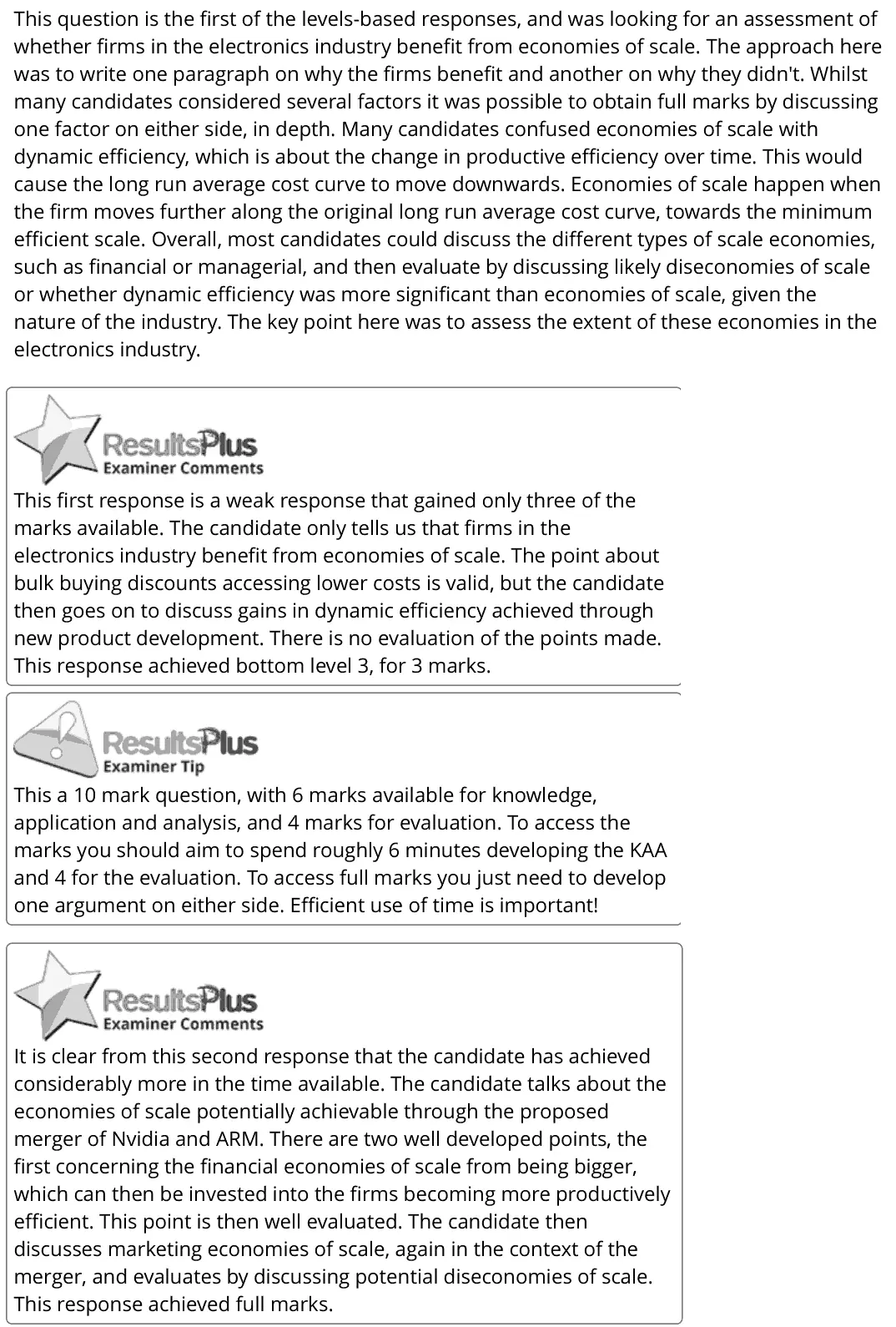
(c) Assess whether firms in the electronics industry benefit from economies of scale. (10)
June 2024 · Paper 1 · Q6(d) 12 marks AO1=2, AO2=2, AO3=4, AO4=4 12-mark response competition policy and regulationmonopoly
Data and extracts for question 6The electronics industry Extract A Rising prices of electronics devices Computer chips act as the “brain” in all electronic devices. Makers of electronic devices face significant increases in the price of computer chips as they try to source enough components, including games consoles, computers and smartphones. The price of some computer chips has jumped from $0.20 each to more than $1. The prices of electronic 5 devices have risen for a range of reasons, including higher material costs and the growing popularity of home entertainment. (Source: adapted from https://www.ft.com/content/8c718a74- cd95-4b2d-ac0e-de0682e4e3cd) Extract B Labour shortages in the electronics industry Every year, highly skilled and experienced employees in the electronics industry retire. The current tight labour market has made an already difficult problem of hiring suitable engineering and computing graduates worse, especially since the nature of the industry is becoming increasingly technical. As production becomes 5 more automated, electronics jobs are more likely to require problem solving and analysis than just assembling skills. However, artificial intelligence and other new technologies can help fill some of the skills gap. In addition, by giving hazardous, repetitive, grimy work to robots, human beings can focus on more creative, analytic tasks. 10 (Source: adapted from https://www.ericsson.com/en/blog/2021/12/ manufacturing-problems-that-keep-ceos-awake-at-night) Extract C Serious concerns over merger The Competition and Markets Authority (CMA) has said the takeover of the Cambridge- based computer chip designer Arm by its US rival Nvidia raises serious competition concerns. It has launched an in-depth investigation into the £29.5 billion deal. The CMA said the merger could reduce choice for firms reliant on computer chips, pushing 5 up prices of products including cars, games consoles and mobile phones. In addition, severe global shortages of computer chips has disrupted the manufacture of a range of electronic goods pushing up costs for firms. Despite this, large electronics firms benefit from economies of scale and are able to finance high-risk innovation and global advertising. 10 (Source adapted from: https://www.theguardian.com/ business/2021/aug/20/watchdog-expresses-concerns- over-nvidias-takeover-of-uk-chip-designer-arm ) Extract D The growing problem of electronic waste Electronic waste is the fastest growing element of the world’s household waste problem. The problem in the UK is particularly bad. The country produces 24.9 kg a person a year – nearly 10 kg more than the EU average. In 2018, 1.2 million tonnes of electrical devices were sold in the UK, and 500 000 tonnes made it to recycling centres. Some appliances 5 are more likely to be recycled than others. The recycling rate for big appliances, such as fridges and cookers, is about 80%. Of small appliances, barely one in five makes it to the recycling centre. As items such as toasters, hairdryers and headphones fit into household bins, they are not often taken to a recycling centre. This causes many problems, such as hazardous substances contaminating soil, water pollution and other external costs. 10 Policy makers have a long list of options to combat this problem including stricter regulation, environmental education, taxation and financial incentives. In some countries, for example, household rubbish is weighed and recycling initiatives are subsidised. (Source adapted from: https://www.ft.com/content/26e1aa74- 2261-11ea-92da-f0c92e957a96)
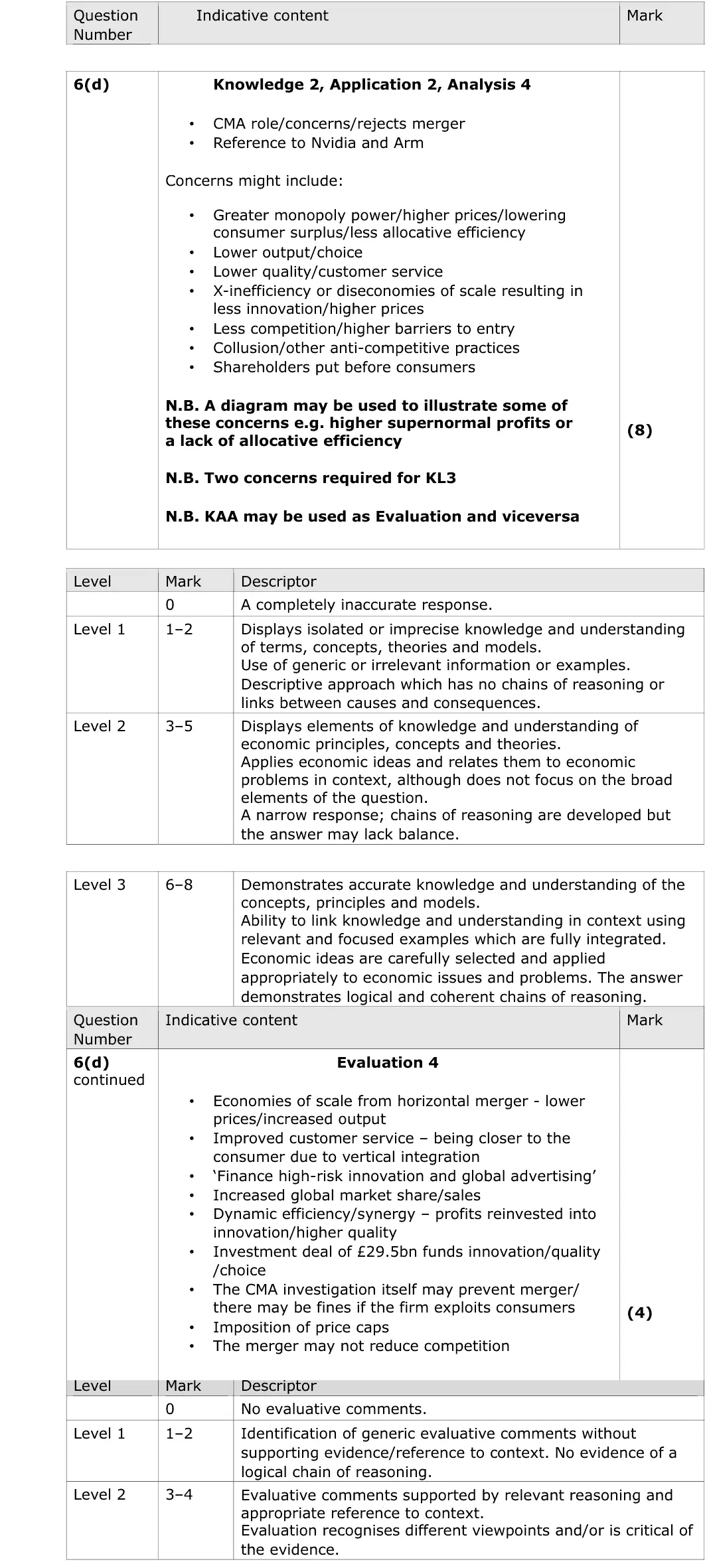
(d) Discuss the likely concerns of the competition authorities regarding the proposed merger of the two companies referred to in Extract C. (12)
June 2024 · Paper 1 · Q6(e) 15 marks AO1=3, AO2=3, AO3=3, AO4=6 15-mark response government intervention in marketsexternalities
Data and extracts for question 6The electronics industry Extract A Rising prices of electronics devices Computer chips act as the “brain” in all electronic devices. Makers of electronic devices face significant increases in the price of computer chips as they try to source enough components, including games consoles, computers and smartphones. The price of some computer chips has jumped from $0.20 each to more than $1. The prices of electronic 5 devices have risen for a range of reasons, including higher material costs and the growing popularity of home entertainment. (Source: adapted from https://www.ft.com/content/8c718a74- cd95-4b2d-ac0e-de0682e4e3cd) Extract B Labour shortages in the electronics industry Every year, highly skilled and experienced employees in the electronics industry retire. The current tight labour market has made an already difficult problem of hiring suitable engineering and computing graduates worse, especially since the nature of the industry is becoming increasingly technical. As production becomes 5 more automated, electronics jobs are more likely to require problem solving and analysis than just assembling skills. However, artificial intelligence and other new technologies can help fill some of the skills gap. In addition, by giving hazardous, repetitive, grimy work to robots, human beings can focus on more creative, analytic tasks. 10 (Source: adapted from https://www.ericsson.com/en/blog/2021/12/ manufacturing-problems-that-keep-ceos-awake-at-night) Extract C Serious concerns over merger The Competition and Markets Authority (CMA) has said the takeover of the Cambridge- based computer chip designer Arm by its US rival Nvidia raises serious competition concerns. It has launched an in-depth investigation into the £29.5 billion deal. The CMA said the merger could reduce choice for firms reliant on computer chips, pushing 5 up prices of products including cars, games consoles and mobile phones. In addition, severe global shortages of computer chips has disrupted the manufacture of a range of electronic goods pushing up costs for firms. Despite this, large electronics firms benefit from economies of scale and are able to finance high-risk innovation and global advertising. 10 (Source adapted from: https://www.theguardian.com/ business/2021/aug/20/watchdog-expresses-concerns- over-nvidias-takeover-of-uk-chip-designer-arm ) Extract D The growing problem of electronic waste Electronic waste is the fastest growing element of the world’s household waste problem. The problem in the UK is particularly bad. The country produces 24.9 kg a person a year – nearly 10 kg more than the EU average. In 2018, 1.2 million tonnes of electrical devices were sold in the UK, and 500 000 tonnes made it to recycling centres. Some appliances 5 are more likely to be recycled than others. The recycling rate for big appliances, such as fridges and cookers, is about 80%. Of small appliances, barely one in five makes it to the recycling centre. As items such as toasters, hairdryers and headphones fit into household bins, they are not often taken to a recycling centre. This causes many problems, such as hazardous substances contaminating soil, water pollution and other external costs. 10 Policy makers have a long list of options to combat this problem including stricter regulation, environmental education, taxation and financial incentives. In some countries, for example, household rubbish is weighed and recycling initiatives are subsidised. (Source adapted from: https://www.ft.com/content/26e1aa74- 2261-11ea-92da-f0c92e957a96)
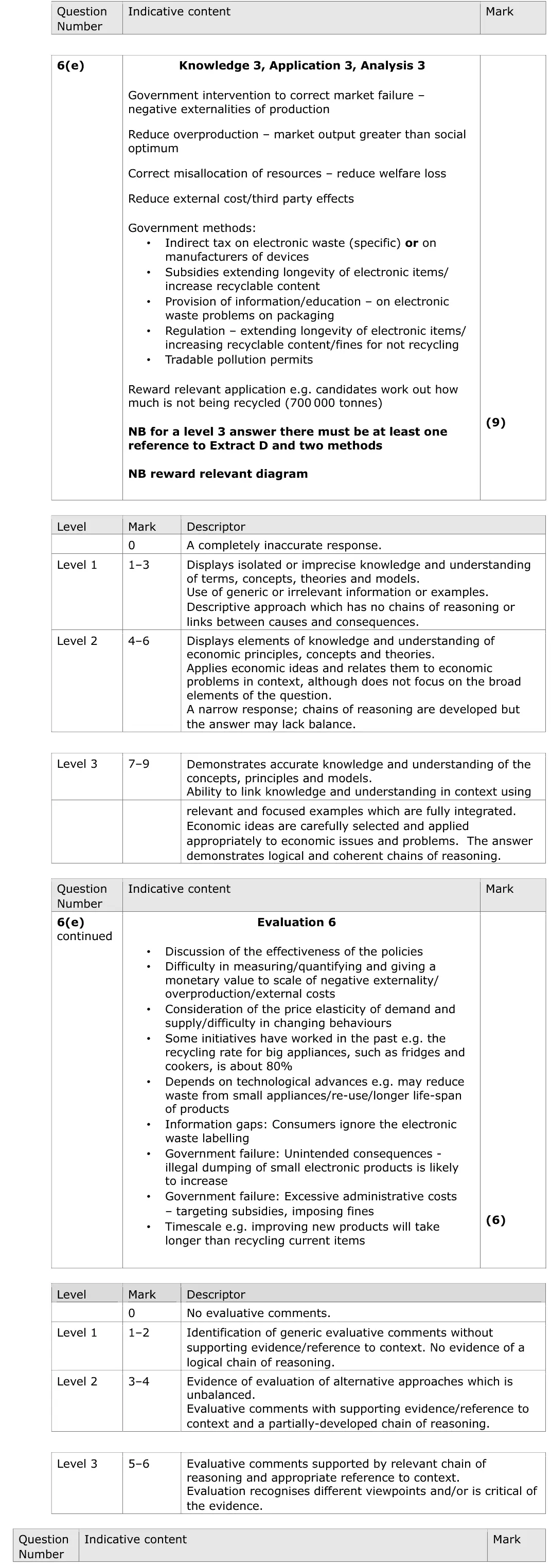
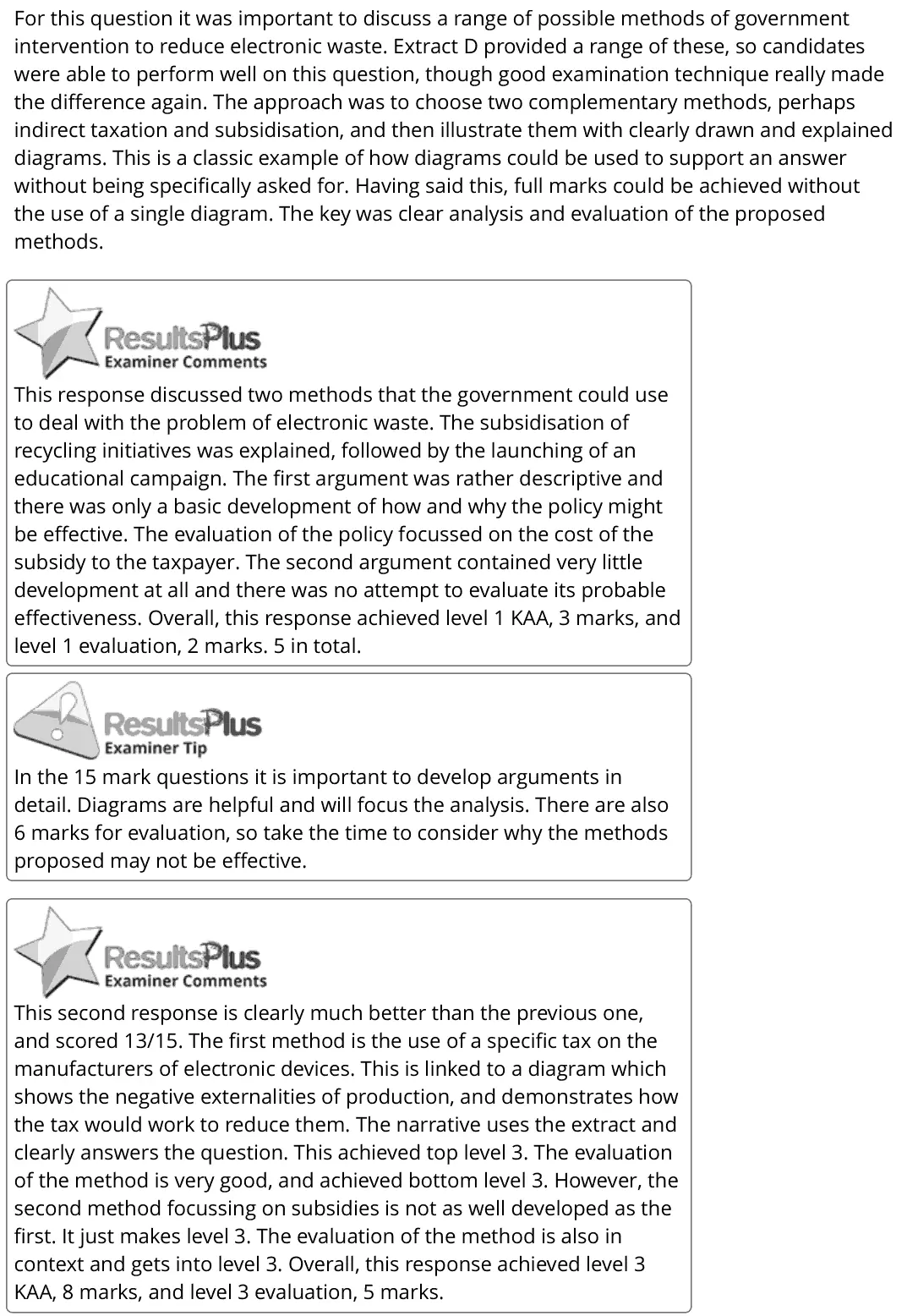
(e) With reference to Extract D, discuss possible methods of government intervention to reduce electronic waste. (15)
June 2024 · Paper 1 · Q7 25 marks AO1=4, AO2=4, AO3=8, AO4=9 25-mark essay Either/or revenues costs and profits
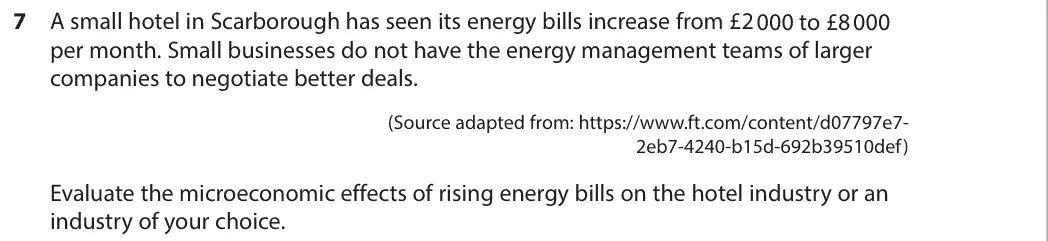
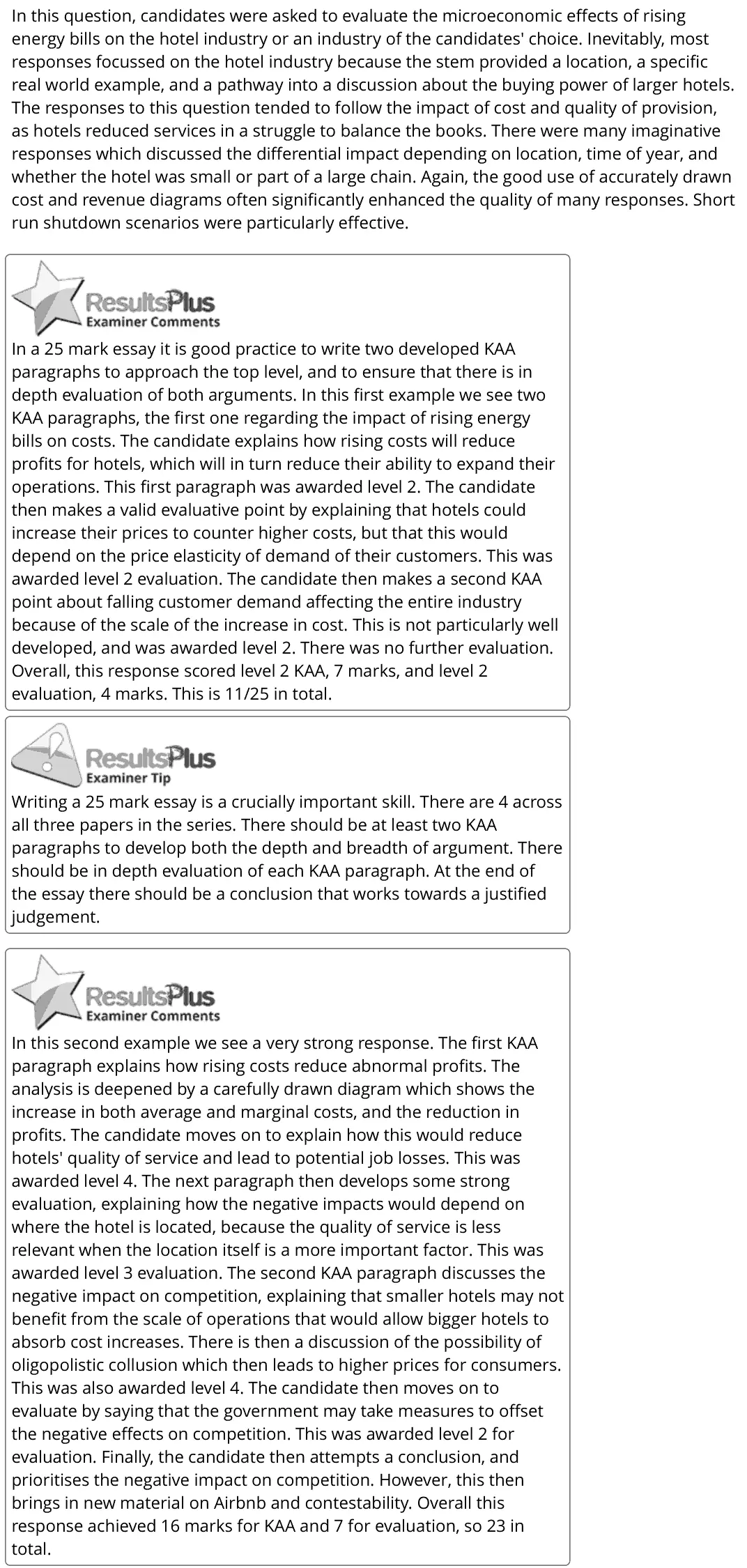
7 A small hotel in Scarborough has seen its energy bills increase from £2 000 to £8 000 per month. Small businesses do not have the energy management teams of larger companies to negotiate better deals. (Source adapted from: https://www.ft.com/content/d07797e7- 2eb7-4240-b15d-692b39510def) Evaluate the microeconomic effects of rising energy bills on the hotel industry or an industry of your choice.
June 2024 · Paper 1 · Q8 25 marks AO1=4, AO2=4, AO3=8, AO4=9 25-mark essay Either/or Hard monopsony and contestability
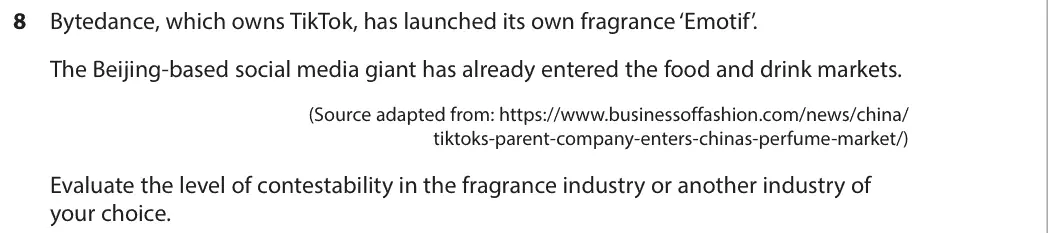
8 Bytedance, which owns TikTok, has launched its own fragrance ‘Emotif’. The Beijing-based social media giant has already entered the food and drink markets. (Source adapted from: https://www.businessoffashion.com/news/china/ tiktoks-parent-company-enters-chinas-perfume-market/) Evaluate the level of contestability in the fragrance industry or another industry of your choice.

Work with an Edexcel economics tutor

Want a paper marked and gone through with you? Message us.

Prefer email? Send an enquiry

If you are under 18, please include a parent's contact details. Enquiries go to enquiries@economicsaleveltutor.com and are deleted once handled. All tutoring is online.