Notes and key-term cards for this topic are being written by our tutors. The past-paper questions below are ready now.
Specification statements
3.4.4Oligopoly: a) Characteristics of oligopoly • high barriers to entry and exit • high concentration ratio • interdependence of firms • product differentiation b) Calculation of n-firm concentration ratios and their significance c) Reasons for collusive and non-collusive behaviour d) Overt and tacit collusion; cartels and price leadership e) Simple game theory: the prisoner's dilemma in a simple two firm/two outcome model f) Types of price competition: • price wars • predatory pricing • limit pricing g) Types of non-price competition
In many industries, such as banking, health insurance, internet search engines, pharmaceuticals, social media and telecommunications, there have been increases in market concentration. Evaluate the possible consequences for business decision making of increased market concentration. Refer to industries of your choice in your answer.
In October 2017 Scania, the Volkswagen-owned truck maker, was fined €880 million (£771 million) by the European Commission for colluding with five other truck manufacturers over a 14-year period. The firms had agreed to coordinate prices after experiencing additional costs of meeting emission regulations. With reference to an industry of your choice, evaluate why some firms engage in collusive behaviour.
Tap a question to zoom it. The data and extracts fold out above each question; the mark scheme and examiner's comment open underneath.
June 2025 · Paper 3 · Q1(c)12 marksAO1=2, AO2=2, AO3=4, AO4=412-mark response
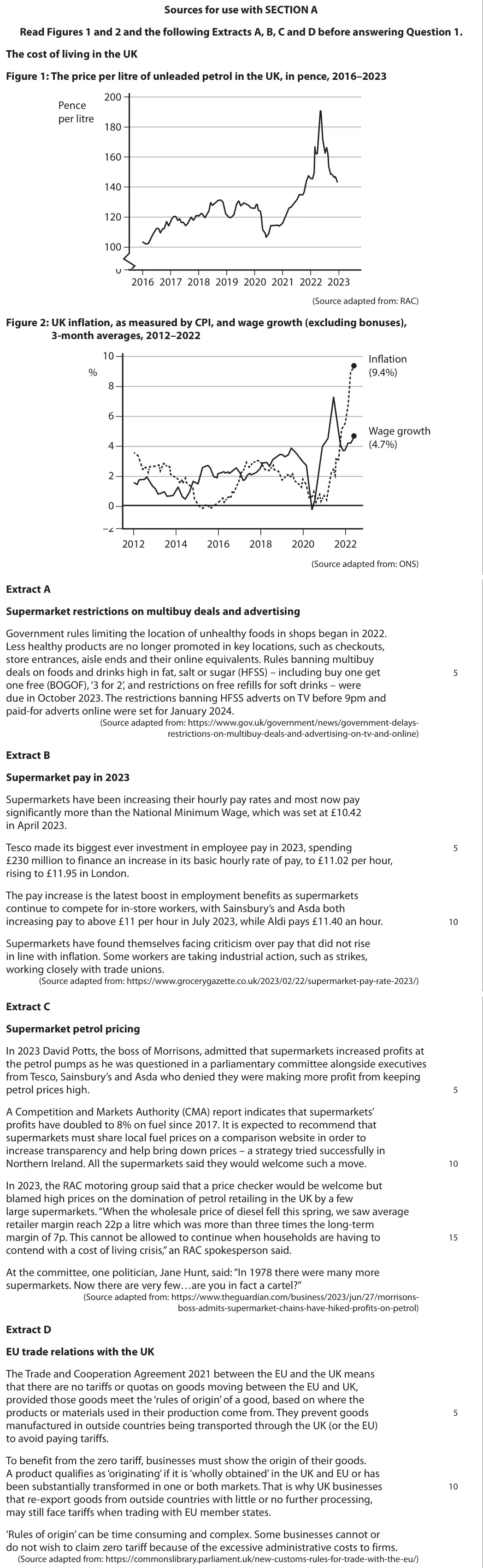
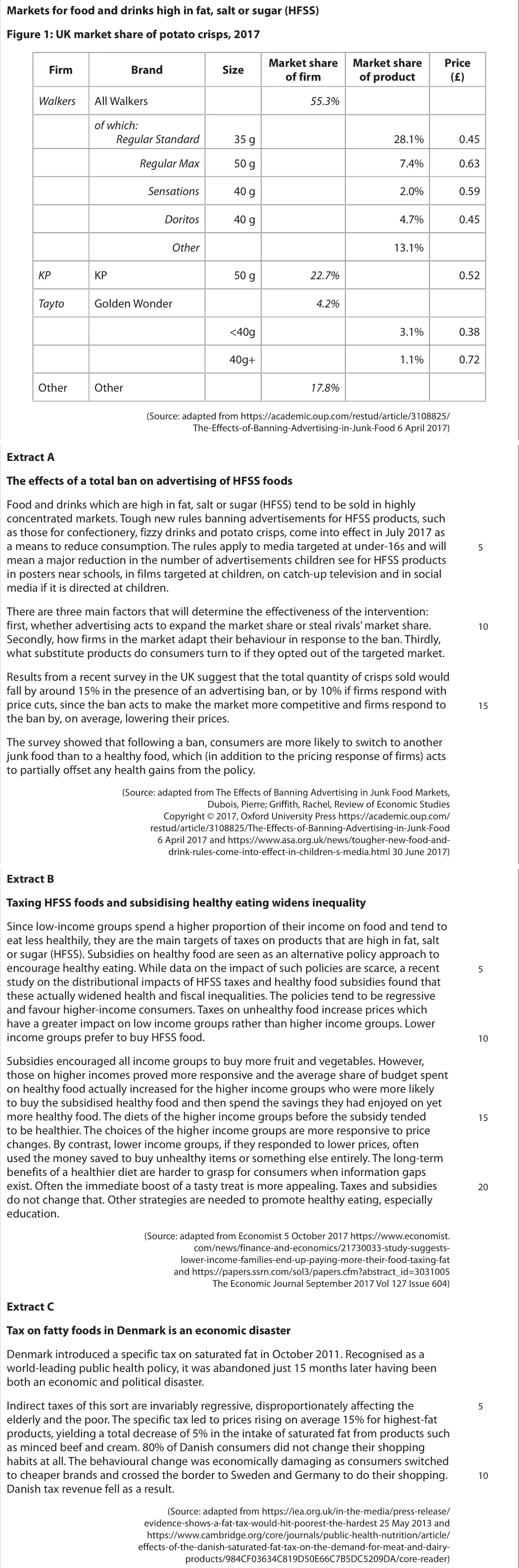
Data and extracts for question 1
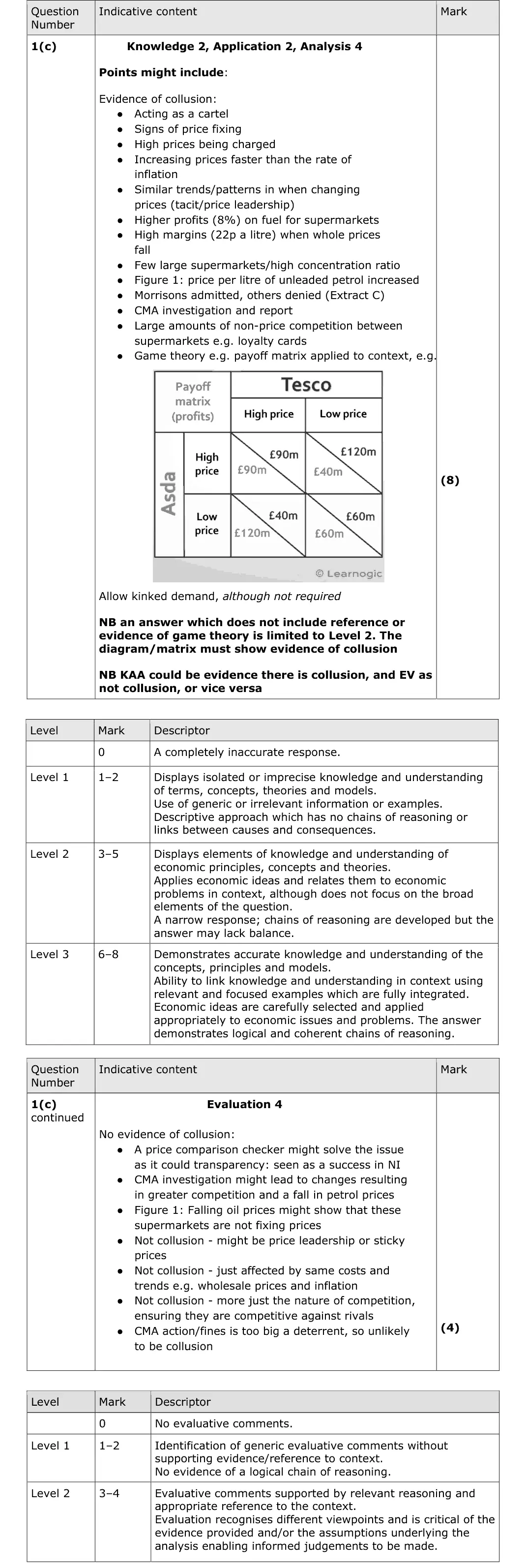
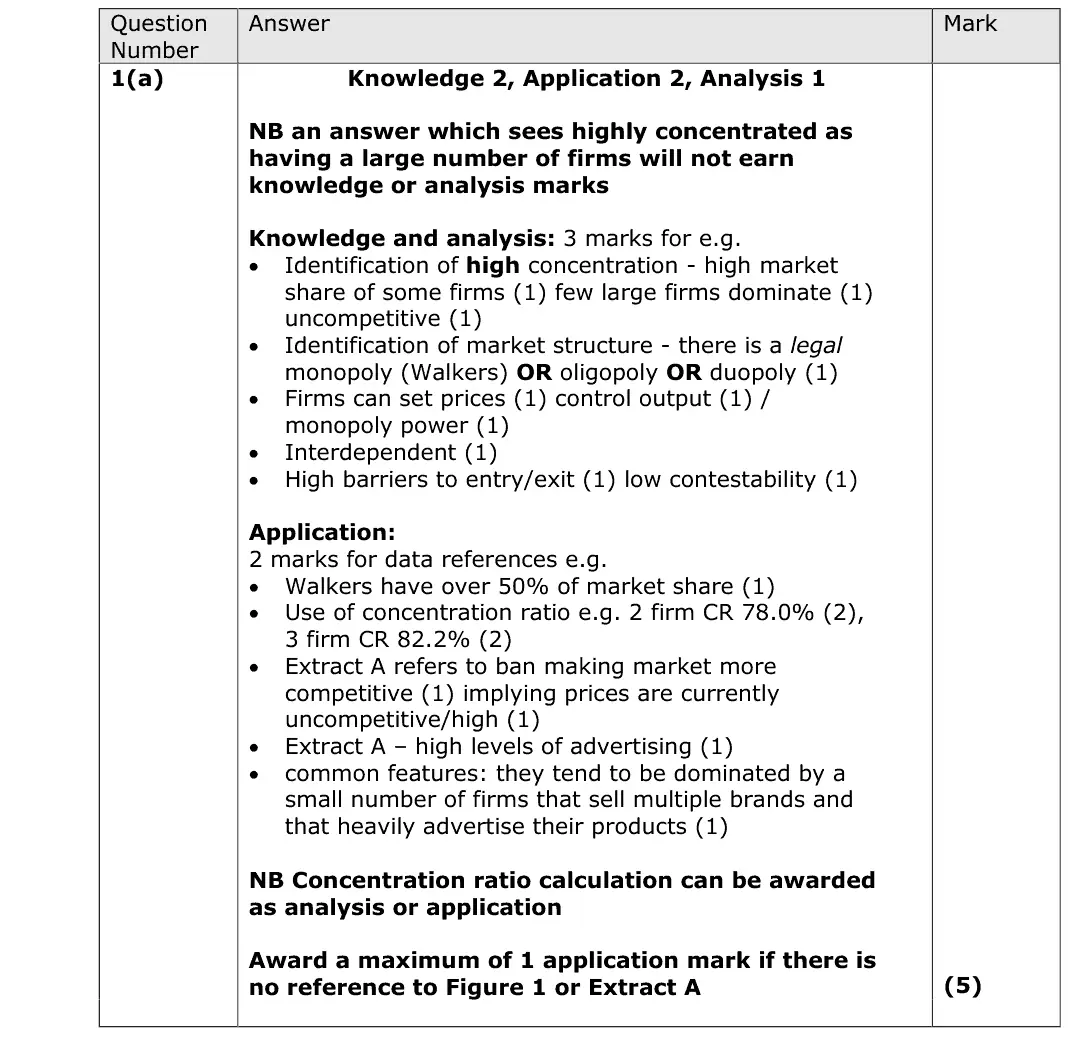
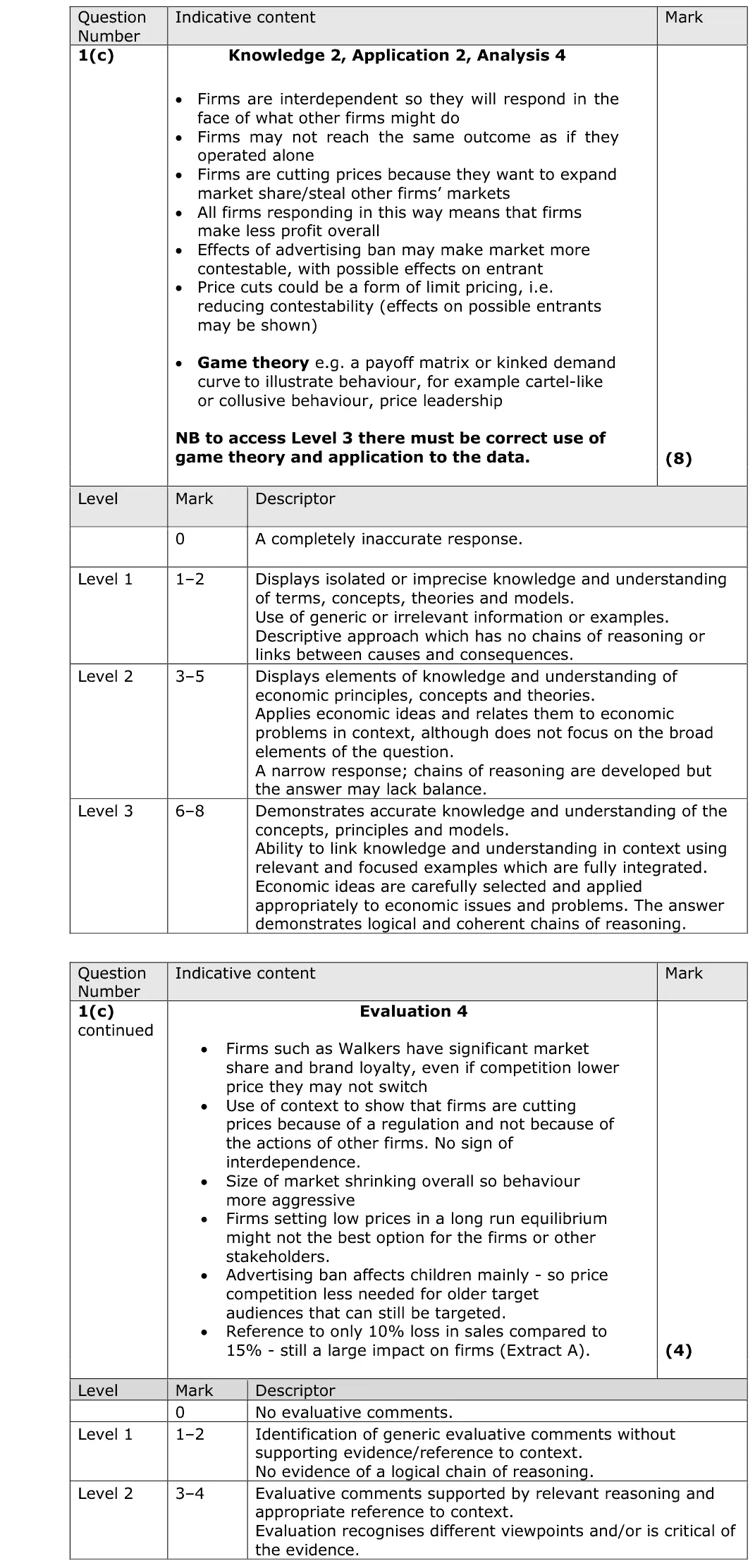
Mark scheme, including the levels grid and indicative content
Examiner's comment
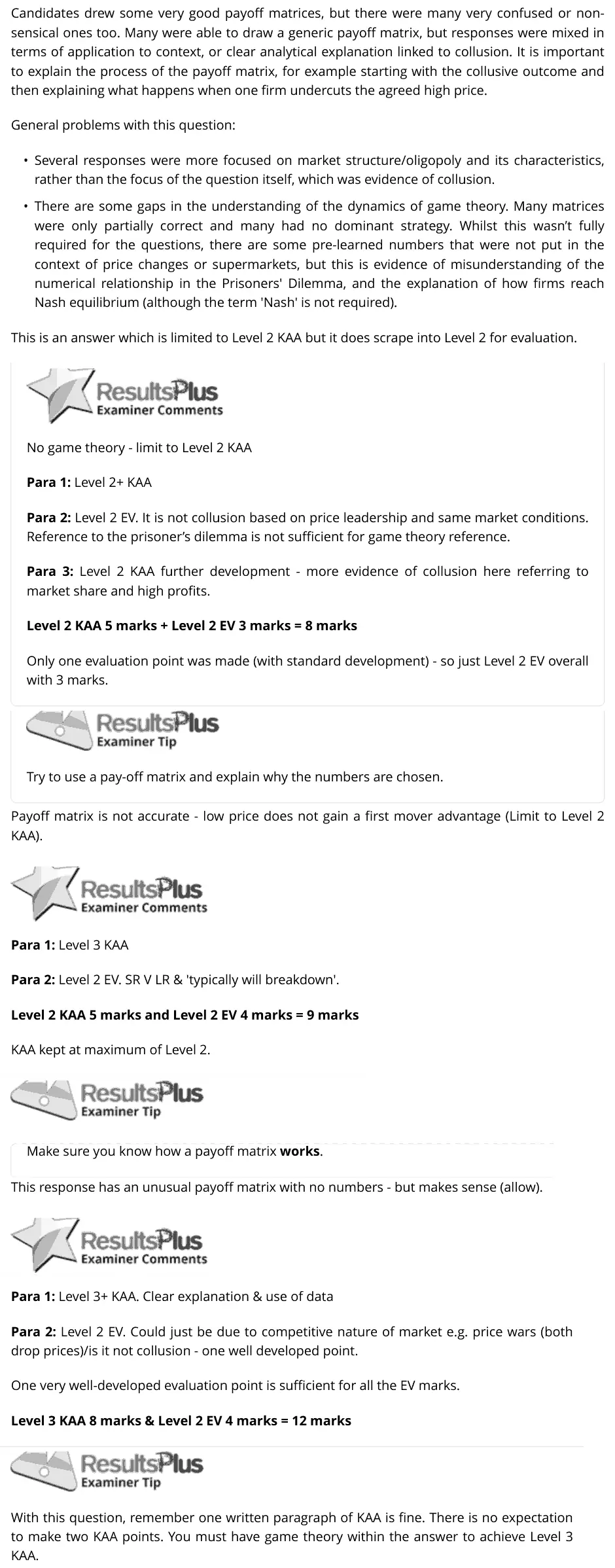
Candidates drew some very good payoff matrices, but there were many very confused or non- sensical ones too. Many were able to draw a generic payoff matrix, but responses were mixed in terms of application to context, or clear analytical explanation linked to collusion. It is important to explain the process of the payoff matrix, for example starting with the collusive outcome and then explaining what happens when one firm undercuts the agreed high price. General problems with this question: • Several responses were more focused on market structure/oligopoly and its characteristics, rather than the focus of the question itself, which was evidence of collusion. • There are some gaps in the understanding of the dynamics of game theory. Many matrices were only partially correct and many had no dominant strategy. Whilst this wasn’t fully required for the questions, there are some pre-learned numbers that were not put in the context of price changes or supermarkets, but this is evidence of misunderstanding of the numerical relationship in the Prisoners' Dilemma, and the explanation of how firms reach Nash equilibrium (although the term 'Nash' is not required). This is an answer which is limited to Level 2 KAA but it does scrape into Level 2 for evaluation. No game theory - limit to Level 2 KAA Para 1: Level 2+ KAA Para 2: Level 2 EV. It is not collusion based on price leadership and same market conditions. Reference to the prisoner’s dilemma is not sufficient for game theory reference. Para 3: Level 2 KAA further development - more evidence of collusion here referring to market share and high profits. Level 2 KAA 5 marks + Level 2 EV 3 marks = 8 marks Only one evaluation point was made (with standard development) - so just Level 2 EV overall with 3 marks. Try to use a pay-off matrix and explain why the numbers are chosen. Payoff matrix is not accurate - low price does not gain a first mover advantage (Limit to Level 2 KAA). Para 1: Level 3 KAA Para 2: Level 2 EV. SR V LR & 'typically will breakdown'. Level 2 KAA 5 marks and Level 2 EV 4 marks = 9 marks KAA kept at maximum of Level 2. Make sure you know how a payoff matrix works. This response has an unusual payoff matrix with no numbers - but makes sense (allow). Para 1: Level 3+ KAA. Clear explanation & use of data Para 2: Level 2 EV. Could just be due to competitive nature of market e.g. price wars (both drop prices)/is it not collusion - one well developed point. One very well-developed evaluation point is sufficient for all the EV marks. Level 3 KAA 8 marks & Level 2 EV 4 marks = 12 marks With this question, remember one written paragraph of KAA is fine. There is no expectation to make two KAA points. You must have game theory within the answer to achieve Level 3 KAA.
Notes from the mark scheme and report
game theory required (payoff matrix: collusive high price vs incentive to undercut)
evidence: similar price patterns in Figure 1, margins 22p vs 7p, profits doubled to 8%
against: same costs and wholesale prices, competitive pricing
many matrices were confused or had no dominant strategy
focus on collusion, not oligopoly characteristics
Quantitative skills: QS 9 (interpret, apply and analyse information in written, graphical tabular and numerical forms)
June 2024 · Paper 1 · Q5(a)4 marksAO1=2, AO2=1, AO3=1Calculation
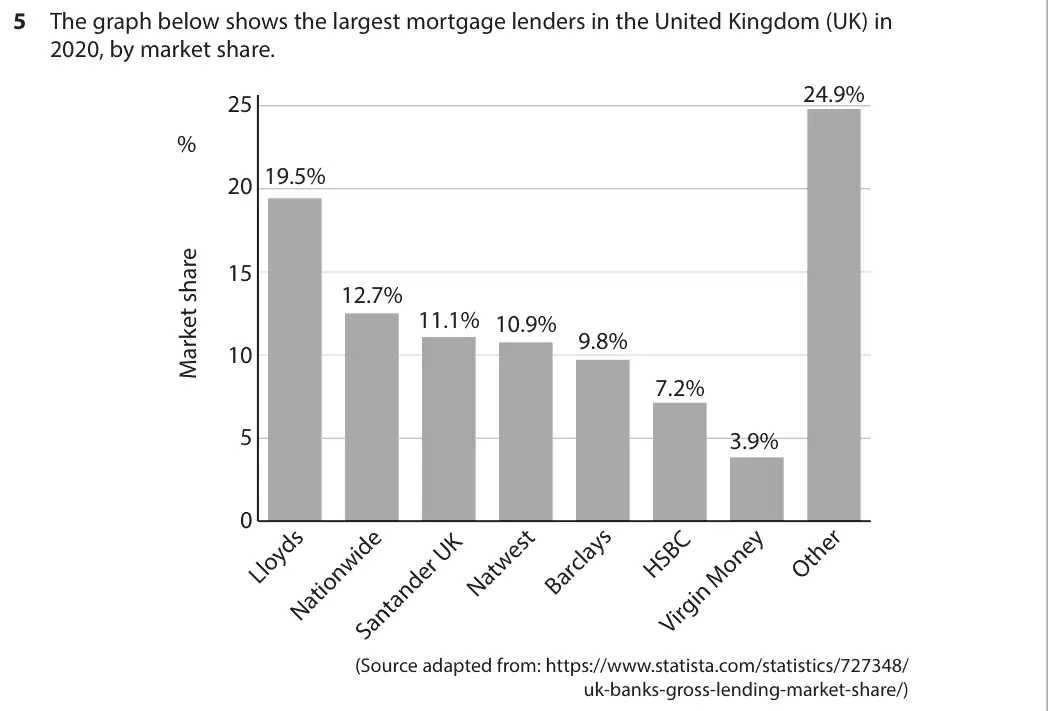
Data and extracts for question 5
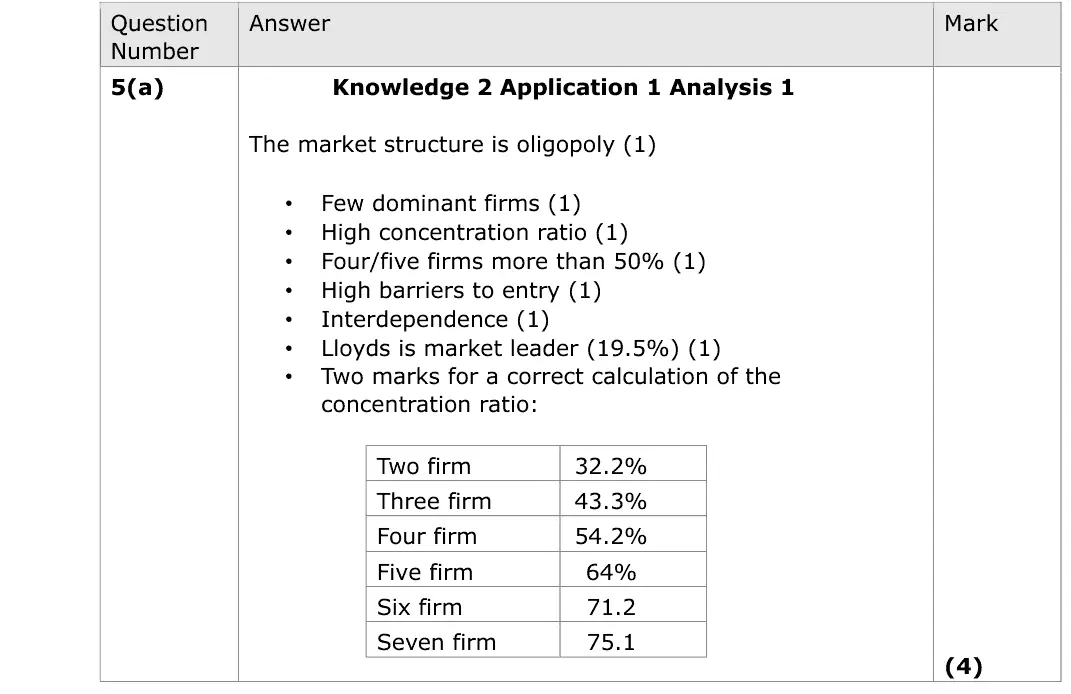
Mark scheme
Examiner's comment
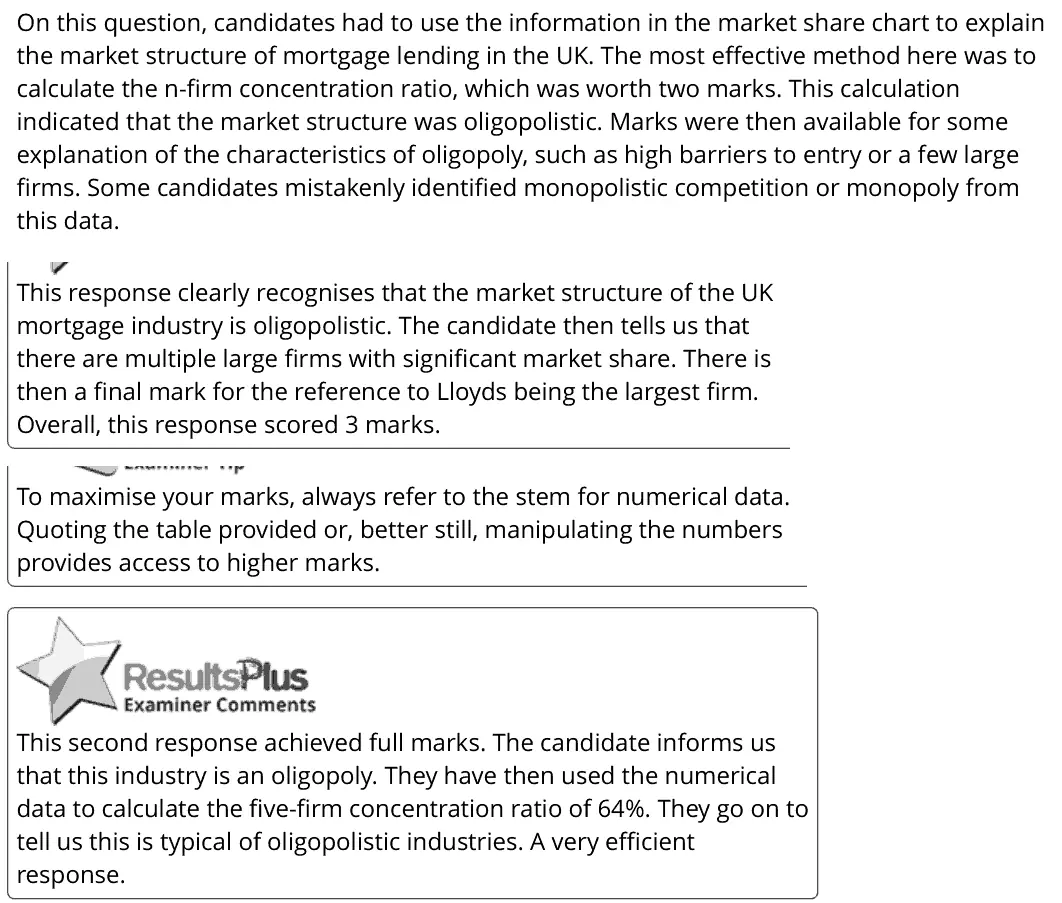
On this question, candidates had to use the information in the market share chart to explain the market structure of mortgage lending in the UK. The most effective method here was to calculate the n-firm concentration ratio, which was worth two marks. This calculation indicated that the market structure was oligopolistic. Marks were then available for some explanation of the characteristics of oligopoly, such as high barriers to entry or a few large firms. Some candidates mistakenly identified monopolistic competition or monopoly from this data. This response clearly recognises that the market structure of the UK mortgage industry is oligopolistic. The candidate then tells us that there are multiple large firms with significant market share. There is then a final mark for the reference to Lloyds being the largest firm. Overall, this response scored 3 marks. To maximise your marks, always refer to the stem for numerical data. Quoting the table provided or, better still, manipulating the numbers provides access to higher marks. This second response achieved full marks. The candidate informs us that this industry is an oligopoly. They have then used the numerical data to calculate the five-firm concentration ratio of 64%. They go on to tell us this is typical of oligopolistic industries. A very efficient response.
Notes from the mark scheme and report
calculate an n-firm concentration ratio (e.g. 5-firm 64%) for 2 marks and conclude oligopoly
some wrongly said monopolistic competition or monopoly
Quantitative skills: QS 2 (calculate, use and understand percentages, percentage changes and percentage point changes); QS 9 (interpret, apply and analyse information in written, graphical tabular and numerical forms)
June 2024 · Paper 1 · Q5(b)1 markMultiple choice
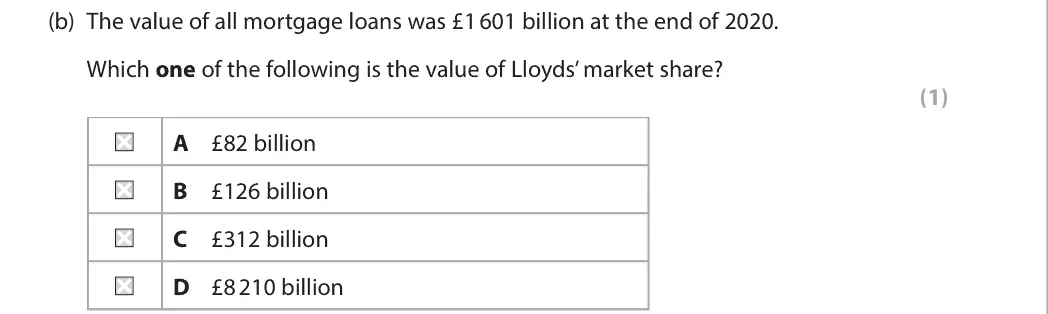
Data and extracts for question 5
Answer
C
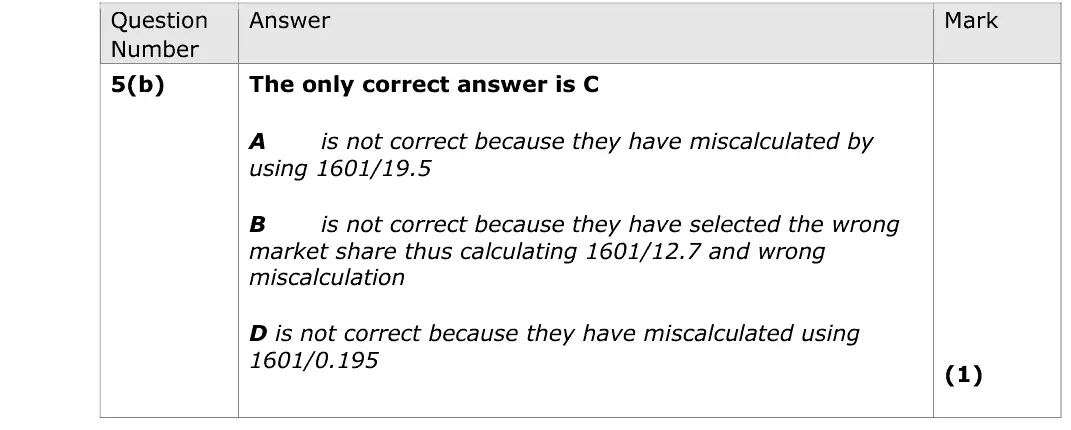
Mark scheme
Notes from the mark scheme and report
19.5% x £1 601 billion = £312 billion (C)
A divides by 19.5, B uses 12.7%, D divides by 0.195
Quantitative skills: QS 2 (calculate, use and understand percentages, percentage changes and percentage point changes)
June 2023 · Paper 1 · Q6(a)5 marksAO1=1, AO2=2, AO3=2Calculation
Data and extracts for question 6
Mark scheme
Examiner's comment
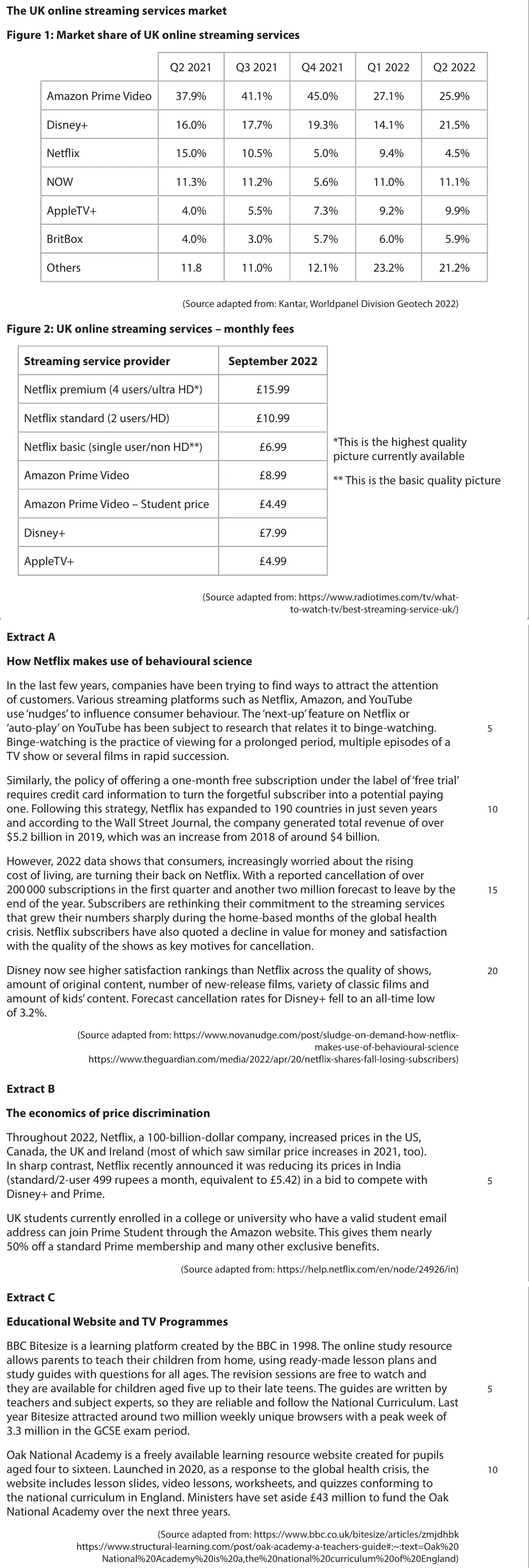
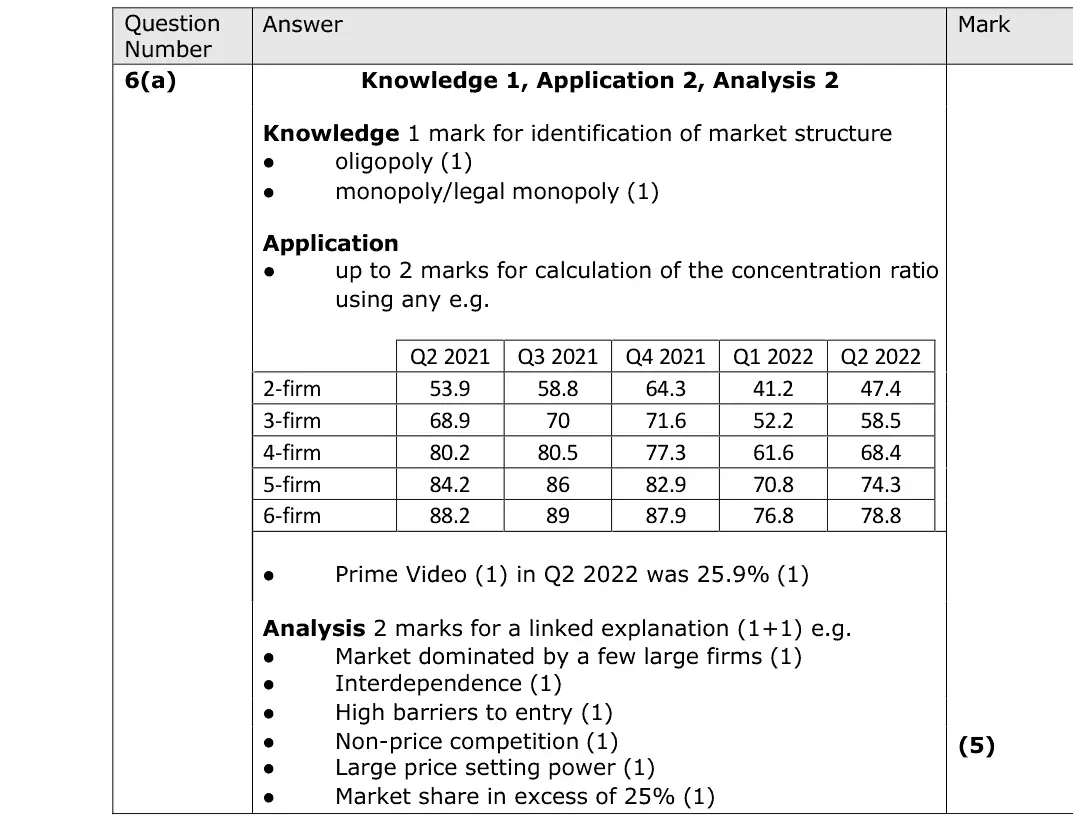
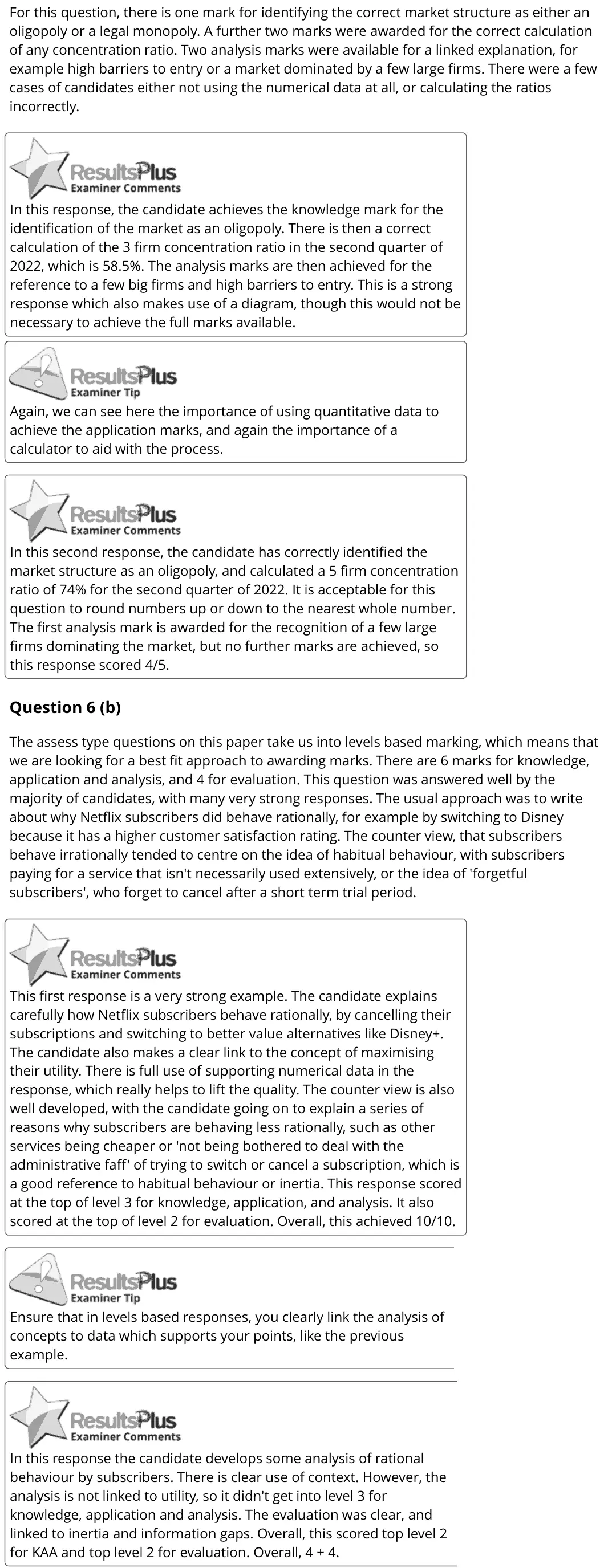
For this question, there is one mark for identifying the correct market structure as either an oligopoly or a legal monopoly. A further two marks were awarded for the correct calculation of any concentration ratio. Two analysis marks were available for a linked explanation, for example high barriers to entry or a market dominated by a few large firms. There were a few cases of candidates either not using the numerical data at all, or calculating the ratios incorrectly. In this response, the candidate achieves the knowledge mark for the identification of the market as an oligopoly. There is then a correct calculation of the 3 firm concentration ratio in the second quarter of 2022, which is 58.5%. The analysis marks are then achieved for the reference to a few big firms and high barriers to entry. This is a strong response which also makes use of a diagram, though this would not be necessary to achieve the full marks available. Again, we can see here the importance of using quantitative data to achieve the application marks, and again the importance of a calculator to aid with the process. In this second response, the candidate has correctly identified the market structure as an oligopoly, and calculated a 5 firm concentration ratio of 74% for the second quarter of 2022. It is acceptable for this question to round numbers up or down to the nearest whole number. The first analysis mark is awarded for the recognition of a few large firms dominating the market, but no further marks are achieved, so this response scored 4/5. Question (b) The assess type questions on this paper take us into levels based marking, which means that we are looking for a best fit approach to awarding marks. There are 6 marks for knowledge, application and analysis, and 4 for evaluation. This question was answered well by the majority of candidates, with many very strong responses. The usual approach was to write about why Netflix subscribers did behave rationally, for example by switching to Disney because it has a higher customer satisfaction rating. The counter view, that subscribers behave irrationally tended to centre on the idea of habitual behaviour, with subscribers paying for a service that isn't necessarily used extensively, or the idea of 'forgetful subscribers', who forget to cancel after a short term trial period. This first response is a very strong example. The candidate explains carefully how Netflix subscribers behave rationally, by cancelling their subscriptions and switching to better value alternatives like Disney+. The candidate also makes a clear link to the concept of maximising their utility. There is full use of supporting numerical data in the response, which really helps to lift the quality. The counter view is also well developed, with the candidate going on to explain a series of reasons why subscribers are behaving less rationally, such as other services being cheaper or 'not being bothered to deal with the administrative faff' of trying to switch or cancel a subscription, which is a good reference to habitual behaviour or inertia. This response scored at the top of level 3 for knowledge, application, and analysis. It also scored at the top of level 2 for evaluation. Overall, this achieved 10/10. Ensure that in levels based responses, you clearly link the analysis of concepts to data which supports your points, like the previous example. In this response the candidate develops some analysis of rational behaviour by subscribers. There is clear use of context. However, the analysis is not linked to utility, so it didn't get into level 3 for knowledge, application and analysis. The evaluation was clear, and linked to inertia and information gaps. Overall, this scored top level 2 for KAA and top level 2 for evaluation. Overall, 4 + 4.
Notes from the mark scheme and report
oligopoly (or legal monopoly for Amazon over 25%): calculate a concentration ratio (e.g. 3-firm Q2 2022 = 58.5%) for 2 marks
explain few large firms and barriers to entry
report: a few did not use the data or miscalculated
Quantitative skills: QS 2 (calculate, use and understand percentages, percentage changes and percentage point changes); QS 9 (interpret, apply and analyse information in written, graphical tabular and numerical forms)
June 2023 · Paper 3 · Q2(c)12 marksAO1=2, AO2=2, AO3=4, AO4=412-mark response
Data and extracts for question 2
Mark scheme, including the levels grid and indicative content
Examiner's comment
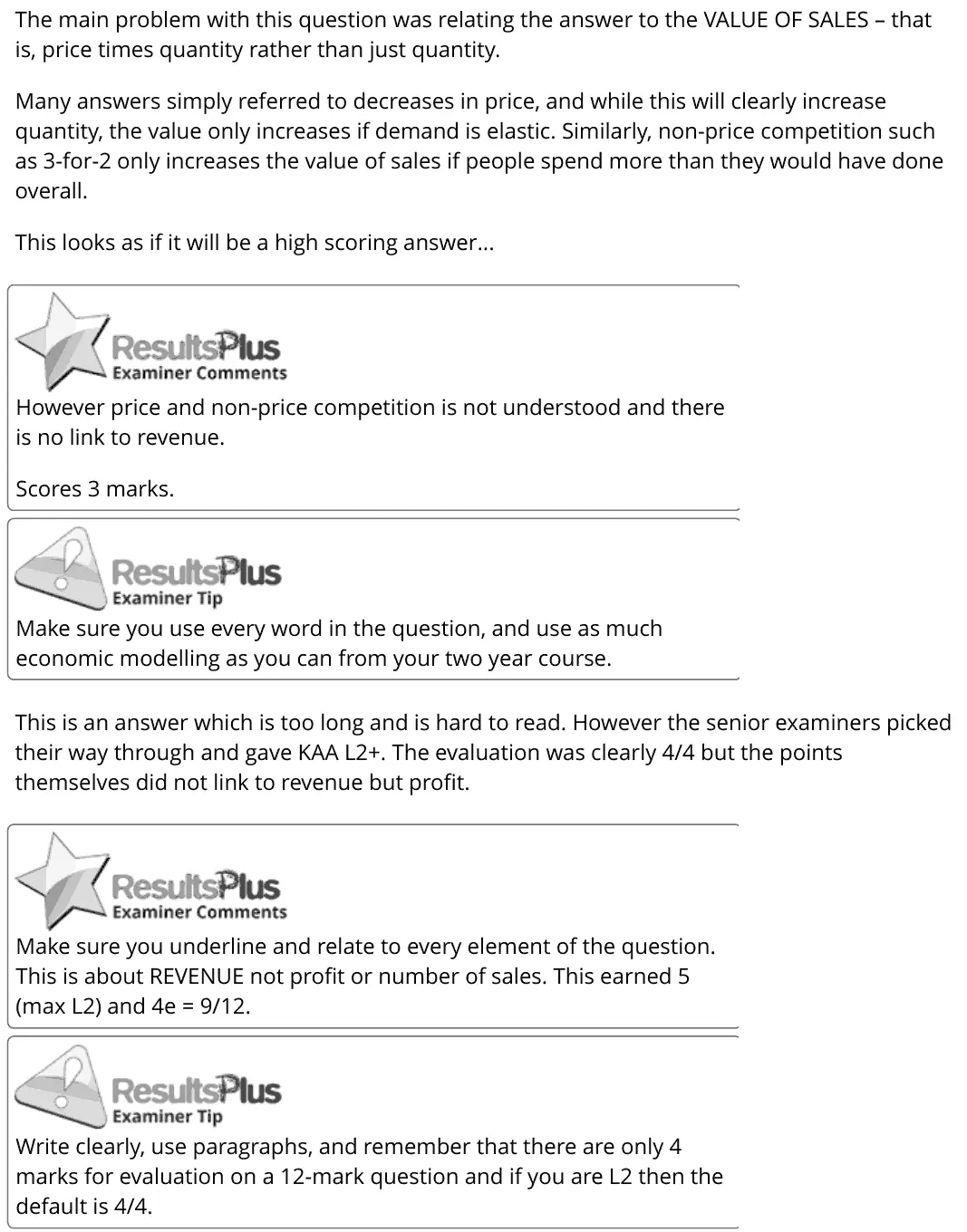
The main problem with this question was relating the answer to the VALUE OF SALES – that is, price times quantity rather than just quantity. Many answers simply referred to decreases in price, and while this will clearly increase quantity, the value only increases if demand is elastic. Similarly, non-price competition such as 3-for-2 only increases the value of sales if people spend more than they would have done overall. This looks as if it will be a high scoring answer... However price and non-price competition is not understood and there is no link to revenue. Scores 3 marks. Make sure you use every word in the question, and use as much economic modelling as you can from your two year course. This is an answer which is too long and is hard to read. However the senior examiners picked their way through and gave KAA L2+. The evaluation was clearly 4/4 but the points themselves did not link to revenue but profit. Make sure you underline and relate to every element of the question. This is about REVENUE not profit or number of sales. This earned 5 (max L2) and 4e = 9/12. Write clearly, use paragraphs, and remember that there are only 4 marks for evaluation on a 12-mark question and if you are L2 then the default is 4/4.
Notes from the mark scheme and report
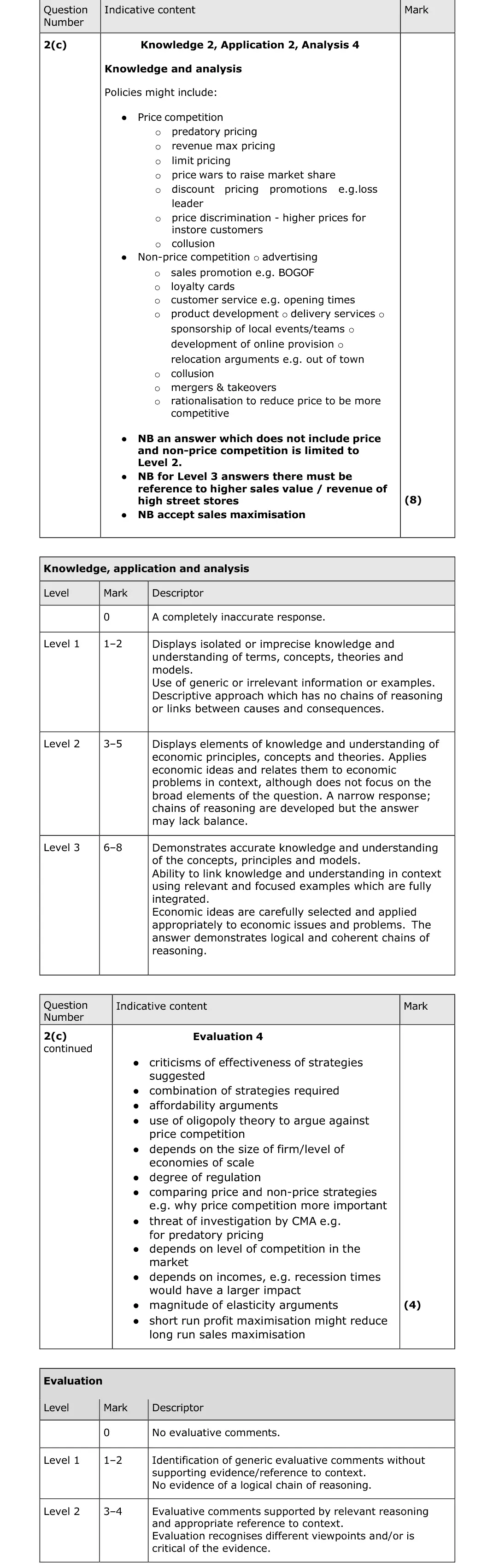
Level 2 cap unless both price and non-price competition
Level 3 needs a link to the value of sales (price x quantity): a price cut raises revenue only if demand is price elastic
answers about profit or number of sales missed the question
June 2022 · Paper 1 · Q4(a)4 marksAO1=2, AO2=2Diagram
Data and extracts for question 4
Mark scheme
Examiner's comment
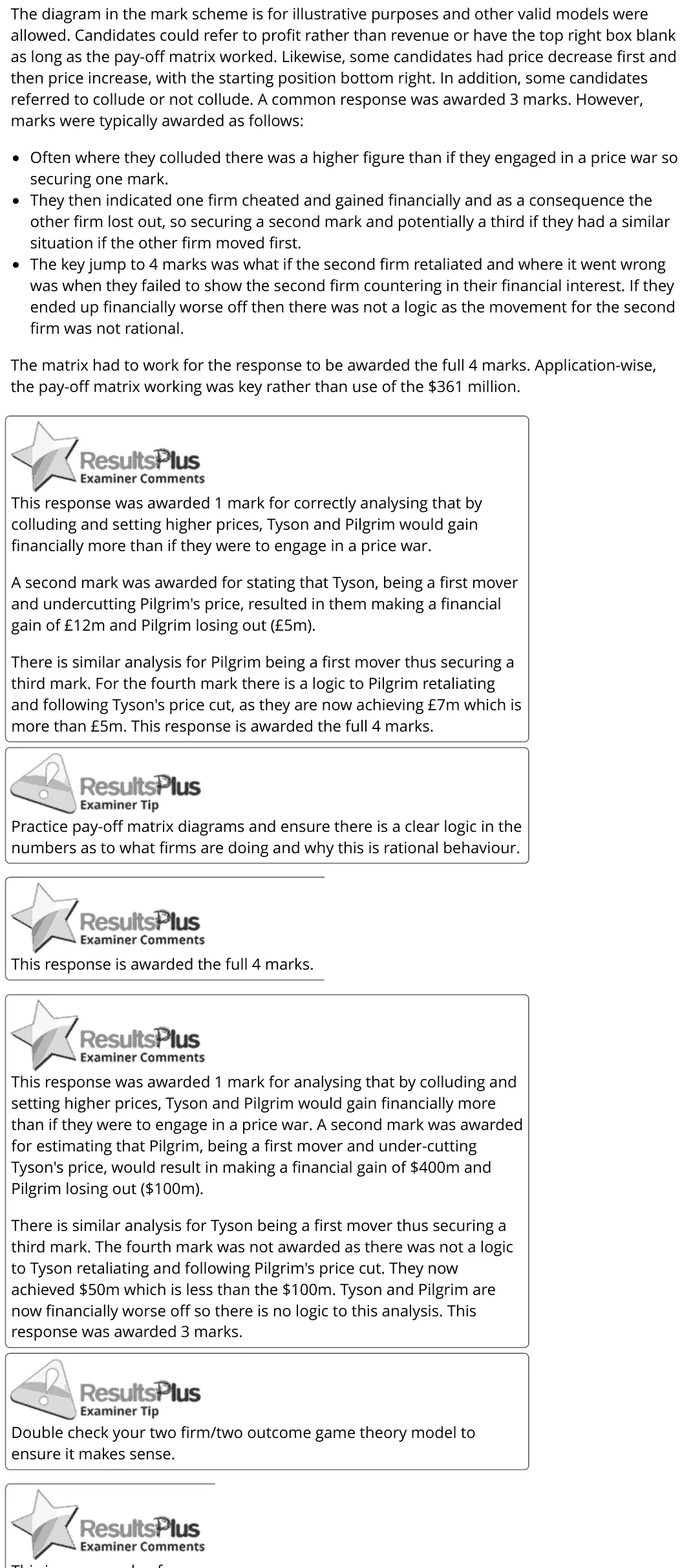
The diagram in the mark scheme is for illustrative purposes and other valid models were allowed. Candidates could refer to profit rather than revenue or have the top right box blank as long as the pay-off matrix worked. Likewise, some candidates had price decrease first and then price increase, with the starting position bottom right. In addition, some candidates referred to collude or not collude. A common response was awarded 3 marks. However, marks were typically awarded as follows: Often where they colluded there was a higher figure than if they engaged in a price war so securing one mark. They then indicated one firm cheated and gained financially and as a consequence the other firm lost out, so securing a second mark and potentially a third if they had a similar situation if the other firm moved first. The key jump to 4 marks was what if the second firm retaliated and where it went wrong was when they failed to show the second firm countering in their financial interest. If they ended up financially worse off then there was not a logic as the movement for the second firm was not rational. The matrix had to work for the response to be awarded the full 4 marks. Application-wise, the pay-off matrix working was key rather than use of the $361 million. This response was awarded 1 mark for correctly analysing that by colluding and setting higher prices, Tyson and Pilgrim would gain financially more than if they were to engage in a price war. A second mark was awarded for stating that Tyson, being a first mover and undercutting Pilgrim's price, resulted in them making a financial gain of £12m and Pilgrim losing out (£5m). There is similar analysis for Pilgrim being a first mover thus securing a third mark. For the fourth mark there is a logic to Pilgrim retaliating and following Tyson's price cut, as they are now achieving £7m which is more than £5m. This response is awarded the full 4 marks. Practice pay-off matrix diagrams and ensure there is a clear logic in the numbers as to what firms are doing and why this is rational behaviour. This response is awarded the full 4 marks. This response was awarded 1 mark for analysing that by colluding and setting higher prices, Tyson and Pilgrim would gain financially more than if they were to engage in a price war. A second mark was awarded for estimating that Pilgrim, being a first mover and under-cutting Tyson's price, would result in making a financial gain of $400m and Pilgrim losing out ($100m). There is similar analysis for Tyson being a first mover thus securing a third mark. The fourth mark was not awarded as there was not a logic to Tyson retaliating and following Pilgrim's price cut. They now achieved $50m which is less than the $100m. Tyson and Pilgrim are now financially worse off so there is no logic to this analysis. This response was awarded 3 marks. Double check your two firm/two outcome game theory model to ensure it makes sense.
Notes from the mark scheme and report
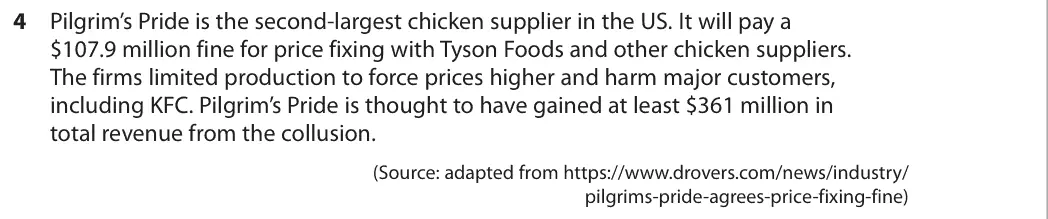
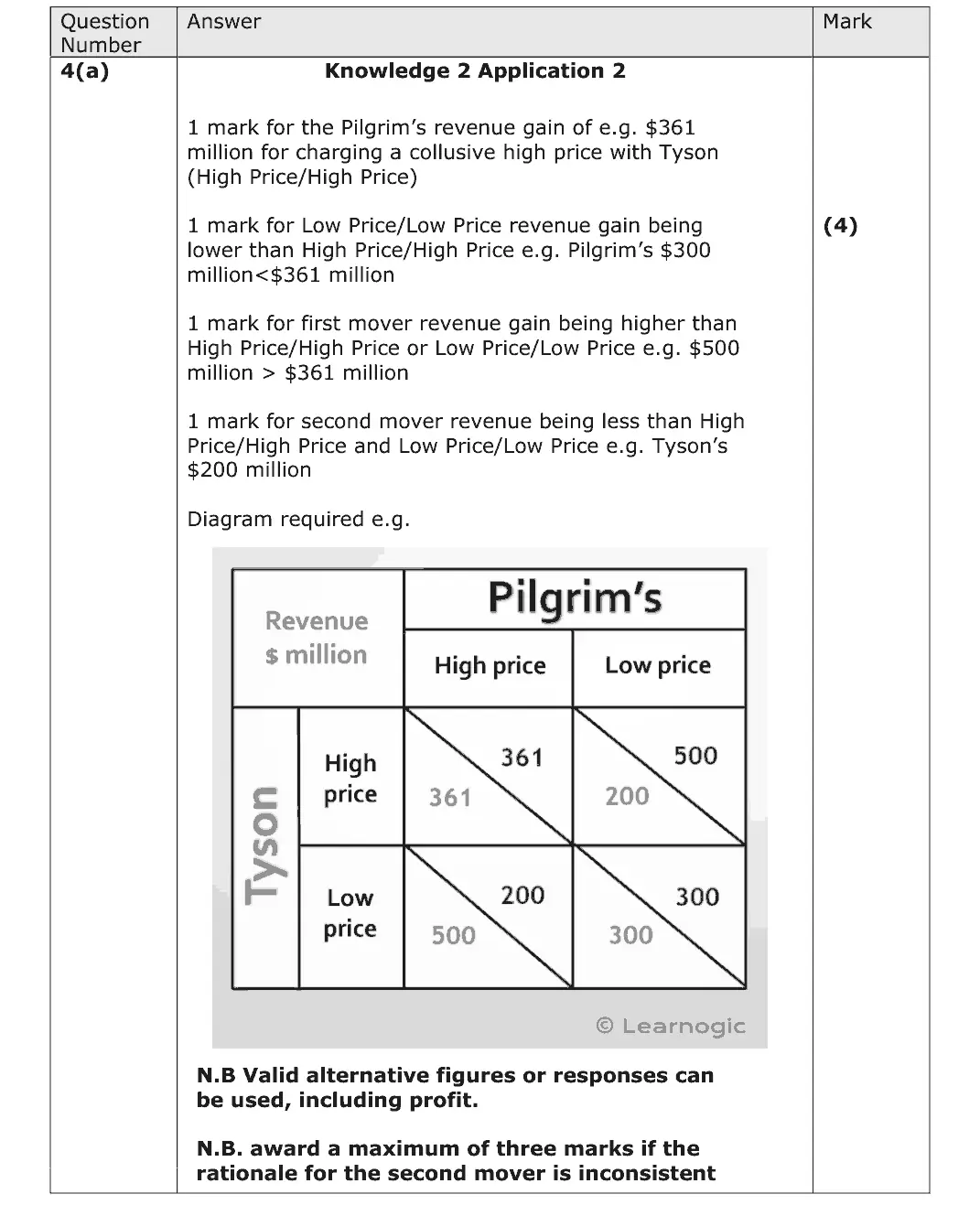
pay-off matrix: both high price gives $361m each, more than both low price (e.g. $300m)
the cheat who cuts price first gains more and the other less, so collusion beats a price war
report: the 4th mark was lost when the second firm's response was not in its own interest
Quantitative skills: QS 4 (construct and interpret a range of standard graphical forms); QS 9 (interpret, apply and analyse information in written, graphical tabular and numerical forms)
June 2022 · Paper 1 · Q4(b)1 markAO3=1Multiple choice
Data and extracts for question 4
Answer
D
Mark scheme
Notes from the mark scheme and report
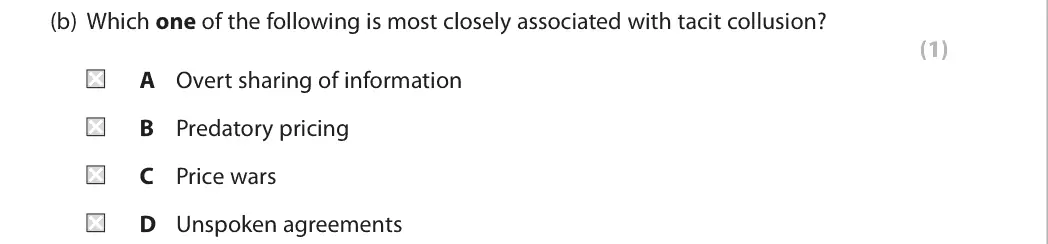
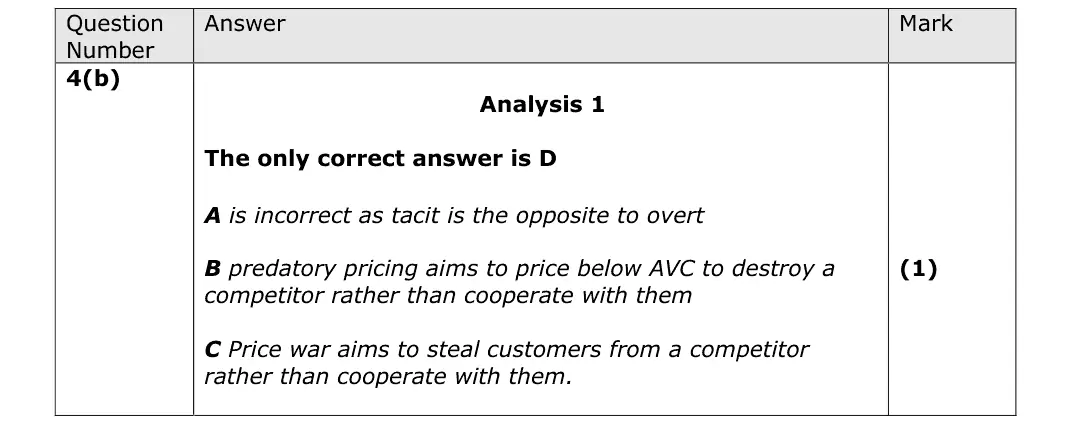
tacit collusion is an unspoken agreement such as price leadership (D)
A overt sharing is the opposite
B predatory pricing and C price wars are competitive, not collusive
June 2022 · Paper 1 · Q6(a)5 marksAO1=1, AO2=2, AO3=2Calculation
Data and extracts for question 6
Mark scheme
Examiner's comment
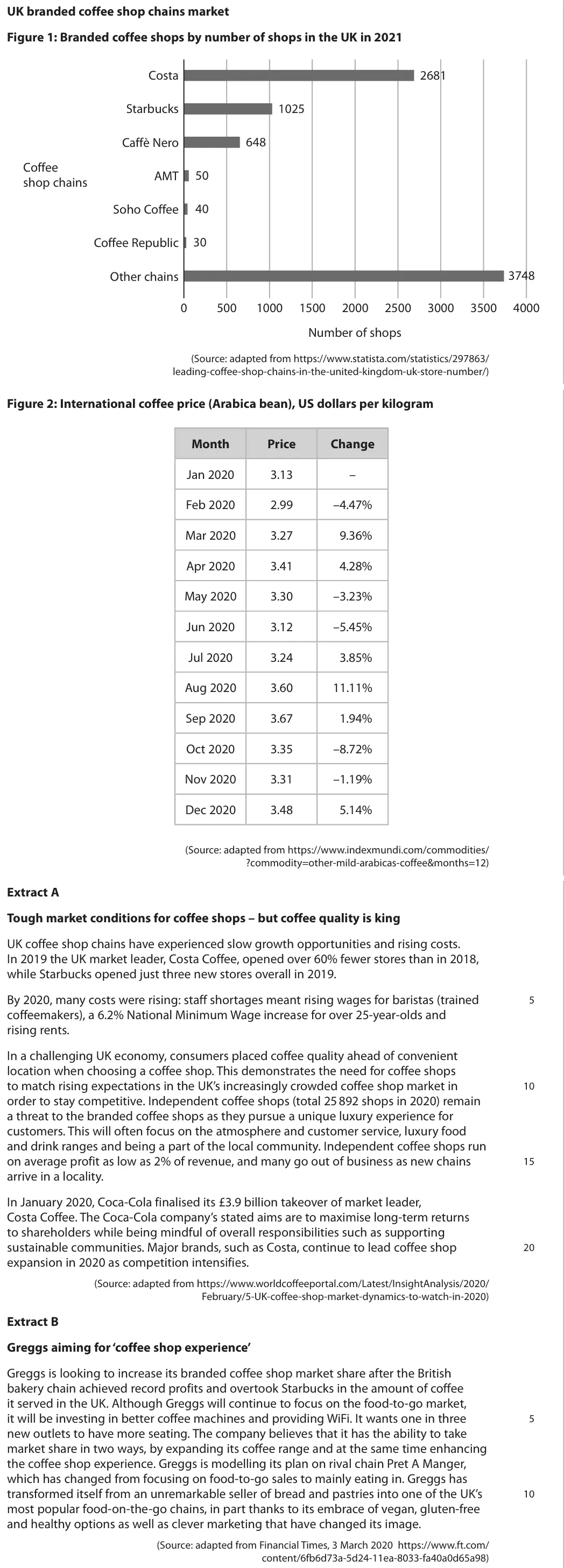
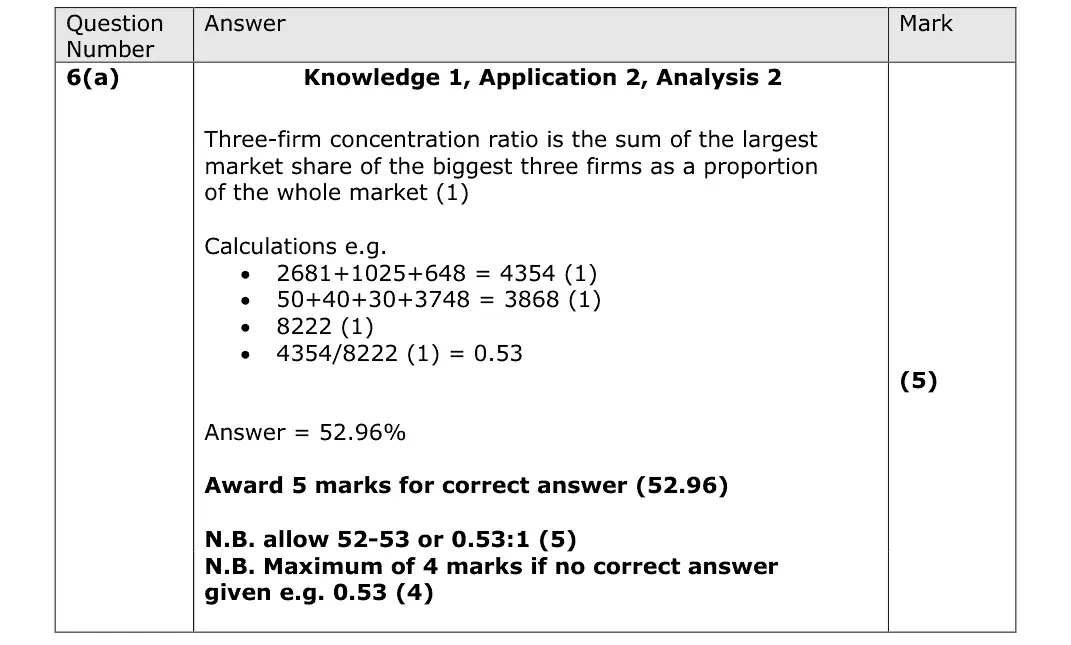
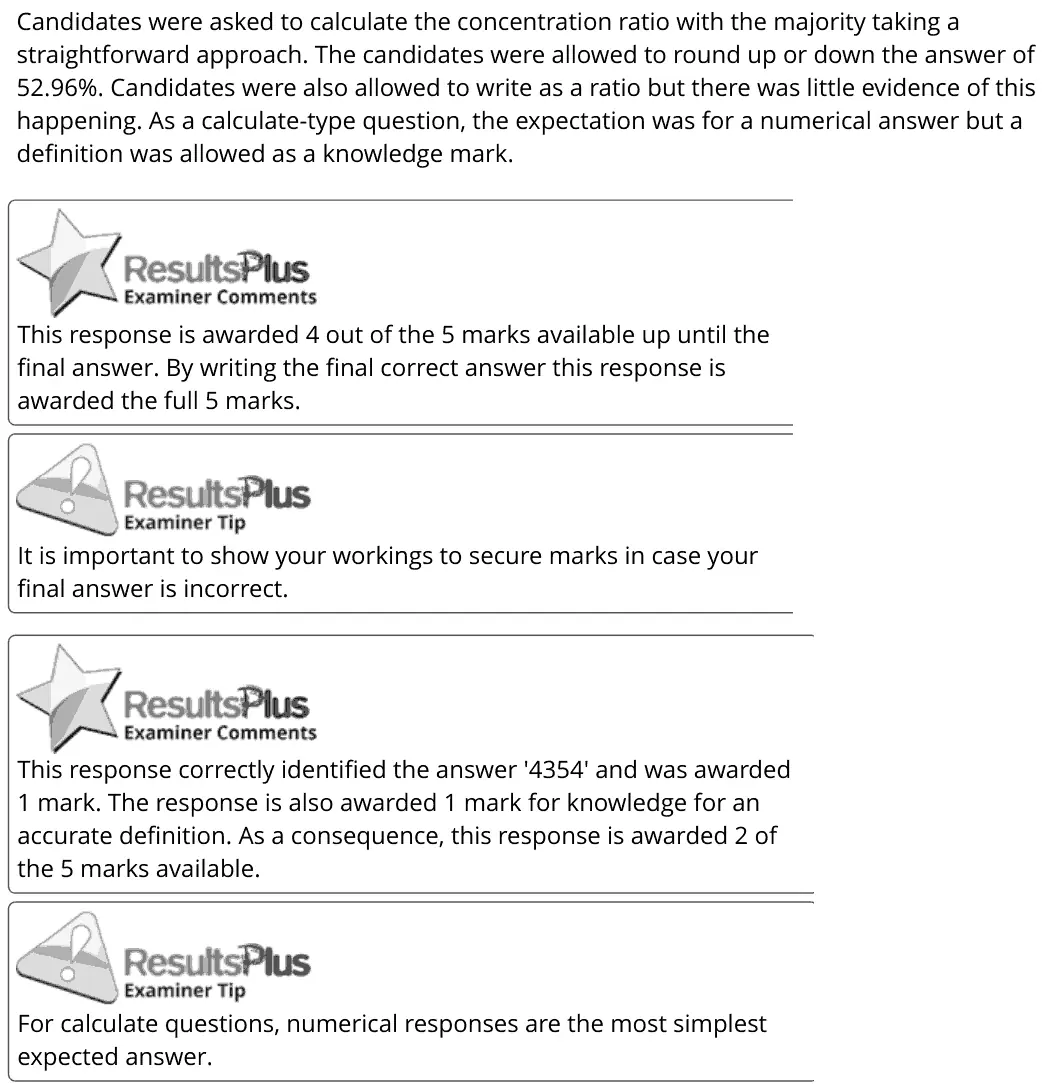
Candidates were asked to calculate the concentration ratio with the majority taking a straightforward approach. The candidates were allowed to round up or down the answer of 52.96%. Candidates were also allowed to write as a ratio but there was little evidence of this happening. As a calculate-type question, the expectation was for a numerical answer but a definition was allowed as a knowledge mark. This response is awarded 4 out of the 5 marks available up until the final answer. By writing the final correct answer this response is awarded the full 5 marks. It is important to show your workings to secure marks in case your final answer is incorrect. This response correctly identified the answer '4354' and was awarded 1 mark. The response is also awarded 1 mark for knowledge for an accurate definition. As a consequence, this response is awarded 2 of the 5 marks available. For calculate questions, numerical responses are the most simplest expected answer.
total must include AMT, Soho, Coffee Republic and other chains
Quantitative skills: QS 2 (calculate, use and understand percentages, percentage changes and percentage point changes); QS 9 (interpret, apply and analyse information in written, graphical tabular and numerical forms)
November 2021 · Paper 1 · Q6(e)15 marksAO1=3, AO2=3, AO3=3, AO4=615-mark response
Data and extracts for question 6
Mark scheme, including the levels grid and indicative content
Notes from the mark scheme and report
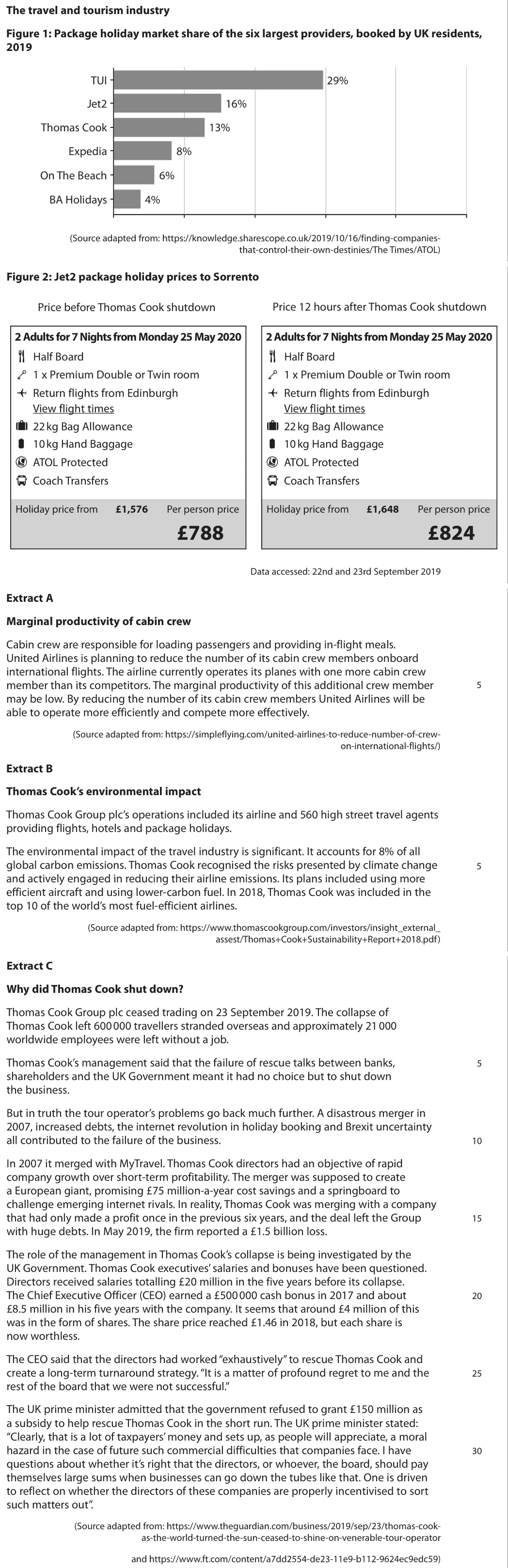
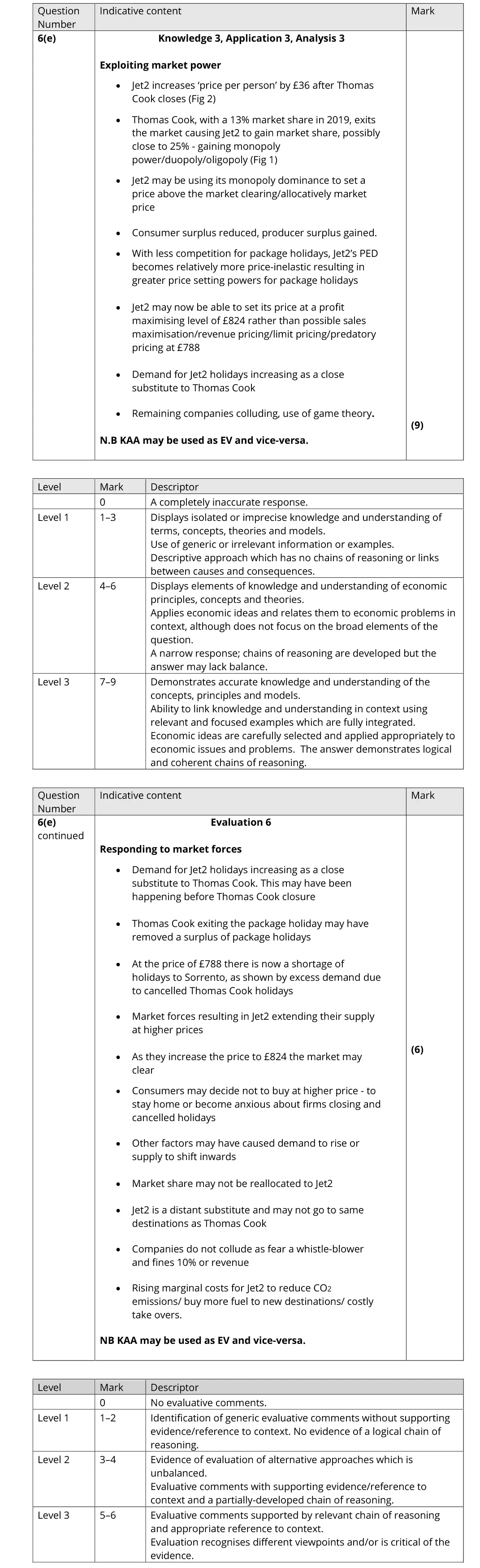
Thomas Cook's exit (13% share, Figure 1) gives Jet2 more market power and less elastic demand, so it raises price from £788 to £824 per person (Figure 2)
move to profit maximising pricing, consumer surplus falls
evaluate with the remaining competition (TUI 29%), contestability and CMA regulation
a final judgement is not required
Quantitative skills: QS 9 (interpret, apply and analyse information in written, graphical tabular and numerical forms)
November 2021 · Paper 1 · Q825 marksAO1=4, AO2=4, AO3=8, AO4=925-mark essayEither/or
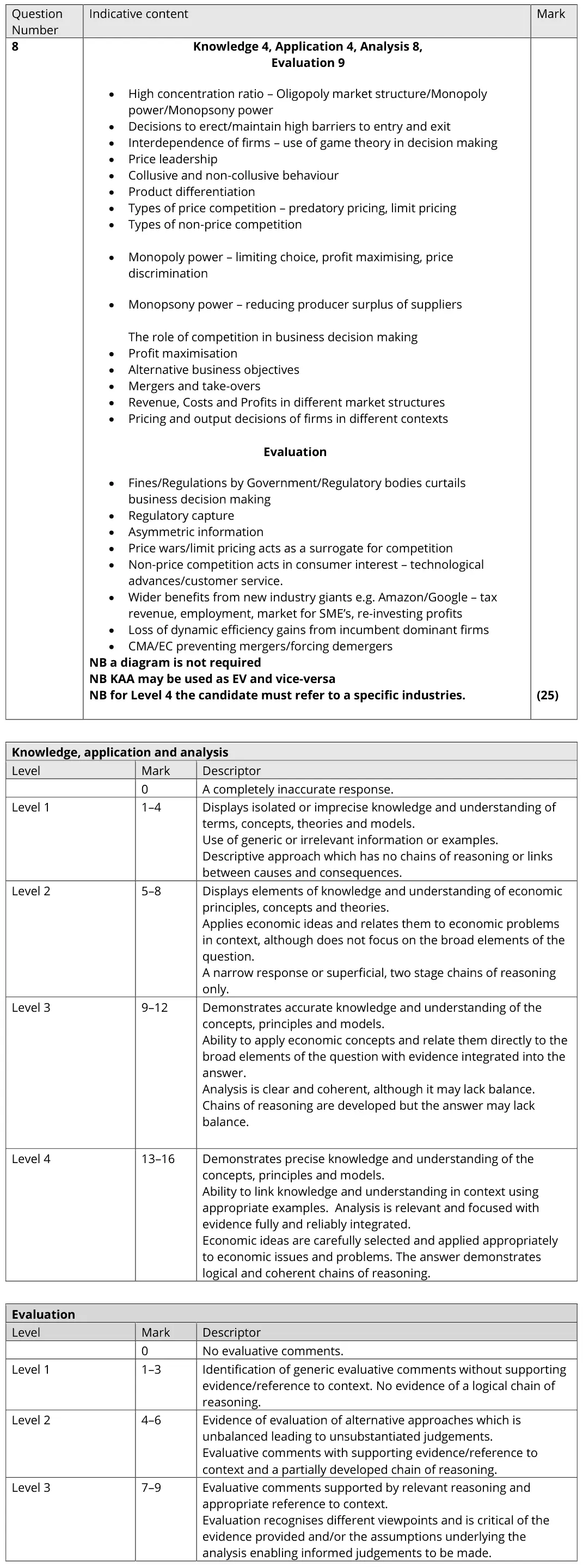
Mark scheme, including the levels grid and indicative content
Examiner's comment
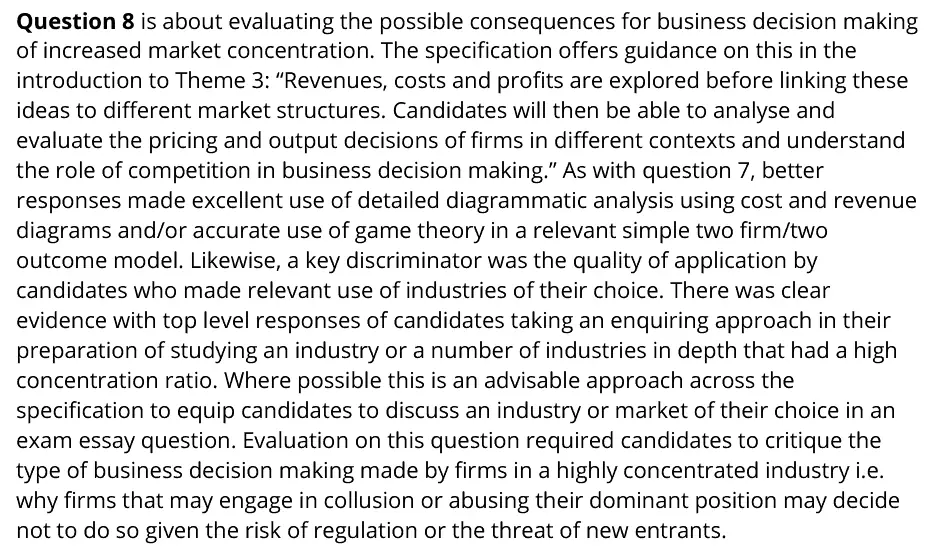
Question 8 is about evaluating the possible consequences for business decision making of increased market concentration. The specification offers guidance on this in the introduction to Theme 3: “Revenues, costs and profits are explored before linking these ideas to different market structures. Candidates will then be able to analyse and evaluate the pricing and output decisions of firms in different contexts and understand the role of competition in business decision making.” As with question 7, better responses made excellent use of detailed diagrammatic analysis using cost and revenue diagrams and/or accurate use of game theory in a relevant simple two firm/two outcome model. Likewise, a key discriminator was the quality of application by candidates who made relevant use of industries of their choice. There was clear evidence with top level responses of candidates taking an enquiring approach in their preparation of studying an industry or a number of industries in depth that had a high concentration ratio. Where possible this is an advisable approach across the specification to equip candidates to discuss an industry or market of their choice in an exam essay question. Evaluation on this question required candidates to critique the type of business decision making made by firms in a highly concentrated industry i.e. why firms that may engage in collusion or abusing their dominant position may decide not to do so given the risk of regulation or the threat of new entrants.
Notes from the mark scheme and report
higher concentration means interdependence: game theory, collusion or price leadership, non-price competition, barriers to entry, monopoly pricing
evaluate with risk of regulation, new entrants and contestability
better answers used cost and revenue diagrams and a two firm/two outcome model applied to named industries
June 2019 · Paper 1 · Q825 marksAO1=4, AO2=4, AO3=8, AO4=925-mark essayEither/or
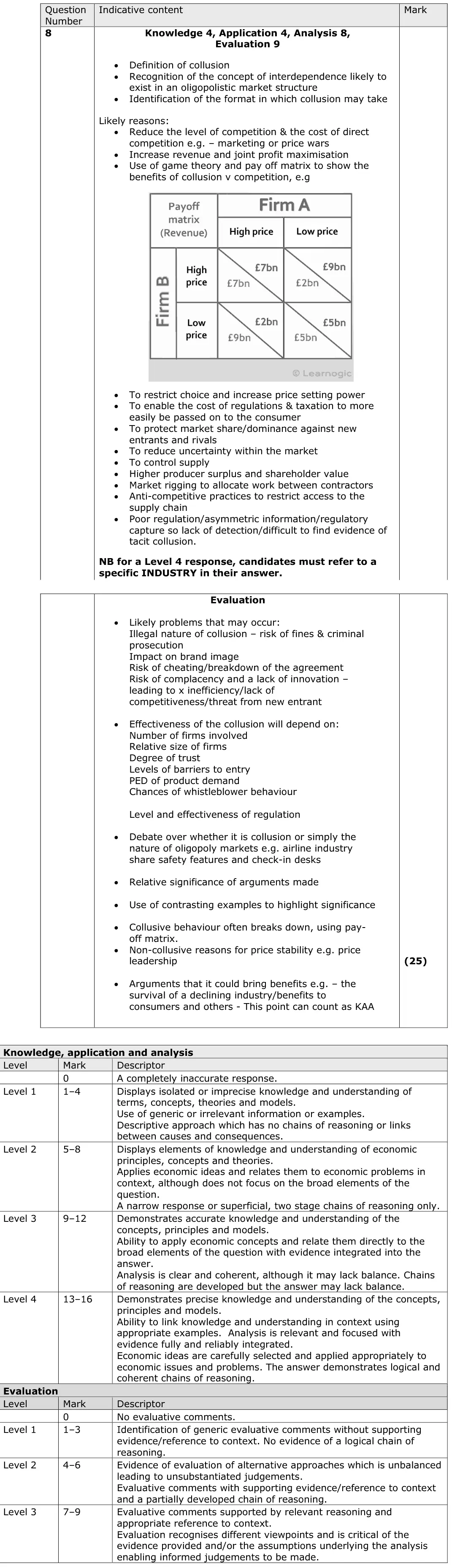
Mark scheme, including the levels grid and indicative content
Examiner's comment
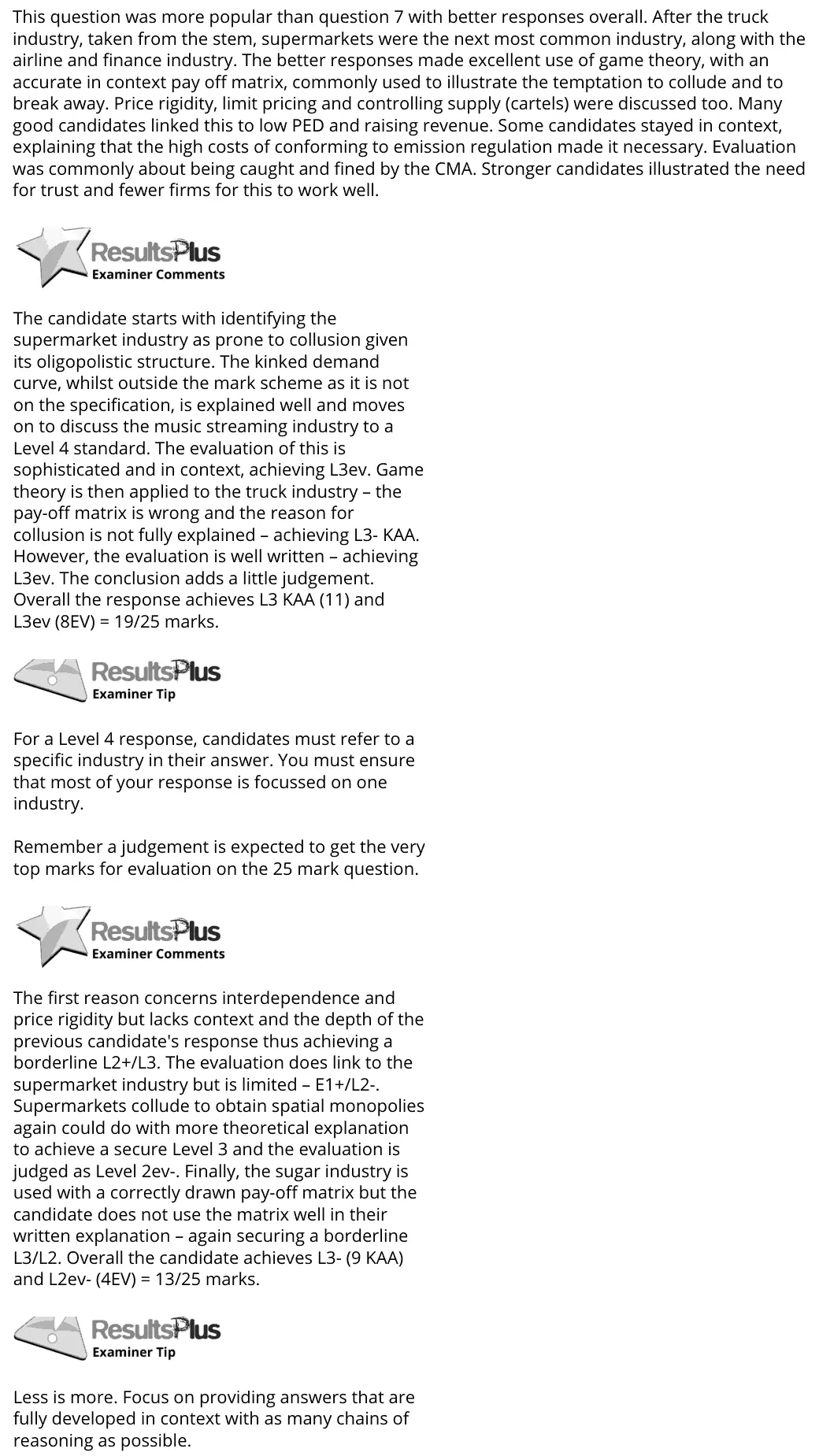
This question was more popular than question 7 with better responses overall. After the truck industry, taken from the stem, supermarkets were the next most common industry, along with the airline and finance industry. The better responses made excellent use of game theory, with an accurate in context pay off matrix, commonly used to illustrate the temptation to collude and to break away. Price rigidity, limit pricing and controlling supply (cartels) were discussed too. Many good candidates linked this to low PED and raising revenue. Some candidates stayed in context, explaining that the high costs of conforming to emission regulation made it necessary. Evaluation was commonly about being caught and fined by the CMA. Stronger candidates illustrated the need for trust and fewer firms for this to work well. The candidate starts with identifying the supermarket industry as prone to collusion given its oligopolistic structure. The kinked demand curve, whilst outside the mark scheme as it is not on the specification, is explained well and moves on to discuss the music streaming industry to a Level 4 standard. The evaluation of this is sophisticated and in context, achieving L3ev. Game theory is then applied to the truck industry – the pay-off matrix is wrong and the reason for collusion is not fully explained – achieving L3- KAA. However, the evaluation is well written – achieving L3ev. The conclusion adds a little judgement. Overall the response achieves L3 KAA (11) and L3ev (8EV) = 19/25 marks. For a Level 4 response, candidates must refer to a specific industry in their answer. You must ensure that most of your response is focussed on one industry. Remember a judgement is expected to get the very top marks for evaluation on the 25 mark question. The first reason concerns interdependence and price rigidity but lacks context and the depth of the previous candidate's response thus achieving a borderline L2+/L3. The evaluation does link to the supermarket industry but is limited – E1+/L2-. Supermarkets collude to obtain spatial monopolies again could do with more theoretical explanation to achieve a secure Level 3 and the evaluation is judged as Level 2ev-. Finally, the sugar industry is used with a correctly drawn pay-off matrix but the candidate does not use the matrix well in their written explanation – again securing a borderline L3/L2. Overall the candidate achieves L3- (9 KAA) and L2ev- (4EV) = 13/25 marks. Less is more. Focus on providing answers that are fully developed in context with as many chains of reasoning as possible.
Notes from the mark scheme and report
reasons for collusion: interdependence, joint profit maximisation, avoiding price wars, passing on regulation costs
game theory pay-off matrix shows the incentive to cheat
evaluate with fines and cheating
Level 4 needs a specific industry
kinked demand curve is not on the spec
June 2019 · Paper 3 · Q1(a)5 marksAO1=2, AO2=2, AO3=1Calculation
Data and extracts for question 1
Mark scheme
Examiner's comment
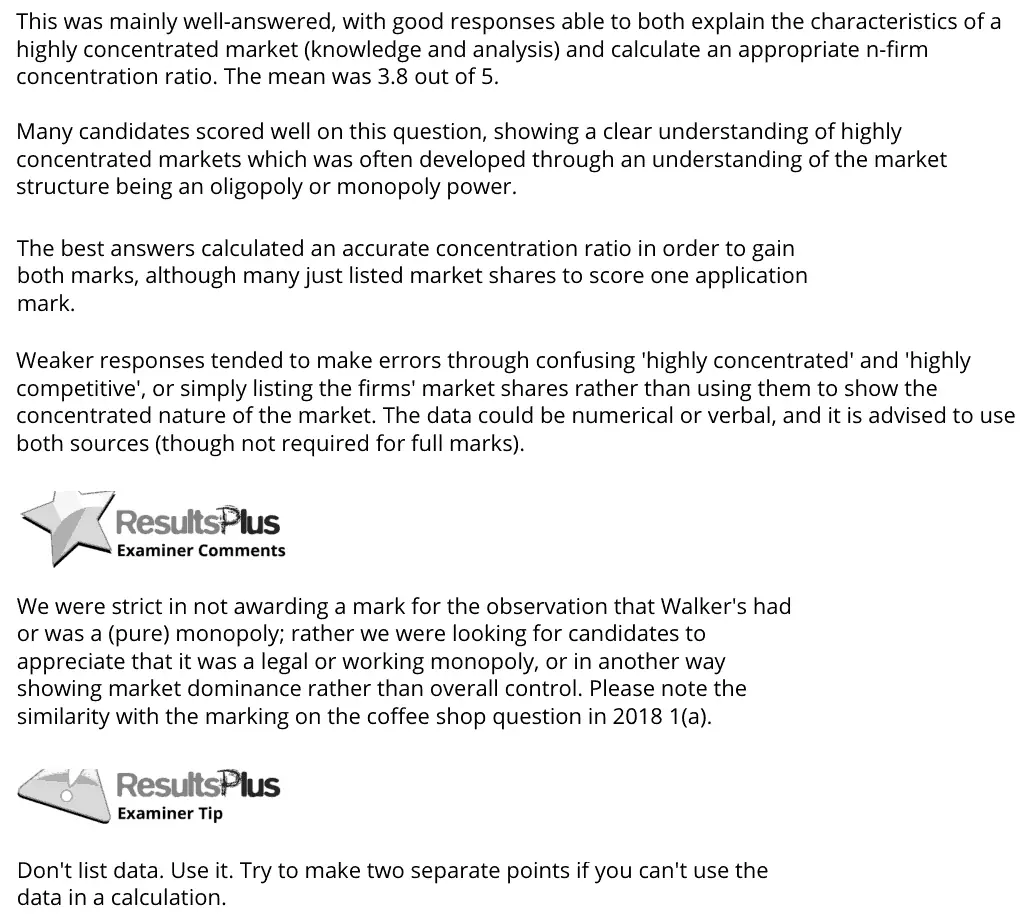
This was mainly well-answered, with good responses able to both explain the characteristics of a highly concentrated market (knowledge and analysis) and calculate an appropriate n-firm concentration ratio. The mean was 3.8 out of 5. Many candidates scored well on this question, showing a clear understanding of highly concentrated markets which was often developed through an understanding of the market structure being an oligopoly or monopoly power. The best answers calculated an accurate concentration ratio in order to gain both marks, although many just listed market shares to score one application mark. Weaker responses tended to make errors through confusing 'highly concentrated' and 'highly competitive', or simply listing the firms' market shares rather than using them to show the concentrated nature of the market. The data could be numerical or verbal, and it is advised to use both sources (though not required for full marks). We were strict in not awarding a mark for the observation that Walker's had or was a (pure) monopoly; rather we were looking for candidates to appreciate that it was a legal or working monopoly, or in another way showing market dominance rather than overall control. Please note the similarity with the marking on the coffee shop question in 2018 1(a). Don't list data. Use it. Try to make two separate points if you can't use the data in a calculation.
Notes from the mark scheme and report
highly concentrated means a few firms hold a large market share, not many firms or 'highly competitive'
calculate a concentration ratio (2-firm 78.0%, 3-firm 82.2%) for both application marks rather than just listing shares
Walkers is not a pure monopoly
max 1 application mark without Figure 1 or Extract A
Quantitative skills: QS 2 (calculate, use and understand percentages, percentage changes and percentage point changes); QS 9 (interpret, apply and analyse information in written, graphical tabular and numerical forms)
June 2019 · Paper 3 · Q1(c)12 marksAO1=2, AO2=2, AO3=4, AO4=412-mark response
Data and extracts for question 1
Mark scheme, including the levels grid and indicative content
Examiner's comment
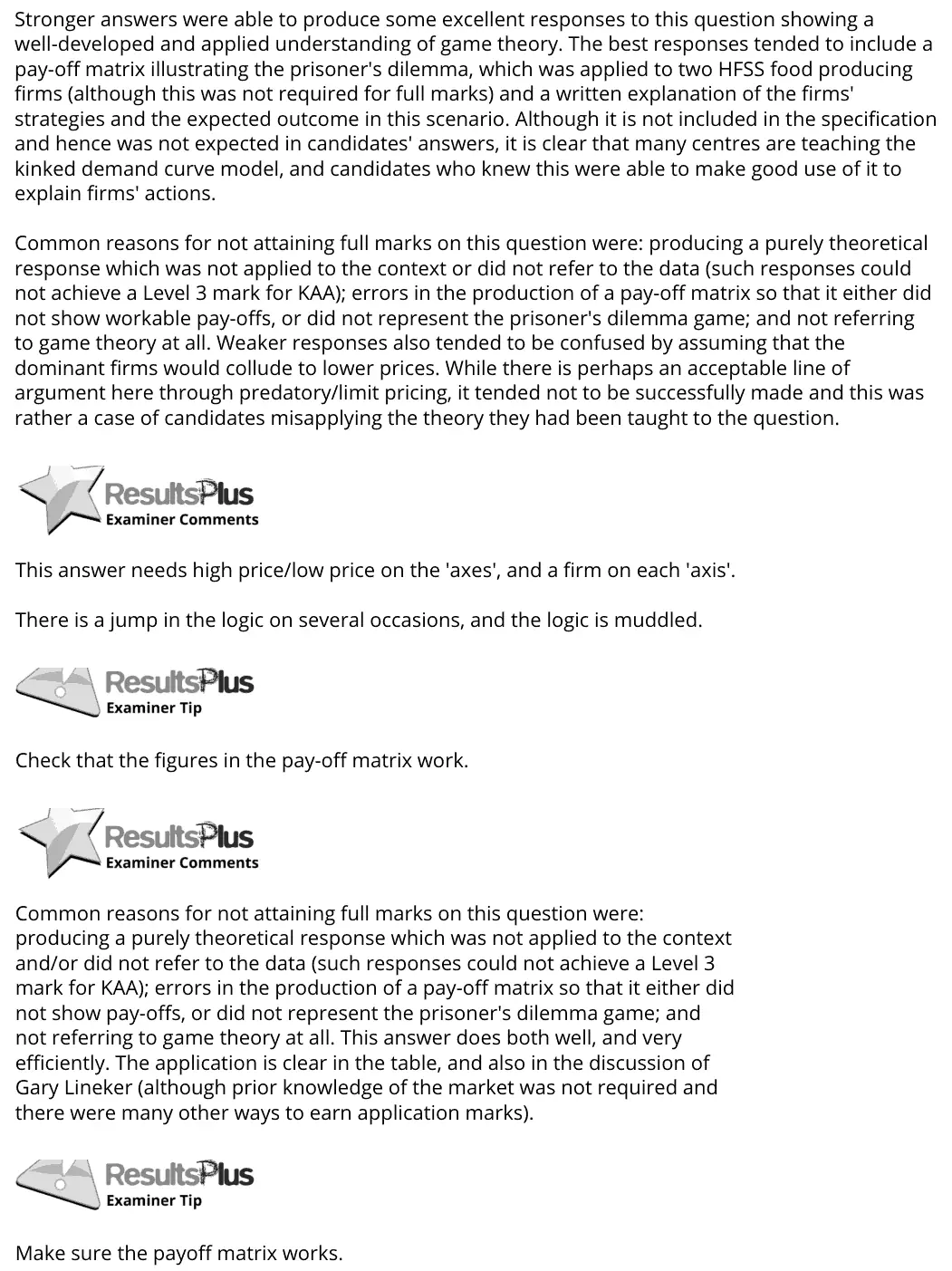
Stronger answers were able to produce some excellent responses to this question showing a well-developed and applied understanding of game theory. The best responses tended to include a pay-off matrix illustrating the prisoner's dilemma, which was applied to two HFSS food producing firms (although this was not required for full marks) and a written explanation of the firms' strategies and the expected outcome in this scenario. Although it is not included in the specification and hence was not expected in candidates' answers, it is clear that many centres are teaching the kinked demand curve model, and candidates who knew this were able to make good use of it to explain firms' actions. Common reasons for not attaining full marks on this question were: producing a purely theoretical response which was not applied to the context or did not refer to the data (such responses could not achieve a Level 3 mark for KAA); errors in the production of a pay-off matrix so that it either did not show workable pay-offs, or did not represent the prisoner's dilemma game; and not referring to game theory at all. Weaker responses also tended to be confused by assuming that the dominant firms would collude to lower prices. While there is perhaps an acceptable line of argument here through predatory/limit pricing, it tended not to be successfully made and this was rather a case of candidates misapplying the theory they had been taught to the question. This answer needs high price/low price on the 'axes', and a firm on each 'axis'. There is a jump in the logic on several occasions, and the logic is muddled. Check that the figures in the pay-off matrix work. Common reasons for not attaining full marks on this question were: producing a purely theoretical response which was not applied to the context and/or did not refer to the data (such responses could not achieve a Level 3 mark for KAA); errors in the production of a pay-off matrix so that it either did not show pay-offs, or did not represent the prisoner's dilemma game; and not referring to game theory at all. This answer does both well, and very efficiently. The application is clear in the table, and also in the discussion of Gary Lineker (although prior knowledge of the market was not required and there were many other ways to earn application marks). Make sure the payoff matrix works.
Notes from the mark scheme and report
Level 3 needs correct game theory (a prisoner's dilemma pay-off matrix applied to crisp firms) and use of Figure 1 / Extract A
interdependence, price war lowers profits for all
purely theoretical answers capped
firms colluding to lower prices is a misreading
evaluate: brand loyalty, ban only targets children, sales fall only 10%
Quantitative skills: QS 9 (interpret, apply and analyse information in written, graphical tabular and numerical forms)
June 2018 · Paper 1 · Q5(c)2 marksAO2=2Calculation
Data and extracts for question 5
Mark scheme
Examiner's comment
This was a high scoring question with the vast majority of candidates gaining 2 marks, although a few only scored 1 mark as they had only calculated the total market share of the companies but had not expressed the answer as a percentage. This answer achieves a mark of 2/2. Full marks for correctly identifying 68.75% for five firm concentration ratios. Without the correct answers being provided only one mark would have been awarded for the formula provided as per the mark scheme. Ensure you clearly state your final answer.
Notes from the mark scheme and report
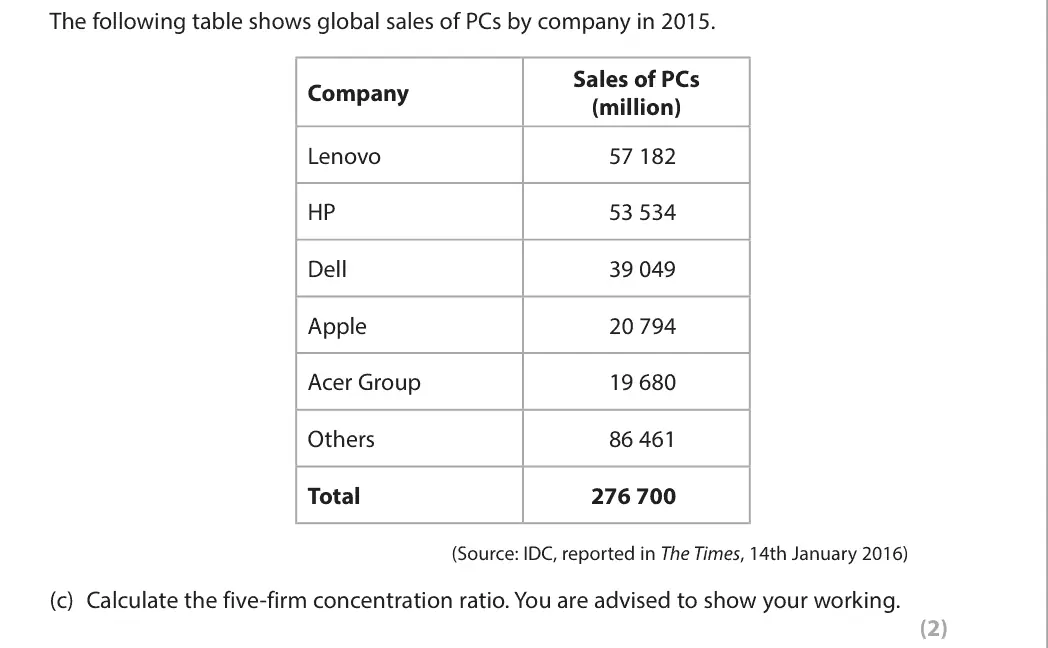
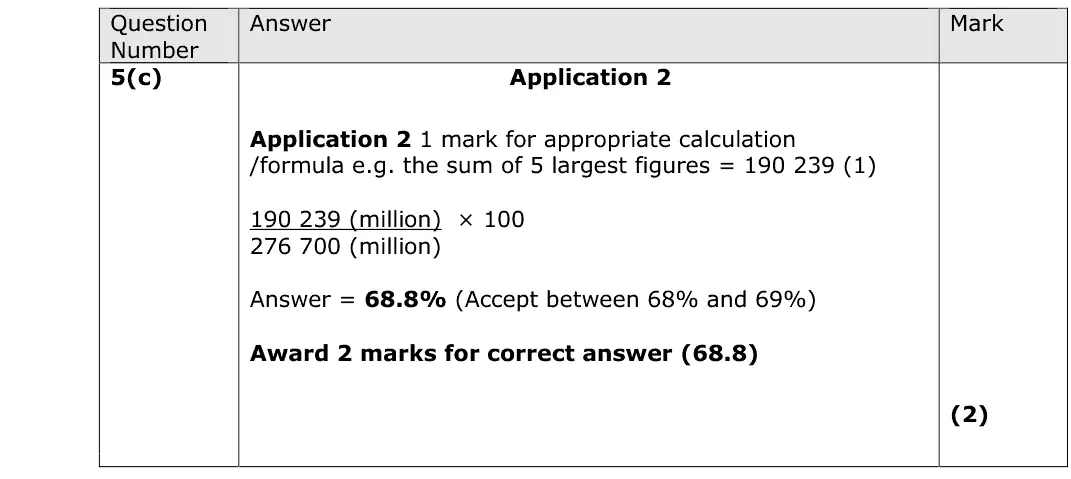
sum of five largest firms' sales 190 239 / 276 700 x 100 = 68.8%
report: a few gave the total share but not as a percentage
Quantitative skills: QS 2 (calculate, use and understand percentages, percentage changes and percentage point changes); QS 9 (interpret, apply and analyse information in written, graphical tabular and numerical forms)
June 2018 · Paper 3 · Q1(a)5 marksAO1=2, AO2=2, AO3=1Short answer
Data and extracts for question 1
Mark scheme
Examiner's comment
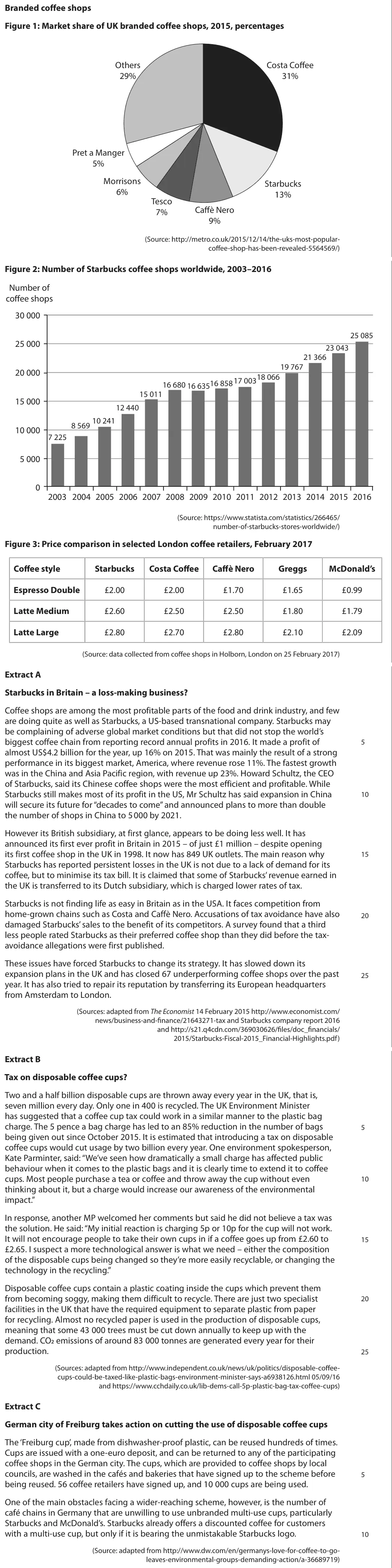
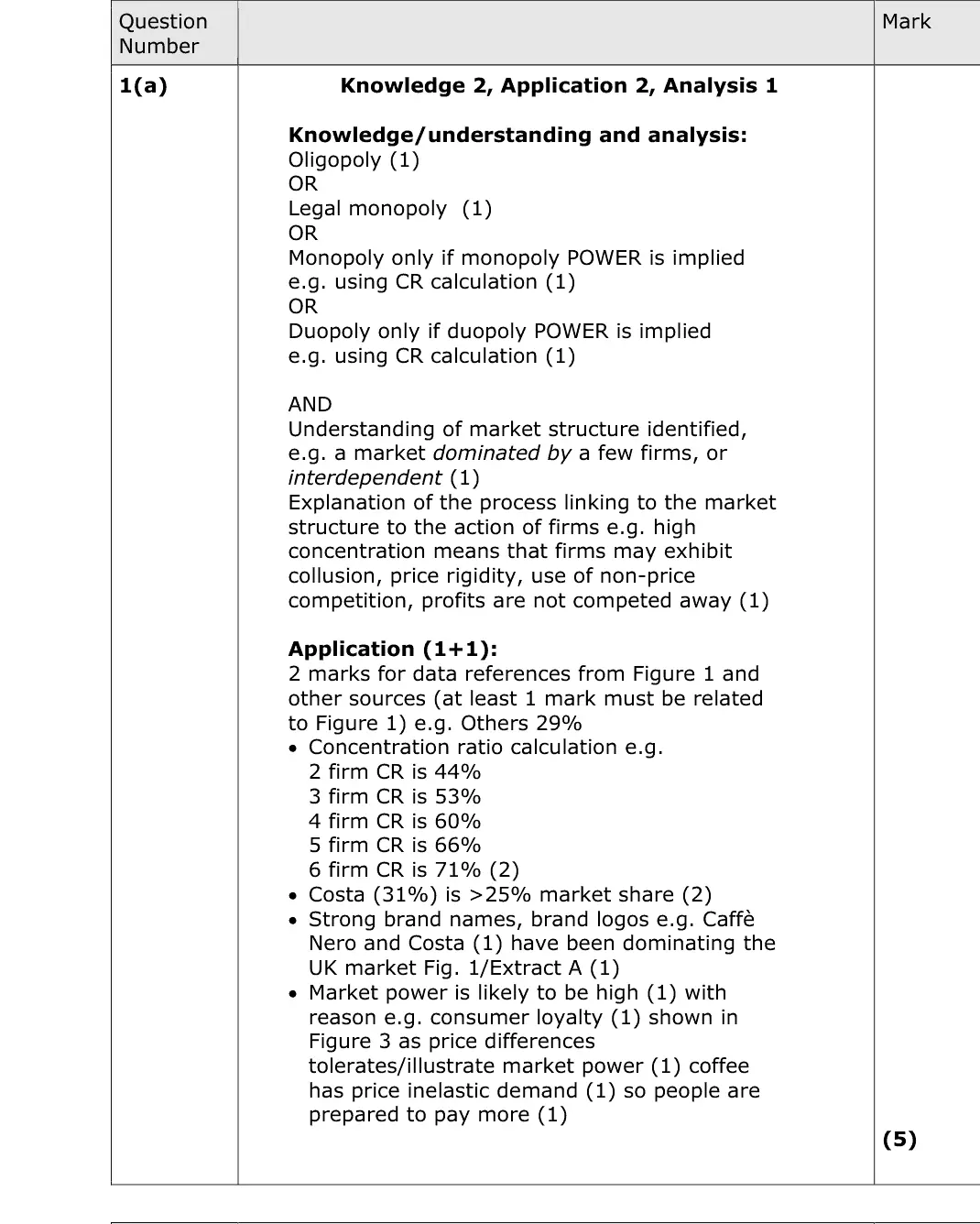
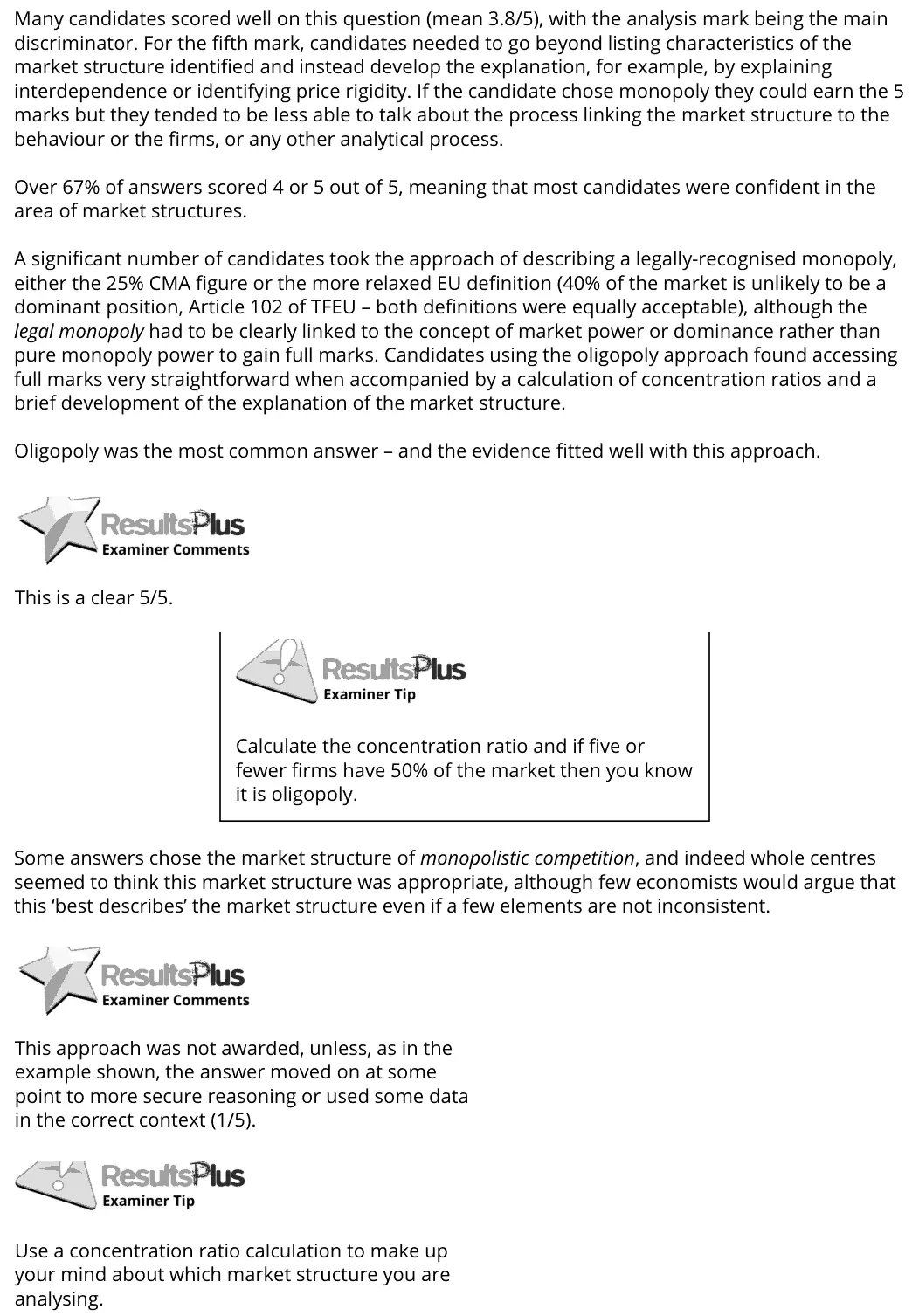
Many candidates scored well on this question (mean 3.8/5), with the analysis mark being the main discriminator. For the fifth mark, candidates needed to go beyond listing characteristics of the market structure identified and instead develop the explanation, for example, by explaining interdependence or identifying price rigidity. If the candidate chose monopoly they could earn the 5 marks but they tended to be less able to talk about the process linking the market structure to the behaviour or the firms, or any other analytical process. Over 67% of answers scored 4 or 5 out of 5, meaning that most candidates were confident in the area of market structures. A significant number of candidates took the approach of describing a legally-recognised monopoly, either the 25% CMA figure or the more relaxed EU definition (40% of the market is unlikely to be a dominant position, Article 102 of TFEU – both definitions were equally acceptable), although the legal monopoly had to be clearly linked to the concept of market power or dominance rather than pure monopoly power to gain full marks. Candidates using the oligopoly approach found accessing full marks very straightforward when accompanied by a calculation of concentration ratios and a brief development of the explanation of the market structure. Oligopoly was the most common answer – and the evidence fitted well with this approach. This is a clear 5/5. Calculate the concentration ratio and if five or fewer firms have 50% of the market then you know it is oligopoly. Some answers chose the market structure of monopolistic competition, and indeed whole centres seemed to think this market structure was appropriate, although few economists would argue that this ‘best describes’ the market structure even if a few elements are not inconsistent. This approach was not awarded, unless, as in the example shown, the answer moved on at some point to more secure reasoning or used some data in the correct context (1/5). Use a concentration ratio calculation to make up your mind about which market structure you are analysing.
Notes from the mark scheme and report
oligopoly (or legal monopoly/duopoly only if market power is shown)
a concentration ratio calculation (e.g. 4-firm 60%) gives both application marks
the 5th mark needs development such as interdependence or price rigidity, not a list of characteristics
monopolistic competition was not awarded
Quantitative skills: QS 9 (interpret, apply and analyse information in written, graphical tabular and numerical forms)
June 2018 · Paper 3 · Q1(b)12 marksAO1=2, AO2=2, AO3=4, AO4=412-mark response
Data and extracts for question 1
Mark scheme, including the levels grid and indicative content
Examiner's comment
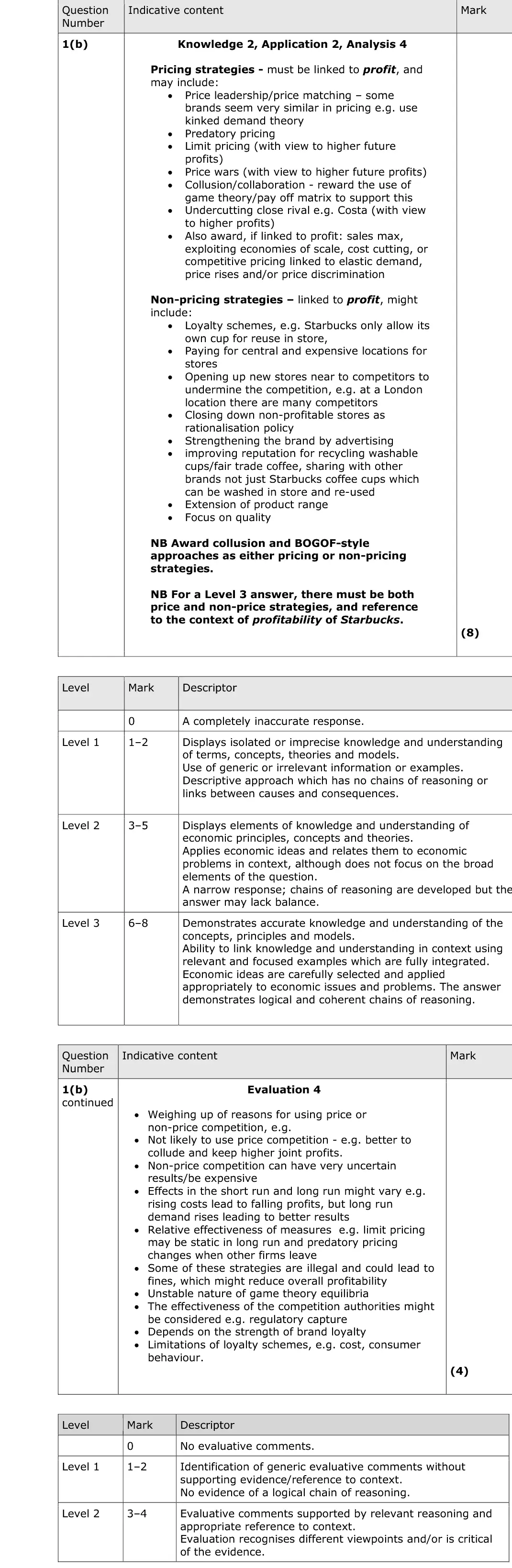
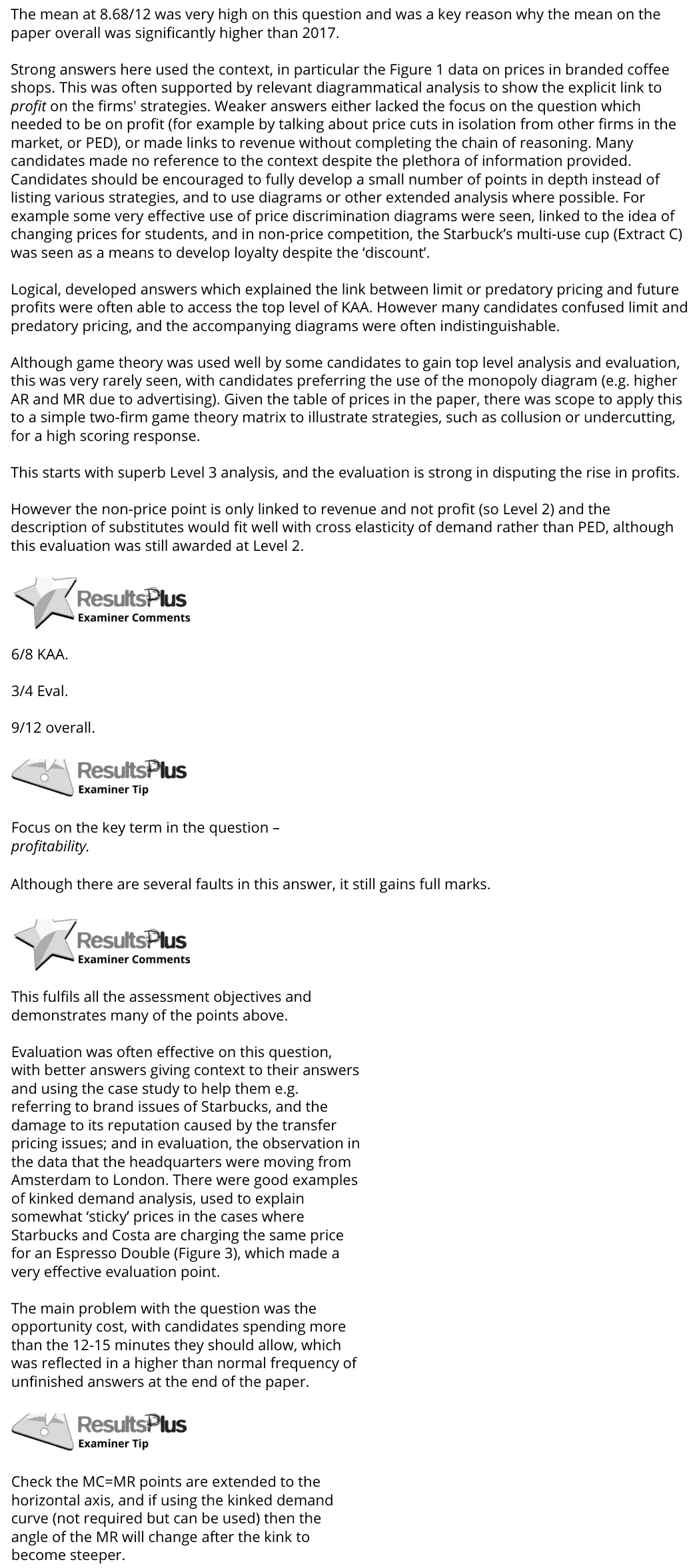
The mean at 8.68/12 was very high on this question and was a key reason why the mean on the paper overall was significantly higher than 2017. Strong answers here used the context, in particular the Figure 1 data on prices in branded coffee shops. This was often supported by relevant diagrammatical analysis to show the explicit link to profit on the firms' strategies. Weaker answers either lacked the focus on the question which needed to be on profit (for example by talking about price cuts in isolation from other firms in the market, or PED), or made links to revenue without completing the chain of reasoning. Many candidates made no reference to the context despite the plethora of information provided. Candidates should be encouraged to fully develop a small number of points in depth instead of listing various strategies, and to use diagrams or other extended analysis where possible. For example some very effective use of price discrimination diagrams were seen, linked to the idea of changing prices for students, and in non-price competition, the Starbuck’s multi-use cup (Extract C) was seen as a means to develop loyalty despite the ‘discount’. Logical, developed answers which explained the link between limit or predatory pricing and future profits were often able to access the top level of KAA. However many candidates confused limit and predatory pricing, and the accompanying diagrams were often indistinguishable. Although game theory was used well by some candidates to gain top level analysis and evaluation, this was very rarely seen, with candidates preferring the use of the monopoly diagram (e.g. higher AR and MR due to advertising). Given the table of prices in the paper, there was scope to apply this to a simple two-firm game theory matrix to illustrate strategies, such as collusion or undercutting, for a high scoring response. This starts with superb Level 3 analysis, and the evaluation is strong in disputing the rise in profits. However the non-price point is only linked to revenue and not profit (so Level 2) and the description of substitutes would fit well with cross elasticity of demand rather than PED, although this evaluation was still awarded at Level 2. 6/8 KAA. 3/4 Eval. 9/12 overall. Focus on the key term in the question – profitability. Although there are several faults in this answer, it still gains full marks. This fulfils all the assessment objectives and demonstrates many of the points above. Evaluation was often effective on this question, with better answers giving context to their answers and using the case study to help them e.g. referring to brand issues of Starbucks, and the damage to its reputation caused by the transfer pricing issues; and in evaluation, the observation in the data that the headquarters were moving from Amsterdam to London. There were good examples of kinked demand analysis, used to explain somewhat ‘sticky’ prices in the cases where Starbucks and Costa are charging the same price for an Espresso Double (Figure 3), which made a very effective evaluation point. The main problem with the question was the opportunity cost, with candidates spending more than the 12-15 minutes they should allow, which was reflected in a higher than normal frequency of unfinished answers at the end of the paper. Check the MC=MR points are extended to the horizontal axis, and if using the kinked demand curve (not required but can be used) then the angle of the MR will change after the kink to become steeper.
Notes from the mark scheme and report
Level 3 needs both price and non-price strategies linked to profit (not just revenue)
use the Figure 3 prices (e.g. kinked demand for matching Costa prices, game theory)
many confused limit and predatory pricing
evaluate e.g. uncertain results of non-price competition
Quantitative skills: QS 9 (interpret, apply and analyse information in written, graphical tabular and numerical forms)
June 2017 · Paper 1 · Q6(a)5 marksAO1=1, AO2=1, AO3=3Calculation
Data and extracts for question 6
Mark scheme
Examiner's comment
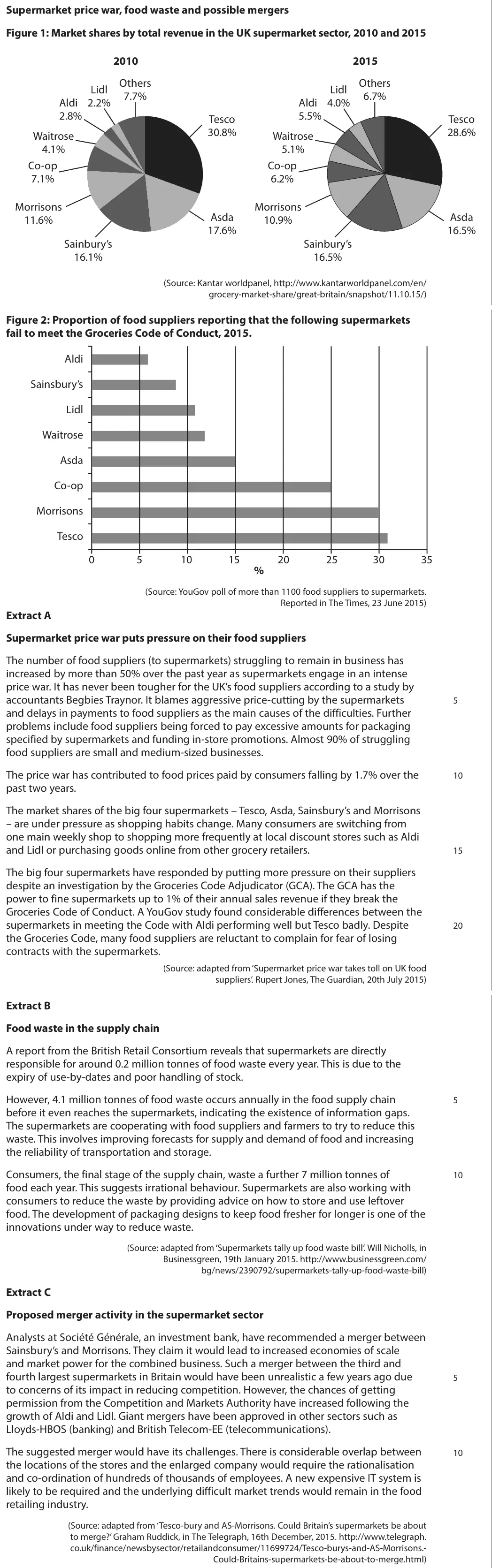
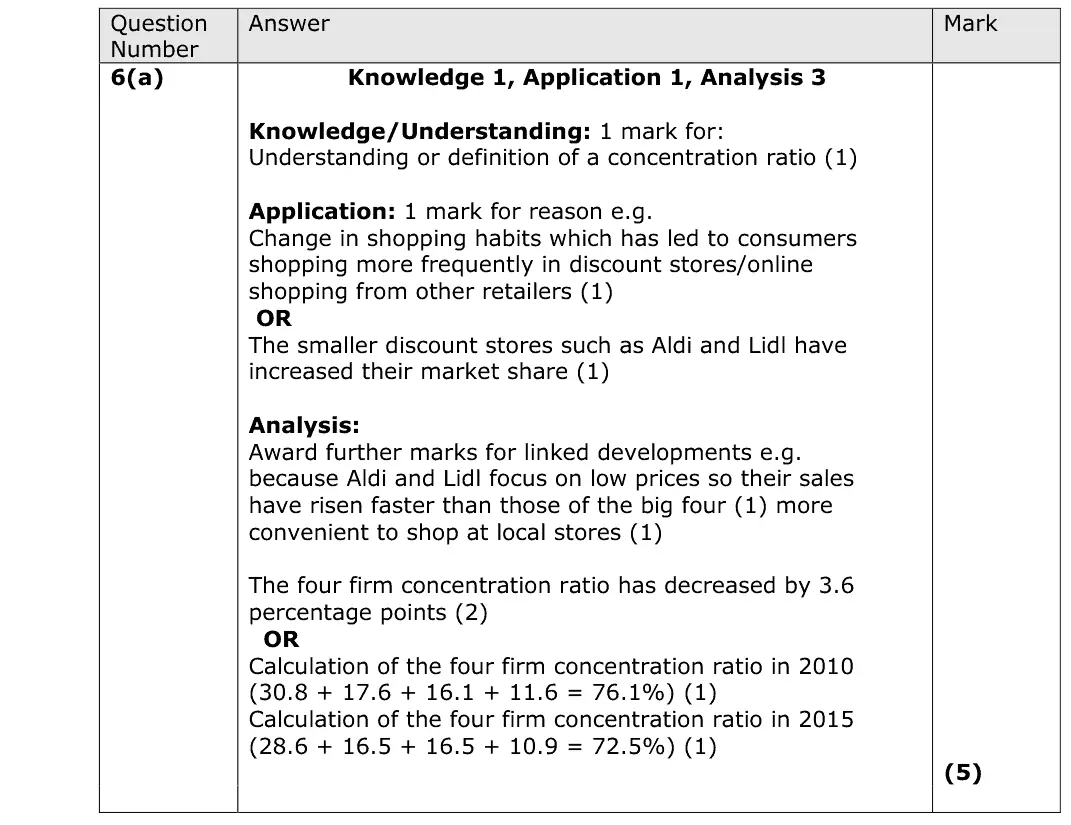
In this question it was clear which candidates knew what the four firm concentration ratio meant. Candidates need to practice such key knowledge and why it may change as part of their exam preparation. Be careful in future about percentage points change and percentage change. This answer achieves a mark of 5/5. The candidate starts by calculating the four firm concentration ratio for both years and identifies that the ratio has decreased by 3.6 percentage points (benefit of doubt given here as technically it is not 3.6%); thereby picking up 2 marks for analysis and one for implicit knowledge of concentration ratio. They then go on to provide and explain the reason for the change. This answer achieves a mark of 5/5. The candidate starts by calculating the four firm concentration ratio for both years thereby picking up 2 marks for analysis and one for implicit knowledge of concentration ratio. They then go on to provide and explain the reason for the change. Ensure you carefully apply the data available, as instructed in the question.
Notes from the mark scheme and report
4-firm CR fell from 76.1% (2010) to 72.5% (2015), a fall of 3.6 percentage points not 3.6%
reason: shoppers switching to discounters Aldi and Lidl and online (Extract A)
define or show understanding of a concentration ratio
Quantitative skills: QS 2 (calculate, use and understand percentages, percentage changes and percentage point changes); QS 9 (interpret, apply and analyse information in written, graphical tabular and numerical forms)
Work with an Edexcel economics tutor
Essays stuck in Level 2, or losing the easy marks in Section A? Book a trial session with Lianne, a former Edexcel examiner.