November 2021: Paper 3

100 marks · 10 question parts · Paper, mark scheme and report on Pearson's site

Question by question

QTopicMarksAOType
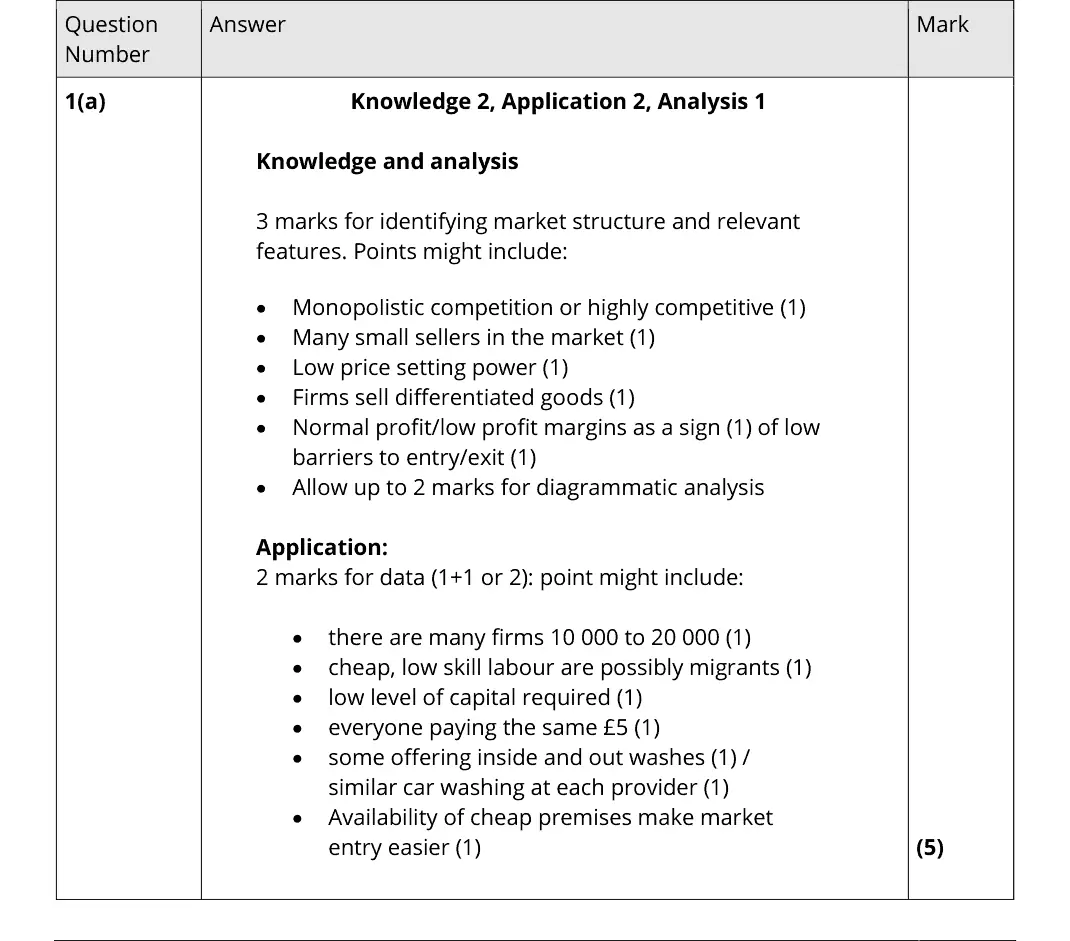
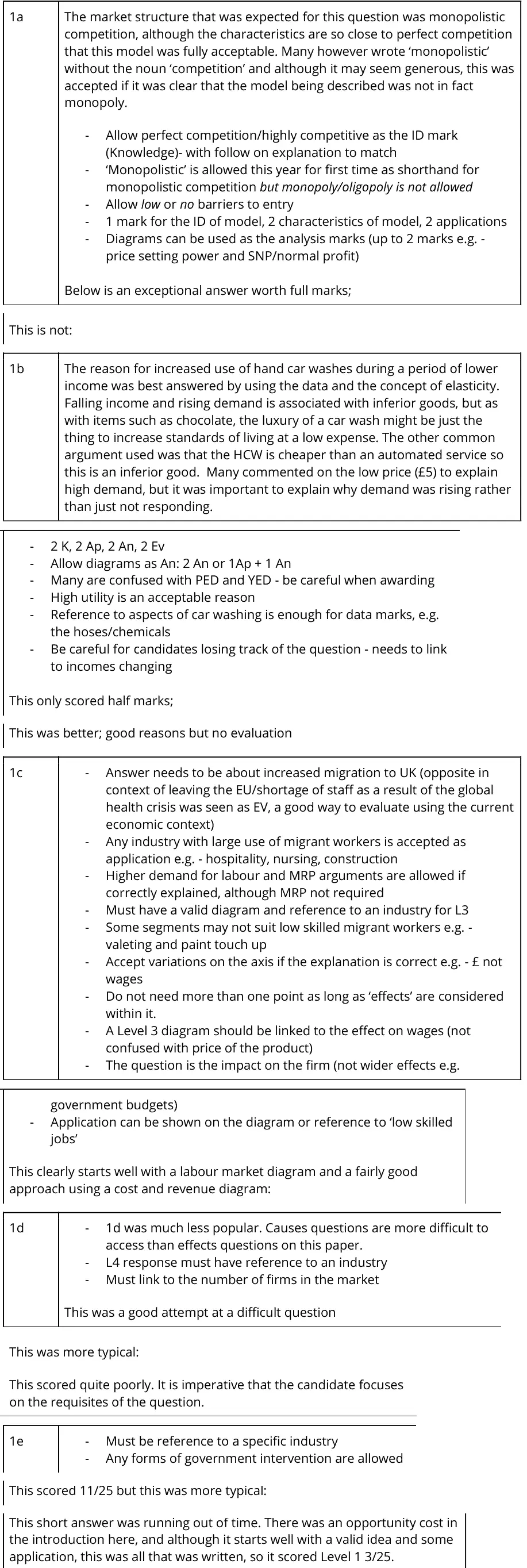
1(a) Market structures: efficiency, perfect and monopolistic competition 5AO1=2,AO2=2,AO3=1Short answer
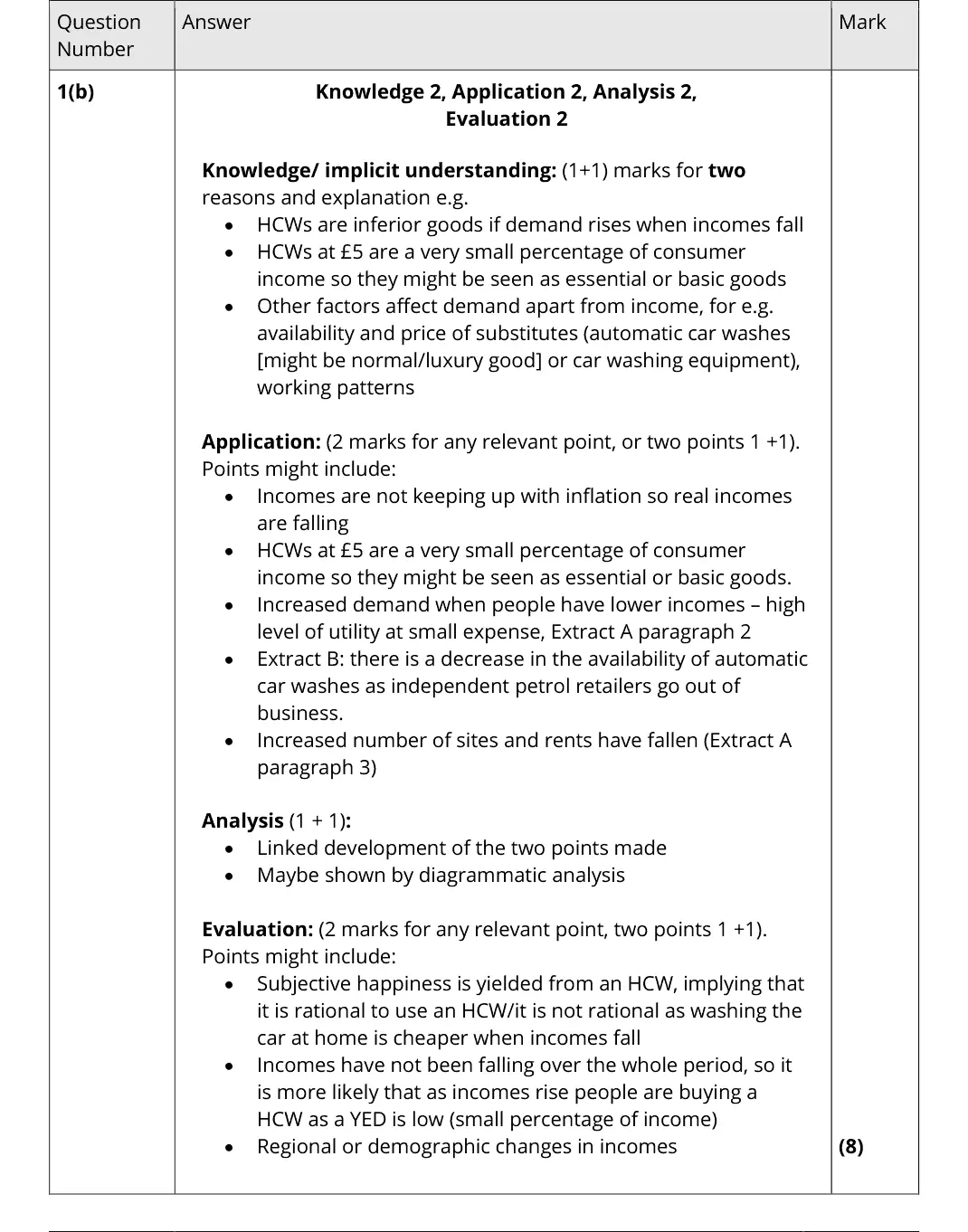
1(b) Price, income and cross elasticities of demand, Supply, demand and price determination 8AO1=2,AO2=2,AO3=2,AO4=2Extended response
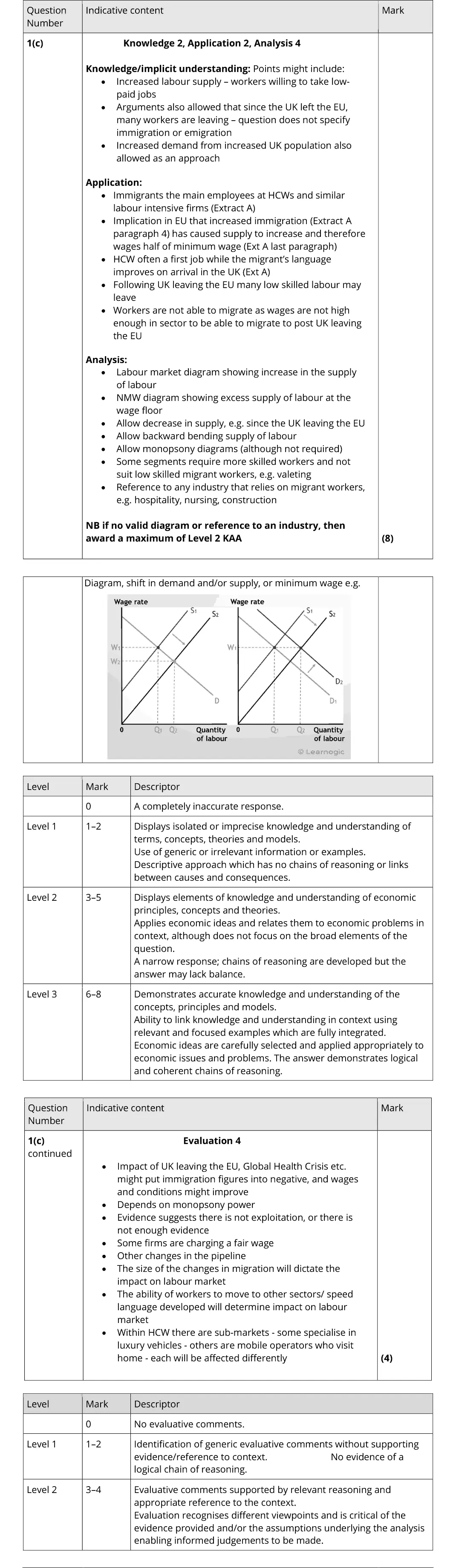
1(c) The labour market 12AO1=2,AO2=2,AO3=4,AO4=4Extended response
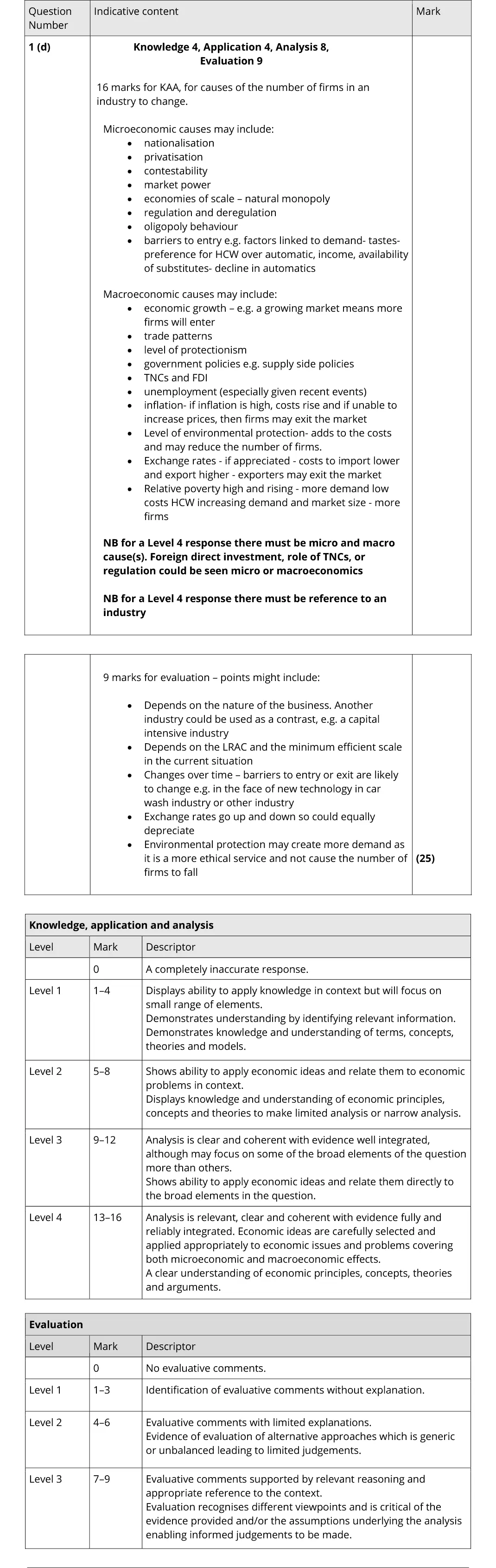
1(d) Monopsony and contestable markets, Economic growth, output gaps and the trade cycle 25AO1=4,AO2=4,AO3=8,AO4=9Essay
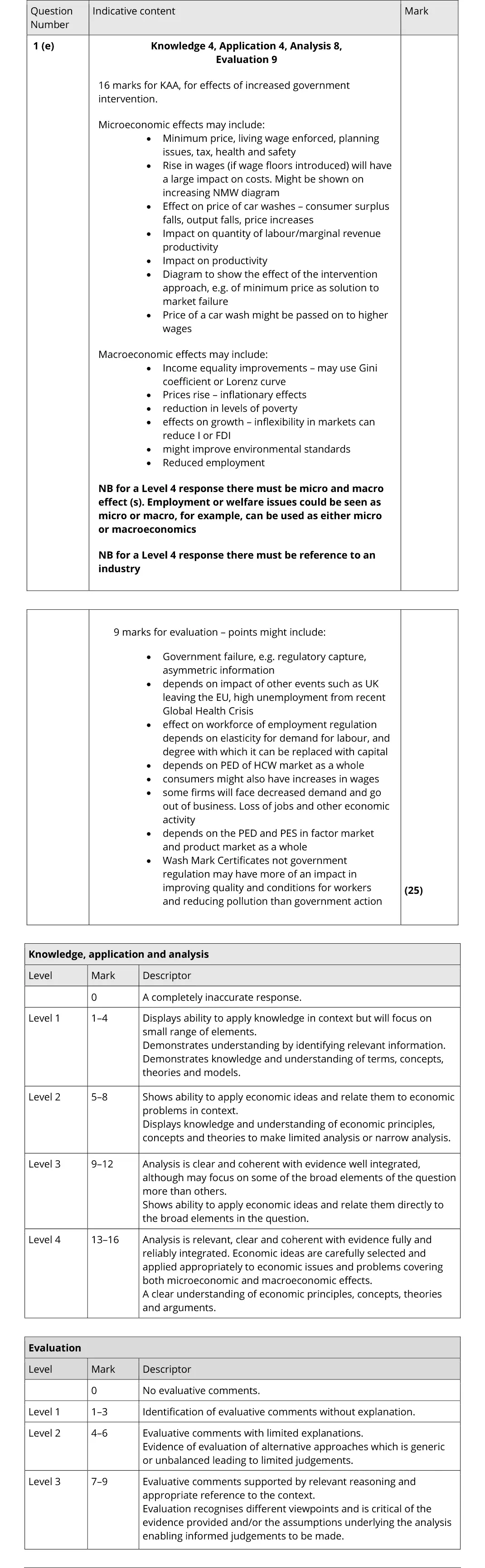
1(e) Government intervention: competition policy and regulation, The labour market, Poverty and inequality 25AO1=4,AO2=4,AO3=8,AO4=9Essay
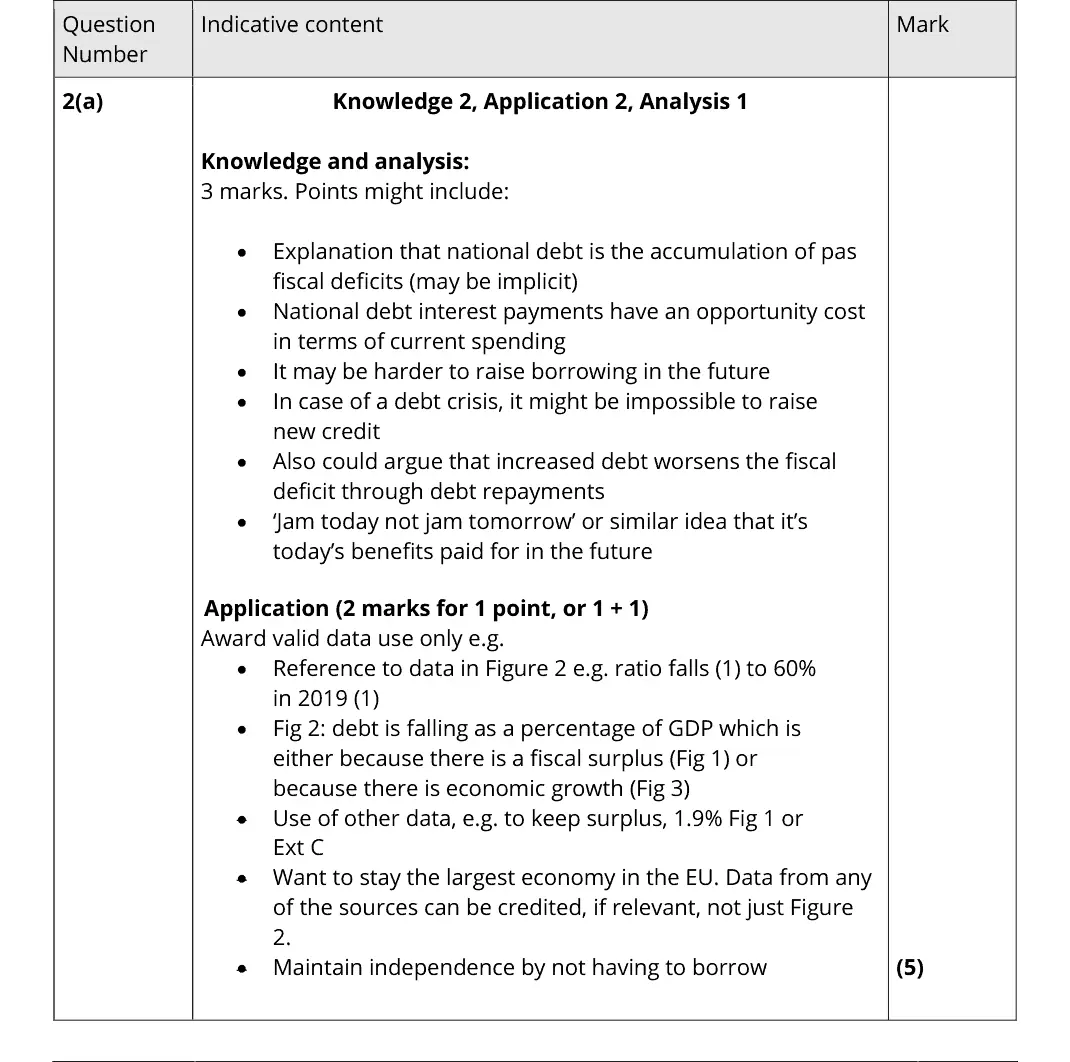
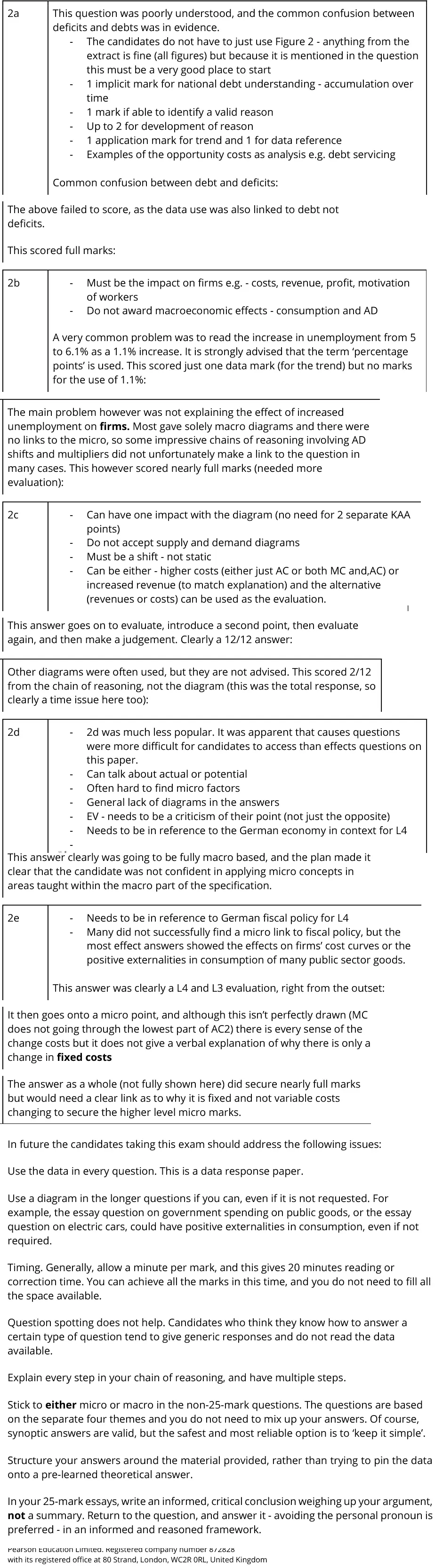
2(a) Public expenditure, taxation and public sector finances 5AO1=2,AO2=2,AO3=1Short answer
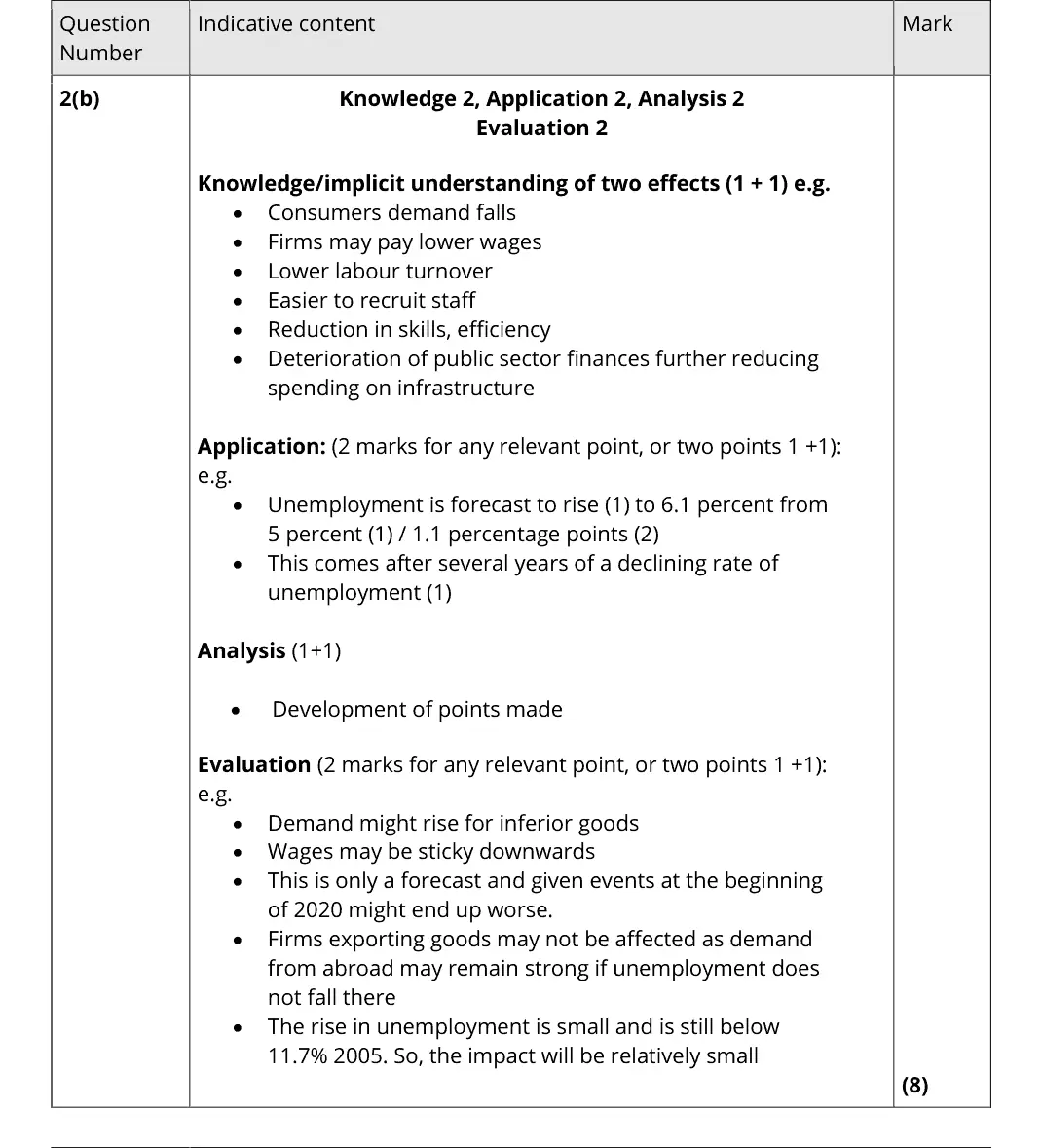
2(b) Employment and unemployment 8AO1=2,AO2=2,AO3=2,AO4=2Extended response
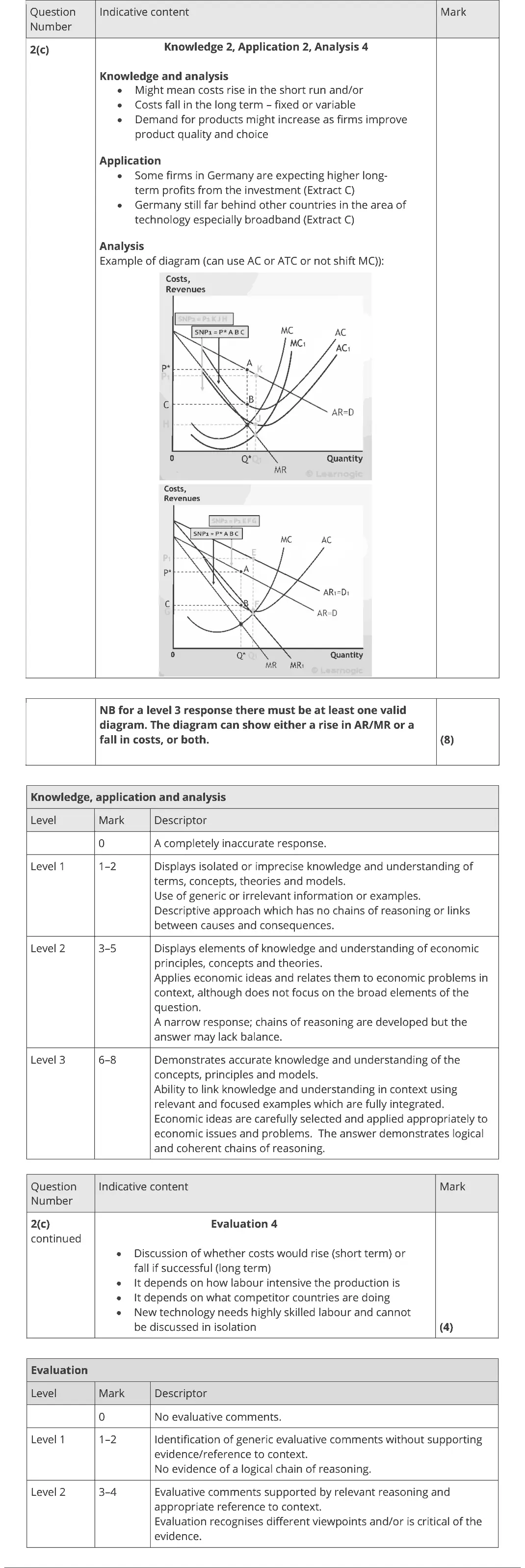
2(c) Revenues, costs and profits 12AO1=2,AO2=2,AO3=4,AO4=4Extended response
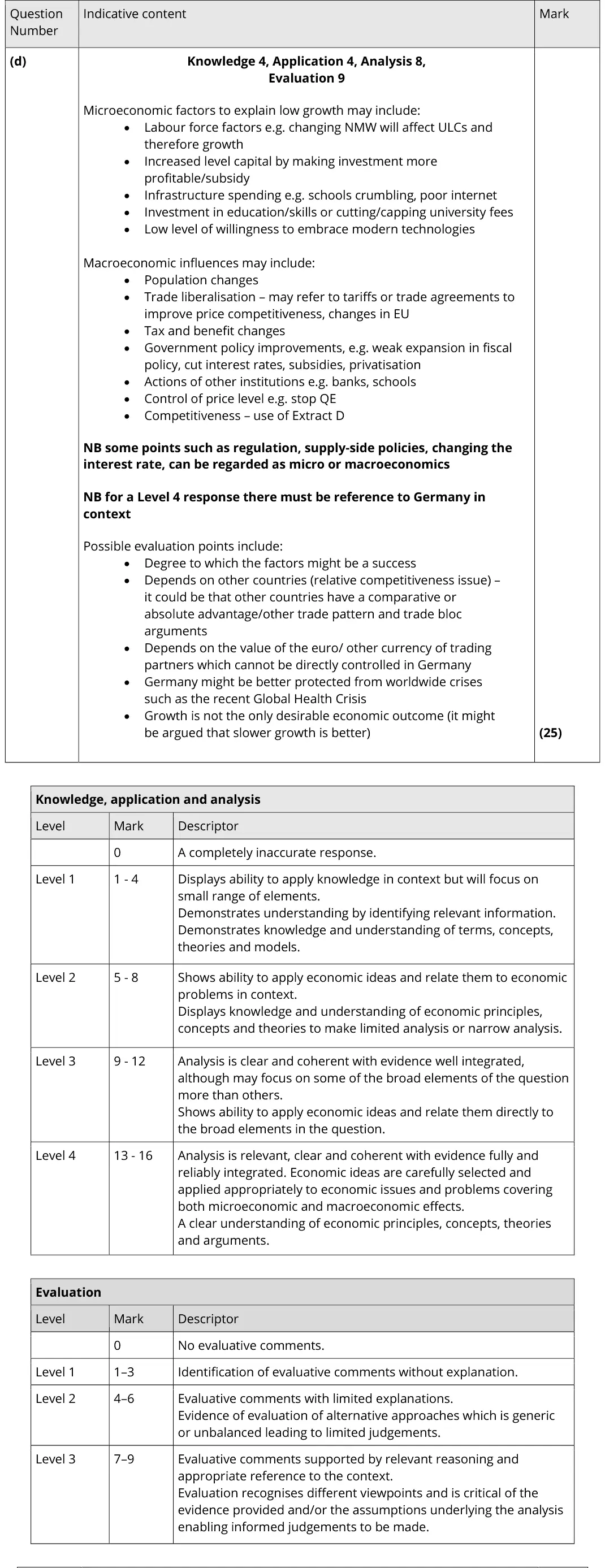
2(d) Economic growth, output gaps and the trade cycle, International competitiveness 25AO1=4,AO2=4,AO3=8,AO4=9Essay
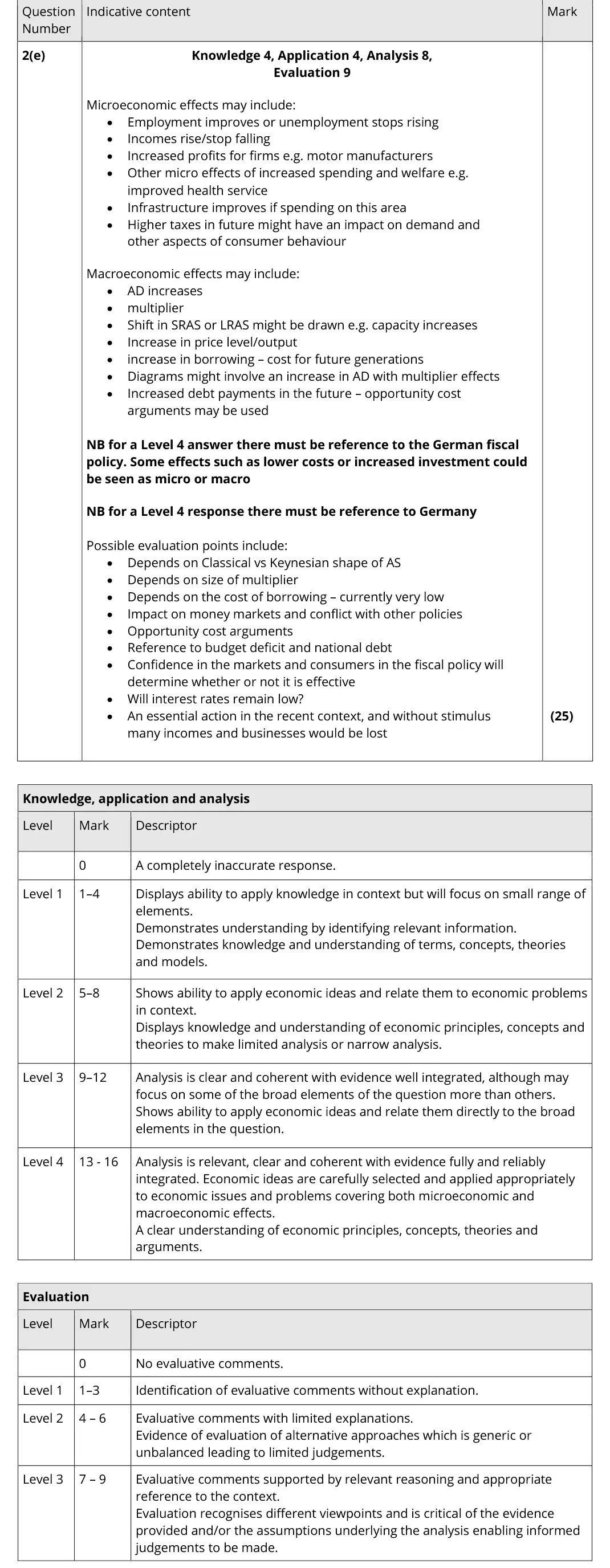
2(e) Demand-side policies: fiscal and monetary policy, Public expenditure, taxation and public sector finances 25AO1=4,AO2=4,AO3=8,AO4=9Essay

The questions

1(a)1(b)1(c)1(d)1(e)2(a)2(b)2(c)2(d)2(e)
November 2021 · Paper 3 · Q1(a) 5 marks AO1=2, AO2=2, AO3=1 Short answer market structures and efficiency
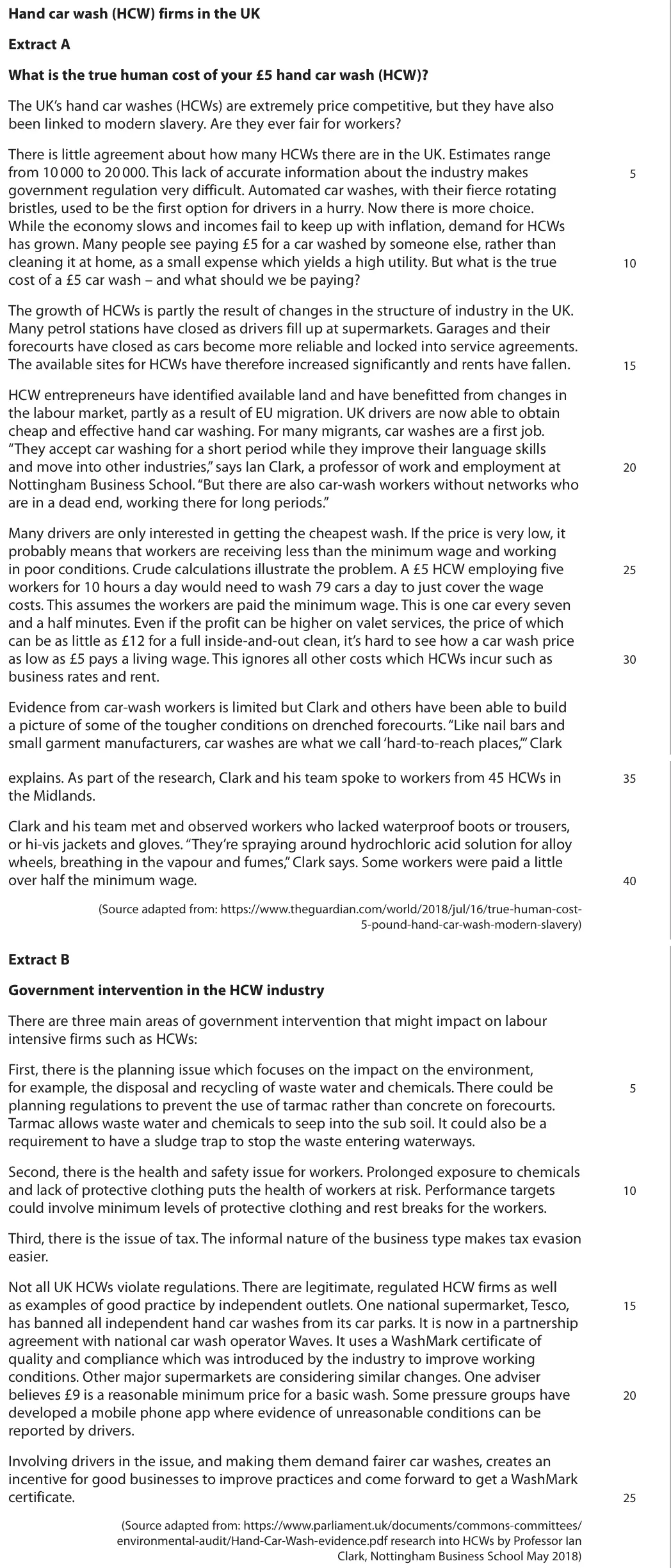
Data and extracts for question 1Hand car wash (HCW) firms in the UK Extract A What is the true human cost of your £5 hand car wash (HCW)? The UK’s hand car washes (HCWs) are extremely price competitive, but they have also been linked to modern slavery. Are they ever fair for workers? There is little agreement about how many HCWs there are in the UK. Estimates range from 10 000 to 20 000. This lack of accurate information about the industry makes 5 government regulation very difficult. Automated car washes, with their fierce rotating bristles, used to be the first option for drivers in a hurry. Now there is more choice. While the economy slows and incomes fail to keep up with inflation, demand for HCWs has grown. Many people see paying £5 for a car washed by someone else, rather than cleaning it at home, as a small expense which yields a high utility. But what is the true 10 cost of a £5 car wash – and what should we be paying? The growth of HCWs is partly the result of changes in the structure of industry in the UK. Many petrol stations have closed as drivers fill up at supermarkets. Garages and their forecourts have closed as cars become more reliable and locked into service agreements. The available sites for HCWs have therefore increased significantly and rents have fallen. 15 HCW entrepreneurs have identified available land and have benefitted from changes in the labour market, partly as a result of EU migration. UK drivers are now able to obtain cheap and effective hand car washing. For many migrants, car washes are a first job. “They accept car washing for a short period while they improve their language skills and move into other industries,” says Ian Clark, a professor of work and employment at 20 Nottingham Business School. “But there are also car-wash workers without networks who are in a dead end, working there for long periods.” Many drivers are only interested in getting the cheapest wash. If the price is very low, it probably means that workers are receiving less than the minimum wage and working in poor conditions. Crude calculations illustrate the problem. A £5 HCW employing five 25 workers for 10 hours a day would need to wash 79 cars a day to just cover the wage costs. This assumes the workers are paid the minimum wage. This is one car every seven and a half minutes. Even if the profit can be higher on valet services, the price of which can be as little as £12 for a full inside-and-out clean, it’s hard to see how a car wash price as low as £5 pays a living wage. This ignores all other costs which HCWs incur such as 30 business rates and rent. Evidence from car-wash workers is limited but Clark and others have been able to build a picture of some of the tougher conditions on drenched forecourts. “Like nail bars and small garment manufacturers, car washes are what we call ‘hard-to-reach places,’” Clark explains. As part of the research, Clark and his team spoke to workers from 45 HCWs in 35 the Midlands. Clark and his team met and observed workers who lacked waterproof boots or trousers, or hi-vis jackets and gloves. “They’re spraying around hydrochloric acid solution for alloy wheels, breathing in the vapour and fumes,” Clark says. Some workers were paid a little over half the minimum wage. 40 (Source adapted from: https://www.theguardian.com/world/2018/jul/16/true-human-cost- 5-pound-hand-car-wash-modern-slavery) Extract B Government intervention in the HCW industry There are three main areas of government intervention that might impact on labour intensive firms such as HCWs: First, there is the planning issue which focuses on the impact on the environment, for example, the disposal and recycling of waste water and chemicals. There could be 5 planning regulations to prevent the use of tarmac rather than concrete on forecourts. Tarmac allows waste water and chemicals to seep into the sub soil. It could also be a requirement to have a sludge trap to stop the waste entering waterways. Second, there is the health and safety issue for workers. Prolonged exposure to chemicals and lack of protective clothing puts the health of workers at risk. Performance targets 10 could involve minimum levels of protective clothing and rest breaks for the workers. Third, there is the issue of tax. The informal nature of the business type makes tax evasion easier. Not all UK HCWs violate regulations. There are legitimate, regulated HCW firms as well as examples of good practice by independent outlets. One national supermarket, Tesco, 15 has banned all independent hand car washes from its car parks. It is now in a partnership agreement with national car wash operator Waves. It uses a WashMark certificate of quality and compliance which was introduced by the industry to improve working conditions. Other major supermarkets are considering similar changes. One adviser believes £9 is a reasonable minimum price for a basic wash. Some pressure groups have 20 developed a mobile phone app where evidence of unreasonable conditions can be reported by drivers. Involving drivers in the issue, and making them demand fairer car washes, creates an incentive for good businesses to improve practices and come forward to get a WashMark certificate. 25 (Source adapted from: https://www.parliament.uk/documents/commons-committees/ environmental-audit/Hand-Car-Wash-evidence.pdf research into HCWs by Professor Ian Clark, Nottingham Business School May 2018)
(a) Using the information provided, explain the market structure that best describes the hand car wash (HCW) industry in the UK. (5)
November 2021 · Paper 3 · Q1(b) 8 marks AO1=2, AO2=2, AO3=2, AO4=2 8-mark response price elasticity of demandsupply and demand
Data and extracts for question 1Hand car wash (HCW) firms in the UK Extract A What is the true human cost of your £5 hand car wash (HCW)? The UK’s hand car washes (HCWs) are extremely price competitive, but they have also been linked to modern slavery. Are they ever fair for workers? There is little agreement about how many HCWs there are in the UK. Estimates range from 10 000 to 20 000. This lack of accurate information about the industry makes 5 government regulation very difficult. Automated car washes, with their fierce rotating bristles, used to be the first option for drivers in a hurry. Now there is more choice. While the economy slows and incomes fail to keep up with inflation, demand for HCWs has grown. Many people see paying £5 for a car washed by someone else, rather than cleaning it at home, as a small expense which yields a high utility. But what is the true 10 cost of a £5 car wash – and what should we be paying? The growth of HCWs is partly the result of changes in the structure of industry in the UK. Many petrol stations have closed as drivers fill up at supermarkets. Garages and their forecourts have closed as cars become more reliable and locked into service agreements. The available sites for HCWs have therefore increased significantly and rents have fallen. 15 HCW entrepreneurs have identified available land and have benefitted from changes in the labour market, partly as a result of EU migration. UK drivers are now able to obtain cheap and effective hand car washing. For many migrants, car washes are a first job. “They accept car washing for a short period while they improve their language skills and move into other industries,” says Ian Clark, a professor of work and employment at 20 Nottingham Business School. “But there are also car-wash workers without networks who are in a dead end, working there for long periods.” Many drivers are only interested in getting the cheapest wash. If the price is very low, it probably means that workers are receiving less than the minimum wage and working in poor conditions. Crude calculations illustrate the problem. A £5 HCW employing five 25 workers for 10 hours a day would need to wash 79 cars a day to just cover the wage costs. This assumes the workers are paid the minimum wage. This is one car every seven and a half minutes. Even if the profit can be higher on valet services, the price of which can be as little as £12 for a full inside-and-out clean, it’s hard to see how a car wash price as low as £5 pays a living wage. This ignores all other costs which HCWs incur such as 30 business rates and rent. Evidence from car-wash workers is limited but Clark and others have been able to build a picture of some of the tougher conditions on drenched forecourts. “Like nail bars and small garment manufacturers, car washes are what we call ‘hard-to-reach places,’” Clark explains. As part of the research, Clark and his team spoke to workers from 45 HCWs in 35 the Midlands. Clark and his team met and observed workers who lacked waterproof boots or trousers, or hi-vis jackets and gloves. “They’re spraying around hydrochloric acid solution for alloy wheels, breathing in the vapour and fumes,” Clark says. Some workers were paid a little over half the minimum wage. 40 (Source adapted from: https://www.theguardian.com/world/2018/jul/16/true-human-cost- 5-pound-hand-car-wash-modern-slavery) Extract B Government intervention in the HCW industry There are three main areas of government intervention that might impact on labour intensive firms such as HCWs: First, there is the planning issue which focuses on the impact on the environment, for example, the disposal and recycling of waste water and chemicals. There could be 5 planning regulations to prevent the use of tarmac rather than concrete on forecourts. Tarmac allows waste water and chemicals to seep into the sub soil. It could also be a requirement to have a sludge trap to stop the waste entering waterways. Second, there is the health and safety issue for workers. Prolonged exposure to chemicals and lack of protective clothing puts the health of workers at risk. Performance targets 10 could involve minimum levels of protective clothing and rest breaks for the workers. Third, there is the issue of tax. The informal nature of the business type makes tax evasion easier. Not all UK HCWs violate regulations. There are legitimate, regulated HCW firms as well as examples of good practice by independent outlets. One national supermarket, Tesco, 15 has banned all independent hand car washes from its car parks. It is now in a partnership agreement with national car wash operator Waves. It uses a WashMark certificate of quality and compliance which was introduced by the industry to improve working conditions. Other major supermarkets are considering similar changes. One adviser believes £9 is a reasonable minimum price for a basic wash. Some pressure groups have 20 developed a mobile phone app where evidence of unreasonable conditions can be reported by drivers. Involving drivers in the issue, and making them demand fairer car washes, creates an incentive for good businesses to improve practices and come forward to get a WashMark certificate. 25 (Source adapted from: https://www.parliament.uk/documents/commons-committees/ environmental-audit/Hand-Car-Wash-evidence.pdf research into HCWs by Professor Ian Clark, Nottingham Business School May 2018)
(b) Examine two reasons why the demand for HCWs increases during a period when consumer ‘incomes fail to keep up with inflation’ (Extract A line 8). (8)
November 2021 · Paper 3 · Q1(c) 12 marks AO1=2, AO2=2, AO3=4, AO4=4 12-mark response labour market
Data and extracts for question 1Hand car wash (HCW) firms in the UK Extract A What is the true human cost of your £5 hand car wash (HCW)? The UK’s hand car washes (HCWs) are extremely price competitive, but they have also been linked to modern slavery. Are they ever fair for workers? There is little agreement about how many HCWs there are in the UK. Estimates range from 10 000 to 20 000. This lack of accurate information about the industry makes 5 government regulation very difficult. Automated car washes, with their fierce rotating bristles, used to be the first option for drivers in a hurry. Now there is more choice. While the economy slows and incomes fail to keep up with inflation, demand for HCWs has grown. Many people see paying £5 for a car washed by someone else, rather than cleaning it at home, as a small expense which yields a high utility. But what is the true 10 cost of a £5 car wash – and what should we be paying? The growth of HCWs is partly the result of changes in the structure of industry in the UK. Many petrol stations have closed as drivers fill up at supermarkets. Garages and their forecourts have closed as cars become more reliable and locked into service agreements. The available sites for HCWs have therefore increased significantly and rents have fallen. 15 HCW entrepreneurs have identified available land and have benefitted from changes in the labour market, partly as a result of EU migration. UK drivers are now able to obtain cheap and effective hand car washing. For many migrants, car washes are a first job. “They accept car washing for a short period while they improve their language skills and move into other industries,” says Ian Clark, a professor of work and employment at 20 Nottingham Business School. “But there are also car-wash workers without networks who are in a dead end, working there for long periods.” Many drivers are only interested in getting the cheapest wash. If the price is very low, it probably means that workers are receiving less than the minimum wage and working in poor conditions. Crude calculations illustrate the problem. A £5 HCW employing five 25 workers for 10 hours a day would need to wash 79 cars a day to just cover the wage costs. This assumes the workers are paid the minimum wage. This is one car every seven and a half minutes. Even if the profit can be higher on valet services, the price of which can be as little as £12 for a full inside-and-out clean, it’s hard to see how a car wash price as low as £5 pays a living wage. This ignores all other costs which HCWs incur such as 30 business rates and rent. Evidence from car-wash workers is limited but Clark and others have been able to build a picture of some of the tougher conditions on drenched forecourts. “Like nail bars and small garment manufacturers, car washes are what we call ‘hard-to-reach places,’” Clark explains. As part of the research, Clark and his team spoke to workers from 45 HCWs in 35 the Midlands. Clark and his team met and observed workers who lacked waterproof boots or trousers, or hi-vis jackets and gloves. “They’re spraying around hydrochloric acid solution for alloy wheels, breathing in the vapour and fumes,” Clark says. Some workers were paid a little over half the minimum wage. 40 (Source adapted from: https://www.theguardian.com/world/2018/jul/16/true-human-cost- 5-pound-hand-car-wash-modern-slavery) Extract B Government intervention in the HCW industry There are three main areas of government intervention that might impact on labour intensive firms such as HCWs: First, there is the planning issue which focuses on the impact on the environment, for example, the disposal and recycling of waste water and chemicals. There could be 5 planning regulations to prevent the use of tarmac rather than concrete on forecourts. Tarmac allows waste water and chemicals to seep into the sub soil. It could also be a requirement to have a sludge trap to stop the waste entering waterways. Second, there is the health and safety issue for workers. Prolonged exposure to chemicals and lack of protective clothing puts the health of workers at risk. Performance targets 10 could involve minimum levels of protective clothing and rest breaks for the workers. Third, there is the issue of tax. The informal nature of the business type makes tax evasion easier. Not all UK HCWs violate regulations. There are legitimate, regulated HCW firms as well as examples of good practice by independent outlets. One national supermarket, Tesco, 15 has banned all independent hand car washes from its car parks. It is now in a partnership agreement with national car wash operator Waves. It uses a WashMark certificate of quality and compliance which was introduced by the industry to improve working conditions. Other major supermarkets are considering similar changes. One adviser believes £9 is a reasonable minimum price for a basic wash. Some pressure groups have 20 developed a mobile phone app where evidence of unreasonable conditions can be reported by drivers. Involving drivers in the issue, and making them demand fairer car washes, creates an incentive for good businesses to improve practices and come forward to get a WashMark certificate. 25 (Source adapted from: https://www.parliament.uk/documents/commons-committees/ environmental-audit/Hand-Car-Wash-evidence.pdf research into HCWs by Professor Ian Clark, Nottingham Business School May 2018)
(c) Discuss the likely effects of changes in the level of migration on firms such as HCWs in the UK. Use a labour market diagram and the information provided to support your answer. (12)
November 2021 · Paper 3 · Q1(d) 25 marks AO1=4, AO2=4, AO3=8, AO4=9 25-mark essay Either/or monopsony and contestabilityeconomic growth and the trade cycle
Data and extracts for question 1Hand car wash (HCW) firms in the UK Extract A What is the true human cost of your £5 hand car wash (HCW)? The UK’s hand car washes (HCWs) are extremely price competitive, but they have also been linked to modern slavery. Are they ever fair for workers? There is little agreement about how many HCWs there are in the UK. Estimates range from 10 000 to 20 000. This lack of accurate information about the industry makes 5 government regulation very difficult. Automated car washes, with their fierce rotating bristles, used to be the first option for drivers in a hurry. Now there is more choice. While the economy slows and incomes fail to keep up with inflation, demand for HCWs has grown. Many people see paying £5 for a car washed by someone else, rather than cleaning it at home, as a small expense which yields a high utility. But what is the true 10 cost of a £5 car wash – and what should we be paying? The growth of HCWs is partly the result of changes in the structure of industry in the UK. Many petrol stations have closed as drivers fill up at supermarkets. Garages and their forecourts have closed as cars become more reliable and locked into service agreements. The available sites for HCWs have therefore increased significantly and rents have fallen. 15 HCW entrepreneurs have identified available land and have benefitted from changes in the labour market, partly as a result of EU migration. UK drivers are now able to obtain cheap and effective hand car washing. For many migrants, car washes are a first job. “They accept car washing for a short period while they improve their language skills and move into other industries,” says Ian Clark, a professor of work and employment at 20 Nottingham Business School. “But there are also car-wash workers without networks who are in a dead end, working there for long periods.” Many drivers are only interested in getting the cheapest wash. If the price is very low, it probably means that workers are receiving less than the minimum wage and working in poor conditions. Crude calculations illustrate the problem. A £5 HCW employing five 25 workers for 10 hours a day would need to wash 79 cars a day to just cover the wage costs. This assumes the workers are paid the minimum wage. This is one car every seven and a half minutes. Even if the profit can be higher on valet services, the price of which can be as little as £12 for a full inside-and-out clean, it’s hard to see how a car wash price as low as £5 pays a living wage. This ignores all other costs which HCWs incur such as 30 business rates and rent. Evidence from car-wash workers is limited but Clark and others have been able to build a picture of some of the tougher conditions on drenched forecourts. “Like nail bars and small garment manufacturers, car washes are what we call ‘hard-to-reach places,’” Clark explains. As part of the research, Clark and his team spoke to workers from 45 HCWs in 35 the Midlands. Clark and his team met and observed workers who lacked waterproof boots or trousers, or hi-vis jackets and gloves. “They’re spraying around hydrochloric acid solution for alloy wheels, breathing in the vapour and fumes,” Clark says. Some workers were paid a little over half the minimum wage. 40 (Source adapted from: https://www.theguardian.com/world/2018/jul/16/true-human-cost- 5-pound-hand-car-wash-modern-slavery) Extract B Government intervention in the HCW industry There are three main areas of government intervention that might impact on labour intensive firms such as HCWs: First, there is the planning issue which focuses on the impact on the environment, for example, the disposal and recycling of waste water and chemicals. There could be 5 planning regulations to prevent the use of tarmac rather than concrete on forecourts. Tarmac allows waste water and chemicals to seep into the sub soil. It could also be a requirement to have a sludge trap to stop the waste entering waterways. Second, there is the health and safety issue for workers. Prolonged exposure to chemicals and lack of protective clothing puts the health of workers at risk. Performance targets 10 could involve minimum levels of protective clothing and rest breaks for the workers. Third, there is the issue of tax. The informal nature of the business type makes tax evasion easier. Not all UK HCWs violate regulations. There are legitimate, regulated HCW firms as well as examples of good practice by independent outlets. One national supermarket, Tesco, 15 has banned all independent hand car washes from its car parks. It is now in a partnership agreement with national car wash operator Waves. It uses a WashMark certificate of quality and compliance which was introduced by the industry to improve working conditions. Other major supermarkets are considering similar changes. One adviser believes £9 is a reasonable minimum price for a basic wash. Some pressure groups have 20 developed a mobile phone app where evidence of unreasonable conditions can be reported by drivers. Involving drivers in the issue, and making them demand fairer car washes, creates an incentive for good businesses to improve practices and come forward to get a WashMark certificate. 25 (Source adapted from: https://www.parliament.uk/documents/commons-committees/ environmental-audit/Hand-Car-Wash-evidence.pdf research into HCWs by Professor Ian Clark, Nottingham Business School May 2018)
(d) Evaluate the microeconomic and macroeconomic factors which determine the number of firms in an industry. Refer to HCWs or another industry of your choice. (25)
November 2021 · Paper 3 · Q1(e) 25 marks AO1=4, AO2=4, AO3=8, AO4=9 25-mark essay Either/or competition policy and regulationlabour marketpoverty and inequality
Data and extracts for question 1Hand car wash (HCW) firms in the UK Extract A What is the true human cost of your £5 hand car wash (HCW)? The UK’s hand car washes (HCWs) are extremely price competitive, but they have also been linked to modern slavery. Are they ever fair for workers? There is little agreement about how many HCWs there are in the UK. Estimates range from 10 000 to 20 000. This lack of accurate information about the industry makes 5 government regulation very difficult. Automated car washes, with their fierce rotating bristles, used to be the first option for drivers in a hurry. Now there is more choice. While the economy slows and incomes fail to keep up with inflation, demand for HCWs has grown. Many people see paying £5 for a car washed by someone else, rather than cleaning it at home, as a small expense which yields a high utility. But what is the true 10 cost of a £5 car wash – and what should we be paying? The growth of HCWs is partly the result of changes in the structure of industry in the UK. Many petrol stations have closed as drivers fill up at supermarkets. Garages and their forecourts have closed as cars become more reliable and locked into service agreements. The available sites for HCWs have therefore increased significantly and rents have fallen. 15 HCW entrepreneurs have identified available land and have benefitted from changes in the labour market, partly as a result of EU migration. UK drivers are now able to obtain cheap and effective hand car washing. For many migrants, car washes are a first job. “They accept car washing for a short period while they improve their language skills and move into other industries,” says Ian Clark, a professor of work and employment at 20 Nottingham Business School. “But there are also car-wash workers without networks who are in a dead end, working there for long periods.” Many drivers are only interested in getting the cheapest wash. If the price is very low, it probably means that workers are receiving less than the minimum wage and working in poor conditions. Crude calculations illustrate the problem. A £5 HCW employing five 25 workers for 10 hours a day would need to wash 79 cars a day to just cover the wage costs. This assumes the workers are paid the minimum wage. This is one car every seven and a half minutes. Even if the profit can be higher on valet services, the price of which can be as little as £12 for a full inside-and-out clean, it’s hard to see how a car wash price as low as £5 pays a living wage. This ignores all other costs which HCWs incur such as 30 business rates and rent. Evidence from car-wash workers is limited but Clark and others have been able to build a picture of some of the tougher conditions on drenched forecourts. “Like nail bars and small garment manufacturers, car washes are what we call ‘hard-to-reach places,’” Clark explains. As part of the research, Clark and his team spoke to workers from 45 HCWs in 35 the Midlands. Clark and his team met and observed workers who lacked waterproof boots or trousers, or hi-vis jackets and gloves. “They’re spraying around hydrochloric acid solution for alloy wheels, breathing in the vapour and fumes,” Clark says. Some workers were paid a little over half the minimum wage. 40 (Source adapted from: https://www.theguardian.com/world/2018/jul/16/true-human-cost- 5-pound-hand-car-wash-modern-slavery) Extract B Government intervention in the HCW industry There are three main areas of government intervention that might impact on labour intensive firms such as HCWs: First, there is the planning issue which focuses on the impact on the environment, for example, the disposal and recycling of waste water and chemicals. There could be 5 planning regulations to prevent the use of tarmac rather than concrete on forecourts. Tarmac allows waste water and chemicals to seep into the sub soil. It could also be a requirement to have a sludge trap to stop the waste entering waterways. Second, there is the health and safety issue for workers. Prolonged exposure to chemicals and lack of protective clothing puts the health of workers at risk. Performance targets 10 could involve minimum levels of protective clothing and rest breaks for the workers. Third, there is the issue of tax. The informal nature of the business type makes tax evasion easier. Not all UK HCWs violate regulations. There are legitimate, regulated HCW firms as well as examples of good practice by independent outlets. One national supermarket, Tesco, 15 has banned all independent hand car washes from its car parks. It is now in a partnership agreement with national car wash operator Waves. It uses a WashMark certificate of quality and compliance which was introduced by the industry to improve working conditions. Other major supermarkets are considering similar changes. One adviser believes £9 is a reasonable minimum price for a basic wash. Some pressure groups have 20 developed a mobile phone app where evidence of unreasonable conditions can be reported by drivers. Involving drivers in the issue, and making them demand fairer car washes, creates an incentive for good businesses to improve practices and come forward to get a WashMark certificate. 25 (Source adapted from: https://www.parliament.uk/documents/commons-committees/ environmental-audit/Hand-Car-Wash-evidence.pdf research into HCWs by Professor Ian Clark, Nottingham Business School May 2018)
(e) Evaluate the microeconomic and macroeconomic effects of increased government intervention in an industry. Refer to HCWs or another industry of your choice. (25)
November 2021 · Paper 3 · Q2(a) 5 marks AO1=2, AO2=2, AO3=1 Short answer Hard public finances and taxation
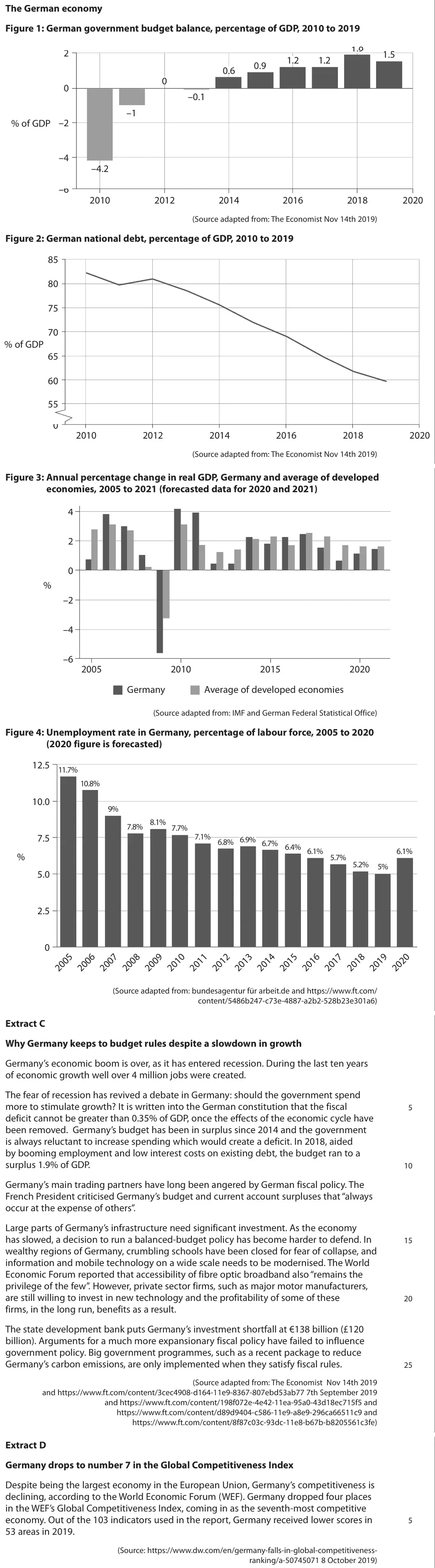
Data and extracts for question 2The German economy Figure 1: German government budget balance, percentage of GDP, 2010 to 2019 1.9 2 1.5 1.2 1.2 0.9 0.6 0 0 –0.1 –1 % of GDP –2 –4 –4.2 –6 2010 2012 2014 2016 2018 2020 (Source adapted from: The Economist Nov 14th 2019) Figure 2: German national debt, percentage of GDP, 2010 to 2019 85 80 75 70 % of GDP 65 60 55 0 2010 2012 2014 2016 2018 2020 (Source adapted from: The Economist Nov 14th 2019) Figure 3: Annual percentage change in real GDP, Germany and average of developed economies, 2005 to 2021 (forecasted data for 2020 and 2021) 4 2 0 % –2 –4 –6 2005 2010 2015 2020 Germany Average of developed economies (Source adapted from: IMF and German Federal Statistical Office) Figure 4: Unemployment rate in Germany, percentage of labour force, 2005 to 2020 (2020 figure is forecasted) 12.5 11 . 7 % 10 . 8 % 10.0 9 % 8 . 1 % 7 . 7 % 7 . 8 % 7.5 7 . 1 % 6 . 8 % 6 . 9 % 6 . 7 % 6 . 4 % 6 . 1 % 6 . 1 % % 5 . 7 % 5 . 2 % 5 % 5.0 2.5 0 (Source adapted from: bundesagentur für arbeit.de and https://www.ft.com/ content/5486b247-c73e-4887-a2b2-528b23e301a6) Extract C Why Germany keeps to budget rules despite a slowdown in growth Germany’s economic boom is over, as it has entered recession. During the last ten years of economic growth well over 4 million jobs were created. The fear of recession has revived a debate in Germany: should the government spend more to stimulate growth? It is written into the German constitution that the fiscal 5 deficit cannot be greater than 0.35% of GDP, once the effects of the economic cycle have been removed. Germany’s budget has been in surplus since 2014 and the government is always reluctant to increase spending which would create a deficit. In 2018, aided by booming employment and low interest costs on existing debt, the budget ran to a surplus 1.9% of GDP. 10 Germany’s main trading partners have long been angered by German fiscal policy. The French President criticised Germany’s budget and current account surpluses that “always occur at the expense of others”. Large parts of Germany’s infrastructure need significant investment. As the economy has slowed, a decision to run a balanced-budget policy has become harder to defend. In 15 wealthy regions of Germany, crumbling schools have been closed for fear of collapse, and information and mobile technology on a wide scale needs to be modernised. The World Economic Forum reported that accessibility of fibre optic broadband also “remains the privilege of the few”. However, private sector firms, such as major motor manufacturers, are still willing to invest in new technology and the profitability of some of these 20 firms, in the long run, benefits as a result. The state development bank puts Germany’s investment shortfall at €138 billion (£120 billion). Arguments for a much more expansionary fiscal policy have failed to influence government policy. Big government programmes, such as a recent package to reduce Germany’s carbon emissions, are only implemented when they satisfy fiscal rules. 25 (Source adapted from: The Economist Nov 14th 2019 and https://www.ft.com/content/3cec4908-d164-11e9-8367-807ebd53ab77 7th September 2019 and https://www.ft.com/content/198f072e-4e42-11ea-95a0-43d18ec715f5 and https://www.ft.com/content/d89d9404-c586-11e9-a8e9-296ca66511c9 and https://www.ft.com/content/8f87c03c-93dc-11e8-b67b-b8205561c3fe) Extract D Germany drops to number 7 in the Global Competitiveness Index Despite being the largest economy in the European Union, Germany’s competitiveness is declining, according to the World Economic Forum (WEF). Germany dropped four places in the WEF’s Global Competitiveness Index, coming in as the seventh-most competitive economy. Out of the 103 indicators used in the report, Germany received lower scores in 5 53 areas in 2019. (Source: https://www.dw.com/en/germany-falls-in-global-competitiveness- ranking/a-50745071 8 October 2019)
(a) Explain one reason why a country such as Germany wants to avoid an increase in the national debt relative to GDP (Figure 2). (5)
November 2021 · Paper 3 · Q2(b) 8 marks AO1=2, AO2=2, AO3=2, AO4=2 8-mark response unemployment
Data and extracts for question 2The German economy Figure 1: German government budget balance, percentage of GDP, 2010 to 2019 1.9 2 1.5 1.2 1.2 0.9 0.6 0 0 –0.1 –1 % of GDP –2 –4 –4.2 –6 2010 2012 2014 2016 2018 2020 (Source adapted from: The Economist Nov 14th 2019) Figure 2: German national debt, percentage of GDP, 2010 to 2019 85 80 75 70 % of GDP 65 60 55 0 2010 2012 2014 2016 2018 2020 (Source adapted from: The Economist Nov 14th 2019) Figure 3: Annual percentage change in real GDP, Germany and average of developed economies, 2005 to 2021 (forecasted data for 2020 and 2021) 4 2 0 % –2 –4 –6 2005 2010 2015 2020 Germany Average of developed economies (Source adapted from: IMF and German Federal Statistical Office) Figure 4: Unemployment rate in Germany, percentage of labour force, 2005 to 2020 (2020 figure is forecasted) 12.5 11 . 7 % 10 . 8 % 10.0 9 % 8 . 1 % 7 . 7 % 7 . 8 % 7.5 7 . 1 % 6 . 8 % 6 . 9 % 6 . 7 % 6 . 4 % 6 . 1 % 6 . 1 % % 5 . 7 % 5 . 2 % 5 % 5.0 2.5 0 (Source adapted from: bundesagentur für arbeit.de and https://www.ft.com/ content/5486b247-c73e-4887-a2b2-528b23e301a6) Extract C Why Germany keeps to budget rules despite a slowdown in growth Germany’s economic boom is over, as it has entered recession. During the last ten years of economic growth well over 4 million jobs were created. The fear of recession has revived a debate in Germany: should the government spend more to stimulate growth? It is written into the German constitution that the fiscal 5 deficit cannot be greater than 0.35% of GDP, once the effects of the economic cycle have been removed. Germany’s budget has been in surplus since 2014 and the government is always reluctant to increase spending which would create a deficit. In 2018, aided by booming employment and low interest costs on existing debt, the budget ran to a surplus 1.9% of GDP. 10 Germany’s main trading partners have long been angered by German fiscal policy. The French President criticised Germany’s budget and current account surpluses that “always occur at the expense of others”. Large parts of Germany’s infrastructure need significant investment. As the economy has slowed, a decision to run a balanced-budget policy has become harder to defend. In 15 wealthy regions of Germany, crumbling schools have been closed for fear of collapse, and information and mobile technology on a wide scale needs to be modernised. The World Economic Forum reported that accessibility of fibre optic broadband also “remains the privilege of the few”. However, private sector firms, such as major motor manufacturers, are still willing to invest in new technology and the profitability of some of these 20 firms, in the long run, benefits as a result. The state development bank puts Germany’s investment shortfall at €138 billion (£120 billion). Arguments for a much more expansionary fiscal policy have failed to influence government policy. Big government programmes, such as a recent package to reduce Germany’s carbon emissions, are only implemented when they satisfy fiscal rules. 25 (Source adapted from: The Economist Nov 14th 2019 and https://www.ft.com/content/3cec4908-d164-11e9-8367-807ebd53ab77 7th September 2019 and https://www.ft.com/content/198f072e-4e42-11ea-95a0-43d18ec715f5 and https://www.ft.com/content/d89d9404-c586-11e9-a8e9-296ca66511c9 and https://www.ft.com/content/8f87c03c-93dc-11e8-b67b-b8205561c3fe) Extract D Germany drops to number 7 in the Global Competitiveness Index Despite being the largest economy in the European Union, Germany’s competitiveness is declining, according to the World Economic Forum (WEF). Germany dropped four places in the WEF’s Global Competitiveness Index, coming in as the seventh-most competitive economy. Out of the 103 indicators used in the report, Germany received lower scores in 5 53 areas in 2019. (Source: https://www.dw.com/en/germany-falls-in-global-competitiveness- ranking/a-50745071 8 October 2019)
(b) Examine two likely effects of the forecast change in the rate of unemployment between 2019 to 2020, on firms in Germany. Refer to Figure 4 in your answer. (8)
November 2021 · Paper 3 · Q2(c) 12 marks AO1=2, AO2=2, AO3=4, AO4=4 12-mark response revenues costs and profits
Data and extracts for question 2The German economy Figure 1: German government budget balance, percentage of GDP, 2010 to 2019 1.9 2 1.5 1.2 1.2 0.9 0.6 0 0 –0.1 –1 % of GDP –2 –4 –4.2 –6 2010 2012 2014 2016 2018 2020 (Source adapted from: The Economist Nov 14th 2019) Figure 2: German national debt, percentage of GDP, 2010 to 2019 85 80 75 70 % of GDP 65 60 55 0 2010 2012 2014 2016 2018 2020 (Source adapted from: The Economist Nov 14th 2019) Figure 3: Annual percentage change in real GDP, Germany and average of developed economies, 2005 to 2021 (forecasted data for 2020 and 2021) 4 2 0 % –2 –4 –6 2005 2010 2015 2020 Germany Average of developed economies (Source adapted from: IMF and German Federal Statistical Office) Figure 4: Unemployment rate in Germany, percentage of labour force, 2005 to 2020 (2020 figure is forecasted) 12.5 11 . 7 % 10 . 8 % 10.0 9 % 8 . 1 % 7 . 7 % 7 . 8 % 7.5 7 . 1 % 6 . 8 % 6 . 9 % 6 . 7 % 6 . 4 % 6 . 1 % 6 . 1 % % 5 . 7 % 5 . 2 % 5 % 5.0 2.5 0 (Source adapted from: bundesagentur für arbeit.de and https://www.ft.com/ content/5486b247-c73e-4887-a2b2-528b23e301a6) Extract C Why Germany keeps to budget rules despite a slowdown in growth Germany’s economic boom is over, as it has entered recession. During the last ten years of economic growth well over 4 million jobs were created. The fear of recession has revived a debate in Germany: should the government spend more to stimulate growth? It is written into the German constitution that the fiscal 5 deficit cannot be greater than 0.35% of GDP, once the effects of the economic cycle have been removed. Germany’s budget has been in surplus since 2014 and the government is always reluctant to increase spending which would create a deficit. In 2018, aided by booming employment and low interest costs on existing debt, the budget ran to a surplus 1.9% of GDP. 10 Germany’s main trading partners have long been angered by German fiscal policy. The French President criticised Germany’s budget and current account surpluses that “always occur at the expense of others”. Large parts of Germany’s infrastructure need significant investment. As the economy has slowed, a decision to run a balanced-budget policy has become harder to defend. In 15 wealthy regions of Germany, crumbling schools have been closed for fear of collapse, and information and mobile technology on a wide scale needs to be modernised. The World Economic Forum reported that accessibility of fibre optic broadband also “remains the privilege of the few”. However, private sector firms, such as major motor manufacturers, are still willing to invest in new technology and the profitability of some of these 20 firms, in the long run, benefits as a result. The state development bank puts Germany’s investment shortfall at €138 billion (£120 billion). Arguments for a much more expansionary fiscal policy have failed to influence government policy. Big government programmes, such as a recent package to reduce Germany’s carbon emissions, are only implemented when they satisfy fiscal rules. 25 (Source adapted from: The Economist Nov 14th 2019 and https://www.ft.com/content/3cec4908-d164-11e9-8367-807ebd53ab77 7th September 2019 and https://www.ft.com/content/198f072e-4e42-11ea-95a0-43d18ec715f5 and https://www.ft.com/content/d89d9404-c586-11e9-a8e9-296ca66511c9 and https://www.ft.com/content/8f87c03c-93dc-11e8-b67b-b8205561c3fe) Extract D Germany drops to number 7 in the Global Competitiveness Index Despite being the largest economy in the European Union, Germany’s competitiveness is declining, according to the World Economic Forum (WEF). Germany dropped four places in the WEF’s Global Competitiveness Index, coming in as the seventh-most competitive economy. Out of the 103 indicators used in the report, Germany received lower scores in 5 53 areas in 2019. (Source: https://www.dw.com/en/germany-falls-in-global-competitiveness- ranking/a-50745071 8 October 2019)
(c) Discuss the likely impact of investment in new technology on the profitability of firms in Germany, as described in Extract C line 20. Use a cost and revenue diagram to support your answer. (12)
November 2021 · Paper 3 · Q2(d) 25 marks AO1=4, AO2=4, AO3=8, AO4=9 25-mark essay Either/or economic growth and the trade cycleinternational competitiveness
Data and extracts for question 2The German economy Figure 1: German government budget balance, percentage of GDP, 2010 to 2019 1.9 2 1.5 1.2 1.2 0.9 0.6 0 0 –0.1 –1 % of GDP –2 –4 –4.2 –6 2010 2012 2014 2016 2018 2020 (Source adapted from: The Economist Nov 14th 2019) Figure 2: German national debt, percentage of GDP, 2010 to 2019 85 80 75 70 % of GDP 65 60 55 0 2010 2012 2014 2016 2018 2020 (Source adapted from: The Economist Nov 14th 2019) Figure 3: Annual percentage change in real GDP, Germany and average of developed economies, 2005 to 2021 (forecasted data for 2020 and 2021) 4 2 0 % –2 –4 –6 2005 2010 2015 2020 Germany Average of developed economies (Source adapted from: IMF and German Federal Statistical Office) Figure 4: Unemployment rate in Germany, percentage of labour force, 2005 to 2020 (2020 figure is forecasted) 12.5 11 . 7 % 10 . 8 % 10.0 9 % 8 . 1 % 7 . 7 % 7 . 8 % 7.5 7 . 1 % 6 . 8 % 6 . 9 % 6 . 7 % 6 . 4 % 6 . 1 % 6 . 1 % % 5 . 7 % 5 . 2 % 5 % 5.0 2.5 0 (Source adapted from: bundesagentur für arbeit.de and https://www.ft.com/ content/5486b247-c73e-4887-a2b2-528b23e301a6) Extract C Why Germany keeps to budget rules despite a slowdown in growth Germany’s economic boom is over, as it has entered recession. During the last ten years of economic growth well over 4 million jobs were created. The fear of recession has revived a debate in Germany: should the government spend more to stimulate growth? It is written into the German constitution that the fiscal 5 deficit cannot be greater than 0.35% of GDP, once the effects of the economic cycle have been removed. Germany’s budget has been in surplus since 2014 and the government is always reluctant to increase spending which would create a deficit. In 2018, aided by booming employment and low interest costs on existing debt, the budget ran to a surplus 1.9% of GDP. 10 Germany’s main trading partners have long been angered by German fiscal policy. The French President criticised Germany’s budget and current account surpluses that “always occur at the expense of others”. Large parts of Germany’s infrastructure need significant investment. As the economy has slowed, a decision to run a balanced-budget policy has become harder to defend. In 15 wealthy regions of Germany, crumbling schools have been closed for fear of collapse, and information and mobile technology on a wide scale needs to be modernised. The World Economic Forum reported that accessibility of fibre optic broadband also “remains the privilege of the few”. However, private sector firms, such as major motor manufacturers, are still willing to invest in new technology and the profitability of some of these 20 firms, in the long run, benefits as a result. The state development bank puts Germany’s investment shortfall at €138 billion (£120 billion). Arguments for a much more expansionary fiscal policy have failed to influence government policy. Big government programmes, such as a recent package to reduce Germany’s carbon emissions, are only implemented when they satisfy fiscal rules. 25 (Source adapted from: The Economist Nov 14th 2019 and https://www.ft.com/content/3cec4908-d164-11e9-8367-807ebd53ab77 7th September 2019 and https://www.ft.com/content/198f072e-4e42-11ea-95a0-43d18ec715f5 and https://www.ft.com/content/d89d9404-c586-11e9-a8e9-296ca66511c9 and https://www.ft.com/content/8f87c03c-93dc-11e8-b67b-b8205561c3fe) Extract D Germany drops to number 7 in the Global Competitiveness Index Despite being the largest economy in the European Union, Germany’s competitiveness is declining, according to the World Economic Forum (WEF). Germany dropped four places in the WEF’s Global Competitiveness Index, coming in as the seventh-most competitive economy. Out of the 103 indicators used in the report, Germany received lower scores in 5 53 areas in 2019. (Source: https://www.dw.com/en/germany-falls-in-global-competitiveness- ranking/a-50745071 8 October 2019)
(d) Evaluate the microeconomic and macroeconomic factors which are likely to determine the rate of economic growth in Germany relative to other developed economies. (25)
November 2021 · Paper 3 · Q2(e) 25 marks AO1=4, AO2=4, AO3=8, AO4=9 25-mark essay Either/or fiscal and monetary policypublic finances and taxation
Data and extracts for question 2The German economy Figure 1: German government budget balance, percentage of GDP, 2010 to 2019 1.9 2 1.5 1.2 1.2 0.9 0.6 0 0 –0.1 –1 % of GDP –2 –4 –4.2 –6 2010 2012 2014 2016 2018 2020 (Source adapted from: The Economist Nov 14th 2019) Figure 2: German national debt, percentage of GDP, 2010 to 2019 85 80 75 70 % of GDP 65 60 55 0 2010 2012 2014 2016 2018 2020 (Source adapted from: The Economist Nov 14th 2019) Figure 3: Annual percentage change in real GDP, Germany and average of developed economies, 2005 to 2021 (forecasted data for 2020 and 2021) 4 2 0 % –2 –4 –6 2005 2010 2015 2020 Germany Average of developed economies (Source adapted from: IMF and German Federal Statistical Office) Figure 4: Unemployment rate in Germany, percentage of labour force, 2005 to 2020 (2020 figure is forecasted) 12.5 11 . 7 % 10 . 8 % 10.0 9 % 8 . 1 % 7 . 7 % 7 . 8 % 7.5 7 . 1 % 6 . 8 % 6 . 9 % 6 . 7 % 6 . 4 % 6 . 1 % 6 . 1 % % 5 . 7 % 5 . 2 % 5 % 5.0 2.5 0 (Source adapted from: bundesagentur für arbeit.de and https://www.ft.com/ content/5486b247-c73e-4887-a2b2-528b23e301a6) Extract C Why Germany keeps to budget rules despite a slowdown in growth Germany’s economic boom is over, as it has entered recession. During the last ten years of economic growth well over 4 million jobs were created. The fear of recession has revived a debate in Germany: should the government spend more to stimulate growth? It is written into the German constitution that the fiscal 5 deficit cannot be greater than 0.35% of GDP, once the effects of the economic cycle have been removed. Germany’s budget has been in surplus since 2014 and the government is always reluctant to increase spending which would create a deficit. In 2018, aided by booming employment and low interest costs on existing debt, the budget ran to a surplus 1.9% of GDP. 10 Germany’s main trading partners have long been angered by German fiscal policy. The French President criticised Germany’s budget and current account surpluses that “always occur at the expense of others”. Large parts of Germany’s infrastructure need significant investment. As the economy has slowed, a decision to run a balanced-budget policy has become harder to defend. In 15 wealthy regions of Germany, crumbling schools have been closed for fear of collapse, and information and mobile technology on a wide scale needs to be modernised. The World Economic Forum reported that accessibility of fibre optic broadband also “remains the privilege of the few”. However, private sector firms, such as major motor manufacturers, are still willing to invest in new technology and the profitability of some of these 20 firms, in the long run, benefits as a result. The state development bank puts Germany’s investment shortfall at €138 billion (£120 billion). Arguments for a much more expansionary fiscal policy have failed to influence government policy. Big government programmes, such as a recent package to reduce Germany’s carbon emissions, are only implemented when they satisfy fiscal rules. 25 (Source adapted from: The Economist Nov 14th 2019 and https://www.ft.com/content/3cec4908-d164-11e9-8367-807ebd53ab77 7th September 2019 and https://www.ft.com/content/198f072e-4e42-11ea-95a0-43d18ec715f5 and https://www.ft.com/content/d89d9404-c586-11e9-a8e9-296ca66511c9 and https://www.ft.com/content/8f87c03c-93dc-11e8-b67b-b8205561c3fe) Extract D Germany drops to number 7 in the Global Competitiveness Index Despite being the largest economy in the European Union, Germany’s competitiveness is declining, according to the World Economic Forum (WEF). Germany dropped four places in the WEF’s Global Competitiveness Index, coming in as the seventh-most competitive economy. Out of the 103 indicators used in the report, Germany received lower scores in 5 53 areas in 2019. (Source: https://www.dw.com/en/germany-falls-in-global-competitiveness- ranking/a-50745071 8 October 2019)
(e) Evaluate the microeconomic and macroeconomic impacts of ‘a much more expansionary fiscal policy’ (Extract C line 23) on the German economy. (25)

Work with an Edexcel economics tutor

Want a paper marked and gone through with you? Message us.

Prefer email? Send an enquiry

If you are under 18, please include a parent's contact details. Enquiries go to enquiries@economicsaleveltutor.com and are deleted once handled. All tutoring is online.