June 2023: AS Paper 1

80 marks · 20 question parts · Paper, mark scheme and report on Pearson's site

Question by question

QTopicMarksAOType
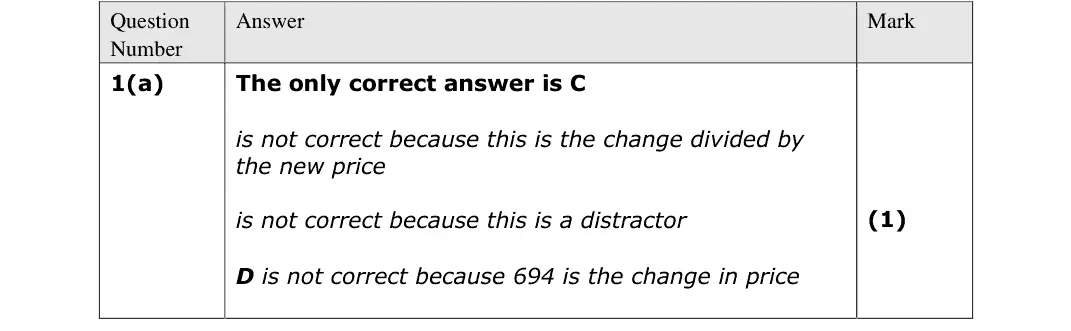
1(a) Government intervention in markets 1Multiple choice
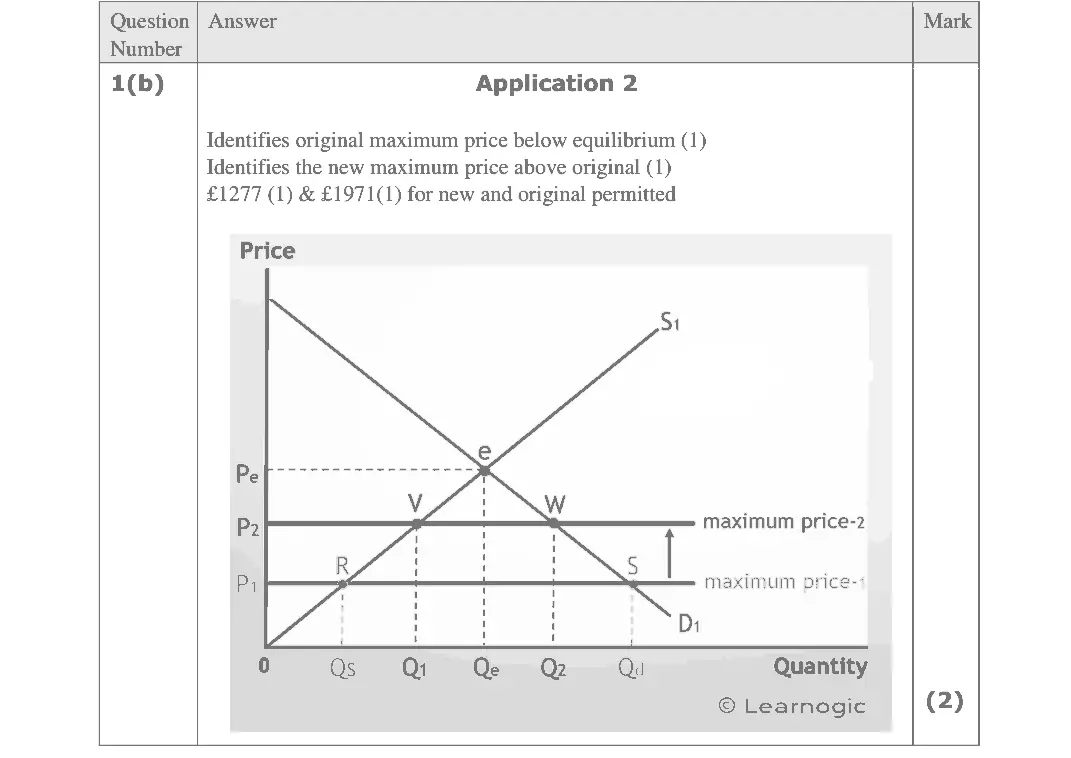
1(b) Government intervention in markets 2AO2=2Short answer
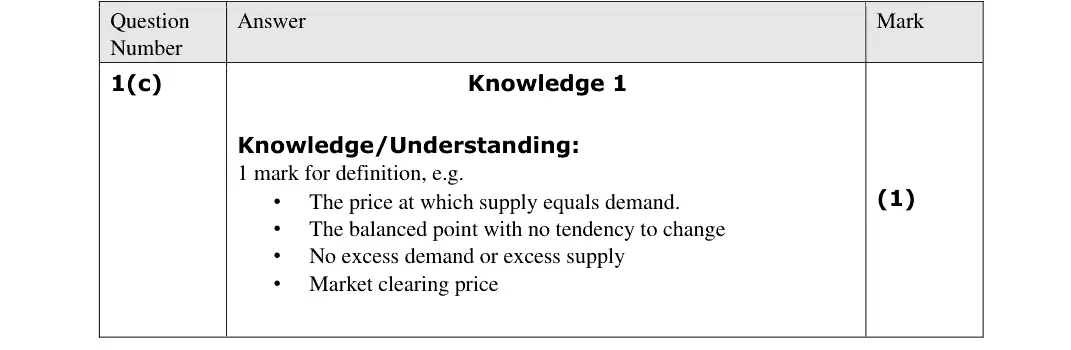
1(c) Supply, demand and price determination 1AO1=1Definition
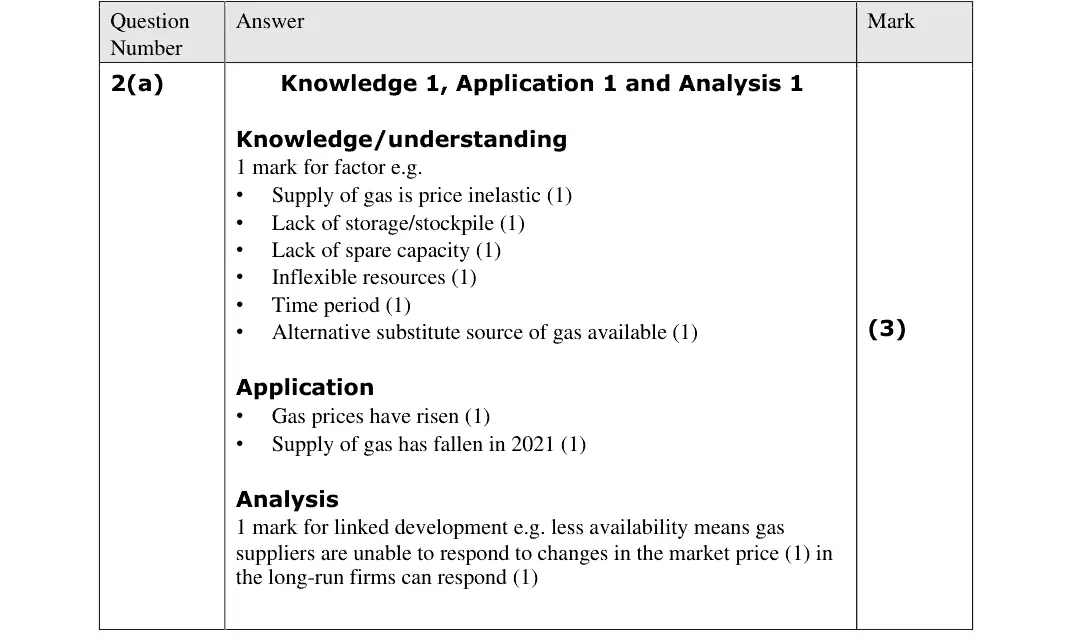
2(a) Price elasticity of supply 3AO1=1,AO2=1,AO3=1Short answer
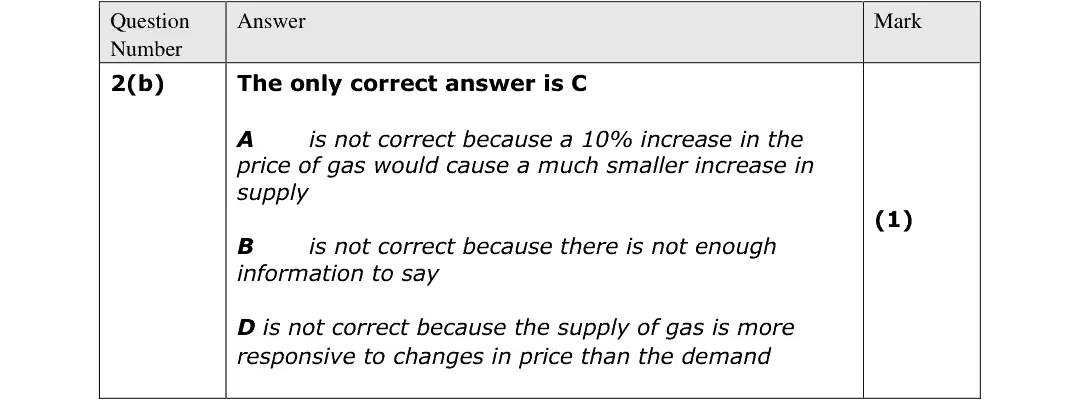
2(b) Price, income and cross elasticities of demand, Price elasticity of supply 1Multiple choice
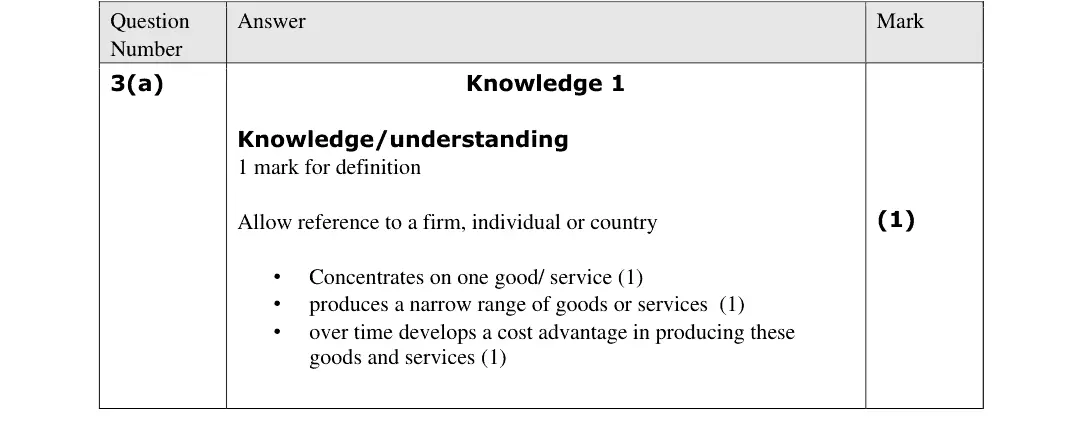
3(a) Specialisation and the division of labour 1AO1=1Definition
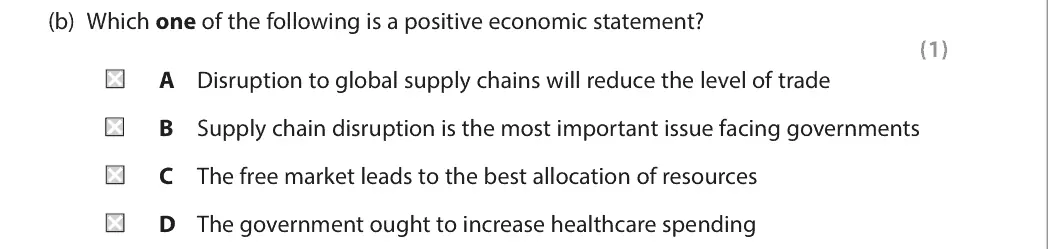
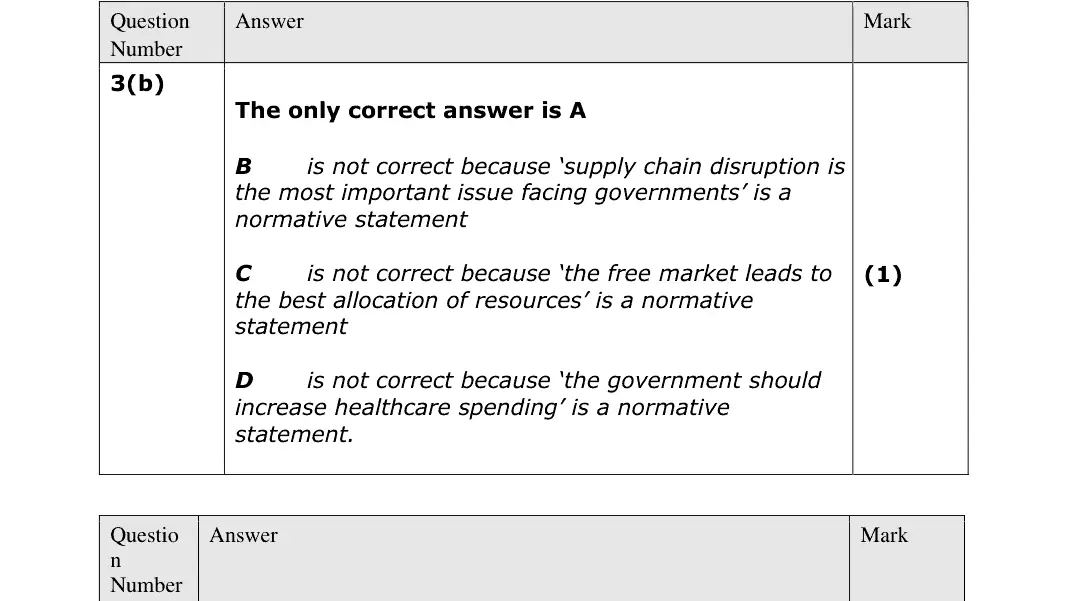
3(b) The nature of economics and the economic problem 1Multiple choice
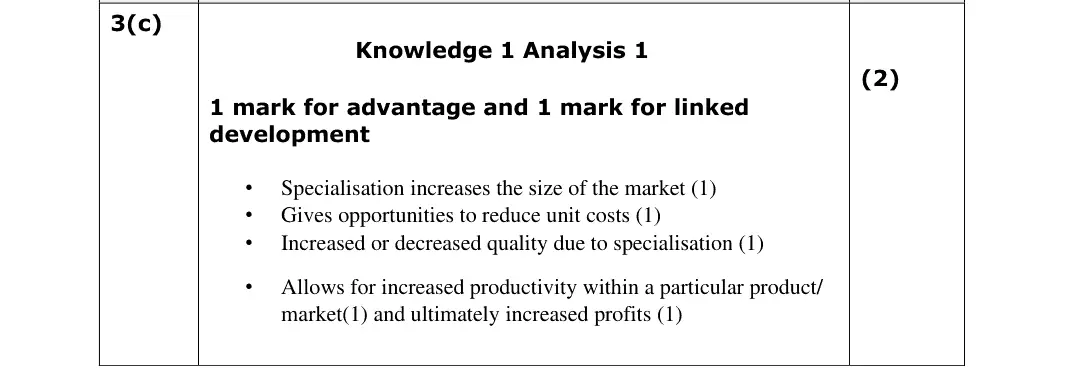
3(c) Specialisation and the division of labour 2AO1=1,AO3=1Short answer
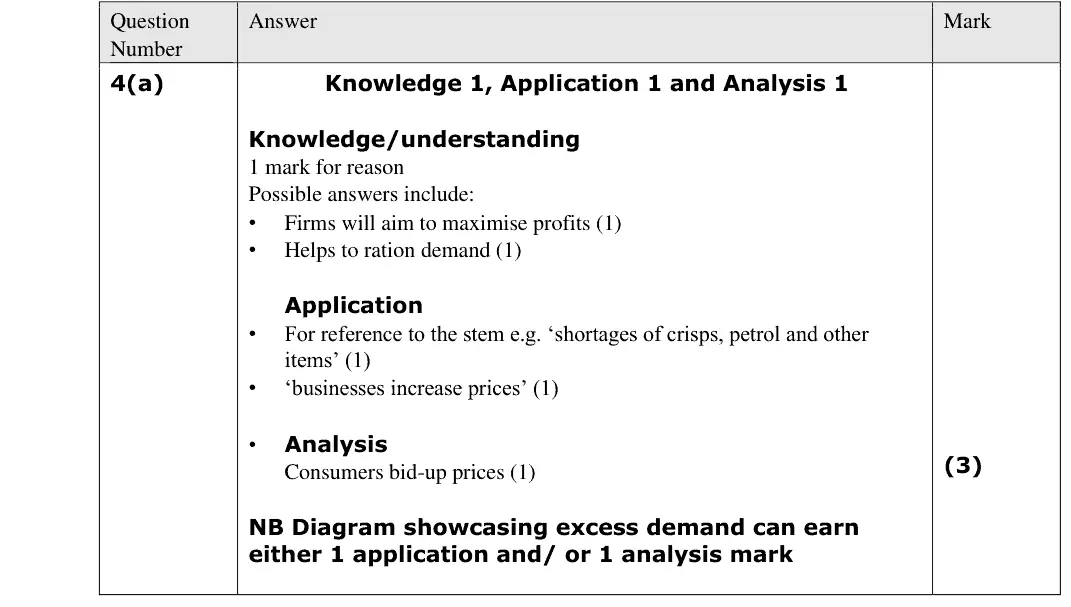
4(a) Rational decision making and behavioural economics, The price mechanism, consumer and producer surplus 3AO1=1,AO2=1,AO3=1Short answer
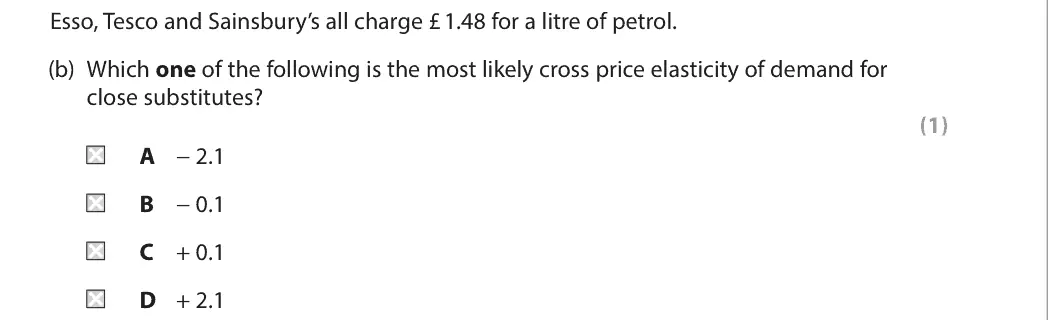
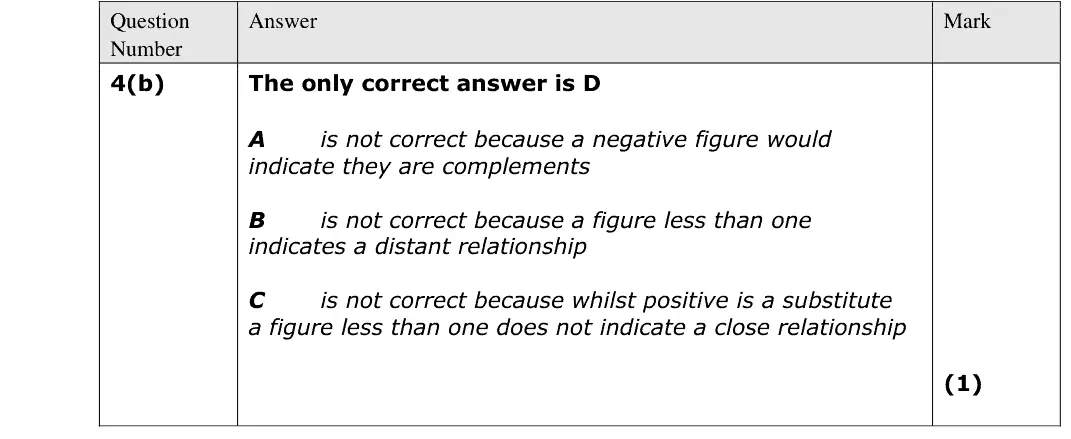
4(b) Price, income and cross elasticities of demand 1Multiple choice
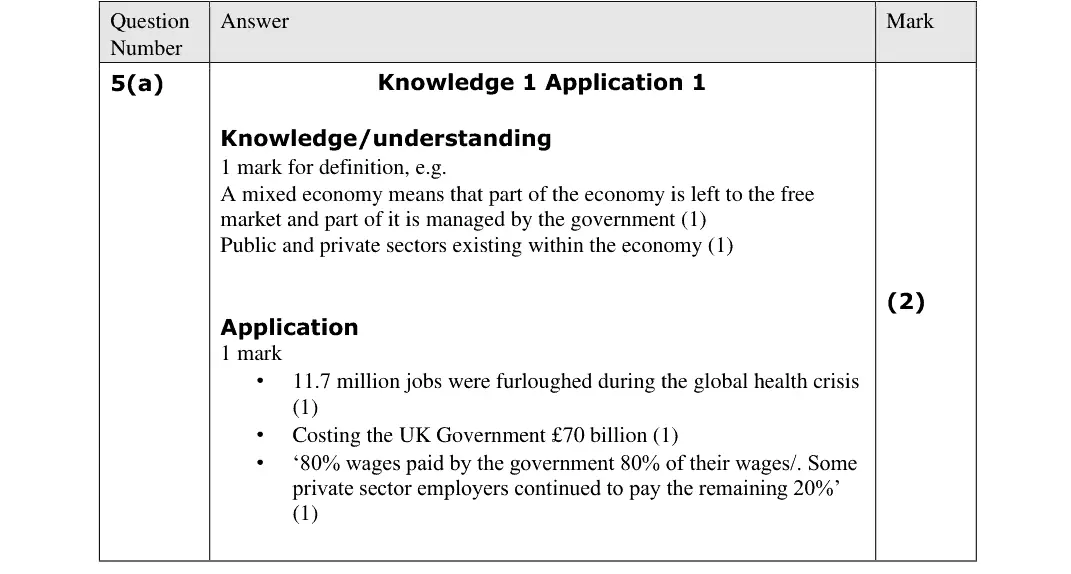
5(a) Free market, mixed and command economies 2AO1=1,AO2=1Definition
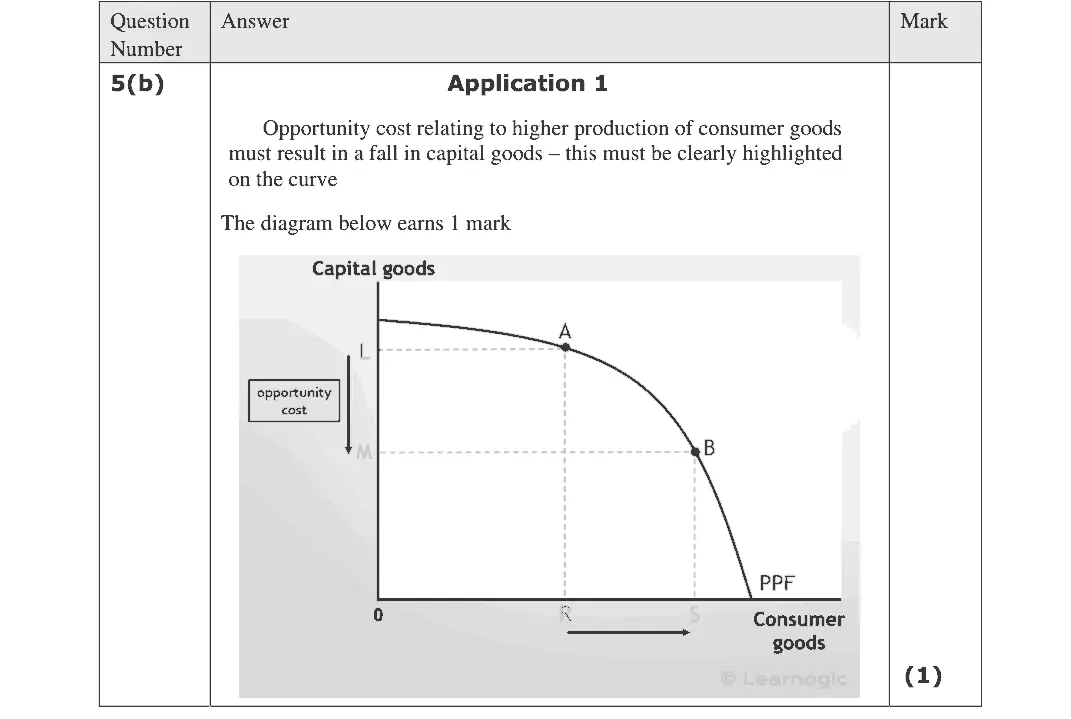
5(b) Production possibility frontiers 1AO2=1Short answer
5(c) Free market, mixed and command economies 1Multiple choice
6(a) Price, income and cross elasticities of demand 5AO1=1,AO2=2,AO3=2Short answer
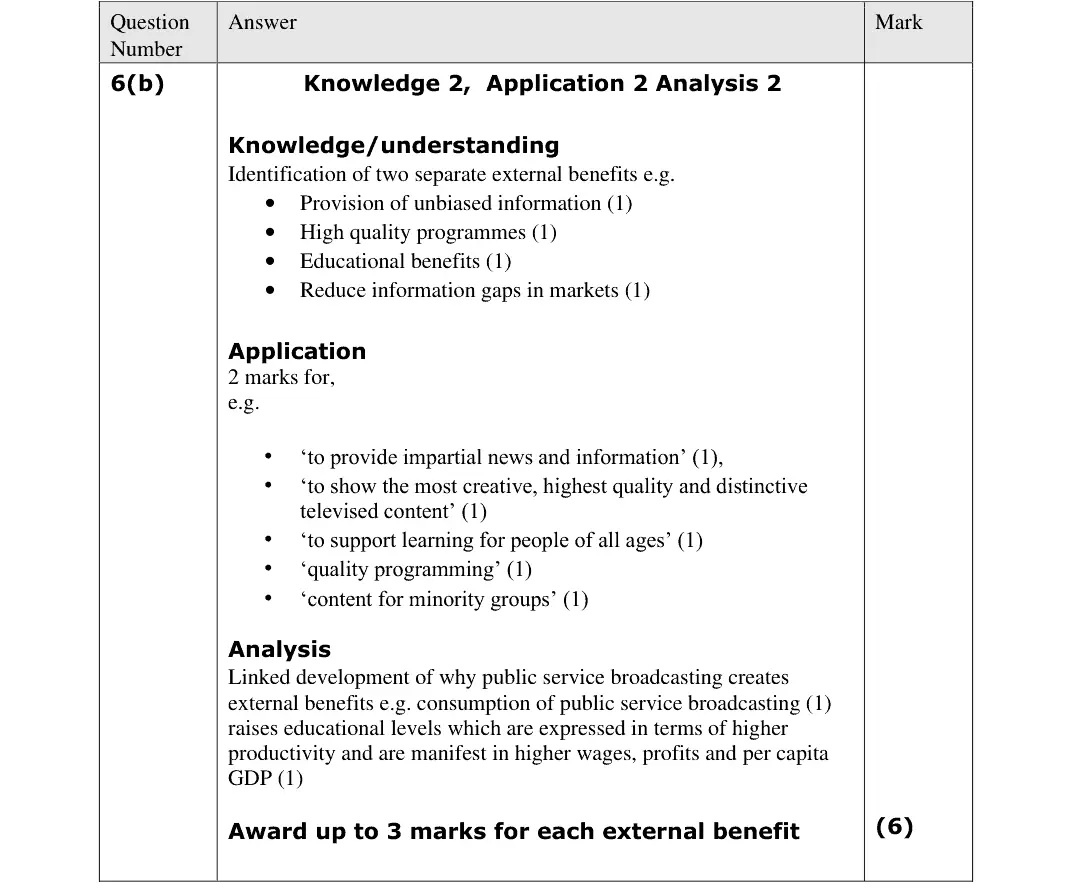
6(b) Market failure and externalities 6AO1=2,AO2=2,AO3=2Short answer
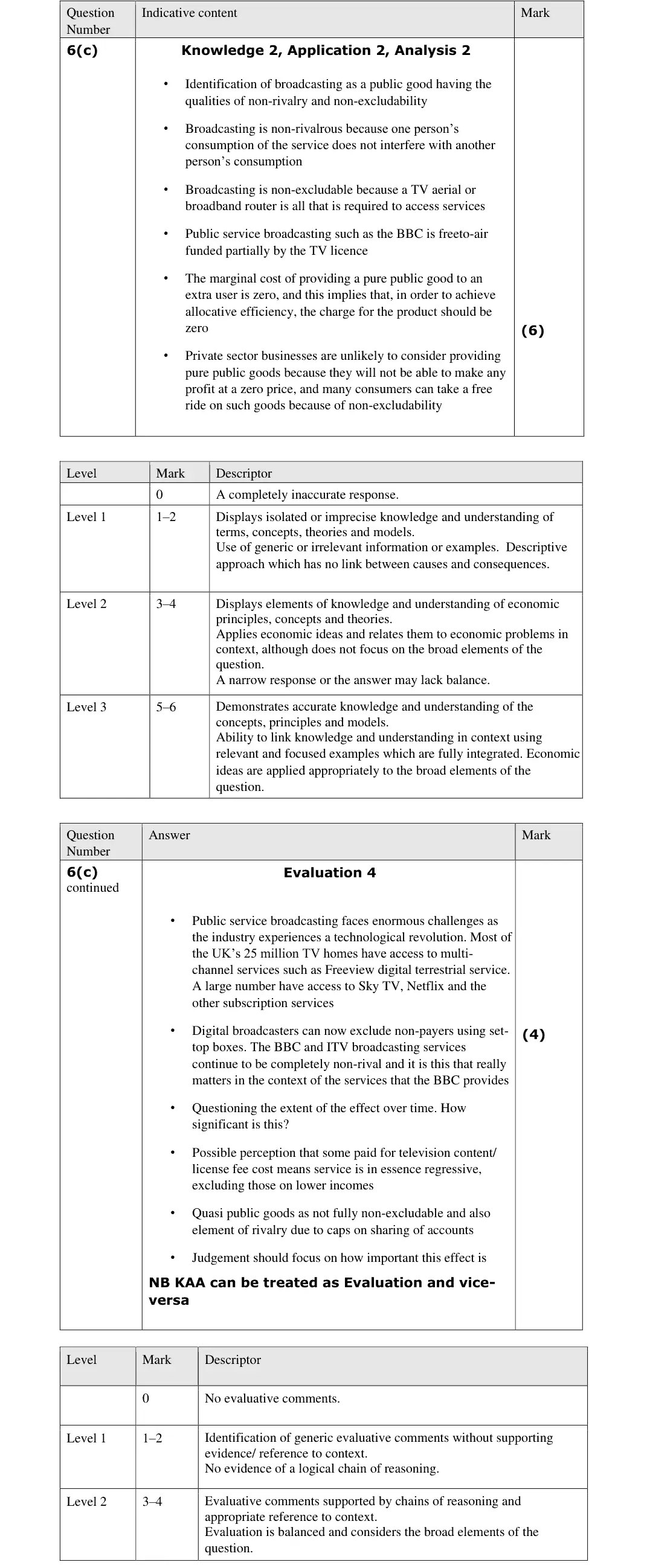
6(c) Public goods and information gaps 10AO1=2,AO2=2,AO3=2,AO4=4Extended response
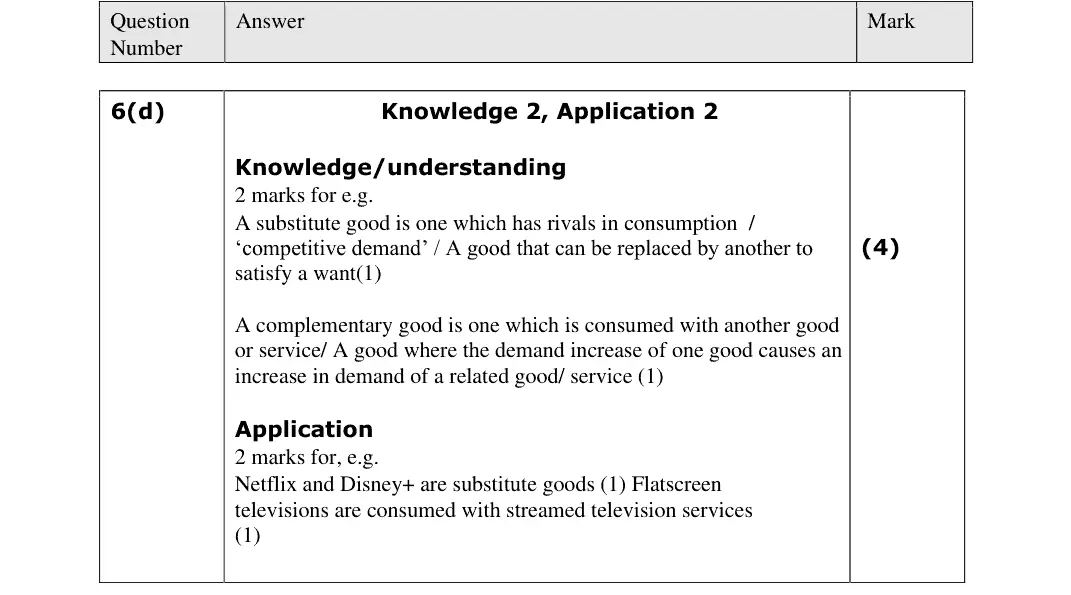
6(d) Price, income and cross elasticities of demand 4AO1=2,AO2=2Short answer
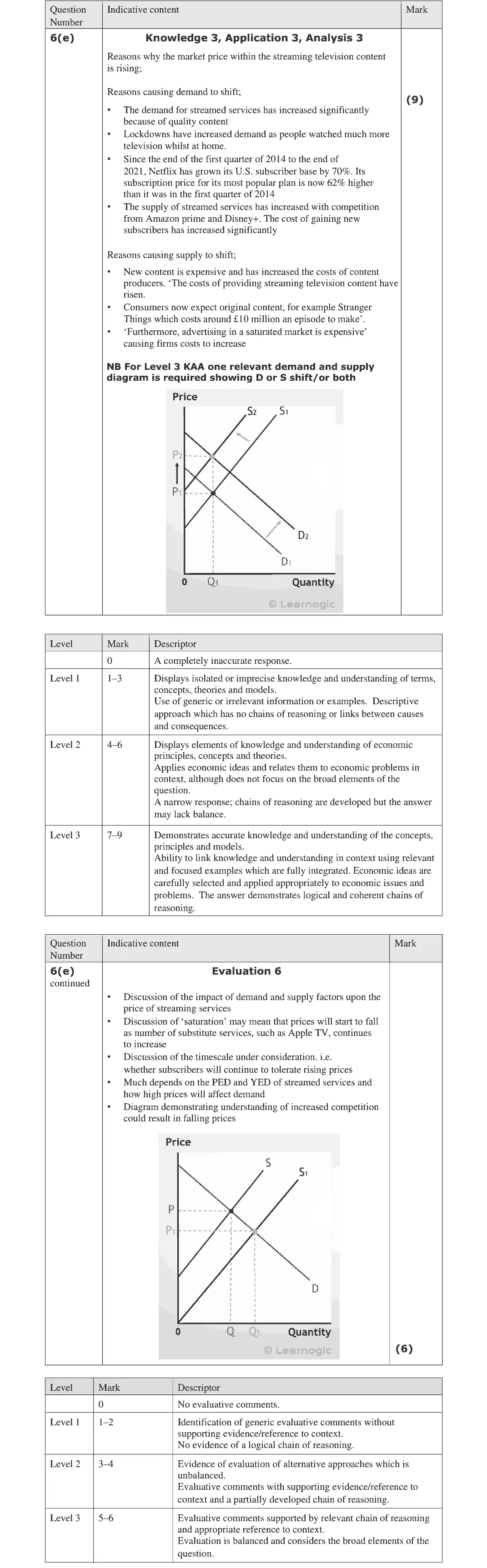
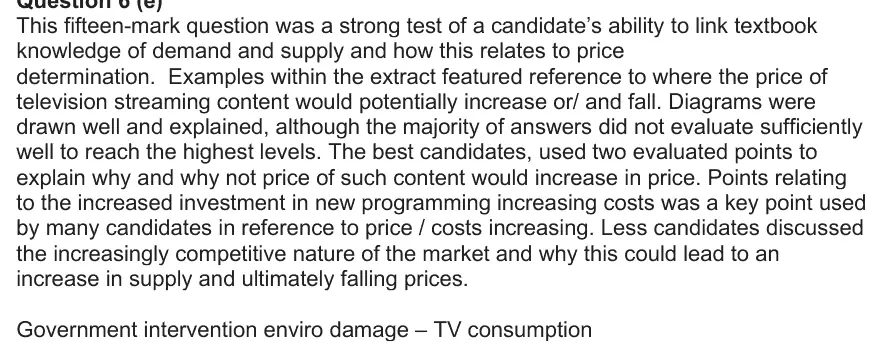
6(e) Supply, demand and price determination 15AO1=3,AO2=3,AO3=3,AO4=6Extended response
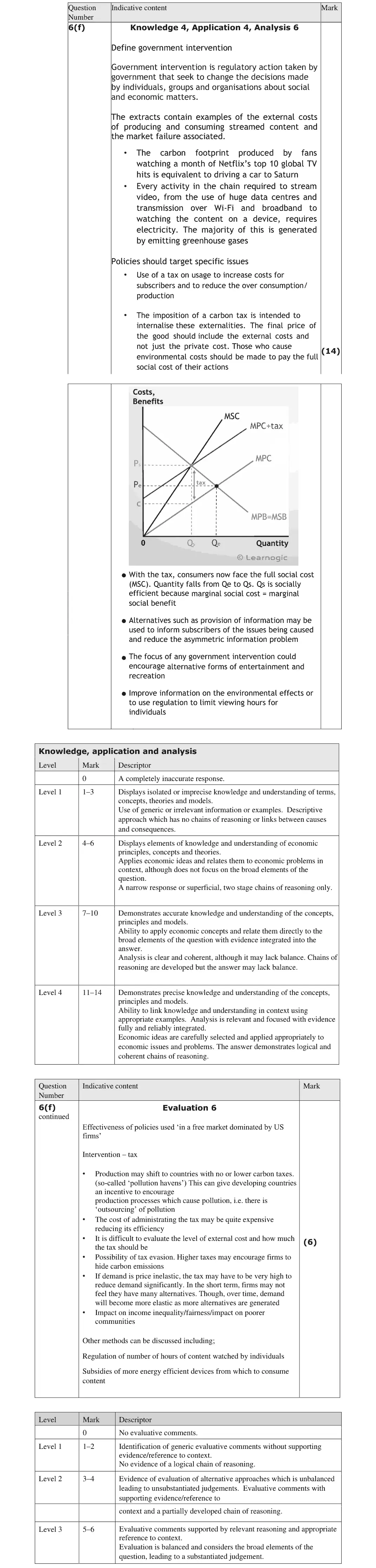
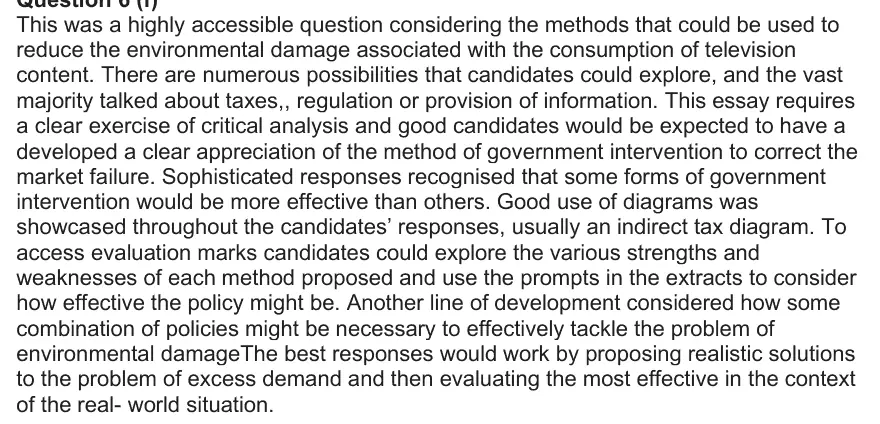
6(f) Government intervention in markets, Market failure and externalities 20AO1=4,AO2=4,AO3=6,AO4=6Essay
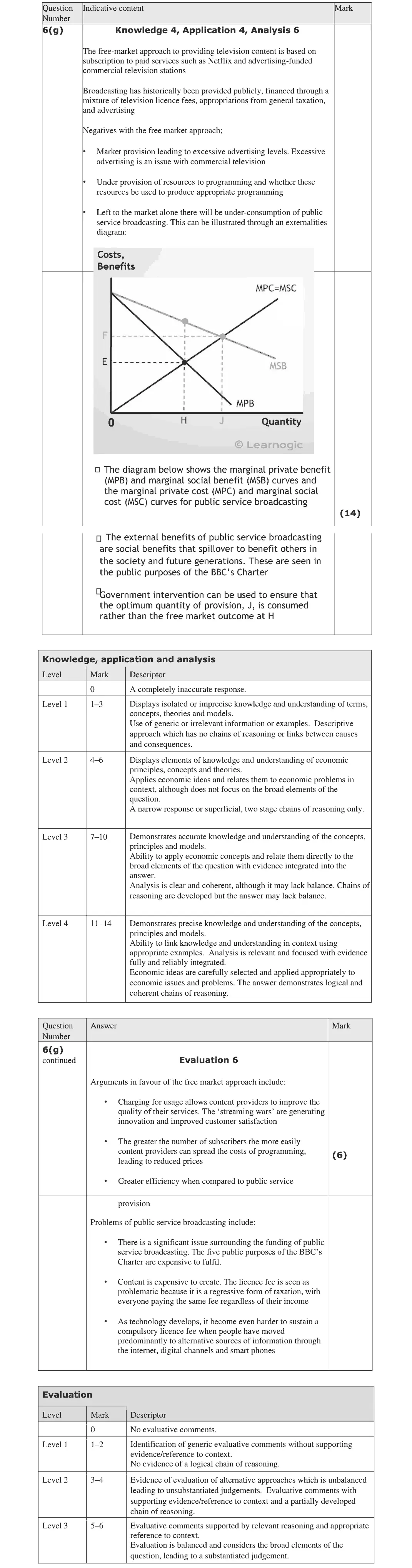
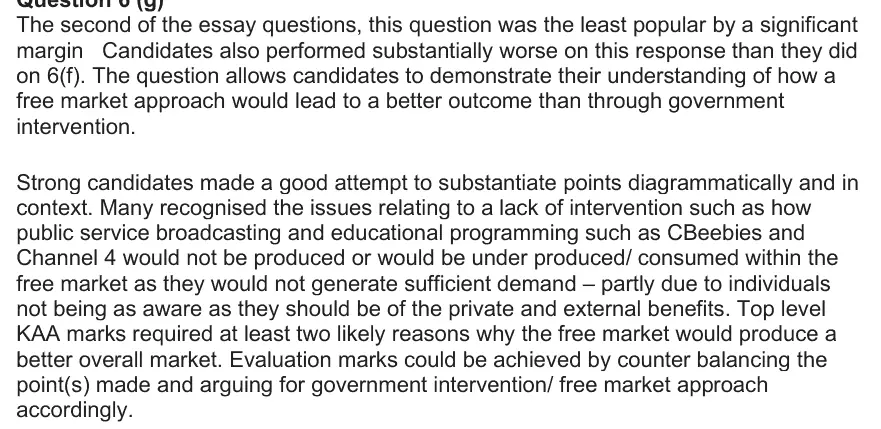
6(g) Free market, mixed and command economies, Market failure and externalities 20AO1=4,AO2=4,AO3=6,AO4=6Essay

The questions

1(a)1(b)1(c)2(a)2(b)3(a)3(b)3(c)4(a)4(b)5(a)5(b)5(c)6(a)6(b)6(c)6(d)6(e)6(f)6(g)
June 2023 · AS Paper 1 · Q1(a) 1 mark Multiple choice government intervention in markets
Data and extracts for question 11 In 2021, energy regulator Ofgem announced that the maximum price of energy will rise from £ 1 277 to £ 1 971 a year, for the average household bill. (Source: adapted from https://www.moneysavingexpert.com/ utilities/what-is-the-energy-price-cap/)
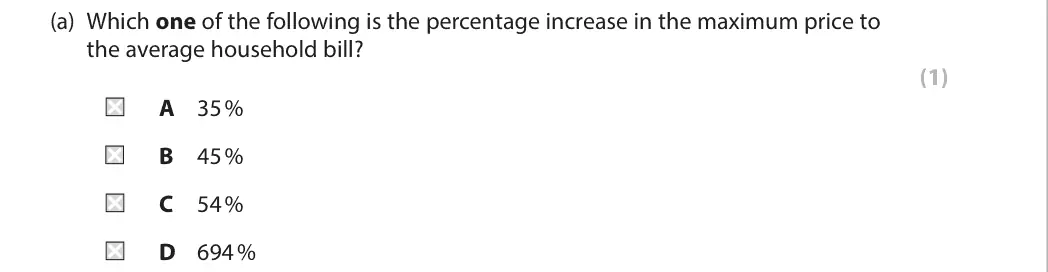
(a) Which one of the following is the percentage increase in the maximum price to the average household bill? (1) A 35 % B 45 % C 54 % D 694 %
June 2023 · AS Paper 1 · Q1(b) 2 marks AO2=2 Short answer government intervention in markets
Data and extracts for question 11 In 2021, energy regulator Ofgem announced that the maximum price of energy will rise from £ 1 277 to £ 1 971 a year, for the average household bill. (Source: adapted from https://www.moneysavingexpert.com/ utilities/what-is-the-energy-price-cap/)
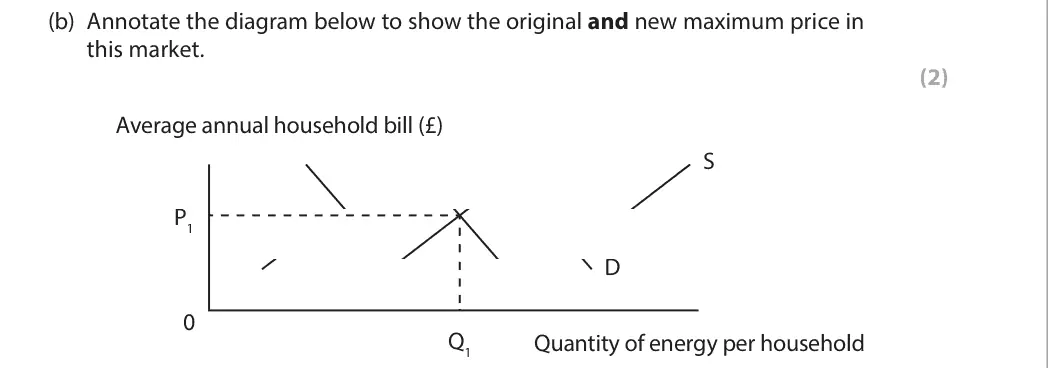
(b) Annotate the diagram below to show the original and new maximum price in this market. (2) Average annual household bill (£) S P1 D 0 Q1 Quantity of energy per household
June 2023 · AS Paper 1 · Q1(c) 1 mark AO1=1 Definition supply and demand
Data and extracts for question 11 In 2021, energy regulator Ofgem announced that the maximum price of energy will rise from £ 1 277 to £ 1 971 a year, for the average household bill. (Source: adapted from https://www.moneysavingexpert.com/ utilities/what-is-the-energy-price-cap/)
(c) Define the term ‘equilibrium price’. (1)
June 2023 · AS Paper 1 · Q2(a) 3 marks AO1=1, AO2=1, AO3=1 Short answer elasticity of supply
Data and extracts for question 22 The world’s largest producer of natural gas is the USA. In 2021 production fell even though the price increased.
(a) Using the data provided, explain one likely factor that may influence the price elasticity of supply of gas. (3)
June 2023 · AS Paper 1 · Q2(b) 1 mark Multiple choice price elasticity of demandelasticity of supply
Data and extracts for question 22 The world’s largest producer of natural gas is the USA. In 2021 production fell even though the price increased.
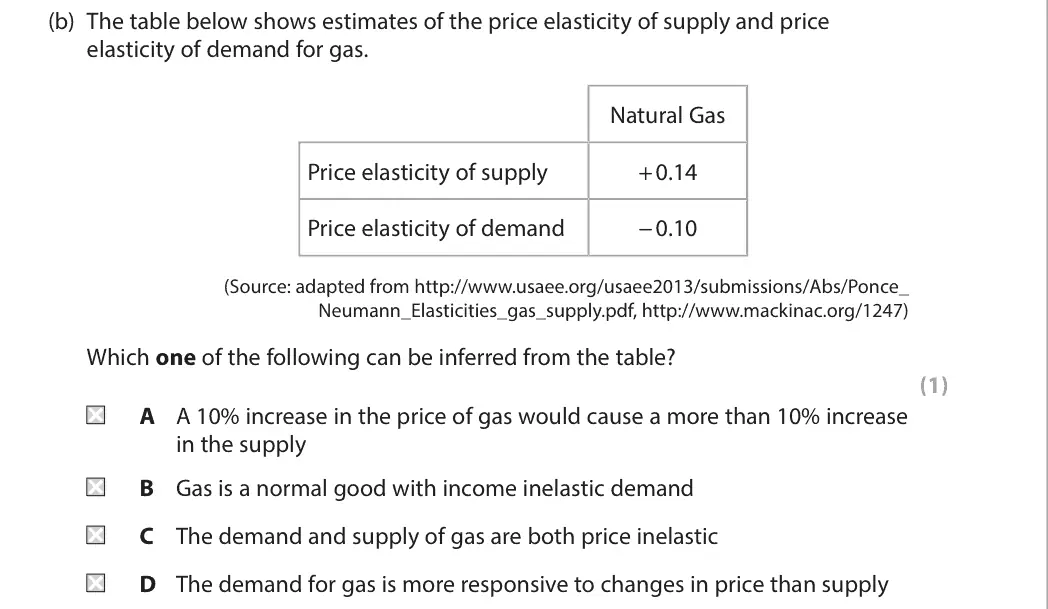
(b) The table below shows estimates of the price elasticity of supply and price elasticity of demand for gas. Natural Gas Price elasticity of supply + 0.14 Price elasticity of demand - 0.10 (Source: adapted from http://www.usaee.org/usaee2013/submissions/Abs/Ponce_ Neumann_Elasticities_gas_supply.pdf, http://www.mackinac.org/1247) Which one of the following can be inferred from the table? (1) A A 10% increase in the price of gas would cause a more than 10% increase in the supply B Gas is a normal good with income inelastic demand C The demand and supply of gas are both price inelastic D The demand for gas is more responsive to changes in price than supply
June 2023 · AS Paper 1 · Q3(a) 1 mark AO1=1 Definition specialisation and division of labour
Data and extracts for question 33 Disruption in the supply chains of essential goods and shortages of key medical products during the global health crisis have highlighted the links between countries and renewed the debate on the advantages and disadvantages of specialisation. (Source: adapted from https://commonslibrary.parliament.uk/research-briefings/cbp-8978/)
(a) Define the term ‘specialisation’. (1)
June 2023 · AS Paper 1 · Q3(b) 1 mark Multiple choice nature of economics
Data and extracts for question 33 Disruption in the supply chains of essential goods and shortages of key medical products during the global health crisis have highlighted the links between countries and renewed the debate on the advantages and disadvantages of specialisation. (Source: adapted from https://commonslibrary.parliament.uk/research-briefings/cbp-8978/)
(b) Which one of the following is a positive economic statement? (1) A Disruption to global supply chains will reduce the level of trade B Supply chain disruption is the most important issue facing governments C The free market leads to the best allocation of resources D The government ought to increase healthcare spending
June 2023 · AS Paper 1 · Q3(c) 2 marks AO1=1, AO3=1 Short answer specialisation and division of labour
Data and extracts for question 33 Disruption in the supply chains of essential goods and shortages of key medical products during the global health crisis have highlighted the links between countries and renewed the debate on the advantages and disadvantages of specialisation. (Source: adapted from https://commonslibrary.parliament.uk/research-briefings/cbp-8978/)
(c) Explain one likely advantage of specialising in the production of goods to trade. (2)
June 2023 · AS Paper 1 · Q4(a) 3 marks AO1=1, AO2=1, AO3=1 Short answer rational decision making and behavioural economicsprice mechanism and surplus
Data and extracts for question 44 During 2021 the UK experienced severe shortages of crisps, petrol and many other items. (Source: adapted from https://www.independent.co.uk/news/business/news/ uk-shortages-covid-brexit-supply-chain-b1968458.html)
(a) Explain one reason why it is rational for a firm to raise prices when there is excess demand. (3)
June 2023 · AS Paper 1 · Q4(b) 1 mark Multiple choice price elasticity of demand
Data and extracts for question 44 During 2021 the UK experienced severe shortages of crisps, petrol and many other items. (Source: adapted from https://www.independent.co.uk/news/business/news/ uk-shortages-covid-brexit-supply-chain-b1968458.html)
Esso, Tesco and Sainsbury’s all charge £ 1.48 for a litre of petrol. (b) Which one of the following is the most likely cross price elasticity of demand for close substitutes? (1) A - 2.1 B - 0.1 C + 0.1 D + 2.1
June 2023 · AS Paper 1 · Q5(a) 2 marks AO1=1, AO2=1 Definition economic systems
Data and extracts for question 55 During the global health crisis, 11.7 million jobs were furloughed, costing the UK Government £70 billion. This meant people were paid by the government 80% of their wages even though they did not work. Some private sector employers continued to pay the remaining 20 %. (Source: adapted from https://commonslibrary.parliament.uk/ examining-the-end-of-the-furlough-scheme)
(a) With reference to the above information, define the term ‘mixed economy’. (2)
June 2023 · AS Paper 1 · Q5(b) 1 mark AO2=1 Short answer production possibility frontiers
Data and extracts for question 55 During the global health crisis, 11.7 million jobs were furloughed, costing the UK Government £70 billion. This meant people were paid by the government 80% of their wages even though they did not work. Some private sector employers continued to pay the remaining 20 %. (Source: adapted from https://commonslibrary.parliament.uk/ examining-the-end-of-the-furlough-scheme)
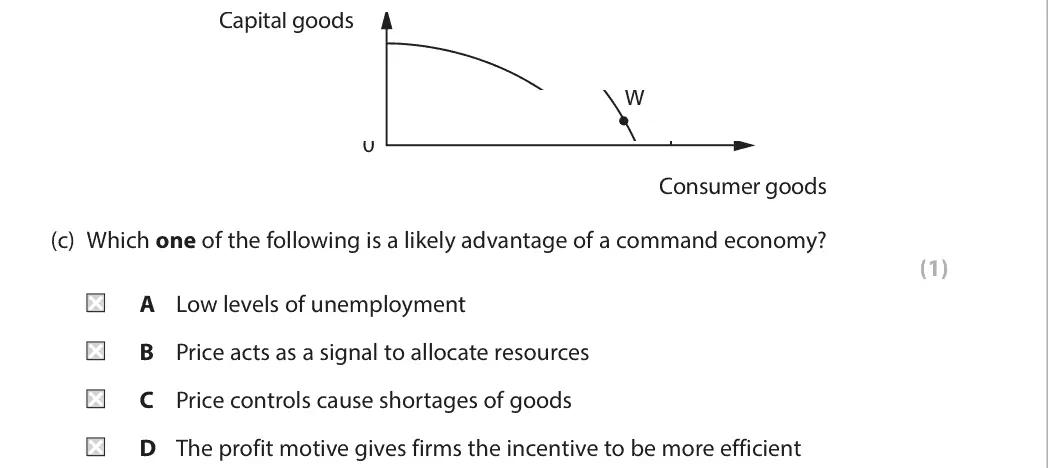
(b) The diagram shows the production possibility frontier of an economy. Assuming the economy is at point W, annotate the diagram to show the opportunity cost of producing more consumer goods. (1)
June 2023 · AS Paper 1 · Q5(c) 1 mark Multiple choice economic systems
Data and extracts for question 55 During the global health crisis, 11.7 million jobs were furloughed, costing the UK Government £70 billion. This meant people were paid by the government 80% of their wages even though they did not work. Some private sector employers continued to pay the remaining 20 %. (Source: adapted from https://commonslibrary.parliament.uk/ examining-the-end-of-the-furlough-scheme)
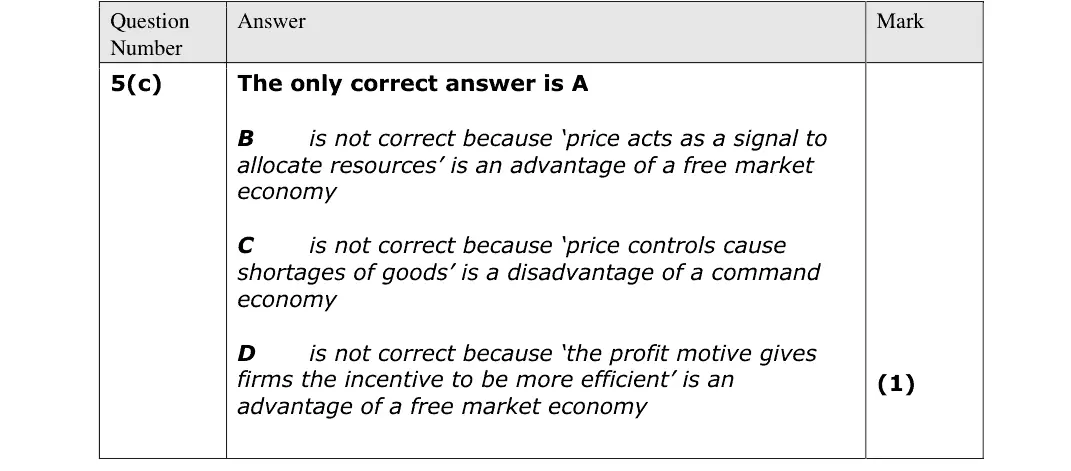
Capital goods W 0 Consumer goods (c) Which one of the following is a likely advantage of a command economy? (1) A Low levels of unemployment B Price acts as a signal to allocate resources C Price controls cause shortages of goods D The profit motive gives firms the incentive to be more efficient
June 2023 · AS Paper 1 · Q6(a) 5 marks AO1=1, AO2=2, AO3=2 Short answer price elasticity of demand
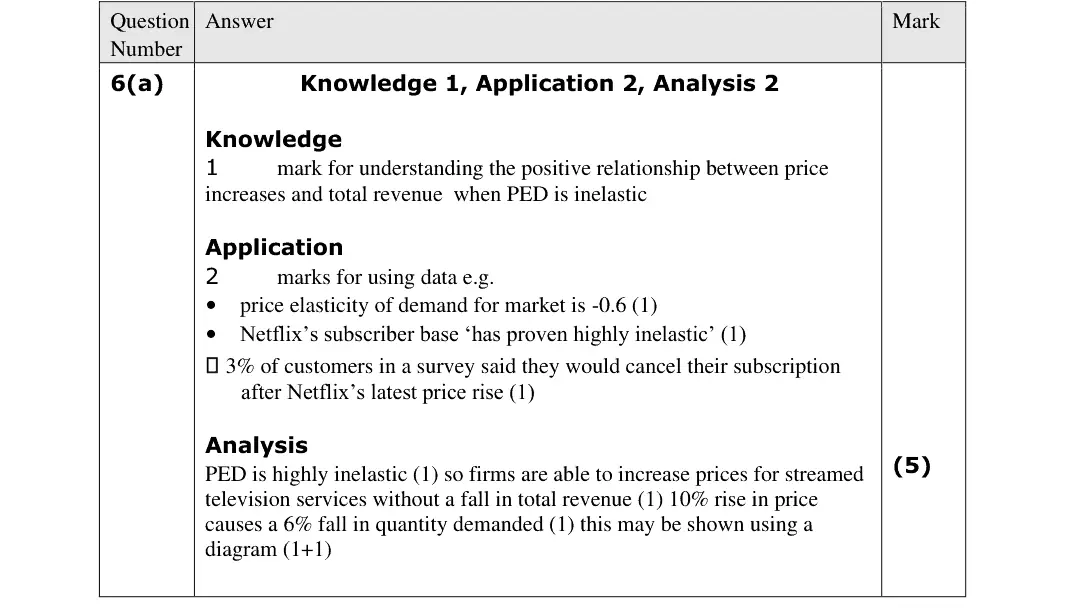
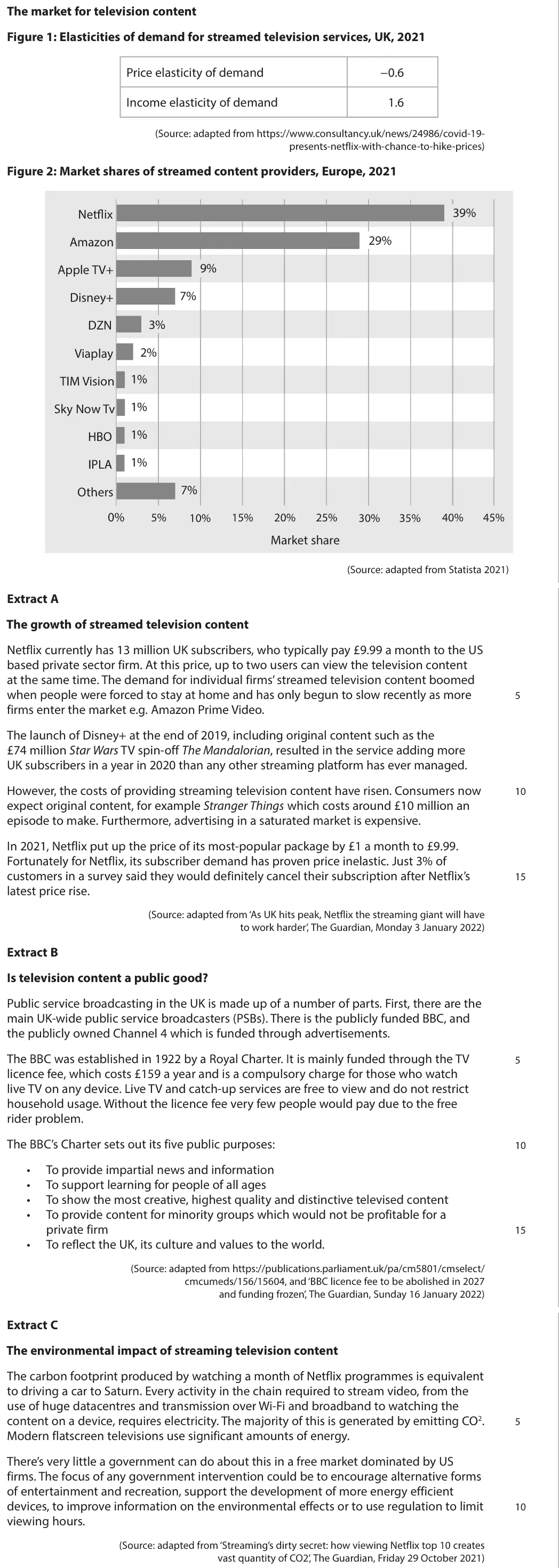
Data and extracts for question 6The market for television content Figure 1: Elasticities of demand for streamed television services, UK, 2021 Price elasticity of demand -0.6 Income elasticity of demand 1.6 (Source: adapted from https://www.consultancy.uk/news/24986/covid-19- presents-netflix-with-chance-to-hike-prices) Figure 2: Market shares of streamed content providers, Europe, 2021 39% Netflix 29% Amazon 9% Apple TV+ 7% Disney+ 3% DZN 2% Viaplay 1% TIM Vision 1% Sky Now Tv 1% HBO 1% IPLA 7% Others 0% 5% 10% 15% 20% 25% 30% 35% 40% 45% Market share (Source: adapted from Statista 2021) Extract A The growth of streamed television content Netflix currently has 13 million UK subscribers, who typically pay £9.99 a month to the US based private sector firm. At this price, up to two users can view the television content at the same time. The demand for individual firms’ streamed television content boomed when people were forced to stay at home and has only begun to slow recently as more 5 firms enter the market e.g. Amazon Prime Video. The launch of Disney+ at the end of 2019, including original content such as the £74 million Star Wars TV spin-off The Mandalorian, resulted in the service adding more UK subscribers in a year in 2020 than any other streaming platform has ever managed. However, the costs of providing streaming television content have risen. Consumers now 10 expect original content, for example Stranger Things which costs around £10 million an episode to make. Furthermore, advertising in a saturated market is expensive. In 2021, Netflix put up the price of its most-popular package by £1 a month to £9.99. Fortunately for Netflix, its subscriber demand has proven price inelastic. Just 3% of customers in a survey said they would definitely cancel their subscription after Netflix’s 15 latest price rise. (Source: adapted from ‘As UK hits peak, Netflix the streaming giant will have to work harder’, The Guardian, Monday 3 January 2022) Extract B Is television content a public good? Public service broadcasting in the UK is made up of a number of parts. First, there are the main UK-wide public service broadcasters (PSBs). There is the publicly funded BBC, and the publicly owned Channel 4 which is funded through advertisements. The BBC was established in 1922 by a Royal Charter. It is mainly funded through the TV 5 licence fee, which costs £159 a year and is a compulsory charge for those who watch live TV on any device. Live TV and catch-up services are free to view and do not restrict household usage. Without the licence fee very few people would pay due to the free rider problem. The BBC’s Charter sets out its five public purposes: 10 • To provide impartial news and information • To support learning for people of all ages • To show the most creative, highest quality and distinctive televised content • To provide content for minority groups which would not be profitable for a private firm 15 • To reflect the UK, its culture and values to the world. (Source: adapted from https://publications.parliament.uk/pa/cm5801/cmselect/ cmcumeds/156/15604, and ‘BBC licence fee to be abolished in 2027 and funding frozen’, The Guardian, Sunday 16 January 2022) Extract C The environmental impact of streaming television content The carbon footprint produced by watching a month of Netflix programmes is equivalent to driving a car to Saturn. Every activity in the chain required to stream video, from the use of huge datacentres and transmission over Wi-Fi and broadband to watching the content on a device, requires electricity. The majority of this is generated by emitting CO2. 5 Modern flatscreen televisions use significant amounts of energy. There’s very little a government can do about this in a free market dominated by US firms. The focus of any government intervention could be to encourage alternative forms of entertainment and recreation, support the development of more energy efficient devices, to improve information on the environmental effects or to use regulation to limit 10 viewing hours. (Source: adapted from ‘Streaming’s dirty secret: how viewing Netflix top 10 creates vast quantity of CO2’, The Guardian, Friday 29 October 2021)
(a) With reference to Figure 1 and Extract A, explain the relationship between price elasticity of demand and total revenue. (5)
June 2023 · AS Paper 1 · Q6(b) 6 marks AO1=2, AO2=2, AO3=2 Short answer externalities
Data and extracts for question 6The market for television content Figure 1: Elasticities of demand for streamed television services, UK, 2021 Price elasticity of demand -0.6 Income elasticity of demand 1.6 (Source: adapted from https://www.consultancy.uk/news/24986/covid-19- presents-netflix-with-chance-to-hike-prices) Figure 2: Market shares of streamed content providers, Europe, 2021 39% Netflix 29% Amazon 9% Apple TV+ 7% Disney+ 3% DZN 2% Viaplay 1% TIM Vision 1% Sky Now Tv 1% HBO 1% IPLA 7% Others 0% 5% 10% 15% 20% 25% 30% 35% 40% 45% Market share (Source: adapted from Statista 2021) Extract A The growth of streamed television content Netflix currently has 13 million UK subscribers, who typically pay £9.99 a month to the US based private sector firm. At this price, up to two users can view the television content at the same time. The demand for individual firms’ streamed television content boomed when people were forced to stay at home and has only begun to slow recently as more 5 firms enter the market e.g. Amazon Prime Video. The launch of Disney+ at the end of 2019, including original content such as the £74 million Star Wars TV spin-off The Mandalorian, resulted in the service adding more UK subscribers in a year in 2020 than any other streaming platform has ever managed. However, the costs of providing streaming television content have risen. Consumers now 10 expect original content, for example Stranger Things which costs around £10 million an episode to make. Furthermore, advertising in a saturated market is expensive. In 2021, Netflix put up the price of its most-popular package by £1 a month to £9.99. Fortunately for Netflix, its subscriber demand has proven price inelastic. Just 3% of customers in a survey said they would definitely cancel their subscription after Netflix’s 15 latest price rise. (Source: adapted from ‘As UK hits peak, Netflix the streaming giant will have to work harder’, The Guardian, Monday 3 January 2022) Extract B Is television content a public good? Public service broadcasting in the UK is made up of a number of parts. First, there are the main UK-wide public service broadcasters (PSBs). There is the publicly funded BBC, and the publicly owned Channel 4 which is funded through advertisements. The BBC was established in 1922 by a Royal Charter. It is mainly funded through the TV 5 licence fee, which costs £159 a year and is a compulsory charge for those who watch live TV on any device. Live TV and catch-up services are free to view and do not restrict household usage. Without the licence fee very few people would pay due to the free rider problem. The BBC’s Charter sets out its five public purposes: 10 • To provide impartial news and information • To support learning for people of all ages • To show the most creative, highest quality and distinctive televised content • To provide content for minority groups which would not be profitable for a private firm 15 • To reflect the UK, its culture and values to the world. (Source: adapted from https://publications.parliament.uk/pa/cm5801/cmselect/ cmcumeds/156/15604, and ‘BBC licence fee to be abolished in 2027 and funding frozen’, The Guardian, Sunday 16 January 2022) Extract C The environmental impact of streaming television content The carbon footprint produced by watching a month of Netflix programmes is equivalent to driving a car to Saturn. Every activity in the chain required to stream video, from the use of huge datacentres and transmission over Wi-Fi and broadband to watching the content on a device, requires electricity. The majority of this is generated by emitting CO2. 5 Modern flatscreen televisions use significant amounts of energy. There’s very little a government can do about this in a free market dominated by US firms. The focus of any government intervention could be to encourage alternative forms of entertainment and recreation, support the development of more energy efficient devices, to improve information on the environmental effects or to use regulation to limit 10 viewing hours. (Source: adapted from ‘Streaming’s dirty secret: how viewing Netflix top 10 creates vast quantity of CO2’, The Guardian, Friday 29 October 2021)
(b) With reference to Extract B, explain two external benefits associated with the consumption of ‘public service broadcasting’ (line 2). (6)
June 2023 · AS Paper 1 · Q6(c) 10 marks AO1=2, AO2=2, AO3=2, AO4=4 10-mark response public goods and information gaps
Data and extracts for question 6The market for television content Figure 1: Elasticities of demand for streamed television services, UK, 2021 Price elasticity of demand -0.6 Income elasticity of demand 1.6 (Source: adapted from https://www.consultancy.uk/news/24986/covid-19- presents-netflix-with-chance-to-hike-prices) Figure 2: Market shares of streamed content providers, Europe, 2021 39% Netflix 29% Amazon 9% Apple TV+ 7% Disney+ 3% DZN 2% Viaplay 1% TIM Vision 1% Sky Now Tv 1% HBO 1% IPLA 7% Others 0% 5% 10% 15% 20% 25% 30% 35% 40% 45% Market share (Source: adapted from Statista 2021) Extract A The growth of streamed television content Netflix currently has 13 million UK subscribers, who typically pay £9.99 a month to the US based private sector firm. At this price, up to two users can view the television content at the same time. The demand for individual firms’ streamed television content boomed when people were forced to stay at home and has only begun to slow recently as more 5 firms enter the market e.g. Amazon Prime Video. The launch of Disney+ at the end of 2019, including original content such as the £74 million Star Wars TV spin-off The Mandalorian, resulted in the service adding more UK subscribers in a year in 2020 than any other streaming platform has ever managed. However, the costs of providing streaming television content have risen. Consumers now 10 expect original content, for example Stranger Things which costs around £10 million an episode to make. Furthermore, advertising in a saturated market is expensive. In 2021, Netflix put up the price of its most-popular package by £1 a month to £9.99. Fortunately for Netflix, its subscriber demand has proven price inelastic. Just 3% of customers in a survey said they would definitely cancel their subscription after Netflix’s 15 latest price rise. (Source: adapted from ‘As UK hits peak, Netflix the streaming giant will have to work harder’, The Guardian, Monday 3 January 2022) Extract B Is television content a public good? Public service broadcasting in the UK is made up of a number of parts. First, there are the main UK-wide public service broadcasters (PSBs). There is the publicly funded BBC, and the publicly owned Channel 4 which is funded through advertisements. The BBC was established in 1922 by a Royal Charter. It is mainly funded through the TV 5 licence fee, which costs £159 a year and is a compulsory charge for those who watch live TV on any device. Live TV and catch-up services are free to view and do not restrict household usage. Without the licence fee very few people would pay due to the free rider problem. The BBC’s Charter sets out its five public purposes: 10 • To provide impartial news and information • To support learning for people of all ages • To show the most creative, highest quality and distinctive televised content • To provide content for minority groups which would not be profitable for a private firm 15 • To reflect the UK, its culture and values to the world. (Source: adapted from https://publications.parliament.uk/pa/cm5801/cmselect/ cmcumeds/156/15604, and ‘BBC licence fee to be abolished in 2027 and funding frozen’, The Guardian, Sunday 16 January 2022) Extract C The environmental impact of streaming television content The carbon footprint produced by watching a month of Netflix programmes is equivalent to driving a car to Saturn. Every activity in the chain required to stream video, from the use of huge datacentres and transmission over Wi-Fi and broadband to watching the content on a device, requires electricity. The majority of this is generated by emitting CO2. 5 Modern flatscreen televisions use significant amounts of energy. There’s very little a government can do about this in a free market dominated by US firms. The focus of any government intervention could be to encourage alternative forms of entertainment and recreation, support the development of more energy efficient devices, to improve information on the environmental effects or to use regulation to limit 10 viewing hours. (Source: adapted from ‘Streaming’s dirty secret: how viewing Netflix top 10 creates vast quantity of CO2’, The Guardian, Friday 29 October 2021)
(c) ‘Television content is a public good’ (Extract B). Assess this statement. (10)
June 2023 · AS Paper 1 · Q6(d) 4 marks AO1=2, AO2=2 Short answer price elasticity of demand
Data and extracts for question 6The market for television content Figure 1: Elasticities of demand for streamed television services, UK, 2021 Price elasticity of demand -0.6 Income elasticity of demand 1.6 (Source: adapted from https://www.consultancy.uk/news/24986/covid-19- presents-netflix-with-chance-to-hike-prices) Figure 2: Market shares of streamed content providers, Europe, 2021 39% Netflix 29% Amazon 9% Apple TV+ 7% Disney+ 3% DZN 2% Viaplay 1% TIM Vision 1% Sky Now Tv 1% HBO 1% IPLA 7% Others 0% 5% 10% 15% 20% 25% 30% 35% 40% 45% Market share (Source: adapted from Statista 2021) Extract A The growth of streamed television content Netflix currently has 13 million UK subscribers, who typically pay £9.99 a month to the US based private sector firm. At this price, up to two users can view the television content at the same time. The demand for individual firms’ streamed television content boomed when people were forced to stay at home and has only begun to slow recently as more 5 firms enter the market e.g. Amazon Prime Video. The launch of Disney+ at the end of 2019, including original content such as the £74 million Star Wars TV spin-off The Mandalorian, resulted in the service adding more UK subscribers in a year in 2020 than any other streaming platform has ever managed. However, the costs of providing streaming television content have risen. Consumers now 10 expect original content, for example Stranger Things which costs around £10 million an episode to make. Furthermore, advertising in a saturated market is expensive. In 2021, Netflix put up the price of its most-popular package by £1 a month to £9.99. Fortunately for Netflix, its subscriber demand has proven price inelastic. Just 3% of customers in a survey said they would definitely cancel their subscription after Netflix’s 15 latest price rise. (Source: adapted from ‘As UK hits peak, Netflix the streaming giant will have to work harder’, The Guardian, Monday 3 January 2022) Extract B Is television content a public good? Public service broadcasting in the UK is made up of a number of parts. First, there are the main UK-wide public service broadcasters (PSBs). There is the publicly funded BBC, and the publicly owned Channel 4 which is funded through advertisements. The BBC was established in 1922 by a Royal Charter. It is mainly funded through the TV 5 licence fee, which costs £159 a year and is a compulsory charge for those who watch live TV on any device. Live TV and catch-up services are free to view and do not restrict household usage. Without the licence fee very few people would pay due to the free rider problem. The BBC’s Charter sets out its five public purposes: 10 • To provide impartial news and information • To support learning for people of all ages • To show the most creative, highest quality and distinctive televised content • To provide content for minority groups which would not be profitable for a private firm 15 • To reflect the UK, its culture and values to the world. (Source: adapted from https://publications.parliament.uk/pa/cm5801/cmselect/ cmcumeds/156/15604, and ‘BBC licence fee to be abolished in 2027 and funding frozen’, The Guardian, Sunday 16 January 2022) Extract C The environmental impact of streaming television content The carbon footprint produced by watching a month of Netflix programmes is equivalent to driving a car to Saturn. Every activity in the chain required to stream video, from the use of huge datacentres and transmission over Wi-Fi and broadband to watching the content on a device, requires electricity. The majority of this is generated by emitting CO2. 5 Modern flatscreen televisions use significant amounts of energy. There’s very little a government can do about this in a free market dominated by US firms. The focus of any government intervention could be to encourage alternative forms of entertainment and recreation, support the development of more energy efficient devices, to improve information on the environmental effects or to use regulation to limit 10 viewing hours. (Source: adapted from ‘Streaming’s dirty secret: how viewing Netflix top 10 creates vast quantity of CO2’, The Guardian, Friday 29 October 2021)
(d) Using examples from the information provided, explain what is meant by both ‘substitutes’ and ‘complementary goods’. (4)
June 2023 · AS Paper 1 · Q6(e) 15 marks AO1=3, AO2=3, AO3=3, AO4=6 15-mark response supply and demand
Data and extracts for question 6The market for television content Figure 1: Elasticities of demand for streamed television services, UK, 2021 Price elasticity of demand -0.6 Income elasticity of demand 1.6 (Source: adapted from https://www.consultancy.uk/news/24986/covid-19- presents-netflix-with-chance-to-hike-prices) Figure 2: Market shares of streamed content providers, Europe, 2021 39% Netflix 29% Amazon 9% Apple TV+ 7% Disney+ 3% DZN 2% Viaplay 1% TIM Vision 1% Sky Now Tv 1% HBO 1% IPLA 7% Others 0% 5% 10% 15% 20% 25% 30% 35% 40% 45% Market share (Source: adapted from Statista 2021) Extract A The growth of streamed television content Netflix currently has 13 million UK subscribers, who typically pay £9.99 a month to the US based private sector firm. At this price, up to two users can view the television content at the same time. The demand for individual firms’ streamed television content boomed when people were forced to stay at home and has only begun to slow recently as more 5 firms enter the market e.g. Amazon Prime Video. The launch of Disney+ at the end of 2019, including original content such as the £74 million Star Wars TV spin-off The Mandalorian, resulted in the service adding more UK subscribers in a year in 2020 than any other streaming platform has ever managed. However, the costs of providing streaming television content have risen. Consumers now 10 expect original content, for example Stranger Things which costs around £10 million an episode to make. Furthermore, advertising in a saturated market is expensive. In 2021, Netflix put up the price of its most-popular package by £1 a month to £9.99. Fortunately for Netflix, its subscriber demand has proven price inelastic. Just 3% of customers in a survey said they would definitely cancel their subscription after Netflix’s 15 latest price rise. (Source: adapted from ‘As UK hits peak, Netflix the streaming giant will have to work harder’, The Guardian, Monday 3 January 2022) Extract B Is television content a public good? Public service broadcasting in the UK is made up of a number of parts. First, there are the main UK-wide public service broadcasters (PSBs). There is the publicly funded BBC, and the publicly owned Channel 4 which is funded through advertisements. The BBC was established in 1922 by a Royal Charter. It is mainly funded through the TV 5 licence fee, which costs £159 a year and is a compulsory charge for those who watch live TV on any device. Live TV and catch-up services are free to view and do not restrict household usage. Without the licence fee very few people would pay due to the free rider problem. The BBC’s Charter sets out its five public purposes: 10 • To provide impartial news and information • To support learning for people of all ages • To show the most creative, highest quality and distinctive televised content • To provide content for minority groups which would not be profitable for a private firm 15 • To reflect the UK, its culture and values to the world. (Source: adapted from https://publications.parliament.uk/pa/cm5801/cmselect/ cmcumeds/156/15604, and ‘BBC licence fee to be abolished in 2027 and funding frozen’, The Guardian, Sunday 16 January 2022) Extract C The environmental impact of streaming television content The carbon footprint produced by watching a month of Netflix programmes is equivalent to driving a car to Saturn. Every activity in the chain required to stream video, from the use of huge datacentres and transmission over Wi-Fi and broadband to watching the content on a device, requires electricity. The majority of this is generated by emitting CO2. 5 Modern flatscreen televisions use significant amounts of energy. There’s very little a government can do about this in a free market dominated by US firms. The focus of any government intervention could be to encourage alternative forms of entertainment and recreation, support the development of more energy efficient devices, to improve information on the environmental effects or to use regulation to limit 10 viewing hours. (Source: adapted from ‘Streaming’s dirty secret: how viewing Netflix top 10 creates vast quantity of CO2’, The Guardian, Friday 29 October 2021)
(e) Discuss likely reasons why the market price of streaming television content is increasing. Draw a supply and demand diagram to support your answer. (15)
June 2023 · AS Paper 1 · Q6(f) 20 marks AO1=4, AO2=4, AO3=6, AO4=6 20-mark essay Either/or government intervention in marketsexternalities
Data and extracts for question 6The market for television content Figure 1: Elasticities of demand for streamed television services, UK, 2021 Price elasticity of demand -0.6 Income elasticity of demand 1.6 (Source: adapted from https://www.consultancy.uk/news/24986/covid-19- presents-netflix-with-chance-to-hike-prices) Figure 2: Market shares of streamed content providers, Europe, 2021 39% Netflix 29% Amazon 9% Apple TV+ 7% Disney+ 3% DZN 2% Viaplay 1% TIM Vision 1% Sky Now Tv 1% HBO 1% IPLA 7% Others 0% 5% 10% 15% 20% 25% 30% 35% 40% 45% Market share (Source: adapted from Statista 2021) Extract A The growth of streamed television content Netflix currently has 13 million UK subscribers, who typically pay £9.99 a month to the US based private sector firm. At this price, up to two users can view the television content at the same time. The demand for individual firms’ streamed television content boomed when people were forced to stay at home and has only begun to slow recently as more 5 firms enter the market e.g. Amazon Prime Video. The launch of Disney+ at the end of 2019, including original content such as the £74 million Star Wars TV spin-off The Mandalorian, resulted in the service adding more UK subscribers in a year in 2020 than any other streaming platform has ever managed. However, the costs of providing streaming television content have risen. Consumers now 10 expect original content, for example Stranger Things which costs around £10 million an episode to make. Furthermore, advertising in a saturated market is expensive. In 2021, Netflix put up the price of its most-popular package by £1 a month to £9.99. Fortunately for Netflix, its subscriber demand has proven price inelastic. Just 3% of customers in a survey said they would definitely cancel their subscription after Netflix’s 15 latest price rise. (Source: adapted from ‘As UK hits peak, Netflix the streaming giant will have to work harder’, The Guardian, Monday 3 January 2022) Extract B Is television content a public good? Public service broadcasting in the UK is made up of a number of parts. First, there are the main UK-wide public service broadcasters (PSBs). There is the publicly funded BBC, and the publicly owned Channel 4 which is funded through advertisements. The BBC was established in 1922 by a Royal Charter. It is mainly funded through the TV 5 licence fee, which costs £159 a year and is a compulsory charge for those who watch live TV on any device. Live TV and catch-up services are free to view and do not restrict household usage. Without the licence fee very few people would pay due to the free rider problem. The BBC’s Charter sets out its five public purposes: 10 • To provide impartial news and information • To support learning for people of all ages • To show the most creative, highest quality and distinctive televised content • To provide content for minority groups which would not be profitable for a private firm 15 • To reflect the UK, its culture and values to the world. (Source: adapted from https://publications.parliament.uk/pa/cm5801/cmselect/ cmcumeds/156/15604, and ‘BBC licence fee to be abolished in 2027 and funding frozen’, The Guardian, Sunday 16 January 2022) Extract C The environmental impact of streaming television content The carbon footprint produced by watching a month of Netflix programmes is equivalent to driving a car to Saturn. Every activity in the chain required to stream video, from the use of huge datacentres and transmission over Wi-Fi and broadband to watching the content on a device, requires electricity. The majority of this is generated by emitting CO2. 5 Modern flatscreen televisions use significant amounts of energy. There’s very little a government can do about this in a free market dominated by US firms. The focus of any government intervention could be to encourage alternative forms of entertainment and recreation, support the development of more energy efficient devices, to improve information on the environmental effects or to use regulation to limit 10 viewing hours. (Source: adapted from ‘Streaming’s dirty secret: how viewing Netflix top 10 creates vast quantity of CO2’, The Guardian, Friday 29 October 2021)
(f) Evaluate possible methods of government intervention to reduce the environmental damage caused by the consumption of television content. (20)
June 2023 · AS Paper 1 · Q6(g) 20 marks AO1=4, AO2=4, AO3=6, AO4=6 20-mark essay Either/or economic systemsexternalities
Data and extracts for question 6The market for television content Figure 1: Elasticities of demand for streamed television services, UK, 2021 Price elasticity of demand -0.6 Income elasticity of demand 1.6 (Source: adapted from https://www.consultancy.uk/news/24986/covid-19- presents-netflix-with-chance-to-hike-prices) Figure 2: Market shares of streamed content providers, Europe, 2021 39% Netflix 29% Amazon 9% Apple TV+ 7% Disney+ 3% DZN 2% Viaplay 1% TIM Vision 1% Sky Now Tv 1% HBO 1% IPLA 7% Others 0% 5% 10% 15% 20% 25% 30% 35% 40% 45% Market share (Source: adapted from Statista 2021) Extract A The growth of streamed television content Netflix currently has 13 million UK subscribers, who typically pay £9.99 a month to the US based private sector firm. At this price, up to two users can view the television content at the same time. The demand for individual firms’ streamed television content boomed when people were forced to stay at home and has only begun to slow recently as more 5 firms enter the market e.g. Amazon Prime Video. The launch of Disney+ at the end of 2019, including original content such as the £74 million Star Wars TV spin-off The Mandalorian, resulted in the service adding more UK subscribers in a year in 2020 than any other streaming platform has ever managed. However, the costs of providing streaming television content have risen. Consumers now 10 expect original content, for example Stranger Things which costs around £10 million an episode to make. Furthermore, advertising in a saturated market is expensive. In 2021, Netflix put up the price of its most-popular package by £1 a month to £9.99. Fortunately for Netflix, its subscriber demand has proven price inelastic. Just 3% of customers in a survey said they would definitely cancel their subscription after Netflix’s 15 latest price rise. (Source: adapted from ‘As UK hits peak, Netflix the streaming giant will have to work harder’, The Guardian, Monday 3 January 2022) Extract B Is television content a public good? Public service broadcasting in the UK is made up of a number of parts. First, there are the main UK-wide public service broadcasters (PSBs). There is the publicly funded BBC, and the publicly owned Channel 4 which is funded through advertisements. The BBC was established in 1922 by a Royal Charter. It is mainly funded through the TV 5 licence fee, which costs £159 a year and is a compulsory charge for those who watch live TV on any device. Live TV and catch-up services are free to view and do not restrict household usage. Without the licence fee very few people would pay due to the free rider problem. The BBC’s Charter sets out its five public purposes: 10 • To provide impartial news and information • To support learning for people of all ages • To show the most creative, highest quality and distinctive televised content • To provide content for minority groups which would not be profitable for a private firm 15 • To reflect the UK, its culture and values to the world. (Source: adapted from https://publications.parliament.uk/pa/cm5801/cmselect/ cmcumeds/156/15604, and ‘BBC licence fee to be abolished in 2027 and funding frozen’, The Guardian, Sunday 16 January 2022) Extract C The environmental impact of streaming television content The carbon footprint produced by watching a month of Netflix programmes is equivalent to driving a car to Saturn. Every activity in the chain required to stream video, from the use of huge datacentres and transmission over Wi-Fi and broadband to watching the content on a device, requires electricity. The majority of this is generated by emitting CO2. 5 Modern flatscreen televisions use significant amounts of energy. There’s very little a government can do about this in a free market dominated by US firms. The focus of any government intervention could be to encourage alternative forms of entertainment and recreation, support the development of more energy efficient devices, to improve information on the environmental effects or to use regulation to limit 10 viewing hours. (Source: adapted from ‘Streaming’s dirty secret: how viewing Netflix top 10 creates vast quantity of CO2’, The Guardian, Friday 29 October 2021)
(g) Evaluate the possible disadvantages of a free market approach to the provision of television content. (20)

Work with an Edexcel economics tutor

Want a paper marked and gone through with you? Message us.

Prefer email? Send an enquiry

If you are under 18, please include a parent's contact details. Enquiries go to enquiries@economicsaleveltutor.com and are deleted once handled. All tutoring is online.