Notes and key-term cards for this topic are being written by our tutors. The past-paper questions below are ready now.
Specification statements
1.3.3Public goods: a) Distinction between public and private goods using the concepts of non-rivalry and non-excludability b) Why public goods may not be provided by the private sector: the free rider problemAS
1.3.4Information gaps: a) The distinction between symmetric and asymmetric information b) How imperfect market information may lead to a misallocation of resourcesAS
Tap a question to zoom it. The data and extracts fold out above each question; the mark scheme and examiner's comment open underneath.
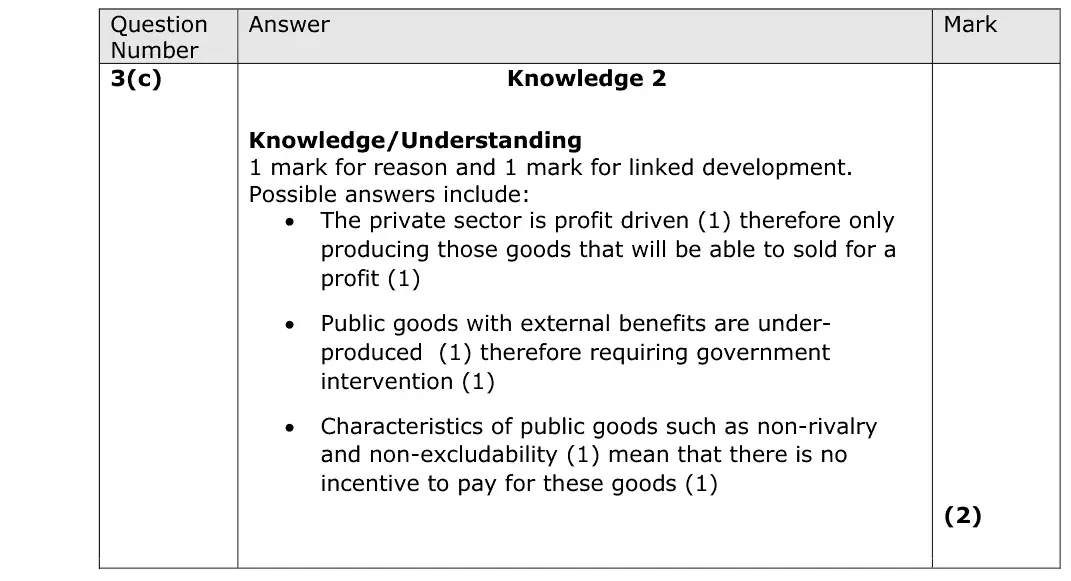
June 2025 · AS Paper 1 · Q3(c)2 marksAO1=2Short answer
Mark scheme
Examiner's comment
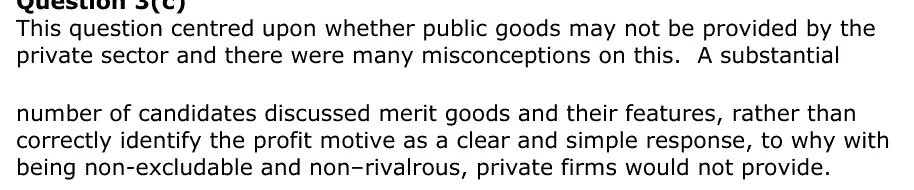
This question centred upon whether public goods may not be provided by the private sector and there were many misconceptions on this. A substantial number of candidates discussed merit goods and their features, rather than correctly identify the profit motive as a clear and simple response, to why with being non-excludable and non–rivalrous, private firms would not provide.
Notes from the mark scheme and report
non-excludable and non-rival so consumers free ride and firms cannot charge, so there is no profit incentive to provide
report: a substantial number wrongly discussed merit goods
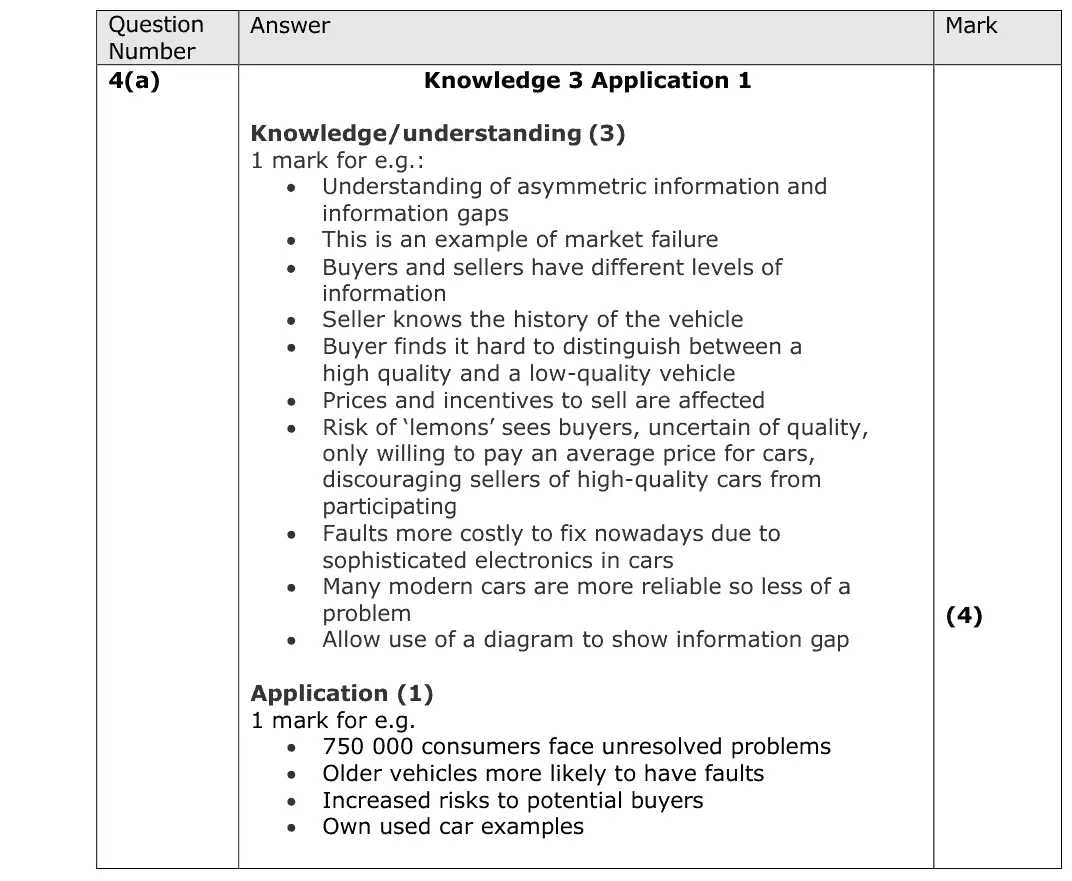
June 2025 · Paper 1 · Q4(a)4 marksAO1=3, AO2=1Short answer
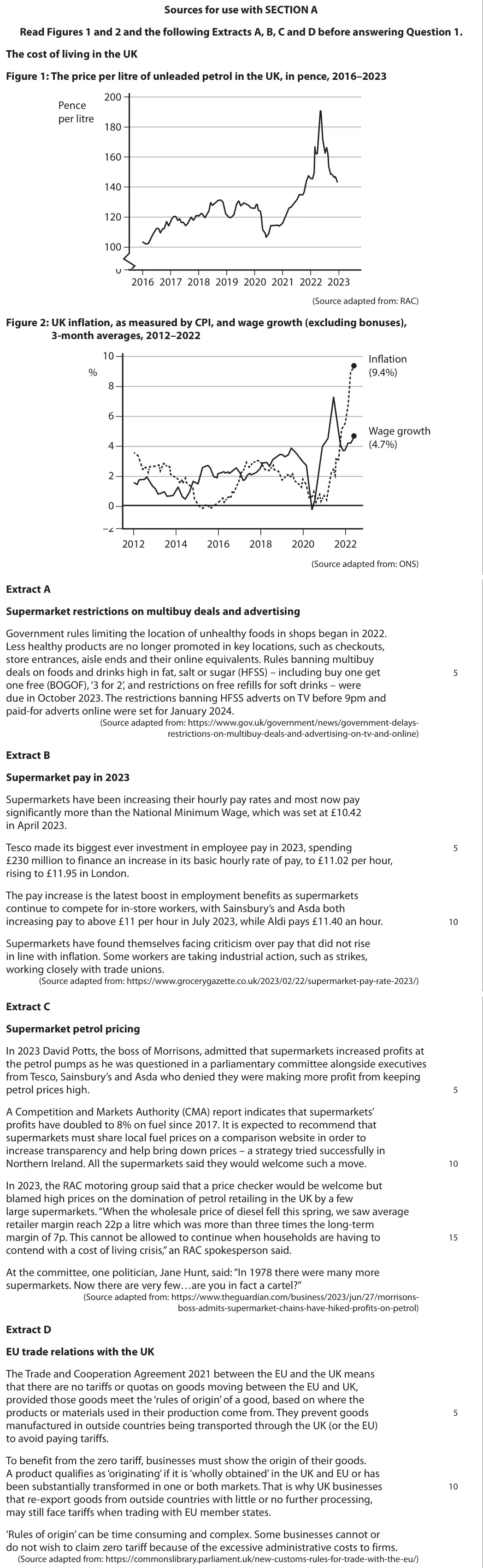
Data and extracts for question 4
Mark scheme
Examiner's comment
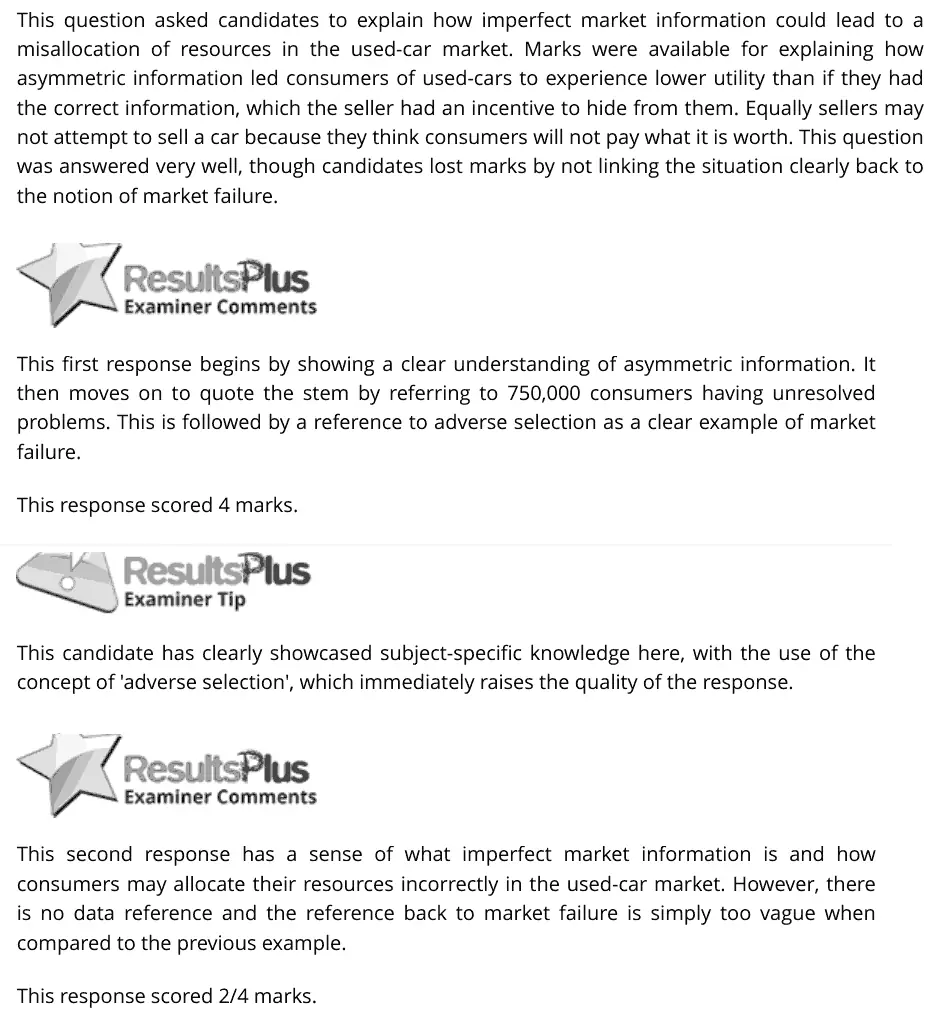
This question asked candidates to explain how imperfect market information could lead to a misallocation of resources in the used-car market. Marks were available for explaining how asymmetric information led consumers of used-cars to experience lower utility than if they had the correct information, which the seller had an incentive to hide from them. Equally sellers may not attempt to sell a car because they think consumers will not pay what it is worth. This question was answered very well, though candidates lost marks by not linking the situation clearly back to the notion of market failure. This first response begins by showing a clear understanding of asymmetric information. It then moves on to quote the stem by referring to 750,000 consumers having unresolved problems. This is followed by a reference to adverse selection as a clear example of market failure. This response scored 4 marks. This candidate has clearly showcased subject-specific knowledge here, with the use of the concept of 'adverse selection', which immediately raises the quality of the response. This second response has a sense of what imperfect market information is and how consumers may allocate their resources incorrectly in the used-car market. However, there is no data reference and the reference back to market failure is simply too vague when compared to the previous example. This response scored 2/4 marks.
Notes from the mark scheme and report
asymmetric information: the seller knows the car's history, buyers pay an average price so good cars are withdrawn (adverse selection)
link clearly to market failure and misallocation
1 application mark e.g. 750 000 consumers with unresolved problems
Quantitative skills: QS 9 (interpret, apply and analyse information in written, graphical tabular and numerical forms)
June 2025 · Paper 3 · Q1(a)5 marksAO1=2, AO2=2, AO3=1Short answer
Data and extracts for question 1
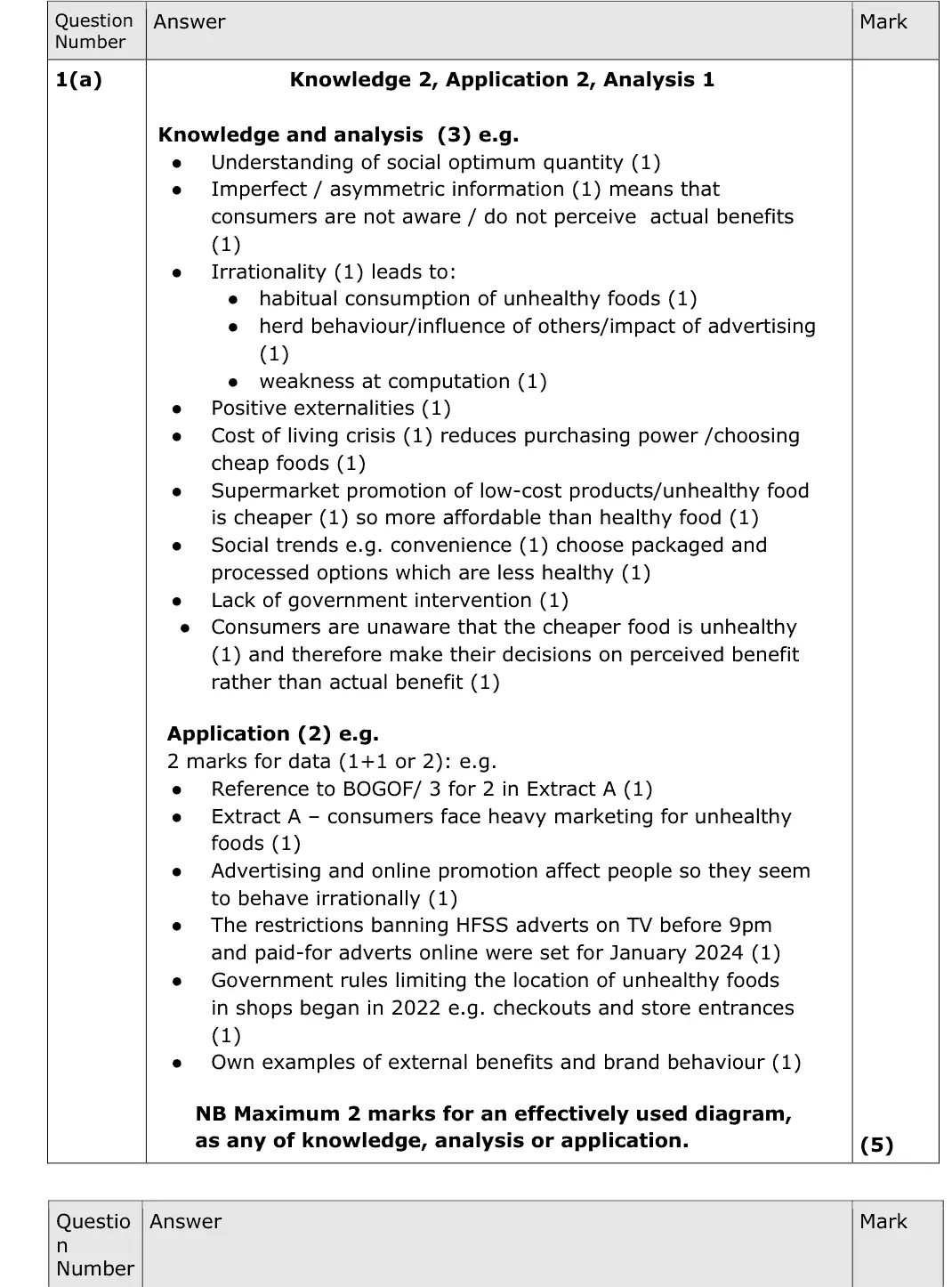
Mark scheme
Examiner's comment
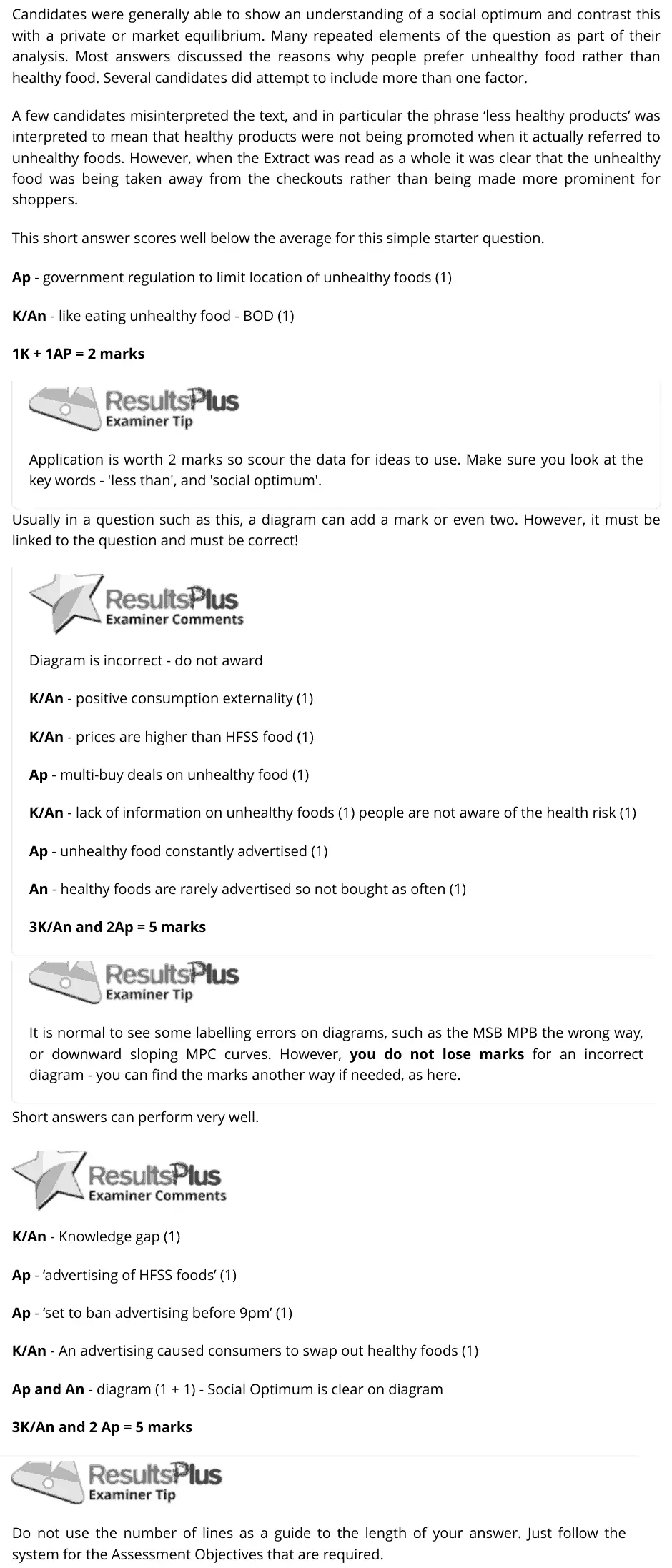
Candidates were generally able to show an understanding of a social optimum and contrast this with a private or market equilibrium. Many repeated elements of the question as part of their analysis. Most answers discussed the reasons why people prefer unhealthy food rather than healthy food. Several candidates did attempt to include more than one factor. A few candidates misinterpreted the text, and in particular the phrase ‘less healthy products’ was interpreted to mean that healthy products were not being promoted when it actually referred to unhealthy foods. However, when the Extract was read as a whole it was clear that the unhealthy food was being taken away from the checkouts rather than being made more prominent for shoppers. This short answer scores well below the average for this simple starter question. Ap - government regulation to limit location of unhealthy foods (1) K/An - like eating unhealthy food - BOD (1) 1K + 1AP = 2 marks Application is worth 2 marks so scour the data for ideas to use. Make sure you look at the key words - 'less than', and 'social optimum'. Usually in a question such as this, a diagram can add a mark or even two. However, it must be linked to the question and must be correct! Diagram is incorrect - do not award K/An - positive consumption externality (1) K/An - prices are higher than HFSS food (1) Ap - multi-buy deals on unhealthy food (1) K/An - lack of information on unhealthy foods (1) people are not aware of the health risk (1) Ap - unhealthy food constantly advertised (1) An - healthy foods are rarely advertised so not bought as often (1) 3K/An and 2Ap = 5 marks It is normal to see some labelling errors on diagrams, such as the MSB MPB the wrong way, or downward sloping MPC curves. However, you do not lose marks for an incorrect diagram - you can find the marks another way if needed, as here. Short answers can perform very well. K/An - Knowledge gap (1) Ap - ‘advertising of HFSS foods’ (1) Ap - ‘set to ban advertising before 9pm’ (1) K/An - An advertising caused consumers to swap out healthy foods (1) Ap and An - diagram (1 + 1) - Social Optimum is clear on diagram 3K/An and 2 Ap = 5 marks Do not use the number of lines as a guide to the length of your answer. Just follow the system for the Assessment Objectives that are required.
Notes from the mark scheme and report
define the social optimum vs market equilibrium
reasons: information gaps (benefits not perceived), positive consumption externalities, irrational habitual/herd behaviour, cheap unhealthy food
use Extract A (BOGOF, HFSS rules) for application
'less healthy products' refers to unhealthy food
max 2 for a diagram, which must be correct
June 2023 · AS Paper 1 · Q6(c)10 marksAO1=2, AO2=2, AO3=2, AO4=410-mark response
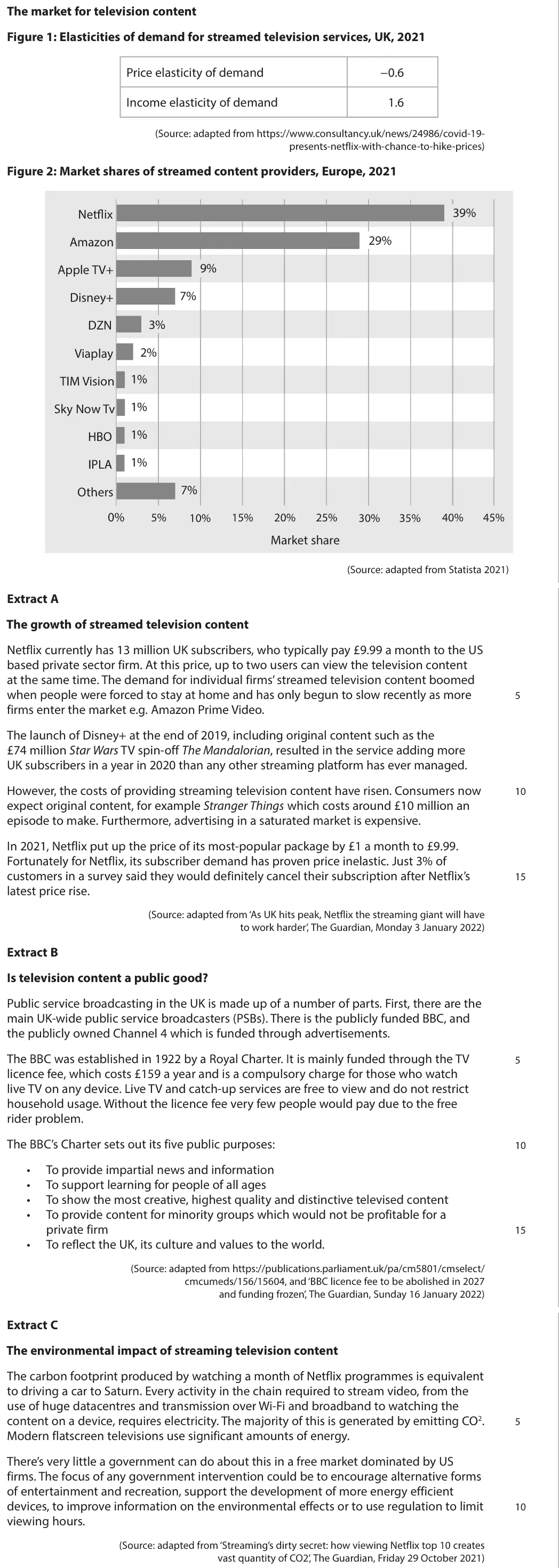
Data and extracts for question 6
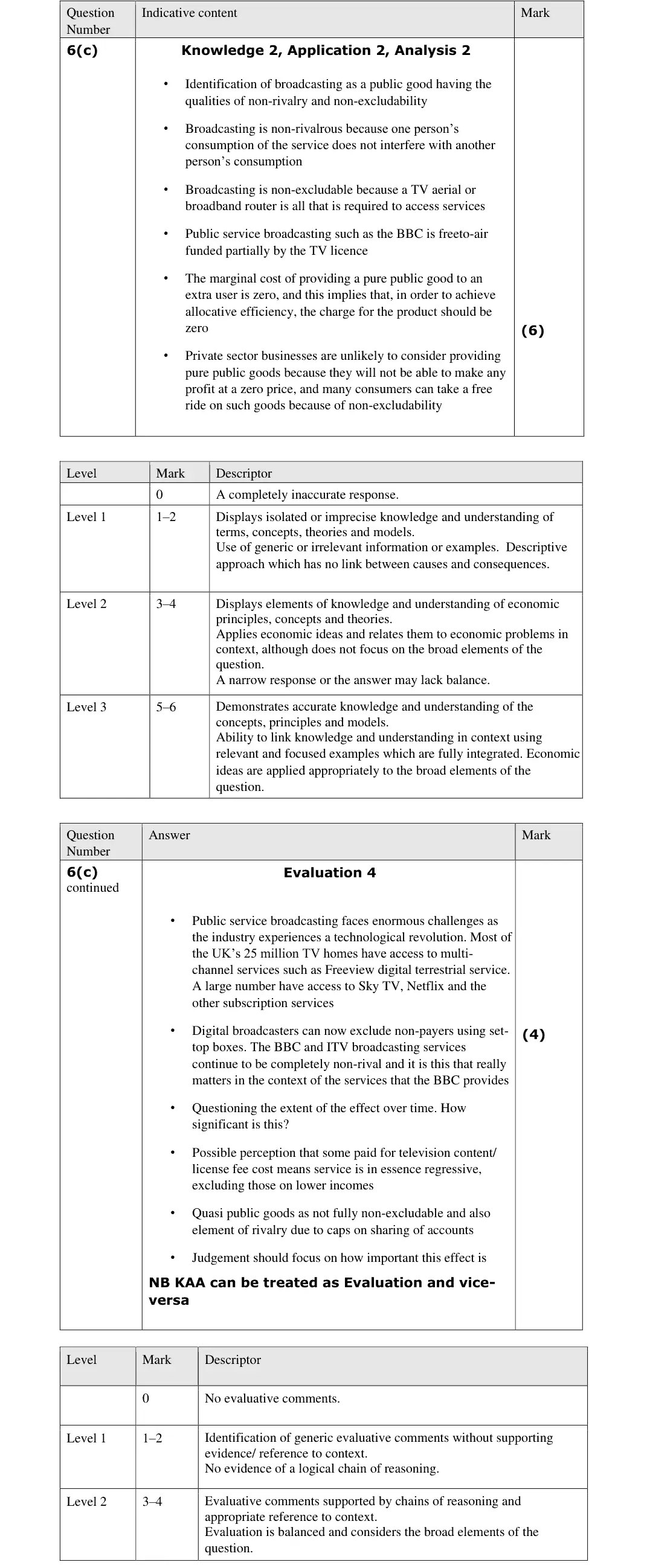
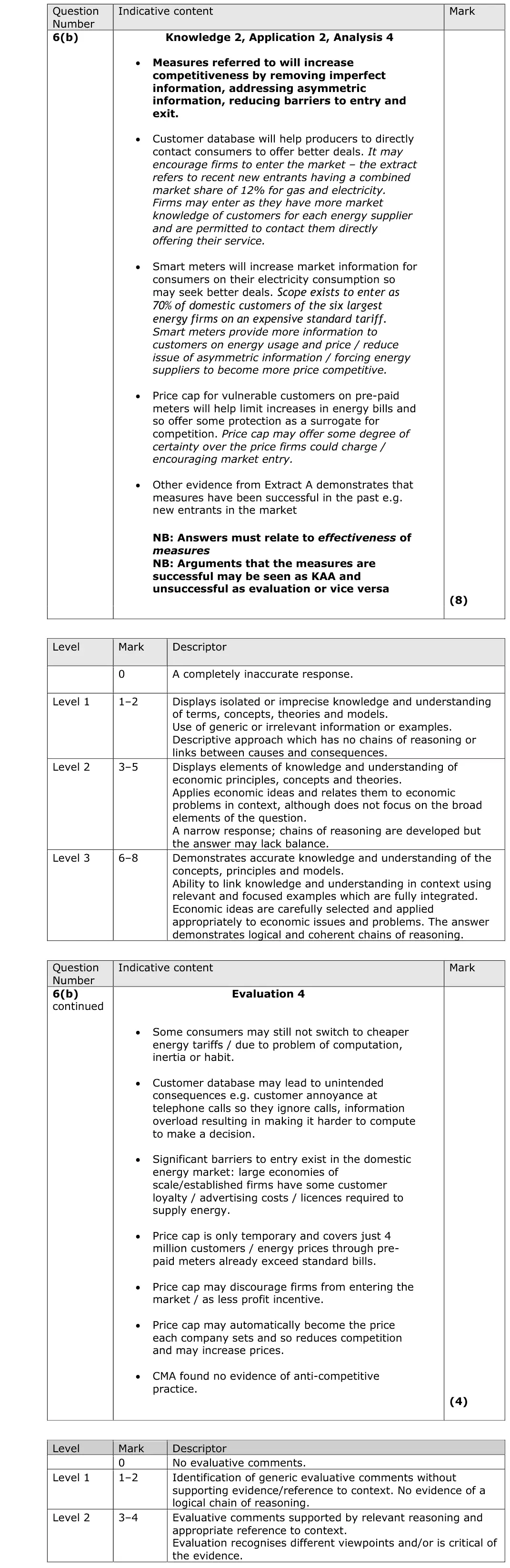
Mark scheme, including the levels grid and indicative content
Examiner's comment
Extract B contained plenty of information candidates could use to consider the characteristics of whether or not television content is a public good, in reference to Netflix shared accounts and license fees for. The key concepts of non-excludability and non-rivalry were applied to the situation well in the majority of responses. Better candidates offered multiple points, and applied this well.
Notes from the mark scheme and report
test against non-rivalry and non-excludability: free to air, shared Netflix accounts, free rider problem without the licence fee
evaluate: subscriptions and paywalls make content excludable, so it is quasi-public or private
June 2022 · AS Paper 1 · Q1(a)1 markMultiple choice
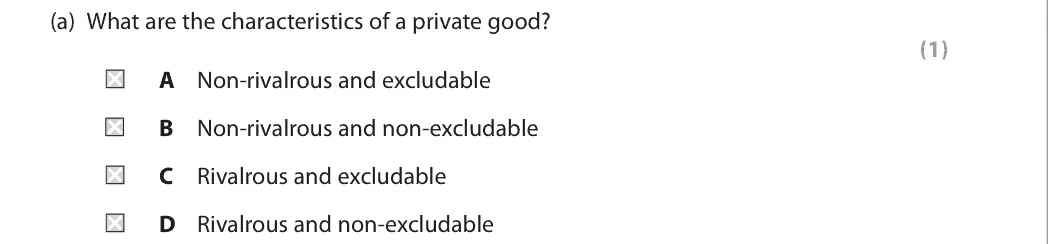
Data and extracts for question 1
Answer
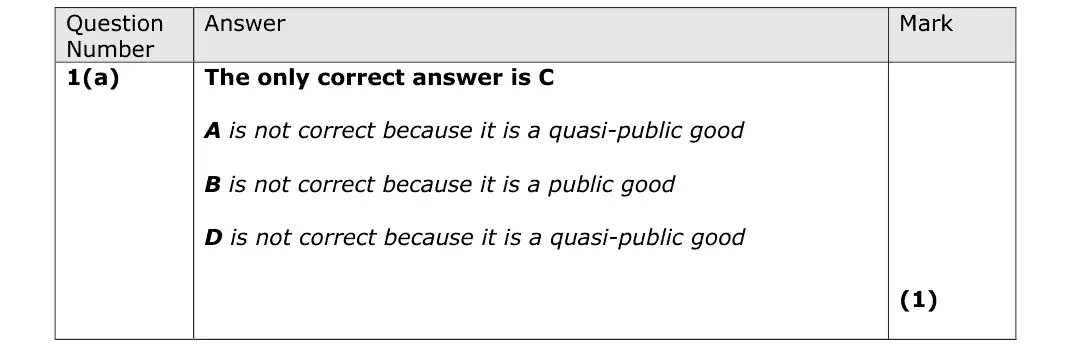
C
Mark scheme
Notes from the mark scheme and report
a private good is rivalrous and excludable (C)
non-rival and non-excludable is a public good (B)
A and D are quasi-public goods
June 2022 · AS Paper 1 · Q1(b)3 marksAO1=1, AO2=1, AO3=1Short answer
Data and extracts for question 1
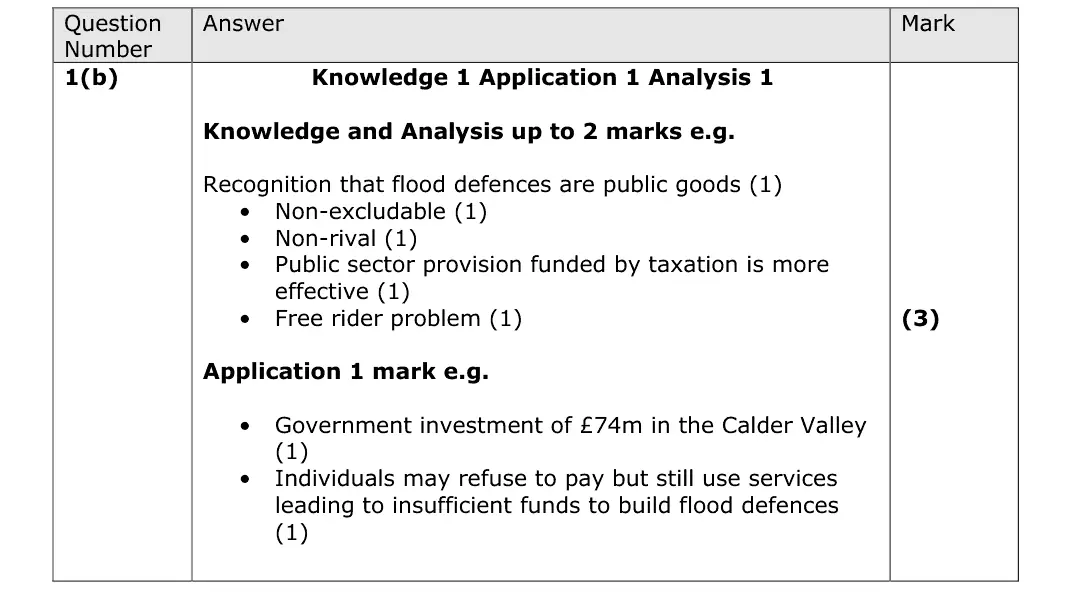
Mark scheme
Examiner's comment
Candidates typically performed well on this question, with most able to explain why flood defences are provided by the public sector. Many candidates were able to put explanations in the context of the Calder Valley, which was necessary to gain the application mark.
Notes from the mark scheme and report
flood defences are non-excludable and non-rival so the free rider problem means the market would not provide them
state provision funded by taxation
apply the £74m Calder Valley scheme for the application mark
June 2019 · AS Paper 1 · Q6(b)6 marksAO1=2, AO2=2, AO3=2Short answer
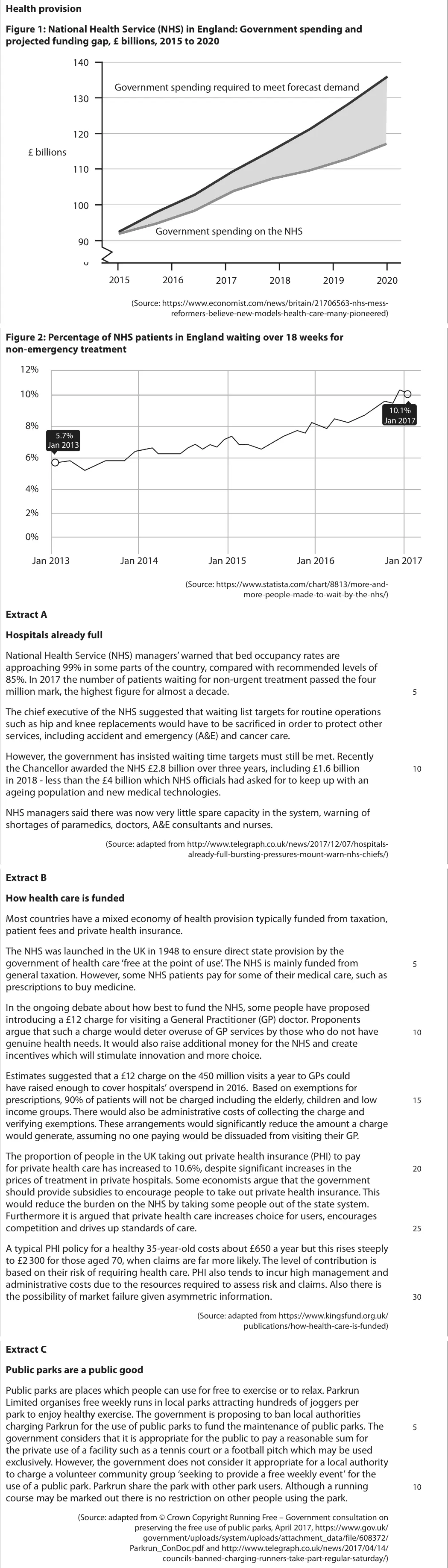
Data and extracts for question 6
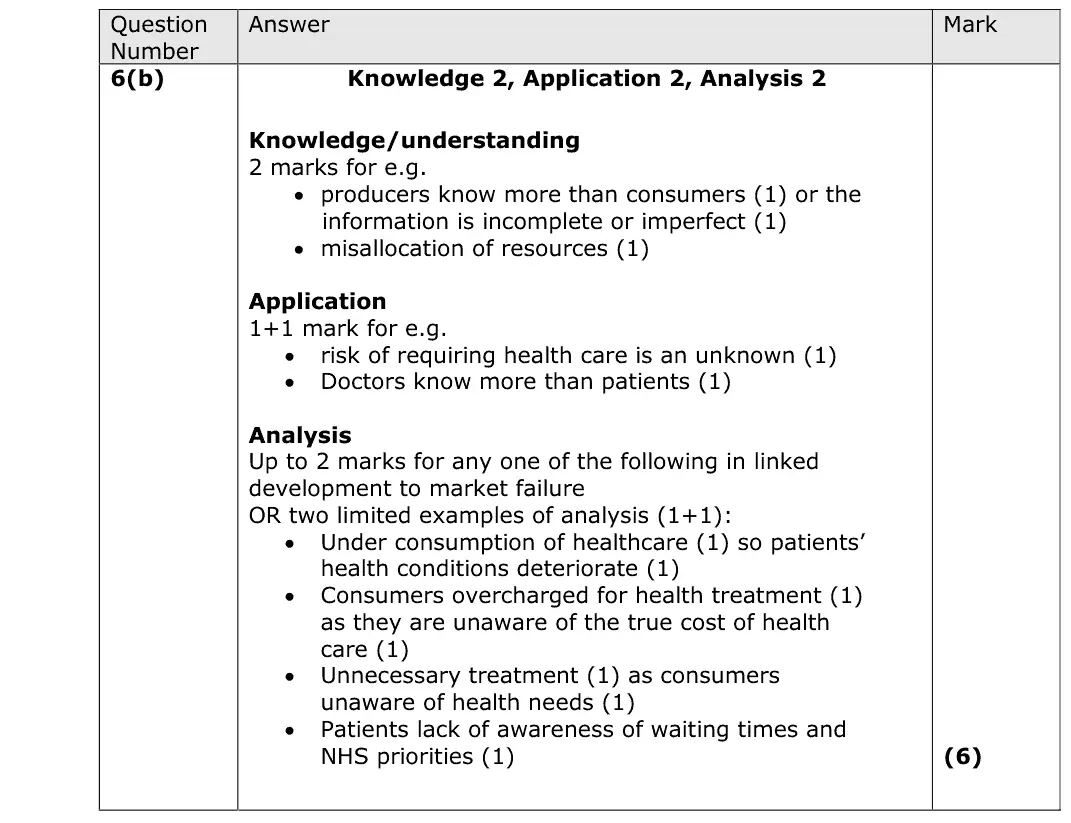
Mark scheme
Examiner's comment
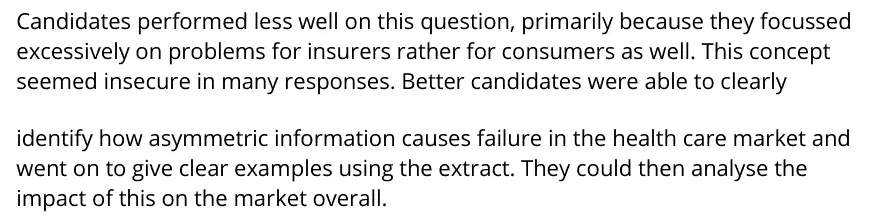
Candidates performed less well on this question, primarily because they focussed excessively on problems for insurers rather for consumers as well. This concept seemed insecure in many responses. Better candidates were able to clearly identify how asymmetric information causes failure in the health care market and went on to give clear examples using the extract. They could then analyse the impact of this on the market overall.
Notes from the mark scheme and report
one party (doctors, insurers) knows more than the other
link to market failure: under-consumption of healthcare, overcharging, unnecessary treatment
many focused only on problems for insurers rather than consumers
June 2019 · AS Paper 1 · Q6(c)10 marksAO1=2, AO2=2, AO3=2, AO4=410-mark response
Data and extracts for question 6
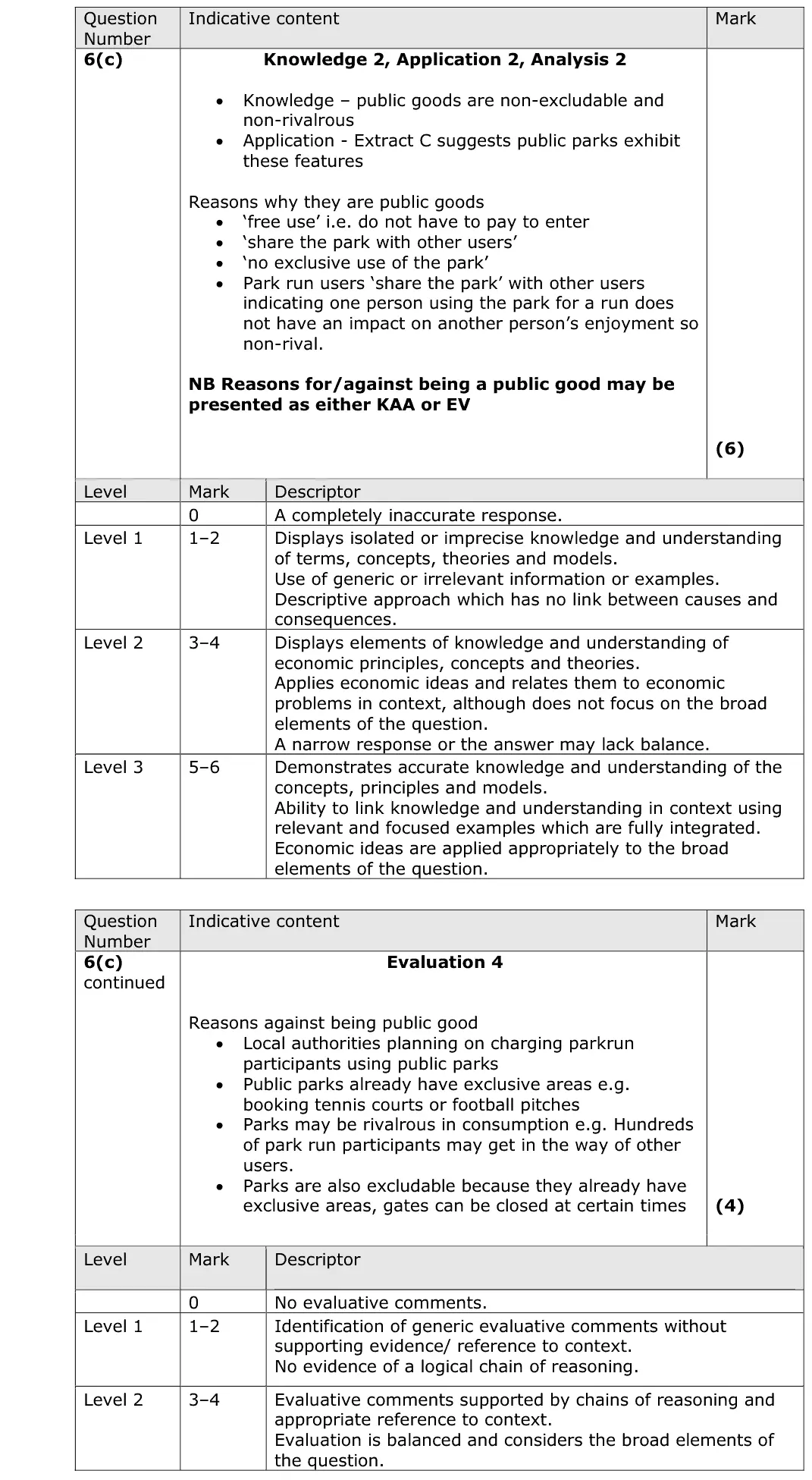
Mark scheme, including the levels grid and indicative content
Examiner's comment
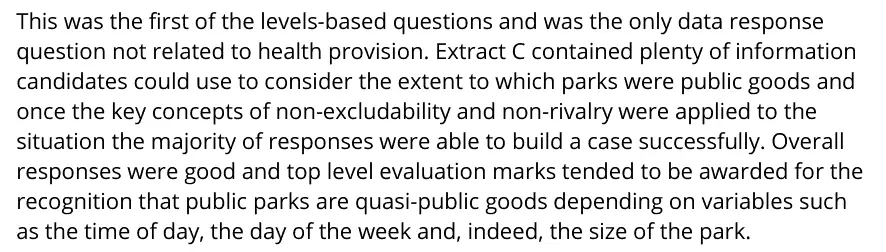
This was the first of the levels-based questions and was the only data response question not related to health provision. Extract C contained plenty of information candidates could use to consider the extent to which parks were public goods and once the key concepts of non-excludability and non-rivalry were applied to the situation the majority of responses were able to build a case successfully. Overall responses were good and top level evaluation marks tended to be awarded for the recognition that public parks are quasi-public goods depending on variables such as the time of day, the day of the week and, indeed, the size of the park.
Notes from the mark scheme and report
test the park against non-excludability and non-rivalry using Extract C (free use, shared with other users)
evaluate: quasi-public good, exclusive pitches and courts, congestion at busy times, charges for Parkrun
June 2019 · Paper 1 · Q6(c)10 marksAO1=2, AO2=2, AO3=2, AO4=410-mark response
Data and extracts for question 6
Mark scheme, including the levels grid and indicative content
Examiner's comment
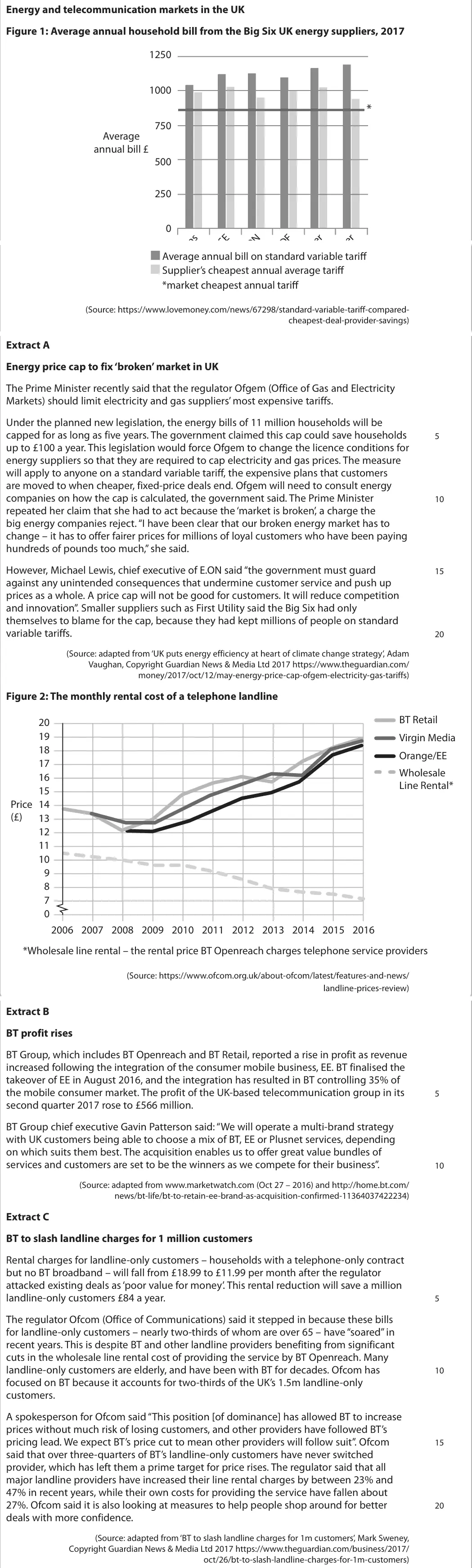
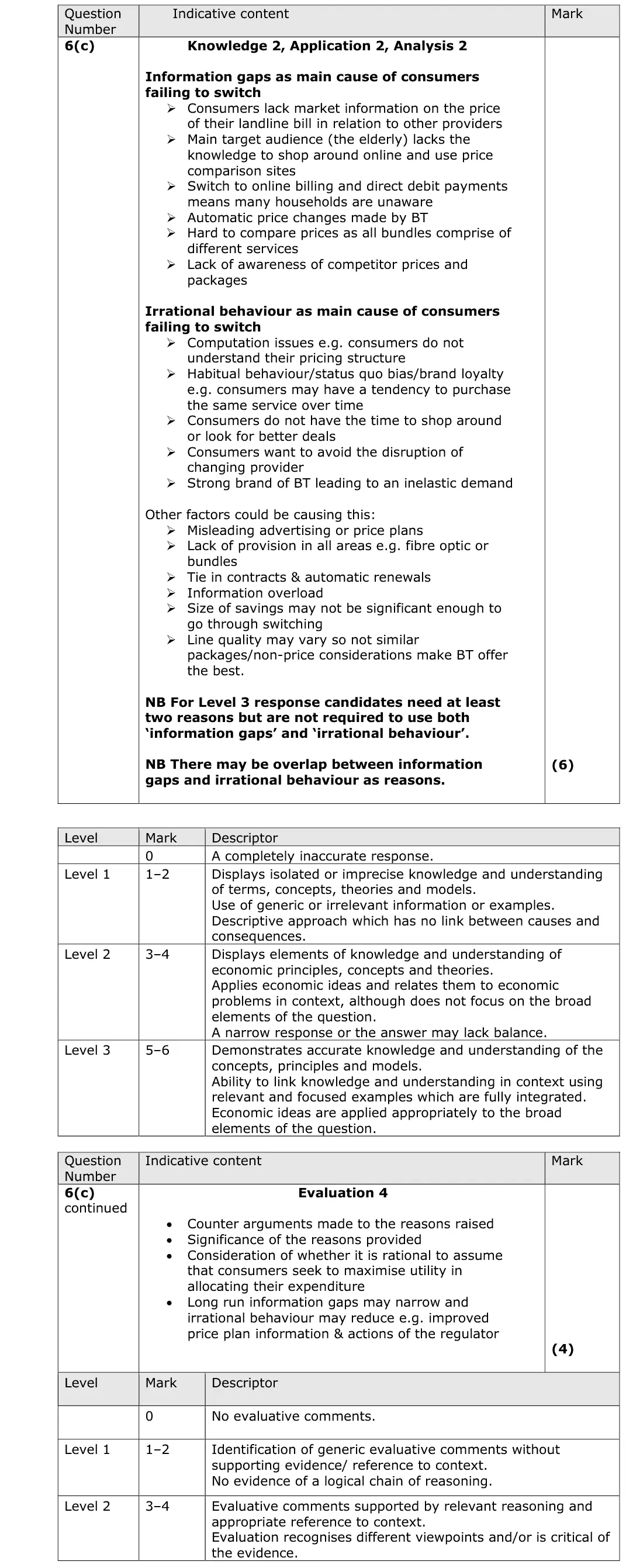
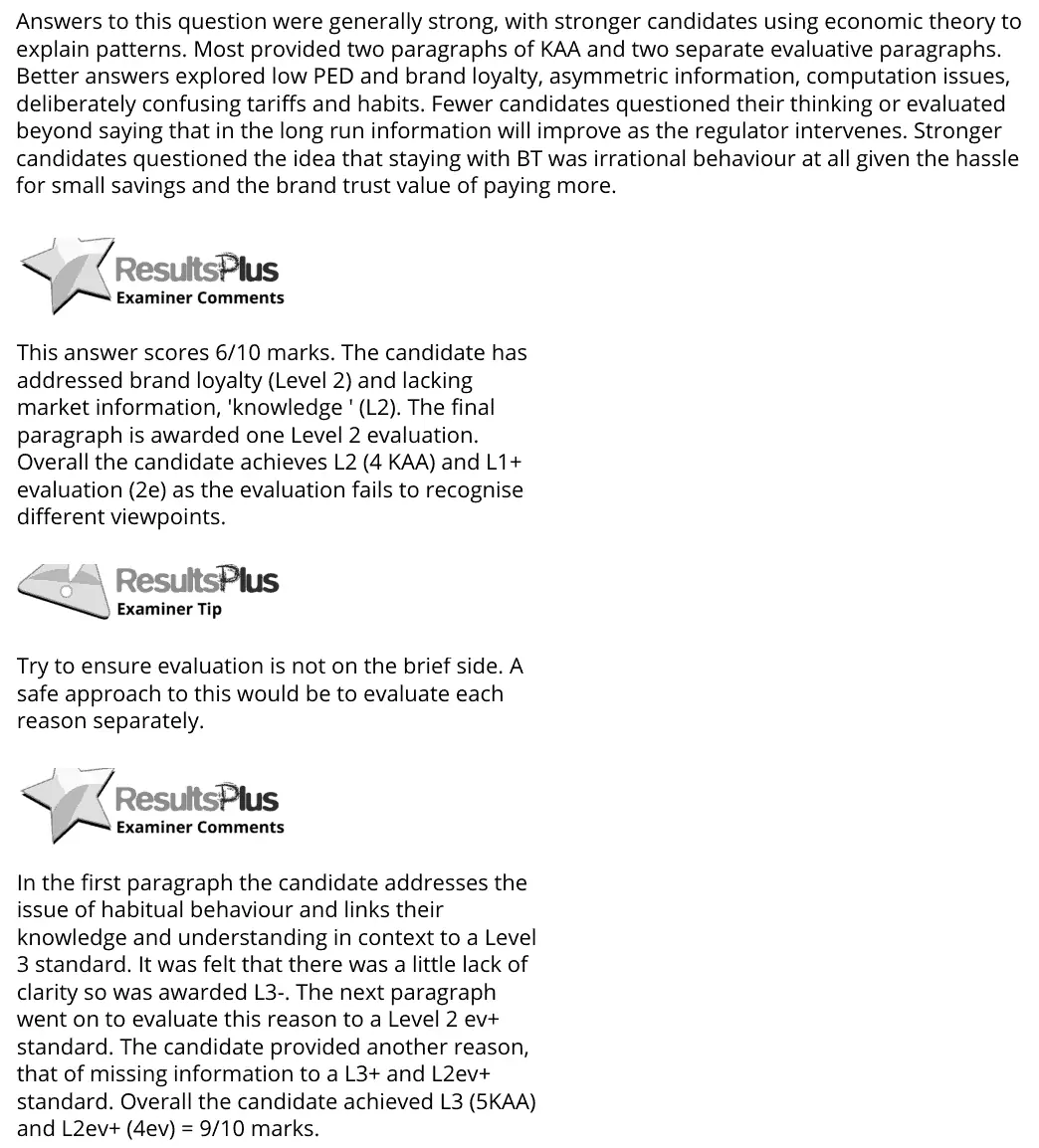
Answers to this question were generally strong, with stronger candidates using economic theory to explain patterns. Most provided two paragraphs of KAA and two separate evaluative paragraphs. Better answers explored low PED and brand loyalty, asymmetric information, computation issues, deliberately confusing tariffs and habits. Fewer candidates questioned their thinking or evaluated beyond saying that in the long run information will improve as the regulator intervenes. Stronger candidates questioned the idea that staying with BT was irrational behaviour at all given the hassle for small savings and the brand trust value of paying more. This answer scores 6/10 marks. The candidate has addressed brand loyalty (Level 2) and lacking market information, 'knowledge ' (L2). The final paragraph is awarded one Level 2 evaluation. Overall the candidate achieves L2 (4 KAA) and L1+ evaluation (2e) as the evaluation fails to recognise different viewpoints. Try to ensure evaluation is not on the brief side. A safe approach to this would be to evaluate each reason separately. In the first paragraph the candidate addresses the issue of habitual behaviour and links their knowledge and understanding in context to a Level 3 standard. It was felt that there was a little lack of clarity so was awarded L3-. The next paragraph went on to evaluate this reason to a Level 2 ev+ standard. The candidate provided another reason, that of missing information to a L3+ and L2ev+ standard. Overall the candidate achieved L3 (5KAA) and L2ev+ (4ev) = 9/10 marks.
Notes from the mark scheme and report
information gaps (elderly customers cannot compare prices) and irrational behaviour (habit, computation, brand loyalty, status quo bias)
Level 3 needs at least two reasons
evaluate e.g. small savings may make staying rational
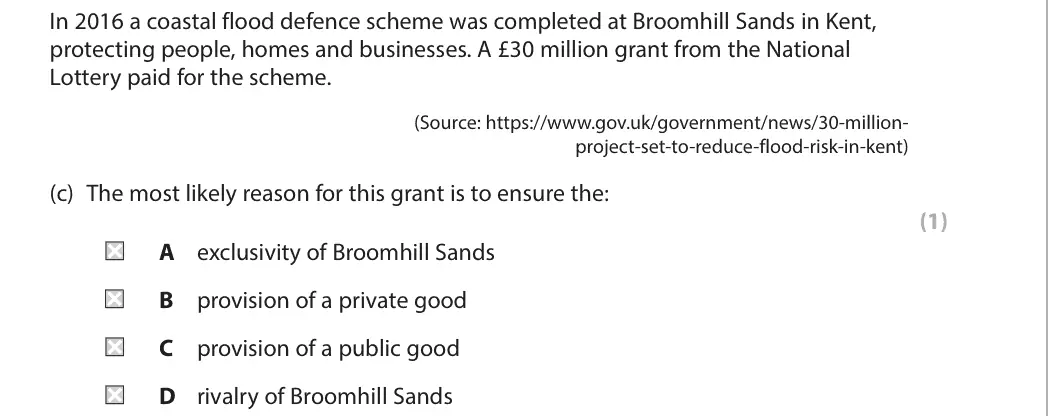
June 2018 · Paper 1 · Q2(c)1 markMultiple choice
Data and extracts for question 2
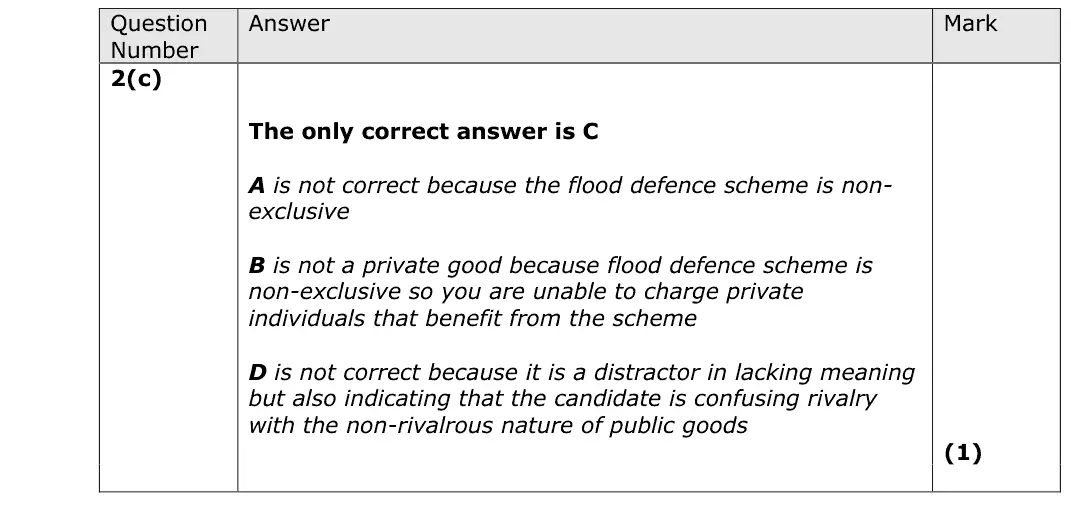
Answer
C
Mark scheme
Notes from the mark scheme and report
the flood defence scheme is non-excludable and non-rival, a public good (C)
B wrong as non-payers cannot be excluded
A and D misuse excludability and rivalry
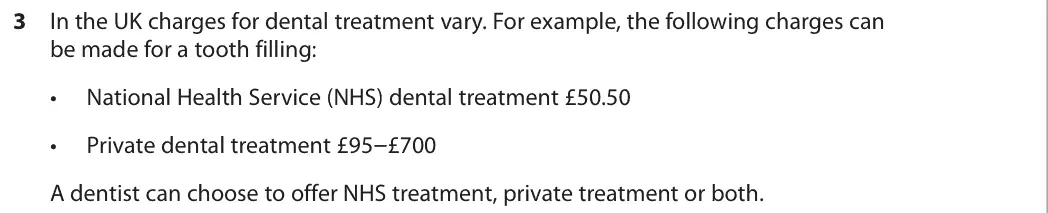
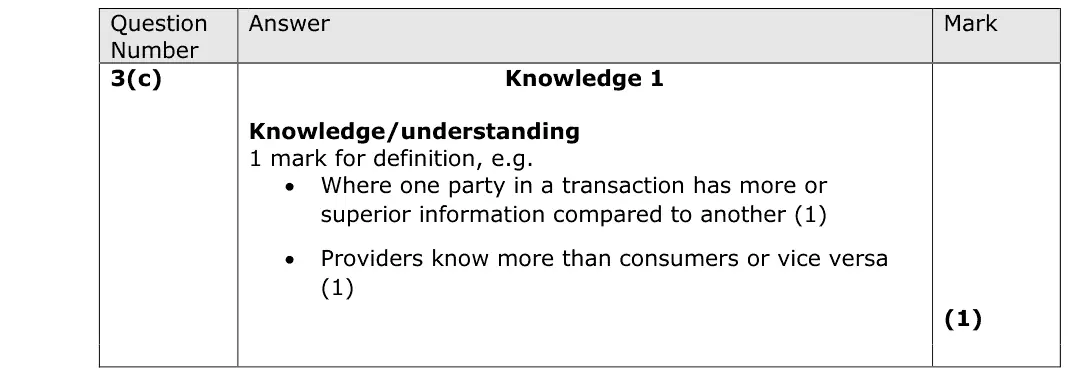
June 2018 · AS Paper 1 · Q3(c)1 markAO1=1Definition
Data and extracts for question 3
Mark scheme
Examiner's comment
A large majority of candidates were able to identify 'asymmetric information' as a situation where one party in a transaction has more or superior information than another. Many applied it to dentists knowing more about the need for treatment than patients, and thus charging them for 'unnecessary' work. The example of second-hand car dealers knowing more about the history of a vehicle than prospective customers was also very popular. A precise definition, referring clearly to 'the trading process', which is sufficient to gain the mark. It is important to focus on 'the transaction', 'trading process' or something very similar here to be sufficiently clear. This is an answer that stresses the unequal nature of the information and then links it to a commercial transaction, though not explicitly. It also identifies the fact that consumers can sometimes have more information than producers. The first part of the answer is rather vague but the mention of 'producers' and 'consumers' is sufficient to gain the mark. Here the candidate fails to identify the 'asymmetry' of the information, stating that the business and consumers 'know the same amount of information. 0 marks. Key definitions should be learned precisely.
Notes from the mark scheme and report
one party to a transaction has more or better information than the other (e.g. dentists know more than patients)
refer to the transaction
June 2018 · AS Paper 1 · Q5(c)1 markMultiple choice
Data and extracts for question 5
Answer
C
Mark scheme
Notes from the mark scheme and report
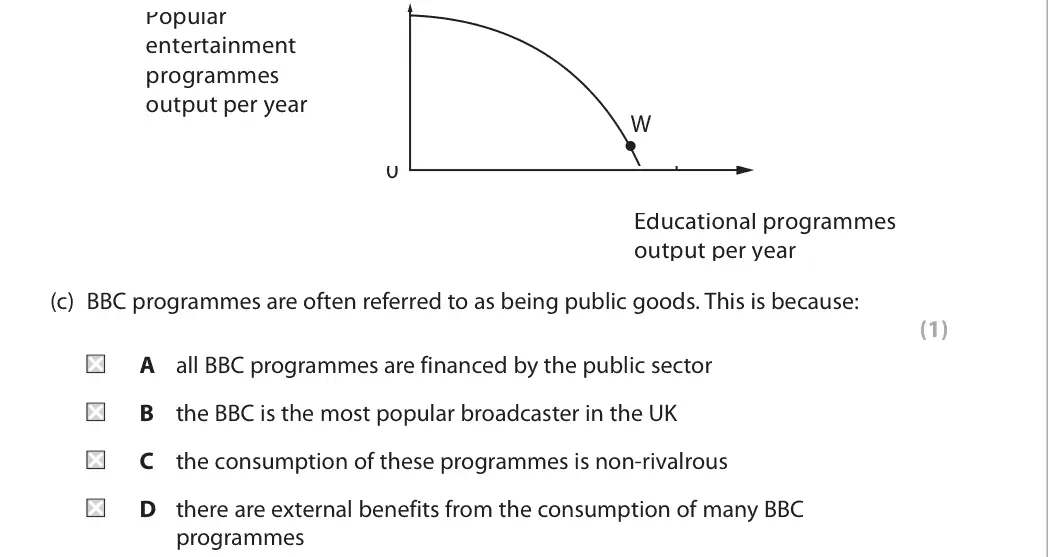
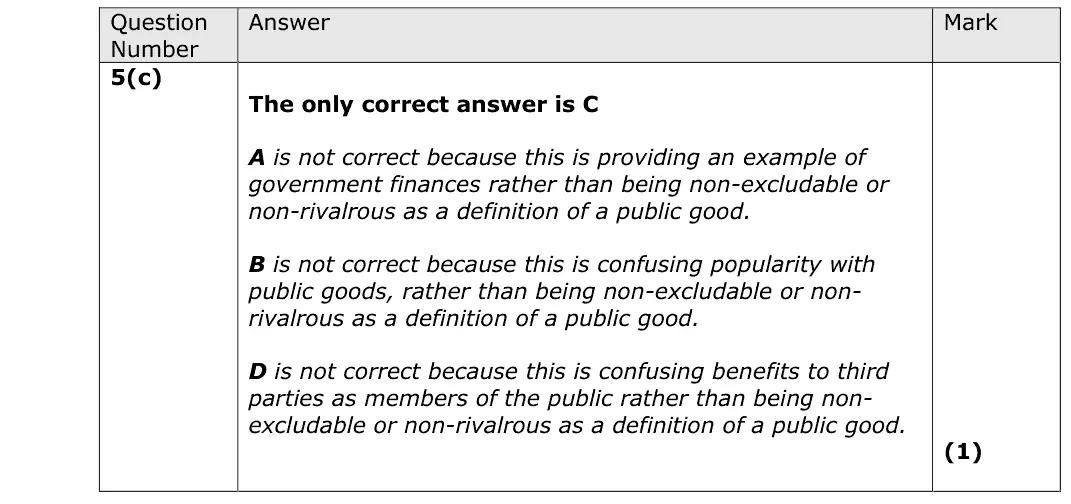
public goods are non-rival (and non-excludable), so C
public finance, popularity and external benefits do not make a good public
June 2018 · Paper 1 · Q6(b)12 marksAO1=2, AO2=2, AO3=4, AO4=412-mark response
Data and extracts for question 6
Mark scheme, including the levels grid and indicative content
Examiner's comment
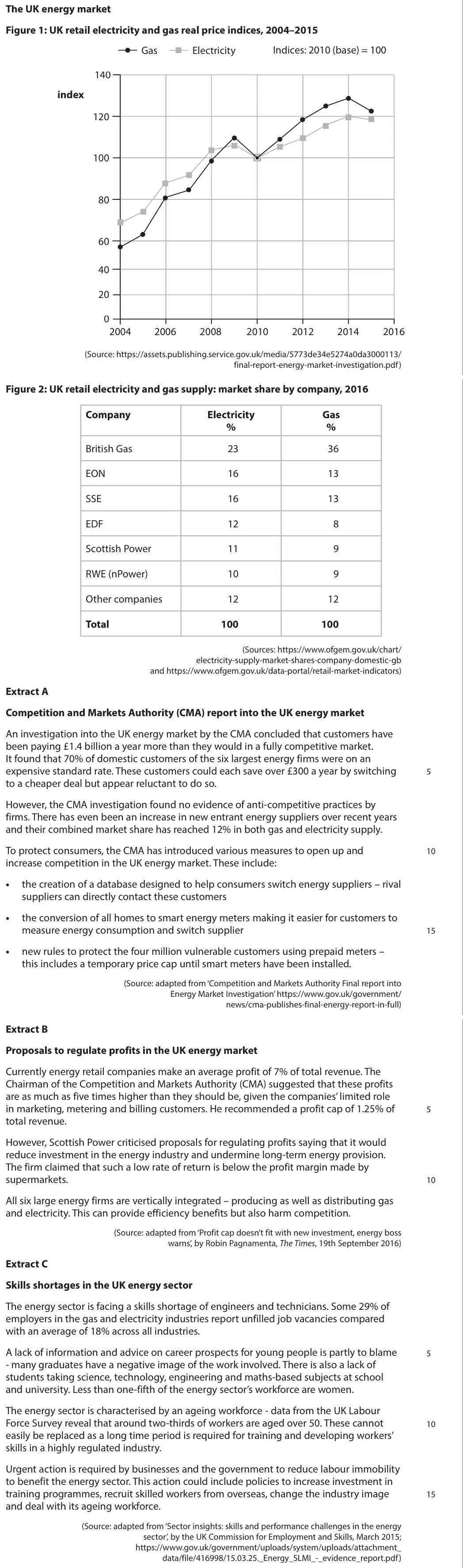
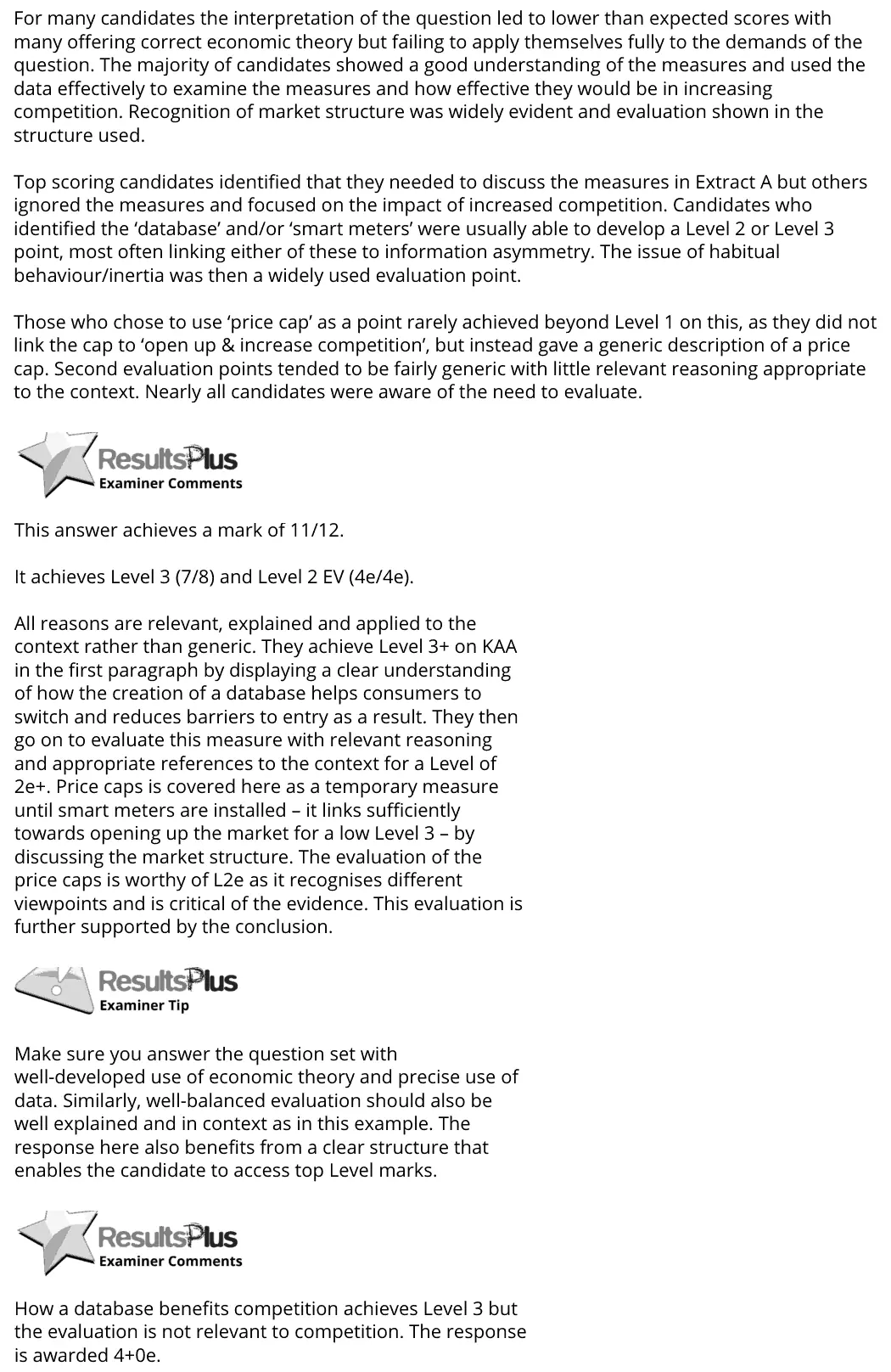
For many candidates the interpretation of the question led to lower than expected scores with many offering correct economic theory but failing to apply themselves fully to the demands of the question. The majority of candidates showed a good understanding of the measures and used the data effectively to examine the measures and how effective they would be in increasing competition. Recognition of market structure was widely evident and evaluation shown in the structure used. Top scoring candidates identified that they needed to discuss the measures in Extract A but others ignored the measures and focused on the impact of increased competition. Candidates who identified the ‘database’ and/or ‘smart meters’ were usually able to develop a Level 2 or Level 3 point, most often linking either of these to information asymmetry. The issue of habitual behaviour/inertia was then a widely used evaluation point. Those who chose to use ‘price cap’ as a point rarely achieved beyond Level 1 on this, as they did not link the cap to ‘open up & increase competition’, but instead gave a generic description of a price cap. Second evaluation points tended to be fairly generic with little relevant reasoning appropriate to the context. Nearly all candidates were aware of the need to evaluate. This answer achieves a mark of 11/12. It achieves Level 3 (7/8) and Level 2 EV (4e/4e). All reasons are relevant, explained and applied to the context rather than generic. They achieve Level 3+ on KAA in the first paragraph by displaying a clear understanding of how the creation of a database helps consumers to switch and reduces barriers to entry as a result. They then go on to evaluate this measure with relevant reasoning and appropriate references to the context for a Level of 2e+. Price caps is covered here as a temporary measure until smart meters are installed – it links sufficiently towards opening up the market for a low Level 3 – by discussing the market structure. The evaluation of the price caps is worthy of L2e as it recognises different viewpoints and is critical of the evidence. This evaluation is further supported by the conclusion. Make sure you answer the question set with well-developed use of economic theory and precise use of data. Similarly, well-balanced evaluation should also be well explained and in context as in this example. The response here also benefits from a clear structure that enables the candidate to access top Level marks. How a database benefits competition achieves Level 3 but the evaluation is not relevant to competition. The response is awarded 4+0e.
Notes from the mark scheme and report
discuss the Extract A measures (switching database, smart meters, price cap) not just the effects of more competition
link to asymmetric information and barriers to entry (new entrants 12% share)
price cap rarely beyond Level 1 unless linked to competition
evaluate with habitual behaviour and inertia
June 2017 · Paper 1 · Q6(d)10 marksAO1=2, AO2=2, AO3=2, AO4=410-mark responseHard
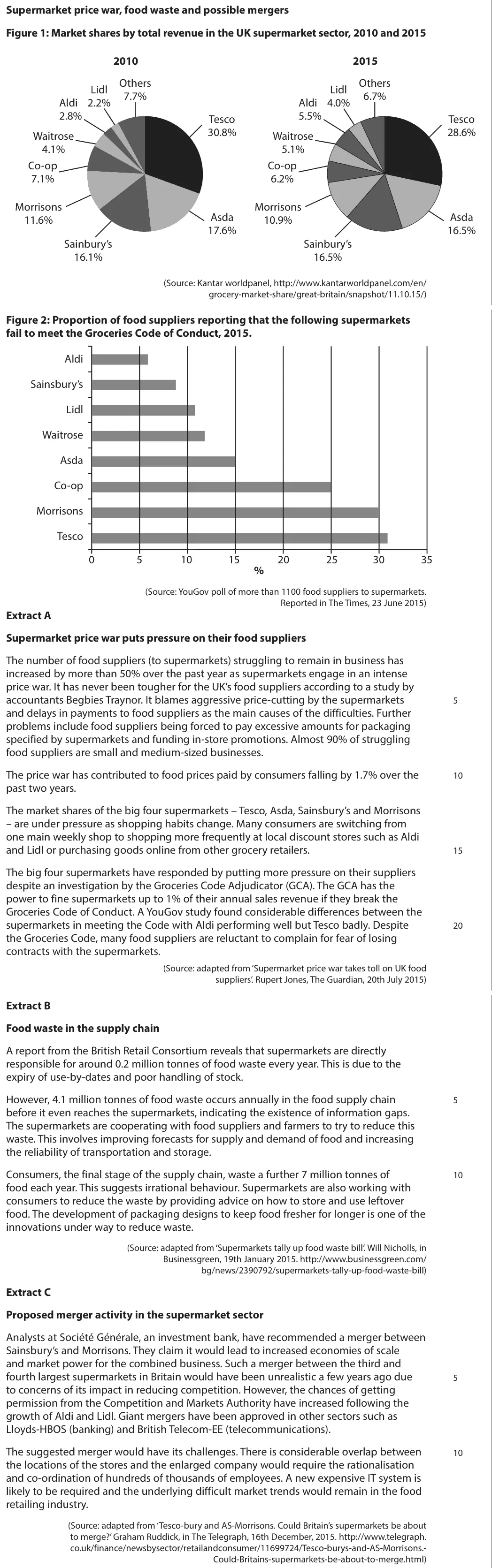
Data and extracts for question 6
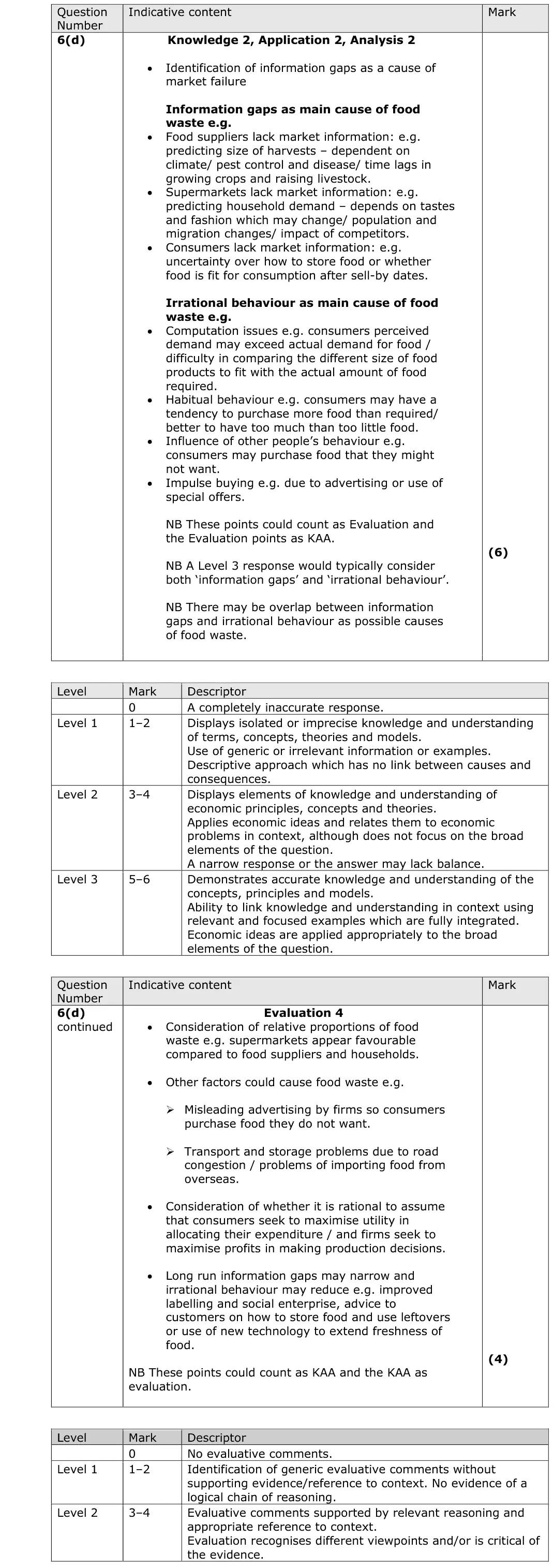
Mark scheme, including the levels grid and indicative content
Examiner's comment
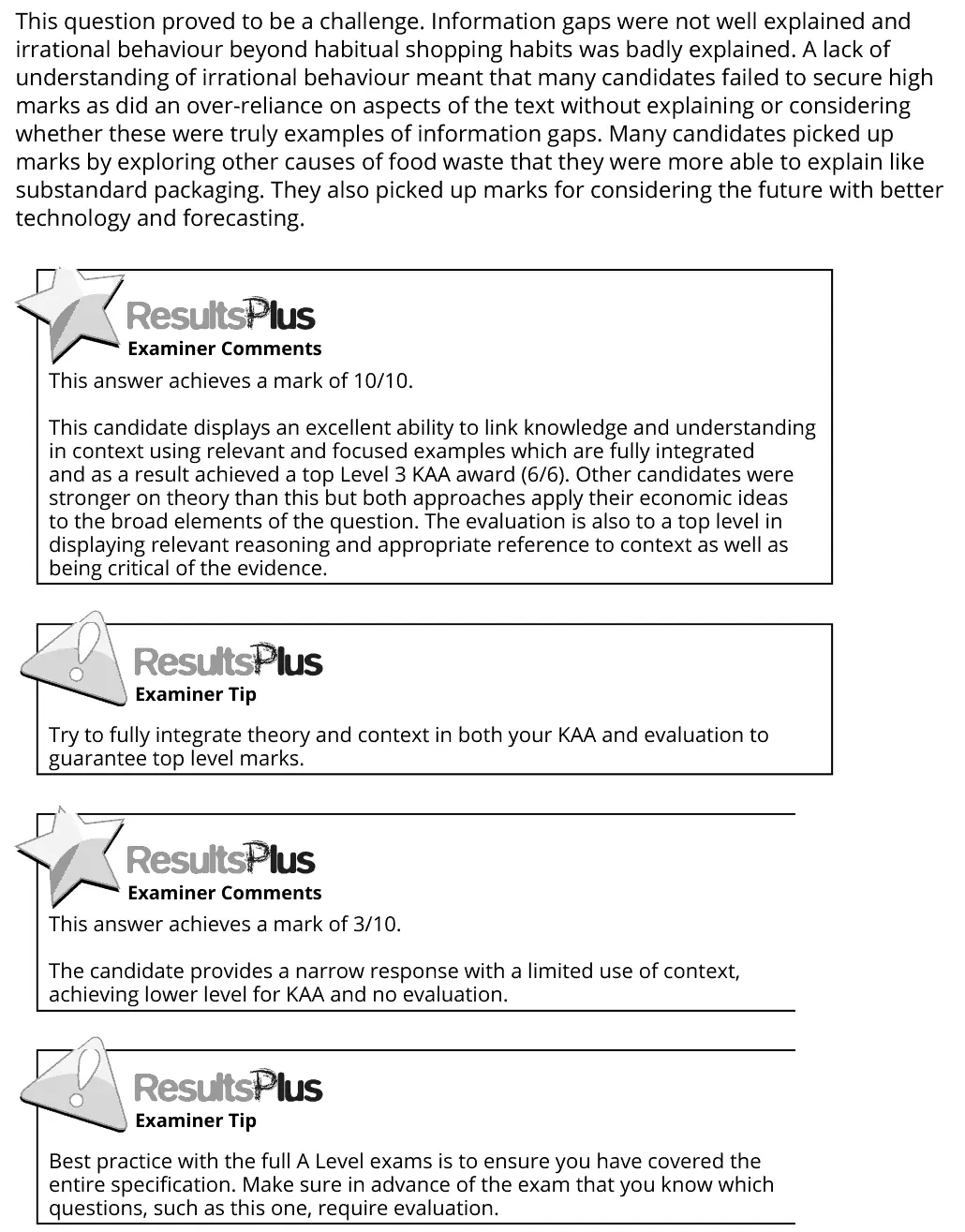
This question proved to be a challenge. Information gaps were not well explained and irrational behaviour beyond habitual shopping habits was badly explained. A lack of understanding of irrational behaviour meant that many candidates failed to secure high marks as did an over-reliance on aspects of the text without explaining or considering whether these were truly examples of information gaps. Many candidates picked up marks by exploring other causes of food waste that they were more able to explain like substandard packaging. They also picked up marks for considering the future with better technology and forecasting. This answer achieves a mark of 10/10. This candidate displays an excellent ability to link knowledge and understanding in context using relevant and focused examples which are fully integrated and as a result achieved a top Level 3 KAA award (6/6). Other candidates were stronger on theory than this but both approaches apply their economic ideas to the broad elements of the question. The evaluation is also to a top level in displaying relevant reasoning and appropriate reference to context as well as being critical of the evidence. Try to fully integrate theory and context in both your KAA and evaluation to guarantee top level marks. This answer achieves a mark of 3/10. The candidate provides a narrow response with a limited use of context, achieving lower level for KAA and no evaluation. Best practice with the full A Level exams is to ensure you have covered the entire specification. Make sure in advance of the exam that you know which questions, such as this one, require evaluation.
Notes from the mark scheme and report
information gaps: suppliers and supermarkets cannot forecast demand and harvests (4.1m tonnes before supermarkets)
irrational behaviour: habit, weak computation by consumers (7m tonnes)
evaluate with other causes e.g. packaging, use-by dates
report: "This question proved to be a challenge" and irrational behaviour was badly explained
June 2016 · AS Paper 1 · Q6(g)20 marksAO1=4, AO2=4, AO3=6, AO4=620-mark essayEither/or
Data and extracts for question 6
Mark scheme, including the levels grid and indicative content
Examiner's comment
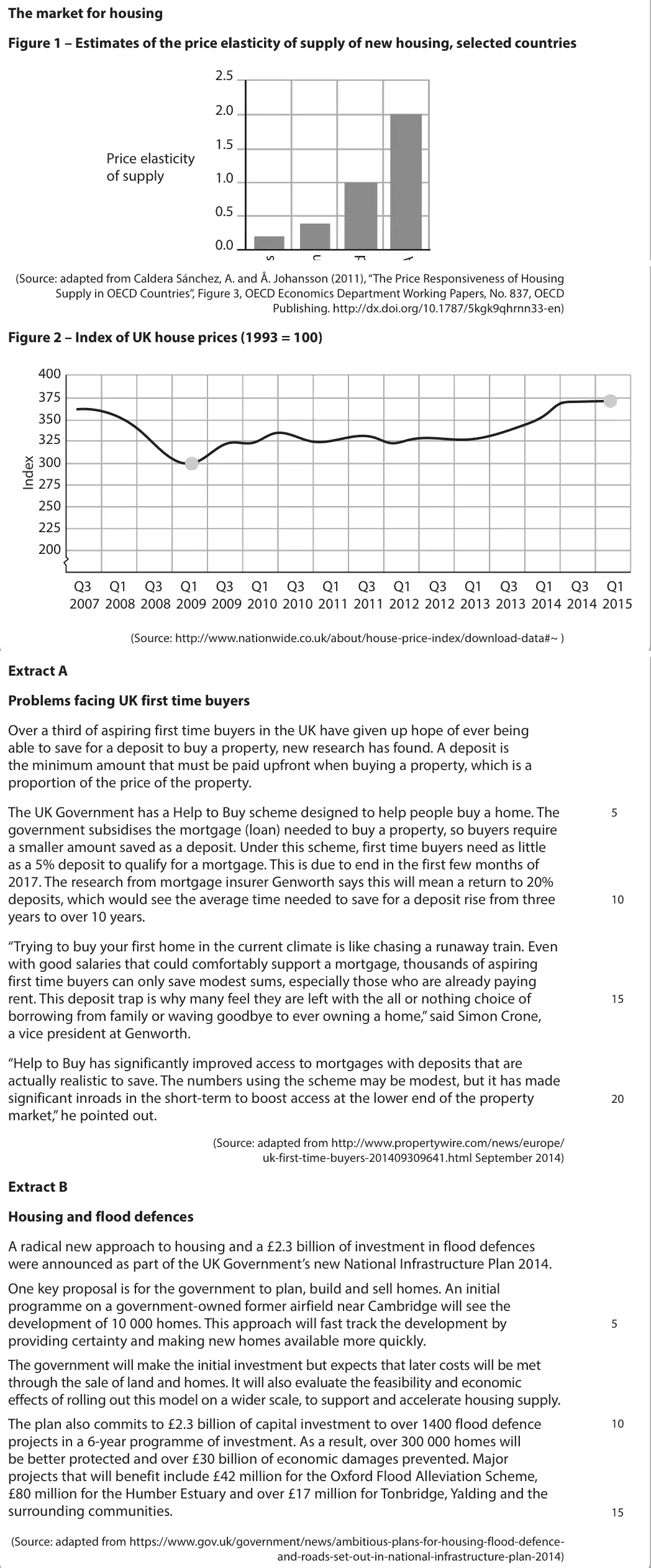
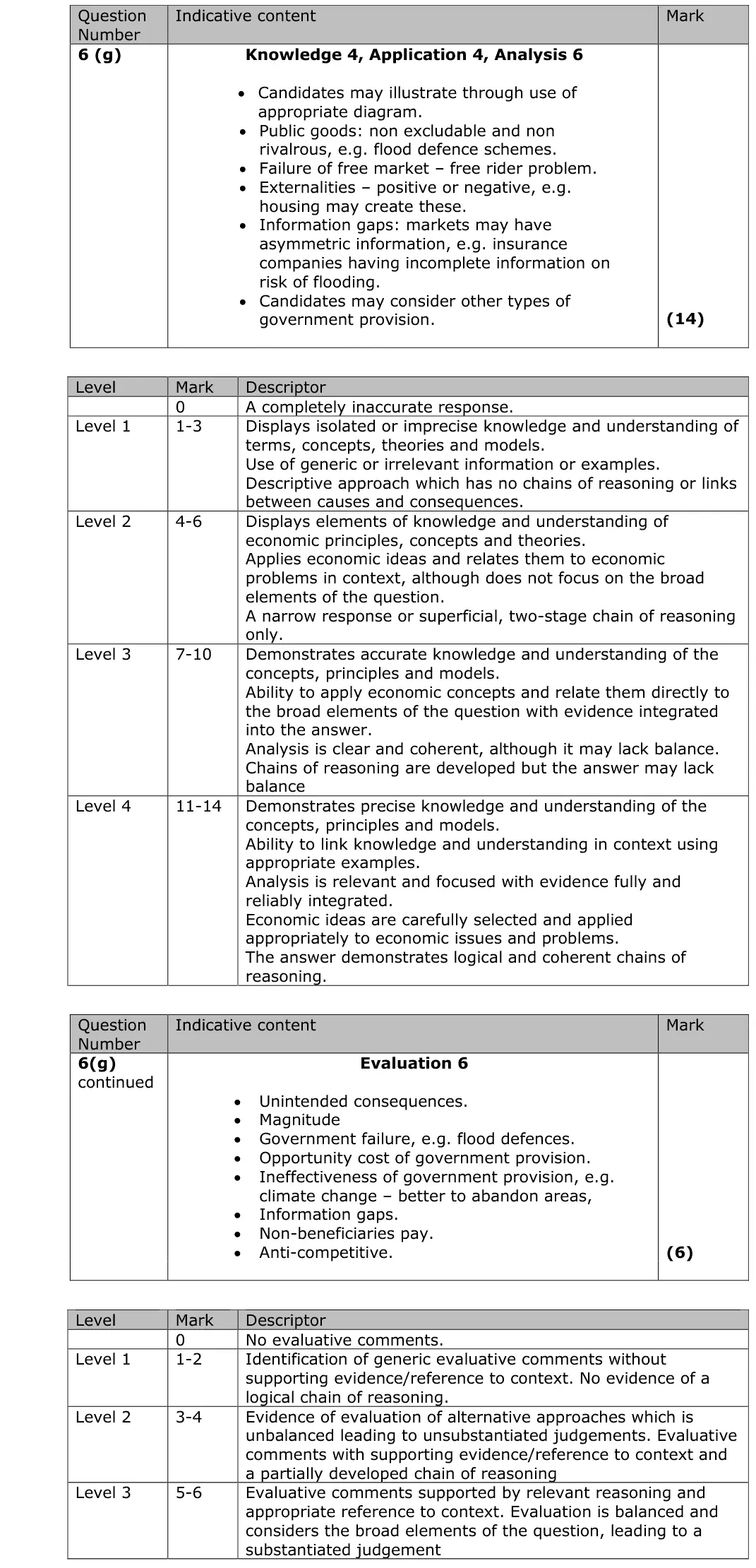
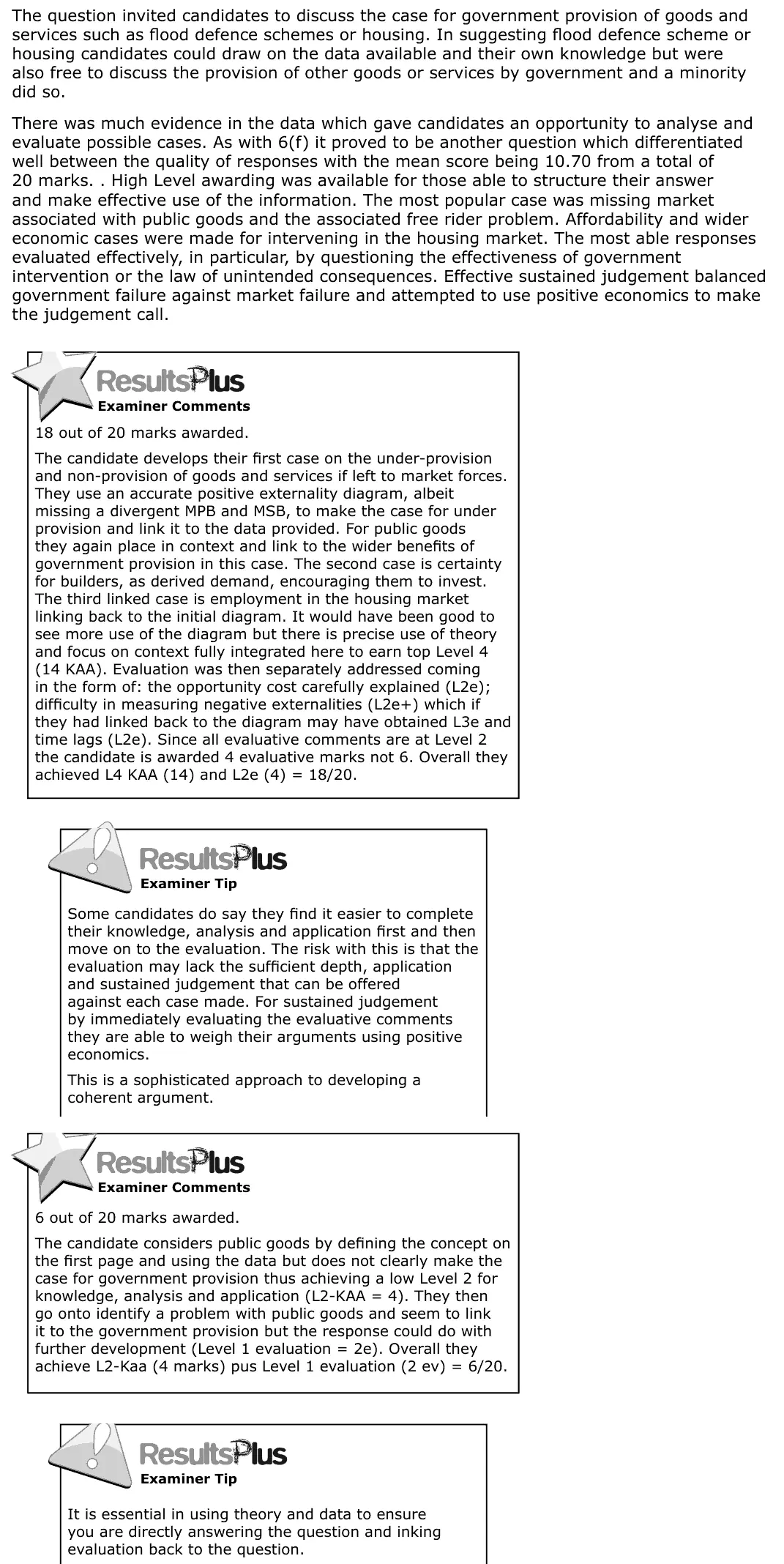
The question invited candidates to discuss the case for government provision of goods and services such as flood defence schemes or housing. In suggesting flood defence scheme or housing candidates could draw on the data available and their own knowledge but were also free to discuss the provision of other goods or services by government and a minority did so. There was much evidence in the data which gave candidates an opportunity to analyse and evaluate possible cases. As with 6(f) it proved to be another question which differentiated well between the quality of responses with the mean score being 10.70 from a total of 20 marks. . High Level awarding was available for those able to structure their answer and make effective use of the information. The most popular case was missing market associated with public goods and the associated free rider problem. Affordability and wider economic cases were made for intervening in the housing market. The most able responses evaluated effectively, in particular, by questioning the effectiveness of government intervention or the law of unintended consequences. Effective sustained judgement balanced government failure against market failure and attempted to use positive economics to make the judgement call. 18 out of 20 marks awarded. The candidate develops their first case on the under-provision and non-provision of goods and services if left to market forces. They use an accurate positive externality diagram, albeit missing a divergent MPB and MSB, to make the case for under provision and link it to the data provided. For public goods they again place in context and link to the wider benefits of government provision in this case. The second case is certainty for builders, as derived demand, encouraging them to invest. The third linked case is employment in the housing market linking back to the initial diagram. It would have been good to see more use of the diagram but there is precise use of theory and focus on context fully integrated here to earn top Level 4 (14 KAA). Evaluation was then separately addressed coming in the form of: the opportunity cost carefully explained (L2e); difficulty in measuring negative externalities (L2e+) which if they had linked back to the diagram may have obtained L3e and time lags (L2e). Since all evaluative comments are at Level 2 the candidate is awarded 4 evaluative marks not 6. Overall they achieved L4 KAA (14) and L2e (4) = 18/20. Some candidates do say they find it easier to complete their knowledge, analysis and application first and then move on to the evaluation. The risk with this is that the evaluation may lack the sufficient depth, application and sustained judgement that can be offered against each case made. For sustained judgement by immediately evaluating the evaluative comments they are able to weigh their arguments using positive economics. This is a sophisticated approach to developing a coherent argument. 6 out of 20 marks awarded. The candidate considers public goods by defining the concept on the first page and using the data but does not clearly make the case for government provision thus achieving a low Level 2 for knowledge, analysis and application (L2-KAA = 4). They then go onto identify a problem with public goods and seem to link it to the government provision but the response could do with further development (Level 1 evaluation = 2e). Overall they achieve L2-Kaa (4 marks) pus Level 1 evaluation (2 ev) = 6/20. It is essential in using theory and data to ensure you are directly answering the question and inking evaluation back to the question.
Notes from the mark scheme and report
flood defences are public goods (non-rival, non-excludable, free rider)
housing case via externalities and information gaps
evaluate with government failure, opportunity cost, non-beneficiaries pay
report mean 10.70 out of 20
Work with an Edexcel economics tutor
Essays stuck in Level 2, or losing the easy marks in Section A? Book a trial session with Lianne, a former Edexcel examiner.