Notes and key-term cards for this topic are being written by our tutors. The past-paper questions below are ready now.
Specification statements
1.1.1Economics as a social science: a) Thinking like an economist: the process of developing models in economics, including the need to make assumptions b) The use of the ceteris paribus assumption in building models c) The inability in economics to make scientific experimentsAS
1.1.2Positive and normative economic statements: a) Distinction between positive and normative economic statements b) The role of value judgements in influencing economic decision making and policyAS
1.1.3The economic problem: a) The problem of scarcity – where there are unlimited wants and finite resources b) The distinction between renewable and non-renewable resources c) The importance of opportunity costs to economic agents (consumers, producers and government)AS
Tap a question to zoom it. The data and extracts fold out above each question; the mark scheme and examiner's comment open underneath.
June 2025 · AS Paper 1 · Q1(b)3 marksAO1=1, AO2=1, AO3=1Short answer
Mark scheme
Examiner's comment
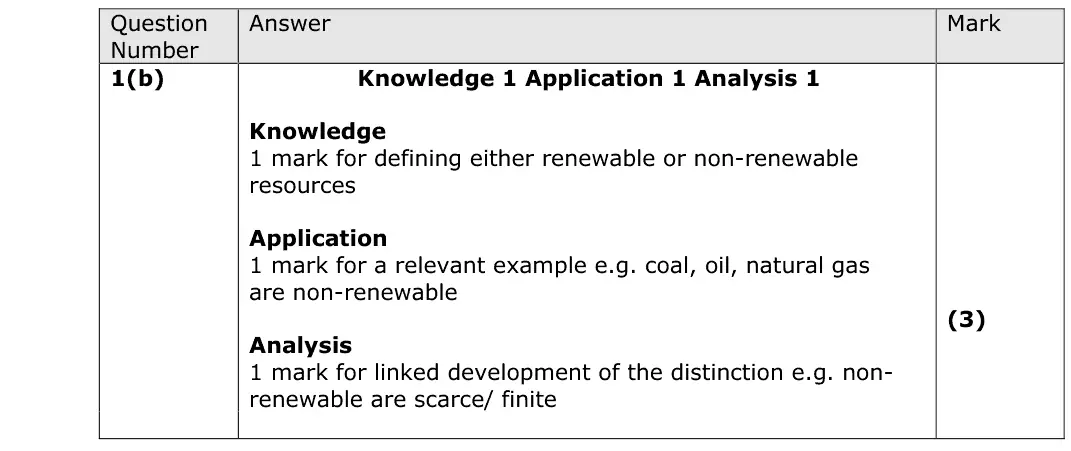
This question focused on the distinction between renewable and non-renewable resources and was answered generally very well, although not all candidates were able to include specific distinctions in the structure of their answers
Notes from the mark scheme and report
renewable resources replenish (wind, solar, timber) while non-renewable resources are finite and run out once used (coal, oil, gas)
give an example and a linked distinction
report: not all gave a specific distinction
June 2025 · AS Paper 1 · Q6(d)4 marksAO1=2, AO2=2Short answer
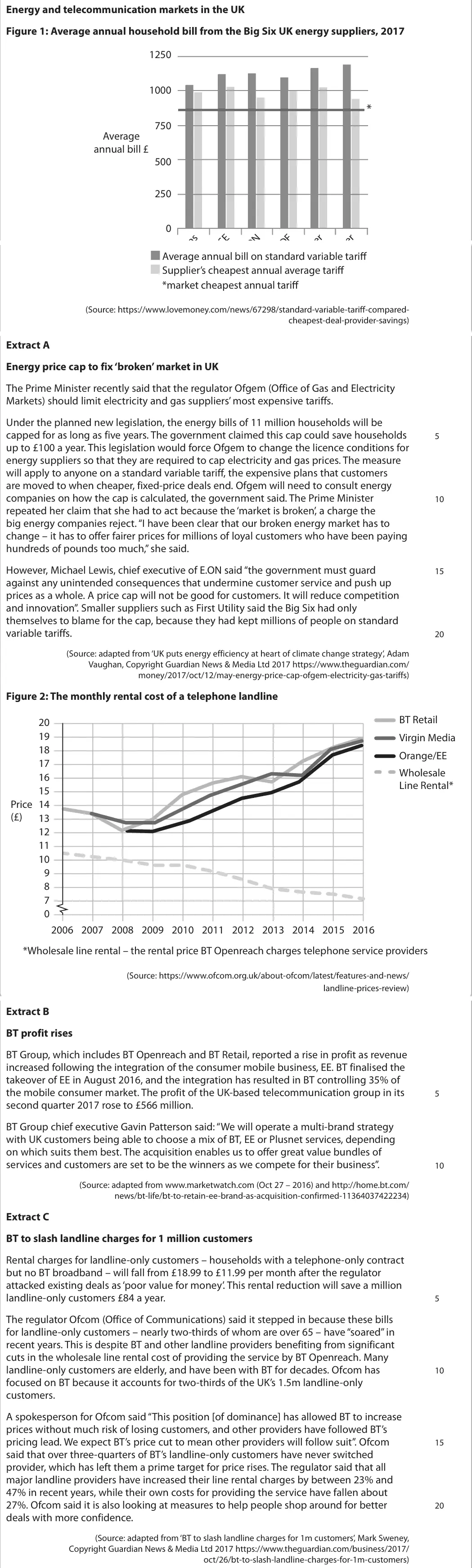
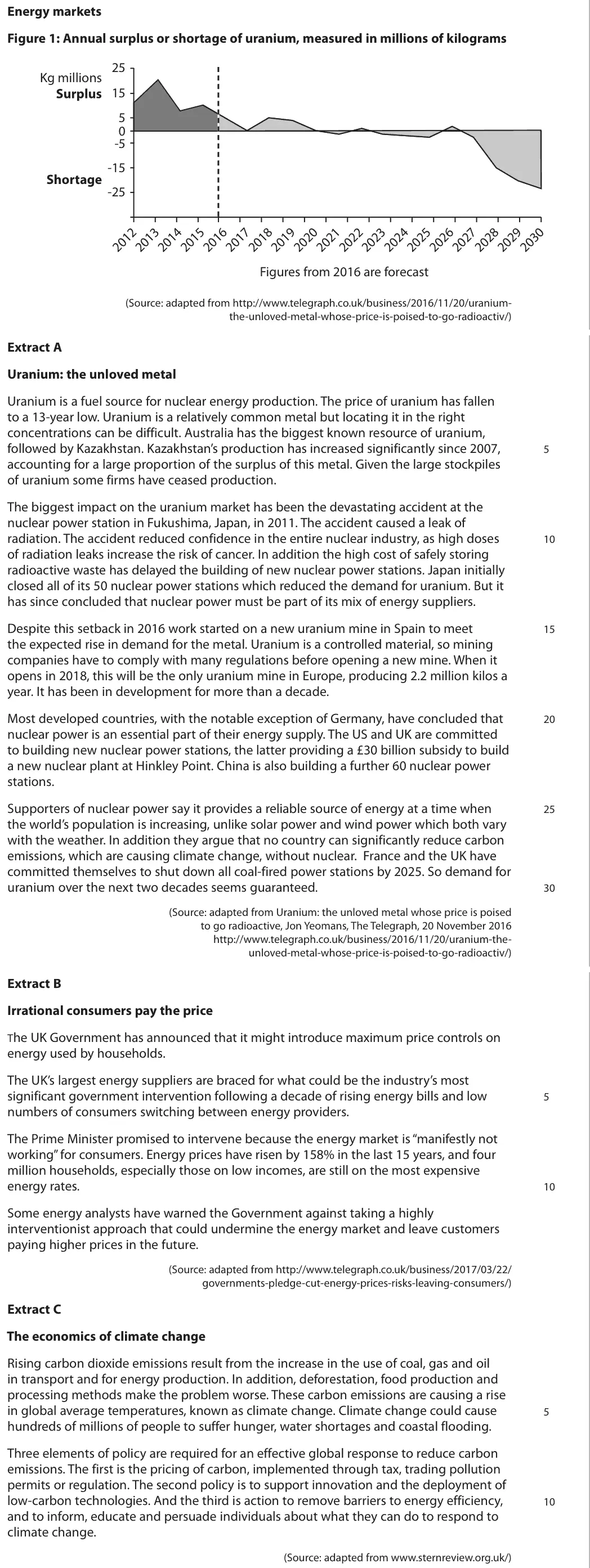
Data and extracts for question 6
Mark scheme
Examiner's comment
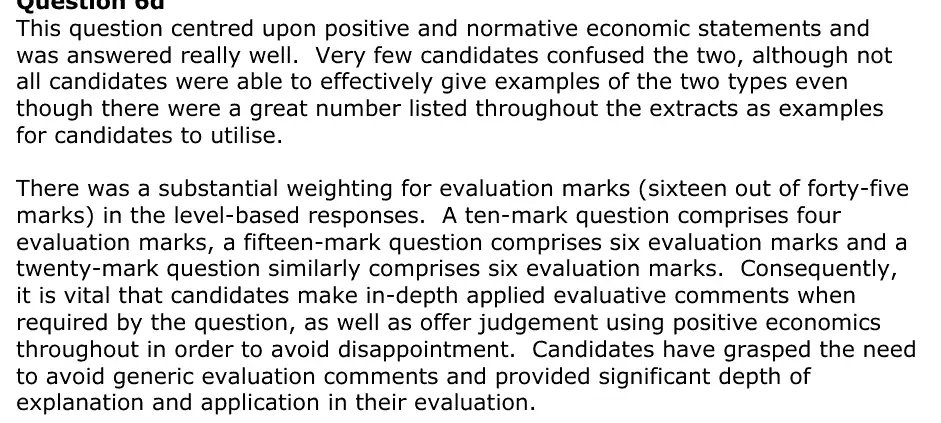
This question centred upon positive and normative economic statements and was answered really well. Very few candidates confused the two, although not all candidates were able to effectively give examples of the two types even though there were a great number listed throughout the extracts as examples for candidates to utilise. There was a substantial weighting for evaluation marks (sixteen out of forty-five marks) in the level-based responses. A ten-mark question comprises four evaluation marks, a fifteen-mark question comprises six evaluation marks and a twenty-mark question similarly comprises six evaluation marks. Consequently, it is vital that candidates make in-depth applied evaluative comments when required by the question, as well as offer judgement using positive economics throughout in order to avoid disappointment. Candidates have grasped the need to avoid generic evaluation comments and provided significant depth of explanation and application in their evaluation.
Notes from the mark scheme and report
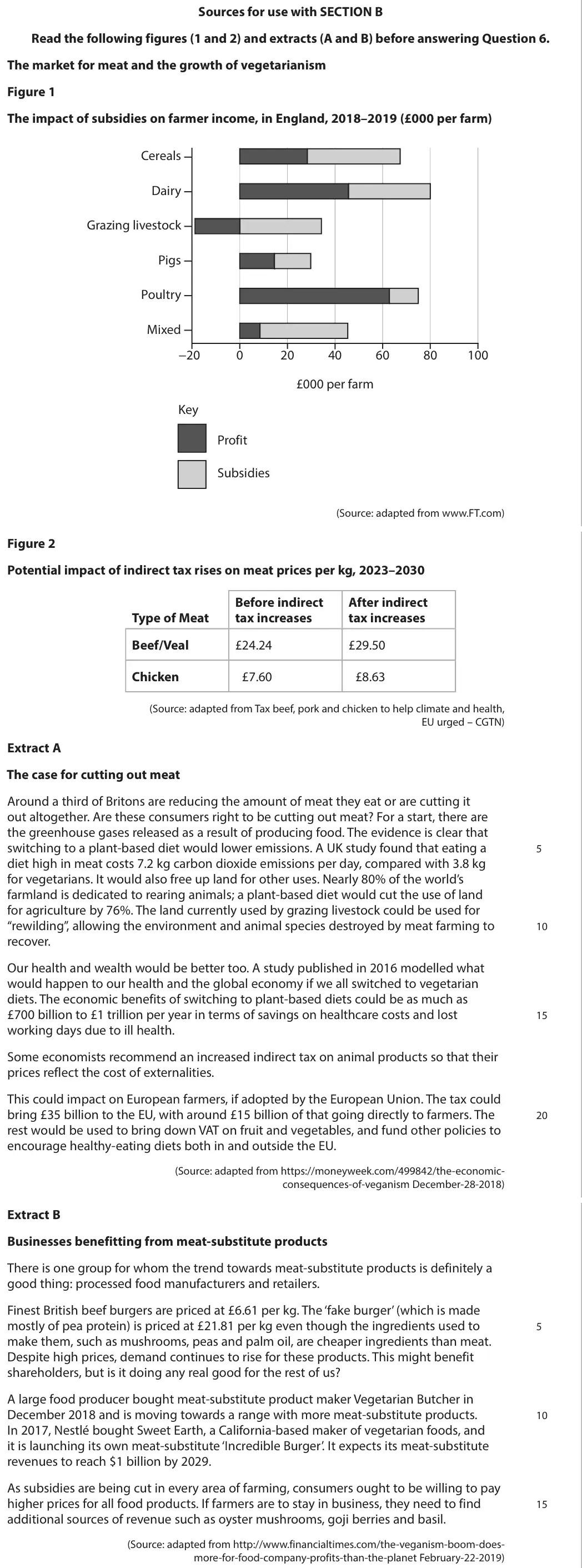
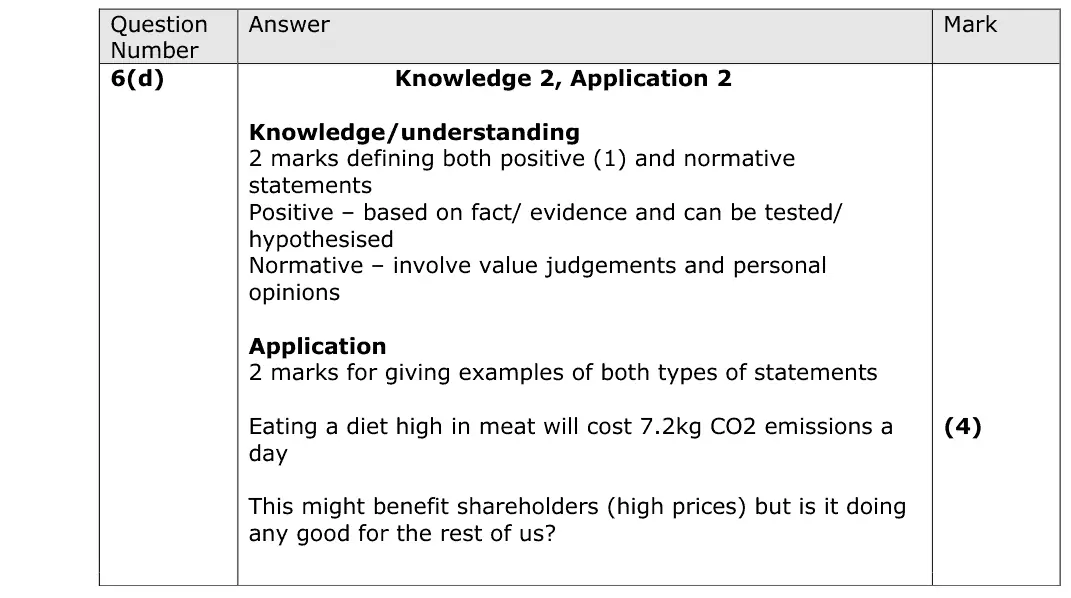
positive = testable fact (e.g. a meat-heavy diet emits 7.2 kg CO2 a day)
normative = value judgement (e.g. "consumers ought to be willing to pay higher prices")
one example of each from the extracts
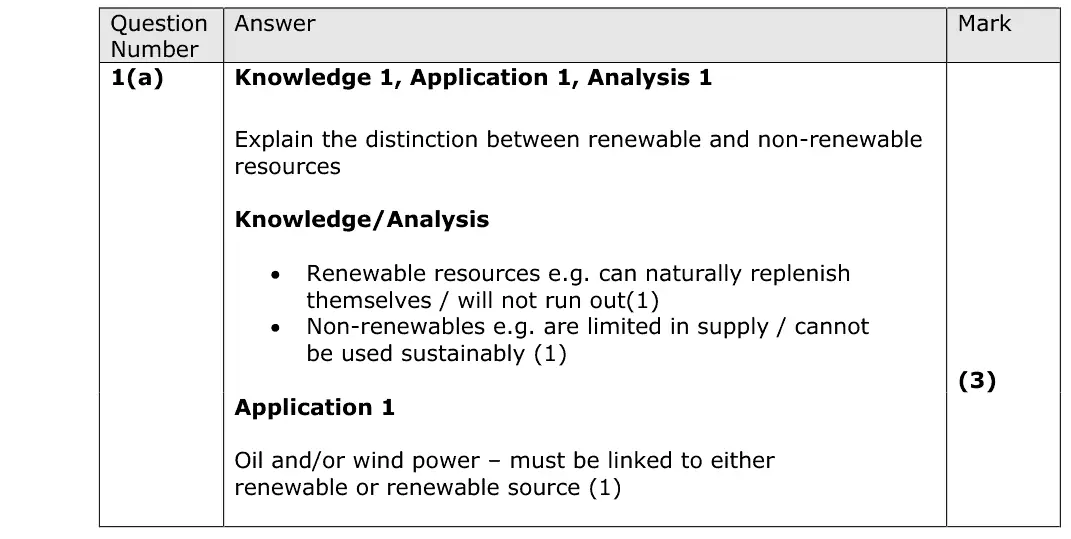
June 2024 · AS Paper 1 · Q1(a)3 marksAO1=1, AO2=1, AO3=1Short answer
Data and extracts for question 1
Mark scheme
Examiner's comment
This question on renewable energy and non-renewable energy was answered very well by a high proportion of candidates and therefore was a good introductory question, whilst still appropriately staying within the confines of the specification. Using the extract was the only way that any candidates lost marks within their responses.
Notes from the mark scheme and report
renewable resources replenish naturally and will not run out
non-renewables are finite and cannot be used sustainably
application mark needs oil or wind power linked to the right category
marks were lost only for not using the information
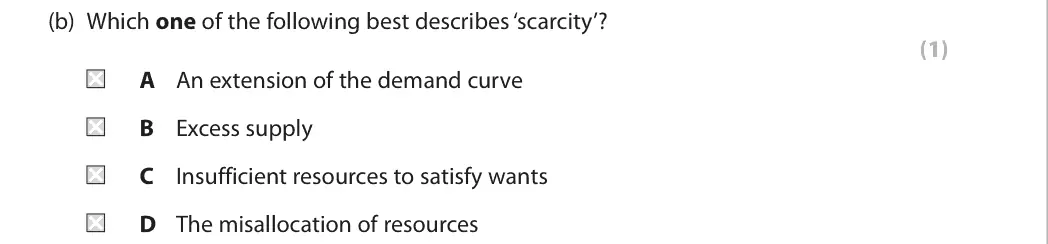
June 2024 · AS Paper 1 · Q1(b)1 markAO1=1Multiple choice
Data and extracts for question 1
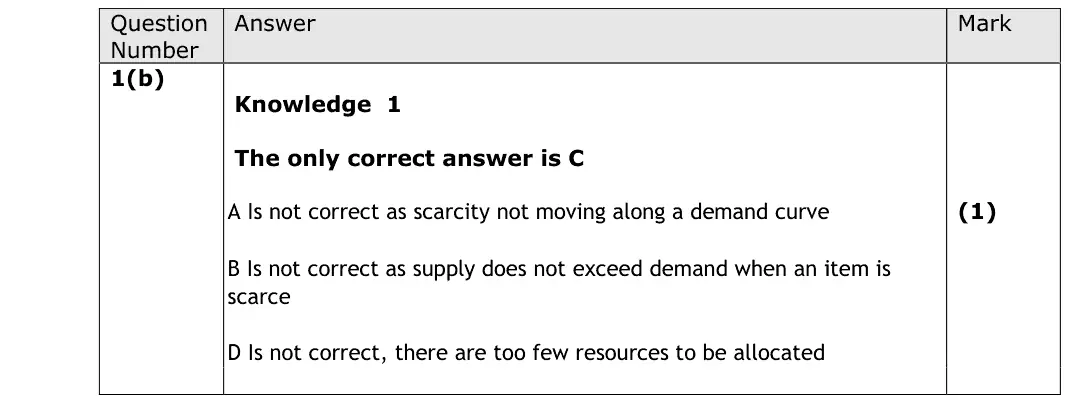
Answer
C
Mark scheme
Notes from the mark scheme and report
scarcity = insufficient resources to satisfy unlimited wants (C)
not a movement along demand (A), not excess supply (B), not misallocation (D)
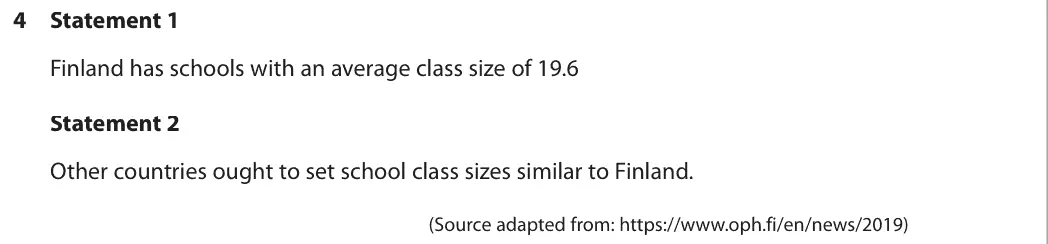
June 2024 · AS Paper 1 · Q4(a)1 markAO1=1Multiple choice
Data and extracts for question 4
Answer
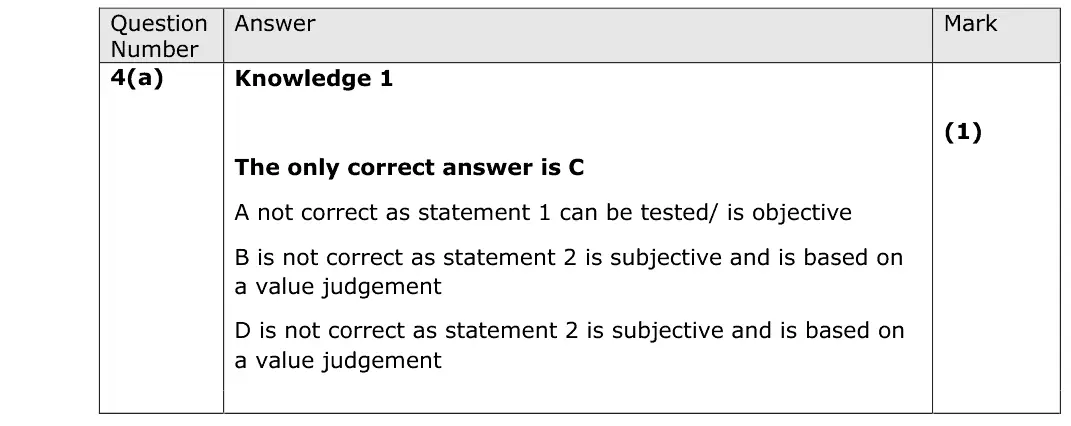
C
Mark scheme
Notes from the mark scheme and report
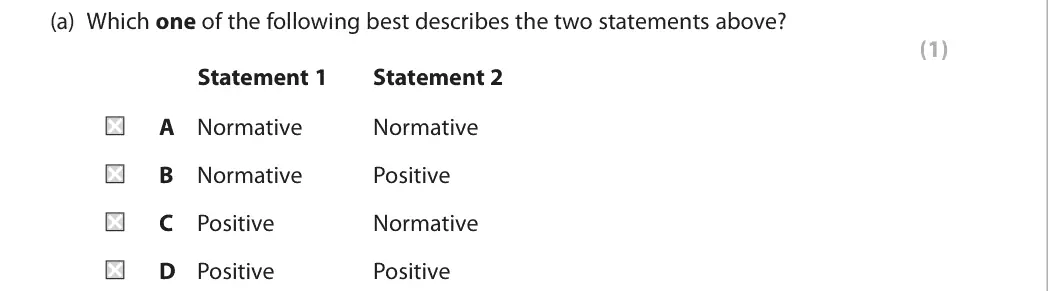
statement 1 can be tested, so positive
statement 2 contains 'ought' and a value judgement, so normative (C)
June 2024 · AS Paper 1 · Q4(b)3 marksAO1=1, AO2=1, AO3=1Short answer
Data and extracts for question 4
Mark scheme
Examiner's comment
This question was well answered, with the definition of opportunity cost very well understood by almost all candidates. Limited development of this with application to the example of Finland, alongside further analysis and without reference to scarcity/ limited resources is where candidates lost marks.
Notes from the mark scheme and report
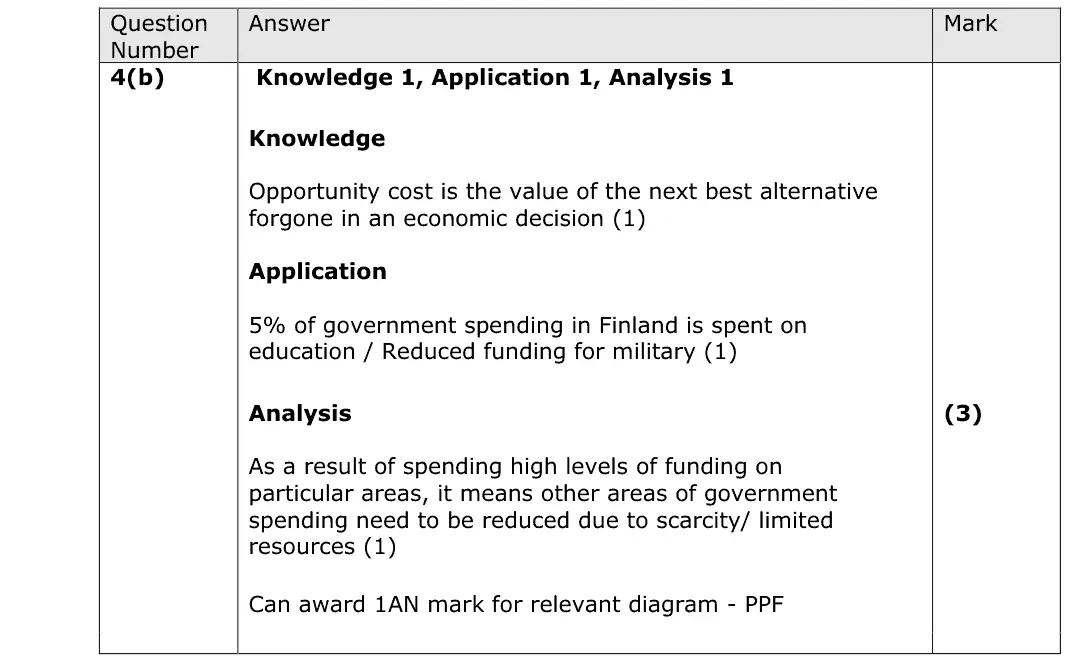
value of the next best alternative forgone
apply to Finland (5% of government spending on education, less for the military)
analysis must link to scarcity of resources
a PPF diagram can earn the analysis mark
June 2024 · AS Paper 1 · Q5(b)1 markAO1=1Definition
Data and extracts for question 5
Mark scheme
Examiner's comment
Question 5 (b) Ceteris paribus as a term was very well recalled and understood, however those where the marks were not awarded, did not use the correct language to explain the concept clearly enough.
Notes from the mark scheme and report
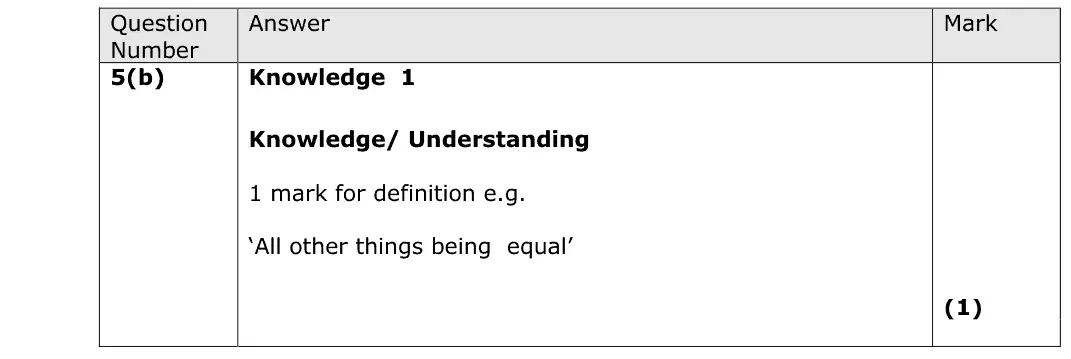
all other things being equal (other variables held constant)
imprecise wording lost the mark
June 2023 · AS Paper 1 · Q3(b)1 markMultiple choice
Data and extracts for question 3
Answer
A
Mark scheme
Notes from the mark scheme and report
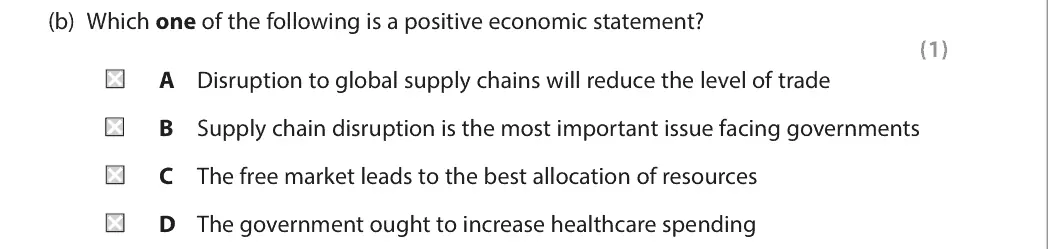
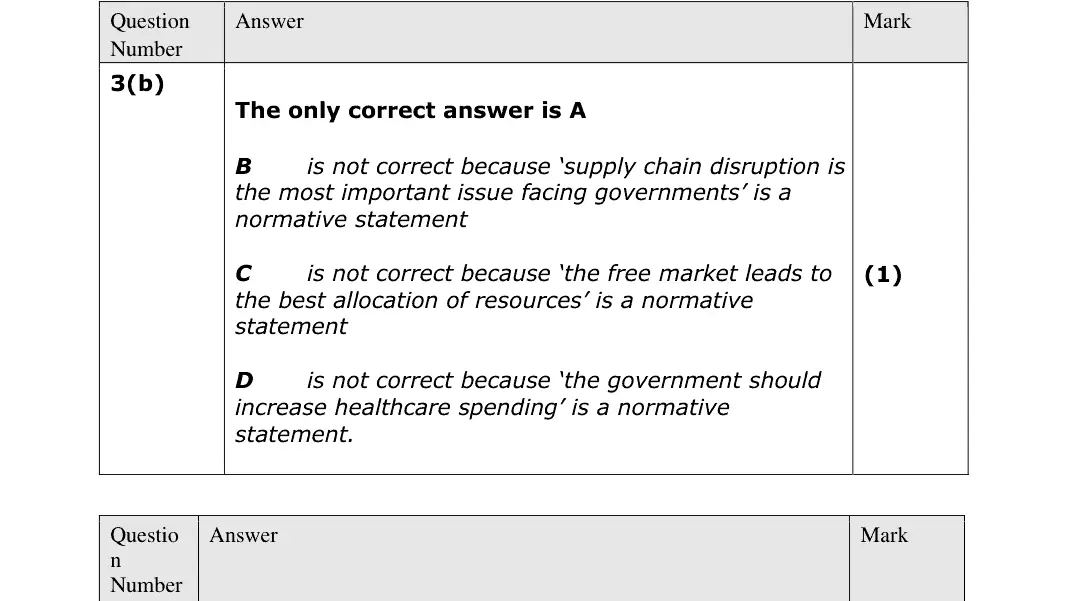
a positive statement can be tested: 'disruption to global supply chains will reduce the level of trade' (A)
B, C and D contain value judgements ('most important', 'best', 'ought to')
June 2023 · Paper 3 · Q1(a)5 marksAO1=2, AO2=2, AO3=1Short answer
Data and extracts for question 1
Mark scheme
Examiner's comment
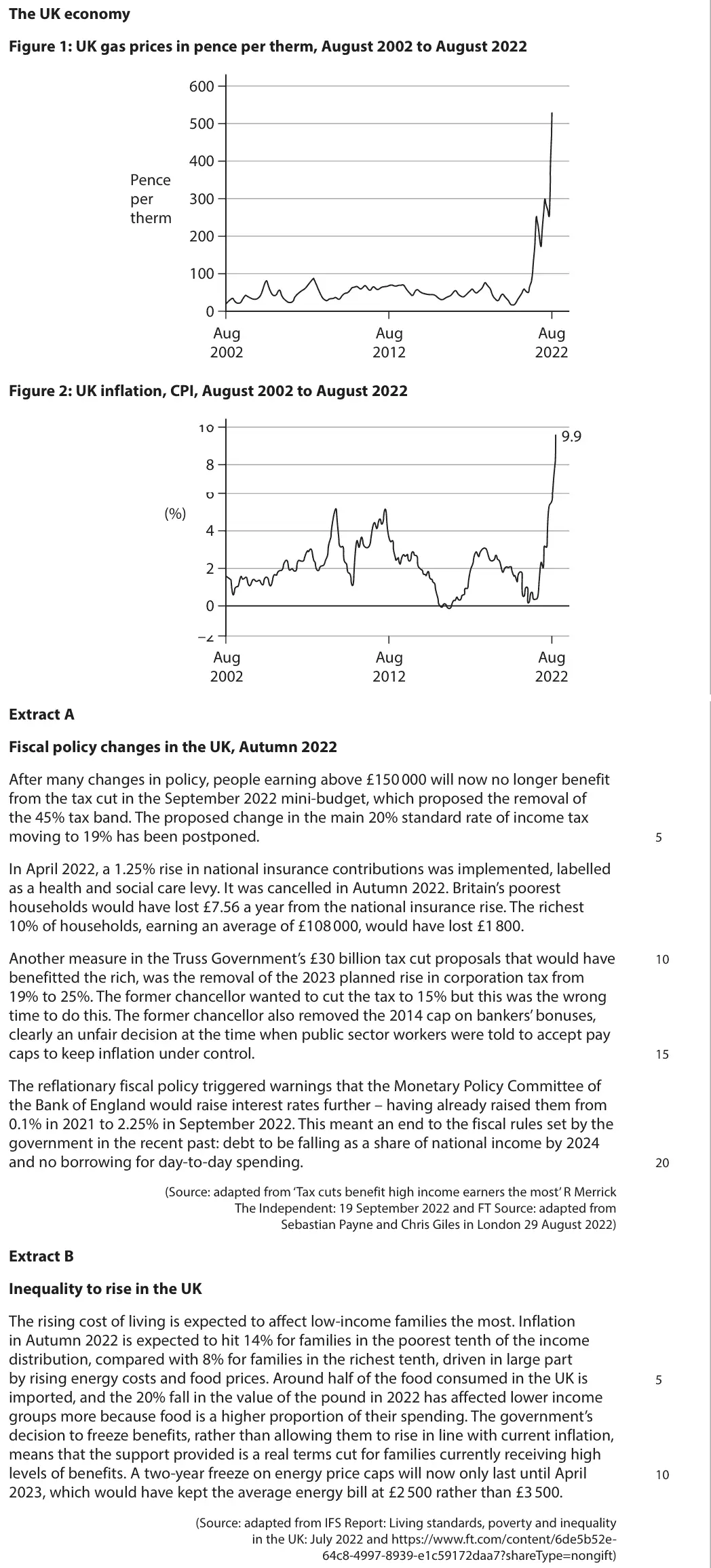
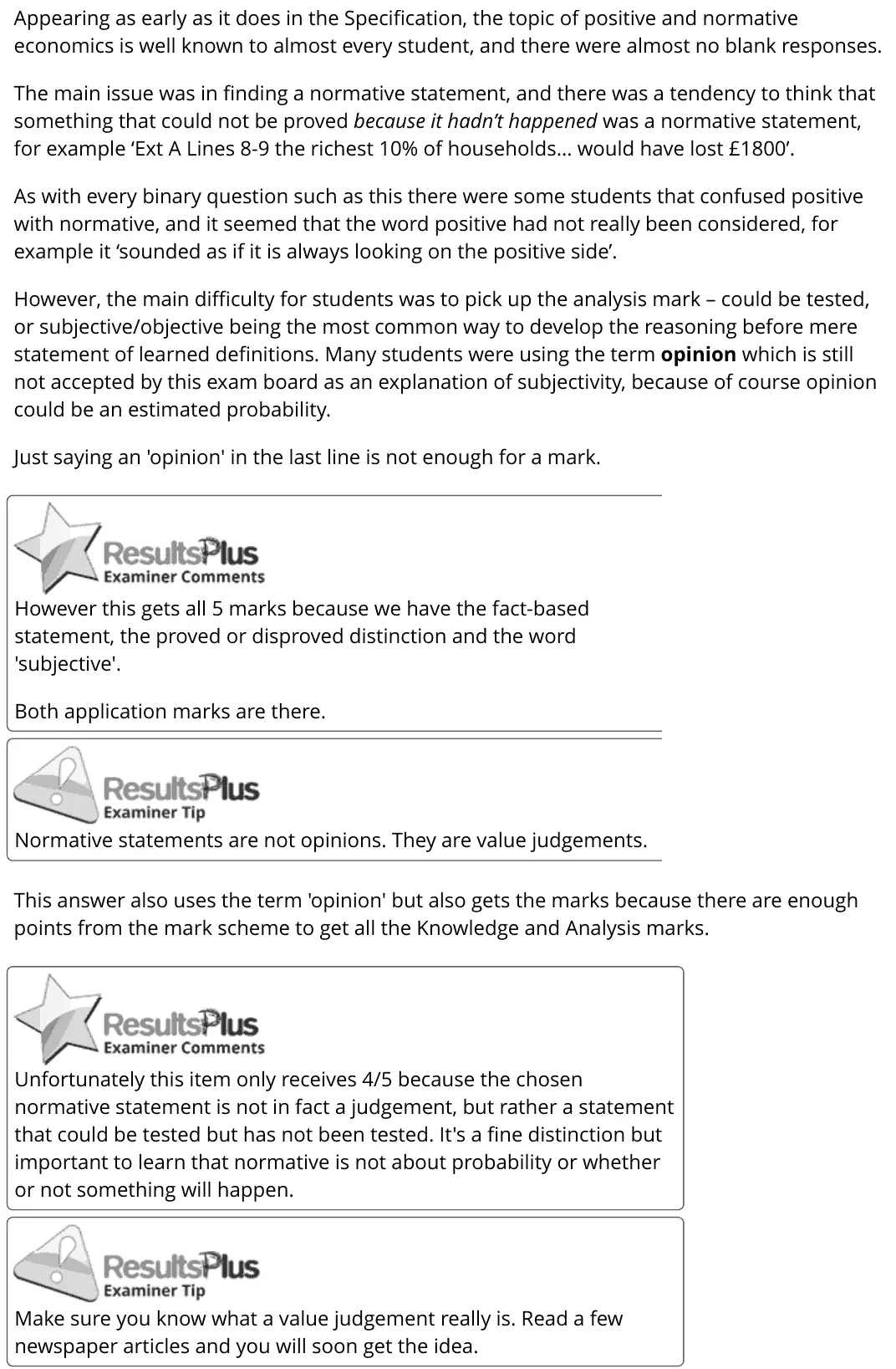
Appearing as early as it does in the Specification, the topic of positive and normative economics is well known to almost every student, and there were almost no blank responses. The main issue was in finding a normative statement, and there was a tendency to think that something that could not be proved because it hadn’t happened was a normative statement, for example ‘Ext A Lines 8-9 the richest 10% of households… would have lost £1800’. As with every binary question such as this there were some students that confused positive with normative, and it seemed that the word positive had not really been considered, for example it ‘sounded as if it is always looking on the positive side’. However, the main difficulty for students was to pick up the analysis mark – could be tested, or subjective/objective being the most common way to develop the reasoning before mere statement of learned definitions. Many students were using the term opinion which is still not accepted by this exam board as an explanation of subjectivity, because of course opinion could be an estimated probability. Just saying an 'opinion' in the last line is not enough for a mark. However this gets all 5 marks because we have the fact-based statement, the proved or disproved distinction and the word 'subjective'. Both application marks are there. Normative statements are not opinions. They are value judgements. This answer also uses the term 'opinion' but also gets the marks because there are enough points from the mark scheme to get all the Knowledge and Analysis marks. Unfortunately this item only receives 4/5 because the chosen normative statement is not in fact a judgement, but rather a statement that could be tested but has not been tested. It's a fine distinction but important to learn that normative is not about probability or whether or not something will happen. Make sure you know what a value judgement really is. Read a few newspaper articles and you will soon get the idea.
Notes from the mark scheme and report
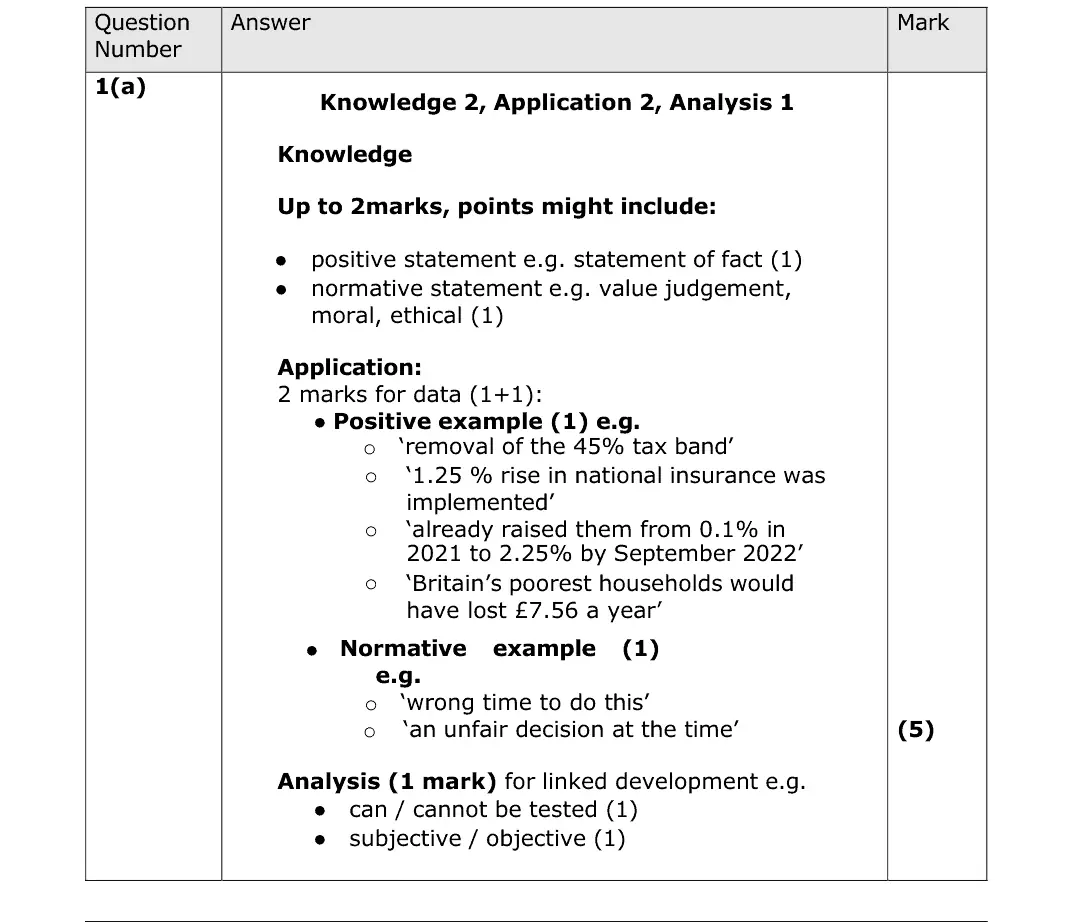
positive = can be tested against facts (e.g. 1.25% rise in national insurance), normative = value judgement (e.g. 'an unfair decision', 'wrong time to do this')
'opinion' is not accepted for normative
a prediction that cannot yet be proved is still positive
analysis mark needs testable or objective v subjective
June 2022 · AS Paper 1 · Q4(a)3 marksAO1=1, AO2=1, AO3=1Short answer
Data and extracts for question 4
Mark scheme
Examiner's comment
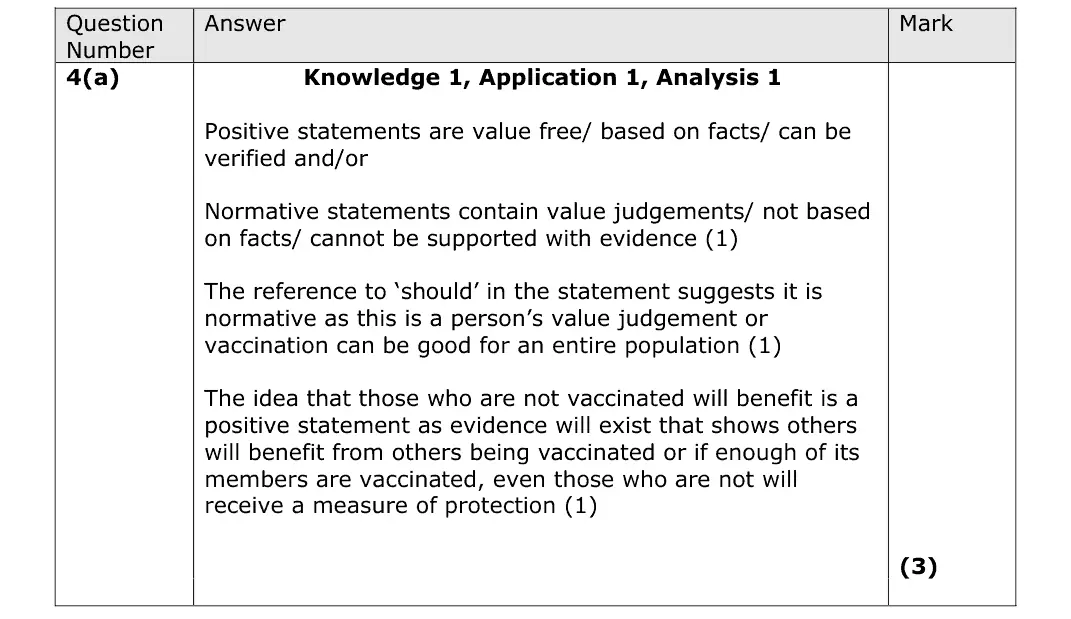
Many candidates were able to explain the difference between positive and normative statements, but many ignored the context of vaccination, which meant they missed the application mark.
Notes from the mark scheme and report
positive = testable fact, normative = value judgement
"should" makes the vaccination statement normative
report: many ignored the vaccination context and missed the application mark
November 2021 · Paper 1 · Q1(a)1 markAO1=1Multiple choice
Data and extracts for question 1
Answer
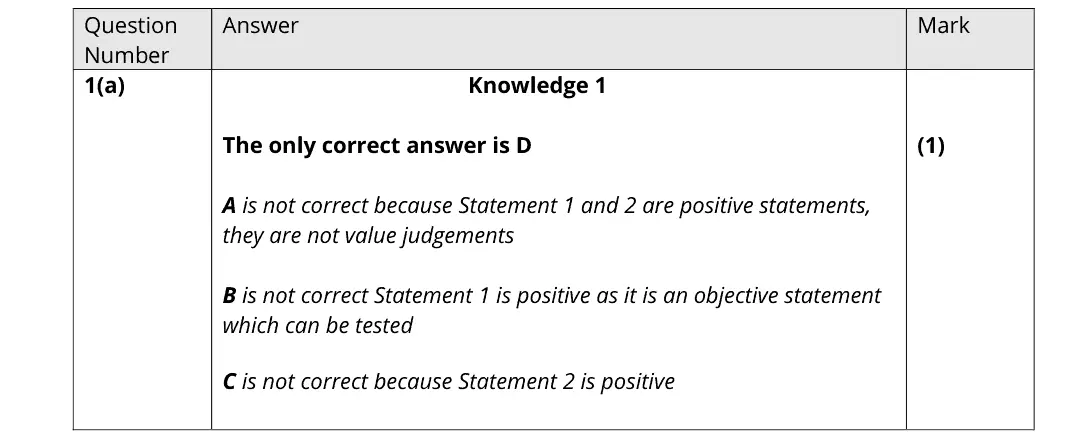
D
Mark scheme
Notes from the mark scheme and report
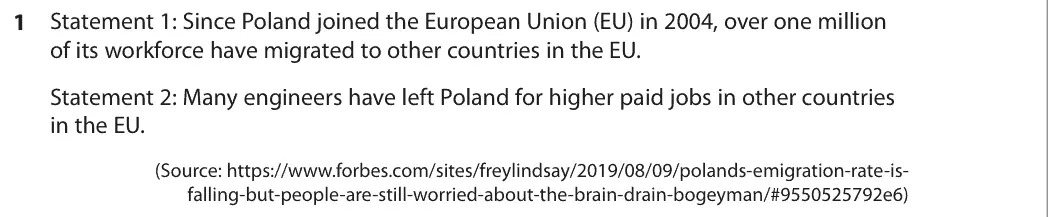
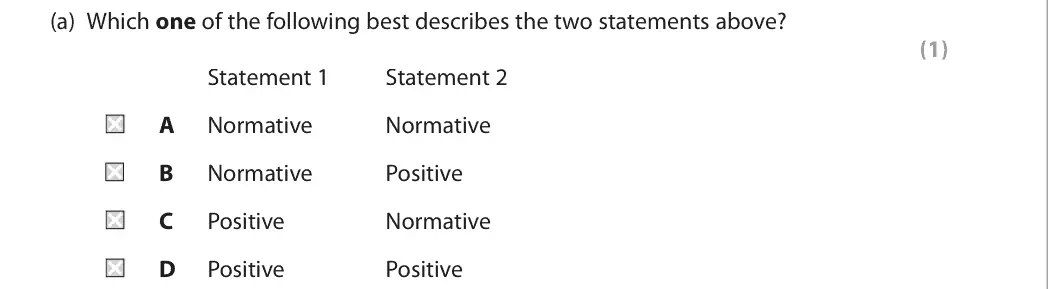
both statements can be tested against evidence and contain no value judgement, so both are positive (D)
"higher paid" is a fact, not a value judgement
October 2020 · AS Paper 1 · Q3(b)3 marksAO1=1, AO2=1, AO3=1Short answer
Data and extracts for question 3
Mark scheme
Examiner's comment
This question was a challenge for some. Though loft insulation is mentioned in the question, it was not necessary to discuss it exclusively. Candidates could access the marks by exploring any opportunity cost to government form such a subsidy, as long as it was clearly explained with a relevant example.
Notes from the mark scheme and report
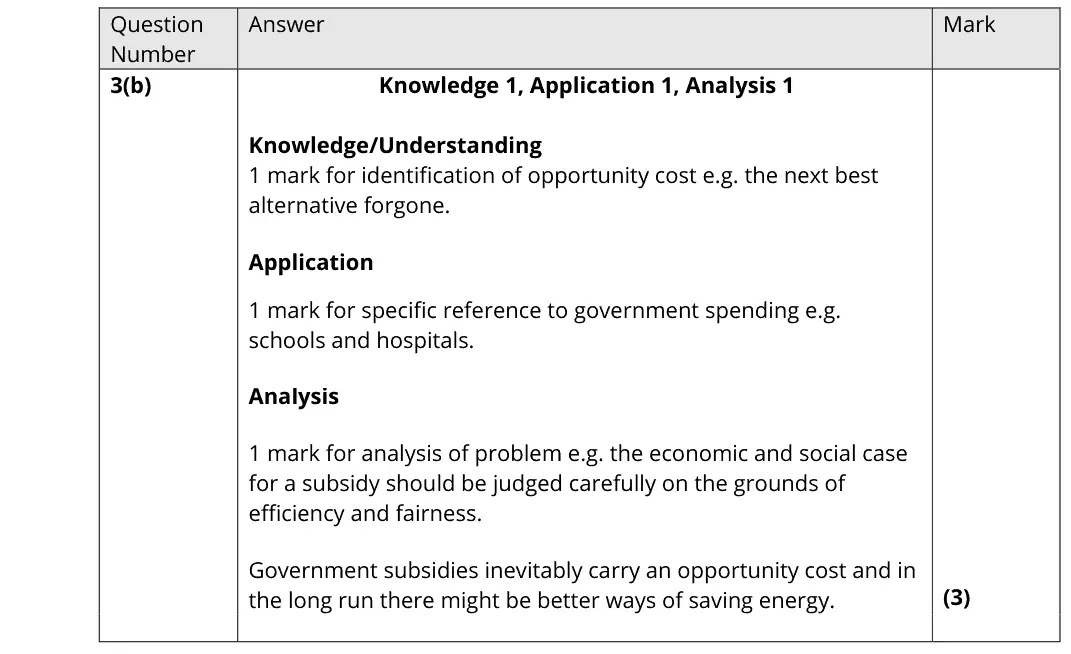
opportunity cost = next best alternative forgone
give a specific alternative use of government spending (schools, hospitals)
analysis e.g. judge the subsidy on efficiency and fairness grounds
need not be about loft insulation only
October 2020 · AS Paper 1 · Q6(b)10 marksAO1=2, AO2=2, AO3=2, AO4=410-mark response
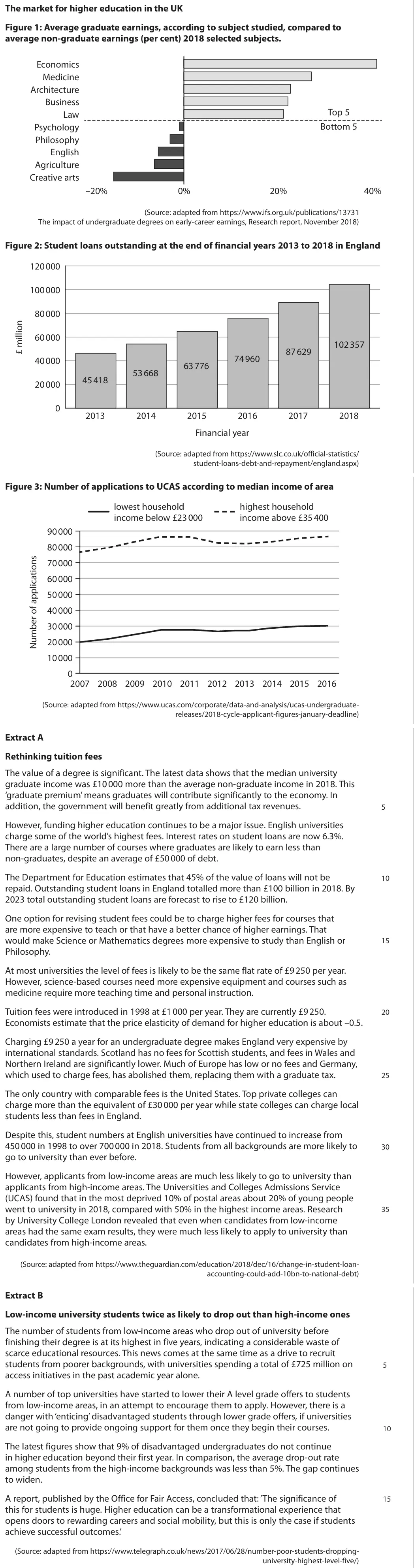
Data and extracts for question 6
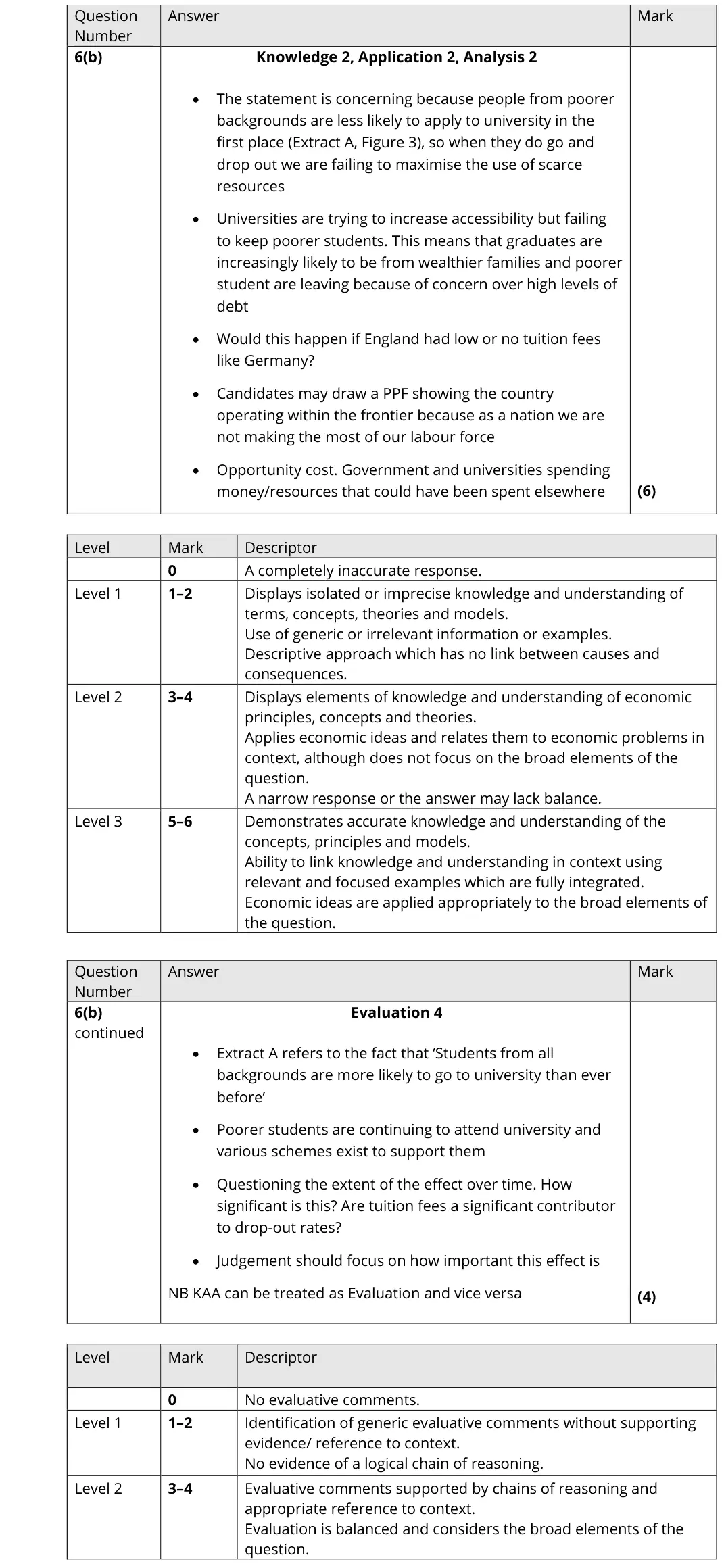
Mark scheme, including the levels grid and indicative content
Examiner's comment
Candidates performed less well on this question, though there were many strong responses that explored whether giving such support to students from low income backgrounds was itself not a waste of scarce resources. Many candidates could also identify that students from low income backgrounds could be dissuaded by the thought of significant debt. To gain high marks some use of a diagram such as the PPF would sharpen the analysis, whilst allowing candidates to showcase their broader economic knowledge.
Notes from the mark scheme and report
'these drop-out rates' are from Extract B (9% of disadvantaged students vs under 5% of high-income)
drop-outs waste scarce resources, economy inside its PPF
evaluate with rising participation (Extract A), whether support schemes are themselves wasteful, debt as the cause
report: candidates performed less well here
Quantitative skills: QS 9 (interpret, apply and analyse information in written, graphical tabular and numerical forms)
June 2019 · AS Paper 1 · Q6(a)5 marksAO1=1, AO2=2, AO3=2Short answer
Data and extracts for question 6
Mark scheme
Examiner's comment
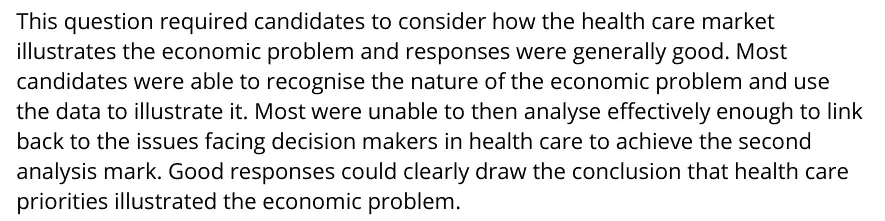
This question required candidates to consider how the health care market illustrates the economic problem and responses were generally good. Most candidates were able to recognise the nature of the economic problem and use the data to illustrate it. Most were unable to then analyse effectively enough to link back to the issues facing decision makers in health care to achieve the second analysis mark. Good responses could clearly draw the conclusion that health care priorities illustrated the economic problem.
Notes from the mark scheme and report
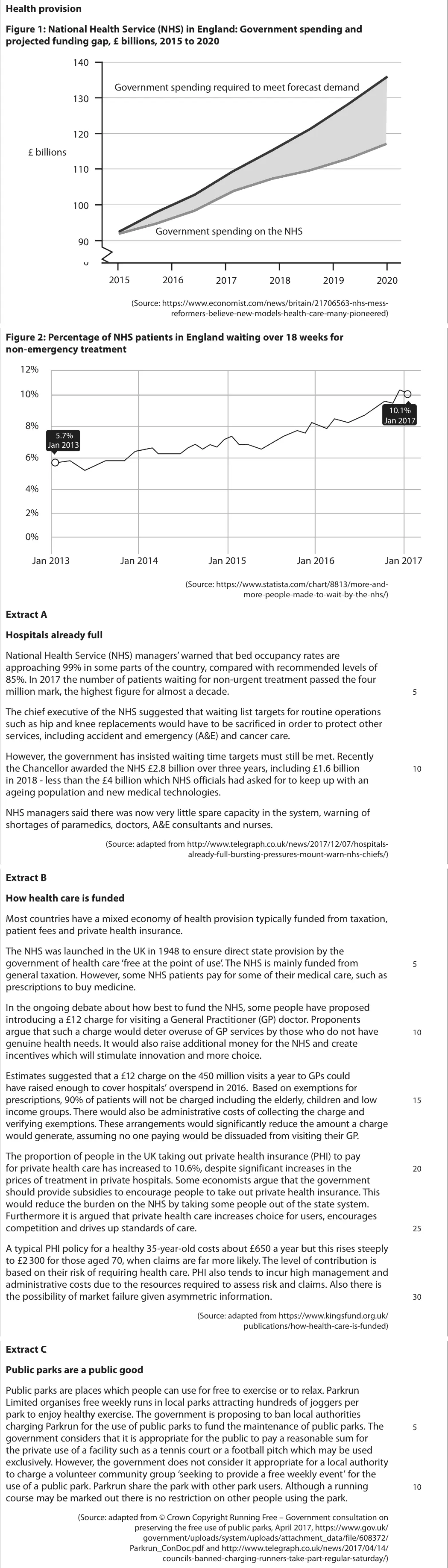
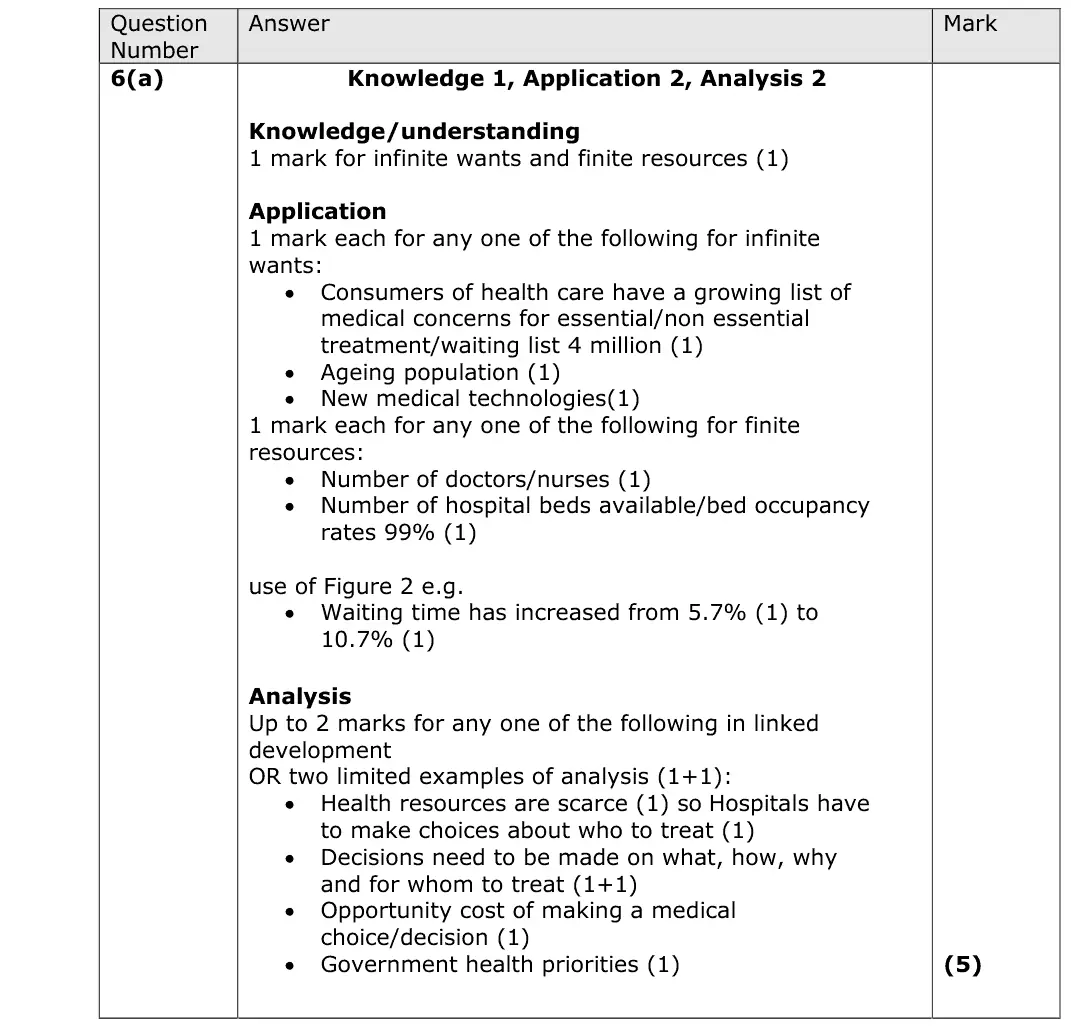
infinite wants (ageing population, waiting list over 4 million) v finite resources (99% bed occupancy, staff shortages)
Figure 2: waiting rose from 5.7% to 10.1%
analysis needs choices and opportunity cost for health decision makers, which most missed
Quantitative skills: QS 9 (interpret, apply and analyse information in written, graphical tabular and numerical forms)
June 2019 · Paper 1 · Q6(a)5 marksAO1=1, AO2=2, AO3=2Short answer
Data and extracts for question 6
Mark scheme
Examiner's comment
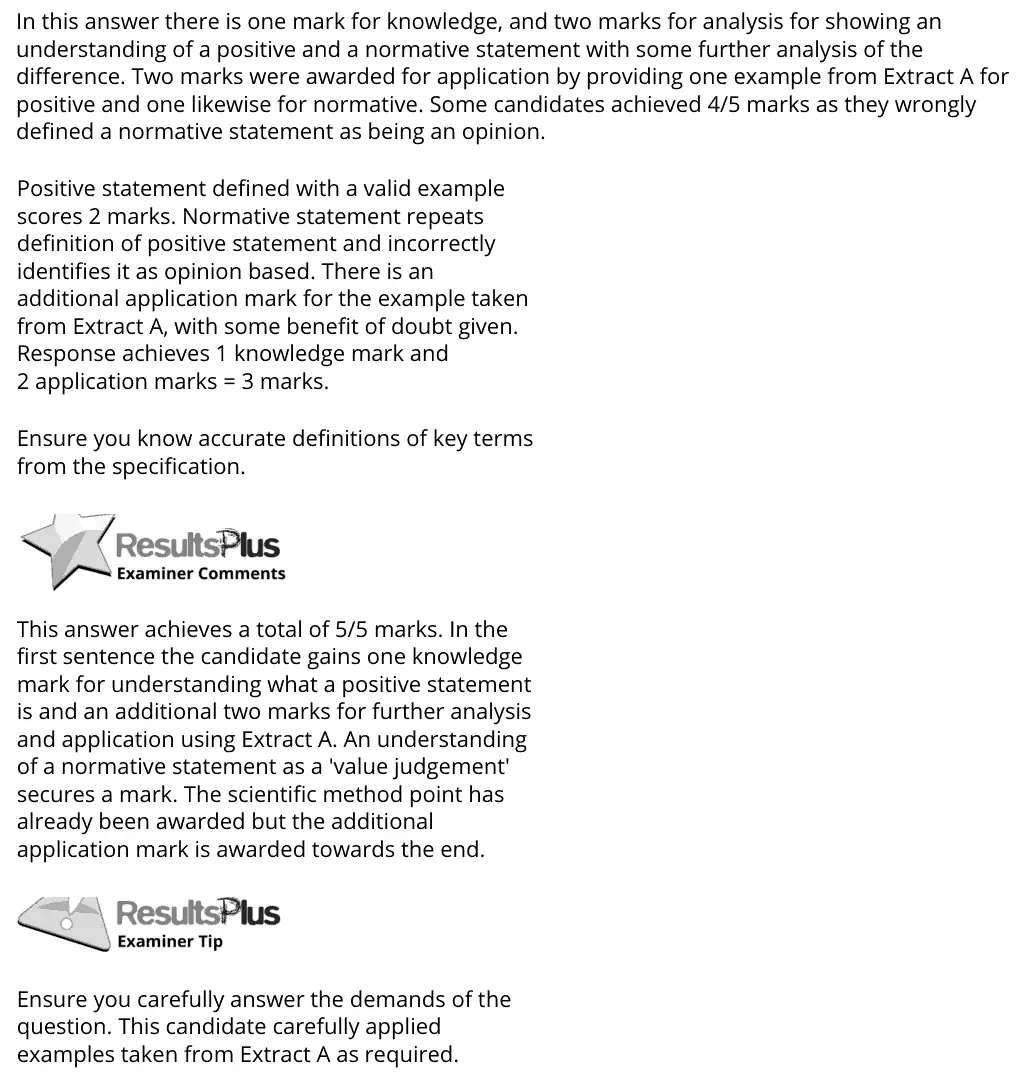
In this answer there is one mark for knowledge, and two marks for analysis for showing an understanding of a positive and a normative statement with some further analysis of the difference. Two marks were awarded for application by providing one example from Extract A for positive and one likewise for normative. Some candidates achieved 4/5 marks as they wrongly defined a normative statement as being an opinion. Positive statement defined with a valid example scores 2 marks. Normative statement repeats definition of positive statement and incorrectly identifies it as opinion based. There is an additional application mark for the example taken from Extract A, with some benefit of doubt given. Response achieves 1 knowledge mark and 2 application marks = 3 marks. Ensure you know accurate definitions of key terms from the specification. This answer achieves a total of 5/5 marks. In the first sentence the candidate gains one knowledge mark for understanding what a positive statement is and an additional two marks for further analysis and application using Extract A. An understanding of a normative statement as a 'value judgement' secures a mark. The scientific method point has already been awarded but the additional application mark is awarded towards the end. Ensure you carefully answer the demands of the question. This candidate carefully applied examples taken from Extract A as required.
Notes from the mark scheme and report
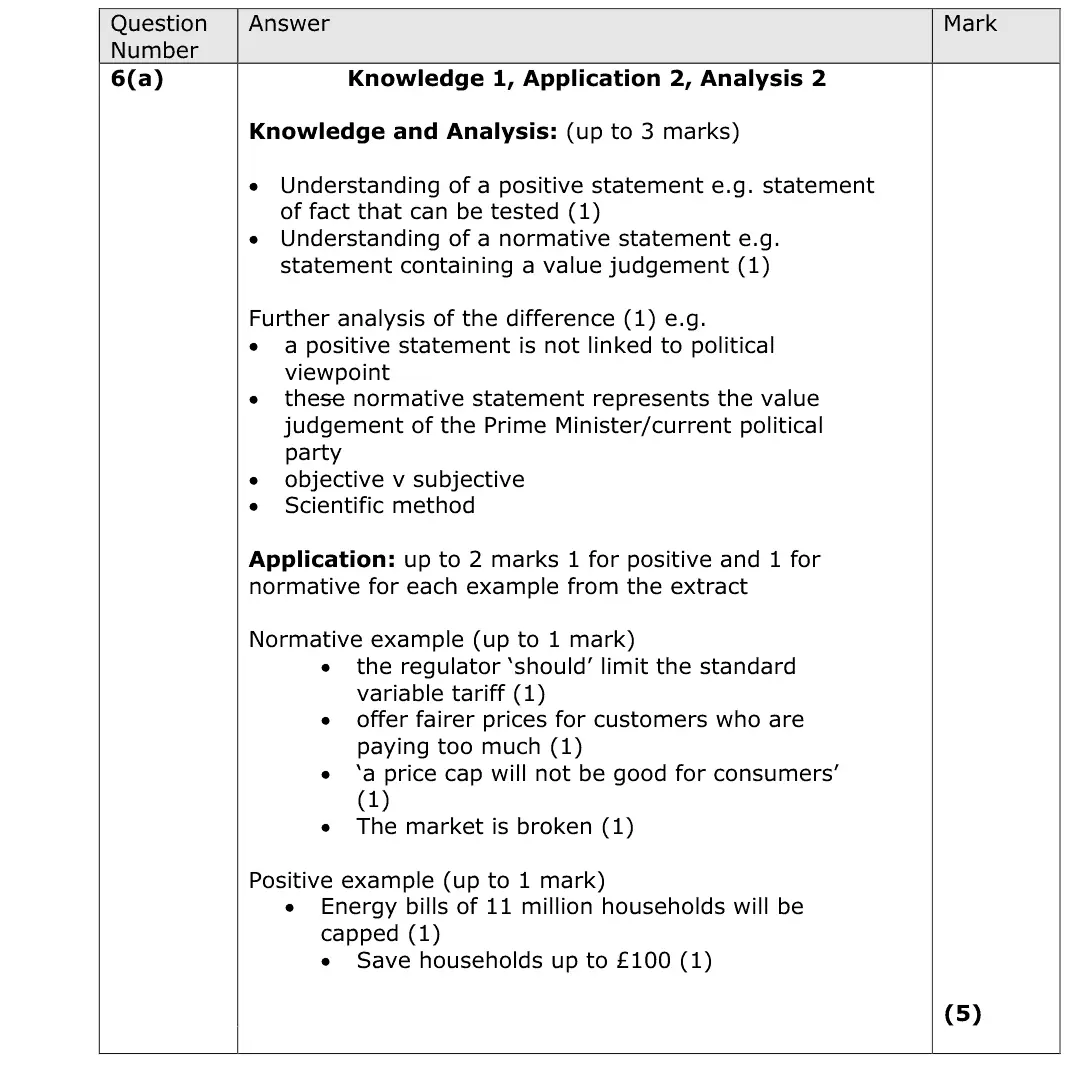
positive = testable statement of fact, normative = contains a value judgement
one example of each from Extract A (e.g. "the market is broken" vs 11 million households capped)
report: defining normative as just "an opinion" lost a mark
June 2019 · Paper 3 · Q2(a)5 marksAO1=2, AO2=2, AO3=1Short answer
Data and extracts for question 2
Mark scheme
Examiner's comment
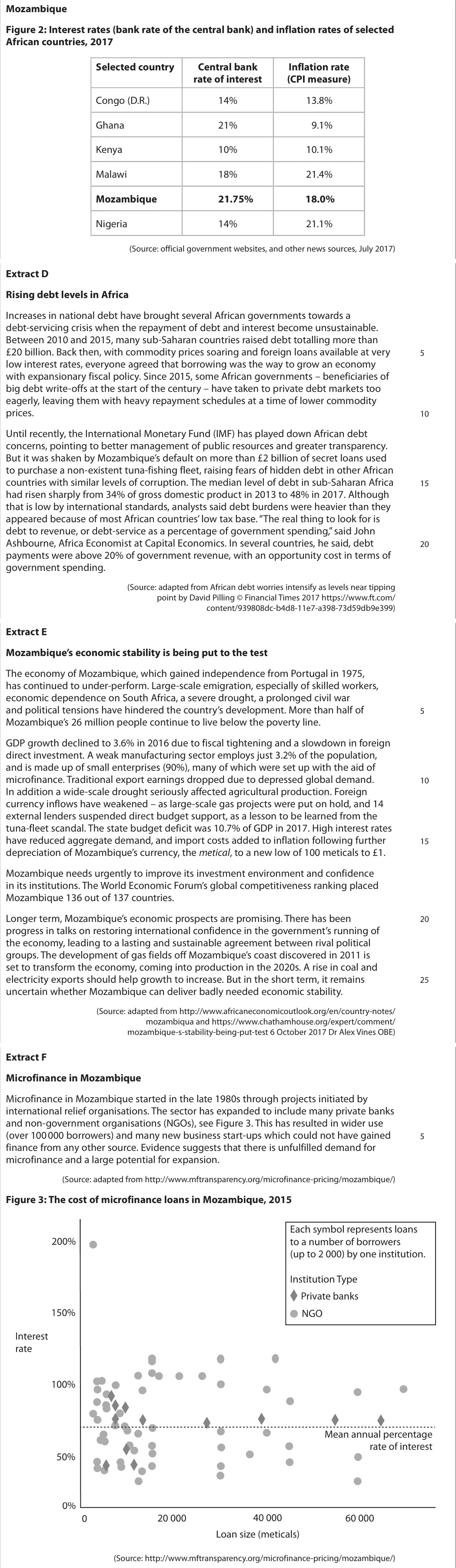
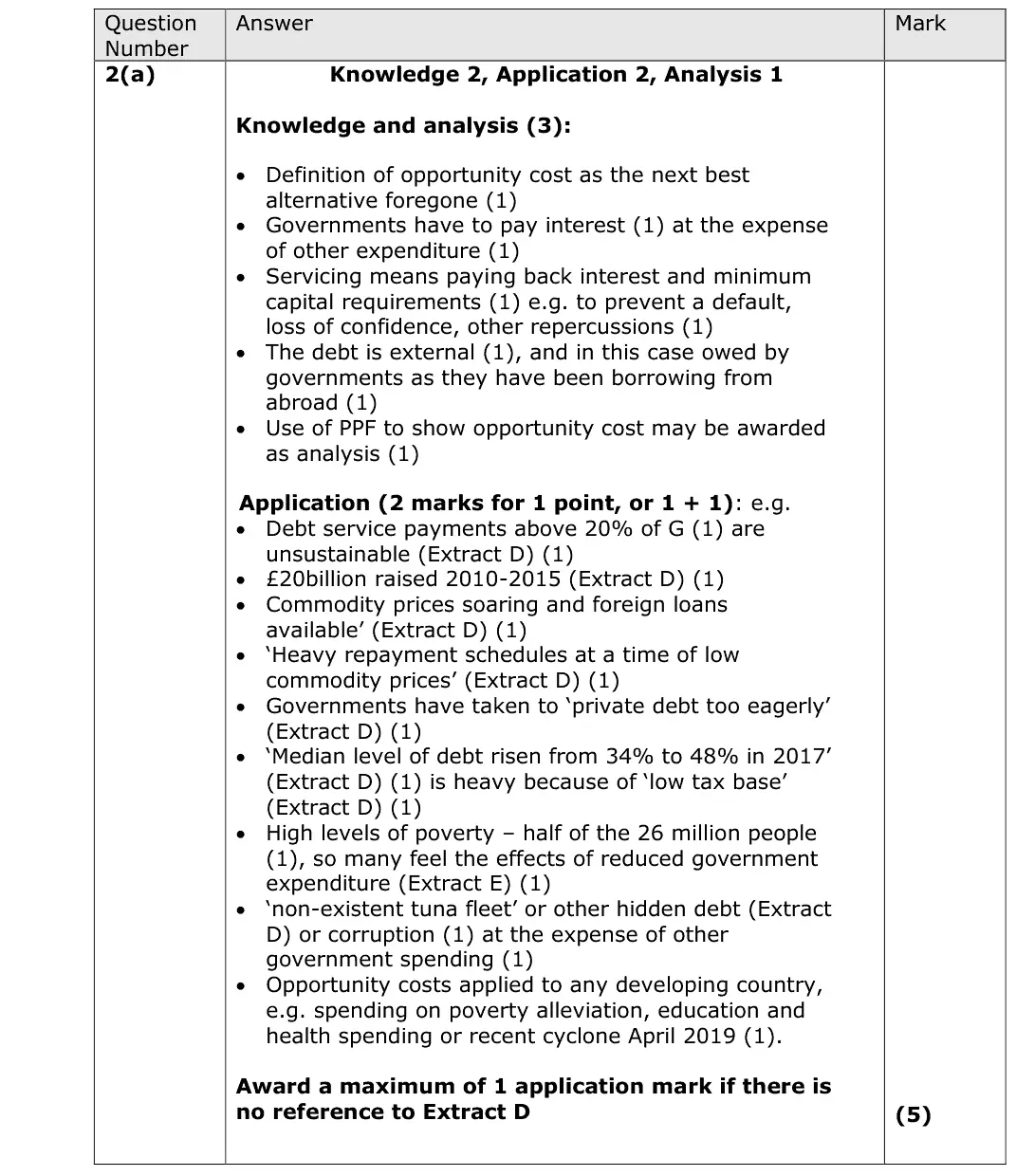
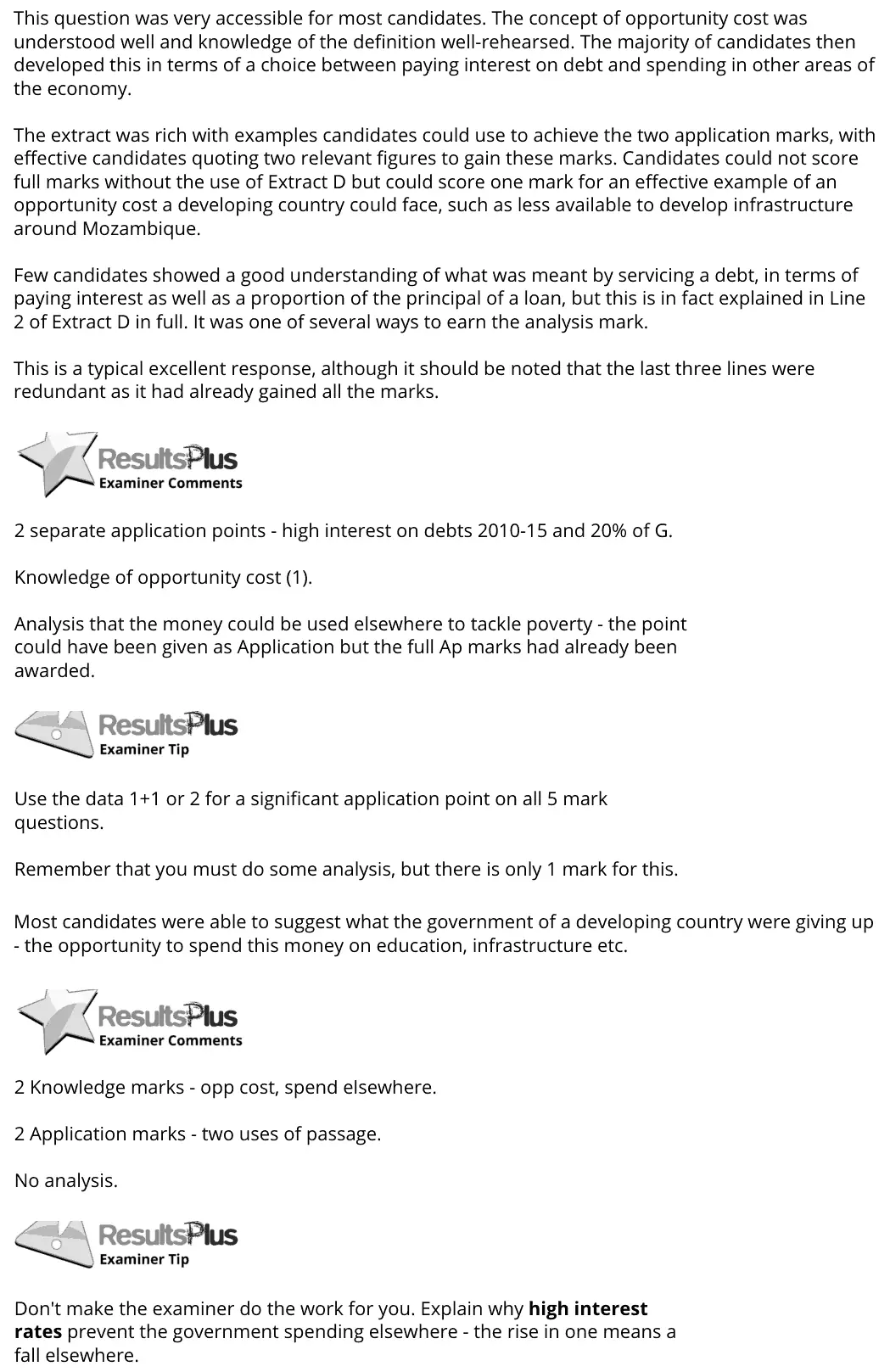
This question was very accessible for most candidates. The concept of opportunity cost was understood well and knowledge of the definition well-rehearsed. The majority of candidates then developed this in terms of a choice between paying interest on debt and spending in other areas of the economy. The extract was rich with examples candidates could use to achieve the two application marks, with effective candidates quoting two relevant figures to gain these marks. Candidates could not score full marks without the use of Extract D but could score one mark for an effective example of an opportunity cost a developing country could face, such as less available to develop infrastructure around Mozambique. Few candidates showed a good understanding of what was meant by servicing a debt, in terms of paying interest as well as a proportion of the principal of a loan, but this is in fact explained in Line 2 of Extract D in full. It was one of several ways to earn the analysis mark. This is a typical excellent response, although it should be noted that the last three lines were redundant as it had already gained all the marks. 2 separate application points - high interest on debts 2010-15 and 20% of G. Knowledge of opportunity cost (1). Analysis that the money could be used elsewhere to tackle poverty - the point could have been given as Application but the full Ap marks had already been awarded. Use the data 1+1 or 2 for a significant application point on all 5 mark questions. Remember that you must do some analysis, but there is only 1 mark for this. Most candidates were able to suggest what the government of a developing country were giving up - the opportunity to spend this money on education, infrastructure etc. 2 Knowledge marks - opp cost, spend elsewhere. 2 Application marks - two uses of passage. No analysis. Don't make the examiner do the work for you. Explain why high interest rates prevent the government spending elsewhere - the rise in one means a fall elsewhere.
Notes from the mark scheme and report
opportunity cost = next best alternative foregone: interest payments come at the expense of spending on health, education, poverty
servicing = interest plus repayment of principal (Extract D line 2)
max 1 application mark without Extract D (e.g. debt payments above 20% of revenue)
Quantitative skills: QS 9 (interpret, apply and analyse information in written, graphical tabular and numerical forms)
June 2018 · AS Paper 1 · Q1(a)1 markMultiple choice
Data and extracts for question 1
Answer
C
Mark scheme
Notes from the mark scheme and report
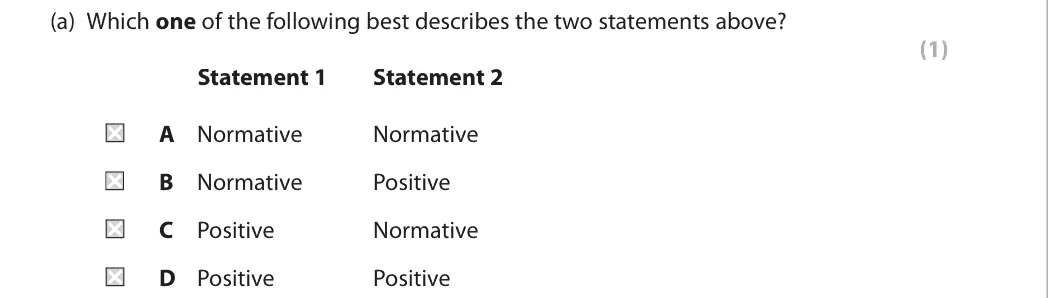
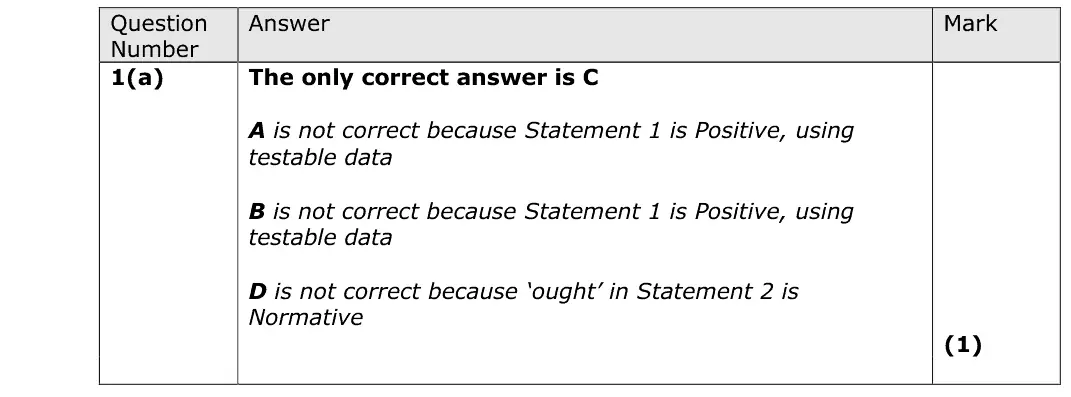
Statement 1 is testable data so positive
"ought" in Statement 2 is a value judgement so normative (C)
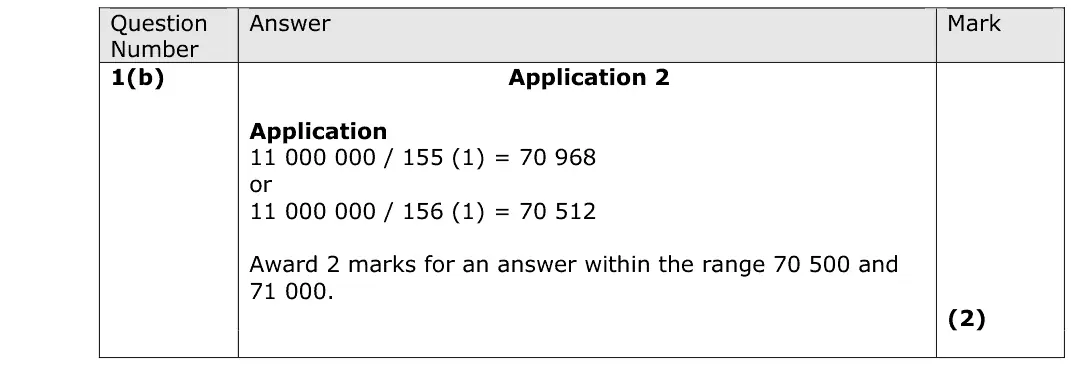
June 2018 · AS Paper 1 · Q1(b)2 marksAO2=2Calculation
Data and extracts for question 1
Mark scheme
Examiner's comment
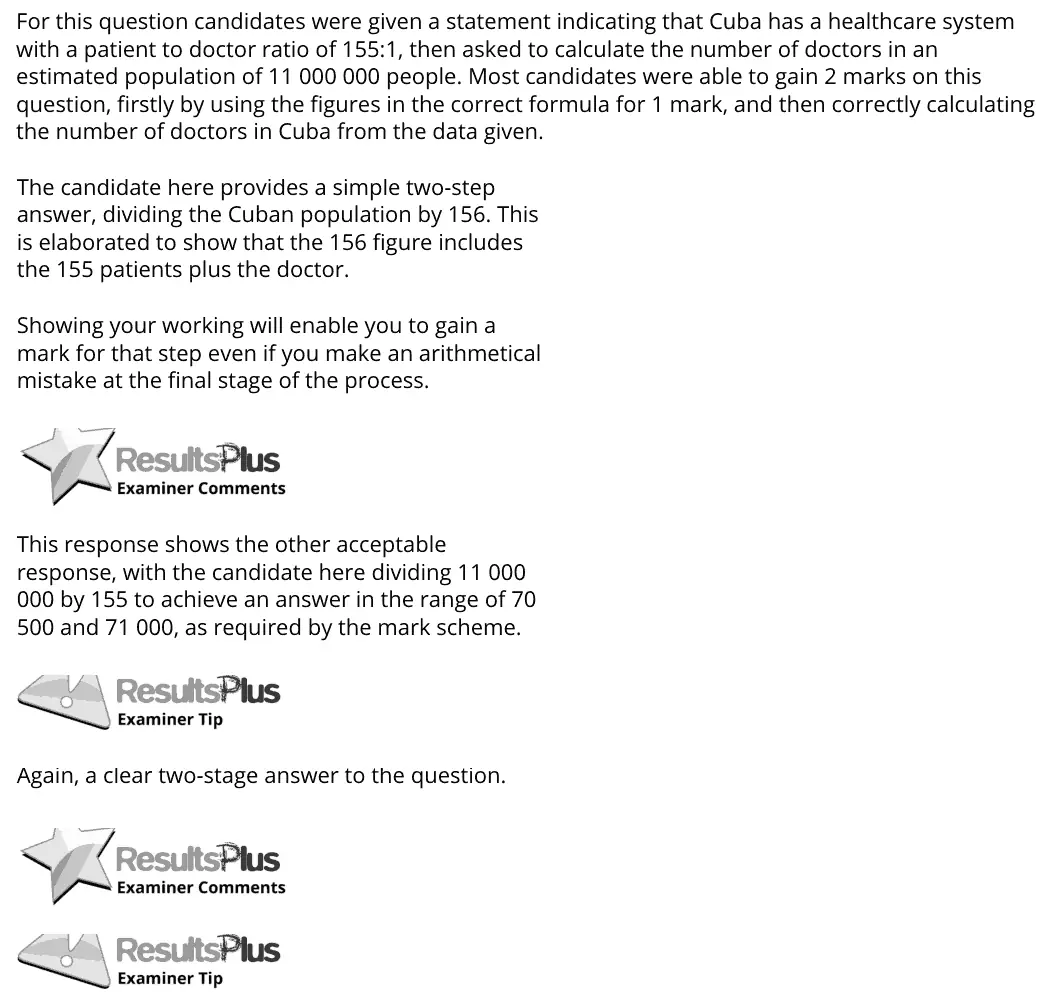
For this question candidates were given a statement indicating that Cuba has a healthcare system with a patient to doctor ratio of 155:1, then asked to calculate the number of doctors in an estimated population of 11 000 000 people. Most candidates were able to gain 2 marks on this question, firstly by using the figures in the correct formula for 1 mark, and then correctly calculating the number of doctors in Cuba from the data given. The candidate here provides a simple two-step answer, dividing the Cuban population by 156. This is elaborated to show that the 156 figure includes the 155 patients plus the doctor. Showing your working will enable you to gain a mark for that step even if you make an arithmetical mistake at the final stage of the process. This response shows the other acceptable response, with the candidate here dividing 11 000 000 by 155 to achieve an answer in the range of 70 500 and 71 000, as required by the mark scheme. Again, a clear two-stage answer to the question.
Quantitative skills: QS 1 (calculate, use and understand ratios and fractions)
June 2018 · AS Paper 1 · Q2(c)1 markAO1=1Definition
Data and extracts for question 2
Mark scheme
Examiner's comment
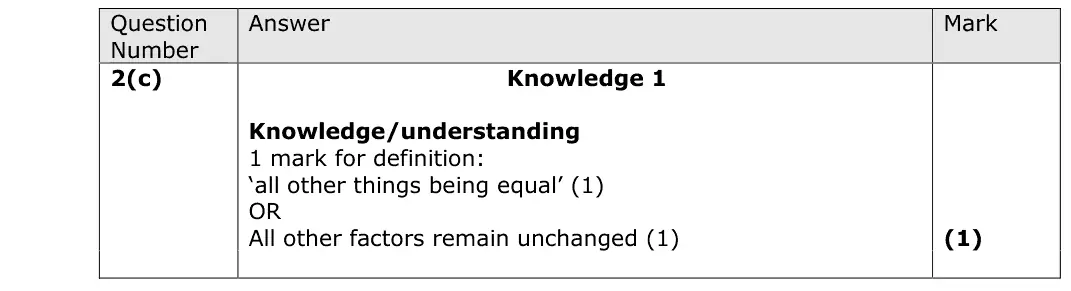
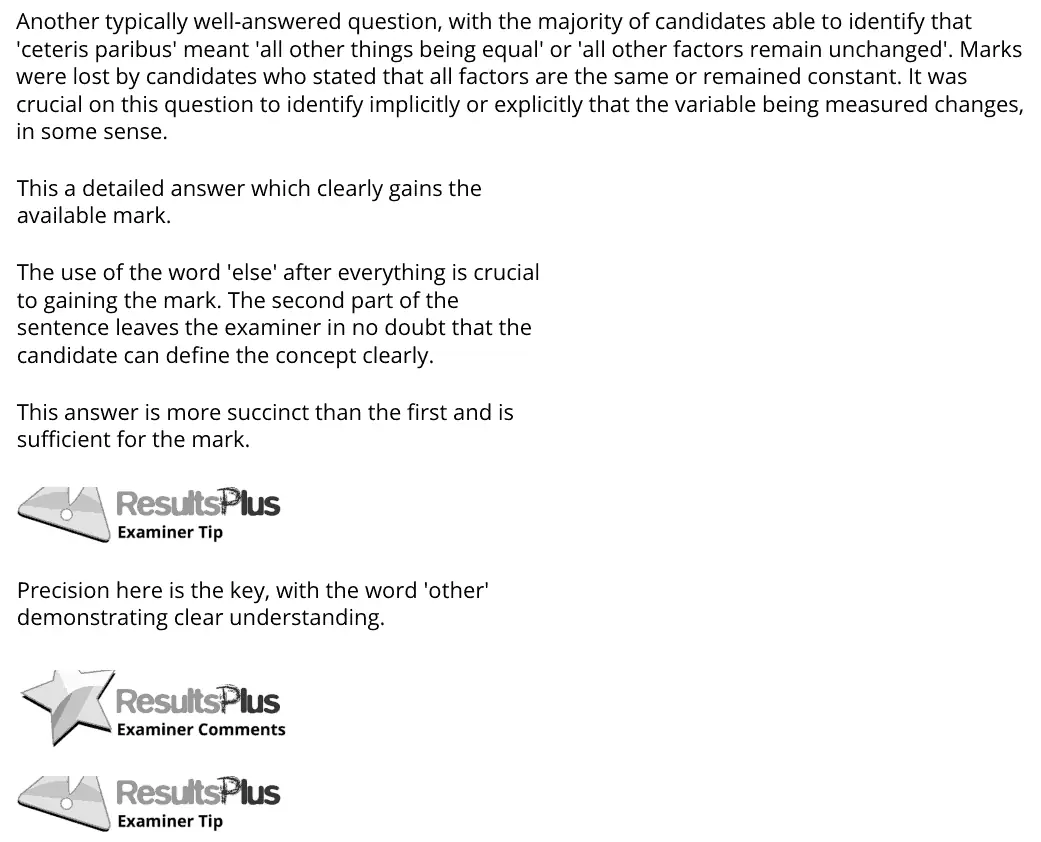
Another typically well-answered question, with the majority of candidates able to identify that 'ceteris paribus' meant 'all other things being equal' or 'all other factors remain unchanged'. Marks were lost by candidates who stated that all factors are the same or remained constant. It was crucial on this question to identify implicitly or explicitly that the variable being measured changes, in some sense. This a detailed answer which clearly gains the available mark. The use of the word 'else' after everything is crucial to gaining the mark. The second part of the sentence leaves the examiner in no doubt that the candidate can define the concept clearly. This answer is more succinct than the first and is sufficient for the mark. Precision here is the key, with the word 'other' demonstrating clear understanding.
Notes from the mark scheme and report
"all other things being equal" or all other factors unchanged
report: "all factors remain constant" lost the mark as the variable studied does change
June 2018 · AS Paper 1 · Q6(d)4 marksAO1=2, AO2=2Short answer
Data and extracts for question 6
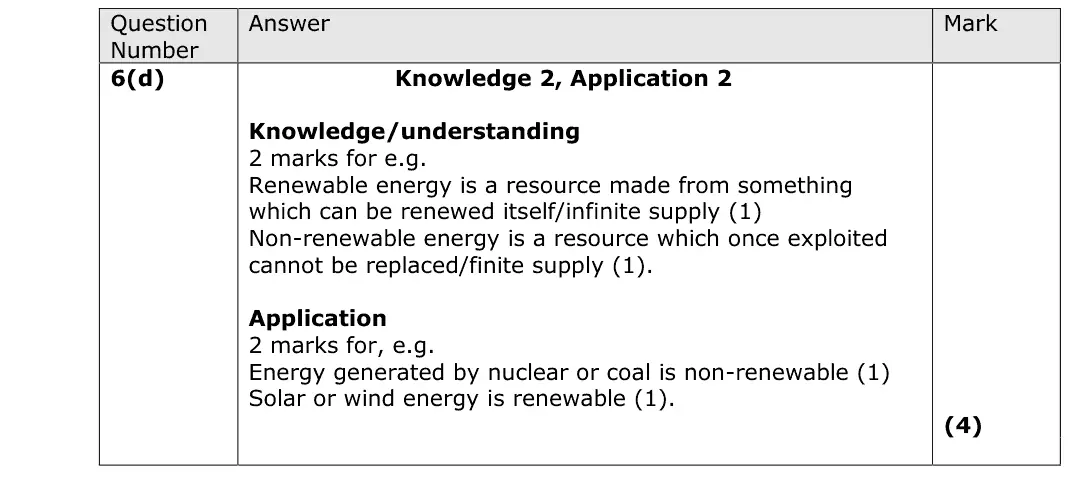
Mark scheme
Examiner's comment
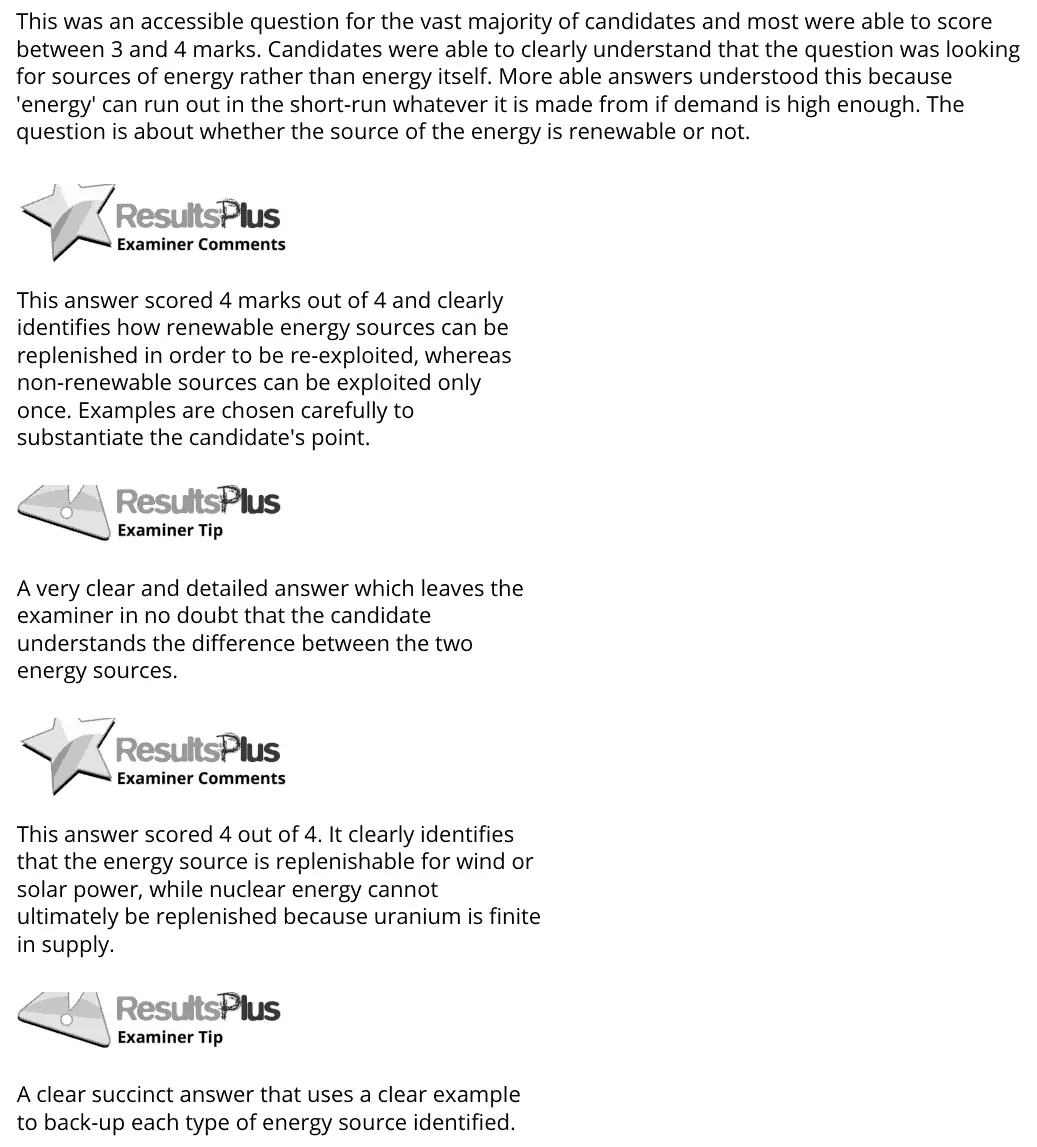
This was an accessible question for the vast majority of candidates and most were able to score between 3 and 4 marks. Candidates were able to clearly understand that the question was looking for sources of energy rather than energy itself. More able answers understood this because 'energy' can run out in the short-run whatever it is made from if demand is high enough. The question is about whether the source of the energy is renewable or not. This answer scored 4 marks out of 4 and clearly identifies how renewable energy sources can be replenished in order to be re-exploited, whereas non-renewable sources can be exploited only once. Examples are chosen carefully to substantiate the candidate's point. A very clear and detailed answer which leaves the examiner in no doubt that the candidate understands the difference between the two energy sources. This answer scored 4 out of 4. It clearly identifies that the energy source is replenishable for wind or solar power, while nuclear energy cannot ultimately be replenished because uranium is finite in supply. A clear succinct answer that uses a clear example to back-up each type of energy source identified.
Notes from the mark scheme and report
renewable sources replenish (solar, wind) while non-renewable sources are finite once used (coal, gas, uranium/nuclear)
use examples from the extracts
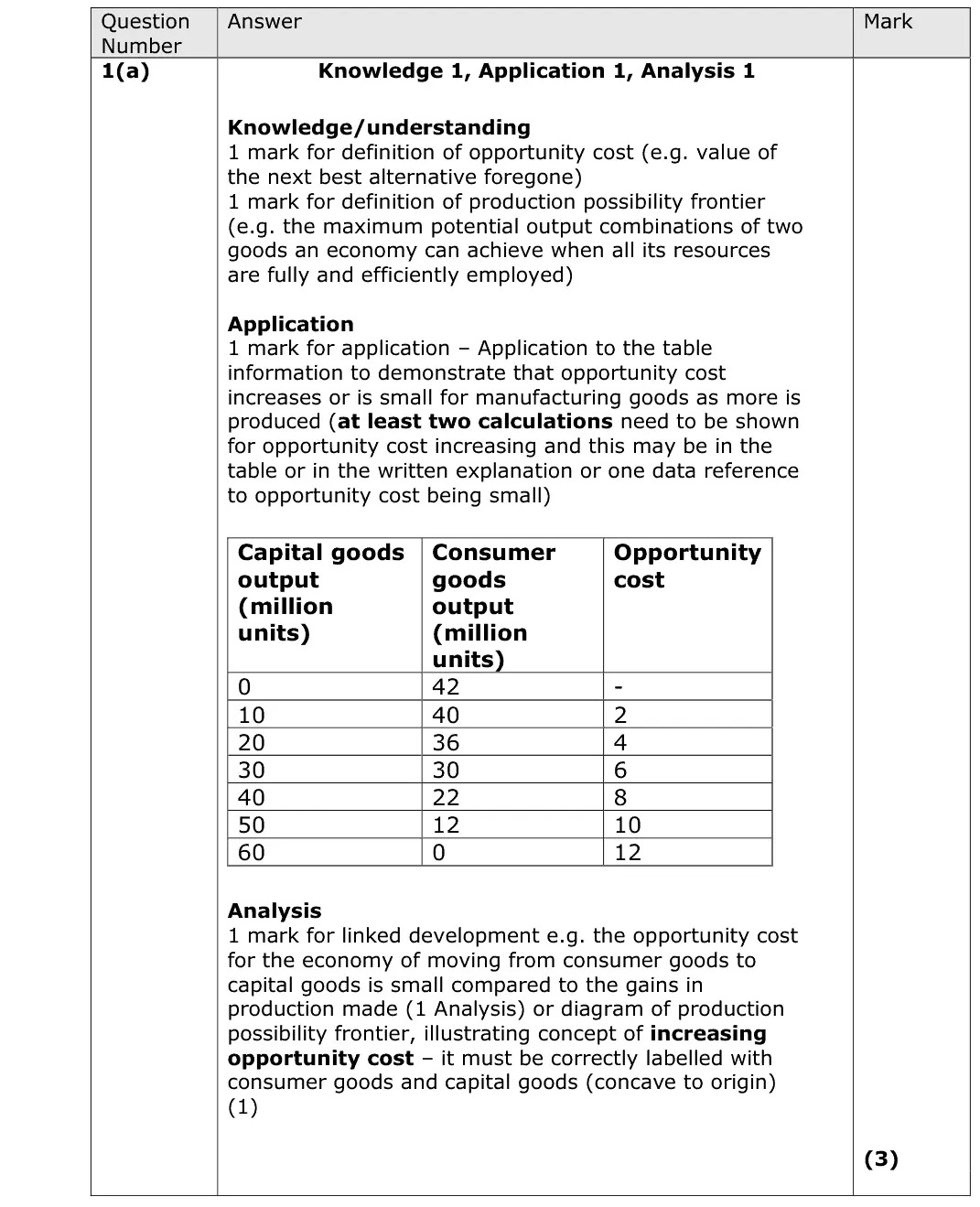
June 2017 · AS Paper 1 · Q1(a)3 marksAO1=1, AO2=1, AO3=1Calculation
Data and extracts for question 1
Mark scheme
Examiner's comment
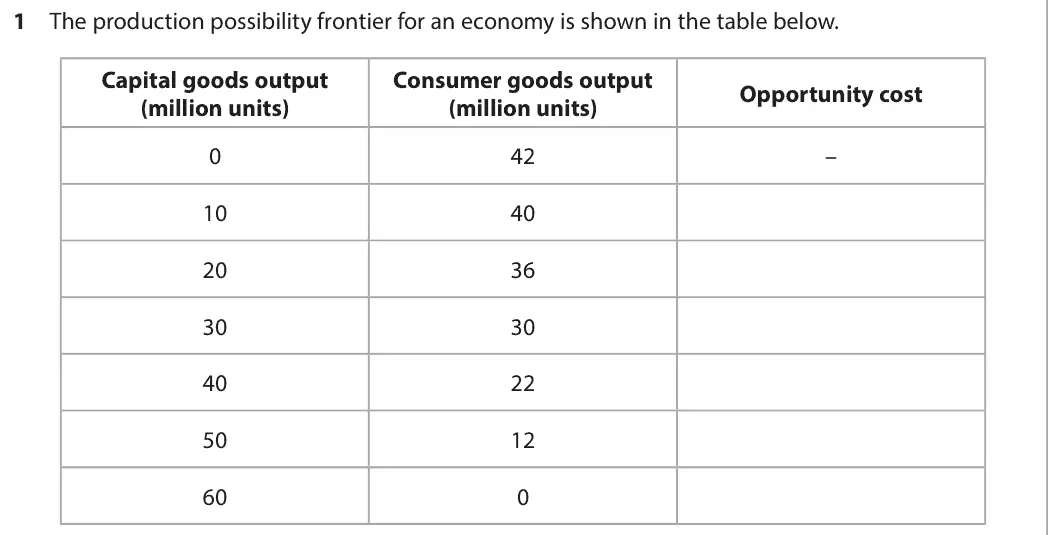
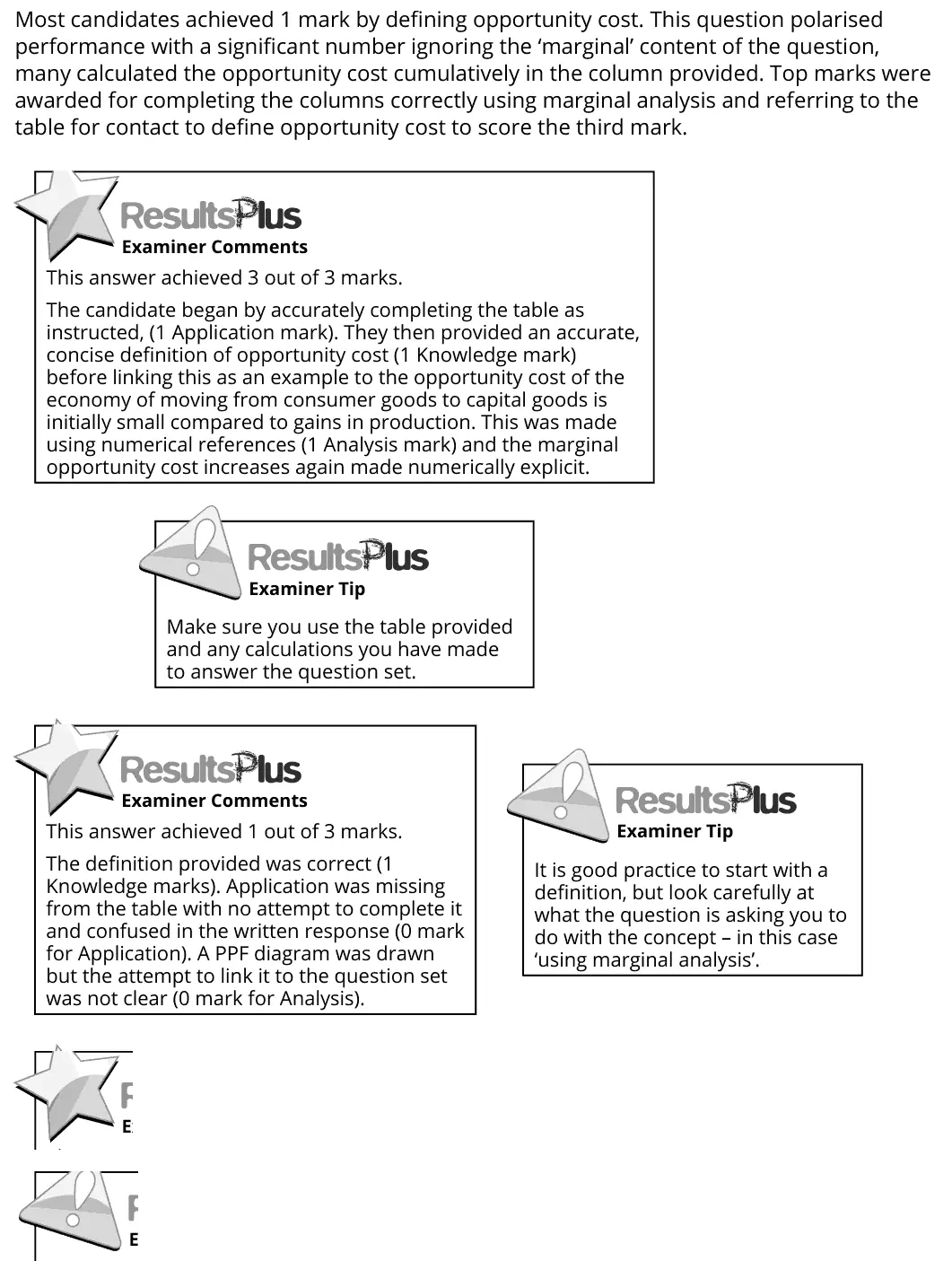
Most candidates achieved 1 mark by defining opportunity cost. This question polarised performance with a significant number ignoring the ‘marginal’ content of the question, many calculated the opportunity cost cumulatively in the column provided. Top marks were awarded for completing the columns correctly using marginal analysis and referring to the table for contact to define opportunity cost to score the third mark. This answer achieved 3 out of 3 marks. The candidate began by accurately completing the table as instructed, (1 Application mark). They then provided an accurate, concise definition of opportunity cost (1 Knowledge mark) before linking this as an example to the opportunity cost of the economy of moving from consumer goods to capital goods is initially small compared to gains in production. This was made using numerical references (1 Analysis mark) and the marginal opportunity cost increases again made numerically explicit. Make sure you use the table provided and any calculations you have made to answer the question set. This answer achieved 1 out of 3 marks. The definition provided was correct (1 Knowledge marks). Application was missing from the table with no attempt to complete it and confused in the written response (0 mark for Application). A PPF diagram was drawn but the attempt to link it to the question set was not clear (0 mark for Analysis). It is good practice to start with a definition, but look carefully at what the question is asking you to do with the concept – in this case ‘using marginal analysis’.
Notes from the mark scheme and report
complete the column marginally: opportunity costs 2, 4, 6, 8, 10, 12 units of consumer goods per extra 10 capital goods (at least two calculations)
many calculated cumulatively and ignored 'marginal'
analysis = increasing opportunity cost, PPF concave to the origin
Quantitative skills: QS 9 (interpret, apply and analyse information in written, graphical tabular and numerical forms)
Work with an Edexcel economics tutor
Essays stuck in Level 2, or losing the easy marks in Section A? Book a trial session with Lianne, a former Edexcel examiner.