Free market, mixed and command economies Theme 1

Where it is examined
A-level Paper 1 (and Paper 3); AS Paper 1
Level
AS and A level
Specification
Section 1.1, 1 statement
Since 2016
15 question parts: 4 essays, 0 levels-marked responses, 4 multiple-choice items

Notes and key-term cards for this topic are being written by our tutors. The past-paper questions below are ready now.

Specification statements

Every essay set on this topic

SeriesPaperQMarksTitle
June 2023AS Paper 16(g)20Evaluate the possible disadvantages of a free market approach to the provision of television content.
October 2020AS Paper 16(f)20Evaluate the possible advantages of a free market approach to providing services such as education.
June 2019AS Paper 16(g)20Evaluate the possible disadvantages of a free market approach to providing health care.
June 2017AS Paper 16(f)20Evaluate the possible advantages of a free market approach to cigarette consumption.

Past-paper questions

Print this topic as a pack

Tap a question to zoom it. The data and extracts fold out above each question; the mark scheme and examiner's comment open underneath.
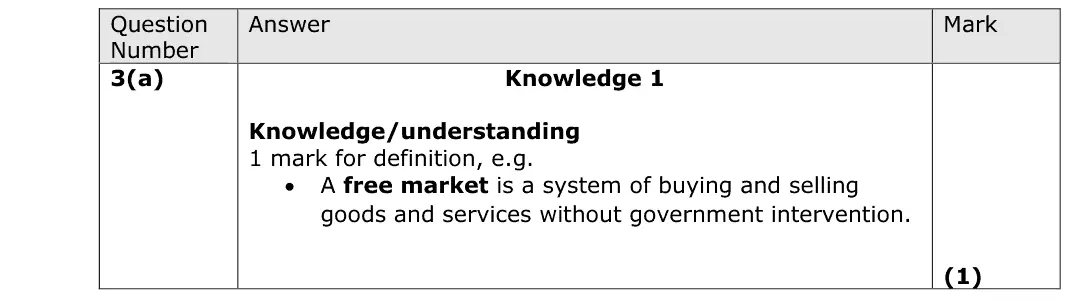
June 2025 · AS Paper 1 · Q3(a) 1 mark AO1=1 Definition
(a) The economy of Singapore is a highly developed free market economy with some elements of government intervention. Define the term ‘free market’. (1)
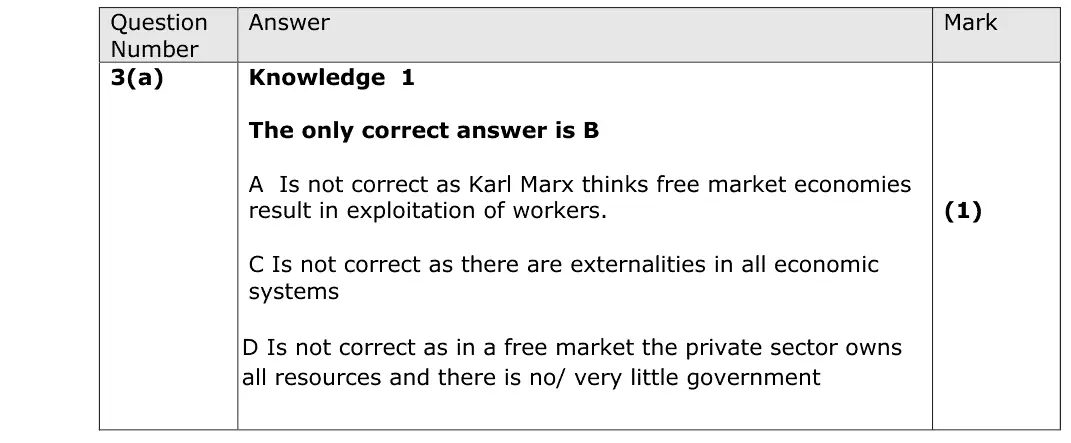
June 2024 · AS Paper 1 · Q3(a) 1 mark AO1=1 Multiple choice
Data and extracts for question 33 Singapore is mainly a free market economy.
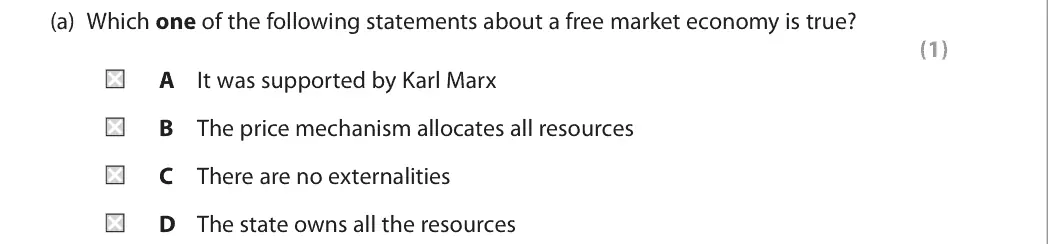
(a) Which one of the following statements about a free market economy is true? (1) A It was supported by Karl Marx B The price mechanism allocates all resources C There are no externalities D The state owns all the resources
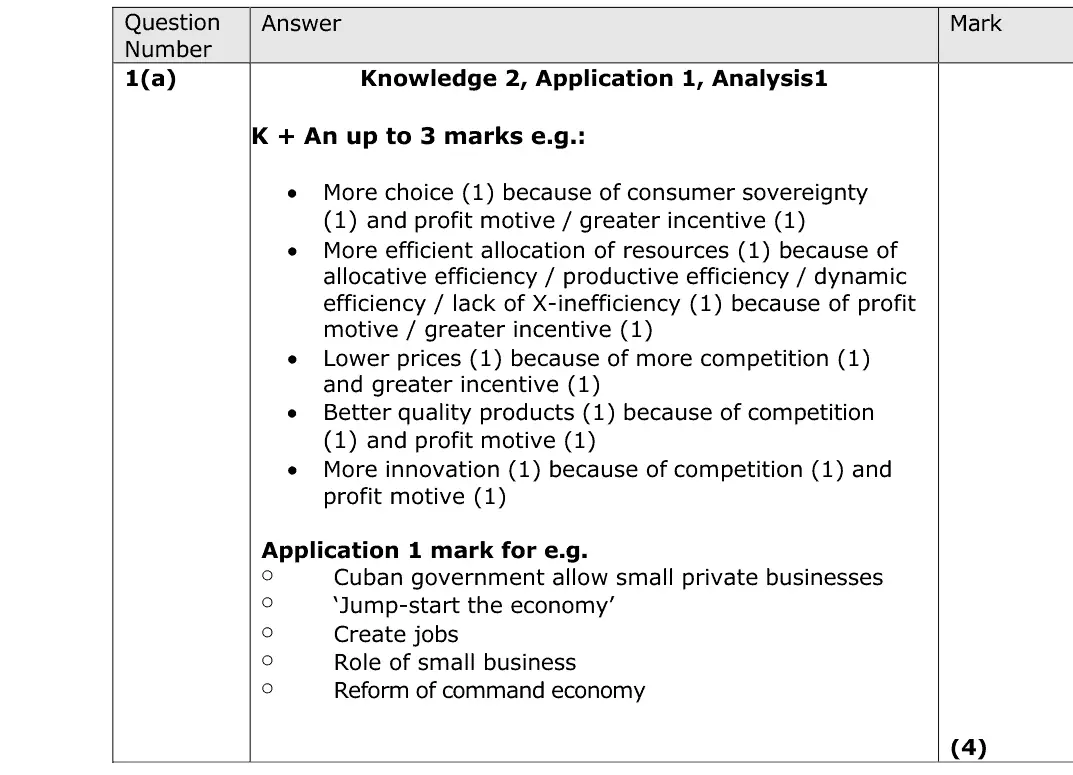
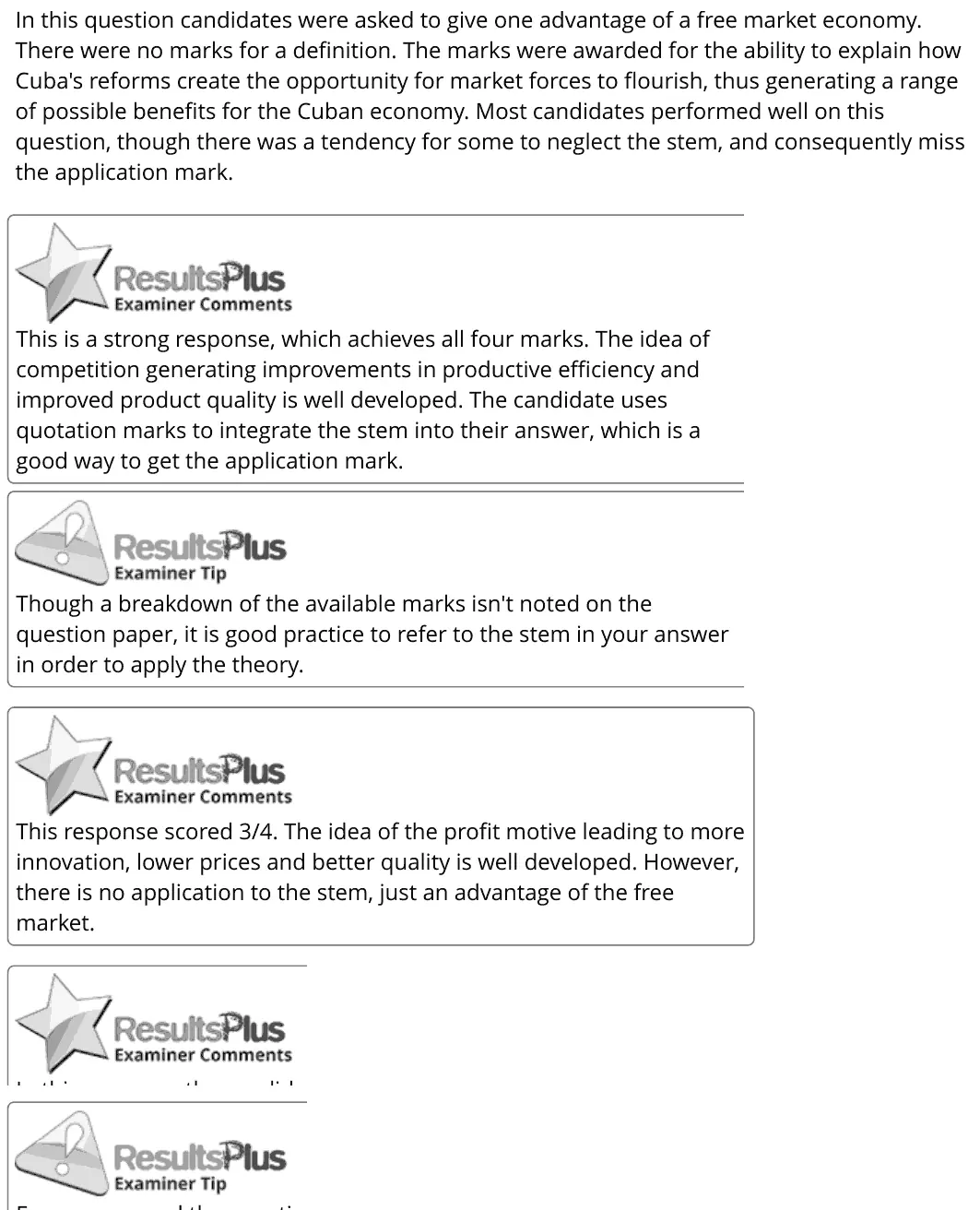
June 2023 · Paper 1 · Q1(a) 4 marks AO1=2, AO2=1, AO3=1 Short answer
Data and extracts for question 11 In a major reform of its command economy, the Cuban government will allow small private businesses to operate in most fields. Free market economists have long called for the role of small business to be expanded to help jump‑start the economy and to create jobs. (Source adapted from: https://www.telegraph.co.uk/news/2021/02/07/ cuba-allows-massive-expansion-private-businesses/)
(a) With reference to the information provided, explain one advantage of a free market economy. (4)
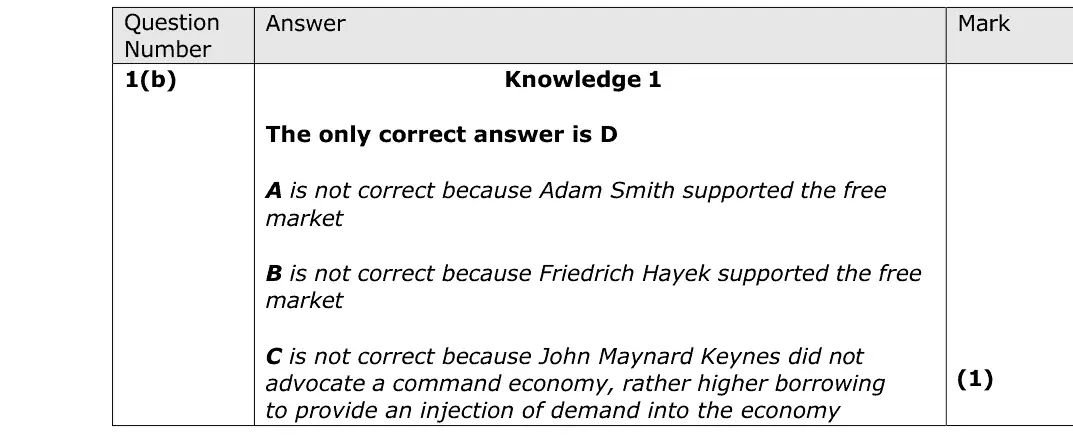
June 2023 · Paper 1 · Q1(b) 1 mark AO1=1 Multiple choice
Data and extracts for question 11 In a major reform of its command economy, the Cuban government will allow small private businesses to operate in most fields. Free market economists have long called for the role of small business to be expanded to help jump‑start the economy and to create jobs. (Source adapted from: https://www.telegraph.co.uk/news/2021/02/07/ cuba-allows-massive-expansion-private-businesses/)
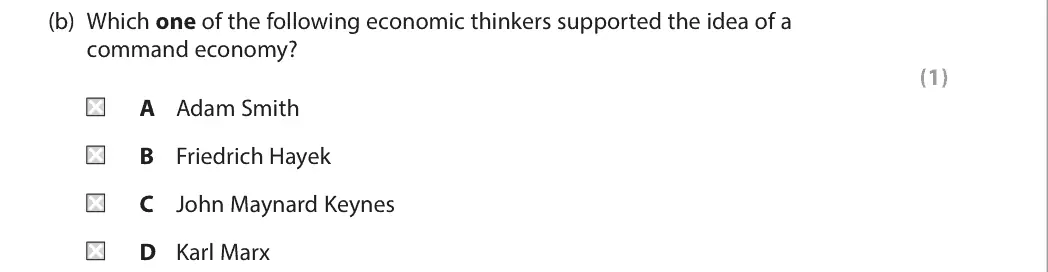
(b) Which one of the following economic thinkers supported the idea of a command economy? (1) A Adam Smith B Friedrich Hayek C John Maynard Keynes D Karl Marx
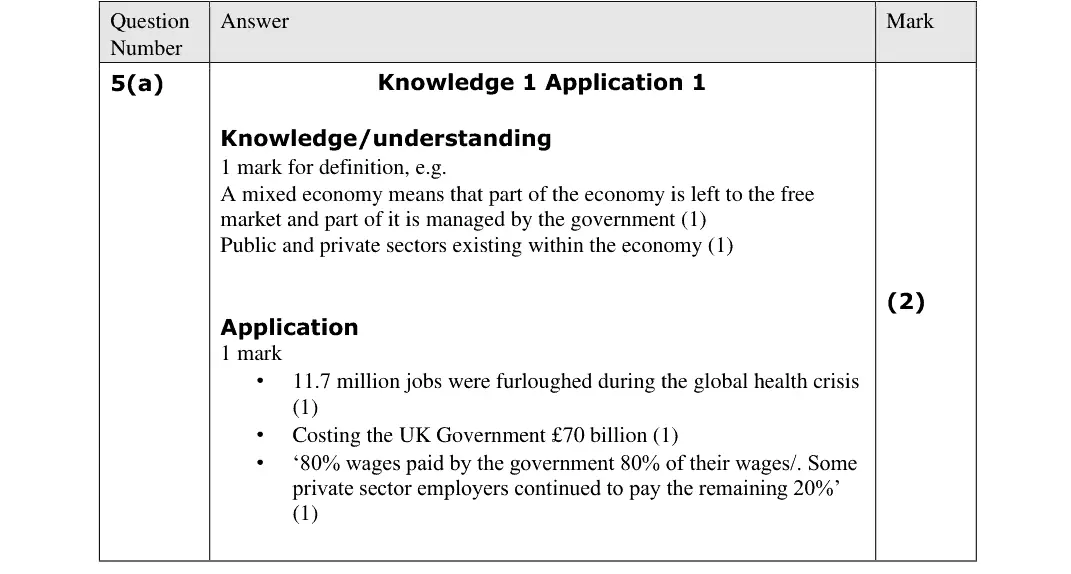
June 2023 · AS Paper 1 · Q5(a) 2 marks AO1=1, AO2=1 Definition
Data and extracts for question 55 During the global health crisis, 11.7 million jobs were furloughed, costing the UK Government £70 billion. This meant people were paid by the government 80% of their wages even though they did not work. Some private sector employers continued to pay the remaining 20 %. (Source: adapted from https://commonslibrary.parliament.uk/ examining-the-end-of-the-furlough-scheme)
(a) With reference to the above information, define the term ‘mixed economy’. (2)
June 2023 · AS Paper 1 · Q5(c) 1 mark Multiple choice
Data and extracts for question 55 During the global health crisis, 11.7 million jobs were furloughed, costing the UK Government £70 billion. This meant people were paid by the government 80% of their wages even though they did not work. Some private sector employers continued to pay the remaining 20 %. (Source: adapted from https://commonslibrary.parliament.uk/ examining-the-end-of-the-furlough-scheme)
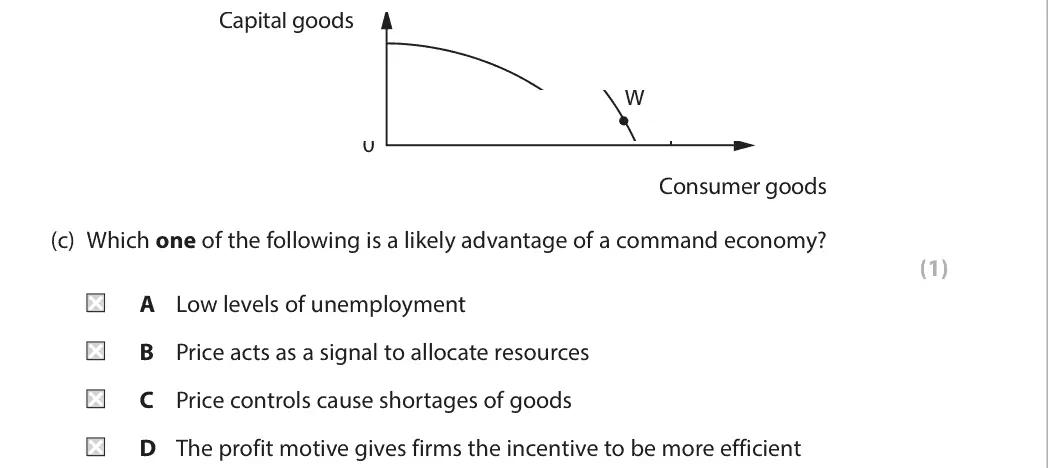
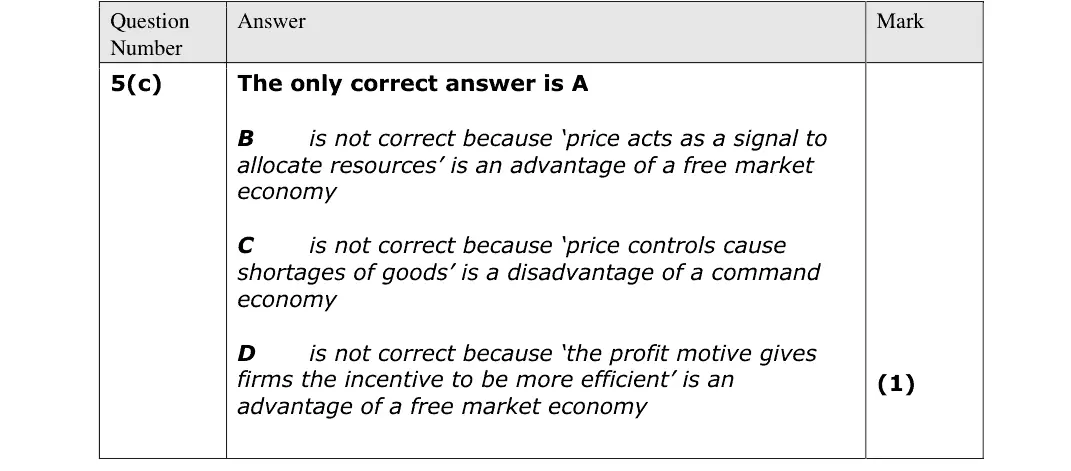
Capital goods W 0 Consumer goods (c) Which one of the following is a likely advantage of a command economy? (1) A Low levels of unemployment B Price acts as a signal to allocate resources C Price controls cause shortages of goods D The profit motive gives firms the incentive to be more efficient
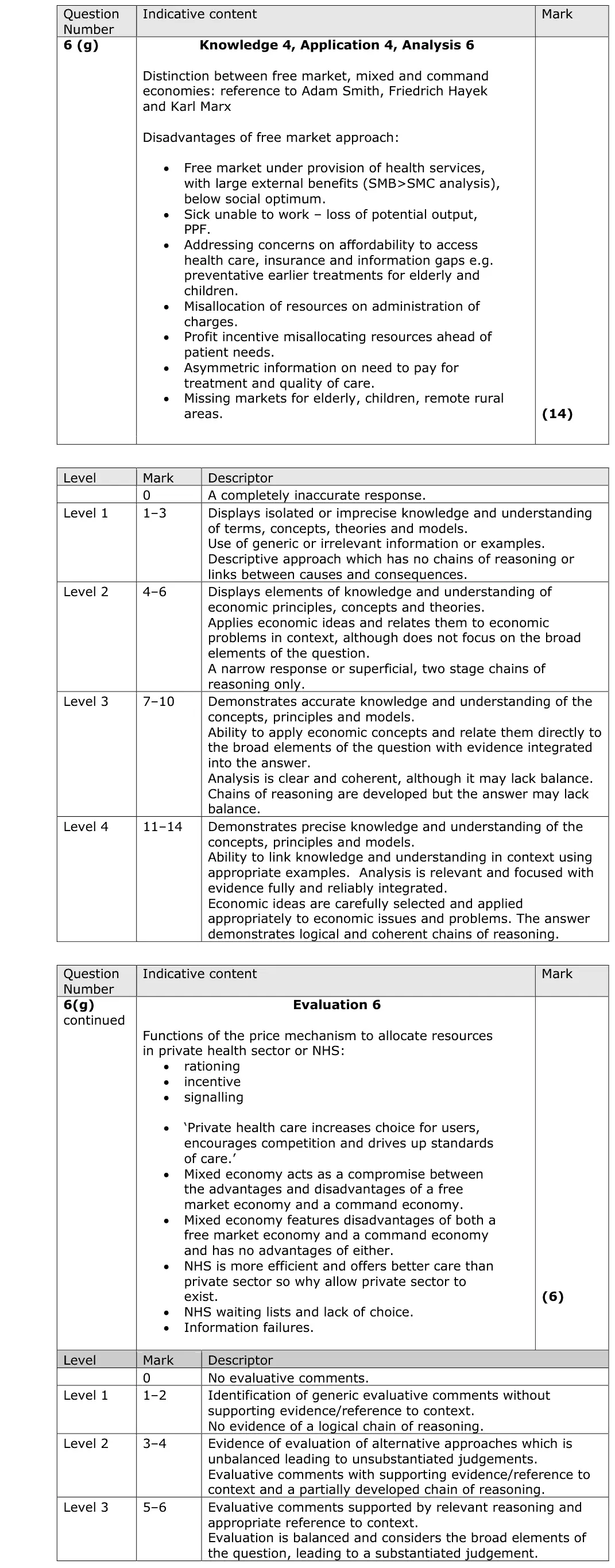
June 2023 · AS Paper 1 · Q6(g) 20 marks AO1=4, AO2=4, AO3=6, AO4=6 20-mark essay Either/or
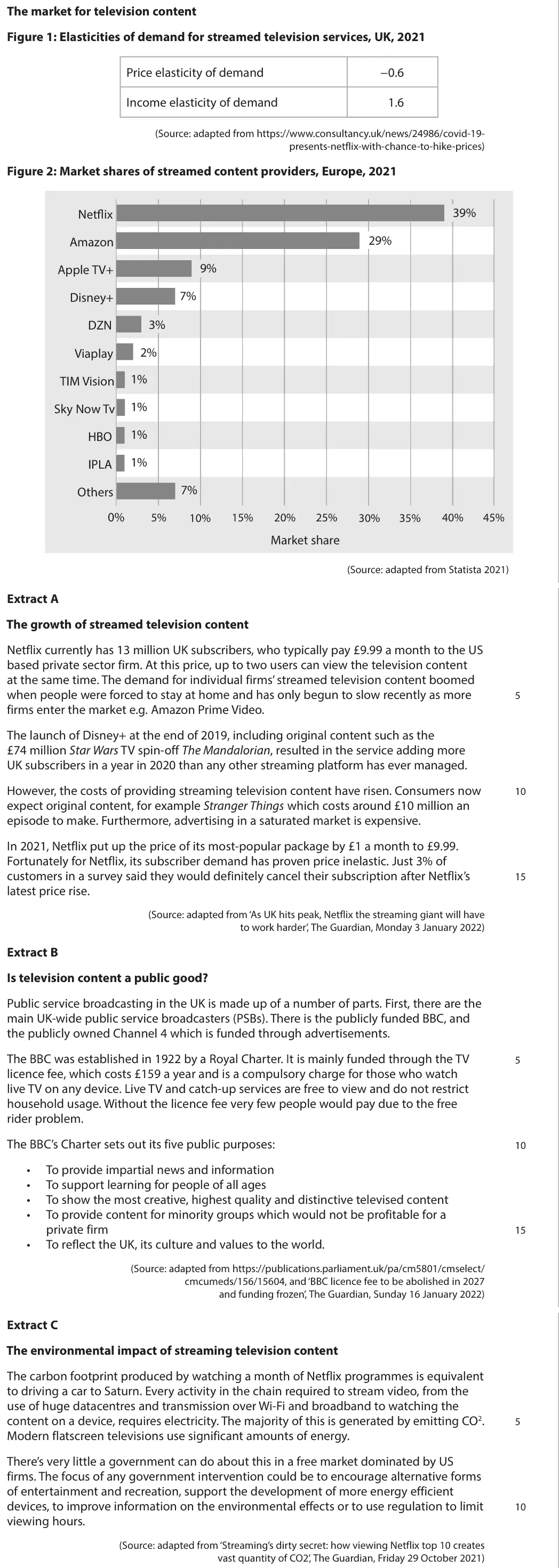
Data and extracts for question 6The market for television content Figure 1: Elasticities of demand for streamed television services, UK, 2021 Price elasticity of demand -0.6 Income elasticity of demand 1.6 (Source: adapted from https://www.consultancy.uk/news/24986/covid-19- presents-netflix-with-chance-to-hike-prices) Figure 2: Market shares of streamed content providers, Europe, 2021 39% Netflix 29% Amazon 9% Apple TV+ 7% Disney+ 3% DZN 2% Viaplay 1% TIM Vision 1% Sky Now Tv 1% HBO 1% IPLA 7% Others 0% 5% 10% 15% 20% 25% 30% 35% 40% 45% Market share (Source: adapted from Statista 2021) Extract A The growth of streamed television content Netflix currently has 13 million UK subscribers, who typically pay £9.99 a month to the US based private sector firm. At this price, up to two users can view the television content at the same time. The demand for individual firms’ streamed television content boomed when people were forced to stay at home and has only begun to slow recently as more 5 firms enter the market e.g. Amazon Prime Video. The launch of Disney+ at the end of 2019, including original content such as the £74 million Star Wars TV spin-off The Mandalorian, resulted in the service adding more UK subscribers in a year in 2020 than any other streaming platform has ever managed. However, the costs of providing streaming television content have risen. Consumers now 10 expect original content, for example Stranger Things which costs around £10 million an episode to make. Furthermore, advertising in a saturated market is expensive. In 2021, Netflix put up the price of its most-popular package by £1 a month to £9.99. Fortunately for Netflix, its subscriber demand has proven price inelastic. Just 3% of customers in a survey said they would definitely cancel their subscription after Netflix’s 15 latest price rise. (Source: adapted from ‘As UK hits peak, Netflix the streaming giant will have to work harder’, The Guardian, Monday 3 January 2022) Extract B Is television content a public good? Public service broadcasting in the UK is made up of a number of parts. First, there are the main UK-wide public service broadcasters (PSBs). There is the publicly funded BBC, and the publicly owned Channel 4 which is funded through advertisements. The BBC was established in 1922 by a Royal Charter. It is mainly funded through the TV 5 licence fee, which costs £159 a year and is a compulsory charge for those who watch live TV on any device. Live TV and catch-up services are free to view and do not restrict household usage. Without the licence fee very few people would pay due to the free rider problem. The BBC’s Charter sets out its five public purposes: 10 • To provide impartial news and information • To support learning for people of all ages • To show the most creative, highest quality and distinctive televised content • To provide content for minority groups which would not be profitable for a private firm 15 • To reflect the UK, its culture and values to the world. (Source: adapted from https://publications.parliament.uk/pa/cm5801/cmselect/ cmcumeds/156/15604, and ‘BBC licence fee to be abolished in 2027 and funding frozen’, The Guardian, Sunday 16 January 2022) Extract C The environmental impact of streaming television content The carbon footprint produced by watching a month of Netflix programmes is equivalent to driving a car to Saturn. Every activity in the chain required to stream video, from the use of huge datacentres and transmission over Wi-Fi and broadband to watching the content on a device, requires electricity. The majority of this is generated by emitting CO2. 5 Modern flatscreen televisions use significant amounts of energy. There’s very little a government can do about this in a free market dominated by US firms. The focus of any government intervention could be to encourage alternative forms of entertainment and recreation, support the development of more energy efficient devices, to improve information on the environmental effects or to use regulation to limit 10 viewing hours. (Source: adapted from ‘Streaming’s dirty secret: how viewing Netflix top 10 creates vast quantity of CO2’, The Guardian, Friday 29 October 2021)
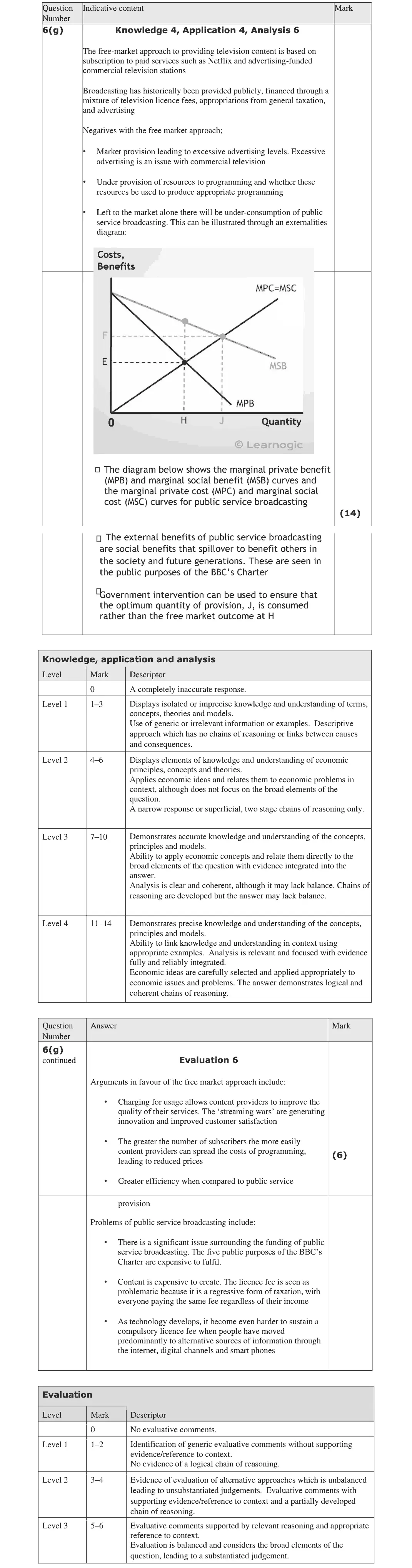
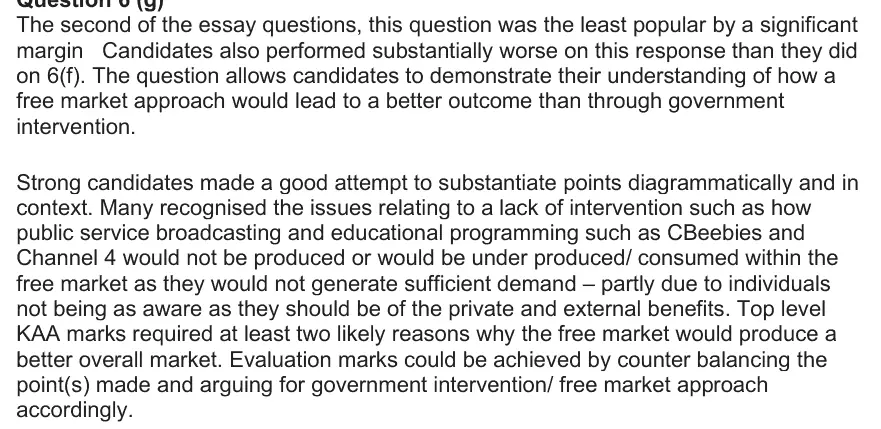
(g) Evaluate the possible disadvantages of a free market approach to the provision of television content. (20)
June 2022 · AS Paper 1 · Q6(c) 6 marks AO1=2, AO2=2, AO3=2 Short answer
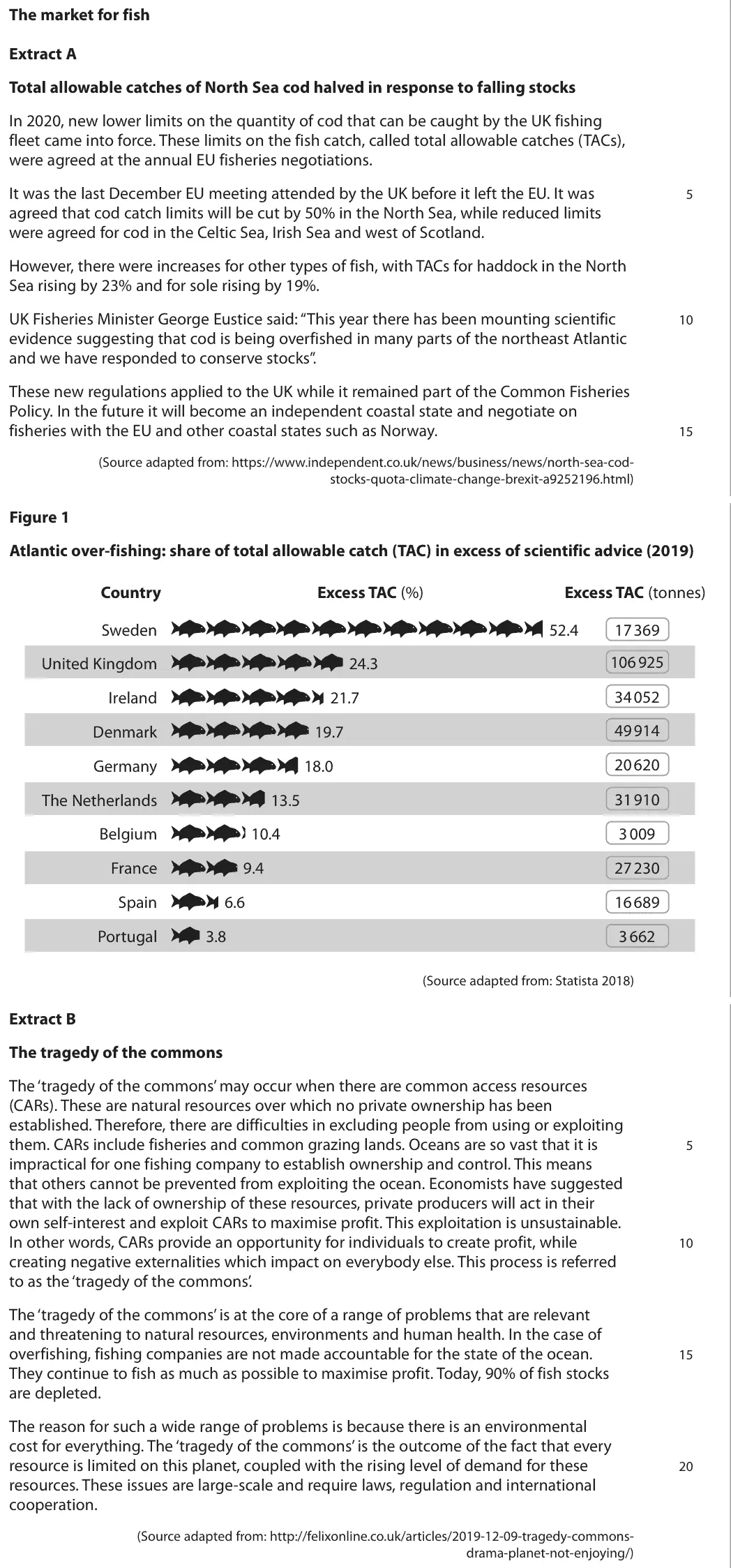
Data and extracts for question 6The market for fish Extract A Total allowable catches of North Sea cod halved in response to falling stocks In 2020, new lower limits on the quantity of cod that can be caught by the UK fishing fleet came into force. These limits on the fish catch, called total allowable catches (TACs), were agreed at the annual EU fisheries negotiations. It was the last December EU meeting attended by the UK before it left the EU. It was 5 agreed that cod catch limits will be cut by 50% in the North Sea, while reduced limits were agreed for cod in the Celtic Sea, Irish Sea and west of Scotland. However, there were increases for other types of fish, with TACs for haddock in the North Sea rising by 23% and for sole rising by 19%. UK Fisheries Minister George Eustice said: “This year there has been mounting scientific 10 evidence suggesting that cod is being overfished in many parts of the northeast Atlantic and we have responded to conserve stocks”. These new regulations applied to the UK while it remained part of the Common Fisheries Policy. In the future it will become an independent coastal state and negotiate on fisheries with the EU and other coastal states such as Norway. 15 (Source adapted from: https://www.independent.co.uk/news/business/news/north-sea-cod- stocks-quota-climate-change-brexit-a9252196.html) Figure 1 Atlantic over-fishing: share of total allowable catch (TAC) in excess of scientific advice (2019) Country Excess TAC (%) Excess TAC (tonnes) Sweden 52.4 17 369 106 925 United Kingdom 24.3 34 052 Ireland 21.7 49 914 Denmark 19.7 20 620 Germany 18.0 The Netherlands 13.5 31 910 3 009 Belgium 10.4 France 9.4 27 230 Spain 6.6 16 689 Portugal 3.8 3 662 (Source adapted from: Statista 2018) Extract B The tragedy of the commons The ‘tragedy of the commons’ may occur when there are common access resources (CARs). These are natural resources over which no private ownership has been established. Therefore, there are difficulties in excluding people from using or exploiting them. CARs include fisheries and common grazing lands. Oceans are so vast that it is 5 impractical for one fishing company to establish ownership and control. This means that others cannot be prevented from exploiting the ocean. Economists have suggested that with the lack of ownership of these resources, private producers will act in their own self-interest and exploit CARs to maximise profit. This exploitation is unsustainable. In other words, CARs provide an opportunity for individuals to create profit, while 10 creating negative externalities which impact on everybody else. This process is referred to as the ‘tragedy of the commons’. The ‘tragedy of the commons’ is at the core of a range of problems that are relevant and threatening to natural resources, environments and human health. In the case of overfishing, fishing companies are not made accountable for the state of the ocean. 15 They continue to fish as much as possible to maximise profit. Today, 90% of fish stocks are depleted. The reason for such a wide range of problems is because there is an environmental cost for everything. The ‘tragedy of the commons’ is the outcome of the fact that every resource is limited on this planet, coupled with the rising level of demand for these 20 resources. These issues are large-scale and require laws, regulation and international cooperation. (Source adapted from: http://felixonline.co.uk/articles/2019-12-09-tragedy-commons- drama-planet-not-enjoying/)
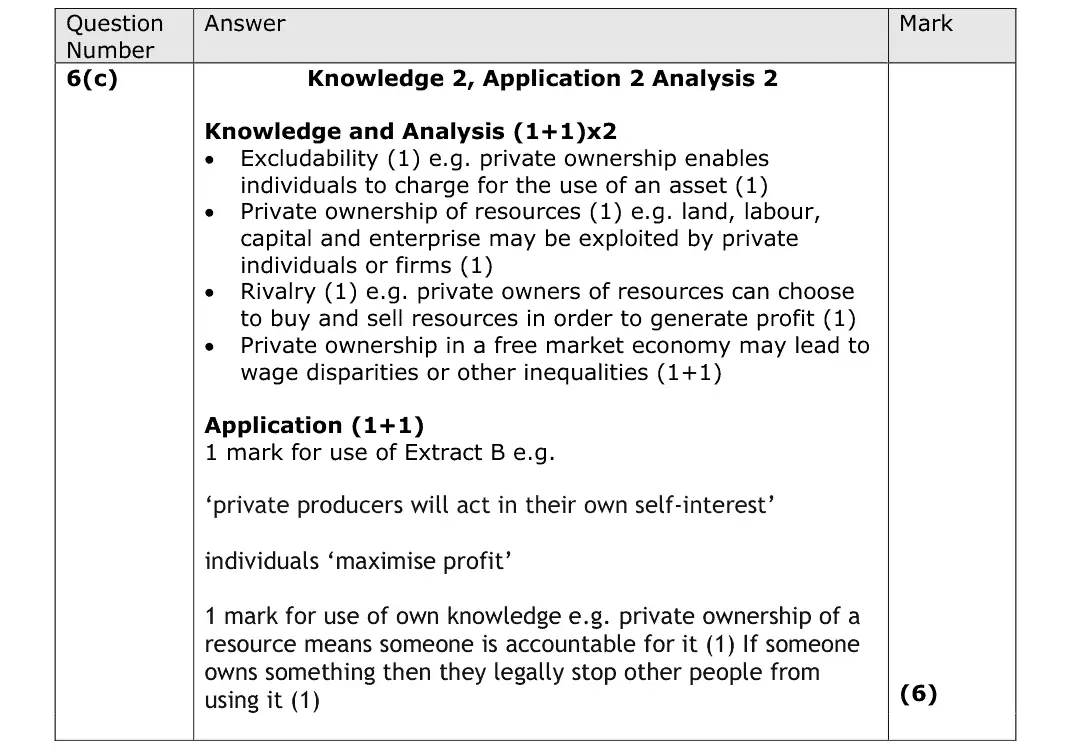
(c) With reference to the information provided and your own knowledge, explain two characteristics of private ownership in a free market economy. (6)
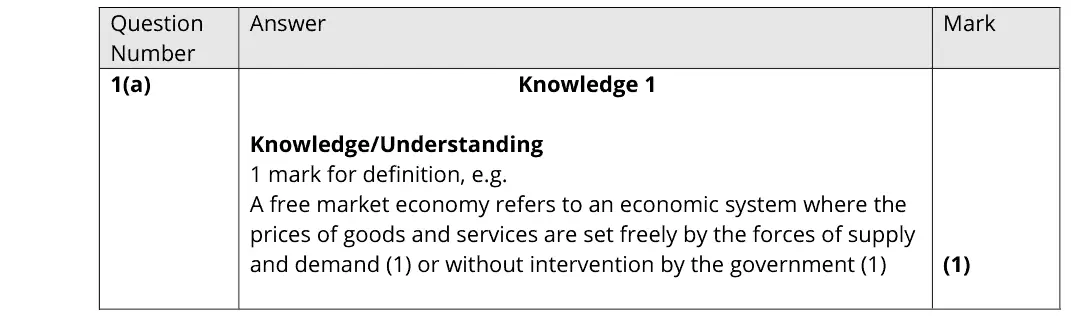
October 2020 · AS Paper 1 · Q1(a) 1 mark AO1=1 Definition
(a) Define the term ‘free market economy’. (1)
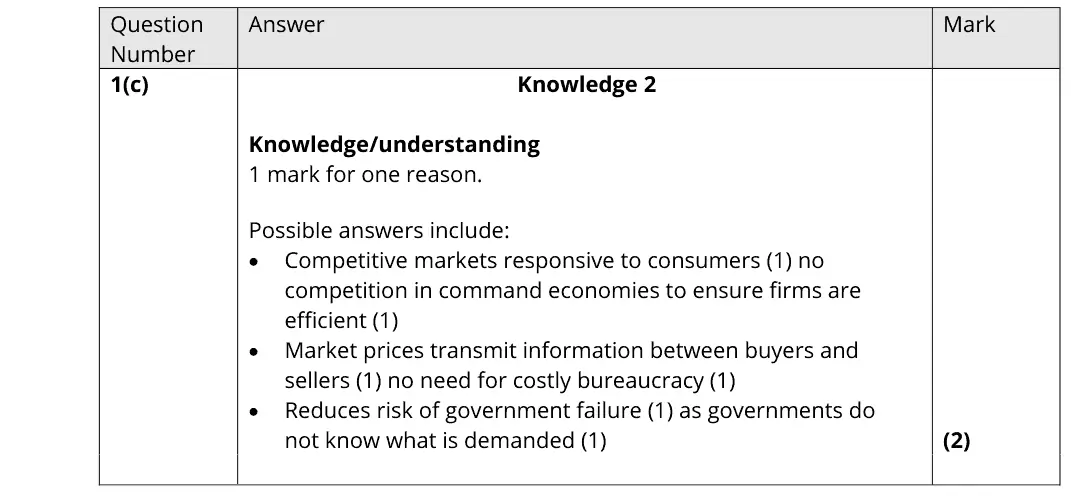
October 2020 · AS Paper 1 · Q1(c) 2 marks AO1=2 Short answer
(c) Explain one advantage of a free market economy compared to a command economy. (2)
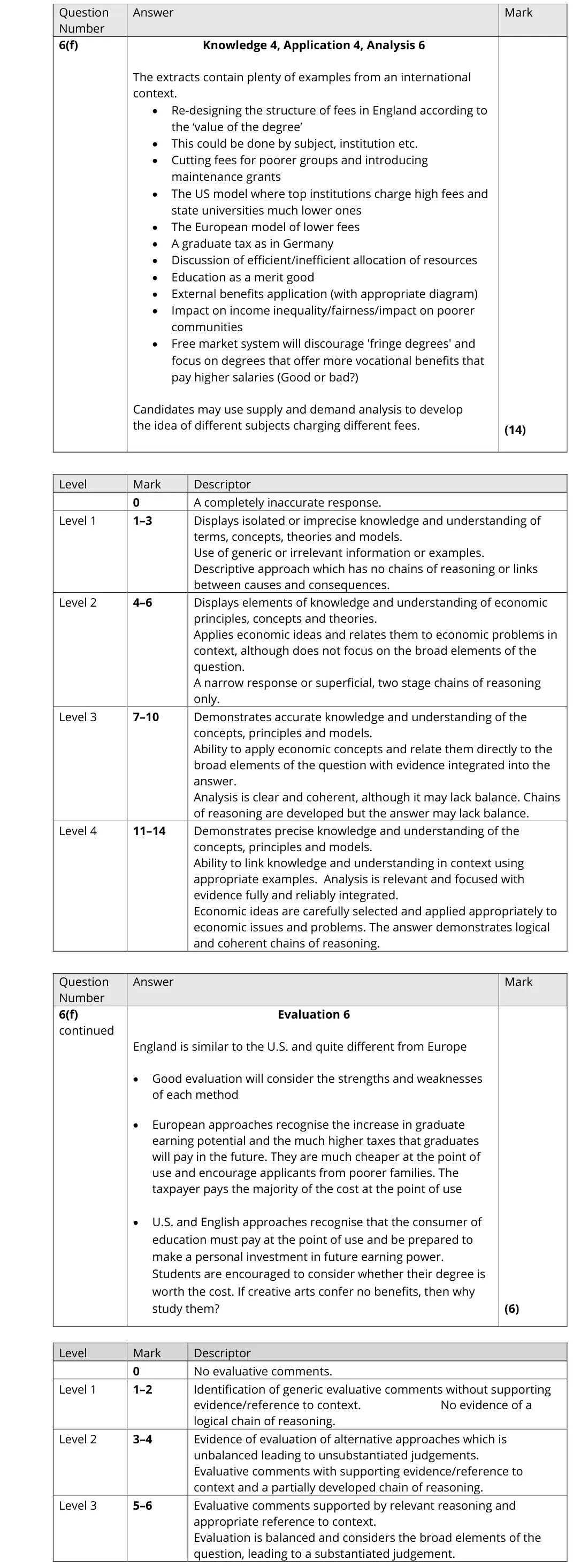
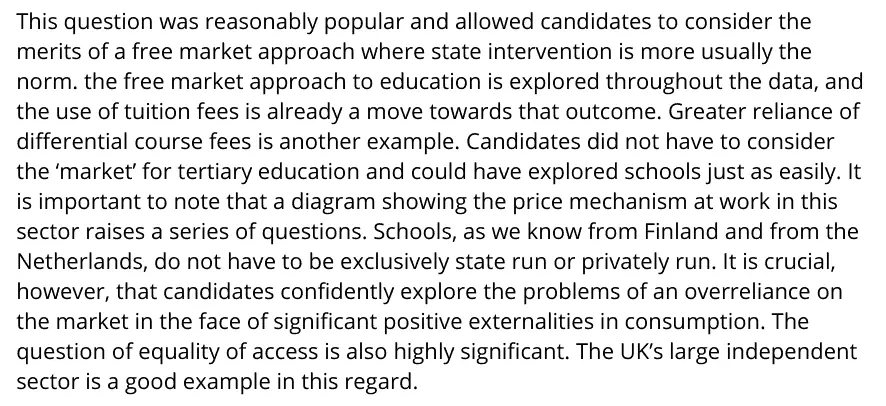
October 2020 · AS Paper 1 · Q6(f) 20 marks AO1=4, AO2=4, AO3=6, AO4=6 20-mark essay Either/or
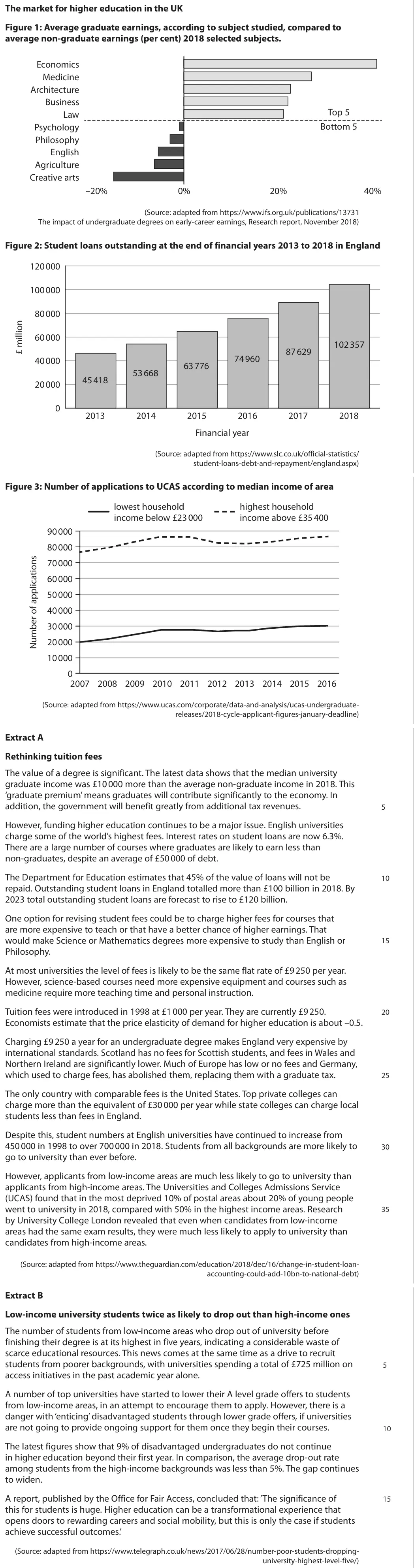
Data and extracts for question 6The market for higher education in the UK Figure 1: Average graduate earnings, according to subject studied, compared to average non-graduate earnings (per cent) 2018 selected subjects. Economics Medicine Architecture Business Top 5 Law Bottom 5 Psychology Philosophy English Agriculture Creative arts –20% 0% 20% 40% (Source: adapted from https://www.ifs.org.uk/publications/13731 The impact of undergraduate degrees on early-career earnings, Research report, November 2018) Figure 2: Student loans outstanding at the end of financial years 2013 to 2018 in England 120 000 100 000 80 000 60 000 102 357 87 629 74 960 40 000 63 776 53 668 45 418 20 000 0 2013 2014 2015 2016 2017 2018 Financial year (Source: adapted from https://www.slc.co.uk/official-statistics/ student-loans-debt-and-repayment/england.aspx) Figure 3: Number of applications to UCAS according to median income of area lowest household highest household income below £23 000 income above £35 400 90 000 80 000 70 000 60 000 50 000 40 000 30 000 20 000 10 000 0 2007 2008 2009 2010 2011 2012 2013 2014 2015 2016 (Source: adapted from https://www.ucas.com/corporate/data-and-analysis/ucas-undergraduate- releases/2018-cycle-applicant-figures-january-deadline) Extract A Rethinking tuition fees The value of a degree is significant. The latest data shows that the median university graduate income was £10 000 more than the average non-graduate income in 2018. This ‘graduate premium’ means graduates will contribute significantly to the economy. In addition, the government will benefit greatly from additional tax revenues. 5 However, funding higher education continues to be a major issue. English universities charge some of the world’s highest fees. Interest rates on student loans are now 6.3%. There are a large number of courses where graduates are likely to earn less than non-graduates, despite an average of £50 000 of debt. The Department for Education estimates that 45% of the value of loans will not be 10 repaid. Outstanding student loans in England totalled more than £100 billion in 2018. By 2023 total outstanding student loans are forecast to rise to £120 billion. One option for revising student fees could be to charge higher fees for courses that are more expensive to teach or that have a better chance of higher earnings. That would make Science or Mathematics degrees more expensive to study than English or 15 Philosophy. At most universities the level of fees is likely to be the same flat rate of £9 250 per year. However, science-based courses need more expensive equipment and courses such as medicine require more teaching time and personal instruction. Tuition fees were introduced in 1998 at £1 000 per year. They are currently £9 250. 20 Economists estimate that the price elasticity of demand for higher education is about –0.5. Charging £9 250 a year for an undergraduate degree makes England very expensive by international standards. Scotland has no fees for Scottish students, and fees in Wales and Northern Ireland are significantly lower. Much of Europe has low or no fees and Germany, which used to charge fees, has abolished them, replacing them with a graduate tax. 25 The only country with comparable fees is the United States. Top private colleges can charge more than the equivalent of £30 000 per year while state colleges can charge local students less than fees in England. Despite this, student numbers at English universities have continued to increase from 450 000 in 1998 to over 700 000 in 2018. Students from all backgrounds are more likely to 30 go to university than ever before. However, applicants from low-income areas are much less likely to go to university than applicants from high-income areas. The Universities and Colleges Admissions Service (UCAS) found that in the most deprived 10% of postal areas about 20% of young people went to university in 2018, compared with 50% in the highest income areas. Research 35 by University College London revealed that even when candidates from low-income areas had the same exam results, they were much less likely to apply to university than candidates from high-income areas. (Source: adapted from https://www.theguardian.com/education/2018/dec/16/change-in-student-loan- accounting-could-add-10bn-to-national-debt) Extract B Low-income university students twice as likely to drop out than high-income ones The number of students from low-income areas who drop out of university before finishing their degree is at its highest in five years, indicating a considerable waste of scarce educational resources. This news comes at the same time as a drive to recruit students from poorer backgrounds, with universities spending a total of £725 million on 5 access initiatives in the past academic year alone. A number of top universities have started to lower their A level grade offers to students from low-income areas, in an attempt to encourage them to apply. However, there is a danger with ‘enticing’ disadvantaged students through lower grade offers, if universities are not going to provide ongoing support for them once they begin their courses. 10 The latest figures show that 9% of disadvantaged undergraduates do not continue in higher education beyond their first year. In comparison, the average drop-out rate among students from the high-income backgrounds was less than 5%. The gap continues to widen. A report, published by the Office for Fair Access, concluded that: ‘The significance of 15 this for students is huge. Higher education can be a transformational experience that opens doors to rewarding careers and social mobility, but this is only the case if students achieve successful outcomes.’ (Source: adapted from https://www.telegraph.co.uk/news/2017/06/28/number-poor-students-dropping- university-highest-level-five/)
(f) Evaluate the possible advantages of a free market approach to providing services such as education. (20)
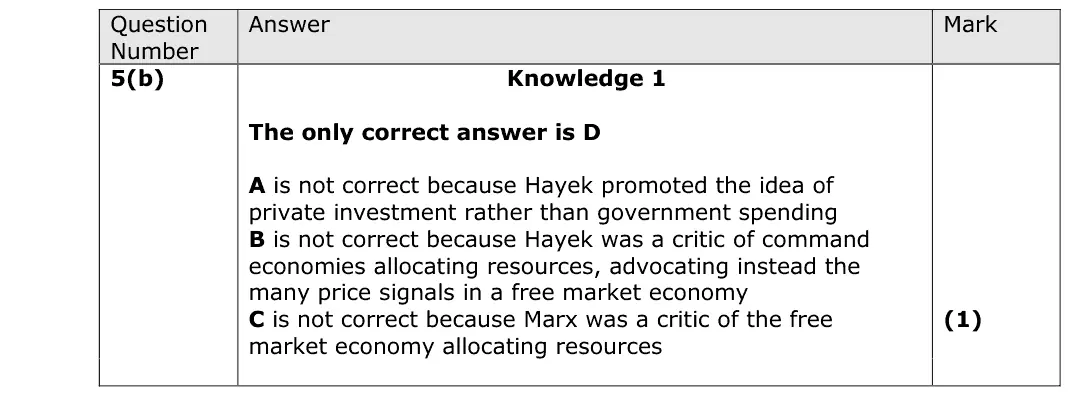
June 2019 · Paper 1 · Q5(b) 1 mark AO1=1 Multiple choice
Data and extracts for question 55 Free market economics is being challenged. The arguments for and against are being increasingly discussed within many countries.
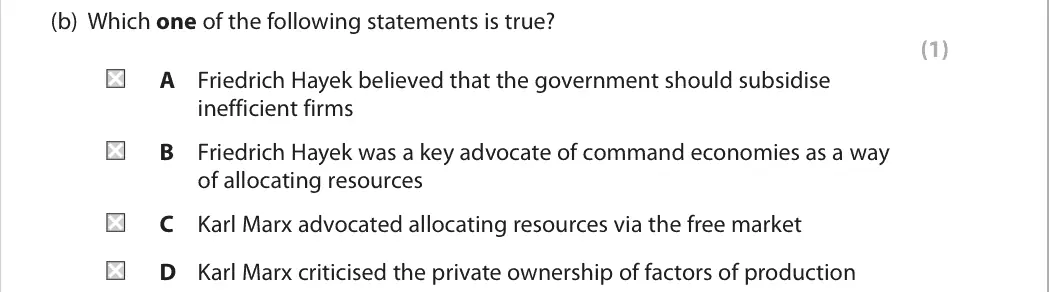
(b) Which one of the following statements is true? (1) A Friedrich Hayek believed that the government should subsidise inefficient firms B Friedrich Hayek was a key advocate of command economies as a way of allocating resources C Karl Marx advocated allocating resources via the free market D Karl Marx criticised the private ownership of factors of production
June 2019 · AS Paper 1 · Q6(g) 20 marks AO1=4, AO2=4, AO3=6, AO4=6 20-mark essay Either/or
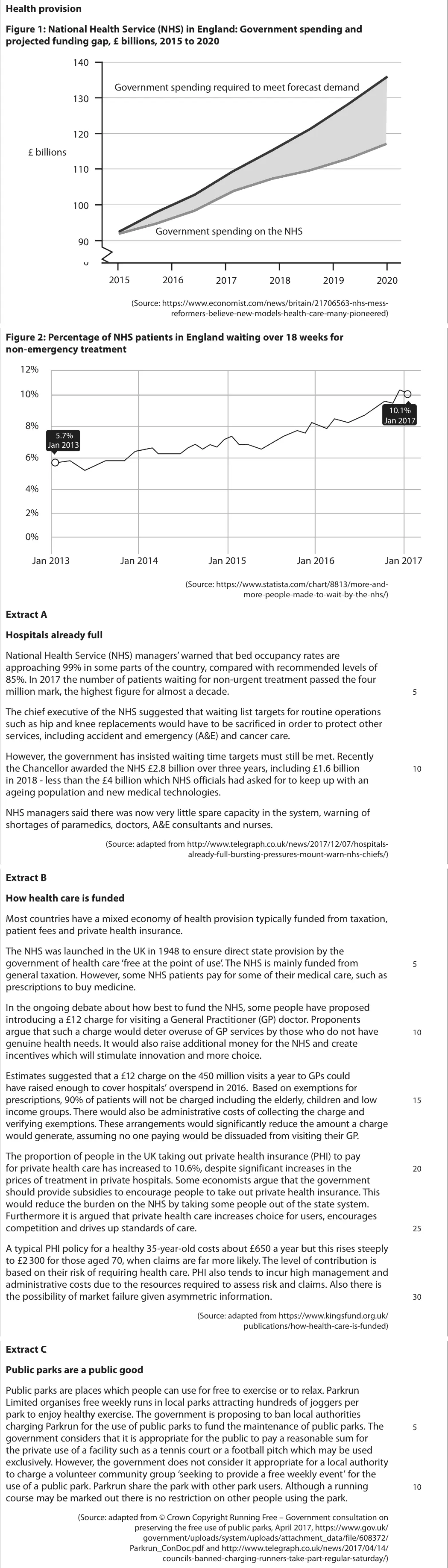
Data and extracts for question 6Health provision Figure 1: National Health Service (NHS) in England: Government spending and projected funding gap, £ billions, 2015 to 2020 140 Government spending required to meet forecast demand 130 120 £ billions 110 100 Government spending on the NHS 90 0 2015 2016 2018 2019 2017 2020 (Source: https://www.economist.com/news/britain/21706563-nhs-mess- reformers-believe-new-models-health-care-many-pioneered) Figure 2: Percentage of NHS patients in England waiting over 18 weeks for non-emergency treatment 12% 10% 10.1% Jan 2017 8% 5.7% Jan 2013 6% 4% 2% 0% Jan 2013 Jan 2014 Jan 2015 Jan 2016 Jan 2017 (Source: https://www.statista.com/chart/8813/more-and- more-people-made-to-wait-by-the-nhs/) Extract A Hospitals already full National Health Service (NHS) managers’ warned that bed occupancy rates are approaching 99% in some parts of the country, compared with recommended levels of 85%. In 2017 the number of patients waiting for non-urgent treatment passed the four million mark, the highest figure for almost a decade. 5 The chief executive of the NHS suggested that waiting list targets for routine operations such as hip and knee replacements would have to be sacrificed in order to protect other services, including accident and emergency (A&E) and cancer care. However, the government has insisted waiting time targets must still be met. Recently the Chancellor awarded the NHS £2.8 billion over three years, including £1.6 billion 10 in 2018 - less than the £4 billion which NHS officials had asked for to keep up with an ageing population and new medical technologies. NHS managers said there was now very little spare capacity in the system, warning of shortages of paramedics, doctors, A&E consultants and nurses. (Source: adapted from http://www.telegraph.co.uk/news/2017/12/07/hospitals- already-full-bursting-pressures-mount-warn-nhs-chiefs/) Extract B How health care is funded Most countries have a mixed economy of health provision typically funded from taxation, patient fees and private health insurance. The NHS was launched in the UK in 1948 to ensure direct state provision by the government of health care ‘free at the point of use’. The NHS is mainly funded from 5 general taxation. However, some NHS patients pay for some of their medical care, such as prescriptions to buy medicine. In the ongoing debate about how best to fund the NHS, some people have proposed introducing a £12 charge for visiting a General Practitioner (GP) doctor. Proponents argue that such a charge would deter overuse of GP services by those who do not have 10 genuine health needs. It would also raise additional money for the NHS and create incentives which will stimulate innovation and more choice. Estimates suggested that a £12 charge on the 450 million visits a year to GPs could have raised enough to cover hospitals’ overspend in 2016. Based on exemptions for prescriptions, 90% of patients will not be charged including the elderly, children and low 15 income groups. There would also be administrative costs of collecting the charge and verifying exemptions. These arrangements would significantly reduce the amount a charge would generate, assuming no one paying would be dissuaded from visiting their GP. The proportion of people in the UK taking out private health insurance (PHI) to pay for private health care has increased to 10.6%, despite significant increases in the 20 prices of treatment in private hospitals. Some economists argue that the government should provide subsidies to encourage people to take out private health insurance. This would reduce the burden on the NHS by taking some people out of the state system. Furthermore it is argued that private health care increases choice for users, encourages competition and drives up standards of care. 25 A typical PHI policy for a healthy 35-year-old costs about £650 a year but this rises steeply to £2 300 for those aged 70, when claims are far more likely. The level of contribution is based on their risk of requiring health care. PHI also tends to incur high management and administrative costs due to the resources required to assess risk and claims. Also there is the possibility of market failure given asymmetric information. 30 (Source: adapted from https://www.kingsfund.org.uk/ publications/how-health-care-is-funded) Extract C Public parks are a public good Public parks are places which people can use for free to exercise or to relax. Parkrun Limited organises free weekly runs in local parks attracting hundreds of joggers per park to enjoy healthy exercise. The government is proposing to ban local authorities charging Parkrun for the use of public parks to fund the maintenance of public parks. The 5 government considers that it is appropriate for the public to pay a reasonable sum for the private use of a facility such as a tennis court or a football pitch which may be used exclusively. However, the government does not consider it appropriate for a local authority to charge a volunteer community group ‘seeking to provide a free weekly event’ for the use of a public park. Parkrun share the park with other park users. Although a running 10 course may be marked out there is no restriction on other people using the park. (Source: adapted from © Crown Copyright Running Free – Government consultation on preserving the free use of public parks, April 2017, https://www.gov.uk/ government/uploads/system/uploads/attachment_data/file/608372/ Parkrun_ConDoc.pdf and http://www.telegraph.co.uk/news/2017/04/14/ councils-banned-charging-runners-take-part-regular-saturday/)
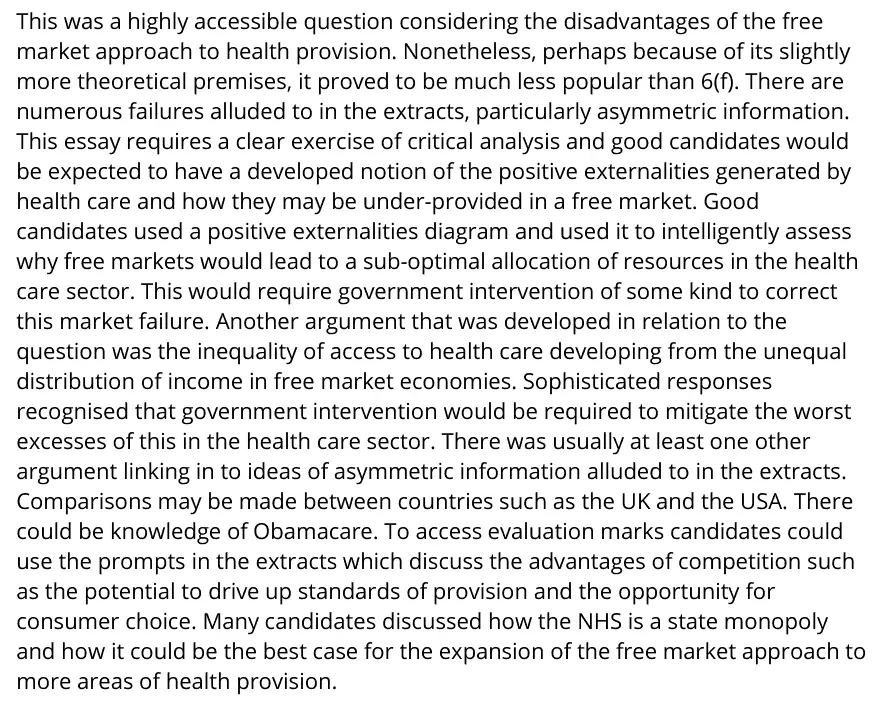
(g) Evaluate the possible disadvantages of a free market approach to providing health care. (20)
June 2018 · AS Paper 1 · Q1(c) 1 mark AO1=1 Definition
Data and extracts for question 11 Statement 1: Cuba has a healthcare system with a patient to doctor ratio of 155:1. Statement 2: Other countries ought to adopt a similar healthcare system to that which exists in Cuba.
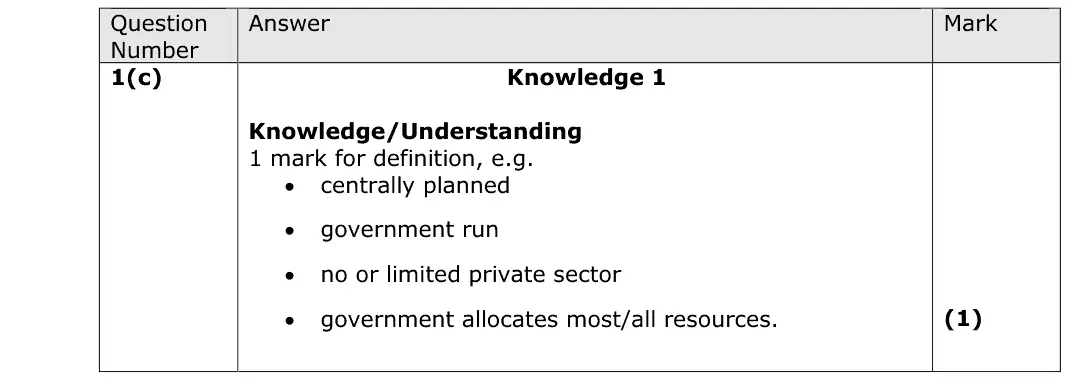
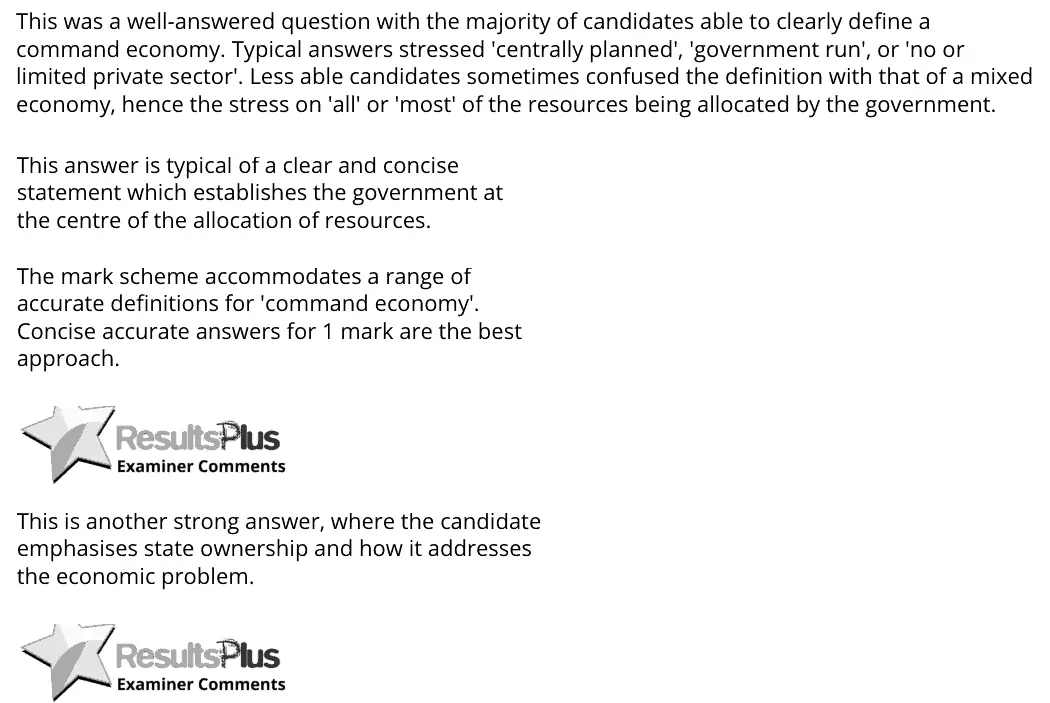
(c) Define the term ‘command economy’. (1)
June 2017 · AS Paper 1 · Q6(f) 20 marks AO1=4, AO2=4, AO3=6, AO4=6 20-mark essay Either/or
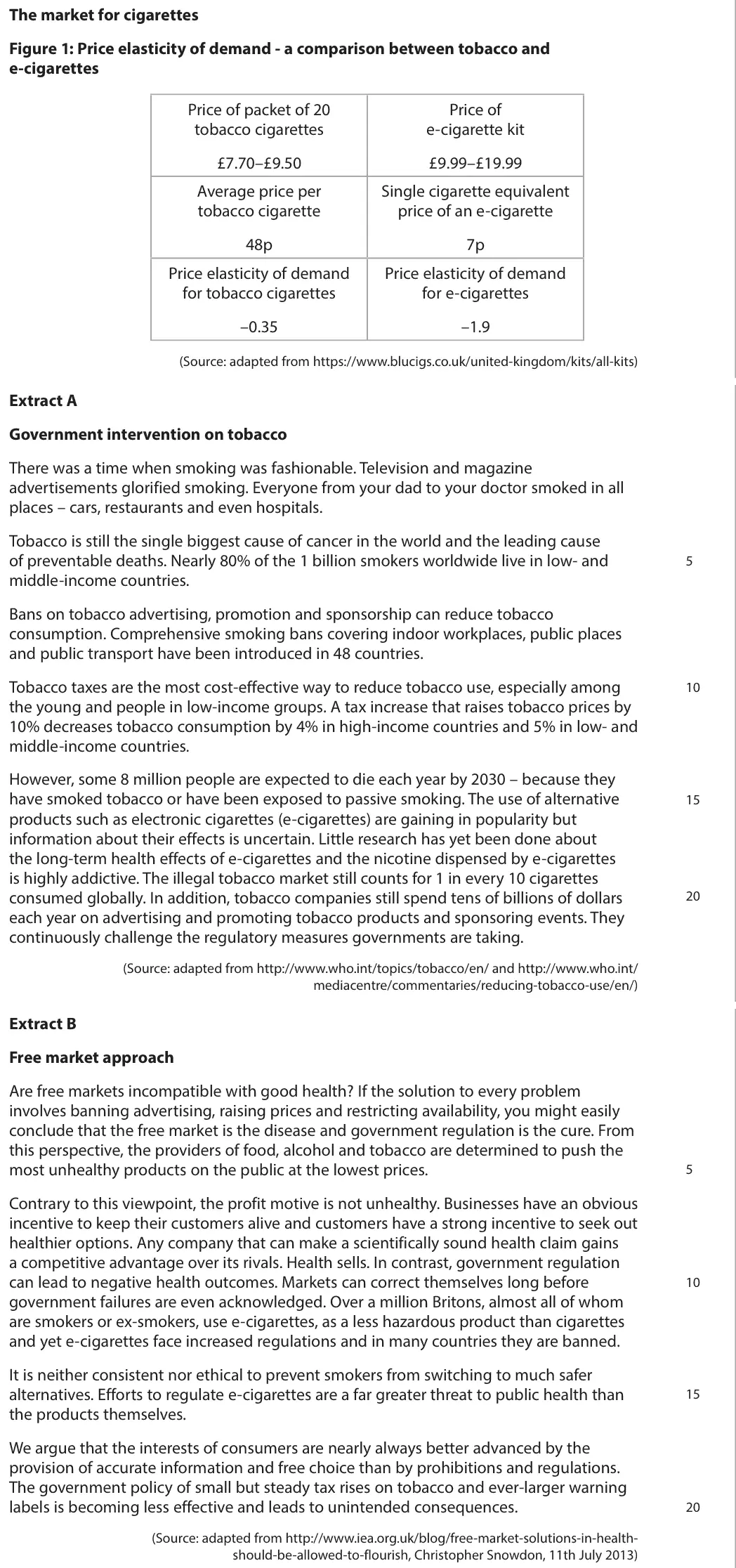
Data and extracts for question 6The market for cigarettes Figure 1: Price elasticity of demand - a comparison between tobacco and e-cigarettes Price of packet of 20 Price of tobacco cigarettes e-cigarette kit £7.70–£9.50 £9.99–£19.99 Average price per Single cigarette equivalent tobacco cigarette price of an e-cigarette 48p 7p Price elasticity of demand Price elasticity of demand for tobacco cigarettes for e-cigarettes –0.35 –1.9 (Source: adapted from https://www.blucigs.co.uk/united-kingdom/kits/all-kits) Extract A Government intervention on tobacco There was a time when smoking was fashionable. Television and magazine advertisements glorified smoking. Everyone from your dad to your doctor smoked in all places – cars, restaurants and even hospitals. Tobacco is still the single biggest cause of cancer in the world and the leading cause of preventable deaths. Nearly 80% of the 1 billion smokers worldwide live in low- and 5 middle-income countries. Bans on tobacco advertising, promotion and sponsorship can reduce tobacco consumption. Comprehensive smoking bans covering indoor workplaces, public places and public transport have been introduced in 48 countries. Tobacco taxes are the most cost-effective way to reduce tobacco use, especially among 10 the young and people in low-income groups. A tax increase that raises tobacco prices by 10% decreases tobacco consumption by 4% in high-income countries and 5% in low- and middle-income countries. However, some 8 million people are expected to die each year by 2030 – because they have smoked tobacco or have been exposed to passive smoking. The use of alternative 15 products such as electronic cigarettes (e-cigarettes) are gaining in popularity but information about their effects is uncertain. Little research has yet been done about the long-term health effects of e-cigarettes and the nicotine dispensed by e-cigarettes is highly addictive. The illegal tobacco market still counts for 1 in every 10 cigarettes consumed globally. In addition, tobacco companies still spend tens of billions of dollars 20 each year on advertising and promoting tobacco products and sponsoring events. They continuously challenge the regulatory measures governments are taking. (Source: adapted from http://www.who.int/topics/tobacco/en/ and http://www.who.int/ mediacentre/commentaries/reducing-tobacco-use/en/) Extract B Free market approach Are free markets incompatible with good health? If the solution to every problem involves banning advertising, raising prices and restricting availability, you might easily conclude that the free market is the disease and government regulation is the cure. From this perspective, the providers of food, alcohol and tobacco are determined to push the most unhealthy products on the public at the lowest prices. 5 Contrary to this viewpoint, the profit motive is not unhealthy. Businesses have an obvious incentive to keep their customers alive and customers have a strong incentive to seek out healthier options. Any company that can make a scientifically sound health claim gains a competitive advantage over its rivals. Health sells. In contrast, government regulation can lead to negative health outcomes. Markets can correct themselves long before 10 government failures are even acknowledged. Over a million Britons, almost all of whom are smokers or ex-smokers, use e-cigarettes, as a less hazardous product than cigarettes and yet e-cigarettes face increased regulations and in many countries they are banned. It is neither consistent nor ethical to prevent smokers from switching to much safer alternatives. Efforts to regulate e-cigarettes are a far greater threat to public health than 15 the products themselves. We argue that the interests of consumers are nearly always better advanced by the provision of accurate information and free choice than by prohibitions and regulations. The government policy of small but steady tax rises on tobacco and ever-larger warning labels is becoming less effective and leads to unintended consequences. 20 (Source: adapted from http://www.iea.org.uk/blog/free-market-solutions-in-health- should-be-allowed-to-flourish, Christopher Snowdon, 11th July 2013)
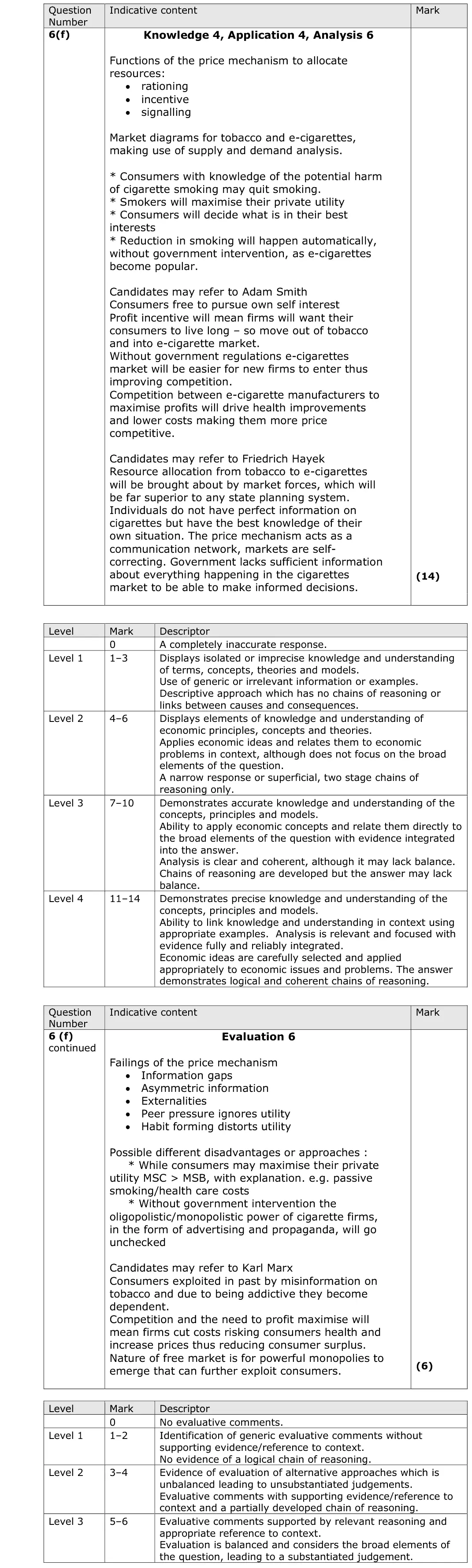
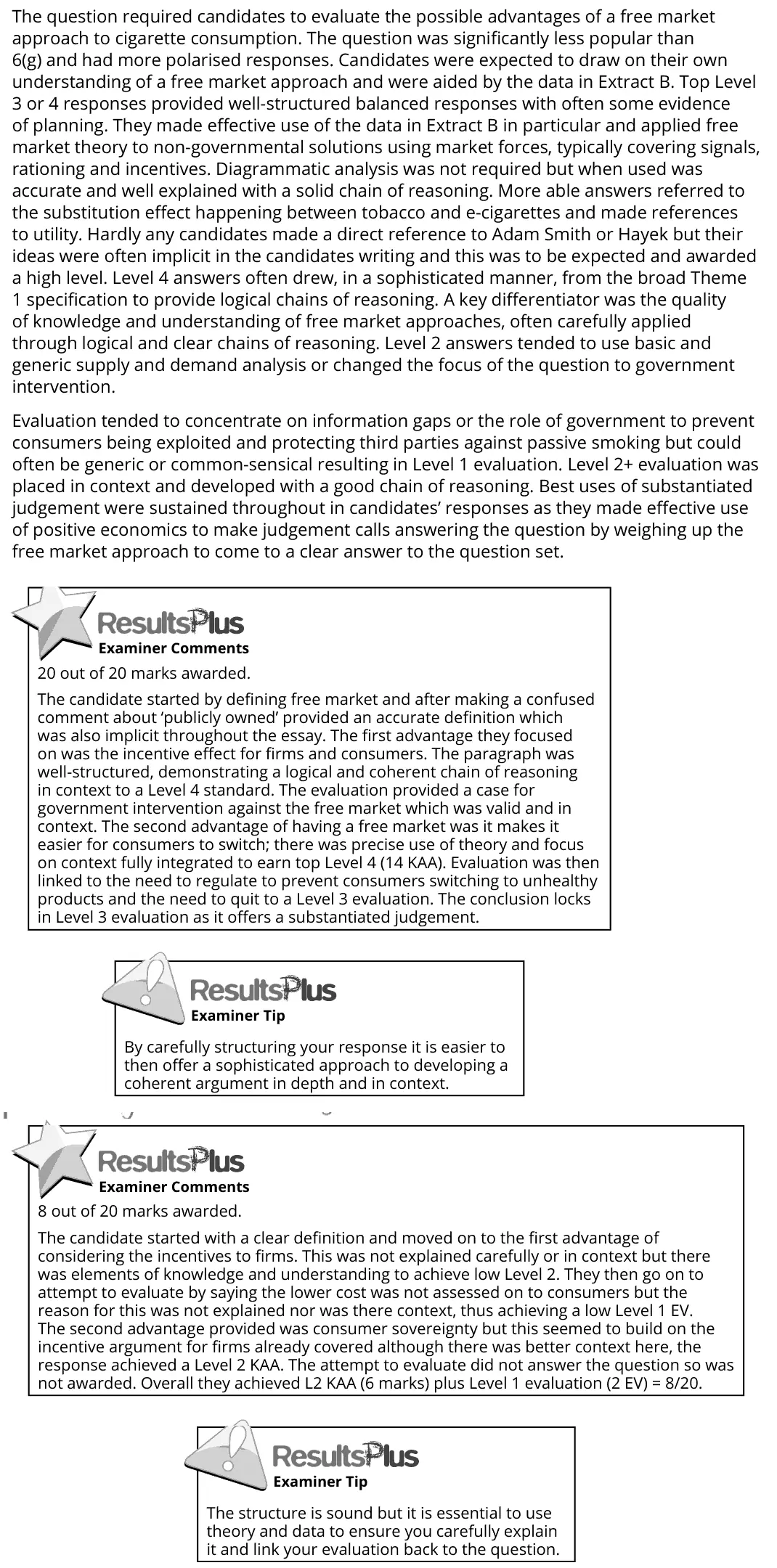
(f) Evaluate the possible advantages of a free market approach to cigarette consumption. (20)

Work with an Edexcel economics tutor

Essays stuck in Level 2, or losing the easy marks in Section A? Book a trial session with Lianne, a former Edexcel examiner.

Prefer email? Send an enquiry

If you are under 18, please include a parent's contact details. Enquiries go to enquiries@economicsaleveltutor.com and are deleted once handled. All tutoring is online.