Rational decision making and behavioural economics Theme 1

Where it is examined
A-level Paper 1 (and Paper 3); AS Paper 1
Level
AS and A level
Specification
Section 1.2, 2 statements
Since 2016
10 question parts: 0 essays, 7 levels-marked responses, 1 multiple-choice items

Notes and key-term cards for this topic are being written by our tutors. The past-paper questions below are ready now.

Specification statements

Past-paper questions

Print this topic as a pack

Tap a question to zoom it. The data and extracts fold out above each question; the mark scheme and examiner's comment open underneath.
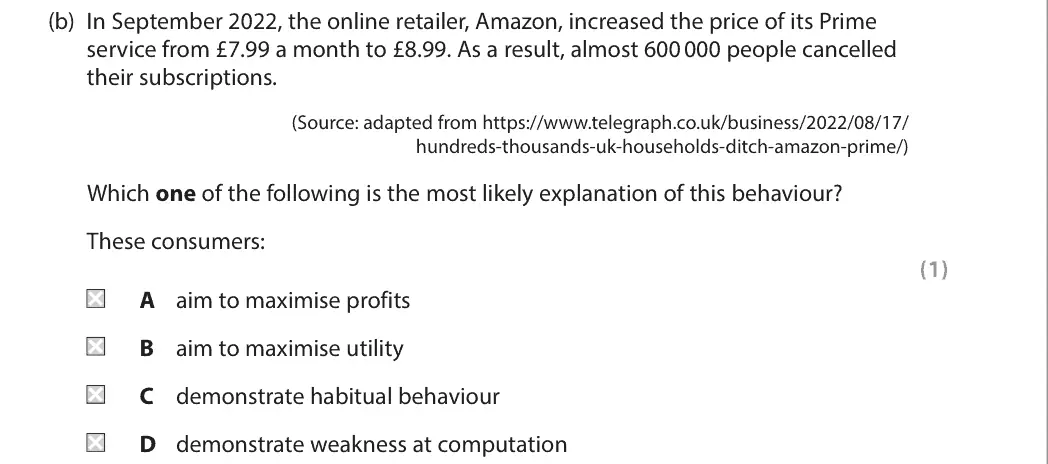
June 2025 · Paper 1 · Q4(b) 1 mark Multiple choice
Data and extracts for question 44 Nearly 750 000 consumers in Britain face unresolved problems with used car purchases every year. Older vehicles tend to have more faults and increase the risks facing a potential buyer. (Source: adapted from https://www.gov.uk/government/news/new- approach-to-give-second-hand-car-buyers-a-better-deal)
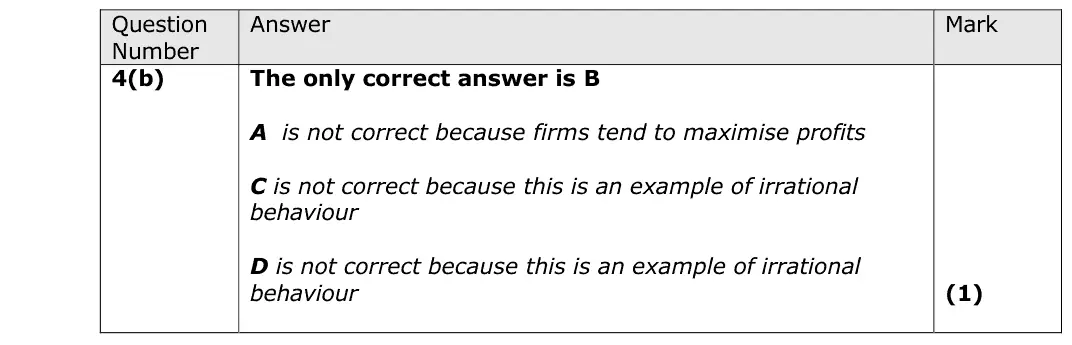
(b) In September 2022, the online retailer, Amazon, increased the price of its Prime service from £7.99 a month to £8.99. As a result, almost 600 000 people cancelled their subscriptions. (Source: adapted from https://www.telegraph.co.uk/business/2022/08/17/ hundreds-thousands-uk-households-ditch-amazon-prime/) Which one of the following is the most likely explanation of this behaviour? These consumers: (1) A aim to maximise profits B aim to maximise utility C demonstrate habitual behaviour D demonstrate weakness at computation
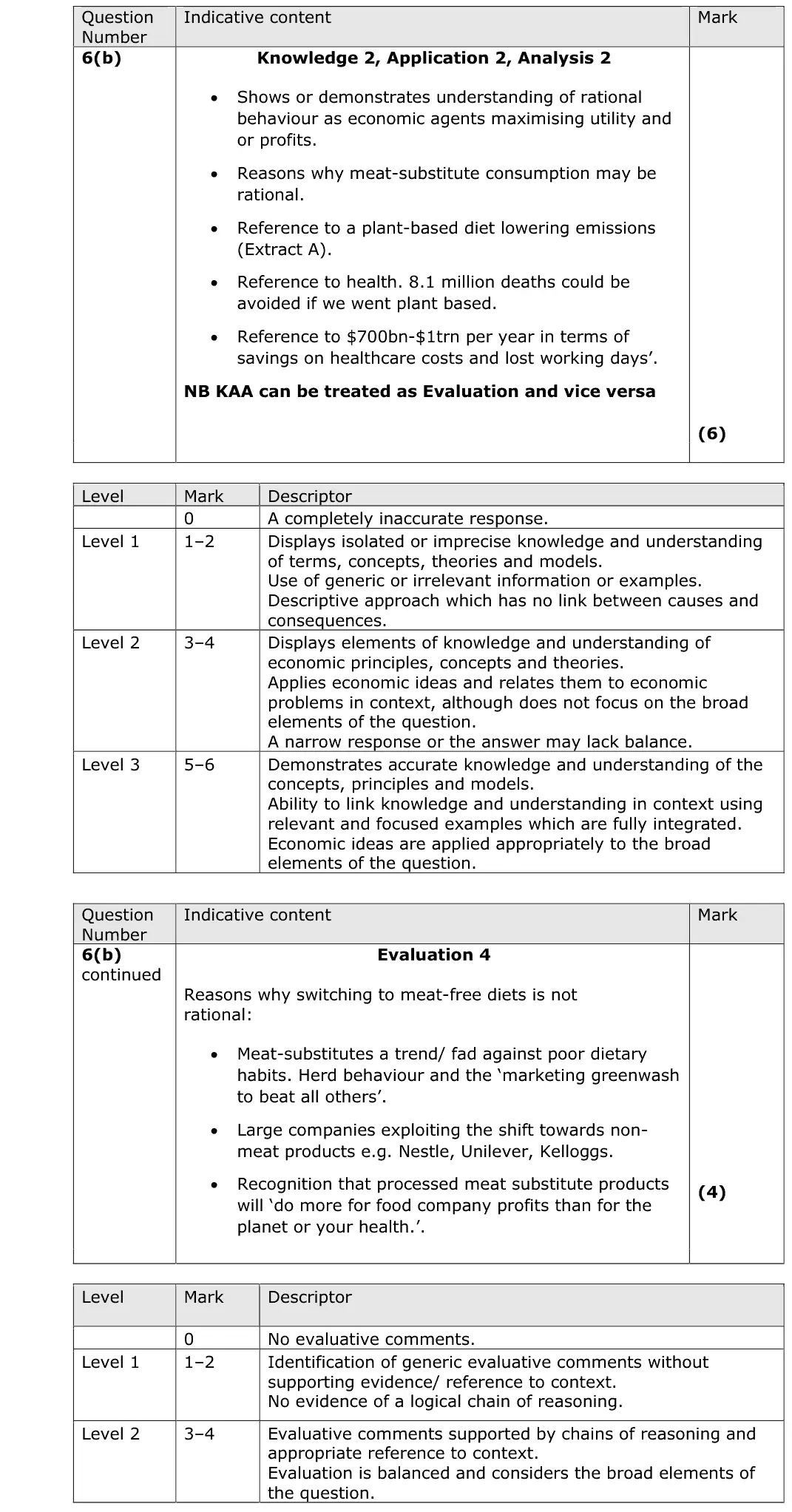
June 2025 · AS Paper 1 · Q6(b) 10 marks AO1=2, AO2=2, AO3=2, AO4=4 10-mark response
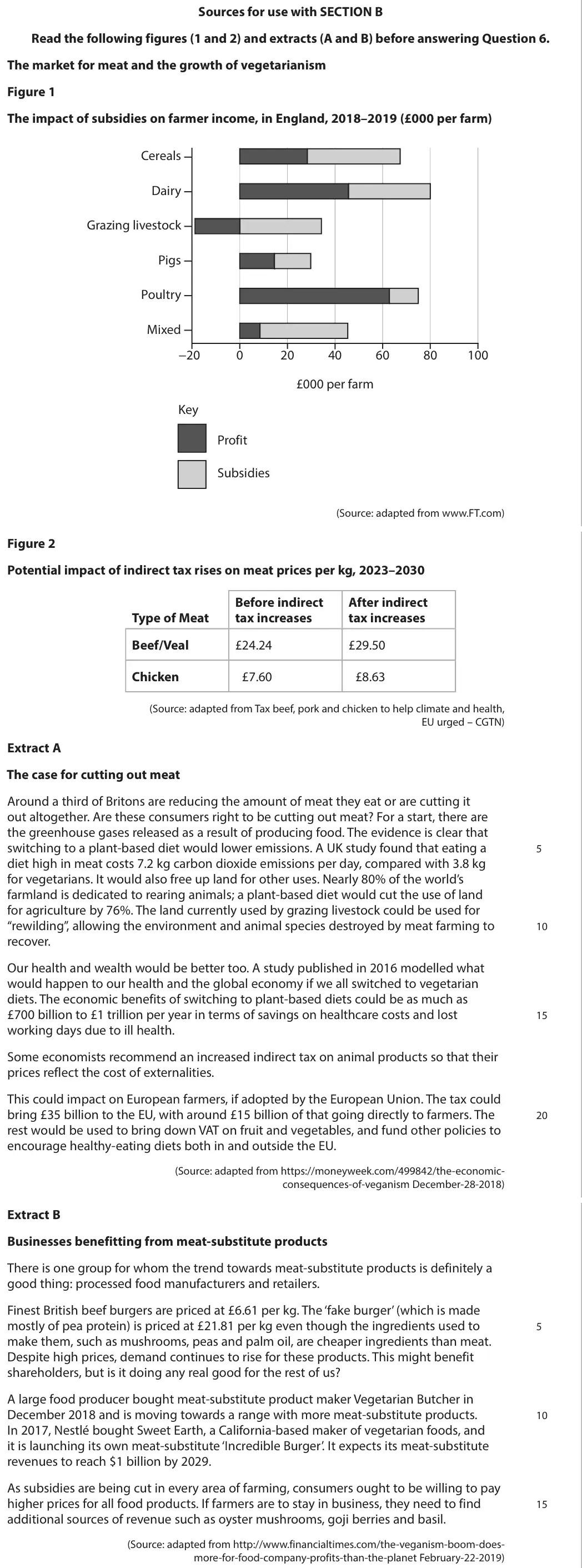
Data and extracts for question 6Sources for use with SECTION B Read the following figures (1 and 2) and extracts (A and B) before answering Question 6. The market for meat and the growth of vegetarianism Figure 1 The impact of subsidies on farmer income, in England, 2018–2019 (£000 per farm) Cereals Dairy Grazing livestock Pigs Poultry Mixed -20 0 20 40 60 80 100 £000 per farm Key Profit Subsidies (Source: adapted from www.FT.com) Figure 2 Potential impact of indirect tax rises on meat prices per kg, 2023–2030 Before indirect After indirect Type of Meat tax increases tax increases Beef/Veal £24.24 £29.50 Chicken £7.60 £8.63 (Source: adapted from Tax beef, pork and chicken to help climate and health, EU urged – CGTN) Extract A The case for cutting out meat Around a third of Britons are reducing the amount of meat they eat or are cutting it out altogether. Are these consumers right to be cutting out meat? For a start, there are the greenhouse gases released as a result of producing food. The evidence is clear that switching to a plant-based diet would lower emissions. A UK study found that eating a 5 diet high in meat costs 7.2 kg carbon dioxide emissions per day, compared with 3.8 kg for vegetarians. It would also free up land for other uses. Nearly 80% of the world’s farmland is dedicated to rearing animals; a plant-based diet would cut the use of land for agriculture by 76%. The land currently used by grazing livestock could be used for “rewilding”, allowing the environment and animal species destroyed by meat farming to 10 recover. Our health and wealth would be better too. A study published in 2016 modelled what would happen to our health and the global economy if we all switched to vegetarian diets. The economic benefits of switching to plant-based diets could be as much as £700 billion to £1 trillion per year in terms of savings on healthcare costs and lost 15 working days due to ill health. Some economists recommend an increased indirect tax on animal products so that their prices reflect the cost of externalities. This could impact on European farmers, if adopted by the European Union. The tax could bring £35 billion to the EU, with around £15 billion of that going directly to farmers. The 20 rest would be used to bring down VAT on fruit and vegetables, and fund other policies to encourage healthy-eating diets both in and outside the EU. (Source: adapted from https://moneyweek.com/499842/the-economic- consequences-of-veganism December-28-2018) Extract B Businesses benefitting from meat-substitute products There is one group for whom the trend towards meat-substitute products is definitely a good thing: processed food manufacturers and retailers. Finest British beef burgers are priced at £6.61 per kg. The ‘fake burger’ (which is made mostly of pea protein) is priced at £21.81 per kg even though the ingredients used to 5 make them, such as mushrooms, peas and palm oil, are cheaper ingredients than meat. Despite high prices, demand continues to rise for these products. This might benefit shareholders, but is it doing any real good for the rest of us? A large food producer bought meat-substitute product maker Vegetarian Butcher in December 2018 and is moving towards a range with more meat-substitute products. 10 In 2017, Nestlé bought Sweet Earth, a California-based maker of vegetarian foods, and it is launching its own meat-substitute ‘Incredible Burger’. It expects its meat-substitute revenues to reach $1 billion by 2029. As subsidies are being cut in every area of farming, consumers ought to be willing to pay higher prices for all food products. If farmers are to stay in business, they need to find 15 additional sources of revenue such as oyster mushrooms, goji berries and basil. (Source: adapted from http://www.financialtimes.com/the-veganism-boom-does- more-for-food-company-profits-than-the-planet February-22-2019)
(b) With reference to the information provided and your own knowledge, assess the view that consumers switching to meat-substitute products is an example of rational behaviour. (10)
June 2024 · AS Paper 1 · Q6(b) 10 marks AO1=2, AO2=2, AO3=2, AO4=4 10-mark response
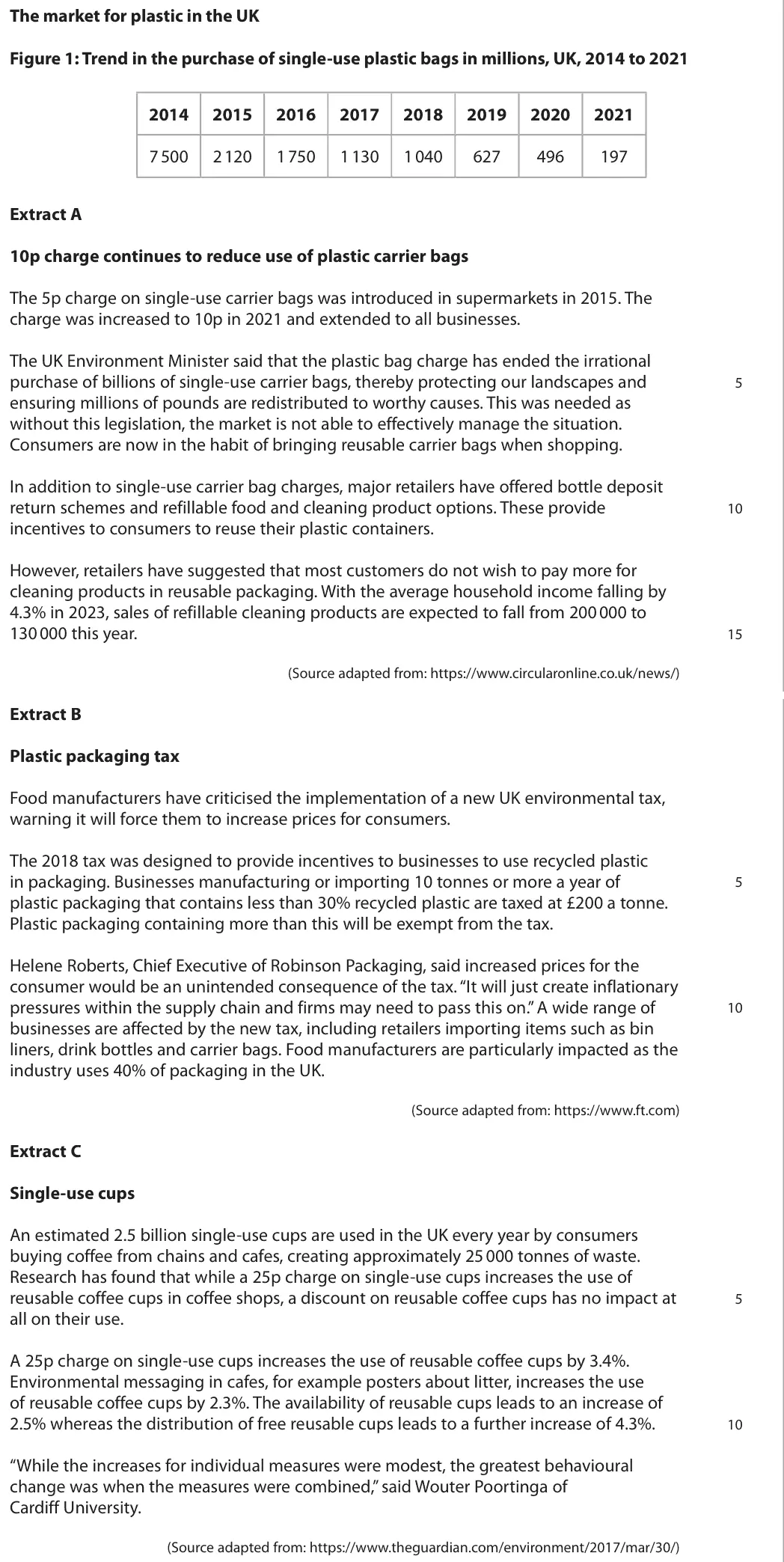
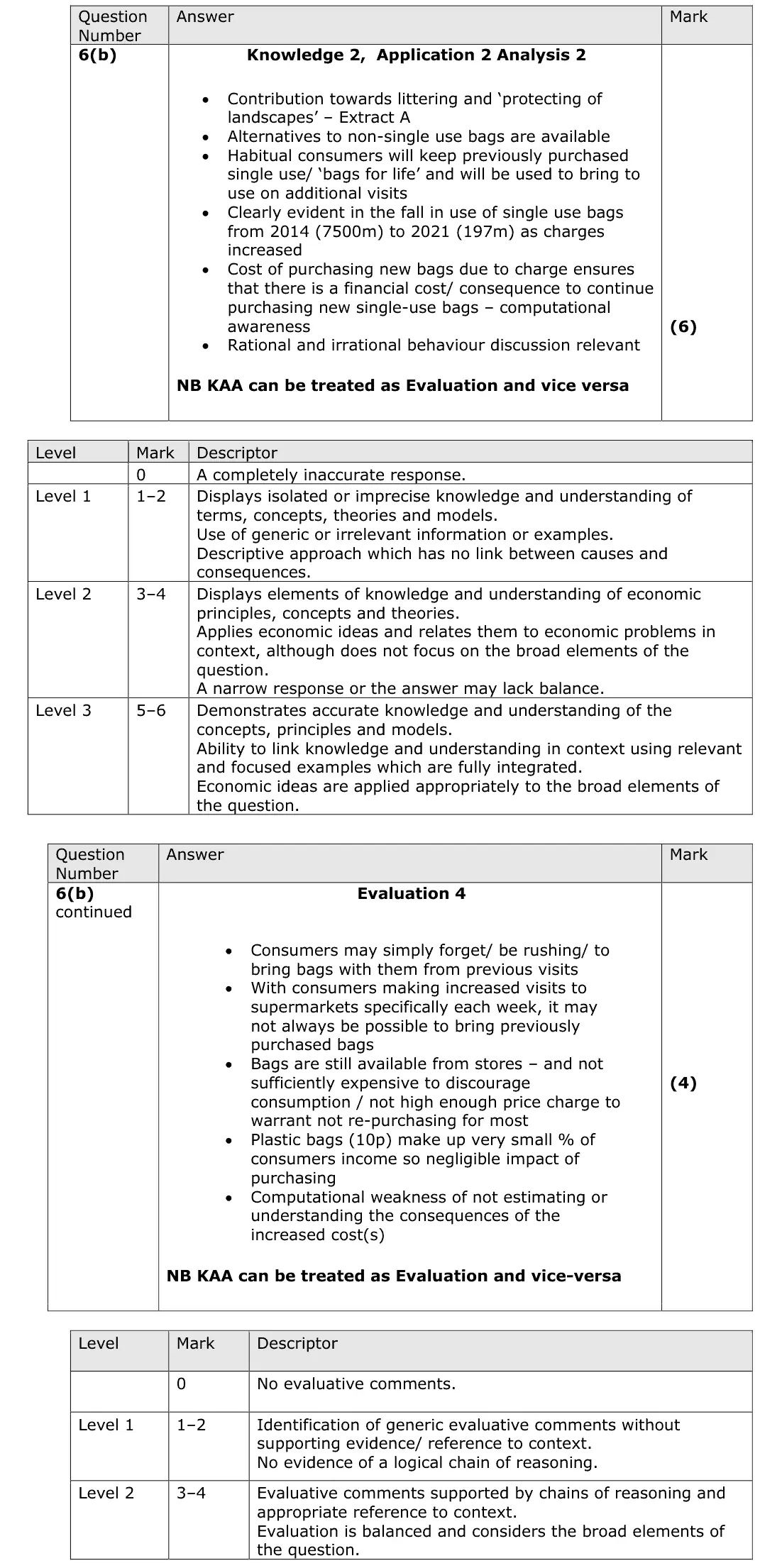
Data and extracts for question 6The market for plastic in the UK Figure 1: Trend in the purchase of single‑use plastic bags in millions, UK, 2014 to 2021 2014 2015 2016 2017 2018 2019 2020 2021 7 500 2 120 1 750 1 130 1 040 627 496 197 Extract A 10p charge continues to reduce use of plastic carrier bags The 5p charge on single‑use carrier bags was introduced in supermarkets in 2015. The charge was increased to 10p in 2021 and extended to all businesses. The UK Environment Minister said that the plastic bag charge has ended the irrational purchase of billions of single‑use carrier bags, thereby protecting our landscapes and 5 ensuring millions of pounds are redistributed to worthy causes. This was needed as without this legislation, the market is not able to effectively manage the situation. Consumers are now in the habit of bringing reusable carrier bags when shopping. In addition to single‑use carrier bag charges, major retailers have offered bottle deposit return schemes and refillable food and cleaning product options. These provide 10 incentives to consumers to reuse their plastic containers. However, retailers have suggested that most customers do not wish to pay more for cleaning products in reusable packaging. With the average household income falling by 4.3% in 2023, sales of refillable cleaning products are expected to fall from 200 000 to 130 000 this year. 15 (Source adapted from: https://www.circularonline.co.uk/news/) Extract B Plastic packaging tax Food manufacturers have criticised the implementation of a new UK environmental tax, warning it will force them to increase prices for consumers. The 2018 tax was designed to provide incentives to businesses to use recycled plastic in packaging. Businesses manufacturing or importing 10 tonnes or more a year of 5 plastic packaging that contains less than 30% recycled plastic are taxed at £200 a tonne. Plastic packaging containing more than this will be exempt from the tax. Helene Roberts, Chief Executive of Robinson Packaging, said increased prices for the consumer would be an unintended consequence of the tax. “It will just create inflationary pressures within the supply chain and firms may need to pass this on.” A wide range of 10 businesses are affected by the new tax, including retailers importing items such as bin liners, drink bottles and carrier bags. Food manufacturers are particularly impacted as the industry uses 40% of packaging in the UK. (Source adapted from: https://www.ft.com) Extract C Single‑use cups An estimated 2.5 billion single‑use cups are used in the UK every year by consumers buying coffee from chains and cafes, creating approximately 25 000 tonnes of waste. Research has found that while a 25p charge on single‑use cups increases the use of reusable coffee cups in coffee shops, a discount on reusable coffee cups has no impact at 5 all on their use. A 25p charge on single‑use cups increases the use of reusable coffee cups by 3.4%. Environmental messaging in cafes, for example posters about litter, increases the use of reusable coffee cups by 2.3%. The availability of reusable cups leads to an increase of 2.5% whereas the distribution of free reusable cups leads to a further increase of 4.3%. 10 “While the increases for individual measures were modest, the greatest behavioural change was when the measures were combined,” said Wouter Poortinga of Cardiff University. (Source adapted from: https://www.theguardian.com/environment/2017/mar/30/)
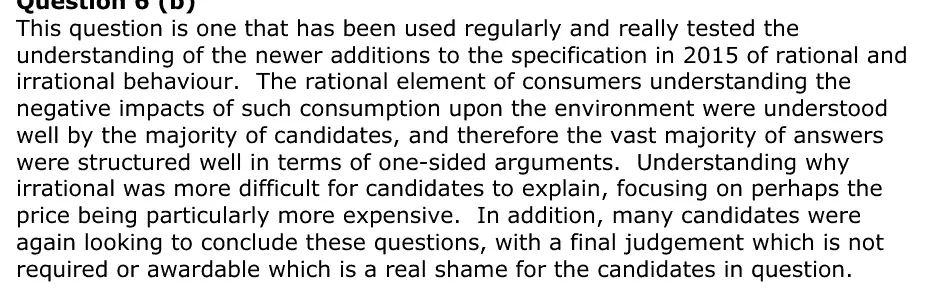
(b) With reference to Extract A and your own knowledge, assess the view that it is irrational to buy plastic carrier bags when shopping. (10)
June 2023 · AS Paper 1 · Q4(a) 3 marks AO1=1, AO2=1, AO3=1 Short answer
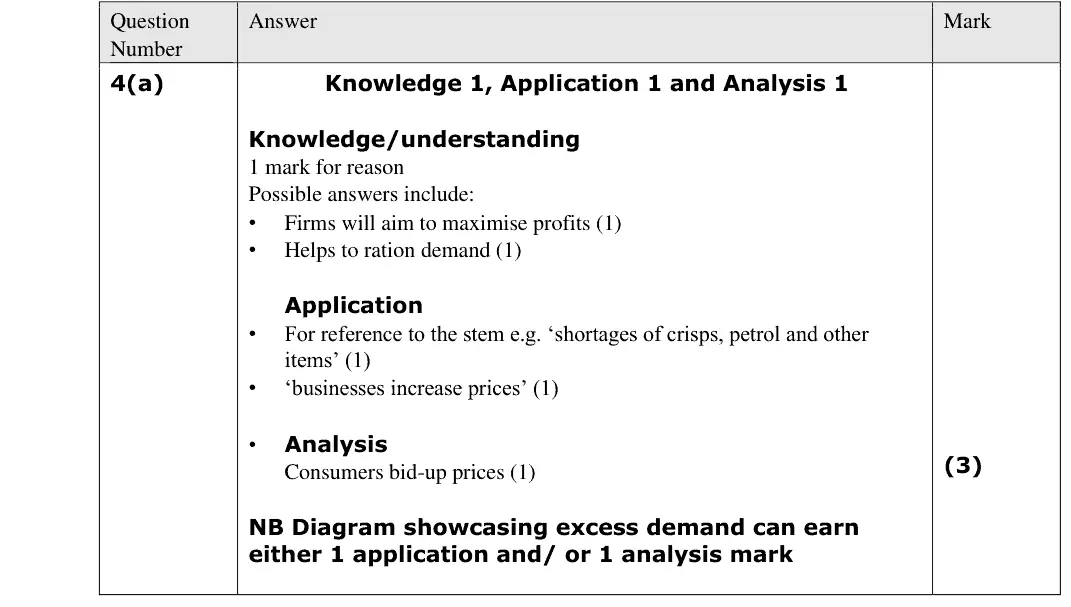
Data and extracts for question 44 During 2021 the UK experienced severe shortages of crisps, petrol and many other items. (Source: adapted from https://www.independent.co.uk/news/business/news/ uk-shortages-covid-brexit-supply-chain-b1968458.html)
(a) Explain one reason why it is rational for a firm to raise prices when there is excess demand. (3)
June 2023 · Paper 1 · Q6(b) 10 marks AO1=2, AO2=2, AO3=2, AO4=4 10-mark response
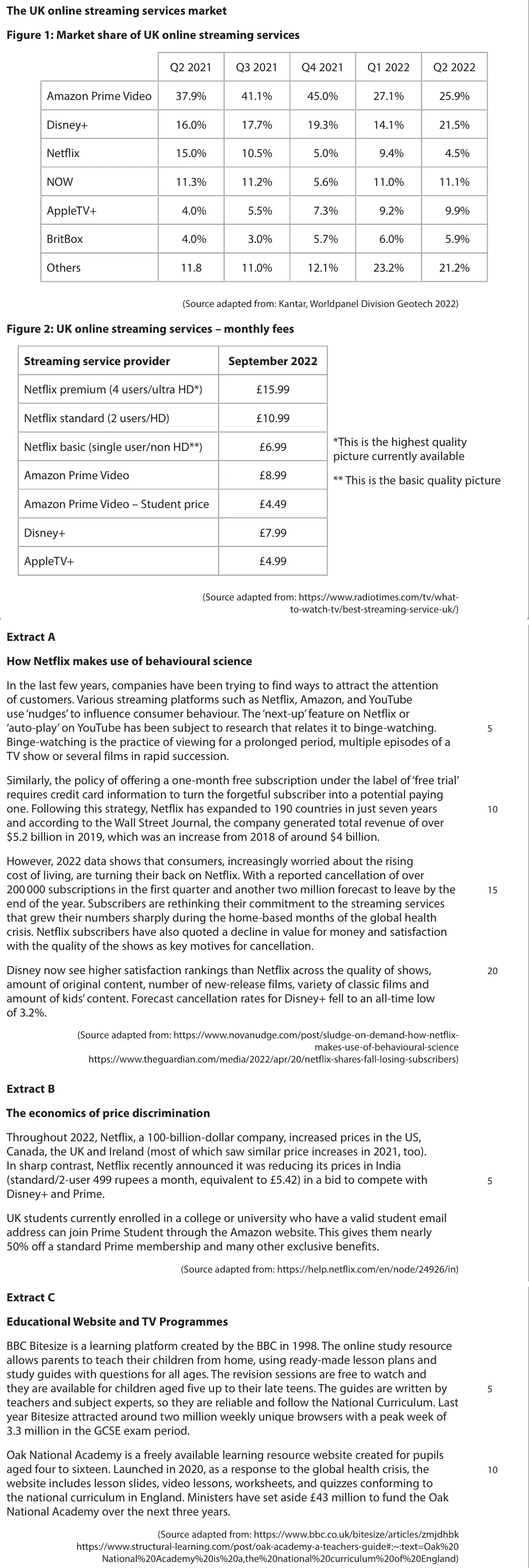
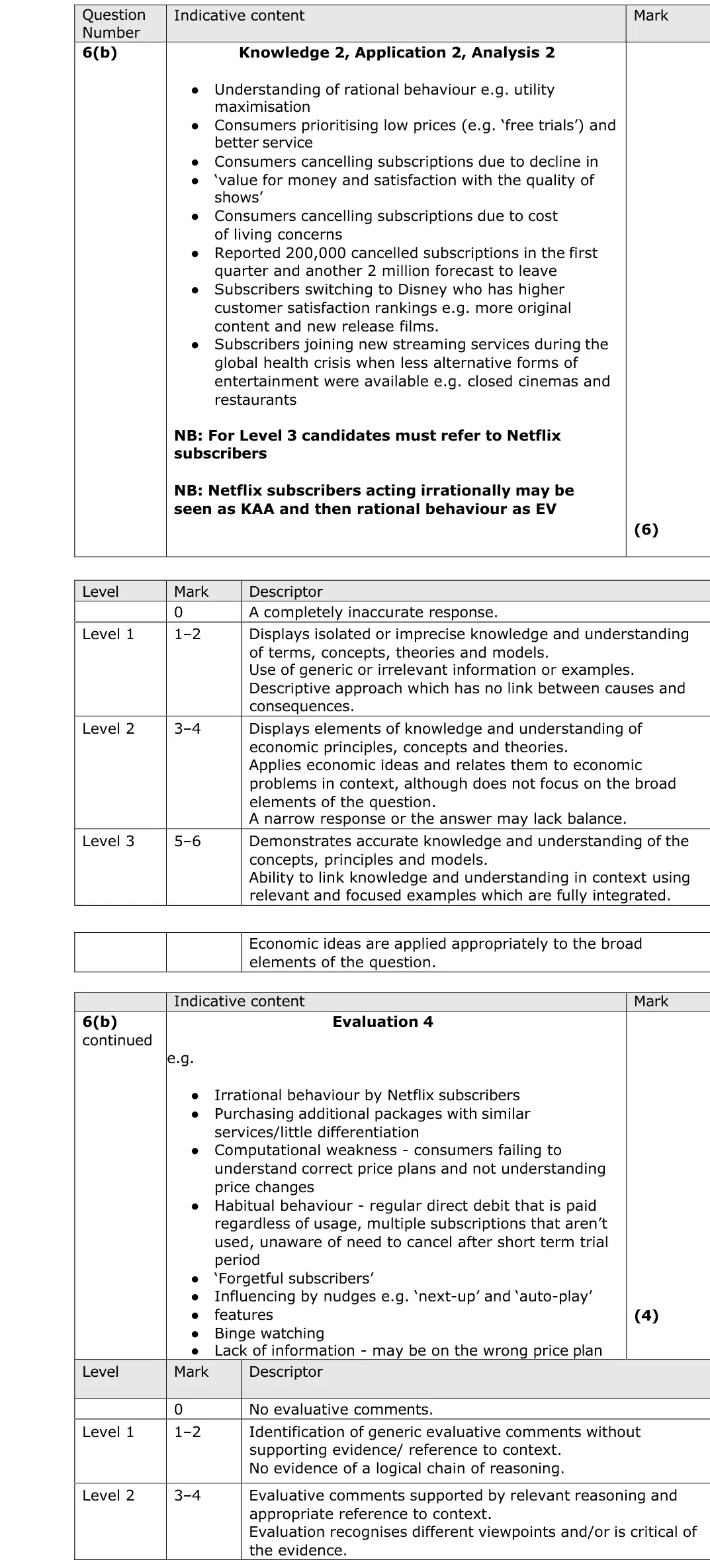
Data and extracts for question 6The UK online streaming services market Figure 1: Market share of UK online streaming services Q2 2021 Q3 2021 Q4 2021 Q1 2022 Q2 2022 Amazon Prime Video 37.9% 41.1% 45.0% 27.1% 25.9% Disney+ 16.0% 17.7% 19.3% 14.1% 21.5% Netflix 15.0% 10.5% 5.0% 9.4% 4.5% NOW 11.3% 11.2% 5.6% 11.0% 11.1% AppleTV+ 4.0% 5.5% 7.3% 9.2% 9.9% BritBox 4.0% 3.0% 5.7% 6.0% 5.9% Others 11.8 11.0% 12.1% 23.2% 21.2% (Source adapted from: Kantar, Worldpanel Division Geotech 2022) Figure 2: UK online streaming services – monthly fees Streaming service provider September 2022 Netflix premium (4 users/ultra HD*) £15.99 Netflix standard (2 users/HD) £10.99 *This is the highest quality Netflix basic (single user/non HD**) £6.99 picture currently available Amazon Prime Video £8.99 ** This is the basic quality picture Amazon Prime Video – Student price £4.49 Disney+ £7.99 AppleTV+ £4.99 (Source adapted from: https://www.radiotimes.com/tv/what- to-watch-tv/best-streaming-service-uk/) Extract A How Netflix makes use of behavioural science In the last few years, companies have been trying to find ways to attract the attention of customers. Various streaming platforms such as Netflix, Amazon, and YouTube use ‘nudges’ to influence consumer behaviour. The ‘next‑up’ feature on Netflix or ‘auto‑play’ on YouTube has been subject to research that relates it to binge‑watching. 5 Binge‑watching is the practice of viewing for a prolonged period, multiple episodes of a TV show or several films in rapid succession. Similarly, the policy of offering a one‑month free subscription under the label of ‘free trial’ requires credit card information to turn the forgetful subscriber into a potential paying one. Following this strategy, Netflix has expanded to 190 countries in just seven years 10 and according to the Wall Street Journal, the company generated total revenue of over $5.2 billion in 2019, which was an increase from 2018 of around $4 billion. However, 2022 data shows that consumers, increasingly worried about the rising cost of living, are turning their back on Netflix. With a reported cancellation of over 200 000 subscriptions in the first quarter and another two million forecast to leave by the 15 end of the year. Subscribers are rethinking their commitment to the streaming services that grew their numbers sharply during the home‑based months of the global health crisis. Netflix subscribers have also quoted a decline in value for money and satisfaction with the quality of the shows as key motives for cancellation. Disney now see higher satisfaction rankings than Netflix across the quality of shows, 20 amount of original content, number of new‑release films, variety of classic films and amount of kids’ content. Forecast cancellation rates for Disney+ fell to an all‑time low of 3.2%. (Source adapted from: https://www.novanudge.com/post/sludge-on-demand-how-netflix- makes-use-of-behavioural-science https://www.theguardian.com/media/2022/apr/20/netflix-shares-fall-losing-subscribers) Extract B The economics of price discrimination Throughout 2022, Netflix, a 100‑billion‑dollar company, increased prices in the US, Canada, the UK and Ireland (most of which saw similar price increases in 2021, too). In sharp contrast, Netflix recently announced it was reducing its prices in India (standard/2‑user 499 rupees a month, equivalent to £5.42) in a bid to compete with 5 Disney+ and Prime. UK students currently enrolled in a college or university who have a valid student email address can join Prime Student through the Amazon website. This gives them nearly 50% off a standard Prime membership and many other exclusive benefits. (Source adapted from: https://help.netflix.com/en/node/24926/in) Extract C Educational Website and TV Programmes BBC Bitesize is a learning platform created by the BBC in 1998. The online study resource allows parents to teach their children from home, using ready-made lesson plans and study guides with questions for all ages. The revision sessions are free to watch and they are available for children aged five up to their late teens. The guides are written by 5 teachers and subject experts, so they are reliable and follow the National Curriculum. Last year Bitesize attracted around two million weekly unique browsers with a peak week of 3.3 million in the GCSE exam period. Oak National Academy is a freely available learning resource website created for pupils aged four to sixteen. Launched in 2020, as a response to the global health crisis, the 10 website includes lesson slides, video lessons, worksheets, and quizzes conforming to the national curriculum in England. Ministers have set aside £43 million to fund the Oak National Academy over the next three years. (Source adapted from: https://www.bbc.co.uk/bitesize/articles/zmjdhbk https://www.structural-learning.com/post/oak-academy-a-teachers-guide#:~:text=Oak%20 National%20Academy%20is%20a,the%20national%20curriculum%20of%20England)
(b) With reference to the information provided, assess whether Netflix subscribers behave rationally. (10)
June 2022 · AS Paper 1 · Q6(b) 10 marks AO1=2, AO2=2, AO3=2, AO4=4 10-mark response
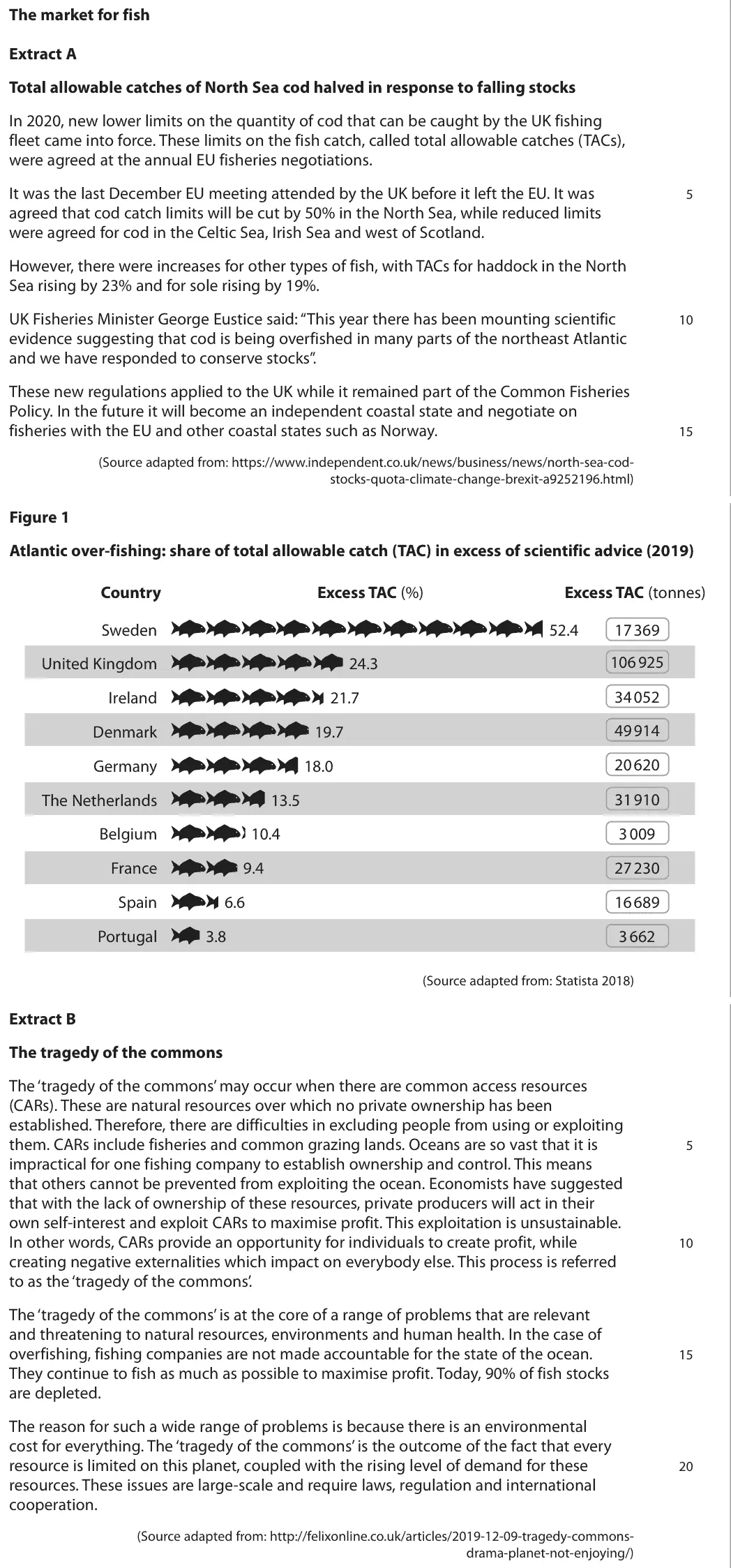
Data and extracts for question 6The market for fish Extract A Total allowable catches of North Sea cod halved in response to falling stocks In 2020, new lower limits on the quantity of cod that can be caught by the UK fishing fleet came into force. These limits on the fish catch, called total allowable catches (TACs), were agreed at the annual EU fisheries negotiations. It was the last December EU meeting attended by the UK before it left the EU. It was 5 agreed that cod catch limits will be cut by 50% in the North Sea, while reduced limits were agreed for cod in the Celtic Sea, Irish Sea and west of Scotland. However, there were increases for other types of fish, with TACs for haddock in the North Sea rising by 23% and for sole rising by 19%. UK Fisheries Minister George Eustice said: “This year there has been mounting scientific 10 evidence suggesting that cod is being overfished in many parts of the northeast Atlantic and we have responded to conserve stocks”. These new regulations applied to the UK while it remained part of the Common Fisheries Policy. In the future it will become an independent coastal state and negotiate on fisheries with the EU and other coastal states such as Norway. 15 (Source adapted from: https://www.independent.co.uk/news/business/news/north-sea-cod- stocks-quota-climate-change-brexit-a9252196.html) Figure 1 Atlantic over-fishing: share of total allowable catch (TAC) in excess of scientific advice (2019) Country Excess TAC (%) Excess TAC (tonnes) Sweden 52.4 17 369 106 925 United Kingdom 24.3 34 052 Ireland 21.7 49 914 Denmark 19.7 20 620 Germany 18.0 The Netherlands 13.5 31 910 3 009 Belgium 10.4 France 9.4 27 230 Spain 6.6 16 689 Portugal 3.8 3 662 (Source adapted from: Statista 2018) Extract B The tragedy of the commons The ‘tragedy of the commons’ may occur when there are common access resources (CARs). These are natural resources over which no private ownership has been established. Therefore, there are difficulties in excluding people from using or exploiting them. CARs include fisheries and common grazing lands. Oceans are so vast that it is 5 impractical for one fishing company to establish ownership and control. This means that others cannot be prevented from exploiting the ocean. Economists have suggested that with the lack of ownership of these resources, private producers will act in their own self-interest and exploit CARs to maximise profit. This exploitation is unsustainable. In other words, CARs provide an opportunity for individuals to create profit, while 10 creating negative externalities which impact on everybody else. This process is referred to as the ‘tragedy of the commons’. The ‘tragedy of the commons’ is at the core of a range of problems that are relevant and threatening to natural resources, environments and human health. In the case of overfishing, fishing companies are not made accountable for the state of the ocean. 15 They continue to fish as much as possible to maximise profit. Today, 90% of fish stocks are depleted. The reason for such a wide range of problems is because there is an environmental cost for everything. The ‘tragedy of the commons’ is the outcome of the fact that every resource is limited on this planet, coupled with the rising level of demand for these 20 resources. These issues are large-scale and require laws, regulation and international cooperation. (Source adapted from: http://felixonline.co.uk/articles/2019-12-09-tragedy-commons- drama-planet-not-enjoying/)
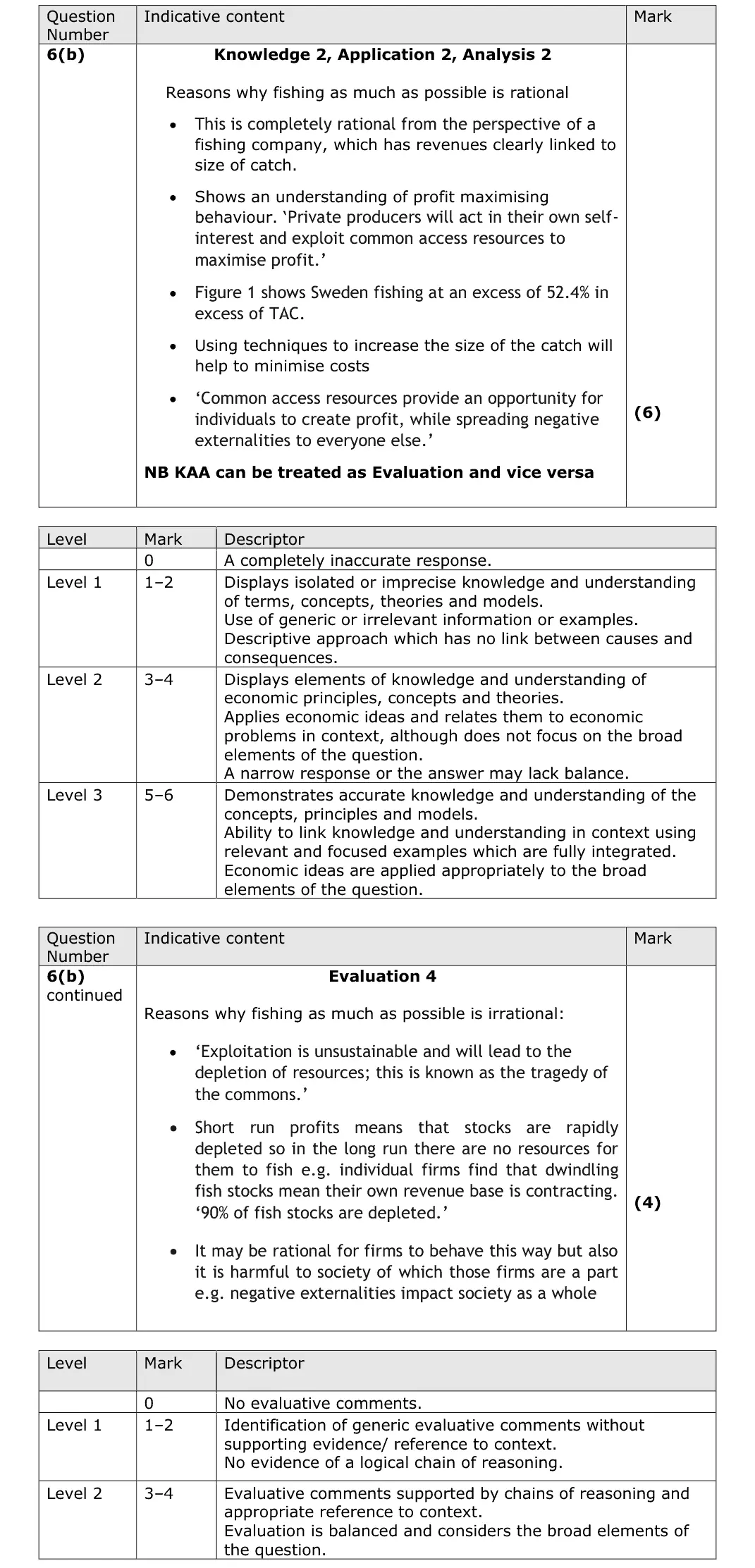
According to Extract B, lines 15–16, ‘fishing companies are not made accountable for the state of the ocean. They continue to fish as much as possible to maximise profit’. (b) Assess whether it is rational for fishing companies to behave in this way. (10)
June 2019 · Paper 1 · Q6(c) 10 marks AO1=2, AO2=2, AO3=2, AO4=4 10-mark response
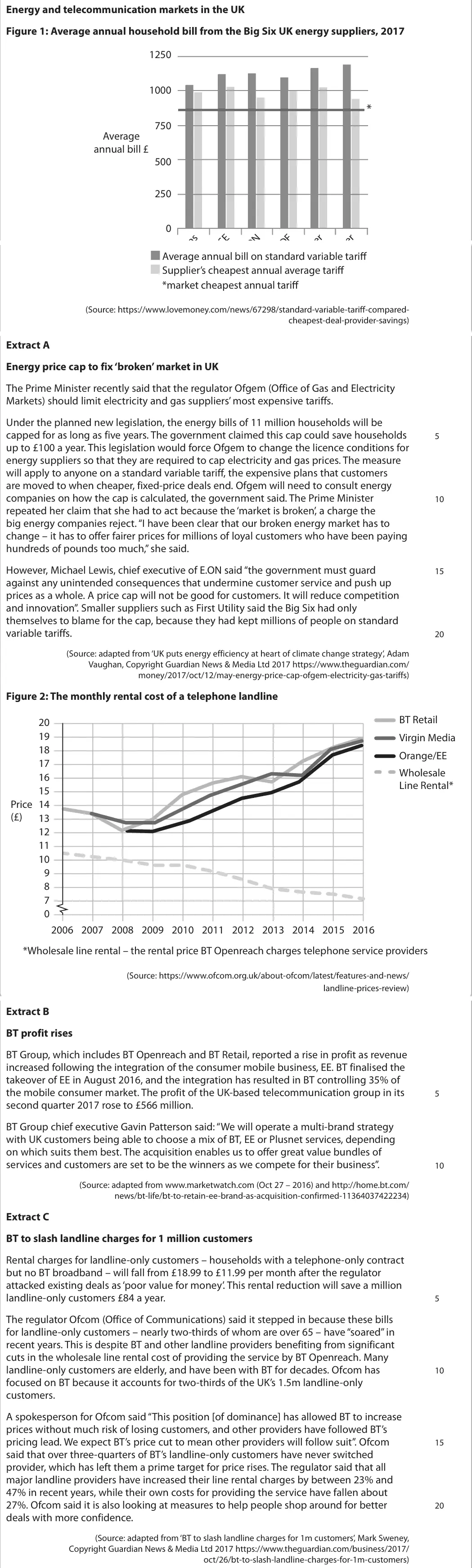
Data and extracts for question 6Energy and telecommunication markets in the UK Figure 1: Average annual household bill from the Big Six UK energy suppliers, 2017 1250 1000 * 750 Average annual bill £ 500 250 0 Average annual bill on standard variable tariff Supplier’s cheapest annual average tariff *market cheapest annual tariff (Source: https://www.lovemoney.com/news/67298/standard-variable-tariff-compared- cheapest-deal-provider-savings) Extract A Energy price cap to fix ‘broken’ market in UK The Prime Minister recently said that the regulator Ofgem (Office of Gas and Electricity Markets) should limit electricity and gas suppliers’ most expensive tariffs. Under the planned new legislation, the energy bills of 11 million households will be capped for as long as five years. The government claimed this cap could save households 5 up to £100 a year. This legislation would force Ofgem to change the licence conditions for energy suppliers so that they are required to cap electricity and gas prices. The measure will apply to anyone on a standard variable tariff, the expensive plans that customers are moved to when cheaper, fixed-price deals end. Ofgem will need to consult energy companies on how the cap is calculated, the government said. The Prime Minister 10 repeated her claim that she had to act because the ‘market is broken’, a charge the big energy companies reject. “I have been clear that our broken energy market has to change – it has to offer fairer prices for millions of loyal customers who have been paying hundreds of pounds too much,” she said. However, Michael Lewis, chief executive of E.ON said “the government must guard 15 against any unintended consequences that undermine customer service and push up prices as a whole. A price cap will not be good for customers. It will reduce competition and innovation”. Smaller suppliers such as First Utility said the Big Six had only themselves to blame for the cap, because they had kept millions of people on standard variable tariffs. 20 (Source: adapted from ‘UK puts energy efficiency at heart of climate change strategy’, Adam Vaughan, Copyright Guardian News & Media Ltd 2017 https://www.theguardian.com/ money/2017/oct/12/may-energy-price-cap-ofgem-electricity-gas-tariffs) Figure 2: The monthly rental cost of a telephone landline BT Retail 20 19 Virgin Media 18 Orange/EE 17 Wholesale 16 Line Rental* 15 Price 14 (£) 13 12 11 10 9 8 7 0 2006 2007 2008 2009 2010 2011 2012 2013 2014 2015 2016 *Wholesale line rental – the rental price BT Openreach charges telephone service providers (Source: https://www.ofcom.org.uk/about-ofcom/latest/features-and-news/ landline-prices-review) Extract B BT profit rises BT Group, which includes BT Openreach and BT Retail, reported a rise in profit as revenue increased following the integration of the consumer mobile business, EE. BT finalised the takeover of EE in August 2016, and the integration has resulted in BT controlling 35% of the mobile consumer market. The profit of the UK-based telecommunication group in its 5 second quarter 2017 rose to £566 million. BT Group chief executive Gavin Patterson said: “We will operate a multi-brand strategy with UK customers being able to choose a mix of BT, EE or Plusnet services, depending on which suits them best. The acquisition enables us to offer great value bundles of services and customers are set to be the winners as we compete for their business”. 10 (Source: adapted from www.marketwatch.com (Oct 27 – 2016) and http://home.bt.com/ news/bt-life/bt-to-retain-ee-brand-as-acquisition-confirmed-11364037422234) Extract C BT to slash landline charges for 1 million customers Rental charges for landline-only customers – households with a telephone-only contract but no BT broadband – will fall from £18.99 to £11.99 per month after the regulator attacked existing deals as ‘poor value for money’. This rental reduction will save a million landline-only customers £84 a year. 5 The regulator Ofcom (Office of Communications) said it stepped in because these bills for landline-only customers – nearly two-thirds of whom are over 65 – have “soared” in recent years. This is despite BT and other landline providers benefiting from significant cuts in the wholesale line rental cost of providing the service by BT Openreach. Many landline-only customers are elderly, and have been with BT for decades. Ofcom has 10 focused on BT because it accounts for two-thirds of the UK’s 1.5m landline-only customers. A spokesperson for Ofcom said “This position [of dominance] has allowed BT to increase prices without much risk of losing customers, and other providers have followed BT’s pricing lead. We expect BT’s price cut to mean other providers will follow suit”. Ofcom 15 said that over three-quarters of BT’s landline-only customers have never switched provider, which has left them a prime target for price rises. The regulator said that all major landline providers have increased their line rental charges by between 23% and 47% in recent years, while their own costs for providing the service have fallen about 27%. Ofcom said it is also looking at measures to help people shop around for better 20 deals with more confidence. (Source: adapted from ‘BT to slash landline charges for 1m customers’, Mark Sweney, Copyright Guardian News & Media Ltd 2017 https://www.theguardian.com/business/2017/ oct/26/bt-to-slash-landline-charges-for-1m-customers)
(c) With reference to Extract C, assess possible reasons why many ‘landline-only’ customers do not switch to a cheaper telephone provider. (10)
June 2018 · AS Paper 1 · Q6(c) 6 marks AO1=2, AO2=2, AO3=2 Short answer
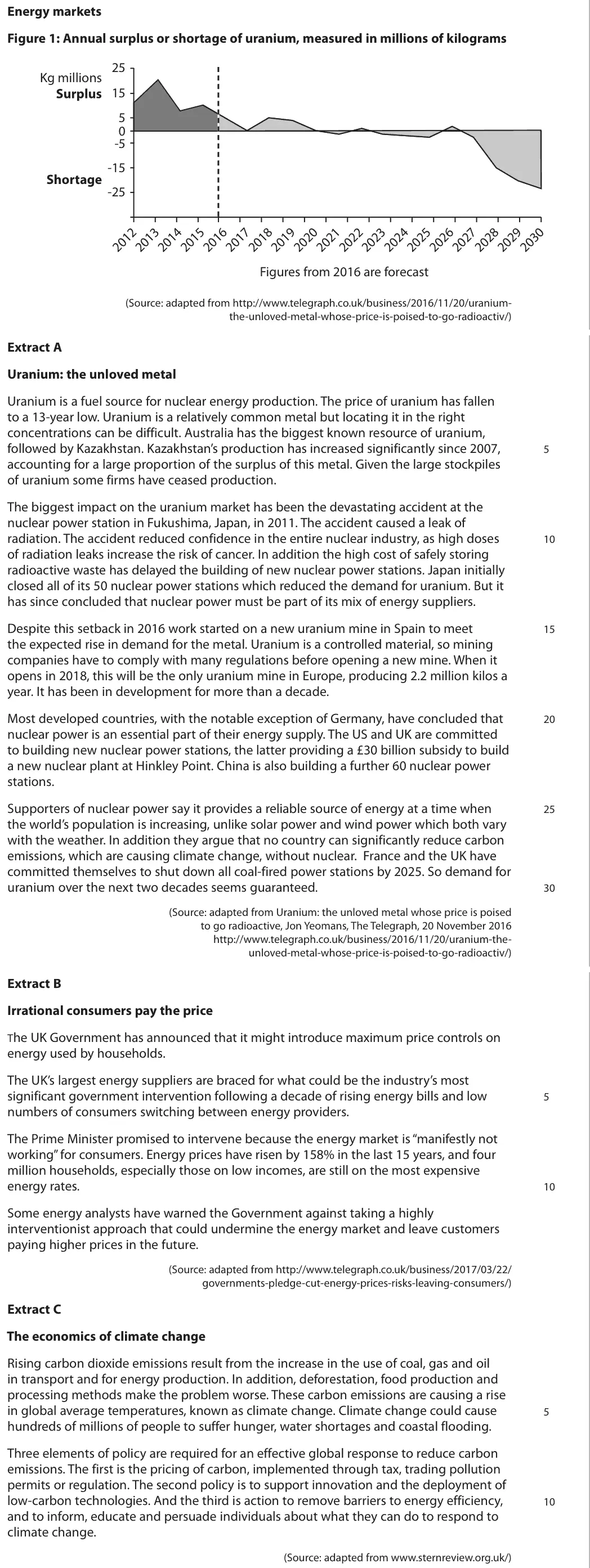
Data and extracts for question 6Energy markets Figure 1: Annual surplus or shortage of uranium, measured in millions of kilograms 25 Kg millions 15 5 0 -5 -15 -25 Figures from 2016 are forecast (Source: adapted from http://www.telegraph.co.uk/business/2016/11/20/uranium- the-unloved-metal-whose-price-is-poised-to-go-radioactiv/) Extract A Uranium: the unloved metal Uranium is a fuel source for nuclear energy production. The price of uranium has fallen to a 13-year low. Uranium is a relatively common metal but locating it in the right concentrations can be difficult. Australia has the biggest known resource of uranium, followed by Kazakhstan. Kazakhstan’s production has increased significantly since 2007, 5 accounting for a large proportion of the surplus of this metal. Given the large stockpiles of uranium some firms have ceased production. The biggest impact on the uranium market has been the devastating accident at the nuclear power station in Fukushima, Japan, in 2011. The accident caused a leak of radiation. The accident reduced confidence in the entire nuclear industry, as high doses 10 of radiation leaks increase the risk of cancer. In addition the high cost of safely storing radioactive waste has delayed the building of new nuclear power stations. Japan initially closed all of its 50 nuclear power stations which reduced the demand for uranium. But it has since concluded that nuclear power must be part of its mix of energy suppliers. Despite this setback in 2016 work started on a new uranium mine in Spain to meet 15 the expected rise in demand for the metal. Uranium is a controlled material, so mining companies have to comply with many regulations before opening a new mine. When it opens in 2018, this will be the only uranium mine in Europe, producing 2.2 million kilos a year. It has been in development for more than a decade. Most developed countries, with the notable exception of Germany, have concluded that 20 nuclear power is an essential part of their energy supply. The US and UK are committed to building new nuclear power stations, the latter providing a £30 billion subsidy to build a new nuclear plant at Hinkley Point. China is also building a further 60 nuclear power stations. Supporters of nuclear power say it provides a reliable source of energy at a time when 25 the world’s population is increasing, unlike solar power and wind power which both vary with the weather. In addition they argue that no country can significantly reduce carbon emissions, which are causing climate change, without nuclear. France and the UK have committed themselves to shut down all coal-fired power stations by 2025. So demand for uranium over the next two decades seems guaranteed. 30 (Source: adapted from Uranium: the unloved metal whose price is poised to go radioactive, Jon Yeomans, The Telegraph, 20 November 2016 http://www.telegraph.co.uk/business/2016/11/20/uranium-the- unloved-metal-whose-price-is-poised-to-go-radioactiv/) Extract B Irrational consumers pay the price The UK Government has announced that it might introduce maximum price controls on energy used by households. The UK’s largest energy suppliers are braced for what could be the industry’s most significant government intervention following a decade of rising energy bills and low 5 numbers of consumers switching between energy providers. The Prime Minister promised to intervene because the energy market is “manifestly not working” for consumers. Energy prices have risen by 158% in the last 15 years, and four million households, especially those on low incomes, are still on the most expensive energy rates. 10 Some energy analysts have warned the Government against taking a highly interventionist approach that could undermine the energy market and leave customers paying higher prices in the future. (Source: adapted from http://www.telegraph.co.uk/business/2017/03/22/ governments-pledge-cut-energy-prices-risks-leaving-consumers/) Extract C The economics of climate change Rising carbon dioxide emissions result from the increase in the use of coal, gas and oil in transport and for energy production. In addition, deforestation, food production and processing methods make the problem worse. These carbon emissions are causing a rise in global average temperatures, known as climate change. Climate change could cause 5 hundreds of millions of people to suffer hunger, water shortages and coastal flooding. Three elements of policy are required for an effective global response to reduce carbon emissions. The first is the pricing of carbon, implemented through tax, trading pollution permits or regulation. The second policy is to support innovation and the deployment of low-carbon technologies. And the third is action to remove barriers to energy efficiency, 10 and to inform, educate and persuade individuals about what they can do to respond to climate change. (Source: adapted from www.sternreview.org.uk/)
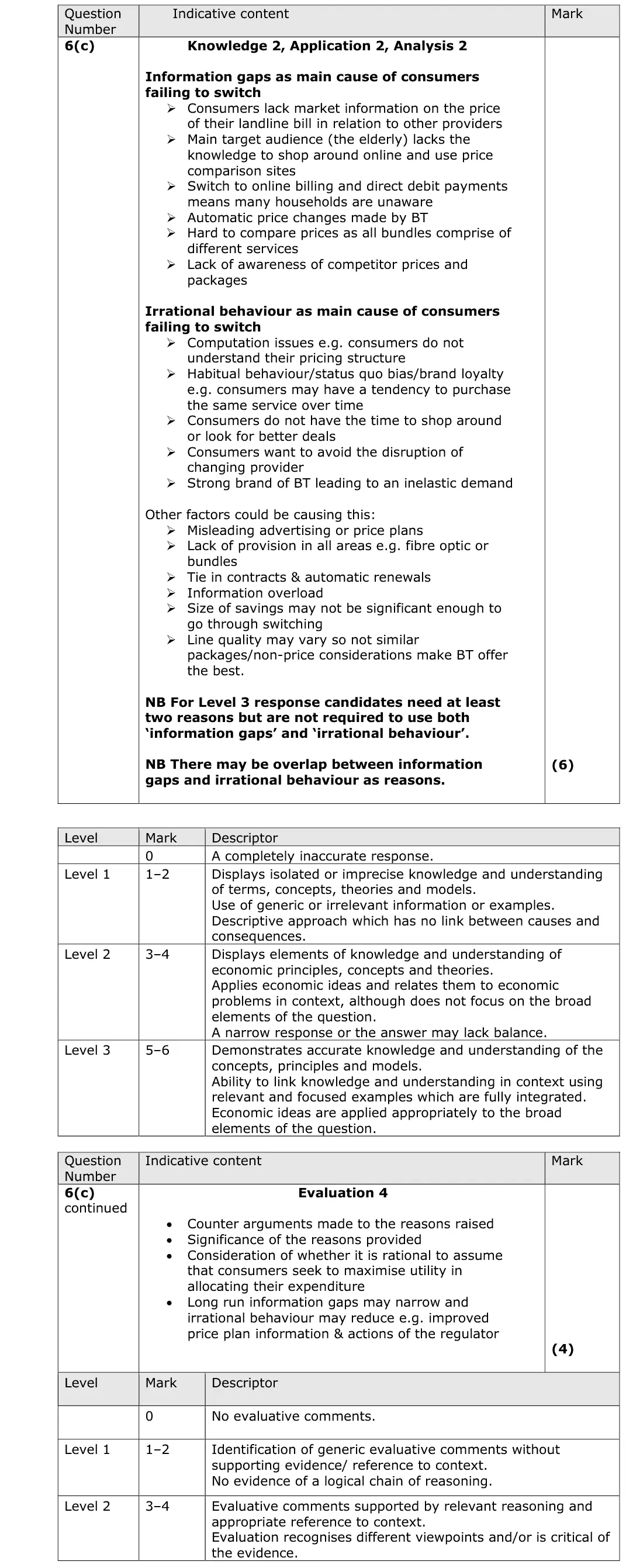
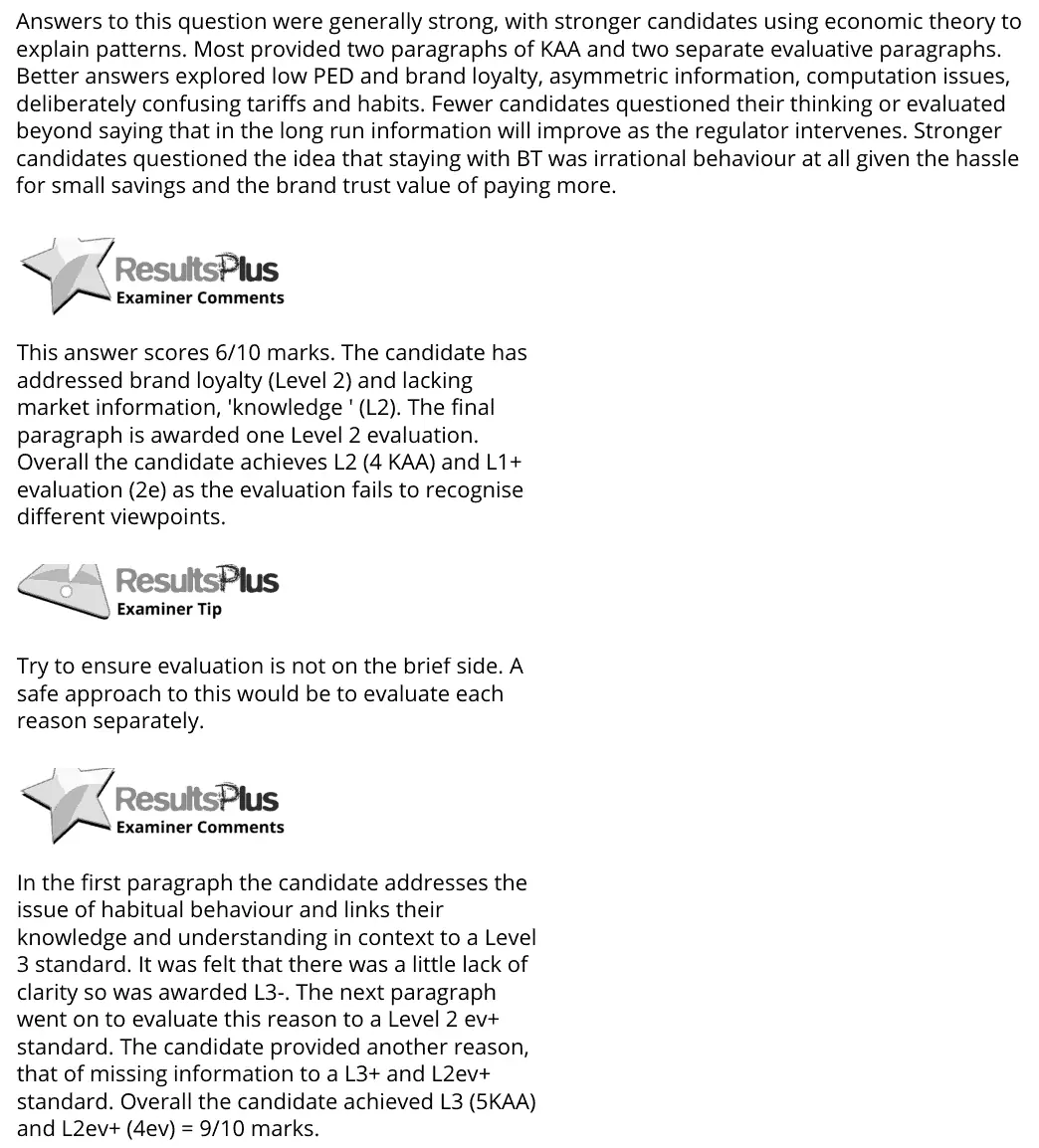
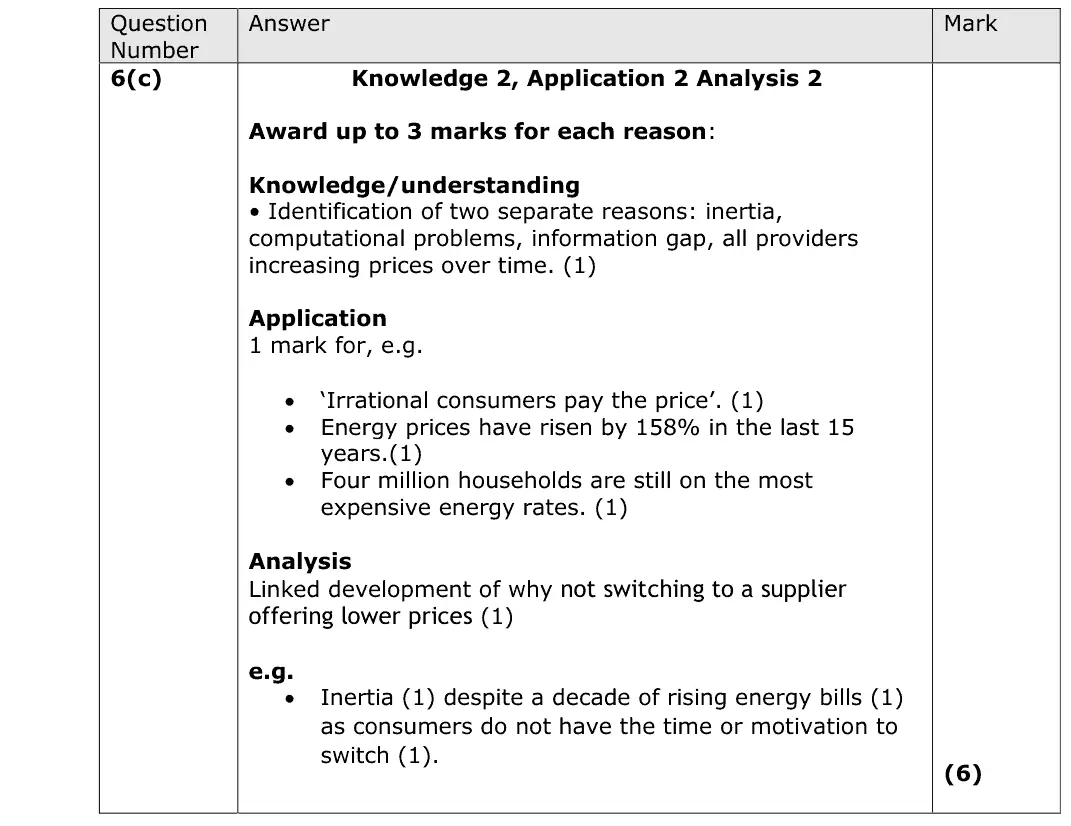
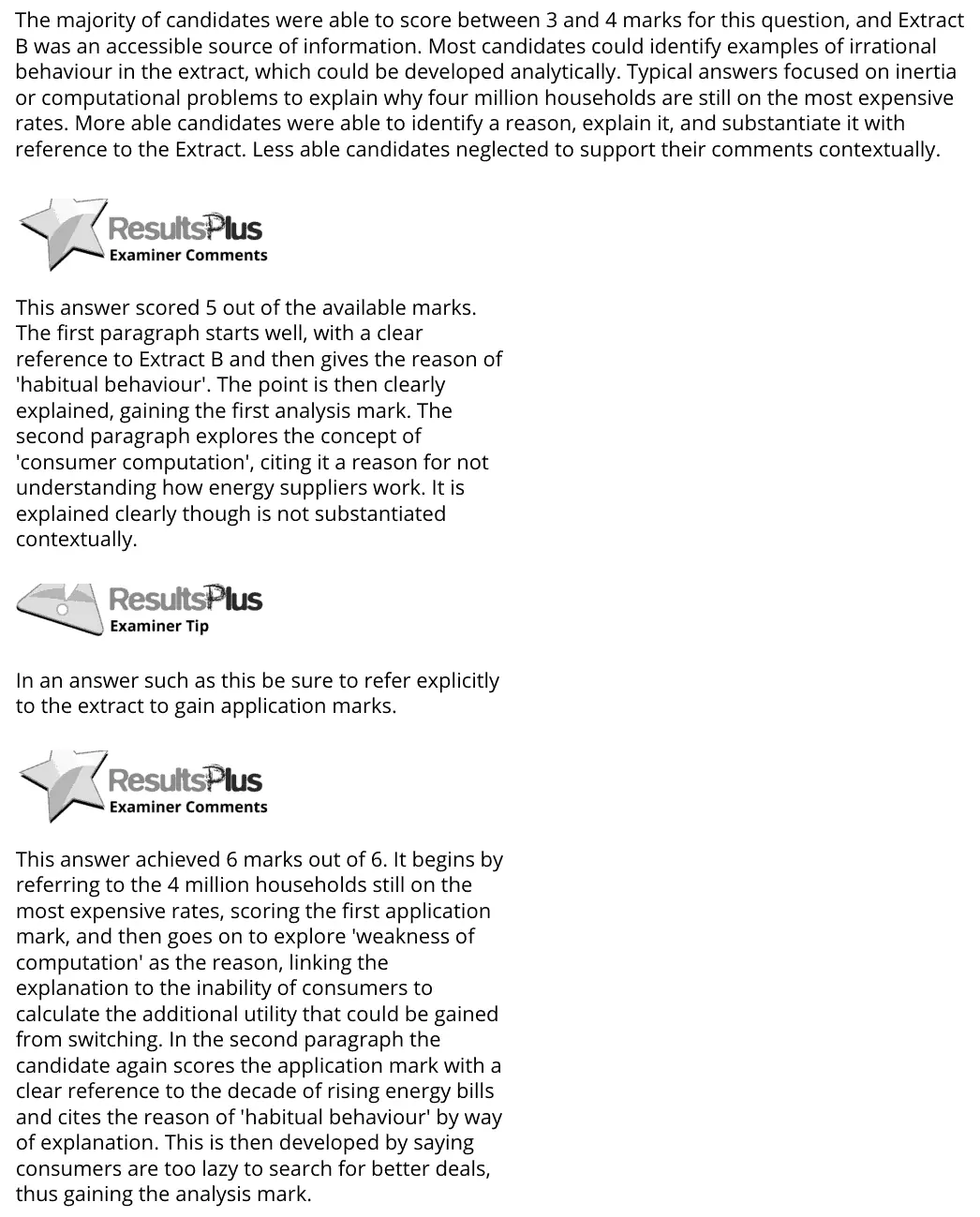
(c) With reference to Extract B, explain two likely reasons why many consumers of energy have not switched to suppliers offering lower prices. (6)
June 2017 · AS Paper 1 · Q6(b) 10 marks AO1=2, AO2=2, AO3=2, AO4=4 10-mark response
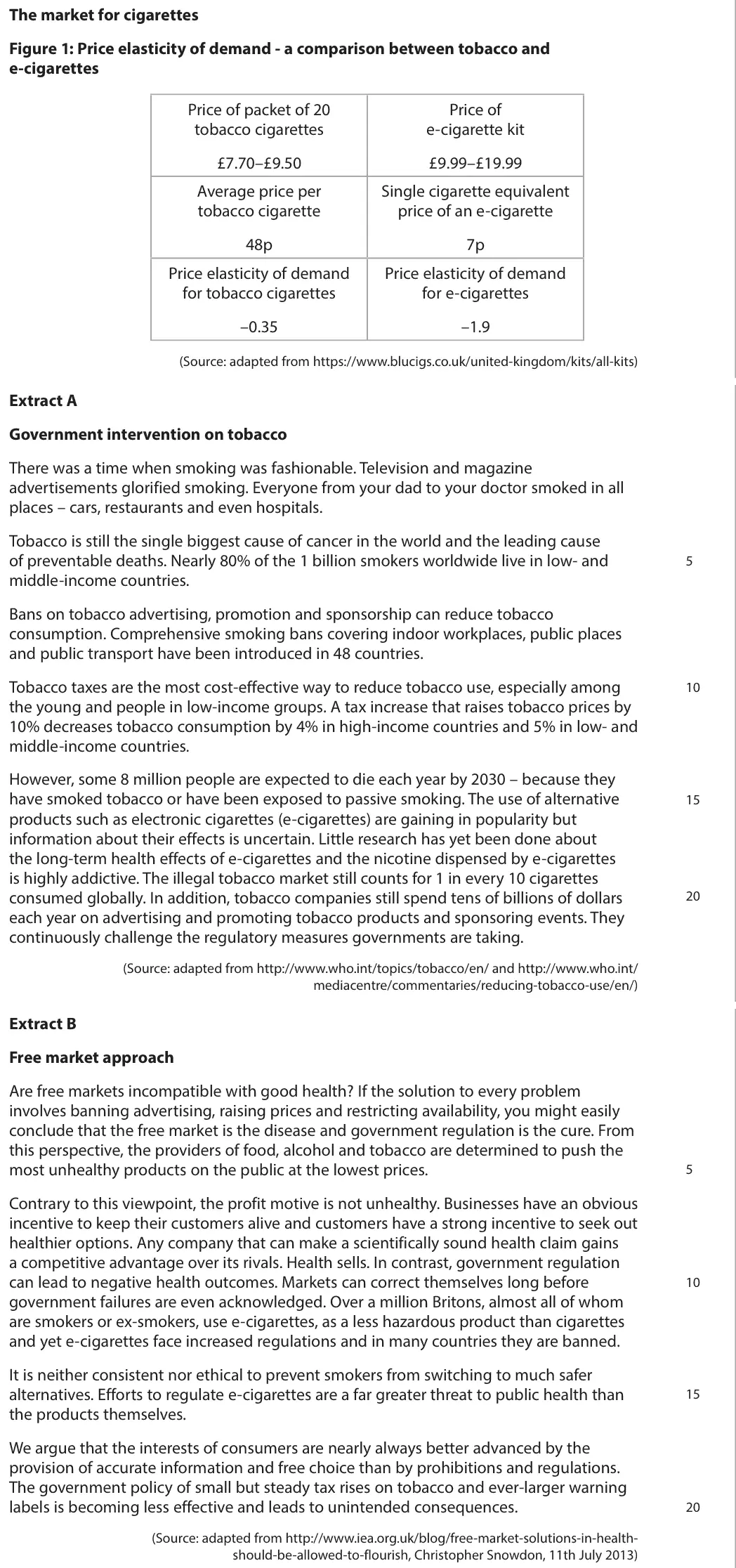
Data and extracts for question 6The market for cigarettes Figure 1: Price elasticity of demand - a comparison between tobacco and e-cigarettes Price of packet of 20 Price of tobacco cigarettes e-cigarette kit £7.70–£9.50 £9.99–£19.99 Average price per Single cigarette equivalent tobacco cigarette price of an e-cigarette 48p 7p Price elasticity of demand Price elasticity of demand for tobacco cigarettes for e-cigarettes –0.35 –1.9 (Source: adapted from https://www.blucigs.co.uk/united-kingdom/kits/all-kits) Extract A Government intervention on tobacco There was a time when smoking was fashionable. Television and magazine advertisements glorified smoking. Everyone from your dad to your doctor smoked in all places – cars, restaurants and even hospitals. Tobacco is still the single biggest cause of cancer in the world and the leading cause of preventable deaths. Nearly 80% of the 1 billion smokers worldwide live in low- and 5 middle-income countries. Bans on tobacco advertising, promotion and sponsorship can reduce tobacco consumption. Comprehensive smoking bans covering indoor workplaces, public places and public transport have been introduced in 48 countries. Tobacco taxes are the most cost-effective way to reduce tobacco use, especially among 10 the young and people in low-income groups. A tax increase that raises tobacco prices by 10% decreases tobacco consumption by 4% in high-income countries and 5% in low- and middle-income countries. However, some 8 million people are expected to die each year by 2030 – because they have smoked tobacco or have been exposed to passive smoking. The use of alternative 15 products such as electronic cigarettes (e-cigarettes) are gaining in popularity but information about their effects is uncertain. Little research has yet been done about the long-term health effects of e-cigarettes and the nicotine dispensed by e-cigarettes is highly addictive. The illegal tobacco market still counts for 1 in every 10 cigarettes consumed globally. In addition, tobacco companies still spend tens of billions of dollars 20 each year on advertising and promoting tobacco products and sponsoring events. They continuously challenge the regulatory measures governments are taking. (Source: adapted from http://www.who.int/topics/tobacco/en/ and http://www.who.int/ mediacentre/commentaries/reducing-tobacco-use/en/) Extract B Free market approach Are free markets incompatible with good health? If the solution to every problem involves banning advertising, raising prices and restricting availability, you might easily conclude that the free market is the disease and government regulation is the cure. From this perspective, the providers of food, alcohol and tobacco are determined to push the most unhealthy products on the public at the lowest prices. 5 Contrary to this viewpoint, the profit motive is not unhealthy. Businesses have an obvious incentive to keep their customers alive and customers have a strong incentive to seek out healthier options. Any company that can make a scientifically sound health claim gains a competitive advantage over its rivals. Health sells. In contrast, government regulation can lead to negative health outcomes. Markets can correct themselves long before 10 government failures are even acknowledged. Over a million Britons, almost all of whom are smokers or ex-smokers, use e-cigarettes, as a less hazardous product than cigarettes and yet e-cigarettes face increased regulations and in many countries they are banned. It is neither consistent nor ethical to prevent smokers from switching to much safer alternatives. Efforts to regulate e-cigarettes are a far greater threat to public health than 15 the products themselves. We argue that the interests of consumers are nearly always better advanced by the provision of accurate information and free choice than by prohibitions and regulations. The government policy of small but steady tax rises on tobacco and ever-larger warning labels is becoming less effective and leads to unintended consequences. 20 (Source: adapted from http://www.iea.org.uk/blog/free-market-solutions-in-health- should-be-allowed-to-flourish, Christopher Snowdon, 11th July 2013)
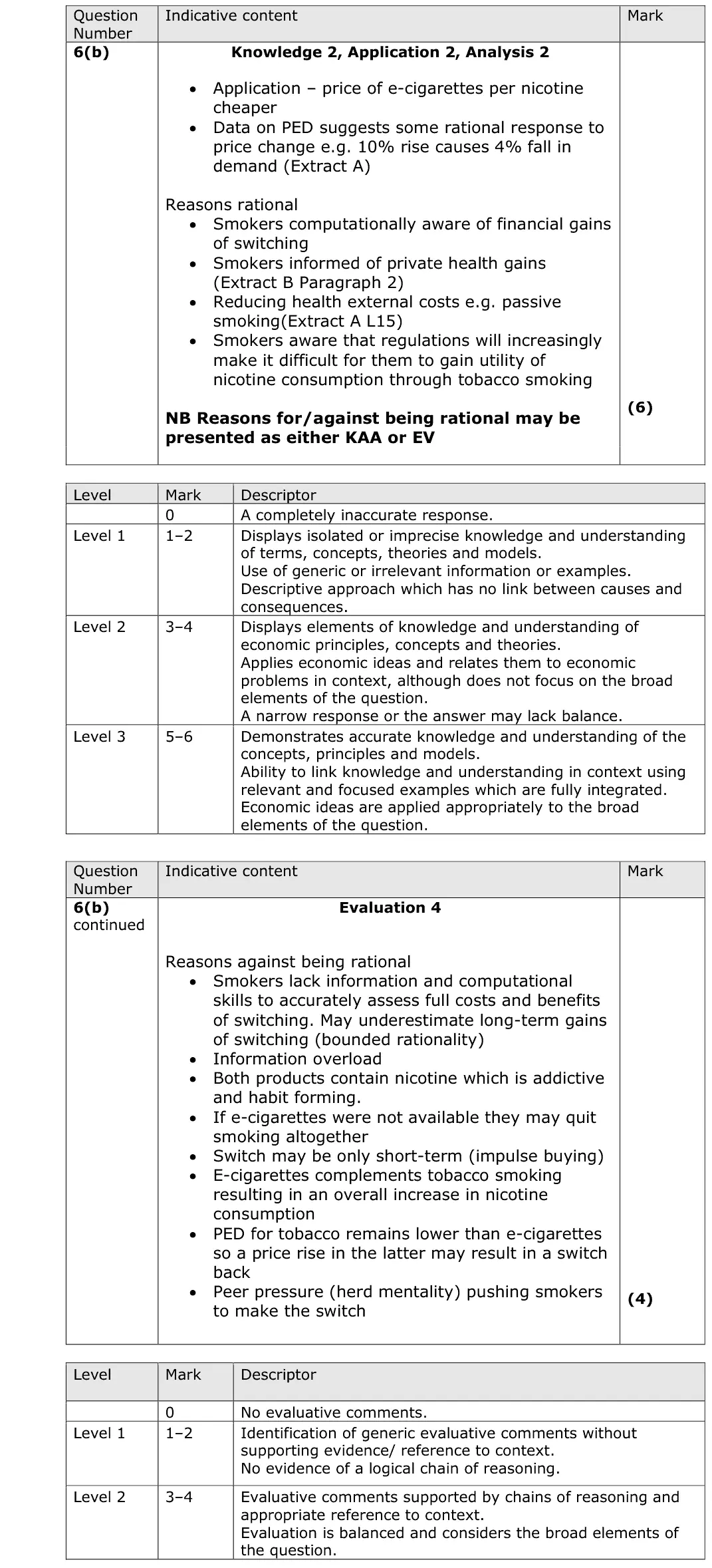
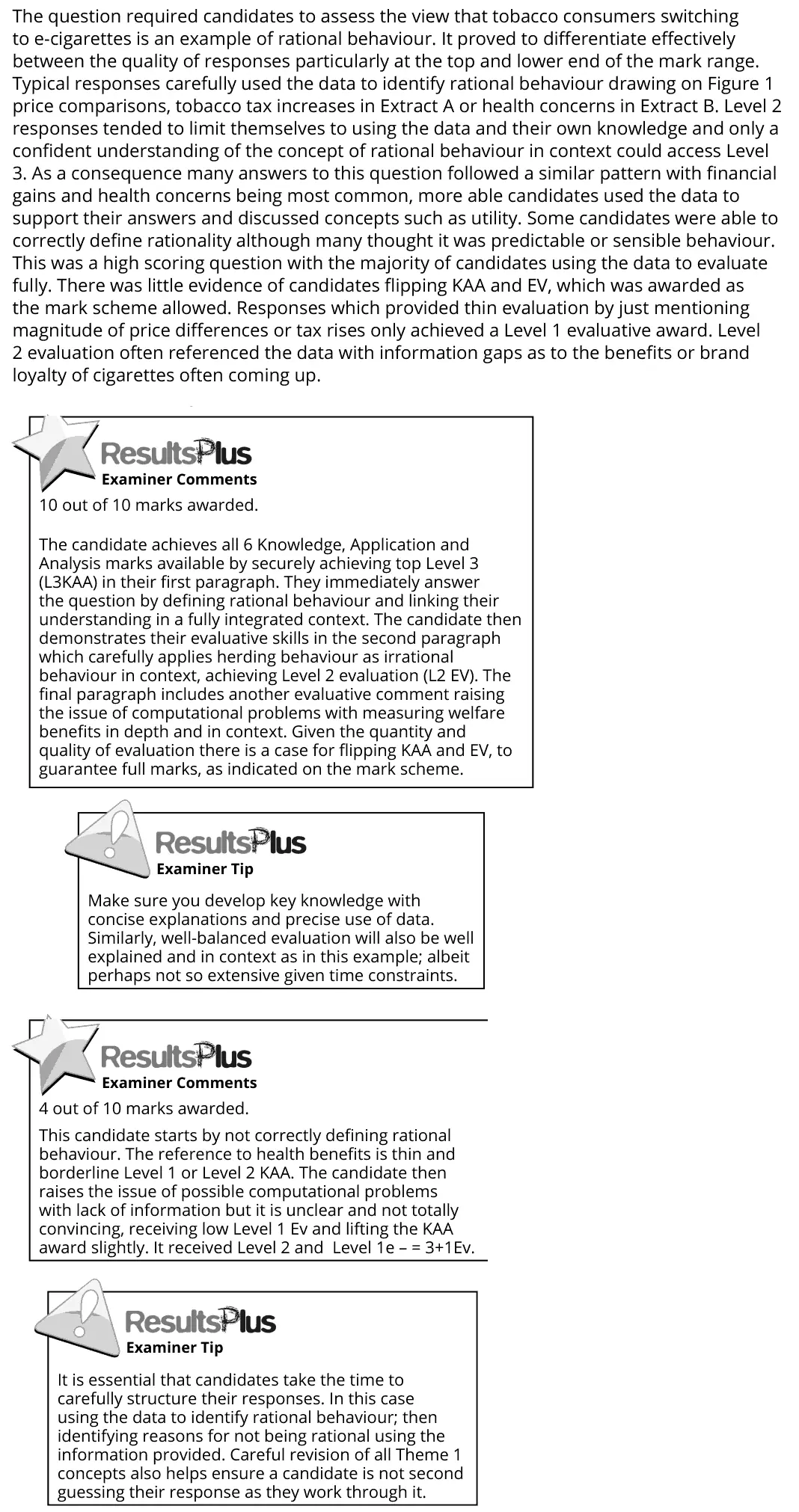
(b) With reference to the information provided and your own knowledge, assess the view that tobacco consumers switching to e-cigarettes is an example of rational behaviour. (10)
June 2017 · Paper 1 · Q6(d) 10 marks AO1=2, AO2=2, AO3=2, AO4=4 10-mark response Hard
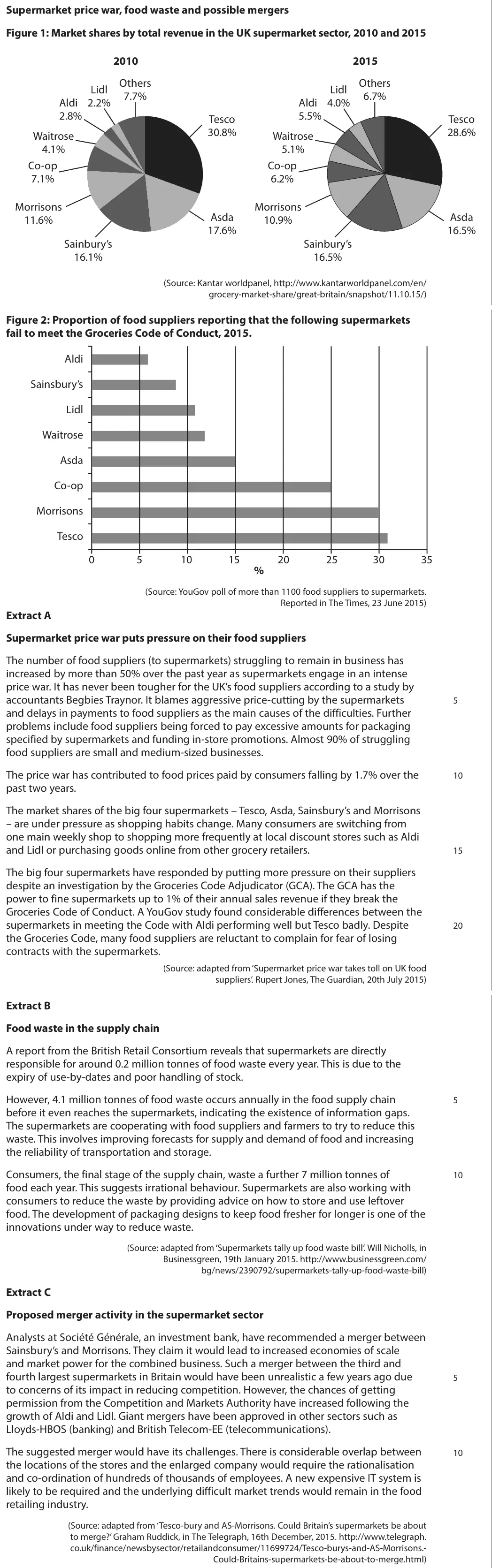
Data and extracts for question 6Supermarket price war, food waste and possible mergers Figure 1: Market shares by total revenue in the UK supermarket sector, 2010 and 2015 2010 2015 Others Others Lidl Lidl 7.7% 6.7% Aldi 2.2% Aldi 4.0% 2.8% 5.5% Tesco Tesco 30.8% 28.6% Waitrose Waitrose 4.1% 5.1% Co-op Co-op 7.1% 6.2% Morrisons Morrisons Asda Asda 11.6% 10.9% 17.6% 16.5% Sainbury’s Sainbury’s 16.1% 16.5% (Source: Kantar worldpanel, http://www.kantarworldpanel.com/en/ grocery-market-share/great-britain/snapshot/11.10.15/) Figure 2: Proportion of food suppliers reporting that the following supermarkets fail to meet the Groceries Code of Conduct, 2015. Aldi Sainsbury’s Lidl Waitrose Asda Co-op Morrisons Tesco 0 5 10 15 20 25 30 35 % (Source: YouGov poll of more than 1100 food suppliers to supermarkets. Reported in The Times, 23 June 2015) Extract A Supermarket price war puts pressure on their food suppliers The number of food suppliers (to supermarkets) struggling to remain in business has increased by more than 50% over the past year as supermarkets engage in an intense price war. It has never been tougher for the UK’s food suppliers according to a study by accountants Begbies Traynor. It blames aggressive price-cutting by the supermarkets 5 and delays in payments to food suppliers as the main causes of the difficulties. Further problems include food suppliers being forced to pay excessive amounts for packaging specified by supermarkets and funding in-store promotions. Almost 90% of struggling food suppliers are small and medium-sized businesses. The price war has contributed to food prices paid by consumers falling by 1.7% over the 10 past two years. The market shares of the big four supermarkets – Tesco, Asda, Sainsbury’s and Morrisons – are under pressure as shopping habits change. Many consumers are switching from one main weekly shop to shopping more frequently at local discount stores such as Aldi and Lidl or purchasing goods online from other grocery retailers. 15 The big four supermarkets have responded by putting more pressure on their suppliers despite an investigation by the Groceries Code Adjudicator (GCA). The GCA has the power to fine supermarkets up to 1% of their annual sales revenue if they break the Groceries Code of Conduct. A YouGov study found considerable differences between the supermarkets in meeting the Code with Aldi performing well but Tesco badly. Despite 20 the Groceries Code, many food suppliers are reluctant to complain for fear of losing contracts with the supermarkets. (Source: adapted from ‘Supermarket price war takes toll on UK food suppliers’. Rupert Jones, The Guardian, 20th July 2015) Extract B Food waste in the supply chain A report from the British Retail Consortium reveals that supermarkets are directly responsible for around 0.2 million tonnes of food waste every year. This is due to the expiry of use-by-dates and poor handling of stock. However, 4.1 million tonnes of food waste occurs annually in the food supply chain 5 before it even reaches the supermarkets, indicating the existence of information gaps. The supermarkets are cooperating with food suppliers and farmers to try to reduce this waste. This involves improving forecasts for supply and demand of food and increasing the reliability of transportation and storage. Consumers, the final stage of the supply chain, waste a further 7 million tonnes of 10 food each year. This suggests irrational behaviour. Supermarkets are also working with consumers to reduce the waste by providing advice on how to store and use leftover food. The development of packaging designs to keep food fresher for longer is one of the innovations under way to reduce waste. (Source: adapted from ‘Supermarkets tally up food waste bill’. Will Nicholls, in Businessgreen, 19th January 2015. http://www.businessgreen.com/ bg/news/2390792/supermarkets-tally-up-food-waste-bill) Extract C Proposed merger activity in the supermarket sector Analysts at Société Générale, an investment bank, have recommended a merger between Sainsbury’s and Morrisons. They claim it would lead to increased economies of scale and market power for the combined business. Such a merger between the third and fourth largest supermarkets in Britain would have been unrealistic a few years ago due 5 to concerns of its impact in reducing competition. However, the chances of getting permission from the Competition and Markets Authority have increased following the growth of Aldi and Lidl. Giant mergers have been approved in other sectors such as Lloyds-HBOS (banking) and British Telecom-EE (telecommunications). The suggested merger would have its challenges. There is considerable overlap between 10 the locations of the stores and the enlarged company would require the rationalisation and co-ordination of hundreds of thousands of employees. A new expensive IT system is likely to be required and the underlying difficult market trends would remain in the food retailing industry. (Source: adapted from ‘Tesco-bury and AS-Morrisons. Could Britain’s supermarkets be about to merge?’ Graham Ruddick, in The Telegraph, 16th December, 2015. http://www.telegraph. co.uk/finance/newsbysector/retailandconsumer/11699724/Tesco-burys-and-AS-Morrisons.- Could-Britains-supermarkets-be-about-to-merge.html)
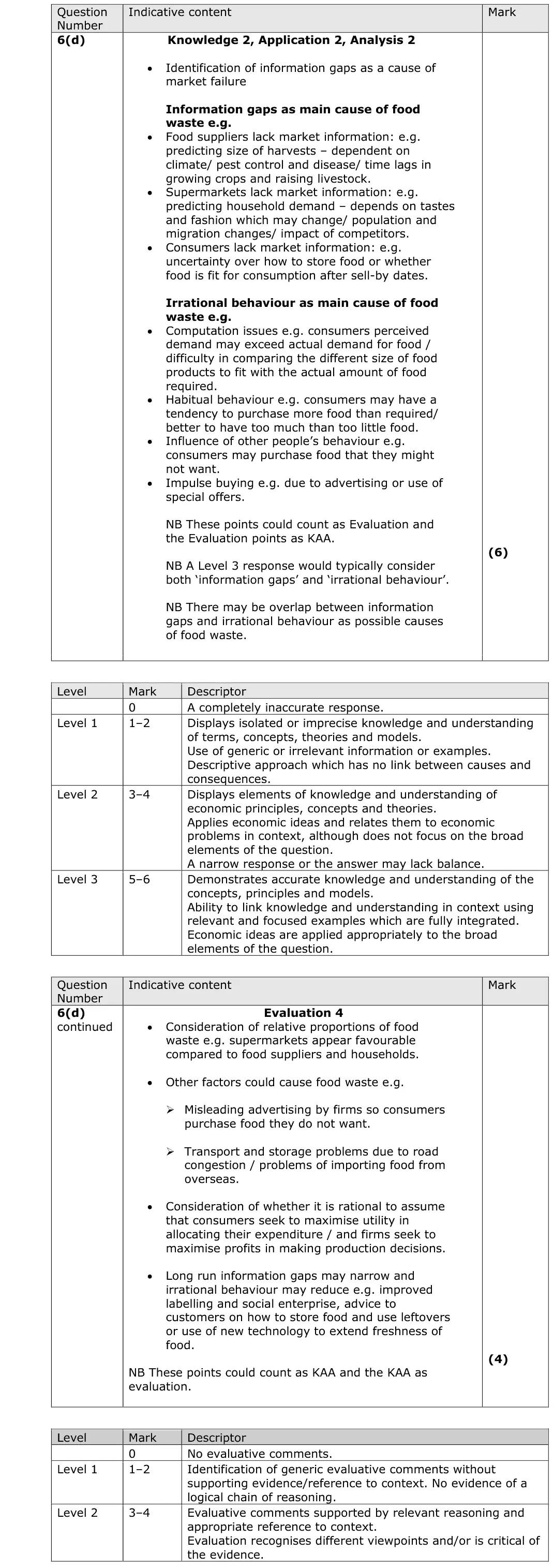
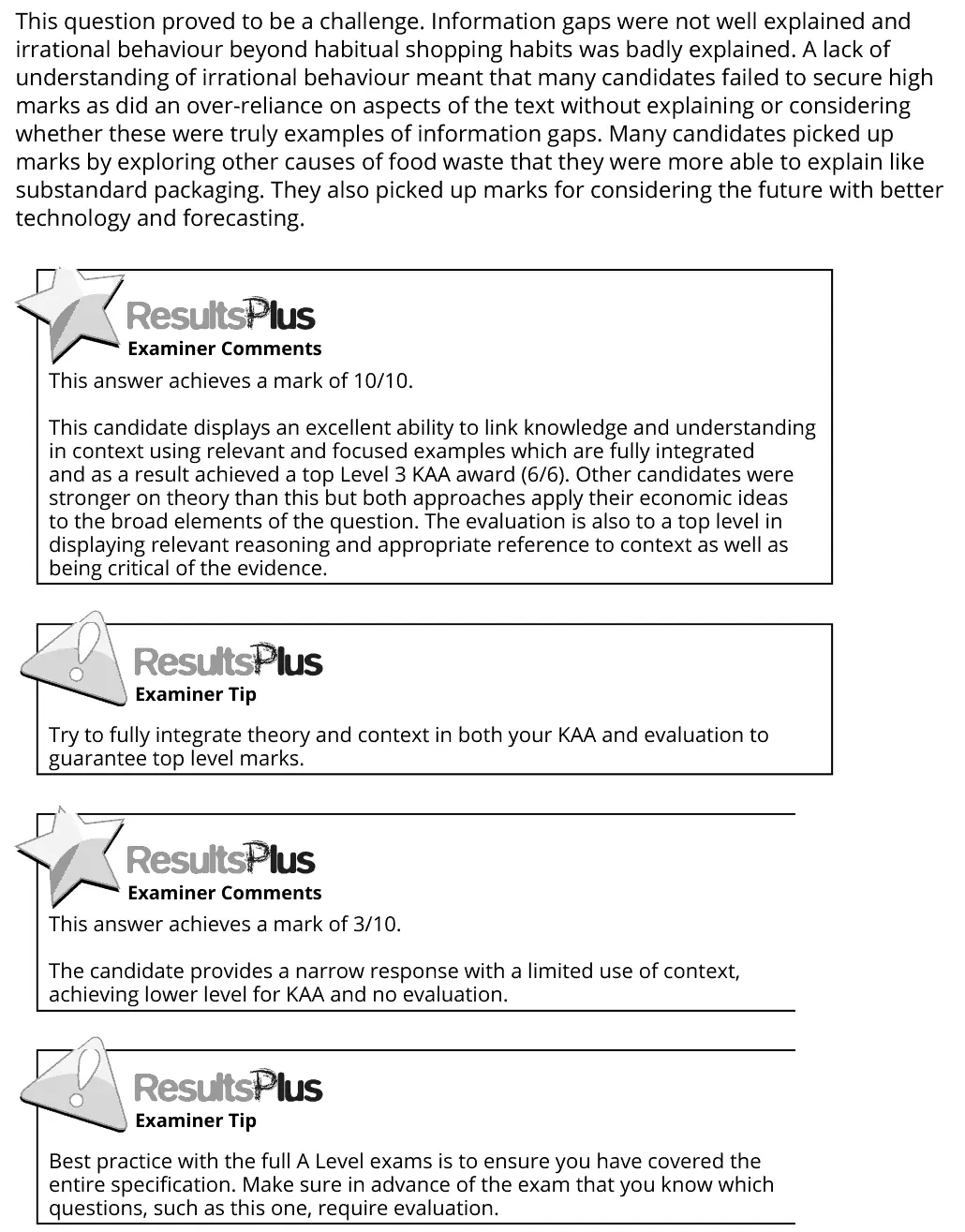
(d) Assess the extent to which ‘information gaps’ (Extract B, lines 5 and 6) and ‘irrational behaviour’ (Extract B, line 11) are the main causes of food waste in the UK. (10)

Work with an Edexcel economics tutor

Essays stuck in Level 2, or losing the easy marks in Section A? Book a trial session with Lianne, a former Edexcel examiner.
Prefer email? Send an enquiry

If you are under 18, please include a parent's contact details. Enquiries go to enquiries@economicsaleveltutor.com and are deleted once handled. All tutoring is online.