June 2017: Paper 1

100 marks · 21 question parts · Paper, mark scheme and report on Pearson's site

Question by question

QTopicMarksAOType
1(a) Supply, demand and price determination 4AO1=2,AO2=2Calculation
1(b) Price, income and cross elasticities of demand 1Multiple choice
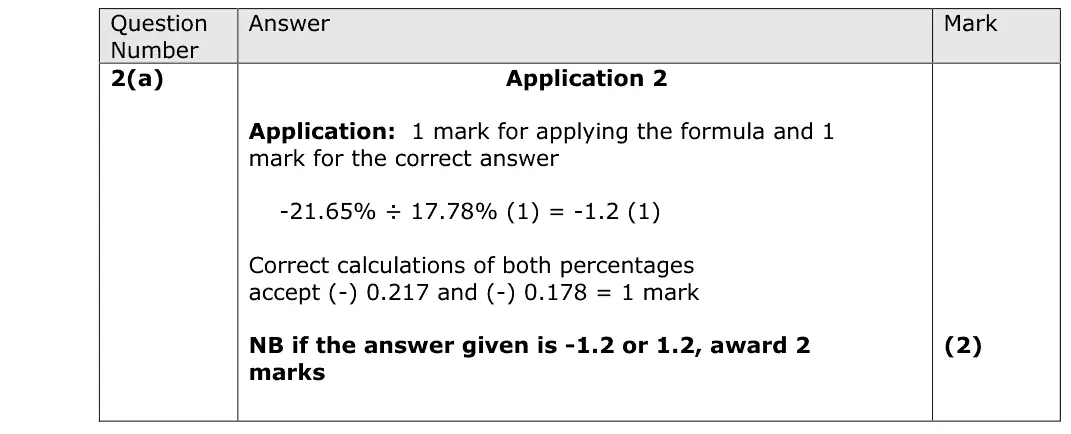
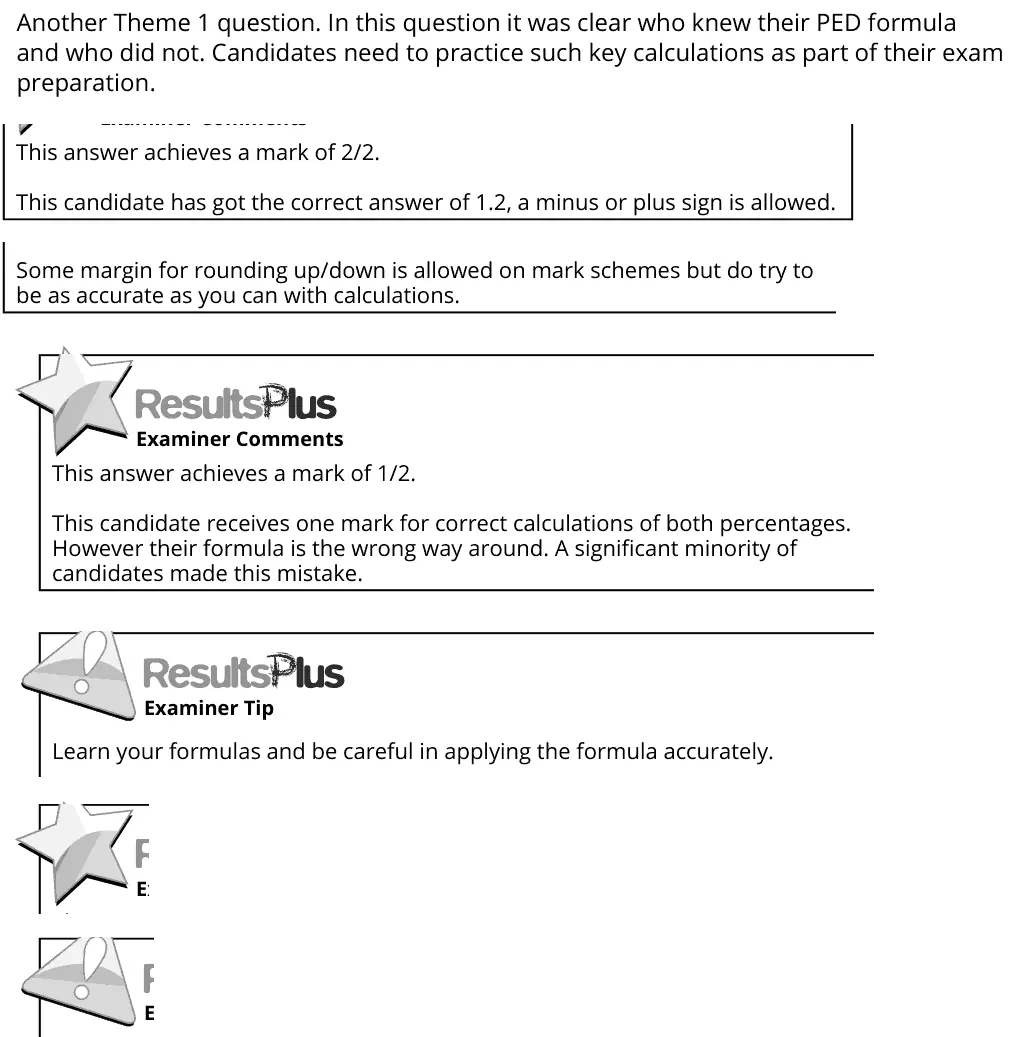
2(a) Price, income and cross elasticities of demand 2AO2=2Calculation
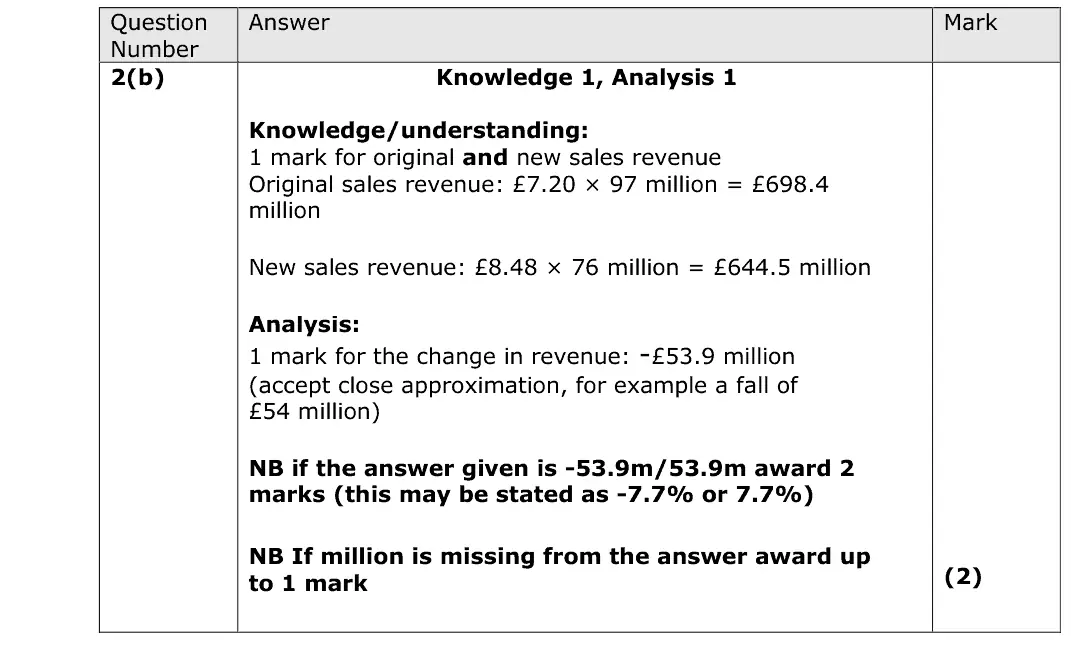
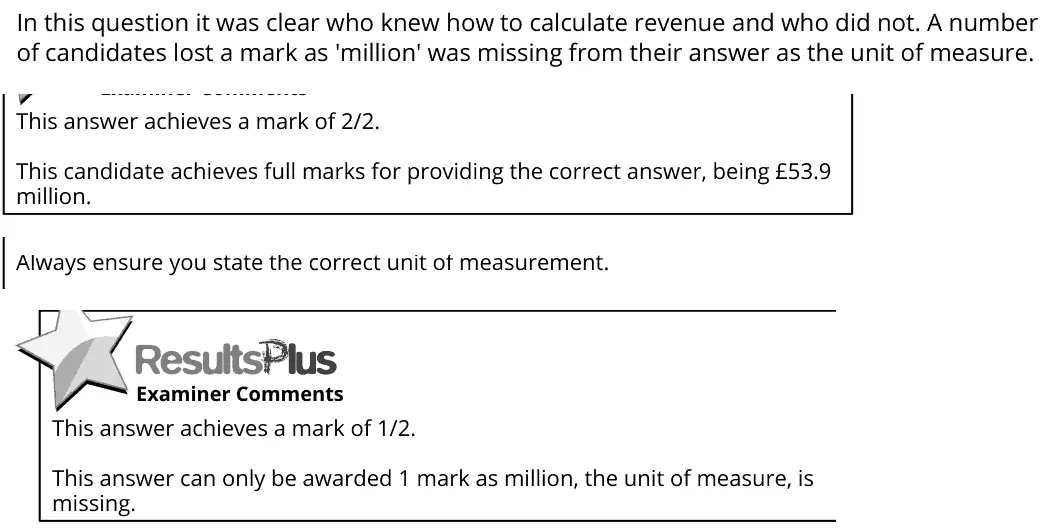
2(b) Price, income and cross elasticities of demand 2AO1=1,AO3=1Calculation
2(c) Price, income and cross elasticities of demand 1Multiple choice
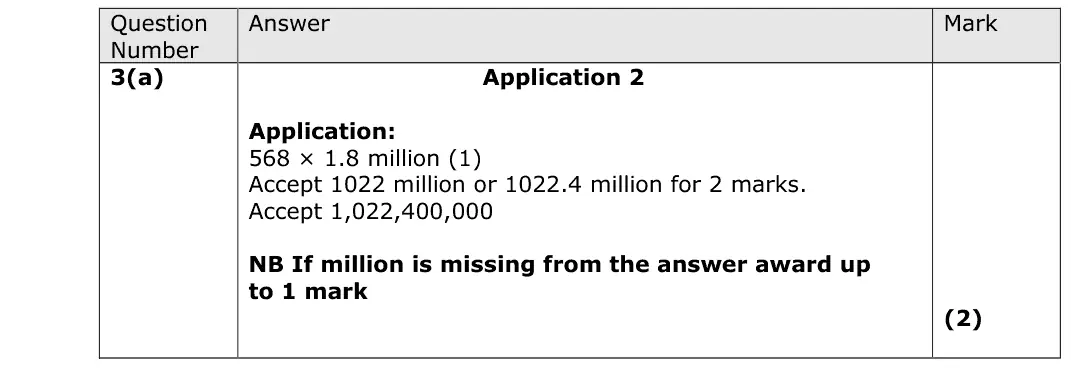
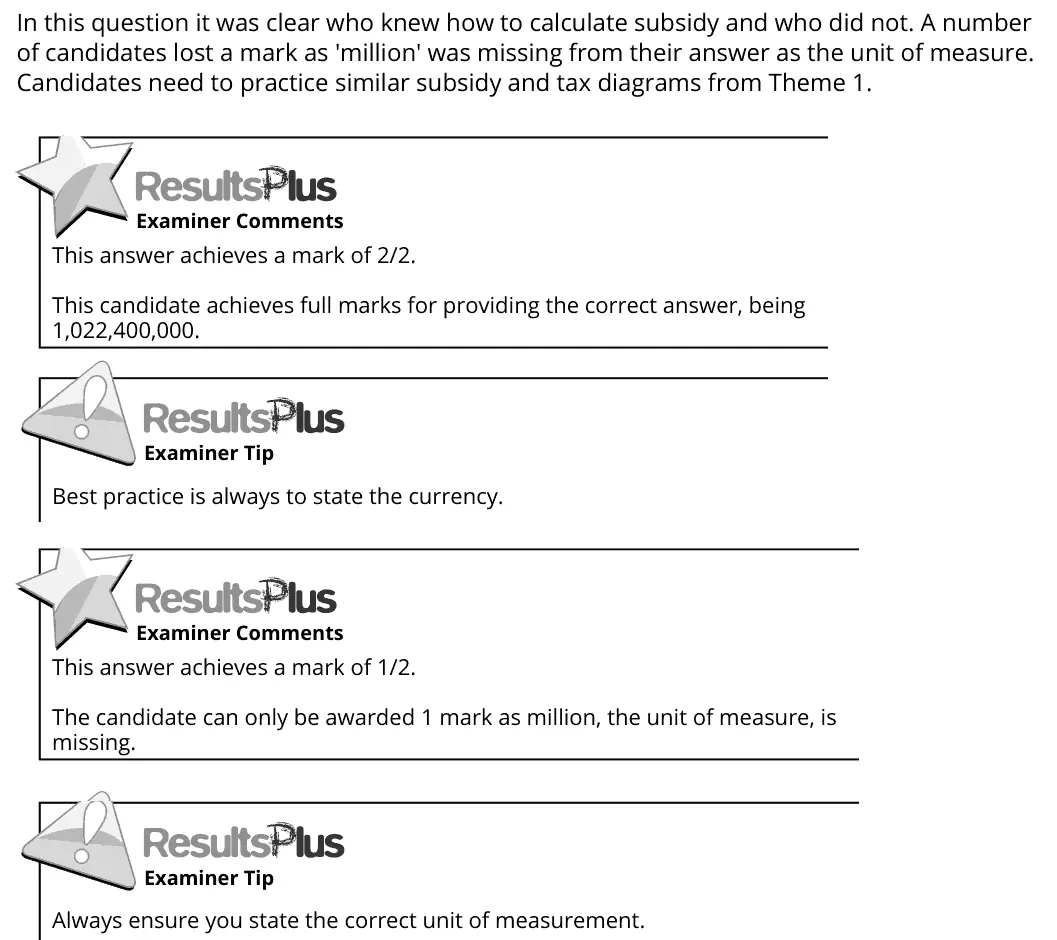
3(a) Indirect taxes and subsidies 2AO2=2Calculation
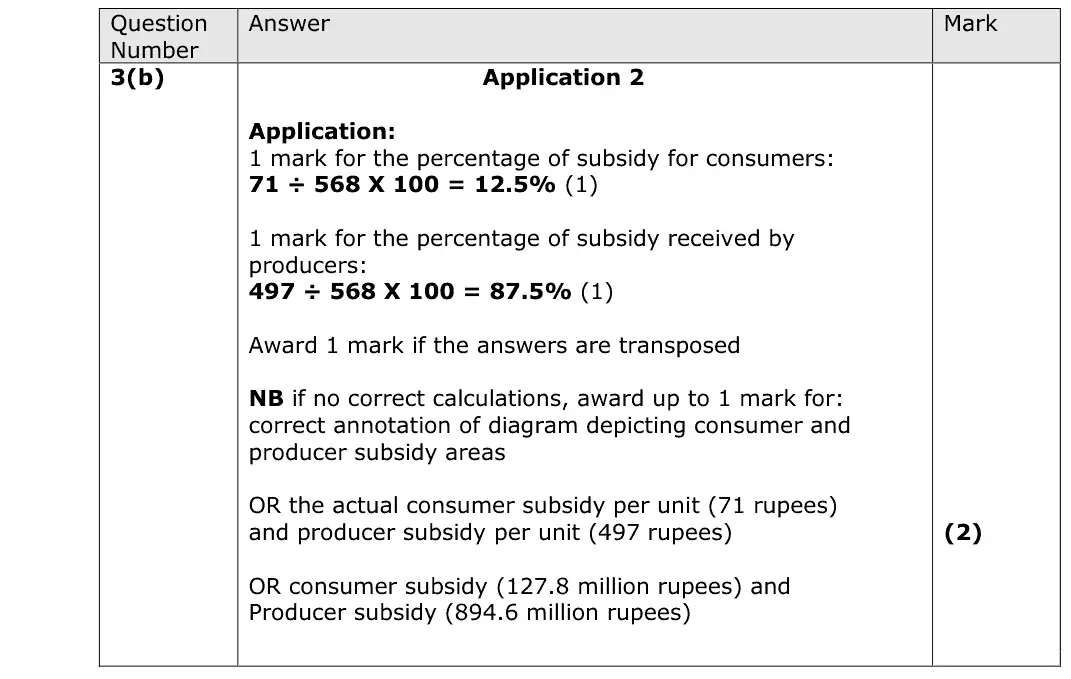
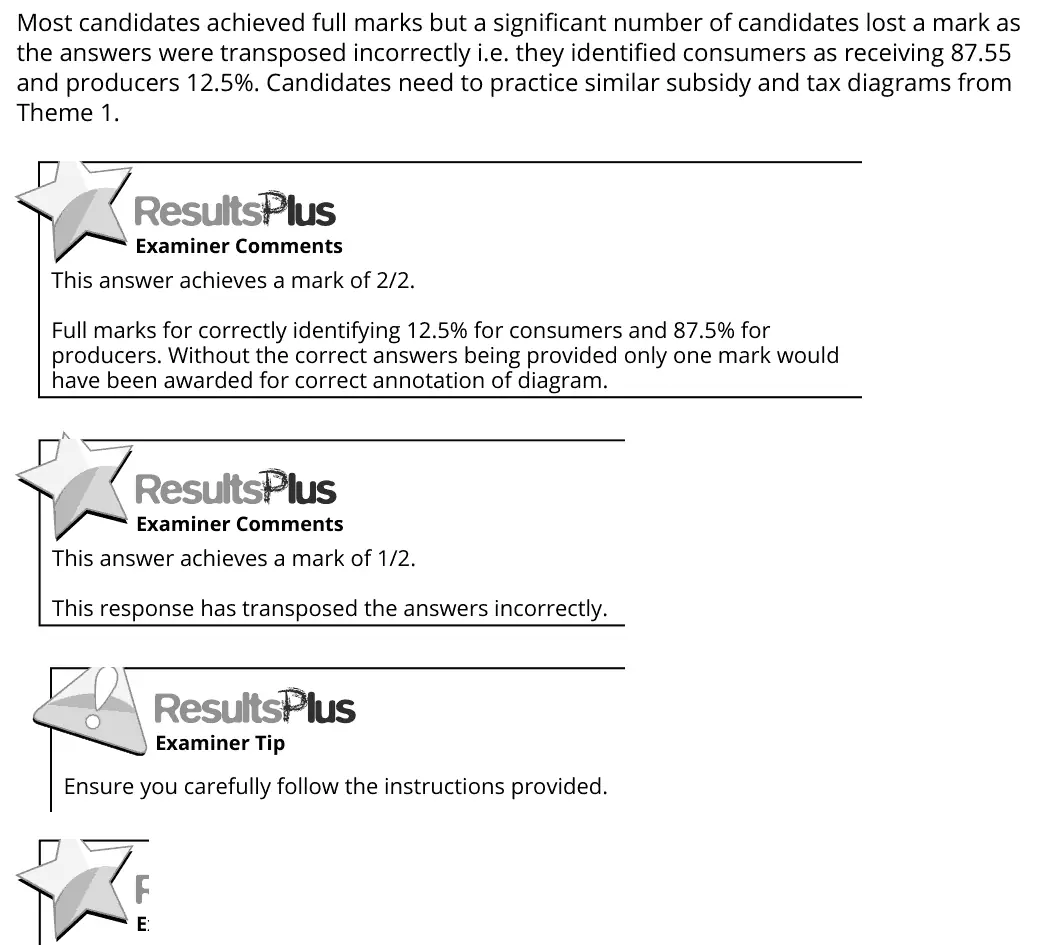
3(b)(i) Indirect taxes and subsidies 1Calculation
3(b)(ii) Indirect taxes and subsidies 1Calculation
3(c) The price mechanism, consumer and producer surplus 1Multiple choice
4(a) Revenues, costs and profits 4AO1=2,AO2=2Diagram
4(b) Monopsony and contestable markets 1Multiple choice
5(a) Revenues, costs and profits 1Multiple choice
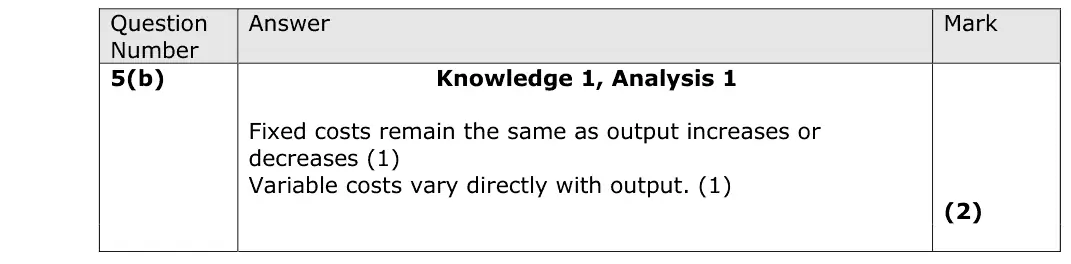
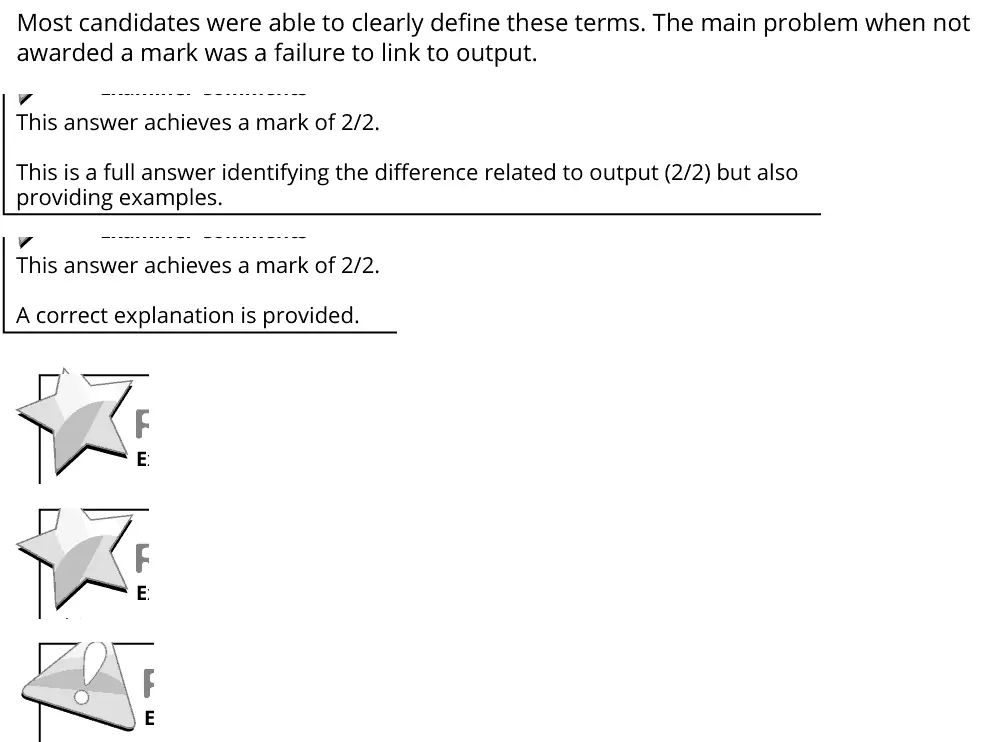
5(b) Revenues, costs and profits 2AO1=1,AO3=1Short answer
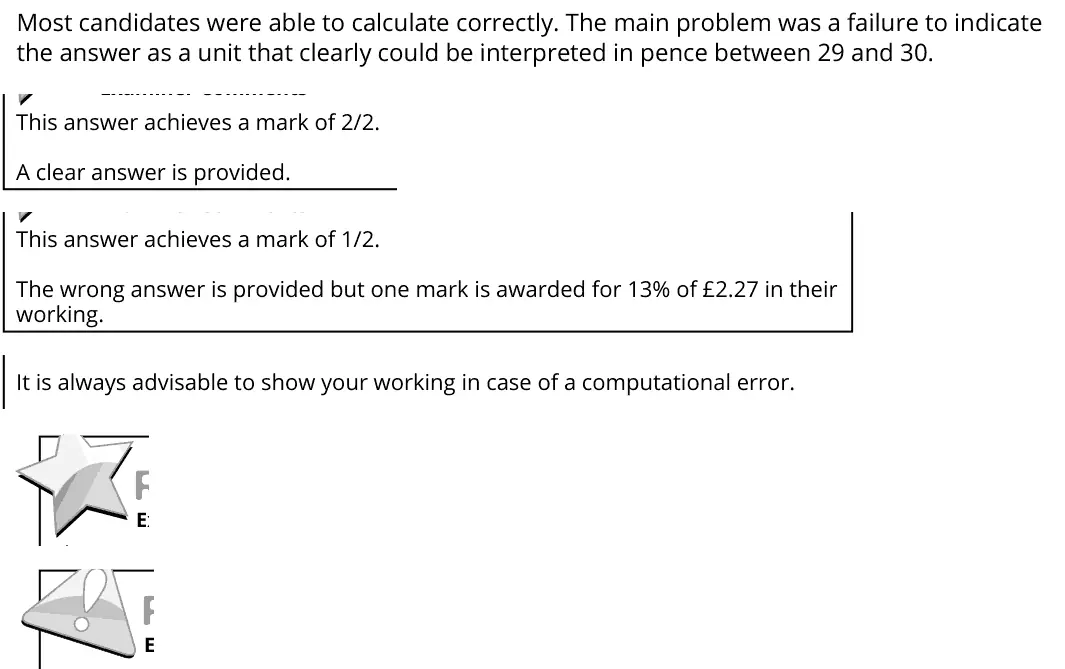
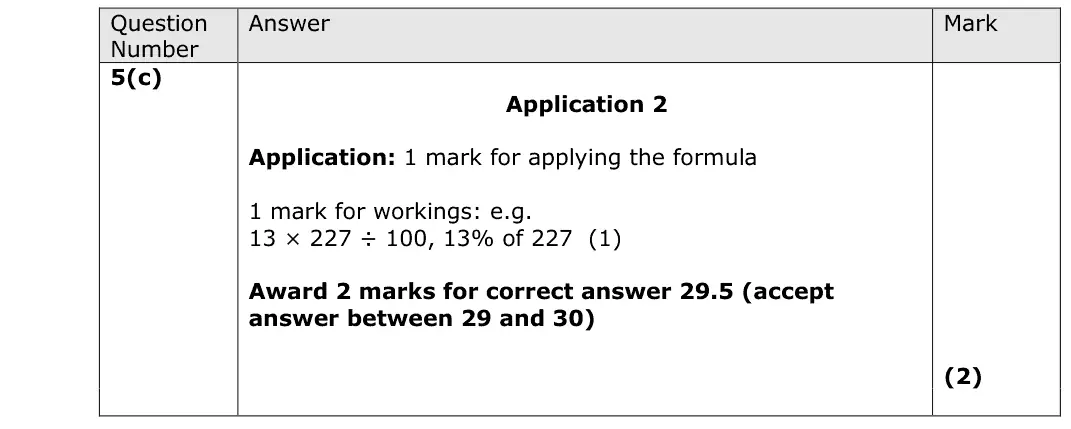
5(c) Revenues, costs and profits 2AO2=2Calculation
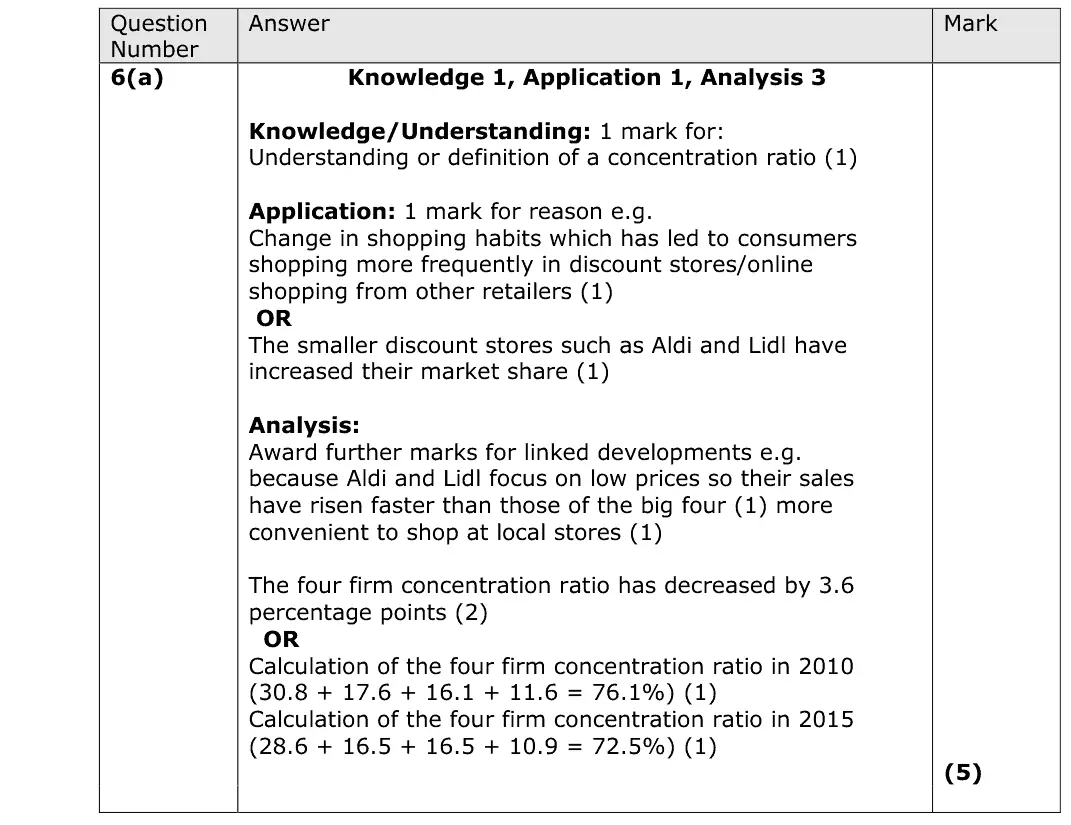
6(a) Oligopoly 5AO1=1,AO2=1,AO3=3Calculation
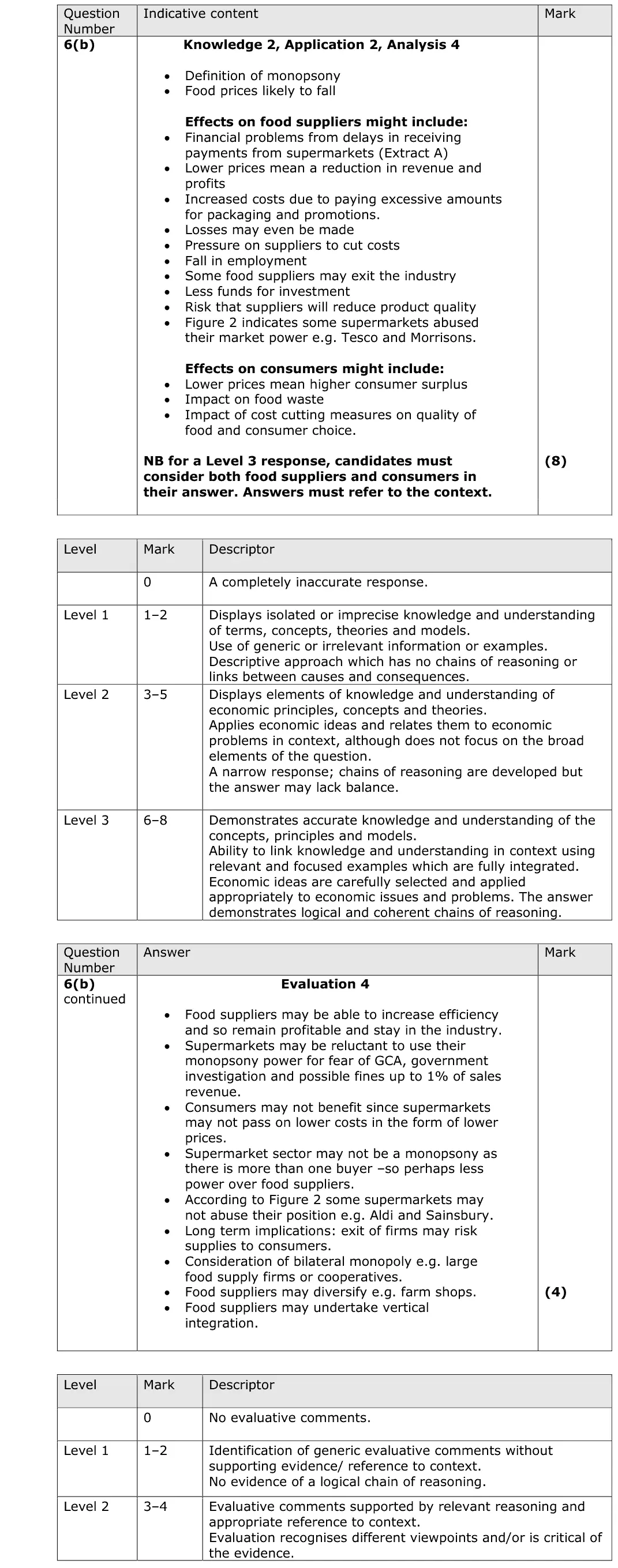
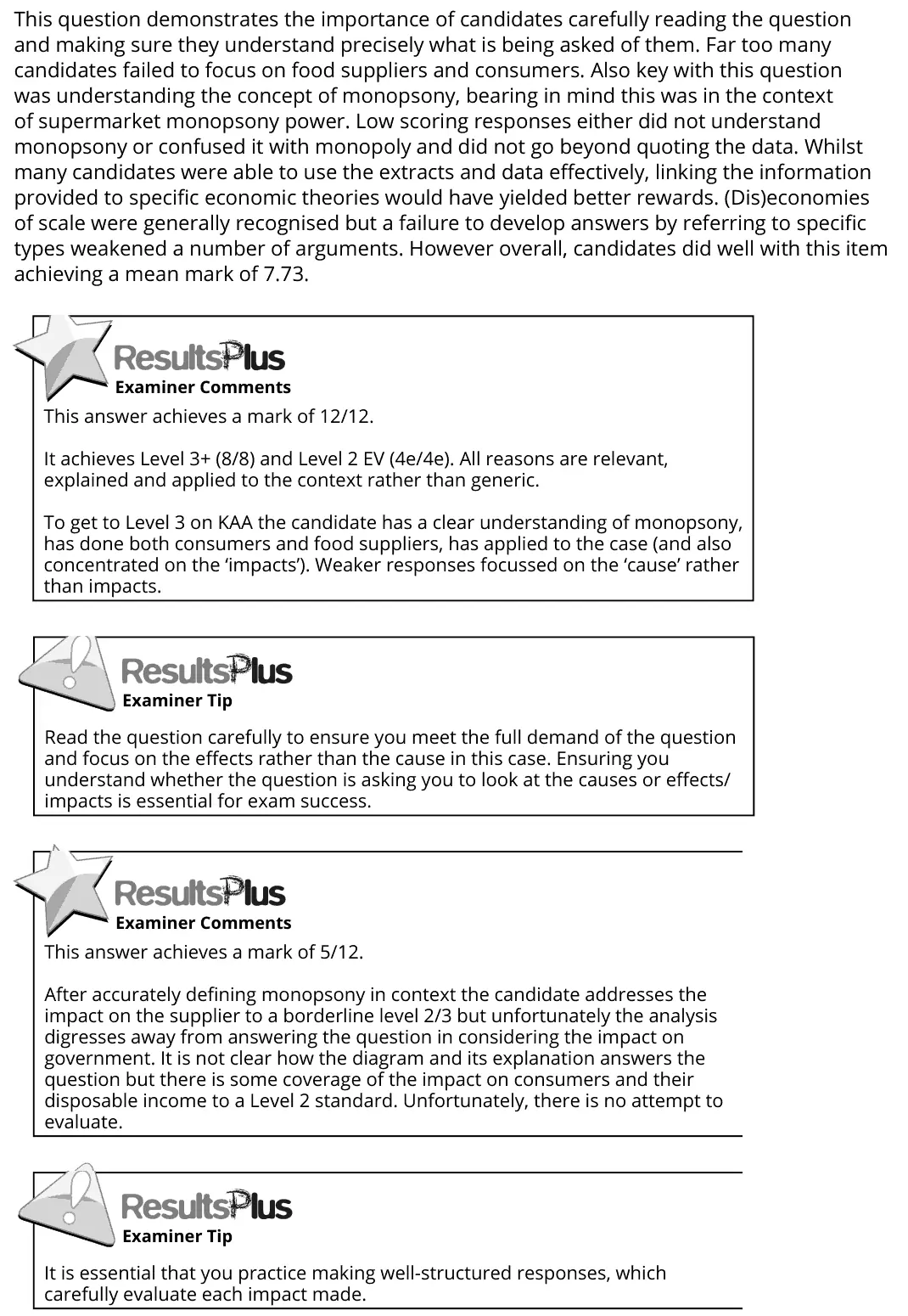
6(b) Monopsony and contestable markets 12AO1=2,AO2=2,AO3=4,AO4=4Extended response
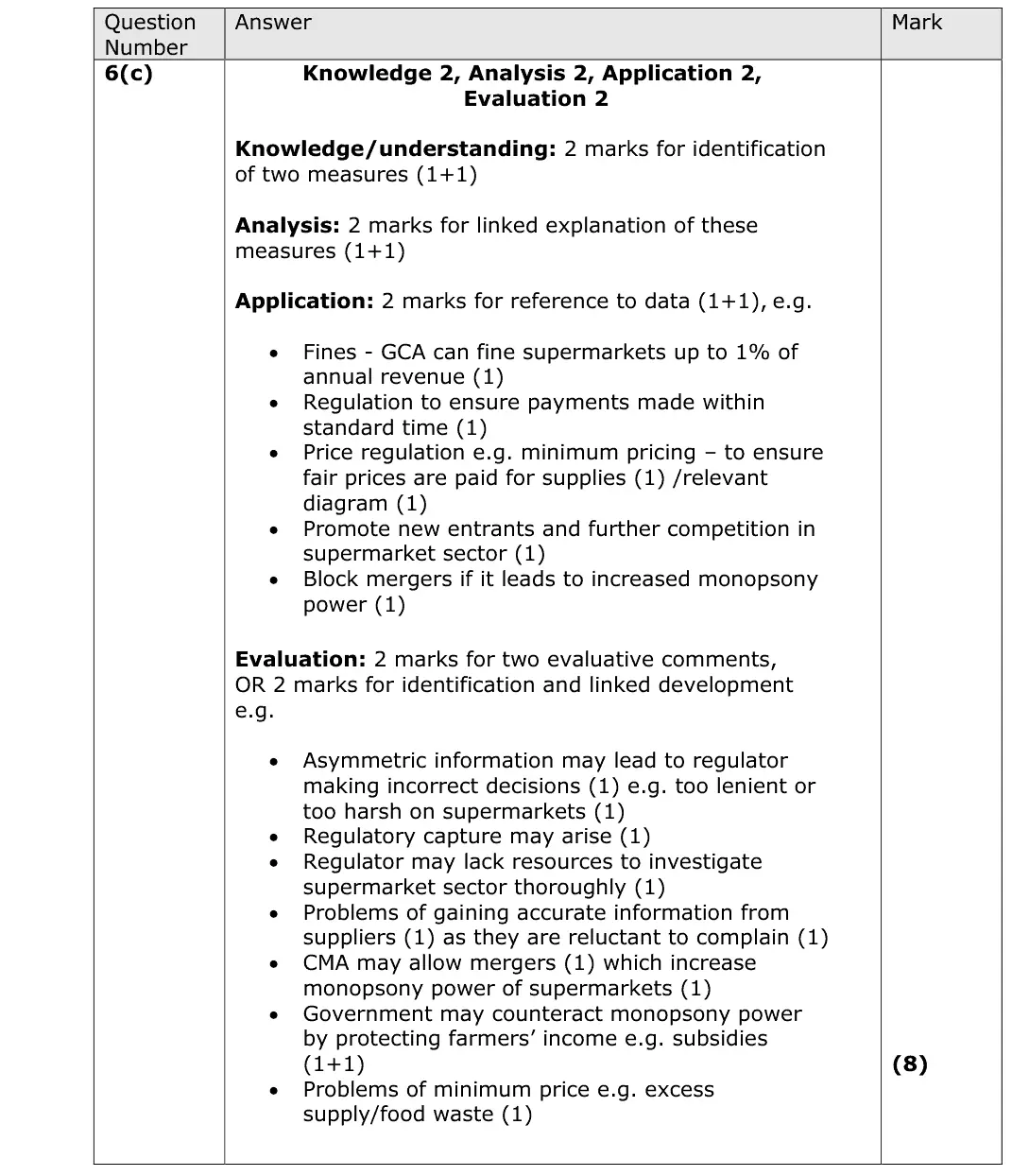
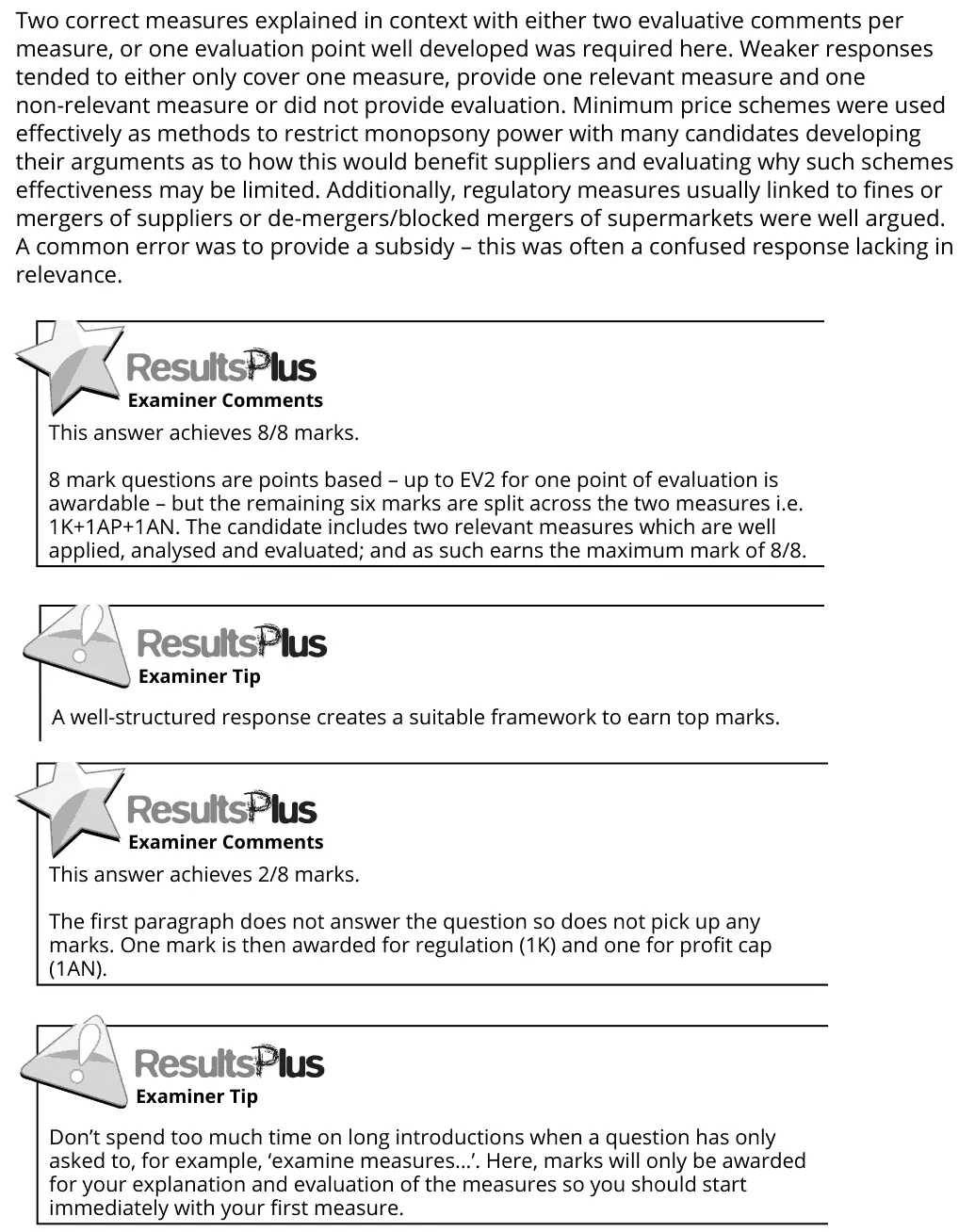
6(c) Government intervention: competition policy and regulation 8AO1=2,AO2=2,AO3=2,AO4=2Extended response
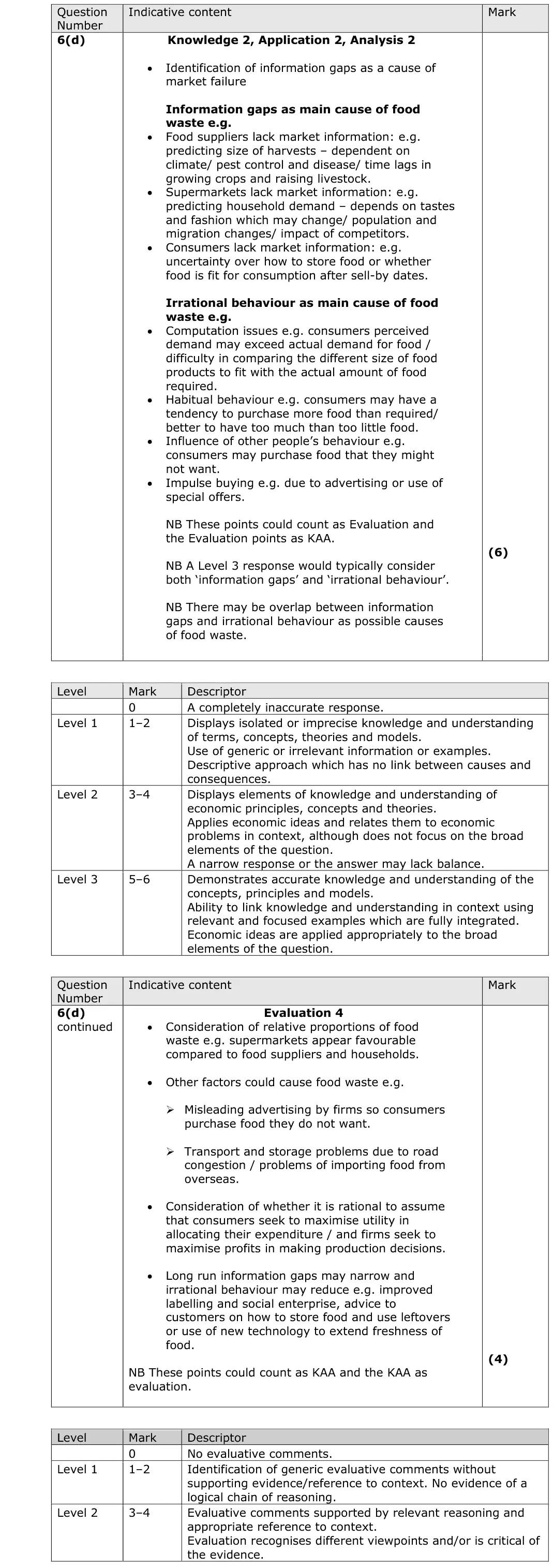
6(d) Public goods and information gaps, Rational decision making and behavioural economics 10AO1=2,AO2=2,AO3=2,AO4=4Extended response
6(e) Business growth and business objectives, Government intervention: competition policy and regulation 15AO1=3,AO2=3,AO3=3,AO4=6Extended response
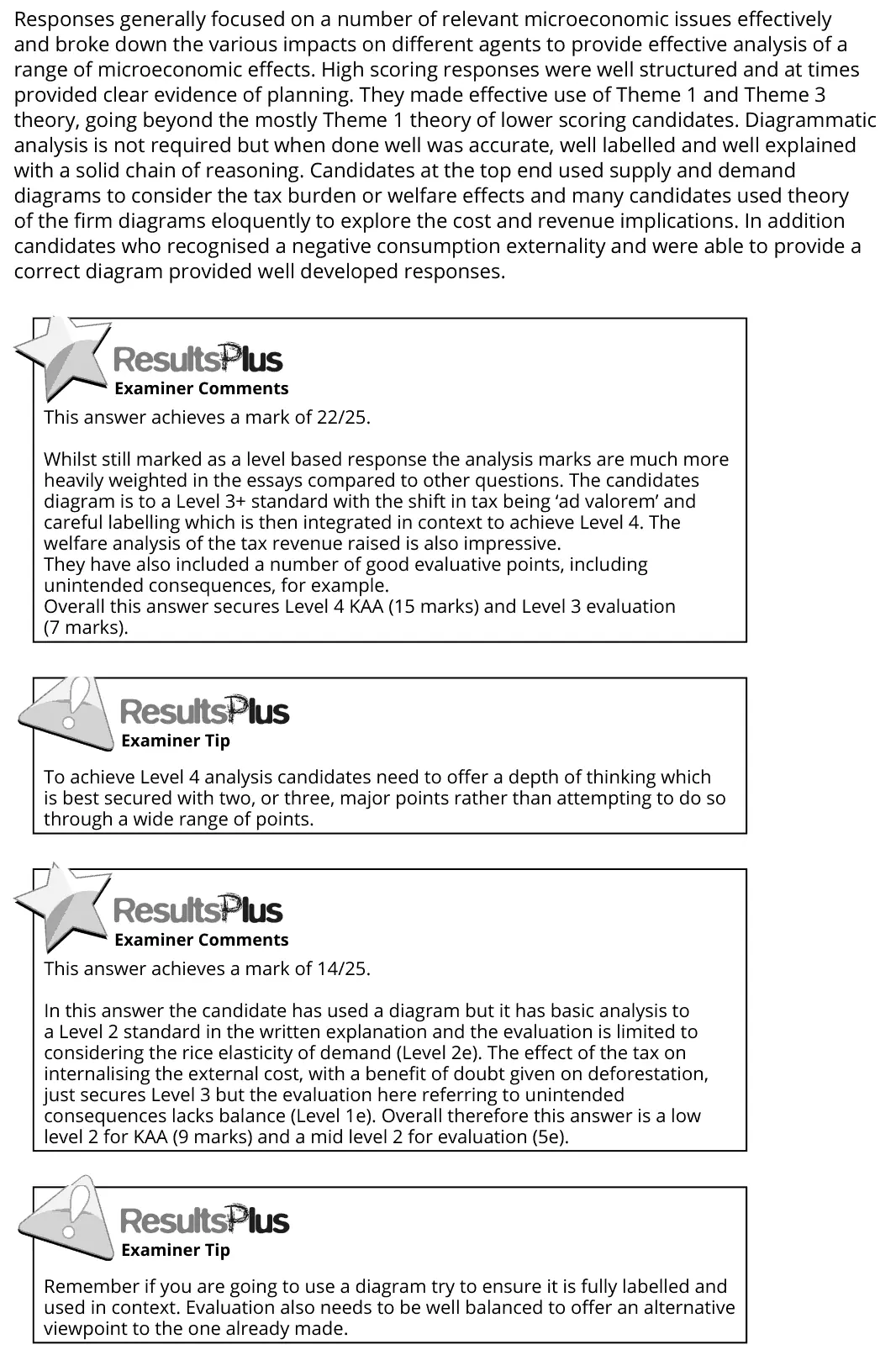
7 Indirect taxes and subsidies, Government intervention in markets 25AO1=4,AO2=4,AO3=8,AO4=9Essay
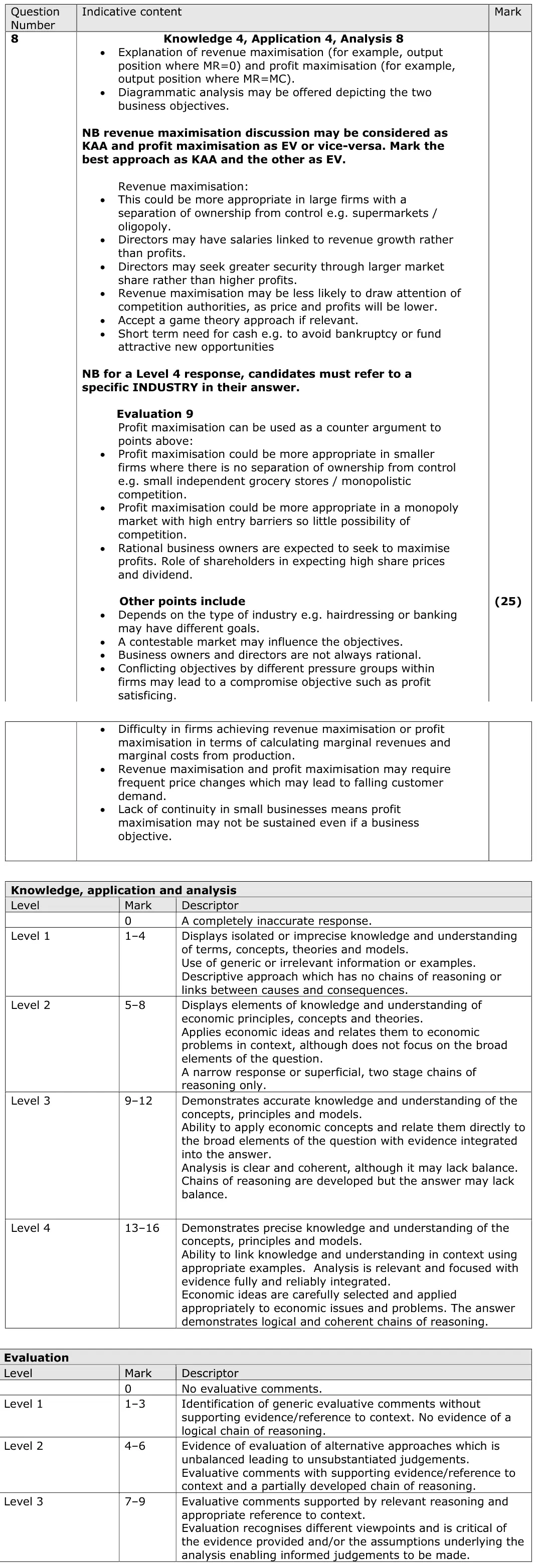
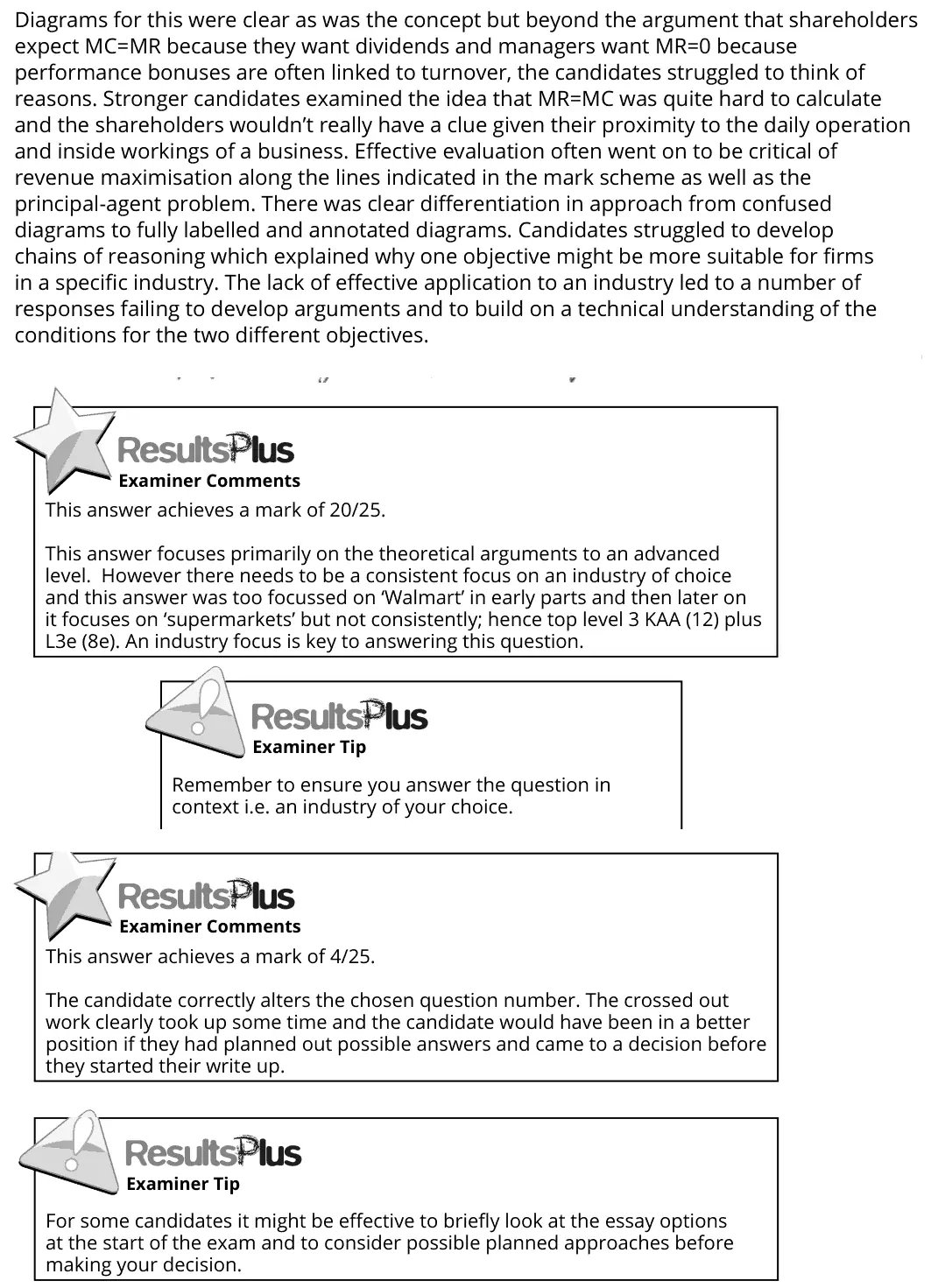
8 Business growth and business objectives 25AO1=4,AO2=4,AO3=8,AO4=9Essay

The questions

1(a)1(b)2(a)2(b)2(c)3(a)3(b)(i)3(b)(ii)3(c)4(a)4(b)5(a)5(b)5(c)6(a)6(b)6(c)6(d)6(e)78
June 2017 · Paper 1 · Q1(a) 4 marks AO1=2, AO2=2 Calculation supply and demand
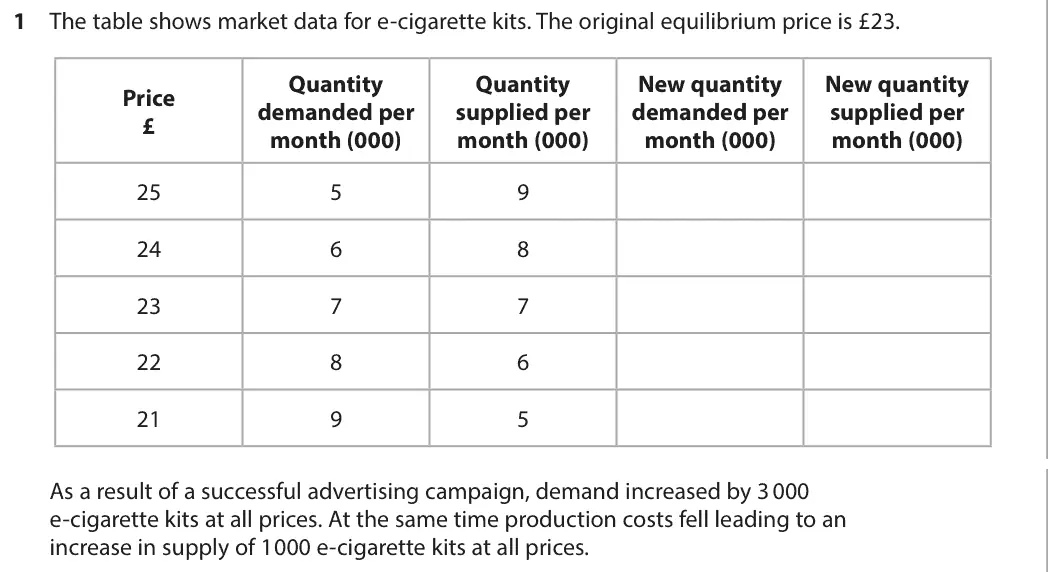
Data and extracts for question 11 The table shows market data for e-cigarette kits. The original equilibrium price is £23. Quantity Quantity New quantity New quantity Price demanded per supplied per demanded per supplied per £ month (000) month (000) month (000) month (000) 25 5 9 24 6 8 23 7 7 22 8 6 21 9 5 As a result of a successful advertising campaign, demand increased by 3 000 e-cigarette kits at all prices. At the same time production costs fell leading to an increase in supply of 1 000 e-cigarette kits at all prices.
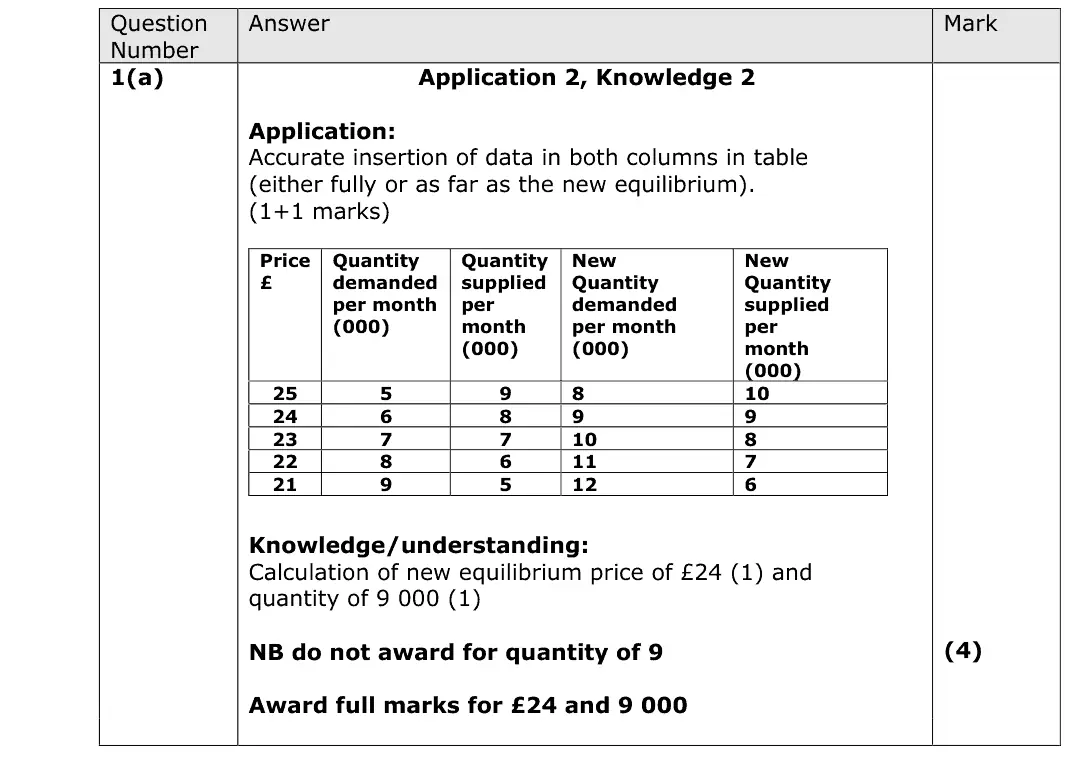
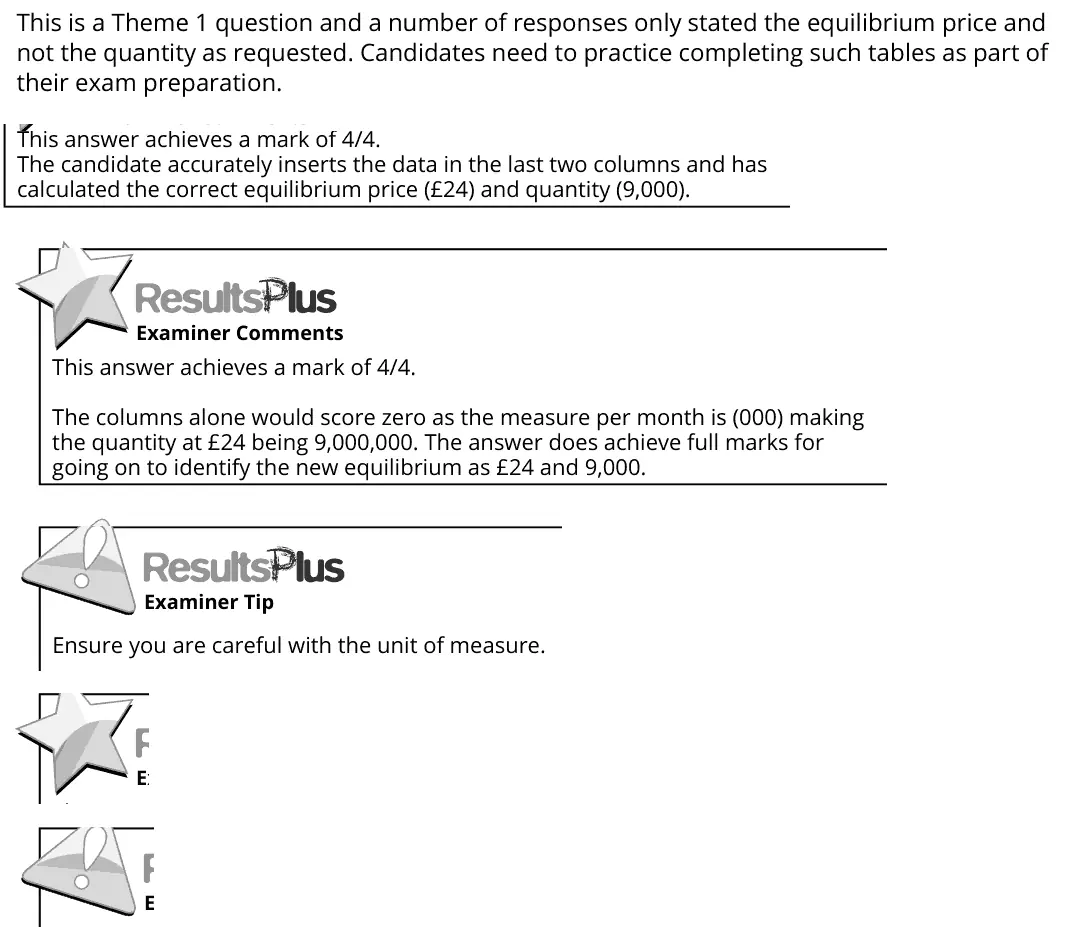
(a) Calculate the new equilibrium price and quantity following the successful advertising campaign and the fall in production costs. Use the last two columns for your working. (4)
June 2017 · Paper 1 · Q1(b) 1 mark Multiple choice price elasticity of demand
Data and extracts for question 11 The table shows market data for e-cigarette kits. The original equilibrium price is £23. Quantity Quantity New quantity New quantity Price demanded per supplied per demanded per supplied per £ month (000) month (000) month (000) month (000) 25 5 9 24 6 8 23 7 7 22 8 6 21 9 5 As a result of a successful advertising campaign, demand increased by 3 000 e-cigarette kits at all prices. At the same time production costs fell leading to an increase in supply of 1 000 e-cigarette kits at all prices.
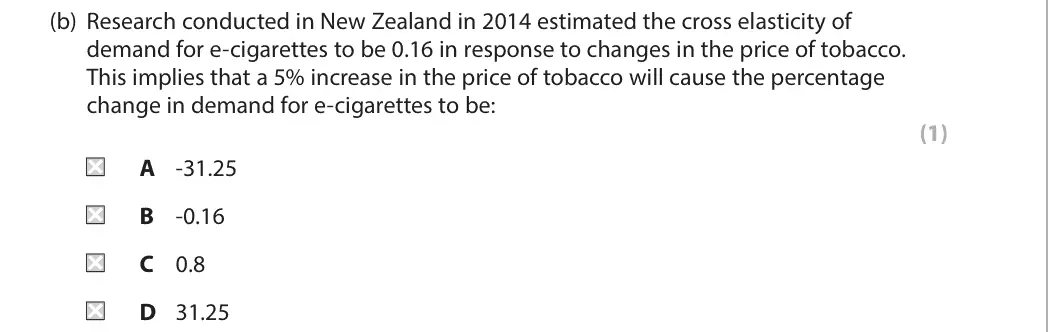
(b) Research conducted in New Zealand in 2014 estimated the cross elasticity of demand for e-cigarettes to be 0.16 in response to changes in the price of tobacco. This implies that a 5% increase in the price of tobacco will cause the percentage change in demand for e-cigarettes to be: (1) A -31.25 B -0.16 C 0.8 D 31.25
June 2017 · Paper 1 · Q2(a) 2 marks AO2=2 Calculation price elasticity of demand
Data and extracts for question 22 Between 2010 and 2015 the average price of tea in the UK increased from £7.20 per kilo to £8.48 per kilo. Over the same period the quantity of tea purchased fell from 97 million kilos to 76 million kilos. (Source: http://www.theguardian.com/lifeandstyle/shortcuts/2015/aug/05/brew-do- you-think-you-are-why-tea-needs-to-copy-coffee-in-order-to-survive)
(a) Assume that the change in the quantity of tea purchased was only caused by the change in the price of tea. Calculate the price elasticity of demand for tea in response to the rise in its price. You are advised to show your working. (2)
June 2017 · Paper 1 · Q2(b) 2 marks AO1=1, AO3=1 Calculation price elasticity of demand
Data and extracts for question 22 Between 2010 and 2015 the average price of tea in the UK increased from £7.20 per kilo to £8.48 per kilo. Over the same period the quantity of tea purchased fell from 97 million kilos to 76 million kilos. (Source: http://www.theguardian.com/lifeandstyle/shortcuts/2015/aug/05/brew-do- you-think-you-are-why-tea-needs-to-copy-coffee-in-order-to-survive)
(b) Calculate the change in total sales revenue for UK tea retailers between 2010 and 2015. You are advised to show your working. (2)
June 2017 · Paper 1 · Q2(c) 1 mark Multiple choice price elasticity of demand
Data and extracts for question 22 Between 2010 and 2015 the average price of tea in the UK increased from £7.20 per kilo to £8.48 per kilo. Over the same period the quantity of tea purchased fell from 97 million kilos to 76 million kilos. (Source: http://www.theguardian.com/lifeandstyle/shortcuts/2015/aug/05/brew-do- you-think-you-are-why-tea-needs-to-copy-coffee-in-order-to-survive)
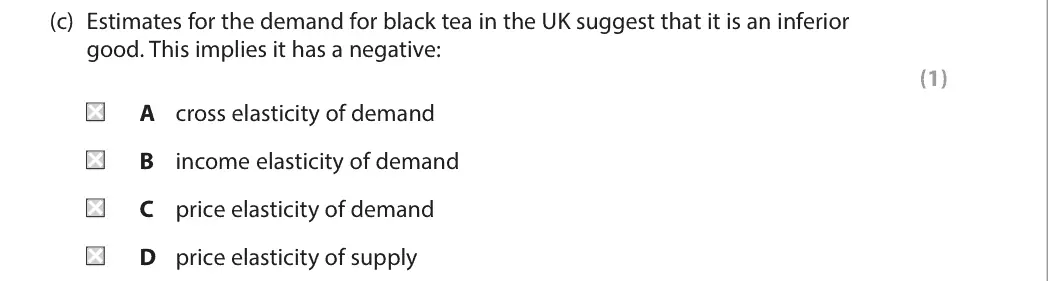
(c) Estimates for the demand for black tea in the UK suggest that it is an inferior good. This implies it has a negative: (1) A cross elasticity of demand B income elasticity of demand C price elasticity of demand D price elasticity of supply
June 2017 · Paper 1 · Q3(a) 2 marks AO2=2 Calculation indirect taxes and subsidies
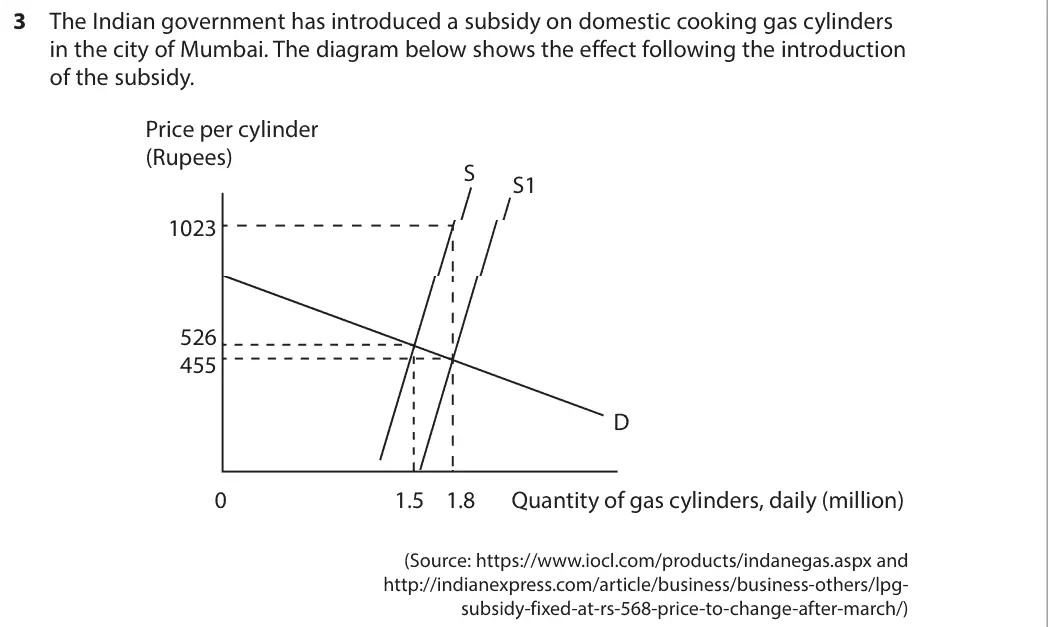
Data and extracts for question 33 The Indian government has introduced a subsidy on domestic cooking gas cylinders in the city of Mumbai. The diagram below shows the effect following the introduction of the subsidy. Price per cylinder (Rupees) S S1 1023 526 455 D 0 1.5 1.8 Quantity of gas cylinders, daily (million) (Source: https://www.iocl.com/products/indanegas.aspx and http://indianexpress.com/article/business/business-others/lpg- subsidy-fixed-at-rs-568-price-to-change-after-march/)

(a) Calculate the total domestic cooking gas subsidy paid daily by the Indian government. You are advised to show your working. (2)
June 2017 · Paper 1 · Q3(b)(i) 1 mark Calculation indirect taxes and subsidies
Data and extracts for question 33 The Indian government has introduced a subsidy on domestic cooking gas cylinders in the city of Mumbai. The diagram below shows the effect following the introduction of the subsidy. Price per cylinder (Rupees) S S1 1023 526 455 D 0 1.5 1.8 Quantity of gas cylinders, daily (million) (Source: https://www.iocl.com/products/indanegas.aspx and http://indianexpress.com/article/business/business-others/lpg- subsidy-fixed-at-rs-568-price-to-change-after-march/)
(b) Calculate the percentage share of the total subsidy received by: (i) consumers (1)
June 2017 · Paper 1 · Q3(b)(ii) 1 mark Calculation indirect taxes and subsidies
Data and extracts for question 33 The Indian government has introduced a subsidy on domestic cooking gas cylinders in the city of Mumbai. The diagram below shows the effect following the introduction of the subsidy. Price per cylinder (Rupees) S S1 1023 526 455 D 0 1.5 1.8 Quantity of gas cylinders, daily (million) (Source: https://www.iocl.com/products/indanegas.aspx and http://indianexpress.com/article/business/business-others/lpg- subsidy-fixed-at-rs-568-price-to-change-after-march/)
(b) Calculate the percentage share of the total subsidy received by: (ii) producers (1)
June 2017 · Paper 1 · Q3(c) 1 mark Multiple choice price mechanism and surplus
Data and extracts for question 33 The Indian government has introduced a subsidy on domestic cooking gas cylinders in the city of Mumbai. The diagram below shows the effect following the introduction of the subsidy. Price per cylinder (Rupees) S S1 1023 526 455 D 0 1.5 1.8 Quantity of gas cylinders, daily (million) (Source: https://www.iocl.com/products/indanegas.aspx and http://indianexpress.com/article/business/business-others/lpg- subsidy-fixed-at-rs-568-price-to-change-after-march/)
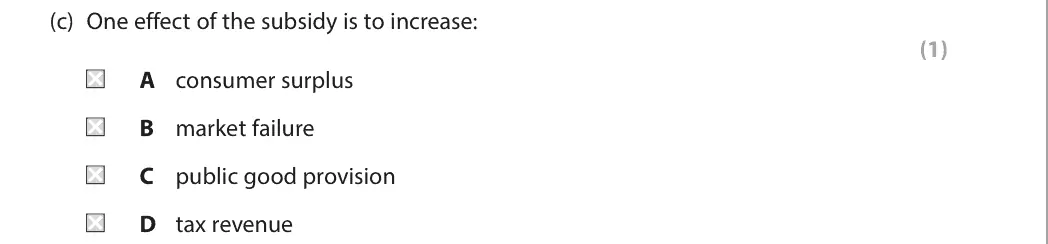
(c) One effect of the subsidy is to increase: (1) A consumer surplus B market failure C public good provision D tax revenue
June 2017 · Paper 1 · Q4(a) 4 marks AO1=2, AO2=2 Diagram revenues costs and profits
Data and extracts for question 44 In 2015 JCB, the construction equipment manufacturer, experienced a 6% fall in revenue. This resulted from a reduction in sales of construction equipment to emerging markets.
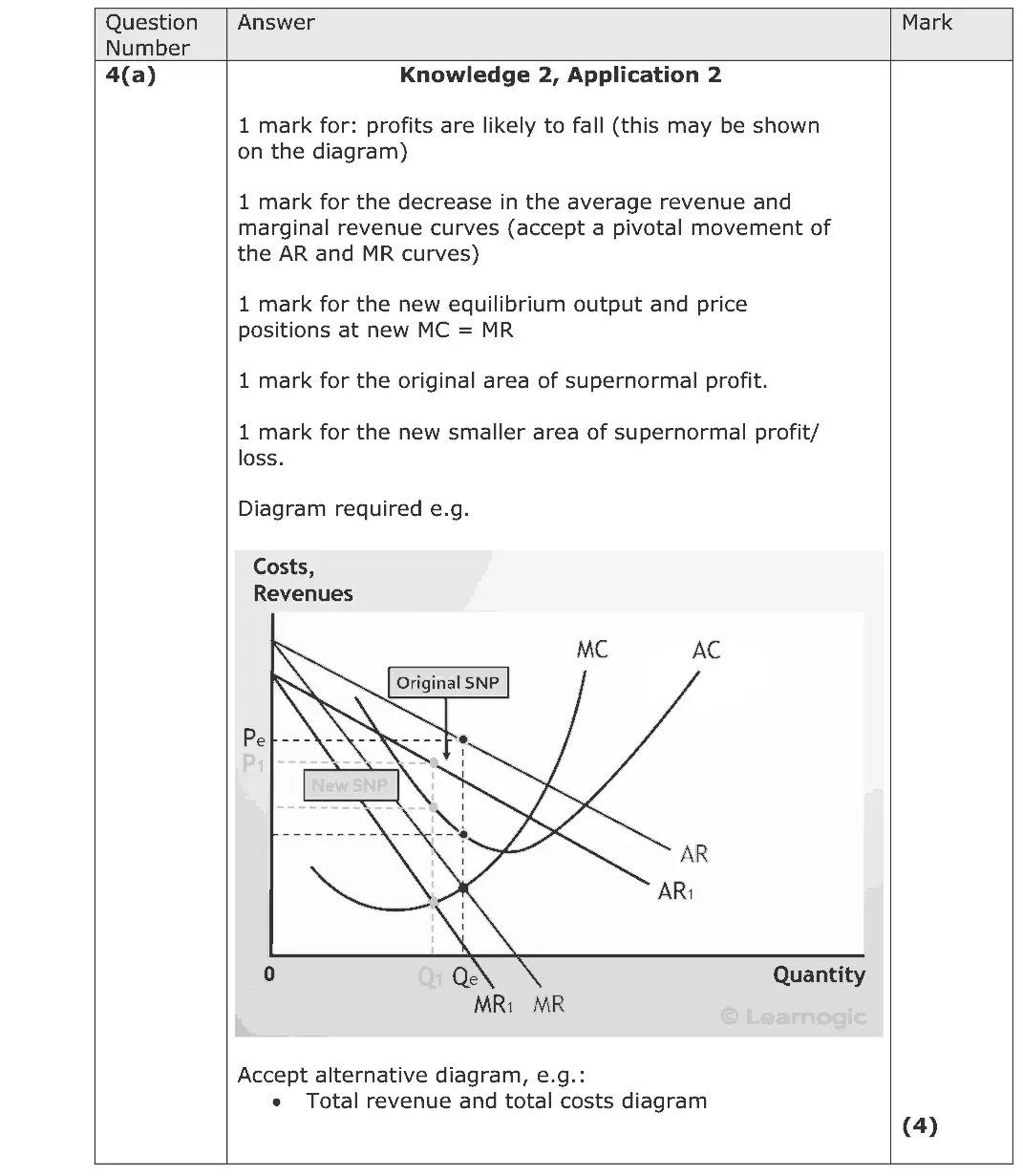
(a) Draw a cost and revenue diagram to show the likely impact of a reduction in sales of construction equipment on JCB’s profits. (4)
June 2017 · Paper 1 · Q4(b) 1 mark Multiple choice monopsony and contestability
Data and extracts for question 44 In 2015 JCB, the construction equipment manufacturer, experienced a 6% fall in revenue. This resulted from a reduction in sales of construction equipment to emerging markets.
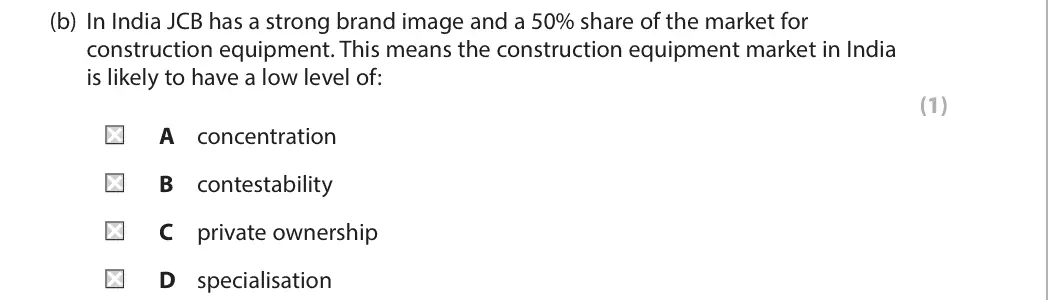
(b) In India JCB has a strong brand image and a 50% share of the market for construction equipment. This means the construction equipment market in India is likely to have a low level of: (1) A concentration B contestability C private ownership D specialisation
June 2017 · Paper 1 · Q5(a) 1 mark Multiple choice revenues costs and profits
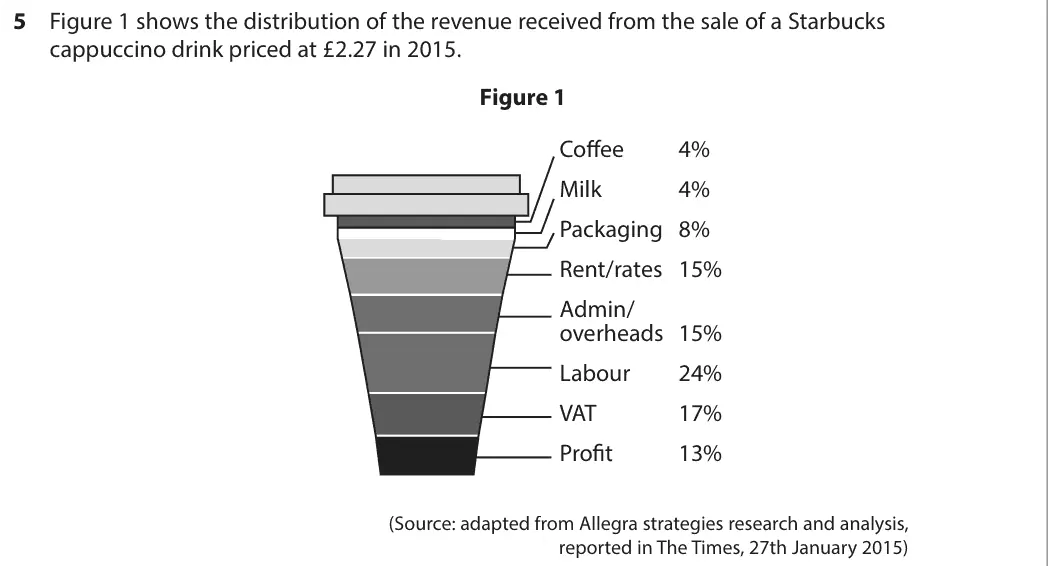
Data and extracts for question 55 Figure 1 shows the distribution of the revenue received from the sale of a Starbucks cappuccino drink priced at £2.27 in 2015. Figure 1 Coffee 4% Milk 4% Packaging 8% Rent/rates 15% Admin/ overheads 15% Labour 24% VAT 17% Profit 13% (Source: adapted from Allegra strategies research and analysis, reported in The Times, 27th January 2015)
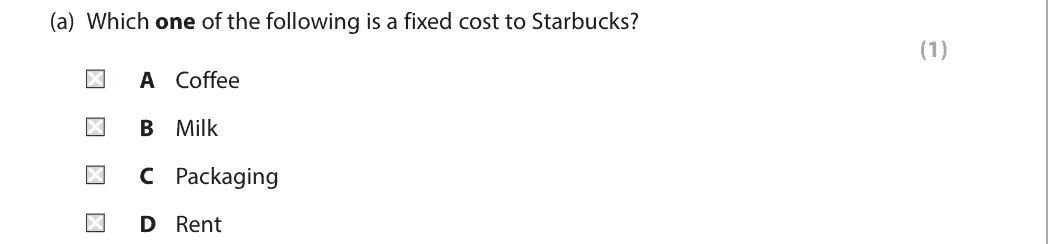
(a) Which one of the following is a fixed cost to Starbucks? (1) A Coffee B Milk C Packaging D Rent
June 2017 · Paper 1 · Q5(b) 2 marks AO1=1, AO3=1 Short answer revenues costs and profits
Data and extracts for question 55 Figure 1 shows the distribution of the revenue received from the sale of a Starbucks cappuccino drink priced at £2.27 in 2015. Figure 1 Coffee 4% Milk 4% Packaging 8% Rent/rates 15% Admin/ overheads 15% Labour 24% VAT 17% Profit 13% (Source: adapted from Allegra strategies research and analysis, reported in The Times, 27th January 2015)
(b) Explain the difference between fixed costs and variable costs. (2)
June 2017 · Paper 1 · Q5(c) 2 marks AO2=2 Calculation revenues costs and profits
Data and extracts for question 55 Figure 1 shows the distribution of the revenue received from the sale of a Starbucks cappuccino drink priced at £2.27 in 2015. Figure 1 Coffee 4% Milk 4% Packaging 8% Rent/rates 15% Admin/ overheads 15% Labour 24% VAT 17% Profit 13% (Source: adapted from Allegra strategies research and analysis, reported in The Times, 27th January 2015)
(c) With reference to Figure 1, calculate the profit (in pence) for a cappuccino drink. You are advised to show your working. (2)
June 2017 · Paper 1 · Q6(a) 5 marks AO1=1, AO2=1, AO3=3 Calculation oligopoly
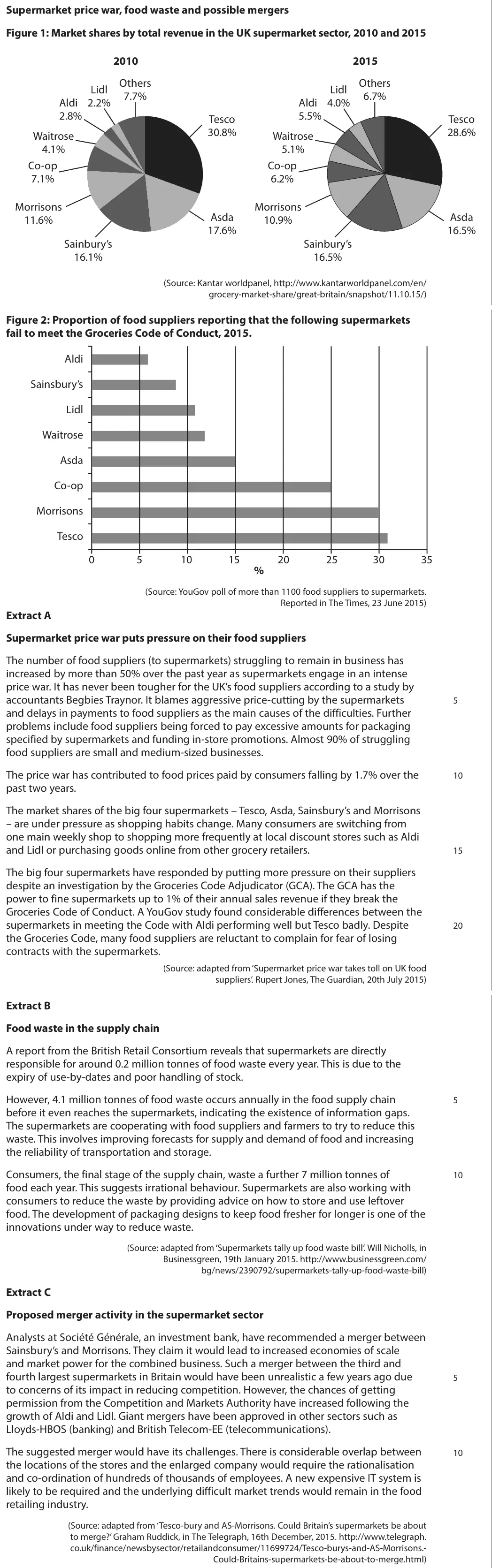
Data and extracts for question 6Supermarket price war, food waste and possible mergers Figure 1: Market shares by total revenue in the UK supermarket sector, 2010 and 2015 2010 2015 Others Others Lidl Lidl 7.7% 6.7% Aldi 2.2% Aldi 4.0% 2.8% 5.5% Tesco Tesco 30.8% 28.6% Waitrose Waitrose 4.1% 5.1% Co-op Co-op 7.1% 6.2% Morrisons Morrisons Asda Asda 11.6% 10.9% 17.6% 16.5% Sainbury’s Sainbury’s 16.1% 16.5% (Source: Kantar worldpanel, http://www.kantarworldpanel.com/en/ grocery-market-share/great-britain/snapshot/11.10.15/) Figure 2: Proportion of food suppliers reporting that the following supermarkets fail to meet the Groceries Code of Conduct, 2015. Aldi Sainsbury’s Lidl Waitrose Asda Co-op Morrisons Tesco 0 5 10 15 20 25 30 35 % (Source: YouGov poll of more than 1100 food suppliers to supermarkets. Reported in The Times, 23 June 2015) Extract A Supermarket price war puts pressure on their food suppliers The number of food suppliers (to supermarkets) struggling to remain in business has increased by more than 50% over the past year as supermarkets engage in an intense price war. It has never been tougher for the UK’s food suppliers according to a study by accountants Begbies Traynor. It blames aggressive price-cutting by the supermarkets 5 and delays in payments to food suppliers as the main causes of the difficulties. Further problems include food suppliers being forced to pay excessive amounts for packaging specified by supermarkets and funding in-store promotions. Almost 90% of struggling food suppliers are small and medium-sized businesses. The price war has contributed to food prices paid by consumers falling by 1.7% over the 10 past two years. The market shares of the big four supermarkets – Tesco, Asda, Sainsbury’s and Morrisons – are under pressure as shopping habits change. Many consumers are switching from one main weekly shop to shopping more frequently at local discount stores such as Aldi and Lidl or purchasing goods online from other grocery retailers. 15 The big four supermarkets have responded by putting more pressure on their suppliers despite an investigation by the Groceries Code Adjudicator (GCA). The GCA has the power to fine supermarkets up to 1% of their annual sales revenue if they break the Groceries Code of Conduct. A YouGov study found considerable differences between the supermarkets in meeting the Code with Aldi performing well but Tesco badly. Despite 20 the Groceries Code, many food suppliers are reluctant to complain for fear of losing contracts with the supermarkets. (Source: adapted from ‘Supermarket price war takes toll on UK food suppliers’. Rupert Jones, The Guardian, 20th July 2015) Extract B Food waste in the supply chain A report from the British Retail Consortium reveals that supermarkets are directly responsible for around 0.2 million tonnes of food waste every year. This is due to the expiry of use-by-dates and poor handling of stock. However, 4.1 million tonnes of food waste occurs annually in the food supply chain 5 before it even reaches the supermarkets, indicating the existence of information gaps. The supermarkets are cooperating with food suppliers and farmers to try to reduce this waste. This involves improving forecasts for supply and demand of food and increasing the reliability of transportation and storage. Consumers, the final stage of the supply chain, waste a further 7 million tonnes of 10 food each year. This suggests irrational behaviour. Supermarkets are also working with consumers to reduce the waste by providing advice on how to store and use leftover food. The development of packaging designs to keep food fresher for longer is one of the innovations under way to reduce waste. (Source: adapted from ‘Supermarkets tally up food waste bill’. Will Nicholls, in Businessgreen, 19th January 2015. http://www.businessgreen.com/ bg/news/2390792/supermarkets-tally-up-food-waste-bill) Extract C Proposed merger activity in the supermarket sector Analysts at Société Générale, an investment bank, have recommended a merger between Sainsbury’s and Morrisons. They claim it would lead to increased economies of scale and market power for the combined business. Such a merger between the third and fourth largest supermarkets in Britain would have been unrealistic a few years ago due 5 to concerns of its impact in reducing competition. However, the chances of getting permission from the Competition and Markets Authority have increased following the growth of Aldi and Lidl. Giant mergers have been approved in other sectors such as Lloyds-HBOS (banking) and British Telecom-EE (telecommunications). The suggested merger would have its challenges. There is considerable overlap between 10 the locations of the stores and the enlarged company would require the rationalisation and co-ordination of hundreds of thousands of employees. A new expensive IT system is likely to be required and the underlying difficult market trends would remain in the food retailing industry. (Source: adapted from ‘Tesco-bury and AS-Morrisons. Could Britain’s supermarkets be about to merge?’ Graham Ruddick, in The Telegraph, 16th December, 2015. http://www.telegraph. co.uk/finance/newsbysector/retailandconsumer/11699724/Tesco-burys-and-AS-Morrisons.- Could-Britains-supermarkets-be-about-to-merge.html)
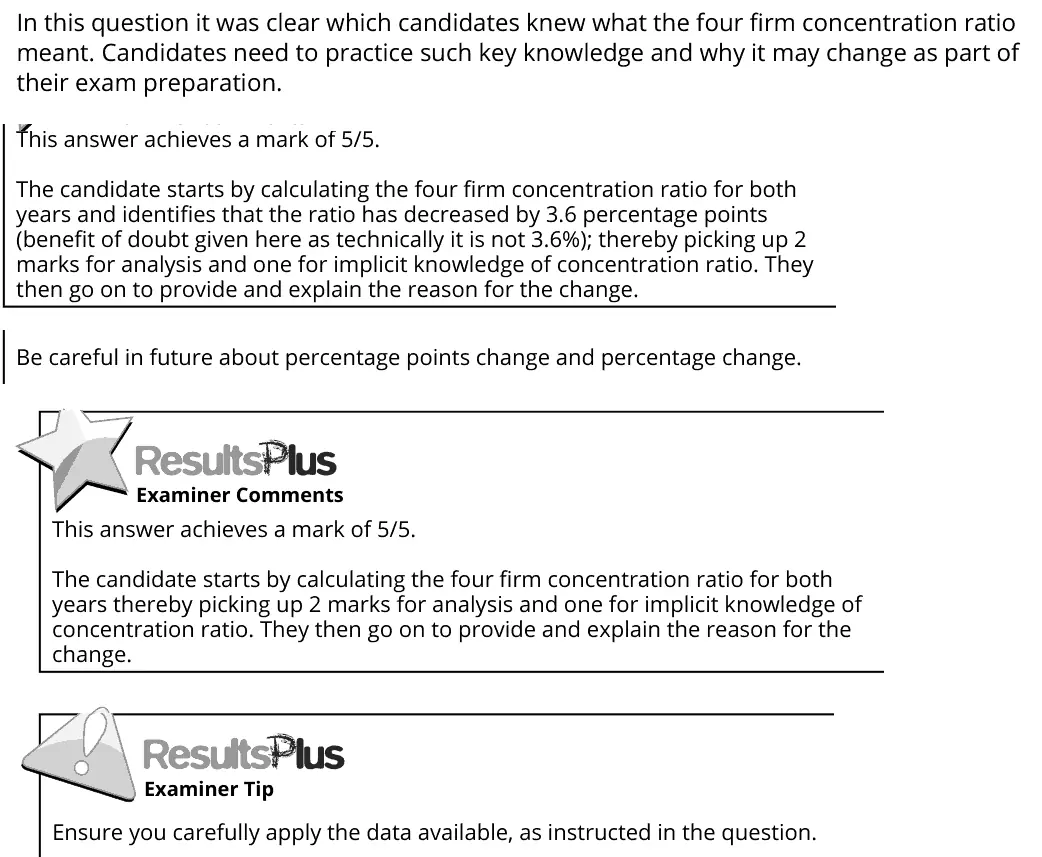
(a) With reference to Figure 1 and Extract A, explain one likely reason for the change in the four-firm concentration ratio of the supermarket sector between 2010 and 2015. (5)
June 2017 · Paper 1 · Q6(b) 12 marks AO1=2, AO2=2, AO3=4, AO4=4 12-mark response monopsony and contestability
Data and extracts for question 6Supermarket price war, food waste and possible mergers Figure 1: Market shares by total revenue in the UK supermarket sector, 2010 and 2015 2010 2015 Others Others Lidl Lidl 7.7% 6.7% Aldi 2.2% Aldi 4.0% 2.8% 5.5% Tesco Tesco 30.8% 28.6% Waitrose Waitrose 4.1% 5.1% Co-op Co-op 7.1% 6.2% Morrisons Morrisons Asda Asda 11.6% 10.9% 17.6% 16.5% Sainbury’s Sainbury’s 16.1% 16.5% (Source: Kantar worldpanel, http://www.kantarworldpanel.com/en/ grocery-market-share/great-britain/snapshot/11.10.15/) Figure 2: Proportion of food suppliers reporting that the following supermarkets fail to meet the Groceries Code of Conduct, 2015. Aldi Sainsbury’s Lidl Waitrose Asda Co-op Morrisons Tesco 0 5 10 15 20 25 30 35 % (Source: YouGov poll of more than 1100 food suppliers to supermarkets. Reported in The Times, 23 June 2015) Extract A Supermarket price war puts pressure on their food suppliers The number of food suppliers (to supermarkets) struggling to remain in business has increased by more than 50% over the past year as supermarkets engage in an intense price war. It has never been tougher for the UK’s food suppliers according to a study by accountants Begbies Traynor. It blames aggressive price-cutting by the supermarkets 5 and delays in payments to food suppliers as the main causes of the difficulties. Further problems include food suppliers being forced to pay excessive amounts for packaging specified by supermarkets and funding in-store promotions. Almost 90% of struggling food suppliers are small and medium-sized businesses. The price war has contributed to food prices paid by consumers falling by 1.7% over the 10 past two years. The market shares of the big four supermarkets – Tesco, Asda, Sainsbury’s and Morrisons – are under pressure as shopping habits change. Many consumers are switching from one main weekly shop to shopping more frequently at local discount stores such as Aldi and Lidl or purchasing goods online from other grocery retailers. 15 The big four supermarkets have responded by putting more pressure on their suppliers despite an investigation by the Groceries Code Adjudicator (GCA). The GCA has the power to fine supermarkets up to 1% of their annual sales revenue if they break the Groceries Code of Conduct. A YouGov study found considerable differences between the supermarkets in meeting the Code with Aldi performing well but Tesco badly. Despite 20 the Groceries Code, many food suppliers are reluctant to complain for fear of losing contracts with the supermarkets. (Source: adapted from ‘Supermarket price war takes toll on UK food suppliers’. Rupert Jones, The Guardian, 20th July 2015) Extract B Food waste in the supply chain A report from the British Retail Consortium reveals that supermarkets are directly responsible for around 0.2 million tonnes of food waste every year. This is due to the expiry of use-by-dates and poor handling of stock. However, 4.1 million tonnes of food waste occurs annually in the food supply chain 5 before it even reaches the supermarkets, indicating the existence of information gaps. The supermarkets are cooperating with food suppliers and farmers to try to reduce this waste. This involves improving forecasts for supply and demand of food and increasing the reliability of transportation and storage. Consumers, the final stage of the supply chain, waste a further 7 million tonnes of 10 food each year. This suggests irrational behaviour. Supermarkets are also working with consumers to reduce the waste by providing advice on how to store and use leftover food. The development of packaging designs to keep food fresher for longer is one of the innovations under way to reduce waste. (Source: adapted from ‘Supermarkets tally up food waste bill’. Will Nicholls, in Businessgreen, 19th January 2015. http://www.businessgreen.com/ bg/news/2390792/supermarkets-tally-up-food-waste-bill) Extract C Proposed merger activity in the supermarket sector Analysts at Société Générale, an investment bank, have recommended a merger between Sainsbury’s and Morrisons. They claim it would lead to increased economies of scale and market power for the combined business. Such a merger between the third and fourth largest supermarkets in Britain would have been unrealistic a few years ago due 5 to concerns of its impact in reducing competition. However, the chances of getting permission from the Competition and Markets Authority have increased following the growth of Aldi and Lidl. Giant mergers have been approved in other sectors such as Lloyds-HBOS (banking) and British Telecom-EE (telecommunications). The suggested merger would have its challenges. There is considerable overlap between 10 the locations of the stores and the enlarged company would require the rationalisation and co-ordination of hundreds of thousands of employees. A new expensive IT system is likely to be required and the underlying difficult market trends would remain in the food retailing industry. (Source: adapted from ‘Tesco-bury and AS-Morrisons. Could Britain’s supermarkets be about to merge?’ Graham Ruddick, in The Telegraph, 16th December, 2015. http://www.telegraph. co.uk/finance/newsbysector/retailandconsumer/11699724/Tesco-burys-and-AS-Morrisons.- Could-Britains-supermarkets-be-about-to-merge.html)
(b) With reference to Figure 2 and Extract A, discuss the possible impact of supermarket monopsony power on both food suppliers and consumers. (12)
June 2017 · Paper 1 · Q6(c) 8 marks AO1=2, AO2=2, AO3=2, AO4=2 8-mark response competition policy and regulation
Data and extracts for question 6Supermarket price war, food waste and possible mergers Figure 1: Market shares by total revenue in the UK supermarket sector, 2010 and 2015 2010 2015 Others Others Lidl Lidl 7.7% 6.7% Aldi 2.2% Aldi 4.0% 2.8% 5.5% Tesco Tesco 30.8% 28.6% Waitrose Waitrose 4.1% 5.1% Co-op Co-op 7.1% 6.2% Morrisons Morrisons Asda Asda 11.6% 10.9% 17.6% 16.5% Sainbury’s Sainbury’s 16.1% 16.5% (Source: Kantar worldpanel, http://www.kantarworldpanel.com/en/ grocery-market-share/great-britain/snapshot/11.10.15/) Figure 2: Proportion of food suppliers reporting that the following supermarkets fail to meet the Groceries Code of Conduct, 2015. Aldi Sainsbury’s Lidl Waitrose Asda Co-op Morrisons Tesco 0 5 10 15 20 25 30 35 % (Source: YouGov poll of more than 1100 food suppliers to supermarkets. Reported in The Times, 23 June 2015) Extract A Supermarket price war puts pressure on their food suppliers The number of food suppliers (to supermarkets) struggling to remain in business has increased by more than 50% over the past year as supermarkets engage in an intense price war. It has never been tougher for the UK’s food suppliers according to a study by accountants Begbies Traynor. It blames aggressive price-cutting by the supermarkets 5 and delays in payments to food suppliers as the main causes of the difficulties. Further problems include food suppliers being forced to pay excessive amounts for packaging specified by supermarkets and funding in-store promotions. Almost 90% of struggling food suppliers are small and medium-sized businesses. The price war has contributed to food prices paid by consumers falling by 1.7% over the 10 past two years. The market shares of the big four supermarkets – Tesco, Asda, Sainsbury’s and Morrisons – are under pressure as shopping habits change. Many consumers are switching from one main weekly shop to shopping more frequently at local discount stores such as Aldi and Lidl or purchasing goods online from other grocery retailers. 15 The big four supermarkets have responded by putting more pressure on their suppliers despite an investigation by the Groceries Code Adjudicator (GCA). The GCA has the power to fine supermarkets up to 1% of their annual sales revenue if they break the Groceries Code of Conduct. A YouGov study found considerable differences between the supermarkets in meeting the Code with Aldi performing well but Tesco badly. Despite 20 the Groceries Code, many food suppliers are reluctant to complain for fear of losing contracts with the supermarkets. (Source: adapted from ‘Supermarket price war takes toll on UK food suppliers’. Rupert Jones, The Guardian, 20th July 2015) Extract B Food waste in the supply chain A report from the British Retail Consortium reveals that supermarkets are directly responsible for around 0.2 million tonnes of food waste every year. This is due to the expiry of use-by-dates and poor handling of stock. However, 4.1 million tonnes of food waste occurs annually in the food supply chain 5 before it even reaches the supermarkets, indicating the existence of information gaps. The supermarkets are cooperating with food suppliers and farmers to try to reduce this waste. This involves improving forecasts for supply and demand of food and increasing the reliability of transportation and storage. Consumers, the final stage of the supply chain, waste a further 7 million tonnes of 10 food each year. This suggests irrational behaviour. Supermarkets are also working with consumers to reduce the waste by providing advice on how to store and use leftover food. The development of packaging designs to keep food fresher for longer is one of the innovations under way to reduce waste. (Source: adapted from ‘Supermarkets tally up food waste bill’. Will Nicholls, in Businessgreen, 19th January 2015. http://www.businessgreen.com/ bg/news/2390792/supermarkets-tally-up-food-waste-bill) Extract C Proposed merger activity in the supermarket sector Analysts at Société Générale, an investment bank, have recommended a merger between Sainsbury’s and Morrisons. They claim it would lead to increased economies of scale and market power for the combined business. Such a merger between the third and fourth largest supermarkets in Britain would have been unrealistic a few years ago due 5 to concerns of its impact in reducing competition. However, the chances of getting permission from the Competition and Markets Authority have increased following the growth of Aldi and Lidl. Giant mergers have been approved in other sectors such as Lloyds-HBOS (banking) and British Telecom-EE (telecommunications). The suggested merger would have its challenges. There is considerable overlap between 10 the locations of the stores and the enlarged company would require the rationalisation and co-ordination of hundreds of thousands of employees. A new expensive IT system is likely to be required and the underlying difficult market trends would remain in the food retailing industry. (Source: adapted from ‘Tesco-bury and AS-Morrisons. Could Britain’s supermarkets be about to merge?’ Graham Ruddick, in The Telegraph, 16th December, 2015. http://www.telegraph. co.uk/finance/newsbysector/retailandconsumer/11699724/Tesco-burys-and-AS-Morrisons.- Could-Britains-supermarkets-be-about-to-merge.html)
(c) Examine measures the government might use to restrict the monopsony power of supermarkets. (8)
June 2017 · Paper 1 · Q6(d) 10 marks AO1=2, AO2=2, AO3=2, AO4=4 10-mark response Hard public goods and information gapsrational decision making and behavioural economics
Data and extracts for question 6Supermarket price war, food waste and possible mergers Figure 1: Market shares by total revenue in the UK supermarket sector, 2010 and 2015 2010 2015 Others Others Lidl Lidl 7.7% 6.7% Aldi 2.2% Aldi 4.0% 2.8% 5.5% Tesco Tesco 30.8% 28.6% Waitrose Waitrose 4.1% 5.1% Co-op Co-op 7.1% 6.2% Morrisons Morrisons Asda Asda 11.6% 10.9% 17.6% 16.5% Sainbury’s Sainbury’s 16.1% 16.5% (Source: Kantar worldpanel, http://www.kantarworldpanel.com/en/ grocery-market-share/great-britain/snapshot/11.10.15/) Figure 2: Proportion of food suppliers reporting that the following supermarkets fail to meet the Groceries Code of Conduct, 2015. Aldi Sainsbury’s Lidl Waitrose Asda Co-op Morrisons Tesco 0 5 10 15 20 25 30 35 % (Source: YouGov poll of more than 1100 food suppliers to supermarkets. Reported in The Times, 23 June 2015) Extract A Supermarket price war puts pressure on their food suppliers The number of food suppliers (to supermarkets) struggling to remain in business has increased by more than 50% over the past year as supermarkets engage in an intense price war. It has never been tougher for the UK’s food suppliers according to a study by accountants Begbies Traynor. It blames aggressive price-cutting by the supermarkets 5 and delays in payments to food suppliers as the main causes of the difficulties. Further problems include food suppliers being forced to pay excessive amounts for packaging specified by supermarkets and funding in-store promotions. Almost 90% of struggling food suppliers are small and medium-sized businesses. The price war has contributed to food prices paid by consumers falling by 1.7% over the 10 past two years. The market shares of the big four supermarkets – Tesco, Asda, Sainsbury’s and Morrisons – are under pressure as shopping habits change. Many consumers are switching from one main weekly shop to shopping more frequently at local discount stores such as Aldi and Lidl or purchasing goods online from other grocery retailers. 15 The big four supermarkets have responded by putting more pressure on their suppliers despite an investigation by the Groceries Code Adjudicator (GCA). The GCA has the power to fine supermarkets up to 1% of their annual sales revenue if they break the Groceries Code of Conduct. A YouGov study found considerable differences between the supermarkets in meeting the Code with Aldi performing well but Tesco badly. Despite 20 the Groceries Code, many food suppliers are reluctant to complain for fear of losing contracts with the supermarkets. (Source: adapted from ‘Supermarket price war takes toll on UK food suppliers’. Rupert Jones, The Guardian, 20th July 2015) Extract B Food waste in the supply chain A report from the British Retail Consortium reveals that supermarkets are directly responsible for around 0.2 million tonnes of food waste every year. This is due to the expiry of use-by-dates and poor handling of stock. However, 4.1 million tonnes of food waste occurs annually in the food supply chain 5 before it even reaches the supermarkets, indicating the existence of information gaps. The supermarkets are cooperating with food suppliers and farmers to try to reduce this waste. This involves improving forecasts for supply and demand of food and increasing the reliability of transportation and storage. Consumers, the final stage of the supply chain, waste a further 7 million tonnes of 10 food each year. This suggests irrational behaviour. Supermarkets are also working with consumers to reduce the waste by providing advice on how to store and use leftover food. The development of packaging designs to keep food fresher for longer is one of the innovations under way to reduce waste. (Source: adapted from ‘Supermarkets tally up food waste bill’. Will Nicholls, in Businessgreen, 19th January 2015. http://www.businessgreen.com/ bg/news/2390792/supermarkets-tally-up-food-waste-bill) Extract C Proposed merger activity in the supermarket sector Analysts at Société Générale, an investment bank, have recommended a merger between Sainsbury’s and Morrisons. They claim it would lead to increased economies of scale and market power for the combined business. Such a merger between the third and fourth largest supermarkets in Britain would have been unrealistic a few years ago due 5 to concerns of its impact in reducing competition. However, the chances of getting permission from the Competition and Markets Authority have increased following the growth of Aldi and Lidl. Giant mergers have been approved in other sectors such as Lloyds-HBOS (banking) and British Telecom-EE (telecommunications). The suggested merger would have its challenges. There is considerable overlap between 10 the locations of the stores and the enlarged company would require the rationalisation and co-ordination of hundreds of thousands of employees. A new expensive IT system is likely to be required and the underlying difficult market trends would remain in the food retailing industry. (Source: adapted from ‘Tesco-bury and AS-Morrisons. Could Britain’s supermarkets be about to merge?’ Graham Ruddick, in The Telegraph, 16th December, 2015. http://www.telegraph. co.uk/finance/newsbysector/retailandconsumer/11699724/Tesco-burys-and-AS-Morrisons.- Could-Britains-supermarkets-be-about-to-merge.html)
(d) Assess the extent to which ‘information gaps’ (Extract B, lines 5 and 6) and ‘irrational behaviour’ (Extract B, line 11) are the main causes of food waste in the UK. (10)
June 2017 · Paper 1 · Q6(e) 15 marks AO1=3, AO2=3, AO3=3, AO4=6 15-mark response business growth and objectivescompetition policy and regulation
Data and extracts for question 6Supermarket price war, food waste and possible mergers Figure 1: Market shares by total revenue in the UK supermarket sector, 2010 and 2015 2010 2015 Others Others Lidl Lidl 7.7% 6.7% Aldi 2.2% Aldi 4.0% 2.8% 5.5% Tesco Tesco 30.8% 28.6% Waitrose Waitrose 4.1% 5.1% Co-op Co-op 7.1% 6.2% Morrisons Morrisons Asda Asda 11.6% 10.9% 17.6% 16.5% Sainbury’s Sainbury’s 16.1% 16.5% (Source: Kantar worldpanel, http://www.kantarworldpanel.com/en/ grocery-market-share/great-britain/snapshot/11.10.15/) Figure 2: Proportion of food suppliers reporting that the following supermarkets fail to meet the Groceries Code of Conduct, 2015. Aldi Sainsbury’s Lidl Waitrose Asda Co-op Morrisons Tesco 0 5 10 15 20 25 30 35 % (Source: YouGov poll of more than 1100 food suppliers to supermarkets. Reported in The Times, 23 June 2015) Extract A Supermarket price war puts pressure on their food suppliers The number of food suppliers (to supermarkets) struggling to remain in business has increased by more than 50% over the past year as supermarkets engage in an intense price war. It has never been tougher for the UK’s food suppliers according to a study by accountants Begbies Traynor. It blames aggressive price-cutting by the supermarkets 5 and delays in payments to food suppliers as the main causes of the difficulties. Further problems include food suppliers being forced to pay excessive amounts for packaging specified by supermarkets and funding in-store promotions. Almost 90% of struggling food suppliers are small and medium-sized businesses. The price war has contributed to food prices paid by consumers falling by 1.7% over the 10 past two years. The market shares of the big four supermarkets – Tesco, Asda, Sainsbury’s and Morrisons – are under pressure as shopping habits change. Many consumers are switching from one main weekly shop to shopping more frequently at local discount stores such as Aldi and Lidl or purchasing goods online from other grocery retailers. 15 The big four supermarkets have responded by putting more pressure on their suppliers despite an investigation by the Groceries Code Adjudicator (GCA). The GCA has the power to fine supermarkets up to 1% of their annual sales revenue if they break the Groceries Code of Conduct. A YouGov study found considerable differences between the supermarkets in meeting the Code with Aldi performing well but Tesco badly. Despite 20 the Groceries Code, many food suppliers are reluctant to complain for fear of losing contracts with the supermarkets. (Source: adapted from ‘Supermarket price war takes toll on UK food suppliers’. Rupert Jones, The Guardian, 20th July 2015) Extract B Food waste in the supply chain A report from the British Retail Consortium reveals that supermarkets are directly responsible for around 0.2 million tonnes of food waste every year. This is due to the expiry of use-by-dates and poor handling of stock. However, 4.1 million tonnes of food waste occurs annually in the food supply chain 5 before it even reaches the supermarkets, indicating the existence of information gaps. The supermarkets are cooperating with food suppliers and farmers to try to reduce this waste. This involves improving forecasts for supply and demand of food and increasing the reliability of transportation and storage. Consumers, the final stage of the supply chain, waste a further 7 million tonnes of 10 food each year. This suggests irrational behaviour. Supermarkets are also working with consumers to reduce the waste by providing advice on how to store and use leftover food. The development of packaging designs to keep food fresher for longer is one of the innovations under way to reduce waste. (Source: adapted from ‘Supermarkets tally up food waste bill’. Will Nicholls, in Businessgreen, 19th January 2015. http://www.businessgreen.com/ bg/news/2390792/supermarkets-tally-up-food-waste-bill) Extract C Proposed merger activity in the supermarket sector Analysts at Société Générale, an investment bank, have recommended a merger between Sainsbury’s and Morrisons. They claim it would lead to increased economies of scale and market power for the combined business. Such a merger between the third and fourth largest supermarkets in Britain would have been unrealistic a few years ago due 5 to concerns of its impact in reducing competition. However, the chances of getting permission from the Competition and Markets Authority have increased following the growth of Aldi and Lidl. Giant mergers have been approved in other sectors such as Lloyds-HBOS (banking) and British Telecom-EE (telecommunications). The suggested merger would have its challenges. There is considerable overlap between 10 the locations of the stores and the enlarged company would require the rationalisation and co-ordination of hundreds of thousands of employees. A new expensive IT system is likely to be required and the underlying difficult market trends would remain in the food retailing industry. (Source: adapted from ‘Tesco-bury and AS-Morrisons. Could Britain’s supermarkets be about to merge?’ Graham Ruddick, in The Telegraph, 16th December, 2015. http://www.telegraph. co.uk/finance/newsbysector/retailandconsumer/11699724/Tesco-burys-and-AS-Morrisons.- Could-Britains-supermarkets-be-about-to-merge.html)
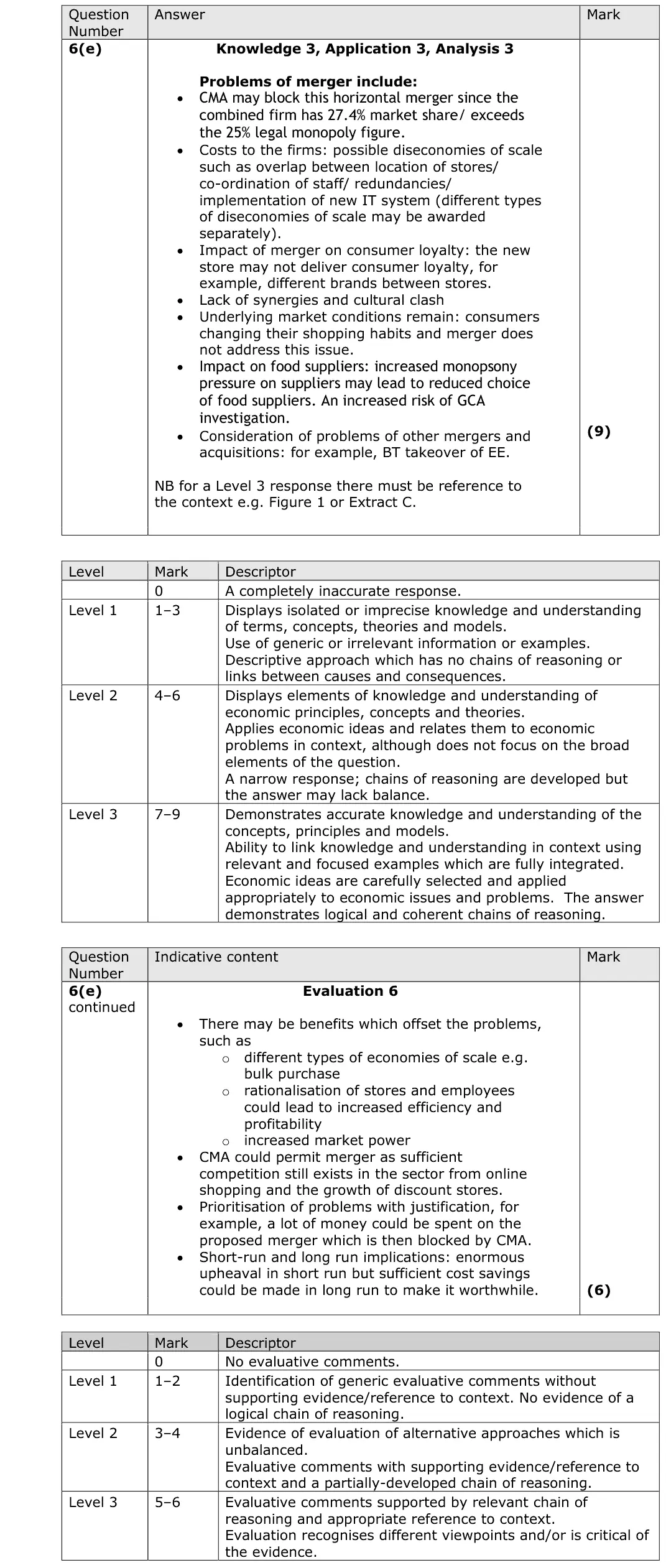
(e) Discuss the likely problems for Sainsbury’s and Morrisons if the suggested merger between them goes ahead. Refer to Figure 1, Extract C and your own knowledge in your answer. (15)
June 2017 · Paper 1 · Q7 25 marks AO1=4, AO2=4, AO3=8, AO4=9 25-mark essay Either/or indirect taxes and subsidiesgovernment intervention in markets
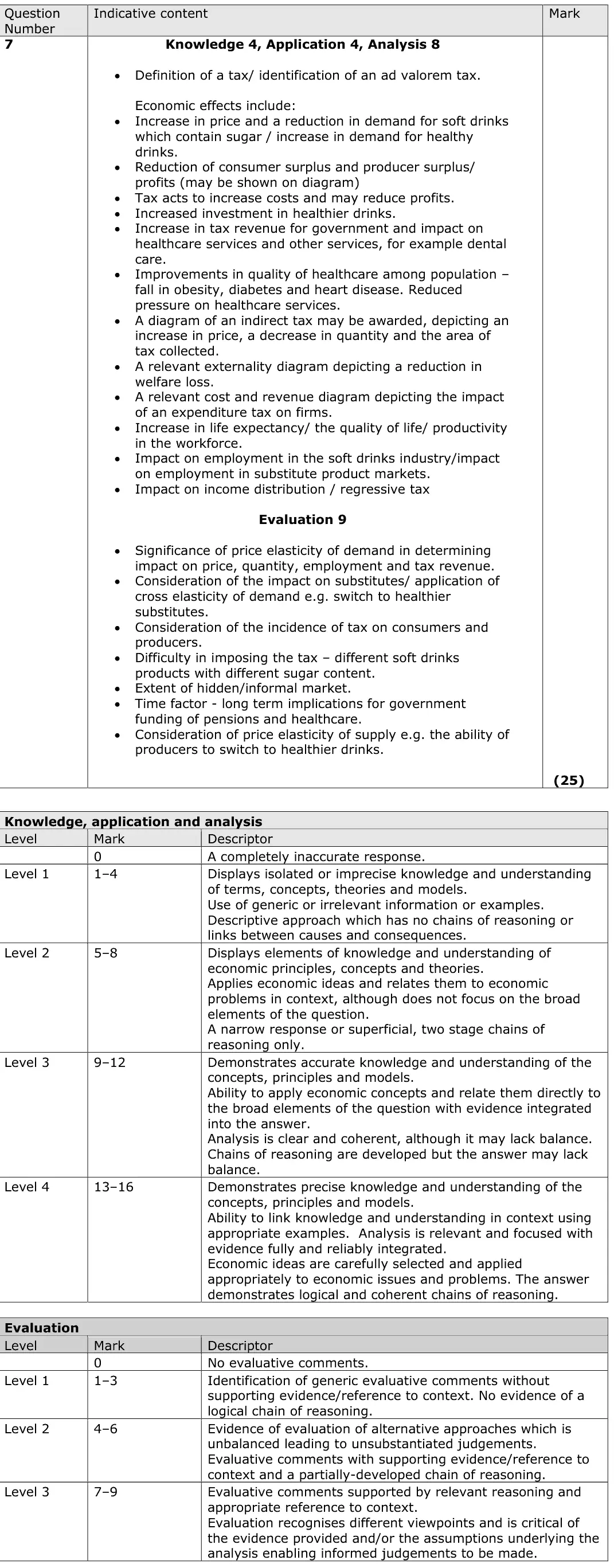
7 In 2015 a report by Public Health England recommended the imposition of a 20% tax on the sale of soft drinks that contain high levels of sugar. Evaluate the likely microeconomic effects of such a tax.
June 2017 · Paper 1 · Q8 25 marks AO1=4, AO2=4, AO3=8, AO4=9 25-mark essay Either/or business growth and objectives
8 ‘Revenue maximisation is a more realistic business objective than profit maximisation for many businesses.’ To what extent do you agree with this statement? Refer to an industry of your choice in your answer.

Work with an Edexcel economics tutor

Want a paper marked and gone through with you? Message us.

Prefer email? Send an enquiry

If you are under 18, please include a parent's contact details. Enquiries go to enquiries@economicsaleveltutor.com and are deleted once handled. All tutoring is online.