June 2024: Paper 2

100 marks · 18 question parts · Paper, mark scheme and report on Pearson's site

Question by question

QTopicMarksAOType
1(a) Aggregate demand 1Multiple choice
1(b) Aggregate demand 2AO2=2Calculation
1(c) Aggregate demand 2AO1=1,AO3=1Short answer
2(a) Aggregate demand 1Multiple choice
2(b) Aggregate demand 4AO1=2,AO2=1,AO3=1Short answer
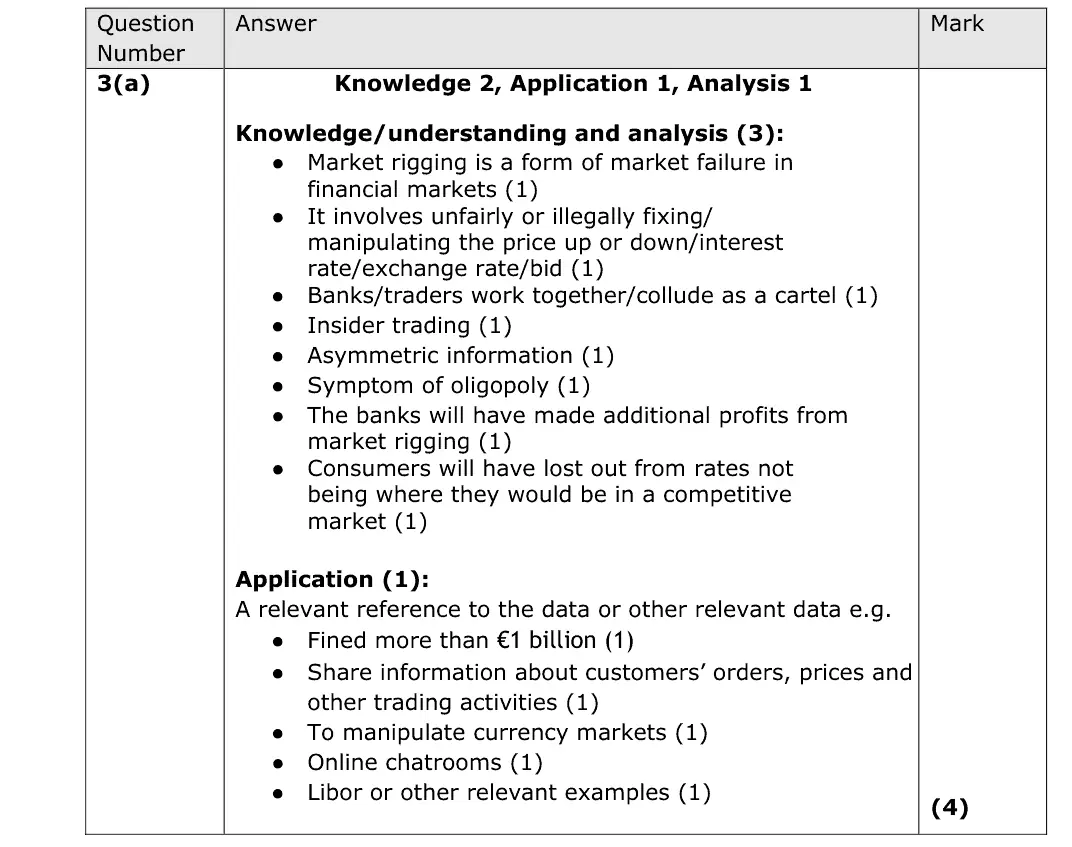
3(a) The financial sector and central banks 4AO1=2,AO2=1,AO3=1Short answer
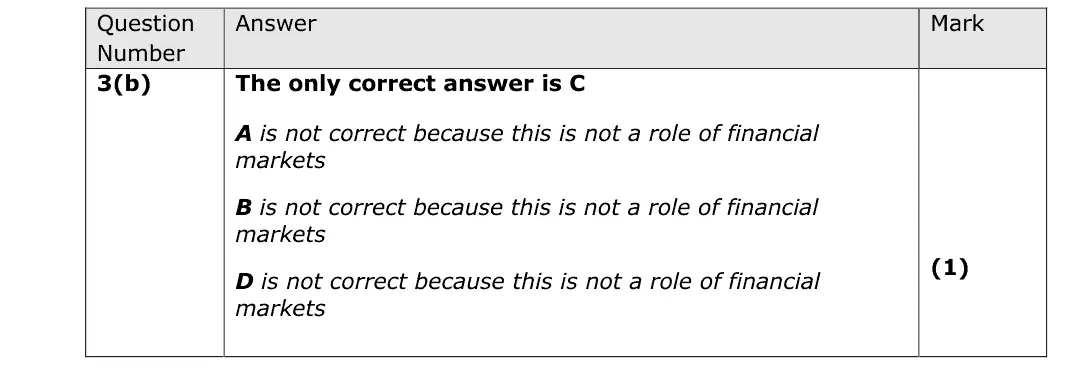
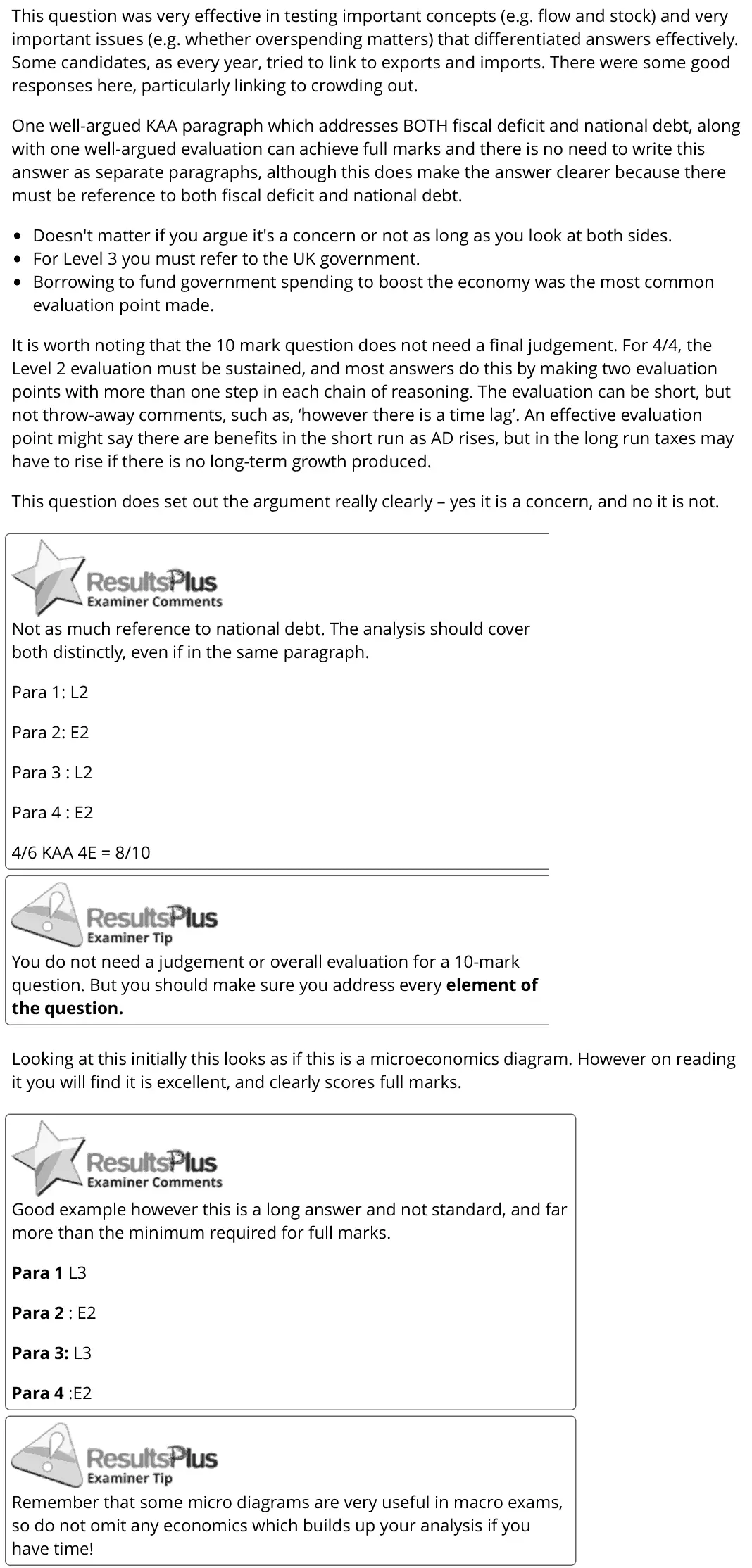
3(b) The financial sector and central banks 1Multiple choice
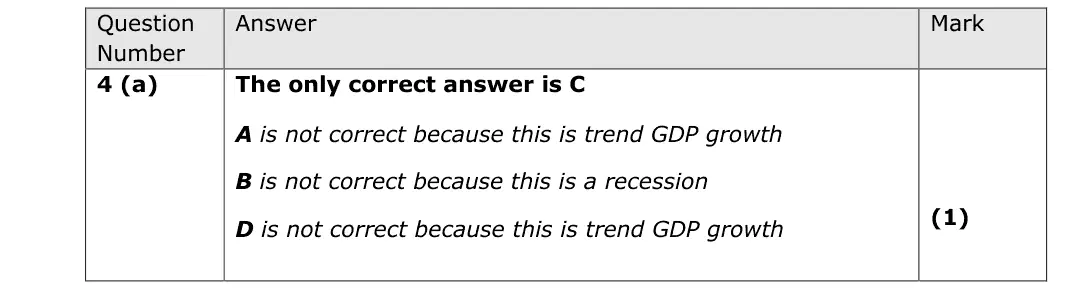
4(a) Economic growth, output gaps and the trade cycle 1Multiple choice
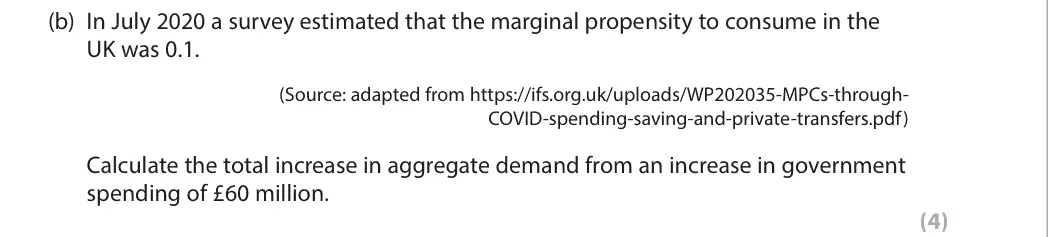
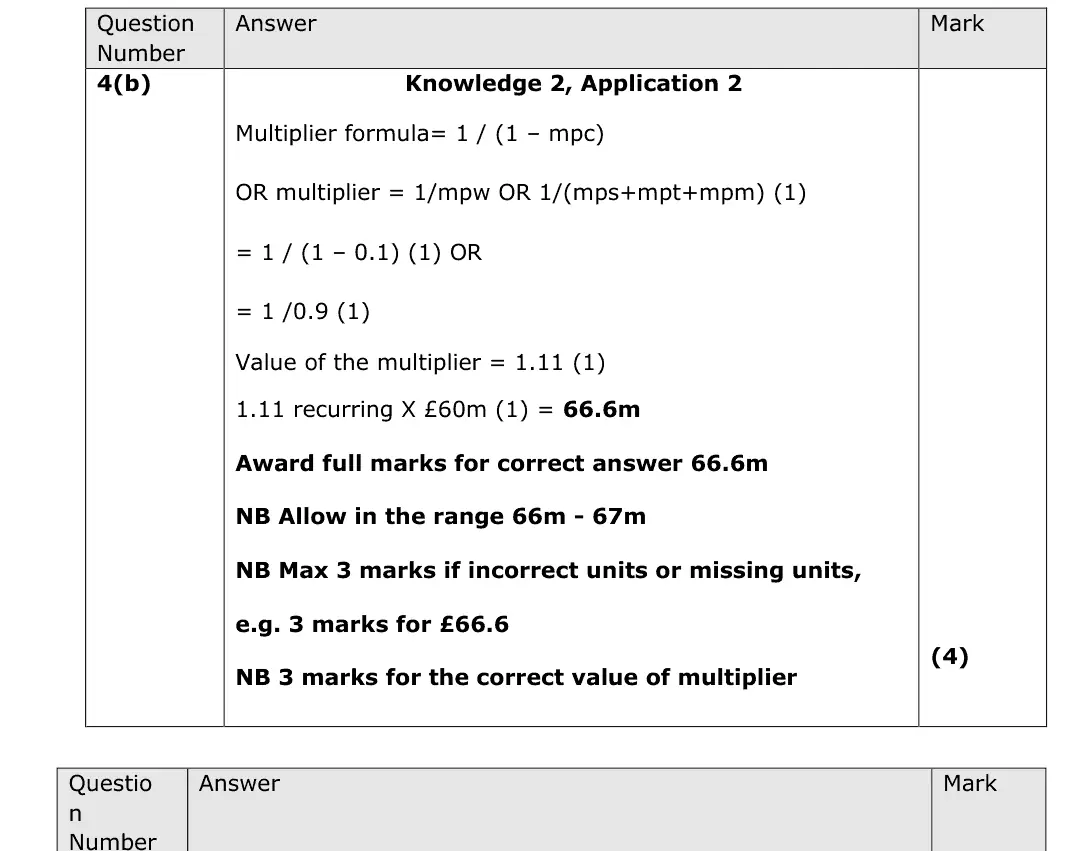
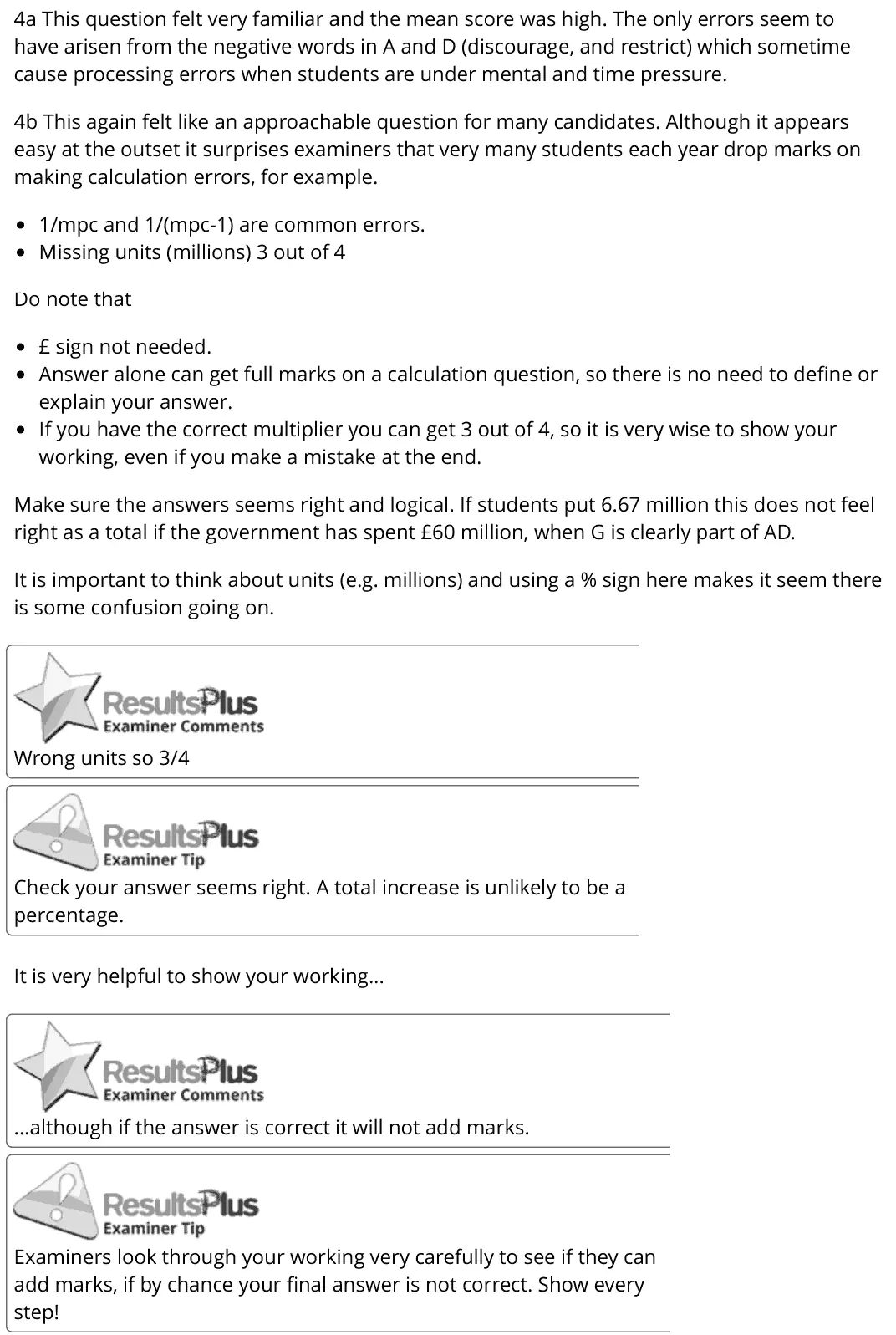
4(b) The circular flow, national income and the multiplier 4AO1=2,AO2=2Calculation
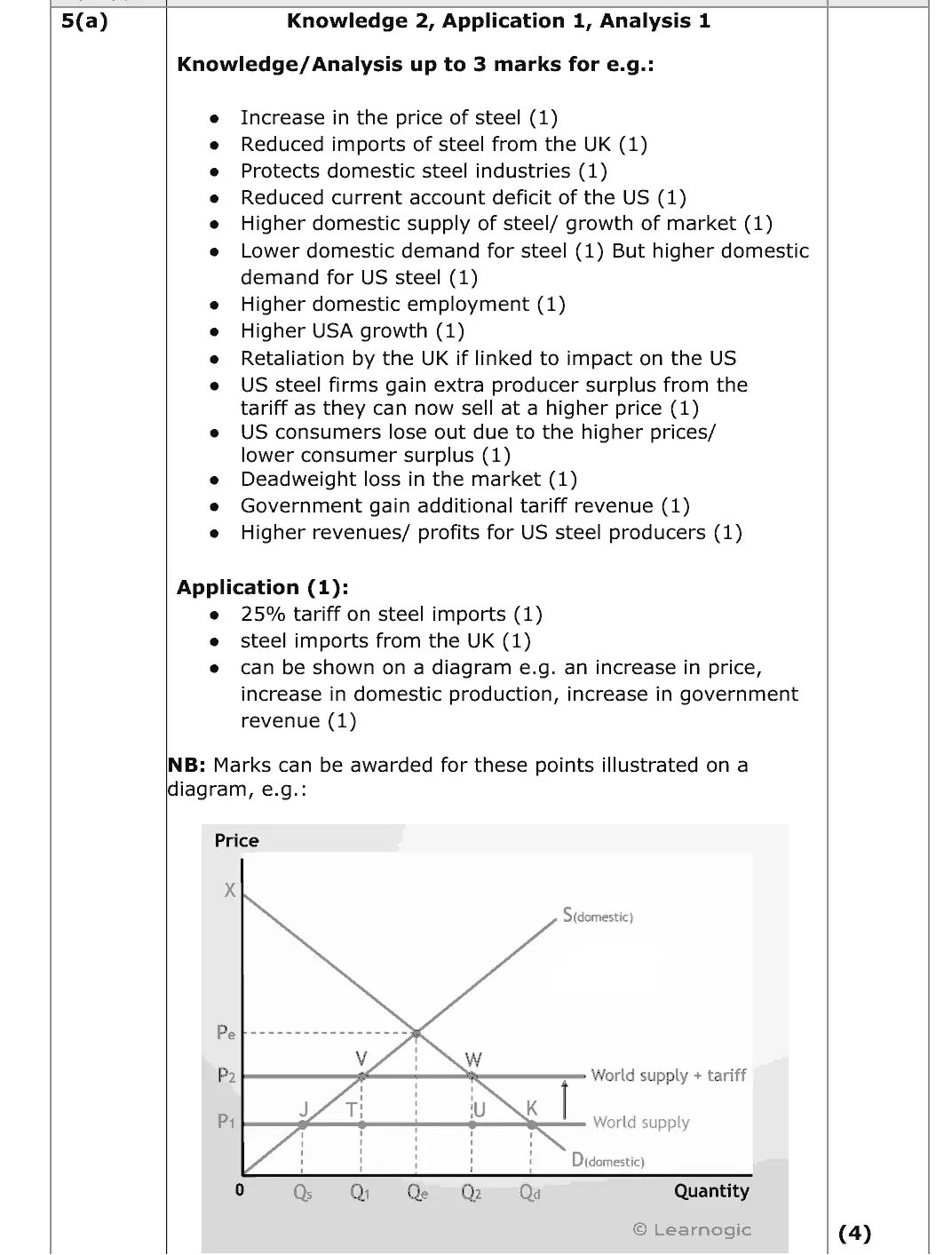
5(a) Trading blocs, the WTO and protectionism 4AO1=2,AO2=1,AO3=1Short answer
5(b) Globalisation, specialisation and trade 1Multiple choice
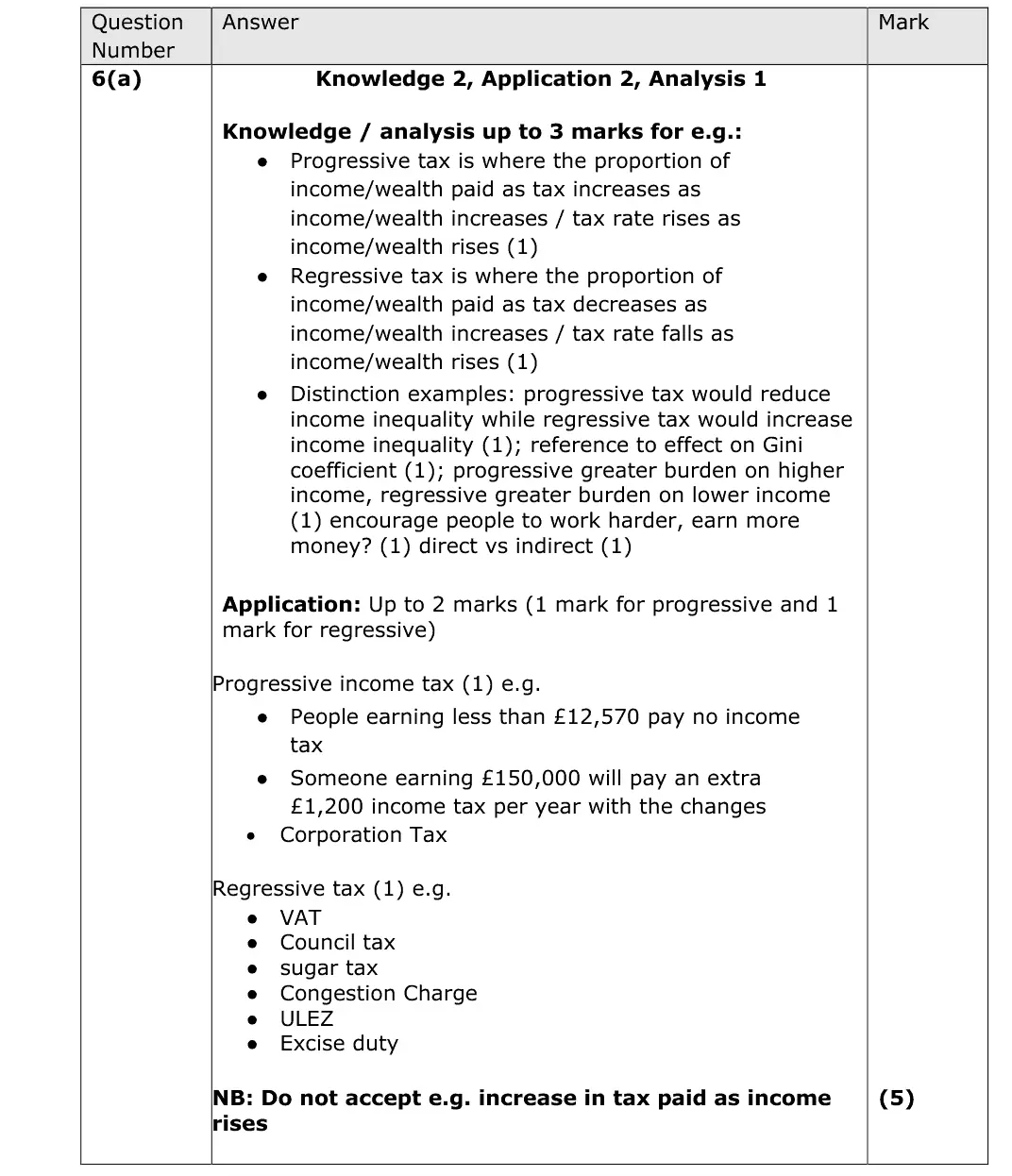
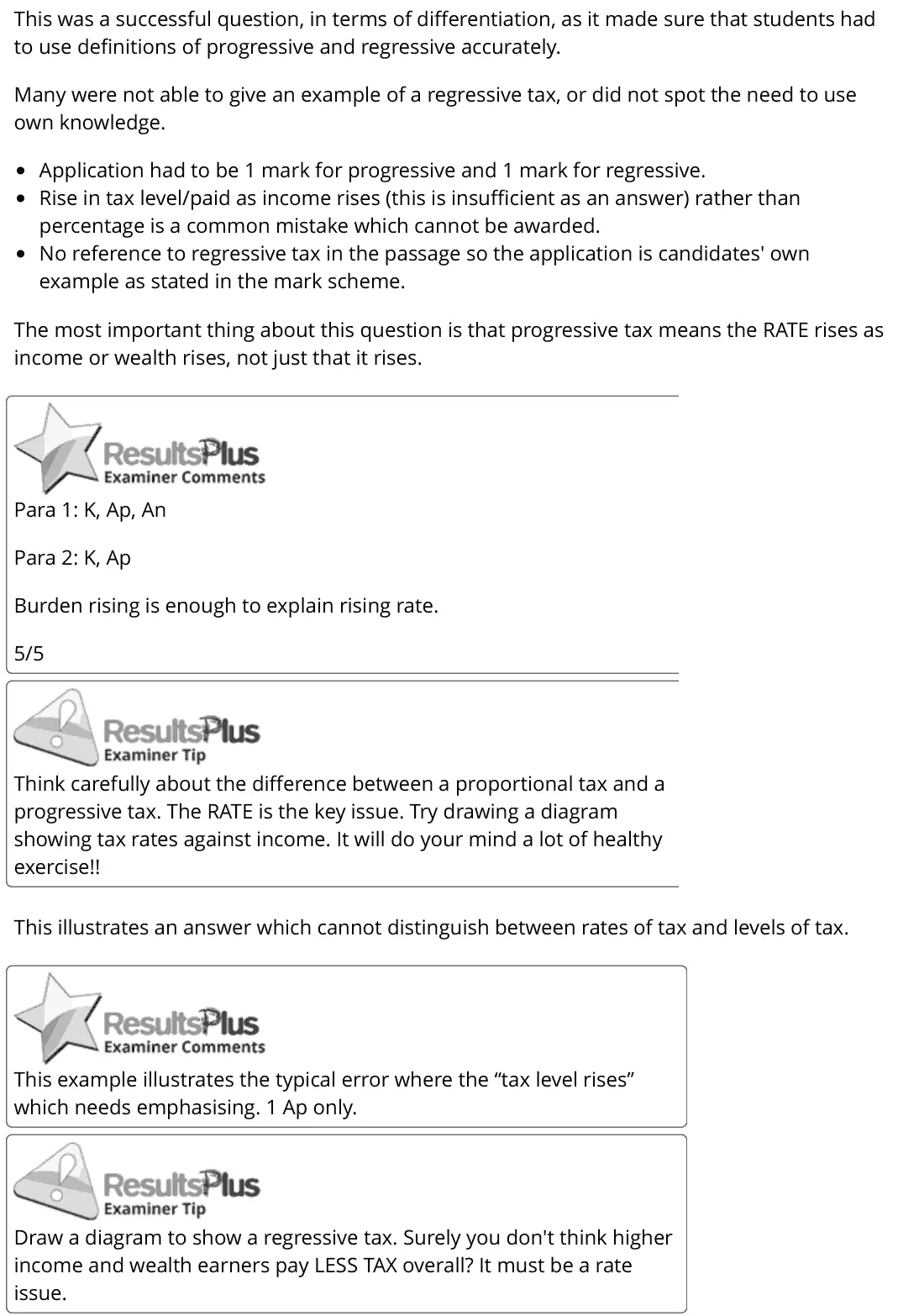
6(a) Public expenditure, taxation and public sector finances 5AO1=2,AO2=2,AO3=1Short answer
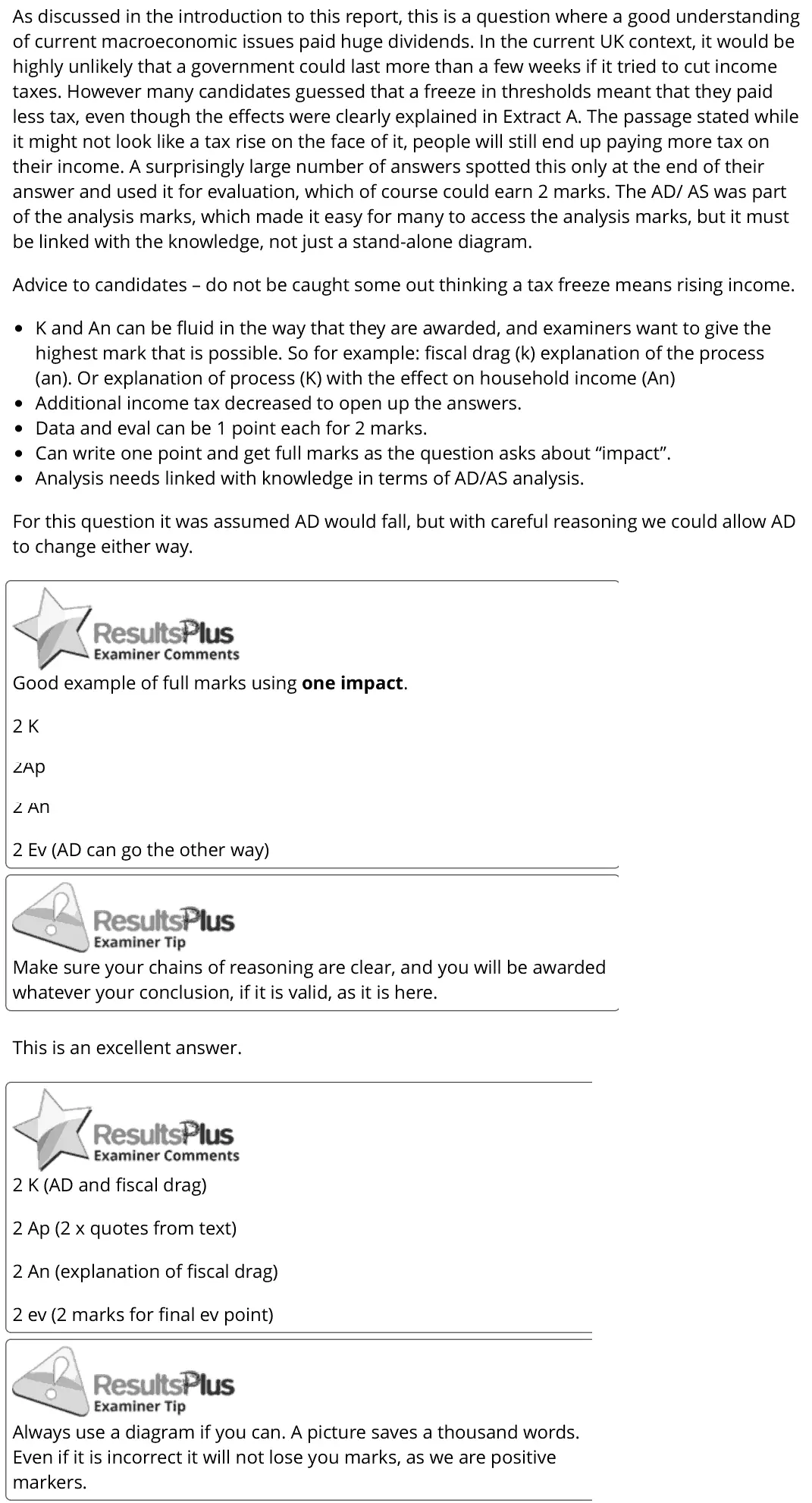
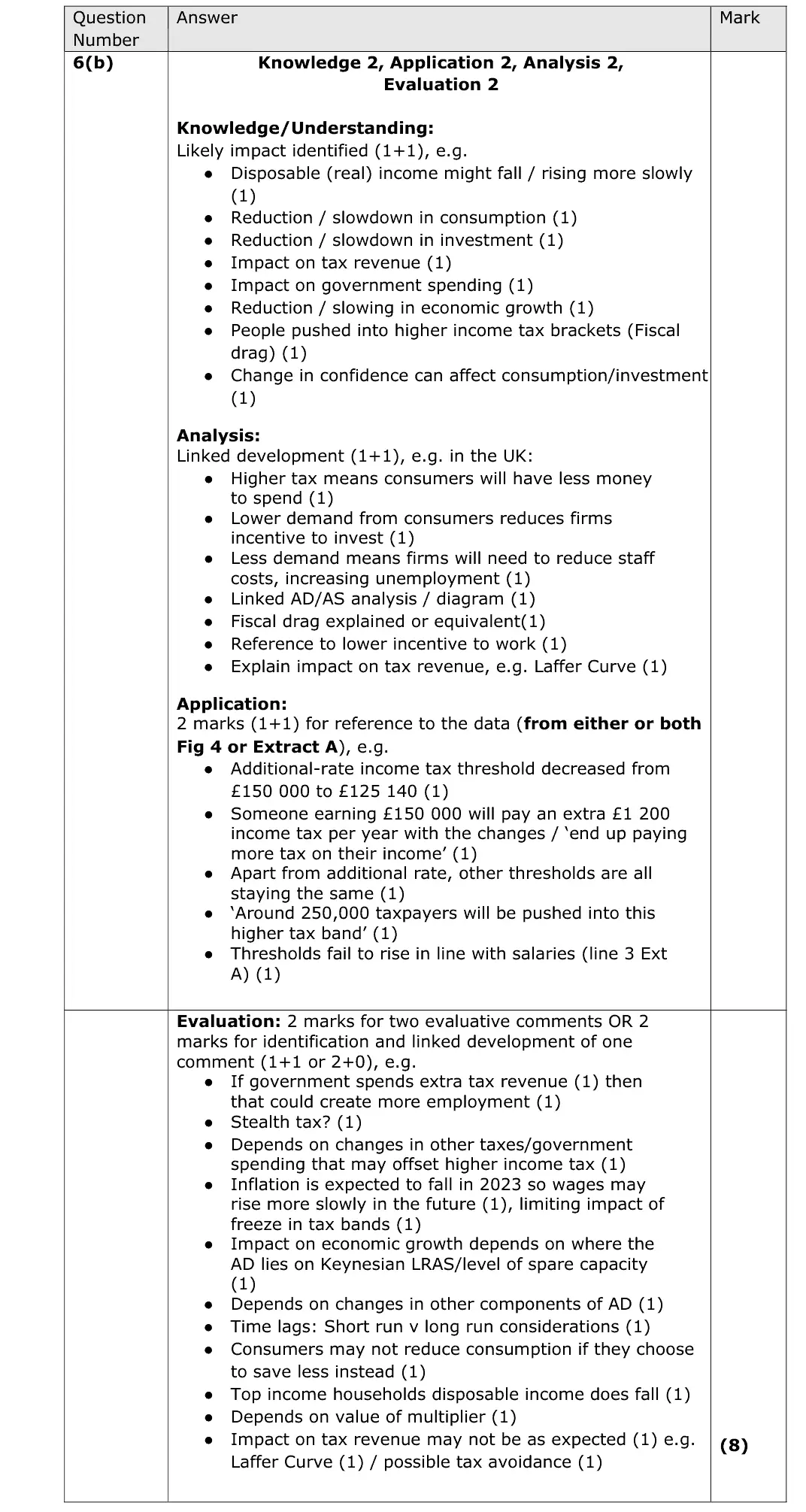
6(b) Public expenditure, taxation and public sector finances, Aggregate demand 8AO1=2,AO2=2,AO3=2,AO4=2Extended response
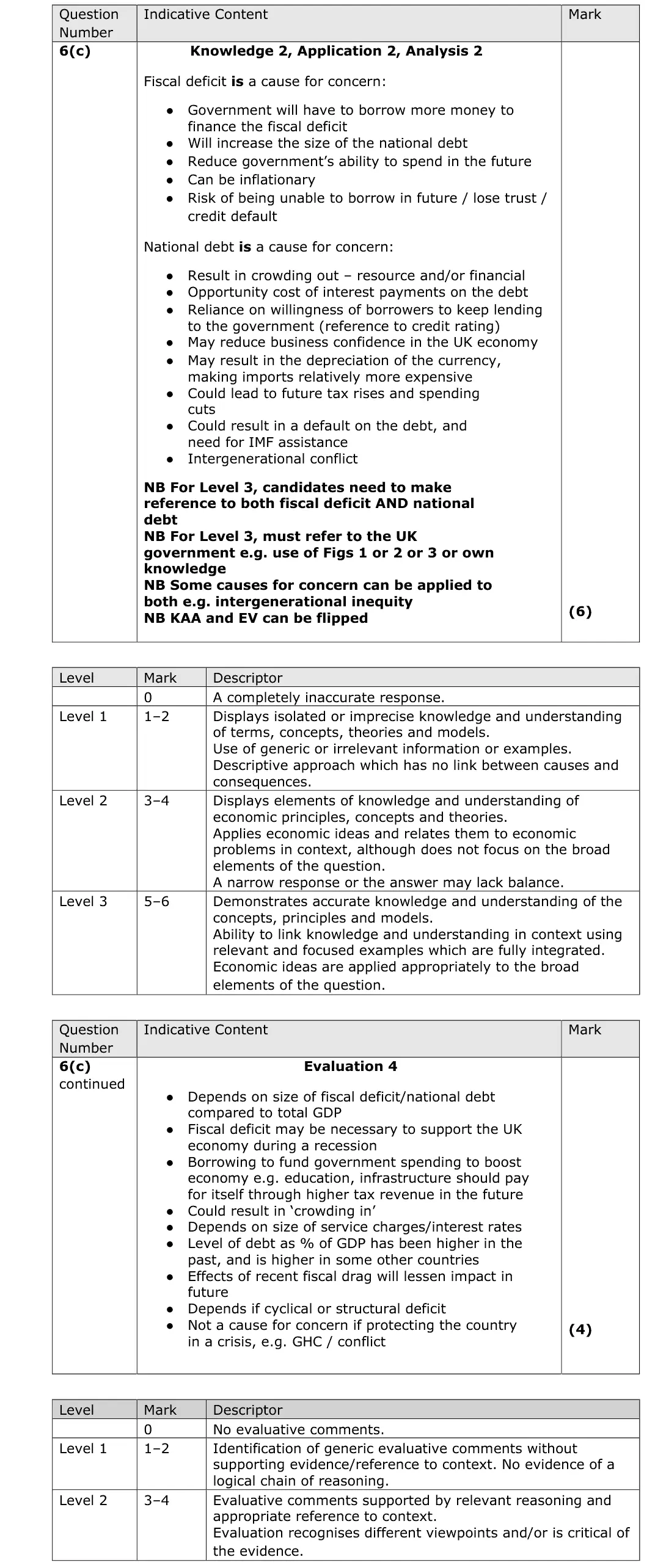
6(c) Public expenditure, taxation and public sector finances 10AO1=2,AO2=2,AO3=2,AO4=4Extended response
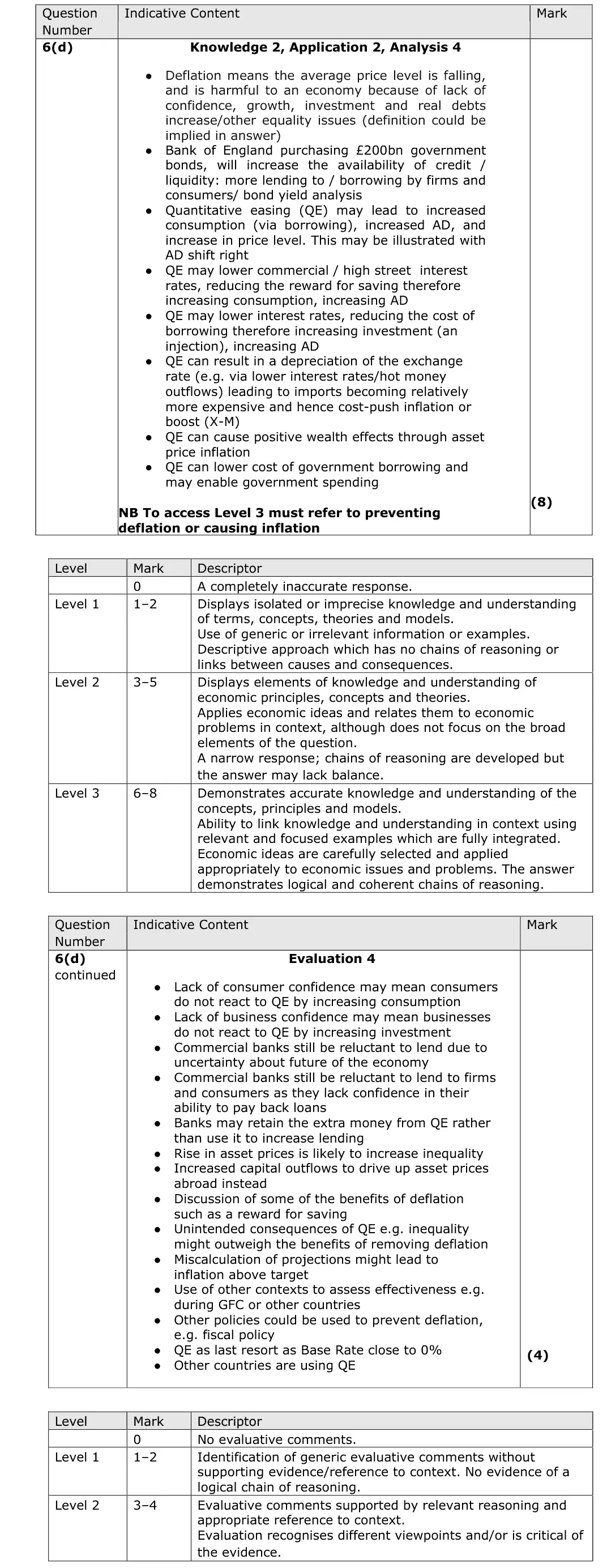
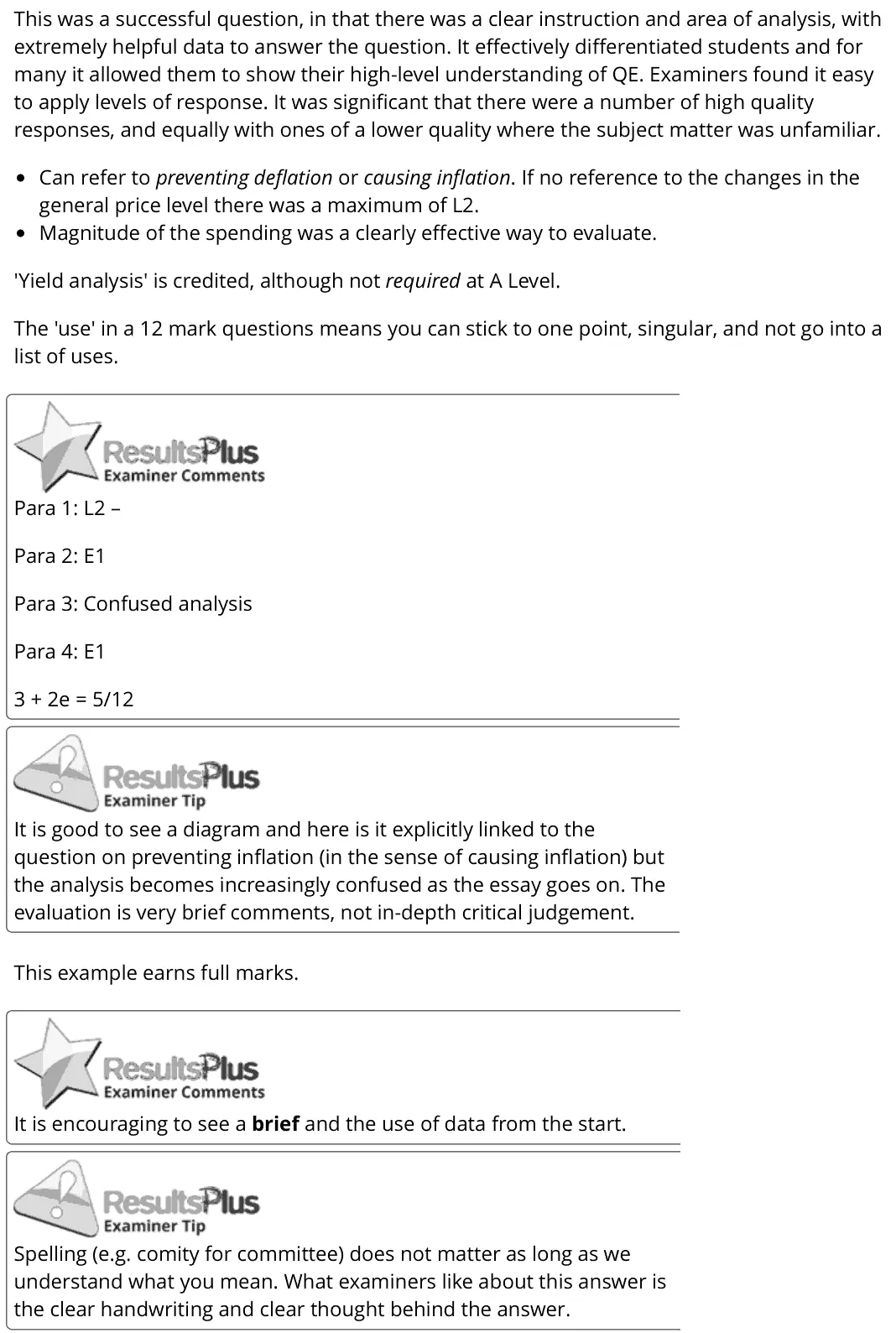
6(d) Demand-side policies: fiscal and monetary policy, The financial sector and central banks 12AO1=2,AO2=2,AO3=4,AO4=4Extended response
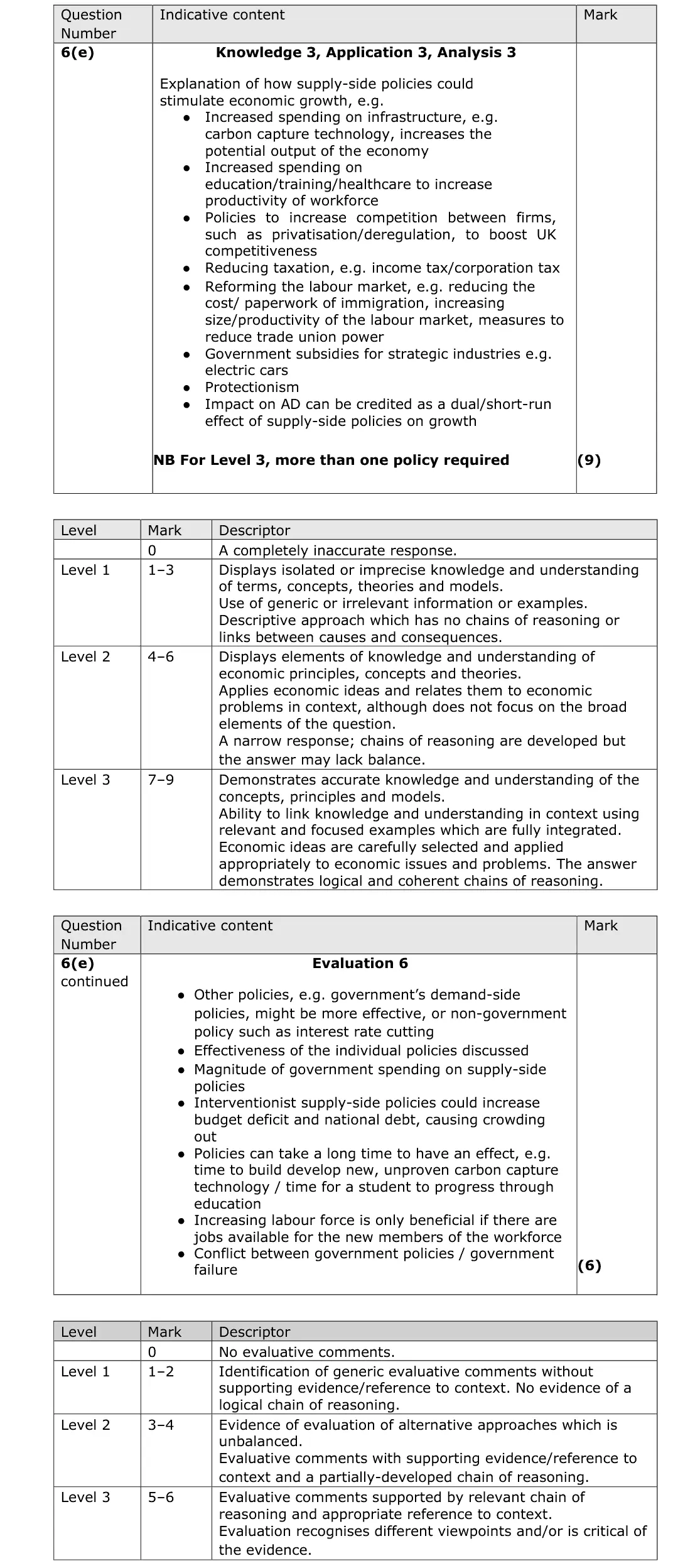
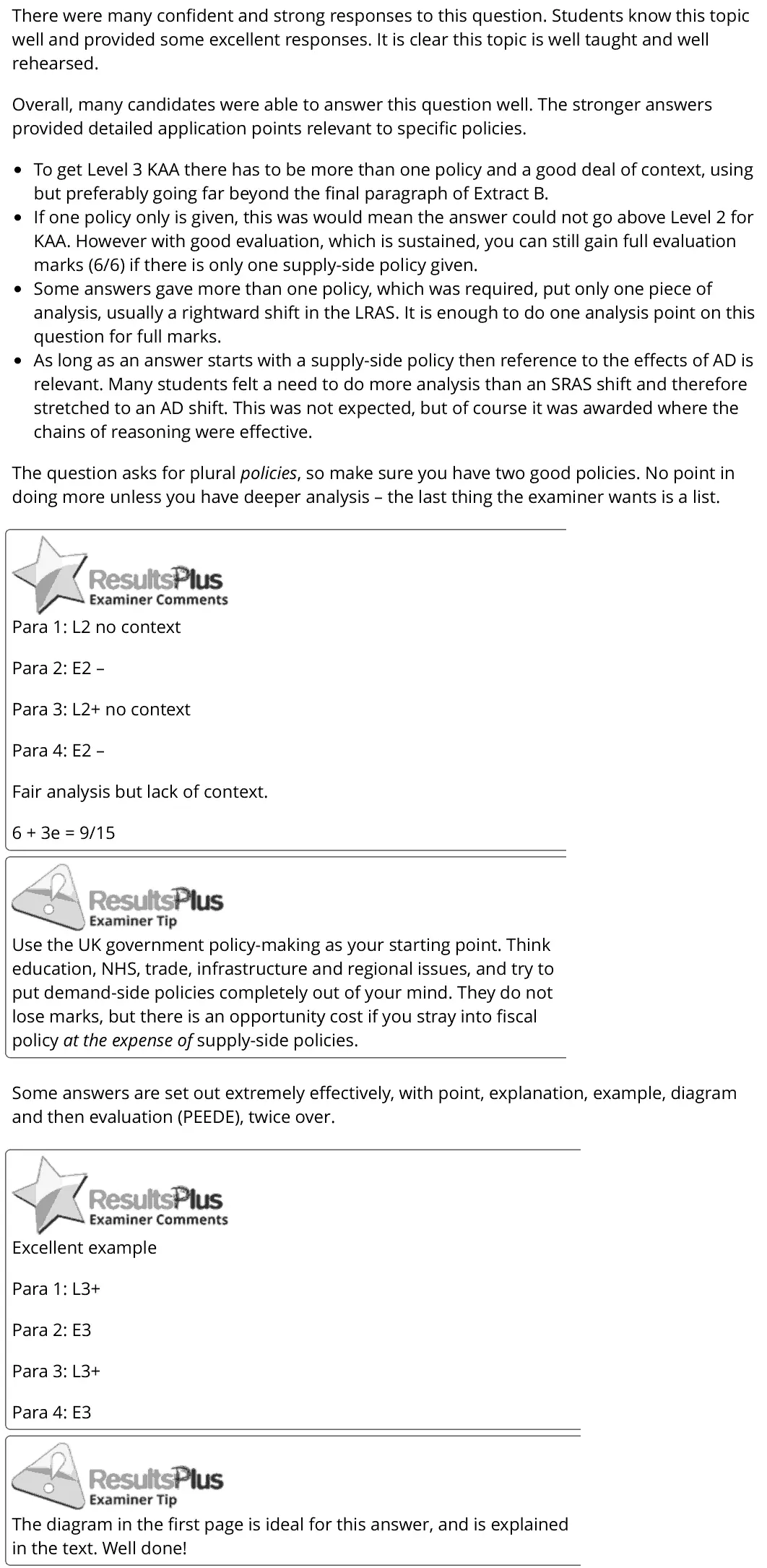
6(e) Supply-side policies 15AO1=3,AO2=3,AO3=3,AO4=6Extended response
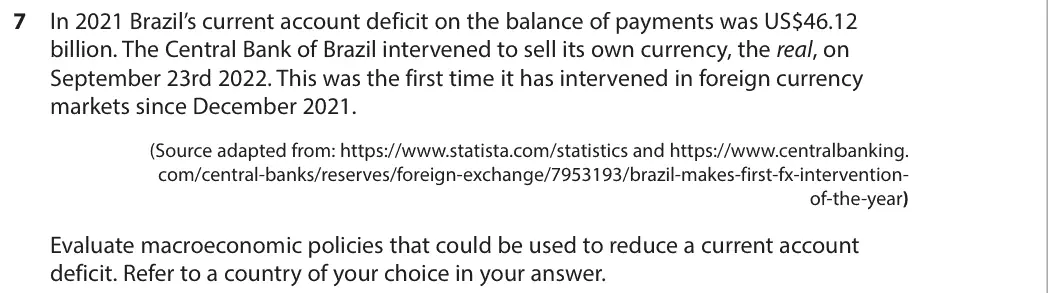
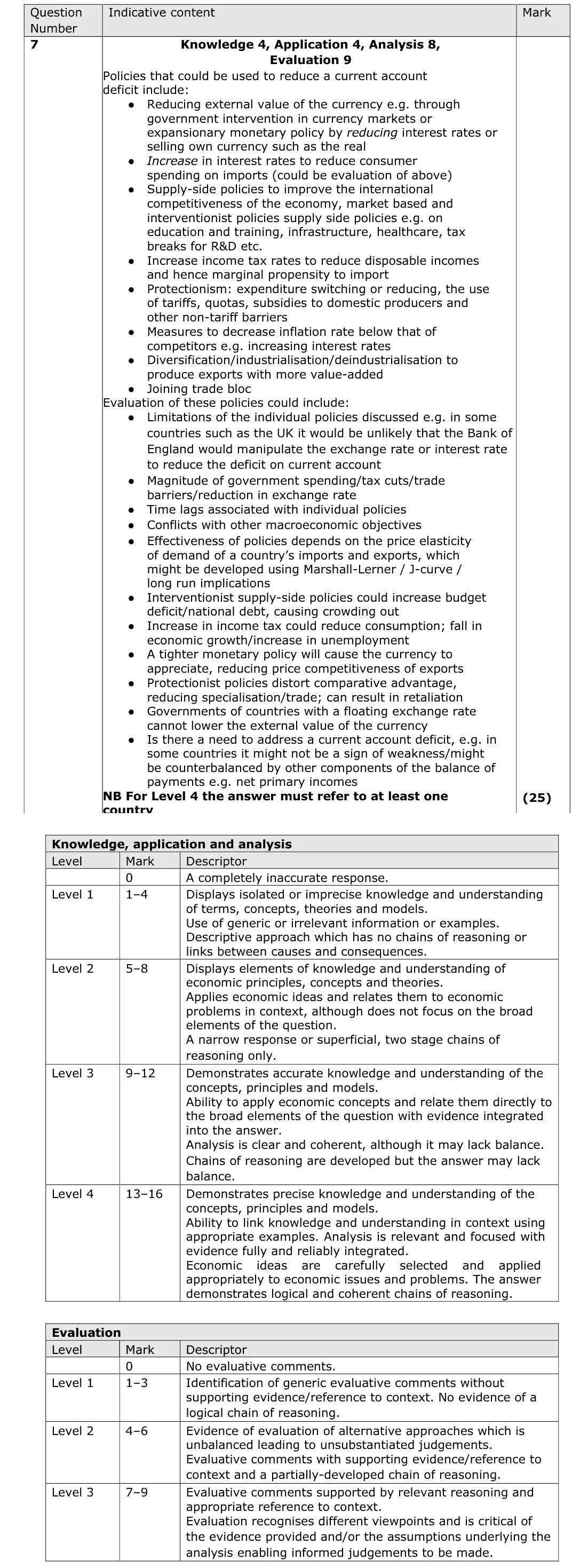
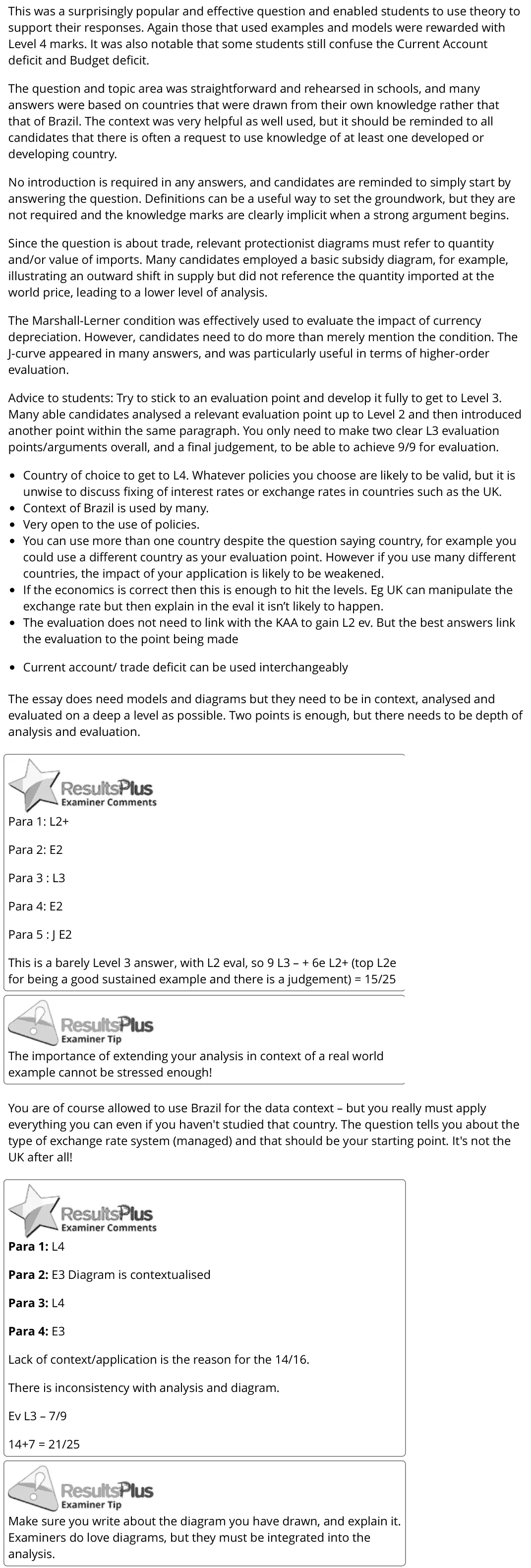
7 The balance of payments, Macroeconomic policies in a global context 25AO1=4,AO2=4,AO3=8,AO4=9Essay
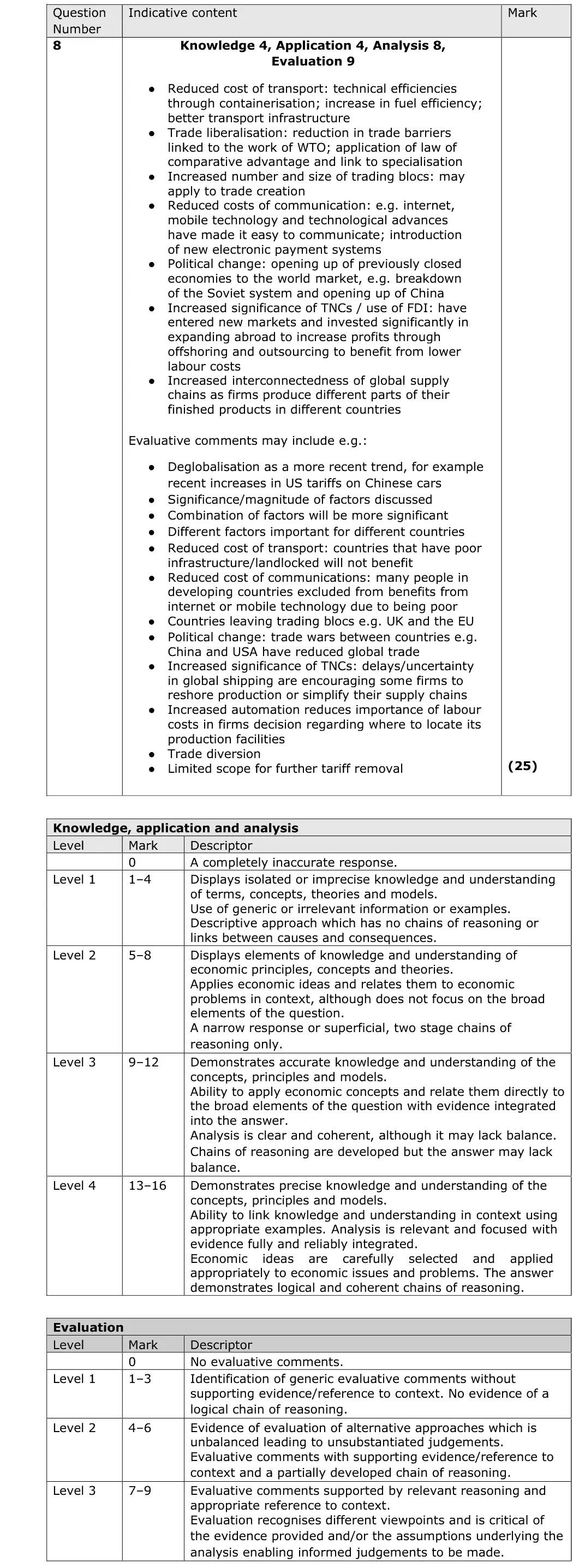
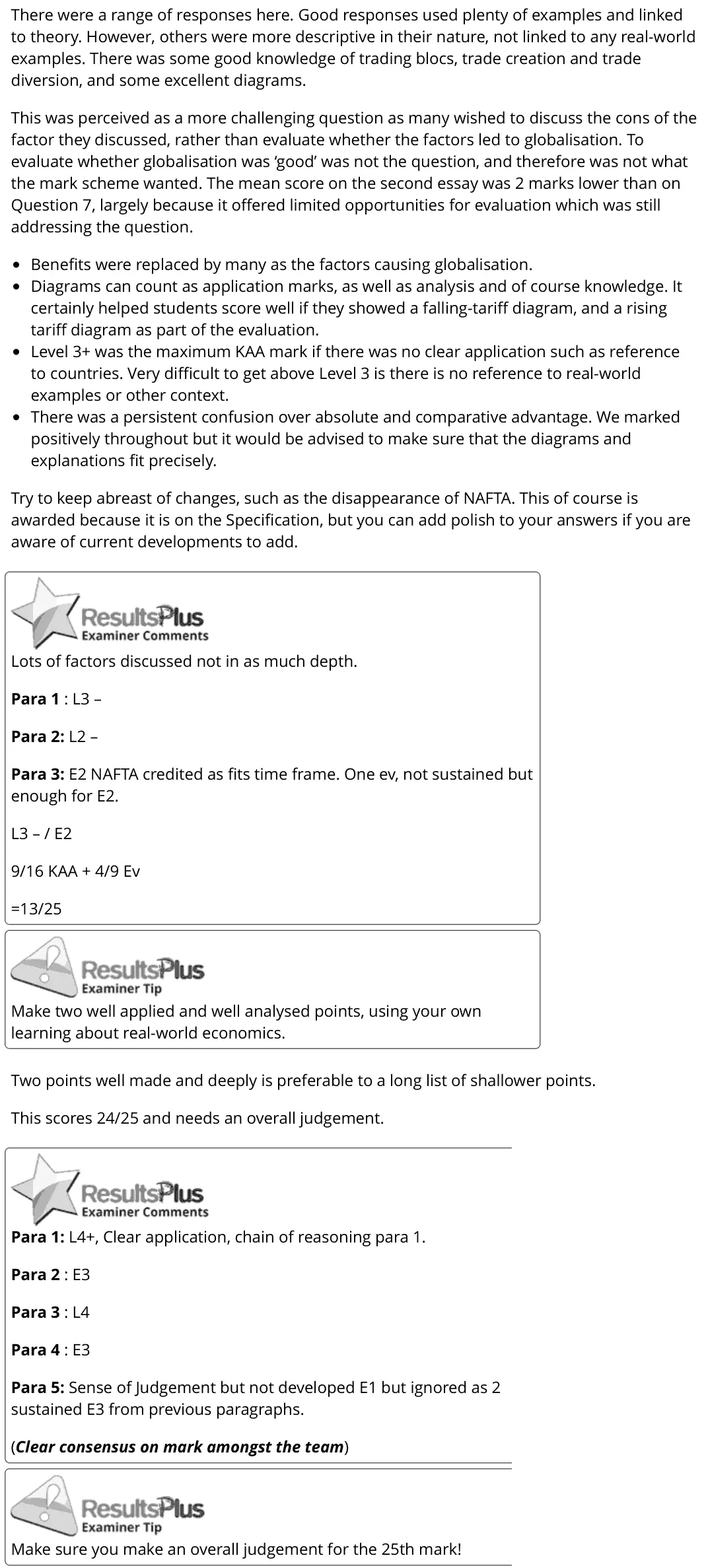
8 Globalisation, specialisation and trade 25AO1=4,AO2=4,AO3=8,AO4=9Essay

The questions

1(a)1(b)1(c)2(a)2(b)3(a)3(b)4(a)4(b)5(a)5(b)6(a)6(b)6(c)6(d)6(e)78
June 2024 · Paper 2 · Q1(a) 1 mark Multiple choice aggregate demand
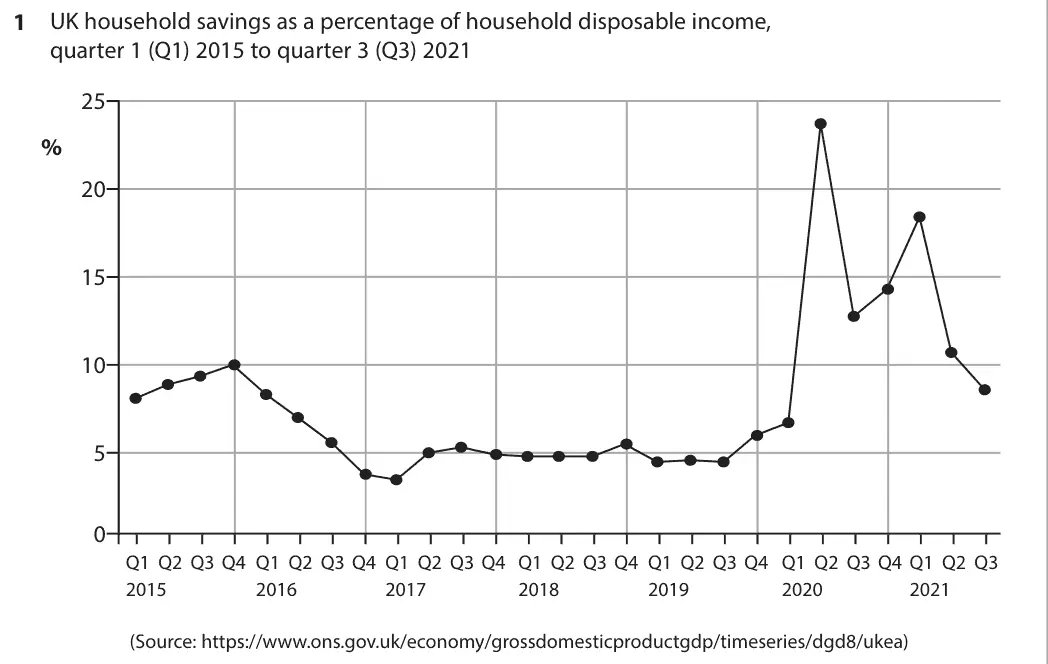
Data and extracts for question 11 UK household savings as a percentage of household disposable income, quarter 1 (Q1) 2015 to quarter 3 (Q3) 2021 25 % 20 15 10 5 0 Q1 Q2 Q3 Q4 Q1 Q2 Q3 Q4 Q1 Q2 Q3 Q4 Q1 Q2 Q3 Q4 Q1 Q2 Q3 Q4 Q1 Q2 Q3 Q4 Q1 Q2 Q3 2015 2016 2017 2018 2019 2020 2021 (Source: https://www.ons.gov.uk/economy/grossdomesticproductgdp/timeseries/dgd8/ukea)
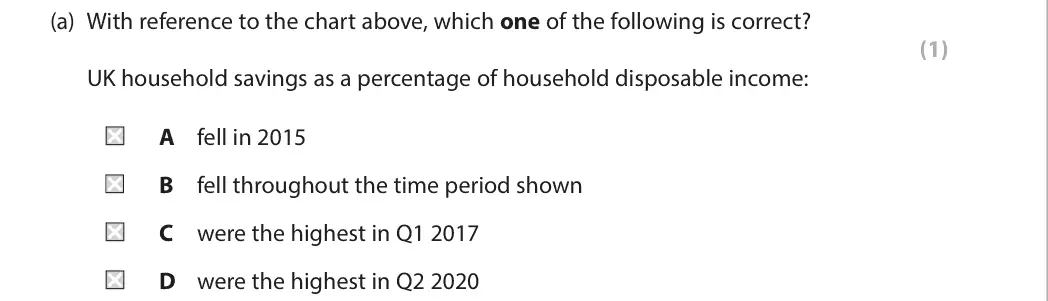
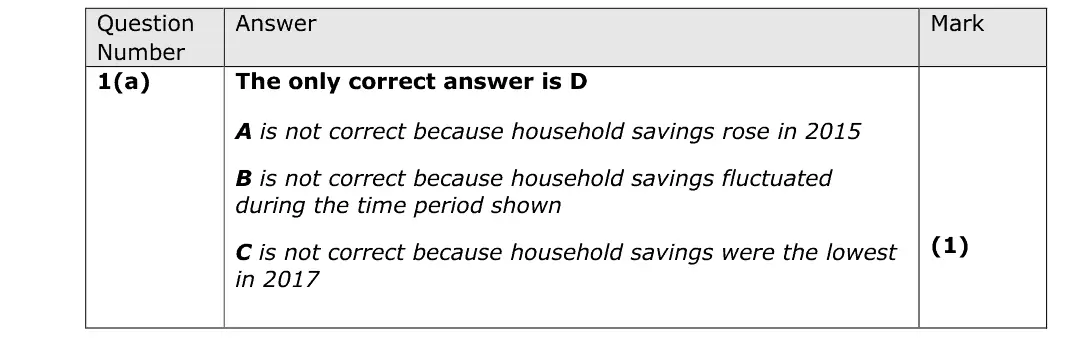
(a) With reference to the chart above, which one of the following is correct? (1) UK household savings as a percentage of household disposable income: A fell in 2015 B fell throughout the time period shown C were the highest in Q1 2017 D were the highest in Q2 2020
June 2024 · Paper 2 · Q1(b) 2 marks AO2=2 Calculation aggregate demand
Data and extracts for question 11 UK household savings as a percentage of household disposable income, quarter 1 (Q1) 2015 to quarter 3 (Q3) 2021 25 % 20 15 10 5 0 Q1 Q2 Q3 Q4 Q1 Q2 Q3 Q4 Q1 Q2 Q3 Q4 Q1 Q2 Q3 Q4 Q1 Q2 Q3 Q4 Q1 Q2 Q3 Q4 Q1 Q2 Q3 2015 2016 2017 2018 2019 2020 2021 (Source: https://www.ons.gov.uk/economy/grossdomesticproductgdp/timeseries/dgd8/ukea)
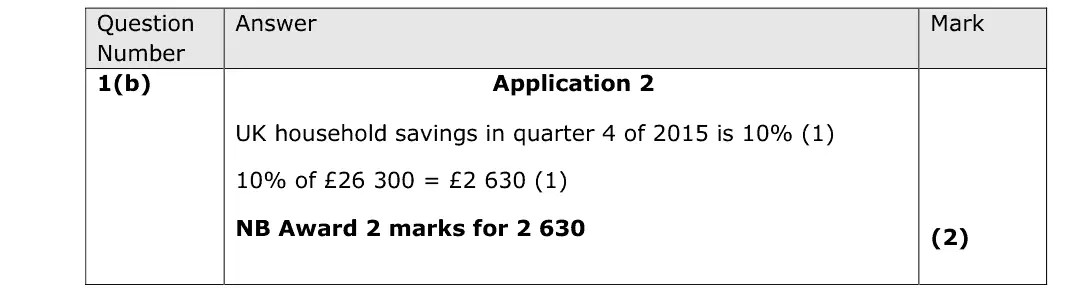
(b) In Q4 of 2015 average household disposable income was £26 300. Calculate the total amount of money saved by the average household in Q4 of 2015. (2)
June 2024 · Paper 2 · Q1(c) 2 marks AO1=1, AO3=1 Short answer aggregate demand
Data and extracts for question 11 UK household savings as a percentage of household disposable income, quarter 1 (Q1) 2015 to quarter 3 (Q3) 2021 25 % 20 15 10 5 0 Q1 Q2 Q3 Q4 Q1 Q2 Q3 Q4 Q1 Q2 Q3 Q4 Q1 Q2 Q3 Q4 Q1 Q2 Q3 Q4 Q1 Q2 Q3 Q4 Q1 Q2 Q3 2015 2016 2017 2018 2019 2020 2021 (Source: https://www.ons.gov.uk/economy/grossdomesticproductgdp/timeseries/dgd8/ukea)
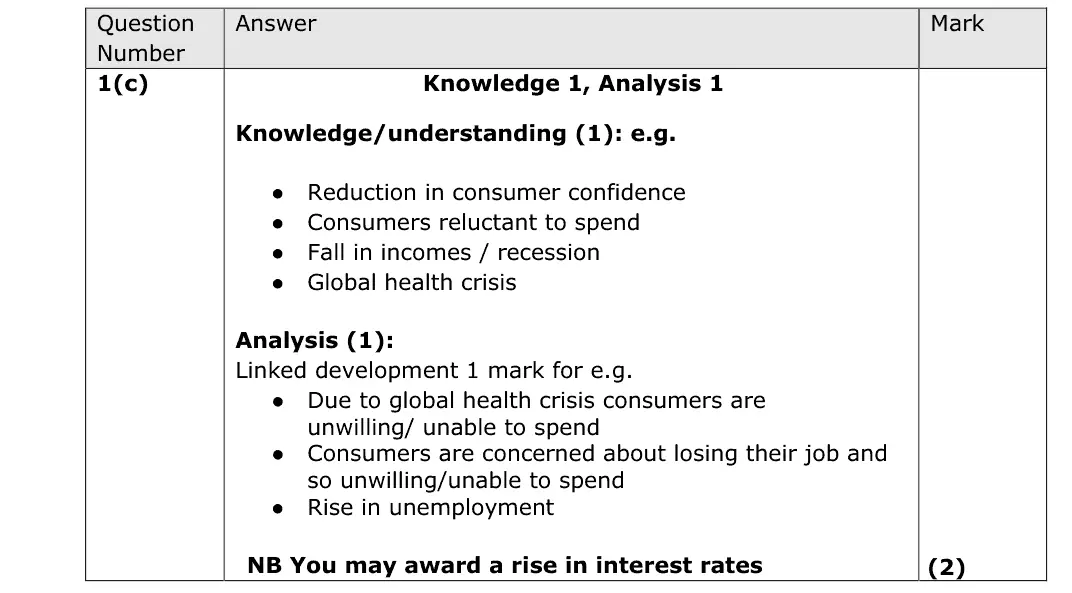
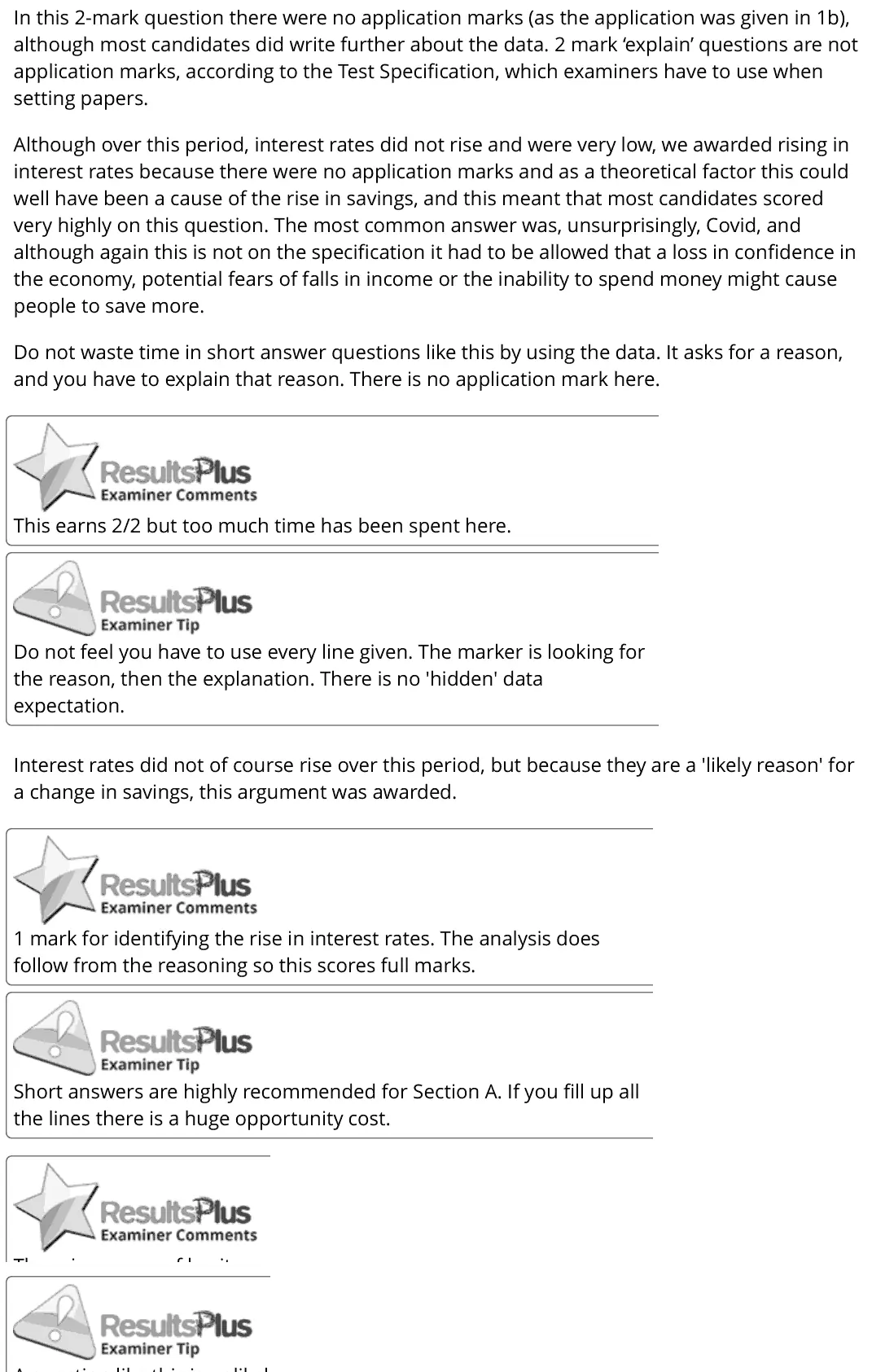
(c) Explain one likely reason for the change in total household savings from Q1 2020 to Q2 2020. (2)
June 2024 · Paper 2 · Q2(a) 1 mark Multiple choice aggregate demand
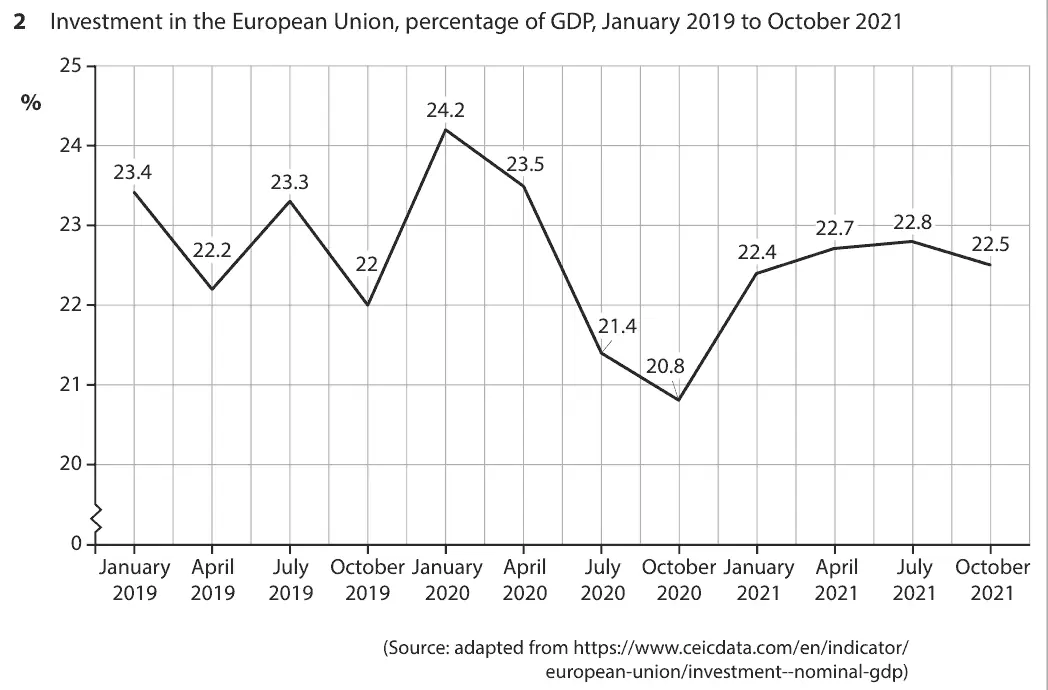
Data and extracts for question 22 Investment in the European Union, percentage of GDP, January 2019 to October 2021 25 % 24.2 24 23.5 23.4 23.3 22.8 23 22.7 22.5 22.2 22.4 22 22 21.4 20.8 21 20 0 January April July October January April July October January April July October 2019 2019 2019 2019 2020 2020 2020 2020 2021 2021 2021 2021 (Source: adapted from https://www.ceicdata.com/en/indicator/ european-union/investment--nominal-gdp)
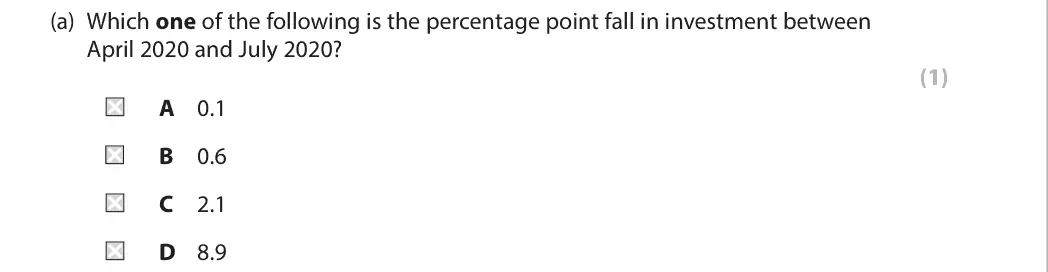
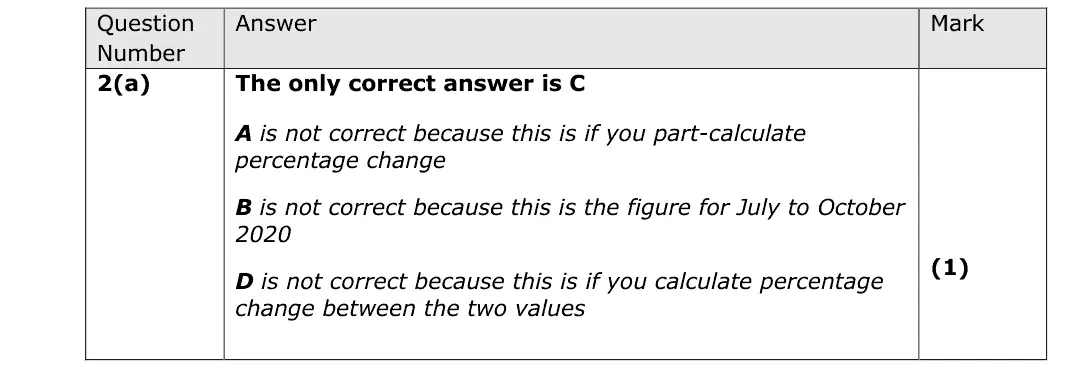
(a) Which one of the following is the percentage point fall in investment between April 2020 and July 2020? (1) A 0.1 B 0.6 C 2.1 D 8.9
June 2024 · Paper 2 · Q2(b) 4 marks AO1=2, AO2=1, AO3=1 Short answer aggregate demand
Data and extracts for question 22 Investment in the European Union, percentage of GDP, January 2019 to October 2021 25 % 24.2 24 23.5 23.4 23.3 22.8 23 22.7 22.5 22.2 22.4 22 22 21.4 20.8 21 20 0 January April July October January April July October January April July October 2019 2019 2019 2019 2020 2020 2020 2020 2021 2021 2021 2021 (Source: adapted from https://www.ceicdata.com/en/indicator/ european-union/investment--nominal-gdp)
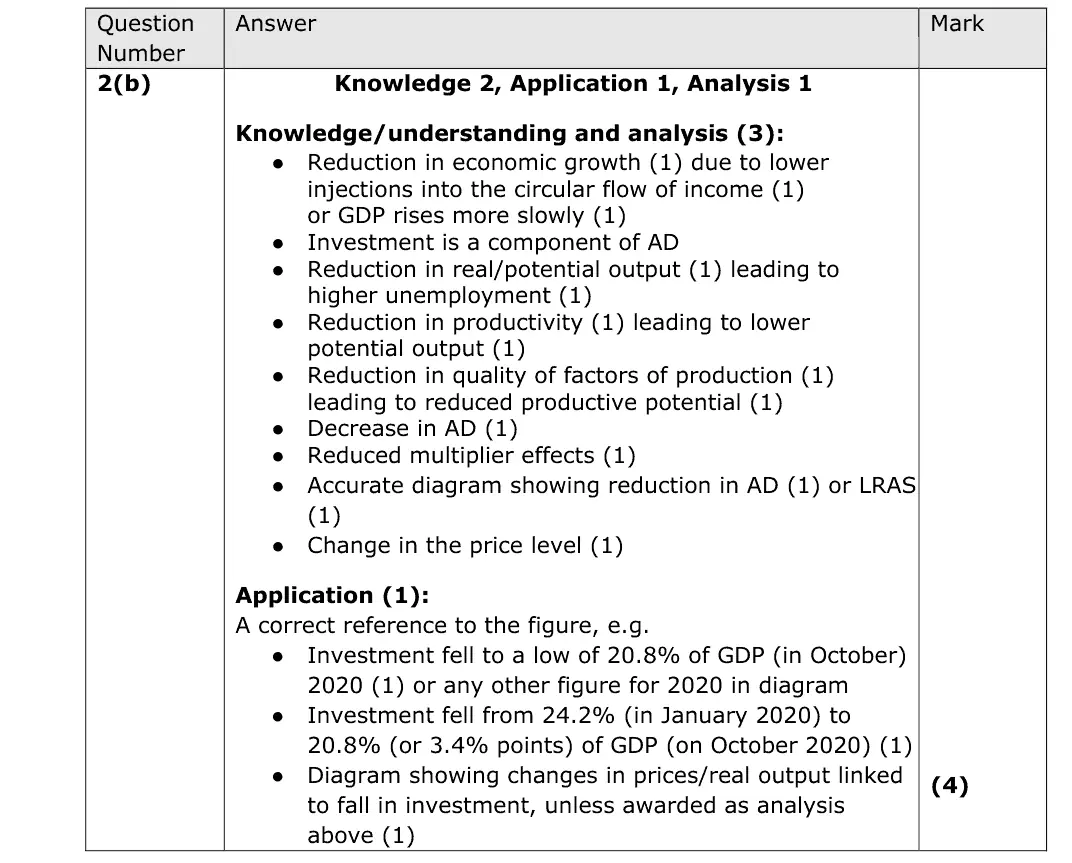
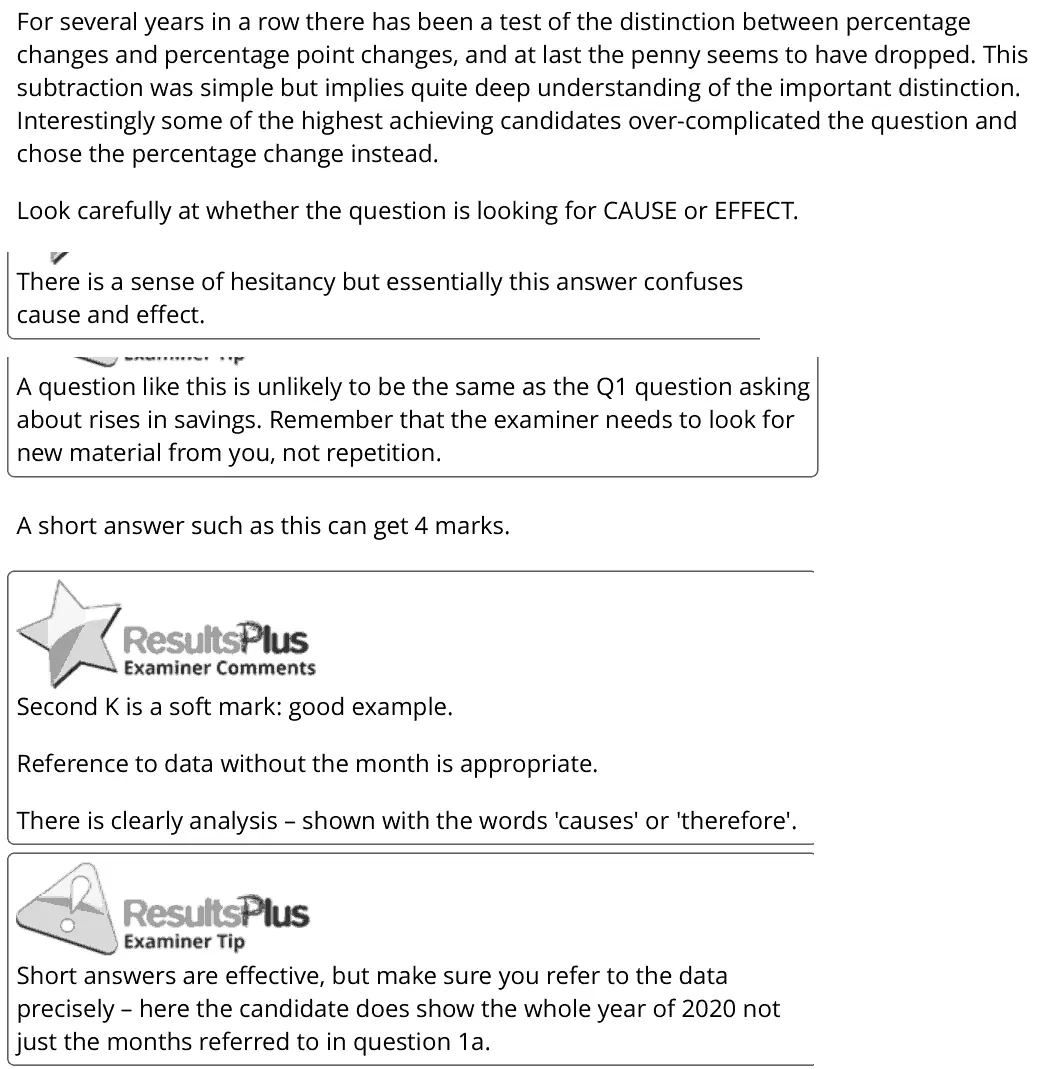
(b) With reference to the data, explain one likely effect of the fall in investment in 2020. (4)
June 2024 · Paper 2 · Q3(a) 4 marks AO1=2, AO2=1, AO3=1 Short answer financial sector
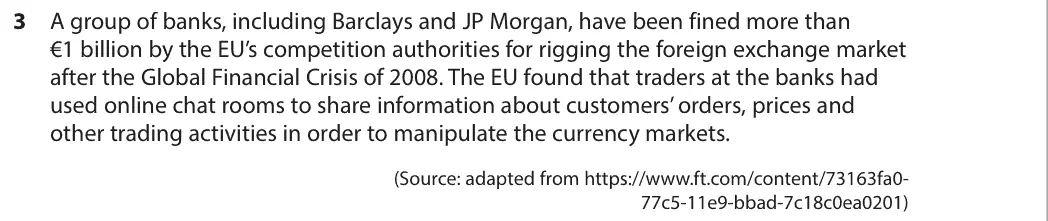
Data and extracts for question 33 A group of banks, including Barclays and JP Morgan, have been fined more than €1 billion by the EU’s competition authorities for rigging the foreign exchange market after the Global Financial Crisis of 2008. The EU found that traders at the banks had used online chat rooms to share information about customers’ orders, prices and other trading activities in order to manipulate the currency markets. (Source: adapted from https://www.ft.com/content/73163fa0- 77c5-11e9-bbad-7c18c0ea0201)
(a) With reference to the information above, explain what is meant by ‘market rigging’. (4)
June 2024 · Paper 2 · Q3(b) 1 mark Multiple choice financial sector
Data and extracts for question 33 A group of banks, including Barclays and JP Morgan, have been fined more than €1 billion by the EU’s competition authorities for rigging the foreign exchange market after the Global Financial Crisis of 2008. The EU found that traders at the banks had used online chat rooms to share information about customers’ orders, prices and other trading activities in order to manipulate the currency markets. (Source: adapted from https://www.ft.com/content/73163fa0- 77c5-11e9-bbad-7c18c0ea0201)
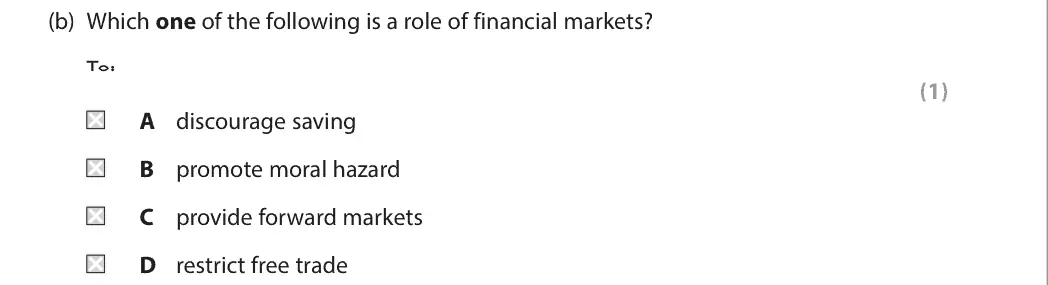
(b) Which one of the following is a role of financial markets? To: (1) A discourage saving B promote moral hazard C provide forward markets D restrict free trade
June 2024 · Paper 2 · Q4(a) 1 mark Multiple choice economic growth and the trade cycle
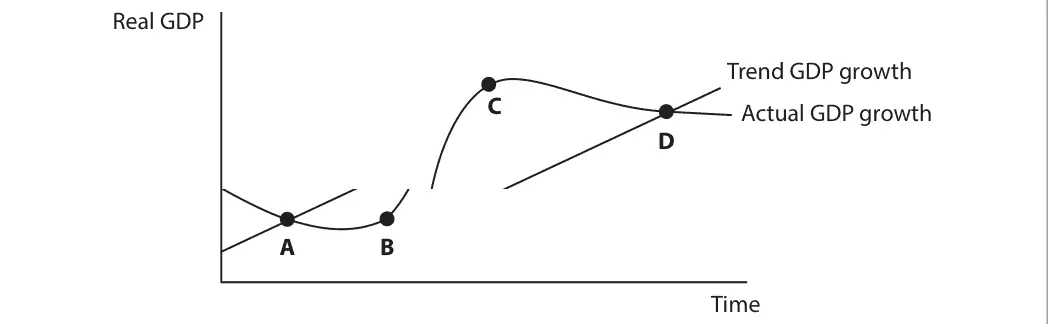
Data and extracts for question 44 Real GDP Trend GDP growth C Actual GDP growth D A B Time
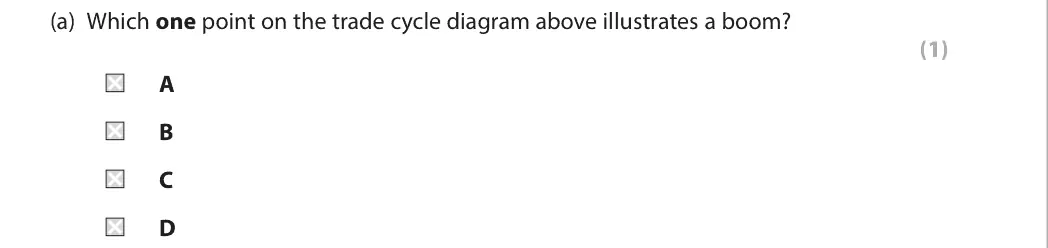
(a) Which one point on the trade cycle diagram above illustrates a boom? (1) A B C D
June 2024 · Paper 2 · Q4(b) 4 marks AO1=2, AO2=2 Calculation national income and the multiplier
Data and extracts for question 44 Real GDP Trend GDP growth C Actual GDP growth D A B Time
(b) In July 2020 a survey estimated that the marginal propensity to consume in the UK was 0.1. (Source: adapted from https://ifs.org.uk/uploads/WP202035-MPCs-through- COVID-spending-saving-and-private-transfers.pdf) Calculate the total increase in aggregate demand from an increase in government spending of £60 million. (4)
June 2024 · Paper 2 · Q5(a) 4 marks AO1=2, AO2=1, AO3=1 Short answer trading blocs and protectionism
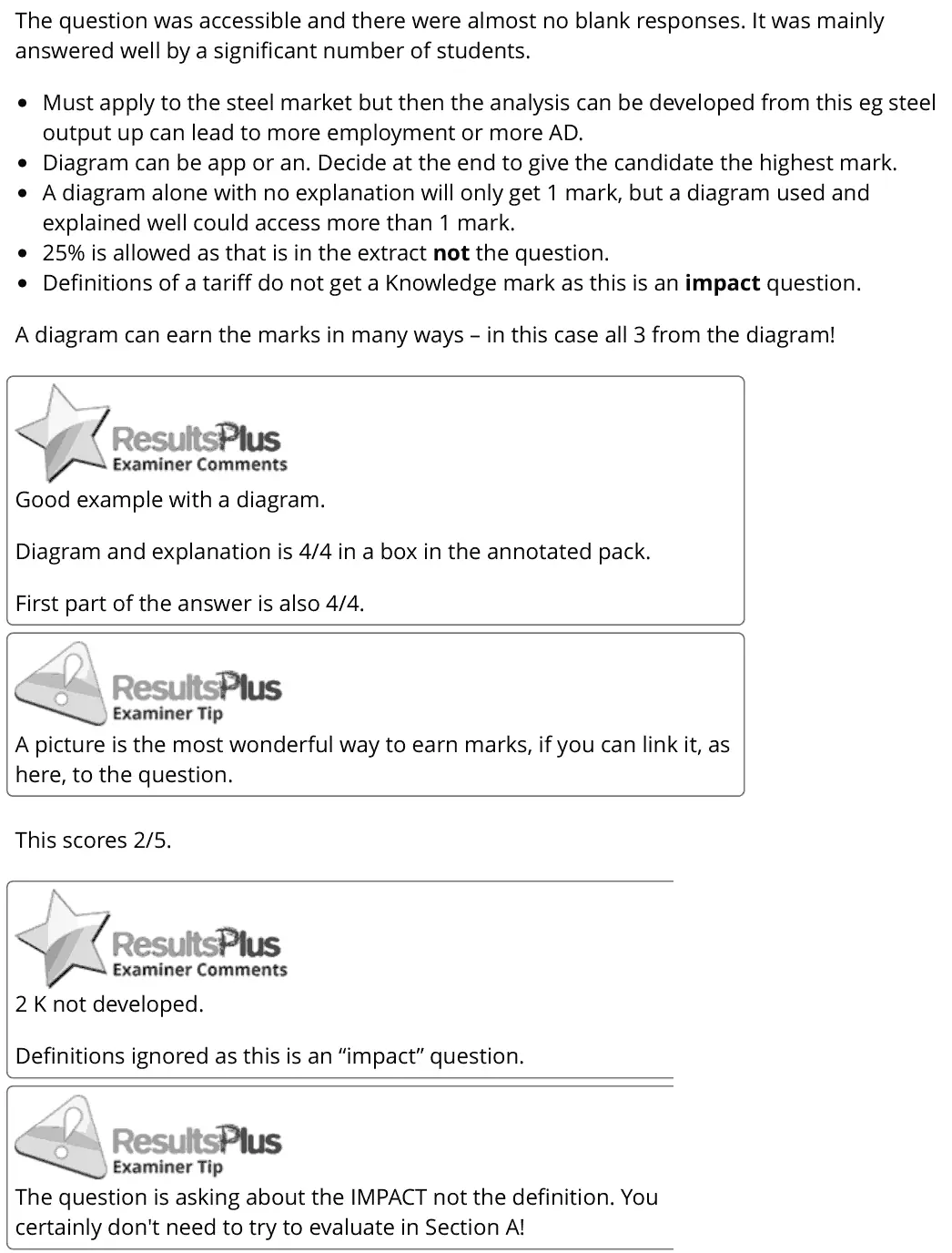
Data and extracts for question 55 In March 2018 the US imposed a tariff of 25% on steel imports from the UK. (Source: adapted from https://www.reuters.com/business/us-uk-announce- plans-formal-talks-metals-tariffs-wednesday-sources-2022-01-19/)
(a) Explain the likely impact of this tariff on the steel market in the US. (4)
June 2024 · Paper 2 · Q5(b) 1 mark Multiple choice globalisation and trade
Data and extracts for question 55 In March 2018 the US imposed a tariff of 25% on steel imports from the UK. (Source: adapted from https://www.reuters.com/business/us-uk-announce- plans-formal-talks-metals-tariffs-wednesday-sources-2022-01-19/)
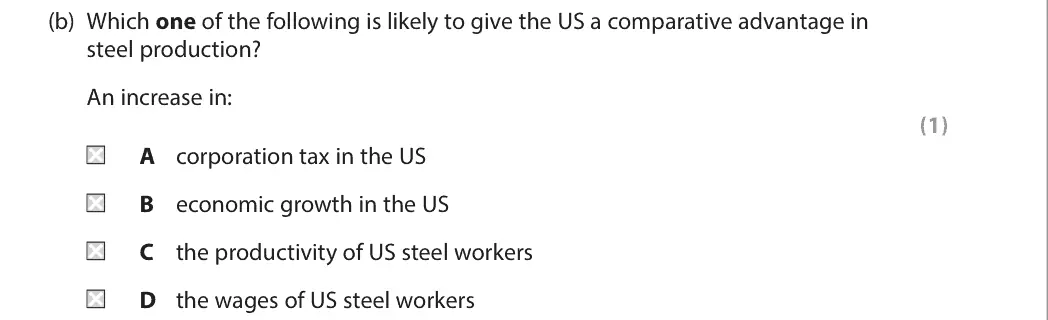
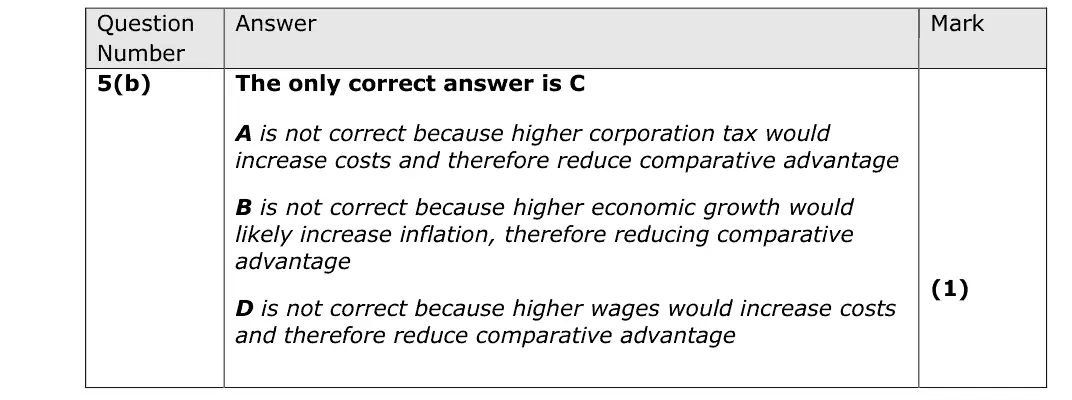
(b) Which one of the following is likely to give the US a comparative advantage in steel production? An increase in: (1) A corporation tax in the US B economic growth in the US C the productivity of US steel workers D the wages of US steel workers
June 2024 · Paper 2 · Q6(a) 5 marks AO1=2, AO2=2, AO3=1 Short answer public finances and taxation
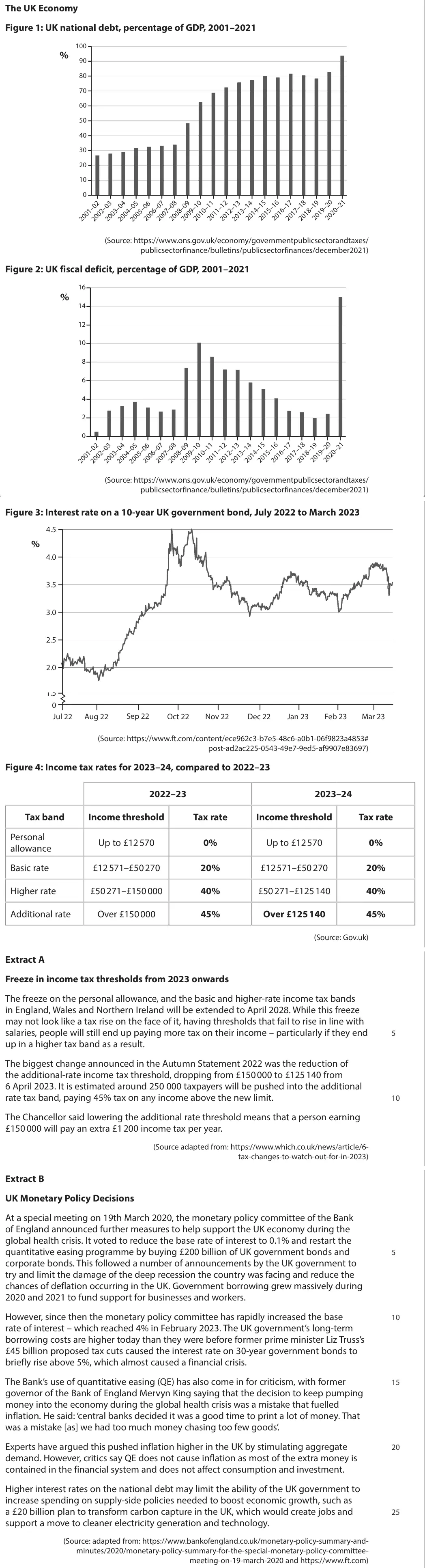
Data and extracts for question 6The UK Economy Figure 1: UK national debt, percentage of GDP, 2001–2021 100 % 90 80 70 60 50 40 30 20 10 0 (Source: https://www.ons.gov.uk/economy/governmentpublicsectorandtaxes/ publicsectorfinance/bulletins/publicsectorfinances/december2021) Figure 2: UK fiscal deficit, percentage of GDP, 2001–2021 16 % 14 12 10 8 6 4 2 0 (Source: https://www.ons.gov.uk/economy/governmentpublicsectorandtaxes/ publicsectorfinance/bulletins/publicsectorfinances/december2021) Figure 3: Interest rate on a 10-year UK government bond, July 2022 to March 2023 4.5 % 4.0 3.5 3.0 2.5 2.0 1.5 0 Sep 22 Jul 22 Aug 22 Oct 22 Nov 22 Dec 22 Jan 23 Feb 23 Mar 23 (Source: https://www.ft.com/content/ece962c3-b7e5-48c6-a0b1-06f9823a4853# post-ad2ac225-0543-49e7-9ed5-af9907e83697) Figure 4: Income tax rates for 2023–24, compared to 2022–23 2022–23 2023–24 Tax band Income threshold Tax rate Income threshold Tax rate Personal Up to £12 570 0% Up to £12 570 0% allowance 20% 20% Basic rate £12 571–£50 270 £12 571–£50 270 Higher rate £50 271–£150 000 40% £50 271–£125 140 40% Additional rate Over £150 000 45% Over £125 140 45% (Source: Gov.uk) Extract A Freeze in income tax thresholds from 2023 onwards The freeze on the personal allowance, and the basic and higher-rate income tax bands in England, Wales and Northern Ireland will be extended to April 2028. While this freeze may not look like a tax rise on the face of it, having thresholds that fail to rise in line with salaries, people will still end up paying more tax on their income – particularly if they end 5 up in a higher tax band as a result. The biggest change announced in the Autumn Statement 2022 was the reduction of the additional-rate income tax threshold, dropping from £150 000 to £125 140 from 6 April 2023. It is estimated around 250 000 taxpayers will be pushed into the additional rate tax band, paying 45% tax on any income above the new limit. 10 The Chancellor said lowering the additional rate threshold means that a person earning £150 000 will pay an extra £1 200 income tax per year. (Source adapted from: https://www.which.co.uk/news/article/6- tax-changes-to-watch-out-for-in-2023) Extract B UK Monetary Policy Decisions At a special meeting on 19th March 2020, the monetary policy committee of the Bank of England announced further measures to help support the UK economy during the global health crisis. It voted to reduce the base rate of interest to 0.1% and restart the quantitative easing programme by buying £200 billion of UK government bonds and 5 corporate bonds. This followed a number of announcements by the UK government to try and limit the damage of the deep recession the country was facing and reduce the chances of deflation occurring in the UK. Government borrowing grew massively during 2020 and 2021 to fund support for businesses and workers. However, since then the monetary policy committee has rapidly increased the base 10 rate of interest – which reached 4% in February 2023. The UK government’s long-term borrowing costs are higher today than they were before former prime minister Liz Truss’s £45 billion proposed tax cuts caused the interest rate on 30-year government bonds to briefly rise above 5%, which almost caused a financial crisis. The Bank’s use of quantitative easing (QE) has also come in for criticism, with former 15 governor of the Bank of England Mervyn King saying that the decision to keep pumping money into the economy during the global health crisis was a mistake that fuelled inflation. He said: ‘central banks decided it was a good time to print a lot of money. That was a mistake [as] we had too much money chasing too few goods’. Experts have argued this pushed inflation higher in the UK by stimulating aggregate 20 demand. However, critics say QE does not cause inflation as most of the extra money is contained in the financial system and does not affect consumption and investment. Higher interest rates on the national debt may limit the ability of the UK government to increase spending on supply-side policies needed to boost economic growth, such as a £20 billion plan to transform carbon capture in the UK, which would create jobs and 25 support a move to cleaner electricity generation and technology. (Source: adapted from: https://www.bankofengland.co.uk/monetary-policy-summary-and- minutes/2020/monetary-policy-summary-for-the-special-monetary-policy-committee- meeting-on-19-march-2020 and https://www.ft.com)
(a) With reference to Figure 4 and your own knowledge, explain the distinction between a progressive and a regressive tax. (5)
June 2024 · Paper 2 · Q6(b) 8 marks AO1=2, AO2=2, AO3=2, AO4=2 8-mark response public finances and taxationaggregate demand
Data and extracts for question 6The UK Economy Figure 1: UK national debt, percentage of GDP, 2001–2021 100 % 90 80 70 60 50 40 30 20 10 0 (Source: https://www.ons.gov.uk/economy/governmentpublicsectorandtaxes/ publicsectorfinance/bulletins/publicsectorfinances/december2021) Figure 2: UK fiscal deficit, percentage of GDP, 2001–2021 16 % 14 12 10 8 6 4 2 0 (Source: https://www.ons.gov.uk/economy/governmentpublicsectorandtaxes/ publicsectorfinance/bulletins/publicsectorfinances/december2021) Figure 3: Interest rate on a 10-year UK government bond, July 2022 to March 2023 4.5 % 4.0 3.5 3.0 2.5 2.0 1.5 0 Sep 22 Jul 22 Aug 22 Oct 22 Nov 22 Dec 22 Jan 23 Feb 23 Mar 23 (Source: https://www.ft.com/content/ece962c3-b7e5-48c6-a0b1-06f9823a4853# post-ad2ac225-0543-49e7-9ed5-af9907e83697) Figure 4: Income tax rates for 2023–24, compared to 2022–23 2022–23 2023–24 Tax band Income threshold Tax rate Income threshold Tax rate Personal Up to £12 570 0% Up to £12 570 0% allowance 20% 20% Basic rate £12 571–£50 270 £12 571–£50 270 Higher rate £50 271–£150 000 40% £50 271–£125 140 40% Additional rate Over £150 000 45% Over £125 140 45% (Source: Gov.uk) Extract A Freeze in income tax thresholds from 2023 onwards The freeze on the personal allowance, and the basic and higher-rate income tax bands in England, Wales and Northern Ireland will be extended to April 2028. While this freeze may not look like a tax rise on the face of it, having thresholds that fail to rise in line with salaries, people will still end up paying more tax on their income – particularly if they end 5 up in a higher tax band as a result. The biggest change announced in the Autumn Statement 2022 was the reduction of the additional-rate income tax threshold, dropping from £150 000 to £125 140 from 6 April 2023. It is estimated around 250 000 taxpayers will be pushed into the additional rate tax band, paying 45% tax on any income above the new limit. 10 The Chancellor said lowering the additional rate threshold means that a person earning £150 000 will pay an extra £1 200 income tax per year. (Source adapted from: https://www.which.co.uk/news/article/6- tax-changes-to-watch-out-for-in-2023) Extract B UK Monetary Policy Decisions At a special meeting on 19th March 2020, the monetary policy committee of the Bank of England announced further measures to help support the UK economy during the global health crisis. It voted to reduce the base rate of interest to 0.1% and restart the quantitative easing programme by buying £200 billion of UK government bonds and 5 corporate bonds. This followed a number of announcements by the UK government to try and limit the damage of the deep recession the country was facing and reduce the chances of deflation occurring in the UK. Government borrowing grew massively during 2020 and 2021 to fund support for businesses and workers. However, since then the monetary policy committee has rapidly increased the base 10 rate of interest – which reached 4% in February 2023. The UK government’s long-term borrowing costs are higher today than they were before former prime minister Liz Truss’s £45 billion proposed tax cuts caused the interest rate on 30-year government bonds to briefly rise above 5%, which almost caused a financial crisis. The Bank’s use of quantitative easing (QE) has also come in for criticism, with former 15 governor of the Bank of England Mervyn King saying that the decision to keep pumping money into the economy during the global health crisis was a mistake that fuelled inflation. He said: ‘central banks decided it was a good time to print a lot of money. That was a mistake [as] we had too much money chasing too few goods’. Experts have argued this pushed inflation higher in the UK by stimulating aggregate 20 demand. However, critics say QE does not cause inflation as most of the extra money is contained in the financial system and does not affect consumption and investment. Higher interest rates on the national debt may limit the ability of the UK government to increase spending on supply-side policies needed to boost economic growth, such as a £20 billion plan to transform carbon capture in the UK, which would create jobs and 25 support a move to cleaner electricity generation and technology. (Source: adapted from: https://www.bankofengland.co.uk/monetary-policy-summary-and- minutes/2020/monetary-policy-summary-for-the-special-monetary-policy-committee- meeting-on-19-march-2020 and https://www.ft.com)
(b) With reference to Figure 4 and Extract A, examine the likely impact of the ‘freeze in income tax thresholds’ (Extract A line 1) on aggregate demand. (8)
June 2024 · Paper 2 · Q6(c) 10 marks AO1=2, AO2=2, AO3=2, AO4=4 10-mark response public finances and taxation
Data and extracts for question 6The UK Economy Figure 1: UK national debt, percentage of GDP, 2001–2021 100 % 90 80 70 60 50 40 30 20 10 0 (Source: https://www.ons.gov.uk/economy/governmentpublicsectorandtaxes/ publicsectorfinance/bulletins/publicsectorfinances/december2021) Figure 2: UK fiscal deficit, percentage of GDP, 2001–2021 16 % 14 12 10 8 6 4 2 0 (Source: https://www.ons.gov.uk/economy/governmentpublicsectorandtaxes/ publicsectorfinance/bulletins/publicsectorfinances/december2021) Figure 3: Interest rate on a 10-year UK government bond, July 2022 to March 2023 4.5 % 4.0 3.5 3.0 2.5 2.0 1.5 0 Sep 22 Jul 22 Aug 22 Oct 22 Nov 22 Dec 22 Jan 23 Feb 23 Mar 23 (Source: https://www.ft.com/content/ece962c3-b7e5-48c6-a0b1-06f9823a4853# post-ad2ac225-0543-49e7-9ed5-af9907e83697) Figure 4: Income tax rates for 2023–24, compared to 2022–23 2022–23 2023–24 Tax band Income threshold Tax rate Income threshold Tax rate Personal Up to £12 570 0% Up to £12 570 0% allowance 20% 20% Basic rate £12 571–£50 270 £12 571–£50 270 Higher rate £50 271–£150 000 40% £50 271–£125 140 40% Additional rate Over £150 000 45% Over £125 140 45% (Source: Gov.uk) Extract A Freeze in income tax thresholds from 2023 onwards The freeze on the personal allowance, and the basic and higher-rate income tax bands in England, Wales and Northern Ireland will be extended to April 2028. While this freeze may not look like a tax rise on the face of it, having thresholds that fail to rise in line with salaries, people will still end up paying more tax on their income – particularly if they end 5 up in a higher tax band as a result. The biggest change announced in the Autumn Statement 2022 was the reduction of the additional-rate income tax threshold, dropping from £150 000 to £125 140 from 6 April 2023. It is estimated around 250 000 taxpayers will be pushed into the additional rate tax band, paying 45% tax on any income above the new limit. 10 The Chancellor said lowering the additional rate threshold means that a person earning £150 000 will pay an extra £1 200 income tax per year. (Source adapted from: https://www.which.co.uk/news/article/6- tax-changes-to-watch-out-for-in-2023) Extract B UK Monetary Policy Decisions At a special meeting on 19th March 2020, the monetary policy committee of the Bank of England announced further measures to help support the UK economy during the global health crisis. It voted to reduce the base rate of interest to 0.1% and restart the quantitative easing programme by buying £200 billion of UK government bonds and 5 corporate bonds. This followed a number of announcements by the UK government to try and limit the damage of the deep recession the country was facing and reduce the chances of deflation occurring in the UK. Government borrowing grew massively during 2020 and 2021 to fund support for businesses and workers. However, since then the monetary policy committee has rapidly increased the base 10 rate of interest – which reached 4% in February 2023. The UK government’s long-term borrowing costs are higher today than they were before former prime minister Liz Truss’s £45 billion proposed tax cuts caused the interest rate on 30-year government bonds to briefly rise above 5%, which almost caused a financial crisis. The Bank’s use of quantitative easing (QE) has also come in for criticism, with former 15 governor of the Bank of England Mervyn King saying that the decision to keep pumping money into the economy during the global health crisis was a mistake that fuelled inflation. He said: ‘central banks decided it was a good time to print a lot of money. That was a mistake [as] we had too much money chasing too few goods’. Experts have argued this pushed inflation higher in the UK by stimulating aggregate 20 demand. However, critics say QE does not cause inflation as most of the extra money is contained in the financial system and does not affect consumption and investment. Higher interest rates on the national debt may limit the ability of the UK government to increase spending on supply-side policies needed to boost economic growth, such as a £20 billion plan to transform carbon capture in the UK, which would create jobs and 25 support a move to cleaner electricity generation and technology. (Source: adapted from: https://www.bankofengland.co.uk/monetary-policy-summary-and- minutes/2020/monetary-policy-summary-for-the-special-monetary-policy-committee- meeting-on-19-march-2020 and https://www.ft.com)
(c) Assess whether a fiscal deficit and national debt should be a cause for concern for the UK government. (10)
June 2024 · Paper 2 · Q6(d) 12 marks AO1=2, AO2=2, AO3=4, AO4=4 12-mark response fiscal and monetary policyfinancial sector
Data and extracts for question 6The UK Economy Figure 1: UK national debt, percentage of GDP, 2001–2021 100 % 90 80 70 60 50 40 30 20 10 0 (Source: https://www.ons.gov.uk/economy/governmentpublicsectorandtaxes/ publicsectorfinance/bulletins/publicsectorfinances/december2021) Figure 2: UK fiscal deficit, percentage of GDP, 2001–2021 16 % 14 12 10 8 6 4 2 0 (Source: https://www.ons.gov.uk/economy/governmentpublicsectorandtaxes/ publicsectorfinance/bulletins/publicsectorfinances/december2021) Figure 3: Interest rate on a 10-year UK government bond, July 2022 to March 2023 4.5 % 4.0 3.5 3.0 2.5 2.0 1.5 0 Sep 22 Jul 22 Aug 22 Oct 22 Nov 22 Dec 22 Jan 23 Feb 23 Mar 23 (Source: https://www.ft.com/content/ece962c3-b7e5-48c6-a0b1-06f9823a4853# post-ad2ac225-0543-49e7-9ed5-af9907e83697) Figure 4: Income tax rates for 2023–24, compared to 2022–23 2022–23 2023–24 Tax band Income threshold Tax rate Income threshold Tax rate Personal Up to £12 570 0% Up to £12 570 0% allowance 20% 20% Basic rate £12 571–£50 270 £12 571–£50 270 Higher rate £50 271–£150 000 40% £50 271–£125 140 40% Additional rate Over £150 000 45% Over £125 140 45% (Source: Gov.uk) Extract A Freeze in income tax thresholds from 2023 onwards The freeze on the personal allowance, and the basic and higher-rate income tax bands in England, Wales and Northern Ireland will be extended to April 2028. While this freeze may not look like a tax rise on the face of it, having thresholds that fail to rise in line with salaries, people will still end up paying more tax on their income – particularly if they end 5 up in a higher tax band as a result. The biggest change announced in the Autumn Statement 2022 was the reduction of the additional-rate income tax threshold, dropping from £150 000 to £125 140 from 6 April 2023. It is estimated around 250 000 taxpayers will be pushed into the additional rate tax band, paying 45% tax on any income above the new limit. 10 The Chancellor said lowering the additional rate threshold means that a person earning £150 000 will pay an extra £1 200 income tax per year. (Source adapted from: https://www.which.co.uk/news/article/6- tax-changes-to-watch-out-for-in-2023) Extract B UK Monetary Policy Decisions At a special meeting on 19th March 2020, the monetary policy committee of the Bank of England announced further measures to help support the UK economy during the global health crisis. It voted to reduce the base rate of interest to 0.1% and restart the quantitative easing programme by buying £200 billion of UK government bonds and 5 corporate bonds. This followed a number of announcements by the UK government to try and limit the damage of the deep recession the country was facing and reduce the chances of deflation occurring in the UK. Government borrowing grew massively during 2020 and 2021 to fund support for businesses and workers. However, since then the monetary policy committee has rapidly increased the base 10 rate of interest – which reached 4% in February 2023. The UK government’s long-term borrowing costs are higher today than they were before former prime minister Liz Truss’s £45 billion proposed tax cuts caused the interest rate on 30-year government bonds to briefly rise above 5%, which almost caused a financial crisis. The Bank’s use of quantitative easing (QE) has also come in for criticism, with former 15 governor of the Bank of England Mervyn King saying that the decision to keep pumping money into the economy during the global health crisis was a mistake that fuelled inflation. He said: ‘central banks decided it was a good time to print a lot of money. That was a mistake [as] we had too much money chasing too few goods’. Experts have argued this pushed inflation higher in the UK by stimulating aggregate 20 demand. However, critics say QE does not cause inflation as most of the extra money is contained in the financial system and does not affect consumption and investment. Higher interest rates on the national debt may limit the ability of the UK government to increase spending on supply-side policies needed to boost economic growth, such as a £20 billion plan to transform carbon capture in the UK, which would create jobs and 25 support a move to cleaner electricity generation and technology. (Source: adapted from: https://www.bankofengland.co.uk/monetary-policy-summary-and- minutes/2020/monetary-policy-summary-for-the-special-monetary-policy-committee- meeting-on-19-march-2020 and https://www.ft.com)
(d) With reference to Extract B, discuss the use of quantitative easing in preventing deflation. (12)
June 2024 · Paper 2 · Q6(e) 15 marks AO1=3, AO2=3, AO3=3, AO4=6 15-mark response supply side policies
Data and extracts for question 6The UK Economy Figure 1: UK national debt, percentage of GDP, 2001–2021 100 % 90 80 70 60 50 40 30 20 10 0 (Source: https://www.ons.gov.uk/economy/governmentpublicsectorandtaxes/ publicsectorfinance/bulletins/publicsectorfinances/december2021) Figure 2: UK fiscal deficit, percentage of GDP, 2001–2021 16 % 14 12 10 8 6 4 2 0 (Source: https://www.ons.gov.uk/economy/governmentpublicsectorandtaxes/ publicsectorfinance/bulletins/publicsectorfinances/december2021) Figure 3: Interest rate on a 10-year UK government bond, July 2022 to March 2023 4.5 % 4.0 3.5 3.0 2.5 2.0 1.5 0 Sep 22 Jul 22 Aug 22 Oct 22 Nov 22 Dec 22 Jan 23 Feb 23 Mar 23 (Source: https://www.ft.com/content/ece962c3-b7e5-48c6-a0b1-06f9823a4853# post-ad2ac225-0543-49e7-9ed5-af9907e83697) Figure 4: Income tax rates for 2023–24, compared to 2022–23 2022–23 2023–24 Tax band Income threshold Tax rate Income threshold Tax rate Personal Up to £12 570 0% Up to £12 570 0% allowance 20% 20% Basic rate £12 571–£50 270 £12 571–£50 270 Higher rate £50 271–£150 000 40% £50 271–£125 140 40% Additional rate Over £150 000 45% Over £125 140 45% (Source: Gov.uk) Extract A Freeze in income tax thresholds from 2023 onwards The freeze on the personal allowance, and the basic and higher-rate income tax bands in England, Wales and Northern Ireland will be extended to April 2028. While this freeze may not look like a tax rise on the face of it, having thresholds that fail to rise in line with salaries, people will still end up paying more tax on their income – particularly if they end 5 up in a higher tax band as a result. The biggest change announced in the Autumn Statement 2022 was the reduction of the additional-rate income tax threshold, dropping from £150 000 to £125 140 from 6 April 2023. It is estimated around 250 000 taxpayers will be pushed into the additional rate tax band, paying 45% tax on any income above the new limit. 10 The Chancellor said lowering the additional rate threshold means that a person earning £150 000 will pay an extra £1 200 income tax per year. (Source adapted from: https://www.which.co.uk/news/article/6- tax-changes-to-watch-out-for-in-2023) Extract B UK Monetary Policy Decisions At a special meeting on 19th March 2020, the monetary policy committee of the Bank of England announced further measures to help support the UK economy during the global health crisis. It voted to reduce the base rate of interest to 0.1% and restart the quantitative easing programme by buying £200 billion of UK government bonds and 5 corporate bonds. This followed a number of announcements by the UK government to try and limit the damage of the deep recession the country was facing and reduce the chances of deflation occurring in the UK. Government borrowing grew massively during 2020 and 2021 to fund support for businesses and workers. However, since then the monetary policy committee has rapidly increased the base 10 rate of interest – which reached 4% in February 2023. The UK government’s long-term borrowing costs are higher today than they were before former prime minister Liz Truss’s £45 billion proposed tax cuts caused the interest rate on 30-year government bonds to briefly rise above 5%, which almost caused a financial crisis. The Bank’s use of quantitative easing (QE) has also come in for criticism, with former 15 governor of the Bank of England Mervyn King saying that the decision to keep pumping money into the economy during the global health crisis was a mistake that fuelled inflation. He said: ‘central banks decided it was a good time to print a lot of money. That was a mistake [as] we had too much money chasing too few goods’. Experts have argued this pushed inflation higher in the UK by stimulating aggregate 20 demand. However, critics say QE does not cause inflation as most of the extra money is contained in the financial system and does not affect consumption and investment. Higher interest rates on the national debt may limit the ability of the UK government to increase spending on supply-side policies needed to boost economic growth, such as a £20 billion plan to transform carbon capture in the UK, which would create jobs and 25 support a move to cleaner electricity generation and technology. (Source: adapted from: https://www.bankofengland.co.uk/monetary-policy-summary-and- minutes/2020/monetary-policy-summary-for-the-special-monetary-policy-committee- meeting-on-19-march-2020 and https://www.ft.com)
(e) Discuss supply-side policies the UK government could introduce to stimulate economic growth. (15)
June 2024 · Paper 2 · Q7 25 marks AO1=4, AO2=4, AO3=8, AO4=9 25-mark essay Either/or balance of paymentsmacroeconomic policy in a global context
7 In 2021 Brazil’s current account deficit on the balance of payments was US$46.12 billion. The Central Bank of Brazil intervened to sell its own currency, the real, on September 23rd 2022. This was the first time it has intervened in foreign currency markets since December 2021. (Source adapted from: https://www.statista.com/statistics and https://www.centralbanking. com/central-banks/reserves/foreign-exchange/7953193/brazil-makes-first-fx-intervention- of-the-year) Evaluate macroeconomic policies that could be used to reduce a current account deficit. Refer to a country of your choice in your answer.
June 2024 · Paper 2 · Q8 25 marks AO1=4, AO2=4, AO3=8, AO4=9 25-mark essay Either/or globalisation and trade
8 In 2020, exports as a share of world GDP were 12% higher than in 2000, almost twice as high as 50 years ago. (Source adapted from: https://www.dhl.com/content/dam/dhl/global/dhl-spotlight/ documents/pdf/2021-gci-update-report.pdf) Evaluate the possible factors contributing to globalisation.

Work with an Edexcel economics tutor

Want a paper marked and gone through with you? Message us.

Prefer email? Send an enquiry

If you are under 18, please include a parent's contact details. Enquiries go to enquiries@economicsaleveltutor.com and are deleted once handled. All tutoring is online.