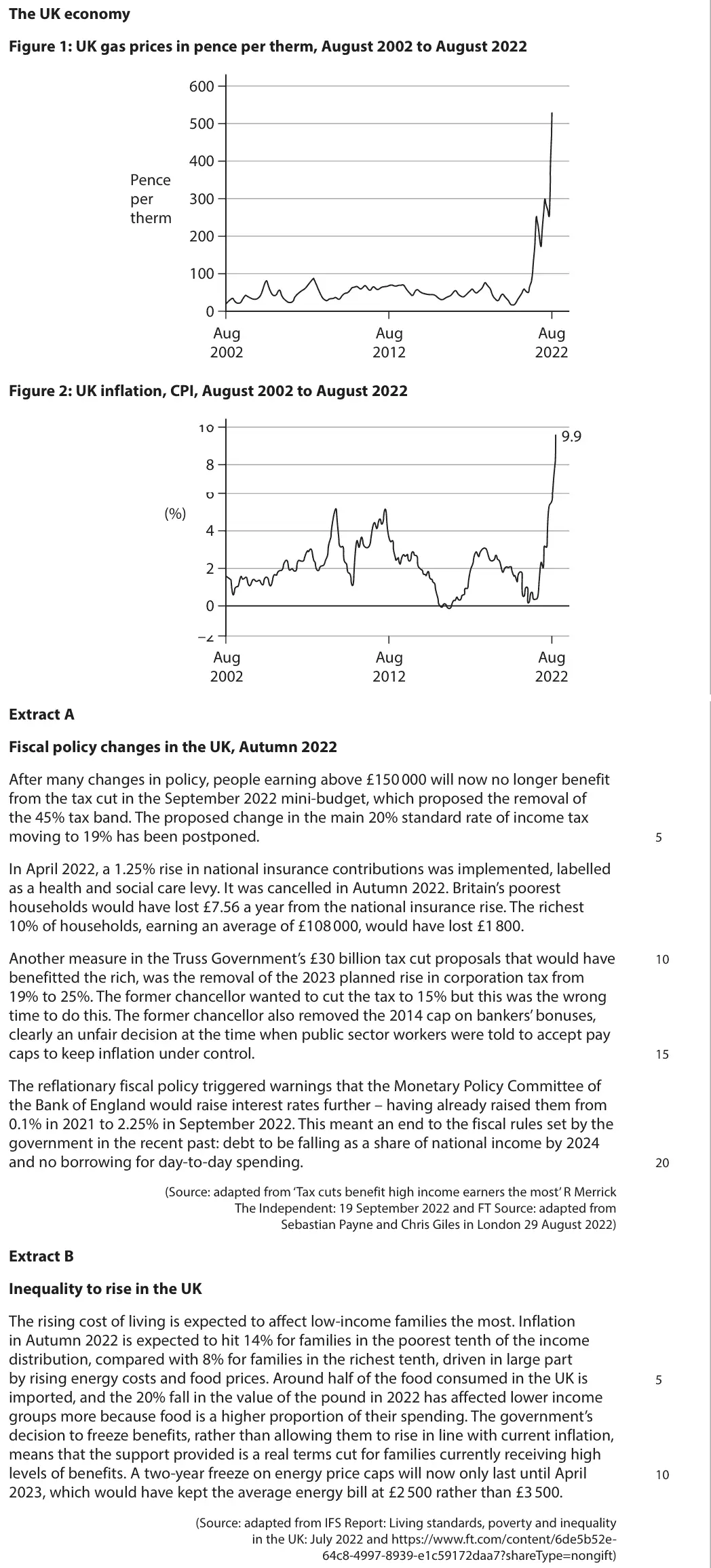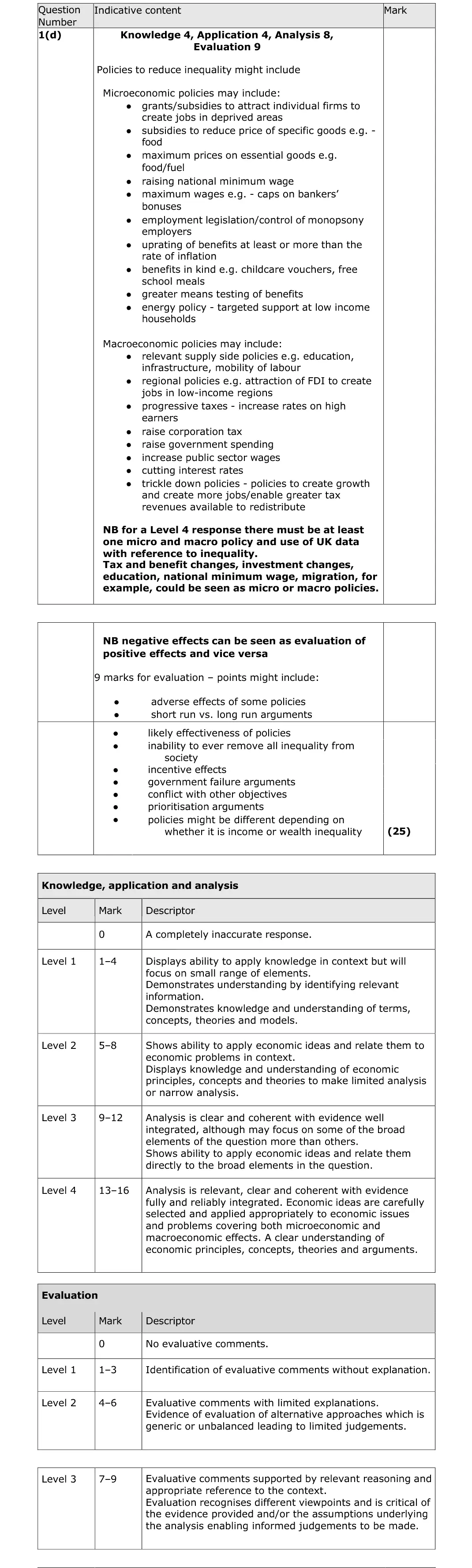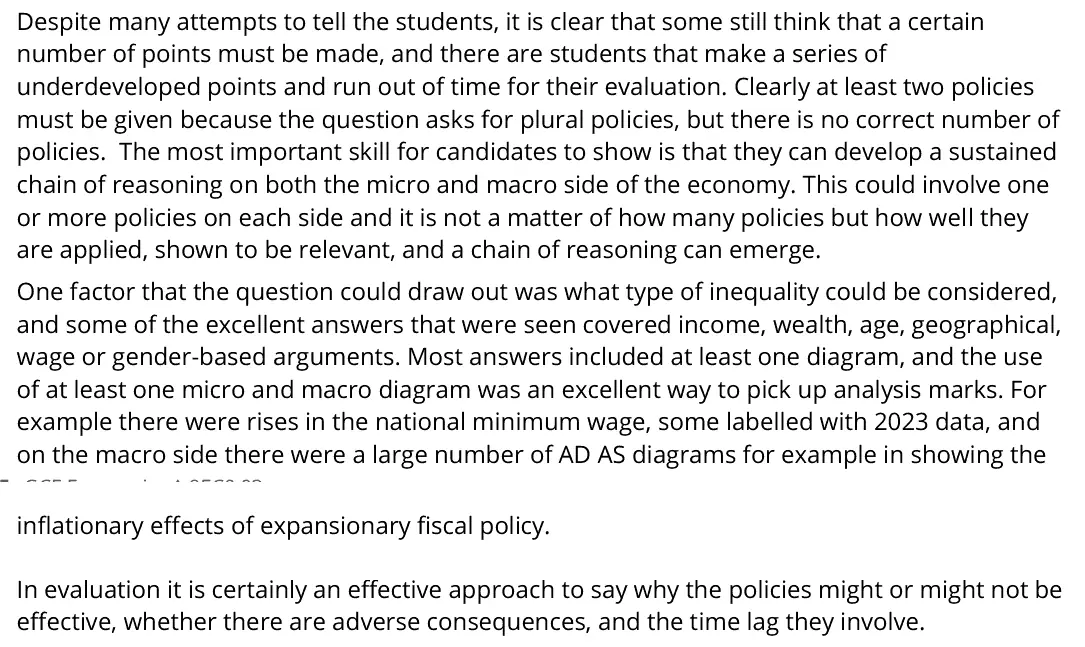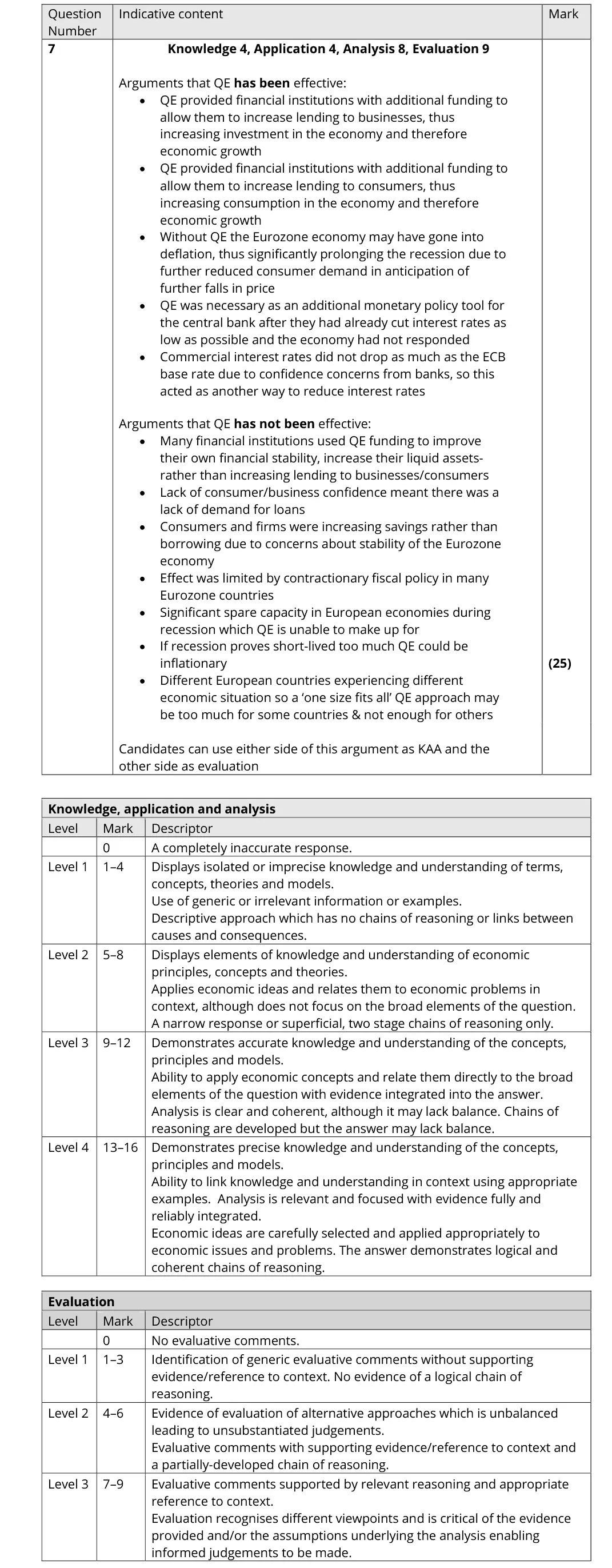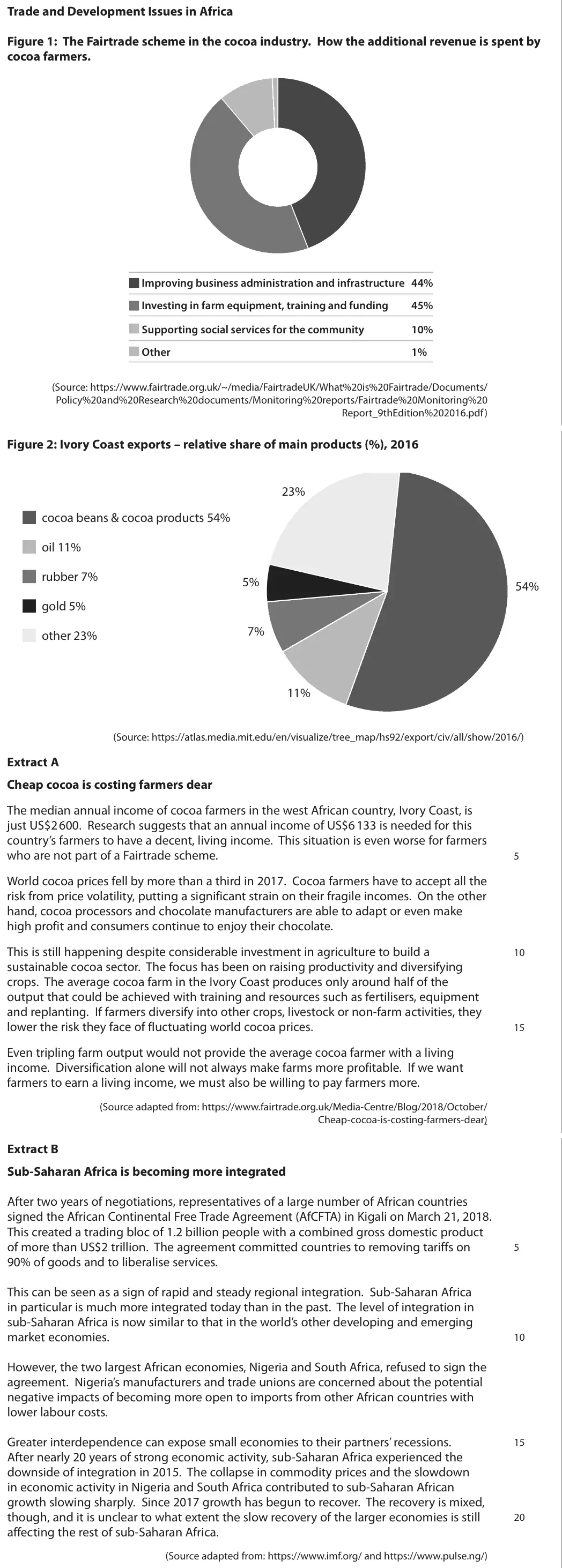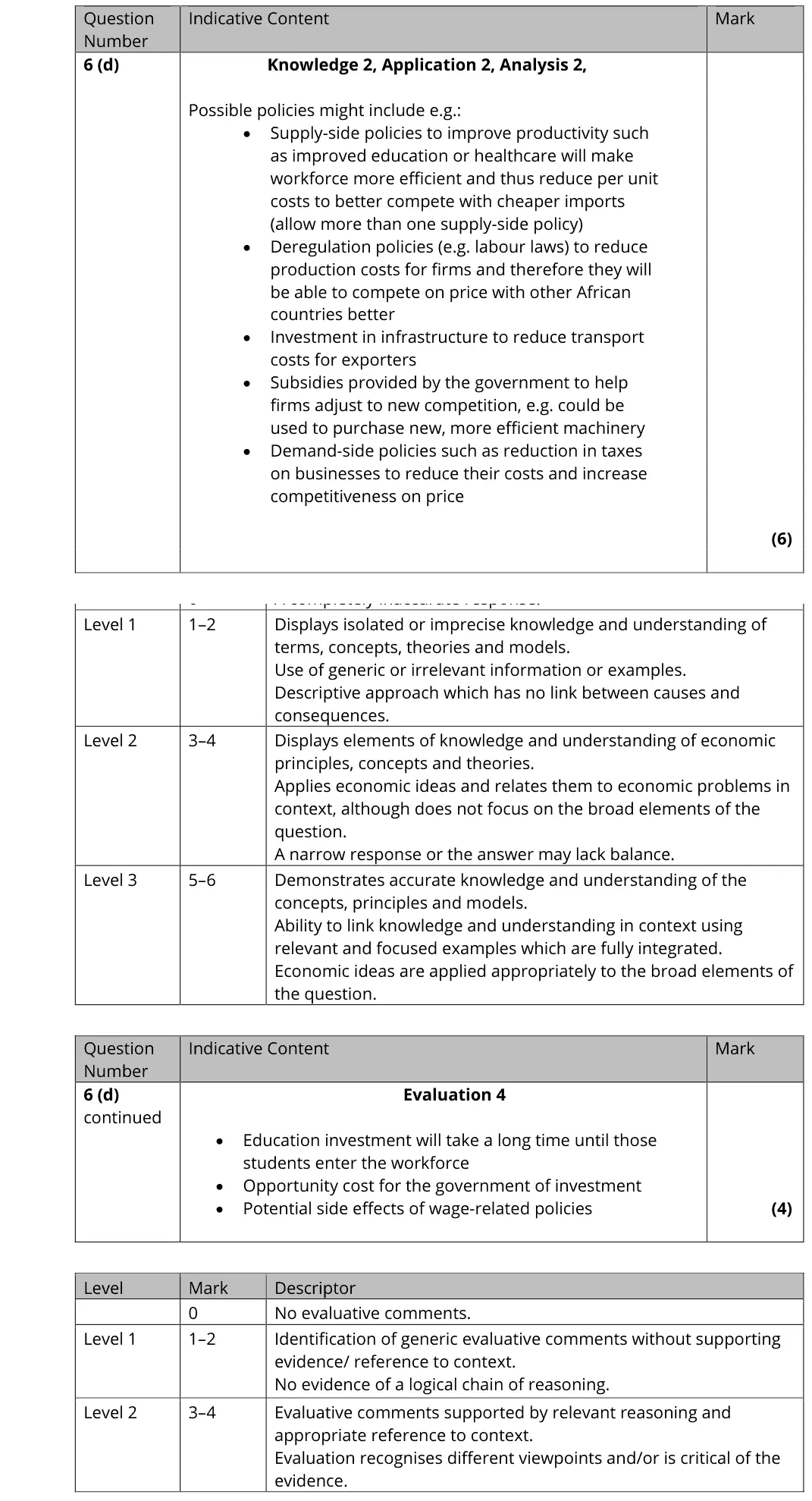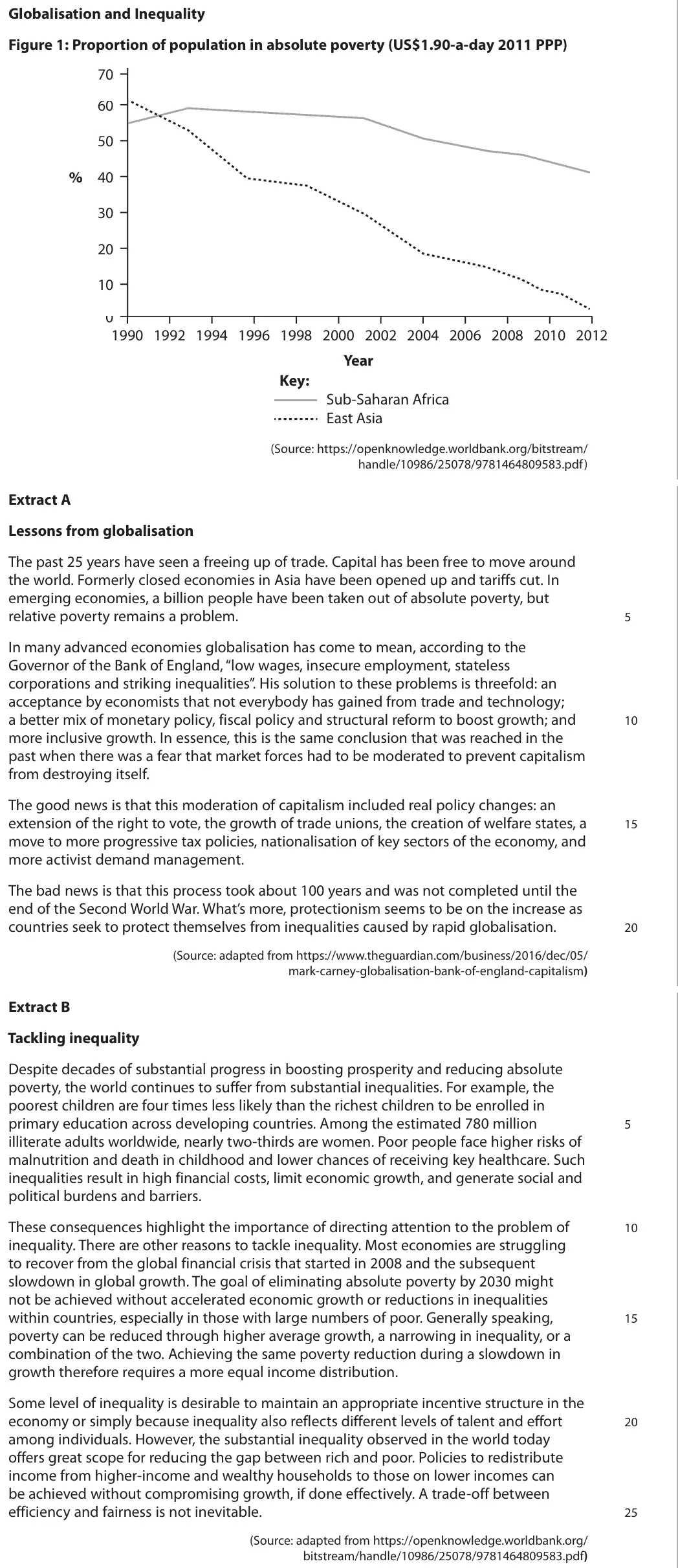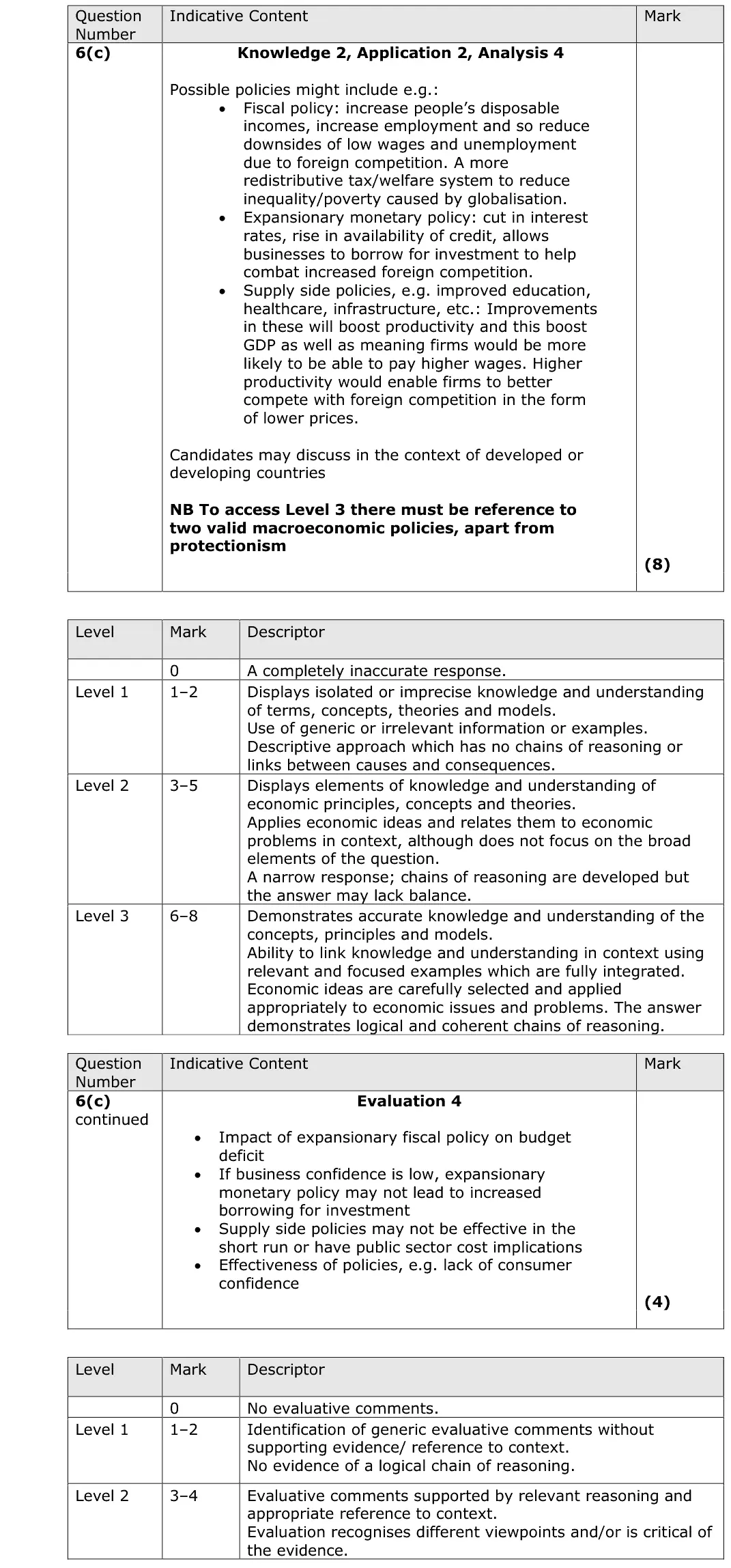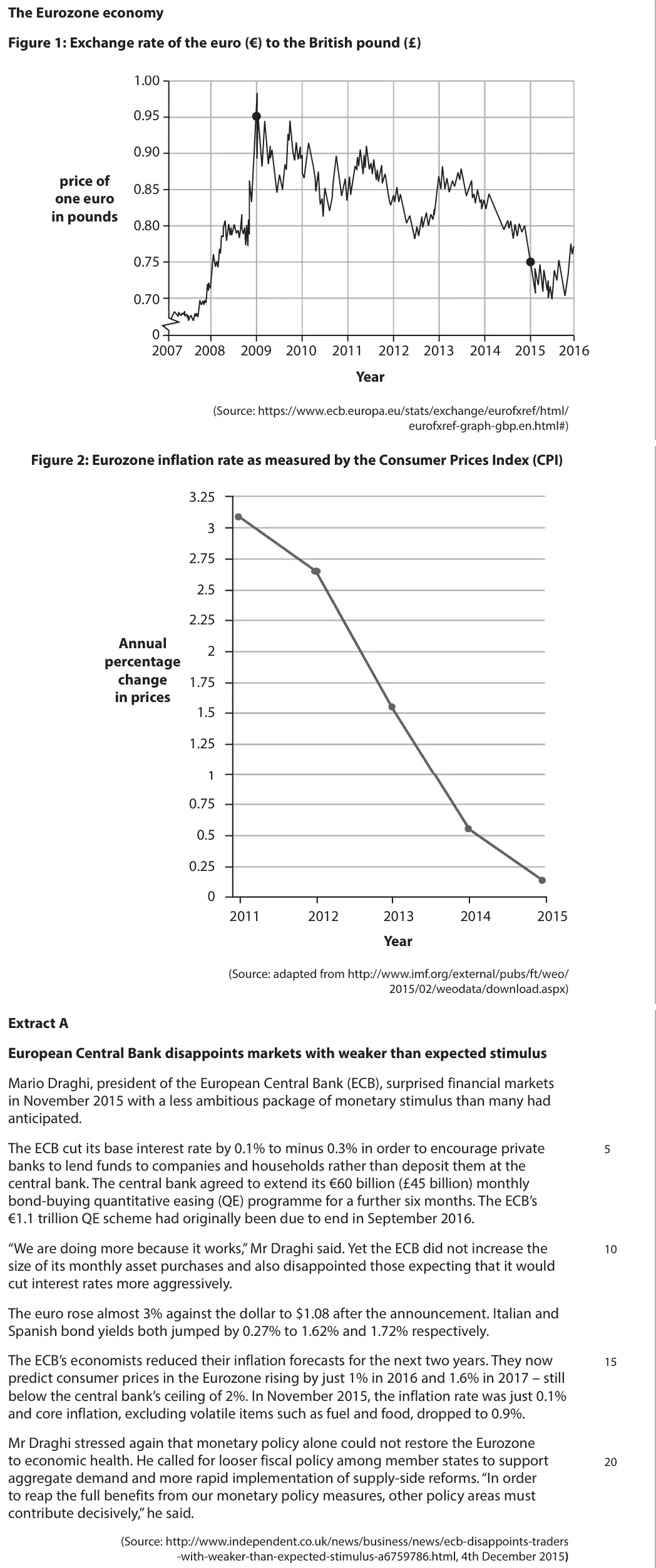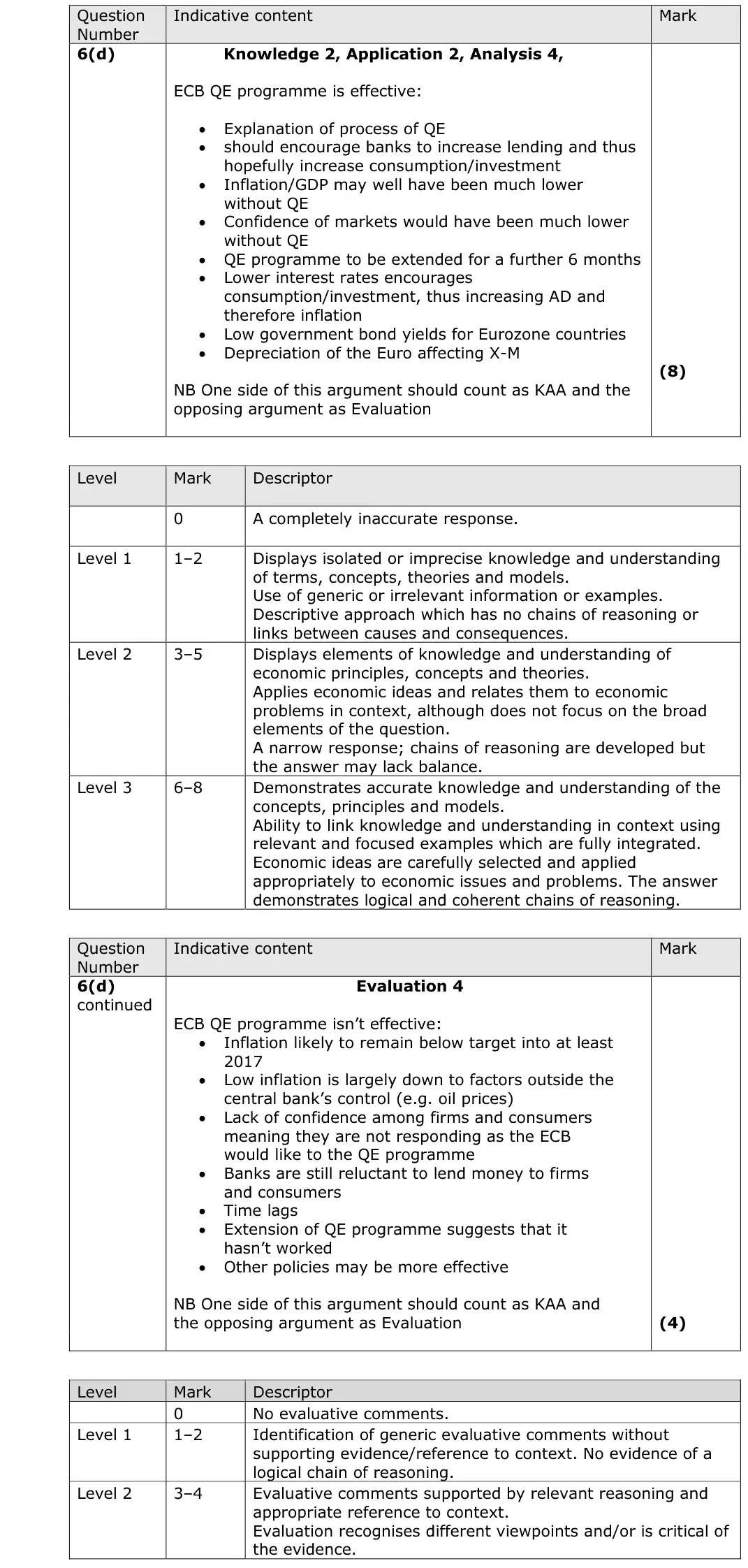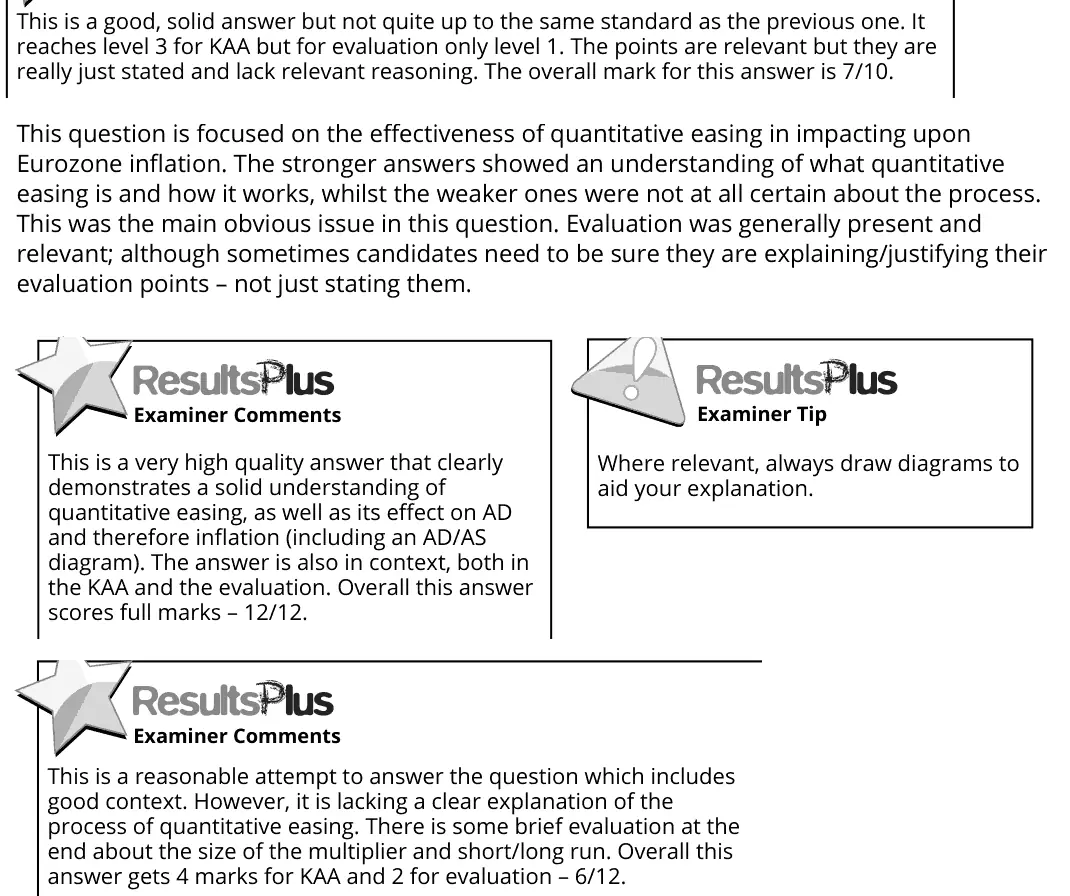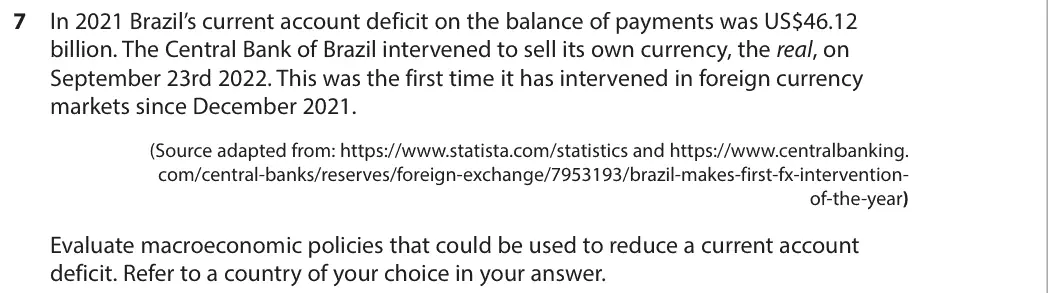
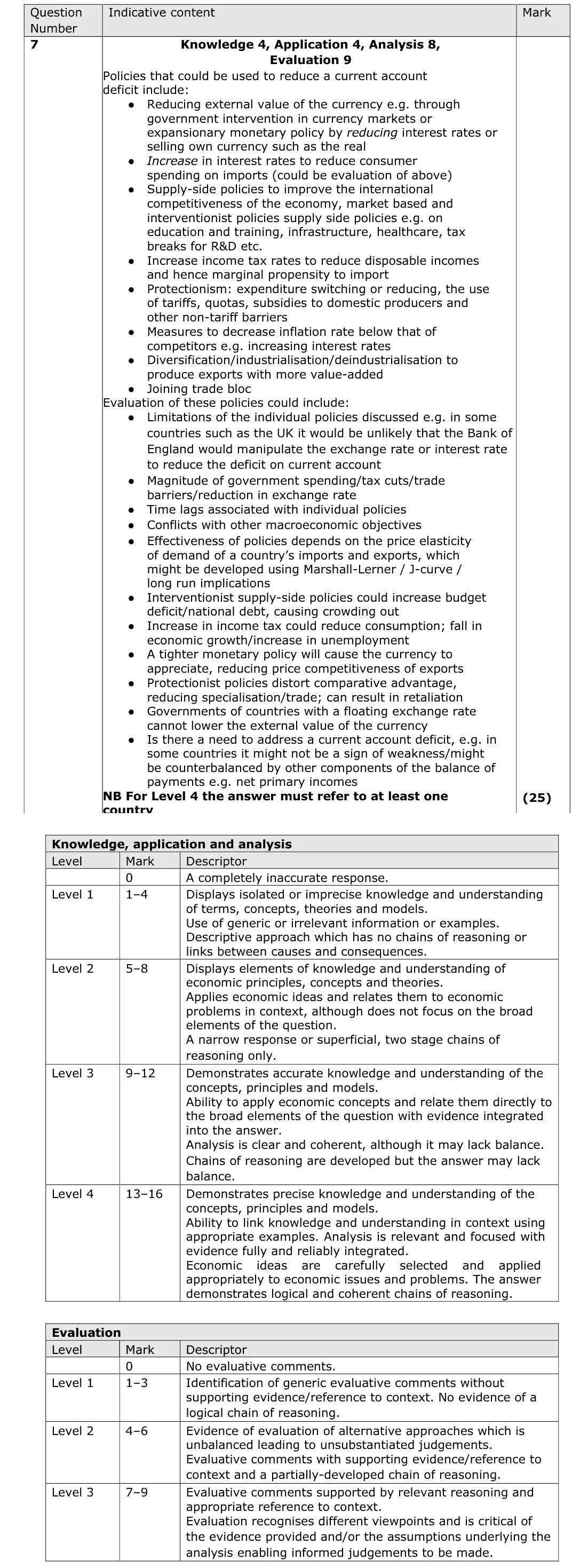
Mark scheme, including the levels grid and indicative content
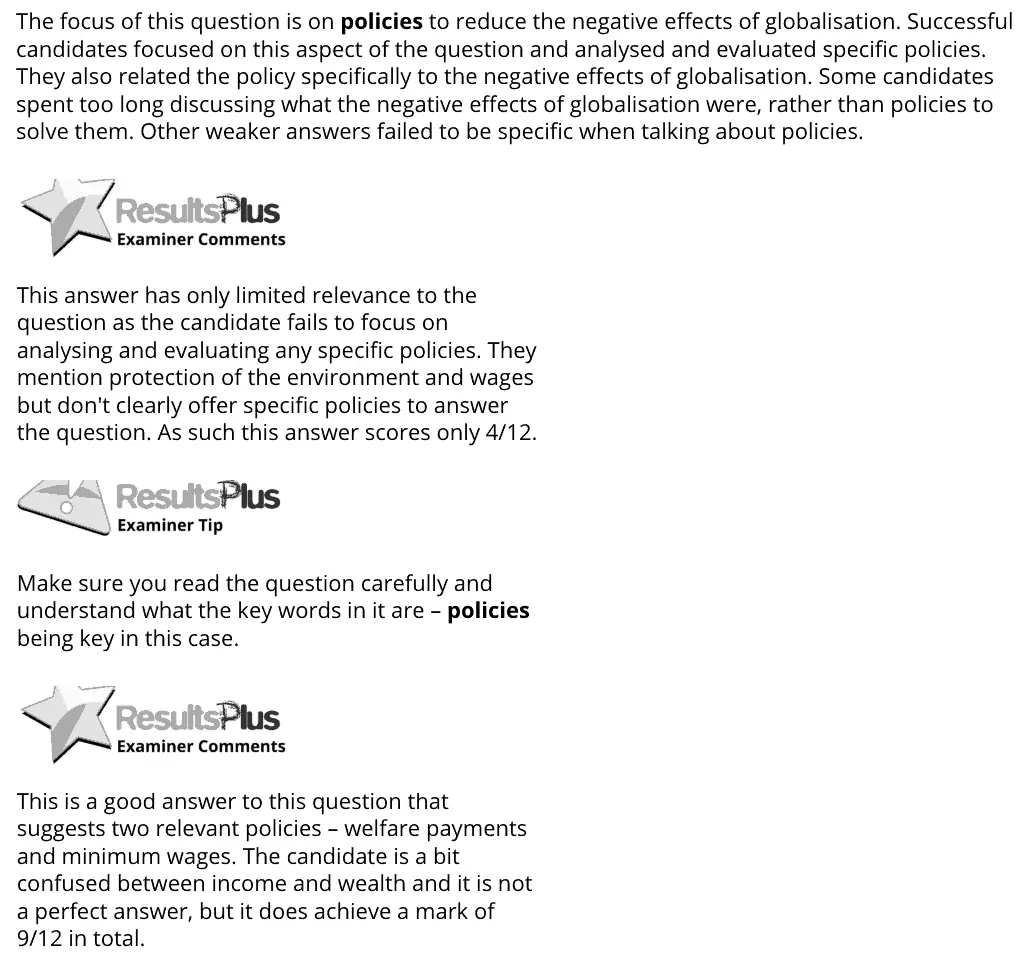
Examiner's comment
This was a surprisingly popular and effective question and enabled students to use theory to support their responses. Again those that used examples and models were rewarded with Level 4 marks. It was also notable that some students still confuse the Current Account deficit and Budget deficit. The question and topic area was straightforward and rehearsed in schools, and many answers were based on countries that were drawn from their own knowledge rather that that of Brazil. The context was very helpful as well used, but it should be reminded to all candidates that there is often a request to use knowledge of at least one developed or developing country. No introduction is required in any answers, and candidates are reminded to simply start by answering the question. Definitions can be a useful way to set the groundwork, but they are not required and the knowledge marks are clearly implicit when a strong argument begins. Since the question is about trade, relevant protectionist diagrams must refer to quantity and/or value of imports. Many candidates employed a basic subsidy diagram, for example, illustrating an outward shift in supply but did not reference the quantity imported at the world price, leading to a lower level of analysis. The Marshall-Lerner condition was effectively used to evaluate the impact of currency depreciation. However, candidates need to do more than merely mention the condition. The J-curve appeared in many answers, and was particularly useful in terms of higher-order evaluation. Advice to students: Try to stick to an evaluation point and develop it fully to get to Level 3. Many able candidates analysed a relevant evaluation point up to Level 2 and then introduced another point within the same paragraph. You only need to make two clear L3 evaluation points/arguments overall, and a final judgement, to be able to achieve 9/9 for evaluation. Country of choice to get to L4. Whatever policies you choose are likely to be valid, but it is unwise to discuss fixing of interest rates or exchange rates in countries such as the UK. Context of Brazil is used by many. Very open to the use of policies. You can use more than one country despite the question saying country, for example you could use a different country as your evaluation point. However if you use many different countries, the impact of your application is likely to be weakened. If the economics is correct then this is enough to hit the levels. Eg UK can manipulate the exchange rate but then explain in the eval it isn’t likely to happen. The evaluation does not need to link with the KAA to gain L2 ev. But the best answers link the evaluation to the point being made Current account/ trade deficit can be used interchangeably The essay does need models and diagrams but they need to be in context, analysed and evaluated on a deep a level as possible. Two points is enough, but there needs to be depth of analysis and evaluation. Para 1: L2+ Para 2: E2 Para 3 : L3 Para 4: E2 Para 5 : J E2 This is a barely Level 3 answer, with L2 eval, so 9 L3 – + 6e L2+ (top L2e for being a good sustained example and there is a judgement) = 15/25 The importance of extending your analysis in context of a real world example cannot be stressed enough! You are of course allowed to use Brazil for the data context – but you really must apply everything you can even if you haven't studied that country. The question tells you about the type of exchange rate system (managed) and that should be your starting point. It's not the UK after all! Para 1: L4 Para 2: E3 Diagram is contextualised Para 3: L4 Para 4: E3 Lack of context/application is the reason for the 14/16. There is inconsistency with analysis and diagram. Ev L3 – 7/9 14+7 = 21/25 Make sure you write about the diagram you have drawn, and explain it. Examiners do love diagrams, but they must be integrated into the analysis.
Notes from the mark scheme and report
- policies: depreciation via intervention or lower rates (Marshall-Lerner, J-curve), deflationary fiscal policy, supply-side policies for competitiveness, protectionism
- refer to a country of choice
- report: some still confuse the current account deficit with the budget deficit
- protection diagrams must show the effect on imports