June 2022: AS Paper 1

80 marks · 18 question parts · Paper, mark scheme and report on Pearson's site

Question by question

QTopicMarksAOType
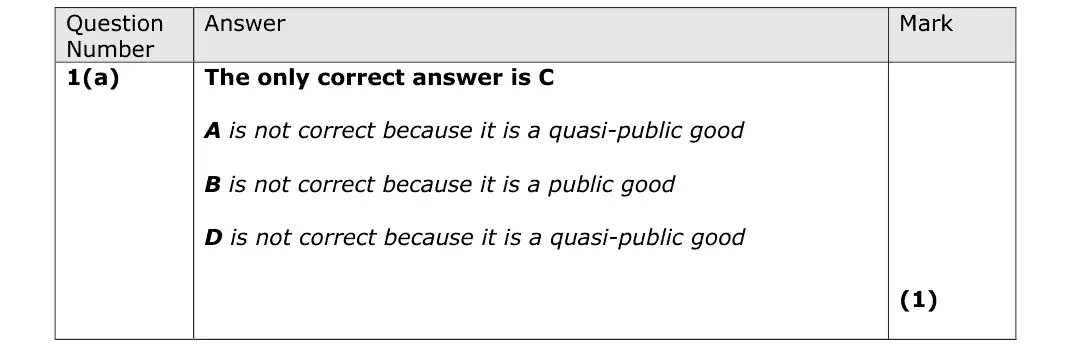
1(a) Public goods and information gaps 1Multiple choice
1(b) Public goods and information gaps, Government intervention in markets 3AO1=1,AO2=1,AO3=1Short answer
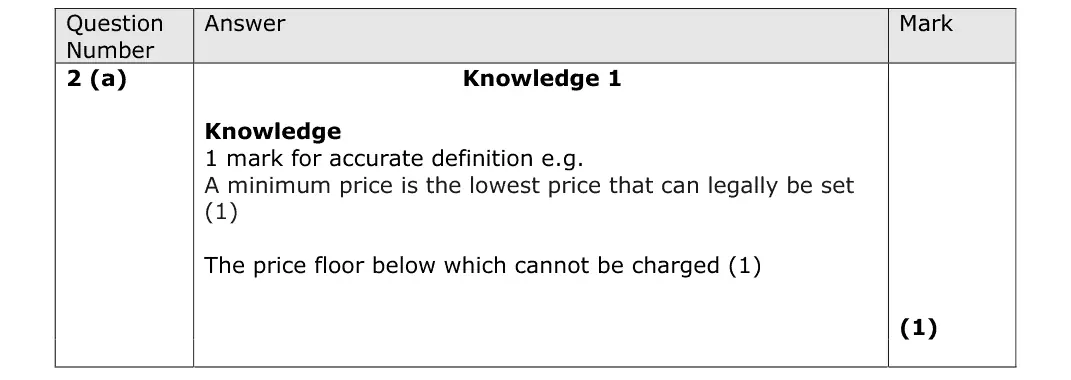
2(a) Government intervention in markets 1AO1=1Definition
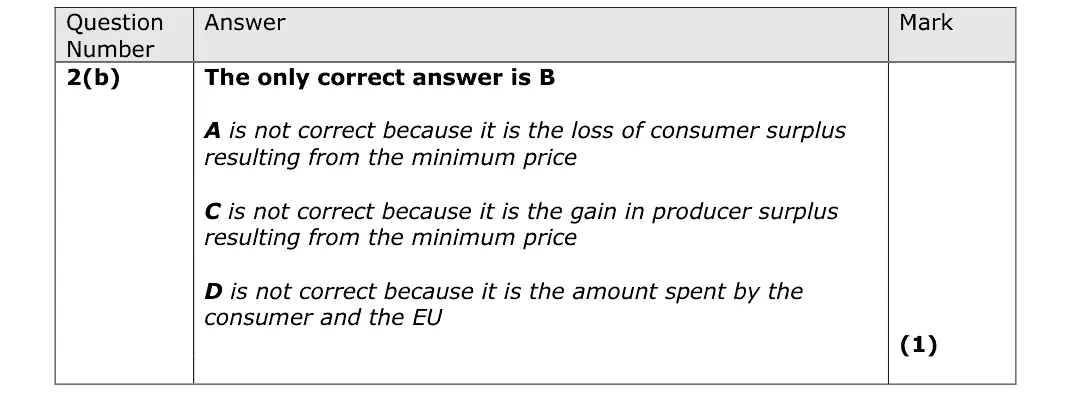
2(b) Government intervention in markets 1Multiple choice
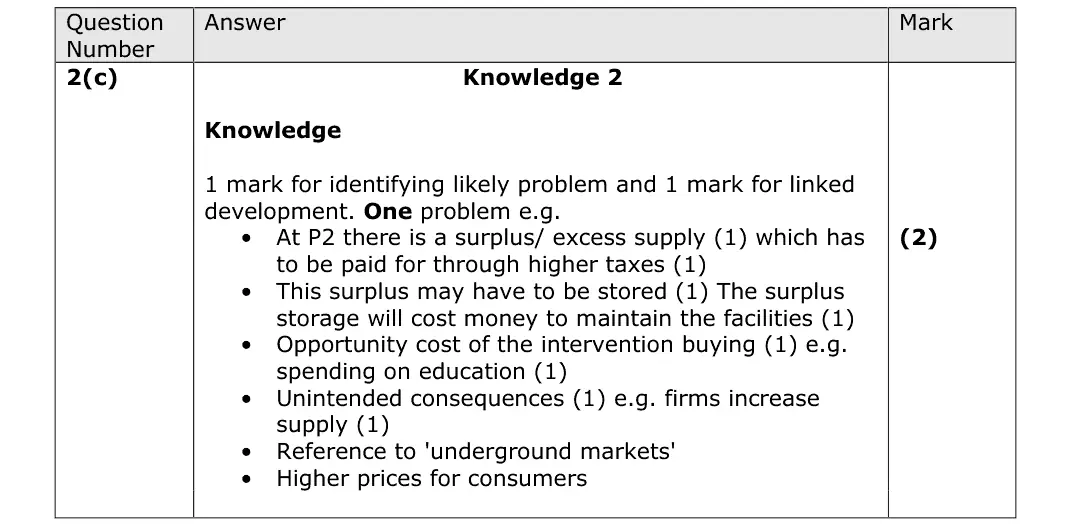
2(c) Government failure 2AO1=2Short answer
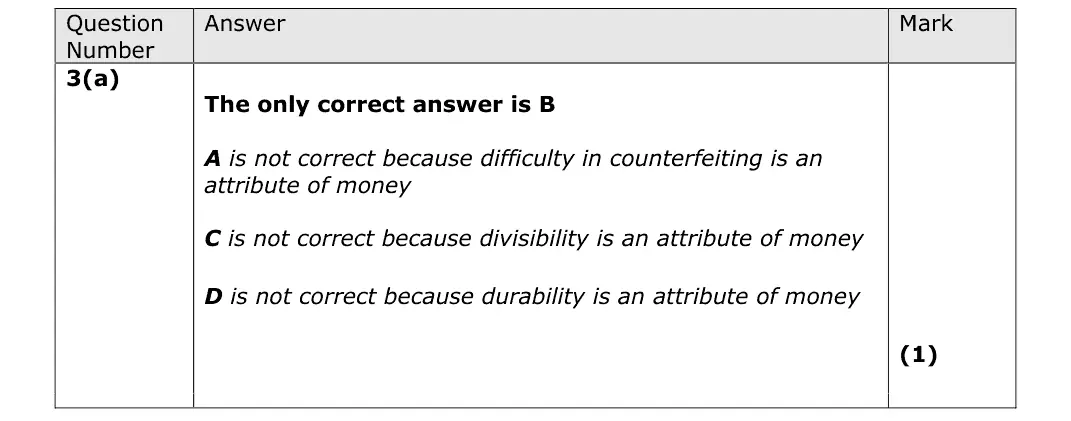
3(a) Specialisation and the division of labour 1Multiple choice
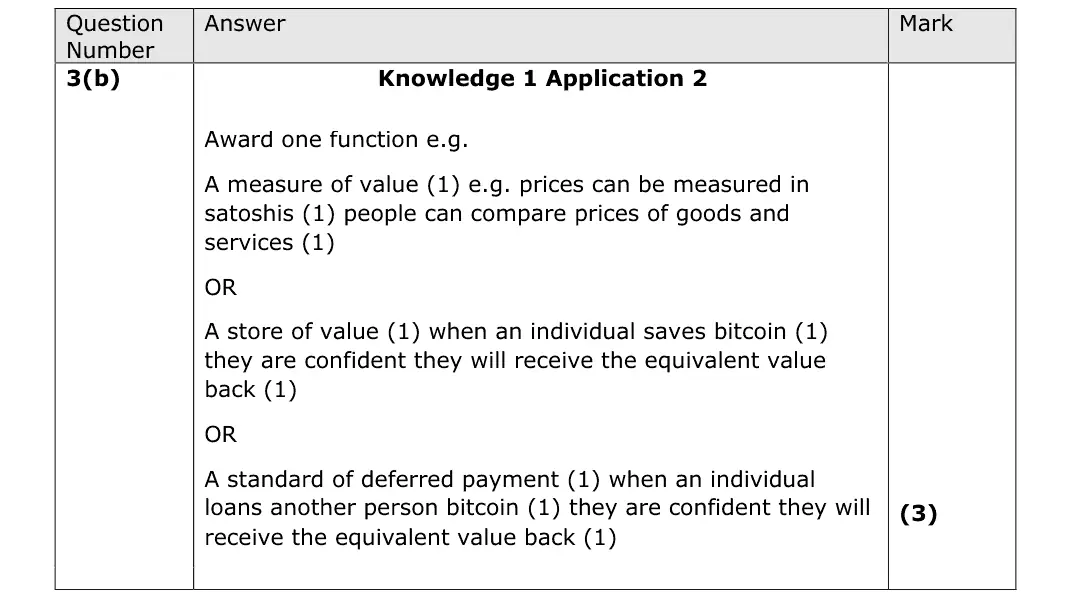
3(b) Specialisation and the division of labour 3AO1=1,AO2=2Short answer
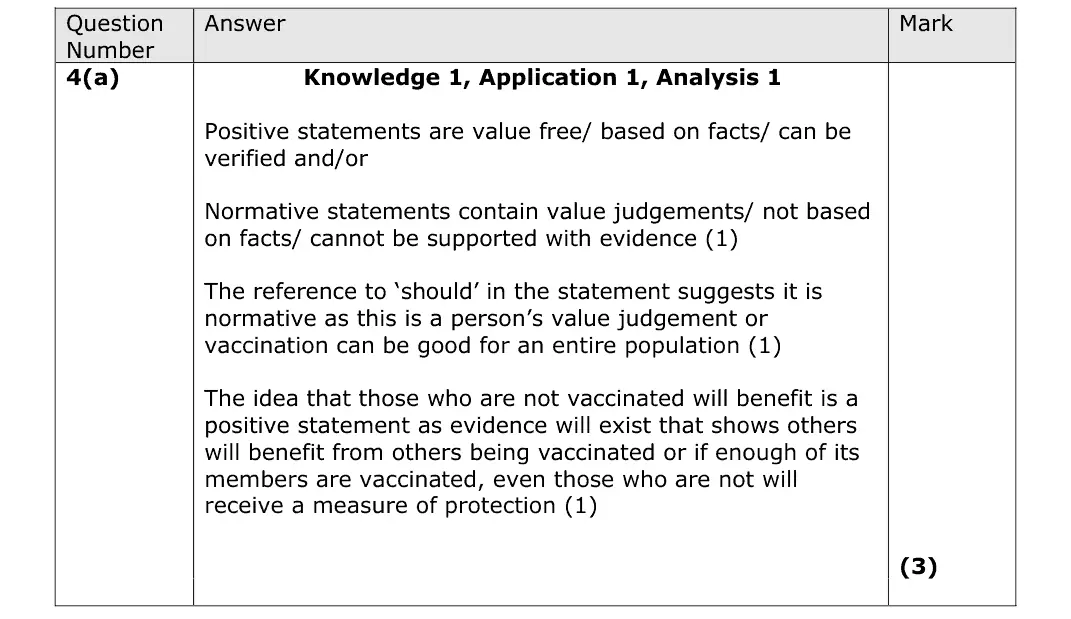
4(a) The nature of economics and the economic problem 3AO1=1,AO2=1,AO3=1Short answer
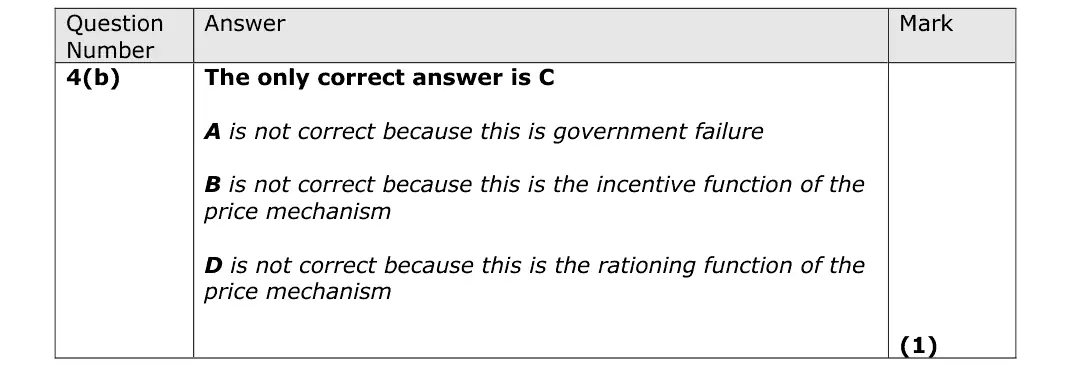
4(b) Market failure and externalities 1Multiple choice
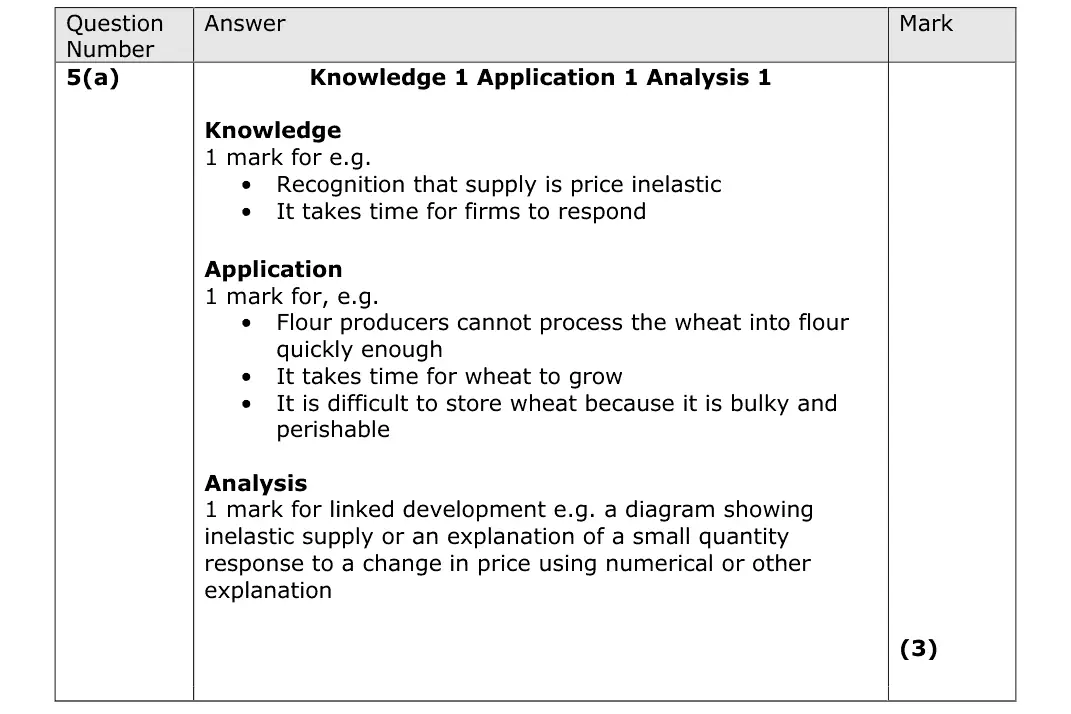
5(a) Price elasticity of supply 3AO1=1,AO2=1,AO3=1Short answer
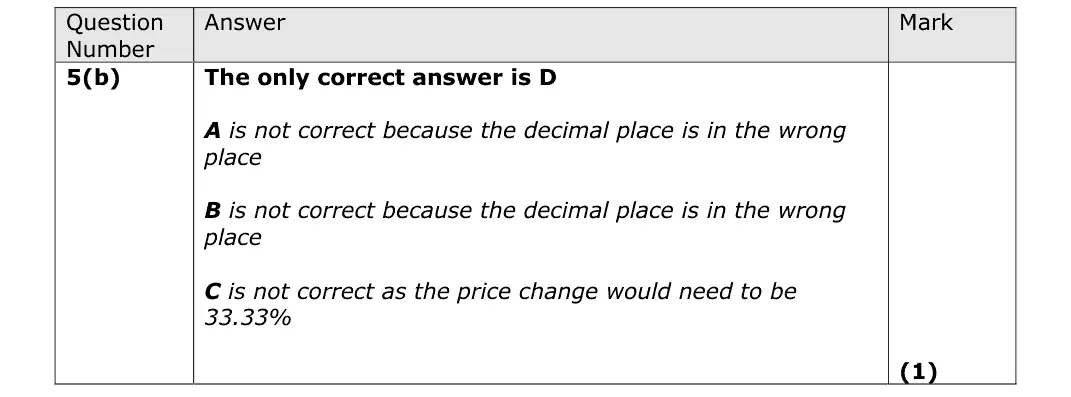
5(b) Price elasticity of supply 1Multiple choice
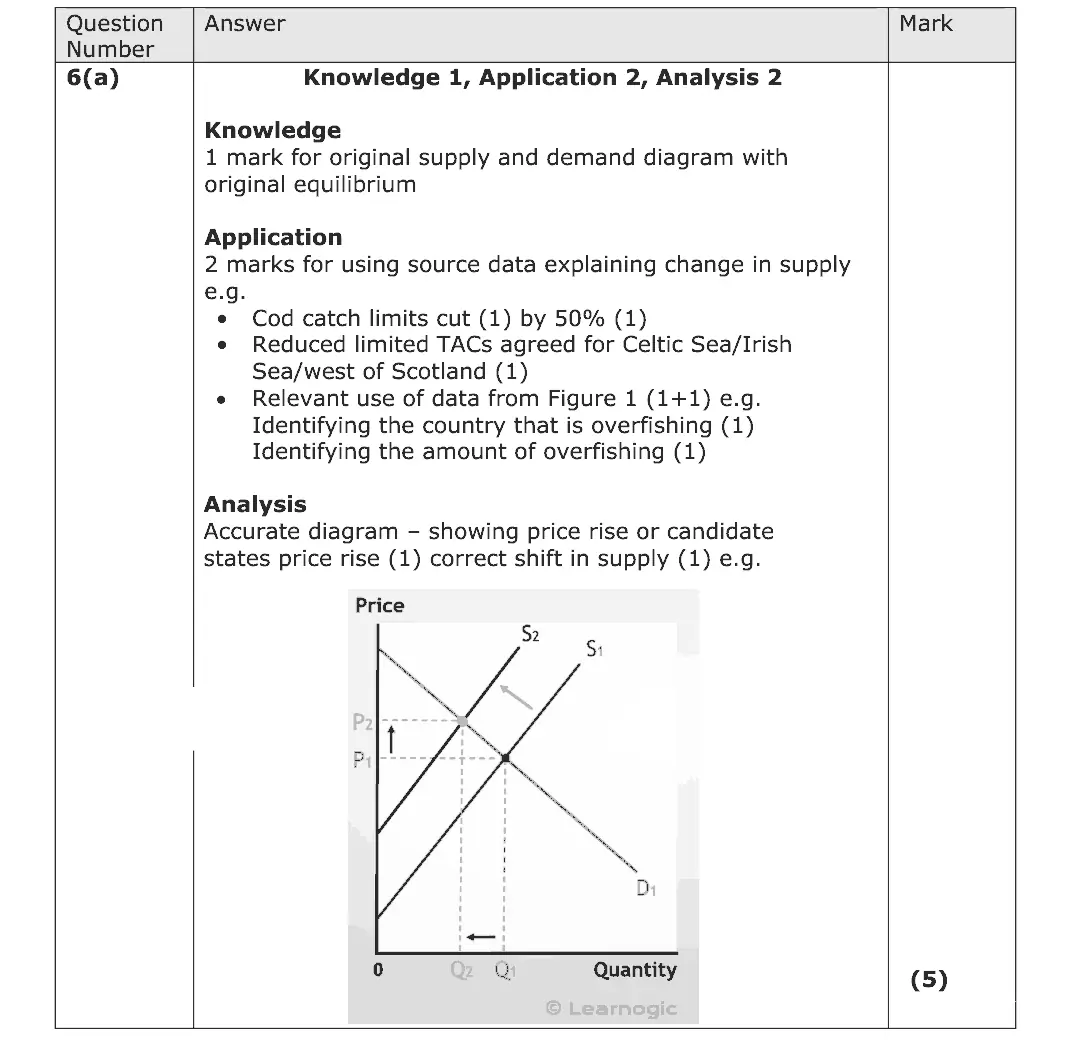
6(a) Supply, demand and price determination, Government intervention in markets 5AO1=1,AO2=2,AO3=2Diagram
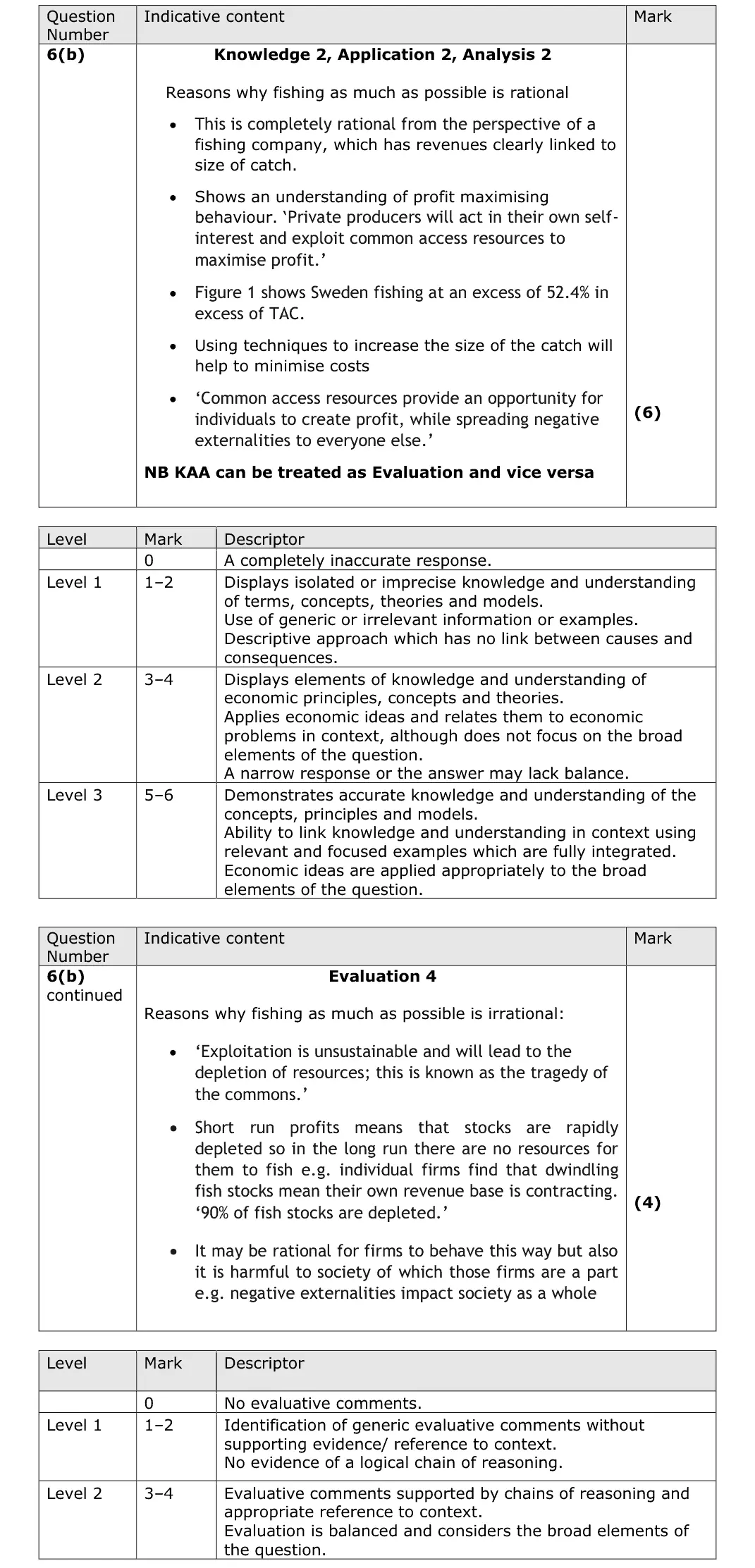
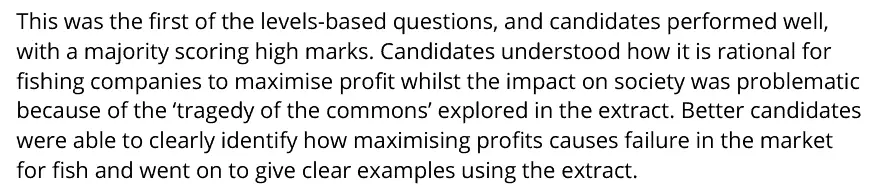
6(b) Rational decision making and behavioural economics 10AO1=2,AO2=2,AO3=2,AO4=4Extended response
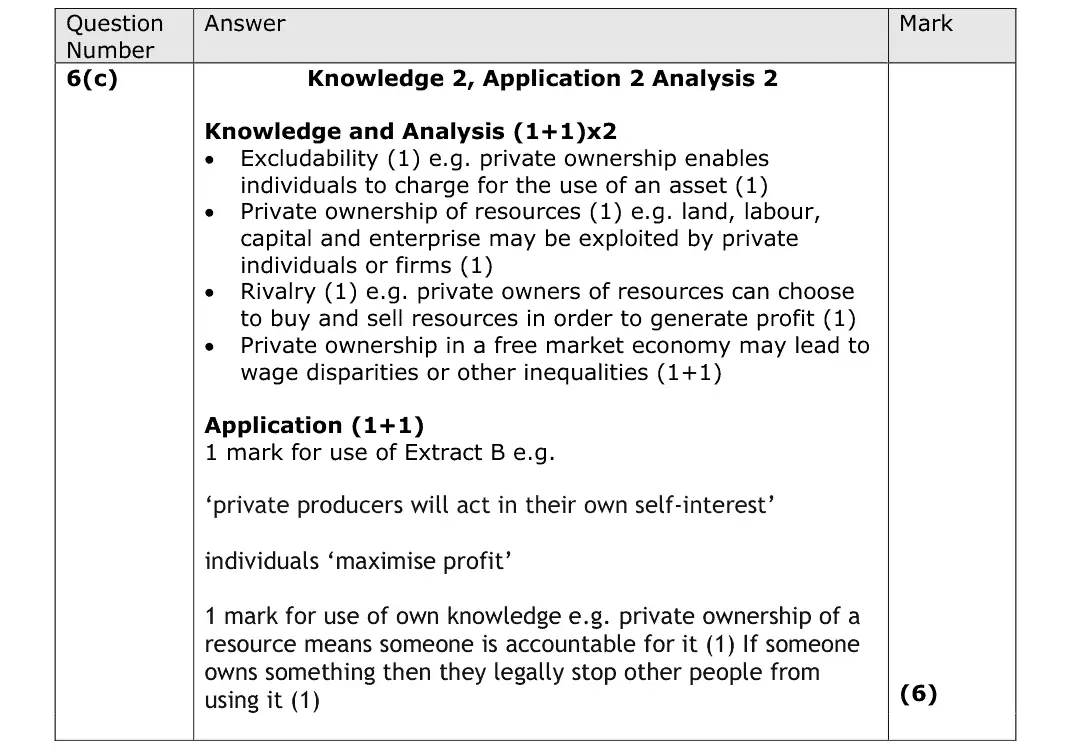
6(c) Free market, mixed and command economies 6AO1=2,AO2=2,AO3=2Short answer
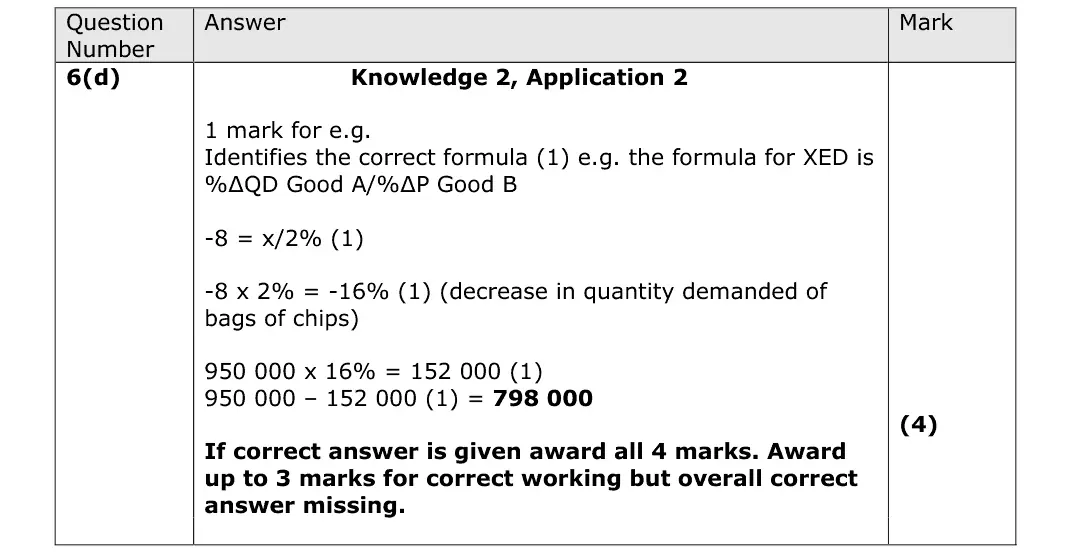
6(d) Price, income and cross elasticities of demand 4AO1=2,AO2=2Calculation
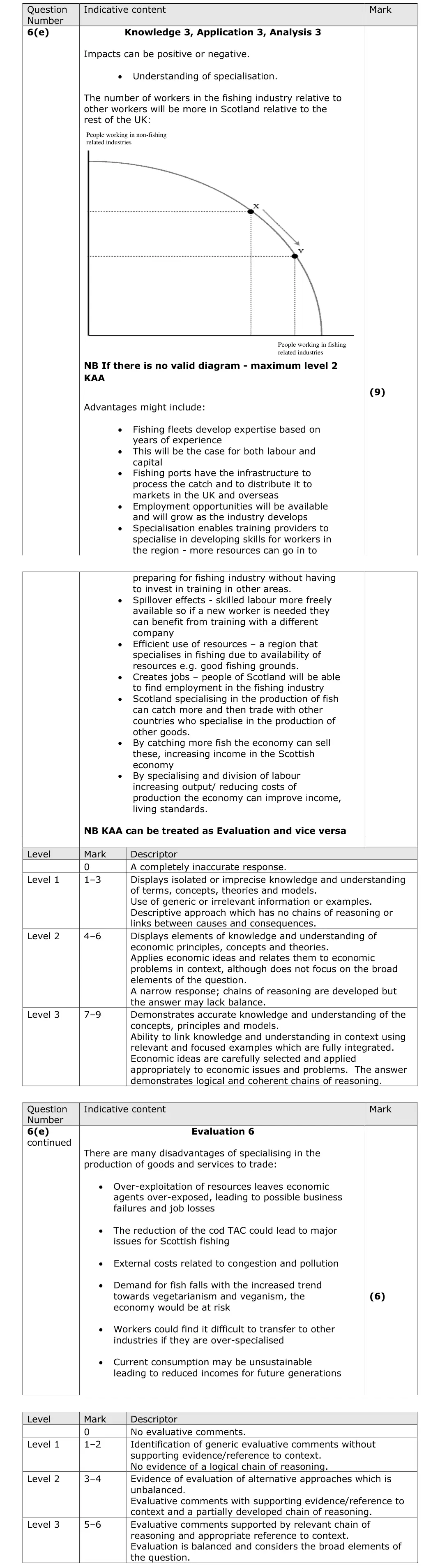
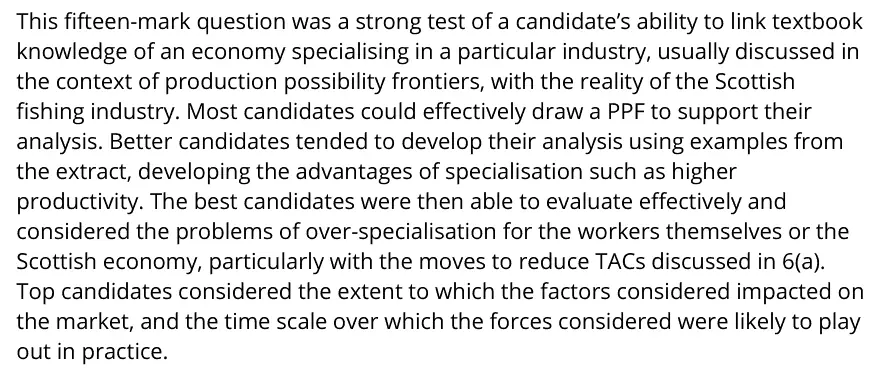
6(e) Specialisation and the division of labour 15AO1=3,AO2=3,AO3=3,AO4=6Extended response
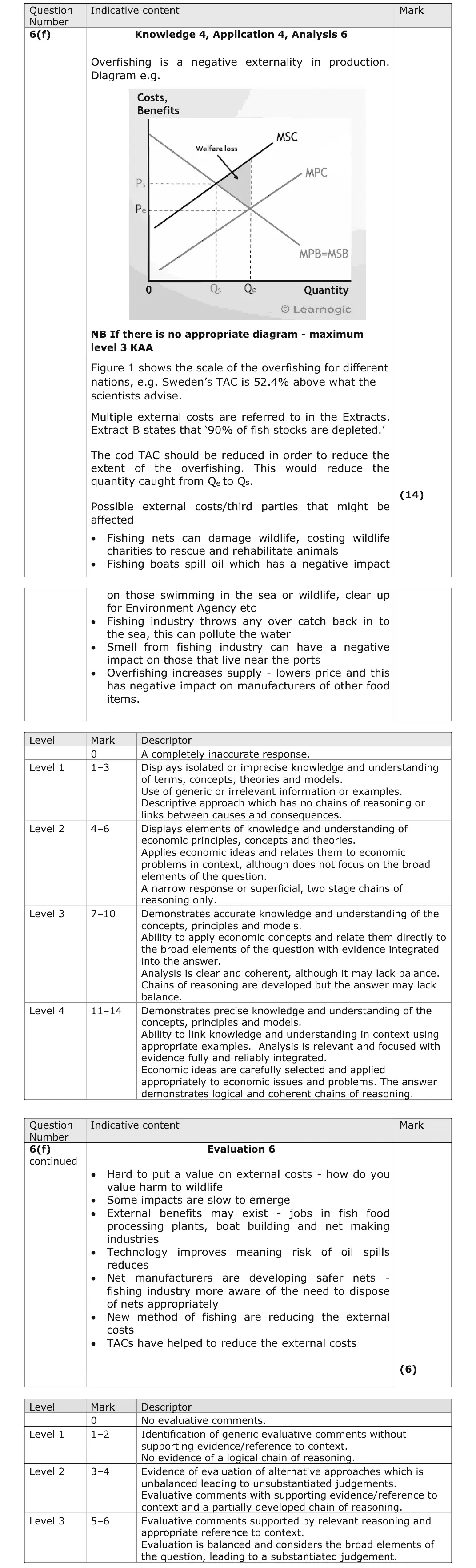
6(f) Market failure and externalities 20AO1=4,AO2=4,AO3=6,AO4=6Essay
6(g) Government intervention in markets 20AO1=4,AO2=4,AO3=6,AO4=6Essay

The questions

1(a)1(b)2(a)2(b)2(c)3(a)3(b)4(a)4(b)5(a)5(b)6(a)6(b)6(c)6(d)6(e)6(f)6(g)
June 2022 · AS Paper 1 · Q1(a) 1 mark Multiple choice public goods and information gaps
Data and extracts for question 11 Since 2015, the government has invested £74 million on a flood defence scheme in the Calder Valley. The scheme will protect homes, businesses and jobs. (Source: https://www.theguardian.com/uk-news/2020/feb/10/yorkshire-residents-criticise- delays-to-flood-defence-scheme)
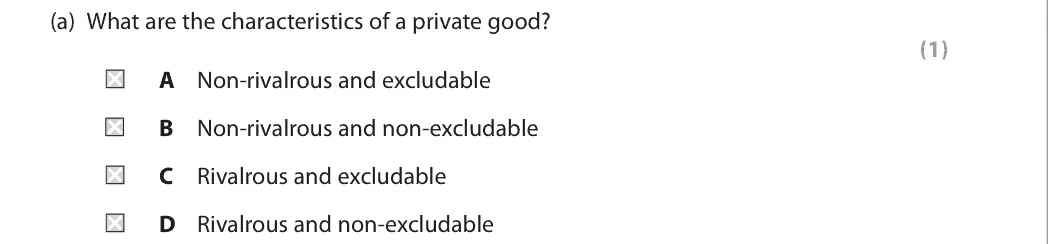
(a) What are the characteristics of a private good? (1) A Non-rivalrous and excludable B Non-rivalrous and non-excludable C Rivalrous and excludable D Rivalrous and non-excludable
June 2022 · AS Paper 1 · Q1(b) 3 marks AO1=1, AO2=1, AO3=1 Short answer public goods and information gapsgovernment intervention in markets
Data and extracts for question 11 Since 2015, the government has invested £74 million on a flood defence scheme in the Calder Valley. The scheme will protect homes, businesses and jobs. (Source: https://www.theguardian.com/uk-news/2020/feb/10/yorkshire-residents-criticise- delays-to-flood-defence-scheme)
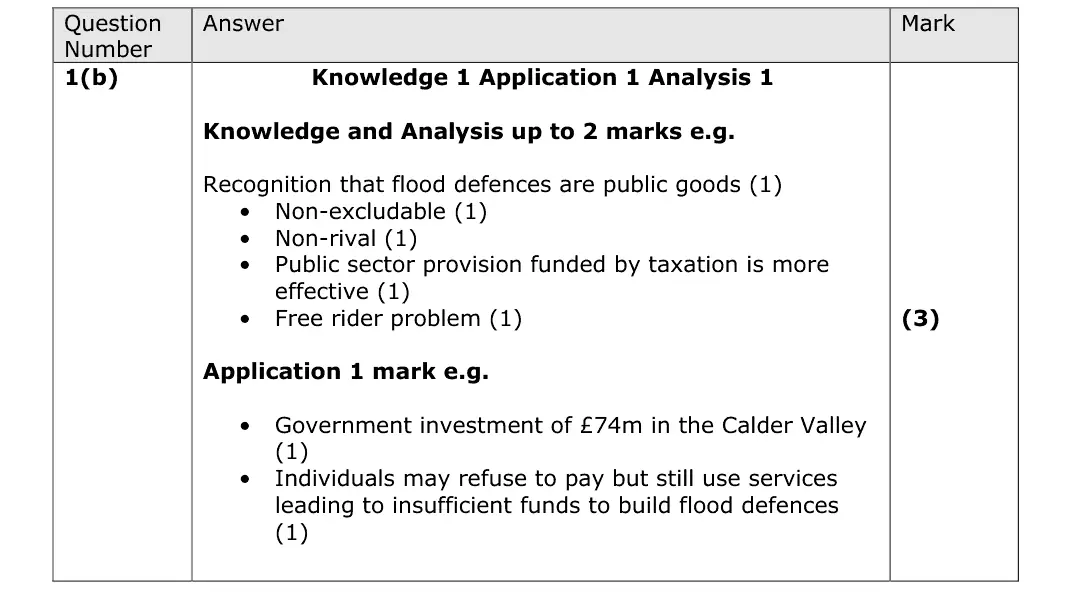
(b) Explain why flood defences such as those in the Calder Valley are usually provided by the public sector. (3)
June 2022 · AS Paper 1 · Q2(a) 1 mark AO1=1 Definition government intervention in markets
Data and extracts for question 22 The Common Agricultural Policy (CAP) is a system of minimum prices and other programmes covering farming, environmental measures and rural development. The CAP applied to British farmers before the UK left the EU in January 2020. (Source adapted from: https://www.gov.uk/government/collections/common-agricultural- policy-reform)
(a) Define the term ‘minimum price’. (1)
June 2022 · AS Paper 1 · Q2(b) 1 mark Multiple choice government intervention in markets
Data and extracts for question 22 The Common Agricultural Policy (CAP) is a system of minimum prices and other programmes covering farming, environmental measures and rural development. The CAP applied to British farmers before the UK left the EU in January 2020. (Source adapted from: https://www.gov.uk/government/collections/common-agricultural- policy-reform)
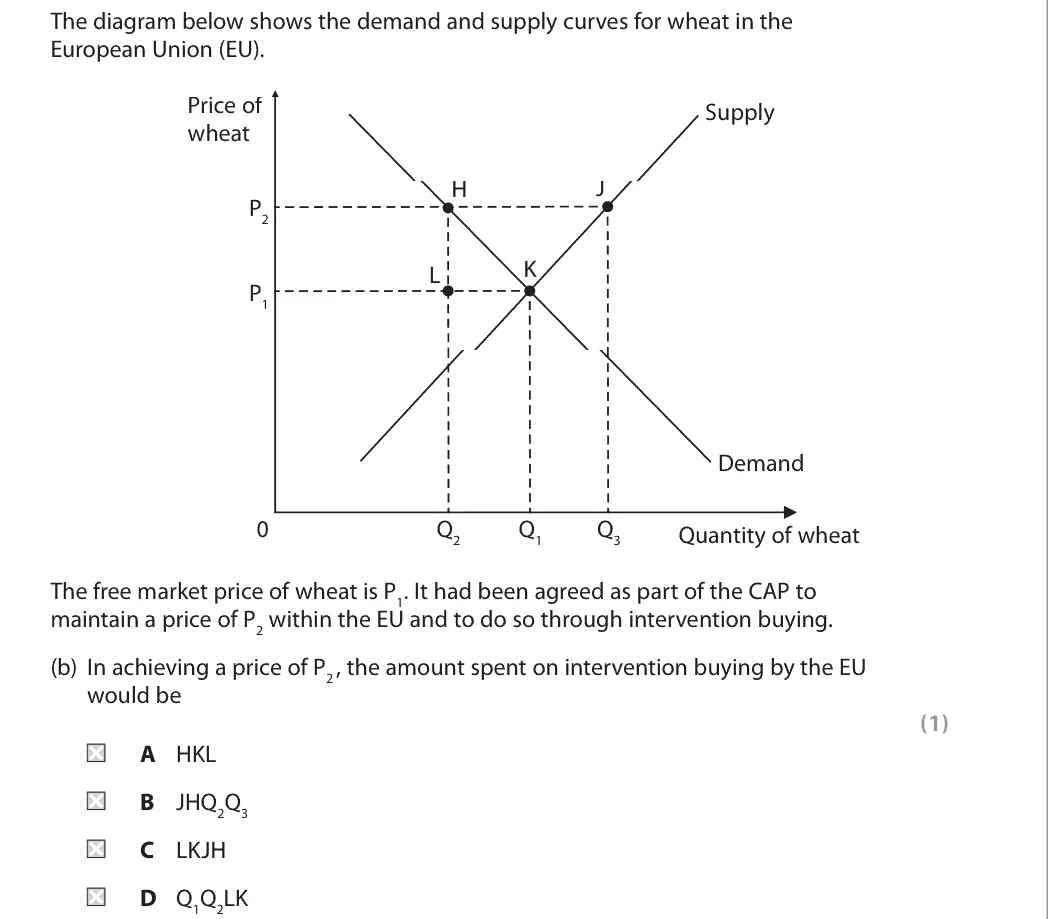
The diagram below shows the demand and supply curves for wheat in the European Union (EU). Price of Supply wheat J H P2 K L P1 Demand Q2 Q1 Q3 0 Quantity of wheat The free market price of wheat is P1. It had been agreed as part of the CAP to maintain a price of P2 within the EU and to do so through intervention buying. (b) In achieving a price of P2 , the amount spent on intervention buying by the EU would be (1) A HKL B JHQ2Q3 C LKJH D Q1Q2LK
June 2022 · AS Paper 1 · Q2(c) 2 marks AO1=2 Short answer government failure
Data and extracts for question 22 The Common Agricultural Policy (CAP) is a system of minimum prices and other programmes covering farming, environmental measures and rural development. The CAP applied to British farmers before the UK left the EU in January 2020. (Source adapted from: https://www.gov.uk/government/collections/common-agricultural- policy-reform)
(c) Explain one likely problem for the EU of maintaining prices at P2 . (2)
June 2022 · AS Paper 1 · Q3(a) 1 mark Multiple choice specialisation and division of labour
Data and extracts for question 33 The world’s first cryptocurrency, Bitcoin is stored and exchanged securely on the internet through a digital ledger known as a blockchain. Bitcoins are divisible into smaller units known as satoshis. (Source: https://www.coinbase.com/price/bitcoin)
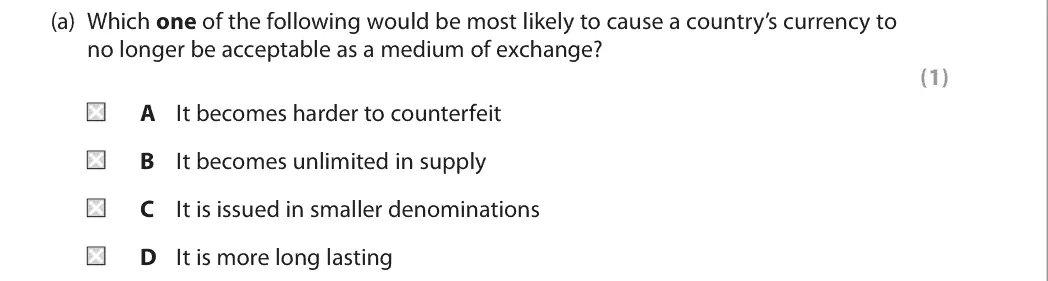
(a) Which one of the following would be most likely to cause a country’s currency to no longer be acceptable as a medium of exchange? (1) A It becomes harder to counterfeit B It becomes unlimited in supply C It is issued in smaller denominations D It is more long lasting
June 2022 · AS Paper 1 · Q3(b) 3 marks AO1=1, AO2=2 Short answer specialisation and division of labour
Data and extracts for question 33 The world’s first cryptocurrency, Bitcoin is stored and exchanged securely on the internet through a digital ledger known as a blockchain. Bitcoins are divisible into smaller units known as satoshis. (Source: https://www.coinbase.com/price/bitcoin)
(b) Explain how Bitcoin fulfils one function of money, apart from as a medium of exchange. (3)
June 2022 · AS Paper 1 · Q4(a) 3 marks AO1=1, AO2=1, AO3=1 Short answer nature of economics
Data and extracts for question 44 A large number of people should be vaccinated against a new virus, so that even those who are not vaccinated will benefit.
(a) With reference to the statement above, explain the difference between positive and normative statements. (3)
June 2022 · AS Paper 1 · Q4(b) 1 mark Multiple choice externalities
Data and extracts for question 44 A large number of people should be vaccinated against a new virus, so that even those who are not vaccinated will benefit.
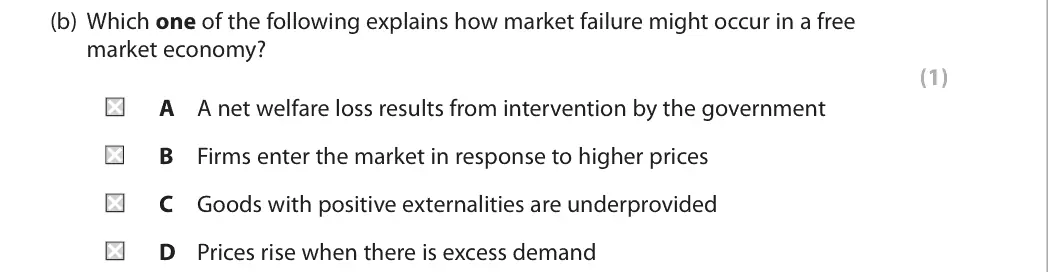
(b) Which one of the following explains how market failure might occur in a free market economy? (1) A A net welfare loss results from intervention by the government B Firms enter the market in response to higher prices C Goods with positive externalities are underprovided D Prices rise when there is excess demand
June 2022 · AS Paper 1 · Q5(a) 3 marks AO1=1, AO2=1, AO3=1 Short answer elasticity of supply
Data and extracts for question 55 In March 2020, a substantial increase in the demand for flour resulted in the retail price of flour increasing. Despite the price rises, the supply of flour failed to keep up with the increased demand.
(a) Explain one reason why flour producers might find it difficult to increase quantity supplied in the short run. (3)
June 2022 · AS Paper 1 · Q5(b) 1 mark Multiple choice elasticity of supply
Data and extracts for question 55 In March 2020, a substantial increase in the demand for flour resulted in the retail price of flour increasing. Despite the price rises, the supply of flour failed to keep up with the increased demand.
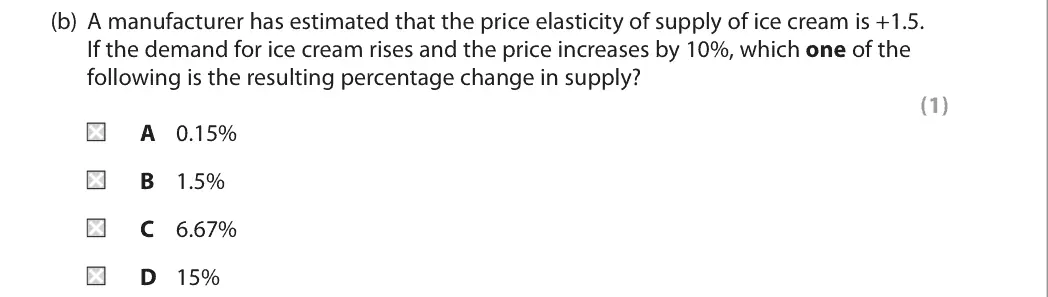
(b) A manufacturer has estimated that the price elasticity of supply of ice cream is +1.5. If the demand for ice cream rises and the price increases by 10%, which one of the following is the resulting percentage change in supply? (1) A 0.15% B 1.5% C 6.67% D 15%
June 2022 · AS Paper 1 · Q6(a) 5 marks AO1=1, AO2=2, AO3=2 Diagram supply and demandgovernment intervention in markets
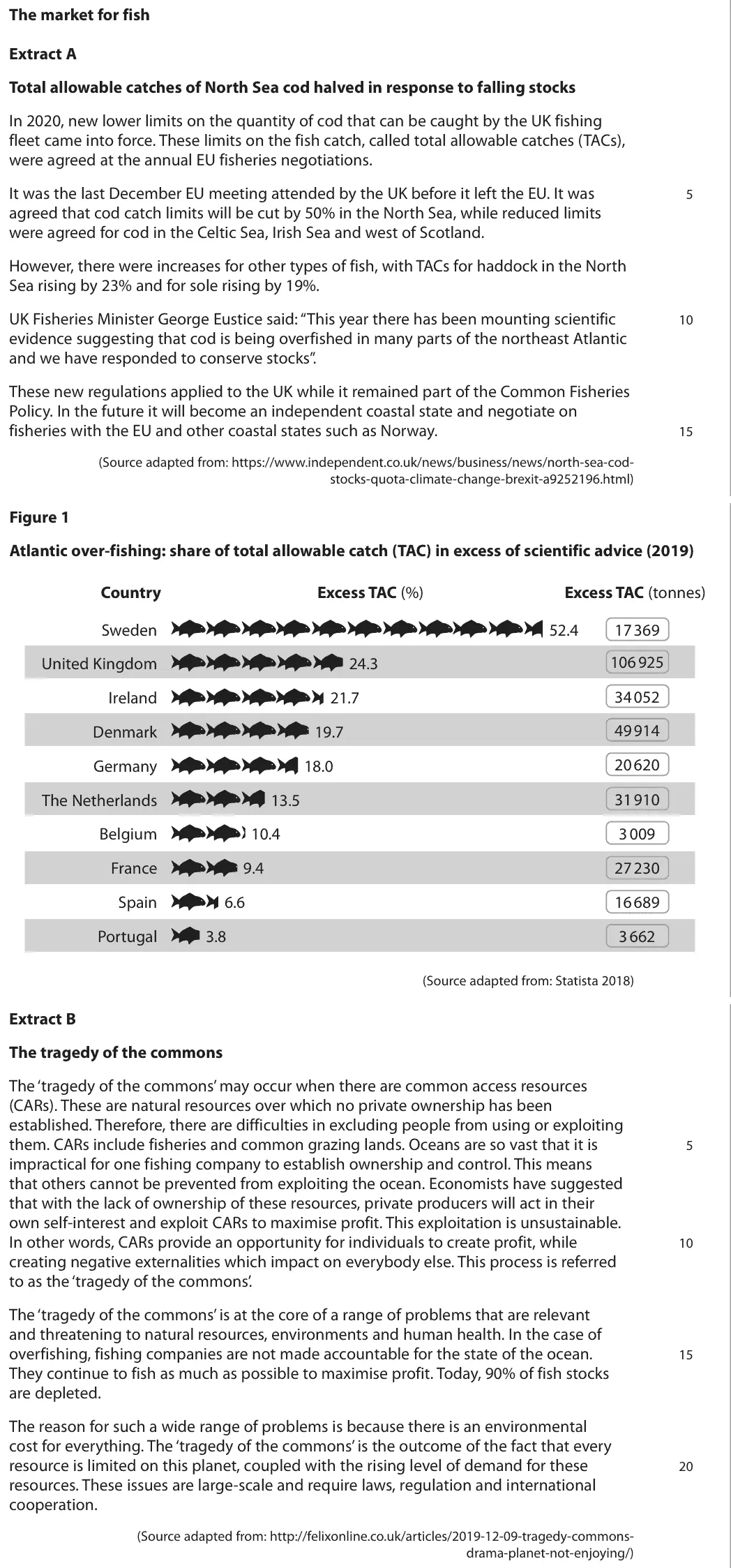
Data and extracts for question 6The market for fish Extract A Total allowable catches of North Sea cod halved in response to falling stocks In 2020, new lower limits on the quantity of cod that can be caught by the UK fishing fleet came into force. These limits on the fish catch, called total allowable catches (TACs), were agreed at the annual EU fisheries negotiations. It was the last December EU meeting attended by the UK before it left the EU. It was 5 agreed that cod catch limits will be cut by 50% in the North Sea, while reduced limits were agreed for cod in the Celtic Sea, Irish Sea and west of Scotland. However, there were increases for other types of fish, with TACs for haddock in the North Sea rising by 23% and for sole rising by 19%. UK Fisheries Minister George Eustice said: “This year there has been mounting scientific 10 evidence suggesting that cod is being overfished in many parts of the northeast Atlantic and we have responded to conserve stocks”. These new regulations applied to the UK while it remained part of the Common Fisheries Policy. In the future it will become an independent coastal state and negotiate on fisheries with the EU and other coastal states such as Norway. 15 (Source adapted from: https://www.independent.co.uk/news/business/news/north-sea-cod- stocks-quota-climate-change-brexit-a9252196.html) Figure 1 Atlantic over-fishing: share of total allowable catch (TAC) in excess of scientific advice (2019) Country Excess TAC (%) Excess TAC (tonnes) Sweden 52.4 17 369 106 925 United Kingdom 24.3 34 052 Ireland 21.7 49 914 Denmark 19.7 20 620 Germany 18.0 The Netherlands 13.5 31 910 3 009 Belgium 10.4 France 9.4 27 230 Spain 6.6 16 689 Portugal 3.8 3 662 (Source adapted from: Statista 2018) Extract B The tragedy of the commons The ‘tragedy of the commons’ may occur when there are common access resources (CARs). These are natural resources over which no private ownership has been established. Therefore, there are difficulties in excluding people from using or exploiting them. CARs include fisheries and common grazing lands. Oceans are so vast that it is 5 impractical for one fishing company to establish ownership and control. This means that others cannot be prevented from exploiting the ocean. Economists have suggested that with the lack of ownership of these resources, private producers will act in their own self-interest and exploit CARs to maximise profit. This exploitation is unsustainable. In other words, CARs provide an opportunity for individuals to create profit, while 10 creating negative externalities which impact on everybody else. This process is referred to as the ‘tragedy of the commons’. The ‘tragedy of the commons’ is at the core of a range of problems that are relevant and threatening to natural resources, environments and human health. In the case of overfishing, fishing companies are not made accountable for the state of the ocean. 15 They continue to fish as much as possible to maximise profit. Today, 90% of fish stocks are depleted. The reason for such a wide range of problems is because there is an environmental cost for everything. The ‘tragedy of the commons’ is the outcome of the fact that every resource is limited on this planet, coupled with the rising level of demand for these 20 resources. These issues are large-scale and require laws, regulation and international cooperation. (Source adapted from: http://felixonline.co.uk/articles/2019-12-09-tragedy-commons- drama-planet-not-enjoying/)
(a) Explain the likely impact of the new 2020 TACs on the price of cod. Include a supply and demand diagram in your answer. (5)
June 2022 · AS Paper 1 · Q6(b) 10 marks AO1=2, AO2=2, AO3=2, AO4=4 10-mark response rational decision making and behavioural economics
Data and extracts for question 6The market for fish Extract A Total allowable catches of North Sea cod halved in response to falling stocks In 2020, new lower limits on the quantity of cod that can be caught by the UK fishing fleet came into force. These limits on the fish catch, called total allowable catches (TACs), were agreed at the annual EU fisheries negotiations. It was the last December EU meeting attended by the UK before it left the EU. It was 5 agreed that cod catch limits will be cut by 50% in the North Sea, while reduced limits were agreed for cod in the Celtic Sea, Irish Sea and west of Scotland. However, there were increases for other types of fish, with TACs for haddock in the North Sea rising by 23% and for sole rising by 19%. UK Fisheries Minister George Eustice said: “This year there has been mounting scientific 10 evidence suggesting that cod is being overfished in many parts of the northeast Atlantic and we have responded to conserve stocks”. These new regulations applied to the UK while it remained part of the Common Fisheries Policy. In the future it will become an independent coastal state and negotiate on fisheries with the EU and other coastal states such as Norway. 15 (Source adapted from: https://www.independent.co.uk/news/business/news/north-sea-cod- stocks-quota-climate-change-brexit-a9252196.html) Figure 1 Atlantic over-fishing: share of total allowable catch (TAC) in excess of scientific advice (2019) Country Excess TAC (%) Excess TAC (tonnes) Sweden 52.4 17 369 106 925 United Kingdom 24.3 34 052 Ireland 21.7 49 914 Denmark 19.7 20 620 Germany 18.0 The Netherlands 13.5 31 910 3 009 Belgium 10.4 France 9.4 27 230 Spain 6.6 16 689 Portugal 3.8 3 662 (Source adapted from: Statista 2018) Extract B The tragedy of the commons The ‘tragedy of the commons’ may occur when there are common access resources (CARs). These are natural resources over which no private ownership has been established. Therefore, there are difficulties in excluding people from using or exploiting them. CARs include fisheries and common grazing lands. Oceans are so vast that it is 5 impractical for one fishing company to establish ownership and control. This means that others cannot be prevented from exploiting the ocean. Economists have suggested that with the lack of ownership of these resources, private producers will act in their own self-interest and exploit CARs to maximise profit. This exploitation is unsustainable. In other words, CARs provide an opportunity for individuals to create profit, while 10 creating negative externalities which impact on everybody else. This process is referred to as the ‘tragedy of the commons’. The ‘tragedy of the commons’ is at the core of a range of problems that are relevant and threatening to natural resources, environments and human health. In the case of overfishing, fishing companies are not made accountable for the state of the ocean. 15 They continue to fish as much as possible to maximise profit. Today, 90% of fish stocks are depleted. The reason for such a wide range of problems is because there is an environmental cost for everything. The ‘tragedy of the commons’ is the outcome of the fact that every resource is limited on this planet, coupled with the rising level of demand for these 20 resources. These issues are large-scale and require laws, regulation and international cooperation. (Source adapted from: http://felixonline.co.uk/articles/2019-12-09-tragedy-commons- drama-planet-not-enjoying/)
According to Extract B, lines 15–16, ‘fishing companies are not made accountable for the state of the ocean. They continue to fish as much as possible to maximise profit’. (b) Assess whether it is rational for fishing companies to behave in this way. (10)
June 2022 · AS Paper 1 · Q6(c) 6 marks AO1=2, AO2=2, AO3=2 Short answer economic systems
Data and extracts for question 6The market for fish Extract A Total allowable catches of North Sea cod halved in response to falling stocks In 2020, new lower limits on the quantity of cod that can be caught by the UK fishing fleet came into force. These limits on the fish catch, called total allowable catches (TACs), were agreed at the annual EU fisheries negotiations. It was the last December EU meeting attended by the UK before it left the EU. It was 5 agreed that cod catch limits will be cut by 50% in the North Sea, while reduced limits were agreed for cod in the Celtic Sea, Irish Sea and west of Scotland. However, there were increases for other types of fish, with TACs for haddock in the North Sea rising by 23% and for sole rising by 19%. UK Fisheries Minister George Eustice said: “This year there has been mounting scientific 10 evidence suggesting that cod is being overfished in many parts of the northeast Atlantic and we have responded to conserve stocks”. These new regulations applied to the UK while it remained part of the Common Fisheries Policy. In the future it will become an independent coastal state and negotiate on fisheries with the EU and other coastal states such as Norway. 15 (Source adapted from: https://www.independent.co.uk/news/business/news/north-sea-cod- stocks-quota-climate-change-brexit-a9252196.html) Figure 1 Atlantic over-fishing: share of total allowable catch (TAC) in excess of scientific advice (2019) Country Excess TAC (%) Excess TAC (tonnes) Sweden 52.4 17 369 106 925 United Kingdom 24.3 34 052 Ireland 21.7 49 914 Denmark 19.7 20 620 Germany 18.0 The Netherlands 13.5 31 910 3 009 Belgium 10.4 France 9.4 27 230 Spain 6.6 16 689 Portugal 3.8 3 662 (Source adapted from: Statista 2018) Extract B The tragedy of the commons The ‘tragedy of the commons’ may occur when there are common access resources (CARs). These are natural resources over which no private ownership has been established. Therefore, there are difficulties in excluding people from using or exploiting them. CARs include fisheries and common grazing lands. Oceans are so vast that it is 5 impractical for one fishing company to establish ownership and control. This means that others cannot be prevented from exploiting the ocean. Economists have suggested that with the lack of ownership of these resources, private producers will act in their own self-interest and exploit CARs to maximise profit. This exploitation is unsustainable. In other words, CARs provide an opportunity for individuals to create profit, while 10 creating negative externalities which impact on everybody else. This process is referred to as the ‘tragedy of the commons’. The ‘tragedy of the commons’ is at the core of a range of problems that are relevant and threatening to natural resources, environments and human health. In the case of overfishing, fishing companies are not made accountable for the state of the ocean. 15 They continue to fish as much as possible to maximise profit. Today, 90% of fish stocks are depleted. The reason for such a wide range of problems is because there is an environmental cost for everything. The ‘tragedy of the commons’ is the outcome of the fact that every resource is limited on this planet, coupled with the rising level of demand for these 20 resources. These issues are large-scale and require laws, regulation and international cooperation. (Source adapted from: http://felixonline.co.uk/articles/2019-12-09-tragedy-commons- drama-planet-not-enjoying/)
(c) With reference to the information provided and your own knowledge, explain two characteristics of private ownership in a free market economy. (6)
June 2022 · AS Paper 1 · Q6(d) 4 marks AO1=2, AO2=2 Calculation price elasticity of demand
Data and extracts for question 6The market for fish Extract A Total allowable catches of North Sea cod halved in response to falling stocks In 2020, new lower limits on the quantity of cod that can be caught by the UK fishing fleet came into force. These limits on the fish catch, called total allowable catches (TACs), were agreed at the annual EU fisheries negotiations. It was the last December EU meeting attended by the UK before it left the EU. It was 5 agreed that cod catch limits will be cut by 50% in the North Sea, while reduced limits were agreed for cod in the Celtic Sea, Irish Sea and west of Scotland. However, there were increases for other types of fish, with TACs for haddock in the North Sea rising by 23% and for sole rising by 19%. UK Fisheries Minister George Eustice said: “This year there has been mounting scientific 10 evidence suggesting that cod is being overfished in many parts of the northeast Atlantic and we have responded to conserve stocks”. These new regulations applied to the UK while it remained part of the Common Fisheries Policy. In the future it will become an independent coastal state and negotiate on fisheries with the EU and other coastal states such as Norway. 15 (Source adapted from: https://www.independent.co.uk/news/business/news/north-sea-cod- stocks-quota-climate-change-brexit-a9252196.html) Figure 1 Atlantic over-fishing: share of total allowable catch (TAC) in excess of scientific advice (2019) Country Excess TAC (%) Excess TAC (tonnes) Sweden 52.4 17 369 106 925 United Kingdom 24.3 34 052 Ireland 21.7 49 914 Denmark 19.7 20 620 Germany 18.0 The Netherlands 13.5 31 910 3 009 Belgium 10.4 France 9.4 27 230 Spain 6.6 16 689 Portugal 3.8 3 662 (Source adapted from: Statista 2018) Extract B The tragedy of the commons The ‘tragedy of the commons’ may occur when there are common access resources (CARs). These are natural resources over which no private ownership has been established. Therefore, there are difficulties in excluding people from using or exploiting them. CARs include fisheries and common grazing lands. Oceans are so vast that it is 5 impractical for one fishing company to establish ownership and control. This means that others cannot be prevented from exploiting the ocean. Economists have suggested that with the lack of ownership of these resources, private producers will act in their own self-interest and exploit CARs to maximise profit. This exploitation is unsustainable. In other words, CARs provide an opportunity for individuals to create profit, while 10 creating negative externalities which impact on everybody else. This process is referred to as the ‘tragedy of the commons’. The ‘tragedy of the commons’ is at the core of a range of problems that are relevant and threatening to natural resources, environments and human health. In the case of overfishing, fishing companies are not made accountable for the state of the ocean. 15 They continue to fish as much as possible to maximise profit. Today, 90% of fish stocks are depleted. The reason for such a wide range of problems is because there is an environmental cost for everything. The ‘tragedy of the commons’ is the outcome of the fact that every resource is limited on this planet, coupled with the rising level of demand for these 20 resources. These issues are large-scale and require laws, regulation and international cooperation. (Source adapted from: http://felixonline.co.uk/articles/2019-12-09-tragedy-commons- drama-planet-not-enjoying/)
Fish and chips are complementary goods with an estimated cross elasticity of demand of –8. Currently 950 000 bags of chips are sold in UK fish and chip shops each day. (d) With reference to the information provided, calculate the new quantity demanded of bags of chips from fish and chip shops, following a 2% increase in the price of fish. You are advised to show your working. (4)
June 2022 · AS Paper 1 · Q6(e) 15 marks AO1=3, AO2=3, AO3=3, AO4=6 15-mark response specialisation and division of labour
Data and extracts for question 6The market for fish Extract A Total allowable catches of North Sea cod halved in response to falling stocks In 2020, new lower limits on the quantity of cod that can be caught by the UK fishing fleet came into force. These limits on the fish catch, called total allowable catches (TACs), were agreed at the annual EU fisheries negotiations. It was the last December EU meeting attended by the UK before it left the EU. It was 5 agreed that cod catch limits will be cut by 50% in the North Sea, while reduced limits were agreed for cod in the Celtic Sea, Irish Sea and west of Scotland. However, there were increases for other types of fish, with TACs for haddock in the North Sea rising by 23% and for sole rising by 19%. UK Fisheries Minister George Eustice said: “This year there has been mounting scientific 10 evidence suggesting that cod is being overfished in many parts of the northeast Atlantic and we have responded to conserve stocks”. These new regulations applied to the UK while it remained part of the Common Fisheries Policy. In the future it will become an independent coastal state and negotiate on fisheries with the EU and other coastal states such as Norway. 15 (Source adapted from: https://www.independent.co.uk/news/business/news/north-sea-cod- stocks-quota-climate-change-brexit-a9252196.html) Figure 1 Atlantic over-fishing: share of total allowable catch (TAC) in excess of scientific advice (2019) Country Excess TAC (%) Excess TAC (tonnes) Sweden 52.4 17 369 106 925 United Kingdom 24.3 34 052 Ireland 21.7 49 914 Denmark 19.7 20 620 Germany 18.0 The Netherlands 13.5 31 910 3 009 Belgium 10.4 France 9.4 27 230 Spain 6.6 16 689 Portugal 3.8 3 662 (Source adapted from: Statista 2018) Extract B The tragedy of the commons The ‘tragedy of the commons’ may occur when there are common access resources (CARs). These are natural resources over which no private ownership has been established. Therefore, there are difficulties in excluding people from using or exploiting them. CARs include fisheries and common grazing lands. Oceans are so vast that it is 5 impractical for one fishing company to establish ownership and control. This means that others cannot be prevented from exploiting the ocean. Economists have suggested that with the lack of ownership of these resources, private producers will act in their own self-interest and exploit CARs to maximise profit. This exploitation is unsustainable. In other words, CARs provide an opportunity for individuals to create profit, while 10 creating negative externalities which impact on everybody else. This process is referred to as the ‘tragedy of the commons’. The ‘tragedy of the commons’ is at the core of a range of problems that are relevant and threatening to natural resources, environments and human health. In the case of overfishing, fishing companies are not made accountable for the state of the ocean. 15 They continue to fish as much as possible to maximise profit. Today, 90% of fish stocks are depleted. The reason for such a wide range of problems is because there is an environmental cost for everything. The ‘tragedy of the commons’ is the outcome of the fact that every resource is limited on this planet, coupled with the rising level of demand for these 20 resources. These issues are large-scale and require laws, regulation and international cooperation. (Source adapted from: http://felixonline.co.uk/articles/2019-12-09-tragedy-commons- drama-planet-not-enjoying/)
The UK fishing industry employs about 24 000 people, more than half of them working in Scotland. (e) Discuss the likely impacts on an economy of specialising in the fishing industry. Use a production possibility frontier diagram in your answer. (15)
June 2022 · AS Paper 1 · Q6(f) 20 marks AO1=4, AO2=4, AO3=6, AO4=6 20-mark essay Either/or Hard externalities
Data and extracts for question 6The market for fish Extract A Total allowable catches of North Sea cod halved in response to falling stocks In 2020, new lower limits on the quantity of cod that can be caught by the UK fishing fleet came into force. These limits on the fish catch, called total allowable catches (TACs), were agreed at the annual EU fisheries negotiations. It was the last December EU meeting attended by the UK before it left the EU. It was 5 agreed that cod catch limits will be cut by 50% in the North Sea, while reduced limits were agreed for cod in the Celtic Sea, Irish Sea and west of Scotland. However, there were increases for other types of fish, with TACs for haddock in the North Sea rising by 23% and for sole rising by 19%. UK Fisheries Minister George Eustice said: “This year there has been mounting scientific 10 evidence suggesting that cod is being overfished in many parts of the northeast Atlantic and we have responded to conserve stocks”. These new regulations applied to the UK while it remained part of the Common Fisheries Policy. In the future it will become an independent coastal state and negotiate on fisheries with the EU and other coastal states such as Norway. 15 (Source adapted from: https://www.independent.co.uk/news/business/news/north-sea-cod- stocks-quota-climate-change-brexit-a9252196.html) Figure 1 Atlantic over-fishing: share of total allowable catch (TAC) in excess of scientific advice (2019) Country Excess TAC (%) Excess TAC (tonnes) Sweden 52.4 17 369 106 925 United Kingdom 24.3 34 052 Ireland 21.7 49 914 Denmark 19.7 20 620 Germany 18.0 The Netherlands 13.5 31 910 3 009 Belgium 10.4 France 9.4 27 230 Spain 6.6 16 689 Portugal 3.8 3 662 (Source adapted from: Statista 2018) Extract B The tragedy of the commons The ‘tragedy of the commons’ may occur when there are common access resources (CARs). These are natural resources over which no private ownership has been established. Therefore, there are difficulties in excluding people from using or exploiting them. CARs include fisheries and common grazing lands. Oceans are so vast that it is 5 impractical for one fishing company to establish ownership and control. This means that others cannot be prevented from exploiting the ocean. Economists have suggested that with the lack of ownership of these resources, private producers will act in their own self-interest and exploit CARs to maximise profit. This exploitation is unsustainable. In other words, CARs provide an opportunity for individuals to create profit, while 10 creating negative externalities which impact on everybody else. This process is referred to as the ‘tragedy of the commons’. The ‘tragedy of the commons’ is at the core of a range of problems that are relevant and threatening to natural resources, environments and human health. In the case of overfishing, fishing companies are not made accountable for the state of the ocean. 15 They continue to fish as much as possible to maximise profit. Today, 90% of fish stocks are depleted. The reason for such a wide range of problems is because there is an environmental cost for everything. The ‘tragedy of the commons’ is the outcome of the fact that every resource is limited on this planet, coupled with the rising level of demand for these 20 resources. These issues are large-scale and require laws, regulation and international cooperation. (Source adapted from: http://felixonline.co.uk/articles/2019-12-09-tragedy-commons- drama-planet-not-enjoying/)
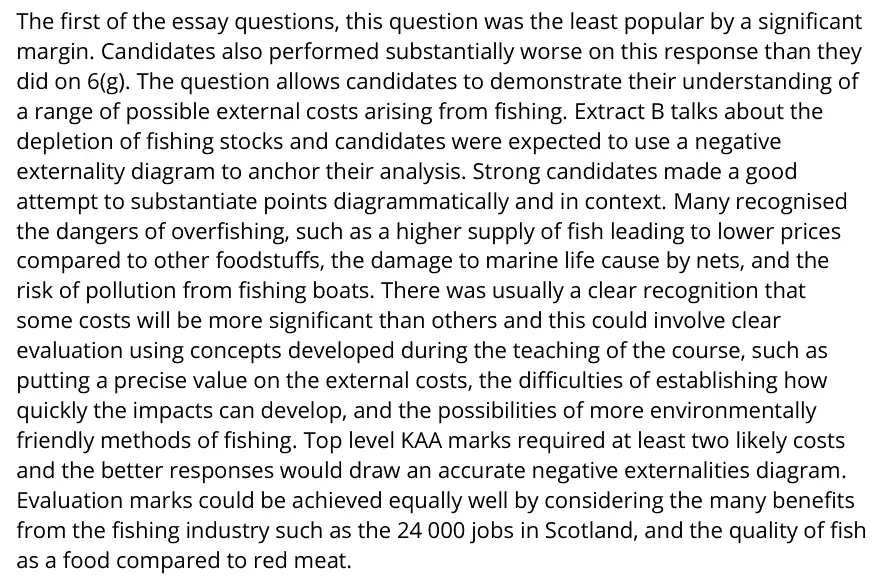
(f) Some economists suggest that the market price of cod does not result in the socially optimum level of output. Evaluate the likely external costs from the over-fishing of cod. Use an appropriate diagram in your answer. (20)
June 2022 · AS Paper 1 · Q6(g) 20 marks AO1=4, AO2=4, AO3=6, AO4=6 20-mark essay Either/or government intervention in markets
Data and extracts for question 6The market for fish Extract A Total allowable catches of North Sea cod halved in response to falling stocks In 2020, new lower limits on the quantity of cod that can be caught by the UK fishing fleet came into force. These limits on the fish catch, called total allowable catches (TACs), were agreed at the annual EU fisheries negotiations. It was the last December EU meeting attended by the UK before it left the EU. It was 5 agreed that cod catch limits will be cut by 50% in the North Sea, while reduced limits were agreed for cod in the Celtic Sea, Irish Sea and west of Scotland. However, there were increases for other types of fish, with TACs for haddock in the North Sea rising by 23% and for sole rising by 19%. UK Fisheries Minister George Eustice said: “This year there has been mounting scientific 10 evidence suggesting that cod is being overfished in many parts of the northeast Atlantic and we have responded to conserve stocks”. These new regulations applied to the UK while it remained part of the Common Fisheries Policy. In the future it will become an independent coastal state and negotiate on fisheries with the EU and other coastal states such as Norway. 15 (Source adapted from: https://www.independent.co.uk/news/business/news/north-sea-cod- stocks-quota-climate-change-brexit-a9252196.html) Figure 1 Atlantic over-fishing: share of total allowable catch (TAC) in excess of scientific advice (2019) Country Excess TAC (%) Excess TAC (tonnes) Sweden 52.4 17 369 106 925 United Kingdom 24.3 34 052 Ireland 21.7 49 914 Denmark 19.7 20 620 Germany 18.0 The Netherlands 13.5 31 910 3 009 Belgium 10.4 France 9.4 27 230 Spain 6.6 16 689 Portugal 3.8 3 662 (Source adapted from: Statista 2018) Extract B The tragedy of the commons The ‘tragedy of the commons’ may occur when there are common access resources (CARs). These are natural resources over which no private ownership has been established. Therefore, there are difficulties in excluding people from using or exploiting them. CARs include fisheries and common grazing lands. Oceans are so vast that it is 5 impractical for one fishing company to establish ownership and control. This means that others cannot be prevented from exploiting the ocean. Economists have suggested that with the lack of ownership of these resources, private producers will act in their own self-interest and exploit CARs to maximise profit. This exploitation is unsustainable. In other words, CARs provide an opportunity for individuals to create profit, while 10 creating negative externalities which impact on everybody else. This process is referred to as the ‘tragedy of the commons’. The ‘tragedy of the commons’ is at the core of a range of problems that are relevant and threatening to natural resources, environments and human health. In the case of overfishing, fishing companies are not made accountable for the state of the ocean. 15 They continue to fish as much as possible to maximise profit. Today, 90% of fish stocks are depleted. The reason for such a wide range of problems is because there is an environmental cost for everything. The ‘tragedy of the commons’ is the outcome of the fact that every resource is limited on this planet, coupled with the rising level of demand for these 20 resources. These issues are large-scale and require laws, regulation and international cooperation. (Source adapted from: http://felixonline.co.uk/articles/2019-12-09-tragedy-commons- drama-planet-not-enjoying/)
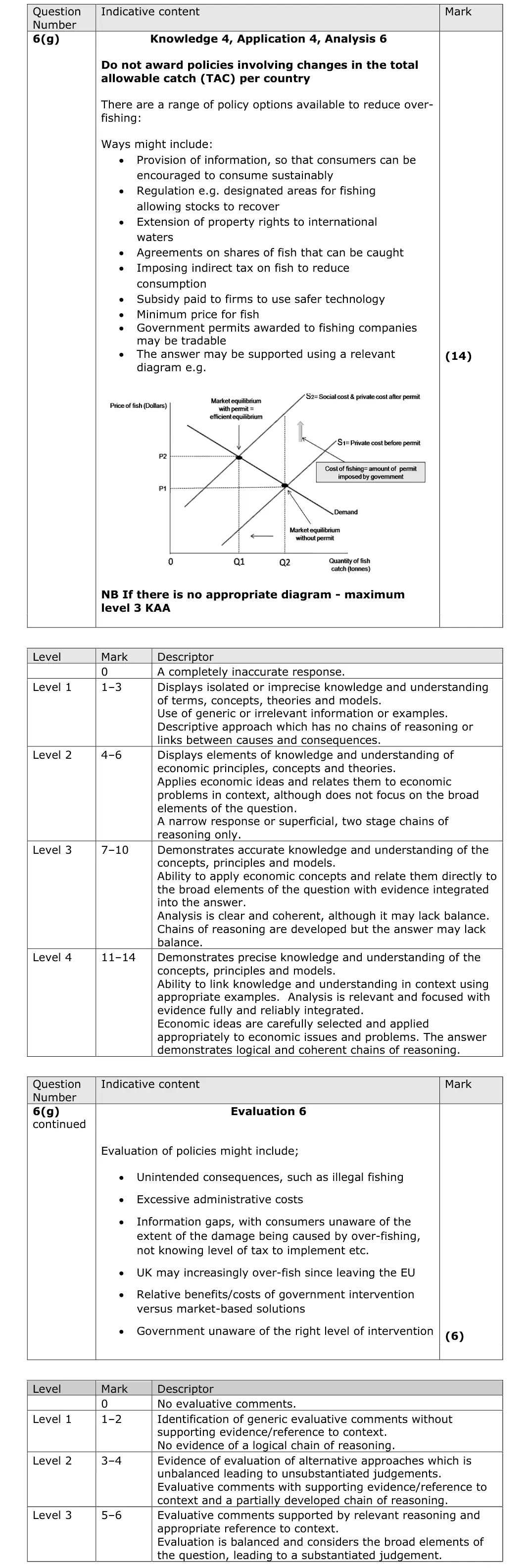
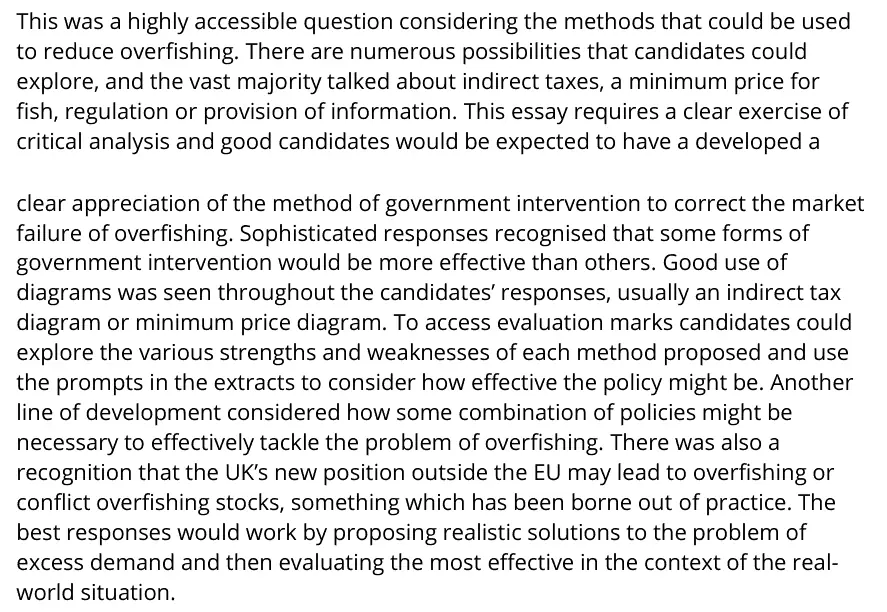
(g) Other than using a TAC, evaluate the policy options which could be used to reduce market failure resulting from over-fishing. Use at least one appropriate diagram in your answer. (20)

Work with an Edexcel economics tutor

Want a paper marked and gone through with you? Message us.
Prefer email? Send an enquiry

If you are under 18, please include a parent's contact details. Enquiries go to enquiries@economicsaleveltutor.com and are deleted once handled. All tutoring is online.