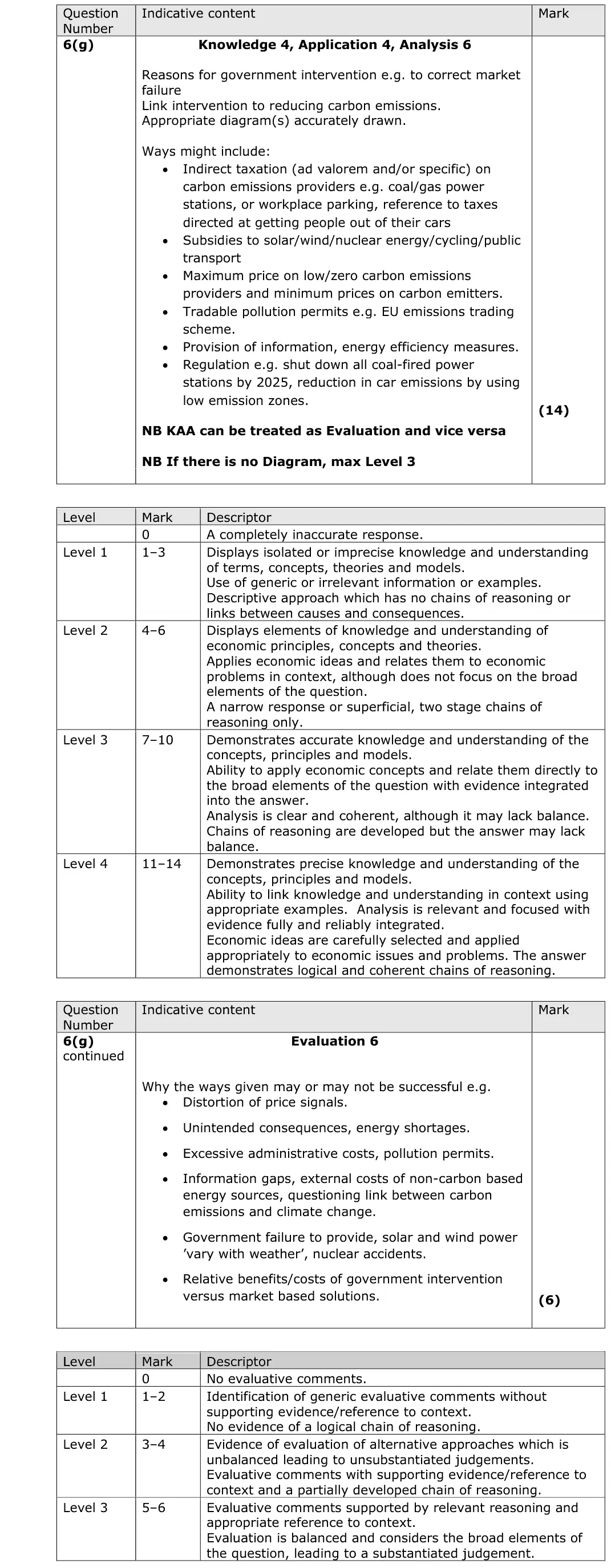
Data and extracts for question 1

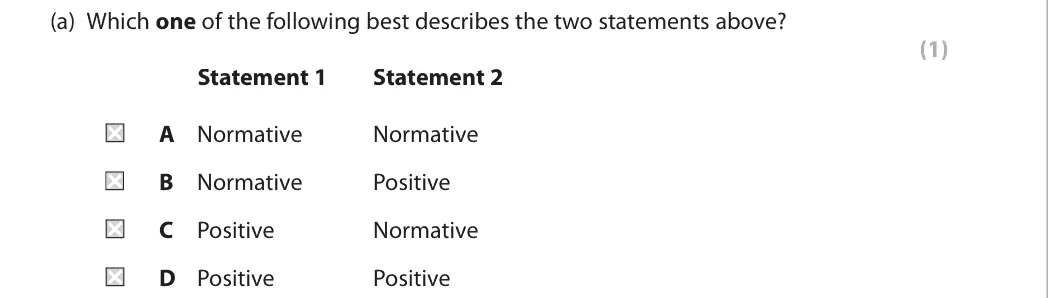
Answer
C
Mark scheme
Notes from the mark scheme and report
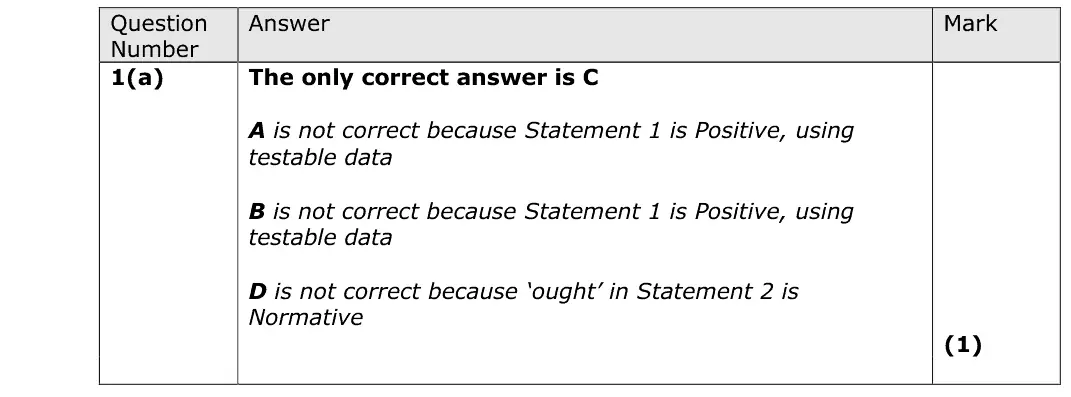
- Statement 1 is testable data so positive
- "ought" in Statement 2 is a value judgement so normative (C)
80 marks · 21 question parts · Paper, mark scheme and report on Pearson's site
C

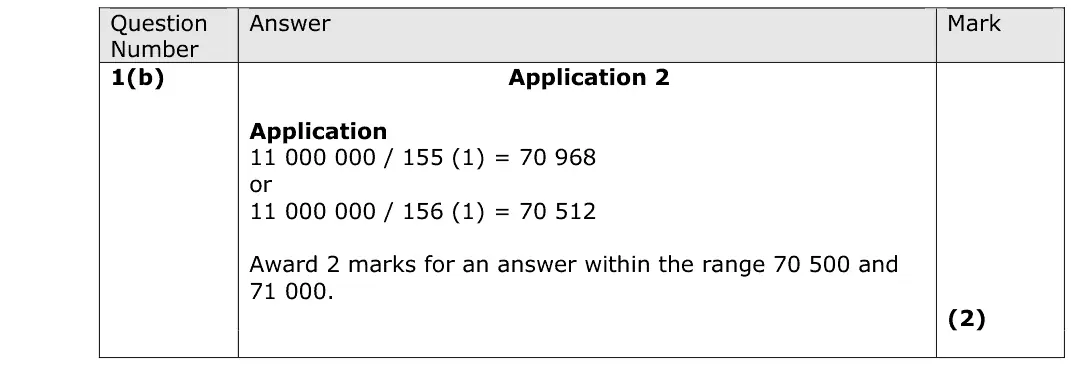
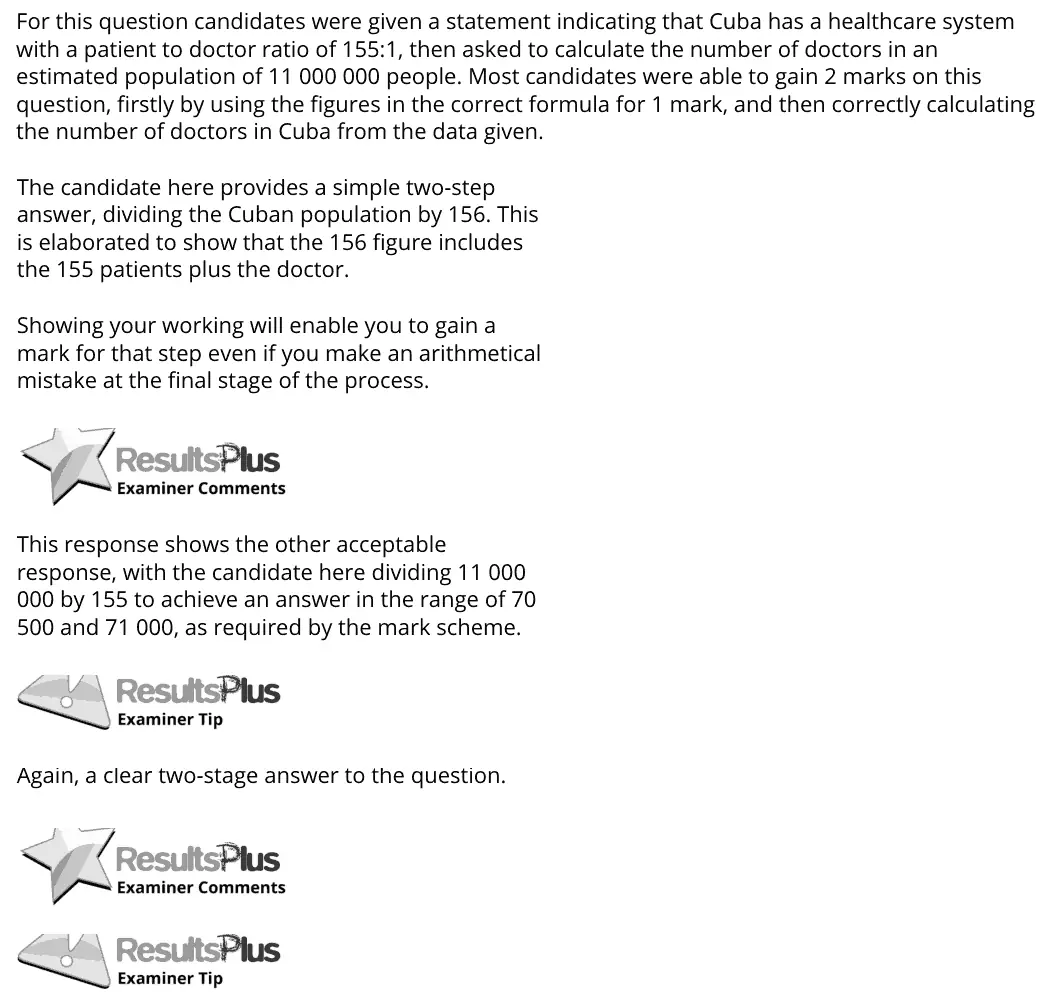
For this question candidates were given a statement indicating that Cuba has a healthcare system with a patient to doctor ratio of 155:1, then asked to calculate the number of doctors in an estimated population of 11 000 000 people. Most candidates were able to gain 2 marks on this question, firstly by using the figures in the correct formula for 1 mark, and then correctly calculating the number of doctors in Cuba from the data given. The candidate here provides a simple two-step answer, dividing the Cuban population by 156. This is elaborated to show that the 156 figure includes the 155 patients plus the doctor. Showing your working will enable you to gain a mark for that step even if you make an arithmetical mistake at the final stage of the process. This response shows the other acceptable response, with the candidate here dividing 11 000 000 by 155 to achieve an answer in the range of 70 500 and 71 000, as required by the mark scheme. Again, a clear two-stage answer to the question.
Quantitative skills: QS 1 (calculate, use and understand ratios and fractions)

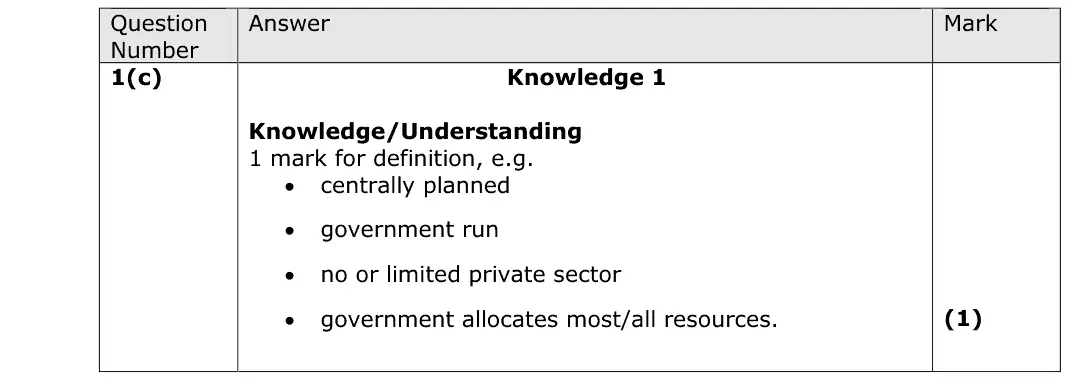
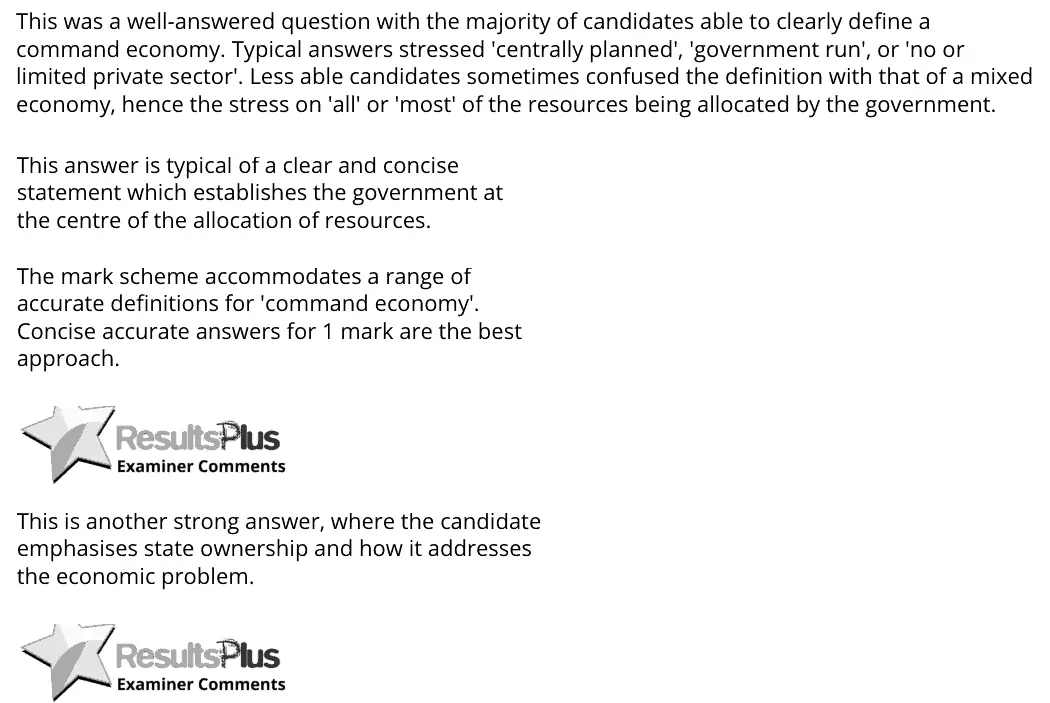
This was a well-answered question with the majority of candidates able to clearly define a command economy. Typical answers stressed 'centrally planned', 'government run', or 'no or limited private sector'. Less able candidates sometimes confused the definition with that of a mixed economy, hence the stress on 'all' or 'most' of the resources being allocated by the government. This answer is typical of a clear and concise statement which establishes the government at the centre of the allocation of resources. The mark scheme accommodates a range of accurate definitions for 'command economy'. Concise accurate answers for 1 mark are the best approach. This is another strong answer, where the candidate emphasises state ownership and how it addresses the economic problem.

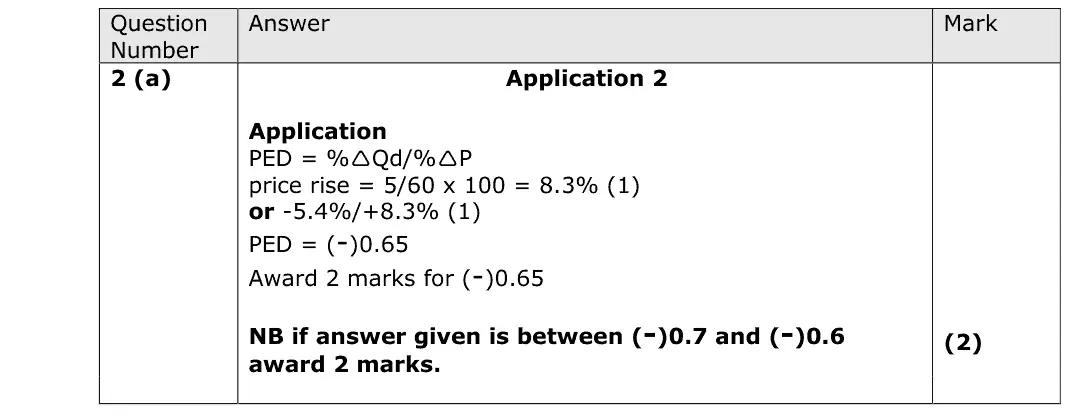
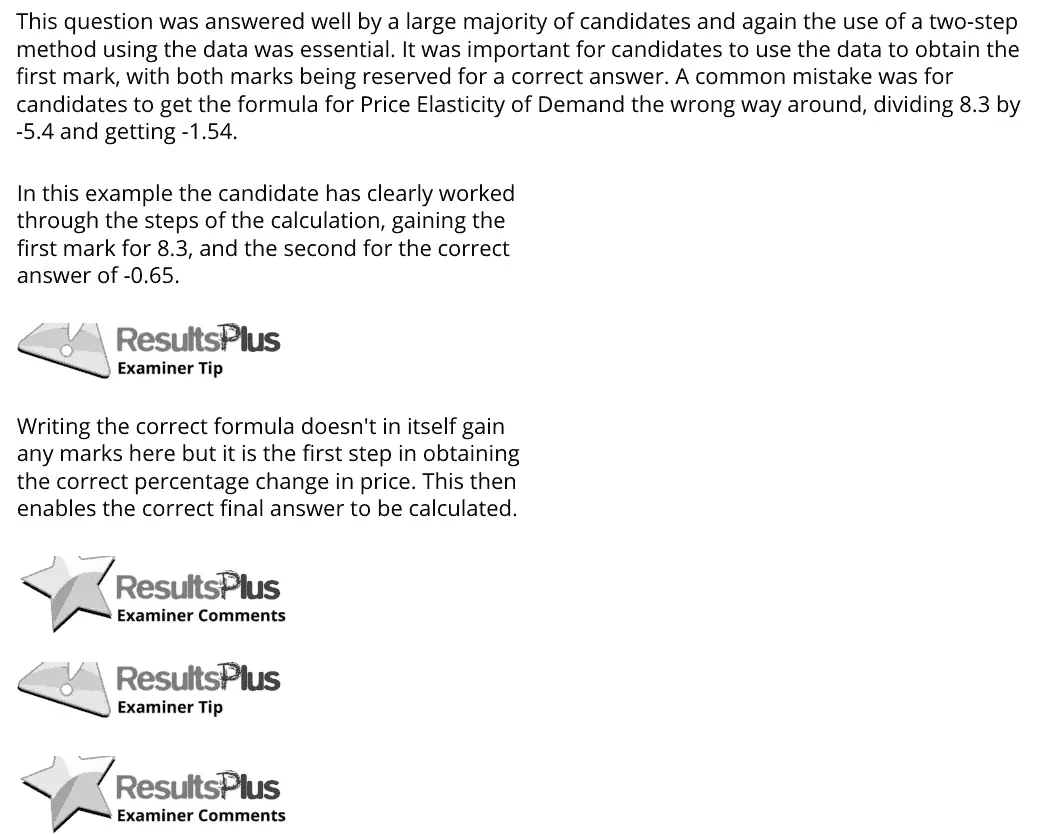
This question was answered well by a large majority of candidates and again the use of a two-step method using the data was essential. It was important for candidates to use the data to obtain the first mark, with both marks being reserved for a correct answer. A common mistake was for candidates to get the formula for Price Elasticity of Demand the wrong way around, dividing 8.3 by -5.4 and getting -1.54. In this example the candidate has clearly worked through the steps of the calculation, gaining the first mark for 8.3, and the second for the correct answer of -0.65. Writing the correct formula doesn't in itself gain any marks here but it is the first step in obtaining the correct percentage change in price. This then enables the correct final answer to be calculated.
Quantitative skills: QS 2 (calculate, use and understand percentages, percentage changes and percentage point changes); QS 8 (make calculations of elasticity and interpret the result)
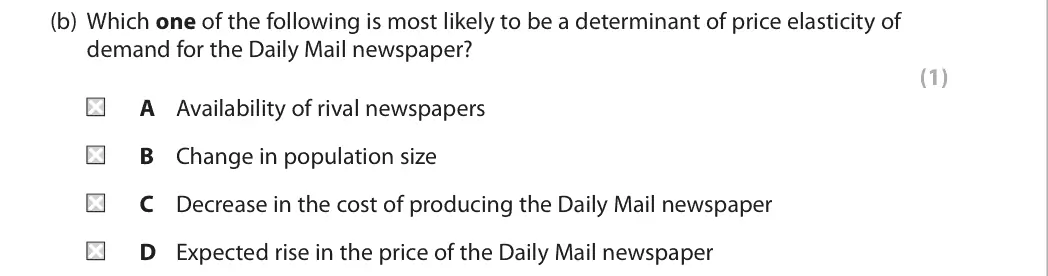
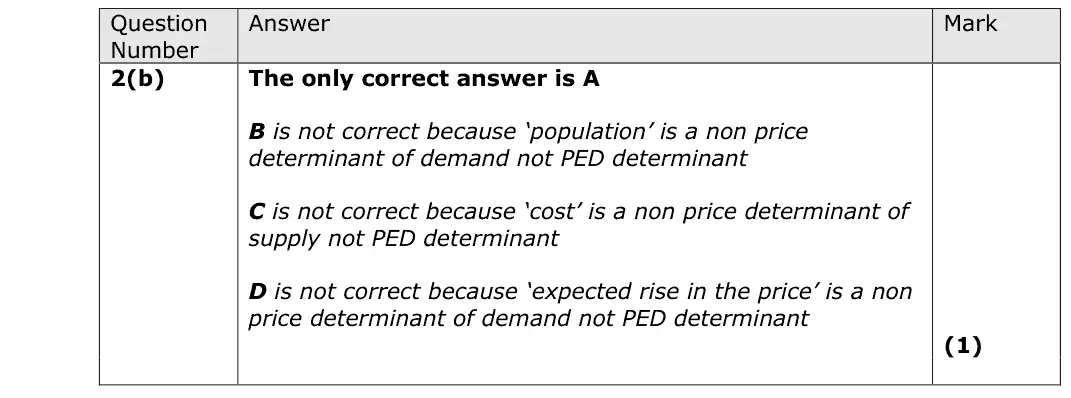
A

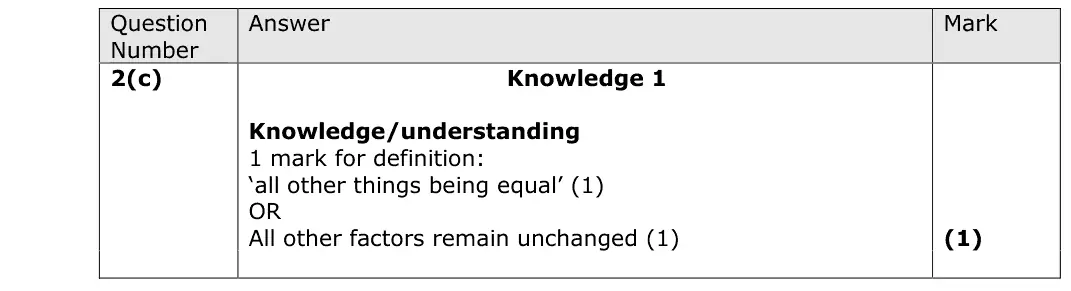
Another typically well-answered question, with the majority of candidates able to identify that 'ceteris paribus' meant 'all other things being equal' or 'all other factors remain unchanged'. Marks were lost by candidates who stated that all factors are the same or remained constant. It was crucial on this question to identify implicitly or explicitly that the variable being measured changes, in some sense. This a detailed answer which clearly gains the available mark. The use of the word 'else' after everything is crucial to gaining the mark. The second part of the sentence leaves the examiner in no doubt that the candidate can define the concept clearly. This answer is more succinct than the first and is sufficient for the mark. Precision here is the key, with the word 'other' demonstrating clear understanding.
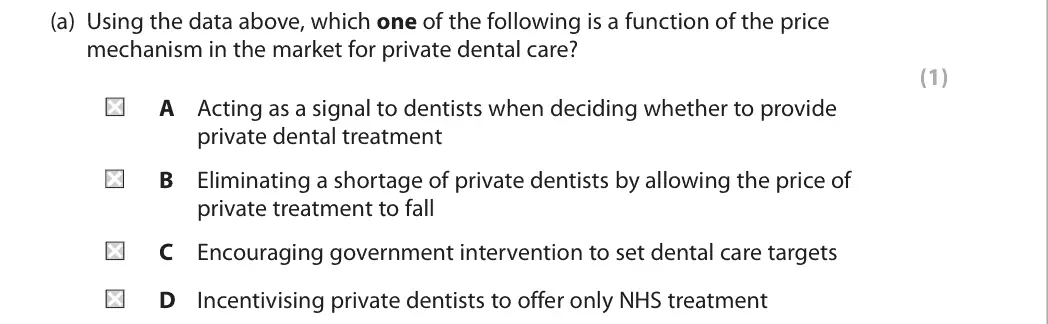
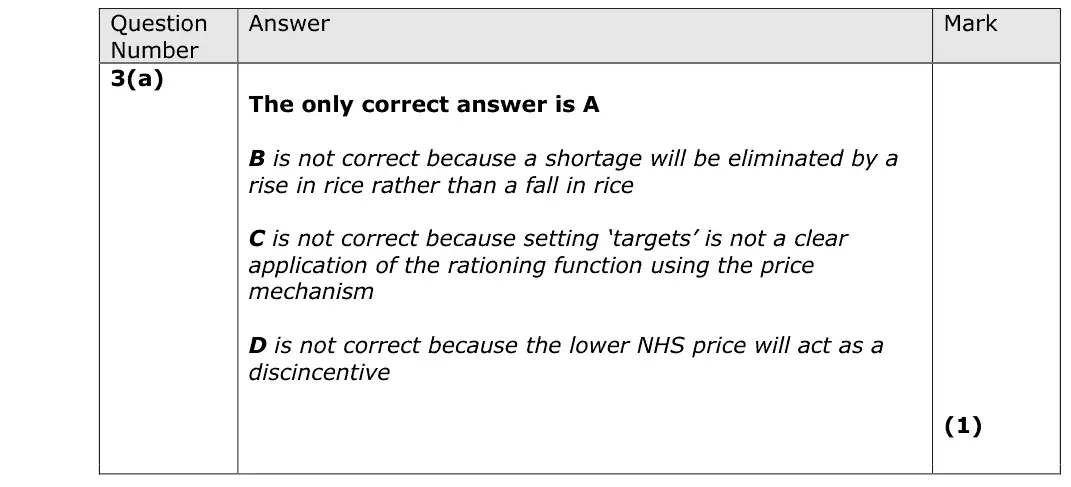
A

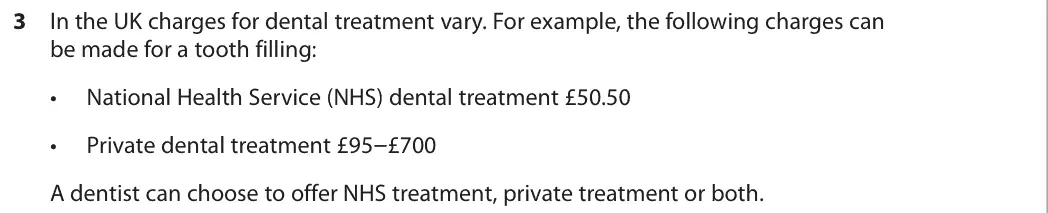
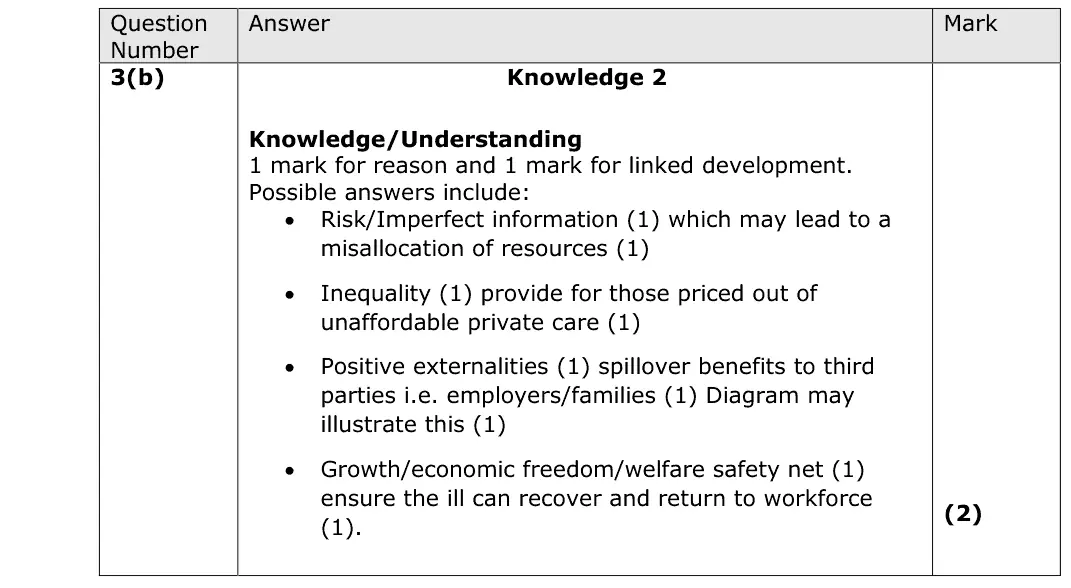
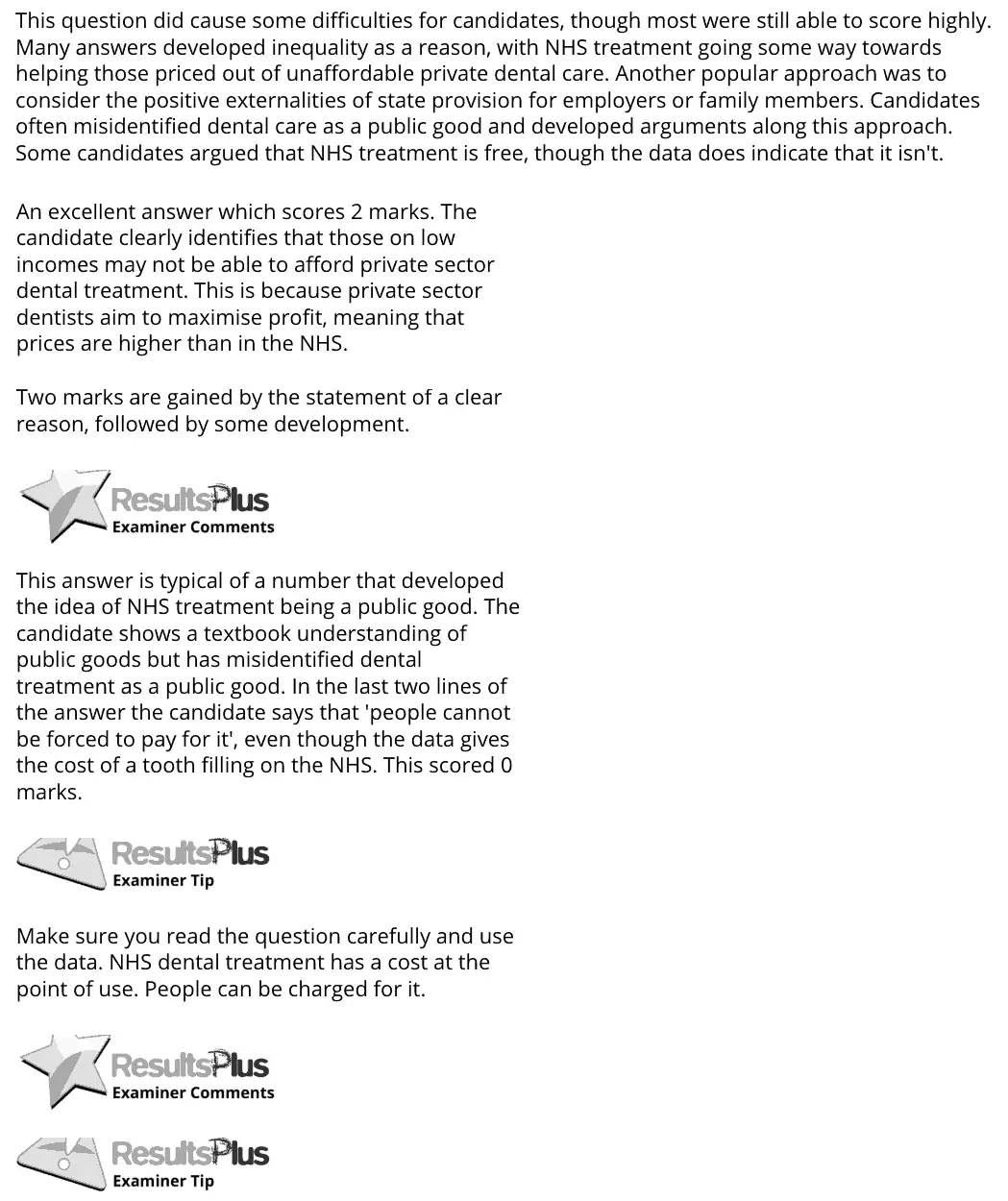
This question did cause some difficulties for candidates, though most were still able to score highly. Many answers developed inequality as a reason, with NHS treatment going some way towards helping those priced out of unaffordable private dental care. Another popular approach was to consider the positive externalities of state provision for employers or family members. Candidates often misidentified dental care as a public good and developed arguments along this approach. Some candidates argued that NHS treatment is free, though the data does indicate that it isn't. An excellent answer which scores 2 marks. The candidate clearly identifies that those on low incomes may not be able to afford private sector dental treatment. This is because private sector dentists aim to maximise profit, meaning that prices are higher than in the NHS. Two marks are gained by the statement of a clear reason, followed by some development. This answer is typical of a number that developed the idea of NHS treatment being a public good. The candidate shows a textbook understanding of public goods but has misidentified dental treatment as a public good. In the last two lines of the answer the candidate says that 'people cannot be forced to pay for it', even though the data gives the cost of a tooth filling on the NHS. This scored 0 marks. Make sure you read the question carefully and use the data. NHS dental treatment has a cost at the point of use. People can be charged for it.

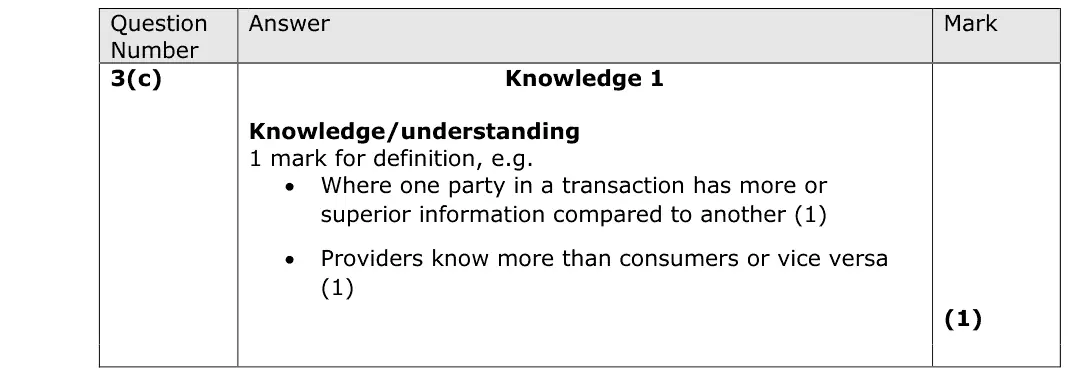
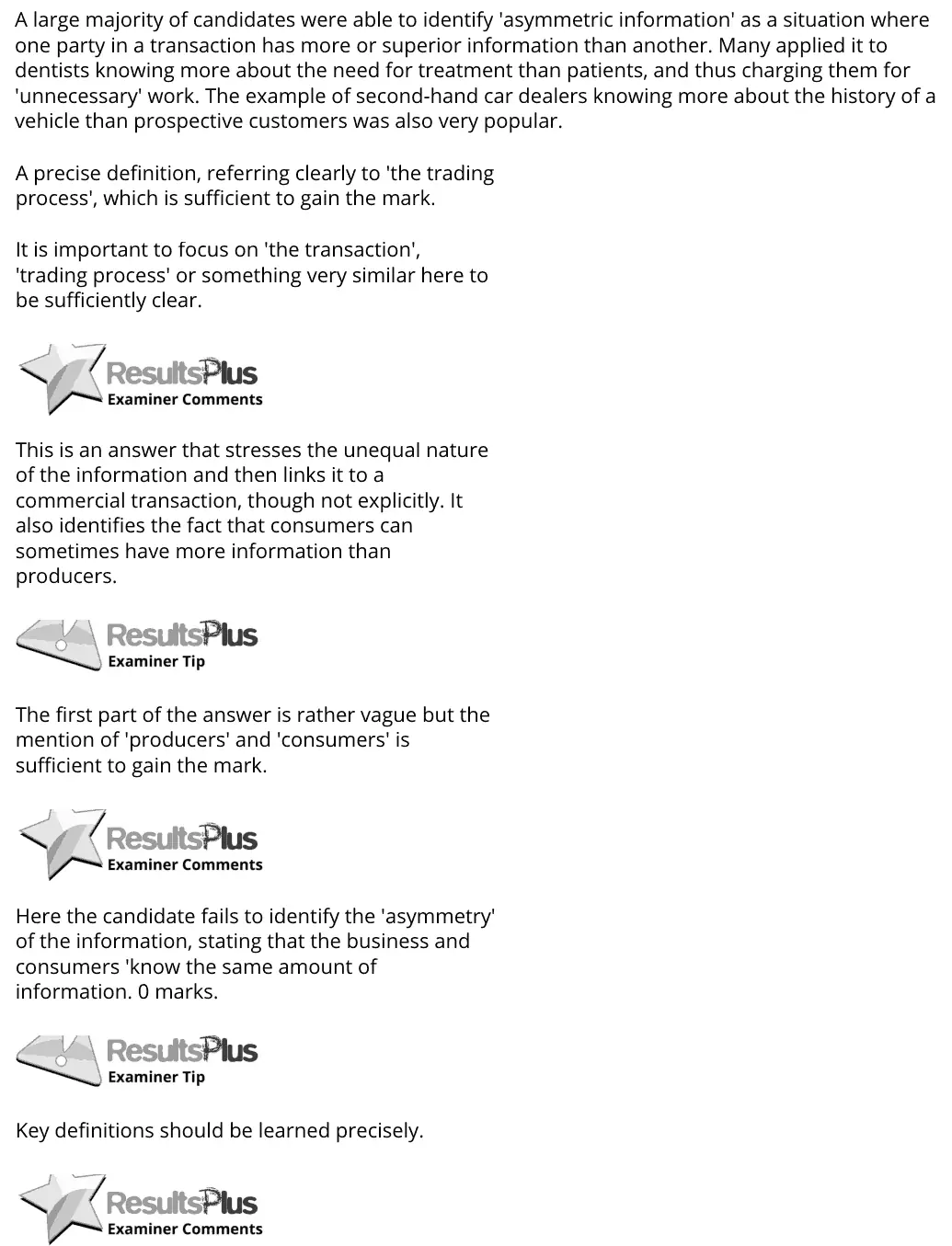
A large majority of candidates were able to identify 'asymmetric information' as a situation where one party in a transaction has more or superior information than another. Many applied it to dentists knowing more about the need for treatment than patients, and thus charging them for 'unnecessary' work. The example of second-hand car dealers knowing more about the history of a vehicle than prospective customers was also very popular. A precise definition, referring clearly to 'the trading process', which is sufficient to gain the mark. It is important to focus on 'the transaction', 'trading process' or something very similar here to be sufficiently clear. This is an answer that stresses the unequal nature of the information and then links it to a commercial transaction, though not explicitly. It also identifies the fact that consumers can sometimes have more information than producers. The first part of the answer is rather vague but the mention of 'producers' and 'consumers' is sufficient to gain the mark. Here the candidate fails to identify the 'asymmetry' of the information, stating that the business and consumers 'know the same amount of information. 0 marks. Key definitions should be learned precisely.
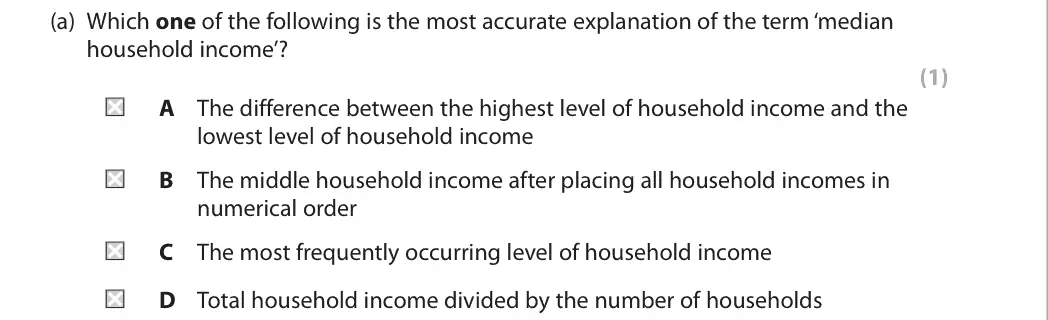
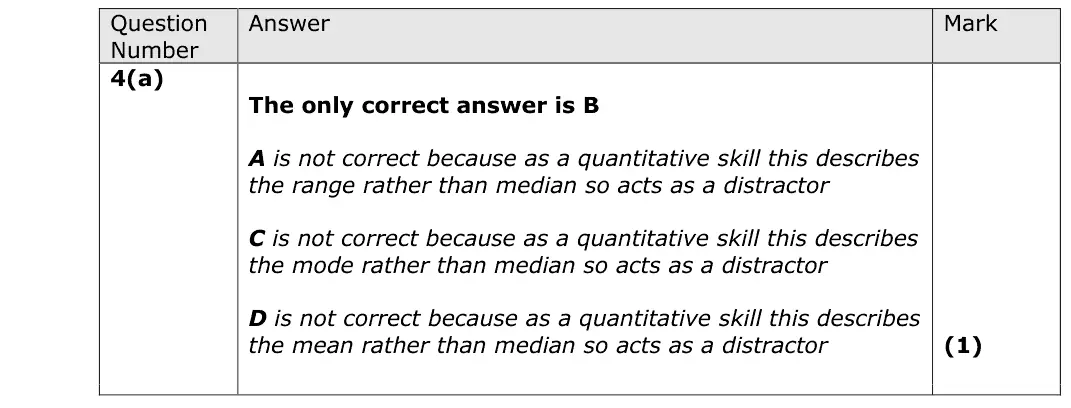
B
Quantitative skills: QS 3 (understand and use the terms mean, median and relevant quantiles)

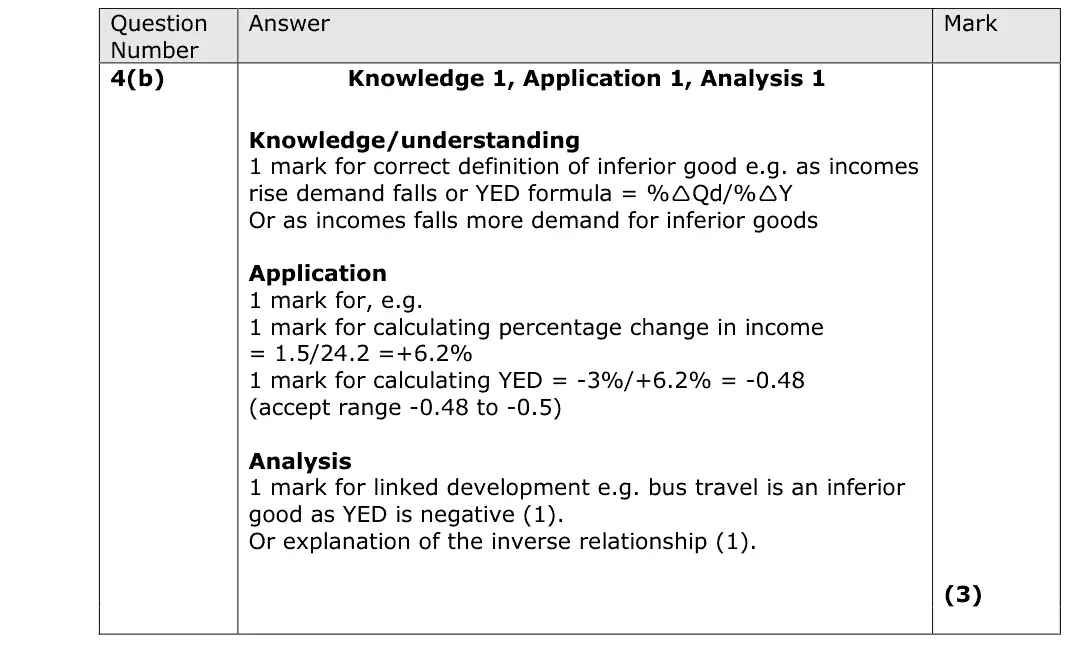
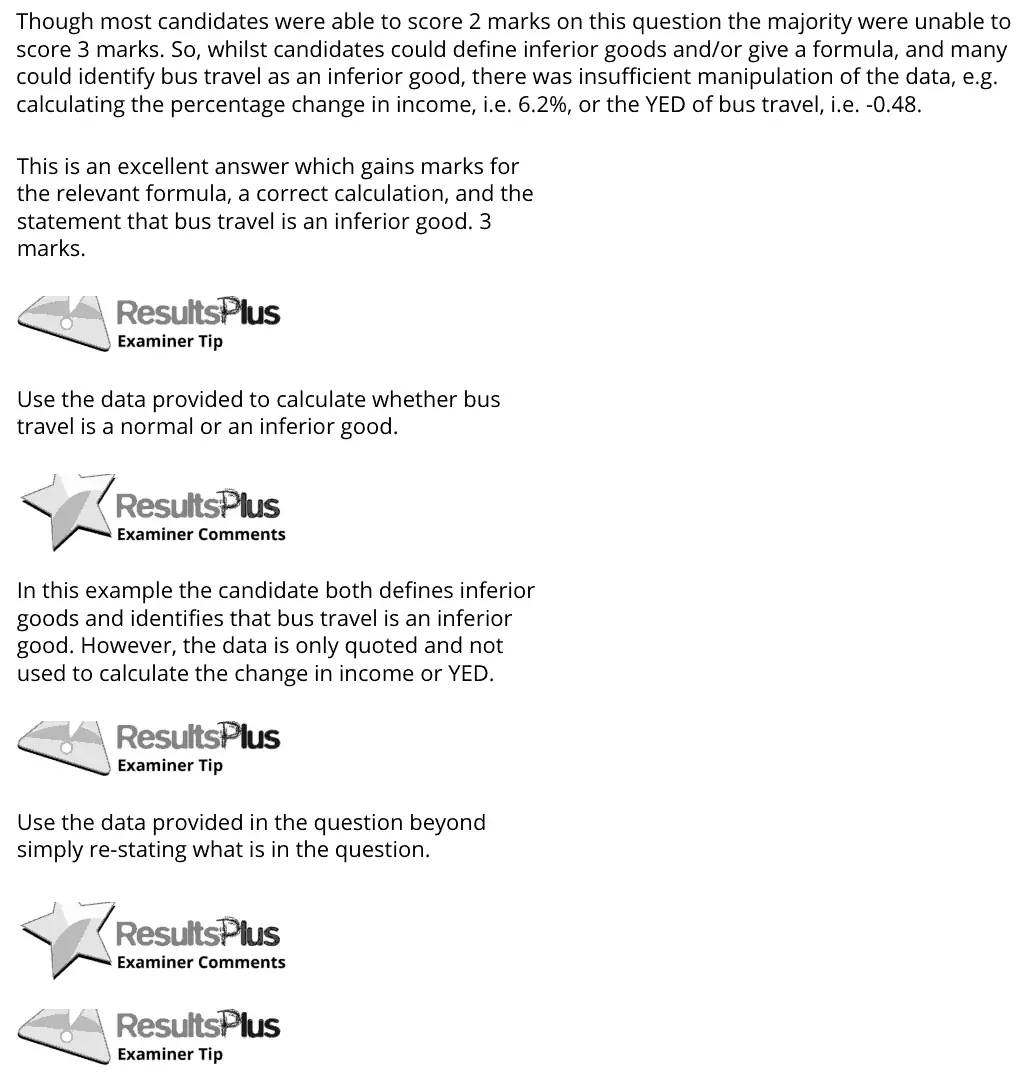
Though most candidates were able to score 2 marks on this question the majority were unable to score 3 marks. So, whilst candidates could define inferior goods and/or give a formula, and many could identify bus travel as an inferior good, there was insufficient manipulation of the data, e.g. calculating the percentage change in income, i.e. 6.2%, or the YED of bus travel, i.e. -0.48. This is an excellent answer which gains marks for the relevant formula, a correct calculation, and the statement that bus travel is an inferior good. 3 marks. Use the data provided to calculate whether bus travel is a normal or an inferior good. In this example the candidate both defines inferior goods and identifies that bus travel is an inferior good. However, the data is only quoted and not used to calculate the change in income or YED. Use the data provided in the question beyond simply re-stating what is in the question.
Quantitative skills: QS 2 (calculate, use and understand percentages, percentage changes and percentage point changes); QS 8 (make calculations of elasticity and interpret the result)

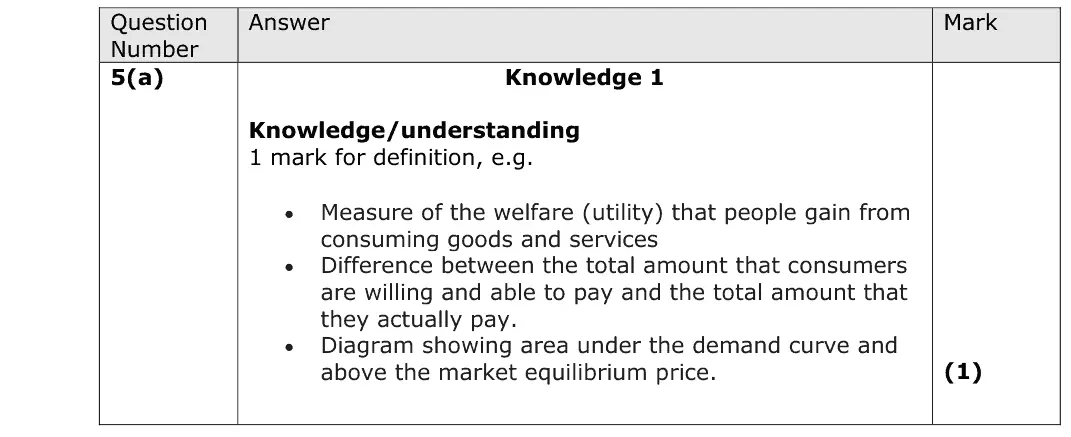
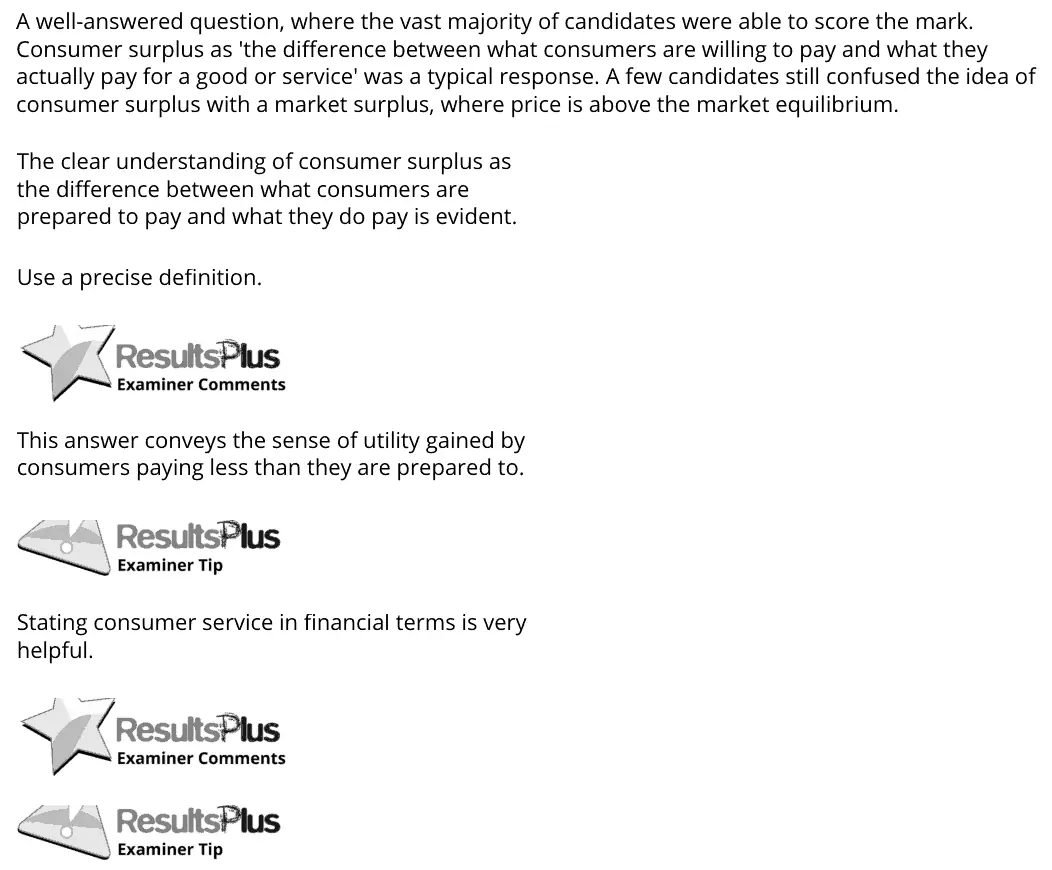
A well-answered question, where the vast majority of candidates were able to score the mark. Consumer surplus as 'the difference between what consumers are willing to pay and what they actually pay for a good or service' was a typical response. A few candidates still confused the idea of consumer surplus with a market surplus, where price is above the market equilibrium. The clear understanding of consumer surplus as the difference between what consumers are prepared to pay and what they do pay is evident. Use a precise definition. This answer conveys the sense of utility gained by consumers paying less than they are prepared to. Stating consumer service in financial terms is very helpful.

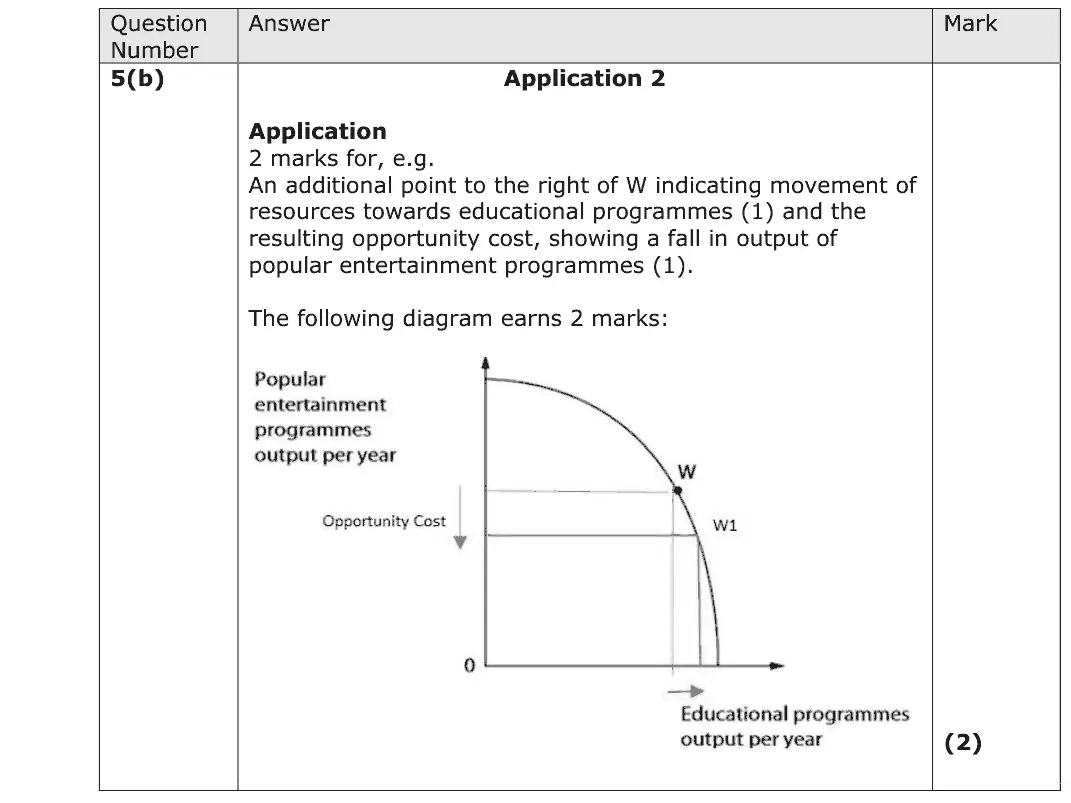
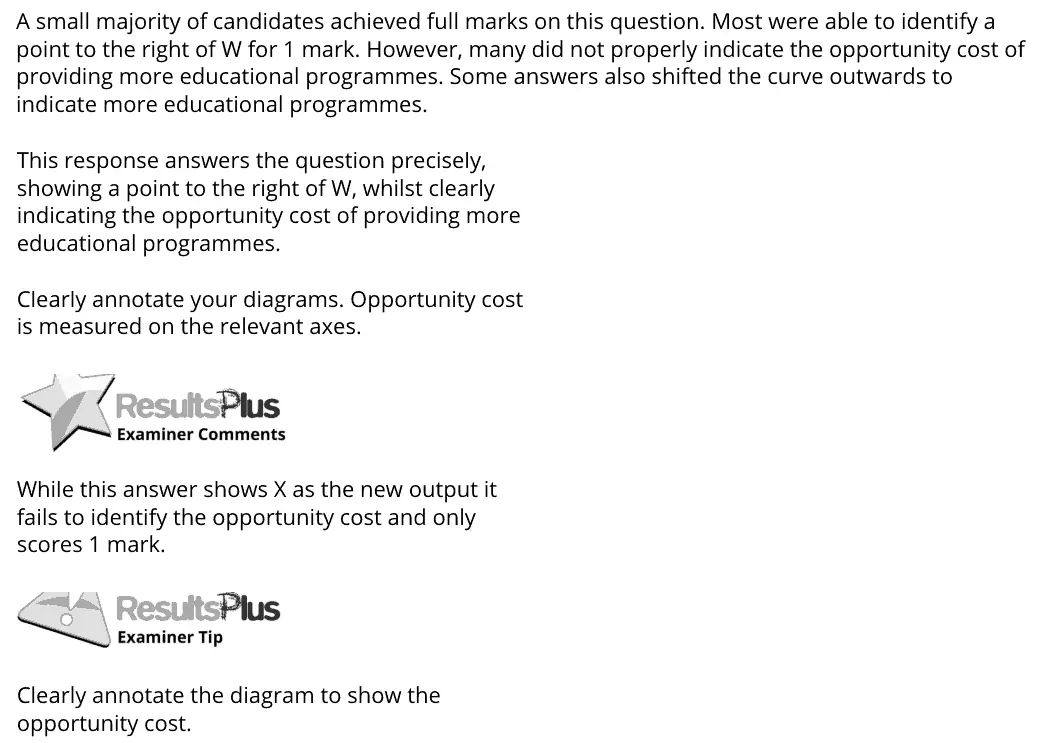
A small majority of candidates achieved full marks on this question. Most were able to identify a point to the right of W for 1 mark. However, many did not properly indicate the opportunity cost of providing more educational programmes. Some answers also shifted the curve outwards to indicate more educational programmes. This response answers the question precisely, showing a point to the right of W, whilst clearly indicating the opportunity cost of providing more educational programmes. Clearly annotate your diagrams. Opportunity cost is measured on the relevant axes. While this answer shows X as the new output it fails to identify the opportunity cost and only scores 1 mark. Clearly annotate the diagram to show the opportunity cost.
Quantitative skills: QS 4 (construct and interpret a range of standard graphical forms)
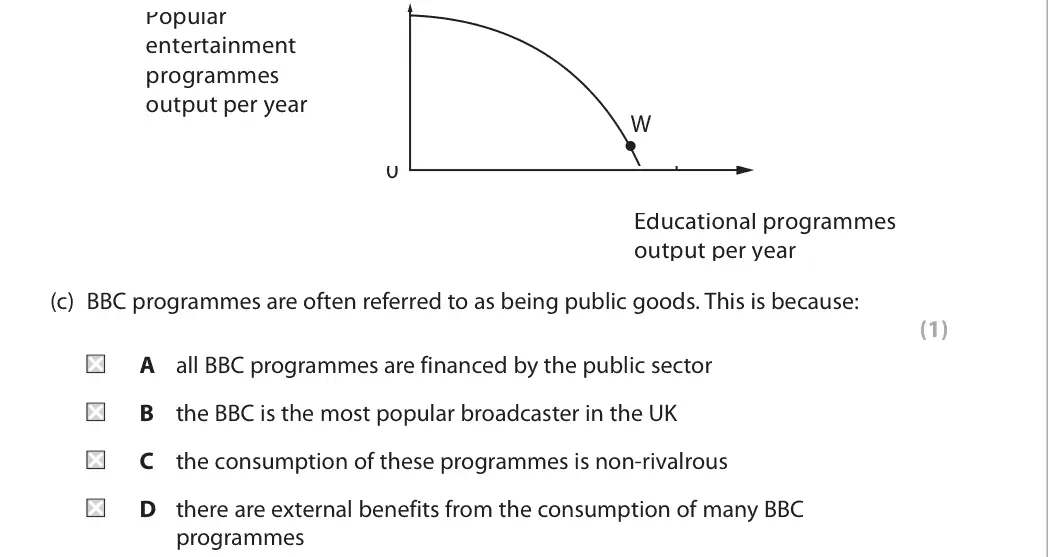
C

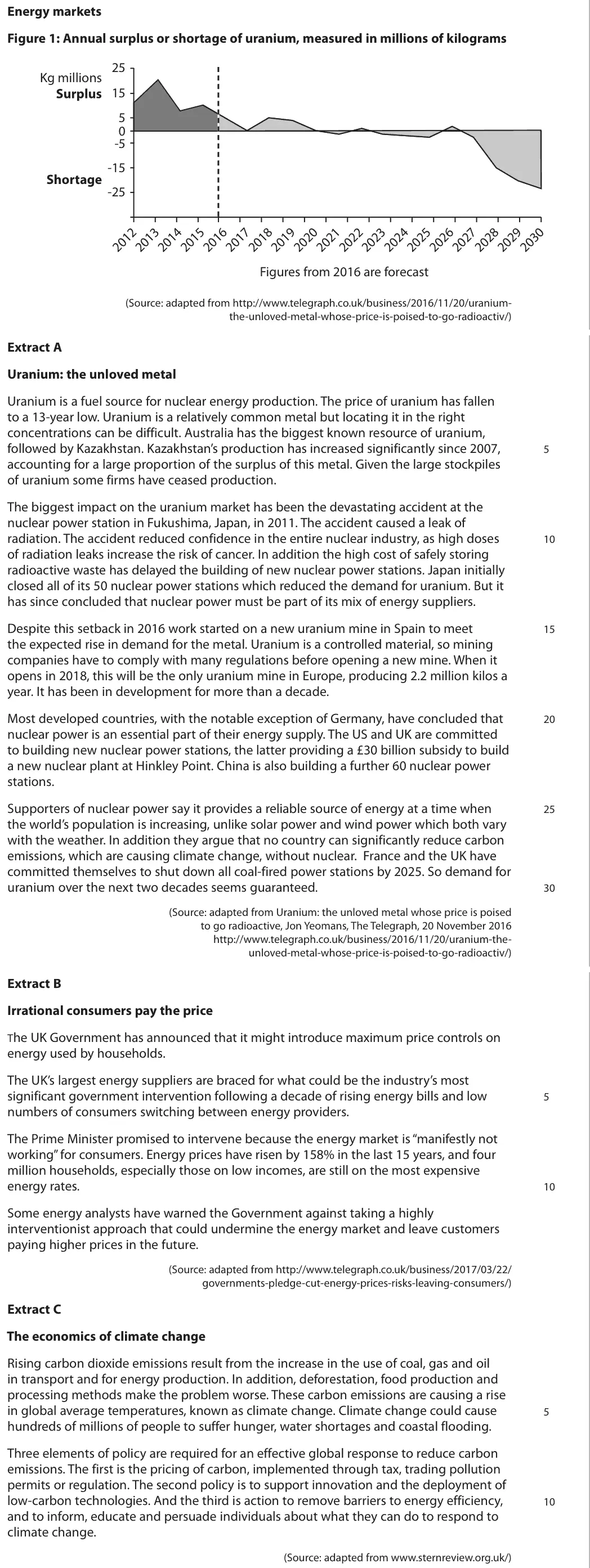
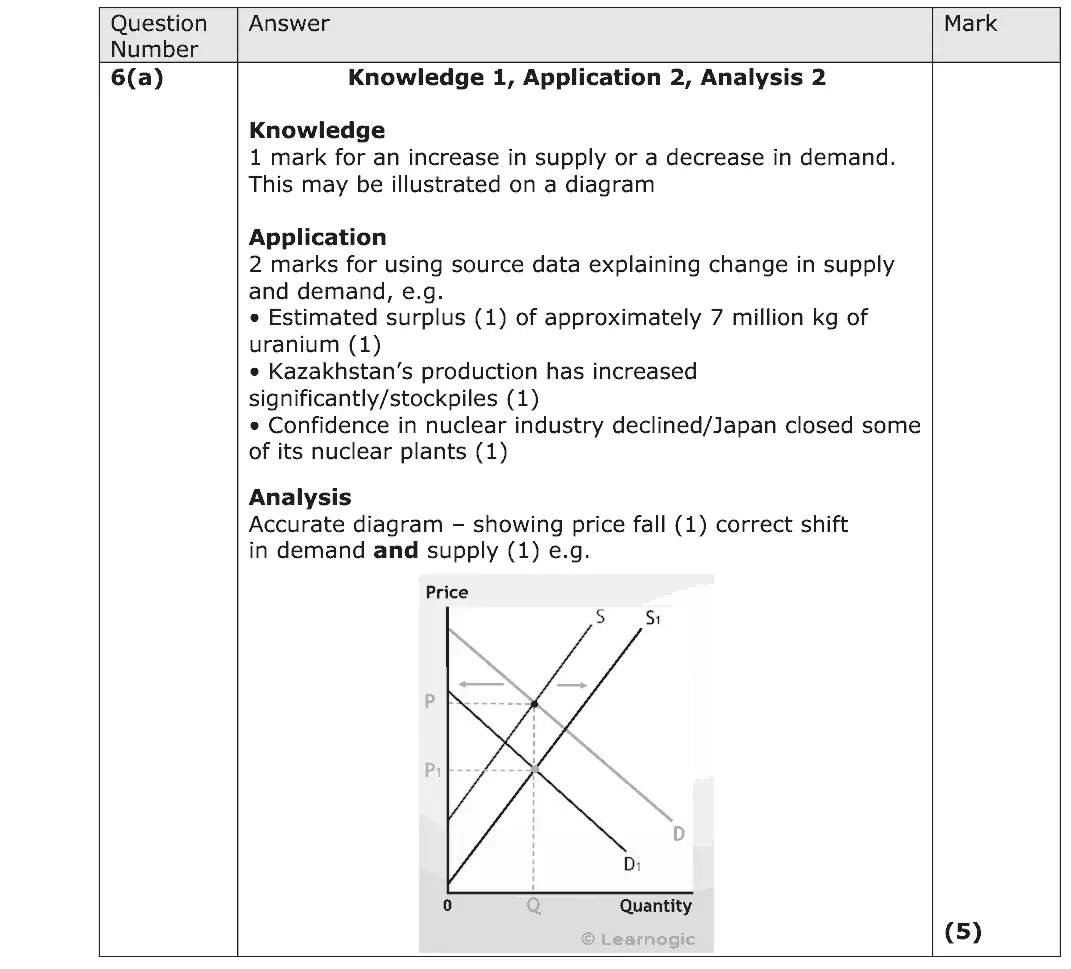
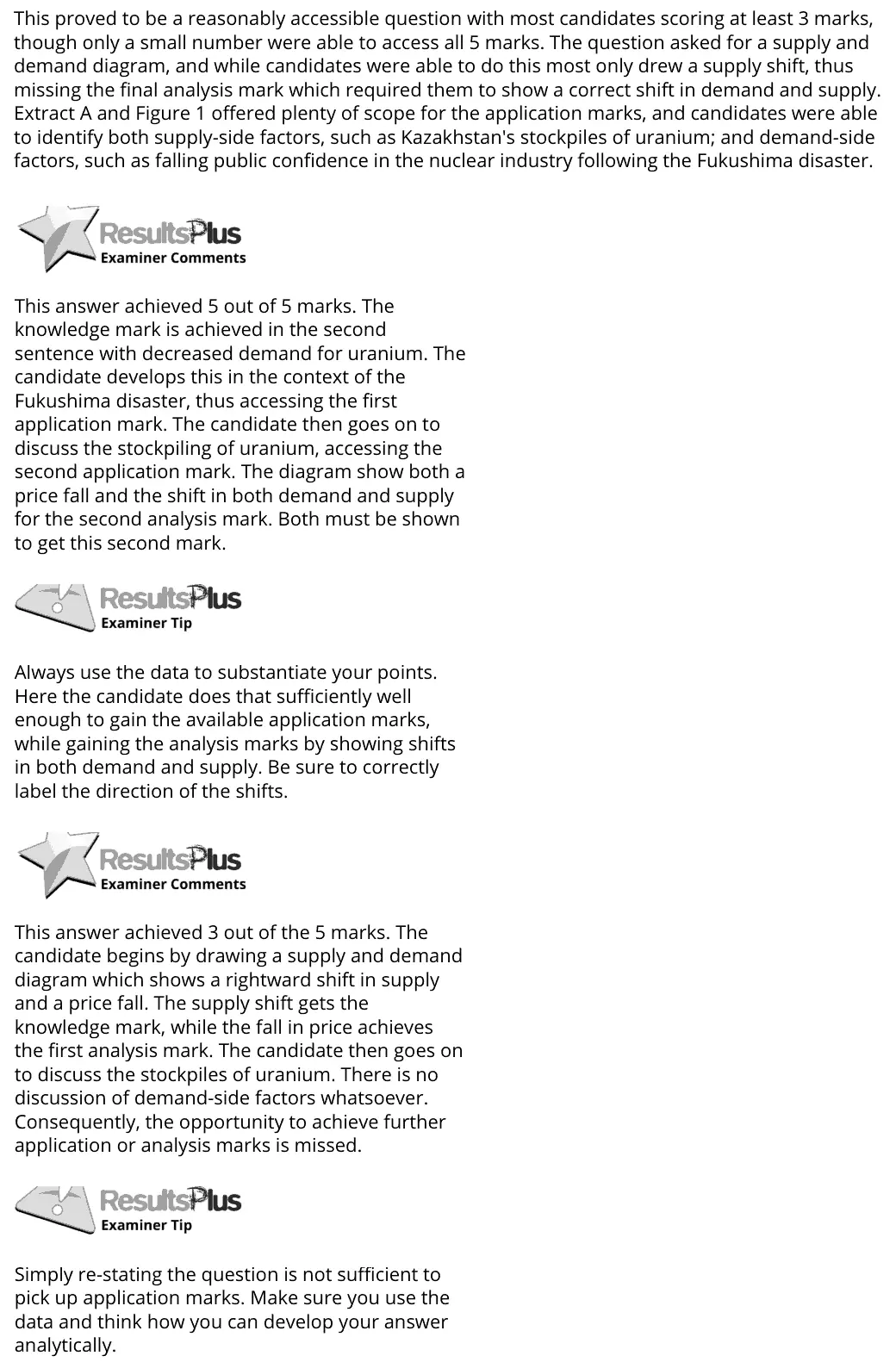
This proved to be a reasonably accessible question with most candidates scoring at least 3 marks, though only a small number were able to access all 5 marks. The question asked for a supply and demand diagram, and while candidates were able to do this most only drew a supply shift, thus missing the final analysis mark which required them to show a correct shift in demand and supply. Extract A and Figure 1 offered plenty of scope for the application marks, and candidates were able to identify both supply-side factors, such as Kazakhstan's stockpiles of uranium; and demand-side factors, such as falling public confidence in the nuclear industry following the Fukushima disaster. This answer achieved 5 out of 5 marks. The knowledge mark is achieved in the second sentence with decreased demand for uranium. The candidate develops this in the context of the Fukushima disaster, thus accessing the first application mark. The candidate then goes on to discuss the stockpiling of uranium, accessing the second application mark. The diagram show both a price fall and the shift in both demand and supply for the second analysis mark. Both must be shown to get this second mark. Always use the data to substantiate your points. Here the candidate does that sufficiently well enough to gain the available application marks, while gaining the analysis marks by showing shifts in both demand and supply. Be sure to correctly label the direction of the shifts. This answer achieved 3 out of the 5 marks. The candidate begins by drawing a supply and demand diagram which shows a rightward shift in supply and a price fall. The supply shift gets the knowledge mark, while the fall in price achieves the first analysis mark. The candidate then goes on to discuss the stockpiles of uranium. There is no discussion of demand-side factors whatsoever. Consequently, the opportunity to achieve further application or analysis marks is missed. Simply re-stating the question is not sufficient to pick up application marks. Make sure you use the data and think how you can develop your answer analytically.
Quantitative skills: QS 4 (construct and interpret a range of standard graphical forms); QS 9 (interpret, apply and analyse information in written, graphical tabular and numerical forms)

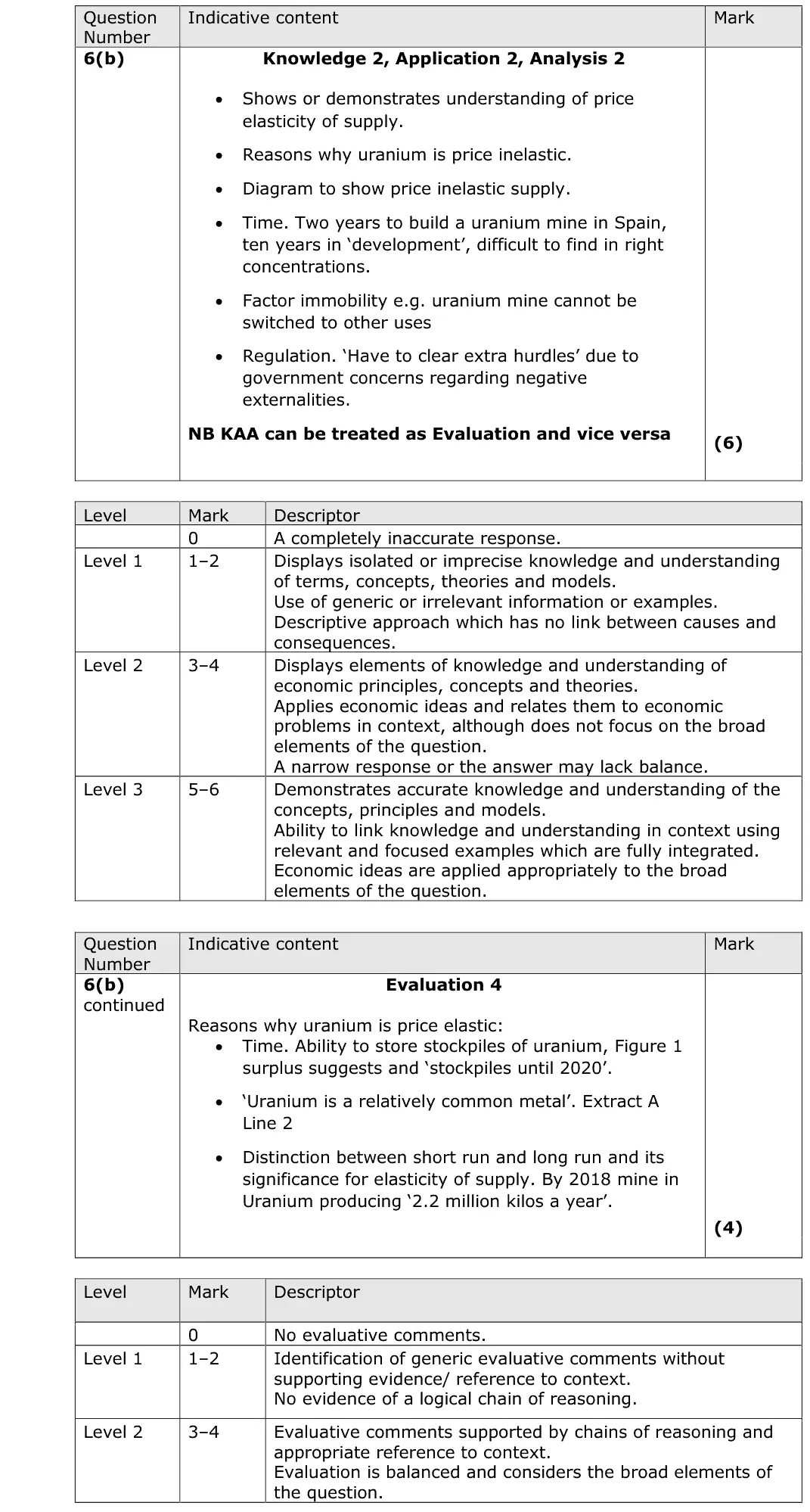
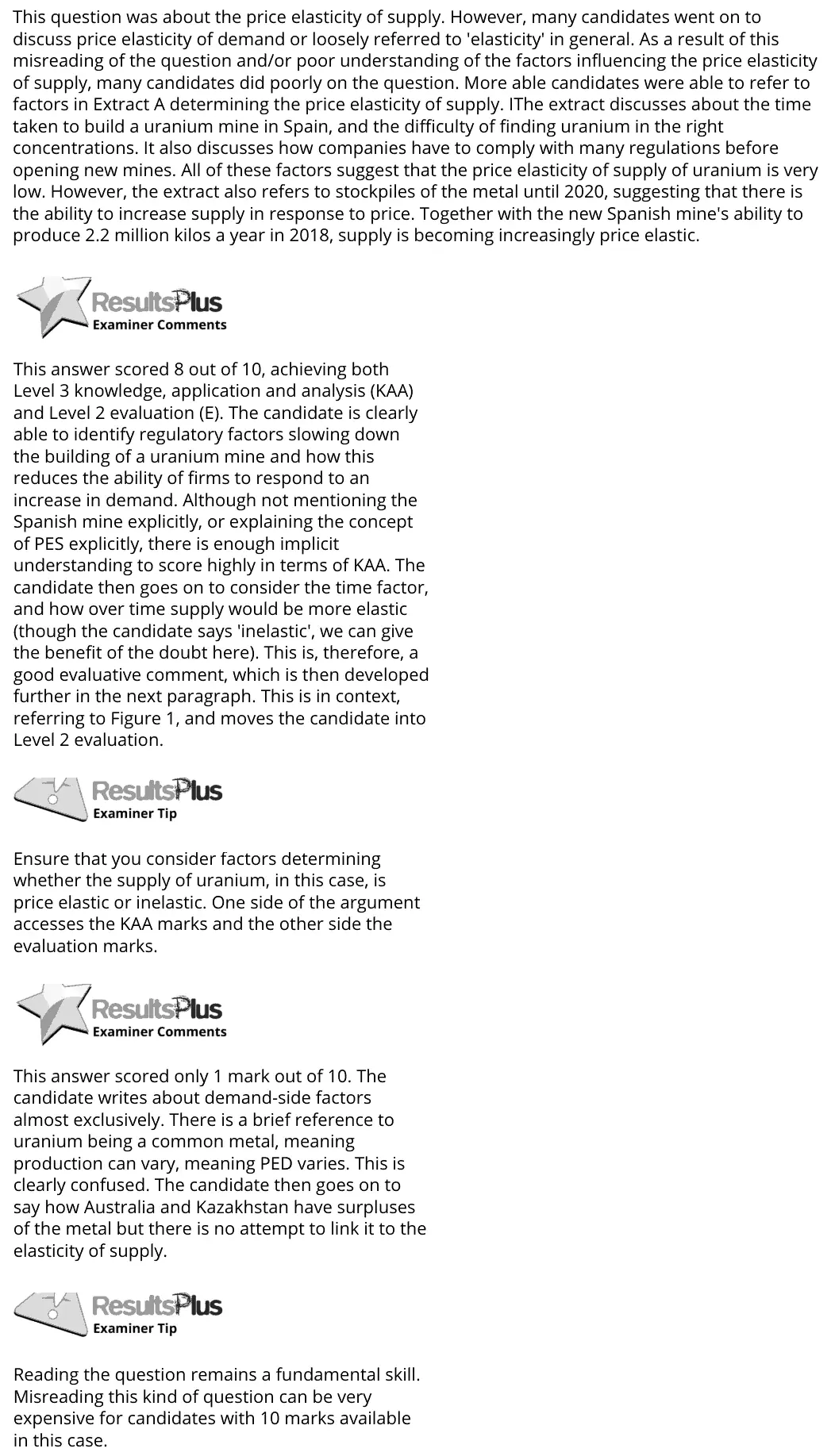
This question was about the price elasticity of supply. However, many candidates went on to discuss price elasticity of demand or loosely referred to 'elasticity' in general. As a result of this misreading of the question and/or poor understanding of the factors influencing the price elasticity of supply, many candidates did poorly on the question. More able candidates were able to refer to factors in Extract A determining the price elasticity of supply. IThe extract discusses about the time taken to build a uranium mine in Spain, and the difficulty of finding uranium in the right concentrations. It also discusses how companies have to comply with many regulations before opening new mines. All of these factors suggest that the price elasticity of supply of uranium is very low. However, the extract also refers to stockpiles of the metal until 2020, suggesting that there is the ability to increase supply in response to price. Together with the new Spanish mine's ability to produce 2.2 million kilos a year in 2018, supply is becoming increasingly price elastic. This answer scored 8 out of 10, achieving both Level 3 knowledge, application and analysis (KAA) and Level 2 evaluation (E). The candidate is clearly able to identify regulatory factors slowing down the building of a uranium mine and how this reduces the ability of firms to respond to an increase in demand. Although not mentioning the Spanish mine explicitly, or explaining the concept of PES explicitly, there is enough implicit understanding to score highly in terms of KAA. The candidate then goes on to consider the time factor, and how over time supply would be more elastic (though the candidate says 'inelastic', we can give the benefit of the doubt here). This is, therefore, a good evaluative comment, which is then developed further in the next paragraph. This is in context, referring to Figure 1, and moves the candidate into Level 2 evaluation. Ensure that you consider factors determining whether the supply of uranium, in this case, is price elastic or inelastic. One side of the argument accesses the KAA marks and the other side the evaluation marks. This answer scored only 1 mark out of 10. The candidate writes about demand-side factors almost exclusively. There is a brief reference to uranium being a common metal, meaning production can vary, meaning PED varies. This is clearly confused. The candidate then goes on to say how Australia and Kazakhstan have surpluses of the metal but there is no attempt to link it to the elasticity of supply. Reading the question remains a fundamental skill. Misreading this kind of question can be very expensive for candidates with 10 marks available in this case.

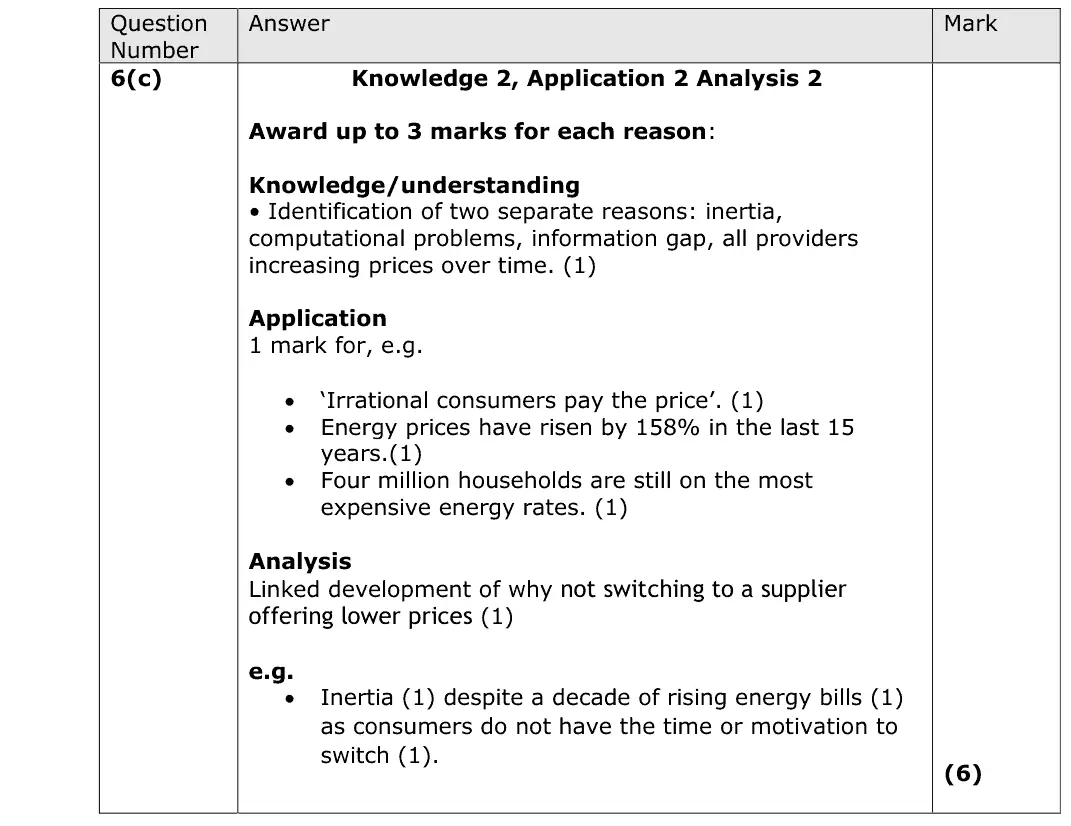
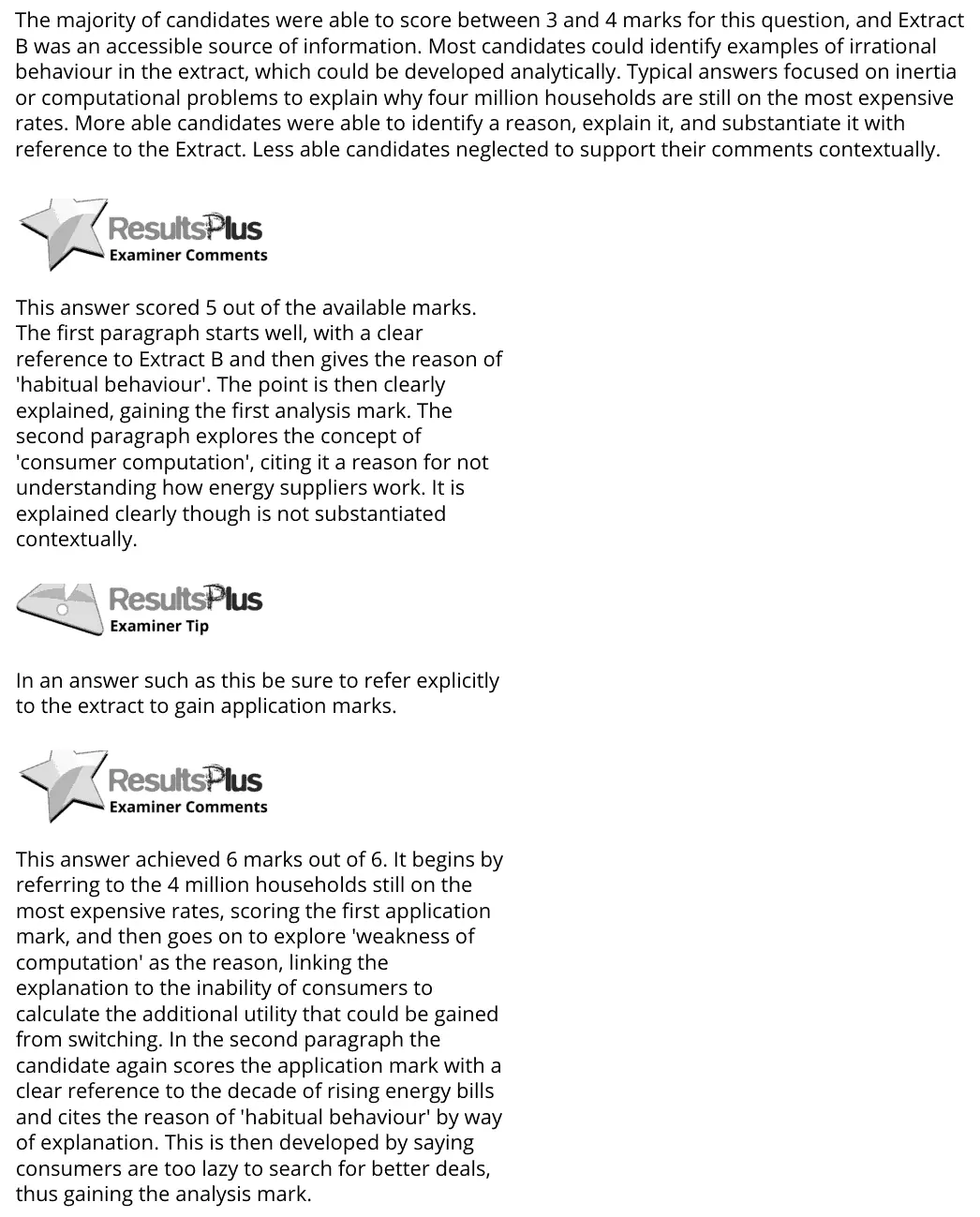
The majority of candidates were able to score between 3 and 4 marks for this question, and Extract B was an accessible source of information. Most candidates could identify examples of irrational behaviour in the extract, which could be developed analytically. Typical answers focused on inertia or computational problems to explain why four million households are still on the most expensive rates. More able candidates were able to identify a reason, explain it, and substantiate it with reference to the Extract. Less able candidates neglected to support their comments contextually. This answer scored 5 out of the available marks. The first paragraph starts well, with a clear reference to Extract B and then gives the reason of 'habitual behaviour'. The point is then clearly explained, gaining the first analysis mark. The second paragraph explores the concept of 'consumer computation', citing it a reason for not understanding how energy suppliers work. It is explained clearly though is not substantiated contextually. In an answer such as this be sure to refer explicitly to the extract to gain application marks. This answer achieved 6 marks out of 6. It begins by referring to the 4 million households still on the most expensive rates, scoring the first application mark, and then goes on to explore 'weakness of computation' as the reason, linking the explanation to the inability of consumers to calculate the additional utility that could be gained from switching. In the second paragraph the candidate again scores the application mark with a clear reference to the decade of rising energy bills and cites the reason of 'habitual behaviour' by way of explanation. This is then developed by saying consumers are too lazy to search for better deals, thus gaining the analysis mark.

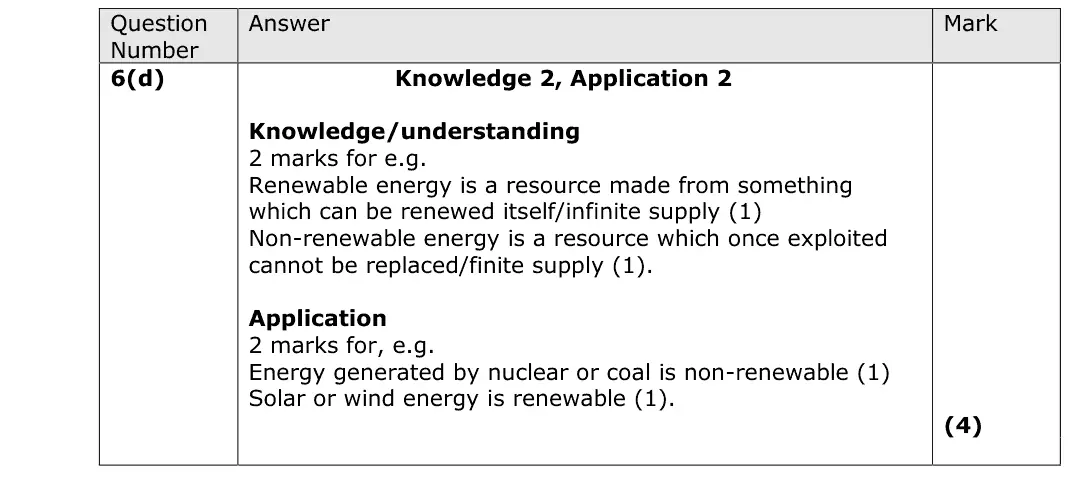
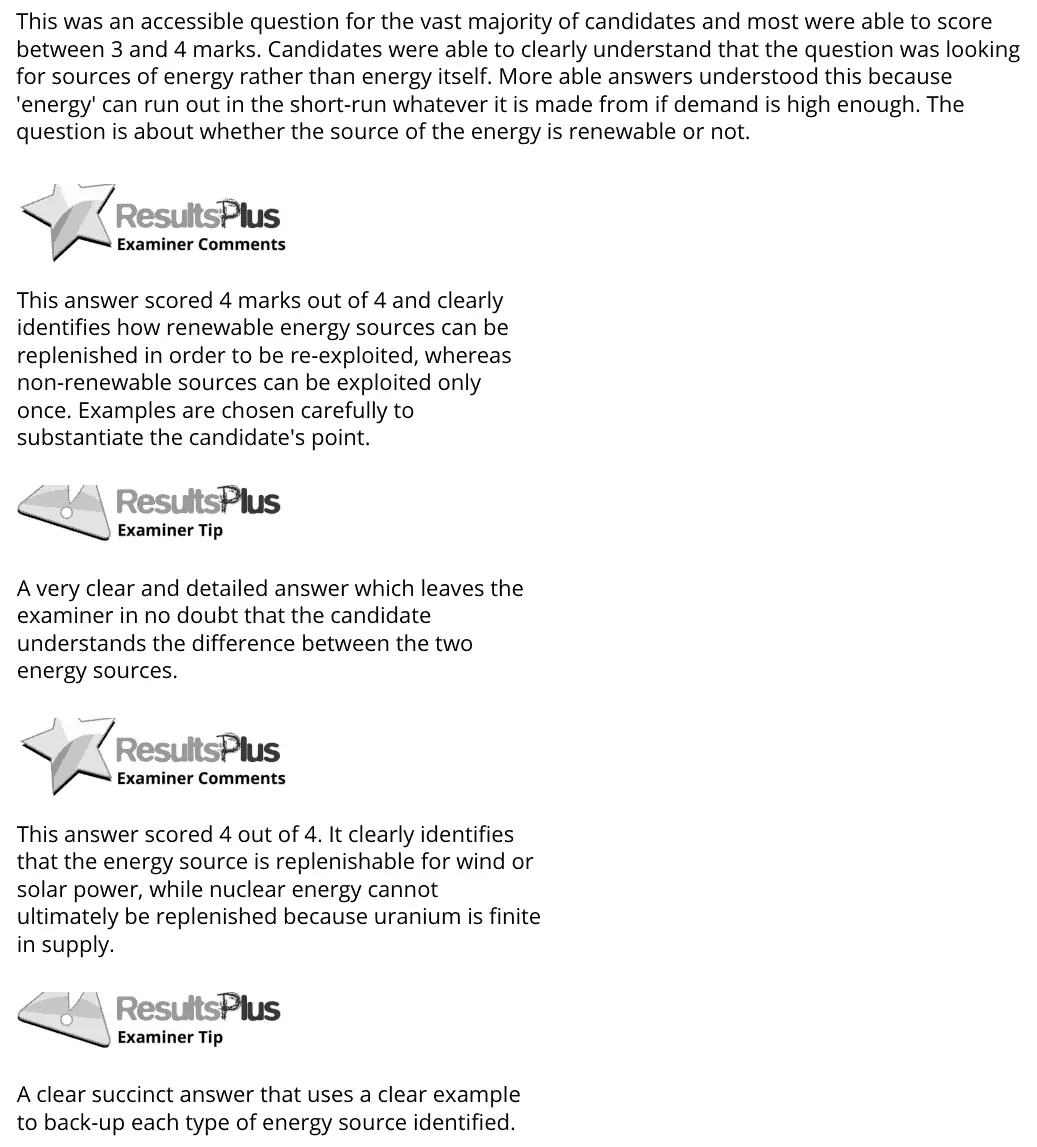
This was an accessible question for the vast majority of candidates and most were able to score between 3 and 4 marks. Candidates were able to clearly understand that the question was looking for sources of energy rather than energy itself. More able answers understood this because 'energy' can run out in the short-run whatever it is made from if demand is high enough. The question is about whether the source of the energy is renewable or not. This answer scored 4 marks out of 4 and clearly identifies how renewable energy sources can be replenished in order to be re-exploited, whereas non-renewable sources can be exploited only once. Examples are chosen carefully to substantiate the candidate's point. A very clear and detailed answer which leaves the examiner in no doubt that the candidate understands the difference between the two energy sources. This answer scored 4 out of 4. It clearly identifies that the energy source is replenishable for wind or solar power, while nuclear energy cannot ultimately be replenished because uranium is finite in supply. A clear succinct answer that uses a clear example to back-up each type of energy source identified.

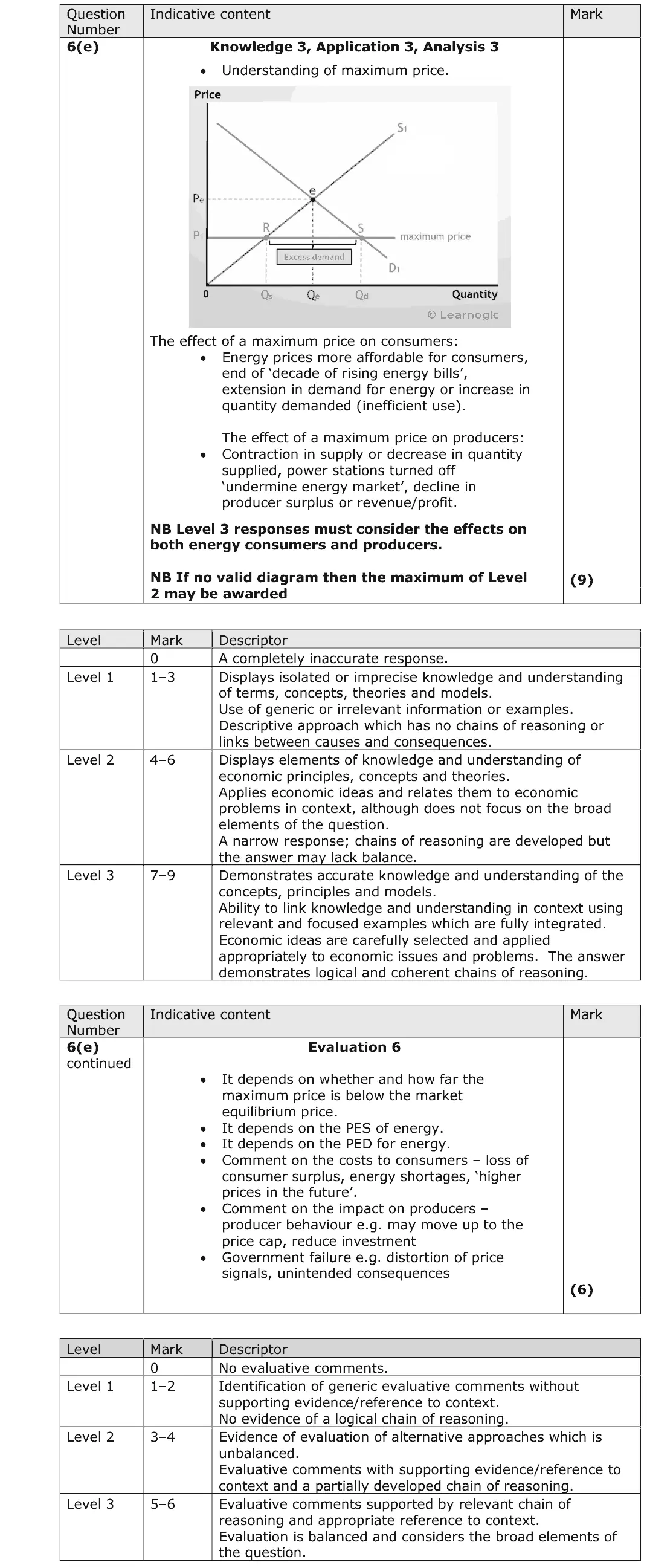
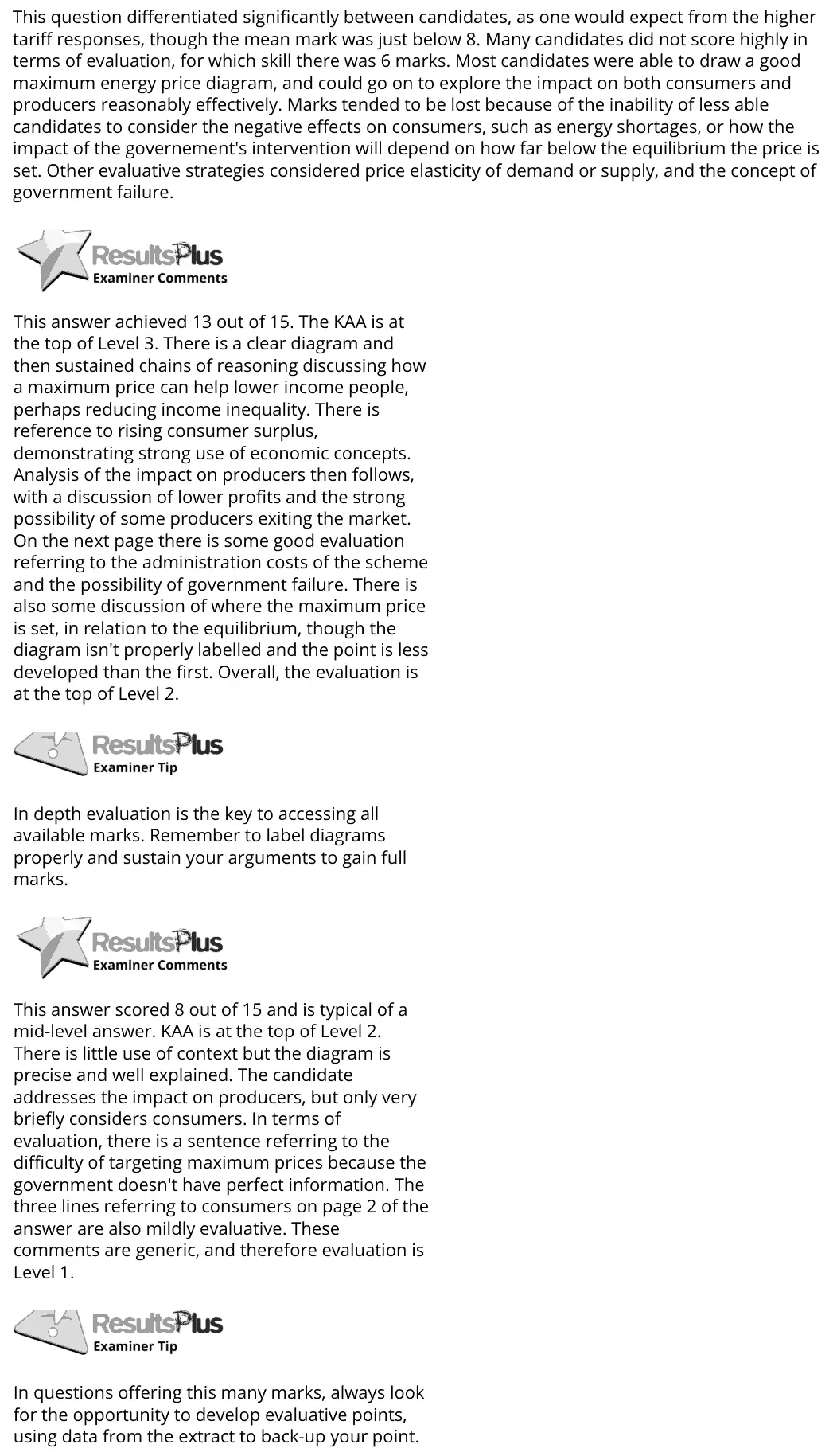
This question differentiated significantly between candidates, as one would expect from the higher tariff responses, though the mean mark was just below 8. Many candidates did not score highly in terms of evaluation, for which skill there was 6 marks. Most candidates were able to draw a good maximum energy price diagram, and could go on to explore the impact on both consumers and producers reasonably effectively. Marks tended to be lost because of the inability of less able candidates to consider the negative effects on consumers, such as energy shortages, or how the impact of the governement's intervention will depend on how far below the equilibrium the price is set. Other evaluative strategies considered price elasticity of demand or supply, and the concept of government failure. This answer achieved 13 out of 15. The KAA is at the top of Level 3. There is a clear diagram and then sustained chains of reasoning discussing how a maximum price can help lower income people, perhaps reducing income inequality. There is reference to rising consumer surplus, demonstrating strong use of economic concepts. Analysis of the impact on producers then follows, with a discussion of lower profits and the strong possibility of some producers exiting the market. On the next page there is some good evaluation referring to the administration costs of the scheme and the possibility of government failure. There is also some discussion of where the maximum price is set, in relation to the equilibrium, though the diagram isn't properly labelled and the point is less developed than the first. Overall, the evaluation is at the top of Level 2. In depth evaluation is the key to accessing all available marks. Remember to label diagrams properly and sustain your arguments to gain full marks. This answer scored 8 out of 15 and is typical of a mid-level answer. KAA is at the top of Level 2. There is little use of context but the diagram is precise and well explained. The candidate addresses the impact on producers, but only very briefly considers consumers. In terms of evaluation, there is a sentence referring to the difficulty of targeting maximum prices because the government doesn't have perfect information. The three lines referring to consumers on page 2 of the answer are also mildly evaluative. These comments are generic, and therefore evaluation is Level 1. In questions offering this many marks, always look for the opportunity to develop evaluative points, using data from the extract to back-up your point.
Quantitative skills: QS 4 (construct and interpret a range of standard graphical forms)

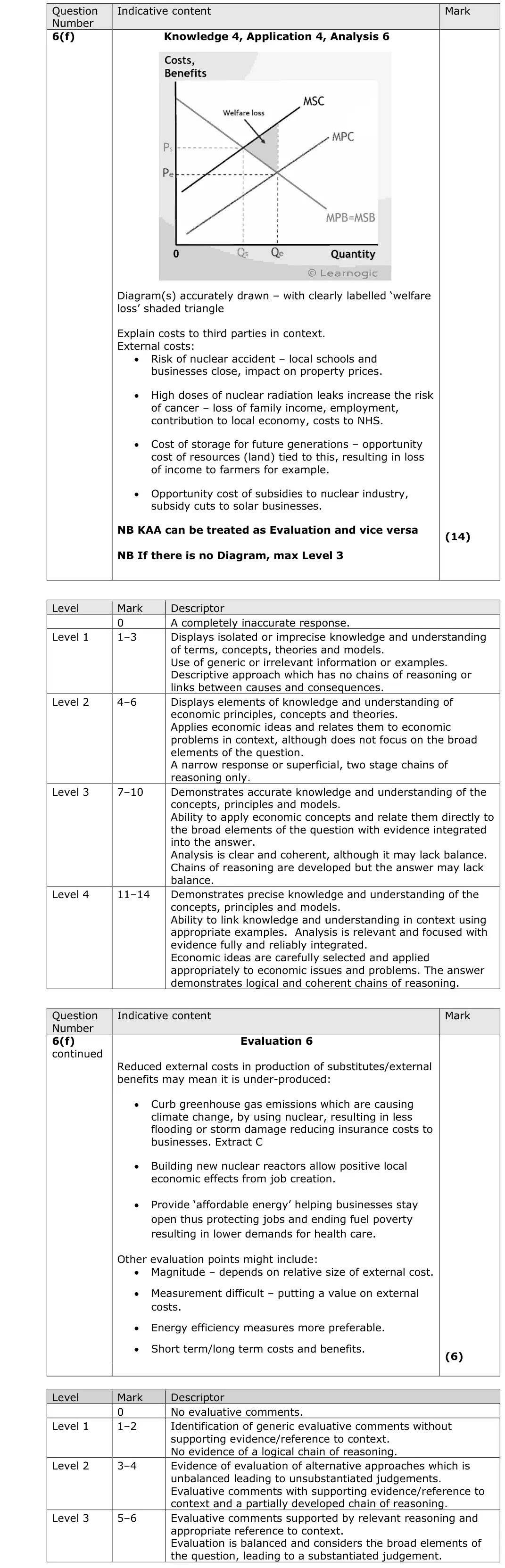
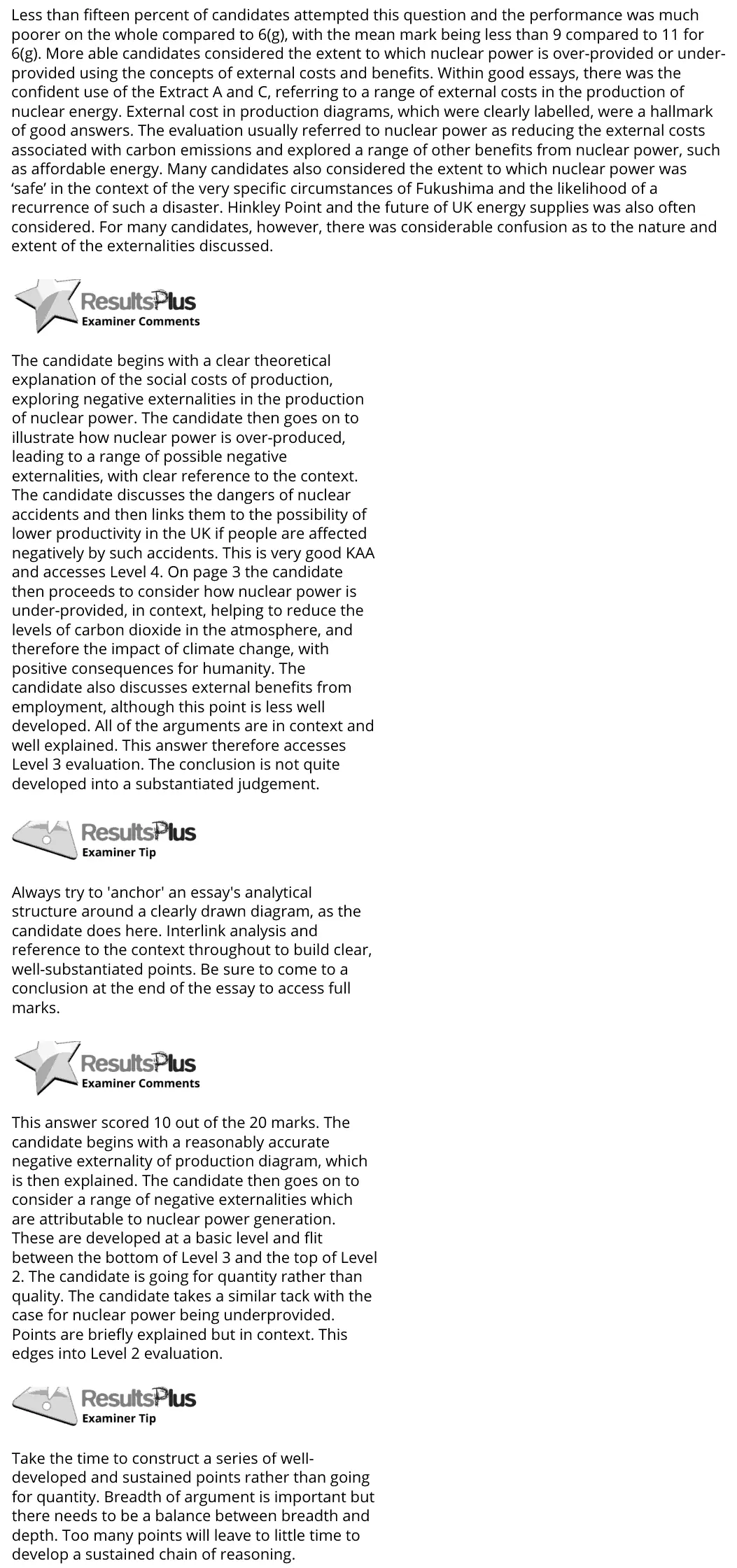
Less than fifteen percent of candidates attempted this question and the performance was much poorer on the whole compared to 6(g), with the mean mark being less than 9 compared to 11 for 6(g). More able candidates considered the extent to which nuclear power is over-provided or under- provided using the concepts of external costs and benefits. Within good essays, there was the confident use of the Extract A and C, referring to a range of external costs in the production of nuclear energy. External cost in production diagrams, which were clearly labelled, were a hallmark of good answers. The evaluation usually referred to nuclear power as reducing the external costs associated with carbon emissions and explored a range of other benefits from nuclear power, such as affordable energy. Many candidates also considered the extent to which nuclear power was ‘safe’ in the context of the very specific circumstances of Fukushima and the likelihood of a recurrence of such a disaster. Hinkley Point and the future of UK energy supplies was also often considered. For many candidates, however, there was considerable confusion as to the nature and extent of the externalities discussed. The candidate begins with a clear theoretical explanation of the social costs of production, exploring negative externalities in the production of nuclear power. The candidate then goes on to illustrate how nuclear power is over-produced, leading to a range of possible negative externalities, with clear reference to the context. The candidate discusses the dangers of nuclear accidents and then links them to the possibility of lower productivity in the UK if people are affected negatively by such accidents. This is very good KAA and accesses Level 4. On page 3 the candidate then proceeds to consider how nuclear power is under-provided, in context, helping to reduce the levels of carbon dioxide in the atmosphere, and therefore the impact of climate change, with positive consequences for humanity. The candidate also discusses external benefits from employment, although this point is less well developed. All of the arguments are in context and well explained. This answer therefore accesses Level 3 evaluation. The conclusion is not quite developed into a substantiated judgement. Always try to 'anchor' an essay's analytical structure around a clearly drawn diagram, as the candidate does here. Interlink analysis and reference to the context throughout to build clear, well-substantiated points. Be sure to come to a conclusion at the end of the essay to access full marks. This answer scored 10 out of the 20 marks. The candidate begins with a reasonably accurate negative externality of production diagram, which is then explained. The candidate then goes on to consider a range of negative externalities which are attributable to nuclear power generation. These are developed at a basic level and flit between the bottom of Level 3 and the top of Level 2. The candidate is going for quantity rather than quality. The candidate takes a similar tack with the case for nuclear power being underprovided. Points are briefly explained but in context. This edges into Level 2 evaluation. Take the time to construct a series of well- developed and sustained points rather than going for quantity. Breadth of argument is important but there needs to be a balance between breadth and depth. Too many points will leave to little time to develop a sustained chain of reasoning.
Quantitative skills: QS 4 (construct and interpret a range of standard graphical forms)

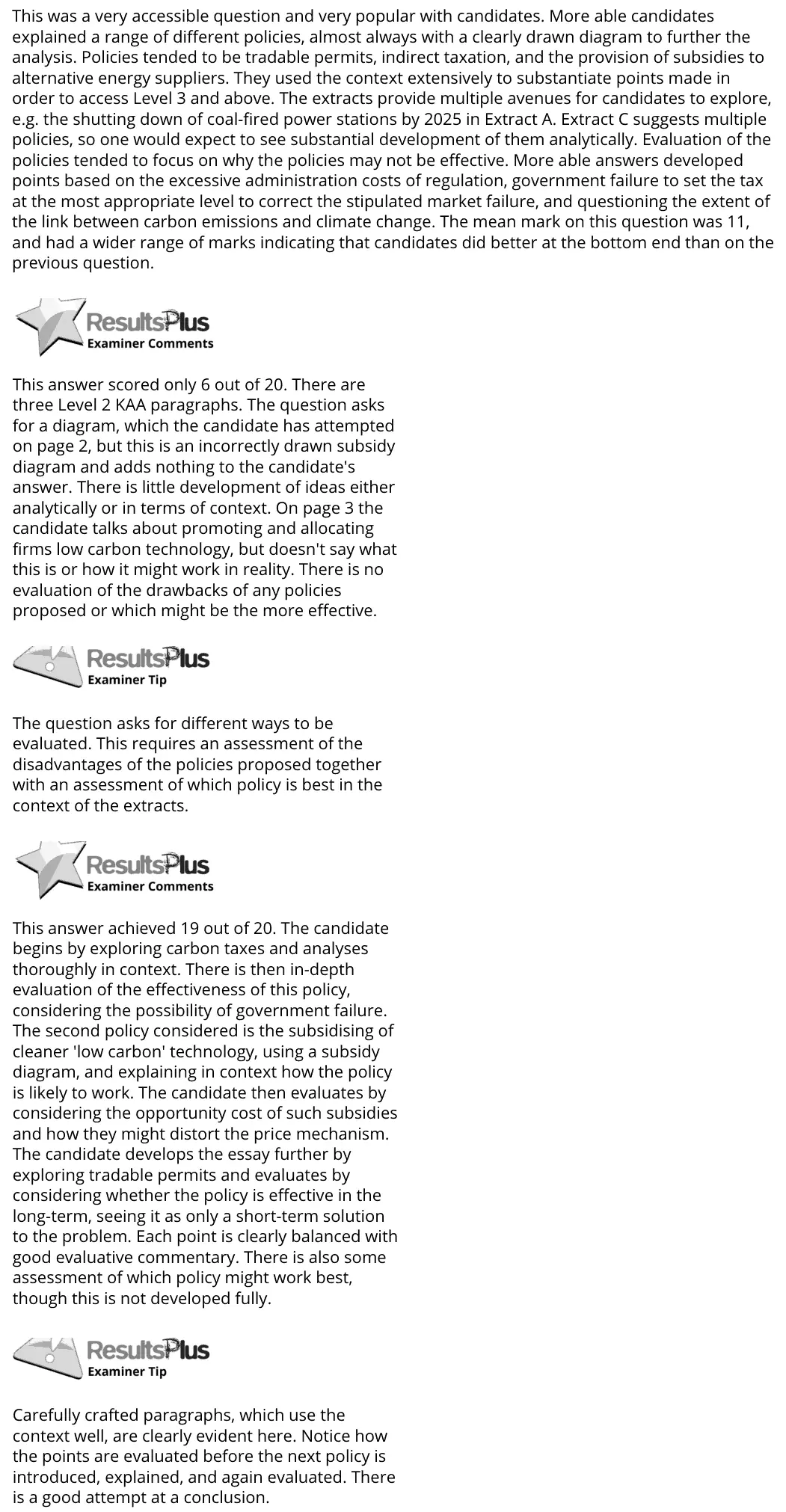
This was a very accessible question and very popular with candidates. More able candidates explained a range of different policies, almost always with a clearly drawn diagram to further the analysis. Policies tended to be tradable permits, indirect taxation, and the provision of subsidies to alternative energy suppliers. They used the context extensively to substantiate points made in order to access Level 3 and above. The extracts provide multiple avenues for candidates to explore, e.g. the shutting down of coal-fired power stations by 2025 in Extract A. Extract C suggests multiple policies, so one would expect to see substantial development of them analytically. Evaluation of the policies tended to focus on why the policies may not be effective. More able answers developed points based on the excessive administration costs of regulation, government failure to set the tax at the most appropriate level to correct the stipulated market failure, and questioning the extent of the link between carbon emissions and climate change. The mean mark on this question was 11, and had a wider range of marks indicating that candidates did better at the bottom end than on the previous question. This answer scored only 6 out of 20. There are three Level 2 KAA paragraphs. The question asks for a diagram, which the candidate has attempted on page 2, but this is an incorrectly drawn subsidy diagram and adds nothing to the candidate's answer. There is little development of ideas either analytically or in terms of context. On page 3 the candidate talks about promoting and allocating firms low carbon technology, but doesn't say what this is or how it might work in reality. There is no evaluation of the drawbacks of any policies proposed or which might be the more effective. The question asks for different ways to be evaluated. This requires an assessment of the disadvantages of the policies proposed together with an assessment of which policy is best in the context of the extracts. This answer achieved 19 out of 20. The candidate begins by exploring carbon taxes and analyses thoroughly in context. There is then in-depth evaluation of the effectiveness of this policy, considering the possibility of government failure. The second policy considered is the subsidising of cleaner 'low carbon' technology, using a subsidy diagram, and explaining in context how the policy is likely to work. The candidate then evaluates by considering the opportunity cost of such subsidies and how they might distort the price mechanism. The candidate develops the essay further by exploring tradable permits and evaluates by considering whether the policy is effective in the long-term, seeing it as only a short-term solution to the problem. Each point is clearly balanced with good evaluative commentary. There is also some assessment of which policy might work best, though this is not developed fully. Carefully crafted paragraphs, which use the context well, are clearly evident here. Notice how the points are evaluated before the next policy is introduced, explained, and again evaluated. There is a good attempt at a conclusion.
Quantitative skills: QS 4 (construct and interpret a range of standard graphical forms)
Want a paper marked and gone through with you? Message us.