June 2017: AS Paper 1

80 marks · 19 question parts · Paper, mark scheme and report on Pearson's site

Question by question

QTopicMarksAOType
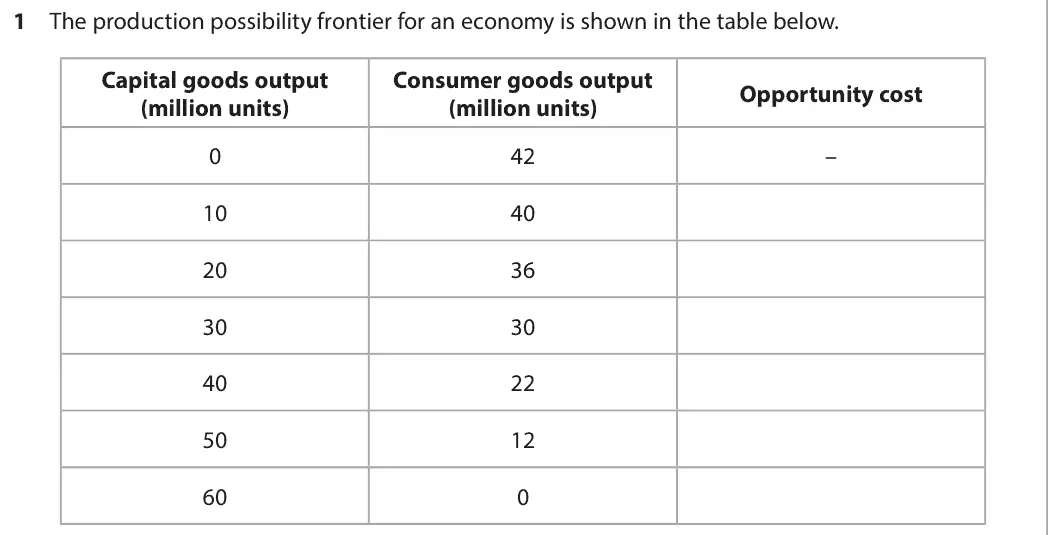
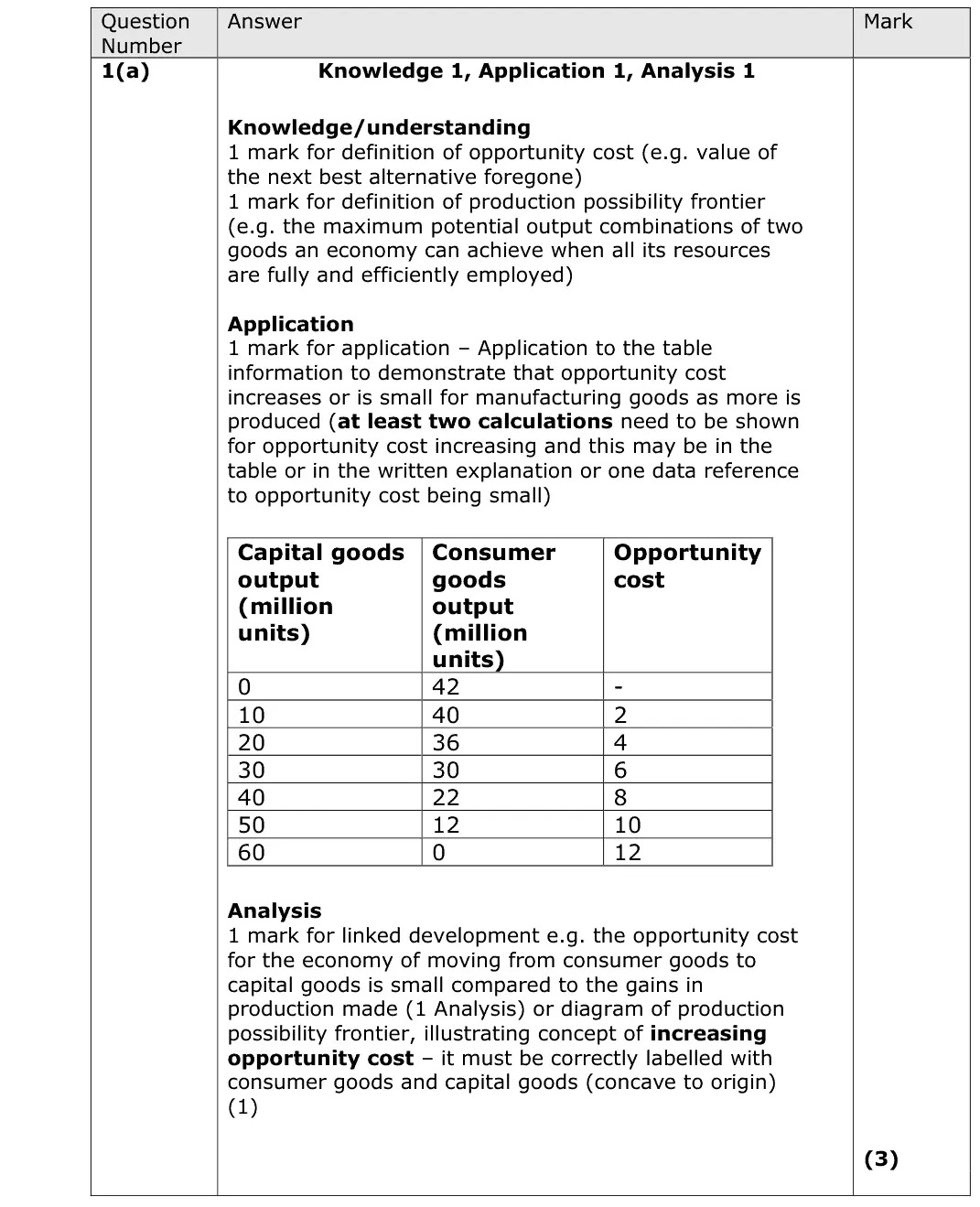
1(a) Production possibility frontiers, The nature of economics and the economic problem 3AO1=1,AO2=1,AO3=1Calculation
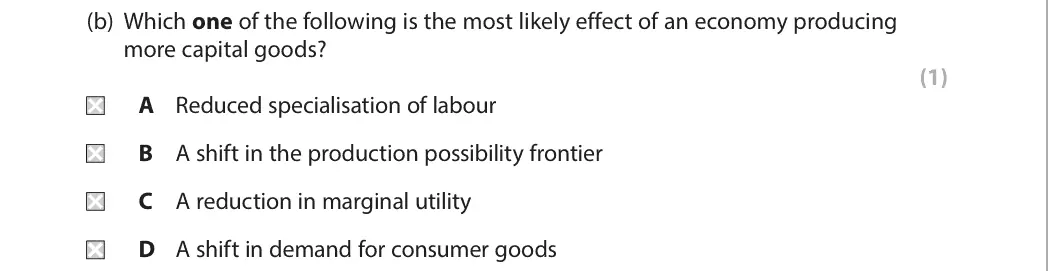
1(b) Production possibility frontiers 1Multiple choice
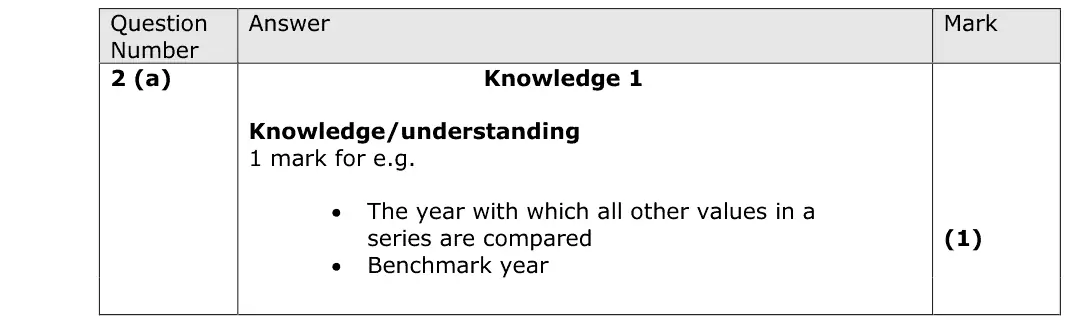
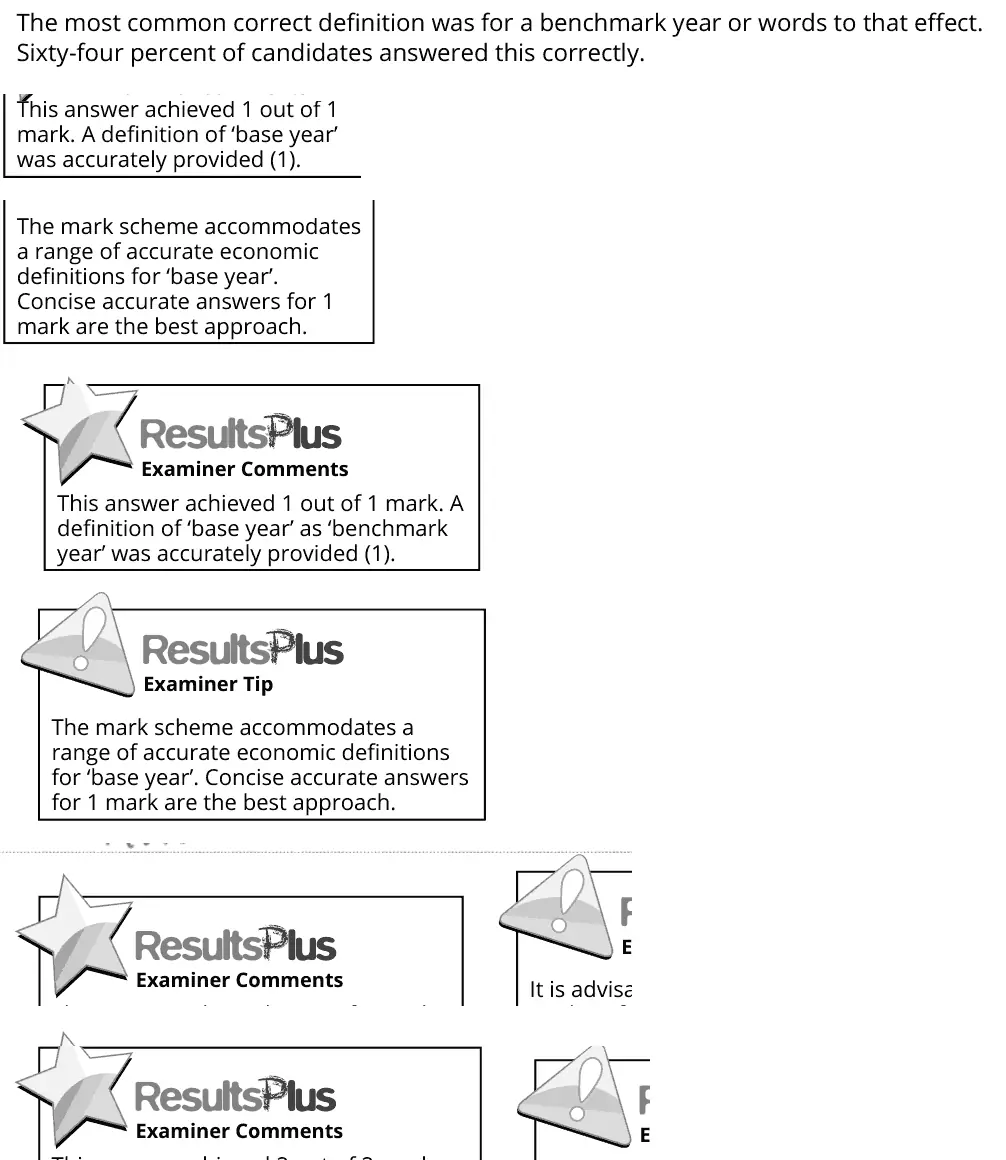
2(a) Supply, demand and price determination 1AO1=1Definition
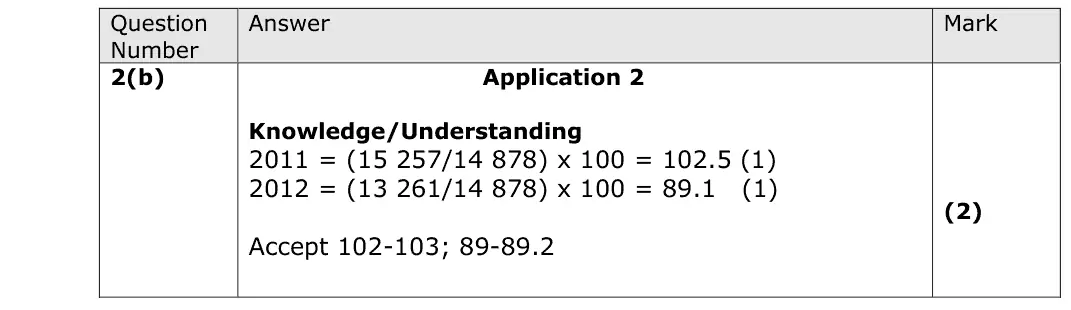
2(b) Supply, demand and price determination 2AO2=2Calculation
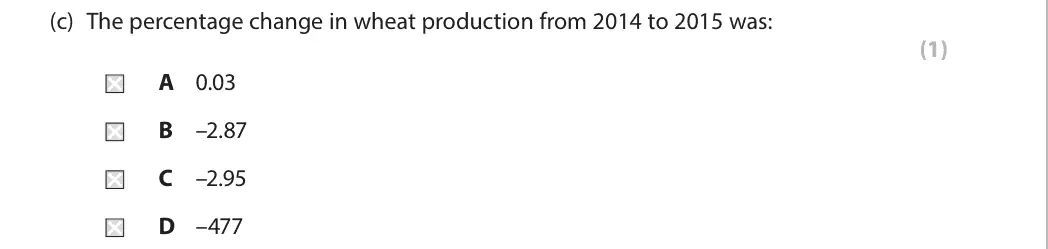
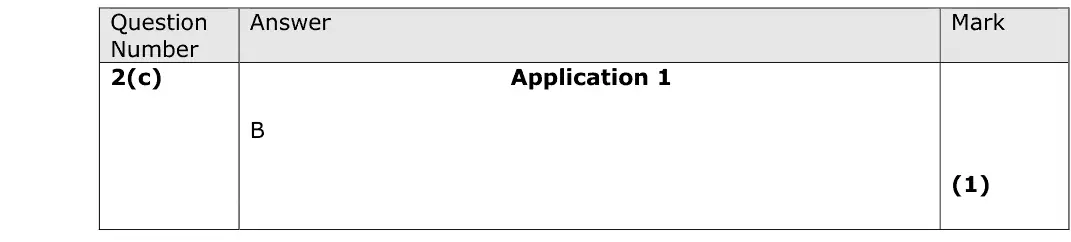
2(c) Supply, demand and price determination 1AO2=1Multiple choice
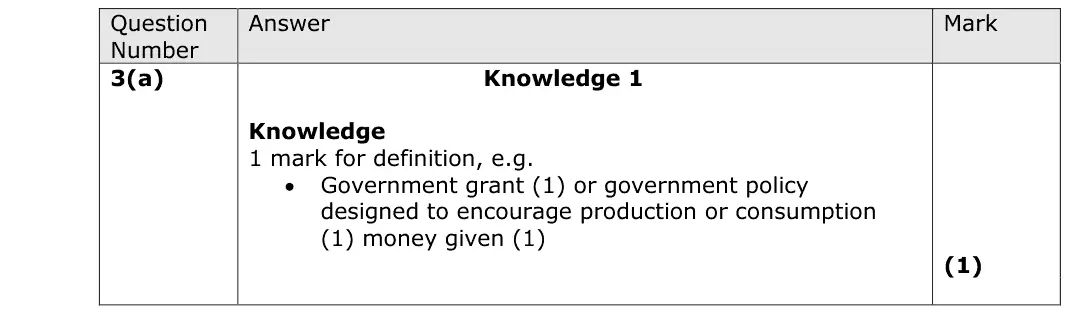
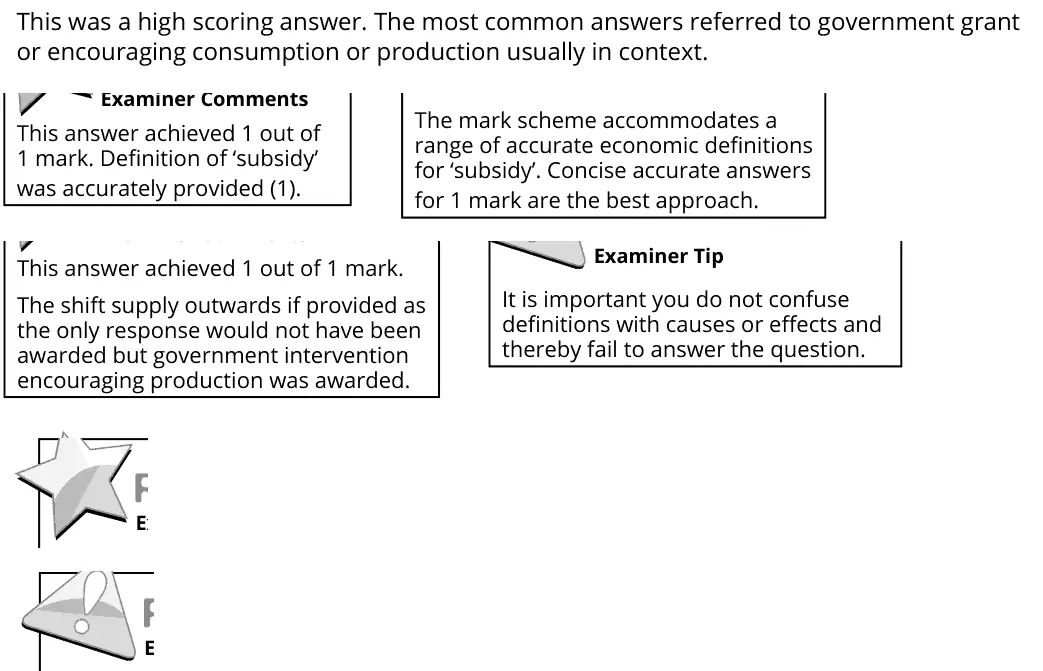
3(a) Indirect taxes and subsidies 1AO1=1Definition
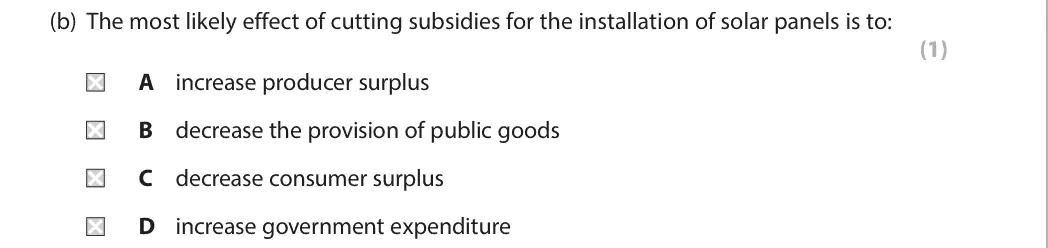
3(b) The price mechanism, consumer and producer surplus, Indirect taxes and subsidies 1AO1=1Multiple choice
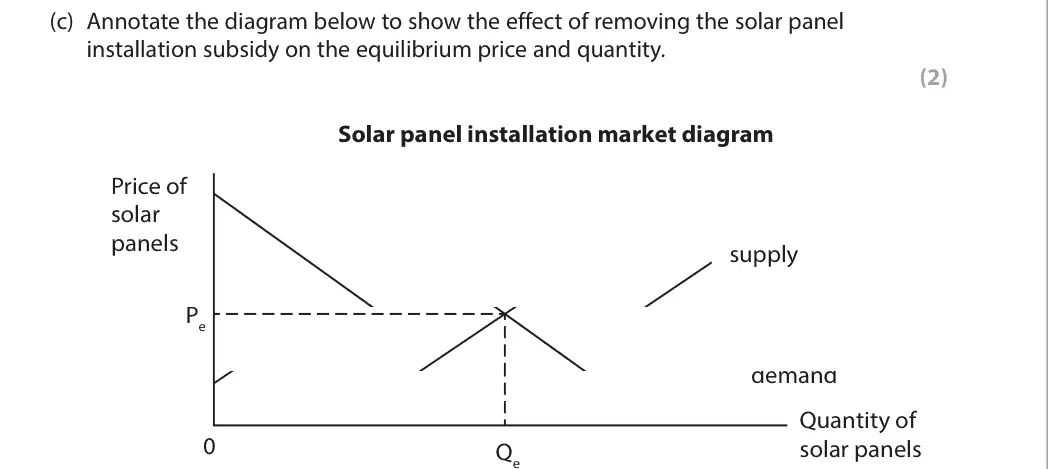
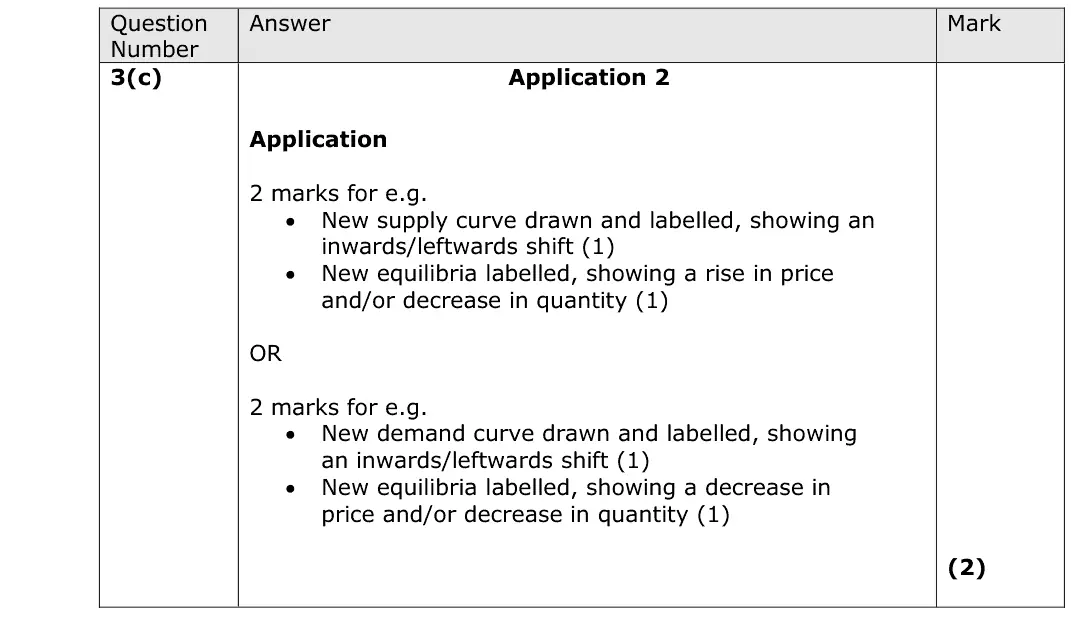
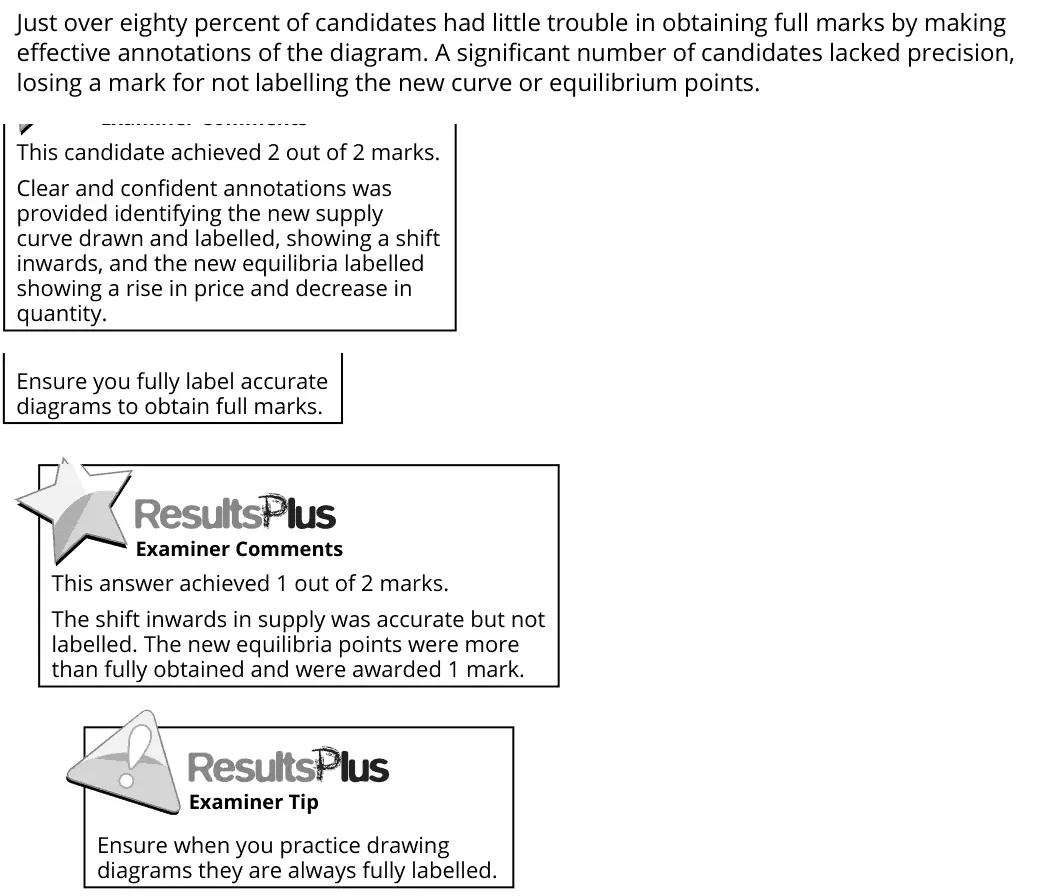
3(c) Indirect taxes and subsidies, Supply, demand and price determination 2AO2=2Diagram
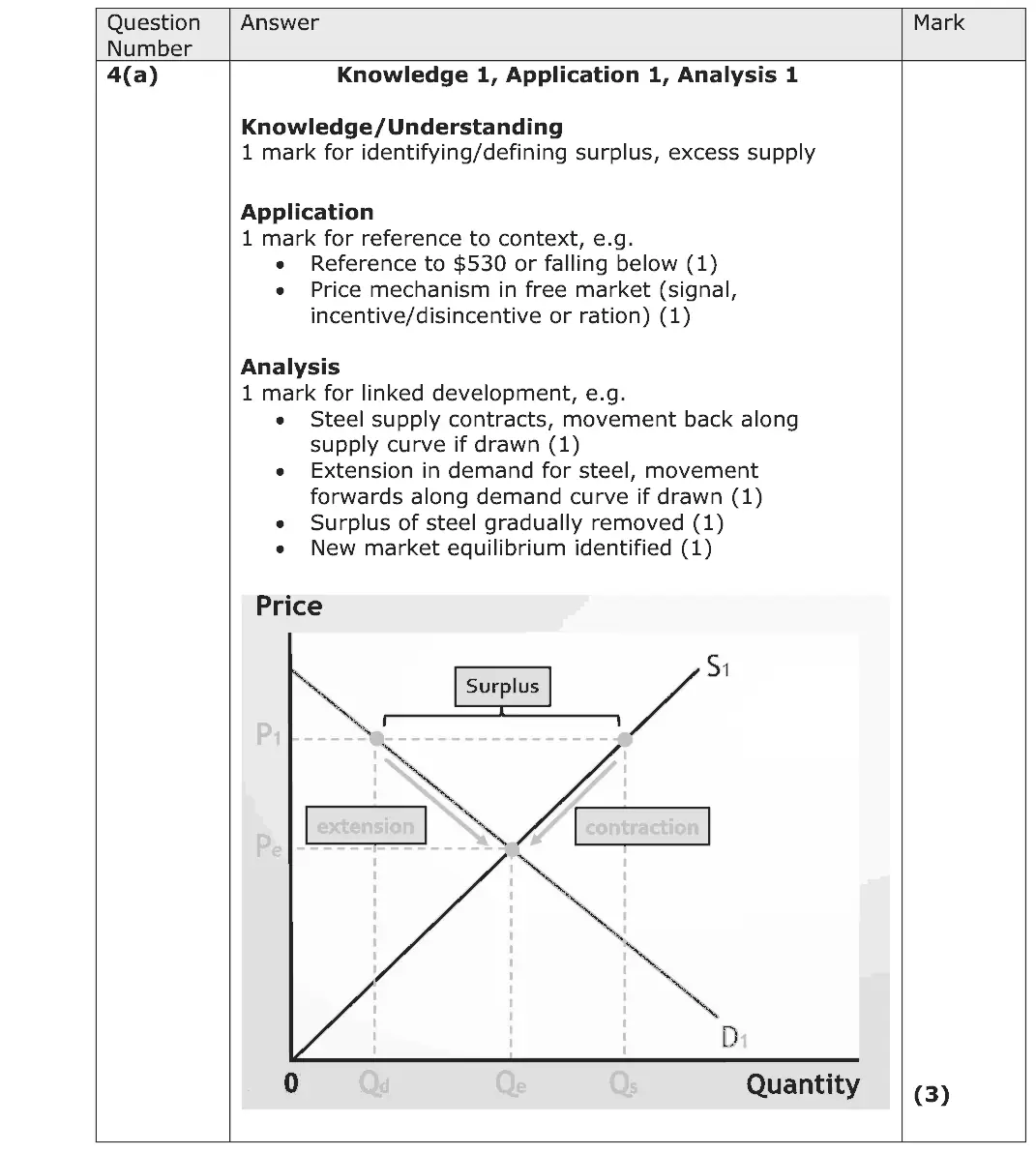
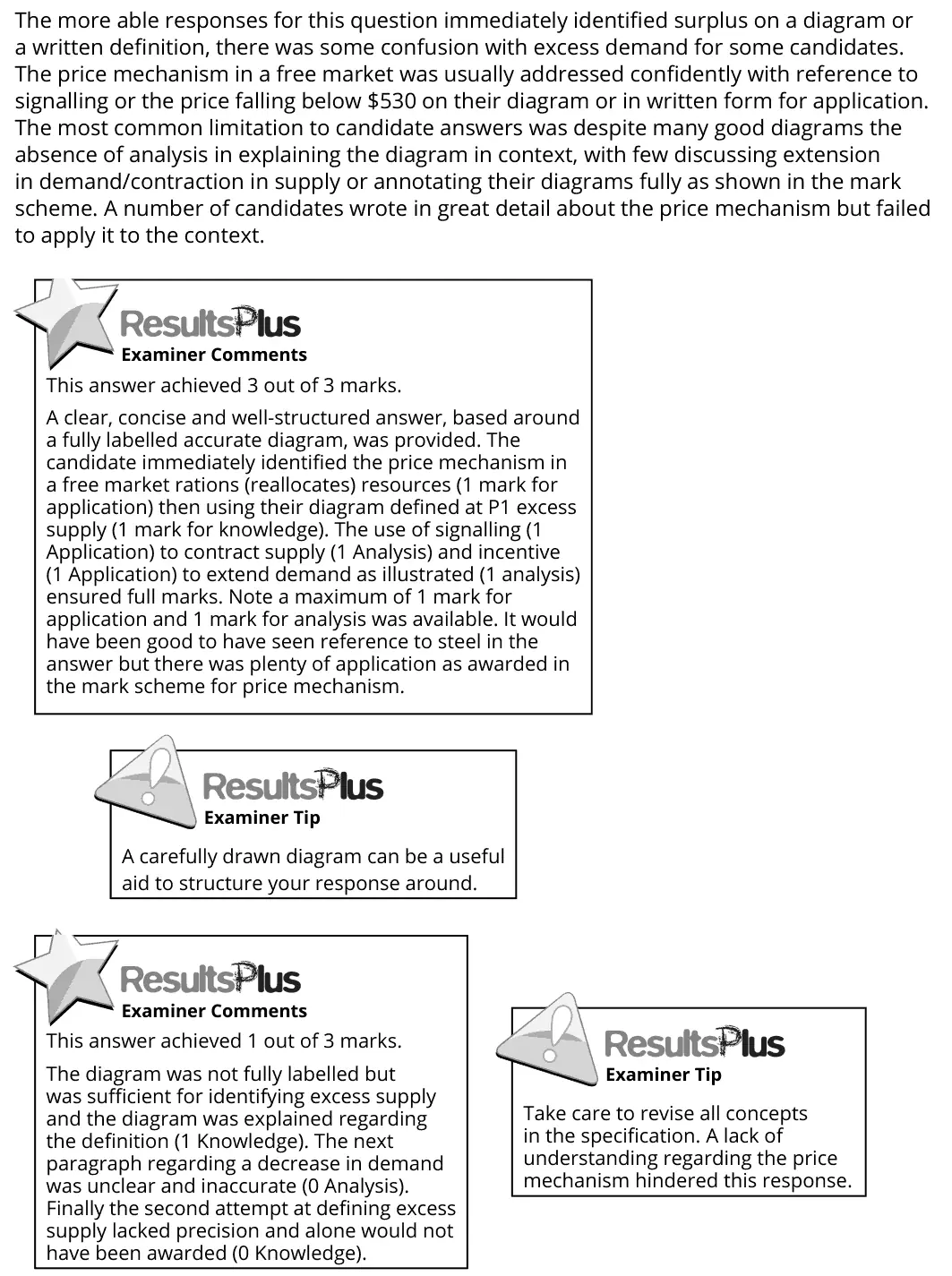
4(a) The price mechanism, consumer and producer surplus, Supply, demand and price determination 3AO1=1,AO2=1,AO3=1Short answer
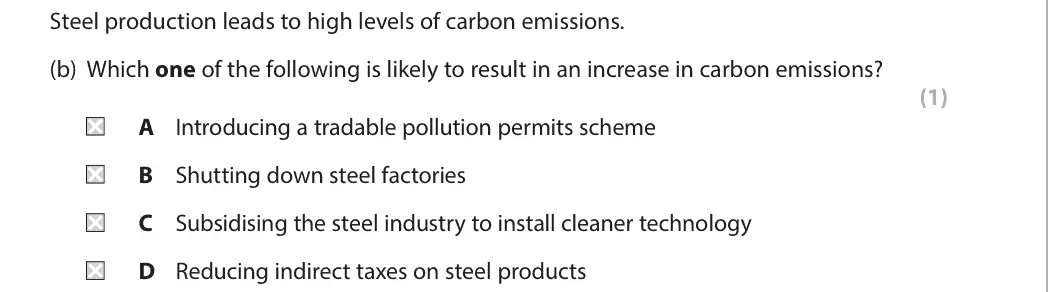
4(b) Government intervention in markets 1Multiple choice
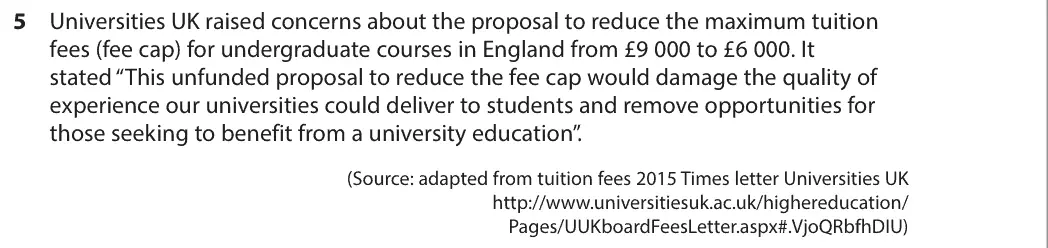
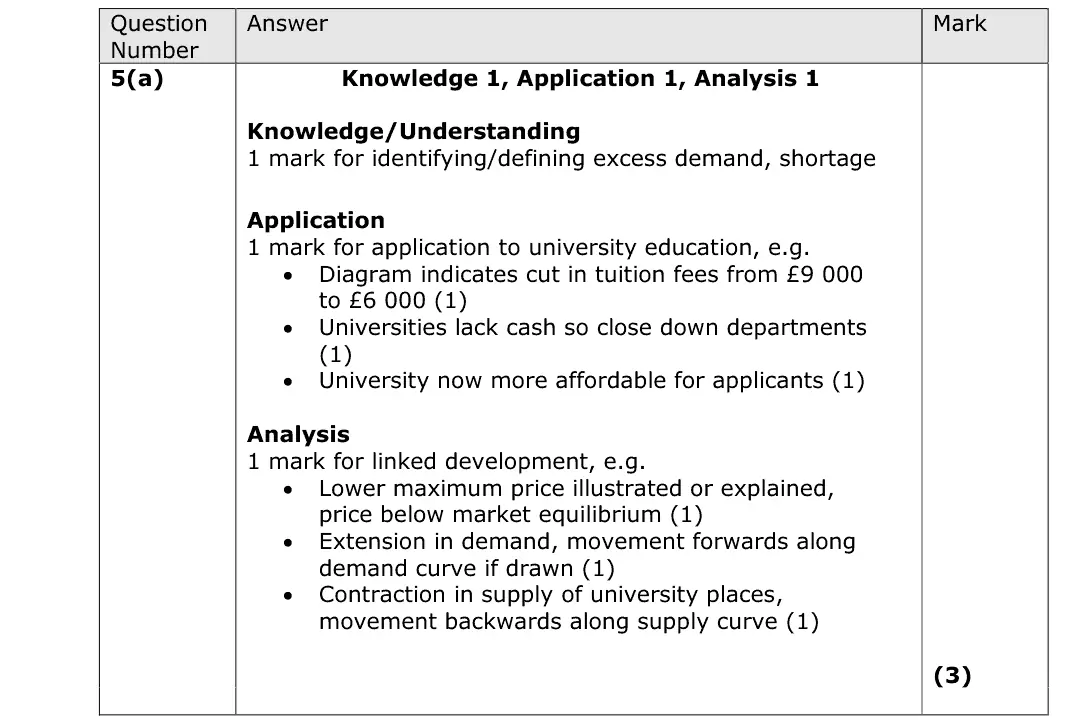
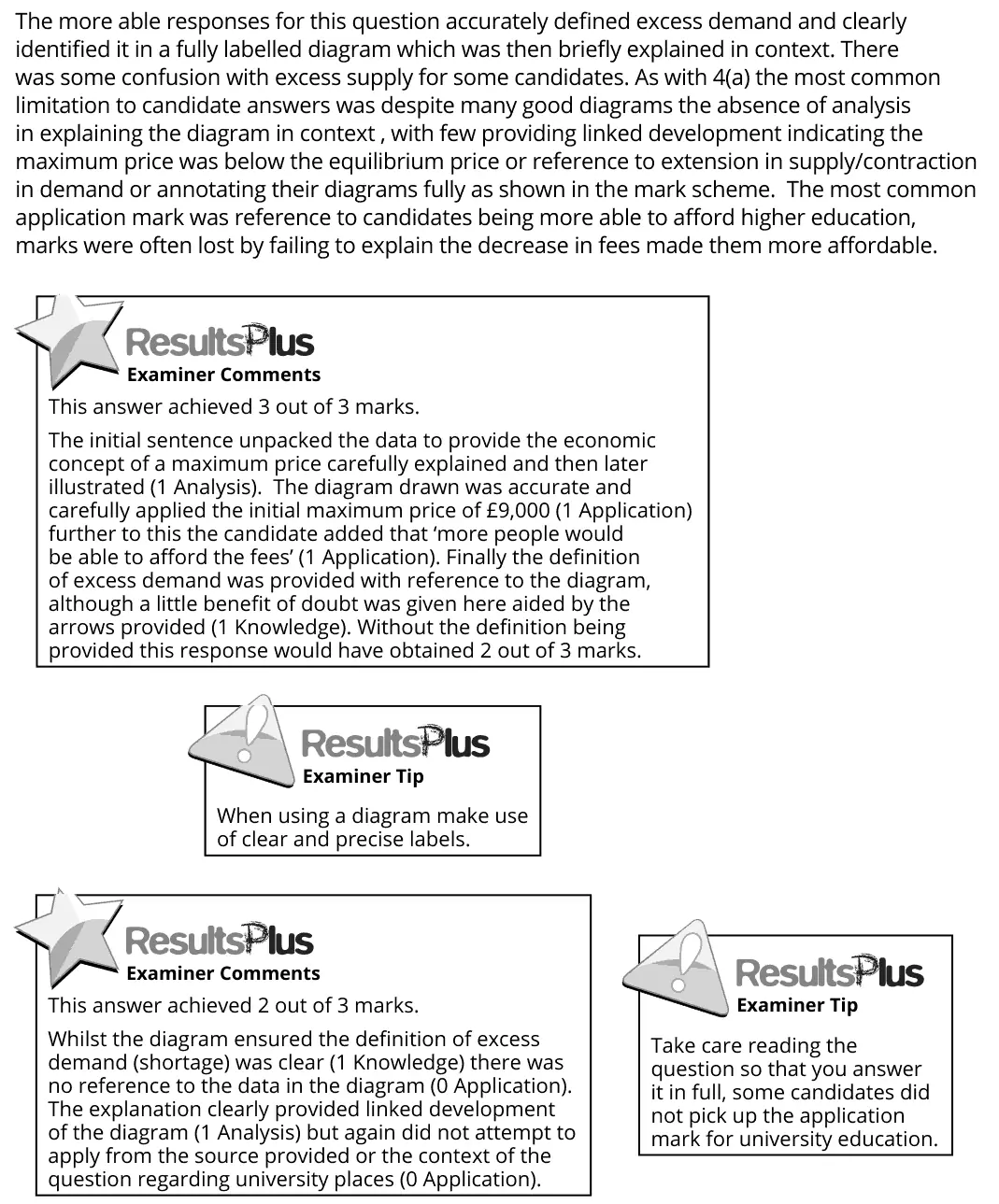
5(a) Government intervention in markets, Supply, demand and price determination 3AO1=1,AO2=1,AO3=1Short answer
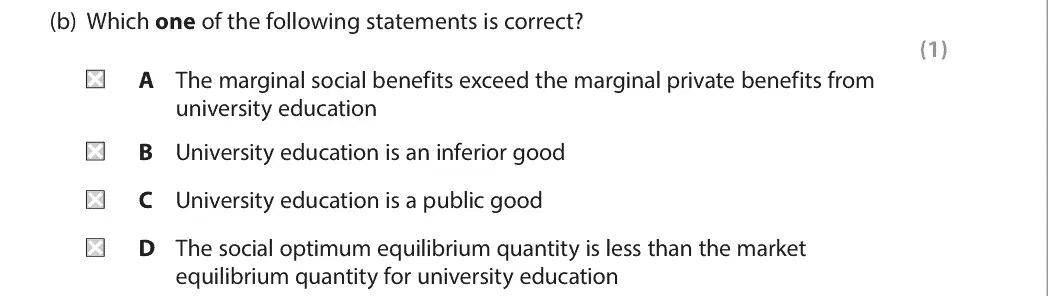
5(b) Market failure and externalities 1Multiple choice
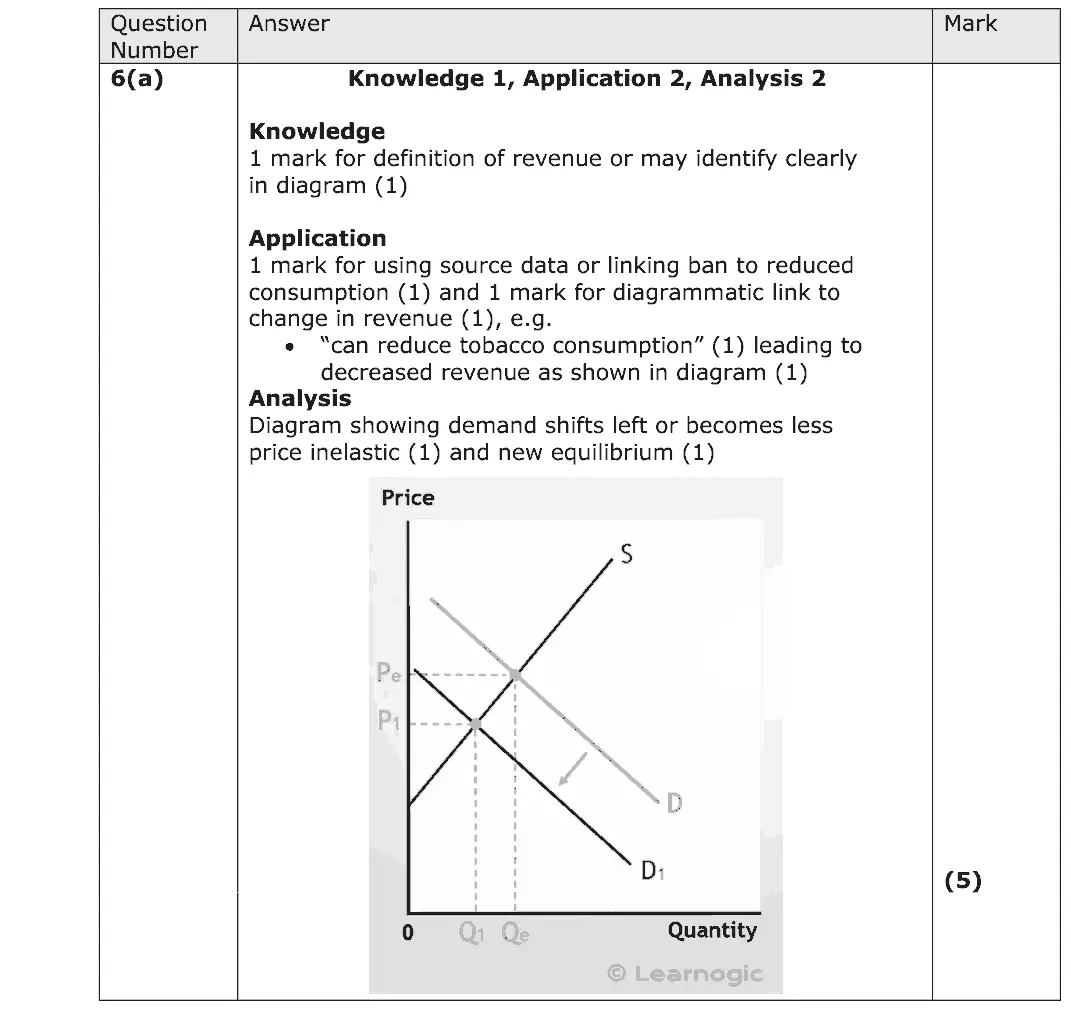
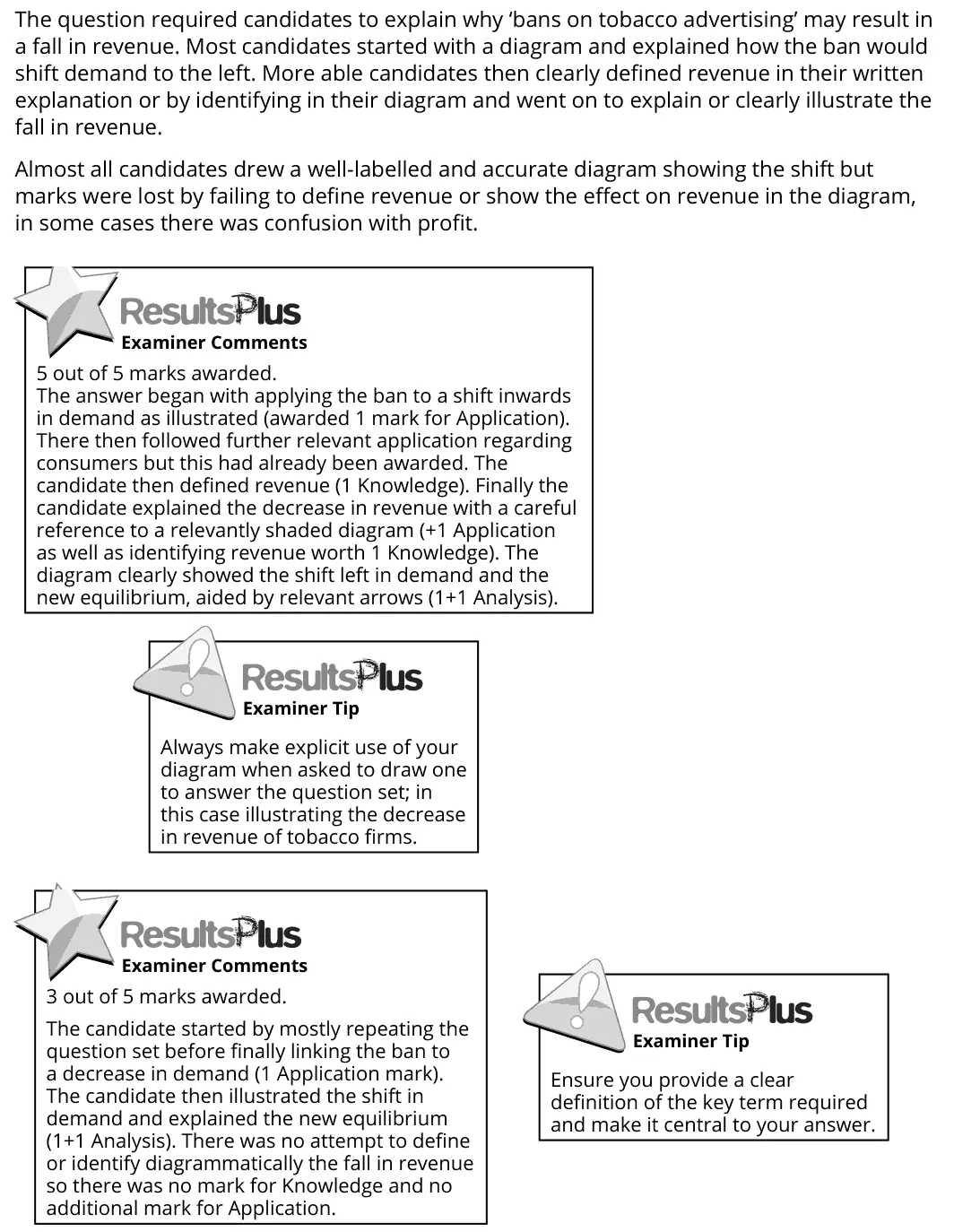
6(a) Supply, demand and price determination 5AO1=1,AO2=2,AO3=2Diagram
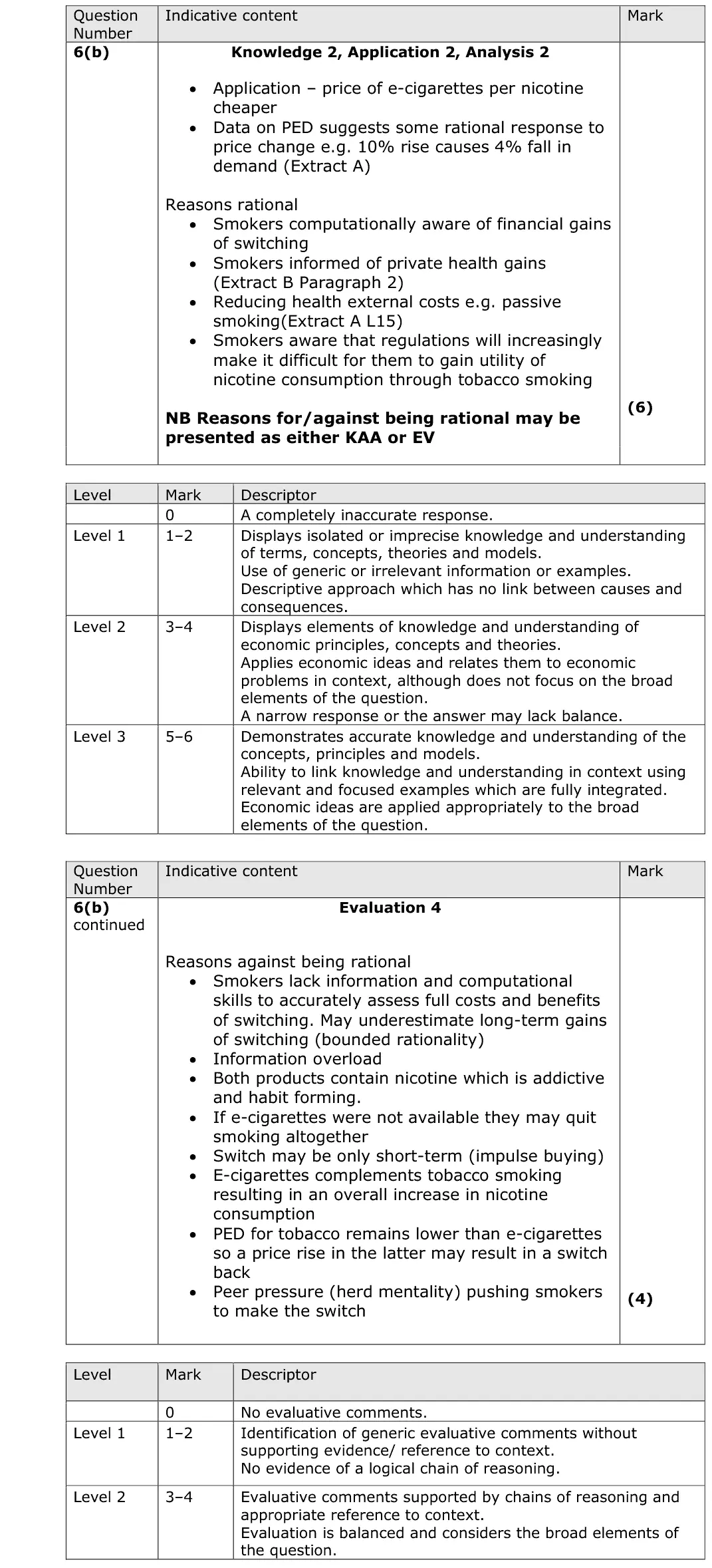
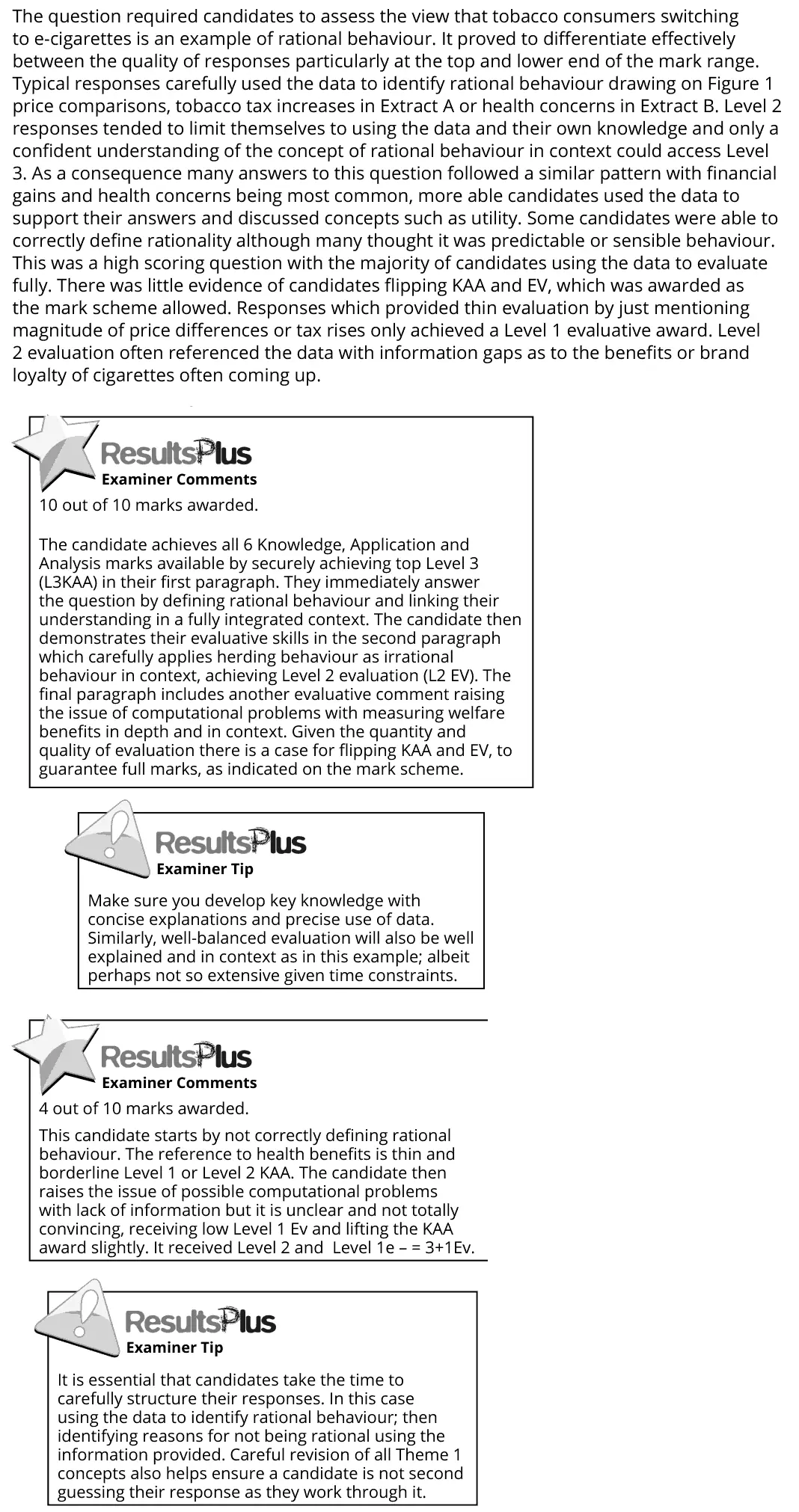
6(b) Rational decision making and behavioural economics 10AO1=2,AO2=2,AO3=2,AO4=4Extended response
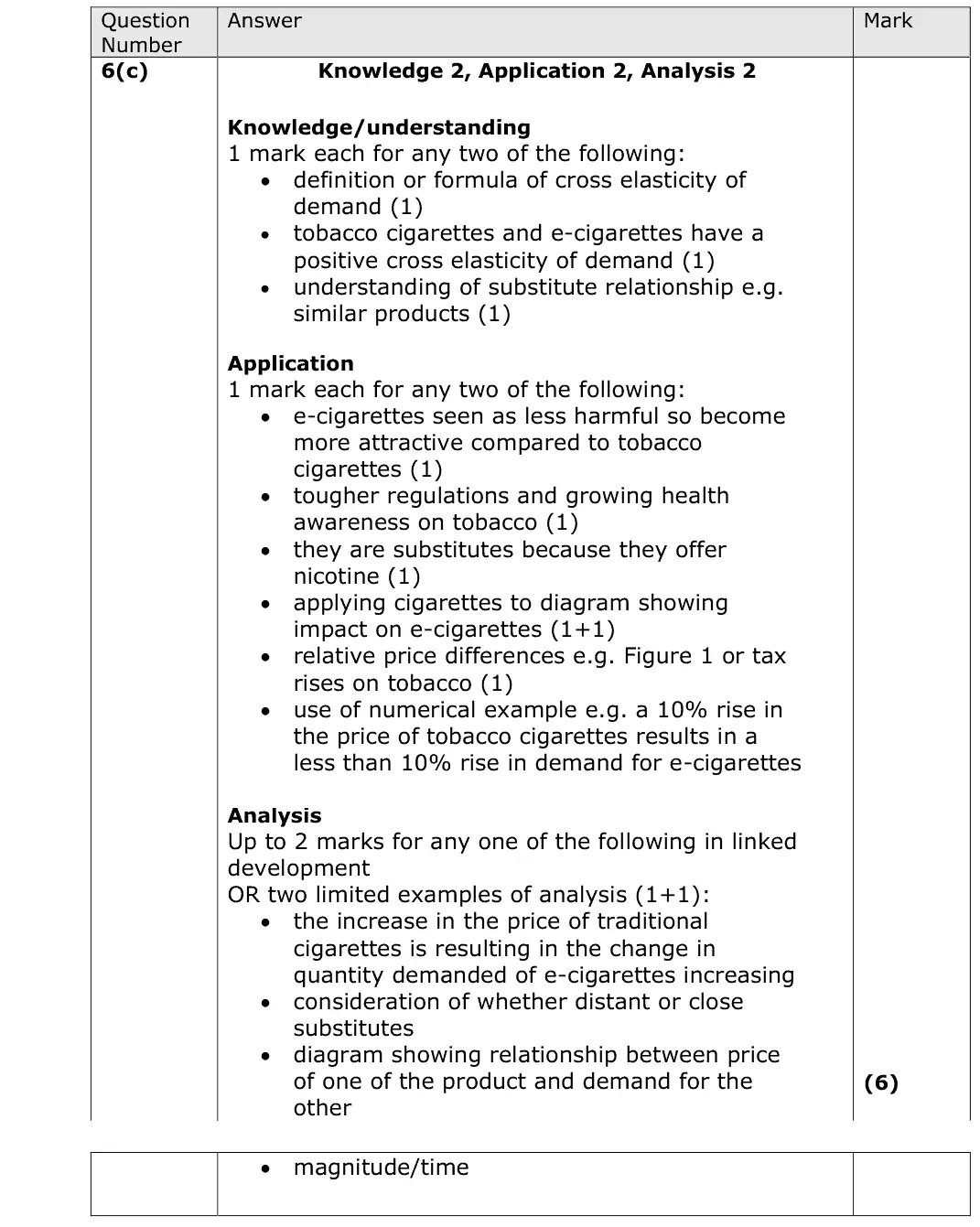
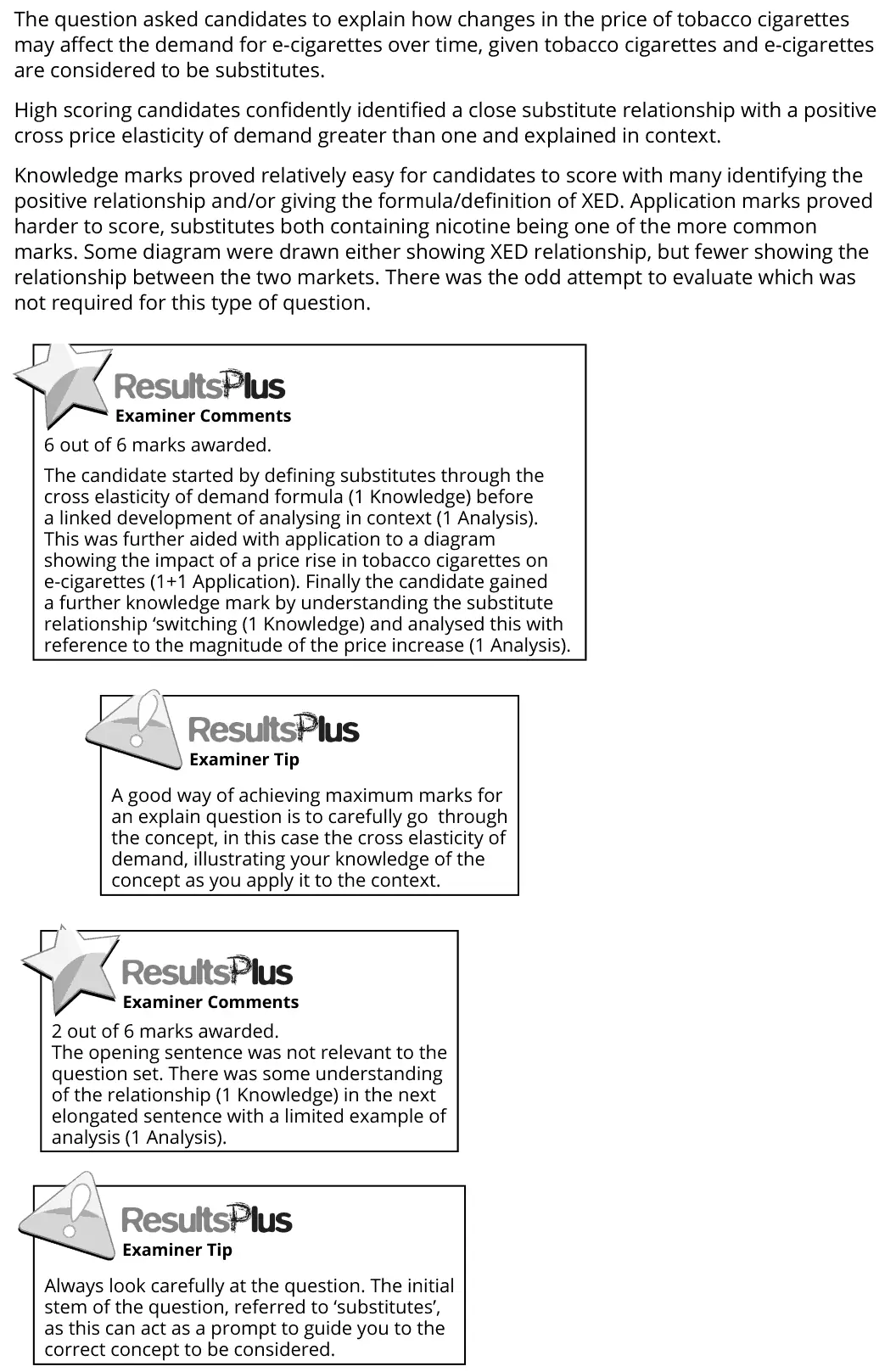
6(c) Price, income and cross elasticities of demand 6AO1=2,AO2=2,AO3=2Short answer
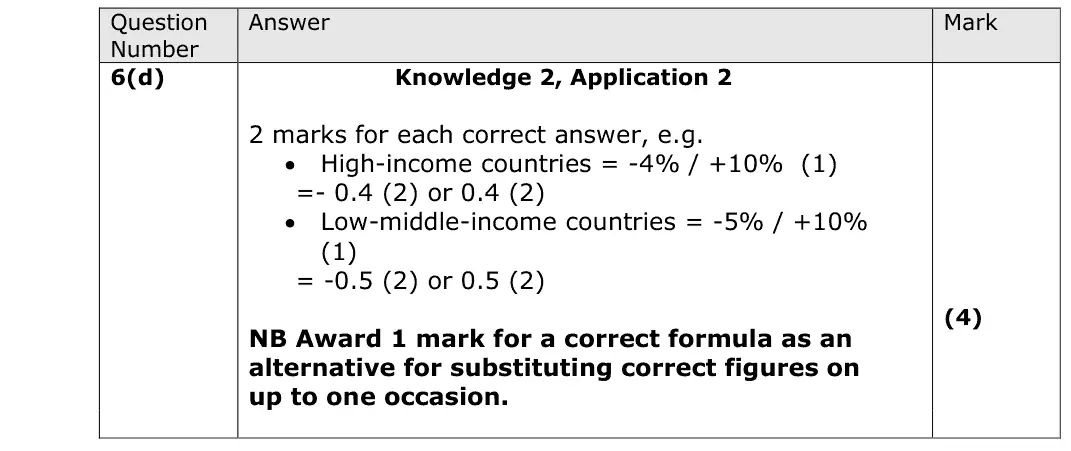
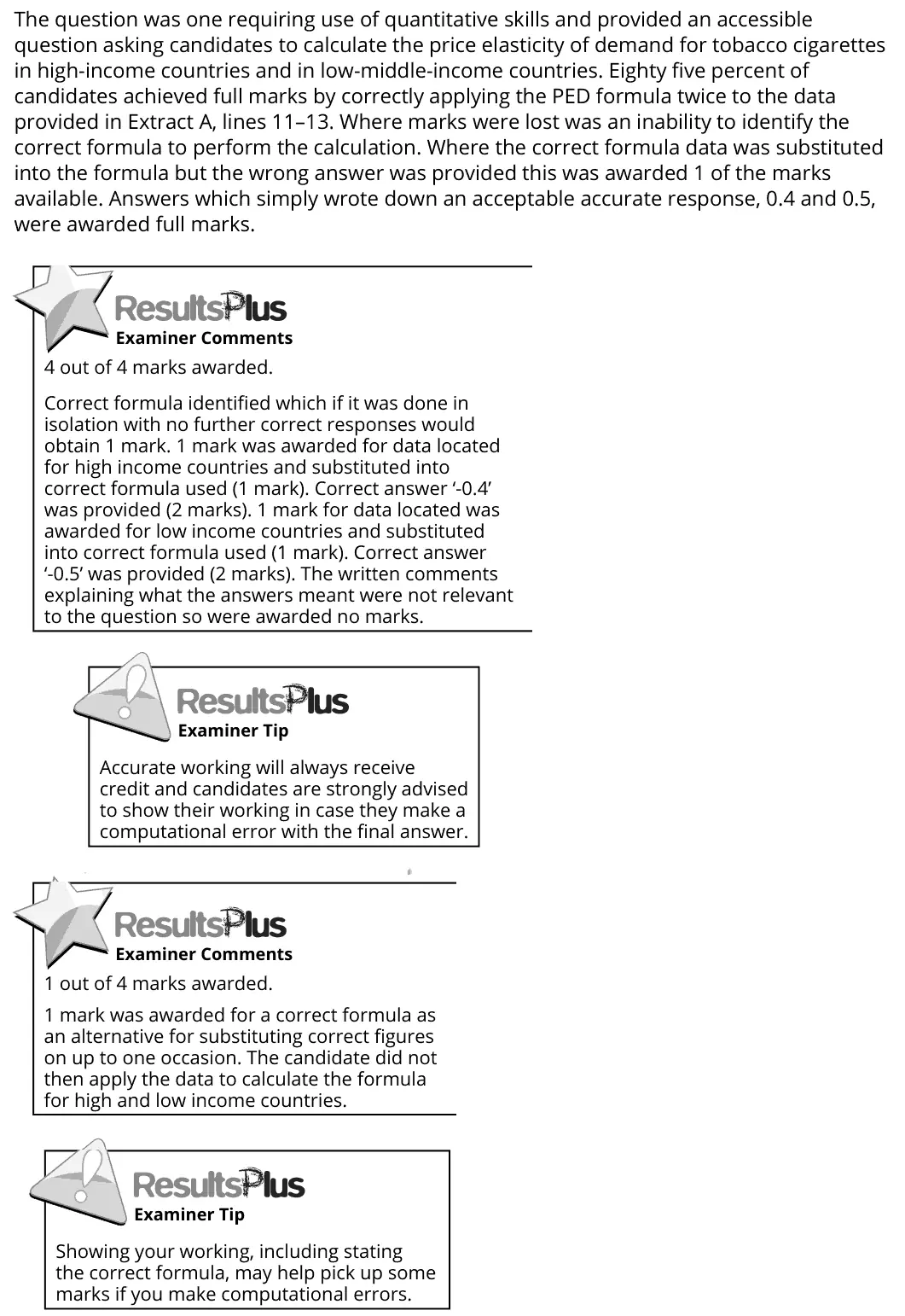
6(d) Price, income and cross elasticities of demand 4AO1=2,AO2=2Calculation
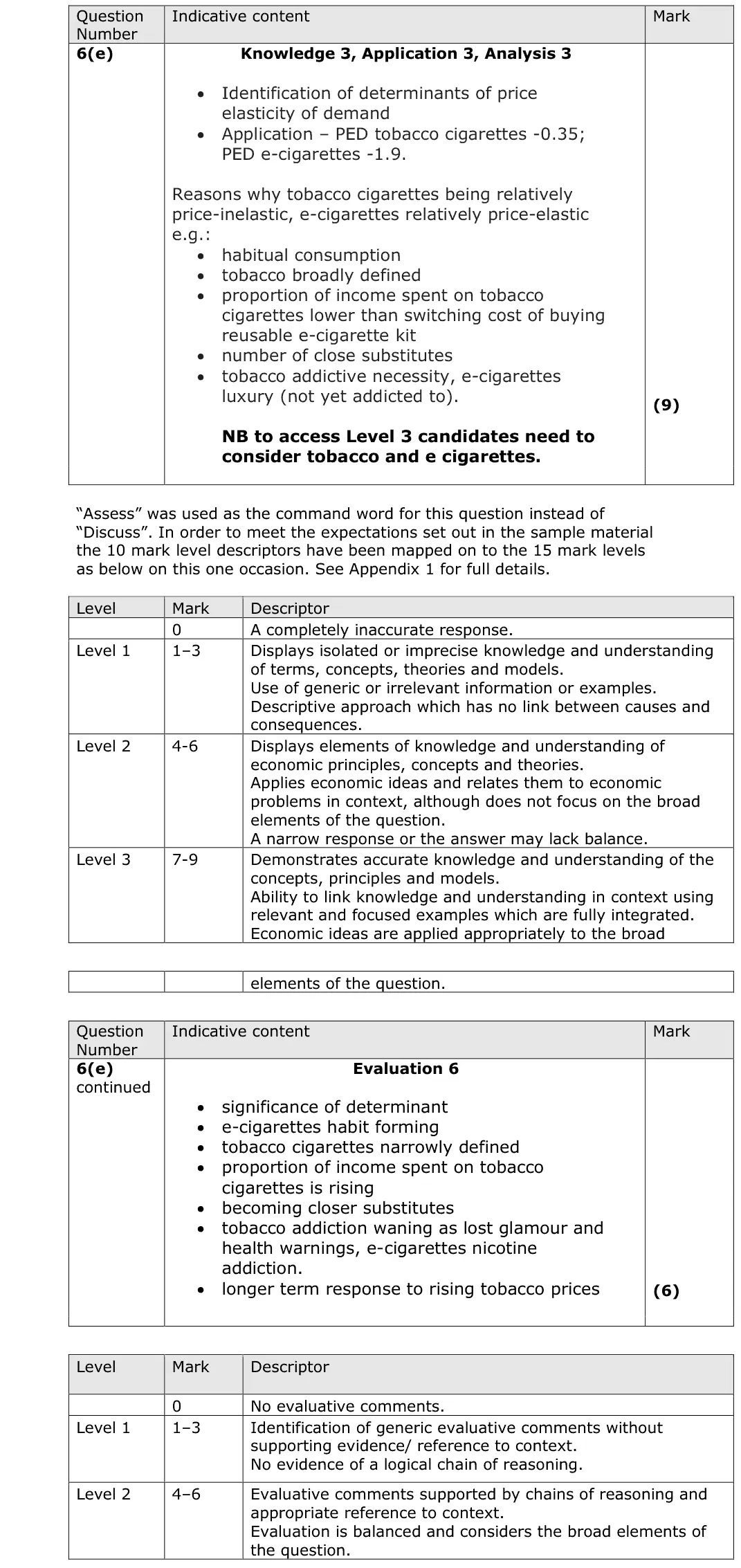
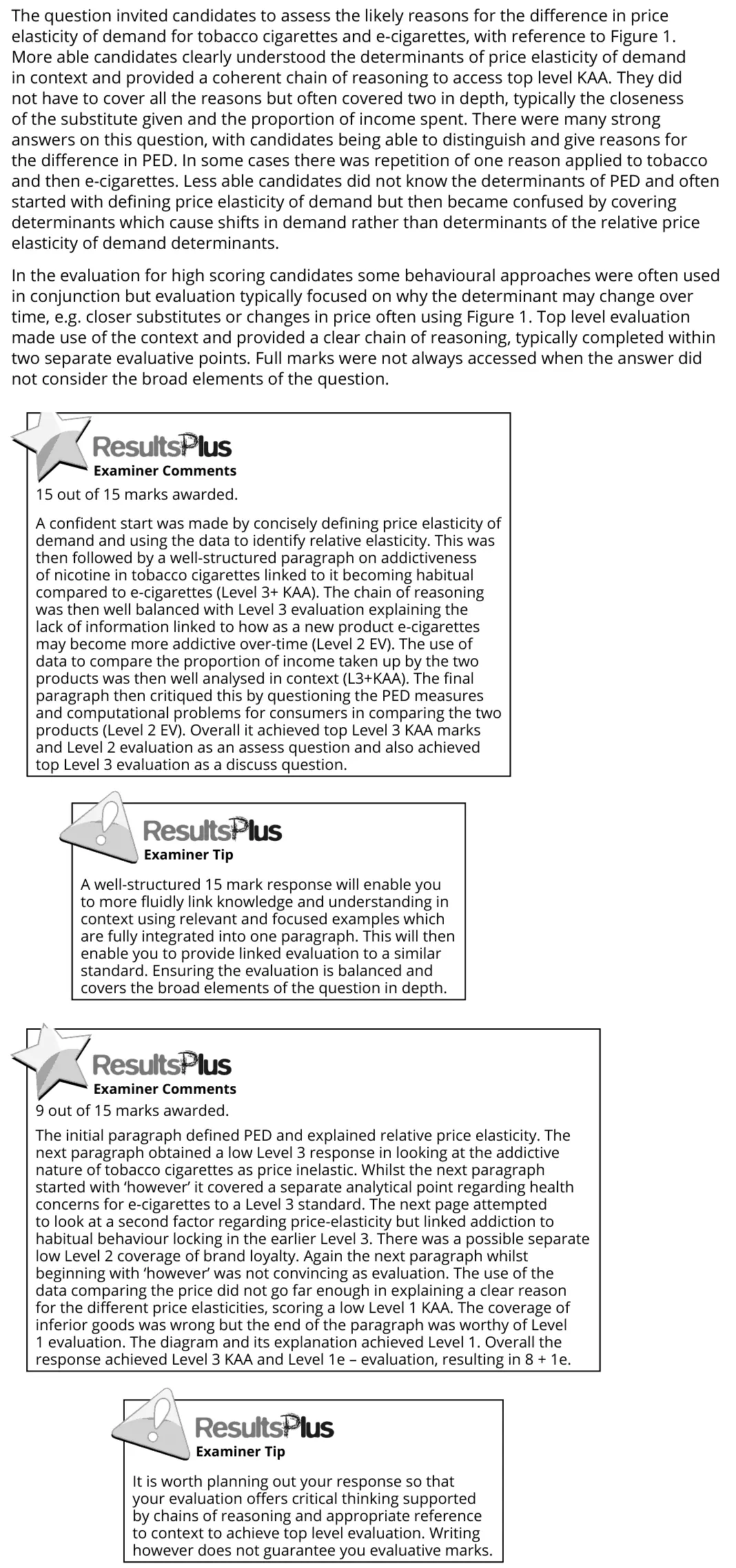
6(e) Price, income and cross elasticities of demand 15AO1=3,AO2=3,AO3=3,AO4=6Extended response
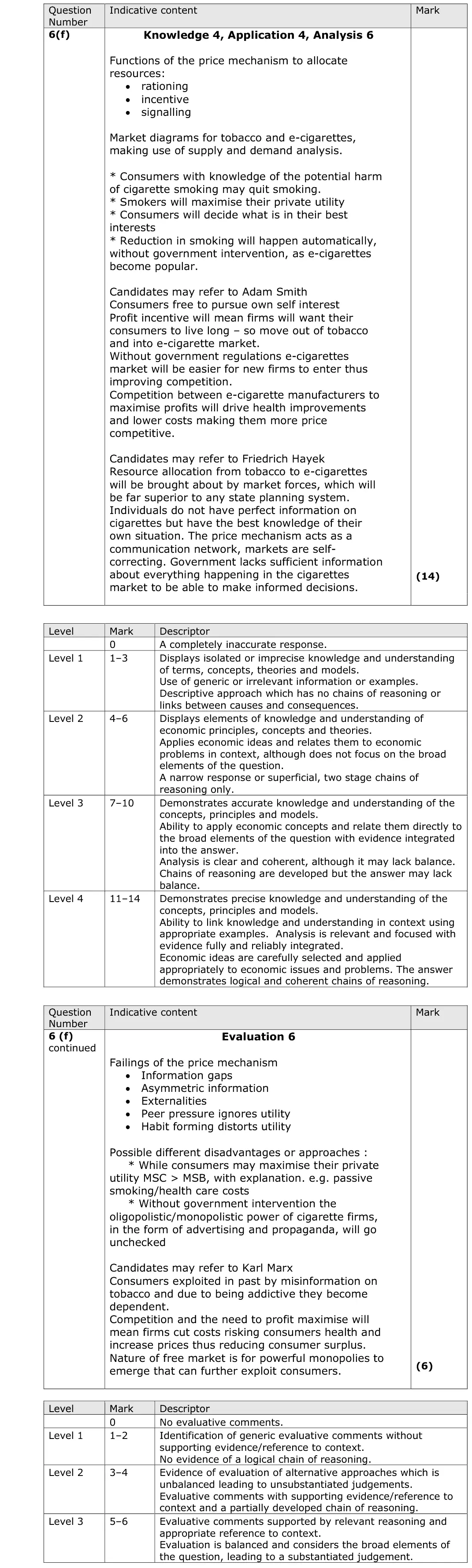
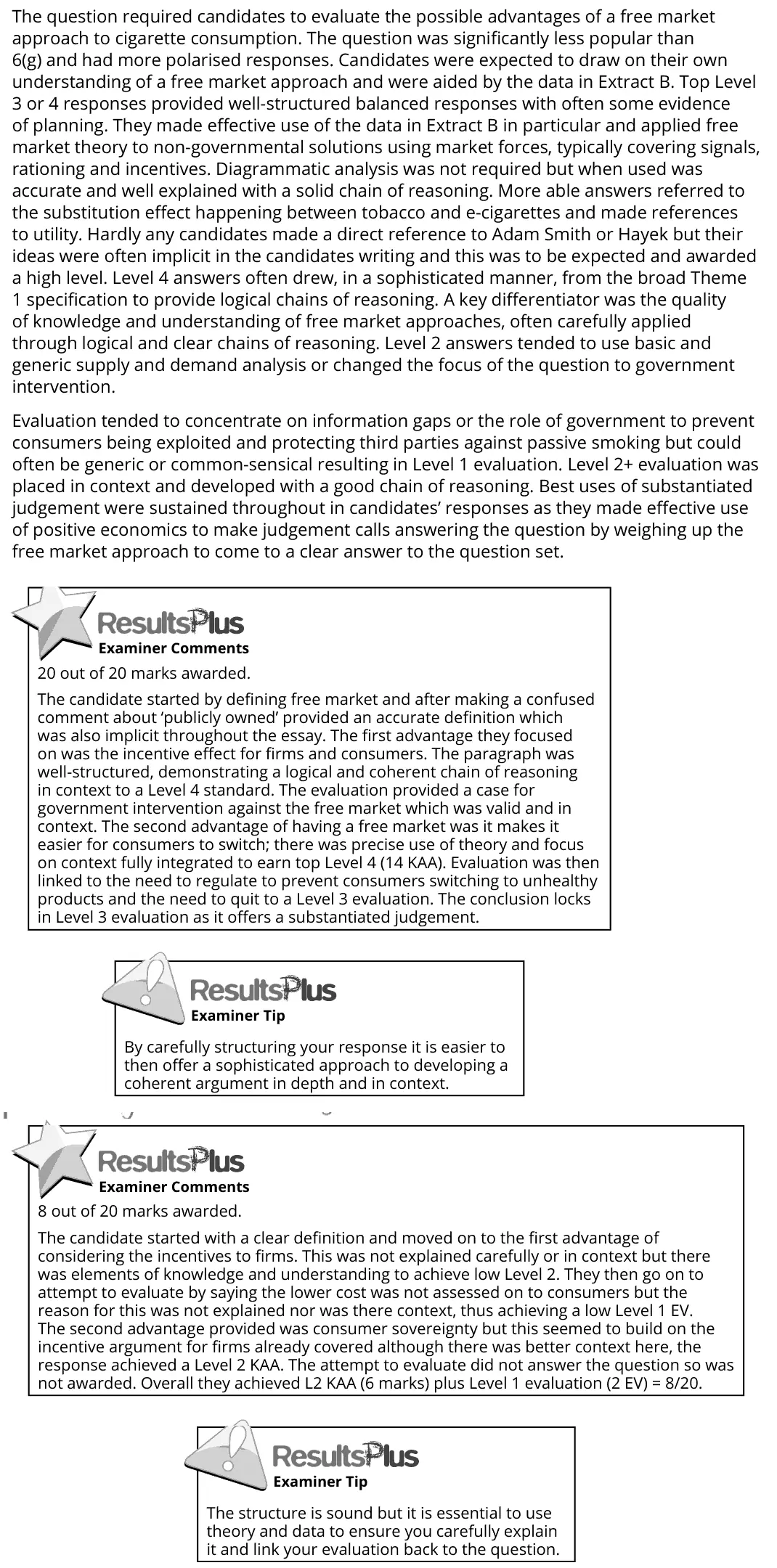
6(f) The price mechanism, consumer and producer surplus, Free market, mixed and command economies 20AO1=4,AO2=4,AO3=6,AO4=6Essay
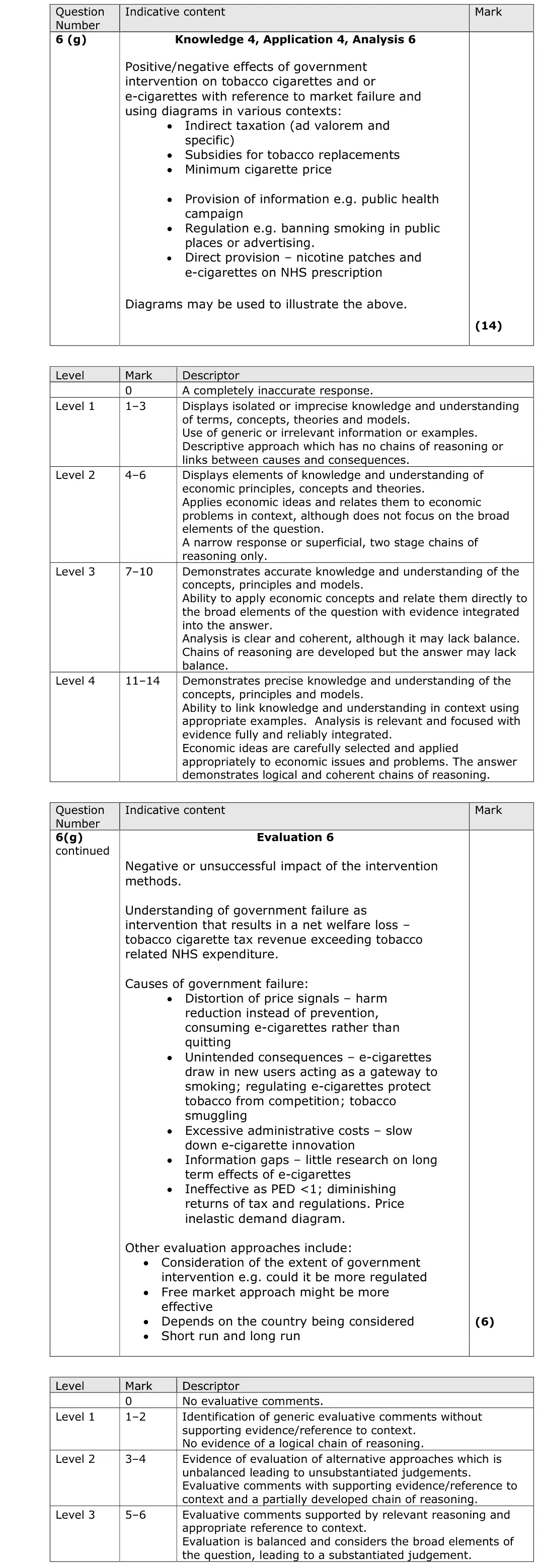
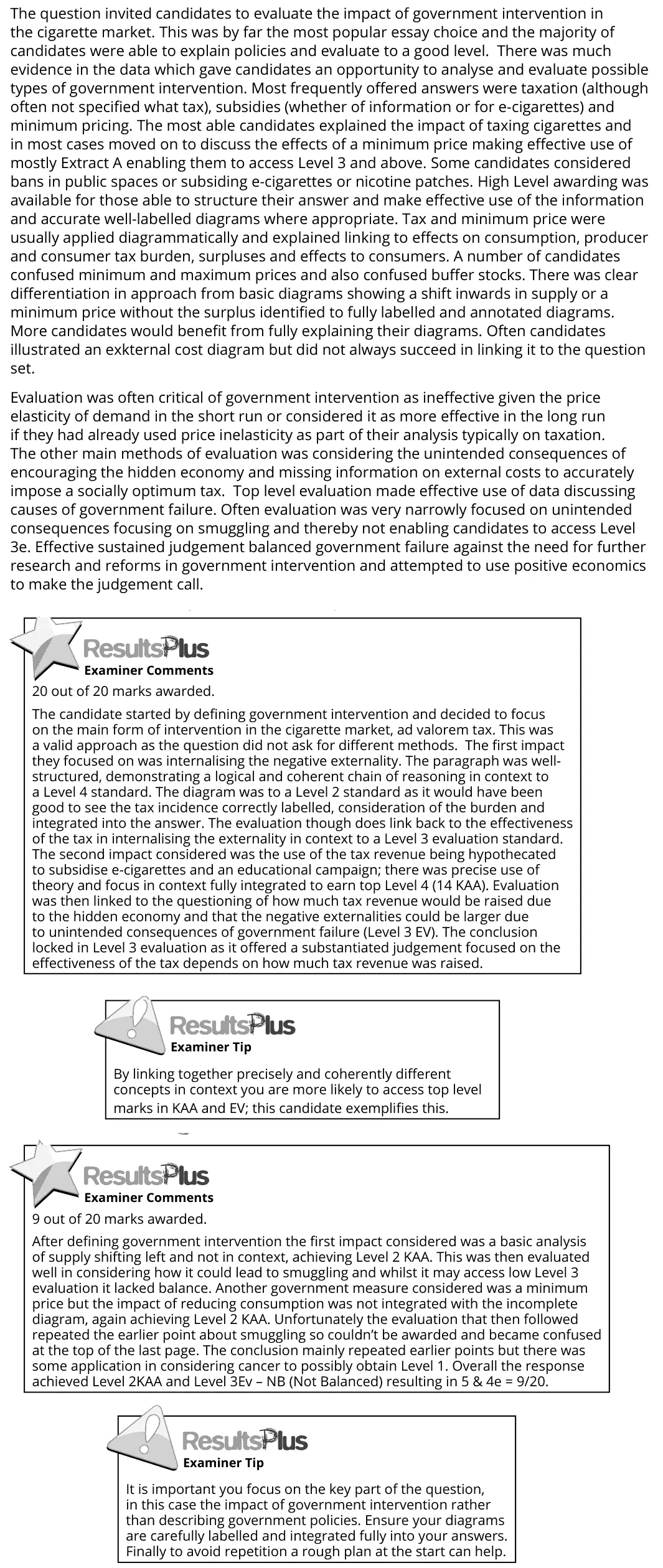
6(g) Government intervention in markets, Government failure 20AO1=4,AO2=4,AO3=6,AO4=6Essay

The questions

1(a)1(b)2(a)2(b)2(c)3(a)3(b)3(c)4(a)4(b)5(a)5(b)6(a)6(b)6(c)6(d)6(e)6(f)6(g)
June 2017 · AS Paper 1 · Q1(a) 3 marks AO1=1, AO2=1, AO3=1 Calculation production possibility frontiersnature of economics
Data and extracts for question 11 The production possibility frontier for an economy is shown in the table below. Capital goods output Consumer goods output Opportunity cost (million units) (million units) 0 42 – 10 40 20 36 30 30 40 22 50 12 60 0
(a) Explain, using marginal analysis from the table above, the concept of opportunity cost. (You may use the last column in answering the question.) (3)
June 2017 · AS Paper 1 · Q1(b) 1 mark Multiple choice production possibility frontiers
Data and extracts for question 11 The production possibility frontier for an economy is shown in the table below. Capital goods output Consumer goods output Opportunity cost (million units) (million units) 0 42 – 10 40 20 36 30 30 40 22 50 12 60 0
(b) Which one of the following is the most likely effect of an economy producing more capital goods? (1) A Reduced specialisation of labour B A shift in the production possibility frontier C A reduction in marginal utility D A shift in demand for consumer goods
June 2017 · AS Paper 1 · Q2(a) 1 mark AO1=1 Definition supply and demand
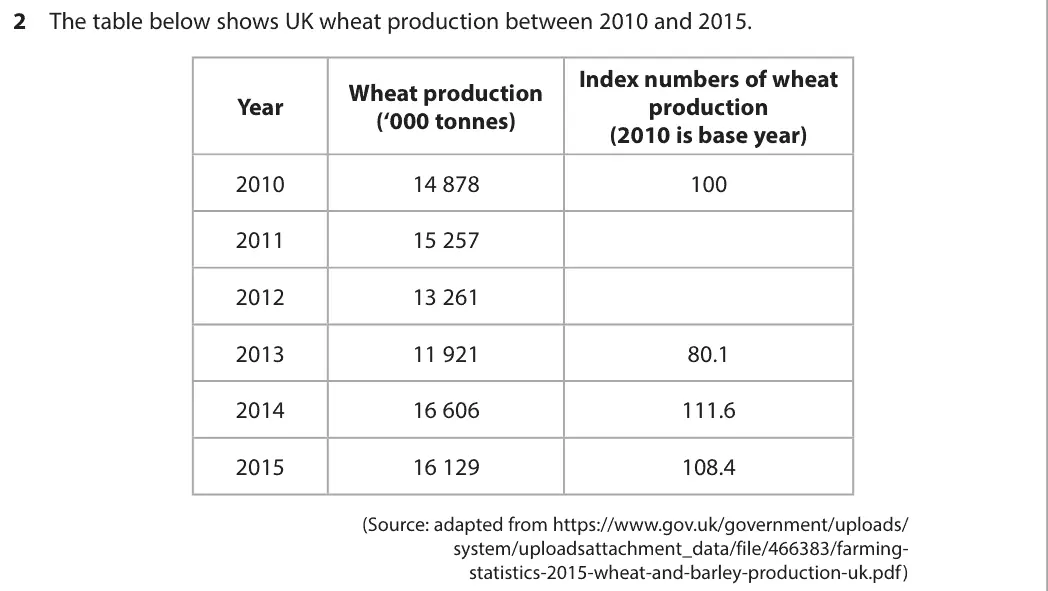
Data and extracts for question 22 The table below shows UK wheat production between 2010 and 2015. Index numbers of wheat Wheat production Year production (‘000 tonnes) (2010 is base year) 2010 14 878 100 2011 15 257 2012 13 261 2013 11 921 80.1 2014 16 606 111.6 2015 16 129 108.4 (Source: adapted from https://www.gov.uk/government/uploads/ system/uploadsattachment_data/file/466383/farming- statistics-2015-wheat-and-barley-production-uk.pdf)
(a) Define the term ‘base year’. (1)
June 2017 · AS Paper 1 · Q2(b) 2 marks AO2=2 Calculation supply and demand
Data and extracts for question 22 The table below shows UK wheat production between 2010 and 2015. Index numbers of wheat Wheat production Year production (‘000 tonnes) (2010 is base year) 2010 14 878 100 2011 15 257 2012 13 261 2013 11 921 80.1 2014 16 606 111.6 2015 16 129 108.4 (Source: adapted from https://www.gov.uk/government/uploads/ system/uploadsattachment_data/file/466383/farming- statistics-2015-wheat-and-barley-production-uk.pdf)
(b) Calculate the index numbers for 2011 and 2012, using 2010 as the base year. (2)
June 2017 · AS Paper 1 · Q2(c) 1 mark AO2=1 Multiple choice supply and demand
Data and extracts for question 22 The table below shows UK wheat production between 2010 and 2015. Index numbers of wheat Wheat production Year production (‘000 tonnes) (2010 is base year) 2010 14 878 100 2011 15 257 2012 13 261 2013 11 921 80.1 2014 16 606 111.6 2015 16 129 108.4 (Source: adapted from https://www.gov.uk/government/uploads/ system/uploadsattachment_data/file/466383/farming- statistics-2015-wheat-and-barley-production-uk.pdf)
(c) The percentage change in wheat production from 2014 to 2015 was: (1) A 0.03 B –2.87 C –2.95 D –477
June 2017 · AS Paper 1 · Q3(a) 1 mark AO1=1 Definition indirect taxes and subsidies
Data and extracts for question 33 In 2015 the UK government cut subsidies for the installation of solar energy panels.
(a) Define the term ‘subsidies’. (1)
June 2017 · AS Paper 1 · Q3(b) 1 mark AO1=1 Multiple choice price mechanism and surplusindirect taxes and subsidies
Data and extracts for question 33 In 2015 the UK government cut subsidies for the installation of solar energy panels.
(b) The most likely effect of cutting subsidies for the installation of solar panels is to: (1) A increase producer surplus B decrease the provision of public goods C decrease consumer surplus D increase government expenditure
June 2017 · AS Paper 1 · Q3(c) 2 marks AO2=2 Diagram indirect taxes and subsidiessupply and demand
Data and extracts for question 33 In 2015 the UK government cut subsidies for the installation of solar energy panels.
(c) Annotate the diagram below to show the effect of removing the solar panel installation subsidy on the equilibrium price and quantity. (2) Solar panel installation market diagram Price of solar panels supply Pe demand Quantity of 0 solar panels Qe
June 2017 · AS Paper 1 · Q4(a) 3 marks AO1=1, AO2=1, AO3=1 Short answer price mechanism and surplussupply and demand
Data and extracts for question 44 The excess supply of carbon steel has recently caused its global price to fall below $530 per tonne. (Source: adapted from http://www.meps.co.uk/allproducts%20steel%20price.htm)
(a) Explain how the price mechanism responds to excess supply in a free market. (3)
June 2017 · AS Paper 1 · Q4(b) 1 mark Multiple choice government intervention in markets
Data and extracts for question 44 The excess supply of carbon steel has recently caused its global price to fall below $530 per tonne. (Source: adapted from http://www.meps.co.uk/allproducts%20steel%20price.htm)
Steel production leads to high levels of carbon emissions. (b) Which one of the following is likely to result in an increase in carbon emissions? (1) A Introducing a tradable pollution permits scheme B Shutting down steel factories C Subsidising the steel industry to install cleaner technology D Reducing indirect taxes on steel products
June 2017 · AS Paper 1 · Q5(a) 3 marks AO1=1, AO2=1, AO3=1 Short answer government intervention in marketssupply and demand
Data and extracts for question 55 Universities UK raised concerns about the proposal to reduce the maximum tuition fees (fee cap) for undergraduate courses in England from £9 000 to £6 000. It stated “This unfunded proposal to reduce the fee cap would damage the quality of experience our universities could deliver to students and remove opportunities for those seeking to benefit from a university education”. (Source: adapted from tuition fees 2015 Times letter Universities UK http://www.universitiesuk.ac.uk/highereducation/ Pages/UUKboardFeesLetter.aspx#.VjoQRbfhDIU)
(a) Explain why reducing the tuition fee cap may result in excess demand for university places. (3)
June 2017 · AS Paper 1 · Q5(b) 1 mark Multiple choice externalities
Data and extracts for question 55 Universities UK raised concerns about the proposal to reduce the maximum tuition fees (fee cap) for undergraduate courses in England from £9 000 to £6 000. It stated “This unfunded proposal to reduce the fee cap would damage the quality of experience our universities could deliver to students and remove opportunities for those seeking to benefit from a university education”. (Source: adapted from tuition fees 2015 Times letter Universities UK http://www.universitiesuk.ac.uk/highereducation/ Pages/UUKboardFeesLetter.aspx#.VjoQRbfhDIU)
(b) Which one of the following statements is correct? (1) A The marginal social benefits exceed the marginal private benefits from university education B University education is an inferior good C University education is a public good D The social optimum equilibrium quantity is less than the market equilibrium quantity for university education
June 2017 · AS Paper 1 · Q6(a) 5 marks AO1=1, AO2=2, AO3=2 Diagram supply and demand
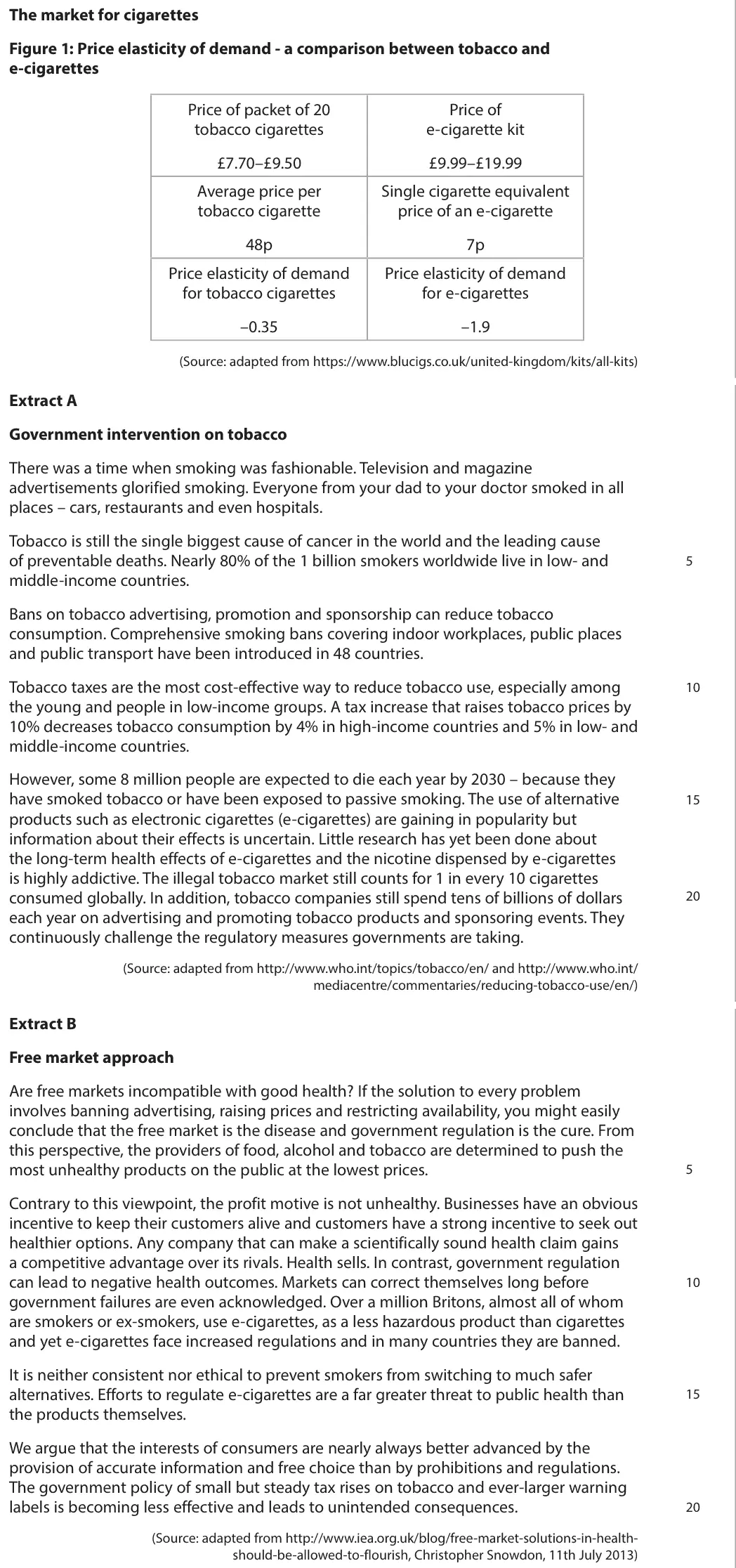
Data and extracts for question 6The market for cigarettes Figure 1: Price elasticity of demand - a comparison between tobacco and e-cigarettes Price of packet of 20 Price of tobacco cigarettes e-cigarette kit £7.70–£9.50 £9.99–£19.99 Average price per Single cigarette equivalent tobacco cigarette price of an e-cigarette 48p 7p Price elasticity of demand Price elasticity of demand for tobacco cigarettes for e-cigarettes –0.35 –1.9 (Source: adapted from https://www.blucigs.co.uk/united-kingdom/kits/all-kits) Extract A Government intervention on tobacco There was a time when smoking was fashionable. Television and magazine advertisements glorified smoking. Everyone from your dad to your doctor smoked in all places – cars, restaurants and even hospitals. Tobacco is still the single biggest cause of cancer in the world and the leading cause of preventable deaths. Nearly 80% of the 1 billion smokers worldwide live in low- and 5 middle-income countries. Bans on tobacco advertising, promotion and sponsorship can reduce tobacco consumption. Comprehensive smoking bans covering indoor workplaces, public places and public transport have been introduced in 48 countries. Tobacco taxes are the most cost-effective way to reduce tobacco use, especially among 10 the young and people in low-income groups. A tax increase that raises tobacco prices by 10% decreases tobacco consumption by 4% in high-income countries and 5% in low- and middle-income countries. However, some 8 million people are expected to die each year by 2030 – because they have smoked tobacco or have been exposed to passive smoking. The use of alternative 15 products such as electronic cigarettes (e-cigarettes) are gaining in popularity but information about their effects is uncertain. Little research has yet been done about the long-term health effects of e-cigarettes and the nicotine dispensed by e-cigarettes is highly addictive. The illegal tobacco market still counts for 1 in every 10 cigarettes consumed globally. In addition, tobacco companies still spend tens of billions of dollars 20 each year on advertising and promoting tobacco products and sponsoring events. They continuously challenge the regulatory measures governments are taking. (Source: adapted from http://www.who.int/topics/tobacco/en/ and http://www.who.int/ mediacentre/commentaries/reducing-tobacco-use/en/) Extract B Free market approach Are free markets incompatible with good health? If the solution to every problem involves banning advertising, raising prices and restricting availability, you might easily conclude that the free market is the disease and government regulation is the cure. From this perspective, the providers of food, alcohol and tobacco are determined to push the most unhealthy products on the public at the lowest prices. 5 Contrary to this viewpoint, the profit motive is not unhealthy. Businesses have an obvious incentive to keep their customers alive and customers have a strong incentive to seek out healthier options. Any company that can make a scientifically sound health claim gains a competitive advantage over its rivals. Health sells. In contrast, government regulation can lead to negative health outcomes. Markets can correct themselves long before 10 government failures are even acknowledged. Over a million Britons, almost all of whom are smokers or ex-smokers, use e-cigarettes, as a less hazardous product than cigarettes and yet e-cigarettes face increased regulations and in many countries they are banned. It is neither consistent nor ethical to prevent smokers from switching to much safer alternatives. Efforts to regulate e-cigarettes are a far greater threat to public health than 15 the products themselves. We argue that the interests of consumers are nearly always better advanced by the provision of accurate information and free choice than by prohibitions and regulations. The government policy of small but steady tax rises on tobacco and ever-larger warning labels is becoming less effective and leads to unintended consequences. 20 (Source: adapted from http://www.iea.org.uk/blog/free-market-solutions-in-health- should-be-allowed-to-flourish, Christopher Snowdon, 11th July 2013)
(a) Explain why ‘bans on tobacco advertising’ (Extract A, line 7) may result in a decrease in the revenue of tobacco firms. Include a supply and demand diagram in your answer. (5)
June 2017 · AS Paper 1 · Q6(b) 10 marks AO1=2, AO2=2, AO3=2, AO4=4 10-mark response rational decision making and behavioural economics
Data and extracts for question 6The market for cigarettes Figure 1: Price elasticity of demand - a comparison between tobacco and e-cigarettes Price of packet of 20 Price of tobacco cigarettes e-cigarette kit £7.70–£9.50 £9.99–£19.99 Average price per Single cigarette equivalent tobacco cigarette price of an e-cigarette 48p 7p Price elasticity of demand Price elasticity of demand for tobacco cigarettes for e-cigarettes –0.35 –1.9 (Source: adapted from https://www.blucigs.co.uk/united-kingdom/kits/all-kits) Extract A Government intervention on tobacco There was a time when smoking was fashionable. Television and magazine advertisements glorified smoking. Everyone from your dad to your doctor smoked in all places – cars, restaurants and even hospitals. Tobacco is still the single biggest cause of cancer in the world and the leading cause of preventable deaths. Nearly 80% of the 1 billion smokers worldwide live in low- and 5 middle-income countries. Bans on tobacco advertising, promotion and sponsorship can reduce tobacco consumption. Comprehensive smoking bans covering indoor workplaces, public places and public transport have been introduced in 48 countries. Tobacco taxes are the most cost-effective way to reduce tobacco use, especially among 10 the young and people in low-income groups. A tax increase that raises tobacco prices by 10% decreases tobacco consumption by 4% in high-income countries and 5% in low- and middle-income countries. However, some 8 million people are expected to die each year by 2030 – because they have smoked tobacco or have been exposed to passive smoking. The use of alternative 15 products such as electronic cigarettes (e-cigarettes) are gaining in popularity but information about their effects is uncertain. Little research has yet been done about the long-term health effects of e-cigarettes and the nicotine dispensed by e-cigarettes is highly addictive. The illegal tobacco market still counts for 1 in every 10 cigarettes consumed globally. In addition, tobacco companies still spend tens of billions of dollars 20 each year on advertising and promoting tobacco products and sponsoring events. They continuously challenge the regulatory measures governments are taking. (Source: adapted from http://www.who.int/topics/tobacco/en/ and http://www.who.int/ mediacentre/commentaries/reducing-tobacco-use/en/) Extract B Free market approach Are free markets incompatible with good health? If the solution to every problem involves banning advertising, raising prices and restricting availability, you might easily conclude that the free market is the disease and government regulation is the cure. From this perspective, the providers of food, alcohol and tobacco are determined to push the most unhealthy products on the public at the lowest prices. 5 Contrary to this viewpoint, the profit motive is not unhealthy. Businesses have an obvious incentive to keep their customers alive and customers have a strong incentive to seek out healthier options. Any company that can make a scientifically sound health claim gains a competitive advantage over its rivals. Health sells. In contrast, government regulation can lead to negative health outcomes. Markets can correct themselves long before 10 government failures are even acknowledged. Over a million Britons, almost all of whom are smokers or ex-smokers, use e-cigarettes, as a less hazardous product than cigarettes and yet e-cigarettes face increased regulations and in many countries they are banned. It is neither consistent nor ethical to prevent smokers from switching to much safer alternatives. Efforts to regulate e-cigarettes are a far greater threat to public health than 15 the products themselves. We argue that the interests of consumers are nearly always better advanced by the provision of accurate information and free choice than by prohibitions and regulations. The government policy of small but steady tax rises on tobacco and ever-larger warning labels is becoming less effective and leads to unintended consequences. 20 (Source: adapted from http://www.iea.org.uk/blog/free-market-solutions-in-health- should-be-allowed-to-flourish, Christopher Snowdon, 11th July 2013)
(b) With reference to the information provided and your own knowledge, assess the view that tobacco consumers switching to e-cigarettes is an example of rational behaviour. (10)
June 2017 · AS Paper 1 · Q6(c) 6 marks AO1=2, AO2=2, AO3=2 Short answer price elasticity of demand
Data and extracts for question 6The market for cigarettes Figure 1: Price elasticity of demand - a comparison between tobacco and e-cigarettes Price of packet of 20 Price of tobacco cigarettes e-cigarette kit £7.70–£9.50 £9.99–£19.99 Average price per Single cigarette equivalent tobacco cigarette price of an e-cigarette 48p 7p Price elasticity of demand Price elasticity of demand for tobacco cigarettes for e-cigarettes –0.35 –1.9 (Source: adapted from https://www.blucigs.co.uk/united-kingdom/kits/all-kits) Extract A Government intervention on tobacco There was a time when smoking was fashionable. Television and magazine advertisements glorified smoking. Everyone from your dad to your doctor smoked in all places – cars, restaurants and even hospitals. Tobacco is still the single biggest cause of cancer in the world and the leading cause of preventable deaths. Nearly 80% of the 1 billion smokers worldwide live in low- and 5 middle-income countries. Bans on tobacco advertising, promotion and sponsorship can reduce tobacco consumption. Comprehensive smoking bans covering indoor workplaces, public places and public transport have been introduced in 48 countries. Tobacco taxes are the most cost-effective way to reduce tobacco use, especially among 10 the young and people in low-income groups. A tax increase that raises tobacco prices by 10% decreases tobacco consumption by 4% in high-income countries and 5% in low- and middle-income countries. However, some 8 million people are expected to die each year by 2030 – because they have smoked tobacco or have been exposed to passive smoking. The use of alternative 15 products such as electronic cigarettes (e-cigarettes) are gaining in popularity but information about their effects is uncertain. Little research has yet been done about the long-term health effects of e-cigarettes and the nicotine dispensed by e-cigarettes is highly addictive. The illegal tobacco market still counts for 1 in every 10 cigarettes consumed globally. In addition, tobacco companies still spend tens of billions of dollars 20 each year on advertising and promoting tobacco products and sponsoring events. They continuously challenge the regulatory measures governments are taking. (Source: adapted from http://www.who.int/topics/tobacco/en/ and http://www.who.int/ mediacentre/commentaries/reducing-tobacco-use/en/) Extract B Free market approach Are free markets incompatible with good health? If the solution to every problem involves banning advertising, raising prices and restricting availability, you might easily conclude that the free market is the disease and government regulation is the cure. From this perspective, the providers of food, alcohol and tobacco are determined to push the most unhealthy products on the public at the lowest prices. 5 Contrary to this viewpoint, the profit motive is not unhealthy. Businesses have an obvious incentive to keep their customers alive and customers have a strong incentive to seek out healthier options. Any company that can make a scientifically sound health claim gains a competitive advantage over its rivals. Health sells. In contrast, government regulation can lead to negative health outcomes. Markets can correct themselves long before 10 government failures are even acknowledged. Over a million Britons, almost all of whom are smokers or ex-smokers, use e-cigarettes, as a less hazardous product than cigarettes and yet e-cigarettes face increased regulations and in many countries they are banned. It is neither consistent nor ethical to prevent smokers from switching to much safer alternatives. Efforts to regulate e-cigarettes are a far greater threat to public health than 15 the products themselves. We argue that the interests of consumers are nearly always better advanced by the provision of accurate information and free choice than by prohibitions and regulations. The government policy of small but steady tax rises on tobacco and ever-larger warning labels is becoming less effective and leads to unintended consequences. 20 (Source: adapted from http://www.iea.org.uk/blog/free-market-solutions-in-health- should-be-allowed-to-flourish, Christopher Snowdon, 11th July 2013)
Tobacco cigarettes and e-cigarettes are considered to be substitutes. (c) Explain how changes in the price of tobacco cigarettes may affect the demand for e-cigarettes over time. (6)
June 2017 · AS Paper 1 · Q6(d) 4 marks AO1=2, AO2=2 Calculation price elasticity of demand
Data and extracts for question 6The market for cigarettes Figure 1: Price elasticity of demand - a comparison between tobacco and e-cigarettes Price of packet of 20 Price of tobacco cigarettes e-cigarette kit £7.70–£9.50 £9.99–£19.99 Average price per Single cigarette equivalent tobacco cigarette price of an e-cigarette 48p 7p Price elasticity of demand Price elasticity of demand for tobacco cigarettes for e-cigarettes –0.35 –1.9 (Source: adapted from https://www.blucigs.co.uk/united-kingdom/kits/all-kits) Extract A Government intervention on tobacco There was a time when smoking was fashionable. Television and magazine advertisements glorified smoking. Everyone from your dad to your doctor smoked in all places – cars, restaurants and even hospitals. Tobacco is still the single biggest cause of cancer in the world and the leading cause of preventable deaths. Nearly 80% of the 1 billion smokers worldwide live in low- and 5 middle-income countries. Bans on tobacco advertising, promotion and sponsorship can reduce tobacco consumption. Comprehensive smoking bans covering indoor workplaces, public places and public transport have been introduced in 48 countries. Tobacco taxes are the most cost-effective way to reduce tobacco use, especially among 10 the young and people in low-income groups. A tax increase that raises tobacco prices by 10% decreases tobacco consumption by 4% in high-income countries and 5% in low- and middle-income countries. However, some 8 million people are expected to die each year by 2030 – because they have smoked tobacco or have been exposed to passive smoking. The use of alternative 15 products such as electronic cigarettes (e-cigarettes) are gaining in popularity but information about their effects is uncertain. Little research has yet been done about the long-term health effects of e-cigarettes and the nicotine dispensed by e-cigarettes is highly addictive. The illegal tobacco market still counts for 1 in every 10 cigarettes consumed globally. In addition, tobacco companies still spend tens of billions of dollars 20 each year on advertising and promoting tobacco products and sponsoring events. They continuously challenge the regulatory measures governments are taking. (Source: adapted from http://www.who.int/topics/tobacco/en/ and http://www.who.int/ mediacentre/commentaries/reducing-tobacco-use/en/) Extract B Free market approach Are free markets incompatible with good health? If the solution to every problem involves banning advertising, raising prices and restricting availability, you might easily conclude that the free market is the disease and government regulation is the cure. From this perspective, the providers of food, alcohol and tobacco are determined to push the most unhealthy products on the public at the lowest prices. 5 Contrary to this viewpoint, the profit motive is not unhealthy. Businesses have an obvious incentive to keep their customers alive and customers have a strong incentive to seek out healthier options. Any company that can make a scientifically sound health claim gains a competitive advantage over its rivals. Health sells. In contrast, government regulation can lead to negative health outcomes. Markets can correct themselves long before 10 government failures are even acknowledged. Over a million Britons, almost all of whom are smokers or ex-smokers, use e-cigarettes, as a less hazardous product than cigarettes and yet e-cigarettes face increased regulations and in many countries they are banned. It is neither consistent nor ethical to prevent smokers from switching to much safer alternatives. Efforts to regulate e-cigarettes are a far greater threat to public health than 15 the products themselves. We argue that the interests of consumers are nearly always better advanced by the provision of accurate information and free choice than by prohibitions and regulations. The government policy of small but steady tax rises on tobacco and ever-larger warning labels is becoming less effective and leads to unintended consequences. 20 (Source: adapted from http://www.iea.org.uk/blog/free-market-solutions-in-health- should-be-allowed-to-flourish, Christopher Snowdon, 11th July 2013)
(d) With reference to Extract A, lines 11–13, calculate the price elasticity of demand for tobacco cigarettes in high-income countries and in low-middle-income countries. You are advised to show your working. (4)
June 2017 · AS Paper 1 · Q6(e) 15 marks AO1=3, AO2=3, AO3=3, AO4=6 15-mark response price elasticity of demand
Data and extracts for question 6The market for cigarettes Figure 1: Price elasticity of demand - a comparison between tobacco and e-cigarettes Price of packet of 20 Price of tobacco cigarettes e-cigarette kit £7.70–£9.50 £9.99–£19.99 Average price per Single cigarette equivalent tobacco cigarette price of an e-cigarette 48p 7p Price elasticity of demand Price elasticity of demand for tobacco cigarettes for e-cigarettes –0.35 –1.9 (Source: adapted from https://www.blucigs.co.uk/united-kingdom/kits/all-kits) Extract A Government intervention on tobacco There was a time when smoking was fashionable. Television and magazine advertisements glorified smoking. Everyone from your dad to your doctor smoked in all places – cars, restaurants and even hospitals. Tobacco is still the single biggest cause of cancer in the world and the leading cause of preventable deaths. Nearly 80% of the 1 billion smokers worldwide live in low- and 5 middle-income countries. Bans on tobacco advertising, promotion and sponsorship can reduce tobacco consumption. Comprehensive smoking bans covering indoor workplaces, public places and public transport have been introduced in 48 countries. Tobacco taxes are the most cost-effective way to reduce tobacco use, especially among 10 the young and people in low-income groups. A tax increase that raises tobacco prices by 10% decreases tobacco consumption by 4% in high-income countries and 5% in low- and middle-income countries. However, some 8 million people are expected to die each year by 2030 – because they have smoked tobacco or have been exposed to passive smoking. The use of alternative 15 products such as electronic cigarettes (e-cigarettes) are gaining in popularity but information about their effects is uncertain. Little research has yet been done about the long-term health effects of e-cigarettes and the nicotine dispensed by e-cigarettes is highly addictive. The illegal tobacco market still counts for 1 in every 10 cigarettes consumed globally. In addition, tobacco companies still spend tens of billions of dollars 20 each year on advertising and promoting tobacco products and sponsoring events. They continuously challenge the regulatory measures governments are taking. (Source: adapted from http://www.who.int/topics/tobacco/en/ and http://www.who.int/ mediacentre/commentaries/reducing-tobacco-use/en/) Extract B Free market approach Are free markets incompatible with good health? If the solution to every problem involves banning advertising, raising prices and restricting availability, you might easily conclude that the free market is the disease and government regulation is the cure. From this perspective, the providers of food, alcohol and tobacco are determined to push the most unhealthy products on the public at the lowest prices. 5 Contrary to this viewpoint, the profit motive is not unhealthy. Businesses have an obvious incentive to keep their customers alive and customers have a strong incentive to seek out healthier options. Any company that can make a scientifically sound health claim gains a competitive advantage over its rivals. Health sells. In contrast, government regulation can lead to negative health outcomes. Markets can correct themselves long before 10 government failures are even acknowledged. Over a million Britons, almost all of whom are smokers or ex-smokers, use e-cigarettes, as a less hazardous product than cigarettes and yet e-cigarettes face increased regulations and in many countries they are banned. It is neither consistent nor ethical to prevent smokers from switching to much safer alternatives. Efforts to regulate e-cigarettes are a far greater threat to public health than 15 the products themselves. We argue that the interests of consumers are nearly always better advanced by the provision of accurate information and free choice than by prohibitions and regulations. The government policy of small but steady tax rises on tobacco and ever-larger warning labels is becoming less effective and leads to unintended consequences. 20 (Source: adapted from http://www.iea.org.uk/blog/free-market-solutions-in-health- should-be-allowed-to-flourish, Christopher Snowdon, 11th July 2013)
(e) With reference to Figure 1, assess the likely reasons for the difference in price elasticity of demand for tobacco cigarettes and e-cigarettes. (15)
June 2017 · AS Paper 1 · Q6(f) 20 marks AO1=4, AO2=4, AO3=6, AO4=6 20-mark essay Either/or price mechanism and surpluseconomic systems
Data and extracts for question 6The market for cigarettes Figure 1: Price elasticity of demand - a comparison between tobacco and e-cigarettes Price of packet of 20 Price of tobacco cigarettes e-cigarette kit £7.70–£9.50 £9.99–£19.99 Average price per Single cigarette equivalent tobacco cigarette price of an e-cigarette 48p 7p Price elasticity of demand Price elasticity of demand for tobacco cigarettes for e-cigarettes –0.35 –1.9 (Source: adapted from https://www.blucigs.co.uk/united-kingdom/kits/all-kits) Extract A Government intervention on tobacco There was a time when smoking was fashionable. Television and magazine advertisements glorified smoking. Everyone from your dad to your doctor smoked in all places – cars, restaurants and even hospitals. Tobacco is still the single biggest cause of cancer in the world and the leading cause of preventable deaths. Nearly 80% of the 1 billion smokers worldwide live in low- and 5 middle-income countries. Bans on tobacco advertising, promotion and sponsorship can reduce tobacco consumption. Comprehensive smoking bans covering indoor workplaces, public places and public transport have been introduced in 48 countries. Tobacco taxes are the most cost-effective way to reduce tobacco use, especially among 10 the young and people in low-income groups. A tax increase that raises tobacco prices by 10% decreases tobacco consumption by 4% in high-income countries and 5% in low- and middle-income countries. However, some 8 million people are expected to die each year by 2030 – because they have smoked tobacco or have been exposed to passive smoking. The use of alternative 15 products such as electronic cigarettes (e-cigarettes) are gaining in popularity but information about their effects is uncertain. Little research has yet been done about the long-term health effects of e-cigarettes and the nicotine dispensed by e-cigarettes is highly addictive. The illegal tobacco market still counts for 1 in every 10 cigarettes consumed globally. In addition, tobacco companies still spend tens of billions of dollars 20 each year on advertising and promoting tobacco products and sponsoring events. They continuously challenge the regulatory measures governments are taking. (Source: adapted from http://www.who.int/topics/tobacco/en/ and http://www.who.int/ mediacentre/commentaries/reducing-tobacco-use/en/) Extract B Free market approach Are free markets incompatible with good health? If the solution to every problem involves banning advertising, raising prices and restricting availability, you might easily conclude that the free market is the disease and government regulation is the cure. From this perspective, the providers of food, alcohol and tobacco are determined to push the most unhealthy products on the public at the lowest prices. 5 Contrary to this viewpoint, the profit motive is not unhealthy. Businesses have an obvious incentive to keep their customers alive and customers have a strong incentive to seek out healthier options. Any company that can make a scientifically sound health claim gains a competitive advantage over its rivals. Health sells. In contrast, government regulation can lead to negative health outcomes. Markets can correct themselves long before 10 government failures are even acknowledged. Over a million Britons, almost all of whom are smokers or ex-smokers, use e-cigarettes, as a less hazardous product than cigarettes and yet e-cigarettes face increased regulations and in many countries they are banned. It is neither consistent nor ethical to prevent smokers from switching to much safer alternatives. Efforts to regulate e-cigarettes are a far greater threat to public health than 15 the products themselves. We argue that the interests of consumers are nearly always better advanced by the provision of accurate information and free choice than by prohibitions and regulations. The government policy of small but steady tax rises on tobacco and ever-larger warning labels is becoming less effective and leads to unintended consequences. 20 (Source: adapted from http://www.iea.org.uk/blog/free-market-solutions-in-health- should-be-allowed-to-flourish, Christopher Snowdon, 11th July 2013)
(f) Evaluate the possible advantages of a free market approach to cigarette consumption. (20)
June 2017 · AS Paper 1 · Q6(g) 20 marks AO1=4, AO2=4, AO3=6, AO4=6 20-mark essay Either/or government intervention in marketsgovernment failure
Data and extracts for question 6The market for cigarettes Figure 1: Price elasticity of demand - a comparison between tobacco and e-cigarettes Price of packet of 20 Price of tobacco cigarettes e-cigarette kit £7.70–£9.50 £9.99–£19.99 Average price per Single cigarette equivalent tobacco cigarette price of an e-cigarette 48p 7p Price elasticity of demand Price elasticity of demand for tobacco cigarettes for e-cigarettes –0.35 –1.9 (Source: adapted from https://www.blucigs.co.uk/united-kingdom/kits/all-kits) Extract A Government intervention on tobacco There was a time when smoking was fashionable. Television and magazine advertisements glorified smoking. Everyone from your dad to your doctor smoked in all places – cars, restaurants and even hospitals. Tobacco is still the single biggest cause of cancer in the world and the leading cause of preventable deaths. Nearly 80% of the 1 billion smokers worldwide live in low- and 5 middle-income countries. Bans on tobacco advertising, promotion and sponsorship can reduce tobacco consumption. Comprehensive smoking bans covering indoor workplaces, public places and public transport have been introduced in 48 countries. Tobacco taxes are the most cost-effective way to reduce tobacco use, especially among 10 the young and people in low-income groups. A tax increase that raises tobacco prices by 10% decreases tobacco consumption by 4% in high-income countries and 5% in low- and middle-income countries. However, some 8 million people are expected to die each year by 2030 – because they have smoked tobacco or have been exposed to passive smoking. The use of alternative 15 products such as electronic cigarettes (e-cigarettes) are gaining in popularity but information about their effects is uncertain. Little research has yet been done about the long-term health effects of e-cigarettes and the nicotine dispensed by e-cigarettes is highly addictive. The illegal tobacco market still counts for 1 in every 10 cigarettes consumed globally. In addition, tobacco companies still spend tens of billions of dollars 20 each year on advertising and promoting tobacco products and sponsoring events. They continuously challenge the regulatory measures governments are taking. (Source: adapted from http://www.who.int/topics/tobacco/en/ and http://www.who.int/ mediacentre/commentaries/reducing-tobacco-use/en/) Extract B Free market approach Are free markets incompatible with good health? If the solution to every problem involves banning advertising, raising prices and restricting availability, you might easily conclude that the free market is the disease and government regulation is the cure. From this perspective, the providers of food, alcohol and tobacco are determined to push the most unhealthy products on the public at the lowest prices. 5 Contrary to this viewpoint, the profit motive is not unhealthy. Businesses have an obvious incentive to keep their customers alive and customers have a strong incentive to seek out healthier options. Any company that can make a scientifically sound health claim gains a competitive advantage over its rivals. Health sells. In contrast, government regulation can lead to negative health outcomes. Markets can correct themselves long before 10 government failures are even acknowledged. Over a million Britons, almost all of whom are smokers or ex-smokers, use e-cigarettes, as a less hazardous product than cigarettes and yet e-cigarettes face increased regulations and in many countries they are banned. It is neither consistent nor ethical to prevent smokers from switching to much safer alternatives. Efforts to regulate e-cigarettes are a far greater threat to public health than 15 the products themselves. We argue that the interests of consumers are nearly always better advanced by the provision of accurate information and free choice than by prohibitions and regulations. The government policy of small but steady tax rises on tobacco and ever-larger warning labels is becoming less effective and leads to unintended consequences. 20 (Source: adapted from http://www.iea.org.uk/blog/free-market-solutions-in-health- should-be-allowed-to-flourish, Christopher Snowdon, 11th July 2013)
(g) Evaluate the impact of government intervention in the cigarette market. (20)

Work with an Edexcel economics tutor

Want a paper marked and gone through with you? Message us.

Prefer email? Send an enquiry

If you are under 18, please include a parent's contact details. Enquiries go to enquiries@economicsaleveltutor.com and are deleted once handled. All tutoring is online.