June 2022: Paper 3

100 marks · 10 question parts · Paper, mark scheme and report on Pearson's site

Question by question

QTopicMarksAOType
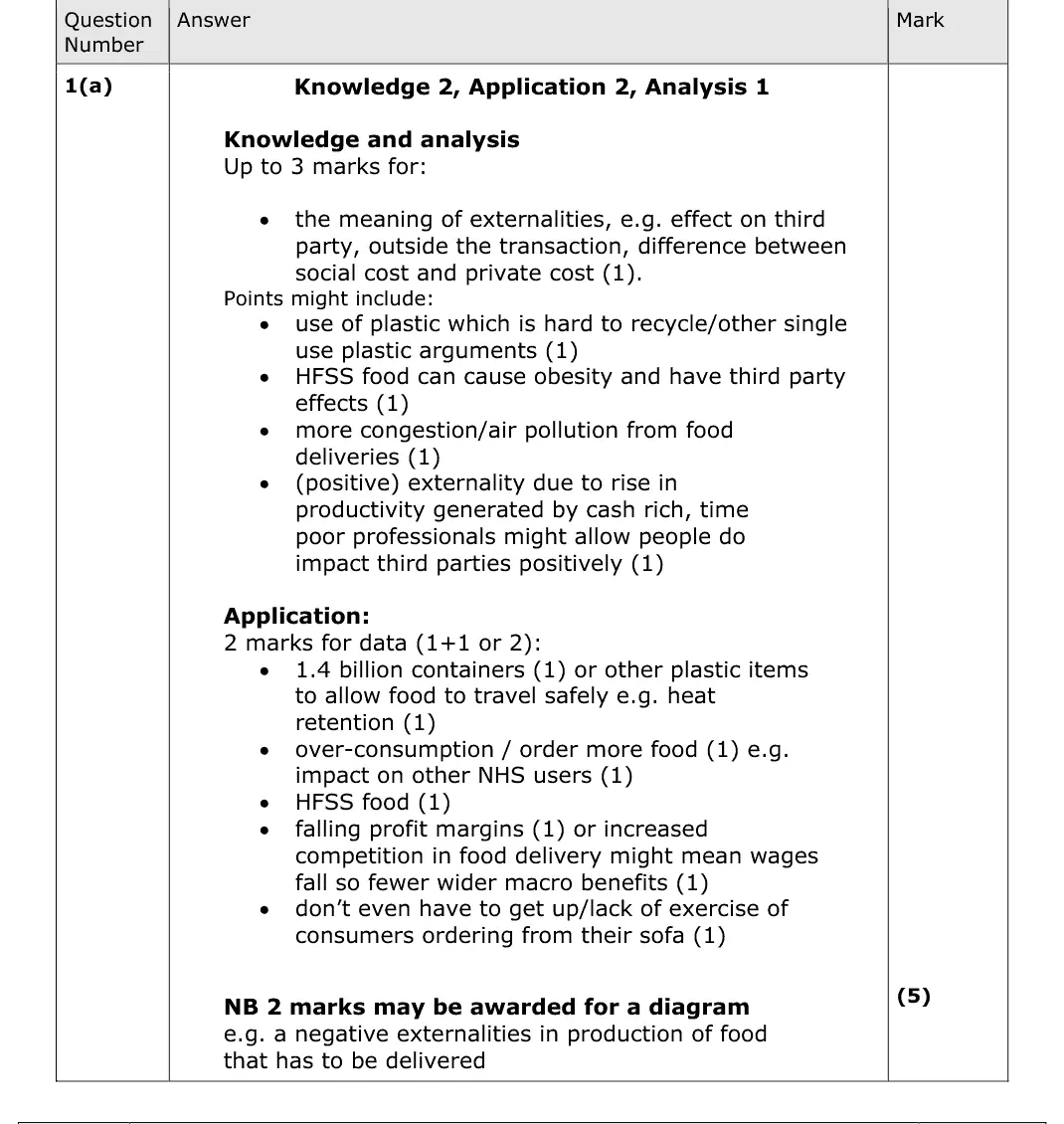
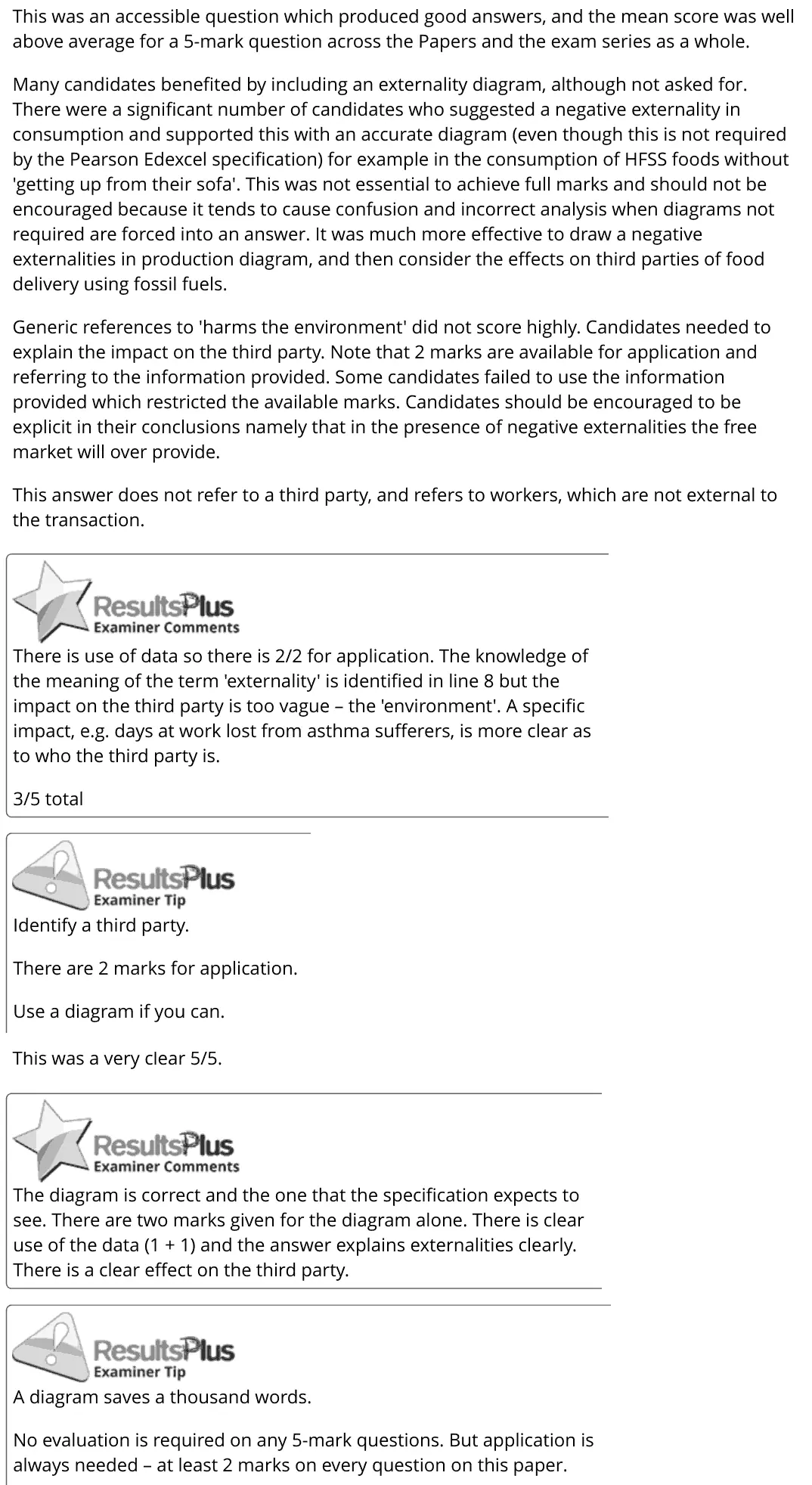
1(a) Market failure and externalities 5AO1=2,AO2=2,AO3=1Short answer
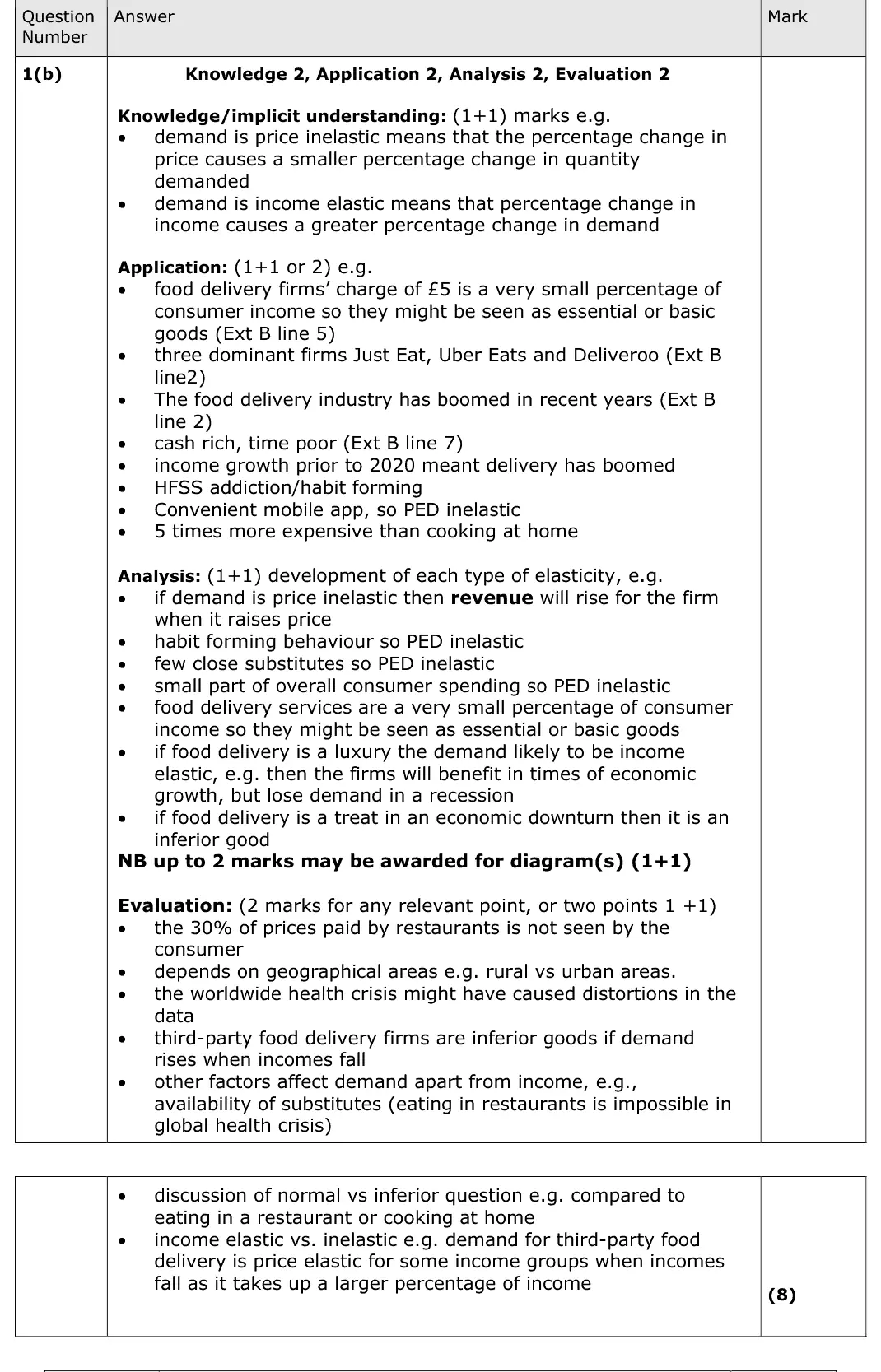
1(b) Price, income and cross elasticities of demand 8AO1=2,AO2=2,AO3=2,AO4=2Extended response
1(c) Business growth and business objectives, Revenues, costs and profits 12AO1=2,AO2=2,AO3=4,AO4=4Extended response
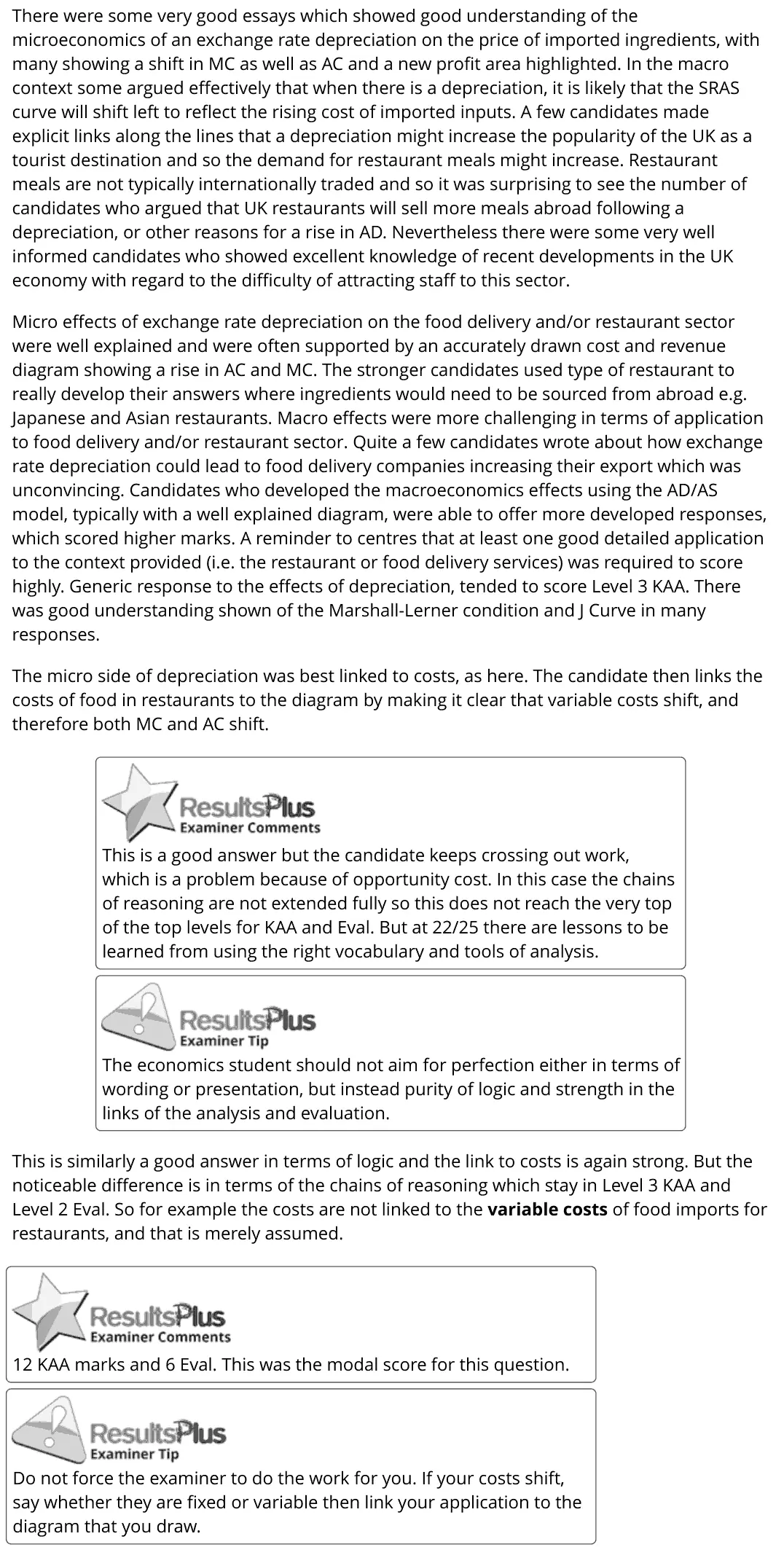
1(d) Exchange rates, Revenues, costs and profits 25AO1=4,AO2=4,AO3=8,AO4=9Essay
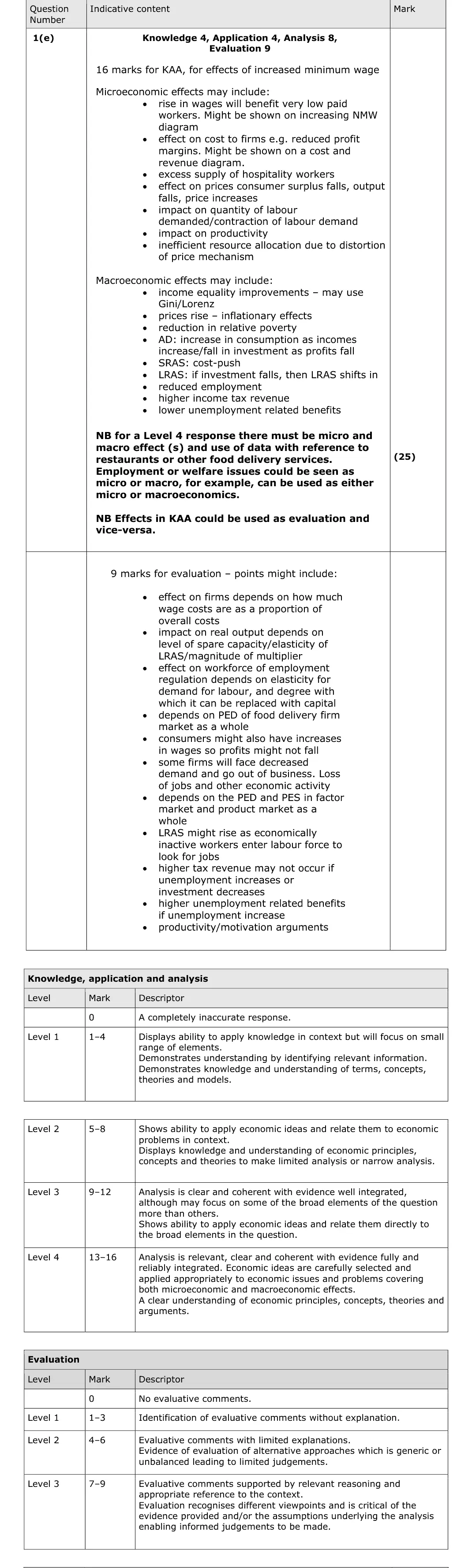
1(e) The labour market, The circular flow, national income and the multiplier 25AO1=4,AO2=4,AO3=8,AO4=9Essay
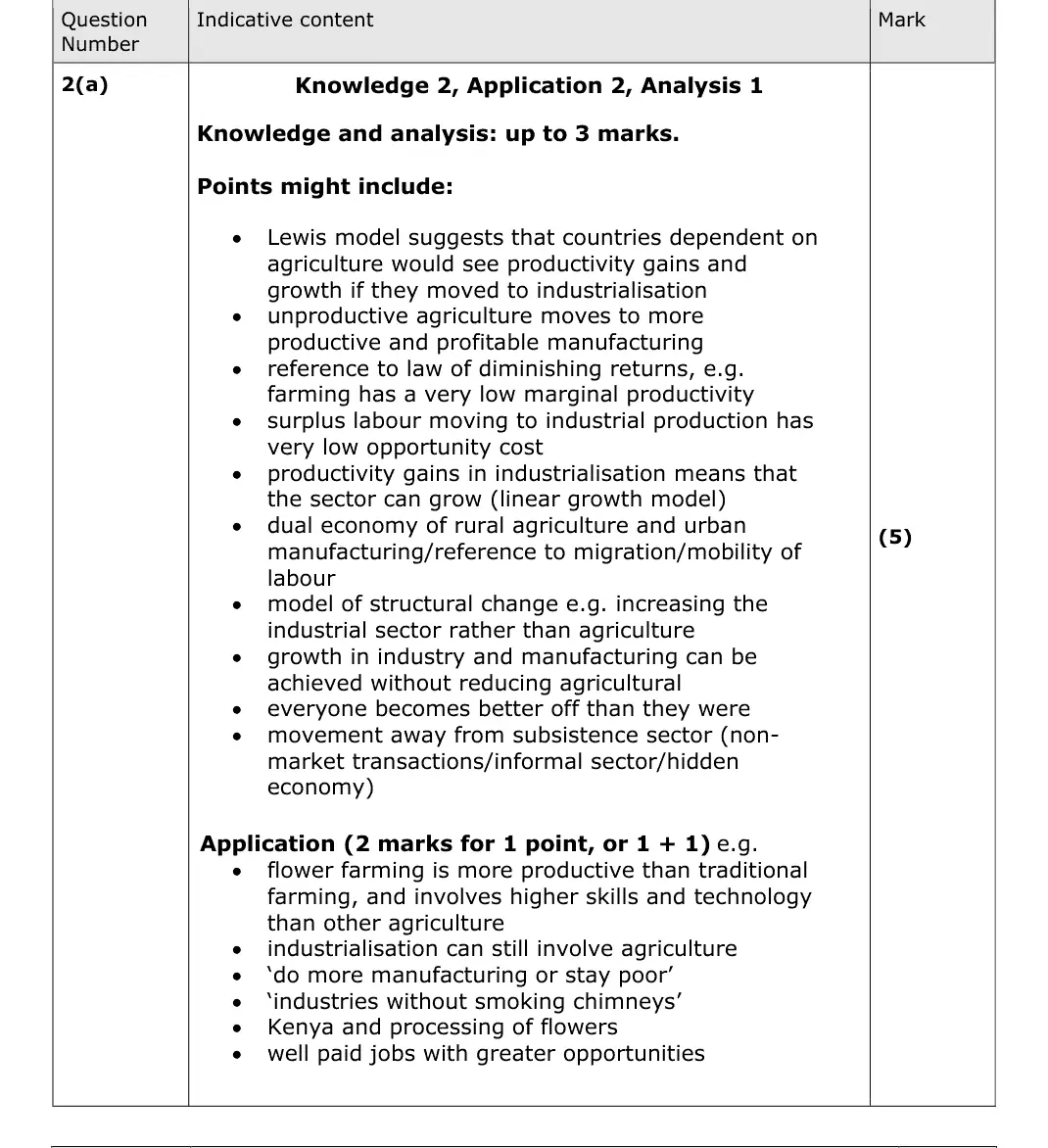
2(a) Emerging and developing economies 5AO1=2,AO2=2,AO3=1Short answer
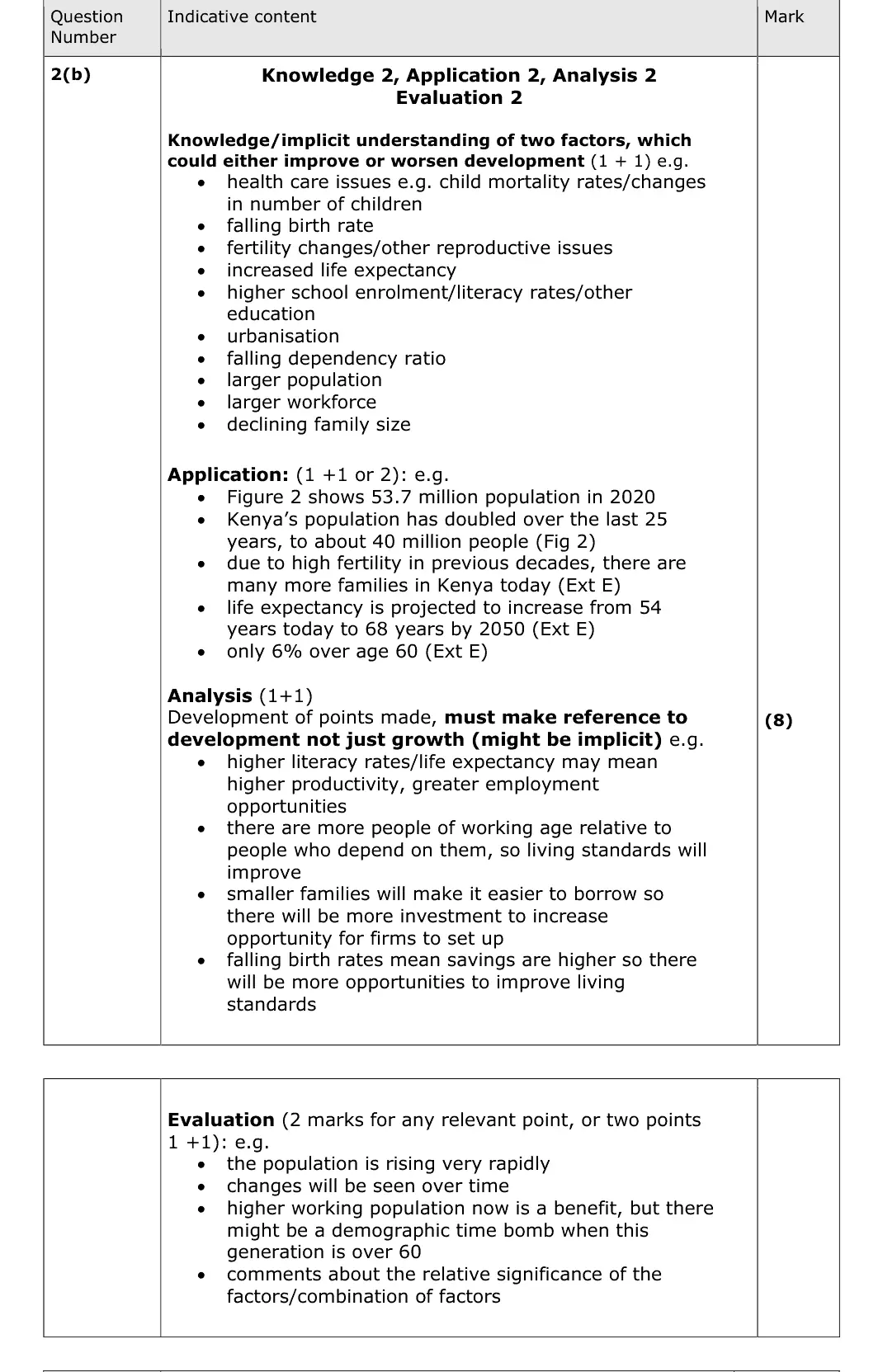
2(b) Emerging and developing economies 8AO1=2,AO2=2,AO3=2,AO4=2Extended response
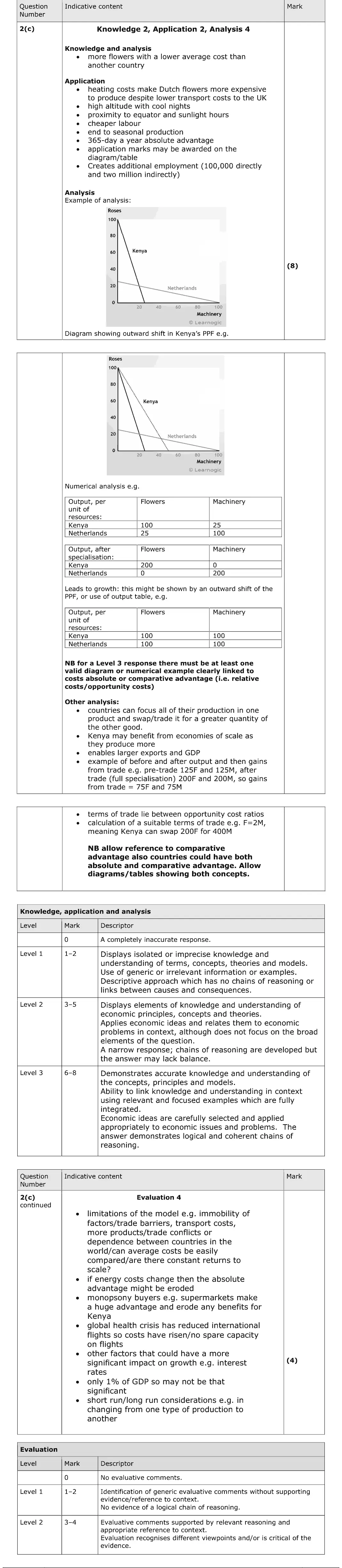
2(c) Globalisation, specialisation and trade 12AO1=2,AO2=2,AO3=4,AO4=4Extended response
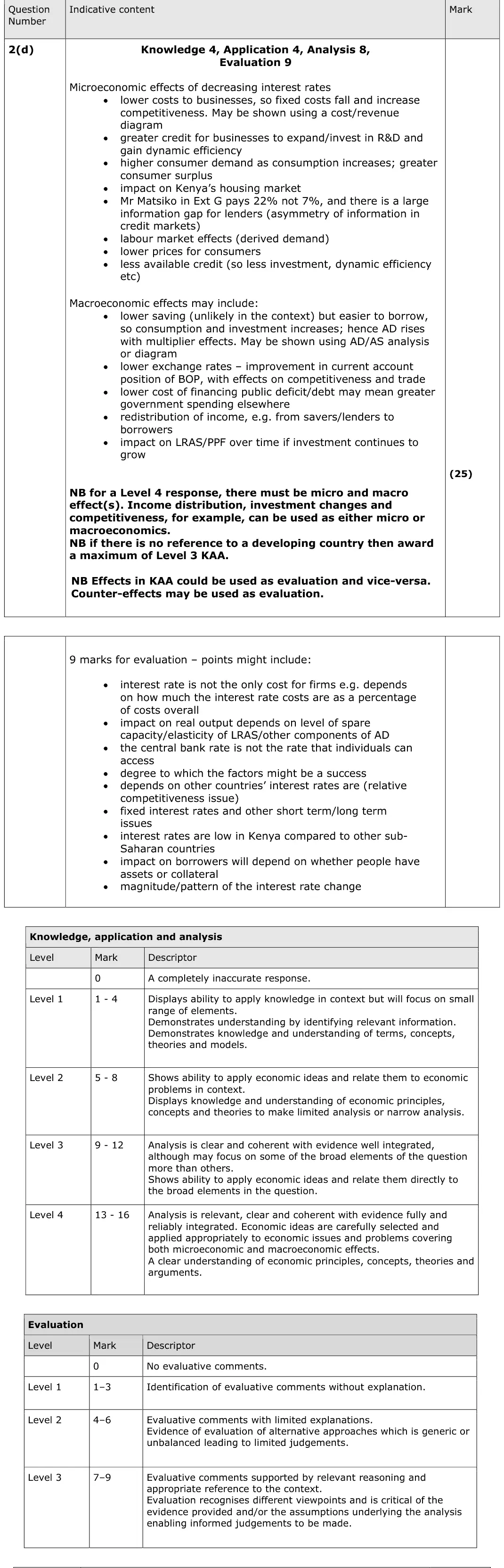
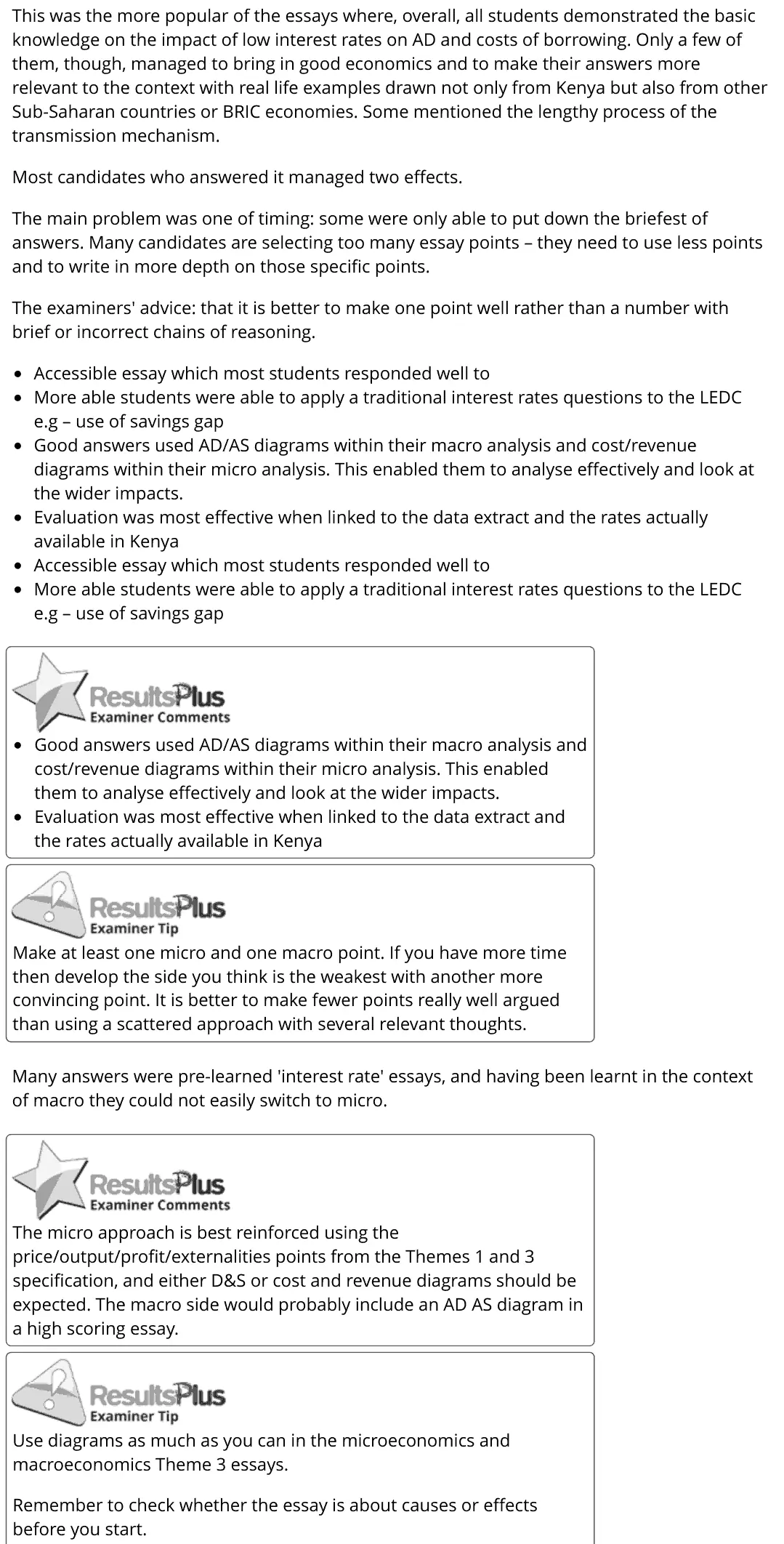
2(d) Demand-side policies: fiscal and monetary policy, Revenues, costs and profits 25AO1=4,AO2=4,AO3=8,AO4=9Essay
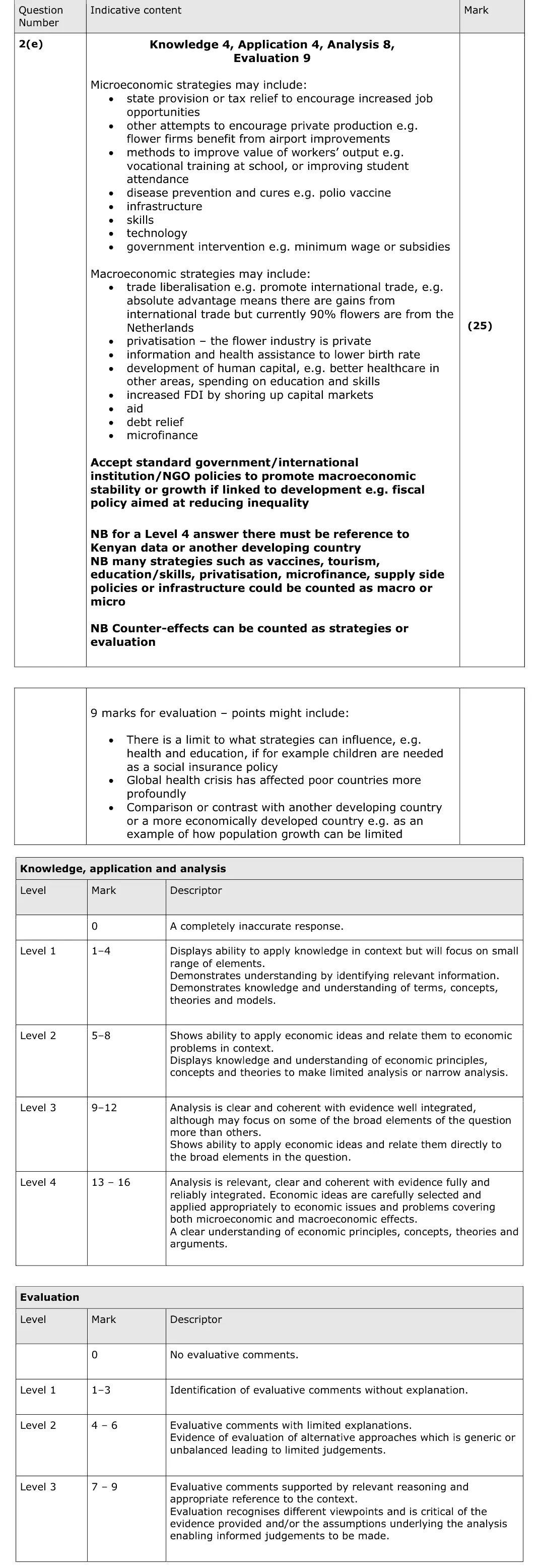
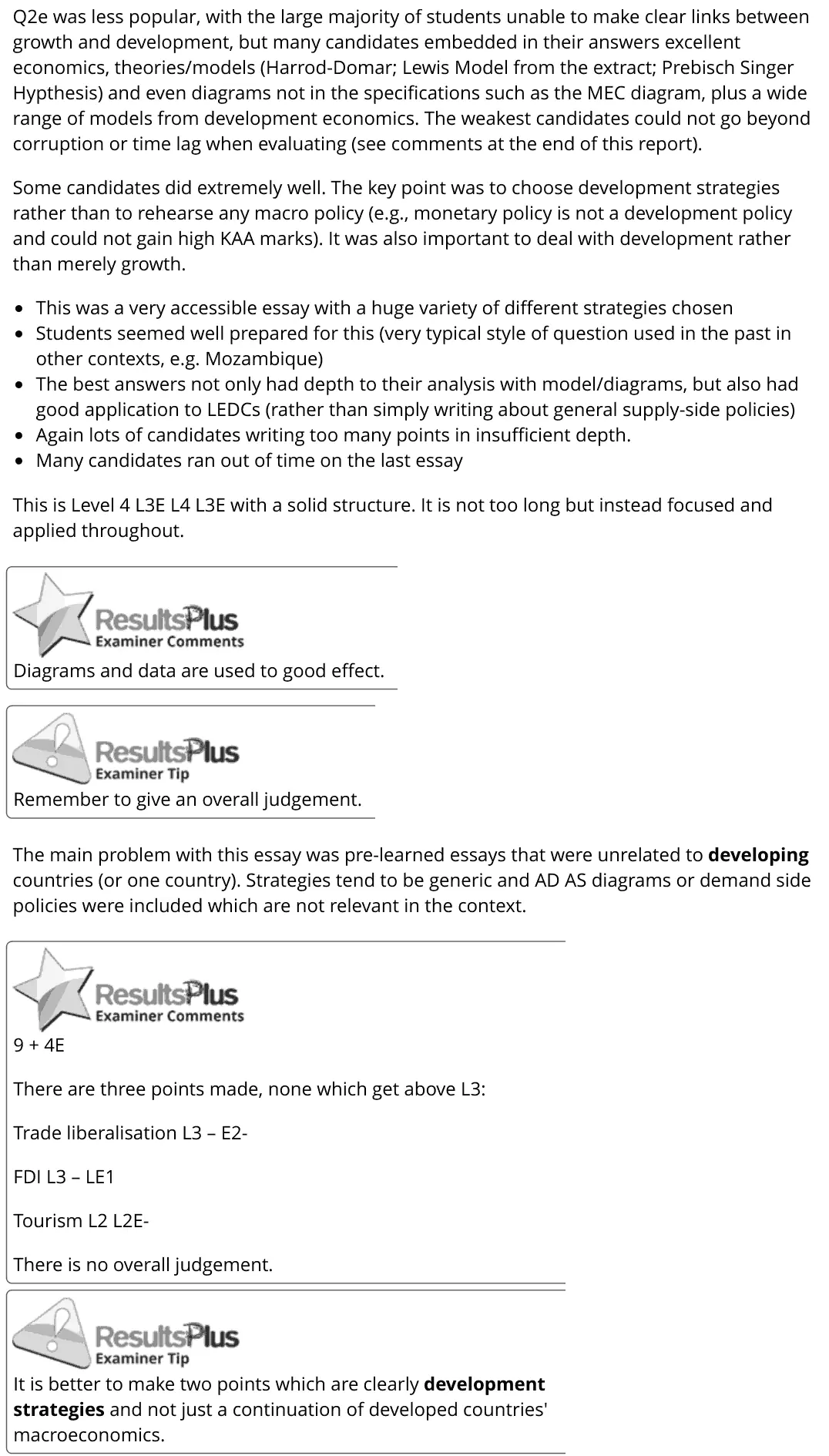
2(e) Emerging and developing economies 25AO1=4,AO2=4,AO3=8,AO4=9Essay

The questions

1(a)1(b)1(c)1(d)1(e)2(a)2(b)2(c)2(d)2(e)
June 2022 · Paper 3 · Q1(a) 5 marks AO1=2, AO2=2, AO3=1 Short answer externalities
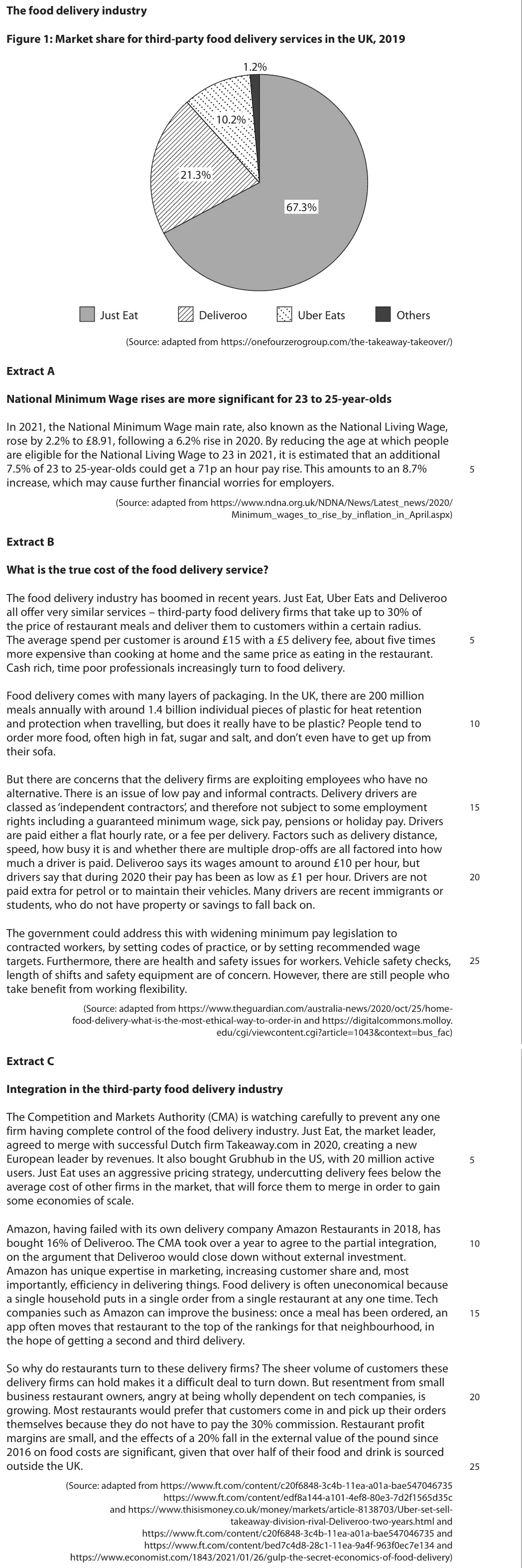
Data and extracts for question 1The food delivery industry Figure 1: Market share for third‑party food delivery services in the UK, 2019 1.2% 10.2% 21.3% 67.3% Just Eat Deliveroo Uber Eats Others (Source: adapted from https://onefourzerogroup.com/the‑takeaway‑takeover/) Extract A National Minimum Wage rises are more significant for 23 to 25-year-olds In 2021, the National Minimum Wage main rate, also known as the National Living Wage, rose by 2.2% to £8.91, following a 6.2% rise in 2020. By reducing the age at which people are eligible for the National Living Wage to 23 in 2021, it is estimated that an additional 7.5% of 23 to 25-year-olds could get a 71p an hour pay rise. This amounts to an 8.7% 5 increase, which may cause further financial worries for employers. (Source: adapted from https://www.ndna.org.uk/NDNA/News/Latest_news/2020/ Minimum_wages_to_rise_by_inflation_in_April.aspx) Extract B What is the true cost of the food delivery service? The food delivery industry has boomed in recent years. Just Eat, Uber Eats and Deliveroo all offer very similar services – third‑party food delivery firms that take up to 30% of the price of restaurant meals and deliver them to customers within a certain radius. The average spend per customer is around £15 with a £5 delivery fee, about five times 5 more expensive than cooking at home and the same price as eating in the restaurant. Cash rich, time poor professionals increasingly turn to food delivery. Food delivery comes with many layers of packaging. In the UK, there are 200 million meals annually with around 1.4 billion individual pieces of plastic for heat retention and protection when travelling, but does it really have to be plastic? People tend to 10 order more food, often high in fat, sugar and salt, and don’t even have to get up from their sofa. But there are concerns that the delivery firms are exploiting employees who have no alternative. There is an issue of low pay and informal contracts. Delivery drivers are classed as ‘independent contractors’, and therefore not subject to some employment 15 rights including a guaranteed minimum wage, sick pay, pensions or holiday pay. Drivers are paid either a flat hourly rate, or a fee per delivery. Factors such as delivery distance, speed, how busy it is and whether there are multiple drop‑offs are all factored into how much a driver is paid. Deliveroo says its wages amount to around £10 per hour, but drivers say that during 2020 their pay has been as low as £1 per hour. Drivers are not 20 paid extra for petrol or to maintain their vehicles. Many drivers are recent immigrants or students, who do not have property or savings to fall back on. The government could address this with widening minimum pay legislation to contracted workers, by setting codes of practice, or by setting recommended wage targets. Furthermore, there are health and safety issues for workers. Vehicle safety checks, 25 length of shifts and safety equipment are of concern. However, there are still people who take benefit from working flexibility. (Source: adapted from https://www.theguardian.com/australia‑news/2020/oct/25/home- food-delivery‑what‑is‑the‑most‑ethical‑way‑to‑order‑in and https://digitalcommons.molloy. edu/cgi/viewcontent.cgi?article=1043&context=bus_fac) Extract C Integration in the third‑party food delivery industry The Competition and Markets Authority (CMA) is watching carefully to prevent any one firm having complete control of the food delivery industry. Just Eat, the market leader, agreed to merge with successful Dutch firm Takeaway.com in 2020, creating a new European leader by revenues. It also bought Grubhub in the US, with 20 million active 5 users. Just Eat uses an aggressive pricing strategy, undercutting delivery fees below the average cost of other firms in the market, that will force them to merge in order to gain some economies of scale. Amazon, having failed with its own delivery company Amazon Restaurants in 2018, has bought 16% of Deliveroo. The CMA took over a year to agree to the partial integration, 10 on the argument that Deliveroo would close down without external investment. Amazon has unique expertise in marketing, increasing customer share and, most importantly, efficiency in delivering things. Food delivery is often uneconomical because a single household puts in a single order from a single restaurant at any one time. Tech companies such as Amazon can improve the business: once a meal has been ordered, an 15 app often moves that restaurant to the top of the rankings for that neighbourhood, in the hope of getting a second and third delivery. So why do restaurants turn to these delivery firms? The sheer volume of customers these delivery firms can hold makes it a difficult deal to turn down. But resentment from small business restaurant owners, angry at being wholly dependent on tech companies, is 20 growing. Most restaurants would prefer that customers come in and pick up their orders themselves because they do not have to pay the 30% commission. Restaurant profit margins are small, and the effects of a 20% fall in the external value of the pound since 2016 on food costs are significant, given that over half of their food and drink is sourced outside the UK. 25 (Source: adapted from https://www.ft.com/content/c20f6848‑3c4b‑11ea‑a01a-bae547046735 https://www.ft.com/content/edf8a144‑a101‑4ef8‑80e3‑7d2f1565d35c and https://www.thisismoney.co.uk/money/markets/article‑8138703/Uber‑set‑sell- takeaway-division‑rival‑Deliveroo‑two‑years.html and https://www.ft.com/content/c20f6848-3c4b‑11ea‑a01a‑bae547046735 and https://www.ft.com/content/bed7c4d8-28c1-11ea-9a4f-963f0ec7e134 and https://www.economist.com/1843/2021/01/26/gulp‑the‑secret‑economics-of-food‑delivery)
(a) Using the information provided, explain one externality that arises in the food delivery market. (5)
June 2022 · Paper 3 · Q1(b) 8 marks AO1=2, AO2=2, AO3=2, AO4=2 8-mark response Hard price elasticity of demand
Data and extracts for question 1The food delivery industry Figure 1: Market share for third‑party food delivery services in the UK, 2019 1.2% 10.2% 21.3% 67.3% Just Eat Deliveroo Uber Eats Others (Source: adapted from https://onefourzerogroup.com/the‑takeaway‑takeover/) Extract A National Minimum Wage rises are more significant for 23 to 25-year-olds In 2021, the National Minimum Wage main rate, also known as the National Living Wage, rose by 2.2% to £8.91, following a 6.2% rise in 2020. By reducing the age at which people are eligible for the National Living Wage to 23 in 2021, it is estimated that an additional 7.5% of 23 to 25-year-olds could get a 71p an hour pay rise. This amounts to an 8.7% 5 increase, which may cause further financial worries for employers. (Source: adapted from https://www.ndna.org.uk/NDNA/News/Latest_news/2020/ Minimum_wages_to_rise_by_inflation_in_April.aspx) Extract B What is the true cost of the food delivery service? The food delivery industry has boomed in recent years. Just Eat, Uber Eats and Deliveroo all offer very similar services – third‑party food delivery firms that take up to 30% of the price of restaurant meals and deliver them to customers within a certain radius. The average spend per customer is around £15 with a £5 delivery fee, about five times 5 more expensive than cooking at home and the same price as eating in the restaurant. Cash rich, time poor professionals increasingly turn to food delivery. Food delivery comes with many layers of packaging. In the UK, there are 200 million meals annually with around 1.4 billion individual pieces of plastic for heat retention and protection when travelling, but does it really have to be plastic? People tend to 10 order more food, often high in fat, sugar and salt, and don’t even have to get up from their sofa. But there are concerns that the delivery firms are exploiting employees who have no alternative. There is an issue of low pay and informal contracts. Delivery drivers are classed as ‘independent contractors’, and therefore not subject to some employment 15 rights including a guaranteed minimum wage, sick pay, pensions or holiday pay. Drivers are paid either a flat hourly rate, or a fee per delivery. Factors such as delivery distance, speed, how busy it is and whether there are multiple drop‑offs are all factored into how much a driver is paid. Deliveroo says its wages amount to around £10 per hour, but drivers say that during 2020 their pay has been as low as £1 per hour. Drivers are not 20 paid extra for petrol or to maintain their vehicles. Many drivers are recent immigrants or students, who do not have property or savings to fall back on. The government could address this with widening minimum pay legislation to contracted workers, by setting codes of practice, or by setting recommended wage targets. Furthermore, there are health and safety issues for workers. Vehicle safety checks, 25 length of shifts and safety equipment are of concern. However, there are still people who take benefit from working flexibility. (Source: adapted from https://www.theguardian.com/australia‑news/2020/oct/25/home- food-delivery‑what‑is‑the‑most‑ethical‑way‑to‑order‑in and https://digitalcommons.molloy. edu/cgi/viewcontent.cgi?article=1043&context=bus_fac) Extract C Integration in the third‑party food delivery industry The Competition and Markets Authority (CMA) is watching carefully to prevent any one firm having complete control of the food delivery industry. Just Eat, the market leader, agreed to merge with successful Dutch firm Takeaway.com in 2020, creating a new European leader by revenues. It also bought Grubhub in the US, with 20 million active 5 users. Just Eat uses an aggressive pricing strategy, undercutting delivery fees below the average cost of other firms in the market, that will force them to merge in order to gain some economies of scale. Amazon, having failed with its own delivery company Amazon Restaurants in 2018, has bought 16% of Deliveroo. The CMA took over a year to agree to the partial integration, 10 on the argument that Deliveroo would close down without external investment. Amazon has unique expertise in marketing, increasing customer share and, most importantly, efficiency in delivering things. Food delivery is often uneconomical because a single household puts in a single order from a single restaurant at any one time. Tech companies such as Amazon can improve the business: once a meal has been ordered, an 15 app often moves that restaurant to the top of the rankings for that neighbourhood, in the hope of getting a second and third delivery. So why do restaurants turn to these delivery firms? The sheer volume of customers these delivery firms can hold makes it a difficult deal to turn down. But resentment from small business restaurant owners, angry at being wholly dependent on tech companies, is 20 growing. Most restaurants would prefer that customers come in and pick up their orders themselves because they do not have to pay the 30% commission. Restaurant profit margins are small, and the effects of a 20% fall in the external value of the pound since 2016 on food costs are significant, given that over half of their food and drink is sourced outside the UK. 25 (Source: adapted from https://www.ft.com/content/c20f6848‑3c4b‑11ea‑a01a-bae547046735 https://www.ft.com/content/edf8a144‑a101‑4ef8‑80e3‑7d2f1565d35c and https://www.thisismoney.co.uk/money/markets/article‑8138703/Uber‑set‑sell- takeaway-division‑rival‑Deliveroo‑two‑years.html and https://www.ft.com/content/c20f6848-3c4b‑11ea‑a01a‑bae547046735 and https://www.ft.com/content/bed7c4d8-28c1-11ea-9a4f-963f0ec7e134 and https://www.economist.com/1843/2021/01/26/gulp‑the‑secret‑economics-of-food‑delivery)
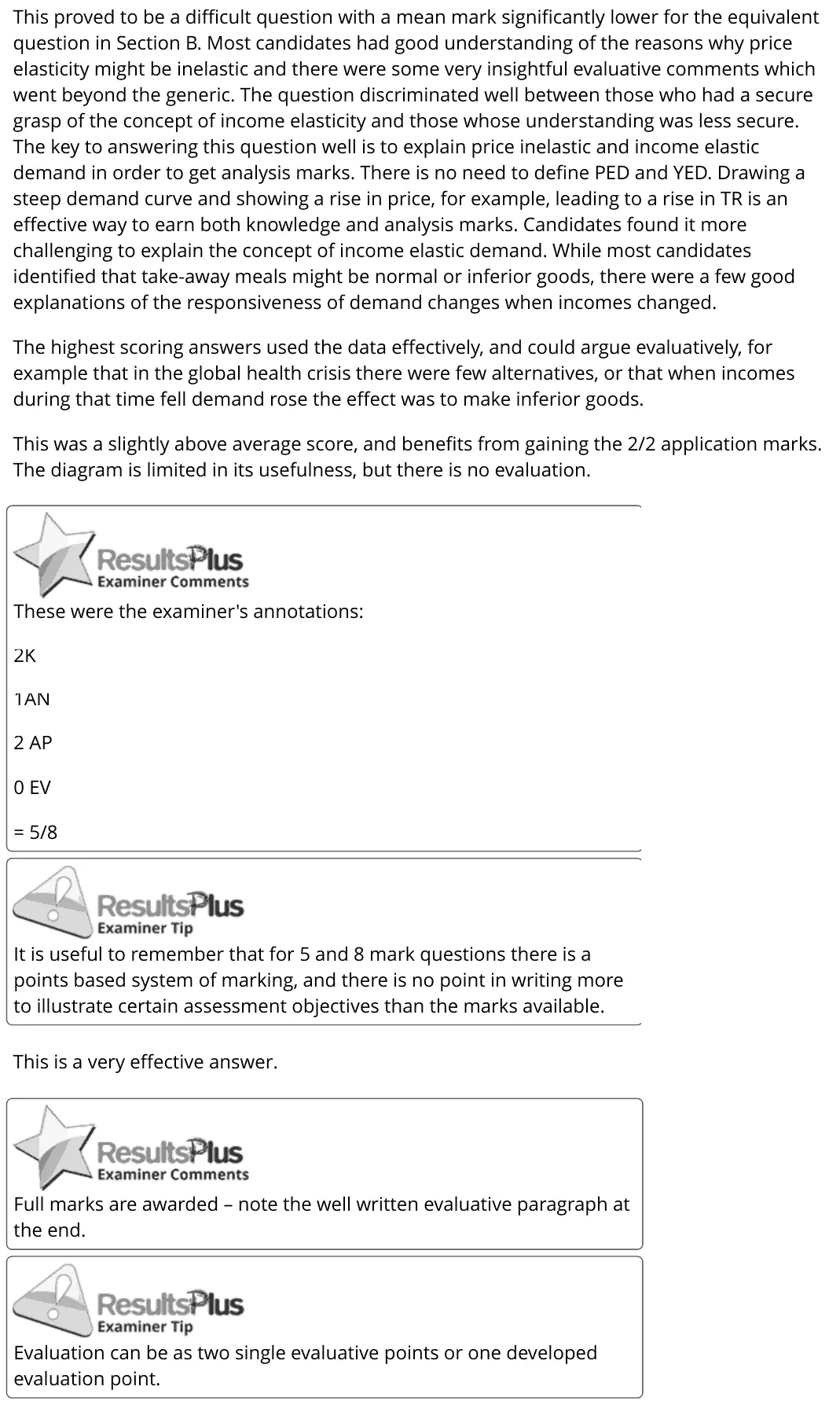
(b) With reference to Extract B, examine whether the demand for delivered food is price inelastic and income elastic. (8)
June 2022 · Paper 3 · Q1(c) 12 marks AO1=2, AO2=2, AO3=4, AO4=4 12-mark response business growth and objectivesrevenues costs and profits
Data and extracts for question 1The food delivery industry Figure 1: Market share for third‑party food delivery services in the UK, 2019 1.2% 10.2% 21.3% 67.3% Just Eat Deliveroo Uber Eats Others (Source: adapted from https://onefourzerogroup.com/the‑takeaway‑takeover/) Extract A National Minimum Wage rises are more significant for 23 to 25-year-olds In 2021, the National Minimum Wage main rate, also known as the National Living Wage, rose by 2.2% to £8.91, following a 6.2% rise in 2020. By reducing the age at which people are eligible for the National Living Wage to 23 in 2021, it is estimated that an additional 7.5% of 23 to 25-year-olds could get a 71p an hour pay rise. This amounts to an 8.7% 5 increase, which may cause further financial worries for employers. (Source: adapted from https://www.ndna.org.uk/NDNA/News/Latest_news/2020/ Minimum_wages_to_rise_by_inflation_in_April.aspx) Extract B What is the true cost of the food delivery service? The food delivery industry has boomed in recent years. Just Eat, Uber Eats and Deliveroo all offer very similar services – third‑party food delivery firms that take up to 30% of the price of restaurant meals and deliver them to customers within a certain radius. The average spend per customer is around £15 with a £5 delivery fee, about five times 5 more expensive than cooking at home and the same price as eating in the restaurant. Cash rich, time poor professionals increasingly turn to food delivery. Food delivery comes with many layers of packaging. In the UK, there are 200 million meals annually with around 1.4 billion individual pieces of plastic for heat retention and protection when travelling, but does it really have to be plastic? People tend to 10 order more food, often high in fat, sugar and salt, and don’t even have to get up from their sofa. But there are concerns that the delivery firms are exploiting employees who have no alternative. There is an issue of low pay and informal contracts. Delivery drivers are classed as ‘independent contractors’, and therefore not subject to some employment 15 rights including a guaranteed minimum wage, sick pay, pensions or holiday pay. Drivers are paid either a flat hourly rate, or a fee per delivery. Factors such as delivery distance, speed, how busy it is and whether there are multiple drop‑offs are all factored into how much a driver is paid. Deliveroo says its wages amount to around £10 per hour, but drivers say that during 2020 their pay has been as low as £1 per hour. Drivers are not 20 paid extra for petrol or to maintain their vehicles. Many drivers are recent immigrants or students, who do not have property or savings to fall back on. The government could address this with widening minimum pay legislation to contracted workers, by setting codes of practice, or by setting recommended wage targets. Furthermore, there are health and safety issues for workers. Vehicle safety checks, 25 length of shifts and safety equipment are of concern. However, there are still people who take benefit from working flexibility. (Source: adapted from https://www.theguardian.com/australia‑news/2020/oct/25/home- food-delivery‑what‑is‑the‑most‑ethical‑way‑to‑order‑in and https://digitalcommons.molloy. edu/cgi/viewcontent.cgi?article=1043&context=bus_fac) Extract C Integration in the third‑party food delivery industry The Competition and Markets Authority (CMA) is watching carefully to prevent any one firm having complete control of the food delivery industry. Just Eat, the market leader, agreed to merge with successful Dutch firm Takeaway.com in 2020, creating a new European leader by revenues. It also bought Grubhub in the US, with 20 million active 5 users. Just Eat uses an aggressive pricing strategy, undercutting delivery fees below the average cost of other firms in the market, that will force them to merge in order to gain some economies of scale. Amazon, having failed with its own delivery company Amazon Restaurants in 2018, has bought 16% of Deliveroo. The CMA took over a year to agree to the partial integration, 10 on the argument that Deliveroo would close down without external investment. Amazon has unique expertise in marketing, increasing customer share and, most importantly, efficiency in delivering things. Food delivery is often uneconomical because a single household puts in a single order from a single restaurant at any one time. Tech companies such as Amazon can improve the business: once a meal has been ordered, an 15 app often moves that restaurant to the top of the rankings for that neighbourhood, in the hope of getting a second and third delivery. So why do restaurants turn to these delivery firms? The sheer volume of customers these delivery firms can hold makes it a difficult deal to turn down. But resentment from small business restaurant owners, angry at being wholly dependent on tech companies, is 20 growing. Most restaurants would prefer that customers come in and pick up their orders themselves because they do not have to pay the 30% commission. Restaurant profit margins are small, and the effects of a 20% fall in the external value of the pound since 2016 on food costs are significant, given that over half of their food and drink is sourced outside the UK. 25 (Source: adapted from https://www.ft.com/content/c20f6848‑3c4b‑11ea‑a01a-bae547046735 https://www.ft.com/content/edf8a144‑a101‑4ef8‑80e3‑7d2f1565d35c and https://www.thisismoney.co.uk/money/markets/article‑8138703/Uber‑set‑sell- takeaway-division‑rival‑Deliveroo‑two‑years.html and https://www.ft.com/content/c20f6848-3c4b‑11ea‑a01a‑bae547046735 and https://www.ft.com/content/bed7c4d8-28c1-11ea-9a4f-963f0ec7e134 and https://www.economist.com/1843/2021/01/26/gulp‑the‑secret‑economics-of-food‑delivery)
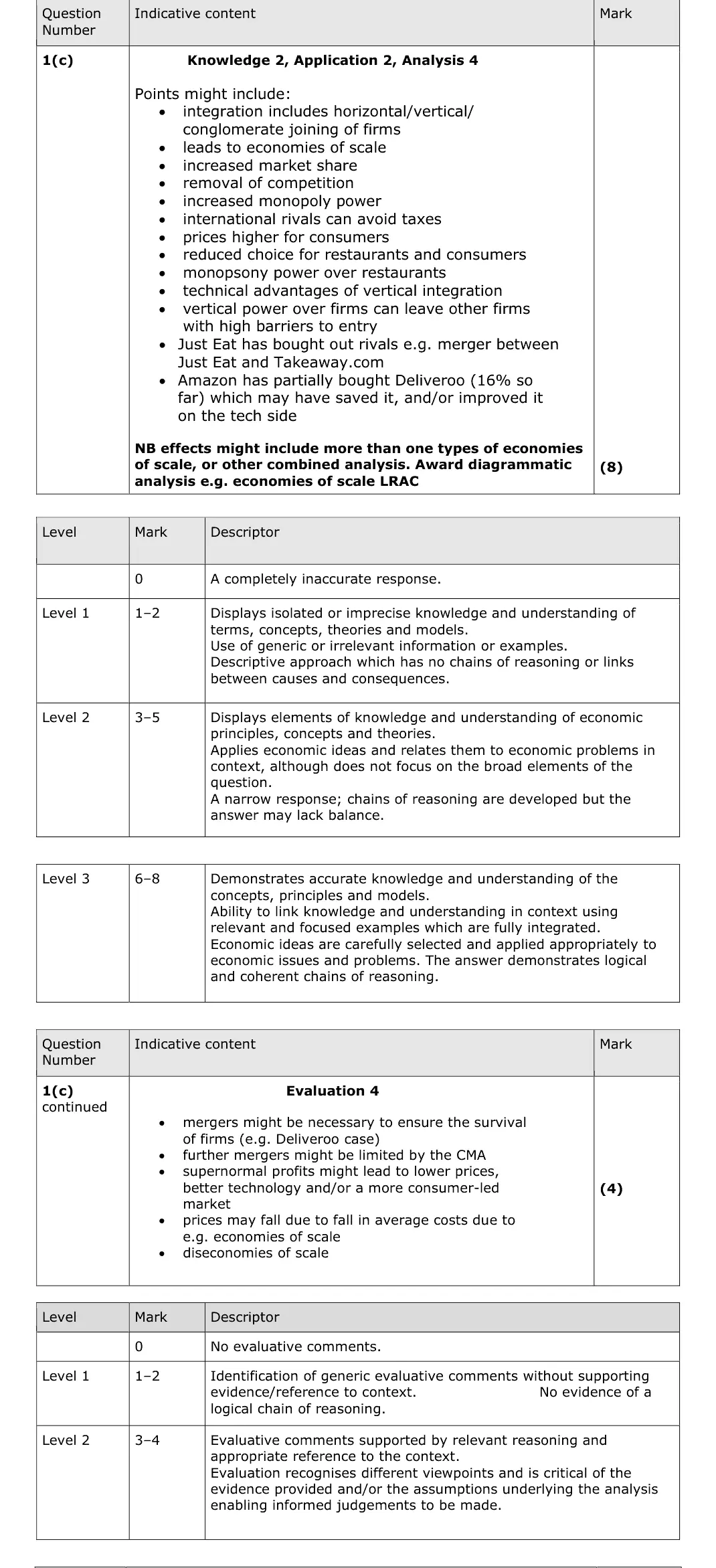
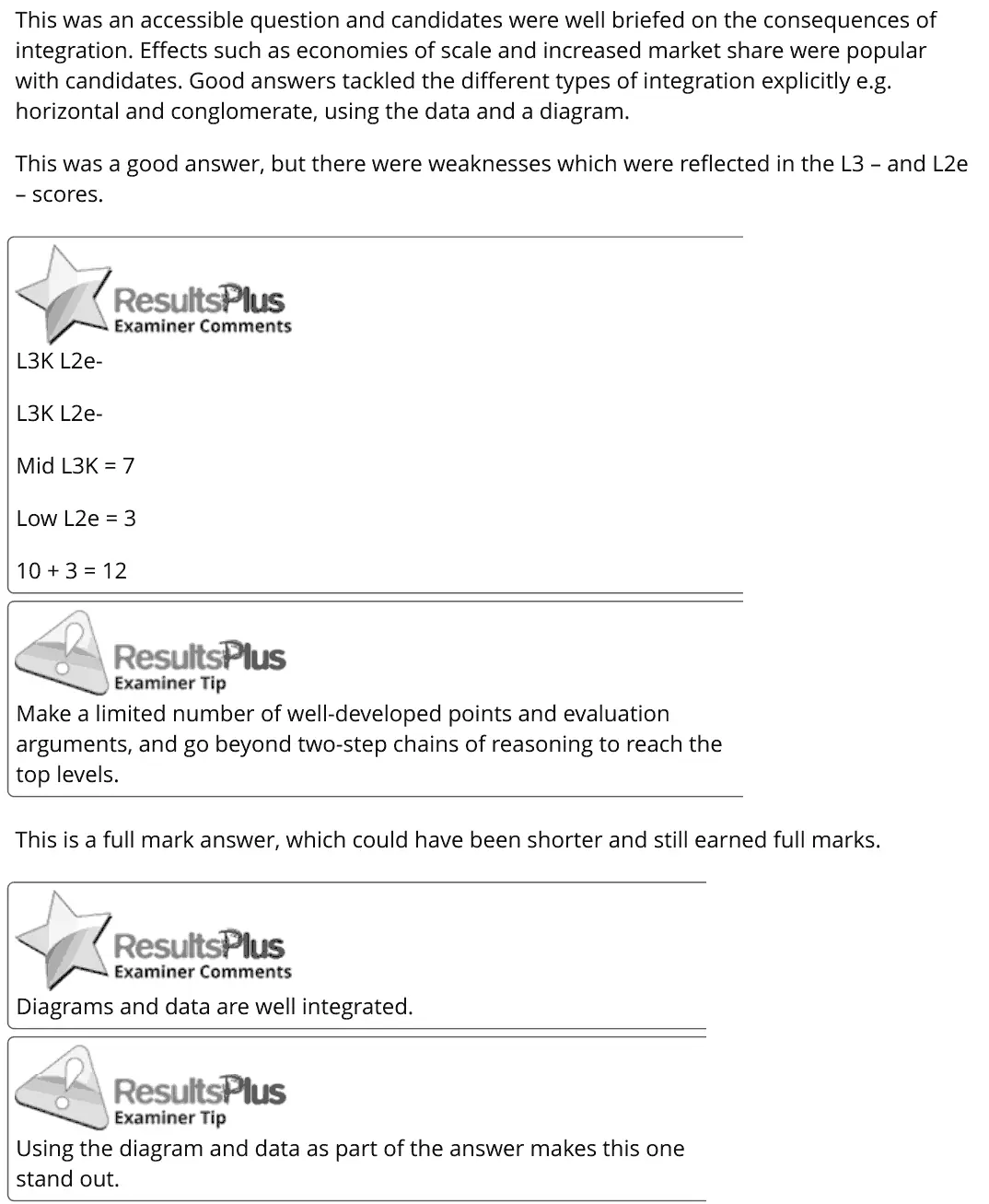
(c) With reference to Extract C, discuss the likely effects of increasing integration within the food delivery market. (12)
June 2022 · Paper 3 · Q1(d) 25 marks AO1=4, AO2=4, AO3=8, AO4=9 25-mark essay Either/or exchange ratesrevenues costs and profits
Data and extracts for question 1The food delivery industry Figure 1: Market share for third‑party food delivery services in the UK, 2019 1.2% 10.2% 21.3% 67.3% Just Eat Deliveroo Uber Eats Others (Source: adapted from https://onefourzerogroup.com/the‑takeaway‑takeover/) Extract A National Minimum Wage rises are more significant for 23 to 25-year-olds In 2021, the National Minimum Wage main rate, also known as the National Living Wage, rose by 2.2% to £8.91, following a 6.2% rise in 2020. By reducing the age at which people are eligible for the National Living Wage to 23 in 2021, it is estimated that an additional 7.5% of 23 to 25-year-olds could get a 71p an hour pay rise. This amounts to an 8.7% 5 increase, which may cause further financial worries for employers. (Source: adapted from https://www.ndna.org.uk/NDNA/News/Latest_news/2020/ Minimum_wages_to_rise_by_inflation_in_April.aspx) Extract B What is the true cost of the food delivery service? The food delivery industry has boomed in recent years. Just Eat, Uber Eats and Deliveroo all offer very similar services – third‑party food delivery firms that take up to 30% of the price of restaurant meals and deliver them to customers within a certain radius. The average spend per customer is around £15 with a £5 delivery fee, about five times 5 more expensive than cooking at home and the same price as eating in the restaurant. Cash rich, time poor professionals increasingly turn to food delivery. Food delivery comes with many layers of packaging. In the UK, there are 200 million meals annually with around 1.4 billion individual pieces of plastic for heat retention and protection when travelling, but does it really have to be plastic? People tend to 10 order more food, often high in fat, sugar and salt, and don’t even have to get up from their sofa. But there are concerns that the delivery firms are exploiting employees who have no alternative. There is an issue of low pay and informal contracts. Delivery drivers are classed as ‘independent contractors’, and therefore not subject to some employment 15 rights including a guaranteed minimum wage, sick pay, pensions or holiday pay. Drivers are paid either a flat hourly rate, or a fee per delivery. Factors such as delivery distance, speed, how busy it is and whether there are multiple drop‑offs are all factored into how much a driver is paid. Deliveroo says its wages amount to around £10 per hour, but drivers say that during 2020 their pay has been as low as £1 per hour. Drivers are not 20 paid extra for petrol or to maintain their vehicles. Many drivers are recent immigrants or students, who do not have property or savings to fall back on. The government could address this with widening minimum pay legislation to contracted workers, by setting codes of practice, or by setting recommended wage targets. Furthermore, there are health and safety issues for workers. Vehicle safety checks, 25 length of shifts and safety equipment are of concern. However, there are still people who take benefit from working flexibility. (Source: adapted from https://www.theguardian.com/australia‑news/2020/oct/25/home- food-delivery‑what‑is‑the‑most‑ethical‑way‑to‑order‑in and https://digitalcommons.molloy. edu/cgi/viewcontent.cgi?article=1043&context=bus_fac) Extract C Integration in the third‑party food delivery industry The Competition and Markets Authority (CMA) is watching carefully to prevent any one firm having complete control of the food delivery industry. Just Eat, the market leader, agreed to merge with successful Dutch firm Takeaway.com in 2020, creating a new European leader by revenues. It also bought Grubhub in the US, with 20 million active 5 users. Just Eat uses an aggressive pricing strategy, undercutting delivery fees below the average cost of other firms in the market, that will force them to merge in order to gain some economies of scale. Amazon, having failed with its own delivery company Amazon Restaurants in 2018, has bought 16% of Deliveroo. The CMA took over a year to agree to the partial integration, 10 on the argument that Deliveroo would close down without external investment. Amazon has unique expertise in marketing, increasing customer share and, most importantly, efficiency in delivering things. Food delivery is often uneconomical because a single household puts in a single order from a single restaurant at any one time. Tech companies such as Amazon can improve the business: once a meal has been ordered, an 15 app often moves that restaurant to the top of the rankings for that neighbourhood, in the hope of getting a second and third delivery. So why do restaurants turn to these delivery firms? The sheer volume of customers these delivery firms can hold makes it a difficult deal to turn down. But resentment from small business restaurant owners, angry at being wholly dependent on tech companies, is 20 growing. Most restaurants would prefer that customers come in and pick up their orders themselves because they do not have to pay the 30% commission. Restaurant profit margins are small, and the effects of a 20% fall in the external value of the pound since 2016 on food costs are significant, given that over half of their food and drink is sourced outside the UK. 25 (Source: adapted from https://www.ft.com/content/c20f6848‑3c4b‑11ea‑a01a-bae547046735 https://www.ft.com/content/edf8a144‑a101‑4ef8‑80e3‑7d2f1565d35c and https://www.thisismoney.co.uk/money/markets/article‑8138703/Uber‑set‑sell- takeaway-division‑rival‑Deliveroo‑two‑years.html and https://www.ft.com/content/c20f6848-3c4b‑11ea‑a01a‑bae547046735 and https://www.ft.com/content/bed7c4d8-28c1-11ea-9a4f-963f0ec7e134 and https://www.economist.com/1843/2021/01/26/gulp‑the‑secret‑economics-of-food‑delivery)
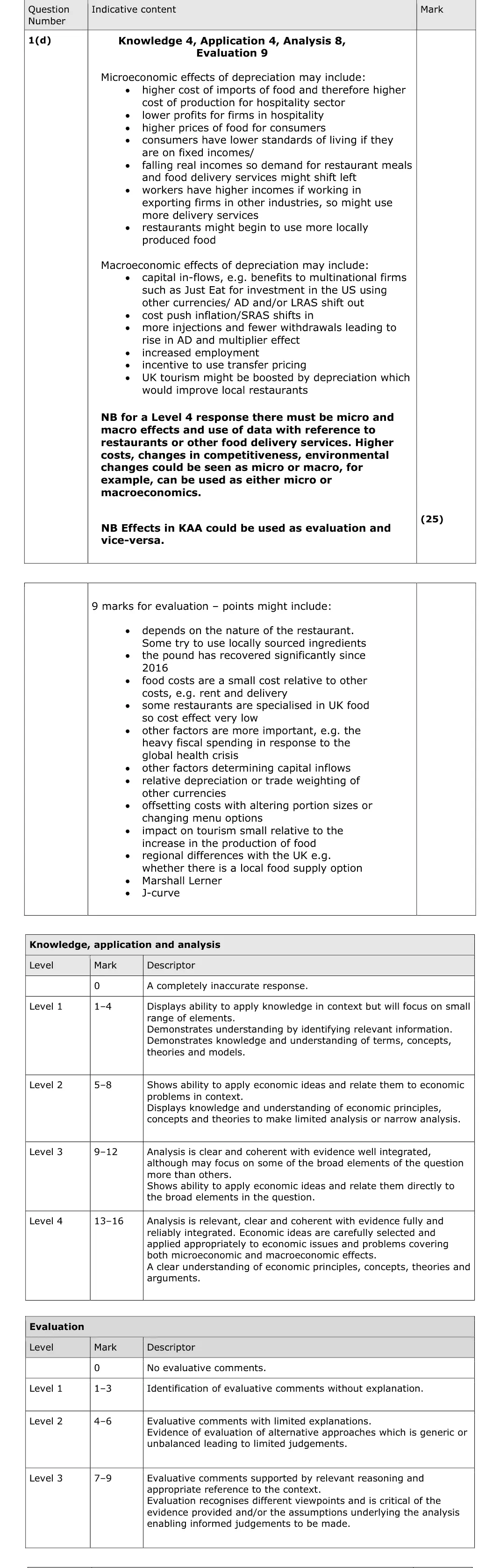
(d) Evaluate the microeconomic and macroeconomic effects of a depreciation of the pound. Refer to restaurants or other food delivery services in your answer. (25)
June 2022 · Paper 3 · Q1(e) 25 marks AO1=4, AO2=4, AO3=8, AO4=9 25-mark essay Either/or labour marketnational income and the multiplier
Data and extracts for question 1The food delivery industry Figure 1: Market share for third‑party food delivery services in the UK, 2019 1.2% 10.2% 21.3% 67.3% Just Eat Deliveroo Uber Eats Others (Source: adapted from https://onefourzerogroup.com/the‑takeaway‑takeover/) Extract A National Minimum Wage rises are more significant for 23 to 25-year-olds In 2021, the National Minimum Wage main rate, also known as the National Living Wage, rose by 2.2% to £8.91, following a 6.2% rise in 2020. By reducing the age at which people are eligible for the National Living Wage to 23 in 2021, it is estimated that an additional 7.5% of 23 to 25-year-olds could get a 71p an hour pay rise. This amounts to an 8.7% 5 increase, which may cause further financial worries for employers. (Source: adapted from https://www.ndna.org.uk/NDNA/News/Latest_news/2020/ Minimum_wages_to_rise_by_inflation_in_April.aspx) Extract B What is the true cost of the food delivery service? The food delivery industry has boomed in recent years. Just Eat, Uber Eats and Deliveroo all offer very similar services – third‑party food delivery firms that take up to 30% of the price of restaurant meals and deliver them to customers within a certain radius. The average spend per customer is around £15 with a £5 delivery fee, about five times 5 more expensive than cooking at home and the same price as eating in the restaurant. Cash rich, time poor professionals increasingly turn to food delivery. Food delivery comes with many layers of packaging. In the UK, there are 200 million meals annually with around 1.4 billion individual pieces of plastic for heat retention and protection when travelling, but does it really have to be plastic? People tend to 10 order more food, often high in fat, sugar and salt, and don’t even have to get up from their sofa. But there are concerns that the delivery firms are exploiting employees who have no alternative. There is an issue of low pay and informal contracts. Delivery drivers are classed as ‘independent contractors’, and therefore not subject to some employment 15 rights including a guaranteed minimum wage, sick pay, pensions or holiday pay. Drivers are paid either a flat hourly rate, or a fee per delivery. Factors such as delivery distance, speed, how busy it is and whether there are multiple drop‑offs are all factored into how much a driver is paid. Deliveroo says its wages amount to around £10 per hour, but drivers say that during 2020 their pay has been as low as £1 per hour. Drivers are not 20 paid extra for petrol or to maintain their vehicles. Many drivers are recent immigrants or students, who do not have property or savings to fall back on. The government could address this with widening minimum pay legislation to contracted workers, by setting codes of practice, or by setting recommended wage targets. Furthermore, there are health and safety issues for workers. Vehicle safety checks, 25 length of shifts and safety equipment are of concern. However, there are still people who take benefit from working flexibility. (Source: adapted from https://www.theguardian.com/australia‑news/2020/oct/25/home- food-delivery‑what‑is‑the‑most‑ethical‑way‑to‑order‑in and https://digitalcommons.molloy. edu/cgi/viewcontent.cgi?article=1043&context=bus_fac) Extract C Integration in the third‑party food delivery industry The Competition and Markets Authority (CMA) is watching carefully to prevent any one firm having complete control of the food delivery industry. Just Eat, the market leader, agreed to merge with successful Dutch firm Takeaway.com in 2020, creating a new European leader by revenues. It also bought Grubhub in the US, with 20 million active 5 users. Just Eat uses an aggressive pricing strategy, undercutting delivery fees below the average cost of other firms in the market, that will force them to merge in order to gain some economies of scale. Amazon, having failed with its own delivery company Amazon Restaurants in 2018, has bought 16% of Deliveroo. The CMA took over a year to agree to the partial integration, 10 on the argument that Deliveroo would close down without external investment. Amazon has unique expertise in marketing, increasing customer share and, most importantly, efficiency in delivering things. Food delivery is often uneconomical because a single household puts in a single order from a single restaurant at any one time. Tech companies such as Amazon can improve the business: once a meal has been ordered, an 15 app often moves that restaurant to the top of the rankings for that neighbourhood, in the hope of getting a second and third delivery. So why do restaurants turn to these delivery firms? The sheer volume of customers these delivery firms can hold makes it a difficult deal to turn down. But resentment from small business restaurant owners, angry at being wholly dependent on tech companies, is 20 growing. Most restaurants would prefer that customers come in and pick up their orders themselves because they do not have to pay the 30% commission. Restaurant profit margins are small, and the effects of a 20% fall in the external value of the pound since 2016 on food costs are significant, given that over half of their food and drink is sourced outside the UK. 25 (Source: adapted from https://www.ft.com/content/c20f6848‑3c4b‑11ea‑a01a-bae547046735 https://www.ft.com/content/edf8a144‑a101‑4ef8‑80e3‑7d2f1565d35c and https://www.thisismoney.co.uk/money/markets/article‑8138703/Uber‑set‑sell- takeaway-division‑rival‑Deliveroo‑two‑years.html and https://www.ft.com/content/c20f6848-3c4b‑11ea‑a01a‑bae547046735 and https://www.ft.com/content/bed7c4d8-28c1-11ea-9a4f-963f0ec7e134 and https://www.economist.com/1843/2021/01/26/gulp‑the‑secret‑economics-of-food‑delivery)
(e) Evaluate the microeconomic and macroeconomic effects of significant increases in the minimum wage. Refer to restaurants or other food delivery services in your answer. (25)
June 2022 · Paper 3 · Q2(a) 5 marks AO1=2, AO2=2, AO3=1 Short answer Hard emerging and developing economies
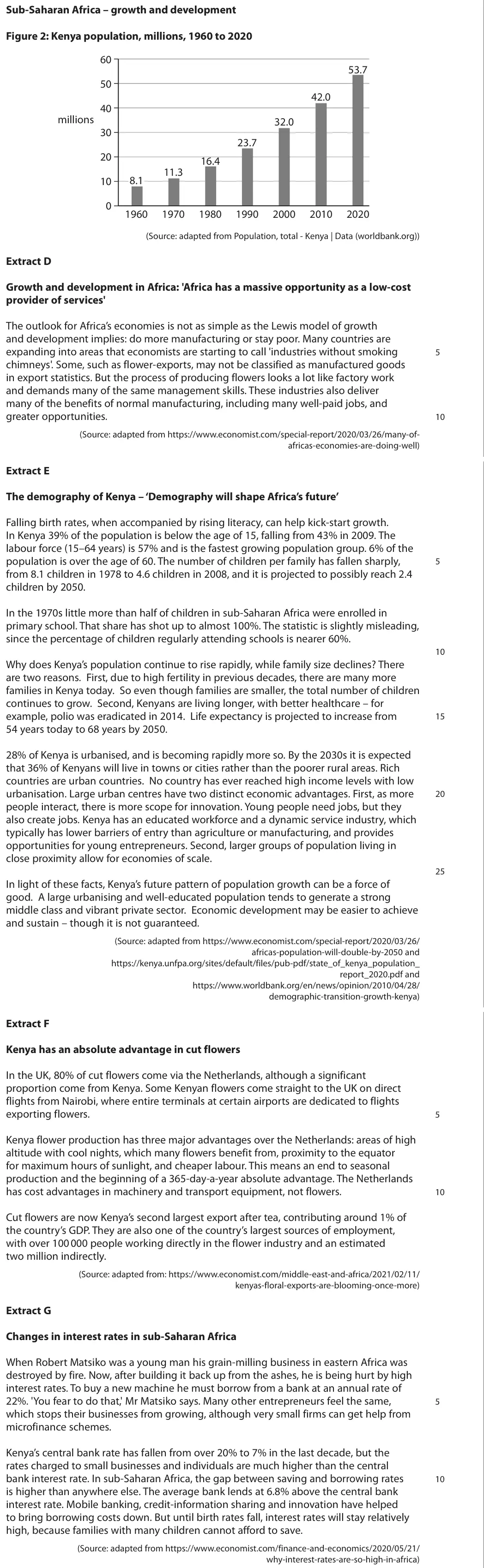
Data and extracts for question 2Sub‑Saharan Africa – growth and development Figure 2: Kenya population, millions, 1960 to 2020 60 53.7 50 42.0 40 millions 32.0 30 23.7 20 16.4 11.3 8.1 10 0 1960 1970 1980 1990 2000 2010 2020 (Source: adapted from Population, total ‑ Kenya | Data (worldbank.org)) Extract D Growth and development in Africa: 'Africa has a massive opportunity as a low‑cost provider of services' The outlook for Africa’s economies is not as simple as the Lewis model of growth and development implies: do more manufacturing or stay poor. Many countries are expanding into areas that economists are starting to call 'industries without smoking 5 chimneys'. Some, such as flower‑exports, may not be classified as manufactured goods in export statistics. But the process of producing flowers looks a lot like factory work and demands many of the same management skills. These industries also deliver many of the benefits of normal manufacturing, including many well‑paid jobs, and greater opportunities. 10 (Source: adapted from https://www.economist.com/special‑report/2020/03/26/many‑of- africas-economies‑are‑doing‑well) Extract E The demography of Kenya – ‘Demography will shape Africa’s future’ Falling birth rates, when accompanied by rising literacy, can help kick‑start growth. In Kenya 39% of the population is below the age of 15, falling from 43% in 2009. The labour force (15–64 years) is 57% and is the fastest growing population group. 6% of the population is over the age of 60. The number of children per family has fallen sharply, 5 from 8.1 children in 1978 to 4.6 children in 2008, and it is projected to possibly reach 2.4 children by 2050. In the 1970s little more than half of children in sub‑Saharan Africa were enrolled in primary school. That share has shot up to almost 100%. The statistic is slightly misleading, since the percentage of children regularly attending schools is nearer 60%. 10 Why does Kenya’s population continue to rise rapidly, while family size declines? There are two reasons. First, due to high fertility in previous decades, there are many more families in Kenya today. So even though families are smaller, the total number of children continues to grow. Second, Kenyans are living longer, with better healthcare – for example, polio was eradicated in 2014. Life expectancy is projected to increase from 15 54 years today to 68 years by 2050. 28% of Kenya is urbanised, and is becoming rapidly more so. By the 2030s it is expected that 36% of Kenyans will live in towns or cities rather than the poorer rural areas. Rich countries are urban countries. No country has ever reached high income levels with low urbanisation. Large urban centres have two distinct economic advantages. First, as more 20 people interact, there is more scope for innovation. Young people need jobs, but they also create jobs. Kenya has an educated workforce and a dynamic service industry, which typically has lower barriers of entry than agriculture or manufacturing, and provides opportunities for young entrepreneurs. Second, larger groups of population living in close proximity allow for economies of scale. 25 In light of these facts, Kenya’s future pattern of population growth can be a force of good. A large urbanising and well‑educated population tends to generate a strong middle class and vibrant private sector. Economic development may be easier to achieve and sustain – though it is not guaranteed. (Source: adapted from https://www.economist.com/special‑report/2020/03/26/ africas‑population‑will‑double‑by‑2050 and https://kenya.unfpa.org/sites/default/files/pub‑pdf/state_of_kenya_population_ report_2020.pdf and https://www.worldbank.org/en/news/opinion/2010/04/28/ demographic‑transition‑growth‑kenya) Extract F Kenya has an absolute advantage in cut flowers In the UK, 80% of cut flowers come via the Netherlands, although a significant proportion come from Kenya. Some Kenyan flowers come straight to the UK on direct flights from Nairobi, where entire terminals at certain airports are dedicated to flights exporting flowers. 5 Kenya flower production has three major advantages over the Netherlands: areas of high altitude with cool nights, which many flowers benefit from, proximity to the equator for maximum hours of sunlight, and cheaper labour. This means an end to seasonal production and the beginning of a 365‑day‑a‑year absolute advantage. The Netherlands has cost advantages in machinery and transport equipment, not flowers. 10 Cut flowers are now Kenya’s second largest export after tea, contributing around 1% of the country’s GDP. They are also one of the country’s largest sources of employment, with over 100 000 people working directly in the flower industry and an estimated two million indirectly. (Source: adapted from: https://www.economist.com/middle‑east‑and‑africa/2021/02/11/ kenyas-floral‑exports‑are-blooming‑once‑more) Extract G Changes in interest rates in sub‑Saharan Africa When Robert Matsiko was a young man his grain‑milling business in eastern Africa was destroyed by fire. Now, after building it back up from the ashes, he is being hurt by high interest rates. To buy a new machine he must borrow from a bank at an annual rate of 22%. 'You fear to do that,' Mr Matsiko says. Many other entrepreneurs feel the same, 5 which stops their businesses from growing, although very small firms can get help from microfinance schemes. Kenya’s central bank rate has fallen from over 20% to 7% in the last decade, but the rates charged to small businesses and individuals are much higher than the central bank interest rate. In sub‑Saharan Africa, the gap between saving and borrowing rates 10 is higher than anywhere else. The average bank lends at 6.8% above the central bank interest rate. Mobile banking, credit‑information sharing and innovation have helped to bring borrowing costs down. But until birth rates fall, interest rates will stay relatively high, because families with many children cannot afford to save. (Source: adapted from https://www.economist.com/finance‑and‑economics/2020/05/21/ why-interest‑rates-are‑so-high‑in-africa)
(a) Explain what is meant by the Lewis model. Refer to Extract D in your answer. (5)
June 2022 · Paper 3 · Q2(b) 8 marks AO1=2, AO2=2, AO3=2, AO4=2 8-mark response emerging and developing economies
Data and extracts for question 2Sub‑Saharan Africa – growth and development Figure 2: Kenya population, millions, 1960 to 2020 60 53.7 50 42.0 40 millions 32.0 30 23.7 20 16.4 11.3 8.1 10 0 1960 1970 1980 1990 2000 2010 2020 (Source: adapted from Population, total ‑ Kenya | Data (worldbank.org)) Extract D Growth and development in Africa: 'Africa has a massive opportunity as a low‑cost provider of services' The outlook for Africa’s economies is not as simple as the Lewis model of growth and development implies: do more manufacturing or stay poor. Many countries are expanding into areas that economists are starting to call 'industries without smoking 5 chimneys'. Some, such as flower‑exports, may not be classified as manufactured goods in export statistics. But the process of producing flowers looks a lot like factory work and demands many of the same management skills. These industries also deliver many of the benefits of normal manufacturing, including many well‑paid jobs, and greater opportunities. 10 (Source: adapted from https://www.economist.com/special‑report/2020/03/26/many‑of- africas-economies‑are‑doing‑well) Extract E The demography of Kenya – ‘Demography will shape Africa’s future’ Falling birth rates, when accompanied by rising literacy, can help kick‑start growth. In Kenya 39% of the population is below the age of 15, falling from 43% in 2009. The labour force (15–64 years) is 57% and is the fastest growing population group. 6% of the population is over the age of 60. The number of children per family has fallen sharply, 5 from 8.1 children in 1978 to 4.6 children in 2008, and it is projected to possibly reach 2.4 children by 2050. In the 1970s little more than half of children in sub‑Saharan Africa were enrolled in primary school. That share has shot up to almost 100%. The statistic is slightly misleading, since the percentage of children regularly attending schools is nearer 60%. 10 Why does Kenya’s population continue to rise rapidly, while family size declines? There are two reasons. First, due to high fertility in previous decades, there are many more families in Kenya today. So even though families are smaller, the total number of children continues to grow. Second, Kenyans are living longer, with better healthcare – for example, polio was eradicated in 2014. Life expectancy is projected to increase from 15 54 years today to 68 years by 2050. 28% of Kenya is urbanised, and is becoming rapidly more so. By the 2030s it is expected that 36% of Kenyans will live in towns or cities rather than the poorer rural areas. Rich countries are urban countries. No country has ever reached high income levels with low urbanisation. Large urban centres have two distinct economic advantages. First, as more 20 people interact, there is more scope for innovation. Young people need jobs, but they also create jobs. Kenya has an educated workforce and a dynamic service industry, which typically has lower barriers of entry than agriculture or manufacturing, and provides opportunities for young entrepreneurs. Second, larger groups of population living in close proximity allow for economies of scale. 25 In light of these facts, Kenya’s future pattern of population growth can be a force of good. A large urbanising and well‑educated population tends to generate a strong middle class and vibrant private sector. Economic development may be easier to achieve and sustain – though it is not guaranteed. (Source: adapted from https://www.economist.com/special‑report/2020/03/26/ africas‑population‑will‑double‑by‑2050 and https://kenya.unfpa.org/sites/default/files/pub‑pdf/state_of_kenya_population_ report_2020.pdf and https://www.worldbank.org/en/news/opinion/2010/04/28/ demographic‑transition‑growth‑kenya) Extract F Kenya has an absolute advantage in cut flowers In the UK, 80% of cut flowers come via the Netherlands, although a significant proportion come from Kenya. Some Kenyan flowers come straight to the UK on direct flights from Nairobi, where entire terminals at certain airports are dedicated to flights exporting flowers. 5 Kenya flower production has three major advantages over the Netherlands: areas of high altitude with cool nights, which many flowers benefit from, proximity to the equator for maximum hours of sunlight, and cheaper labour. This means an end to seasonal production and the beginning of a 365‑day‑a‑year absolute advantage. The Netherlands has cost advantages in machinery and transport equipment, not flowers. 10 Cut flowers are now Kenya’s second largest export after tea, contributing around 1% of the country’s GDP. They are also one of the country’s largest sources of employment, with over 100 000 people working directly in the flower industry and an estimated two million indirectly. (Source: adapted from: https://www.economist.com/middle‑east‑and‑africa/2021/02/11/ kenyas-floral‑exports‑are-blooming‑once‑more) Extract G Changes in interest rates in sub‑Saharan Africa When Robert Matsiko was a young man his grain‑milling business in eastern Africa was destroyed by fire. Now, after building it back up from the ashes, he is being hurt by high interest rates. To buy a new machine he must borrow from a bank at an annual rate of 22%. 'You fear to do that,' Mr Matsiko says. Many other entrepreneurs feel the same, 5 which stops their businesses from growing, although very small firms can get help from microfinance schemes. Kenya’s central bank rate has fallen from over 20% to 7% in the last decade, but the rates charged to small businesses and individuals are much higher than the central bank interest rate. In sub‑Saharan Africa, the gap between saving and borrowing rates 10 is higher than anywhere else. The average bank lends at 6.8% above the central bank interest rate. Mobile banking, credit‑information sharing and innovation have helped to bring borrowing costs down. But until birth rates fall, interest rates will stay relatively high, because families with many children cannot afford to save. (Source: adapted from https://www.economist.com/finance‑and‑economics/2020/05/21/ why-interest‑rates-are‑so-high‑in-africa)
(b) Examine two demographic factors influencing development in Kenya. (8)
June 2022 · Paper 3 · Q2(c) 12 marks AO1=2, AO2=2, AO3=4, AO4=4 12-mark response Hard globalisation and trade
Data and extracts for question 2Sub‑Saharan Africa – growth and development Figure 2: Kenya population, millions, 1960 to 2020 60 53.7 50 42.0 40 millions 32.0 30 23.7 20 16.4 11.3 8.1 10 0 1960 1970 1980 1990 2000 2010 2020 (Source: adapted from Population, total ‑ Kenya | Data (worldbank.org)) Extract D Growth and development in Africa: 'Africa has a massive opportunity as a low‑cost provider of services' The outlook for Africa’s economies is not as simple as the Lewis model of growth and development implies: do more manufacturing or stay poor. Many countries are expanding into areas that economists are starting to call 'industries without smoking 5 chimneys'. Some, such as flower‑exports, may not be classified as manufactured goods in export statistics. But the process of producing flowers looks a lot like factory work and demands many of the same management skills. These industries also deliver many of the benefits of normal manufacturing, including many well‑paid jobs, and greater opportunities. 10 (Source: adapted from https://www.economist.com/special‑report/2020/03/26/many‑of- africas-economies‑are‑doing‑well) Extract E The demography of Kenya – ‘Demography will shape Africa’s future’ Falling birth rates, when accompanied by rising literacy, can help kick‑start growth. In Kenya 39% of the population is below the age of 15, falling from 43% in 2009. The labour force (15–64 years) is 57% and is the fastest growing population group. 6% of the population is over the age of 60. The number of children per family has fallen sharply, 5 from 8.1 children in 1978 to 4.6 children in 2008, and it is projected to possibly reach 2.4 children by 2050. In the 1970s little more than half of children in sub‑Saharan Africa were enrolled in primary school. That share has shot up to almost 100%. The statistic is slightly misleading, since the percentage of children regularly attending schools is nearer 60%. 10 Why does Kenya’s population continue to rise rapidly, while family size declines? There are two reasons. First, due to high fertility in previous decades, there are many more families in Kenya today. So even though families are smaller, the total number of children continues to grow. Second, Kenyans are living longer, with better healthcare – for example, polio was eradicated in 2014. Life expectancy is projected to increase from 15 54 years today to 68 years by 2050. 28% of Kenya is urbanised, and is becoming rapidly more so. By the 2030s it is expected that 36% of Kenyans will live in towns or cities rather than the poorer rural areas. Rich countries are urban countries. No country has ever reached high income levels with low urbanisation. Large urban centres have two distinct economic advantages. First, as more 20 people interact, there is more scope for innovation. Young people need jobs, but they also create jobs. Kenya has an educated workforce and a dynamic service industry, which typically has lower barriers of entry than agriculture or manufacturing, and provides opportunities for young entrepreneurs. Second, larger groups of population living in close proximity allow for economies of scale. 25 In light of these facts, Kenya’s future pattern of population growth can be a force of good. A large urbanising and well‑educated population tends to generate a strong middle class and vibrant private sector. Economic development may be easier to achieve and sustain – though it is not guaranteed. (Source: adapted from https://www.economist.com/special‑report/2020/03/26/ africas‑population‑will‑double‑by‑2050 and https://kenya.unfpa.org/sites/default/files/pub‑pdf/state_of_kenya_population_ report_2020.pdf and https://www.worldbank.org/en/news/opinion/2010/04/28/ demographic‑transition‑growth‑kenya) Extract F Kenya has an absolute advantage in cut flowers In the UK, 80% of cut flowers come via the Netherlands, although a significant proportion come from Kenya. Some Kenyan flowers come straight to the UK on direct flights from Nairobi, where entire terminals at certain airports are dedicated to flights exporting flowers. 5 Kenya flower production has three major advantages over the Netherlands: areas of high altitude with cool nights, which many flowers benefit from, proximity to the equator for maximum hours of sunlight, and cheaper labour. This means an end to seasonal production and the beginning of a 365‑day‑a‑year absolute advantage. The Netherlands has cost advantages in machinery and transport equipment, not flowers. 10 Cut flowers are now Kenya’s second largest export after tea, contributing around 1% of the country’s GDP. They are also one of the country’s largest sources of employment, with over 100 000 people working directly in the flower industry and an estimated two million indirectly. (Source: adapted from: https://www.economist.com/middle‑east‑and‑africa/2021/02/11/ kenyas-floral‑exports‑are-blooming‑once‑more) Extract G Changes in interest rates in sub‑Saharan Africa When Robert Matsiko was a young man his grain‑milling business in eastern Africa was destroyed by fire. Now, after building it back up from the ashes, he is being hurt by high interest rates. To buy a new machine he must borrow from a bank at an annual rate of 22%. 'You fear to do that,' Mr Matsiko says. Many other entrepreneurs feel the same, 5 which stops their businesses from growing, although very small firms can get help from microfinance schemes. Kenya’s central bank rate has fallen from over 20% to 7% in the last decade, but the rates charged to small businesses and individuals are much higher than the central bank interest rate. In sub‑Saharan Africa, the gap between saving and borrowing rates 10 is higher than anywhere else. The average bank lends at 6.8% above the central bank interest rate. Mobile banking, credit‑information sharing and innovation have helped to bring borrowing costs down. But until birth rates fall, interest rates will stay relatively high, because families with many children cannot afford to save. (Source: adapted from https://www.economist.com/finance‑and‑economics/2020/05/21/ why-interest‑rates-are‑so-high‑in-africa)
(c) Using the example of cut flowers (Extract F), discuss how the concept of absolute advantage may lead to growth in Kenya. Use numerical or diagrammatic analysis in your answer. (12)
June 2022 · Paper 3 · Q2(d) 25 marks AO1=4, AO2=4, AO3=8, AO4=9 25-mark essay Either/or fiscal and monetary policyrevenues costs and profits
Data and extracts for question 2Sub‑Saharan Africa – growth and development Figure 2: Kenya population, millions, 1960 to 2020 60 53.7 50 42.0 40 millions 32.0 30 23.7 20 16.4 11.3 8.1 10 0 1960 1970 1980 1990 2000 2010 2020 (Source: adapted from Population, total ‑ Kenya | Data (worldbank.org)) Extract D Growth and development in Africa: 'Africa has a massive opportunity as a low‑cost provider of services' The outlook for Africa’s economies is not as simple as the Lewis model of growth and development implies: do more manufacturing or stay poor. Many countries are expanding into areas that economists are starting to call 'industries without smoking 5 chimneys'. Some, such as flower‑exports, may not be classified as manufactured goods in export statistics. But the process of producing flowers looks a lot like factory work and demands many of the same management skills. These industries also deliver many of the benefits of normal manufacturing, including many well‑paid jobs, and greater opportunities. 10 (Source: adapted from https://www.economist.com/special‑report/2020/03/26/many‑of- africas-economies‑are‑doing‑well) Extract E The demography of Kenya – ‘Demography will shape Africa’s future’ Falling birth rates, when accompanied by rising literacy, can help kick‑start growth. In Kenya 39% of the population is below the age of 15, falling from 43% in 2009. The labour force (15–64 years) is 57% and is the fastest growing population group. 6% of the population is over the age of 60. The number of children per family has fallen sharply, 5 from 8.1 children in 1978 to 4.6 children in 2008, and it is projected to possibly reach 2.4 children by 2050. In the 1970s little more than half of children in sub‑Saharan Africa were enrolled in primary school. That share has shot up to almost 100%. The statistic is slightly misleading, since the percentage of children regularly attending schools is nearer 60%. 10 Why does Kenya’s population continue to rise rapidly, while family size declines? There are two reasons. First, due to high fertility in previous decades, there are many more families in Kenya today. So even though families are smaller, the total number of children continues to grow. Second, Kenyans are living longer, with better healthcare – for example, polio was eradicated in 2014. Life expectancy is projected to increase from 15 54 years today to 68 years by 2050. 28% of Kenya is urbanised, and is becoming rapidly more so. By the 2030s it is expected that 36% of Kenyans will live in towns or cities rather than the poorer rural areas. Rich countries are urban countries. No country has ever reached high income levels with low urbanisation. Large urban centres have two distinct economic advantages. First, as more 20 people interact, there is more scope for innovation. Young people need jobs, but they also create jobs. Kenya has an educated workforce and a dynamic service industry, which typically has lower barriers of entry than agriculture or manufacturing, and provides opportunities for young entrepreneurs. Second, larger groups of population living in close proximity allow for economies of scale. 25 In light of these facts, Kenya’s future pattern of population growth can be a force of good. A large urbanising and well‑educated population tends to generate a strong middle class and vibrant private sector. Economic development may be easier to achieve and sustain – though it is not guaranteed. (Source: adapted from https://www.economist.com/special‑report/2020/03/26/ africas‑population‑will‑double‑by‑2050 and https://kenya.unfpa.org/sites/default/files/pub‑pdf/state_of_kenya_population_ report_2020.pdf and https://www.worldbank.org/en/news/opinion/2010/04/28/ demographic‑transition‑growth‑kenya) Extract F Kenya has an absolute advantage in cut flowers In the UK, 80% of cut flowers come via the Netherlands, although a significant proportion come from Kenya. Some Kenyan flowers come straight to the UK on direct flights from Nairobi, where entire terminals at certain airports are dedicated to flights exporting flowers. 5 Kenya flower production has three major advantages over the Netherlands: areas of high altitude with cool nights, which many flowers benefit from, proximity to the equator for maximum hours of sunlight, and cheaper labour. This means an end to seasonal production and the beginning of a 365‑day‑a‑year absolute advantage. The Netherlands has cost advantages in machinery and transport equipment, not flowers. 10 Cut flowers are now Kenya’s second largest export after tea, contributing around 1% of the country’s GDP. They are also one of the country’s largest sources of employment, with over 100 000 people working directly in the flower industry and an estimated two million indirectly. (Source: adapted from: https://www.economist.com/middle‑east‑and‑africa/2021/02/11/ kenyas-floral‑exports‑are-blooming‑once‑more) Extract G Changes in interest rates in sub‑Saharan Africa When Robert Matsiko was a young man his grain‑milling business in eastern Africa was destroyed by fire. Now, after building it back up from the ashes, he is being hurt by high interest rates. To buy a new machine he must borrow from a bank at an annual rate of 22%. 'You fear to do that,' Mr Matsiko says. Many other entrepreneurs feel the same, 5 which stops their businesses from growing, although very small firms can get help from microfinance schemes. Kenya’s central bank rate has fallen from over 20% to 7% in the last decade, but the rates charged to small businesses and individuals are much higher than the central bank interest rate. In sub‑Saharan Africa, the gap between saving and borrowing rates 10 is higher than anywhere else. The average bank lends at 6.8% above the central bank interest rate. Mobile banking, credit‑information sharing and innovation have helped to bring borrowing costs down. But until birth rates fall, interest rates will stay relatively high, because families with many children cannot afford to save. (Source: adapted from https://www.economist.com/finance‑and‑economics/2020/05/21/ why-interest‑rates-are‑so-high‑in-africa)
(d) Evaluate the microeconomic and macroeconomic effects of decreasing interest rates in Kenya, or another developing country of your choice. (25)
June 2022 · Paper 3 · Q2(e) 25 marks AO1=4, AO2=4, AO3=8, AO4=9 25-mark essay Either/or emerging and developing economies
Data and extracts for question 2Sub‑Saharan Africa – growth and development Figure 2: Kenya population, millions, 1960 to 2020 60 53.7 50 42.0 40 millions 32.0 30 23.7 20 16.4 11.3 8.1 10 0 1960 1970 1980 1990 2000 2010 2020 (Source: adapted from Population, total ‑ Kenya | Data (worldbank.org)) Extract D Growth and development in Africa: 'Africa has a massive opportunity as a low‑cost provider of services' The outlook for Africa’s economies is not as simple as the Lewis model of growth and development implies: do more manufacturing or stay poor. Many countries are expanding into areas that economists are starting to call 'industries without smoking 5 chimneys'. Some, such as flower‑exports, may not be classified as manufactured goods in export statistics. But the process of producing flowers looks a lot like factory work and demands many of the same management skills. These industries also deliver many of the benefits of normal manufacturing, including many well‑paid jobs, and greater opportunities. 10 (Source: adapted from https://www.economist.com/special‑report/2020/03/26/many‑of- africas-economies‑are‑doing‑well) Extract E The demography of Kenya – ‘Demography will shape Africa’s future’ Falling birth rates, when accompanied by rising literacy, can help kick‑start growth. In Kenya 39% of the population is below the age of 15, falling from 43% in 2009. The labour force (15–64 years) is 57% and is the fastest growing population group. 6% of the population is over the age of 60. The number of children per family has fallen sharply, 5 from 8.1 children in 1978 to 4.6 children in 2008, and it is projected to possibly reach 2.4 children by 2050. In the 1970s little more than half of children in sub‑Saharan Africa were enrolled in primary school. That share has shot up to almost 100%. The statistic is slightly misleading, since the percentage of children regularly attending schools is nearer 60%. 10 Why does Kenya’s population continue to rise rapidly, while family size declines? There are two reasons. First, due to high fertility in previous decades, there are many more families in Kenya today. So even though families are smaller, the total number of children continues to grow. Second, Kenyans are living longer, with better healthcare – for example, polio was eradicated in 2014. Life expectancy is projected to increase from 15 54 years today to 68 years by 2050. 28% of Kenya is urbanised, and is becoming rapidly more so. By the 2030s it is expected that 36% of Kenyans will live in towns or cities rather than the poorer rural areas. Rich countries are urban countries. No country has ever reached high income levels with low urbanisation. Large urban centres have two distinct economic advantages. First, as more 20 people interact, there is more scope for innovation. Young people need jobs, but they also create jobs. Kenya has an educated workforce and a dynamic service industry, which typically has lower barriers of entry than agriculture or manufacturing, and provides opportunities for young entrepreneurs. Second, larger groups of population living in close proximity allow for economies of scale. 25 In light of these facts, Kenya’s future pattern of population growth can be a force of good. A large urbanising and well‑educated population tends to generate a strong middle class and vibrant private sector. Economic development may be easier to achieve and sustain – though it is not guaranteed. (Source: adapted from https://www.economist.com/special‑report/2020/03/26/ africas‑population‑will‑double‑by‑2050 and https://kenya.unfpa.org/sites/default/files/pub‑pdf/state_of_kenya_population_ report_2020.pdf and https://www.worldbank.org/en/news/opinion/2010/04/28/ demographic‑transition‑growth‑kenya) Extract F Kenya has an absolute advantage in cut flowers In the UK, 80% of cut flowers come via the Netherlands, although a significant proportion come from Kenya. Some Kenyan flowers come straight to the UK on direct flights from Nairobi, where entire terminals at certain airports are dedicated to flights exporting flowers. 5 Kenya flower production has three major advantages over the Netherlands: areas of high altitude with cool nights, which many flowers benefit from, proximity to the equator for maximum hours of sunlight, and cheaper labour. This means an end to seasonal production and the beginning of a 365‑day‑a‑year absolute advantage. The Netherlands has cost advantages in machinery and transport equipment, not flowers. 10 Cut flowers are now Kenya’s second largest export after tea, contributing around 1% of the country’s GDP. They are also one of the country’s largest sources of employment, with over 100 000 people working directly in the flower industry and an estimated two million indirectly. (Source: adapted from: https://www.economist.com/middle‑east‑and‑africa/2021/02/11/ kenyas-floral‑exports‑are-blooming‑once‑more) Extract G Changes in interest rates in sub‑Saharan Africa When Robert Matsiko was a young man his grain‑milling business in eastern Africa was destroyed by fire. Now, after building it back up from the ashes, he is being hurt by high interest rates. To buy a new machine he must borrow from a bank at an annual rate of 22%. 'You fear to do that,' Mr Matsiko says. Many other entrepreneurs feel the same, 5 which stops their businesses from growing, although very small firms can get help from microfinance schemes. Kenya’s central bank rate has fallen from over 20% to 7% in the last decade, but the rates charged to small businesses and individuals are much higher than the central bank interest rate. In sub‑Saharan Africa, the gap between saving and borrowing rates 10 is higher than anywhere else. The average bank lends at 6.8% above the central bank interest rate. Mobile banking, credit‑information sharing and innovation have helped to bring borrowing costs down. But until birth rates fall, interest rates will stay relatively high, because families with many children cannot afford to save. (Source: adapted from https://www.economist.com/finance‑and‑economics/2020/05/21/ why-interest‑rates-are‑so-high‑in-africa)
(e) Evaluate the microeconomic and macroeconomic strategies that could be used to promote development in Kenya, or another developing country of your choice. (25)

Work with an Edexcel economics tutor

Want a paper marked and gone through with you? Message us.

Prefer email? Send an enquiry

If you are under 18, please include a parent's contact details. Enquiries go to enquiries@economicsaleveltutor.com and are deleted once handled. All tutoring is online.