June 2019: AS Paper 1

80 marks · 19 question parts · Paper, mark scheme and report on Pearson's site

Question by question

QTopicMarksAOType
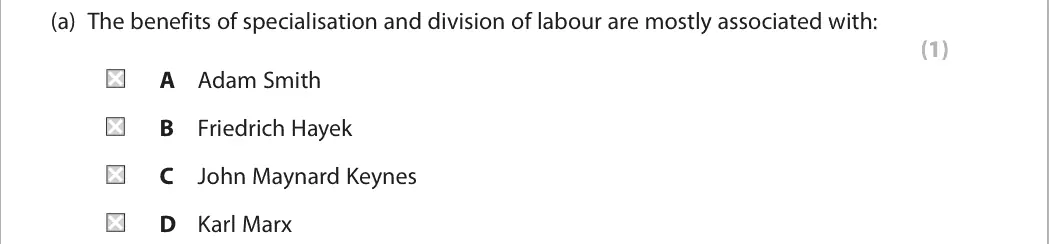
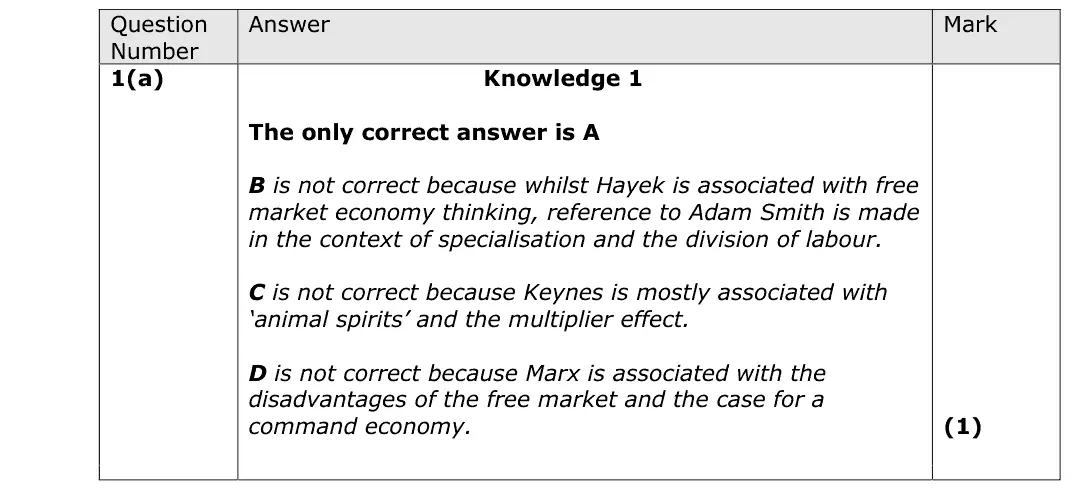
1(a) Specialisation and the division of labour 1AO1=1Multiple choice
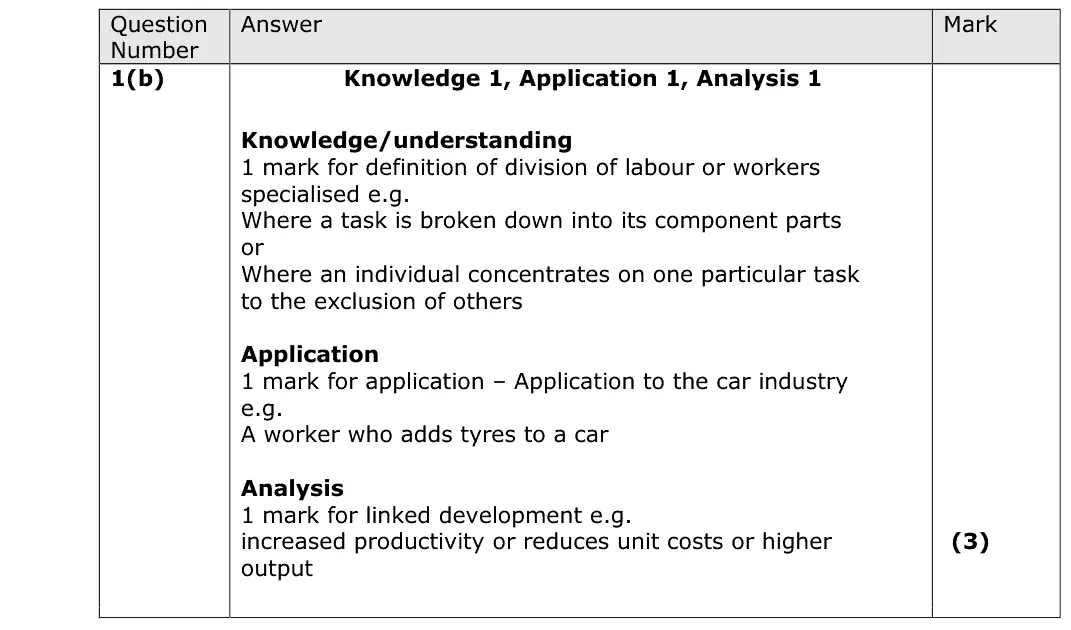
1(b) Specialisation and the division of labour 3AO1=1,AO2=1,AO3=1Short answer
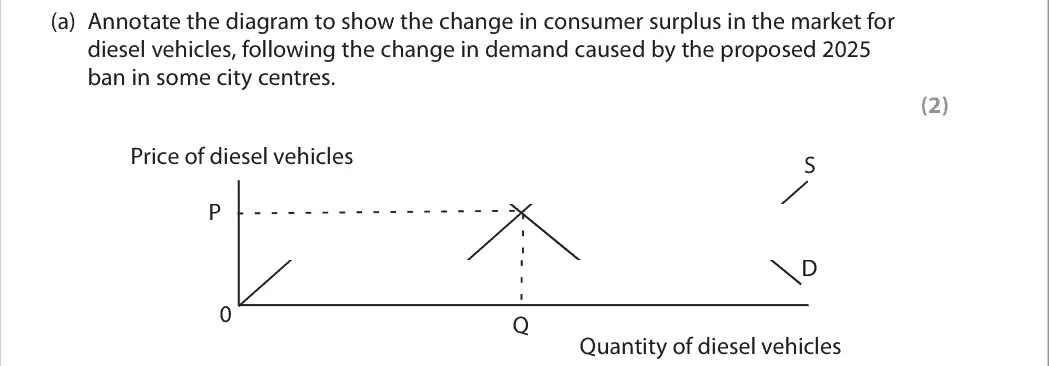
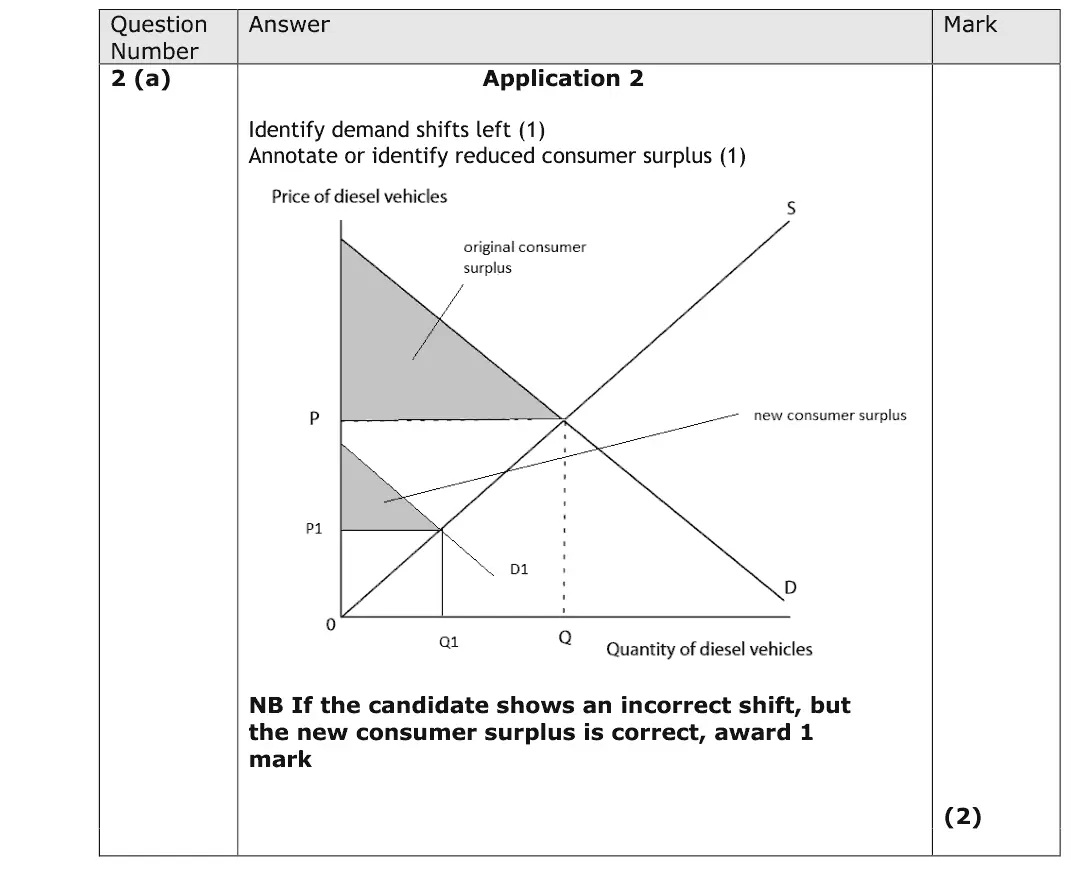
2(a) The price mechanism, consumer and producer surplus 2AO2=2Short answer
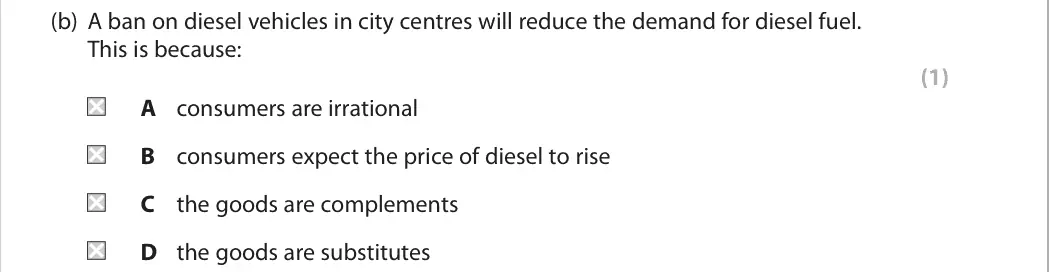
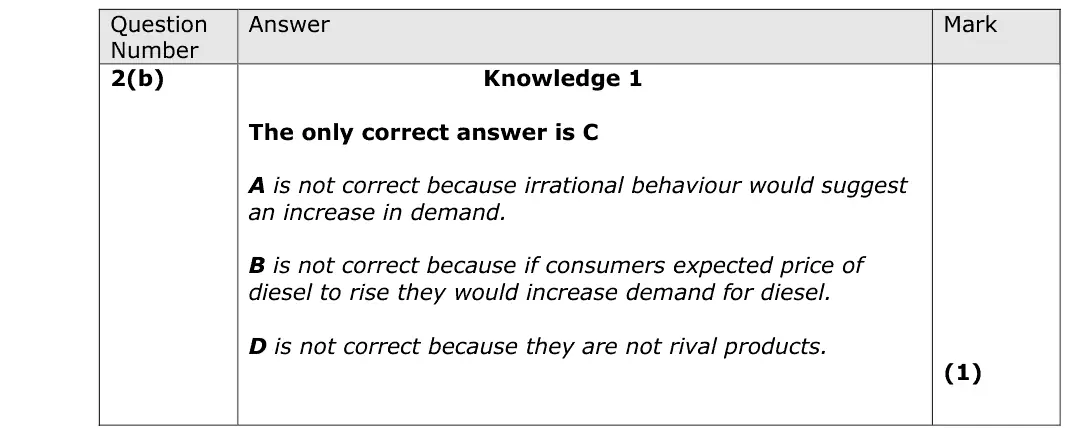
2(b) Supply, demand and price determination 1AO1=1Multiple choice
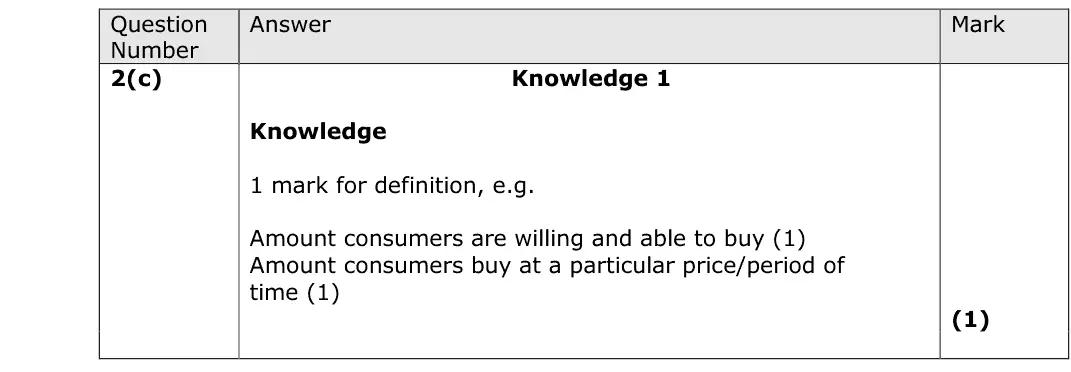
2(c) Supply, demand and price determination 1AO1=1Definition
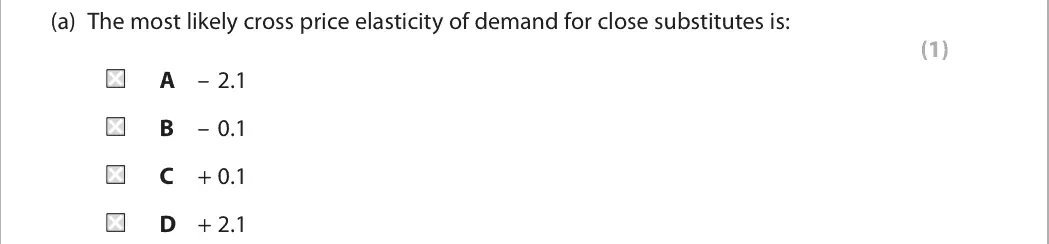
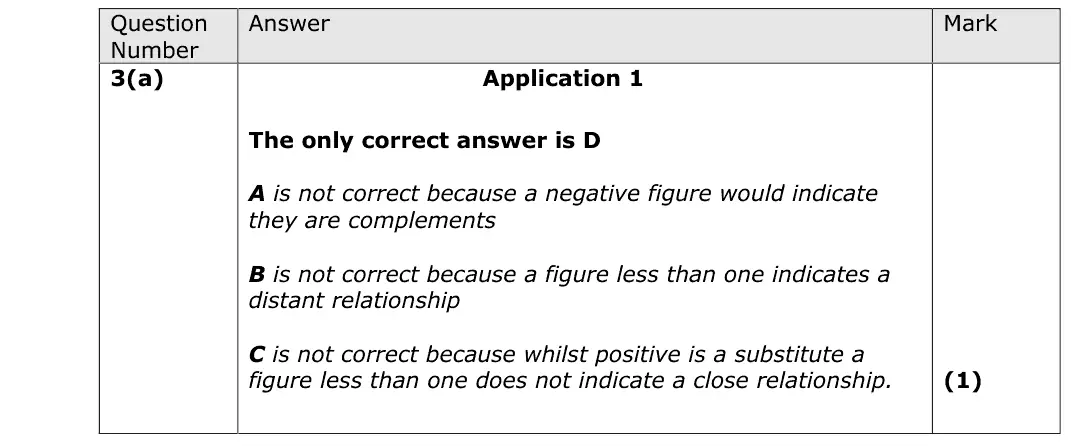
3(a) Price, income and cross elasticities of demand 1AO2=1Multiple choice
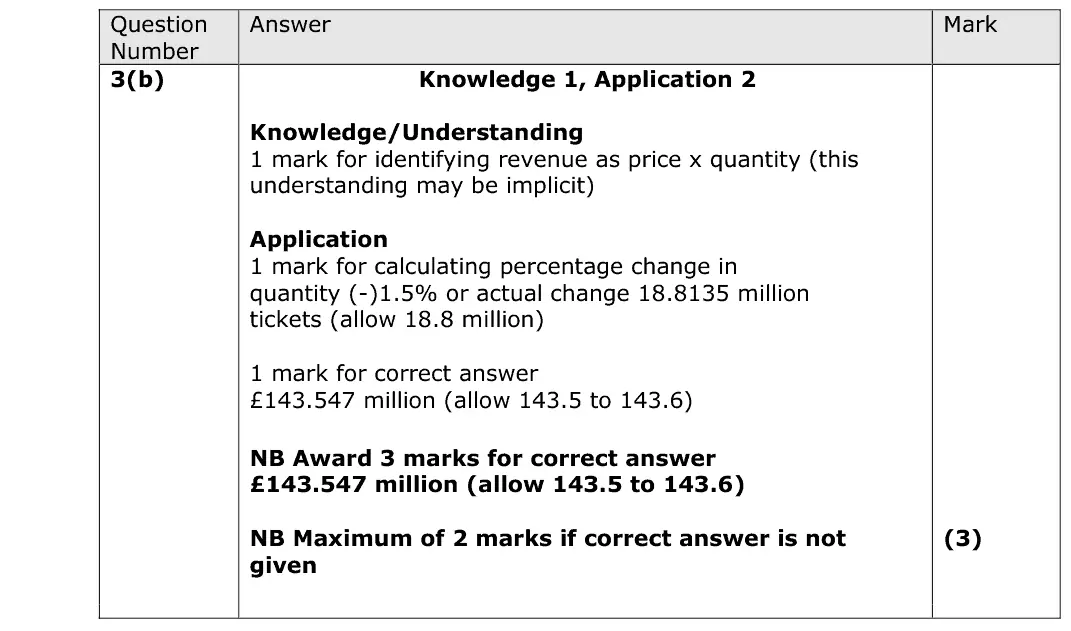
3(b) Price, income and cross elasticities of demand 3AO1=1,AO2=2Calculation
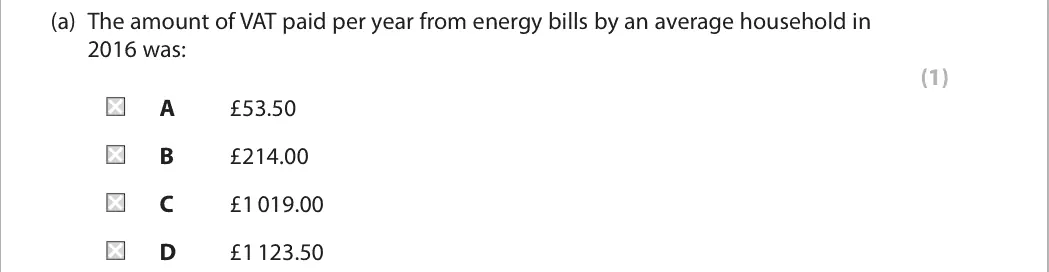
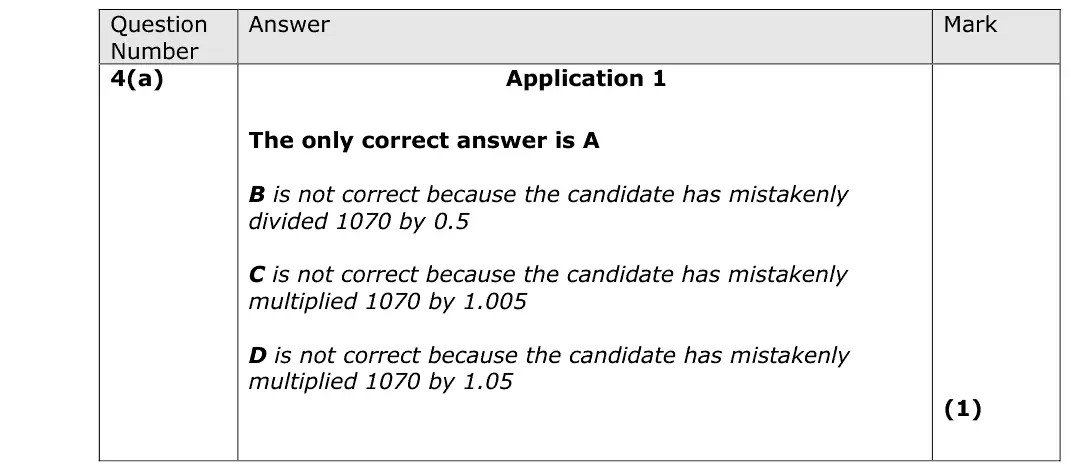
4(a) Indirect taxes and subsidies 1AO2=1Multiple choice
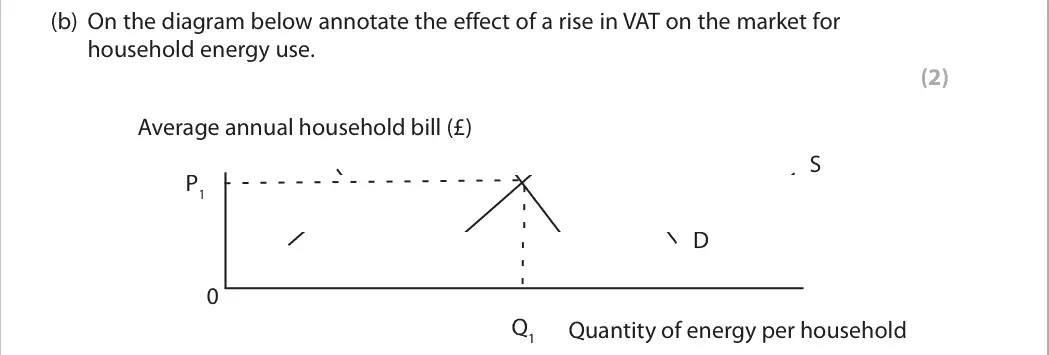
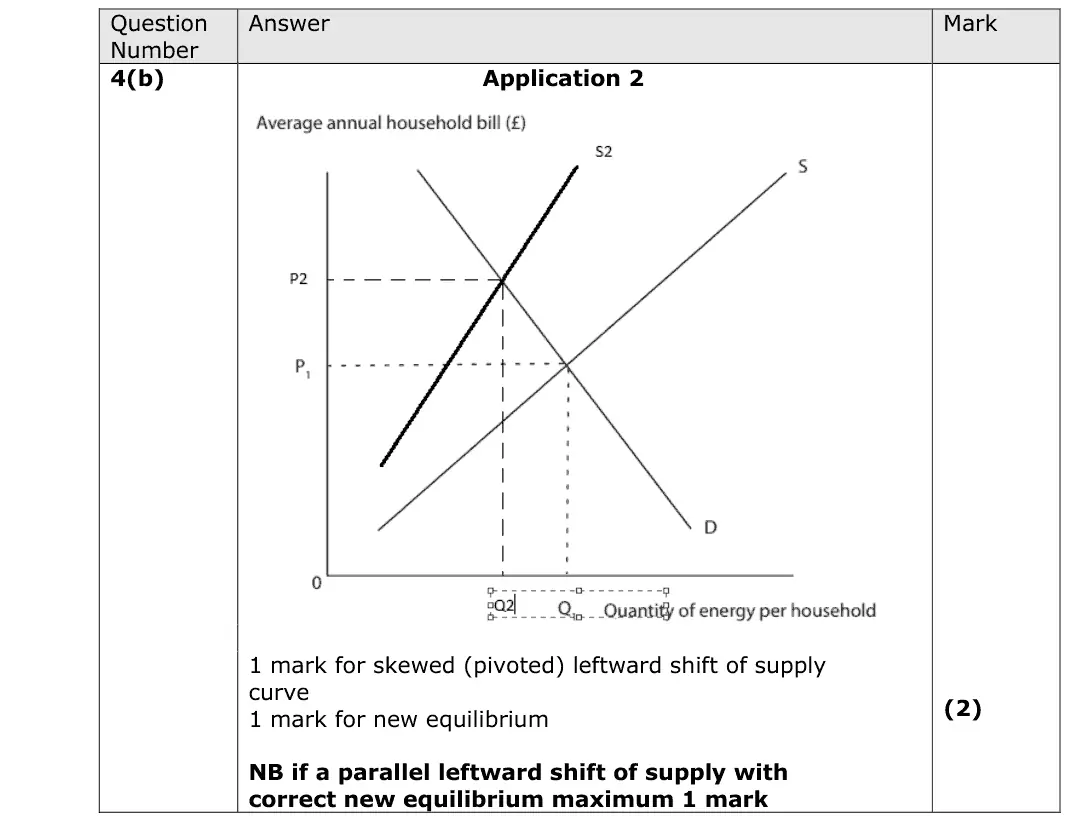
4(b) Indirect taxes and subsidies 2AO2=2Short answer
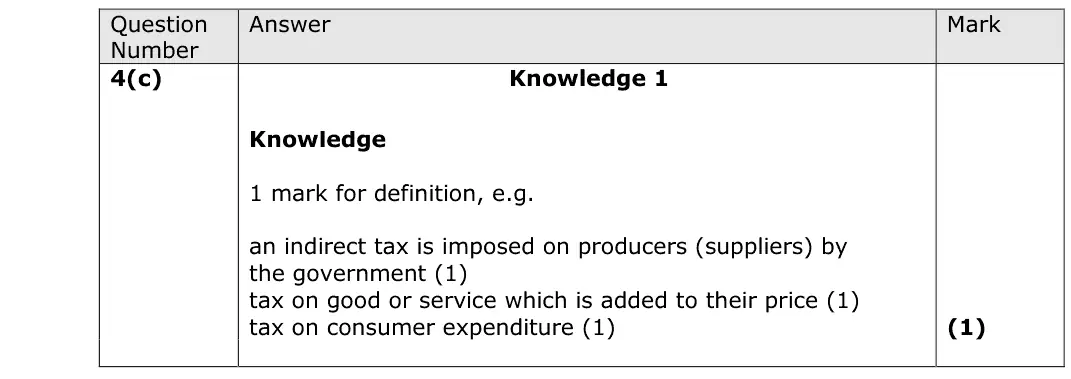
4(c) Indirect taxes and subsidies 1AO1=1Definition
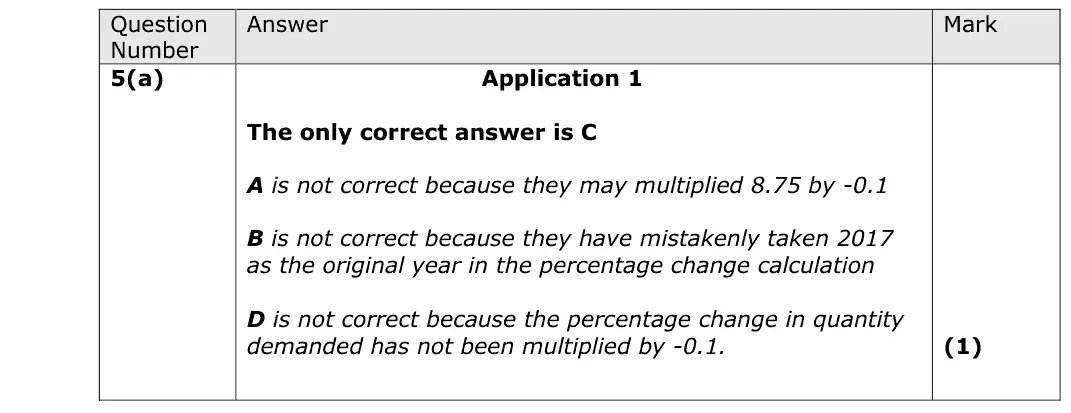
5(a) Price, income and cross elasticities of demand 1AO2=1Multiple choice
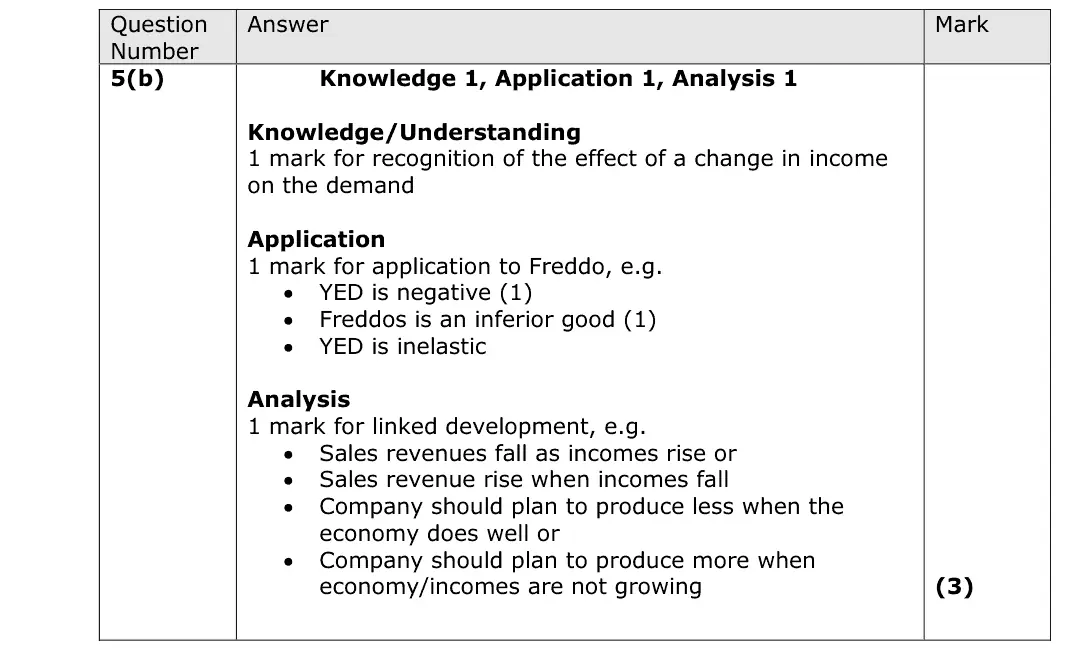
5(b) Price, income and cross elasticities of demand 3AO1=1,AO2=1,AO3=1Short answer
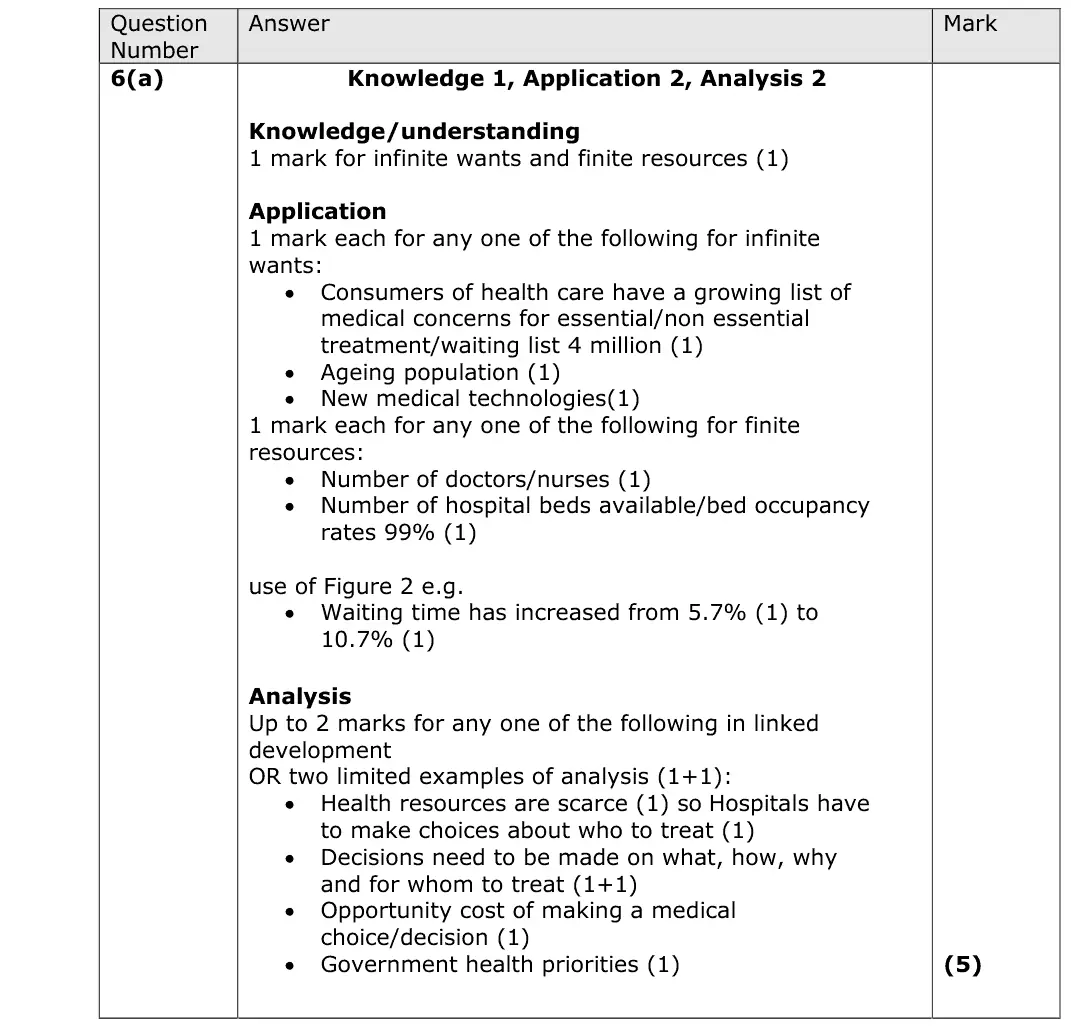
6(a) The nature of economics and the economic problem 5AO1=1,AO2=2,AO3=2Short answer
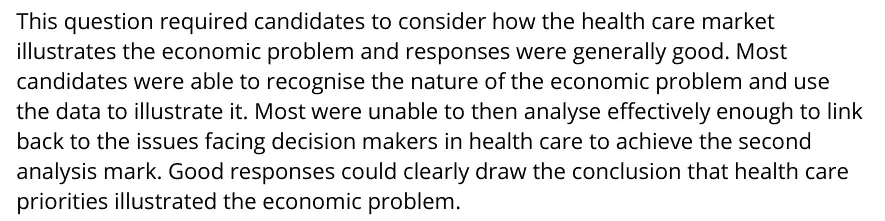
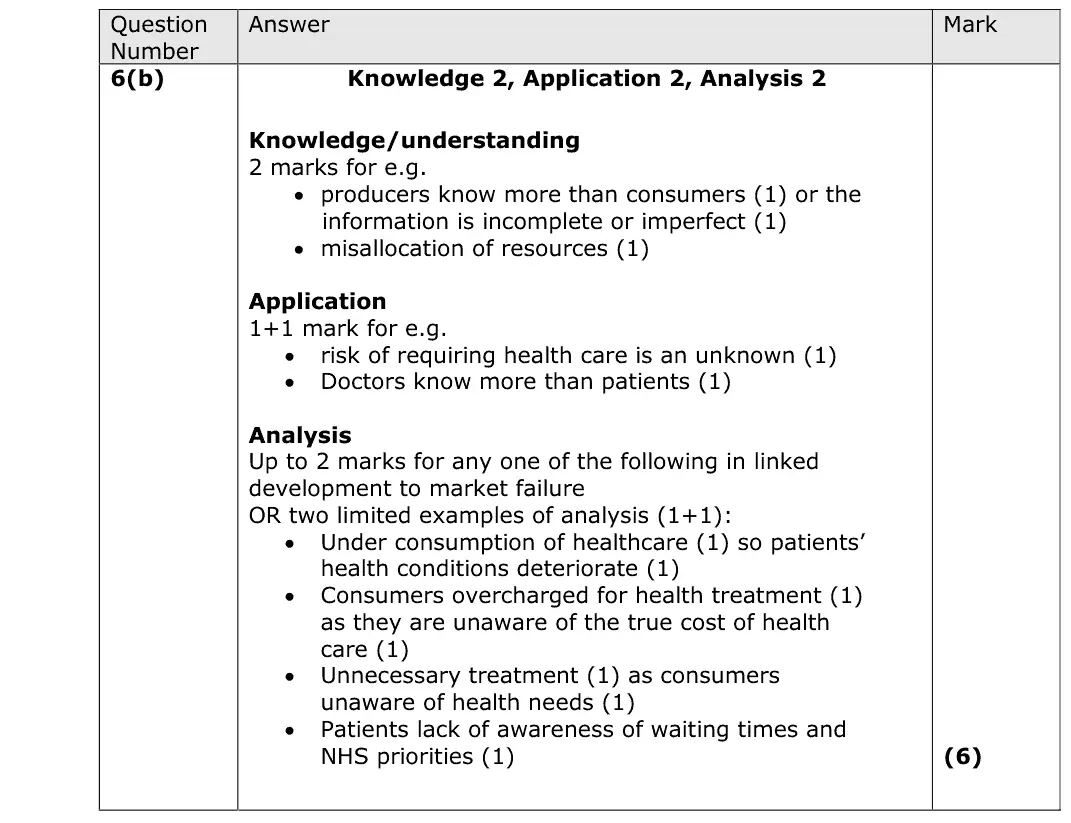
6(b) Public goods and information gaps 6AO1=2,AO2=2,AO3=2Short answer
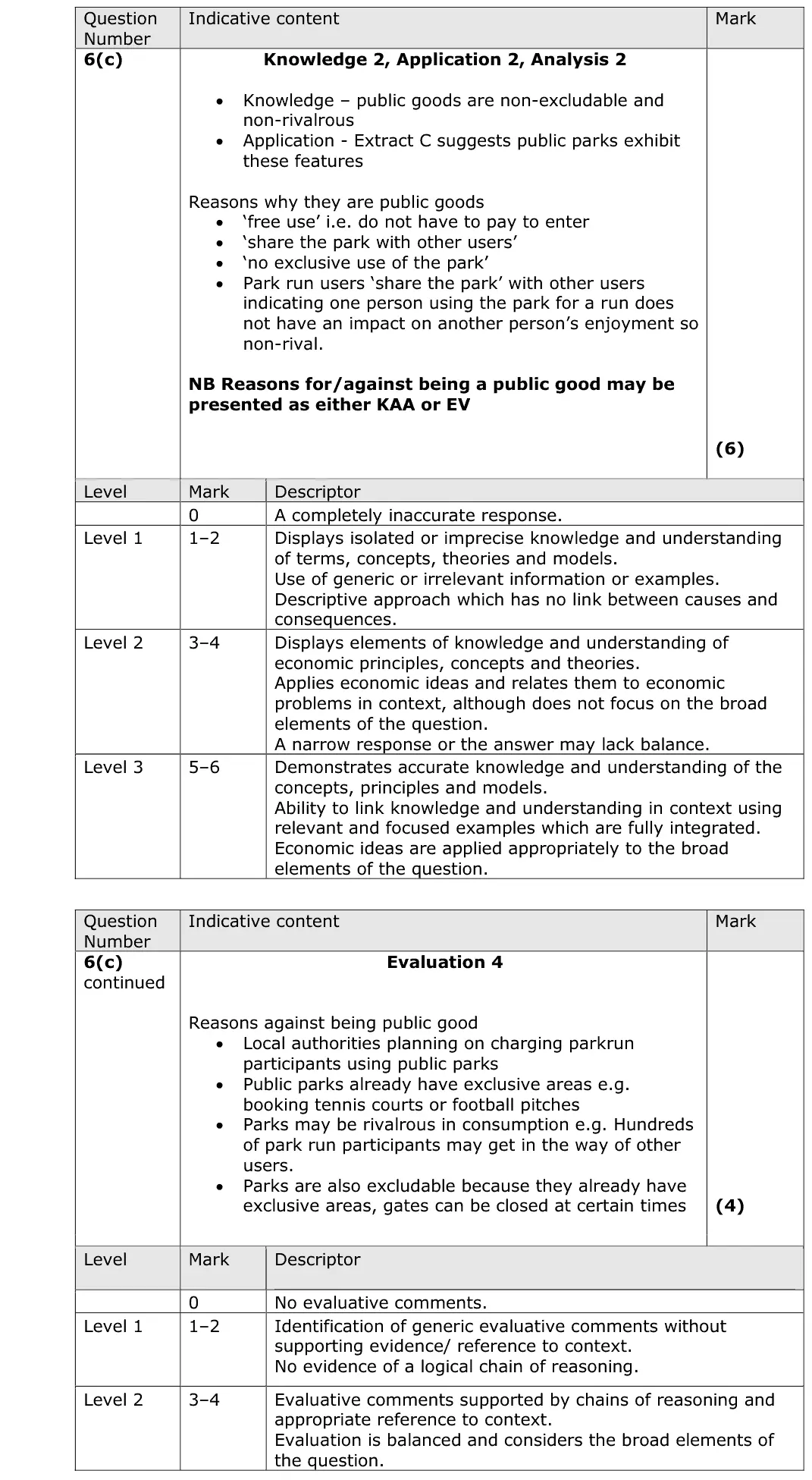
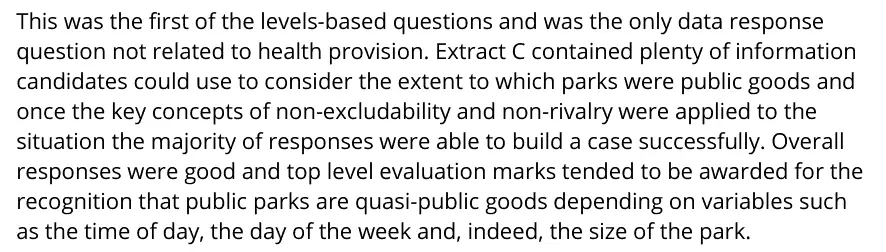
6(c) Public goods and information gaps 10AO1=2,AO2=2,AO3=2,AO4=4Extended response
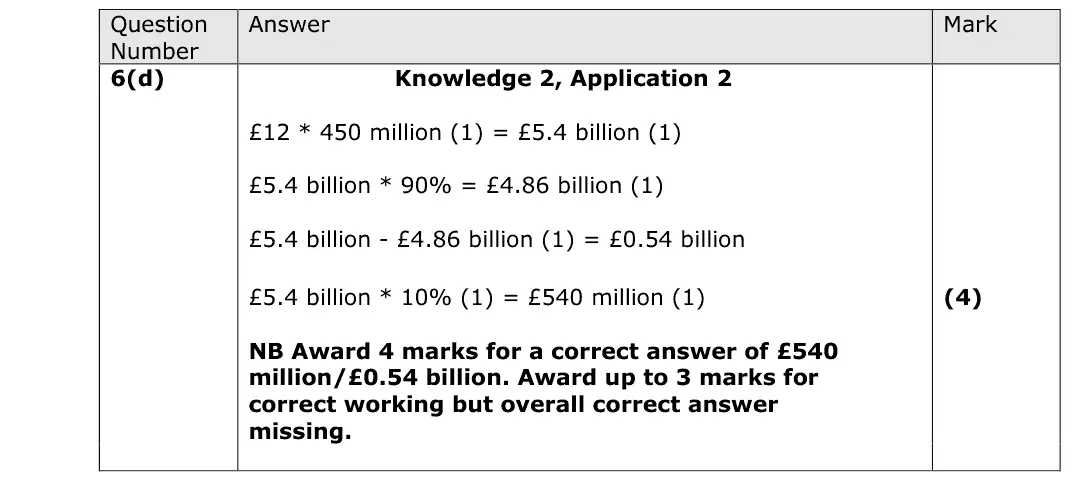
6(d) Government intervention in markets 4AO1=2,AO2=2Calculation
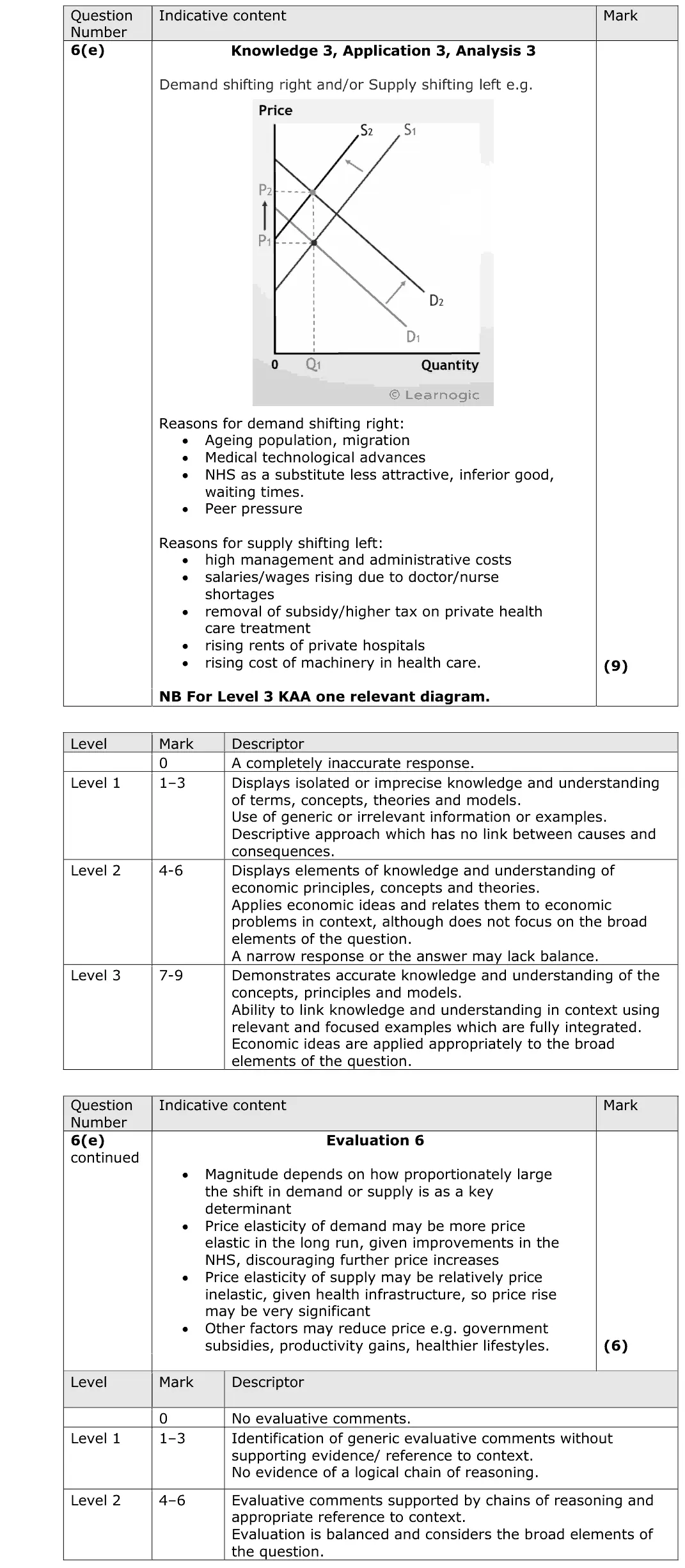
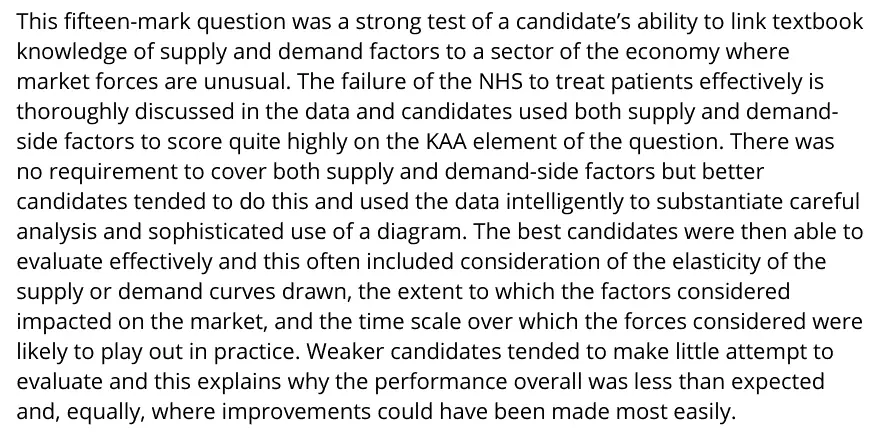
6(e) Supply, demand and price determination 15AO1=3,AO2=3,AO3=3,AO4=6Extended response
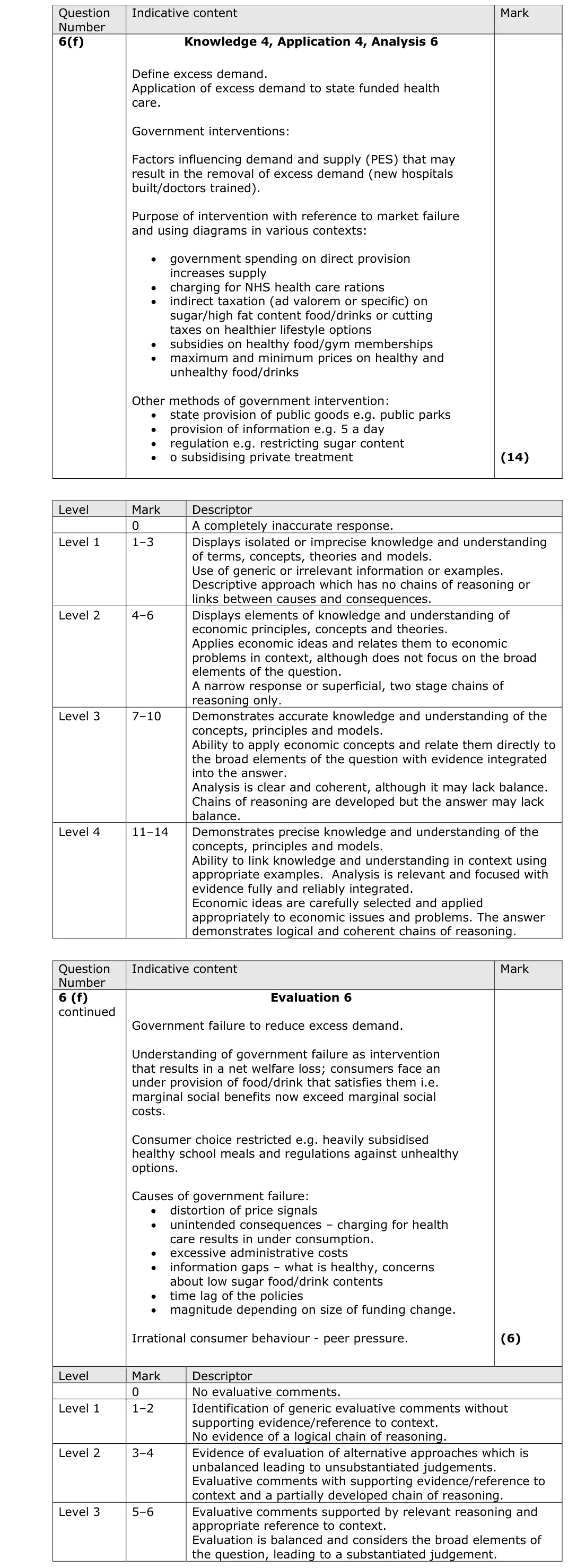
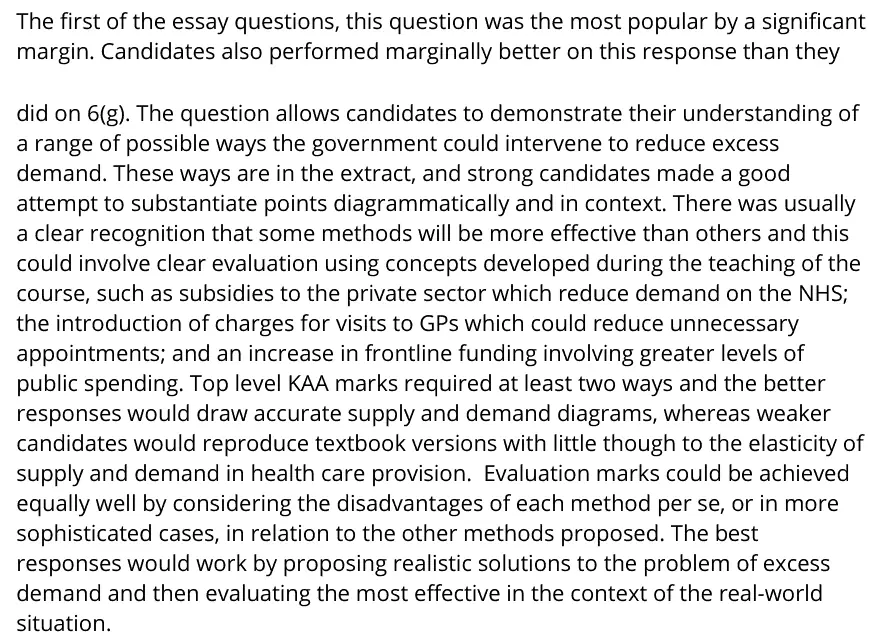
6(f) Government intervention in markets, Supply, demand and price determination 20AO1=4,AO2=4,AO3=6,AO4=6Essay
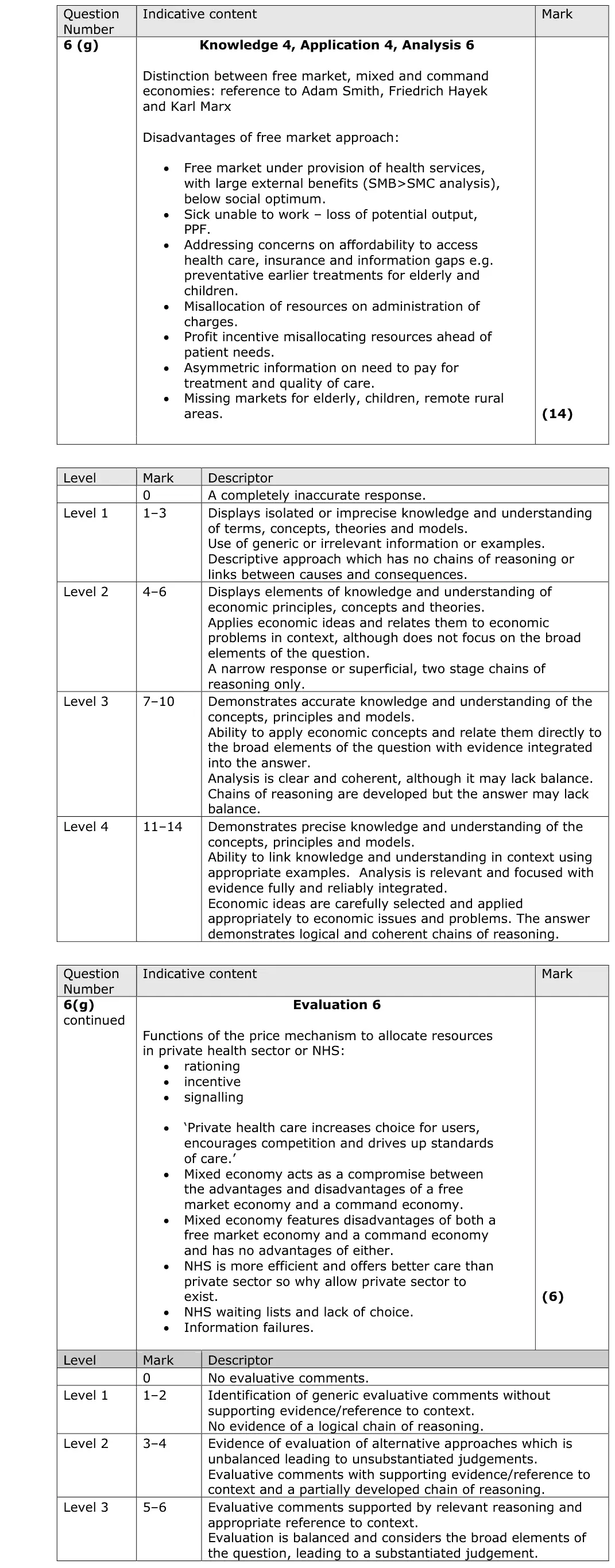
6(g) Free market, mixed and command economies, Market failure and externalities 20AO1=4,AO2=4,AO3=6,AO4=6Essay

The questions

1(a)1(b)2(a)2(b)2(c)3(a)3(b)4(a)4(b)4(c)5(a)5(b)6(a)6(b)6(c)6(d)6(e)6(f)6(g)
June 2019 · AS Paper 1 · Q1(a) 1 mark AO1=1 Multiple choice specialisation and division of labour
Data and extracts for question 11 Henry Ford designed his first moving assembly line in 1913, and revolutionised the car production process of the Ford Model T. This assembly line, at the first Ford factory, became the benchmark for mass production methods around the world. (Source: adapted from https://www.ford.co.uk/experience-ford/history-and-heritage)
(a) The benefits of specialisation and division of labour are mostly associated with: (1) A Adam Smith B Friedrich Hayek C John Maynard Keynes D Karl Marx
June 2019 · AS Paper 1 · Q1(b) 3 marks AO1=1, AO2=1, AO3=1 Short answer specialisation and division of labour
Data and extracts for question 11 Henry Ford designed his first moving assembly line in 1913, and revolutionised the car production process of the Ford Model T. This assembly line, at the first Ford factory, became the benchmark for mass production methods around the world. (Source: adapted from https://www.ford.co.uk/experience-ford/history-and-heritage)
(b) Explain one advantage of the division of labour in car production. (3)
June 2019 · AS Paper 1 · Q2(a) 2 marks AO2=2 Short answer price mechanism and surplus
Data and extracts for question 22 The consensus that diesel emissions are bad for health has led to many cities planning to ban diesel vehicles from their centres. The mayors of Paris, Mexico City, Madrid and Athens have said they intend to ban these vehicles by 2025. (Source: adapted from http://www.autoexpress.co.uk/car-news/consumer-news/98747/ diesel-ban-clean-air-zone-expansion-could-see-diesel-cars-charged-to)
(a) Annotate the diagram to show the change in consumer surplus in the market for diesel vehicles, following the change in demand caused by the proposed 2025 ban in some city centres. (2) Price of diesel vehicles S P D 0 Q Quantity of diesel vehicles
June 2019 · AS Paper 1 · Q2(b) 1 mark AO1=1 Multiple choice supply and demand
Data and extracts for question 22 The consensus that diesel emissions are bad for health has led to many cities planning to ban diesel vehicles from their centres. The mayors of Paris, Mexico City, Madrid and Athens have said they intend to ban these vehicles by 2025. (Source: adapted from http://www.autoexpress.co.uk/car-news/consumer-news/98747/ diesel-ban-clean-air-zone-expansion-could-see-diesel-cars-charged-to)
(b) A ban on diesel vehicles in city centres will reduce the demand for diesel fuel. This is because: (1) A consumers are irrational B consumers expect the price of diesel to rise C the goods are complements D the goods are substitutes
June 2019 · AS Paper 1 · Q2(c) 1 mark AO1=1 Definition supply and demand
Data and extracts for question 22 The consensus that diesel emissions are bad for health has led to many cities planning to ban diesel vehicles from their centres. The mayors of Paris, Mexico City, Madrid and Athens have said they intend to ban these vehicles by 2025. (Source: adapted from http://www.autoexpress.co.uk/car-news/consumer-news/98747/ diesel-ban-clean-air-zone-expansion-could-see-diesel-cars-charged-to)
(c) Define the term ‘demand’. (1)
June 2019 · AS Paper 1 · Q3(a) 1 mark AO2=1 Multiple choice price elasticity of demand
Data and extracts for question 33 Amazon Prime, Netflix and NowTV all charge £7.99 per month for streaming very similar film and television services.
(a) The most likely cross price elasticity of demand for close substitutes is: (1) A – 2.1 B – 0.1 C + 0.1 D + 2.1
June 2019 · AS Paper 1 · Q3(b) 3 marks AO1=1, AO2=2 Calculation price elasticity of demand
Data and extracts for question 33 Amazon Prime, Netflix and NowTV all charge £7.99 per month for streaming very similar film and television services.
In 2016 the average cinema ticket price in the UK was £7.41, and there were 19.1 million tickets sales. The price elasticity of demand was estimated to be –0.5. (b) Calculate the new total revenue if prices were raised by 3% in 2017 to £7.63, if everything else remained unchanged. You are advised to show your working. (3)
June 2019 · AS Paper 1 · Q4(a) 1 mark AO2=1 Multiple choice indirect taxes and subsidies
Data and extracts for question 44 In 2016 the average energy bill per household was £1 070 per year, excluding VAT, an indirect tax charged at 5%. (Source: adapted from ©Crown Copyright https://www.ofgem.gov.uk/ publications-and-updates/infographic-bills-prices-and-profits)
(a) The amount of VAT paid per year from energy bills by an average household in 2016 was: (1) A £53.50 B £214.00 C £1 019.00 D £1 123.50
June 2019 · AS Paper 1 · Q4(b) 2 marks AO2=2 Short answer indirect taxes and subsidies
Data and extracts for question 44 In 2016 the average energy bill per household was £1 070 per year, excluding VAT, an indirect tax charged at 5%. (Source: adapted from ©Crown Copyright https://www.ofgem.gov.uk/ publications-and-updates/infographic-bills-prices-and-profits)
(b) On the diagram below annotate the effect of a rise in VAT on the market for household energy use. (2) Average annual household bill (£) S P1 D 0 Q1 Quantity of energy per household
June 2019 · AS Paper 1 · Q4(c) 1 mark AO1=1 Definition indirect taxes and subsidies
Data and extracts for question 44 In 2016 the average energy bill per household was £1 070 per year, excluding VAT, an indirect tax charged at 5%. (Source: adapted from ©Crown Copyright https://www.ofgem.gov.uk/ publications-and-updates/infographic-bills-prices-and-profits)
(c) Define the term ‘indirect tax’. (1)
June 2019 · AS Paper 1 · Q5(a) 1 mark AO2=1 Multiple choice price elasticity of demand
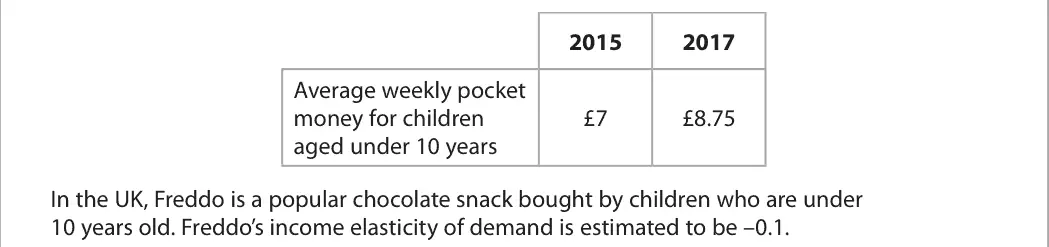
Data and extracts for question 55 2015 2017 Average weekly pocket money for children £7 £8.75 aged under 10 years In the UK, Freddo is a popular chocolate snack bought by children who are under 10 years old. Freddo’s income elasticity of demand is estimated to be –0.1.
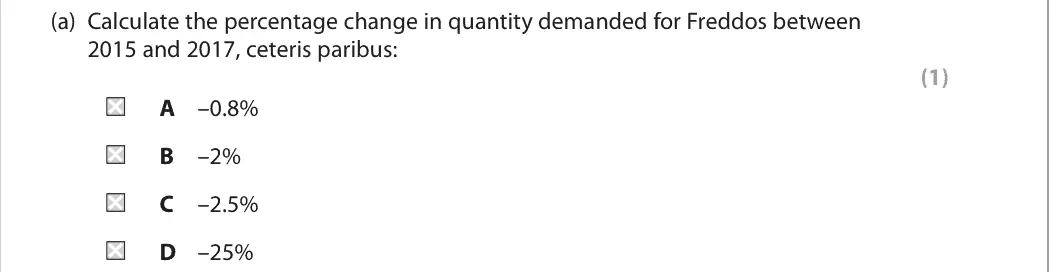
(a) Calculate the percentage change in quantity demanded for Freddos between 2015 and 2017, ceteris paribus: (1) A –0.8% B –2% C –2.5% D –25%
June 2019 · AS Paper 1 · Q5(b) 3 marks AO1=1, AO2=1, AO3=1 Short answer price elasticity of demand
Data and extracts for question 55 2015 2017 Average weekly pocket money for children £7 £8.75 aged under 10 years In the UK, Freddo is a popular chocolate snack bought by children who are under 10 years old. Freddo’s income elasticity of demand is estimated to be –0.1.
(b) Explain one reason why the income elasticity of demand is significant to the producer of Freddos. (3)
June 2019 · AS Paper 1 · Q6(a) 5 marks AO1=1, AO2=2, AO3=2 Short answer nature of economics
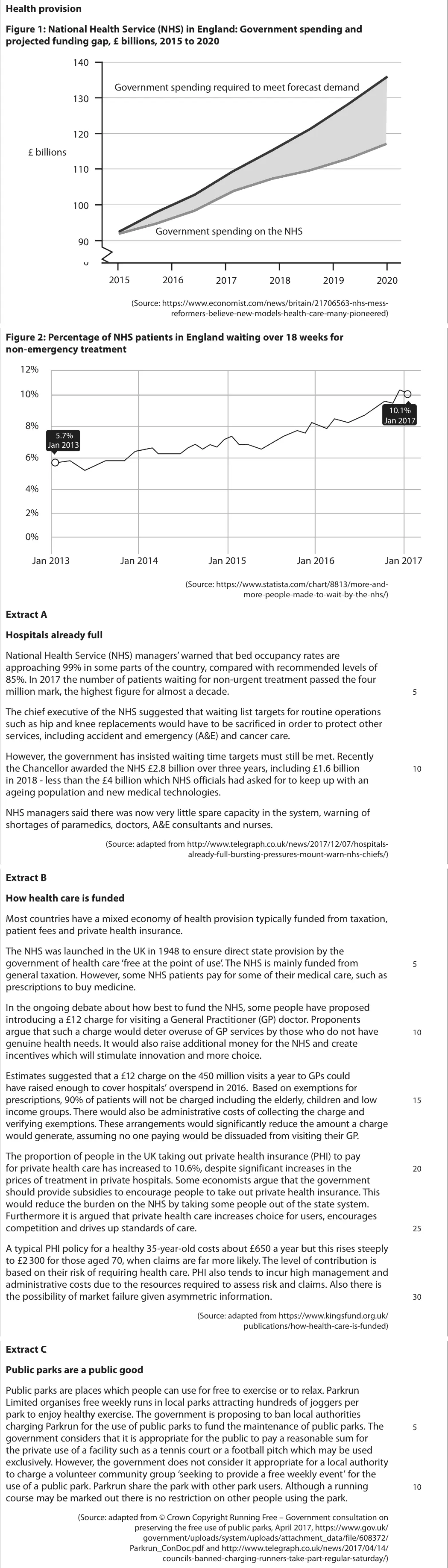
Data and extracts for question 6Health provision Figure 1: National Health Service (NHS) in England: Government spending and projected funding gap, £ billions, 2015 to 2020 140 Government spending required to meet forecast demand 130 120 £ billions 110 100 Government spending on the NHS 90 0 2015 2016 2018 2019 2017 2020 (Source: https://www.economist.com/news/britain/21706563-nhs-mess- reformers-believe-new-models-health-care-many-pioneered) Figure 2: Percentage of NHS patients in England waiting over 18 weeks for non-emergency treatment 12% 10% 10.1% Jan 2017 8% 5.7% Jan 2013 6% 4% 2% 0% Jan 2013 Jan 2014 Jan 2015 Jan 2016 Jan 2017 (Source: https://www.statista.com/chart/8813/more-and- more-people-made-to-wait-by-the-nhs/) Extract A Hospitals already full National Health Service (NHS) managers’ warned that bed occupancy rates are approaching 99% in some parts of the country, compared with recommended levels of 85%. In 2017 the number of patients waiting for non-urgent treatment passed the four million mark, the highest figure for almost a decade. 5 The chief executive of the NHS suggested that waiting list targets for routine operations such as hip and knee replacements would have to be sacrificed in order to protect other services, including accident and emergency (A&E) and cancer care. However, the government has insisted waiting time targets must still be met. Recently the Chancellor awarded the NHS £2.8 billion over three years, including £1.6 billion 10 in 2018 - less than the £4 billion which NHS officials had asked for to keep up with an ageing population and new medical technologies. NHS managers said there was now very little spare capacity in the system, warning of shortages of paramedics, doctors, A&E consultants and nurses. (Source: adapted from http://www.telegraph.co.uk/news/2017/12/07/hospitals- already-full-bursting-pressures-mount-warn-nhs-chiefs/) Extract B How health care is funded Most countries have a mixed economy of health provision typically funded from taxation, patient fees and private health insurance. The NHS was launched in the UK in 1948 to ensure direct state provision by the government of health care ‘free at the point of use’. The NHS is mainly funded from 5 general taxation. However, some NHS patients pay for some of their medical care, such as prescriptions to buy medicine. In the ongoing debate about how best to fund the NHS, some people have proposed introducing a £12 charge for visiting a General Practitioner (GP) doctor. Proponents argue that such a charge would deter overuse of GP services by those who do not have 10 genuine health needs. It would also raise additional money for the NHS and create incentives which will stimulate innovation and more choice. Estimates suggested that a £12 charge on the 450 million visits a year to GPs could have raised enough to cover hospitals’ overspend in 2016. Based on exemptions for prescriptions, 90% of patients will not be charged including the elderly, children and low 15 income groups. There would also be administrative costs of collecting the charge and verifying exemptions. These arrangements would significantly reduce the amount a charge would generate, assuming no one paying would be dissuaded from visiting their GP. The proportion of people in the UK taking out private health insurance (PHI) to pay for private health care has increased to 10.6%, despite significant increases in the 20 prices of treatment in private hospitals. Some economists argue that the government should provide subsidies to encourage people to take out private health insurance. This would reduce the burden on the NHS by taking some people out of the state system. Furthermore it is argued that private health care increases choice for users, encourages competition and drives up standards of care. 25 A typical PHI policy for a healthy 35-year-old costs about £650 a year but this rises steeply to £2 300 for those aged 70, when claims are far more likely. The level of contribution is based on their risk of requiring health care. PHI also tends to incur high management and administrative costs due to the resources required to assess risk and claims. Also there is the possibility of market failure given asymmetric information. 30 (Source: adapted from https://www.kingsfund.org.uk/ publications/how-health-care-is-funded) Extract C Public parks are a public good Public parks are places which people can use for free to exercise or to relax. Parkrun Limited organises free weekly runs in local parks attracting hundreds of joggers per park to enjoy healthy exercise. The government is proposing to ban local authorities charging Parkrun for the use of public parks to fund the maintenance of public parks. The 5 government considers that it is appropriate for the public to pay a reasonable sum for the private use of a facility such as a tennis court or a football pitch which may be used exclusively. However, the government does not consider it appropriate for a local authority to charge a volunteer community group ‘seeking to provide a free weekly event’ for the use of a public park. Parkrun share the park with other park users. Although a running 10 course may be marked out there is no restriction on other people using the park. (Source: adapted from © Crown Copyright Running Free – Government consultation on preserving the free use of public parks, April 2017, https://www.gov.uk/ government/uploads/system/uploads/attachment_data/file/608372/ Parkrun_ConDoc.pdf and http://www.telegraph.co.uk/news/2017/04/14/ councils-banned-charging-runners-take-part-regular-saturday/)
(a) With reference to Extract A and Figure 2, explain how the health care market in the UK illustrates the economic problem. (5)
June 2019 · AS Paper 1 · Q6(b) 6 marks AO1=2, AO2=2, AO3=2 Short answer public goods and information gaps
Data and extracts for question 6Health provision Figure 1: National Health Service (NHS) in England: Government spending and projected funding gap, £ billions, 2015 to 2020 140 Government spending required to meet forecast demand 130 120 £ billions 110 100 Government spending on the NHS 90 0 2015 2016 2018 2019 2017 2020 (Source: https://www.economist.com/news/britain/21706563-nhs-mess- reformers-believe-new-models-health-care-many-pioneered) Figure 2: Percentage of NHS patients in England waiting over 18 weeks for non-emergency treatment 12% 10% 10.1% Jan 2017 8% 5.7% Jan 2013 6% 4% 2% 0% Jan 2013 Jan 2014 Jan 2015 Jan 2016 Jan 2017 (Source: https://www.statista.com/chart/8813/more-and- more-people-made-to-wait-by-the-nhs/) Extract A Hospitals already full National Health Service (NHS) managers’ warned that bed occupancy rates are approaching 99% in some parts of the country, compared with recommended levels of 85%. In 2017 the number of patients waiting for non-urgent treatment passed the four million mark, the highest figure for almost a decade. 5 The chief executive of the NHS suggested that waiting list targets for routine operations such as hip and knee replacements would have to be sacrificed in order to protect other services, including accident and emergency (A&E) and cancer care. However, the government has insisted waiting time targets must still be met. Recently the Chancellor awarded the NHS £2.8 billion over three years, including £1.6 billion 10 in 2018 - less than the £4 billion which NHS officials had asked for to keep up with an ageing population and new medical technologies. NHS managers said there was now very little spare capacity in the system, warning of shortages of paramedics, doctors, A&E consultants and nurses. (Source: adapted from http://www.telegraph.co.uk/news/2017/12/07/hospitals- already-full-bursting-pressures-mount-warn-nhs-chiefs/) Extract B How health care is funded Most countries have a mixed economy of health provision typically funded from taxation, patient fees and private health insurance. The NHS was launched in the UK in 1948 to ensure direct state provision by the government of health care ‘free at the point of use’. The NHS is mainly funded from 5 general taxation. However, some NHS patients pay for some of their medical care, such as prescriptions to buy medicine. In the ongoing debate about how best to fund the NHS, some people have proposed introducing a £12 charge for visiting a General Practitioner (GP) doctor. Proponents argue that such a charge would deter overuse of GP services by those who do not have 10 genuine health needs. It would also raise additional money for the NHS and create incentives which will stimulate innovation and more choice. Estimates suggested that a £12 charge on the 450 million visits a year to GPs could have raised enough to cover hospitals’ overspend in 2016. Based on exemptions for prescriptions, 90% of patients will not be charged including the elderly, children and low 15 income groups. There would also be administrative costs of collecting the charge and verifying exemptions. These arrangements would significantly reduce the amount a charge would generate, assuming no one paying would be dissuaded from visiting their GP. The proportion of people in the UK taking out private health insurance (PHI) to pay for private health care has increased to 10.6%, despite significant increases in the 20 prices of treatment in private hospitals. Some economists argue that the government should provide subsidies to encourage people to take out private health insurance. This would reduce the burden on the NHS by taking some people out of the state system. Furthermore it is argued that private health care increases choice for users, encourages competition and drives up standards of care. 25 A typical PHI policy for a healthy 35-year-old costs about £650 a year but this rises steeply to £2 300 for those aged 70, when claims are far more likely. The level of contribution is based on their risk of requiring health care. PHI also tends to incur high management and administrative costs due to the resources required to assess risk and claims. Also there is the possibility of market failure given asymmetric information. 30 (Source: adapted from https://www.kingsfund.org.uk/ publications/how-health-care-is-funded) Extract C Public parks are a public good Public parks are places which people can use for free to exercise or to relax. Parkrun Limited organises free weekly runs in local parks attracting hundreds of joggers per park to enjoy healthy exercise. The government is proposing to ban local authorities charging Parkrun for the use of public parks to fund the maintenance of public parks. The 5 government considers that it is appropriate for the public to pay a reasonable sum for the private use of a facility such as a tennis court or a football pitch which may be used exclusively. However, the government does not consider it appropriate for a local authority to charge a volunteer community group ‘seeking to provide a free weekly event’ for the use of a public park. Parkrun share the park with other park users. Although a running 10 course may be marked out there is no restriction on other people using the park. (Source: adapted from © Crown Copyright Running Free – Government consultation on preserving the free use of public parks, April 2017, https://www.gov.uk/ government/uploads/system/uploads/attachment_data/file/608372/ Parkrun_ConDoc.pdf and http://www.telegraph.co.uk/news/2017/04/14/ councils-banned-charging-runners-take-part-regular-saturday/)
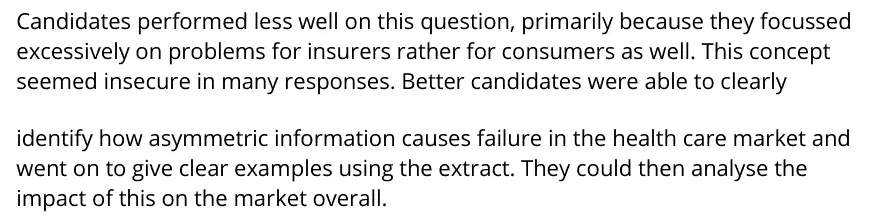
(b) Explain how ‘asymmetric information’ (Extract B, line 30) can lead to market failure in health provision. (6)
June 2019 · AS Paper 1 · Q6(c) 10 marks AO1=2, AO2=2, AO3=2, AO4=4 10-mark response public goods and information gaps
Data and extracts for question 6Health provision Figure 1: National Health Service (NHS) in England: Government spending and projected funding gap, £ billions, 2015 to 2020 140 Government spending required to meet forecast demand 130 120 £ billions 110 100 Government spending on the NHS 90 0 2015 2016 2018 2019 2017 2020 (Source: https://www.economist.com/news/britain/21706563-nhs-mess- reformers-believe-new-models-health-care-many-pioneered) Figure 2: Percentage of NHS patients in England waiting over 18 weeks for non-emergency treatment 12% 10% 10.1% Jan 2017 8% 5.7% Jan 2013 6% 4% 2% 0% Jan 2013 Jan 2014 Jan 2015 Jan 2016 Jan 2017 (Source: https://www.statista.com/chart/8813/more-and- more-people-made-to-wait-by-the-nhs/) Extract A Hospitals already full National Health Service (NHS) managers’ warned that bed occupancy rates are approaching 99% in some parts of the country, compared with recommended levels of 85%. In 2017 the number of patients waiting for non-urgent treatment passed the four million mark, the highest figure for almost a decade. 5 The chief executive of the NHS suggested that waiting list targets for routine operations such as hip and knee replacements would have to be sacrificed in order to protect other services, including accident and emergency (A&E) and cancer care. However, the government has insisted waiting time targets must still be met. Recently the Chancellor awarded the NHS £2.8 billion over three years, including £1.6 billion 10 in 2018 - less than the £4 billion which NHS officials had asked for to keep up with an ageing population and new medical technologies. NHS managers said there was now very little spare capacity in the system, warning of shortages of paramedics, doctors, A&E consultants and nurses. (Source: adapted from http://www.telegraph.co.uk/news/2017/12/07/hospitals- already-full-bursting-pressures-mount-warn-nhs-chiefs/) Extract B How health care is funded Most countries have a mixed economy of health provision typically funded from taxation, patient fees and private health insurance. The NHS was launched in the UK in 1948 to ensure direct state provision by the government of health care ‘free at the point of use’. The NHS is mainly funded from 5 general taxation. However, some NHS patients pay for some of their medical care, such as prescriptions to buy medicine. In the ongoing debate about how best to fund the NHS, some people have proposed introducing a £12 charge for visiting a General Practitioner (GP) doctor. Proponents argue that such a charge would deter overuse of GP services by those who do not have 10 genuine health needs. It would also raise additional money for the NHS and create incentives which will stimulate innovation and more choice. Estimates suggested that a £12 charge on the 450 million visits a year to GPs could have raised enough to cover hospitals’ overspend in 2016. Based on exemptions for prescriptions, 90% of patients will not be charged including the elderly, children and low 15 income groups. There would also be administrative costs of collecting the charge and verifying exemptions. These arrangements would significantly reduce the amount a charge would generate, assuming no one paying would be dissuaded from visiting their GP. The proportion of people in the UK taking out private health insurance (PHI) to pay for private health care has increased to 10.6%, despite significant increases in the 20 prices of treatment in private hospitals. Some economists argue that the government should provide subsidies to encourage people to take out private health insurance. This would reduce the burden on the NHS by taking some people out of the state system. Furthermore it is argued that private health care increases choice for users, encourages competition and drives up standards of care. 25 A typical PHI policy for a healthy 35-year-old costs about £650 a year but this rises steeply to £2 300 for those aged 70, when claims are far more likely. The level of contribution is based on their risk of requiring health care. PHI also tends to incur high management and administrative costs due to the resources required to assess risk and claims. Also there is the possibility of market failure given asymmetric information. 30 (Source: adapted from https://www.kingsfund.org.uk/ publications/how-health-care-is-funded) Extract C Public parks are a public good Public parks are places which people can use for free to exercise or to relax. Parkrun Limited organises free weekly runs in local parks attracting hundreds of joggers per park to enjoy healthy exercise. The government is proposing to ban local authorities charging Parkrun for the use of public parks to fund the maintenance of public parks. The 5 government considers that it is appropriate for the public to pay a reasonable sum for the private use of a facility such as a tennis court or a football pitch which may be used exclusively. However, the government does not consider it appropriate for a local authority to charge a volunteer community group ‘seeking to provide a free weekly event’ for the use of a public park. Parkrun share the park with other park users. Although a running 10 course may be marked out there is no restriction on other people using the park. (Source: adapted from © Crown Copyright Running Free – Government consultation on preserving the free use of public parks, April 2017, https://www.gov.uk/ government/uploads/system/uploads/attachment_data/file/608372/ Parkrun_ConDoc.pdf and http://www.telegraph.co.uk/news/2017/04/14/ councils-banned-charging-runners-take-part-regular-saturday/)
(c) ‘Public parks are a public good’ (Extract C, line 1). Assess this statement. (10)
June 2019 · AS Paper 1 · Q6(d) 4 marks AO1=2, AO2=2 Calculation government intervention in markets
Data and extracts for question 6Health provision Figure 1: National Health Service (NHS) in England: Government spending and projected funding gap, £ billions, 2015 to 2020 140 Government spending required to meet forecast demand 130 120 £ billions 110 100 Government spending on the NHS 90 0 2015 2016 2018 2019 2017 2020 (Source: https://www.economist.com/news/britain/21706563-nhs-mess- reformers-believe-new-models-health-care-many-pioneered) Figure 2: Percentage of NHS patients in England waiting over 18 weeks for non-emergency treatment 12% 10% 10.1% Jan 2017 8% 5.7% Jan 2013 6% 4% 2% 0% Jan 2013 Jan 2014 Jan 2015 Jan 2016 Jan 2017 (Source: https://www.statista.com/chart/8813/more-and- more-people-made-to-wait-by-the-nhs/) Extract A Hospitals already full National Health Service (NHS) managers’ warned that bed occupancy rates are approaching 99% in some parts of the country, compared with recommended levels of 85%. In 2017 the number of patients waiting for non-urgent treatment passed the four million mark, the highest figure for almost a decade. 5 The chief executive of the NHS suggested that waiting list targets for routine operations such as hip and knee replacements would have to be sacrificed in order to protect other services, including accident and emergency (A&E) and cancer care. However, the government has insisted waiting time targets must still be met. Recently the Chancellor awarded the NHS £2.8 billion over three years, including £1.6 billion 10 in 2018 - less than the £4 billion which NHS officials had asked for to keep up with an ageing population and new medical technologies. NHS managers said there was now very little spare capacity in the system, warning of shortages of paramedics, doctors, A&E consultants and nurses. (Source: adapted from http://www.telegraph.co.uk/news/2017/12/07/hospitals- already-full-bursting-pressures-mount-warn-nhs-chiefs/) Extract B How health care is funded Most countries have a mixed economy of health provision typically funded from taxation, patient fees and private health insurance. The NHS was launched in the UK in 1948 to ensure direct state provision by the government of health care ‘free at the point of use’. The NHS is mainly funded from 5 general taxation. However, some NHS patients pay for some of their medical care, such as prescriptions to buy medicine. In the ongoing debate about how best to fund the NHS, some people have proposed introducing a £12 charge for visiting a General Practitioner (GP) doctor. Proponents argue that such a charge would deter overuse of GP services by those who do not have 10 genuine health needs. It would also raise additional money for the NHS and create incentives which will stimulate innovation and more choice. Estimates suggested that a £12 charge on the 450 million visits a year to GPs could have raised enough to cover hospitals’ overspend in 2016. Based on exemptions for prescriptions, 90% of patients will not be charged including the elderly, children and low 15 income groups. There would also be administrative costs of collecting the charge and verifying exemptions. These arrangements would significantly reduce the amount a charge would generate, assuming no one paying would be dissuaded from visiting their GP. The proportion of people in the UK taking out private health insurance (PHI) to pay for private health care has increased to 10.6%, despite significant increases in the 20 prices of treatment in private hospitals. Some economists argue that the government should provide subsidies to encourage people to take out private health insurance. This would reduce the burden on the NHS by taking some people out of the state system. Furthermore it is argued that private health care increases choice for users, encourages competition and drives up standards of care. 25 A typical PHI policy for a healthy 35-year-old costs about £650 a year but this rises steeply to £2 300 for those aged 70, when claims are far more likely. The level of contribution is based on their risk of requiring health care. PHI also tends to incur high management and administrative costs due to the resources required to assess risk and claims. Also there is the possibility of market failure given asymmetric information. 30 (Source: adapted from https://www.kingsfund.org.uk/ publications/how-health-care-is-funded) Extract C Public parks are a public good Public parks are places which people can use for free to exercise or to relax. Parkrun Limited organises free weekly runs in local parks attracting hundreds of joggers per park to enjoy healthy exercise. The government is proposing to ban local authorities charging Parkrun for the use of public parks to fund the maintenance of public parks. The 5 government considers that it is appropriate for the public to pay a reasonable sum for the private use of a facility such as a tennis court or a football pitch which may be used exclusively. However, the government does not consider it appropriate for a local authority to charge a volunteer community group ‘seeking to provide a free weekly event’ for the use of a public park. Parkrun share the park with other park users. Although a running 10 course may be marked out there is no restriction on other people using the park. (Source: adapted from © Crown Copyright Running Free – Government consultation on preserving the free use of public parks, April 2017, https://www.gov.uk/ government/uploads/system/uploads/attachment_data/file/608372/ Parkrun_ConDoc.pdf and http://www.telegraph.co.uk/news/2017/04/14/ councils-banned-charging-runners-take-part-regular-saturday/)
(d) Calculate the annual revenue raised by charging £12 per GP visit. Assume there will be 450 million GP visits per year and 90% of these will not be charged. You are advised to show your working. (4)
June 2019 · AS Paper 1 · Q6(e) 15 marks AO1=3, AO2=3, AO3=3, AO4=6 15-mark response supply and demand
Data and extracts for question 6Health provision Figure 1: National Health Service (NHS) in England: Government spending and projected funding gap, £ billions, 2015 to 2020 140 Government spending required to meet forecast demand 130 120 £ billions 110 100 Government spending on the NHS 90 0 2015 2016 2018 2019 2017 2020 (Source: https://www.economist.com/news/britain/21706563-nhs-mess- reformers-believe-new-models-health-care-many-pioneered) Figure 2: Percentage of NHS patients in England waiting over 18 weeks for non-emergency treatment 12% 10% 10.1% Jan 2017 8% 5.7% Jan 2013 6% 4% 2% 0% Jan 2013 Jan 2014 Jan 2015 Jan 2016 Jan 2017 (Source: https://www.statista.com/chart/8813/more-and- more-people-made-to-wait-by-the-nhs/) Extract A Hospitals already full National Health Service (NHS) managers’ warned that bed occupancy rates are approaching 99% in some parts of the country, compared with recommended levels of 85%. In 2017 the number of patients waiting for non-urgent treatment passed the four million mark, the highest figure for almost a decade. 5 The chief executive of the NHS suggested that waiting list targets for routine operations such as hip and knee replacements would have to be sacrificed in order to protect other services, including accident and emergency (A&E) and cancer care. However, the government has insisted waiting time targets must still be met. Recently the Chancellor awarded the NHS £2.8 billion over three years, including £1.6 billion 10 in 2018 - less than the £4 billion which NHS officials had asked for to keep up with an ageing population and new medical technologies. NHS managers said there was now very little spare capacity in the system, warning of shortages of paramedics, doctors, A&E consultants and nurses. (Source: adapted from http://www.telegraph.co.uk/news/2017/12/07/hospitals- already-full-bursting-pressures-mount-warn-nhs-chiefs/) Extract B How health care is funded Most countries have a mixed economy of health provision typically funded from taxation, patient fees and private health insurance. The NHS was launched in the UK in 1948 to ensure direct state provision by the government of health care ‘free at the point of use’. The NHS is mainly funded from 5 general taxation. However, some NHS patients pay for some of their medical care, such as prescriptions to buy medicine. In the ongoing debate about how best to fund the NHS, some people have proposed introducing a £12 charge for visiting a General Practitioner (GP) doctor. Proponents argue that such a charge would deter overuse of GP services by those who do not have 10 genuine health needs. It would also raise additional money for the NHS and create incentives which will stimulate innovation and more choice. Estimates suggested that a £12 charge on the 450 million visits a year to GPs could have raised enough to cover hospitals’ overspend in 2016. Based on exemptions for prescriptions, 90% of patients will not be charged including the elderly, children and low 15 income groups. There would also be administrative costs of collecting the charge and verifying exemptions. These arrangements would significantly reduce the amount a charge would generate, assuming no one paying would be dissuaded from visiting their GP. The proportion of people in the UK taking out private health insurance (PHI) to pay for private health care has increased to 10.6%, despite significant increases in the 20 prices of treatment in private hospitals. Some economists argue that the government should provide subsidies to encourage people to take out private health insurance. This would reduce the burden on the NHS by taking some people out of the state system. Furthermore it is argued that private health care increases choice for users, encourages competition and drives up standards of care. 25 A typical PHI policy for a healthy 35-year-old costs about £650 a year but this rises steeply to £2 300 for those aged 70, when claims are far more likely. The level of contribution is based on their risk of requiring health care. PHI also tends to incur high management and administrative costs due to the resources required to assess risk and claims. Also there is the possibility of market failure given asymmetric information. 30 (Source: adapted from https://www.kingsfund.org.uk/ publications/how-health-care-is-funded) Extract C Public parks are a public good Public parks are places which people can use for free to exercise or to relax. Parkrun Limited organises free weekly runs in local parks attracting hundreds of joggers per park to enjoy healthy exercise. The government is proposing to ban local authorities charging Parkrun for the use of public parks to fund the maintenance of public parks. The 5 government considers that it is appropriate for the public to pay a reasonable sum for the private use of a facility such as a tennis court or a football pitch which may be used exclusively. However, the government does not consider it appropriate for a local authority to charge a volunteer community group ‘seeking to provide a free weekly event’ for the use of a public park. Parkrun share the park with other park users. Although a running 10 course may be marked out there is no restriction on other people using the park. (Source: adapted from © Crown Copyright Running Free – Government consultation on preserving the free use of public parks, April 2017, https://www.gov.uk/ government/uploads/system/uploads/attachment_data/file/608372/ Parkrun_ConDoc.pdf and http://www.telegraph.co.uk/news/2017/04/14/ councils-banned-charging-runners-take-part-regular-saturday/)
(e) Discuss likely reasons why the prices of treatments in private sector hospitals are increasing. Draw a supply and demand diagram to support your answer. (15)
June 2019 · AS Paper 1 · Q6(f) 20 marks AO1=4, AO2=4, AO3=6, AO4=6 20-mark essay Either/or government intervention in marketssupply and demand
Data and extracts for question 6Health provision Figure 1: National Health Service (NHS) in England: Government spending and projected funding gap, £ billions, 2015 to 2020 140 Government spending required to meet forecast demand 130 120 £ billions 110 100 Government spending on the NHS 90 0 2015 2016 2018 2019 2017 2020 (Source: https://www.economist.com/news/britain/21706563-nhs-mess- reformers-believe-new-models-health-care-many-pioneered) Figure 2: Percentage of NHS patients in England waiting over 18 weeks for non-emergency treatment 12% 10% 10.1% Jan 2017 8% 5.7% Jan 2013 6% 4% 2% 0% Jan 2013 Jan 2014 Jan 2015 Jan 2016 Jan 2017 (Source: https://www.statista.com/chart/8813/more-and- more-people-made-to-wait-by-the-nhs/) Extract A Hospitals already full National Health Service (NHS) managers’ warned that bed occupancy rates are approaching 99% in some parts of the country, compared with recommended levels of 85%. In 2017 the number of patients waiting for non-urgent treatment passed the four million mark, the highest figure for almost a decade. 5 The chief executive of the NHS suggested that waiting list targets for routine operations such as hip and knee replacements would have to be sacrificed in order to protect other services, including accident and emergency (A&E) and cancer care. However, the government has insisted waiting time targets must still be met. Recently the Chancellor awarded the NHS £2.8 billion over three years, including £1.6 billion 10 in 2018 - less than the £4 billion which NHS officials had asked for to keep up with an ageing population and new medical technologies. NHS managers said there was now very little spare capacity in the system, warning of shortages of paramedics, doctors, A&E consultants and nurses. (Source: adapted from http://www.telegraph.co.uk/news/2017/12/07/hospitals- already-full-bursting-pressures-mount-warn-nhs-chiefs/) Extract B How health care is funded Most countries have a mixed economy of health provision typically funded from taxation, patient fees and private health insurance. The NHS was launched in the UK in 1948 to ensure direct state provision by the government of health care ‘free at the point of use’. The NHS is mainly funded from 5 general taxation. However, some NHS patients pay for some of their medical care, such as prescriptions to buy medicine. In the ongoing debate about how best to fund the NHS, some people have proposed introducing a £12 charge for visiting a General Practitioner (GP) doctor. Proponents argue that such a charge would deter overuse of GP services by those who do not have 10 genuine health needs. It would also raise additional money for the NHS and create incentives which will stimulate innovation and more choice. Estimates suggested that a £12 charge on the 450 million visits a year to GPs could have raised enough to cover hospitals’ overspend in 2016. Based on exemptions for prescriptions, 90% of patients will not be charged including the elderly, children and low 15 income groups. There would also be administrative costs of collecting the charge and verifying exemptions. These arrangements would significantly reduce the amount a charge would generate, assuming no one paying would be dissuaded from visiting their GP. The proportion of people in the UK taking out private health insurance (PHI) to pay for private health care has increased to 10.6%, despite significant increases in the 20 prices of treatment in private hospitals. Some economists argue that the government should provide subsidies to encourage people to take out private health insurance. This would reduce the burden on the NHS by taking some people out of the state system. Furthermore it is argued that private health care increases choice for users, encourages competition and drives up standards of care. 25 A typical PHI policy for a healthy 35-year-old costs about £650 a year but this rises steeply to £2 300 for those aged 70, when claims are far more likely. The level of contribution is based on their risk of requiring health care. PHI also tends to incur high management and administrative costs due to the resources required to assess risk and claims. Also there is the possibility of market failure given asymmetric information. 30 (Source: adapted from https://www.kingsfund.org.uk/ publications/how-health-care-is-funded) Extract C Public parks are a public good Public parks are places which people can use for free to exercise or to relax. Parkrun Limited organises free weekly runs in local parks attracting hundreds of joggers per park to enjoy healthy exercise. The government is proposing to ban local authorities charging Parkrun for the use of public parks to fund the maintenance of public parks. The 5 government considers that it is appropriate for the public to pay a reasonable sum for the private use of a facility such as a tennis court or a football pitch which may be used exclusively. However, the government does not consider it appropriate for a local authority to charge a volunteer community group ‘seeking to provide a free weekly event’ for the use of a public park. Parkrun share the park with other park users. Although a running 10 course may be marked out there is no restriction on other people using the park. (Source: adapted from © Crown Copyright Running Free – Government consultation on preserving the free use of public parks, April 2017, https://www.gov.uk/ government/uploads/system/uploads/attachment_data/file/608372/ Parkrun_ConDoc.pdf and http://www.telegraph.co.uk/news/2017/04/14/ councils-banned-charging-runners-take-part-regular-saturday/)
(f) Evaluate possible ways the government could intervene to reduce the excess demand for state-funded health care. (20)
June 2019 · AS Paper 1 · Q6(g) 20 marks AO1=4, AO2=4, AO3=6, AO4=6 20-mark essay Either/or economic systemsexternalities
Data and extracts for question 6Health provision Figure 1: National Health Service (NHS) in England: Government spending and projected funding gap, £ billions, 2015 to 2020 140 Government spending required to meet forecast demand 130 120 £ billions 110 100 Government spending on the NHS 90 0 2015 2016 2018 2019 2017 2020 (Source: https://www.economist.com/news/britain/21706563-nhs-mess- reformers-believe-new-models-health-care-many-pioneered) Figure 2: Percentage of NHS patients in England waiting over 18 weeks for non-emergency treatment 12% 10% 10.1% Jan 2017 8% 5.7% Jan 2013 6% 4% 2% 0% Jan 2013 Jan 2014 Jan 2015 Jan 2016 Jan 2017 (Source: https://www.statista.com/chart/8813/more-and- more-people-made-to-wait-by-the-nhs/) Extract A Hospitals already full National Health Service (NHS) managers’ warned that bed occupancy rates are approaching 99% in some parts of the country, compared with recommended levels of 85%. In 2017 the number of patients waiting for non-urgent treatment passed the four million mark, the highest figure for almost a decade. 5 The chief executive of the NHS suggested that waiting list targets for routine operations such as hip and knee replacements would have to be sacrificed in order to protect other services, including accident and emergency (A&E) and cancer care. However, the government has insisted waiting time targets must still be met. Recently the Chancellor awarded the NHS £2.8 billion over three years, including £1.6 billion 10 in 2018 - less than the £4 billion which NHS officials had asked for to keep up with an ageing population and new medical technologies. NHS managers said there was now very little spare capacity in the system, warning of shortages of paramedics, doctors, A&E consultants and nurses. (Source: adapted from http://www.telegraph.co.uk/news/2017/12/07/hospitals- already-full-bursting-pressures-mount-warn-nhs-chiefs/) Extract B How health care is funded Most countries have a mixed economy of health provision typically funded from taxation, patient fees and private health insurance. The NHS was launched in the UK in 1948 to ensure direct state provision by the government of health care ‘free at the point of use’. The NHS is mainly funded from 5 general taxation. However, some NHS patients pay for some of their medical care, such as prescriptions to buy medicine. In the ongoing debate about how best to fund the NHS, some people have proposed introducing a £12 charge for visiting a General Practitioner (GP) doctor. Proponents argue that such a charge would deter overuse of GP services by those who do not have 10 genuine health needs. It would also raise additional money for the NHS and create incentives which will stimulate innovation and more choice. Estimates suggested that a £12 charge on the 450 million visits a year to GPs could have raised enough to cover hospitals’ overspend in 2016. Based on exemptions for prescriptions, 90% of patients will not be charged including the elderly, children and low 15 income groups. There would also be administrative costs of collecting the charge and verifying exemptions. These arrangements would significantly reduce the amount a charge would generate, assuming no one paying would be dissuaded from visiting their GP. The proportion of people in the UK taking out private health insurance (PHI) to pay for private health care has increased to 10.6%, despite significant increases in the 20 prices of treatment in private hospitals. Some economists argue that the government should provide subsidies to encourage people to take out private health insurance. This would reduce the burden on the NHS by taking some people out of the state system. Furthermore it is argued that private health care increases choice for users, encourages competition and drives up standards of care. 25 A typical PHI policy for a healthy 35-year-old costs about £650 a year but this rises steeply to £2 300 for those aged 70, when claims are far more likely. The level of contribution is based on their risk of requiring health care. PHI also tends to incur high management and administrative costs due to the resources required to assess risk and claims. Also there is the possibility of market failure given asymmetric information. 30 (Source: adapted from https://www.kingsfund.org.uk/ publications/how-health-care-is-funded) Extract C Public parks are a public good Public parks are places which people can use for free to exercise or to relax. Parkrun Limited organises free weekly runs in local parks attracting hundreds of joggers per park to enjoy healthy exercise. The government is proposing to ban local authorities charging Parkrun for the use of public parks to fund the maintenance of public parks. The 5 government considers that it is appropriate for the public to pay a reasonable sum for the private use of a facility such as a tennis court or a football pitch which may be used exclusively. However, the government does not consider it appropriate for a local authority to charge a volunteer community group ‘seeking to provide a free weekly event’ for the use of a public park. Parkrun share the park with other park users. Although a running 10 course may be marked out there is no restriction on other people using the park. (Source: adapted from © Crown Copyright Running Free – Government consultation on preserving the free use of public parks, April 2017, https://www.gov.uk/ government/uploads/system/uploads/attachment_data/file/608372/ Parkrun_ConDoc.pdf and http://www.telegraph.co.uk/news/2017/04/14/ councils-banned-charging-runners-take-part-regular-saturday/)
(g) Evaluate the possible disadvantages of a free market approach to providing health care. (20)

Work with an Edexcel economics tutor

Want a paper marked and gone through with you? Message us.

Prefer email? Send an enquiry

If you are under 18, please include a parent's contact details. Enquiries go to enquiries@economicsaleveltutor.com and are deleted once handled. All tutoring is online.