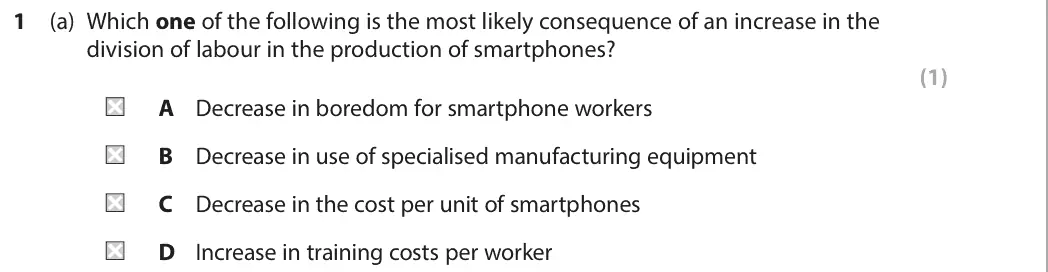
Answer
C
Mark scheme

Notes from the mark scheme and report
- division of labour raises productivity so cost per unit falls (C)
- it tends to increase boredom, increase use of specialised equipment and reduce training cost per worker
80 marks · 18 question parts · Paper, mark scheme and report on Pearson's site
C

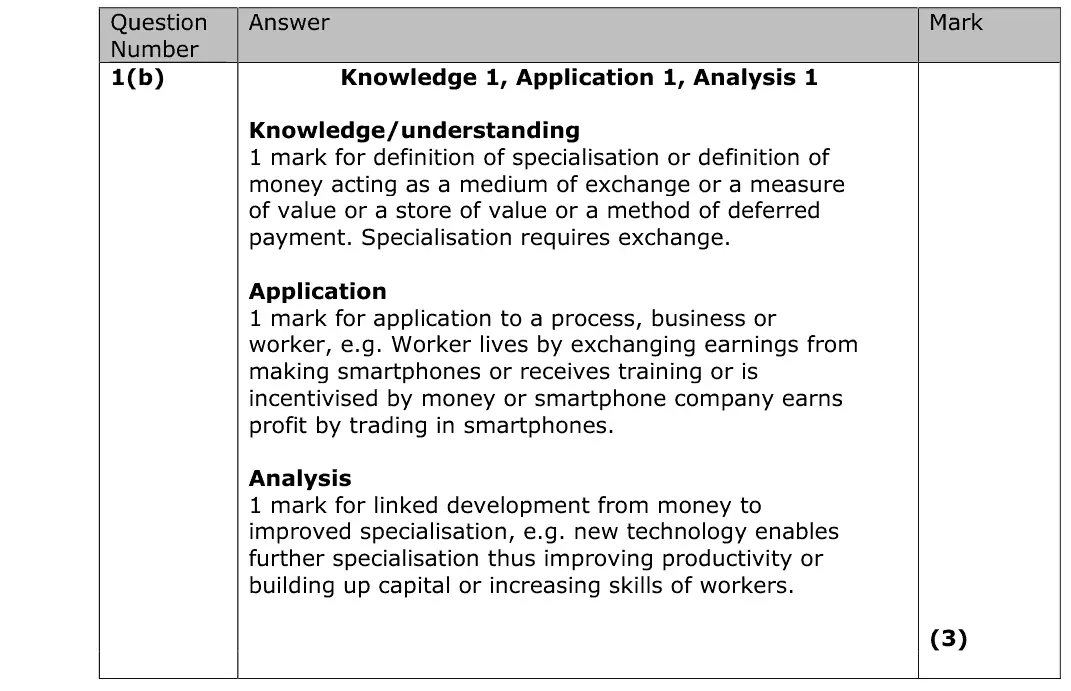
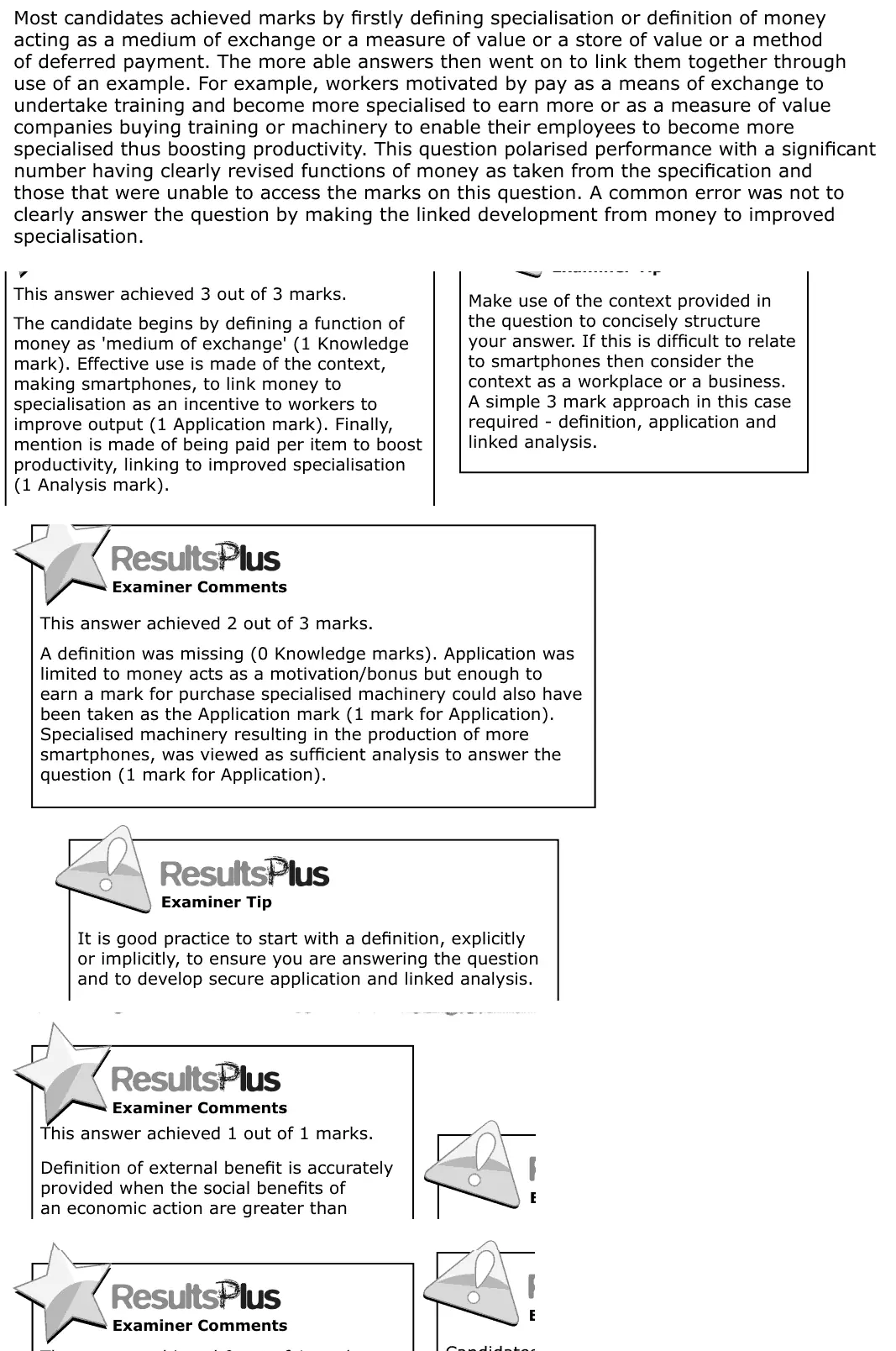
Most candidates achieved marks by firstly defining specialisation or definition of money acting as a medium of exchange or a measure of value or a store of value or a method of deferred payment. The more able answers then went on to link them together through use of an example. For example, workers motivated by pay as a means of exchange to undertake training and become more specialised to earn more or as a measure of value companies buying training or machinery to enable their employees to become more specialised thus boosting productivity. This question polarised performance with a significant number having clearly revised functions of money as taken from the specification and those that were unable to access the marks on this question. A common error was not to clearly answer the question by making the linked development from money to improved specialisation. This answer achieved 3 out of 3 marks. The candidate begins by defining a function of money as 'medium of exchange' (1 Knowledge mark). Effective use is made of the context, making smartphones, to link money to specialisation as an incentive to workers to improve output (1 Application mark). Finally, mention is made of being paid per item to boost productivity, linking to improved specialisation (1 Analysis mark). Make use of the context provided in the question to concisely structure your answer. If this is difficult to relate to smartphones then consider the context as a workplace or a business. A simple 3 mark approach in this case required - definition, application and linked analysis. This answer achieved 2 out of 3 marks. A definition was missing (0 Knowledge marks). Application was limited to money acts as a motivation/bonus but enough to earn a mark for purchase specialised machinery could also have been taken as the Application mark (1 mark for Application). Specialised machinery resulting in the production of more smartphones, was viewed as sufficient analysis to answer the question (1 mark for Application). It is good practice to start with a definition, explicitly or implicitly, to ensure you are answering the question and to develop secure application and linked analysis.

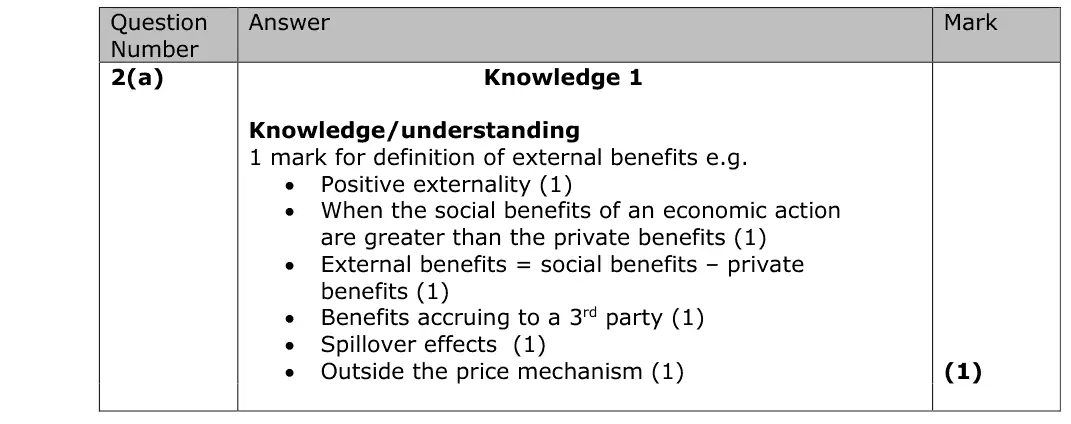
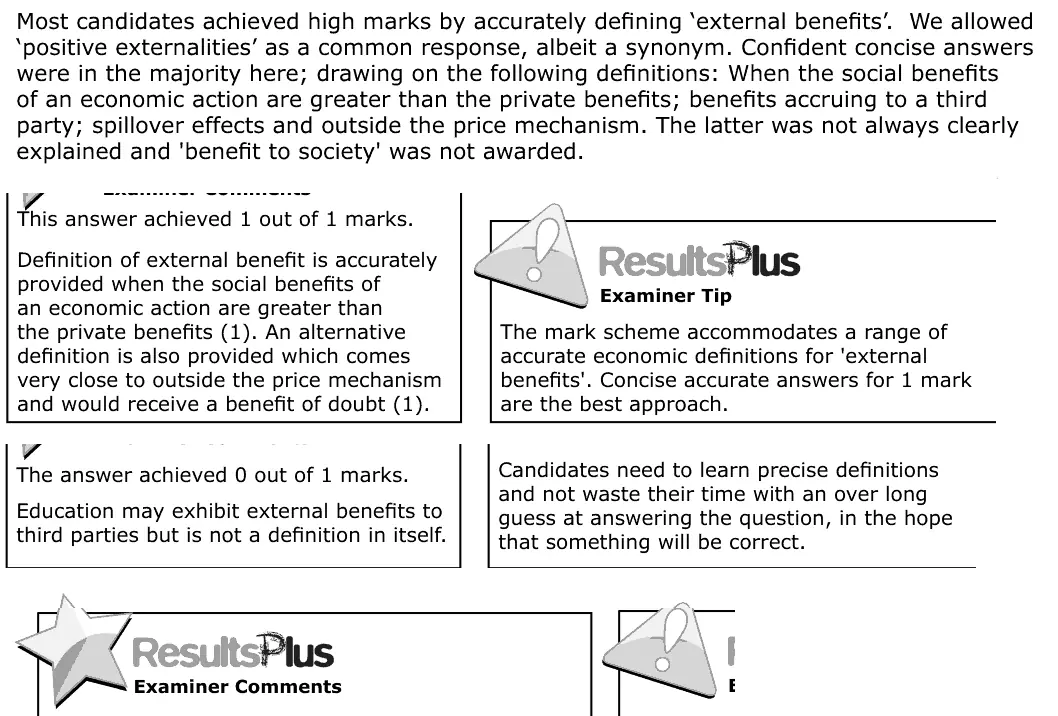
Most candidates achieved high marks by accurately defining ‘external benefits’. We allowed ‘positive externalities’ as a common response, albeit a synonym. Confident concise answers were in the majority here; drawing on the following definitions: When the social benefits of an economic action are greater than the private benefits; benefits accruing to a third party; spillover effects and outside the price mechanism. The latter was not always clearly explained and 'benefit to society' was not awarded. This answer achieved 1 out of 1 marks. Definition of external benefit is accurately provided when the social benefits of an economic action are greater than the private benefits (1). An alternative definition is also provided which comes very close to outside the price mechanism and would receive a benefit of doubt (1). The mark scheme accommodates a range of accurate economic definitions for 'external benefits'. Concise accurate answers for 1 mark are the best approach. The answer achieved 0 out of 1 marks. Education may exhibit external benefits to third parties but is not a definition in itself. Candidates need to learn precise definitions and not waste their time with an over long guess at answering the question, in the hope that something will be correct.
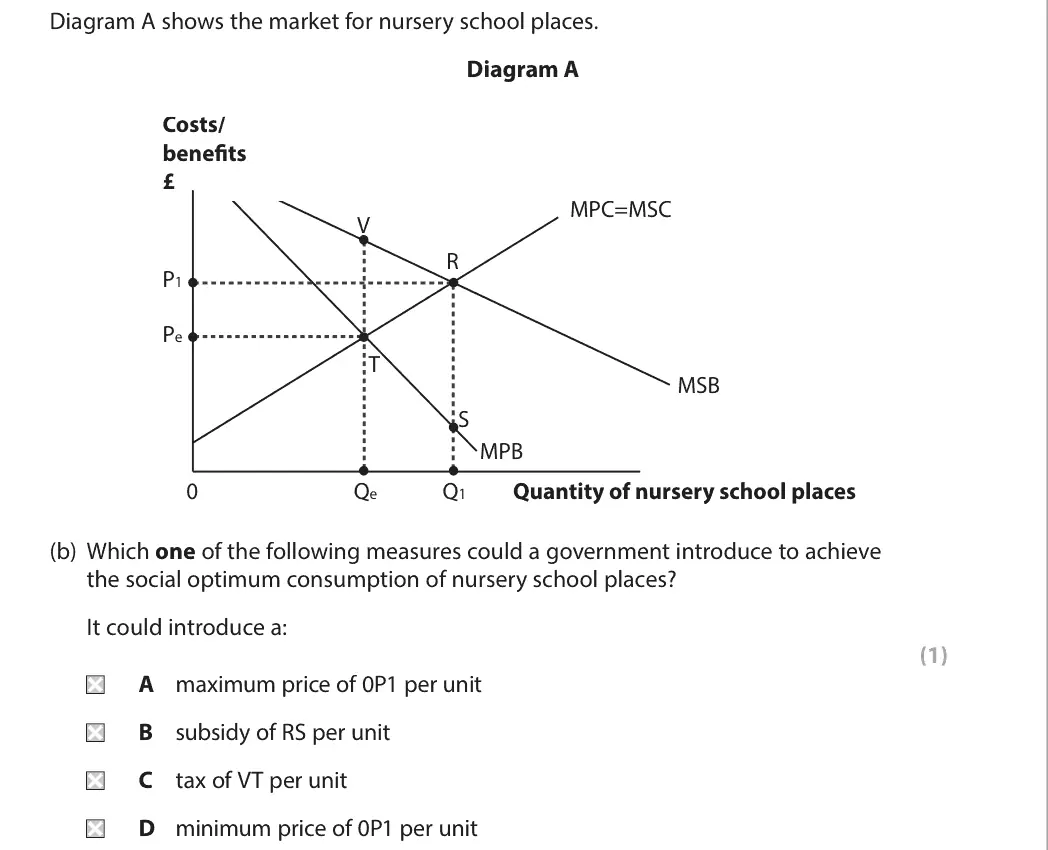
B
Quantitative skills: QS 4 (construct and interpret a range of standard graphical forms)

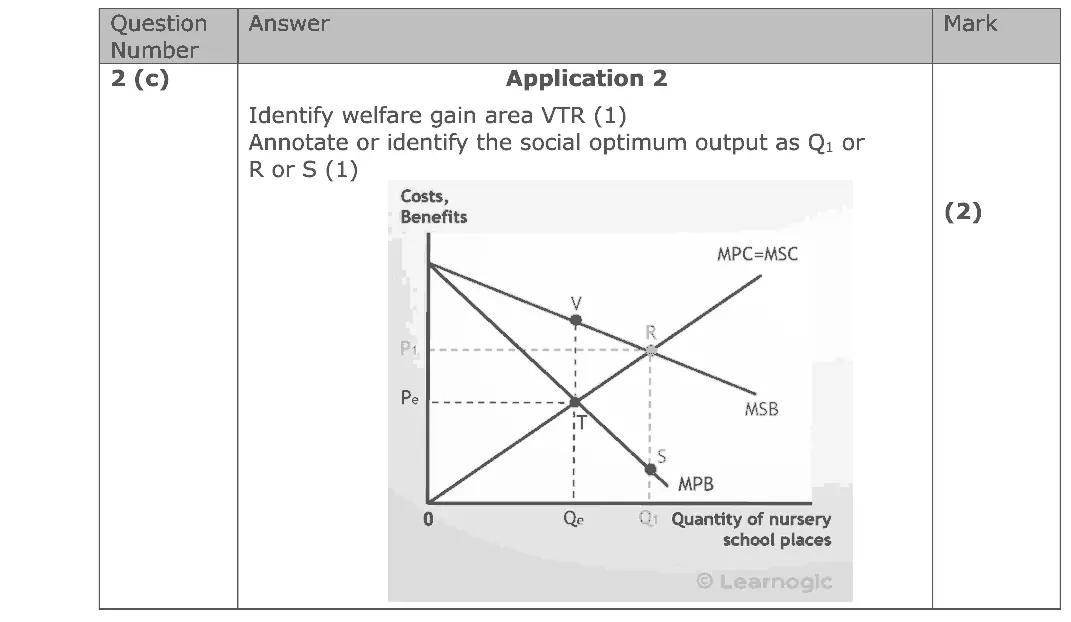
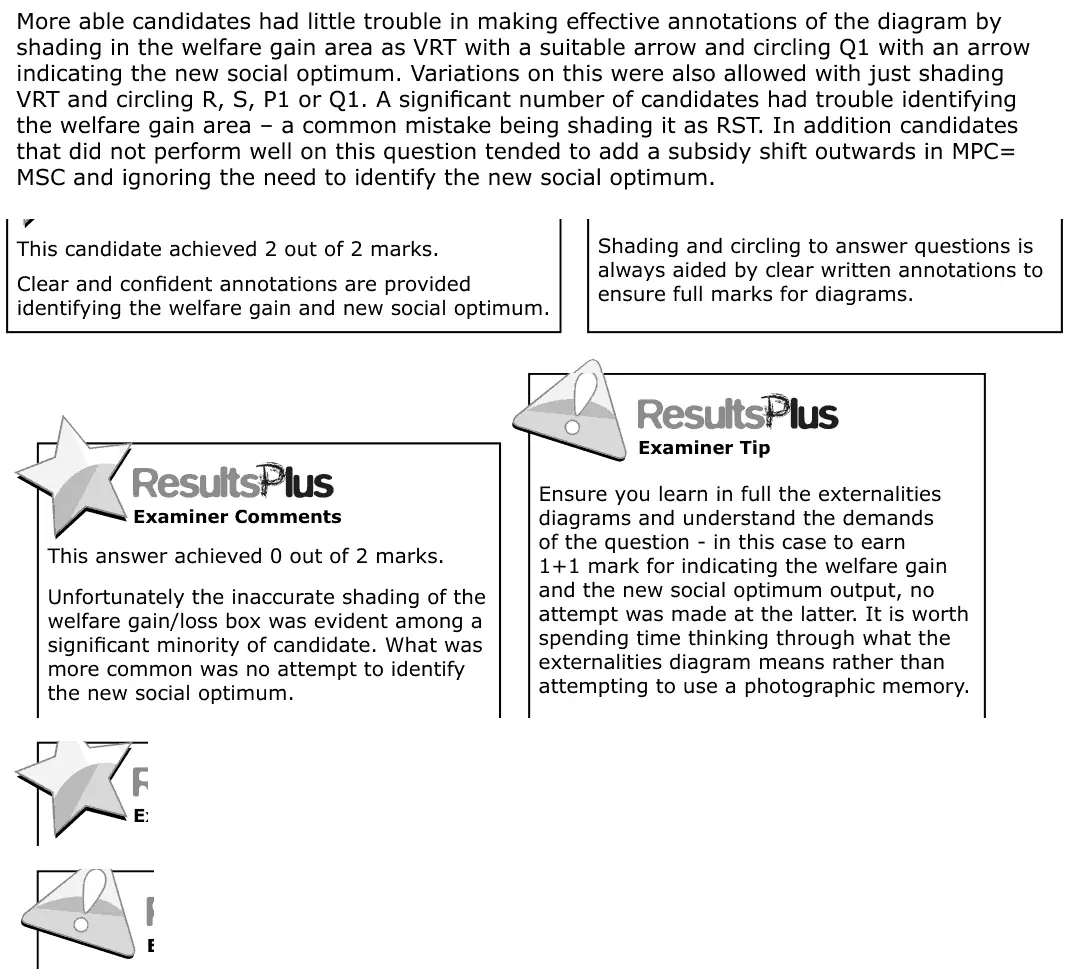
More able candidates had little trouble in making effective annotations of the diagram by shading in the welfare gain area as VRT with a suitable arrow and circling Q1 with an arrow indicating the new social optimum. Variations on this were also allowed with just shading VRT and circling R, S, P1 or Q1. A significant number of candidates had trouble identifying the welfare gain area – a common mistake being shading it as RST. In addition candidates that did not perform well on this question tended to add a subsidy shift outwards in MPC= MSC and ignoring the need to identify the new social optimum. This candidate achieved 2 out of 2 marks. Clear and confident annotations are provided identifying the welfare gain and new social optimum. Shading and circling to answer questions is always aided by clear written annotations to ensure full marks for diagrams. This answer achieved 0 out of 2 marks. Unfortunately the inaccurate shading of the welfare gain/loss box was evident among a significant minority of candidate. What was more common was no attempt to identify the new social optimum. Ensure you learn in full the externalities diagrams and understand the demands of the question - in this case to earn 1+1 mark for indicating the welfare gain and the new social optimum output, no attempt was made at the latter. It is worth spending time thinking through what the externalities diagram means rather than attempting to use a photographic memory.
Quantitative skills: QS 4 (construct and interpret a range of standard graphical forms)
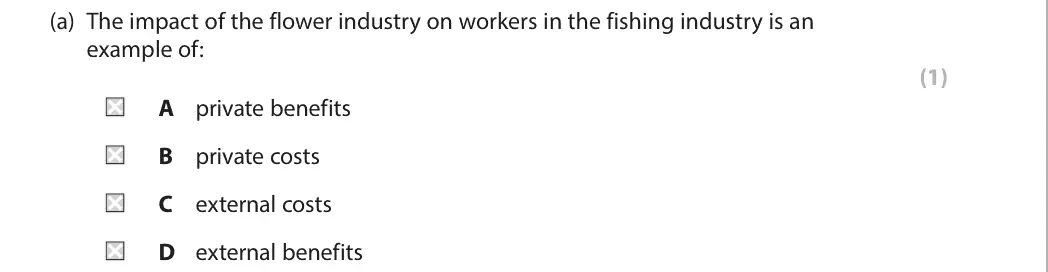
C

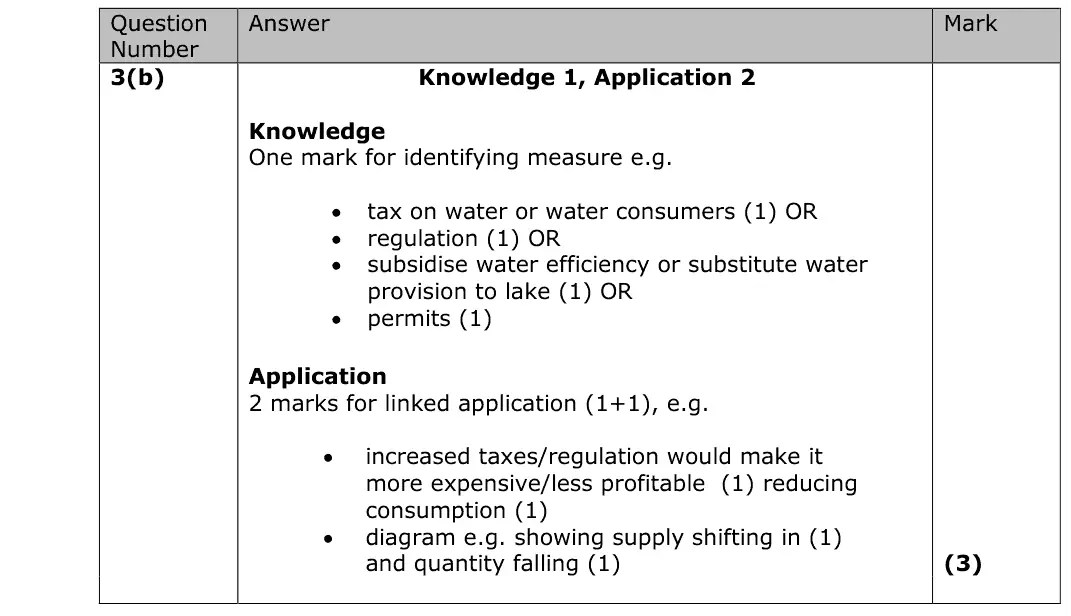
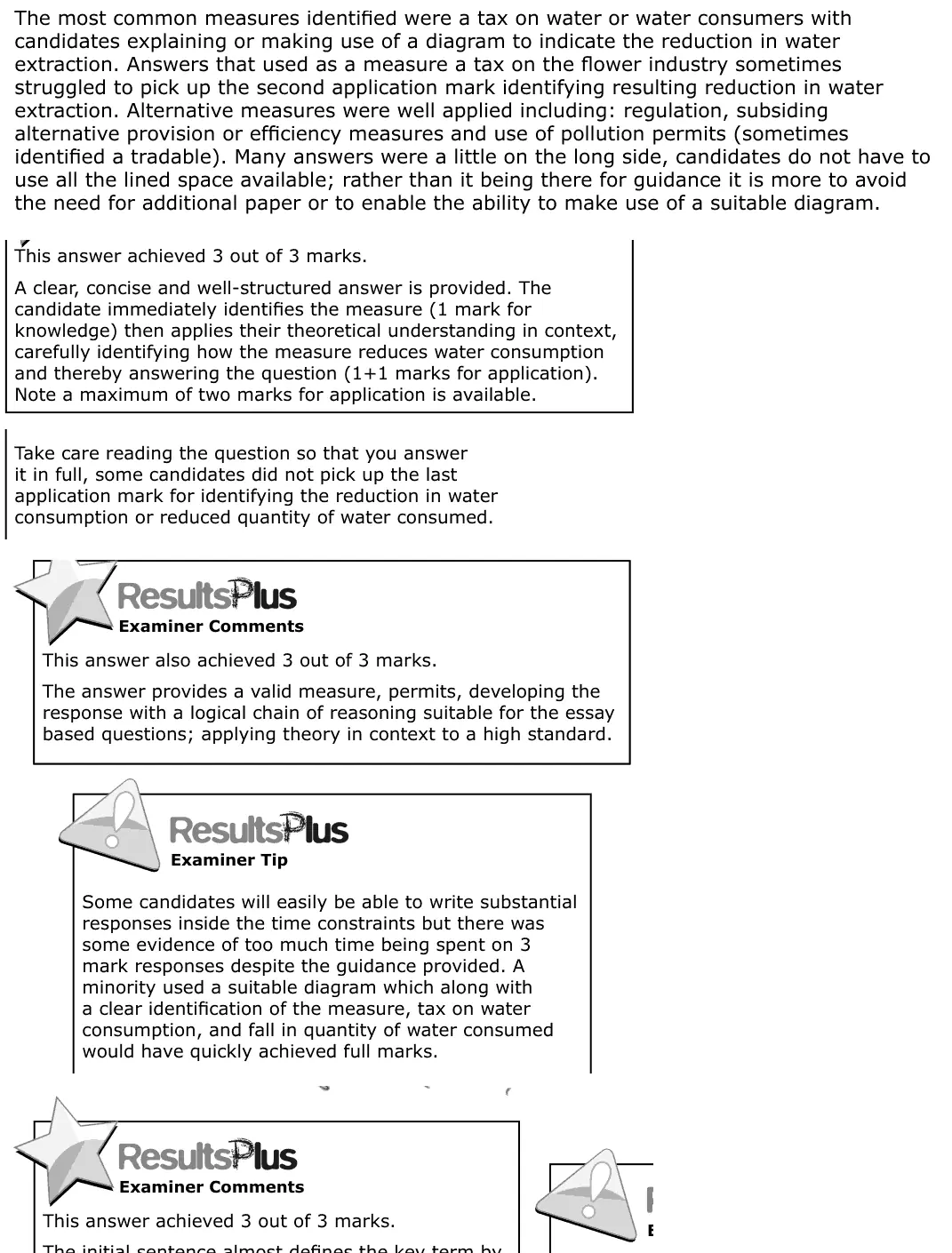
The most common measures identified were a tax on water or water consumers with candidates explaining or making use of a diagram to indicate the reduction in water extraction. Answers that used as a measure a tax on the flower industry sometimes struggled to pick up the second application mark identifying resulting reduction in water extraction. Alternative measures were well applied including: regulation, subsiding alternative provision or efficiency measures and use of pollution permits (sometimes identified a tradable). Many answers were a little on the long side, candidates do not have to use all the lined space available; rather than it being there for guidance it is more to avoid the need for additional paper or to enable the ability to make use of a suitable diagram. This answer achieved 3 out of 3 marks. A clear, concise and well-structured answer is provided. The candidate immediately identifies the measure (1 mark for knowledge) then applies their theoretical understanding in context, carefully identifying how the measure reduces water consumption and thereby answering the question (1+1 marks for application). Note a maximum of two marks for application is available. Take care reading the question so that you answer it in full, some candidates did not pick up the last application mark for identifying the reduction in water consumption or reduced quantity of water consumed. This answer also achieved 3 out of 3 marks. The answer provides a valid measure, permits, developing the response with a logical chain of reasoning suitable for the essay based questions; applying theory in context to a high standard. Some candidates will easily be able to write substantial responses inside the time constraints but there was some evidence of too much time being spent on 3 mark responses despite the guidance provided. A minority used a suitable diagram which along with a clear identification of the measure, tax on water consumption, and fall in quantity of water consumed would have quickly achieved full marks.

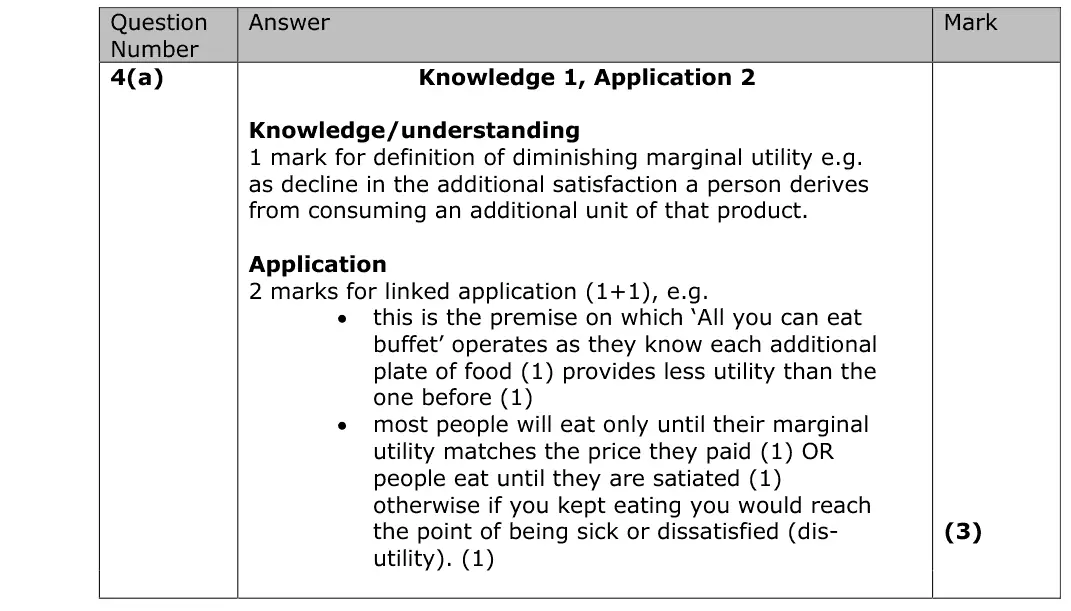
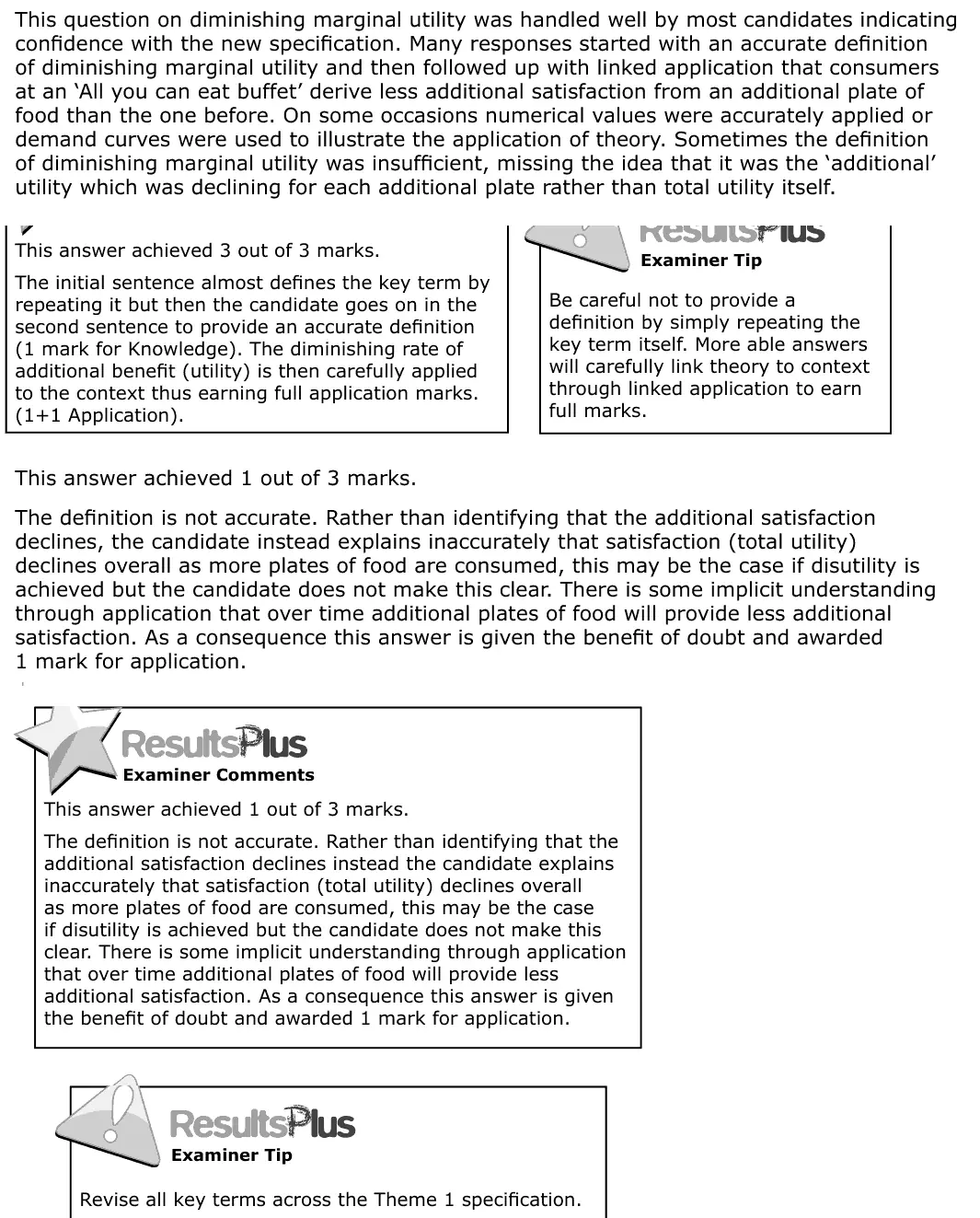
This question on diminishing marginal utility was handled well by most candidates indicating confidence with the new specification. Many responses started with an accurate definition of diminishing marginal utility and then followed up with linked application that consumers at an ‘All you can eat buffet’ derive less additional satisfaction from an additional plate of food than the one before. On some occasions numerical values were accurately applied or demand curves were used to illustrate the application of theory. Sometimes the definition of diminishing marginal utility was insufficient, missing the idea that it was the ‘additional’ utility which was declining for each additional plate rather than total utility itself. This answer achieved 3 out of 3 marks. The initial sentence almost defines the key term by repeating it but then the candidate goes on in the second sentence to provide an accurate definition (1 mark for Knowledge). The diminishing rate of additional benefit (utility) is then carefully applied to the context thus earning full application marks. (1+1 Application). Be careful not to provide a definition by simply repeating the key term itself. More able answers will carefully link theory to context through linked application to earn full marks. This answer achieved 1 out of 3 marks. The definition is not accurate. Rather than identifying that the additional satisfaction declines, the candidate instead explains inaccurately that satisfaction (total utility) declines overall as more plates of food are consumed, this may be the case if disutility is achieved but the candidate does not make this clear. There is some implicit understanding through application that over time additional plates of food will provide less additional satisfaction. As a consequence this answer is given the benefit of doubt and awarded 1 mark for application. This answer achieved 1 out of 3 marks. The definition is not accurate. Rather than identifying that the additional satisfaction declines instead the candidate explains inaccurately that satisfaction (total utility) declines overall as more plates of food are consumed, this may be the case if disutility is achieved but the candidate does not make this clear. There is some implicit understanding through application that over time additional plates of food will provide less additional satisfaction. As a consequence this answer is given the benefit of doubt and awarded 1 mark for application. Revise all key terms across the Theme 1 specification.
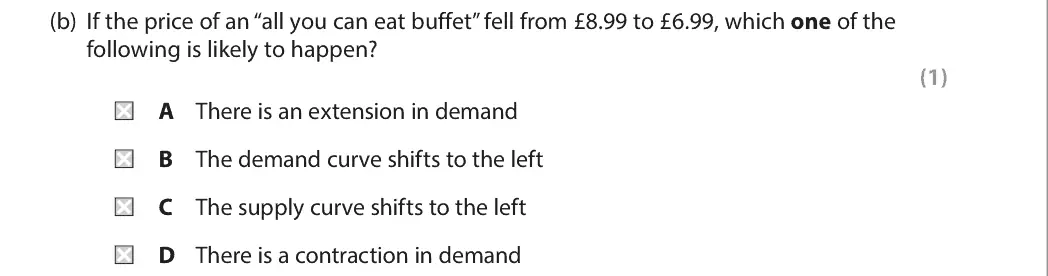
A
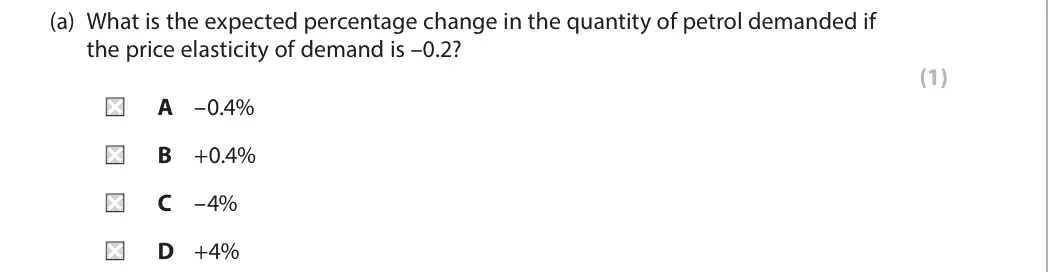
D
Quantitative skills: QS 2 (calculate, use and understand percentages, percentage changes and percentage point changes); QS 8 (make calculations of elasticity and interpret the result)

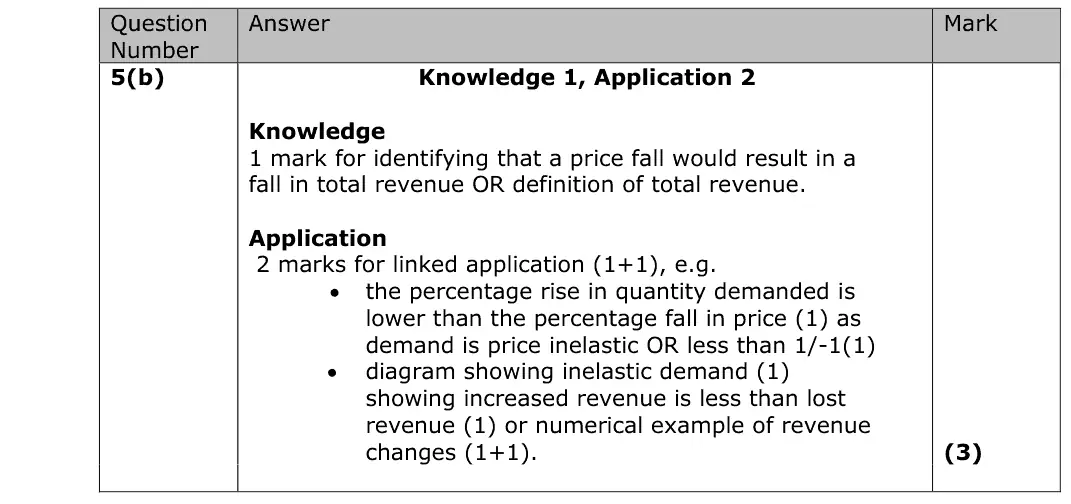
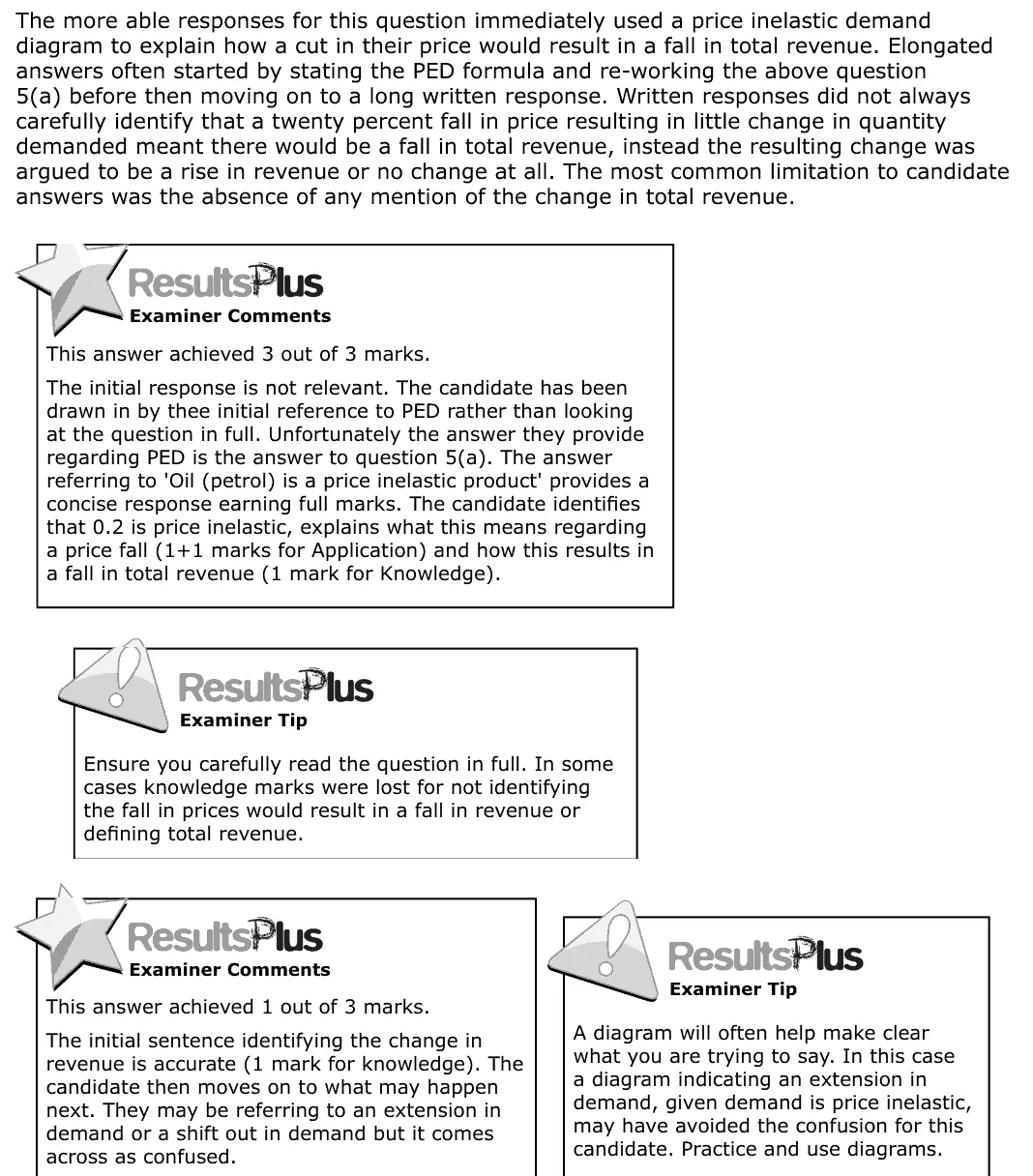
The more able responses for this question immediately used a price inelastic demand diagram to explain how a cut in their price would result in a fall in total revenue. Elongated answers often started by stating the PED formula and re-working the above question 5(a) before then moving on to a long written response. Written responses did not always carefully identify that a twenty percent fall in price resulting in little change in quantity demanded meant there would be a fall in total revenue, instead the resulting change was argued to be a rise in revenue or no change at all. The most common limitation to candidate answers was the absence of any mention of the change in total revenue. This answer achieved 3 out of 3 marks. The initial response is not relevant. The candidate has been drawn in by thee initial reference to PED rather than looking at the question in full. Unfortunately the answer they provide regarding PED is the answer to question 5(a). The answer referring to 'Oil (petrol) is a price inelastic product' provides a concise response earning full marks. The candidate identifies that 0.2 is price inelastic, explains what this means regarding a price fall (1+1 marks for Application) and how this results in a fall in total revenue (1 mark for Knowledge). Ensure you carefully read the question in full. In some cases knowledge marks were lost for not identifying the fall in prices would result in a fall in revenue or defining total revenue. This answer achieved 1 out of 3 marks. The initial sentence identifying the change in revenue is accurate (1 mark for knowledge). The candidate then moves on to what may happen next. They may be referring to an extension in demand or a shift out in demand but it comes across as confused. A diagram will often help make clear what you are trying to say. In this case a diagram indicating an extension in demand, given demand is price inelastic, may have avoided the confusion for this candidate. Practice and use diagrams.
Quantitative skills: QS 8 (make calculations of elasticity and interpret the result)

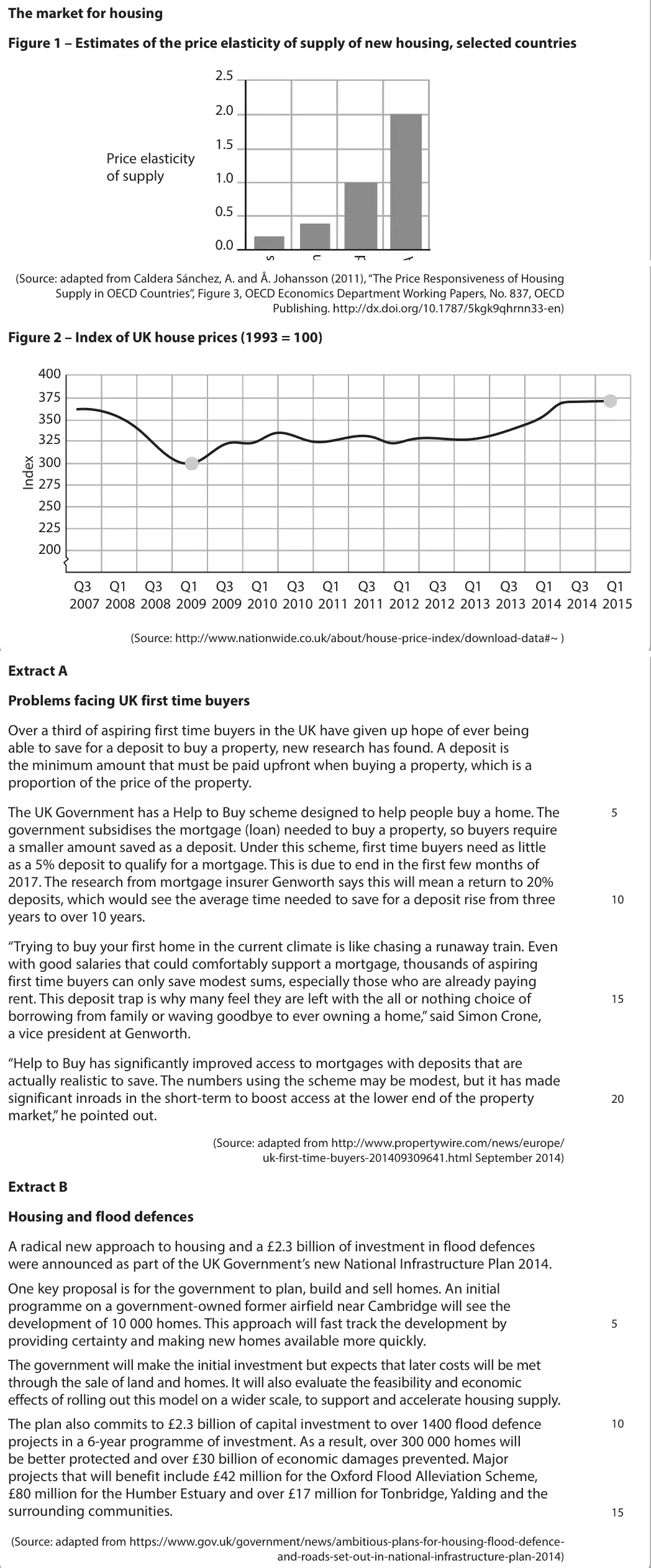
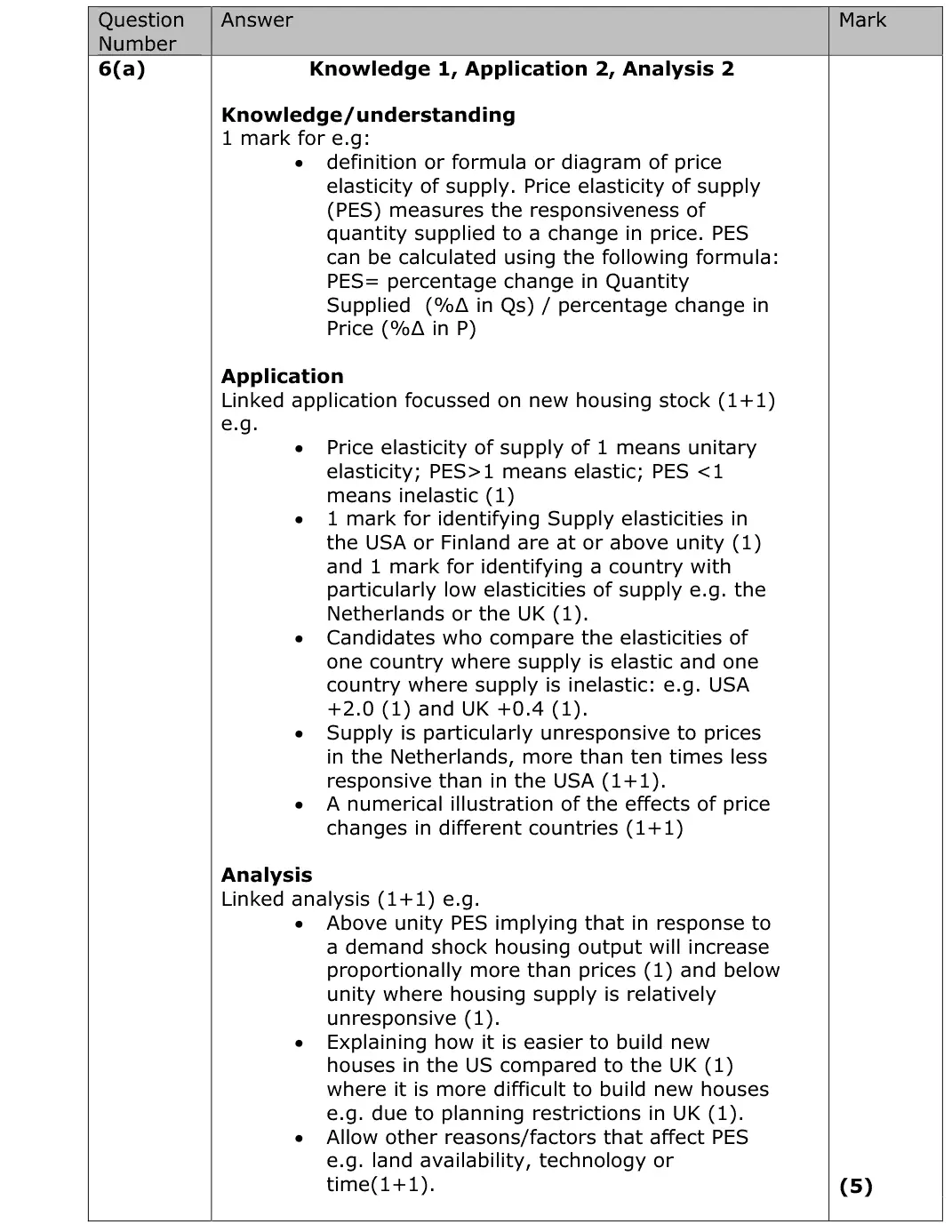
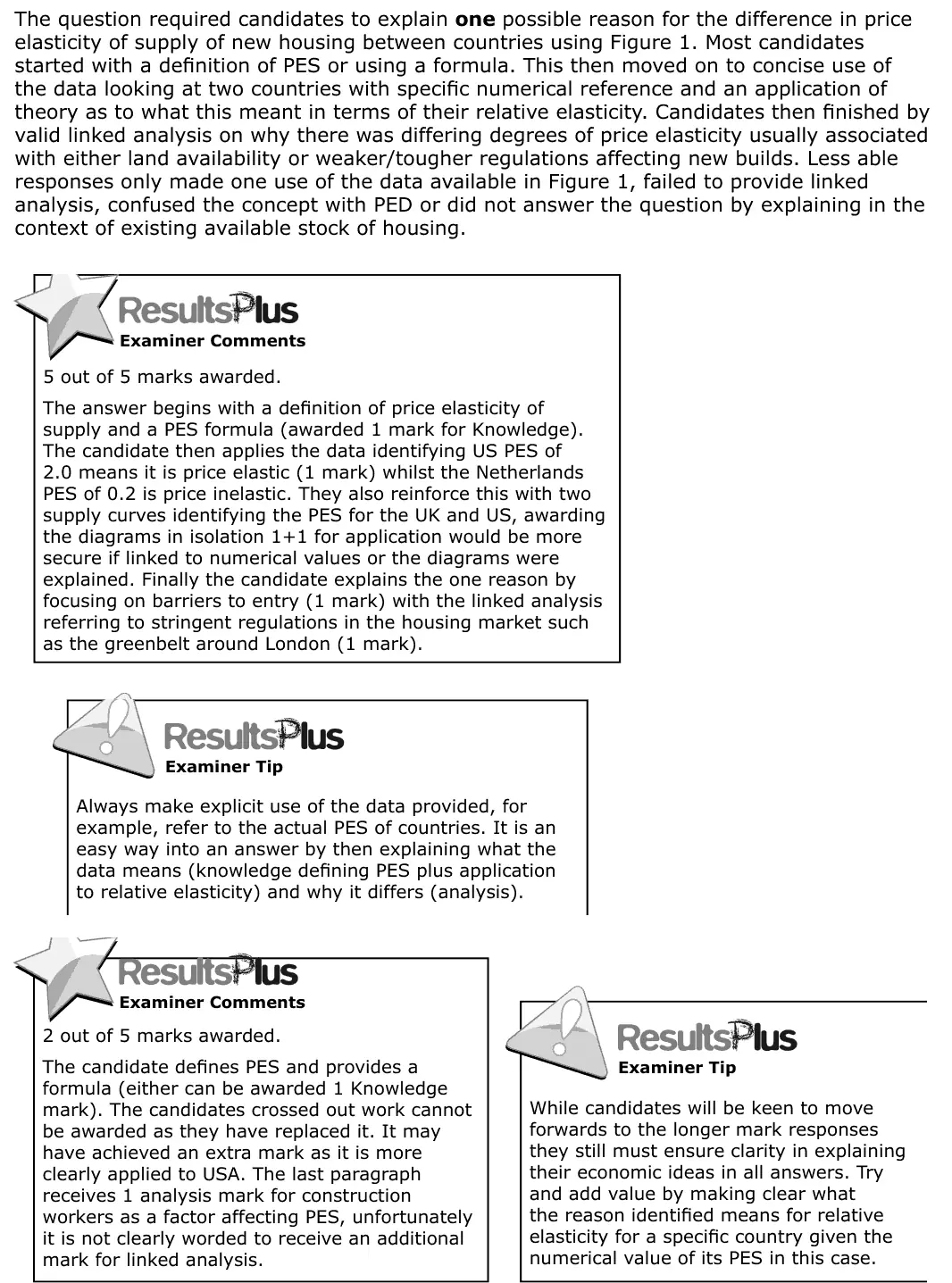
The question required candidates to explain one possible reason for the difference in price elasticity of supply of new housing between countries using Figure 1. Most candidates started with a definition of PES or using a formula. This then moved on to concise use of the data looking at two countries with specific numerical reference and an application of theory as to what this meant in terms of their relative elasticity. Candidates then finished by valid linked analysis on why there was differing degrees of price elasticity usually associated with either land availability or weaker/tougher regulations affecting new builds. Less able responses only made one use of the data available in Figure 1, failed to provide linked analysis, confused the concept with PED or did not answer the question by explaining in the context of existing available stock of housing. 5 out of 5 marks awarded. The answer begins with a definition of price elasticity of supply and a PES formula (awarded 1 mark for Knowledge). The candidate then applies the data identifying US PES of 2.0 means it is price elastic (1 mark) whilst the Netherlands PES of 0.2 is price inelastic. They also reinforce this with two supply curves identifying the PES for the UK and US, awarding the diagrams in isolation 1+1 for application would be more secure if linked to numerical values or the diagrams were explained. Finally the candidate explains the one reason by focusing on barriers to entry (1 mark) with the linked analysis referring to stringent regulations in the housing market such as the greenbelt around London (1 mark). Always make explicit use of the data provided, for example, refer to the actual PES of countries. It is an easy way into an answer by then explaining what the data means (knowledge defining PES plus application to relative elasticity) and why it differs (analysis). 2 out of 5 marks awarded. The candidate defines PES and provides a formula (either can be awarded 1 Knowledge mark). The candidates crossed out work cannot be awarded as they have replaced it. It may have achieved an extra mark as it is more clearly applied to USA. The last paragraph receives 1 analysis mark for construction workers as a factor affecting PES, unfortunately it is not clearly worded to receive an additional mark for linked analysis. While candidates will be keen to move forwards to the longer mark responses they still must ensure clarity in explaining their economic ideas in all answers. Try and add value by making clear what the reason identified means for relative elasticity for a specific country given the numerical value of its PES in this case.
Quantitative skills: QS 8 (make calculations of elasticity and interpret the result); QS 9 (interpret, apply and analyse information in written, graphical tabular and numerical forms)

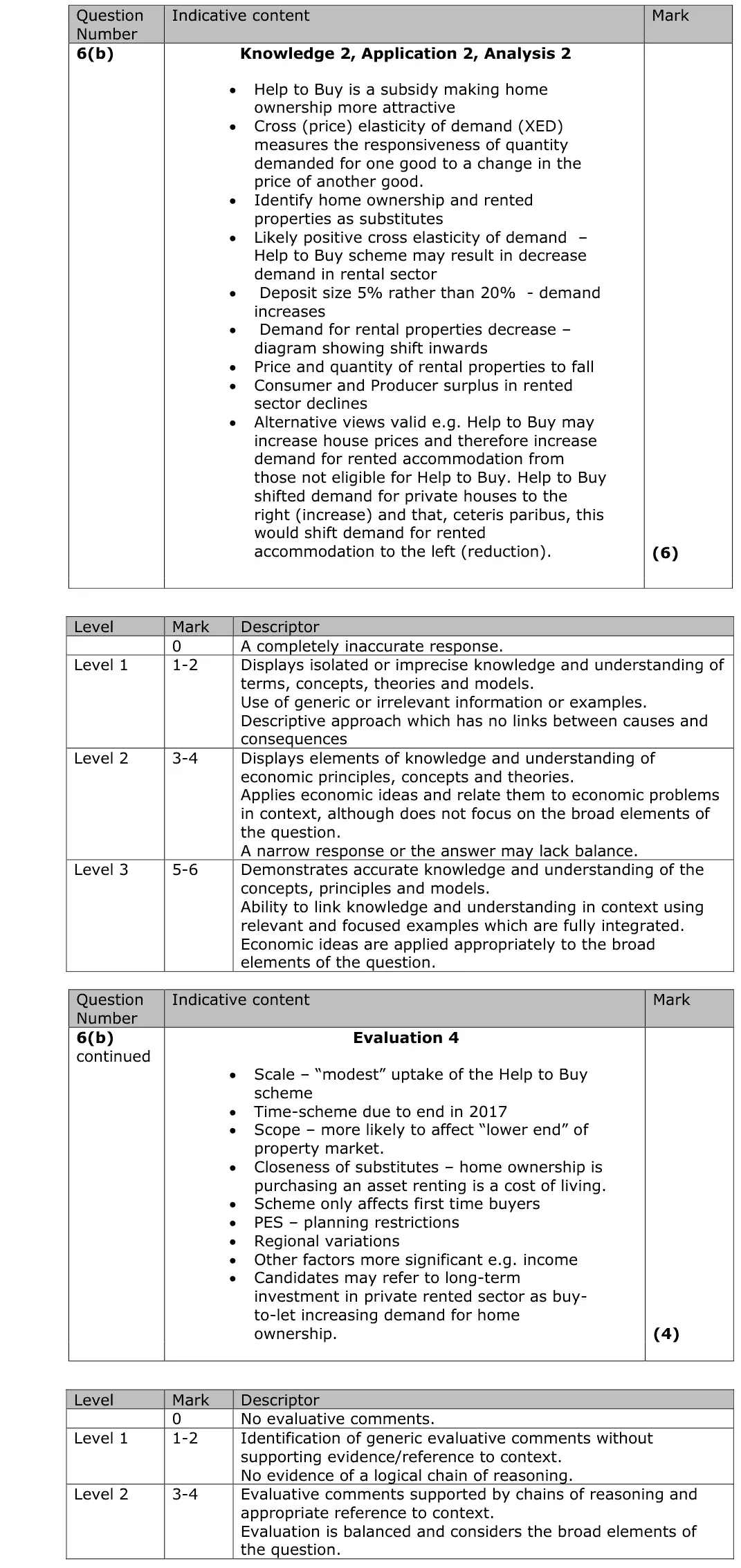
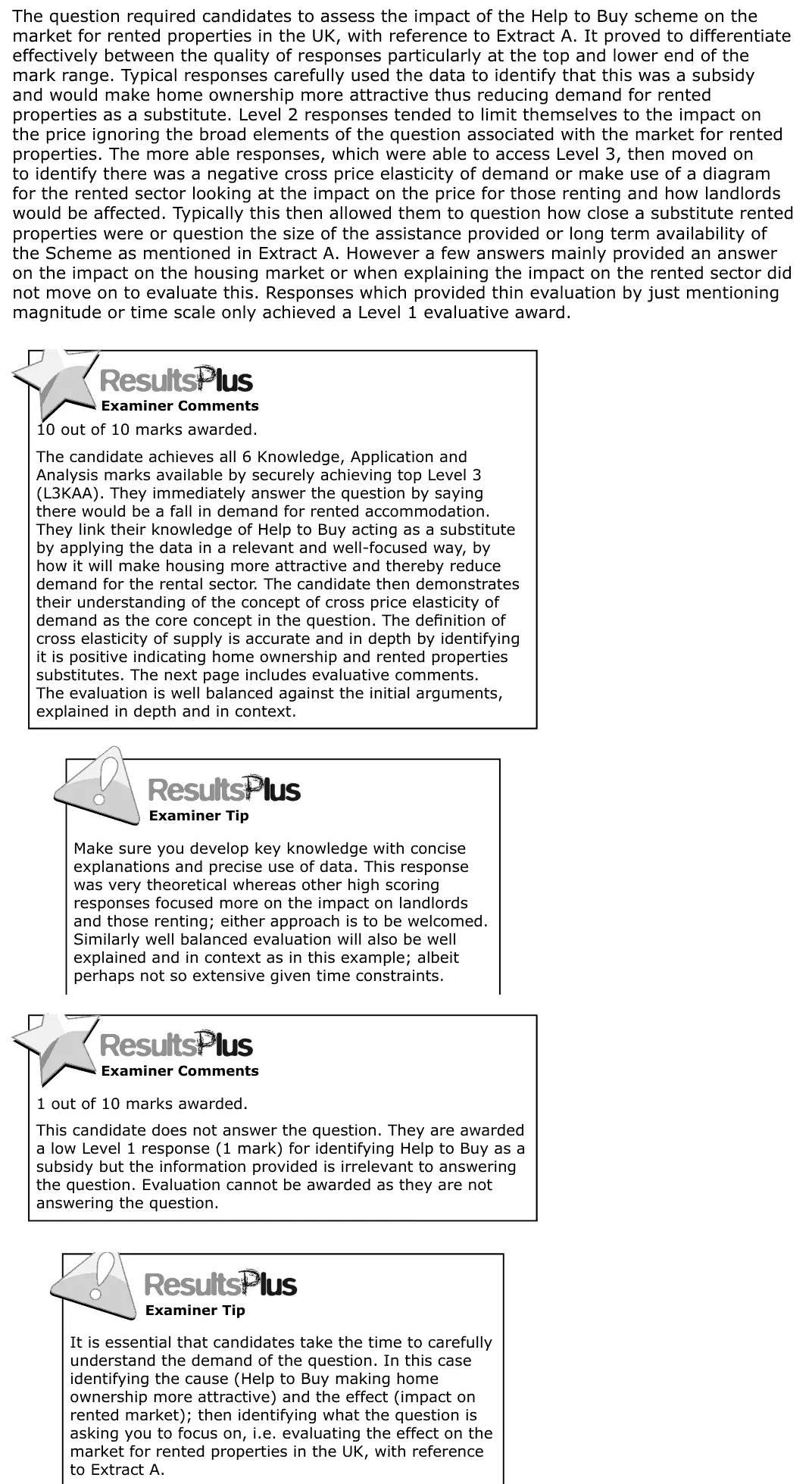
The question required candidates to assess the impact of the Help to Buy scheme on the market for rented properties in the UK, with reference to Extract A. It proved to differentiate effectively between the quality of responses particularly at the top and lower end of the mark range. Typical responses carefully used the data to identify that this was a subsidy and would make home ownership more attractive thus reducing demand for rented properties as a substitute. Level 2 responses tended to limit themselves to the impact on the price ignoring the broad elements of the question associated with the market for rented properties. The more able responses, which were able to access Level 3, then moved on to identify there was a negative cross price elasticity of demand or make use of a diagram for the rented sector looking at the impact on the price for those renting and how landlords would be affected. Typically this then allowed them to question how close a substitute rented properties were or question the size of the assistance provided or long term availability of the Scheme as mentioned in Extract A. However a few answers mainly provided an answer on the impact on the housing market or when explaining the impact on the rented sector did not move on to evaluate this. Responses which provided thin evaluation by just mentioning magnitude or time scale only achieved a Level 1 evaluative award. 10 out of 10 marks awarded. The candidate achieves all 6 Knowledge, Application and Analysis marks available by securely achieving top Level 3 (L3KAA). They immediately answer the question by saying there would be a fall in demand for rented accommodation. They link their knowledge of Help to Buy acting as a substitute by applying the data in a relevant and well-focused way, by how it will make housing more attractive and thereby reduce demand for the rental sector. The candidate then demonstrates their understanding of the concept of cross price elasticity of demand as the core concept in the question. The definition of cross elasticity of supply is accurate and in depth by identifying it is positive indicating home ownership and rented properties substitutes. The next page includes evaluative comments. The evaluation is well balanced against the initial arguments, explained in depth and in context. Make sure you develop key knowledge with concise explanations and precise use of data. This response was very theoretical whereas other high scoring responses focused more on the impact on landlords and those renting; either approach is to be welcomed. Similarly well balanced evaluation will also be well explained and in context as in this example; albeit perhaps not so extensive given time constraints. 1 out of 10 marks awarded. This candidate does not answer the question. They are awarded a low Level 1 response (1 mark) for identifying Help to Buy as a subsidy but the information provided is irrelevant to answering the question. Evaluation cannot be awarded as they are not answering the question. It is essential that candidates take the time to carefully understand the demand of the question. In this case identifying the cause (Help to Buy making home ownership more attractive) and the effect (impact on rented market); then identifying what the question is asking you to focus on, i.e. evaluating the effect on the market for rented properties in the UK, with reference to Extract A.
Quantitative skills: QS 9 (interpret, apply and analyse information in written, graphical tabular and numerical forms)

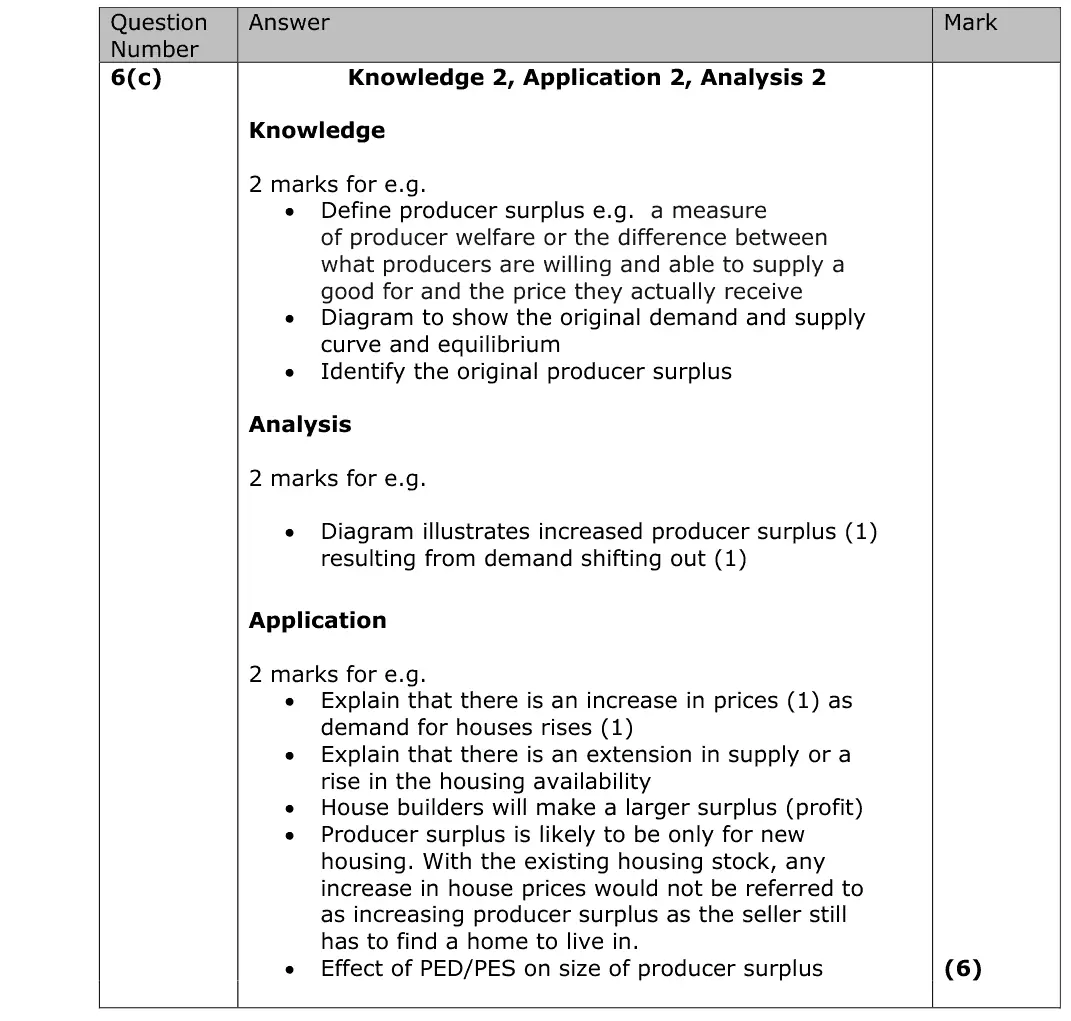
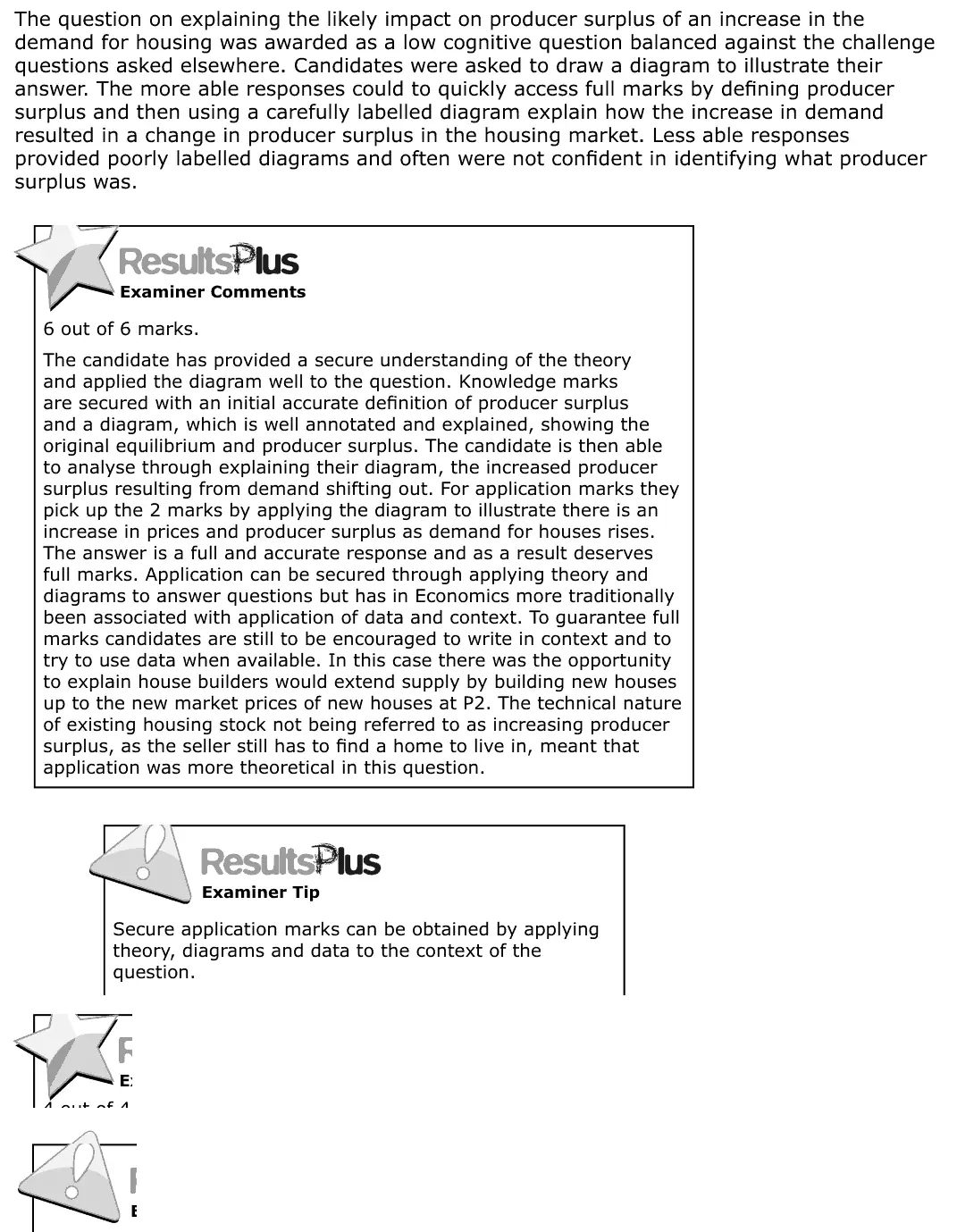
The question on explaining the likely impact on producer surplus of an increase in the demand for housing was awarded as a low cognitive question balanced against the challenge questions asked elsewhere. Candidates were asked to draw a diagram to illustrate their answer. The more able responses could to quickly access full marks by defining producer surplus and then using a carefully labelled diagram explain how the increase in demand resulted in a change in producer surplus in the housing market. Less able responses provided poorly labelled diagrams and often were not confident in identifying what producer surplus was. 6 out of 6 marks. The candidate has provided a secure understanding of the theory and applied the diagram well to the question. Knowledge marks are secured with an initial accurate definition of producer surplus and a diagram, which is well annotated and explained, showing the original equilibrium and producer surplus. The candidate is then able to analyse through explaining their diagram, the increased producer surplus resulting from demand shifting out. For application marks they pick up the 2 marks by applying the diagram to illustrate there is an increase in prices and producer surplus as demand for houses rises. The answer is a full and accurate response and as a result deserves full marks. Application can be secured through applying theory and diagrams to answer questions but has in Economics more traditionally been associated with application of data and context. To guarantee full marks candidates are still to be encouraged to write in context and to try to use data when available. In this case there was the opportunity to explain house builders would extend supply by building new houses up to the new market prices of new houses at P2. The technical nature of existing housing stock not being referred to as increasing producer surplus, as the seller still has to find a home to live in, meant that application was more theoretical in this question. Secure application marks can be obtained by applying theory, diagrams and data to the context of the question.
Quantitative skills: QS 4 (construct and interpret a range of standard graphical forms)

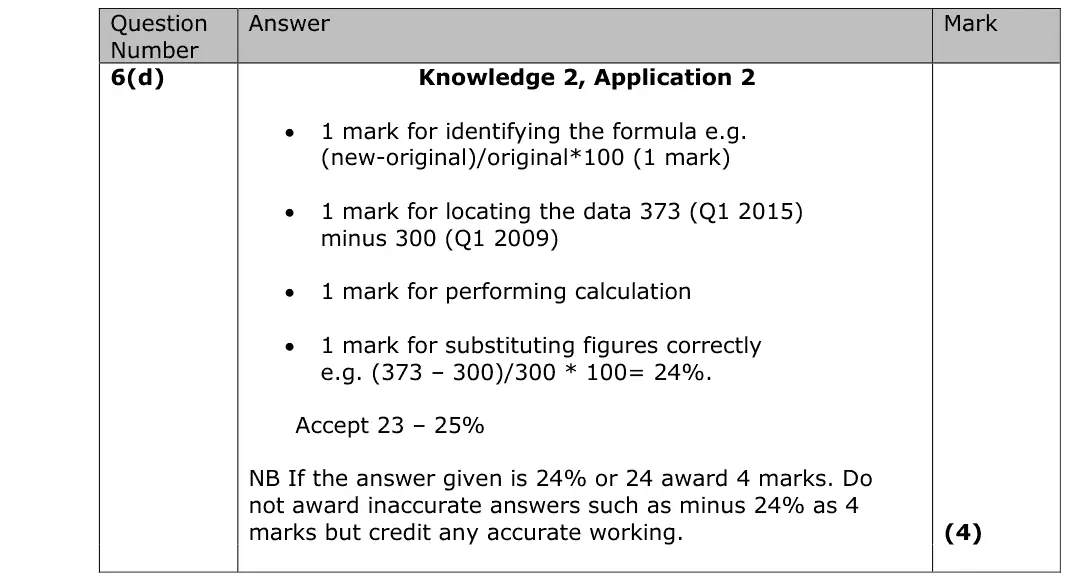
The question was one requiring use of quantitative skills question and provided an accessible question asking candidates to calculate the percentage change in house prices between the first quarter of 2009 and the first quarter of 2015. Nearly all candidates were able to obtain at least 1 mark by locating the data. Where marks were lost was an inability to identify the correct formula to perform the calculation. Where the correct formula and calculation was completed resulting in a mistaken answer this was awarded 3 marks, for example in identifying prices had fallen. Answers which simply wrote down an acceptable accurate response, 23-25%, were awarded full marks but were rare to find indicating good exam technique by the overwhelming majority of candidates. 4 out of 4 marks awarded. 1 mark for data located accurately and easy to follow with year references 375 (2015) and 300 (2009). Correct formula used (1 mark) and data substituted accurately (1 mark). Without the correct answer identified this would achieve 3 marks. The correct calculation is made, a 25% change, which makes the overall score 4 marks. In isolation writing '25%' change would have received full marks but this candidate has clearly shown their working in a concise manner in case they did make a computational error. Ensure you understand what Index numbers mean, some candidates added pound signs and zeros i.e. 2008 house prices were £300,000 which is inaccurate. Despite this error full marks could still be achieved for identifying the correct percentage change. Accurate working will always receive credit and candidates are strongly advised to show their working in case they make a computational error with the final answer. 1 out of 4 marks awarded. This answer clearly locates the data for 2009 and 2015 and uses the key to identify that they are Index numbers (1 Application mark). Unfortunately they do not then apply the data to calculate the percentage change (1+0 Application marks). They do not know how to work out a percentage change so receive no knowledge marks. Make careful use of data in a Figure you are asked to look at, spending time to see what the data is showing, there are always marks for doing this. Being aware of how to calculate percentage changes accurately is a useful tool for economists.
Quantitative skills: QS 2 (calculate, use and understand percentages, percentage changes and percentage point changes); QS 5 (calculate and interpret index numbers); QS 9 (interpret, apply and analyse information in written, graphical tabular and numerical forms)

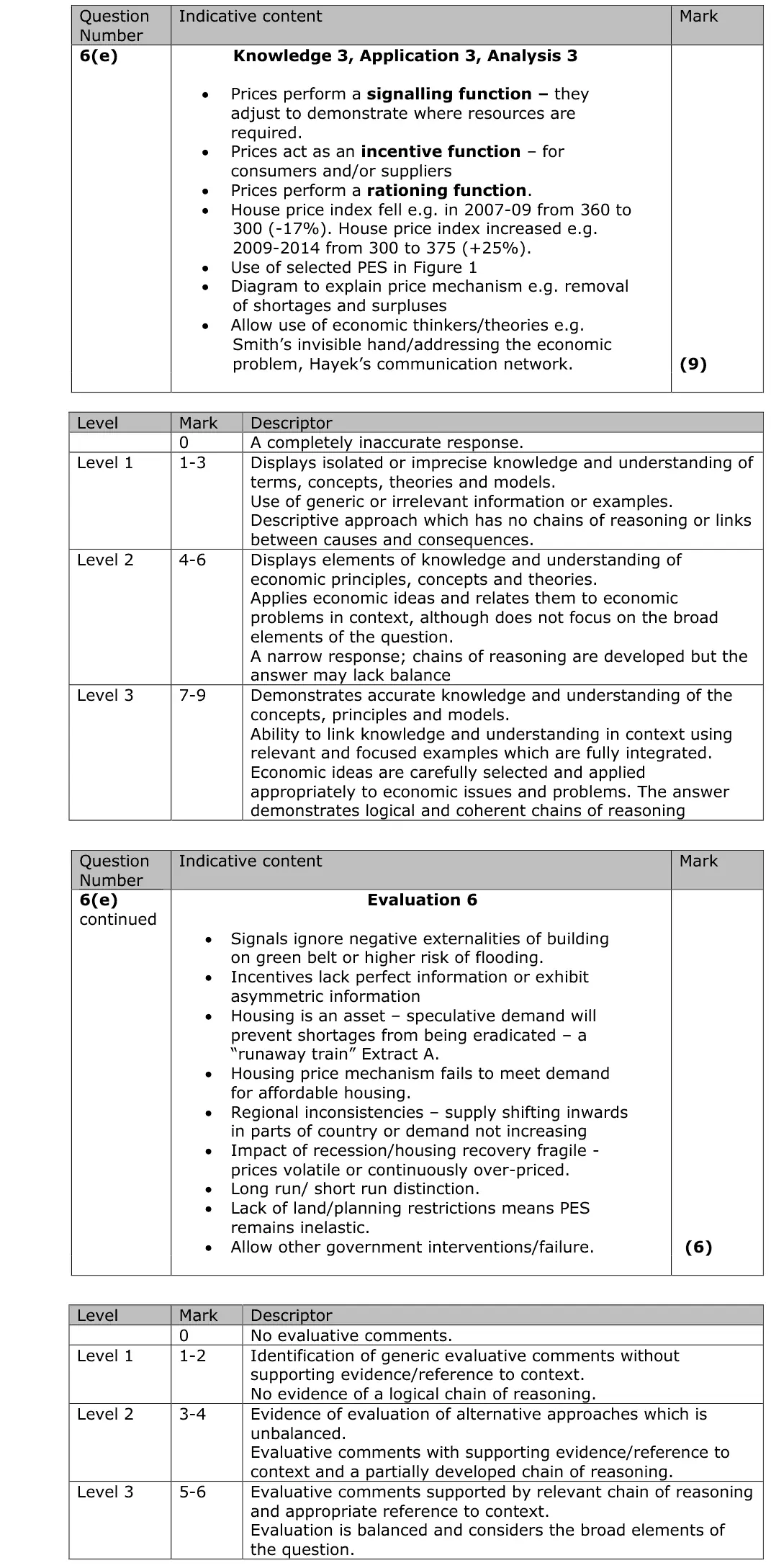
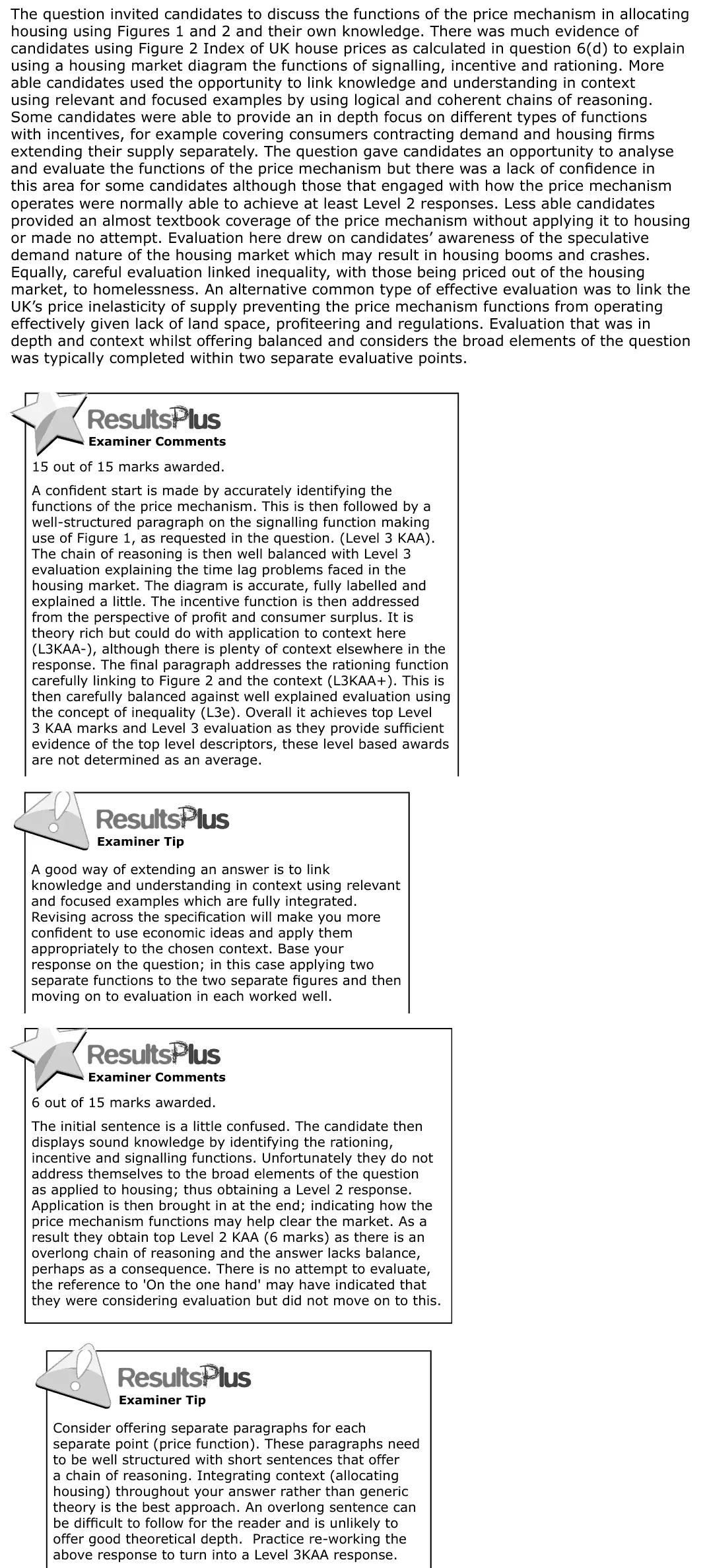
The question invited candidates to discuss the functions of the price mechanism in allocating housing using Figures 1 and 2 and their own knowledge. There was much evidence of candidates using Figure 2 Index of UK house prices as calculated in question 6(d) to explain using a housing market diagram the functions of signalling, incentive and rationing. More able candidates used the opportunity to link knowledge and understanding in context using relevant and focused examples by using logical and coherent chains of reasoning. Some candidates were able to provide an in depth focus on different types of functions with incentives, for example covering consumers contracting demand and housing firms extending their supply separately. The question gave candidates an opportunity to analyse and evaluate the functions of the price mechanism but there was a lack of confidence in this area for some candidates although those that engaged with how the price mechanism operates were normally able to achieve at least Level 2 responses. Less able candidates provided an almost textbook coverage of the price mechanism without applying it to housing or made no attempt. Evaluation here drew on candidates’ awareness of the speculative demand nature of the housing market which may result in housing booms and crashes. Equally, careful evaluation linked inequality, with those being priced out of the housing market, to homelessness. An alternative common type of effective evaluation was to link the UK’s price inelasticity of supply preventing the price mechanism functions from operating effectively given lack of land space, profiteering and regulations. Evaluation that was in depth and context whilst offering balanced and considers the broad elements of the question was typically completed within two separate evaluative points. 15 out of 15 marks awarded. A confident start is made by accurately identifying the functions of the price mechanism. This is then followed by a well-structured paragraph on the signalling function making use of Figure 1, as requested in the question. (Level 3 KAA). The chain of reasoning is then well balanced with Level 3 evaluation explaining the time lag problems faced in the housing market. The diagram is accurate, fully labelled and explained a little. The incentive function is then addressed from the perspective of profit and consumer surplus. It is theory rich but could do with application to context here (L3KAA-), although there is plenty of context elsewhere in the response. The final paragraph addresses the rationing function carefully linking to Figure 2 and the context (L3KAA+). This is then carefully balanced against well explained evaluation using the concept of inequality (L3e). Overall it achieves top Level 3 KAA marks and Level 3 evaluation as they provide sufficient evidence of the top level descriptors, these level based awards are not determined as an average. A good way of extending an answer is to link knowledge and understanding in context using relevant and focused examples which are fully integrated. Revising across the specification will make you more confident to use economic ideas and apply them appropriately to the chosen context. Base your response on the question; in this case applying two separate functions to the two separate figures and then moving on to evaluation in each worked well. 6 out of 15 marks awarded. The initial sentence is a little confused. The candidate then displays sound knowledge by identifying the rationing, incentive and signalling functions. Unfortunately they do not address themselves to the broad elements of the question as applied to housing; thus obtaining a Level 2 response. Application is then brought in at the end; indicating how the price mechanism functions may help clear the market. As a result they obtain top Level 2 KAA (6 marks) as there is an overlong chain of reasoning and the answer lacks balance, perhaps as a consequence. There is no attempt to evaluate, the reference to 'On the one hand' may have indicated that they were considering evaluation but did not move on to this. Consider offering separate paragraphs for each separate point (price function). These paragraphs need to be well structured with short sentences that offer a chain of reasoning. Integrating context (allocating housing) throughout your answer rather than generic theory is the best approach. An overlong sentence can be difficult to follow for the reader and is unlikely to offer good theoretical depth. Practice re-working the above response to turn into a Level 3KAA response.
Quantitative skills: QS 9 (interpret, apply and analyse information in written, graphical tabular and numerical forms)

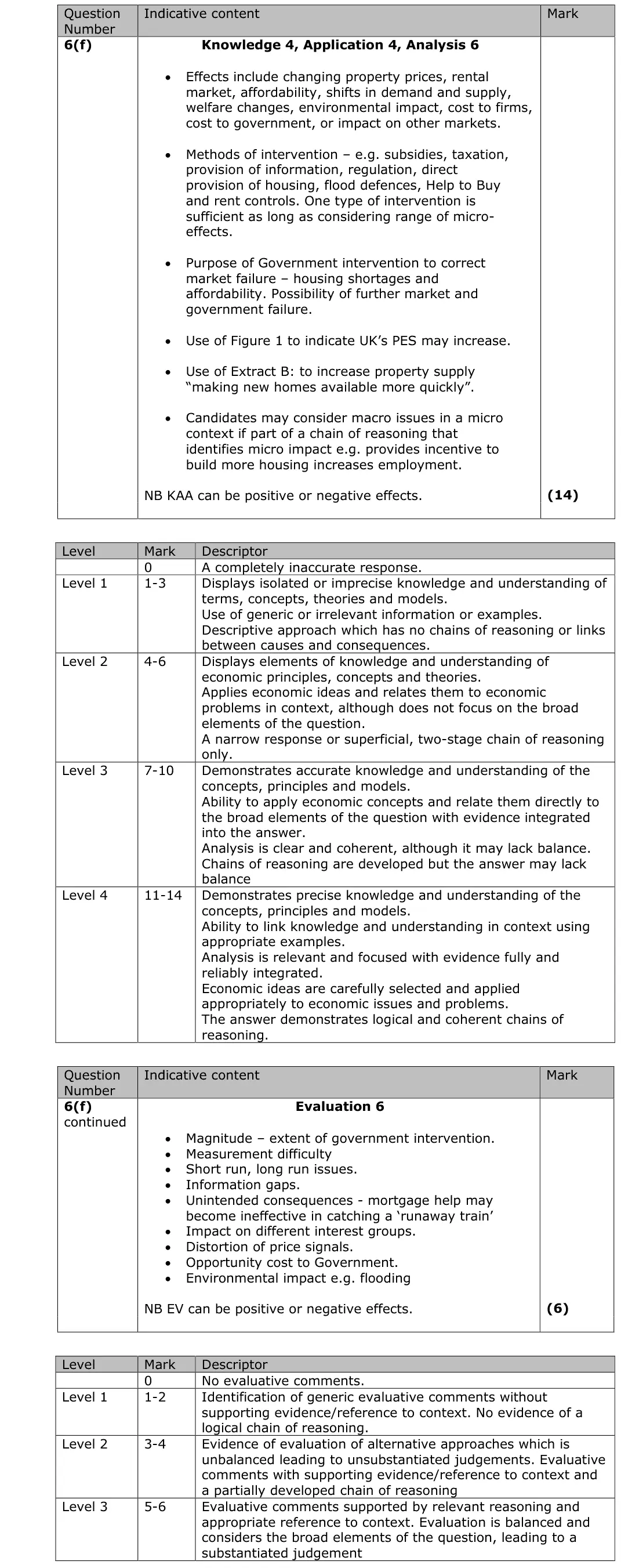
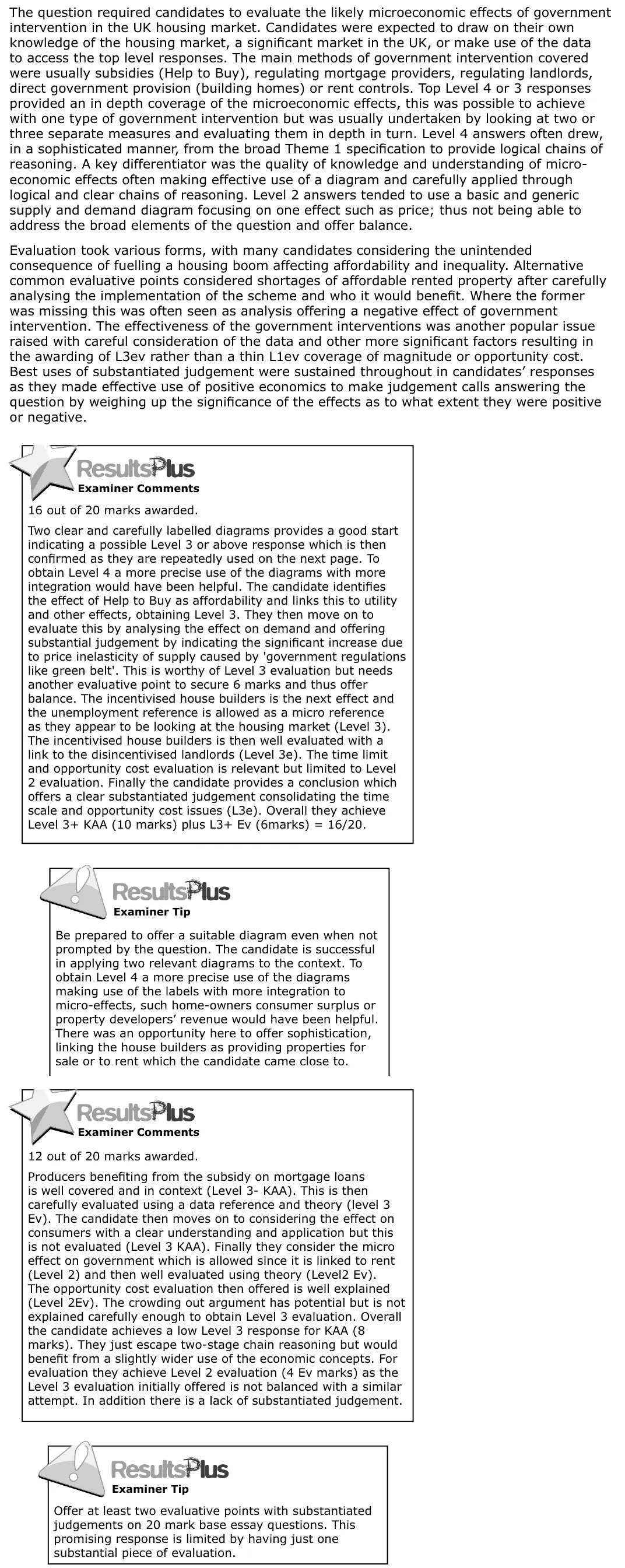
The question required candidates to evaluate the likely microeconomic effects of government intervention in the UK housing market. Candidates were expected to draw on their own knowledge of the housing market, a significant market in the UK, or make use of the data to access the top level responses. The main methods of government intervention covered were usually subsidies (Help to Buy), regulating mortgage providers, regulating landlords, direct government provision (building homes) or rent controls. Top Level 4 or 3 responses provided an in depth coverage of the microeconomic effects, this was possible to achieve with one type of government intervention but was usually undertaken by looking at two or three separate measures and evaluating them in depth in turn. Level 4 answers often drew, in a sophisticated manner, from the broad Theme 1 specification to provide logical chains of reasoning. A key differentiator was the quality of knowledge and understanding of micro- economic effects often making effective use of a diagram and carefully applied through logical and clear chains of reasoning. Level 2 answers tended to use a basic and generic supply and demand diagram focusing on one effect such as price; thus not being able to address the broad elements of the question and offer balance. Evaluation took various forms, with many candidates considering the unintended consequence of fuelling a housing boom affecting affordability and inequality. Alternative common evaluative points considered shortages of affordable rented property after carefully analysing the implementation of the scheme and who it would benefit. Where the former was missing this was often seen as analysis offering a negative effect of government intervention. The effectiveness of the government interventions was another popular issue raised with careful consideration of the data and other more significant factors resulting in the awarding of L3ev rather than a thin L1ev coverage of magnitude or opportunity cost. Best uses of substantiated judgement were sustained throughout in candidates’ responses as they made effective use of positive economics to make judgement calls answering the question by weighing up the significance of the effects as to what extent they were positive or negative. 16 out of 20 marks awarded. Two clear and carefully labelled diagrams provides a good start indicating a possible Level 3 or above response which is then confirmed as they are repeatedly used on the next page. To obtain Level 4 a more precise use of the diagrams with more integration would have been helpful. The candidate identifies the effect of Help to Buy as affordability and links this to utility and other effects, obtaining Level 3. They then move on to evaluate this by analysing the effect on demand and offering substantial judgement by indicating the significant increase due to price inelasticity of supply caused by 'government regulations like green belt'. This is worthy of Level 3 evaluation but needs another evaluative point to secure 6 marks and thus offer balance. The incentivised house builders is the next effect and the unemployment reference is allowed as a micro reference as they appear to be looking at the housing market (Level 3). The incentivised house builders is then well evaluated with a link to the disincentivised landlords (Level 3e). The time limit and opportunity cost evaluation is relevant but limited to Level 2 evaluation. Finally the candidate provides a conclusion which offers a clear substantiated judgement consolidating the time scale and opportunity cost issues (L3e). Overall they achieve Level 3+ KAA (10 marks) plus L3+ Ev (6marks) = 16/20. Be prepared to offer a suitable diagram even when not prompted by the question. The candidate is successful in applying two relevant diagrams to the context. To obtain Level 4 a more precise use of the diagrams making use of the labels with more integration to micro-effects, such home-owners consumer surplus or property developers’ revenue would have been helpful. There was an opportunity here to offer sophistication, linking the house builders as providing properties for sale or to rent which the candidate came close to. 12 out of 20 marks awarded. Producers benefiting from the subsidy on mortgage loans is well covered and in context (Level 3- KAA). This is then carefully evaluated using a data reference and theory (level 3 Ev). The candidate then moves on to considering the effect on consumers with a clear understanding and application but this is not evaluated (Level 3 KAA). Finally they consider the micro effect on government which is allowed since it is linked to rent (Level 2) and then well evaluated using theory (Level2 Ev). The opportunity cost evaluation then offered is well explained (Level 2Ev). The crowding out argument has potential but is not explained carefully enough to obtain Level 3 evaluation. Overall the candidate achieves a low Level 3 response for KAA (8 marks). They just escape two-stage chain reasoning but would benefit from a slightly wider use of the economic concepts. For evaluation they achieve Level 2 evaluation (4 Ev marks) as the Level 3 evaluation initially offered is not balanced with a similar attempt. In addition there is a lack of substantiated judgement. Offer at least two evaluative points with substantiated judgements on 20 mark base essay questions. This promising response is limited by having just one substantial piece of evaluation.

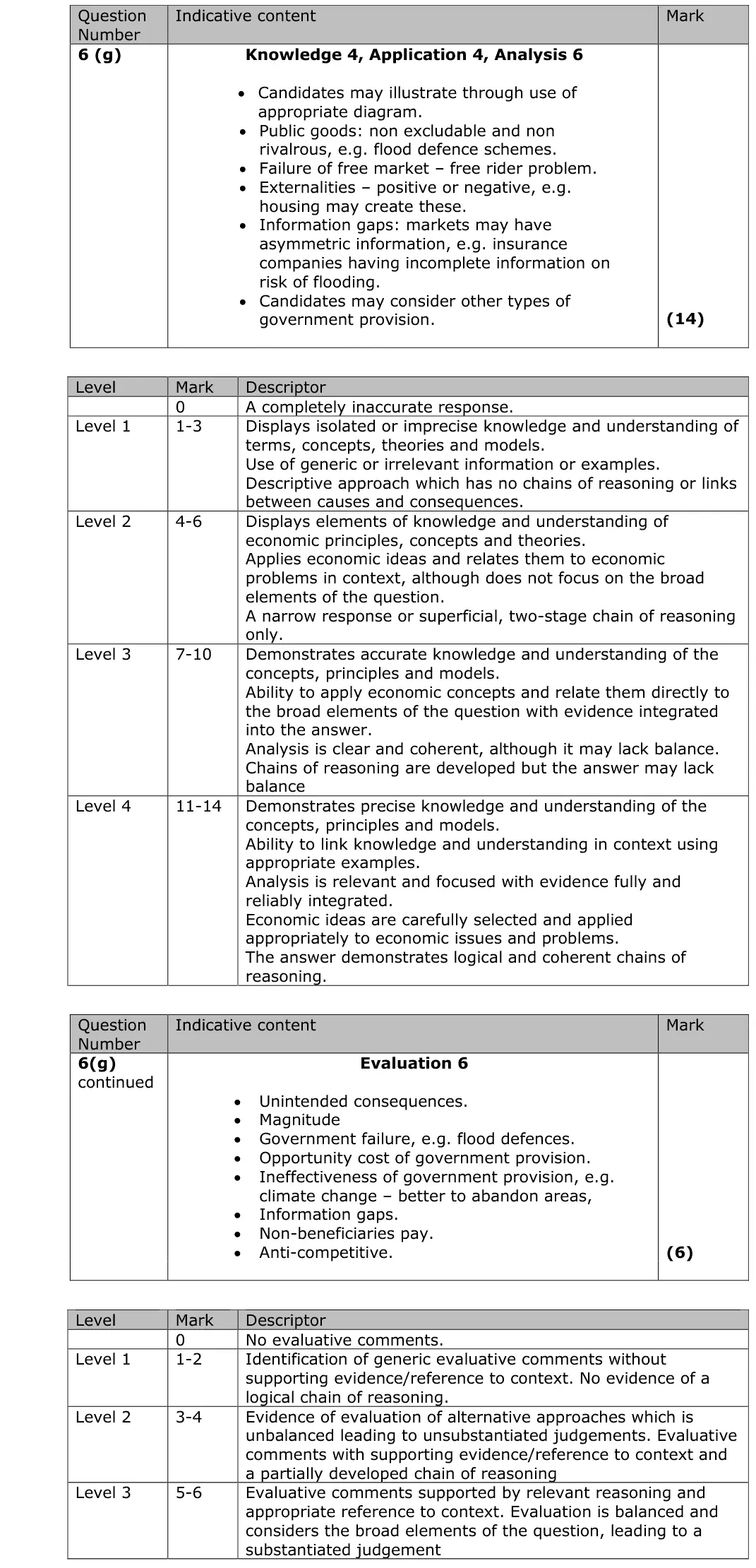
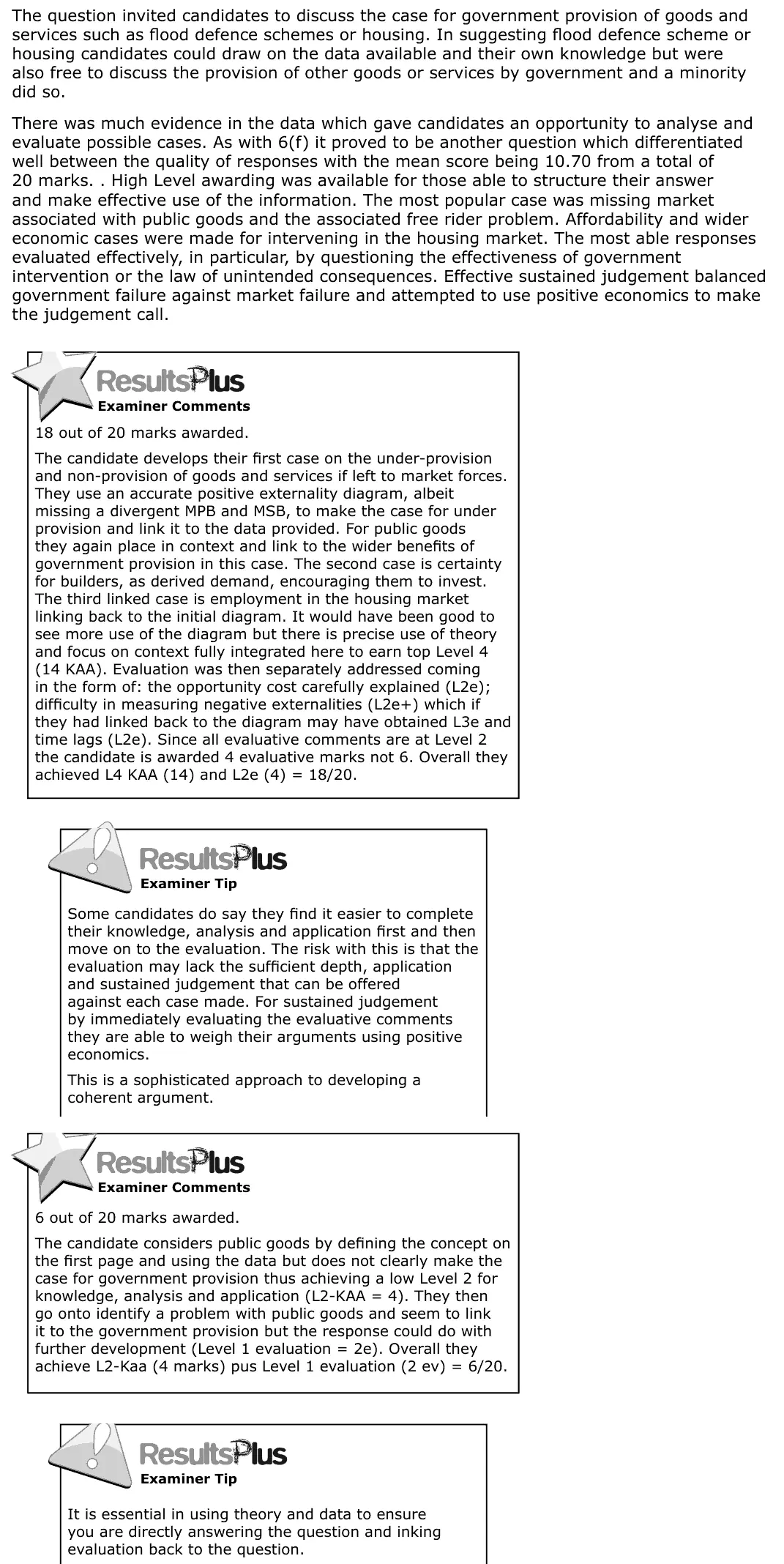
The question invited candidates to discuss the case for government provision of goods and services such as flood defence schemes or housing. In suggesting flood defence scheme or housing candidates could draw on the data available and their own knowledge but were also free to discuss the provision of other goods or services by government and a minority did so. There was much evidence in the data which gave candidates an opportunity to analyse and evaluate possible cases. As with 6(f) it proved to be another question which differentiated well between the quality of responses with the mean score being 10.70 from a total of 20 marks. . High Level awarding was available for those able to structure their answer and make effective use of the information. The most popular case was missing market associated with public goods and the associated free rider problem. Affordability and wider economic cases were made for intervening in the housing market. The most able responses evaluated effectively, in particular, by questioning the effectiveness of government intervention or the law of unintended consequences. Effective sustained judgement balanced government failure against market failure and attempted to use positive economics to make the judgement call. 18 out of 20 marks awarded. The candidate develops their first case on the under-provision and non-provision of goods and services if left to market forces. They use an accurate positive externality diagram, albeit missing a divergent MPB and MSB, to make the case for under provision and link it to the data provided. For public goods they again place in context and link to the wider benefits of government provision in this case. The second case is certainty for builders, as derived demand, encouraging them to invest. The third linked case is employment in the housing market linking back to the initial diagram. It would have been good to see more use of the diagram but there is precise use of theory and focus on context fully integrated here to earn top Level 4 (14 KAA). Evaluation was then separately addressed coming in the form of: the opportunity cost carefully explained (L2e); difficulty in measuring negative externalities (L2e+) which if they had linked back to the diagram may have obtained L3e and time lags (L2e). Since all evaluative comments are at Level 2 the candidate is awarded 4 evaluative marks not 6. Overall they achieved L4 KAA (14) and L2e (4) = 18/20. Some candidates do say they find it easier to complete their knowledge, analysis and application first and then move on to the evaluation. The risk with this is that the evaluation may lack the sufficient depth, application and sustained judgement that can be offered against each case made. For sustained judgement by immediately evaluating the evaluative comments they are able to weigh their arguments using positive economics. This is a sophisticated approach to developing a coherent argument. 6 out of 20 marks awarded. The candidate considers public goods by defining the concept on the first page and using the data but does not clearly make the case for government provision thus achieving a low Level 2 for knowledge, analysis and application (L2-KAA = 4). They then go onto identify a problem with public goods and seem to link it to the government provision but the response could do with further development (Level 1 evaluation = 2e). Overall they achieve L2-Kaa (4 marks) pus Level 1 evaluation (2 ev) = 6/20. It is essential in using theory and data to ensure you are directly answering the question and inking evaluation back to the question.
Want a paper marked and gone through with you? Message us.