June 2022: AS Paper 2

80 marks · 19 question parts · Paper, mark scheme and report on Pearson's site

Question by question

QTopicMarksAOType
1(a) Demand-side policies: fiscal and monetary policy 1Multiple choice
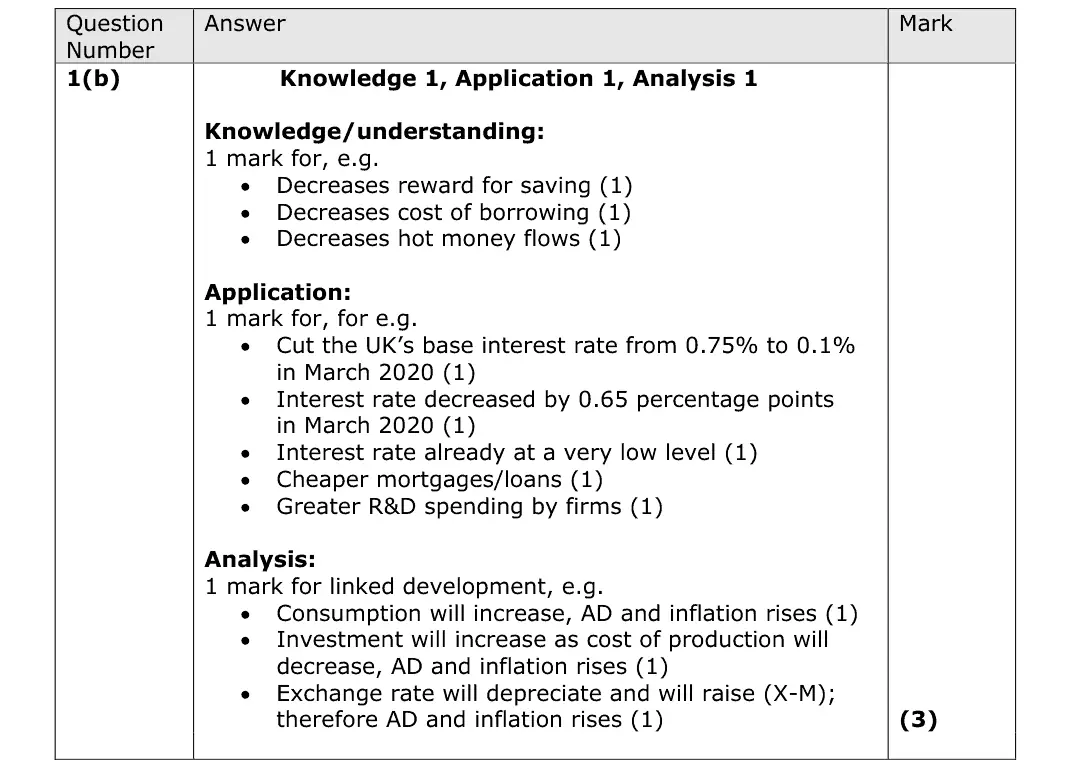
1(b) Demand-side policies: fiscal and monetary policy 3AO1=1,AO2=1,AO3=1Short answer
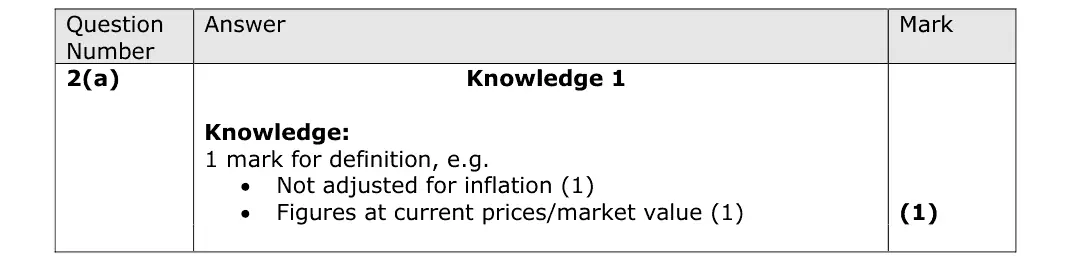
2(a) Measuring economic growth: GDP, GNI and living standards 1AO1=1Definition
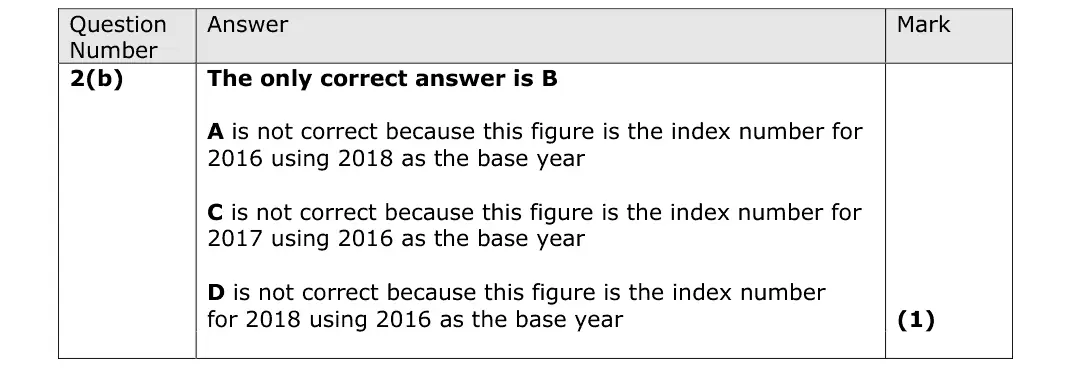
2(b) Measuring economic growth: GDP, GNI and living standards 1Multiple choice
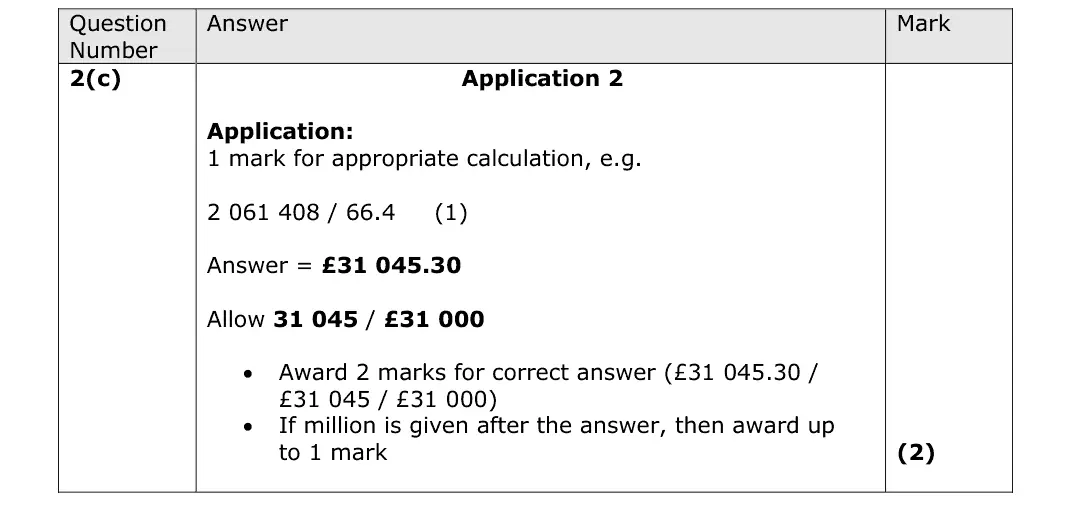
2(c) Measuring economic growth: GDP, GNI and living standards 2AO2=2Calculation
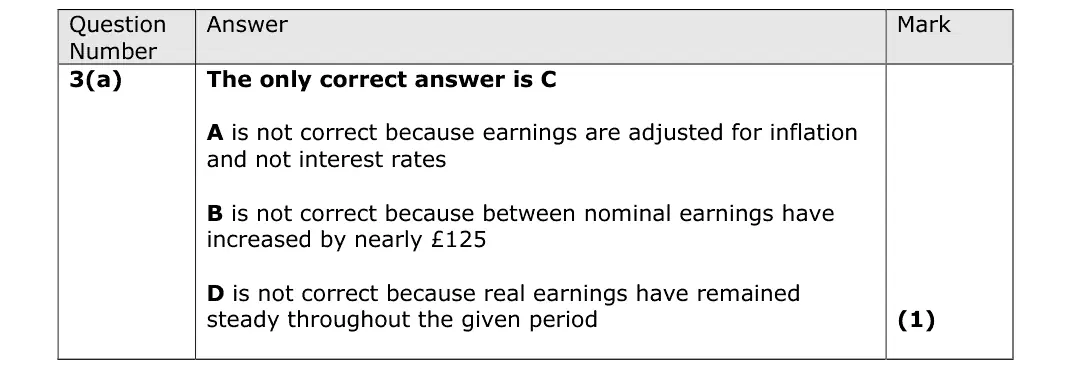
3(a) Measuring economic growth: GDP, GNI and living standards 1Multiple choice
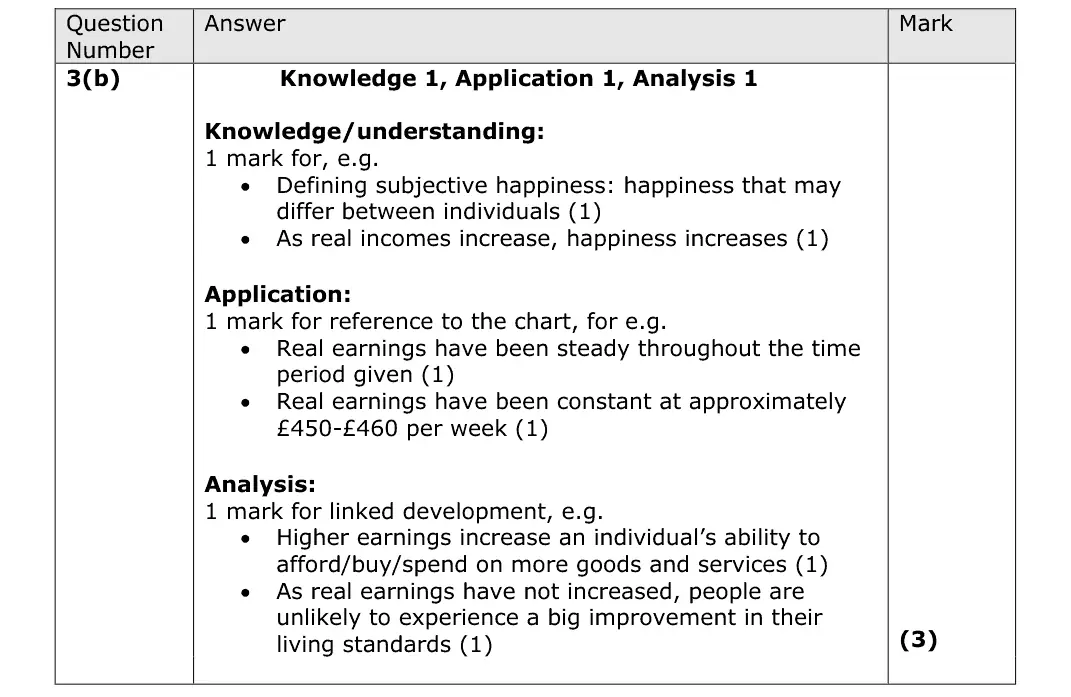
3(b) Measuring economic growth: GDP, GNI and living standards 3AO1=1,AO2=1,AO3=1Short answer
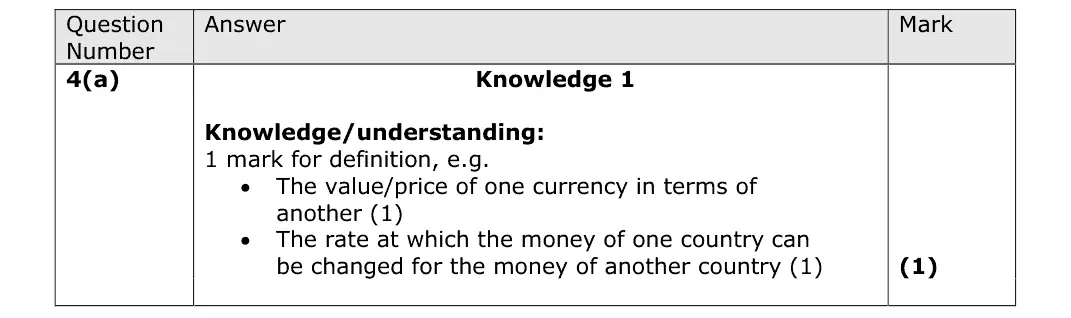
4(a) Aggregate demand 1AO1=1Definition
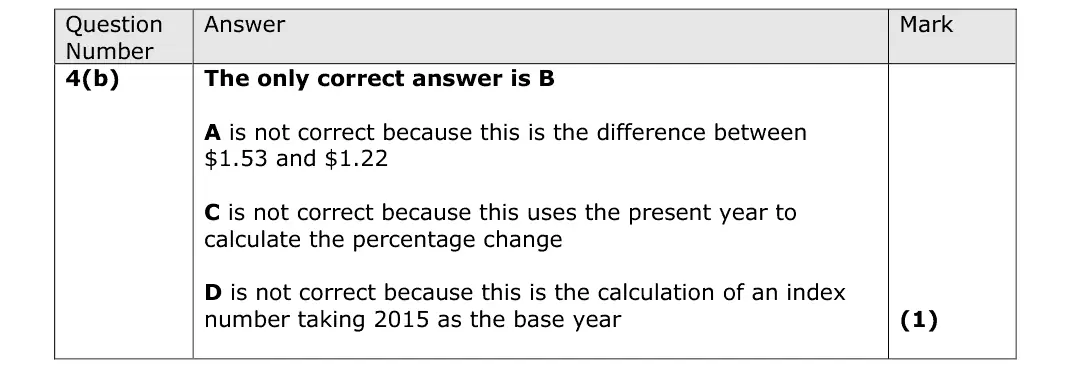
4(b) Aggregate demand 1Multiple choice
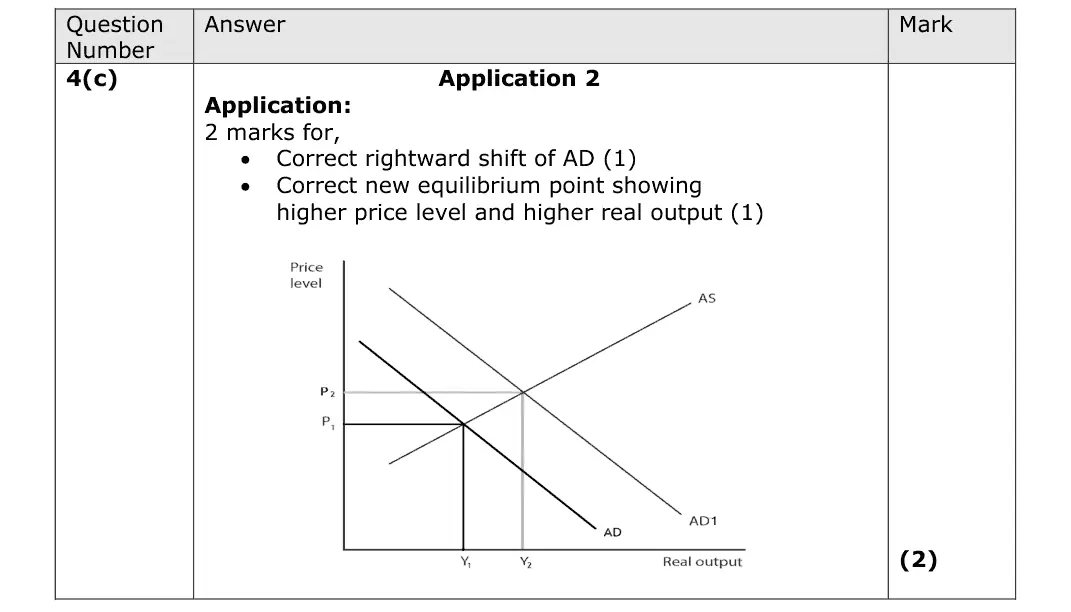
4(c) Aggregate demand, The circular flow, national income and the multiplier 2AO2=2Diagram
5(a) Inflation 1Multiple choice
5(b) Inflation 3AO1=1,AO2=1,AO3=1Short answer
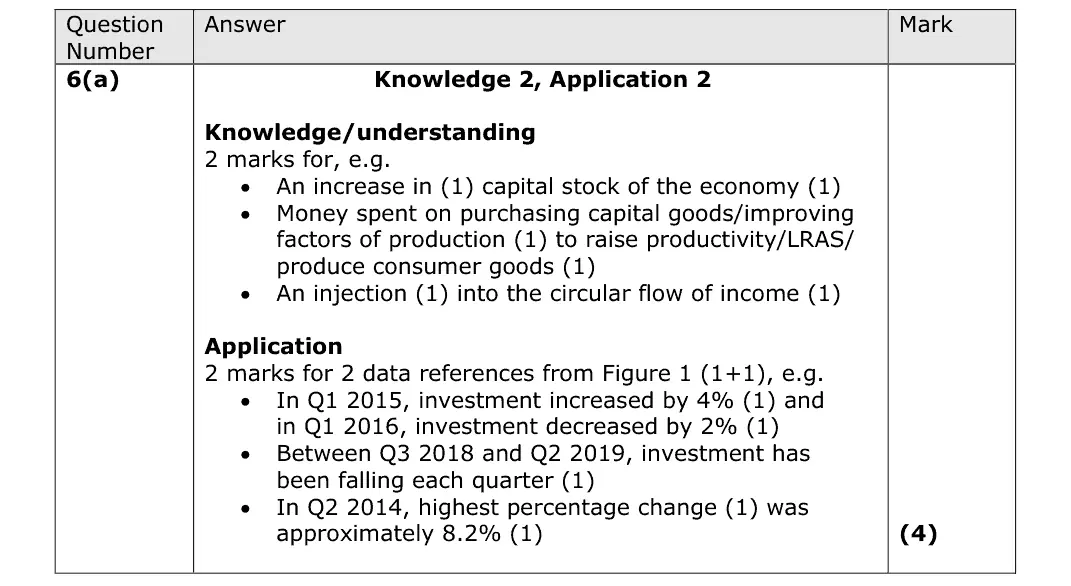
6(a) Aggregate demand 4AO1=2,AO2=2Short answer
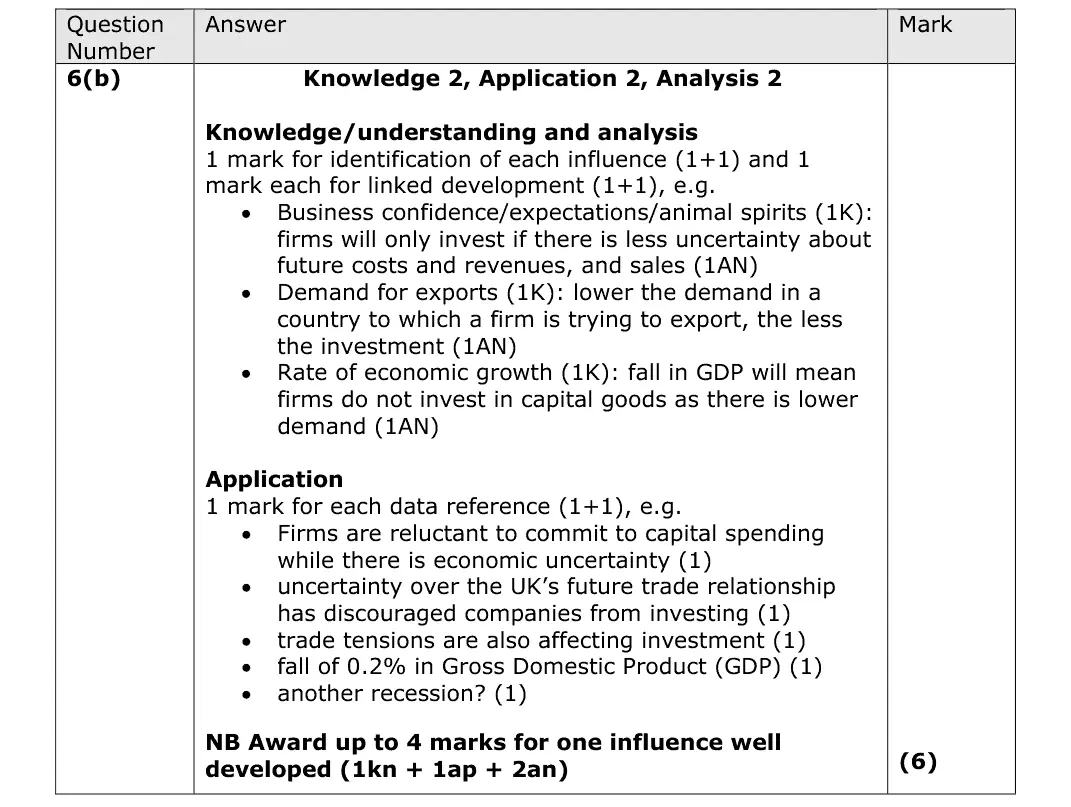
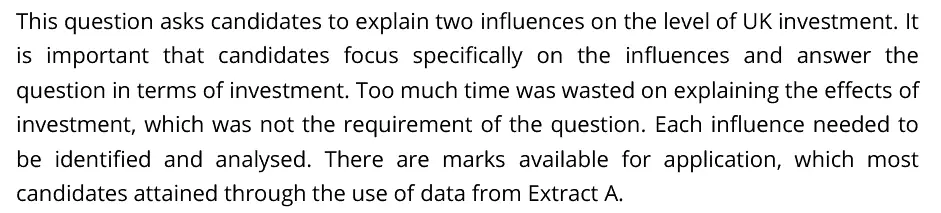
6(b) Aggregate demand 6AO1=2,AO2=2,AO3=2Short answer
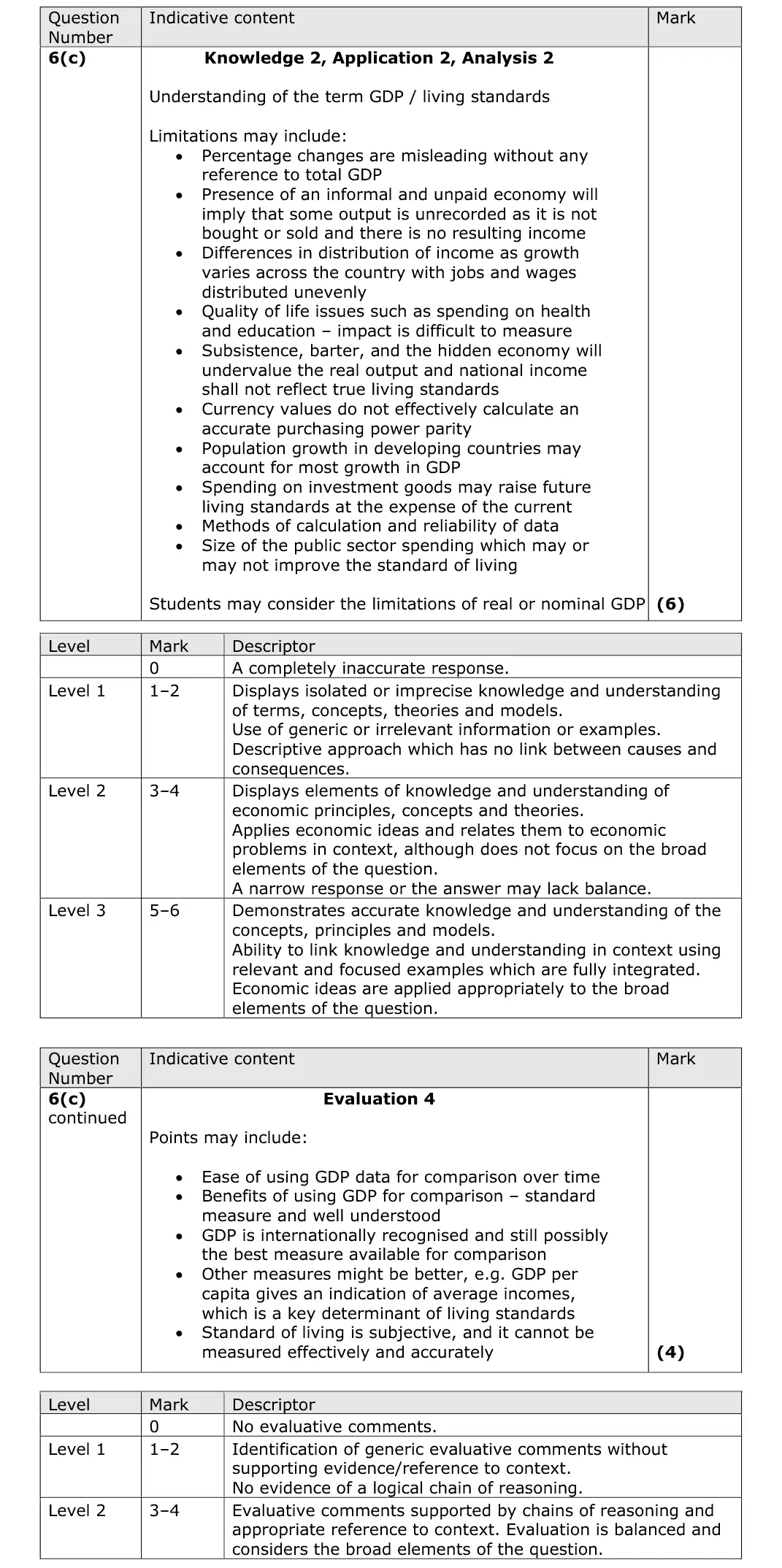
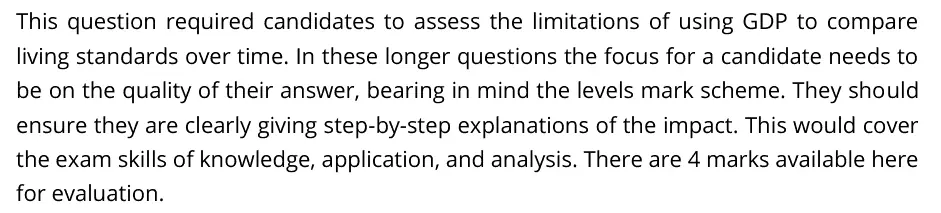
6(c) Measuring economic growth: GDP, GNI and living standards 10AO1=2,AO2=2,AO3=2,AO4=4Extended response
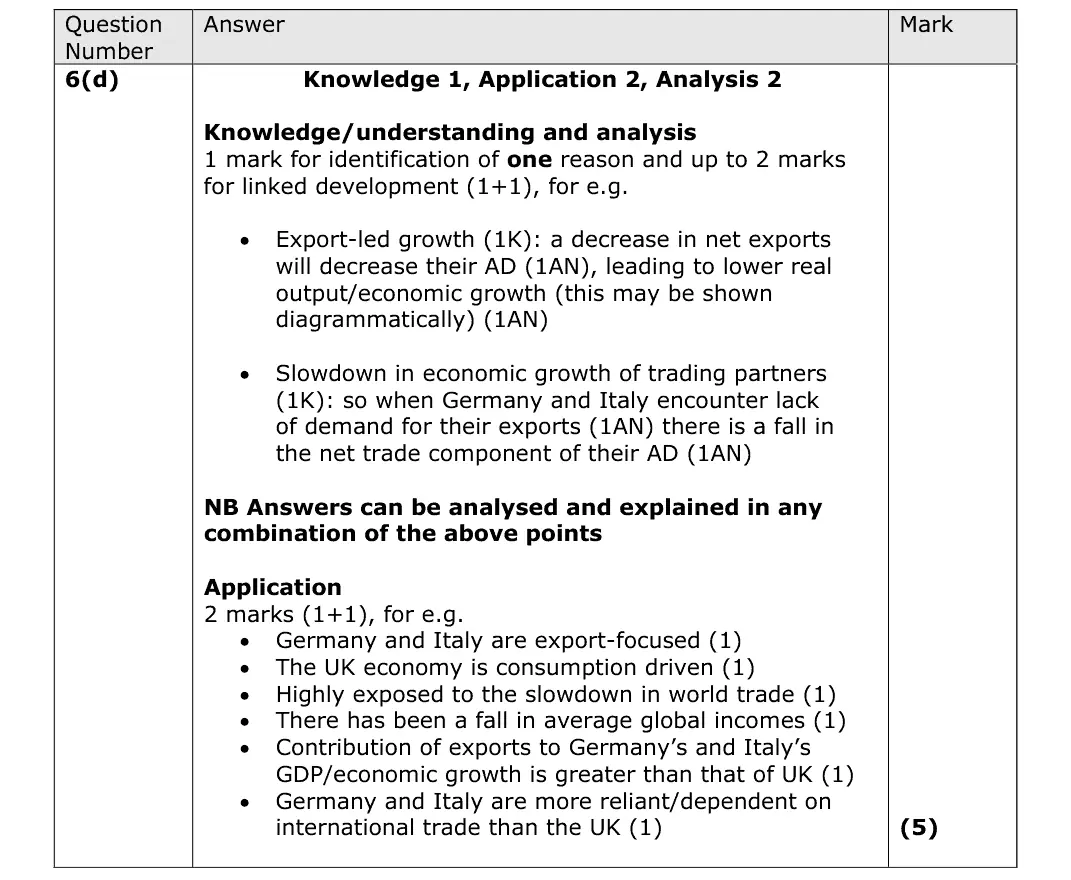
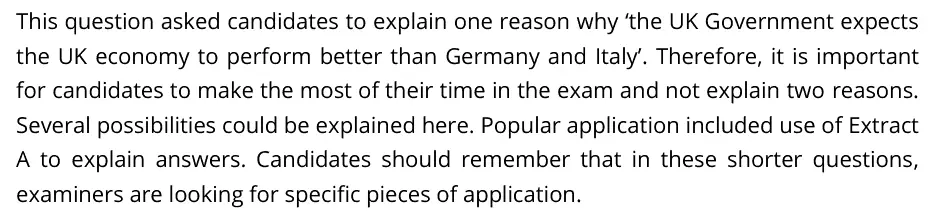
6(d) The balance of payments, Economic growth, output gaps and the trade cycle 5AO1=1,AO2=2,AO3=2Short answer
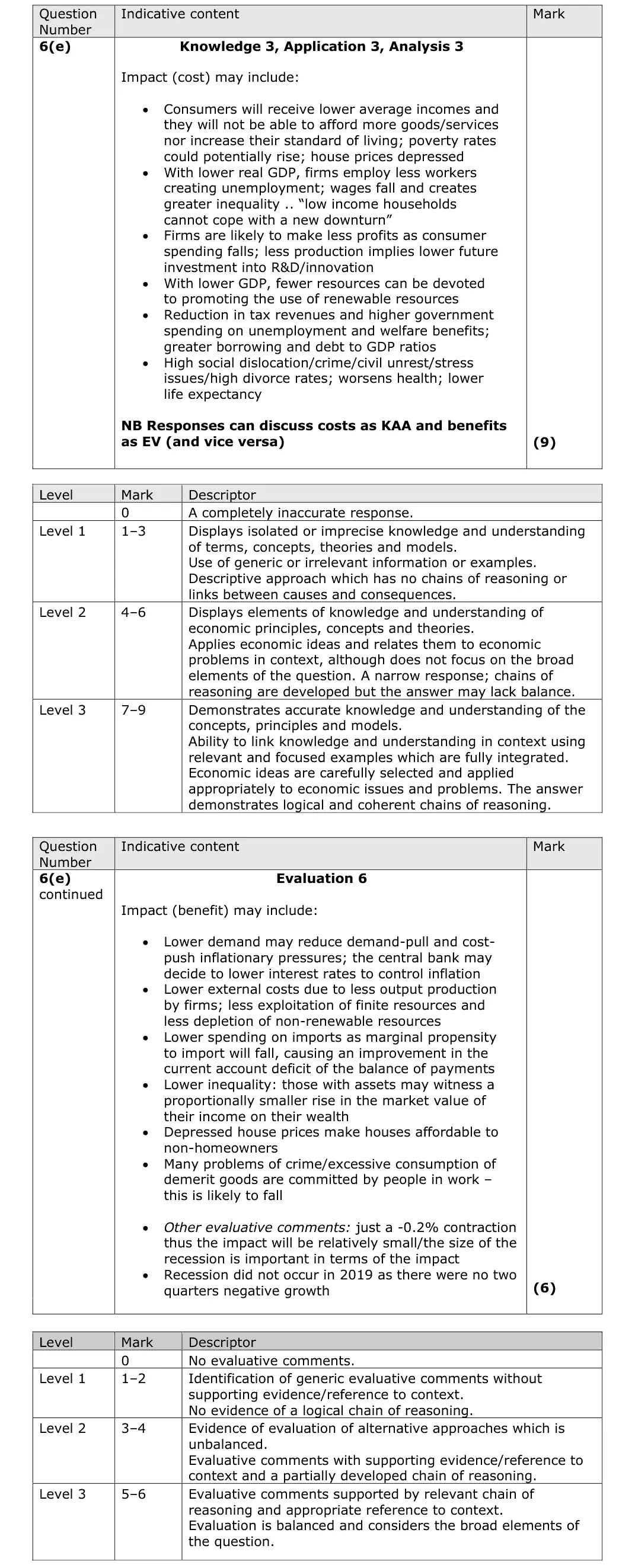
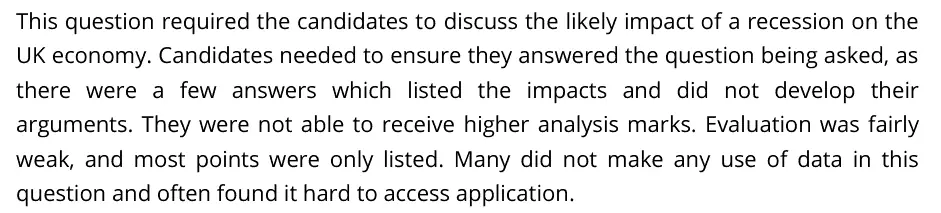
6(e) Economic growth, output gaps and the trade cycle 15AO1=3,AO2=3,AO3=3,AO4=6Extended response
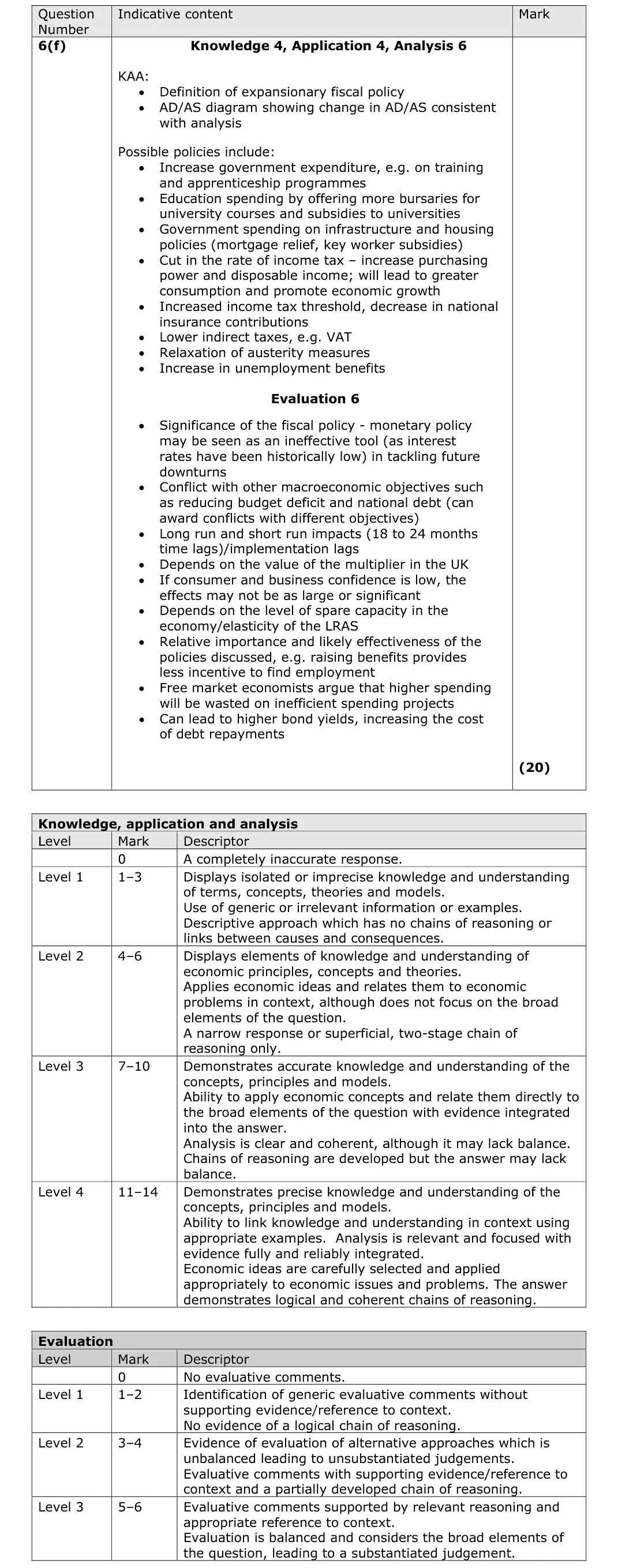
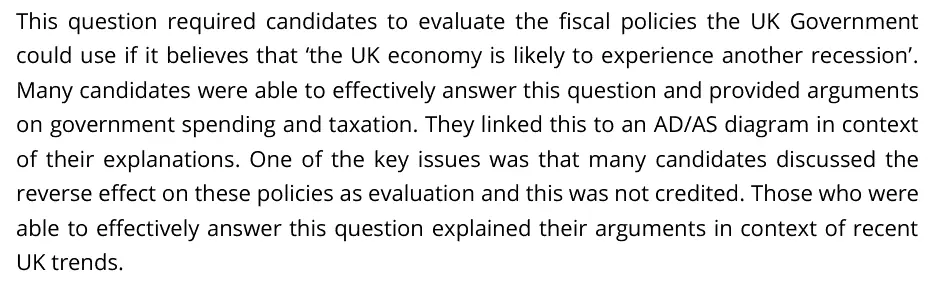
6(f) Demand-side policies: fiscal and monetary policy 20AO1=4,AO2=4,AO3=6,AO4=6Essay
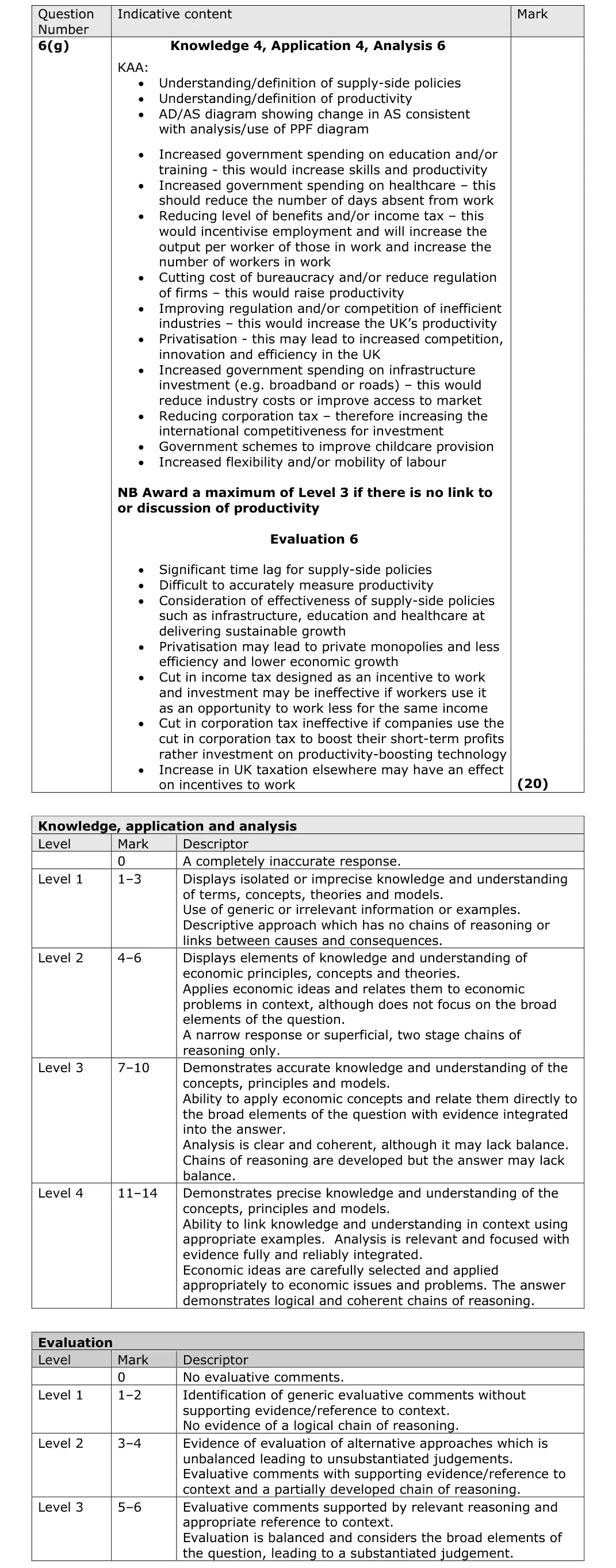
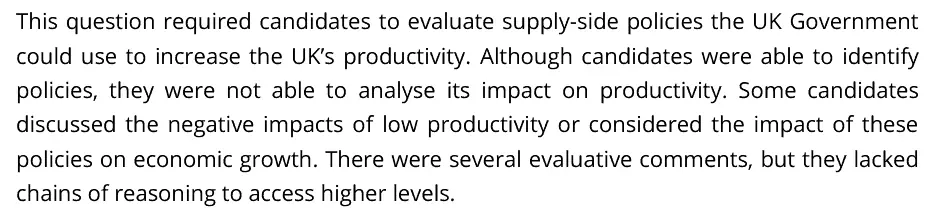
6(g) Supply-side policies 20AO1=4,AO2=4,AO3=6,AO4=6Essay

The questions

1(a)1(b)2(a)2(b)2(c)3(a)3(b)4(a)4(b)4(c)5(a)5(b)6(a)6(b)6(c)6(d)6(e)6(f)6(g)
June 2022 · AS Paper 2 · Q1(a) 1 mark Multiple choice fiscal and monetary policy
Data and extracts for question 11 In March 2020 the Monetary Policy Committee (MPC) of the Bank of England reintroduced its quantitative easing programme.
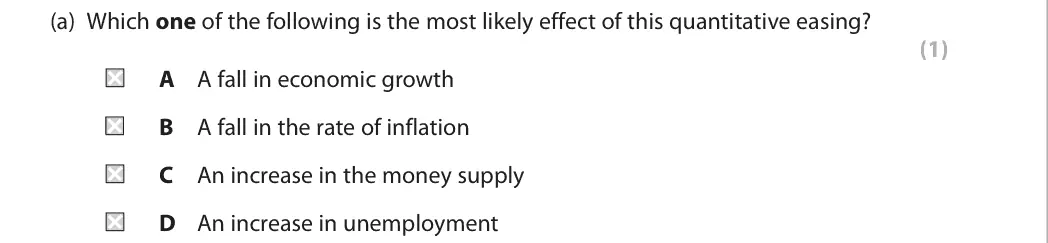
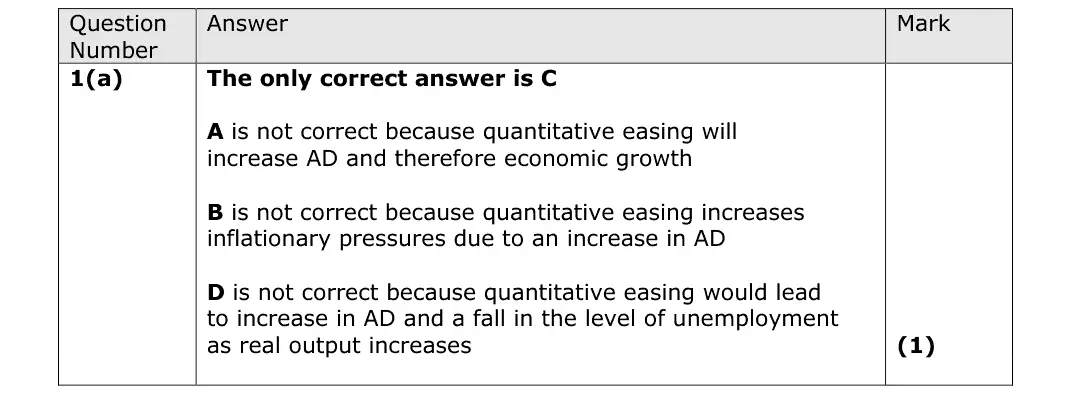
(a) Which one of the following is the most likely effect of this quantitative easing? (1) A A fall in economic growth B A fall in the rate of inflation C An increase in the money supply D An increase in unemployment
June 2022 · AS Paper 2 · Q1(b) 3 marks AO1=1, AO2=1, AO3=1 Short answer fiscal and monetary policy
Data and extracts for question 11 In March 2020 the Monetary Policy Committee (MPC) of the Bank of England reintroduced its quantitative easing programme.
The MPC of the Bank of England also cut the UK’s base interest rate from 0.75% to 0.1% in March 2020. (b) Explain one likely impact of a decrease in the base interest rate on inflation. (3)
June 2022 · AS Paper 2 · Q2(a) 1 mark AO1=1 Definition measuring economic growth
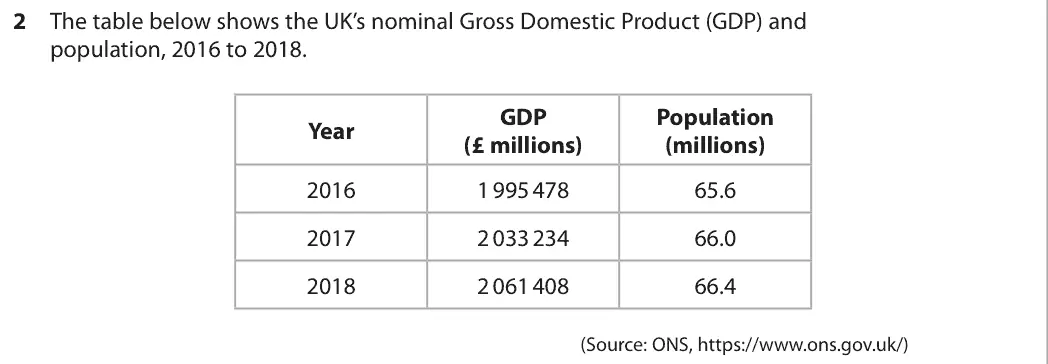
Data and extracts for question 22 The table below shows the UK’s nominal Gross Domestic Product (GDP) and population, 2016 to 2018. GDP Population Year (£ millions) (millions) 2016 1 995 478 65.6 2017 2 033 234 66.0 2018 2 061 408 66.4 (Source: ONS, https://www.ons.gov.uk/)
(a) Define the term ‘nominal’. (1)
June 2022 · AS Paper 2 · Q2(b) 1 mark Multiple choice measuring economic growth
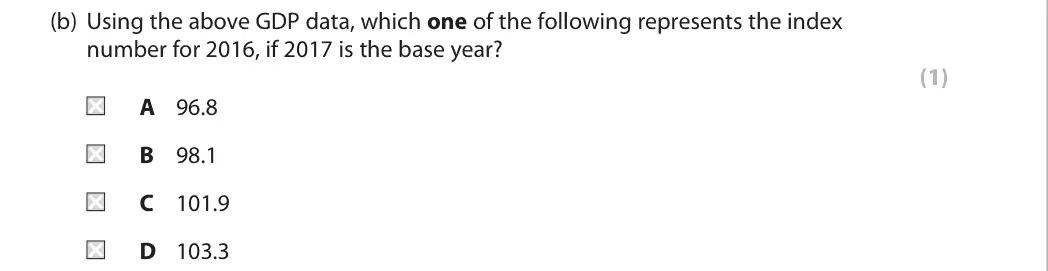
Data and extracts for question 22 The table below shows the UK’s nominal Gross Domestic Product (GDP) and population, 2016 to 2018. GDP Population Year (£ millions) (millions) 2016 1 995 478 65.6 2017 2 033 234 66.0 2018 2 061 408 66.4 (Source: ONS, https://www.ons.gov.uk/)
(b) Using the above GDP data, which one of the following represents the index number for 2016, if 2017 is the base year? (1) A 96.8 B 98.1 C 101.9 D 103.3
June 2022 · AS Paper 2 · Q2(c) 2 marks AO2=2 Calculation measuring economic growth
Data and extracts for question 22 The table below shows the UK’s nominal Gross Domestic Product (GDP) and population, 2016 to 2018. GDP Population Year (£ millions) (millions) 2016 1 995 478 65.6 2017 2 033 234 66.0 2018 2 061 408 66.4 (Source: ONS, https://www.ons.gov.uk/)
(c) Calculate the UK’s nominal GDP per capita in 2018. You are advised to show your working. (2)
June 2022 · AS Paper 2 · Q3(a) 1 mark Multiple choice measuring economic growth
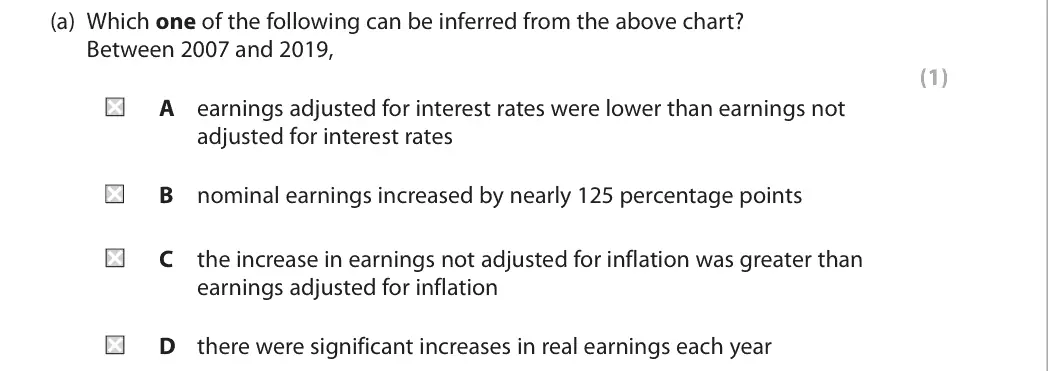
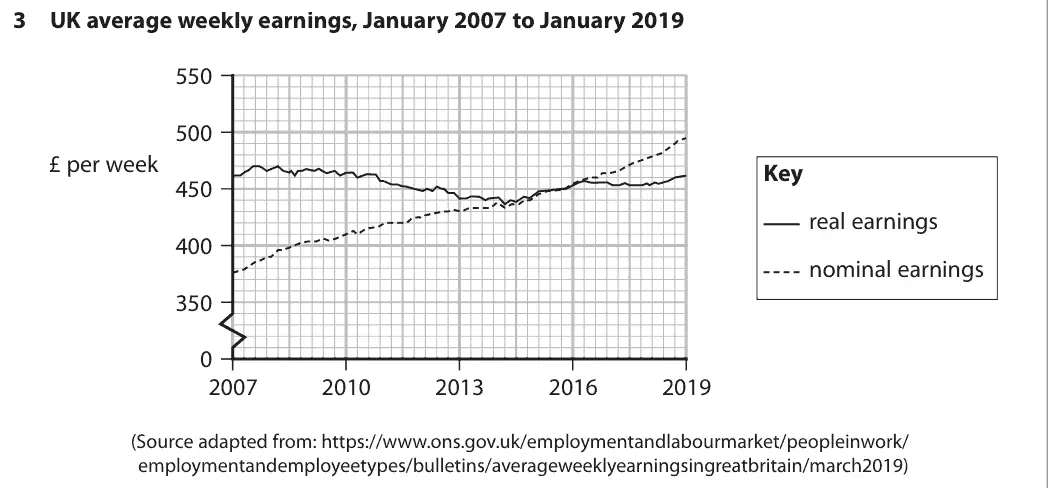
Data and extracts for question 33 UK average weekly earnings, January 2007 to January 2019 550 500 £ per week Key 450 real earnings 400 nominal earnings 350 0 2007 2010 2013 2016 2019 (Source adapted from: https://www.ons.gov.uk/employmentandlabourmarket/peopleinwork/ employmentandemployeetypes/bulletins/averageweeklyearningsingreatbritain/march2019)
(a) Which one of the following can be inferred from the above chart? Between 2007 and 2019, (1) A earnings adjusted for interest rates were lower than earnings not adjusted for interest rates B nominal earnings increased by nearly 125 percentage points C the increase in earnings not adjusted for inflation was greater than earnings adjusted for inflation D there were significant increases in real earnings each year
June 2022 · AS Paper 2 · Q3(b) 3 marks AO1=1, AO2=1, AO3=1 Short answer measuring economic growth
Data and extracts for question 33 UK average weekly earnings, January 2007 to January 2019 550 500 £ per week Key 450 real earnings 400 nominal earnings 350 0 2007 2010 2013 2016 2019 (Source adapted from: https://www.ons.gov.uk/employmentandlabourmarket/peopleinwork/ employmentandemployeetypes/bulletins/averageweeklyearningsingreatbritain/march2019)
(b) With reference to the chart, explain the likely relationship between real incomes and subjective happiness. (3)
June 2022 · AS Paper 2 · Q4(a) 1 mark AO1=1 Definition Hard aggregate demand
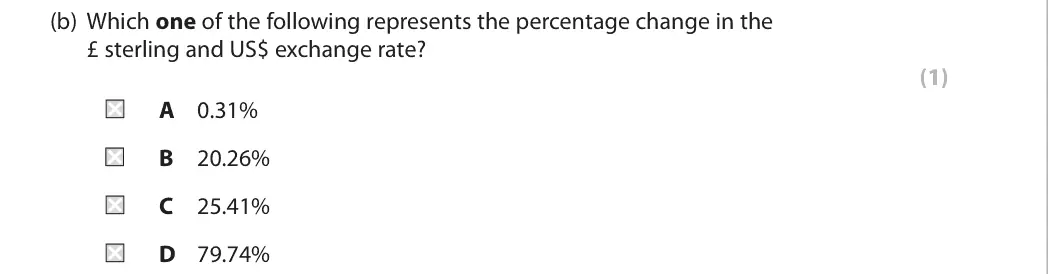
Data and extracts for question 44 The UK exchange rate changed from £1 = $1.53 in January 2015 to £1 = $1.22 in October 2019.
(a) Define the term ‘exchange rate’. (1)
June 2022 · AS Paper 2 · Q4(b) 1 mark Multiple choice aggregate demand
Data and extracts for question 44 The UK exchange rate changed from £1 = $1.53 in January 2015 to £1 = $1.22 in October 2019.
(b) Which one of the following represents the percentage change in the £ sterling and US$ exchange rate? (1) A 0.31% B 20.26% C 25.41% D 79.74%
June 2022 · AS Paper 2 · Q4(c) 2 marks AO2=2 Diagram aggregate demandnational income and the multiplier
Data and extracts for question 44 The UK exchange rate changed from £1 = $1.53 in January 2015 to £1 = $1.22 in October 2019.
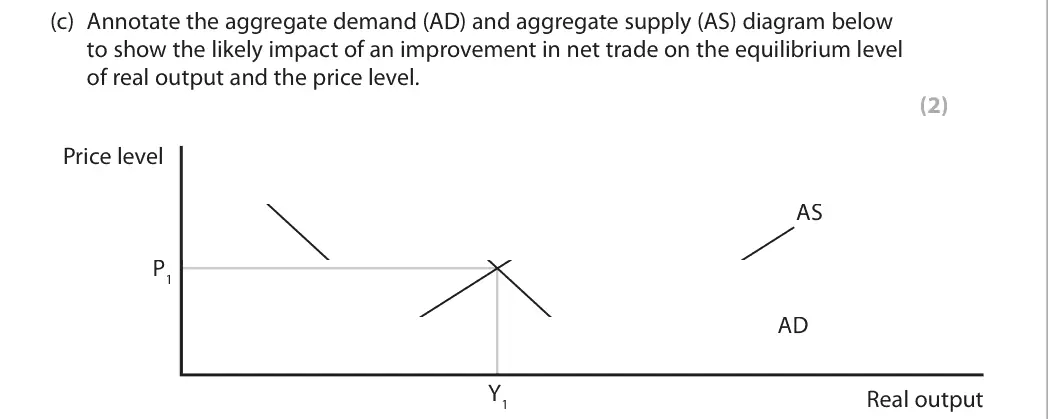
(c) Annotate the aggregate demand (AD) and aggregate supply (AS) diagram below to show the likely impact of an improvement in net trade on the equilibrium level of real output and the price level. (2) Price level AS P1 AD Y1 Real output
June 2022 · AS Paper 2 · Q5(a) 1 mark Multiple choice inflation
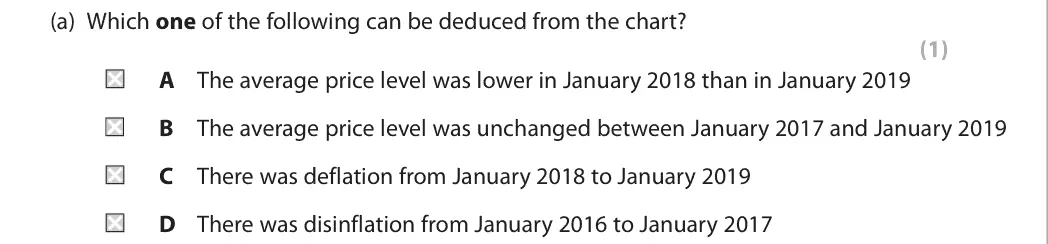
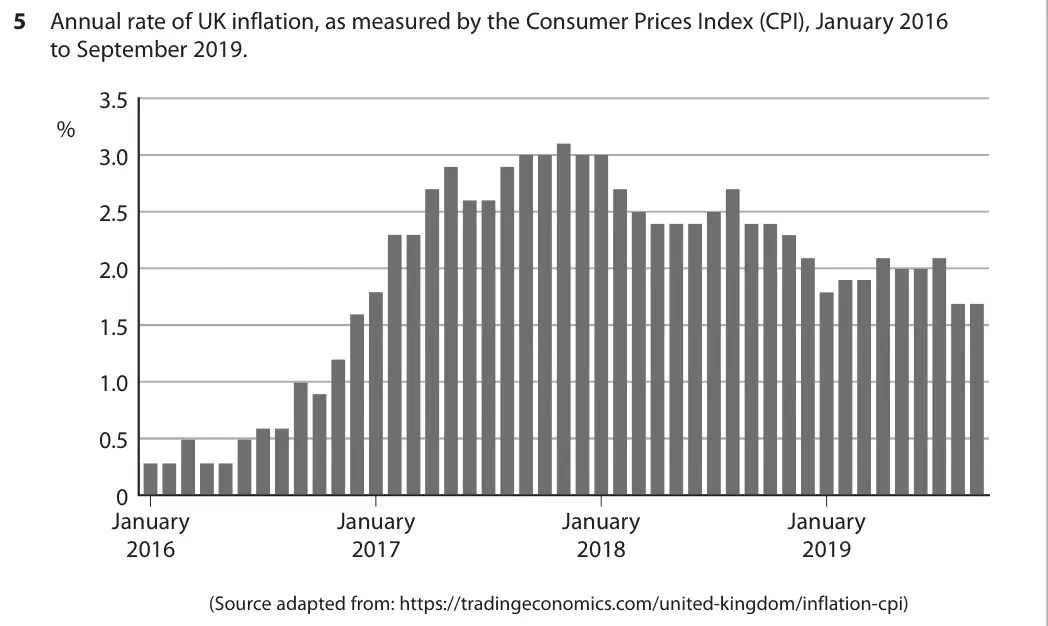
Data and extracts for question 55 Annual rate of UK inflation, as measured by the Consumer Prices Index (CPI), January 2016 to September 2019. 3.5 % 3.0 2.5 2.0 1.5 1.0 0.5 0 January January January January 2016 2017 2018 2019 (Source adapted from: https://tradingeconomics.com/united-kingdom/inflation-cpi)
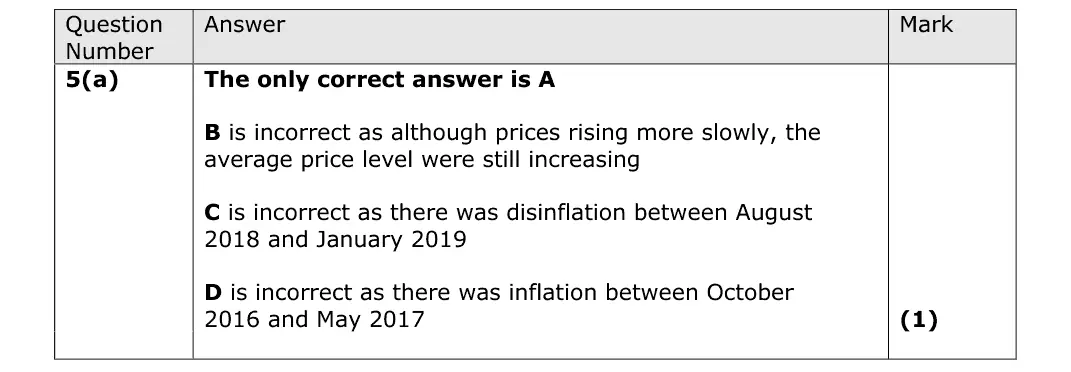
(a) Which one of the following can be deduced from the chart? (1) A The average price level was lower in January 2018 than in January 2019 B The average price level was unchanged between January 2017 and January 2019 C There was deflation from January 2018 to January 2019 D There was disinflation from January 2016 to January 2017
June 2022 · AS Paper 2 · Q5(b) 3 marks AO1=1, AO2=1, AO3=1 Short answer inflation
Data and extracts for question 55 Annual rate of UK inflation, as measured by the Consumer Prices Index (CPI), January 2016 to September 2019. 3.5 % 3.0 2.5 2.0 1.5 1.0 0.5 0 January January January January 2016 2017 2018 2019 (Source adapted from: https://tradingeconomics.com/united-kingdom/inflation-cpi)
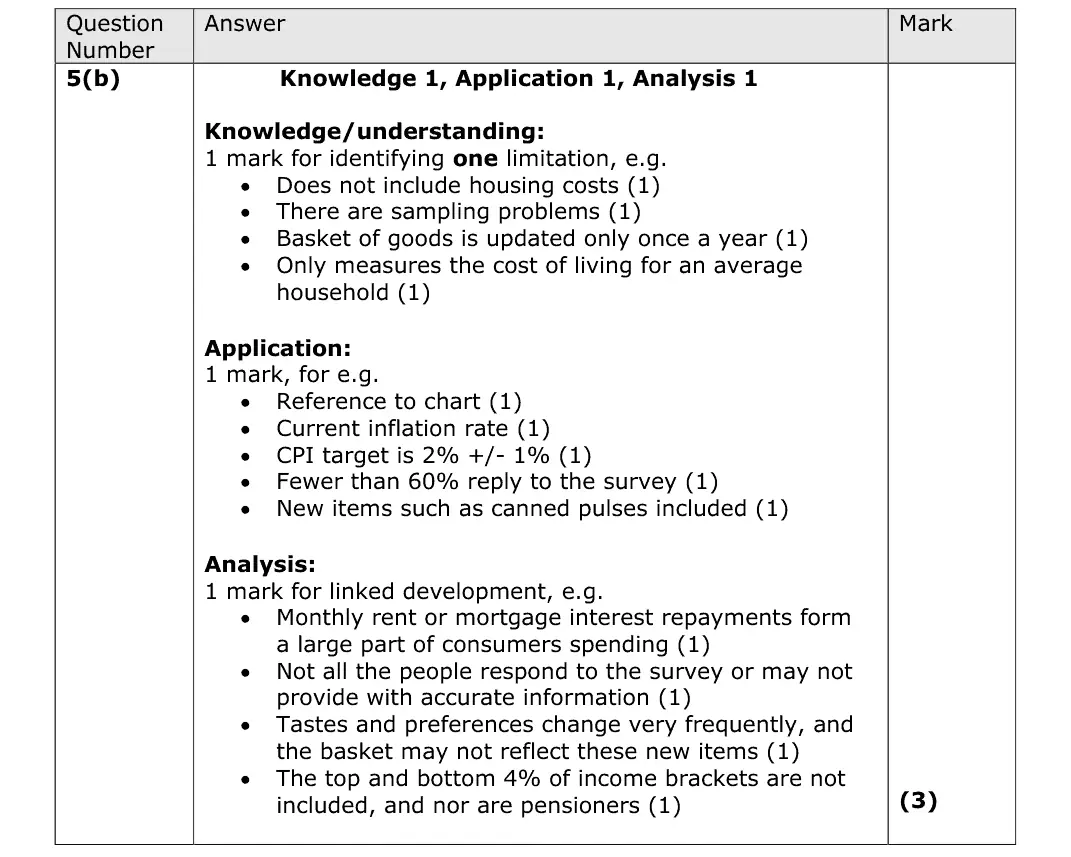
(b) Explain one limitation of CPI in measuring the rate of inflation. (3)
June 2022 · AS Paper 2 · Q6(a) 4 marks AO1=2, AO2=2 Short answer aggregate demand
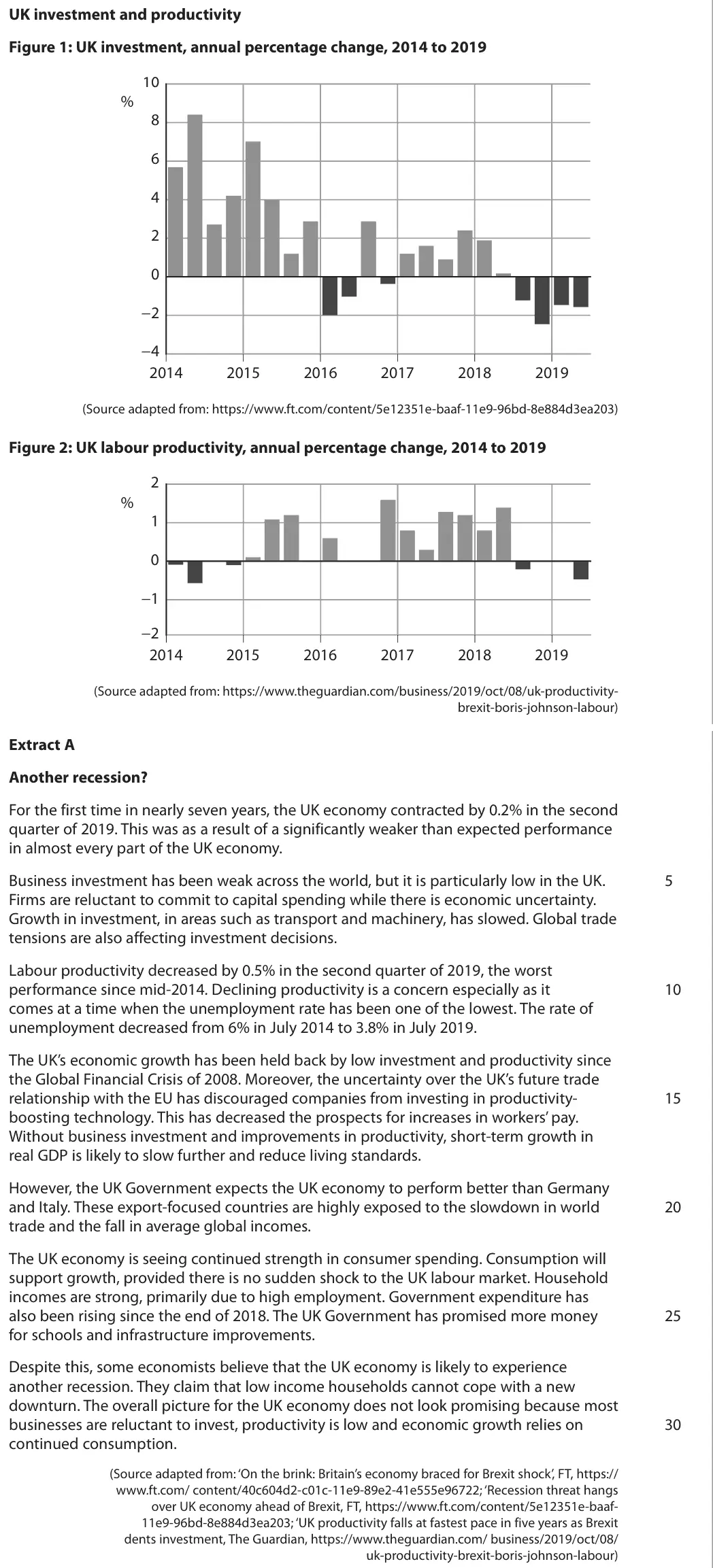
Data and extracts for question 6UK investment and productivity Figure 1: UK investment, annual percentage change, 2014 to 2019 10 % 8 6 4 2 0 -2 -4 2014 2015 2016 2017 2018 2019 (Source adapted from: https://www.ft.com/content/5e12351e-baaf-11e9-96bd-8e884d3ea203) Figure 2: UK labour productivity, annual percentage change, 2014 to 2019 2 % 1 0 -1 -2 2014 2015 2016 2017 2018 2019 (Source adapted from: https://www.theguardian.com/business/2019/oct/08/uk-productivity- brexit-boris-johnson-labour) Extract A Another recession? For the first time in nearly seven years, the UK economy contracted by 0.2% in the second quarter of 2019. This was as a result of a significantly weaker than expected performance in almost every part of the UK economy. Business investment has been weak across the world, but it is particularly low in the UK. 5 Firms are reluctant to commit to capital spending while there is economic uncertainty. Growth in investment, in areas such as transport and machinery, has slowed. Global trade tensions are also affecting investment decisions. Labour productivity decreased by 0.5% in the second quarter of 2019, the worst performance since mid-2014. Declining productivity is a concern especially as it 10 comes at a time when the unemployment rate has been one of the lowest. The rate of unemployment decreased from 6% in July 2014 to 3.8% in July 2019. The UK’s economic growth has been held back by low investment and productivity since the Global Financial Crisis of 2008. Moreover, the uncertainty over the UK’s future trade relationship with the EU has discouraged companies from investing in productivity- 15 boosting technology. This has decreased the prospects for increases in workers’ pay. Without business investment and improvements in productivity, short-term growth in real GDP is likely to slow further and reduce living standards. However, the UK Government expects the UK economy to perform better than Germany and Italy. These export-focused countries are highly exposed to the slowdown in world 20 trade and the fall in average global incomes. The UK economy is seeing continued strength in consumer spending. Consumption will support growth, provided there is no sudden shock to the UK labour market. Household incomes are strong, primarily due to high employment. Government expenditure has also been rising since the end of 2018. The UK Government has promised more money 25 for schools and infrastructure improvements. Despite this, some economists believe that the UK economy is likely to experience another recession. They claim that low income households cannot cope with a new downturn. The overall picture for the UK economy does not look promising because most businesses are reluctant to invest, productivity is low and economic growth relies on 30 continued consumption. (Source adapted from: ‘On the brink: Britain’s economy braced for Brexit shock’, FT, https:// www.ft.com/ content/40c604d2-c01c-11e9-89e2-41e555e96722; ‘Recession threat hangs over UK economy ahead of Brexit, FT, https://www.ft.com/content/5e12351e-baaf- 11e9-96bd-8e884d3ea203; ‘UK productivity falls at fastest pace in five years as Brexit dents investment, The Guardian, https://www.theguardian.com/ business/2019/oct/08/ uk-productivity-brexit-boris-johnson-labour)
(a) With reference to Figure 1, explain the term ‘investment’. (4)
June 2022 · AS Paper 2 · Q6(b) 6 marks AO1=2, AO2=2, AO3=2 Short answer aggregate demand
Data and extracts for question 6UK investment and productivity Figure 1: UK investment, annual percentage change, 2014 to 2019 10 % 8 6 4 2 0 -2 -4 2014 2015 2016 2017 2018 2019 (Source adapted from: https://www.ft.com/content/5e12351e-baaf-11e9-96bd-8e884d3ea203) Figure 2: UK labour productivity, annual percentage change, 2014 to 2019 2 % 1 0 -1 -2 2014 2015 2016 2017 2018 2019 (Source adapted from: https://www.theguardian.com/business/2019/oct/08/uk-productivity- brexit-boris-johnson-labour) Extract A Another recession? For the first time in nearly seven years, the UK economy contracted by 0.2% in the second quarter of 2019. This was as a result of a significantly weaker than expected performance in almost every part of the UK economy. Business investment has been weak across the world, but it is particularly low in the UK. 5 Firms are reluctant to commit to capital spending while there is economic uncertainty. Growth in investment, in areas such as transport and machinery, has slowed. Global trade tensions are also affecting investment decisions. Labour productivity decreased by 0.5% in the second quarter of 2019, the worst performance since mid-2014. Declining productivity is a concern especially as it 10 comes at a time when the unemployment rate has been one of the lowest. The rate of unemployment decreased from 6% in July 2014 to 3.8% in July 2019. The UK’s economic growth has been held back by low investment and productivity since the Global Financial Crisis of 2008. Moreover, the uncertainty over the UK’s future trade relationship with the EU has discouraged companies from investing in productivity- 15 boosting technology. This has decreased the prospects for increases in workers’ pay. Without business investment and improvements in productivity, short-term growth in real GDP is likely to slow further and reduce living standards. However, the UK Government expects the UK economy to perform better than Germany and Italy. These export-focused countries are highly exposed to the slowdown in world 20 trade and the fall in average global incomes. The UK economy is seeing continued strength in consumer spending. Consumption will support growth, provided there is no sudden shock to the UK labour market. Household incomes are strong, primarily due to high employment. Government expenditure has also been rising since the end of 2018. The UK Government has promised more money 25 for schools and infrastructure improvements. Despite this, some economists believe that the UK economy is likely to experience another recession. They claim that low income households cannot cope with a new downturn. The overall picture for the UK economy does not look promising because most businesses are reluctant to invest, productivity is low and economic growth relies on 30 continued consumption. (Source adapted from: ‘On the brink: Britain’s economy braced for Brexit shock’, FT, https:// www.ft.com/ content/40c604d2-c01c-11e9-89e2-41e555e96722; ‘Recession threat hangs over UK economy ahead of Brexit, FT, https://www.ft.com/content/5e12351e-baaf- 11e9-96bd-8e884d3ea203; ‘UK productivity falls at fastest pace in five years as Brexit dents investment, The Guardian, https://www.theguardian.com/ business/2019/oct/08/ uk-productivity-brexit-boris-johnson-labour)
(b) With reference to Extract A, explain two influences on the level of UK investment. (6)
June 2022 · AS Paper 2 · Q6(c) 10 marks AO1=2, AO2=2, AO3=2, AO4=4 10-mark response measuring economic growth
Data and extracts for question 6UK investment and productivity Figure 1: UK investment, annual percentage change, 2014 to 2019 10 % 8 6 4 2 0 -2 -4 2014 2015 2016 2017 2018 2019 (Source adapted from: https://www.ft.com/content/5e12351e-baaf-11e9-96bd-8e884d3ea203) Figure 2: UK labour productivity, annual percentage change, 2014 to 2019 2 % 1 0 -1 -2 2014 2015 2016 2017 2018 2019 (Source adapted from: https://www.theguardian.com/business/2019/oct/08/uk-productivity- brexit-boris-johnson-labour) Extract A Another recession? For the first time in nearly seven years, the UK economy contracted by 0.2% in the second quarter of 2019. This was as a result of a significantly weaker than expected performance in almost every part of the UK economy. Business investment has been weak across the world, but it is particularly low in the UK. 5 Firms are reluctant to commit to capital spending while there is economic uncertainty. Growth in investment, in areas such as transport and machinery, has slowed. Global trade tensions are also affecting investment decisions. Labour productivity decreased by 0.5% in the second quarter of 2019, the worst performance since mid-2014. Declining productivity is a concern especially as it 10 comes at a time when the unemployment rate has been one of the lowest. The rate of unemployment decreased from 6% in July 2014 to 3.8% in July 2019. The UK’s economic growth has been held back by low investment and productivity since the Global Financial Crisis of 2008. Moreover, the uncertainty over the UK’s future trade relationship with the EU has discouraged companies from investing in productivity- 15 boosting technology. This has decreased the prospects for increases in workers’ pay. Without business investment and improvements in productivity, short-term growth in real GDP is likely to slow further and reduce living standards. However, the UK Government expects the UK economy to perform better than Germany and Italy. These export-focused countries are highly exposed to the slowdown in world 20 trade and the fall in average global incomes. The UK economy is seeing continued strength in consumer spending. Consumption will support growth, provided there is no sudden shock to the UK labour market. Household incomes are strong, primarily due to high employment. Government expenditure has also been rising since the end of 2018. The UK Government has promised more money 25 for schools and infrastructure improvements. Despite this, some economists believe that the UK economy is likely to experience another recession. They claim that low income households cannot cope with a new downturn. The overall picture for the UK economy does not look promising because most businesses are reluctant to invest, productivity is low and economic growth relies on 30 continued consumption. (Source adapted from: ‘On the brink: Britain’s economy braced for Brexit shock’, FT, https:// www.ft.com/ content/40c604d2-c01c-11e9-89e2-41e555e96722; ‘Recession threat hangs over UK economy ahead of Brexit, FT, https://www.ft.com/content/5e12351e-baaf- 11e9-96bd-8e884d3ea203; ‘UK productivity falls at fastest pace in five years as Brexit dents investment, The Guardian, https://www.theguardian.com/ business/2019/oct/08/ uk-productivity-brexit-boris-johnson-labour)
(c) With reference to the fourth paragraph of Extract A, assess the limitations of using GDP to compare living standards over time. (10)
June 2022 · AS Paper 2 · Q6(d) 5 marks AO1=1, AO2=2, AO3=2 Short answer balance of paymentseconomic growth and the trade cycle
Data and extracts for question 6UK investment and productivity Figure 1: UK investment, annual percentage change, 2014 to 2019 10 % 8 6 4 2 0 -2 -4 2014 2015 2016 2017 2018 2019 (Source adapted from: https://www.ft.com/content/5e12351e-baaf-11e9-96bd-8e884d3ea203) Figure 2: UK labour productivity, annual percentage change, 2014 to 2019 2 % 1 0 -1 -2 2014 2015 2016 2017 2018 2019 (Source adapted from: https://www.theguardian.com/business/2019/oct/08/uk-productivity- brexit-boris-johnson-labour) Extract A Another recession? For the first time in nearly seven years, the UK economy contracted by 0.2% in the second quarter of 2019. This was as a result of a significantly weaker than expected performance in almost every part of the UK economy. Business investment has been weak across the world, but it is particularly low in the UK. 5 Firms are reluctant to commit to capital spending while there is economic uncertainty. Growth in investment, in areas such as transport and machinery, has slowed. Global trade tensions are also affecting investment decisions. Labour productivity decreased by 0.5% in the second quarter of 2019, the worst performance since mid-2014. Declining productivity is a concern especially as it 10 comes at a time when the unemployment rate has been one of the lowest. The rate of unemployment decreased from 6% in July 2014 to 3.8% in July 2019. The UK’s economic growth has been held back by low investment and productivity since the Global Financial Crisis of 2008. Moreover, the uncertainty over the UK’s future trade relationship with the EU has discouraged companies from investing in productivity- 15 boosting technology. This has decreased the prospects for increases in workers’ pay. Without business investment and improvements in productivity, short-term growth in real GDP is likely to slow further and reduce living standards. However, the UK Government expects the UK economy to perform better than Germany and Italy. These export-focused countries are highly exposed to the slowdown in world 20 trade and the fall in average global incomes. The UK economy is seeing continued strength in consumer spending. Consumption will support growth, provided there is no sudden shock to the UK labour market. Household incomes are strong, primarily due to high employment. Government expenditure has also been rising since the end of 2018. The UK Government has promised more money 25 for schools and infrastructure improvements. Despite this, some economists believe that the UK economy is likely to experience another recession. They claim that low income households cannot cope with a new downturn. The overall picture for the UK economy does not look promising because most businesses are reluctant to invest, productivity is low and economic growth relies on 30 continued consumption. (Source adapted from: ‘On the brink: Britain’s economy braced for Brexit shock’, FT, https:// www.ft.com/ content/40c604d2-c01c-11e9-89e2-41e555e96722; ‘Recession threat hangs over UK economy ahead of Brexit, FT, https://www.ft.com/content/5e12351e-baaf- 11e9-96bd-8e884d3ea203; ‘UK productivity falls at fastest pace in five years as Brexit dents investment, The Guardian, https://www.theguardian.com/ business/2019/oct/08/ uk-productivity-brexit-boris-johnson-labour)
(d) Explain one likely reason why ‘the UK Government expects the UK economy to perform better than Germany and Italy’ (Extract A, lines 19–20). (5)
June 2022 · AS Paper 2 · Q6(e) 15 marks AO1=3, AO2=3, AO3=3, AO4=6 15-mark response economic growth and the trade cycle
Data and extracts for question 6UK investment and productivity Figure 1: UK investment, annual percentage change, 2014 to 2019 10 % 8 6 4 2 0 -2 -4 2014 2015 2016 2017 2018 2019 (Source adapted from: https://www.ft.com/content/5e12351e-baaf-11e9-96bd-8e884d3ea203) Figure 2: UK labour productivity, annual percentage change, 2014 to 2019 2 % 1 0 -1 -2 2014 2015 2016 2017 2018 2019 (Source adapted from: https://www.theguardian.com/business/2019/oct/08/uk-productivity- brexit-boris-johnson-labour) Extract A Another recession? For the first time in nearly seven years, the UK economy contracted by 0.2% in the second quarter of 2019. This was as a result of a significantly weaker than expected performance in almost every part of the UK economy. Business investment has been weak across the world, but it is particularly low in the UK. 5 Firms are reluctant to commit to capital spending while there is economic uncertainty. Growth in investment, in areas such as transport and machinery, has slowed. Global trade tensions are also affecting investment decisions. Labour productivity decreased by 0.5% in the second quarter of 2019, the worst performance since mid-2014. Declining productivity is a concern especially as it 10 comes at a time when the unemployment rate has been one of the lowest. The rate of unemployment decreased from 6% in July 2014 to 3.8% in July 2019. The UK’s economic growth has been held back by low investment and productivity since the Global Financial Crisis of 2008. Moreover, the uncertainty over the UK’s future trade relationship with the EU has discouraged companies from investing in productivity- 15 boosting technology. This has decreased the prospects for increases in workers’ pay. Without business investment and improvements in productivity, short-term growth in real GDP is likely to slow further and reduce living standards. However, the UK Government expects the UK economy to perform better than Germany and Italy. These export-focused countries are highly exposed to the slowdown in world 20 trade and the fall in average global incomes. The UK economy is seeing continued strength in consumer spending. Consumption will support growth, provided there is no sudden shock to the UK labour market. Household incomes are strong, primarily due to high employment. Government expenditure has also been rising since the end of 2018. The UK Government has promised more money 25 for schools and infrastructure improvements. Despite this, some economists believe that the UK economy is likely to experience another recession. They claim that low income households cannot cope with a new downturn. The overall picture for the UK economy does not look promising because most businesses are reluctant to invest, productivity is low and economic growth relies on 30 continued consumption. (Source adapted from: ‘On the brink: Britain’s economy braced for Brexit shock’, FT, https:// www.ft.com/ content/40c604d2-c01c-11e9-89e2-41e555e96722; ‘Recession threat hangs over UK economy ahead of Brexit, FT, https://www.ft.com/content/5e12351e-baaf- 11e9-96bd-8e884d3ea203; ‘UK productivity falls at fastest pace in five years as Brexit dents investment, The Guardian, https://www.theguardian.com/ business/2019/oct/08/ uk-productivity-brexit-boris-johnson-labour)
(e) With reference to the information provided, discuss the likely impact of a recession on the UK economy. (15)
June 2022 · AS Paper 2 · Q6(f) 20 marks AO1=4, AO2=4, AO3=6, AO4=6 20-mark essay Either/or fiscal and monetary policy
Data and extracts for question 6UK investment and productivity Figure 1: UK investment, annual percentage change, 2014 to 2019 10 % 8 6 4 2 0 -2 -4 2014 2015 2016 2017 2018 2019 (Source adapted from: https://www.ft.com/content/5e12351e-baaf-11e9-96bd-8e884d3ea203) Figure 2: UK labour productivity, annual percentage change, 2014 to 2019 2 % 1 0 -1 -2 2014 2015 2016 2017 2018 2019 (Source adapted from: https://www.theguardian.com/business/2019/oct/08/uk-productivity- brexit-boris-johnson-labour) Extract A Another recession? For the first time in nearly seven years, the UK economy contracted by 0.2% in the second quarter of 2019. This was as a result of a significantly weaker than expected performance in almost every part of the UK economy. Business investment has been weak across the world, but it is particularly low in the UK. 5 Firms are reluctant to commit to capital spending while there is economic uncertainty. Growth in investment, in areas such as transport and machinery, has slowed. Global trade tensions are also affecting investment decisions. Labour productivity decreased by 0.5% in the second quarter of 2019, the worst performance since mid-2014. Declining productivity is a concern especially as it 10 comes at a time when the unemployment rate has been one of the lowest. The rate of unemployment decreased from 6% in July 2014 to 3.8% in July 2019. The UK’s economic growth has been held back by low investment and productivity since the Global Financial Crisis of 2008. Moreover, the uncertainty over the UK’s future trade relationship with the EU has discouraged companies from investing in productivity- 15 boosting technology. This has decreased the prospects for increases in workers’ pay. Without business investment and improvements in productivity, short-term growth in real GDP is likely to slow further and reduce living standards. However, the UK Government expects the UK economy to perform better than Germany and Italy. These export-focused countries are highly exposed to the slowdown in world 20 trade and the fall in average global incomes. The UK economy is seeing continued strength in consumer spending. Consumption will support growth, provided there is no sudden shock to the UK labour market. Household incomes are strong, primarily due to high employment. Government expenditure has also been rising since the end of 2018. The UK Government has promised more money 25 for schools and infrastructure improvements. Despite this, some economists believe that the UK economy is likely to experience another recession. They claim that low income households cannot cope with a new downturn. The overall picture for the UK economy does not look promising because most businesses are reluctant to invest, productivity is low and economic growth relies on 30 continued consumption. (Source adapted from: ‘On the brink: Britain’s economy braced for Brexit shock’, FT, https:// www.ft.com/ content/40c604d2-c01c-11e9-89e2-41e555e96722; ‘Recession threat hangs over UK economy ahead of Brexit, FT, https://www.ft.com/content/5e12351e-baaf- 11e9-96bd-8e884d3ea203; ‘UK productivity falls at fastest pace in five years as Brexit dents investment, The Guardian, https://www.theguardian.com/ business/2019/oct/08/ uk-productivity-brexit-boris-johnson-labour)
(f) Evaluate the fiscal policies the UK Government could use if it believes that ‘the UK economy is likely to experience another recession’ (Extract A, lines 27–28). (20)
June 2022 · AS Paper 2 · Q6(g) 20 marks AO1=4, AO2=4, AO3=6, AO4=6 20-mark essay Either/or Hard supply side policies
Data and extracts for question 6UK investment and productivity Figure 1: UK investment, annual percentage change, 2014 to 2019 10 % 8 6 4 2 0 -2 -4 2014 2015 2016 2017 2018 2019 (Source adapted from: https://www.ft.com/content/5e12351e-baaf-11e9-96bd-8e884d3ea203) Figure 2: UK labour productivity, annual percentage change, 2014 to 2019 2 % 1 0 -1 -2 2014 2015 2016 2017 2018 2019 (Source adapted from: https://www.theguardian.com/business/2019/oct/08/uk-productivity- brexit-boris-johnson-labour) Extract A Another recession? For the first time in nearly seven years, the UK economy contracted by 0.2% in the second quarter of 2019. This was as a result of a significantly weaker than expected performance in almost every part of the UK economy. Business investment has been weak across the world, but it is particularly low in the UK. 5 Firms are reluctant to commit to capital spending while there is economic uncertainty. Growth in investment, in areas such as transport and machinery, has slowed. Global trade tensions are also affecting investment decisions. Labour productivity decreased by 0.5% in the second quarter of 2019, the worst performance since mid-2014. Declining productivity is a concern especially as it 10 comes at a time when the unemployment rate has been one of the lowest. The rate of unemployment decreased from 6% in July 2014 to 3.8% in July 2019. The UK’s economic growth has been held back by low investment and productivity since the Global Financial Crisis of 2008. Moreover, the uncertainty over the UK’s future trade relationship with the EU has discouraged companies from investing in productivity- 15 boosting technology. This has decreased the prospects for increases in workers’ pay. Without business investment and improvements in productivity, short-term growth in real GDP is likely to slow further and reduce living standards. However, the UK Government expects the UK economy to perform better than Germany and Italy. These export-focused countries are highly exposed to the slowdown in world 20 trade and the fall in average global incomes. The UK economy is seeing continued strength in consumer spending. Consumption will support growth, provided there is no sudden shock to the UK labour market. Household incomes are strong, primarily due to high employment. Government expenditure has also been rising since the end of 2018. The UK Government has promised more money 25 for schools and infrastructure improvements. Despite this, some economists believe that the UK economy is likely to experience another recession. They claim that low income households cannot cope with a new downturn. The overall picture for the UK economy does not look promising because most businesses are reluctant to invest, productivity is low and economic growth relies on 30 continued consumption. (Source adapted from: ‘On the brink: Britain’s economy braced for Brexit shock’, FT, https:// www.ft.com/ content/40c604d2-c01c-11e9-89e2-41e555e96722; ‘Recession threat hangs over UK economy ahead of Brexit, FT, https://www.ft.com/content/5e12351e-baaf- 11e9-96bd-8e884d3ea203; ‘UK productivity falls at fastest pace in five years as Brexit dents investment, The Guardian, https://www.theguardian.com/ business/2019/oct/08/ uk-productivity-brexit-boris-johnson-labour)
(g) Evaluate the supply-side policies the UK Government could use to increase the UK’s productivity. (20)

Work with an Edexcel economics tutor

Want a paper marked and gone through with you? Message us.
Prefer email? Send an enquiry

If you are under 18, please include a parent's contact details. Enquiries go to enquiries@economicsaleveltutor.com and are deleted once handled. All tutoring is online.