Notes and key-term cards for this topic are being written by our tutors. The past-paper questions below are ready now.
Specification statements
2.3.1The characteristics of AS: a) The AS curve b) The distinction between movement along, and a shift of, the AS curve c) The relationship between short-run AS and long-run ASAS
2.3.2Short-run AS: a) Factors influencing short-run AS: • changes in costs of raw materials and energy • changes in exchange rates • changes in tax ratesAS
2.3.3Long-run AS: a) Different shapes of the long-run AS curve: • Keynesian • classical b) Factors influencing long-run AS: • technological advances • changes in relative productivity • changes in education and skills • changes in government regulations • demographic changes and migration • competition policyAS
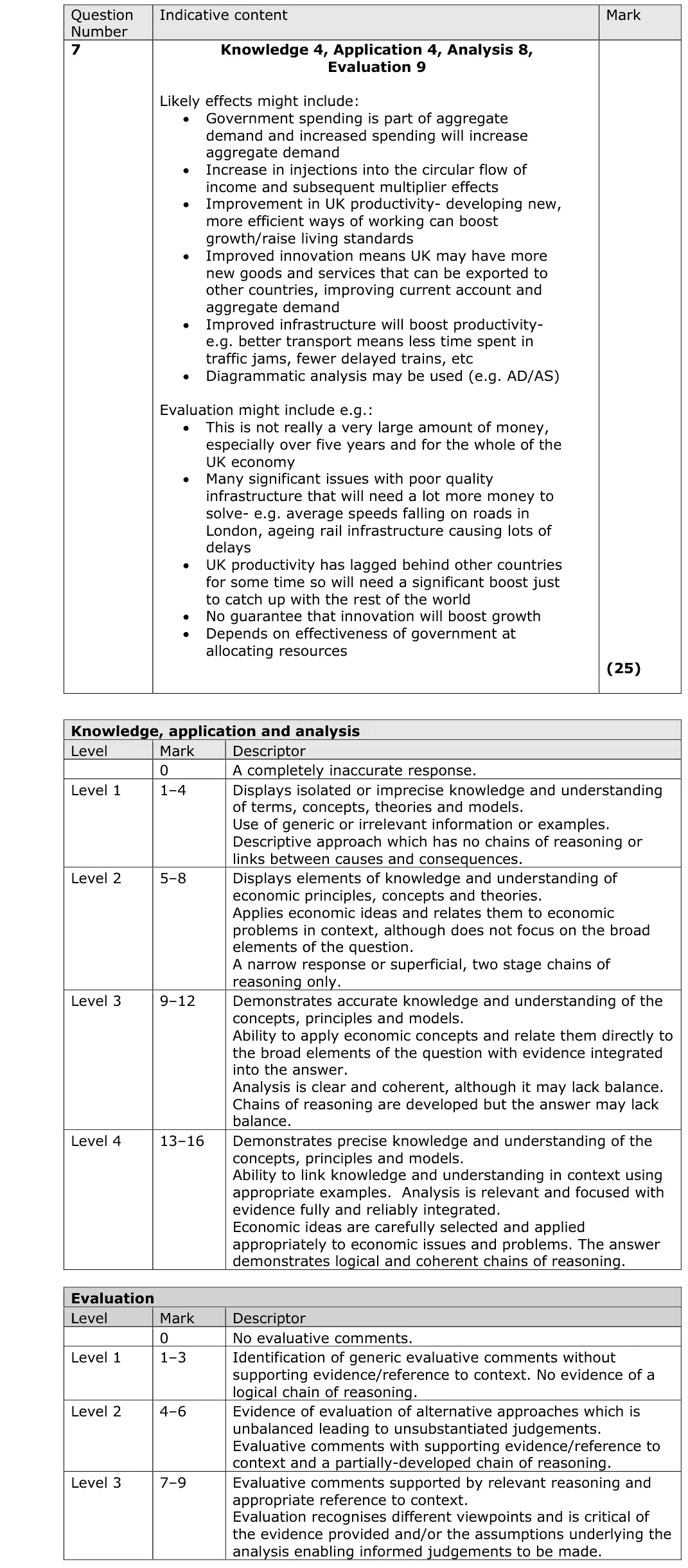
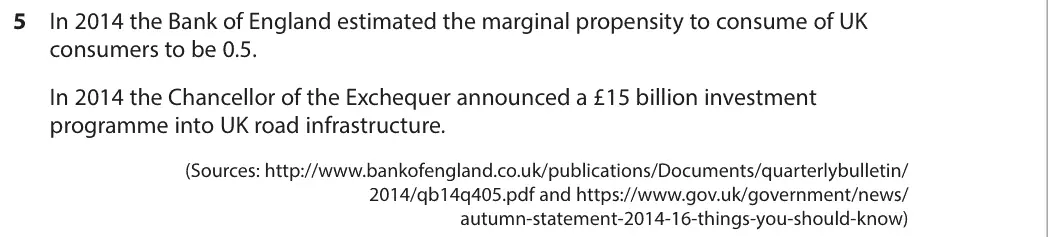
In 2016 the UK Chancellor of the Exchequer announced that the government would spend an extra £23 billion on innovation and infrastructure over the following five years. Evaluate the likely economic effects of this planned increase in government expenditure.
Global oil prices fell from a 2008 peak of $147 a barrel to $27 in 2016. Evaluate the likely macroeconomic consequences of a significant fall in global oil prices.
Tap a question to zoom it. The data and extracts fold out above each question; the mark scheme and examiner's comment open underneath.
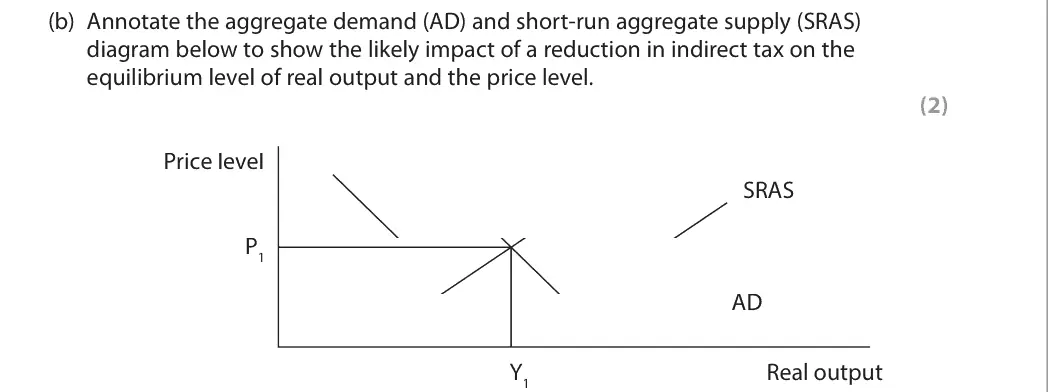
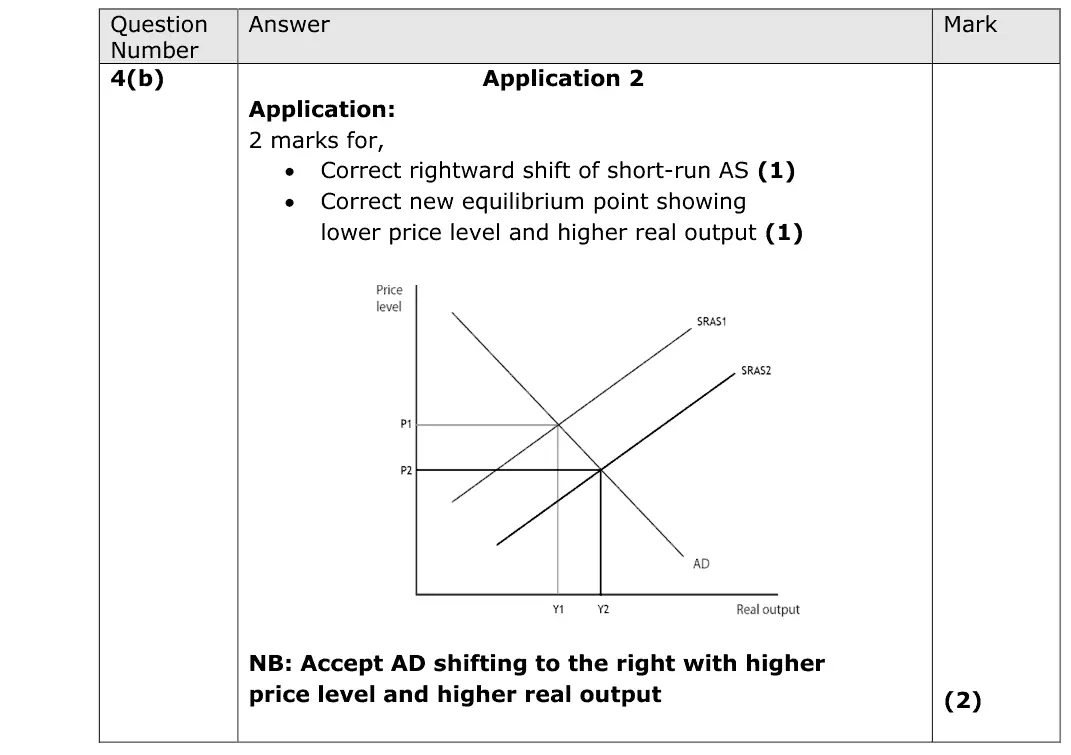
June 2025 · AS Paper 2 · Q4(b)2 marksAO2=2Diagram
Data and extracts for question 4
Mark scheme
Examiner's comment
This question required candidates to show/draw the likely impact of a reduction in indirect tax in the context of an AD/AS diagram. Marks were awarded as 1 mark for a rightward shift in AD/SRAS and 1 mark for equilibrium showing new price level and new real output. Most candidates achieved the 2 marks on this question.
Notes from the mark scheme and report
lower indirect tax cuts firms' costs so SRAS shifts right: lower price level, higher real output (AD shifting right also accepted)
Quantitative skills: QS 4 (construct and interpret a range of standard graphical forms)
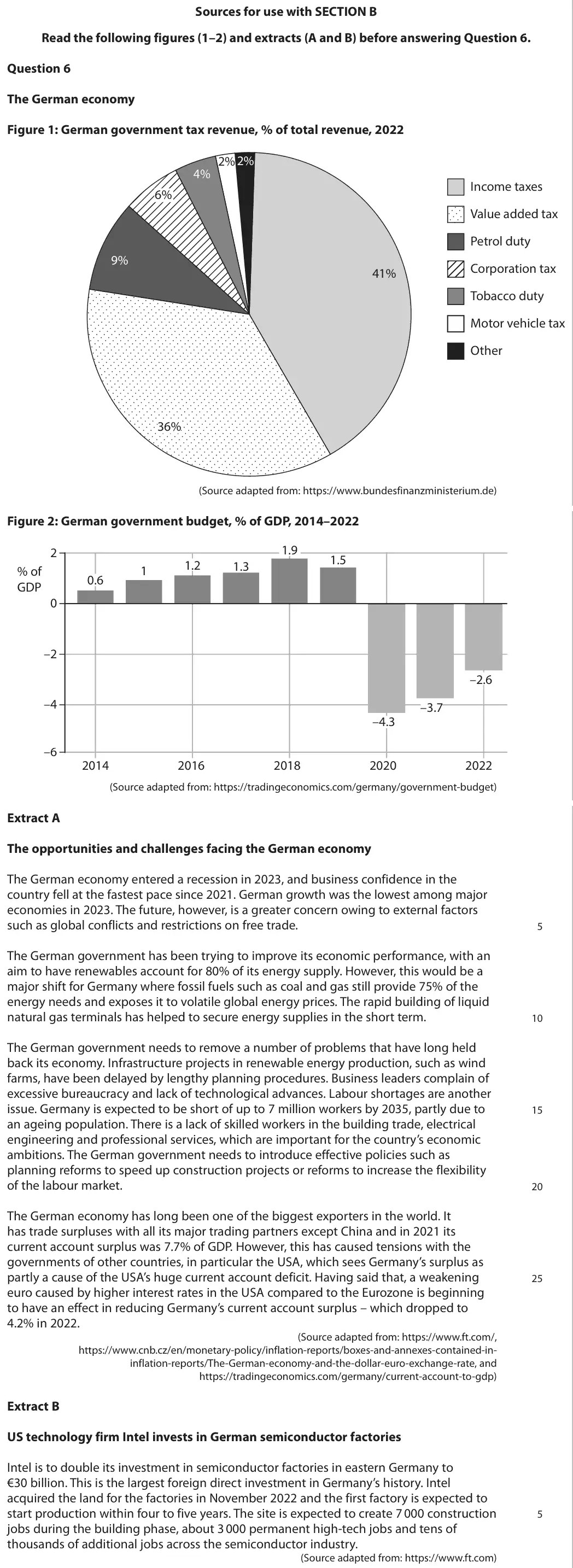
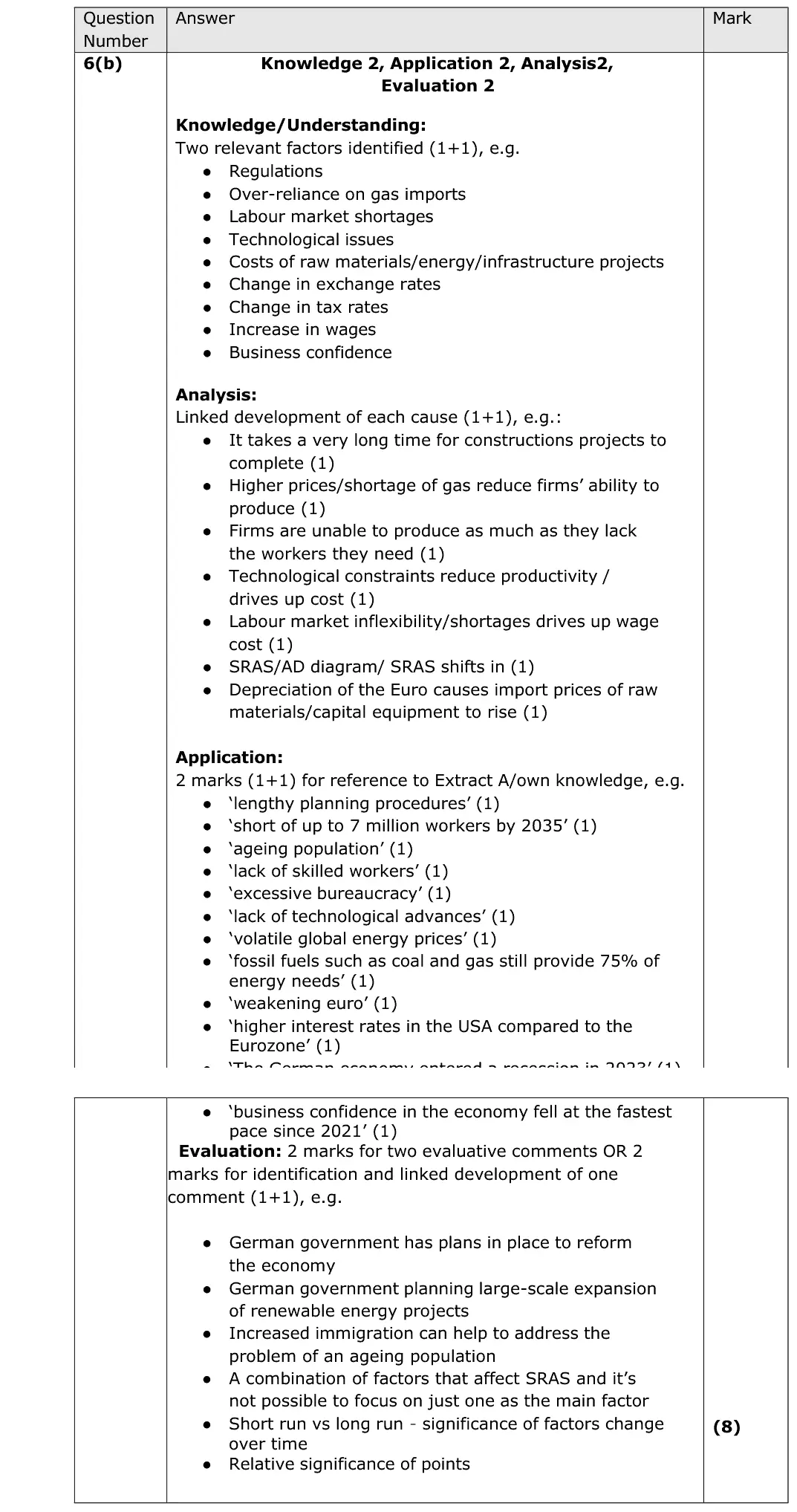
June 2025 · Paper 2 · Q6(b)8 marksAO1=2, AO2=2, AO3=2, AO4=28-mark response
Data and extracts for question 6
Mark scheme, including the levels grid and indicative content
Examiner's comment
This 8-mark question is the last points-based marking question before we move onto Levels- based questions. Marks were awarded as two for knowledge, two for application, two for analysis, and two for evaluation. As in most 8-mark questions candidates were asked to examine TWO factors influencing short-run aggregate supply. Generally candidates were able to score well on this question, identifying relevant points with application from Extract A. This is a good example of where the extract is very helpful and that candidates need to ensure they make effective use of it to help them in answering the question. This answer scores 3/8 as it doesn’t fully answer the question. The first paragraph isn’t answering the question and so doesn’t get any marks. Labour shortages is the first point the candidate has made which earns a knowledge mark. They quote Germany being short up to 7 million workers and the ageing population, both of these are application points. There is a further piece of application referencing lack of skilled workers, but they have already achieved the 2 marks available for application. There is no analysis present to explain how labour shortages affect short-run aggregate supply so therefore no analysis mark. There are no further points so it is only the 1 mark for knowledge. Overall, therefore, this answer gets 1 knowledge mark and 2 application marks. Remember the structure of questions like this: 2 points are needed, and you need to have 2 pieces of knowledge, 2 application, 2 analysis, and there are 2 marks for evaluation. This answer is significantly better than the first script for this question, scoring 7/8 in total. In the first paragraph, the candidate mentions lack of suitable labour as a knowledge mark. They also have 2 pieces of application about shortage of 7 million workers and lack of skilled workers and an analysis mark for their diagram. This point is then evaluated in the second paragraph. Their third paragraph talks about delayed infrastructure for the second knowledge mark and the impact on capital and labour mobility for analysis. They also have a quotation from the extract which could have earnt them another application mark. The only thing missing is another piece of evaluation for the last mark. If you look at this answer it is roughly the same length as the other example except this answer gets 7/8 and the other only 3/8. It is not about how much you write, but whether you write an answer to the question that matters.
Notes from the mark scheme and report
two SRAS factors from Extract A: energy costs and reliance on imported gas, labour shortages raising wages, regulation, exchange rate (weaker euro)
evaluate e.g. LNG terminals securing supply, short run vs long run
report: the first paragraph often did not answer the question
June 2024 · AS Paper 2 · Q6(d)5 marksAO1=1, AO2=2, AO3=2Short answer
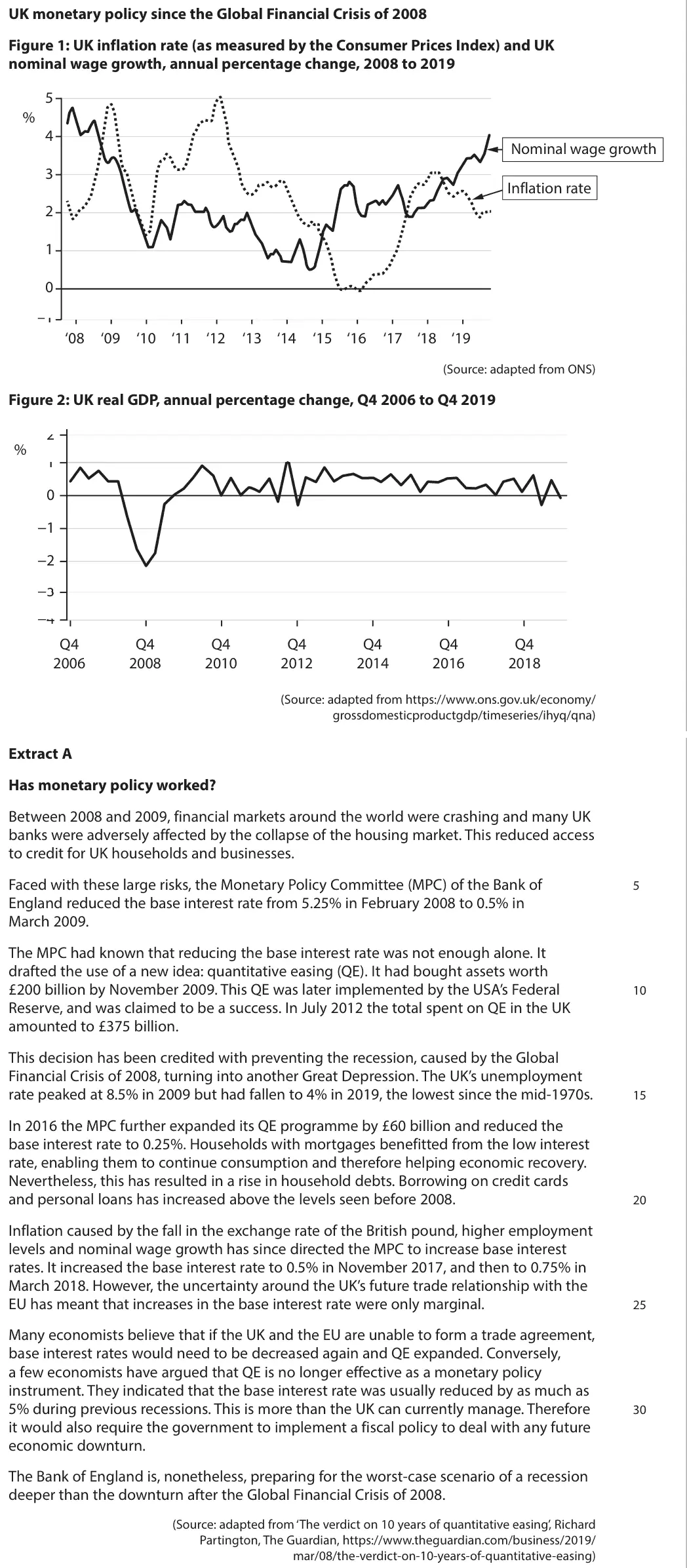
Data and extracts for question 6
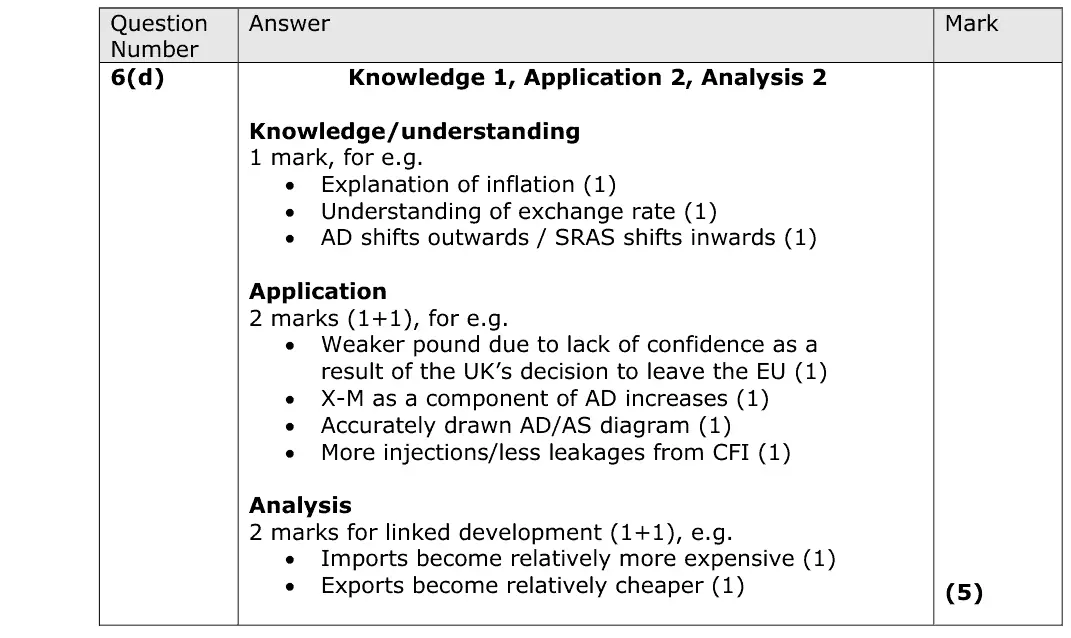
Mark scheme
Examiner's comment
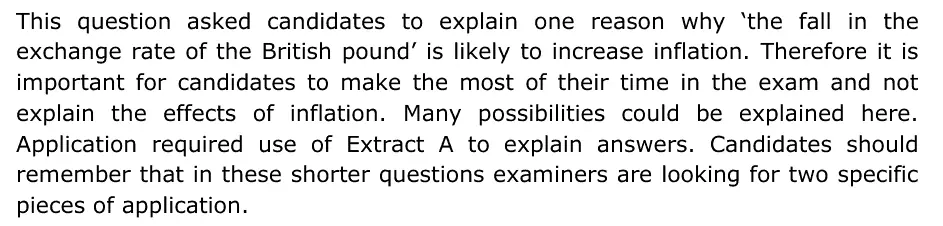
This question asked candidates to explain one reason why ‘the fall in the exchange rate of the British pound’ is likely to increase inflation. Therefore it is important for candidates to make the most of their time in the exam and not explain the effects of inflation. Many possibilities could be explained here. Application required use of Extract A to explain answers. Candidates should remember that in these shorter questions examiners are looking for two specific pieces of application.
Notes from the mark scheme and report
a weaker pound makes imports dearer (cost-push via SRAS) and exports cheaper (AD rises, demand-pull)
two application marks from Extract A e.g. Brexit uncertainty
do not explain the effects of inflation
November 2021 · Paper 2 · Q2(a)1 markMultiple choice
Answer
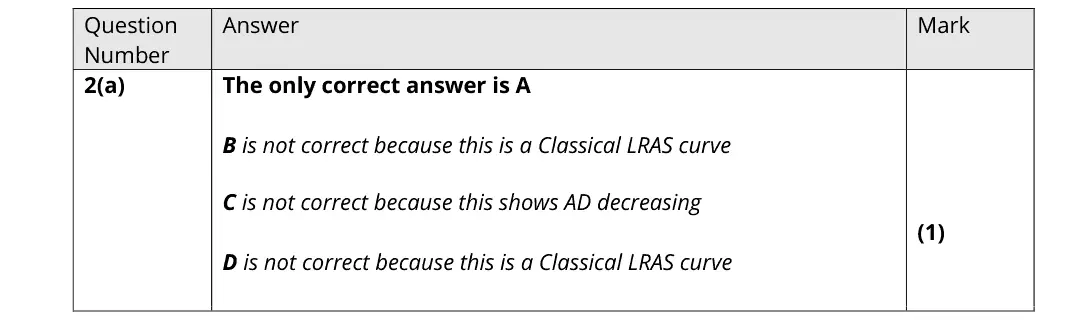
A
Mark scheme
Notes from the mark scheme and report
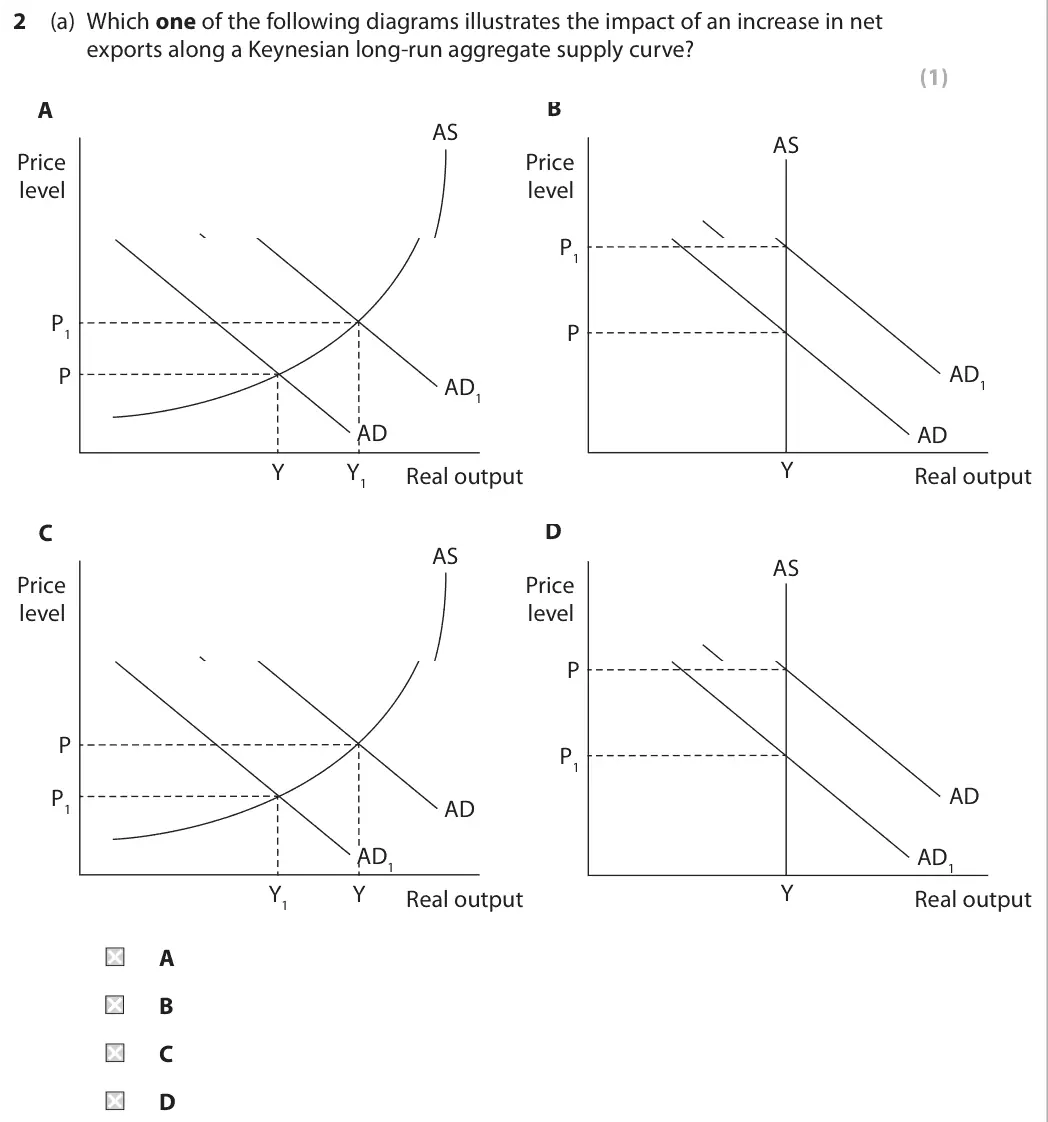
higher net exports shift AD right along a Keynesian LRAS, raising real output (and the price level near full capacity) (A)
B and D draw a classical vertical LRAS, C shows AD falling
Quantitative skills: QS 4 (construct and interpret a range of standard graphical forms)
November 2021 · Paper 2 · Q2(b)2 marksAO1=1, AO3=1Short answer
Mark scheme
Examiner's comment
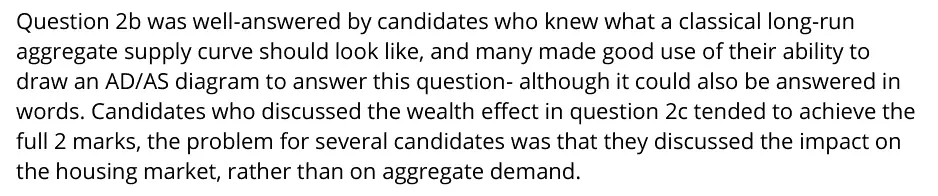
Question 2b was well-answered by candidates who knew what a classical long-run aggregate supply curve should look like, and many made good use of their ability to draw an AD/AS diagram to answer this question- although it could also be answered in words. Candidates who discussed the wealth effect in question 2c tended to achieve the full 2 marks, the problem for several candidates was that they discussed the impact on the housing market, rather than on aggregate demand.
Notes from the mark scheme and report
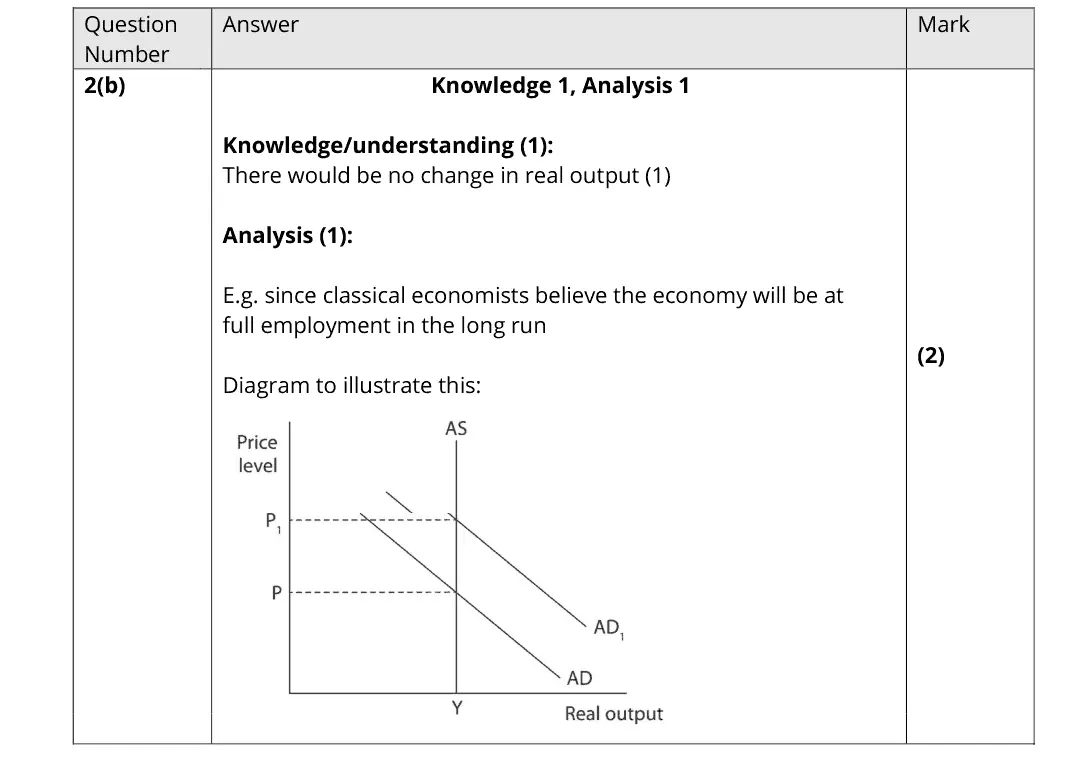
classical LRAS is vertical at full employment, so in the long run real output does not change, only the price level rises
a diagram may be used
November 2021 · Paper 2 · Q4(a)4 marksAO1=2, AO2=1, AO3=1Short answer
Data and extracts for question 4
Mark scheme
Examiner's comment
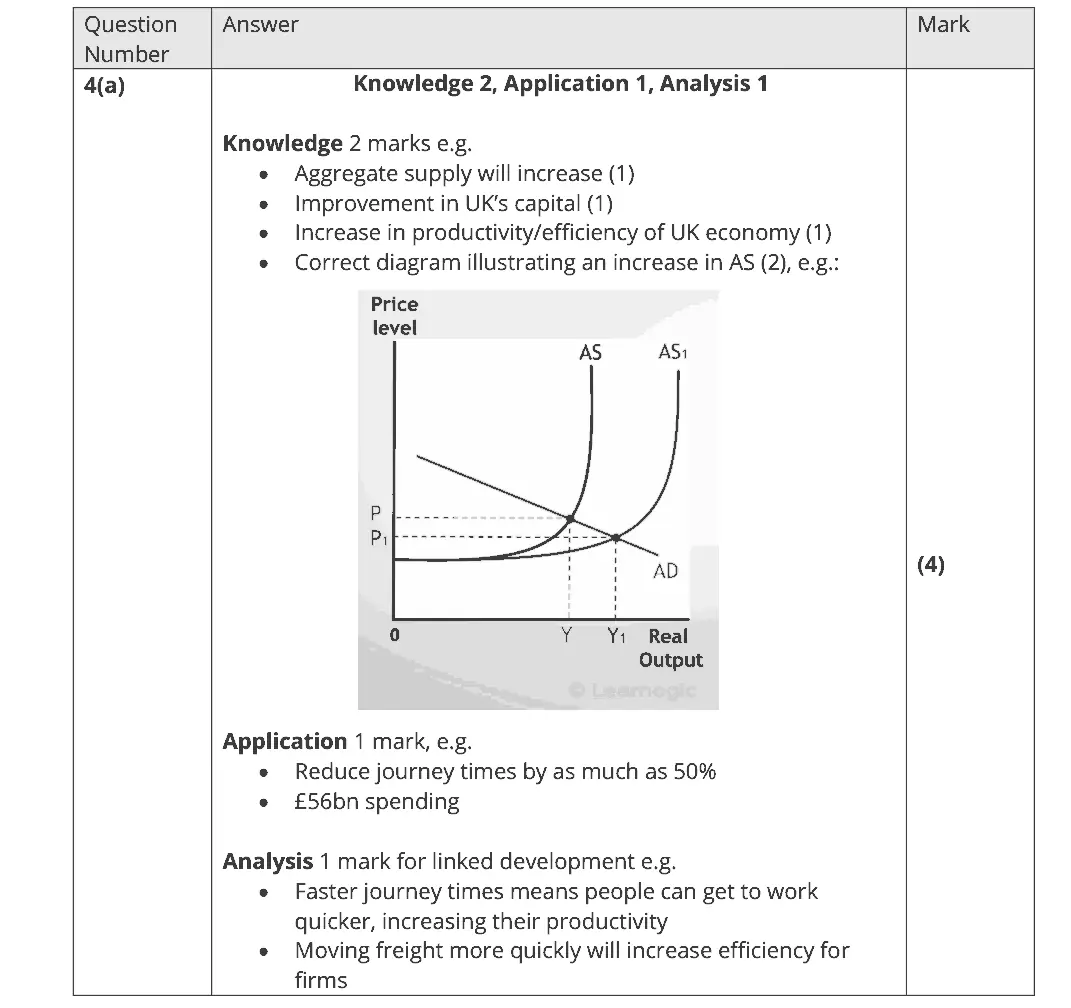
Question 4a focuses on the impact on aggregate supply of the High Speed 2 rail link, and most candidates could explain that aggregate supply would increase and offer some explanation as to why. However, candidates often struggled to achieve full marks as they couldn’t explain clearly the link in terms of productivity/efficiency and how this would increase the aggregate supply. The answer below did a good job of this and was awarded full marks. In question 5b most candidates could correctly calculate percentage change, but in 5c many candidates struggled to explain why Purchasing Power Parities are used, with many not understanding what the term means and some attempting a partial but vague explanation. The answer below demonstrates how to achieve full marks on this question. Section B:
Notes from the mark scheme and report
HS2 improves infrastructure and productivity so LRAS shifts right (diagram can earn the knowledge marks)
use the 50% journey time cut or £56bn
many could not explain the productivity link clearly
October 2020 · AS Paper 2 · Q2(a)1 markAO1=1Diagram
Mark scheme
Examiner's comment
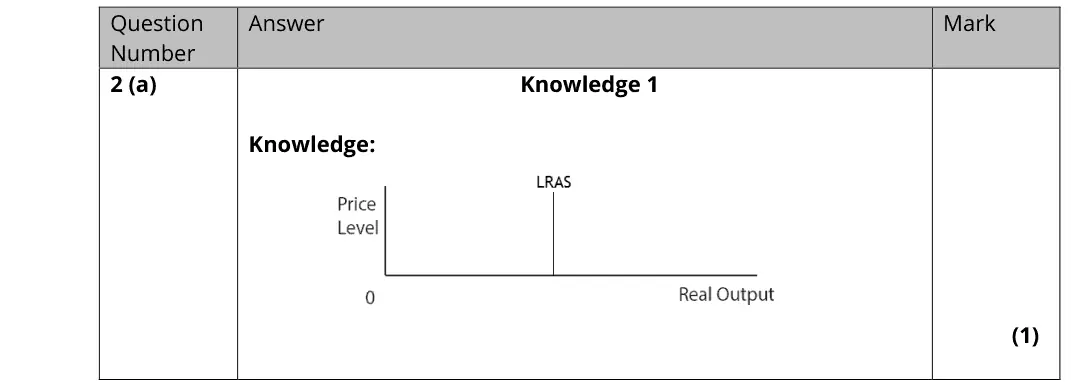
This question requires candidates to illustrate the shape of the Classical long-run AS curve. A few candidates were not able to distinguish between the classical and the Keynesian AS curves.
Notes from the mark scheme and report
Classical LRAS is vertical at full-capacity real output
some drew the Keynesian (reverse L) shape
Quantitative skills: QS 4 (construct and interpret a range of standard graphical forms)
October 2020 · AS Paper 2 · Q2(b)2 marksAO1=2Short answer
Mark scheme
Examiner's comment
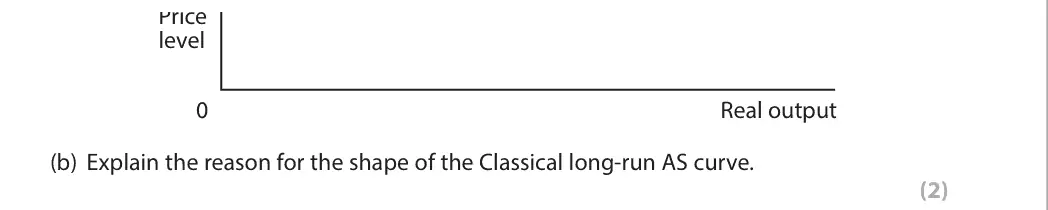
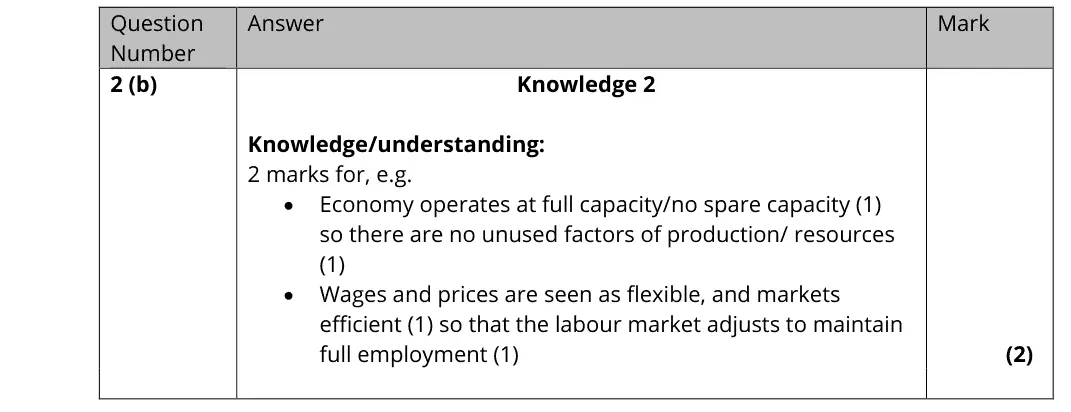
This question required candidates to explain the reason for the shape of the Classical long-run AS curve. Many candidates were able to identify a reason but often did not explain the point they had identified.
Notes from the mark scheme and report
identify the reason and develop it: economy at full capacity so no unused resources, or flexible wages and prices restore full employment
many identified but did not explain
October 2020 · Paper 2 · Q5(a)4 marksAO1=2, AO2=2Diagram
Data and extracts for question 5
Mark scheme
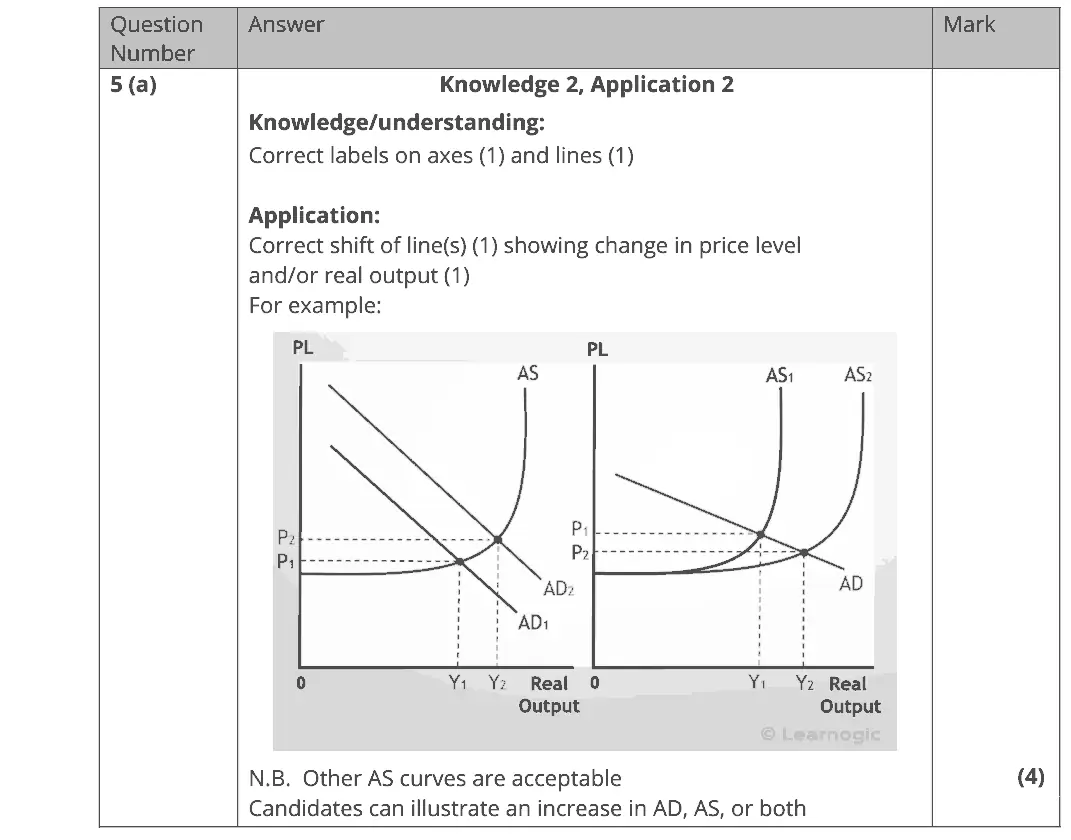
Examiner's comment
Question 5 consists mainly of a draw question, and the vast majority of students demonstrated a very good understanding of what an AD/AS diagram should look like, and what should be happening on it in this case study- i.e. an increase in either aggregate supply and/or aggregate demand. Section B, the data response section, is based on information provided in the exam paper about trade and development issues in Africa. This includes 2 figures and 2 extracts on different issues.
Notes from the mark scheme and report
labels on axes (price level, real output) and curves for 2 marks
government-funded infrastructure can shift AD right, LRAS right or both
show the new price level and real output
Quantitative skills: QS 4 (construct and interpret a range of standard graphical forms)
October 2020 · AS Paper 2 · Q6(e)15 marksAO1=3, AO2=3, AO3=3, AO4=615-mark responseHard
Data and extracts for question 6
Mark scheme, including the levels grid and indicative content
Examiner's comment
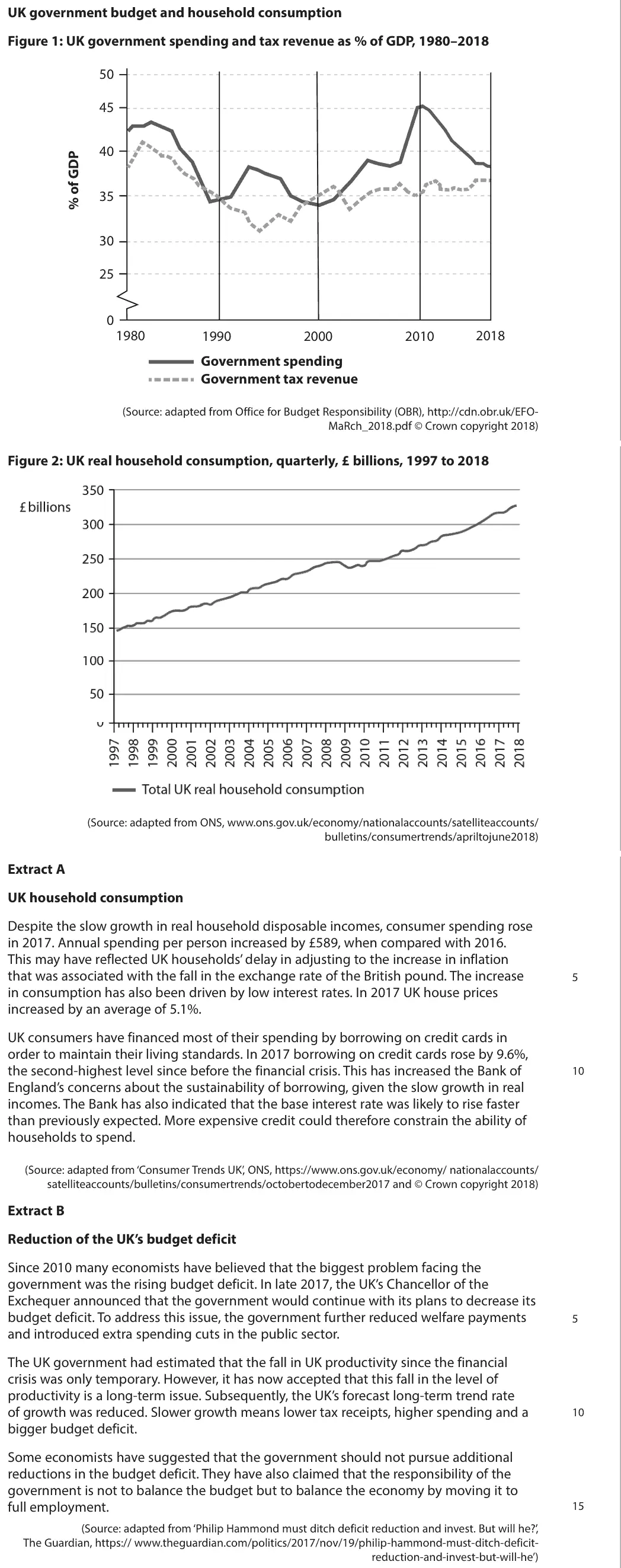
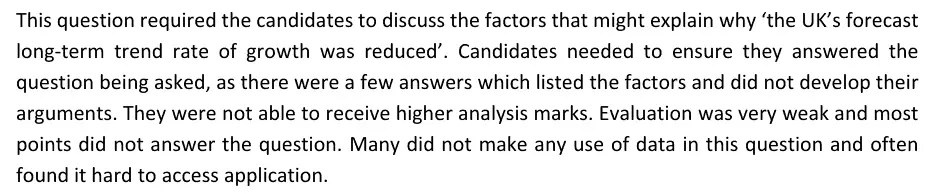
This question required the candidates to discuss the factors that might explain why ‘the UK’s forecast long-term trend rate of growth was reduced’. Candidates needed to ensure they answered the question being asked, as there were a few answers which listed the factors and did not develop their arguments. They were not able to receive higher analysis marks. Evaluation was very weak and most points did not answer the question. Many did not make any use of data in this question and often found it hard to access application.
Notes from the mark scheme and report
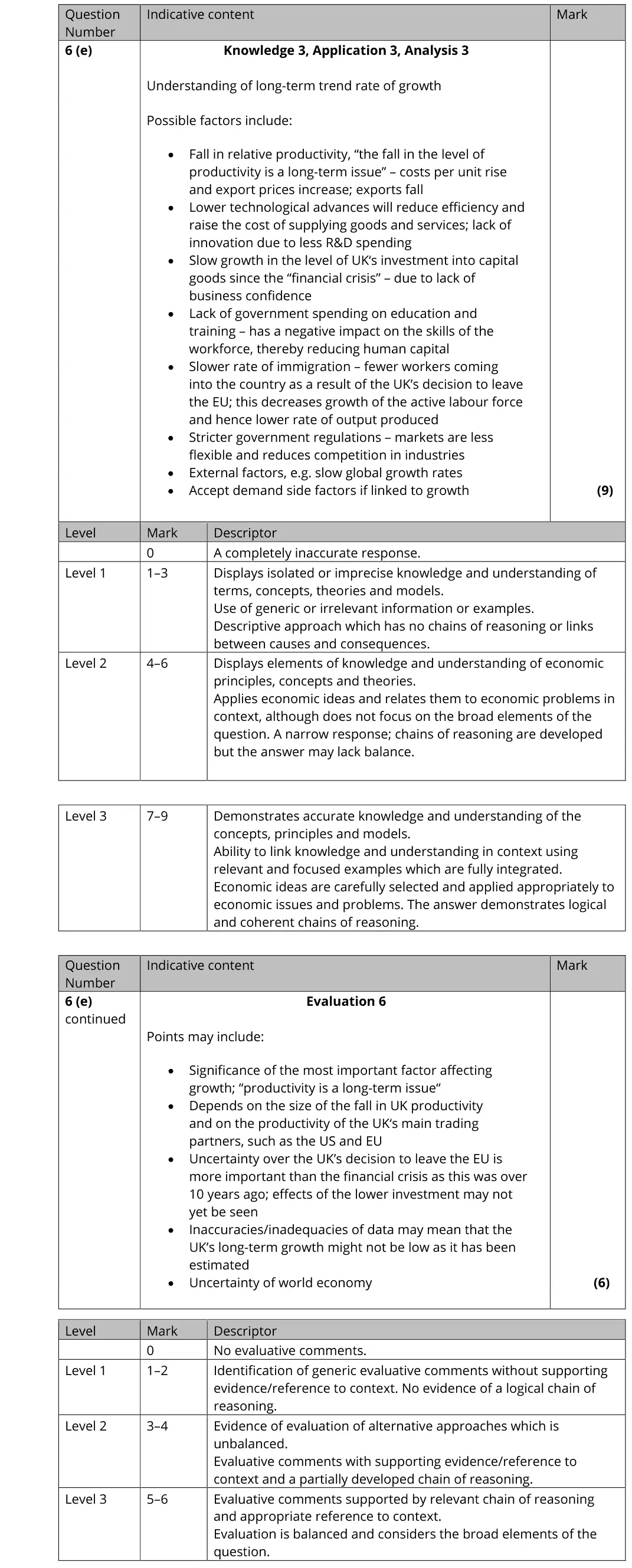
trend growth depends on LRAS: low productivity (Extract B), weak investment since the crisis, lower migration, skills
develop rather than list factors
report: "Evaluation was very weak and most points did not answer the question", many did not use data
October 2020 · Paper 3 · Q2(b)8 marksAO1=2, AO2=2, AO3=2, AO4=28-mark response
Data and extracts for question 2
Mark scheme, including the levels grid and indicative content
Examiner's comment
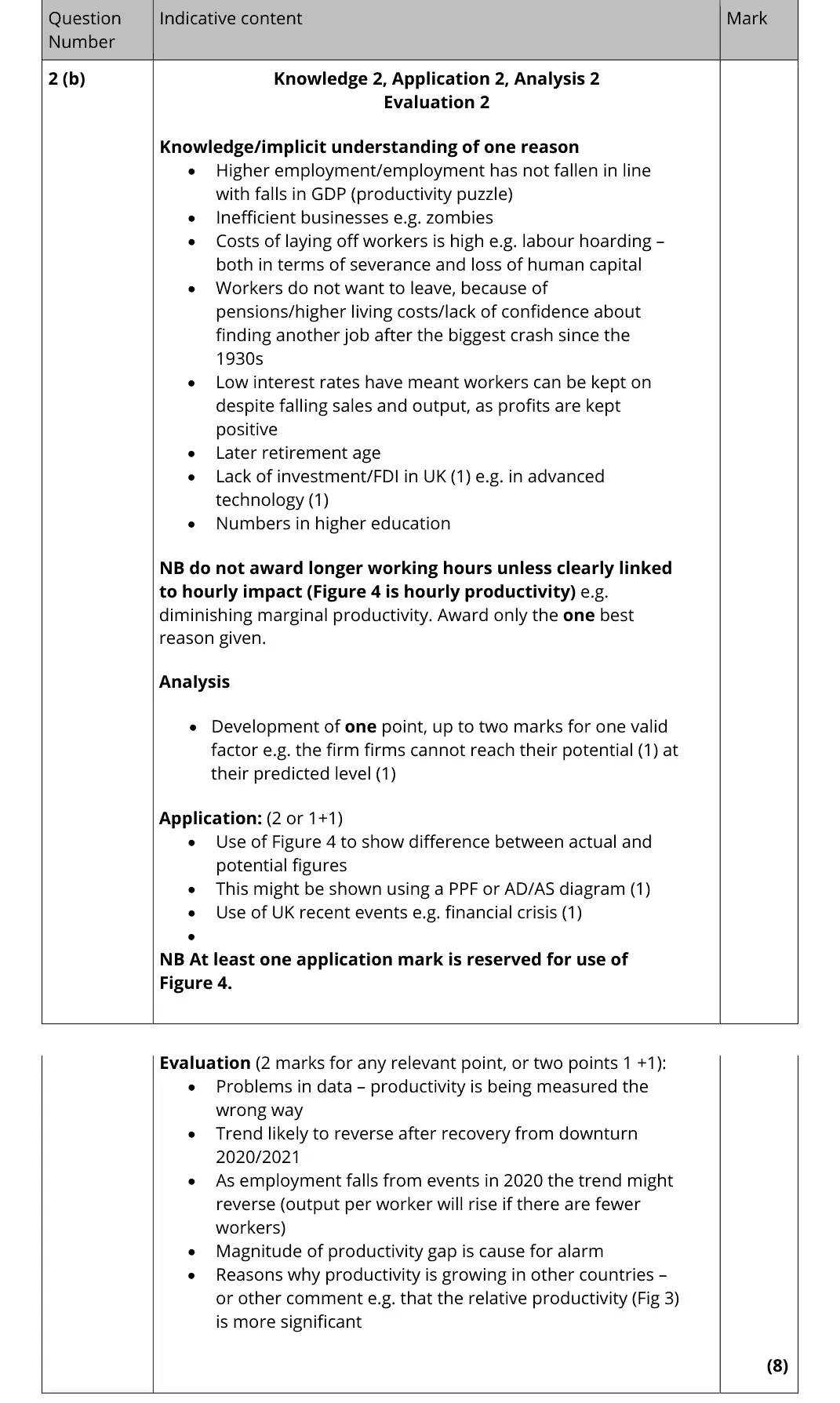
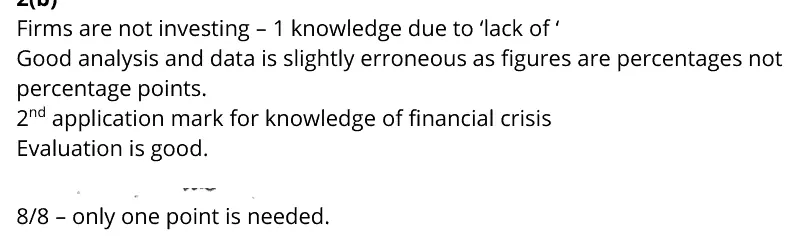
Firms are not investing – 1 knowledge due to ‘lack of ‘ Good analysis and data is slightly erroneous as figures are percentages not percentage points. 2nd application mark for knowledge of financial crisis Evaluation is good. 8/8 – only one point is needed.
Notes from the mark scheme and report
one reason only (best one credited): labour hoarding, low investment, zombie firms kept alive by low interest rates
longer hours not credited unless linked to hourly output
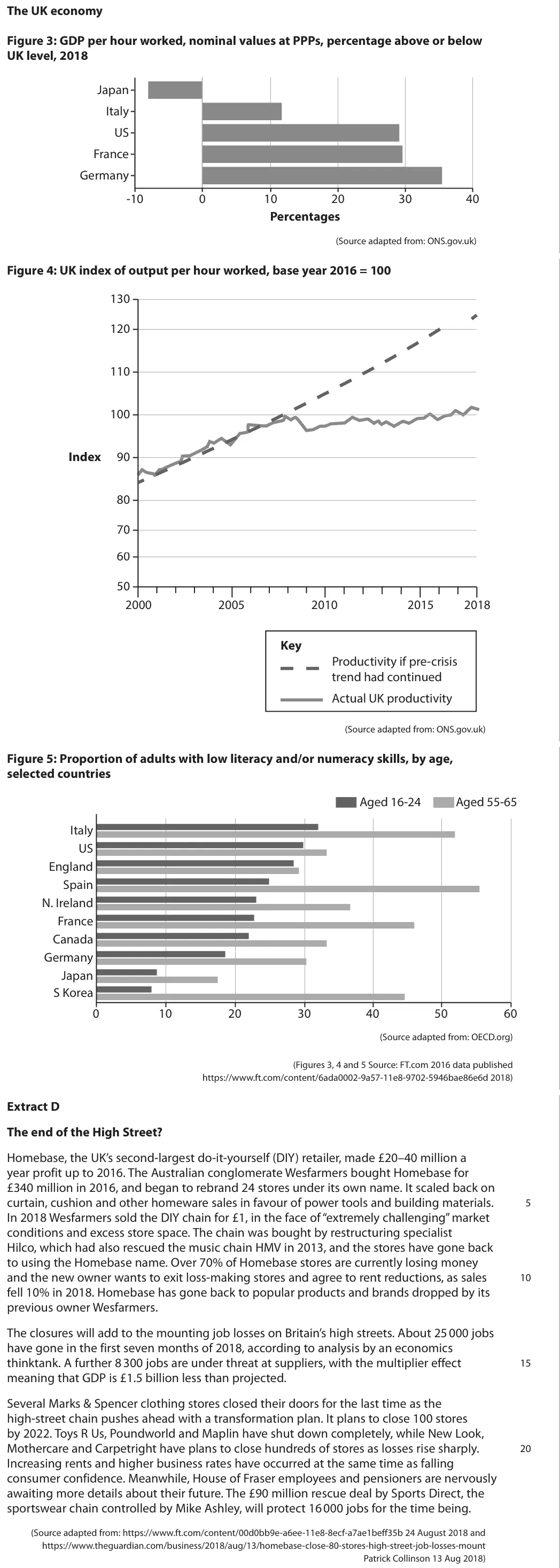
at least one application mark reserved for Figure 4 (gap between actual and pre-crisis trend)
index values are not percentages
Quantitative skills: QS 5 (calculate and interpret index numbers); QS 9 (interpret, apply and analyse information in written, graphical tabular and numerical forms)
October 2020 · Paper 3 · Q2(e)25 marksAO1=4, AO2=4, AO3=8, AO4=925-mark essayEither/or
Data and extracts for question 2
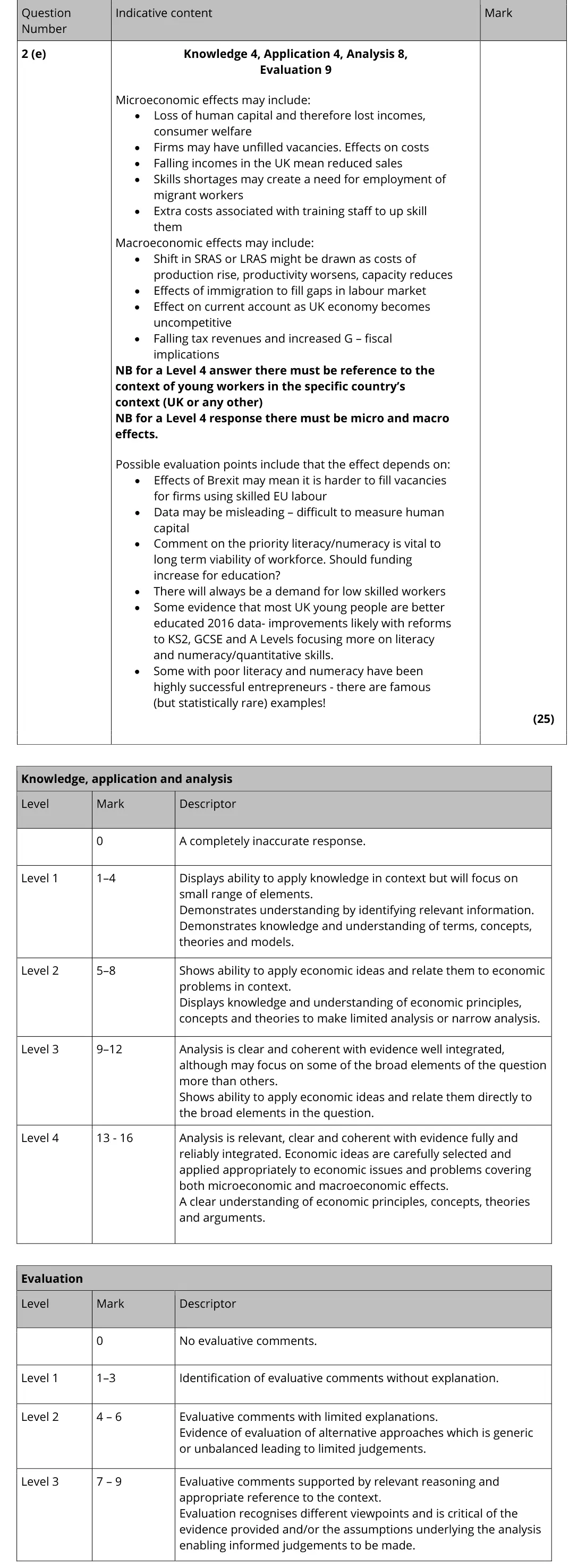
Mark scheme, including the levels grid and indicative content
Examiner's comment
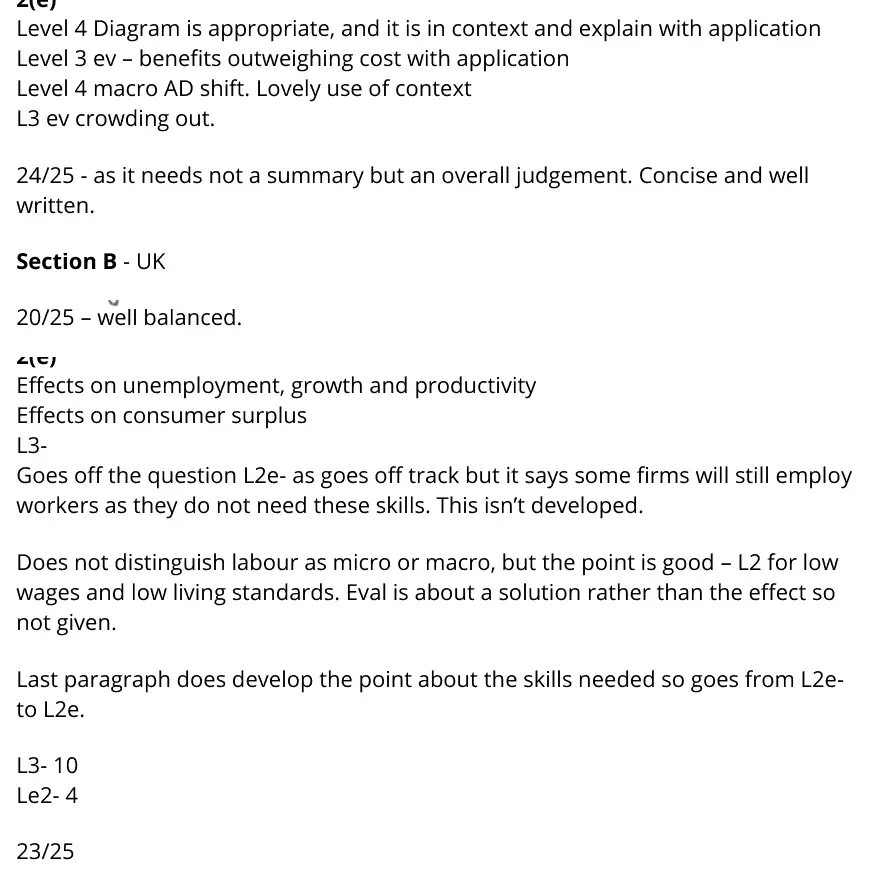
Level 4 Diagram is appropriate, and it is in context and explain with application Level 3 ev – benefits outweighing cost with application Level 4 macro AD shift. Lovely use of context L3 ev crowding out. 24/25 - as it needs not a summary but an overall judgement. Concise and well written. Section B - UK 20/25 – well balanced. Effects on unemployment, growth and productivity Effects on consumer surplus L3- Goes off the question L2e- as goes off track but it says some firms will still employ workers as they do not need these skills. This isn’t developed. Does not distinguish labour as micro or macro, but the point is good – L2 for low wages and low living standards. Eval is about a solution rather than the effect so not given. Last paragraph does develop the point about the skills needed so goes from L2e- to L2e. L3- 10 Le2- 4 23/25
Notes from the mark scheme and report
micro: lost human capital, unfilled vacancies, training costs, migrant labour
macro: SRAS/LRAS shift left, weaker current account, fiscal costs
Level 4 needs both micro and macro and the context of young workers
evaluation must be about the effect, not a solution
June 2019 · AS Paper 2 · Q2(a)1 markAO1=1Diagram
Mark scheme
Examiner's comment
This question requires candidates to illustrate the shape of the Keynesian long-run AS curve. A few candidates were not able to distinguish between the classical and the Keynesian AS curves.
Notes from the mark scheme and report
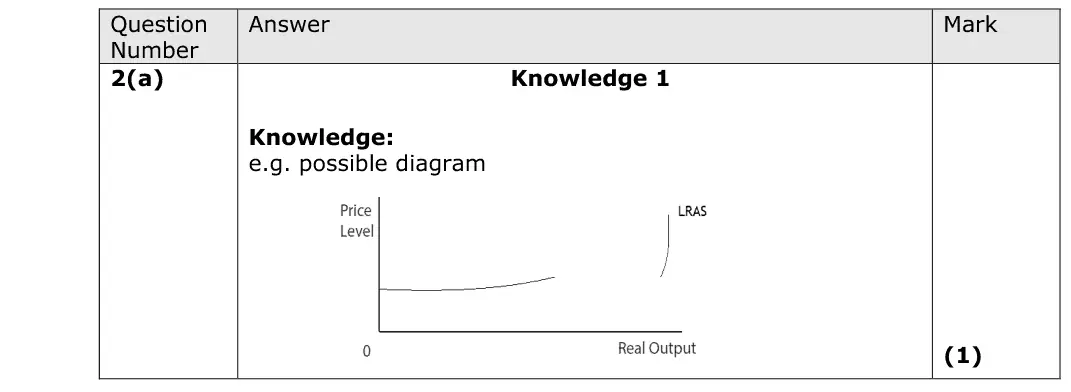
Keynesian LRAS is horizontal at low output, upward sloping, then vertical at full capacity
report: a few drew the classical vertical LRAS instead
Quantitative skills: QS 4 (construct and interpret a range of standard graphical forms)
June 2019 · AS Paper 2 · Q2(c)1 markMultiple choice
Answer
D
Mark scheme
Notes from the mark scheme and report
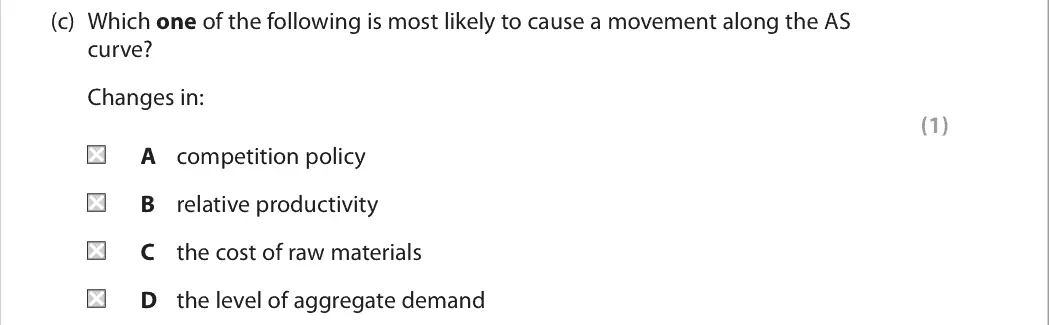
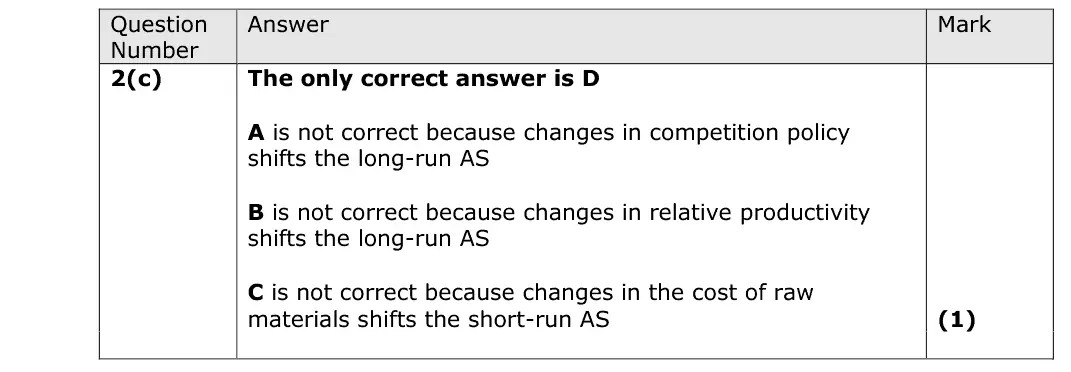
a change in AD causes a movement along the AS curve (D)
A and B shift LRAS
C shifts SRAS
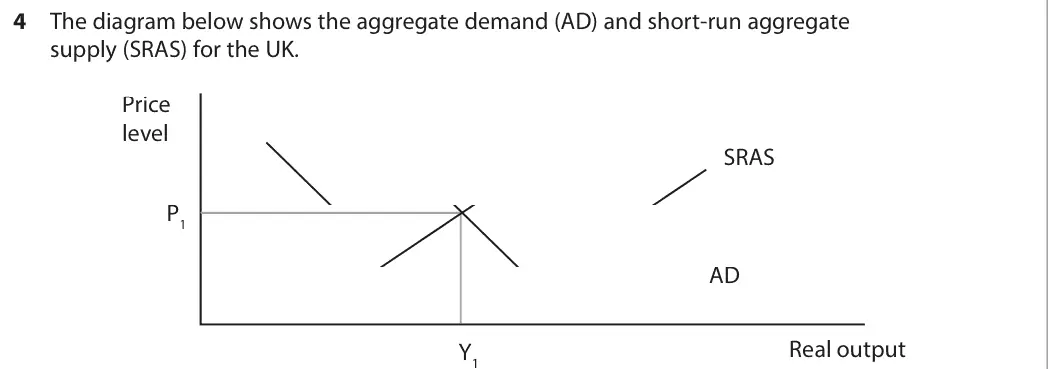
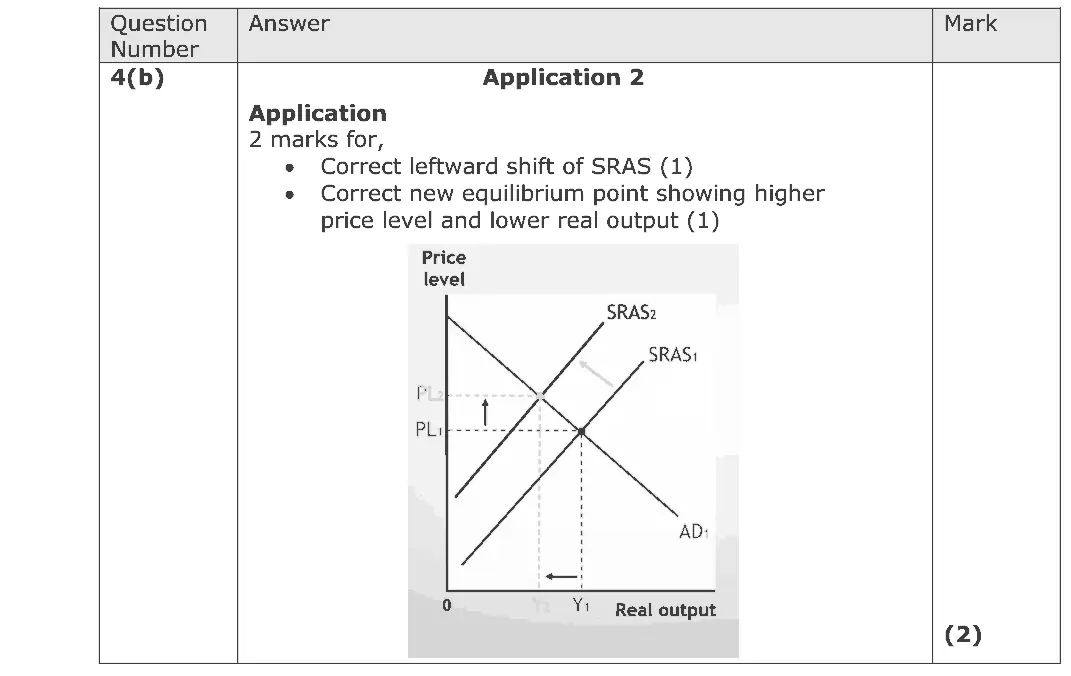
June 2018 · AS Paper 2 · Q4(b)2 marksAO2=2Diagram
Data and extracts for question 4
Mark scheme
Examiner's comment
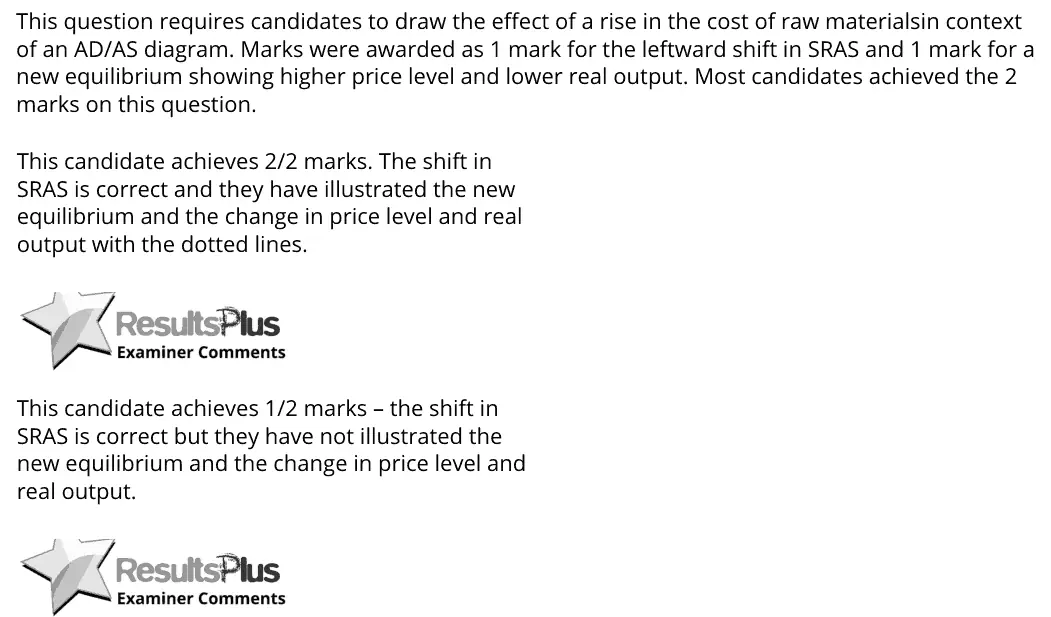
This question requires candidates to draw the effect of a rise in the cost of raw materialsin context of an AD/AS diagram. Marks were awarded as 1 mark for the leftward shift in SRAS and 1 mark for a new equilibrium showing higher price level and lower real output. Most candidates achieved the 2 marks on this question. This candidate achieves 2/2 marks. The shift in SRAS is correct and they have illustrated the new equilibrium and the change in price level and real output with the dotted lines. This candidate achieves 1/2 marks – the shift in SRAS is correct but they have not illustrated the new equilibrium and the change in price level and real output.
Notes from the mark scheme and report
shift SRAS left and mark the new equilibrium with a higher price level and lower real output
missing the new equilibrium loses a mark
Quantitative skills: QS 4 (construct and interpret a range of standard graphical forms)
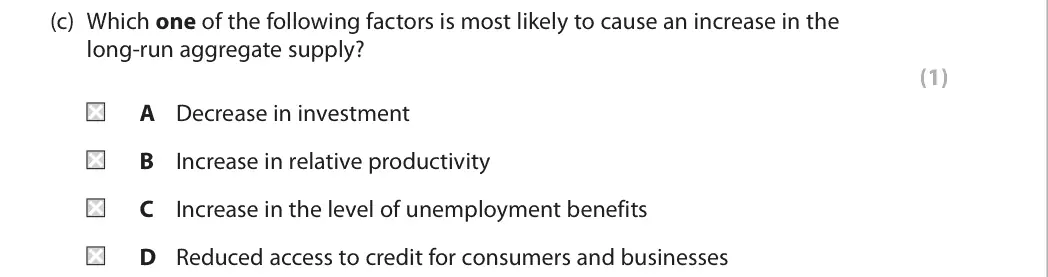
June 2018 · AS Paper 2 · Q4(c)1 markMultiple choice
Data and extracts for question 4
Answer
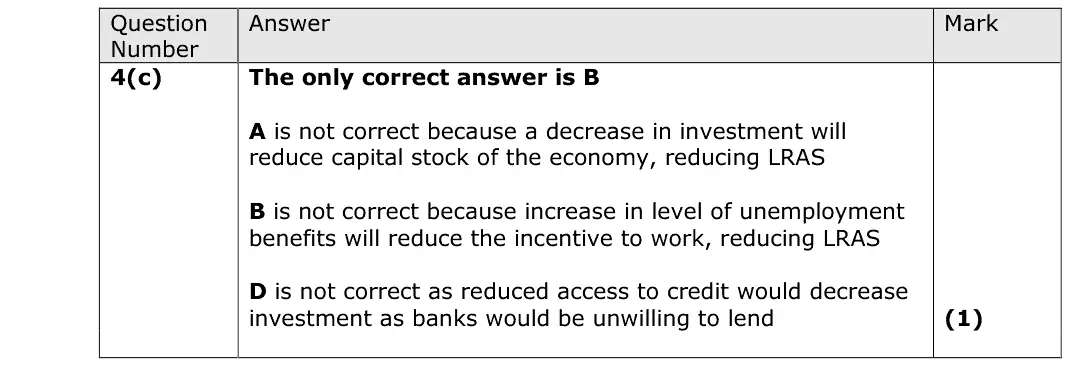
B
Mark scheme
Notes from the mark scheme and report
higher relative productivity shifts LRAS right (B)
lower investment, higher benefits (weaker work incentives) and less credit reduce LRAS
June 2018 · Paper 2 · Q725 marksAO1=4, AO2=4, AO3=8, AO4=925-mark essayEither/or
Mark scheme, including the levels grid and indicative content
Examiner's comment
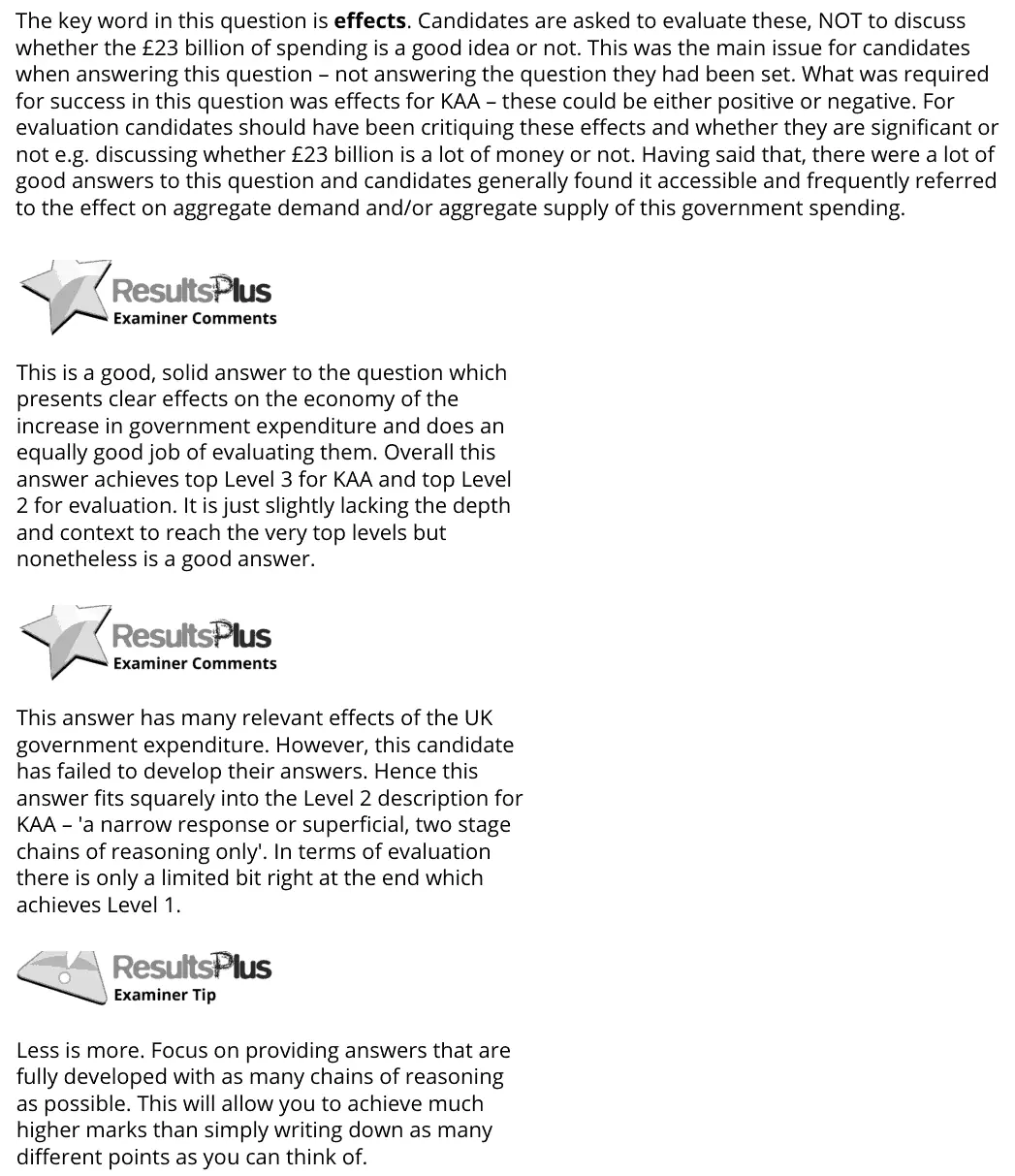
The key word in this question is effects. Candidates are asked to evaluate these, NOT to discuss whether the £23 billion of spending is a good idea or not. This was the main issue for candidates when answering this question – not answering the question they had been set. What was required for success in this question was effects for KAA – these could be either positive or negative. For evaluation candidates should have been critiquing these effects and whether they are significant or not e.g. discussing whether £23 billion is a lot of money or not. Having said that, there were a lot of good answers to this question and candidates generally found it accessible and frequently referred to the effect on aggregate demand and/or aggregate supply of this government spending. This is a good, solid answer to the question which presents clear effects on the economy of the increase in government expenditure and does an equally good job of evaluating them. Overall this answer achieves top Level 3 for KAA and top Level 2 for evaluation. It is just slightly lacking the depth and context to reach the very top levels but nonetheless is a good answer. This answer has many relevant effects of the UK government expenditure. However, this candidate has failed to develop their answers. Hence this answer fits squarely into the Level 2 description for KAA – 'a narrow response or superficial, two stage chains of reasoning only'. In terms of evaluation there is only a limited bit right at the end which achieves Level 1. Less is more. Focus on providing answers that are fully developed with as many chains of reasoning as possible. This will allow you to achieve much higher marks than simply writing down as many different points as you can think of.
Notes from the mark scheme and report
evaluate the effects (AD and multiplier, productivity and LRAS, exports), not whether the spending is a good idea
evaluate size of £23 billion over five years, time lags, government efficiency in allocating resources
a diagram may be used but is not required
June 2017 · Paper 2 · Q825 marksAO1=4, AO2=4, AO3=8, AO4=925-mark essayEither/or
Mark scheme, including the levels grid and indicative content
Examiner's comment
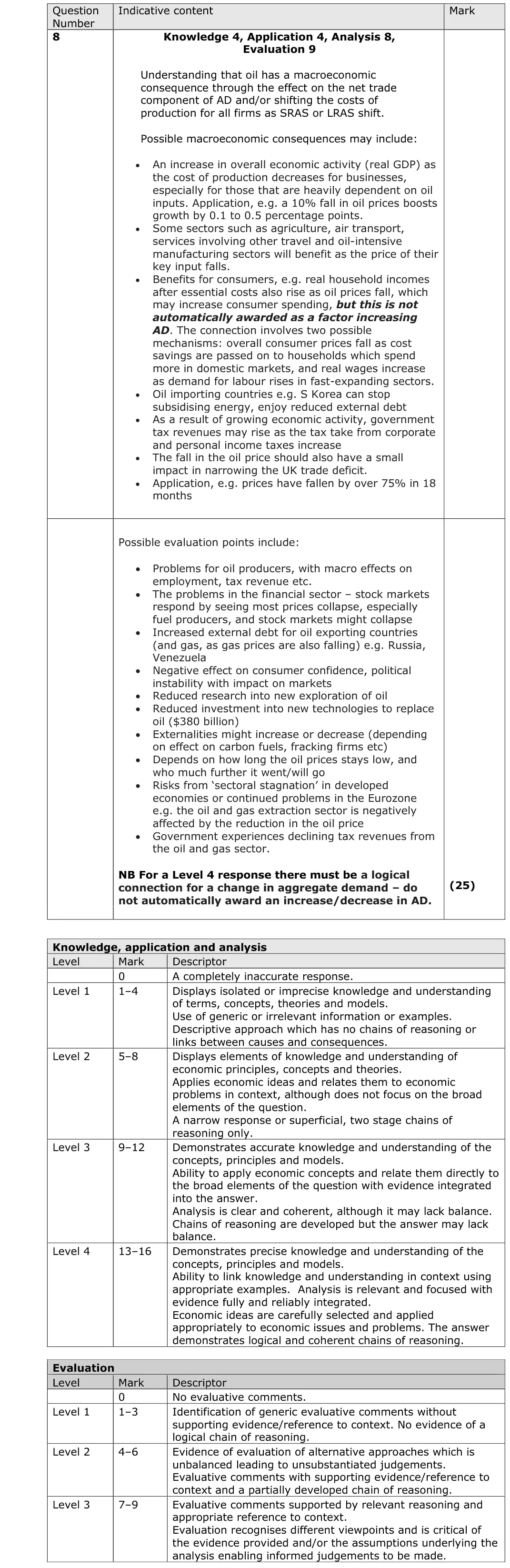
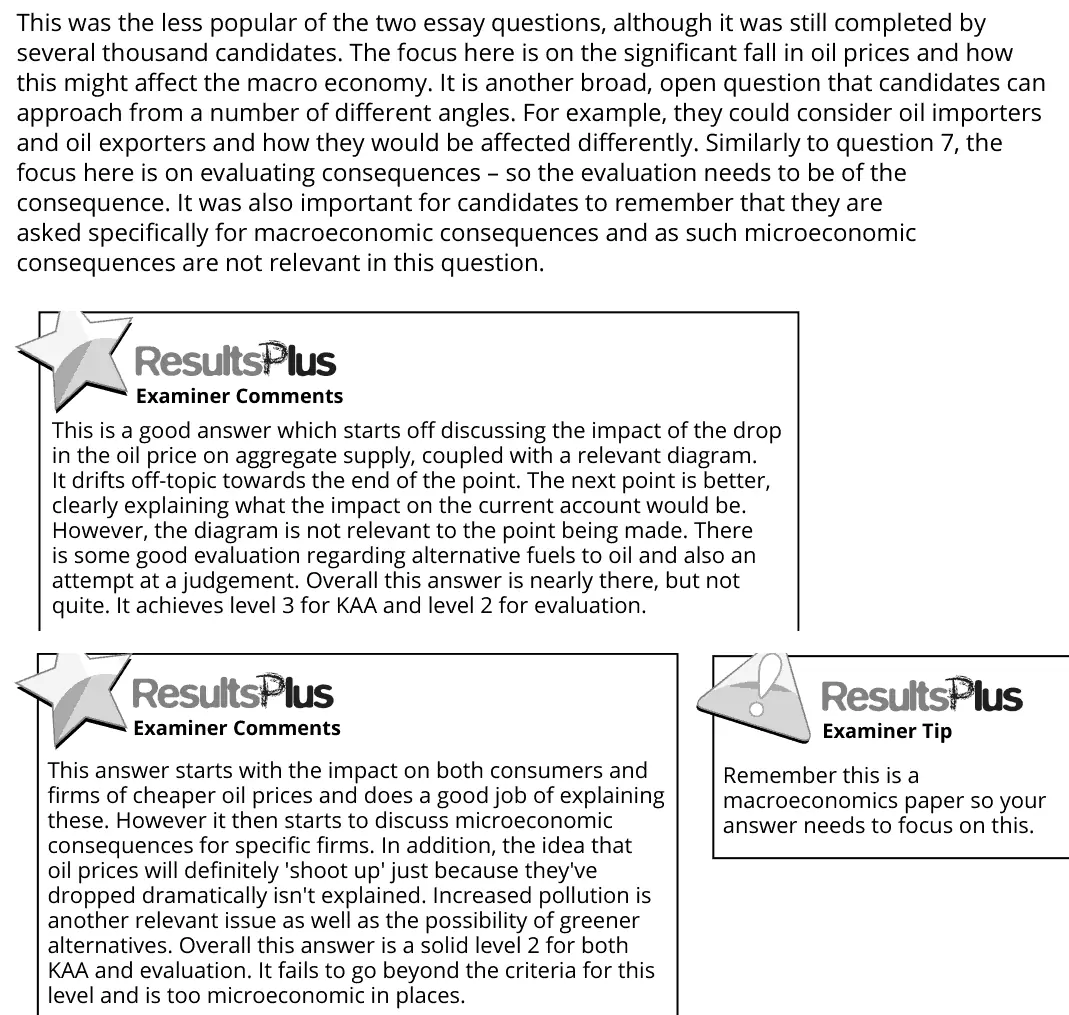
This was the less popular of the two essay questions, although it was still completed by several thousand candidates. The focus here is on the significant fall in oil prices and how this might affect the macro economy. It is another broad, open question that candidates can approach from a number of different angles. For example, they could consider oil importers and oil exporters and how they would be affected differently. Similarly to question 7, the focus here is on evaluating consequences – so the evaluation needs to be of the consequence. It was also important for candidates to remember that they are asked specifically for macroeconomic consequences and as such microeconomic consequences are not relevant in this question. This is a good answer which starts off discussing the impact of the drop in the oil price on aggregate supply, coupled with a relevant diagram. It drifts off-topic towards the end of the point. The next point is better, clearly explaining what the impact on the current account would be. However, the diagram is not relevant to the point being made. There is some good evaluation regarding alternative fuels to oil and also an attempt at a judgement. Overall this answer is nearly there, but not quite. It achieves level 3 for KAA and level 2 for evaluation. This answer starts with the impact on both consumers and firms of cheaper oil prices and does a good job of explaining these. However it then starts to discuss microeconomic consequences for specific firms. In addition, the idea that oil prices will definitely 'shoot up' just because they've dropped dramatically isn't explained. Increased pollution is another relevant issue as well as the possibility of greener alternatives. Overall this answer is a solid level 2 for both KAA and evaluation. It fails to go beyond the criteria for this level and is too microeconomic in places. Remember this is a macroeconomics paper so your answer needs to focus on this.
Notes from the mark scheme and report
lower oil prices shift SRAS right (lower inflation, higher real GDP) and affect net trade
oil importers vs exporters differ
macro consequences only, micro effects on specific firms earn little
Level 4 needs a logical link to changes in AD/AS
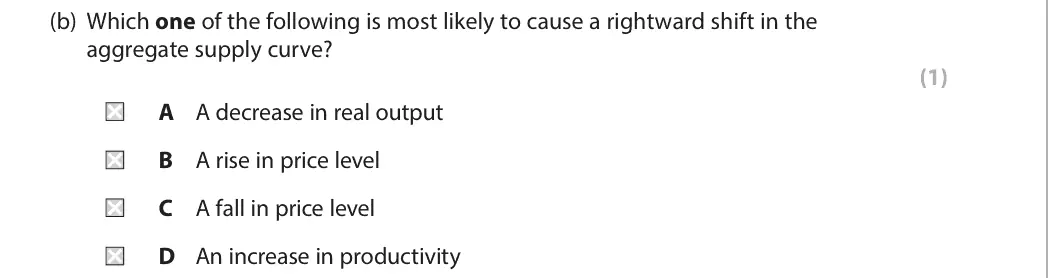
June 2016 · AS Paper 2 · Q5(b)1 markMultiple choice
Data and extracts for question 5
Answer
D
Mark scheme
Notes from the mark scheme and report
higher productivity raises productive capacity, shifting AS right (D)
A is an outcome
B and C are price level changes, which are movements along AS
Work with an Edexcel economics tutor
Essays stuck in Level 2, or losing the easy marks in Section A? Book a trial session with Lianne, a former Edexcel examiner.